Blog

  • MIL-OSI Canada: Government of Canada supports women-led organizations in southern Ontario

    Source: Government of Canada News

    Today, the Honourable Ruby Sahota, Minister of Democratic Institutions and Minister responsible for the Federal Economic Development Agency for Southern Ontario (FedDev Ontario), along with the Honourable Mona Fortier, Member of Parliament for Ottawa–Vanier, announced a combined investment of nearly $4.2 million to support five women-led organizations to scale-up, modernize their ventures, and grow.

    MIL OSI Canada News

  • MIL-OSI Canada: Biography – Marie-Josée Houle

    Source: Government of Canada News

    Ms. Houle was appointed as Canada’s first Federal Housing Advocate in 2022, marking a new chapter in a career defined by her work in the affordable housing and homelessness sector. Ms. Houle is an experienced leader who is recognized for her community activism, expertise in human rights, and extensive knowledge of the housing and homelessness system.

    MIL OSI Canada News

  • MIL-OSI Canada: Drugs for Rare Diseases – Ontario Agreement

    Source: Government of Canada News

    Today, the Governments of Canada and the province of Ontario signed the National Strategy for Drugs for Rare Disease (DRD) agreement to invest over $535 million over three years to improve access to new drugs for rare diseases for Ontario residents and to support enhanced access to existing drugs, early diagnosis, and screening for rare diseases.

    MIL OSI Canada News

  • MIL-OSI Canada: Minister of Transport and Internal Trade to make an important announcement at the Port of Halifax

    Source: Government of Canada News

    HALIFAX, NOVA SCOTIA – The Minister of Transport and Internal Trade, the Honourable Anita Anand, will make an announcement related to Canada’s supply chain infrastructure and green shipping corridors. She will be accompanied by Fulvio Fracassi, the Chief Executive Officer of the Halifax Port Authority.

    MIL OSI Canada News

  • MIL-OSI China: VAT invoice data reflects robust Spring Festival holiday consumption

    Source: China State Council Information Office 3

    China’s State Taxation Administration released value-added tax (VAT) invoice data on Wednesday, revealing strong consumer spending during the Spring Festival holiday.

    The eight-day holiday, which ended on Tuesday, saw the average daily sales revenues of consumer-related industries increase 10.8 percent from last year’s Spring Festival.

    Goods consumption grew 9.9 percent year on year, and services consumption saw a 12.3 percent rise, according to the data.

    Strong participation in China’s policy-backed consumer goods trade-in program boosted holiday market consumer sentiment.

    Household appliance and audiovisual equipment sales revenues surged 166.4 percent from last year’s holiday figure, and sales of communication devices jumped 181.9 percent.

    Since last year, “trade-in” has been a buzzword in China’s consumer market, driving retail sales growth steadily.

    The holiday saw a tourism market boom, with sales revenues from tourism-related services increasing 37.5 percent.

    Homestay businesses flourished during the period, attracting tourists with personalized lodging experiences marked by local cultural characteristics. Their sales revenues increased 12.6 percent compared to the Spring Festival holiday last year.

    Demand for sports entertainment and fitness services remained strong, with sports venues reporting a 135 percent increase in sales revenues and fitness services seeing a 224.1 percent revenue rise.

    Department store retail sales increased 5.2 percent, and convenience store sales grew 16.1 percent, according to the data.

    The vibrant holiday market has boosted confidence in the Chinese economy, setting a positive tone for the rest of the year, said Chen Lifen, a researcher at the Development Research Center of the State Council.

    MIL OSI China News

  • MIL-OSI: R3 partners with IDEMIA Secure Transactions to Transform CBDC Payments Both Online and Offline

    Source: GlobeNewswire (MIL-OSI)

    • R3’s Digital Currency platform integrates IDEMIA Secure Transactions’ offline solution to enable secure, seamless CBDC transactions both online and offline, progressing the global digital payments ecosystem.

    LONDON, Feb. 06, 2025 (GLOBE NEWSWIRE) — R3, the financial markets digital solutions provider, has partnered with IDEMIA Secure Transactions (IST), a division of IDEMIA Group and global provider of secure payment and connectivity solutions, to offer offline payment solutions. This partnership marks a significant step forward in the evolution of Central Bank Digital Currencies (CBDCs), offering enhanced access and usability across both online and offline environments.

    R3’s Digital Currency platform is advancing global financial infrastructure by empowering central banks and financial institutions with programmable digital money for wholesale and retail CBDCs, as well as private digital currencies. Built on R3’s Corda—the leading tokenization platform for regulated institutions with 60+ live applications globally—it offers secure, scalable digital money solutions that ensure network sovereignty and interoperability. Users have control over their networks while maintaining the ability to transact seamlessly across others unlocking access to next-generation services.

    IST provides secure, market-leading offline capabilities for CBDCs, and other digital currencies. The solution leverages hardware security, robust offline payment protocols and device-integrated security layers to enable safe and easy offline transactions directly on user devices. IST also offers secure dynamic provisioning solutions, based on its market leading platform, to remotely deploy offline wallets on user smartphones. Integrating IST’s offline solution with R3’s Digital Currency platform enables CBDCs issued on Corda to be held and used in retail offline transactions, providing cash-like capabilities to the CBDC.

    This collaboration provides a unique advancement in online and offline CBDC usage, enabling end-users to make transactions from a range of devices, including phones and smart cards. This initiative enhances financial inclusion, especially for remote areas where there may be limited or no internet capability, strengthening the digital payment system and diversifying payment options. It also enhances financial services resilience whilst introducing new technologies to support further customer product innovation.

    Commenting on the partnership, Kate Karimson, Chief Commercial Officer of R3, said, “As 130 countries actively explore CBDCs, while many others are pursuing alternative forms of tokenized payment solutions, these innovations have the potential to generate huge financial efficiencies for both the wholesale and retail sector by reducing payment fees and accelerating the movement of money. By enabling secure and efficient offline transactions, IDEMIA Secure Transactions and R3 are unlocking access to this promising technology and building products for an open and connected digital future. We’re excited to expand this initiative to other product capabilities soon.”

    Kate Eagle, Head of Growth & Innovation Incubation at IDEMIA Secure Transactions, said, “IDEMIA Secure Transactions is excited to partner with R3 on our offline digital currency solution. Integrating with R3’s Digital Currency platform to enable CBDCs issued on the Corda network to be exchanged offline from a range of devices expands access to digital currencies and streamlines the wallet payment experience. This partnership also introduces technology that enables consecutive offline payments between payers and payees, leveraging secure chip technology for enhanced and uncompromised security. We are proud to be driving financial inclusion and innovation at the forefront of this sector.”

    Media Enquiries

    Eterna Partners

    (+44) 7442 230170

    R3@eternapartners.com

    About R3

    R3 is the leader in digital currency, digital assets and interoperability solutions. R3 supports Central Banks, Corporates and FMIs by providing them with solutions to progress financial markets digitization.

    Corda is an open, permissioned DLT platform powering the tokenization of assets and currencies connecting global markets. Corda enables tokenization with control, security and privacy, providing asset mobility in a permissioned, trusted environment.

    R3 is committed to progressing financial markets and to enabling an open, trusted and advanced digital economy.

    For further information, please visit www.r3.com.

    The MIL Network

  • MIL-OSI: International Petroleum Corporation to release 2024 Year-End Financial and Operational Results and to hold Capital Markets Day on February 11, 2025

    Source: GlobeNewswire (MIL-OSI)

    International Petroleum Corporation (IPC) (TSX, Nasdaq Stockholm: IPCO) will publish its financial and operating results and related management’s discussion and analysis for the three months and year ended December 31, 2024, on Tuesday, February 11, 2025 at 07:30 CET, followed by an audiocast at 10:00 CET (09:00 GMT). IPC’s annual Capital Markets Day will also be held on Tuesday, February 11, 2025 as a webcast at 15:00 CET (14:00 GMT).

    Follow the 2024 year-end financial and operating results presentation starting at 10:00 CET (09:00 GMT) live on www.international-petroleum.com or using the link below:

    Presentation Link: https://ipc.videosync.fi/2025-02-11-q4

    Follow the Capital Markets Day presentation at 15:00 CET (14:00 GMT) live on www.international-petroleum.com or using the link below:

    Presentation Link: https://ipc.videosync.fi/2025-02-11-cmd

    International Petroleum Corp. (IPC) is an international oil and gas exploration and production company with a high quality portfolio of assets located in Canada, Malaysia and France, providing a solid foundation for organic and inorganic growth. IPC is a member of the Lundin Group of Companies. IPC is incorporated in Canada and IPC’s shares are listed on the Toronto Stock Exchange (TSX) and the Nasdaq Stockholm under the symbol “IPCO”.

    For further information, please contact:

    Rebecca Gordon
    SVP Corporate Planning and Investor Relations
    rebecca.gordon@international-petroleum.com
    Tel: +41 22 595 10 50
     

    Or

    Robert Eriksson
    Media Manager
    reriksson@rive6.ch
    Tel: +46 701 11 26 15

    Forward-Looking Statements
    This press release contains statements and information which constitute “forward-looking statements” or “forward-looking information” (within the meaning of applicable securities legislation). Such statements and information (together, “forward-looking statements”) relate to future events, including the Corporation’s future performance, business prospects or opportunities. Actual results may differ materially from those expressed or implied by forward-looking statements. The forward-looking statements contained in this press release are expressly qualified by this cautionary statement. Forward-looking statements speak only as of the date of this press release, unless otherwise indicated. IPC does not intend, and does not assume any obligation, to update these forward-looking statements, except as required by applicable laws.

    All statements other than statements of historical fact may be forward-looking statements. Any statements that express or involve discussions with respect to predictions, expectations, beliefs, plans, projections, forecasts, guidance, budgets, objectives, assumptions or future events or performance (often, but not always, using words or phrases such as “seek”, “anticipate”, “plan”, “continue”, “estimate”, “expect”, “may”, “will”, “project”, “forecast”, “predict”, “potential”, “targeting”, “intend”, “could”, “might”, “should”, “believe”, “budget” and similar expressions) are not statements of historical fact and may be “forward-looking statements”.

    Attachment

    The MIL Network

  • MIL-OSI: Mercurity Fintech Holding Inc. Officially Joins Russell Microcap® Index

    Source: GlobeNewswire (MIL-OSI)

    New York, NY, Feb. 06, 2025 (GLOBE NEWSWIRE) — Mercurity Fintech Holding Inc. (the “Company,” “we,” “us,” “our company,” or “MFH”) (Nasdaq: MFH), a digital fintech group, today announced its inclusion in the FTSE Russell Microcap® Index, marking a significant milestone in the Company’s growth trajectory.

    Inclusion in the Russell Microcap Index positions MFH among a select group of promising growth companies and enhances its visibility within the investment community. The Russell indexes are widely recognized as key benchmarks for investment managers and institutional investors, who rely on them for index funds and active investment strategies. As of the end of 2024, the Company has observed increased passive equity holdings from leading global financial institutions, including BlackRock, UBS Group AG, and Citigroup, which may be influenced, in part, by the Company’s inclusion in the Russell Microcap Index. The Company believes its inclusion in the Russell Microcap Index has positively impacted its shareholder structure and has contributed to increased recognition and credibility among institutional investors.

    Shi Qiu, CEO of Mercurity Fintech Holding Inc., said, “This milestone reflects our tremendous growth and highlights the strength of our business as we continue to expand in AI hardware intelligent manufacturing and advanced liquid cooling solutions. Our inclusion in the Russell Microcap Index validates our strategic direction and underscores the value we’re creating in AI hardware manufacturing sector.”

    Membership in the Russell Microcap Index, which remains in place for one year, is subject to annual or periodic reconstitution by FTSE Russell and depends on the Company meeting the requisite criteria at the time of such reconstitution. FTSE Russell determines membership for its Russell indexes primarily by objective, market-capitalization rankings, and style attributes.

    “We are honored to be recognized alongside other promising companies in the Russell Microcap Index,” continued Qiu. “This achievement opens up new opportunities for visibility and investment, and we look forward to the continued journey ahead as we strive to innovate and deliver value to our shareholders.”

    About Mercurity Fintech Holding Inc.
    Mercurity Fintech Holding Inc. is a digital fintech company with subsidiaries specializing in distributed computing and financial brokerage business. In addition to our fintech operations, we are actively contributing to the evolution of AI hardware technology by providing secure, cutting-edge solutions in intelligent manufacturing and advanced liquid cooling systems. Our dedication to compliance, innovation, and operational excellence ensures that we remain a trusted partner in both the rapidly transforming digital financial landscape and the dynamic AI technology sector. For more information, please visit the Company’s website at https://mercurityfintech.com.

    Forward-Looking Statements
    This announcement contains forward-looking statements within the meaning of the safe harbor provisions of the Private Securities Litigation Reform Act of 1995. All statements other than statements of historical fact in this announcement are forward-looking statements. These forward-looking statements involve known and unknown risks and uncertainties and are based on current expectations and projections about future events and financial trends that the Company believes may affect its financial condition, results of operations, business strategy and financial needs. Investors can identify these forward-looking statements by words or phrases such as “may,” “will,” “expect,” “anticipate,” “aim,” “estimate,” “intend,” “plan,” “believe,” “potential,” “continue,” “is/are likely to” or other similar expressions. The Company undertakes no obligation to update forward-looking statements to reflect subsequent occurring events or circumstances, or changes in its expectations, except as may be required by law. Although the Company believes that the expectations expressed in these forward-looking statements are reasonable, it cannot assure you that such expectations will turn out to be correct, and the Company cautions investors that actual results may differ materially from the anticipated results.

    For more information, please contact:
    International Elite Capital Inc.
    Vicky Chueng
    Tel: +1(646) 866-7989
    Email: mfhfintech@iecapitalusa.com

    The MIL Network

  • MIL-OSI: International Petroleum Corporation to release 2024 Year-End Financial and Operational Results and to hold Capital Markets Day on February 11, 2025

    Source: GlobeNewswire (MIL-OSI)

    TORONTO, Feb. 06, 2025 (GLOBE NEWSWIRE) — International Petroleum Corporation (IPC) (TSX, Nasdaq Stockholm: IPCO) will publish its financial and operating results and related management’s discussion and analysis for the three months and year ended December 31, 2024, on Tuesday, February 11, 2025 at 07:30 CET, followed by an audiocast at 10:00 CET (09:00 GMT). IPC’s annual Capital Markets Day will also be held on Tuesday, February 11, 2025 as a webcast at 15:00 CET (14:00 GMT).

    Follow the 2024 year-end financial and operating results presentation starting at 10:00 CET (09:00 GMT) live on www.international-petroleum.com or using the link below:

    Presentation Link: https://ipc.videosync.fi/2025-02-11-q4

    Follow the Capital Markets Day presentation at 15:00 CET (14:00 GMT) live on www.international-petroleum.com or using the link below:

    Presentation Link: https://ipc.videosync.fi/2025-02-11-cmd

    International Petroleum Corp. (IPC) is an international oil and gas exploration and production company with a high quality portfolio of assets located in Canada, Malaysia and France, providing a solid foundation for organic and inorganic growth. IPC is a member of the Lundin Group of Companies. IPC is incorporated in Canada and IPC’s shares are listed on the Toronto Stock Exchange (TSX) and the Nasdaq Stockholm under the symbol “IPCO”.

    For further information, please contact:

    Rebecca Gordon
    SVP Corporate Planning and Investor Relations
    rebecca.gordon@international-petroleum.com
    Tel: +41 22 595 10 50
    Or Robert Eriksson
    Media Manager
    reriksson@rive6.ch
    Tel: +46 701 11 26 15
         

    Forward-Looking Statements
    This press release contains statements and information which constitute “forward-looking statements” or “forward-looking information” (within the meaning of applicable securities legislation). Such statements and information (together, “forward-looking statements”) relate to future events, including the Corporation’s future performance, business prospects or opportunities. Actual results may differ materially from those expressed or implied by forward-looking statements. The forward-looking statements contained in this press release are expressly qualified by this cautionary statement. Forward-looking statements speak only as of the date of this press release, unless otherwise indicated. IPC does not intend, and does not assume any obligation, to update these forward-looking statements, except as required by applicable laws.

    All statements other than statements of historical fact may be forward-looking statements. Any statements that express or involve discussions with respect to predictions, expectations, beliefs, plans, projections, forecasts, guidance, budgets, objectives, assumptions or future events or performance (often, but not always, using words or phrases such as “seek”, “anticipate”, “plan”, “continue”, “estimate”, “expect”, “may”, “will”, “project”, “forecast”, “predict”, “potential”, “targeting”, “intend”, “could”, “might”, “should”, “believe”, “budget” and similar expressions) are not statements of historical fact and may be “forward-looking statements”.

    The MIL Network

  • MIL-OSI: c/side Media Alert: What E-Commerce Businesses Must Know About Recent PCI DSS Updates

    Source: GlobeNewswire (MIL-OSI)

    SAN FRANCISCO, Feb. 06, 2025 (GLOBE NEWSWIRE) — c/side, a cybersecurity company with tools for monitoring, optimizing, and securing vulnerable browser-side third-party scripts, today highlighted new self-attestation requirements introduced in recent PCI updates ahead of the March 31, 2025, compliance deadline.

    The Payment Card Industry Security Standards Council (PCI SSC) introduced significant changes to Self-Assessment Questionnaire A (SAQ A) on January 30, 2025. While SAQ A has traditionally offered a simplified compliance path for low-risk merchants not storing cardholder data, the update adds a crucial requirement: merchants must now confirm their e-commerce systems are protected against client-side script attacks to maintain their SAQ A qualification status.

    “E-commerce businesses must now self-attest that their site is secure against client-side web script attacks,” said Simon Wijckmans, CEO and founder, c/side. “This change presents compliance challenges, especially for merchants relying on third-party payment providers, as many lack the expertise to assess client-side risks. Without the right protections, they may no longer qualify for SAQ A. The best way to ensure PCI DSS 4.0.1 compliance is to continuously monitor the client-side environment in real-time and stay ahead of evolving threats.”

    What e-commerce merchants must know:

    • Critical March 31 deadline: Merchants must verify (and attest to) their protection against client-side attacks to maintain SAQ A qualification under PCI DSS v4.0.1.
    • Expanded merchant responsibility: While requirements 6.4.3 and 11.6.1 are no longer mandatory, merchants must now actively demonstrate client-side security measures.
    • Hidden vulnerabilities in modern e-commerce: Third-party payment providers do not automatically protect against script manipulation, leaving payment data exposed to sophisticated attacks.
    • Escalating risk environment: Client-side attacks have been rising fast and affecting merchants both large and small.

    Additional resources:

    About c/side

    c/side is a forward-thinking cybersecurity startup focused on browser-side detection and protection. Led by industry expert Simon Wijckmans, c/side is pioneering technologies to shield against sophisticated cyber threats, ensuring unparalleled security standards for users across the web.

    Contact
    Kyle Peterson
    kyle@clementpeterson.com

    The MIL Network

  • MIL-OSI Global: These maps of support for Germany’s far-right AfD lay bare the depth of the urban-rural divide

    Source: The Conversation – UK – By Rolf Frankenberger, Managing Director Research, Institute for Research on Right-Wing Extremism (IRex), University of Tübingen

    The process of industrialisation, globalisation and urbanisation – spreading out from urban centres into the countryside – is one of the core developments of modern society. It has changed people’s lives in almost every part of the world. This is a process that has been going on for more than a century. New lifestyles have developed and traditional ones have been challenged.

    A new division has emerged as a result between the urban and the rural. The two are more than just forms of settlements – they reflect ideals, values and lifestyles. Those who live in towns and cities lead almost entirely different lives to those who live in the countryside.

    Where the two meet, there is potential for tension. And that tension can be politicised. In Germany, the Alternative für Deutschland (AfD), a far-right nationalist and völkisch party, is using the “urban-rural divide” to polarise and mobilise an electorate that is attracted by romanticised notions of purity, tradition, nation and rurality.

    Using spatial and data analysis, we can illustrate the patterns of this politicisation.

    Imagine you are living in a small village in the countryside. You strongly believe in traditions and family life. You regard the landscape around you as home – as heimat, as it would be called in German. But people from abroad are moving into your village, because they can afford land there. They are different in the way they think and live. They might, for example, be digital nomads in search of a picturesque location for their home office.

    These newcomers bring the city with them, changing the rural community they join. City, to you, is a cipher for urbanity, globalism and individualism.

    But this is just one side of the coin. The other is that people from the countryside also move to cities, be it for education, work or just because there is nothing left in their village. And they bring their lifestyles to the city, too, trying to keep up traditional ideals of how the world should look.

    Diversity, ambiguity and, sometimes, incompatibility become the norm under these conditions. Urban lifestyles and designs – such as shared flats, alternative family forms, non-binary identity or digital mobility at work – collide with rural norms such as the traditional family and “rootedness” across generations.

    This can happen both in cities and in rural areas. As a result, a pluralism of ideas, styles and values arises – ranging from progressive, liberal and leftist, inclusive, modernist values to traditional, conservative and rightist, exclusive and nationalist beliefs. They coexist but are unevenly distributed over urban and rural areas.

    The AfD and other far-right parties introduce a political meaning to the urban-rural divide. The AfD pushes a narrative of the city as a negative force that is fundamentally incompatible with the rural. It claims that an elite cartel has usurped power in Germany and is trying to destroy the “culturally determined German identity”. It instead advocates for the protection of a leitkultur – of customs and traditions (brauchtum) that it believes create identity. It asserts heteronormativity as a biological fact, emphasises a strong traditional family, traditional farming and rural identity.

    What might be called cultural landscapes (kulturlandschaften) have become a particular battleground of late, with opposition to the construction of wind turbines, especially in forests, now a policy position. The AfD’s candidate for chancellor, Alice Weidel, described these as “windmills of shame” (“Windmühlen der Schande”) and called for their dismantling at the recent party congress. Wind turbines can be understood here as expressions of urban leitmotifs in a rural cultural landscape – they disrupt the countryside to provide energy for unseen urban consumers.

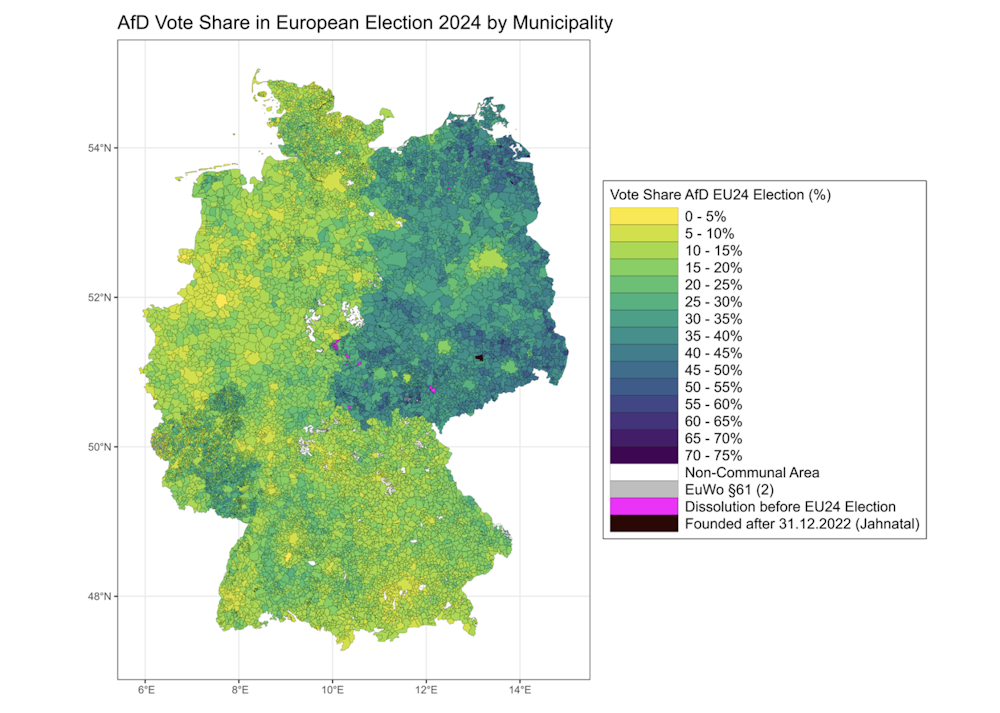
    And ultimately, this politicisation translates into electoral outcomes. In the European parliament elections of June 2024, the AfD took 15.9% of German votes. If we look at the spatial distribution of the AfD’s vote, a pattern showing the salience of the urban-rural divide emerges.

    East and west, town and country

    It’s clear by looking at the map that most (though not all) of the AfD’s strongholds are in eastern Germany – the region which used to be the German Democratic Republic (GDR). Fascism and Nazism were outlawed by decree when this anti-fascist state was established but, in reality, far-right ideologies don’t die off that easily. The result was that extremist views survived in an environment where there was also a lack of education on the National Socialism of the past – and a lack of education about democracy.

    When the socialist authoritarian GDR regime fell in 1989, Germany was reunified under western conditions. This had various effects, including a sense that the experiences of the east were not valued. The inequalities between the two sides of the reunified nation have left some in the east feeling distant from the state. The AfD’s version of nationalism finds fertile ground here.

    Another pattern is also clear across the whole country: the AfD is stronger in remote and rural areas and weaker in urban centres. There is less support in cities such as Berlin, Cologne, Dresden, Hamburg, Leipzig, Munich and Stuttgart. Places with more globalised cultures, international business and diverse populations remain comparably resilient to the spread of the far right.

    AfD support in different municipalities. The darker the colours, the higher the AfD vote share.
    R Frankenberger, CC BY-ND

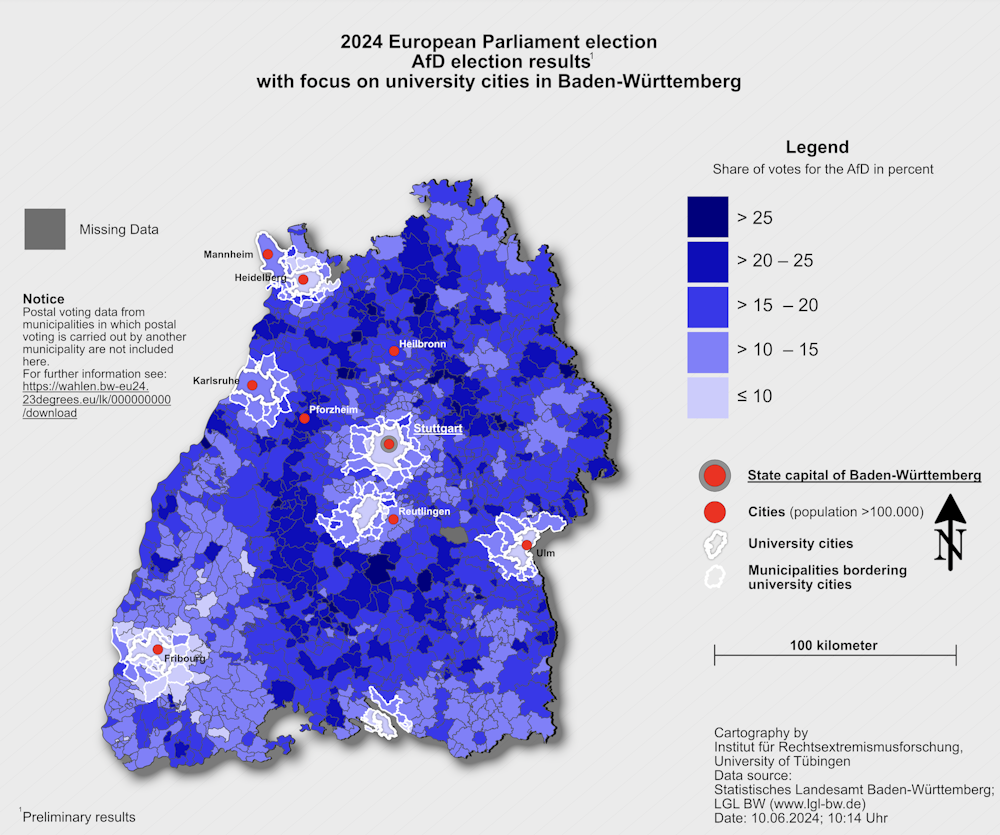
    These patterns become more visible if you take the European election results in the state of Baden-Württemberg as an example.

    The AfD performs significantly worse in the more globalised, cosmopolitan and university-oriented urban areas and their suburbs than in the more remote and rural areas of Baden-Württemberg. On the map, university cities are marked out with a white outline.

    AfD support mapped, with university cities highlighted.
    University of Tübingen, CC BY-ND

    The AfD is particularly strong in the northern and eastern Black Forest, on the Baar, in the Swabian Alb, in the Rems-Murr district, in the Swabian Forest and in Hohenlohe. Most of these areas are remote, with many small towns and villages. They have slightly lower income levels and lower levels of migration than average. They are much more traditional in terms of culture and religion than urban areas.

    The Black Forest, the Swabian Forest, and Hohenlohe also have quite strong protestant and evangelical communities, which are strongholds of traditional family life, customs and traditions.

    We should expect to see these trends continue. The AfD looks set to make further gains in the February 23 election being held in Germany, retaining its strongholds in the east but also spreading into the west in rural areas. The urban-rural divide will therefore become all the more apparent and entrenched when German voters head to the polls.

    Rolf Frankenberger does not work for, consult, own shares in or receive funding from any company or organisation that would benefit from this article, and has disclosed no relevant affiliations beyond their academic appointment.

    ref. These maps of support for Germany’s far-right AfD lay bare the depth of the urban-rural divide – https://theconversation.com/these-maps-of-support-for-germanys-far-right-afd-lay-bare-the-depth-of-the-urban-rural-divide-248405

    MIL OSI – Global Reports

  • MIL-OSI Africa: Female genital mutilation is a leading cause of death for girls where it’s practised – new study

    Source: The Conversation – Africa – By Heather D. Flowe, Professor of Psychology, University of Birmingham

    Female genital mutilation or cutting (FGM/C) is a deeply entrenched cultural practice that affects around 200 million women and girls. It’s practised in at least 25 African countries, as well as parts of the Middle East and Asia and among immigrant populations globally.

    It is a harmful traditional practice that involves removing or damaging female genital tissue. Often it’s “justified” by cultural beliefs about controlling female sexuality and marriageability. FGM/C causes immediate and lifelong physical and psychological harm to girls and women, including severe pain, complications during childbirth, infections and trauma.

    We brought together our expertise in economics and gender based violence to examine excess mortality (avoidable deaths) due to FGM/C. Our new research now reveals a devastating reality: FGM/C is one of the leading causes of death for girls and young women in countries where it’s practised. FGM/C can result in death from severe bleeding, infection, shock, or obstructed labour.

    Our study estimates that it causes approximately 44,000 deaths each year across the 15 countries we examined. That is equivalent to a young woman or girl every 12 minutes.

    This makes it a more significant cause of death in the countries studied than any other excluding infection, malaria and respiratory infections or tuberculosis. Put differently, it is a bigger cause of death than HIV/Aids, measles, meningitis and many other well-known health threats for young women and girls in these countries.

    Prior research has shown that FGM/C leads to severe pain, bleeding and infection. But tracking deaths directly caused by the practice has been nearly impossible. This is partly because FGM/C is illegal in many countries where it occurs, and it typically takes place in non-clinical settings without medical supervision.

    Where the crisis is most severe

    The practice is particularly prevalent in several African nations. In Guinea, our data show 97% of women and girls have undergone FGM/C, while in Mali the figure stands at 83%, and in Sierra Leone, 90%. The high prevalence rates in Egypt, with 87% of women and girls affected, are a reminder that FGM/C is not confined to sub-Saharan Africa.

    For our study, we analysed data from the 15 African countries for which comprehensive “gold standard” FGM/C incidence information is available. Meaning, the data is comprehensive, reliable and widely accepted for research, policymaking and advocacy efforts to combat FGM/C.

    We developed a new approach to help overcome previous gaps in data. We matched data on the proportion of girls subjected to FGM/C at different ages with age-specific mortality rates across 15 countries between 1990 and 2020. The age at which FGM occurs varies significantly by country. In Nigeria, 93% of procedures are performed on girls younger than five years old. In contrast, in Sierra Leone, most girls undergo the procedure between the ages of 10 and 14.

    Since health conditions vary from place to place and over time, and vary in the same place from one year to the next, we made sure to consider these differences. This helped us figure out if more girls were dying at the ages when FGM/C usually happens in each country.

    For example, in Chad, 11.2% of girls undergo FGM/C aged 0-4, 57.2% at 5-9 and 30% at 10-14. We could see how mortality rates changed between these age groups compared to countries with different FGM patterns.

    This careful statistical approach helped us identify the excess deaths associated with the practice while accounting for other factors that might affect child mortality.

    Striking findings

    Our analysis revealed that when the proportion of girls subjected to FGM in a particular age group increases by 50 percentage points, their mortality rate rises by 0.1 percentage points. While this may sound small, when applied across the population of affected countries, it translates to tens of thousands of preventable deaths annually.

    The scale is staggering: while armed conflicts in Africa caused approximately 48,000 combat deaths per year between 1995 and 2015, our research suggests FGM/C leads to about 44,000 deaths annually. This places FGM among the most serious public health challenges facing these nations.

    Beyond the numbers

    These statistics represent real lives cut short. Most FGM/C procedures are performed without anaesthesia, proper medical supervision, or sterile equipment. The resulting complications can include severe bleeding, infection and shock. Even when not immediately fatal, the practice can lead to long-term health problems and increased risks during childbirth.

    The impact extends beyond physical health. Survivors often face psychological trauma and social challenges. In many communities, FGM/C is deeply embedded in cultural practices and tied to marriage prospects, making it difficult for families to resist the pressure to continue the tradition.

    Urgent crisis

    FGM/C is not just a human rights violation – it’s a public health crisis demanding urgent attention. While progress has been made in some areas, with some communities abandoning the practice, our research suggests that current efforts to combat FGM/C need to be dramatically scaled up.

    The COVID-19 pandemic has potentially worsened the situation, owing to broader impacts of the pandemic on societies, economies and healthcare systems. The UN estimates that the pandemic may have led to 2 million additional cases of FGM/C that could have been prevented. Based on our mortality estimates, this could result in approximately 4,000 additional deaths in the 15 countries we studied.

    The way forward

    Ending FGM/C requires a multi-faceted approach. Legal reforms are crucial – the practice remains legal in five of the 28 countries where it’s most commonly practised. However, laws alone aren’t enough. Community engagement, education, and support for grassroots organisations are essential for changing deeply held cultural beliefs and practices.

    Previous research has shown that information campaigns and community-led initiatives can be effective. For instance, studies have documented reductions in FGM/C rates following increased social media reach in Egypt and the use of educational films showing different views on FGM/C.

    Most importantly, any solution must involve the communities where FGM/C is practised. Our research underscores that this isn’t just about changing traditions – it’s about saving lives. Every year of delay means tens of thousands more preventable deaths.

    Our findings suggest that ending FGM/C should be considered as urgent a priority as combating major infectious diseases. The lives of millions of girls and young women depend on it.

    – Female genital mutilation is a leading cause of death for girls where it’s practised – new study
    – https://theconversation.com/female-genital-mutilation-is-a-leading-cause-of-death-for-girls-where-its-practised-new-study-249171

    MIL OSI Africa

  • MIL-OSI United Kingdom: Civil servants can now learn more about national security

    Source: United Kingdom – Executive Government & Departments

    The College for National Security launches a new online course to help break down barriers and help civil servants learn more about national security.

    Andrew Millar, College for National Security

    Civil servants can now learn more about national security, thanks to a new online course launched by the College for National Security.

    The aim of the What is national security course is to break down barriers to understanding National Security threats and impacts and help civil servants integrate it into their jobs.

    Threats to the UK

    “To respond to a broad range of threats the UK faces, we need a workforce that is knowledgeable, skilled and connected when it comes to national security,” said college head Andrew Millar, pictured, who is also deputy director of Government Skills, of which the college is a part.

    “This course gives an introduction to national security and gives civil servants an overview of key national security themes. It’s an ideal introduction for anyone who would like a better understanding of national security, are interested in a career in national security or who are new to the sector.”

    Better understanding

    As part of its efforts to increase understanding of national security, the college has also published its ‘Guide to the UK National Security Community’. The guide outlines the departments, agencies and devolved administrations involved in national security and was developed in collaboration with 23 departments and agencies. It aims to help colleagues better understand the UK’s national security community and the breadth of departments involved. 

    Find out more about the College for National Security.

    Updates to this page

    Published 6 February 2025

    MIL OSI United Kingdom

  • MIL-OSI United Kingdom: New Chair of The Royal Mint announced

    Source: United Kingdom – Executive Government & Departments

    Chris Walton has taken up the position following Graham Love’s six-year term.

    The Treasury has today announced the appointment of Chris Walton as Non-Executive Chair of The Royal Mint.

    Chris Walton will be in position for an initial three-year term, succeeding Graham Love, who served as Chair since December 2018. Chris will oversee the Mint as it continues to diversify its portfolio into new business areas, and to produce UK circulating coins in line with demand.

    Commenting on the appointment, Economic Secretary to the Treasury and City Minister, Emma Reynolds said:

    I’m delighted to welcome Chris Walton to The Royal Mint as the new Chair. Chris brings a wealth of leadership experience to the role, and I look forward to working with him as he shapes the strategic vision of The Royal Mint in the years ahead.

    I want to thank Graham Love for his leadership over the last six years. Graham has overseen a number of successes in his time as Chair and has set the foundations for The Royal Mint of the future.

    Chris Walton added:

    It is a privilege to join The Royal Mint during this fascinating period of transformation. With sustainability at its core, the Mint is evolving for the future, and I am eager to support its growth and build on a remarkable legacy.

    The Royal Mint is one of the oldest companies in the world – supplying coins to the UK for over 1,100 years. It also produces commemorative coins, to mark events of national, historical and cultural significance, offers investment in precious metals, a jewellery collection and recycling precious metals from e-waste. 

    The Chair of The Royal Mint is responsible for providing strategic direction and works closely with the Board of Directors and Executive Team.

    Updates to this page

    Published 6 February 2025

    MIL OSI United Kingdom

  • MIL-OSI Canada: The Government of Canada announces an appointment to the Board of Directors of The Jacques Cartier and Champlain Bridges Incorporated

    Source: Government of Canada News (2)

    Today, the Honourable Nathaniel Erskine-Smith, Minister of Housing, Infrastructure and Communities, announced the appointment of Éric Michaud to the Board of Directors of The Jacques Cartier and Champlain Bridges Incorporated (JCCBI), the Crown corporation responsible for the operation of five federal transportation corridors in the Montreal area, and the Québec Bridge.

    MIL OSI Canada News

  • MIL-OSI Canada: Minister Sajjan inaugurates the new B Jetty at Canadian Forces Base Esquimalt 

    Source: Government of Canada News (2)

    Today, the Honourable Harjit S. Sajjan, President of the King’s Privy Council for Canada and Minister of Emergency Preparedness and Minister responsible for the Pacific Economic Development Agency of Canada, marked the opening of Canadian Forces Base (CFB) Esquimalt’s new B Jetty, on behalf of the Honourable Bill Blair, Minister of National Defence, and the Honourable Jean-Yves Duclos, Minister of Public Services and Procurement, and Quebec Lieutenant.

    MIL OSI Canada News

  • MIL-OSI Canada: Department of Finance Canada hosts briefing with industry stakeholders on the Canada-U.S. economic relationship

    Source: Government of Canada News (2)

    Yesterday, Chris Forbes, Deputy Minister of Finance, hosted the third briefing with Canadian industry and labour stakeholders, and provincial and territorial representatives on Canada-U.S. economic issues. Arun Alexander, Canada’s Deputy Ambassador to the United States of America, and Shannon Grainger, Assistant Deputy Minister, Portfolio Affairs and Communications, Public Safety Canada, also joined the call.

    MIL OSI Canada News

  • MIL-OSI Canada: Department of Finance Canada officials host second briefing with industry stakeholders on the Canada-U.S. economic relationship

    Source: Government of Canada News (2)

    Yesterday, Chris Forbes, Deputy Minister of Finance, hosted a second briefing with Canadian industry and labour stakeholders, and provincial and territorial representatives on Canada-U.S. economic issues. Canada’s Deputy Ambassador to the United States of America, Arun Alexander, also joined the call.

    MIL OSI Canada News

  • MIL-OSI Canada: Minister Lebouthillier meets with Nova Scotia Fisheries Minister

    Source: Government of Canada News (2)

    Today, the Minister of Fisheries, Oceans and the Canadian Coast Guard, the Honourable Diane Lebouthillier, met with the Nova Scotia Minister of Fisheries and Aquaculture, the Honourable Kent Smith, to discuss mutual interests in protecting the local economies of coastal communities, and ensuring our fisheries are sustainable for years to come.

    MIL OSI Canada News

  • MIL-OSI Canada: New oyster movement rules in Prince Edward Island to help prevent further spread of MSX

    Source: Government of Canada News (2)

    On July 11, 2024, Prince Edward Island (PEI) first detected multinucleate sphere unknown (MSX) – an oyster disease caused by the Haplosporidium nelsoni parasite. Since that time, the Canadian Food Inspection Agency (CFIA), Fisheries and Oceans Canada (DFO), and the Province of PEI have increased sampling and testing of oysters in PEI.

    MIL OSI Canada News

  • MIL-OSI Canada: Joint statement: Four years on from the Military Coup in Myanmar

    Source: Government of Canada News (2)

    January 31, 2025 – Ottawa, Ontario – Global Affairs Canada

    “Today marks 4 years since the Myanmar military regime overthrew the democratically elected government in Myanmar, creating one of the largest crises in the Indo-Pacific. Since the coup, the people of Myanmar remain subject to military rule that has deprived many of their rights, democratic aspirations and, for thousands, their liberty and their lives.

    MIL OSI Canada News

  • MIL-OSI Canada: Remarks by the Deputy Prime Minister on delivering a tax break for all Canadians and cracking down on short-term rentals

    Source: Government of Canada News (2)

    Inflation was two per cent in October. This means that inflation has been within the Bank of Canada’s target range for the past ten months, or the entire year. Notably, interest rates have already declined four times, and Canada was the first G7 country to cut interest rates.

    MIL OSI Canada News

  • MIL-OSI Canada: Remarks by the Deputy Prime Minister regarding Bill C-78, the Tax Break for All Canadians Act

    Source: Government of Canada News (2)

    Bill C-78 proposes a two-month tax break to all Canadians, from December 14, 2024, to February 15, 2025. With a GST/HST exemption across the country, Canadians will be able to buy essentials like groceries, prepared foods, snacks, and kids’ clothing—all tax-free.

    MIL OSI Canada News

  • MIL-OSI Canada: Media Advisory: Infrastructure Announcement in Gaspé

    Source: Government of Canada News

    Members of the media are invited to an infrastructure announcement with the Honourable Diane Lebouthillier, Minister of Fisheries, Oceans and the Canadian Coast Guard and Member of Parliament for Gaspésie—Les Îles-de-la-Madeleine, Daniel Côté, Mayor of Gaspé and Daniel Bernier, President of the Board of Directors, Comité Centre Artistique de Cap-aux-Os.

    MIL OSI Canada News

  • MIL-OSI Canada: Significant investments in marine safety and to support Indigenous communities through the Oceans Protection Plan

    Source: Government of Canada News

    Marine coordinators will be responsible for building relationships and integrating Indigenous Knowledge in proposed federal policies, programs, processes, directives, regulations, or legislation concerning marine safety and environmental protection. Additionally, the coordinators will help establish partnerships to better support the cooperative management of coasts and waterways.

    MIL OSI Canada News

  • MIL-OSI Canada: Canada announces new funding during International Development Week to strengthen climate action and economies 

    Source: Government of Canada News

    Climate change is one of today’s greatest challenges. Developing countries are often the hardest hit by climate change, and many have limited capacity to adapt to its impacts. As part of its efforts to achieve the UN’s Sustainable Development Goals, Canada is committed to doing its part to strengthen climate action and economies in vulnerable regions of the world so that we can all benefit from a healthy environment that is rich in biodiversity.

    MIL OSI Canada News

  • MIL-OSI Canada: Canada Invests in Climate Change Adaptation to Keep Communities Safe in Northern Ontario and Across Canada

    Source: Government of Canada News

    On January 29, 2025, Marc G. Serré, Parliamentary Secretary to the Honourable Jonathan Wilkinson, along with Member of Parliament Viviane Lapointe and Member of Parliament Anthony Rota, announced over $2.7 million in funding for five projects based in Northern Ontario under Natural Resources Canada’s Climate Change Adaptation Program (CCAP).

    MIL OSI Canada News

  • MIL-OSI Canada: Government of Canada announces re-appointment to Canada Infrastructure Bank Board of Directors

    Source: Government of Canada News

    Mr. Guilmette currently serves as Executive Vice President and Chief Financial Officer of Boralex, where he is responsible for several divisions, including Finance and Accounting, Taxation, Investor Relationst and Internal Controls. Prior to this, he served as Interim Chief Investment Officer at the Canada Infrastructure Bank (CIB), and held previous roles as the Senior Vice-President of Infrastructure Investments PSP Investments, and as Senior Director Private Equity Investments at the Caisse de dépôt et placement du Québec.

    MIL OSI Canada News

  • MIL-OSI Canada: Protecting Canada’s Democratic Institutions and Processes from Foreign Interference

    Source: Government of Canada News

    Foreign interference poses a growing threat to Canada’s democratic institutions. The Government of Canada is working to ensure that Canadians can maintain their trust in Canada’s democratic institutions. This includes a series of measures already in place, as well as ongoing work to further strengthen our electoral system against foreign interference.

    MIL OSI Canada News

  • MIL-OSI Canada: Backgrounder: Sanctions against individuals and entities in Belarus

    Source: Government of Canada News

    Canada is imposing sanctions against individuals and entities in relation to the Lukashenko regime’s ongoing gross and systematic human rights violations in Belarus, as well as its support of Russia’s violation of Ukraine’s sovereignty and territorial integrity.

    MIL OSI Canada News