NewzIntel.com

    • Checkout Page
    • Contact Us
    • Default Redirect Page
    • Frontpage
    • Home-2
    • Home-3
    • Lost Password
    • Member Login
    • Member LogOut
    • Member TOS Page
    • My Account
    • NewzIntel Alert Control-Panel
    • NewzIntel Latest Reports
    • Post Views Counter
    • Privacy Policy
    • Public Individual Page
    • Register
    • Subscription Plan
    • Thank You Page

Blog

  • MIL-OSI USA: [EXTERNAL] Office of the Governor — News Release — Governor Green Travels to Florida; Leads Discussions on Crisis Resolution, Recovery

    Source: US State of Hawaii

    [EXTERNAL] Office of the Governor — News Release — Governor Green Travels to Florida; Leads Discussions on Crisis Resolution, Recovery

    Posted on Feb 4, 2025 in Latest Department News, Newsroom, Office of the Governor Press Releases

    STATE OF HAWAIʻI 
    KA MOKU ʻĀINA O HAWAIʻI 

     
    JOSH GREEN, M.D. 
    GOVERNOR
    KE KIAʻĀINA 


    GOVERNOR GREEN TO TRAVEL TO FLORIDA TO LEAD DISCUSSIONS ON CRISIS RESOLUTION AND RECOVERY AT INTERNATIONAL CONFERENCE
     

    FOR IMMEDIATE RELEASE
    February 4, 2025

    HONOLULU — Governor Josh Green, M.D., will travel to lead discussions on Alternative Dispute Resolution at the International Institute for Crisis Prevention and Resolution’s annual meeting in Florida. As part of the panel, Governor Green will share valuable insights and best practices drawn from the state’s response to the August 2023 Maui wildfires, offering a perspective on how Hawai‘i is navigating its recovery. Additionally, Governor Green will meet with experts in mental health and the justice system who have developed national best practice approaches to crisis response, deflection from arrest, and diversion into services and housing for individuals with complex health and mental needs, many of whom are experiencing homelessness.

    Even while traveling, Governor Green’s first obligation is to Hawai‘i, ensuring he remains fully engaged in his duties including meetings, calls and administrative responsibilities with the executive Cabinet.

    The Governor will depart Hawai‘i on Tuesday evening, February 4, 2025, and return on Friday afternoon, February 7, 2025. During his absence, Lieutenant Governor Sylvia Luke will serve as Acting Governor.

    # # # 

    Media Contacts:   
    Erika Engle
    Press Secretary
    Office of the Governor, State of Hawai‘i
    Phone: 808-586-0120
    Email: [email protected]

    Makana McClellan
    Director of Communications
    Office of the Governor, State of Hawaiʻi
    Cell: 808-265-0083
    Email: [email protected]

    MIL OSI USA News –

    February 6, 2025
  • MIL-OSI: KK MINER: Best Free Bitcoin Litecoin and Dogecoin Cloud Mining Platform Regulated in the UK

    Source: GlobeNewswire (MIL-OSI)

    LONDON, Feb. 05, 2025 (GLOBE NEWSWIRE) — KK MINER, the UK-regulated leader in free cloud mining for Bitcoin, Litecoin, Dogecoin, and more, is excited to announce the launch of its brand-new mobile app. This timely release empowers users to access and manage their cloud mining investments anytime, anywhere, further democratizing cryptocurrency mining.

    Key Highlights of the Mobile App Launch:

    • Seamless On-the-Go Mining: The new mobile app provides a user-friendly interface for monitoring mining contracts, tracking daily earnings, and managing investments with ease.
    • Enhanced Security: Built with top-tier security measures from McAfee® and Cloudflare®, the app ensures your digital assets are protected wherever you are.
    • Instant Rewards: New users who register via the app receive an immediate $10 sign-up bonus and can earn $1 daily simply by logging in.
    • Diverse Contract Options: From a minimal $10 one-day contract to longer-term investments, users can choose from a variety of mining plans designed to suit different budgets and goals.
    • 24/7 Reliability: With 100% uptime and round-the-clock technical support, the mobile app guarantees uninterrupted access to your mining operations.

    “With the rapid growth predicted in the cryptocurrency market—experts foresee Bitcoin reaching $150,000, Litecoin $1,000, and Dogecoin breaking the $1 barrier by 2025—the launch of our mobile app comes at an opportune time,” said a KK MINER spokesperson. “We’re committed to making cloud mining accessible and secure, and our mobile solution is a game-changer for users seeking flexibility and efficiency.”

    Simple steps to start cloud mining with KK MINER

    Step 1: Choose KK MINER as your provider: KK MINER’s mining method is simple and straightforward, and users only need a minimum deposit to start mining. The platform ensures that everyone can participate by providing daily returns from mining contracts and flexible withdrawal methods.

    Step 2: Register an account: Visit KK MINER official kkminer.top. Then create an account with your email address, log in to access the dashboard and start mining immediately.

    Step 3: Purchase a mining contract: KK MINER offers a variety of contract options to meet different budgets and goals. Users can choose from the following options:

    The profit will be automatically credited to your account the next day after purchasing the contract. When the account reaches $100, you can choose to withdraw it to your crypto wallet or continue to purchase contracts to earn more profits.

    About KK MINER

    KK MINER leverages advanced cloud mining technology to eliminate traditional barriers like expensive hardware and technical know-how. The platform’s transparent model—featuring no management fees, daily payouts, and a variety of contract options—makes it a trusted choice for both newcomers and experienced miners alike. Regulated by UK financial authorities, KK MINER adheres to stringent standards for security and compliance, ensuring a reliable and legally compliant mining environment.

    Get Started Today

    Download the KK MINER mobile app now from the official website at https://kkminer.top/ and join the revolution in cloud mining. With the new mobile app, managing your cryptocurrency investments has never been easier or more secure.

    For additional information, please contact:

    Contact:
    KK MINER
    Email: info@kkminer.top
    Website: https://kkminer.top/

    Disclaimer: This press release is provided by KKMiner. The statements, views, and opinions expressed in this content are solely those of the sponsor and do not necessarily reflect the views of this media platform. We do not endorse, verify, or guarantee the accuracy, completeness, or reliability of any information presented. This content is for informational purposes only and should not be considered as financial, investment, or trading advice. Investing in cloud mining and related opportunities involves significant risks, including the potential loss of capital. Readers are strongly encouraged to conduct their own research and consult with a qualified financial advisor before making any investment decisions.

    Photos accompanying this announcement are available at:

    https://www.globenewswire.com/NewsRoom/AttachmentNg/e932729a-41c5-4185-9307-77fa3a95fe38

    https://www.globenewswire.com/NewsRoom/AttachmentNg/1e34f87d-202f-4727-969e-1948fb6b1ebd

    https://www.globenewswire.com/NewsRoom/AttachmentNg/f83c8902-32c2-4c13-8716-c9c745cf9760

    The MIL Network –

    February 6, 2025
  • MIL-OSI: YieldMax™ ETFs Announces Distributions on NFLY ($1.0705), CONY ($1.0468), PYPY ($0.6665), YMAX ($0.1944), YMAG ($0.1862) and Others

    Source: GlobeNewswire (MIL-OSI)

    CHICAGO, MILWAUKEE and NEW YORK, Feb. 05, 2025 (GLOBE NEWSWIRE) — YieldMax™ today announced distributions for the YieldMax™ Weekly Payers and Group C ETFs listed in the table below.

    ETF Ticker1 ETF Name Reference Asset Distribution per Share Distribution Frequency Ex-Date & Record Date Payment Date
    GPTY* YieldMax™ AI & Tech Portfolio Option Income ETF Multiple $0.3353 Weekly 2/7/2025 2/10/2025
    LFGY YieldMax™ Crypto Industry & Tech Portfolio Option Income ETF Multiple $0.6280 Weekly 2/6/2025 2/7/2025
    YMAX YieldMax™ Universe Fund of Option Income ETFs Multiple $0.1944 Weekly 2/6/2025 2/7/2025
    YMAG YieldMax™ Magnificent 7 Fund of Option Income ETFs Multiple $0.1862 Weekly 2/6/2025 2/7/2025
    CONY YieldMax™ COIN Option Income Strategy ETF COIN $1.0468 Every 4 Weeks 2/6/2025 2/7/2025
    FIAT YieldMax™ Short COIN Option Income Strategy ETF COIN $0.5498 Every 4 Weeks 2/6/2025 2/7/2025
    MSFO YieldMax™ MSFT Option Income Strategy ETF MSFT $0.3615 Every 4 Weeks 2/6/2025 2/7/2025
    AMDY YieldMax™ AMD Option Income Strategy ETF AMD $0.3812 Every 4 Weeks 2/6/2025 2/7/2025
    NFLY YieldMax™ NFLX Option Income Strategy ETF NFLX $1.0705 Every 4 Weeks 2/6/2025 2/7/2025
    ABNY YieldMax™ ABNB Option Income Strategy ETF ABNB $0.4033 Every 4 Weeks 2/6/2025 2/7/2025
    PYPY YieldMax™ PYPL Option Income Strategy ETF PYPL $0.6665 Every 4 Weeks 2/6/2025 2/7/2025
    ULTY YieldMax™ Ultra Option Income Strategy ETF Multiple $0.5369 Every 4 Weeks 2/6/2025 2/7/2025
    CVNY** YieldMax™ CVNA Option Income Strategy ETF CVNA   – Every 4 Weeks – –
    Weekly Payers & Group D ETFs scheduled for next week: GPTY LFGY YMAX YMAG MSTY YQQQ AMZY APLY AIYY DISO SQY SMCY

    Note: DIPS, FIAT, CRSH and YQQQ are hereinafter referred to as the “Short ETFs”.

    You are not guaranteed a distribution under the ETFs. Distributions for the ETFs (if any) are variable and may vary significantly from period to period and may be zero.

    Investors in the Funds will not have rights to receive dividends or other distributions with respect to the underlying reference asset(s).

    *GPTY’s nonstandard dates are for this distribution only. The dates for GPTY’s future distributions will be those set forth in the YieldMax Distribution Schedule.

    **The inception date for CVNY is January 29, 2025.

    1Each ETF’s strategy (except those of the Short ETFs) will cap potential gains if its reference asset’s shares increase in value, yet subjects an investor to all potential losses if the reference asset’s shares decrease in value. Such potential losses may not be offset by income received by the ETF. Each Short ETF’s strategy will cap potential gains if its reference asset decreases in value, yet subjects an investor to all potential losses if the reference asset increases in value. Such potential losses may not be offset by income received by the ETF.

    Each Fund has a limited operating history and while each Fund’s objective is to provide current income, there is no guarantee the Fund will make a distribution. Distributions are likely to vary greatly in amount.

    Important Information

    Investors should consider the investment objectives, risks, charges and expenses carefully before investing. For a prospectus or summary prospectus with this and other information about each Fund, visit our website at www.YieldMaxETFs.com. Read the prospectus or summary prospectus carefully before investing.

    There is no guarantee that any Fund’s investment strategy will be properly implemented, and an investor may lose some or all of its investment in any such Fund.

    Tidal Financial Group is the adviser for all YieldMax™ ETFs.

    THE FUND, TRUST, AND ADVISER ARE NOT AFFILIATED WITH ANY UNDERLYING REFERENCE ASSET.

    Risk Disclosures (applicable to all YieldMax ETFs referenced above, except the Short ETFs)

    YMAX, YMAG, FEAT and FIVY generally invest in other YieldMax™ ETFs. As such, these two Funds are subject to the risks listed in this section, which apply to all the YieldMax™ ETFs they may hold from time to time.

    Investing involves risk. Principal loss is possible.

    Call Writing Strategy Risk. The path dependency (i.e., the continued use) of the Fund’s call writing strategy will impact the extent that the Fund participates in the positive price returns of the underlying reference asset and, in turn, the Fund’s returns, both during the term of the sold call options and over longer periods.

    Counterparty Risk. The Fund is subject to counterparty risk by virtue of its investments in options contracts. Transactions in some types of derivatives, including options, are required to be centrally cleared (“cleared derivatives”). In a transaction involving cleared derivatives, the Fund’s counterparty is a clearing house rather than a bank or broker. Since the Fund is not a member of clearing houses and only members of a clearing house (“clearing members”) can participate directly in the clearing house, the Fund will hold cleared derivatives through accounts at clearing members.

    Derivatives Risk. Derivatives are financial instruments that derive value from the underlying reference asset or assets, such as stocks, bonds, or funds (including ETFs), interest rates or indexes. The Fund’s investments in derivatives may pose risks in addition to, and greater than, those associated with directly investing in securities or other ordinary investments, including risk related to the market, imperfect correlation with underlying investments or the Fund’s other portfolio holdings, higher price volatility, lack of availability, counterparty risk, liquidity, valuation and legal restrictions.

    Options Contracts. The use of options contracts involves investment strategies and risks different from those associated with ordinary portfolio securities transactions. The prices of options are volatile and are influenced by, among other things, actual and anticipated changes in the value of the underlying instrument, including the anticipated volatility, which are affected by fiscal and monetary policies and by national and international political, changes in the actual or implied volatility or the reference asset, the time remaining until the expiration of the option contract and economic events.

    Distribution Risk. As part of the Fund’s investment objective, the Fund seeks to provide current income. There is no assurance that the Fund will make a distribution in any given period. If the Fund does make distributions, the amounts of such distributions will likely vary greatly from one distribution to the next.

    High Portfolio Turnover Risk. The Fund may actively and frequently trade all or a significant portion of the Fund’s holdings. A high portfolio turnover rate increases transaction costs, which may increase the Fund’s expenses.

    Liquidity Risk. Some securities held by the Fund, including options contracts, may be difficult to sell or be illiquid, particularly during times of market turmoil.

    Non-Diversification Risk. Because the Fund is “non-diversified,” it may invest a greater percentage of its assets in the securities of a single issuer or a smaller number of issuers than if it was a diversified fund.

    New Fund Risk. The Fund is a recently organized management investment company with no operating history. As a result, prospective investors do not have a track record or history on which to base their investment decisions.

    Price Participation Risk. The Fund employs an investment strategy that includes the sale of call option contracts, which limits the degree to which the Fund will participate in increases in value experienced by the underlying reference asset over the Call Period.

    Single Issuer Risk. Issuer-specific attributes may cause an investment in the Fund to be more volatile than a traditional pooled investment which diversifies risk or the market generally. The value of the Fund, which focuses on an individual security (ARKK, TSLA, AAPL, NVDA, AMZN, META, GOOGL, NFLX, COIN, MSFT, DIS, XOM, JPM, AMD, PYPL, SQ, MRNA, AI, MSTR, Bitcoin ETP, GDX®, SNOW, ABNB, BABA, TSM, SMCI, PLTR, MARA, CVNA), may be more volatile than a traditional pooled investment or the market as a whole and may perform differently from the value of a traditional pooled investment or the market as a whole.

    Inflation Risk. Inflation risk is the risk that the value of assets or income from investments will be less in the future as inflation decreases the value of money. As inflation increases, the present value of the Fund’s assets and distributions, if any, may decline.

    Risk Disclosures (applicable only to GPTY)

    Artificial Intelligence Risk. Issuers engaged in artificial intelligence typically have high research and capital expenditures and, as a result, their profitability can vary widely, if they are profitable at all. The space in which they are engaged is highly competitive and issuers’ products and services may become obsolete very quickly. These companies are heavily dependent on intellectual property rights and may be adversely affected by loss or impairment of those rights. The issuers are also subject to legal, regulatory and political changes that may have a large impact on their profitability. A failure in an issuer’s product or even questions about the safety of the product could be devastating to the issuer, especially if it is the marquee product of the issuer. It can be difficult to accurately capture what qualifies as an artificial intelligence company.

    Technology Sector Risk. The Fund will invest substantially in companies in the information technology sector, and therefore the performance of the Fund could be negatively impacted by events affecting this sector. Market or economic factors impacting technology companies and companies that rely heavily on technological advances could have a significant effect on the value of the Fund’s investments. The value of stocks of information technology companies and companies that rely heavily on technology is particularly vulnerable to rapid changes in technology product cycles, rapid product obsolescence, government regulation and competition, both domestically and internationally, including competition from foreign competitors with lower production costs. Stocks of information technology companies and companies that rely heavily on technology, especially those of smaller, less-seasoned companies, tend to be more volatile than the overall market. Information technology companies are heavily dependent on patent and intellectual property rights, the loss or impairment of which may adversely affect profitability.

    Risk Disclosure (applicable only to MARO)

    Digital Assets Risk: The Fund does not invest directly in Bitcoin or any other digital assets. The Fund does not invest directly in derivatives that track the performance of Bitcoin or any other digital assets. The Fund does not invest in or seek direct exposure to the current “spot” or cash price of Bitcoin. Investors seeking direct exposure to the price of Bitcoin should consider an investment other than the Fund. Digital assets like Bitcoin, designed as mediums of exchange, are still an emerging asset class. They operate independently of any central authority or government backing and are subject to regulatory changes and extreme price volatility.

    Risk Disclosures (applicable only to BABO and TSMY)

    Currency Risk: Indirect exposure to foreign currencies subjects the Fund to the risk that currencies will decline in value relative to the U.S. dollar. Currency rates in foreign countries may fluctuate significantly over short periods of time for a number of reasons, including changes in interest rates and the imposition of currency controls or other political developments in the U.S. or abroad.

    Depositary Receipts Risk: The securities underlying BABO and TSMY are American Depositary Receipts (“ADRs”). Investment in ADRs may be less liquid than the underlying shares in their primary trading market.

    Foreign Market and Trading Risk: The trading markets for many foreign securities are not as active as U.S. markets and may have less governmental regulation and oversight.

    Foreign Securities Risk: Investments in securities of non-U.S. issuers involve certain risks that may not be present with investments in securities of U.S. issuers, such as risk of loss due to foreign currency fluctuations or to political or economic instability, as well as varying regulatory requirements applicable to investments in non-U.S. issuers. There may be less information publicly available about a non-U.S. issuer than a U.S. issuer. Non-U.S. issuers may also be subject to different regulatory, accounting, auditing, financial reporting and investor protection standards than U.S. issuers.

    Risk Disclosures (applicable only to GDXY)

    Risk of Investing in Foreign Securities. The Fund is exposed indirectly to the securities of foreign issuers selected by GDX®’s investment adviser, which subjects the Fund to the risks associated with such companies. Investments in the securities of foreign issuers involve risks beyond those associated with investments in U.S. securities.

    Risk of Investing in Gold and Silver Mining Companies. The Fund is exposed indirectly to gold and silver mining companies selected by GDX®’s investment adviser, which subjects the Fund to the risks associated with such companies.

    The Fund invests in options contracts based on the value of the VanEck Gold Miners ETF (GDX®), which subjects the Fund to some of the same risks as if it owned GDX®, as well as the risks associated with Canadian, Australian and Emerging Market Issuers, and Small-and Medium-Capitalization companies.

    Risk Disclosures (applicable only to YBIT)

    YBIT does not invest directly in Bitcoin or any other digital assets. YBIT does not invest directly in derivatives that track the performance of Bitcoin or any other digital assets. YBIT does not invest in or seek direct exposure to the current “spot” or cash price of Bitcoin. Investors seeking direct exposure to the price of Bitcoin should consider an investment other than YBIT.

    Bitcoin Investment Risk: The Fund’s indirect investment in Bitcoin, through holdings in one or more Underlying ETPs, exposes it to the unique risks of this emerging innovation. Bitcoin’s price is highly volatile, and its market is influenced by the changing Bitcoin network, fluctuating acceptance levels, and unpredictable usage trends.

    Digital Assets Risk: Digital assets like Bitcoin, designed as mediums of exchange, are still an emerging asset class. They operate independently of any central authority or government backing and are subject to regulatory changes and extreme price volatility. Potentially No 1940 Act Protections. As of the date of this Prospectus, there is only a single eligible Underlying ETP, and it is an investment company subject to the 1940 Act.

    Bitcoin ETP Risk: The Fund invests in options contracts that are based on the value of the Bitcoin ETP. This subjects the Fund to certain of the same risks as if it owned shares of the Bitcoin ETP, even though it does not. Bitcoin ETPs are subject, but not limited, to significant risk and heightened volatility. An investor in a Bitcoin ETP may lose their entire investment. Bitcoin ETPs are not suitable for all investors. In addition, not all Bitcoin ETPs are registered under the Investment Company Act of 1940. Those Bitcoin ETPs that are not registered under such statute are therefore not subject to the same regulations as exchange traded products that are so registered.

    Risk Disclosures (applicable only to the Short ETFs)

    Investing involves risk. Principal loss is possible.

    Price Appreciation Risk. As part of the Fund’s synthetic covered put strategy, the Fund purchases and sells call and put option contracts that are based on the value of the underlying reference asset. This strategy subjects the Fund to certain of the same risks as if it shorted the underlying reference asset, even though it does not. By virtue of the Fund’s indirect inverse exposure to changes in the value of the underlying reference asset, the Fund is subject to the risk that the value of the underlying reference asset increases. If the value of the underlying reference asset increases, the Fund will likely lose value and, as a result, the Fund may suffer significant losses.

    Put Writing Strategy Risk. The path dependency (i.e., the continued use) of the Fund’s put writing (selling) strategy will impact the extent that the Fund participates in decreases in the value of the underlying reference asset and, in turn, the Fund’s returns, both during the term of the sold put options and over longer periods.

    Purchased OTM Call Options Risk. The Fund’s strategy is subject to potential losses if the underlying reference asset increases in value, which may not be offset by the purchase of out-of-the-money (OTM) call options. The Fund purchases OTM calls to seek to manage (cap) the Fund’s potential losses from the Fund’s short exposure to the underlying reference asset if it appreciates significantly in value. However, the OTM call options will cap the Fund’s losses only to the extent that the value of the underlying reference asset increases to a level that is at or above the strike level of the purchased OTM call options. Any increase in the value of the underlying reference asset to a level that is below the strike level of the purchased OTM call options will result in a corresponding loss for the Fund. For example, if the OTM call options have a strike level that is approximately 100% above the then-current value of the underlying reference asset at the time of the call option purchase, and the value of the underlying reference asset increases by at least 100% during the term of the purchased OTM call options, the Fund will lose all its value. Since the Fund bears the costs of purchasing the OTM calls, such costs will decrease the Fund’s value and/or any income otherwise generated by the Fund’s investment strategy.

    Counterparty Risk. The Fund is subject to counterparty risk by virtue of its investments in options contracts. Transactions in some types of derivatives, including options, are required to be centrally cleared (“cleared derivatives”). In a transaction involving cleared derivatives, the Fund’s counterparty is a clearing house rather than a bank or broker. Since the Fund is not a member of clearing houses and only members of a clearing house (“clearing members”) can participate directly in the clearing house, the Fund will hold cleared derivatives through accounts at clearing members.

    Derivatives Risk. Derivatives are financial instruments that derive value from the underlying reference asset or assets, such as stocks, bonds, or funds (including ETFs), interest rates or indexes. The Fund’s investments in derivatives may pose risks in addition to, and greater than, those associated with directly investing in securities or other ordinary investments, including risk related to the market, imperfect correlation with underlying investments or the Fund’s other portfolio holdings, higher price volatility, lack of availability, counterparty risk, liquidity, valuation and legal restrictions.

    Options Contracts. The use of options contracts involves investment strategies and risks different from those associated with ordinary portfolio securities transactions. The prices of options are volatile and are influenced by, among other things, actual and anticipated changes in the value of the underlying reference asset, including the anticipated volatility, which are affected by fiscal and monetary policies and by national and international political, changes in the actual or implied volatility or the reference asset, the time remaining until the expiration of the option contract and economic events.

    Distribution Risk. As part of the Fund’s investment objective, the Fund seeks to provide current income. There is no assurance that the Fund will make a distribution in any given period. If the Fund does make distributions, the amounts of such distributions will likely vary greatly from one distribution to the next.

    High Portfolio Turnover Risk. The Fund may actively and frequently trade all or a significant portion of the Fund’s holdings.

    Liquidity Risk. Some securities held by the Fund, including options contracts, may be difficult to sell or be illiquid, particularly during times of market turmoil.

    Non-Diversification Risk. Because the Fund is “non-diversified,” it may invest a greater percentage of its assets in the securities of a single issuer or a smaller number of issuers than if it was a diversified fund.

    New Fund Risk. The Fund is a recently organized management investment company with no operating history. As a result, prospective investors do not have a track record or history on which to base their investment decisions.

    Price Participation Risk. The Fund employs an investment strategy that includes the sale of put option contracts, which limits the degree to which the Fund will participate in decreases in value experienced by the underlying reference asset over the Put Period.

    Single Issuer Risk. Issuer-specific attributes may cause an investment in the Fund to be more volatile than a traditional pooled investment which diversifies risk or the market generally. The value of the Fund, for any Fund that focuses on an individual security (e.g., TSLA, COIN, NVDA), may be more volatile than a traditional pooled investment or the market as a whole and may perform differently from the value of a traditional pooled investment or the market as a whole.

    Inflation Risk. Inflation risk is the risk that the value of assets or income from investments will be less in the future as inflation decreases the value of money. As inflation increases, the present value of the Fund’s assets and distributions, if any, may decline.

    Risk Disclosures (applicable only to YQQQ)

    Index Overview. The Nasdaq 100 Index is a benchmark index that includes 100 of the largest non-financial companies listed on the Nasdaq Stock Market, based on market capitalization.

    Index Level Appreciation Risk. As part of the Fund’s synthetic covered put strategy, the Fund purchases and sells call and put option contracts that are based on the Index level. This strategy subjects the Fund to certain of the same risks as if it shorted the Index, even though it does not. By virtue of the Fund’s indirect inverse exposure to changes in the Index level, the Fund is subject to the risk that the Index level increases. If the Index level increases, the Fund will likely lose value and, as a result, the Fund may suffer significant losses. The Fund may also be subject to the following risks: innovation and technological advancement; strong market presence of Index constituent companies; adaptability to global market trends; and resilience and recovery potential.

    Index Level Participation Risk. The Fund employs an investment strategy that includes the sale of put option contracts, which limits the degree to which the Fund will benefit from decreases in the Index level experienced over the Put Period. This means that if the Index level experiences a decrease in value below the strike level of the sold put options during a Put Period, the Fund will likely not experience that increase to the same extent and any Fund gains may significantly differ from the level of the Index losses over the Put Period. Additionally, because the Fund is limited in the degree to which it will participate in decreases in value experienced by the Index level over each Put Period, but has significant negative exposure to any increases in value experienced by the Index level over the Put Period, the NAV of the Fund may decrease over any given period. The Fund’s NAV is dependent on the value of each options portfolio, which is based principally upon the inverse of the performance of the Index level. The Fund’s ability to benefit from the Index level decreases will depend on prevailing market conditions, especially market volatility, at the time the Fund enters into the sold put option contracts and will vary from Put Period to Put Period. The value of the options contracts is affected by changes in the value and dividend rates of component companies that comprise the Index, changes in interest rates, changes in the actual or perceived volatility of the Index and the remaining time to the options’ expiration, as well as trading conditions in the options market. As the Index level changes and time moves towards the expiration of each Put Period, the value of the options contracts, and therefore the Fund’s NAV, will change. However, it is not expected for the Fund’s NAV to directly inversely correlate on a day-to-day basis with the returns of the Index level. The amount of time remaining until the options contract’s expiration date affects the impact that the value of the options contracts has on the Fund’s NAV, which may not be in full effect until the expiration date of the Fund’s options contracts. Therefore, while changes in the Index level will result in changes to the Fund’s NAV, the Fund generally anticipates that the rate of change in the Fund’s NAV will be different than the inverse of the changes experienced by the Index level.

    YieldMax™ ETFs are distributed by Foreside Fund Services, LLC. Foreside is not affiliated with Tidal Financial Group, YieldMax™ ETFs.

    © 2025 YieldMax™ ETFs

    The MIL Network –
    February 6, 2025
  • MIL-OSI Economics: Luis de Guindos: Interview with Hospodárske Noviny

    Source: European Central Bank

    Interview with Luis de Guindos, Vice-President of the ECB, conducted by Mário Blaščák

    5 February 2025

    The ECB lowered its interest rates by 25 basis points last week. How low can rates go given the current inflation and growth outlook?

    We have been very clear that we are not following any predetermined path and will decide meeting by meeting, based on the incoming economic data. This is because the level of uncertainty is huge. Now that we see inflation approaching our 2% target, we have been reducing the restriction of our monetary policy. How much lower rates will go depends on the data confirming that inflation is converging towards our target in a sustainable manner. We are confident that this will happen this year, but there are still a number of uncertainties, particularly surrounding the geopolitical situation, that we need to take into account. So, even if our current trajectory under the current circumstances is clear, nobody knows the level at which interest rates will end up.

    At the press conference, ECB President Christine Lagarde described the current level of interest rates as being in restrictive territory. Národná banka Slovenska Governor Peter Kažimír recently suggested that rates would decline to a neutral level close to 2%. Do you agree?

    I usually agree with my friend Peter Kažimír on a lot of things [laughs]. The neutral rate is an interesting concept from an academic standpoint. However, using it as a reference for monetary policy decisions is not the right approach, in my view. The range of the neutral rate, based on different models, can be very ample. Our bank lending surveys provide a much better indicator of the restrictiveness of our monetary policy, by showing how banks are easing or tightening financing conditions. For policy decisions we need to consider all relevant incoming data and a vast range of indicators to form our assessment of the inflation outlook, underlying inflation and the strength of monetary policy transmission. So while the neutral rate makes for an interesting academic concept, it is not very useful from a policymaking standpoint.

    Why don’t academic concepts hold up? Are we living through unusual times?

    Academic research is crucial for the conceptual framework of the things we do. But the high level of uncertainty we are now dealing with potentially calls for a more pragmatic approach, placing less weight on unobservable variables or model-based estimates with shortcomings and results expressed in wide ranges.

    Services inflation is double the target level and wage growth is near 5%. How confident are you that the projected moderation in inflation will actually materialise?

    As we can clearly see at the moment, not all the components of inflation evolve in parallel. You are right that while goods inflation stands at 0.5%, services inflation is at 4%. It is important that services inflation starts to decelerate. We believe this will happen because services are very wage-sensitive, and we expect wage growth to start to decelerate. We also see our corporate surveys confirming our belief that wage dynamics will start to slow down, so we expect this to help bring down services inflation.

    How is inflation expected to evolve over the next few months?

    On average, we may see an increase in headline inflation over the next couple of months because of base effects, mostly due to energy prices. Nevertheless, we are convinced that headline inflation will start to decelerate later on in the spring and converge towards our 2% target on a sustainable basis.

    Is there any time lag between the projected moderation in wage growth and services inflation?

    There is always a certain delay in that respect. But looking only at wage growth data is like looking into a rear-view mirror. Looking ahead, we pay attention to expectations about inflation, which are firmly anchored. At the same time, there is the crucial “catch-up” process, which is almost complete. While the purchasing power of workers’ wages in the euro area fell during the period of high inflation, it has now recovered. These two elements lead us to believe that wage increases will start to decelerate.

    Eurostat released data on GDP growth in the euro area, which has been stagnating. Forward-looking indicators point to an economic slowdown, affecting wages and, in turn, consumer demand. Is that the reason why you are expecting weak growth in household consumption?

    You raised a very important issue. In order to understand what will happen to the economy, consumer behaviour is key. Right now, we don’t see consumption picking up even though the moderation in inflation has restored households’ purchasing power. It is likely that this is related to consumer confidence. The impact of past shocks like the pandemic, the post-pandemic period and the energy shock, as well as the current geopolitical situation and the general level of uncertainty worldwide, is moderating consumption. But we believe that confidence will be restored over time, as real wages recover.

    A recovery in consumption will be key for a rebound of euro area economic growth. The lack of consumer confidence is one of the reasons why this has not been the case yet.

    What would happen if the war in Ukraine were to end tomorrow? Would it change everything we think about the economy and the course of monetary policy?

    From a human standpoint, a peace agreement would obviously be very positive. And generally speaking, an end to the war would also benefit the economy. But this would depend on how the war is resolved and whether the terms of the settlement are good for Ukraine and for the rest of Europe.

    In its pursuit of price stability, the ECB targets inflation, but what role did weak economic growth play in your decision to lower interest rates?

    Even though we target inflation, our decision-making of course involves a broader perspective. We consider a wide range of indicators, such as consumer demand, investment, energy prices and exchange rate developments, as well as actual and potential economic growth. We calibrate all of these components on an ongoing basis to produce the most accurate projection of inflation over time in order to support our decisions.

    Slovakia is an automotive power. However, the car sector has been struggling in the wake of the green transition. After your dinner with European Commission President Ursula von der Leyen last week, how do you see the green transition evolving?

    This question would be better put to the European Commission. Ms von der Leyen explained the main features of the Competitiveness Compass, with simplification and flexibility being major drivers. This means looking at decarbonisation targets also through the lens of the competitiveness of European industries.

    Slovakia is one of Europe’s fiscal sinners, but it has implemented consolidation measures, including income tax and VAT hikes and the introduction of a transaction tax. Do you think it will be enough if small euro area countries take action while large countries do not?

    Every country needs to do their part to comply with the new fiscal framework. The new rules need to be implemented fully, faithfully and by all countries, because the credibility of fiscal policy is crucial. This does not apply to Europe alone, but to other countries in the world too. Markets are monitoring each country’s fiscal position very closely, and any doubts about the sustainability of public finances are quickly reflected in increased government bond yields, as we have seen in the United States and the United Kingdom. An increase in government bond yields is detrimental to growth and financial stability. That is why we must maintain the credibility of the new fiscal framework, as this a prerequsite for keeping long-term yields at a low level, which is vital for the economic recovery. The new fiscal rules are flexible to allow sustainable deficit cuts and they will not jeopardise efforts to invest in areas such as climate change or defence.

    Global debt is on track to hit 100% of world GDP this year. Is this alarming? And who is the biggest debt sinner?

    I won’t name any countries, because the figures are already out there. In general, the policy response to the pandemic played a big part in increasing sovereign debt, as there was a combination of very loose fiscal and monetary policy. But this was an exceptional situation – extraordinary times require extraordinary measures.

    That being said, many countries have seen their fiscal positions deteriorate. Public debt ratios are now high, and a number of countries have increased their structural deficits. This is why it is so important to implement the new fiscal governance framework in its entirety. This means not only reducing the fiscal deficit and the public debt-to-GDP ratio, but also implementing structural reforms.

    Do you view the consolidation measures adopted by the Slovak Government as positive?

    It is not for us to assess the fiscal measures of individual countries. Looking at Slovakia’s fiscal profile, we see that its debt is below the euro area average, at around 60% of GDP. The budget deficit is higher, which means that Slovakia is subject to an excessive deficit procedure. In general, it’s important to reduce the deficit in a way that ensures the sustainability of public finances. This can be done through a combination of cutting expenditure and increasing tax revenue. But how to do that, and by how much, is for each country to decide.

    12 years ago, Italy’s fiscal sustainability triggered a crisis. Today, France is under the spotlight of the markets and its government bond yields are on the rise. Does this pose a threat to the stability of the euro area?

    We have seen an increase in yields in several countries. In the case of France, this may have been somewhat stronger, mainly because of the political situation. But the plans submitted to the European Commission are fully compliant with the new fiscal framework. So what I hope for France, and for other euro area countries, is political stability, and for them to be able to implement the plans approved by the European Commission.

    Mortgages are very important for people in Slovakia, as Slovaks prefer to live in their own homes. But interest rates went from levels below 1% all the way up to 5.3% in November 2023. In view of the monetary policy easing cycle, is the ECB a messenger of good news for Slovaks?

    We are trying to do our job. When inflation was high, we increased interest rates, and now that it is falling, we are reducing them. On average, inflation peaked at above 10% in October 2022 and it now stands at 2.5%, which is why we have cut interest rates by 125 basis points since June last year. This has an impact on financing conditions and on mortgage rates, but the structure of the mortgage market is also important in determining how quickly our monetary policy is transmitted. In countries where most of the mortgage market is at variable rates, interest rate cuts are rapidly reflected in household mortgage payments. In countries where there are more fixed-rate mortgages, this process is slower. But the transmission of monetary policy easing will eventually be reflected in mortgages across the board, and people will feel that they are less costly than before we started to reduce rates.

    So monetary policy is a bit of a bittersweet symphony? Bitter in bad times and sweet in good times?

    Yes, bitter when inflation is high and we need to tighten financing conditions, and sweet when it is low. Now that inflation is declining, and if it continues to do so, we will adjust our monetary policy accordingly. If inflation had not declined, we would not have cut rates.

    How big a threat are Donald Trump’s economic policies to the ECB’s inflation target?

    With regard to tariffs, our analyses suggest that the main impact will be on growth. If the world embarks on the path towards a trade war, this will have an extremely negative impact on the growth prospects of the global economy. Increases in tariffs and quotas are a negative supply shock, especially if accompanied by retaliation. This vicious circle should be avoided. Estimating the impact on inflation is more difficult owing to the dampening effect of tariffs on demand and growth, as well as the fact that selective tariffs can lead to trade being redirected and diverted.

    Are you concerned about stagflation, i.e. a stagnation in growth accompanied by rising prices, which the ECB’s monetary policy cannot reach? Could it lead to a reversal of the monetary policy stance?

    If inflation moves according to our projections, the path of our monetary policy is clear. Although there are always some external factors affecting the economy, and potentially shocks, our baseline scenario sees inflation on track to converge towards our target this year, with a slight recovery in economic growth. We expect euro area GDP growth to reach 1.1% this year, following 0.7% last year.

    To support the economic recovery, we will need a growth-oriented fiscal policy that also guarantees the fiscal sustainability of public finances, as well as structural reforms. This is where the European Commission’s Competitiveness Compass will play a key role. To achieve real unity, we need to simplify processes and integrate markets in Europe. That means the Single Market, the capital markets union and the banking union. These will be key elements in improving the growth prospects and growth potential of the euro area.

    MIL OSI Economics –

    February 6, 2025
  • MIL-OSI Economics: Belgium: Staff Concluding Statement of the 2025 Article IV Mission

    Source: International Monetary Fund

    February 5, 2025

    A Concluding Statement describes the preliminary findings of IMF staff at the end of an official staff visit (or ‘mission’), in most cases to a member country. Missions are undertaken as part of regular (usually annual) consultations under Article IV of the IMF’s Articles of Agreement, in the context of a request to use IMF resources (borrow from the IMF), as part of discussions of staff monitored programs, or as part of other staff monitoring of economic developments.

    The authorities have consented to the publication of this statement. The views expressed in this statement are those of the IMF staff and do not necessarily represent the views of the IMF’s Executive Board. Based on the preliminary findings of this mission, staff will prepare a report that, subject to management approval, will be presented to the IMF Executive Board for discussion and decision.

    An IMF team led by Jean-François Dauphin visited Brussels to conduct the 2025 Article IV consultation with Belgium. The mission’s discussions (January 22-February 3) took place before the formation of the new government and the present statement, which summarizes the mission’s findings and recommendations, does not reflect the new government’s policy intentions.

    The IMF team thanks the Belgium authorities andother counterpartsfor the constructive dialogue and productive collaboration. It congratulates the new government on its nomination and looks forward to future engagement.

    ******

    The Belgian economy has been resilient to a series of shocks, but growth has slowed, and disinflation has faced headwinds. The labor market has been strong but shows signs of cooling. Labor-cost competitiveness has declined with wage growth outpacing sluggish productivity growth. Absent policy change, pressures from an aging population will weigh on Belgium’s social model and further increase the fiscal deficit and public debt, heightening vulnerability to changes in market sentiment. The outlook is subject to high uncertainty, amid risks that could push growth down and inflation up, including deepening geoeconomic and trade fragmentation, and adverse energy price developments.

    • Sustained fiscal consolidation is needed to support disinflation, rebuild buffers, lower market vulnerabilities, and address spending pressures from aging and the green transition. All federal and federated entities need to contribute to the adjustment. Rationalizing current spending while preserving (or increasing) public investment in infrastructure, healthcare, and education and enhancing its efficiency is a priority.
    • To preserve macrofinancial stability, current capital buffer requirements and prudential limits on mortgage loans should be maintained. Recent progress in strengthening systemic risk assessment, supervision, the macroprudential framework, and crisis management and resolution preparedness is welcome and should be sustained.
    • Reforms are needed to enhance growth potential through higher labor force participation, increased productivity, and a more efficient resource allocation. Priorities include increasing the income gap between work and nonwork through tax and social benefits reforms, reforming the wage-setting mechanism, and upgrading labor skills. Together with efforts with EU partners to deepen the single market, further product market reforms to reduce barriers to entry, foster greater competition, and improve the insolvency regime will improve firm dynamics and the diffusion of innovation. Sustaining the green transition requires strong commitment and enhanced coordination among the federal and regional governments.

    Economic outlook and risks

    Growth is expected to be stable in 2025 and inflation to slowly return to target. Output is expected to grow by 1.1 percent in 2025 and slightly increase by 2027 supported by monetary policy easing and a higher contribution from net exports. Inflation is projected to gradually decline as wage growth moderates and the projected drop in international energy prices passes through to retail prices. The external current account is expected to return to small surpluses over the medium term as energy prices ease and external demand increases. Under unchanged policies, pressures from the aging population would further increase the fiscal deficit to about 7 percent and public debt about 125 percent of GDP in 2030, heightening vulnerabilities.

    The baseline outlook is subject to sizeable risks, tilted down for growth and up for inflation. Growth could be weaker if the expected recovery in external demand falters amid escalating geoeconomic tensions and trade fragmentation. Inflation could be higher than projected due to adverse energy price developments, or if persistently-high core inflation affects expectations. Fiscal sustainability concerns could arise and lead to a sharp increase in borrowing costs—especially if global risk aversion increases—, necessitating abrupt fiscal consolidation with negative consequences for growth and potentially financial stability.

    Rebuilding Fiscal Buffers Despite Pressures

    Significant fiscal consolidation is needed to address large structural deficits and rising public debt that were exacerbated by the pandemic and energy crisis. In the short term, consolidation will help further reduce inflation, notwithstanding still-high wage growth and looser monetary policy. This would also help address significant upside risks to inflation. Critically, a sustained reduction in fiscal deficits is needed to reduce vulnerability to changes in market sentiment, rebuild space to address potential future shocks, address long-term spending pressures, and ultimately, preserve the core of Belgium’s social model, which places a high premium on solidarity and equity.

    Consolidation under the new EU economic governance framework (EGF) would significantly improve fiscal sustainability. Given the magnitude of the needed adjustment, the medium-term fiscal structural plan (MTFSP) under the EGF would benefit from a seven-year rather than a four-year adjustment path, accompanied by credible and front-loaded growth-enhancing reforms. Under such an adjustment, an annual reduction in the structural primary balance of about 0.5 percentage points of GDP until 2031 will be necessary to reach an overall deficit below 3 percent of GDP by 2031 and maintain it until 2041, per the EGF.

    Fiscal adjustment should center on rationalizing current spending, while making room for public investment. Rationalizing social benefits and the public wage bill is crucial for achieving budgetary savings. Public investment should be preserved, or ideally, increased to mitigate the growth impact of fiscal consolidation, support green transition, and bolster the economy’s productive capacity.

    Improving the efficiency of public investment is critical amid competing demands for resources. This includes laying out clear infrastructure investment strategies, strengthening project appraisal, selection, and governance, and improving coordination within and among the federal and federated entities. In healthcare, increasing the focus on preventive care and reforming the organization and role of hospitals would help absorb part of the projected increase in spending due to aging and better prepare the system to the evolving need of an older population. Education reforms can help achieve the same education outcomes at lower costs or improve outcomes without increasing spending.

    Pension reforms are essential to address cost pressures from aging. The focus should be on raising the effective retirement age in line with healthy-life expectancy and facilitating longer employment through life-long learning and upskilling. Additionally, reviewing eligibility criteria for specific pension regimes (e.g., disability pensions) and limiting increases in pension benefits by reviewing automatic indexation are necessary steps. A review of special provisions (e.g., arduous jobs) could inform reforms to balance fairness and costs.

    Tax reforms should aim to shift part of the tax burden from labor to capital, without revenue loss, and to reduce tax exemptions. Belgium has the highest labor-tax wedge in the OECD. Reducing labor taxation will help increase the employment rate. All revenue from capital (e.g., interests, dividends, and capital gains) should be taxed in the same way to ensure neutrality in investment decisions, ideally by incorporating these revenues into the overall taxable income subject to personal income tax. Reducing preferential regimes and treatments in the tax system, a significant source of foregone revenue, also needs to be part of the reform package. Tax reforms should be coordinated among the federal and federated entities for their revenue and distributional impacts.

    The new EGF provides an opportunity to strengthen Belgian’s fiscal framework through a revitalized fiscal council and greater accountability among federated entities. The implementation of the 2013 federal-regional coordination agreement has proved challenging, given the complexities of Belgium’s fiscal federalism. The new EGF provides a renewed opportunity to introduce binding rules for burden sharing the fiscal adjustment, with clear accountability for the federal and all federated entities. A strengthened fiscal council (e.g., with enhanced staffing and direct reporting to parliaments) would help ensure that the federal and each federated entity’s fiscal behavior is consistent with Belgium’s European commitments.

    Preserving Macrofinancial Stability

    Overall systemic risks in the financial sector remain moderate but are evolving due to changing macroeconomic and market conditions. While the economy is slowing and real estate markets cooling, interest rates are now decreasing. Household indebtedness has stabilized, and corporate indebtedness has declined due to substantial investments being largely cash financed. Corporate bankruptcies have been increasing but remain aligned with pre-pandemic trends. Risks from residential real estate have moderated, but commercial real estate market activity has dropped sharply, and vacancies have risen, reflecting low demand for office space. Overall, exposures to real estate remain broadly stable.

    With the level of financial stability risks expected to remain unchanged, capital buffers and prudential limits on residential mortgages should be maintained . Since last year, macroprudential policies have tightened, with capital buffers significantly raised. The NBB also appropriately encouraged banks to lengthen new mortgage maturities to ease the debt servicing burden of households and pre-empt borrower distress. Progress has been made in implementing the 2023 Financial Stability Assessment Program (FSAP) recommendations and this effort should be accelerated now that a new government is in place and the required legislative changes can be pushed forward.

    Strengthening Labor Markets

    Labor market fragmentation and rigidity in Belgium are impeding growth potential. The coexistence of local or sectoral pockets of high vacancies and pockets of high unemployment highlights inefficiencies in labor allocation that hinder potential growth. Employment gaps for low-skilled workers, older workers, women, and individuals with an immigration background or disabilities remain high. Fostering a more inclusive labor market will enhance overall economic performance and mitigate fiscal pressures.

    Enhancing labor market incentives is essential. Labor market, tax, and social benefit reforms should consistently aim to increase the income gap between work and nonwork and reduce the cost of hiring and dismissal. Reducing the duration of unemployment benefits and linking social benefits to income levels would incentivize re-entry into the labor force. Policy efforts should also focus on facilitating re-integration of workers from long-term sick leave.

    Reforming the wage-setting mechanism will help increase labor market efficiency, improve competitiveness, and reduce fiscal costs. Automatic wage and social benefit indexation protected household purchasing power during the inflation shock. However, it also increased structural fiscal deficits and led to labor-cost increases exceeding those of major trading partners when accounting for productivity differential, weighing on competitiveness. Consideration should be given to abolishing the automatic indexation and the 1996 wage law which, together, define a floor and a ceiling for wage growth, that do not allow for an optimal allocation of labor and increased employment. At a minimum, the labor market would already benefit from reforms including adjusting the basis for indexation to exclude volatile prices, broadening the group of comparator countries in the wage law, using productivity-adjusted wage growth as the basis for comparison, and allowing firms to partially index wages considering specific local and sectoral labor market conditions.

    Reforms in education and life-long training are necessary to upskill the labor force, enhance employment rates, and promote growth. While educational outcomes in Belgium are comparable to peers, they are achieved at a higher cost. Addressing teacher shortages, reducing grade repetition rates, and achieving greater equality of educational outcomes irrespective of backgrounds will require a comprehensive reform of the educational system. Actions should seek to align education with the needs of Belgian companies, better leverage teachers’ time, and strengthen support provided to students who face difficulties. These reforms would help increase employment, productivity, and the creation and diffusion of innovation.

    Boosting Productivity

    Boosting productivity will require further product market reforms to improve firm dynamics and the diffusion of innovation. Despite significant investment in innovation, Belgium’s long-term productivity slowdown is worse than peers, suggesting room to improve the transmission of innovation to productivity gains. Lagging productivity is linked to insufficient firm dynamics—the entry, growth, and exit of firms—, with Belgium experiencing some of the lowest firm entry and exit rates in the EU. To enhance productivity and dynamics, further product market reforms are necessary to reduce regulatory and administrative barriers and improve the insolvency regime.

    Deepening the European single market and advancing the capital market union would benefit firms in Belgium. Removing remaining barriers to trade within the EU and harmonizing regulations and bankruptcy frameworks would enhance Belgian firms’ access to a much larger customer base, improve competition and firm dynamics, and provide buffers against risks from geo-fragmentation. Moreover, developing venture capital within an EU-wide push toward capital market union would help widen Belgian firms’ options to finance growth.

    Sustaining the Green Transition

    Despite progress, much effort remains needed to achieve climate objectives. The expansion of the EU emissions trading system should be complemented by timely implementation of carbon taxation and phasing out fossil fuel subsidies, while ensuring support for vulnerable population. The consolidation of federal and regional climate efforts into a coherent and cohesive national strategy is essential. Improved coordination and accountability among the federal and regional governments will facilitate the design, execution, and evaluation of climate policies. Adequate investments in the green transition are necessary to ensure Belgium meets its climate goals and contributes to the European Green Deal.

    IMF Communications Department
    MEDIA RELATIONS

    PRESS OFFICER: Camila Perez

    Phone: +1 202 623-7100Email: MEDIA@IMF.org

    @IMFSpokesperson

    MIL OSI Economics –

    February 6, 2025
  • MIL-OSI Economics: Investors, Trump and the Illuminati: What the “Nigerian prince” scams became in 2024

    Source: Securelist – Kaspersky

    Headline: Investors, Trump and the Illuminati: What the “Nigerian prince” scams became in 2024

    “Nigerian” spam is a collective term for messages designed to entice victims with alluring offers and draw them into an email exchange with scammers, who will try to defraud them of their money. The original “Nigerian” spam emails were sent in the name of influential and wealthy individuals from Nigeria, hence the name of the scam.

    The themes of these phishing emails evolved over time, with cybercriminals leveraging contemporary events and popular trends to pique the interest of their targets. However, the distinctive characteristics of the messages that placed them in the “Nigerian” scam category remained unchanged:

    • The user is encouraged to reply to an email. It is usually enough for the attackers to receive a reply in any format, but sometimes they ask the victim to provide additional information, such as contact details or an address.
    • Typically, scammers mention a large amount of money that they claim the recipient is entitled to, either due to sheer luck or because of their special status. However, some emails use other types of bait: investment opportunities, generous gifts, invitations to an exclusive community, and so on.
    • The body of most “Nigerian” scam emails includes the email address – often registered with a free email service – of the alleged benefactor or an agent, which may be different from the sender’s address. Sometimes the return address is given in the Reply-To field rather than the message itself, and the address also differs from the one in the From field. Alternatively, the message body might contain a phone number in place of an email address.
    • The messages are often poorly written, with a large number of mistakes and typos. The text may well be the product of low-quality machine translation or generated by a large language model poorly trained on that language.

    Types of “Nigerian” email messages

    Email from wealthy benefactors

    A fairly common tactic that has superseded the original “Nigerian” scam involves messages purportedly from wealthy individuals suffering from a terminal illness and facing imminent death. They claim to have no heirs, and therefore wish to bequeath their vast fortune to the recipient, whom they deem worthy.

    1

    2

    3

    4

    5

    6

    7

    8

    9

    10

    11

    12

    13

    14

    15

    16

    17

    18

    19

    20

    21

    22

    23

    24

    25

    26

    Subject: PLEASE READ CAREFULLY

    From: “Judith Peters”>

    Reply-To:

    Dearest One

    I’m Mrs Judith Peters a Successful business Woman dealing with Exportation, I got your mail contact through search

    in order to let you know my Ugly Situation.

    Am a dying Woman here in Los Angeles California Hospital Bed in (USA),I Lost my Husband and my only Daughter

    for Covid-19 in March 2020 I’m dying with a cancer disease at the moment.

    My Doctor open-up to me that he is Afraid to tell me my Condition and inside me, I already know that I’m not going to

    survive and I can’t live alone without my Family on Earth.

    I have a project that I am about to hand over to you. and I already instructed the Heritage Bank to transfer my fund

    sum of $50,000.000.00usd to you, so as to enable you to give 50% to Charitable Home and take 50% for yourself.

    Don’t think otherwise and why would anybody send someone you barely know to help you deliver a message, help me

    do this for the happiness of my soul.

    Please, do as I said there was someone from your State that I deeply love so very very much and I miss her so badly I

    have no means to reach any Charitable Home there,that is why I go for a personal search of the Country and State and

    I got your mail contact through search to let you know my Bitterness and the situation that i am passing through.

    Please help me accomplish my goal,ask my Attorney to help me keep you notice failure for me to reach you in person.

    The Doctor said I have a few days to live, please contact my attorney with the following email address and phone

    number as soon as possible, I am finding it difficult to breathe now and I am not sure if I can stay up to  two week.

    Name Attorney Chaplain Upright

    Email:attorneycchplain@…

    Please hurry up to contact my attorney so that he can direct you on how you will hand over 50% of the $50,000,000.00

    to Charity, i really want to achieve that goal by helping the Charity organization before I die.

    My Regards.

    Mrs Judith Peters

    The narrative may change slightly from one email to the next. For example, a “wealthy benefactor” might ask the recipient to act as a go-between for a monetary transfer to a third party in exchange for a reward, as described in the email above, or simply offer a valuable gift. The message can claim to be written by either a dying millionaire or, as in the example below, a legal representative of the deceased.

    Alternatively, the “millionaires” may be in good health and supposedly donating their money purely out of the goodness of their hearts. To enhance credibility, attackers can embed links to publicly available data about the individual they’re posing as.

    1

    2

    3

    4

    5

    6

    7

    8

    9

    10

    11

    12

    13

    Subject: DONATION

    From: Maria Elizabeth Schaeffler

    Dear [Recipient Name],

    My name is Maria-Elisabeth Schaeffler. I am a German business magnate, investor and philanthropist. I am the owner

    of the Schaeffler Group at Schaeffler Technologies AG & Co. KG at Schaeffler Technologies AG & Co. KG. I spend

    25% of my wealth for charitable causes. Also, I have pledged to give away the remaining 25% this year to private

    individuals. I have decided to donate €4,500,000 to you. If you are interested in accepting this donation, please contact

    me for details.

    Send an email to: …@gmail.com

    You can learn more about me by visiting the link below

    https://en.wikipedia.org/wiki/Maria-Elisabeth_Schaeffler

    Greetings,

    Maria-Elisabeth Schaeffler, Managing Director, Wipro Limited …@gmail.com

    Compensation scams

    Beyond the “millionaire giveaway” scam, fraudsters frequently use the lure of compensations from governments, banks and other trusted entities. By doing so, they exploit the victim’s vulnerability rather than their greed. Scammers sometimes take their victims on an emotional rollercoaster ride. They start by frightening people with bad news, then calm them down by saying the problem has been fixed, and finally surprise them with a generous offer of compensation.

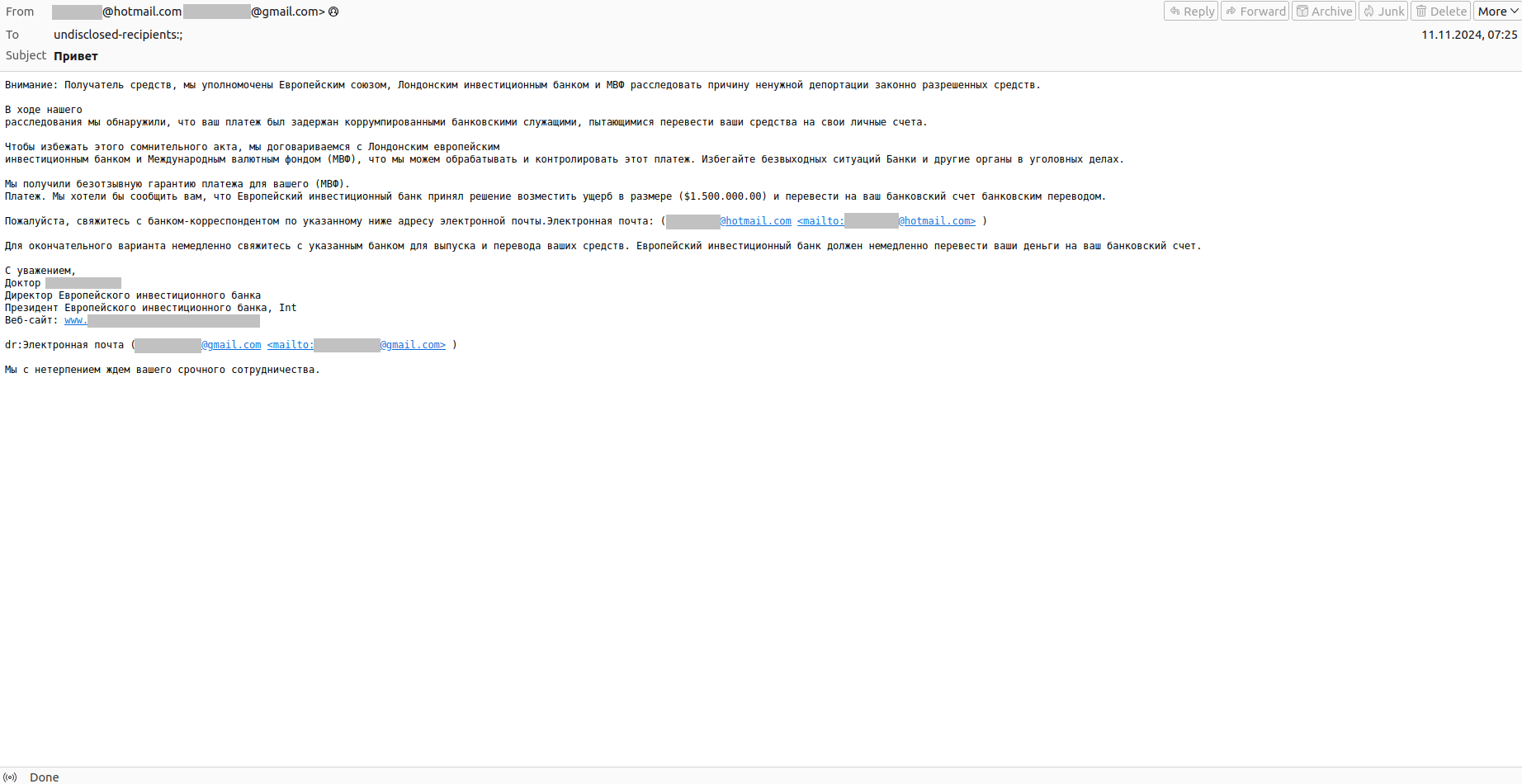
    For example, in the email screenshot below, the attackers, posing as high-ranking officials at a major bank, claim that “corrupt employees” were attempting to steal the recipient’s money. The bank claims to have taken action and is offering an exorbitant amount as damage compensation. To get it, the recipient is urged to contact a correspondent bank as soon as possible at an email address, which is, unsurprisingly, registered with a free email service.

    Scammers have another trick up their sleeve when it comes to compensations: they pretend to be from the police or some international organization and promise to give victims of “Nigerian” scams or other rip-offs their money back. In the example below, scammers, posing as the Financial Stability Council and the United Bank for Africa (UBA), promise the victim a payout from a so-called “fraud victims compensation fund”.

    Attention My Dear,
    After the Global Financial Pact Summit, Monday, November 11, 2024 in Paris we have come to the conclusion to pay
    Scammed victim compensation fund. You are in the badge B category that are going to benefit from the world’s largest
    humanitarian aid budgets. With due regards to the instruction from the Financial Stability Board (FSB). We want to
    inform you that (The Financial Stability Board (FSB)) have arranged with UNITED BANK FOR AFRICA to
    immediately effect your payment through the online transfer of your $1.750.000.00usd via UBA BANK online
    transfers. The transfer of your fund will be processed and completed within 3 working days, within which the fund
    will safely reflect into any designated bank account of your choice.
    To this effect, you’re required to contact
    Sir.Joseph Warfel Mandy
    Online Banking Services, UBA BANK
    Email : …@gmail.com
    Deposit And Fund Details
    Fund Ref: 110/XX/236/OB/2024
    Fund Value .. $1.750.000.00
    Fund Origin ..Financial Stability Board (FSB)
    Paying Formula.. UBA BANK Online Transfer!
    Contact Sir.Joseph Warfel Mandy with your
    Full names
    Direct telephone number
    Your identification Number
    Current Address
    He will furnish you with all necessary online information to carry out the online transfer of your fund by yourself.
    Please note that F.S.B mobilization and efficiency sum of $125 is the only payable/required sum to effectively
    complete your online transfer without any delay.
    Thanks and best regards
    Dr.John Schindler (Secretary General)
    Copyright @The Financial Stability Board (FSB)

    1

    2

    3

    4

    5

    6

    7

    8

    9

    10

    11

    12

    13

    14

    15

    16

    17

    18

    19

    20

    21

    22

    23

    24

    25

    26

    27

    28

    29

    30

    31

    Subject: Fund Ref: 110/XX/236/OB/2024

    From: “Dr.John Schindler (Secretary General)”

    Attention My Dear,

    After the Global Financial Pact Summit, Monday, November 11, 2024 in Paris we have come to the conclusion to pay

    Scammed victim compensation fund. You are in the badge B category that are going to benefit from the world’s largest

    humanitarian aid budgets. With due regards to the instruction from the Financial Stability Board (FSB). We want to

    inform you that (The Financial Stability Board (FSB)) have arranged with UNITED BANK FOR AFRICA to

    immediately effect your payment through the online transfer of your $1.750.000.00usd via UBA BANK online

    transfers. The transfer of your fund will be processed and completed within 3 working days, within which the fund

    will safely reflect into any designated bank account of your choice.

    To this effect, you’re required to contact

    Sir.Joseph Warfel Mandy

    Online Banking Services, UBA BANK

    Email : …@gmail.com

    Deposit And Fund Details

    Fund Ref: 110/XX/236/OB/2024

    Fund Value .. $1.750.000.00

    Fund Origin ..Financial Stability Board (FSB)

    Paying Formula.. UBA BANK Online Transfer!

    Contact Sir.Joseph Warfel Mandy with your

    Full names

    Direct telephone number

    Your identification Number

    Current Address

    He will furnish you with all necessary online information to carry out the online transfer of your fund by yourself.

    Please note that F.S.B mobilization and efficiency sum of $125 is the only payable/required sum to effectively

    complete your online transfer without any delay.

    Thanks and best regards

    Dr.John Schindler (Secretary General)

    Copyright @The Financial Stability Board (FSB)

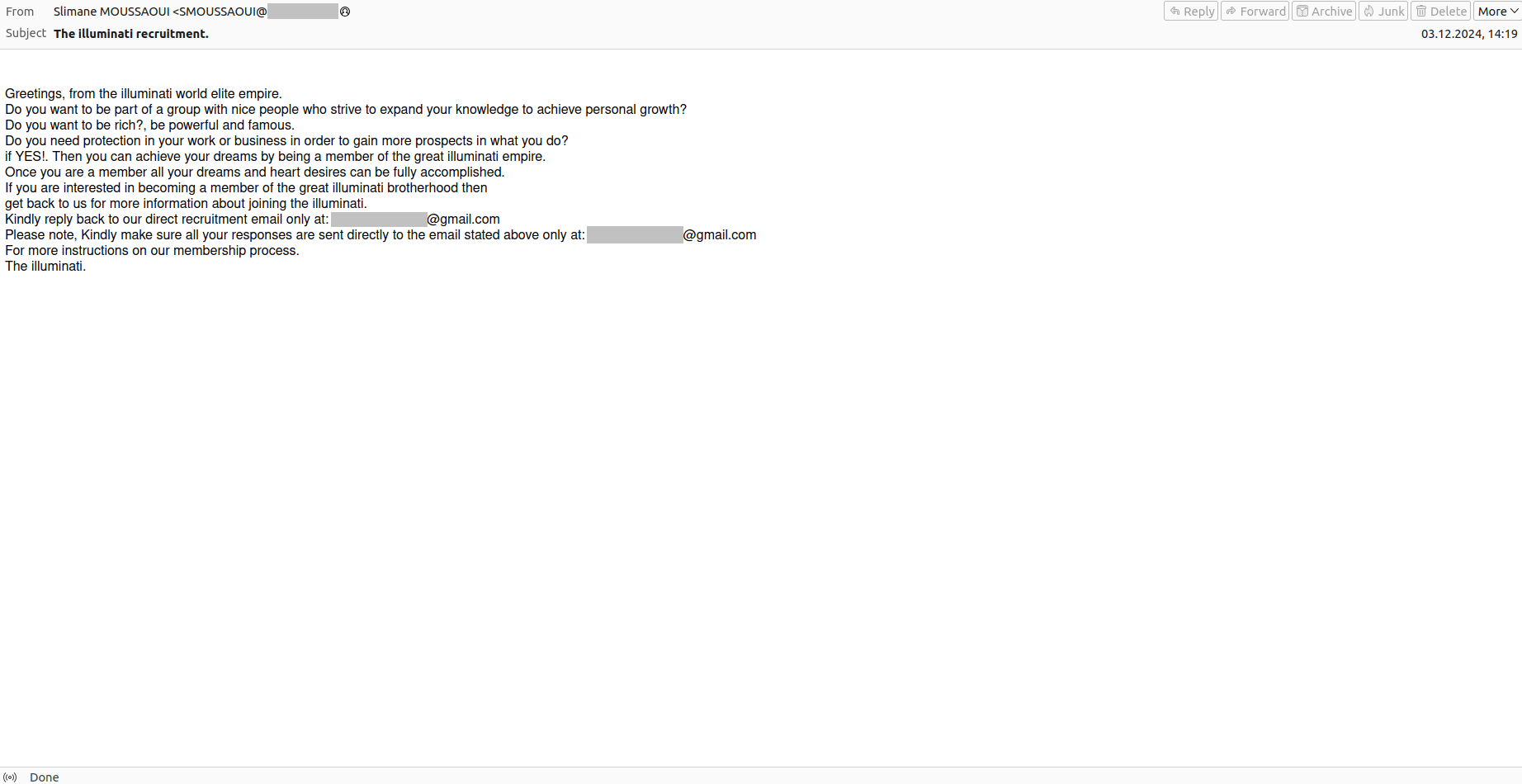
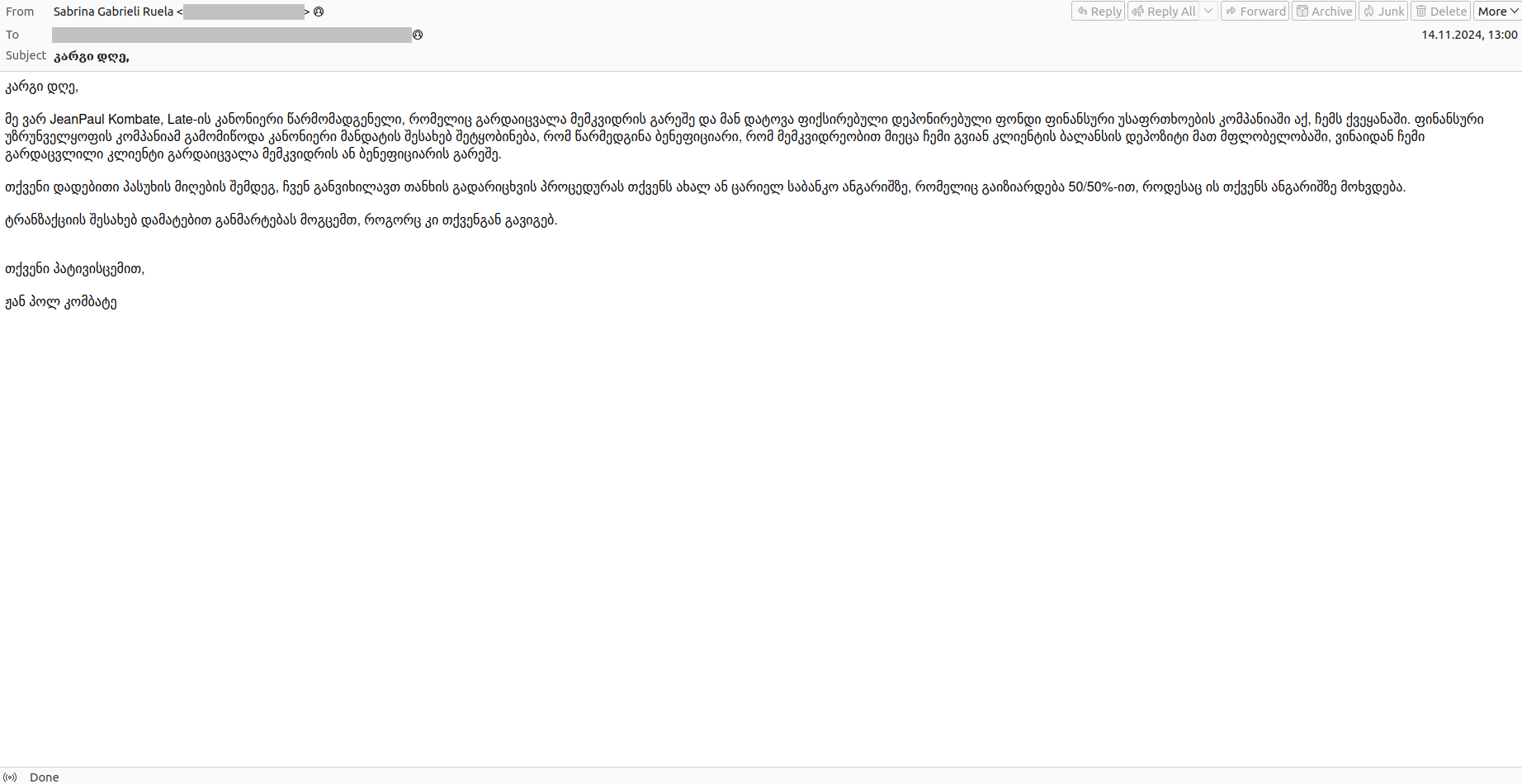
    Sometimes scammers pretend to be “victims of fraud” themselves. The screenshot below shows a common example: scammers masquerade as victims of cryptocurrency fraud, offering help from “noble hackers” who they claim helped them recover their losses.

    Lottery scams

    Lottery win notification scams share many similarities with “Nigerian” scams. Fraudsters promise recipients large sums of money and provide their contact details for further communication. It’s likely that the victim has never heard of the lottery they’ve supposedly won.

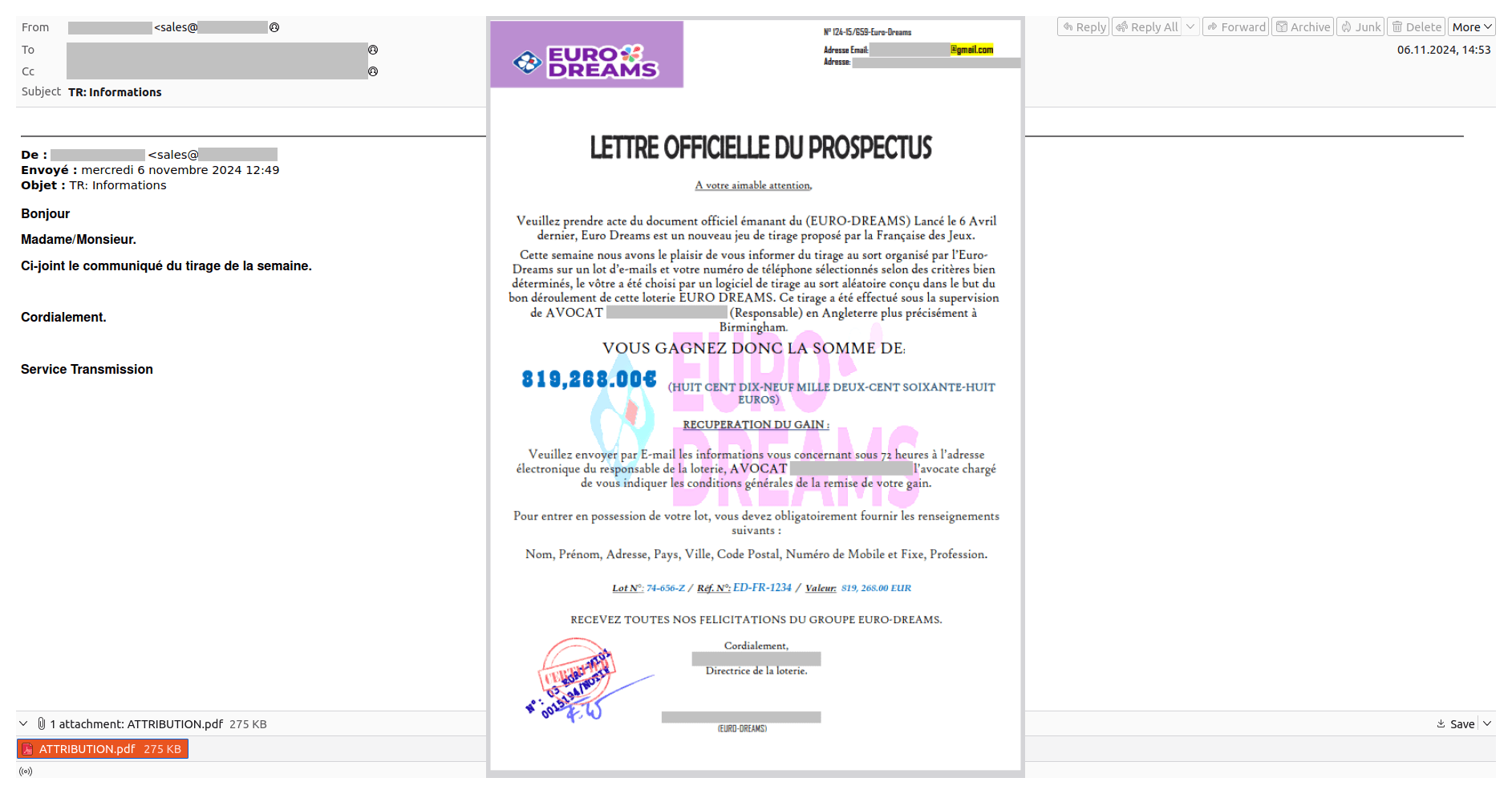
    In some cases, scammers employ unusual tactics. For example, in a message claiming to be from a European lottery director, the email body is all but empty. All the “win” details and next steps are in a PDF attachment. The file includes a free email address, which is typical of “Nigerian” scams, and asks you to send fairly detailed personal information, such as your full name, address, and both your mobile and landline phone numbers. They even ask for your job position.

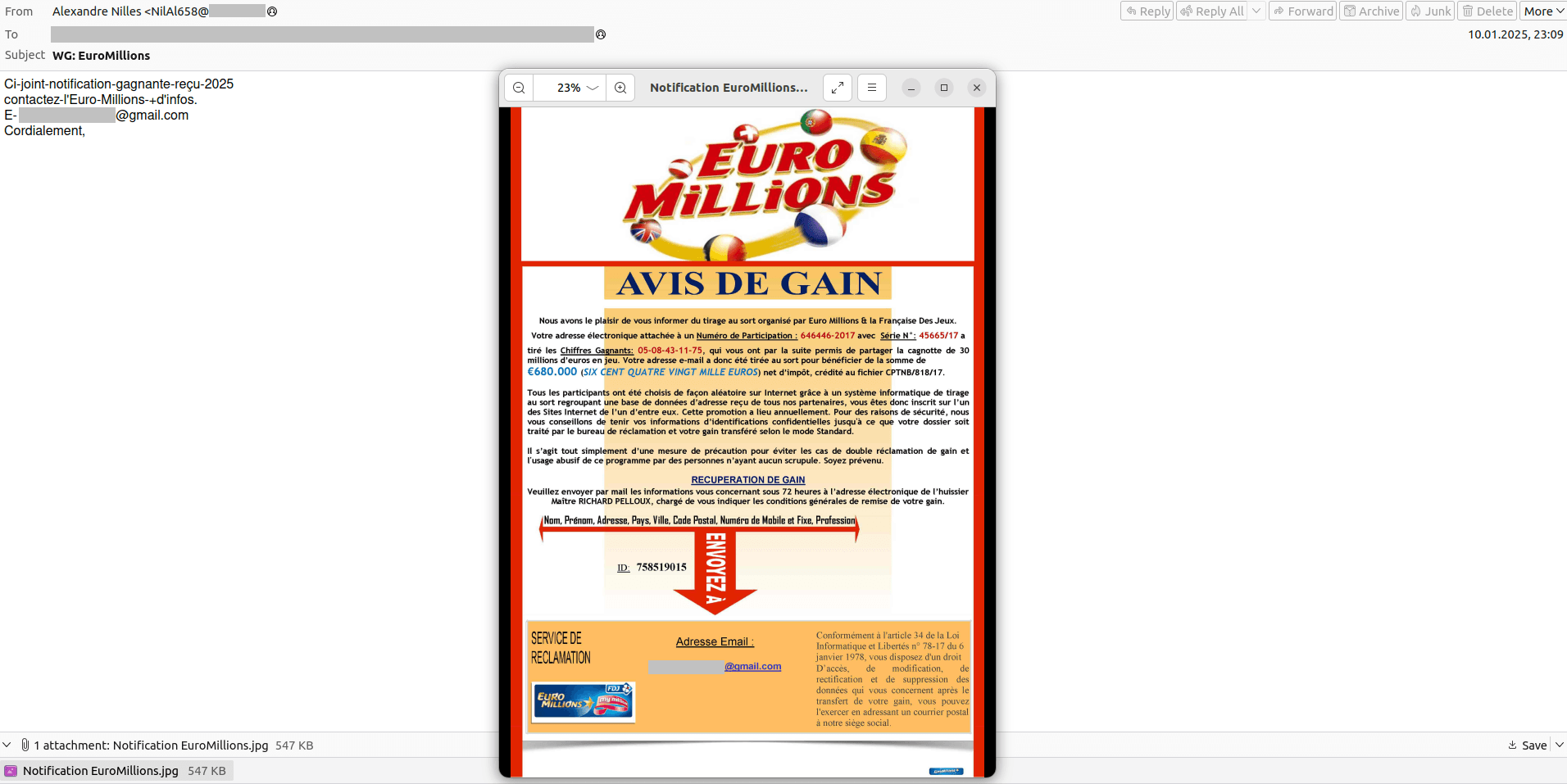
    In other similar emails, we noticed image attachments that included all the details about the supposed “win” and contact information.

    Another lottery scam tactic combines two types of bait: a lottery win (fraudsters pretend to be someone else who has won and is now offering you money) and offering a donation from a wealthy elderly person.

    1

    2

    3

    4

    5

    6

    7

    8

    9

    Subject: Spende von €1,500,000.00

    From: Theodorus Struyck

    Reply-To: Theodorus Struyck <...>

    Wir freuen uns, Ihnen mitteilen zu können, dass Ihnen und Ihrer Familie eine Spende von €1,500,000..00 von

    Theodorus Struyck, 65, geschenkt wurde und der Gewinner des zweitgrößten Jackpot-Preises der kalifornischen

    Lotterie Powerball im Wert von 1,765 Mrd. 11, 2023 , ein Teil dieser Spende ist für Sie und Ihre Familie. und diese

    Spende wird auch zur Armutsbekämpfung beitragen, für arme und ältere Menschen in Ihrer Gemeinde, indem sie der

    Menschheit helfen. Bitte kontaktieren Sie uns für weitere Informationen, um das Geld per E-Mail zu erhalten:

    …@gmail.com, …@outlook.com

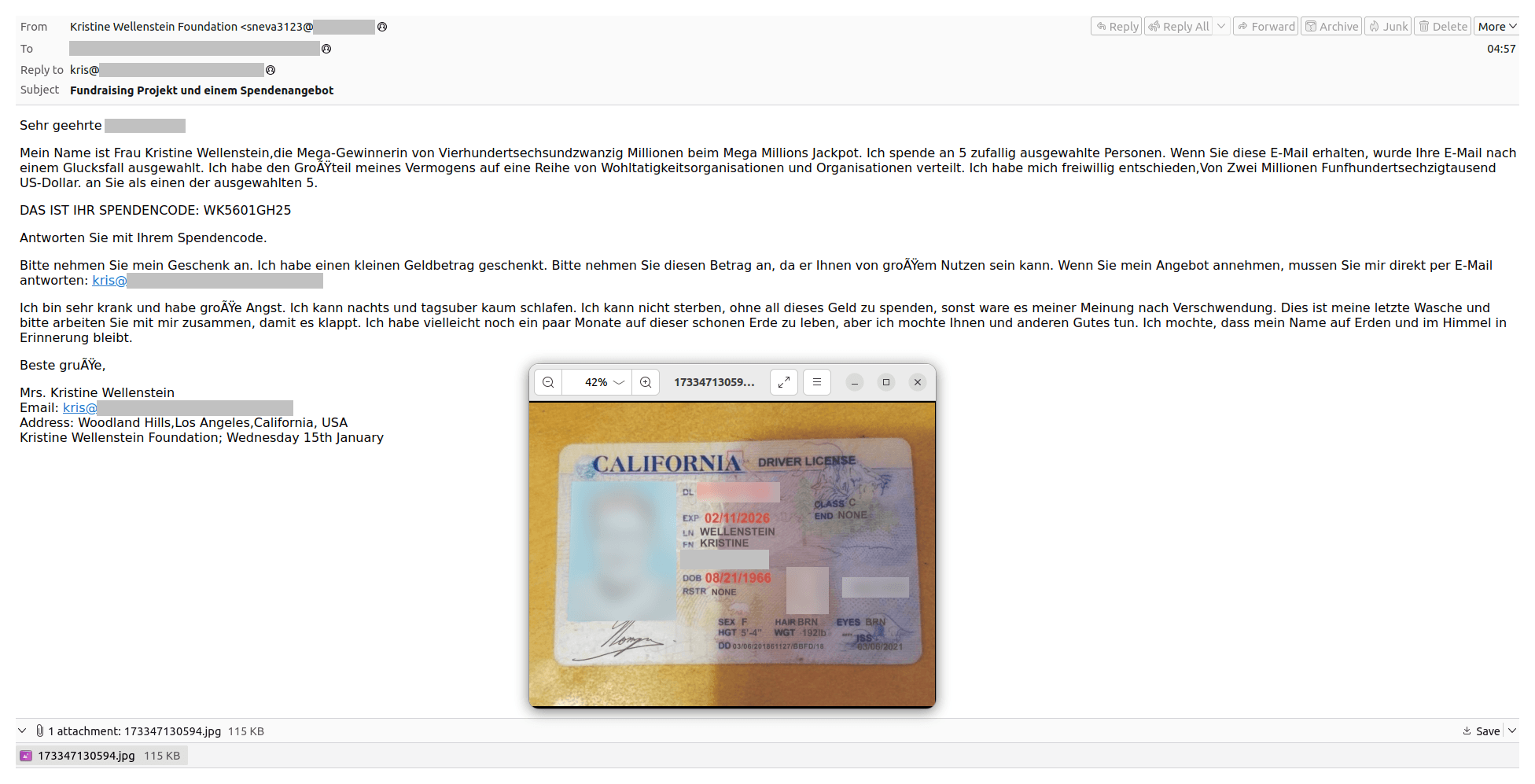
    In some cases, to make their scams more convincing, scammers attach photos of documents to their emails that supposedly confirm the sender’s identity or their winnings.

    Online dating scams

    Some “Nigerian” scams are so sophisticated that they can be hard to spot right away. These include offers of friendship that often develop into romantic conversations, which can be almost indistinguishable from real-life interactions. We’ve seen examples of really long email exchanges where a whole drama played out. A man and a woman met online and hit it off, chatting for hours about everything under the sun. Now, one of them is finally ready to meet the other in person. However, they can’t afford the ticket or visa, and they’re pleading with their partner for financial help so they can meet.

    In a different scenario, the scammer pretends to send an expensive gift to their partner. Eventually, they claim they can’t afford the postage and ask the victim to cover the costs. If the victim agrees, they’ll be hit with a series of additional fees, and the package will never materialize.

    “Nigerian” spam for businesses

    While “Nigerian” scams are often targeted at individual users, similar spam can also be found in the B2B sector. Cybercriminals claim to be seeking businesses to invest in, and the recipient’s company may be their target. To arrange a “partnership”, they ask the recipient to reply to the email.

    1

    2

    3

    4

    5

    6

    7

    8

    9

    10

    11

    12

    13

    14

    15

    16

    Subject: Potential Investment Opportunities in Russia

    From: Grigorii Iuvchenko

    Dear [Recipient’s Name],

    I hope this email catches you off guard. I am a business development professional at Sovereign Wealth Portfolio

    Limited. We operate on behalf of the Kingdom of Saudi Arabia through the Saudi Fund. As you may be aware, Saudi

    Arabia is in the process of applying for membership in the BRICS economic bloc, which includes Brazil, Russia,

    India, China and South Africa. As part of this process, Saudi Arabia is required to invest a certain amount in each of

    these member countries.

    I have been tasked with identifying potential investment opportunities in Russia, and I believe that you or your

    organization could be a suitable candidate. Whether it is a new venture, a project, or an existing business, I would be

    interested to hear your thoughts on possible partnership opportunities.

    I look forward to your response.

    Sincerely,

    Alexander Maksakov

    Business Development Director

    Sovereign Wealth Portfolio Limited

    Current “Nigerian” spam themes

    Some of the spam samples above reference recent or current real-world events, such as the COVID-19 pandemic or Saudi Arabia’s possible BRICS membership. This is typical of “Nigerian” scams. There are countless ways scammers exploit various global or local, significant or ordinary, positive or negative events, news, incidents, and activities to pursue their selfish goals.

    The most talked-about event of 2024, the US presidential election, significantly influenced the types of scams we saw. Emails that took advantage of this topic were sent to users around the globe. For instance, in the following message, the scammers claimed that the recipient, who uses a German email address, was lucky enough to win millions of dollars from the Donald J. Trump Foundation.

    1

    2

    3

    4

    5

    6

    7

    8

    9

    10

    11

    12

    13

    14

    15

    16

    17

    18

    19

    20

    21

    22

    23

    24

    25

    Subject: DONALD TRUMP FOUNDATION

    From: MR Donald trump

    Reply-To: …@gmail.com

    Hello., this email is from Donald J. Trump Foundation, American

    politician, media personality, and businessman who served as the 45th

    president of the United States from 2017 to 2021. , The Trump Foundation

    is a charitable organization formed in 1988.

    As we happily celebrate Mr Donald J. Trump as 47th President of the

    United States.

    It gives me great joy to announce to you that after the winning of

    election, Donald J. Trump has called for the reopening of the Trump

    foundation which was closed years ago.

    The Trump foundation is giving out $15,000,000.00 each to 50 lucky

    people around the world to unknown randomly selected individual

    Emails online,the foundation simply attempt to be fearful when others

    are greedy and to be greedy only when others are fearful Price is what

    you pay, Value is what you get, Someone’s sitting in the shade today

    because someone planted a tree a long time ago.

    You have been selected to receive this $15,000,000.00, as a lucky one

    confirm back to me that this selected unknown email is valid,Visit

    the web page to know more about the Donald J. Trump Foundation,

    https://…

    Contact. This email below (…@gmail.com)

    Best Regards

    Donald J. Trump Foundation

    Creativity unbound

    While most spam fits into well-known categories, scammers can come up with some very surprising offers. We’ve seen quite a few messages from people claiming they’re giving away a piano because they’re moving or because the previous owner has passed away, as is often the case.

    Sometimes you find some really unusual specimens. For example, in the screenshot below, there’s an email allegedly sent from a secret society of Illuminati who claim to be ready to share their wealth and power, as well as make the lucky recipient famous if they agree to become part of their grand brotherhood.

    Conclusion

    “Nigerian” spam has existed for a long time and is characterized by its diversity. Fraudsters can pose as both real and fictitious individuals: bank employees, lawyers, businesspeople, magnates, bankers, ambassadors, company executives, law enforcement officers, presidents or even members of secret societies. They use a variety of stories to hook the user: compensations and reimbursements, donations and charity, winnings, inheritances, investments, and much more. Messages can be anything from short and captivating to long and persuasive, filled with numerous convincing claims designed to lull the victim into a false sense of security. The main danger of such emails lies in the fact that at first glance, there is nothing harmful in them: no links to phishing sites and no suspicious attachments. Scammers exclusively rely on social engineering and are willing to correspond with the victim for an extended period, increasing the credibility of their fabricated story.

    To avoid falling victim to such scams, it’s important to understand the dangers of tempting offers and to be critical of emails allegedly sent from influential individuals. If possible, it’s best to avoid responding to messages from unverified senders altogether. If for some reason you can’t avoid corresponding with a stranger, before responding to even an innocent message about finding a new owner for a piano, it’s worth double-checking the information in it, paying attention to inconsistencies, grammatical errors, etc. If the reply-to address is different from the sender’s address, or if you see a different address in the email body, this may be a sign of fraud.

    MIL OSI Economics –

    February 6, 2025
  • MIL-OSI United Kingdom: Time and change at El Cabril

    Source: United Kingdom – Executive Government & Departments

    Four Committee on Radioactive Waste Management (CoRWM) members travelled to Andalucia to visit the El Cabril low and intermediate level nuclear waste disposal facility.

    The true extent of the 29 October floods on the Spanish regions of Valencia and Andalucia did not become immediately apparent, but the flood waters caused the death of over 230 people and was one of the deadliest natural disasters in Spanish history. On what became one of the most devastating weeks in history for Valencia and Andalucia, 4 CoRWM members travelled to Andalucia to visit the El Cabril low and intermediate level nuclear waste disposal facility. These sobering statistics added a pertinence to our visit.

    Flooding events and ‘extreme’ weather – the torrential rain in Spain on 29 October brought a years’ worth of precipitation in a single day– are increasing in frequency and highlight the pressing need for robust, zero carbon energy systems that can sustain our energy needs without causing environmental and human disaster. This contextual framing of our visit to the nuclear waste disposal site at El Cabril is important. We need to securely dispose of our nuclear waste without leaving a burden for future generations. Disposal must be safe in the short and long term from environmental change. This becomes increasingly pertinent if we are to use nuclear in a portfolio of energy choices to meet out net zero targets.

    CoRWM were welcomed to Spain and the El Cabril site by Nuria Prieto Serrano from ENRESA (Empresa Nacional de Residuos Radiactivos S.A.). Nuria is Senior Technician working in the department of International Co-operation and Research and Development at ENRESA. She is a philologist and lawyer with over 20 years’ experience in radioactive waste management and was an excellent guide and source of knowledge. We started our visit by sharing information on the countries respective nuclear waste disposal strategies and current progress.

    Spain is currently decommissioning all their nuclear energy plants in the wake of a decision to discontinue nuclear energy production. Wastes described as very low, low and intermediate level wastes, in the Spanish categorisation of radioactive waste as described on the ENRESA website, can be disposed of at El Cabril. These wastes are similar to low and intermediate level wastes in the UK, but high-level wastes and some special wastes will need to be disposed of in a geological facility. Therefore, the process of designing and delivering a geological disposal facility is now starting in Spain.

    Penny Harvey (CoRWM Deputy Chair) spoke about the work of CoRWM, and CoRWM’s role in the management and disposal of nuclear wastes in the UK. The role of a body such as CoRWM was of interest to ENRESA, as Spain progresses towards developing its strategy for and delivery of a deep geological disposal facility.

    Visitors centre displays showing the site layout (left) and canister types (right)

    El Cabril is on a former uranium mine and it is this legacy that led to the first wastes being stored here. The old mining cottages are still on site. Now empty, they appear like a row of little white teeth in the landscape evidence of the complex nature of human involvement on the site and the ties between geology, energy, people and landscape. Nuria describes how a future siting of a deep geological disposal facility would be open and transparent with community engagement in the process. We reflect on the importance of the community engagement process in the UK and the time and effort it takes to do it well and to gain trust and respect. Aspects of heritage, place, peoples, combined with the geology and other logistics all need to come together to create the right environment for a geological disposal facility.

    As ever, with such visits, time was short and there was much to discuss and see. We had a quick tour of the visitor’s centre, which receives a staggering c.3,000 visitors/year; despite being many hours’ drive from any centre of major population. The visitor’s centre is a simple, clear and informative space with great views out onto the site. Our next stop was the watch tower, which affords fabulous views across the rolling Spanish countryside in which the El Cabril site is embedded. The watch tower is, as its name suggests, a security post; but not focused on risks such as terrorism threats that might first come to mind as a UK citizen. The watch tower’s main function is fire watch, as forest fire is deemed the biggest risk to site safety, and there are helicopter pads and reservoirs built into the landscape ready for firefighting. This simple fact provokes thoughts of climate change, shifting weather patterns and the increased frequency of extreme events. Much of Spain had temperatures over 40 degrees in the summer of 2024. Risks to infrastructure are changing as weather patterns destabilise. In a region where fire is the highest risk to a nuclear waste disposal site, but has also just seen the worst floods in its history, managing waste carefully and predicting future scenarios is a must.

    The view from the Watch Tower across the El Cabril site (left), and the Handling and Operations area (right).

    The central operations room provided an insight into the control systems and monitoring. Viewed through a one-way window that cleverly can be come two-way if the operators allow, we glimpsed the complexities of the monitoring and evaluation systems. Here we also learnt the operational workflow from delivery of waste at the site through to disposal, with graphics and text combined with real site photography. Then Nuria walked us through the loading, handling, testing and monitoring areas. We also saw the transportation truck systems that bring waste to the site from different nuclear operators. Despite being only 4 members from CoRWM we brought expertise in siting and engagement, in geology, regulation, risk management, transport and disposal logistics, so there was much to discuss and see.

    The fluid draining and sampling pipes beneath the El Cabril low and intermediate level waste vaults (left), and Nuria Prieto Serrano explaining the fluid sampling system (right)

    The highlight was the disposal vaults themselves. Firstly, we were taken into the passageways below the completed low and intermediate level waste vaults to see the water sampling and analysis system. Although dry the system and monitoring is designed so that any fluid collected in the base of the silos can be drained and tested. The system allows testing of fluid from individual silos so that any issues can be isolated. Above ground large tents cover the operational very low-level waste disposal sites and layers of waste and barriers are stacked up to create the stores within each concrete silo. It is possible to walk out on top of these very low-level wastes and to see the waste and back-fill up close. Eventually the disposal areas will be landscaped. The tops of the rolling hills were removed to create the disposal areas, and these will be recreated when the vaults are full, returning the landscape to its past form. Or at least how it was most recently.

    These aspects of time, change and expectation are interesting, always framed in the human timescale and often within a single generation or two, rather than anything close to geological (millions and billions of years) or even timescales of some radioactive decay (tens of thousands of years). The Valencia floods and the environmental and human disaster that ensued signal potentially rapid change on relatively short (human) timescales. We will need to learn to adapt and be resilient, and act collectively for the common good. Sharing best practice and understanding internationally is key, learning from each other’s challenges and solutions. The timescales are both long and short and change is inevitable as we navigate our way to optimal nuclear waste disposal solutions.

    With special thanks to Nuria Prieto Serrano, and ENRESA for hosting CoRWM’s visit.

    Share this page

    The following links open in a new tab

    • Share on Facebook (opens in new tab)
    • Share on Twitter (opens in new tab)

    Updates to this page

    Published 5 February 2025

    MIL OSI United Kingdom –

    February 6, 2025
  • MIL-OSI Russia: Marat Khusnullin: In 2024, 53 long-term construction projects for 10.7 thousand equity holders were completed in Russia

    Translartion. Region: Russians Fedetion –

    Source: Government of the Russian Federation – An important disclaimer is at the bottom of this article.

    In 2024, thanks to federal mechanisms for restoring the rights of defrauded equity holders after completion of construction, 53 apartment buildings that were previously considered problematic were put into operation. The Supervisory Board of the Territorial Development Fund made decisions on them in 2019–2022.

    “Not so long ago, the issue of equity holders who suffered in Russia was acute. The government has done a lot of work to reduce the severity of this social problem. At present, we continue to implement the decisions that were previously made by the FRT Supervisory Board. Last year, 53 buildings were completed with the help of federal mechanisms. About 10.7 thousand people will receive the keys to new apartments in them. In total, since 2019, the rights of about 254 thousand citizens who suffered from the actions of unscrupulous developers have been restored,” said Deputy Prime Minister, Chairman of the FRT Supervisory Board Marat Khusnullin.

    Completed long-term construction projects are located in 14 regions: Krasnodar, Perm, Khabarovsk and Krasnoyarsk Krais, Leningrad, Nizhny Novgorod, Novosibirsk, Omsk, Chelyabinsk, Tambov and Ulyanovsk Oblasts, the Republics of Khakassia and North Ossetia, as well as in the Khanty-Mansi Autonomous Okrug.

    “The largest volume of work over the past year was completed in the Leningrad Region, where 10 houses were delivered for 3 thousand defrauded equity holders, in the Krasnoyarsk Region, where the construction of 9 houses for 1880 equity holders was completed, and in the Krasnodar Region, where 5 houses are ready, the keys to which will be received by 1254 people. In addition, 6 houses were erected in the Perm Region, in which 1167 equity holders will move in, and in the Novosibirsk Region 3 houses for 741 people were completed,” noted the General Director of the Territorial Development Fund Ilshat Shagiakhmetov.

    Federal and regional mechanisms are used to help affected equity holders. Federal mechanisms include completing the construction of the problematic facility and paying compensation based on the decision of the FRT supervisory board.

    Please note: This information is raw content directly from the source of the information. It is exactly what the source states and does not reflect the position of MIL-OSI or its clients.

    MIL OSI Russia News –

    February 6, 2025
  • MIL-OSI Russia: Belgium: Staff Concluding Statement of the 2025 Article IV Mission

    Source: IMF – News in Russian

    February 5, 2025

    A Concluding Statement describes the preliminary findings of IMF staff at the end of an official staff visit (or ‘mission’), in most cases to a member country. Missions are undertaken as part of regular (usually annual) consultations under Article IV of the IMF’s Articles of Agreement, in the context of a request to use IMF resources (borrow from the IMF), as part of discussions of staff monitored programs, or as part of other staff monitoring of economic developments.

    The authorities have consented to the publication of this statement. The views expressed in this statement are those of the IMF staff and do not necessarily represent the views of the IMF’s Executive Board. Based on the preliminary findings of this mission, staff will prepare a report that, subject to management approval, will be presented to the IMF Executive Board for discussion and decision.

    An IMF team led by Jean-François Dauphin visited Brussels to conduct the 2025 Article IV consultation with Belgium. The mission’s discussions (January 22-February 3) took place before the formation of the new government and the present statement, which summarizes the mission’s findings and recommendations, does not reflect the new government’s policy intentions.

    The IMF team thanks the Belgium authorities andother counterpartsfor the constructive dialogue and productive collaboration. It congratulates the new government on its nomination and looks forward to future engagement.

    ******

    The Belgian economy has been resilient to a series of shocks, but growth has slowed, and disinflation has faced headwinds. The labor market has been strong but shows signs of cooling. Labor-cost competitiveness has declined with wage growth outpacing sluggish productivity growth. Absent policy change, pressures from an aging population will weigh on Belgium’s social model and further increase the fiscal deficit and public debt, heightening vulnerability to changes in market sentiment. The outlook is subject to high uncertainty, amid risks that could push growth down and inflation up, including deepening geoeconomic and trade fragmentation, and adverse energy price developments.

    • Sustained fiscal consolidation is needed to support disinflation, rebuild buffers, lower market vulnerabilities, and address spending pressures from aging and the green transition. All federal and federated entities need to contribute to the adjustment. Rationalizing current spending while preserving (or increasing) public investment in infrastructure, healthcare, and education and enhancing its efficiency is a priority.
    • To preserve macrofinancial stability, current capital buffer requirements and prudential limits on mortgage loans should be maintained. Recent progress in strengthening systemic risk assessment, supervision, the macroprudential framework, and crisis management and resolution preparedness is welcome and should be sustained.
    • Reforms are needed to enhance growth potential through higher labor force participation, increased productivity, and a more efficient resource allocation. Priorities include increasing the income gap between work and nonwork through tax and social benefits reforms, reforming the wage-setting mechanism, and upgrading labor skills. Together with efforts with EU partners to deepen the single market, further product market reforms to reduce barriers to entry, foster greater competition, and improve the insolvency regime will improve firm dynamics and the diffusion of innovation. Sustaining the green transition requires strong commitment and enhanced coordination among the federal and regional governments.

    Economic outlook and risks

    Growth is expected to be stable in 2025 and inflation to slowly return to target. Output is expected to grow by 1.1 percent in 2025 and slightly increase by 2027 supported by monetary policy easing and a higher contribution from net exports. Inflation is projected to gradually decline as wage growth moderates and the projected drop in international energy prices passes through to retail prices. The external current account is expected to return to small surpluses over the medium term as energy prices ease and external demand increases. Under unchanged policies, pressures from the aging population would further increase the fiscal deficit to about 7 percent and public debt about 125 percent of GDP in 2030, heightening vulnerabilities.

    The baseline outlook is subject to sizeable risks, tilted down for growth and up for inflation. Growth could be weaker if the expected recovery in external demand falters amid escalating geoeconomic tensions and trade fragmentation. Inflation could be higher than projected due to adverse energy price developments, or if persistently-high core inflation affects expectations. Fiscal sustainability concerns could arise and lead to a sharp increase in borrowing costs—especially if global risk aversion increases—, necessitating abrupt fiscal consolidation with negative consequences for growth and potentially financial stability.

    Rebuilding Fiscal Buffers Despite Pressures

    Significant fiscal consolidation is needed to address large structural deficits and rising public debt that were exacerbated by the pandemic and energy crisis. In the short term, consolidation will help further reduce inflation, notwithstanding still-high wage growth and looser monetary policy. This would also help address significant upside risks to inflation. Critically, a sustained reduction in fiscal deficits is needed to reduce vulnerability to changes in market sentiment, rebuild space to address potential future shocks, address long-term spending pressures, and ultimately, preserve the core of Belgium’s social model, which places a high premium on solidarity and equity.

    Consolidation under the new EU economic governance framework (EGF) would significantly improve fiscal sustainability. Given the magnitude of the needed adjustment, the medium-term fiscal structural plan (MTFSP) under the EGF would benefit from a seven-year rather than a four-year adjustment path, accompanied by credible and front-loaded growth-enhancing reforms. Under such an adjustment, an annual reduction in the structural primary balance of about 0.5 percentage points of GDP until 2031 will be necessary to reach an overall deficit below 3 percent of GDP by 2031 and maintain it until 2041, per the EGF.

    Fiscal adjustment should center on rationalizing current spending, while making room for public investment. Rationalizing social benefits and the public wage bill is crucial for achieving budgetary savings. Public investment should be preserved, or ideally, increased to mitigate the growth impact of fiscal consolidation, support green transition, and bolster the economy’s productive capacity.

    Improving the efficiency of public investment is critical amid competing demands for resources. This includes laying out clear infrastructure investment strategies, strengthening project appraisal, selection, and governance, and improving coordination within and among the federal and federated entities. In healthcare, increasing the focus on preventive care and reforming the organization and role of hospitals would help absorb part of the projected increase in spending due to aging and better prepare the system to the evolving need of an older population. Education reforms can help achieve the same education outcomes at lower costs or improve outcomes without increasing spending.

    Pension reforms are essential to address cost pressures from aging. The focus should be on raising the effective retirement age in line with healthy-life expectancy and facilitating longer employment through life-long learning and upskilling. Additionally, reviewing eligibility criteria for specific pension regimes (e.g., disability pensions) and limiting increases in pension benefits by reviewing automatic indexation are necessary steps. A review of special provisions (e.g., arduous jobs) could inform reforms to balance fairness and costs.

    Tax reforms should aim to shift part of the tax burden from labor to capital, without revenue loss, and to reduce tax exemptions. Belgium has the highest labor-tax wedge in the OECD. Reducing labor taxation will help increase the employment rate. All revenue from capital (e.g., interests, dividends, and capital gains) should be taxed in the same way to ensure neutrality in investment decisions, ideally by incorporating these revenues into the overall taxable income subject to personal income tax. Reducing preferential regimes and treatments in the tax system, a significant source of foregone revenue, also needs to be part of the reform package. Tax reforms should be coordinated among the federal and federated entities for their revenue and distributional impacts.

    The new EGF provides an opportunity to strengthen Belgian’s fiscal framework through a revitalized fiscal council and greater accountability among federated entities. The implementation of the 2013 federal-regional coordination agreement has proved challenging, given the complexities of Belgium’s fiscal federalism. The new EGF provides a renewed opportunity to introduce binding rules for burden sharing the fiscal adjustment, with clear accountability for the federal and all federated entities. A strengthened fiscal council (e.g., with enhanced staffing and direct reporting to parliaments) would help ensure that the federal and each federated entity’s fiscal behavior is consistent with Belgium’s European commitments.

    Preserving Macrofinancial Stability

    Overall systemic risks in the financial sector remain moderate but are evolving due to changing macroeconomic and market conditions. While the economy is slowing and real estate markets cooling, interest rates are now decreasing. Household indebtedness has stabilized, and corporate indebtedness has declined due to substantial investments being largely cash financed. Corporate bankruptcies have been increasing but remain aligned with pre-pandemic trends. Risks from residential real estate have moderated, but commercial real estate market activity has dropped sharply, and vacancies have risen, reflecting low demand for office space. Overall, exposures to real estate remain broadly stable.

    With the level of financial stability risks expected to remain unchanged, capital buffers and prudential limits on residential mortgages should be maintained . Since last year, macroprudential policies have tightened, with capital buffers significantly raised. The NBB also appropriately encouraged banks to lengthen new mortgage maturities to ease the debt servicing burden of households and pre-empt borrower distress. Progress has been made in implementing the 2023 Financial Stability Assessment Program (FSAP) recommendations and this effort should be accelerated now that a new government is in place and the required legislative changes can be pushed forward.

    Strengthening Labor Markets

    Labor market fragmentation and rigidity in Belgium are impeding growth potential. The coexistence of local or sectoral pockets of high vacancies and pockets of high unemployment highlights inefficiencies in labor allocation that hinder potential growth. Employment gaps for low-skilled workers, older workers, women, and individuals with an immigration background or disabilities remain high. Fostering a more inclusive labor market will enhance overall economic performance and mitigate fiscal pressures.

    Enhancing labor market incentives is essential. Labor market, tax, and social benefit reforms should consistently aim to increase the income gap between work and nonwork and reduce the cost of hiring and dismissal. Reducing the duration of unemployment benefits and linking social benefits to income levels would incentivize re-entry into the labor force. Policy efforts should also focus on facilitating re-integration of workers from long-term sick leave.

    Reforming the wage-setting mechanism will help increase labor market efficiency, improve competitiveness, and reduce fiscal costs. Automatic wage and social benefit indexation protected household purchasing power during the inflation shock. However, it also increased structural fiscal deficits and led to labor-cost increases exceeding those of major trading partners when accounting for productivity differential, weighing on competitiveness. Consideration should be given to abolishing the automatic indexation and the 1996 wage law which, together, define a floor and a ceiling for wage growth, that do not allow for an optimal allocation of labor and increased employment. At a minimum, the labor market would already benefit from reforms including adjusting the basis for indexation to exclude volatile prices, broadening the group of comparator countries in the wage law, using productivity-adjusted wage growth as the basis for comparison, and allowing firms to partially index wages considering specific local and sectoral labor market conditions.

    Reforms in education and life-long training are necessary to upskill the labor force, enhance employment rates, and promote growth. While educational outcomes in Belgium are comparable to peers, they are achieved at a higher cost. Addressing teacher shortages, reducing grade repetition rates, and achieving greater equality of educational outcomes irrespective of backgrounds will require a comprehensive reform of the educational system. Actions should seek to align education with the needs of Belgian companies, better leverage teachers’ time, and strengthen support provided to students who face difficulties. These reforms would help increase employment, productivity, and the creation and diffusion of innovation.

    Boosting Productivity

    Boosting productivity will require further product market reforms to improve firm dynamics and the diffusion of innovation. Despite significant investment in innovation, Belgium’s long-term productivity slowdown is worse than peers, suggesting room to improve the transmission of innovation to productivity gains. Lagging productivity is linked to insufficient firm dynamics—the entry, growth, and exit of firms—, with Belgium experiencing some of the lowest firm entry and exit rates in the EU. To enhance productivity and dynamics, further product market reforms are necessary to reduce regulatory and administrative barriers and improve the insolvency regime.

    Deepening the European single market and advancing the capital market union would benefit firms in Belgium. Removing remaining barriers to trade within the EU and harmonizing regulations and bankruptcy frameworks would enhance Belgian firms’ access to a much larger customer base, improve competition and firm dynamics, and provide buffers against risks from geo-fragmentation. Moreover, developing venture capital within an EU-wide push toward capital market union would help widen Belgian firms’ options to finance growth.

    Sustaining the Green Transition

    Despite progress, much effort remains needed to achieve climate objectives. The expansion of the EU emissions trading system should be complemented by timely implementation of carbon taxation and phasing out fossil fuel subsidies, while ensuring support for vulnerable population. The consolidation of federal and regional climate efforts into a coherent and cohesive national strategy is essential. Improved coordination and accountability among the federal and regional governments will facilitate the design, execution, and evaluation of climate policies. Adequate investments in the green transition are necessary to ensure Belgium meets its climate goals and contributes to the European Green Deal.

    IMF Communications Department
    MEDIA RELATIONS

    PRESS OFFICER: Camila Perez

    Phone: +1 202 623-7100Email: MEDIA@IMF.org

    @IMFSpokesperson

    https://www.imf.org/en/News/Articles/2025/02/05/CS-Belgium-2025

    MIL OSI

    MIL OSI Russia News –

    February 6, 2025
  • MIL-OSI: CampDoc and CouncilWare Announce Strategic Integration for Scouting America Councils

    Source: GlobeNewswire (MIL-OSI)

    ANN ARBOR, Mich., Feb. 05, 2025 (GLOBE NEWSWIRE) — CampDoc, the leading electronic health record system for camps, and CouncilWare, a premier software provider for scouting organizations, are excited to announce a strategic integration designed specifically for Scouting America councils. This collaboration will streamline operations and enhance the experience for scouts, families, and council administrators nationwide.

    The integration between CampDoc and CouncilWare aims to simplify administrative tasks through automatic account provisioning, data syncing, and single sign on (SSO), ensuring that critical health information is readily available to improve communication and response times when it matters most.

    “We are thrilled to partner with CouncilWare to bring this innovative solution to Scouting America councils,” said Dr. Michael Ambrose, Founder and CEO of CampDoc. “This integration will empower councils to provide top-notch care and reassure families, while helping to streamline efficiency on check-in day and throughout the duration of the program.”

    CampDoc is the only approved Electronic Health Record (EHR) by Scouting America. Individual councils and high adventure bases have utilized the CampDoc tool to collect the Annual Health and Medical Record (AHMR), document medication administration, and record incident reports.

    “Collaborating with CampDoc allows us to provide a unified system that addresses the unique needs of scouting organizations,” said Russ Votava, CEO of CouncilWare. “We are proud to support Scouting America councils in their commitment to developing the next generation of leaders.”

    CampDoc and CouncilWare recently piloted their integration at the National Order of the Arrow Conference (NOAC) this past summer, and they are excited to expand their work with Scouting America at the 2026 National Jamboree.

    The integration reflects a shared commitment to leveraging technology to improve the scouting experience. By uniting their platforms, CampDoc and CouncilWare are addressing the growing need for efficient, secure, and user-friendly solutions in the scouting community.

    Scouting America Councils interested in exploring the integration between CampDoc and CouncilWare should visit www.campdoc.com or www.councilware.com for more information.

    About DocNetwork
    CampDoc and SchoolDoc offer the most comprehensive Electronic Health Record (EHR) solution to help ensure the health and safety of children while they are away from home. DocNetwork is trusted by over 1,250 programs across all 50 states and internationally, including traditional day and residential camps, YMCAs, JCCs, Girl Scouts, Boy Scouts, parks and recreation facilities, colleges and universities, and K-12 public, private, and charter schools. For more information about DocNetwork and web-based health management, please visit www.campdoc.com, www.schooldoc.com, or call 734-619-8300.

    About CouncilWare
    CouncilWare is a modern, web-based, fully-responsive, software service that provides Scouting America councils with the functionality needed to support their operations. The software was developed in response to a growing demand for a council website solution that was custom tailored to the Scouting program and met the specific requirements that councils have in supporting their participants and volunteers. Core functions include Event Registration, Product Sales and Facility Reservations. For more information about CouncilWare please visit councilware.com or call 402-477-0809.

    Contact:
    Michael Ambrose, M.D.
    DocNetwork
    734-619-8300
    michael@docnetwork.org

    Russ Votava
    CouncilWare
    402-477-0809
    russ.votava@councilware.com

    The MIL Network –

    February 6, 2025
  • MIL-OSI: Plutus Financial Group Limited Announces Pricing of Initial Public Offering

    Source: GlobeNewswire (MIL-OSI)

    Hong Kong, Feb. 05, 2025 (GLOBE NEWSWIRE) — Plutus Financial Group Limited (“the “Company”) (NasdaqCM: PLUT), a Hong Kong-based financial services company, today announced the pricing of its initial public offering (the “Offering”) of 2,100,000 ordinary shares at a public offering price of $4 per ordinary share, for total gross proceeds of $8.4 million, before deducting underwriting discounts and offering expenses. The Offering is being conducted on a firm commitment basis. The ordinary shares are expected to commence trading on Nasdaq Capital Market under the ticker symbol “PLUT” on February 5, 2025.

    The Company has granted the underwriter an option, exercisable within 45 days from the date of the underwriting agreement, to purchase up to an additional 315,000 ordinary shares at the public offering price, less underwriting discounts and expenses. The Offering is expected to close on February 6, 2025, subject to customary closing conditions.

    The Company intends to use the proceeds from the Offering for: i) development of tailor-made software and applications for different aspects of its operations, including customer services, trading, wealth management, and portfolio construction and monitoring; ii) increasing its available funding for offering trading facilities solutions to customers, including margin trading, and IPO margin financing; and iii) expansion of its customer management and wealth management teams.

    R.F. Lafferty & Co., Inc. is acting as lead underwriter for the Offering, with Revere Securities LLC acting as co-underwriter. The Crone Law Group, P.C. is acting as counsel to the Company. Sichenzia Ross Ference Carmel LLP is acting as lead counsel to the underwriters with respect to the Offering.

    A registration statement on Form F-1, as amended (File No. 333-276791) relating to the Offering was previously filed with the Securities and Exchange Commission (the “SEC”) by the Company, and subsequently declared effective by the SEC on February 4, 2025. The Offering is being made only by means of a prospectus, forming a part of the registration statement. A final prospectus relating to the Offering will be filed with the SEC and will be available on the SEC’s website at www.sec.gov. Electronic copies of the final prospectus related to the Offering may be obtained, when available, from R.F. Lafferty & Co., Inc., 40 Wall Street, 27th Floor, New York, NY 10005, or by telephone at (212) 293-9090.

    Before you invest, you should read the final prospectus and other documents the Company has filed or will file with the SEC for more complete information about the Company and the Offering. This press release shall not constitute an offer to sell or the solicitation of an offer to buy the securities described herein, nor shall there be any sale of these securities in any state or jurisdiction in which such offer, solicitation, or sale would be unlawful prior to registration or qualification under the securities laws of any such state or jurisdiction.

    About Plutus Financial Group Limited

    Plutus Financial Group Limited is a Hong Kong-based financial services holding company operating through two wholly-owned primary subsidiaries – Plutus Securities Limited (“Plutus Securities”) and Plutus Asset Management Limited (“Plutus Asset Management”). Plutus Securities, a securities broker licensed by the Securities and Futures Commission of Hong Kong (the “SFC”) and a Participant on the HKEx stock exchange in Hong Kong, provides quality securities dealing and brokerage, margin financing, securities custody, and nominee services. As a licensed securities broker, Plutus Securities provides a range of financial services, including:

    • Hong Kong stock trading through the internet, mobile app, and customer phone hotline
    • Margin financing;
    • Securities custody and nominee services; providing secure and reliable clearing and settlement procedures;
    • Access to debt capital markets; and
    • Equity capital markets for issuers, offer underwriting for IPO and other equity placements, and marketing, distribution and pricing of lead-managed and co-managed offerings.

    Plutus Asset Management, a wealth management and advisory firm licensed by the SFC, provides wealth management services including:

    • Professional funds management;
    • Discretionary accounts with strategies developed for customers based on individual risk tolerance and investment preferences;
    • Investment consulting and advisory services for funds managed by other companies; and
    • Investment funds, including a real estate fund, a fixed income fund, a private equity investment, and a hedge fund.

    For more information, visit the Company’s website at http://www.plutusfingroup.com./en/index.php.

    Forward-Looking Statements

    All statements other than statements of historical fact in this announcement are forward-looking statements, including but not limited to, the Company’s proposed Offering. These forward-looking statements involve known and unknown risks and uncertainties and are based on current expectations and projections about future events and financial trends that the Company believes may affect its financial condition, results of operations, business strategy and financial needs, including the expectation that the Offering will be successfully completed. Investors can identify these forward-looking statements by words or phrases such as “may,” “will,” “expect,” “anticipate,” “aim,” “estimate,” “intend,” “plan,” “believe,” “potential,” “continue,” “is/are likely to” or other similar expressions. The Company undertakes no obligation to update forward-looking statements to reflect subsequent occurring events or circumstances, or changes in its expectations, except as may be required by law. Although the Company believes that the expectations expressed in these forward-looking statements are reasonable, it cannot assure you that such expectations will turn out to be correct, and the Company cautions investors that actual results may differ materially from the anticipated results and encourages investors to review other factors that may affect its future results in the Company’s registration statement and in its other filings with the SEC.

    For more information, please contact:

    Investor Relations:
    Plutus Financial Group Limited
    Attn: Jeff Yeung
    ir@plutusfingroup.com

    The MIL Network –

    February 6, 2025
  • MIL-OSI Video: There are jobs and industries in Europe and in the US that hat rely on the transatlantic partnership

    Source: European Commission (video statements)

    The European Union will protect its interests while making the EU-USA transatlantic partnership work.

    There are jobs, businesses, and industries in Europe and in the US that rely on the transatlantic partnership. We want to make it work. Not only because of our historic ties with the USA, but because it is simply smart business.

    And we will always protect our own interests.

    This is the European way.

    https://www.youtube.com/watch?v=Ac8S-5bhKnw

    MIL OSI Video –

    February 6, 2025
  • MIL-OSI Banking: Statement of the Monetary Policy Committee 5 February 2025

    Source: Central Bank of Iceland

    The Monetary Policy Committee (MPC) of the Central Bank of Iceland has decided to lower the Bank’s interest rates by 0.5 percentage points. The Bank’s key interest rate – the rate on seven-day term deposits – will therefore be 8.0%. All Committee members voted in favour of the decision.

    MIL OSI Global Banks –

    February 6, 2025
  • MIL-OSI Europe: Latest news – Exchange of views on the humanitarian situation in the Democratic Republic of Congo – Committee on Development

    Source: European Parliament

    On Wednesday 5 February, Development Committee MEPs will participate in an extraordinary meeting of the European Parliament’s Delegation to the Africa-EU Parliamentary Assembly on the topic of the humanitarian situation in the Democratic Republic of Congo. The discussion will focus on the humanitarian aspects of the crisis following the M23 offensive in North Kivu and the subsequently soaring displacement and humanitarian needs in the area.

    The meeting will feature contributions from:

    • Dr Denis Mukwege, Nobel Peace Prize 2018 and Sakharov Prize 2014 laureate (remotely),

    • Ms Thérèse Kayikwamba Wagner, Minister of Foreign Affairs, Democratic Republic of Congo,

    • Ms Nathalie-Aziza Munana, Minister of Social Affairs and Solidarity, Democratic Republic of Congo (remotely),

    • Mr Maciej Popowski, Director-General for European Civil Protection and Humanitarian Aid Operations (ECHO), European Commission.

    The meeting can be followed via the following link.

    MIL OSI Europe News –

    February 6, 2025
  • MIL-OSI Europe: Written question – Vignettes for low-emission zones – E-000355/2025

    Source: European Parliament

    Question for written answer  E-000355/2025
    to the Commission
    Rule 144
    Oihane Agirregoitia Martínez (Renew)

    A number of municipalities and coastal areas have established low-emission zones (LEZs) by means of local, community and regional legislation, however, mandatory use of vignettes identifying the type of vehicle being driven – and thus its emissions – differs from one Member State to another.

    In the EU, where free movement is a cornerstone that must be upheld, the obligation to use different vignettes issued by different Member State administrations is detrimental in areas where cross-border economic activities play a vital role. Opaque administrative and bureaucratic red tape leads to disillusion with the EU.

    Taking into account that it is often municipalities and community associations that decide LEZ categorisations and that the absence of harmonised environmental vignettes restricts the movement of vehicles:

    • 1.Is the Commission considering working on a single, harmonised European vignette for the categorisation of vehicles in the Member States?
    • 2.If so, what steps would have to be taken?

    Submitted: 27.1.2025

    Last updated: 5 February 2025

    MIL OSI Europe News –

    February 6, 2025
  • MIL-OSI Europe: Written question – Romania’s Făget Sud – Colonia Făget area in need of urgent protection as a proposed Natura 2000 site – E-000333/2025

    Source: European Parliament

    Question for written answer  E-000333/2025
    to the Commission
    Rule 144
    Nicolae Ştefănuță (Verts/ALE)

    The Făget Sud – Colonia Făget area in Romania, proposed as a Natura 2000 site and endorsed by the Romanian Academy in February 2024, continues to face severe threats due to inaction by the Romanian authorities. Despite receiving a reasoned opinion from the Commission in October 2024 (INFR(2020)2297), Romania has delayed the formal designation of the site and failed to implement temporary protective measures. Illegal construction, habitat destruction and administrative delays jeopardise this ecologically valuable area. We urge the Commission to address this critical issue and ask the following:

    • 1.What steps can the Commission take to ensure that the Romanian authorities comply with their obligations under Directive 92/43/EEC, including granting immediate temporary protection for the Făget Sud – Colonia Făget area?
    • 2.Considering the lack of progress and the documented violations, will the Commission consider escalating the infringement procedure to the Court of Justice of the European Union to enforce compliance and prevent further environmental degradation?
    • 3.Can the Commission strengthen monitoring mechanisms and provide additional support to ensure that Romania fulfils its responsibilities under EU environmental law, particularly for the designation of Natura 2000 sites?

    Submitted: 26.1.2025

    Last updated: 5 February 2025

    MIL OSI Europe News –

    February 6, 2025
  • MIL-OSI Europe: Written question – Urgent implementation and strengthening of tariff measures on fertilisers from Russia and Belarus – P-000434/2025

    Source: European Parliament

    Priority question for written answer  P-000434/2025
    to the Commission
    Rule 144
    Marta Wcisło (PPE)

    The Commission’s highly anticipated decision to introduce tariffs on fertilisers from Russia and Belarus should be implemented without delay. While this decision is a step in the right direction, any delay risks allowing Russian fertiliser exporters to profit from the European market during the peak demand season. Additionally, other fertiliser-related product codes must be included in the measures to close potential loopholes that Russia could exploit as part of its hybrid warfare strategy.

    • 1.Does the Commission intend to include code 3103 of the Combined Nomenclature[1] (covering phosphorus fertilisers such as triple superphosphate (TSP) and single superphosphate (SSP)) within the scope of the regulation, given that, if it does not, the Russian Federation could continue to supply these products to European markets by strategically manipulating the classifications under code 3105 (mineral or chemical fertilisers containing two or three of the fertilising elements nitrogen, phosphorus and potassium)?
    • 2.Does the Commission intend to include code 3104 (muriate of potash (MOP), sulphate of potash (SOP)), given that the primary beneficiary of sales of these potash fertilisers is the Russian oligarch-owned company Uralkali and that there are sufficient alternative suppliers from Germany, Spain, Israel, Canada, Laos and Jordan to ensure market stability?
    • 3.What transitional measures does the Commission plan to implement between now and 1 July 2025 to prevent excessive imports from Russia before the tariffs take effect?

    Submitted: 31.1.2025

    • [1] Commission Implementing Regulation (EU) 2023/2364 of 26 September 2023 amending Annex I to Council Regulation (EEC) No 2658/87 on the tariff and statistical nomenclature and on the Common Customs Tariff, OJ L, 2023/2364, 31.10.2023, ELI: http://data.europa.eu/eli/reg_impl/2023/2364/oj.
    Last updated: 5 February 2025

    MIL OSI Europe News –

    February 6, 2025
  • MIL-OSI Europe: Latest news – Delegation Meeting, on 3 February 2025 – Delegation to the EU-North Macedonia Joint Parliamentary Committee

    Source: European Parliament

    Members of the Delegation to the EU-North Macedonia JPC met on 3 February 2025, from 16:00 to 17:00.

    They have exchange views on the political and economic situation in North Macedonia, and on the status of EU relations with the country, with

    · Ms Sigrid BRETTEL, Head of the Albania/North Macedonia Unit, DG NEAR, European Commission

    · Mr Ivo SCHUTTE, Deputy Head of Division of the ‘Western Balkans’, European External Action Service

    MIL OSI Europe News –

    February 6, 2025
  • MIL-OSI Europe: Written question – Greek banks profiteering from interest, fees and excessive charges – E-000352/2025

    Source: European Parliament

    Question for written answer  E-000352/2025
    to the Commission
    Rule 144
    Nikolaos Anadiotis (NI)

    Last year, Greek banks reported a significant increase in their net revenues from interest, fees and charges, which amounted to more than EUR 10 billion[1]. This increase has raised serious concerns about the financial burden on citizens amid broader economic challenges.

    For example, charges on payments of public fines, utility bills, ATM withdrawals from other banks, money transfers, PIN/card reissuance, dormant accounts, international SEPA transfers, simple over-the-counter transactions and annual debit card fees – such practices significantly boost the profitability of the banking sector at the expense of consumers and SMEs, which already face increased costs for borrowing and financial services. Banks in several other EU countries have also brought in considerable net revenues – although much lower than in Greece – raising questions about the fairness of these practices, in particular in the light of the ongoing inflationary pressures and economic instability.

    In view of this, can the Commission say:

    • 1.Is it aware of the significant increase in revenue generated by banks from interest, fees and charges, particularly in Greece but also across the EU as a whole?
    • 2.If the Greek banks’ charges are incompatible with European legislation, will it harmonise them or limit them across Europe?
    • 3.What measures does it intend to take to address this serious and worrying development and to ensure that Greek consumers are treated more fairly and that the unscrupulous exploitation of all is put to an end?

    Submitted: 27.1.2025

    • [1] https://www.datajournalists.co.uk/2024/10/03/na-poioi-thisayrizoyn-parti-10-dis-eyro-mesa-se-1-etos-gia-tis-trapezes/.
    Last updated: 5 February 2025

    MIL OSI Europe News –

    February 6, 2025
  • MIL-OSI Europe: Written question – Italy’s violation of the European Media Freedom Act – E-000339/2025

    Source: European Parliament

    Question for written answer  E-000339/2025
    to the Commission
    Rule 144
    Sandro Ruotolo (S&D)

    On Friday 24 January, the CEO of RAI – whose top managers are appointed by the Government, an arrangement at odds with Article 5 of the European Media Freedom Act (EMFA) – sent out a circular announcing the designation of ‘editorial managers’ for all of the national broadcaster’s programmes.

    The decision has been met with strong criticism, especially by the Union of RAI Journalists, USIGRAI, which labelled the move an attempt to control the state broadcaster’s editorial line by curbing the autonomy of its presenters and directors.

    We cannot let RAI become a tool in the hands of whichever government is in office, especially given the existence of EU regulations like the EMFA.

    The decision to directly manage Italy’s public broadcaster will compromise its editorial independence and impartiality and is a blatant violation of Article 3 of the EMFA. Having come into force on 8 November 2024, Article 3 obliges Member States to ensure that recipients of media services in the Union have ‘the right to receive a plurality of news and current affairs content, produced with respect for editorial freedom of media service providers’.

    In the light of the above:

    • 1.Does the Commission not agree that the RAI CEO’s decision is a flagrant breach of EU media legislation?
    • 2.If it does, what steps will it take to ensure that the Italian government complies with the EMFA?

    Submitted: 27.1.2025

    Last updated: 5 February 2025

    MIL OSI Europe News –

    February 6, 2025
  • MIL-OSI Europe: Written question – Continued EU financial support to the UN Relief and Works Agency for Palestine Refugees in the Near East – P-000354/2025

    Source: European Parliament

    Priority question for written answer  P-000354/2025/rev.1
    to the Commission
    Rule 144
    Kristoffer Storm (ECR)

    In the light of reports that Israeli hostages were hidden in UN shelters and that Hamas terrorists took advantage of UN camps, can the Commission answer the following questions:

    • 1.Does the Commission know whether hostages were held in UN shelters, and does this raise concerns about potential misuse of the EU’s financial support to the UN Relief and Works Agency for Palestine Refugees in the Near East (UNRWA) in this case?
    • 2.If evidence confirms that hostages were held in UN shelters, will the Commission halt its financial support to UNRWA?

    Submitted: 27.1.2025

    Last updated: 5 February 2025

    MIL OSI Europe News –

    February 6, 2025
  • MIL-OSI Europe: Written question – Europe lags behind in the development of Artificial Intelligence – E-000341/2025

    Source: European Parliament

    Question for written answer  E-000341/2025
    to the Commission
    Rule 144
    Nikolaos Anadiotis (NI)

    Europe[1] appears to be significantly lagging behind in investment in and development of Artificial Intelligence (AI) technologies compared to the United States and China[2] and the competition between them[3], impacting not only technological progress but also the ability to attract skilled human resources. This has negative implications for the future of the EU.

    In this context, what are the Commission’s strategies for: a) strengthening investment in the field of AI in order to make Europe competitive at the global level, b) creating an attractive framework to draw in talent and develop skills in AI within Europe, and c) promoting ethics, transparency and security in AI technologies, as well as harmonising their development and use with the values and rights of European citizens?

    Submitted: 27.1.2025

    • [1] https://eur-lex.europa.eu/legal-content/EN/TXT/?uri=CELEX:52024SA0008(01)
    • [2] https://github.com/deepseek-ai/DeepSeek-R1
    • [3] https://breakingthenews.net/Article/Nasdaq-futures-tumble-3-amid-DeepSeek-concerns/63416020
    Last updated: 5 February 2025

    MIL OSI Europe News –

    February 6, 2025
  • MIL-OSI Europe: Written question – Public procurement that takes security of supply into account – E-000360/2025

    Source: European Parliament

    Question for written answer  E-000360/2025
    to the Commission
    Rule 144
    Alexander Bernhuber (PPE)

    A balanced public procurement framework that takes into account both sustainability and security of supply can make a decisive contribution to bolstering the resilience of the European food supply chain. However, this requires that a balance be struck between the objectives of equal treatment and the strategic interests inherent in being prepared for crises.

    • 1.In so far as concerns sustainability and regional procurement, how does the Commission plan to support public procurers with regard to increasing the inclusion of regional products in order to promote short supply chains, sustainable diets and a reduction in transport emissions, without jeopardising the principles of non-discrimination and fair competition?
    • 2.How does the Commission intend to structure public procurement criteria in such a way as to promote sustainable products while strengthening security of supply in times of crisis?
    • 3.Based on the final report of the Strategic Dialogue on the revision of Directive 2014/24/EU, what concrete strategic measures are planned to promote regional and sustainable products – such as products from small farms or artisanal food products – in public procurement?

    Submitted: 27.1.2025

    Last updated: 5 February 2025

    MIL OSI Europe News –

    February 6, 2025
  • MIL-OSI Europe: Briefing – Understanding EU counter-terrorism policy – 05-02-2025

    Source: European Parliament

    Faced with a persistent terrorist threat, the European Union (EU) is playing an increasingly ambitious role in counter-terrorism. While primary responsibility for combating crime and ensuring security lies with the Member States, the EU provides cooperation, coordination and (to some extent) harmonisation, as well as financial support, to address this borderless phenomenon. Moreover, awareness of the connection between development and stability, as well as between internal and external security, has come to shape EU action beyond Union borders. EU spending on counter-terrorism has increased over the years, to allow for better cooperation between national law enforcement authorities and enhanced support by the EU bodies in charge of security and justice, such as Europol, eu-LISA and Eurojust. The many new rules and instruments that have been adopted in recent years focus, among other things, on harmonising definitions of terrorist offences and sanctions, sharing information and data, protecting borders, countering terrorist financing and regulating firearms. However, implementing and evaluating the various measures is a challenging task. The European Parliament has played an active role not only in shaping legislation, but also in evaluating existing tools and gaps through the work accomplished by its Special Committee on Terrorism (TERR) in 2018. In line with the Parliament’s recommendations, as well as the priorities set by the European Commission and its counter-terrorism agenda presented in December 2020, EU counter-terrorism action has focused on doing more to anticipate threats, counter radicalisation, and reduce vulnerabilities by making critical infrastructures more resilient and improving the protection of public spaces. The EU will also continue to address the online dimension of various forms of extremism, in line with the regulations on dissemination of terrorist content online and on the provision of digital services in the EU. This briefing updates an earlier one, entitled Understanding EU counter-terrorism policy, published in 2023.

    MIL OSI Europe News –

    February 6, 2025
  • MIL-OSI Europe: Written question – Improving energy integration: a path to competitiveness for EU companies – E-000299/2025

    Source: European Parliament

    Question for written answer  E-000299/2025
    to the Commission
    Rule 144
    Dan-Ştefan Motreanu (PPE)

    EU companies could become more competitive in comparison with their United States and Chinese counterparts by reducing energy costs, according to a report from the International Monetary Fund (IMF). Achieving this goal requires governments to cooperate in investing in and integrating the EU’s fragmented energy market.

    The report estimates that integrating energy markets across the 27 EU Member States could save approximately EUR 40 billion annually, while attracting investors to the region. However, energy policy decisions remain largely within the jurisdiction of national governments rather than being part of a unified EU strategy. The IMF warns that this fragmented approach increases the risk of uncoordinated and more expensive solutions.

    What short- and medium-term measures does the Commission plan to implement to enhance energy interconnection among the Member States, and facilitate the integration of their energy markets?

    Submitted: 23.1.2025

    Last updated: 5 February 2025

    MIL OSI Europe News –

    February 6, 2025
  • MIL-OSI Europe: Highlights – Reports on links between Biodiversity, Climate change and Transformative Action – Committee on the Environment, Climate and Food Safety

    Source: European Parliament

    On 6 February, ENVI members will hold an exchange of views with the Intergovernmental Platform on Biodiversity and Ecosystem Services (IPBES) and the European Research Council (ERC) on their recent assessment reports.

    The Intergovernmental Platform on Biodiversity and Ecosystem Services (IPBES) performs regular assessments of knowledge on biodiversity and ecosystem services. During the meeting, IPBES will present its two latest reports. The “Nexus Assessment” brings about a thematic assessment of the interlinkages among biodiversity, water, food and health in the context of climate change. The “Transformative Change Assessment” focus on the underlying causes of biodiversity loss and the determinants of transformative change and options for achieving the 2050 Vision for Biodiversity.

    The European Research Council (ERC), founded in 2007, is the leading European funding organisation for frontier research. The ERC will present its report on “Transformative Change for a Sustainable Future”, which analysed over 300 ERC funded projects to address the concept of transformative change and how to meet the pressing challenges of climate change, biodiversity loss, and sustainable development.

    MIL OSI Europe News –

    February 6, 2025
  • MIL-OSI Europe: Written question – ‘Demographic change in Europe: a toolbox for action’ – question on assistance to national authorities in addressing demographic change – E-000216/2025

    Source: European Parliament

    Question for written answer  E-000216/2025/rev.1
    to the Commission
    Rule 144
    Idoia Mendia (S&D)

    In October 2023, the Commission presented ‘Demographic change in Europe: a toolbox for action’, outlining policy tools available to the Member States in addressing demographic challenges and their impacts on the EU’s society, economy and competitiveness.

    The Commission committed to supporting the review and upgrading of demography-related policies by encouraging regular dialogue and exchanges with the Member States, dedicating specific structures and resources, and assisting national authorities in developing national strategies to address demographic change.

    • 1.Concretely, what specific structures and resources have been allocated or planned to support dialogue and exchanges on demographic change in Spain?
    • 2.Which countries have received such support, and what national strategies, including their main objectives or measures, have been developed or reinforced as a result?

    Submitted: 20.1.2025

    Last updated: 5 February 2025

    MIL OSI Europe News –

    February 6, 2025
  • MIL-OSI Europe: Oral question – US AI chip export restrictions: a challenge to European AI development and economic resilience – O-000001/2025

    Source: European Parliament

    Question for oral answer  O-000001/2025
    to the Commission
    Rule 142
    Borys Budka
    on behalf of the Committee on Industry, Research and Energy

    The recent US decision to impose export restrictions on advanced AI chips and AI model weights poses a significant challenge for the functioning of the EU’s single market, economic resilience and technological sovereignty. Categorising EU Member States into different tiers undermines the principles of the EU’s common commercial policy and jeopardises the EU’s common approach to AI development and industrial capacity building. Consequently:

    • 1.What is the impact of these measures on the implementation of the Chips Act, specifically for the third pillar (monitoring and crisis response), and on the AI factories initiative? What adaptation measures is the Commission considering?
    • 2.How does the Commission plan to mitigate the potential negative impacts on Member States facing export caps, and on European technological development in general?
    • 3.What concrete steps is the Commission taking to further accelerate the development of EU’s domestic AI chip production capabilities to reduce dependence on external suppliers and strengthen EU economic resilience?
    • 4.The Competitiveness Compass makes only limited references to semiconductors. Is the Commission considering an update to the Chips Act to further support and accelerate investments in Europe’s semiconductor ecosystem?
    • 5.Is the Commission planning to bring forward the recently announced centre for excellence and research for AI? If so, how and when is it due to be implemented?

    Submitted: 31.1.2025

    Lapses: 1.5.2025

    Last updated: 5 February 2025

    MIL OSI Europe News –

    February 6, 2025
  • MIL-OSI Europe: Written question – Addressing barriers in the EU single market for services – E-000302/2025

    Source: European Parliament

    Question for written answer  E-000302/2025
    to the Commission
    Rule 144
    Dan-Ştefan Motreanu (PPE)

    The 2025 annual report on the single market (on which articles have been recently published in the press) highlights a persistent issue affecting the EU’s economic performance: falling productivity and enduring barriers to business. Despite progress in some areas, significant challenges remain, particularly in the services sector, which suffers the most from these barriers.

    While trade in goods within the EU has increased from just over 20 % of GDP to 23.8 % between 2018 and today, trade in services has grown only marginally, from 7 % of GDP to 7.8 % during the same period. This disparity underscores the sluggish progress in creating a truly integrated market for services.

    The report also notes that many of today’s barriers to providing services are similar to those that existed two decades ago, indicating a lack of significant reform in this area. These barriers stifle competition, limit growth opportunities and hinder the EU’s ability to fully realise the potential of its single market.

    What short- and medium-term measures does the Commission plan to implement to address the persistent barriers in the single market for services and to promote a more integrated and competitive market?

    Submitted: 23.1.2025

    Last updated: 5 February 2025

    MIL OSI Europe News –

    February 6, 2025
  • MIL-OSI Europe: Written question – European care deal and EU Care Strategy – E-000390/2025

    Source: European Parliament

    Question for written answer  E-000390/2025
    to the Commission
    Rule 144
    Merja Kyllönen (The Left)

    The EU Care Strategy was welcomed and adopted in 2022, explicitly recognising the huge and indispensable contribution of informal carers and proposing specific support measures to enable the provision of this care. Indeed, as indicated by the Commission, 80 % of long-term care across the EU is provided by informal carers.

    During her recent parliamentary hearing, Commissioner Roxana Mînzatu announced her plan to come forward with a ‘European care deal’, ensuring that professional as well as informal carers are paid and protected.

    Can the Commission clarify:

    How this future care deal will relate to the 2022 EU Care Strategy?

    Submitted: 29.1.2025

    Last updated: 5 February 2025

    MIL OSI Europe News –

    February 6, 2025
←Previous Page
1 … 4,634 4,635 4,636 4,637 4,638 … 5,934
Next Page→
NewzIntel.com

NewzIntel.com

MIL Open Source Intelligence

  • Blog
  • About
  • FAQs
  • Authors
  • Events
  • Shop
  • Patterns
  • Themes

Twenty Twenty-Five

Designed with WordPress