Category: AM-NC

  • MIL-OSI Security: Major Mexican Narcotrafficker Sentenced to Nearly 20 Years in Prison

    Source: United States Attorneys General 9

    A Mexican national who operated as a high-level cocaine trafficker was sentenced today to 232 months in prison for directing an international drug trafficking conspiracy.

    According to court documents, Jorge Humberto Perez Cazares, also known as Cadete, 41, of Sinaloa, Mexico, was a leader and organizer of a transnational drug trafficking organization that was responsible for shipping multiple tons of cocaine from Central America into Mexico for further distribution into the United States, specifically Los Angeles. Perez Cazares used violence to protect his narcotics shipments and worked with a close affiliate of the co-leader of the Sinaloa Cartel.

    “Jorge Humberto Perez Cazares was a major Mexican narcotrafficker responsible for shipping multiple tons of cocaine from Central America into Mexico for distribution in Los Angeles,” said Matthew R. Galeotti, Head of the Justice Department’s Criminal Division. “Drug traffickers like Perez Cazares use violence to profit off bringing poisonous drugs into the United States with no regard for the welfare of our citizens. Today’s sentence demonstrates that the Department of Justice will not rest in bringing drug trafficking leaders to justice.”

    “This sentence marks the downfall of a trafficker who fueled violence and addiction on both sides of the border,” said Assistant Director Jose A. Perez of the FBI’s Criminal Investigative Division. “The FBI and our law enforcement partners will continue to target the command structure of these cartels and dismantle their operations.”

    “Jorge ‘Cadete’ Perez Cazares wasn’t just moving multi-ton quantities of cocaine — he was fueling a criminal empire. Perez Cazares funneled substantial amounts of narcotics into the United States and profited off the pain of addiction,” said Acting Administrator Robert Murphy of the Drug Enforcement Administration (DEA). “The government proved he was no middleman — he was a leader. And now, justice is delivering a sentence worthy of the destruction he caused.”

    In February 2014, U.S. law enforcement targeted Perez Cazares’s Los Angeles-based distribution network, raiding three stash houses and seizing $1.4 million in cash and more than 70 kilograms of cocaine. Around the same time, Perez Cazares personally negotiated a deal with a Guatemalan drug trafficker for over $23 million in cocaine. Days later, he was arrested by Guatemalan authorities while traveling in a truck with 514 kilograms of cocaine. In June 2016, he was arrested again in Mexico pursuant to a U.S. provisional arrest warrant and extradited to the United States on July 30, 2021.

    In April 2024, shortly before trial, Perez Cazares pleaded guilty to the sole count of conspiracy to import five kilograms or more of cocaine into the United States.

    The FBI Washington Field Office investigated the case. The DEA Miami Office and DEA Guatemala Country Office provided critical assistance. Perez Cazares’s capture and extradition were made possible thanks to key international coordination between the Government of Guatemala, the U.S. Marshals Service, and the Justice Department’s Office of International Affairs.

    Trial Attorney Douglas Meisel of the Criminal Division’s Narcotic and Dangerous Drug Section is prosecuting the case.

    This case is part of Operation Take Back America, a nationwide initiative that marshals the full resources of the Department of Justice to repel the invasion of illegal immigration, achieve the total elimination of cartels and other transnational criminal organizations and protect our communities from the perpetrators of violent crime. Operation Take Back America streamlines efforts and resources from the Department’s Organized Crime Drug Enforcement Task Forces and Project Safe Neighborhoods. 

    MIL Security OSI

  • MIL-OSI United Kingdom: Appointment of Axel Heitmueller as the PM’s Expert Adviser on Health

    Source: United Kingdom – Government Statements

    Press release

    Appointment of Axel Heitmueller as the PM’s Expert Adviser on Health

    Axel Heitmueller has been appointed as the Prime Minister’s Expert Adviser on Health. 

    Axel Heitmueller has been appointed as the Prime Minister’s Expert Adviser on Health. The Prime Minister’s Expert Adviser will advise ministers and drive forward the Government’s vision for health and social care.

    Axel brings with him extensive experience working in the healthcare sector as CEO of Imperial College Health Partners and Executive Director of Strategy at the Chelsea and Westminster NHS Foundation Trust Hospital.

    Updates to this page

    Published 9 June 2025

    MIL OSI United Kingdom

  • MIL-OSI United Kingdom: UNOCA’s role in early warning, preventive diplomacy and regional coordination is more vital than ever: UK statement at the UN Security Council

    Source: United Kingdom – Government Statements

    Speech

    UNOCA’s role in early warning, preventive diplomacy and regional coordination is more vital than ever: UK statement at the UN Security Council

    Statement by Ambassador James Kariuki, UK Deputy Permanent Representative to the UN, at the UN Security Council meeting on UNOCA.

    First, the United Kingdom welcomes Gabon’s continued progress toward democratic governance and commends SRSG Abarry’s support for a credible, inclusive and transparent transition. 

    The peaceful conduct of the April 2025 presidential elections was a positive step and we are encouraged by Gabon’s readmission to the African Union. The legislative and senatorial elections in September will be an important milestone. 

    And we encourage the government of Gabon to remain committed to transparency and due process as they look to deliver for the Gabonese people.

    Second, the United Kingdom remains concerned by ongoing violence in Cameroon’s North-West and South-West regions and its impact on civilians. We note that UNOCA is well-placed to support a Cameroonian-led dialogue and resolution to the conflict.

    We also note that the long-standing crisis in the Lake Chad Basin is affecting Cameroon’s Far North region, with government forces fighting Boko Haram and Islamic State.

    Given the cross-border nature of this threat, we urge greater regional cooperation through the Lake Chad Basin Commission and the Multinational Joint Task Force.

    Third, we recognise the completion of Chad’s political transition. We welcome the increased representation of women and the increased diversity of the National Assembly. 

    But we note concern at reports of corruption, harassment and the intimidation of opposition parties during the electoral process. We urge Chad to increase political and media freedoms to ensure a more peaceful, pluralistic, and transparent democracy.

    Finally, President, the United Kingdom maintains its steadfast support for the work of UNOCA and its good offices. UNOCA’s role in early warning, preventive diplomacy, and regional coordination is more vital than ever. 

    We encourage continued collaboration with ECCAS and other regional actors to address cross-border threats and promote sustainable peace for the region.

    Updates to this page

    Published 9 June 2025

    MIL OSI United Kingdom

  • MIL-OSI Russia: Students of the State University of Management entered the top 50 of the All-Russian competition “Startup as a Diploma”

    Translation. Region: Russian Federal

    Source: State University of Management – Official website of the State –

    The lists of finalists and top 50 of the All-Russian competition “Startup as a Diploma”, operated by the State University of Management, have been published.

    Two graduates from our university made it into the top 50: Danila Yakovlev and Mikhail Zorin.

    Danila took 12th place with the project “Innovative glass pebbles”

    Mikhail took 23rd place with the HolterTECH project and entered the top 50 participants of the competition, which allows him to receive a certificate, as well as an invitation to the final of the competition.

    We sincerely congratulate our students on their excellent results and wish them further success in developing their own projects!

    Please note: This information is raw content directly from the source of the information. It is exactly what the source states and does not reflect the position of MIL-OSI or its clients.

    MIL OSI Russia News

  • MIL-OSI Canada: Nominations open: recognizing infrastructure excellence

    Source: Government of Canada regional news (2)

    MIL OSI Canada News

  • MIL-OSI Canada: Government of Canada officials to hold a media availability regarding Canada’s summer seasonal weather outlook

    Source: Government of Canada News

    Gatineau, Quebec – June 9, 2025 Media representatives are advised that officials from Environment and Climate Change Canada and Health Canada will hold a media availability to discuss Canada’s summer seasonal weather outlook.

    The media availability will be held via Zoom. Following the briefing, media will have the opportunity to ask questions to Environment and Climate Change Canada and Health Canada experts. This availability is for attribution and may be recorded.

    Event: Media availability (bilingual)
    Date: Tuesday, June 10, 2025
    Time: 1:00 p.m. (EDT)
    Location: Via Zoom

    To join the media availability, please follow the Zoom link.

    Notes to media:

    • Please note this event will be the primary opportunity for media representatives to connect with experts on this topic.
    • When joining the media availability on Zoom, media representatives interested in asking a question are asked to change their screen names to include their full name and media outlet. Unidentified participants will not be called upon.
    • Media representatives can adjust the video layout of their screen for broadcast purposes. To do so, please follow these instructions.

    MIL OSI Canada News

  • MIL-OSI USA: DeGette, Pallone, and Democratic Health Subcommittee Members Demand Hearing on Alarming Disruptions at NIH

    Source: United States House of Representatives – Congresswoman Diana DeGette (First District of Colorado)

    WASHINGTON, D.C. — Today, Energy and Commerce Health Subcommittee Ranking Member Diana DeGette (CO-01), Energy and Commerce Committee Ranking Member Frank Pallone, Jr. (NJ-06) and all Democratic Health subcommittee members called for an urgent hearing with Dr. Jay Bhattacharya, Director of the National Institutes of Health (NIH), amid growing concerns over sweeping disruptions to the agency since the beginning of the second Trump Administration. 

    In a letter sent to Energy and Commerce Committee Chair Brett Guthrie (R-KY), the Members requested a hearing to examine “significant staff reductions at the agency, the documented delayed or canceled research activities at NIH, and policy changes that have taken place in the first months of the Trump administration.”

    “Congress has a constitutional responsibility to oversee executive actions that fundamentally alter the structure, capacity, and mission of agencies established in statute, in a bipartisan manner. The current trajectory of NIH under the Trump administration is alarming, marked by political interference, anti-science rhetoric, and destabilizing personnel and funding decisions,” the letter reads. 

    The Members outlined sweeping and destabilizing changes at NIH since January, including: 

    1. Attempting to push out at least 2,500 NIH staff as part of broader HHS-wide staff reductions totaling more than 20,000 employees;
    2. Cancelling over 800 research grants—totaling billions of dollars—impacting research into cancer, mental health, rare diseases, infectious disease, and health disparities;
    3. Freezing NIH grant-operations and external communications, stalling the agency’s ability to carry out its mission; and
    4. Proposing a nearly 40% budget cut to NIH in the Administration’s fiscal year 2026 budget, despite strong bipartisan support for biomedical research.

    The letter continues, “It is critical the Energy and Commerce Committee convene a hearing with Director Bhattacharya to examine these actions and assess whether the NIH remains equipped to serve the American people and maintain its leadership in global biomedical research. We are deeply concerned the disruption at NIH and our biomedical research enterprise will have untold costs in terms of lost innovation and treatments and cures for the American people.”

    The Members sent the letter following the publication of the “Bethesda Declaration” in which hundreds of current and recently terminated NIH employees expressed deep concerns to Director Bhattacharya about the direction NIH has taken under President Trump. 

    Read the Member’s full letter here.

    ### 

    MIL OSI USA News

  • MIL-OSI USA: Congresswoman Schrier Introduces Bill to Strengthen Diabetes Education and Care

    Source: United States House of Representatives – Congresswoman Kim Schrier, M.D. (WA-08)

    WASHINGTON, DCCongresswoman Kim Schrier, M.D. (WA-08) recently reintroduced the bipartisan Expanding Access to Diabetes Self-Management Training Act, which will expand Medicare coverage for diabetes self-management training services. These services reduce diabetes-related deaths and heart attacks, lead to improved self-care, and lower care costs for hospitals. Congresswoman Schrier is joined in introducing this legislation by Congressman Gus Bilirakis (FL-12). This legislation was introduced in the U.S. Senate by Senators Jeanne Shaheen (D-NH) and Susan Collins (R-ME). 

    “I’ve had type 1 diabetes for 40 years and still remember the lessons I learned in 1985 about managing my blood sugars. So I know firsthand the importance of education in navigating this disease. Without a proper understanding of the roles that insulin, food, exercise, medications, and illness have on blood sugar, individuals with diabetes can quickly end up in the hospital,” said Congresswoman Schrier. “We know that self-management training helps people with diabetes live healthy lives, and I am proud to work with my Democratic and Republican colleagues to introduce this important bill and remove barriers to self-management training.”

    The Expanding Access to Diabetes Self-Management Training Act will: 

    • Allow the initial 10 hours of diabetes self-management training (DSMT) to remain available until fully used.
    • Permit DSMT and Medical Nutrition Therapy (MNT) services to be provided on the same day.
    • Exclude DSMT services from Part B cost-sharing and deductible requirements.
    • Permit physicians and qualified nonphysician practitioners (e.g., podiatrists, emergency department providers, physician assistants, nurse practitioners, or clinical nurse specialists) to refer for DSMT services.
    • Establish a Center for Medicare Innovation demonstration program to test the impact of covering virtual DSMT under the Medicare program. 

    “By providing diabetes patients with these self-management resources, seniors will be empowered to take control of their own health and well-being, and we can help mitigate the negative impact this disease has on them and their families,” said Congressman Gus Bilirakis. “Supporting our seniors in managing chronic conditions like diabetes is not just good policy—it’s a commitment to health, dignity, and independence.”

    “The Association of Diabetes Care & Education Specialists (ADCES) extends our sincere appreciation to Representatives Kim Schrier, MD, and Gus Bilirakis for leading efforts to expand access to diabetes education and care for Medicare beneficiaries,” said ADCES President Veronica Brady, PhD, RN, FNP-P, BC-ADM, CDCES. “Diabetes Self-Management Training (DSMT) supports people living with diabetes in improving their health outcomes and preventing complications—benefits that can also contribute to lowering overall health care costs.”

    ###

    MIL OSI USA News

  • MIL-OSI USA: Hoyer Recognizes Educators from the Fifth District at Annual Luncheon

    Source: United States House of Representatives – Congressman Steny H Hoyer (MD-05)

    UPPER MARLBORO, MD – Congressman Steny H. Hoyer (MD-05) hosted his annual Educators Luncheon in Upper Marlboro recently to honor 17 exceptional educators, teachers, and education professionals in the Fifth District. Honorees included recipients of several leadership awards, including the Washington Post Finalists for the Teacher of the Year and County Educators of the Year Award Winners.

    “I am proud to celebrate the outstanding educators and support staff who work hard every day for Marylanders in the Fifth District,” said Congressman Hoyer. “America’s teachers continue to face challenges of today with grace and resilience – as they have done for many years. Despite the Trump Administration’s unprecedented attacks on the Department of Education and higher education, I will continue to fight for the funding needed to ensure all our students – no matter their race, ethnicity, gender, sexual orientation, or disability status – receive equal treatment under the law and in the classroom. I thank them for meeting with me to discuss our shared commitment to the next generation of Marylanders.”
     

    The following education professionals were honored:

    Anne Arundel County
    1. Heather Garris, George Arlotto Leadership Award, Principal of the Year (2023-24)

    Calvert County
    1. Bill Voshell, Calvert County Teacher of the Year (2025)
    2. Rebecca Bowen, Washington Post Principal Finalist (2025)  
    3. Wendy Badgley, Educational Support Professional of the Year (2025)

    Charles County
    1. Alison Cheney, Charles County Teacher of the Year (2025)
    2. Georgia Green, Washington Post Teacher Finalist (2025)
    3. Nicholas Adam, Washington Post Principal Finalist (2025)
    4. Melissa Revell, Outstanding Employee of Charles County Public Schools (2025)
    5. Melanie Sokol, Outstanding Employee of Charles County Public Schools (2025)

    Prince George’s County
    1. Lafiya Tunstall, Prince George’s County Teacher of the Year (2025)
    2. Kathy Russell, Prince George’s County Teacher of the Year (2024)
    3. Dr. Ryan Daniel, National Distinguished Principal (2025), Washington Post Principal of the Year (2024)
    4. Lashawn James, Maryland’s Pupil Personnel Worker of the Year (2025)

    St. Mary’s County
    1. Hunter Martin, Washington Post Teacher Finalist (2025)
    2. Dr. Deborah Dennie, Washington Post Principal Finalist (2025)
    3. Vivian Johnson, St. Mary’s County Public Schools Educational Support Professional of the Year (2025)
    4. Kelly Bridges, Leader of Excellence (2025)

    MIL OSI USA News

  • MIL-OSI Security: Celebrating the IAEA’s Archive – Documents and Images of a Global Mission

    Source: International Atomic Energy Agency – IAEA

    Delve into the rich history of the IAEA through our extensive collection of documents and images, showcasing our mission to promote the peaceful use of atomic energy for global peace, health, and prosperity.

    Our archive preserves the official records of the Agency, including programme activities, agreements, and treaties. Our large audio-visual collection features films, sound recordings, photographs, and architectural plans.

    Be inspired, visit our our online catalogue https://archives-catalogue.iaea.org

    MIL Security OSI

  • MIL-OSI Global: Wildfire smoke can harm your brain, not just your lungs

    Source: The Conversation – Canada – By Dr Bhavini Gohel, Clinical Associate Professor, Cumming School of Medicine, University of Calgary

    Wildfires are already burning in parts of Canada, and as they do, many communities are already facing the familiar thick haze as smoke drifts in.

    Smoke from wildfires has already led Environment Canada to issue air quality warnings for much of Ontario. In Toronto, smoke led to the city briefly having the worst air quality in the world.

    Anyone who has experienced wildfire smoke knows how it can leave you with a scratchy throat, stinging eyes and impact your lungs. However, smoke can also affect your brain. Tiny airborne pollutants found in smoke have been linked to increased risk of stroke, dementia and flare-ups in neurological diseases like multiple sclerosis (MS).

    These effects can disproportionately impact older adults, people with disabilities, Indigenous Peoples and those living in low-income communities. This isn’t just about climate. It’s about equity, and health systems need to catch up.

    Canada’s 2023 wildfire season was the worst on record, and as climate change worsens wildfires, it may be a sign of what’s to come.

    Animation of Canada’s 2023 wildfire season by cartographer Peter Atwood, using NASA data to show the daily spread of fires and smoke across the country. (Peter Atwood)

    A direct path to the brain

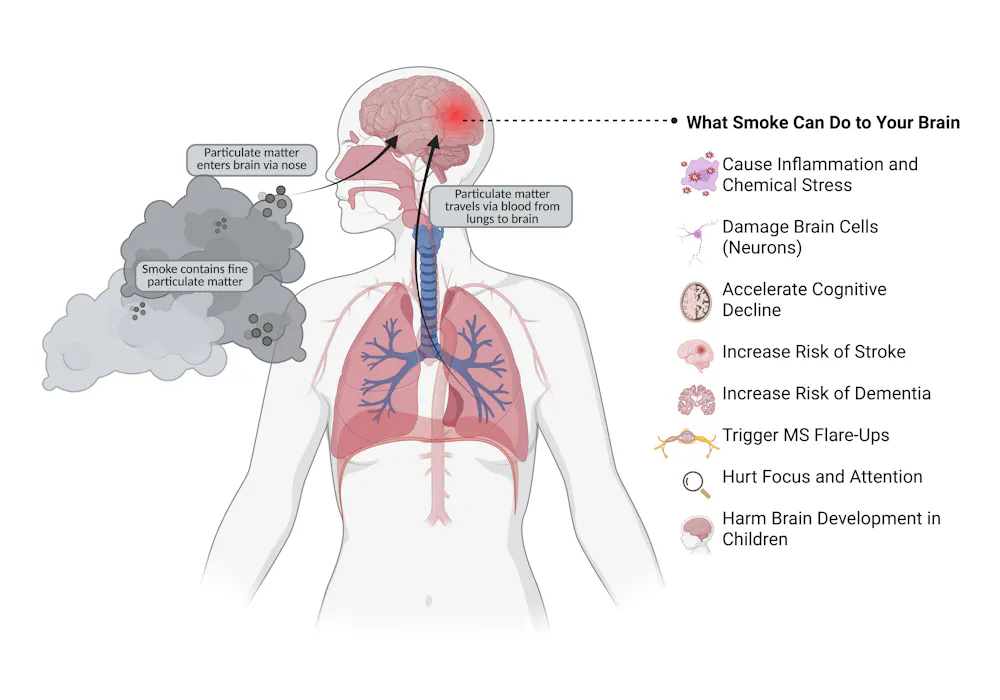
    Alongside harmful gases and heavy metals, wildfire smoke contains fine particulate matter, also known as PM2.5. These tiny particles can travel deep into your lungs, slip into your bloodstream and even reach your brain. Some even bypass the lungs entirely, entering the brain directly through the nose.

    After entering the brain, these toxins can cause inflammation and stress, damage nerve cells and even accelerate cognitive decline. Studies have linked exposure to air pollution to an increased risk of stroke and dementia. Even short-term spikes in smoke exposure, like those during wildfires, lead to a surge in emergency visits for strokes, especially among people over 65.

    A 2022 experiment had thousands of adults participate in an online attention task under smoky conditions. It found that just a three-hour spike in fine particulate matter, typical of a heavy smoke episode, led to measurably worse attention scores. This fits other evidence that breathing smoke makes people mentally foggy, forgetful or fatigued.

    Fine particulate matter in wildfire smoke can reach the brain via the lungs or nose, causing inflammation, neuronal damage, and raising the risk of stroke, dementia, cognitive decline, and MS flare-ups.
    (Muskaan Muse Laroyia)

    Wildfire smoke, dementia and MS

    In 2024, a study found that chronic exposure to wildfire-related air pollution significantly increased the likelihood of someone being diagnosed with dementia. The risk was most pronounced in low-income communities, where people often have less access to clean air, health care and protective measures.

    For people already living with neurological conditions like MS or Parkinson’s disease, the stakes are even higher. Exposure to fine particulate pollution has been linked with increased hospital admissions for MS relapses, particularly in young patients. Other research points to worsening symptoms of epilepsy and cognitive decline under extreme heat and polluted air conditions.

    Despite these mounting risks, neurological health considerations have been largely absent from wildfire preparedness initiatives and public health responses. That needs to change.

    If you want to stay informed about local smoke exposure, tools like AQmap can help you track PM2.5 levels in real time across Canada.

    Some more impacted than others

    Some face far greater risk from wildfire smoke than others, including older adults, those with pre-existing health conditions, people with lower socio-economic status, Indigenous populations, people residing in remote areas and children. This is a health equity issue as much as a medical one.

    Each of these groups faces unique and compounding challenges during smoke events. For example, older adults are more vulnerable to the cardiovascular and neurological effects of smoke. They also face greater barriers to accessing filtered environments.

    People with disabilities or chronic illnesses, including those with neurological conditions, often can’t relocate during smoke events and may rely on power-dependent medical devices that can fail during climate emergencies.

    Low-income families are more likely to live in housing without proper air filtration or cooling. These same communities often face higher baseline rates of neurological disease.

    Indigenous communities, more than 80 per cent of which are located near fire-prone areas, face recurring displacement, interruptions to care and disproportionate exposure to smoke each summer.

    Children and adolescents are particularly susceptible to the harmful neurological effects of wildfires. Because their brains are still developing and they breathe more air per body weight than adults, children are especially vulnerable to harmful pollutants.

    Studies have linked early-life exposure to fine particulate matter with an increased risk of neuro-developmental disorders, lower cognitive function and structural brain changes.

    These populations aren’t just more exposed, they also have fewer resources to respond.

    Rethinking Canada’s health systems

    Recognizing these inequities, we are developing a climate-health equity framework for Canada, with a specific focus on neurological health. Our interdisciplinary team is asking: how can we build health systems that protect vulnerable brains during climate emergencies?

    Health-care workers in Alberta Health Services have designed the Climate-Resilient Acute Care Clinical Operations Framework. This framework supports hospitals in becoming both greener and more resilient, ensuring care can continue during wildfires, floods and extreme heat events.

    Importantly, it also centres the needs of equity-deserving populations, integrating climate adaptation into emergency care, supply chains, staffing and patient communication.

    What needs to change?

    1. Public awareness must expand beyond respiratory health. Neurological effects of smoke should be included in public health messaging, especially for high-risk groups.

    2. Health systems must be climate-ready, with clean air shelters, evacuation protocols and services tailored to meet the needs of neurological patients.

    3. Communities need support, from funding for air filtration to co-ordinated outreach during smoke events. Indigenous-led fire stewardship and community health initiatives should be part of national planning. Supporting Indigenous-led fire stewardship not only strengthens wildfire response but also respects Indigenous sovereignty and traditional ecological knowledge.

    4. Clinicians must be empowered to address climate-related health risks. Training in environmental health, including its impact on the brain, is increasingly essential.

    Wildfire season is back, and with it, an urgent need to protect more than just our lungs. The science is clear: breathing smoky air affects our minds, especially for those already facing health and social vulnerabilities.

    Climate change is a brain health issue. Building a healthier, more equitable future requires us to treat it that way, starting now.

    Dr Bhavini Gohel works for the Canadian Coalition for Green Healthcare.

    Muskaan Muse Laroyia does not work for, consult, own shares in or receive funding from any company or organisation that would benefit from this article, and has disclosed no relevant affiliations beyond their academic appointment.

    ref. Wildfire smoke can harm your brain, not just your lungs – https://theconversation.com/wildfire-smoke-can-harm-your-brain-not-just-your-lungs-258052

    MIL OSI – Global Reports

  • MIL-OSI United Kingdom: Fairer system for debt collection to boost protections for financially vulnerable

    Source: United Kingdom – Executive Government & Departments

    Press release

    Fairer system for debt collection to boost protections for financially vulnerable

    Government to consult on regulation of enforcement sector as well as increase protections for those facing debt enforcement action and raise fees recoverable by bailiff firms

    • Three-pronged package of measures to deliver a fairer system of debt enforcement
    • Plans to improve independent regulation of the enforcement industry to boost oversight
    • Number of doorstep visits by bailiffs to be reduced to limit unfair build-up of fees

    New reforms to the enforcement sector will protect the financially vulnerable and give those facing debt greater opportunity to settle at the earliest and cheapest stage possible.

    Setting out plans to overhaul to the way sector operates, the Government today (Monday 9 June) outlined it will:

    • Consult on plans for greater regulation of bailiff firms, including oversight from an independent body accountable to Parliament.
    • Encourage earlier and cheaper settlement of debt, reducing the number of “doorstep visits” and avoiding the accumulation of enforcement fees.
    • Increase fees bailiff firms can collect for the first time since 2014 to ensure a sustainable sector while better supporting people in debt. The threshold which bailiff firms can charge an additional fee will also be raised to reduce the number of people in debt paying this additional fee.

    Minister of State for Courts and Legal Services Minister Sackman, said: 

    Debt recovery must be fair to everyone. If you’re an organisation or individual who is owed money you should be able to get it back. And if you fall into debt you should be treated fairly and supported to get back on your feet.

    That is why we are reforming the enforcement sector – to safeguard debtors and creditors alike whilst building a more sustainable system.

    The consultation launched today also seeks views on the role an independent statutory regulator should play in enforcement. This includes how the regulator could work with other regulatory bodies, and how it would be held to account by the Government. 

    While most bailiff firms have already signed up to the Enforcement Conduct Board’s voluntary accreditation scheme, the government proposals would see all bailiff firms regulated to the same standards and overseen by the same independent body, ensuring greater protections for vulnerable people.  

    To reduce the number of doorstep visits and help prevent people from falling into more debt through accrued enforcement fees, reforms will increase the minimum notice period which must be given before enforcement officers can visit those in debt to 14 days (from seven) – and to 28 days if requested by a debt advisor.

    This will give people more time to access debt advice, and/or set up a payment agreement.  

    To support a fair, viable, and effective enforcement system, the fees bailiff firms can collect from those facing action will be uplifted by 5%. This is the first fee increase since 2014 and reflects the impact of rising costs on bailiff firms. To protect the interests of financially vulnerable individual, it will be made clear that creditors should not share the profits made from the use of bailiff firms and the charging of fees.

    Minister of State for Local Government and English Devolution, Jim McMahon OBE said:

    These reforms will help make sure those facing the enforcement system are properly protected and supported in dealing with their debts – and we won’t just stop here.

    We will shortly be consulting on improvements to council tax administration including the way council tax is collected and enforced, so people can have their say in delivering a fairer system to support both vulnerable households and local councils.

    Background information

    • The Enforcement Conduct Board (ECB) was established in 2022, tasked with providing voluntary, independent oversight of the sector to ensure fair treatment for every party facing enforcement action
    • The Government is consulting on how to ensure that there is independent oversight of firms that employ enforcement agents and High Court Enforcement Officers to enforce debts using the Taking Control of Goods procedure in England and Wales. The consultation will run for six weeks. Responses will inform legislation to be brought forward as soon as parliamentary time allows
    • As set out in the Chancellor of the Exchequer’s Regulation Action Plan, when regulation is designed well it can be an essential tool to promote growth and investment and protect the public. We will introduce independent statutory regulation of the sector in line with the objectives in the Action Plan, and our work across Government to cut the administrative costs of regulation by 25% by the end of parliament
    • The threshold above which bailiff firms can charge an additional percentage fee will be raised by 24%. Currently, an additional one-off fee of 7.5% of any debt over a set threshold can be recovered by bailiff firms if the debt reaches the enforcement (visit) stage. The 24% rise to this threshold will rebalance these fees in line with inflation and reduce the number of people in debt paying the additional fee
    • The reforms to the regulations about when fees can be recovered and uplifts to the fees and thresholds will be implemented when parliamentary time allows

    Updates to this page

    Published 9 June 2025

    MIL OSI United Kingdom

  • MIL-OSI USA: Trahan Statement on House Settlement Approval

    Source: United States House of Representatives – Congresswoman Lori Trahan (D-MA-03)

    LOWELL, MA – Today, Congresswoman Lori Trahan (MA-03), a former Division I athlete and member of the House Energy and Commerce Committee, issued the following statement after a federal judge approved the proposed settlement in the House, Hubbard, and Carter v. National Collegiate Athletic Association lawsuits:
    “This settlement is a long overdue acknowledgment of what we’ve known for a long time: amateurism is a relic of the past. This outcome wasn’t the result of college sports executives’ forward thinking or university administrators’ generosity. It happened because athletes stood up, spoke out, and demanded better.”
    “For the first time, colleges will be able to pay athletes directly for the use of their name, image, and likeness. That’s not just a step forward – it’s an acknowledgement of the value athletes create. The challenge now lies in how these funds are distributed. Institutions must meet their obligations under Title IX, and we will be watching to ensure they do.”
    “With this momentum, athletes can, and must, keep pushing. There’s much more work ahead to strengthen Title IX, ensure NIL rights extend to all college athletes, and center the health and safety of athletes in every conversation about reform. The greatest threat to that progress is misguided intervention by Congress that chokes off the hard-won gains athletes have fought to achieve. If Congress acts, it must focus on the actual challenges facing college athletics – not the balance sheets of powerful conferences.”
    ###

    MIL OSI USA News

  • MIL-OSI USA: King, Colleagues to White House: “Immediately Reverse” Damaging, Unconstitutional Cuts to Job Corps

    US Senate News:

    Source: United States Senator for Maine Angus King

    WASHINGTON, D.C. — With the Trump administration attempting to shutter the nation’s largest jobs training program for low-income and at-risk young people, Senator Angus King (I-ME), alongside 39 of his Senate colleagues, sent a letter to Department of Labor (DOL) Secretary Lori Chavez-DeRemer urging her to reverse the unconstitutional and illegal cuts to the Job Corps program that are harming student and communities in Maine and across the country. These cuts have left 25,000 students and thousands of staff across 99 Job Corps centers in the lurch, including nearly 500 Maine students and nearly 270 Maine employees

    “The Administration’s decision to illegally and abruptly terminate Job Corps center operations has left 25,000 students and thousands of staff across 99 Job Corps centers in the lurch,” wrote the senators. “The sudden ‘pause’ of operations at Job Corps centers puts young people’s lives at risk, especially a significant number of students who were experiencing homelessness before arriving to the program. Local communities will pay a steep price, especially the thousands of individuals who work at the centers and will lose their livelihoods.” 

    “We urge you to immediately reverse this decision to prevent a lapse in education and services for Job Corps students. We further urge that the Department restart enrollments, expeditiously restart background checks, and make any contract extensions or modifications necessary to ensure no interruptions or delays for students or program operations,” concluded the senators. 

    For more than 60 years, Job Corps has helped millions of young people in rural communities and cities alike to finish high school, learn technical skills and get good-paying jobs while providing stable housing, medical and mental health care, and other supportive services. Through Job Corps programs, young people receive the training they need to start in good-paying jobs that support their communities after graduation – including as wildland firefighters, nurses, electricians, machinists, pipefitters, and welders. Last month, however, the Trump administration indefinitely ‘paused’ operations at Job Corps sites across the country. 

    Joining Senator King on the letter are Senators Tammy Duckworth (D-IL.), Richard Blumenthal (D-CT), Tim Kaine (D-VA), Ed Markey (D-MA), Angela Alsobrooks (D-MD), Peter Welch (D-VT), Bernie Sanders (I-VT), Lisa Blunt Rochester (D-DE), Kirsten Gillibrand (D-NY), Mazie Hirono (D-HI), Elizabeth Warren (D-MA), Chris Murphy (D-CT), Chris Coons (D-DE), John Fetterman (D-PA), Elissa Slotkin (D-MI.), Ben Ray Lujan (D-NM), Amy Klobuchar (D-MN), Jacky Rosen (D-NV), Martin Heinrich (D-NM), Tina Smith (D-MN), Jack Reed (D-RI), Chuck Schumer (D-NY), Alex Padilla (D-CA), Raphael Warnock (D-GR), Jeff Merkley (D-OR), Brian Schatz (D-HI), Cory Booker (D-NJ), John Hickenlooper (D-CO), Andy Kim (D-NJ), Chris Van Hollen (D-MD), Dick Durbin (D-IL), Catherine Cortez Masto (D-NV), Mark Warner (D-VA), Jeanne Shaheen (D-NH), Mark Kelly (D-AZ), Ron Wyden (D-OR), Gary Peters (D-MI.), Tammy Baldwin (D-WI) and Patty Murray (D-WA). 

    Senator King has been consistently sounding the alarm on President Donald Trump’s existential threat to the Constitution. He previously gave a speech on the Senate floor sharing that this administration is doing ‘exactly what the Framers [of the Constitution] most feared” and a speech where he shared his growing concerns over the Trump Administration’s usurpation of Congressional authority. Senator King also previously declared that the proposal to halt all federal grant and loan disbursement was illegal and a direct assault on the Constitution. Previously, he joined 36 Senators in a letter to Secretary of State Marco Rubio, sharing the detrimental effects of  the Trump Administration’s dismantling of the U.S. Agency for International Development (USAID), and has also joined fellow Senate Select Committee on Intelligence (SSCI) colleagues in writing a letter to the White House about the risks to national security by allowing unvetted Department of Government Efficiency (DOGE) staff and representatives to access classified and sensitive government materials.

    The full text of the letter is available here and below.

    +++

    Dear Secretary Chavez-DeRemer:

    We write to express our grave concern with the “pause” of operations that began at Job Corps centers on May 29, 2025, which will harm students and local economies in every state across the country. The Administration’s decision to illegally and abruptly terminate Job Corps center operations has left 25,000 students and thousands of staff across 99 Job Corps centers in the lurch. The sudden “pause” of operations at Job Corps centers puts young people’s lives at risk, especially a significant number of students who were experiencing homelessness before arriving to the program. Local communities will pay a steep price, especially the thousands of individuals who work at the centers and will lose their livelihoods.

    We urge you to immediately reverse this decision to prevent a lapse in education and services for Job Corps students. We further urge that the Department restart enrollments, expeditiously restart background checks, and make any contract extensions or modifications necessary to ensure no interruptions or delays for students or program operations. Congress passed the Full-Year Continuing Appropriations and Extensions Act of 2025, which includes $1,760,155,000 for Job Corps and ensures that Job Corps Centers are funded for the new program year that begins on July 1, 2025. We write to remind you of your obligation to faithfully implement the law.

    Since 1964, Job Corps has helped millions of low-income or at-risk young people develop the skills and resilience needed to succeed in work and life. As the largest free residential education and job training program for young adults ages 16-24, Job Corps programs help students complete their high school education, learn high-value technical skills, and connect to employment through intensive education, training, and support services in a residential setting while providing stable housing, medical and mental health care, and other supportive services to ensure their success. At a time when more than 72 percent of jobs will require training beyond a high school diploma, Job Corps provides students with the opportunity to become wildland firefighters, nurses, electricians, machinists, pipefitters, CDL drivers and welders and more.

    Job Corps centers operate in rural and metropolitan regions nationwide and contribute to their local communities and economies. Many centers have partnered with employers, local workforce development boards, government agencies, and community-based organizations to develop the future workforce and meet the needs of local employers.

    Abruptly canceling contracts for the nation’s Job Corps centers will leave students and communities in the lurch and undermine opportunities for young people to get education and training to succeed in valuable trades. Rather than gutting this valuable program, we urge you to work with Congress to strengthen accountability and program quality for the betterment of young workers, employers needing skilled labor, and communities nationwide, such as reforms included in the bipartisan, bicameral WIOA reauthorization bill from last Congress. We request that you provide written answers to the following questions as soon as possible, but not later than June 20, 2025.

    1. Please provide a list of onboard strength (enrollment) at each center before January 20, 2025 and before the operations pause on May 28, 2025.
    2. With Job Corps operations on pause, how does the department plan to fulfill its obligations to implement the Full-Year Continuing Appropriations and Extensions Act, 2025, which includes $1,760,155,00 for Job Corps serving students?
    3. Please provide information on the number of students experiencing homelessness prior to enrollment at a Job Corps center based on enrollment at each center on May 28, 2025.
    4. Please provide a list of every contract that has been terminated or modified since January 20, 2025, including the total amount of funds to each operator, the amount of funds that each operator has spent up to the date of the contract’s termination or modification, and the amount of remaining unspent funds for each contract.
    5. What authority is the Department using to “pause” operations? Please provide a citation in law or regulation.
    6. The concept of a “pause” does not exist in Job Corps authorizing statute and appears to be an attempt to illegally shut down Job Corps operations without following requirements in law. Section 159 of the Workforce Innovation and Opportunity Act (WIOA) includes clear requirements and processes for the closure of Job Corps Centers that were not followed in this “pause”. How does the Department define a “pause” and how is it different than a “termination”?
    7. On April 25, 2025, the Department’s Employment and Training Administration (ETA) released the first-ever Job Corps Transparency Report, which is used throughout the DOL press release to pause operations at centers.
      1. Centers have returned funding to DOL when enrollments were lower than expected (but that’s not reflected in this report.) Please provide an updated cost per enrollee that accounts for money returned to DOL.
      2. The report also provides cost per enrollee based on enrollment from program year 2023. DOL has much more up-to-date enrollment numbers. Please provide an updated cost per enrollee with the enrollments on campuses as of May 28, 2025, incorporating onboard strength at each campus.

    Sincerely,

    MIL OSI USA News

  • MIL-OSI USA: Rep. Young Kim Applauds Department of Education Announcement to Combat Federal Student Aid Fraud

    Source: United States House of Representatives – Representative Young Kim (CA-39)

    Washington, DC – Today, U.S. Representative Young Kim (CA-40) applauded the Department of Education (Department)’s announcement to launch a nationwide effort to eliminate identity theft and fraud in the federal student aid programs for the fall 2025 semester.

    The Department’s announcement comes after Rep. Kim led a letter calling for a federal investigation into fraudulent community college applications stealing financial aid and abusing federal and state taxpayer dollars.

    Recent reports show that 34 percent of community college applications from the last calendar year were fraudulent.

    “Last year, more than one in every three California community college applications was fake, leading to financial aid fraud stealing $10 million in federal taxpayer dollars and $3 million from our state. This is not only a flagrant waste of taxpayer dollars but also deprives real students in need of receiving student aid they need to receive an education,” said Congresswoman Kim. “I appreciate the Department of Education hearing our call for answers and transparency on behalf of the American people.”

    MIL OSI USA News

  • MIL-OSI United Kingdom: Attracting more investment for housing

    Source: Scottish Government

    Boosting growth potential

    Proposals to build investor confidence in the housing market have been published by an independent group of experts. 

    The Housing Investment Taskforce report makes a number of recommendations to increase investment across the social, affordable and private housing sectors including:

    • Attracting other funds, in addition to public money, for affordable housing.
    • Creating conditions to support more shared home ownership
    • Supporting a more entrepreneurial approach from public bodies.

    Welcoming the taskforce report Housing Minister Paul McLennan said:

    “It is my ambition, shared by the members of the Housing Investment Taskforce, to make Scotland the best place for housing investment. The report has identified a range of actions to support more investment across all tenures of the housing system to meet Scotland’s growth potential.

    “We’re taking forward these recommendations in the Programme for Government and will work in partnership with taskforce members and other organisations to grow investor confidence to support the delivery of more homes across Scotland.”

    MODA Planning Director James Blakey said:

    “Addressing the housing emergency needs bold, imaginative and concrete actions, and we are proud to have collaborated with the Housing Minister and the taskforce over the last year to shape these. Working in partnership to create market certainty and viability is key to attracting crucial investment into Scotland so we can build the new homes people want and need.”

    Communications Director of Springfield Karen Campbell said:

    “The taskforce’s report is clear on the value in building confidence, supporting new partnerships and creating the economic opportunity to unlock new and existing investment in Scotland. Working together we can now take those actions forward to deliver more homes across all tenures.”

    HIT report

    Ken Gibb report

    MIL OSI United Kingdom

  • MIL-OSI United Kingdom: Manchester Central Library and Town Hall Extension to temporarily close for major ICT investment

    Source: City of Manchester

    Manchester Central Library, along with the Town Hall Extension, are closing temporarily in August for the replacement and upgrade of ICT networks and Wi-Fi systems.

    They will be closed for three weeks from 2- 24 August with no access for staff or the public as there will be no ICT network access available while cabling and upgrade work is carried out, which means no connectivity for laptops, PCs, printers and other digital infrastructure. 

    The ICT project will update the Local Area Network (LAN) and the Wireless Local Area Network (WLAN). It will ensure that the Central Library and the Town Hall Extension will have a flexible ICT network providing seamless connectivity for staff and the public using our buildings, as well as third parties including the NHS, GMP and other local authorities. 

    To date, more than 120 buildings have been completed with feedback from staff, library visitors and our partners highlighting its transformative impact. 

    Manchester’s 21 local libraries will be open as usual providing PCs, book lending and study space, all of which have already had successful LAN and Wi-Fi network updates.  

    Find further information on all Manchester Libraries services.  

    Staff hours will be increased in nine key libraries in the city, and we will continue to operate a visitor information service and accept books that are being returned.  

    Staff will be on hand at Central Library entrances to advise customers and residents of the closure and signpost to alternative libraries, places to sightsee, meet or enjoy a coffee in the city. 

    Find out everything you need to know about the temporary Manchester Central Library closure .

    The St Peter’s Square Generator enterprise hub will also be closed but all the services for businesses will be available at the Generator hub site at  Royal Mills Ancoats which opened in 2024. 

    The Town Hall Extension will be fully closed and affected staff will work remotely, while alternative arrangements are being made for in-person pre-booked appointments carried out in the Town Hall Extension, including alternative locations for in-person homelessness appointments and for taxi drivers to attend in-person to present legal documentation.

    Councillor Garry Bridges, Deputy Leader of Manchester City Council, said:  

    “We need to carry out important work to upgrade the network systems which were implemented during the major refurbishment works in 2013.   

    “Currently there is patchy network coverage in critical areas across the buildings, and the upgrade will give us a flexible ICT network that is more fitting to modern ways of working and our digital strategy goals.  

    “We are sorry for the inconvenience that these temporary closures may cause but we are making alternative plans for the services during this time, and we hope that people will understand that the end point of this critical work will be beneficial to everyone who uses the buildings for years to come.” 


    Councillor John Hacking, Executive Member for Skills, Employment and Leisure said:

    “Although there is never a good time to shut Manchester Central Library, we cannot move forward in updating the network without this necessary closure. I can assure people that we will be working at pace to bring a better and faster Wi-Fi provision for our customers when we reopen. 

    “Our library staff will be relocated to our branch libraries during the closure to ensure they can continue to provide the vital services our residents have come to expect while the work is undertaken – and of course a range of library services are also available online.” 


    MIL OSI United Kingdom

  • MIL-OSI Canada: The answer to global energy security

    Alberta’s energy industry contributes billions of dollars to Alberta’s economy and plays a vital role in the global responsible energy supply.

    Premier Danielle Smith, Minister of Energy and Minerals Brian Jean, and other government officials will attend the Global Energy Show from June 10 to 12 to welcome international delegates and promote Alberta’s responsible energy development. Their participation will focus on strengthening Alberta’s position as a trusted energy partner, advancing investment opportunities, and highlighting the province’s role in reducing global energy poverty through secure, sustainable supply.

    With current geopolitical challenges, Alberta’s role in energy security has never been more important for Canada’s stability and that of our trading partners, particularly in North America and Asia.

    “Alberta’s energy industry has been built from the ground up by innovative minds who saw opportunity where others see challenges – and they continue to do so today. Thanks to this ingenuity, Alberta has risen in the global ranks as an energy powerhouse with an equally strong environmental record. With global demand for energy security at an all-time high, Alberta stands ready to provide the solutions our partners need.”

    Danielle Smith, Premier

    “The world needs reliable, responsible and affordable energy from a producer they can trust. Alberta’s vast resources are positioned to meet long-term energy demand and will be key in obtaining North American and global energy security and helping defeat energy poverty. We intend to showcase this to attendees from all over the world at this year’s Global Energy Show.”

    Brian Jean, Minister of Energy and Minerals

    While at the Global Energy Show, Premier Smith and Minister Jean will meet with international officials and business leaders to promote Alberta’s energy sector and vast resource base. Their discussions will focus on strengthening Alberta’s position as a reliable resource partner, identifying new opportunities to meet evolving energy needs, and reducing global reliance on energy from conflict zones.

    “As Canada’s largest international energy gathering, the event will address critical issues including energy security, affordability, access and investment. With delegates from over 100 countries, Calgary will highlight Canada’s leadership in shaping the future of energy at home and globally.”

    Nick Samain, Senior Vice President at dmg events

    The conference is an annual event in Calgary, the heart of Canada’s energy sector, and will take place at the BMO Centre with numerous panels, keynote speakers and opportunities for delegates to network.

    Related information

    • Global Energy Show

    MIL OSI Canada News

  • MIL-OSI Canada: Saskatchewan Advances Initiative for Primary Care Nurse Practitioners to Provide Publicly Funded Health Services

    Source: Government of Canada regional news

    Released on June 9, 2025

    The Government of Saskatchewan is asking for an expression of interest (EOI) from Nurse Practitioners (NPs) who want to deliver publicly funded primary care services.

    This initiative will allow NPs to work to their full scope of practice, promote collaborative, team-based care, and increase access to primary care services for patients. 

    “We are committed to ensuring that every Saskatchewan resident has access to a primary care provider by 2028,” Health Minister Jeremy Cockrill said. “This new initiative creates more opportunities for Nurse Practitioners throughout the health system and improves access to primary care services across our province.”

    The expression of interest opens today. NPs who would like to be considered for this initiative should fill out the EOI by July 6 at midnight. 

    The Government of Saskatchewan announced plans in 2024 to develop a funding model that allows NPs to deliver publicly funded primary care services, such as health assessments, treating common illnesses and injuries and chronic disease management. This is the first step in the plan.

    After EOIs are submitted, invitations to apply will be sent out in late July. Successful applicants will enter a contract developed by the Ministry of Health and will function as independent contractors.

    The Ministry of Health will work with the Saskatchewan Association of Nurse Practitioners (SANP) to implement this initiative.

    “We are excited to see this project come to fruition, as it allows Nurse Practitioners to work both individually, and alongside primary care physicians and allied health professionals,” SANP President Michelle O’Keefe said. “We appreciate the efforts by the Ministry of Health to provide Nurse Practitioners access to an innovative funding model that promotes team-based care.”

    Information sessions on this project will be held virtually on June 17 and 19, 2025. For more information on these sessions, this project or to fill out an EOI please visit: saskatchewan.ca.

    -30-

    For more information, contact:

    Media Inquiry Line
    Health
    Regina
    Phone: 306-787-4083
    Email: media@health.gov.sk.ca

    MIL OSI Canada News

  • MIL-OSI USA: Dingell Announces $3.4 Million for Great Lakes Water Authority for PFAS Remediation

    Source: United States House of Representatives – Congresswoman Debbie Dingell (12th District of Michigan)

    Congresswoman Debbie Dingell (MI-06) today announced the Environmental Protection Agency (EPA) has awarded $3,452,972 to the Great Lakes Water Authority (GLWA) for a PFAS Compounds Remediation Project, as requested by Congresswoman Dingell in the Fiscal Year 2023 appropriations process.

    “We know the urgent threat of PFAS too well in Michigan, and this is a problem so many of our communities are facing and working hard to remediate,” Dingell said. “I’m proud to have secured this funding for the Great Lakes Water Authority to establish a project to rapidly respond to, treat, and dispose of PFAS in our local water systems. I will continue to fight in Congress for funds and regulations to end the spread of dangerous forever chemicals.”

    “We would like to thank Congresswoman Dingell for her efforts to secure this funding. The PFAS family of forever compounds continue to be an area of concern for water utilities that receive them in their waste streams,” said Suzanne R. Coffey, Chief Executive Officer, Great Lakes Water Authority. “GLWA has worked diligently to identify point sources that contribute these chemicals to mitigate and remove them from our system. This funding will allow us to continue to expand and optimize those efforts.” 

    GLWA provides wastewater treatment services to approximately 28% of Michigan’s population, serving 79 communities located in Wayne, Oakland, and Macomb Counties. This funding will enable GLWA to establish a demonstration project for the rapid response, remediation, treatment, and disposal of PFAS compound contamination impacts in the Oakwood Sewer District, and to identify and eliminate Emerging Contaminants (i.e., PFAS Compounds) that have been discharged within its system. The project will benefit all communities served by eliminating contaminants from the system and local waterways, and will also benefit communities where PFOA or PFAS contaminants of unknown origin are discovered.

    MIL OSI USA News

  • MIL-OSI Security: NHS Foundation Trust found guilty of health and safety offences

    Source: United Kingdom London Metropolitan Police

    The North East London NHS Foundation Trust has been found guilty of a health and safety offence, following an investigation by the Metropolitan Police into the death of 22-year old Alice Figueredo at Goodmayes Hospital in 2015.

    The ward manager of the hospital, Benjamin Aninakwa, 53 (25.06.1971) of St Francis Way, Grays was also found guilty of a health and safety offence.

    Alice was being treated on the Hepworth Ward at the hospital after being sectioned under the Mental Health Act in February 2015.

    During a trial lasting seven months, the court heard that the Trust and Aninakwa failed in their duty of care to protect Alice from harm across the six months she was on the ward, before she took her own life on 7 July 2015.

    Alice’s parents, Jane and Max Figueredo, said: “We would like to thank all those involved in the Metropolitan Police, the Crown Prosecution Service and their barristers for their diligent dedication to investigating and prosecuting Alice’s death.

    “Thank you for believing that her life mattered and that the way she was so heartbreakingly, abysmally failed by the staff at this hospital, should not just be ignored and kicked into the long grass – which is what we believe NELFT set about doing after Alice died.

    “We also want to thank the Judge and the jury in this case for their very evident hard work and conscientious commitment in what has been a much lengthier trial than any of us expected.”

    Detective Inspector Jonathan Potter, who led the investigation, said: “My thoughts remain with Alice’s family. They have had to endure years of heartbreak before sitting through a long and difficult trial where they heard time and time again about the tragic series of inactions that led to their daughter’s death.

    “This was a complex investigation led by the Metropolitan Police Service, into a unique case that has led to the conviction of the Trust and Benjamin Aninakwa for health and safety offences.

    “There is nothing I can say that will bring back Alice, but I hope that today’s verdict offers some comfort to her family.

    “While there are thousands of NHS workers that do a commendable job every day, today’s result must also ensure that lessons are learnt to stop the same mistakes happening again.”

    Nine months after Alice’s death, following a report by her parents, the Met’s Specialist Crime Command launched an investigation into the Trust and Aninakwa.

    To build evidence of the offences committed, officers developed a careful understanding of the ward itself, painstakingly combing through more than 2,600 medical documents, many of them hundreds of pages long, as well as dozens of witness statements from staff, family and friends of Alice. Officers also interviewed Aninakwa and took statements from various members of the trust.

    Despite the rarity of a case like this and amid investigative difficulties presented by Covid, officers gathered a range of experts to consult about their experience of being on similar wards. This included nursing staff and psychiatric practitioners, as well as senior colleagues in other NHS trusts and groups including the Care Quality Commission and NHS England.

    Their investigation revealed the extent of negligence by the Trust and Aninakwa, who as ward manager, had failed in his responsibility to make sure that Alice was safe.

    Although Aninakwa knew that Alice had a history of self-harm – dating back to 2013 when she had previously been admitted, and again in 2015 – officers discovered that he repeatedly failed to report such instances and ensure other staff were aware. This was even though Alice had been, according to Aninakwa himself, his only patient who was actively trying to harm themselves.

    In records seen by investigating officers, a mere 13 instances of self-harm were reported, out of a possible 81. Only three of these, out of a possible 19, related to specific items that Alice had used to self-harm on the ward. Even during a scoping exercise by the Trust about the use of possible items, Aninakwa failed to highlight Alice’s history of self-harming behaviour.

    As part of a wide range of failings, officers also found that Aninakwa had failed to direct staff to remove specific items from the communal areas of Hepworth Ward. Nor did he ensure that patients were properly observed by staff and that sufficient steps were taken to lock communal areas that were of concern.

    Consequently, Alice was able to access one of the communal areas on the ward where she took her own life on 7 July 2015.

    Following a complex investigation in partnership with the CPS, the CPS authorised the Met to charge North East London NHS Foundation Trust and Benjamin Aninakwa with health and safety offences corporate manslaughter in September 2023. They were cleared of corporate manslaughter offences at the Old Bailey on Monday, 9 June.

    Sentencing will take place at a court and on a date that is yet to be arranged.

    Aninakwa was found guilty of an offence under section 7 of the Health and Safety at Work Act, having failed to take reasonable care for the health and safety of others.

    The Trust was found guilty of an offence under section 3 of the Health and Safety at Work Act, by failing to ensure that others are not exposed to risks to their health or safety.

    MIL Security OSI

  • MIL-OSI USA: Senators Coons, McCormick introduce legislation to reduce overcrowded emergency departments

    US Senate News:

    Source: United States Senator for Delaware Christopher Coons

    WASHINGTON – U.S. Senator Chris Coons (D-Del.) and David McCormick (R-Pa.) introduced the Addressing Boarding and Crowding in the Emergency Department (ABC-ED) Act, bipartisan legislation to help alleviate emergency department overcrowding by improving the efficiency of emergency care to deliver better health outcomes.

    When inpatient hospital beds reach capacity, patients are often required to “board” in the emergency department (ED). Although this practice is meant to be temporary, a staggering 97% of emergency doctors report caring for patients who have been boarding in the ED for more than 24-hours, according to the American College of Emergency Physicians. This gridlock delays care for new patients and puts ED nurses – who are often responsible for 10 or more patients at once – under even higher pressure and stress.

    The ABC-ED Act would alleviate these issues by allowing public health data modernization grants to be used for developing and maintaining real-time systems that track hospital bed availability to inform state and regional emergency care planning. Improving data systems for hospitals serving neighboring communities – like those on the border of Delaware and Pennsylvania – can reduce wait times, improve patient flow, and support emergency medical staff.

    “If you’ve ever had to go to an emergency room in Delaware, you know that wait times are just too long,” said Senator Coons. “Too many patients end up having to wait hours, or even days, for a bed to open up in the hospital, no matter the emergency. I’ve heard from so many Delawareans about this problem, and I’m proud to lead the federal effort to find solutions. I urge our colleagues to take up this bipartisan bill that will help hospitals modernize their systems, take stress off emergency rooms, and ensure more Americans are getting the care they need as soon as possible.”

    “Advanced technology and AI are re-shaping the way our country and economy work,” said Senator McCormick. “It’s critical to Americans’ long-term health and wellbeing that our nation’s hospitals can access technological resources to update their procedures and practices and ensure patients are receiving the care they need in a timely fashion. I’m grateful to work across the aisle with Senator Coons to help improve the quality and efficiency of our nation’s healthcare system.”

    In addition to Senators Coons and McCormick, the legislation is co-sponsored by U.S. Senators Lisa Blunt Rochester (D-Del.), Thom Tillis (R-N.C.), Angus King (I-Maine), and Markwayne Mullin (R-Okla.). It is led in the House by Representatives Joyce (R-Pa.) and Dingell (D-Mich.).

    “This bipartisan legislation is a practical step towards addressing overcrowding in emergency departments across the nation,” said Senator Tillis. “By giving states the tools to better track and manage hospital capacity in real-time, we can improve patient care, reduce delays, and help save lives.”

    “Overcrowded emergency departments can mean longer wait times for patients and a lack of resources for staff,” said Senator Blunt Rochester. “We need to confront this part of our health care crisis by investing in technology that can identify shortages before they become a problem. I’m glad to be introducing this bill and hope to see it brought to the Floor for a vote.”  

    “Emergency departments in Oklahoma and across the country are overwhelmed. This bill is a critical step in the right direction to address this crisis.” said Senator Mullin. “I’m proud to partner with my colleagues on this to get our hospitals and healthcare workers the resources they need to improve the patient experience in emergency departments.”

    Specifically, the ABC-ED Act would:

    1. Expand public health data grants to support hospital bed tracking systems
    2. Direct the Government Accountability Office to conduct a study to determine best practices for the development and maintenance of public health data systems for tracking hospital capacity
    3. Authorize the Centers for Medicare and Medicaid Services Innovation Center to pilot improved care programs for patients most likely to experience ED boarding, including seniors and those with acute psychiatric needs

    The bill is endorsed by the American College of Emergency Physicians (ACEP) and the Delaware Healthcare Association.

    “Boarding in the emergency department is a national public health crisis that puts patient lives at risk and strains emergency physicians and care teams every day,” said Alison Haddock, MD, FACEP, President of the American College of Emergency Physicians. “We are deeply grateful to Senators Coons, McCormick, Tillis, King, Mullin, and Blunt Rochester for their leadership on this critical issue for emergency medicine, and for joining our House champions, Representatives Joyce and Dingell, to ensure this legislation is a bipartisan, bicameral priority. The ABC-ED Act equips emergency physicians with resources and real-time data to inform medical decisions that can reduce dangerous delays and improve the flow of patients through the emergency care continuum.”

    “Crowded emergency departments and long wait times can put a strain on our healthcare workforce and lead to patients abandoning care. We thank Senator Coons for his leadership in introducing the ABC-ED Act and his bipartisan work on solutions to address this growing challenge. Many factors contribute to ED wait times like increased utilization during respiratory illness season and barriers that prevent individuals from being transferred to post-acute care facilities. Efforts like this legislation will reduce wait times and help enhance our system of care for both patients and our workforce,” said Brian Frazee, President & CEO of the Delaware Healthcare Association. 

    “Delaware ACEP would like to thank Senators Coons, Blunt Rochester, and their colleagues for their support of access to emergency care in Delaware and in the country.  Delaware citizens have seen some of the longest wait-times in the country for ER visits, with hundreds of patients waiting for hours for care in the ERs state-wide at busy times. With his sponsorship of the ABC-ED Act, Sen. Coons has shown his understanding and support for the emergency healthcare team.  Bottlenecks in the entire healthcare system lead to patients who are admitted to the hospital waiting for their hospital beds in the ER.  This results in worse health outcomes for those patients as well as the patients who are waiting to be seen in the space that is occupied by admitted patients.  It is with deep gratitude that the physicians of Delaware ACEP proudly support Senator Coons’ sponsorship of the ABC-ED act to address these concerns and improve health outcomes for this state and for the country,” said the Delaware ACEP Board of Directors.

    Delawareans have dealt with longer ED wait times than nearly every other state for more than a decade. The average ED visit time in Delaware was 141 minutes in 2023 – only a marginal improvement from the 156 minutes averaged in 2013. As a result of long wait times, Delawareans are also more likely to leave without treatment, putting their lives unnecessarily at risk. Long ED wait times are the result of intersecting challenges ranging from health workforce and primary care shortages to insufficient options for discharge due to a shortage of nursing home and behavioral health care options. Last year, the Delaware Healthcare Association reported that more than 300 long-stay patients were boarding in Delaware’s hospitals – using about 10% of the state’s hospital beds – despite being medically ready for discharge. Recent hospital closures in Pennsylvania will further strain hospital capacity issues in the region, making this federal initiative to complement state and local leadership more pressing than ever. 

    The text of the bill is available here.

    MIL OSI USA News

  • MIL-OSI Canada: CRTC takes action to support local news across Canada

    Source: Government of Canada News (2)

    June 9, 2025—Gatineau—Canadian Radio-television and Telecommunications Commission (CRTC)

    The CRTC is taking another step forward to implement the modernized Broadcasting Act (the Act) by helping independent Canadian television stations access more funding from the Independent Local News Fund (ILNF).

    The Act requires the CRTC to modernize Canada’s broadcasting framework and ensure that online streaming services make meaningful contributions to Canadian and Indigenous content. As part of this work, the CRTC launched a consultation to review how the ILNF can better support local news. The CRTC received a number of comments on the public record, including from broadcasters, community stations, and other groups.

    Based on the public record, today’s decision confirms the eligibility criteria for television stations to access more funding from the ILNF, continues to ensure fair distribution of funding, and supports the distribution of local news by requiring ILNF recipients to make it available online.

    This decision follows a number of actions the CRTC has taken to implement the modernized Act. To find out more, check out the CRTC’s regulatory plan.

    Quick facts

    • The CRTC is an independent quasi-judicial tribunal that regulates the Canadian communications sector in the public interest. The CRTC holds public consultations on telecommunications and broadcasting matters and makes decisions based on the public record.
    • The CRTC is fulfilling the mandate given to it by Parliament to modernize Canada’s broadcasting framework. To date, the CRTC has launched 15 public consultations to implement the modernized Act.
    • Today’s decision also confirms that since Corus Entertainment Inc. is an independent broadcaster, its 15 Global stations are eligible to receive funding from the ILNF.  

    Associated links

    MIL OSI Canada News

  • MIL-OSI Canada: Competition Bureau sues DoorDash for allegedly advertising misleading prices and discounts

    Source: Government of Canada News (2)

    June 9, 2025 – GATINEAU, QC – Competition Bureau

    The Competition Bureau is taking legal action against DoorDash Inc., and its subsidiary DoorDash Technologies Canada Inc., for promoting their online delivery services at a lower price than what consumers actually have to pay.

    A Bureau investigation found that consumers were unable to purchase food and other items at the advertised price on DoorDash’s websites and mobile applications due to the addition of mandatory fees at checkout. This practice is commonly known as drip pricing and is deceptive because consumers are not presented with an attainable price upfront.

    DoorDash charges consumers numerous mandatory fees to deliver orders made online, including service fees, delivery fees, expanded range fees, small order fees and regulatory response fees. As a result, consumers end up paying higher prices or receiving lower discounts than advertised. The company has been engaging in the alleged conduct for close to a decade, acquiring nearly $1 billion in mandatory fees from consumers.

    The Bureau also alleges that the way certain fees are represented on the company’s platform give the impression that they are taxes, where, in reality, they are charges imposed at DoorDash’s discretion.

    Today, the Bureau filed an application with the Competition Tribunal seeking, among other things, for DoorDash to: 

    • stop the deceptive price and discount advertising;
    • stop portraying fees as taxes;
    • pay a penalty; and
    • issue restitution to affected consumers who purchased food and other items through DoorDash’s platform.

    MIL OSI Canada News

  • MIL-OSI Canada: Canada’s new government is rebuilding, rearming, and reinvesting in the Canadian Armed Forces

    Source: Government of Canada – Prime Minister

    In an increasingly dangerous and divided world, Canada must be prepared – to defend our people and our values, to secure our sovereignty, and to protect our Allies. We must be prepared to lead and to shape a more stable and prosperous world. This entails government recognizing our new realities and investing in the measures required to meet this moment.

    Today, the Prime Minister, Mark Carney, announced that Canada’s new government is rebuilding, rearming, and reinvesting in the Canadian Armed Forces.

    With this increase, Canada will achieve NATO’s 2 per cent target this year – half a decade ahead of schedule – and further accelerate our investments in years to follow, consistent with our security imperatives. The investment for 2025-26 will be over $9 billion.

    Measures in this plan include:

    • Better pay for Canadian Armed Forces, improved recruitment and retention, and investments to support operational readiness, fleet maintenance, security, and infrastructure requirements.
    • New aircraft, armed vehicles, and ammunition, as well as support for projects currently underway.
    • Developing new drones and sensors to monitor the seafloor and the Arctic.
    • Repairing and maintaining existing ships, aircraft, and other assets.
    • More health care funding and staff for Armed Forces personnel.
    • Expanding the reach, security mandate, and abilities of the Canadian Coast Guard and integrating it into our NATO defence capabilities – to better secure our sovereignty and expand maritime surveillance.
    • Bolstering Canada’s defence industrial capacity.
    • Building capacity in artificial intelligence, cyber, quantum, and space.
    • Modern and secure digital infrastructure.

    The plan will support key capabilities, including:

    • Arctic Over-the-Horizon Radar
    • Joint Counter-Drone Program
    • Joint Support Ships
    • Long-range precision strike capability
    • Increased domestic ammunition production
    • Additional logistics utility vehicles, light utility vehicles, and armoured vehicles

    This government will also undertake efforts to support veterans, including modernizing the benefits system so veterans get supports sooner, streamlining military trade credentials in the civilian sectors, and improving health services for women veterans.

    Canada requires these capabilities to uphold and assert its sovereignty and ensure our defence never becomes dependent on others again. As we strengthen the Canadian Armed Forces, we will also build up Canadian industry, driving innovation and creating good careers for Canadian workers and new opportunities for Canadian businesses. Now more than ever, we need to defend our sovereignty and safeguard Canada’s people and interests.

    Quotes

    “In an increasingly dangerous and divided world, Canada must assert its sovereignty. We will rapidly procure new equipment and technology, build our defence industrial capacity, and meet our NATO defence commitment this year. Canada will seize this opportunity with urgency and determination.”

    “For generations, Canadians have served our country with honour, and today, we renew our promise to stand behind them. We are equipping our Armed Forces with the capabilities and support they need to protect Canadians and uphold our commitments around the world. This historic investment will strengthen our sovereignty and invest in the Canadian economy – growing a world-class defence industry that fuels innovation and job creation.”

    Related Product

    MIL OSI Canada News

  • MIL-OSI Canada: Vicky Eatrides to the Banff World Media Festival

    Source: Government of Canada News

    “From Pitch to Production: Building Canada’s broadcasting framework of the future”

    Banff, Alberta
    June 9, 2025

    Vicky Eatrides, Chairperson and Chief Executive Officer
    Canadian Radio-television and Telecommunications Commission (CRTC)

    Check against delivery

    Introduction

    Good morning, everyone, and thank you, Rod, for the warm welcome.

    Before I begin my remarks, I would like to acknowledge that we are gathered on the traditional territory of the Treaty 7 First Nations, including the Stoney and Siksika First Nations. Let us thank these communities and pay tribute to their Elders.

    Thank you for inviting me to speak with you. I am happy to be joined by CRTC colleagues, including Joanne Levy, our Commissioner for Manitoba and Saskatchewan, and Scott Shortliffe, our Vice-President of Broadcasting. It is also nice to see so many familiar faces in the room.

    It is a pleasure to be back here with you in beautiful Banff. As you may remember, last time we were here together, I pitched a project.

    The project was about how we help build the broadcasting system of the future. A system that is strong and healthy, and that features a multitude of voices creating original content for broadcast on radio, TV and streaming services.

    As Canadian actor and filmmaker Dan Levy once said:“ The amazing part about the Canadian identity is that it’s so rich and so diverse. You are getting stories that are representing so many different types of people, and so many ways of life.” Well, that sentiment captures the spirit of this project — one focused on unity through diversity and drawing on each other’s strengths to build a framework that lasts.

    Last time I pitched it, we were in the development stage. Since then, we have moved past pre-production and the project is in full swing. We have been co-producing this project with many of you, and though we are not yet ready to reveal the final cut, we are making progress.

    Everyone in this room knows what pre-production is like — things start off gradually, then suddenly everything is happening all at once. The next thing you know, you are deep in production and working toward a release date. That is what it has been like for our project. We first had to put the pieces in place — like getting a script written and setting shooting locations — and now we are full tilt into filming.

    So, in the brief time we have this morning, let me take you back to the storylines for our project. Then let us touch on the steps we have taken so far in production, and end on how diverse perspectives are bringing our project to life.

    Storylines for our project

    So let us go back to the storylines.

    As you know, the CRTC is an independent quasi-judicial tribunal that regulates the Canadian communications sector in the public interest. We hold public consultations on telecommunications and broadcasting matters, and we make decisions based on the public record.

    On the broadcasting side, Parliament gave us new responsibilities when it adopted the Online Streaming Act, and we have been making significant progress.

    Modernizing the decades-old regulatory framework has been no small task. We knew that the changes would be substantial and complex and could not be done overnight.

    So we got to work quickly, sketching out our storylines.

    One of these storylines is about ensuring high-quality Canadian content. This includes news, drama, comedies, documentaries, and other types of programming. So that Canadians can easily find, watch, and listen to the diverse content they have told us they want.

    Another storyline is about a sustainable broadcasting system. And what do we mean by sustainable? We mean a system that is financially resilient and capable of adapting to technological advancements and changing market dynamics. A system in which broadcasters contribute in the most effective and appropriate way for their business models. And a system that promotes fair competition, diversity and innovation.

    We also have a storyline that, while perhaps less prominent, plays an important role in the overall narrative. This one is about clear and predictable rules. Because having a transparent framework ensures fairness and consistency in the regulatory environment.

    And once the storylines were settled, we moved quickly toward production.

    Steps taken in production

    All of the actions we have taken so far have been shaped through broad consultations and have been based on a robust public record.

    One example is our consultation on base contributions. The goal was to explore whether we should set base contributions for online streaming services, and if so, how much they should contribute and who should benefit from the contributions.

    From the outset, the industry told us that decisions with the most impact needed to be made quickly, so we took action. That consultation included over 360 submissions and a three-week public hearing, where we heard from more than 120 groups and individuals. As you know, the resulting decision is directing an estimated $200 million annually into the Canadian broadcasting system, targeting areas of immediate need.

    That decision was a key first step in establishing that online streaming services must contribute to the Canadian broadcasting system. It laid the groundwork for clear rules and determined how each player could best support the system’s success as a whole.

    We have continued to move quickly to build on this momentum.

    In our work so far to modernize the broadcasting framework, we have launched 15 public consultations, and we are in the middle of an ambitious series of public hearings to help us make decisions.

    And one of those broadcasting decisions was released just this morning. It is a decision that supports local TV news across Canada.

    As you know, we established in base contributions that online streaming services should contribute toward news because of the vital role it plays in the system. Today’s decision recognizes how important news broadcasters are in keeping Canadians informed and involved in their communities.

    Diverse perspectives bringing our project to life

    And more action is coming. Action that is based on meaningful engagement with groups and individuals, including many of you.

    Less than two weeks ago, we concluded a major hearing on the definition of Canadian content for TV and online streaming services, and on supporting the creation and distribution of Canadian and Indigenous content. The level of engagement spoke volumes: we received 480 written submissions, and we heard from 78 groups during our public hearing.

    While our main focus was on the definition of Canadian content, we discussed topics like the role of programs of national interest and the use of artificial intelligence. And we heard a wide range of perspectives.

    We heard broad recognition for the importance of defining Canadian content and for how vital storytelling is to our culture. The definition matters because it is tied to what is broadcast, what is supported by funding, and therefore, what gets greenlit and aired. This decision will influence and shape the stories that are told in the future. 

    We heard that we should maintain what is working well in the broadcasting system.

    And we heard a call for continued quick action and clarity.

    While we just wrapped up this hearing, we have another one starting in the coming days, where we will be turning our minds to the market dynamics within the Canadian broadcasting system. And in September, we will be holding a hearing on what Canadian content means for audio services.

    We will issue key decisions on these matters starting this fall. Once the policy decisions are in place, we will move quickly to set conditions of service for the major players — those shaping and benefiting most from Canada’s broadcasting system. These conditions will bring certainty regarding Canadian programming investments while ensuring the system continues to support Canadian talent, stories, and culture.

    Building the broadcasting framework of the future involves the perspectives of many to get it right — from traditional broadcasters to producers, to Canadians, public interest groups, online streaming services, and more. Every voice can help shape what comes next.

    Conclusion

    On that positive note, let me leave you with this.

    Our project is in full swing. Together, we are continuing to make progress.

    We are helping build the broadcasting system of the future. A strong and vibrant system. One that supports the diversity and richness of the Canadian identity.

    Everyone has a role to play in bringing this project to life. So let us keep moving together quickly through production.

    Because our project is about more than a regulatory framework. It is about a system that inspires, connects, and reflects all Canadians. For today, for tomorrow, and for generations to come.

    Thank you.

    MIL OSI Canada News

  • MIL-OSI USA: Davids Announces New Federal Grant to Lower Energy Costs in Franklin, Anderson Counties

    Source: United States House of Representatives – Congresswoman Sharice Davids (KS-3)

    Today, Representative Sharice Davids announced a federal grant to help two rural Kansas nursing and rehabilitation centers lower their energy costs through solar power. The investments, totaling nearly $200,000, are part of the Rural Energy for America Program (REAP), which helps small businesses and farms in rural areas make energy-efficient upgrades. Davids was the only member of Kansas’ Congressional Delegation to vote for the Inflation Reduction Act, which supports this program. “High energy bills are one of the biggest costs for Kansas businesses, especially in rural areas,” said Davids. “This funding helps local facilities save thousands of dollars each year—money they can reinvest into their operations and community. I’ll keep working to bring down costs and make smart investments like this across our state.” Recover-Care Richmond, a nursing and rehab facility in Franklin County, received $99,995 to install new solar technology. This is expected to save the facility over $13,000 a year and cover 51 percent of its total energy use. Parkview Heights Nursing & Rehab Center in Anderson County also received $99,995 for new solar technology. This will replace nearly 95,000 kilowatt hours of electricity each year — enough to power eight homes — helping the facility save money and reduce its reliance on the grid. Davids has made it a priority to lower energy costs for Kansas businesses and families. Through tax credits in the Inflation Reduction Act, which she voted to pass, 3.4 million American families have already saved more than $8 billion on their utility bills. The law also caps the cost of insulin at $35 a month for seniors and finally lets Medicare negotiate for lower prescription drug prices, saving 74,000 Kansans on Medicare up to 79 percent on certain medicines. REAP provides grants and loans to rural small businesses and farms to help them install renewable energy systems or improve energy efficiency. The program is administered by the U.S. Department of Agriculture and is part of a broader effort to invest in rural communities across the country.

    MIL OSI USA News

  • MIL-OSI USA: U.S. House Passes Davids’ Bipartisan Bill to Help People in Recovery Rejoin the Workforce

    Source: United States House of Representatives – Congresswoman Sharice Davids (KS-3)

    Last night, the U.S. House of Representatives passed Representative Sharice Davids’ bipartisan legislation to address the impact of substance use on America’s workforce. The legislation would reauthorize the Comprehensive Addiction Recovery through Effective Employment and Reentry (CAREER) Act, which supports individuals recovering from substance use disorder, ensuring they can reenter the workforce and maintain gainful employment. The bill, originally introduced alongside Congressman Andy Barr (R-KY-06), was passed as part of the bipartisan Support for Patients and Communities Reauthorization (SUPPORT) Act.

    “Substance use has devastated far too many Kansas families, and we must ensure those recovering from addiction are supported and have access to good-paying jobs,” said Davids. “Today, my colleagues from both sides of the aisle joined me in helping those folks recovering from substance use find employment and live independently. There are so many local organizations who walk alongside our neighbors in recovery, and I’m proud to support them with the CAREER Act.”

    Davids’ CAREER Act would reauthorize the Substance Abuse and Mental Health Services Administration’s (SAMHSA) Treatment, Recovery, and Workforce Support Grant Program, which helps determine workforce gaps and coordinate employment and training activities for individuals in recovery. The reauthorization would also increase funding for the program and allow the grants to be used for transportation between work, training, and recovery services. 

    “The CAREER Act has played a key role in supporting workforce development, vocational training, and skill-building in our communities,” said Congressman Andy Barr (R-KY-06). “By renewing its authorization, we can make this essential program even more effective, ensuring American workers have what they need to thrive in today’s job market. Given the ongoing battle our nation faces with substance abuse, especially the opioid crisis in Kentucky, it’s crucial that we focus on helping and providing resources to those working towards recovery.”

    To ensure a safer and healthier community, Davids has made it a priority to address the opioid and fentanyl epidemic head-on. She hosted multiple summits with law enforcementhealth care workers, and education professionals on combating the fentanyl epidemic and has taken a number of legislative actions based on the specific needs of the Kansas Third District, including:

    • Securing a nearly $16 million grant to help law enforcement seize illicit drugs like fentanyl, reduce violent crime associated with drug trafficking, and improve data collection.
    • Voting to permanently place all fentanyl-related substances into a Schedule I class, labeling the drug with a high potential for abuse and no currently accepted medical use.
    • Joining a bipartisan group of lawmakers to request funding for new handheld mass spectrometry trace-level chemical detection devices at domestic ports.
    • Urging the FDA to take up expert recommendations and make Narcan, a common naloxone nasal spray, available without a prescription — which they did earlier this year.
    • Helping pass a bipartisan bill to create a public awareness campaign about synthetic opioids. This came after meeting with Libby Davis, a Johnson County resident whose son passed away after taking a counterfeit pill that was unknowingly laced with fentanyl.
    • Pushing for expanded federal grant opportunities, so law enforcement and Emergency Medical Technicians (EMT) can easily acquire life-saving naloxone kits.
    • Visiting the Port of Long Beach to see how the port uses state-of-the-art technologies to prevent harmful substances — like fentanyl — from entering the country illegally.

    MIL OSI USA News

  • MIL-OSI USA: During Pride Month, Davids Introduces Bill Supporting LGBTQI+ Youth Mental Health

    Source: United States House of Representatives – Congresswoman Sharice Davids (KS-3)

    Today, during Pride Month, Representative Sharice Davids reintroduced her legislation to improve mental health support for at-risk LGBTQI+ youth. A Centers for Disease Control and Prevention (CDC) survey of American teenagers found that LGBTQI+ students report significantly worse mental health than other students. Also, nearly 40 percent of gay, lesbian, and bisexual teens said they considered committing suicide in 2023. The Pride in Mental Health Act works to improve physical and mental health in at-risk youth.

    “Children here in Kansas and across the country continue to struggle with mental health challenges, but we are failing many of our most vulnerable children on this issue,” said Davids. “My Pride in Mental Health Act takes a comprehensive and data-driven approach to tackling the mental health crisis among LGBTQI+ youth. By increasing access to mental health support for our children and teens, we can save lives.”

    Specifically, the Pride in Mental Health Act:

    • Increases mental health support for LGBTQI+ youth by updating care standards, developing training for caregivers, identifying school bullying prevention guidelines, and more.
    • Protects at-risk youth by commissioning a report on the mental health and mental health care of LGBTQI+ youth in foster care and other federal social services programs.
    • Directs the Substance Abuse and Mental Health Services Administration (SAMHSA) to review and update resources listed on their website that pertain to LGBTQI+ communities.

    The Pride in Mental Health Act has been endorsed by the Congressional Equality Caucus, Human Rights Campaign, GLSEN, National Education Association (NEA), Advocates for Trans Equality, PFLAG National, American Psychological Association (APA), Institute for Health Research & Policy at Whitman-Walker, interACT: Advocates for Intersex Youth, National Alliance on Mental Illness (NAMI), The Trevor Project, Seattle Indian Health Board, and the American Academy of Pediatrics.

    “As someone who faced firsthand the challenges of growing up LGBTQI+ while struggling with their mental health, I know how isolating and overwhelming it can be,” said Representative Ritchie Torres (NY-15). “Across the country, LGBTQI+ youth face alarmingly high rates of depression, suicidal ideation, and disproportionate representation in the foster care system. For too long, we’ve failed to meet their needs with the compassion and support they deserve. That’s why I’m proud to co-lead the Pride in Mental Health Act with Rep. Sharice Davids to confront these disparities head-on and ensure every young LGBTQI+ person has access to the care and support they need to thrive.”

    “Young people across the country are struggling right now with unprecedented levels of depression and mental health challenges, and it is felt most acutely among LGBTQ+ youth,” said Congressman Sorensen (IL-17). “It’s important this Pride Month that we help our vulnerable youth access the mental health care, treatment, and resources they need to live happy and healthy lives as their full selves. I’m proud to work with my fellow Equality Caucus Co-Chairs, Reps. Davids and Torres, to address this crisis head-on. With this legislation, we can improve and save lives.”

    “On behalf of PFLAGers everywhere, I thank Rep. Davids for introducing this important bill providing tools and accountability to SAMHSA,” said Brian K. Bond, CEO, PFLAG National. “Across races, places, genders, and abilities, all people — including LGBTQ+ youth — deserve to thrive as their authentic selves. This bill will ensure access to and measurement of critical behavioral health services, especially for trans youth who are facing unprecedented attacks by people who are seeking to remove the most basic access to healthcare of all kinds.”

    “The LGBTQ+ community faces significant barriers to accessing mental health care,” said Hannah Wesolowski, Chief Advocacy Officer, National Alliance on Mental Illness (NAMI). “Ensuring access to early intervention and comprehensive, evidence-based treatment are essential to helping LGBTQ+ individuals with mental health conditions to live well. The Pride in Mental Health Act helps ensure that all individuals affected by mental illness receive the care and support they need and deserve to lead healthy, fulfilling lives within a supportive and inclusive community. NAMI is grateful to Rep. Davids for introducing this legislation and proud to support this important bill.”

    “Passing the Pride in Mental Health Act would provide vital resources to support the mental health of LGBTQ+ young people and shine a necessary spotlight on the serious mental health crisis facing our country,” said Mark Henson, Interim Vice President of Advocacy and Government Affairs, The Trevor Project. “The Trevor Project’s research found that 39% of LGBTQ+ young people seriously considered attempting suicide in the past year, yet half of those who wanted mental health care were not able to get it. It’s clear that we need more resources to end suicide among this high-risk group, and this legislation creates a critical avenue for providing the resources, data, and awareness we need to help LGBTQ+ young people across the country lead the happy, healthy lives they deserve.”

    “The reintroduction of the Pride in Mental Health Act is a critical step toward closing the persistent behavioral health gaps experienced by LGBTQ+ youth,” said Arthur C. Evans Jr., PhD, CEO, American Psychological Association. “Decades of psychological research show that access to affirming, evidence-based care dramatically improves outcomes for LGBTQ+ individuals. This legislation affirms a simple but powerful principle: every young person deserves the support they need to thrive — without fear, stigma, or discrimination. We commend Representative Sharice Davids for her bold leadership and steadfast commitment to the mental health and well-being of LGBTQ+ youth.”

    “LGBTQ+ youth are growing up in a moment of crisis — where their very existence is being debated in legislatures across the country,” said David Stacy, Vice President for Government Affairs, Human Rights Campaign. “They are not just facing the everyday pressures of adolescence, but also the constant drumbeat of rejection and discrimination. Mental health support from affirming, qualified professionals isn’t just helpful — it’s lifesaving. The Pride in Mental Health Act is a crucial response to this national emergency.”

    Davids has focused on improving mental health care since taking office. She visited Tyler’s House KC to help launch their summer mental wellness programming, helped secure funding for mental health programs in Wyandotte and Johnson Counties, and advocated for stronger mental health supports in schools. She also helped acquire grants for local police departments to hire more behavioral health specialists to the force, including the Overland Park Police Department’s new Crisis Action Team. Her legislation to renew federal mental health grant programs for health centers, schools, and law enforcement also passed the U.S. House.

    MIL OSI USA News

  • MIL-OSI USA: Davids Honors Prairie Village Woman Killed in Antisemitic Attack with Moment of Silence on U.S. House Floor

    Source: United States House of Representatives – Congresswoman Sharice Davids (KS-3)

    Today, Representative Sharice Davids led a moment of silence on the U.S. House Floor in honor of Sarah Milgrim, a Prairie Village native, and her partner, Yaron Lischinsky, who were fatally shot outside the Capital Jewish Museum earlier this month. Milgrim was a 2017 graduate of Shawnee Mission East High School and earned her degree from the University of Kansas in 2021.

    Read Davids’ full speech below:

    Mr. Speaker, I rise today with a heavy heart to honor the lives of Sarah Milgrim and her partner, Yaron Lischinsky, who were tragically and senselessly killed in an antisemitic attack outside the Capital Jewish Museum here in D.C.

    Sarah grew up in Prairie Village, Kansas, a community I have the honor of serving in Congress. She graduated from Shawnee Mission East and the University of Kansas. She was a devoted member of Congregation B’nai Jehudah and was dedicated to building understanding and connection between Israel and the United States. Her partner Yaron shared that commitment.

    This hateful and targeted violence is heartbreaking. It’s unacceptable.  Antisemitism has no place in our country, and yet we are seeing a deeply disturbing rise in these acts of hate.

    To Sarah and Yaron, may your memories be a blessing. To the Jewish community in Kansas, Colorado, and across the nation, please know that I am standing with you. We mourn with you. We recommit to creating a world where no one fears for their safety because of who they are. And I can tell you, Sarah was committed to that.

    Mr. Speaker, I now ask my colleagues to please rise and join me in a moment of silence to honor the lives lost.

    MIL OSI USA News