NewzIntel.com

    • Checkout Page
    • Contact Us
    • Default Redirect Page
    • Frontpage
    • Home-2
    • Home-3
    • Lost Password
    • Member Login
    • Member LogOut
    • Member TOS Page
    • My Account
    • NewzIntel Alert Control-Panel
    • NewzIntel Latest Reports
    • Post Views Counter
    • Privacy Policy
    • Public Individual Page
    • Register
    • Subscription Plan
    • Thank You Page

Category: Asia Pacific

  • MIL-OSI Asia-Pac: Parliamentary Committee on Official Language Visits the National Museum of Indian Cinema

    Source: Government of India

    Posted On: 23 APR 2025 11:27AM by PIB Mumbai

    Mumbai, 23 April 2025


    The Members of the Parliamentary Committee on Official Language visited the National Film Development Corporation (NFDC) and the National Museum of Indian Cinema (NMIC)in Mumbai, on Tuesday, April 22, 2025. 

    The delegation included Members of Parliament Shri Shankar Lalwani (Indore LS constituency), Shri Haribhai Patel (Mehsana LS constituency), Shri Kuldeep Indora (Ganganagar LS cindtutuency), Dr. Sumer Singh Solanki (RS), Shri Zia Ur Rahman (Sambhal LS Constituency), along with Secretary (Committee) Shri Prem Narain.

    The Members of the Parliamentary Committee were received by Shri D. Ramakrishnan, General Manager, NFDC, and other senior officials. Shri Ravindra Kumar Jain, Senior Economic Advisor, Union Ministry of Information & Broadcasting, was also present on the occasion. 

    The museum tour was conducted by Ms. Jayita Ghosh, Manager – Marketing & Public Relations, NMIC, and Shri Satyajit Mandlay, Deputy General Manager and Curator. The Members of the Official Language Committee received an insightful overview of Indian cinema’s historical journey, technological advancements, rare posters, and curated collections.

    The Members were deeply impressed by the exhibits and praised the museum for preserving and showcasing the cultural heritage of Indian cinema. They shared that the visit was not only enlightening and informative but also emotionally resonant, offering a unique connection to the soul of Indian cinema. They also expressed their intent to revisit the museum in the future.

    The occasion marked a proud moment for both NMIC and NFDC, as the enduring legacy of Indian cinema was recognized and appreciated by key policymakers of the nation.


    * * *

    PIB Mumbai | SC/ DR

    Follow us on social media: @PIBMumbai    /PIBMumbai     /pibmumbai   pibmumbai[at]gmail[dot]com  /PIBMumbai     /pibmumbai

    (Release ID: 2123693) Visitor Counter : 75

    MIL OSI Asia Pacific News –

    April 23, 2025
  • MIL-OSI Asia-Pac: Tur procurement continues in major Tur producing states

    Source: Government of India

    Tur procurement continues in major Tur producing states

    Govt. committed to purchase 100 percent of production of Tur at MSP

    Tur procurement is also done on e-Samridhi and eSamyukti portals

    Posted On: 23 APR 2025 2:15PM by PIB Delhi

    In order to incentivize the farmers contributing for the enhancement of domestic production of pulses and to reduce the dependence on imports, the Government has approved the procurement of Tur, Urad and Masur under Price Support Scheme (PSS) equivalent to 100% of the production of the state for the procurement year 2024-25.

    The Government has also made an announcement in Budget 2025 that the procurement of Tur (Arhar), Urad and Masur would be undertaken 100% of the production of the State for another four years up to 2028-29 through Central Nodal Agencies namely NAFED and NCCF to achieve self- sufficiency in pulses in the country.

    Accordingly, Union Minister of Agriculture and Farmers’ Welfare Shri Shivraj Singh Chouhan approved the procurement of Tur (Arhar) in the states of Andhra Pradesh, Chhattisgarh, Gujarat, Haryana, Karnataka, Madhya Pradesh, Maharashtra, Telangana and Uttar Pradesh under Price Support Scheme during the Kharif 2024-25 season for a total quantity of 13.22 LMT. The Minister has also approved the extension of procurement period in Andhra Pradesh by 30 days beyond 90 days upto 22nd of next month in the interest of farmers.

    The procurement at MSP through NAFED and NCCF is in progress in Andhra Pradesh,Gujarat, Karnataka, Maharashtra and Telangana and a total quantity of 3.92 LMT of Tur (Arhar) has been procured in these states till 22nd of this month benefitting 2,56,517farmers of these states. Tur procurement is also done from pre-registered farmers on e-Samridhi portal of NAFED and eSamyukti portal of NCCF.  The Govt. of India is committed to take up 100 percent procurement of Tur @ MSP offered by farmers through central nodal agencies namely NAFED and NCCF.

    ******

    PSF/KSR/AR

    (Release ID: 2123761) Visitor Counter : 15

    Read this release in: Hindi

    MIL OSI Asia Pacific News –

    April 23, 2025
  • MIL-OSI Asia-Pac: Consumer Price Indices for March 2025

    Source: Hong Kong Government special administrative region

         The Census and Statistics Department (C&SD) released today (April 23) the Consumer Price Index (CPI) figures for March 2025. According to the Composite CPI, overall consumer prices rose by 1.4% in March 2025 over the same month a year earlier, smaller than the average rate of increase in January and February 2025 (1.7%). Netting out the effects of all Government’s one-off relief measures, the year-on-year rate of increase in the Composite CPI (i.e. the underlying inflation rate) in March 2025 was 1.0%, also smaller than the average rate of increase in January and February 2025 (1.3%). The comparison to the average rate of increase in January and February is to neutralise the effect caused by the different timing of the Chinese New Year between two years, which occurred in January this year but in February last year. The smaller increase in March 2025 was mainly due to the decreases in inbound and outbound transport fares and the charges for package tours. 

         Comparing March 2025 with February 2025, the year-on-year rate of increase in the Composite CPI in March 2025 was 1.4%, the same as that in February 2025. Netting out the effects of all Government’s one-off relief measures, the year-on-year rate of increase in the Composite CPI in March 2025 was 1.0%, slightly smaller than the corresponding increase in February 2025 (1.1%).  

         On a seasonally adjusted basis, the average monthly rate of change in the Composite CPI for the 3-month period ending March 2025 was 0.0%, the same as that for the 3-month period ending February 2025. Netting out the effects of all Government’s one-off relief measures, the corresponding rates of change were both 0.0%.   

         Analysed by sub-index, the year-on-year rates of increase in the CPI(A), CPI(B) and CPI(C) were 2.0%, 1.2% and 1.0% respectively in March 2025, as compared to the average rates of increase of 2.2%, 1.5% and 1.3% respectively in January and February 2025, and 2.0%, 1.2% and 1.0% respectively in February 2025. Netting out the effects of all Government’s one-off relief measures, the year-on-year rates of increase in the CPI(A), CPI(B) and CPI(C) were 1.4%, 0.9% and 0.8% respectively in March 2025, as compared to the average rates of increase of 1.7%, 1.2% and 1.2% respectively in January and February 2025, and 1.4%, 1.0% and 0.9% respectively in February 2025.   

         On a seasonally adjusted basis, for the 3-month period ending March 2025, the average monthly rates of change in the CPI(A), CPI(B) and CPI(C) were 0.1%, 0.0% and 0.0% respectively. The corresponding rates of change for the 3-month period ending February 2025 were 0.1%, 0.0% and 0.1% respectively. Netting out the effects of all Government’s one-off relief measures, the average monthly rates of change in the seasonally adjusted CPI(A), CPI(B) and CPI(C) for the 3-month period ending March 2025 were -0.1%, 0.0% and 0.0% respectively, the same as those for the 3-month period ending February 2025.   

         Amongst the various components of the Composite CPI, year-on-year increases in prices were recorded in March 2025 for electricity, gas and water (14.0%), alcoholic drinks and tobacco (4.4%), transport (1.7%), housing (1.7%), meals out and takeaway food (1.3%), miscellaneous goods (1.0%), and miscellaneous services (1.0%).   

         On the other hand, year-on-year decreases in the components of the Composite CPI were recorded in March 2025 for clothing and footwear (-2.8%), basic food (-1.5%), and durable goods (-0.5%).   

         In the first quarter of 2025, the Composite CPI rose by 1.6% over a year earlier, while the CPI(A), CPI(B) and CPI(C) rose by 2.2%, 1.4% and 1.2% respectively. The corresponding increases after netting out the effects of all Government’s one-off relief measures were 1.2%, 1.6%, 1.1% and 1.0% respectively.   

         For the 12 months ending March 2025, the Composite CPI was on average 1.6% higher than that in the preceding 12-month period. The respective increases in the CPI(A), CPI(B) and CPI(C) were 2.1%, 1.5% and 1.4% respectively. The corresponding increases after netting out the effects of all Government’s one-off relief measures were 1.1%, 1.2%, 1.1% and 1.1% respectively.   

    Commentary

         A Government spokesman said that the underlying consumer price inflation stayed modest in March. The underlying Composite CPI increased by 1.0% over a year earlier in March, smaller than the increase of 1.3% in January and February combined. Price pressures on various major components stayed contained in general.

         Looking ahead, overall inflation should remain modest in the near term. External price pressures should be broadly in check, though escalating trade conflicts continue to warrant attention. The Government will monitor the situation closely.

    Further information

         The CPIs and year-on-year rates of change at section level for March 2025 are shown in Table 1. The time series on the year-on-year rates of change in the CPIs before and after netting out the effects of all Government’s one-off relief measures are shown in Table 2. For discerning the latest trend in consumer prices, it is also useful to look at the changes in the seasonally adjusted CPIs. The time series on the average monthly rates of change during the latest 3 months for the seasonally adjusted CPIs are shown in Table 3. The rates of change in the original and the seasonally adjusted Composite CPI and the underlying inflation rate are presented graphically in Chart 1.

         More detailed statistics are given in the “Monthly Report on the Consumer Price Index”. Users can browse and download this publication at the website of the C&SD (www.censtatd.gov.hk/en/EIndexbySubject.html?pcode=B1060001&scode=270).

         For enquiries about the CPIs, please contact the Consumer Price Index Section of the C&SD (Tel: 3903 7374 or email: cpi@censtatd.gov.hk).

    MIL OSI Asia Pacific News –

    April 23, 2025
  • MIL-OSI Asia-Pac: Suspected red tide sighted at some beaches

    Source: Hong Kong Government special administrative region

    Attention TV and radio announcers:

    Please broadcast the following as soon as possible:

    Here is an item of interest to swimmers.

    The Leisure and Cultural Services Department announced today (April 23) that due to the sighting of a suspected red tide, red flags have been hoisted at Lido Beach, Casam Beach and Ting Kau Beach in Tsuen Wan District. Beachgoers are advised not to swim at these beaches until further notice.

    MIL OSI Asia Pacific News –

    April 23, 2025
  • MIL-OSI Asia-Pac: DELIVERY OF 10th AMMUNITION CUM TORPEDO CUM MISSILE (ACTCM) BARGE, LSAM 24 (YARD 134)

    Source: Government of India

    Posted On: 23 APR 2025 9:00AM by PIB Delhi

    Induction ceremony of 10th ACTCM Barge, LSAM 24 (Yard 134) was held on 22 Apr 25 at Naval Dockyard, Mumbai. Chief Guest for Induction Ceremony was Cmde AKK Reddy, AGM(PR), ND(Mbi).

    The contract for construction and delivery of eleven (11) Ammunition Cum Torpedo Cum Missile (ACTCM) Barges was concluded with M/s Suryadipta Projects Pvt Ltd, Thane on 05 Mar 21, an MSME Shipyard. The Shipyard has indigenously designed these Barges in collaboration with an Indian Ship Design firm and subsequently model tested at Naval Science and Technological Laboratory, Visakhapatnam successfully to ensure seaworthiness. These barges are built in accordance with relevant Naval Rules and Regulations of Indian Register of Shipping (IRS). These Barges are proud flag bearers of “Make in India” and “Aatmanirbhar Bharat” initiatives of Government of India. Nine ACTCM Barges have already been delivered and the shipyard has also been awarded a contract for construction and delivery of four Sullage Barges to the Indian Navy thereby highlighting the Indian Navy’s commitment towards encouraging MSMEs.

    Induction of these Barges would provide impetus to operational commitments of Indian Navy by facilitating Transportation, Embarkation and Disembarkation of articles/ ammunition to Indian Navy platforms both alongside jetties and at outer harbours.

    *****

    VM/SKS                                          

    (Release ID: 2123750) Visitor Counter : 84

    MIL OSI Asia Pacific News –

    April 23, 2025
  • MIL-OSI Asia-Pac: DPIIT Secretary chairs PMG review of mega infrastructure projects in Uttar Pradesh, Haryana, Punjab and Uttarakhand

    Source: Government of India

    DPIIT Secretary chairs PMG review of mega infrastructure projects in Uttar Pradesh, Haryana, Punjab and Uttarakhand

    Projects worth over ₹14,096 crore reviewed

    Posted On: 23 APR 2025 1:35PM by PIB Delhi

    Secretary, Department for Promotion of Industry and Internal Trade (DPIIT), Shri Amardeep Bhatia, chaired a high-level meeting to review mega infrastructure projects in the states of Uttar Pradesh, Haryana, Punjab, and Uttarakhand. The review meeting, conducted under the aegis of the Project Monitoring Group (PMG), was attended by senior officials from central ministries, state governments, and project proponents.

    During the meeting, 19 issues across 17 significant projects were reviewed, with the total cost of these projects exceeding ₹14,096 crore. The discussions focused on fast-tracking resolution of implementation challenges through enhanced inter-ministerial and inter-state coordination.

    Among the major projects reviewed was the four-laning of the Jaunpur-Akbarpur road project, valued at ₹3,164.72 crore. The project involves two key issues across two work packages, and is crucial for improving regional connectivity and road infrastructure.

    The meeting also laid emphasis on the establishment of new ESI Hospitals at multiple strategic locations. These projects are part of the Government of India’s broader effort to strengthen healthcare infrastructure, particularly in underserved and high-demand regions. Shri Bhatia noted that the hospitals will significantly improve access to quality medical care and contribute to regional development, thereby supporting the well-being of the workforce and their families.

    The construction of the permanent campus of NIT Uttarakhand at Sumari in Pauri Garhwal district was another key project reviewed. Aimed at strengthening the region’s educational ecosystem, the campus will provide a state-of-the-art academic and administrative environment for the institute. Once operational, it is expected to elevate the quality of technical education and research in Uttarakhand and spur local socio-economic development.

    Shri Bhatia reiterated the Government’s commitment to reinforcing the institutional framework for project monitoring and urged all stakeholders to adopt a proactive approach for issue resolution. He encouraged private sector participants to actively engage with the PMG platform (https://pmg.dpiit.gov.in/) to expedite project implementation by leveraging streamlined coordination with the government and other key entities.

    ***

    Abhishek Dayal/ Abhijith Narayanan/ Ishita Biswas

    (Release ID: 2123748) Visitor Counter : 84

    MIL OSI Asia Pacific News –

    April 23, 2025
  • MIL-OSI Asia-Pac: President Lai pays respects to Pope Francis  

    Source: Republic of China Taiwan

    Details
    2025-04-23
    President Lai meets US CNAS NextGen fellows
    On the morning of April 23, President Lai Ching-te met with fellows from the Shawn Brimley Next Generation National Security Leaders Program (NextGen) run by the Center for a New American Security (CNAS). In remarks, President Lai thanked the government of the United States for continuing its arms sales to Taiwan over the years, supporting Taiwan’s efforts to enhance its national defense capabilities and jointly maintaining peace and stability in the Indo-Pacific region. The president pointed out that we will promote our “Taiwan plus one” policy, that is, new arrangements for Taiwan plus the US, and form a “Taiwan investment in the US team” to expand investment and bring about even closer Taiwan-US trade cooperation, allowing us to reduce the trade deficit and generate development that benefits both sides. A translation of President Lai’s remarks follows: Ms. Michèle Flournoy, chair of the CNAS Board of Directors, is a good friend of Taiwan, and she has made major contributions to Taiwan-US relations through her long-time efforts on various aspects of our cooperation. I am happy to welcome Chair Flournoy, who is once again leading a NextGen Fellowship delegation to Taiwan. CNAS is a prominent think tank focusing on US national security and defense policy based in Washington, DC. Its NextGen Fellowship has fostered talented individuals in the fields of national security and foreign affairs. This year’s delegation is significantly larger than those of the past, demonstrating the increased importance that the next generation of US leaders attach to Taiwan. On behalf of the people of Taiwan, I extend my sincerest welcome to you all. The Taiwan Strait, an issue of importance for our guests, has become a global issue. There is a high degree of international consensus that peace and stability across the Taiwan Strait are indispensable elements in global security and prosperity. Facing military threats from China, Taiwan proposed the Four Pillars of Peace action plan. First, we are actively implementing military reforms, enhancing whole-of-society defense resilience, and working to increase our defense budget to more than 3 percent of GDP. Second, we are strengthening our economic resilience. As Taiwan’s economy must keep advancing, we can no longer put all our eggs in one basket. We are taking action to remain firmly rooted in Taiwan while expanding our global presence and marketing worldwide. In these efforts, we are already seeing results. Third, we are standing side-by-side with other democratic countries to demonstrate the strength of deterrence and achieve our goal of peace through strength. And fourth, Taiwan is willing, under the principles of parity and dignity, to conduct exchanges and cooperate with China towards achieving peace and stability in the Taiwan Strait. This April 10 marked the 46th anniversary of the enactment of the Taiwan Relations Act. We thank the US government for continuing its arms sales to Taiwan over the years, supporting Taiwan’s efforts to enhance its national defense capabilities and jointly maintaining peace and stability in the Indo-Pacific region. We look forward to Taiwan and the US continuing to strengthen collaboration on the development of both our defense industries as well as the building of non-red supply chains. This will yield even more results and further deepen our economic and trade partnership. The US is now the main destination for outbound investment from Taiwan. Moving forward, we will promote our “Taiwan plus one” policy, that is, new arrangements for Taiwan plus the US. And our government will form a “Taiwan investment in the US team” to expand investment. We hope this will bring Taiwan-US economic and trade cooperation even closer and, through mutually beneficial assistance, allow us to generate development that benefits both our sides while reducing our trade deficit. In closing, thank you once again for visiting Taiwan. We hope your trip is fruitful and leaves you with a deep impression of Taiwan. We also hope that going forward you continue supporting Taiwan and advancing even greater development for Taiwan-US ties.  Chair Flournoy then delivered remarks, first thanking President Lai for making time to receive their delegation. Referring to President Lai’s earlier remarks, she said that it is quite an impressive group, as past members of this program have gone on to become members of the US Congress, leading government experts, and leaders in the think-tank world and in the private sector. She remarked that investing in this group is a wonderful privilege for her and that they appreciate President Lai’s agreeing to take the time to engage in exchange with them. Chair Flournoy emphasized that they are visiting Taiwan at a critical moment, when there is so much change and volatility in the geostrategic environment, a lot of uncertainty, and a lot of unpredictability. She stated that given our shared values, our shared passion for democracy and human rights, and our shared interests in peace and stability in the Indo-Pacific region, this is an important time for dialogue, collaboration, and looking for additional opportunities where we can work together towards regional peace and stability.

    Details
    2025-04-18
    President Lai meets US delegation from Senate Foreign Relations Subcommittee on East Asia and the Pacific
    On the afternoon of April 18, President Lai Ching-te met with a delegation led by Senator Pete Ricketts, chairman of the United States Senate Foreign Relations Subcommittee on East Asia, the Pacific, and International Cybersecurity Policy. In remarks, President Lai said we hope to promote our Taiwan plus one policy, that is, new industrial arrangements for Taiwan plus the US, to leverage the strengths of both sides and reinforce our links in such areas as the economy, trade, and technological innovation. The president said that by deepening cooperation, Taiwan and the US will be better positioned to work together on building non-red supply chains. He said a more secure and sustainable economic and trade partnership will allow us to address the challenges posed by geopolitics, climate change, and the restructuring of global supply chains. A translation of President Lai’s remarks follows: I warmly welcome you all to Taiwan. I want to take this opportunity to especially thank Chairman Pete Ricketts and Ranking Member Chris Coons for their high regard and support for Taiwan. Chairman Ricketts has elected to visit Taiwan on his first overseas trip since taking up his new position in January. Ranking Member Coons made a dedicated trip to Taiwan in 2021 to announce a donation of COVID-19 vaccines on behalf of the US government. He also visited last May, soon after my inauguration, continuing to deepen Taiwan-US exchanges. Thanks to support from Chairman Ricketts and Ranking Member Coons, the US Congress has continued to introduce many concrete initiatives and resources to assist Taiwan through the National Defense Authorization Act and Consolidated Appropriations Act, bringing the Taiwan-US partnership even closer. For this, I want to again express my gratitude. There has long been bipartisan support in the US Congress for maintaining security in the Taiwan Strait. Faced with China’s persistent political and military intimidation, Taiwan will endeavor to reform national defense and enhance whole-of-society defense resilience. We will also make special budget allocations to ensure that our defense budget exceeds 3 percent of GDP, up from the current 2.5 percent, so as to enhance Taiwan’s self-defense capabilities. We look forward to Taiwan and the US continuing to work together to maintain peace and stability in the region. We will also promote our Taiwan plus one policy, that is, new industrial arrangements for Taiwan plus the US. We hope to leverage the strengths of both sides and reinforce our links in such areas as the economy, trade, and technological innovation, jointly promoting prosperity and development. We believe that by deepening cooperation through the Taiwan plus one policy, Taiwan and the US will be better positioned to work together on building non-red supply chains. A more secure and sustainable economic and trade partnership will allow us to address the challenges posed by geopolitics, climate change, and the restructuring of global supply chains. In closing, I wish Chairman Ricketts and Ranking Member Coons a smooth and successful visit. Chairman Ricketts then delivered remarks, first thanking President Lai for his hospitality. He said that he and his delegation have had a wonderful time meeting with government officials, industry representatives, and the team at the American Institute in Taiwan. Highlighting that Taiwan has long been a friend and partner of the US, he said their bipartisan delegation to Taiwan emphasizes long-time bipartisan support in the US Congress for Taiwan, and though administrations change, that bipartisan support remains. Chairman Ricketts stated that the US is committed to peace and stability in the Indo-Pacific and that they want to see peace across the Taiwan Strait. He also stated that the US opposes any unilateral change in the status of Taiwan and that they expect any differences between Taiwan and China to be resolved peacefully without coercion or the threat of force. To that end, he said, the US will continue to assist Taiwan in its self-defense and will also step up by bolstering its own defense capabilities, noting that there is broad consensus on this in the US Congress. Chairman Ricketts stated that they want to see Taiwan participate in international organizations and memberships where appropriate, and encourage Taiwan to reach out to current and past diplomatic allies to strengthen those bilateral relationships. He pointed out that the long economic relationship between the US and Taiwan is important for our as well as the entire world’s security and prosperity. He also noted that there are many opportunities for us to continue to grow the economic relationship that will help create more prosperity for our respective peoples and ensure that we are more secure in the world. Chairman Ricketts emphasized that they made this trip early on in the new US administration to work with Taiwan to develop three points: security, diplomatic relations, and the economy. He stated that in the face of rising aggression from communist China, the US will provide commensurate help to Taiwan in self-defense and that they will continue to provide the services and tools needed. In closing, Chairman Ricketts once again thanked President Lai for the hospitality and said he looks forward to dialogue on how we can continue these relationships. Ranking Member Coons then delivered remarks. Mentioning that their delegation also visited the Philippines on this trip, he said that there and in Taiwan, they have been focused on peace, stability, and security, and the ways for deepening and strengthening economic and security relations. He noted that 46 years ago, the US Senate passed the Taiwan Relations Act, adding that it was strongly bipartisan when enacted and that support for it is still strongly bipartisan today. Its core commitment, he said, is that the US will be engaged and will be a partner in ensuring that any dispute or challenge across the strait will be resolved peacefully, and that Taiwan will have the resources it needs for its self-defense. Ranking Member Coons said that between people, friendships are deepest and most enduring when they are based not just on interests but on values, and that the same is true between the US and Taiwan. Free press, free enterprise, free societies, democracy – these core shared values, he said, anchor our friendship and partnership, making them deeper. He remarked that they are grateful for the significant investment in the US being made by companies from Taiwan, but what anchors our partnership, in addition to these important investments and investments being made by Taiwan in its own security, are the values that mobilize our free-enterprise spirit and our commitment to free societies. In Europe in recent years, Ranking Member Coons said, an aggressive nation has tried to change boundaries and change history by force. He said that the US and dozens of countries committed to freedom have come to the aid of Ukraine to defend it, help it stabilize, and secure its future. So too in this region of the world, he added, the US and a bipartisan group in the US Senate are committed to stable, secure, peaceful relations and to deterring any unilateral effort to change the status quo by force. In closing, he said he is grateful for a chance to return to Taiwan after the pandemic and that he looks forward to our conversation, our partnership, and the important work we have in front of us. The delegation was accompanied to the Presidential Office by American Institute in Taiwan Taipei Office Director Raymond Greene.

    Details
    2025-04-17
    President Lai meets New Zealand delegation from All-Party Parliamentary Group on Taiwan  
    On the morning of April 17, President Lai Ching-te met with a delegation from New Zealand’s All-Party Parliamentary Group on Taiwan. In remarks, President Lai thanked the government of New Zealand for reiterating the importance of peace and stability across the Taiwan Strait on multiple occasions since last year. He also stated that this year, the Taiwan-New Zealand economic cooperation agreement (ANZTEC) is being implemented in its complete form. The president expressed hope that deeper collaboration in such fields as smart agriculture, food manufacturing, biomedicine, the digital economy, and clean energy, as well as exchanges among our indigenous peoples, will allow our economies and industries to continue evolving as they adapt to the challenges arising from global changes. A translation of President Lai’s remarks follows: I extend a warm welcome to all of our guests. New Zealand’s All-Party Parliamentary Group on Taiwan was established in 2023, marking a significant milestone in the deepening of Taiwan-New Zealand relations. I would like to thank Members of Parliament Stuart Smith and Tangi Utikere for leading this delegation, and thank all our guests for demonstrating support for Taiwan through action. We currently face a rapidly changing international landscape. Authoritarian regimes continue to converge and expand. Democracies must actively cooperate and jointly safeguard peace, stability, and the prosperous development of the Indo-Pacific region. Since last year, the government of New Zealand has on multiple occasions reiterated the importance of peace and stability across the Taiwan Strait. On behalf of the people of Taiwan, I would like to express our sincere gratitude for these statements and demonstrations of support. This year, ANZTEC is being implemented in its complete form. We look forward to exploring even more diverse markets with New Zealand. Deeper collaboration in such fields as smart agriculture, food manufacturing, biomedicine, the digital economy, and clean energy, as well as exchanges among indigenous peoples, will allow our economies and industries to continue evolving as they adapt to the challenges arising from global changes. Taiwan and New Zealand share the universal values of democracy, freedom, and respect for human rights, and parliamentary diplomacy is a tradition practiced by democracies around the world. Looking ahead, our parliamentary exchanges and mutual visits are bound to become more frequent. This will enable us to explore even more opportunities for cooperation and further deepen and solidify the democratic partnership between Taiwan and New Zealand. Thank you once again for making the long journey to visit us. I wish you a fruitful and successful trip. I also hope that everyone can take time to see more of Taiwan, try our local cuisine, and learn more about our culture. I hope our guests will fall in love with Taiwan. MP Smith then delivered remarks, saying that it is a great pleasure and an honor to be received by President Lai. The MP, noting that President Lai already covered many of the points he planned to make, went on to say that New Zealand and Taiwan share many values. He indicated that both are trading nations that rely on easy access for imports and exports, and that is why freedom of navigation is so important. That is why New Zealand had a naval vessel sail through the Taiwan Strait, he said, to underline the importance of freedom of navigation and our mutual security. MP Smith said that they look forward to building stronger relationships and enhancing the trade between our two nations. He added that New Zealand has much to offer in the field of geothermal energy to assist Taiwan, and mentioned that New Zealand is third largest in terms of the number of rocket launchers for satellites, which could assist Taiwan with communications in the future. New Zealand has other products as well, he said, but looks for assistance from Taiwan’s technology and technological sector. Lastly, MP Smith stated that he looks forward to a long and prosperous relationship between Taiwan and New Zealand. MP Utikere then delivered remarks, indicating that like Taiwan, New Zealand is a nation that is surrounded by ocean, which means that they rely on strong partnerships with communities of interest all around the globe. He said that the all-party parliamentary friendship group that was established and that they are a part of goes a long way in ensuring that a secure relationship between our two parliaments can continue to prosper. The MP also thanked Taiwan’s Representative to New Zealand Joanne Ou (歐江安) and her team for their work, which has ensured the success of the delegation’s visit. He said that the delegation experienced meetings with ministers in Taiwan’s government, members of the legislature, and those from the non-government organization sector as well. He also said that they enjoyed the opportunity to visit Wulai, and that the strength of the connections between the indigenous peoples of Taiwan and the indigenous peoples of Aotearoa New Zealand is something that certainly landed with members of the delegation. MP Utikere noted that he will take up President Lai’s offer on experiencing more of Taiwan, and will spend a few extra days in Tainan, which he understands has a very special place in the president’s heart, adding that he looks forward to his time and experiences there. The MP concluded his remarks by saying that this will be a relationship that continues to go from strength to strength. After their remarks, the New Zealand delegation sang the Māori song “Tutira Mai Nga Iwi” to extend best wishes to Taiwan. Also in attendance at the meeting were New Zealand Members of Parliament Jamie Arbuckle, Greg Fleming, Hamish Campbell, Cameron Luxton, and Helen White.  

    Details
    2025-04-15
    President Lai meets delegation led by Tuvalu Deputy Prime Minister Panapasi Nelesone 
    On the afternoon of April 15, President Lai Ching-te met with a delegation led by Tuvalu Deputy Prime Minister and Minister of Finance and Economic Development Panapasi Nelesone and his wife. In remarks, President Lai thanked Tuvalu for its staunch and long-term backing of Taiwan’s international participation. The president said he looks forward to our nations deepening bilateral ties in such areas as agriculture, medicine, education, and information and communications technology and working together toward greater peace, prosperity, and development in the Pacific region. A translation of President Lai’s remarks follows: I extend a very warm welcome to Deputy Prime Minister Nelesone and Madame Corinna Ituaso Laafai as they lead this delegation to Taiwan. Our distinguished guests are the first delegation from Tuvalu that I have received at the Presidential Office this year. During my visit to Tuvalu last year, I met and exchanged views with Deputy Prime Minister Nelesone and the ministers present. I am delighted to meet you again today and thank you once again for the hospitality you accorded my delegation. The culture of Tuvalu and the warmth of its people are not easily forgotten. Tuvalu’s support for Taiwan has also touched us deeply. I want to take this opportunity to thank Tuvalu for staunchly backing Taiwan’s international participation over the past several decades. Our two countries have supported each other like family and have together made contributions in the international arena. Last Tuesday, I received the credentials of Ambassador Lily Tangisia Faavae and expressed my hope for Taiwan and Tuvalu continuing to deepen bilateral relations. This visit by Deputy Prime Minister Nelesone is an important step in that regard. Our two countries will be signing a labor cooperation agreement and an agreement concerning the recognition of training and certification of seafarers. This will expand bilateral cooperation at multiple levels and bring our relations even closer. Taiwan and Tuvalu are maritime nations and share the values of democracy and freedom. Our two countries have stood shoulder to shoulder to protect marine resources and address the challenges posed by climate change and authoritarianism, and we aspire to work toward greater peace, prosperity, and development in the Pacific region. Our nations have produced fruitful results in such areas as agriculture, medicine, education, and information and communications technology. I anticipate that, with the support of Deputy Prime Minister Nelesone and our distinguished guests, we can continue to employ a more diverse range of strategies to begin a new chapter in our diplomatic partnership. Together, we can make even greater and more concrete contributions to regional development. Deputy Prime Minister Nelesone then delivered remarks, first thanking President Lai for his kind words of welcome and the warm hospitality extended to his delegation. On behalf of the government and people of Tuvalu, he conveyed their gratitude to the president and the people of Taiwan for the generous support, as well as for the enduring friendship we share. He said that Taiwan’s steadfast commitment to our bilateral relationship has been instrumental in advancing our shared values of democracy, resilience, and sustainable development. From vital development assistance to cooperation in health, education, and climate change resilience, he added, Taiwan’s contributions have made a significant impact on the lives of the people of Tuvalu.  For Taiwan’s recent generous donation of shoes for Tuvaluan primary school students, Deputy Prime Minister Nelesone expressed thanks to President Lai. He commented that these gifts, which underscore a deep commitment to the welfare of their youth, transcend mere material support; they are symbols of care, friendship, and hope for the future generations. Noting that our bilateral relationship is built on mutual respect, shared values, and a common vision for sustainable development in the Pacific, he expressed confidence that this partnership will continue to flourish and will serve as a beacon of cooperation and solidarity within our region.  The delegation also included Tuvalu Minister of Foreign Affairs, Labour, and Trade Paulson Panapa; Minister of Public Works, Infrastructure Development and Water Ampelosa Tehulu, and was accompanied to the Presidential Office by Tuvalu Ambassador Faavae.

    Details
    2025-04-10
    President Lai pens Bloomberg News article on Taiwan’s response to US reciprocal tariffs
    On April 10, an article penned by President Lai Ching-te entitled “Taiwan Has a Roadmap for Deeper US Trade Ties” was published by Bloomberg News, explaining to a global audience Taiwan’s strategy on trade with the United States, as well as how Taiwan will engage in dialogue with the aim of removing bilateral trade barriers, increasing investment between Taiwan and the US, and reducing tariffs to zero. The following is the full text of President Lai’s article: Last month, the first of Taiwan’s 66 new F-16Vs rolled off the assembly line in Greenville, South Carolina. Signed during President Donald Trump’s first term, the $8 billion deal stands as a testament to American ingenuity and leadership in advanced manufacturing. Beyond its economic impact – creating thousands of well-paying jobs across the US – it strengthens the foundations of peace and stability in the Indo-Pacific.  This deal is emblematic of the close interests shared between Taiwan and the US. Our bond is forged by an unwavering belief in freedom and liberty. For decades, our two countries have stood shoulder-to-shoulder in deterring communist expansionism. Even as Beijing intensifies its air force and naval exercises in our vicinity, we remain resolute. Taiwan will always be a bastion of democracy and peace in the region. This partnership extends well beyond the security realm. Though home to just 23 million people, Taiwan has in recent years become a significant investor in America. TSMC recently announced it will raise its total investment in the US to $165 billion – an initiative that will create 40,000 construction jobs and tens of thousands more in advanced chip manufacturing and R&D. This investment will bolster the emergence of a new high-tech cluster in Arizona. Taiwan is committed to strengthening bilateral cooperation in manufacturing and innovation. As a trade-dependent economy, our long-term success is built on trade relationships that are fair, reciprocal and mutually beneficial. Encouraging Taiwanese businesses to expand their global footprint, particularly in the US, is a vital part of this strategy. Deepening commercial ties between Taiwanese and American firms is another. These core principles will guide our response to President Trump’s reciprocal tariffs. First, we will seek to restart trade negotiations with a common objective of reducing all tariffs between Taiwan and the US. While Taiwan already maintains low tariffs, with an average nominal rate of 6%, we are willing to further cut this rate to zero on the basis of reciprocity with the US. By removing the last vestiges to free and fair trade, we seek to encourage greater trade and investment flows between our two countries. Second, Taiwan will rapidly expand procurement of American goods. Over the past five years, rising demand for semiconductors and AI-related components has increased our trade surplus. In response to these market trends, Taiwan will seek to narrow the trade imbalance through the procurement of energy, agriculture and other industrial goods from the US. These efforts will create thousands of new jobs across multiple sectors.  We’ll also pursue additional arms procurements that are vital to our self-defense and contribute to peace and stability over the Taiwan Strait. During President Trump’s first term, we secured $18 billion in arms deals, including advanced fighter jets, tanks and anti-ship missiles. Future purchases, which are not reflected in trade balances, build on our economic and security partnership while being essential to Taiwan’s “Peace Through Strength” approach. Third, new investments will be made across the US. Already, Taiwanese firms support 400,000 jobs throughout all 50 states. Beyond TSMC, we also see emerging opportunities in electronics, ICT, energy and petrochemicals. We will establish a cross-agency “US Investment Team” to support bilateral trade and investment – and we hope that efforts will be reciprocated by the Trump administration. Fourth, we are committed to removing non-tariff trade barriers. Taiwan will take concrete steps to resolve persistent issues that have long impeded trade negotiations. And finally, we will strongly address US concerns over export controls and improper transshipment of low-cost goods through Taiwan. These steps form the basis of a comprehensive roadmap for how Taiwan will navigate the shifting trade landscape, transforming challenges in the Taiwan-US economic relationship into new opportunities for growth, resilience and strategic alignment. At a time of growing global uncertainty, underpinned by growing Chinese assertiveness, closer trade ties are more than sound economics; they are a critical pillar of regional security. Our approach is long-term and principled, grounded in a lasting commitment to our friendship with the US, a firm belief in the benefits of fair and reciprocal trade, and an unwavering dedication to peace and stability across the Taiwan Strait. We are confident that our shared economic and security interests will not only overcome turbulence in the international trade environment – they will define the future of a free and open Indo-Pacific.

    Details
    2025-04-06
    President Lai delivers remarks on US tariff policy response
    On April 6, President Lai Ching-te delivered recorded remarks regarding the impact of the 32 percent tariff that the United States government recently imposed on imports from Taiwan in the name of reciprocity. In his remarks, President Lai explained that the government will adopt five response strategies, including making every effort to improve reciprocal tariff rates through negotiations, adopting a support plan for affected domestic industries, adopting medium- and long-term economic development plans, forming new “Taiwan plus the US” arrangements, and launching industry listening tours. The president emphasized that as we face this latest challenge, the government and civil society will work hand in hand, and expressed hope that all parties, both ruling and opposition, will support the measures that the Executive Yuan will take to open up a broader path for Taiwan’s economy. A translation of President Lai’s remarks follows: My fellow citizens, good evening. The US government recently announced higher tariffs on countries around the world in the name of reciprocity, including imposing a 32 percent tariff on imports from Taiwan. This is bound to have a major impact on our nation. Various countries have already responded, and some have even adopted retaliatory measures. Tremendous changes in the global economy are expected. Taiwan is an export-led economy, and in facing future challenges there will inevitably be difficulties, so we must proceed carefully to turn danger into safety. During this time, I want to express gratitude to all sectors of society for providing valuable opinions, which the government regards highly, and will use as a reference to make policy decisions.  However, if we calmly and carefully analyze Taiwan’s trade with the US, we find that last year Taiwan’s exports to the US were valued at US$111.4 billion, accounting for 23.4 percent of total export value, with the other 75-plus percent of products sold worldwide to countries other than the US. Of products sold to the US, competitive ICT products and electronic components accounted for 65.4 percent. This shows that Taiwan’s economy does still have considerable resilience. As long as our response strategies are appropriate, and the public and private sectors join forces, we can reduce impacts. Please do not panic. To address the reciprocal tariffs by the US, Taiwan has no plans to adopt retaliatory tariffs. There will be no change in corporate investment commitments to the US, as long as they are consistent with national interests. But we must ensure the US clearly understands Taiwan’s contributions to US economic development. More importantly, we must actively seek to understand changes in the global economic situation, strengthen Taiwan-US industry cooperation, elevate the status of Taiwan industries in global supply chains, and with safeguarding the continued development of Taiwan’s economy as our goal, adopt the following five strategies to respond. Strategy one: Make every effort to improve reciprocal tariff rates through negotiations using the following five methods:  1. Taiwan has already formed a negotiation team led by Vice Premier Cheng Li-chiun (鄭麗君). The team includes members from the National Security Council, the Office of Trade Negotiations, and relevant Executive Yuan ministries and agencies, as well as academia and industry. Like the US-Mexico-Canada free trade agreement, negotiations on tariffs can start from Taiwan-US bilateral zero-tariff treatment. 2. To expand purchases from the US and thereby reduce the trade deficit, the Executive Yuan has already completed an inventory regarding large-scale procurement plans for agricultural, industrial, petroleum, and natural gas products, and the Ministry of National Defense has also proposed a military procurement list. All procurement plans will be actively pursued. 3. Expand investments in the US. Taiwan’s cumulative investment in the US already exceeds US$100 billion, creating approximately 400,000 jobs. In the future, in addition to increased investment in the US by Taiwan Semiconductor Manufacturing Company, other industries such as electronics, ICT, petrochemicals, and natural gas can all increase their US investments, deepening Taiwan-US industry cooperation. Taiwan’s government has helped form a “Taiwan investment in the US” team, and hopes that the US will reciprocate by forming a “US investment in Taiwan” team to bring about closer Taiwan-US trade cooperation, jointly creating a future economic golden age.  4. We must eliminate non-tariff barriers to trade. Non-tariff barriers are an indicator by which the US assesses whether a trading partner is trading fairly with the US. Therefore, we will proactively resolve longstanding non-tariff barriers so that negotiations can proceed more smoothly. 5. We must resolve two issues that have been matters of longstanding concern to the US. One regards high-tech export controls, and the other regards illegal transshipment of dumped goods, otherwise referred to as “origin washing.” Strategy two: We must adopt a plan for supporting our industries. For industries that will be affected by the tariffs, and especially traditional industries as well as micro-, small-, and medium-sized enterprises, we will provide timely and needed support and assistance. Premier Cho Jung-tai (卓榮泰) and his administrative team recently announced a package of 20 specific measures designed to address nine areas. Moving forward, the support we provide to different industries will depend on how they are affected by the tariffs, will take into account the particular features of each industry, and will help each industry innovate, upgrade, and transform. Strategy three: We must adopt medium- and long-term economic development plans. At this point in time, our government must simultaneously adopt new strategies for economic and industrial development. This is also the fundamental path to solutions for future economic challenges. The government will proactively cooperate with friends and allies, develop a diverse range of markets, and achieve closer integration of entities in the upper, middle, and lower reaches of industrial supply chains. This course of action will make Taiwan’s industrial ecosystem more complete, and will help Taiwanese industries upgrade and transform. We must also make good use of the competitive advantages we possess in such areas as semiconductor manufacturing, integrated chip design, ICT, and smart manufacturing to build Taiwan into an AI island, and promote relevant applications for food, clothing, housing, and transportation, as well as military, security and surveillance, next-generation communications, and the medical and health and wellness industries as we advance toward a smarter, more sustainable, and more prosperous new Taiwan. Strategy four: “Taiwan plus one,” i.e., new “Taiwan plus the US” arrangements: While staying firmly rooted in Taiwan, our enterprises are expanding their global presence and marketing worldwide. This has been our national economic development strategy, and the most important aspect is maintaining a solid base here in Taiwan. We absolutely must maintain a solid footing, and cannot allow the present strife to cause us to waver. Therefore, our government will incentivize investments, carry out deregulation, and continue to improve Taiwan’s investment climate by actively resolving problems involving access to water, electricity, land, human resources, and professional talent. This will enable corporations to stay in Taiwan and continue investing here. In addition, we must also help the overseas manufacturing facilities of offshore Taiwanese businesses to make necessary adjustments to support our “Taiwan plus one” policy, in that our national economic development strategy will be adjusted as follows: to stay firmly rooted in Taiwan while expanding our global presence, strengthening US ties, and marketing worldwide. We intend to make use of the new state of supply chains to strengthen cooperation between Taiwanese and US industries, and gain further access to US markets. Strategy five: Launch industry listening tours: All industrial firms, regardless of sector or size, will be affected to some degree once the US reciprocal tariffs go into effect. The administrative teams led by myself and Premier Cho will hear out industry concerns so that we can quickly resolve problems and make sure policies meet actual needs. My fellow citizens, over the past half-century and more, Taiwan has been through two energy crises, the Asian financial crisis, the global financial crisis, and pandemics. We have been able to not only withstand one test after another, but even turn crises into opportunities. The Taiwanese economy has emerged from these crises stronger and more resilient than ever. As we face this latest challenge, the government and civil society will work hand in hand, and I hope that all parties in the legislature, both ruling and opposition, will support the measures that the Executive Yuan will take to open up a broader path for Taiwan’s economy. Let us join together and give it our all. Thank you.

    MIL OSI Asia Pacific News –
    April 23, 2025
  • MIL-OSI Asia-Pac: Immigration Department repatriates 26 Vietnamese illegal immigrants to Vietnam (with photos)

    Source: Hong Kong Government special administrative region

    Immigration Department repatriates 26 Vietnamese illegal immigrants to Vietnam  
         The ImmD has been committed to promptly removing unsubstantiated non-refoulement claimants from Hong Kong to maintain effective immigration control and safeguard the public interest. Under the updated removal policy effective from December 7, 2022, the ImmD may generally proceed with the removal of a claimant whose judicial review case has been dismissed by the Court of First Instance of the High Court, thereby enhancing the efficiency of and efforts in removing unsubstantiated claimants.

         The ImmD will remain committed to expediting the removal process to repatriate illegal immigrants and overstayers from Hong Kong as soon as practicable, according to the actual situation, through appropriate measures as necessary.
    Issued at HKT 17:45

    NNNN

    CategoriesMIL-OSI

    MIL OSI Asia Pacific News –

    April 23, 2025
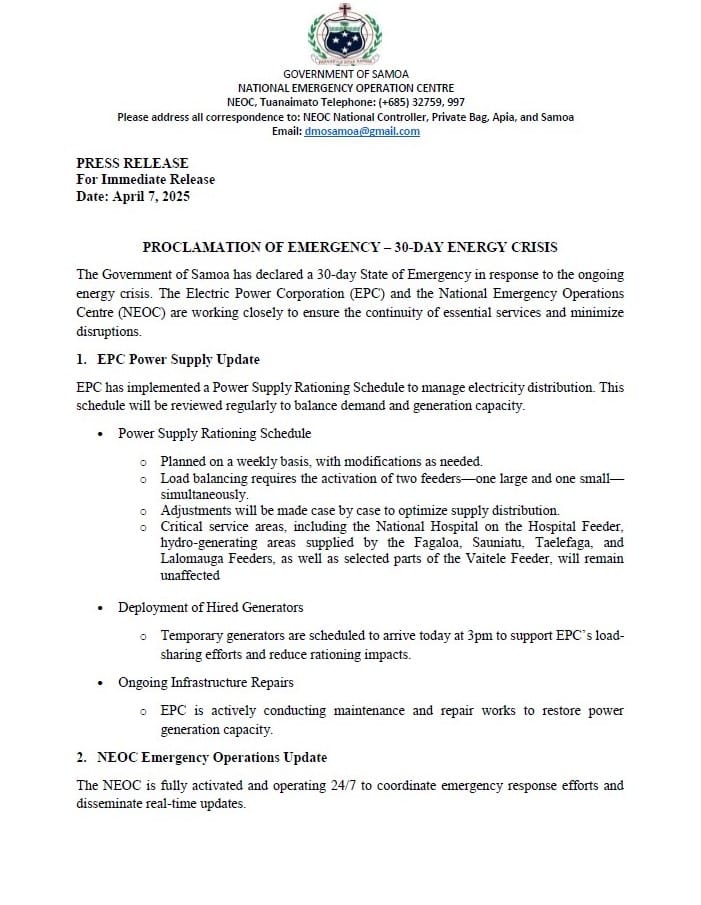
  • MIL-OSI Asia-Pac: PROCLAMATION OF EMERGENCY – 30-DAY ENERGY CRISIS

    Source:

    Share this:

    [PRESS RELEASE April 7, 2025] – The Government of Samoa has declared a 30-day State of Emergency in response to the ongoing energy crisis. The Electric Power Corporation (EPC) and the National Emergency Operations Centre (NEOC) are working closely to ensure the continuity of essential services and minimize disruptions.

    1. EPC Power Supply Update

    EPC has implemented a Power Supply Rationing Schedule to manage electricity distribution. This schedule will be reviewed regularly to balance demand and generation capacity.

     Power Supply Rationing Schedule

    Planned on a weekly basis, with modifications as needed.

    Load balancing requires the activation of two feeders—one large and one small—simultaneously.

    Adjustments will be made case by case to optimize supply distribution.

    Critical service areas, including the National Hospital on the Hospital Feeder, hydro-generating areas supplied by the Fagaloa, Sauniatu, Taelefaga, and Lalomauga Feeders, as well as selected parts of the Vaitele Feeder, will remain unaffected

     Deployment of Hired Generators

    Temporary generators are scheduled to arrive today at 3pm to support EPC’s load-sharing efforts and reduce rationing impacts.

     Ongoing Infrastructure Repairs

    EPC is actively conducting maintenance and repair works to restore power generation capacity.

    2. NEOC Emergency Operations Update

    The NEOC is fully activated and operating 24/7 to coordinate emergency response efforts and disseminate real-time updates.

    Sector-Based Impact Assessments

    NEOC through Sector Coordinators is conducting targeted assessments to evaluate sector-specific impacts, identify infrastructure challenges, and prioritize critical needs.

    A coordination meeting with Sector Coordinators was held on April 2, 2025, to guide assessment processes.

    3. Response Coordination & Public Assistance

     NEOC is actively supporting EPC and overseeing emergency response activities.

     The public is urged to stay informed via official communication channels for rationing schedules and emergency measures.

    For further inquiries and updates, please contact: Electric Power Corporation (EPC): 7773724 OR 7502041 National Emergency Operations Centre (NEOC): 997 OR 32759

    The Government of Samoa appreciates the public’s patience and cooperation during this critical period. Further updates will be provided as necessary.

    END.

    POLOAIGA O FA’ALAVELAVE TUTUPU FA’AFUASE’I MO LE 30 ASO AUĀ LE TULAGA AFĀINA O LE ‘ELETISE UA I AI NEI.

    [PEPA O FA’AMATALAGA Aso Gafua, 07 Aperila 2025] – I le fa’amamaluina ai e le Malo o le 30 Aso o le Poloaiga o Faalavelave Tutupu Fa’afuase’i i le atunu’u atoa, e saili fofō ai i le mafatiaga o feagai nei ma le Faalapotopotoga o Malosi’aga Faa ‘Eletise [EPC] i le tau faasoasoaina o le ‘eletise i nisi o afio’aga i Upolu, o lo’o fa’aauau pea ona galulue vāvālalata le Ofisa Tutotonu mo le Fa’afoeina o Fa’alavelave Fa’afuase’i ma Matuiā [NEOC] ma le EPC ia mautinoa o lo’o fa’aauau pea le auaunaga mo’omia e fa’aitiitia ai nisi fa’afitauli e toe tutupu mai.

    1. Tala lata i le auaunaga a le EPC mo le ‘eletise.

    O lo’o faagasolo pea le faasoasoa o le ‘eletise ma mata’itū fa’afitauli e alia’e mai i taimi uma. O lea fetu’una’iga o lo’o iloilo toto’a mai lea taimi i lea taimi ina ia gafatia ma o gatusa ma le mana’omiaga;

     Fa’asoasoaina o le ‘eletise i taimi ma aso fa’atulagaina.

    Fa’atulaga le galuega fa’asoasoa mo le ‘eletise i le vaiaso fa’atasi ma suiga pe a mana’omia.

    Ia paleni tutusa laina malolosi o le ā fa’aāogajna i le taimi e tasi, e aofia ai le laina malosi tele ma le laina malosi laititi.

    Fetu’unā’iga talafeagai mai mataupu taitasi auā le fa’aleleia ma le fa’asoaina atu o le ‘eletise.

    Auaunaga i laina mālolosi o le ‘eletise mo nofoaga ma’ale’ale e aofia ai le Falema’i Tele i Moto’otua, ma nofoaga o lo’o fa’alagolago i le ‘eletise e gaosia mai le suāvai e pei o Fagaloa, Sauniatu, Ta’elefaga ma le laina malosi i Lalomauga, fa’apea se vaega o le laina malosi i Vaitele o lo’o tumau pea ona lē a’afia i le ‘eletise fa’asoasoa.

     Afi ‘Eletise Fa’aāoga Fa’avaitaimi

    Ua fuafua e taunuu mai i le itula e 3:00 i le asō ‘Afi ‘Eletise lē tumau e fesoasoani i le fa’asoasoaina o le ‘eletise i le atunu’u ma fa’aitiitia ai fa’afitauli ua tutupu mai.

    Fa’aauau pea galuega fa’aleleia mo le auaunaga tau ‘eletise O lo’o fa’aauau pea galuega fa’aleleia a le EPC ina ia mautinoa le toe vave fo’ia o le fa’afitauli o feagai nei ma se vaega o le atunu’u ona o le tau faasoasoaina o le ‘eletise.

    2: GALUEGA FA’AGASOLO A LE NEOC I LE TAIMI NEI.

    O lo’o fa’aauau pea ona galulue le NEOC mo le 24 itula i le 7 aso o le vaiaso, e mata’itū ma ta’imua i galuega mo ni fa’alavelave tutupu fa’afuase’i ma auaunaga tali atu auā le fa’asoaina o tala lata mai i le tulaga o i ai le auaunaga tau ‘eletise i le atunu’u.

     Iloilo toto’a a’afiaga o Vaega Maoti [Sector] mai le ‘eletise.

    O lo’o taula’i le iloiloga a le NEOC tauala atu i Vaega Maoti e māta’itū a’afiaga ma lu’itau aemaise o le fa’amuamua mana’omia o lo’o matuā ogaoga ona a’afiaga ona o le tulaga fa’asoasoa o i ai nei le ‘eletise.

    O le fonotaga ma ia vaega maoti sa faia i le aso 2 o Aperila 2025 auā ta’iala mo le fa’agasologa o lea iloiloga.

    Auaunaga Tali Atu & Fesoasoani mo le Lautele

     Fesoasoani le NEOC e galulue faatasi ma le EPC e silasila toto’a uma i le auaunaga tali atu mo Fa’alavelave Tutupu Fa’afuase’i.

     Fautuaina ma talosagaina le atunu’u lautele ina silasila i fa’asalalauga uma o lo’o tuuina atu i alafa’asalalau a le Malo mo le tulaga o le fa’agasologa o le fa’asoasoaina o le ‘eletise ma le tali atu i fa’alavelave fa’afuase’i.

    Mo nisi fa’amatalaga ma ni fesili, fa’amolemole feso’ota’i:

    Malosi’aga Tau ‘Eletise [EPC]: 7773724 po’o 7502041

    Ofisa Tutotonu mo le Fa’afoeina o Fa’alavelave Fa’afuase’i ma Matuiā [NEOC]: 997 po’o 32759

    E fa’afetaia pea e le Malo o Samoa le onosa’i ma le nofo malamalama o le atunu’u lautele a’o tatou i ai i lenei vaitau faigatā ona o le ‘eletise. O le ā fa’aauau pea ona tu’uina atu lipoti lata mai o le tulaga o lo’o i la tatou auaunaga.

    MAE’A

    Share this:

    April 23, 2025

    MIL OSI Asia Pacific News –

    April 23, 2025
  • MIL-OSI Asia-Pac: SAMOANS TRIUMPH AT STRONGMAN COMPETITION IN AUSTRALIA

    Source:

    Share this:

    [PRESS RELEASE 5 April 2025] – Samoa delivered a strong performance at the Battle in the Bay strongman competition in Melbourne over the weekend, with five athletes from Strongman Samoa finishing on or near the podium across multiple divisions.

    The Battle in the Bay, hosted by Australia’s Strongest and Strong Geelong at the Melbourne Exhibition Centre as part of the Fitness Expo, featured competitors from across the region.

    Samoa’s athletes arrived well-prepared and delivered steady, disciplined performances across all events.

    Evangeline Taylor-Pati dominated the Open Women’s division, taking out first place with consistent lifts and confident execution across all events. Her approach was methodical, and the result left no doubt.

    “These events reward control and preparation,” she said. “We’ve been training for this level of pressure. Once I got through the first event clean, I knew I could settle in and keep the pace.”

    Teammate Elsie Pesamino followed with a strong second-place finish, while Annette Punivalu battled through a tight field to place fourth just off the podium. The combined results marked a standout day for Samoa’s women, who led the team effort with calm, focused performances.

    In the Under 105kg Men’s division, Ryan Walker earned third place. In the Open Men’s category, Misa Peter Anae finished second after a solid showing across all disciplines.

    “We came here to compete properly, not just participate,” said Misa. “The whole team stayed switched on. No one panicked, no one rushed.”

    Strongman Samoa acknowledged the support of BearWell, who supplied the team’s kit and backed the campaign from the outset. Their support has helped lift the sport’s profile in Samoa and enabled athletes to train and compete at higher levels.

    The team now shifts focus to the “Pacific Strongest”, set for 7 June in Apia. It will be the first international strongman event hosted in Samoa, bringing together visiting and local athletes for a full day of heavy events.

    END

    Share this:

    April 23, 2025

    MIL OSI Asia Pacific News –

    April 23, 2025
  • MIL-OSI Asia-Pac: Civil Aviation Minister Ram Mohan Naidu takes swift action to support tourists and victims affected by Kashmir terror attack

    Source: Government of India

    Civil Aviation Minister Ram Mohan Naidu takes swift action to support tourists and victims affected by Kashmir terror attack

    Four special flights arranged from Srinagar—Two to Delhi and Two to Mumbai

    Airlines directed to maintain regular fare levels

    Posted On: 23 APR 2025 10:33AM by PIB Delhi

    In the wake of the tragic terror attack in Kashmir, Union Minister for Civil Aviation Shri Ram Mohan Naidu has moved swiftly to ensure the safety and well-being of affected tourists and victims.

    The Minister personally spoke to the Home Minister and is monitoring the situation round the clock, working in close coordination with relevant authorities. As part of immediate relief measures, four special flights from Srinagar—two to Delhi and two to Mumbai—have been arranged, with additional flights kept on standby to cater to further evacuation needs.

    Shri Ram Mohan Naidu also held an urgent meeting with all airline operators and issued a strong advisory against surge pricing. Airlines have been directed to maintain regular fare levels, ensuring that no passenger is burdened during this sensitive time.

    Additionally, Shri Ram Mohan Naidu has directed all airlines to extend full cooperation for the transportation of deceased individuals to their respective home states, working in sync with state governments and local authorities.

    The Ministry of Civil Aviation remains on high alert and committed to extending every possible assistance to those affected.

    *****

    Beena Yadav/Divyanshu Kumar

    (Release ID: 2123677) Visitor Counter : 213

    MIL OSI Asia Pacific News –

    April 23, 2025
  • MIL-OSI Asia-Pac: Result of tenders of RMB Sovereign Bonds held on April 23, 2025

    Source: Hong Kong Government special administrative region

    The following is issued on behalf of the Hong Kong Monetary Authority:

    Result of the tenders of RMB Sovereign Bonds held on April 23, 2025
     

    Tender Result
    *********
    Tender Date : April 23, 2025
    Bonds available for Tender : 2-year RMB Bonds
    Issuer : The Ministry of Finance of the People’s Republic of China
    Issue Number : BCMKFB25004 (Further Issuance)
    Issue and Settlement Date : April 25, 2025
    Maturity Date : February 21, 2027 (or the closest coupon payment date)
    Coupon Rate : 1.75 per cent
    Application Amount : RMB 10,177 million
    Issue Amount : RMB 4,000 million
    Average Accepted Price : 100.29
    Lowest Accepted Price : 100.20
    Highest Accepted Price : 100.45
    Allocation Ratio
    (At Lowest Accepted Price)
    : Approximately 41.07 per cent
    Tender Result
    *********
    Tender Date : April 23, 2025
    Bonds available for Tender : 3-year RMB Bonds
    Issuer : The Ministry of Finance of the People’s Republic of China
    Issue Number : BCMKFB25005 (Further Issuance)
    Issue and Settlement Date : April 25, 2025
    Maturity Date : February 21, 2028 (or the closest coupon payment date)
    Coupon Rate : 1.80 per cent
    Application Amount : RMB 11,583 million
    Issue Amount : RMB 4,000 million
    Average Accepted Price : 100.55
    Lowest Accepted Price : 100.41
    Highest Accepted Price : 100.96
    Allocation Ratio
    (At Lowest Accepted Price)
    : Approximately 94.74 per cent
    Tender Result
    *********
    Tender Date : April 23, 2025
    Bonds available for Tender : 5-year RMB Bonds
    Issuer : The Ministry of Finance of the People’s Republic of China
    Issue Number : BCMKFB25006 (Further Issuance)
    Issue and Settlement Date : April 25, 2025
    Maturity Date : February 21, 2030 (or the closest coupon payment date)
    Coupon Rate : 1.88 per cent
    Application Amount : RMB 10,672 million
    Issue Amount : RMB 3,000 million
    Average Accepted Price : 101.09
    Lowest Accepted Price : 100.85
    Highest Accepted Price : 101.30
    Allocation Ratio
    (At Lowest Accepted Price)
    : Approximately 71.56 per cent


    Tender Result
    *********
    Tender Date : April 23, 2025
    Bonds available for Tender : 15-year RMB Bonds
    Issuer : The Ministry of Finance of the People’s Republic of China
    Issue Number : BCMKFB25028
    Issue and Settlement Date : April 25, 2025
    Maturity Date : April 25, 2040 (or the closest coupon payment date)
    Application Amount : RMB 5,950 million
    Issue Amount : RMB 1,500 million
    Average accepted Coupon Rate : 2.05 per cent
    Highest accepted Coupon Rate
    (Bonds’ Coupon)
    : 2.10 per cent
    Lowest accepted Coupon Rate : 1.90 per cent
    Allocation Ratio
    (At Highest accepted Coupon Rate)
    : Approximately 2.97 per cent

    MIL OSI Asia Pacific News –

    April 23, 2025
  • MIL-OSI Asia-Pac: Government announces updates to routine drinking water testing programme and Enhanced Water Quality Monitoring Programme

    Source: Hong Kong Government special administrative region

    The Water Supplies Department (WSD) has been committed to providing high-quality and reliable drinking water to Hong Kong citizens in accordance with the guidelines of the World Health Organization (WHO). Following the release of the latest Guidelines for Drinking-water Quality (GDWQ) by the WHO in 2022, the Government has commissioned an expert consultant to review the routine drinking water testing programme for Hong Kong Drinking Water Standards. The review also covers the latest developments in drinking water standards/guidelines across a number of jurisdictions. Based on the review findings and recommendations of the expert consultant, the Government will update the routine drinking water testing programme, including the addition of three new parameters, namely “manganese”, “cylindrospermopsins” and “saxitoxins”, as well as the expansion of the coverage of an existing parameter “microcystin-LR”. These revisions were proposed in accordance with the latest WHO’s GDWQ and have been submitted to the Drinking Water Safety Advisory Committee, which comprises academics, medical experts and relevant industry stakeholders, for deliberation. The Committee’s agreement on the proposed revisions has been obtained.

    Regarding two parameters of “tetrachloroethene” and “uranium”, covered under the current testing programme, previous routine drinking water quality monitoring data showed that their contents were extremely low or even undetectable, far below the level that would pose a risk to health. These two parameters will be excluded from the routine testing programme, but will still be included in the Surveillance List to facilitate the WSD’s surveillance monitoring from time to time. The Committee’s agreement on the recommendation has also be obtained.

    Under the routine drinking water testing programme, water samples are taken from catchments, impounding reservoirs, water treatment works, service reservoirs, water distribution systems and water taps accessible to the general public (e.g. shopping centres, community facilities, sports venues, government offices, etc) for testing. The parameters covered by the programme are established in accordance with WHO’s GDWQ, with testing frequencies ranging from daily to monthly, while the parameters covered by the Surveillance List are usually tested once every six months.

    In addition, the WSD expands the scope of drinking-water quality monitoring through the Enhanced Water Quality Monitoring Programme (Enhanced Programme) to cover water taps of all residential and non-residential customers. Each year, about 670 premises will be randomly selected from all water accounts in Hong Kong. Samples will be collected from water taps of these premises for testing of six metals (namely antimony, cadmium, chromium, copper, lead and nickel), residual chlorine and Escherichia coli. According to the monitoring data over the past years, the levels of antimony in drinking water samples collected from these premises have always been below the reporting limit. Based on the advice of the expert consultant, the WSD will stop testing antimony under the Enhanced Programme, while the testing of other items remain unchanged. This arrangement has been agreed by the Committee.

    The above proposal will be implemented from June 2025. The public may visit the WSD’s website for the latest updates.

    Routine drinking water testing programme
    www.wsd.gov.hk/en/core-businesses/water-quality/my-drinking-water-quality/index.html

    Enhanced Water Quality Monitoring Programme
    www.wsd.gov.hk/en/core-businesses/water-quality/action-plan-for-enhancing-of-drinking-water-safety/drinking-water-standards-enhanced-water-quality/index.html

    MIL OSI Asia Pacific News –

    April 23, 2025
  • MIL-OSI Asia-Pac: List of Outcomes: State Visit of Prime Minister to Saudi Arabia

    Source: Government of India

    Posted On: 23 APR 2025 2:25AM by PIB Delhi

    I. Strategic Partnership Council

    • The second leaders meeting of the India-Saudi Arabia Strategic Partnership Council (SPC) was co-chaired by Hon’ble Prime Minister of India Shri Narendra Modi and His Royal Highness Prince Mohammed bin Salman, Crown Prince and Prime Minister of the Kingdom of Saudi Arabia on 22 April 2025 in Jeddah. The Council reviewed the work of the various committees, subcommittees and working groups under the SPC, which encompass political, defence, security, trade, investment, energy, technology, agriculture, culture and people-to-people ties. The discussions were followed by signing of the minutes by the two leaders.
    • To reflect the deepening of defence partnership over the past few years – including joint exercises, training programmes, and collaboration in defence industry, the Council decided to create a new Ministerial Committee on Defence Cooperation under the SPC.
    • To strengthen cultural and people-to-people ties, which has significant momentum in recent years, the Council decided to create a new Ministerial Committee on Tourism and Cultural Cooperation under the SPC.
    • The four committees under the India-Saudi Arabia SPC shall now be as follows:

      (1) Political, Consular and Security Cooperation Committee.

      (2) Defence Cooperation Committee.

      (3) Economy, Energy, Investment and Technology Committee.

      (4) Tourism and Cultural Cooperation Committee.

    II. High Level Task Force on Investment (HLTF)

    • Building on the commitment of Saudi Arabia to invest USD 100 billion in India in multiple areas including energy, petrochemicals, infrastructure, technology, fintech, digital infrastructure, telecommunications, pharmaceuticals, manufacturing and health, the joint High-Level Task Force on Investment came to an understanding in multiple areas to rapidly promote such investment flows.
    • Both sides agreed to collaborate on establishing two refineries in India.
    • The progress made by HLTF in areas such as taxation is a major breakthrough for greater investment cooperation in the future.

    III. List of MoUs/Agreements:

    • MoU between the Saudi Space Agency and the Department of Space of India on Cooperation in the field of Space Activities for Peaceful Purposes.
    • MoU between the Ministry of Health of Saudi Arabia and the Ministry of Health and Family Welfare of India on Cooperation in the field of Health.
    • MoU between the Saudi Arabian Anti-Doping Committee (SAADC) and the National Anti-Doping Agency, India (NADA) on Cooperation in the field of Anti-Doping Education and Prevention.
    • Agreement between the Saudi Post Corporation (SPL) and the Department of Posts, Ministry of Communications of India on Cooperation in Inward Surface Parcel.

    ***

    MJPS/SR 

    (Release ID: 2123660) Visitor Counter : 44

    MIL OSI Asia Pacific News –

    April 23, 2025
  • MIL-OSI Asia-Pac: PIONEERING ELECTRIC VEHICLE COURSE SUCCESSFULLY COMPLETED

    Source:

    Share this:

    [PRESS RELEASE – 9 APRIL 2025] – The first ever certified local course for electric vehicle (EV) mechanics has been completed, with the participants receiving their certificates today in a ceremony held at the National University of Samoa (NUS).

    Thirty one drivers and vehicle operators from different Government Ministries and Authorities, and automotive trainers and teachers from the National University of Samoa, Don Bosco Technical College, and Laumua o Puna’oa Vocational School, have completed the four-day Train the Trainers course on EV automotive Professional Continuation Training (PCT), that was conducted at NUS.

    The training was run by EV specialist, Paul Corbert, from REPCO New Zealand, and was made possible under the Japan-funded CAP-IT Project which promotes clean, green transport, and implemented by the United Nations Development Programme (UNDP) in close partnership with the Government of Samoa through the Ministry of Works, Transport and Infrastructure.

    “This training is part of a broader effort under CAP-IT to build capacity where it matters most — in our institutions, in our teachers, and in our young people. This is only the beginning. As we roll out new curricula, upgrade automotive workshops in three schools – which we launched yesterday, and scale up access to EV infrastructure, we are also investing in people — people like you — who will make this transition real, relevant, and lasting,” said Aliona Niculita, UNDP Resident Representative.

    The trainers will now pass on their newfound skills and knowledge to their students, who will become the new generation of EV professionals who will lead the transition to green transport in Samoa.

    “I’m grateful for this course and the new knowledge and skills I have gained, along with my fellow teachers, which will go a long way in helping us to train and teach our youth at our school at Don Bosco Technical Centre at Alafua on this relatively new concept of green transport,” said Teaali’i Aukusitino Kalolo, Head of Department, Automotive and Mechanical Education at Don Bosco.

    This course is the operationalization of the new curriculum and EV mechanics education that was launched yesterday, along with the Transport and Infrastructure Sector Decarbonization Strategy and Sustainable Land Use and Mobility Plan.

    The design and rollout of this training programme was done in collaboration with the KVA consortium of Samoa and FLOW Consultants of New Zealand.

    END.

    SOURCE – UNDP in Samoa, Cook Islands, Tokelau & Niue

    Share this:

    April 23, 2025

    MIL OSI Asia Pacific News –

    April 23, 2025
  • MIL-OSI Asia-Pac: Secretary General of Muslim World League calls on Prime Minister

    Source: Government of India

    Posted On: 23 APR 2025 2:23AM by PIB Delhi

    The Secretary General of Muslim World League, Sheikh Dr. Mohammed bin Abdulkarim Al-Issa today called on Prime Minister Shri Narendra Modi in Jeddah. He strongly condemned the ghastly terror attack in Jammu and Kashmir and offered deepest condolences on the innocent lives lost.

    Prime Minister recalled his meeting with the Secretary General in July 2023 in New Delhi. He appreciated the role of Muslim World League in promoting tolerant values, advocating moderation and advancing social cohesion and harmony. Recalling India’s age-old philosophy of Vasudhaiva Kutumbakam [the World is one Family] Prime Minister noted that India as a multi-cultural, multi-lingual, multi-ethnic and multi-religious society, celebrates unity in diversity. India’s incredible diversity is a valuable strength that has given shape to its vibrant society and polity. He commended the firm stand of Muslim World League against extremism, terrorism and violence.

    Prime Minister underlined that India attaches high importance to its relations with Saudi Arabia, which has today evolved into an enduring partnership across several domains. The close socio-cultural ties form an important facet of this partnership.


    ***

    MJPS/SR

    (Release ID: 2123659) Visitor Counter : 46

    MIL OSI Asia Pacific News –

    April 23, 2025
  • MIL-OSI Asia-Pac: EV EDUCATION LAUNCHED IN TOP VOCATIONAL INSTITUTIONS IN SAMOA, ALONG WITH NEW DECARBONIZATION PLANS

    Source:

    Share this:

    [PRESS RELEASE 08 April 2025] – A significant educational milestone has been reached, with the opening of electric vehicles (EV) automotive workshops in three vocational institutions in Samoa, namely the National University of Samoa, Don Bosco Technical Centre, and Laumua o Puna’oa Technical College.

    These workshops will be supported by the incorporation of an EV mechanics curriculum as a Professional Continuing Training (PCT) programme of these schools, pending the signing of a Memorandum of Understanding soon.

    These will equip students with essential knowledge and skills in EV automotive and electrical fields, preparing them to become certified EV mechanics, and laying the foundation for integrating EV training into national education.

    These were highlighted today at a ceremony at Don Bosco, Alafua, which also celebrated the launch of the Transport and Infrastructure Sector Decarbonization Strategy and Sustainable Land Use and Mobility Plan, with Prime Minister, Fiame Naomi Mata’afa, doing the honours.

    “Transport is a key enabler of connectivity — supporting trade, employment, education, and healthcare. Yet, it is also one of the largest contributors to carbon emissions in Samoa. The importance of these Plans are clear: it ensures that Samoa remains steadfast in its commitment to transitioning to a lower-carbon future. It encompasses new legislation, policy changes, financing initiatives, and interventions to support our transportation needs in a way that minimizes environmental harm while ensuring that future generations benefit from enhanced mobility,” said Olo Fiti Afoa Vaai, Minister for the Ministry of Works, Transport and Infrastructure.

    These new developments have all been made possible under the CAP-IT Project – Climate Action Pathways for Island Transport – which aims to facilitate Samoa’s transition to a more clean and sustainable transport sector.

    The project is funded by the Government of Japan, and jointly implemented by the United Nations Development Programme (UNDP), and the Government of Samoa through the Ministry of Works, Transport and Infrastructure.

    “Japan is proud to support Samoa’s long-term journey towards a cleaner, more resilient transport sector. By advancing policies, building skills, and providing infrastructure through the CAP-IT project, we are investing in a sustainable future led by Samoa’s youth and powered by innovation,” said Ryotaro Suzuki, Ambassador of Japan to Samoa.

    The Transport Sector Decarbonization Strategy and Sustainable Land Use and Mobility Plan will guide Samoa’s transition from fossil fuel dependency to a decarbonized transport sector. This shift will not only reduce carbon emissions but also improve transport services, ensuring a healthier and more sustainable Samoa.

    “The long-term benefits of these initiatives extend far beyond environmental stewardship. They create jobs, empower our youth, and open new economic opportunities in the burgeoning field of sustainable transport. UNDP remains steadfast in supporting Samoa’s capacity-building efforts, fostering innovation, and implementing policies that drive systemic change in our transport sector,” said Aliona Niculita, UNDP Resident Representative in Samoa.

    The CAP-IT project is a component of the Japan-funded US$36.8 million regional project, ‘Promoting Green Transformation in the Pacific Region towards Net-zero and Climate-Resilient Development’, also supporting Papua New Guinea, Timor-Leste, and Vanuatu in achieving their green transformation ambitions for a more inclusive, climate-resilient future.

    END.

    Share this:

    April 23, 2025

    MIL OSI Asia Pacific News –

    April 23, 2025
  • MIL-OSI Asia-Pac: Prime Minister meets with High Royal Highness the Crown Prince and Prime Minister of the Kingdom of Saudi Arabia and co-chairs the India–Saudi Arabia Strategic Partnership Council

    Source: Government of India

    Posted On: 23 APR 2025 2:20AM by PIB Delhi

    Prime Minister Shri Narendra Modi paid a State Visit to the Kingdom of Saudi Arabia on April 22, 2025. Prime Minister was received by His Royal Highness Prince Mohammed bin Salman, Crown Prince and Prime Minister of the Kingdom of Saudi Arabia at the Royal Palace in Jeddah and accorded a ceremonial welcome.

    ​Prime Minister and His Royal Highness Prince Mohammed bin Salman, Crown Prince and Prime Minister of the Kingdom of Saudi Arabia held official talks and co-chaired the second meeting of the India–Saudi Arabia Strategic Partnership Council (SPC). HRH Crown Prince strongly condemned the ghastly terror attack in Pahalgam and offered deepest condolences on the innocent lives lost. The two leaders resolved to combat terrorism tooth and nail.

    The leaders reviewed the progress under the Council since their last meeting in September 2023 in New Delhi. The leaders noted with appreciation the intensification in bilateral engagement and the large number of high-level visits across various Ministries that have built trust and mutual understanding on both sides. The two leaders discussed cooperation in the fields of energy, defence, trade, investment, technology, culture and people-to-people relations. Prime Minister thanked His Royal Highness for the support and welfare extended to the Indian community in Saudi Arabia. He also appreciated the support provided by the Saudi government for the Indian Haj pilgrims.

    Both leaders appreciated the progress in the discussions in the High-Level Task Force on Investment. They welcomed the understanding reached by the Task Force in multiple areas, which builds on the earlier commitment of Saudi Arabia to invest USD 100 billion in India across multiple sectors including energy, petrochemicals, infrastructure, technology, fintech, digital infrastructure, telecommunications, pharmaceuticals, manufacturing, and health. In this context, they particularly welcomed the agreement to collaborate on establishing two oil refineries in India, as well as the progress achieved on taxation issues. Prime Minister proposed that to further strengthen economic ties both countries could work for connecting payment gateways and trade settlement in local currencies.

    The two leaders discussed progress in India-Middle East Europe Economic Corridor [IMEEC], particularly the bilateral connectivity initiatives being undertaken by the two sides. Both leaders also exchanged views on regional and global issues of mutual interest.

    The two leaders expressed satisfaction at the outcomes of the work of the two Ministerial Committees under the Council, namely: (a) the Committee on Political, Security, Social and Cultural Cooperation and its subcommittees, and (b) the Committee on Economy and Investments and its Joint Working Groups.

    The two leaders welcomed the expansion of the Strategic Partnership Council with the establishment two new ministerial committees. In this context, to reflect the deepening of the defence partnership, the leaders agreed on the establishment of the Ministerial Committee on Defence Cooperation. Acknowledging the growing momentum in cultural cooperation between the two sides in recent years, they also agreed to establish a Ministerial Committee on Tourism and Culture Cooperation. After the meeting, the minutes of the second SPC were signed by the two leaders.

    The leaders welcomed the signing of 4 bilateral MoUs and agreements in the fields of Space, Health, Sports (Anti-Doping) and postal cooperation on the occasion of the visit. [List of Outcomes]

    Prime Minister invited His Royal Highness Prince Mohammed bin Salman to visit India for the third meeting of the Strategic Partnership Council.


    ***

    MJPS/SR

    (Release ID: 2123658) Visitor Counter : 52

    MIL OSI Asia Pacific News –

    April 23, 2025
  • MIL-OSI Asia-Pac: PRESENTATION OF CREDENTIALS OF THE AMBASSADOR OF THE SWISS CONFEDERATION TO THE INDEPENDENT STATE OF SAMOA

    Source:

    Share this:

    [PRESS RELEASE – TUESDAY 8 APRIL 2025] – His Excellency Mr. Victor Vavricker presented his Letters of Credence to the Head of State of the Independent State of Samoa, Afioga Tuimaleali’ifano Va’aletoa Sualauvi II, at a Credentials Ceremony held this morning at the Official Residence of the Head of State at Vailele, accrediting His Excellency as the Ambassador Extraordinary and Plenipotentiary of Switzerland to Samoa with residence in Wellington, New Zealand.

    Samoa and Switzerland have enjoyed cordial relations since the establishment of formal ties on 1 August 1981. Over the years, our collaboration has grown through shared values of multilateralism, sustainable development, and in addressing the challenges posed by climate change. Ambassador Vavricka reaffirmed Switzerland’s continued support for Samoa and the Pacific region, underscoring the importance of cooperation, respect for sovereignty, and shared development goals, as well as recognizing the vital role of Small Island Developing States (SIDS) in the global community.

    Afioga Tuimaleali’ifano Va’aletoa Sualauvi II welcomed the Ambassador and acknowledged the growing partnership between Samoa and Switzerland. The Head of State highlighted Switzerland’s contributions to international development initiatives, particularly those that align with Samoa’s national priorities. His Highness reaffirmed Samoa’s confidence in the strengthening of bilateral relations, noting that Ambassador Vavricka’s tenure would further enhance the strong and enduring partnership between the two countries. The Head of State also acknowledged the contributions of the Honorary Consul Mrs. Sylvie Salanoa in strengthening Samoa-Switzerland relations through small grant projects in the local community.

    H.E. Mr. Viktor Vavricka holds a licentiate in Law from the University of Zurich. He entered the service of the Federal Department of Foreign Affairs in 2002, where he was initially assigned as a stagiaire in Bern and Ottawa. Mr. Vavricka has held several senior positions within Switzerland’s foreign service, including heading the Human Rights and International Humanitarian Law Section in the Directorate of International Law and the Asset Recovery Task Force. He also held various diplomatic postings including as Deputy Head of Mission in Riyadh, Saudi Arabia, Bangkok, Thailand, and Berlin, Germany. In 2021, he was appointed Ambassador Extraordinary and Plenipotentiary of Switzerland to New Zealand with cross accreditation to Cook Islands, Fiji, Samoa, Tonga, and Tuvalu. He also serves as the Consul General to American Samoa.

    END

    Photo by the Government of Samoa (Jasmine Netzler-Iose)

    Share this:

    April 23, 2025

    MIL OSI Asia Pacific News –

    April 23, 2025
  • MIL-OSI Asia-Pac: SFESA AND FIJI NATIONAL FIRE AUTHORITY SIGN HISTORIC MOU TO STRENGTHEN PACIFIC EMERGENCY RESPONSE

    Source:

    Share this:

    [PRESS RELEASE 07 April 2025] – Marking a major milestone for regional cooperation and resilience, the Samoa Fire and Emergency Services Authority (SFESA) and the National Fire Authority (NFA) of Fiji have officially signed a Memorandum of Understanding (MOU) to enhance fire safety and emergency response capabilities across the Pacific.

    “This MOU represents more than a formal agreement — it is a shared vision for a safer, more resilient Pacific, knowing your neighbours and knowing their strengths and capabilities is a valuable asset.

    It is testament to the value of regionalism, of understanding that when we combine our knowledge, skills and resources, we are far more capable than when we act alone” said Commissioner Tanuvasa Oloapu Petone Mauga of SFESA.

    Through collaboration, training, and mutual support, we can strengthen our collective ability to respond to the evolving risks facing our communities.

    The MOU outlines key areas of cooperation, including:

    •Share trainings opportunities and personnel exchanges to strengthen operational readiness

    •Collaborative fire prevention and community education programs – SFESA and NFA will promote fire safety and educate the public/community on best practices to reduce fire risks

    •Adoption of modern firefighting technologies and best practices – the partnership will focus on adopting latest technology in firefighting and techniques to improve operational effectiveness in times of disaster and major emergencies

    •Cooperation for the purpose to support each other in the building of safe and more resilient communities in the Pacific Region

    Following the formalities, the SFESA delegation visited key NFA facilities, beginning with Lami Fire Station, where they were warmly welcomed with a ceremonial parade. The visit provided an in-depth overview of the station’s operations and highlighted the dedication of Fiji’s firefighters.

    These engagements provided valuable insights into Fiji’s emergency response infrastructure and reinforced the importance of regional learning and exchange.

    SFESA extends its heartfelt gratitude to the leadership and personnel of NFA Fiji for their warm hospitality, and to the Pacific Islands Emergency Management Alliance (PIEMA) for their continued support in making this milestone a reality.

    ENDS

    SOURCE – Samoa Fire and Emergency Services Authority

    Share this:

    April 23, 2025

    MIL OSI Asia Pacific News –

    April 23, 2025
  • MIL-OSI Asia-Pac: SAMOA AIRPORT AUTHORITY CLARIFIES LANDSIDE RANDOM VEHICLE SECURITY SCREENING MEASURES AT FALEOLO INTERNATIONAL AIRPORT.

    Source:

    Share this:

    [PRESS RELEASE 07 April 2025] – The Samoa Airport Authority (S.A.A.) wishes to clarify the recent vehicle screening operations conducted at the entry gate of Faleolo International Airport.

    The SAA’s decision to implement random screening of vehicles entering the airport premises was made in response to serious and escalating threats to public safety, security and airport property. Over the past several months, there have been three separate incidents involving violent disputes on airport grounds including in the public car park area. These incidents involved the use of dangerous weapons such as machetes and alarmingly, the discharge of firearms.

    These occurrences represent a threat to the safety and security of travelers, airport personnel, and the general public. As stipulated in the Airport Authority Act 2012, relevant by-laws, operating procedures and codes of practices, the SAA may exercise all necessary measures to prevent such threats from materializing again.

    It is important to note that the initial intent of the screening operation was to carry out a brief series of security-related questions to the general public entering the Airport, not to conduct physical searches of vehicles or personal belongings. Unfortunately, there was a miscommunication with some members of our security teams, which resulted in unintended and more extensive screening procedures at the entry point in recent days.

    While we regret the inconvenience this may have caused, the decision was made with the safety and security of all airport users as the highest priority. We are currently reviewing our communication and operational protocols to ensure clarity and consistency in the future.

    The Samoa Airport Authority appreciates the understanding and cooperation of the public as we continue to work towards providing a safe and secure environment at Faleolo International Airport.

    Ma le fa’aaloalo tele.

    Tumanuvao Evile Falefatu

    GENERAL MANAGER

    ENDS.

    SOURCE – Samoa Airport Authority

    Share this:

    April 23, 2025

    MIL OSI Asia Pacific News –

    April 23, 2025
  • MIL-OSI Asia-Pac: Software launch of CGHS Digital Health Platform

    Source: Government of India

    Software launch of CGHS Digital Health Platform

    CGHS to launch modernized Health Management Information System (HMIS) from 28th April 2025; legacy system to be discontinued

    All CGHS services, including those at Wellness Centres, to remain closed on 26th April 2025 (Saturday) to facilitate the transition

    PAN-based beneficiary identification, real-time tracking, automated payment verification, and fully online application workflows introduced

    Legacy websites www.cghs.gov.in and www.cghs.nic.in to become non-functional; new portal launched at www.cghs.mohfw.gov.in

    CGHS mobile applications for Android and iOS re-launched with upgraded interface and integrated digital services

    Posted On: 23 APR 2025 11:41AM by PIB Delhi

    The Central Government Health Scheme (CGHS), a flagship programme under the Ministry of Health and Family Welfare, Government of India, is undergoing a major digital transformation with the launch of the next-generation Health Management Information System (HMIS). Developed by the Centre for Development of Advanced Computing (C-DAC), this comprehensive digital platform is scheduled to go live from 28th April 2025.

    The transformation is being implemented in view of the technical obsolescence of the existing CGHS software, which has been in use since 2005 and lacks compatibility with modern IT standards, cyber security frameworks, and user expectations. The revamped HMIS will enable faster, more transparent, and user-friendly access to CGHS services, ensuring improved service delivery and administrative efficiency.

    To ensure a seamless rollout, all CGHS services including those at Wellness Centres shall remain closed for one day on 26th April 2025 (Saturday). This temporary suspension is necessary to complete data migration, switch-over activities, and final validation.

    Key Reforms and Technological Advancements in the New CGHS HMIS

    1. PAN-Based Unique Identification of Beneficiaries
      • Every beneficiary will now be mapped to a unique PAN-based identifier. This will eliminate duplication of records and help in streamlining the validation process for entitlements.
    2. Integrated Digital Verification & Contribution Tracking
      • Contribution payments will now be auto-verified through direct integration (Line of Business Application Integration) with Bharat Kosh. There will be no manual choosing of options, entry of details on Bharat Kosh portal which shall eliminate errors and refund issues.
    3. Pre-payment Scrutiny of Applications
      • New system enables scrutiny and approval of card applications before the payment stage. This ensures that applicants are guided regarding eligibility and contribution amount before making a payment.
    4. Online Card Modification Services
      • Services like card transfers, change in dependent status, and category change (Serving to Pensioner, etc.) can now be initiated and completed entirely online.
    5. Real-Time Application Tracking and Alerts
      • The system will generate SMS and email alerts at each stage of application processing. This increases transparency and reduces in-person follow-ups.
    6. Mandatory Password Reset and Secure Access
      • All existing users will be prompted to reset their passwords on first login. This is being enforced as a cyber hygiene measure in accordance with MeitY security advisories.
    7. DDO/PAO-Based Department Identification
      • Department identity will be verified using Pay and Accounts Office (PAO) and Drawing and Disbursing Officer (DDO) codes, as indicated in employee salary slips. This ensures backend mapping of sponsoring authorities.
    8. Mobile Application Relaunch (Android & iOS)
      • The official CGHS mobile apps have been re-developed and now offer an enhanced beneficiary experience with:
      • Access to Digital CGHS Card
      • Real-time status tracking
      • E-referrals and appointment scheduling (where applicable)
      • Integrated contact with Helpdesk and AD Offices

    Legacy System Deactivation and Website Migration

    From 28th April 2025, the old CGHS websites www.cghs.gov.in and www.cghs.nic.in will be deactivated. All services and information will henceforth be hosted on the new unified CGHS Digital Platform at www.cghs.mohfw.gov.in.

    Beneficiaries are advised to access all online services, including registration, application, grievance redressal, and information retrieval, through this new portal only.

    All legacy beneficiary data, including medical history and pharmacy transactions, are being securely migrated, ensuring no loss of records. The transition complies fully with government data privacy and protection standards.

    Additionally, the department shall be onboarded on the new CGHS Platform for a paperless approval process. In the interim, departments may continue to submit applications physically at the respective CGHS Card Sections.

    Advisory for Beneficiaries and Departments

    • 28th April onwards, CGHS Contribution shall be only through CGHS Website i.e. www.cghs.mohfw.gov.in. The existing manual process of payment available on www.bharatkosh.gov.in shall discontinue from 28th April 2025.
    • Applications for CGHS services in progress but not paid for by 27th April 2025 will lapse. A fresh application will be required through the new portal.
    • All Beneficiaries aged above 18 years are advised to link their PAN Card with their CGHS Beneficiary ID and apply for corrections in case of any errors through the beneficiary login on CGHS website www.cghs.mohfw.gov.in.
    • Instructions shall be issued for the Departments regarding onboarding on the new platform.
    • The existing issued cards shall continue to function normally.

    Support initiatives include:

    • CGHS Helpdesk and User Manuals are available on the CGHS website www.cghs.mohfw.gov.in and mobile app for use by Departments and Beneficiaries.
    • Continuous support through the CGHS Card Sections and respective Additional Director (AD) Offices.

    *****


    MV

    HFW/CGHS HMIS Software Launch/23 April 2025/1

    (Release ID: 2123696) Visitor Counter : 46

    MIL OSI Asia Pacific News –

    April 23, 2025
  • MIL-OSI Asia-Pac: Welcome remarks by STL at Guangdong-Hong Kong-Macao Clean Energy Supply Chain Conference (English only)

    Source: Hong Kong Government special administrative region

    Following are the welcome remarks by the Secretary for Transport and Logistics, Ms Mable Chan, at the Guangdong-Hong Kong-Macao Clean Energy Supply Chain Conference today (April 23):

    Mr CY Leung (Vice-Chairman of the National Committee of the Chinese People’s Political Consultative Conference and Adviser of the Hong Kong Chamber of Shipping), Professor Ip (President of the Hong Kong University of Science and Technology, Professor Nancy Ip), Mr Hing Chao (Chairman of the Hong Kong Chamber of Shipping), distinguished guests, ladies and gentlemen,

    MIL OSI Asia Pacific News –

    April 23, 2025
  • MIL-OSI: Tower Semiconductor Announces First Quarter 2025 Financial Results and Conference Call

    Source: GlobeNewswire (MIL-OSI)

    MIGDAL HAEMEK, Israel – April 23, 2025 – Tower Semiconductor (NASDAQ/ TASE: TSEM), the leading foundry of high value analog semiconductor solutions, will issue its first quarter 2025 earnings release on Wednesday, May 14, 2025. The Company will hold a conference call to discuss its first quarter 2025 financial results and second quarter 2025 guidance on Wednesday, May 14, 2025, at 10:00 a.m. Eastern Time (09:00 a.m. Central, 08:00 a.m. Mountain, 07:00 a.m. Pacific and 05:00 p.m. Israel time).

    The call will be webcast and available through the Investor Relations section of Tower Semiconductor’s website at https://ir.towersemi.com/, where the pre-registration form required for dial-in participation is also accessible. Upon completing the registration, participants will receive the dial-in details, a unique PIN, and a confirmation email with all necessary information. The teleconference will be available for replay for 90 days.

    About Tower Semiconductor         

    Tower Semiconductor Ltd. (NASDAQ/TASE: TSEM), the leading foundry of high-value analog semiconductor solutions, provides technology, development, and process platforms for its customers in growing markets such as consumer, industrial, automotive, mobile, infrastructure, medical and aerospace and defense. Tower Semiconductor focuses on creating a positive and sustainable impact on the world through long-term partnerships and its advanced and innovative analog technology offering, comprised of a broad range of customizable process platforms such as SiGe, BiCMOS, mixed-signal/CMOS, RF CMOS, CMOS image sensor, non-imaging sensors, displays, integrated power management (BCD and 700V), photonics, and MEMS. Tower Semiconductor also provides world-class design enablement for a quick and accurate design cycle as well as process transfer services including development, transfer, and optimization, to IDMs and fabless companies. To provide multi-fab sourcing and extended capacity for its customers, Tower Semiconductor owns one operating facility in Israel (200mm), two in the U.S. (200mm), two in Japan (200mm and 300mm) which it owns through its 51% holdings in TPSCo, shares a 300mm facility in Agrate, Italy with STMicroelectronics as well as has access to a 300mm capacity corridor in Intel’s New Mexico factory. For more information, please visit: www.towersemi.com.

    ###

    Contact Information:
    Liat Avraham
    Investor Relations
    liatavra@towersemi.com | +972 4 650 6154

    Attachment

    • TSEM_Tower_Q12025_PRDate_1

    The MIL Network –

    April 23, 2025
  • MIL-OSI Europe: Written question – Specific action by the EU to ensure the security of supply of critical medicines – E-001492/2025

    Source: European Parliament

    Question for written answer  E-001492/2025
    to the Commission
    Rule 144
    Gerald Hauser (PfE)

    The increasing dependence of EU Member States on third countries – particularly China and India – for their supply of medicines is undoubtedly one of the biggest problems facing the health-care sector. Currently, around 80% of all active pharmaceutical ingredients come from these two countries. This is considered one of the main reasons for the growing number of supply shortages of medicines.

    The Critical Medicines Alliance, set up in January 2024, is a consultative body tasked with proposing how to secure the EU’s of supply of critical medicines, supporting efforts to effectively prevent and resolve shortages.

    • 1.What specific measures does the Commission intend to take to ensure that critical medicines and their raw materials are once again produced in sufficient quantities in the EU and that supply chains are truly diversified?
    • 2.What specific measures does the Commission intend to take to shield patients from the foreseeable price rises in critical medicines as a result of increased production in the EU and the diversification of supply chains?

    Submitted: 10.4.2025

    Last updated: 23 April 2025

    MIL OSI Europe News –

    April 23, 2025
  • MIL-OSI United Kingdom: Lord Collins of Highbury, UK Minister for Africa visits Uganda

    Source: United Kingdom – Government Statements

    Press release

    Lord Collins of Highbury, UK Minister for Africa visits Uganda

    Lord Collins of Highbury visited Uganda on 3 and 4 April to reinforce the UK’s commitment to sustainable development and mutual economic growth.

    UK Minister for Africa Lord Collins with British High Commissioner Lisa Chesney, CEO of Uganda Airlines Jenifer Bamuturaki, and Minister of Works and Transport Katumba Wamala, at a reception to mark the Uganda Airlines’ direct flight to the UK, scheduled for 18 May 2025.

    During his 2-day visit, Lord Collins announced the launch of a new UK-Uganda Growth Dialogue between the UK and the Ministry of Finance, Planning and Economic Development.

    The UK-Uganda Growth Dialogue will be a quarterly series of discussions on commercial deals, business environment and economic policy to identify opportunities to increase trade and investment between the 2 nations. It will unblock barriers to trade and create new opportunities for collaboration.

    Lord Collins visited areas of UK investments such as Zembo, a leading e-mobility company in Uganda, which has received financing from UK Innovate and Private Infrastructure Development Group.

    Uganda’s green transition

    Funding has accelerated the adoption of electric motorcycles and other zero-emission vehicles, reducing carbon emissions and saving the average boda driver US$500 annually on traditional fuel and maintenance costs. The investment supports Uganda’s transition to greener mobility while creating new job opportunities.

    Lord Collins of Highbury stated:

    My visit to Uganda reaffirms the UK’s unwavering commitment to building equal partnerships that supporting sustainable development and drive mutually beneficial economic growth in the region. We are dedicated to working closely with our Ugandan partners to achieve shared prosperity and a brighter future for all.

    Celebrating direct flights between UK and Uganda

    Lord Collins and Uganda Airlines jointly hosted a reception to celebrate the new Uganda Airlines direct flight to the UK – the first in 10 years. The direct flights are expected to enhance trade, tourism, and people-to-people links between the UK and Uganda, further strengthening the 2 countries’ historic relationship.

    Lord Collins remarked:

    The introduction of direct flights between Entebbe and London Gatwick marks a pivotal moment in our efforts to deepen ties and foster mutual growth. We are excited about the opportunities this new connection will bring.

    Supporting Uganda’s research and innovation

    During his visit to Uganda, Lord Collins of Highbury visited the Uganda Virus Research Institute (UVRI), which boasts over £25 million in active funding from UK Universities and Medical Research Council and hosts many British medical researchers for and a 35-year partnership with the UK.

    UVRI has pioneered breakthroughs, including significant advancements in HIV/AIDS treatment and Ebola research, enhanced disease surveillance and provided expert advice on controlling viral infections.

    UVRI partners with the Ministry of Health, the UK’s Medical Research Council (MRC), the London School of Hygiene & Tropical Medicine, and other international and local experts to advance its mission

    Background

    UVRI (Uganda Virus Research Institute)

    UVRI is a leading research institute in Uganda, focusing on viral diseases and public health, collaborating with UK Universities and international partners.

    PIDG (Private Infrastructure Development Group)

    PIDG mobilises finance for infrastructure projects in Africa and Asia, promoting sustainable development through public-private partnerships.

    Innovate UK

    Innovate UK supports business-led innovation across sectors with financial support, expert advice and access to resources.

    Share this page

    The following links open in a new tab

    • Share on Facebook (opens in new tab)
    • Share on Twitter (opens in new tab)

    Updates to this page

    Published 23 April 2025

    MIL OSI United Kingdom –

    April 23, 2025
  • MIL-OSI Asia-Pac: Mar inflation up 1.4%

    Source: Hong Kong Information Services

    Overall consumer prices rose 1.4% year-on-year in March, smaller than the average rate of increase in January and February, the Census & Statistics Department announced today.
     
    Netting out the effects of the Government’s one-off relief measures, underlying inflation was 1%, also smaller than the average rate of increase in January and February.
     
    Compared with a year before, price increases were recorded in March in the following categories: electricity, gas and water; alcoholic drinks and tobacco; transport; housing; meals out and takeaway food; miscellaneous goods; and miscellaneous services.  
     
    Meanwhile, year-on-year decreases were logged in clothing and footwear; basic food; and durable goods.
     
    The Government said overall inflation should remain modest in the near term, adding that external price pressures should be broadly in check, though escalating trade conflicts continue to warrant attention.

    MIL OSI Asia Pacific News –

    April 23, 2025
  • MIL-OSI NGOs: Strengthening the Oxfam Confederation: Historic Decisions on Affiliation in the Philippines, Kenya and Senegal

    Source: Oxfam –

    The Oxfam Confederation has taken a major step forward on its journey to becoming more diverse, inclusive, and locally led. 

    At the March 2025 Affiliate Business Meeting (ABM), all Oxfam Affiliates unanimously approved three significant affiliation decisions:

    • Oxfam Pilipinas has become a Full Affiliate of the Confederation.
    • Oxfam Kenya and Oxfam Senegal have been confirmed as Prospective Affiliates.

    These decisions mark a historic moment, not just in structural terms, but as an expression of Oxfam’s feminist and decolonial commitments, and our shared ambition to shift power and centre leadership in the Global South. In 2020, Oxfam committed to becoming a peer-based Affiliate Network by 2030, with parity between northern and southern Affiliates. Affiliation journeys – from an exploration phase to Prospective Affiliate status and then Full Affiliate status – are central to this transformation.

    Oxfam Pilipinas

    Oxfam Pilipinas has transitioned from an existing Country Program into an independent national organisation, becoming a Full Affiliate after a robust process of transformation. This builds on over 35 years of presence in the country and deep partnerships with movements for social, gender, and climate justice. With a strong feminist and rights-based identity, Oxfam Pilipinas leads with a vision of Patas na Bukas: The Future is Equal – advancing humanitarian leadership, resilient governance, and the power of grassroots activism.

    Oxfam Kenya and Oxfam Senegal are newly established national organisations that build on the legacy of longstanding Oxfam Country Programs. They are led by Boards committed to building dependable, resilient and influential national affiliates.

    Oxfam Kenya

    Oxfam Kenya brings over 60 years of experience in humanitarian response, influencing, and development, underpinned by feminist and decolonial approaches. Its strategy is rooted in accountable governance, gender justice, and systems change, with a strong emphasis on localised leadership and innovation. 

    Oxfam Senegal

    Oxfam Senegal, drawing from over four decades of work in the country, is building a bold, citizen-led organisation focused on dismantling systemic inequalities and driving just climate and governance solutions across Francophone and Sahelian contexts. Its approach is grounded in intersectionality, equity, and strong regional alliances.

    Their Prospective Affiliate status reflects the Confederation’s confidence in their leadership, governance, and strategic clarity, and opens a transition phase during which they will deepen their operational and institutional capacities while playing an active role in confederation life. 

    What This Means for the Confederation and Our Work

    These decisions strengthen Oxfam’s ability to act as a network of peers that is truly shaped by the people and places we serve. They are a testament to the leadership, vision, and resilience of our colleagues in the Philippines, Kenya and Senegal, and to the collaborative efforts across the Confederation that support these transitions.

    We are celebrating this historic moment as we recommit ourselves to become a bolder, more globally balanced, and more just Oxfam.

    MIL OSI NGO –

    April 23, 2025
  • MIL-OSI NGOs: Oxfam reaction to OECD preliminary data on aid spending in 2024

    Source: Oxfam –

    In response to the publication today of the Organization for Economic Cooperation and Development’s (OECD) preliminary data on Official Development Assistance (ODA) for 2024, Oxfam International’s Aid Policy Lead Salvatore Nocerino said:

    “Today’s figures lay bare an ugly truth: even before this year’s devastating cuts to aid, rich countries had already begun to renege on their moral obligations to the world’s most vulnerable communities. Not only had they been reducing aid, but also spending a significant share of it within their own borders to cover refugee costs.

    “Only a handful of countries, including Luxembourg, New Zealand, Spain and South Korea, maintained or increased their aid budgets in 2024, and are expected to do the same this year.

    “If governments keep slashing aid, more children will go to bed hungry, more people will die from diseases we’ve long known how to prevent, and millions more will be pushed even deeper into poverty.

    “Governments must urgently reverse these cuts and start taxing the super-rich, whose wealth has grown unchecked. In a world as interconnected as ours, diseases and climate disasters know no borders. These cuts are reckless and short-sighted, and will drive us all towards greater harm.”
     

    The OECD’s preliminary data shows that ODA totalled $212 billion in 2024, a significant drop from $223 billion in 2023. Last year’s ODA fell $237 billion short of meeting the longstanding commitment of allocating 0.7 percent of gross national income (GNI) to aid for low- and middle-income countries. Oxfam has calculated that in the 54 years since this promise was made, rich countries have failed to deliver a total of $7.5 trillion in aid.

    In 2024, 13.1 percent was spent on domestic refugee reception.

    According to Forbes’ 39th Annual World’s Billionaire List published on 1 April, billionaires are worth a record $16.1 trillion, $2 trillion more than in 2024.
     

    MIL OSI NGO –

    April 23, 2025
  • MIL-OSI NGOs: Todos, todos, todos

    Source: Greenpeace Statement –

    He’ll come back again, I muttered as I declined a friend’s invitation to see Pope Francis when he visited the University of Sto. Tomas in 2015. There was good reason to believe he would. Being one of two predominantly Catholic countries in Asia, the Philippines would certainly be a prime place for a liberal-leaning pope to visit. That confidence was also masked by a certain hubris that I might find myself in Rome one of these days, looking up at St. Peter’s Square. So his sudden death brings more regrets than questions; a certainty that I missed the mark and did not see Christ’s representative in the flesh.

    Having been raised Catholic, the life of the Church was always like a familiar plaza. There was as much friendship as there was gossip, and it was a place to cultivate not only one’s faith but also the sense of community that is so important with the Church. In a sense, I was also brought up in the more traditional track of Catholicism, and this was also reflected in my theological interests during graduate studies. Looking back, it seemed all the more strange that I would refuse an opportunity to see the Pope. Perhaps there was something stirring inside me, a subconscious feeling that made it difficult for me to embrace the Church.

    Francis, in many ways, represented a perceived break—a moment of irruption in the unified vision of the Church. One could remember the fear in his eyes when he was presented to the world for the first time in strikingly simple garb. There was something uncanny about him when he was addressing the crowd. Why couldn’t I shake off the feeling of discomfort? Being Jesuit-educated, I should understand this simplicity, but for some reason, there was what Karl Rahner called “the unsolved remainder” that lingered long after the pomp and excitement of Francis’s election.

    And it became more and more apparent as Francis slowly broke down what I thought was the Church, often in gentle ways. From admitting—to a Haiyan survivor—the failure of human reason amidst unspeakable suffering, to kissing the feet of inmates in Regina Coeli prison in Rome every Maundy Thursday, Francis’s brand of Church-building was one of humility.

    The Franciscan brand of humility was never far away from radical unity. In order for the Church to be truly itself, she had to go back to her roots, a Church that called for the liberation of the oppressed, that swung open the doors of secrecy, that loved everyone—todos, todos, todos—regardless of orientation, belief, background, or status. The roots of the Church, Francis pressed, had to go where there was a real chance it would not grow and then eventually rot away. The fringes and the frontlines where God seemingly has abandoned humanity: among the wastelands of war, famine, and communities flattened by extreme weather, and even in the most personal and intimate encounters of the deafening silence of God.

    Perhaps it was the reaching out to the margins that terrified me, because spiritually, I’ve found myself in those dark corners especially in the last few years. Perhaps I felt seen and heard, and I did not want to be because I refused to admit that all I heard was silence. Because such is the nature of the dark night–it creeps up silently, etching away the facade of one’s faith. It then becomes like an irresistible itch that one unconsciously scratches, preventing any kind of healing. Paradoxically, it is only ever in this kind of darkness and silence that the God of Francis’s teaching fully reveals His power, the power of pure presence, and this presence had a name: mercy.

    That was probably the unsolved remainder: a God that offered no world-changing reason for the problems of humanity, no quick fixes to the climate crisis, no easy answers to the suffering of the innocent. A God that simply announces Himself as Herself in the midst of the world’s brokenness, with the complete honesty that nothing will ever fully address the weight of suffering. Francis represented that simple, honest, and all-embracing mercy, and that disturbed me, because little did I know that I was the one being ministered to.

    Perhaps that was what Francis really tried to teach: to be able to have the confidence to confront even the darkest questions, mustering up the courage to face the world’s problems with nothing more than the quiet assurance that God will never leave. This conviction probably annoyed me because it was easier said than done. It probably angered me too as it didn’t offer the kind of solutions our world has been accustomed to.

    The urgency is much more pressing in a world that is slowly crumbling away from the excesses of the rich and powerful, who continue to prioritize greed and self-interest over the life of the planet, and who foment hate towards those that are not like them. Could you believe that? The “answer” to all these overwhelming problems was to be silent and sit by someone and cry with them?

    Maybe it was less of an answer and more of a signpost towards a starting point. That, to meet and commune with those who have suffered, what was required was to refrain from immediately offering solutions and open oneself up to the simple power of presence. In many ways it is also a slap on my face: working in an environmental NGO, one gets lost in the urgency of the calls, for instance, to make polluters pay, and one forgets the truly essential starting point of mercy. One gets addicted to the thrill of campaigning, and one neglects the unsolved remainder that will always result from the calculus of the climate crisis. Perhaps the starting point in addressing the climate crisis is on the level of fear and trembling with others, where words fail and presence remains the only acceptable response. Much like the silence that envelops a household swept away by a storm surge, and no amount of campaigning will ever repay or repair what was lost. Campaigning involving human suffering always entails acquiescing to the silence of presence, and only then can one build truly merciful and human connections and tackle the climate crisis together with others.

    It took Francis’s death to make me realize that I was being ministered to spiritually and in work, and there is no timeline for when the darkness will be lifted. Now the plaza is less bustling and, at times, flooded. And the floating garbage is like the lingering memories of the moments I wasted neglecting my own faith and conviction for my work. But when I look up, all I see are the forgotten that Francis invited back into the Church, and I realize my own brokenness and darkness too, as I am constantly being invited back to the Church that is equally broken.

    Maybe this is what it means to be a Church now: to acknowledge our brokenness and how we have become used to or even addicted to it. To use this as a starting point to see each other as each other and cultivate the kind of courageous presence that breaks down the powerful. Until everyone, everyone, and everyone is embraced without measure.

    You might want to check out Greenpeace Philippines’ petition called Courage for Climate, a drive in support of real policy and legal solutions in the pursuit of climate justice.

    Courage for Climate

    The climate crisis may seem hopeless, but now is the time for courage, not despair. Join Filipino communities taking bold action for our planet.

    Make an Act of Courage Today!


    Jefferson Chua is a Greenpeace Campaigner working on climate, based in the Philippines.

    MIL OSI NGO –

    April 23, 2025
←Previous Page
1 … 769 770 771 772 773 … 1,669
Next Page→
NewzIntel.com

NewzIntel.com

MIL Open Source Intelligence

  • Blog
  • About
  • FAQs
  • Authors
  • Events
  • Shop
  • Patterns
  • Themes

Twenty Twenty-Five

Designed with WordPress