NewzIntel.com

    • Checkout Page
    • Contact Us
    • Default Redirect Page
    • Frontpage
    • Home-2
    • Home-3
    • Lost Password
    • Member Login
    • Member LogOut
    • Member TOS Page
    • My Account
    • NewzIntel Alert Control-Panel
    • NewzIntel Latest Reports
    • Post Views Counter
    • Privacy Policy
    • Public Individual Page
    • Register
    • Subscription Plan
    • Thank You Page

Category: DJF

  • MIL-OSI Russia: Lecture “Notes from a Dead Station”

    Translation. Region: Russian Federal

    Source: Moscow Government – Government of Moscow –

    The Museum of Cosmonautics will host events dedicated to the outstanding flight of cosmonauts Vladimir Dzhanibekov and Viktor Savinykh, which became part of the program to save the uncontrolled orbital station Salyut-7.

    At 14:00, there will be a lecture entitled “Notes from a Dead Station” by Pavel Gaiduk, an expert in the field of Russian cosmonautics. He will share stories about the world’s first manual docking with a space station. He will talk about the trials and difficulties that became part of the cosmonauts’ work in the process of restoring the functionality of the station.

    Please note: This information is raw content directly from the source of the information. It is exactly what the source states and does not reflect the position of MIL-OSI or its clients.

    Please Note; This Information is Raw Content Directly from the Information Source. It is access to What the Source Is Stating and Does Not Reflect

    HTTPS: //bytle.mo.ru/Event/347737257/

    MIL OSI Russia News –

    June 5, 2025
  • MIL-OSI Russia: China approves first domestically produced nine-valent HPV vaccine

    Translation. Region: Russian Federal

    Source: People’s Republic of China in Russian – People’s Republic of China in Russian –

    Source: People’s Republic of China – State Council News

    BEIJING, June 4 (Xinhua) — China’s National Medical Products Administration has approved the first domestically developed nonavalent vaccine against human papillomavirus (HPV), the agency said in a statement Wednesday.

    The move would end more than a decade of foreign drug dominance in China’s market.

    The vaccine, which targets nine strains of HPV, is the second of its kind in the world. HPV vaccines are widely used to prevent cervical cancer in women, as well as genital cancers and warts in both men and women. -0-

    MIL OSI Russia News –

    June 5, 2025
  • MIL-OSI Russia: China Creates 300-Kilometer Fully Connected Quantum Secure Direct Communication Network

    Translation. Region: Russian Federal

    Source: People’s Republic of China in Russian – People’s Republic of China in Russian –

    Source: People’s Republic of China – State Council News

    BEIJING, June 4 (Xinhua) — Chinese scientists have achieved a new milestone in the development of quantum communication by successfully building a 300-kilometer-long fully connected quantum secure direct communication (QSDC) network, which is practically applicable to long-distance communication use.

    A major breakthrough by a research team from Shanghai Jiaotong University has preserved the accuracy of a quantum state by more than 85 percent after transmitting data between four users over a distance of 300 km, Science and Technology Daily reported.

    Published in the journal Science Bulletin, the latest research aims to overcome two key limiting factors for quantum networking – data transmission range and throughput.

    The team developed an innovative dual-pumped structure with high anti-jamming capability to successfully realize QSDC over a distance of more than 300 km, while the photon pair transmission frequency was stabilized at 300 to 400 Hz, which theoretically allows for data transmission rates of several bits per second.

    The result follows a team of researchers from Beijing in February this year reporting a world record in testing quantum direct communication over standard optical fibre, achieving continuous and uninterrupted data transmission over a distance of 104.8 km.

    Quantum direct communication was previously proposed by researchers at Tsinghua University. It enables secure communication by using quantum states and has advantages such as detecting and preventing eavesdropping, compatibility with existing networks, simplified management processes, and covert data transmission.

    QSDC systems are expected to be widely used in finance and other areas with extremely high information security requirements. -0-

    MIL OSI Russia News –

    June 5, 2025
  • MIL-OSI Russia: Afghan interim government leader condemns Israeli aggression in Gaza

    Translation. Region: Russian Federal

    Source: People’s Republic of China in Russian – People’s Republic of China in Russian –

    Source: People’s Republic of China – State Council News

    KABUL, June 4 (Xinhua) — Supreme Leader of the Afghan Interim Government Haibatullah Akhundzada has condemned Israel’s ongoing military operation in the Palestinian city of Gaza as a crime against humanity.

    “The Zionist attacks and acts of oppression against women, children and Muslims in Gaza and other parts of Palestine continue unabated. These acts constitute grave crimes against humanity and a grave injustice,” he said.

    In his message, congratulating on the most important Muslim religious holiday of Eid al-Adha /Kurban Bayram/, celebrated on June 7 in Afghanistan, he also called for an immediate end to the brutal reprisals in Gaza.

    Haibatullah Akhundzada also called on businessmen to contribute to the reconstruction process of Afghanistan, saying: “Our traders and industrialists should intensify their efforts for the development and prosperity of our country so that our nation becomes self-sufficient and does not depend on anyone.” –0–

    MIL OSI Russia News –

    June 5, 2025
  • MIL-OSI Russia: Exclusive: US tariffs add uncertainty for EU and Balkans – analyst

    Translation. Region: Russian Federal

    Source: People’s Republic of China in Russian – People’s Republic of China in Russian –

    Source: People’s Republic of China – State Council News

    SARAJEVO, June 4 (Xinhua) — The U.S. proposal to impose tariffs on EU goods signals a broader shift in its policies and could cause significant damage to transatlantic economic ties, Adnan Huskic, an analyst and associate professor at the Sarajevo School of Science and Technology, told Xinhua in a recent interview.

    “This move reflects a simplistic approach to global trade and deep-rooted mistrust of Europe,” he said. “Such measures go beyond economics and demonstrate the continued abdication of the United States’ role in ensuring security on the European continent.”

    Although Bosnia and Herzegovina is not a member of the European Union, Huskic noted, it remains closely linked to EU countries, especially Germany, its main export market. “Any economic downturn in Germany or the EU will have serious side effects for Bosnia and the entire Western Balkans,” he said.

    A. Huskic also expressed concern about the fragmented response of the region to global changes. “The countries of the Western Balkans often act independently of each other and do not maintain strategic cooperation. Such fragmentation makes them vulnerable to global shocks, and ultimately they have to adapt to the dynamics created by the main players in this arena.”

    The change in the US approach to global interaction has created uncertainty among its partners, said A. Huskic, adding that the new reality is the United States, characterized by an inconsistent and unpredictable policy.

    “The rest of the world must stand firm in defense of free trade,” he added.

    The expert also pointed to Europe’s lag in emerging technologies and the need for reform. According to him, the EU is currently lagging behind in artificial intelligence and other innovative areas, and its economic model is in dire need of change.

    The EU must quickly reform and seek global partners with similar goals to become more autonomous and innovative, added A. Huskic. –0–

    MIL OSI Russia News –

    June 5, 2025
  • MIL-OSI Security: Federal Jury Convicts Michigan Man on Charges of Attempting to Provide Material Support to ISIS and Possessing a Destructive Device

    Source: United States Attorneys General

    A Michigan man was convicted yesterday by a jury on charges of attempting to provide material support to the Islamic State of Iraq and al-Sham, commonly known as ISIS, a designated foreign terrorist organization, and for being a felon in possession of a destructive device.

    MIL Security OSI –

    June 5, 2025
  • MIL-OSI Africa: 2025 Basketball Africa League Season: By the Numbers

    Source: Africa Press Organisation – English (2) – Report:

    PRETORIA, South Africa, June 4, 2025/APO Group/ —

    The 2025 Basketball Africa League (BAL) (https://BAL.NBA.com) Playoffs and Finals, which will be held at the SunBet Arena in Pretoria, South Africa for the first time from Friday, June 6 – Saturday, June 14, will feature the top eight teams (https://apo-opa.co/4jvNMLd) from the three conference group phases that were held in Rabat, Morocco; Dakar, Senegal; and Kigali, Rwanda in April and May: No. 1 seed AlAhli Tripoli (Libya; 6-0), No. 2 seed Al Ittihad (Egypt; 6-0), No. 3 seed 2022 BAL champion US Monastir (Tunisia; 4-2), No. 4 seed Rivers Hoopers (Nigeria; 4-2), No. 5 seed 2024 BAL champion Petro de Luanda (Angola; 3-3), No. 6 seed Armée Patriotique Rwandaise (APR; Rwanda; 3-3), No. 7 seed Kriol Star (Cape Verde; 3-3) and No. 8 seed FUS de Rabat (Morocco; 2-4). 

    The schedule (https://apo-opa.co/3FpJLdw) for the Playoffs and Finals features four seeding games followed by an eight-game, single-elimination playoffs, culminating with the 2025 BAL Finals on June 14 at 4:00 p.m. CAT.  Tickets are on sale now at BAL.NBA.com and Ticketmaster.co.za. 

    Below are notable facts and figures about the 2025 BAL season: 

    • 250,000,000 – Since 2021, the BAL has contributed more than $250 million to Africa’s GDP. 
    • 2,739,498 – BAL games have generated a record 2,739,498 million views on the league’s YouTube (https://apo-opa.co/441ALVe) channel this season (+69% year-over-year). 
    • 168,000 – The May 22 game between APR and Made by Basketball (MBB; South Africa) was the most-watched game ever on the BAL’s YouTube channel, with 168,000 unique viewers. 
    • 111,008 – The BAL set an attendance record with 111,008 fans attending the three conference group phases, including three sold-out opening days. 
    • 37,000 – Nearly 37,000 jobs were linked to the BAL playing games across the continent over the league’s first four seasons.  
    • 2,347 – This season, the BAL has engaged 2,347 youth and community members through social impact programming. 
    • 600 – More than 600 media members from 30 countries across Africa, Europe, and the U.S. were credentialed to cover the three conference group phases.  
    • 214 – The 2025 BAL season is reaching fans in 214 countries and territories in 17 languages. 
    • 156 – The 12 BAL teams collectively featured 156 players from a record 28 countries across Africa, Europe, Oceania and the U.S. during group phase play. 
    • 115 – AlAhli Tripoli scored a BAL-record 115 points in a win against the Nairobi City Thunder (Kenya) on May 18. 
    • 39 – MBB guard Teafale Lenard Jr. scored a BAL season-high 39 points in a 76-85 loss to the Nairobi City Thunder on May 24. 
    • 17 – Rivers Hoopers center Peter Olisemeka grabbed a BAL season-high 17 rebounds in a 94-77 loss to Al Ittihad on April 12.  
    • 13 – Petro de Luanda guard Childe Dundao set a BAL record for most assists in a game with 13 in a 103-74 win over Kriol Star on April 26.  
    • 12 – As part of the fourth edition of the BAL Elevate program, one NBA Academy Africa prospect joined each of the 12 BAL teams for the season. 
    • 8 – APR center Aliou Diarra set a BAL record for most blocked shots in a single game with eight in a 77-74 win vs. the Nairobi City Thunder on May 25. 
    • 8 – Al Ahli Tripoli guard Jean-Jacques Boissy made a BAL season-high eight three-pointers in an 87-77 win vs. MBB on May 17. 
    • 6 – A record six new teams and two new countries competed in the 2025 BAL season. 
    • 2 – Kriol Star is the only BAL team to win two overtime games in the same season, vs. ASC Ville de Dakar on May 1 (95-92) and vs. Petro de Luanda on May 4 (71-69).  
    • 2 – 2022 BAL champion US Monastir and defending champion Petro de Luanda are the only two teams to compete in all five BAL seasons.  
    • 1 – This season marked the first time BAL games were held in Morocco and the first time South Africa is hosting the Playoffs and Finals.  

    MIL OSI Africa –

    June 5, 2025
  • MIL-OSI China: Closure of Xin’an River grand bridge finished in Jiande, China’s Zhejiang

    Source: People’s Republic of China – State Council News

    Closure of Xin’an River grand bridge finished in Jiande, China’s Zhejiang

    Updated: June 4, 2025 21:45 Xinhua
    An aerial drone photo taken on June 4, 2025 shows the Xin’an River grand bridge in Jiande, east China’s Zhejiang Province, June 4, 2025. As part of the Jinhua-Jiande High Speed Railway in Zhejiang, the Xin’an River grand bridge finished its closure on Wednesday. [Photo/Xinhua]
    An aerial drone photo taken on June 4, 2025 shows the Xin’an River grand bridge in Jiande, east China’s Zhejiang Province, June 4, 2025. [Photo/Xinhua]
    An aerial drone photo taken on June 4, 2025 shows the Xin’an River grand bridge in Jiande, east China’s Zhejiang Province, June 4, 2025. [Photo/Xinhua]
    An aerial drone photo taken on June 4, 2025 shows the construction site of the closure of the Xin’an River grand bridge in Jiande, east China’s Zhejiang Province, June 4, 2025. [Photo/Xinhua]
    An aerial drone photo taken on June 4, 2025 shows the construction site of the closure of the Xin’an River grand bridge in Jiande, east China’s Zhejiang Province, June 4, 2025. [Photo/Xinhua]

    MIL OSI China News –

    June 5, 2025
  • MIL-OSI China: Ecological compensation mechanism for Yangtze, Yellow rivers slated for 2027 completion

    Source: People’s Republic of China – State Council News

    Ecological compensation mechanism for Yangtze, Yellow rivers slated for 2027 completion

    BEIJING, June 4 — China is set to establish a unified cross-basin ecological compensation mechanism for the mainstreams of the Yangtze and Yellow rivers by 2027, as part of its broader efforts to improve water environment management, the Ministry of Finance announced on Wednesday.

    According to a plan jointly issued by the ministry and four other government departments, the mechanism will expand to cover the mainstreams and major tributaries of key river basins, including the Yangtze and Yellow rivers, by 2035.

    The system will feature diversified compensation measures, flexible approaches, refined standards and a mature operational framework.

    China’s central fiscal authorities will play a coordinating and guiding role in implementing this mechanism — ensuring that compensation indicators and funding scales align with the water ecological conservation situation while remaining fiscally sustainable for local governments.

    China first introduced plans for Yangtze and Yellow river compensation mechanisms in 2021 and 2020, respectively. Since then, the country has made significant progress in terms of ecological conservation and restoration of these rivers.

    For example, the Yangtze River basin has seen a recovery in aquatic biodiversity following the imposition of a 10-year fishing ban in 2020. According to the Ministry of Agriculture and Rural Affairs, 344 native fish species were recorded in the river from 2021 to 2024 — an increase of 36 species compared to the 2017-2020 period before the ban took effect.

    Meanwhile, the Yellow River, China’s second-longest waterway, has also experienced steady ecological improvements, including enhanced water security and environmental quality.

    MIL OSI China News –

    June 5, 2025
  • MIL-OSI United Nations: Sudan: Rape survivors and pregnant women cut off from life-saving services as funding collapses

    Source: United Nations Population Fund

    CAIRO, 4 June 2025 – Hundreds of thousands of women and girls in Sudan are being left without access to emergency obstetric care or support after rape, as conflict, access constraints and devastating funding cuts cut off care and gut essential health services. UNFPA, the United Nations sexual and reproductive health agency, warns that without immediate support, women and girls will continue to pay for this crisis with their lives.

    Pregnant women in crisis

    Gynaecologists, nurses and midwives tell UNFPA they are witnessing more and more displaced pregnant women arriving at facilities in desperate condition after months without care, often suffering complications from constant distress, malnutrition, and physical exhaustion. Balghis, a UNFPA-supported midwife in Gedaref state told UNFPA: “By the time they reach us, it’s often a race against time to safeguard the health of the mother, the baby, or both. These are not isolated cases; they are becoming the norm.” 

    Over 1.1 million pregnant women in Sudan currently lack access to antenatal care, safe delivery, and postpartum care due to persistent insecurity, access limitations and inadequate funding, according to WHO. Recent funding cuts by donors have forced UNFPA to withdraw support from more than half of the 93 health facilities it was funding. In the areas most severely affected by fighting, including the regions of Al Jazirah, Kordofan, the Darfurs, and in the capital, Khartoum, 80 percent of health facilities are barely functional or completely shut down. 

    Rape survivors left without protection

    UNFPA’s gender-based violence prevention and treatment services have also undergone sharp cuts, forcing the organization to scale back services to survivors escaping violence and to shutter 11 out of 61 safe spaces. These spaces provided safety, counselling, medical treatment and legal referrals to survivors of rape. Only one in four facilities offering clinical management of rape services across all 18 States are currently fully operational, with the Darfurs and Kordofan the most severely affected.  

    Around 12.1 million people in Sudan —  nearly one in four, most of them women and girls  —   are now at risk of gender-based violence. Demand for gender-based violence services tripled last year, and more than half of those who sought support at UNFPA-supported facilities had been exposed to rape or other forms of sexual assault. 

    Dina, a gender-based violence specialist in Sudan, told UNFPA: “The scale and brutality of violations are beyond anything we’ve previously documented. We have documented numerous cases of adolescent girls who have survived rape and sexual violence. Many are left coping with the consequences, including unwanted pregnancies, sexually transmitted infections, and deep psychological trauma. It will take decades to recover from this. Yet the survivors we work with are still fighting to survive, to raise their voices, and to access justice.” 

    Chronic underfunding puts women and girls at further risk

    Funding for gender-based violence prevention and response has been woefully inadequate for years. In 2024, humanitarian donors provided less than 20 percent of the $62.8 million required to tackle gender-based violence in Sudan. When combined with the deep cuts this year to sexual and reproductive health services which are inextricably linked to gender-based violence services, the service gap is expected to widen.

    “The world is turning its back on the women and girls of Sudan,” said Laila Baker, UNFPA Arab States Regional Director. “Cuts to humanitarian funding are not just budget decisions — they are life-and-death choices. When the services that protect women’s health, safety and dignity vanish, what message do we send? That their suffering is invisible. That their lives don’t matter. This is unacceptable.”

    UNFPA calls on international donors to step up with immediate, urgent funding for Sudan’s women and girls. Silence and inaction are a choice. Donors must act now — lives depend on it.

    Available resources

    Photos from a UNFPA-supported health centre and women and girls’ safe spaces in Gedaref and Kassala are available here:  They are free to use with credit to ©UNFPA.

    To download, journalists can self-register for an account by clicking the “login” button in the upper right corner. Their account will be automatically approved once they verify their email address.

    About UNFPA

    UNFPA is the United Nations sexual and reproductive health agency. Our mission is to deliver a world where every pregnancy is wanted, every childbirth is safe and every young person’s potential is fulfilled.

    Media Contacts

    MIL OSI United Nations News –

    June 5, 2025
  • MIL-OSI United Nations: 4 June 2025 Departmental update Neglected tropical diseases further neglected due to ODA cuts

    Source: World Health Organisation

    Neglected tropical diseases (NTDs) are a diverse group of conditions1 that still affect 1 billion people, mainly vulnerable populations in underserved regions of the world. Nevertheless, they are preventable, treatable and can be eliminated. As of May 2025, 56 countries have successfully eliminated at least one NTD – demonstrating significant progress towards WHO’s global target of 100 countries reaching elimination by 2030.

    This hard-won progress is now at risk. The dismantling of official development assistance (ODA) for global health, and particularly for NTD programmes, threatens to stall or reverse gains and negatively impact lives of vulnerable communities.

    Threat to NTD gains

    The recent withdrawal of funding by the United States from NTD projects jeopardizes the success of 19 years of investment in the global effort to eliminate NTDs.

    Early reports shared with the World Health Organization (WHO) indicate that the immediate impact of the funding withdrawal has delayed 47 campaigns in which mass treatment was warranted to free 143 million people from the burden of NTDs. In 2020, WHO Member States set targets for 2030 by endorsing the Road map for neglected tropical diseases 2021–2030 through World Health Assembly decision WHA73(33). Missing the planned campaigns and impact surveys in 2025 will postpone the achievement of targets in at least 10 additional countries. The abrupt cuts also halted critical research to validate new treatments, diagnostics and surveillance platforms to ensure these diseases no longer pose a threat globally.

    On 10 April 2025, WHO issued a warning on the impact caused by sudden suspensions and reductions in ODA for health, indicating that health service disruptions had been reported by over 70% of its surveyed country offices and that NTD programmes were among the most severely affected. In some settings, the nature and scale of service disruptions are comparable to those observed during the peak periods of the COVID-19 pandemic.

    Critical shortages in medicines and health products are leaving one third of responding countries without essential commodities for major health services. At the same time, the suspension of funding has triggered job losses among health and care workers in over half of those countries.

    Furthermore, if alternative mechanisms for service delivery are not urgently secured, suspensions and reductions in ODA for health could lead to expiration of over 55 million NTD tablets by the end of 2025, in Africa alone. In response, countries are working to identify local opportunities to sustain treatment activities, including integrated campaigns within broader health initiatives and mobilization of national resources to protect people’s health, prevent medicine wastage and sustain progress.

    Incredible past achievements at risk

    Over the past two decades, the Government of the United States of America, through USAID, supported the delivery of 3.3 billion treatments to more than 1.7 billion people in 26 countries, clearing infections, stopping transmission and reducing the burden of lymphatic filariasis, onchocerciasis (river blindness), schistosomiasis, soil-transmitted helminthiases (intestinal worm infections) and trachoma in several areas. This cumulative support of US$ 1.4 billion significantly advanced public health outcomes and enabled 14 countries (Bangladesh, Benin, Cambodia, Colombia, Ecuador, Ghana, Guatemala, Lao People’s Democratic Republic, Mali, Mexico, Nepal, Niger, Togo and Viet Nam) to achieve elimination of at least one NTD.

    NTD programmes have continued delivering impressive results despite fierce challenges: in 2023 alone, more than 860 million people received treatment for NTDs through mass drug administration or individual case management; and between January 2023 and May 2025, 17 countries were officially acknowledged by WHO for eliminating one NTD. Today, the halt in drug distribution and the layoff of frontline health workers threaten to reverse this progress – raising serious concerns about the resurgence of NTDs in the most affected regions.

    Funding challenges and implications for NTDs

    The withdrawal of United States funding to NTD programmes is not an isolated event. The last few years have witnessed a deprioritization of financial investments in support of NTDs, which accelerated during the years of the COVID-19 pandemic. For example, in 2021, another key stakeholder, the Government of the United Kingdom of Great Britain and Northern Ireland, ended its flagship NTD initiative, the Ascend programme. Nevertheless, recent pledges such as those made in December 2023 during the Reaching the Last Mile (RLM) Forum had raised hopes of reversing this trend.

    Decreased funding places a heavy strain on NTD programmes at a time when they are called to face unprecedented challenges, including the impact of climate change on vector-borne diseases. Notably, WHO declared dengue a grade 3 emergency in 2024, when over 14 million cases and 10 000 deaths were reported in 107 countries. The current global risk of dengue is assessed as high, and the disease remains a global health threat, while lack of resources continues to hamper prevention and control efforts, and the disease has spread to newer areas and countries in recent years.

    NTD programmes are recognized among the most cost-effective initiatives in global health, also thanks to effective public-private partnerships. Generous donations from pharmaceutical companies including Bayer AG, Chemo Group, Eisai Co. Ltd, EMS SA Pharma, Gilead Sciences, Inc., GSK, Johnson & Johnson, Merck KGaA, Merck Sharp & Dohme (MSD), Novartis, Pfizer and Sanofi – cumulatively valued at over US$ 12 billion between 2011 and today –make life-changing treatments available to those in need at minimal cost.

    Defunding NTD programmes threatens a proven public health success, potentially reversing hard-earned progress, exacerbating the cycle of disease and poverty, leaving vulnerable populations further marginalized and deepening inequality.

    Moving forward

    During the most recent Seventy-eighth World Health Assembly, NTDs were centre-stage, with a number of events held on the margins of the Assembly. Notably, two NTD-related resolutions, on eradication of dracunculiasis (Guinea-worm disease) and on skin diseases, were unanimously adopted by Member States.

    At this critical juncture, it is imperative to build on such renewed consensus and strengthen the global commitment to eliminating NTDs. This requires fostering nationally owned, sustainable programmes complemented by catalytic external support. Together, we must work towards the complete elimination of NTDs and release communities from the heavy burden of suffering these diseases cause.

    Notes

    1. Buruli ulcer; Chagas disease; dengue and chikungunya; dracunculiasis; echinococcosis; foodborne trematodiases; human African trypanosomiasis; leishmaniasis; leprosy; lymphatic filariasis; mycetoma, chromoblastomycosis and other deep mycoses; noma; onchocerciasis; rabies; scabies and other ectoparasitoses; schistosomiasis; snakebite envenoming; soil-transmitted helminthiases; taeniasis and cysticercosis; trachoma; yaws.

    MIL OSI United Nations News –

    June 5, 2025
  • MIL-OSI Global: Development finance in a post-aid world: the case for country platforms

    Source: The Conversation – Africa – By Richard Calland, Emeritus Associate Professor in Public Law, UCT. Visiting Adjunct Professor, WITS School of Governance; Director, Africa Programme, University of Cambridge Institute for Sustainability Leadership, University of Cambridge

    With the Trump administration slashing US Agency for International Development budgets and European nations shifting overseas development aid budgets to bolster defence spending, the world has entered a “post-aid era”.

    But there is an opportunity to recast development finance as strategic investment: “country platforms”.

    Country platforms are government-led, nationally owned mechanisms that bring together a country’s climate priorities, investment needs and reform agenda, and align them with the interests of development partners, private investors and implementing agencies. They function as a strategic hub: convening actors, coordinating funding, and curating pipelines of projects for investment.

    Think of them as the opposite of donor-driven fragmentation. Instead of dozens of disconnected projects driven by external priorities, a country platform enables governments to set the agenda and direct finance to where it is needed most. That could be renewable energy, climate-smart agriculture, resilient infrastructure, or nature-based solutions.

    Country platforms are a current fad. They were the talk of the town at the 2025 Spring meetings of multilateral development banks in Washington DC. Will they quickly fade as the next big new idea comes into view? Or can they escape the limitations and failings of the finance and development aid ecosystem?

    The Independent High Level Expert Group on Climate Finance, on which I serve, is striving to find new ways to ramp up finance – both public and private – in quality and quantity. I agree with those who argue that country platforms could be the innovation that unlocks the capital urgently needed to tackle climate overshoot and buttress economic development.

    The model is already being tested. More than ten countries have launched their platforms, and more are in the pipeline.

    For African countries, the opportunity could not be more timely. African governments are racing to deliver their Nationally Determined Contributions. These are the commitments they’ve made to reduce their greenhouse gas emissions as part of climate change mitigation targets set out in the Paris Agreement. Implementing these plans is often being done under severe fiscal constraints.

    At the same time global capital is looking for investment opportunities. But it needs to be convinced that the rewards will outweigh the risks.

    Where it’s being tested

    In Africa, South Africa’s Just Energy Transition Partnership has demonstrated both the potential and the complexity of a country platform. Egypt and Senegal also have country platforms at different stages of implementation. Kenya and Nigeria are exploring similar mechanisms. The African Union’s Climate Change and Resilient Development Strategy calls for country platforms across the continent.

    New entrants can learn from countries that started first.

    But country platforms come in different shapes and sizes according to the context.

    Another promising example is emerging through Mission 300, an initiative of the World Bank and African Development Bank, working with partners like The Rockefeller Foundation, Global Energy Alliance for People and Planet, and Sustainable Energy for All. It aims to connect 300 million people to clean electricity by 2030.

    Central to this initiative are Compact Delivery and Monitoring Units. These are essentially country platforms anchored in electrification. They reflect how a well-structured country platform can make an impact. Twelve African countries are already moving in this direction. All announced their Mission 300 compacts at the Africa Heads of State Summit in Tanzania.

    This growing cohort reflects a continental commitment to putting energy-driven country platforms at the heart of Africa’s development architecture.

    Why now – and why Africa?

    A well-functioning country platform can help in a number of ways.

    Firstly, it can give the political and economic leadership a clear goal. The platform can survive elections and show stability, certainty and transparency to the investment world.

    Secondly, national ownership and strategic alignment can reduce risk and build confidence. That would encourage investment.

    Thirdly, it builds trust among development partners and investors through clear priorities, transparency, and national ownership.

    Fourthly, it moves beyond isolated pilot projects to system-level transformation – meaning structural change. The transition in one sector, energy for example, creates new value chains that create more, better and safer jobs. Country platforms put African governments in charge of their own economic development, not as passive recipients of climate finance.

    The country sets its investment priorities and then the match-making with international climate finance can begin.

    Making it work: what’s needed

    Developing the data on which a country bases its investment and development plans, and blending those with the fiscal, climate and nature data, is complex. For this reason country platforms require investment in institutional capacity, cross-ministerial collaboration, and strong coordination between finance ministries, environment agencies and economic planners. And especially, in leadership capability.

    African countries must take charge of this capacity and capability acceleration.

    Second, development partners can respond by providing money as well as supporting African leadership, aligning with national strategies, and being willing to co-design mechanisms that meet both investor expectations and local realities.

    Capacity is especially crucial given the scale of Africa’s needs. According to the African Development Bank, Africa will require over US$200 billion annually by 2030 to meet its climate goals. Donor aid will provide only a fraction of this. It will require smart, coordinated investment and careful debt management. Country platforms provide the structure to govern the process.

    Seizing the opportunity

    Country platforms represent one of the most promising innovations in climate and development finance architecture. Properly designed and led, they offer African countries the opportunity to take ownership of their climate and development futures – on their own terms.

    Country platforms could be the “buckle” that finally enables the supply and demand sides of climate finance to come together. It will require commitment, strategic and technical capability, and, above all, smart leadership.

    Richard Calland works for the University of Cambridge Institute for Sustainability Leadership. He is also an Emeritus Associate Professor at the University of Cape Town and an Adjunct Visiting Professor at the University of Witwatersrand School of Governance. He serves on the Advisory Council of the Council for the Advancement of the South African Constitution, Chairs of the Board of Sustainability Education and is a member of the Board of Chapter Zero Southern Africa.

    – ref. Development finance in a post-aid world: the case for country platforms – https://theconversation.com/development-finance-in-a-post-aid-world-the-case-for-country-platforms-257994

    MIL OSI – Global Reports –

    June 5, 2025
  • MIL-OSI USA: Congressman Kean Visits Northeast Carpenters Training Center with Secretary Lori Chavez-DeRemer

    Source: US Representative Tom Kean, Jr. (NJ-07)

    Contact: Riley Pingree

    (June 4, 2025) NEW JERSEY — Yesterday, Congressman Tom Kean, Jr. (NJ-07) joined U.S. Secretary of Labor Lori Chavez-DeRemer at the Northeast Carpenters Training Center as part of the Secretary’s America at Work listening tour.

    The visit highlighted the United Brotherhood of Carpenters and Joiners of America’s state-of-the-art facility and its hands-on training programs in skilled trades including carpentry, HVAC, and electrical work. Congressman Kean and Secretary Chavez-DeRemer met with New Jersey labor leaders to discuss the critical need for continued federal investment in workforce development, expanded apprenticeship opportunities, and the role of unions in driving economic growth across the state.

    Secretary Chavez-DeRemer’s nationwide America at Work tour is focused on hearing directly from workers, union members, employers, and community leaders to inform and modernize federal labor policy.

    “From construction and manufacturing to transportation infrastructure, everything built in New Jersey is built by the hands of dedicated tradesmen and women,” said Congressman Tom Kean, Jr. “Today’s visit to the Northeast Carpenters Training Center, alongside Secretary of Labor Lori Chavez-DeRemer, was an incredible opportunity to see the next generation of skilled laborers in action. The center’s workforce development programs show how strong partnerships between labor, industry, and educators equip students with the skills, leadership, and safety training they need to succeed on the job and return home safely to their families each night. As we invest in infrastructure, innovation, and nationwide projects, New Jersey will continue to lead the way due to its strong and skilled workforce. I want to thank Secretary Chavez-DeRemer for her continued leadership and for visiting the great Garden State.”

    “Today’s visit to the Northeast Carpenters Training Center in Edison showcased the very best of America’s skilled workforce,” said Secretary Chavez-DeRemer. “This state-of-the-art facility equips apprentices and journeymen with the skillset they need to excel in today’s dynamic construction industry. These innovative, hands-on training facilities will help fuel our economic comeback and empower workers to thrive under President Trump’s leadership. I want to thank Congressman Kean for hosting me on this tour and for his commitment to investing in our workforce.” 

    ###

    MIL OSI USA News –

    June 5, 2025
  • MIL-OSI USA: Rep. Becca Balint Calls Out DHS Lack of Accountability for Mahdawi Kidnapping

    Source: United States House of Representatives – Congresswoman Becca Balint (VT-AL)

    “We need answers and accountability for the illegal kidnappings, disappearances and intimidation carried out by Noem and the Trump administration. While not surprising, I’m deeply disturbed that Secretary Noem not only takes no responsibility for these illegal kidnappings, she continues to take pride in them.”

    Today, Rep. Becca Balint (VT-AL) reacts to the Department of Homeland Security (DHS) response to her inquiry on Mohsen Mahdawi’s arrest and detention. Last Friday, Rep. Balint’s office received the following response from Secretary Noem: 

    “Thank you for your April 16, 2025, letter to the Department of Homeland Security (DHS). 

    “The information requested in your letter is currently the subject of active litigation. Accordingly, DHS declines to comment on such matters.” 

    In April, in response to Mr. Mahdawi’s arrest, Rep. Balint and 67 other House Democrats demanded the Administration’s alleged reason for his arrest from Secretaries Rubio and Noem and received no response. On April 30th, Mr. Mahdawi was released on bail following a decision from Judge Geoffrey Crawford. 

    “We need answers and accountability for the illegal kidnappings, disappearances and intimidation carried out by Noem and the Trump administration,” said Rep. Becca Balint. “While not surprising, I’m deeply disturbed that Secretary Noem not only takes no responsibility for these illegal kidnappings, she continues to take pride in them. The fear of being ripped off the streets by masked agents when you show up to work or a citizenship appointment does not make our communities safer. I’m relieved that Mr. Mahdawi has been released and was able to graduate college, but his arrest should terrify us all. Under Trump, ICE and DHS have become a means to carry out political arrests and silence those who disagree with his authoritarian agenda. I’ll continue to demand accountability and justice for everyone in this country, including Mahmoud Khalil and others still being held unjustly.”

    ###

    MIL OSI USA News –

    June 5, 2025
  • MIL-OSI Africa: Development finance in a post-aid world: the case for country platforms

    Source: The Conversation – Africa – By Richard Calland, Emeritus Associate Professor in Public Law, UCT. Visiting Adjunct Professor, WITS School of Governance; Director, Africa Programme, University of Cambridge Institute for Sustainability Leadership, University of Cambridge

    With the Trump administration slashing US Agency for International Development budgets and European nations shifting overseas development aid budgets to bolster defence spending, the world has entered a “post-aid era”.

    But there is an opportunity to recast development finance as strategic investment: “country platforms”.

    Country platforms are government-led, nationally owned mechanisms that bring together a country’s climate priorities, investment needs and reform agenda, and align them with the interests of development partners, private investors and implementing agencies. They function as a strategic hub: convening actors, coordinating funding, and curating pipelines of projects for investment.

    Think of them as the opposite of donor-driven fragmentation. Instead of dozens of disconnected projects driven by external priorities, a country platform enables governments to set the agenda and direct finance to where it is needed most. That could be renewable energy, climate-smart agriculture, resilient infrastructure, or nature-based solutions.

    Country platforms are a current fad. They were the talk of the town at the 2025 Spring meetings of multilateral development banks in Washington DC. Will they quickly fade as the next big new idea comes into view? Or can they escape the limitations and failings of the finance and development aid ecosystem?

    The Independent High Level Expert Group on Climate Finance, on which I serve, is striving to find new ways to ramp up finance – both public and private – in quality and quantity. I agree with those who argue that country platforms could be the innovation that unlocks the capital urgently needed to tackle climate overshoot and buttress economic development.

    The model is already being tested. More than ten countries have launched their platforms, and more are in the pipeline.

    For African countries, the opportunity could not be more timely. African governments are racing to deliver their Nationally Determined Contributions. These are the commitments they’ve made to reduce their greenhouse gas emissions as part of climate change mitigation targets set out in the Paris Agreement. Implementing these plans is often being done under severe fiscal constraints.

    At the same time global capital is looking for investment opportunities. But it needs to be convinced that the rewards will outweigh the risks.

    Where it’s being tested

    In Africa, South Africa’s Just Energy Transition Partnership has demonstrated both the potential and the complexity of a country platform. Egypt and Senegal also have country platforms at different stages of implementation. Kenya and Nigeria are exploring similar mechanisms. The African Union’s Climate Change and Resilient Development Strategy calls for country platforms across the continent.

    New entrants can learn from countries that started first.

    But country platforms come in different shapes and sizes according to the context.

    Another promising example is emerging through Mission 300, an initiative of the World Bank and African Development Bank, working with partners like The Rockefeller Foundation, Global Energy Alliance for People and Planet, and Sustainable Energy for All. It aims to connect 300 million people to clean electricity by 2030.

    Central to this initiative are Compact Delivery and Monitoring Units. These are essentially country platforms anchored in electrification. They reflect how a well-structured country platform can make an impact. Twelve African countries are already moving in this direction. All announced their Mission 300 compacts at the Africa Heads of State Summit in Tanzania.

    This growing cohort reflects a continental commitment to putting energy-driven country platforms at the heart of Africa’s development architecture.

    Why now – and why Africa?

    A well-functioning country platform can help in a number of ways.

    Firstly, it can give the political and economic leadership a clear goal. The platform can survive elections and show stability, certainty and transparency to the investment world.

    Secondly, national ownership and strategic alignment can reduce risk and build confidence. That would encourage investment.

    Thirdly, it builds trust among development partners and investors through clear priorities, transparency, and national ownership.

    Fourthly, it moves beyond isolated pilot projects to system-level transformation – meaning structural change. The transition in one sector, energy for example, creates new value chains that create more, better and safer jobs. Country platforms put African governments in charge of their own economic development, not as passive recipients of climate finance.

    The country sets its investment priorities and then the match-making with international climate finance can begin.

    Making it work: what’s needed

    Developing the data on which a country bases its investment and development plans, and blending those with the fiscal, climate and nature data, is complex. For this reason country platforms require investment in institutional capacity, cross-ministerial collaboration, and strong coordination between finance ministries, environment agencies and economic planners. And especially, in leadership capability.

    African countries must take charge of this capacity and capability acceleration.

    Second, development partners can respond by providing money as well as supporting African leadership, aligning with national strategies, and being willing to co-design mechanisms that meet both investor expectations and local realities.

    Capacity is especially crucial given the scale of Africa’s needs. According to the African Development Bank, Africa will require over US$200 billion annually by 2030 to meet its climate goals. Donor aid will provide only a fraction of this. It will require smart, coordinated investment and careful debt management. Country platforms provide the structure to govern the process.

    Seizing the opportunity

    Country platforms represent one of the most promising innovations in climate and development finance architecture. Properly designed and led, they offer African countries the opportunity to take ownership of their climate and development futures – on their own terms.

    Country platforms could be the “buckle” that finally enables the supply and demand sides of climate finance to come together. It will require commitment, strategic and technical capability, and, above all, smart leadership.

    – Development finance in a post-aid world: the case for country platforms
    – https://theconversation.com/development-finance-in-a-post-aid-world-the-case-for-country-platforms-257994

    MIL OSI Africa –

    June 5, 2025
  • MIL-OSI Europe: OSCE Representative on Freedom of the Media discusses importance of media freedom and independent journalism during official visit to Hungary

    Source: Organization for Security and Co-operation in Europe – OSCE

    Headline: OSCE Representative on Freedom of the Media discusses importance of media freedom and independent journalism during official visit to Hungary

    OSCE Representative on Freedom of the Media discusses importance of media freedom and independent journalism during official visit to Hungary | OSCE

    Skip navigation

    Navigation

    Navigation

    Home Newsroom News and press releases OSCE Representative on Freedom of the Media discusses importance of media freedom and independent journalism during official visit to Hungary

    MIL OSI Europe News –

    June 5, 2025
  • MIL-OSI United Kingdom: Gaza: Minister for the Middle East statement, 4 June 2025

    Source: United Kingdom – Government Statements

    Oral statement to Parliament

    Gaza: Minister for the Middle East statement, 4 June 2025

    Minister for the Middle East Hamish Falconer made a statement to the House of Commons on Gaza.

    Madam Deputy Speaker,

    We are appalled by repeated reports of mass casualty incidents, in which Palestinians have been killed when trying to access aid sites in Gaza. 

    Desperate civilians who have endured 20 months of war should never face the risk of death or injury to simply feed themselves and their families.

    We call for an immediate and independent investigation into these events, and for the perpetrators to be held to account.

    It is deeply disturbing that these incidents happened near the new Gaza Humanitarian Foundation (GHF) distribution sites.  

    They highlight the utterly desperate need to get aid in. 

    The Israeli Government says it has opened up aid access with its new system. 

    But the warnings raised by the United Kingdom, the United Nations, aid partners and the international community about these operations have materialised and the results are agonising.

    Israel’s newly introduced measures for aid delivery are inhumane, foster desperation and endanger civilians. 

    Israel’s unjustified block on aid into Gaza needs to end. It is inhumane. 

    Israel must immediately allow the UN and aid partners to safely deliver all types of aid at scale to save lives, reduce suffering and maintain dignity. It must ensure food and other critical supplies can reach people safely where they are across the whole of the Gaza Strip. Civilians, medical and humanitarian workers and facilities must be protected.  

    We will continue to be steadfast in our support for the UN and other trusted INGOs as the most effective and principled partners for aid delivery. 

    Our support has meant over 465,000 people have received essential healthcare, 640,000 have received food, and 275,000 people have improved access to water, sanitation and hygiene services.

     Just two weeks ago, my honourable friend, the Minister for Development, announced £4m additional funding to support the British Red Cross, enabling the delivery humanitarian relief in Gaza through their partner the Palestinian Red Crescent. Th was part of our wider £101m support package for this financial year. Aid must be allowed in so this support can continue. 

    Today, the UN Security Council is expected to consider a resolution for an immediate ceasefire, the release of all the hostages and the lifting of all Israeli restrictions on humanitarian aid, and supporting delivery by the UN.  

    And we will once again use our vote in support of these goals.  

    Following our leadership in coordinating dozens of countries to address the humanitarian situation, the joint statement from the UK, France and Canada, as well as the actions announced by my Right Honourable Friend the Foreign Secretary on 20 May, we will continue to convene international partners to increase the pressure and take further steps to address the catastrophic situation on the ground.  

    We will continue to strongly support the efforts led by the United States, Qatar and Egypt to secure an immediate ceasefire in Gaza. As the Prime Minister has said, a ceasefire is the best way to secure the release of all remaining hostages and achieve a long-term political solution. 

    This Israeli Government’s decision to expand its military operations in Gaza and severely restrict aid undermine all these goals. 

    Madam Deputy Speaker,

    We repeat our utter condemnation of Hamas, our demand that it releases all the hostages immediately and unconditionally. They can have no role in the future governance of Gaza. 

    A two-state solution is the only way to bring the long-lasting peace, stability and security that both Israelis and Palestinians deserve. We welcome France and Saudi Arabia’s leadership in chairing an international conference later this month.

    I commend this statement to the House.

    Updates to this page

    Published 4 June 2025

    MIL OSI United Kingdom –

    June 5, 2025
  • MIL-OSI United Kingdom: Housing Bill: Greens condemn SNP ‘rhetoric over reality’ as action on empty homes ditched

    Source: Scottish Greens

    04 Jun 2025 Housing

    Empty homes in Scotland must be used to tackle the housing emergency.

    More in Housing

    The Scottish Greens have condemned the SNP Government for voting down plans to bring more empty homes back into use.

    The proposals, which were put forward by the Greens as amendments to the Housing (Scotland) Bill, would have empowered councils to issue compulsory sales orders on long-term unoccupied residential properties.

    Recent Scottish Government statistics have shown that 31,596 homes in Scotland are classified as having been empty for more than a year. This is more than the number of homelessness applications made across Scotland last year. It means the powers proposed by the Greens would have been a key step towards alleviating the housing emergency.

    However, the SNP and the Conservatives voted down the plans at Stage 2 of the Bill process. They did so despite polling commissioned by the Scottish Greens showing that the majority of people (69%) want to see powers introduced that would force owners of derelict homes to sell up.

    Scottish Greens MSP Maggie Chapman, who brought the amendment, said that the Government’s decision not to back the proposals showed it wasn’t serious about considering all options to tackle the housing emergency.

    Ms Chapman said: 

    “The Scottish Government agrees that we are in the midst of a growing housing emergency. But, once again, we’re seeing that its rhetoric isn’t translating into reality.

    “Home ownership is a distant dream for people all over Scotland. Too many people are trapped in the private rented sector or are having to live with their parents or sleep on friends’ sofas because rents are so high. Seeing empty, neglected homes in their area must feel like a kick in the teeth.

    “The compulsory sales orders amendment that I brought forward would have rapidly opened up thousands of homes to Scottish people. Instead of backing a near-instant boost to affordable housing supply, the SNP has opted to do nothing.

    “Every abandoned flat and empty plot is a missed opportunity to provide a secure home for someone who desperately needs it. The Scottish Greens will continue to do all we can to bring these vacant spaces back into use.”

    MIL OSI United Kingdom –

    June 5, 2025
  • MIL-OSI United Kingdom: Presiding Officer must speak up for human rights and democracy

    Source: Scottish Greens

    04 Jun 2025 External Affairs

    The Presiding Officer’s meeting with the Consul General takes place on the 36th anniversary of the Tiananmen Square massacre.

    More in External Affairs

    The Presiding Officer of the Scottish Parliament must raise vital issues of democracy and human rights with the Chinese consul general at a meeting on Wednesday, Scottish Greens Co-Leader Patrick Harvie MSP has made clear in a letter to the Presiding Officer. 

    The meeting between the Presiding Officer and the Consul General takes place on the 36th anniversary of the Tiananmen Square massacre, where hundreds of protesters were murdered, and thousands injured or arrested by the Chinese military.

    The Scottish Parliament has a history of supporting democracy and human rights around the world and in China.

    In the letter to the Presiding Officer Mr Harvie said:

    “Holding such meetings is of course consistent with your role, under standing order 3.1(d), to represent the Parliament in discussions and exchanges with external bodies including overseas governments. From time to time this will involve meetings with non-democratic regimes including those with extremely troubling human rights records. 

    “Where such meetings are required, I would trust that the human rights issues are always addressed directly in discussions. This is not only important in relation to inter-governmental meetings; as a democratic body it is important that the Parliament itself speaks up for democratic values, especially when meeting with regimes which suppress pro-democracy movements.

    “Additionally, in this particular instance I am sure you will also be aware that today is the anniversary of the anti-democratic violence generally known as the Tiananmen Square massacre. I was extremely surprised that this particular meeting should have been timed to coincide with the anniversary of such a violent assault against pro-democracy campaigners.”

    Mr Harvie added:

    “I am asking for your assurance that you have made clear, or that you will make clear, to the Consul General the Scottish Parliament’s commitment to human rights and democracy, and the international community’s longstanding call for a re-evaluation of the Chinese Government’s position on the use of excessive and lethal force against legitimate protest on June 4th 1989, including justice for the perpetrators and reparations for the victims.”

    Text of letter to Presiding Officer from Patrick Harvie MSP

    Dear Presiding Officer,

    I note the following entry in the regular list of IRO supported inward visits:
    Wednesday 4 June: Consul General of China, meeting with Presiding Officer

    Holding such meetings is of course consistent with your role, under standing order 3.1(d), to represent the Parliament in discussions and exchanges with external bodies including overseas governments. From time to time this will involve meetings with non-democratic regimes including those with extremely troubling human rights records. Where such meetings are required, I would trust that the human rights issues are always addressed directly in discussions. This is not only important in relation to inter-governmental meetings; as a democratic body it is important that the Parliament itself speaks up for democratic values, especially when meeting with regimes which suppress pro-democracy movements.

    Additionally, in this particular instance I am sure you will also be aware that today is the anniversary of the anti-democratic violence generally known as the Tiananmen Square massacre. I was extremely surprised that this particular meeting should have been timed to coincide with the anniversary of such a violent assault against pro-democracy campaigners.

    At this point I do not know whether the meeting has already taken place or is due later today. In either case, I am asking for your assurance that you have made clear, or that you will make clear, to the Consul General the Scottish Parliament’s commitment to human rights and democracy, and the international community’s longstanding call for a re-evaluation of the Chinese Government’s position on the use of excessive and lethal force against legitimate protest on June 4th 1989, including justice for the perpetrators and reparations for the victims.

    Kind regards,
    Patrick Harvie


    MIL OSI United Kingdom –

    June 5, 2025
  • MIL-OSI USA: A Final Farewell to Landsat 7

    Source: US Geological Survey

    However, Landsat 7’s imagery will remain everlasting. The data collected by the satellite’s sensor from 1999 to 2024 is a key part of Landsat’s 50-plus year record of imaging our planet’s surface and are preserved in the USGS Earth Resources Observation and Science (EROS) Center archive.

    Landsat 7’s active science mission ended in early 2024, with its final images downlinked that May. The satellite’s 25 years of continuous data collection will remain a valuable tool, supporting resource management, scientific discovery and related decision-making for years to come.

    Lowering the Orbit

    In its final year, the USGS Landsat 7 Flight Operations Team at Goddard Space Flight Center (GSFC) and the ground station crew at EROS closely monitored Landsat 7 while carefully planning for its “passivation”—moving the satellite from an active to a passive state. Once passivated, Landsat 7 will no longer be able to maneuver or send and receive signals from USGS personnel or any other entity. 

    Landsat 7 Orbit Lowering Approach

    The first step in this process was to lower the satellite’s orbit, which was completed through two sets of controlled burns on April 8 and April 15, 2025. “With sadness, I am informing you that Landsat 7 has performed its last maneuver and depleted all of its useable fuel. For all planning purposes, Landsat 7 has now become a non-maneuverable satellite,” said Joe Blahovec, USGS Chief of the Satellite & Ground Systems Operations Branch at EROS. He is also responsible for the Landsat Flight Operations Team and Mission Operations Center at GSFC.

    Landsat 7 had already been flying in a lower orbit since 2022, when it dropped to an altitude of 697 kilometers (433 miles), making room for Landsat 9 to join Landsat 8 at 705 km (438 miles). Due to increased solar activity in recent years, Landsat 7 had dropped another 5 km to an orbit of about 692 km (430 miles). Following the latest maneuvers, Landsat 7 now orbits at 688 km (427.5 miles), farther away from other satellites in low-Earth orbit and reducing the likelihood of collision concerns.

    To further reduce the risk of interfering with future missions, Landsat 7 was shifted from an elliptical to a circular orbit. This adjustment helps minimize the chance of collision with Landsat Next—currently planned to launch in the early 2030s. By the time Landsat Next is operating at a similar altitude, Landsat 7’s circular path will limit how long their orbits overlap, making it less likely that future satellites will need to maneuver around it.


    Shutting Down the Satellite

    From May 27 through June 4, 2025, mission control has been shutting down systems no longer needed for Landsat 7. Steps include bleeding off the battery charge, disconnecting the battery’s charging circuits, disabling the fuel-line heaters, repositioning the solar array to minimize charging, and turning off the instruments that control the satellite’s “attitude,” or orientation in space. 

    The final systems to go are those responsible for attitude control. The very last command will shut off the S-band, permanently ending communication between the satellite and the ground. 

    After that, Landsat 7 will remain silent, drifting in orbit for approximately 55 years before reentering Earth’s atmosphere. Although its mission is over, one final safeguard remains. An internal loop command that manages power, ensuring the satellite remains safely dormant. This system prevents the solar array from generating enough charge to reactivate the satellite, even if it accidentally shifts toward the Sun.

    An engineering model of the Landsat 7 ETM+ (Enhanced Thematic Mapper Plus) sensor 


    Looking Toward the Future

    Landsat 7’s long watch over Earth leaves a legacy that will continue to support science and society for decades to come. Today, Landsat 8 (launched in 2013) and Landsat 9 (launched in 2021) work together to create a complete snapshot of Earth every 8 days. The next generation—Landsat Next—is currently planned to launch in the early 2030s and will offer even greater coverage and detail.

    Tim Newman, Program Coordinator for the USGS National Land Imaging Program called Landsat 7 “a transformational bridge between the past and the future of Earth observation.” He added, “Landsat 7 sustained decades of continuity by evolving satellite observations and data products to meet changing priorities and national needs. Its unqualified value to the Nation in science and operational applications helped ensure the future of the long-running Landsat program, inspiring even more capable operational missions like Landsat 8 and 9 and the revolutionary new Landsat Next, now in development. Cheers to all who worked on Landsat 7, and especially the USGS Flight Operations Team for a quarter century of outstanding service to the Nation and the world!”

    As the program moves forward, Landsat 7 is remembered fondly by the personnel who spent years commanding the satellite and monitoring its health. They feel a connection to the program’s many accomplishments and future capabilities. 

    Blahovec reflected: “The Landsat 7 mission stands as a testament to the unwavering dedication and ingenuity of the team that has operated and safeguarded it. Their relentless efforts have enabled the satellite to deliver invaluable Earth observation data to the nation and the global community for over 20 years beyond its original design lifespan. While this moment is bittersweet, the team should take great pride in their remarkable efforts and accomplishments throughout the years.”

    MIL OSI USA News –

    June 5, 2025
  • MIL-OSI Security: Maryland Man Sentenced for Wire Fraud in Hampshire County

    Source: Office of United States Attorneys

    Duane Dixon, Jr., age 35, of Aberdeen, Maryland, was sentenced to 15 months in federal prison for conspiracy to commit wire fraud and three counts of wire fraud. Dixon was found guilty by a jury following a trial in January 2025. 

    MIL Security OSI –

    June 5, 2025
  • MIL-OSI Global: Extreme weather’s true damage cost is often a mystery – that’s a problem for understanding storm risk, but it can be fixed

    Source: The Conversation – USA – By John Nielsen-Gammon, Regents Professor of Atmospheric Sciences, Texas A&M University

    Hail can be destructive, yet the cost of the damage often isn’t publicly tracked. NOAA/NSSL

    On Jan. 5, 2025, at about 2:35 in the afternoon, the first severe hailstorm of the season dropped quarter-size hail in Chatham, Mississippi. According to the federal storm events database, there were no injuries, but it caused $10,000 in property damage.

    How do we know the storm caused $10,000 in damage? We don’t.

    That estimate is probably a best guess from someone whose primary job is weather forecasting. Yet these guesses, and thousands like them, form the foundation for publicly available tallies of the costs of severe weather.

    If the damage estimates from hailstorms are consistently lower in one county than the next, potential property buyers might think it’s because there’s less risk of hailstorms. Instead, it might just be because different people are making the estimates.

    Hail damage in Dallas in June 2012.
    Rondo Estrello/Flickr, CC BY-SA

    We are atmospheric scientists at Texas A&M University who lead the Office of the Texas State Climatologist. Through our involvement in state-level planning for weather-related disasters, we have seen county-scale patterns of storm damage over the past 20 years that just didn’t make sense. So, we decided to dig deeper.

    We looked at storm event reports for a mix of seven urban and rural counties in southeast Texas, with populations ranging from 50,000 to 5 million. We included all reported types of extreme weather. We also talked with people from the two National Weather Service offices that cover the area.

    Storm damage investigations vary widely

    Typically, two specific types of extreme weather receive special attention.

    After a tornado, the National Weather Service conducts an on-site damage survey, examining its track and destruction. That survey forms the basis for the official estimate of a tornado’s strength on the enhanced Fujita scale. Weather Service staff are able to make decent damage cost estimates from knowledge of home values in the area.

    They also investigate flash flood damage in detail, and loss information is available from the National Flood Insurance Program, the main source of flood insurance for U.S. homes.

    Tornadoes in May 2025 destroyed homes in communities in several states, including London, Ky.
    AP Photo/Timothy D. Easley

    Most other losses from extreme weather are privately insured, if they’re insured at all.

    Insured loss information is collected by reinsurance companies – the companies that insure the insurance companies – and gets tabulated for major events. Insurance companies use their own detailed information to try to make better decisions on rates than their competitors do, so event-based loss data by county from insurance companies isn’t readily available.

    Losing billion-dollar disaster data

    There’s one big window into how disaster damage has changed over the years in the U.S.

    The National Oceanic and Atmospheric Administration, or NOAA, compiled information for major disasters, including insured losses by state. Bulk data won’t tell communities or counties about their specific risk, but it enabled NOAA to calculate overall damage estimates, which it released as its billion-dollar disasters list.

    From that program, we know that the number and cost of billion-dollar disasters in the United States has increased dramatically in recent years. News articles and even scientific papers often point to climate change as the primary culprit, but a much larger driver has been the increasing number and value of buildings and other types of infrastructure, particularly along hurricane-prone coasts.

    Critics in the past year called for more transparency and vetting of the procedures used to estimate billion-dollar disasters. But that’s not going to happen, because NOAA in May 2025 stopped making billion-dollar disaster estimates and retired its user interface.

    Previous estimates can still be retrieved from NOAA’s online data archive, but by shutting down that program, the window into current and future disaster losses and insurance claims is now closed.

    Emergency managers at the county level also make local damage estimates, but the resources they have available vary widely. They may estimate damages only when the total might be large enough to trigger a disaster declaration that makes relief funds available from the federal government.

    Patching together very rough estimates

    Without insurance data or county estimates, the local offices of the National Weather Service are on their own to estimate losses.

    There is no standard operating procedure that every office must follow. One office might choose to simply not provide damage estimates for any hailstorms because the staff doesn’t see how it could come up with accurate values. Others may make estimates, but with varying methods.

    The result is a patchwork of damage estimates. Accurate values are more likely for rare events that cause extensive damage. Loss estimates from more frequent events that don’t reach a high damage threshold are generally far less reliable.

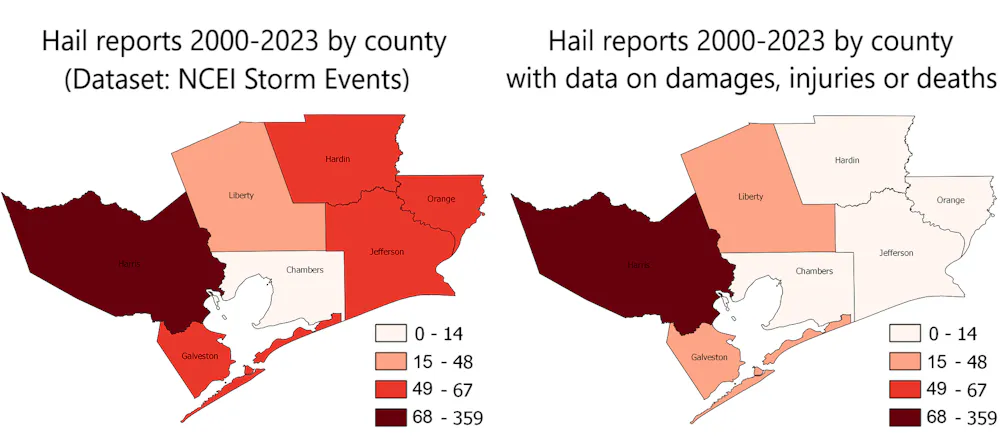
    The number of severe hail reports in southeast Texas listed in the National Centers for Environmental Information’s storm events database is strongly correlated with population. The county with the most reports and greatest detail in those reports is home to Houston. Hailstorms in the three easternmost counties are rarely associated with damage estimates.
    John Nielsen-Gammon and B.J. Baule

    Do you want to look at local damage trends? Forget about it. For most extreme weather events, estimation methods vary over time and are not documented.

    Do you want to direct funding to help communities improve resilience to natural disasters where the need is greatest? Forget about it. The places experiencing the largest per capita damages depend not just on actual damages but on the different practices of local National Weather Service offices.

    Are you moving to a location that might be vulnerable to extreme weather? Companies are starting to provide localized risk estimates through real estate websites, but the algorithms tend to be proprietary, and there’s no independent validation.

    4 steps to improve disaster data

    We believe a few fixes could make NOAA’s storm events database and the corresponding values in the larger SHELDUS database, managed by Arizona State University, more reliable. Both databases include county-level disasters and loss estimates for some of those disasters.

    First, the National Weather Service could develop standard procedures for local offices for estimating disaster damages.

    Second, additional state support could encourage local emergency managers to make concrete damage estimates from individual events and share them with the National Weather Service. The local emergency manager generally knows the extent of damage much better than a forecaster sitting in an office a few counties away.

    Third, state or federal governments and insurance companies can agree to make public the aggregate loss information at the county level or other scale that doesn’t jeopardize the privacy of their policyholders. If all companies provide this data, there is no competitive disadvantage for doing so.

    Fourth, NOAA could create a small “tiger team” of damage specialists to make well-informed, consistent damage estimates of larger events and train local offices on how to handle the smaller stuff.

    With these processes in place, the U.S. wouldn’t need a billion-dollar disasters program anymore. We’d have reliable information on all the disasters.

    John Nielsen-Gammon receives funding from the National Oceanic and Atmospheric Administration and the State of Texas.

    William Baule receives funding from NOAA, the State of Texas, & the Austin Community Foundation.

    – ref. Extreme weather’s true damage cost is often a mystery – that’s a problem for understanding storm risk, but it can be fixed – https://theconversation.com/extreme-weathers-true-damage-cost-is-often-a-mystery-thats-a-problem-for-understanding-storm-risk-but-it-can-be-fixed-257105

    MIL OSI – Global Reports –

    June 5, 2025
  • MIL-OSI Global: ‘Loyal to the oil’ – how religion and striking it rich shape Canada’s hockey fandom

    Source: The Conversation – USA – By Cody Musselman, Preceptor, College Writing Program, Harvard University

    Some Edmonton Oilers fans are pinning their Stanley Cup hopes on captain Connor McDavid. AP Photo/Rebecca Blackwell

    Déjà vu is a common occurrence in the world of sports, and the Edmonton Oilers are no strangers to repeat matchups. The Canadian team faced off against the New York Islanders in both 1983 and ’84 for hockey’s biggest prize, the Stanley Cup. In this year’s National Hockey League finals, the Oilers will try to avenge their Game 7 loss to the Florida Panthers in 2024.

    Edmontonians who have been “loyal to the oil,” as fans say, have been waiting for redemption ever since. The Trump administration’s threats toward its northern neighbor has fueled a wave of nationalism, making even more fans eager for a Canadian team to win the Stanley Cup – which has not happened since 1993. With hopes pinned to Edmonton, the finals also brings renewed attention to some of Canada’s biggest exports: hockey and oil.

    Novelist Leslie McFarlane once observed that for Canadians, “hockey is more than a game; it is almost a religion.” Prayers and superstitions abound, from wearing special clothing to fans averting their eyes during penalty shots.

    The Oilers also evoke another aspect of Canadian society that, for some, has almost religious importance: resource extraction. In American and Canadian culture, oil has long been entangled with religion. It’s a national blessing from God, in some people’s eyes, and a means to the “good life” for those who persevere to find it. For many people in communities whose economies center around resource extraction, the possibility of success is valued above its environmental risks.

    We are scholars of religion who study sports and how oil shapes society, or petro-cultures. The Edmonton Oilers showcase a worldview in which triumph, luck and rugged work pay off – beliefs at home on the ice or in the oil field. The Stanley Cup Final offers a glimpse into how the oil industry has helped shaped the religious fervor around Canada’s favorite sport.

    Edmonton Oilers fan Dale Steil’s boots before the team’s playoff game against the Los Angeles Kings on April 26, 2024.
    AP Photo/Tony Gutierrez

    Boomtown

    Edmonton is the capital of Alberta, a province known for its massive oil, gas and oil sands reserves. With five refineries producing an average of 3.8 million barrels a day, oil and gas is Alberta’s biggest industry – and a way of life.

    This is especially true in Edmonton, known as the “Oil Capital of Canada.” Here, oil not only structures the local economy, but it also shapes identities, architecture and everyday experiences.

    Visit the West Edmonton Mall, for example, and you’ll see a statue of three oil workers drilling, reminding shoppers that petroleum is the bedrock of their commerce. Visit the Canadian Energy Museum to learn how oil and gas have remade the region since the late 1940s, and glimpse items such as engraved hard hats and the “Oil Patch Kid,” a spin on the iconic “Cabbage Patch Kids” toys. Tour the Greater Edmonton area and see how pump jacks dot the horizon. Oil is everywhere, shaping futures, fortunes and possibility.

    Pump jacks near Acme, Alberta – a regular sight.
    Michael Interisano/Design Pics Editorial/Universal Images Group via Getty Images

    Set against this backdrop, the Oilers’ name is unsurprising. It is not uncommon, after all, to name teams after local industries. Football’s Pittsburgh Steelers pay homage to the steel mills that once employed much of the team’s fan base. The Tennessee Oilers were originally the Houston Oilers, prompting other Texas teams such as the XFL’s Roughnecks to follow suit. Further north, the name of basketball’s Detroit Pistons references car manufacturing.

    Teams with industry-inspired names play double duty, venerating both a place and a trade. Some fans are not only cheering for the home team, but also cheering for themselves – affirming that their industry and their labor matter.

    Ales Hemsky of the Edmonton Oilers skates out from under the oil derrick for a game at Rexall Place in 2008 in Edmonton, Alberta.
    Andy Devlin/NHLI via Getty Images

    In a TikTok video from last year’s Stanley Cups playoffs, a man overcome with joy at the Oilers’ victory over the Dallas Stars claps his hands and hops around his living room. The caption reads, “My first-generation immigrant oil rig working Filipino father who has never played a second of hockey in his life … happily cheering for the Oilers advancing in the playoffs. Better Bring that cup home for him oily boys.” He appears to be cheering for the Oilers not because they are a hockey team, but because they are an oil team.

    And indeed, the Oilers are an oily team. The Oilers’ Oilfield Network, for example, describes itself as “exclusively promot[ing] companies in the Oil and Gas industry,” allowing leaders to connect “through the power of Oilers hockey.”

    The Oilers’ connection with industry is further underscored by their logos. The current one features a simple drop of oil, but past designs featured machinery gears and an oil worker pulling a lever shaped like a hockey stick.

    Simply put, “Edmonton is all oil,” Oilers goaltender Stuart Skinner shared after defeating the Dallas Stars to win the 2025 Western Conference Final.

    Liquid gold

    There is a long tradition of pairing hockey with oil – and with Canada itself.

    After the British North America Act founded Canada in 1867, the new nation searched for a distinctive identity through sport and other cultural forms.

    Enter hockey. The winter game evolved in Canada from the Gaelic game of “shinty” and the First Nations’ game of lacrosse and soon became part of the glue holding the nation together.

    Ever since, media, politicians, sports groups and major industries have helped fuel fan fervor and promoted hockey as integral to Canada’s rugged frontiersman character.

    The Montreal Amateur Athletic Association posing with the first Stanley Cup in 1893.
    Bruce Bennett Studios via Getty Images Studios/Getty Images

    In 1936, Imperial Oil, one of Canada’s largest petroleum companies, began sponsoring Hockey Night in Canada, a national radio show that reached millions each week. Several years later, Imperial Oil played a major role in bringing the show to television, where the Imperial Oil Choir sang the theme song. Imperial Oil and its gas stations, Esso, also sponsored youth hockey programs across the nation. In 2019, Imperial inked a deal to be the NHL’s “official retail fuel” in Canada.

    Striking it rich

    Connections between hockey and industry in Alberta’s oil country aren’t just about sponsorships. Central to both cultures is the idea of luck – historically, one of the many things it takes to extract fossil fuels. “Striking it rich” in the oil fields has become entangled with the idea of divine providence, especially among the many Christian laborers.

    Philosopher Terra Schwerin Rowe has written about North America’s “petro-theology,” explaining how many perceive oil as a free-flowing gift from God meant to be taken from the Earth – if you can find it.

    A Canadian oil worker kisses his wife and daughter goodbye as he sets off to work in northern Alberta in the 1950s.
    John Chillingworth/Getty Images

    Oil represents fortune, and who wouldn’t want to borrow a bit of that for their team? Sports are thrilling because sometimes talent, team chemistry and the home-field advantage still lose to a stroke of good luck. Oil culture pairs the idea of divine favor with an insistence on rough-and-tumble endurance, similar to hockey.

    Sometimes if you don’t strike it rich the first time, you have to keep on drilling. The next well may be the one to bring wealth. Oil prospectors know this, but so do sports fans who maintain hope season to season.

    Soon fans from around the world will join Edmonton locals in rooting for the Oilers. They’ll throw their hands up in despair if captain Connor McDavid enters the “sin bin” – the penalty box – or dance in celebration to the Oilers’ theme, “La Bamba.” Some of them will be cheering, too, for oil.

    This is an updated version of an article originally published on June 19, 2024.

    The authors do not work for, consult, own shares in or receive funding from any company or organization that would benefit from this article, and have disclosed no relevant affiliations beyond their academic appointment.

    – ref. ‘Loyal to the oil’ – how religion and striking it rich shape Canada’s hockey fandom – https://theconversation.com/loyal-to-the-oil-how-religion-and-striking-it-rich-shape-canadas-hockey-fandom-258024

    MIL OSI – Global Reports –

    June 5, 2025
  • MIL-OSI Global: What a sunny van Gogh painting of ‘The Sower’ tells us about Pope Leo’s message of hope

    Source: The Conversation – USA – By Virginia Raguin, Distinguished Professor of Humanities Emerita, College of the Holy Cross

    Vincent van Gogh’s ‘Sower at Sunset’ painting. Vincent van Gogh/ Kröller-Müller Museum via Wikimedia Commons, CC BY-NC-SA

    In his first general audience in Rome, Pope Leo XIV referred to Vincent van Gogh’s painting “Sower at Sunset” and called it a symbol of hope. A brilliant setting sun illuminates a field as a farmer walks toward the right, sowing seeds.

    Leo referred to Christ’s Parable of the Sower, a story in the Gospel that speaks to the need to do good works. “Every word of the Gospel is like a seed sown in the soil of our lives,” he said, and highlighted that the soil is not only our heart, “but also the world, the community, the church.”

    He noted that “behind the sower, van Gogh painted the grain already ripe,” and Leo called it an image of hope which shows that somehow the seed has borne fruit.

    Van Gogh painted “Sower at Sunset” in 1888, when he was living in Arles in southern France. At the time, he was creating art alongside his friend Paul Gauguin and feeling very happy about the future. The painting reflects his optimism.

    Van Gogh’s inspiration

    In November 1888, van Gogh wrote to his brother Theo, in whom he frequently confided, about “Sower at Sunset.” He described its beautiful colors: “Immense lemon-yellow disc for the sun. Green-yellow sky with pink clouds. The field is violet, the sower and the tree Prussian Blue.”

    ‘The Sower,’ by Jean-François Millet.
    Museum of Fine Arts, Boston via Wikimedia Commons

    Van Gogh’s painting was inspired by French artist Jean-Francois Millet’s 1860 painting, “The Sower.” But he transformed Millet’s composition, in which a dark, isolated figure dominates, and deliberately set the sower in the midst of a landscape transformed by the sun.

    Other artists, including the Norwegian Emanuel Vigeland, explicitly depicted the Parable of the Sower. Vigeland’s series of stained-glass windows in an Oslo church explains each passage’s meaning. As the sower works, some seeds fall by the wayside and the birds immediately eat them, indicating those who hear the word of God but do not listen.

    Norwegian artist Emanuel Vigeland’s ‘Parable of the Sower,’ 1917-19, Lutheran church of Borgestad, near Oslo, Norway.
    Virginia Raguin

    Some seeds fall on stony ground and cannot take root, a symbol of those with little tenacity. Others fall among thorns and are choked. Vigeland juxtaposed a dramatic image of a miser counting piles of money, indicating how the man’s life has become choked by desire for material gain.

    The final passage of the parable states that some seeds fell on good ground and yielded a hundredfold. Vigeland’s depiction shows an image of an abundant harvest of grain next to a man seated on the ground and cradling a child in his lap.

    What it says about Leo

    Van Gogh’s painting corresponds to many of the ideas the new pope expressed in the first days of his papacy. Leo observed: “In the center of the painting is the sun, not the sower, [which reminds us that] it is God who moves history, even if he sometimes seems absent or distant. It is the sun that warms the clods of the earth and ripens the seed.”

    The theme of the dignity of labor is also inherent in the image of the sower being deeply engrossed in physical labor, which relates to the pope’s choice of his name. The pope stated that he took on the name Leo XIV “mainly because Pope Leo XIII in his historic encyclical Rerum Novarum addressed the social question in the context of the first great industrial revolution.” Leo XIII was referring to the social question of economic injustice in the meager rewards for workers even as owners made great profits from the Industrial Revolution.

    The pope saw Van Gogh’s image of the sower, like Vigeland’s, as a message of hope. That message, to him, fits with the theme of hope of The Jubilee Year proclaimed by Leo’s predecessor, Francis. Leo also expressed hope that humans listening to God would embrace service to others.

    Virginia Raguin does not work for, consult, own shares in or receive funding from any company or organization that would benefit from this article, and has disclosed no relevant affiliations beyond their academic appointment.

    – ref. What a sunny van Gogh painting of ‘The Sower’ tells us about Pope Leo’s message of hope – https://theconversation.com/what-a-sunny-van-gogh-painting-of-the-sower-tells-us-about-pope-leos-message-of-hope-258040

    MIL OSI – Global Reports –

    June 5, 2025
  • MIL-OSI Global: 1 in 4 children suffers from chronic pain − school nurses could be key to helping them manage it

    Source: The Conversation – USA – By Natoshia R. Cunningham, Associate Professor of Family Medicine, Michigan State University

    Mental heath approaches beat medication in treating children’s chronic pain. andresr/E+ via Getty Images

    Joint pain, headaches, stomachaches, fibromyalgia – the list sounds like an inventory of ailments that might plague people as they age. Yet these are chronic, painful conditions that frequently affect children.

    People often imagine childhood as a time when the body functions at its best, but about 25% of children experience chronic pain. I was one of them: Starting in elementary school, migraines incapacitated me for hours at a stretch with excruciating pain that made it impossible to go to school, much less talk to friends or have fun.

    As a licensed pediatric pain psychologist, I develop and test psychological care strategies for children who experience chronic pain. Effective treatments exist, but they are often not accessible, particularly for families that don’t live near major medical centers or have adequate health insurance. My colleagues and I are working to change that by training school nurses and other community health providers to deliver such care.

    More than growing pains

    Chronic pain in children is not only widespread but also persistent. Many continue to experience symptoms for years on end. For example, one-third of children with abdominal pain experience symptoms that last into adulthood. Children with chronic pain are also more likely to come from families that have less income, have greater health care barriers, report more safety concerns about their environment and experience greater exposure to violence than those without chronic pain.

    These conditions interfere with daily life. Children with chronic pain miss about 1 in 5 days of school. Consequently, their academics suffer and they are less likely to graduate from high school. Mental health conditions such as anxiety and depression are common.

    Experiencing chronic pain in childhood also puts people at an increased risk for opioid use in adulthood, signaling a major public health concern.

    Chronic pain can derail a child’s daily life.

    Behavioral therapy for pain

    Many adults think nothing of taking medicines such as ibuprofen or acetaminophen for minor aches and pains, but there’s little evidence that pharmacologic treatments work best for children’s chronic pain. Research suggests that such medicines are insufficient for helping children get back to their routines and activities, such as school, sports and hanging out with friends.

    The most studied and perhaps most effective approach for treating chronic pain in children is cognitive behavioral therapy. This modality involves teaching children how pain works in the brain, and also training them on problem solving, relaxation methods such as deep breathing, challenging negative thoughts about pain, and pacing activities to avoid pain flares. Unlike pain medications, which wear off after a few hours, research suggests that cognitive behavioral therapy can have a lasting effect. Kids can get back to doing things they need and want to do, and they often feel better too over the long term.

    My colleagues and I – along with other researchers – have developed and tested cognitive behavioral approaches for children with chronic painful conditions such as functional abdominal pain and childhood-onset lupus. These interventions not only get kids back to their daily lives but also reduce symptoms of anxiety and depression that often accompany children’s pain syndromes.

    To be sure, providing interventions in the form of web-based tools or apps can improve access for children who can’t see a provider. However, we have found that children and their families are more likely to complete the course of treatment with a provider, and that automated self-management tools can complement but not replace care delivered by a provider. In fact, when cognitive behavioral therapy for children’s chronic pain is delivered exclusively through an online tool, only a third of children complete treatment.

    How community providers can fill the gap

    Despite the proven benefits of psychological therapies for children’s pain, few providers are trained to use them. That’s one of the most common barriers to care.

    One potentially untapped resource is school nurses and other specialists who are often the first point of contact for a child with chronic pain, such as social workers and school counselors. Programs already exist to train school providers, including school nurses, in managing children’s mental health, but few of them address chronic pain.

    To fill this gap, my colleagues and I have developed a program to train school nurses and other community health experts to teach children cognitive and behavioral strategies to manage their chronic pain. So far, we have trained approximately 100 school providers across Michigan, who report that the training improves pain symptoms and helps keep children in school. We are also expanding the project to address trauma and other mental health symptoms that commonly occur with chronic pain, and to support providers in discouraging substance use to manage pain in these children.

    Our work suggests that this approach can empower providers to reach children in rural communities and other settings that lack access to care. By training more boots on the ground, we hope to provide children with the pain management tools they need to grow into healthy and thriving adults.

    Natoshia R. Cunningham receives grant funding from the US Department of Defense, the Michigan Health Endowment Fund, and the Childhood Arthritis and Rheumatology Research Alliance-Arthritis Foundation. She was previously funded by the National Institutes of Health, and the Blue Cross Blue Shield Foundation of Michigan.

    – ref. 1 in 4 children suffers from chronic pain − school nurses could be key to helping them manage it – https://theconversation.com/1-in-4-children-suffers-from-chronic-pain-school-nurses-could-be-key-to-helping-them-manage-it-251220

    MIL OSI – Global Reports –

    June 5, 2025
  • MIL-OSI Global: What is vibe coding? A computer scientist explains what it means to have AI write computer code − and what risks that can entail

    Source: The Conversation – USA – By Chetan Jaiswal, Associate Professor of Computer Science, Quinnipiac University

    Large language model AIs can generate software code based on your prompts. J Studios/DigitalVision via Getty Images

    Whether you’re streaming a show, paying bills online or sending an email, each of these actions relies on computer programs that run behind the scenes. The process of writing computer programs is known as coding. Until recently, most computer code was written, at least originally, by human beings. But with the advent of generative artificial intelligence, that has begun to change.

    Now, just as you can ask ChatGPT to spin up a recipe for a favorite dish or write a sonnet in the style of Lord Byron, you can now ask generative AI tools to write computer code for you. Andrej Karpathy, an OpenAI co-founder who previously led AI efforts at Tesla, recently termed this “vibe coding.”

    For complete beginners or nontechnical dreamers, writing code based on vibes – feelings rather than explicitly defined information – could feel like a superpower. You don’t need to master programming languages or complex data structures. A simple natural language prompt will do the trick.

    How it works

    Vibe coding leans on standard patterns of technical language, which AI systems use to piece together original code from their training data. Any beginner can use an AI assistant such as GitHub Copilot or Cursor Chat, put in a few prompts, and let the system get to work. Here’s an example:

    “Create a lively and interactive visual experience that reacts to music, user interaction or real-time data. Your animation should include smooth transitions and colorful and lively visuals with an engaging flow in the experience. The animation should feel organic and responsive to the music, user interaction or live data and facilitate an experience that is immersive and captivating. Complete this project using JavaScript or React, and allow for easy customization to set the mood for other experiences.”

    But AI tools do this without any real grasp of specific rules, edge cases or security requirements for the software in question. This is a far cry from the processes behind developing production-grade software, which must balance trade-offs between product requirements, speed, scalability, sustainability and security. Skilled engineers write and review the code, run tests and establish safety barriers before going live.

    But while the lack of a structured process saves time and lowers the skills required to code, there are trade-offs. With vibe coding, most of these stress-testing practices go out the window, leaving systems vulnerable to malicious attacks and leaks of personal data.

    And there’s no easy fix: If you don’t understand every – or any – line of code that your AI agent writes, you can’t repair the code when it breaks. Or worse, as some experts have pointed out, you won’t notice when it’s silently failing.

    The AI itself is not equipped to carry out this analysis either. It recognizes what “working” code usually looks like, but it cannot necessarily diagnose or fix deeper problems that the code might cause or exacerbate.

    IBM computer scientist Martin Keen explains the difference between AI programming and traditional programming.

    Why it matters

    Vibe coding could be just a flash-in-the-pan phenomenon that will fizzle before long, but it may also find deeper applications with seasoned programmers. The practice could help skilled software engineers and developers more quickly turn an idea into a viable prototype. It could also enable novice programmers or even amateur coders to experience the power of AI, perhaps motivating them to pursue the discipline more deeply.

    Vibe coding also may signal a shift that could make natural language a more viable tool for developing some computer programs. If so, it would echo early website editing systems known as WYSIWYG editors that promised designers “what you see is what you get,” or “drag-and-drop” website builders that made it easy for anyone with basic computer skills to launch a blog.

    For now, I don’t believe that vibe coding will replace experienced software engineers, developers or computer scientists. The discipline and the art are much more nuanced than what AI can handle, and the risks of passing off “vibe code” as legitimate software are too great.

    But as AI models improve and become more adept at incorporating context and accounting for risk, practices like vibe coding might cause the boundary between AI and human programmer to blur further.

    Chetan Jaiswal does not work for, consult, own shares in or receive funding from any company or organization that would benefit from this article, and has disclosed no relevant affiliations beyond their academic appointment.

    – ref. What is vibe coding? A computer scientist explains what it means to have AI write computer code − and what risks that can entail – https://theconversation.com/what-is-vibe-coding-a-computer-scientist-explains-what-it-means-to-have-ai-write-computer-code-and-what-risks-that-can-entail-257172

    MIL OSI – Global Reports –

    June 5, 2025
  • MIL-OSI Global: Your left and right brain hear language differently − a neuroscientist explains how

    Source: The Conversation – USA – By Hysell V. Oviedo, Assistant Professor of Biomedical Research, Washington University in St. Louis

    How you process language is influenced by how each side of your brain developed in early life. Peter Dazeley/The Image Bank via Getty Images

    Some of the most complex cognitive functions are possible because different sides of your brain control them. Chief among them is speech perception, the ability to interpret language. In people, the speech perception process is typically dominated by the left hemisphere.

    Your brain breaks apart fleeting streams of acoustic information into parallel channels – linguistic, emotional and musical – and acts as a biological multicore processor. Although scientists have recognized this division of cognitive labor for over 160 years, the mechanisms underpinning it remain poorly understood.

    Researchers know that distinct subgroups of neurons must be tuned to different frequencies and timing of sound. In recent decades, studies on animal models, especially in rodents, have confirmed that splitting sound processing across the brain is not uniquely human, opening the door to more closely dissecting how this occurs.

    Yet a central puzzle persists: What makes near-identical regions in opposite hemispheres of the brain process different types of information?

    Answering that question promises broader insight into how experience sculpts neural circuits during critical periods of early development, and why that process is disrupted in neurodevelopmental disorders.

    Timing is everything

    Sensory processing of sounds begins in the cochlea, a part of the inner ear where sound frequencies are converted into electricity and forwarded to the auditory cortex of the brain. Researchers believe that the division of labor across brain hemispheres required to recognize sound patterns begins in this region.

    For more than a decade, my work as a neuroscientist has focused on the auditory cortex. My lab has shown that mice process sound differently in the left and right hemispheres of their brains, and we have worked to tease apart the underlying circuitry.

    For example, we’ve found the left side of the brain has more focused, specialized connections that may help detect key features of speech, such as distinguishing one word from another. Meanwhile, the right side is more broadly connected, suited for processing melodies and the intonation of speech.

    Sound information moves through the cochlea to the brain.
    Jonathan E. Peelle, CC BY-SA

    We tackled the question of how these left-right differences in hearing develop in our latest work, and our results underscore the adage that timing is everything.

    We tracked how neural circuits in the left and right auditory cortex develop from early life to adulthood. To do this, we recorded electrical signals in mouse brains to observe how the auditory cortex matures and to see how sound experiences shape its structure.

    Surprisingly, we found that the right hemisphere consistently outpaced the left in development, showing more rapid growth and refinement. This suggests there are critical windows of development – brief periods when the brain is especially adaptive and sensitive to environmental sound – specific to each hemisphere that occur at different times.

    To test the consequences of this asynchrony, we exposed young mice to specific tones during these sensitive periods. In adulthood, we found that where sound is processed in their brains was permanently skewed. Animals that heard tones during the right hemisphere’s earlier critical window had an overrepresentation of those frequencies mapped in the right auditory cortex.

    Adding yet another layer of complexity, we found that these critical windows vary by sex. The right hemisphere critical window opens earlier in female mice, and the left hemisphere window opens just days later. In contrast, male mice had a very sensitive right hemisphere critical window, but no detectable window on the left. This points to the elusive role sex may play in brain plasticity.

    Our findings provide a new way to understand how different hemispheres of the brain process sound and why this might vary for different people. They also provide evidence that parallel areas of the brain are not interchangeable: the brain can encode the same sound in radically different ways, depending on when it occurs and which hemisphere is primed to receive it.

    Speech and neurodevelopment

    The division of labor between brain hemispheres is a hallmark of many human cognitive functions, especially language. This is often disrupted in neuropsychiatric conditions such as autism and schizophrenia.

    Reduced language information encoding in the left hemisphere is a strong indication of auditory hallucinations in schizophrenia. And a shift from left- to right-hemisphere language processing is characteristic of autism, where language development is often impaired.

    Children with certain neurodevelopmental conditions may have trouble processing speech.
    Towfiqu Ahamed/iStock via Getty Images Plus

    Strikingly, the right hemisphere of people with autism seems to respond earlier to sound than the left hemisphere, echoing the accelerated right-side maturation we saw in our study on mice. Our findings suggest that this early dominance of the right hemisphere in encoding sound information might amplify its control of auditory processing, deepening the imbalance between hemispheres.

    These insights deepen our understanding of how language-related areas in the brain typically develop and can help scientists design earlier and more targeted treatments to support early speech, especially for children with neurodevelopmental language disorders.

    Hysell V Oviedo receives funding from NIH.

    – ref. Your left and right brain hear language differently − a neuroscientist explains how – https://theconversation.com/your-left-and-right-brain-hear-language-differently-a-neuroscientist-explains-how-257436

    MIL OSI – Global Reports –

    June 5, 2025
  • MIL-OSI Global: Memories of the good parts of using drugs can keep people hooked − altering the neurons that store them could help treat addiction

    Source: The Conversation – USA – By Ana Clara Bobadilla, Assistant Professor of Biomedical Sciences, Colorado State University

    Your memories are likely stored in ensembles of neurons that fire together. PASIEKA/Science Photo Library via Getty Images

    Everyday human behavior is guided and shaped by the search for rewards. This includes eating tasty meals, drinking something refreshing, sexual activity and nurturing children. Many of these behaviors are needed for survival. But in some instances, this search for rewards can pose a significant threat to survival.

    People rely on memories of rewards to function and survive. Associated with positive experiences, these memories provide context for evaluating present and future choices. For example, if foods high in sugar are associated with a positive experience, this can reinforce the behavior of eating the food that provided the reward. Similarly, a flavorful meal at a specific restaurant increases the likelihood you’ll become a returning costumer.

    A deeper understanding of how reward memories work and interact with each other is critical to informing the choices you make and to treating disorders where seeking rewards has become problematic. Eliminating all reward seeking would negatively affect behaviors essential for survival, such as eating and reproducing. But if you can specifically target reward memories linked to different drugs, this could help reduce their abuse.

    I am a behavioral neuroscientist studying addiction, and my team is interested in how reward memories are formed and processed in the brain. We study how memories linked to natural rewards such as food, water and sex differ from those linked with rewards from drugs such as fentanyl and cocaine.

    Understanding the differences between these types of rewards and how memories of different drugs interact may lead to more effective treatments for addiction.

    What is memory?

    To study reward memories, it is important to understand the neurobiology of memory, or how the brain remembers things.

    In 1904, evolutionary zoologist Richard Semon introduced the term engram to describe the physical representation of a memory – also called its trace – that forms in the brain after an experience. Later, psychologist Donald Hebb hypothesized that interconnected brain cells that are active at the same time during an experience form a physical ensemble that make up a memory.

    In the past decade, neuroscientists have developed new tools that support the idea that neuronal ensembles, or small populations of brain cells that are activated at the same time, are likely the physical representation of memory. How new memories recruit neurons into ensembles is not fully understood, but the plasticity of neurons – their ability to change their connections with each other – seems to play a major role.

    Memories are physically stored in your brain.

    Research on neuronal ensembles has transformed how scientists understand learning and memory. Researchers can now create artificial memories, activate positive memories to counteract negative feelings, and alter how memories are linked. All these experiments on altering memory have been conducted on animal models, since the technology required to apply these techniques to humans is not yet available.

    To create artificial memories, for instance, researchers can mark a neuronal ensemble associated with a specific environment A in genetically modified mice. They can then activate those neurons when exposing the mice to a foot shock in a different environment B. Later, the mice showed increased freezing behavior in environment A, though they never received a shock in that space. By activating the memory of environment A during the foot shock, mice created a false memory that the foot shock was associated with that space.

    Treating substance use disorders

    Neuronal ensembles hold untapped promise for the study and treatment of substance use disorders and other reward-related disorders. These include those involving a deficit in their ability to experience reward, such as gambling disorder, eating disorders and depression.

    Natural rewards – food, water, sex and nurturing – induce pleasurable feelings that reinforce the behavior that elicits that reward. This is known as positive reinforcement, a strategy often used in everyday life; think training a dog with treats, or using sticker charts for potty training.

    Research has linked positive and negative experiences with neuronal ensembles: exploratory and social behaviors, fear, and feeding. In substance use disorders, a drug can induce both pleasant and unpleasant feelings. For example, cocaine induces an intense rush or high, but the crash induced by the drug wearing off causes irritability and lethargy. These feelings reinforce drug use at the expense of essential behaviors that ensure survival, such as eating, sleeping or maintaining social networks and relationships.

    Neuronal ensembles may also play a causal role in the development of multiple aspects of substance use disorders, including drug taking, drug craving and seeking behaviors, increased sensitivity to certain drugs and relapse.

    How drug memory changes the brain

    Similarly to how any memory is stored in the brain as a neuronal ensemble, drug memories are carried in specific neuronal ensembles and activated during drug-related behaviors.

    Fundamental questions remain about how neuronal ensembles encode drug-related memories. Because the processing centers for drug rewards and natural rewards mostly overlap in the brain, it is challenging to develop treatments that target only drug reward seeking. Emerging treatments for addiction, such as certain types of brain stimulation, are not specific enough to differentiate between drug or natural reward pathways.

    Discovering how particular drugs of abuse affect genes, cells and neuronal circuits can help researchers develop new treatments for substance use disorders without altering the natural reward-seeking behaviors essential for survival.

    The reward of drug use can be hard to disentangle from the rewards of eating, drinking and other activities necessary for survivial.
    Kseniya Ovchinnikova/Moment via Getty Images

    For example, about 72% of people suffering from substance use disorders report using multiple substances, frequently together. To better understand how polysubstance use affects the brain, my team tags neurons active during drug-related behaviors in genetically modified mice. This allows us to map and compare the neurons carrying reward-related memories for one drug with the neurons associated with another drug. In this way, we can study how the brain represents and stores memories when mice are exposed to cocaine and fentanyl – two substances people in the U.S. are increasingly taking together – and how different brain regions communicate this information with each other.

    To dissect exactly how drugs of abuse hijack the brain’s natural reward system, my team is comparing how seeking different types of rewards changes the neurons carrying reward memories. For example, we have previously shown that the network of cells carrying the memory of seeking cocaine are mostly distinct from those linked to seeking sugar.

    Based on this work, we are currently using fruit fly models to analyze the genetic activity of the neuronal ensemble linked to seeking cocaine. This will allow us to better identify which genes could be potential targets to reduce the activity of that neuronal ensemble and treat substance use disorder.

    Psychedelics and addiction

    Drug-related intrusive thoughts and fixed behavioral patterns – meaning actions that are repeatedly taken regardless of negative consequences – are common symptoms of substance abuse that lead to the formation of harmful neural pathways in the brain. Psychedelics may be able to help reform these pathways by triggering an overall “system reboot” of the brain.

    Several clinical trials point to the potential of psychedelics to treat tobacco, alcohol and opioid use disorders, with early results showing increased abstinence and reduced drug cravings.

    My lab is currently examining how psilocin – the active metabolite of the psychedelic psilocybin – affects the drug-related memories of mice. Our research focuses on two questions. First, can psilocin alter drug seeking and intake in fentanyl addiction? And second, what type of memory does psilocin create in the brain, and could it alter prior cocaine memories?

    Reward memories both help people survive and lead to substance use disorders. Delving into the intricate mechanisms of how the brain remembers rewards at the cellular and genetic levels can help researchers and doctors better treat addiction without altering the reward pathways needed for survival.

    Ana Clara Bobadilla receives funding from the National Institute on Drug Abuse and the Brain & Behavior Research Foundation.

    – ref. Memories of the good parts of using drugs can keep people hooked − altering the neurons that store them could help treat addiction – https://theconversation.com/memories-of-the-good-parts-of-using-drugs-can-keep-people-hooked-altering-the-neurons-that-store-them-could-help-treat-addiction-245529

    MIL OSI – Global Reports –

    June 5, 2025
  • MIL-OSI Africa: Ghana’s Minerals Commission Showcases Drone Technology at Mining in Motion 2025

    Source: Africa Press Organisation – English (2) – Report:

    ACCRA, Ghana, June 4, 2025/APO Group/ —

    The Minerals Commission of Ghana – the body responsible for the regulation and management of the country’s mineral resources – is utilizing drone technology to address illegal mining. This innovative solution not only enables the government to combat illegal processes, but supports mining operations through geological tracking and oversight.

    At the Mining in Motion 2025 summit – taking place this week in Accra – Dr. Sylvester Akpah, Lead Consultant at the Minerals Commission, showcased how the drones provide real-time aerial surveillance of mining concessions and mineral-rich areas, enabling authorities to detect and respond to illegal operations.

    “There is a need for us to support the government’s agenda to ensure mining is done legally and sustainably, through the aerial imagery we obtain from drones,” Akpah said.

    He explained that artificial intelligence (AI) is integrated into the system to analyze drone footage and pinpoint the exact coordinates of suspected illegal mining activities.

    “With AI, we can determine whether a site is legal or illegal. Once that’s confirmed, security agencies can be deployed to take appropriate action,” he said.

    Beyond identifying unauthorized mining, the technology also allows for tracking of excavators, providing insights into ownership, operational legality and the movement of mined minerals. This enhances regulatory oversight and transparency in the mineral value chain.

    Data collected by the drones is integrated into the Minerals Commission of Ghana’s internal systems, where it is analyzed by trained local data analysts. According to Akpah, the data acquisition and processing contributes to local skills development and supports Ghana’s broader digitalization efforts in the mining sector.

    MIL OSI Africa –

    June 5, 2025
  • MIL-OSI Africa: Africa Investment Forum Partners Sign Partnership Framework Agreement at African Bank Development Bank Group’s 2025 Annual Meetings

    Source: Africa Press Organisation – English (2) – Report:

    ABIDJAN, Ivory Coast, June 4, 2025/APO Group/ —

    On the sidelines of the African Development Bank Annual Meetings (www.AfDB.org), founding partners of the Africa Investment Forum signed a Partnership Framework Agreement, reinforcing their collective commitment to mobilize transformative investments across the African continent.

    The new framework creates a clearer partnership model that sets out the roles and benefits for the founding partners. It also opens the door for expansion to new partners, ensuring everyone benefits while increasing the Forum’s overall impact.

    Launched in 2018, the Africa Investment Forum platform has solidified its standing as  Africa’s premier investment marketplace for global investors and has garnered nearly $225 billion in investment interest to date.

    Principals of the African Development Bank Group, Africa50, Africa Finance Corporation, Development Bank of Southern Africa (DBSA) and Arab Bank for Economic Development in Africa (BADEA) signed the agreement. The other partners are Trade and Development Bank, European Investment Bank, Islamic Development Bank and Afreximbank.

    Speaking at the signing ceremony, President of the African Development Bank Group and chairperson of the Africa Investment Forum, Dr. Akinwumi A. Adesina said:

    “This agreement is a testament to our shared vision: that Africa will not be developed by aid, but by investment. The AIF has changed perceptions and proven that Africa is indeed a bankable destination.”

    Dr Fahad Abdullah Aldossari, Chairman of BADEA’s Board of Directors said: “The signing of the AIF Framework Agreement marks a remarkable milestone to ascertain both effectiveness and efficiency as well as financial sustainability for AIF 2.0 in a bid to advance more projects to bankability and crowd-in transformative investments to the continent.”

    Alain Ebobissé, CEO of Africa 50 said: “This signature marks our renewed commitment to support the objectives of the Africa Investment Forum, launched under the visionary leadership of President Adesina. It is a much-needed deal-making platform that helps strengthen collaborations and leverage innovative models to unlock private capital to accelerate the delivery of bankable projects on the continent. It is critical for African Institutions to support it”.

    “As a Founding Partner, we are proud to see this initiative formally take shape. Through AIF, we’ve proven what Africa can achieve when we collaborate — building the continent’s first investment platform that truly mobilizes capital for bankable, high-impact projects,” said Samaila Zubairu, President and CEO of Africa Finance Corporation.

    “We have to continue leveraging the AIF as a platform for capital mobilisation in Africa, to bridge the infrastructure funding gap in the continent,” said DBSA’s CEO Boitumelo Mosako.

    The signing of the Partnership Framework Agreement takes place ahead of what is expected to be an expanded and impactful Market Days 2025, to be held from 26 to 28 November 2025 in Rabat, Morocco. Market Days, the centerpiece of the Africa Investment Forum platform, brings together investors, deal sponsors and heads of government to advance transformational African projects toward financial close.   

    MIL OSI Africa –

    June 5, 2025
←Previous Page
1 … 1,466 1,467 1,468 1,469 1,470 … 5,175
Next Page→
NewzIntel.com

NewzIntel.com

MIL Open Source Intelligence

  • Blog
  • About
  • FAQs
  • Authors
  • Events
  • Shop
  • Patterns
  • Themes

Twenty Twenty-Five

Designed with WordPress