Category: KB

  • MIL-OSI Global: Detroit voters have an opportunity to pick a mayor who will ease zoning, improve transit and protect long-term residents

    Source: The Conversation – USA – By Brian J. Connolly, Assistant Professor of Business Law, University of Michigan

    Five of Detroit’s mayoral candidates discuss their ideas for the future of the city. Detroit PBS

    Five of the nine candidates in Detroit’s mayoral contest debated on May 29, 2025, during the annual Mackinac Policy Conference.

    When asked about outgoing Mayor Mike Duggan’s 11-year tenure, many of the candidates praised him for skillfully steering Detroit through bankruptcy and attracting new business investment.

    But the candidates also saw an opportunity to do more.

    “Without a doubt, we have to ensure that more investment comes back into our neighborhoods and that we’re activating our commercial corridors,” the race’s front-runner, Detroit City Council President Mary Sheffield, said.

    Helping Detroit residents improve their neighborhoods will be an important task for the city’s next mayor. I do not live in Detroit, but my family lived there for generations before my grandparents joined the white flight from the city in the 1970s. And my research on housing, infrastructure and land use law offers some ideas for how the next mayor could encourage investment while at the same time improving social equity.

    Duggan’s legacy

    By most accounts, the Motor City under Duggan has been an urban revitalization success story.

    Once the nation’s murder capital, its crime rate has fallen dramatically.

    And after experiencing the largest-ever municipal bankruptcy, the city boasts an investment-grade credit rating. For the past two years, the city has gained population after decades of losses. But many of the city’s neighborhoods, from Brightmoor to Jefferson-Chalmers, have not experienced the same economic surge as its booming downtown.

    Detroit’s Brightmoor neighborhood has an artsy vibe – and a high crime rate.
    Patrick Gorski/NurPhoto via Getty Images

    In the city center, offices are being converted to apartments, Michigan’s second-tallest building is rising along with other new developments, and the city has hosted major national events such as the NFL draft. Yet some of Detroit’s outlying areas still suffer from disinvestment and abandonment, poor infrastructure, underperforming schools and crime.

    Many Detroiters are concerned the city’s boom might displace longtime residents if it causes housing prices to increase dramatically or removes affordable homes from the market.

    Detroit’s voters will narrow the field to two candidates on Aug. 5. To help voters evaluate the candidates’ positions between now and then, here are some research-backed ideas for improving life in the city.

    Make it easy to build

    Detroit’s next mayor can make it easier to build new homes and businesses in the city’s neighborhoods.

    Repopulating neighborhoods reduces visual blight, brings life to vacant areas and improves the city’s fiscal health by bringing in new tax revenue. Population growth also supports neighborhood businesses that create jobs and serve the community. And it will mitigate the city’s recent, steep growth in housing prices by adding new supply to the market.

    Easing zoning and building rules is a good place to start. U.S. cities such as Minneapolis and Portland have recently reformed zoning laws to simplify housing construction. They’ve also modified single-family zoning citywide to allow multiplexes and accessory dwelling units. Those interventions have resulted in a small increase in new housing. Even more construction has taken place in cities such as Denver that have allowed higher-density development along major corridors – projects that can be more easily scaled and financed due to their larger size and attractiveness to investors.

    To date, Detroit has not adopted any of these reforms.

    Another way to spur building is to offer developers a predictable approval process. Even if cities maintain building height restrictions, setbacks and design requirements – things Detroit has maintained – predictable procedures reduce development costs and assure investors that projects can be completed on time. For example, cities can shorten the time it takes to review a project. They can also avoid city council or planning commission public hearings with subjective review criteria, which Detroit currently allows under its zoning laws.

    Detroit’s initial efforts to update its zoning in 2018 stalled. Yet the city has an opportunity to become the nation’s easiest place to build, and doing so will ensure that it remains affordable while attracting investment.

    Improve transit service

    Detroit’s next mayor can aid its neighborhoods by improving transit service.

    Without a regional transit system, southeast Michigan remains heavily car-dependent. Yet a 2017 study showed less than half of low-income Detroiters own cars. And of those who don’t own a car, 43% missed work, an appointment or something else due to a lack of transportation. Although this study is several years old, these statistics likely haven’t changed much due to rising costs of housing and car ownership.

    Today, nearly one-third of Detroiters live in poverty – meaning, for a family of four, they earn less than US$32,000 per year – yet the national average annual cost of car ownership exceeds $12,000. Giving lower-income Detroiters a low-cost, reliable means to get to work would benefit the city’s neighborhoods, residents and businesses.

    Expanding transit service has other benefits, too. Transit reduces traffic, encourages the healthy habit of walking to and from stops and improves air quality. Transit investments also increase land values around stations and brings new businesses to these neighborhoods. In addition to serving the needs of working Detroiters, more frequent and reliable bus service would increase neighborhood property values, according to research.

    Make property taxes fairer

    Since the city’s emergence from bankruptcy 11 years ago, housing wealth in Detroit has grown by $4.6 billion.

    Although a rise in land values signals investor confidence in the city and benefits its homeowners, high prices limit Detroiters’ ability to afford housing, the wealth is not shared with everyone, and there is heightened risk of displacing low-income residents.

    And, as candidates frequently mentioned during the debate, after more than 40 years of tax increases to make up for sliding property values, the city has one of the highest effective property tax rates in Michigan, over 2.8%, making housing even less affordable. Nevertheless, Detroit routinely abates taxes for major commercial developments such as Hudson’s Detroit and several downtown hotels, which some residents view as unfair.

    Detroit’s next mayor has an opportunity to reduce the property tax burden for residents and businesses, improve the system’s fairness, and use increasing land prices and new development for public benefit.

    Duggan proposed a land-value tax to replace the city’s property tax in 2023. Unlike property taxes, land-value taxes place a levy on the value of land, not structures on the land. These taxes create an incentive for owners to develop their properties for productive use rather than speculate on underutilized land.

    In a city like Detroit, with thousands of vacant properties, a land-value tax would encourage development by limiting the benefits of long-term land speculation. For lower-income homeowners and renters, the city could avoid displacement through exemptions and other mechanisms.

    Duggan’s proposal failed in the Michigan Legislature, which needs to approve changes to the property tax. But Detroit’s next mayor could revive this push.

    The next mayor could also press the Legislature for other tools, such as the authority to levy development impact fees to build parks and schools or provide social services in neighborhoods affected by new development.

    Michigan law allows the formation of special assessment districts, business improvement zones and other special taxing entities to provide public infrastructure. Expanding these tools may allow Detroit to leverage rising property values to provide public benefits such as streets or parks.

    Importantly, the city can gain better public services and infrastructure while encouraging development. Tools such as the city’s community benefits ordinance, which requires developers of large projects to negotiate with neighbors for services and amenities, look good on paper but can delay projects or mistake individuals’ interests for community needs. Similarly, affordable housing mandates often lead to counterproductive results such as discouraging new development or raising costs on market-rate housing.

    Brian J. Connolly does not work for, consult, own shares in or receive funding from any company or organization that would benefit from this article, and has disclosed no relevant affiliations beyond their academic appointment.

    ref. Detroit voters have an opportunity to pick a mayor who will ease zoning, improve transit and protect long-term residents – https://theconversation.com/detroit-voters-have-an-opportunity-to-pick-a-mayor-who-will-ease-zoning-improve-transit-and-protect-long-term-residents-254540

    MIL OSI – Global Reports

  • MIL-OSI Africa: Mining in Motion Highlights Role of Artisanal Small-Scale Miners (ASM)-Large-Scale Miners (LSM) Synergies in Africa

    Source: Africa Press Organisation – English (2) – Report:

    ACCRA, Ghana, June 5, 2025/APO Group/ —

    Ghana is making strides towards fostering greater collaboration between Artisanal Small-Scale Miners (ASM) and Large-Scale Miners (LSM), seeking to unlock greater value from the mining industry while creating newfound opportunities for local communities. A discussion at the Mining in Motion 2025 summit highlighted the value of strengthen ASM-LSM synergies, with speakers underscoring the need to promote cooperation among industry stakeholders.

    The session – titled Fostering Synergies Between ASM and LSM: Maximizing Gold Value through Collaboration – shed light on the role ASMs play, not only in Ghana but across the broader African continent. ASMs make up a large part of Ghana’s mining industry, contributing over 35% to the country’s total gold output.

    According to Okyere Yaw Ntrama, General Manager, Ahafo Mine at Newmont Ghana Gold Limited, “The ASM industry is labor-intensive but they are also the best producers in terms of driving value for the economy. Formalization and synergies are not only about co-existence but about co-creation of knowledge, equal access and prosperity. When we talk about shared value, we also talk about resources that should be optimally mined. If there are areas that cannot be mined by larger companies, they should be given to small-scale miners.” 

    Ntrama further explained that through synergies between the ASM and LSM industry, Ghana can optimize mining operations. Specifically, the country can determine areas which are not commercially viable for LSM players, handing them over to ASMs to develop.

    Otu Solomon Kwame from the Association of Small-Scale Miners of Ghana, emphasized that, “Sometimes small-scale miners feel neglected by the larger companies. We need to devise policies to make sure these companies are fixed into lasting cooperation. We need to work with mining companies to determine areas that have been determined as [unfeasible]. Those areas can be given to small-scale miners.” 

    Meanwhile, Edward Bickham, Senior Adviser, World Gold Council, believes that there needs to be greater trust developed between ASM and LSM companies. He stated: “ASMs need to be treated as other stakeholders are: understood and worked with because they are significant. As an LSM, you need to think of the sustainable development of the communities around you. ASM is an important part of livelihoods. There is also the issue of security and collaboration. You need to think about the dynamics and relationships between the two types of miners. There is a huge trust-building initiative that needs to be taken.”

    Echoing these remarks, Eduard Cornew, Co-founder & President of Mwamba Mining, emphasized that trust is an imperative part of improving cooperation and accelerating productivity across Ghana’s mining sector. Cornew drew attention to the need to create trust between different mining corporations – from small-scale miners to larger corporations.

    Beyond Ghana, major mining producers in Africa are turning to regulation to facilitate collaboration across industry players. Jean-Paul Kapongo, Director General, SAEMAPE at the Ministry of Mining of the Democratic Republic of Congo (DRC), explained that, It all started in our country with the advent of the mining code and the mining regulations. These two documents provide the possibility and the accessibility to access the DRC’s mines.”

    The DRC is one of Africa’s biggest mineral producers. By promoting synergies between ASM and LSM players, the country seeks to reaffirm its position as global supplier.

    MIL OSI Africa

  • MIL-OSI Africa: Africa Finance Corporation (AFC) Champions Shift of $4 Trillion in Domestic Savings into Africa’s Infrastructure Transformation

    Source: Africa Press Organisation – English (2) – Report:

    LAGOS, Nigeria, June 5, 2025/APO Group/ —

    • Clarion call for scaling electricity generation and transmission to drive structural economic transformation  
    • Installed power capacity per capita stagnated in Africa vs. doubling in India since 2008 
    • Africa’s railway expansion is gaining speed with 7,000 km of new track investments poised to double growth in the next decade 
    • Africa’s rising supply of strategic resources such as iron ore requires a unified continental approach to integrate production, processing and demand centres for steel 

    Africa Finance Corporation (AFC) (www.AfricaFC.org ), the continent’s leading infrastructure solutions provider, today publishes the most comprehensive and up-to-date picture of Africa’s investable capital landscape—revealing over $4 trillion of domestic savings in banking assets, institutional funds and reserves.  

    Download report: https://apo-opa.co/4kWVdwh

    The research in the 2025 edition of the State of Africa’s Infrastructure (SAI) Report underscores AFC’s conviction in the capacity for African-led investment as the foundation for scaling provision of power, transportation and industrialisation across the continent. 

    Specifically, the SAI Report provides a conservative estimate of over $1.1 trillion in long-term institutional capital from pensions, insurance, sovereign wealth funds, and public development banks, along with $2.5 trillion in commercial banking assets and over $470 billion in central bank reserves. 

    Despite the scale of these resources, most investments are allocated to low-risk and short-term instruments rather than being channelled into the real economy. AFC’s report calls for targeted policy reforms, financial innovation, increased use of risk-mitigation tools, and the creation of financial structures—such as pooled funds or investment platforms—to reposition African institutions at the heart of the continent’s infrastructure transformation.  

    Thinking Bigger 

    As part of the process of identifying investment opportunities, the SAI Report seeks to shift Africa’s energy narrative—from small-scale access to large-scale, interconnected power systems capable of driving industrialisation, digital sovereignty, and climate resilience.  

    Under-investment in African energy is stark. In 2024, Africa added just 6.5 GW of grid-connected capacity from all sources—compared to over 18 GW from renewables alone in India. Installed power generation per person has stagnated in Africa while more than doubling in India since 2008, highlighting the widening gap in energy access and industrial potential.   

    The report further advocates for regional grid integration and private sector participation in electricity transmission, noting that Africa—in contrast to other developing regions—has yet to see a single independent transmission project. AFC identifies Angola, DRC, Tanzania, and Mauritania as key interconnector markets that could enable countries with excess generation capacity to supply power to those facing deficits—linking multiple power pools and balancing electricity flows across borders.  

    Rail Renaissance 

    In contrast to the under-investment in energy, the SAI Report spotlights the emergence of a new rail infrastructure cycle, signaling renewed momentum across Africa’s transport landscape. From east to west and southern Africa, a growing pipeline of railway projects—public and private—is reversing decades of neglect and disrepair. 

    Under-construction and planned lines total over 7,000 km, potentially doubling the pace of rail expansion in the decade ahead.  

    To showcase this renaissance, AFC has launched the first-ever Digital Map of African Railways (https://apo-opa.co/3ZhLHLT)—a dynamic, interactive platform that provides real-time insights into the continent’s rail corridors. The tool aims to enhance project visibility, foster investor interest, and support coordination along key transport and trade corridors. 

    Industrial Value Chains 

    The report further identifies steel, fertilizers and oil refining as Africa’s three most important strategic industrial inputs—currently dominated by some $300bn of annual imports but ripe for domestic value addition.  

    As a result of local production shortfalls, Africa currently consumes just 24 kg of steel per capita, compared to a global average of 219 kg, and 23 kg of fertilizer per hectare, versus 140 globally. Notably, the ore-to-steel supply chain represents a major untapped industrial opportunity—but realising its potential will require connecting expanding iron ore supply centres in West Africa with processing hubs and growing consumption markets across the continent. 

    AFC calls for coordinated investment in energy, transport, and logistics to unlock competitiveness in these sectors and anchor regional production hubs. 

    Commenting on the findings, Samaila Zubairu, President & CEO of Africa Finance Corporation, said: “This report provides a practical roadmap for how Africa can channel its significant financial strength into the infrastructure needed to drive industrial transformation—from scaling electricity supply to revitalising rail and building up strategic industries like steel and fertilisers. The tools exist. The capital is available. What’s needed now is coordinated action to unlock it.” 

    MIL OSI Africa

  • MIL-OSI Europe: New Ocean Pact to protect marine life and strengthen blue economy

    Source: European Union 2

    The ocean shapes our economies, our food systems, even the air we breathe. To better protect our ocean, the Commission has adopted a European Ocean Pact, which will help to promote a thriving blue economy and support the well-being of people living in coastal areas. 

    This Ocean Pact brings together EU ocean policies under one single and coordinated framework. It will do so through a collaborative approach between EU countries, regions, and stakeholders, including fishers, innovators, investors, scientists, and civil society. Six priority areas for action will define this work, namely

    • protecting and restoring ocean health by supporting EU countries in their efforts to restore degraded coastal marine habitats
    • boosting the competitiveness of the EU sustainable blue economy including by strengthening the EU’s maritime industry and by introducing a Blue Generational Renewal Strategy, to foster access to young professionals in marine research, ocean tech, and sustainable fisheries
    • supporting coastal and island communities, and outermost regions by presenting new or updated strategies for these regions and communities
    • enhancing maritime security and defence by strengthening EU coast guard cooperation and maritime border security
    • advancing ocean research, knowledge, skills and innovation by proposing an ambitious EU Ocean Observation Initiative
    • strengthening EU ocean diplomacy and international ocean governance by stepping up its fight against illegal, unreported and unregulated fishing

    The European Ocean Pact will be complemented by an ocean act by 2027, which will help to ensure the implementation of the priorities of the pact.  An EU Ocean Pact dashboard will be used to track progress.

    For more information

    Press release: Commission adopts European Ocean Pact for a healthy ocean, a competitive blue economy and thriving coastal communities

    More information about the European Ocean Pact 

    MIL OSI Europe News

  • MIL-OSI United Kingdom: FMQs: Scottish Government urged to reinstate direct ferry service to Europe

    Source: Scottish Greens

    A direct connection to mainland Europe would be a positive boost to Scotland.

    The First Minister has been urged to take action on “Brexit bureaucracy” and work to reinstate a direct ferry service between Scotland and mainland Europe. 

    Scottish Greens MSP Mark Ruskell has been in discussions with Transport Cabinet Secretary Fiona Hyslop to see a ferry service in operation between Rosyth and Dunkirk, creating a direct route for freight and passengers from Scotland. 

    There is a willingness from the Westminster Government to support actions needed to get the ferry service running, but so-called “Brexit bureaucracy” over border control ports need to be agreed upon. 

    Speaking at First Minister’s Questions today, Mr Ruskell asked: 

    “To ask the First Minister what actions the Scottish Government is taking to secure a direct ferry route between Scotland and France?”

    First Minister John Swinney said his government is determined to support action to make this ferry route possible, and that he believes Scotland’s future is in the European Union. 

    In his second question, Mr Ruskell asked: 

    “Well, can I thank the First Minister for that response. I absolutely welcome the engagement with the cabinet secretary earlier in the week. 

    “It’s absolutely clear that a direct ferry service between Rosyth and Dunkirk would be a great win for the economy and the environment. It would be wonderful news for all of us who cherish our connections with the rest of Europe.

    “I understand the ferry operators, DFDS, want to move forward to start sailing in spring next year. Forth Ports around Rosyth want progress. The Port of Dunkirk have bought in. And the Westminster government is also supportive. 

    “The only thing that is getting in the way, First Minister, is Brexit bureaucracy around the location of a border control post. Time is ticking. 

    “A resolution needs to be found by the end of June to secure the service, First Minister. 

    “Are you able to take the lead, to convene stakeholders and to resolve these remaining issues and get this over the line?”

    Speaking after FMQ’s, Mr Ruskell said: 

    “We are within touching distance of connecting Fife to France through a direct ferry service, but Brexit Bureaucracy is getting in the way. 

    “I’m pleased that both the First Minister and the Cabinet Secretary have agreed to lead talks to resolve the issue of a Border Control Post but time is ticking and operators need certainty by the end of this month.

    “For years people have been waiting for the Rosyth ferry to come back, it needs to happen by Spring 2026, stakeholders need the certainty that any fix in the regulations can be delivered in time.”

    MIL OSI United Kingdom

  • MIL-OSI Russia: Fourth year together with GUU: the new season of “University Shifts” has started

    Translation. Region: Russian Federal

    Source: State University of Management – Official website of the State –

    On June 5, Vladimir Stroyev, Rector of the State University of Management, took part in a press conference dedicated to the IV season of the educational and tourist project “University Shifts” to be held from June to September 2025.

    Deputy Minister of Science and Higher Education of the Russian Federation Olga Petrova spoke about further plans for the development of the project:

    “Next year, we are planning a closer integration of shifts with national projects and an expansion of participation opportunities for children from Russian territories, because they also want to join universities.”

    The Deputy Minister also stressed the importance of involving university students as camp counselors, as this contributes to a deeper understanding of what has happened and is happening in new territories.

    Rector of the State University of Management Vladimir Stroev noted the changes that have occurred over the years in the mood of the shift participants:

    “We are proud that our university has been participating in the project from the very beginning. Thanks to Olga Petrova, who comes to visit every shift, the “Movement of the First” and the “Knowledge” society, with whom we have been closely cooperating for a long time and implementing joint thematic projects. It all started out difficult. In 2022, the guys came with different moods, we had to work a lot with them psychologically. Last year, the participants already had a different atmosphere, the complexity of interaction of the first years was gone. These are already our citizens who are interested in the history of their country.”

    Vladimir Stroyev also recalled that in 2025, the State University of Management will hold three shifts: cultural and educational, educational, where students will learn about the university’s educational programs, and entrepreneurial.

    The press conference was also attended by Deputy Director of the Department for Integration of the National Education System and International Cooperation of the Ministry of Education of Russia Pavel Belokon, Deputy Chairperson of the Board of the All-Russian Public-State Movement of Children and Youth “Movement of the First” Sonya Pogosyan, Deputy General Director of the Russian Society “Knowledge” Irina Karikh and Vice-Rector for Work with Students of the Peoples’ Friendship University of Russia named after Patrice Lumumba Mikhail Katsarsky.

    Let us recall that “University Shifts” is a project that helps schoolchildren and students see the structure of universities from the inside and get acquainted with the educational program and opportunities of higher education institutions. In 2025, about 90 universities from all over the country are waiting for the guys.

    Please note: This information is raw content directly from the source of the information. It is exactly what the source states and does not reflect the position of MIL-OSI or its clients.

    MIL OSI Russia News

  • MIL-OSI USA News: ICYMI: Texas Ends In-State Tuition for Illegals After DOJ Lawsuit

    Source: US Whitehouse

    From CBS News Texas:

    “Texas has agreed to end in-state tuition rates for undocumented immigrants.

    The Department of Justice sued Texas on Wednesday over a long-standing state education policy, which it says illegally favors undocumented foreign students. The lawsuit accuses Texas of discriminating against out-of-state American students by offering in-state tuition rates to undocumented immigrants. 

    That same day, Attorney General Ken Paxton filed a joint motion along with the Trump administration to end the law.

    It’s one of the latest efforts by the Trump administration to crack down on immigration into the country. President Trump issued two executive orders to prevent ‘benefits or preferential treatments’ from going to undocumented immigrants.”

    Click here to read the full story.

    MIL OSI USA News

  • MIL-OSI Asia-Pac: Convenor of ExCo Non-official Members reviews Hong Kong Customs passing-out parade (with photos)

    Source: Hong Kong Government special administrative region

    Convenor of ExCo Non-official Members reviews Hong Kong Customs passing-out parade  
    Speaking at the passing-out parade, Mrs Ip said Hong Kong Customs is committed to leveraging Hong Kong’s strategic positioning of enjoying strong support of the motherland and being closely connected to the world under the “one country, two systems” framework to deepen its multilateral co-operation with partners in the A/P region. This not only demonstrates the department’s endeavour to echo the directional principle of “leveraging our unique advantages while reinforcing our connectivity with both the Mainland and the world” as proposed during the “two sessions”, but also serves as a vivid illustration of Hong Kong’s integration into the overall development of the country.Issued at HKT 20:45

    NNNN

    MIL OSI Asia Pacific News

  • MIL-OSI USA: NORTHAMPTON COUNTY – Governor Shapiro, PennDOT Secretary to Advocate for Mass Transit Investments, Connecting Communities and Powering Pennsylvania’s Economy

    Source: US State of Pennsylvania

    June 05, 2025Lower Nazareth Township, PA

    ADVISORY – NORTHAMPTON COUNTY – Governor Shapiro, PennDOT Secretary to Advocate for Mass Transit Investments, Connecting Communities and Powering Pennsylvania’s Economy

    Governor Josh Shapiro and Secretary of PennDOT Mike Carroll will visit Lehigh Valley Hospital-Hecktown Oaks to highlight the importance of investing in mass transit to create jobs, connect communities, and grow Pennsylvania’s economy. The Governor’s 2025-26 Budget Proposal calls for significant investment in mass transit and road and bridge infrastructure all across the Commonwealth ensuring Pennsylvanians can get where they need to go.

    WHO:
    Governor Josh Shapiro
    Secretary Mike Carroll, PennDOT
    Senator Lisa Boscola
    Owen O’Neil, Executive Director of Lehigh and Northampton Transportation Authority
    Dr. Joseph G. Cacchione, CEO of Jefferson Health
    Tony Iannelli, President and CEO of the Greater Lehigh Valley Chamber of Commerce
    Nancy Dischinat, Executive Director Workforce Board Lehigh Valley

    WHERE:
    Lehigh Valley Hospital-Hecktown Oaks
    3780 Hecktown Road,
    Easton, PA 18045

    WHEN:
    TODAY, Thursday, June 5, 2025, at 11:00 AM

    LIVE STREAM:
    pacast.com/live/gov
    governor.pa.gov/live/

    RSVP:
    Press who are interested in attending should RSVP with the names and phone numbers for each member of their team to ra-gvgovpress@pa.gov.

    MIL OSI USA News

  • MIL-OSI: TOP Ships Inc. Announces Ex-Distribution Date for Planned Spin-Off of Rubico, a New Nasdaq-Listed Suezmax Tanker Company

    Source: GlobeNewswire (MIL-OSI)

    ATHENS, Greece, June 05, 2025 (GLOBE NEWSWIRE) — TOP Ships Inc. (the “Company” or “TOP Ships”) (NYSE American:TOPS), an international owner and operator of modern, fuel-efficient “ECO” tanker vessels, announced today that the NYSE American (the “NYSE”) has established an ex-distribution date for the previously-announced proposed spin-off of two of its Suezmax tanker vessels.

    Rubico Inc. (“Rubico”), currently a subsidiary of TOP Ships, would become an independent publicly-traded company listed on the Nasdaq Capital Market as a result of the planned spin-off. The initial assets of Rubico will be the M/T Eco Malibu and M/T Eco West Coast, each a modern, high specification, scrubber-fitted and fuel-efficient 157,000 dwt Suezmax tanker. As part of the spin-off transaction, TOP Ships intends to distribute 100% of the common shares of Rubico pro rata to its securityholders of record as of June 16, 2025.

    The NYSE has established an ex-distribution date for the distribution of Rubico common shares of June 16, 2025. Beginning on that date, TOP Ships common shares will trade without an entitlement by the purchaser of such shares to Rubico common shares distributed in connection with the spin-off.

    TOP Ships securityholders do not need to take any action to receive Rubico shares to which they are entitled, and do not need to pay any consideration or surrender or exchange TOP Ships common shares or warrants.

    TOP Ships expects that approximately 3,057,337 Rubico common shares will be distributed in the Spin-Off at an assumed distribution ratio of one Rubico common share for every two TOP Ships common shares held by TOP Ships common shareholders (and warrantholders on an as-exercised basis) at the close of business on June 16, 2025. However, such distribution ratio will depend on the number of TOP Ships common shares outstanding, as well as the number of common shares into which outstanding TOP Ships common stock purchase warrants are exercisable, on June 16, 2025, the record date for the spin-off distribution.

    Concurrently and conditioned on the spin-off transaction, Rubico expects to raise $1.5 million in a private placement of its common shares at a purchase price of $20.00 per share.

    Rubico has filed a registration statement on Form 20-F with the Securities and Exchange Commission in connection with the proposed spin-off. The transaction remains subject to such registration statement being declared effective and the approval of the listing of Rubico’s common shares on the Nasdaq Capital Market. There can be no assurance that the transaction will occur or, if it does occur, of its terms or timing. TOP Ships may, at any time, decide to abandon the spin-off. A copy of the registration statement on Form 20-F filed by Rubico is available at www.sec.gov. The information in the filed registration statement on Form 20-F is not final and remains subject to change.

    About TOP Ships Inc.

    TOP Ships Inc. is an international owner and operator of ocean-going vessels focusing on modern, fuel-efficient eco tanker vessels transporting crude oil, petroleum products (clean and dirty) and bulk liquid chemicals. For more information about TOP Ships Inc., visit its website: www.topships.org.

    Cautionary Note Regarding Forward-Looking Statements

    Matters discussed in this press release may constitute forward-looking statements. The Private Securities Litigation Reform Act of 1995 provides safe harbor protections for forward-looking statements in order to encourage companies to provide prospective information about their business. Forward-looking statements include statements concerning plans, objectives, goals, strategies, future events or performance, and underlying assumptions and other statements, which are other than statements of historical facts, including statements regarding the proposed spin-off and the prospects and strategies of TOP Ships and Rubico following the spin-off, the valuation of the shares of Rubico and TOP Ships following the spin-off, and the listing of Rubico’s common shares on the Nasdaq Capital Market.

    The Company desires to take advantage of the safe harbor provisions of the Private Securities Litigation Reform Act of 1995 and is including this cautionary statement in connection with this safe harbor legislation. The words “believe,” “anticipate,” “intends,” “estimate,” “forecast,” “project,” “plan,” “potential,” “may,” “should,” “expect,” “pending,” and similar expressions identify forward-looking statements. The forward-looking statements in this press release are based upon various assumptions, many of which are based, in turn, upon further assumptions, including, without limitation, our management’s examination of historical operating trends, data contained in our records, and other data available from third parties. Although we believe that these assumptions were reasonable when made, because these assumptions are inherently subject to significant uncertainties and contingencies which are difficult or impossible to predict and are beyond our control, we cannot assure you that we will achieve or accomplish these expectations, beliefs, or projections. Please see our filings with the Securities and Exchange Commission for a more complete discussion of these and other risks and uncertainties. The information set forth herein speaks only as of the date hereof, and we disclaim any intention or obligation to update any forward‐looking statements as a result of developments occurring after the date of this communication.

    For further information please contact:

    Alexandros Tsirikos
    Chief Financial Officer
    TOP Ships Inc.
    Tel: +30 210 812 8107
    Email: atsirikos@topships.org

    The MIL Network

  • MIL-OSI: Orbit International’s Power Group Reports Bookings of Approximately $1,000,000 for the Month of May 2025

    Source: GlobeNewswire (MIL-OSI)

    HAUPPAUGE, N.Y., June 05, 2025 (GLOBE NEWSWIRE) — Orbit International Corp. (the “Company”) (OTC PINK:ORBT), an electronics manufacturer and software solution provider, today announced that bookings for its Orbit Power Group (“OPG”) for the month of May 2025 were approximately $1,000,000. Deliveries for these orders have already commenced and are expected to continue through the fourth quarter of 2026.

    Mitchell Binder, President and CEO of Orbit International commented, “We are pleased to report very strong bookings for our OPG during the month of May 2025. Bookings for the month were highlighted by orders for VPX power supplies totaling over $800,000. Bookings for our VPX power supplies continue to be strong in 2025 after record bookings for this technology in 2024, and despite the delay of a significant follow-on order. This order was expected in the first half of 2025 and is now expected in the first half of 2026, however, the timing of receipt of military awards is always an uncertainty. We remain encouraged by the progress of this technology as we continue to receive follow-on orders from our customer base along with initial prototype orders from both existing and new customers as we develop additional features for this technology.”

    Orbit International Corp., through its Electronics Group, is involved in the development and manufacture of custom electronic device and subsystem solutions for military, industrial and commercial applications through its production facilities in Hauppauge, NY and Carson, CA. Orbit’s Power Group, also located in Hauppauge, NY, designs and manufactures a wide array of power products including VPX, COTS (Commercial-off-the-shelf) and commercial power supplies.

    Certain matters discussed in this news release and oral statements made from time to time by representatives of the Company including, statements regarding our expectations of Orbit International Corp.’s operating plans, deliveries under contracts and strategies generally; statements regarding our expectations of the performance of our business; expectations regarding costs and revenues, future operating results, additional orders, future business opportunities and continued growth, may constitute forward-looking statements within the meaning of the Private Securities Litigation Reform Act of 1995 and the Federal securities laws. Although Orbit International Corp. believes that the expectations reflected in such forward-looking statements are based upon reasonable assumptions, it can give no assurance that its expectations will be achieved.

    Forward-looking information is subject to certain risks, trends and uncertainties that could cause actual results to differ materially from those projected. Many of these factors are beyond Orbit International Corp.’s ability to control or predict. Important factors that may cause actual results to differ materially and that could impact Orbit International Corp. and the statements contained in this news release can be found in Orbit International Corp.’s reports posted with the OTC Disclosure and News service. For forward-looking statements in this news release, Orbit International Corp. claims the protection of the safe harbor for forward-looking statements contained in the Private Securities Litigation Reform Act of 1995. Orbit International Corp. assumes no obligation to update or supplement any forward-looking statements whether as a result of new information, future events or otherwise.

    CONTACT
    David Goldman
    Chief Financial Officer
    631-435-8300

    The MIL Network

  • MIL-OSI Global: In pardoning reality TV stars Todd and Julie Chrisley, Trump taps into a sense of persecution felt by his conservative Christian base

    Source: The Conversation – USA – By Diane Winston, Professor and Knight Center Chair in Media & Religion, USC Annenberg School for Communication and Journalism

    Savannah Chrisley, left, spearheaded a campaign to pardon her mother, Julie, and father, Todd, right. Noel Vasquez/Getty Images

    President Donald Trump has never met Todd Chrisley, the reality TV star that he pardoned on May 27, 2025, along with Chrisley’s wife, Julie.

    But the pair have much in common.

    Both are admired by their fans for their brash personas and salty ripostes. Both enjoy lavish lifestyles: Trump is known for his real estate deals and rococo White House redecoration, and Chrisley for his entrepreneurial skill and acquisitions of sprawling properties.

    Quick-tempered tycoons, they live large and keep score – especially when people cross them.

    And maybe most importantly, both have run into legal trouble with Georgia prosecutors. In 2019, The U.S. Attorney’s Office for the Northern District of Georgia indicted the Chrisleys for fraud and tax evasion, and the Fulton County district attorney filed charges against Trump in 2023.

    In 2022, Todd and Julie Chrisley were tried in Fulton County, found guilty and sentenced to 12- and seven-year sentences, respectively. A year later, a Fulton County grand jury indicted Trump as part of an alleged conspiracy to overturn the 2020 presidential election results in Georgia, a case that’s currently in limbo.

    After the Chrisleys went to prison, their daughter Savannah began campaigning for their release. Her efforts to win over prominent conservatives – including her outspoken support for Trump – led to a prime-time appearance at the 2024 Republican National Convention.

    “My family has been persecuted by rogue prosecutors due to our public profile and conservative beliefs,” she told the delegates and a television audience of 15 million viewers.

    Turning an insult into an accolade, she claimed prosecutors had called them the “Trumps of the South.”

    Her framing of her parents’ imprisonment aligns with Trump’s broader campaign narrative of victimization, redemption and retribution, which critics say he has continued to promote and carry out during his second term.

    Preaching perfection

    Like Trump, who starred on “The Apprentice” for 11 years, the Chrisleys had their own reality television show.

    Chrisley Knows Best” aired on USA Network from 2014 to 2023. I’m familiar with the Chrisleys because I wrote about Todd in a 2018 book I co-edited on religion and reality television. The show was particularly popular among viewers in their 30s, who were fascinated by the Chrisleys’ extravagant lifestyle and Todd’s over-the-top personality.

    The self-proclaimed “patriarch of perfection,” Todd flew twice a month to Los Angeles from Atlanta, and later Nashville, to have his hair cut and highlighted. He spoke freely about using Botox and invited viewers into his room-size closet where his clothes were organized by color. No matter the time of day, Todd was camera-ready: buffed, manicured and dressed in designer clothes.

    The family enjoyed all the trappings of success: fancy cars, a palatial home and expensive vacations. Yet, in almost every episode, Todd made clear that his life, and theirs by extension, centered on family, religion and responsibility. In fact, many episodes revolved around Todd’s efforts to promote these values through his parenting lessons.

    On the one hand, Todd tried to teach responsibility and the value of hard work to his five children. On the other hand, he bribed and cajoled them into doing what he wanted. Todd seemed to have it both ways: His strictness and traditional values appealed to Christian viewers, but his sass and cussing won over secular audiences.

    But sometimes his words rang hollow. Todd talked a lot about work, but viewers rarely saw him at a job. He frequently quoted the Bible, but audiences seldom saw him in church. He extolled family, but a few years into the series, his two older children, Lindsie and Kyle, disappeared from the show.

    In 2023, the series disappeared, too. By then, the Chrisleys were in prison.

    Trump knows best

    On the day of his inauguration, when Trump pardoned or commuted the sentences of the roughly 1,500 people involved in the Jan. 6, 2021, insurrection, he vowed to “take appropriate action to correct past misconduct by the Federal Government related to the weaponization of law enforcement.”

    According to the president, the imprisonment of Todd and Julie Chrisley and his pardoning of them is just that.

    “Your parents are going to be free and clean and I hope that we can do it by tomorrow,” Trump told Savannah Chrisley in a recorded phone conversation. “They’ve been given a pretty harsh treatment based on what I’m hearing.”

    Trump’s pardons, which have freed a number of conservatives convicted of fraud, may stem from his belief that he and many others have been falsely accused and persecuted by the elite, liberal establishment.

    But the pardons also strike home for his right-wing religious supporters, many of whom think that Democrats will do anything to quash their faith, including using the justice system to specifically target Christians.

    “We live in a nation founded on freedom, liberty and justice for all. Justice is supposed to be blind. But today, we have a two-faced justice system,” Savannah Chrisley said during her RNC speech. “Look at what they are doing to countless Christians and conservatives that the government has labeled them extremists or even worse.”

    While those claims have been disputed, eradicating anti-Christian bias, at home and abroad, has nevertheless become a centerpiece of Trump’s policies during his second term.

    The lawyers who prosecuted the Chrisleys had a different perspective. They called Todd and Julie “career swindlers who have made a living by jumping from one fraud scheme to another, lying to banks, stiffing vendors and evading taxes at every corner,” and whose reputations were “based on the lie that their wealth came from dedication and hard work.”

    The couple were ultimately found guilty of defrauding Atlanta-area banks of US$36 million by using falsified papers to apply for mortgages, obtaining false loans to repay older loans, and not repaying those loans. They also were convicted of hiding their true income from the IRS and owing $500,000 in back taxes.

    At his sentencing, Todd said that he intended to pay it all back. At a press conference after his pardon, he said he was convicted for something he did not do.

    Todd Chrisley holds a press conference on May 31, 2025, after his release from prison.

    In the days since their release, the Chrisleys announced they were filming a new reality show, which will air on Lifetime. The series will focus on the couple’s legal struggles, imprisonment, pardon and reunification.

    Thanks to the constitutional protections of the presidency, Trump’s reelection has shielded him from ongoing federal criminal prosecution. And now, thanks to the stroke of Trump’s pen, the “Trumps of the South” are back in business, too.

    Diane Winston does not work for, consult, own shares in or receive funding from any company or organization that would benefit from this article, and has disclosed no relevant affiliations beyond their academic appointment.

    ref. In pardoning reality TV stars Todd and Julie Chrisley, Trump taps into a sense of persecution felt by his conservative Christian base – https://theconversation.com/in-pardoning-reality-tv-stars-todd-and-julie-chrisley-trump-taps-into-a-sense-of-persecution-felt-by-his-conservative-christian-base-257932

    MIL OSI – Global Reports

  • MIL-OSI Global: Storm damage costs are often a mystery – that’s a problem for understanding extreme weather risk

    Source: The Conversation – USA – By John Nielsen-Gammon, Regents Professor of Atmospheric Sciences, Texas A&M University

    Hail can be destructive, yet the cost of the damage often isn’t publicly tracked. NOAA/NSSL

    On Jan. 5, 2025, at about 2:35 in the afternoon, the first severe hailstorm of the season dropped quarter-size hail in Chatham, Mississippi. According to the federal storm events database, there were no injuries, but it caused $10,000 in property damage.

    How do we know the storm caused $10,000 in damage? We don’t.

    That estimate is probably a best guess from someone whose primary job is weather forecasting. Yet these guesses, and thousands like them, form the foundation for publicly available tallies of the costs of severe weather.

    If the damage estimates from hailstorms are consistently lower in one county than the next, potential property buyers might think it’s because there’s less risk of hailstorms. Instead, it might just be because different people are making the estimates.

    Hail damage in Dallas in June 2012.
    Rondo Estrello/Flickr, CC BY-SA

    We are atmospheric scientists at Texas A&M University who lead the Office of the Texas State Climatologist. Through our involvement in state-level planning for weather-related disasters, we have seen county-scale patterns of storm damage over the past 20 years that just didn’t make sense. So, we decided to dig deeper.

    We looked at storm event reports for a mix of seven urban and rural counties in southeast Texas, with populations ranging from 50,000 to 5 million. We included all reported types of extreme weather. We also talked with people from the two National Weather Service offices that cover the area.

    Storm damage investigations vary widely

    Typically, two specific types of extreme weather receive special attention.

    After a tornado, the National Weather Service conducts an on-site damage survey, examining its track and destruction. That survey forms the basis for the official estimate of a tornado’s strength on the enhanced Fujita scale. Weather Service staff are able to make decent damage cost estimates from knowledge of home values in the area.

    They also investigate flash flood damage in detail, and loss information is available from the National Flood Insurance Program, the main source of flood insurance for U.S. homes.

    Tornadoes in May 2025 destroyed homes in communities in several states, including London, Ky.
    AP Photo/Timothy D. Easley

    Most other losses from extreme weather are privately insured, if they’re insured at all.

    Insured loss information is collected by reinsurance companies – the companies that insure the insurance companies – and gets tabulated for major events. Insurance companies use their own detailed information to try to make better decisions on rates than their competitors do, so event-based loss data by county from insurance companies isn’t readily available.

    Losing billion-dollar disaster data

    There’s one big window into how disaster damage has changed over the years in the U.S.

    The National Oceanic and Atmospheric Administration, or NOAA, compiled information for major disasters, including insured losses by state. Bulk data won’t tell communities or counties about their specific risk, but it enabled NOAA to calculate overall damage estimates, which it released as its billion-dollar disasters list.

    From that program, we know that the number and cost of billion-dollar disasters in the United States has increased dramatically in recent years. News articles and even scientific papers often point to climate change as the primary culprit, but a much larger driver has been the increasing number and value of buildings and other types of infrastructure, particularly along hurricane-prone coasts.

    Critics in the past year called for more transparency and vetting of the procedures used to estimate billion-dollar disasters. But that’s not going to happen, because NOAA in May 2025 stopped making billion-dollar disaster estimates and retired its user interface.

    Previous estimates can still be retrieved from NOAA’s online data archive, but by shutting down that program, the window into current and future disaster losses and insurance claims is now closed.

    Emergency managers at the county level also make local damage estimates, but the resources they have available vary widely. They may estimate damages only when the total might be large enough to trigger a disaster declaration that makes relief funds available from the federal government.

    Patching together very rough estimates

    Without insurance data or county estimates, the local offices of the National Weather Service are on their own to estimate losses.

    There is no standard operating procedure that every office must follow. One office might choose to simply not provide damage estimates for any hailstorms because the staff doesn’t see how it could come up with accurate values. Others may make estimates, but with varying methods.

    The result is a patchwork of damage estimates. Accurate values are more likely for rare events that cause extensive damage. Loss estimates from more frequent events that don’t reach a high damage threshold are generally far less reliable.

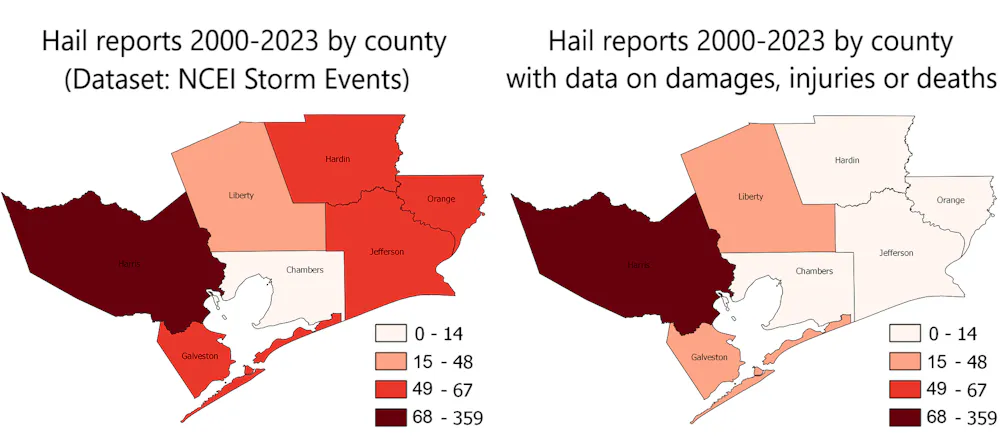
    The number of severe hail reports in southeast Texas listed in the National Centers for Environmental Information’s storm events database is strongly correlated with population. The county with the most reports and greatest detail in those reports is home to Houston. Hailstorms in the three easternmost counties are rarely associated with damage estimates.
    John Nielsen-Gammon and B.J. Baule

    Do you want to look at local damage trends? Forget about it. For most extreme weather events, estimation methods vary over time and are not documented.

    Do you want to direct funding to help communities improve resilience to natural disasters where the need is greatest? Forget about it. The places experiencing the largest per capita damages depend not just on actual damages but on the different practices of local National Weather Service offices.

    Are you moving to a location that might be vulnerable to extreme weather? Companies are starting to provide localized risk estimates through real estate websites, but the algorithms tend to be proprietary, and there’s no independent validation.

    4 steps to improve disaster data

    We believe a few fixes could make NOAA’s storm events database and the corresponding values in the larger SHELDUS database, managed by Arizona State University, more reliable. Both databases include county-level disasters and loss estimates for some of those disasters.

    First, the National Weather Service could develop standard procedures for local offices for estimating disaster damages.

    Second, additional state support could encourage local emergency managers to make concrete damage estimates from individual events and share them with the National Weather Service. The local emergency manager generally knows the extent of damage much better than a forecaster sitting in an office a few counties away.

    Third, state or federal governments and insurance companies can agree to make public the aggregate loss information at the county level or other scale that doesn’t jeopardize the privacy of their policyholders. If all companies provide this data, there is no competitive disadvantage for doing so.

    Fourth, NOAA could create a small “tiger team” of damage specialists to make well-informed, consistent damage estimates of larger events and train local offices on how to handle the smaller stuff.

    With these processes in place, the U.S. wouldn’t need a billion-dollar disasters program anymore. We’d have reliable information on all the disasters.

    John Nielsen-Gammon receives funding from the National Oceanic and Atmospheric Administration and the State of Texas.

    William Baule receives funding from NOAA, the State of Texas, & the Austin Community Foundation.

    ref. Storm damage costs are often a mystery – that’s a problem for understanding extreme weather risk – https://theconversation.com/storm-damage-costs-are-often-a-mystery-thats-a-problem-for-understanding-extreme-weather-risk-257105

    MIL OSI – Global Reports

  • MIL-OSI Global: Reproducibility may be the key idea students need to balance trust in evidence with healthy skepticism

    Source: The Conversation – USA – By Sarah R. Supp, Associate Professor of Data Analytics, Denison University

    Reproducing results can increase trust in scientific studies. Huntstock via Getty Images

    Many people have been there.

    The dinner party is going well until someone decides to introduce a controversial topic. In today’s world, that could be anything from vaccines to government budget cuts to immigration policy. Conversation starts to get heated. Finally, someone announces with great authority that a scientific study supports their position. This causes the discussion to come to an abrupt halt because the dinner guests disagree on their belief in scientific evidence. Some may believe science always speaks the truth, some may think science can never be trusted, and others may disagree on which studies with contradicting claims are “right.”

    How can the dinner party – or society – move beyond this kind of impasse? In today’s world of misinformation and disinformation, healthy skepticism is essential. At the same time, much scientific work is rigorous and trustworthy. How do you reach a healthy balance between trust and skepticism? How can researchers increase the transparency of their work to make it possible to evaluate how much confidence the public should have in any particular study?

    As teachers and scholars, we see these problems in our own classrooms and in our students – and they are mirrored in society.

    The concept of reproducibility may offer important answers to these questions.

    Reproducibility is what it sounds like: reproducing results. In some ways, reproducibility is like a well-written recipe, such as a recipe for an award-winning cake at the county fair. To help others reproduce their cake, the proud prizewinner must clearly document the ingredients used and then describe each step of the process by which the ingredients were transformed into a cake. If others can follow the directions and come up with a cake of the same quality, then the recipe is reproducible.

    Think of the English scholar who claims that Shakespeare did not author a play that has historically been attributed to him. A critical reader will want to know exactly how they arrived at that conclusion. What is the evidence? How was it chosen and interpreted? By parsing the analysis step by step, reproducibility allows a critical reader to gauge the strength of any kind of argument.

    We are a group of researchers and professors from a wide range of disciplines who came together to discuss how we use reproducibility in our teaching and research.

    Based on our expertise and the students we encounter, we collectively see a need for higher-education students to learn about reproducibility in their classes, across all majors. It has the potential to benefit students and, ultimately, to enhance the quality of public discourse.

    The foundation of credibility

    Reproducibility has always been a foundation of good science because it allows researchers to scrutinize each other’s studies for rigor and credibility and expand upon prior work to make new discoveries. Researchers are increasingly paying attention to reproducibility in the natural sciences, such as physics and medicine, and in the social sciences, such as economics and environmental studies. Even researchers in the humanities, such as history and philosophy, are concerned with reproducibility in studies involving analysis of texts and evidence, especially with digital and computational methods. Increased interest in transparency and accessibility has followed the rising importance of computer algorithms and numerical analysis in research. This work should be reproducible, but it often remains opaque.

    Broadly, research is reproducible if it answers the question: “How do you know?” − such that another researcher could theoretically repeat the study and produce consistent results.

    Reproducible research is explicit about the materials and methods that were used in a study to make discoveries and come to conclusions. Materials include everything from scientific instruments such as a tensiometer measuring soil moisture to surveys asking people about their daily diet. They also include digital data such as spreadsheets, digitized historic texts, satellite images and more. Methods include how researchers make observations and analyze data.

    To reproduce a social science study, for example, we would ask: What is the central question or hypothesis? Who was in the study? How many individuals were included? What were they asked? After data was collected, how was it cleaned and prepared for analysis? How exactly was the analysis run?

    Proper documentation of all these steps, plus making available the original data from the study, allows other scientists to redo the research, evaluate the decisions made during the process of gathering and analyzing information, and assess the credibility of the findings.

    This short video, made by the National Academies, explains the key concepts in reproducing scientific findings and notes ways the process can be improved.

    Over the past 20 years, the need for reproducibility has become increasingly important. Scientists have discovered that some published studies are too poorly documented for others to repeat, lack verified data sources, are questionably designed, or even fraudulent.

    Putting reproducibility to work: An example

    A highly contentious, retracted study from 1998 linked the measles, mumps and rubella (MMR) vaccine and autism. Scientists and journalists used their understanding of reproducibility to discover the flaws in the study.

    The central question of the study was not about vaccines but aimed to explore a possible relationship between colitis − an inflammation of the large intestine − and developmental disorders. The authors explicitly wrote, “We did not prove an association between measles, mumps, and rubella vaccine and the syndrome described.”

    The study observed just 12 patients who were referred to the authors’ gastroenterology clinic and had histories of recent behavioral disorders, including autism. This sample of children is simply too small and selective to be able to make definitive conclusions.

    In this study, the researchers translated children’s medical charts into summary tables for comparison. When a journalist attempted to reproduce the published data tables from the children’s medical histories, they found pervasive inconsistencies.

    Reproducibility allows for corrections in research. The article was published in a respected journal, but it lacked transparency with regard to patient recruitment, data analysis and conflicts of interest. Whereas traditional peer review involves critical evaluation of a manuscript, reproducibility also opens the door to evaluating the underlying data and methods. When independent researchers attempted to reproduce this study, they found deep flaws. The article was retracted by the journal and by most of its authors. Independent research teams conducted more robust studies, finding no relationship between vaccines and autism.

    Each research discipline has its own set of best practices for achieving reproducibility. Disciplines in which researchers use computational or statistical analysis require sharing the data and software code for reproducing studies. In other disciplines, researchers interpret nonnumerical qualities of data sources such as interviews, historical texts, social media content and more. These disciplines are working to develop standards for sharing their data and research designs for reproducibility. Across disciplines, the core principles are the same: transparency of the evidence and arguments by which researchers arrived at their conclusions.

    Reproducibility in the classroom

    Colleges and universities are uniquely situated to promote reproducibility in research and public conversations. Critical thinking, effective communication and intellectual integrity, staples of higher-education mission statements, are all served by reproducibility.

    Teaching faculty at colleges and universities have started taking some important steps toward incorporating reproducibility into a wide range of undergraduate and graduate courses. These include assignments to replicate existing studies, training in reproducible methods to conduct and document original research, preregistration of hypotheses and analysis plans, and tools to facilitate open collaboration among peers. A number of initiatives to develop and disseminate resources for teaching reproducibility have been launched.

    Despite some progress, reproducibility still needs a central place in higher education. It can be integrated into any course in which students weigh evidence, read published literature to make claims, or learn to conduct their own research. This change is urgently needed to train the next generation of researchers, but that is not the only reason.

    Reproducibility is fundamental to constructing and communicating claims based on evidence. Through a reproducibility lens, students evaluate claims in published studies as contingent on the transparency and soundness of the evidence and analysis on which the claims are based. When faculty teach reproducibility as a core expectation from the beginning of a curriculum, they encourage students to internalize its principles in how they conduct their own research and engage with the research published by others.

    Institutions of higher education already prioritize cultivating engaged, literate and critical citizens capable of solving the world’s most challenging contemporary problems. Teaching reproducibility equips students, and members of the public, with the skills they need to critically analyze claims in published research, in the media and even at dinner parties.

    Also contributing to this article are participants in the 2024 Reproducibility and Replicability in the Liberal Arts workshop, funded by the Alliance to Advance Liberal Arts Colleges (AALAC) [in alphabetical order]: Ben Gebre-Medhin (Department of Sociology and Anthropology, Mount Holyoke College), Xavier Haro-Carrión (Department of Geography, Macalester College), Emmanuel Kaparakis (Quantitative Analysis Center, Wesleyan University), Scott LaCombe (Statistical and Data Sciences, Smith College), Matthew Lavin (Data Analytics Program, Denison University), Joseph J. Merry (Sociology Department, Furman University), Laurie Tupper (Department of Mathematics and Statistics, Mount Holyoke College).

    Sarah Supp receives funding from the National Science Foundation, awards #1915913, #2120609, and #2227298.

    Joseph Holler receives funding from the National Science Foundation, award #2049837.

    Peter Kedron receives funding from the National Science Foundation, award #2049837 and from Esri.

    Richard Ball has received funding from the Alfred P. Sloan Foundation and the United Kingdom Reproducibility Network.

    Anne M. Nurse and Nicholas J. Horton do not work for, consult, own shares in or receive funding from any company or organization that would benefit from this article, and have disclosed no relevant affiliations beyond their academic appointment.

    ref. Reproducibility may be the key idea students need to balance trust in evidence with healthy skepticism – https://theconversation.com/reproducibility-may-be-the-key-idea-students-need-to-balance-trust-in-evidence-with-healthy-skepticism-251771

    MIL OSI – Global Reports

  • MIL-OSI Global: How your electric bill may be paying for big data centers’ energy use

    Source: The Conversation – USA – By Ari Peskoe, Lecturer on Law, Harvard University

    Your power bill may be hiding something. photoschmidt/iStock/Getty Images Plus

    In the race to develop artificial intelligence, large technology companies such as Google and Meta are trying to secure massive amounts of electricity to power new data centers. Electric utilities see the prospect of earning large profits by providing electricity to these power-hungry facilities and are competing for their business by offering discounts not available to average consumers.

    In our paper Extracting Profits from the Public, we explain how utilities are forcing regular ratepayers to pay for the discounts enjoyed by some of the nation’s largest companies and identify ways policymakers can limit the costs to the public.

    Shifting costs

    In much of the U.S., utilities are monopolists. Within their service territories, they are the only companies allowed to deliver electricity to consumers. To fund their operations, utilities split the costs of maintaining and expanding their systems among all ratepayers – homeowners, businesses, warehouses, factories and anyone else who uses electricity.

    Historically, a utility expanded its system to meet growing demand for electricity from new factories, businesses and homes. To pay for its expansion − new power plants, new transmission lines and other equipment − the utility would propose to raise electricity rates by different amounts for various types of consumers.

    Public utility commissions are state agencies charged with ensuring that the public gets a fair deal. These commissions monitor how much money the utility spends to provide electric service and how its costs are shared among various types of ratepayers, including residential, commercial and industrial consumers. Ultimately, the public utility commission is supposed to approve any rate increases based on its assessment of what’s fair to consumers.

    Splitting the utility’s costs among all consumers made perfect sense when population growth and economic development across the economy stimulated the need for new infrastructure. But today, in many utility service territories, most of the projected growth in electricity demand is due to new data centers.

    Here’s the problem for consumers: To meet data center demand, utilities are building new power plants and power lines that are needed only because of data center growth. If state regulators allow utilities to follow the standard approach of splitting the costs of new infrastructure among all consumers, the public will end up paying to supply data centers with all that power.

    An artist’s rendering of a proposed Meta data center in Richland Parish, La.
    Meta via Facebook

    A big price tag

    One particularly acute example is in Louisiana. A Meta data center under development in the northeastern corner of the state is projected to use, by our calculations, twice as much energy as the city of New Orleans.

    Entergy, the regional monopoly utility, is proposing to build more than US$3 billion worth of new gas-fired power plants and delivery infrastructure to meet the data center’s energy demand. Rather than billing Meta directly for these costs, Entergy is proposing to include the costs in rates paid by all customers.

    Entergy claims its contract with Meta will cover some portion of the $3 billion price tag and that will mitigate any increases in consumers’ bills. But Entergy has asked state regulators to keep key terms of the contract secret, and only a redacted version of its application is available online.

    The public has no idea how much it might pay if the commission approves the contract. And if the Meta data center ends up using much less power than the company anticipates, the public does not know whether it would be on the hook to pay higher electricity rates for longer periods to guarantee Entergy a profit.

    The electronics in data centers consume large amounts of electricity.
    RJ Sangosti/MediaNews Group/The Denver Post via Getty Images

    Secret agreements

    Our research, reviewing nearly 50 public utility commission proceedings about data centers’ power needs across 10 states, uncovered dozens of secretive contracts between utilities and data centers. Unlike Louisiana, most states require utilities to submit to the public utility commission their one-off deals with data centers, but they allow utilities to conceal the pricing terms from the public.

    In normal rate-review cases, numerous parties advocate for their interests in a public proceeding, including members of the public, industry groups and the utility itself. But as our paper finds, utility commission reviews of data center contracts are based on confidential utility filings that are inaccessible to the general public. Few, if any, outsiders participate, and as a result the commission often hears only the utility’s version of the deal.

    Because the pricing terms are secret, it is impossible to know whether the deal that a utility is offering to a data center is too low to cover the utility’s costs of providing power to the data center, which would mean that the public is subsidizing the deal. History shows, however, that utilities have a long history of exploiting their monopolies to shift costs to the public, including through secret contracts.

    Electric utilities also charge customers for the costs of building and maintaining transmission networks.
    Jay L. Clendenin/Getty Images

    Other public costs

    Our paper also explores other ways that the public pays for data center energy costs. For instance, many high-voltage interstate transmission projects, which connect large power plants to local delivery systems, are developed through regional planning processes run by numerous utilities. These alliances have complex rules for splitting the costs of new transmission lines and equipment among their utility members.

    Once a utility is charged its share, it spreads the costs of new transmission projects among its local ratepayers. Because some regions are building new transmission capacity to accommodate data centers, our analysis finds that the public has been forced to pay billions of dollars for data center growth.

    Data center energy costs can also be shifted when data centers connect directly to existing power plants. Under what are called “co-location” deals, the power plant stops selling energy to the wider public and just sells to the data center. With less supply in the overall market, prices go up and the public faces higher bills as a result.

    Many state legislatures are noticing these problems and working to figure out how to address them. Several recent bills would set new terms and conditions for future data center deals that could help protect the public from data center energy costs.

    Ari Peskoe is the Director of the Electricity Law Initiative at the Harvard Law School Environmental and Energy Law Program (EELP). EELP receives funding from philanthropic foundations that support the clean energy transition.

    Eliza Martin does not work for, consult, own shares in or receive funding from any company or organization that would benefit from this article, and has disclosed no relevant affiliations beyond their academic appointment.

    ref. How your electric bill may be paying for big data centers’ energy use – https://theconversation.com/how-your-electric-bill-may-be-paying-for-big-data-centers-energy-use-257794

    MIL OSI – Global Reports

  • MIL-OSI Global: 100 years ago, the Supreme Court made a landmark ruling on parents’ rights in education – today, another case raises new questions

    Source: The Conversation – USA – By Charles J. Russo, Joseph Panzer Chair in Education and Research Professor of Law, University of Dayton

    A selection of books that are part of the Supreme Court case Mahmoud v. Taylor are pictured on April, 15, 2025, in Washington. AP Photo/Pablo Martinez Monsivais

    A century ago, the Supreme Court handed down one of its most important cases about education. On June 1, 1925, the court struck down an Oregon statute requiring all students to attend public school – a law critics argued was meant to limit faith-based schools, at a time when anti-Catholic bias was still common in parts of the United States.

    The majority opinion in Pierce v. Society of Sisters of the Holy Name of Jesus and Mary included a now-famous dictum about parents’ rights to shape their children’s upbringing. According to the court, “the child is not the mere creature of the state; those who nurture him and direct his destiny have the right, coupled with the high duty, to recognize and prepare him for additional obligations.”

    Soon, the Supreme Court is expected to release another decision around parental beliefs and education: Mahmoud v. Taylor. The plaintiffs are parents who want to excuse their children from public school lessons involving storybooks with LGBTQ+ characters – lessons they assert contradict their religious beliefs.

    As someone who teaches education law, I believe this is perhaps the court’s most significant case on parental rights since Pierce. Mahmoud raises questions not only about religious freedom, but also about educators’ ability to determine curricula, and public education in a pluralistic society.

    Picture-book debate

    Controversy arose during the 2022-23 school year in Montgomery County, Maryland’s largest school district, when officials approved various storybooks with LGBTQ+-inclusive themes to be incorporated into the English language-arts curriculum for preschool and elementary students.

    Some parents challenged the materials, including “Pride Puppy!”, a picture book the board later removed from use. Originally approved for preschool and pre-K, the story portrays a family whose puppy gets lost at a LGBTQ+ Pride parade, devoting a page to each letter of the alphabet. At the end of the book, a long “search and find” list of words for children to go back and look for in the pictures of the parade includes “[drag] queen” and “king,” “leather” and “lip ring.”

    Other materials for older children included stories about same-sex marriage, a transgender child and nonbinary bathroom signs.

    Parents who objected to the use of these materials on religious grounds sought to excuse their children from lessons using them. The parents basically argued that requiring their children to participate compelled or coerced them to go against their families’ religious beliefs.

    A group of parents protest in Rockville, Md., on June 27, 2023, in an effort to opt out of books that feature LGBTQ+ characters in Montgomery County schools.
    Sarah L. Voisin/The Washington Post via Getty Images

    Initially, officials agreed to allow opt-outs for elementary schoolers whose parents objected to the materials. However, a day later they changed their minds. Since then, school officials cited concerns about absenteeism, the feasibility of accommodating opt-out requests, and a desire to avoid stigmatizing LGBTQ+ students or families as reasons for their policy.

    A group of Muslim, Orthodox Christian and Catholic families challenged the board’s refusal to excuse their children from lessons using the disputed materials.

    The federal trial court, however, rejected the parents’ claim that having no opt-outs violated their right to due process.

    Parents appealed, and the 4th Circuit affirmed in favor of the school board 2-1. The court added that officials had not violated the parents’ First Amendment rights to freely exercise their faith. “There’s no evidence at present that the Board’s decision not to permit opt-outs compels the Parents or their children to change their religious beliefs or conduct, either at school or elsewhere,” the panel concluded.

    The dissenting judge stridently countered. Officials violated the parents’ free exercise rights by forcing them “to make a choice,” he wrote, between “either adher[ing] to their faith, or receiv[ing] a free public education for their children.” He also noted that the board’s opt-out policy was not neutral toward religion, because under Maryland regulations, children may be excused from sex-ed lessons.

    In January 2025, the Supreme Court agreed to hear the parents’ appeal, addressing whether the schools are burdening parents’ free-exercise rights.

    Court record

    In their brief to the Supreme Court and oral arguments, the parents cited Wisconsin v. Yoder, a Supreme Court ruling from 1972. The court found that Amish parents did not have to send their children to school after the eighth grade, which the families argued would violate their religious beliefs. Amish communities descend from Anabaptist Christians who fled persecution in Europe and emphasize living simply, eschewing many modern technologies.

    In Yoder, the justices agreed with the parents that their children received all the education they needed in their home communities. Under the First Amendment, parents have the right “to guide the religious future and education of their children,” the majority wrote, a matter “established beyond debate.”

    During oral arguments for Mahmoud in April 2025, some justices briefly discussed another precedent: the Supreme Court’s 1943 judgment in West Virginia State Board of Education v. Barnette, resolved at the height of U.S. involvement in World War II. Here, three parents who were Jehovah’s Witnesses refused to have their children participate in public schools’ flag salute and Pledge of Allegiance because they viewed it as a form of idolatry contrary to their religious beliefs. Others objected
    to the salute as “being too much like Hitler’s.”

    The court reasoned that educators could not compel students to participate, because forcing children – or anyone – to engage in activities inconsistent with their beliefs is contrary to their First Amendment rights to the free exercise of religion and freedom of speech.

    Viewed together, these cases highlight how the court has granted parents significant leeway to exempt their children from educational activities inconsistent with their religious beliefs.

    Questions at court

    During oral arguments, a majority of justices appeared to support the parents’ request to excuse children from lessons involving the books about LGBTQ+ characters.

    The board’s attorney argued that students did not have to agree with the books’ messages, simply to participate in the lesson. Being exposed to an idea “does not burden free exercise,” he said.

    Protesters in support of LGBTQ+ rights and against book bans outside the U.S. Supreme Court building on April 22, 2025, the day the court heard arguments in Mahmoud v. Taylor.
    Anna Moneymaker/Getty Images

    Chief Justice John Roberts, however, queried whether it is realistic for 5-year-olds to understand that distinction. He asked, “Do you want to say you don’t have to follow the teacher’s instructions, you don’t have to agree with the teacher? I mean, that may be a more dangerous message than some of the other things.”

    Other conservative justices also appeared skeptical of the idea that the lessons were merely exposing young children to ideas, but not instilling moral lessons. The storybooks do not simply explain that some people believe something and others do not, Justice Amy Coney Barrett suggested; they inform students that “this is the right view of the world.” Similarly, Justice Neil Gorsuch remarked that telling students that “some people think X, and X is wrong and hurtful and negative” is “more than exposure.”

    “What is the big deal about allowing them to opt out of this?” Justice Samuel Alito asked.

    Conversely, Justice Elena Kagan acknowledged that parents’ concerns were “serious,” but wondered how to draw limits on opt-out policies. Did the parents’ argument suggest that anytime “a religious person confronts anything in a classroom that conflicts with her religious beliefs or her parents’ that – that the parent can then demand an opt-out?”

    Justice Sonia Sotomayor pressed the plaintiffs’ attorney on whether “the mere exposure to things that you object to” really counts as coercion. And Justice Ketanji Brown Jackson questioned why, even if opt-outs are not allowed, public schools teaching “something that the parent disagrees with” is coercive, given that homeschooling and private schools are legal.

    Mahmoud raises challenging questions about curricular content, parental control and free exercise of religion – questions the court will hopefully resolve. A ruling is expected in June or early July 2025.

    Charles J. Russo does not work for, consult, own shares in or receive funding from any company or organization that would benefit from this article, and has disclosed no relevant affiliations beyond their academic appointment.

    ref. 100 years ago, the Supreme Court made a landmark ruling on parents’ rights in education – today, another case raises new questions – https://theconversation.com/100-years-ago-the-supreme-court-made-a-landmark-ruling-on-parents-rights-in-education-today-another-case-raises-new-questions-257876

    MIL OSI – Global Reports

  • MIL-OSI Video: Department of State Press Briefing – June 5, 2025 – 2:00 PM

    Source: United States of America – Department of State (video statements)

    Department Press Briefing with Principal Deputy Spokesperson Tommy Pigott at the Department of State, on June 5, 2025.

    ———-
    Under the leadership of the President and Secretary of State, the U.S. Department of State leads America’s foreign policy through diplomacy, advocacy, and assistance by advancing the interests of the American people, their safety and economic prosperity. On behalf of the American people we promote and demonstrate democratic values and advance a free, peaceful, and prosperous world.

    The Secretary of State, appointed by the President with the advice and consent of the Senate, is the President’s chief foreign affairs adviser. The Secretary carries out the President’s foreign policies through the State Department, which includes the Foreign Service, Civil Service and U.S. Agency for International Development.

    Get updates from the U.S. Department of State at www.state.gov and on social media!
    Facebook: https://www.facebook.com/statedept
    X: https://x.com/StateDept
    Instagram: https://www.instagram.com/statedept
    Flickr: https://flickr.com/photos/statephotos/
    Rumble: https://rumble.com/c/StateDept
    Substack: https://statedept.substack.com

    Watch on-demand State Department videos: https://video.state.gov/
    Subscribe to The Week at State e-newsletter: https://public.govdelivery.com/accounts/USSTATEBPA/signup/32562

    State Department website: https://www.state.gov/
    Careers website: https://careers.state.gov/
    White House website: https://www.whitehouse.gov/
    Terms of Use: https://state.gov/tou

    #StateDepartment #DepartmentofState #Diplomacy

    https://www.youtube.com/watch?v=VsGIDrVpLZY

    MIL OSI Video

  • MIL-OSI Russia: Rosneft’s green investment volume in 2024 reached 74 billion rubles

    Translation. Region: Russian Federal

    Source: Rosneft – Rosneft – An important disclaimer is at the bottom of this article.

    June 5 is World Environment Day, its goal is to draw attention to measures to protect ecosystems. In Russia, this date coincides with Ecologist Day.

    Rosneft implements large-scale events and projects aimed at preserving a favorable environment. In 2024, the Company’s “green” investments amounted to 74 billion rubles and exceeded the previous year’s level by 16%. In total, over the past three years, this figure amounted to almost 200 billion rubles.

    The key components of the Company’s long-term environmental agenda are reflected in the strategy “Rosneft-2030: Reliable Energy and Global Energy Transition”. The priorities of the Company and its subsidiaries include the implementation of programs for land reclamation, including “historical heritage”, increasing the reliability of pipelines, preserving water resources and biological diversity in the regions of presence.

    Thus, Samotlorneftegaz completed the implementation of a large-scale program for the reclamation of “historical heritage” lands in 2024 – the total area of restored lands exceeded 2.2 thousand hectares. The company carried out about 85% of all reclamation work using its own eco-service. During the project, new technologies were developed and unique experience was gained, which is in demand by other enterprises.

    Rosneft pays great attention to reforestation activities, thereby contributing to the sustainable development of ecosystems, the preservation of biodiversity, and the fight against climate change. The Company, together with the Government of the Krasnoyarsk Territory, is implementing a comprehensive forest climate project aimed at unlocking the climate-regulating potential of the region’s forests and promoting sustainable development. In 2024, the Company and its subsidiaries in the regions of presence planted almost 11 million seedlings and trees of various species.

    Rosneft is actively implementing the principles of a closed-loop economy (circular economy). Improving the efficiency of waste management processes is one of the priority goals of the Company’s strategy until 2030. The Company’s production enterprises are successfully implementing waste-free technologies that make it possible to obtain artificial soil from drill cuttings – an environmentally friendly building material.

    In addition, the enterprises of the Samara group of the Company handed over almost 300 tons of spent catalyst for recycling. More than 8 thousand tons of non-ferrous and ferrous metal were sent for recycling by the Achinsk Oil Refinery, Saratov Oil Refinery, Syzran Oil Refinery, Kuibyshevsky Oil Refinery, Novokuibyshevsky Oil Refinery, RN-Vankor and Bashneft enterprises.

    The Kuibyshev Oil Refinery, Novokuibyshevsk Oil Refinery, RN-Vankor and Bashneft enterprises also sent about 4.5 thousand tons of waste oils and emulsions, etc. for recycling.

    Biodiversity conservation is another significant area of Rosneft’s environmental activities. The company has been holding annual events to replenish Russia’s aquatic bioresources for over 10 years. In 2024, Rosneft enterprises released over 21.7 million young fish into the country’s water bodies.

    Volunteers of the Company, its subsidiaries and design institutes also actively participate in various environmental initiatives, promote the development of a culture of rational and responsible consumption of natural resources. Employees with children take part in events for greening and improvement of urban areas and natural recreational zones, cleaning of coastlines as part of federal environmental campaigns such as “Green Spring”, “Garden of Memory”, “Water of Russia”, “Clean Shores” and others.

    For over 15 years, Samotlorneftegaz volunteers have been holding clean-up days to clean the shoreline of Lake Kymyl-Emtor as part of the All-Russian campaign “Water of Russia”.

    Samara oil workers help the employees of the Botanical Garden of Samara University to clear the territory of dead wood and leaves, to purchase rare plant species and plant seedlings, and also to restore and improve springs in the region. In 2024, volunteers of the Samara region collected more than 30 cubic meters of garbage from the coastal areas of the Volga and Sok rivers. Volunteers of the Novokuibyshevsk Petrochemical Company collected 930 kg of household waste during an environmental run.

    In 2024, RN-Nyaganneftegaz oil workers collected about 3 tons of household waste from the coastline of the Nyagan-Yugan River.

    Earlier, on the eve of Victory Day, employees of Rosneft enterprises organized the cleaning of parks, memorial complexes and monuments dedicated to the feat of the Soviet people during the Great Patriotic War.

    The Company’s enterprises make a significant contribution to the conservation of natural resources – they organize campaigns to collect used batteries, plastic and waste paper for their further recycling. In 2024, Rosneft employees handed over over 1,100 kg of used batteries, uninterruptible power supplies and disposable batteries for recycling, transferred over 7 tons of plastic for recycling and collected about 180 tons of waste paper.

    Rosneft volunteers also actively promote environmental education of young people and conduct environmental quests, master classes, quizzes and eco-lessons for schoolchildren. For example, Orenburgneft implemented the Eco-School project in 2024 and, together with students from the region’s schools, collected more than 10 tons of waste paper, more than 70 kg of batteries and more than 17 kg of plastic caps.

    For 14 years now, the company has been holding annual environmental safety competitions, which help to raise the level of environmental culture and serve as an incentive for subsidiaries to build up their competencies and improve their work in this area.

    The successful environmental activities of Rosneft subsidiaries have received high public praise. In 2024, the Company’s plants – Syzran Oil Refinery, Novokuibyshevsky Oil Refinery, Kuibyshevsky Oil Refinery – received the highest awards of the All-Russian competition “Leader of Environmental Activities in Russia”.

    Department of Information and Advertising of PJSC NK Rosneft June 5, 2025

    Please note: This information is raw content directly from the source of the information. It is exactly what the source states and does not reflect the position of MIL-OSI or its clients.

    MIL OSI Russia News

  • MIL-OSI United Nations: UNECE advances support for Ukraine’s recovery through action on green and resilient urban energy projects

    Source: United Nations Economic Commission for Europe

    Since Russia’s full-scale invasion of Ukraine, the country’s energy infrastructure has suffered approximately $20 billion in damage, causing widespread power outages and insufficient heat supply – with the cities of Kharkiv and Mykolaiv alone accounting for over $630 million in losses, according to UNDP.  

    While emergency efforts have focused on rebuilding existing capacity and fossil fuel capacity replacements, this approach can overlook the need for more resilient and sustainable local energy solutions. In addition to the need to rebuild energy infrastructure and meet ambitious 2030 renewable energy targets in place in national energy and climate laws, Ukraine aims to move to a system that balances centralized and decentralized systems, across heat, electricity and energy demand.  

    In this context, Ukrainian cities will play an important role in the country’s sustainable and resilient reconstruction that is aligned with the energy transition, as well as with European standards and regulations. 

    Meeting with Ukraine’s Ambassador to the United Nations and other International Organizations in Geneva, H.E. Yevhenii Tsymbaliuk, UNECE Executive Secretary Tatiana Molcean reiterated UNECE’s steadfast commitment to help the government address these issues, building on strong cooperation on urban development and energy policy. Looking ahead to the Ukraine Recovery Conference to be held in Rome in July, she underscored solidarity and ongoing support for Ukraine’s sustainable and resilient recovery across UNECE’s areas of expertise. 

    Local action for Ukraine’s green energy recovery 

    Support to urban reconstruction planning has been a core dimension of UNECE’s support to Ukraine’s recovery since the start of the war. Through the UN4UkrainianCities initiative, UNECE has mobilized international partners to support the development of concept master plans and pilot projects in the cities of Kharkiv and Mykolaiv, and has supported the government to draft new housing legislation, including the State Housing Policy Strategy, as well as to strengthen capacities for the Urban Planning Cadastre. 

    To this end, UNECE, the United Nations Environment Programme (UNEP), and the Autonomous Region of Bolzano in Italy jointly organized an international study trip to strengthen the capacities of the cities of Kharkiv and Mykolaiv, among other 2 municipalities, for integrated urban energy planning focused on decentralized and renewable local energy and modern district heating systems.  

    This study visit is facilitated by the UNEP programme “Unlocking greener and more resilient energy in Ukrainian cities”, supported by the Italian Development Co-operation (AICS), and by UNECE’s UN4UkrainianCities initiative. Additional support to the study visit is provided by the NOI Technopark in Bolzano, Alperia (Bolzano, Italy), and EURAC Research. 

    Officials from Kharkiv and Mykolaiv will benefit from the guidance of international experts, and site visits to state-of-the-art local, renewable and decentralized energy installations. 

    Mobilizing partnerships meet financing needs on the ground 

    At the Hamburg Sustainability Conference this week, the City Council of Bucha, home to 73,000 people and located 30km from Kyiv, presented a project for the construction of a decentralised city energy system. Supported by UNECE, this provided an opportunity to present the project seeking €145 million from potential investors and financiers in staged investment through Public-Private Partnerships. 

    Developed in response to energy capacity losses during the war, the distributed energy system aims to provide a reliable uninterruptible power supply of over 112 MW through a clean, flexible and autonomous system comprising generation facilities and grid connection infrastructure. This would include power plants for households and critical infrastructure, power for the city’s industrial cluster, and energy storage systems. The project would in addition create an estimated 120 jobs. 

    Continued support for sustainable recovery 

    In Geneva, the Executive Secretary also recalled UNECE’s broader, multisectoral support to the government of Ukraine in implementing the National Recovery Plan, including through: the PIERS methodology to assess sustainability of infrastructure projects, facilitating Public-Private Partnerships and other investment; the Platform for Action on the Green Recovery of Ukraine; the Inter-agency Coordination Group on Environmental Assessments for Ukraine; harnessing Innovation for Sustainable Development; support for water-related and other environmental challenges, leveraging UNECE Multilateral Environmental Agreements; and applying the UN Framework Classification for Resources (UNFC) to support the sustainable management of Ukraine’s critical raw materials. 

    MIL OSI United Nations News

  • MIL-OSI Canada: Minister Sidhu meets with Laurent Saint-Martin, French Minister Delegate for Foreign Trade and French Nationals Abroad

    Source: Government of Canada News

    June 5, 2025 – Ottawa, Ontario – Global Affairs Canada

    The Honourable Maninder Sidhu, Minister of International Trade, met with Laurent Saint-Martin, Minister Delegate for Foreign Trade and French Nationals Abroad, on the margins of the Organisation for Economic Co-operation and Development Ministerial Council Meeting in Paris, France. This was their first bilateral meeting.

    The ministers discussed shared trade priorities and how to handle global trade uncertainty, including through full ratification of the Canada-European Union Comprehensive Economic and Trade Agreement. They agreed on the importance of working closely with trusted partners, including through the G7.

    They discussed ways to expand and diversify trade and investment between Canada and France, including through more minister-led trade missions between the two countries.  

    Associated links

    MIL OSI Canada News

  • MIL-OSI Europe: OSCE-supported conference in Montenegro tackles challenges of transnational drug crime

    Source: Organization for Security and Co-operation in Europe – OSCE

    Headline: OSCE-supported conference in Montenegro tackles challenges of transnational drug crime

    (l-r) U.S. Ambassador Judy Rising Reinke, Special State Prosecutor Vladimir Novović, acting director of the Police Directorate Lazar Šćepanović, Head of the OSCE Mission to Montenegro Jan Haukaas and Security Co-operation and Governance Programme Manager Stephen Harmon at the opening of the three-day international conference in Budva, 4 June 2025. (OSCE/Marina Živaljević) Photo details

    Transnational organized crime, specifically drug trafficking, remains a critical, shared threat that transcends national borders. It can only be effectively countered through co-ordinated, joint action grounded in international collaboration, sustained strategic commitment, and mutual trust.
    This was emphasized at the opening of a three-day international conference “Connecting the Drugs: Challenges and Threats from Expanding Trans-Atlantic Collusion and Traffic in Drug Crime”, organized by the OSCE Mission to Montenegro and the Police Directorate of Montenegro, with support from the Embassy of the United States of America. The event is taking place from 4 to 6 June in Budva.
    The conference brings together 70 regional law enforcement leaders, investigators, and prosecutors involved in organized crime investigations from countries of the Western Balkans region, Italy, Romania, Spain and the United States.
    Opening the conference, acting director of the Police Directorate of Montenegro, Lazar Šćepanović, noted that the dominant criminal activity of high-risk organized crime groups from Montenegro continues to be cocaine smuggling at the international level, with these structures maintaining links to criminal groups across the Western Balkans. “Despite all the challenges, Montenegro has made significant progress in the fight against transnational organized crime and drug trafficking in the previous period, relying on strengthening police co-operation, adopting European standards, and intensive international co-ordination,” said director Šćepanović. He also emphasized that “the priority of the Montenegrin police will remain the strengthening and intensifying of international police co-operation”, which is one of the underlying themes of the conference.
    Special State Prosecutor Vladimir Novović stated that he was proud that the Special State Prosecutor’s Office had developed relations and intensive co-operation with key international institutions. “Each of them, within their own jurisdiction, is dedicated to fighting this global problem,” said Special Prosecutor Novović. He further noted that this co-operation has already enabled the prosecution to achieve significant results, especially in terms of uncovering and prosecuting international drug trafficking rings.”
    U.S. Ambassador Judy Rising Reinke highlighted that the fight against drug trafficking requires unwavering commitment, collaboration, innovation, and trust.  “Montenegro has been an incredible partner in this fight, and their leadership in this regional event is testament to the effectiveness of the police and prosecutors who work tirelessly to dismantle criminal groups. The positive results are encouraging, but there is still so much more to be done. Thank you for joining us here today so that together we can degrade these criminal networks, protect our communities, and ensure a safer future,” said Ambassador Reinke.
    Head of Mission Jan Haukaas stated that the OSCE’s regional presence and comprehensive mandate made it uniquely positioned to support cross-border co-operation. “The OSCE is well placed to facilitate trust among institutions, and promote holistic, cross-sectoral responses that address both the criminal, institutional, economic and societal risks posed by criminal networks. This conference can contribute to those efforts by bringing together law enforcement and prosecutorial institutions across Southeast Europe and beyond,” said Ambassador Haukaas.
    This three-day conference provides a platform for participants to exchange regional and international expertise in combating drug crime, with a particular focus on emerging collusion between South East Europe and Latin American criminal organizations. It also explores challenges and threats criminal collaboration poses to the region and the rest of Europe. The event brings together representatives from leading international, regional, and national law enforcement and criminal justice agencies, with presentations by UNODC, INTERPOL, EUROPOL, EUDA, DEA and the FBI, among others. The conference also includes an in-depth expert presentation by the Vigilance Project on Latin American drug cartels and the threats they represent for Europe, including Southeast Europe.

    MIL OSI Europe News

  • The Q4 Growth Numbers Have A Pleasant Message for India

    Source: Government of India

    Source: Government of India (4)

    More good news for India’s economy. Following the news of India becoming the fourth-largest economy, at more than $4 trillion, the numbers for the fourth quarter of FY25 are out. At 7.4 per cent, the growth numbers have exceeded the market expectations, leaving many pleasantly surprised.

    We finished the third quarter at 6.4 per cent, the second quarter at 5.6 per cent, and the first quarter at 6.5 per cent. Interestingly, in FY24, the GDP grew at 9.5 per cent in Q3 and 8.4 per cent in Q4. So, what happened?

    We must factor in the external factors at play here. In FY25, the first quarter, between April and June, was lost to the national elections. Business activity was largely muted, cash flows were restricted, and new orders were delayed. Nothing unusual, for elections of this magnitude and importance do leave the businesses on the precautionary backfoot.

    The second quarter, between July and September, was about getting used to a new avatar of the Narendra Modi Government. People were sceptical, given an unusual alliance in the Centre. However, it was soon visible to everyone that things were not going to change. The Lok Sabha numbers had not dented PM Modi’s socio-economic pursuits, and the show was to go on, uninterrupted.

    Whatever little doubts that remained were decimated on the morning of October 8, 2024. The flip in numbers, within twenty minutes, around 10:00 AM, sealed the political fate of the Congress. The Bharatiya Janata Party had triumphed expectations and predictions, and became the first party to register a third consecutive win (with complete five-year terms). The Haryana victory set up the third quarter for an economic resurgence.

    By the beginning of the fourth quarter, the BJP was in the driver’s seat. Maharashtra had been won with a thumping majority, and the party was eyeing Delhi next. The Budget came with the good news of a tax cut, enabling zero income tax for citizens with Rs. 12.75 Lakh annual income (standard deduction included).

    The larger message behind the fourth quarter numbers must be acknowledged. Political stability is directly proportional to growth numbers. While elections are an unavoidable occurrence in the trajectory of our democracy, the idea of ‘One Nation, One Election’, must be discussed with greater vigour. The continuity offered by the Narendra Modi government, in its third term, has also given the economy a critical thrust.

    From here, it’s a journey of a few years until we become the third-largest economy on the planet, trailing China and the United States of America. The evolution of our economy will add to our geopolitical heft, inevitably. As the largest free market in the world, with over a billion people, consumerism and the growing middle class offers enough nudge for the MSMEs and other aspiring entrepreneurs to embrace manufacturing.

    The tax cuts will also kick in next year, ushering in at least Rs. 1 Lakh Crore more into the economy. This will soon reflect in automobile sales numbers, tourism revenue, and other indirect taxes, as the spending goes up. The mere fact that the Modi Government was able to introduce these tax cuts is a testament to their stupendous fiscal management in the last eleven years.

    The other message is that of self-reliance. While the pandemic, Russia-Ukraine war, and the global supply chains crisis have put the manufacturing ambition into a hyperdrive mode, we can do more. India Stack and UPI are a stunning example of how self-reliance can propel success in other sectors, like the service economy. Close to 1,868 Crore UPI transactions in May 2025 further showcase the resolve of the Indian market.

    However, it’s now time to go big on hardware. The ongoing ‘Operation Sindoor’ proves how warfare is evolving, and why we should not rely on external players, especially China, for critical components. This is where our focus must be. The services industry has sustained the aspiring Indian middle class for almost three decades. It’s now time for manufacturing to take over.

    As we grow to become a ten trillion dollar economy by 2035, the nature of employment will evolve as well. Artificial Intelligence applications, offered at throwaway prices, are making several jobs redundant. The cycle of time moves, as it did when computers replaced typewriters, but no reason for India to be disheartened. Our economy evolved well with computers, it’ll do so with AI and hardware as well.

    The 7.4 per cent growth number has a message for India: keep the hustle going. Do not be afraid to evolve with the times, and while the ten trillion mark is a decade away, start preparing for it today. On the policy front, we must begin pondering ideas that allow us to minimise disruption (One Nation, One Election). On the innovation front, let’s get people to start aspiring for jobs that involve not sitting before a computer, but manufacturing one.

    This is India’s decade. The rise is inevitable and indispensable for the world.

    (Tushar Gupta is a Delhi-based journalist and a political commentator)

  • Election Commission digitizes post-election reporting with upgraded Index Card System

    Source: Government of India

    Source: Government of India (4)

    In a significant step toward enhancing electoral transparency and efficiency, the Election Commission of India (ECI) has implemented a streamlined, technology-driven system for generating Index Cards and a wide array of post-election statistical reports. The initiative, led by Chief Election Commissioner Gyanesh Kumar along with Election Commissioners Dr. Sukhbir Singh Sandhu and Dr. Vivek Joshi, aims to replace traditional manual reporting methods with an automated framework to ensure faster and more accurate data dissemination.

    The Index Card, though non-statutory, plays a vital role in post-election documentation. Introduced as a suo motu initiative by the ECI, it serves as a comprehensive data source that supports deep electoral research and fosters democratic discourse. It provides constituency-level data across multiple dimensions, including candidate information, vote counts, party performance, gender-based voting patterns, and regional voting variations.

    This robust reporting tool forms the basis for generating nearly 35 statistical reports for Lok Sabha elections and 14 for State Assembly elections. These reports encompass detailed insights such as voter turnout, number of polling stations, elector demographics, participation of women voters, and performance metrics of national and regional parties, including Registered Unrecognized Political Parties (RUPPs). The reports, designed for academic and research use, are based on secondary data from the Index Cards, while primary and final data remains secured in statutory forms held by the Returning Officers.

    Previously, data was gathered manually at the constituency level using physical Index Cards, which were later digitized—a time-consuming, multi-step process that often led to delays in making election data publicly accessible.

    With the latest upgrade, automation and data integration have replaced manual processes, allowing the ECI to generate accurate reports more efficiently.

  • MIL-OSI USA: Join us on 6/26 for a Foreign and Comparative Law Webinar: “Two Sides of the Same Coin: The Evolution of Surrogacy Law in France and Colombia”

    Source: US Global Legal Monitor

    The following is a guest post by Louis Gilbert and Stephania Alvarez, foreign law specialists at the Law Library of Congress. Louis has previously published the following post: “Wait, It Is Not About Wigs?” – The Story of Faso Dan Fani Court Robes in Burkina Faso, and “Join Us on 11/21 for a Foreign and Comparative Law Webinar titled “Review of Law Library of Congress Research Reports Published in 2024.” Stephania has previously published the following blog posts: FALQs: Guyana-Venezuela Territorial Dispute, and Law Library Publishes New Report, “Peru: Civic Space Legal Framework.”

    Please join us on June 26, 2025, at 2:00 p.m. EDT, for another entry into our Foreign and Comparative Law Webinar series with our “Two Sides of the Same Coin: The Evolution of Surrogacy Law in France and Colombia” webinar. Surrogacy and the adoption of children born through this practice have been the focus of significant legislative and jurisprudential developments around the world. The evolution of surrogacy in France and Colombia has different legal implications in each country.

    Register here. 

    In Colombia, surrogacy is neither explicitly regulated nor prohibited. Nevertheless, the Constitutional Court has addressed this topic in various rulings, in which it has established rules and requirements for surrogacy agreements and emphasized the need to protect the child’s fundamental rights.

    On the other hand, surrogacy is forbidden in France, and the recognition of children born abroad is currently at the center of legal discussions. Recent developments in French jurisprudence have enabled numerous French citizens to resort to surrogacy agreements abroad. The questions of filiation and adoption are no longer framed solely around the legality or prohibition of certain practices but are increasingly approached from the perspective of the child’s fundamental rights.

    Although France and Colombia adopt opposing approaches to surrogacy, their legal systems complement each other in safeguarding the best interests of the child. In Colombia, the severance of the legal bond between the surrogate and the baby allows for clear filiation between the intended parents and the child, which France now fully recognizes when it has been validly established abroad. Therefore, the absence of a specific legal framework prohibiting surrogacy in Colombia, in addition to the lower costs and greater accessibility compared to other countries, has made this country an increasingly common destination for surrogacy procedures.


    Stephania Alvarez is a foreign law specialist at the Law Library of Congress. She conducts research and writes reports on a wide range of topics relating primarily to the laws of Central and South American jurisdictions. Stephania has a Bachelor of Laws from Icesi University in Colombia. She completed a dual degree program at Sciences Po in Paris, France, and Georgetown University Law Center, earning a master’s in environmental policy and a Master of Laws in environmental and energy law, respectively.

    Louis Gilbert is a foreign law specialist at the Law Library of Congress. He conducts research and writes reports on topics relating to the laws of French-speaking jurisdictions. He holds a bachelor’s degree in law from the University of Essex, England, a master’s in comparative law from the Université Paris X, France, and a J.D. from American University.


    To learn about other upcoming classes on domestic and foreign law topics, visit the Legal Research Institute. Please request ADA accommodations at least five business days in advance by contacting (202) 707-6362 or [email protected].

    Subscribe to In Custodia Legis – it’s free! – to receive interesting posts drawn from the Law Library of Congress’s vast collections and our staff’s expertise in U.S., foreign, and international law.

    MIL OSI USA News

  • MIL-OSI Europe: ASIA/BAHRAIN – Tolerance and peaceful coexistence are the key points of the meeting between Prince Salman and the Apostolic Vicar of Northern Arabia

    Source: Agenzia Fides – MIL OSI

    Thursday, 5 June 2025

    BNA

    Manama (Agenzia Fides) – “The Kingdom of Bahrain, under the leadership of His Majesty King Hamad bin Isa Al Khalifa, maintains a firm commitment to promoting the values of tolerance and the principles of peaceful coexistence, deeply rooted in our tradition of openness to all cultures and religions,” said His Royal Highness Salman bin Hamad Al Khalifa, Crown Prince and Prime Minister, during a meeting held on June 4 at Riffa Palace with Bishop Aldo Berardi, Apostolic Vicar of Northern Arabia, accompanied by Father Saji Thomas, OFM cap., rector of the Cathedral of Our Lady of Arabia in Awali.Prince Salman emphasized that these fundamental values have been instrumental in Bahrain establishing itself as a model of intercultural coexistence and harmony. He also highlighted the Kingdom’s constant commitment to promoting initiatives that strengthen the values of forgiveness and peace, and recalled with gratitude Pope Francis’ historic visit to Bahrain in 2022 (see Fides, 3/11/2022).He also expressed his gratitude to Bishop Berardi for his efforts in promoting compassion and tolerance, wishing him success in his pastoral mission.For his part, the Apostolic Vicar said he was honored for the opportunity of the meeting and praised Bahrain’s cultural diversity and rich heritage, which continue to sustain and foster peaceful coexistence. (AP) (Agenzia Fides, 5/6/2025)
    Share:

    MIL OSI Europe News

  • MIL-OSI Europe: ASIA/INDIA – Amristar, a city sacred to the Sikhs, should become a “war-free zone”

    Source: Agenzia Fides – MIL OSI

    Archdiocese of Amristar

    New Delhi (Agenzia Fides) – Amritsar, the holy city of Sikhism, on the border between India and Pakistan and home to the famous Golden Temple, should be declared a “war-free zone” and be granted international protection following the example of the Vatican. This is Indian parliamentarian and Sikh Sukhjinder Singh Randhawa demanded of the Indian government. He called on Indian Prime Minister Narendra Modi to work with international bodies to initiate the appropriate recognition process for a city that presents itself as a symbolic place of peace for humanity.The matter, according to an open letter, has “deep spiritual and national significance,” because “the holy city of Amristar is not just a geographical location, but the spiritual heart of the Sikh faith and a beacon of love and peace for humanity.” “Its sacred aura transcends religious boundaries, offering comfort, unity, and compassion in a world increasingly torn by conflict and division,” he continued.”For Sikhism, Amritsar has the same spiritual significance as Mecca has for Muslims and the Vatican has for Christians. Therefore, I humbly request that Amritsar’s global spiritual significance be officially recognized and that appropriate international security mechanisms, similar to those that protect the Vatican, be adopted,” he said.Randhawa noted that “recent geopolitical tensions, particularly on the India-Pakistan front, have rekindled legitimate concerns about Amritsar’s potential vulnerability in the event of a military conflict.” “The appeal,” the letter continues, “is not a request for political sovereignty (such as that enjoyed by the Vatican City), but rather a request for international spiritual recognition and permanent security protection. At a time marked by increasing global tensions and militarization, it is imperative that Amritsar be protected from the threat of war and violence, now and forever,” the MP said. The politician recalled the universal teachings of the Guru Granth Sahib (the holy text of Sikhism), which are based on peace, humility, and brotherhood and represent “a powerful moral force against the rising tide of militarism in the world.” “While many global powers are increasingly inclined toward conflict, the Sikh ethos of ‘Sarbat da Bhala’ (‘the well-being of all’) stands as one of humanity’s last hopes for coexistence and peace,” he noted. The concerns expressed by the Sikh community and civil society throughout India require a broader perspective, the MP continued, beyond regional circles and within an international framework, “to ensure the security and sanctity of this revered city under all circumstances.” Requesting the support of other parliamentarians of all religions, Randhawa urged the Indian Prime Minister “to take the necessary diplomatic and legislative steps to declare Amritsar a ‘war-free zone’ and a place recognized and respected by all, as it carries a message of peace and harmony for all humanity.” (PA) (Agenzia Fides, 5/6/2025)
    Share:

    MIL OSI Europe News

  • MIL-OSI Europe: AFRICA/NIGERIA – Catholic priest kidnapped: He worked as a chaplain in Alaska and wanted to help Boko Haram victims in Nigeria

    Source: Agenzia Fides – MIL OSI

    Diocesi di Fairbanks

    Abuja (Agenzia Fides) – “I was able to speak with Father Afina. He is well and in good health. We hope he can be released soon,” said John Bogna Bakeni, Auxiliary Bishop of Maiduguri (capital of Borno State in northeastern Nigeria), to Fides. He confirmed the news reported by some newspapers in Fairbanks (Alaska, USA) about the kidnapping of Father Alphonsus Afina, a Nigerian priest who served for years as a chaplain in the US diocese.”Father Afina was kidnapped on the night of Sunday, June 1, near Gwoza, as he was returning to Maiduguri after celebrating Mass,” Msgr. Bakeni reported. The kidnappers then contacted the Diocese of Maiduguri by phone and provided proof that Father Afina is alive. The area around Gwoza is relatively unsafe due to the presence of the two largest groups into which the Islamist Boko Haram has split. One is the “Jama’tu Ahlis Sunna Lidda’awati wal-Jihad” (JAS). The other, the “Islamic State West Africa Province” (ISWAP), has joined the Islamic State and become the “West Africa Province” (see Fides, 2/7/2024).The news of the Nigerian priest’s kidnapping caused great distress in the US Diocese of Fairbanks, where Father Afina worked in the villages of the Seward Peninsula for six and a half years from 2017 to 2024. During his time in the American diocese, Father Afina took online courses to earn a degree in psychology and counseling, with theintention of founding a trauma center for Boko Haram victims upon his return to Nigeria.On June 3, the Diocese of Fairbanks celebrated a Mass to pray for the priest’s return to his family. More than 200 parishioners attended the Mass, and others watched the live broadcast from the villages where Father Afina served. (L.M.) (Agenzia Fides, 5/6/2025)
    Share:

    MIL OSI Europe News

  • MIL-OSI Security: South Texan Receives Over 17 Years for Attempting to Coerce and Entice International Child Pornography Using Popular Apps

    Source: US FBI

    McALLEN, Texas – A 20-year-old Edinburg man has been sentenced for attempting to coerce and entice the production of child sexual abuse material (CSAM) from a Finnish minor, announced U.S. Attorney Nicholas J. Ganjei.

    Brandon Roy Alvarez pleaded guilty Oct. 9, 2024.

    U.S. District Judge Drew Tipton has now sentenced Alvarez to 210 months in federal prison. At the hearing, the court heard additional information including that Alvarez would collect child pornography and store it on multiple devices. He would then pose as a minor and utilize the CSAM he collected to entice his victims to produce more. Alvarez will serve 10 years on supervised release following completion of his prison term. During that time, he will have to comply with numerous requirements designed to restrict his access to children and the internet. Alvarez will also be ordered to register as a sex offender.

    The investigation began after authorities discovered a 10-year-old minor victim residing in Finland had received sexually explicit messages and CSAM videos from an English-speaking individual through various social media and other applications. They identified Alvarez as that person.

    He had attempted to entice the minor victim into sending him a nude photo and/or a video of the victim masturbating from on or about Sept. 17-20, 2023.

    Alvarez admitted he used his accounts to meet underage children online. He said he would pretend to be a minor female child to gain the other user’s trust and then use child pornography he collected to lure minors into sending sexually explicit photographs and videos.

    FBI conducted the investigation.

    Assistant U.S. Attorney Alexa D. Parcell is prosecuting the case, which was brought as part of Project Safe Childhood (PSC), a nationwide initiative the Department of Justice (DOJ) launched in May 2006 to combat the growing epidemic of child sexual exploitation and abuse. U.S. Attorneys’ Offices and the Criminal Division’s Child Exploitation and Obscenity Section leads PSC, which marshals federal, state and local resources to locate, apprehend and prosecute individuals who sexually exploit children and identifies and rescues victims. For more information about PSC, please visit DOJ’s PSC page. For more information about internet safety education, please visit the resources tab on that page

    MIL Security OSI

  • MIL-OSI USA: Lee, Hassan Bill Cuts Drug Prices and Red Tape

    US Senate News:

    Source: United States Senator for New Hampshire Maggie Hassan
    WASHINGTON – U.S. Senator Mike Lee (R-UT) introduced the bipartisan Biosimilar Red Tape Elimination Act today to cut drug prices for consumers and increase competition in the pharmaceutical market by categorizing generic-brand “biosimilar” drugs as interchangeable with their name-brand counterparts. Senators Rand Paul (R-KY), Maggie Hassan (D-NH), and Ben Ray Luján (D-NM) cosponsored the legislation.
    “Americans are missing out on lower drug prices thanks to bureaucratic red tape that protects big pharma monopolies,” said Senator Mike Lee. “Many consumers would choose a cheaper generic-brand version of their medications, but technicalities from Congress have kept these out of reach. Our legislation will cut the red tape to bring drug prices down, break up the big pharma monopolies, and let Americans make their own medication choices.”
    “I’m proud to support Senator Lee’s Biosimilar Red Tape Elimination Act. Americans pay too much for prescription treatments because of outdated FDA requirements. This bill would give pharmacists more options, subject to state law, to substitute unaffordable therapeutics with lower-cost alternatives. I offered similar reforms in the past because health care reform starts with giving patients more affordable choices. It’s time we stop letting red tape stand between patients and lower prices.” said Dr. Rand Paul
    “Too many Americans face sky-high prescription drug costs. This bipartisan legislation will cut unnecessary red tape and help biosimilar drugs get to the market faster, creating more competition in the market, and cutting costs for consumers,” said Senator Hassan. “I will continue to work to lower prescription drug and health care costs for Granite Staters and all Americans.”
    “Limited competition drives up drug prices, making it harder for people to afford the medications they need to survive. Expanding access to biosimilar drugs can improve patients’ lives and reduce costs. But too often, access can be limited due to regulatory red tape that scientists agree is not necessary,” said Senator Luján. “This bipartisan bill will help simplify that process while maintaining rigorous safety and effectiveness standards. By increasing competition, this legislation will allow more patients and families to access the treatments they need.”
    “As the FDA has made clear, there is no clinically meaningful difference between biosimilars and interchangeable biosimilars,” said John Murphy, President and CEO of the Association for Accessible Medicines. “The Biosimilar Red Tape Elimination Act will expand competition and generate savings for patients and taxpayers, while preserving FDA’s ability to ensure the safety and efficacy of medicines for America’s patients. The Biosimilars Council and AAM thank Senators Lee and Luján for their work on behalf of American patients and we look forward to working with Congress to eliminate this outdated and unnecessary barrier to lower-priced biosimilar medicines.”
    Background:
    “Biosimilars” – generic alternatives to name-brand medications – have the potential to significantly reduce the cost of biologic drugs through increased competition. Choosing biosimilars over their name-brand counterparts could save consumers an estimated $42.9 billion by 2027. Americans deserve to hold this decision-making power, but red tape around biosimilars keeps them from being widely used. The FDA’s complex approval system has confused physicians, patients, and states about biosimilars’ safety and efficacy.
    Biosimilars must undergo extensive testing to prove they provide no meaningful difference from their name-brand version. Bringing a new biosimilar to market costs as much as $300 million and can take as long as 9 years. Even after this approval, patients may not be able to access biosimilars because Congress created a separate designation: interchangeability. To be classified as truly “interchangeable” with the name-brand version, a biosimilar must undergo further testing called “switching studies.” This type of research has proven unnecessary for biosimilars, as it repeatedly shows no meaningful difference or relevant new data.
    The Biosimilar Red Tape Elimination Act would remove these extra steps so that a biosimilar will immediately be classified as interchangeable upon its initial approval by the FDA. Foregoing unnecessary switching studies would no longer disqualify biosimilars as alternatives to their name-brand counterparts.
    This legislation will streamline the regulatory pathway for biosimilar approval by aligning the law with the current scientific reality, giving Americans the option to save billions and increasing competition in the pharmaceutical market.
    The Biosimilar Red Tape Elimination Act would:
    Amend the federal code to state that all biosimilars, upon approval, shall be deemed interchangeable. The bill still uses the term “interchangeable” because states have crafted their own laws around interchangeability. Retaining that word would provide for minimal disruption to current biosimilar distribution.
    Strike the current requirement in code that has been used to justify switching studies.
    Create a cooldown period for certain biologics that were already granted exclusive interchangeable status.
    Instruct HHS and FDA to issue or retract relevant guidance.
    One-Pager | Bill Text

    MIL OSI USA News

  • MIL-OSI United Kingdom: Emergency utility repairs hold up Darlington Street improvement works

    Source: City of Wolverhampton

    The works form part of City of Wolverhampton Council’s £19 million programme to transform the city centre experience for visitors to Darlington Street, Lichfield Street and Queen Square.

    All externally funded, the investment will help boost the local economy by delivering better public spaces, improved lighting and safety, more trees, greenery and seating and easier access for buses, cycles and taxis. It follows extensive consultation with businesses, the public and key stakeholders.

    Contractor Taylor Woodrow started the first stage of the transformation works on Darlington Street on 20 January and have been making good progress.

    Unfortunately, recent excavation works have uncovered a water main in very poor condition that needs to be dealt with by Severn Trent Water, who are not expected to start on site until the end of June, halting the improvement works on the southside carriageway.

    In addition, 2 BT chambers have been discovered that require emergency works. Cellars, belonging to buildings that once stood adjacent to the Fold Street car park, have also been exposed that require backfilling correctly to avoid future subsidence.

    Despite readjusting the works schedule to pick up works in other parts of the site, the combined effect of these factors – all out of the council’s and Taylor Woodrow’s control – mean the Darlington Street works and associated road closure between Chapel Ash Island and Red Lion Street will be in place longer than anticipated. Pedestrian access to businesses will continue to be maintained during business hours.

    The overall city centre improvements 2 and a half year programme is still on course to be completed by summer 2027.

    City of Wolverhampton Council Cabinet Member for City Development, Jobs and Skills, Councillor Chris Burden, said: “We appreciate this is frustrating and we will continue to do everything in our power to minimise disruption caused by these unforeseen issues with utility providers.

    “These works will ultimately enable people to better enjoy our city centre from the moment they arrive and are the next step in our transformation plans that have already seen improvements in North Street and Victoria Street deliver positive outcomes for businesses, residents and visitors.

    “In the meantime, I’d like to thank everyone for their patience and understanding while these critical works are carried out.”

    MIL OSI United Kingdom