. Gov. Kelly Announces Winners of 2nd Annual New Venture Competition
LINCOLN, NE – Lieutenant Governor Joe Kelly awarded prizes to three teams of aspiring college entrepreneurs through the 2nd Annual Nebraska Governor’s New Venture Competition. Awardees were announced during Thursday’s Nebraska Business Hall of Fame banquet at the Lincoln Marriott Cornhusker Hotel. Ten teams were selected as semi-finalists. The winners, prize amounts and a description of each project follow:
First Place: Golden Garden Compost, UNO, $20,000 prize
Golden Garden Compost creates premium organic compost for home gardeners using efficient production and innovative marketing to maximize profits.
Second Place: brAIn Rot, UNL, $15,000 prize
brAIn Rot is an educational platform that helps developers enhance their coding skills by solving real world puzzles and competing in coding contests.
Third Place: IndoFilm, UNL, $10,000 prize
InfoFilm helps share the impactful stories within the agriculture industry through videography, product photography, branding photography and social media management.
“This program is a great opportunity to publicize and support Nebraska-based ideas with world-changing potential,” said Lt. Gov. Kelly. “This year’s pool of finalists brought a variety of ideas to impact education, healthcare, agriculture, AI and other significant areas. They are risk takers willing to put in the long hours for the potential rewards of starting a new venture and watching it blossom.”
Governor Jim Pillen created the competition in 2023 to showcase and encourage student-led entrepreneurship. The competition is designed for contemplated and pre-seed businesses. Applicants must designate how their business falls into one of nine industry tracks: Agtech, Fintech/Insurtech, Cleantech, Advanced Manufacturing, Biotech/Healthtech, Emerging Media Arts, Sportstech, General Tech and the Bioeconomy. Submissions must have been received by Dec. 15, 2024.
This year, 15 teams – including undergraduate and graduate students – submitted proposals. Participating teams hailed from the University of Nebraska – Lincoln (UNL), University of Nebraska – Omaha (UNO), University of Nebraska – Kearney (UNK) and Metro Community College (MCC). The 15 teams made their initial pitch virtually to a panel of judges representing Flyover Capital, Nebraska Innovation Labs, Nelnet Ventures, Redbud VC and Tech Nebraska. Judges evaluated each project and whittled the group to 10 semi-finalists.
“Starting a business is hard enough but starting a business while also attending college is extremely challenging due to time constraints and academic obligations,” said Dan Hoffman, CEO of Invest Nebraska. “Nebraska’s entrepreneurial ecosystem of startup founders, funders, and service providers are excited to mentor and support these young teams as they begin their entrepreneurial journey.”
Semi-finalist teams were mentored leading up to their final project presentation yesterday during the Nebraska State Chamber of Commerce annual meeting. The judges, from Lincoln Partnership for Economic Development, MOVE Venture Capital, Nelnet, Nave Analytics, Nebraska Public Power District andWorkshop, selected the awardees.
“I appreciate that Governor Pillen is prioritizing entrepreneurship as a key economic development strategy,” said Nebraska Department of Economic Development (DED) Director K.C. Belitz. “The New Venture Competition is a great way to showcase and encourage the inventiveness of Nebraska’s rising generation. Across the state, we’re building an entrepreneurial ecosystem to support young Nebraskans in turning their ideas into successful businesses.”
“Congratulations to the 15 teams of students who shared their ideas for pursuing an entrepreneurial opportunity and competed in the New Venture Competition,” added Nebraska Chamber President Bryan Slone. “We’re always excited to support the next generation of Nebraska business professionals and it was exciting to watch these young entrepreneurs reach new heights.”
Sponsors for the New Venture Competition include the Nebraska Chamber of Commerce & Industry, Nebraska Public Power District (NPPD), Omaha Public Power District (OPPD), Invest Nebraska, Nebraska Diplomats, Nebraska Economic Developers Association (NEDA) and the Nebraska Department of Economic Development (DED).
For more information about the Governor’s New Venture Competition, visit the contest’s website: https://negovnewventure.com.
First Place Team Golden Garden Compost of the University of Nebraska – Omaha
Second Place Team brAIn Rot of the University of Nebraska – Lincoln
Third Place Team InfoFilm of the University of Nebraska – Lincoln
Trucks transport railway containers at the Kunming cargo terminal of China United International Rail Containers Co., Ltd. (CRIntermodal) in Kunming, southwest China’s Yunnan Province, on Jan. 2, 2025. [Photo/Xinhua]
Having long been poring over China’s diversified culture, German vlogger Robert Adolf is particularly fascinated by Yunnan Province, home to over 20 ethnic groups.
This year’s Spring Festival is unique to Adolf and his mother, who traveled by train to Xishuangbanna, a tropical autonomous prefecture in Yunnan Province and one of the stations along the China-Laos Railway route.
Adolf has previously explored this 1,035 km-long route linking Kunming of Yunnan to the Laotian capital of Vientiane with eight stops in between, and felt a surge of excitement over how railroads have expanded to smaller cities and villages.
“It’s now much easier to visit rural areas,” he said.
Dressed in the traditional attire of the Shui ethnic group, Adolf told Xinhua that he felt “more real … and more to the hearts” in smaller towns. “There’s a family atmosphere.”
In Yunnan, Adolf has observed the Dai people’s Water-Splashing Festival and the Munao Zongge Festival (meaning “Dancing together”) of the Jingpo people. During the journey, Adolf posted videos on social platforms like Douyin and YouTube, with his bio describing him “on the quest to film all 56 Ethnic Groups in China.”
He said that people always find ways to keep traditions up to date, and the government helps preserve them by supporting cultural heritage, investing in museums and funding inheritors. “In China, they really keep the culture alive.”
His mother Anna Adolf referred to the journey in Yunnan as an adventure. “Everywhere I look, people are wearing beautiful clothes, singing and dancing.”
During the Spring Festival travel season, thousands of passengers travel home or explore new destinations via the China-Laos cross-border train.
At Kunming South Station, the starting point of the railway, waiting rooms were abuzz with travelers speaking Chinese, Lao, Thai and English, a testament to the cross-border railway’s growing international appeal.
“We’ve always had a good experience on trains in China. I’m sure this time it will be convenient and comfortable,” Susie, an American living in Beijing, told Xinhua, as she queued up for a train heading to Laos.
The railway also benefits Thai travelers, who said that it makes the homebound journey faster.
Since its launch in 2021, the China-Laos Railway, a flagship Belt and Road Initiative project, has handled over 43 million passenger trips and more than 48.3 million tonnes of cargo.
The Kunming-Vientiane D87 train is painted deep green. It might evoke memories of the old-style passenger trains in China, but its designed speed of 160 km/h integrates efficiency with the need to navigate complex terrain, transporting both passengers and freight.
Inside some of the train compartments during the Spring Festival holiday, red paper-cut decorations on the windows added a festive touch, marking the first Spring Festival since UNESCO listed the tradition as intangible cultural heritage.
For Southikiat Thavisouk, a Laotian TV host returning to Vientiane, the railway trip is more than transportation. “It’s a bridge between the Chinese and Laotian people,” he said.
Having studied at Huaqiao University in China’s Fujian Province, Thavisouk recalled the warm hospitality he received there. Now back in Laos, he sees the Chinese New Year celebrated as well.
Soulideth Lavanphone, a Laotian tour guide accompanying a group of Chinese travelers, shared a similar sentiment. “I studied in Sichuan, and China is my second home. I’ll do my best to make sure Chinese visitors have a great time in Laos,” he said.
“Many travelers from Western countries and ASEAN nations have all come to experience the Laos-China Railway firsthand,” said Laotian Consul General in Kunming Pongdong Paxaphacdy with much pride.
“Tickets are often sold out due to high demand, and we are working on solutions to improve capacity,” Paxaphacdy said.
“This railway has boosted investment, tourism and connectivity, bringing real benefits to the people. With strong support from both governments, this railway will only continue to grow,” he added.
The Ministry of Commerce said Japan’s plans for export controls on semiconductors will undermine the stability of the global industrial and supply chains as well as disrupt normal business operations.
“For some time, certain countries have been stretching the concept of national security and abusing export control measures to impose sanctions aimed at suppressing China’s semiconductor and other industries,” a spokesperson with the Ministry of Commerce said on Friday.
The spokesperson highlighted that Japan’s plans for export controls on chips will also harm the interests of both Chinese and Japanese companies.
According to the MOC spokesperson, China urges Japan to listen to the rational voices of industry stakeholders and reconsider its course of action. “We hope Japan will take into account the broader picture of international trade rules and China-Japan economic cooperation, and promptly correct these measures to avoid hindering the healthy development of bilateral economic relations.”
As Japan has announced tech and trade curbs including sanctions on some Chinese firms, China made it clear that it reserves the right to take countermeasures to safeguard its legitimate rights and interests, the spokesperson said. China also reaffirmed its stance on ensuring the smooth functioning of global industrial and supply chains.
Jin Xu, chairman of the China Association of International Trade, said some countries’ efforts to “decouple and sever industrial and supply chains” and build “small yards with high fences” will not benefit the local people and will ultimately harm local businesses.
China, with its robust technological capabilities, solid industrial foundation, and strong government support, is well-positioned to overcome any technological blockades, Jin said.
“I firmly believe China will make breakthroughs in the fields of chips. I am convinced that the suppression by some countries will not last,” he said.
A flooded street in TownsvilleJohn Wilkinson/Facebook
Record-breaking floods across north Queensland have now turned deadly, with one woman drowning while being rescued on Sunday morning. And the floodwaters are still rising, with rain set to continue.
Over the 48 hours to Sunday, there were reports of up to 1 metre of rainfall in parts of northeast Queensland. The torrential rain continues, particularly in the Herbert Coast region and north to around Tully.
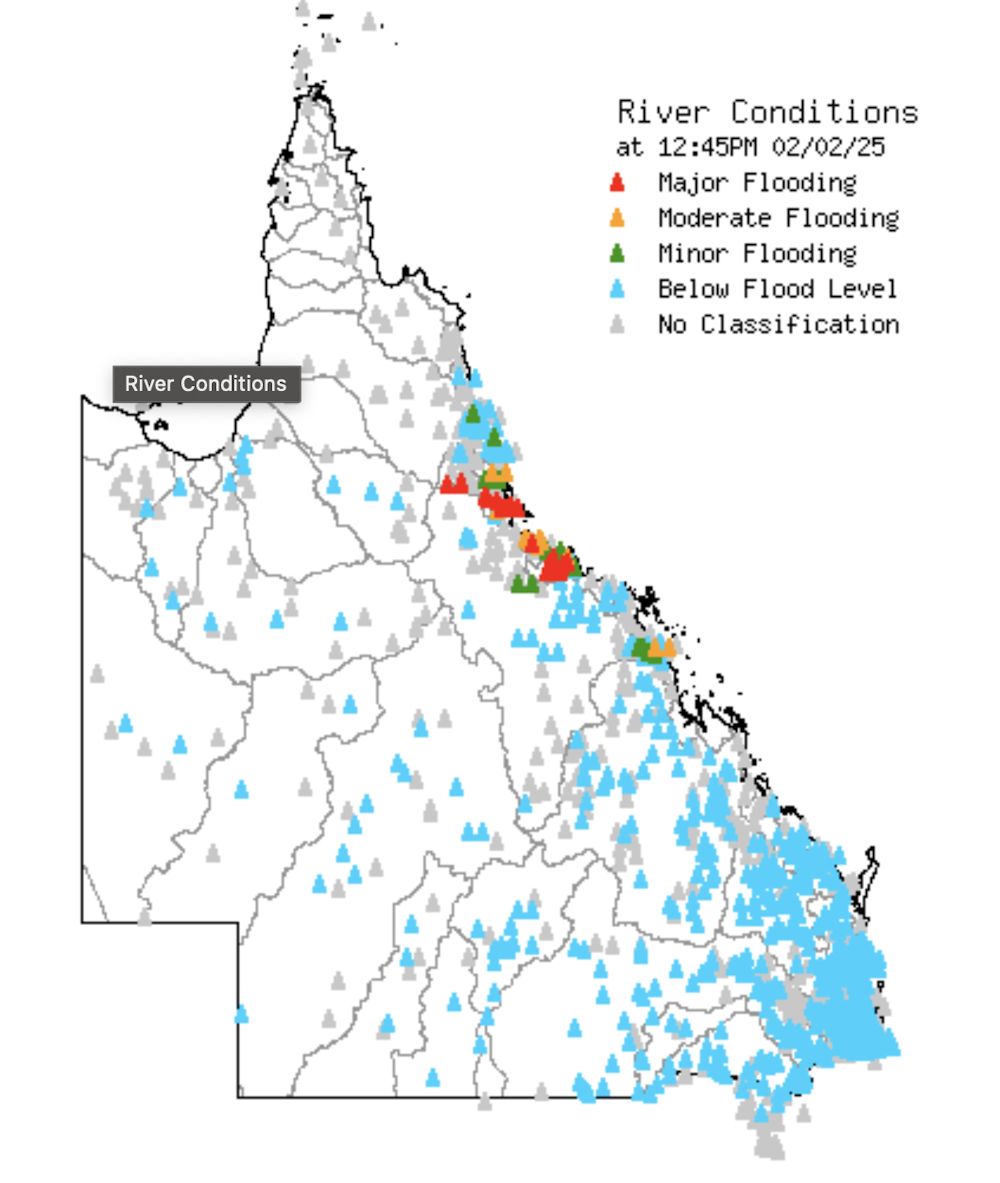
Major flooding in northern Queensland rivers, as of 12.45pm February 2. Bureau of Meteorology
Residents of Ingham and nearby towns, about 100km from Townsville, are witnessing flooding from the nearby Herbert River. This morning, it was at 15 metres and rising. With more heavy rain forecast for the next 24 hours, the Herbert River is likely to break the 1967 record of 15.2 metres later today.
Queensland Premier David Crisafulli – who grew up on his family’s sugar cane farm in Ingham – has said the floods will be a “once in a century” event for the town. To make matters worse, authorities say the town has lost power and an extended outage is likely.
The atmospheric factors behind these floods are very similar to recent floods in the region – and climate change is no doubt playing a role.
The flood level for the Herbert River at Ingham set in 1967 was 15.2 metres. It’s likely to be breached this afternoon (Sunday February 2). Australian Bureau of Meteorology, CC BY
Where are the floods hitting?
For many people in Townsville – the largest city in Northern Australia – the unfolding emergency will bring back memories of the devastating February 2019 floods, which caused A$1.24 billion in damage. Residents have been asked to evacuate from several low-lying suburbs which were inundated in 2019.
Authorities in Townsville asked all residents in the low-lying black zone to evacuate by midday Sunday February 2. Floodwaters could reach second-storey heights in this zone. Residents in pink suburbs have been asked to be on standby. Townsville Council, CC BY
It is too early to say if this flood event will be worse. Fortunately, water levels in the city’s Ross River Dam are much lower than 2019. Townsville Airport has recorded 545mm of rain over the past 48 hours, with many northwest suburbs recording much higher levels. The township of Rollingstone – 60km northwest of Townsville – recorded a whopping 702mm over the 24 hours to 9am Sunday.
Further north in the Cairns to Daintree region, residents are watching with concern, with many still raw after the record-breaking floods of December 2023.
What triggered each of these floods was prolonged heavy rain falling on the southeast flank of a stationary tropical low weather system. Normally, tropical lows bring wind and rain, but move through quite quickly. But in recent years, we have seen a tendency for these systems to stall, sitting in place over or near land and dumping huge volumes of rain.
Last week, the Bureau of Meteorology warned that five tropical lows were forming around northern Australia. Most tropical cyclones form from tropical lows embedded in the region’s monsoon trough, a large low pressure band which forms over summer and draws in warm, moist air from the adjacent tropical seas.
But significant rain events like this one don’t necessarily require a tropical cyclone. Slow-moving deep monsoon lows over land can also deliver huge amounts of rain and widespread flooding.
These atmospheric conditions allow intense rain bands to form between converging winds: warm, moist winds from the northeast and southeast winds originating from the Coral Sea. As the winds collide, they push the moist air up into the cooler parts of the atmosphere where it condenses and falls as torrential rain.
More extreme rainfall and higher frequencies of flooded rivers and flash floods around the world have a clear link to climate change and ongoing global heating.
The main drivers behind these events include warming of the atmosphere. For every 1°C of warming, the atmosphere holds 7% more water vapour. Recent research suggests this figure could be even higher for short duration rainfall.
Hotter oceans hold more energy, meaning they can also amplify the global water cycle when atmospheric conditions are suitable.
This year’s latest ever monsoon
This year, sea surface temperatures in the northwest Coral Sea are 1-2°C above average. Ocean temperatures have risen because of a lack of cloud cover and rain last month. In northwestern Australia, this has given rise to an intensifying marine heatwave.
This ocean heat is likely to be driven by the Australian monsoon’s latest ever arrival. The monsoon brings heavy rains to northern Australia, triggering the wet season. When it arrives, sea surface temperatures generally drop due to a combination of high cloud cover and the cooling effect of rainwater.
After a slow start, the North Australian monsoon season is now in full swing.
The Bureau of Meteorology is monitoring an active monsoon trough for any low pressure systems, which may develop into tropical cyclones over the next week or so. If any cyclone does form, it will gain energy from warmer than usual sea surface temperatures.
What’s next for north Queensland?
The flood emergency in north Queensland is far from over. All global circulation models predict heavy rain to continue in the region, extending up towards Cape York and the Gulf Country as an active monsoon surge moves in from Indonesia.
As river catchments get saturated, more and more water will run off and engorge rivers. Forecasts are for rain to continue well into tonight and the next few days. We are likely to see more flooding in more places this week.
West Hants District RCMP is asking for the public’s assistance in locating 22-year-old Makayla Lynn Oickle who was last seen in Three Mile Plains.
Oickleis described as 5-foot-4 and 110 pounds. She has long blonde hair with black roots, green eyes and a tattoo of butterflies on her right hand. She was last seen wearing black sweatpants and a black cropped hoodie.
When someone goes missing, it has deep and far-reaching impacts for the person and those who know them. We ask that people spread the word through social media respectfully.
Anyone with information on the whereabouts of Makayla Lynn Oickle is asked to contact the West Hants District RCMP at 902-798-2207. To remain anonymous, call Nova Scotia Crime Stoppers, toll-free, at 1-800-222-TIPS (8477), submit a secure web tip at www.crimestoppers.ns.ca, or use the P3 Tips app.
By the authority vested in me as President by the Constitution and the laws of the United States of America, including the International Emergency Economic Powers Act (50 U.S.C. 1701 et seq.) (IEEPA), the National Emergencies Act (50 U.S.C. 1601 et seq.) (NEA), section 604 of the Trade Act of 1974, as amended (19 U.S.C. 2483), and section 301 of title 3, United States Code,
I, DONALD J. TRUMP, President of the United States of America, find that the sustained influx of illicit opioids and other drugs has profound consequences on our Nation, endangering lives and putting a severe strain on our healthcare system, public services, and communities.
This challenge threatens the fabric of our society. Gang members, smugglers, human traffickers, and illicit drugs of all kinds have poured across our borders and into our communities. Canada has played a central role in these challenges, including by failing to devote sufficient attention and resources or meaningfully coordinate with United States law enforcement partners to effectively stem the tide of illicit drugs.
Drug trafficking organizations (DTOs) are the world’s leading producers of fentanyl, methamphetamine, cocaine, and other illicit drugs, and they cultivate, process, and distribute massive quantities of narcotics that fuel addiction and violence in communities across the United States. These DTOs often collaborate with transnational cartels to smuggle illicit drugs into the United States, utilizing clandestine airstrips, maritime routes, and overland corridors.
The challenges at our southern border are foremost in the public consciousness, but our northern border is not exempt from these issues. Criminal networks are implicated in human trafficking and smuggling operations, enabling unvetted illegal migration across our northern border. There is also a growing presence of Mexican cartels operating fentanyl and nitazene synthesis labs in Canada. The flow of illicit drugs like fentanyl to the United States through both illicit distribution networks and international mail — due, in the case of the latter, to the existing administrative exemption from duty and taxes, also known as de minimis, under section 1321 of title 19, United States Code — has created a public health crisis in the United States, as outlined in the Presidential Memorandum of January 20, 2025 (America First Trade Policy) and Executive Order 14157 of January 20, 2025 (Designating Cartels and Other Organizations as Foreign Terrorist Organizations and Specially Designated Global Terrorists). With respect to smuggling of illicit drugs across our northern border, Canada’s Financial Transactions and Reports Analysis Centre recently published a study on the laundering of proceeds of illicit synthetic opioids, which recognized Canada’s heightened domestic production of fentanyl, largely from British Columbia, and its growing footprint within international narcotics distribution. Despite a North American dialogue on the public health impacts of illicit drugs since 2016, Canadian officials have acknowledged that the problem has only grown. And while U.S. Customs and Border Protection (CBP) within the Department of Homeland Security seized, comparatively, much less fentanyl from Canada than from Mexico last year, fentanyl is so potent that even a very small parcel of the drug can cause many deaths and destruction to America families. In fact, the amount of fentanyl that crossed the northern border last year could kill 9.5 million Americans.
Immediate action is required to finally end this public health crisis and national emergency, which will not happen unless the compliance and cooperation of Canada is assured.
I hereby determine and order:
Section 1. (a) As President of the United States, my highest duty is the defense of the country and its citizens. A Nation without borders is not a nation at all. I will not stand by and allow our sovereignty to be eroded, our laws to be trampled, our citizens to be endangered, or our borders to be disrespected anymore.
I previously declared a national emergency with respect to the grave threat to the United States posed by the influx of illegal aliens and illicit drugs into the United States in Proclamation 10886 of January 20, 2025 (Declaring a National Emergency at the Southern Border). Pursuant to the NEA, I hereby expand the scope of the national emergency declared in that Proclamation to cover the threat to the safety and security of Americans, including the public health crisis of deaths due to the use of fentanyl and other illicit drugs, and the failure of Canada to do more to arrest, seize, detain, or otherwise intercept DTOs, other drug and human traffickers, criminals at large, and drugs. In addition, this failure to act on the part of Canada constitutes an unusual and extraordinary threat, which has its source in substantial part outside the United States, to the national security and foreign policy of the United States. I hereby declare and reiterate a national emergency under the NEA and IEEPA to deal with that threat. This national emergency requires decisive and immediate action, and I have decided to impose, consistent with law, ad valorem tariffs on articles that are products of Canada set forth in this order. In doing so, I invoke my authority under section 1702(a)(1)(B) of IEEPA and specifically find that action under other authority to impose tariffs is inadequate to address this unusual and extraordinary threat.
Sec. 2. (a) All articles that are products of Canada as defined by the Federal Register notice described in subsection (e) of this section (Federal Register notice), and except for those products described in subsection (b) of this section, shall be, consistent with law, subject to an additional 25 percent ad valorem rate of duty. Such rate of duty shall apply with respect to goods entered for consumption, or withdrawn from warehouse for consumption, on or after 12:01 a.m. eastern time on February 4, 2025, except that goods entered for consumption, or withdrawn from warehouse for consumption, after such time that were loaded onto a vessel at the port of loading or in transit on the final mode of transport prior to entry into the United States before 12:01 a.m. eastern time on February 1, 2025, shall not be subject to such additional duty, only if the importer certifies to CBP as specified in the Federal Register notice.
(b) With respect to energy or energy resources, as defined in section 8 of Executive Order 14156 of January 20, 2025 (Declaring a National Energy Emergency), and as otherwise included in the Federal Register notice, such articles that are products of Canada as defined by the Federal Register notice shall be, consistent with law, subject to an additional 10 percent ad valorem rate of duty. Such rate of duty shall apply with respect to goods entered for consumption, or withdrawn from warehouse for consumption, on or after 12:01 a.m. eastern time on February 4, 2025, except that goods entered for consumption, or withdrawn from warehouse for consumption, after such time that were loaded onto a vessel at the port of loading or in transit on the final mode of transport prior to entry into the United States before 12:01 a.m. eastern time on February 1, 2025, shall not be subject to such additional duty, only if the importer certifies to CBP as specified in the Federal Register notice.
(c) The rates of duty established by this order are in addition to any other duties, fees, exactions, or charges applicable to such imported articles.
(d) Should Canada retaliate against the United States in response to this action through import duties on United States exports to Canada or similar measures, the President may increase or expand in scope the duties imposed under this order to ensure the efficacy of this action.
(e) In order to establish the duty rate on imports of articles that are products of Canada, the Secretary of Homeland Security shall determine the modifications necessary to the Harmonized Tariff Schedule of the United States (HTSUS) in order to effectuate this order consistent with law and shall make such modifications to the HTSUS through notice in the Federal Register. The modifications made to the HTSUS by this notice shall be effective with respect to goods entered for consumption, or withdrawn from warehouse for consumption, on or after 12:01 a.m. eastern time on February 4, 2025, and shall continue in effect until such actions are expressly reduced, modified, or terminated.
(f) Articles that are products of Canada, except those that are eligible for admission under “domestic status” as defined in 19 CFR 146.43, which are subject to the duties imposed by this order and are admitted into a United States foreign trade zone on or after 12:01 a.m. eastern time on February 4, 2025, except as otherwise noted in subsections (a) and (b) of this section, must be admitted as “privileged foreign status” as defined in 19 CFR 146.41. Such articles will be subject upon entry for consumption to the rates of duty related to the classification under the applicable HTSUS subheading in effect at the time of admittance into the United States foreign trade zone.
(g) No drawback shall be available with respect to the duties imposed pursuant to this order.
(h) For avoidance of doubt, duty-free de minimis treatment under 19 U.S.C. 1321 shall not be available for the articles described in subsection (a) and subsection (b) of this section.
(i) Any prior Presidential Proclamation, Executive Order, or other Presidential directive or guidance related to trade with Canada that is inconsistent with the direction in this order is hereby terminated, suspended, or modified to the extent necessary to give full effect to this order.
(j) The articles described in subsection (a) and subsection (b) of this section shall exclude those encompassed by 50 U.S.C. 1702(b).
Sec. 3. (a) The Secretary of Homeland Security shall regularly consult with the Secretary of State, the Attorney General, the Assistant to the President for National Security Affairs, and the Assistant to the President for Homeland Security on the situation at our northern border. The Secretary of Homeland Security shall inform the President of any circumstances that, in the opinion of the Secretary of Homeland Security, indicate that the Government of Canada has taken adequate steps to alleviate this public health crisis through cooperative enforcement actions. Upon the President’s determination of sufficient action to alleviate the crisis, the tariffs described in section 2 of this order shall be removed.
(b) The Secretary of Homeland Security, in coordination with the Secretary of State, the Attorney General, the Assistant to the President for National Security Affairs, and the Assistant to the President for Homeland Security, shall recommend additional action, if necessary, should the Government of Canada fail to take adequate steps to alleviate the illegal migration and illicit drug crises through cooperative enforcement actions.
Sec. 4. The Secretary of Homeland Security, in consultation with the Secretary of the Treasury, the Attorney General, and the Secretary of Commerce, is hereby authorized to take such actions, including adopting rules and regulations, and to employ all powers granted to the President by IEEPA as may be necessary to implement this order. The Secretary of Homeland Security may, consistent with applicable law, redelegate any of these functions within the Department of Homeland Security. All executive departments and agencies shall take all appropriate measures within their authority to implement this order.
Sec. 5. The Secretary of Homeland Security, in coordination with the Secretary of the Treasury, the Attorney General, the Secretary of Commerce, the Assistant to the President for National Security Affairs, and the Assistant to the President for Homeland Security, is hereby authorized to submit recurring and final reports to the Congress on the national emergency under IEEPA declared in this order, consistent with section 401(c) of the NEA (50 U.S.C. 1641(c)) and section 204(c) of IEEPA (50 U.S.C. 1703(c)).
Sec. 6. General Provisions. (a) Nothing in this order shall be construed to impair or otherwise affect:
(i) the authority granted by law to an executive department, agency, or the head thereof; or
(ii) the functions of the Director of the Office of Management and Budget relating to budgetary, administrative, or legislative proposals.
(b) This order shall be implemented consistent with applicable law and subject to the availability of appropriations.
(c) This order is not intended to, and does not, create any right or benefit, substantive or procedural, enforceable at law or in equity by any party against the United States, its departments, agencies, or entities, its officers, employees, or agents, or any other person.
North China’s coal-rich Shanxi Province achieved a record coal-bed methane (CBM) output of 13.4 billion cubic meters in 2024, up 18.9 percent year on year, according to the provincial statistics bureau.
CBM is a byproduct of coal production and considered a major cause of fatalities in coal mine accidents. This unconventional natural gas is primarily composed of methane and produced from coal seams.
With modern technology, CBM can be stably extracted and used as a clean energy source. Currently, CBM is being explored and utilized in large scale in Shanxi — rather than being discharged to pollute the environment. Through this process, coal mines have also managed to effectively reduce gas explosion accidents.
“In the next stage, Shanxi will take multiple measures to boost CBM storage and production, and vigorously promote CBM development,” said Mao Xiaowen, deputy director of the Shanxi energy bureau.
Shanxi is rich in CBM resources, with about 8.31 trillion cubic meters of proven CBM reserves underground within a depth of 2,000 meters — which accounts for nearly one-third of the country’s total. Notably, the province’s 2024 CBM output amounted to 80.6 percent of China’s total, the provincial energy bureau revealed.
Last year, Shanxi’s raw coal output reached 1.27 billion tonnes, accounting for around 26.7 percent of the national output, the provincial statistics bureau said.
U.S. President Donald Trump signed an executive order on Saturday to impose a 10-percent tariff on goods imported from China. The latest U.S. trade protectionist measure has drawn widespread opposition both domestically and internationally.
The White House said the 10-percent tariff is on all imports from China on top of existing tariffs. Trump says the tariffs dovetail with his embrace of protectionist measures.
Chinese Foreign Ministry Spokesperson Mao Ning has said that China always believes that there is no winner in a trade war or tariff war, and remains steadfast in safeguarding its national interests. Spokesperson for the Ministry of Commerce He Yadong said China’s position on the tariff issue is consistent. Tariff measures are not conducive to the interests of either China or the United States, nor to the rest of the world, He said.
According to the executive order, the United States also imposed a 25-percent tariff on goods from Mexico and Canada. For energy products from Canada, the administration imposed a 10-percent tariff.
The Albanese Labor Government is extending the National Early Childhood Program (NECP) to support young children with disability or developmental concerns, their families and carers.
Autism Queensland and the Australian Catholic University (ACU) will each receive an additional $5 million from 2025-26 to 2026-27 to continue activities funded under the NECP.
Minister for Social Services Amanda Rishworth said the $10 million Federal investment for this extension will mean more children with disability or developmental concerns aged 0-8 years and their families are supported.
“We recognise the importance of a child’s early years and ensuring they and their families have what they need to ensure a bright future,” Minister Rishworth said.
“For children with developmental concerns or disability, it is crucial they and their families are given tailored support to ensure they can have their best start in life.
“The early childhood program activities under the NECP align withAustralia’s Disability Strategy 2021-2031and theEarly Years Strategy 2024-2034, helping children and building capacity in their families to support their development.
“The NECP was designed in consultation with parents, carers and peak bodies, and the Government is pleased to continue to fund these important activities.”
The NECP supports young children with newly identified disability or emerging developmental concerns and their parents and carers, increasing readiness for educational environments and providing opportunities to socialise with their peers and siblings in a supported and family-centred environment.
Initial funding of $13.8 million was awarded following two open grant rounds for 2022-23 to 2024-25. Under these grants:
Autism Queensland lead a consortium of organisations including playgroup and autism associations to provide regular, facilitated supports, including playgroups and music programs across the country.
ACU provides facilitated group workshops for parents and carers whose children have a newly identified disability or who have concerns regarding their child’s development.
Topics: NDIS; Foundational Supports; The Budget, Antisemitism; Nature Positive bill; Peter Dutton’s proposed investor visa.
ANDREW CLENNELL, HOST: Joining me live is the new NDIS Minister. She replaced Bill Shorten about a month ago, Amanda Rishworth, thanks for your time. Let me start with this news I’ve just revealed. Can you tell us what is the nature of the one-year deal being offered by the PM on Foundational Support money for the NDIS and why is it being tied to the hospital agreement?
AMANDA RISHWORTH, MINISTER FOR THE NATIONAL DISABILTY INSURANCE SCHEME: Firstly, I would say it’s not new that we are working with the states and territories to develop Foundational Supports. In fact, I have been working with my counterparts to work out the design of Foundational Supports, what they might look like and how we might go forward on that in terms of the agreements with states and territories. There are a lot of agreements with states and territories that our government is progressing. Certainly, the health reform is one of those. NDIS reform is another one. So, there is a lot of agreements to land with states and territories and what I’ve been doing is working very hard to put some meat on the bones about what we would be funding with Foundational Supports.
ANDREW CLENNELL: Well, you say it’s not new. The fact it’s a one-year deal is new, isn’t it, that you’re looking at?
AMANDA RISHWORTH: We’ve been working towards Foundational Supports for a long time. I’m not privy to the First Ministers negotiations, but I’ve been working very much with the idea of how we stand up supports outside the NDIS that are there to support people that may not need the intensity that the NDIS provides. So, the First Ministers will continue to have their discussions, but I’m certainly working on what Foundational Support looks like. How do we roll those out and how do we make a difference outside side of the scheme so that there are supports available.
ANDREW CLENNELL: Do you expect states to be providing these Foundational Supports by mid-year as envisioned? Are the states fair dinkum about this or could the deal just collapse?
AMANDA RISHWORTH: It’s never been expected that all the Foundational Supports would be stood up this year. Indeed, as the review outlined, they will have to be rolled out in a progressive way. But we’ve had good cooperation with states and territories. Just one example of a system change that we have with South Australia, for example, is what’s called the Inklings program. And the idea of that is to provide intervention before there is a diagnosis to ensure that children are put on a strong developmental pathway and don’t need the NDIS. There is already work being done around what these systems look like outside the NDIS. But we’ll keep working with the states and territories to start sending these supports up.
ANDREW CLENNELL: What money are you proposing to give the states to deliver these services which can act as a NDIS substitute? Is there a danger of just cost shifting from the NDIS or are there going to be real savings here?
AMANDA RISHWORTH: Let’s be clear. The NDIS is a joint endeavour by states and territories and the Commonwealth, and they co-govern. But what we’re talking about, and the review made it clear, is that for some people, for some children as well, that may have developmental delay, they might be served outside of the scheme with lower intensity supports. So, they don’t require the full individualised plan that is provided by the NDIS. And just in the nature of the way the supports will be delivered, they will be a lower cost. But I have to say, Andrew, when it comes to sustainability of the NDIS, Foundational Supports are not the only element that goes to sustainability. There is a lot of work we’ve been doing and will continue to do to improve the sustainability of the scheme and to hit that 8 per cent growth target which we are on track for.
ANDREW CLENNELL: I’m told, in terms of saving money through the Foundational Support one example is the Federal Government would want schools to have a staff speech pathologist, for example, rather than have say 10 private speech pathologists visit schools to see students one on one. Is that a good example of what you’re trying to achieve here?
AMANDA RISHWORTH: I don’t want to be so prescriptive because we’re still working through it, but a good example would be if a child might have some fine motor delay. Rather than an individualised plan that has a range of different supports they might be serviced with, for example, some adaptive technology like some specialised cutlery that helps them with their fine motor skills and perhaps some periodic OT input rather than a full individualised plan that gets reassessed and re put in place every single year. So, they are the types of things that we are looking at. How do you provide much more targeted, much more often episodic or periodic interventions that do not require this sort of individualised plan. I don’t think anyone accepted that for children with developmental delay that they would have an individualised plan for a lifetime. That certainly was not the vision for the scheme which is for significant and permanent impairment. So, we’ve got to work and identify these. Things look different in different states and that’s why systems are different in different states, and we will be working with each state and territory about what that looks like and how it might be delivered.
ANDREW CLENNELL: How did we get to the point where something like 35 per cent of people on this scheme have autism? Could there be closer scrutiny of who gets this support? When this scheme was set up, it was for people with significant and permanent disability. There was even an ANU study in 2023 which suggested there were more autism diagnoses in this country and that could be linked to accessing the NDIS.
AMANDA RISHWORTH: What the review said, Andrew, was that with the NDIS the only level of support, I think the review said is the only lifeboat in the ocean. Of course it has led to people gravitate to get support. That is partly what I said Foundational Supports are about. It’s also partly that there are two pathways in the NDIS. Firstly, the permanent and significant pathway and then there’s the early intervention pathway. And for me, I want to make sure that the early intervention pathway is making a difference, that it is evidence based and that we are seeing interventions that improve the developmental trajectory of a child, so that they don’t need to, on an ongoing basis, actually rely on the NDIS. The NDIS was never designed that it would be diagnosis driven. It was about functional capacity and what supports you need. We need to get back to having a focus on that and also make sure for those that may need a lower intensity of support, that it’s out there in the broader community through different service systems. And that’s what we’re working to. And quite frankly it’s been really left to drift under the previous government. There wasn’t the sustained focus. Now Former Minister Shorten had a sustained focus on this and I will continue that.
ANDREW CLENNELL: When Julia Gillard rose in the Parliament to announce this scheme, she said there were more than 400,000 people living with significant and permanent disabilities. And then 13 years later, we have 650,000 participants of the scheme. How many people do you envisage in say three to five years being on this scheme?
AMANDA RISHWORTH: I don’t have those projections, but I have to say what’s driving the scheme is or the costs in the scheme is not only the number of participants on the Scheme. It has been identified that intra-plan inflation also has an impact on the fiscal elements of the Scheme. So, while numbers are important, we’ve got to make sure that eligibility is correct and that it’s significant and permanent. And the supports put in place are about supporting people with supports that are reasonable and necessary. It is not just the numbers that are driving the cost. Here we had a situation where we’ve put some new rules in place to be clear about what’s funded and what’s not. There were grey areas about what is funded, what was not, and so we were seeing some confusion around that. We’ve put very clear guidelines now about what should be funded and what shouldn’t be funded. We’ve also put some clear guidelines about how people manage their budgets and their plans, and also make sure, for example, that there isn’t service providers gouging participants. It’s taken a lot of work to look at how we bring these costs down. Just to give you an example, 2021-22, when the previous government was in charge, there was a 23 per cent growth in the cost of the scheme. 2024-25 we have been able to bring that down to about 12 per cent.
ANDREW CLENNELL: It’s still 12 per cent. Your target’s eight per cent. Let me ask you this, I appreciate your point on the numbers, but Julia Gillard spoke about 400,000. We’ve now got 650,000. Could you envisage a million Australians being on the NDIS? Because it looks like we’re headed that way.
AMANDA RISHWORTH: I don’t think that’s right to characterise the trajectory. I’ll just give you an example. Recently, the numbers were revised of the number of Australians living with disability in this country, and it’s 5.5 million people. So, if we look at the numbers that are on the NDIS, it is certainly not all people living with disability in Australia. And of course, that 5.5 million had been revised, up from over 4.5 million. So, we are seeing the trajectory of people reporting disability increase in this country across the board. Not all of them are on the NDIS. In fact, only a small proportion of people are getting support from the NDIS. And that’s why we’ve got to be continuing to work hard to look at what other supports we can give people to make sure that they don’t need necessarily the NDIS but can get support elsewhere.
ANDREW CLENNELL: Peter Dutton’s spoken about cutting 36,000 public servants. Your predecessor, Bill Shorten, won the budget support to hire another 1,000 public servants in a bid to get the NDIS under control. In particular to look at eligibility for the scheme, what progress have they so far made and what sort of people are now being rejected from the scheme that were being accepted?
AMANDA RISHWORTH: I need to be clear in terms of the early intervention pathway, there has always been a reassessment at six years of age and nine years of age, because we’re hoping, of course, that the early interventions has made a difference and those children do not require the scheme anymore. Thee work that’s been undertaken is to make sure that those reassessments have happened. When Peter Dutton talks about cutting public servants, what he’s saying is he doesn’t want those reassessments to happen. He doesn’t want to make sure that plans are done efficiently, effectively and quickly. Is he planning to cut the Fraud Fusion Task Force? Because there was no focus on fraud in the NDIS previously. That requires people from across agencies to make sure that taxpayers money is spent correctly and is not gouged. When it comes to my other hat as Social Services Minister, is he talking about pensioners waiting on the phone for longer? These are frontline public servants that are making a difference. But importantly, when it comes to the NDIS, paying attention to all these elements that the previous government dropped, whether it’s fraud, whether it’s reassessment, whether it’s proper efficient planning, whether it’s responsiveness when people have a query, they are the public servants that Peter Dutton is talking about.
ANDREW CLENNELL: I just want to get through a couple more things. When it comes to a possible budget, we don’t know if it’s happening or during the election campaign the PM, Treasurer and Finance Minister have flagged more cost-of-living assistance. I ask you, in your social services portfolio, do you expect to be promising more in terms of rental assistance or in terms of welfare benefits or pension payments?
AMANDA RISHWORTH: We’ve been working through the budget process and Andrew; you’ll be not surprised. I won’t be announcing what will be in the budget here today, but when it comes to supporting people with cost of living, it’s clear. Two rent assistance increases that have led to the largest rent assistance in over 30 years. Of course we’ve increased other payments, we’ve improved arrangements for the pension, supporting pensioners with cost of living, we’ve supported more pensioners onto the concession card, helping them with cost doctors. Of course, there’s been medicines and a range of other cost of living measures. So, we’ve got a strong record when it comes to supporting people right across the board, including our tax cuts. Look, I’m going to say watch out on budget night. I know you’re an avid watcher of the budget and all will be revealed on budget night.
ANDREW CLENNELL: It sounds like you think there is a budget, Amanda Rishworth. I’m not so confident we’ll see in good time. I wanted to ask now about but this issue of the anti-Semitic attacks and the criticism of the Prime Minister in terms of either he didn’t get briefings, and he should investigate it. That’s what Peter Dutton and the opposition say. Or another version I’ve heard is he’s hearing things but not broadcasting them. There Is a fine balance here, isn’t there? Could it be politically detrimental for the Government if he doesn’t look on top of it? The Prime Minister?
AMANDA RISHWORTH: I think this is a ridiculous criticism from Peter Dutton and just shows that all he wants to do is play politics with what is a really serious issue. It is unacceptable that there are people of Jewish faith feeling unsafe in this country. But for the Government it is about being responsible in making sure people are actually safe, not playing politics. And I have to say, ensuring police and security agencies, can do their job and keep the community safe should be, in my view, the number one outcome we all want to see. So, if the leader of the Opposition just wants to play politics with this then he should be condemned, quite frankly, because it is about what leads to safety in our community. That should be a priority of every member of Parliament.
ANDREW CLENNELL: Health Minister Mark Butler made an announcement Friday concerning the establishment of an inquiry into the use of gender changing medicine. Is this a bid to head off Peter Dutton doing a Donald Trump on this issue this year?
AMANDA RISHWORTH: These guidelines have not been reviewed since 2018. It is timely that the guidelines be reviewed with the most up to date evidence, particularly when we’re talking about children. As a mum I would like to know that the guidelines are absolutely up to date, we’ve got proper medical evidence on the table and that young people in this country are getting the best possible medical care. So, it is timely that the evidence is looked at, that the input from research is added and that we have the most up to date medical guidelines in this country.
ANDREW CLENNELL: The Nature Positive bill, it looks dead in this term of Parliament. The Prime Minister is going to pull it. I understand?
AMANDA RISHWORTH: I think it’s clear that The Greens keep making more and more extreme demands. Peter Dutton has been incredibly oppositional to this will not even engage. This is despite the Samuel review identifying that both businesses wanted faster approvals, and we needed stronger protections for our environment. But with this type of opposition and people not willing to have discussions and make compromises, I think it’s clear that we won’t be able to pursue this piece of legislation in the Parliament.
ANDREW CLENNELL: What do you make of these comments by Peter Dutton at a fundraiser that he might reintroduce this significant investor visa and him trying to re-establish relations with the Chinese Australian community?
AMANDA RISHWORTH: I would say when it comes to migration, it just shows Peter Dutton likes to talk a lot of political game. But when it comes down to taking action, he failed to support our legislation to put a cap on international students. After being lobbied against that, he has now signalled that he will bring back a visa that we abolished. It really does show that he’s not serious when it comes to tackling our migration system. But we shouldn’t be surprised because he left it in a complete mess when he was in charge. And of course, you know, we’re getting down to the political season. You know, there’ll be a lot of political statements made clearly in the leader of the opposition’s case, it is contradictory from one day to the other, but that’s politics and that’s an election season.
ANDREW CLENNELL: We’ll have plenty more of it. Amanda Rishworth, thanks so much for your time.
An aerial drone photo taken on Dec. 15, 2023 shows a view of the Hong Kong-Zhuhai-Macao Bridge in south China. [Photo/Xinhua] The Zhuhai port of the Hong Kong-Zhuhai-Macao Bridge handled 156,000 inbound and outbound passenger trips on Friday, a daily record since the bridge’s opening in 2018. The 55-km bridge links China’s Hong Kong Special Administrative Region (SAR), Macao SAR, and the city of Zhuhai in Guangdong Province. It is the world’s longest bridge-and-tunnel sea crossing. According to the border inspection authorities in Zhuhai, more than 454,000 passenger trips and over 69,000 vehicle trips were recorded through the bridge’s Zhuhai port from Tuesday to Friday, the first four days of the Spring Festival holiday, up 22 percent and 32 percent respectively year on year. Daily passenger flows at the port exceeded 100,000 on 50 days in 2024, a 10-fold increase from 2023. More than 3 million trips by vehicles carrying number plates from Hong Kong or Macao were recorded at the port in 2024, accounting for 55 percent of its total traffic.
A research team from the University of Science and Technology of China (USTC) has unveiled a groundbreaking biomimetic prosthetic hand with high dexterity, which is capable of combing hair, operating smartphones, and even performing intricate sign language gestures. The lightweight prosthetic device, which replicates the functionality of a human hand, highlights a significant advancement in prosthetics and humanoid robots, offering hope to millions of amputees worldwide. The study was published in Nature Communications, the USTC said on its official website. A leap forward in prosthetics The human hand, with its 23 degrees of freedom (DOFs) — the number of independent movements it can perform — is a marvel of natural engineering, contributing to 54 percent of the body’s overall functional movements despite weighing only about one-150th of the body’s weight. Traditional prosthetic hands, often powered by motors, struggle to balance weight and functionality. Most weigh more than 0.4 kilograms, causing discomfort while offering fewer than 10 DOFs. This limitation confines their ability to perform complex tasks, leading nearly half of users to abandon their prosthetic hands. The USTC team addressed these challenges by using shape-memory alloys (SMAs) — materials that “remember” their original shape and return to it when heated — as artificial muscles. Combined with a tendon-like transmission system, this innovative approach amplifies the driving force while reducing resistance. The team also embedded 23 sensor units in the fingers and wrist for precise motion control and integrated 38 SMA actuators with a cooling module. The result is a prosthetic hand weighing just 0.37 kilograms, lighter than the average human hand, yet capable of 19 active DOFs. High dexterity and versatility According to the research team, the prosthetic hand demonstrates remarkable dexterity, enabling it to perform tasks such as combing hair, writing, shaking hands, handing out business cards, and even playing chess. Its advanced design allows it to replicate 33 standard human grasping modes and six new, more complex ones, such as using scissors, operating smartphones, and performing intricate sign language gestures. In clinical tests, a 60-year-old female amputee mastered the device within half a day, successfully completing tasks from the clinically validated hand function test — Southampton Hand Assessment Procedure (SHAP) — and the Wolf Motor Function Test (WMFT), which measures upper extremity motor abilities. Its integration with voice recognition technology sets the USTC prosthetic hand apart. It supports 60 languages and 20 dialects with 95 percent accuracy and millisecond-level response times. This user-friendly interface makes it accessible to a wide range of users, particularly amputees, according to the research team. Compared to similar projects globally, the USTC team’s design stands out for its high DOFs, lightweight construction, and advanced sensory feedback. The USTC team’s innovation holds immense promise for both prosthetics and humanoid robotics, according to the research team. Its high adaptability opens up a wide range of practical applications across multiple fields, including specialized operations in hazardous environments such as nuclear power plant maintenance or deep-sea equipment repair, medical rehabilitation, flexible manufacturing in high-precision production lines, and home services.
The Chinese military on Friday conducted combat readiness patrols in territorial waters and the airspace of China’s Huangyan Dao and its surrounding areas. According to a statement issued by the Chinese People’s Liberation Army Southern Theater Command, since January, it has organized naval and air forces to continuously enhance patrols in waters and airspace surrounding the territorial waters of Huangyan Dao, while also strengthening relevant maritime and airspace control and management. These efforts are aimed at resolutely safeguarding China’s national sovereignty and security, and maintaining peace and stability in the South China Sea, the statement said.
More than 304 million inter-regional passenger trips were made across China on Friday, the fourth day of this year’s Spring Festival holiday, as the most celebrated holiday in the country featured many family visits and served as a boost for tourism, official data showed Saturday. It was the first time in this year’s Spring Festival travel rush, also known as chunyun, that the number of daily inter-regional trips had exceeded 300 million, according to a special work team established to facilitate sound operations during chunyun. Trips by road increased by 6.9 percent year on year to reach 288.44 million on Friday, while journeys by rail and air rose 5.3 percent and 3.6 percent, respectively. A record-breaking 9 billion trips are expected to be made during chunyun in 2025, with this annual travel surge running from Jan. 14 to Feb. 22. The Spring Festival, an occasion for family reunions, fell on Jan. 29 this year. Road trips, including many in new energy vehicles (NEVs), are expected to account for about 80 percent of all inter-regional trips — as a variety of charging options on China’s highways make it easier than ever for NEVs to hit the road. Notably, railway authorities across various regions have increased capacity on popular travel routes and enhanced station and train services to better meet passenger demands during chunyun, said China State Railway Group Co., Ltd.
Source: People’s Republic of China – State Council News
People enjoy various activities across China during Spring Festival
Updated: February 2, 2025 09:44Xinhua
A fish lantern performance team parades at a scenic spot in Luoyang, central China’s Henan Province, during the Spring Festival holiday on Jan. 31, 2025. [Photo/Xinhua]Tourists visit a scenic spot decorated with colorful lights and ribbons in Haigang District of Qinhuangdao, north China’s Hebei Province, during the Spring Festival holiday on Jan. 31, 2025. [Photo/Xinhua]Tourists watch a lantern show in Yuncheng, north China’s Shanxi Province, during the Spring Festival holiday on Jan. 31, 2025. [Photo/Xinhua]Two girls in traditional costumes look at lanterns in Tancheng County of Linyi, east China’s Shandong Province, during the Spring Festival holiday on Jan. 31, 2025. [Photo/Xinhua]People watch lanterns in Neihuang County of Anyang City, central China’s Henan Province, during the Spring Festival holiday on Jan. 31, 2025. [Photo/Xinhua]People watch a musical fountain in Zhanyi District of Qujing, southwest China’s Yunnan Province, during the Spring Festival holiday on Jan. 31, 2025. [Photo/Xinhua]Tourists visit Lijiang ancient town in Lijiang, southwest China’s Yunnan Province, during the Spring Festival holiday on Jan. 31, 2025. [Photo/Xinhua]Tourists watch a live-action drama in Fengnan District of Tangshan, north China’s Hebei Province, during the Spring Festival holiday on Jan. 31, 2025. [Photo/Xinhua]Tourists take a cruise to enjoy the night scenery in Yuzhong District of southwest China’s Chongqing during the Spring Festival holiday on Jan. 31, 2025. [Photo/Xinhua]
Source: United States Senator for New Hampshire Jeanne Shaheen
(Washington, DC) – U.S. Senator Jeanne Shaheen (D-NH), Ranking Member of the U.S. Senate Foreign Relations Committee, today released the following statement in response to President Trump imposing sweeping 25 percent tariffs on imported goods from Canada and Mexico, which economists have warned could stoke further inflation, slow economic growth and raise prices on consumers:
“Putting far-reaching tariffs on our neighbors and close trading partners is going to spike costs for our families, businesses and workers. It’s a fact that hardworking American consumers and small businesses will be forced to foot the bill of the President’s price hikes, not foreign countries.
“Because of this misguided, politically motivated action, the cost of everything from cars and gas to housing and groceries will increase—and Americans struggling to make ends meet will be hit the hardest. While that might not matter to Donald Trump and his entourage of billionaires, it matters deeply to the people in my state.
“As always, I stand ready to work with anyone to make life more affordable. It’s a shame that the President has chosen to play politics instead of delivering for the families we serve.”
Yesterday, Shaheen led the New Hampshire Congressional delegation in urging the President not to place sweeping tariffs on imports, especially from our Canadian and Mexican neighbors, citing how it would dramatically increase costs for families and small businesses across the Granite State.
Earlier this year, Shaheen introduced new legislation with U.S. Senators Ron Wyden (D-OR) and Tim Kaine (D-VA) to shield American businesses and consumers from rising prices imposed by tariffs on imported goods into the United States. The Senators’ legislation would keep costs down for imported goods by limiting the authority of the International Emergency Economic Powers Act (IEEPA)—which allows a President to immediately place unlimited tariffs after declaring a national emergency—while preserving IEEPA’s use for sanctions and other tools.
After the November election, a multitude of business leaders warned that if the President placed sweeping tariffs as promised, they’d be forced to raise prices on consumers. The CEO of Best Buy said, “the vast majority of that tariff will probably be passed on to the consumer as a price increase.” The CFO of Walmart said, “there will probably be cases where prices will go up for consumers.” The CEO of Columbia Sportswear said, “we’re set to raise prices” and “it’s going to be very, very difficult to keep products affordable.” The CEO of AutoZone said, “if we get tariffs, we will pass those tariff costs back to the consumer.” The President of Texas-based Lipow Oil Associates said, “The prices at the pump are going to go up.”
New traffic signals will be installed at the intersection of Brighton Road, Ocean Boulevard and Scholefield Road in South Australia to improve safety for road users, pedestrians and cyclists.
This work forms part of a $30 million upgrade to two intersections along Brighton Road with upgrades already delivered at the intersection of Brighton Road and Edwards Street.
As traffic demand has grown and with new development in the area, getting access to the arterial road network for communities in Seacliff, Kingston Park and Marino has become increasingly difficult and dangerous.
The Ocean Boulevard carries around 30 000 vehicles a day and Scholefield Road carries around 4,000 vehicles each day.
The new traffic signals will maintain a consistent and reliable level of service and access for these communities whilst improving pedestrian and cyclist access and safety through the creation of a new signalised crossing of Brighton Road / Ocean Boulevard.
Design development is planned throughout 2025, with a possible construction start date mid-2026 and completion late 2026 to early 2027.
The Australian and South Australian governments have each contributed $15 million to fund the $30 million Brighton Road Intersection Improvements project.
Quotes attributable to Federal Infrastructure, Transport, Regional Development and Local Government Minister Catherine King:
“Funding the intersection upgrade is an important investment in making sure people can get to where they want to go and home again safely.
“We have listened to the local community, particularly the messages from Louise Miller-Frost and Alex Dighton about the need for these traffic signals.
“South Australians deserve quality infrastructure, and the Albanese and Malinauskas Labor Governments are partnering to making that happen.”
Quotes attributable to South Australian Minister for Infrastructure and Transport Tom Koutsantonis:
“The intersection of Scholefield Road and Ocean Boulevard is the primary access point onto the arterial road network for the Kingston Park and Marino community.
“We know this intersection is already causing access issues due to traffic volumes and the Villawood and Seacliff developments currently underway will only add to that, particularly during peak hours.
“We committed to look into solutions and I’m delighted the Albanese Government has partnered with us to make this happen.”
Quotes attributable to the Federal Member for Boothby Louise Miller-Frost:
“Traffic lights and upgrades at the intersection of Brighton Road, Ocean Boulevard and Schofield Road at Seacliff will significantly reduce congestion and improve safety for vehicles, pedestrians and cyclists.
“I’ve heard what communities in Seacliff, Kingston Park and Marino have to say, and I am pleased that the Albanese Labor Government is delivering this in partnership with the Malinauskas Government.”
Quotes attributable to the South Australian Member for Black Alex Dighton:
“My community has consistently raised with me concerns over the difficulty of access at this intersection due to traffic volumes on Ocean Boulevard, which carries around 30,000 vehicles a day at this location.
“I’m delighted that the Albanese and Malinauskas Governments have followed through on this commitment to the community to properly consider solutions and ensure funding to make sure this gets done.”
A new ‘Blueprint for Growth’ to supercharge Liverpool’s knowledge sector over the next 15 years is set to create more than a million sq ft of new laboratory and workspace in the city.
Knowledge Quarter Liverpool’s urban innovation district and placemaking organisation has pledged to help create a range of inclusive innovation opportunities and inspire future generations by focussing on skills development, community engagement, collaboration and inward investment.
KQ Liverpool’s new 2040 vision has been created following consultation with more than fifty local stakeholders and is underpinned by three core principles; to Convene and Collaborate, Amplify and Attract, Invent and Innovate.
As Liverpool and the wider city region continue to suffer from serious inequalities around issues such as health, education and deprivation, tackling those will be crucial to KQ Liverpool’s future plans, alongside support for the essential community work carried out by its partners.
This will involve expansion of its existing KQ Futures programme, enabled through the Liverpool City Region Health and Life Sciences Innovation Zone, to engage and inspire local young people about the various career opportunities that exist in their home city in specialist sectors. In 2024, KQ Liverpool hosted hundreds of students at its innovation sites and published an illustrated children’s book, Animates: Learning in Liverpool, which was delivered to every primary school in the city region.
It will also seek to boost business growth, job creation and investment into the area while promoting the city region’s high-growth priorities around health and life sciences, materials innovation, AI and robotics. This includes supporting scale-up as well as start-up businesses and simplifying the business support and funding landscape to encourage more innovation-led organisations to start, relocate and stay.
The physical development of the innovation district itself is another key element of the new vision.
KQ Liverpool will work with developers and investors including Sciontec to create more than a million sq ft of new laboratory and workspace.
It will play an important role in unlocking the potential of development sites such as Paddington South, Mount Pleasant and Copperas Hill and shaping transport and connectivity improvements across the district, thus making it more accessible and recognisable to residents, businesses and visitors.
There will also be fresh focus on the collective influence of KQ Liverpool and its partners around important national and international issues and challenges, rather than the physical boundary of the district itself, helping to attract inward investment and showcase the strengths of its innovation ecosystem.
Speaking on behalf of the wide range of partners engaged in KQ Liverpool, its chair Andrew Lewis, who is also Liverpool City Council’s Chief Executive, said: “Our 2040 vision is about improving the lives of those who live and work here, for years to come. We want to create an innovation generation, supporting new skills in our local communities, highlighting the many incredible innovations that happen here in KQ Liverpool, and encouraging future generations of science and technology pioneers to call Liverpool their home.
“We can be proud of the innovation ecosystem and partnerships we have created here in Liverpool, bringing high quality jobs and investment into the city centre, through spin-outs, SMEs, multinationals and global investors who see the enormous potential of KQ Liverpool as a place to do business and create long-term opportunities.”
Colin Sinclair, chief executive of KQ Liverpool, said: “The foundation of our success to date has been the strength of our partnership, exceeding expectations by challenging the norm and refusing to accept anything average or ordinary.
“Going forward, our 2040 vision amplifies that ambition. As a partnership, we will do everything in our power to make this place and peoples’ lives better.”
For further information about KQ Liverpool or the new KQ Liverpool 2040 : A Blueprint for Growth, please click here.
Liverpool will play host to the prestigious 2025 British Chess Championships alongside a wider chess festival this summer as organisers hope to put on the strongest event in its 121-year history.
Britain’s top chess players will converge on Liverpool from July 31 to August 10 as the English Chess Federation’s flagship annual event comes to the city for only the second time, it was announced on Friday.
It will culminate in new British champions being named at all age groups.
A series of tournaments featuring the cream of Britain’s chess talent, including the Open and Women’s championships, will be held in Liverpool’s landmark St George’s Hall. A weekend congress for amateurs will also be held at the nearby Liverpool Holiday Inn in Lime Street.
Alongside the competitive events, Liverpool will host a festival and programme of social and cultural activities organised in association with the city’s historic Liverpool Chess Club.
This will be the 111th British Chess Championships—a series that has run almost unbroken since 1904.
The last two British Chess Championships, held in Leicester and Hull, have seen record numbers competing. Continuing growth is expected this year.
UK chess has also been experiencing a boom in participation among amateurs and success at the top level. In 2024, two new English grandmasters were named: teenage sensation Shreyas Royal and England’s newest grandmaster Ameet Ghasi.
The event is being put on by the English Chess Federation in partnership with Liverpool City Council and St George’s Hall, with support from the Chess Trust and the John Robinson Chess Trust.
Liverpool City Council’s Cabinet Member for Health, Wellbeing and Culture, Councillor Harry Doyle, said: “Liverpool has a long and rich connection with chess and it’s a hugely popular activity in schools and communities so we are delighted to be hosting the British Chess Championships later this summer.
“St George’s Hall, with its incredible architecture and acoustics, will offer the perfect backdrop, lending itself perfectly to quiet, focused gameplay, which is sure to result in a thrilling competition for contestants and spectators alike.
“This is yet another coup for Liverpool, as we continue to position ourselves as a versatile events city, and we look forward to working closely with the English Chess Federation and Chess In Schools and Communities to give a warm Liverpool welcome to the best of the best from the chess world.”
It is a welcome return to Liverpool, a city steeped in chess culture. Liverpool boasts a thriving local league and, in Liverpool Chess Club, one of the oldest chess clubs in the world founded in 1837. Atticus Chess Club, based in the Cross Keys Pub in Earle Street, is also a former winner of the national club championships.
Chess was also a key theme as the city hosted the 2023 Eurovision Song Contest for Ukraine with school children encouraged to learn the game to honour the link with Liverpool’s sister city, Odesa. Schools were tasked with producing Eurovision-themed chess pieces and a unique chess event featuring players from Liverpool and Ukraine was held at St Luke’s Bombed Out Church.
Liverpool last hosted the British in 2008, the year the city was named the European Capital of Culture. That year, Grandmaster Stuart Conquest emerged victorious as the 2008 Open champion while International Master Jovanka Houska won the first of her nine Women’s titles.
Nigel Towers, the English Chess Federation’s Director for Home Chess, said: “2008 was recognised as a strong event with many titled players. However, we expect the return visit in 2025 to provide an even more competitive championship and one of the strongest British tournaments ever given the increasing numbers of active British grandmasters and international masters and the current generation of top-level juniors.”
Amos Burn, one of the world’ strongest chess players in the 19th century, was a member of the Liverpool Chess Club from 1867 until his death in 1925, serving as its president for many years.
Among the top players Liverpool has produced are four-time British Women’s champion Sheila Jackson, the 15th Correspondence World Championship winner John Carleton and International Masters Gary Quillan and Malcolm Pein, a former British junior champion. Nearby Southport has also produced two grandmasters in Nigel Davies and Stuart Haslinger.
ADDRESSING AN EMERGENCY SITUATION: The extraordinary threat posed by illegal aliens and drugs, including deadly fentanyl, constitutes a national emergency under the International Emergency Economic Powers Act (IEEPA).
Until the crisis is alleviated, President Donald J. Trump is implementing a 25% additional tariff on imports from Canada and Mexico and a 10% additional tariff on imports from China. Energy resources from Canada will have a lower 10% tariff.
President Trump is taking bold action to hold Mexico, Canada, and China accountable to their promises of halting illegal immigration and stopping poisonous fentanyl and other drugs from flowing into our country.
The orders make clear that the flow of contraband drugs like fentanyl to the United States, through illicit distribution networks, has created a national emergency, including a public health crisis. Chinese officials have failed to take the actions necessary to stem the flow of precursor chemicals to known criminal cartels and shut down money laundering by transnational criminal organizations.
In addition, the Mexican drug trafficking organizations have an intolerable alliance with the government of Mexico. The government of Mexico has afforded safe havens for the cartels to engage in the manufacturing and transportation of dangerous narcotics, which collectively have led to the overdose deaths of hundreds of thousands of American victims. This alliance endangers the national security of the United States, and we must eradicate the influence of these dangerous cartels.
There is also a growing presence of Mexican cartels operating fentanyl and nitazene synthesis labs in Canada. A recent study recognized Canada’s heightened domestic production of fentanyl, and its growing footprint within international narcotics distribution
USING OUR LEVERAGE TO ENSURE AMERICANS’ SAFETY: Previous Administrations failed to fully leverage America’s economic position as a tool to secure our borders against illegal migration and combat the scourge of fentanyl, preferring to let problems fester.
Access to the American market is a privilege. The United States has one of the most open economies in the world, and the lowest average tariff rates in the world.
While trade accounts for 67% of Canada’s GDP, 73% of Mexico’s GDP, and 37% of China’s GDP, it accounts for only 24% of U.S. GDP. However, in 2023 the U.S. trade deficit in goods was the world’s largest at over $1 trillion.
Tariffs are a powerful, proven source of leverage for protecting the national interest. President Trump is using the tools at hand and taking decisive action that puts Americans’ safety and our national security first.
Though previous Administrations have failed to leverage America’s combination of exceptional strength and its unique role in world trade to advance the security interests of the American people, President Trump has not.
PRESIDENT TRUMP IS KEEPING HIS PROMISE TO STOP THE FLOOD OF ILLEGAL ALIENS AND DRUGS: When voters overwhelmingly elected Donald J. Trump as President, they gave him a mandate to seal the border. That is exactly what he is doing.
The Biden Administration’s policies have fueled the worst border crisis in U.S. history.
More than 10 million illegal aliens attempted to enter the United States under Biden’s leadership, including a rising number of Chinese nationals and people on the terror watchlist.
This problem is not confined to the southern border – encounters at the northern border with Canada are rising as well.
The sustained influx of illegal aliens has profound consequences on every aspect of our national life – overwhelming our schools, lowering our wages, reducing our housing supply and raising rents, overcrowding our hospitals, draining our welfare system, and causing crime.
Gang members, smugglers, human traffickers, and illegal drugs and narcotics of all kinds are pouring across our borders and into our communities.
Last fiscal year, Customs and Border Protection (CBP) apprehended more than 21,000 pounds of fentanyl at our borders, enough fentanyl to kill more than 4 billion people.
It is estimated that federal officials are only able to seize a fraction of the fentanyl smuggled across the southern border.
These drugs kill tens of thousands of Americans each year, including 75,000 deaths per year attributed to fentanyl alone.
More Americans are dying from fentanyl overdoses each year than the number of American lives lost in the entirety of the Vietnam War.
BUILDING ON PAST SUCCESS: President Trump continues to demonstrate his commitment to ensuring U.S. trade policy serves the national interest.
As President Trump said in the Presidential Memorandum on American First Trade Policy, trade policy is a critical component in national security.
President Trump promised in November to “sign all necessary documents to charge Mexico and Canada a 25% Tariff on ALL products coming into the United States, and its ridiculous Open Borders. This Tariff will remain in effect until such time as Drugs, in particular Fentanyl, and all Illegal Aliens stop this Invasion of our Country!”
During his first term as President of the United States, President Trump established the President’s Commission on Combating Drug Addiction and the Opioid Crisis and declared the Opioid Crisis a public health emergency.
President Trump also has a long record of putting America first on trade. In his first term, President Trump successfully used threats of tariffs on Mexico to help secure our border.
When our national security was threatened by a global oversupply of steel and aluminum, President Trump took swift action to protect America’s national security by implementing tariffs on imports of these goods.
In response to China’s intellectual property theft, forced technology transfer, and other unreasonable behavior, President Trump acted with conviction to impose tariffs on imports from China, using that leverage to reach a historic bilateral economic agreement.
Just last week, President Trump leveraged tariffs to successfully resolve national security concerns with Colombia, swiftly reaching an outcome that prioritizes the safety and security of the American people and the sanctity of our national borders.
Department of Defense Spokesman John Ullyot provided the following readout:
On January 31, Secretary of Defense Pete Hegseth had constructive introductory calls with Mexico’s Secretary of National Defense, General Ricardo Trevilla Trejo, and Secretary of the Navy, Admiral Raymundo Morales Angeles, to discuss U.S. national security interests and our countries’ defense cooperation. Secretary Hegseth underscored that his top priority is to safeguard the United States and its citizens, to include securing the southern border. The Secretary highlighted the importance of Mexico’s armed forces continuing to disrupt cartel activities that threaten the United States, and for Mexico to continue taking steps to curb illegal migration into the United States. In both calls, the Secretary and his Mexican counterparts reaffirmed their commitment to deepening bilateral cooperation between our militaries. They also agreed that they and their staffs will maintain close communication and coordination with each other to protect the citizens and territories of both nations.
Washington, DC: Kristalina Georgieva, Managing Director of the International Monetary Fund (IMF), issued the following statement today after news of the death of Mr. Horst Köhler, former IMF Managing Director:
“It is with great sadness that we have learned of the passing of Horst Köhler, who was the eighth Managing Director of the Fund and ably led our institution between 2000 and 2004. Mr. Köhler will be remembered for his many contributions, and in particular for navigating the Fund’s work through the difficult period after September 11, 2001. He mobilized the Fund and the international community to help the low-income and heavily indebted members, championing greater transparency and strong governance.
“During his distinguished career, he played a key role in Germany’s unification in 1990 as Deputy Finance Minister of the Federal Republic of Germany and was instrumental in drafting the legal framework for the introduction of the euro. He served as president of the European Bank for Reconstruction and Development, before joining the IMF as Managing Director. In 2004 he left the IMF to become president of the Federal Republic of Germany, winning the hearts of many for his principled approach. Throughout a large part of his life, he was particularly devoted to drawing the world’s attention to the needs of the African continent – something many of us at the Fund greatly admired.
“On behalf of the IMF, I wish to offer our deepest condolences to Mr. Köhler’s family – his wife Eva, his two children Ulrike and Jochen, and his grandchildren. Mr. Köhler led a life of distinguished public service, and leaves behind a profound legacy of dedication to fairness and justice and an unfailing concern for others.”
Washington, DC: Kristalina Georgieva, Managing Director of the International Monetary Fund (IMF), issued the following statement today after news of the death of Mr. Horst Köhler, former IMF Managing Director:
“It is with great sadness that we have learned of the passing of Horst Köhler, who was the eighth Managing Director of the Fund and ably led our institution between 2000 and 2004. Mr. Köhler will be remembered for his many contributions, and in particular for navigating the Fund’s work through the difficult period after September 11, 2001. He mobilized the Fund and the international community to help the low-income and heavily indebted members, championing greater transparency and strong governance.
“During his distinguished career, he played a key role in Germany’s unification in 1990 as Deputy Finance Minister of the Federal Republic of Germany and was instrumental in drafting the legal framework for the introduction of the euro. He served as president of the European Bank for Reconstruction and Development, before joining the IMF as Managing Director. In 2004 he left the IMF to become president of the Federal Republic of Germany, winning the hearts of many for his principled approach. Throughout a large part of his life, he was particularly devoted to drawing the world’s attention to the needs of the African continent – something many of us at the Fund greatly admired.
“On behalf of the IMF, I wish to offer our deepest condolences to Mr. Köhler’s family – his wife Eva, his two children Ulrike and Jochen, and his grandchildren. Mr. Köhler led a life of distinguished public service, and leaves behind a profound legacy of dedication to fairness and justice and an unfailing concern for others.”
Premier David Eby is announcing immediate counter-measures to stand up for B.C.’s workers and businesses after the United States announced incoming 25% tariffs on Canadian goods and 10% tariffs on energy.
“President Trump’s 25% tariffs are a complete betrayal of the historic bond between our countries and a declaration of economic war against a trusted ally,” said Premier Eby. “As British Columbians, and as Canadians, we will stand strong and united in the face of this unprecedented attack.”
As a first step in response to the tariffs, Premier Eby announced immediate measures, including:
directing the BC Liquor Distribution Branch to immediately stop buying American liquor from “red states”, and remove the top-selling “red-state” brands from the shelves of public liquor stores; and
directing the B.C. government and Crown corporations to buy Canadian goods and services first.
The Province is assessing private-sector projects worth $20 billion with the goal of getting them approved as quickly as possible, and issuing their permits faster. These are expected to create 6,000 jobs in remote and rural communities. In addition, the Province has vowed to support and help implement the actions being taken by the federal government.
Premier Eby added that additional measures are under consideration by B.C. and could be introduced in the coming days and weeks.
“We won’t back down or be bullied into becoming another state,” said Premier Eby. “Our province is unified and resolute. We’ll never stop standing up for B.C. and Canada.”
In January 2025, B.C. released its preliminary assessment of 25% tariffs. That analysis showed that B.C. could see a cumulative loss of $69 billion in economic activity between 2025 and 2028, along with the loss of more than 120,000 jobs. Estimates also indicated 25% tariffs on Canadian mineral exports alone will cost American companies over US$11 billion and have a profound effect on the U.S. defense industry, energy production, and manufacturing.
The B.C. government has a three-point approach to fight back against the tariffs and protect British Columbians:
respond to U.S. tariffs with tough counter-actions and outreach to American decision-makers;
strengthen B.C.’s economy by expediting projects and supporting industry and workers; and
diversify trade markets for products so British Columbia is less reliant on U.S. markets and customers.
To support B.C.’s strong tariff response and ensure actions are swift, responsive and co-ordinated, Premier Eby has established a trade and economic security task force to bring together business, labour and Indigenous leadership. The task force is co-chaired by Tamara Vrooman from the Vancouver International Airport, Jonathan Price from Teck, Bridgitte Anderson from the Greater Vancouver Board of Trade, and includes B.C.’s largest business organizations.
A new cabinet committee will act as a day-to-day war room, co-ordinating the whole-of-government approach the Province is taking to protect B.C.’s workers, businesses and economy.
Quick Facts:
54% of BC exports in 2023 were sent to the United States;
Wood, pulp and paper, metallic mineral and energy products combined make up approximately 67% of total goods exports.
The top five states for B.C.’s exports were: Washington ($9.8 billion), California ($3.2 billion), Illinois ($2.1 billion), Texas ($1.5 billion), Oregon ($1.3 billion)
Source: United States Senator Jacky Rosen (D-NV)
WASHINGTON, D.C. – Today, U.S. Senator Jacky Rosen (D-NV) released the following statement after the Trump Administration announced that President Trump is implementing a 25% across-the-board tariff on imported goods from Mexico and Canada, the top trading partners for the United States.
“President Trump has effectively enacted a new tax on Americans for anything imported from Canada and Mexico,” said Senator Rosen. “His across-the-board tariffs are going to drive up costs for hardworking families on essential items, including groceries and housing. At a time when Nevadans are already being squeezed by high costs, this action is only going to hurt families.”
Source: People’s Republic of China – State Council News
Parade held to mark Chinese New Year in Macao
Updated: February 1, 2025 21:29Xinhua
People perform during a parade in celebration of the Chinese New Year in Macao, south China, Jan. 31, 2025. A parade was held Friday by the Macao Government Tourism Office in Macao to celebrate the Chinese New Year, or the Spring Festival. [Photo/Xinhua]People perform during a parade in celebration of the Chinese New Year in Macao, south China, Jan. 31, 2025. [Photo/Xinhua]Children perform during a parade in celebration of the Chinese New Year in Macao, south China, Jan. 31, 2025. [Photo/Xinhua]An actress is pictured during a parade in celebration of the Chinese New Year in Macao, south China, Jan. 31, 2025. [Photo/Xinhua]People perform during a parade in celebration of the Chinese New Year in Macao, south China, Jan. 31, 2025. [Photo/Xinhua]A float is pictured during a parade in celebration of the Chinese New Year in Macao, south China, Jan. 31, 2025. [Photo/Xinhua]
Source: People’s Republic of China – State Council News
Chinese Yingge dance staged to mark Spring Festival in Frankfurt
Updated: February 1, 2025 21:50Xinhua
People take videos of Yingge dance during the Spring Festival temple fair in Frankfurt, Germany, on Jan. 31, 2025. The Yingge team from Shantou, south China’s Guangdong province, offered a rich cultural feast in Frankfurt to friends from all over the world through their Chaoyang Yingge dance, a unique art form combining drama, dance, and martial arts. [Photo/Xinhua]A woman takes a selfie with members of a Yingge team during the Spring Festival temple fair in Frankfurt, Germany, on Jan. 31, 2025. [Photo/Xinhua]A woman poses for a photo with a member of a Yingge team during the Spring Festival temple fair in Frankfurt, Germany, on Jan. 31, 2025. [Photo/Xinhua]A woman poses for a photo with members of a Yingge team during the Spring Festival temple fair in Frankfurt, Germany, on Jan. 31, 2025. [Photo/Xinhua]Members of a Yingge team perform traditional Chaoyang Yingge dance during the Spring Festival temple fair in Frankfurt, Germany, on Jan. 31, 2025. [Photo/Xinhua]Members of a Yingge team pose for a group photo during the Spring Festival temple fair in Frankfurt, Germany, on Jan. 31, 2025. [Photo/Xinhua]
Source: People’s Republic of China – State Council News
Skiing becomes popular sport in China during Spring Festival holiday
Updated: February 2, 2025 08:05Xinhua
In this aerial drone photo, people ski at Qiangrengu ski resort in Wenchuan County, Aba Tibetan and Qiang Autonomous Prefecture, southwest China’s Sichuan Province, Jan. 31, 2025. Skiing has become a popular sport in China during the Spring Festival holiday. [Photo/Xinhua]Children enjoy themselves at Qiangrengu ski resort in Wenchuan County, Aba Tibetan and Qiang Autonomous Prefecture, southwest China’s Sichuan Province, Jan. 31, 2025. [Photo/Xinhua]People ski at Qiangrengu ski resort in Wenchuan County, Aba Tibetan and Qiang Autonomous Prefecture, southwest China’s Sichuan Province, Jan. 31, 2025. [Photo/Xinhua]People ski at Qiangrengu ski resort in Wenchuan County, Aba Tibetan and Qiang Autonomous Prefecture, southwest China’s Sichuan Province, Jan. 31, 2025. [Photo/Xinhua]A man skis at Qiangrengu ski resort in Wenchuan County, Aba Tibetan and Qiang Autonomous Prefecture, southwest China’s Sichuan Province, Jan. 31, 2025. [Photo/Xinhua]People ski at Qiangrengu ski resort in Wenchuan County, Aba Tibetan and Qiang Autonomous Prefecture, southwest China’s Sichuan Province, Jan. 31, 2025. [Photo/Xinhua]People ski at Qiangrengu ski resort in Wenchuan County, Aba Tibetan and Qiang Autonomous Prefecture, southwest China’s Sichuan Province, Jan. 31, 2025. [Photo/Xinhua]
Source: People’s Republic of China – State Council News
FRANKFURT/GUANGZHOU, Feb. 1 — Hundreds of local residents experienced the festive joy of the Chinese New Year or Spring Festival in Frankfurt, Germany on Friday as a group of flamboyantly dressed performers captivated the public with their lively and unique dance in celebration.
The performance was distinctive — an artful fusion of drama, dance, and martial arts — earning it the special name Yingge dance, or “dance to the hero’s song.”
It is a form of folk dance popular in south China’s Guangdong Province and it was listed as the first batch of national intangible cultural heritage in 2006.
The 25-member Ximen Yingge Team from Shantou, Guangdong Province, energized onlookers with their powerful and rhythmic movements against the crisp winter air in Frankfurt as the first Spring Festival temple fair kicked off here.
Organized by the Department of Culture and Tourism of Guangdong Province, the team is currently on an eight-day tour of Germany and France, starting on Tuesday, as part of the “Happy Chinese New Year” event. Frankfurt is one of several stops on their tour, which also includes stops in Hanau, Paris, and Lyon.
Among the mesmerized spectators was Rebecca, a student, who recorded the entire performance in Frankfurt on her phone.
“I love the dance and feel thrilled to experience Chinese New Year celebrations up close for the first time. The performers are so passionate, and they’ve brought so much joy to us. It’s truly spectacular!” she said.
Chen Tanpeng, coach of the Ximen Yingge Team, highlighted the distinctiveness of their innovative performance, saying more Chinese dance elements have been incorporated.
Juergen Scheuermann, chairman of the Hanau-Taizhou Friendship Association, spoke highly of the performance, noting that “We look forward to stronger cultural ties and deeper connections between our peoples.”
For the performers, the experience was just as exhilarating. “We came to Germany … offering a rich cultural feast to friends from around the world,” Chen said, adding, “The atmosphere here is amazing — the people are warm, the food is delicious, and we are truly delighted to celebrate the Chinese New Year in such a wonderful place.”
Wu Yanhua, deputy coach of the team, expressed pride in sharing their heritage. “Through Yingge, we hope to transcend language barriers and bring the joy of the Chinese New Year to people everywhere,” she said.
The team’s preparation for the tour was meticulous, lasting two months to ensure a stellar performance.
Beyond their performance, the team also brought a touch of home to Europe, presenting handmade gifts to local spectators, including paper cuttings, embroidered sachets, mini Spring Festival couplets, and Yingge-themed keychains.
Anna Breit, a local resident, said, “It’s wonderful … The performers’ costumes are stunning, and their performance not only brings joy but also allows us to feel the rich spirit of the Chinese New Year.”
At the close of 2024, UNESCO added the Spring Festival, social practices of the Chinese people in celebration of traditional new year, to its Representative List of the Intangible Cultural Heritage of Humanity. A year earlier, the 78th UN General Assembly recognized the Chinese New Year as an official UN holiday, underscoring the festival’s growing global presence.
Source: People’s Republic of China – State Council News
BELGRADE, Feb. 1 — The Lajkovac-Valjevo motorway in Serbia, built by China’s Shandong Hi-Speed Group, was officially inaugurated on Saturday, marking the full completion of the main route.
The motorway will open to traffic on Sunday.
Serbian Prime Minister Milos Vucevic, Minister of Public Investments Darko Glisic, and Chinese Ambassador to Serbia Li Ming attended the ceremony and delivered speeches.
Vucevic described the motorway as a “road of hope, promise, and solutions,” emphasizing that its completion ends the isolation of Valjevo and the entire Kolubara District.
Glisic highlighted the project’s role in the region’s development, stating that it will attract investment and boost local incomes.
Li Ming praised the Chinese construction team for overcoming challenges to complete the project on schedule with high quality.
He expressed confidence that the road’s opening will spur economic growth and attract investment along its route. He also voiced hope for future cooperation in building more such roads.
Spanning 18.3 kilometers, the motorway, with a design speed of 100 kilometers per hour, links the central-western Serbian cities of Valjevo and Lajkovac. It is expected to ease traffic congestion and further enhance Serbia’s transport network.