“Managers or upper management have looked down upon taking time off.”
“People think that maybe you’re not as invested in the job, that you’re shirking your duties or something.”
These are just a few of the responses to questions I asked during a study I conducted on vacation guilt among American workers.
More than 88% of full-time, private sector workers in the U.S. receive paid time off. This benefit is ostensibly in place to improve employee morale and well-being.
Yet a 2024 Pew Research Center survey found that nearly half of American workers don’t take all the vacation days they’ve been allotted. And many of them feel as if they’re discouraged from using their time off. Ironically, what’s supposed to be a source of relaxation and restoration morphs into a stressor: As vacations approach, feelings of doubt and guilt creep in.
I’m from Singapore. Upon moving to the U.S. in 2016, I was surprised at how pervasive vacation guilt appeared to be.
Compared with many of the other countries where I’ve lived or worked, American culture seems to prioritize mental healthand wellness. I assumed these attitudes extended to the American workplace.
Surprisingly, though, I noticed that many of my American friends felt guilty about taking time off that they’d earned. So as a scholar of tourism and hospitality, I wanted to understand how and why this happened.
Vacation guilt
To carry out the study, I collaborated with tourism scholar Robert Li. We interviewed 15 workers who had experienced feelings of guilt over taking time off. We also administered an online survey to 860 full-time employees who received paid time off from their employers.
We wanted to know whether employees felt less respected or believed that their bosses and colleagues saw them in a worse light for taking time off. Maybe they feared being seen as slackers or, worse, replaceable.
We found that 1 in 5 respondents to our survey experienced vacation guilt, and these concerns made them think twice about following through with their vacation plans. For those who eventually did take a vacation, they often tried to ease their guilt by going for fewer days. They might also apologize for taking a vacation or avoid talking about their vacation plans at work.
Some of the people we interviewed had pushed through their hesitation and taken their vacation as planned. Yet all of these employees believed that they’d been penalized for taking time off and that it led to poor performance reviews, despite the fact that their paid vacation days had been a clearly articulated, earned benefit.
Meanwhile, the law in other advanced economies entitles employees to a minimum amount of annual paid leave. The EU, for example, mandates at least 20 days per year on top of paid public holidays, such as Christmas and New Year’s Day, with a number of EU member countries requiring more than 20 days of paid vacation for full-time employees. Even in Japan, which is notorious for its workaholic culture, employees are entitled to a minimum of 10 days of paid leave every year.
Throughout much of the U.S., whether paid vacation time is offered at all depends on an employer’s generosity, while many employees face a “use-it-or-lose-it” situation, meaning unused vacation days don’t roll over from one year to the next.
For paid time off to serve its purpose, I think employers need to provide more than vacation days. They also need to have a supportive culture that readily encourages employees to use this benefit without having to worry about repercussions.
The journal publication on which this article was based was supported by the inaugural Seed Funding Forum, Fox
School of Business, Temple University, USA.
Demonstrators march outside the U.S. Capitol during the Poor People’s Campaign rally at the National Mall in Washington on June 23, 2018. AP Photo/Jose Luis Magana
America has never been richer. But the gains are so lopsided that the top 10% controls 69% of all wealth in the country, while the bottom half controls just 3%. Meanwhile, surging corporate profits have mostly benefited investors, not the broader public.
This divide is expected to widen after President Donald Trump’s sweeping new spending bill drastically cuts Medicaid and food aid, programs that stabilize the economy and subsidize low-wage employers.
Moreover, the tax cuts at the heart of the bill will deliver tens of billions of dollars in benefits to the wealthiest households while disproportionately burdeninglow-income households, according to analyses by the nonpartisan Congressional Budget Office and Joint Committee on Taxation. By 2033, the bottom 20% will pay more in taxes while the top 0.1% receive $43 billion in cuts.
I am a sociologist who studies economic inequality, and my research demonstrates that the class-based inequalities exacerbated by the Trump bill are not new. Rather, they are part of a 50-year trend linked to social cleavages, political corruption and a declining belief in the common good.
The roots of class-based inequality
The decades following World War II were broadly prosperous, but conditions began changing in the 1970s. Class inequality has increased enormously since then, according to government data, while income inequality has risen for five decades at the expense of workers.
Economists usually gauge a country’s economic health by looking at its gross domestic product as measured through total spending on everything from groceries to patents.
But another way to view GDP is by looking at whether the money goes to workers or business owners. This second method – the income approach – offers a clearer picture of who really benefits from economic growth.
The money that goes to labor’s share of GDP, or workers, is represented by employee compensation, including wages, salaries and benefits. The money left over for businesses after paying for work and materials is called gross operating surplus, or business surplus.
The share of GDP going to workers rose 12% from 1947 to 1970, then fell 14% between 1970 and 2023. The opposite happened with the business surplus, falling 18% in the early postwar decades before jumping 34% from 1970 to today.
Meanwhile, corporate profits have outpaced economic growth by 193% since 1970. Within profits, shareholder dividends as a share of GDP grew 274%.
As of 2023, labor had lost all of the economic gains made since 1947. Had workers kept their 1970 share of GDP, they would have earned $1.7 trillion more in 2023 alone. And no legislation or federal action since 1970 has reversed this half-century trend.
When more of the economy goes to businesses instead of workers, that poses serious social problems. My research focuses on three that threaten democracy.
1. Fraying social bonds and livelihoods
Not just an issue of income and assets, growing class inequality represents the fraying of American society.
For instance, inequality and the resulting hardship are linked to worse health outcomes. Americans die younger than their peers in other rich countries, and U.S. life expectancy has decreased, especially among the poor.
Inequality can disrupt families. Kids who experience the stresses of poverty can develop neurological and emotional problems, putting them at risk for drug use as adults. On the other hand, when minimum wages increase and people begin saving wealth, divorce risk falls.
Research shows inequality has many other negative consequences, from reduced social mobility to lower social trust and even higher homicide rates.
Together, these broad social consequences are linked to misery, political discontent and normlessness.
2. Increasing corruption in politics
Inequality is rising in the U.S. largely because business elites are exercising more influence over policy outcomes, research shows. My related work on privatization explains how 50 years of outsourcing public functions – through contracting, disinvestment and job cuts – threatens democratic accountability.
Research across different countries has repeatedly found that higher income inequality increasespolitical corruption. It does so by undermining trust in government and institutions, and enabling elites to dominate policymaking while weakening public oversight.
Since 2010, weakened campaign finance laws driven by monied interests have sharply increased corruption risks. The Supreme Court ruled then in Citizens United to lift campaign finance restrictions, enabling unlimited political spending. It reached an apex in 2024, when Elon Musk spent $200 million to elect Trump before later installing his Starlink equipment onto Federal Aviation Administration systems in a reported takeover of a $2.4 billion contract with Verizon.
Research shows that a large majority of Americans believe that the economy is rigged, suggesting everyday people sense the link between inequality and corruption.
Demonstrators gather outside the Supreme Court in Washington as the court heard arguments on campaign finance in 2013. AP Photo/Susan Walsh
3. Undermining belief in the common good
National aspirations have emphasized the common good since America’s founding. The Declaration of Independence lists the king’s first offense as undermining the “public good” by subverting the rule of law. The Constitution’s preamble commits the government to promoting the general welfare and shared well-being.
This tends to coincide with a drop in voting and other forms of civic engagement.
The government has fewer mechanisms for protecting community when rising inequality is paired with lower taxes for the wealthy and reduced public resources. My research finds that public sector unions especially bolster civic engagement in this environment.
Given increasing workplace and social isolation, America’s loneliness epidemic is unsurprising, especially for low earners.
All of these factors and their contribution to alienation can foster authoritarian beliefs and individualism. When people become cold and distrustful of one another, the notion of the common good collapses.
Inequality as a policy outcome
News coverage of the Trump bill and policy debate have largely centered on immediate gains and losses. But zoomed out, a clearer picture emerges of the long-term dismantling of foundations that once supported broad economic security. That, in turn, has enabled democratic decline.
Republicans hold both chambers of Congress through 2026, making significant policy changes unlikely in the short term. Democrats opposed the bill but are out of power. And their coalition is divided between a centrist establishment and an insurgent progressive wing with diverging priorities in addressing inequality.
Yet democratic decline and inequality are not inevitable. If restoring broad prosperity and social stability are the goals, they may require revisiting the New Deal-style policies that produced labor’s peak economic share of 59% of GDP in 1970.
Nathan Meyers does not work for, consult, own shares in or receive funding from any company or organization that would benefit from this article, and has disclosed no relevant affiliations beyond their academic appointment.
Spotted lanternfly season is back in Pennsylvania. The polka-dotted, gray-and-red-winged adult insects make their appearance each July and tend to hang around until December. It’s an unwelcome summer ritual that started in 2014 when the invasive pests were first detected in the U.S.
The Conversation U.S. talked to Flor Acevedo, an assistant professor of entomology at Penn State University, about the bugs and her research on how lanternflies are threatening the state’s vineyards and wine industry.
Does Pennsylvania have many vineyards?
Pennsylvania has more than 400 wineries with about 14,000 acres planted in vineyards, according to the Pennsylvania Wine Association. The industry generates about US$7 billion in total economic activity. Erie County, where I live, has about 70% of Pennsylvania’s vineyard acreage, with the rest scattered across the state.
What do lanternflies do to grapevines?
The spotted lanternfly feeds on many plants, but its preferred hosts are the Tree of Heaven, an invasive plant introduced to Philadelphia from China in 1784, and grapevines.
Entomologist Flor Acevedo counts spotted lanternflies on a Tree of Heaven plant. Flor E. Acevedo
Extensive feeding by these sap-sucking insects can weaken grapevines and, when combined with other stressors such as diseases or frosty winters, can kill the vines. While spotted lanternflies feed on other important crops such as apple trees, they have been lethal only to grapevines and Tree of Heaven plants.
My lab initially investigated whether spotted lanternflies could survive to adulthood and reproduce when feeding exclusively on grapevines. This would help us determine whether the insects could thrive in regions with extensive grapevine cultivation.
We found they do survive, but their fitness is severely reduced. Insects feeding solely on grapevines had high mortality, slower development and laid fewer eggs when compared with those that had access to a mixed diet of Tree of Heaven and grapevines.
Our next question was whether different grapes would be equally suitable for spotted lanternfly survival and reproduction. In the U.S. we grow native grapevines such as Concord and muscadine as well as vines of European origin. We found that spotted lanternflies did not survive to adulthood when they fed only on muscadine grapevines.
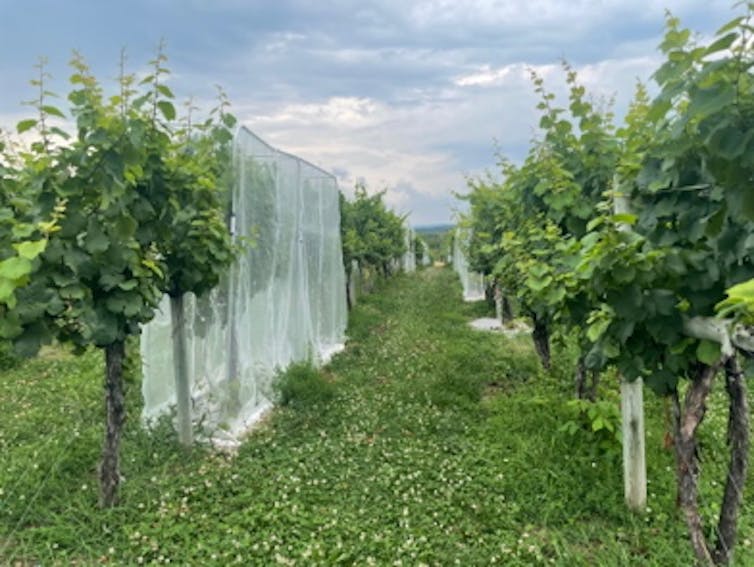
This research group enclosed both red and white grapevines – Cabernet Franc and Chardonnay – in mesh cages in the field and infested them with between 20 and 350 spotted lanternflies per vine. We wanted to determine the effect of constant adult insect feeding on grapevine yield, fruit sugars and phenolics, which are chemical compounds that are important for wine color, flavor and aroma. We also wanted to know the density of infestation that would induce changes in yield and fruit and wine quality.
Researchers infested grapevines with lanternflies to see how they affect yield and fruit quality. Flor E. Acevedo
We found a decrease in sugar content in the fruit within a single season, as well as a decrease in phenolics in red wine. We also found a reduction in yield after the second year of consecutive insect feeding.
These findings suggest that, if not controlled, spotted lanternfly adult feeding could reduce income to growers by reducing yield and could affect the wine industry by reducing the quality of the drink.
How worried are Pennsylvania winemakers and how are they responding?
Perceptions vary depending on whether the winery or vineyard is in an area that has already been infested.
Those that have been dealing with lanternflies for a few years have established protocols for pest monitoring and applying insecticides. But those that haven’t experienced it yet are concerned about the insect’s arrival on their properties.
Owners of organic vineyards are also concerned, but there are few of those in this region.
Wineries are being affected by spotted lanternflies in at least two ways. First, for those that grow grapes, lanternflies have increased their costs due to the extra labor and insecticide applications needed to control them. Second, for wineries that are agrotourism sites, they need to keep outdoor seating spaces neat and free from lanternflies.
As an entomologist, what do you find most fascinating about these creatures?
Most insects that feed on plants lay their eggs close to a food source for the young to feed on when they hatch. But spotted lanternflies lay their eggs on almost anything – car tires, field equipment, rocks, fabrics, old wood, cardboard. This behavior facilitates the insect’s dispersal, as eggs can be easily transported without being noticed. Once the eggs hatch, the nymphs search for young plant shoots or herbaceous plants to eat.
Anything else people in Pennsylvania should know as they see lanternflies again this summer?
I think it’s important for the public to know that, as pretty as some of us may find spotted lanternflies, these insects are invasive, damaging and affecting the state economy. Everybody can help stop the spread of these insects by killing and avoiding transporting them at any living stage.
Spotted lanternflies lay eggs in masses. These masses look like light grayish-brown, mudlike or puttylike patches, typically about an inch long, and they are found on various surfaces. At any life stage the insects can be killed by squishing them, immersing them in hand sanitizer or freezing them for several days.
Flor Acevedo has received funding for her research from the USDA Crop Protection and Pest Management program (2023-70006-40597), the Pennsylvania Department of Agriculture, the Pennsylvania Wine Marketing and Research Board, the New York Wine and Grape Foundation, the Penn State University College of Agriculture, and the John H. and Timothy R. Crouch Endowment Grant for Viticulture, Enology, and Pomology Research.
Iceland’s Minister for Foreign Affairs Ms. Þorgerður Katrín Gunnarsdóttir visited the US submarine USS Newport News in Grundartangi harbour yesterday. The submarine is in Iceland for a regular service visit. This is the not the first time a nuclear-powered US submarine enters Icelandic territorial waters; however, this is the first service visit of such a vessel to an Icelandic port. The USS Newport is a Los Angeles-class vessel with a crew of around 140 personnel and does not carry nuclear weapons.
“This is an important milestone in a long and successful defence partnership with the United States, which has been strengthened significantly in recent years. We have been systematically deepening the partnership based on the Bilateral Defence Agreement from 1951 and common interests in the North Atlantic and the Arctic. We place great emphasis on security and defence and want to ensure our own security and the security of our allies, and we do this, inter alia, by supporting their operations in the region,” says Þorgerður Katrín.
Admiral Stuart B. Munsch, Commander of the U.S. European and African Fleet, and Erin Sawyer, Acting U.S. Ambassador to Iceland, welcomed the Minister for Foreign Affairs upon her arrival at Grundartangi. There, the Minister was given a tour of the submarine, briefed on the crew’s assignments, and met with Admiral Munsch on security developments in the North Atlantic and Arctic. Admiral Munsch also met with the Director General for Defence, Mr. Jónas G. Allansson, visited the Keflavík Air Base, and met with the U.S. forces carrying out Anti-Submarine Warfare missions.
This is the eighth time that a U.S. Navy nuclear-powered submarine makes a service visit in Icelandic territorial waters, since the former Minister for Foreign Affairs announced on April 18, 2023, that such submarines would be permitted to make brief service stops in Iceland.
The Ministry of Foreign Affairs is responsible for the visit, but the Icelandic Coast Guard is leading its implementation in close collaboration with the National Commissioner of Police, the Icelandic Radiation Safety Agency and the Directorate of Health in accordance with established procedures. The visits have all been successful due to close cooperation and consultation between the relevant domestic institutions and good cooperation with the U.S. Navy and the U.S. Embassy in Iceland.
Iceland’s Minister for Foreign Affairs Ms. Þorgerður Katrín Gunnarsdóttir visited the US submarine USS Newport News in Grundartangi harbour yesterday. The submarine is in Iceland for a regular service visit. This is the not the first time a nuclear-powered US submarine enters Icelandic territorial waters; however, this is the first service visit of such a vessel to an Icelandic port. The USS Newport is a Los Angeles-class vessel with a crew of around 140 personnel and does not carry nuclear weapons.
“This is an important milestone in a long and successful defence partnership with the United States, which has been strengthened significantly in recent years. We have been systematically deepening the partnership based on the Bilateral Defence Agreement from 1951 and common interests in the North Atlantic and the Arctic. We place great emphasis on security and defence and want to ensure our own security and the security of our allies, and we do this, inter alia, by supporting their operations in the region,” says Þorgerður Katrín.
Admiral Stuart B. Munsch, Commander of the U.S. European and African Fleet, and Erin Sawyer, Acting U.S. Ambassador to Iceland, welcomed the Minister for Foreign Affairs upon her arrival at Grundartangi. There, the Minister was given a tour of the submarine, briefed on the crew’s assignments, and met with Admiral Munsch on security developments in the North Atlantic and Arctic. Admiral Munsch also met with the Director General for Defence, Mr. Jónas G. Allansson, visited the Keflavík Air Base, and met with the U.S. forces carrying out Anti-Submarine Warfare missions.
This is the eighth time that a U.S. Navy nuclear-powered submarine makes a service visit in Icelandic territorial waters, since the former Minister for Foreign Affairs announced on April 18, 2023, that such submarines would be permitted to make brief service stops in Iceland.
The Ministry of Foreign Affairs is responsible for the visit, but the Icelandic Coast Guard is leading its implementation in close collaboration with the National Commissioner of Police, the Icelandic Radiation Safety Agency and the Directorate of Health in accordance with established procedures. The visits have all been successful due to close cooperation and consultation between the relevant domestic institutions and good cooperation with the U.S. Navy and the U.S. Embassy in Iceland.
Iceland’s Minister for Foreign Affairs Ms. Þorgerður Katrín Gunnarsdóttir visited the US submarine USS Newport News in Grundartangi harbour yesterday. The submarine is in Iceland for a regular service visit. This is the not the first time a nuclear-powered US submarine enters Icelandic territorial waters; however, this is the first service visit of such a vessel to an Icelandic port. The USS Newport is a Los Angeles-class vessel with a crew of around 140 personnel and does not carry nuclear weapons.
“This is an important milestone in a long and successful defence partnership with the United States, which has been strengthened significantly in recent years. We have been systematically deepening the partnership based on the Bilateral Defence Agreement from 1951 and common interests in the North Atlantic and the Arctic. We place great emphasis on security and defence and want to ensure our own security and the security of our allies, and we do this, inter alia, by supporting their operations in the region,” says Þorgerður Katrín.
Admiral Stuart B. Munsch, Commander of the U.S. European and African Fleet, and Erin Sawyer, Acting U.S. Ambassador to Iceland, welcomed the Minister for Foreign Affairs upon her arrival at Grundartangi. There, the Minister was given a tour of the submarine, briefed on the crew’s assignments, and met with Admiral Munsch on security developments in the North Atlantic and Arctic. Admiral Munsch also met with the Director General for Defence, Mr. Jónas G. Allansson, visited the Keflavík Air Base, and met with the U.S. forces carrying out Anti-Submarine Warfare missions.
This is the eighth time that a U.S. Navy nuclear-powered submarine makes a service visit in Icelandic territorial waters, since the former Minister for Foreign Affairs announced on April 18, 2023, that such submarines would be permitted to make brief service stops in Iceland.
The Ministry of Foreign Affairs is responsible for the visit, but the Icelandic Coast Guard is leading its implementation in close collaboration with the National Commissioner of Police, the Icelandic Radiation Safety Agency and the Directorate of Health in accordance with established procedures. The visits have all been successful due to close cooperation and consultation between the relevant domestic institutions and good cooperation with the U.S. Navy and the U.S. Embassy in Iceland.
Iceland’s Minister for Foreign Affairs Ms. Þorgerður Katrín Gunnarsdóttir visited the US submarine USS Newport News in Grundartangi harbour yesterday. The submarine is in Iceland for a regular service visit. This is the not the first time a nuclear-powered US submarine enters Icelandic territorial waters; however, this is the first service visit of such a vessel to an Icelandic port. The USS Newport is a Los Angeles-class vessel with a crew of around 140 personnel and does not carry nuclear weapons.
“This is an important milestone in a long and successful defence partnership with the United States, which has been strengthened significantly in recent years. We have been systematically deepening the partnership based on the Bilateral Defence Agreement from 1951 and common interests in the North Atlantic and the Arctic. We place great emphasis on security and defence and want to ensure our own security and the security of our allies, and we do this, inter alia, by supporting their operations in the region,” says Þorgerður Katrín.
Admiral Stuart B. Munsch, Commander of the U.S. European and African Fleet, and Erin Sawyer, Acting U.S. Ambassador to Iceland, welcomed the Minister for Foreign Affairs upon her arrival at Grundartangi. There, the Minister was given a tour of the submarine, briefed on the crew’s assignments, and met with Admiral Munsch on security developments in the North Atlantic and Arctic. Admiral Munsch also met with the Director General for Defence, Mr. Jónas G. Allansson, visited the Keflavík Air Base, and met with the U.S. forces carrying out Anti-Submarine Warfare missions.
This is the eighth time that a U.S. Navy nuclear-powered submarine makes a service visit in Icelandic territorial waters, since the former Minister for Foreign Affairs announced on April 18, 2023, that such submarines would be permitted to make brief service stops in Iceland.
The Ministry of Foreign Affairs is responsible for the visit, but the Icelandic Coast Guard is leading its implementation in close collaboration with the National Commissioner of Police, the Icelandic Radiation Safety Agency and the Directorate of Health in accordance with established procedures. The visits have all been successful due to close cooperation and consultation between the relevant domestic institutions and good cooperation with the U.S. Navy and the U.S. Embassy in Iceland.
Iceland’s Minister for Foreign Affairs Ms. Þorgerður Katrín Gunnarsdóttir visited the US submarine USS Newport News in Grundartangi harbour yesterday. The submarine is in Iceland for a regular service visit. This is the not the first time a nuclear-powered US submarine enters Icelandic territorial waters; however, this is the first service visit of such a vessel to an Icelandic port. The USS Newport is a Los Angeles-class vessel with a crew of around 140 personnel and does not carry nuclear weapons.
“This is an important milestone in a long and successful defence partnership with the United States, which has been strengthened significantly in recent years. We have been systematically deepening the partnership based on the Bilateral Defence Agreement from 1951 and common interests in the North Atlantic and the Arctic. We place great emphasis on security and defence and want to ensure our own security and the security of our allies, and we do this, inter alia, by supporting their operations in the region,” says Þorgerður Katrín.
Admiral Stuart B. Munsch, Commander of the U.S. European and African Fleet, and Erin Sawyer, Acting U.S. Ambassador to Iceland, welcomed the Minister for Foreign Affairs upon her arrival at Grundartangi. There, the Minister was given a tour of the submarine, briefed on the crew’s assignments, and met with Admiral Munsch on security developments in the North Atlantic and Arctic. Admiral Munsch also met with the Director General for Defence, Mr. Jónas G. Allansson, visited the Keflavík Air Base, and met with the U.S. forces carrying out Anti-Submarine Warfare missions.
This is the eighth time that a U.S. Navy nuclear-powered submarine makes a service visit in Icelandic territorial waters, since the former Minister for Foreign Affairs announced on April 18, 2023, that such submarines would be permitted to make brief service stops in Iceland.
The Ministry of Foreign Affairs is responsible for the visit, but the Icelandic Coast Guard is leading its implementation in close collaboration with the National Commissioner of Police, the Icelandic Radiation Safety Agency and the Directorate of Health in accordance with established procedures. The visits have all been successful due to close cooperation and consultation between the relevant domestic institutions and good cooperation with the U.S. Navy and the U.S. Embassy in Iceland.
Iceland’s Minister for Foreign Affairs Ms. Þorgerður Katrín Gunnarsdóttir visited the US submarine USS Newport News in Grundartangi harbour yesterday. The submarine is in Iceland for a regular service visit. This is the not the first time a nuclear-powered US submarine enters Icelandic territorial waters; however, this is the first service visit of such a vessel to an Icelandic port. The USS Newport is a Los Angeles-class vessel with a crew of around 140 personnel and does not carry nuclear weapons.
“This is an important milestone in a long and successful defence partnership with the United States, which has been strengthened significantly in recent years. We have been systematically deepening the partnership based on the Bilateral Defence Agreement from 1951 and common interests in the North Atlantic and the Arctic. We place great emphasis on security and defence and want to ensure our own security and the security of our allies, and we do this, inter alia, by supporting their operations in the region,” says Þorgerður Katrín.
Admiral Stuart B. Munsch, Commander of the U.S. European and African Fleet, and Erin Sawyer, Acting U.S. Ambassador to Iceland, welcomed the Minister for Foreign Affairs upon her arrival at Grundartangi. There, the Minister was given a tour of the submarine, briefed on the crew’s assignments, and met with Admiral Munsch on security developments in the North Atlantic and Arctic. Admiral Munsch also met with the Director General for Defence, Mr. Jónas G. Allansson, visited the Keflavík Air Base, and met with the U.S. forces carrying out Anti-Submarine Warfare missions.
This is the eighth time that a U.S. Navy nuclear-powered submarine makes a service visit in Icelandic territorial waters, since the former Minister for Foreign Affairs announced on April 18, 2023, that such submarines would be permitted to make brief service stops in Iceland.
The Ministry of Foreign Affairs is responsible for the visit, but the Icelandic Coast Guard is leading its implementation in close collaboration with the National Commissioner of Police, the Icelandic Radiation Safety Agency and the Directorate of Health in accordance with established procedures. The visits have all been successful due to close cooperation and consultation between the relevant domestic institutions and good cooperation with the U.S. Navy and the U.S. Embassy in Iceland.
Iceland’s Minister for Foreign Affairs Ms. Þorgerður Katrín Gunnarsdóttir visited the US submarine USS Newport News in Grundartangi harbour yesterday. The submarine is in Iceland for a regular service visit. This is the not the first time a nuclear-powered US submarine enters Icelandic territorial waters; however, this is the first service visit of such a vessel to an Icelandic port. The USS Newport is a Los Angeles-class vessel with a crew of around 140 personnel and does not carry nuclear weapons.
“This is an important milestone in a long and successful defence partnership with the United States, which has been strengthened significantly in recent years. We have been systematically deepening the partnership based on the Bilateral Defence Agreement from 1951 and common interests in the North Atlantic and the Arctic. We place great emphasis on security and defence and want to ensure our own security and the security of our allies, and we do this, inter alia, by supporting their operations in the region,” says Þorgerður Katrín.
Admiral Stuart B. Munsch, Commander of the U.S. European and African Fleet, and Erin Sawyer, Acting U.S. Ambassador to Iceland, welcomed the Minister for Foreign Affairs upon her arrival at Grundartangi. There, the Minister was given a tour of the submarine, briefed on the crew’s assignments, and met with Admiral Munsch on security developments in the North Atlantic and Arctic. Admiral Munsch also met with the Director General for Defence, Mr. Jónas G. Allansson, visited the Keflavík Air Base, and met with the U.S. forces carrying out Anti-Submarine Warfare missions.
This is the eighth time that a U.S. Navy nuclear-powered submarine makes a service visit in Icelandic territorial waters, since the former Minister for Foreign Affairs announced on April 18, 2023, that such submarines would be permitted to make brief service stops in Iceland.
The Ministry of Foreign Affairs is responsible for the visit, but the Icelandic Coast Guard is leading its implementation in close collaboration with the National Commissioner of Police, the Icelandic Radiation Safety Agency and the Directorate of Health in accordance with established procedures. The visits have all been successful due to close cooperation and consultation between the relevant domestic institutions and good cooperation with the U.S. Navy and the U.S. Embassy in Iceland.
Iceland’s Minister for Foreign Affairs Ms. Þorgerður Katrín Gunnarsdóttir visited the US submarine USS Newport News in Grundartangi harbour yesterday. The submarine is in Iceland for a regular service visit. This is the not the first time a nuclear-powered US submarine enters Icelandic territorial waters; however, this is the first service visit of such a vessel to an Icelandic port. The USS Newport is a Los Angeles-class vessel with a crew of around 140 personnel and does not carry nuclear weapons.
“This is an important milestone in a long and successful defence partnership with the United States, which has been strengthened significantly in recent years. We have been systematically deepening the partnership based on the Bilateral Defence Agreement from 1951 and common interests in the North Atlantic and the Arctic. We place great emphasis on security and defence and want to ensure our own security and the security of our allies, and we do this, inter alia, by supporting their operations in the region,” says Þorgerður Katrín.
Admiral Stuart B. Munsch, Commander of the U.S. European and African Fleet, and Erin Sawyer, Acting U.S. Ambassador to Iceland, welcomed the Minister for Foreign Affairs upon her arrival at Grundartangi. There, the Minister was given a tour of the submarine, briefed on the crew’s assignments, and met with Admiral Munsch on security developments in the North Atlantic and Arctic. Admiral Munsch also met with the Director General for Defence, Mr. Jónas G. Allansson, visited the Keflavík Air Base, and met with the U.S. forces carrying out Anti-Submarine Warfare missions.
This is the eighth time that a U.S. Navy nuclear-powered submarine makes a service visit in Icelandic territorial waters, since the former Minister for Foreign Affairs announced on April 18, 2023, that such submarines would be permitted to make brief service stops in Iceland.
The Ministry of Foreign Affairs is responsible for the visit, but the Icelandic Coast Guard is leading its implementation in close collaboration with the National Commissioner of Police, the Icelandic Radiation Safety Agency and the Directorate of Health in accordance with established procedures. The visits have all been successful due to close cooperation and consultation between the relevant domestic institutions and good cooperation with the U.S. Navy and the U.S. Embassy in Iceland.
Iceland’s Minister for Foreign Affairs Ms. Þorgerður Katrín Gunnarsdóttir visited the US submarine USS Newport News in Grundartangi harbour yesterday. The submarine is in Iceland for a regular service visit. This is the not the first time a nuclear-powered US submarine enters Icelandic territorial waters; however, this is the first service visit of such a vessel to an Icelandic port. The USS Newport is a Los Angeles-class vessel with a crew of around 140 personnel and does not carry nuclear weapons.
“This is an important milestone in a long and successful defence partnership with the United States, which has been strengthened significantly in recent years. We have been systematically deepening the partnership based on the Bilateral Defence Agreement from 1951 and common interests in the North Atlantic and the Arctic. We place great emphasis on security and defence and want to ensure our own security and the security of our allies, and we do this, inter alia, by supporting their operations in the region,” says Þorgerður Katrín.
Admiral Stuart B. Munsch, Commander of the U.S. European and African Fleet, and Erin Sawyer, Acting U.S. Ambassador to Iceland, welcomed the Minister for Foreign Affairs upon her arrival at Grundartangi. There, the Minister was given a tour of the submarine, briefed on the crew’s assignments, and met with Admiral Munsch on security developments in the North Atlantic and Arctic. Admiral Munsch also met with the Director General for Defence, Mr. Jónas G. Allansson, visited the Keflavík Air Base, and met with the U.S. forces carrying out Anti-Submarine Warfare missions.
This is the eighth time that a U.S. Navy nuclear-powered submarine makes a service visit in Icelandic territorial waters, since the former Minister for Foreign Affairs announced on April 18, 2023, that such submarines would be permitted to make brief service stops in Iceland.
The Ministry of Foreign Affairs is responsible for the visit, but the Icelandic Coast Guard is leading its implementation in close collaboration with the National Commissioner of Police, the Icelandic Radiation Safety Agency and the Directorate of Health in accordance with established procedures. The visits have all been successful due to close cooperation and consultation between the relevant domestic institutions and good cooperation with the U.S. Navy and the U.S. Embassy in Iceland.
Manaus (Agenzia Fides) – “The mission not only leads to Jesus, but also discovers him already present in every smile, in every stroke of the oar, in every simple gesture of love.” Sérgio Warnes, a novice at the IMC Novitiate in Manaus, recounts the experience shared by a group of Consolata Missionary (IMC) novices, who found themselves, as he himself says, “living one of the most demanding and enriching experiences of our formation: visiting the ‘ribeirinhas’ communities of the Amazon.”“The greatest lesson of this experience was the time shared with the community, with creation, and with God,” he writes. “The generosity of people is something that moves the soul. They offered us the little they had, and that little became much.” Despite the difficulties they face, their faith is alive and dynamic, expressed in fraternity, devotion, and hospitality,” the novice emphasizes.“They are witnesses that poverty is not synonymous with sadness and that spiritual wealth is real and abundant even in the midst of the jungle.”“In this Jubilee Year, we recognize with profound admiration the journey of so many men and women who, even in the midst of the jungle, walk, row, and cross entire rivers just to encounter the mystery of our existence: Jesus in the Eucharist. It is our duty as Christians to bring Jesus to the riverbanks, to the wooden houses, in the middle of the jungle, crossing rivers, enduring the heat, mosquitoes, and humidity,” adds Sérgio. “It is difficult, yes, but it is worth it. So that the Gospel may not remain confined within four walls, but may travel and reach the ends of the earth, to proclaim salvation to humanity.”“Missionary life is itinerant. In this mission, we sleep in one house, drink coffee in another, celebrate in different places, and bathe in the river water. We will return, without a doubt. Because the mission continues. And the river never stops. Where there is a community waiting, Jesus also waits for us.” (AP) (Agenzia Fides, 11/7/2025)
Share:
Vatican City (Agenzia Fides) – The Holy Father has appointed the Reverend Michel Guillaud, of the clergy of Lyon, until now diocesan administrator of the diocese of Constantine, Algeria. as bishop of the same see.Bishop Michel Guillaud was born on 24 June 1961 in Villeurbanne, France. After studying at the University Seminary of Lyon and obtaining a licentiate in theology, he was awarded a licentiate in Islamology from the Pontifical Institute for Arabic and Islamic Studies (PISAI), Rome.He was ordained a priest on 1 July 1990 for the archdiocese of Lyon.He has held the following offices: lecturer in Islamology at the Catholic Faculty of Lyon; chaplain of students of the Catholic University of Lyon; parish priest in Batna (2006-2014), Constantine (2014-2016), Skikda (2016 to the present) and vicar general of the diocese of Constantine (2020-2024); secretary general of the Regional Episcopal Conference of North Africa (CERNA) (2015-2025); and since 2024, diocesan administrator of the diocese of Constantine. (Agenzia Fides, 11/7/2025)
Share:
Vatican City (Agenzia Fides) – The Holy Father has appointed the Reverend Michel Guillaud, of the clergy of Lyon, until now diocesan administrator of the diocese of Constantine, Algeria. as bishop of the same see.Bishop Michel Guillaud was born on 24 June 1961 in Villeurbanne, France. After studying at the University Seminary of Lyon and obtaining a licentiate in theology, he was awarded a licentiate in Islamology from the Pontifical Institute for Arabic and Islamic Studies (PISAI), Rome.He was ordained a priest on 1 July 1990 for the archdiocese of Lyon.He has held the following offices: lecturer in Islamology at the Catholic Faculty of Lyon; chaplain of students of the Catholic University of Lyon; parish priest in Batna (2006-2014), Constantine (2014-2016), Skikda (2016 to the present) and vicar general of the diocese of Constantine (2020-2024); secretary general of the Regional Episcopal Conference of North Africa (CERNA) (2015-2025); and since 2024, diocesan administrator of the diocese of Constantine. (Agenzia Fides, 11/7/2025)
Share:
Vatican City (Agenzia Fides) – The Holy Father has appointed the Reverend Michel Guillaud, of the clergy of Lyon, until now diocesan administrator of the diocese of Constantine, Algeria. as bishop of the same see.Bishop Michel Guillaud was born on 24 June 1961 in Villeurbanne, France. After studying at the University Seminary of Lyon and obtaining a licentiate in theology, he was awarded a licentiate in Islamology from the Pontifical Institute for Arabic and Islamic Studies (PISAI), Rome.He was ordained a priest on 1 July 1990 for the archdiocese of Lyon.He has held the following offices: lecturer in Islamology at the Catholic Faculty of Lyon; chaplain of students of the Catholic University of Lyon; parish priest in Batna (2006-2014), Constantine (2014-2016), Skikda (2016 to the present) and vicar general of the diocese of Constantine (2020-2024); secretary general of the Regional Episcopal Conference of North Africa (CERNA) (2015-2025); and since 2024, diocesan administrator of the diocese of Constantine. (Agenzia Fides, 11/7/2025)
Share:
Myitkyina (Agenzia Fides) – In the face of terrible events such as the bloody civil war and the earthquake that devastated central Myanmar, the three bishops of the Burmese dioceses of Myitkyina, Banmaw, and Lashio (in north-central Myanmar) address the faithful in a joint pastoral letter: “The Lord Jesus told us: ‘Do not let your hearts be troubled. You have faith in God; have faith also in me!’ (John 14:1). And further: ‘Whoever wishes to come after me must deny himself, take up his cross, and follow me (Mt 16:24).” The pastoral letter, sent to Fides, is signed by the three bishops: Msgr. John Mung-ngawn La Sam, M.F., of the diocese of Myitkyina; Msgr. Raymond Sumlut Gam, of the Diocese of Banmaw; and Msgr. Lucas Dau Ze Jeimphaung, SDB, of the Diocese of Lashio, all three often forced to leave their homes and seek refuge elsewhere due to insecurity and fighting in their territories.”Over the past four years,” the bishops lament, “the fighting has led to the destruction of lives, families, farms, and land, as well as the displacement of thousands of people to refugee camps.” People are “worried about their safety and their children’s education.” The wounds of war were aggravated by the powerful earthquake that “once again shook central Myanmar, collapsing houses, and injuring and killing many people.”In this situation of uncertainty and distress, the bishops wish to assist the faithful and write: “No matter how difficult our situation may be, if we pray to God every day with faith and love, we will be able to endure all difficulties and become bearers of the Cross with Jesus Christ, receiving his grace of consolation and encouragement.”In this context, the bishops recall the sufferings and tribulations of many saints who, in their experience, accepted suffering out of love for Christ and lived the spirit described by St. Paul in his Letter to the Corinthians, which the bishops cite and apply today to the Burmese people: “We are afflicted in every way, but not constrained; perplexed, but not driven to despair; persecuted, but not abandoned; struck down, but not destroyed” (2 Cor 4:8-9).The bishops remind the faithful that other peoples of the world are also experiencing the same situation of extreme hardship, which is why they should feel united in this trial: “Many countries in the world are suffering from natural disasters, terrorism, wars, death, illness, and infirmity,” and everyone is called to live this situation in faith and not to lose hope and charity. “Therefore, dear faithful, let us, without becoming discouraged, pray for a lasting peace and implore peace from God with all our heart, mind, and strength,” the three bishops conclude. “Let us pray, encourage, console, and help one another in this Holy Year, which, despite everything, is full of hope.” “May God bless you with physical, mental, and spiritual health and grant you His grace and the strength of the Holy Spirit.” (PA) (Agenzia Fides, 11/7/2025)
Share:
Myitkyina (Agenzia Fides) – In the face of terrible events such as the bloody civil war and the earthquake that devastated central Myanmar, the three bishops of the Burmese dioceses of Myitkyina, Banmaw, and Lashio (in north-central Myanmar) address the faithful in a joint pastoral letter: “The Lord Jesus told us: ‘Do not let your hearts be troubled. You have faith in God; have faith also in me!’ (John 14:1). And further: ‘Whoever wishes to come after me must deny himself, take up his cross, and follow me (Mt 16:24).” The pastoral letter, sent to Fides, is signed by the three bishops: Msgr. John Mung-ngawn La Sam, M.F., of the diocese of Myitkyina; Msgr. Raymond Sumlut Gam, of the Diocese of Banmaw; and Msgr. Lucas Dau Ze Jeimphaung, SDB, of the Diocese of Lashio, all three often forced to leave their homes and seek refuge elsewhere due to insecurity and fighting in their territories.”Over the past four years,” the bishops lament, “the fighting has led to the destruction of lives, families, farms, and land, as well as the displacement of thousands of people to refugee camps.” People are “worried about their safety and their children’s education.” The wounds of war were aggravated by the powerful earthquake that “once again shook central Myanmar, collapsing houses, and injuring and killing many people.”In this situation of uncertainty and distress, the bishops wish to assist the faithful and write: “No matter how difficult our situation may be, if we pray to God every day with faith and love, we will be able to endure all difficulties and become bearers of the Cross with Jesus Christ, receiving his grace of consolation and encouragement.”In this context, the bishops recall the sufferings and tribulations of many saints who, in their experience, accepted suffering out of love for Christ and lived the spirit described by St. Paul in his Letter to the Corinthians, which the bishops cite and apply today to the Burmese people: “We are afflicted in every way, but not constrained; perplexed, but not driven to despair; persecuted, but not abandoned; struck down, but not destroyed” (2 Cor 4:8-9).The bishops remind the faithful that other peoples of the world are also experiencing the same situation of extreme hardship, which is why they should feel united in this trial: “Many countries in the world are suffering from natural disasters, terrorism, wars, death, illness, and infirmity,” and everyone is called to live this situation in faith and not to lose hope and charity. “Therefore, dear faithful, let us, without becoming discouraged, pray for a lasting peace and implore peace from God with all our heart, mind, and strength,” the three bishops conclude. “Let us pray, encourage, console, and help one another in this Holy Year, which, despite everything, is full of hope.” “May God bless you with physical, mental, and spiritual health and grant you His grace and the strength of the Holy Spirit.” (PA) (Agenzia Fides, 11/7/2025)
Share:
A city letting agent has received a significant fine for failing to meet health and safety standards and endangering vulnerable tenants.
Steadwall Properties Limited of Normanton Road was fined £14,000 after pleading guilty to renting out accommodation deemed unsafe by Derby City Council.
The property on Osmaston Road, located above a pharmacy, had been made the subject of a Prohibition Order in August 2023.
This was in response to an inspection by the Council’s Environmental Health team, which uncovered significant safety hazards, including a compromised flat roof, and risks of structural collapse.
The property had been converted into two flats, but the building work had not been certified. Tenants living there at the time were rehoused by Derby Homes.
The Prohibition Order, issued under the Housing Act 2004, meant no one could live there until work had been done to make the flats safe.
A routine check of the properties in August 2024 and a subsequent criminal investigation found that the flats had been rented out to new tenants in contravention of the Prohibition Order, and that serious safety hazards remained in the property. The letting agents had been receiving rent payments for eight months.
At Southern Derbyshire Magistrates’ Court on 7 July 2025, Steadwall Properties Limited of Normanton Road Derby pleaded guilty to the offence of knowingly permitting occupation of a prohibited property contrary to section 32 of The Housing Act 2004,
The company was fined £21,000, reduced to £14,000 because of an early guilty plea, and ordered to pay £1750 costs.
In summing up the case, the Magistrates commented that Steadwall Properties had recklessly permitted occupation and placed vulnerable tenants at risk of considerable harm.
Councillor Shiraz Khan, Cabinet Member for Housing, Strategic Planning and Regulatory Services said:
We’re committed to ensuring everyone in Derby has a safe place to call home.
While most private landlords are responsible and provide good quality housing, our dedicated team works tirelessly to identify and pursue those, whether they are landlords or letting agents, who disregard the health and safety of their tenants.
We simply won’t tolerate substandard accommodation and will continue to use every tool at our disposal – from prosecution to civil penalty notices and rent repayment orders – to hold them accountable.
I would encourage anyone with concerns about their rented property or their landlord to report this to our team.
Source: Government of the Russian Federation – Government of the Russian Federation –
An important disclaimer is at the bottom of this article.
“Russia continues to demonstrate growth in popularity among foreign tourists, which is due to the creation of tourism infrastructure and the introduction of simplified entry mechanisms,” said Deputy Prime Minister Dmitry Chernyshenko, commenting on the bill adopted by the State Duma, expanding the possibilities of a single electronic visa for entry into Russia.
According to the document, the visa validity period has been increased from 60 to 120 days from the date of issue, and the permitted period of stay for foreign citizens in the country has increased from 16 to 30 days.
The Deputy Prime Minister noted that extending the validity of the electronic visa and increasing the permitted period of stay in Russia is an important step towards foreign tourists.
“Our country is becoming increasingly popular with guests from abroad. Last year, the country was visited by more than 5 million foreign tourists, which is 30% more than the previous year. We see that foreign guests are increasingly using simplified entry mechanisms – applying for electronic visas. Over the first five months of 2025, more than 230 thousand foreign tourists entered the country using it, and in total, 940 thousand people used it during the period of operation of the mechanism. The new measures will make Russia even more accessible to international travelers and strengthen the country’s position in the global tourism market,” Dmitry Chernyshenko emphasized.
Maxim Reshetnikov, Minister of Economic Development, added: “The Ministry of Economic Development is systematically working to increase the attractiveness of Russia for foreign tourists. An electronic visa is one of the important mechanisms for simplified entry for tourists. The next step, which is currently being considered, is the possibility of its multiple use.”
Let us recall that the platform for issuing unified electronic visas was launched on August 1, 2023 for citizens of 64 countries.
Please note: This information is raw content obtained directly from the source of the information. It is an accurate report of what the source claims and does not necessarily reflect the position of MIL-OSI or its clients.
Source: Government of the Russian Federation – Government of the Russian Federation –
An important disclaimer is at the bottom of this article.
On July 11, 2025, the magazine will turn 30 years old.
Dear friends!
Congratulations on your 30th birthday.
In 1995, the first issue of your publication was published, which covered the formation of a market economy, technology, and key trends in business.
All these years, Expert has always been at the center of news, helping to navigate the information flow, forming a discussion, responding to events and changes in the economy, finance, industry, science, giving them a competent assessment. The magazine is distinguished by its original author’s style, presents the opinions of the expert community. It is important that you master new formats, use various genres, maintain high quality standards. This has allowed you not only to win the respect of professionals, but also to attract the interest of readers who find interesting and useful materials on the pages.
Thanks to a unique team of journalists, editors, reviewers, talented people who are passionate about their work, Expert continues to be one of the most sought-after specialized publications.
I wish you new successes, creative successes, well-being and prosperity.
M. Mishustin
Please note: This information is raw content obtained directly from the source of the information. It is an accurate report of what the source claims and does not necessarily reflect the position of MIL-OSI or its clients.
“Managers or upper management have looked down upon taking time off.”
“People think that maybe you’re not as invested in the job, that you’re shirking your duties or something.”
These are just a few of the responses to questions I asked during a study I conducted on vacation guilt among American workers.
More than 88% of full-time, private sector workers in the U.S. receive paid time off. This benefit is ostensibly in place to improve employee morale and well-being.
Yet a 2024 Pew Research Center survey found that nearly half of American workers don’t take all the vacation days they’ve been allotted. And many of them feel as if they’re discouraged from using their time off. Ironically, what’s supposed to be a source of relaxation and restoration morphs into a stressor: As vacations approach, feelings of doubt and guilt creep in.
I’m from Singapore. Upon moving to the U.S. in 2016, I was surprised at how pervasive vacation guilt appeared to be.
Compared with many of the other countries where I’ve lived or worked, American culture seems to prioritize mental healthand wellness. I assumed these attitudes extended to the American workplace.
Surprisingly, though, I noticed that many of my American friends felt guilty about taking time off that they’d earned. So as a scholar of tourism and hospitality, I wanted to understand how and why this happened.
Vacation guilt
To carry out the study, I collaborated with tourism scholar Robert Li. We interviewed 15 workers who had experienced feelings of guilt over taking time off. We also administered an online survey to 860 full-time employees who received paid time off from their employers.
We wanted to know whether employees felt less respected or believed that their bosses and colleagues saw them in a worse light for taking time off. Maybe they feared being seen as slackers or, worse, replaceable.
We found that 1 in 5 respondents to our survey experienced vacation guilt, and these concerns made them think twice about following through with their vacation plans. For those who eventually did take a vacation, they often tried to ease their guilt by going for fewer days. They might also apologize for taking a vacation or avoid talking about their vacation plans at work.
Some of the people we interviewed had pushed through their hesitation and taken their vacation as planned. Yet all of these employees believed that they’d been penalized for taking time off and that it led to poor performance reviews, despite the fact that their paid vacation days had been a clearly articulated, earned benefit.
Meanwhile, the law in other advanced economies entitles employees to a minimum amount of annual paid leave. The EU, for example, mandates at least 20 days per year on top of paid public holidays, such as Christmas and New Year’s Day, with a number of EU member countries requiring more than 20 days of paid vacation for full-time employees. Even in Japan, which is notorious for its workaholic culture, employees are entitled to a minimum of 10 days of paid leave every year.
Throughout much of the U.S., whether paid vacation time is offered at all depends on an employer’s generosity, while many employees face a “use-it-or-lose-it” situation, meaning unused vacation days don’t roll over from one year to the next.
For paid time off to serve its purpose, I think employers need to provide more than vacation days. They also need to have a supportive culture that readily encourages employees to use this benefit without having to worry about repercussions.
The journal publication on which this article was based was supported by the inaugural Seed Funding Forum, Fox
School of Business, Temple University, USA.
Demonstrators march outside the U.S. Capitol during the Poor People’s Campaign rally at the National Mall in Washington on June 23, 2018. AP Photo/Jose Luis Magana
America has never been richer. But the gains are so lopsided that the top 10% controls 69% of all wealth in the country, while the bottom half controls just 3%. Meanwhile, surging corporate profits have mostly benefited investors, not the broader public.
This divide is expected to widen after President Donald Trump’s sweeping new spending bill drastically cuts Medicaid and food aid, programs that stabilize the economy and subsidize low-wage employers.
Moreover, the tax cuts at the heart of the bill will deliver tens of billions of dollars in benefits to the wealthiest households while disproportionately burdeninglow-income households, according to analyses by the nonpartisan Congressional Budget Office and Joint Committee on Taxation. By 2033, the bottom 20% will pay more in taxes while the top 0.1% receive $43 billion in cuts.
I am a sociologist who studies economic inequality, and my research demonstrates that the class-based inequalities exacerbated by the Trump bill are not new. Rather, they are part of a 50-year trend linked to social cleavages, political corruption and a declining belief in the common good.
The roots of class-based inequality
The decades following World War II were broadly prosperous, but conditions began changing in the 1970s. Class inequality has increased enormously since then, according to government data, while income inequality has risen for five decades at the expense of workers.
Economists usually gauge a country’s economic health by looking at its gross domestic product as measured through total spending on everything from groceries to patents.
But another way to view GDP is by looking at whether the money goes to workers or business owners. This second method – the income approach – offers a clearer picture of who really benefits from economic growth.
The money that goes to labor’s share of GDP, or workers, is represented by employee compensation, including wages, salaries and benefits. The money left over for businesses after paying for work and materials is called gross operating surplus, or business surplus.
The share of GDP going to workers rose 12% from 1947 to 1970, then fell 14% between 1970 and 2023. The opposite happened with the business surplus, falling 18% in the early postwar decades before jumping 34% from 1970 to today.
Meanwhile, corporate profits have outpaced economic growth by 193% since 1970. Within profits, shareholder dividends as a share of GDP grew 274%.
As of 2023, labor had lost all of the economic gains made since 1947. Had workers kept their 1970 share of GDP, they would have earned $1.7 trillion more in 2023 alone. And no legislation or federal action since 1970 has reversed this half-century trend.
When more of the economy goes to businesses instead of workers, that poses serious social problems. My research focuses on three that threaten democracy.
1. Fraying social bonds and livelihoods
Not just an issue of income and assets, growing class inequality represents the fraying of American society.
For instance, inequality and the resulting hardship are linked to worse health outcomes. Americans die younger than their peers in other rich countries, and U.S. life expectancy has decreased, especially among the poor.
Inequality can disrupt families. Kids who experience the stresses of poverty can develop neurological and emotional problems, putting them at risk for drug use as adults. On the other hand, when minimum wages increase and people begin saving wealth, divorce risk falls.
Research shows inequality has many other negative consequences, from reduced social mobility to lower social trust and even higher homicide rates.
Together, these broad social consequences are linked to misery, political discontent and normlessness.
2. Increasing corruption in politics
Inequality is rising in the U.S. largely because business elites are exercising more influence over policy outcomes, research shows. My related work on privatization explains how 50 years of outsourcing public functions – through contracting, disinvestment and job cuts – threatens democratic accountability.
Research across different countries has repeatedly found that higher income inequality increasespolitical corruption. It does so by undermining trust in government and institutions, and enabling elites to dominate policymaking while weakening public oversight.
Since 2010, weakened campaign finance laws driven by monied interests have sharply increased corruption risks. The Supreme Court ruled then in Citizens United to lift campaign finance restrictions, enabling unlimited political spending. It reached an apex in 2024, when Elon Musk spent $200 million to elect Trump before later installing his Starlink equipment onto Federal Aviation Administration systems in a reported takeover of a $2.4 billion contract with Verizon.
Research shows that a large majority of Americans believe that the economy is rigged, suggesting everyday people sense the link between inequality and corruption.
Demonstrators gather outside the Supreme Court in Washington as the court heard arguments on campaign finance in 2013. AP Photo/Susan Walsh
3. Undermining belief in the common good
National aspirations have emphasized the common good since America’s founding. The Declaration of Independence lists the king’s first offense as undermining the “public good” by subverting the rule of law. The Constitution’s preamble commits the government to promoting the general welfare and shared well-being.
This tends to coincide with a drop in voting and other forms of civic engagement.
The government has fewer mechanisms for protecting community when rising inequality is paired with lower taxes for the wealthy and reduced public resources. My research finds that public sector unions especially bolster civic engagement in this environment.
Given increasing workplace and social isolation, America’s loneliness epidemic is unsurprising, especially for low earners.
All of these factors and their contribution to alienation can foster authoritarian beliefs and individualism. When people become cold and distrustful of one another, the notion of the common good collapses.
Inequality as a policy outcome
News coverage of the Trump bill and policy debate have largely centered on immediate gains and losses. But zoomed out, a clearer picture emerges of the long-term dismantling of foundations that once supported broad economic security. That, in turn, has enabled democratic decline.
Republicans hold both chambers of Congress through 2026, making significant policy changes unlikely in the short term. Democrats opposed the bill but are out of power. And their coalition is divided between a centrist establishment and an insurgent progressive wing with diverging priorities in addressing inequality.
Yet democratic decline and inequality are not inevitable. If restoring broad prosperity and social stability are the goals, they may require revisiting the New Deal-style policies that produced labor’s peak economic share of 59% of GDP in 1970.
Nathan Meyers does not work for, consult, own shares in or receive funding from any company or organization that would benefit from this article, and has disclosed no relevant affiliations beyond their academic appointment.
Spotted lanternfly season is back in Pennsylvania. The polka-dotted, gray-and-red-winged adult insects make their appearance each July and tend to hang around until December. It’s an unwelcome summer ritual that started in 2014 when the invasive pests were first detected in the U.S.
The Conversation U.S. talked to Flor Acevedo, an assistant professor of entomology at Penn State University, about the bugs and her research on how lanternflies are threatening the state’s vineyards and wine industry.
Does Pennsylvania have many vineyards?
Pennsylvania has more than 400 wineries with about 14,000 acres planted in vineyards, according to the Pennsylvania Wine Association. The industry generates about US$7 billion in total economic activity. Erie County, where I live, has about 70% of Pennsylvania’s vineyard acreage, with the rest scattered across the state.
What do lanternflies do to grapevines?
The spotted lanternfly feeds on many plants, but its preferred hosts are the Tree of Heaven, an invasive plant introduced to Philadelphia from China in 1784, and grapevines.
Entomologist Flor Acevedo counts spotted lanternflies on a Tree of Heaven plant. Flor E. Acevedo
Extensive feeding by these sap-sucking insects can weaken grapevines and, when combined with other stressors such as diseases or frosty winters, can kill the vines. While spotted lanternflies feed on other important crops such as apple trees, they have been lethal only to grapevines and Tree of Heaven plants.
My lab initially investigated whether spotted lanternflies could survive to adulthood and reproduce when feeding exclusively on grapevines. This would help us determine whether the insects could thrive in regions with extensive grapevine cultivation.
We found they do survive, but their fitness is severely reduced. Insects feeding solely on grapevines had high mortality, slower development and laid fewer eggs when compared with those that had access to a mixed diet of Tree of Heaven and grapevines.
Our next question was whether different grapes would be equally suitable for spotted lanternfly survival and reproduction. In the U.S. we grow native grapevines such as Concord and muscadine as well as vines of European origin. We found that spotted lanternflies did not survive to adulthood when they fed only on muscadine grapevines.
This research group enclosed both red and white grapevines – Cabernet Franc and Chardonnay – in mesh cages in the field and infested them with between 20 and 350 spotted lanternflies per vine. We wanted to determine the effect of constant adult insect feeding on grapevine yield, fruit sugars and phenolics, which are chemical compounds that are important for wine color, flavor and aroma. We also wanted to know the density of infestation that would induce changes in yield and fruit and wine quality.
Researchers infested grapevines with lanternflies to see how they affect yield and fruit quality. Flor E. Acevedo
We found a decrease in sugar content in the fruit within a single season, as well as a decrease in phenolics in red wine. We also found a reduction in yield after the second year of consecutive insect feeding.
These findings suggest that, if not controlled, spotted lanternfly adult feeding could reduce income to growers by reducing yield and could affect the wine industry by reducing the quality of the drink.
How worried are Pennsylvania winemakers and how are they responding?
Perceptions vary depending on whether the winery or vineyard is in an area that has already been infested.
Those that have been dealing with lanternflies for a few years have established protocols for pest monitoring and applying insecticides. But those that haven’t experienced it yet are concerned about the insect’s arrival on their properties.
Owners of organic vineyards are also concerned, but there are few of those in this region.
Wineries are being affected by spotted lanternflies in at least two ways. First, for those that grow grapes, lanternflies have increased their costs due to the extra labor and insecticide applications needed to control them. Second, for wineries that are agrotourism sites, they need to keep outdoor seating spaces neat and free from lanternflies.
As an entomologist, what do you find most fascinating about these creatures?
Most insects that feed on plants lay their eggs close to a food source for the young to feed on when they hatch. But spotted lanternflies lay their eggs on almost anything – car tires, field equipment, rocks, fabrics, old wood, cardboard. This behavior facilitates the insect’s dispersal, as eggs can be easily transported without being noticed. Once the eggs hatch, the nymphs search for young plant shoots or herbaceous plants to eat.
Anything else people in Pennsylvania should know as they see lanternflies again this summer?
I think it’s important for the public to know that, as pretty as some of us may find spotted lanternflies, these insects are invasive, damaging and affecting the state economy. Everybody can help stop the spread of these insects by killing and avoiding transporting them at any living stage.
Spotted lanternflies lay eggs in masses. These masses look like light grayish-brown, mudlike or puttylike patches, typically about an inch long, and they are found on various surfaces. At any life stage the insects can be killed by squishing them, immersing them in hand sanitizer or freezing them for several days.
Flor Acevedo has received funding for her research from the USDA Crop Protection and Pest Management program (2023-70006-40597), the Pennsylvania Department of Agriculture, the Pennsylvania Wine Marketing and Research Board, the New York Wine and Grape Foundation, the Penn State University College of Agriculture, and the John H. and Timothy R. Crouch Endowment Grant for Viticulture, Enology, and Pomology Research.
The SWIFT constellation, shown not to scale in this illustration, will fly farther than its predecessors to improve space weather warning time. Steve Alvey
The burgeoning space industry and the technologies society increasingly relies on – electric grids, aviation and telecommunications – are all vulnerable to the same threat: space weather.
These ejections are bundles of magnetic fields and particles that originate from the Sun. They can travel at speeds up to 1,242 miles per second (2,000 kilometers per second) and may cause geomagnetic storms.
They create beautiful aurora displays – like the northern lights you can sometimes see in the skies – but can also disrupt satellite operations, shut down the electric grid and expose astronauts aboard future crewed missions to the Moon and Mars to lethal doses of radiation.
An animation shows coronal mass ejection erupting from the Sun.
Space is also a critical domain for military operations. Satellites provide essential capabilities for military communication, surveillance, navigation and intelligence.
As countries such as the U.S. grow to depend on infrastructure in space, extreme space weather events pose a greater threat. Today, space weather threatens up to US$2.7 trillion in assets globally.
In September 1859, the most powerful recorded space weather event, known as the Carrington event, caused fires in North America and Europe by supercharging telegraph lines. In August 1972, another Carrington-like event nearly struck the astronauts orbiting the Moon. The radiation dose could have been fatal. More recently, in February 2022, SpaceX lost 39 of its 49 newly launched Starlink satellites because of a moderate space weather event.
Today’s space weather monitors
Space weather services heavily rely on satellites that monitor the solar wind, which is made up of magnetic field lines and particles coming from the Sun, and communicate their observations back to Earth. Scientists can then compare those observations with historical records to predict space weather and explore how the Earth may respond to the observed changes in the solar wind.
Earth’s magnetic field naturally protects living things and Earth-orbiting satellites from most adverse effects of space weather. However, extreme space weather events may compress – or in some cases, peel back – the Earth’s magnetic shield.
This process allows solar wind particles to make it into our protected environment – the magnetosphere – exposing satellites and astronauts onboard space stations to harsh conditions.
At these distances, the satellites remain within Earth’s protective magnetic shield and can reliably measure the planet’s response to space weather conditions. However, to more directly study incoming solar wind, researchers use additional satellites located farther upstream – hundreds of thousands of miles from Earth.
The U.S., the European Space Agency and India all operate space weather monitoring satellites positioned around the L1 Lagrange point – nearly 900,000 miles (1,450,000 km) from Earth – where the gravitational forces of the Sun and Earth balance. From this vantage point, space weather monitors can provide up to 40 minutes of advance warning for incoming solar events.
The Lagrange points are equilibrium points for smaller objects, like the Earth, that orbit around a larger object, like the Sun. The L1 point is between the Earth and the Sun, where the gravitational pulls of the two objects balance out. Since the Sun’s pull is so much stronger than the Earth’s, the point is much closer to Earth. Xander89/Wikimedia Commons, CC BY-SA
Advance warning for space weather
Increasing the warning time beyond 40 minutes – the current warning time – would help satellite operators, electric grid planners, flight directors, astronauts and Space Force officers better prepare for extreme space weather events.
For instance, during geomagnetic storms, the atmosphere heats up and expands, increasing drag on satellites in low Earth orbit. With enough advance warning, operators can update their drag calculations to prevent satellites from descending and burning up during these events. With the updated drag calculations, satellite operators could use the satellites’ propulsion systems to maneuver them higher up in orbit.
Airlines could change their routes to avoid exposing passengers and staff to high radiation doses during geomagnetic storms. And future astronauts on the way to or working on the Moon or Mars, which lack protection from these particles, could be alerted in advance to take cover.
Aurora lovers would also appreciate having more time to get to their favorite viewing destinations.
The Space Weather Investigation Frontier
My team and I have been developing a new space weather satellite constellation, named the Space Weather Investigation Frontier. SWIFT will, for the first time, place a space weather monitor beyond the L1 point, at 1.3 million miles (2.1 million kilometers) from Earth. This distance would allow scientists to inform decision-makers of any Earth-bound space weather events up to nearly 60 minutes before arrival.
Satellites with traditional chemical and electric propulsion systems cannot maintain an orbit at that location – farther from Earth and closer to the Sun – for long. This is because they would need to continuously burn fuel to counteract the Sun’s gravitational pull.
To address this issue, our team has spent decades designing and developing a new propulsion system. Our solution is designed to affordably reach a distance that is closer to the Sun than the traditional L1 point, and to operate there reliably for more than a decade by harnessing an abundant and reliable resource – sunlight.
SWIFT would use a fuelless propulsion system called a solar sail to reach its orbit. A solar sail is a hair-thin reflective surface – simulating a very thin mirror – that spans about a third of a football field. It balances the force of light particles coming from the Sun, which pushes it away, with the Sun’s gravity, which pulls it inward.
While a sailboat harnesses the lift created by wind flowing over its curved sails to move across water, a solar sail uses the momentum of photons from sunlight, reflected off its large, shiny sail, to propel a spacecraft through space. Both the sailboat and solar sail exploit the transfer of energy from their respective environments to drive motion without relying on traditional propellants.
A solar sail could enable SWIFT to enter an otherwise unstable sub-L1 orbit without the risk of running out of fuel.
NASA successfully launched its first solar sail in 2010. This in-space demonstration, named NanoSail-D2, featured a 107-square-foot (10 m2 ) sail and was placed in low Earth orbit. That same year, the Japanese Space Agency launched a larger solar sail mission, IKAROS, which deployed a 2,110 ft2 (196 m2 ) sail in the solar wind and successfully orbited Venus.
An illustration of the solar sail used on the IKAROS space probe. These sails use light particles as propulsion. Andrzej Mirecki, CC BY-SA
The Planetary Society and NASA followed up by launching two sails in low Earth orbit: LightSail, with an area of 344 ft2 (32 m2 ), and the advanced composite solar sail system, with an area of 860 ft2 (80 m2 ).
The SWIFT team’s solar sail demonstration mission, Solar Cruiser, will be equipped with a much larger sail – it will have area of 17,793 ft2 (1,653 m2 ) and launch as early as 2029. We successfully deployed a quadrant of the sail on Earth early last year.
If successful, the Solar Cruiser mission will pave the way for a small satellite constellation that will monitor the solar wind.
To transport it to space, the team will meticulously fold and tightly pack the sail inside a small canister. The biggest challenge to overcome will be deploying the sail once in space and using it to guide the satellite along its orbital path.
If successful, Solar Cruiser will pave the way for SWIFT’s constellation of four satellites. The constellation would include one satellite equipped with sail propulsion, set to be placed in an orbit beyond L1, and three smaller satellites with chemical propulsion in orbit at the L1 Lagrange point.
The satellites will be indefinitely parked at and beyond L1, collecting data in the solar wind without interruption. Each of the four satellites can observe the solar wind from different locations, helping scientists better predict how it may evolve before reaching Earth.
As modern life depends more on space infrastructure, continuing to invest in space weather prediction can protect both space- and ground-based technologies.
Mojtaba Akhavan-Tafti receives funding from NASA. He is the Principal Investigator of Space Weather Investigation Frontier (SWIFT).
lign=”center”>The Strength Of A Nation Lies In The Originality Of Its Thought And The Timelessness Of Its Values, urges VP India Is A Civilizational Continuum—A Flowing River Of Consciousness, Inquiry, And Learning, says VP Indigenous Insights Were Dismissed As Relics Of The Primitive Past; Selective Remembrance Continued Even After Independence, Highlights VP Western Constructs Were Paraded As Universal Truths. There Was An Architecture Of Erasure And Decimation, says VP Colonization Produced Clerks And Yeomen Instead of Thinkers; Grades Replaced Critical Thinking, highlights VP A Genuine Indian Knowledge System Ecosystem Must Honour Both Text And Lived Experience, Emphasises VP Vice-President Addresses The Inaugural Annual Conference On The Indian Knowledge System (IKS) In New Delhi
The Vice-President of India, Shri Jagdeep Dhankhar, today said, “India’s rise as a global power must be accompanied by the rise of its intellectual and cultural gravitas. This is very significant as the rise without this is not lasting, and the rise without this is not in harmony with our traditions. The strength of a nation lies in the originality of its thought, the timelessness of its values, and the resilience of its intellectual traditions. That is the kind of soft power that endures, and soft power is potent in the world we live in”, he said.
Reaffirming India’s identity beyond the confines of post-colonial constructs, the Vice-President observed, “India is not just a political construct formed in the mid-20th century. It is a civilizational continuum—a flowing river of consciousness, inquiry, and learning that has endured.”
Critiquing the historical sidelining of indigenous wisdom, he said, “While indigenous insights were dismissed as relics of the primitive past, it was not an error of interpretation. It was an architecture of erasure, destruction, and decimation. What is more tragic is that the selective remembrance continued even after independence. Western constructs were paraded as universal truths. To put it more bluntly, untruth was camouflaged as truth.”
“What should have been our fundamental priority was not even on the radar. How can you not be cognizant of your core values?” he questioned.
Reflecting on the historical ruptures in India’s intellectual journey, the Vice-President remarked, “The Islamic invasion of India caused the first interlude in the glorious journey of Bharatiya Vidya Parampara (भारतीय विद्या परंपरा). Instead of embrace and assimilation, there was contempt and destruction. The British colonization brought forth the second interlude, when the Indian Knowledge System was stunted, stymied, and subverted. Centers of learning changed their motives. The compass was moderated. The North Star was changed. From bearing Sages and Savants, it started producing clerks and yeomen. The needs of the East India Company to have brown babus replaced the need of the nation to have thinkers.”
“We stopped thinking, contemplating, writing, and philosophizing. We started cramming, regurgitating, and swallowing. Grades, unfortunately, replaced critical thinking. The great Bharatiya Vidya Parampara (भारतीय विद्या परंपरा) and its allied institutions were systematically drained, destroyed, and decimated.”, he mentioned.
Addressing the inaugural Annual Conference on the Indian Knowledge Systems (IKS) in New Delhi as the Chief Guest today, Shri Dhankhar said, “Long before the Universities of Europe came into being, Bharat’s universities had already established themselves as thriving centers of learning. Our ancient land was home to luminous centres of intellectual life—Takshashila, Nalanda, Vikramashila, Vallabhi, and Odantapuri. These were the towering citadels of knowledge. Their libraries were vast oceans of wisdom, housing tens of thousands of manuscripts.”
He added, “These were global universities, where seekers came from lands near and far, such as Korea, China, Tibet, and Persia. These were the spaces where the intellect of the world embraced the spirit of Bharat.”
Calling for a more holistic understanding of knowledge, the Vice-President said, “Knowledge resides beyond manuscripts. It lives in communities, in embodied practices, in the intergenerational transmission of wisdom.”
He emphasised that, “A genuine Indian Knowledge Systems research ecosystem must honour both the written word and the lived experience—recognizing that insight emerges as much from context as it does from text.”
Calling for focused action to strengthen Indian Knowledge Systems, the Vice-President remarked, “Let us therefore turn our attention to tangible action because that is the need of the hour. The creation of digitized repositories of classical Indian texts is an urgent priority covering all classical languages such as Sanskrit, Tamil, Pali, and Prakrit, to name just a few.”
He added, “These repositories should be made widely accessible, enabling scholars in India and researchers around the world to engage meaningfully with these sources. Equally essential is the development of training programs that empower young scholars with robust methodological tools, blending philosophy, computational analysis, ethnography, and comparative inquiry to deepen their engagement with the Indian knowledge system.”
Quoting renowned scholar Max Müller, the Vice-President said, “If I were asked under what sky the human mind has most fully developed some of its choicest gifts, has most deeply pondered on the greatest problems of life, and has found solutions of some of them which well deserve the attention even of those who have studied Plato and Kant—I should point to India.”
“Friends, it was nothing but the articulation of eternal truth,” the Vice-President said.
Touching upon the dynamic relationship between tradition and innovation, the Vice-President stated, “The wisdom of the past does not obstruct innovation—rather it inspires it. The metaphysical can speak to the material. Spiritual insight can coexist with scientific precision, but then you have to know what spiritual insight is.”
He continued, “The Rigveda’s hymns to the cosmos can find new relevance in the age of astrophysics. The Charaka Samhita can be read alongside global debates on public health ethics.”
“As we navigate a fractured world, we are stunned by global conflagration. So we are faced with a fractured world. Knowledge systems that have long reflected on the interplay between mind and matter, the individual and the cosmos, duty and consequence, become relevant and vital to shaping thoughtful, enduring responses.”, he concluded.
Shri Sarbananda Sonowal, Minister of Ports, Shipping and Waterways, Govt. of India, Prof. Santishree Dhulipudi Pandit, Vice Chancellor, Jawaharlal Nehru University, Prof. M. S. Chaitra, Director- IKSHA, Akhil Bharatiye Toli Sadasya, Prajna Pravah, and other dignitaries were also present on the occasion.
lign=”center”>The Strength Of A Nation Lies In The Originality Of Its Thought And The Timelessness Of Its Values, urges VP India Is A Civilizational Continuum—A Flowing River Of Consciousness, Inquiry, And Learning, says VP Indigenous Insights Were Dismissed As Relics Of The Primitive Past; Selective Remembrance Continued Even After Independence, Highlights VP Western Constructs Were Paraded As Universal Truths. There Was An Architecture Of Erasure And Decimation, says VP Colonization Produced Clerks And Yeomen Instead of Thinkers; Grades Replaced Critical Thinking, highlights VP A Genuine Indian Knowledge System Ecosystem Must Honour Both Text And Lived Experience, Emphasises VP Vice-President Addresses The Inaugural Annual Conference On The Indian Knowledge System (IKS) In New Delhi
The Vice-President of India, Shri Jagdeep Dhankhar, today said, “India’s rise as a global power must be accompanied by the rise of its intellectual and cultural gravitas. This is very significant as the rise without this is not lasting, and the rise without this is not in harmony with our traditions. The strength of a nation lies in the originality of its thought, the timelessness of its values, and the resilience of its intellectual traditions. That is the kind of soft power that endures, and soft power is potent in the world we live in”, he said.
Reaffirming India’s identity beyond the confines of post-colonial constructs, the Vice-President observed, “India is not just a political construct formed in the mid-20th century. It is a civilizational continuum—a flowing river of consciousness, inquiry, and learning that has endured.”
Critiquing the historical sidelining of indigenous wisdom, he said, “While indigenous insights were dismissed as relics of the primitive past, it was not an error of interpretation. It was an architecture of erasure, destruction, and decimation. What is more tragic is that the selective remembrance continued even after independence. Western constructs were paraded as universal truths. To put it more bluntly, untruth was camouflaged as truth.”
“What should have been our fundamental priority was not even on the radar. How can you not be cognizant of your core values?” he questioned.
Reflecting on the historical ruptures in India’s intellectual journey, the Vice-President remarked, “The Islamic invasion of India caused the first interlude in the glorious journey of Bharatiya Vidya Parampara (भारतीय विद्या परंपरा). Instead of embrace and assimilation, there was contempt and destruction. The British colonization brought forth the second interlude, when the Indian Knowledge System was stunted, stymied, and subverted. Centers of learning changed their motives. The compass was moderated. The North Star was changed. From bearing Sages and Savants, it started producing clerks and yeomen. The needs of the East India Company to have brown babus replaced the need of the nation to have thinkers.”
“We stopped thinking, contemplating, writing, and philosophizing. We started cramming, regurgitating, and swallowing. Grades, unfortunately, replaced critical thinking. The great Bharatiya Vidya Parampara (भारतीय विद्या परंपरा) and its allied institutions were systematically drained, destroyed, and decimated.”, he mentioned.
Addressing the inaugural Annual Conference on the Indian Knowledge Systems (IKS) in New Delhi as the Chief Guest today, Shri Dhankhar said, “Long before the Universities of Europe came into being, Bharat’s universities had already established themselves as thriving centers of learning. Our ancient land was home to luminous centres of intellectual life—Takshashila, Nalanda, Vikramashila, Vallabhi, and Odantapuri. These were the towering citadels of knowledge. Their libraries were vast oceans of wisdom, housing tens of thousands of manuscripts.”
He added, “These were global universities, where seekers came from lands near and far, such as Korea, China, Tibet, and Persia. These were the spaces where the intellect of the world embraced the spirit of Bharat.”
Calling for a more holistic understanding of knowledge, the Vice-President said, “Knowledge resides beyond manuscripts. It lives in communities, in embodied practices, in the intergenerational transmission of wisdom.”
He emphasised that, “A genuine Indian Knowledge Systems research ecosystem must honour both the written word and the lived experience—recognizing that insight emerges as much from context as it does from text.”
Calling for focused action to strengthen Indian Knowledge Systems, the Vice-President remarked, “Let us therefore turn our attention to tangible action because that is the need of the hour. The creation of digitized repositories of classical Indian texts is an urgent priority covering all classical languages such as Sanskrit, Tamil, Pali, and Prakrit, to name just a few.”
He added, “These repositories should be made widely accessible, enabling scholars in India and researchers around the world to engage meaningfully with these sources. Equally essential is the development of training programs that empower young scholars with robust methodological tools, blending philosophy, computational analysis, ethnography, and comparative inquiry to deepen their engagement with the Indian knowledge system.”
Quoting renowned scholar Max Müller, the Vice-President said, “If I were asked under what sky the human mind has most fully developed some of its choicest gifts, has most deeply pondered on the greatest problems of life, and has found solutions of some of them which well deserve the attention even of those who have studied Plato and Kant—I should point to India.”
“Friends, it was nothing but the articulation of eternal truth,” the Vice-President said.
Touching upon the dynamic relationship between tradition and innovation, the Vice-President stated, “The wisdom of the past does not obstruct innovation—rather it inspires it. The metaphysical can speak to the material. Spiritual insight can coexist with scientific precision, but then you have to know what spiritual insight is.”
He continued, “The Rigveda’s hymns to the cosmos can find new relevance in the age of astrophysics. The Charaka Samhita can be read alongside global debates on public health ethics.”
“As we navigate a fractured world, we are stunned by global conflagration. So we are faced with a fractured world. Knowledge systems that have long reflected on the interplay between mind and matter, the individual and the cosmos, duty and consequence, become relevant and vital to shaping thoughtful, enduring responses.”, he concluded.
Shri Sarbananda Sonowal, Minister of Ports, Shipping and Waterways, Govt. of India, Prof. Santishree Dhulipudi Pandit, Vice Chancellor, Jawaharlal Nehru University, Prof. M. S. Chaitra, Director- IKSHA, Akhil Bharatiye Toli Sadasya, Prajna Pravah, and other dignitaries were also present on the occasion.
The following is a guest post by Foreign Law Specialist Sayuri Umeda, and the following foreign law interns who work with Sayuri: Raksmei Dara, Inseol Hong, Nguyet Le, and Panicha (Yuri) Rattanaboonsen.
As lawyers from Japan, Cambodia, South Korea, Vietnam, and Thailand, we were curious about the different rules and regulations for voting in public elections for each of the countries we represent, and decided to compare the voting methods of these countries. To our surprise, we found that each country had a different voting method.
The following three questions were asked:
What is the voting age;
What is the right of convicted criminals to vote, and
What is the method of voting (national elections only, excluding proportional representation elections if that is not the only electoral system)?
Question 1 – What is the voting age in the countries above?
All countries have a voting age of 18. Voters must be 18 years of age or older on election day.
Question 2 – Do convicted criminals have the right to vote?
In all countries, those who are imprisoned are denied the right to vote.
In South Korea, such restrictions are limited to those who are serving sentences of one year or more. Those awaiting execution of a sentence of one year or more are also ineligible to vote. (Public Official Election Act, infra, art. 18) In Japan and Korea, individuals convicted of certain electoral and corruption offenses are barred from voting for several years after the completion of their sentence. (Korea: id.; Japan, Public Offices Election Act, infra, art. 11.) In Thailand, those who are detained by legal order and those who have been deprived of the right to vote, with or without a final sentence, cannot vote. (Organic Act on the Election of Members of the House of Representatives, infra, sec. 32.)
Even though outside the scope of the question, we were surprised to learn that in Thailand, the constitution does not give monks, novices, or clergy the right to vote. (Constitution, B.E. 2560, sec. 96.)
Question 3 – What is the method of voting in each country?
Cambodia
In the Cambodian national election, voters do not vote for an individual candidate, but for a party. (Law on the Election of Members of the National Assembly, art. 5.) The long-ruling Cambodian People’s Party has won landslide victories in elections since the 2003 general election. A voter places a single tick mark inside one of the square boxes next to their chosen political party on the ballot paper. (Id. art. 105.) Before exiting the ballot casting room, the voter must dip a finger in indelible purple ink and mark their name on the voter’s list to confirm that they have voted.
Japan
Voters must write the name of one candidate on the ballot. (Public Offices Election Act, Act No. 100 of 1950, as amended, art. 46, para. 1.) Some complain that writing the names of candidates is not easy for people with disabilities or injuries. Marking the name of the candidate of choice would be easier and reduce mistakes. However, this is not permitted in national elections. The Kobe Newspaper explains that when using the marking system, the names of all candidates must be written on the ballot, so the ballots cannot be printed until the candidates have been decided, which takes time to prepare.
South Korea
The election is conducted by marking a ballot. (Public Official Election Act, Act No. 20902, as amended April 1, 2025, art. 146, para. 1.) Marking is done by using a stamp that is placed in a box next to the candidate chosen by the voter. The stamps are prepared by the Election Commission. This stamp has an interesting history. In the 1940s and 1950s, voters had to bring objects to stamp their ballots, such as bullet casings or small bamboo sticks. Today, the stamp imprints “ト”. This character shape has an advantage that the marked candidate cannot be mistaken when an imprint is smeared. The ballot paper must be folded before being put in the box.
Thailand
Voting is done by marking a cross in the box beside the candidate’s number on the ballot paper. In cases where the eligible voters wish to vote for none of the candidates, they shall mark a cross in the checkbox for “not to vote for any candidate”. (Organic Act on the Election of Members of the House of Representatives B.E. 2561 (2018), § 91.) Please see the examples of acceptable and unacceptable crosses in the image at the top of this blog post.
Vietnam
Voters cross out the names of candidates they do not choose on their ballot. (Circular 01/2021/TT-BNV dated January 11, 2021, to guide the Voting Procedure for National Assembly’s Representatives term 2021-2026 based on Law on Voting for Representatives of National Assembly and People’s Council dated June 25, 2015, art. 10 para. 3.c, 3.d, 4b.)
What other interesting voting procedures have you encountered? What other countries would you like to hear about? Let us know in the comments.
Subscribeto In Custodia Legis – it is free! – to receive interesting posts drawn from the Law Library of Congress’s vast collections and our staff’s expertise in U.S., foreign, and international law.
The following is a guest post by Foreign Law Specialist Sayuri Umeda, and the following foreign law interns who work with Sayuri: Raksmei Dara, Inseol Hong, Nguyet Le, and Panicha (Yuri) Rattanaboonsen.
As lawyers from Japan, Cambodia, South Korea, Vietnam, and Thailand, we were curious about the different rules and regulations for voting in public elections for each of the countries we represent, and decided to compare the voting methods of these countries. To our surprise, we found that each country had a different voting method.
The following three questions were asked:
What is the voting age;
What is the right of convicted criminals to vote, and
What is the method of voting (national elections only, excluding proportional representation elections if that is not the only electoral system)?
Question 1 – What is the voting age in the countries above?
All countries have a voting age of 18. Voters must be 18 years of age or older on election day.
Question 2 – Do convicted criminals have the right to vote?
In all countries, those who are imprisoned are denied the right to vote.
In South Korea, such restrictions are limited to those who are serving sentences of one year or more. Those awaiting execution of a sentence of one year or more are also ineligible to vote. (Public Official Election Act, infra, art. 18) In Japan and Korea, individuals convicted of certain electoral and corruption offenses are barred from voting for several years after the completion of their sentence. (Korea: id.; Japan, Public Offices Election Act, infra, art. 11.) In Thailand, those who are detained by legal order and those who have been deprived of the right to vote, with or without a final sentence, cannot vote. (Organic Act on the Election of Members of the House of Representatives, infra, sec. 32.)
Even though outside the scope of the question, we were surprised to learn that in Thailand, the constitution does not give monks, novices, or clergy the right to vote. (Constitution, B.E. 2560, sec. 96.)
Question 3 – What is the method of voting in each country?
Cambodia
In the Cambodian national election, voters do not vote for an individual candidate, but for a party. (Law on the Election of Members of the National Assembly, art. 5.) The long-ruling Cambodian People’s Party has won landslide victories in elections since the 2003 general election. A voter places a single tick mark inside one of the square boxes next to their chosen political party on the ballot paper. (Id. art. 105.) Before exiting the ballot casting room, the voter must dip a finger in indelible purple ink and mark their name on the voter’s list to confirm that they have voted.
Japan
Voters must write the name of one candidate on the ballot. (Public Offices Election Act, Act No. 100 of 1950, as amended, art. 46, para. 1.) Some complain that writing the names of candidates is not easy for people with disabilities or injuries. Marking the name of the candidate of choice would be easier and reduce mistakes. However, this is not permitted in national elections. The Kobe Newspaper explains that when using the marking system, the names of all candidates must be written on the ballot, so the ballots cannot be printed until the candidates have been decided, which takes time to prepare.
South Korea
The election is conducted by marking a ballot. (Public Official Election Act, Act No. 20902, as amended April 1, 2025, art. 146, para. 1.) Marking is done by using a stamp that is placed in a box next to the candidate chosen by the voter. The stamps are prepared by the Election Commission. This stamp has an interesting history. In the 1940s and 1950s, voters had to bring objects to stamp their ballots, such as bullet casings or small bamboo sticks. Today, the stamp imprints “ト”. This character shape has an advantage that the marked candidate cannot be mistaken when an imprint is smeared. The ballot paper must be folded before being put in the box.
Thailand
Voting is done by marking a cross in the box beside the candidate’s number on the ballot paper. In cases where the eligible voters wish to vote for none of the candidates, they shall mark a cross in the checkbox for “not to vote for any candidate”. (Organic Act on the Election of Members of the House of Representatives B.E. 2561 (2018), § 91.) Please see the examples of acceptable and unacceptable crosses in the image at the top of this blog post.
Vietnam
Voters cross out the names of candidates they do not choose on their ballot. (Circular 01/2021/TT-BNV dated January 11, 2021, to guide the Voting Procedure for National Assembly’s Representatives term 2021-2026 based on Law on Voting for Representatives of National Assembly and People’s Council dated June 25, 2015, art. 10 para. 3.c, 3.d, 4b.)
What other interesting voting procedures have you encountered? What other countries would you like to hear about? Let us know in the comments.
Subscribeto In Custodia Legis – it is free! – to receive interesting posts drawn from the Law Library of Congress’s vast collections and our staff’s expertise in U.S., foreign, and international law.
Source: United States Bureau of Alcohol Tobacco Firearms and Explosives (ATF)
KANSAS CITY, Mo. – A Kansas City, Mo. man was sentenced in federal court today for fentanyl trafficking and illegally possessing a firearm.
Lawrence A. Andrews, 51, was sentenced by U.S. Chief District Judge Beth Phillips to 10 years in federal prison without parole.
On March 4, 2025, Andrews pleaded guilty to possession with intent to distribute fentanyl and possession of a firearm in furtherance of a drug trafficking crime. Andrews admitted he possessed fentanyl pills weighing a total of approximately 19 grams with the intent to distribute and a SCCY, Model CPX-2, 9mm pistol on Aug. 8, 2023.
On Aug. 8, 2023, officers with the Kansas City, Mo. Police Department stopped a vehicle driven by Andrews. Andrews was arrested on a failure to appear warrant. Officers searched Andrews’ vehicle and located the firearm and fentanyl, along with approximately 10 grams of PCP, 22 grams of cocaine in the base form, 3 grams of cocaine in the salt form, and 3 grams of methamphetamine.
Andrews has prior felony convictions, including two convictions for stealing, eight convictions for possession of a controlled substance, trafficking in drugs in the second degree, and being a felon in possession of a firearm.
This case is being prosecuted by Special Assistant U.S. Attorney Jessica L. Jennings. It was investigated by the Kansas City, Missouri Police Department and the Bureau of Alcohol, Tobacco, Firearms and Explosives.
Project Safe Neighborhoods
This case is part of Project Safe Neighborhoods (PSN), a program bringing together all levels of law enforcement and the communities they serve to reduce violent crime and gun violence, and to make our neighborhoods safer for everyone. On May 26, 2021, the Department launched a violent crime reduction strategy strengthening PSN based on these core principles: fostering trust and legitimacy in our communities, supporting community-based organizations that help prevent violence from occurring in the first place, setting focused and strategic enforcement priorities, and measuring the results.