Blog

  • MIL-OSI Analysis: The government wants local authorities to embrace AI – here’s one way it could work in practice

    Source: The Conversation – UK – By Alex Lord, Professor, Lever Chair of Urban Planning, University of Liverpool

    Francesco Scatena/Shutterstock

    Few issues ignite communities more fiercely than what to do with land. The prospect of releasing small portions of green belt land for housing developments, a windfarm proposal or plans for a new road can transform mild-mannered citizens into passionate advocates overnight.

    This visceral connection between people and place perfectly illustrates the famous observation that “all politics is local”. In England, the principle that every citizen should be given the opportunity to “have their say” on planning matters is enshrined in law. Before any planning document is adopted, local authorities must give the public the chance to provide feedback.

    The logic for this is based on a common-sense morality: before binding decisions are made about how an area might change, the local people who have to live with those decisions should be given the opportunity to endorse or reject that plan.

    In practice this is a hugely cumbersome process. Local authorities have to make sense of thousands of comments. This prompted my colleagues and I at the University of Liverpool to begin thinking about how AI could be used to make this process more efficient.

    Once a local authority publishes the relevant local planning document, every citizen, company, public, private or third sector organisation has the right to submit a written response. These may address the entire document or focus on a specific issue.

    In all cases, the local authority is obliged to collate, comprehend and concisely summarise all public submissions. They will then decide whether the document requires amendments or if further evidence is needed to justify the proposals.

    This creates an overwhelming burden for planning departments up and down the country. In high-development areas, submissions often number in the tens of thousands. And individual submissions range from a few sentences to over 100 pages.

    Planners must read, absorb and synthesise all this information into a final report which will be used to make a decision. This report must fairly represent the aggregate views across all submissions.

    Beyond the sheer volume of responses, human cognitive limitations and biases further complicate the process. Some submissions may be given greater emphasis than others. Recently read submissions are likely to have a greater influence on the reader than those reviewed earlier.

    A digital solution

    These challenges prompted us to explore alternatives. We partnered with Greater Cambridge Shared Planning – the planning authority for Cambridge City and South Cambridgeshire District Councils – to develop an AI-powered solution. Our tool, Plan AI, would read and summarise public submissions to the planning process.

    In 2025, my colleagues and I conducted a real-world experiment. Three live public consultation exercises were processed in parallel – once by planners and once by Plan AI.

    It took a planning officer just over 60 hours in total to download and process 320 submissions. Eighteen hours of this time was used to summarise each submission – a task that took Plan AI only 16 minutes. In that time, the AI tool was also able to create comprehensive reports identifying key themes, referenced sources and geographic analysis of the submissions.

    A subsequent qualitative assessment found there to be no discernible difference in the quality of the summaries produced by the human planning officer and those by Plan AI. In fact, the general overview document produced by Plan AI is a significant addition to what would normally be produced. It included a geographic analysis of the origins of submissions – crucial information for planners to understand which communities and demographic groups were participating in the consultation.

    Controversial planning proposals can attract tens of thousands of public comments.
    pjhpix/Shutterstock

    The future of planning

    The UK government has set out a vision for local authorities to embrace AI for reducing administrative burden and improving the efficiency of government. For example, it recently rolled out an AI tool, developed with Google DeepMind, to digitise planning records.

    The implications of experiments like these are far reaching. Planners can focus on their core expertise – assessing applications and supporting government priorities for housing, new towns and infrastructure renewal – rather than spending countless hours processing public comments.

    AI can process vast amounts of text more consistently and comprehensively than humans. It can also identify connections between submissions that might otherwise be missed.

    With the administrative burden drastically reduced, local authorities could potentially consult citizens more frequently across a wider range of planning issues, making planning even more democratic. Planners freed from paperwork could also dedicate more time to meaningful public engagement.

    Of course, one danger with AI is that it could be used on the other side of the consultation, to generate a large volume of submissions in an attempt to over-amplify a particular point of view. However, AI tools could be used to defend against this.

    PlanAI or similar programmes can generate an immediate summary of a comment submission, an ideal opportunity to insert a verification check that the submitter is indeed human. Putting the human back in the loop in this way reduces the potential for AI to be used to skew consultations.

    By building the right tools and systems, we can create planning processes that are both more efficient and more responsive to citizen input – a win for democracy and effective governance alike.

    PlanAI was developed under a paid contract with Greater Cambridge Shared Planning. At the time of publication, it is not sold or marketed to other governments or authorities, but may be so in the future. Alex Lord and the other researchers involved received funding from the UK government’s PropTech initiative and Greater Cambridge Shared Planning.

    ref. The government wants local authorities to embrace AI – here’s one way it could work in practice – https://theconversation.com/the-government-wants-local-authorities-to-embrace-ai-heres-one-way-it-could-work-in-practice-258449
    MIL OSI Analysis

  • Why drones and AI can’t quickly find missing flood victims, yet

    Source: ForeignAffairs4

    Source: The Conversation – USA – By Robin R. Murphy, Professor of Computer Science and Engineering, Texas A&M University

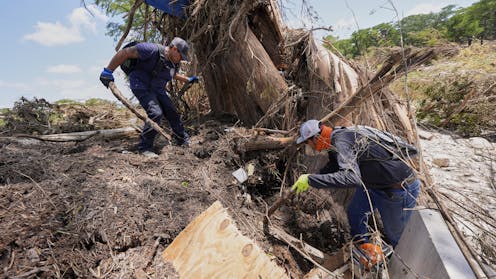
    The landscape In the aftermath of a flood makes it challenging to spot victims. AP Photo/Gerald Herbert

    For search and rescue, AI is not more accurate than humans, but it is far faster.

    Recent successes in applying computer vision and machine learning to drone imagery for rapidly determining building and road damage after hurricanes or shifting wildfire lines suggest that artificial intelligence could be valuable in searching for missing persons after a flood.

    Machine learning systems typically take less than one second to scan a high-resolution image from a drone versus one to three minutes for a person. Plus, drones often produce more imagery to view than is humanly possible in the critical first hours of a search when survivors may still be alive.

    Unfortunately, today’s AI systems are not up to the task.

    We are robotics reseachers who study the use of drones in disasters. Our experiences searching for victims of flooding and numerous other events show that current implementations of AI fall short.

    However, the technology can play a role in searching for flood victims. The key is AI-human collaboration.

    a large red SUV with a white horizontal stripe and symbols and lettering along the side
    Drones have become standard equipment for first responders, but floods pose unique challenges.
    Eric Smalley, CC BY-ND

    AI’s potential

    Searching for flood victims is a type of wilderness search and rescue that presents unique challenges. The goal for machine learning scientists is to rank which images have signs of victims and indicate where in those images search-and-rescue personnel should focus. If the responder sees signs of a victim, they pass the GPS location in the image to search teams in the field to check.

    The ranking is done by a classifier, which is an algorithm that learns to identify similar instances of objects – cats, cars, trees – from training data in order to recognize those objects in new images. For example, in a search-and-rescue context, a classifier would spot instances of human activity such as garbage or backpacks to pass to wilderness search-and-rescue teams, or even identify the missing person themselves.

    A classifier is needed because of the sheer volume of imagery that drones can produce. For example, a single 20-minute flight can produce over 800 high-resolution images. If there are 10 flights – a small number – there would be over 8,000 images. If a responder spends only 10 seconds looking at each image, it would take over 22 hours of effort. Even if the task is divided among a group of “squinters,” humans tend to miss areas of images and show cognitive fatigue.

    The ideal solution is an AI system that scans the entire image, prioritizes images that have the strongest signs of victims, and highlights the area of the image for a responder to inspect. It could also decide whether the location should be flagged for special attention by search-and-rescue crews.

    Where AI falls short

    While this seems to be a perfect opportunity for computer vision and machine learning, modern systems have a high error rate. If the system is programmed to overestimate the number of candidate locations in hopes of not missing any victims, it will likely produce too many false candidates. That would mean overloading squinters or, worse, the search-and-rescue teams, which would have to navigate through debris and muck to check the candidate locations.

    Developing computer vision and machine learning systems for finding flood victims is difficult for three reasons.

    One is that while existing computer vision systems are certainly capable of identifying people visible in aerial imagery, the visual indicators of a flood victim are often very different compared with those for a lost hiker or fugitive. Flood victims are often obscured, camouflaged, entangled in debris or submerged in water. These visual challenges increase the possibility that existing classifiers will miss victims.

    Second, machine learning requires training data, but there are no datasets of aerial imagery where humans are tangled in debris, covered in mud and not in normal postures. This lack also increases the possibility of errors in classification.

    Third, many of the drone images often captured by searchers are oblique views, rather than looking straight down. This means the GPS location of a candidate area is not the same as the GPS location of the drone. It is possible to compute the GPS location if the drone’s altitude and camera angle are known, but unfortunately those attributes rarely are. The imprecise GPS location means teams have to spend extra time searching.

    How AI can help

    Fortunately, with humans and AI working together, search-and-rescue teams can successfully use existing systems to help narrow down and prioritize imagery for further inspection.

    In the case of flooding, human remains may be tangled among vegetation and debris. Therefore, a system could identify clumps of debris big enough to contain remains. A common search strategy is to identify the GPS locations of where flotsam has gathered, because victims may be part of these same deposits.

    aerial view of a landscape with green rings superimposed
    A machine learning algorithm identified piles of debris large enough to contain bodies in an aerial image of a flood aftermath.
    Center for Robot-Assisted Search and Rescue and University of Maryland

    An AI classifier could find debris commonly associated with remains, such as artificial colors and construction debris with straight lines or 90-degree corners. Responders find these signs as they systematically walk the riverbanks and flood plains, but a classifier could help prioritize areas in the first few hours and days, when there may be survivors, and later could confirm that teams didn’t miss any areas of interest as they navigated the difficult landscape on foot.

    The Conversation

    Robin R. Murphy receives funding from the National Science Foundation. She is affiliated with the Center for Robot-Assisted Search and Rescue.

    Thomas Manzini is affiliated with the Center for Robot Assisted Search & Rescue (CRASAR), and his work is funded by the National Science Foundation’s AI Institute for Societal Decision Making (AI-SDM).

    ref. Why drones and AI can’t quickly find missing flood victims, yet – https://theconversation.com/why-drones-and-ai-cant-quickly-find-missing-flood-victims-yet-261035

  • MIL-OSI Canada: Celebrating the opening of Halifax’s new Marine Container Examination Facility

    Source: Government of Canada News (2)

    July 16, 2025                       Halifax, Nova Scotia                        Canada Border Services Agency

    Today, the Honourable Darren Fisher, Member of Parliament for Dartmouth—Cole Harbour, on behalf of the Honourable Gary Anandasangaree, Minister of Public Safety, along with senior officials from the Canada Border Services Agency (CBSA), the Halifax Port Authority and the Africville community, celebrated the opening of the new Marine Container Examination Facility (MCEF) in Halifax, Nova Scotia.  

    This new examination facility, constructed by the Halifax Port Authority with funding from Transport Canada’s National Trade Corridors Fund and funding from the CBSA, represents an investment into Canada’s future, and a commitment to the safety and security of Canadians. In addition to allowing for improved flow of supply chains and secure trade, it enables Canadian businesses to compete and grow in international markets, improves efficiency and safety for CBSA employees and operations, and contributes to continued growth for port operations in Halifax.

    Halifax’s new Marine Container Examination Facility is home to the CBSA’s Container Examination Team and Waterfront Cargo Inspection Unit, and is located on the shores of the Bedford Basin, adjacent to the PSA Halifax Fairview Cove Terminal near the former Africville community. The 2,700 square-metre Envision-Verified Certified building replaces the former MCEF warehouse located in the Burnside Industrial Park, which required shipping containers to be transported across the MacKay Bridge for examination.

    The work taking place at the new MCEF is critical to protecting Canadian communities and trade partner communities from the impacts of transnational organized crime, while facilitating the smooth flow of Canada’s critical supply chains via the Port of Halifax, one of Canada’s most vital marine gateways.

    High-risk shipping containers are referred for examination at the MCEF by the CBSA’s National Targeting Centre, as well as the CBSA’s Waterfront Cargo Inspection Unit in Halifax. CBSA officers based at the facility then conduct comprehensive examinations of the containers and cargo to look for drugs, weapons, stolen vehicles and other dangerous contraband being imported to or exported from Canada. Officers also ensure compliance with Canada’s food, plant, and animal regulations.

    Large quantities of illicit drugs and stolen vehicles are regularly intercepted by CBSA officers at the Marine Container Examination Facility. From March 1, 2024 to July 1, 2025, CBSA officers at the Marine Container Examination Facility intercepted 189 stolen vehicles, 1957kg of cannabis leaving Canada, and $208M worth of narcotics.

    The facility’s name, Africville Seasides, honours the history, vibrancy and resiliency of the people of Africville. Africville community members selected the building’s name in honour of their hockey team, the Africville Seasides, which played in the first and only all-Black men’s ice hockey league in Canada and won two championships in the early 1900s.

    MIL OSI Canada News

  • MIL-OSI Canada: New wildland provincial park in Alberta

    Source: Government of Canada regional news (2)

    MIL OSI Canada News

  • MIL-OSI Canada: Rural and Remote Health Minister Continues Summer Tour Through Eastern Saskatchewan

    Source: Government of Canada regional news

    Released on July 16, 2025

    Rural and Remote Health Minister Lori Carr is continuing her Saskatchewan summer tour through the eastern part of the province. Minister Carr will meet with local leadership and health care staff while visiting health facilities in Nokomis, Wynyard and Foam Lake.

    “It has been a wonderful opportunity to travel throughout the province over the past months and meet with dedicated health professionals in each community,” Minister Carr said. “Our government remains committed to ensuring high quality healthcare for residents close to home, and safe, modern facilities to attract the best healthcare professionals to this province.”

    As part of its capital funding plan, Government provided $760,000 in 2024-25 for roof repairs at Foam Lake Jubilee Home which will take place in 2025-26 and has budgeted an additional $150,000 this year to replace the facility’s air conditioning system. 

    Additionally, over the past three years, the Nokomis Health Centre received upgrades including a new kitchen HVAC exhaust system, new shingles and a nurse call system for a total cost of $281,000.

    -30-

    For more information, contact:

    MIL OSI Canada News

  • MIL-OSI USA: Rep. Norcross Secures Priorities to Invest in South Jersey, Increase National Defense Innovation as NDAA Advances

    Source: United States House of Representatives – Congressman Donald Norcross (1st District of New Jersey)

    WASHINGTON, D.C. — Today, Ranking Member of the House Armed Services Committee’s Tactical Air and Land Forces Subcommittee and Member of the Seapower and Projection Forces Subcommittee, Congressman Donald Norcross (D-NJ), advanced the Fiscal Year 2026 National Defense Authorization Act (NDAA) out of committee and secured priorities that invest in South Jersey and increase national defense innovation. This is the 65th year that the NDAA, the largest authorization bill in Congress with a budget of $882.6 billion, passed out of committee, continuing the tradition of bipartisan cooperation on this bill.   

    “The National Defense Authorization Act (NDAA) that was passed out of committee is a commitment to our nation’s security and a steadfast investment in the courageous men and women in our armed forces. It ensures that we have what every commander wants for their troops: that they are manned, trained, and equipped with the best to carry out our nation’s mission and return home safely. It provides a $3.8% pay raise to all servicemembers and it cuts down on red tape to make certain that our men and women in uniform have the resources they need to keep our country safe,” said Congressman Donald Norcross. “This bipartisan legislation strengthens our industrial base, reinforces Buy American principles, supports our allies, and includes the Streamlining Procurement for Effective Execution and Delivery (SPEED) Act to streamline procurement and decision-making. As ranking member of the Tactical Air and Land Subcommittee, I will continue to work with my colleagues on both sides of the aisle to strengthen our national defense, continue investing in our industrial base, and deliver for South Jersey.”

    The FY26 NDAA improves military readiness and strengthens American industry by cutting red tape, fixing outdated systems, and supporting defense innovation. The FY26 NDAA also includes a 3.8% pay raise for all servicemembers and a 60 percent increase in the Family Separation Allowance which increases the monthly allowance to military families separated due to mission requirements.  

    Rep. Norcross authored an amendment that was adopted in a bipartisan vote to protect Department of Defense employees by restoring their collective bargaining rights after President Trump illegally issued an executive order that stripped these rights away.  

    Fiscal Year 2026 NDAA Priorities Secured by Rep. Norcross: 

    • Over $618 million for CH-47 helicopters, which will be manufactured by South Jersey workers. 
    • Over $2.5 billion for the KC-46 refueler aircraft, which flies out of Joint Base McGuire-Dix Lakehurst.  
    • $5 million to Rowan University for research, development, and engineering to enable rapid entry and sustainment in the Arctic and other cold regions being conducted. 
    • Protected Buy American principles, American jobs, and manufacturing by making sure defense programs continue using U.S.-made parts and materials, keeping our industrial base strong 
    • Required a detailed Pentagon briefing on how it will spend reconciliation funds to strengthen and modernize the munitions industrial base, holding the Pentagon accountable for how it will use the funds. 
    • Required a DoD study on the state of the skilled trade workforce essential to Navy shipbuilding to strengthen the training and workforce pipeline and increase our shipbuilding capacity. 
    • Protected the E-7 Wedgetail program from cancellation, ensuring $800 million in continued investment in this critical airborne warning and control capability. 
    • $9.9 million investment to enhance Army command and control for unmanned systems and their defense which will be developed by South Jersey workers.  
    • $10 million for research and development of man-portable doppler radars for Army Network Command, Control, Communication, and Intelligence (C3I) Technology. 
    • $50 million to support U.S.-Israel anti-tunneling cooperation. 

    ###

    MIL OSI USA News

  • MIL-OSI USA: Washington state sues Trump administration for unlawfully cutting billions in disaster mitigation funding

    Source: Washington State News

    SEATTLE — Attorney General Nick Brown today led a coalition of 20 states in suing the Trump administration over its decision to illegally shut down the Federal Emergency Management Agency’s (FEMA) bipartisan Building Resilient Infrastructure and Communities (BRIC) program, designed to protect communities from natural disasters before they strike.  

    For the past 30 years, the BRIC program has provided communities across the nation with resources to proactively fortify against natural disasters. By focusing on preparation, the program has protected property, saved money that would have otherwise been spent on post-disaster costs, reduced injuries, and saved lives. 

    The impact of the BRIC program’s termination has been devastating, with communities across the country being forced to delay, scale back, or cancel hundreds of mitigation projects depending on this funding. Projects that have been in development for years, and in which communities have invested millions of dollars are now threatened. And now, Americans from coast to coast face a higher risk of harm from natural disasters.

    “This illegal cut endangers the communities most vulnerable to natural disasters,” Brown said. “Communities and states face devastating consequences when the federal government doesn’t meet its obligations to the public, and I will hold the Trump administration accountable for abandoning their safety.”

    Responding to the catastrophic losses resulting from Hurricane Katrina and its aftermath, Congress passed a law stating FEMA must protect communities through four interrelated functions — mitigation, preparation, response, and recovery. The BRIC program is the core of FEMA’s pre-disaster mitigation efforts. A recent study concluded that every dollar FEMA spends on mitigation saves an average of six dollars in post-disaster costs. 

    The BRIC program supports often difficult-to-fund projects, such as constructing evacuation shelters and floodwalls, safeguarding utility grids against wildfires, protecting wastewater and drinking water infrastructure, and fortifying bridges, roadways, and culverts. 

    Over the past four years, FEMA has selected nearly 2,000 projects to receive roughly $4.5 billion in BRIC funding nationwide. In Washington state, there are 27 open BRIC projects that total $182 million and nearly three quarters of that funding goes to small towns and rural communities. This money funds projects like constructing levees and floodwalls in Aberdeen and Hoquiam and generating electricity in Klickitat County for hospitals and school districts if the power goes out during wildfires and severe weather.

    The coalition of attorneys general argue that FEMA’s decision to abruptly terminate the BRIC program is in direct violation of Congress’s decision to fund it. The executive branch has no lawful authority to unilaterally refuse to spend funds appropriated by Congress. They also assert that shutting down the BRIC program violates Separation of Powers and the Administrative Procedure Act, and violates the Appointments Clause because Cameron Hamilton, who acted as FEMA Administrator and gave the directive to terminate the BRIC program, was never appointed by the President or confirmed by the Senate and therefore was acting as an administrator unlawfully. 

    With this lawsuit, the coalition of attorneys general are seeking a preliminary injunction to prevent the Trump administration from spending BRIC funds for other purposes and a permanent injunction to reverse the termination of the BRIC program and require the restoration of these critical funds to the communities relying on them.  

    Joining Washington state in filing this lawsuit, are attorneys general of Arizona, California, Colorado, Connecticut, Delaware, Illinois, Maine, Maryland, Massachusetts, Michigan, Minnesota, New Jersey, New York, North Carolina, Oregon, Rhode Island, Vermont, Wisconsin, and the governor of the Commonwealth of Pennsylvania.

    The complaint can be found here.

    -30-

    Washington’s Attorney General serves the people and the state of Washington. As the state’s largest law firm, the Attorney General’s Office provides legal representation to every state agency, board, and commission in Washington. Additionally, the Office serves the people directly by enforcing consumer protection, civil rights, and environmental protection laws. The Office also prosecutes elder abuse, Medicaid fraud, and handles sexually violent predator cases in 38 of Washington’s 39 counties. Visit www.atg.wa.gov to learn more.

    Media Contact:

    Email: press@atg.wa.gov

    Phone: (360) 753-2727

    General contacts: Click here

    Media Resource Guide & Attorney General’s Office FAQ

    MIL OSI USA News

  • MIL-OSI Submissions: Why drones and AI can’t quickly find missing flood victims, yet

    Source: The Conversation – USA – By Robin R. Murphy, Professor of Computer Science and Engineering, Texas A&M University

    The landscape In the aftermath of a flood makes it challenging to spot victims. AP Photo/Gerald Herbert

    For search and rescue, AI is not more accurate than humans, but it is far faster.

    Recent successes in applying computer vision and machine learning to drone imagery for rapidly determining building and road damage after hurricanes or shifting wildfire lines suggest that artificial intelligence could be valuable in searching for missing persons after a flood.

    Machine learning systems typically take less than one second to scan a high-resolution image from a drone versus one to three minutes for a person. Plus, drones often produce more imagery to view than is humanly possible in the critical first hours of a search when survivors may still be alive.

    Unfortunately, today’s AI systems are not up to the task.

    We are robotics reseachers who study the use of drones in disasters. Our experiences searching for victims of flooding and numerous other events show that current implementations of AI fall short.

    However, the technology can play a role in searching for flood victims. The key is AI-human collaboration.

    Drones have become standard equipment for first responders, but floods pose unique challenges.
    Eric Smalley, CC BY-ND

    AI’s potential

    Searching for flood victims is a type of wilderness search and rescue that presents unique challenges. The goal for machine learning scientists is to rank which images have signs of victims and indicate where in those images search-and-rescue personnel should focus. If the responder sees signs of a victim, they pass the GPS location in the image to search teams in the field to check.

    The ranking is done by a classifier, which is an algorithm that learns to identify similar instances of objects – cats, cars, trees – from training data in order to recognize those objects in new images. For example, in a search-and-rescue context, a classifier would spot instances of human activity such as garbage or backpacks to pass to wilderness search-and-rescue teams, or even identify the missing person themselves.

    A classifier is needed because of the sheer volume of imagery that drones can produce. For example, a single 20-minute flight can produce over 800 high-resolution images. If there are 10 flights – a small number – there would be over 8,000 images. If a responder spends only 10 seconds looking at each image, it would take over 22 hours of effort. Even if the task is divided among a group of “squinters,” humans tend to miss areas of images and show cognitive fatigue.

    The ideal solution is an AI system that scans the entire image, prioritizes images that have the strongest signs of victims, and highlights the area of the image for a responder to inspect. It could also decide whether the location should be flagged for special attention by search-and-rescue crews.

    Where AI falls short

    While this seems to be a perfect opportunity for computer vision and machine learning, modern systems have a high error rate. If the system is programmed to overestimate the number of candidate locations in hopes of not missing any victims, it will likely produce too many false candidates. That would mean overloading squinters or, worse, the search-and-rescue teams, which would have to navigate through debris and muck to check the candidate locations.

    Developing computer vision and machine learning systems for finding flood victims is difficult for three reasons.

    One is that while existing computer vision systems are certainly capable of identifying people visible in aerial imagery, the visual indicators of a flood victim are often very different compared with those for a lost hiker or fugitive. Flood victims are often obscured, camouflaged, entangled in debris or submerged in water. These visual challenges increase the possibility that existing classifiers will miss victims.

    Second, machine learning requires training data, but there are no datasets of aerial imagery where humans are tangled in debris, covered in mud and not in normal postures. This lack also increases the possibility of errors in classification.

    Third, many of the drone images often captured by searchers are oblique views, rather than looking straight down. This means the GPS location of a candidate area is not the same as the GPS location of the drone. It is possible to compute the GPS location if the drone’s altitude and camera angle are known, but unfortunately those attributes rarely are. The imprecise GPS location means teams have to spend extra time searching.

    How AI can help

    Fortunately, with humans and AI working together, search-and-rescue teams can successfully use existing systems to help narrow down and prioritize imagery for further inspection.

    In the case of flooding, human remains may be tangled among vegetation and debris. Therefore, a system could identify clumps of debris big enough to contain remains. A common search strategy is to identify the GPS locations of where flotsam has gathered, because victims may be part of these same deposits.

    A machine learning algorithm identified piles of debris large enough to contain bodies in an aerial image of a flood aftermath.
    Center for Robot-Assisted Search and Rescue and University of Maryland

    An AI classifier could find debris commonly associated with remains, such as artificial colors and construction debris with straight lines or 90-degree corners. Responders find these signs as they systematically walk the riverbanks and flood plains, but a classifier could help prioritize areas in the first few hours and days, when there may be survivors, and later could confirm that teams didn’t miss any areas of interest as they navigated the difficult landscape on foot.

    Robin R. Murphy receives funding from the National Science Foundation. She is affiliated with the Center for Robot-Assisted Search and Rescue.

    Thomas Manzini is affiliated with the Center for Robot Assisted Search & Rescue (CRASAR), and his work is funded by the National Science Foundation’s AI Institute for Societal Decision Making (AI-SDM).

    ref. Why drones and AI can’t quickly find missing flood victims, yet – https://theconversation.com/why-drones-and-ai-cant-quickly-find-missing-flood-victims-yet-261035

    MIL OSI

  • MIL-OSI United Kingdom: New Affordable Homes Standard set to transform housing across York and North Yorkshire

    Source: City of York

    A major milestone has been reached in the mission to provide affordable, high quality and sustainable homes across York and North Yorkshire with the launch of a new Affordable Homes Standard.

    Spearheaded by the York and North Yorkshire Housing Partnership, the Standard represents a shared commitment to ensuring that all affordable homes across the region meet a consistent, high-quality benchmark and reflect the needs of local communities, now and for generations to come.

    At its core, the Standard provides a clear framework for what good affordable housing should look like. It sets out agreed specifications covering space standards, energy efficiency, design quality, types of housing, and how homes can be adapted to people’s needs over time.

    The Standard is designed to support housing needs at all stages of life and will make affordable homes indistinguishable from those sold on the open market.

    Environmental sustainability is a central part of this. The Standard sets out how new homes should be built with high levels of insulation, low carbon heating such as heat pumps, and features to protect and enhance the natural environment, ensuring space for nature to thrive alongside people.

    Most significantly, the 23 members which make up the York and North Yorkshire Housing Partnership have all committed to only building or acquiring homes that meet the new Standard.

    The Standard has received the full support of York and North Yorkshire Mayor David Skaith, reflecting his vision for creating healthy, thriving communities across the region. It is also supported by City of York Council and North Yorkshire Council which are partnership members.

    David Skaith, Mayor of York and North Yorkshire, said:

    We need to deliver the right homes in the right places, ensuring our next generation can stay and thrive in York and North Yorkshire. That ambition takes a big step forward with the launch of the Affordable Homes Standard.

    “This sets a consistent, high-quality benchmark as we play our part and deliver on the national target of building 1.5 million homes. 

    “It means that we build more energy efficient homes with a better quality of design, built with nature in mind. That’s good news for our environment and for residents, who will benefit from lower energy bills.

    “This underpins our commitment to create and support thriving communities and I look forward to working closely with the York and North Yorkshire Housing Partnership on delivering the homes we deserve and need.” 

    The Standard has been developed in response to growing recognition of the need for more consistent standards and a more community-focused approach to the delivery of homes secured through Section 106 agreements – an essential tool for providing affordable housing through the planning process.

    While these homes help boost affordable housing supply, the partnership is clear that quality and long-term suitability must go hand in hand with quantity.

    Councillor Michael Pavlovic, Executive Member for Housing at City of York Council, said:

    This new Standard which we proudly support, echoes our commitment to improving the quality and supply of affordable homes in the city.

    “We are providing great quality homes through our own Housing Delivery Programme and we welcome this approach to ensure that all affordable homes developed in the city in future years will be spacious, healthy and environmentally friendly.”

    Councillor Simon Myers, Executive Member for Housing at North Yorkshire Council, added:

    This new standard sets out exactly what the people of North Yorkshire should be able to expect from affordable homes and makes an important contribution to improving their quality of life.

    “It reflects our commitment as a landlord to improve our own homes and raises the bar for our partners and others in the sector to do the same.”

    Nick Atkin, Chair of the York and North Yorkshire Housing Partnership, said:

    This new Standard is a big step forward in making sure affordable housing across our region is built to a consistently high standard. It’s about creating homes that people can be proud of, well designed, energy efficient, and built to meet the needs of local communities now and in the future.

    “By working together across the region, we’re setting a clear shared benchmark for what good affordable housing will look like in York and North Yorkshire.”

    MIL OSI United Kingdom

  • MIL-OSI Russia: The Parade of Historical Transport took place for the first time on Sergius of Radonezh Street!

    Translation. Region: Russian Federal

    In September 2024, Moscow Mayor Sergei Sobyanin opened a tram line more than 860 meters long, which made it possible to organize a new tram route No. 2 “3rd Vladimirskaya Street” – “Kursky Station”.

    Maxim Liksutov noted that more than 150 units of historical equipment participated in the parade and exhibition of retro transport on July 12: 16 trams of different generations, about 80 rally crews and about 75 cars, including the Ikarus-280 bus.

    The parade and exhibition were attended by more than 140 thousand spectators

    Not only trams from different eras were presented, but also exhibits from the Moscow Transport Museum and the Museum of the Special Purpose Garage of the Federal Security Service of Russia

    Spectators were even able to see a horse-drawn tram – the predecessor of the electric tram

    The atmosphere of old Moscow was recreated by historical reenactors, and the concert program included artists from the “Music in the Metro” project, the Moscow Metro Academic Choir, and DJ Smash

    This is already the 19th tram parade. The parade was headed by a horse-drawn tram pulled by four horses. Such events are popular with Muscovites and traditionally attract a large number of spectators. On the instructions of Moscow Mayor Sergei Sobyanin, further organization of even more interesting events for residents and guests of the capital continues, added Maxim Liksutov.

    MIL OSI Russia News

  • MIL-OSI Russia: Construction of a new transport and logistics complex has begun in Kazakhstan

    Translation. Region: Russian Federal

    Source: People’s Republic of China in Russian – People’s Republic of China in Russian –

    An important disclaimer is at the bottom of this article.

    Source: People’s Republic of China – State Council News

    ALMATY, July 16 (Xinhua) — Construction of a new transport and logistics complex (TLC) “Tobyl” has begun in the northern Kazakh city of Kostanay, the press service of the Kazakh Prime Minister reported on Wednesday.

    The area of the logistics complex will be 133.6 hectares, the total investment volume will be 64 billion tenge /about 121.3 million US dollars/.

    The design capacity of the TLC “Tobyl” will be up to 400 thousand TEU (twenty-foot container equivalent) per year, or over 11 million tons of cargo.

    The complex will be integrated into international transport corridors linking China, Central Asia, Turkey, Iran, Afghanistan and Europe.

    An increase in cargo turnover is expected on the Northern Kazakhstan – Southern Urals route and in the direction of China.

    Completion of construction of the TLC “Tobyl” is planned for 2027. –0–

    Please note: This information is raw content obtained directly from the source of the information. It is an accurate report of what the source claims and does not necessarily reflect the position of MIL-OSI or its clients.

    .

    MIL OSI Russia News

  • MIL-OSI Russia: Israel launches airstrikes on presidential palace area in Damascus, Syrian army headquarters partially destroyed

    Translation. Region: Russian Federal

    Source: People’s Republic of China in Russian – People’s Republic of China in Russian –

    An important disclaimer is at the bottom of this article.

    Source: People’s Republic of China – State Council News

    DAMASCUS, July 16 (Xinhua) — Israel launched intense air strikes on the presidential palace area in the Syrian capital Damascus on Wednesday, partially destroying the Syrian army’s headquarters, local media and eyewitnesses reported.

    As noted, the strikes were directed against the interim authorities of Syria due to clashes between the government army and the Druze community in the province of As-Suwayda in the south of the country.

    Israel carried out at least five airstrikes on Wednesday afternoon, mostly targeting the Syrian army’s General Command, destroying part of the building, according to local media and the Britain-based Syrian Observatory for Human Rights.

    Local television footage showed smoke rising from the headquarters in Umayyad Square in central Damascus.

    Another strike hit the area of the Syrian presidential palace, Qasr al-Shaab, sending plumes of white smoke rising over the mountain on which the palace is located.

    There have been no reports of casualties or official comments yet.

    Following the previous strike on the headquarters early Wednesday morning, Syrian state television channel Al-Ikhbariya reported that two civilians were wounded as a result of “Israeli aggression.”

    The Israeli military campaign is part of a larger effort to support the Druze community in As-Suwayda, where deadly clashes have escalated between local Druze militias, Bedouin tribes and interim government forces. –0–

    Please note: This information is raw content obtained directly from the source of the information. It is an accurate report of what the source claims and does not necessarily reflect the position of MIL-OSI or its clients.

    .

    MIL OSI Russia News

  • MIL-OSI Russia: Kazakhstan introduces criminal liability for droppering and forced marriage

    Translation. Region: Russian Federal

    Source: People’s Republic of China in Russian – People’s Republic of China in Russian –

    An important disclaimer is at the bottom of this article.

    Source: People’s Republic of China – State Council News

    Almaty, July 16 (Xinhua) — Kazakhstan has introduced criminal liability for droppering and forced marriage, the press service of the President of Kazakhstan reported on Wednesday.

    The President of Kazakhstan Kassym-Jomart Tokayev signed the law “On Amendments and Supplements to Certain Legislative Acts on Issues of Optimization of Criminal Legislation of Kazakhstan.”

    The new law establishes criminal liability for droppering – “the illegal provision, transfer and acquisition of access to a bank account, payment instrument or identification tool, as well as the illegal implementation of payments and money transfers.”

    In addition, criminal liability is introduced for forced marriage.

    In addition, lawyers are given the right to submit to the court a defense document, a document that is the opposite of the indictment. –0–

    Please note: This information is raw content obtained directly from the source of the information. It is an accurate report of what the source claims and does not necessarily reflect the position of MIL-OSI or its clients.

    .

    MIL OSI Russia News

  • MIL-OSI Russia: Presidents of Belarus and Indonesia held talks in Minsk

    Translation. Region: Russian Federal

    Source: People’s Republic of China in Russian – People’s Republic of China in Russian –

    An important disclaimer is at the bottom of this article.

    Source: People’s Republic of China – State Council News

    MINSK, July 16 (Xinhua) — Belarusian President Alexander Lukashenko and Indonesian President Prabowo Subianto held talks in Minsk on Tuesday, the press service of the Belarusian head of state reported on the same day.

    The presidents met in an informal setting. During the talks, which lasted about three hours, the leaders of the two countries discussed a wide range of topics. “I am ready to discuss with you all the issues that may be on the agenda of our relations,” A. Lukashenko noted.

    In turn, the Indonesian leader thanked the Belarusian president for the reception and expressed hope to meet in Indonesia in the near future. –0–

    Please note: This information is raw content obtained directly from the source of the information. It is an accurate report of what the source claims and does not necessarily reflect the position of MIL-OSI or its clients.

    .

    MIL OSI Russia News

  • MIL-OSI Russia: Belarus’ GDP grew by 2.1 percent in the first half of 2025 — Belstat

    Translation. Region: Russian Federal

    Source: People’s Republic of China in Russian – People’s Republic of China in Russian –

    An important disclaimer is at the bottom of this article.

    Source: People’s Republic of China – State Council News

    MINSK, July 16 (Xinhua) — Belarus’ gross domestic product grew by 2.1 percent in the first half of 2025, the Belarusian National Statistical Committee (Belstat) said on Wednesday.

    The country’s GDP for the first six months in current prices amounted to 129.4 billion Belarusian rubles /about 44 billion US dollars/, or in comparable prices – 102.1 percent compared to the same period in 2024.

    The GDP deflator index in the first half of the year compared to the same period last year was 111.9 percent. –0–

    Please note: This information is raw content obtained directly from the source of the information. It is an accurate report of what the source claims and does not necessarily reflect the position of MIL-OSI or its clients.

    .

    MIL OSI Russia News

  • MIL-OSI Canada: Alberta leads with health care aide regulation

    Alberta’s 40,000 health care aides play a vital role in the health system, providing hands-on support to Albertans who need a high level of care, including seniors and those with chronic or acute illnesses. Starting Feb. 2, 2026, health care aides in Alberta will be regulated under a professional college – just like many other front-line health professionals.

    To practise and use the health care aide title, individuals will need to meet approved education requirements, follow standards of practice, commit to ongoing learning and abide by a professional code of ethics.

    “This is a major step forward in strengthening Alberta’s health care system. It gives Albertans confidence that the care they receive is safe and that health care aides have the proper training and oversight.”

    Adriana LaGrange, Minister of Primary and Preventative Health Services

    The College of Licensed Practical Nurses of Alberta will become the College of Licensed Practical Nurses and Health Care Aides of Alberta and will be responsible for registering health care aides, setting practice and conduct standards, ensuring continued professional development and responding to complaints. This work builds on the college’s experience regulating licensed practical nurses in Alberta.

    “The College of Licensed Practical Nurses of Alberta is ready to take on the work of regulating health care aides in a manner that protects the public. We are leveraging our experience as a trusted regulator of licensed practical nurses to prepare health care aides and our partners for this transition. The CLPNA is confident that the interests of Albertans will be served through our oversight of registration, practice, conduct and continuing competence.”

    Kurtis Kooiker, president, College of Licensed Practical Nurses of Alberta

    Health care aides who meet the requirements are eligible for enrolment in the Alberta Health Care Aide Directory. Those enrolled in the directory immediately before regulation comes into force will be transferred to a health care aide register with the college and issued a practice permit.

    As of Feb. 2, 2026, individuals who meet the requirements for registration as a health care aide, who intend to provide health care aide services to the public, and who want to use the health care aide title must apply for registration with the College of Licensed Practical Nurses and Health Care Aides of Alberta. Going forward, only registered health care aides will be allowed to use the health care aide title, and all registered health care aides will be required to renew their practice permits annually.

    In the weeks ahead, regulatory changes to support implementation will be finalized. The college will also continue working with health care aides, employers, post-secondary institutions and other partners to support a smooth transition.

    MIL OSI Canada News

  • MIL-OSI Canada: Africville Seasides Marine Container Examination Facility

    Source: Government of Canada News

    July 16, 2025                 Halifax, Nova Scotia     

    Construction on the new Marine Container Examination Facility (MCEF) began in summer 2022 and was completed in early April 2025. Operations started on April 7, 2025.

    The new facility offers many benefits including:

    • Improves the efficiency, safety, security and operations for Canada Border Services (CBSA) employees
    • Reduces port congestion through operational efficiencies
    • Allows continued growth for the Halifax Port Authority
    • Increases supply chain effectiveness
    • Enables Canadian businesses to compete and grow in international markets
    • Reduces container truck traffic and emissions as the new MCEF is located directly on Port of Halifax property

    Facility description

    The 2,700 square-metre building is owned and operated by the Halifax Port Authority, and is used by the Canada Border Services Agency.

    The facility has 10 examination bays used by CBSA officers to examine high-risk shipping containers near the terminal. Large quantities of drugs and stolen vehicles are regularly intercepted by border services officers.

    The facility includes a truck gate with electronic scanners to help keep track of containers and their cargo.

    The Marine Container Examination Facility is an Envision-Verified infrastructure project, scoring 26% above industry standards under the Institute for Sustainable Infrastructure rating system. The building has many sustainable features including:

    • A solar photovoltaic system
    • A rainwater harvesting system
    • Development of a Construction Sustainability Checklist that all contractors were required to submit as part of their tender submission
    • Development of a Contractor Tracking Tool for earthworks, materials, energy use, and water use, motion-activated LED fixtures
    • In-floor radiant heating
    • Building generator for backup power
    • Security fence rear compound for holding all containers marked for examination
    • EV charging stations

    Funding

    The Halifax Port Authority and the Government of Canada have invested approximately $25 million in the new facility. Transport Canada invested $7 million under the National Trade Corridors Fund. The CBSA invested $879,000 for :

    • CCTV hardware and installation
    • Furniture
    • IT equipment
    • Signage
    • Detection equipment
    • Audio Visual equipment
    • Building WIFI and Network equipment and installation
    • Tooling and storage cabinets

    MIL OSI Canada News

  • MIL-OSI USA: SPC Severe Thunderstorm Watch 518

    Source: US National Oceanic and Atmospheric Administration

    Note:  The expiration time in the watch graphic is amended if the watch is replaced, cancelled or extended.Note: Click for Watch Status Reports.
    SEL8

    URGENT – IMMEDIATE BROADCAST REQUESTED
    Severe Thunderstorm Watch Number 518
    NWS Storm Prediction Center Norman OK
    1235 PM CDT Wed Jul 16 2025

    The NWS Storm Prediction Center has issued a

    * Severe Thunderstorm Watch for portions of
    Northern Illinois
    Far Northwest Indiana
    Lake Michigan

    * Effective this Wednesday afternoon and evening from 1235 PM
    until 800 PM CDT.

    * Primary threats include…
    Scattered damaging wind gusts to 70 mph possible
    Isolated large hail events to 1 inch in diameter possible
    A tornado or two possible

    SUMMARY…Scattered thunderstorms are forecast to develop in a
    north-south band and move east across the Watch. A couple of the
    stronger thunderstorms may acquire transient supercell
    characteristics. Scattered damaging gusts are the primary hazard,
    but an isolated risk for large hail will accompany the stronger
    storms and a tornado cannot be ruled out.

    The severe thunderstorm watch area is approximately along and 75
    statute miles east and west of a line from 40 miles east northeast
    of Rockford IL to 20 miles south southeast of Marseilles IL. For a
    complete depiction of the watch see the associated watch outline
    update (WOUS64 KWNS WOU8).

    PRECAUTIONARY/PREPAREDNESS ACTIONS…

    REMEMBER…A Severe Thunderstorm Watch means conditions are
    favorable for severe thunderstorms in and close to the watch area.
    Persons in these areas should be on the lookout for threatening
    weather conditions and listen for later statements and possible
    warnings. Severe thunderstorms can and occasionally do produce
    tornadoes.

    &&

    OTHER WATCH INFORMATION…CONTINUE…WW 517…

    AVIATION…A few severe thunderstorms with hail surface and aloft to
    1 inch. Extreme turbulence and surface wind gusts to 60 knots. A few
    cumulonimbi with maximum tops to 500. Mean storm motion vector
    24025.

    …Smith

    SEL8

    URGENT – IMMEDIATE BROADCAST REQUESTED
    Severe Thunderstorm Watch Number 518
    NWS Storm Prediction Center Norman OK
    1235 PM CDT Wed Jul 16 2025

    The NWS Storm Prediction Center has issued a

    * Severe Thunderstorm Watch for portions of
    Northern Illinois
    Far Northwest Indiana
    Lake Michigan

    * Effective this Wednesday afternoon and evening from 1235 PM
    until 800 PM CDT.

    * Primary threats include…
    Scattered damaging wind gusts to 70 mph possible
    Isolated large hail events to 1 inch in diameter possible
    A tornado or two possible

    SUMMARY…Scattered thunderstorms are forecast to develop in a
    north-south band and move east across the Watch. A couple of the
    stronger thunderstorms may acquire transient supercell
    characteristics. Scattered damaging gusts are the primary hazard,
    but an isolated risk for large hail will accompany the stronger
    storms and a tornado cannot be ruled out.

    The severe thunderstorm watch area is approximately along and 75
    statute miles east and west of a line from 40 miles east northeast
    of Rockford IL to 20 miles south southeast of Marseilles IL. For a
    complete depiction of the watch see the associated watch outline
    update (WOUS64 KWNS WOU8).

    PRECAUTIONARY/PREPAREDNESS ACTIONS…

    REMEMBER…A Severe Thunderstorm Watch means conditions are
    favorable for severe thunderstorms in and close to the watch area.
    Persons in these areas should be on the lookout for threatening
    weather conditions and listen for later statements and possible
    warnings. Severe thunderstorms can and occasionally do produce
    tornadoes.

    &&

    OTHER WATCH INFORMATION…CONTINUE…WW 517…

    AVIATION…A few severe thunderstorms with hail surface and aloft to
    1 inch. Extreme turbulence and surface wind gusts to 60 knots. A few
    cumulonimbi with maximum tops to 500. Mean storm motion vector
    24025.

    …Smith

    Note: The Aviation Watch (SAW) product is an approximation to the watch area. The actual watch is depicted by the shaded areas.
    SAW8
    WW 518 SEVERE TSTM IL IN LM 161735Z – 170100Z
    AXIS..75 STATUTE MILES EAST AND WEST OF LINE..
    40ENE RFD/ROCKFORD IL/ – 20SSE MMO/MARSEILLES IL/
    ..AVIATION COORDS.. 65NM E/W /34NW ORD – 29SSW JOT/
    HAIL SURFACE AND ALOFT..1 INCH. WIND GUSTS..60 KNOTS.
    MAX TOPS TO 500. MEAN STORM MOTION VECTOR 24025.

    LAT…LON 42418691 41098709 41098997 42418985

    THIS IS AN APPROXIMATION TO THE WATCH AREA. FOR A
    COMPLETE DEPICTION OF THE WATCH SEE WOUS64 KWNS
    FOR WOU8.

    Watch 518 Status Report Message has not been issued yet.

    Note:  Click for Complete Product Text.Tornadoes

    Probability of 2 or more tornadoes

    Low (20%)

    Probability of 1 or more strong (EF2-EF5) tornadoes

    Low (5%)

    Wind

    Probability of 10 or more severe wind events

    Mod (40%)

    Probability of 1 or more wind events > 65 knots

    Low (20%)

    Hail

    Probability of 10 or more severe hail events

    Low (20%)

    Probability of 1 or more hailstones > 2 inches

    Low (10%)

    Combined Severe Hail/Wind

    Probability of 6 or more combined severe hail/wind events

    Mod (60%)

    For each watch, probabilities for particular events inside the watch (listed above in each table) are determined by the issuing forecaster. The “Low” category contains probability values ranging from less than 2% to 20% (EF2-EF5 tornadoes), less than 5% to 20% (all other probabilities), “Moderate” from 30% to 60%, and “High” from 70% to greater than 95%. High values are bolded and lighter in color to provide awareness of an increased threat for a particular event.

    MIL OSI USA News

  • MIL-OSI USA: CUMBERLAND COUNTY – Shapiro Administration to Celebrate Underground Storage Tank Indemnification Fund’s 30th Anniversary

    Source: US State of Pennsylvania

    July 17, 2025Camp Hill, PA

    ADVISORY – CUMBERLAND COUNTY – Shapiro Administration to Celebrate Underground Storage Tank Indemnification Fund’s 30th Anniversary

    The Pennsylvania Insurance Department (PID) and Department of Environmental Protection (DEP) will mark the Underground Storage Tank Indemnification Fund’s (USTIF) 30th anniversary, celebrating three decades of service and commitment to cleaner and safer communities across the Commonwealth.

    Since its inception in 1994, USTIF has remained committed to providing critical financial assistance to underground storage tank owners and operators that protect Pennsylvania’s environment, while also supporting business continuity and demonstrating how partnerships between the public and private sectors can unite to serve Pennsylvanians.

    WHO:
    Pennsylvania Insurance Commissioner Michael Humphreys
    Laura Lyon Slaymaker, Deputy Insurance Commissioner
    Ramez Ziadeh, DEP Executive Deputy Secretary
    Andrew Greiner, USTIF Board Member
    Nick Ruffner, Public Affairs Manager, Sheetz, Inc.

    WHEN:
    TOMORROW, Thursday, July 17, 2025, at 10:00 AM

    WHERE:
    Soon-to-be new Sheetz facility at 4415 Carlisle Pike, Camp Hill, PA 17011

    RSVP:
    Press who are interested in attending must RSVP to ra-in-press@pa.gov.

    MIL OSI USA News

  • MIL-OSI: Agricultural Scientific Begins Construction on Innovative Hydroponic Greenhouse to Transform U.S. Food Supply Chain

    Source: GlobeNewswire (MIL-OSI)

    LAGRANGE, Ga., July 16, 2025 (GLOBE NEWSWIRE) — Agricultural Scientific, LLC announces that construction is now underway on the Agriculture Technology Campus (ATC), an innovative agricultural project in South Carolina set to transform food production in the Eastern U.S.

    Located at the 1,000-acre Agriculture Technology Campus, the high-tech hub will feature a hydroponic greenhouse and processing facility in Early Branch, SC. It will produce locally grown, organic tomatoes with 90% greater water efficiency than traditional farming, reducing dependence on imports from Mexico, California, and Canada.

    Initially announced in September 2020 during the COVID pandemic, the highly anticipated project that garnered international interest, has been galvanized through a strategic partnership between Phoenix Lender Services, a subsidiary of Community Bankshares, Inc. and Optus Bank of South Carolina.

    Backed by a complex capital stack of USDA Business & Industry and Food Supply Chain loans, the project will enable 400+ acres of hydroponic greenhouses to produce year-round vegetables, cutting water use and eliminating pesticides. Upon completion, this innovative project will bring $350 million in private capital investment and over 1000 direct jobs to rural Hampton County and the surrounding region.

    “This isn’t just about growing vegetables—it’s about reshaping the future of agriculture and re-shoring our critical U.S. supply chain,” said Zeb Portanova, CEO of Agricultural Scientific. “By producing fresh, high-quality produce closer to consumers, we can reduce food miles, cut emissions, and limit our reliance on foreign countries. Thank you to the United States Department of Agriculture Secretary Brooke Rollins for her integral support of this project.”

    Currently, 90% of vegetables consumed in the Eastern U.S. are transported from other countries and regions, leading to supply chain vulnerabilities and excessive carbon emissions. This project will drastically shorten food miles, ensuring fresher produce while slashing CO₂ emissions by approximately 600 metric tons per 100 truckloads.

    Key benefits of this initiative include:

    • Enhance food security by reducing reliance on imported produce from Mexico and Canada
    • Lower carbon emissions through sustainable, localized production
    • Align with retailers’ goals by providing fresher, locally grown, organic, and environmentally responsible products
    • Foster U.S.-based manufacturing growth and reinvestment in critical sectors that sustain communities and the economy
    • Generate hundreds of skilled agricultural jobs in South Carolina

    “This is a landmark moment for agriculture, rural America, and sustainability,” said Chris Hurn, President of Phoenix Lender Services and Community Bankshares, Inc. “By investing in local food production, we’re not only boosting U.S. agriculture but also bringing manufacturing back home, reducing reliance on foreign supply chains and creating lasting economic impact.”

    “This facility represents the future of sustainable food production,” said Reggie Webber, Chief Credit Officer of Optus Bank. “It’s not just an investment in farming—it’s an investment in economic stability, job creation, and environmental responsibility.

    “At Optus Bank, we are proud to bank on communities through innovation, impact, and economic empowerment. Our strategic partnership with Community Bankshares and their subsidiaries, Phoenix Lender Services, allows us to achieve a key strategic imperative for the Bank,” said Benita Lefft, President of Optus Bank.

    A total USDA loan capital stack of $46,157,187 was successfully structured through the partnership. This included two food supply chain loans totaling $29,610,400 and a Business & Industry (B&I) loan of $16,546,787.

    The ATC is developed and owned by Agricultural Scientific, LLC and leased to Lokal Harvest USA (LHUSA), a subsidiary of Harvest House, one of Europe’s largest and most successful greenhouse operators. With a track record of supplying major retailers like Walmart, Kroger, Sam’s Club, Trader Joe’s, and Publix, Lokal Harvest USA is well-positioned to scale operations and meet the rising demand for fresh, locally grown produce.

    “The Agriculture Technology Campus has been the talk of Hampton County since it was first announced, and the commencement of construction could not have come at a better time. We in Hampton County understand that good economic development has a direct tie to a better quality of life for all of our citizens, and we are excited about this innovative agricultural project. We thank everyone involved in the ATC project for their support, and we look forward to working with the company for decades to come as new jobs and opportunities emerge in Hampton County,” said Dr. Roy Hollingsworth, Chairman of Hampton County Council.

    “SouthernCarolina Alliance is delighted to see this critical project coming to fruition. We appreciate the support of our partners at USDA, the SC Dept. of Commerce, the SC Dept. of Agriculture, Phoenix Lender Services, Community Bankshares, and Optus Bank in facilitating this investment in our region. Good jobs and investment change communities, and this project will not only affect Hampton County locally, but also improve the quality of life in our region and beyond through both its economic impact and fresher, healthier produce for all,” said Danny Black, President and CEO, SouthernCarolina Alliance.

    This landmark project is more than just a local initiative—it’s a scalable model for the future of agriculture in the U.S. With federal support, private investment, and the expertise of global leaders in hydroponic agriculture, this initiative is poised to set a new standard for modern farming—one that delivers fresher produce, reduces environmental impact, and supports economic growth.

    Local, legislative and state leaders gathered at the construction site on July 16 to celebrate the partnership and view the construction underway.

    For more information, please visit The Agriculture Technology Campus https://agtechcampus.com.

    For more information about Phoenix Lender Services and its lending solutions, please visit www.phoenixlenderservices.com.

    ABOUT AGRICULTURE TECHNOLOGY CAMPUS (ATC)

    The Agriculture Technology Campus in Hampton County, SC, is a pioneering agricultural development designed to revolutionize food production through controlled-environment farming, sustainable growing practices, and strategic partnerships with global leaders in greenhouse technology. If you are interested in joining the ATC campus, please email info@gemozf.com. Backed by a complex capital stack of USDA Business & Industry and Food Supply Chain loans, the project will enable 400+ acres of hydroponic greenhouses to produce year-round vegetables, cutting water use and eliminating pesticides.

    ABOUT PHOENIX LENDER SERVICES

    Based in Georgia and serving clients nationwide, Phoenix Lender Services offers a comprehensive suite of commercial lending solutions, including loan underwriting, closing, and servicing; participant lender matching; secondary market sales; portfolio management; risk analysis; and compliance reviews and regulatory support. Our seasoned professionals combine extensive industry expertise in SBA, USDA, and other commercial government-guaranteed lending with industry-leading technologies to deliver tailored solutions that align with each client’s unique strategic goals. Phoenix Lender Services is leading the way in SBA and USDA commercial lending.

    ABOUT COMMUNITY BANKSHARES INC

    Community Bankshares, Inc. is a dynamic company that is revolutionizing the financial landscape via its support for America’s businesses. As a mission-focused company, we are redefining how lending capital is provided across the nation and its territories in ways that promote business stability and encourage local area prosperity. In doing so, we foster economic growth, job creation and retention, and community strength. https://communitybankshares.com/

    ABOUT OPTUS BANK

    Established in 1921, Optus Bank is a federally designated Minority Depository Institution (MDI) and certified Community Development Financial Institution (CDFI) dedicated to serving underserved communities. Optus is committed to Banking on Communities Through Innovation, Impact, and Economic Empowerment—providing access to capital, financial education, and full-service banking for individuals, small businesses, and mission-aligned organizations. https://optus.bank/

    ABOUT LOKAL HARVEST USA

    Lokal Harvest USA is a leading producer of hydroponic greenhouse vegetables, bringing advanced farming techniques and global supply chain expertise to the U.S. market in partnership with Harvest House, one of Europe’s largest greenhouse operators.

    https://agtechcampus.com/

    MEDIA CONTACT

    Abigail Davison
    Uproar PR by Moburst for Community Bankshares, Inc.
    abigail.davison@moburst.com

    A photo accompanying this announcement is available at https://www.globenewswire.com/NewsRoom/AttachmentNg/e99b9c29-2298-468a-8d70-705020ace65d

    The MIL Network

  • MIL-OSI Economics: Minecraft summer updates include streaming home for movie, new features and rewards in-game

    Source: Microsoft

    Headline: Minecraft summer updates include streaming home for movie, new features and rewards in-game

    Minecraft’s latest game drop isn’t just focused on what’s under your feet, but what’s above your head. Chase the Skies introduces the happy ghast, a new rideable mob that lets you take to the air alone or with friends. While exploring the Nether, you can now come across a dried ghast – return it to the Overworld, then hydrate it with water, and you’ll net yourself a ghastling, who will then grow into your new flying mount after you’ve waited long enough, or fed it enough snowballs. Just make sure you also have a ghast harness to use your smiley new ride! 

    Chase the Skies also introduces a number of new features, from craftable saddles, to new Amos Roddy music tracks, to a player locator bar to help make playing with friends that little bit easier, and even the ability to leash multiple mobs together like you’re the Overworld’s strangest dog walker. Why not leash a boat to your new happy ghast and help carry even more players through the skies? 

    Vibrant Visuals – Out Now for Compatible Minecraft: Bedrock Edition Devices 

    One of the biggest shifts in Minecraft history is here – Vibrant Visuals transforms the look of the Bedrock Edition, retaining the game’s iconic style while adding improved graphical elements – directional lighting, volumetric fog, pixelated shadows and reflections, and much more. 

    It’s a truly stunning change, turning Minecraft into the game you’ve always imagined in your head (but, if you like the original look, you can always switch back!). You can read all about the upgrade on Xbox Wire, but trust me, you really should play it for yourself. 

    Vibrant Memories Camera Add-On – Out Now for Minecraft: Bedrock Edition 

    Want to make the most of those Vibrant Visuals vistas? The Vibrant Memories camera add-on (available in the Minecraft Marketplace) introduces multiple features to let you take the perfect shot – from saving camera angles, to changing the weather, or controlling time itself. Each shot will be saved to your personal album, and you can even add music to capture the perfect mood. 

    Realms Plus – New Content Available Now 

    Realms Plus subscribers can now add Chase the Skies and Vibrant Visuals content to their own personal servers – and there are also new Marketplace drops included in your subscription. 

    The One Slime Block Adventure world by Mush Co throws you into an adventure featuring 5 unique boss battles, 6 dimensions, and a lot of slime, from enemies to weaponry. Meanwhile the Aquaculture add-on by Team Metallurgy will turn you into the ultimate angler, adding 60 new underwater creatures, rare equipment, new cooking mechanics, and more. Both are included as part of Realms Plus. 

    A Minecraft Movie – Now Streaming on HBO Max  

    This year’s blockiest buster is available to stream now. After becoming a phenomenon in theaters, with an HBO Max subscription, you can now watch ‘A Minecraft Movie’ at home.  

    Join Garrett (Jason Momoa), Dawn (Danielle Brooks), Natalie (Emma Myers), and Henry (Sebastian Hansen) – four misfits who are pulled through a portal to Minecraft’s Overworld as you’ve never seen it before. After meeting Steve (Jack Black), they’ll need to harness the power of creativity to repel a Piglin invasion and return to the real world. 

    Whether it’s your first time venturing into the live-action Overworld, or you already know all the words to Steve’s Lava Chicken, it’s easier than ever to watch. 

    Steve’s Lava Chicken Remix Music Disc and Dennis Painting – Out Now 

    Speaking of Steve’s Lava Chicken, you’ve got two new ways of listening to the song inspired by the movie. It’s available to stream now, and in Minecraft. Get your blocky hands on a music disc that will let you play the song from your jukebox. 

    Plus, pay tribute to man’s (well, Steve’s) best friend by crafting a new painting of Dennis, the pale wolf hero of ‘A Minecraft Movie’. 

    Claim Your Community Challenge Rewards 

    In its latest Community Challenge, Mojang asked the Minecraft community to work together to spawn 50 million happy ghasts in Creative mode, and feed snowballs to 1 million ghastlings in Survival mode – and you delivered! As your reward, every Bedrock Edition player can now access the Ghast Rider Floatie and the Happy Ghast Pilot Gear in the Dressing Room, while every Java Edition player can download the Ghast Riding Swimmer and Happy Ghast Pilot skins here. 

    Minecraft

    Microsoft Studios

    2004

    $19.99 $15.99

    Xbox One X Enhanced

    Xbox Game Pass

    CREATE Build whatever you can imagine in your own infinite world that’s unique in every playthrough. EXPLORE Discover biomes, resources and mobs, and craft your way through a world filled with surprises in the ultimate sandbox game. SURVIVE Experience unforgettable adventures as you face mysterious foes, traverse exciting landscapes, and travel to perilous dimensions. PLAY TOGETHER Have a blast with friends, whether you’re sitting on the same couch in split screen or miles apart in cross-platform play for console, mobile and PC. Connect with millions of players on community servers or subscribe to Realms Plus to play with up to 10 friends on your own private server. EXPERIENCE MORE Get creator-made add-ons, thrilling worlds, and stylish cosmetics on Minecraft Marketplace. Subscribe to Marketplace Pass (or Realms Plus) to access 150+ worlds, skin & textures packs, and more – refreshed monthly.

    MIL OSI Economics

  • MIL-OSI Economics: Protecting customers from Octo Tempest attacks across multiple industries

    Source: Microsoft

    Headline: Protecting customers from Octo Tempest attacks across multiple industries

    In recent weeks, Microsoft has observed Octo Tempest, also known as Scattered Spider, impacting the airlines sector, following previous activity impacting retail, food services, hospitality organizations, and insurance between April and July 2025. This aligns with Octo Tempest’s typical patterns of concentrating on one industry for several weeks or months before moving on to new targets. Microsoft Security products continue to update protection coverage as these shifts occur. 

    To help protect and inform customers, this blog highlights the protection coverage across the Microsoft Defender and Microsoft Sentinel security ecosystem and provides security posture hardening recommendations to protect against threat actors like Octo Tempest.

    Get ahead of threat actors with integrated security solutions from Microsoft Defender

    Overview of Octo Tempest 

    Octo Tempest, also known in the industry as Scattered Spider, Muddled Libra, UNC3944, or 0ktapus, is a financially motivated cybercriminal group that has been observed impacting organizations using varying methods in their end-to-end attacks. Their approach includes: 

    • Gaining initial access using social engineering attacks and impersonating a user and contacting service desk support through phone calls, emails, and messages.
    • Short Message Service (SMS)-based phishing using adversary-in-the-middle (AiTM) domains that mimic legitimate organizations.
    • Using tools such as ngrok, Chisel, and AADInternals.
    • Impacting hybrid identity infrastructures and exfiltrating data to support extortion or ransomware operations.  

    Recent activity shows Octo Tempest has deployed DragonForce ransomware with a particular focus on VMWare ESX hypervisor environments. In contrast to previous patterns where Octo Tempest used cloud identity privileges for on-premises access, recent activities have involved impacting both on-premises accounts and infrastructure at the initial stage of an intrusion before transitioning to cloud access. 

    Octo Tempest detection coverage 

    Microsoft Defender has a wide range of detections to detect Octo Tempest related activities and more. These detections span across all areas of the security portfolio including endpoints, identities, software as a service (SaaS) apps, email and collaboration tools, cloud workloads, and more to provide comprehensive protection coverage. Shown below is a list of known Octo Tempest tactics, techniques, and procedures (TTPs) observed in recent attack chains mapped to detection coverage.

    Tactic  Technique  Microsoft Protection Coverage (non-exhaustive) 
    Initial Access  Initiating password reset on target’s credentials  Unusual user password reset in your virtual machine; (MDC) 
    Discovery  Continuing environmental reconnaissance  Suspicious credential dump from NTDS.dit; (MDE)
    Account enumeration reconnaissance; (MDI)
    Network-mapping reconnaissance (DNS); (MDI)
    User and IP address reconnaissance (SMB); (MDI)
    User and Group membership reconnaissance (SAMR); (MDI)
    Active Directory attributes reconnaissance (LDAP); (MDI) 
    Credential Access,  Lateral Movement  Identifying Tier-0 assets  Mimikatz credential theft tool; (MDE)
    ADExplorer collecting Active Directory information; (MDE)
    Security principal reconnaissance (LDAP); (MDI)
    Suspicious Azure role assignment detected; (MDC)
    Suspicious elevate access operation; (MDC)
    Suspicious domain added to Microsoft Entra ID; (MDA)
    Suspicious domain trust modification following risky sign-in; (MDA) 
    Collecting additional credentials  Suspected DCSync attack (replication of directory services); (MDI)
    Suspected AD FS DKM key read; (MDI) 
    Accessing enterprise environments with VPN and deploying VMs with tools to maintain access in compromised environments  ‘Ngrok’ hacktool was prevented; (MDE)
    ‘Chisel’ hacktool was prevented; (MDE)
    Possibly malicious use of proxy or tunneling tool; (MDE)
    Possible Octo Tempest-related device registered (MDA) 
    Defense Evasion, Persistence  Leveraging EDR and management tooling  Tampering activity typical to ransomware attacks; (MDE) 
    Persistence, Execution  Installing a trusted backdoor  ADFS persistent backdoor; (MDE) 
    Actions on Objectives  Staging and exfiltrating stolen data  Possible exfiltration of archived data; (MDE)
    Data exfiltration over SMB; (MDI) 
    Deploying ransomware  ‘DragonForce’ ransomware was prevented; (MDE)
    Possible hands-on-keyboard pre-ransom activity; (MDE) 
    Note: The list is not exhaustive. A full list of available detections can be found in the Microsoft Defender portal. 

    Disrupting Octo Tempest attacks  

    Disrupt in-progress attacks with automatic attack disruption:
    Attack disruption is Microsoft Defender’s unique, built-in self-defense capability that consumes multi-domain signals, the latest threat intelligence, and AI-powered machine learning models to automatically predict and disrupt an attacker’s next move by containing the compromised asset (user, device). This technology uses multiple potential indicators and behaviors, including all the detections listed above, possible Microsoft Entra ID sign-in attempts, possible Octo Tempest-related sign-in activities and correlate them across the Microsoft Defender workloads into a high-fidelity incident. 

    Based on previous learnings from popular Octo Tempest techniques, attack disruption will automatically disable the user account used by Octo Tempest and revokes all existing active sessions by the compromised user. 

    While attack disruption can contain the attack by cutting off the attacker, it is critical for security operations center (SOC) teams to conduct incident response activities and post-incident analysis to help ensure the threat is fully contained and remediated.  

    Investigate and hunt for Octo Tempest related activity:
    Octo Tempest is infamously known for aggressive social engineering tactics, often impacting individuals with specific permissions to gain legitimate access and move laterally through networks. To help organizations identify these activities, customers can use Microsoft Defender’s advanced hunting capability to proactively investigate and respond to threats across their environment. Analysts can query across both first- and third-party data sources powered by Microsoft Defender XDR and Microsoft Sentinel. In addition to these tables, analysts can also use exposure insights from Microsoft Security Exposure Management.  

    Learn more about Microsoft Security Exposure Management

    Using advanced hunting and the Exposure Graph, defenders can proactively assess and hunt for the threat actor’s related activity and identify which users are most likely to be targeted and what will be the effect of a compromise, strengthening defenses before an attack occurs.  

    Proactive defense against Octo Tempest 

    Microsoft Security Exposure Management, available in the Microsoft Defender portal, equips security teams with capabilities such as critical asset protection, threat actor initiatives, and attack path analysis that enable security teams to proactively reduce exposure and mitigate the impact of Octo Tempest’s hybrid attack tactics.

    Ensure critical assets stay protected 

    Customers should ensure critical assets are classified as critical in the Microsoft Defender portal to generate relevant attack paths and recommendations in initiatives. Microsoft Defender automatically identifies critical devices in your environment, but teams should also create custom rules and expand critical asset identifiers to enhance protection.  

    Take action to minimize impact with initiatives 

    Exposure Management’s initiatives feature provides goal-driven programs that unify key insights to help teams harden defenses and act fast on real threats. To address the most pressing risks related to Octo Tempest, we recommend organizations begin with the initiatives below: 

    • Octo Tempest Threat Initiative: Octo Tempest is known for tactics like extracting credentials from Local Security Authority Subsystem Service (LSASS) using tools like Mimikatz and signing in from attacker-controlled IPs—both of which can be mitigated through controls like attack surface reduction (ASR) rules and sign-in policies. This initiative brings these mitigations together into a focused program, mapping real-world attacker behaviors to actionable controls that help reduce exposure and disrupt attack paths before they escalate.
    • Ransomware Initiative: A broader initiative focused on reducing exposure to extortion-driven attacks through hardening identity, endpoint, and infrastructure layers. This will provide recommendations tailored for your organization.  

    Investigate on-premises and hybrid attack paths

    Security teams can use attack path analysis to trace cross-domain threats—like those used by Octo Tempest—who’ve exploited the critical Entra Connect server to pivot into cloud workloads, escalate privileges, and expand their reach. Teams can use the ‘Chokepoint’ view in the attack path dashboard to highlight entities appearing in multiple paths, making it easy to filter for helpdesk-linked accounts, a known Octo target, and prioritize their remediation.  

    Given Octo Tempest’s hybrid attack strategy, a representative attack path may look like this: 

    Recommendations 

    In today’s threat landscape, proactive security is essential. By following security best practices, you reduce the attack surface and limit the potential impact of adversaries like Octo Tempest. Microsoft recommends implementing the following to help strengthen your overall posture and stay ahead of threats: 

    Identity security recommendations 

    Endpoint security recommendations 

    • Enable Microsoft Defender Antivirus cloud-delivered protection for Linux.
    • Turn on Microsoft Defender Antivirus real-time protection for Linux.
    • Enable Microsoft Defender for Endpoint EDR in block mode to block post breach malicious behavior on the device through behavior blocking and containment capabilities.
    • Turn on tamper protection that essentially prevents Microsoft Defender for Endpoint (your security settings) from being modified.
    • Block credential stealing from the Windows local security authority subsystem: Attack surface reduction (ASR) rules are the most effective method for blocking the most common attack techniques being used in cyber-attacks and malicious software.
    • Turn on Microsoft Defender Credential Guard to isolate secrets so that only privileged system software can access them.

    Cloud security recommendations 

    • Key Vaults should have purge protection enabled to prevent immediate, irreversible deletion of vaults and secrets.
    • To reduce risks of overly permissive inbound rules on virtual machines’ management ports, enable just-in-time (JIT) network access control. 
    • Microsoft Defender for Cloud recommends encrypting data with customer-managed keys (CMK) to support strict compliance or regulatory requirements. To reduce risk and increase control, enable CMK to manage your own encryption keys through Microsoft Azure Key Vault.
    • Enable logs in Azure Key Vault and retain them for up to a year. This enables you to recreate activity trails for investigation purposes when a security incident occurs or your network is compromised.
    • Microsoft Azure Backup should be enabled for virtual machines to protect the data on your Microsoft Azure virtual machines, and to create recovery points that are stored in geo-redundant recovery vaults.

    Microsoft Defender

    Comprehensive threat prevention, detection and response capabilities for everyone.

    Explore security solutions

    ​​To learn more about Microsoft Security solutions, visit our website. Bookmark the Microsoft Security blog to keep up with our expert coverage on security matters.

    Also, follow us on Microsoft Security LinkedIn and @MSFTSecurity on X for the latest news and updates on cybersecurity. 

    MIL OSI Economics

  • MIL-OSI Economics: From student to startup: 23-year-old Zülal Tannur shows how Microsoft is a partner in possibility

    Source: Microsoft

    Headline: From student to startup: 23-year-old Zülal Tannur shows how Microsoft is a partner in possibility

    When most people think of Microsoft, they think of products—Windows, Azure, Office. But for some of us, Microsoft has become something far greater: a foundation for growth, a partner, and a constant force behind bold, world-changing visions.

    Just ask Zülal Tannur, the 23-year-old founder behind From Your Eyes and NeuroVision AI Tech Inc., and the 2025 EMEA Winner of the Microsoft Women Power Awards.

    An award typically granted to women with 15+ years of executive leadership, this recognition breaks tradition—and reflects something much more powerful than experience alone. It highlights what happens when fearless student innovators are met with intentional support, deep mentorship, and global belief in their ideas.

    • At 18: Named one of Microsoft’s youngest global tech leaders.
    • At 21: Founded FROM YOUR EYES, a company dedicated to redefining accessibility through AI-based perception systems.
    • At 22: Became the Imagine Cup World Champion, earning $100,000 in funding and a mentorship session with Microsoft CEO Satya Nadella.
    • By 23: Scaled her second company, NeuroVision AI Tech Inc., from Türkiye to Silicon Valley—powered by AI, Azure, and unstoppable vision.

    Zülal’s story is more than inspiring—it’s evidence of what’s possible when Microsoft doesn’t just cheer from the sidelines but walks alongside founders as they build, scale, and redefine industries.

    • Smart Mobility: Embedding artificial vision into next-generation vehicles.
    • Urban Perception Infrastructure: Designing edge-first AI systems that help cities and machines “see.”
    • Federated Intelligence: Moving beyond centralized AI toward more secure, adaptable, and inclusive systems.

    Their work represents the leading edge of accessibility, AI, and mobility innovation—and Microsoft has been a strategic partner every step of the way.

    From the Imagine Cup to Microsoft for Startups Founders Hub, from GitHub for Startups to one-on-one mentorship from Satya Nadella himself—Zülal’s experience reveals the depth of Microsoft’s commitment to student innovators turned startup leaders.

    This isn’t just about giving students a platform. It’s about giving them:

    • Capital to scale early-stage technologies
    • Mentorship from global leaders who’ve built transformative companies
    • Credibility through recognition and awards that open doors
    • Community via programs like the Partner Network and Startups Founders Hub

    Zülal says it best:

    “As a blind, young, and female founder, having people truly see the vision behind what you build isn’t always easy. But Microsoft Imagine Cup saw it — and amplified it. It was our big bang: our first investment, the catalyst that took us global. From FROM YOUR EYES to founding NeuroVision AI Tech in the U.S., we’ve built a team that’s now 60% international and partnered with giants like NVIDIA. Imagine Cup didn’t just support us — it believed in what we could become.”

    Her journey is proof that when student founders are met with intentional partnership—not just encouragement—they can go from early vision to global impact.

    Zülal leads two AI companies focused on accessibility, vision, and mobility. She also happens to be the world’s first blind Technology Ambassador.

    Her story proves that innovation isn’t always born in boardrooms. Sometimes, it begins in student dorms. In hackathons. At virtual competitions. And with a relentless belief that technology should make the world more inclusive, not less.

    As Zülal puts it:

    This isn’t about where we’ve been. It’s about where we’re going—and how far we’re willing to see.

    Microsoft didn’t just watch her journey. They invested in it. Believed in it. And became the kind of partner that doesn’t just back startups—they help build them.


    Are you an early stage student founder?

    Sign up here to be notified when Imagine Cup 2026 launches later this year.

    MIL OSI Economics

  • MIL-OSI Economics: Microsoft introduces new training framework that enhances human-LLM collaboration

    Source: Microsoft

    Headline: Microsoft introduces new training framework that enhances human-LLM collaboration

    Large language models (LLMs) can solve complex puzzles in seconds, yet they sometimes struggle over simple conversations. When these AI tools make assumptions, overlook key details, or neglect to ask clarifying questions, the result can erode trust and derail real-world interactions, where nuance is everything.

    A key reason these models behave this way lies in how they’re trained and evaluated. Most benchmarks use isolated, single-turn prompts with clear instructions. Training methods tend to optimize for the model’s next response, not its contribution to a successful, multi-turn exchange. But real-world interaction is dynamic and collaborative. It relies on context, clarification, and shared understanding.

    User-centric approach to training 

    To address this, we’re exploring ways to train LLMs with users in mind. Our approach places models in simulated environments that reflect the back-and-forth nature of real conversations. Through reinforcement learning, these models improve through trial and error, for example, learning when to ask questions and how to adapt tone and communication style to different situations. This user-centric approach helps bridge the gap between how LLMs are typically trained and how people actually use them.  

    This is the concept behind CollabLLM (opens in new tab), recipient of an ICML (opens in new tab) Outstanding Paper Award (opens in new tab). This training framework helps LLMs improve through simulated multi-turn interactions, as illustrated in Figure 1. The core insight behind CollabLLM is simple: in a constructive collaboration, the value of a response isn’t just in its immediate usefulness, but in how it contributes to the overall success of the conversation. A clarifying question might seem like a delay but often leads to better outcomes. A quick answer might appear useful but can create confusion or derail the interaction.

    Figure 1. Diagram comparing two training approaches for LLMs. (a) The standard method lacks user-agent collaboration and uses single-turn rewards, leading to an inefficient conversation. (b) In contrast, CollabLLM simulates multi-turn user-agent interactions during training, enabling it to learn effective collaboration strategies and produce more efficient dialogues.

    CollabLLM puts this collaborative approach into practice with a simulation-based training loop, illustrated in Figure 2. At any point in a conversation, the model generates multiple possible next turns by engaging in a dialogue with a simulated user.

    Figure 2: Simulation-based training process used in CollabLLM

    The system uses a sampling method to extend conversations turn by turn, choosing likely responses for each participant (the AI agent or the simulated user), while adding some randomness to vary the conversational paths. The goal is to expose the model to a wide variety of conversational scenarios, helping it learn more effective collaboration strategies.

    Spotlight: Event Series

    Microsoft Research Forum

    Join us for a continuous exchange of ideas about research in the era of general AI. Watch the first four episodes on demand.

    Watch on-demand

    To each simulated conversation, we applied multiturn-aware reward (MR) functions, which assess how the model’s response at the given turn influences the entire trajectory of the conversation. We sampled multiple conversational follow-ups from the model, such as statements, suggestions, questions, and used MR to assign a reward to each based on how well the conversation performed in later turns. We based these scores on automated metrics that reflect key factors like goal completion, conversational efficiency, and user engagement.

    To score the sampled conversations, we used task-specific metrics and metrics from an LLM-as-a-judge framework, which supports efficient and scalable evaluation. For metrics like engagement, a judge model rates each sampled conversation on a scale from 0 to 1.

    The MR of each model response was computed by averaging the scores from the sampled conversations, originating from the model response. Based on the score, the model updates its parameters using established reinforcement learning algorithms like Proximal Policy Optimization (PPO) or Direct Preference Optimization (DPO).

    We tested CollabLLM through a combination of automated and human evaluations, detailed in the paper. One highlight is a user study involving 201 participants in a document co-creation task, shown in Figure 3. We compared CollabLLM to a baseline trained with single-turn rewards and to a second, more proactive baseline prompted to ask clarifying questions and take other proactive steps. CollabLLM outperformed both, producing higher-quality documents, better interaction ratings, and faster task completion times.

    Figure 3: Results of the user study in a document co-creation task comparing CollabLLM to a baseline trained with single-turn rewards.

    Designing for real-world collaboration

    Much of today’s AI research focuses on fully automated tasks, models working without input from or interaction with users. But many real-world applications depend on people in the loop: as users, collaborators, or decision-makers. Designing AI systems that treat user input not as a constraint, but as essential, leads to systems that are more accurate, more helpful, and ultimately more trustworthy.

    This work is driven by a core belief: the future of AI depends not just on intelligence, but on the ability to collaborate effectively. And that means confronting the communication breakdowns in today’s systems.

    We see CollabLLM as a step in that direction, training models to engage in meaningful multi-turn interactions, ask clarifying questions, and adapt to context. In doing so, we can build systems designed to work with people—not around them.

    MIL OSI Economics

  • MIL-OSI Africa: In Burkina Faso, cashew cultivation is a lever for sustainable and inclusive rural development

    Source: APO

    Launched in 2017 and completed in 2024, the Cashew Development Support Project in the Comoé Basin for REDD+ (PADA/REDD+) exemplified sustainable development. The project combined poverty reduction, ecological transition and the empowerment of women and young people, achieving a remarkable implementation rate of 95 percent.  It has revitalised the cashew nut industry, Burkina Faso’s third largest agricultural export after cotton and sesame.

    The PADA/REDD+ project received support from the African Development Bank, which granted a loan of $4 million, and the African Development Fund, the Bank Group’s concessional funding window, with a grant of $1.39 million, representing 61 percent of the total project cost of $8.82 million. The government of Burkina Faso and the beneficiaries provided the remaining funding.

    The project mobilised the necessary resources to contribute to the sustainable transformation of the Cascades, Hauts Bassins and South-West regions, with significant participation from women. It enabled producers to reduce maintenance costs, improve soil fertility and structure, and increase cashew productivity and incomes in a sustainable manner.

    Climate action combined with agricultural production

    The first component of the PADA/REDD+ focused on carbon sequestration. This resulted in the creation of seven tree parks, the production of more than 1.6 million improved seedlings and the development of approximately 27,000 hectares of agroforestry plantations. One-third of these plantations are maintained by women, underlining the project’s commitment to promoting social inclusion. A total of 35,340 producers, including 6,047 women, were trained in good agricultural and organic practices.

    This capacity-building approach for producers and processors equipped each stakeholder with the skills required to meet their needs and expectations, particularly in mastering technical production and processing methods.

    Adama Patrick Sombié, a cashew nut processor in Bérégadougou, confirms his satisfaction: “Before the project, there were no cashew tree parks in the village, only forest and a few orchards. When the project offered plots to promoters, I signed up and received two hectares.”

    Access to finance and modernization of processing

    The second component of the project focused on strengthening value chains. Long hampered by limited access to finance, the sector’s development has benefited from an innovative partnership with the umbrella organisation of Burkina Faso’s Caisses populaires banks, alongside savings and loan cooperatives.

    This mechanism enabled investment loans to be granted based on a sliding scale of interest rates, financing 103 microprojects for a total of 888 million CFA francs, or approximately $500,000. The project also created 9,580 additional “green” jobs, 92.66 percent of which were for women, by financing micro-investment projects.

    Thanks to the funding provided, seven processing units were modernised. A new unit called “Tensya” was established in the commune of Toussiana, and three warehouses were built, one of which is reserved for women. The project also enabled the purchase of 12 trucks and 45 tricycles, training in good practices for 631 people, strengthening the environmental skills of 477 stakeholders, and the construction and equipping of infrastructure such as a cooking and shelling centre for women in Diéri, entirely subsidised by the African Development Bank.

    An inclusive and sustainable impact

    These microprojects reached nearly 18,000 people, 61 percent of whom were women, further strengthening the inclusive approach of PADA/REDD+. “This project is a blessing for us. Thanks to the income generated, we can send our children to school and keep them healthy. Before, we used to sell our products at rock-bottom prices, but now, with our own processing units, we control the entire value chain,” says Aramatou Barro, a processor in Diéri.

    Christiane Koné, a processor in Toussiana, confirms this postive impact: “Thanks to the project, we have been able to purchase six automatic shelling machines, which are twice as fast as our 25 manual shelling tables.”

    At the same time, the project structured supply networks, ensured that 96 cooperatives complied with OHADA (Organization for the Harmonization of Business Law in Africa) standards and implemented an environmental management plan. Working conditions have improved significantly. Isso Kindo, a trader in Bobo-Dioulasso, says: “Transport was our main obstacle. Today, thanks to the truck financed by the project, I can transport up to 60 tonnes of nuts from the towns of Banfora and Mangodara.”

    The impact of PADA/REDD+ can also be measured in terms of job creation for young people and rural entrepreneurs. In Orodara, Arzouma Zougouri, a producer and business owner, explains that “the project’s support has enabled me to better equip my processing unit. I’ve gone from 200 to 300 employees,” he says proudly.

    By structuring the cashew nut sector sustainably, increasing productivity and strengthening local processing, PADA/REDD+ achieved its objectives whilst laying the foundations for more resilient rural development. Its contribution to carbon sequestration through agroforestry plantations strengthens its environmental impact. Perennial plantations, modernised agricultural practices, a strengthened local processing network and better access to finance were the pillars of this success.

    Distributed by APO Group on behalf of African Development Bank Group (AfDB).

    Media files

    .

    MIL OSI Africa

  • MIL-OSI Russia: For the first time, we held a Parade and an exhibition of historical transport on Sergiya Radonezhskogo Street!

    Recall that the tram line on this street was opened by Moscow Mayor Sergey Sobyanin in September last year.

    Maksim Liksutov noted that more than 150 units of historical equipment participated in the parade and exhibition of retro transport: 16 trams of different generations, about 80 rally crews and about 75 cars, including the Ikarus-280 bus.

    How it was:

    More than 140 thousand spectators visited the parade and the exhibition.

    Not only trams from different eras were presented, but also exhibits from the Moscow Transport Museum and the Museum of the Special Purpose Garage of the Federal Guard Service of Russia.

    The audience was even able to see a horse-drawn tram – the predecessor of the electric tram.

    The atmosphere of old Moscow was recreated by historical reenactors, and the concert program was attended by artists of the Music in the Metro project, the Academic Choir of the Moscow Metro and DJ Smash.

    Today the 19th tram parade took place. The parade was led by a horse-drawn tram drawn by four horses. Such events are liked by Muscovites and traditionally gather a large number of spectators. On behalf of Moscow Mayor Sergey Sobyanin, we will continue to organize more interesting events for residents and guests of the capital, — added Maksim Liksutov.

    MIL OSI Russia News

  • ICAR marks 97th Foundation Day with focus on agricultural innovation and farmer welfare

    Source: Government of India

    Source: Government of India (4)

    Union Minister of Agriculture, Farmers Welfare, and Rural Development Shivraj Singh Chouhan on Wednesday celebrated the 97th Foundation Day of the Indian Council of Agricultural Research (ICAR) at the Bharat Ratna C. Subramaniam Auditorium, NASC Complex, Pusa, New Delhi. Addressing a gathering of scientists, farmers, and officials, he hailed ICAR’s contributions to India’s agricultural revolution under Prime Minister Narendra Modi’s leadership, describing scientists as “modern-day rishis” dedicated to farmer welfare.

    During the event, Shri Chouhan conferred the National Agricultural Science Awards to exceptional scientists, including women researchers and young innovators. He inaugurated the Viksit Krishi Exhibition, showcasing advanced agricultural technologies, released 10 new publications, and launched several Memoranda of Understanding to strengthen research collaborations. The event was attended by Union Minister of State for Agriculture Bhagirath Choudhary, Secretary of Agriculture Devesh Chaturvedi, ICAR Director General Dr. M.L. Jat, and directors of various agricultural research institutes.

    Chouhan expressed gratitude to ICAR on behalf of India’s 800 million citizens benefiting from the public distribution system and countries importing Indian agricultural products. He emphasized that the Foundation Day is a moment of pride, akin to a festival, and praised scientists for their unparalleled dedication to advancing farmer welfare.

    Highlighting India’s agricultural progress, the minister noted that foodgrain production has surged from an annual growth of 3.9 million tonnes (2000–2013) to 8.1 million tonnes (2013–2025), a 2.5 to 3-fold increase. Horticulture production has grown by 7.5 million tonnes annually over the past 11 years, while milk production has risen from 4.2 million tonnes annually (2000–2014) to 10.2 million tonnes (2014–2025). These achievements, driven by advanced technologies, have bolstered food reserves, enabling wheat exports and necessitating additional rice storage facilities.

    Despite challenges like climate change, fragmented landholdings, and pest infestations, Shri Chouhan credited ICAR’s scientific community for sustained agricultural growth. He urged scientists to prioritize natural farming, enhance pulses and oilseeds productivity, and develop compact machinery suited for marginal farmers. The minister emphasized that research must be driven by farmers’ needs rather than centralized decisions from Delhi-based institutes.

    The Viksit Krishi Sankalp Abhiyan, described as the world’s largest agricultural initiative, has identified 500 critical research topics for focused pursuit, following crop-specific consultations on soybean, cotton, sugarcane, and maize. Shri Chouhan addressed concerns over declining cotton yields due to viral attacks, including on Bt cotton, and called for collaborative efforts between ICAR and the agriculture department.

    To protect farmers from exploitation, the minister announced a forthcoming toll-free grievance helpline and strict action against the sale of substandard seeds, fertilizers, or unauthorized bio-stimulants, noting that over 30,000 bio-stimulants are currently sold unregulated. Letters have been sent to state Chief Ministers urging prompt action. Shri Chouhan also proposed affordable fertilizer outlets, modeled on Jan Aushadhi Kendras, to ensure fair pricing for farmers.

  • MIL-OSI Canada: Housing Starts Continue to Soar in Saskatchewan

    Source: Government of Canada regional news

    Released on July 16, 2025

    Year-to-date growth ranks first in the nation 

    The latest data from Canada Mortgage and Housing Corporation indicates that urban housing starts in Saskatchewan saw an increase of 84.1 per cent in the first six months of 2025 compared to the same period in 2024, which ranks first for growth among the provinces.

    “For the last five months, Saskatchewan has been at the forefront of growth in Canada for urban housing starts, showing that our growth initiatives are leading to more and more people choosing to call our province home,” Trade and Export Development Minister Warren Kaeding said. “The unprecedented growth we are experiencing is helping to create more jobs, opportunities and greater affordability for the citizens of Saskatchewan.”

    In addition, Saskatchewan’s two largest cities both saw an increase in urban housing starts in the first six months in 2025, with Saskatoon seeing a 112.9 per cent increase and Regina seeing a 40.4 per cent increase. Rural areas experienced an impressive 247.2 per cent in urban housing starts during this same period.  

    Housing starts refers to the number of housing projects that started that month.

    Saskatchewan continues to see significant economic growth. Statistics Canada’s latest Gross Domestic Product (GDP) numbers indicate that the province’s real GDP at basic prices reached an all-time high of $80.5 billion in 2024, increasing by $2.6 billion, or 3.4 per cent. This places Saskatchewan second in the nation for real GDP growth and above the national average of 1.6 per cent.

    Private capital investment in Saskatchewan increased last year by 17.3 per cent to $14.7 billion, ranking first among provinces. Private capital investment is projected to reach $16.2 billion in 2025, an increase of 10.1 per cent over 2024. This is the second-highest anticipated percentage increase among the provinces.

    Last year, the Government of Saskatchewan unveiled its new Securing the Next Decade of Growth – Saskatchewan’s Investment Attraction Strategy. This strategy, combined with Saskatchewan’s trade and investment website, InvestSK.ca, contains helpful information for potential markets and solidifies the province as the best place to do business in Canada. 

    For more information, visit: InvestSK.ca.

    -30-

    For more information, contact:

    MIL OSI Canada News

  • MIL-OSI USA: H.R. 3395, Middle Market IPO Cost Act

    Source: US Congressional Budget Office

    H.R. 3395 would require the Government Accountability Office (GAO), in consultation with the Securities and Exchange Commission and the Financial Industry Regulatory Authority, to study and report to the Congress within one year of enactment on the costs small- and medium-sized companies incur when conducting initial public offerings (IPOs). An IPO is a process where a private company offers shares to the public for the first time, making it a publicly traded company.

    Based on the cost of similar activities, CBO estimates that implementing H.R. 3395 would cost $1 million over the 2025-2026 period. Any related spending would be subject to the availability of appropriated funds.

    The CBO staff contact for this estimate is Matthew Pickford. The estimate was reviewed by H. Samuel Papenfuss, Deputy Director of Budget Analysis.

    Phillip L. Swagel

    Director, Congressional Budget Office

    MIL OSI USA News

  • MIL-OSI USA: H.R. 1469, Senior Security Act of 2025

    Source: US Congressional Budget Office

    H.R. 1469 would require the Securities and Exchange Commission (SEC) to establish and administer a task force to identify challenges faced by senior investors, coordinate commission activities with respect to senior investors, and consult with state securities and law enforcement authorities and insurance regulators. The task force would be required to report to the Congress every two years on its activities. The bill also would direct the Government Accountability Office (GAO) to report to the Congress and the task force on the financial exploitation of senior citizens.

    Using information from the SEC, CBO estimates that implementing H.R. 1469 would cost $8 million over the 2025-2030 period. CBO expects that the SEC would need five employees, at an average annual cost of $330,000 for each employee, to administer the task force and report to the Congress. Because the SEC is authorized to collect fees each year to offset its annual appropriation, CBO expects that the net effect on discretionary spending over the 2025-2030 period would be negligible, assuming appropriation actions consistent with that authority. CBO estimates that the GAO report would cost less than $500,000; any related spending would be subject to the availability of appropriated funds.

    If the SEC increased fees to offset the costs for rulemaking as required by the bill, H.R. 1469 would increase the cost of an existing mandate as defined in the Unfunded Mandates Reform Act (UMRA) on private entities required to pay those fees. CBO estimates that the incremental cost of the mandate would be small and would fall well below the annual threshold for private-sector mandates established in UMRA ($206 million in 2025, adjusted annually for inflation).

    The bill would not impose any intergovernmental mandates.

    The CBO staff contacts for this estimate are Aurora Swanson (for federal costs) and Lucy Marret (for mandates). The estimate was reviewed by H. Samuel Papenfuss, Deputy Director of Budget Analysis.

    Phillip L. Swagel

    Director, Congressional Budget Office

    MIL OSI USA News