Blog

  • MIL-OSI Economics: IMF Executive Board Concludes 2024 Article IV Consultation with Samoa

    Source: International Monetary Fund

    January 31, 2025

    Washington, DC: The Executive Board of the International Monetary Fund (IMF) concluded the Article IV consultation[1] with Samoa on January 16, 2025 and endorsed the staff appraisal without a meeting on a lapse-of-time basis.[2]

    Samoa’s economic recovery has been remarkable. Following a 15 percent contraction over 3 years during the pandemic, GDP growth rebounded to 9.2 percent in FY2023 and accelerated further to 9.4 percent in FY2024, driven by a quick recovery in the tourism sector. Inflation has declined from double digit levels in FY2023 to 2.9 percent year-on-year in October 2024. The fiscal surplus increased further to 10.1 percent of GDP in FY2024, supported by robust grant flows, buoyant tax revenues, and restrained expenditures, including low capital spending amid capacity constraints. The current account moved to a surplus in FY2024 which, combined with continued strong grant inflows, supported a significant increase in foreign reserves.

    GDP growth is projected to remain robust at 5.5 percent in FY2025, driven by an anticipated pickup in public investment and the preparations and hosting of the Commonwealth Heads of Government Meeting (CHOGM). Inflation is expected to rise moderately amid the ongoing economic recovery. While the near-term outlook remains favorable, growth is expected to slow to the historical average of around 2 percent in the medium term. Furthermore, risks to the outlook are skewed to the downside amid heightened global uncertainties and potential pressures on inflation, including from significant excess liquidity in the banking system.

    Executive Board Assessment

    In concluding the 2024 Article IV consultation with Samoa, Executive Directors endorsed the staff’s appraisal, as follows:

    Samoa’s near-term economic outlook remains favorable. GDP growth in FY2025 is projected to remain well above pre-pandemic levels, supported by the preparations and hosting of CHOGM and the envisaged expansionary fiscal stance. Inflation is expected to rise moderately as the economic recovery continues. GDP growth is expected to converge towards the historical average of about 2 percent over the medium-term. Risks to the outlook are tilted to the downside, including from a slowdown in key trading partners amid heightened global uncertainty, as well as upside risks to inflation from external and domestic sources.

    Samoa’s recent policy mix has helped build significant economic buffers but has also presented challenges. Large fiscal surpluses have improved debt dynamics, resulting in an upgrade to Samoa’s debt distress rating from high to moderate in the IMF-WB DSA, but low capital spending is undermining the economy’s productive capacity. The tight fiscal stance, coupled with high grants and remittance inflows and the exchange rate peg, has resulted in the emergence of a large current account surplus with the external sector assessed to be substantially stronger than the level implied by fundamentals and desired policy settings. The resulting large build up in foreign reserves has also created excess liquidity in the banking system.

    An expansionary fiscal stance will support the economy, while fiscal reforms can improve the effectiveness of policy and mitigate risks. The focus in the near term should be overcoming capacity constraints to execute much needed public investment, including climate-related projects.

    Maintaining PFM controls over the DDP, including through the election cycle, remains a priority. Improving fiscal data and implementing further PFM reforms can also help improve policy formulation, implementation, and credibility. Fully reversing the pandemic-era utility tariff cuts, while implementing any support for low-income households transparently through the budget, can help address lingering weakness in some SOEs while protecting the vulnerable.

    Monetary policy normalization should continue, with an aim to guide interest rates higher. The exchange rate peg remains the appropriate nominal anchor. However, to guard against domestic inflation risks, monetary policy should aim to reduce excess liquidity to reasonable levels and push real short-term rates to positive territory.

    Further strengthening financial supervision and regulation, including for PFIs, should be a priority. Financial sector risks have declined relative to the pandemic but require continued monitoring. Priorities for the banking system include operationalizing the emergency liquidity assistance framework and enhancing prudential standards. Upgrading governance and prudential regulations for PFIs is also needed to contain potential risks. Establishing an online credit registry will help advance financial inclusion.

    A multi-pronged approach can help mitigate CBR pressures. Strengthening the AML/CFT legal framework and implementing effective risk-based supervision will help prepare Samoa for its APG mutual evaluation in 2027. Ensuring the timely rollout of the e-KYC facility and the National Digital ID will help improve customer due diligence. Given low ML/TF risks from remittance payments, effort should be made to streamline regulatory and supervisory requirements on both sides of main remittance corridors.

    Overcoming significant structural challenges which impede the medium-term growth potential will require concerted reform efforts. Key priorities include attracting foreign investment, reducing trade facilitation costs, and mitigating the impact of the pickup in the seasonal workers program, including by enhancing human capital and raising labor force participation rates.

    Table 1. Samoa: Selected Economic and Financial Indicators 1/

    Proj.

    2020/21

    2021/22

    2022/23

    2023/24

    2024/25

    2025/26

    2026/27

    2027/28

    2028/29

    Output
    and
    Inflation

    (12-month percent change)

    Real GDP

    -7.0

    -5.4

    9.2

    9.4

    5.5

    2.8

    2.1

    2.0

    2.0

    Nominal GDP

    -7.5

    0.0

    18.0

    14.9

    8.7

    6.0

    5.2

    5.0

    5.1

    Consumer price
    index
    (end of period)

    4.1

    10.8

    10.7

    0.8

    3.5

    2.6

    3.0

    3.0

    3.0

    Consumer price
    index
    (period average)

    -3.0

    8.7

    12.0

    3.6

    3.1

    3.0

    3.0

    3.0

    3.0

    Central Government Finances

    (In percent of GDP)

    Revenue
    and grants

    36.5

    38.5

    34.1

    36.0

    33.0

    32.0

    31.5

    31.5

    31.4

    Of which: Grants

    6.8

    9.4

    4.5

    6.2

    4.2

    4.0

    4.0

    4.0

    4.0

    Expenditure

    34.7

    33.1

    31.0

    25.9

    33.1

    33.5

    33.4

    33.5

    33.6

    Of which: Expense

    31.3

    32.2

    27.5

    25.7

    27.9

    28.3

    28.2

    28.3

    28.2

    Of which: Net acquisition
    of non-financial assets

    3.4

    0.9

    3.5

    0.3

    5.2

    5.2

    5.2

    5.2

    5.4

    Overall balance

    1.7

    5.4

    3.0

    10.1

    -0.1

    -1.5

    -1.9

    -2.0

    -2.2

    Gross debt outstanding

    46.3

    43.7

    33.3

    27.7

    22.5

    19.3

    20.4

    21.5

    22.6

    Money
    and
    Credit Aggregates

    (12-month percent change)

    Broad
    money (M2)

    8.1

    2.2

    16.3

    7.7

    7.5

    6.0

    6.0

    6.0

    6.0

    Private
    sector
    credit, commercial banks

    1.5

    0.2

    -2.6

    3.5

    4.0

    5.0

    5.0

    5.0

    5.0

    Private
    sector
    credit,
    other financial corporations

    -0.9

    4.9

    2.9

    8.2

    Private
    sector
    credit,
    total
    financial system

    2.0

    0.6

    -0.1

    3.7

    Private Sector Credit

    (In percent of GDP)

    Commercial banks

    53.1

    53.2

    43.9

    39.5

    Total financial system

    94.0

    94.6

    80.1

    72.3

    Bank Financial Soundness

    Regulatory capital to risk-
    weighted assets, ratio

    28.1

    28.8

    33.2

    29.0

    Non-performing loans to
    total gross loans, ratio

    3.7

    4.6

    4.7

    4.6

    Balance of Payments

    (In percent of GDP)

    Current account balance

    -14.5

    -11.3

    -3.3

    4.0

    -0.5

    -1.2

    -1.3

    -1.6

    -2.0

    Merchandise exports,
    f.o.b.

    4.1

    3.8

    4.6

    3.5

    3.4

    3.5

    3.5

    3.5

    3.7

    Merchandise imports, f.o.b.

    37.8

    41.4

    47.1

    41.3

    43.0

    42.9

    42.7

    42.5

    42.5

    Services
    (net)

    -3.9

    -2.9

    10.8

    17.6

    16.4

    16.0

    16.0

    16.0

    16.0

    Of which: Tourism receipts

    0.0

    0.0

    16.4

    21.0

    21.9

    21.5

    21.5

    21.5

    21.5

    Income
    (net)

    -1.7

    -2.6

    -1.3

    -2.3

    -2.7

    -2.8

    -2.8

    -2.8

    -2.8

    Current transfers
    (net)

    24.8

    31.7

    29.6

    26.4

    25.4

    25.1

    24.6

    24.1

    23.7

    External Reserves and Debt

    Gross
    official reserves (million
    U.S.
    dollars) 2/

    288.5

    303.2

    401.7

    494.3

    503.8

    506.2

    523.9

    542.9

    557.5

    (in months
    of next
    year’s imports)

    7.9

    6.4

    8.3

    9.0

    8.8

    8.5

    8.5

    8.3

    8.2

    External
    debt (in percent of GDP)

    46.1

    43.6

    33.3

    25.9

    20.9

    17.8

    19.0

    20.3

    21.5

    Exchange Rates

    Market rate (tala/U.S. dollar,
    period average)

    2.57

    2.61

    2.73

    2.76

    Real
    effective exchange
    rate

    -0.5

    6.4

    9.2

    -0.6

    (12-month percent change) 3/

    Memorandum items:

    Nominal GDP
    (million 
    tala)

    2,169

    2,170

    2,562

    2,943

    3,200

    3,391

    3,568

    3,748

    3,938

    GDP per capita (U.S. dollars)

    4,136

    4,032

    4,498

    5,070

    5,474

    5,728

    5,945

    6,160

    6,440

    Sources: Data provided by the Samoan authorities; and IMF staff estimates and projections.

    1/ Fiscal years July-June.

    2/ Incorporates August 2021 SDR allocation.

    3/ Increase signifies appreciation.

    [1] Under Article IV of the IMF’s Articles of Agreement, the IMF holds bilateral discussions with members, usually every year. A staff team visits the country, collects economic and financial information, and discusses with officials the country’s economic developments and policies. On return to headquarters, the staff prepares a report, which forms the basis for discussion by the Executive Board.

    [2] The Executive Board takes decisions under its lapse-of-time procedure when the Board agrees that a proposal can be considered without convening formal discussions.

    IMF Communications Department
    MEDIA RELATIONS

    PRESS OFFICER: Pemba Sherpa

    Phone: +1 202 623-7100Email: MEDIA@IMF.org

    MIL OSI Economics

  • MIL-OSI United Kingdom: A busy weekend ahead in the city centre as Manchester welcomes Year of the Snake

    Source: City of Manchester

    Manchester is expected to be even busier than usual this weekend (Feb 1 & 2) as the city comes together to welcome in the Year of the Snake, with a weekend full of activities including the annual Chinese New Year Dragon Parade which takes place on Sunday.

    Already a sea of colour with trees decked out in traditional red lanterns in celebration of the Lunar New Year, visitors heading into the city centre this weekend are promised a dazzling display of traditional and contemporary Chinese culture.

    The weekend’s activities – organised by the Federation of Chinese Associations of Manchester (FCAM) – will see Manchester’s Chinatown transformed into a festive wonderland with lanterns, music, food, and family-friendly activities.

    Anyone planning to come into Manchester and enjoy the activities is advised to use public transport and to travel as light as possible with no big bags, and to consider using back packs or other carriers for babies and toddlers as an alternative to pushchairs.

    Visitors should note that the busiest part of the weekend is likely to be from 12 noon to 2 pm on Sunday when the Dragon Parade takes place.  

    People coming in to see the parade should be aware that access into Chinatown may be restricted during this time in order to manage the number of people in the area, and they may be advised to enjoy the parade from elsewhere along the route instead.

    Chinatown visitors throughout the weekend will be able to enjoy a host of activities across the two days from 12 noon – 8 pm, including sampling a variety of delicious Chinese delicacies and authentic street food from local vendors.

    Mesmerising traditional dance and music performances will also be taking place on both Saturday and Sunday on the main stage in the Chinatown carpark.

    Other highlights include performances from the Guizhou Acrobatic Troupe at 2:45 pm and 3:45 pm on Sunday, and a DJ playing Cantonese and Mandarin pop songs from 8 pm – 10 pm on Saturday.

    FCAM’s famous Night Dragon will also be making appearances in the Chinatown carpark on Saturday at 6:30 pm and 7:30 pm, whilst Sunday will see the spectacular annual Dragon Parade take place, featuring a stunning traditional dragon, acrobatic performances, dancers and drummers.  

    Starting from the junction of Oxford Street and George Street at 12 noon on Sunday, the Dragon Parade will make its way along Portland Street, into Chinatown, with a final performance on Princess Street.

    This year’s festivities will culminate on Sunday evening with the record-breaking Illuminated Dragon which will take to the streets of Chinatown from 6:30 pm, featuring members of the public recruited earlier in the day by organisers to help take part in dancing the dragon.

    Away from Chinatown, activities will also be taking place at Central Library throughout the weekend, with an afternoon of arts and crafts on Saturday from 1 – 4 pm and a Hanfu Show featuring traditional Chinese clothing. 

    On Sunday, the Library will be throwing open its doors for the day to help even more families celebrate the Year of the Snake, with a fun-filled programme of dance and music performances, arts and crafts, face-painting, and much more. 

    The day will begin with an unmissable Lion Dance outside the Library at 11 am before the Library opens its doors at 11:30 am for a day of activities which finish at 4 pm.

    Cllr Pat Karney, City Centre spokesperson, Manchester City Council, said: “We know how much Mancunians love visiting Chinatown and joining in with all the fantastic celebrations to mark the start of the new lunar year. 

    “We want everyone to enjoy themselves but it will be busy so people should plan their visit accordingly.  Use public transport, travel light, think about what time will be best for you to come in, and most of all be kind to each other as you navigate your way around the city centre which is sure to be much busier than usual.” 

    Important travel and traffic advice

    Members of the public travelling into Manchester are advised to use public transport where possible.  
    More information and advice on travelling into Manchester this weekend is available on TFGM’s website here 

    A number of road closures will be in place over the weekend to allow the activities to take place. 

    Road closures

    Chinatown

    From 5am Saturday 1 February to 11.59pm Sunday 2 February:

    • Nicholas Street (George Street to Faulkner Street)
    • St James Street (Nicolas Street to Princess Street)
       

    From 5am to 11.59pm Sunday 2 February:

    • Faulkner Street (Princess Street to New York Street)
    • Reyner Street  (Princess Street to Charlotte Street)
    • St James Street (Princess Street to Charlotte Street)
    • Charlotte Street (Portland Street to Mosley Street)
    • George Street (Princess Street to New York Street)
    • Chain Street (George Street to Faulkner Street)
    • Back George Street (Dickenson Street to Charlotte Street)
    • Nicholas Street (Portland Street to Mosley Street)
    • Pine Street (Chain Street to New York Street)

    Parade route

    From 10am to 3pm Sunday 2 February:

    • Peter Street (Mount Street to Lower Mosley Street) soft closure at the junction of Peter Street / Deansgate. Access for residents and businesses only.
    • Oxford Street (Peter Street to Whitworth Street West)
    • Portland Street (Chepstow Street to Chorlton Street)
    • Princess Street (Major Street to Cooper Street)
    • George Street (Oxford Street to Princess Street)
    • St James Street (Oxford Street to Princess Street)
    • Back George Street (Dickinson Street to Princess Street)
    • Faulkner Street (Princess Street to Novotel Hotel Entrance/ End of Faulkner Street)
    • Dickinson Street (Back George Street to Portland Street and Portland Street to Linley House/end of Dickinson Street)
    • Bale Street (Hall Street to Lower Mosley Street)
    • Hall Street (Bale Street to Oxford Street) 
    • Soft Closure inbound at Whitworth Street/Princess Street, Whitworth Street/ Sackville Street, and Whitworth Street/Chorlton Street junctions. No through traffic. Access to residents, businesses, and buses only.  

    Parking suspensions

    Chinatown

    From 6pm on Friday 31 January to 11.59pm Sunday 2 February:

    • George Street (New York Street to Dickinson Street)
    • Nicholas Street (Portland Street to Mosley Street)
    • Faulkner Street (New York Street to Princess Street)
    • Charlotte Street (Portland Street to Mosley Street)
    • Chinatown Car Park (all bays)

    Accessible parking on Saturday can be found on Fountain Street (Booth Street to York Street) 

    Parade route

    From 8pm Saturday 1 February to 4pm Sunday 2 February:

    • Peter Street (Mount Street to Lower Mosley Street)
    • Mount Street (Windmill Street to Peter Street)
    • Oxford Street (Lower Mosley Street to Whitworth Street West)
    • Hall Street (Oxford Street to Bale Street)
    • George Street (Oxford Street to Dickinson Street)
    • St James Street (Oxford Street to Charlotte Street)
    • Chepstow Street (Oxford Road to Great Bridgewater Street)
    • Portland Street (Chepstow Street to New York Street)
    • Dickinson Street (Back George Street to Portland Street, and Portland Street to Linley House/end of Dickinson Street)
    • Princess Street (Cooper Street to Major Street)

    Accessible parking on Sunday can be found on Fountain Street (Booth Street to York Street) or Mount Street (Windmill Street to Albert Square).All bays, loadings bays, accessible parking bays, and taxi ranks, will be suspended.

    Metrolink

    Sunday 2 February

    Between 12 noon and 1pm there will be congestion around St Peter’s Square due to an increased number of pedestrians. Passengers are advised to expect delays.

    Chester Road roadworks

    There are significant road works taking place in the Chester Road roundabout area. Road travel into the city centre will be very busy, please use public transport if you can.

    Road closure information is also available here  

    More information about Chinese New Year and Lunar New Year celebrations in Manchester here 

    MIL OSI United Kingdom

  • MIL-OSI USA: Joint statement from 13 state attorneys general: President Trump is misleading the American people on diversity, equity, inclusion and accessibility initiatives

    Source: Washington State News

    OLYMPIA — Attorney General Nick Brown, with the attorneys general of California, Illinois, Connecticut, Delaware, Hawaii, Maryland, Massachusetts, Minnesota, New Jersey, New York, Rhode Island and Vermont today issued a joint statement addressing President Trump’s recent executive orders purporting to dismantle diversity, equity, and inclusion (DEI) and diversity, equity, inclusion, and accessibility (DEIA) policies and programs – collectively referred to below as “DEIA”:
     
    “President Trump’s executive orders are unnecessary and disingenuous. These orders have nothing to do with combatting discrimination. The Trump administration has longstanding civil rights laws at its disposal to combat real discrimination, and we would be willing partners if it chose to pursue this path. Instead, the administration is targeting lawful policies and programs that are beneficial to all Americans. These policies and programs are not only consistent with state and federal anti-discrimination laws, they foster environments where everyone has an opportunity to succeed. That is the opposite of discrimination.    
     
    President Trump’s attack on diversity, equity, inclusion and accessibility initiatives undermines a simple and unassailable goal: to create fairer workplaces and opportunities for all to succeed. His baseless and offensive claims that these initiatives somehow contributed to the tragic plane crash this week are an insult to those who are grieving, and the individuals serving in the military and air traffic control.
     
    As state attorneys general representing tens of millions of American workers, we strongly oppose the President’s attempts to weaponize decades-old policies, which have been supported by Democratic and Republican administrations alike, to combat historical inequities faced by underrepresented communities and the ongoing, insidious discrimination that still exists in our country. 
     
    DEIA initiatives do more than prevent discrimination—they promote respect, understanding and the celebration of diverse perspectives. This means ensuring that people of diverse races, backgrounds and beliefs are present and valued in workplace and educational settings, that everyone receives fair treatment and equal access to opportunities, and that individuals or groups feel welcomed and supported in those settings. Inclusive employment practices such as expanded parental leave and flexible work arrangements acknowledge employees’ diverse needs, family constructs and abilities.
     
    Contrary to President Trump’s assertions, the policies he seeks to end do not diminish the importance of individual merit, nor do they mean that employers are lowering their standards, hiring unqualified candidates or engaging in race-and-sex-based preferences. DEIA initiatives simply ensure that there are fair opportunities for everyone, helping to maximize contributions from all employees and enabling businesses and organizations to succeed in their missions.
     
    As the chief law enforcement officers for our respective states, we are committed to enforcing federal and state civil rights laws to protect the rights of all our people against discriminatory practices. We condemn discrimination in any form, and we stand in strong opposition to the President’s recent orders and the misleading narrative he has pushed to justify them.”  

    -30-

    Washington’s Attorney General serves the people and the state of Washington. As the state’s largest law firm, the Attorney General’s Office provides legal representation to every state agency, board, and commission in Washington. Additionally, the Office serves the people directly by enforcing consumer protection, civil rights, and environmental protection laws. The Office also prosecutes elder abuse, Medicaid fraud, and handles sexually violent predator cases in 38 of Washington’s 39 counties. Visit www.atg.wa.gov to learn more.

    Media Contact:

    Email: press@atg.wa.gov

    Phone: (360) 753-2727

    General contacts: Click here

    Media Resource Guide & Attorney General’s Office FAQ

    MIL OSI USA News

  • MIL-OSI USA: Joint Statement from 13 State Attorneys General: President Trump is Misleading the American People on Purpose of Diversity, Equity, Inclusion, and Accessibility Initiatives

    Source: US State of California

    OAKLAND – California Attorney General Rob Bonta and Illinois Attorney General Kwame Raoul, with the attorneys general of Connecticut, Delaware, Hawaii, Maryland, Massachusetts, Minnesota, New Jersey, New York, Rhode Island, Vermont, and Washington, today issued a joint statement addressing President Trump’s recent executive orders purporting to dismantle diversity, equity, and inclusion (DEI) and diversity, equity, inclusion, and accessibility (DEIA) policies and programs – collectively referred to below as “DEIA”: 

    “President Trump’s executive orders are unnecessary and disingenuous. These orders have nothing to do with combatting discrimination. The Trump administration has longstanding civil rights laws at its disposal to combat real discrimination, and we would be willing partners if it chose to pursue this path. Instead, the administration is targeting lawful policies and programs that are beneficial to all Americans. These policies and programs are not only consistent with state and federal anti-discrimination laws, they foster environments where everyone has an opportunity to succeed. That is the opposite of discrimination.  

    President Trump’s attack on diversity, equity, inclusion, and accessibility initiatives undermines a simple and unassailable goal: to create fairer workplaces and opportunities for all to succeed. His baseless and offensive claims that these initiatives somehow contributed to the tragic plane crash this week are an insult to those who are grieving and the individuals serving in the military and air traffic control.

    As state attorneys general representing tens of millions of American workers, we strongly oppose the President’s attempts to weaponize decades-old policies, which have been supported by Democratic and Republican administrations alike, to combat historical inequities faced by underrepresented communities and the ongoing, insidious discrimination that still exists in our country. 

    DEIA initiatives do more than prevent discrimination—they promote respect, understanding, and the celebration of diverse perspectives. This means ensuring that people of diverse races, backgrounds, and beliefs are present and valued in workplace and educational settings, that everyone receives fair treatment and equal access to opportunities, and that individuals or groups feel welcomed and supported in those settings. Inclusive employment practices such as expanded parental leave and flexible work arrangements acknowledge employees’ diverse needs, family constructs, and abilities.

    Contrary to President Trump’s assertions, the policies he seeks to end do not diminish the importance of individual merit, nor do they mean that employers are lowering their standards, hiring unqualified candidates, or engaging in race-and-sex-based preferences. DEIA initiatives simply ensure that there are fair opportunities for everyone, helping to maximize contributions from all employees and enabling businesses and organizations to succeed in their missions.

    As the chief law enforcement officers for our respective states, we are committed to enforcing federal and state civil rights laws to protect the rights of all our people against discriminatory practices. We condemn discrimination in any form, and we stand in strong opposition to the President’s recent orders and the misleading narrative he has pushed to justify them.” 

    MIL OSI USA News

  • MIL-OSI Security: U.S. Marshals Arrest 18-Year-Old Wanted for Richmond Heights Homicide

    Source: US Marshals Service

    Cleveland, OH – Today, members of the U.S. Marshals led, Northern Ohio Violent Fugitive Task Force (NOVFTF) arrested Keyon Stephens, 18. Stephens was wanted by the Richmond Heights Police Department for aggravated murder.

    According to the Richmond Heights Police Department, on September 7, 2024, officers were dispatched to an address on the 100 block of Ruth Ellen Drive for a shooting. When officers arrived, they found 29-year-old Dewon Que’Shawn Lee deceased in the parking lot of the apartments from gunshot wounds.

    18-year-old Keyon Stephens was identified as a suspect in this shooting incident and a warrant was issued for his arrest. This morning, members of the NOVFTF arrested Stephens at a residence located in the 800 block of Ruple Road, Cleveland, Ohio.

    U.S. Marshal Pete Elliott stated, “Our task force continues to have a strong partnership with the Richmond Heights Police Department. Today was another example of our partnership leading to the arrest of a wanted, violent fugitive.”

    Anyone with information concerning any wanted fugitive can contact the Northern Ohio Violent Fugitive Task Force at 1-866-4WANTED (1-866-492-6833), or you can submit a web tip. Reward money is available, and tipsters may remain anonymous.  Follow the U.S. Marshals on Twitter @USMSCleveland.

    The Northern Ohio Violent Fugitive Task Force – Cleveland Division is composed of the following federal, state and local agencies:  U.S. Marshals Service, Cleveland Police Department, Cuyahoga County Sheriff’s Office, Cuyahoga Metropolitan Housing Authority Police Department, Euclid Police Department, Ohio Adult Parole Authority, Ohio State Highway Patrol, Independence Police Department, Parma Police Department, Aurora Police Department, Solon Police Department, Cleveland RTA Police Department, Westlake Police Department, Bedford Police Department, Middleburg Heights Police Department, Newburgh Heights Police Department and the Metrohealth Police Department. 

    MIL Security OSI

  • MIL-OSI Security: U.S. Attorney’s Office, FBI, and USMS Disrupt Contraband Operation at Cibola County Correctional Center with Arrest

    Source: Federal Bureau of Investigation FBI Crime News (b)

    ALBUQUERQUE – Federal law enforcement arrested two Albuquerque men on Tuesday after executing search warrants that uncovered a significant cache of weapons, drugs, and evidence of an ongoing drug trafficking operation linked to the Cibola County Correctional Center.

    According to court records, Michael “Gomer” Ernest Garcia, 46, was arrested on outstanding federal and state warrants. A second man, Eric Edwards, 36, was taken into custody on a state warrant.

    Garcia was the final defendant sought in connection with an investigation into a conspiracy involving both incarcerated and non-incarcerated individuals who formed a drug trafficking network that was introducing contraband into the Cibola County Correctional Center in Milan, NM.

    During the operation, authorities seized weapons and illegal substances from Garcia’s residence, including:

    • Sixteen firearms, among them one pistol with a machine gun conversion device, five AR-15 rifles, two AR-15 pistols, and one AK-47 rifle
    • More than two dozen high-capacity magazines
    • Hundreds of rounds of ammunition in various calibers
    • Controlled substances including methamphetamine and heroin

    Garcia had been evading law enforcement for over two years and was featured on the “METRO 15” wanted poster.

    U.S. Attorney Alexander M.M. Uballez, Raul Bujanda, Special Agent in Charge of the FBI Albuquerque Field Office, and David Barnett, U.S. Marshal for the District of New Mexico, made the announcement today.

    The FBI Albuquerque Division Violent Gang Task Force (VGTF) and United States Marshals Service jointly investigated this case with assistance from the CoreCivic Intelligence Unit and the New Mexico State Police. Assistant United States Attorneys Paul Mysliwiec and David Hirsch are prosecuting the case.

    The VGTF is an FBI led task force comprising of agents and officers from the New Mexico State Police, Rio Rancho Police Department, Bernalillo County Sheriff’s Office, and the Albuquerque Police Department.

    # # #

    MIL Security OSI

  • MIL-OSI Security: Monessen Resident Sentenced to Two Decades in Prison for Production of Material Depicting the Sexual Exploitation of a Minor

    Source: Federal Bureau of Investigation FBI Crime News (b)

    PITTSBURGH, Pa. – A former resident of Monessen, Pennsylvania, has been sentenced in federal court to 20 years in prison, to be followed by 10 years of supervised release, on his conviction of production of material depicting the sexual exploitation of a minor, Acting United States Attorney Troy Rivetti announced today.

    United States District Judge Christy Criswell Wiegand imposed the sentence on Stefan Sweeney, 36.

    According to information presented to the Court, Sweeney produced a video depicting the sexual exploitation of a 13-year-old girl.

    In imposing the sentence, Judge Wiegand stated that a 20-year term of imprisonment reflected a balance between the defendant’s acceptance of responsibility and the serious nature of his crimes.

    Assistant United States Attorney DeMarr Moulton prosecuted this case on behalf of the government.

    Acting United States Attorney Rivetti commended the Federal Bureau of Investigation; Kennedy Township Police Department; Pittsburgh Bureau of Police, and other local police departments for the investigation leading to the successful prosecution of Sweeney.

    This case was brought as part of Project Safe Childhood, a nationwide initiative launched in May 2006 by the Department of Justice to combat the growing epidemic of child sexual exploitation and abuse. Led by the United States Attorneys’ Offices and the Criminal Division’s Child Exploitation and Obscenity Section, Project Safe Childhood marshals federal, state, and local resources to locate, apprehend, and prosecute individuals who sexually exploit children, and to identify and rescue victims. For more information about Project Safe Childhood, please visit www.justice.gov/psc.

    MIL Security OSI

  • MIL-OSI USA: Hickenlooper, Bennet, Boebert Re-introduce Bipartisan Bill to Finish the Arkansas Valley Conduit

    US Senate News:

    Source: United States Senator for Colorado John Hickenlooper
    WASHINGTON – Today, U.S. Senators John Hickenlooper and Michael Bennet reintroduced the Finish the Arkansas Valley Conduit (AVC) Act to lower costs and complete the AVC, a water project that will deliver clean, reliable water to Southeast Colorado communities. Representative Lauren Boebert introduced bipartisan companion legislation in the House of Representatives.
    “50,000 Coloradans are depending on us to deliver safe, clean drinking water for the Arkansas River Valley,” said Hickenlooper. “With construction well underway, we can’t slow down now.”
    “This bill will ensure the federal government makes good on its promise to Southeastern Coloradans to deliver a safe and reliable water supply,” said Bennet. “We have invested over $550 million to build the Arkansas Valley Conduit over the past decade and now we must ensure increased costs don’t stop this project in its tracks.”
    “Southeastern Coloradans need access to a clean, sustainable water supply that every family can depend on, which is what the Finish The AVC Act will deliver,” said Boebert. “I’m proud to introduce this legislation with our Senators to help our rural communities in Colorado see this critical project through to completion.”
    The Finish the AVC Act would remove interest payments on all non-federal cost share funds and extend the repayment period from 50 to 100 years. This bill helps make sure that underserved communities of Southeastern Colorado can access clean drinking water and repay the federal government. The estimated cost of the project more than doubled from the 2019 estimate of $640 million to $1.3 billion due to increased inflation and labor costs.
    The Arkansas Valley Conduit is the final component of the Fryingpan-Arkansas Project, a water diversion and storage project in the lower Arkansas Valley, which Congress approved in 1962. Once constructed, the Conduit will deliver clean drinking water from the Pueblo Reservoir to more than 50,000 families, producers and municipalities throughout 39 communities in the Arkansas River Valley. Currently, these Southeast communities rely entirely on groundwater, with several facing water contamination from naturally-occurring radioactive elements.
    “In Colorado, we are committed to ensuring that everyone has access to clean, reliable drinking water,” said Governor Polis. “I applaud the hard work of members of Colorado’s congressional delegation to deliver on the promise of the Arkansas Valley Conduit and secure this much-needed water supply for southeastern Colorado.”
    “Building the Arkansas Valley Conduit and making it financially feasible for the water providers and people of southeastern Colorado has been a top priority of our delegation for many years,” said Bill Long, President, Southeastern Colorado Water Conservancy District. “Reintroduction of legislation to make the cost-sharing requirements achievable in this economically stressed part of  Colorado is just another example of that. It is our hope that the Senate and the House will begin moving this legislation promptly as we work with our state and federal partners to build the conduit as expeditiously as possible, with the robust infrastructure funding provided to us thus far because of the delegation’s support.”
    Hickenlooper and Bennet have long advocated for increased federal funding for the AVC. Both senators helped deliver $500 million in funding for the Bureau of Reclamation (BOR) from the Bipartisan Infrastructure Law for the AVC, including $250 million earlier this month, $90 million earlier this year, $100 million in 2023 and $60 million in 2022. Following Hickenlooper and Bennet’s call to the Senate Appropriations Committee Leadership this April to increase funds for the project, the Committee included $13 million for the AVC in their fiscal year 2025 Energy and Water bill.
    The full text of the bill is available HERE.

    MIL OSI USA News

  • MIL-OSI Global: The Austin 7 is back – a short history of the iconic British car that changed the automotive industry

    Source: The Conversation – UK – By Tom Stacey, Senior Lecturer in Operations and Supply Chain Management, Anglia Ruskin University

    In perhaps one of the greatest brand comeback stories in automotive since the Fiat 500 in 2007, British car company Austin announced the return of the Austin Arrow.

    Its name is an unashamed reference to one of the most memorable Austin 7 models – first introduced in the 1920s the Arrow was the original “everyman sportscar”, before the muscle cars (think of the Dodge Challenger) of the US became popular in the 1960s. Now reimagined as an electric Vehicle (EV), the Arrow is designed and made in the UK and aims to be to 2020s consumers what the original was 90 years ago.

    A number of cars are synonymous with the British car industry. In fact, as a small nation, Britain punches above its weight when it comes to classic automobile brands – The Mini, the Range Rover, London black cabs, James Bond’s Aston Martins, and even the London red bus. However, if one car can be credited for creating the dawn of the motor vehicle in the UK, it would be the diminutive Austin 7.

    The car was created in the 1920s at the time when Austin was struggling. New laws were pushing manufacturers to produce smaller, less powerful cars. But Austin’s board of directors didn’t support a cheap, small car with low profit margins. Austin was known for its larger, luxury products.

    However, Sir Herbert Austin and his 18-year-old apprentice Stanley Edge decided to secretly create a small car. Thank god they didn’t heed the board, because they ended up creating the greatest democratising automotive product Britain had ever seen (until they repeated it with the Austin Mini).

    The reason why products such as the Austin 7 come to define their period is rarely due to their technical prowess or exhilarating performance – it’s because they bring to the masses a technology that is both useful and traditionally seen as out of reach.

    The Austin 7 was a bit like the iPhone. There were smartphones that came before it, like the Sony Ericsson p800. However, these were considered expensive and out of reach for the average consumer. The Iphone did the same thing but at a cheaper price and so came to be the definitive smartphone.


    Looking for something good? Cut through the noise with a carefully curated selection of the latest releases, live events and exhibitions, straight to your inbox every fortnight, on Fridays. Sign up here.


    With the Austin 7, Herbert Austin’s team applied the key lessons from Ford’s Model T – creating a simple, modestly powered car with just enough features for mass appeal while incorporating clever design elements that earned the respect of car enthusiasts.

    When the Austin 7 was unveiled in July 1922, it was priced at just £165, when an Austin 20 was between £600 and £700. At a time when the average British worker earned around £5 per week, the only real affordable car had been Ford’s basic and utilitarian Model T at around £250.

    The 7’s ingenious design was the key to its success. With a shared base frame for the car, it could be a four-seater family car, a stylish coupe, or even a racing car.

    This cheap, tiny car not only was a legend in its own right and familiar around the world, but it influenced other legends too.

    Colin Chapman, the founder of Lotus Cars, based his first Lotus 1 on the Austin 7. What is less known is that German car manufacturer BMW built Austin 7s under licence in the 1920s and 30s but called them “Dixis”. Nissan did the same in Japan in the pre-war period. Such licensing deals helped set up both manufacturers’ future success as the powerhouses they are today.

    Austin 7s were produced all over Europe, Asia and even in Australia. The 7 was also produced in the US as the “American Bantam” and its design contributed to the “Willy’s Jeep”, one of the US’s most famous vehicles.

    Ultimately, the beginning of the second world war marked the end of Austin 7 production as the Austin factory at Longbridge, near Birmingham, needed to be repurposed to produce munitions. When the war ended, tastes for vehicles had changed and factories started to produce more modern designs, and not those from the 1920s, marking the end of a British automotive icon in 1939.

    Now it’s back, thanks to the engineer John Stubbs who bought the Austin brand after noticing the brand and trademarks were available. The rights to these had been owned by the Nanjing Automobile Group, which bought MG Rover when it collapsed in 2005. However, Nanjing had let these lapse and Stubbs bought them for £170 in 2015.

    The new Essex-based Austin Motor Company aims to recreate this classic brand, tugging at the heartstrings of those looking nostalgically at Britain’s automotive heyday. The announcement featured images of fun, cheap (£31,000) and light cars driving around the B-roads of Britain, or perhaps being taken to a racetrack for an amateur competition, harking back to earlier days. However, this car is thoroughly modern, featuring an electric motor.

    The new Austin Arrow is not meant to be the usable “everyman” car the original 7 was. For starters, to be compliant with quadricycle (a micro car with less than 6kW of power and an unladen mass no more than 425 kg) legislation it is limited to 60mph as a top speed and the range will be a maximum of 100 miles on one charge.

    However, as that fun, racy, open-top car that it’s predecessors were, it very much captures the spirit of the original Austin 7 Arrow.

    Tom Stacey does not work for, consult, own shares in or receive funding from any company or organisation that would benefit from this article, and has disclosed no relevant affiliations beyond their academic appointment.

    ref. The Austin 7 is back – a short history of the iconic British car that changed the automotive industry – https://theconversation.com/the-austin-7-is-back-a-short-history-of-the-iconic-british-car-that-changed-the-automotive-industry-248712

    MIL OSI – Global Reports

  • MIL-OSI Global: Leonardo da Vinci’s incredible studies of human anatomy still don’t get the recognition they deserve

    Source: The Conversation – UK – By Michael Carroll, Reader / Associate Professor in Reproductive Science, Manchester Metropolitan University

    Wikimedia, CC BY-SA

    The mere mention of Leonardo da Vinci evokes genius. We know him as a polymath whose interests spanned astronomy, geology, hydrology, engineering and physics. As a painter, his Mona Lisa and Last Supper are considered works of mastery.

    Yet one great achievement that frequently goes unrecognised is his studies of human anatomy. More than 500 years after his death, it’s time this changed.

    Leonardo is thought to have been born on April 15 1452 in Anchiano, a small hamlet near the town of Vinci, close to Florence. His mother was a 16-year-old peasant girl called Caterina di Meo Lippi, and his father was Ser Piero da Vinci, a 26-year-old notary.

    Being illegitimate, the young Leonardo was only permitted an elementary education in reading, writing and arithmetic. He was also barred from becoming a notary, but this worked out to his advantage. Instead of being constrained by life as an officiate, he was free to be creative and explore the world of nature, satisfying his insatiable appetite for knowledge.

    The human anatomy became one of his great interests. This was seeded during his time as an apprentice in Andrea del Verrocchio’s bottega (studio) in Florence, where studying the human form was crucial for achieving realistic depictions.

    Creating detailed anatomical drawings required precise sketching skills and the ability to accurately depict the structures being studied. As Leonardo’s fascination grew, he would delve deeper into anatomy as a discipline.

    Pioneers

    This traces back to the 2nd-century Greek physician Galen of Pergamum, whose anatomical descriptions were mostly based on insights he had gained through dissecting animals and studying wounded gladiators. However, he did no human dissections – they were illegal during his time – and many of his extrapolations from animal to human anatomy were wrong.

    Galen dissecting a monkey, Veloso Salgado (1906).
    wikimedia

    It wasn’t until the 14th century that anatomy and medical science advanced thanks to the start of systematic human cadaver dissections. The physician Mondino de Liuzzi, who practised the first public dissections of human cadavers at the University of Bologna, published the first modern anatomical text, Anathomia Corporis Humani, in 1316.

    The text was mostly descriptive in nature, like that of Galen, lacking drawings to illustrate anatomy. Subsequent texts on the subject during the 14th and early 15th centuries did contain drawings, but these were basic and unrealistic.

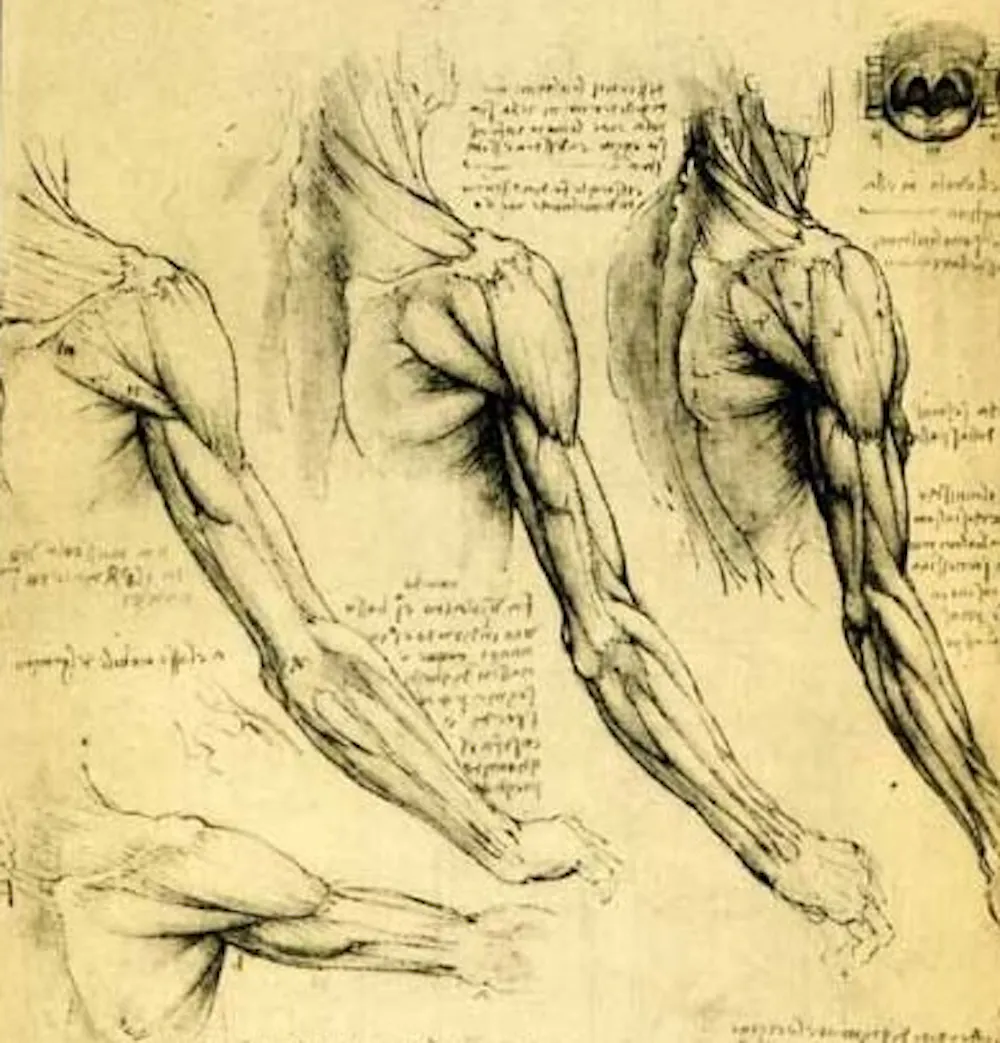
    Leonardo advanced this discipline through his remarkable observational skills, knowledge of perspective and, most notably, his outstanding drawing abilities. His anatomical sketches were unlike anything seen before. For example, his sketches of the muscles of the arms and human skull are comparable to illustrations in today’s medical anatomy texts.

    Sketches of human muscles, 1515.
    Italian Renaissance Art, CC BY-SA

    According to Leonardo’s biographer, Giorgio Vasari, the artist “was one of the first who, with Galen’s teachings, began to bring honour to medical studies and to shed real light upon anatomy, which had until that time been shrouded in the deepest shadows of ignorance”.

    Leonardo was the first to depict a detailed study of the human spine, showing its natural curvature and correctly numbered vertebrae. He drew and described nearly all the bones and muscles of the body in beautiful detail, as well as investigating their biomechanics.

    His studies on the heart combined both experimentation and observation. Using an ox’s heart to understand blood flow though the aortic valves, Leonardo poured molten wax into the surrounding cavities to make a wax cast, from which a glass model of the heart was made. He then pumped water mixed with grass seeds through this model to visualise the flow pattern. From this experiment, he concluded that the vortex-like flow of blood through the aortic valves was responsible for closing them during each heartbeat.

    Sketches of the heart, c1507.
    MAG, CC BY-SA

    Over 450 years later, in 1968, scientists used dyes and radiography methods to observe this blood flow and prove that Leonardo was correct. A study in 2014 using MRI (magnetic resonance imaging) also demonstrated that he had provided a strikingly precise depiction of these vortex-like flows.

    Shortcomings

    Leonardo may have dissected around 30 human corpses during his lifetime. Most took place at the Santa Maria Nuova hospital in Florence, and later at the Santo Spirito hospital in Rome. The fact he didn’t have more human cadavers to study probably helps to explain why he also got things wrong.

    In addition, Leonardo was very influenced by Galen, through his readings of both Mondino de Liuzzi and the Persian writer Avicenna (c980-1037), while also dissecting animals such as dogs, cattle and horses to fill in human anatomical gaps.

    This approach is evident in his study of the male and female reproductive system, as I found when carrying out a detailed review of his work in this area. Misconceptions included the presence of three channels in the penis for semen, urine and “animal spirit”. The prostate gland is also missing in all his sketches of the male reproductive system. Meanwhile, he made the uterus spherical (derived from cow dissections), and similarly misrepresented the fallopian tubes and ovaries.

    Even then, Leonardo still got a lot right. He correctly depicts the position of the foetus in the uterus, and the umbilical cord anatomy. He also correctly argued that penile erections were caused by blood engorgement and not by air or “vital spirits” flowing into the penis, as suggested by Galen.

    Sketch of baby in the womb, c1510-1513.
    Wikimedia, CC BY-SA

    Where he got things wrong, Leonardo’s shifting focus may also have played a part. His restlessness, disorganised notes and unfinished work suggest ADHD (attention deficit hyperactivity disorder). Equally, this may also explain his boundless curiosity and incredible creativity.

    Despite his shortcomings, Leonardo’s anatomical studies were centuries ahead of their time, rivalling modern standards. His work in this area might have been more appreciated had he published it in a book: he had planned one, and is said to have been collaborating with the Renaissance physician and professor, Marc’Antonio della Torre.

    Unfortunately, this was cut short with Marc’Antonio’s death in 1511. Leonardo died in 1519 at the age of 67, and while his gifts to the world have received endless attention, his important contributions to anatomy remain overshadowed, and deserve greater recognition.

    Michael Carroll does not work for, consult, own shares in or receive funding from any company or organisation that would benefit from this article, and has disclosed no relevant affiliations beyond their academic appointment.

    ref. Leonardo da Vinci’s incredible studies of human anatomy still don’t get the recognition they deserve – https://theconversation.com/leonardo-da-vincis-incredible-studies-of-human-anatomy-still-dont-get-the-recognition-they-deserve-248708

    MIL OSI – Global Reports

  • MIL-OSI Global: Why bats need tunnels

    Source: The Conversation – UK – By Eleanor Harrison, Lecturer in Ecology, Keele University

    A soprano pipistrelle, one of the commonest UK species, often roosts in buildings. Bearacreative/Shutterstock

    Developers need not “worry about bats and newts” before they start building, Chancellor Rachel Reeves has said in a speech that outlined her plans to reform the UK’s planning process. Reeves’ comments suggest construction firms and housebuilders will be allowed to destroy habitat if they pay into “a nature fund” that might finance restoration elsewhere.

    As an ecologist (with a passion for bats), I have serious concerns about what this would mean for the UK’s dwindling biodiversity. The comments from the chancellor are, at best, disheartening at a critical time for nature conservation.

    Bats and newts are derided as the gum in the wheels of the planning system. But the idea that nature inherently obstructs development and stymies our collective prosperity is wrong. There are many ways infrastucture can be designed to work with nature in mind from the start – often with low cost.

    The chancellor’s own calculations are off if she attaches no economic value to nature. In one scientific study that tried to quantify the economic contribution of wildlife, researchers found that losing pest-eating bats in North American farmland would cost farmers several billions of dollars in crop losses.

    Blaming wildlife for economic challenges will only worsen the biodiversity crisis. A report from 2023 found that nearly one in six UK species are at risk of extinction, and that the country is one of the most nature depleted in the world.

    Rather than weakening protections for nature, the UK should be doing much more to help the plants and animals that call these islands home.

    Why we should worry about bats and newts

    Populations of the great crested newt halved between 1965 and 1975 and have continued to decline by 2% every five years since. The enormous loss of habitat is partly to blame: half of all ponds vanished in the 20th century and 80% of those remaining are in poor condition. These figures highlight the long-running failure of the planning system to protect nature.

    Newts need ponds to breed in, but they also traverse surrounding grasslands and marshes to find food and new homes. Destruction of these habitats will not be easily remedied by digging a new pond elsewhere, with money from the chancellor’s new fund. Connections between habitats are also essential – isolated, artificial ponds are of little use if wildlife cannot reach them.

    The UK has lost a vast area of nature habitat within a generation.
    Kyaw Thiha/Shutterstock

    This approach will be even less helpful to bats, whose habitat requirements are even more varied.

    Bats are highly sensitive to environmental changes. The UK is home to 18 species, including the brown long-eared bat and the pug-like barbastelle. Far from being the menace of developers, bats have suffered greatly as changes to buildings have excluded them from making roosts while changes to the wider landscape have made it harder for them to find feeding and breeding sites.

    The numbers of some species have shown a small increase since monitoring began in 1998, but a wider perspective is instructive: the barbastelle bat, for instance, has declined by 99% in the UK over the past few hundred years.

    The wider decline of nature now poses a terrible strain. Local bat conservation groups have reported an uptick in the number of starving or underweight bats. All UK bats eat insects, so their health is linked with moths and butterflies and other pollinators that knit ecosystems together. Bats are an early warning system for the overall health of our environment.

    Develop with nature, not against it

    Conservation measures have to be tailored to the relevant species and setting. Careful deliberation in the planning system is important to protect species – it cannot be replaced with a pot of money that each developer pays into.

    Take “bat tunnels”, the structures designed to help bats safely navigate developments which recently drew the chancellor’s ire. These tunnels have been installed along the HS2 trainline and, in theory, protect bats from the 220-mph train as it intersects their flight paths.

    Bat tunnels maintain connections between habitats, enabling bats to reach their roosting, feeding and breeding sites without risking their lives near roads or other man-made barriers. It’s not just a fatal collision bats risk – noise and pollution also perturb bats and the insects they eat.

    While some species might benefit from a simple bat box that allows bats to roost by providing a roosting structure either outside of a building or on trees, others might need more complex changes. Bats rely on sound to navigate, emitting squeaks that bounce around their environment to create an audible impression of the world.

    Conservationists might build them flight paths composed of hedgerows and other features that bats can use to orient themselves. This can be particularly important for developments over a large area.

    In these instances, it’s important that bats, who may travel several kilometres from their roosts to feeding sites, have well-connected habitats. Fragmenting the landscape leaves smaller and smaller pockets of available habitat which in turn support fewer and fewer species.

    Some measures to help wildlife are cheap and easy to implement.
    Heather Wharram/Shutterstock

    Instead of being an expensive burden, most measures for mitigating development are fairly easy to implement. It could be as simple as maintaining and improving hedgerows or preserving old trees. More ambitious schemes include designing rail lines that allow animals to pass over or beneath.

    Instead of weakening protections and treating biodiversity as a hindrance, a smarter approach would be to integrate nature into development from the outset, and so prevent harm to protected sites and reduce the need for compensation later. The Woodland Trust said that “HS2’s assessment of woodland was significantly deficient” and its impacts to ancient woodland could have been avoided with alternative routes or proposals. In lieu of better assessment, the developers ran into avoidable delays.

    There is no one-size-fits-all approach to conservation – no big pot of funding that can pay to repair all the damage later. It requires careful, species-specific strategies, because the needs of wildlife vary greatly. Ignoring the necessity of protecting wildlife jeopardises ecosystems which underpin the economy.

    Effective conservation is not a barrier to development, but rather, key to a sustainable future, for people, nature and industries.


    Don’t have time to read about climate change as much as you’d like?

    Get a weekly roundup in your inbox instead. Every Wednesday, The Conversation’s environment editor writes Imagine, a short email that goes a little deeper into just one climate issue. Join the 40,000+ readers who’ve subscribed so far.


    Eleanor Harrison is affiliated with Staffordshire Bat Group, who aid in bat conservation locally.

    ref. Why bats need tunnels – https://theconversation.com/why-bats-need-tunnels-248782

    MIL OSI – Global Reports

  • MIL-OSI Global: DeepSeek claims to have cured AI’s environmental headache. The Jevons paradox suggests it might make things worse

    Source: The Conversation – UK – By Peter Howson, Assistant Professor in International Development, Northumbria University, Newcastle

    William Stanley Jevons also invented an early computer. University of Manchester Libraries / wiki, CC BY-SA

    AI burns through a lot of resources. And thanks to a paradox first identified way back in the 1860s, even a more energy-efficient AI is likely to simply mean more energy is used in the long run.

    For most users, “large language models” such as OpenAI’s ChatGPT work like intuitive search engines. But unlike regular web-searches that find and retrieve data from anywhere along a global network of servers, AI models return data they’ve generated from scratch. Like powering up a nuclear reactor to use a calculator, this tailored process is very inefficient.

    One study suggests the AI industry will be consuming somewhere between 85 and 134 terrawatt-hours (TWh) of electricity by 2027. That’s a similar amount of energy as the Netherlands consumes each year. One prominent researcher predicts that by 2030, over 20% of all electricity produced in the US will be feeding AI data centres (huge warehouses filled with computers).

    Big tech firms have always claimed to be heavy investors in wind and solar energy. But AI’s appetite for 24/7 power means most are developing their own nuclear options. Microsoft even plans to revive the infamous Three Mile Island power plant, scene of America’s worst ever civil nuclear accident.

    Despite Google’s ambitious target of being carbon neutral by 2030, the company’s AI developments mean its emissions have climbed 48% in the past few years. And the computing power needed to train these models increases tenfold each year.

    However, Chinese start-up DeepSeek claims to have created a fix: a model that matches the performance of established US rivals like OpenAI, but at a fraction of the cost and carbon footprint.

    An environmental game changer?

    DeepSeek has created a powerful open-source, relatively energy-lite model. The company claims it spent just US$6 million renting the hardware needed to train its new R1 model, compared with over $60 million for Meta’s Llama, which used 11 times the computing resources.

    DeepSeek uses a “mixture-of-experts” architecture, a machine-learning method that allows the model to scale up and down depending on the complexity of prompts. The company claims its model can also store more data and be trained without the need for huge amounts of expensive processor chips.

    Compared with its US rivals, DeepSeek promises to do more with less.
    Chitaika / shutterstock

    In reaction, US chip manufacturing and energy stocks plummeted following investor concerns that AI companies would rethink their energy-intensive data centre developments. As the world’s largest supplier of specialist AI processors, Nvidia saw its share price fall by US$589 billion, the biggest one-day loss in Wall Street history.

    Paradoxically, as well as upsetting the performance of US tech stocks, improving the energy efficiency of AI platforms could actually worsen the industry’s environmental performance as a whole.

    With tech stocks crashing, Microsoft CEO Satya Nadella tried to bring a longer-term perspective: “Jevons paradox strikes again!” he posted on X. “As AI gets more efficient and accessible, we will see its use skyrocket, turning it into a commodity we just can’t get enough of.”

    The Jevons paradox

    The idea that energy efficiency isn’t always a good thing for Earth’s resources has been around for well over a century. In 1865, a young Englishman named William Stanley Jevons wrote “The Coal Question”, a book in which he suggested that Britain’s place as an industrial superpower might soon come to an end, due to its rapidly depleting coal reserves.

    But to Jevons, frugality was not the solution. He argued: “It is wholly a confusion of ideas to suppose that the economical use of fuel is equivalent to a diminished consumption. The very contrary is the truth.”

    According to Jevons, any increase in resource efficiency generates an increase in long-term resource consumption, rather than a decrease. Because greater energy efficiency has the effect of reducing energy’s implicit price, it increases the rate of return – and demand.

    Jevons offered the example of the British iron industry. If technological advancements helped a blast furnace produce iron with less coal, profits would rise and new investment in iron production would be attracted. At the same time, falling prices would stimulate additional demand. He concluded: “The greater number of furnaces will more than make up for the diminished [coal] consumption of each.”

    More recently, the economist William Nordhaus applied this idea to the efficiency of lighting since the dawn of human civilisation. In a paper published in 1998, he concluded that in ancient Babylon, the average labourer might need to work more than 40 hours to purchase enough fuel to produce the equivalent amount of light emitted by a modern lightbulb for one hour. But by 1992, an average American would need to work for less than half a second to produce the same.

    Throughout time, efficiency gains haven’t reduced the energy we expend on lighting or shrunk our energy consumption. On the contrary, we now generate so much electric light that areas without it have become tourist attractions.

    Warming and lighting our homes efficiently, driving our cars, mining Bitcoin and, indeed, building AI models are all subject to the same so-called rebound effects identified in the Jevons paradox. And this is why it will be impossible to ensure a more efficient AI industry actually leads to an overall reduction in energy use.

    A Sputnik moment

    In the 1950s, the US was horrified when the Soviets launched Sputnik, the first space satellite. The emergence of a more efficient rival caused America to allocate more resources to the space race, not less.

    DeepSeek is Silicon Valley’s Sputnik moment. More efficient AI will probably mean more distributed and powerful models, in an arms race that is no longer made up only of US tech giants. AI offers superpower status, and the floodgates may now be fully open for the UK and other global competitors, as well as China.

    What’s for certain is that in the long term, the AI industry’s appetite for energy and other resources is only going to increase.

    Peter Howson has received research funding from the British Academy.

    ref. DeepSeek claims to have cured AI’s environmental headache. The Jevons paradox suggests it might make things worse – https://theconversation.com/deepseek-claims-to-have-cured-ais-environmental-headache-the-jevons-paradox-suggests-it-might-make-things-worse-248720

    MIL OSI – Global Reports

  • MIL-OSI Global: Can aching joints really predict the weather? Exploring the science behind the stormy debate

    Source: The Conversation – UK – By Michelle Spear, Professor of Anatomy, University of Bristol

    For centuries, people have claimed that their aching joints can predict changes in the weather, often reporting increased discomfort before rain or cold fronts. Given the scale and duration, there is a sense of legitimacy to these anecdotes – but this phenomenon remains scientifically contentious.

    From shifts in barometric pressure to temperature fluctuations, many theories attempt to explain how environmental factors might influence joint pain. But is there an anatomical basis for this claim, or is it simply an enduring weather-related myth? Are our joints any more reliable than the Met Office?

    At the heart of this debate lies barometric pressure, also known as atmospheric pressure – the force exerted by air molecules in the Earth’s atmosphere. While invisible, air has mass, and the “weight” pressing down on us fluctuates with altitude and weather systems.

    Higher barometric pressure often signals fair-weather conditions with clear skies and calm winds, whereas lower pressure typically precedes unsettled weather, such as cloudy skies, precipitation and humidity.

    Moveable joints are intricate structures cushioned by synovial fluid, the viscous liquid that lubricates joints, and encased in capsules rich in nerve endings. In healthy joints, these components should allow smooth, pain-free movement. However, when joints are compromised by cartilage damage (as in osteoarthritis) or inflammation (as in rheumatoid arthritis), even subtle changes in the environment may be acutely felt.

    One leading hypothesis suggests that changes in barometric pressure may directly influence joint discomfort. When atmospheric pressure drops ahead of storms, it can allow inflamed tissues within joints to expand slightly, increasing stress on surrounding nerves and amplifying pain. Conversely, rapid increases in pressure, characteristic of fair-weather systems, may compress already sensitive tissues, leading to discomfort in some people.

    Scientific studies offer some support for these claims, though results remain mixed. For instance, a 2007 study published in the American Journal of Medicine found a slight but significant correlation between dropping barometric pressure and increased knee pain in osteoarthritis patients. However, this pattern is not universally observed across all joint conditions.

    A 2011 systematic review in Arthritis Research & Therapy examined the relationship between weather and pain in rheumatoid arthritis patients. It revealed highly variable responses: while some people reported increased pain under low-pressure conditions, others noted no change. A few even experienced discomfort during high-pressure fronts.

    More recently, a [2019 citizen-science project] called Cloudy with a chance of pain used app-based pain tracking to explore this connection. The study found a modest association between falling pressure and heightened joint pain, but it also highlighted substantial individual differences in how people perceive weather-related pain.

    These findings suggest that while changes in barometric pressure may influence joint pain for some, responses are far from uniform and depend on a complex interplay of factors, including the individual’s underlying joint condition and overall pain sensitivity.

    Why responses differ

    Barometric pressure rarely acts in isolation. Fluctuations in temperature and humidity often accompany pressure changes, complicating the picture.

    Cold weather can have a pronounced effect on joints, particularly in people with existing joint conditions. Low temperatures cause muscles to contract and become stiffer, which can lead to reduced flexibility and a greater risk of strain or discomfort.

    Ligaments, which connect bones to one another, and tendons, which anchor muscles to bones, may also lose some of their elasticity in colder conditions. This decreased pliability can make joint movement feel more restricted and exacerbate pain in conditions like arthritis.

    Cold weather can also cause blood vessels to narrow — particularly in the extremities, as the body prioritises maintaining core temperature. This reduced blood flow can deprive affected areas of essential oxygen and nutrients, slowing the removal of metabolic waste products like lactic acid, which may accumulate in tissues and exacerbate inflammation and discomfort.

    For people with inflammatory conditions, the reduced circulation can aggravate swelling and stiffness, especially in small joints like those in the fingers and toes.

    Cold also slows the activity of synovial fluid. In lower temperatures, the fluid becomes less effective at reducing friction, which can heighten joint stiffness and make motion more painful, particularly for people with degenerative conditions such as osteoarthritis.

    Sudden temperature changes may also play a role. Rapid shifts can challenge the body’s ability to adapt, which might worsen pain in people with chronic conditions. Similarly, high humidity can intensify sensations of heat or dampness in already inflamed areas, further complicating the experience of pain.

    However, isolating a single variable – whether humidity, temperature or pressure –proves difficult because of the interplay of overlapping factors.

    Responses to weather also depend on individual factors, including the extent of joint damage, overall pain sensitivity and psychological expectations. This variability makes it difficult to link a single meteorological factor to a biological response.

    Still, the evidence suggests that people with joint conditions tend to be more attuned to environmental changes, particularly pressure fluctuations.

    While the relationship between weather and joint pain remains an imperfect science, the collective evidence indicates that there may be some truth to the age-old belief. For those with chronic joint conditions, shifts in barometric pressure and accompanying weather changes might indeed serve as nature’s warning system – albeit one that’s far from foolproof.

    Michelle Spear does not work for, consult, own shares in or receive funding from any company or organisation that would benefit from this article, and has disclosed no relevant affiliations beyond their academic appointment.

    ref. Can aching joints really predict the weather? Exploring the science behind the stormy debate – https://theconversation.com/can-aching-joints-really-predict-the-weather-exploring-the-science-behind-the-stormy-debate-247728

    MIL OSI – Global Reports

  • MIL-OSI Global: DeepSeek: what you need to know about the Chinese firm disrupting the AI landscape

    Source: The Conversation – UK – By Stuart Mills, Assistant Professor of Economics, University of Leeds

    Before January 27 2025, it’s fair to say that Chinese tech company DeepSeek was flying under the radar. And then it came dramatically into view.

    Suddenly, everyone was talking about it – not least the shareholders and executives at US tech firms like Nvidia, Microsoft and Google, which all saw their company values tumble thanks to the success of this AI startup research lab.

    Founded by a successful Chinese hedge fund manager, the lab has taken a different approach to artificial intelligence. One of the major differences is cost.

    The development costs for Open AI’s ChatGPT-4 were said to be in excess of US$100 million (£81 million). DeepSeek’s R1 model – which is used to generate content, solve logic problems and create computer code – was reportedly made using much fewer, less powerful computer chips than the likes of GPT-4, resulting in costs claimed (but unverified) to be as low as US$6 million.

    This has both financial and geopolitical effects. China is subject to US sanctions on importing the most advanced computer chips. But the fact that a Chinese startup has been able to build such an advanced model raises questions about the effectiveness of these sanctions, and whether Chinese innovators can work around them.

    The timing of DeepSeek’s new release on January 20, as Donald Trump was being sworn in as president, signalled a challenge to US dominance in AI. Trump responded by describing the moment as a “wake-up call”.

    From a financial point of view, the most noticeable effect may be on consumers. Unlike rivals such as OpenAI, which recently began charging US$200 per month for access to their premium models, DeepSeek’s comparable tools are currently free. They are also “open source”, allowing anyone to poke around in the code and reconfigure things as they wish.

    Low costs of development and efficient use of hardware seem to have afforded DeepSeek this cost advantage, and have already forced some Chinese rivals to lower their prices. Consumers should anticipate lower costs from other AI services too.

    Artificial investment

    Longer term – which, in the AI industry, can still be remarkably soon – the success of DeepSeek could have a big impact on AI investment.

    This is because so far, almost all of the big AI companies – OpenAI, Meta, Google – have been struggling to commercialise their models and be profitable.

    Until now, this was not necessarily a problem. Companies like Twitter and Uber went years without making profits, prioritising a commanding market share (lots of users) instead.

    And companies like OpenAI have been doing the same. In exchange for continuous investment from hedge funds and other organisations, they promise to build even more powerful models.

    These models, the business pitch probably goes, will massively boost productivity and then profitability for businesses, which will end up happy to pay for AI products. In the mean time, all the tech companies need to do is collect more data, buy more powerful chips (and more of them), and develop their models for longer.

    But this costs a lot of money.

    Nvidia’s Blackwell chip – the world’s most powerful AI chip to date – costs around US$40,000 per unit, and AI companies often need tens of thousands of them. But up to now, AI companies haven’t really struggled to attract the necessary investment, even if the sums are huge.

    DeepSeek might change all this.

    By demonstrating that innovations with existing (and perhaps less advanced) hardware can achieve similar performance, it has given a warning that throwing money at AI is not guaranteed to pay off.

    For example, prior to January 20, it may have been assumed that the most advanced AI models require massive data centres and other infrastructure. This meant the likes of Google, Microsoft and OpenAI would face limited competition because of the high barriers (the vast expense) to enter this industry.

    Money worries

    But if those barriers to entry are much lower than everyone thinks – as DeepSeek’s success suggests – then many massive AI investments suddenly look a lot riskier. Hence the abrupt effect on big tech share prices.

    Shares in chipmaker Nvidia fell by around 17% and ASML, which creates the machines needed to manufacture advanced chips, also saw its share price fall. (While there has been a slight bounceback in Nvidia’s stock price, it appears to have settled below its previous highs, reflecting a new market reality.)

    Nvidia and ASML are “pick-and-shovel” companies that make the tools necessary to create a product, rather than the product itself. (The term comes from the idea that in a goldrush, the only person guaranteed to make money is the one selling the picks and shovels.)

    The “shovels” they sell are chips and chip-making equipment. The fall in their share prices came from the sense that if DeepSeek’s much cheaper approach works, the billions of dollars of future sales that investors have priced into these companies may not materialise.

    ‘When we find some gold we can invest in AI.’
    Everett Collection/Shutterstock

    For the likes of Microsoft, Google and Meta (OpenAI is not publicly traded), the cost of building advanced AI may now have fallen, meaning these firms will have to spend less to remain competitive. That, for them, could be a good thing.

    But there is now doubt as to whether these companies can successfully monetise their AI programmes.

    US stocks make up a historically large percentage of global investment right now, and technology companies make up a historically large percentage of the value of the US stock market. Losses in this industry might force investors to sell off other investments to cover their losses in tech, leading to a whole-market downturn.

    And it shouldn’t have come as a surprise. In 2023, a leaked Google memo warned that the AI industry was exposed to outsider disruption. The memo argued that AI companies “had no moat” – no protection – against rival models. DeepSeek’s success may be the proof that this is true.

    Richard Whittle receives funding from the ESRC, Research England and was the recipient of a CAPE Fellowship.

    Stuart Mills does not work for, consult, own shares in or receive funding from any company or organisation that would benefit from this article, and has disclosed no relevant affiliations beyond their academic appointment.

    ref. DeepSeek: what you need to know about the Chinese firm disrupting the AI landscape – https://theconversation.com/deepseek-what-you-need-to-know-about-the-chinese-firm-disrupting-the-ai-landscape-248621

    MIL OSI – Global Reports

  • MIL-OSI Global: Exploring bacopa: the science behind the latest brain health trend

    Source: The Conversation – UK – By James Goodwin, Professor in the Physiology of Ageing, Loughborough University

    Koldunov/Shutterstock

    As I’ve grown older and experienced the vagaries of my ageing memory, I’ve often reflected on the possibility of a miracle cure that would rejuvenate it. As if in answer to my wishful thinking, not one but several reports recently appeared simultaneously in the scientific news, highlighting a trending solution of which I was blissfully unaware.

    A welter of articles – The Times of India, MSN, New York Post and others – spoke of an Indian herb called bacopa, or to give it its full botanical name, Bacopa monnieri, an aquatic flower. This wave of publicity resulted in a massive spike in interest: 2,000 monthly searches on Google and a weekly average of 13,000 views on TikTok.

    The reason for its global popularity? A new study which concluded that ingesting bacopa brought significant improvements in both memory and cognition skills (concentration, alertness, reasoning and mental flexibility).

    All types of memory were improved – short-term memory (verbal and spatial), working memory and episodic memory (memory of everyday events).

    The researchers also reported other brain health-related benefits. Anxiety and cortisol levels in the blood were significantly reduced, and sleep quality and serum BDNF were increased by taking a bacopa supplement (BDNF is a naturally produced protein in the brain that stimulates the production of new brain cells in every decade of our life). If I had wanted a miracle, perhaps I had found it.

    But one swallow doesn’t make a summer. And neither should a single study set a law in stone.

    So, curious as to the weight of evidence, I delved deeper. My search led me to a surprising source – Ayurvedic medicine.

    Over many thousands of years, this traditional Indian medical system has expounded the benefits of bacopa. Bacopa is a medhya rasayana, meaning a class of herbs believed to improve mental health, memory and intellect, and promote rejuvenation and longevity.

    It would be true to say that millions of people over the centuries have relied on this supplement for health and mental health benefits. However, history and tradition teach us many things, but not all of them are true. And, therefore, I asked myself: what of the scientific evidence?

    One of the earliest papers on the effects of taking bacopa was in 2008. And though, over the years, it stimulated several more studies favourable to the use of bacopa, the picture of its effectiveness is mixed.

    It’s true to say that most of the papers – many of them using the gold standard method of a randomised controlled trial – find that bacopa is positive for improved memory and reduced anxiety. And there is a biological explanation.

    Bacopa extract contains many potent substances called “bacosides” that have, among other effects, antioxidant, anti-inflammatory and anxiolytic (anxiety-reducing) properties. But by no means do all studies show that bacopa improves memory and anxiety. In fact, in 2021 a review of bacopa research stated that there are only limited studies (six to date) to establish the memory-enhancing and brain-protecting effects of bacopa.

    Safety

    Then I asked myself, is it safe? I turned to the US Food and Drug Administration (FDA). If there is an issue with safety and side-effects, the FDA would know.

    The FDA has not approved bacopa as a drug and therefore has not made any statements as to its safety or efficacy. However, the way in which a supplement is marketed can lead to the FDA categorising it as a drug. For example, in 2024, a US company selling veterinary products was censured because their marketing of one of them intended it to be used in the cure of chronic seizures and epilepsy in dogs.

    The FDA can investigate, censor or fine – without limit – any company which says that its supplement acts like a drug by implying it can be used to prevent, mitigate, treat or cure any illness.

    There is a very fine line here. For example, marketing such as, “the control of blood pressure” may lead to a US federal investigation. A company in Houston, Texas, making medical claims for bacopa was given 15 days in a warning letter by the FDA to correct their marketing or face sanctions including fines.

    The FDA states: “Dietary supplements are regulated by the FDA as food, not as drugs. However, many dietary supplements contain ingredients that have strong biological effects which may conflict with a medicine you are taking or a medical condition you may have.”

    Such effects are known in bacopa because it inhibits an important brain chemical called acetylcholine and therefore could counteract cholinergic drugs for conditions such as dementia, glaucoma and urinary retention.

    It is generally safe for most people, but is inadvisable where there are thyroid conditions, asthma, COPD, genital problems, stomach ulcers or if pregnant.

    What are we to make of all this? All that glisters is not gold. And the wisdom of the ages is not irrevocable. There may be a frenzy of popularity in the media but that makes bacopa neither effective nor safe.

    The moral here is that before spending your hard-earned money on a promising product that has been seized upon by millions, you should pause, read, research, think and then, based on real evidence, commit – one way or the other. After all, since the days of Newton, science has served us pretty well.

    James Goodwin does not work for, consult, own shares in or receive funding from any company or organisation that would benefit from this article, and has disclosed no relevant affiliations beyond their academic appointment.

    ref. Exploring bacopa: the science behind the latest brain health trend – https://theconversation.com/exploring-bacopa-the-science-behind-the-latest-brain-health-trend-247154

    MIL OSI – Global Reports

  • MIL-OSI Global: Marianne Faithfull: the singer with an inimitable voice was a Romantic poet at heart

    Source: The Conversation – UK – By Stephanie Hernandez, PhD Candidate, Literature and Music, University of Liverpool

    Marianne Faithfull, the London-born singer with an inimitable voice, has passed away at the age of 78. She was known for many things: she was a pop star, an actress and a muse. But she was probably best known for her voice.

    When she first entered the world of pop in 1964, her high-pitched tones rang with mellifluous vibrato. As she grew older and lived an increasingly excessive lifestyle, she developed a rasp – a quality borne of her unique experiences.

    Faithfull’s final musical releases were works that incorporated Romantic poetry in different ways. She Walks in Beauty (2021) is a spoken-word album of canonical Romantic poetry by the likes of Lord Byron, Percy Shelley and John Keats. Songs of Innocence and Experience 1965-1995 (2022) is a chronological retrospective of her career which uses the name of William Blake’s poetry collection (1789) as its title.

    As a PhD student focused on the legacy of Romanticism in 1960s and 1970s popular music, I’ve closely examined Faithfull’s engagement with Romantic literature throughout her career. These final two albums represent a beautiful culmination of her artistic journey, and are a testament to her unique voice and strong poetic influences.


    Looking for something good? Cut through the noise with a carefully curated selection of the latest releases, live events and exhibitions, straight to your inbox every fortnight, on Fridays. Sign up here.


    Songs of Innocence and Experience 1965-1995, like Blake’s poetry collection, is broken up into the sections Innocence and Experience.

    The Innocence portion of the album covers Faithfull’s youth, featuring early hits such as This Little Bird. Her early sound incorporated baroque pop instrumentation, including harps, harpsichord and horn arrangements (Come and Stay with Me), as well as folk styles with the acoustic guitar at the centre of the sound (Cockleshells).

    Faithfull’s voice in this section portrays her as an “innocent” girl in pop stardom, as its high pitch and pure tone embody a sense of naivete that is also reflected in her lyrics about young love, such as in Come and Stay With Me:

    We’ll live a life no one has ever known
    But I know you’re thinking that I’m hardly grown
    But oh thank God, at last and finally
    I can see you’re gonna stay with me

    There is a noticeable shift in the Innocence section of the album with the song Sister Morphine. As the song was made in collaboration with her then-boyfriend, Mick Jagger, it features a noticeably more rock sound in contrast to her previous pop productions. You can also hear subtle changes in Faithfull’s voice: it cracks and sounds strained in places.

    The song’s lyrics (“Please, Sister Morphine, turn my nightmares into dreams”) reflect the darker side of the mythologised “swinging sixties” lifestyle and its drug culture, which Faithfull has come to symbolise.

    Blake’s Songs of Innocence features a piper as the presiding narrator over the poems. In contrast, Songs of Experience is meant to be heard through the voice of an ancient bard, as established in Introduction to the Songs of Experience:

    Hear the voice of the Bard!
    Who Present, Past, & Future sees
    Whose ears have heard,
    The Holy Word
    That walk’d among the ancient trees.

    The Experience section of Faithfull’s album features music from Broken English (1979) and her re-recording of As Tears Go By, from Strange Weather (1987). The songs in this portion of the album exhibit her completely transformed voice: from piper to bard, it is deeper, raw and more weathered as a result of her struggles with addiction and bouts of illness. This brought a distinct edge to her music, marking a new phase in her career.

    Beyond the qualities of her voice, Faithfull’s song selection reflects Blake’s notions of Experience. Strange Weather (“Will you take me across the Channel / London Bridge is falling down”) aligns with Blake’s London geographically and thematically, as both explore entrapment and decay. Faithfull’s depiction of societal monotony, as in “Strangers talk only about the weather / All over the world / It’s the same …” echo Blake’s “charter’d street(s)” and “mind-forg’d manacles”.

    Faithfull’s connection to Romantic poetry is most overt in She Walks in Beauty, which she made with Warren Ellis (Australian composer and member of Nick Cave and the Bad Seeds). In this album, she recites Romantic poetry set to Ellis’s music.

    The poems she selected to recite are all by male poets and many feature voiceless female subjects, such as Byron’s She Walks in Beauty or Thomas Hood’s The Bridge of Sighs. On the album’s liner notes, Faithfull described how she related with these women, particularly Alfred, Lord Tennyson’s Lady of Shalott.

    The Lady of Shalott is a woman cursed to live alone in a tower near Camelot – unable to look directly at the world, forced to weave what she sees in the mirror. Faithfull uses the Lady to reflect on the pressure she felt to conform to the expectations imposed on her by the press and music industry. There is a parallel between the Lady’s forced isolation and her struggles with being controlled and defined by external forces, as she explained:

    Do I identify with the Lady? Oh yeah, always. I’m nothing like the Lady of Shalott, but I guess I wanted to be … When Mick Jagger wrote the lyrics for As Tears Go By, he knew this poem. There’s a bit he always said he used from here, the thing about ‘it was the closing of the day’.

    In the liner notes, Faithfull also mentioned that her love of poetry was thanks to her English teacher at St Joseph’s Convent in Reading, Mrs Simpson, and to Palgrave’s Golden Treasury, an anthology of English poetry, which she had bought as a teenager.

    Faithfull’s lifelong interest in literature came to fruition in her two final projects. They exemplify how she was a pop star, muse and chanteuse – and also a Romantic.

    Stephanie Hernandez does not work for, consult, own shares in or receive funding from any company or organisation that would benefit from this article, and has disclosed no relevant affiliations beyond their academic appointment.

    ref. Marianne Faithfull: the singer with an inimitable voice was a Romantic poet at heart – https://theconversation.com/marianne-faithfull-the-singer-with-an-inimitable-voice-was-a-romantic-poet-at-heart-248805

    MIL OSI – Global Reports

  • MIL-OSI Canada: Steveston crossing removal postponed

    The removal of the old Steveston Highway crossing, initially scheduled to begin this weekend, Feb.1-2, 2025, has been postponed due to incoming snowy winter weather.

    There will be no traffic-pattern changes or overnight closures of Highway 99 at Steveston Highway this weekend.

    This postponement by the Steveston Interchange Project contractor will allow the Ministry of Transportation and Transit’s winter-maintenance operations to have full access to Highway 99 for brine applications and plowing, if necessary.

    The removal of the old Steveston Highway crossing will begin on Friday, Feb. 7, 2025, and take place over three weekends: Feb. 7-10; Feb. 21-24; and Feb. 28 to March 3. 

    Learn More:

    Further information on traffic-pattern changes for the dismantling of the Steveston Highway crossing can be found here: www.highway99tunnel.ca/current-work/

    For updates, check: https://www.drivebc.ca/

    MIL OSI Canada News

  • MIL-OSI USA: What They Are Saying: Gov. Kemp Unveils Plan to Tackle Tort Reform and Stabilize Insurance Costs for Hardworking Georgians

    Source: US State of Georgia

    ATLANTA, GA – In front of what AJC Political Reporter Greg Bluestein described as “one of the most crowded press conferences I’ve seen in years at the Gold Dome,” Governor Brian Kemp laid out his plan to level the playing field in our courtrooms, ban hostile foreign powers from taking advantage of consumers and legal proceedings, stabilize insurance costs for businesses and consumers, increase transparency and fairness, and ensure Georgia continues to be the best place to live, work, and raise a family.

    The announcement has since received praise from, leaders and members of the Georgia General Assembly, doctors, industry partners, and other stakeholders.

    Read more of what they are saying:

    Lieutenant Governor Burt Jones

    “My position on this important issue has always been the same. If we want to continue to be the #I state in which to do business, we must foster a business-friendly climate. We have to work together to ensure that we put families and consumers first by tackling the hidden costs we all pay thanks to Georgia’s current tort laws. I look forward to working with those in the General Assembly to move these bills through the legislative process.”

    Senator John F. Kennedy

    “Georgia’s current legal environment raises prices and undermines the ability of job creators to start and grow their business.

    @GovKemp’s tort reform legislation will level the playing field in our courts and stabilize costs for families and consumers. I look forward to working alongside my colleagues to get this meaningful tort reform across the finish line.”

    House Speaker Pro Tempore Jan Jones

    “…@GovKemp announced plans for lawsuit reform that will reduce insurance costs, helping business owners keep the lights on, while preserving citizens’ rights to legal relief. I look forward to discussing these issues and enabling Georgia to stay competitive.”

    Georgia House Republican Caucus

    “The Georgia House stands ready to support @GovKemp’s efforts this session to bring meaningful judicial reform to our state and ease burdens on our state’s job creators!”

    Caylee Noggle – President, Georgia Hospital Association

    Georgia Hospital Association members and their physicians applauded our elected leaders, including Office of Governor Brian P. Kemp , Lieutenant Governor Burt Jones , and Speaker Jon Burns, today in support of common sense, fair tort reforms that will rebalance the system and protect access to healthcare, improve patient safety and outcomes, and preserve our workforce.”

    Chris Clark – President/CEO, Georgia Chamber of Commerce

    “…Georgia took an important step forward to curb lawsuit abuse, to protect families, small business and our economic competitiveness. The Georgia Chamber of Commerce and our 50,000 members and their millions of hard working Georgians team members will work day and night for bipartisan legislation that ensures our legal system is focused on justice and not jackpots!”

    Katie Kirkpatrick – President & CEO, Metro Atlanta Chamber

    “MAC supports Governor Kemp for his strong commitment to enacting meaningful tort reform. As a top legislative priority for the Metro Atlanta Chamber, we know the critical importance of this effort to address key challenges faced by businesses and healthcare providers. Governor Kemp’s proposed legislative package aims to bring balance to legal proceedings and create parity with neighboring states.”

    Marsha Poorak – CEO, Southern Electric Company, LLC

    “Businesses in our state showed up strong this morning to support Governor Kemp’s tort reform efforts!  It was incredible standing on the steps behind him with medical professionals, construction workers, convenience store owners, and many more… The turnout demonstrated what we already know: tort reform is desperately needed by almost every industry in our state.”

    Georgia Child Care Association

    “Child care centers across Georgia are facing skyrocketing insurance premiums—some increasing over 20% annually. These rising costs make it harder for centers to stay open and affordable for families.

    The Georgia Child Care Association (GCCA) supports civil justice reforms to address the financial strain caused by excessive lawsuits and large settlements. Our goal is to strike a balance that ensures fair outcomes while reducing unnecessary financial burdens on child care providers.”

    Georgia Restaurant Association

    “We’re standing with Governor Kemp for Legal Reform! 💪

    GRA members proudly supported Governor Brian Kemp as he unveiled a new legislative package for comprehensive tort reform. This bill will protect both business owners and consumers from frivolous lawsuits, ensuring a more fair legal system. We look forward to to collaborating with the governor to advance this critical legislation!”

    Georgia Health Care Association/Georgia Center for Assisted Living

    “We commend Gov. Kemp for prioritizing these important reform efforts, which will promote accountability and help ensure resources are directed where they are most needed – toward providing high-quality care for residents and patients.”

    Georgia Association of Manufacturers 

    “As the only Association in the state focused solely on manufacturers, GAM strongly supports Governor Kemp’s tort reform initiative.”

    Georgia Motor Trucking Association

    “The time for change in Georgia is now. We are proud to stand in support of @GovKemp’s tort reform bill and fight for ALL Georgians.”

    Georgia Retailers

    “Thank you @GovKemp for your leadership! Your proposed reforms will protect responsible retailers and restore fairness and common sense. We are proud to stand with you!”

    Georgia REALTORS

    “GAR leadership and our advocacy staff joined Governor Kemp’s press conference supporting his tort reform legislative package, which aims to address Georgia’s challenging legal environment. GAR will continue working alongside state leadership to advance meaningful tort reform that promotes a fair legal system and economic growth across our state.”

    Georgia Senior Living Association

    “The Georgia Senior Living Association is grateful to Governor Brian Kemp, Lt. Governor Burt Jones, Speaker John Burns, and Insurance Commissioner John King for their support of the people and businesses in Georgia. Now is the time for GSLA action…”

    The Georgia Hotel & Lodging Association (GHLA)

    “The Georgia Hotel & Lodging Association (GHLA) and the hotel industry across our state fully support Governor Brian Kemp’s initiatives to bring much-needed litigation and insurance reforms to Georgia. Unchecked jury verdicts, soaring insurance premiums, and limited access to adequate coverage are placing an unsustainable burden on businesses, driving up operational costs, and jeopardizing the future of our industry. These proposed reforms are critical to restoring fairness and predictability, ensuring that Georgia continues to be a premier destination for both business and tourism”

    MIL OSI USA News

  • MIL-OSI USA: Sen. Sheikh Rahman: Weeks 2 & 3 of the Legislative Session 

    Source: US State of Georgia

    As we enter the heart of the legislative session, work under the Gold Dome is moving full speed ahead. Even as ice and snow swept across South Georgia and Atlanta last week, our commitment to serving the people of Georgia never wavered.

    We hit the ground running when we returned to the Capitol this past Monday. Some highlights included the Senate Democratic Caucus Press Conference, Alpha Kappa Alpha Sorority Inc. Day and Chamber of Commerce Day. I am always excited to see these events full of Georgians getting involved in our state government.

    As budget hearings for the next fiscal year continue over the remainder of session, we have a critical opportunity to shape investments that will directly impact our communities. Governor Brian Kemp’s proposed budget includes $50 million in security grants for individual schools—an essential step toward keeping students safe. However, proper school safety goes beyond physical security; it requires a commitment to addressing the broader issues affecting student well-being. I will continue advocating for a budget that supports working families, invests in underserved communities, and ensures every Georgian has the opportunity to succeed.

    On Tuesday, the Senate Democratic Caucus announced several key legislative priorities for this session. We introduced Senate Bill 50, a bipartisan effort to close health insurance gaps, expand mental health and maternal care access, and ensure working families can afford quality healthcare. Too many Georgians rely on emergency rooms for primary care because they lack affordable insurance. We believe every Georgian deserves reliable, accessible healthcare, and we will continue pushing for solutions that lower costs and expand coverage. In the coming weeks, we will introduce bills to raise the state minimum wage, improve public schools, and expand access to affordable childcare. Our focus remains on legislation that puts people first.

    I am pleased to have worked across the aisle and cosponsored several pieces of bipartisan legislation, including Senate Bill 9, or the “Ensuring Accountability for Illegal AI Activities Act.” Sponsored by Sen. John Albers (R—Roswell), SB 9 would create sentencing penalties for individuals who utilize artificial intelligence to develop obscene materials that could endanger vulnerable members of our population. 

    I encourage students between the ages of 12 and 18 to apply to spend a day as a Senate Page. This program allows students to participate actively in the legislative process at our State Capitol for a day during the legislative session. This program is an invaluable experience, and I encourage my younger constituents to participate. Interested students may apply for the program here.

    The weeks ahead will be eventful, with key debates and legislation shaping Georgia’s future. I’m committed to keeping you informed and ensuring your voice is heard. Thank you for your trust—I encourage you to stay engaged as we work toward a stronger, fairer Georgia.

    # # # #

    Senator Sheikh Rahman represents the 5th Senate District which includes portions of Lawrenceville, Norcross, Duluth, Tucker and Lilburn in Gwinnett County. He may be reached at (404) 463-5261 or by email at sheikh.rahman@senate.ga.gov.

    MIL OSI USA News

  • MIL-OSI Security: Dartmouth — Nova Scotia RCMP Collision and Reconstruction Service interview on seatbelt use

    Source: Royal Canadian Mounted Police

    Cpl. Ford and Cpl. Durette of the RCMP’s Collision and Reconstruction Service recently sat down with CBC to discuss their role in investigating collisions and the impact of vehicle occupants failing to wear seatbelts.

    https://www.cbc.ca/player/play/video/9.6621874

    MIL Security OSI

  • MIL-OSI: Combined General Meeting of January 31, 2025

    Source: GlobeNewswire (MIL-OSI)

    Paris, France – January 31, 2025 – The Combined Annual General Meeting of Atos SE shareholders convened to approve the 2023 financial statements was held today at the Company’s registered office, chaired by Philippe Salle, Chairman of the Board of Directors until today and Chairman and Chief Executive Officer as of February 1, 2025.

    Broadcast live on the Atos website, the Annual General Meeting was a key opportunity to inform and exchange views with shareholders, who approved all the resolutions submitted to the vote.

    In particular, the Annual General Meeting approved the statutory and consolidated financial statements for the 2023 financial year.

    Detailed voting results and a replay of the Annual General Meeting will be available on the Atos website (under Investors – Annual General Meeting).

    Changes to the Board of Directors composition

    The Annual General Meeting approved all the ratifications of appointments submitted to it. In particular, the ratification of Philippe Salle’s appointment was approved by 94.18% of the votes cast.

    The shareholders approved the renewal of Sujatha Chandrasekaran’s term of office as Director, and the appointments of Joanna Dziubak and Hildegard Müller as new Directors.

    At the close of the Annual General Meeting, the Board of Directors noted the end of Mandy Metten’s term of office as the second Director representing employees, with the Board reduced to eight members (excluding the Director representing employees), and the expiry of the terms of office of Alain Crozier, Katrina Hopkins, Monika Maurer and Astrid Stange.

    On the recommendation of the Nomination and Governance Committee, the Board of Directors has decided to appoint Mandy Metten as a censor to the Board of Directors, with effect from today, subject to ratification by the next Annual General Meeting.

    The Board again noted the resignation of Jean Pierre Mustier from his duties as Chief Executive Officer and Director of the Company with effect from today. The Board also reiterated its unanimous decision of October 14, 2024 to combine the roles of Chairman and Chief Executive Officer, and to appoint Philippe Salle as Chairman and Chief Executive Officer with effect from February 1, 2025. The Board would like to thank Jean Pierre Mustier, who remarkably steered the Group’s restructuring, for his unfailing commitment and contribution to the Group’s success, as well as for the exemplary transition he implemented with Philippe Salle.

    At the close of the Annual General Meeting and the Board of Directors, the Atos Board of Directors comprised nine Directors, of whom 75% are independent Directors1 and 62.5% are women2, and one censor:

    • Philippe Salle, Chairman and Chief Executive Officer
    • Laurent Collet-Billon*, Vice-Chairman of the Board of Directors
    • Elizabeth Tinkham*, Lead Independent Director
    • Sujatha Chandrasekaran*
    • Joanna Dziubak*
    • Farès Louis, Director representing employees
    • Françoise Mercadal-Delasalles*
    • Jean-Jacques Morin*
    • Hildegard Müller
    • Mandy Metten, censor

    * Independent Directors

    The Board of Directors has also amended its Internal Rules3, in particular to strengthen the duties and resources of the Lead Independent Director, whose appointment is now mandatory when the roles of Chairman and Chief Executive Officer are combined. The matters reserved to the Board of Directors have also been extended.

    Changes to the Board Committees composition

    Taking into account its renewed composition, the Board has restructured its committees, as of today, on the recommendation of the Nomination and Governance Committee:

    • Audit Committee: Jean-Jacques Morin* (Chair); Laurent Collet-Billon*; Joanna Dziubak*; Sujatha Chandrasekaran*
    • Nomination and Governance Committee: Elizabeth Tinkham* (Chair); Sujatha Chandrasekaran*; Farès Louis; Joanna Dziubak*
    • Remuneration Committee: Laurent Collet-Billon* (Chair); Farès Louis; Françoise Mercadal-Delasalles*; Hildegard Müller
    • CSR Committee: Françoise Mercadal-Delasalles* (Chair); Hildegard Müller; Farès Louis

    * Independent Directors

    Philippe Salle, Chairman of the Board of Directors of Atos SE, said: “I am delighted by the confidence expressed by our shareholders. With a more compact and strengthened Board of Directors, we are fully mobilized and focused on deploying the Group’s new strategy. On behalf of the entire Board of Directors, I would like to thank the Directors whose terms of office have ended for their commitment and contribution to Atos during this critical period.

    ***

    About Atos

    Atos is a global leader in digital transformation with c. 82,000 employees and annual revenue of c. €10 billion. European number one in cybersecurity, cloud and high-performance computing, the Group provides tailored end-to-end solutions for all industries in 69 countries. A pioneer in decarbonization services and products, Atos is committed to a secure and decarbonized digital for its clients. Atos is a SE (Societas Europaea), and listed on Euronext Paris.

    The purpose of Atos is to help design the future of the information space. Its expertise and services support the development of knowledge, education and research in a multicultural approach and contribute to the development of scientific and technological excellence. Across the world, the Group enables its customers and employees, and members of societies at large to live, work and develop sustainably, in a safe and secure information space.

    Contacts

    Investor relations: David Pierre-Kahn | investors@atos.net | +33 6 28 51 45 96
    Individual shareholders: 0805 65 00 75
    Press contact: globalprteam@atos.net


    1 In accordance with article 10.3 of the AFEP-MEDEF Code, the Director representing employees is not taken into account in determining the percentage of independent members.

    2 In accordance with the law, the Director representing employees is not taken into account in determining the parity ratio on the Board of Directors.

    3 Available on the Atos website, under Investors – Corporate Governance.

    Attachment

    The MIL Network

  • MIL-OSI USA: Durbin, Grassley Urge PhRMA To Embrace Their Bill To End Price Secrecy In Prescription Drug Advertisements

    US Senate News:

    Source: United States Senator for Illinois Dick Durbin
    January 31, 2025
    CHICAGO – U.S. Senate Democratic Whip Dick Durbin (D-IL) and U.S. Senator Chuck Grassley (R-IA), a senior member and former chairman of the Senate Finance Committee, today sent a letter to the President and CEO of the Pharmaceutical Research and Manufacturers of America (PhRMA) urging them to embrace their bipartisan legislation, the Drug-price Transparency for Consumers (DTC) Act, to empower patients and providers and commit to voluntarily disclosing list prices in DTC advertisements. 
    The Senators wrote, “The United States is one of only two developed countries in the world that permits such pharmaceutical commercials. President Trump’s nominee for Health and Human Services Secretary has expressed interest in outright banning this practice. It would be wise for drug companies to adopt commonsense solutions to address the concerns that have been raised about DTC prescription drug advertising. As you are aware, the United States Senate previously voted unanimously to pass our measure to require that pharmaceutical companies disclose their list prices in DTC ads, and it is our hope that this policy will become law this Congress. This bipartisan legislation would ensure that when patients are bombarded with information about the newest wonder drug, the price is not kept secret. President Trump previously has issued regulations to advance this policy.”
    Drug manufacturers in the United States spend approximately $6 billion annually in direct-to-consumer (DTC) prescription drug advertisements, with approximately one-third of all commercial time across evening news programs being consumed with these pharmaceutical promotions. A recent study in the Journal of the American Medical Association found that more than two-thirds of drugs advertised on television were considered “low therapeutic value”. This creates concern for taxpayers, as a review we requested from the Government Accountability Office (GAO) found prescription drugs advertised on television accounted for 58 percent of Medicare’s overall spending on prescription drugs between 2016-2018. In 2022, the two most-advertised drugs on television alone accounted for $1.7 billion in Medicare spending.
    “There is a lot of value in knowing a prescription drug’s list price, the most accessible and standardized price of a drug, which is set by the manufacturer itself. This is especially important for consumers with high-deductible health insurance plans, those who are underinsured, or have no health insurance coverage at all,” the Senators continued.
    Recently, the Senators reintroduced the DTC Act to bring price transparency to DTC prescription drug ads. In addition to President Trump’s previous support, the bill in the 118th Congress was cosponsored by Vice President Vance. Given PhRMA’s stated support for pharmacy benefit manager transparency, the Senators argue it is only reasonable to have transparency across the pharmaceutical supply chain.
    The Senators conclude, “We urge you to take the reasonable, minimal step of embracing our bipartisan legislation to empower patients and providers and commit to voluntarily disclosing list prices in DTC advertisements.”
    Full text of the letter is available here and below:
    January 31, 2025
    Dear Mr. Ubl:
    Drug manufacturers in the United States spend approximately $6 billion annually in direct-to-consumer (DTC) prescription drug advertisements, with approximately one-third of all commercial time across evening news programs being consumed with these pharmaceutical promotions.  It is a similar story when consumers stream their favorite show or scroll through social media.  Yet consumers learn nothing from these advertisements about the cost of the prescription drug.  This must change. 
    A recent study in the Journal of the American Medical Association found that more than two-thirds of drugs advertised on television were considered “low therapeutic value”.  This creates concern for taxpayers, as a review we requested from the Government Accountability Office (GAO) found prescription drugs advertised on television accounted for 58 percent of Medicare’s overall spending on prescription drugs between 2016-2018.  In 2022, the two most-advertised drugs on television alone accounted for $1.7 billion in Medicare spending.
    The United States is one of only two developed countries in the world that permits such pharmaceutical commercials.  President Trump’s nominee for Health and Human Services Secretary has expressed interest in outright banning this practice.  It would be wise for drug companies to adopt commonsense solutions to address the concerns that have been raised about DTC prescription drug advertising. 
    As you are aware, the United States Senate previously voted unanimously to pass our measure to require that pharmaceutical companies disclose their list prices in DTC ads, and it is our hope that this policy will become law this Congress.  This bipartisan legislation would ensure that when patients are bombarded with information about the newest wonder drug, the price is not kept secret.  President Trump previously has issued regulations to advance this policy.
    There is a lot of value in knowing a prescription drug’s list price, the most accessible and standardized price of a drug, which is set by the manufacturer itself.  This is especially important for consumers with high-deductible health insurance plans, those who are underinsured, or have no health insurance coverage at all—particularly as efforts are underway to reform the rebate structure used by pharmacy benefit managers.
    Some of your member companies previously disclosed drug list prices in advertisements, and PhRMA previously has wanted to be more transparent with the American public about price information for advertised medications.  We appreciate that 35 drug manufacturers voluntarily have certified to follow PhRMA’s “Guiding Principles on Direct-to-Consumer Advertisements,” which includes directing patients to find information about the cost of medicine, including the list price, on the company’s website.  We are glad that drug companies agree that consumers should know the price of a prescription drug before purchasing it.  But in instances where manufacturers currently do opt to provide pricing information (e.g., “pay as little as $0 per dose”), they can understate or obscure a patient’s out-of-pocket liability.
    Studies show that patients are better able to approximate their out-of-pocket expenses when provided with the list price.  When voluntarily choosing to promote medications over the airwaves, manufacturers already are required to disclose safety, side effects, and contraindication information.  Yet, for many patients, price plays a primary role in clinical adherence. 
    Recently, we reintroduced our bipartisan legislation (S.229) to bring price transparency to DTC prescription drug ads.  In addition to President Trump’s previous support, our bill in the 118th Congress was cosponsored by Vice President Vance.  Given PhRMA’s stated support for pharmacy benefit manager transparency, it is only reasonable to have transparency across the pharmaceutical supply chain.
    We urge you to take the reasonable, minimal step of embracing our bipartisan legislation to empower patients and providers and commit to voluntarily disclosing list prices in DTC advertisements.  Thank you for your attention to this important matter.
    Sincerely,
    -30-

    MIL OSI USA News

  • MIL-OSI Russia: IMF Executive Board Concludes 2024 Article IV Consultation with Samoa

    Source: IMF – News in Russian

    January 31, 2025

    Washington, DC: The Executive Board of the International Monetary Fund (IMF) concluded the Article IV consultation[1] with Samoa on January 16, 2025 and endorsed the staff appraisal without a meeting on a lapse-of-time basis.[2]

    Samoa’s economic recovery has been remarkable. Following a 15 percent contraction over 3 years during the pandemic, GDP growth rebounded to 9.2 percent in FY2023 and accelerated further to 9.4 percent in FY2024, driven by a quick recovery in the tourism sector. Inflation has declined from double digit levels in FY2023 to 2.9 percent year-on-year in October 2024. The fiscal surplus increased further to 10.1 percent of GDP in FY2024, supported by robust grant flows, buoyant tax revenues, and restrained expenditures, including low capital spending amid capacity constraints. The current account moved to a surplus in FY2024 which, combined with continued strong grant inflows, supported a significant increase in foreign reserves.

    GDP growth is projected to remain robust at 5.5 percent in FY2025, driven by an anticipated pickup in public investment and the preparations and hosting of the Commonwealth Heads of Government Meeting (CHOGM). Inflation is expected to rise moderately amid the ongoing economic recovery. While the near-term outlook remains favorable, growth is expected to slow to the historical average of around 2 percent in the medium term. Furthermore, risks to the outlook are skewed to the downside amid heightened global uncertainties and potential pressures on inflation, including from significant excess liquidity in the banking system.

    Executive Board Assessment

    In concluding the 2024 Article IV consultation with Samoa, Executive Directors endorsed the staff’s appraisal, as follows:

    Samoa’s near-term economic outlook remains favorable. GDP growth in FY2025 is projected to remain well above pre-pandemic levels, supported by the preparations and hosting of CHOGM and the envisaged expansionary fiscal stance. Inflation is expected to rise moderately as the economic recovery continues. GDP growth is expected to converge towards the historical average of about 2 percent over the medium-term. Risks to the outlook are tilted to the downside, including from a slowdown in key trading partners amid heightened global uncertainty, as well as upside risks to inflation from external and domestic sources.

    Samoa’s recent policy mix has helped build significant economic buffers but has also presented challenges. Large fiscal surpluses have improved debt dynamics, resulting in an upgrade to Samoa’s debt distress rating from high to moderate in the IMF-WB DSA, but low capital spending is undermining the economy’s productive capacity. The tight fiscal stance, coupled with high grants and remittance inflows and the exchange rate peg, has resulted in the emergence of a large current account surplus with the external sector assessed to be substantially stronger than the level implied by fundamentals and desired policy settings. The resulting large build up in foreign reserves has also created excess liquidity in the banking system.

    An expansionary fiscal stance will support the economy, while fiscal reforms can improve the effectiveness of policy and mitigate risks. The focus in the near term should be overcoming capacity constraints to execute much needed public investment, including climate-related projects.

    Maintaining PFM controls over the DDP, including through the election cycle, remains a priority. Improving fiscal data and implementing further PFM reforms can also help improve policy formulation, implementation, and credibility. Fully reversing the pandemic-era utility tariff cuts, while implementing any support for low-income households transparently through the budget, can help address lingering weakness in some SOEs while protecting the vulnerable.

    Monetary policy normalization should continue, with an aim to guide interest rates higher. The exchange rate peg remains the appropriate nominal anchor. However, to guard against domestic inflation risks, monetary policy should aim to reduce excess liquidity to reasonable levels and push real short-term rates to positive territory.

    Further strengthening financial supervision and regulation, including for PFIs, should be a priority. Financial sector risks have declined relative to the pandemic but require continued monitoring. Priorities for the banking system include operationalizing the emergency liquidity assistance framework and enhancing prudential standards. Upgrading governance and prudential regulations for PFIs is also needed to contain potential risks. Establishing an online credit registry will help advance financial inclusion.

    A multi-pronged approach can help mitigate CBR pressures. Strengthening the AML/CFT legal framework and implementing effective risk-based supervision will help prepare Samoa for its APG mutual evaluation in 2027. Ensuring the timely rollout of the e-KYC facility and the National Digital ID will help improve customer due diligence. Given low ML/TF risks from remittance payments, effort should be made to streamline regulatory and supervisory requirements on both sides of main remittance corridors.

    Overcoming significant structural challenges which impede the medium-term growth potential will require concerted reform efforts. Key priorities include attracting foreign investment, reducing trade facilitation costs, and mitigating the impact of the pickup in the seasonal workers program, including by enhancing human capital and raising labor force participation rates.

    Table 1. Samoa: Selected Economic and Financial Indicators 1/

    Proj.

    2020/21

    2021/22

    2022/23

    2023/24

    2024/25

    2025/26

    2026/27

    2027/28

    2028/29

    Output
    and
    Inflation

    (12-month percent change)

    Real GDP

    -7.0

    -5.4

    9.2

    9.4

    5.5

    2.8

    2.1

    2.0

    2.0

    Nominal GDP

    -7.5

    0.0

    18.0

    14.9

    8.7

    6.0

    5.2

    5.0

    5.1

    Consumer price
    index
    (end of period)

    4.1

    10.8

    10.7

    0.8

    3.5

    2.6

    3.0

    3.0

    3.0

    Consumer price
    index
    (period average)

    -3.0

    8.7

    12.0

    3.6

    3.1

    3.0

    3.0

    3.0

    3.0

    Central Government Finances

    (In percent of GDP)

    Revenue
    and grants

    36.5

    38.5

    34.1

    36.0

    33.0

    32.0

    31.5

    31.5

    31.4

    Of which: Grants

    6.8

    9.4

    4.5

    6.2

    4.2

    4.0

    4.0

    4.0

    4.0

    Expenditure

    34.7

    33.1

    31.0

    25.9

    33.1

    33.5

    33.4

    33.5

    33.6

    Of which: Expense

    31.3

    32.2

    27.5

    25.7

    27.9

    28.3

    28.2

    28.3

    28.2

    Of which: Net acquisition
    of non-financial assets

    3.4

    0.9

    3.5

    0.3

    5.2

    5.2

    5.2

    5.2

    5.4

    Overall balance

    1.7

    5.4

    3.0

    10.1

    -0.1

    -1.5

    -1.9

    -2.0

    -2.2

    Gross debt outstanding

    46.3

    43.7

    33.3

    27.7

    22.5

    19.3

    20.4

    21.5

    22.6

    Money
    and
    Credit Aggregates

    (12-month percent change)

    Broad
    money (M2)

    8.1

    2.2

    16.3

    7.7

    7.5

    6.0

    6.0

    6.0

    6.0

    Private
    sector
    credit, commercial banks

    1.5

    0.2

    -2.6

    3.5

    4.0

    5.0

    5.0

    5.0

    5.0

    Private
    sector
    credit,
    other financial corporations

    -0.9

    4.9

    2.9

    8.2

    Private
    sector
    credit,
    total
    financial system

    2.0

    0.6

    -0.1

    3.7

    Private Sector Credit

    (In percent of GDP)

    Commercial banks

    53.1

    53.2

    43.9

    39.5

    Total financial system

    94.0

    94.6

    80.1

    72.3

    Bank Financial Soundness

    Regulatory capital to risk-
    weighted assets, ratio

    28.1

    28.8

    33.2

    29.0

    Non-performing loans to
    total gross loans, ratio

    3.7

    4.6

    4.7

    4.6

    Balance of Payments

    (In percent of GDP)

    Current account balance

    -14.5

    -11.3

    -3.3

    4.0

    -0.5

    -1.2

    -1.3

    -1.6

    -2.0

    Merchandise exports,
    f.o.b.

    4.1

    3.8

    4.6

    3.5

    3.4

    3.5

    3.5

    3.5

    3.7

    Merchandise imports, f.o.b.

    37.8

    41.4

    47.1

    41.3

    43.0

    42.9

    42.7

    42.5

    42.5

    Services
    (net)

    -3.9

    -2.9

    10.8

    17.6

    16.4

    16.0

    16.0

    16.0

    16.0

    Of which: Tourism receipts

    0.0

    0.0

    16.4

    21.0

    21.9

    21.5

    21.5

    21.5

    21.5

    Income
    (net)

    -1.7

    -2.6

    -1.3

    -2.3

    -2.7

    -2.8

    -2.8

    -2.8

    -2.8

    Current transfers
    (net)

    24.8

    31.7

    29.6

    26.4

    25.4

    25.1

    24.6

    24.1

    23.7

    External Reserves and Debt

    Gross
    official reserves (million
    U.S.
    dollars) 2/

    288.5

    303.2

    401.7

    494.3

    503.8

    506.2

    523.9

    542.9

    557.5

    (in months
    of next
    year’s imports)

    7.9

    6.4

    8.3

    9.0

    8.8

    8.5

    8.5

    8.3

    8.2

    External
    debt (in percent of GDP)

    46.1

    43.6

    33.3

    25.9

    20.9

    17.8

    19.0

    20.3

    21.5

    Exchange Rates

    Market rate (tala/U.S. dollar,
    period average)

    2.57

    2.61

    2.73

    2.76

    Real
    effective exchange
    rate

    -0.5

    6.4

    9.2

    -0.6

    (12-month percent change) 3/

    Memorandum items:

    Nominal GDP
    (million 
    tala)

    2,169

    2,170

    2,562

    2,943

    3,200

    3,391

    3,568

    3,748

    3,938

    GDP per capita (U.S. dollars)

    4,136

    4,032

    4,498

    5,070

    5,474

    5,728

    5,945

    6,160

    6,440

    Sources: Data provided by the Samoan authorities; and IMF staff estimates and projections.

    1/ Fiscal years July-June.

    2/ Incorporates August 2021 SDR allocation.

    3/ Increase signifies appreciation.

    [1] Under Article IV of the IMF’s Articles of Agreement, the IMF holds bilateral discussions with members, usually every year. A staff team visits the country, collects economic and financial information, and discusses with officials the country’s economic developments and policies. On return to headquarters, the staff prepares a report, which forms the basis for discussion by the Executive Board.

    [2] The Executive Board takes decisions under its lapse-of-time procedure when the Board agrees that a proposal can be considered without convening formal discussions.

    IMF Communications Department
    MEDIA RELATIONS

    PRESS OFFICER: Pemba Sherpa

    Phone: +1 202 623-7100Email: MEDIA@IMF.org

    https://www.imf.org/en/News/Articles/2025/01/31/pr25023-samoa-imf-executive-board-concludes-2024-article-iv-consult

    MIL OSI

    MIL OSI Russia News

  • MIL-OSI United Nations: Seeking Dialogue over Division, Confronting Hate Before It Takes Hold Is Key to Better Future, Secretary-General Stresses in International Day of Human Fraternity Message

    Source: United Nations General Assembly and Security Council

    Following is UN Secretary-General António Guterres’ message for the International Day of Human Fraternity, observed on 4 February:

    On this International Day of Human Fraternity, we celebrate the values of equality, unity and mutual respect.  Yet today, all over the world, we see a surge of discrimination, xenophobia and intolerance driving people apart and tearing at the fabric of societies.

    It is the duty of all of us, including religious leaders, to seek dialogue over division, and confront hatred wherever we find it, before it takes hold and spreads.

    The Declaration “Human Fraternity for World Peace and Living Together” — co-authored by His Holiness Pope Francis and His Eminence the Grand Imam of Al-Azhar Sheikh Ahmed El-Teyeb — is a blueprint for interfaith harmony and peaceful coexistence.  It is a powerful reminder that our shared commitment to human rights and dignity is the foundation of a better future for all.

    Inspired by this Declaration, let us recognize that we are one human family — rich in diversity, equal in dignity and rights, and united in solidarity.  Together, we can pave the way for a more peaceful, inclusive and just world for all people.

    MIL OSI United Nations News

  • MIL-OSI Canada: CPS officer charged with perjury and fabricating evidence

    Source: Government of Canada regional news (2)

    MIL OSI Canada News

  • MIL-OSI Canada: Largest Addictions Treatment Centre in Saskatchewan Opens its Doors to Inpatients

    Source: Government of Canada regional news

    Released on January 31, 2025

    Mental Health and Addictions Minister Lori Carr is pleased to announce that the first phase of inpatient spaces is now available at the new addictions treatment centre near Lumsden.

    Intake started January 21 for 20 inpatient spaces at the EHN Willowview Recovery Centre.

    “I am delighted that the first phase of inpatient spaces are now operating at our province’s largest addictions treatment centre,” Carr said. “The Government of Saskatchewan is focused on helping residents who want treatment for substance use access the supports they need to start their path to recovery.”

    The centre, located about 20 minutes northwest of Regina, has space for 60 patients. It has been offering intensive outpatient treatment since October 2024. As renovations continue on the facility, outpatient spaces are expected to start transitioning to inpatient spaces.

    EHN Willowview Recovery Centre is operated by EHN Canada. EHN is a leading addictions treatment provider with decades of experience operating facilities across Canada.

    “It is genuinely a privilege to partner with the Government of Saskatchewan and the Saskatchewan Health Authority to bring this world-class centre to the residents of this province,” EHN CEO Joe Manget said. “As a resident of Ontario, I really envy what this province is doing; your government is forward thinking and gets things done. I hope the country takes note of Saskatchewan’s leadership in mental health and addictions.”

    EHN Canada was one of the successful proponents chosen through a competitive Request for Proposals process initiated by the Ministry of Health and the Saskatchewan Health Authority (SHA) seeking addictions treatment services, including intensive outpatient, inpatient treatment and recovery or transitional services.

    The agreement to provide the service is between the SHA and EHN Canada.

    “We know that anyone can struggle with substance use that can lead to dependency,” SHA Provincial Executive Director of Mental Health and Addictions Services Colleen Quinlan said. “These treatment spaces are another monumental step toward getting more people access to the help they need when they need it. This partnership allows us to better support Saskatchewan residents voluntarily seeking addictions treatment on their recovery journey.”

    EHN Willowview Recovery Centre will provide adults who want treatment for substance use with holistic, wrap-around inpatient addictions treatment for up to 16 weeks.

    With the 60 spaces at Willowview, 221 of the 500 new spaces under Saskatchewan’s Action Plan for Mental Health and Addictions are now available to Saskatchewan residents.

    This includes:

    • 15 inpatient treatment spaces at Muskwa Lake Wellness Camp;
    • 15 withdrawal management spaces at Onion Lake Cree Nation;
    • 15 inpatient treatment spaces and two withdrawal management spaces at Thorpe Recovery Centre near Lloydminster;
    • 26 post-treatment spaces at St. Joseph’s Addiction Recovery Centre in Estevan;
    • 32 intensive outpatient treatment spaces through Possibilities Recovery Center in Saskatoon;
    • 14 inpatient addictions treatment spaces with Poundmaker’s Lodge in North Battleford; and
    • 42 virtual spaces through EHN Canada.

    The 2024-25 Provincial Budget invests a record $574 million in mental health and addiction supports and services. This is the largest investment in the province’s history for mental health and addiction supports.

    -30-

    For more information, contact:

    MIL OSI Canada News

  • MIL-OSI United Kingdom: Office of the Public Guardian appoints non-executive Board Chair

    Source: United Kingdom – Executive Government & Departments

    Alison Sansome appointed as non-executive Board Chair for the Office of the Public Guardian.

    Alison Sansome has been appointed as the new non-executive Board Chair for the Office of the Public Guardian (OPG). In her role, Alison will lead the Board, facilitating Board meetings and helping to inform decision making, using her knowledge and expertise to provide independent scrutiny and constructive advice.  

    Non-executives are senior external figures who provide independent advice, support, and challenge to government departments on policy implementation, operational delivery, and strategic direction. 

    The non-executive Board Chair has regular meetings with the Chief Executive to reflect on the organisation’s direction and the board’s role in supporting and challenging the executive team. Alison has extensive board, committee and tribunal experience in a range of sectors including justice, health, defence, emergency services and information technology. She currently holds a number of roles in a non-executive portfolio, including Vice Chair of the Fire Standards Board and Board Member for the Office of Legal Complaints. Alison also previously held several Senior Civil Service roles in the Ministry of Defence. 

    On Alison’s appointment, Public Guardian and Chief Executive Amy Holmes, said: 

    “We’re delighted to have Alison join the OPG Board. Alison has a wealth of knowledge and experience, including time within the Civil Service. Her expertise is welcomed by the Board and will be key in creating positive impact for our customers.”

    Updates to this page

    Published 31 January 2025

    MIL OSI United Kingdom

  • MIL-OSI United Kingdom: Recruitment for a Senior Safety Assessor

    Source: United Kingdom – Executive Government & Departments

    Senior Safety Assessor vacancy, working on authorising veterinary medicines in the UK.

    We have a vacancy for a Senior Safety Assessor.

    Job Title

    Senior Safety Assessor

    Grade

    G7

    Salary & Pension

    £ 59,900 per annum with Pension Scheme

    Annual Leave entitlement

    Commencing at 25 days

    Role

    This exciting and interesting job puts you at the heart of authorising veterinary medicines in the UK.  You will be a senior assessor within the Human and Environmental Safety Team, which is part of the VMD’s Authorisations Division.

    Assessment of data relating to human risk assessments being the primary focus, with the secondary requirement being the assessment of environmental safety.

    How to apply

    You must make your application via Senior Safety Assessor – Civil Service Jobs – GOV.UK where you will find a full job description.

    Closing Date

    24 February 2025

    Updates to this page

    Published 31 January 2025

    MIL OSI United Kingdom

  • MIL-OSI USA: Joint Statement from 12 State Attorneys General: President Trump is Misleading the American People on Purpose of Diversity, Equity, Inclusion, and Accessibility Initiatives

    Source: US State of California

    OAKLAND – California Attorney General Rob Bonta and Illinois Attorney General Kwame Raoul, with the attorneys general of Connecticut, Delaware, Hawaii, Maryland, Massachusetts, Minnesota, New Jersey, New York, Vermont, and Washington, today issued a joint statement addressing President Trump’s recent executive orders purporting to dismantle diversity, equity, and inclusion (DEI) and diversity, equity, inclusion, and accessibility (DEIA) policies and programs – collectively referred to below as “DEIA”: 

    “President Trump’s executive orders are unnecessary and disingenuous. These orders have nothing to do with combatting discrimination. The Trump administration has longstanding civil rights laws at its disposal to combat real discrimination, and we would be willing partners if it chose to pursue this path. Instead, the administration is targeting lawful policies and programs that are beneficial to all Americans. These policies and programs are not only consistent with state and federal anti-discrimination laws, they foster environments where everyone has an opportunity to succeed. That is the opposite of discrimination.  

    President Trump’s attack on diversity, equity, inclusion, and accessibility initiatives undermines a simple and unassailable goal: to create fairer workplaces and opportunities for all to succeed. His baseless and offensive claims that these initiatives somehow contributed to the tragic plane crash this week are an insult to those who are grieving and the individuals serving in the military and air traffic control.

    As state attorneys general representing tens of millions of American workers, we strongly oppose the President’s attempts to weaponize decades-old policies, which have been supported by Democratic and Republican administrations alike, to combat historical inequities faced by underrepresented communities and the ongoing, insidious discrimination that still exists in our country. 

    DEIA initiatives do more than prevent discrimination—they promote respect, understanding, and the celebration of diverse perspectives. This means ensuring that people of diverse races, backgrounds, and beliefs are present and valued in workplace and educational settings, that everyone receives fair treatment and equal access to opportunities, and that individuals or groups feel welcomed and supported in those settings. Inclusive employment practices such as expanded parental leave and flexible work arrangements acknowledge employees’ diverse needs, family constructs, and abilities.

    Contrary to President Trump’s assertions, the policies he seeks to end do not diminish the importance of individual merit, nor do they mean that employers are lowering their standards, hiring unqualified candidates, or engaging in race-and-sex-based preferences. DEIA initiatives simply ensure that there are fair opportunities for everyone, helping to maximize contributions from all employees and enabling businesses and organizations to succeed in their missions.

    As the chief law enforcement officers for our respective states, we are committed to enforcing federal and state civil rights laws to protect the rights of all our people against discriminatory practices. We condemn discrimination in any form, and we stand in strong opposition to the President’s recent orders and the misleading narrative he has pushed to justify them.” 

    MIL OSI USA News

  • MIL-OSI Security: Multiple Defendants Indicted or Sentenced on Federal Immigration Charges

    Source: Office of United States Attorneys

    BIRMINGHAM, Ala. – Recently, the federal grand jury in the Northern District of Alabama has indicted several people for illegal reentry after deportation and/or being an alien in possession of a firearm.  Others have been sentenced to federal prison or await further proceedings after pleading guilty to federal immigration-connected charges.

    “Keeping our communities safe is our top priority,” said U.S. Attorney Prim Escalona. “My office is focused on prosecuting individuals who are in our country illegally, especially those who engage in federal crimes. We will continue to work with our federal, state, and local law enforcement partners to ensure that individuals who commit these crimes are held accountable.”

    “The charges and sentences announced today highlight the importance of pursuing criminals who violate our nation’s immigration laws and threaten public safety,” said Steven N. Schrank, Special Agent in Charge of HSI Atlanta that covers Alabama and Georgia. “HSI and our partners remain steadfast in identifying, arresting, and prosecuting illegal aliens who engage in criminal activity, unlawfully possess firearms or commit violence across our communities.”

    Those indicted in November, December, and January include:

    • Elbio Byron Cuz-Chub, 22, of Guatemala, who was charged with being an alien in possession of a firearm;
    • Edgar Bayardo Madriz-Morales, 64, of Nicaragua, who was charged with illegal reentry after deportation;
    • Jorge Campos-Xochihua, 31, of Mexico, who was charged with being an alien in possession of a firearm; and
    • Abraham Lopez-Ramirez, 48, of Mexico, who was charged with illegal reentry after deportation.

    An indictment contains only charges.  A defendant is presumed innocent unless and until proven guilty.

    Several other defendants recently have been adjudicated on federal immigration-related charges.  Those include:

    • Juan Manuel Salas-Sanchez, 43, of Mexico, who was sentenced to 135 months in prison after pleading guilty to possession of methamphetamine with intent to distribute and being an alien in possession of a firearm;
    • Marvin Ernesto Clemente, 38, of El Salvador, who was sentenced to 36 months in prison after pleading guilty to illegal re-entry after deportation;
    • Raul Edgardo Jimenez-Cruz, 38, of Honduras, who was sentenced to 24 months in prison after pleading guilty to possession of cocaine with intent to distribute and illegal reentry after deportation;
    • Jesus Daniel Bibiano-Ruiz, 28, of Mexico, who was sentenced to 12 months in prison after pleading guilty to being an alien in possession of a firearm;
    • Alvaro Amezcua-Gonzalez, 48, of Mexico, who was sentenced to 10 months in prison after pleading guilty to being an alien in possession of a firearm; and
    • Clemente Aguilera-Castaneda, 55, of Mexico, who pleaded guilty to illegal reentry after deportation. A sentencing hearing is scheduled for February 18, 2025.

    Assistant U.S. Attorneys from the Northern District of Alabama will provide regular training to attorneys, federal agents, and state and local law enforcement partners to assist them in investigating and prosecuting immigration offenses in federal court.

    MIL Security OSI