I am pleased to send my greetings to the World Internet of Things Convention.
Digital technology has transformed every aspect of our lives.
It is also an increasingly powerful engine of business and economic growth. Real-time data sharing, IoT applications, information networking and artificial intelligence are enabling the development of smart grids, smart homes and smart cities. Across various sectors, including transportation, agriculture, energy, and healthcare, these technologies are improving quality of life, promoting sustainability, and fostering more responsive services.
But not all countries or communities are benefitting equally. For those without capacity or connectivity, the digital divide is an opportunity divide. And as your theme reminds us, unleashing the potential of a new digital economy depends on a fully connected world.
Last month, leaders adopted the Global Digital Compact to help close the divide and support efforts to ensure that communities and countries get the financial and technological assistance to expand connectivity to all people.
On AI, we also made an essential breakthrough: the first truly universal agreement on governance giving every country a seat at the AI table.
Digital technology is about bridging divides.
Let’s ensure that these rapidly evolving technologies serve all people, equally.
Source: Northern Territory Police and Fire Services
Northern Territory Police no longer hold concerns for the welfare of a 38-year-old Palmerston man.
He was located safe and well by police a short time ago.
NT Police would like to thank the public for their assistance.
Investigations into the disturbance are ongoing, and anyone with information is urged to contact police on 131 444 or Crime Stoppers via 1800 333 000 or https://crimestoppersnt.com.au/.
Source: The Conversation – Africa – By Charlie Shackleton, Professor & Research Chair in Interdisciplinary Science in Land and Natural Resource Use for Sustainable Livelihoods, Rhodes University
The springbok is best known, thanks to it being a name for sports teams.A Oosthuizen/iStock/Getty Images
Alongside a national flag, anthem and coat of arms, most countries have one or more plant and animal species that they designate as national symbols. The national animal of China, for example, is the giant panda, a nation-wide source of pride and diplomacy. Americans salute the bald eagle as a symbol of strength and freedom.
But how do South Africans relate to their official national symbols? Do they even know what they are? It’s a country with an enviable variety of ethnicities, cultures, languages, histories, landscapes and biodiversity. It’s also a country fractured by colonialism and apartheid.
South Africa is still in the process of building a unified and national identity as it moves beyond apartheid, an oppressive system of legislated racial division that formally ended with the advent of democracy in 1994.
The process of nation building includes developing a shared history, identity, pride and values of what it means to be South African. One dynamic in this process is the shaping of a collective identity around particular national icons, symbols, activities and personalities. The national anthem, flag, sports stars, artists and the like. Things that make citizens proud of their country and its people, despite a divided past.
King protea. Carol Phillips/iStock/Getty Images
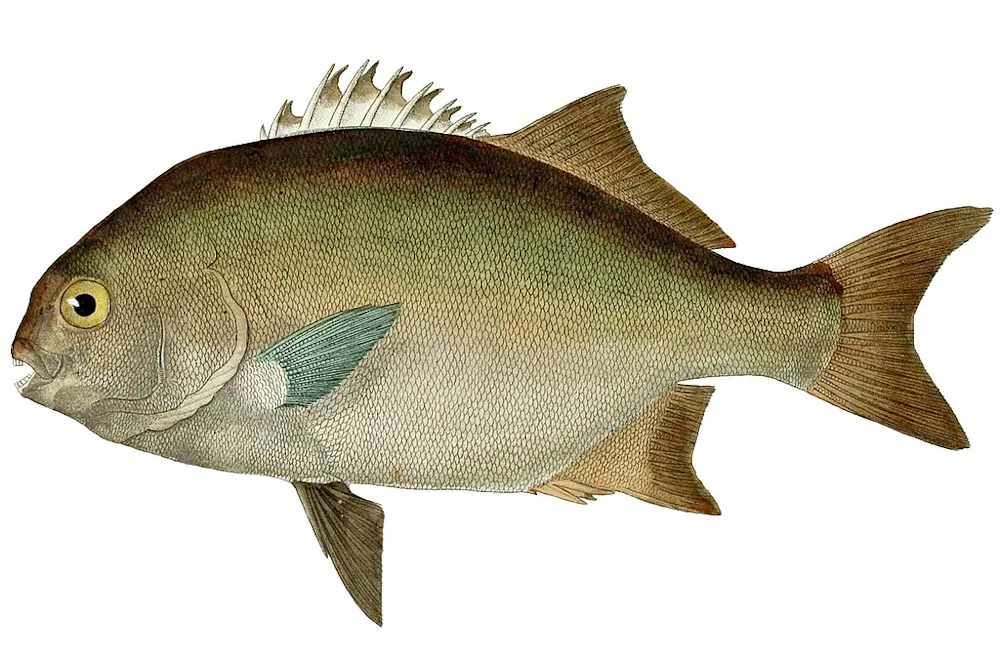
Reflecting its mega-biodiversity status, South Africa boasts five national animal and plant symbols. These are the national animal (springbok), fish (galjoen), bird (blue crane), flower (king protea) and tree (real yellowwood). Yet, their usefulness in helping build a national identity depends on South Africans actually knowing what they are. Sadly, this seems not to be the case.
As environmental scientists we’re intrigued by the relationships between humans and nature. Environmental scholars Ondwela Tshikombeni, Monde Ntshudu and I recently conducted a study to find out how much South Africans know about the five biodiversity symbols. We found that only a tiny fraction could name all of them. The level of knowledge about them was generally low.
This indicates that these symbols can’t be effectively used to help build a common South African identity. Nor will they add value to biodiversity conservation campaigns in a time when the need to protect nature increases due to the impacts of human development and climate change.
National animals and plants
The process of choosing a species as a national symbol is different depending on the country and may even be contested. In Turkey, for example, the national animal is the grey wolf. It can be a symbol of pride or be rejected because it’s the controversial name of a rightwing political group.
Many national symbols are rooted in history and could stem from the emblems of the political, colonial or economic elites of the past. Or they may be more recent and based on lobbying by certain groups or even via public vote. Britain, for example, asked the public to choose a national bird. The robin won.
Galjoen. Biodiversity Heritage Library/Wikimedia Commons, CC BY
The first national animal to be used as a symbol in South Africa was the springbuck (or springbok), proposed in 1906 as a name for the country’s rugby team ahead of a tour of Europe. The most recent addition was the galjoen in 1992.
Our study
We surveyed 382 urban dwellers in four towns spanning three provinces: Mossel Bay, Kariega (formerly Uitenhage), Gcuwa (formerly Butterworth) and Kokstad. In each town we set out to interview 25 adults across low-, medium- and high-income areas and the central business district.
Blue crane. Knowsley Hall/Wikimedia Commons
As part of the survey, we asked people to name each of the five national biodiversity symbols. After that, we presented them with photos of four different species (one of which was the national one) and asked them to correctly identify the national species.
What we found
Only 11 of the respondents (3%) could name all five symbols, while almost half (48%) could not correctly name a single one. The most widely known were the springbok (40%) and the king protea (40%), perhaps because they correspond to the names of national sporting teams. The blue crane was mentioned by only 16% of the respondents and the galjoen (8%) and yellowwood (6%) fared even worse.
The numbers were slightly better when respondents were asked to identify each species from a photo of four choices – 58% identified the protea, 51% the blue crane, 45% the springbok, 26% the galjoen and 16% the real yellowwood.
Real yellowwood. Abu Shawka/ Wikimedia Commons, CC BY-SA
To benchmark these knowledge levels, we also asked a few questions about the national flag and coat of arms. Only eight people knew the meaning of the phrase at the base of the coat of arms (ǃke e꞉ǀxarraǁke, meaning “diverse people unite” in the |Xam language of the country’s original inhabitants). Only 29% correctly knew that the Y-shape in the middle of the national flag was green. This indicates that the low knowledge of national symbols is not limited to just biodiversity symbols.
What can be done about it
It’s clear that a great deal more effort is needed to popularise the national biodiversity symbols if they’re to be used to help shape a national identity in South Africa. They could be promoted in schools where other national symbols, like the flag and anthem, are common.
The South African National Biodiversity Institute and the Department of Sport, Arts and Culture could promote them during September’s heritage month celebrations. They could engage the public by popularising their names in the different official languages of the country and their roles in folklore and indigenous knowledge. They could also be featured in national and international tourism promotions.
Ondwela Tshikombeni and Monde Ntshudu contributed to this article
Charlie Shackleton received funding from the National Research Foundation under the SARChI Chairs programme for this work.
There is some disagreement among legal practitioners and scholars about whether corporations have duties under international law.
Many argue that only states are bound by international law, and it is those states which are obliged to regulate how businesses operate within their borders. Corporations have only a voluntary responsibility to avoid committing human rights violations through their operations.
I have been doing research in the area of corporate accountability for human rights violations since 2006. My most recent paper looks at the role of multinational corporations (multinationals) in benefiting from and perpetuating structural poverty in the global south.
I argue that international law can no longer exempt corporations from liability for human rights violations, including those arising from poverty. Under certain circumstances, corporations should have duties under international law to ensure human rights are fulfilled. I argue that this is particularly true when it comes to socio-economic rights such as the rights to housing, education, food, water and healthcare.
International human rights law must be developed to impose duties directly on multinational corporations to alleviate poverty in the developing countries where they operate.
This is not an absolute duty – it would only arise in certain circumstances and for specific periods of time, as I show in my paper.
Poverty and corporations
Some estimate that as many as 1.3 billion people live in poverty – more than 10% of the world’s population, the vast majority in the global south.
Poverty is also deadly. It is estimated that at least 21,300 people die every day as a result of poverty and inequality. Poverty is a human rights violation, affecting the rights to dignity, life, food and water.
Businesses have a long history of profiting from human rights abuses. Finance and transport companies have acknowledged ties to the slave trade. European banks reportedly assisted South Africa’s apartheid government to procure arms.
Even when they are not directly responsible for human rights violations, multinational corporations may be complicit. Multinationals based in the global north tend to exploit developing countries for their cheap labour, natural resources and weak regulatory frameworks. In other words, corporations benefit from poverty.
International law
In 2005, Professor John Ruggie was appointed as the United Nations secretary-general’s special representative on the issue of human rights and transnational corporations and other business enterprises. He developed the United Nations Guiding Principles on Business and Human Rights. This framework adopts the position that only states are subjects and have duties under international human rights law.
The UN guiding principles are organised around three pillars, known as Protect, Respect and Remedy. The first pillar relates to states’ obligations to uphold human rights. It includes the duty to regulate businesses to ensure they do not violate rights through their operations. The second pillar refers to corporations’ responsibility to respect human rights. This is voluntary and not a legal obligation. The third pillar ensures that victims of human rights violations have access to effective remedies.
This framework relies on three factors: states which have the interests of their citizens at heart, corporations complying with human rights standards, and effective remedial systems. If all three work together, then the UN guiding principles can address corporate accountability for rights violations.
In practice, however, this is not the case. Many states, particularly those in the developing world with high levels of poverty, rely on foreign investment. This creates a power imbalance when negotiating with large multinational corporations. Multinationals are able to demand favourable investment conditions, including relaxing laws that might protect human rights.
Under the UN guiding principles, if states do not impose obligations on corporations to comply with human rights, they do not have such obligations.
Next steps
Not all corporations should have the same duties as states. I propose a set of factors that would determine when a corporation might have a duty under international human rights law to fulfil socio-economic rights. These factors are:
the extent of the violation
the position or vulnerability of the victim
the urgency of the situation
whether the corporation is the only actor that can fulfil the right.
For example, let us imagine a scenario in which a company operates a mine in the Central African Republic. It has built a hospital for its workers and management. Surrounding the mining operations are indigent communities who resided in the area before the operations began.
One day, a child from one of the settlements is knocked over by a car. Her injuries are not life-threatening, but they are severe and the child is in terrible pain. The closest hospital is the mine-owned private hospital. There is a public hospital, but it is far away and travelling there would take time and be costly. The child’s family rushes her to the mine’s hospital for emergency treatment. Does the hospital have a legal duty to admit the child and pay for her treatment?
Applying a combination of the factors, the answer is yes. The child is vulnerable by virtue of her age and poverty, the situation is urgent, and the mine hospital is the only entity that can fulfil the right under the circumstances.
Using this framework, I argue that international human rights law should be developed to mitigate the harm of poverty in the global south, by imposing duties on corporations that benefit from poverty. Some corporations have a perverse incentive to keep communities poor. International law has a role to play in overturning this state of affairs.
Ultimately, my proposal seeks to review what we think of as a fair and just economy. Nothing will change if only states have obligations under international law. The global economic market is neither free nor fair. It has created the most severe human rights violations of our age. International human rights law must address this.
Bonita Meyersfeld has received funding from the National Research Foundation as part of her NRF rating.
Source: The Conversation – Africa – By Bonita Meyersfeld, Associate Professor, University of the Witwatersrand
There is some disagreement among legal practitioners and scholars about whether corporations have duties under international law.
Many argue that only states are bound by international law, and it is those states which are obliged to regulate how businesses operate within their borders. Corporations have only a voluntary responsibility to avoid committing human rights violations through their operations.
I have been doing research in the area of corporate accountability for human rights violations since 2006. My most recent paper looks at the role of multinational corporations (multinationals) in benefiting from and perpetuating structural poverty in the global south.
I argue that international law can no longer exempt corporations from liability for human rights violations, including those arising from poverty. Under certain circumstances, corporations should have duties under international law to ensure human rights are fulfilled. I argue that this is particularly true when it comes to socio-economic rights such as the rights to housing, education, food, water and healthcare.
International human rights law must be developed to impose duties directly on multinational corporations to alleviate poverty in the developing countries where they operate.
This is not an absolute duty – it would only arise in certain circumstances and for specific periods of time, as I show in my paper.
Poverty and corporations
Some estimate that as many as 1.3 billion people live in poverty – more than 10% of the world’s population, the vast majority in the global south.
Poverty is also deadly. It is estimated that at least 21,300 people die every day as a result of poverty and inequality. Poverty is a human rights violation, affecting the rights to dignity, life, food and water.
Businesses have a long history of profiting from human rights abuses. Finance and transport companies have acknowledged ties to the slave trade. European banks reportedly assisted South Africa’s apartheid government to procure arms.
Even when they are not directly responsible for human rights violations, multinational corporations may be complicit. Multinationals based in the global north tend to exploit developing countries for their cheap labour, natural resources and weak regulatory frameworks. In other words, corporations benefit from poverty.
International law
In 2005, Professor John Ruggie was appointed as the United Nations secretary-general’s special representative on the issue of human rights and transnational corporations and other business enterprises. He developed the United Nations Guiding Principles on Business and Human Rights. This framework adopts the position that only states are subjects and have duties under international human rights law.
The UN guiding principles are organised around three pillars, known as Protect, Respect and Remedy. The first pillar relates to states’ obligations to uphold human rights. It includes the duty to regulate businesses to ensure they do not violate rights through their operations. The second pillar refers to corporations’ responsibility to respect human rights. This is voluntary and not a legal obligation. The third pillar ensures that victims of human rights violations have access to effective remedies.
This framework relies on three factors: states which have the interests of their citizens at heart, corporations complying with human rights standards, and effective remedial systems. If all three work together, then the UN guiding principles can address corporate accountability for rights violations.
In practice, however, this is not the case. Many states, particularly those in the developing world with high levels of poverty, rely on foreign investment. This creates a power imbalance when negotiating with large multinational corporations. Multinationals are able to demand favourable investment conditions, including relaxing laws that might protect human rights.
Under the UN guiding principles, if states do not impose obligations on corporations to comply with human rights, they do not have such obligations.
Next steps
Not all corporations should have the same duties as states. I propose a set of factors that would determine when a corporation might have a duty under international human rights law to fulfil socio-economic rights. These factors are:
the extent of the violation
the position or vulnerability of the victim
the urgency of the situation
whether the corporation is the only actor that can fulfil the right.
For example, let us imagine a scenario in which a company operates a mine in the Central African Republic. It has built a hospital for its workers and management. Surrounding the mining operations are indigent communities who resided in the area before the operations began.
One day, a child from one of the settlements is knocked over by a car. Her injuries are not life-threatening, but they are severe and the child is in terrible pain. The closest hospital is the mine-owned private hospital. There is a public hospital, but it is far away and travelling there would take time and be costly. The child’s family rushes her to the mine’s hospital for emergency treatment. Does the hospital have a legal duty to admit the child and pay for her treatment?
Applying a combination of the factors, the answer is yes. The child is vulnerable by virtue of her age and poverty, the situation is urgent, and the mine hospital is the only entity that can fulfil the right under the circumstances.
Using this framework, I argue that international human rights law should be developed to mitigate the harm of poverty in the global south, by imposing duties on corporations that benefit from poverty. Some corporations have a perverse incentive to keep communities poor. International law has a role to play in overturning this state of affairs.
Ultimately, my proposal seeks to review what we think of as a fair and just economy. Nothing will change if only states have obligations under international law. The global economic market is neither free nor fair. It has created the most severe human rights violations of our age. International human rights law must address this.
– Big companies profit from poverty but aren’t obliged to uphold human rights. International law must change – scholar – https://theconversation.com/big-companies-profit-from-poverty-but-arent-obliged-to-uphold-human-rights-international-law-must-change-scholar-241398
NERMEEN SHAIKH: Israel’s deadly siege on northern Gaza has entered a 30th day. Early week, the World Health Organisation managed to deliver some medical supplies to the Kamal Adwan Hospital, but on Thursday, Israeli fighter jets bombed the hospital’s third floor, where the supplies were being stored.
Al Jazeera reports Israeli forces are continuing to shell Beit Lahia, the scene of multiple massacres last week. On Wednesday, an Israeli attack on a market in Beit Lahia killed at least 10 Palestinians. Earlier in the week, Israel struck a five-story residential building, killing at least 93 people, including 25 children.
Meanwhile, at the United Nations, the UN Special Rapporteur on the Occupied Palestinian Territory, Francesca Albanese, has released a major report accusing Israel of committing genocide.
Albanese concludes that Israel’s war on Gaza is part of a campaign of, “long-term intentional, systematic, state-organised forced displacement and replacement of the Palestinians” . The report is titled Genocide as Colonial Erasure.
AMY GOODMAN: Francesca Albanese is now facing intensifying personal attacks from Israeli and US officials. She was set to brief Congress earlier last week, but the briefing was cancelled. On Tuesday, the US Ambassador to the United Nations, Linda Thomas-Greenfield, wrote on social media, “As UN Special Rapporteur Albanese visits New York, I want to reiterate the US belief she is unfit for her role. The United Nations should not tolerate antisemitism from a UN-affiliated official hired to promote human rights.”
On Wednesday, Francesca Albanese spoke at the United Nations and responded to the US attacks.
FRANCESCA ALBANESE: I have the same shock that you have, looking at how the United States is behaving in this context, in the context of the genocide that is unfolding in Gaza. I’m not — I’m not surprised that they attack anyone who speaks to the facts that are, frankly, on our watch in Gaza. And they do that so brutally because they feel called out, because it’s not that it’s that the United States is simply an observer. The United States is being an enabler in what Israel has been doing.
AMY GOODMAN: That was UN Special Rapporteur Francesca Albanese speaking at the United Nations on Wednesday. She joins us here in our studio.
Welcome back to Democracy Now! Thanks so much for joining us.
Well, before we get you to further respond to what the US and Israel is saying, can you lay out the findings of your report?
Colonial Erasure’: UN expert Francesca Albanese on Israel’s “intent to destroy” Gaza Video: Democracy Now!
FRANCESCA ALBANESE: Absolutely. First of all, thank you for having me.
I have to say that this report is the second I write on — and I present to the United Nations on the topic of genocide. And it has been very reluctantly that I’ve taken on the responsibility to be the chronicler of — the chronicler of an unfolding genocide in Gaza.
In March this year, I concluded that there were reasonable grounds to believe that Israel had committed at least three acts of genocide in Gaza, like killing members of the protected group, Palestinians; inflicting severe bodily and mental harm; and creating conditions of life that would lead to the destruction of the group. And the reason why I identified these were not just war crimes and crimes against humanity is because I identified an intent to destroy.
And I understand that even in this country, people are quite confused about what is genocidal intent, because it’s not a motive. One can have many motives to commit a crime. And I understand genocide is a very insidious one, and it’s difficult to identify what’s a motive. But this is not about the motives. The intent to commit genocide is the determination to destroy, which is fully evident in — especially in the Gaza Strip, as I identified in — as argued in March already.
The reason why I continue to write about genocide — and, in fact, this report walks on the heels of the previous one — is in order to better explain the intent, especially state intent, because there is another misunderstanding that there should be a trial of the alleged perpetrators in order to have — to attribute responsibility to a state.
No, because not only you have had acts committed that should have been prevented by the — in a rule of law, in a proclaimed rule of law system like Israel, where there is the government, the Parliament, the judiciary, working as checks and balances, genocide has not only been not prevented, [it] has been enabled through the various organs of the state.
And I explain what has happened as of October 7, which has provided the opportunity to escalate violence, to build on the rage and on the fury of many Israelis, turning the soldiers into willful executioners, is that there was already a plan, hatred.
I mean, the Palestinians, like Ilan Pappé says, are victims not of war, but of a political ideology that has been unleashed. Palestinians have always been an unwanted encumbrance in the Israeli mindset, because they are an obstacle both as an identity and as legal status to the realisation of Greater Israel as a state for Jewish Israelis only.
NERMEEN SHAIKH:So, we’ll go back to — because I do want to ask about the Israeli state institutions that you name and the branches of the Israeli state that have been involved in forming this state’s intent. But if you could elaborate on the point that you make, the difference between intent and motive, and in particular what you say in the report about how it’s critical to determine genocidal intent, “by way of inference”?
You know, that’s a different phrasing than one has heard in all of this conversation about genocide so far. If you explain what you mean by that and what such a determination makes possible? So, rather than just looking at genocidal intent in other forms, what it means to infer genocidal intent?
FRANCESCA ALBANESE: So, first of all, what constitutes genocide is established by Article II of the Genocide Convention, which creates a twofold obligation for member states, to prevent genocide so genocide doesn’t have to complete itself. When there is a manifestation of intent, even genocidal intent, there is already an obligation to intervene, because a crime is unfolding.
And then there is an obligation to punish. How the jurisprudence, especially after Rwanda and after former Yugoslavia, there have been cases both for criminal proceedings, where individual perpetrators have been investigated and tried, and [the] responsibility of the state, litigated before the International Court of Justice. This is how the jurisprudence on genocide has developed.
And the intent has been further elaborated upon what the Genocide Convention says. And while it might be difficult to have direct intent, meaning to have — it’s difficult but not impossible, in fact, to have a state official say, “Yes, let’s go and destroy everyone” — although I do believe that there is direct intent in this genocide in Gaza.
But the court also established that genocide can be inferred from the scale of the attack on the people, the nature of the attack, the general conduct. And what it says is that normally there should be a holistic approach in order to identify intent, which is exactly what I’ve done.
And indeed, this is why I proposed in this report what I called the triple lens approach. We need to look at the conduct, like the totality of the conduct, instead of studying with a microscope each and every crime. We need to look at the whole, against the totality of the people, the Palestinians as such, in the totality of the land, that Israel has slated as its own by divine design.
NERMEEN SHAIKH: No, absolutely. And then, if you could — the other precedent you’ve just spoken about — of course, Rwanda and former Yugoslavia — another case that you cite in the International Court of Justice is The Gambia v. Myanmar. So, how is that comparable to what we see happening in Gaza? Why is that a relevant example and different from both Rwanda and former Yugoslavia?
FRANCESCA ALBANESE: Let me tell you what I see as the major differences in the case of Israel, because it’s a very complex discussion. But in all four cases, there is a toxic combination of hatred, ideological hatred, which has informed political doctrines. And this is true in all the various contexts we are mentioning. The other common element is that there is [a] combination of crimes. Like, forced displacement is not an act of genocide per se, but the jurisprudence says that it can contribute to corroborate the intent.
But, again, mass killing or mass destruction of property, torture and other crimes against a person, which translate into an infliction of physical and mental harm to the group, not individuals as such, but individuals as part of the group, these are common elements to all genocides.
What I find characteristic in this one is, first of all, this is not — I mean, the state of Israel is not Myanmar and is not Rwanda 30 years ago. This is not war-torn former Yugoslavia. This is a state which has a separation of powers, different organs, as I said, checks and balances. And let me give you a specific example, because you asked me to comment on the state functions.
In January this year, the International Court of Justice issued a set of preliminary measures in the context of its identification, before even looking at the merits of the case initiated by South Africa for Israel’s breach, alleged breach, of the Genocide Convention, which identified the plausibility of risk for the rights protected — of the rights of the Palestinians protected under the Genocide Convention, which means plausibility — it’s semantics, but it’s plausibility that genocide might be committed against the Palestinians in Gaza.
And the provisional measures included an obligation to investigate and prosecute the various cases of incitement, genocidal incitement, that the court had already identified. And it mentions leaders, senior leaders, of the Israeli state. Has there been any investigation? Has there been any prosecution?
But I’m telling you more. The genocidal statements didn’t resonate as shocking in the Israeli public, not only because there was rage, an enormous rage and animosity, of course. I mean, this is understandable, that the facts of October 7 were brutal and traumatized the people.
But at the same time, hatred against the Palestinians and hate speech, it’s not something that started on October 7. I do remember, and I do remember the shock I felt because no one was reacting, and years ago, there were Israeli ministers talking of — freely, of killing, justifying the killing of Palestinians’ mothers and children because they would turn into terrorists.
AMY GOODMAN: Francesca Albanese, talk about the title of your report, Genocide as Colonial Erasure.
FRANCESCA ALBANESE: This is another element which I think — and, in fact, it’s the most important, where we see the difference between this genocide and others, because there is a settler-colonial component. And again, if you look at what the International Court of Justice in July this year concluded, when it decided that the — when it found that Israel’s 57 years of occupation in Gaza, the West Bank and East Jerusalem is unlawful and needs to be withdrawn totally and unconditionally, as rapidly as possibly, which the General Assembly says by September 2025.
The court said that it amounts to — that the colonies amount to — have led to a process of annexation and racial segregation and apartheid. And these are the features of settler colonialism, the taking of the land, the taking of the resources, displacing the local population and replacing it. This has been a feature.
Now, it is in this context that we need to analyse what is happening today. And by the way, don’t believe, don’t listen only to Francesca Albanese. Listen to what these Israeli leaders and ministers are saying — reoccupying Gaza, retaking Gaza, recolonising Gaza, reconquesting Gaza. This is what they are saying.
And there are settlers on expeditions, not only to Gaza but also to Lebanon. So, this is why I say that the main difference, the main feature of this genocide, apart all the horrible aspects of it, is that this is the first settler-colonial genocide to be ever litigated before a court, an international court.
And this is why coming to this country, which is a country birthed from a genocide, when I meet the Native Americans, for example, I feel the pain of these people. And I say if we manage to build on the intersectionality of Indigenous struggle, the cry for justice behind this case for Palestine will resonate even louder, because it will somewhat be an act of atonement from the settler-colonial endeavor, which has sprouted out of Europe, toward Indigenous peoples. So there is a lot of symbolism behind it.
NERMEEN SHAIKH:And, you know, the analogy — first of all, you talked about the case brought by South Africa, so what they share, apart from South Africa and Israel-Palestine, is both the fact that they were colonial-settler states, as well as the fact that apartheid has been established as having occurred in both places.
Now, in the case of South Africa, it was a decision that was taken by the United Nations at the time of apartheid, was unseating South Africa from the General Assembly. There have been calls now to do the same with Israel. So, if you could — if you could comment on that?
And then, I just want to quote another short sentence from your report, in which you say, “As the world watches the first live-streamed settler-colonial genocide, only justice can heal the wounds that political expedience has allowed to fester.” So, if you could talk about the International Court of Justice’s case in that context, what role you think they can play, South Africa’s case, in resolving or addressing — seeing and addressing this wound?
FRANCESCA ALBANESE: First of all, let me unpack the question of the unseating Israel, because this is one of the recommendations I made in my report. Under Article 6 of the UN Charter, a member state can be suspended of its credentials or its membership by the General Assembly upon recommendation of the UN Security Council. And the first criticism I got is that we cannot do that, because every states commit international law violations. Absolutely. Absolutely.
But there are two striking features here. First, Israel is quite unique in maintaining an unlawful occupation, which has deemed such by — in at least one full occasion, but again, there was already a case brought before the ICJ in 2004, so there have been two ICJ advisory opinions.
There is a pending case for genocide. There has been the violations of hundreds of resolutions by the — on Israel — over occupied Palestinian territory, by the Security Council, the General Assembly, the Human Rights Council, and steady violation of international humanitarian law, human rights law, the Apartheid Convention, the Genocide Convention. So this is quite unique.
But all the more, this year alone, Israel has conducted an attack, an unprecedented attack, against the United Nations. It has attacked physically, through artillery, weapons, bombs, UN premises. Seventy percent of UNRWA offices and UNRWA buildings, clinics, distribution centers have been hit and shelled by the Israeli army.
Two hundred and thirty UN staff members have been killed by Israel in Gaza alone. UN peacekeepers in Lebanon have been attacked. And this doesn’t even take into account the smear, the defamation against senior UN officials, the declaration of the secretary-general as persona non grata, the referring to the General Assembly as a “cloak of antisemites”.
Again, this has mounted to a level — the hubris against the United Nations and international law has been unchecked and unbounded forever, but now, especially after the Knesset passed a law outlawing UNRWA, declaring UNRWA a terrorist organisation, and therefore disabling it from its capacity to deliver aid and assistance especially in Gaza and the West Bank and East Jerusalem, this is the nail in the coffin of the UN Charter.
And it can also contribute to that sense of colonial erasure, because here it’s not just at stake the function of a UN body — and UNRWA is a subsidiary body of the General Assembly, so it’s even more serious. But there is the capacity of UNRWA to deliver humanitarian aid in a desperate situation, and also the fact that UNRWA is seen by Israel as the symbol of Palestinian identity, especially the Palestinian refugees. So there is an attempt to erase Palestinianness, including by hitting UNRWA.
AMY GOODMAN: I want to ask you about your trip here, as we begin to wrap up. The US Ambassador to the United Nations, Linda Thomas-Greenfield, quoted on — tweeted on Tuesday, “As UN Special Rapporteur Albanese visits New York, I want to reiterate the US belief she is unfit for her role. The United Nations should not tolerate antisemitism from a UN-affiliated official hired to promote human rights.” If you can further address their charge of antisemitism against you?
FRANCESCA ALBANESE: Yeah.
AMY GOODMAN: And talk about what happened. You were supposed to come to Congress and speak and brief them, but that was cancelled this week.
FRANCESCA ALBANESE: Yes, it was canceled. But let me — first of all, I’m very embarrassed to read this, because a senior US official who writes this, I mean, it shows a little bit of desperation. I’m sorry, but, you know, I’m very candid.
And let me unpack my antisemitism for the audience. So, what I’ve been accused of — the reason why I’ve been accused of antisemitism — is because I’ve allegedly compared the Jews to the Nazis. Never done. Never done.
What I’ve said, what I’ve done is saying, and I keep on saying, that history is repeating itself. I’ve never done such a comparison where I draw the parallel. It’s on the behaviour of member states who have the legal and moral obligation to prevent atrocities, including an unfolding genocide.
In the past, they have done nothing — nothing — until the end of the Second World War, to prevent the genocide of the Jews and the Roma and Sinti. And they’ve done nothing to prevent the genocide of the Bosnians.
And they’ve done nothing to prevent the genocide of the Rwandans. And they are doing the same today. This is where I insist that now, compared to when there was the Holocaust, now we have a human rights framework that should prevent this. The Genocide Convention to prevent this. So, this is one of the points.
The second point, — which leads to portray me as an antisemite, which is really offensive — is that I’ve said that October 7 was not — I’ve contested, I’ve challenged the argument that October 7 was an antisemitic attack. October 7 was a crime, was heinous. And again, I’ve condemned the acts that were directed against the Israeli civilians, and expressed solidarity with the victims, with the families. I’ve been in contact with the families of the hostages.
But I’ve also said the hatred that led that attack, that prompted that attack, to the extent it hit civilians, not the military, but it was prompted not by the fact that the Israelis are Jews, but the fact that the Israelis — I mean, the Israelis are part of that endeavor that has kept the Palestinians in a cage for 17 years and, before, under martial law for 37 years. And Palestinians have tried — it’s true they have used violence, but before violence, they have tried dialogue. They have tried collaboration. They have tried a number of means to access justice, and they have gone nowhere.
I can — I mean, let me relate just this case, because last year I worked with children. And someone who was 17 years old before October 7 last year had never set foot out of Gaza. This is the reality. And I spoke with children while I was writing my report on “unchilding”, the experience of Palestinians under Israeli occupation. And one of them — I mean, there were these two girls fighting, because one of them had been able to go to Israel and the West Bank because she had cancer and could be treated, and the other was jealous, because, she said, “At least she was sick, and she could go, she could travel. I’ve never seen the mountains.”
And again, this doesn’t justify violence, but, please, please, put things in context. And even Israeli scholars have said claiming that October 7 was prompted by antisemitism is a way to decontextualize history and to deresponsibilise Israel.
I condemn Israel not because it’s a Jewish state. It’s not about that, but because it’s in breach of international law through and through. And were the majority of Israelis Buddhists, Christians, atheists, it would be the same. I would be as vocal as I am now.
NERMEEN SHAIKH: Francesca, just one last question, and we only have a minute. Your recent book, J’Accuse, you take the title, of course, from the letter Émile Zola wrote during the Dreyfus Affair to the French president. You came under severe criticism for the choice of that title. Could you explain why you chose it and what it means in this context?
FRANCESCA ALBANESE: Absolutely. I have the sense that whatever I say comes under scrutiny and criticism. But J’Accuse is — first of all, it’s the title that was proposed by the editor, the publisher. And I was against it until October 7.
When I saw the narrative, the dehumanization of the Palestinians after October 7, and what it was legitimising, I said, “This is the title. We need to use it,” because I draw the parallel between what is happening to the Palestinians and what has happened to other groups, particularly the Jewish people in Europe.
I say the Holocaust was not just about the concentration camps. The Holocaust was a culmination of centuries of discrimination, and the previous decades had led the Jewish people in Europe to be kicked out of jobs, professions, to be treated like subhumans, as animals. And it’s this dehumanisation that we need to look at in the face today, in the eyes today, and recognise as leading to atrocity crimes.
AMY GOODMAN: We want to thank you for being with us, Francesca Albanese, UN Special Rapporteur on the Occupied Palestinian Territory.
Part of the mirror platform for scientific experiments at China’s space station. [Photo/China Media Group] A mirror platform for scientific experiments at China’s space station has entered the official operation stage, which will provide important support for scientific experiments on the space station, according to the Technology and Engineering Center for Space Utilization (CSU) under the Chinese Academy of Sciences. The mirror platform is equipped with 14 science experiment cabinets and corresponding public support equipment for information, power distribution, and fluid cooling inside and outside the cabin. It operates as a scientific experiment system on the ground parallel to China’s space station. The extensive scientific experiments the Shenzhou-19 crew is about to conduct have already undergone matching and verification experiments. “Through the platform, we have conducted ground verification for the experiments that the Shenzhou-19 crew will perform, as well as for the experiment payloads, related software, and spare parts before the launch,” Zhong Hongen, a researcher at CSU, told China Media Group. The mirror platform has three main functions as an important ground science experiment infrastructure of the national space laboratory. First, before the scientific payloads carried by the Shenzhou and Tianzhou spacecraft are launched, they must undergo final confirmation testing there, where astronauts can also receive operational training for scientific experiments. Second, scientific experiment plans conducted on the space station can be verified there in advance, allowing for troubleshooting and solution verification in case of any faults that occur in orbit. Lastly, it supports Earth-to-space comparison experiments, enabling comparative analysis and research between the scientific experiments conducted at the space station and on the mirror platform. “Earth-to-space comparison experiments involve conducting experiments in space while simultaneously on the ground. This allows for a comparison under similar conditions, differing only in microgravity, to observe how the two different gravity factors affect the experimental results,” said Zhong.
Tech leaders gather at the AI Creators Conference in Beijing, Oct. 30, 2024. [Photo courtesy of the organizer]
The AI Creators Conference, hosted by Chinese tech media company Pingwest, convened Wednesday in Beijing’s Zhongguancun subdistrict to explore practical applications of artificial intelligence.
Pingwest founder Luo Yihang introduced this year’s theme, “AI for Real,” emphasizing how AI can enhance daily life and provide practical services. The event spotlighted AI applications in mobile phones and VR glasses, drawing industry leaders, including Vivo Vice President Zhou Wei and Xreal founder Xu Chi.
Zhou detailed Vivo’s journey since launching its Global Research Institute in 2018, which is dedicated to integrating AI technology with smartphones. In 2023, the company introduced BlueLM, its proprietary technology designed to enhance AI-smartphone integration for improved user interaction and personalized services.
Zhou emphasized that smartphones act as a bridge between people and the digital world, describing them as potential personal butlers. He outlined five key AI agent capabilities: perceiving user intentions, sharing experiences and memories, assisting in decision-making, autonomously operating applications and managing user affairs.
These AI-powered devices will offer proactive intelligence and personalized services. Smartphones will be able to understand various languages, including minority ones, recognize speakers’ emotions and take autonomous actions like restaurant reservations, according to Zhou.
The Vivo executive described the shift as “services finding people” instead of “people finding services.”
The guide emphasizes standardizing evaluation methods for AI products while promoting the integration of large language models into practical applications. Zhou said smartphone manufacturers, including Vivo, will discuss in November how to establish industry standards for integrating AI agents into smartphones, aiming to facilitate collaborative innovation.
Xreal founder Xu Chi shared his vision for AR glasses at the conference, predicting they could replace smartphones as the primary terminal device within a decade. While current models lag behind smartphones in efficiency, AI integration will simplify their use.
Xu envisions future AR glasses with AI assistants providing personalized support and services, aligning with Vivo’s approach. Xu compared the concept to “Iron Man’s suit,” where users control their AI assistant through simple hand gestures.
China’s domestically developed large passenger aircraft C919. [Photo/Xinhua]
China Eastern Airlines (CEA) has successfully replaced the first engine for the world’s first delivered C919 aircraft, filling a gap in the maintenance capability for the country’s homegrown large passenger aircraft.
The engine replacement is one of the most complicated tasks in aircraft maintenance. The main purpose of the engine replacement was to verify the feasibility of the C919’s engine replacement process to improve aircraft safety.
The CEA maintenance engineers completed 60 routine tasks and more than 10 non-routine tasks over nine days, with all test parameters normal, successfully completing the first engine replacement of the C919 aircraft numbered B-919A.
The engine replacement “will ensure the sustainable operation of the C919 aircraft in CEA in the future and enhance its performance,” said Dong Haoyang, manager of the C919 engine replacement project at China Eastern Xibei Airlines as cited by CCTV+.
The CEA has seven C919 aircraft in operation, serving five commercial routes connecting Shanghai with Beijing, Chengdu, Xi’an and other cities.
Other airlines, including Air China and China Southern Airlines, have also conducted commercial operations with the aircraft.
Police are reiterating warnings to bushwalkers after another search and rescue response was launched to rescue 4 bushwalkers near Mount Anne in the Southwest National Park. Around 10.30am this morning police received a call from bushwalkers after several tents were destroyed overnight during strong and gusty winds. The weather prevented the party from walking out of the area and concerns were held due to further deterioration of weather conditions. The rescue helicopter responded with weather hampering efforts, requiring a walking party to be inserted to aid the bushwalkers. Just after 2.30pm this afternoon rescue personnel consisting of a police rescue officer and a flight paramedic reached the bushwalkers. The rescue is continuing, with the bushwalkers not expected to be extracted from the area for several hours. A severe weather warning had been issued in recent days including for that area, and due to those forecasts it is remarkable that bushwalkers chose to continue. Whilst the group was well prepared with necessary equipment, not recognising the risks associated with those warnings has placed the party and responding search and rescue personnel in danger. Police again remind those venturing outdoors to monitor weather warnings and consider the impact of the weather on their activities. Other essential safety considerations include; · Taking sufficient communication devices including mobile phones, charging banks and Personal Locator Beacons (PLB’s) · Ensuring sufficient emergency food, water and spare clothing is carried in the event the length of the trip extends · Research impending weather conditions for the area and do not continue with plans where inclement weather is due.
At the invitation of H.E. Police Colonel Tawee Sodsong, Minister of Justice of the Kingdom of Thailand, Secretary-General of ASEAN, Dr. Kao Kim Hourn, will lead the ASEAN Secretariat delegation for a Working Visit to Thailand, on 5-6 November 2024. During the working visit, Dr. Kao is planned to meet with high-ranking officials from the Royal Thai Government to discuss, among others, Thailand’s role in strengthening ASEAN’s collective law enforcement efforts against transnational crime and illicit drugs.
As part of the visit, Dr. Kao will also engage with youth in local communities, including sentenced persons, with the aim of supporting them with their future growth and reintegration into society, where Dr. Kao will deliver a special lecture on “Educating for a Better Life: Fostering Quality Citizens” to inspire youth at the Central Juvenile Correctional Institution. Additionally, Dr. Kao will visit the Central Women Correctional Institution to observe Thailand’s rehabilitative and corrective efforts in fostering a safer and more inclusive society. This working visit will reinforce ASEAN’s cooperation in law enforcement, justice, and security, while underscoring the shared commitment to youth empowerment and supporting rehabilitation efforts within ASEAN communities.
The post Secretary-General of ASEAN to conduct a Working Visit to the Kingdom of Thailand appeared first on ASEAN Main Portal.
Source: Hong Kong Government special administrative region
HKETO Brussels supports Hong Kong films during Asian Film Festival Barcelona in Spain HKETO Brussels supports Hong Kong films during Asian Film Festival Barcelona in Spain *************************************************************************************
The Hong Kong Economic and Trade Office in Brussels (HKETO, Brussels) supported the 12th Asian Film Festival Barcelona, which is taking place in Barcelona, Spain, from October 24 to November 3, 2024. Seven Hong Kong movies are supported by Brussels ETO in the Festival, namely “The Narrow Road”, “Fly Me to the Moon”, “Dust to Dust”, “Love Lies”, “Where the Wind Blows”, “Cinema Strada” and “Time Still Turns the Pages”. “Time Still Turns the Pages” has been selected as the closing film of the Festival this year. Brussels ETO hosted a reception on November 2 (Barcelona time) for about 100 guests from the local film, cultural and business sectors. Speaking at the reception, Assistant Representative Mr Paul Leung said that Hong Kong is an East-meets-West centre for international cultural exchange and an Asian front-runner in global film history. “To enhance the development of the film industry, the Government of the Hong Kong Special Administrative Region has been supporting the film industry through the Film Development Fund in four strategic directions, namely nurturing talent, enhancing local production, expanding markets and building audiences,” added Mr Leung. He highlighted the recently launched Hong Kong-Europe-Asian Film Collaboration Funding Scheme, which subsidises film projects co-produced by filmmakers from European and Asian countries to produce films featuring Hong Kong, European and Asian cultures. The scheme aims to support Hong Kong films in expanding to overseas markets. The Asian Film Festival in Barcelona is celebrating its 12th anniversary this year. It is one of the major film festivals in Barcelona dedicated to Asian movies.
am pleased to send my greetings to the World Internet of Things Convention.
Digital technology has transformed every aspect of our lives.
It is also an increasingly powerful engine of business and economic growth. Real-time data sharing, IoT applications, information networking and artificial intelligence are enabling the development of smart grids, smart homes and smart cities. Across various sectors, including transportation, agriculture, energy, and healthcare, these technologies are improving quality of life, promoting sustainability, and fostering more responsive services.
But not all countries or communities are benefitting equally. For those without capacity or connectivity, the digital divide is an opportunity divide. And as your theme reminds us, unleashing the potential of a new digital economy depends on a fully connected world.
Last month, leaders adopted the Global Digital Compact to help close the divide and support efforts to ensure that communities and countries get the financial and technological assistance to expand connectivity to all people.
On AI, we also made an essential breakthrough: the first truly universal agreement on governance giving every country a seat at the AI table.
Digital technology is about bridging divides.
Let’s ensure that these rapidly evolving technologies serve all people, equally.
Hong Kong recorded nearly 32.6 million visitor arrivals in the first three quarters of this year, marking a year-on-year increase of nearly 40 percent, data from the Hong Kong Tourism Board showed Thursday. Among the total arrivals, over 25.2 million were from the Chinese mainland, increasing by some 35 percent year on year, while visitor arrivals from elsewhere surged by 59 percent during the period. In September alone, Hong Kong recorded nearly 3.1 million visitor arrivals, reflecting a 10-percent rise compared to the same month last year, with approximately half of these arrivals consisting of overnight visitors. Notably, in the first three quarters, the number of visitor arrivals from South Korea exceeded 592,000, representing a year-on-year increase of 171.3 percent, while visitor arrivals from France surpassed 93,700, representing a year-on-year growth of 73.6 percent.
Attendees take part in the “Science and Technology for Risk-Informed Sustainable Development” thematic session at the 2024 World Science and Technology Development Forum (WSTDF), in Beijing, Oct. 24, 2024. [Photo courtesy of WSTDF] The 2024 World Science and Technology Development Forum (WSTDF) held a thematic session in Beijing on Oct. 24 focused on “Science and Technology for Risk-Informed Sustainable Development.” Leading representatives of policymakers, scholars and private sector took part in the event, discussing how to mobilize science and technology to navigate emerging global risks and build a safer, more inclusive and sustainable future. The session was hosted by the Integrated Research on Disaster Risk (IRDR), the International Society for Digital Earth (ISDE) and the International Research Center of Big Data for Sustainable Development Goals (CBAS), and supported by the International Science Council (ISC) and the U.N. Office for Disaster Risk Reduction (UNDRR). Salvatore Arico, CEO of the ISC, and Marco Toscano-Rivalta, head of UNDRR’s Regional Office for Asia and the Pacific, co-chaired the event, and it was co-moderated by IRDR Executive Director Yang Saini and Senior Science Officer Han Qunli. Collaboration and shared solutions for global risks As climate change accelerates and disaster risks become more complex, the importance of international scientific cooperation grows ever more crucial. Wu Guoxiong, an academician at the Chinese Academy of Sciences (CAS) and a researcher at the CAS Institute of Atmospheric Physics, highlighted the significance of international cooperation in early warnings for disasters. He pointed to the Sub-seasonal to Seasonal (S2S) Prediction Project as a successful model of global collaboration. Countries including China, the United Kingdom, the United States and Japan participate in the project, which allows real-time comparisons of their climate prediction models, improving collective capacity to address climate-related disasters. Rajib Shaw, chair of the UNDRR Asia-Pacific Scientific and Technical Advisory Group, emphasized the need for increased global cooperation to bridge technological divides. He noted that technologies such as artificial intelligence and drones are vital for disaster risk reduction, yet many Global South countries lack access to these advanced tools, making the collaboration essential. Manon Burger, biochemistry publishing director for Elsevier, underlined the importance of open access to scientific research in fostering global knowledge sharing. “We publish more than 3,000 journals, many of which are available open access, ensuring that researchers worldwide can stay updated on the latest scientific advancements,” Burger said. She also introduced Elsevier Foundation, which has partnered with over 100 institutions in 70 countries since it was established in 2005, offering approximately $16 million in funding for initiatives supporting climate action and inclusive health care. Josephine Ngaira, professor of geography (climatology) in the School of Disaster Management and Humanitarian Assistance at Masinde Muliro University of Science and Technology in Kenya, stressed the need to address the specific challenges of grassroots communities and vulnerable populations in disaster risk management. She advocated for inclusive models that ensure technological benefits reach all levels of society, advancing sustainable development worldwide. DRR education and empowerment of young professionals Young people are a driving force behind technological innovation and sustainable development. Shabhaz Khan, director of the UNESCO Regional Office for East Asia, stated that the youth is highly recognized by the United Nations, and can be mobilized and engaged in pilot disaster research activities. Salvatore Arico, CEO of the ISC, underscored the importance of interdisciplinary training for young researchers. He pointed out that current education systems often remain siloed within single disciplines, whereas solving complex global issues requires interdisciplinary research and training. He advocated for education reforms to provide young scientists with more diverse learning opportunities and to encourage cross-sector exploration. Khamarrul Azahari Razak, director of Malaysia’s Disaster Preparedness and Prevention Center, emphasized the importance of investing in human resources and listening to the voices of young people. Meanwhile, professor Christopher Garimoi Orach from the School of Public Health at Makerere University in Uganda, highlighted the need to strengthen disaster risk management education in developing countries, particularly at the higher education level. He noted that training specialists in disaster risk reduction is crucial for future global risk preparedness. Building social resilience through government policies In tackling global risks, national policies and government support are the keys. Robert Walker, fellow of the Royal Society of Arts and the Academy of Social Sciences Academy of UK and professor at the University of Oxford, stated that social policy should focus on enhancing social resilience by providing people with a sense of security, thus reducing their anxieties and enabling them to contribute to disaster risk reduction. Walker praised China’s efforts in promoting social security and resilience through advancing common prosperity, poverty reduction and energy transition. Salvatore Arico further emphasized that collaboration between governments, communities and scientists is essential for addressing global challenges such as climate change, land degradation and declining water quality. He noted that considering the practical applicability of scientific methods from the beginning of policy design would help enhance implementation effectiveness and ensure technology-driven progress. Rajib Shaw called for greater adaptability in governance mechanisms. Given the existing gap between sci-tech advancements and governance structures, he suggested policy adjustments from governments to facilitate adaptive governance, thus ensuing effective application of scientific tools in disaster risk reduction and management.
Death toll from a house collapse in south China’s Guangxi Zhuang Autonomous Region has risen to four after one more body was pulled out, local publicity authority confirmed on Sunday morning. According to the publicity department of the Binyang County, the collapse occurred at approximately 2 p.m. on Saturday in Nanguan Village. The bodies of four people have been recovered as of 9:10 a.m. Sunday. Rescue work is ongoing as rescuers are trying to search for one more person who could possibly be buried. The house collapse followed an explosion, but cause of the accident is still being investigated.
“I’m going to work on extreme light for medical and energy fields,” Nobel laureate Gérard Mourou said on Friday, speaking on plans for his work in China. The French physicist, who joined Peking University’s School of Physics as chair professor last month, made the remarks on the sidelines of this year’s Beijing Forum, a global academic forum on innovation and human progress. At the opening ceremony of the annual forum, he outlined the applications of ultra-high intensity lasers in such areas as medicine and nuclear energy. In 2018, Mourou shared the Nobel Prize in Physics with Arthur Ashkin and Donna Strickland “for groundbreaking inventions in the field of laser physics.” He is expected to assist in the establishment of a new institute for scientific research and international cooperation in the fields of laser physics, particle physics, nuclear physics, medical physics and astrophysics, according to a statement from Peking University. As China invests heavily in developing science and education, talent is arriving from around the world at an increasing pace. Fields Medal winner Caucher Birkar has been teaching mathematics full-time at Tsinghua University since 2021. Structural biologist Yan Nieng returned to China from Princeton University in the United States in 2022 to found a medical academy in Shenzhen. Yan also delivered a keynote speech at this year’s Beijing Forum. And about one week after Mourou joined Peking University, a symposium celebrating the 50th anniversary of the discovery of the J particle brought several notable individuals to China: Nobel laureates Samuel Chao Chung Ting, Sheldon Glashow and David Gross, as well as Luciano Maiani, former director-general of the European Organization for Nuclear Research. “Achievements of the Chinese efforts are truly remarkable,” Gross told the media, explaining why the event was taking place in China despite the fact that the J particle was not discovered in the country. Though the initial discovery was made elsewhere, all 30 newly identified members of the J particle family were found at the Chinese Academy of Sciences’ Institute of High Energy Physics, Ting said. Mourou praised China for its scientific and technological advancements over the past decades. “I knew some of the scientists,” he said. “And they are interested about what I’m doing.” He joked that those scientists had been “smart enough” to convince him to join the university and start a new institute for ultra-high intensity lasers. Mourou said that he has been impressed by Chinese students, noting that they excel in innovation — not just in their coursework, as is often the stereotype. More than 500 scholars and experts from over 30 countries and regions are taking part in the 2024 Beijing Forum. Topics include sustainable development, the environment and health, and digitalization and artificial intelligence. “The best is yet to come,” Mourou said on the future applications of his research.
At the invitation of Chinese Premier Li Qiang, foreign leaders including Malaysian Prime Minister Anwar Ibrahim, Uzbek Prime Minister Abdulla Aripov, Slovak Prime Minister Robert Fico, Kazakh Prime Minister Olzhas Bektenov, Mongolian Prime Minister Luvsannamsrai Oyun-Erdene and Serbian Prime Minister Milos Vucevic will attend the opening ceremony of the 7th China International Import Expo (CIIE) and relevant events, Foreign Ministry spokesperson Mao Ning announced Sunday.
The 7th CIIE will be held in Shanghai from Nov. 5 to 10. Enditem
Replicas of Sanxingdui relics are on display at the Memor Museum in New York.[Photo provided by Mingmei Li/China Daily]
Spanning millennia, the history and mystery of Sanxingdui’s ancient civilization is reaching international audiences through modern digital platforms.
The exhibition Sanxingdui Encounter: A Global Tour of 12K Micro-viewing of National Treasures opened on Oct 11 at the Memor Museum in New York, offering visitors an opportunity to have an immersive virtual experience of the relics and also see the physical replicas of these treasures.
The display will last until Jan 19.
Sanxingdui, an archaeological site located in modern-day Guanghan, Southwest China’s Sichuan province, illustrates the civilization of the ancient Shu kingdom, which flourished over 3,000 years ago. Sanxingdui was not discovered until the 1920s, and ongoing archaeological efforts continue to reveal discoveries.
By the end of 2022, fieldwork on six newly uncovered sacrificial pits was nearly complete, yielding a wealth of precious artifacts. Over 4,000 items, including jade, stone and pottery, were unearthed during this phase of excavation. Archaeologists are piecing together the history of the ancient Shu civilization and presenting these findings to the public.
The Shu kingdom, which arose in the Sichuan basin during the Bronze Age, was a key hub for early-stage Chinese civilization. Its people produced finely crafted bronze, jade, gold and ceramic artifacts, depicting mythical creatures, rulers, gods and shamans with exaggerated features such as bulging eyes and enlarged ears.
“Sanxingdui’s rich heritage deserves international attention, with its vast cultural significance needing to be shared with a broader audience,” says Willa Ao, director of the Memor Museum.
“We want to present the relics through a blend of digital and physical experiences.”
One example Ao gives is a bronze figure, which strikingly resembles the stance of an American fitness coach performing a dead lift. Additionally, a bronze tree is adorned with numerous small hanging artifacts, reminiscent of ornaments used to decorate Christmas trees.
Sanxingdui’s unearthed bronzes were previously showcased at the Metropolitan Museum of Art in 2002 as part of a broader exhibition on bronze artifacts, but Ao says this time, she wanted to provide New Yorkers a new and interactive way to feel the relics.
This is done through 1:1 replicas from the Sanxingdui Museum’s collection, using ultra-high-definition 12k technology, artificial intelligence interaction and virtual reality immersion, which required three years of preparation.
Visitors will have the opportunity to view the famous Bronze Mask with Crown and Protruding Eyes, a rare artifact that provides insight into the ceremonial and spiritual practices of the ancient Shu people.
Also on display is the striking Bronze Head Wearing a Gold Mask, first unearthed in 1986, which illustrates a unique blend of social status and ritual significance.
“Although they are replicas, they remain highly valuable,” Ao says. She explains that these reproductions of the Sanxingdui Museum’s collection were crafted using identical materials to faithfully replicate the original artifacts.
Visitors will be able to explore the relics using VR technology, which brings large artifacts like the Large Standing Man and the Bronze Sacred Tree into the gallery through virtual exploration.
The exhibition also employs 12K video capture to document smaller artifacts, delicate bronze bells and bird sculptures, magnifying them for a closer look.
Sanxingdui is an important archaeological discovery, not just within Chinese archaeology, but within the world of archaeology, says Kristen Martucci, the exhibition’s translator.
Martucci, 26, has been studying Chinese since high school and pursued East Asian studies, particularly ancient Chinese history, at Harvard University.
She primarily helps translate materials into English in a way that is approachable for American and international audiences.
She says her work is also a learning process in both Chinese and history while uncovering the “mystery”.
“I learned about Sanxingdui in my graduate school courses, but even for me, seeing these replicas and using this exhibition and VR to experience it — that’s new to me, so it’s really exciting,” she says.
A drone photo shows tourists enjoying the sunrise scenery in Fuyuan City, northeast China’s Heilongjiang Province, Oct. 12, 2024. [Photo/Xinhua]
As Chinese people rub their hands for yet another annual “Double 11” online shopping spree, e-commerce platforms like Taobao are no longer the only places they dwell upon.
Attracted by exclusive “Double 11” hotel packages — usually heavily discounted multi-night stays at boutique hotels, resorts and guesthouses — people are spending more time on the country’s leading online travel agencies, such as Fliggy and Ctrip.
Fliggy felt the heat firsthand when it kicked off sales of this year’s “Double 11” tourism packages on the evening of Oct. 21. Its revenue exceeded 1 billion yuan (about $140 million) in just 53 seconds — a dramatic acceleration from 13 minutes last year — and surpassed last year’s first-day sales total in just 52 minutes.
After a customer secures a holiday package, they can select any check-in date within that package’s validity period, which is usually several months, and their payment will only go through once they confirm the dates of their stay.
These packages meet Chinese consumers’ growing demand for good-value products and services, and as the time they have to make decisions is often limited, flexibility and convenience are increasingly significant when it comes to travel accommodation, according to a report from commercial property information provider Meadin.
For hotels, “Double 11” sales are another arena in the country’s booming tourist market.
During the seven-day National Day holiday last month, China recorded 765 million domestic tourist trips, a year-on-year increase of 5.9 percent on a comparable basis, according to data from the Ministry of Culture and Tourism.
The total spending of domestic tourists exceeded 700 billion yuan during the period, up 6.3 percent year on year and 7.9 percent from 2019, the data shows.
Notably, tourist demand for customized trips and exclusive experiences has been booming, stimulating a surge in county tourism and the rise of boutique homestays, which saw the highest growth rate in terms of quantity among all holiday accommodation types in September, according to the Meadin report.
A report released by bed and breakfast (B&B) booking platform Xiaozhu shows that during the National Day holiday, its B&B bookings increased by 37 percent compared to the same period last year.
“The competition has been fierce in the tourism market this year, and businesses are facing great challenges,” said Shuai Mengting, who is in charge of Fliggy’s “Double 11” sales, which she believes present an important opportunity for hotels in the upcoming off-season.
To take full advantage of the opportunity and secure more reservations for the off-season, hotels have been expanding their package sales channels by livestreaming and inviting influencers to promote their products.
Following that trend, Fliggy is also expanding its sales channels. During this year’s “Double 11” sales, the company’s marketing input on popular social media platforms like WeChat, Xiaohongshu and Weibo doubled compared to last year, Shuai said.
“In terms of value, the travel products for this year’s ‘Double 11’ are arguably the best we’ve had in recent years,” she said.
Secretary for Financial Services & the Treasury Christopher Hui will depart on a visit to Switzerland today, and will return to Hong Kong on Friday.
In Geneva, Mr Hui will attend and speak at the 41st session of the Intergovernmental Working Group of Experts on International Standards of Accounting & Reporting, organised by the UN Conference on Trade & Development.
He will meet top figures from international organisations, and from the financial and business sectors, to talk about the advantages of Hong Kong’s financial industries and how the city is well equipped to respond to the world’s increasing focus on sustainability.
During the visit, the treasury chief will also meet financial officials from the Swiss Government.
During Mr Hui’s absence, Under Secretary for Financial Services & the Treasury Joseph Chan will be Acting Secretary.
Secretary for Innovation, Technology & Industry Prof Sun Dong will depart today on a visit to Canada, where he will stop in Toronto, Ottawa and Waterloo and seek to strengthen co-operation between Hong Kong and Canada in areas such as innovation and technology (I&T).
Prof Sun will meet leaders of I&T enterprises in the country, and engage with Hong Kong youngsters studying there.
He will also deliver a keynote speech at the Seminar on Life Science & Global Health, co-organised by the Hong Kong-Canada Business Association (Ottawa Chapter) and Invest Hong Kong, and visit universities, research institutes and I&T parks.
Prof Sun will return to Hong Kong on November 8. During his absence, Under Secretary for Innovation, Technology & Industry Lillian Cheong will be Acting Secretary.
Fighter aircraft from the U.S., Japan, and the Republic of Korea conducted a trilateral escort flight of a U.S. bomber operating in the Indo-Pacific, Nov. 3, 2024.
Two U.S. F-16 from the 36th Fighter Squadron, 51st Fighter Wing flew with four Japan Air Self-Defense Force F-2s from the 8th Air Wing and four Republic of Korea Air Force F-15Ks from the 11th Fighter Wing to escort one U.S. Air Force B-1B Lancer.
This exercise continues strong trilateral cooperation, enabling immediate response to regional security challenges in a critical security environment.
Our three nations maintain an absolute commitment to the shared vision of a secure, rules-based, and open Indo-Pacific region.
Source: US National Oceanic and Atmospheric Administration
Note: The expiration time in the watch graphic is amended if the watch is replaced, cancelled or extended.Note: Click for Watch Status Reports. SEL0
URGENT – IMMEDIATE BROADCAST REQUESTED Tornado Watch Number 700 NWS Storm Prediction Center Norman OK 140 AM CST Sun Nov 3 2024
The NWS Storm Prediction Center has issued a
* Tornado Watch for portions of Central and eastern Oklahoma A small part of northwest Texas
* Effective this Sunday morning from 140 AM until 900 AM CST.
* Primary threats include… A few tornadoes possible Isolated very large hail events to 2 inches in diameter possible Isolated damaging wind gusts to 70 mph possible
SUMMARY…Previously and potentially tornadic supercells over parts of central and southern OK ultimately will be absorbed by a squall line, which itself will pose a tornado and severe-gust threat as it moves into a favorable shear/buoyancy environment this morning.
The tornado watch area is approximately along and 65 statute miles east and west of a line from 40 miles southwest of Ardmore OK to 15 miles east northeast of Tulsa OK. For a complete depiction of the watch see the associated watch outline update (WOUS64 KWNS WOU0).
PRECAUTIONARY/PREPAREDNESS ACTIONS…
REMEMBER…A Tornado Watch means conditions are favorable for tornadoes and severe thunderstorms in and close to the watch area. Persons in these areas should be on the lookout for threatening weather conditions and listen for later statements and possible warnings.
&&
OTHER WATCH INFORMATION…CONTINUE…WW 699…
AVIATION…Tornadoes and a few severe thunderstorms with hail surface and aloft to 2 inches. Extreme turbulence and surface wind gusts to 60 knots. A few cumulonimbi with maximum tops to 500. Mean storm motion vector 24035.
…Edwards
SEL0
URGENT – IMMEDIATE BROADCAST REQUESTED Tornado Watch Number 700 NWS Storm Prediction Center Norman OK 140 AM CST Sun Nov 3 2024
The NWS Storm Prediction Center has issued a
* Tornado Watch for portions of Central and eastern Oklahoma A small part of northwest Texas
* Effective this Sunday morning from 140 AM until 900 AM CST.
* Primary threats include… A few tornadoes possible Isolated very large hail events to 2 inches in diameter possible Isolated damaging wind gusts to 70 mph possible
SUMMARY…Previously and potentially tornadic supercells over parts of central and southern OK ultimately will be absorbed by a squall line, which itself will pose a tornado and severe-gust threat as it moves into a favorable shear/buoyancy environment this morning.
The tornado watch area is approximately along and 65 statute miles east and west of a line from 40 miles southwest of Ardmore OK to 15 miles east northeast of Tulsa OK. For a complete depiction of the watch see the associated watch outline update (WOUS64 KWNS WOU0).
PRECAUTIONARY/PREPAREDNESS ACTIONS…
REMEMBER…A Tornado Watch means conditions are favorable for tornadoes and severe thunderstorms in and close to the watch area. Persons in these areas should be on the lookout for threatening weather conditions and listen for later statements and possible warnings.
&&
OTHER WATCH INFORMATION…CONTINUE…WW 699…
AVIATION…Tornadoes and a few severe thunderstorms with hail surface and aloft to 2 inches. Extreme turbulence and surface wind gusts to 60 knots. A few cumulonimbi with maximum tops to 500. Mean storm motion vector 24035.
…Edwards
Note: The Aviation Watch (SAW) product is an approximation to the watch area. The actual watch is depicted by the shaded areas. SAW0 WW 700 TORNADO OK TX 030740Z – 031500Z AXIS..65 STATUTE MILES EAST AND WEST OF LINE.. 40SW ADM/ARDMORE OK/ – 15ENE TUL/TULSA OK/ ..AVIATION COORDS.. 55NM E/W /26SW ADM – 9ENE TUL/ HAIL SURFACE AND ALOFT..2 INCHES. WIND GUSTS..60 KNOTS. MAX TOPS TO 500. MEAN STORM MOTION VECTOR 24035.
LAT…LON 33879865 36289680 36289446 33879638
THIS IS AN APPROXIMATION TO THE WATCH AREA. FOR A COMPLETE DEPICTION OF THE WATCH SEE WOUS64 KWNS FOR WOU0.
Watch 700 Status Report Message has not been issued yet.
Note: Click for Complete Product Text.Tornadoes
Probability of 2 or more tornadoes
Mod (50%)
Probability of 1 or more strong (EF2-EF5) tornadoes
Low (20%)
Wind
Probability of 10 or more severe wind events
Mod (30%)
Probability of 1 or more wind events > 65 knots
Low (20%)
Hail
Probability of 10 or more severe hail events
Mod (30%)
Probability of 1 or more hailstones > 2 inches
Mod (30%)
Combined Severe Hail/Wind
Probability of 6 or more combined severe hail/wind events
Mod (60%)
For each watch, probabilities for particular events inside the watch (listed above in each table) are determined by the issuing forecaster. The “Low” category contains probability values ranging from less than 2% to 20% (EF2-EF5 tornadoes), less than 5% to 20% (all other probabilities), “Moderate” from 30% to 60%, and “High” from 70% to greater than 95%. High values are bolded and lighter in color to provide awareness of an increased threat for a particular event.
Over the weekend, the Albanese government announced radical changes to student loans, which would kick in after the next federal election.
Three million Australians with student debt could see their balances cut by 20%. The remaining debt would be repaid under a new system, with no compulsory repayments for people earning less than A$67,000 a year. Both changes require parliamentary approval.
The changes will apply to everyone with a student debt, including all HELP (formerly HECS), vocational education and Australian apprenticeship support loans, as well as other student support loans.
People with student debt would undoubtedly benefit from the proposed changes. But they come with a hefty price tag and some disadvantages.
What are the proposed cuts to student debt?
As of June 30 this year, Australia’s higher education student debt totalled about $75.1 billion – although this is soon set to drop by about $3 billion. Legislation to partially reverse recent indexation to debts will go to the Senate later this month.
However, staying with the $75 billion, a 20% cut would be about $15 billion.
Using the government’s figures, someone with the average HELP debt of $27,600 would see around $5,520 cut from their HELP loans next year.
Vocational education students owed $8.4 billion as of June 30 2024. Their balances would reduce by about $1.7 billion under the changes.
Based on previous student support loan data, this debt is more than $3 billion. The changes would see it drop by about $600 million.
These reductions total $17.3 billion compared to the government’s estimate of $16 billion. But the upcoming indexation changes may explain this difference.
Repayments set to change
These changes have two important elements: the income at which repayments start and how repayments are calculated.
There was a noted outcry earlier this year when the cost of an arts degree hit $50,000 for 2025.
No compulsory repayments if you earn under $67,000
With parliament’s approval, for 2025-26 compulsory repayments on student loans would not start until the debtor was earning $67,000. This is up from about $56,000.
This would help a significant number of Australians. In 2023-24 more than 400,000 debtors had incomes between $50,000 and $70,000.
Changes to how repayments are calculated
Another significant change is to how repayments are calculated. Currently, when a debtor’s income reaches one of 18 income levels they repay a higher percentage, based on all their income.
This can produce strange results. Take a graduate earning $62,850 a year. They are in the 1% of income repayment rate, so they owe the Australian Taxation Office $628.50 in HELP repayments. But if their income goes up by $1 to $62,851 they enter the 2% repayment bracket, and owe the tax office $1,257. So a $1 pay increase would reduce the graduate’s take home pay by more than $600.
Under the government’s proposal, repayments would be calculated on income above a threshold, ignoring all income below the first threshold.
The new system would start with a 15% repayment rate at incomes between $67,000 and $124,999. Income at $125,000 or above would have a 17% repayment rate.
So, take a graduate on $70,000 a year. Under the current system, they will repay 2.5% of all their income, which is $1,750. Under the proposed system their repayments will be calculated only on the $3,000 difference between $67,000 and $70,000. This means they pay 15% of $3,000 or $450.
But those earning $180,000 plus will repay more student debt each year due to the new system. This is not a large group.
Of the 1.16 million people who made a HELP repayment in 2021-22, all but 16,000 earned less than $180,000.
The cost of an arts degree is set to reach $50,000 in 2025, amid growing concerns over study costs. rongyiquan/Shutterstock
There are some disadvantages
The downside of reduced annual repayments is longer repayment periods and more indexation of HELP balances.
People who want to repay more quickly can make voluntary repayments, which have increased significantly in recent years. But most people take the default option of compulsory repayments only.
While people who currently hold debt will see their repayment times reduced after the 20% cut to their balance, future borrowers won’t have this benefit.
Given the pattern of recent announcements, it would not be surprising if the government also announced reduced student contributions for future borrowers.
But it is also surprising the government has been stalling for two years on the high cost of arts degrees, set to hit almost $17,000 a year next year. These high fees should have been reduced long ago.
The cost to government
The 20% reduction in student debt balances will also come at a very significant cost to government and taxpayers.
This will not be the full $16 billion they have announced, since that includes debt that is not expected to be repaid anyway.
For higher education debt, the government actuary estimates 24% of the debt outstanding as of June 30 this year will not be repaid. Even so, a 20% cut to the $57.1 billion “good” debt would still cost $11.4 billion.
Cutting vocational education debt by 20% would add around another $1 billion to the cost, after deducting debt that won’t be repaid. Debts for student income support tend to have high bad debt rates, but the 20% cut for them would also add to the government’s expenditure.
The government will also incur further costs from slowing down future repayments.
Is this the best way?
The last few years have highlighted how stressful and damaging high levels of student debt can be for younger Australians.
And as Labor looks ahead to the next federal poll, reducing individuals’ debts and repayments could be a useful election selling point.
However, the Albanese govenrment’s plan comes with a high price tag and the priorities may not be entirely right. Managing future debt, such as by reversing fee hikes under the Job-ready Graduates program, is as important as reducing old debt.
Andrew Norton does not work for, consult, own shares in or receive funding from any company or organisation that would benefit from this article, and has disclosed no relevant affiliations beyond their academic appointment.
The Qantas upgrades affair has turned from a missile targeted at Anthony Albanese to a cluster bomb hitting MPs on all sides.
On Sunday, Education Minister Jason Clare took the opportunity provided by an interview on Sky about the government’s proposal to slash 20% off student debt to relate, in detail, why he requested a Qantas upgrade in 2019 for a private trip to Singapore.
He’d had an operation on his leg. He was catching up with his family already overseas. He contacted someone – he’s forgotten who – in Qantas.
On the other side of politics, the Nationals’ Bridget McKenzie, who’s been in hot pursuit of Albanese over his upgrades, is yet to produce full details of her own situation. She’s asked the airlines for the information.
Then there’s the Liberals’ Paul Fletcher, who apparently likes to book economy on flights of under two hours. He’s had 69 upgrades over almost 15 years.
It’s important to remember what the rules are. Parliamentarians in their work are entitled to fly business class on domestic trips. In some cases, they choose to fly economy on short hauls and business on longer ones.
In the wake of the ongoing revelations, surely it is time to fix the rules. One obvious change should be a ban on upgrades for all personal travel, domestic or overseas, by parliamentarians. If MPs do not want the discomfort of economy class on holidays or other excursions, they should pay to avoid it.
Another change should be that the minister for transport, and the shadow minister, should decline upgrades for their official travel. That avoids any suggestion of being influenced by such perks.
This parliamentary week is devoted, in the Senate, to estimates hearings, so there will be some grilling on the first day about upgrades, and also about the fabled Qantas chairman’s lounge, a networking facility which those with power are invited to join.
“The Chairman’s Lounge” is the title of the book by journalist Joe Aston that kicked off the furore a week ago.
The estimates hearings are also likely to see opposition senators probe the entrails of whether Lidia Thorpe, who demonstrated noisily at the parliamentary reception for the King, has or has not been properly sworn in as a senator.
Thorpe substituted the word “hairs” for “heirs” when she read the oath. But she signed the paper, and constitutional expert Anne Twomey thinks she’s met the requirements.
McKenzie has been among those targeting Thorpe. But if, when the full Senate sits later in the month, the opposition tries to have action taken against Thorpe, it will just serve her cause.
Thorpe wants publicity and that would give her plenty more. To be attempting to censure or even have disqualified an Indigenous senator would send a bad signal, at home (where some Indigenous people back her) and abroad.
The House of Representatives this week will have a heap of legislation before it, including the bill on misinformation and disinformation. There will be another to keep the NBN in public hands, as well as the aged care reforms.
But we’re still awaiting an announcement on restricting gambling advertising, and a bill to put an age limit on young people signing up to social media accounts.
We won’t be seeing before the election legislation for the prime minister’s announcement on cutting student debt by 20%, and other changes relating to its repayment, that he unveiled at the weekend.
Unlike the government’s earlier change to the indexation of this debt, now before the Senate, these new measures are promises – conditional on Labor winning next year’s election.
If that happens, Albanese says this will be “the first piece of legislation we bring into the next parliament”. The 20% cut would be from loan accounts that exist on June 1 next year.
The government says this is worth $16 billion, although experts point out the real figure – that is, the cost to taxpayers – is several billion dollars less because a portion of these loans would never be repaid anyway.
We do not have a precise timeline for the cost, which the government says would be borne over the life of the debt. No doubt the estimates hearings will see some delving into this promise, that is squarely directed at millennial voters and those younger and focused on the cost of living.
Michelle Grattan does not work for, consult, own shares in or receive funding from any company or organisation that would benefit from this article, and has disclosed no relevant affiliations beyond their academic appointment.
A federal jury in Louisville, Kentucky, today convicted a former Louisville Metro Police Department (LMPD) officer for violating the civil rights of Breonna Taylor during the execution of a search warrant in March 2020 that led to the tragic death of Taylor in her home.
Brett Hankison, 46, was convicted on one count of civil rights abuse. Count one charged him with depriving Taylor of her constitutional rights when he fired five shots through a bedroom window that was covered with blinds and a blackout curtain. The jury found that Hankison used a dangerous weapon in the commission of the offense, and that his conduct involved an attempt to kill, although his shots did not strike Taylor. Hankison was found not guilty on count two, which charged him with depriving three of Taylor’s neighbors of their constitutional rights by firing five more shots through a sliding glass door that was also covered with blinds and a curtain.
“Today, Brett Hankison was found guilty by a jury of his peers for willfully depriving Breonna Taylor of her constitutional rights,” said Attorney General Merrick B. Garland. “His use of deadly force was unlawful and put Ms. Taylor in harm’s way. This verdict is an important step toward accountability for the violation of Breonna Taylor’s civil rights, but justice for the loss of Ms. Taylor is a task that exceeds human capacity.”
“This defendant is being held accountable for his willful and heinous use of deadly force that endangered the life of Breonna Taylor,” said Assistant Attorney General Kristen Clarke of the Justice Department’s Civil Rights Division. “Breonna Taylor’s life mattered. We hope the jury’s verdict recognizing this violation of Ms. Taylor’s civil and constitutional rights brings some small measure of comfort to her family and loved ones who have suffered so deeply from the tragic events of March 2020. We hope that communities use this moment to say her name and to engrave on their hearts and minds Breonna Taylor’s life and enduring legacy. The Justice Department will continue to vigorously defend the civil rights of every person in this country to be free from unlawful police violence.”
According to evidence at trial, during the execution of the warrant at Taylor’s home, officers knocked on Taylor’s door and announced themselves as police at approximately 12:45 a.m. No one answered the door, and the officers saw no indication that anyone in the home was awake or had heard their announcement. The police then rammed the door open and Taylor’s boyfriend, believing that intruders were breaking in, fired his handgun one time at officers, two of whom fired back, hitting and killing Taylor.
Hankison was not one of the officers who fired from the doorway. He fired separately, from the side of the building, through a sliding glass door and a bedroom window, both of which were covered with closed blinds and curtains. Evidence showed that several of Hankison’s shots passed through Taylor’s apartment, pierced the interior walls and narrowly missed a young couple with a five-year-old child living next door to Taylor. Other shots flew over Taylor’s head as she lay on the floor of her apartment.
At trial, numerous law enforcement witnesses testified that officers are trained never to fire their weapons at a target they cannot see. Officers who were on the scene for the execution of the warrant, and others who responded later, testified that Hankison violated LMPD training and the principles of law enforcement when he fired blindly into a crowded apartment complex. The Commander of LMPD’s SWAT unit, who responded to the scene shortly after the shooting, testified that he was in “shock and disbelief” when he learned that Hankison had fired into the covered windows in Ms. Taylor’s home. The jury also heard from her neighbors, who were nearly hit by Hankison’s bullets.
Hankison will be sentenced on March 12, 2025. A federal district court judge will determine any sentence after considering the U.S. Sentencing Guidelines and other statutory factors.
Two other LMPD officers remain charged in connection with the search warrant executed at Taylor’s home. Former Detective Joshua Jaynes, 40, and LMPD Sergeant Kyle Meany, 35, are charged with federal civil rights and obstruction offenses for their roles in preparing and approving a falsified search warrant affidavit that resulted in the warrant that led to Taylor’s death. A trial will be set for a later date, and they are presumed innocent until proven guilty.
Another former LMPD officer, Detective Kelly Goodlett, previously pleaded guilty to conspiring with Jaynes to falsify the affidavit used to obtain a search warrant for Taylor’s home and to cover up their actions after Taylor’s death. A sentencing hearing is scheduled for April 29, 2025.
The FBI Louisville Field Office investigated the case.
Special Litigation Counsel Michael J. Songer and Trial Attorney Anna Gotfryd of the Civil Rights Division’s Criminal Section prosecuted the case.
Source: The Conversation – Africa – By Samuel Adomako, Associate Professor of Strategy and Innovation, University of Birmingham
Financial literacy is vital for individuals and households. Simply put, it’s the ability to understand and effectively use various financial skills: budgeting, managing debt, making sound investments, and understanding financial statements.
These skills are crucial for businesses, too – especially small and medium enterprises. Small and medium enterprises are widely recognised as the backbone of many low-income countries’ economies. The World Bank estimates that these businesses account for between 60% and 70% of jobs in sub-Saharan Africa and approximately 40% of low-income countries’ GDPs globally.
Ghana is one of the countries whose economy relies heavily on small and medium enterprises. Much emphasis has been placed on how important it is for these businesses to access finance. But far less has been discussed about the value of financial literacy. In Ghana, as is the case in many other countries, the reality is that many small and medium enterprises still fail to grow as expected, even when they have access to capital. This surprising outcome suggests that access to finance, while crucial, is not the sole factor determining business success. The missing piece of the puzzle? Financial literacy.
We conducted a study to find out whether managers at small and medium enterprises in Ghana believed that financial literacy would help them to improve their growth after accessing finance. CEOs and senior financial managers who self-identified as being financially literate told us that their businesses had grown as a result, explicitly linking growth and financial literacy.
It is clear from this study that financial literacy empowers the managers of small and medium enterprises to make informed decisions, make the best use of their resources, and avoid common pitfalls that can derail business growth. It enables them not only to access finance but also to use it effectively for sustainable growth and long-term success.
Our findings have wider implications. Small and medium enterprises are vital for economic growth. But their potential is being undermined by a lack of financial literacy. This isn’t just a problem for businesses themselves: it’s a problem for the entire economy they are part of. When small and medium enterprises fail to grow, job creation stalls, innovation slows down, and the economy as a whole suffers.
We defined small and medium enterprises in the same way as Ghana’s Statistical Service does: companies that have 250 or fewer employees.
Ultimately, 201 firms across the manufacturing and services sectors took part in the study. The vast majority of responses were from CEOs and senior finance managers, which is important since people in these positions ought to have comprehensive knowledge about a firm’s growth and performance.
The respondents saw a clear link between financial literacy and access to finance for growing their businesses. One CEO said:
Understanding financial principles is the foundation of our business decisions. Without financial literacy, we wouldn’t have been able to secure the necessary funding to expand our operations. It’s not just about getting access to finance but knowing how to manage it effectively that drives growth.
A senior financial manager told us:
Before improving our financial literacy, we struggled to convince lenders of our potential. Learning how to present our financials clearly and manage our cash flow gave us the credibility we needed to secure financing and invest in our growth.
Some interviewees discussed how not being financially literate had hampered their ability to properly use funding. A finance manager said that, after securing an initial round of funding. “we quickly realised we couldn’t manage cash flow effectively”, adding:
It felt like we were putting out fires every day. I didn’t understand terms like ‘liquidity ratios’ or ‘debt management’ until I started learning about financial literacy. It was eye-opening.
These lessons happened in various ways, some more formal than others. One CEO, realising their own financial management skills needed work, hired a financial officer with strong abilities in this area and learned a great deal from them.
Some CEOs signed themselves up for financial management workshops; others organised short courses for their entire teams. One told us: “We took a financial literacy course designed for entrepreneurs, and it gave us new insights into how to manage loans and investments. It wasn’t just about survival but also about how to leverage what we had to grow. Now, we budget better, monitor our cash flow closely, and even started saving for unexpected expenses.”
There are several ways to improve financial literacy among small and medium enterprises.
First, policymakers should incorporate mandatory financial literacy training into existing support programmes for these businesses. It should cover essential financial management skills such as budgeting, cash flow management and investment planning.
Policymakers could also facilitate partnerships between banks, microfinance institutions and educational organisations to offer targeted financial literacy workshops for managers at small and medium enterprises. This would equip businesses to manage the financial support they receive.
Finally, policymakers should introduce incentives, such as reduced interest rates or preferential loan terms, for small and medium enterprises that complete certified financial literacy courses. This would motivate managers to enhance their financial management skills, leading to more sustainable business growth and improved economic outcomes.
– Financial skills like managing debt are key to success, but Ghana’s small businesses don’t have them – https://theconversation.com/financial-skills-like-managing-debt-are-key-to-success-but-ghanas-small-businesses-dont-have-them-241955
Bond issuances in China hit 7.6 trillion yuan (about $1.07 trillion) in September this year, data from the country’s central bank showed.
Specifically, issuances of treasury bonds came in at 1.36 trillion yuan, while local government bond issuances amounted to 1.28 trillion yuan, according to the People’s Bank of China.
Financial bond issuances stood at 764 billion yuan, and corporate credit bond issuances reached 1.19 trillion yuan.
Outstanding bonds held in custody came in at 169.9 trillion yuan at the end of September.