Blog

  • MIL-OSI Asia-Pac: Shri Dharmendra Pradhan addresses Australian International Education Conference

    Source: Government of India (2)

    Shri Dharmendra Pradhan addresses Australian International Education Conference

    Shri Dharmendra Pradhan holds a bilateral meeting with his Australian counterpart Hon. Jason Clare, MP in Melbourne

    Establishment of Australian university campuses in India just the beginning, much more potential to be realized – Shri Dharmendra Pradhan

    Cooperation in education is the fulcrum of India-Australia relationship – Shri Dharmendra Pradhan

    NEP 2020 has transformed India’s learning landscape into a powerhouse of possibilities – Shri Dharmendra Pradhan

    As a ‘Vishwa-Bandhu’, India is committed to being a trusted partner in human-centric development – Shri Dharmendra Pradhan

    By 2035 one in four people around the world who get a university degree will get it in India – Hon. Jason Clare, MP

    Posted On: 23 OCT 2024 3:09PM by PIB Delhi

    Union Minister for Education, Shri Dharmendra Pradhan, delivered the plenary speech at the Australian International Education Conference in Melbourne, Australia, today. Shri Pradhan also held a Bilateral Meeting with his counterpart Minister for Education, Government of Australia, Mr. Jason Clare MP. Members of the Indian delegation, heads of the universities of both countries, and other dignitaries were also present at the event.

    Shri Pradhan in his speech commended the strong and evolving partnership between India and Australia that ties the history of the two countries and will also pave the way for a brighter future together. He also reaffirmed the further strengthening of these ties under the visionary leadership of Prime Minister Shri Narendra Modi and Prime Minister of Australia Mr. Anthony Albanese.

    Shri Pradhan also highlighted that in the 4th Industrial Revolution, education must prepare students to be creators and managers of technology. India’s National Education Policy provides a framework emphasising digital literacy, soft skills, critical thinking, and interdisciplinary studies to adapt to evolving job markets, he added.

    Shri Pradhan emphasized that cooperation in education is the fulcrum of the India-Australia relationship. He stated that the main objective is to enhance India’s education system into a competency-based framework, focusing on skills-based education as outlined in India’s National Education Policy (NEP).

    The Minister spoke about how NEP 2020 has transformed India’s learning landscape into a powerhouse of possibilities, the enduring India-Australia ties and the remarkable strides made in education cooperation powered by NEP 2020. The establishment of Australian university campuses in India is just the beginning, with much more potential to be realized, he added.

    He also added that together, the countries can advance knowledge, leverage technology for global challenges, and create endless opportunities for innovation and entrepreneurship for the students.

    The Minister also expressed that as a ‘Vishwa-Bandhu’, India is committed to being a trusted partner in human-centric development. The idea is to build and nurture global citizens, contributing to a brighter future for the next generation, he said.

    Mr. Jason Clare MP, in his speech, emphasised the importance of a good education system that can change more than just lives. It can change nations, he added. Commending India’s education systems, he said that by 2035 one in four people around the world who get a university degree will get it in India. He mentioned how Australian universities like Deakin had been in India for 30 years and now Wollongong has one campus. He expressed his gratitude to Shri Pradhan for encouraging these initiatives. He also praised the work the six Innovative Research Universities are doing by exploring options for a consortium campus in India.

    Earlier in the day, Shri Pradhan also met Mr. Jason Clare MP for a discussion regarding shared priorities of India and Australia in early childhood care, capacity building of teachers, and the potential for school twinning initiatives. Building on the strong institutional linkages between Indian and Australian higher education institutions, they agreed to further strengthen the partnership in critical and emerging technologies. They also explored the possibility of establishing branch campuses of Australian universities in India.

    During these discussions, Shri Pradhan also met the Assistant Minister of Foreign Affairs, Mr. Tim Watts MP.

    Shri Pradhan met Mrs. Jacinta Allan MP, Premier of Victoria, Australia. He highlighted that Victoria is home to the largest Indian diaspora in Australia. They had engaging conversations on ways to strengthen institutional linkages of schools and universities in Victoria with India.

    Shri Pradhan also visited South Melbourne Primary School and engaged with young learners. He explored the school’s innovative approaches to early childhood education. He emphasized how NEP 2020 in India places a strong focus on Early Childhood Care and Education (ECCE), which is essential for a child’s holistic development. He reaffirmed his commitment to adopting global best practices to make early learning universal, enjoyable, and stress-free.

    Shri Dharmendra Pradhan visited the Royal Melbourne Institute of Technology (RMIT), a hub for technology, design, and enterprise. He explored their ‘Discovery to Device’ med-tech facility, fast-tracking ideas to products. He also appreciated the university’s emphasis on industry experience, hands-on skills, and focus on transforming ideas into products. Shri Pradhan explored how RMIT can partner and work with top Indian HEIs to equip Indian students with future skills and jobs.

    Discovery to Device transforms ideas into products, through prototyping and scale-up manufacture, to create real-world impact.

    Shri Pradhan also visited Monash University, which has notably welcomed Indian students since the late 1960s. Shri Pradhan received key insights into the university’s research & innovation ecosystem and their plans to strengthen educational ties with Indian institutions through its New India Plan. He also toured the Innovation Lab & Center for Nanofabrication— commending their impressive facilities supporting talent in driving ideas into impactful innovations.

    In a significant move to enhance bilateral cooperation in the education sector, Shri Pradhan is visiting Australia from 22 to 26 October 2024. The visit is expected to foster collaboration, participation, and synergy in critical areas of mutual interest in education. Earlier this week from 20-21 October, Shri Pradhan visited Singapore and met the Prime Minister, Deputy Prime Minister, Education Minister and other dignitaries to expand bilateral cooperation in skill-based education and research.

    *****

    SS/AK

    (Release ID: 2067313) Visitor Counter : 69

    MIL OSI Asia Pacific News

  • MIL-OSI Asia-Pac: Ministry of Mines Organizes One-Day Workshop on Study on State Best Practices in Mining in Collaboration with FIMI

    Source: Government of India

    Posted On: 23 OCT 2024 2:51PM by PIB Delhi

    The Ministry of Mines, in collaboration with the Federation of Indian Mineral Industries (FIMI) successfully organized a one-day workshop on Study on State Best Practices in Mining, in Delhi today. It was attended by representatives of 20 States and from mining industry. This interactive workshop aimed at building an understanding on various initiatives & policy reforms undertaken by the States. The objective of the study is to assess and identify the different best practices that State governments have implemented/ adopted within their jurisdictions and showcase how other States can replicate/ adopt these practices to further improve mining sector growth. This Study will complement the on-going work of the Ministry to develop a State Mining Index, the Framework of which was issued to the States in September for data submission.

    The Secretary, Ministry of Mines, Govt. of India, Shri V. L. Kantha Rao was the Chief Guest at the inaugural session of the workshop. In his keynote address, Shri Rao emphasized the crucial role of States in fostering a strong regulatory environment by introducing innovative policies, initiatives, and administrative measures that drive impactful and sustainable progress of the sector. Emphasizing the active participation of States being important in successful completion of study, he encouraged the representatives from the States to share the information on best practices undertaken/ adopted by them.

    ****

    ST

    (Release ID: 2067303) Visitor Counter : 48

    MIL OSI Asia Pacific News

  • MIL-OSI Asia-Pac: ICG implements preventive measures in view of Cyclone Dana’s likely landfall along West Bengal & Odisha coasts

    Source: Government of India

    ICG implements preventive measures in view of Cyclone Dana’s likely landfall along West Bengal & Odisha coasts  

    Vessels & aircraft strategically positioned; Weather warnings & safety advisories being broadcast; Disaster relief teams on standby

    Posted On: 23 OCT 2024 2:49PM by PIB Delhi

    As Cyclone Dana is forecast to make landfall on October 24-25, 2024 along the coasts of West Bengal and Odisha, Indian Coast Guard (ICG) Region (North-East) has implemented a series of preventive measures to safeguard lives and property at sea. The ICG has been closely monitoring the situation and has taken proactive steps to ensure preparedness for dealing with any emergency arising from the cyclone’s impact. 

    ICG has tasked ships, aircraft and Remote Operating Stations at West Bengal and Odisha to broadcast regular weather warnings and safety advisories to fishermen and mariners. These alerts are being transmitted continuously to all fishing vessels, urging them to return to shore immediately and seek safe shelter.

    The ICG has mobilised its vessels and aircraft, positioning them strategically to respond swiftly to any emergency situation at sea. Additionally, ICG personnel are working in coordination with local administrations and disaster management authorities to ensure a coordinated and effective response.

    Fishing communities along the coastline have been informed through various channels, including village heads, to avoid venturing into the sea until the cyclone passes. The ICG is on high alert, with its dedicated disaster relief teams and assets ready to provide assistance, rescue & relief operations.

     ***

    SR/Savvy/KB

    (Release ID: 2067301) Visitor Counter : 65

    MIL OSI Asia Pacific News

  • MIL-OSI Asia-Pac: Mid Term Progress of Ministry of Steel under Special Campaign 4.0 for Disposal of Pending Matters

    Source: Government of India (2)

    Posted On: 23 OCT 2024 1:54PM by PIB Delhi

    Ministry of Steel, in collaboration with its CPSEs has initiated efforts and prepared action plans for implementing Special Campaign for Disposal of Pending Matters (SCDPM) 4.0 from 02 October 2024 to 31 October 2024.

    The SCDPM aims to systematically address and dispose of pending references across various categories, including Member of Parliament (MP) references, Prime Minister’s Office (PMO) references, VIP and Cabinet references, State Government references, and CPGRAM matters and other important matters.

    The mid-term progress of SCDPM 4.0 highlights significant achievements, with 87% of references from Members of Parliament already replied to and 80% of the public grievances target reached. Additionally, 9,690 physical files have been weeded out, freeing up 21,379 sq. ft. of space due to scrap disposal and file weeding. Out of a target of 375, 159 cleanliness campaigns have been conducted so far. Regular review meetings with nodal officers of CPSEs are also being held to monitor progress effectively.


    One Stop Centre functionaries in MECON Delhi Office carried out cleaning of drainage, grass cutting and cleanliness drive under ongoing Special Campaign 4.0 


               BEFORE                                                                AFTER                        


    One Stop functionaries in Bhilai (SAIL) conducted drive on cleanliness in Streets, Office and Garden with focus on maintaining hygiene for prevention of Dengue and Malaria.


    MSTC Carried out awareness among its employees and public about importance of SCDPM 4.0

    The Ministry of Steel, under Special Campaign 4.0 for Disposal of Pending Matters, has undertaken various initiatives to promote cleanliness and environmental sustainability across its units. SAIL-Bhilai Steel Plant concluded its “Swachhata Hi Seva 2024” program with a Shramdaan activity and honored Safai Mitra workers for their dedication. Additionally, MOIL demonstrated leadership in Nagpur by conducting eco-friendly initiatives, including Shramdaan, contributing to the Swachhata Hi Seva campaign. These activities, shared through social media, underscore the Ministry’s commitment to fostering a cleaner and greener India.


    ******

    MG

    (Release ID: 2067290) Visitor Counter : 55

    MIL OSI Asia Pacific News

  • MIL-OSI Asia-Pac: Union Food and Consumer Affairs Minister Shri Pralhad Joshi launches retail of Bharat Chana Dal Phase – II in Delhi-NCR by flagging off mobile vans

    Source: Government of India

    Union Food and Consumer Affairs Minister Shri Pralhad Joshi launches retail of Bharat Chana Dal Phase – II in Delhi-NCR by flagging off mobile vans

    Chana Dal at MRP Rs.70 per kg and Chana Whole at Rs.58 per kg is made available to consumers from 3 lakh ton of Chana stock

    Government of India committed towards ensuring availability of essential food items to consumers at affordable prices: Shri Pralhad Joshi

    Posted On: 23 OCT 2024 1:38PM by PIB Delhi

    Union Minister of Consumer Affairs, Food and Public Distribution & New and Renewable Energy, Shri Pralhad Joshi, launched the retail of Bharat Chana Dal Phase – II in Delhi-NCR by flagging off mobile vans of NCCF, NAFED and Kendriya Bhandar here today, in the presence of Ministers of State, Shri B.L. Verma and Smt. Nimuben Jayantibhai Bambhaniya.

    In Phase – II of Bharat Chana Dal, 3 lakh tons of Chana stock from the price stabilisation buffer is being converted to Chana Dal and Chana Whole for retail sale to consumers at MRP of Rs.70 per kg and Rs.58 per kg, respectively. Apart from Chana, the government had also expanded the Bharat brand to Moong and Masur Dals. The Bharat Moong Dal is retailed at Rs.107 per kg, Bharat Moong Sabut at Rs.93 per kg and Bharat Masur Dal at Rs.89 per kg. The resumption of Bharat Chana Dal at this time will enhance the supplies to consumers of Delhi-NCR in this festive season.

    While interacting with media persons during the event, Shri Joshi stated that the initiative is an affirmation of the Government of India’s commitment to ensuring the availability of essential food to the consumers at affordable prices. Direct interventions through retail sale of basic food items such as rice, atta, dals and onion have also helped in maintaining stable price regime.

    The Centre has taken various policy measures to ensure availability of pulses. In order to encourage domestic production, the government has raised the MSP of pulses year after year, and also announced the policy to procure Tur, Urad and Masur without ceiling for 2024-25 season. During Kharif 2024-25 sowing season, NCCF and NAFED had conducted awareness campaigns, seed distribution and pre-registration of farmers for assured procurement, and the same activities are being continued in upcoming Rabi sowing season. To augment domestic production and facilitate seamless import, the government has allowed duty free import of Tur, Urad, Masur and Chana till 31st March, 2025 and Yellow Peas import till 31st December, 2024. Enhanced area coverage of Kharif pulses this year, together with continuous inflow of imports have led to declining trend in the prices of most pulses since July, 2024. The retail prices of Tur dal, Urad dal, Moong dal and Masur dal have either declined or remained stable during the past three months.

    In respect of vegetables, the government had procured 4.7 lakh tonnes onions from the rabi crop for price stabilisation buffer through NCCF and NAFED. The government started the disposal of onions from the buffer from 5th September, 2024 and till date, 1.15 lakh tonnes has been disposed. NCCF has disposed onions in 77 centres across 21 States and NAFED in 43 centres in 16 States. To augment the pace of disposal, bulk transportation of onions by rail rakes have been adopted for the first time. NCCF had transported 1,600 MT (42 BCN wagons i.e. approximately 53 trucks) by Kanda Express from Nashik which arrived at Delhi on 20th October, 2024. NAFED has also arranged the transportation of 800 – 840 MT of onions to Chennai by rail rake. The rail rake to Chennai has left Nashik on 22nd October, 2024.

    Indent for shipments by rail rake to Lucknow and Varanasi has been placed by NCCF. The Department of Consumer affairs has also requested Indian Railways to allow transportation of onion rakes from Nashik to multiple locations across the North-eastern region which would include (i) NJP: New Jalpaiguri (Siliguri), (ii) DBRG- Dibrugarh, (iii) NTSK- New Tinsukia, and (iv) CGS: Changsari. This will ensure wider availability of onions in different regions of India ensuring its availability at a very reasonable price to consumers.

    ***

    Nihi Sharma

    (Release ID: 2067286) Visitor Counter : 105

    MIL OSI Asia Pacific News

  • MIL-OSI Asia-Pac: Union Minister, Ministry of Panchayati Raj, Shri Rajiv Ranjan Singh to Launch “Weather Forecasts at the Gram Panchayat Level” on 24th October 2024 at Vigyan Bhawan, New Delhi

    Source: Government of India (2)

    Union Minister, Ministry of Panchayati Raj, Shri Rajiv Ranjan Singh to Launch “Weather Forecasts at the Gram Panchayat Level” on 24th October 2024 at Vigyan Bhawan, New Delhi

    Villages to become Climate Resilient: Weather Forecasts will now be Available to Gram Panchayats

    Gram Panchayats to Get Access to 5-Day and Hourly Weather Forecasts

    Posted On: 23 OCT 2024 9:53AM by PIB Delhi

    The Ministry of Panchayati Raj (MoPR), in collaboration with the India Meteorological Department (IMD), Ministry of Earth Sciences (MoES), is set to launch a landmark and a transformative initiative to provide Gram Panchayats with 5 days daily weather forecasting and provision to check hourly weather forecast Gram Panchayat-Level Weather Forecasting – on 24th October 2024 at Vigyan Bhawan, New Delhi. This initiative, aimed at empowering rural communities and enhancing disaster preparedness at the grassroots, will directly benefit farmers and villagers across the country. As part of the Government’s 100 Days Agenda, this initiative strengthens grassroots governance and promotes sustainable agricultural practices, making rural populations more climate-resilient and better equipped to tackle environmental challenges.

    This is the first time that localized weather forecasts will be available at the Gram Panchayat level, supported by IMD’s expanded sensor coverage. The forecasts will be disseminated through the Ministry’s digital platforms: e-GramSwaraj, which enables efficient governance, project tracking, and resource management; the Meri Panchayat app, which fosters community engagement by allowing citizens to interact with local representatives and report issues; and Gram Manchitra, a spatial planning tool that provides geospatial insights for development projects.

    The launch will be graced by the presence of Shri Rajiv Ranjan Singh alias Lalan Singh, Minister of Panchayati Raj, Shri (Dr.) Jitendra Singh, Minister of State (Independent Charge) for Science and Technology & Earth Sciences, and Shri Prof. S. P. Singh Baghel, Minister of State for Panchayati Raj along with Shri Vivek Bharadwaj, Secretary, Ministry of Panchayati Raj, Shri Devesh Chaturvedi, Secretary, Ministry of Agriculture & Farmers Welfare, Dr. M. Ravichandran, Secretary, Ministry of Earth Sciences, Dr. Mrutyunjay Mohapatra, DG, India Meteorological Department, Shri Alok Prem Nagar, Joint Secretary, Ministry of Panchayati Raj and other senior officials from the Ministries of Panchayati Raj, Agriculture, Rural Development, National Disaster Management Authority (NDMA), Department of Science and Technology (DST), and other key stakeholders.

    A Training Workshop on “Weather Forecasts at the Gram Panchayat Level” will be organized to mark the launch of this pioneering initiative. The workshop will be attended by more than 200 participants, including Elected Representatives of Panchayati Raj Institutions and State Panchayati Raj officials. This training session will equip Panchayat representatives and functionaries with the knowledge and skills to effectively utilize weather forecasting tools and resources at the grassroots level, empowering them to make informed decisions and enhance climate resilience in their communities.

    This endeavour, a key component of the Government’s 100 Days Agenda, is a significant stride toward boosting local-level governance and cultivating climate-resilient villages. As weather patterns become increasingly unpredictable, the introduction of weather forecasting at the Gram Panchayat level will serve as a crucial tool in safeguarding agricultural livelihoods and enhancing rural preparedness against natural disasters. Gram Panchayats will receive daily updates on temperature, rainfall, wind speed, and cloud cover, empowering them to make critical decisions in agriculture, such as planning sowing, irrigation, and harvesting activities. These tools will also strengthen disaster preparedness and infrastructure planning. Furthermore, SMS alerts will be sent to Panchayat representatives regarding extreme weather events like cyclones and heavy rainfall, ensuring immediate action to protect lives, crops, and property. This endeavour is a transformative step toward building climate-resilient communities at the grassroots level.

    ***


    AA

    (Release ID: 2067232) Visitor Counter : 53

    MIL OSI Asia Pacific News

  • MIL-OSI Asia-Pac: Day 2 of ITU Kaleidoscope 2024 Highlights Cutting-Edge AI Innovations for Sustainable Development

    Source: Government of India

    Day 2 of ITU Kaleidoscope 2024 Highlights Cutting-Edge AI Innovations for Sustainable Development

    “ITU Kaleidoscope 2024: Bridging Technology and Sustainability for a more secure, equitable, and sustainable digital ecosystem “: Rohit Sharma Member (Services), Digital Communications Commission, DoT

    Posted On: 23 OCT 2024 8:42AM by PIB Delhi

    The second day of ITU Kaleidoscope 2024, which concluded yesterday on the sidelines of ITU-WTSA 2024 in New Delhi, brought forward transformative discussions focused on AI and digital technologies driving sustainable development. Kicking off with a special presentation by Mari Carmen Aguayo Torres, the day emphasized inclusive technology solutions, particularly through public-private partnerships to attract women to tech fields.

    Kicking off with a special presentation by Mari Carmen Aguayo Torres, the day emphasized inclusive technology solutions, particularly through public-private partnerships to attract women to tech fields.

    Eva Ibarrola, from the University of the Basque Country, Spain, chaired the session for the presentation on Attracting Girls to Technology Through Public-Private Partnership, and Applications and Services for Sustainable Development. Mr. Rohit Sharma, Member (services), Department of Telecommunications, Government of India and Mr. Sunil Kumar, President – IETE chaired the sessions on Social, economic, environmental and policy aspects for sustainable development.

    The event presented groundbreaking insights into AI applications for healthcare, education, and sustainable development. Themes included AI’s impact on healthcare, education, and agriculture, with discussions on AI-driven diagnostics and AI’s role in rural education access. The sessions also emphasized the importance of cybersecurity in IoT applications and explored AI’s ethical implications in content creation. Overall, the event underscored the critical need for innovation and international collaboration in developing technologies that support the UN Sustainable Development Goals (SDGs). The afternoon poster session fostered vibrant research collaboration, with topics covering AI’s role in education and the use of space systems to achieve the UN Sustainable Development Goals (SDGs).

    Mr. Rohit Sharma Member (Services), Digital Communications Commission, DoT said, “ITU Kaleidoscope 2024 provided a crucial platform for exploring the intersection of technology and sustainability. From the cybersecurity implications of agricultural IoT devices to the complexities of AI-generated copyright and the future of international taxation for ICT solutions, the discussions highlighted the importance of global cooperation in ensuring that technological advancements contribute to sustainable development. The insights shared by experts across fields underscore the need for robust policies and innovative standards to create a more secure, equitable, and sustainable digital ecosystem.”

    Mr. Atul Sinha Dy. Director General National Communications Academy said that, “The diverse research presented today showcases practical solutions to pressing global challenges, emphasizing the need for cross-disciplinary collaboration. I am confident that the ideas shared will help shape the future of technology for the greater good.”

    ITU WTSA New Delhi 2024 witnessed another happening day yesterday with Mr. Sunil Kumar, President IETE, who chaired sessions on Social, economic, environmental and policy aspects for sustainable development, with presentations on The Role of Refurbished Mobile Phones in Digital Inclusion and Sustainable Development”, “Advancing Trustworthy AI for Sustainable Development: Recommendations for Standardising AI Incident Reporting” and on “Modelling Internet Use in the Global Development Context.

    Concluding the day, interactive discussions focused on the social, economic, and policy impacts of AI, particularly cybersecurity challenges in agriculture and copyright issues in AI-generated content. These sessions provided critical insights into real-world challenges and opportunities that arise with the integration of AI into key sectors.

    On Day 3, two important panel discussions will take the spotlight, delving into the future of global standards and innovation opportunities, followed by the presentation of paper awards.

    Kaleidoscope 2024 continues to inspire meaningful dialogue around technology, standards, and sustainability, propelling forward global efforts for a more inclusive digital future.

    About ITU Kaleidoscope

    ITU Kaleidoscope is an annual event that has been instrumental in bridging the gap between academia and industry, promoting the exchange of ideas that contribute to the global standardization of telecommunications technologies. Since its inception in 2008, Kaleidoscope has become one of the most influential platforms for discussing the future of digital communications, providing a space where researchers and innovators can present their most promising work.

    Visit the official ITU Kaleidoscope 2024 website at https://www.itu.int/en/ITU-T/academia/kaleidoscope/2024/Pages/default.aspx or simply type ITU Kaleidoscope 2024 in google and select the first displayed website for detailed information on the event program, speakers, and sessions.

    About WTSA 2024:

    WTSA 2024, organized by the International Telecommunication Union (ITU), serves as a platform for the development and implementation of global telecommunications standards, uniting regulators, industry leaders, and policymakers to shape the future of communications worldwide.


    ******

    SB/DP/ARJ

    (Release ID: 2067228) Visitor Counter : 38

    MIL OSI Asia Pacific News

  • MIL-OSI Economics: The Crypto Game of Lazarus APT: Investors vs. Zero-days

    Source: Securelist – Kaspersky

    Headline: The Crypto Game of Lazarus APT: Investors vs. Zero-days

    Introduction

    Lazarus APT and its BlueNoroff subgroup are a highly sophisticated and multifaceted Korean-speaking threat actor. We closely monitor their activities and quite often see them using their signature malware in their attacks — a full-feature backdoor called Manuscrypt. According to our research, Lazarus has been employing this malware since at least 2013 and we’ve documented its usage in 50+ unique campaigns targeting governments, diplomatic entities, financial institutions, military and defense contractors, cryptocurrency platforms, IT and telecommunication operators, gaming companies, media outlets, casinos, universities, and even security researchers — the list goes on.

    On May 13, 2024, our consumer-grade product Kaspersky Total Security detected a new Manuscrypt infection on the personal computer of a person living in Russia. Since Lazarus rarely attacks individuals, this piqued our interest and we decided to take a closer look. We discovered that prior to the detection of Manuscrypt, our technologies also detected exploitation of the Google Chrome web browser originating from the website detankzone[.]com. On the surface, this website resembled a professionally designed product page for a decentralized finance (DeFi) NFT-based (non-fungible token) multiplayer online battle arena (MOBA) tank game, inviting users to download a trial version. But that was just a disguise. Under the hood, this website had a hidden script that ran in the user’s Google Chrome browser, launching a zero-day exploit and giving the attackers complete control over the victim’s PC. Visiting the website was all it took to get infected — the game was just a distraction.

    We were able to extract the first stage of the attack — an exploit that performs remote code execution in the Google Chrome process. After confirming that the exploit was based on a zero-day vulnerability targeting the latest version of Google Chrome, we reported our findings to Google the same day. Two days later, Google released an update and thanked us for discovering this attack.

    Acknowledgement for finding CVE-2024-4947 (excerpt from the security fixes included into Chrome 125.0.6422.60)

    Having notified Google about the discovered vulnerability, we followed responsible vulnerability disclosure policy and refrained from sharing specific details in public, giving users sufficient time to apply the patch. This approach is also intended to prevent further exploitation by threat actors. Google took additional steps by blocking detankzone[.]com and other websites linked to this campaign, ensuring that anyone attempting to access these sites — even without our products — would be warned of their malicious nature.

    While we respected Google’s request for a set disclosure period, on May 28, 2024, Microsoft published a blog post titled “Moonstone Sleet emerges as new North Korean threat actor with new bag of tricks,” which partially revealed our findings. According to the blog, Microsoft had also been tracking the campaign and associated websites since February 2024. However, their analysis overlooked a key point in the malicious campaign: the presence of the browser exploit and the fact that it was a high-severity issue — a zero-day. In this report, we explore in great detail the vulnerabilities exploited by the attackers and the game they used as bait (spoiler alert: we had to develop our own server for this online game).

    The exploit

    The website used by the attackers as a cover for their campaign was developed in TypeScript/React, and one of its index.tsx files contained a small piece of code that loads and executes the Google Chrome exploit.

    Website facade and the hidden exploit loader

    The exploit contains code for two vulnerabilities: the first is used to gain the ability to read and write Chrome process memory from the JavaScript, and the second is used to bypass the recently introduced V8 sandbox.

    First vulnerability (CVE-2024-4947)

    The heart of every web browser is its JavaScript engine. The JavaScript engine of Google Chrome is called V8 — Google’s own open-source JavaScript engine. For lower memory consumption and maximum speed, V8 uses a fairly complex JavaScript compilation pipeline, currently consisting of one interpreter and three JIT compilers.

    V8’s JavaScript compilation pipeline

    When V8 starts to execute JavaScript, it first compiles the script into bytecode and executes it using the interpreter called Ignition. Ignition is a register-based machine with several hundred instructions. While executing bytecode, V8 monitors the program’s behavior, and may JIT-compile some functions for better performance. The best and fastest code is produced by TurboFan, a highly optimizing compiler with one drawback — the code generation takes too much time. Still, the difference in performance between Ignition and TurboFan was so significant that a new non-optimizing JIT compiler was introduced in 2021 called Sparkplug, which compiles bytecode into equivalent machine code almost instantly. Sparkplug-generated code runs faster than the interpreter, but the performance gap between Sparkplug- and TurboFan-generated code was still big. Because of this, in Chrome 117 (released in Q4 2023), the developers introduced a new optimizing compiler, Maglev, whose goal is to generate good enough code fast enough by performing optimizations based solely on feedback from the interpreter. CVE-2024-4947 (issue 340221135) is the vulnerability in this new compiler.

    To understand this vulnerability and how it was exploited, let’s take a look at the code the attackers used to trigger it.

    Code used by the attackers to trigger CVE-2024-4947

    We can see in this code that it first accesses the exported variable exportedVar of the moduleImport module and then creates the emptyArray array and the arrHolder dictionary. However, it seems that no real work is done with them, they are just returned by the function trigger. And then something interesting happens – the f function is executed until it returns “true”. However, this function returns “true” only if it can set the exported variable moduleImport.exportedVar to the “3.79837e-312” value, and if an exception occurs because of this, the f function returns “false”. How could it be that executing the same expression moduleImport.exportedVar = 3.79837e312; should always return “false” until it returns “true”?

    Bytecode produced by the Ignition interpreter for “moduleImport.exportedVar = 3.79837e-312;”

    If we take a look at the bytecode produced for this expression by Ignition and at the code of the SetNamedProperty instruction handler, which is supposed to set this variable to the “3.79837e-312” value, we can see that it will always throw an exception — according to the ECMAScript specification, storing in a module object is always an error in JavaScript.

    JIT code produced by Maglev for “moduleImport.exportedVar = 3.79837e-312;”

    But if we wait until this bytecode has been executed enough times and V8 decides to compile it using the Maglev compiler, we’ll see that the resulting machine code doesn’t throw an exception, but actually sets this property somewhere in the moduleImport object. This happens due to a missing check for storing to module exports — which is the CVE-2024-4947 vulnerability (you can find the fix here). How do attackers exploit it? To answer this, we need to understand how JavaScript objects are represented in memory.

    Structure of JS objects

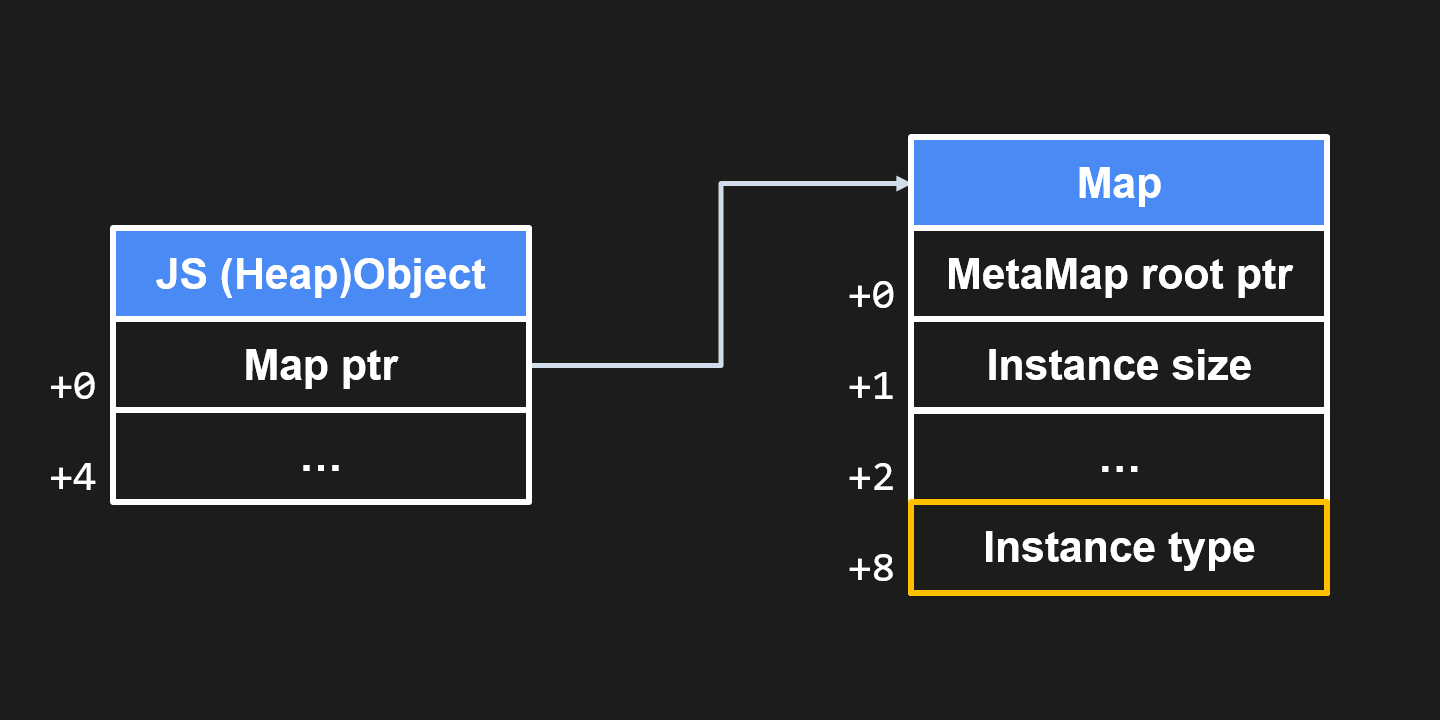
    All JS objects begin with a pointer to a special object called Map (also known as HiddenClass) which stores meta information about the object and describes its structure. It contains the object’s type (stored at a +8 offset), number of properties, and so on.

    Structure of the “moduleImport” JS object

    The moduleImport module is represented in memory as a JSReceiver object, which is the most generic JS object and is used for types for which properties can be defined. It includes a pointer to the array of properties ( PropertyArray) which is basically a regular JS object of the FixedArray type with its own Map. If in the expression moduleImport.exportedVar = 3.79837e312; moduleImport was not a module but a regular object, the code would set the property #0 in that array, writing at a +8 offset; however, since it is a module and there is a bug, the code sets this property, writing at a +0 offset, overwriting the Map object with the provided object.

    Structure of the “3.79837e-312” number JS object

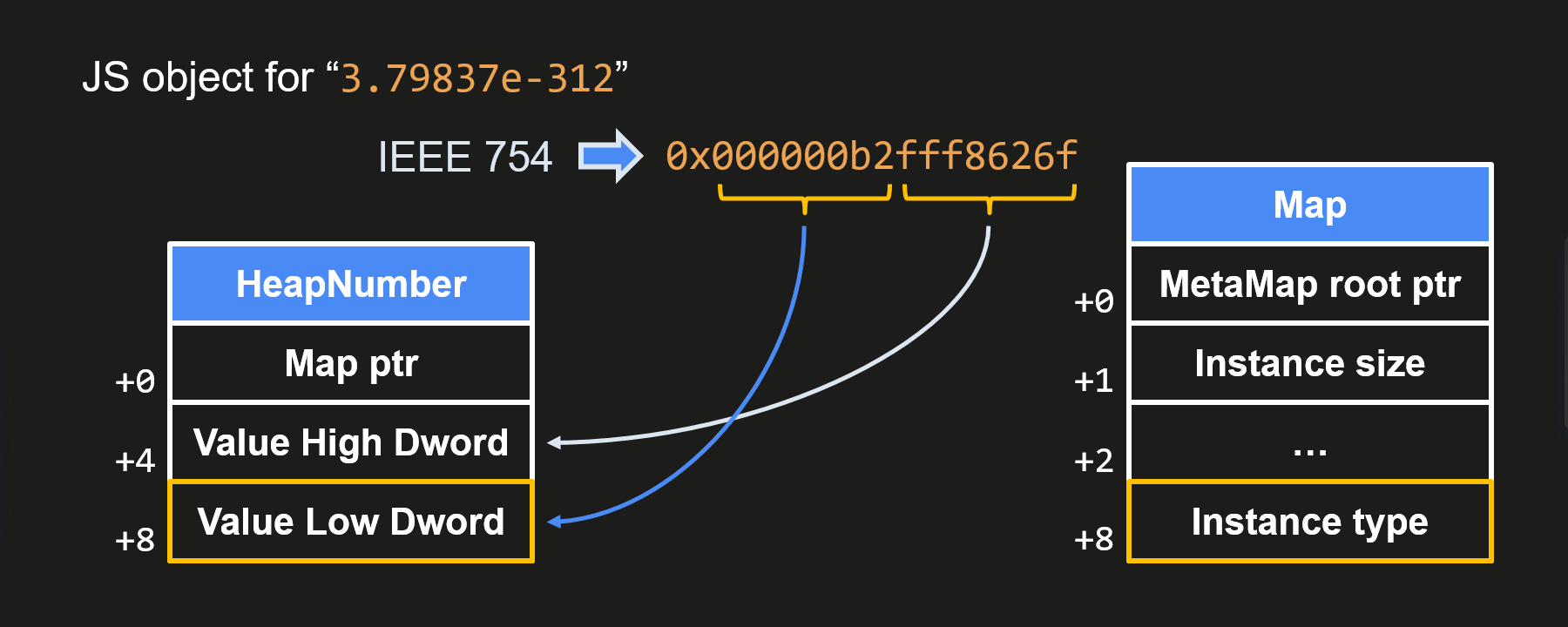
    Since 3.79837e-312 is a floating-point number, it is converted to a 64-bit value (according to the IEEE 754 standard) and stored in a HeapNumber JS object at a +4 offset. This allows the attackers to set their own type for the PropertyArray object and cause a type confusion. Setting the type to 0xB2 causes V8 to treat the PropertyArray as a PropertyDictionary, which results in memory corruption because the PropertyArray and PropertyDictionary objects are of different sizes and the kLengthAndHashOffset field of the PropertyDictionary falls outside the bounds of the PropertyArray.

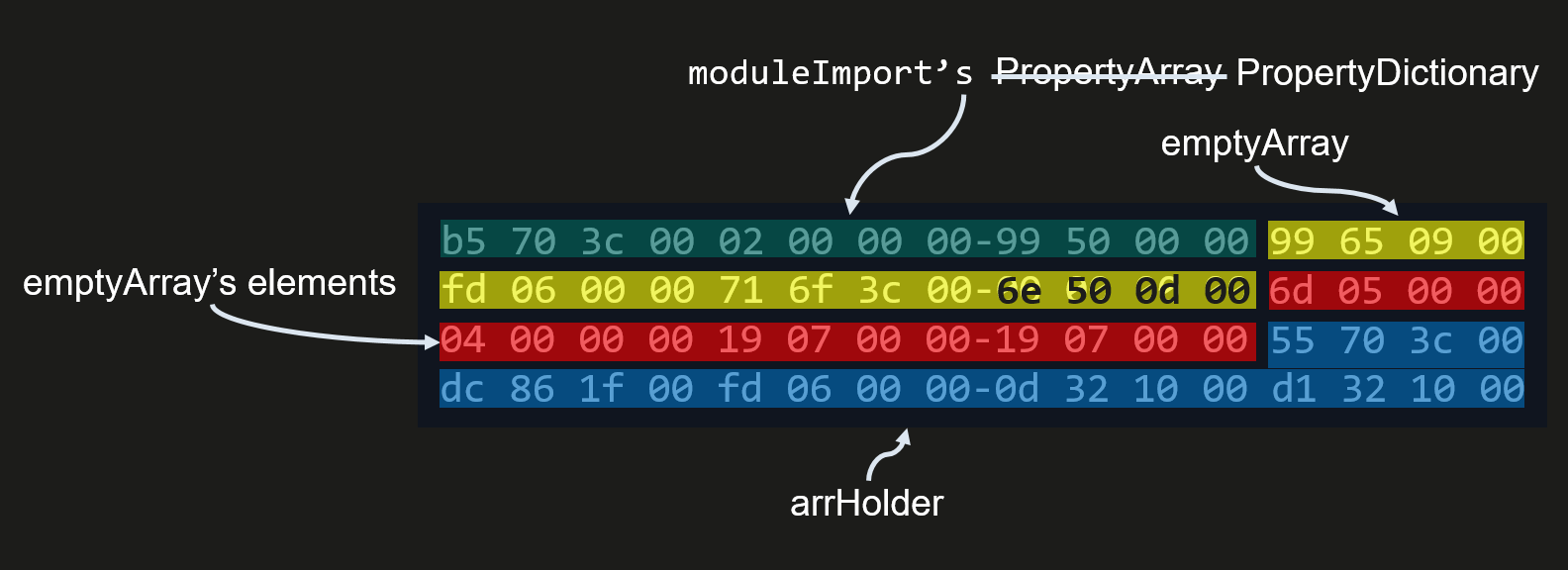
    Now the attackers need to get the right memory layout and corrupt something useful. They defragment the heap and perform the actions that you can see in the trigger function.

    Memory layout created by the “trigger” function

    What happens in this function is the following:

    1. It accesses the exported module variable moduleImport.exportedVar to allocate moduleImport’s PropertyArray.
    2. It creates an emptyArray with two elements.
    3. Removing elements from this array reallocates the object that is used for storing the elements and sets emptyArray’s length to 0. This is an important step because in order to overwrite emptyArray’s length with PropertyDictionary’s hash, the length/hash must be equal to 0.
    4. The trigger function creates the arrHolder dictionary with two objects. This step follows the creation of the emptyArray to allow the pointers of these two objects to be accessed and overwritten when the length of emptyArray is corrupted. The first object, xxarr: doubleArray is used to construct a primitive for getting the addresses of JS objects. The second object, xxab: fakeArrayBuffer is used to construct a primitive for getting read/write access to the whole address space of the Chrome process.
    5. Next, the trigger function executes the f function until it is compiled by Maglev, and overwrites the type of the PropertyArray so it is treated as a PropertyDictionary object.
    6. Executing new WeakRef(moduleImport) triggers the calculation of PropertyDictionary’s hash, and the length of emptyArray is overwritten with the hash value.
    7. The trigger function returns emptyArray and arrHolder containing objects that can be overwritten with emptyArray.

    After this, the exploit again abuses Maglev, or rather the fact that it optimizes the code based on the feedback collected by the interpreter. The exploit uses Maglev to compile a function that loads a double value from an array obtained using arrHolder.xxarr. When this function is compiled, the attackers can overwrite the pointer to an array obtained using arrHolder.xxarr via emptyArray[5] and use this function to get the addresses of JS objects. Similarly, the attackers use arrHolder.xxab to compile a function that sets specific properties and overwrites the length of another ArrayBuffer-type object along with the pointer to its data (backing_store_ptr). This becomes possible when the pointer to the object accessible via arrHolder.xxab is replaced via emptyArray[6] with a pointer to the ArrayBuffer. This gives the attackers read and write access to the entire address space of the Chrome process.

    Second vulnerability (V8 sandbox bypass)

    At this point, the attackers can read and write memory from JavaScript, but they need an additional vulnerability to bypass the newly introduced V8 (heap) sandbox. This sandbox is purely software-based and its main function is to isolate the V8 memory (heap) in such a way that attackers cannot access other parts of the memory and execute code. How does it do this? You may have noticed that all the pointers in the previous section are 32 bits long. This is not because we’re talking about a 32-bit process. It’s a 64-bit process, but the pointers are 32 bits long because V8 uses something called pointer compression. The pointers are not stored in full, but just as their lower parts, or they could also be seen as a 32-bit offset from some “base” address. The upper part (the “base” address) is stored in CPU registers and added by the code. In this case, attackers should not be able to obtain real pointers from the isolated memory and have no way to obtain addresses for the stack and JIT-code pages.

    To bypass the V8 sandbox, the attackers used an interesting but very common vulnerability associated with interpreters — we have previously seen variations of this vulnerability in multiple virtual machine implementations. In V8, regular expressions are implemented using its own interpreter, Irregexp, with its own set of opcodes. The Irregexp VM is completely different from Ignition, but it is also a register-based VM.

    Examples of vulnerable code in Irregexp VM instruction handlers

    The vulnerability is that the virtual machine has a fixed number of registers and a dedicated array for storing them, but the register indexes are decoded from the instruction bodies and are not checked. This allows attackers to access the memory outside the bounds of the register array.

    Malicious Irregexp VM bytecode for reading the memory outside of the register array bounds

    Coincidentally, the pointers to output_registers and output_register_count are located right next to the register array. This allows the attackers to read and write the memory outside of the V8 sandbox with the help of the SUCCEED opcode. Attackers use this to overwrite JIT’ed code with shellcode and execute it.

    This issue (330404819) was submitted and fixed in March 2024. It is unknown whether it was a bug collision and the attackers discovered it first and initially exploited it as a 0-day vulnerability, or if it was initially exploited as a 1-day vulnerability.

    Shellcode

    At this point, the attackers need additional vulnerabilities to escape the Chrome process and gain full access to the system. In the best practices of sophisticated attackers, they run a validator in the form of a shellcode that collects as much information as possible and sends it to the server to decide whether to provide the next stage (another exploit) or not. This decision is made based on the following information: CPUID information (vendor, processor name, etc), whether it’s running on a VM or not, OS version and build, number of processors, tick count, OS product type, whether it’s being debugged or not, process path, file version info of system modules, file version info of process executable, and SMBIOS firmware table.

    By the time we analyzed the attack, the attackers had already removed the exploit from the decoy website, preventing us from easily obtaining the next stage of the attack. At Kaspersky, we possess technologies that have allowed us to discover and help to fix a huge number of 0-day privilege escalation vulnerabilities exploited by sophisticated attackers in various malware campaigns over the years; however, in this particular case we would have to wait for the next attack in order to extract its next stage. We’ve decided to not wait, preferring to let Google fix the initial exploit used to perform the remote code execution in Google Chrome.

    List of in-the-wild 0-days caught and reported by Kaspersky over the past 10 years

    Social activity

    What never ceases to impress us is how much effort Lazarus APT puts into their social engineering campaigns. For several months, the attackers were building their social media presence, regularly making posts on X (formerly Twitter) from multiple accounts and promoting their game with content produced by generative AI and graphic designers.

    Attackers’ accounts on X

    One of the tactics used by the attackers was to contact influential figures in the cryptocurrency space to get them to promote their malicious website and most likely to also compromise them.

    Attackers’ attempts to contact crypto-influencers

    The attackers’ activity was not limited to X — they also used professionally designed websites with additional malware, premium accounts on LinkedIn, and spear phishing through email.

    The game

    Malicious website offering to download a beta version of the game

    What particularly caught our attention in this attack was that the malicious website attacking its visitors using a Google Chrome zero-day was inviting them to download and try a beta version of a computer game. As big computer games fans ourselves, we immediately wanted to try it. Could the attackers have developed a real game for this campaign? Could this be the first computer game ever developed by a threat actor? We downloaded detankzone.zip and it looked legit: the 400 MB-archive contained a valid file structure of a game developed in Unity. We unpacked the game’s resources and found “DeTankZone” logos, HUD elements, and 3D model textures. Debugging artifacts indicated that the game had been compiled by the attackers. We decided to give it a spin.

    Start menu of the DeTankZone game

    After an intro with the game’s logo, we are greeted with a typical online gaming start menu, asking us to enter valid account credentials to access the game. We tried to log in using some common account names and passwords, and then tried to register our own account through the game and the website — but nothing worked.

    Is that really all this game has to offer? We started reverse engineering the game’s code and discovered that there was more content available beyond this start menu. We found the code responsible for communication with the game server and started reverse engineering that as well. The game was hardcoded to use the server running at “api.detankzone[.]com,” which clearly wasn’t working. But we really wanted to check this game out! What to do? We decided to develop our own game server, of course.

    First, we discovered that the game uses the Socket.IO protocol to communicate with the server, so we chose the pythonsocketio library to develop our own server. We then found a function with a list of all supported command names (event names) and reverse engineered how they are obfuscated. After that, we reverse engineered how the data was encoded: it turned out to be a JSON encrypted with AES256 and encoded with Base64. For the AES key it uses the string “Full Stack IT Service 198703Game”, while the string “MatGoGameProject” is used for the IV. We hoped that this information might reveal the identities of the game’s developers, but a Google search yielded no results. Finally, we reverse engineered the data format for a couple of commands, implemented them on our server, and replaced the server URL with the address of our own server. Success! After all this we were able to log into the game and play with the bots!

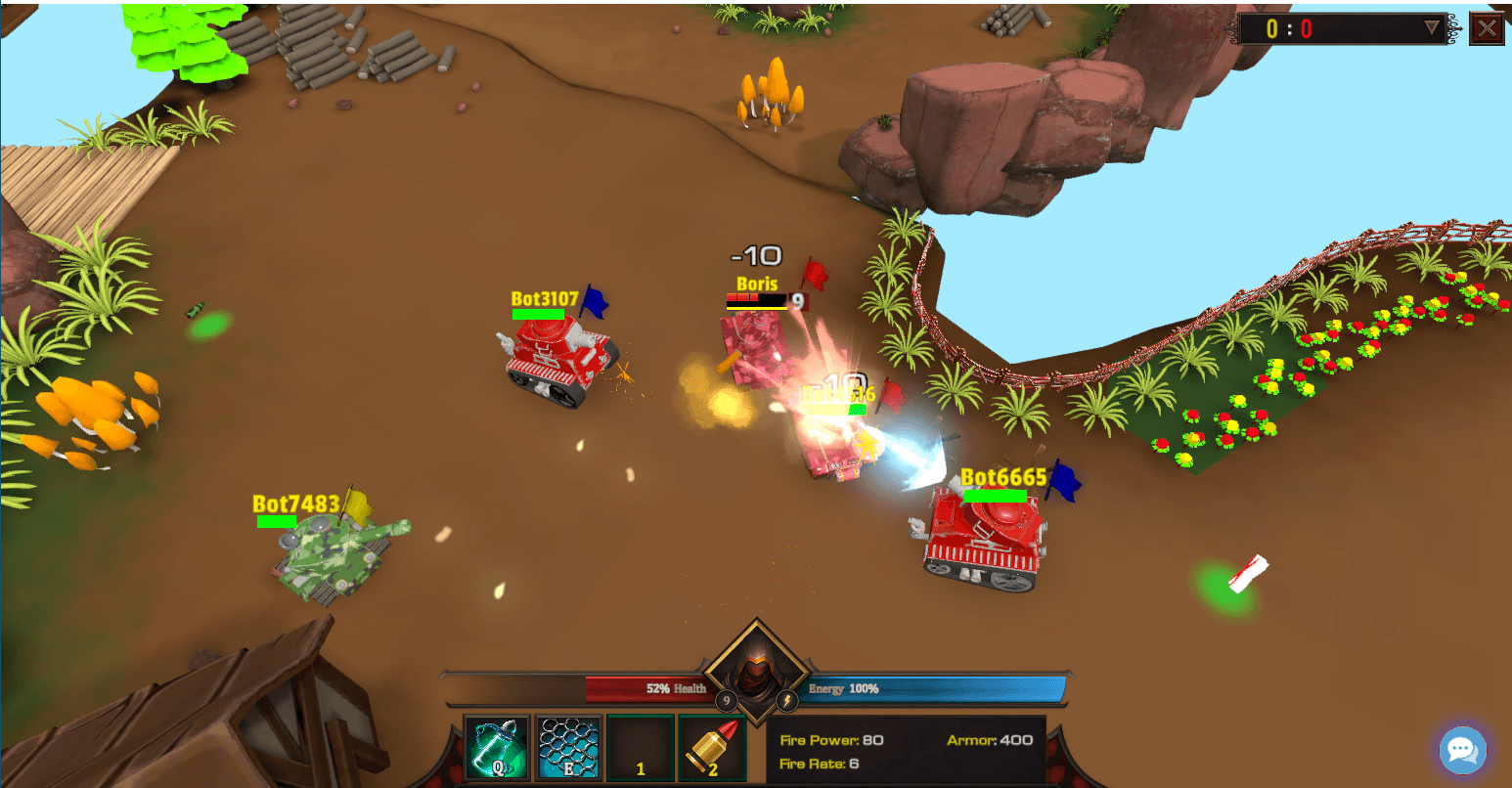
    Screenshot from the game running with our custom server

    Yes, it turned out to be a real game! We played it for a bit and it was fun — it reminded us of some shareware games from the early 2000s. Definitely worth the effort. The textures look a little tacky and the game itself closely resembles a popular Unity tutorial, but if Lazarus had developed this game themselves, it would have set a new bar for attack preparation. But no — Lazarus stayed true to themselves. It turns out that the source code for this game was stolen from its original developers.

    The original game

    DeFiTankLand (DFTL) – the original game

    We found a legitimate game that served as a prototype for the attacker’s version – it’s called DeFiTankLand (DFTL). Studying the developers’ Telegram chat helped us build a timeline of the attack. On February 20, 2024, the attackers began their campaign, advertising their game on X. Two weeks later, on March 2, 2024, the price of the DeFiTankLand’s currency, DFTL2 coin, dropped, and the game’s developers announced on their Telegram that their cold wallet had been hacked and $20,000 worth of DFTL2 coins had been stolen. The developers blamed an insider for this. Insider or not, we suspect that this was the work of Lazarus, and that before stealing the coins they first stole the game’s source code, modified all the logos and references to DeFiTankLand, and used it to make their campaign more credible.

    Conclusions

    Lazarus is one of the most active and sophisticated APT actors, and financial gain remains one of their top motivations. Over the years, we have uncovered many of their attacks on the cryptocurrency industry, and one thing is certain: these attacks are not going away. The attackers’ tactics are evolving and they’re constantly coming up with new, complex social engineering schemes. Lazarus has already successfully started using generative AI, and we predict that they will come up with even more elaborate attacks using it. What makes Lazarus’s attacks particularly dangerous is their frequent use of zero-day exploits. Simply clicking a link on a social network or in an email can lead to the complete compromise of a personal computer or corporate network.

    Historically, half of the bugs discovered or exploited in Google Chrome and other web browsers have affected its compilers. Huge changes in the code base of the web browser and the introduction of new JIT compilers inevitably lead to a large number of new vulnerabilities. What can end users do about this? While Google Chrome continues to add new JIT compilers, there is also Microsoft Edge, which can run without JIT at all. But it’s also fair to say that the newly introduced V8 sandbox might be very successful at stopping bugs exploitation in compilers. Once it becomes more mature, exploiting Google Chrome with JIT may be as difficult as exploiting Microsoft Edge without it.

    Indicators of Compromise

    Exploit
    B2DC7AEC2C6D2FFA28219AC288E4750C
    E5DA4AB6366C5690DFD1BB386C7FE0C78F6ED54F
    7353AB9670133468081305BD442F7691CF2F2C1136F09D9508400546C417833A

    Game
    8312E556C4EEC999204368D69BA91BF4
    7F28AD5EE9966410B15CA85B7FACB70088A17C5F
    59A37D7D2BF4CFFE31407EDD286A811D9600B68FE757829E30DA4394AB65A4CC

    Domains
    detankzone[.]com
    ccwaterfall[.]com

    MIL OSI Economics

  • MIL-OSI Banking: Thales reports its order intake and sales as of September 30, 2024

    Source: Thales Group

    Headline: Thales reports its order intake and sales as of September 30, 2024

    • Order intake: €15.6 billion, up 23% on an organic basis1(+26% total change)
    • Sales: €14.1 billion, up 6.2% on an organic basis (+9.4% total change)
    • 2024 targets confirmed:
      • Book-to-bill ratio above 1
      • Organic sales growth between +5% and +6%2
      • EBIT margin: 11.7% to 11.8%

    Thales (Euronext Paris: HO) today announced its order intake and sales for the period ending September 30, 2024.

    Reminder: 9m 2023 figures have been restated to include Cyber civil activities transferred from Defence and Security to Digital Identity & Security.

    “The third quarter confirmed the continued strong commercial momentum and organic sales growth in most of Thales’ businesses.
    ​The Defence business enjoyed unparalleled visibility thanks to emblematic long-term contracts. Avionics was driven by the recovery in air traffic and solid growth prospects. The cybersecurity and biometrics businesses benefited from a robust environment.
    ​We are also proud of Thales’ inclusion in the CAC 40 ESG index. This is a strong external endorsement of our non-financial performance and of our contribution to the protection of society, the planet and citizens.
    ​We are confident that we will achieve our annual financial targets for 2024, thanks to our teams’ unwavering involvement.”

    ​Patrice Caine, Chairman & Chief Executive Officer

    Order intake

    Order intake over the first nine months of 2024 amounted to €15,551 million, up 23% on an organic basis4 compared with the first nine months of 2023 (up 26% total change). The Group continued to benefit from an excellent commercial momentum in all its businesses, particularly in Defence & Security.

    Over the period, Thales recorded 19 large orders with a unit value of more than €100 million, the cumulative amount of which came to €4,983 million:

    • Four large orders booked in Q1 2024:
      • The entry into force of the third phase of the order placed by Indonesia in 2022 for the purchase of 42 Rafale aircraft (18 aircraft and support services);
      • Order of an aerial surveillance system for a military customer in the Middle East;
      • Second tranche of the contract signed in 2023 between France and Italy for the production of 400 ASTER B1NT ground-to-air missiles;
      • Phased contract with the French Defence Procurement Agency (DGA) to develop the next generation of sonars to equip French nuclear-powered ballistic-missile submarines (SSBN).
    • Eight large orders booked in Q2 2024:
      • Order of two new F126 frigates by the German Navy. This additional contract brings the number of F126 frigates acquired by the German Navy to six in the past four years;
      • Exomars 2028, a contract signed between industrial prime contractor Thales Alenia Space and the European Space Agency (ESA) to relaunch the European space mission dedicated to the exploration of the Red Planet;
      • Order by SKY Perfect JSAT to Thales Alenia Space of JSAT-31, a new generation of satellite reconfigurable in orbit using Space INSPIRE technology;
      • Order by France’s Joint Munitions Command (SiMu) of tens of thousands of 120mm rifled ammunition;
      • Order for a next generation cloud native “FLYTEDGE” InFlight Entertainment System for a major worldwide airline;
      • Order by an Asian customer of latest-generation Ground Master 400 Alpha long-range air surveillance radars;
      • Order by the Dutch Ministry of Defence of seven additional Ground Master 200 multi-mission compact radars;
      • Service contract for the maintenance of the Royal Australian Navy fleet.
    • Seven major orders recorded in Q3 2024:
      • Order for the supply of communications, vetronics, navigation and optronics equipment for vehicles in the French Army’s SCORPION program;
      • Order for the renovation of an air traffic management system;
      • Order from the UK Ministry of Defence for the supply of LMM missiles to strengthen Ukraine’s air defence capabilities;
      • Order of LMM missiles for the British armed forces;
      • Order for the supply of Ground Fire multifunction radars and engagement modules following France’s acquisition of seven SAMP/T NG air defence systems;
      • Order for the supply of anti-submarine warfare systems for the first phase of the construction of six HUNTER-class frigates for the Royal Australian Navy;
      • Notification by the DGA of the second tranche of the development of the future RBE2 XG radar for the Rafale F5.

    At €10,567 million, order intake with a unit value of less than €100 million increased by 6% compared to the first nine months of 2023; while order intake with a unit value of less than €10 million was up by 7% at September 30, 2024.

    From a geographical5 point of view, order intake in mature markets recorded organic growth of 12%, to €11,413 million, driven by strong sales momentum in the United Kingdom (up 28% on an organic basis) as well as in Australia and New Zealand (up 34% on an organic basis). Order intake in emerging markets amounted to €4,137 million, with strong organic growth of 69% as at September 30, 2024. This performance reflected excellent momentum in the Near and Middle East (up 175% on an organic basis) and in Asia (up 49% on an organic basis).

    Order intake in the Aerospace segment totaled €3,639 million, versus €3,403 million over the first nine months of 2023 (+8% at constant scope and exchange rates). This increase reflects two contrasting trends. On the one hand, the avionics market remained strong, our activities growing double-digit organically. On the other hand, the order intake in the space business declined due to a high comparison basis (two large orders signed as at September 30, 2024 versus five as of September 30, 2023).

    At €8,951 million (compared with €6,404 million for the first nine months of 2023), order intake in the Defence & Security segment continued to record a strong momentum, with organic growth of 40%. Seven new orders with a unit value of more than €100 million in the third quarter were added to the nine already recorded in the first half of the year. The order book stood at €37.0 billion, compared with €35.1 billion at September 30, 2023.

    At €2,905 million, order intake in the Digital Identity & Security segment was in line with sales over the period, as most of the activities in this segment operate on short cycles.

    Sales

    Sales for the first nine months of 2024 amounted to €14,069million, compared with €12,854 million for the same period in 2023, an increase of 6.2% at constant scope and exchange rates.

    From a geographical5 point of view, sales growth was strong in mature markets (+6.3% on an organic basis), driven in particular by Europe (+9.0%) including France (+9.4%), and Australia and New Zealand (+8.5%). Emerging markets posted organic growth of +5.8% over the period.

    Sales in the Aerospace segment amounted to €3,839 million, up 5.6% compared to the first nine months of 2023 (+5.3% at constant scope and exchange rates). This growth reflected ongoing robust demand in the avionics market, leading the activity to grow mid-single digit plus. It was however mitigated by the low-single digit organic growth of the space business.

    Sales in the Defence & Security segment totaled €7,239 million, up +8.8% compared to the first nine months of 2023 (+8.5% at constant scope and exchange rates). After sustained growth recorded in the first half of the year, this segment confirmed its strong momentum in the third quarter. Growth was driven in particular by land and air systems.

    In the Digital Identity & Security segment, sales totaled €2,914 million, up 15.7% in the first nine months of 2024 (+0.3% at constant scope and exchange rates), including the positive scope effect linked to the acquisitions of Tesserent and Imperva. The stability in organic growth in this segment reflects contrasting trends:

    • Banking and Payment solutions, negatively affected by a high comparison basis, continued to suffer from further destocking in North America;
    • Steady pace of growth in Cyber and Biometrics activities;
    • Continued ramp-up on Connectivity Solutions market, recording double-digit organic growth.

    Outlook

    Thales continues to benefit from its solid positioning in all its major markets and enjoys robust medium-term outlook, as illustrated by the continued strong sales momentum in the third quarter of 2024.

    As a result, assuming there are no major new disruptions in the global economy or global supply chains, Thales confirms its 2024 annual targets:

    • A book-to-bill ratio above 1;
    • Organic sales growth of between +5% and +6%, corresponding to sales in the range of €19.9 billion to €20.1 billion6;
    • An EBIT margin between 11.7% and 11.8%.

    ****

    This press release contains certain forward-looking statements. Although Thales believes that its expectations are based on reasonable assumptions, actual results may differ significantly from the forward-looking statements due to various risks and uncertainties, as described in the Company’s Universal Registration Document, which has been filed with the French financial markets authority (Autorité des marchés financiers – AMF).

    1In this press release, “organic” means “at constant scope and exchange rates”.

    2Between €19.9 billion and €20.1 billion based on September 2024 scope and exchange rates.

    3Mature markets: Europe, North America, Australia, New Zealand; emerging markets: all other countries.

    4Taking into account a negative currency effect of -€45 million and a positive net scope effect of €441 million.

    5See table on page 6.

    5Seetableon page 6.

    6Based on September 2024 scope and exchanges rates.

    MIL OSI Global Banks

  • MIL-OSI Banking: Committee on Market Access holds third thematic session on supply chain resilience

    Source: WTO

    Headline: Committee on Market Access holds third thematic session on supply chain resilience

    The moderator of the session, Mr Iain Fifer of the United Kingdom, emphasized the critical role of trade data in analyzing and enhancing the resilience of supply chains. He noted the challenges in gathering reliable, timely and relevant data, and underlined how such information can inform decision-making.
    Thailand highlighted logistical challenges related to train freight routes from Thailand to Europe. While rail transport is faster than ocean freight and cheaper than air freight, it faces significant obstacles such as customs clearance issues at multiple borders, a lack of harmonized standards, and higher costs compared to sea freight. Additionally, it stressed how limitations in rail infrastructure add complexity.
    China emphasized the importance of multilateral and bilateral trade frameworks, such as those supported by the WTO, in ensuring smooth supply chain operations. It underscored technological advances, particularly in big data and green energy, as key influencers of the development of global supply chains. China also announced the upcoming release of its Global Supply Chain Connectivity Index at the second China International Supply Chain Expo in November 2024. The document will provide a quantitative assessment of the resilience and stability of global supply chains.
    India focused on the three fundamental pillars of supply chains — production, logistics and markets. It also underlined the importance of digital infrastructure in bolstering supply chain resilience. Additionally, India discussed initiatives such as the Unified Logistics Interface Platform and the PM Gati Shakti National Master Plan, which utilize geospatial data to enhance infrastructure connectivity and logistics efficiency.
    The United States introduced its newly established Supply Chain Center within the Department of Commerce, designed to enhance supply chain resilience. The unit’s “Scale” tool assesses risks across sectors of the US economy by evaluating more than 40 indicators of criticality, vulnerability and resiliency in supply chains. The tool provides an in-depth view of current risks to better inform policy decisions, the United States underlined.
    Switzerland presented an initiative led by the Organisation for Economic Cooperation and Development (OECD) aimed at improving the transparency and resilience of medical supply chains. The initiative was prompted by the supply shortages experienced during the COVID-19 pandemic. Switzerland’s project involves a monitoring mechanism designed to increase visibility in global medical supply chains and address future disruptions through international cooperation and the use of advanced technologies such as artificial intelligence.
    In his conclusion, the moderator emphasized the importance of data design and collection in creating a comprehensive understanding of various supply chains. He stressed that data sharing and collaboration were central themes of the discussion, noting that swift and accurate exchange of information between stakeholders and governments is essential. Additionally, he acknowledged the significant analytical work required after data collection and pointed out that once data analysis is completed, it must be effectively utilized to guide policymaking. The session also featured examples of ongoing policy initiatives shaped by data-driven projects.
    The interim Chair of the Market Access Committee, Ms Nicola Waterfield of Canada, expressed appreciation for the presentations and highlighted the importance of the discussions. She also announced that the Committee’s next formal meeting is scheduled for 19-20 November 2024.

    Share

    MIL OSI Global Banks

  • MIL-OSI Video: United Nations Day 2024 – UN Chief Message | United Nations

    Source: United Nations (Video News)

    Video message by António Guterres, Secretary-General of the United Nations, for United Nations Day (24 October 2024).

    “The United Nations was built by the world, for the world.

    Since 1945, it has been the place for countries to unite behind global solutions to global problems.

    Solutions that ease tensions, build bridges and forge peace.

    Solutions to eradicate poverty, spur sustainable development, and stand up for the most vulnerable.

    Solutions that deliver lifesaving relief to people living through conflicts, violence, economic hardship, and climate disasters.

    Solutions that level the scales of justice and equality for women and girls.

    Solutions that tackle issues that were unimaginable in 1945 — climate change, digital technology, artificial intelligence, and outer space.

    In September, the General Assembly adopted the Pact for the Future, the Global Digital Compact and the Declaration on Future Generations.

    Together, these milestone agreements will help ensure that the United Nations system adapts, reforms and rejuvenates, so it is fit for the changes and challenges around us and delivers solutions for all.

    But our work will always be rooted in the timeless values and principles of the UN Charter and international law, and in the dignity and human rights of every person.

    In today’s troubled world, hope is not enough.

    Hope requires determined action and multilateral solutions for peace, shared prosperity and a thriving planet.

    Hope requires all countries working as one.

    Hope requires the United Nations.

    On United Nations Day, I call on all countries to keep this beacon for the world, and its ideals, shining”.

    More info: un.org

    https://www.youtube.com/watch?v=zkGcMpJlOAo

    MIL OSI Video

  • MIL-OSI Video: How do Governance Reforms Promote Economic Growth and Social Inclusion?

    Source: International Monetary Fund – IMF (video statements)

    Governance reforms can boost growth, reduce poverty and inequality, and accelerate a country’s transition to higher income status. Sustained efforts with high-level political support to strengthen the anti-corruption and governance frameworks are essential for success.

    https://www.youtube.com/watch?v=eCm2ahmceLc

    MIL OSI Video

  • MIL-OSI Video: Gulf Cooperation Council Diversification–the Role of Foreign and Sovereign Wealth Funds’ Investments

    Source: International Monetary Fund – IMF (video statements)

    Foreign and Sovereign Wealth Funds’ investments are key drivers of the economic transformation in Gulf Cooperation Council (GCC), with a recent focus on services and renewable industries. These investments are pivotal in driving non-hydrocarbon growth, steering GCC toward a more diversified and sustainable economic future.

    https://www.youtube.com/watch?v=CJhWlV9i4LQ

    MIL OSI Video

  • MIL-OSI Video: The Catalytic Impact of IMF Lending on Development Assistance

    Source: International Monetary Fund – IMF (video statements)

    IMF programs often align with increased foreign aid to Low-Income Countries, as both occur during economic stress. We investigate how these programs catalyze aid from international donors, enhancing financial support during critical times.

    https://www.youtube.com/watch?v=v76HuGPkDvA

    MIL OSI Video

  • MIL-OSI Video: Has the Transmission of US Monetary Policy Changed Since 2022?

    Source: International Monetary Fund – IMF (video statements)

    The US economy grew strongly after the Fed hiked rates in 2022. Was this because monetary policy was less effective than usual? Or did other factors just offset it? We show Fed policy was about 25% weaker than usual, but only temporarily.

    https://www.youtube.com/watch?v=BAgqAzVXONU

    MIL OSI Video

  • MIL-OSI Video: Transforming Social Safety Nets: A Digital Revolution

    Source: International Monetary Fund – IMF (video statements)

    This Analytical Corner focuses on how digital technologies are transforming social safety nets in various country settings such as Brazil, DRC, India, Pakistan, Togo, and Türkiye. Join us to discover innovative strategies to identify, verify, and pay social benefits to enhance support for vulnerable households, even in low-capacity settings. Related publication: Expanding and Improving Social Safety Nets Through Digitalization: Conceptual Framework and Review of Country Experiences (IMF Note, December 2023).

    https://www.youtube.com/watch?v=XIh2aySlzvo

    MIL OSI Video

  • MIL-OSI Video: The Nexus of Climate and Monetary Policy: Evidence from the Middle East and Central Asia

    Source: International Monetary Fund – IMF (video statements)

    This paper investigates the effects of climate shocks on inflation and monetary policy in the Middle East and Central Asia (ME&CA) region.

    We first introduce a theoretical model to understand the impact of climate risks on headline and food inflation. In particular, the model shows how climate shocks could affect the path of policy rates through food prices.
    We then use local projections to estimate the impact of climate shocks on headline and food inflation. The results show that price stability is more easily achievable under positive climate conditions.

    Overall, our findings shed new light on the importance of considering climate-related supply shocks when designing monetary policy, particularly in countries where food makes up a significant part of the CPI-basket.

    https://www.youtube.com/watch?v=j5eyFAxtXc4

    MIL OSI Video

  • MIL-OSI Video: The Clock is Ticking: Meeting Sub-Saharan Africa’s Urgent Job Creation Challenge

    Source: International Monetary Fund – IMF (video statements)

    Sub-Saharan Africa urgently needs to create jobs for its growing population, especially in fragile and low-income countries. Three main challenges must be tackled: transforming informality, addressing firm growth barriers, and accelerating structural transformation.

    https://www.youtube.com/watch?v=cTvLPGf4jvA

    MIL OSI Video

  • MIL-OSI Video: Harnessing Renewables in Sub-Saharan Africa: Barriers Reforms and Economic Prospects

    Source: International Monetary Fund – IMF (video statements)

    Sub-Saharan Africa needs to increase its electricity production. Leveraging renewable energy, supported by climate finance and policy reforms, can boost both power generation and GDP.

    https://www.youtube.com/watch?v=6D-1ManIp1w

    MIL OSI Video

  • MIL-OSI Video: Deputy Secretary-General Empowers Fans at the Global Citizen Festival | United Nations

    Source: United Nations (Video News)

    At the 2024 Global Citizen Festival, Deputy Secretary-General Amina J. Mohammed encourages fans to act on the global goals. The festival unites artists, activists, world leaders and fans with the goal to end extreme poverty. Global Citizen Festival is more than just music – it’s a platform for social justice, environmental sustainability and empowering vulnerable communities.

    https://www.youtube.com/watch?v=LO3tqR3nEuM

    MIL OSI Video

  • MIL-OSI Video: Midori: A Journey of Peace and Sustainability

    Source: United Nations (Video News)

    Discover Midori’s inspiring journey as a Messenger of Peace, from her early focus on education to championing broader Sustainable Development Goals like environmental protection. In this video, she shares her firsthand experiences in the field and emphasizes how we are all connected, with everyone deserving a decent life and access to education.

    https://www.youtube.com/watch?v=9mIB4sUyRuQ

    MIL OSI Video

  • MIL-OSI Video: Iraq, Gaza/UNSCO, Lebanon & other topics – Daily Press Briefing (22 Oct 2024) | United Nations

    Source: United Nations (Video News)

    Noon briefing by Farhan Haq, Deputy Spokesperson for the Secretary-General.

    Highlights:
    -BRICS
    -Iraq
    -Gaza/UNSCO
    -Occupied Palestinian Territory
    -Gaza/UN Development Programme
    -The UN Interim Force in Lebanon
    -Lebanon/Humanitarian
    -Yemen
    -Sudan
    -Ukraine
    -Security Council/Ukraine
    -Cuba
    -Haiti
    -Democratic Republic of the Congo

    BRICS
    I can confirm that the Secretary-General is once again attending the BRICS summit, which this year takes place in Kazan, in the Russian Federation.

    Iraq
    In a statement issued today, the Secretary-General congratulates the Kurdistan Region of Iraq and its people on the holding of parliamentary elections on 20 October, which took place in a calm and peaceful manner. He further commends the efforts of the Independent High Electoral Commission (IHEC), supported by the United Nations Assistance Mission for Iraq (UNAMI), in the preparations and conduct of these elections.
    As the Kurdistan Region of Iraq awaits the final results, the Secretary-General encourages all political leaders and segments of society to continue to maintain a peaceful atmosphere and urges political actors to resolve any electoral disputes through established legal channels and to complete the electoral process by forming an inclusive government as soon as possible. He reiterates the commitment of the United Nations to support Iraq’s efforts to consolidate democratic gains and build a prosperous future for the people of Iraq.

    Gaza/UNSCO
    Tor Wennesland, the UN Special Coordinator for the Middle East Peace Process, visited Gaza today, where he saw firsthand the continued immense destruction and profound suffering of the people.
    He said he met with UN staff and Palestinian NGOs in Gaza, whose tireless efforts are admirable. He heard directly from them about the alarming security and humanitarian situation across the Strip, particularly in northern Gaza. The challenges faced by the people of Gaza, including serious violations of international humanitarian law, are enormous, with urgent needs for food, medical supplies, and protection.
    Mr. Wennesland said that a significant increase in the entry of humanitarian assistance and an improvement in security is urgently required.  He reiterated the Secretary-General’s repeated call for an immediate ceasefire and the unconditional release of all hostages held by Hamas. He calls on all relevant parties to urgently pursue these goals.

    Gaza/UN Development Programme
    The UN Development Programme (UNDP) says that one year into the Gaza war, the humanitarian crisis has reached a catastrophic level – with unprecedented casualties, widespread destruction and severe food insecurity.
    The war has had a severe impact on critical sectors such as education, healthcare, social services, the economy and the environment, UNDP says in a new report. Educational institutions have suffered significant losses, with numerous casualties among students and educators and the widespread destruction of schools. The healthcare system is nearing collapse, facing critical shortages in medical supplies and widespread malnutrition, particularly among children.
    Economic projections indicate that the gross domestic product (GDP) of the State of Palestine contracted by 35.1 per cent in 2024 compared with a no-war scenario, with unemployment potentially rising to 49.9 per cent. By the end of 2024, the Human Development Index (HDI) in the State of Palestine may fall to 0.643, a level not seen since human development calculations began in 2004.
    Poverty in the State of Palestine is projected to rise to 74.3 per cent in 2024, affecting 4.1 million people, including 2.61 million people who are newly impoverished. The full report is online.

    Full Highlights: https://www.un.org/sg/en/content/ossg/noon-briefing-highlight?date%5Bvalue%5D%5Bdate%5D=22+October+2024

    https://www.youtube.com/watch?v=gfpt8lR-1Oc

    MIL OSI Video

  • MIL-OSI China: Xi underscores BRICS’ role in building multipolar world, driving globalization

    Source: People’s Republic of China – State Council News

    KAZAN, Russia, Oct. 23 — The BRICS mechanism is a pillar in promoting a multipolar world and fostering an inclusive economic globalization, said Chinese President Xi Jinping on Tuesday as leaders gathered in Kazan for the 16th BRICS Summit.

    Xi made the remarks while meeting with Russian President Vladimir Putin ahead of the leaders’ formal meetings. He noted that BRICS is the world’s most important platform for solidarity and cooperation between emerging markets and developing countries.

    He also voiced his hope to have in-depth discussions with Putin and other leaders participating in the summit on the future development of the BRICS mechanism, so as to secure more opportunities for the Global South.

    Putin thanked China for its support during Russia’s presidency of BRICS, stressing that Russia is ready to closely cooperate with China to ensure the success of the first BRICS Summit after its expansion and bolster BRICS cooperation.

    Kazan, the capital of Tatarstan and the fifth-largest city in Russia, holds historical and cultural significance. Xi told Putin during their meeting that around 400 years ago, the Great Tea Road that connected the two countries went past Kazan, through which tea leaves from China’s Wuyi Mountain region found their way into many Russian households.

    The city is also home to Kazan Federal University, where notable figures like the Russian writer Leo Tolstoy and Russian revolutionary leader Vladimir Lenin studied.

    Russian fighter jets escorted Xi’s plane before its landing at the Kazan International Airport around noon on Tuesday. Guards of honor lined both sides of a red carpet to salute Xi, while Russian youths in traditional attire offered him a warm welcome.

    Kazan Mayor Ilsur Metshin, one of the Russian officials who greeted Xi at the airport, told Xinhua that the city is honored to host the Chinese president.

    During the three-day summit, Xi will attend small- and large-scale leaders’ meetings and the BRICS Plus leaders’ dialogue. He will also have in-depth exchanges with leaders of other countries on the current international situation, BRICS cooperation, the development of the BRICS mechanism and important issues of common concern, according to Chinese Foreign Ministry Spokesperson Mao Ning.

    GREATER BRICS

    Observers see the BRICS Summit as an opportunity for Global South countries to voice their needs.

    Victoria Fedosova, deputy director of the Institute for Strategic Research and Forecasts of the Russian Peoples’ Friendship University, said the very dynamic development of BRICS and the growth in its membership reflect a demand for a platform to address global issues.

    “The BRICS mechanism has enormous potential in adjusting the imbalances in global development accumulated over the last 80 years,” said Fedosova.

    The New Development Bank (NDB) is a flagship project of BRICS cooperation. As the first multilateral development bank established by emerging economies, the NDB, headquartered in Shanghai, provides financing support for infrastructure development, clean energy, environmental protection, and the building of cyber infrastructure across BRICS countries.

    Dilma Rousseff, president of the NDB who is also in Kazan, told Putin during a meeting on Tuesday that the summit is “very important.”

    BRICS has emerged as “the core of this multipolar world” alongside other global and regional organizations, said British author and political commentator Carlos Martinez. “It is essential to move away from the dominance of Western voices and allow countries from the Global South to have a meaningful say in international relations.”

    “BRICS, with its focus on inclusivity and equality, serves as a shining star of this new type of international relations,” he said.

    Zukiswa Roboji, a researcher at Walter Sisulu University in South Africa, said that BRICS has “undoubtedly made notable strides in recent years,” offering emerging economies easier access to financial resources and better opportunities for trade, investment and development.

    Experts also highlighted China’s role in BRICS cooperation and development. Timirkhan Alishev, vice rector for International Affairs at Kazan Federal University, told Xinhua that all initiatives introduced by China are rooted in multilateralism, fostering communication and dialogue on multiple levels.

    “We see China puts a lot of efforts into developing BRICS,” said Alishev, adding that there are no preconditions for BRICS cooperation as one can begin dialogue on equal footing with everyone.

    STRONGER APPEAL

    The term BRIC was initially coined in 2001 by Jim O’Neill, former chief economist at Goldman Sachs, as an investment concept referring to emerging market economies of Brazil, Russia, India and China. With South Africa’s inclusion in 2010, BRICS officially took shape.

    Following last year’s expansion, the BRICS grouping now represents approximately 30 percent of global GDP, nearly half of the world’s population, and one-fifth of global trade.

    “Measured by GDP, the BRICS countries have already surpassed the G7 in importance,” said Rousseff in a recent interview with Xinhua.

    One of the key priorities of Russia’s BRICS chairmanship is integrating the new members into the BRICS framework, according to the official website. Other areas of practical cooperation include boosting trade and direct investment, as well as fostering a balanced and equitable transition to a low-carbon economy.

    As BRICS’ influence grows, its appeal has strengthened. Over 30 countries like Thailand, Malaysia, Türkiye and Azerbaijan have either formally applied for or expressed interest in its membership, while many other developing countries are seeking deeper cooperation with the group.

    “Joining BRICS will benefit Thailand in many ways, including advancing cooperation with other developing countries and increasing its influence in the international arena,” said Tang Zhimin, director of China ASEAN Studies at the Bangkok-based Panyapiwat Institute of Management.

    BRICS “has become an engine of growth for the world economy and plays an important role in global policymaking,” Tang added.

    MIL OSI China News

  • MIL-OSI China: Scenery of Longji Rice Terraces in S China’s Guangxi

    Source: People’s Republic of China – State Council News

    Scenery of Longji Rice Terraces in S China’s Guangxi

    Updated: October 23, 2024 19:06 Xinhua
    This photo shows the Longji Rice Terraces in Longsheng County, south China’s Guangxi Zhuang Autonomous Region, Oct. 22, 2024. [Photo/Xinhua]
    An aerial drone photo shows tourists enjoying the scenery of the Longji Rice Terraces in Longsheng County, south China’s Guangxi Zhuang Autonomous Region, Oct. 22, 2024. [Photo/Xinhua]
    Tourists take cable cars to enjoy the scenery of the Longji Rice Terraces in Longsheng County, south China’s Guangxi Zhuang Autonomous Region, Oct. 22, 2024. [Photo/Xinhua]
    An aerial drone photo shows the Longji Rice Terraces in Longsheng County, south China’s Guangxi Zhuang Autonomous Region, Oct. 22, 2024. [Photo/Xinhua]
    Tourists enjoy the scenery of the Longji Rice Terraces in Longsheng County, south China’s Guangxi Zhuang Autonomous Region, Oct. 22, 2024. [Photo/Xinhua]
    This photo shows the Longji Rice Terraces in Longsheng County, south China’s Guangxi Zhuang Autonomous Region, Oct. 22, 2024. [Photo/Xinhua]
    Tourists enjoy the scenery of the Longji Rice Terraces in Longsheng County, south China’s Guangxi Zhuang Autonomous Region, Oct. 22, 2024. [Photo/Xinhua]
    Tourists enjoy the scenery of the Longji Rice Terraces in Longsheng County, south China’s Guangxi Zhuang Autonomous Region, Oct. 22, 2024. [Photo/Xinhua]
    Tourists enjoy the scenery of the Longji Rice Terraces in Longsheng County, south China’s Guangxi Zhuang Autonomous Region, Oct. 22, 2024. [Photo/Xinhua]
    This photo shows the Longji Rice Terraces in Longsheng County, south China’s Guangxi Zhuang Autonomous Region, Oct. 22, 2024. [Photo/Xinhua]
    This photo shows the Longji Rice Terraces in Longsheng County, south China’s Guangxi Zhuang Autonomous Region, Oct. 22, 2024. [Photo/Xinhua]
    An aerial drone photo shows tourists enjoying the scenery of the Longji Rice Terraces in Longsheng County, south China’s Guangxi Zhuang Autonomous Region, Oct. 22, 2024. [Photo/Xinhua]
    An aerial drone photo shows tourists taking cable cars to enjoy the scenery of the Longji Rice Terraces in Longsheng County, south China’s Guangxi Zhuang Autonomous Region, Oct. 22, 2024. [Photo/Xinhua]

    MIL OSI China News

  • MIL-OSI USA: Administrator Samantha Power Visits Siem Reap, Cambodia

    Source: USAID

    The below is attributable to Spokesperson Benjamin Suarato:

    Today, Administrator Samantha Power arrived in Siem Reap, Cambodia. She began the day by visiting a Cambodian foster family who is receiving support through USAID in caring for a 11-month-old child with a disability. The family’s caseworker and USAID partners who support persons with disabilities and family-focused care also participated. Administrator Power recognized the tireless efforts of Cambodian partners, social workers, and foster families who are supporting child protection in Cambodia. She discussed ways for USAID to continue supporting and advocating for the rights and inclusion of people living with disabilities in Cambodia.

    Administrator Power then traveled to the Svay Thom Pagoda to discuss USAID’s efforts to support local partners in delivering innovative tuberculosis (TB) screening and diagnostic solutions. Despite Cambodia being removed from the WHO High TB Burden Country list in 2021, it remains on the global TB watchlist and experienced setbacks in TB case finding during the COVID-19 pandemic. The Administrator also announced one of USAID’s largest direct awards to a local organization in Cambodia, through which USAID will continue supporting Cambodia’s ambitious goal of ending TB as a public health threat by 2030.

    Administrator Power then met with trade union members and labor activists working at Angkor Wat, a UNESCO-recognized World Heritage Site located in Siem Reap, to discuss working conditions and other pressing labor rights issues, and how USAID support helps tourism-oriented and other trade unions address them. Administrator Power noted the Biden Administration’s strong support for labor rights, including through the 2023 Presidential Memorandum on Advancing Worker Empowerment, Rights, and High Labor Standards Globally. USAID has supported the trade union movement in Cambodia for decades, and Administrator Power discussed with the union members and activists USAID’s continued commitment to working with Cambodian worker organizations.

    MIL OSI USA News

  • MIL-OSI USA: Administrator Samantha Power at a Press Gaggle in Siem Reap

    Source: USAID

    ADMINISTRATOR SAMANTHA POWER: Good afternoon, everyone. Thank you for coming. Thanks also to our partners from the Cambodian government who have joined us here today. 

    This is my fourth trip to Cambodia, but it is my first trip to Cambodia as USAID Administrator. But, maybe more significant than that, it is the first trip to Cambodia ever by the USAID Administrator, despite decades of investments that USAID has made in economic development, health development, food security, and the like. So, I feel really personally privileged to be back in a country that I find incredibly beautiful, filled with such warm and hospitable people who have welcomed me many times over the years. To now get to come back as USAID Administrator, it’s a great privilege. 

    I had the chance to tour a tuberculosis screening clinic here at the Svay Thom Pagoda. Over the past five years, USAID’s Community Mobilization Initiatives to End TB, which we have called COMMIT, has helped Cambodia make remarkable progress preventing, detecting, and treating tuberculosis. And, I got to see this screening effort, at least in one of them, up close. 

    In the past 20 years, Cambodia has cut the rate of tuberculosis in this country by almost half, and the country is no longer on the World Health Organization’s list of the 30 highest TB Burden Countries. That is genuine progress. But, of course, the fight against TB is not over. An estimated 54,000 Cambodians contract TB still every year, and about a third of TB cases go undetected. 

    So, to help Cambodia meet its goal of ending TB in this country by 2030, I am pleased today to announce a new five year initiative, which we will call COMMIT II, the second phase of our investment here. We will start with an initial $4 million investment for the first year of the program, with additional funding to come. 

    I want to stress that this is one of the largest local direct awards that USAID has ever given to a local Cambodian organization. We think it’s extremely important to invest directly in Cambodian organizations that are doing the work out in their communities to advance the health and the interests of the Cambodian people. 

    Through this program, COMMIT II, we will work directly with local communities to improve TB screening, diagnosis, and TB preventive therapy. We will focus especially on identifying and treating the cases that are currently going undetected. And, we know that getting at these undetected cases is the key to preventing the spread of this terrible disease. 

    Our work together, that of USAID with the Cambodian people, that of USAID with the Cambodian health ministry, is really just one example of the productive health partnership that has developed over the last decades. And it is also, I think, reflective of what is a deepening partnership between the United States and Cambodia, and between the American people and the Cambodian people. 

    I’d like to say a word about malaria as well. Over the past decade, the U.S. has invested $87 million to support Cambodia’s efforts to eliminate malaria. These efforts, led by the Cambodian people, have been a stunning success, with Cambodia registering zero malaria deaths since 2017 and now on track to completely eliminate malaria as soon as next year. 

    We have also supported Cambodia’s efforts to make childbirth safer for mothers and for infants. Since 2005, Cambodia has reduced maternal deaths by 67 percent, infant deaths by 71 percent, and deaths of children under five by 81 percent. 

    The United States and the American people also stood with the Cambodian people during the COVID-19 pandemic, delivering 3.3 million vaccines and providing $16 million in other support. 

    We are really gratified now that Cambodia has become a new partner in the U.S. Global Health Security Strategy, which aims at making sure that Cambodia has the infrastructure to have the surveillance capacity in communities, the lab equipment and testing equipment that it needs in order to prevent, detect, and respond to future health threats. 

    Now we are supporting Cambodia taking on another urgent health threat, and this is one that – while I know the press has covered TB in the past, has covered the incredible progress made against malaria – this may be a harm and a form of illness that even the press has not yet given significant coverage to. And, this issue is lead poisoning, and specifically the lead poisoning of children. 

    Lead poisoning slows a child’s brain development. It harms their bodies, and it can even kill children. Lead poisoning affects an estimated six million children here in Cambodia. That’s over 70 percent of all kids in this country. 

    Taking on this global menace of lead poisoning is extremely important to USAID. It is an urgent priority for the United States government as a whole, and Cambodia has already made itself a really important partner in this effort. Cambodia was one of just 26 founding member countries in a brand new Partnership for a Lead-Free Future that we just launched in September at the UN General Assembly. And, we are really thankful to the Cambodian Health Ministry and to the government for stepping forward and being a leader in raising its hand and committing itself to eliminating lead poisoning for children here in Cambodia.

    Lead poisoning, unlike a lot of other diseases, is really hard to detect. It is tough to know also what the source of lead poisoning is. Is it spices? Is it paint? Is it the recycling of batteries that is causing lead poisoning? 

    Today, which as it happens, is part of international Lead Poisoning Prevention Week, I am pleased to announce that USAID will support Cambodia’s first-ever national survey to evaluate the levels of lead and other heavy metals in the blood levels of children and pregnant women. We will also look together at the level of lead in products in Cambodian stores. And, we will together work to understand how prevalent lead is in the environment. To be clear, understanding where lead poisoning is coming from here in Cambodia is absolutely critical to preventing it going forward. 

    USAID will also work together with the Royal Government of Cambodia and with UNICEF to take steps to mitigate lead exposure by raising awareness and developing policies and regulations that will prevent future exposure. Together, I am confident that just as we have on malaria and TB and just as we did on COVID-19, together we will make progress against this invisible threat.

    USAID stands ready to support the doctors, the teachers, the parents, the government officials and the citizens who want to rid their communities of lead poisoning once and for all. This partnership matters a great deal to the United States. We see how far it can go, and we are very satisfied with the progress that we have seen in the health sector, and eager to learn from it, to see how we can propel progress in other sectors as well. 

    And with that, I am happy to take your questions. Thank you.

    QUESTION: My name is Chamna. I am from Cambodianess, a news outlet based in Siem Reap and Phnom Penh, ma’am. So, ma’am, my first question is that you know, as the first USAID Administrator to Cambodia, visited Cambodia for two days, can you give us, like, a brief activity that you have done and also you will do tomorrow?

    And, the second question is that, why do you choose Siem Reap, one of the cultural provinces of Cambodia, to visit, ma’am? And, also the third question, I was informed that you will visit Prime Minister Hun Manet tomorrow. So, what do you hope to communicate with the Prime Minister, ma’am?

    ADMINISTRATOR POWER: That’s a lot of questions. So, let me start with why did I come to Siem Reap. This is my third trip to Siem Reap. Once a person has come to Siem Reap once, they always insist on coming back. And, any tourist who has come if they haven’t come back, it is only because it is so far away. But, for me, when I knew I was coming to Cambodia, I’ve had such beautiful connections with the people of this town in my previous visits, such rich conversations. And again, the privilege for me is now to come as USAID Administrator and to actually see the work that we have been doing as the United States, as the American people, with the Cambodian people in communities, you know, in a manner that is not only advancing the U.S.-Cambodian partnership, but touching real lives. And so, just as the Cambodian people have touched me over the years, I felt I had to come back.

    And in terms of the content of the visit – my visit follows on, of course, the visit of Secretary [Lloyd] Austin, our Secretary of Defense. We believe really strongly in the United States in what we call the three Ds – diplomacy, defense, and development – because the three Ds reflect the needs, in a way, of all individuals, which is to be physically secure, to be free, to express oneself, and to live as one chooses and as one, and to raise children in a manner where you can imagine them fulfilling their dreams. 

    And then, of course, to develop economically. And we think that, you know, an enhanced security partnership of the kind that Secretary Austin discussed with more exchanges and more familiarity between us, more diplomatic engagement, and these really significant development investments will hopefully support those incredible Cambodians who are doing work to build a brighter Cambodia for the next generation. And, of course, young people are at the heart of Cambodia’s economic progress, and will be at the heart of its progress in strengthening its institutions, its governance, the rule of law, et cetera. 

    My visit will include, yes, a meeting with Prime Minister. I’m very much looking forward to that. I already had the chance in January of this year to meet with the Prime Minister in Davos when he attended, and I attended, the World Economic Forum. But, of course, now we have had a chance, over many more months, to work on shared challenges like strengthening global health security; to initiate new partnerships like the new partnership to combat lead poisoning. And, I look forward to talking about what more can be done, recognizing that we all want to see Cambodia’s economy continue to grow. He has been very specific, of course, about Cambodia – wanting Cambodia to become an upper middle-income country by 2030. We, as USAID, want to understand how we can be catalytic in supporting certain sectors, and so hearing directly from him about his priorities now deeper into his tenure as Prime Minister will be very important. 

    And, of course, we recognize as well that non-governmental organizations, community-based organizations, civil society organizations, that those organizations who are in the community have such an important role to play as well in delivering services like we saw being delivered, in screening tuberculosis, or in educating the community, but also in rooting out corruption and exposing those forces that get in the way of Cambodia’s economy reaching its full potential, and above all, the Cambodian people benefiting as much as they should from all that Cambodia offers and all that young people are investing in that economy. So, I will see the Prime Minister. 

    I will, of course, later today – I can’t come to Siem Reap without seeing some of Angkor Wat. I will engage with individuals outside of government who are looking at, you know, what more can be done, again, to strengthen freedom and governance and the rule of law in this country. And, you know, I’m really looking forward to learning. On every trip, I learned so much, and Cambodia has changed really so much since my last visit to this country, which was back in 2012. Even just driving around, I can see so many of the changes. But again, my privilege is to be here as USAID Administrator and to talk to our incredible team about what more we can do to accelerate the progress in support of Cambodian leaders, inside and outside ministries.

    QUESTION: Okay, ma’am. Also, my second question has two parts, of course. Now, you’re touring the TB, you know, let’s say, progress. How to eliminate them, how to make the system better. So, what are the development[s] that you see so far back then, back there, when you tour the, you know, the mechanism, and also, what are the challenges that still remain? That, you know, when you talk to the expert, they say, there are many challenges out there that needs to be done. That is the first part of the question. 

    And, the second part of the question can be cultural, again, because I see doctors, I see, you know, organization experts, but, at the same time, they are working on health. But, they are not in the clinic. They are not in the hospital. They are in a pagoda, which is a sanctuary for Cambodia, so Buddhism for hundreds of years. So, when you see, you know, expert, modern, expert, modern equipment coming together with old people in the sanctuary of Cambodian religion, how do you make of the situation?

    ADMINISTRATOR POWER: Well, and this is really important, I think, to stress what is so significant about what Cambodians are doing here, is that they are coming to the people. They are bringing the equipment to diagnose whether TB is present in a person to a more central location than the people would otherwise be able to access. So, normally, this very sophisticated X-ray equipment, and the computers that process the X-rays to diagnose whether somebody is likely to have TB, these individuals would have to go very, very far [to access]. 

    And, what USAID, in partnership with the Cambodian Ministry of Health and with this non-governmental organization that has been at the forefront, what we have done together is come up with activities that are designed to move the diagnosis and, ultimately, the treatment closer to the people. And, that is what you saw here, is a large group of individuals who were told that if you come to this place at this time, you won’t have to drive miles and miles in order to get the X-rays. And so, everyone here either had some symptom of TB, or had someone in their family who had some symptom. So, in their mind, they were worried, “Maybe, would I?” but maybe they weren’t worried enough to drive so far. Maybe they couldn’t afford a bus fare, or, you know, they didn’t have a motorbike in order to be able to make it that far. 

    And so, among the people who are here, I’m sure, are people whose TB cases would have gone undetected if we had relied on the old way of doing things. And so, this is really a partnership that looks at the data, sees that a third of TB cases in Cambodia go undetected, and so we have to fix that. If Cambodia is to reach its goal of getting rid of TB by 2030, that is going to require detecting all the cases of TB so that TB then isn’t spread in communities. And, mobile clinics, mobile health workers, mobile screening is going to be a big part of that solution. 

    And, you know, I think that when one seeks out meeting places, gathering places, one looks and here again, we as the United States and as USAID, we defer entirely to the Cambodian Ministry of Health about where best to situate these mobile screening, this equipment. We may invest the resources to purchase this equipment, but fundamentally, when it comes to respecting Cambodian culture, we are the guests of the Cambodian people. We are the guests of the Cambodian Government, and we take their lead and follow their guidance about how best to, again, meet people where they are likely to feel comfortable traveling to and sitting for some time as they go through the different stages of diagnosis, you know, starting, of course, with with the X-ray. But then, if they are deemed, if it is deemed possible that they have TB, going further, and then even waiting for a couple hours to get the formal diagnosis, then the counseling that is going to come. That is a long afternoon. It’s a lot to ask of particularly elderly people, who are among those who gathered. And so to do so in a manner that is culturally sensitive, but that also allows the individuals who come the comfort of not being out in the blazing sun for the entire day. I’m assuming that is why this location was chosen.

    QUESTION: Okay, so my final question is not related to TB or but it’s more like related to your, let’s say, journalism career. So, in Cambodia right now, a lot of young people are interested in journalism, if not you know the media subject. And also, you said that you were a former journalist working in many countries and zones, and now you are a diplomat, so it’s like a career transition. So, just a message for young people in Cambodia, how does journalism help shape, you know, a person’s career in the future? I mean, after they do journalism, of course.

    ADMINISTRATOR POWER: I think journalism is an incredibly important form of civic participation. All of you are bringing to your communities news and facts and often vital information that citizens need to learn. For example, when journalists cover a local happening like this in Siem Reap that there was a gathering where people were able to get TB screening and diagnosis right here, somebody reads that or they see that on the news, and then they think to themselves, “Oh, I haven’t been feeling that well. Maybe I will go and find a screening facility. Or I will ask someone if they know when next this kind of gathering is going to happen, this kind of screening, mobile screening is going to be available.” That’s an example of the kind of good that a journalist can do for their community. 

    Obviously, they’re also in countries where corruption has been an issue. Journalism can be extremely important in also helping law enforcement know where corruption is happening so that it can be rooted out. The Cambodian government really wants to continue to grow the economy. All of us would like to see more American investment in Cambodia. Journalists have a really vital role to play in shining a spotlight on the kinds of things that might need to change in order for that investment to come at a faster clip than it has up to this point. 

    So, you know, I look back on my journalism career, and I feel grateful that I had that chance to be a journalist. I feel grateful to have made some small contribution, I hope, through my journalism. But, the other thing that young people should know as they think about their careers is, if you’re a curious person, journalism is incredible. Look at you. You’ve asked that’s your sixth question. You’re clearly a very, very curious person. But, journalism is incredible because you just get to go around and ask questions, any question that comes into your mind. You can actually earn a living asking questions and learning. And so, you get to perform something that hopefully helps your community grow and progress, while also yourself satisfying the kinds of questions that you’ve had maybe since you were a small child. So, I think it’s a great career. 

    The more that Cambodia can strengthen its checks and balances, where it has more and more independent institutions, that will give investors confidence. And journalists, over time, will become more and more independent, and will be a very important source of sunlight on all the developments in Cambodia, helping it progress into a more stable and prosperous society.

    MIL OSI USA News

  • MIL-OSI: Roper Technologies announces third quarter financial results

    Source: GlobeNewswire (MIL-OSI)

    SARASOTA, Fla., Oct. 23, 2024 (GLOBE NEWSWIRE) — Roper Technologies, Inc. (Nasdaq: ROP) reported financial results for the third quarter ended September 30, 2024. The results in this press release are presented on a continuing operations basis.

    Third quarter 2024 highlights

    • Revenue increased 13% to $1.76 billion; organic revenue increased 4%
    • GAAP DEPS increased 6% to $3.40; adjusted DEPS increased 7% to $4.62
    • GAAP net earnings increased 6% to $368 million; adjusted net earnings increased 7% to $499 million
    • Adjusted EBITDA increased 10% to $717 million
    • Operating cash flow was $755 million; adjusted operating cash flow increased 17%

    “Our portfolio of market-leading technology businesses delivered another solid quarter, highlighted by 13% total revenue growth, 10% EBITDA growth, and 15% free cash flow growth,” said Neil Hunn, Roper Technologies’ President and CEO. “We are, again, increasing our full year guidance to the high end of the range, supported by our third quarter results, the continued expansion of our recurring revenue base, and improving demand for our businesses’ mission critical solutions.”

    “During the third quarter, we completed the acquisition of Transact Campus, which has been combined with our CBORD business. This acquisition adds another high-quality vertical software business to our portfolio with highly compelling value creation opportunities for our shareholders. We remain well positioned to execute our disciplined and process-driven capital deployment strategy, with significant M&A firepower and a robust pipeline of acquisition opportunities,” concluded Mr. Hunn.

    Updating 2024 guidance

    Roper now expects full year 2024 adjusted DEPS of $18.21 – $18.25, compared to previous guidance of $18.10 – $18.25. The Company increased its full year total revenue growth outlook to 13%+ and continues to expect organic revenue growth of approximately 6%.

    For the fourth quarter of 2024, the Company expects adjusted DEPS of $4.70 – $4.74.

    The Company’s guidance excludes the impact of unannounced future acquisitions or divestitures.

    Conference call to be held at 8:00 AM (ET) today

    A conference call to discuss these results has been scheduled for 8:00 AM ET on Wednesday, October 23, 2024. The call can be accessed via webcast or by dialing +1 800-836-8184 (US/Canada) or +1 646-357-8785, using conference call ID 50829. Webcast information and conference call materials will be made available in the Investors section of Roper’s website (http://www.ropertech.com) prior to the start of the call. The webcast can also be accessed directly by using the following URL https://event.webcast. Telephonic replays will be available for up to two weeks and can be accessed by dialing +1 646-517-4150 with access code 50829#.

    Use of non-GAAP financial information

    The Company supplements its consolidated financial statements presented on a GAAP basis with certain non-GAAP financial information to provide investors with greater insight, increase transparency and allow for a more comprehensive understanding of the information used by management in its financial and operational decision-making. Reconciliation of non-GAAP measures to their most directly comparable GAAP measures are included in the accompanying financial schedules or tables. The non-GAAP financial measures disclosed by the Company should not be considered a substitute for, or superior to, financial measures prepared in accordance with GAAP, and the financial results prepared in accordance with GAAP and reconciliations from these results should be carefully evaluated.

    Minority interests

    Following the sale of a majority stake in its industrial businesses to CD&R, Roper holds a minority interest in Indicor. The fair value of Roper’s equity investment in Indicor is updated on a quarterly basis and reported as “equity investments gain, net.” Roper also holds a minority interest in Certinia, a leading provider of professional services automation software. The Company’s investment is accounted for under the equity method and its proportionate share of earnings or loss associated with this investment is reported as “equity investments gain, net.” Roper makes non-GAAP adjustments for the impacts associated with these investments.

    Table 1: Revenue and adjusted EBITDA reconciliation ($M)
    (from continuing operations)
      Q3 2023   Q3 2024   V %
    GAAP revenue $ 1,563     $ 1,765     13 %
               
    Components of revenue growth          
    Organic         4 %
    Acquisitions         9 %
    Foreign exchange         %
    Revenue growth         13 %
               
    Adjusted EBITDA reconciliation          
    GAAP net earnings $ 346     $ 368      
    Taxes   97       99      
    Interest expense   42       68      
    Depreciation   9       9      
    Amortization   182       197      
    EBITDA $ 676     $ 741     10 %
               
    Restructuring-related expenses associated with the
    Syntellis (’23) and Transact (’24) acquisitions
      9       9      
    Transaction-related expenses for completed
    acquisitions
      5       5      
    Financial impacts associated with the minority
    investments in Indicor & Certinia A
      (34 )     (37 )    
    Gain on sale of non-operating assets   (3 )          
    Adjusted EBITDA $ 652     $ 717     10 %
    % of revenue   41.7 %     40.7 %   (100 bps)
                       
    Table 2: Adjusted net earnings reconciliation ($M)
    (from continuing operations)
      Q3 2023   Q3 2024   V %
    GAAP net earnings $ 346     $ 368     6 %
    Restructuring-related expenses associated with the
    Syntellis (’23) and Transact (’24) acquisitions
      7       7      
    Transaction-related expenses for completed
    acquisitions
      4       4      
    Financial impacts associated with the minority
    investments in Indicor & Certinia A
      (28 )     (29 )    
    Gain on sale of non-operating assets   (3 )          
    Amortization of acquisition-related intangible
    assets B
      140       149      
    Adjusted net earnings $ 465     $ 499     7 %
               
    Table 3: Adjusted DEPS reconciliation
    (from continuing operations)
      Q3 2023   Q3 2024   V %
    GAAP DEPS $ 3.21     $ 3.40     6 %
    Restructuring-related expenses associated with the
    Syntellis (’23) and Transact (’24) acquisitions
      0.06       0.07      
    Transaction-related expenses for completed
    acquisitions
      0.03       0.03      
    Financial impacts associated with the minority
    investments in Indicor & Certinia A
      (0.26 )     (0.27 )    
    Gain on sale of non-operating assets   (0.02 )          
    Amortization of acquisition-related intangible
    assets B
      1.30       1.38      
    Adjusted DEPS $ 4.32     $ 4.62     7 %
               
    Table 4: Adjusted cash flow reconciliation ($M)
    (from continuing operations)
      Q3 2023   Q3 2024   V %
    Operating cash flow $ 631     $ 755     20 %
    Taxes paid in period related to divestiture   16            
    Adjusted operating cash flow $ 647     $ 755     17 %
    Capital expenditures   (13 )     (23 )    
    Capitalized software expenditures   (9 )     (13 )    
    Adjusted free cash flow $ 625     $ 719     15 %
               
    Table 5: Forecasted adjusted DEPS reconciliation
    (from continuing operations)
      Q4 2024   FY 2024
      Low end   High end   Low end   High end
    GAAP DEPS C $ 3.29   $ 3.33   $ 12.64   $ 12.68
    Restructuring-related expenses associated
    with the Transact acquisition
              0.07     0.07
    Transaction-related expenses for
    completed acquisitions
              0.05     0.05
    Financial impacts associated with the
    minority investments in Indicor & Certinia A
    TBD   TBD   TBD   TBD
    Amortization of acquisition-related
    intangible assets B
      1.41     1.41     5.45     5.45
    Adjusted DEPS $ 4.70   $ 4.74   $ 18.21   $ 18.25
                   

    Footnotes:

    A. Adjustments related to the financial impacts associated with the minority investments in Indicor & Certinia as shown below ($M, except per share data). Forecasted results do not include any potential impacts associated with our minority investments in Indicor or Certinia, as these potential impacts cannot be reasonably predicted. These impacts will be excluded from all non-GAAP results in future periods.
                       
        Q3 2023A   Q3 2024A     Q4 2024E   FY 2024E
      Pretax $ (34 )   $ (37 )     TBD   TBD
      After-tax $ (28 )   $ (29 )     TBD   TBD
      Per share $ (0.26 )   $ (0.27 )     TBD   TBD
                       
    B. Actual results and forecast of estimated amortization of acquisition-related intangible assets as shown below ($M, except per share data). These adjustments are taxed at 21%.
                       
        Q3 2023A   Q3 2024A     Q4 2024E   FY 2024E
      Pretax $ 177     $ 189       $ 193   $ 745
      After-tax $ 140     $ 149       $ 153   $ 588
      Per share $ 1.30     $ 1.38       $ 1.41   $ 5.45
                       
    C. Forecasted GAAP DEPS do not include any potential impacts associated with our minority investments in Indicor or Certinia. These impacts will be excluded from all non-GAAP results in future periods.
       

    Note: Numbers may not foot due to rounding.

    About Roper Technologies

    Roper Technologies is a constituent of the Nasdaq 100, S&P 500, and Fortune 1000. Roper has a proven, long-term track record of compounding cash flow and shareholder value. The Company operates market leading businesses that design and develop vertical software and technology enabled products for a variety of defensible niche markets. Roper utilizes a disciplined, analytical, and process-driven approach to redeploy its excess capital toward high-quality acquisitions. Additional information about Roper is available on the Company’s website at http://www.ropertech.com.

    Contact information:
    Investor Relations
    941-556-2601
    investor-relations@ropertech.com

    The information provided in this press release contains forward-looking statements within the meaning of the federal securities laws. These forward-looking statements may include, among others, statements regarding operating results, the success of our internal operating plans, and the prospects for newly acquired businesses to be integrated and contribute to future growth, profit and cash flow expectations. Forward-looking statements may be indicated by words or phrases such as “anticipate,” “estimate,” “plans,” “expects,” “projects,” “should,” “will,” “believes,” “intends” and similar words and phrases. These statements reflect management’s current beliefs and are not guarantees of future performance. They involve risks and uncertainties that could cause actual results to differ materially from those contained in any forward-looking statement. Such risks and uncertainties include our ability to identify and complete acquisitions consistent with our business strategies, integrate acquisitions that have been completed, realize expected benefits and synergies from, and manage other risks associated with, acquired businesses, including obtaining any required regulatory approvals with respect thereto. We also face other general risks, including our ability to realize cost savings from our operating initiatives, general economic conditions and the conditions of the specific markets in which we operate, including risks related to labor shortages and rising interest rates, changes in foreign exchange rates, difficulties associated with exports, risks associated with our international operations, cybersecurity and data privacy risks, including litigation resulting therefrom, risks related to political instability, armed hostilities, incidents of terrorism, public health crises (such as the COVID-19 pandemic) or natural disasters, increased product liability and insurance costs, increased warranty exposure, future competition, changes in the supply of, or price for, parts and components, including as a result of the current inflationary environment and ongoing supply chain constraints, environmental compliance costs and liabilities, risks and cost associated with litigation, potential write-offs of our substantial intangible assets, and risks associated with obtaining governmental approvals and maintaining regulatory compliance for new and existing products. Important risks may be discussed in current and subsequent filings with the SEC. You should not place undue reliance on any forward-looking statements. These statements speak only as of the date they are made, and we undertake no obligation to update publicly any of them in light of new information or future events.

    Roper Technologies, Inc.      
    Condensed Consolidated Balance Sheets (unaudited)    
    (Amounts in millions)      
           
      September 30, 2024   December 31, 2023
    ASSETS:      
           
    Cash and cash equivalents $ 269.6     $ 214.3  
    Accounts receivable, net   821.2       829.9  
    Inventories, net   129.0       118.6  
    Income taxes receivable   43.0       47.7  
    Unbilled receivables   130.3       106.4  
    Other current assets   199.2       164.5  
    Total current assets   1,592.3       1,481.4  
           
    Property, plant and equipment, net   132.8       119.6  
    Goodwill   19,267.2       17,118.8  
    Other intangible assets, net   9,212.7       8,212.1  
    Deferred taxes   35.9       32.2  
    Equity investments   878.6       795.7  
    Other assets   433.2       407.7  
    Total assets $ 31,552.7     $ 28,167.5  
           
    LIABILITIES AND STOCKHOLDERS’ EQUITY:      
           
    Accounts payable $ 155.8     $ 143.0  
    Accrued compensation   248.5       250.0  
    Deferred revenue   1,671.0       1,583.8  
    Other accrued liabilities   468.4       446.5  
    Income taxes payable   47.0       40.4  
    Current portion of long-term debt, net   699.0       499.5  
    Total current liabilities   3,289.7       2,963.2  
           
    Long-term debt, net of current portion   7,677.6       5,830.6  
    Deferred taxes   1,649.9       1,513.1  
    Other liabilities   420.0       415.8  
    Total liabilities   13,037.2       10,722.7  
           
    Common stock   1.1       1.1  
    Additional paid-in capital   2,976.9       2,767.0  
    Retained earnings   15,661.4       14,816.3  
    Accumulated other comprehensive loss   (107.4 )     (122.8 )
    Treasury stock   (16.5 )     (16.8 )
    Total stockholders’ equity   18,515.5       17,444.8  
    Total liabilities and stockholders’ equity $ 31,552.7     $ 28,167.5  
           
    Roper Technologies, Inc.          
    Condensed Consolidated Statements of Earnings (unaudited)        
    (Amounts in millions, except per share data)        
                   
      Three months ended
    September 30,
      Nine months ended
    September 30,
        2024       2023       2024       2023  
    Net revenues $ 1,764.6     $ 1,563.4     $ 5,162.1     $ 4,564.3  
    Cost of sales   542.9       467.1       1,566.1       1,382.3  
    Gross profit   1,221.7       1,096.3       3,596.0       3,182.0  
                   
    Selling, general and administrative expenses   725.1       650.2       2,123.9       1,899.6  
    Income from operations   496.6       446.1       1,472.1       1,282.4  
                   
    Interest expense, net   67.7       42.4       188.4       114.6  
    Equity investments gain, net   (37.4 )     (33.9 )     (93.6 )     (98.7 )
    Other (income) expense, net   (0.9 )     (5.0 )     0.9       0.1  
                   
    Earnings before income taxes   467.2       442.6       1,376.4       1,266.4  
                   
    Income taxes   99.3       97.0       289.4       275.5  
                   
    Net earnings from continuing operations   367.9       345.6       1,087.0       990.9  
                   
    Loss from discontinued operations, net of tax         (2.9 )           (4.1 )
    Gain on disposition of discontinued operations,
    net of tax
            4.5             8.4  
    Net earnings from discontinued operations         1.6             4.3  
                   
    Net earnings $ 367.9     $ 347.2     $ 1,087.0     $ 995.2  
                   
    Net earnings per share from continuing
    operations:
                 
    Basic $ 3.43     $ 3.23     $ 10.15     $ 9.30  
    Diluted $ 3.40     $ 3.21     $ 10.06     $ 9.23  
                   
    Net earnings per share from discontinued
    operations:
                 
    Basic $     $ 0.02     $     $ 0.04  
    Diluted $     $ 0.02     $     $ 0.04  
                   
    Net earnings per share:              
    Basic $ 3.43     $ 3.25     $ 10.15     $ 9.34  
    Diluted $ 3.40     $ 3.23     $ 10.06     $ 9.27  
                   
    Weighted average common shares outstanding:              
    Basic   107.2       106.7       107.1       106.5  
    Diluted   108.1       107.6       108.0       107.3  
                                   
    Roper Technologies, Inc.    
    Selected Segment Financial Data (unaudited)
    (Amounts in millions; percentages of net revenues)
                                   
      Three months ended September 30,   Nine months ended September 30,
        2024       2023       2024       2023  
      Amount   %   Amount   %   Amount   %   Amount   %
    Net revenues:                              
    Application Software $ 984.4       $ 803.4       $ 2,811.4       $ 2,335.1    
    Network Software   367.1         364.1         1,102.1         1,076.7    
    Technology Enabled
    Products
      413.1         395.9         1,248.6         1,152.5    
    Total $ 1,764.6       $ 1,563.4       $ 5,162.1       $ 4,564.3    
                                   
                                   
    Gross profit:                              
    Application Software $ 672.8   68.3 %   $ 557.7   69.4 %   $ 1,939.6   69.0 %   $ 1,609.2   68.9 %
    Network Software   311.8   84.9 %     310.7   85.3 %     935.9   84.9 %     914.0   84.9 %
    Technology Enabled
    Products
      237.1   57.4 %     227.9   57.6 %     720.5   57.7 %     658.8   57.2 %
    Total $ 1,221.7   69.2 %   $ 1,096.3   70.1 %   $ 3,596.0   69.7 %   $ 3,182.0   69.7 %
                                   
                                   
    Operating profit*:                              
    Application Software $ 259.8   26.4 %   $ 206.9   25.8 %   $ 750.5   26.7 %   $ 601.3   25.8 %
    Network Software   166.0   45.2 %     164.4   45.2 %     492.1   44.7 %     465.0   43.2 %
    Technology Enabled
    Products
      141.1   34.2 %     137.1   34.6 %     424.0   34.0 %     391.7   34.0 %
    Total $ 566.9   32.1 %   $ 508.4   32.5 %   $ 1,666.6   32.3 %   $ 1,458.0   31.9 %
                                   
    * Segment operating profit is before unallocated corporate general and administrative expenses and enterprise-wide stock-based compensation. These expenses were $70.3 and $62.3 for the three months ended September 30, 2024 and 2023, respectively, and $194.5 and $175.6 for the nine months ended September 30, 2024 and 2023, respectively.
     
    Roper Technologies, Inc.  
    Condensed Consolidated Statements of Cash Flows (unaudited)
    (Amounts in millions)
      Nine months ended
    September 30,
        2024       2023  
    Cash flows from operating activities:      
    Net earnings from continuing operations $ 1,087.0     $ 990.9  
    Adjustments to reconcile net earnings from continuing operations to cash flows from operating activities:      
    Depreciation and amortization of property, plant and equipment   27.9       26.3  
    Amortization of intangible assets   573.8       532.8  
    Amortization of deferred financing costs   7.0       7.7  
    Non-cash stock compensation   112.9       99.2  
    Equity investments gain, net   (93.6 )     (98.7 )
    Income tax provision   289.4       275.5  
    Changes in operating assets and liabilities, net of acquired businesses:      
    Accounts receivable   82.8       25.8  
    Unbilled receivables   (17.1 )     (15.3 )
    Inventories   (8.3 )     (11.2 )
    Accounts payable   (7.2 )     12.1  
    Other accrued liabilities   (1.7 )     (72.0 )
    Deferred revenue   24.5       18.6  
    Cash taxes paid for gain on disposal of business         (16.4 )
    Cash income taxes paid, excluding tax associated with gain on disposal of
    business
      (383.1 )     (335.6 )
    Other, net   (23.3 )     (24.0 )
    Cash provided by operating activities from continuing operations   1,671.0       1,415.7  
    Cash used in operating activities from discontinued operations         (2.4 )
    Cash provided by operating activities   1,671.0       1,413.3  
           
    Cash flows from (used in) investing activities:      
    Acquisitions of businesses, net of cash acquired   (3,464.1 )     (1,970.1 )
    Capital expenditures   (39.2 )     (37.8 )
    Capitalized software expenditures   (33.4 )     (28.7 )
    Distributions from equity investment   9.5       25.3  
    Other, net   (1.0 )     0.6  
    Cash used in investing activities from continuing operations   (3,528.2 )     (2,010.7 )
    Cash provided by disposition of discontinued operations         2.0  
    Cash used in investing activities   (3,528.2 )     (2,008.7 )
           
    Cash flows from (used in) financing activities:      
    Proceeds from senior notes   2,000.0        
    Payments of senior notes   (500.0 )     (700.0 )
    Borrowings under revolving line of credit, net   565.0       910.0  
    Debt issuance costs   (24.7 )      
    Cash dividends to stockholders   (241.1 )     (217.5 )
    Proceeds from stock-based compensation, net   88.1       99.3  
    Treasury stock sales   14.5       11.6  
    Other   (0.1 )     (0.1 )
    Cash provided by financing activities   1,901.7       103.3  
    (Continued)
           
    Roper Technologies, Inc.  
    Condensed Consolidated Statements of Cash Flows (unaudited) – Continued
    (Amounts in millions)
      Nine months ended
    September 30,
        2024       2023  
    Effect of exchange rate changes on cash   10.8       (1.2 )
           
    Net increase (decrease) in cash and cash equivalents   55.3       (493.3 )
           
    Cash and cash equivalents, beginning of period   214.3       792.8  
           
    Cash and cash equivalents, end of period $ 269.6     $ 299.5  
           

    The MIL Network

  • MIL-OSI: YieldMax™ ETFs Announces Distributions on MSTY (175.64%), AIYY (100.45%), SQY (70.37%), YMAX (67.11%), YMAG (14.96%) and Others

    Source: GlobeNewswire (MIL-OSI)

    CHICAGO and MILWAUKEE and NEW YORK, Oct. 23, 2024 (GLOBE NEWSWIRE) — YieldMax™ today announced distributions for the YieldMax™ ETFs listed in the table below.

    ETF
    Ticker
    1
    ETF Name Reference Asset Distribution
    per Share
    Distribution Frequency Distribution Rate2,4,5 30-Day
    SEC
    Yield
    3
    Ex-Date &
    Record Date
    Payment
    Date
    YMAX YieldMax™ Universe Fund of Option Income ETFs Multiple $0.2268 Weekly 67.11% 62.93% 10/24/2024 10/25/2024
    YMAG YieldMax™ Magnificent 7 Fund of Option Income ETFs Multiple $0.0545 Weekly 14.96% 50.85% 10/24/2024 10/25/2024
    MSTY YieldMax™ MSTR Option Income Strategy ETF MSTR $4.1981 Every 4 Weeks 175.64% 0.00% 10/24/2024 10/25/2024
    YQQQ   YieldMax™ Short N100 Option Income Strategy ETF N100 $0.3550 Every 4 Weeks 24.82% 3.63% 10/24/2024 10/25/2024
    AMZY YieldMax™ AMZN Option Income Strategy ETF AMZN $0.7632 Every 4 Weeks 50.32% 3.27% 10/24/2024 10/25/2024
    APLY YieldMax™ AAPL Option Income Strategy ETF AAPL $0.3428 Every 4 Weeks 24.35% 3.17% 10/24/2024 10/25/2024
    AIYY YieldMax™ AI Option Income Strategy ETF AI $0.7241 Every 4 Weeks 100.45% 3.76% 10/24/2024 10/25/2024
    DISO YieldMax™ DIS Option Income Strategy ETF DIS $0.5146 Every 4 Weeks 40.88% 3.41% 10/24/2024 10/25/2024
    SQY YieldMax™ SQ Option Income Strategy ETF SQ $1.0201 Every 4 Weeks 70.37% 3.44% 10/24/2024 10/25/2024
    SMCY YieldMax™ SMCI Option Income Strategy ETF SMCI $5.3541 Every 4 Weeks _ _ 10/24/2024 10/25/2024
    Scheduled for next week: TSLY CRSH GOOY YBIT OARK XOMO SNOY TSMY


    The performance data quoted above represents past performance. Past performance does not guarantee future results. The investment return and principal value of an investment will fluctuate so that an investor’s shares, when sold or redeemed, may be worth more or less than their original cost and current performance may be lower or higher than the performance quoted above. Performance current to the most recent month-end can be obtained by calling 
    (833) 378-0717.

    Note: DIPS, FIAT, CRSH and YQQQ are hereinafter referred to as the “Short ETFs”.

    Distributions are not guaranteed.   The Distribution Rate and 30-Day SEC Yield are not indicative of future distributions, if any, on the ETFs. In particular, future distributions on any ETF may differ significantly from its Distribution Rate or 30-Day SEC Yield. You are not guaranteed a distribution under the ETFs. Distributions for the ETFs (if any) are variable and may vary significantly from period to period and may be zero. Accordingly, the Distribution Rate and 30-Day SEC Yield will change over time, and such change may be significant.

    Investors in the Funds will not have rights to receive dividends or other distributions with respect to the underlying reference asset(s).

    1  All YieldMax™ ETFs (except YMAX, YMAG and ULTY) have a gross expense ratio of 0.99%. YMAX and YMAG have a Management Fee of 0.29% and Acquired Fund Fees and Expenses of 0.99% for a gross expense ratio of 1.28%. “Acquired Fund Fees and Expenses” are indirect fees and expenses that the Fund incurs from investing in the shares of other investment companies, namely other YieldMax™ ETFs. ULTY has a gross expense ratio of 1.24% but the investment adviser has agreed to a 0.10% fee waiver through at least February 28, 2025.

    2  The Distribution Rate shown is as of close on October 22, 2024. The Distribution Rate is the annual distribution rate an investor would receive if the most recent distribution, which includes option income, remained the same going forward. The Distribution Rate is calculated by annualizing an ETF’s Distribution per Share and dividing such annualized amount by the ETF’s most recent NAV. The Distribution Rate represents a single distribution from the ETF and does not represent its total return. Distributions may also include a combination of ordinary dividends, capital gain, and return of investor capital, which may decrease an ETF’s NAV and trading price over time. As a result, an investor may suffer significant losses to their investment. These Distribution Rates may be caused by unusually favorable market conditions and may not be sustainable. Such conditions may not continue to exist and there should be no expectation that this performance may be repeated in the future.

    3  The 30-Day SEC Yield represents net investment income, which excludes option income, earned by such ETF over the 30-Day period ended September 30. 2024, expressed as an annual percentage rate based on such ETF’s share price at the end of the 30-Day period. As of such date, the ULTY subsidized and unsubsidized 30-Day SEC Yields were 0.00% and 0.00%, respectively. The subsidized yield reflects fee waivers in effect while the unsubsidized yield does not adjust for any fee waivers in effect.

    4  Each ETF’s strategy (except those of the Short ETFs) will cap potential gains if its reference asset’s shares increase in value, yet subjects an investor to all potential losses if the reference asset’s shares decrease in value. Such potential losses may not be offset by income received by the ETF. Each Short ETF’s strategy will cap potential gains if its reference asset decreases in value, yet subjects an investor to all potential losses if the reference asset increases in value. Such potential losses may not be offset by income received by the ETF.

    5  As of the date hereof, distributions for the following ETFs have included return of investor capital: TSLY, OARK, APLY, AMZY, NVDY, GOOY, JPMO, XOMO, PYPY, CONY, DISO, FBY, MSFO, NFLY, SQY, AMDY, MRNY, AIYY, MSTY, ULTY, YMAX, YMAG, YBIT, SNOY, CRSH, GDXY and FIAT. For additional information, please visit http://www.YieldMaxETFs.com/TaxInfo.

    Each Fund has a limited operating history and while each Fund’s objective is to provide current income, there is no guarantee the Fund will make a distribution. Distributions are likely to vary greatly in amount.

    Standardized Performance

    For YMAX, click here. For YMAG, click here. For TSLY, click here. For OARK, click here. For APLY, click here. For NVDY, click here. For AMZY, click here. For FBY, click here. For GOOY, click here. For NFLY, click here. For CONY, click here. For MSFO, click here. For DISO, click here. For XOMO, click here. For JPMO, click here. For AMDY, click here. For PYPY, click here. For SQY, click here. For MRNY, click here. For AIYY, click here. For MSTY, click here. For ULTY, click here. For YBIT, click here. For CRSH, click here. For GDXY, click here. For SNOY, click here. For ABNY, click here. For FIAT, click here. For DIPS, click here. For BABO, click here. For YQQQ, click here. For TSMY, click here. For SMCY, click here. For PLTY, click here

    Prospectuses

    Click here.

    Before investing you should carefully consider the Fund’s investment objectives, risks, charges and expenses. This and other information are in the prospectus. Please read the prospectuses carefully before you invest.

    There is no guarantee that any Fund’s investment strategy will be properly implemented, and an investor may lose some or all of its investment in any such Fund.

    Tidal Financial Group is the adviser for all YieldMax™ ETFs and ZEGA Financial is their sub-adviser.

    THE FUND, TRUST, AND SUB-ADVISER ARE NOT AFFILIATED WITH ANY UNDERLYING REFERNCE ASSET.

    Risk Disclosures (applicable to all YieldMax ETFs referenced above, except the Short ETFs)

    YMAX and YMAG generally invest in other YieldMax™ ETFs. As such, these two Funds are subject to the risks listed in this section, which apply to all the YieldMax™ ETFs they may hold from time to time.

    Investing involves risk. Principal loss is possible.

    Call Writing Strategy Risk. The path dependency (i.e., the continued use) of the Fund’s call writing strategy will impact the extent that the Fund participates in the positive price returns of the underlying reference asset and, in turn, the Fund’s returns, both during the term of the sold call options and over longer time periods.

    Counterparty Risk. The Fund is subject to counterparty risk by virtue of its investments in options contracts. Transactions in some types of derivatives, including options, are required to be centrally cleared (“cleared derivatives”). In a transaction involving cleared derivatives, the Fund’s counterparty is a clearing house rather than a bank or broker. Since the Fund is not a member of clearing houses and only members of a clearing house (“clearing members”) can participate directly in the clearing house, the Fund will hold cleared derivatives through accounts at clearing members.

    Derivatives Risk. Derivatives are financial instruments that derive value from the underlying reference asset or assets, such as stocks, bonds, or funds (including ETFs), interest rates or indexes. The Fund’s investments in derivatives may pose risks in addition to, and greater than, those associated with directly investing in securities or other ordinary investments, including risk related to the market, imperfect correlation with underlying investments or the Fund’s other portfolio holdings, higher price volatility, lack of availability, counterparty risk, liquidity, valuation and legal restrictions.

    Options Contracts. The use of options contracts involves investment strategies and risks different from those associated with ordinary portfolio securities transactions. The prices of options are volatile and are influenced by, among other things, actual and anticipated changes in the value of the underlying instrument, including the anticipated volatility, which are affected by fiscal and monetary policies and by national and international political, changes in the actual or implied volatility or the reference asset, the time remaining until the expiration of the option contract and economic events.

    Distribution Risk. As part of the Fund’s investment objective, the Fund seeks to provide current income. There is no assurance that the Fund will make a distribution in any given period. If the Fund does make distributions, the amounts of such distributions will likely vary greatly from one distribution to the next.

    High Portfolio Turnover Risk. The Fund may actively and frequently trade all or a significant portion of the Fund’s holdings.

    Liquidity Risk. Some securities held by the Fund, including options contracts, may be difficult to sell or be illiquid, particularly during times of market turmoil.

    Non-Diversification Risk. Because the Fund is “non-diversified,” it may invest a greater percentage of its assets in the securities of a single issuer or a smaller number of issuers than if it was a diversified fund.

    New Fund Risk. The Fund is a recently organized management investment company with no operating history. As a result, prospective investors do not have a track record or history on which to base their investment decisions.

    Price Participation Risk. The Fund employs an investment strategy that includes the sale of call option contracts, which limits the degree to which the Fund will participate in increases in value experienced by the underlying reference asset over the Call Period.

    Single Issuer Risk. Issuer-specific attributes may cause an investment in the Fund to be more volatile than a traditional pooled investment which diversifies risk or the market generally. The value of the Fund, which focuses on an individual security (ARKK, TSLA, AAPL, NVDA, AMZN, META, GOOGL, NFLX, COIN, MSFT, DIS, XOM, JPM, AMD, PYPL, SQ, MRNA, AI, MSTR, Bitcoin ETP, GDX®, SNOW, ABNB, BABA, TSM, SMCI, PLTR), may be more volatile than a traditional pooled investment or the market as a whole and may perform differently from the value of a traditional pooled investment or the market as a whole.

    Inflation Risk. Inflation risk is the risk that the value of assets or income from investments will be less in the future as inflation decreases the value of money. As inflation increases, the present value of the Fund’s assets and distributions, if any, may decline.

    Risk Disclosures (applicable only to BABO and TSMY)

    Currency Risk: Indirect exposure to foreign currencies subjects the Fund to the risk that currencies will decline in value relative to the U.S. dollar. Currency rates in foreign countries may fluctuate significantly over short periods of time for a number of reasons, including changes in interest rates and the imposition of currency controls or other political developments in the U.S. or abroad.

    Depositary Receipts Risk: The securities underlying BABO and TSMY are American Depositary Receipts (“ADRs”). Investment in ADRs may be less liquid than the underlying shares in their primary trading market.

    Foreign Market and Trading Risk: The trading markets for many foreign securities are not as active as U.S. markets and may have less governmental regulation and oversight.

    Foreign Securities Risk: Investments in securities of non-U.S. issuers involve certain risks that may not be present with investments in securities of U.S. issuers, such as risk of loss due to foreign currency fluctuations or to political or economic instability, as well as varying regulatory requirements applicable to investments in non-U.S. issuers. There may be less information publicly available about a non-U.S. issuer than a U.S. issuer. Non-U.S. issuers may also be subject to different regulatory, accounting, auditing, financial reporting and investor protection standards than U.S. issuers.

    Risk Disclosures (applicable only to GDXY)

    Risk of Investing in Foreign Securities. The Fund is exposed indirectly to the securities of foreign issuers selected by GDX®’s investment adviser, which subjects the Fund to the risks associated with such companies. Investments in the securities of foreign issuers involve risks beyond those associated with investments in U.S. securities.

    Risk of Investing in Gold and Silver Mining Companies. The Fund is exposed indirectly to gold and silver mining companies selected by GDX®’s investment adviser, which subjects the Fund to the risks associated with such companies.

    The Fund invests in options contracts based on the value of the VanEck Gold Miners ETF (GDX®), which subjects the Fund to some of the same risks as if it owned GDX®, as well as the risks associated with Canadian, Australian and Emerging Market Issuers, and Small-and Medium-Capitalization companies.

    Risk Disclosures (applicable only to YBIT)

    YBIT does not invest directly in Bitcoin or any other digital assets. YBIT does not invest directly in derivatives that track the performance of Bitcoin or any other digital assets. YBIT does not invest in or seek direct exposure to the current “spot” or cash price of Bitcoin. Investors seeking direct exposure to the price of Bitcoin should consider an investment other than YBIT.

    Bitcoin Investment Risk: The Fund’s indirect investment in Bitcoin, through holdings in one or more Underlying ETPs, exposes it to the unique risks of this emerging innovation. Bitcoin’s price is highly volatile, and its market is influenced by the changing Bitcoin network, fluctuating acceptance levels, and unpredictable usage trends.

    Digital Assets Risk: Digital assets like Bitcoin, designed as mediums of exchange, are still an emerging asset class. They operate independently of any central authority or government backing and are subject to regulatory changes and extreme price volatility. Potentially No 1940 Act Protections. As of the date of this Prospectus, there is only a single eligible Underlying ETP, and it is an investment company subject to the 1940 Act.

    Bitcoin ETP Risk: The Fund invests in options contracts that are based on the value of the Bitcoin ETP. This subjects the Fund to certain of the same risks as if it owned shares of the Bitcoin ETP, even though it does not. Bitcoin ETPs are subject, but not limited, to significant risk and heightened volatility. An investor in a Bitcoin ETP may lose their entire investment. Bitcoin ETPs are not suitable for all investors. In addition, not all Bitcoin ETPs are registered under the Investment Company Act of 1940. Those Bitcoin ETPs that are not registered under such statute are therefore not subject to the same regulations as exchange traded products that are so registered.

    Risk Disclosures (applicable only to the Short ETFs)

    Investing involves risk. Principal loss is possible.

    Price Appreciation Risk. As part of the Fund’s synthetic covered put strategy, the Fund purchases and sells call and put option contracts that are based on the value of the underlying reference asset. This strategy subjects the Fund to certain of the same risks as if it shorted the underlying reference asset, even though it does not. By virtue of the Fund’s indirect inverse exposure to changes in the value of the underlying reference asset, the Fund is subject to the risk that the value of the underlying reference asset increases. If the value of the underlying reference asset increases, the Fund will likely lose value and, as a result, the Fund may suffer significant losses.

    Put Writing Strategy Risk. The path dependency (i.e., the continued use) of the Fund’s put writing (selling) strategy will impact the extent that the Fund participates in decreases in the value of the underlying reference asset and, in turn, the Fund’s returns, both during the term of the sold put options and over longer time periods.

    Purchased OTM Call Options Risk. The Fund’s strategy is subject to potential losses if the underlying reference asset increases in value, which may not be offset by the purchase of out-of-the-money (OTM) call options. The Fund purchases OTM calls to seek to manage (cap) the Fund’s potential losses from the Fund’s short exposure to the underlying reference asset if it appreciates significantly in value. However, the OTM call options will cap the Fund’s losses only to the extent that the value of the underlying reference asset increases to a level that is at or above the strike level of the purchased OTM call options. Any increase in the value of the underlying reference asset to a level that is below the strike level of the purchased OTM call options will result in a corresponding loss for the Fund. For example, if the OTM call options have a strike level that is approximately 100% above the then-current value of the underlying reference asset at the time of the call option purchase, and the value of the underlying reference asset increases by at least 100% during the term of the purchased OTM call options, the Fund will lose all its value. Since the Fund bears the costs of purchasing the OTM calls, such costs will decrease the Fund’s value and/or any income otherwise generated by the Fund’s investment strategy.

    Counterparty Risk. The Fund is subject to counterparty risk by virtue of its investments in options contracts. Transactions in some types of derivatives, including options, are required to be centrally cleared (“cleared derivatives”). In a transaction involving cleared derivatives, the Fund’s counterparty is a clearing house rather than a bank or broker. Since the Fund is not a member of clearing houses and only members of a clearing house (“clearing members”) can participate directly in the clearing house, the Fund will hold cleared derivatives through accounts at clearing members.

    Derivatives Risk. Derivatives are financial instruments that derive value from the underlying reference asset or assets, such as stocks, bonds, or funds (including ETFs), interest rates or indexes. The Fund’s investments in derivatives may pose risks in addition to, and greater than, those associated with directly investing in securities or other ordinary investments, including risk related to the market, imperfect correlation with underlying investments or the Fund’s other portfolio holdings, higher price volatility, lack of availability, counterparty risk, liquidity, valuation and legal restrictions.

    Options Contracts. The use of options contracts involves investment strategies and risks different from those associated with ordinary portfolio securities transactions. The prices of options are volatile and are influenced by, among other things, actual and anticipated changes in the value of the underlying reference asset, including the anticipated volatility, which are affected by fiscal and monetary policies and by national and international political, changes in the actual or implied volatility or the reference asset, the time remaining until the expiration of the option contract and economic events.

    Distribution Risk. As part of the Fund’s investment objective, the Fund seeks to provide current income. There is no assurance that the Fund will make a distribution in any given period. If the Fund does make distributions, the amounts of such distributions will likely vary greatly from one distribution to the next.

    High Portfolio Turnover Risk. The Fund may actively and frequently trade all or a significant portion of the Fund’s holdings.

    Liquidity Risk. Some securities held by the Fund, including options contracts, may be difficult to sell or be illiquid, particularly during times of market turmoil.

    Non-Diversification Risk. Because the Fund is “non-diversified,” it may invest a greater percentage of its assets in the securities of a single issuer or a smaller number of issuers than if it was a diversified fund.

    New Fund Risk. The Fund is a recently organized management investment company with no operating history. As a result, prospective investors do not have a track record or history on which to base their investment decisions.

    Price Participation Risk. The Fund employs an investment strategy that includes the sale of put option contracts, which limits the degree to which the Fund will participate in decreases in value experienced by the underlying reference asset over the Put Period.

    Single Issuer Risk. Issuer-specific attributes may cause an investment in the Fund to be more volatile than a traditional pooled investment which diversifies risk or the market generally. The value of the Fund, for any Fund that focuses on an individual security (e.g., TSLA, COIN, NVDA), may be more volatile than a traditional pooled investment or the market as a whole and may perform differently from the value of a traditional pooled investment or the market as a whole.

    Inflation Risk. Inflation risk is the risk that the value of assets or income from investments will be less in the future as inflation decreases the value of money. As inflation increases, the present value of the Fund’s assets and distributions, if any, may decline.

    Risk Disclosures (applicable only to YQQQ)

    Index Overview. The Nasdaq 100 Index is a benchmark index that includes 100 of the largest non-financial companies listed on the Nasdaq Stock Market, based on market capitalization.

    Index Level Appreciation Risk. As part of the Fund’s synthetic covered put strategy, the Fund purchases and sells call and put option contracts that are based on the Index level. This strategy subjects the Fund to certain of the same risks as if it shorted the Index, even though it does not. By virtue of the Fund’s indirect inverse exposure to changes in the Index level, the Fund is subject to the risk that the Index level increases. If the Index level increases, the Fund will likely lose value and, as a result, the Fund may suffer significant losses. The Fund may also be subject to the following risks: innovation and technological advancement; strong market presence of Index constituent companies; adaptability to global market trends; and resilience and recovery potential.

    Index Level Participation Risk. The Fund employs an investment strategy that includes the sale of put option contracts, which limits the degree to which the Fund will benefit from decreases in the Index level experienced over the Put Period. This means that if the Index level experiences a decrease in value below the strike level of the sold put options during a Put Period, the Fund will likely not experience that increase to the same extent and any Fund gains may significantly differ from the level of the Index losses over the Put Period. Additionally, because the Fund is limited in the degree to which it will participate in decreases in value experienced by the Index level over each Put Period, but has significant negative exposure to any increases in value experienced by the Index level over the Put Period, the NAV of the Fund may decrease over any given time period. The Fund’s NAV is dependent on the value of each options portfolio, which is based principally upon the inverse of the performance of the Index level. The Fund’s ability to benefit from the Index level decreases will depend on prevailing market conditions, especially market volatility, at the time the Fund enters into the sold put option contracts and will vary from Put Period to Put Period. The value of the options contracts is affected by changes in the value and dividend rates of component companies that comprise the Index, changes in interest rates, changes in the actual or perceived volatility of the Index and the remaining time to the options’ expiration, as well as trading conditions in the options market. As the Index level changes and time moves towards the expiration of each Put Period, the value of the options contracts, and therefore the Fund’s NAV, will change. However, it is not expected for the Fund’s NAV to directly inversely correlate on a day-to-day basis with the returns of the Index level. The amount of time remaining until the options contract’s expiration date affects the impact that the value of the options contracts has on the Fund’s NAV, which may not be in full effect until the expiration date of the Fund’s options contracts. Therefore, while changes in the Index level will result in changes to the Fund’s NAV, the Fund generally anticipates that the rate of change in the Fund’s NAV will be different than the inverse of the changes experienced by the Index level.

    YieldMax™ ETFs are distributed by Foreside Fund Services, LLC. Foreside is not affiliated with Tidal Financial Group, YieldMax™ ETFs or ZEGA Financial.

    © 2024 YieldMax™ ETFs

    The MIL Network

  • MIL-OSI: Talen Energy to Report Third Quarter 2024 Financial Results on November 12, 2024

    Source: GlobeNewswire (MIL-OSI)

    HOUSTON, Oct. 23, 2024 (GLOBE NEWSWIRE) — Talen Energy Corporation (“Talen”) (NASDAQ: TLN) plans to release its third quarter 2024 financial results on Tuesday, November 12, 2024, before market open. President and Chief Executive Officer Mac McFarland and Chief Financial Officer Terry Nutt will discuss the financial and operating results during an earnings call at 10:00 a.m. EST (9:00 a.m. CST) on November 12, 2024.

    To listen to the earnings call, please register in advance for the webcast here. For participants joining the call via phone, please register here prior to the start time to receive dial-in information. For those unable to participate in the live event, a digital replay of the earnings call will be archived for approximately one year and available on Talen’s Investor Relations website at https://ir.talenenergy.com/news-events/events.

    About Talen
    Talen Energy (NASDAQ: TLN) is a leading independent power producer and energy infrastructure company dedicated to powering the future. We own and operate approximately 10.7 gigawatts of power infrastructure in the United States, including 2.2 gigawatts of nuclear power and a significant dispatchable fossil fleet. We produce and sell electricity, capacity, and ancillary services into wholesale U.S. power markets, with our generation fleet principally located in the Mid-Atlantic and Montana. Our team is committed to generating power safely and reliably, delivering the most value per megawatt produced and driving the energy transition. Talen is also powering the digital infrastructure revolution. We are well-positioned to capture this significant growth opportunity, as data centers serving artificial intelligence increasingly demand more reliable, clean power. Talen is headquartered in Houston, Texas. For more information, visit https://www.talenenergy.com/.

    Investor Relations:
    Ellen Liu
    Senior Director, Investor Relations
    InvestorRelations@talenenergy.com

    Media:
    Taryne Williams
    Director, Corporate Communications
    Taryne.Williams@talenenergy.com

    Forward-Looking Statements
    This communication contains forward-looking statements within the meaning of the federal securities laws, which statements are subject to substantial risks and uncertainties. These forward-looking statements are intended to qualify for the safe harbor from liability established by the Private Securities Litigation Reform Act of 1995. All statements other than statements of historical fact included in this communication, or incorporated by reference into this communication, are forward-looking statements. Throughout this communication, we have attempted to identify forward-looking statements by using words such as “anticipate,” “believe,” “continue,” “could,” “estimate,” “expect,” “forecasts,” “goal,” “intend,” “may,” “plan,” “potential,” “predict,” “project,” “seek,” “should,” “will,” or other forms of these words or similar words or expressions or the negative thereof, although not all forward-looking statements contain these terms. Forward-looking statements address future events and conditions concerning, among other things capital expenditures, earnings, litigation, regulatory matters, hedging, liquidity and capital resources and accounting matters. Forward-looking statements are subject to substantial risks and uncertainties that could cause our future business, financial condition, results of operations or performance to differ materially from our historical results or those expressed or implied in any forward-looking statement contained in this communication. All of our forward-looking statements include assumptions underlying or relating to such statements that may cause actual results to differ materially from expectations, and are subject to numerous factors that present considerable risks and uncertainties.

    The MIL Network

  • MIL-OSI: Starget Pharma and Cancer Focus Fund Announce $5.1 Million Investment to Support Phase 1b Clinical Trial of Novel Peptide Radioligand for Precision Cancer Therapy

    Source: GlobeNewswire (MIL-OSI)

    • Starget’s Smart Targeted Radioligand (STR) Theranostics Enable Precise Targeted Delivery of Highly Focused Molecular Radiation Directly to Cancer Cells while Minimizing Damage to Healthy Tissues
    • Lead Program DOTAPTR-58 Was Developed Using Starget’s Proprietary Peptide Backbone Dynamics Platform that Leverages Backbone Cyclic Innovations and In-Silico AI to Rapidly Design Highly Specific Ligands

    TEL AVIV, Israel and HOUSTON, Oct. 23, 2024 (GLOBE NEWSWIRE) — Starget Pharma (Starget), a clinical stage biotechnology company developing precision peptide radioligand therapies, and Cancer Focus Fund, LP, a unique investment fund established in collaboration with The University of Texas MD Anderson Cancer Center (MD Anderson) to provide funding and clinical expertise to advance promising clinical therapies, today announced a $5.1 million investment from Cancer Focus Fund to support a Phase 1b clinical trial of Starget’s lead theranostic, DOTA-PTR-58. The trial will target tumors overexpressing somatostatin receptor type 3 (SSTR-3), including sarcomas, neuroendocrine tumors (NET), melanoma, and hepatocellular carcinomas. The trial will be conducted at MD Anderson and other centers and will begin enrolling patients in early 2025.

    Targeted theranostic radiotherapy combines diagnostic imaging with targeted treatment to provide personalized care for advanced metastatic cancers. Using patient data, theranostics precisely targets tumor cells, delivering localized radiotherapy that can either generate diagnostic images or directly destroy cancer cells. This approach offers greater precision and a wider therapeutic window than conventional radiation therapy.

    “This investment validates the potential of our smart targeted radioligands to provide safer and more effective therapies for challenging cancers,” said Sigal Kalmanson Cusnir, CEO of Starget Pharma. “Our Backbone Dynamics technology enables us to transform peptides into next-generation radiopharmaceuticals with enhanced properties. We look forward to collaborating with MD Anderson on this Phase 1b trial of DOTA-PTR-58, a first-in-class theranostic that has demonstrated both safety and tumor uptake in early studies. We believe our proprietary technology offers significant advantages over existing radioligand therapies, particularly for advanced cancer patients with limited options.”

    Starget’s Backbone Dynamics technology is an innovative peptide radioligand drug design platform that uses proprietary backbone cyclization to create molecules with enhanced stability, selectivity, and pharmacokinetics. The platform accelerates the design of new radioligand candidates, facilitating the rapid development of cancer therapies with enhanced efficacy and safety.

    “Starget Pharma’s novel STR technology exemplifies the potential cancer breakthroughs we seek to support,” said Ross Barrett, a founder and Managing Partner of Cancer Focus Fund. “Recent successes with peptide-based radioligands have begun to realize the promise of this approach, and Starget’s proprietary Backbone Dynamics technology further advances these gains by enhancing peptide diversity and optimizing candidate selection for a variety of difficult-to-treat cancers.”

    Jordi Rodón, MD, PhD, Associate Professor of Investigational Cancer Therapeutics at MD Anderson, will serve as Principal Investigator of the Phase 1b trial.

    About DOTA-PTR-58 and SSTR-3
    DOTA-PTR-58 is a first-in-class superagonist radioligand with sub-nanomolar affinity targeting selective somatostatin receptor type 3 (SSTR-3), a receptor highly expressed across multiple tumor types including sarcoma, melanoma, NET and hepatocellular carcinomas. Unlike the more commonly used target SSTR-2, SSTR-3 shows lower expression in normal tissues, offering a broader therapeutic window. DOTA-PTR-58 comprises a theranostic pair: Imaging with a Ga-68 isotope and therapy with a Lu-177 isotope. A follow-on program will include Imaging with a Ga-68 isotope and therapy with an Ac-225 isotope. The molecule demonstrates high in vivo tumor uptake and internalization, selectivity and significant antitumor activity.

    About Starget Pharma
    Starget Pharma is a clinical stage company developing a pipeline of radiotherapy programs generated using its proprietary Backbone Dynamics peptide platform that leverages backbone cyclic innovations and in-silico AI to rapidly design highly specific Smart Targeted Radioligands (STRs) that deliver focused radiation for the imaging and treatment of cancer. These STR’s are designed to engage novel and validated tumor-specific targets with either alpha or beta isotopes. Starget’s lead program targets SSTR-3, a somatostatin receptor that is overexpressed in tumor cells compared to healthy tissues and has enhanced cell internalization compared to other tumor targets. First-in-human data has demonstrated promising safety and good tumor uptake. A Phase 1b trial is expected to begin in early 2025 at MD Anderson and other centers. Beyond its lead program, Starget has a robust pipeline encompassing novel tumor targets and isotopes, offering first-in-class and best-in-class potential for a variety of metastatic cancers. For more information, visit stargetpharma.com.

    About Cancer Focus Fund
    The Cancer Focus Fund LP is a unique investment fund established in collaboration with The University of Texas MD Anderson Cancer Center (MD Anderson). The fund provides investment support to advance promising cancer therapies that are close to being tested in humans or are in early clinical development, as well as the clinical trial expertise and infrastructure of MD Anderson and strategic partners Ochsner Health System Precision Cancer Therapies Program New Orleans and the LSU Feist Weiller Cancer Center Shreveport. The Fund’s objective is to leverage this unique combination to provide investors with superior risk-adjusted returns. In collaboration with partner MD Anderson, the Cancer Focus Fund provides both capital and translational research expertise with the goal of accelerating the development of novel cancer therapies that result in better outcomes for patients while generating returns for investors.

    Disclosures
    The University of Texas MD Anderson Cancer Center’s relationship with Cancer Focus Fund, and all research conducted at MD Anderson related to Cancer Focus Fund, has been identified as an institutional financial conflict of interest by MD Anderson’s Institutional Conflict of Interest Committee and therefore is managed under an Institutional Conflict of Interest Management and Monitoring Plan.

    Contacts

    Starget Pharma
    Corporate:
    Sigal Kalmanson Cusnir
    Chief Executive Officer
    sigal@stargetpharma.com

    Media:
    ir@stargetpharma.com

    Cancer Focus Fund
    Corporate:
    Ross Barrett
    Managing Partner
    ross@cancerfocusfund.com

    Media:
    Barbara Lindheim
    BLL Partners for Cancer Focus Fund
    blindheim@bllbiopartners.com
    +1 917 355-9234

    The MIL Network