MILES AXLE Translation. Region: Russian Federation –
Source: Moscow Government – Government of Moscow –
Moscow is one of the world leaders in the development and application of digital technologies in the daily lives of city residents. Their further implementation in all sectors will improve the availability and quality of services provided to residents, as well as increase the efficiency of the capital’s management system.
“Currently, there are more than 90 digital projects in Moscow using artificial intelligence. Among them are medical AI services in radiation diagnostics, an intelligent transport system, a voice assistant for the Citywide Contact Center, and others. In the next three years, we will continue the digital transformation to improve the availability and quality of services, as well as the efficiency of the city management system. We have allocated budget funds for this,” wrote Sergei Sobyanin
Source: Sergei Sobyanin’s Telegram channel @mos_sobyanin
Among the most priority projects and areas:
— development and operation of a unified medical information and analytical system — unification of technologies that increase the efficiency of doctors and help patients receive fast and high-quality medical care in any healthcare facility in the city;
— modernization, development and replication of existing subsystems and services of the Moscow Electronic School, including the development of the Teacher Portfolio and Digital Teacher services based on artificial intelligence, as well as the refinement of the MESh services to meet the needs of colleges. The large-scale project of comprehensive updating of the Moscow Electronic School infrastructure will continue.
Moscow is the Russian leader in the implementation of artificial intelligence (AI) technologies in the urban environment. To improve the efficiency of government bodies and provide the highest quality service to citizens and businesses, the use of AI in the social sphere and urban economy is expanding. Today, the capital is implementing more than 90 digital projects using AI. These include medical AI services in radiation diagnostics, an intelligent transport system, a voice assistant for a citywide contact center, as well as AI algorithms in video analytics to identify shortcomings in urban economy and improvement.
In 2025–2027, this work will continue, including using a new promising area – artificial intelligence technologies.
Please note: This information is raw content directly from the source of the information. It is exactly what the source states and does not reflect the position of MIL-OSI or its clients.
Please note; This information is raw content directly from the information source. It is accurate to what the source is stating and does not reflect the position of MIL-OSI or its clients.
MILES AXLE Translation. Region: Russian Federation –
Source: Moscow Government – Government of Moscow –
Specialists from the city’s municipal services complex have cleared the waters of 15 Moscow piers of garbage. This was reported by the Deputy Mayor of Moscow for Housing and Public Utilities and Improvement Petr Biryukov.
“We have completed complex hydrotechnical works to clean the water areas of passenger berths. The need for these measures was caused by the pollution of the river bottom with large household waste and scrap metal, which could lead to damage to pleasure boats,” the deputy mayor said.
Before cleaning the waters, divers carefully examined the bottom. Large household waste was raised to the surface using a barge equipped with a crane. The discovered items were moved to the shore for disposal.
To ensure uninterrupted operation of shipping, water areas were cleaned only on weekdays in the morning.
According to Pyotr Biryukov, all of the capital’s berths will be prepared for winter: stairways, granite surfaces and fences will be cleaned and washed.
Please note: This information is raw content directly from the source of the information. It is exactly what the source states and does not reflect the position of MIL-OSI or its clients.
Please note; This information is raw content directly from the information source. It is accurate to what the source is stating and does not reflect the position of MIL-OSI or its clients.
Source: United Kingdom UK House of Lords (video statements)
The House of Lords Public Services Committee has published its report on the transition from education to work for young disabled people. It calls on the government to work with employers to ensure they have the tools and support they need to create inclusive workplaces. The report also calls for increased awareness of the workplace rights of disabled people and the urgent need for systems to tackle workplace discrimination.
MILES AXLE Translation. Region: Russian Federation –
Source: Moscow Government – Government of Moscow –
649.6 billion rubles will be allocated for the development of Moscow education in 2025. The city will continue to implement the educational infrastructure modernization program. The draft budget provides the necessary funds for the implementation of a large-scale program for the reconstruction of Moscow schools. Thanks to it, a modern educational environment will be formed, which will make Moscow education even more effective. Currently, 50 schools are being modernized. From 2025, the program will include up to 100 buildings annually.
“In the field of education, in 2025, we will continue to modernize the entire infrastructure. The draft budget includes funds for a large program to reconstruct the capital’s schools. We will continue to improve the territories of educational institutions. We will expand the network of pre-professional classes so that in every district of Moscow, schoolchildren have the opportunity to prepare for a profession,” wrote Sergei Sobyanin
Source: Sergei Sobyanin’s Telegram channel @mos_sobyanin
Moscow schools will continue to implement a unique project to prepare for the Unified State Exam (USE). Conducting practical training will allow eleventh-graders to study in groups formed by their level of knowledge and pass it successfully.
As part of the modernization of the secondary vocational education system, the city is carrying out a large-scale transformation of its infrastructure and content. The draft budget provides the necessary resources for the implementation of new educational programs created taking into account a practice-oriented approach and with the participation of employers and professional associations.
The capital will continue to upgrade the workshops of city colleges to ensure that practical and laboratory classes are conducted at the most modern technical level, as well as creating new practical training sites located near enterprises that are potential employers.
In addition to work on updating the material and technical base of existing colleges, it is planned to build four large educational complexes. In them, thanks to technologies and new teaching formats, professionals for the enterprises of the future will be trained. In addition to the Rudnevo industrial park, it is planned to create two more similar sites for practical training of students.
In 2025–2027, admission to city colleges will be significantly increased. This will fully satisfy the demand for secondary vocational education from ninth-grade school graduates, as well as other categories of youth and adult residents.
Grant support for educational organizations for achieving significant results will also continue. In 2025, grants will be provided to Moscow colleges for high results in student training for the first time. The funds will be used to encourage teachers and masters of industrial training. The city will distribute 20 such grants annually. The draft budget for 2025 allocates 4.8 billion rubles for providing grants to educational organizations.
Teachers are provided with a reward for class management and an allowance for working with electronic technologies of the Moscow Electronic School (MES) project. In addition, participation in the project to prepare students for the Unified State Exam implies the possibility of receiving additional payments, the amount of which depends on the teaching load and the results achieved.
The city will continue to pay grants for the development of electronic educational materials “MESh”. These are electronic teaching aids, scenarios, topics, tests on functional literacy, in demand by teachers and schoolchildren.
Strengthening the material and technical base of social institutions
The draft budget provides 817.8 billion rubles for repairs and re-equipping educational, medical and other social institutions with modern equipment, including 298.6 billion rubles in 2025.
It is planned to allocate 141.1 billion rubles (in 2025 — 89.2 billion rubles) for the development and strengthening of the material and technical base of healthcare institutions in 2025–2027. The funds will ensure the completion of the second stage of the reconstruction of outpatient clinics in 2025, the overhaul of hospitals, the creation of women’s and mental health centers, as well as the equipping of healthcare institutions with modern medical equipment, including under life cycle contracts.
It is planned to allocate 462.3 billion rubles for the development and strengthening of the material and technical base of educational organizations over three years, including 129.7 billion rubles in 2025. The funds are intended for the implementation of the program for the reconstruction of capital schools, the modernization of the secondary vocational education system, and for the improvement of the territories of educational organizations.
It is planned to allocate 28.9 billion rubles for the development of the material and technical base of social protection institutions in the next three years, including 11.1 billion rubles in 2025. The funds will allow for the renovation of stationary institutions for the elderly, the improvement of the territories of stationary family education assistance centers, and the completion of the formation of a network of Moscow longevity centers in all districts of Moscow.
It is planned to allocate 48.3 billion rubles for the repair and strengthening of the material and technical base of sports facilities, including 18 billion rubles in 2025. The funds will ensure the renovation of sports areas and large city facilities, as well as comprehensive capital repairs of sports facilities according to the new Moscow standard.
It is planned to allocate 32.5 billion rubles in total to strengthen the material and technical base of cultural institutions (major and current repairs, acquisition of equipment) in 2025–2027, including 12 billion rubles in 2025.
Please note: This information is raw content directly from the source of the information. It is exactly what the source states and does not reflect the position of MIL-OSI or its clients.
Please note; This information is raw content directly from the information source. It is accurate to what the source is stating and does not reflect the position of MIL-OSI or its clients.
MILES AXLE Translation. Region: Russian Federation –
Source: Moscow Government – Government of Moscow –
In the north-east of the capital, as part of the redevelopment of part of the former industrial zone Severyanin, a pedestrian boulevard will be built. This was reported by the Deputy Mayor of Moscow for Urban Development Policy and Construction Vladimir Efimov.
“The integrated development program allows us to build comfortable city blocks and create modern public spaces: parks, squares, embankments. For example, on part of the former Severyanin industrial zone, not far from Krasnaya Sosna Street, a boulevard will appear, which will occupy 0.6 hectares. This is almost 10 percent of the entire territory of the integrated development project. In addition, landscaping will be carried out near residential and educational facilities,” said Vladimir Efimov.
The section being reorganized is easily accessible from the Rostokino station of the Moscow Central Circle and the platform of the same name on the Yaroslavl direction.
“On a plot of 7.18 hectares, the KRT operator will build a residential quarter for participants in the renovation program and other city needs with an area of more than 152 thousand square meters, as well as an educational complex for 650 children. In addition, the project includes the improvement of courtyards, the territory of the school and kindergarten: there will be recreation areas, children’s and sports grounds,” said the Minister of the Moscow Government, Head of the Department of City Property
Earlier, the Mayor of Moscow said that within the framework of 236 projects integrated development of territories About 1.25 thousand hectares of urban spaces will be improved. Walking areas, sports grounds, bike paths, entertainment and recreation areas will be created.
According to the program of integrated development of territories, multifunctional city blocks are created, where roads, comfortable housing and all necessary infrastructure are designed on the site of former industrial zones and inefficiently used areas. Currently, 236 such projects with a total area of more than 3.1 thousand hectares are at various stages of implementation in Moscow. Their development is being carried out on the orders of Sergei Sobyanin.
Please note: This information is raw content directly from the source of the information. It is exactly what the source states and does not reflect the position of MIL-OSI or its clients.
Please note; This information is raw content directly from the information source. It is accurate to what the source is stating and does not reflect the position of MIL-OSI or its clients.
MILES AXLE Translation. Region: Russian Federation –
Source: Peter the Great St Petersburg Polytechnic University – Peter the Great St Petersburg Polytechnic University –
The staff of the research laboratory “Laser and Additive Technologies” of the Institute of Mechanical Engineering, Materials and Transport of SPbPU successfully completed research work under a contract with the company “Engineering Construction Service”. The specialists analyzed and compared residual deformations of welded joints with different welding methods.
Scientists conducted research on a robotic technological complex for hybrid laser-arc welding. They evaluated different types of welding: laser, hybrid laser-arc, laser with filler wire of samples made of steel grade St3 with a thickness of 10 mm, as well as one-sided and two-sided – manual arc and mechanized semi-automatic in active gases and mixtures.
The main thing in the project is to demonstrate the capabilities of university laboratories in developing innovative technologies for enterprises in the real sector of the economy based on the accumulated experience of the Polytechnic University. Such interaction accelerates the professional development of young scientists and helps to increase the technological sovereignty of the country, – noted the director of the IMMiT Anatoly Popovich.
The specialists conducted a metallographic study of samples obtained using different welding methods and made a comparative analysis of residual deformations using 3D scanning. It turned out that less deformation occurs with hybrid laser-arc welding, and most of all with one-sided manual arc welding.
We have experimentally confirmed the advantages of laser and hybrid laser-arc welding over traditional arc processes. The productivity of the welding process has increased ninefold. The consumption of shielding gas has decreased by 7-9 times, welding wire – by 25-35 times, power consumption – by 2-9 times. Welding deformations have decreased by four times. In other words, using laser welding technologies, it is possible to obtain joints with smaller deformations while reducing the cost of the welding process by 7-10 times, – said Mikhail Kuznetsov, Head of the Research Laboratory “LiAT” of IMMiT.
Please note: This information is raw content directly from the source of the information. It is exactly what the source states and does not reflect the position of MIL-OSI or its clients.
Please note; This information is raw content directly from the information source. It is accurate to what the source is stating and does not reflect the position of MIL-OSI or its clients.
MILES AXLE Translation. Region: Russian Federation –
Source: Peter the Great St Petersburg Polytechnic University – Peter the Great St Petersburg Polytechnic University –
The annual international championship on promising technologies and skills BRICS Future Skills was held in Kazan
Dmitry Zharkov, a student at the St. Petersburg Polytechnic University’s Institute of Civil Engineering, joined the joint team of Russia and China. Together with his partners, he became the winner in the innovative technology track “Artificial Intelligence and Generative Design of Buildings and Territories”.
The team developed a multifunctional system for designing and master planning of logistics parks and technology parks. This includes optimal use of land taking into account the requirements of the technical task, automation of design, analysis of natural factors and resources for sustainable development, automated modeling of buildings to speed up development, simulation of air flows and agent modeling for building logistics routes. The team’s success once again confirmed the high level of training and competence of Russian students in the field of advanced technologies.
The competition in the “BIM Information Modeling Technologies” competency was attended by 15 teams from Russia, China, South Africa and Kazakhstan. The participants demonstrated how modern methods accelerate and improve design, creating effective and innovative solutions. It is important to emphasize the importance of international cooperation and innovation in information technology, — commented Anna Korotkova, the championship’s chief expert and senior lecturer at the Higher School of Industrial and Construction Geometry and Design at the Institute of Information Science of St. Petersburg Polytechnic University.
The event was organized by the BRICS Business Council, the International Platform for Skills and Professions Development, the Agency for Professions and Skills Development, and the International Center for Information Technology and Communications. The championship became a platform for demonstrating advanced technological solutions, exchanging experience in the field of digital transformation, and launching joint educational programs aimed at developing the digital economy in the BRICS countries.
Please note: This information is raw content directly from the source of the information. It is exactly what the source states and does not reflect the position of MIL-OSI or its clients.
Please note; This information is raw content directly from the information source. It is accurate to what the source is stating and does not reflect the position of MIL-OSI or its clients.
Luxembourg –15 October2024 – Subsea 7 S.A. (Oslo Børs: SUBC, ADR: SUBCY) will publish its third quarter 2024 results for the period ended 30 September 2024 on Thursday 21 November 2024 at 08:00 CET.
A conference call and simultaneous webcast for the investment community will be held on Thursday 21 November 2024 at 11:00 UK / 12:00 CET.
From 08:00 CET the results announcement and the presentation to be reviewed during the conference call and webcast will be available on the Subsea7 website: http://www.Subsea7.com
******************************************************************************* Subsea7 creates sustainable value by delivering the offshore energy transition solutions the world needs.
Subsea7 is listed on the Oslo Børs (SUBC), ISIN LU0075646355, LEI 222100AIF0CBCY80AH62.
George Negus, who has died at the age of 82, belonged to the nomenclatura of Australian television current affairs journalism.
He first came to prominence as a member of the team that produced the groundbreaking nightly ABC TV current affairs program, This Day Tonight. That team was made up of others who were also to become household names: presenter Bill Peach and reporters Peter Luck, Gerald Stone and Mike Willesee.
The program became a burr under the saddle of senior ABC management. On its second day it broke the story that the then chair of the ABC, James Darling, was not to be given a third term. The story incurred the chairman’s displeasure. The fallout went on interminably, a rehearsal for many tumults that were to follow throughout TDT’s 11-year existence.
This kind of fearless, sometimes irreverent, public-interest journalism was meat and drink to Negus. He practised it from both sides of the chasm that traditionally separates journalists from political staffers.
During the term of the Whitlam government, he became press secretary to the attorney-general, Lionel Murphy. He leaked to the media Murphy’s plan to raid the headquarters of the Australian Security Intelligence Organisation (ASIO) in 1973 because Murphy believed the agency was withholding from him information about domestic terrorism.
However, it was as a television journalist that Negus made his name. In 1979 he joined the founding team of the Nine Network’s 60 Minutes program, alongside Ray Martin, Ian Leslie and, later, Jana Wendt.
In 1992 he became the founding host of ABC TV’s Foreign Correspondent program and worked there until 1999. He developed a reputation as a well-informed and courageous reporter specialising in the Middle East. In 2004, he published a bestselling book, The World from Islam: A Journey of Discovery through the Muslim Heartland, in which he defended Islam against the stereotype that it was inherently violent.
In 2005 he became host of the SBS program Dateline, which also had a foreign affairs focus, and in 2011 began hosting 6.30 with George Negus on the Ten network.
In 2012, Negus and a fellow panellist on the Ten network show The Circle, Yumi Stynes, became embroiled in a controversy concerning remarks they made about Ben Roberts-Smith, many years before he was found by a federal court judge to have committed war crimes, a finding that is now on appeal.
There was severe public blowback on Negus and Stynes, who then apologised to Roberts-Smith. They in turn received apologies from Australia’s major newspapers for misconstruing the original remarks.
In 2015 he was made a Member of the Order of Australia for services to media and environmental conservation.
Although he acquired a knockabout image, he was described by two women who worked with him as disarmingly approachable.
Nehida Barakat was the senior producer for the ABC’s 7.30 program in about 2000 when Negus stood in as the summer presenter. She was apprehensive when he rang to discuss an intro she had written. “This gentlemanly voice asked: ‘Would you mind if I changed just a couple of words?’”
Nicole Chvastek, who worked with him at Nine, said he was a big star who generated an air of excitement, a mixture of the intelligent, well-travelled journalist and “a sort of approachable larrikin everyman”.
It was his down-to-earth approach to storytelling that viewers related to so readily. This, coupled with unshakeable fairmindedness on the issues he reported on, marked him out as an unusually gifted journalist.
He is survived by his partner, Kirsty, and two sons, Ned and Serge. The family released a statement saying he had “passed away peacefully surrounded by loved ones after a gracious decline from Alzheimer’s disease, all the while with his trademark smile”.
Denis Muller does not work for, consult, own shares in or receive funding from any company or organisation that would benefit from this article, and has disclosed no relevant affiliations beyond their academic appointment.
AkzoNobel and Randstad partner up on “Common Ground” in Japan-Netherlands Business Cooperation.
The Kingdom of the Netherlands has announced that AkzoNobel and Randstad will become Gold Sponsors for the Netherlands Pavilion at Expo 2025 Osaka Japan. The announcement was made during an event held at the Embassy of the Kingdom of the Netherlands in Tokyo, Japan on October 4, 2024. Hiroaki Takahashi, Country sales manager of Automotive and Specialty Coatings at AkzoNobel Japan, and Jos Schut, CHRO Randstad, were invited there on behalf of Marc Kuipers, Commissioner General for the Netherlands at Expo 2025 Osaka. At the Embassy, Aino Jansen, Project Director Expo 2025 Osaka, shared the pavilion’s vision, program, and an overview of sponsorship packages. At the same event, Philips was also announced as a Silver Sponsor for the Netherlands Pavilion.
The Netherlands is very proud to participate in the Expo 2025 Osaka Kansai Japan, to be held from 13 April to 13 October 2025. With its participation theme “Common Ground,” The Netherlands aims to showcase Dutch innovative solutions in areas such as the energy transition. During Expo 2025, the pavilion intends to provide “Common Ground”: a meeting place for businesses, knowledge institutions, governments and (cultural) organizations to bring together different perspectives and expertise in order to find collective solutions to global challenges.
Marc Kuipers, Commissioner General for the Netherlands at Expo 2025 Osaka
“I am delighted to announce our partners, including two Gold Sponsors, for the Osaka-Kansai Expo 2025. These partnerships represent a crucial step in deepening business and cultural ties between the Netherlands and Japan,” says Mr. Kuipers, “Together with AkzoNobel, Randstad, and Philips, we are excited to work under the theme of ‘Common Ground’, advancing our shared vision and collaboration towards a sustainable future.”
Kaj van Alem, President of AkzoNobel Japan and Global Director for AkzoNobel’s Wood Coatings business
“AkzoNobel is excited to be involved in this incredible initiative at the Osaka World Expo as part of our commitment to a better future. The event will be a tremendous global stage that represents a perfect opportunity for AkzoNobel in Japan, to showcase its extensive portfolio of sustainability-driven innovative solutions.”
Kajetan Slonina, Chairman and CEO, Randstad K.K. / Chief Executive, APAC, Randstad Jos Schut, CHRO, Randstad K.K.& APAC, Randstad
“We are pleased for Randstad to be able to participate in the EXPO 2025 Netherlands Pavilion as a supporting company. Randstad originated in the Netherlands, the country which influenced the way we work. At Randstad we aim to be the world’s most equitable and specialized talent company. We are committed to actively contributing to the creation of a sustainable and better future. We contribute to global society’s needs by promoting fair labor markets, realizing fairness in the workplace, and through the green transition. The Common Ground concept advocated by the Netherlands Pavilion is a vision and a shared mission. We are aligned with this vision, aiming to create a society where everyone can find meaningful and rewarding work, develop the skills they need, and work with vitality as their true selves. We eagerly anticipate the opportunity to meet you on Common Ground and embark on this journey together.”
Sponsorships
The Netherlands Pavilion is still accepting applications from companies and organizations interested in becoming sponsors, as well as organizing events in the event space within the pavilion.
Event space at the Netherlands pavilion available for rent
The event space within the Netherlands Pavilion will be available for external organizations to rent during the Expo.
For the first time in nearly three years, the German banks responding to the Bank Lending Survey (BLS) did not tighten their credit standards for loans to enterprises further in the third quarter of 2024, but eased them marginally instead. On the other hand, they once again tightened their credit standards for loans to households for house purchase and for consumer credit and other lending to households For the fourth quarter, banks are planning to tighten their credit standards for loans to enterprises again, partly owing to pessimistic market and economic expectations.
The surveyed banks, did not, on balance, change credit terms and conditions for loans to enterprises. Terms and conditions were eased for loans to households for house purchase and tightened for consumer credit and other lending to households.
Demand for loans increased in all three loan categories. As expected by banks, the resurgence of demand for loans to enterprises that started in the previous quarter continued. The increase in demand for loans to households exceeded the previous quarter’s expectations.
The ECB Governing Council’s past and expected key interest rate decisions had a positive impact on net interest income, thereby contributing to an improvement in banks’ profitability in the 2024 summer half-year. For the winter half-year 2024-25, banks are expecting the key interest rate decisions to have a negative impact on their net interest income as well as on their profitability.
The BLS covers three loan categories: loans to enterprises, loans to households for house purchase, and consumer credit and other lending to households. For the first time in nearly three years, the surveyed banks did not tighten their credit standards (i.e. their internal guidelines or loan approval criteria) for loans to enterprises further, but eased them marginally. By contrast, they tightened their standards for loans to households again. The net percentage of banks that adjusted their requirements was −3% for loans to enterprises (compared with +3% in the previous quarter), +7% for loans for house purchase (compared with +7% in the previous quarter), and +15% for consumer credit and other lending to households (compared with +7% in the previous quarter). In the previous quarter, banks had planned to tighten their standards marginally for loans to enterprises. By contrast, the adjustments in loans to households for house purchase were broadly consistent with what had been planned in the previous quarter; standards for consumer credit and other lending to households were tightened more strongly than planned.
The recent marginal easing of credit standards for loans to enterprises took place against the backdrop of many and varied low-impact factors – an indication of banks’ uncertain assessments of the general situation. While banks indicated that the general economic situation and the economic outlook were having a restrictive impact on all loan categories, only loans to households have been subject to a tightening of credit standards thus far.
The banks cited their perception of increased credit risk as the key factor behind the tightening of credit standards for loans to households, attributing this to households’ lower creditworthiness. For the fourth quarter of 2024, banks are planning to tighten credit standards for loans to enterprises and consumer credit and other lending to households, but are not planning to adjust the standards for loans to households for house purchase.
Although, on aggregate, banks made hardly any changes in the third quarter to their credit terms and conditions (i.e. the terms and conditions actually approved as laid down in the loan contract) for loans to enterprises, this conceals lower lending rates on the one hand and an increase in margins on riskier loans on the other. Terms and conditions for loans to households for house purchase were eased, on the whole. The expansionary adjustments are the outcome of reduced lending rates and lower margins irrespective of credit ratings. As regards consumer credit and other lending to households, meanwhile, limits on loan amounts and increased margins irrespective of credit ratings were the main reasons for the tightened credit terms and conditions overall.
Demand for bank loans in Germany rose on balance in all loan categories in the third quarter of 2024. The pick-up in demand for loans to enterprises that had begun in the previous quarter continued. This was consistent with banks’ expectations in the previous quarter. Banks saw the decline in the general level of interest rates as the main reason for the increase in demand. For the first time in around two years, this factor no longer dampened, but rather supported, firms’ demand for loans. In addition, funding needs for debt refinancing, restructuring and renegotiation increased. After a second quarter in which fixed investment had been the main driver of overall demand growth, only small and medium-sized enterprises demanded marginally more lending for this purpose in the third quarter. The “inventories and working capital” factor, which had also contributed significantly to the increase in demand in the previous quarter, had an overall slightly dampening effect on demand in the third quarter, as large firms had less need for loans for this purpose. A reduction in internal financing options pushed demand slightly upwards.
According to banks, households increased their demand for loans for house purchase mainly because they took a more positive view of the housing market outlook. In addition, the general interest rate level once again pushed up demand. Banks believe that demand for consumer credit and other loans to households increased since more durable consumer goods were being purchased and consumer confidence was on the rise. The rejection rate rose for loans to enterprises and consumer credit and other lending to households, whereas it fell for the second time in a row for loans to households for house purchase. For the next three months, the surveyed banks are expecting to see demand increase further across all three loan categories.
The October survey round contained ad hoc questions on participating banks’ financing conditions and the impact of the ECB Governing Council’s past and expected key interest rate decisions. It also included questions on the impact of the Eurosystem’s monetary policy asset portfolios and on the third series of targeted longer-term refinancing operations (TLTRO III).
Against the backdrop of conditions in financial markets, German banks reported that their funding situation had improved somewhat compared with the previous quarter. The ECB Governing Council’s past and expected future key interest rate decisions have had, overall, a positive impact on banks’ profitability over the past six months. However, following the two interest rate cuts in June and September of this year, fewer banks reported a positive impact than in previous surveys. Banks continued to attribute the positive impact to an increase in net interest income. For the 2024-25 winter half-year, banks are expecting the key interest rate decisions to have a negative impact on their net interest income as well as on their profitability. The reduction in the Eurosystem’s monetary policy securities holdings, taken in isolation, had a positive impact on profitability, as it contributed to an increase in net interest income. German banks assessed the impact on their capital ratios, too, as positive.
Over the past six months, TLTRO III has had hardly any impact on the financial situation of banks in Germany. Only in terms of profitability did banks continue to report a positive impact. For the first time, TLTRO III no longer had any impact on the liquidity position of banks in Germany. As the deadline for repaying borrowed funds in full is December 2024, banks are not expecting TLTRO III to have any further impact on their financial situation over the next six months.
The Bank Lending Survey, which is conducted four times a year, took place between 6 September and 23 September 2024. In Germany, 33 banks took part in the survey. The response rate was 97%.
The number of irregular border crossings into the European Union fell by 42% to 166 000 in the first nine months of this year, according to preliminary data collected by Frontex.*
The most significant declines in irregular border crossings were observed on the Western Balkan and Central Mediterranean routes, with a 79% and 64% decline, respectively.
Over 3 000 Frontex officers and staff are deployed across Europe to help manage the EU’s external borders.
Key highlights for the first nine months of 2024:
Central Mediterranean recorded a 64% drop (y/y) in irregular border crossings.
Western Balkans region demonstrated a significant decline of 79%.
Eastern Land Border and Western African route saw the highest increases, at 192% and 100%, respectively.
Top three nationalities so far this year: Syria, Mali, Ukraine.
The Central Mediterranean route continued its significant downward trend this year. Between January and September, the number of arrivals on this route fell by 64% to 47 700.
The Eastern Mediterranean, which has continued to rise this year, saw an increase of 15% in the first nine months of the year to 45 600. In September, this was the busiest route with the highest number of detections at 6 750, compared with 5 600 detections in the Central Mediterranean.
The number of detections on the Western African route remained exceptionally high in the January-September period, reaching over 30 600, double the figure from the same period of last year.
The number of detections in the Western Balkan route recorded the biggest drop of all the main migratory routes to the EU this year with the fall of 79% to nearly 17 000.
With an increase of 192% to 13 200, the Eastern Land Borders continued to record high numbers of arrivals this year.
On the Channel route, the number of detections between January and September increased by 2% to reach 47 514.
* Note: The preliminary data presented in this statement refer to the number of detections of irregular border crossing at the external borders of the European Union. The same person may cross the border several times in different locations at the external border.
Headline: Government and public sector workers reach agreement
Published: 15 October 2024
Released by: Treasurer, Minister for Industrial Relations
The NSW Government and the Public Service Association (PSA) have reached agreement on the state’s first multi-year pay agreement for Crown employees in over a decade after months of complex negotiations.
The agreement covers more than 90,000 public sector workers – nearly a quarter of the state government’s workforce – including prison guards, school assistants and other essential workers.
Using the government’s new mutual bargaining framework, the PSA and the government have agreed to:
Work towards reducing injury rates, to help minimise pressure on the state’s workers compensation scheme.
Overhaul redeployment policies to reduce redundancy costs, encouraging workers to stay rather than to leave the public service.
Modernise awards to remove redundant allowances, like the “word processing allowance.”
These savings allowed the government and the PSA to reach agreement on an increase of 11.4 per cent compounded over three years.
It follows a 4.5 per cent pay rise delivered last year, which was the highest in more than a decade.
Under this policy, a typical public sector award employee is $5,274.89 better off now than under the previous government’s wage cap. At the same time, the multi-year agreement creates budget certainty into the future.
Treasurer Daniel Mookhey said:
“This agreement is proof that a mature government can bargain to reach a deal that’s good for taxpayers and good for workers.
“Our mutual gains bargaining system has worked. In a cost-of-living crisis, we are delivering meaningful pay rises to people.
“We went to the election promising to scrap the wages cap. We’ve done that. And our work continues.
“I want to thank the PSA leadership and their members for tough but fair negotiations.
Minister for Industrial Relations Sophie Cotsis said:
“I welcome the agreement with the Public Service Association and thank them for their advocacy.
“This is a good step forward but there is always more work to do to ensure we have the best public service in the world.”
Source: The Conversation – UK – By Vanessa Newby, Assistant Professor, Institute of Security and Global Affairs, Leiden University
The United Nations security council has expressed strong concern for the safety of peacekeepers in Lebanon after a series of incidents over the past week in which UN positions have come under fire from the Israel Defense Forces as they continue their push in the south of the country.
“UN peacekeepers and UN premises must never be the target of an attack,” the security council said on October 14 in a statement adopted by consensus of the 15-member council. It urged all parties to respect the security and safety of the United Nations Interim Force in Lebanon (Unifil) operating in south Lebanon.
The same day Israel requested that Unifil withdraw five kilometres back from the blue line which constitutes the de facto border between Israel and Lebanon, to keep them “out of harm’s way”.
On each occasion, the IDF has either claimed it was acting in self-defence against Hezbollah or that its actions were accidental. These explanations have failed to convince the rest of the world.
The US, several European countries and the EU have all stated that UN peacekeepers must not be harmed. The UN secretary general, António Guterres, contends these attacks may constitute war crimes and are a breach of both international law and international humanitarian law.
Since 1978, Unifil has lost 337 peacekeepers, making Lebanon the most costly, in human terms, of all the UN peacekeeping operations. But despite these risks it has remained in post. Throughout Unifil’s deployment, IDF has put it under pressure both directly and through a proxy force, the South Lebanon Army (SLA). As such Unifil has a strong institutional memory of staying put in the direst of circumstances which makes it unlikely to recommend a drawdown.
What’s more, the security council is aware that if Unifil leaves the area, another UN-led conflict resolution mechanism is likely to be required in future. This logic is why Unifil mandates have always been renewed – albeit sometimes for three months or less.
The biggest threat to Unifil’s deployment is if one or more troop contributing countries decide the risks are too high and withdraw their contingents. The post-2006 Unifil mission comprises the highest number of European troop contingents of all peace operations worldwide with the main contributors being Italy, Spain, Ireland, and France.
The two sectors that comprise the mission – sector west and sector east – are led by Italy and Spain respectively. The biggest non-EU contributors are India, Ghana, Indonesia and Malaysia. If one or more of these countries were to decide to withdraw troops, this could trigger a reevaluation of the mission’s ability to deploy.
If Unifil were to leave, it is worth noting that their compounds have a large amount of expensive equipment – much of it owned nationally by the troop contributing countries. The logistical challenge of moving troops and equipment in a battle zone would be very difficult and dangerous.
Despite the intense fighting, many civilians still remain. The death toll from the hostilities is now estimated to be 2,306 dead and 10,698 wounded. Unifil’s presence remains crucial to monitor the hostilities and wherever possible, provide civilian protection and humanitarian assistance. But for that to be possible, Israel’s allies must continue to exert pressure to ensure that the IDF ceases all attacks on Unifil.
A new ‘zone of security’?
One possible reason for the attacks is that the IDF believes ridding the area of Unifil exposes Hezbollah and will enable the IDF to continue their incursion unhindered by the watchful eyes of an international observer.
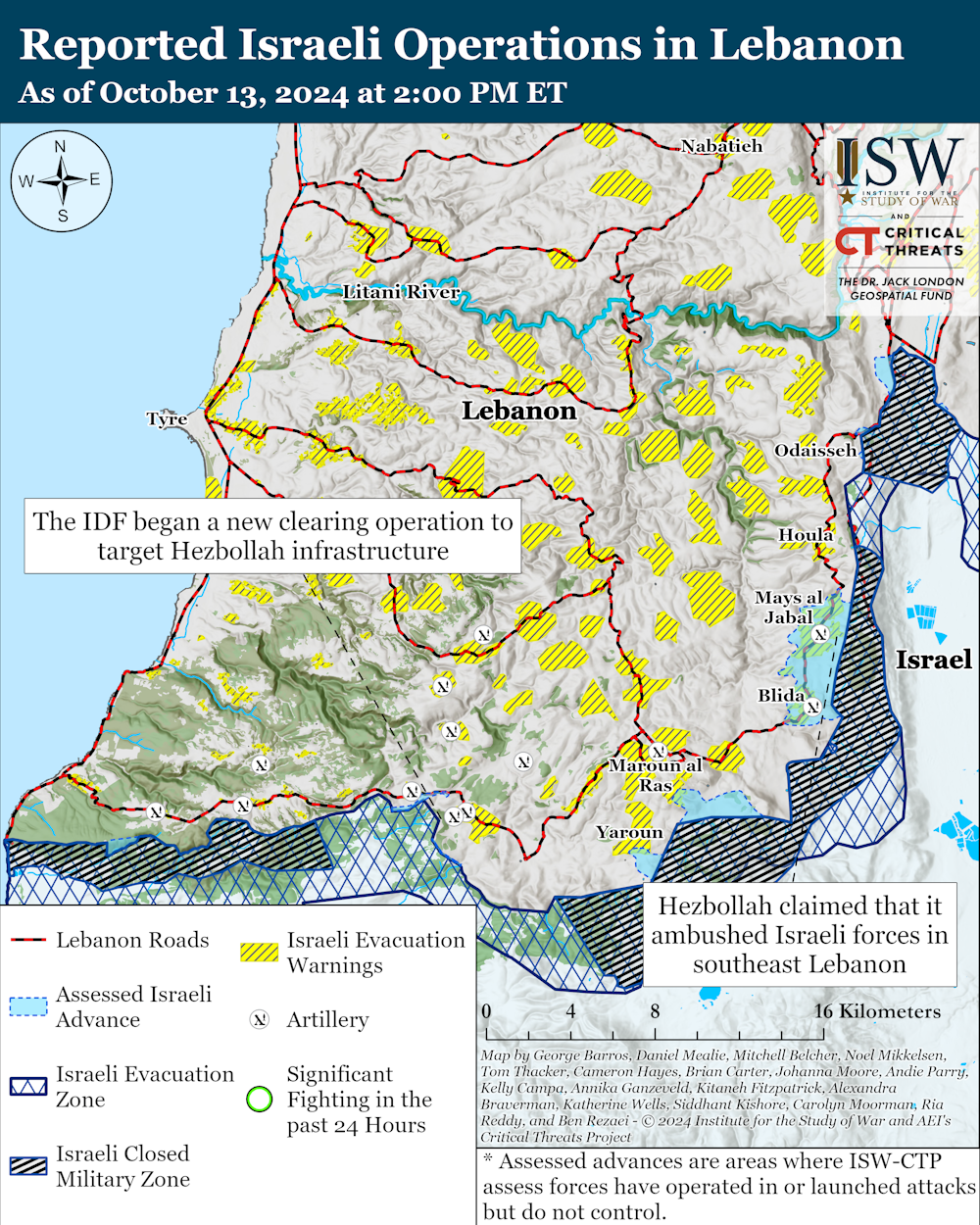
Israel’s ground offensive in southern Lebanon, October 13 2024. Institute for the Study of War
But there’s another possibility. During the Lebanese civil war, the IDF occupied a section of Lebanese land bordering Israel that was known as the “zone of security”. Its purpose was to serve as a buffer zone for northern Israel, initially designed to protect Israeli citizens from Palestinian militia, and later also from the Shia resistance groups Amal and Hezbollah.
The Israeli request for Unifil to move five kilometres back from the blue line could mean Israel is considering reestablishing some kind of buffer zone. Several factors point to this being a possibility – although the IDF and the Israeli government may not be aligned on this issue as recent tensions suggest.
First, the IDF has now deployed units from at least four divisions into Lebanon. The volume of troop numbers deployed is upwards of 15,000 suggesting this incursion is more than a limited operation.
Second, 29 Unifil compounds lie along the blue line. Were they to be evacuated by the UN, there would be nothing to stop the IDF from moving in and developing them into their own strongholds. While UN positions would need reinforcement and protection equipment, they would nonetheless remain useful.
Third, in 2006 the IDF tried to destroy Hezbollah from the air and deployed limited haphazard ground incursions. These tactics failed and the prevailing view may now be that the only way to guarantee the safe return of 65,000 Israelis to their homes in northern Israel is through an occupation.
But unlike the previous occupation, where the IDF was aided by the SLA, Israel currently has no partner in Lebanon, and it is unlikely to find a willing accomplice among the Lebanese population to help them manage the security of a buffer zone. This means IDF troops would directly bear the brunt of attacks from resistance groups, and the northern Israeli villages would be unlikely to remain secure.
The Netanyahu government’s continued use of military solutions to solve political problems has worrying implications for Israel, Lebanon and the Middle East as a whole. At this stage, Israel looks as if it might be settling back into a conflict that could become another “forever war”.
Thus far, the tactics used by the IDF would imply they are not thinking ahead to “the day after” and the cost to Israel that would come with the prolonged occupation of a buffer zone.
This article was written with assistance from John Molloy, lt. col. (rtd.) Irish Defence Forces and former senior Unifil political & civil affairs officer, 2008-2017.
Chiara Ruffa receives funding from the Swedish Research Council, the Fulbright Commission and the European Commission.
A recent poll by the Social Research Foundation, a think thank, found that 60% of South Africans thought the government of national unity was working well. It also reported that support for the unity government’s anchor political parties, the African National Congress (ANC) and the Democratic Alliance (DA), had risen since 29 May 2024 when elections were held.
The poll results came out at the same time as the business press was reporting increased collaboration between business and government, fostered by the unity government. Corporations have reportedly pledged up to R250 million (about US$14.3 million to assist the state to address various logistics crises and help the National Prosecuting Authority prosecute corruption.
Although we should be cautious about taking such news at face value, it is worth noting that the arrival of the unity government has been accompanied by other good news. For example:
take-home pay for those in employment has begun to rise
Still, it is wise not to get too excited unless any upturn in the economy benefits the majority of South Africans. As Frans Cronje, director of the Social Research Foundation, has observed, while the unity government may be good for the middle class, there is no sign yet that it is addressing the needs of the poor and the people on the periphery of the economy.
Unless its benefits become socially inclusive, it might well collapse. We need to take Cronje’s reservations seriously. Note, however, that although the unity government is a coalition, it is led by the African National Congress. And, while all parties agree that they need to put the economy back on track and promote growth, there is little evidence yet that the government is pursuing distinctively new policies.
Beware complacency
We are often told that “a rising tide lifts all boats”.
But this claim owes more to ideology than careful analysis of economic data. In any case, it is a catchphrase which condones inequality. It suggests that as long as living standards increase for the poor, it does not matter if the wealthy gain even more. Indeed, one version is that the more the well-off benefit, the more likely they are to spend and invest their money – that is, to create wealth for others.
Such complacency is dangerous. Apart from being contentious economically, it poses risks to both democracy and political stability. This is particularly the case in South Africa, which is widely recognised as the most unequal country in the world.
High rates of inequality erode social cohesion and trust in democracy. In the May general election, the lowest level of voter turnout since 1994 reflected a worrying decline in support for democracy: from 72% in 2011 to just 43% by 2023.
Extremes of inequality are unlikely to lead to the formation of governing coalitions committed to pursuing developmental strategies of benefit to all. As a result, populist parties that tout simplistic solutions may find it easier to win support. As suggested by the unheralded performance of Jacob Zuma’s umKhonto we Sizwe Party in the 2024 election, this is a particular danger in South Africa. Here, the poorer black majority possess potential political power in an economy which remains largely controlled and owned by a richer, white minority. The French economist Thomas Piketty in his latest blockbuster, Capital and Ideology, warns that in such situations, the dangers of a lurch towards authoritarianism are much increased.
Highly unequal countries typically suffer higher levels of stress, crime and violence, often resulting in violent responses by the state against marginalised communities to quell protests.
Little prospect of reduction of inequality
The issue is not whether the unity government is blind to these dangers, but whether the policies it is pursuing are likely to make a dent in the staggering level of inequality.
If investment and growth do occur, there will be good news down the line – possibly the creation of some 2 million jobs and more financial room for the government to fund social benefits for the poor. But it’s unlikely to have a marked effect on the level of inequality.
First, the unity government is not promising any great change from policies that have been pursued since 1994, only more efficient implementation. Those policies have somewhat decreased racial disparities, notably by promoting a black middle class, but they have not reduced the overall level of inequality. Indeed, as Piketty shows, this has increased, not decreased, since 1994.
Second, the unity government’s policies may continue to focus on the reduction of poverty. But this is unlikely to shift the proportions of income between the different classes. As Cronje has hinted, the new government is underpinned by a middle-class coalition, and for this to hang together, the middle class will want to reap its reward.
Third, history doesn’t offer much hope. Former settler colonies stand out for their exceptionally high levels of inequality. In South Africa, white people always dominated the top earners before 1994. Now they have been joined by high-earning black people, many of them public officials. The top decile’s share of total earning has increased since the end of apartheid. Today it is close to 70%, compared with around 35% in Europe.
Fourth, we live in an age which Piketty describes as “hyper-capitalism”, in which money and ultra-rich elites are highly mobile. This makes it hard for national governments to tax the rich more. They can leave, or threaten to withdraw their investments to earn higher returns elsewhere. South Africa has already been leaking its millionaires. The unity government will not want to scare any more of them away. So, it’s unlikely to adopt aggressive tax policies in the cause of narrowing inequality.
The unity government may well promote high growth and if successful, may ameliorate poverty, but it seems unlikely that it will either attempt or succeed in reducing inequality. It may be good for the elite and middle class, but not necessarily for the health of democracy.
Roger Southall does not work for, consult, own shares in or receive funding from any company or organisation that would benefit from this article, and has disclosed no relevant affiliations beyond their academic appointment.
MILES AXLE Translation. Region: Russian Federation –
Source: State University of Management – Official website of the State –
On October 11, 2024, the 10th All-Russian scientific and practical conference “Constitutional Foundations of Prosecutor’s Activity (Sukharev Readings)” was held at the University of the Prosecutor’s Office of the Russian Federation, in which the rector of the State University of Management Vladimir Stroev took part.
The conference is dedicated to the birthday of the outstanding statesman, legal scholar, specialist in the field of criminal law, criminal procedure and criminology Alexander Yakovlevich Sukharev.
The plenary session and the work of the sections were devoted to the following issues: – constitutional and legal status of the prosecutor’s office of the Russian Federation: history and modernity; – constitutional foundations of prosecutorial activity outside the criminal law sphere; – constitutional foundations of prosecutorial activity in the criminal law sphere.
Representatives of the Prosecutor General’s Office of the Russian Federation, government bodies and public organizations, prosecutor’s offices, scientific and educational organizations took part in the forum.
Opening the conference, the rector of the University of the Prosecutor’s Office of the Russian Federation Igor Matskevich addressed the participants with a welcoming speech on behalf of the Deputy Prosecutor General of the Russian Federation Yuri Ponomarev, in which he noted the relevance of the topic of the event, its fundamental nature from the point of view of the place and role of the prosecutor’s office in the system of the state legal mechanism.
Representatives of the Federation Council Committee on Constitutional Legislation and State Building, the State Duma Committee on Security and Anti-Corruption, the School for Training and Advanced Studies of Prosecutors in Ho Chi Minh City (Vietnam), the Scientific and Educational Center of the Prosecutor General’s Office of the Republic of Azerbaijan, the Institute of Legislation and Comparative Law under the Government of the Russian Federation, Lomonosov Moscow State University, Kutafin Moscow State Law University (MSAL), A. Ya. Sukharev Moscow Academy of the Investigative Committee, V. Ya. Kikot Moscow University of the Ministry of Internal Affairs of Russia and other specialized educational institutions spoke at the plenary and sectional sessions.
Based on the results of the conference, recommendations were prepared, and it is planned to publish a collection of articles indexed in the RSCI system.
Subscribe to the TG channel “Our GUU” Date of publication: 10/15/2024
Please note: This information is raw content directly from the source of the information. It is exactly what the source states and does not reflect the position of MIL-OSI or its clients.
Please note; This information is raw content directly from the information source. It is accurate to what the source is stating and does not reflect the position of MIL-OSI or its clients.
MILES AXLE Translation. Region: Russian Federation –
Source: Saint Petersburg State University of Architecture and Civil Engineering – Saint Petersburg State University of Architecture and Civil Engineering – Meeting of Vice-Rector for Youth Policy Marina Malyutina (center) with representatives of student families
The Saint Petersburg State University of Architecture and Civil Engineering will have a “single window” system for student families. This was announced at a meeting with representatives of such families by Vice-Rector for Youth Policy Marina Malyutina.
The meeting took place on October 10 in a hybrid format: some students joined it online. Together with the vice-rector, the constructive dialogue was attended by the head of the youth policy department Irina Nuryeva, deputy head of the youth policy department Yulia Romanova, and deputy deans for educational work.
Marina Malyutina reported that a wide range of measures to support student families is being implemented in St. Petersburg. In order to better know their rights, student parents should carefully study local regulations, in particular, a number of articles of the Social Code of St. Petersburg dated November 22, 2011.
Yulia Romanova informed about the support measures for student families at various levels, including those provided by SPbGASU. Thus, students of our university can receive a one-time financial aid upon the birth of a child; advisory assistance on family issues and child-rearing issues; individual consultations with a psychologist. In addition, SPbGASU will allocate and equip special-purpose rooms for parents and their preschool-aged children, intended for feeding, changing the child, organizing his rest and leisure. For women who gave birth during the period of study, there is an opportunity to transfer from paid to free education. For students with children under three years old, there is an opportunity to transfer to an individual curriculum. Also among the support measures are New Year’s parties and gifts for children, assistance in employment for women who gave birth during the period of study.
The “single window” system will allow young parents to quickly resolve any problem. Students learned how exactly this system will be implemented: first, they should contact the employee responsible for working with student families with a request, and he, in turn, will address the request to the relevant departments and coordinate their actions.
The “single window” system involves the dean’s offices, the department of organization of educational activities, the department of economics, the center for psychological support of students, the center for student entrepreneurship and career. “They are informed about the importance of the task set by our president and the government, and are charged with the result. Our university is joining in solving demographic problems on an equal basis with everyone else,” said Marina Malyutina.
During the meeting, students received answers to questions about what a student family is and how it differs from a young family, whether studying for a master’s degree is considered obtaining a first higher education, etc. They will receive information materials in the form of a mailing list.
Please note: This information is raw content directly from the source of the information. It is exactly what the source states and does not reflect the position of MIL-OSI or its clients.
Please note; This information is raw content directly from the information source. It is accurate to what the source is stating and does not reflect the position of MIL-OSI or its clients.
MILES AXLE Translation. Region: Russian Federation –
Source: Moscow Exchange – Moscow Exchange –
Please note: This information is raw content directly from the source of the information. It is exactly what the source states and does not reflect the position of MIL-OSI or its clients.
Please note; This information is raw content directly from the information source. It is accurate to what the source is stating and does not reflect the position of MIL-OSI or its clients.
Maximum amount of funds placed (in placement currency)
200,000,000.00
Placement period, days
97
Date of deposit
10/15/2024
Refund date
01/20/2025
Minimum placement interest rate, % per annum
21.00
Conditions of imprisonment, urgent or special
Urgent
Minimum amount of funds placed for one application (in placement currency)
200,000,000.00
Maximum number of applications from one Participant, pcs.
1
Auction form, open or closed
Open
Basis of the Treaty
General Agreement
Schedule (Moscow time)
Preliminary applications
from 11:00 to 11:10
Applications in competition mode
from 11:10 to 11:15
Setting a cut-off percentage or declaring the auction invalid
until 11:25
Additional terms
Placement of funds with the possibility of early withdrawal of the entire deposit amount and payment of interest accrued on the deposit amount at the rate established by the deposit transaction, in the event of non-compliance of the Bank with the requirements established by clause 2.1. of the Regulation “On the procedure for selecting banks for placing funds of the Moscow Small Business Lending Assistance Fund in deposits (deposits) under the GDS” (as amended on the date of the deposit transaction), early withdrawal at the “on demand” rate, interest payment monthly, on the last business day of the month, without replenishment
MILES AXLE Translation. Region: Russian Federation –
Source: Moscow Exchange – Moscow Exchange –
Please note: This information is raw content directly from the source of the information. It is exactly what the source states and does not reflect the position of MIL-OSI or its clients.
Please note; This information is raw content directly from the information source. It is accurate to what the source is stating and does not reflect the position of MIL-OSI or its clients.
Maximum amount of funds placed (in placement currency)
45,000,000.00
Placement period, days
10
Date of deposit
10/15/2024
Refund date
10/25/2024
Minimum placement interest rate, % per annum
19.60
Conditions of imprisonment, urgent or special
Urgent
Minimum amount of funds placed for one application (in placement currency)
45,000,000.00
Maximum number of applications from one Participant, pcs.
1
Auction form, open or closed
Open
Basis of the Treaty
General Agreement
Schedule (Moscow time)
Preliminary applications
from 12:30 to 12:40
Applications in competition mode
from 12:40 to 12:45
Setting a cut-off percentage or declaring the auction invalid
until 12:55
Additional terms
Placement of funds with the possibility of early withdrawal of the entire deposit amount and payment of interest accrued on the deposit amount at the rate established by the deposit transaction, in the event of non-compliance of the Bank with the requirements established by clause 2.1. of the Regulation “On the procedure for selecting banks for placing funds of the Moscow Small Business Lending Assistance Fund in deposits (deposits) under the GDS” (as amended on the date of the deposit transaction), early withdrawal at the “on demand” rate, payment of interest at the end of the term, without replenishment
Headline: Gartner Survey Finds Leader and Manager Development Tops HR Leaders’ List of 2025 Priorities for Third Consecutive Year
Leader and manager development remains the No. 1 priority in 2025 for HR leaders for the third consecutive year, according to a survey by Gartner, Inc. The continued focus on manager development comes as managers report feeling overwhelmed by their responsibilities.
A special exhibition and premiere showcasing the inspiring pioneers of Black British ballet is coming to Liverpool.
The City’s Central Library is to host the exhibition, from 31st October to 30th November, which will be one of the showpiece events of Liverpool’s Black History Month celebrations.
The groundbreaking exhibition is based on the research of Dr Sandie Bourne, a dancer, choreographer and academic, who brings together archival photographs, films and interviews to explore the under-representation of Black artists in British ballet.
The touring exhibition, funded by a £245,500 grant from The National Lottery Heritage Fund, will visit 25 libraries across the UK, with Liverpool Central Library being one of the key stops.
The celebration of Black dancers kicks off with Island Movements, an original Windrush-themed ballet.
This free event will be staged at Discover in Central Library on Friday 18 October at 4pm
Island Movements tells the powerful story of a family from the Windrush generation, beginning with a young Caribbean soldier during WWII and following the family’s experiences throughout their life in the UK.
After the performance there will be a Q&A with the dancers and creators, offering a behind-the-scenes look at the making of this special piece.
This moving ballet will open the wider exhibition, celebrating the rich yet often overlooked contributions of Black British ballet dancers from the 1940s to today.
Pioneers like Brenda Garratt-Glassman, the first Black British student at the Royal Ballet Upper School, and Darren Panton, the first Black British student at the Royal Ballet boarding school, are among the trailblazers featured.
Throughout November, Liverpool Central Library is inviting people to take part in dance, writing, and photography workshops, panel discussions and a virtual reality experience as part of the exhibition’s activities.
Cllr Harry Doyle Cabinet Member for Health, Wellbeing & Culture:“We’re incredibly excited to bring this exhibition to Liverpool Central Library during Black History Month. This event is a wonderful opportunity for everyone, not just for ballet lovers. It offers an interactive experience that invites all visitors to explore the inspiring stories and rich heritage of Black British dancers who have helped shape the world of ballet. Whether you’re a long-time fan, or new to ballet, these emotionally compelling performances and workshops are the perfect introduction.”
Marsha Lowe, Director of Oxygen Arts, said: “This exhibition is an important step in giving our Black British pioneers the recognition they deserve, bringing their challenges and achievements to a much wider audience. But we want to go further, to change the perception of ballet by diversifying ballet audiences and encouraging the next generation of young Black dancers to see ballet is ‘for them’.”
Stuart McLeod, Director of England – London & South – at The National Lottery Heritage Fund, said: “We are delighted to support this project, which thanks to money raised by National Lottery players, will mean that more people will be able to get involved with, protect and learn about the exciting heritage right on their doorstep. Heritage has a huge role to play in instilling pride in communities and boosting local economies, and this project is a fantastic example of achieving those aims.”
Isobel Hunter, Chief Executive of Libraries Connected, said: “Public libraries, with their diverse audience base and commitment to democratising culture, are the perfect venue for this ground breaking exhibition. There has never been a better time to celebrate the achievements of these Black British pioneers; it’s hugely exciting to see their stories brought to life in this way.”
Armenia’s Crossroads of Peace initiative offers a vision of peace and stability through improved infrastructure and trade. It is also a great opportunity to build sustainable infrastructure, improve customs clearance, and promote green trade. Key reforms in road safety and foreign direct investment are essential for long-term success, positioning Armenia as a strategic hub for regional trade.
Armenia, located in the South Caucasus between Europe and Asia, holds a strategic geographic position as a natural crossroads for east-west and north-south trade routes.
Despite closed borders with neighbors to the east and west, Armenia has outlined a vision of open borders through its “Crossroads of Peace” initiative.
Supported by investments in road, rail, and border checkpoints, the initiative envisions economic ties and peaceful relations with all neighbors. While improved rail networks and modern roads are a key focus, the initiative must address several factors to ensure long-term success:
Make the infrastructure sustainable. The infrastructure investments under the initiative represent a remarkable opportunity to incorporate sustainable infrastructure. Doing so would set a standard for future developments in Armenia and position the country as an early adopter of sustainable infrastructure in the region.
This can be done through implementing green building standards in the roads, bridges, and related infrastructure, through the use of sustainable, recycled, or low-carbon materials along with enforcing emissions standards for equipment used in construction and maintenance.
LED streetlights, which last longer and reduce energy consumption, could be used. Border points can be built or refurbished to meet energy efficient standards and equipped with power supplied from renewable sources.
These interventions would limit the carbon footprint of the Crossroads initiative while, in the long run, reducing the overall costs for its implementation.
Streamline customs clearance processes. Freight typically follows the least time-consuming and cost-efficient way. While better roads and rail networks are attractive for transit trade, customs processes need to be streamlined to truly deliver on the desired objective.
Digitization is the backbone of modern logistics. For customs processes, it reduces paperwork, corruption, and can drastically cut border wait times. Armenia’s adoption of the Electronic International Road Transport system is a needed advancement that would immediately improve customs clearance efficiency.
As Armenia’s neighbors have adopted the system as well, its geographic position along with digitally integrated customs procedures would make it the natural choice for freight movement. And with much of the legal framework agreed and a gap analysis already prepared by the United Nations Economic Commission for Europe, this would seem to be low-hanging fruit on the list to improve logistics and promote regional trade.
Armenia is at a critical point in its development trajectory and the Crossroads initiative could be the mechanism to propel it into a regional hub for trade and logistics.
Promote Green Trade. The Crossroads initiative could be an enabler for Armenia to become an advocate for green trade to yield benefits to future generations.
This could be achieved through developing green logistics frameworks that incentivize low-emission transportation assets and eco-friendly packaging for goods.
Local campaigns to raise awareness of the benefits of green products and sustainable consumption can help instill these practices in Armenia, while eco-friendly labels on products can help consumers make smart choices when purchasing goods and services.
Armenia has already renewed its commitment to the Paris Agreement and the government has demonstrated it takes the climate agenda seriously. Promoting green trade will be another mark on the road to greater sustainability, competitiveness, export diversification, and generally improved value addition.
Become an enabling environment for foreign direct investment. With open borders the Crossroads initiative can attract greater foreign direct investment, which would have sweeping benefits including job creation, greater productivity, increased government revenue, human capital development, and general technological advancements.
The regional stability offered by the initiative could be the trigger that entices foreign investors to consider Armenia as a new frontier for opportunity.
Armenia has shown steady improvements in attracting new businesses, suggesting its legal and regulatory frameworks have become more attractive to foreign investors. However, Armenia faces stiff regional competition in the South Caucasus from Georgia and will need to accelerate these reforms to redirect investment in the region.
The creation of more special economic zones is an important lever for the government to attract investment. Given the integral nature of transport and logistics to the initiative, more zones designed to support better logistics and simplified trade would be a meaningful step to attract the right firms and needed capacity to execute on the increased demand the Crossroads will bring to the region.
Create a culture of road safety. With significant investments in road infrastructure, the Crossroads initiative will offer drivers smoother and faster road surfaces. However, without stronger measures to promote a culture of road safety and enforced safety laws, improved conditions could lead to an increase in accidents.
Armenia has taken positive steps enacting legislation that requires seat belts and motorcycle helmets, yet on the road it is common to see drivers without either. The legislation also does not specify restraints for child safety and children are allowed to be seated in the front, both drastically increasing the chances of injury or death in case of accident.
A coordinated countrywide awareness-raising campaign on the benefits of seat belts, helmets, and child restraints is necessary, along with legislative actions to identify standards and improve enforcement.
Armenia is at a critical point in its development trajectory and the Crossroads initiative could be the mechanism to propel it into a regional hub for trade and logistics. However, it should not only be framed around building roads, rail, and bridges. It should also deliver on its broader ambitions and create lasting benefits for society.
TAINAN, Taiwan, Oct. 15, 2024 (GLOBE NEWSWIRE) — Himax Technologies, Inc. (Nasdaq: HIMX), an industry leader in fabless display driver ICs and other semiconductors, today announced the successful mass production of its cutting-edge In-Cell Touch TDDI (Touch and Display Driver Integration) solution, the HX83132, for high-end LCD AI laptops. The HX83132 has already been adopted by several leading panel makers across the board. By entering mass production during the third quarter of 2024, this marks a significant milestone for the first-of-its-kind, innovative product. As notebook brand customers increasingly prioritize product differentiation and value enhancement, the integration of touch functionality into displays of high-end laptops and AI PCs has emerged as a key trend. Himax HX83132 is featured in one marquee brand’s first AI laptops, which boasts a 15.3-inch, 2.8K high-resolution touch display with a 120Hz refresh rate, significantly enhancing both interactivity and visual experience for seamless, intuitive user operations.
In-cell TDDI has become a mainstream technology for LCD displays, characterized by the seamless integration of touch functionality with display driver ICs. This integration not only simplifies the supply chain but also provides substantial cost benefits to panel manufacturers. Having pioneered the mass production of In-cell TDDI technology for mid-sized tablets and automotive displays in 2019, Himax has established itself as the industry leader by introducing an industry-first touch display solution supporting screen sizes of up to 45 inches for ultra-large automotive applications. The newly launched HX83132 series further expands the application of In-cell TDDI technology to laptops, boasting a unique design architecture that pairs seamlessly with timing controller (Tcon) chips supporting various eDP specifications which make it suitable for both mainstream and high-end LCD laptops. This TDDI and Tcon configuration effectively minimizes the need for supporting components, resulting in a more compact PCB size and narrower bezel design. The HX83132 series offers precise touch sensitivity, ensuring smooth human-machine interaction, significantly enhancing user experience and improving productivity.
The industry-leading HX83132 In-cell TDDI solution offers the following key features:
Flexible support for diverse panel sizes and resolutions: The advanced chip architecture can interconnect up to 6 chips, accommodating a wide range of laptop display needs with support for screen sizes up to 16 inches and resolutions up to 4K
Optimized and streamlined module architecture design: The HX83132 solution outperforms competition by providing more display and touch channels at the same resolution while utilizing fewer ICs. Additionally, the integrated microprocessor and level shifter minimize the need for external components, resulting in a smaller PCB size and enhanced design efficiency
Leveraging existing architecture for rapid In-cell Touch upgrades: The HX83132 features a state-of-the-art, integrated proprietary display driver and touch controller architecture. From a display perspective, it utilizes a standard Tcon architecture, which enables pure display panels, without the need for a dedicated Tcon for the In-cell touch functionality. Meanwhile, the TDDI integrates an in-house proprietary distributed touch microprocessor architecture, specifically designed to handle the high computational demands of touch data processing, effectively reducing development time
Comprehensive support for various power-saving operation scenarios: The HX83132 is compatible with eDP 1.4 and eDP 1.5 Tcons, and supports multiple power-saving features, including Panel Self Refresh (PSR) and User-Based Refresh Rate (UBRR), optimizing energy efficiency across different usage scenarios
About Himax Technologies, Inc.
Himax Technologies, Inc. (NASDAQ: HIMX) is a leading global fabless semiconductor solution provider dedicated to display imaging processing technologies. The Company’s display driver ICs and timing controllers have been adopted at scale across multiple industries worldwide including TVs, PC monitors, laptops, mobile phones, tablets, automotive, ePaper devices, industrial displays, among others. As the global market share leader in automotive display technology, the Company offers innovative and comprehensive automotive IC solutions, including traditional driver ICs, advanced in-cell Touch and Display Driver Integration (TDDI), local dimming timing controllers (Local Dimming Tcon), Large Touch and Display Driver Integration (LTDI) and OLED display technologies. Himax is also a pioneer in tinyML visual-AI and optical technology related fields. The Company’s industry-leading WiseEyeTM Ultralow Power AI Sensing technology which incorporates Himax proprietary ultralow power AI processor, always-on CMOS image sensor, and CNN-based AI algorithm has been widely deployed in consumer electronics and AIoT related applications. Himax optics technologies, such as diffractive wafer level optics, LCoS microdisplays and 3D sensing solutions, are critical for facilitating emerging AR/VR/metaverse technologies. Additionally, Himax designs and provides touch controllers, OLED ICs, LED ICs, EPD ICs, power management ICs, and CMOS image sensors for diverse display application coverage. Founded in 2001 and headquartered in Tainan, Taiwan, Himax currently employs around 2,200 people from three Taiwan-based offices in Tainan, Hsinchu and Taipei and country offices in China, Korea, Japan, Germany, and the US. Himax has 2,683 patents granted and 390 patents pending approval worldwide as of September 30, 2024.
Factors that could cause actual events or results to differ materially from those described in this conference call include, but are not limited to, the effect of the Covid-19 pandemic on the Company’s business; general business and economic conditions and the state of the semiconductor industry; market acceptance and competitiveness of the driver and non-driver products developed by the Company; demand for end-use applications products; reliance on a small group of principal customers; the uncertainty of continued success in technological innovations; our ability to develop and protect our intellectual property; pricing pressures including declines in average selling prices; changes in customer order patterns; changes in estimated full-year effective tax rate; shortage in supply of key components; changes in environmental laws and regulations; changes in export license regulated by Export Administration Regulations (EAR); exchange rate fluctuations; regulatory approvals for further investments in our subsidiaries; our ability to collect accounts receivable and manage inventory and other risks described from time to time in the Company’s SEC filings, including those risks identified in the section entitled “Risk Factors” in its Form 20-F for the year ended December 31, 2023 filed with the SEC, as may be amended.
PUBLIC OPENING POSITION DISCLOSURE/DEALING DISCLOSURE BY A PERSON WITH INTERESTS IN RELEVANT SECURITIES REPRESENTING 1% OR MORE Rule 8.3 of the Takeover Code (the “Code”)
1.
KEY INFORMATION
(a)
Full name of discloser:
Dimensional Fund Advisors Ltd. in its capacity as investment advisor and on behalf its affiliates who are also investment advisors (”Dimensional”). Dimensional expressly disclaims beneficial ownership of the shares described in this form 8.3.
(b)
Owner or controller of interests and short positions disclosed, if different from 1(a): The naming of nominee or vehicle companies is insufficient. For a trust, the trustee(s), settlor and beneficiaries must be named.
(c)
Name of offeror/offeree in relation to whose relevant securities this form relates: Use a separate form for each offeror/offeree
International Distribution Services PLC
(d)
If an exempt fund manager connected with an offeror/offeree, state this and specify identity of offeror/offeree:
(e)
Date position held/dealing undertaken: For an opening position disclosure, state the latest practicable date prior to the disclosure
14 October 2024
(f)
In addition to the company in 1(c) above, is the discloser making disclosures in respect of any other party to the offer? If it is a cash offer or possible cash offer, state “N/A”
N/a
2.
POSITIONS OF THE PERSON MAKING THE DISCLOSURE
If there are positions or rights to subscribe to disclose in more than one class of relevant securities of the offeror or offeree named in 1(c), copy table 2(a) or (b) (as appropriate) for each additional class of relevant security.
(a)
Interests and short positions in the relevant securities of the offeror or offeree to which the disclosure relates following the dealing (if any)
Class of relevant security:
1p ordinary (GB00BDVZYZ77)
Interests
Short Positions
Number
%
Number
%
(1)
Relevant securities owned and/or controlled:
22,210,999
2.32 %
(2)
Cash-settled derivatives:
(3)
Stock-settled derivatives (including options) and agreements to purchase/sell:
Total
22,210,999 *
2.32 %
* Dimensional Fund Advisors LP and/or its affiliates do not have discretion regarding voting decisions in respect of 128,333 shares that are included in the total above.
All interests and all short positions should be disclosed.
Details of any open stock-settled derivative positions (including traded options), or agreements to purchase or sell relevant securities, should be given on a Supplemental Form 8 (Open Positions).
(b)
Rights to subscribe for new securities (including directors’ and other employee options)
Class of relevant security in relation to which subscription right exists:
Details, including nature of the rights concerned and relevant percentages:
3.
DEALINGS (IF ANY) BY THE PERSON MAKING THE DISCLOSURE
Where there have been dealings in more than one class of relevant securities of the offeror or offeree named in 1(c), copy table 3(a), (b), (c) or (d) (as appropriate) for each additional class of relevant security dealt in.
The currency of all prices and other monetary amounts should be stated.
(a)
Purchases and sales
Class of relevant security
Purchase/sale
Number of securities
Price per unit
1p ordinary (GB00BDVZYZ77)
Purchase
3,520
3.4220 GBP
There was a Transfer In of 203,756 shares of 1p ordinary
(b)
Cash-settled derivative transactions
Class of relevant security
Product descriptione.g. CFD
Nature of dealinge.g. opening/closing a long/short position, increasing/reducing a long/short position
Other dealings (including subscribing for new securities)
Class of relevant security
Nature of dealinge.g. subscription, conversion
Details
Price per unit (if applicable)
4.
OTHER INFORMATION
(a)
Indemnity and other dealing arrangements
Details of any indemnity or option arrangement, or any agreement or understanding, formal or informal, relating to relevant securities which may be an inducement to deal or refrain from dealing entered into by the person making the disclosure and any party to the offer or any person acting in concert with a party to the offer: Irrevocable commitments and letters of intent should not be included. If there are no such agreements, arrangements or understandings, state “none”
None
(b)
Agreements, arrangements or understandings relating to options or derivatives
Details of any agreement, arrangement or understanding, formal or informal, between the person making the disclosure and any other person relating to: (i) the voting rights of any relevant securities under any option; or (ii) the voting rights or future acquisition or disposal of any relevant securities to which any derivative is referenced: If there are no such agreements, arrangements or understandings, state “none”
None
(c)
Attachments
Is a Supplemental Form 8 (Open Positions) attached?
NO
Date of disclosure
15 October 2024
Contact name
Thomas Hone
Telephone number
+44 20 3033 3419
Public disclosures under Rule 8 of the Code must be made to a Regulatory Information Service.
The Panel’s Market Surveillance Unit is available for consultation in relation to the Code’s disclosure requirements on +44 (0)20 7638 0129.
PUBLIC OPENING POSITION DISCLOSURE/DEALING DISCLOSURE BY A PERSON WITH INTERESTS IN RELEVANT SECURITIES REPRESENTING 1% OR MORE Rule 8.3 of the Takeover Code (the “Code”)
1.
KEY INFORMATION
(a)
Full name of discloser:
Dimensional Fund Advisors Ltd. in its capacity as investment advisor and on behalf its affiliates who are also investment advisors (”Dimensional”). Dimensional expressly disclaims beneficial ownership of the shares described in this form 8.3.
(b)
Owner or controller of interests and short positions disclosed, if different from 1(a): The naming of nominee or vehicle companies is insufficient. For a trust, the trustee(s), settlor and beneficiaries must be named.
(c)
Name of offeror/offeree in relation to whose relevant securities this form relates: Use a separate form for each offeror/offeree
Hargreaves Lansdown PLC
(d)
If an exempt fund manager connected with an offeror/offeree, state this and specify identity of offeror/offeree:
(e)
Date position held/dealing undertaken: For an opening position disclosure, state the latest practicable date prior to the disclosure
14 October 2024
(f)
In addition to the company in 1(c) above, is the discloser making disclosures in respect of any other party to the offer? If it is a cash offer or possible cash offer, state “N/A”
N/a
2.
POSITIONS OF THE PERSON MAKING THE DISCLOSURE
If there are positions or rights to subscribe to disclose in more than one class of relevant securities of the offeror or offeree named in 1(c), copy table 2(a) or (b) (as appropriate) for each additional class of relevant security.
(a)
Interests and short positions in the relevant securities of the offeror or offeree to which the disclosure relates following the dealing (if any)
Class of relevant security:
0.4p ordinary (GB00B1VZ0M25)
Interests
Short Positions
Number
%
Number
%
(1)
Relevant securities owned and/or controlled:
5,901,303
1.24 %
(2)
Cash-settled derivatives:
(3)
Stock-settled derivatives (including options) and agreements to purchase/sell:
Total
5,901,303 *
1.24 %
* Dimensional Fund Advisors LP and/or its affiliates do not have discretion regarding voting decisions in respect of 183,277 shares that are included in the total above.
All interests and all short positions should be disclosed.
Details of any open stock-settled derivative positions (including traded options), or agreements to purchase or sell relevant securities, should be given on a Supplemental Form 8 (Open Positions).
(b)
Rights to subscribe for new securities (including directors’ and other employee options)
Class of relevant security in relation to which subscription right exists:
Details, including nature of the rights concerned and relevant percentages:
3.
DEALINGS (IF ANY) BY THE PERSON MAKING THE DISCLOSURE
Where there have been dealings in more than one class of relevant securities of the offeror or offeree named in 1(c), copy table 3(a), (b), (c) or (d) (as appropriate) for each additional class of relevant security dealt in.
The currency of all prices and other monetary amounts should be stated.
(a)
Purchases and sales
Class of relevant security
Purchase/sale
Number of securities
Price per unit
0.4p ordinary (GB00B1VZ0M25)
Purchase
1,580
10.8600 GBP
There was a Transfer In of 23,577 shares of 0.4p ordinary
(b)
Cash-settled derivative transactions
Class of relevant security
Product descriptione.g. CFD
Nature of dealinge.g. opening/closing a long/short position, increasing/reducing a long/short position
Other dealings (including subscribing for new securities)
Class of relevant security
Nature of dealinge.g. subscription, conversion
Details
Price per unit (if applicable)
4.
OTHER INFORMATION
(a)
Indemnity and other dealing arrangements
Details of any indemnity or option arrangement, or any agreement or understanding, formal or informal, relating to relevant securities which may be an inducement to deal or refrain from dealing entered into by the person making the disclosure and any party to the offer or any person acting in concert with a party to the offer: Irrevocable commitments and letters of intent should not be included. If there are no such agreements, arrangements or understandings, state “none”
None
(b)
Agreements, arrangements or understandings relating to options or derivatives
Details of any agreement, arrangement or understanding, formal or informal, between the person making the disclosure and any other person relating to: (i) the voting rights of any relevant securities under any option; or (ii) the voting rights or future acquisition or disposal of any relevant securities to which any derivative is referenced: If there are no such agreements, arrangements or understandings, state “none”
None
(c)
Attachments
Is a Supplemental Form 8 (Open Positions) attached?
NO
Date of disclosure
15 October 2024
Contact name
Thomas Hone
Telephone number
+44 20 3033 3419
Public disclosures under Rule 8 of the Code must be made to a Regulatory Information Service.
The Panel’s Market Surveillance Unit is available for consultation in relation to the Code’s disclosure requirements on +44 (0)20 7638 0129.
GUANGZHOU, China, Oct. 15, 2024 (GLOBE NEWSWIRE) — The board of directors (the “Board”) of Highest Performances Holdings Inc. (NASDAQ: HPH) (“HPH” or the “Company”), today announces that the office of Mr. Peh Chin Hua as Director has been vacated, effective immediately.
Following the foregoing changes, our board of directors consists of seven directors, three of which are independent directors. Our current directors as of the date of this press release are as follows:
Name
Position
Hang Suong Nguyen
Chairwoman of the Board
Yinan Hu
Vice-Chairman and Chief Executive Officer
Youjie Kong
Director
Yong Ren
Director
Lihong Zhai
Independent Director and the Chairman of Audit Committee
Min Zhou
Independent Director and the Chairwoman of Nominating and Governance Committee
Yingying Li
Independent Director and the Chairwoman of Compensation Committee
Forward-looking Statements This press release contains forward-looking statements as defined by the Private Securities Litigation Reform Act of 1995. Forward-looking statements include statements concerning plans, objectives, goals, strategies, future events or performance, and underlying assumptions and other statements that are other than statements of historical facts. When HPH uses words such as “may”, “will”, “intend”, “should”, “believe”, “expect”, “anticipate”, “project”, “estimate” or similar expressions that do not relate solely to historical matters, it is making forward-looking statements. Forward-looking statements are not guarantees of future performance and involve risks and uncertainties that may cause the actual results to differ materially from HPH’s expectations discussed in the forward-looking statements. These statements are subject to uncertainties and risks including, but not limited to, the following: HPH’s ability to obtain proceeds from the Agreement; HPH’s goals and strategies; HPH’s future business development; product and service demand and acceptance; changes in technology; economic conditions; the growth of the third-party wealth management industry in China; reputation and brand; the impact of competition and pricing; government regulations; fluctuations in general economic and business conditions in China and the international markets HPH serves and assumptions underlying or related to any of the foregoing and other risks contained in reports filed by HPH with the Securities and Exchange Commission. For these reasons, among others, investors are cautioned not to place undue reliance upon any forward-looking statements in this press release. Additional factors are discussed in HPH’s filings with the U.S. Securities and Exchange Commission, which are available for review at http://www.sec.gov. HPH undertakes no obligation to publicly revise these forward-looking statements to reflect events or circumstances that arise after the date hereof.
COLUMBIA, Md., Oct. 15, 2024 (GLOBE NEWSWIRE) — Synergy ECP, a leading provider of mission critical, highly technical solutions for the Defense and Intelligence Communities, is excited to announce the appointment of Michael Widener to its Board of Advisors. Synergy ECP is a portfolio company of Falfurrias Management Partners.
Michael Widener, a former Senior Intelligence Service executive at the Central Intelligence Agency and four-time Chief of Station/Base, brings decades of experience to Synergy ECP’s Board of Advisors through his leadership of historically large and complex CIA programs in Africa, Europe, the Middle East, and Southeast Asia. Michael also led CIA efforts related to understanding the impact of advanced computing, microelectronics, next-generation communications, and other emerging technologies on US national security by harnessing expertise from the US private sector and worldwide venture capital ecosystem to deliver new capabilities into the Intelligence Community.
“We are honored to welcome Michael Widener to our Board of Advisors,” said Bruce Howard, CEO of Synergy ECP. “Michael’s extensive experience at the intersection of emerging technologies, the private sector, and policymakers will support Synergy ECP’s efforts as we deliver technical solutions in areas such as signals intelligence, cyber operations, critical infrastructure resiliency, zero trust methodologies, and next generation 5G capabilities. Additionally, his mission understanding, developed through years of leading human intelligence and covert action programs, will ensure Synergy ECP stays on the leading edge of emerging technical requirements within our intelligence community.”
“I am honored to join the Board of Advisors at Synergy ECP,” said Mr. Widener. “Our Intelligence Community faces significant challenges in understanding the national security implications of emerging technology areas such as artificial intelligence, quantum computing, and cyber. I look forward to supporting Synergy ECP as they advance on their mission of solving the toughest national security challenges for tip of the spear customers leading our Nation’s cyber and signals intelligence operations.”
About Synergy ECP Founded in 2007 and headquartered in Columbia, Maryland, Synergy ECP is a leading provider of cybersecurity, software and systems engineering and IT services to the U.S. intelligence and defense communities. The company leverages its expertise in data transport solutions, software and systems engineering, and other solutions to deliver critical and innovative capabilities to high-level decision makers that enhance our nation’s security. For more information, visit http://www.synergyecp.com.
PUBLIC OPENING POSITION DISCLOSURE/DEALING DISCLOSURE BY A PERSON WITH INTERESTS IN RELEVANT SECURITIES REPRESENTING 1% OR MORE Rule 8.3 of the Takeover Code (the “Code”)
1.
KEY INFORMATION
(a)
Full name of discloser:
Dimensional Fund Advisors Ltd. in its capacity as investment advisor and on behalf its affiliates who are also investment advisors (”Dimensional”). Dimensional expressly disclaims beneficial ownership of the shares described in this form 8.3.
(b)
Owner or controller of interests and short positions disclosed, if different from 1(a): The naming of nominee or vehicle companies is insufficient. For a trust, the trustee(s), settlor and beneficiaries must be named.
(c)
Name of offeror/offeree in relation to whose relevant securities this form relates: Use a separate form for each offeror/offeree
DS Smith PLC
(d)
If an exempt fund manager connected with an offeror/offeree, state this and specify identity of offeror/offeree:
(e)
Date position held/dealing undertaken: For an opening position disclosure, state the latest practicable date prior to the disclosure
14 October 2024
(f)
In addition to the company in 1(c) above, is the discloser making disclosures in respect of any other party to the offer? If it is a cash offer or possible cash offer, state “N/A”
YES International Paper Co
2.
POSITIONS OF THE PERSON MAKING THE DISCLOSURE
If there are positions or rights to subscribe to disclose in more than one class of relevant securities of the offeror or offeree named in 1(c), copy table 2(a) or (b) (as appropriate) for each additional class of relevant security.
(a)
Interests and short positions in the relevant securities of the offeror or offeree to which the disclosure relates following the dealing (if any)
Class of relevant security:
10p ordinary (GB0008220112)
Interests
Short Positions
Number
%
Number
%
(1)
Relevant securities owned and/or controlled:
28,934,543
2.10 %
(2)
Cash-settled derivatives:
(3)
Stock-settled derivatives (including options) and agreements to purchase/sell:
Total
28,934,543 *
2.10 %
* Dimensional Fund Advisors LP and/or its affiliates do not have discretion regarding voting decisions in respect of 537,794 shares that are included in the total above.
All interests and all short positions should be disclosed.
Details of any open stock-settled derivative positions (including traded options), or agreements to purchase or sell relevant securities, should be given on a Supplemental Form 8 (Open Positions).
(b)
Rights to subscribe for new securities (including directors’ and other employee options)
Class of relevant security in relation to which subscription right exists:
Details, including nature of the rights concerned and relevant percentages:
3.
DEALINGS (IF ANY) BY THE PERSON MAKING THE DISCLOSURE
Where there have been dealings in more than one class of relevant securities of the offeror or offeree named in 1(c), copy table 3(a), (b), (c) or (d) (as appropriate) for each additional class of relevant security dealt in.
The currency of all prices and other monetary amounts should be stated.
(a)
Purchases and sales
Class of relevant security
Purchase/sale
Number of securities
Price per unit
10p ordinary (GB0008220112)
Purchase
5,290
4.7000 GBP
There was a Transfer In of 86,972 shares of 10p ordinary
(b)
Cash-settled derivative transactions
Class of relevant security
Product descriptione.g. CFD
Nature of dealinge.g. opening/closing a long/short position, increasing/reducing a long/short position
Other dealings (including subscribing for new securities)
Class of relevant security
Nature of dealinge.g. subscription, conversion
Details
Price per unit (if applicable)
4.
OTHER INFORMATION
(a)
Indemnity and other dealing arrangements
Details of any indemnity or option arrangement, or any agreement or understanding, formal or informal, relating to relevant securities which may be an inducement to deal or refrain from dealing entered into by the person making the disclosure and any party to the offer or any person acting in concert with a party to the offer: Irrevocable commitments and letters of intent should not be included. If there are no such agreements, arrangements or understandings, state “none”
None
(b)
Agreements, arrangements or understandings relating to options or derivatives
Details of any agreement, arrangement or understanding, formal or informal, between the person making the disclosure and any other person relating to: (i) the voting rights of any relevant securities under any option; or (ii) the voting rights or future acquisition or disposal of any relevant securities to which any derivative is referenced: If there are no such agreements, arrangements or understandings, state “none”
None
(c)
Attachments
Is a Supplemental Form 8 (Open Positions) attached?
NO
Date of disclosure
15 October 2024
Contact name
Thomas Hone
Telephone number
+44 20 3033 3419
Public disclosures under Rule 8 of the Code must be made to a Regulatory Information Service.
The Panel’s Market Surveillance Unit is available for consultation in relation to the Code’s disclosure requirements on +44 (0)20 7638 0129.
#synod24 – Presentation of His Eminence Cardinal Jean-Claude Hollerich, S.J., general rapporteur of the Synod of the Second Session of the 16th Ordinary General Assembly of the Synod of Bishops, 15.10.2024
The following is the presentation of Part III of the Instrumentum laboris dedicated to “Places”, delivered by His Eminence Cardinal Jean-Claude Hollerich, S.J., general rapporteur of the Synod, in the presence of the Holy Father this morning at the beginning of the session:
Presentation of His Eminence Cardinal Jean-Claude Hollerich, S.J.
Good morning and welcome. Let us resume our work. If we look at the calendar, we will discover that we have arrived at the tenth session of the Circuli minores. Tomorrow morning, we will also hold the tenth General Congregation: the two methods of our work proceed at the same pace, which we are trying to maintain without giving in to fatigue.
The calendar also tells us that we have arrived at Part III of the Instrumentum laboris, namely the final chapter of the book. Let us confront it with the same decisiveness and energy of the previous ones, because it is no less important. Last but not least, as we say in English. As the title of the section tells us, we take on “the perspective of the places that are the tangible contexts for our embodied relationships, marked by their variety, plurality and interconnection, and rooted in the foundation of the profession of faith, resisting human temptations to abstract universalism” (IL2, Introduction).
Talking about places means restoring to the centre of attention the fact that “the Church cannot be understood without being rooted in a place and a culture” (IL2, 80). This “does not mean giving in to particularism or relativism but enhancing the concreteness in which, in space and time, a shared experience of adherence to the manifestation of the Triune God who saves takes shape” (ibid.). The first paragraph of this Section, entitled “Areas of shared journeying”, invites us to focus on how, in our time, people live the dimension of rootedness in a context. Many factors, which I will not summarize here, ensure that today this experience has a far less marked spatial and geographical connotation than in the past. We always have a need to belong, but this need finds an answer in networks of relationships “more dynamic and mobile than in the past”, up to the borderline case of the digital environment. What does this mean for the fulfilment of our mission to proclaim the Gospel? In what way must we rethink our institutions “in the logic of missionary service” (IL2, 87), which takes place in a different context compared to the past? What institutional and organizational forms need to be changed, and how?
In the Church, talking about local contexts has however also meant taking into consideration “the relationships established between places and cultures”. Places and cultures are not different planets, but rather they are always in relation with each other. Even more so are the Churches that inhabit them, on account of the bond of communion that binds them in the unity of the entire Church, of which the Bishop of Rome has visible primacy. These Churches, which are all represented in this Hall, at different levels and in various ways, maintain between themselves and with the Church as a whole a rich range of relationships, which are made tangible in an exchange of gifts. There are the Eastern Ecclesiae sui iuris alongside the Latin Church. In turn, each one of these Churches presents dioceses or eparchies, which maintain a variety of relationships, also institutional, between themselves and with the entire Church, starting from those which give rise to groupings of Churches. Finally, communion also presides in the internal life of each local Church, in the various forms in which the faithful participate, especially in the bodies provided for this purpose. This is dealt with in the second and third paragraphs of Part III of the Instrumentum laboris, entitled respectively “Local Churches in the one and unique Catholic Church” and “The bonds that shape the unity of the Church”.
Lastly, the final paragraph focuses on “The service to unity of the Bishop of Rome”. I think I am able to interpret the mens of the Holy Father by reiterating the invitation to confront the work and exchange on this paragraph in a spirit of parrhesia. The Holy Father has summoned us here to listen to our advice also on the way in which his service and that of the Roman Curia can be made more effective today. He has the right to know what we really think, starting from the life and needs of the People of God and the places from which we originate.
At first sight, many of the themes we are dealing with in this Module may appear technical, for insiders, far removed from the daily life of the vast majority of the People of God. I am sure that the theological-pastoral Forums we will experience tomorrow afternoon will help us dispel this impression, highlighting the relevance of these themes for the mission of the Church in today’s world.
Above all, I think that this Module too, like and perhaps even more than the previous one, encounters and questions the lived experience of those of us who are here. It seems to me that this is the most correct perspective in which to place ourselves to face the work ahead of us.
In order to be aware of this, I invite each of us to take a minute to look around, first of all casting our eyes over the people sitting at our own table. [BRIEF PAUSE].
And then I invite everyone to widen their gaze, embracing the whole room. I admit that for me, from this raised table, it is easier [BRIEF PAUSE].
In this very tangible place, the Paul VI Hall, we have spent almost two months of our life now. In this place we have made the relationships between us grow, in a network that is not limited by these walls, but which truly embraces the whole Church and the entire world. In this place we have lived a rich and intense experience. As in any synodal encounter, but in an even more special way, we have experienced that the encounter between brothers and sisters in faith is not without hardships and difficulties, but leads to the encounter with the Lord and brings forth the joy of the Gospel.
If we were to keep this treasure only for ourselves, we would transform it into a privilege. This Module thus offers us the opportunity to ask ourselves what methods and organizational and institutional forms can make the wealth of the experience we have lived here, in this place, become accessible to the entire People of God, and not only through our narrative, but through the renewal of our Churches. It will not be possible to bring all the Baptized into the Paul VI Hall, but this is not the point: it is not necessary to come here to enter into the dynamism of the synodal Church. The purpose of our work in the coming days is to propose tools that make it easier.
United Nations peacekeepers in southern Lebanon have reported a series of incidents over the past few days in which they have been endangered by Israeli Defense Forces (IDF) as Israel continues its incursion into southern Lebanon. From bearing witness to sheltering the local population, the UN Unifil mission has a vital role to play in Lebanon, but at what cost?
Read the analysis by experts Chiara Ruffa, Professor in political science at Sciences Po Center for International Studies (CERI), and Vanessa Newby, Assistant Professor at the Institute of Security and Global Affairs at Leiden University, initially published by our partner The Conversation.
United Nations peacekeepers in southern Lebanon have reported a series of incidents over the past few days in which they have been endangered by Israeli Defense Forces (IDF) as Israel continues its incursion into southern Lebanon.
Two members of the United Nations Interim Force in Lebanon (Unifil) were wounded on October 10 when an Israeli tank fired its weapon at Unifil’s headquarters in the city of Naqoura. They are reported to be receiving treatment in hospital for minor injuries.
This follows a series of other reports of IDF troops firing on other Unifil positions in recent days. A Unifil statement called on the IDF “and all actors to ensure the safety and security of UN personnel and property and to respect the inviolability of UN premises at all times”.
For 44 years the presence of UN peacekeepers in southern Lebanon has provided a much-needed measure of predictability and stability on an international fault line that has the potential to trigger a larger war in the Middle East. Its value has often been to shine an international spotlight on events on the ground and to provide humanitarian assistance to the local population.
The Unifil peacekeeping mission is in an area of southern Lebanon that stretches from the de facto Lebanese border with Israel about 18 miles northwards up to the Litani River. In violation of UN security council resolution 1701, which was issued in 2006 and was designed to bring to an end the 33-day war between Israel and Hezbollah, Israeli tanks have been advancing into southern Lebanon since September 30. Hezbollah is fighting back – and casualties are mounting.
In 2006, the Unifil mission adopted a new mandate under UN Resolution 1701. Like all newer UN peacekeeping mandates, it contained a protection of civilians clause which authorises Unifil to “protect civilians under imminent threat of physical violence”.
Israel contends that Hezbollah missile attacks into northern Israel are an indication that Unifil has never fully implemented 1701 – hence the need to invade and destroy the militant group. But protection of civilians is central to Unifil’s mandate. While the IDF claims it is targeting Hezbollah’s military infrastructure and leadership, thousands of civilian lives in southern Lebanon remain at risk.
It has recently been reported that more than 2,000 civilians have died in the latest Israeli incursion, with more than 9,000 injured and over 608,000 displaced. So, implementation of this protection clause has never been more important.
The most notorious incident was the Qana incident of 1996, when 106 civilians died while sheltering in the Fijian UN compound. In July 2006, the IDF used a precision guided aerial bomb on a Unifil post. The attack killed four international unarmed military observers working under Unifil operational control, despite repeated verbal warnings from Unifil headquarters to avoid the post. The IDF has also damaged Unifil positions in times of peace. In January 2005 an unarmed French UN observer was killed by IDF tank fire. In January 2015 IDF artillery killed a Spanish peacekeeper.
So the challenge for Unifil has always been that if they allow civilians to take shelter in their compounds, they risk becoming part of the IDF’s collateral damage.
Similarly, Hezbollah is also no friend of Unifil. In December 2022, Hezbollah supporters killed an Irish peacekeeper who ventured accidentally into a village just outside the area of operation.
International witness
Despite these challenges, Unifil still has a powerful role to play in southern Lebanon. As the fog of war engulfs all the protagonists, Unifil has the ability to bring the world’s attention to the current conflict which may help constrain the parties. It is critical at this time to have an international force bear witness to events on the ground and provide basic humanitarian assistance, monitor and report potential violations and guarantee shelter to the local population whenever possible to help the displaced people that remain within the Unifil area of operation.
On October 7, the US State Department warned the IDF that it did not want to see military action taken against Unifil or for the peacekeepers to be put in danger in any way. This warning is welcome given the recent disregard for the UN demonstrated by Israel’s prime minister, Benjamin Netanyahu. who, when speaking to the UN general assembly on September 27, labelled the UN “contemptible in the eyes of decent people everywhere”. On October 2, the Israeli government barred UN secretary general António Guterres from entering Israel.
Israel’s allies must increase the pressure for the IDF to allow Unifil to exercise the protection of civilians clause contained in its mandate. This would mean allowing the peacekeeping force the freedom of movement in south Lebanon to facilitate the delivery of humanitarian aid. The IDF must also guarantee the safety of civilians escaping with Unifil’s assistance from the villages. And the IDF must allow Unifil to establish safe zones for civilians trapped in the conflict, to compensate for the absence of air raid shelters and bunkers in Lebanon.
While Unifil may not be able to prevent the bloodshed, for now it can continue help to stem the flow, just as it always has.