Session 2
Monetary policy, credit and banking
Chair: Carlo Altavilla, European Central Bank
The long-run effects of monetary policy
Òscar Jordà*, University of California, Davis
Co-Authors: Sanjay R. Singh and Alan M. Taylor
Discussant: Margherita Bottero, Banca d’ Italia
Collateral Heterogeneity and Monetary Policy Transmission: Evidence from Loans to SMEs and Large Firms
Şebnem Kalemli-Özcan*, Brown University
Co-Authors: Cecilia R. Caglio and R. Matthew Darst
Discussant: Katharina Bergant, International Monetary Fund
Session 1
Monetary policy and financial markets
Chair: Wolfgang Lemke, European Central Bank
Bond Market Views of the Fed
Luigi Bocola*, Stanford University
Co-Authors: Alessandro Dovis, Kasper Jørgensen and Rishabh Kirpalani
Discussant: Klodiana Istrefi, Banque de France
Deciphering Monetary Policy Shocks
Christian Wagner*, WU Vienna University of Economics and Business
Co-Authors: Phillipp Gnan, Maximilian Schleritzko and Maik Schmeling
Source: US National Institute of Justice (video statements)
(Opinions or points of view expressed represent the speaker and do not necessarily represent the official position or policies of the U.S. Department of Justice. Any product or manufacturer discussed is presented for informational purposes only and do not constitute product approval or endorsement by the U.S. Department of Justice.)
Source: US National Institute of Justice (video statements)
(Opinions or points of view expressed represent the speaker and do not necessarily represent the official position or policies of the U.S. Department of Justice. Any product or manufacturer discussed is presented for informational purposes only and do not constitute product approval or endorsement by the U.S. Department of Justice.)
Alberta’s government, in partnership with Alberta Health Services (AHS), the University of Alberta, University of Calgary and the Professional Association of Resident Physicians of Alberta has reached a four-year agreement that provides competitive and fair-market compensation for physicians in training.
The negotiated agreement provides wage increases of three per cent in each of the first two years, and two per cent in each of the last two years. It also includes market adjustments that put Alberta on par with other western Canadian medical schools.
Ensuring resident physicians receive competitive, fair-market compensation while they train and provide services across the province will help stabilize and strengthen acute health care today while bringing medical students and ultimately more physicians to the province to support the province’s future health needs.
“Alberta’s government is grateful for all the hard work resident physicians put in as they complete their training. We are pleased to see that a new agreement has been reached and look forward to more physicians calling Alberta home.”
“We are extremely grateful to all of our resident physicians, who play a vital role in caring for Albertans and supporting our front-line physicians and health care teams. This agreement will help us recruit medical students and encourage them to practise in this province.”
Rural and Remote Family Medicine Resident Physician Bursary Pilot Program
The agreement builds on actions Alberta’s government is taking to make the province a more attractive place for medical students and resident physicians to study and practise. On Oct. 3, Alberta’s government announced measures to improve health care in rural and remote communities through the new Rural and Remote Family Medicine Resident Physician Bursary Pilot Program. The bursary program is part of the province’s Rural Health Action Plan.
The pilot program will provide up to $8 million annually for the next two years to medical students in their final year of an undergraduate medical program when they are matched with a family medicine residency program at the University of Alberta or University of Calgary, or to residents currently completing a family medicine residency at either university regardless of their year of study. In return, bursary recipients will commit to delivering comprehensive patient care in eligible communities for three years after completing their residency.
“With this agreement, Alberta strengthens its position as an attractive destination for resident physicians across Canada. By enhancing compensation, training and working conditions, we ensure Alberta recruits and retains the brightest medical talent to serve our communities and shape the future of health care.”
“The University of Alberta is pleased collaborations with our partners have resulted in an agreement that reflects the critical impact resident physicians make in our health care system so all Albertans receive the care they need.”
“Remuneration, respect, retention and recruitment of rural generalists are key to elevating rural hospitals to becoming rural centres of excellence. With this agreement and bursary pilot program, the Alberta government is recognizing rural health as being different, requiring separate and unique solutions for our communities that are mutually beneficial in enhancing the health of rural Albertans.”
Quick facts
Resident physicians have graduated medical school but are completing post-graduate training in a residency program to obtain their licence to practise. With residency programs requiring an additional two to seven years of post-graduate training, most resident physicians spend more than 10 years training to become fully licensed physicians and surgeons.
The Professional Association of Resident Physicians of Alberta represents more than 1,660 resident physicians in Alberta.
The current agreement between AHS, the University of Alberta, University of Calgary and the association ended on June 30, 2024.
The resident physician agreement is funded by Alberta Health through a grant to AHS and the universities.
Related information
Postgraduate medical education (AHS)
Related news
Improving health care in rural and remote Alberta (Oct. 3, 2024)
Source: United Kingdom – Executive Government & Departments
L22 Resolution on Sudan. Statement delivered by the UK’s Permanent Representative to the WTO and UN in Geneva, Simon Manley.
Location:
Geneva
Delivered on:
(Transcript of the speech, exactly as it was delivered)
Mr President,
On behalf of a core group consisting of Germany, Norway, the United States and the United Kingdom, I would like to present draft resolution L22.
Four years ago, this Council paid tribute to the exemplary, non-violent and inspiring popular uprising of the Sudanese people whose call for freedom, peace and justice, had brought about a fundamental change in Sudan’s political and human rights situation. The contrast to the situation in Sudan today could not be more stark. The senseless, brutal war that began last year has displaced over 10 million people.
The Council’s fact-finding mission has documented some of the appalling suffering which Sudan’s people have endured. Women raped and sexually abused. People executed because of their ethnicity. Children recruited as soldiers. Indiscriminate shelling in civilian areas.
More recent reporting of attacks by Rapid Support Forces in El Fasher and by the Sudanese Armed forces in greater Khartoum are horrifying. Airstrikes and shelling by both parties have killed many civilians and dozens of young men have reportedly been executed in the streets of Khartoum, for suspected affiliation with the RSF.
Mr President,
We would prefer not to have to present a resolution. But clearly – this situation warrants the Council’s attention. We need independent monitoring. We need to document these atrocities. The people of Sudan need accountability. It is only then that lasting peace can be achieved. The Fact-Finding Mission, the only independent mechanism focused on investigating the mass violations and abuses across the country, must be renewed. There is no other international mechanism doing this work and there is no feasible national alternative. Sudan’s ‘national committee’ is neither impartial, nor independent. And it is being used to silence those that criticise the authorities’ actions.
Mr President,
Our core group held consultations and consulted extensively with all delegations – including Sudan – on this draft. We took on board many of the suggestions made, including a number from Sudan. Unfortunately, despite our best efforts, these changes were not enough for the Sudanese authorities.
Colleagues,
The situation in Sudan has been shamefully underreported. There is already too little information coming out of the country. The Sudanese authorities may not be in favour of this resolution, but the Sudanese people are. They want accountability. They want peace. They want their future back.
Let us show them today that they are not forgotten and that we are listening to them – by voting in favour of this resolution.
Kenzie Demach has been safely located. The RCMP thanks the public and the media for their assistance.
On September 30, 2024, at approximately 11:25 am, Portage la Prairie RCMP received a report of a missing 14-year-old female from Long Plain First Nation. Kenzie Demach is believed to be in Portage la Prairie. Police and family are concerned for Kenzie’s well-being.
Kenzie is described as 5’6″ tall, 100 pounds, with black, shoulder-length hair and brown eyes.
If you have information, please call Portage la Prairie RCMP at 204-857-4445, Crime Stoppers anonymously at 1-800-222-8477, or secure tip online athttp://www.manitobacrimestoppers.com.
As the investigation into the gunshots continues by Thompson RCMP, investigators have determined while Tyrell Porter is still wanted in relation to a previous shooting in Thompson, he was not involved in the shootings on September 28, 2024.
A surveillance photo of the male believed to have fled the scene has been obtained, and police are asking for the public’s help in identifying the individual in the photo. Investigators believe the suspect may be in Winnipeg.
If you have information related to this investigation, please call Thompson RCMP at 204-677-6909 Crime Stoppers anonymously at 1-800-222-8477, or secure tip online athttp://www.manitobacrimestoppers.com.
On September 28, 2024, at approximately 7:00 pm Thompson RCMP responded to a call of gunshots outside a residence on Duke Place.
Officers responded immediately and, upon arrival, discovered a residence with a bullet hole through the window. The lone occupant of the residence was not injured.
Witnesses reported seeing a male run from the area, and officers began a search for the suspect.
At approximately 7:50 pm, officers responded to a second report of gunshots in the area of Brandon Crescent. Officers responded and began extensive patrols.
At approximately 7:50 pm, officers responded to a second report of gunshots in the area of Brandon Crescent. Officers responded and began extensive patrols.
Thompson RCMP believe these two shootings were targeted, and are linked to an on-going investigation involving 21-year-old Tyrell Porter who is WANTED for multiple firearms offences from a previous shooting.
Porter may still be in the Thompson area. He is considered armed and dangerous. If seen, please call Thompson RCMP at 204-677-6909 Crime Stoppers anonymously at 1-800-222-8477, or secure tip online at http://www.manitobacrimestoppers.com if you have any information on his location. Do not approach. The investigation continues.
On September 28, 2024, at approximately 10:35 pm, officers from the RCMP Federal Policing Northwest Region’s Integrated Border Enforcement Team (IBET) in Manitoba, working with counterparts from the United States Border Patrol, became aware of a border incursion happening approximately seven kilometres east of Emerson, Manitoba, near Road 18 East.
Officers from IBET, Morris, Emerson, and St. Pierre-Jolys RCMP Detachments attended immediately and patrolled the area. An SUV was located in the general location. Officers were able to observe numerous people in the vehicle as well as luggage. A traffic stop was conducted, and officers were able to determine that human smuggling was taking place.
Six people were arrested under the Customs Act and the driver was arrested for human smuggling. All were transported to the Emerson RCMP Detachment.
Of the people arrested under the Customs Act, one male was from the Republic of Sudan, two males and one female were from the Republic of Chad, one male was from Mauritania, and one male was identified as a Permanent Resident of Canada. The subjects are all adults ranging in age from 30 to 53 years old.
Semere Haile, 42, from Winnipeg, was arrested and charged with human smuggling contrary to section 117 of the Immigration and Refugee Protection Act. He was released at the direction of Public Prosecution Service of Canada on several conditions and attended Winnipeg Provincial Court on October 7, 2024.
The six people arrested under the Customs Act were all handed over to the Canada Border Services Agency for processing.
“Crossing the Canada and United States border between the ports of entry is not only an illegal act, but a dangerous one,” said Sergeant Lance Goldau, head of IBET in Manitoba. “For everyone’s safety, we continue to work closely with our United States counterparts to stop incursions at the border.”
Source: Federal Bureau of Investigation (FBI) State Crime News
MISSOULA — A Kalispell man today admitted to pointing a laser at an airplane while it was in flight over Kalispell, U.S. Attorney Jesse Laslovich said.
The defendant, Nolan Wayne Hamman, 32, pleaded guilty to aiming a laser pointer at an aircraft as charged in an indictment. Hamman faces a maximum of five years in prison, a $250,000 fine and three years of supervised release.
U.S. Magistrate Judge Kathleen L. DeSoto presided. Sentencing was set for Feb. 6, 2025 before U.S. District Judge Dana L. Christensen. The court will determine any sentence after considering the U.S. Sentencing Guidelines and other statutory factors. Hamman was detained pending further proceedings.
In court documents, the government alleged that on Nov. 25, 2023, a flight instructor operating a plane over Kalispell called 911 to report a person shining a laser pointer at her plane while she was flying with a minor student. The Flathead County Sheriff’s Office deputies responded and located Hamman on the ground with the laser pointer. Hamman admitted to shining the laser at the plane while it was in flight.
The U.S. Attorney’s Office is prosecuting the case. The FBI, Federal Aviation Administration, Flathead County Sheriff’s Office and Kalispell Police Department conducted the investigation.
Source: Federal Bureau of Investigation (FBI) State Crime Alerts (b)
MINNEAPOLIS – An Eden Prairie woman has been sentenced to 24 months in prison, two years of supervised release, and was ordered to pay $1,137,404 in restitution for embezzling more than $1 million from her employer, announced U.S. Attorney Andrew M. Luger.
According to court documents, Monica Svobodny, 52, worked as the Supply Chain and Engineering Manager at a furniture manufacturing company located in Edina, Minnesota. Svobodny used her managerial position to embezzle funds and convert them to her own use and benefit. Svobodny regularly used company credit cards for unauthorized personal expenses such as designer clothing, spa services, and luxury hotel stays. To cover her fraud, she left unapproved credit card expenses as “pending” for accounting purposes. On more than 300 occasions, she used company cards to transfer funds to herself via PayPal to cover personal expenses. Svobodny also edited PayPal transaction receipts and fraudulently listed some of the expenses as payments to a defunct company.
In total, Svobodny knowingly and willfully embezzled more than $1,137,000 over a period of seven years.
On April 10, 2024, Svobodny pleaded guilty in U.S. District Court to one count of wire fraud. She was sentenced yesterday in U.S. District Court by Judge Ann D. Montgomery.
This case is the result of an investigation conducted by the Edina Police Department with assistance from the FBI.
Assistant U.S. Attorney Rebecca E. Kline prosecuted the case.
Source: Federal Bureau of Investigation (FBI) State Crime Alerts (b)
WASHINGTON – Two men from Indiana pleaded guilty on Oct. 3, 2024, to assaulting law enforcement during the Jan. 6, 2021, breach of the U.S. Capitol. Their actions and the actions of others disrupted a joint session of the U.S. Congress convened to ascertain and count the electoral votes related to the 2020 presidential election.
Donald Lee Moss, 62, of Elizabethtown, Indiana, and James Link Behymer, 61, of Hope, Indiana, each pleaded guilty to one count of assaulting, resisting, or impeding certain officers before U.S. District Judge Tanya S. Chutkan. The two men will be sentenced on Feb. 13, 2025.
According to court documents, at about 2:00 p.m. on Jan. 6, 2021, in Washington, D.C., a group of Metropolitan Police (MPD) officers, wearing riot gear, walked toward the Lower West Terrace of the U.S. Capitol building as angry and violent rioters descended on, and surrounded, the officers and began shouting obscenities and curses at them.
The surrounded officers repeatedly issued commands to “move back.” They also began to move rioters away from their positions with their hands and batons. At approximately 2:01 p.m., Behymer approached the MPD officers with his friend, Donald Lee Moss. An MPD officer then extended his hand toward Behymer and said, “Sir, step back for your own safety.” Other officers directed Behymer and Moss to move back, but they did not. Behymer raised his right arm with a closed fist and repeatedly shouted, “USA! USA! USA!” At the same time, Moss pointed toward the U.S. Capitol building and shouted, “This is our f— house!”
At 2:01 p.m., an MPD officer extended their hand, attempting to keep Behymer back. Behymer then swung his fist down, striking the officer’s wrist. A few seconds later, the MPD officer placed their right hand on Behymer to keep him back; however, Behymer swung his left fist downward and struck the officer’s arm a second time while Moss forcibly shoved the officer’s hand off Behymer.
Behymer continued to shout, “USA! USA! USA!” and Moss told the officer to “Get your f— hand off of him!” as the mob constricted the officers’ movements and pushed into them. Some members of the mob threw objects, including a traffic cone, at the officers. Amidst the chaos, rioters screamed: “F— You! F— Nazis!”, “Go back to the Gestapo training camp!” “You’re the traitors!” and “You wanna take us all on?!” Shortly after striking the officer’s arm, Moss leaned in and forcefully pushed another MPD officer from behind.
At approximately 2:02 p.m., Behymer was at the front of the rioters, physically pressed into the officers. A rioter shouted at police: “Y’all surrounded.” Behymer then grabbed an officer’s hand and baton while the officer attempted to keep Behymer away. At approximately 2:03 p.m., Behymer re-engaged with police—again grabbing an officer’s baton.
Ten minutes after assaulting and opposing officers on the Lower West Terrace, at approximately 2:13 p.m., Behymer and Moss entered the U.S. Capitol building through the Senate Wing doors. At approximately 2:21p.m. Moss stood at a shattered window and waived other rioters towards the Capitol building, encouraging them to enter the building. The two men then made their way toward the Crypt and the hallway linking toward the Senate Wing Doors. At about 2:31 p.m., Moss carried a chair across the Crypt lobby and placed it directly in the path of the retractable ceiling door to prevent the door from closing.
Moss and Behymer exited the Capitol at approximately 2:41 p.m. and 2:43 p.m., respectively At about 2:48 p.m., rioters broke through a barricade set up by Capitol Police at the Senate Wing doors. Roughly two minutes later, Behymer and Moss re-entered the Capitol again via the Senate Wing doors and walked toward the Crypt before exiting at 3:34 p.m.
The U.S. Attorney’s Office for the District of Columbia and the Department of Justice National Security Division’s Counterterrorism Section are prosecuting this case. The U.S. Attorney’s Office for the Southern District of Indiana provided valuable assistance.
The FBI’s Indianapolis and Washington Field Offices are investigating this case. Moss was listed as BOLO (Be on the Lookout) #401 on the FBI’s website. Valuable assistance was provided by the U.S. Capitol Police and the Metropolitan Police Department.
In the 44 months since Jan. 6, 2021, more than 1,504 individuals have been charged in nearly all 50 states for crimes related to the breach of the U.S. Capitol, including more than 560 individuals charged with assaulting or impeding law enforcement, a felony. The investigation remains ongoing.
Anyone with tips can call 1-800-CALL-FBI (800-225-5324) or visit tips.fbi.gov.
Source: Federal Bureau of Investigation (FBI) State Crime News
Second Defendant Sentenced to 16 Months in Prison for Laundering Drug Proceeds Disguised As International Wire Transfers
OAKLAND – Christian Grajeda-Varela, a Honduran national who pleaded guilty to fentanyl trafficking and money laundering, was sentenced to 46 months in federal prison. The sentence was handed down by the Hon. Haywood S. Gilliam, Jr., United States District Judge.
Grajeda-Varela, 25, was charged by indictment on Aug. 2, 2023, and superseding information on July 15, 2024. He pleaded guilty on July 17, 2024 to distribution of 40 grams or more of fentanyl and to conspiracy to launder monetary instruments.
In his plea agreement, Grajeda-Varela admitted that he sold roughly 1.5 pounds of fentanyl in July 2023 to a drug dealer in the Tenderloin neighborhood of San Francisco. Upon a search of his Oakland residence, federal agents found 109 grams of fentanyl, over six pounds of mannitol (a common mixing agent used to cut or dilute fentanyl), cocaine base, cocaine, and heroin. Agents also found a kilogram press, cutting boards, and tools to cut drugs, supplies that Grajeda-Varela admitted using to dilute and assist with the distribution of drugs.
As described in court documents, multiple WhatsApp messages were found on Grajeda-Varela’s phone containing international wire transfer receipts sent from America Latina, a money service business in Oakland. Grajeda-Varela admitted that, between March and August 2022, he agreed with someone he suspected was involved in the drug trade to commit money laundering by bringing large amounts of cash to America Latina. Specifically, Grajeda-Varela brought over $235,000 in cash to America Latina for the business to wire to recipients in Mexico and Honduras in the form of roughly 125 international wires. According to the plea agreement, each of these international wires was structured and transmitted in an amount below $3,000 to avoid mandatory customer information reporting requirements under federal law.
Grajeda-Varela admitted that he exchanged WhatsApp messages with a woman named “Griselda” who generally accepted the bulk cash he brought in and conducted the international wires for him at America Latina, and that receipts for wires America Latina sent between March and August 2022 were found on his phone as well as on the phone of Griselda Cancelada Liceaga, who owned America Latina.
Grajeda-Varela further admitted that he knew that the owners of America Latina were structuring the bulk cash into wires of less than $3,000 each that were sent under the names of uninvolved persons to make it appear that each wire was an unrelated family/friend remittance.
In a separately charged case, Griselda Cancelada Liceaga, 45, of Oakland, was sentenced to 16 months in federal prison. Liceaga’s sentence was handed down by the Hon. Jeffrey S. White, Senior United States District Judge.
Liceaga was charged by criminal complaint on Aug. 30, 2022, and pleaded guilty to money laundering conspiracy on May 28, 2024. According to her plea agreement, while at her money service business America Latina, Liceaga sent multiple international wire receipts via WhatsApp between March and August 2022 to an individual arrested and prosecuted for drug trafficking. She further admitted to using the names of unrelated persons as the wire senders and did so with the intent to evade the $3,000 transaction reporting requirement under federal law.
According to her plea agreement, Liceaga was familiar with the reporting requirement because she had received anti-money laundering training from the national wire service companies whose wire services she used. Liceaga further admitted that prior to opening America Latina, she had worked at another Oakland money service business, Rincon Musical, where she and her co-workers agreed to structure large cash amounts into wire transactions that were each less than $3,000 that they sent out under the names of unrelated persons.
“We are committed to working with our law enforcement partners to use all tools at our disposal to combat the drug trade in the Northern District of California and beyond,” said United States Attorney Ismail J. Ramsey. “Along with drug traffickers, individuals who engage in and enable the laundering of drug proceeds will be held accountable.”
“Dismantling the profitability of deadly drug trafficking in our communities makes our streets safer and is a core capability of IRS-CI Special Agents. These sentencings highlight the effectiveness of Organized Crime Drug Enforcement Task Force investigations and the relentlessness in which we pursue those perpetuating the lethal drug epidemic,” said IRS Criminal Investigation (IRS-CI) Oakland Field Office Acting Special Agent in Charge Michael Mosley. “Our Special Agents follow the money. When the money leads us to transnational criminal organizations, we build cases that take those criminals off the streets and puts them behind bars.”
“This decisive action, taken in collaboration with our law enforcement partners, disrupts the flow of dangerous drugs and eliminates the financial networks that make this crime possible,” said Federal Bureau of Investigation (FBI) Special Agent in Charge Robert Tripp. “Those who choose to profit from poisoning our communities and endanger public safety will be held accountable. We remain resolute in our mission to dismantle these threats and ensure that justice is served.”
“The cartels would be out of business without drug distributors and money launderers. Christian Grajeda-Varela and Griselda Cancelada Liceaga blatantly violated the law to line their pockets with ill-gotten gains,” said Drug Enforcement Administration (DEA) Special Agent in Charge Bob P. Beris. “We will be relentless in our pursuit of those who put poison in our community and skirt the law by structuring payments of drug proceeds.”
The announcements were made by United States Attorney Ismail J. Ramsey, IRS-CI Oakland Field Office Acting Special Agent in Charge Michael Mosley, FBI Special Agent in Charge Robert Tripp, and DEA Special Agent in Charge Bob P. Beris.
These prosecutions are part of Organized Crime Drug Enforcement Task Force (OCDETF) investigations. OCDETF identifies, disrupts, and dismantles the highest-level drug traffickers, money launderers, gangs, and transnational criminal organizations that threaten the United States by using a prosecutor-led, intelligence-driven, multi-agency approach that leverages the strengths of federal, state, and local law enforcement agencies against criminal networks.
Assistant United States Attorneys Charles Bisesto and Daniel Pastor prosecuted these cases with assistance from Amanda Martinez and Andy Ding. The prosecution of Grajeda-Varela is the result of an investigation by the FBI and IRS-CI with assistance from the DEA and the Concord Police Department. The prosecution of Cancelada Liceaga is the result of an investigation by IRS-CI and DEA with assistance from the Oakland Police Department.
This year’s Connecting EU seminar, the EESC flagship annual communication event for civil society communicators, will be talking about journalism and the crucial need to preserve its independence and accountability as essential foundations for safeguarding democracy and preventing its decline.
Apart from mounting political pressures and restrictions in media freedom, journalism is facing unprecedented challenges stemming from the rapid rise of generative AI, and all the good and bad it brings. Can journalism stay relevant in a world, where, according to some reports, over 20% of young people rely solely on TikTok to get their information?
On top of this, old challenges, such as lack of media ownership transparency and insufficient funding, seem set to stay. What will it take for journalism to remain a cornerstone of democracy? How can civil society and journalists, as key democratic watchdogs, best team up in this new context?
Taking place on 17 and 18 October in Brussels, under the title ‘A bastion of democracy: helping journalism survive and thrive’, the seminar will include two panels and a practical networking session:
Responsible journalism in the post-truth era. Is responsible journalism even viable today? In a world where media outlets are competing with influencers and social media as the sources of news, will journalism have to reinvent itself to stay a public good? Can the latest EU acts help make AI an ally of press freedom?
The job of living dangerously– investigative reporting. Investigative journalism has a long history of holding power to account and providing a voice for those seeking to report abuse of position and privilege. What kinds of challenges do investigative reporters have to grapple with to bring the truth to light? What protection do they have at their disposal to shield themselves from threats? Can the EU legislation secure more freedom and power for them?
Working as a press or communication officer in the age of Instagram, TikTok and AI – how to get your message across (networking session and workshops). Through presentations and hands-on workshops, the session aims to offer a glimpse into the brave new world of communicating to different audiences, including young people.
The seminar is part of the ‘Connecting EU’ series, now in its 17th year. Every year, this event provides a platform for press and communication professionals from civil society organisations to network and discuss current issues of common interest affecting Europe. It brings together EESC members and other EU representatives, partner organisations from Member States, journalists and researchers to debate the hot issues of the day.
The Connecting EU 2024 seminar will take place at the EESC premises in Brussels and is organised with the support of the European Federation for Journalists and the Daphne Caruana Galizia Prize for Journalism.
The European Banking Authority (EBA) today published its final Guidelines on the orderly redemption of token holders in case of crisis of the issuer. The Guidelines, which are addressed to competent authorities designated under the Markets in Crypto-Assets Regulation (MiCAR), cover issuers of asset-referenced tokens (ARTs) and of e-money tokens (EMTs).
The Guidelines specify the content of the redemption plan to be developed by issuers of ARTs and EMTs in going concern, including the liquidation strategies of the reserve of assets, the mapping of critical activities, the content of the redemption claims, the main steps of the redemption process, and the elements that may lead to the trigger of the plan by the competent authority.
Considering the feedback received during the public consultation, a few targeted amendments have been made to streamline the wording and provide further clarity on some specific aspects. For instance, some clarifications allow for flexibility so that the guidance addressed to issuers of ARTs relating to the liquidation of the reserve of assets can be used, to some extent, also by issuers of EMTs.
Legal basis and next steps
The Guidelines on redemption plans have been developed according to Article 47(5) of MiCAR. By virtue of the cross-reference set out in Article 55 MiCAR, the Guidelines also cover issuers of e-money tokens, as applicable.
Source: World Trade Organization – WTO (video statements)
Ecuador deposited its instrument of acceptance of the Agreement on Fisheries Subsidies on 9 October. Ambassador José Valencia presented Ecuador’s instrument of acceptance to Director-General Ngozi Okonjo-Iweala.
The Honourable Jonathan Wilkinson, Canada’s Minister of Energy and Natural Resources, announced funding to support the further development of critical minerals in Sudbury and the surrounding region. Minister Wilkinson announced up to $8.4 million in conditionally approved funding provided through the Critical Minerals Infrastructure Fund (CMIF), pending final due diligence from Natural Resources Canada, for five critical mineral infrastructure development projects in the Sudbury and Timmins regions. This investment would include:
October 9, 2024 Sudbury, Ontario Natural Resources Canada
The Government of Canada is working to seize the generational opportunity presented by critical minerals while ensuring that Indigenous Peoples and communities share in those benefits. Canada is well positioned to be a global leader and first-class producer of a wide variety of critical minerals that are essential to power the clean economy — including nickel and copper — and, in turn, create good jobs and support economic opportunities across critical mineral value chains — from mining to processing, manufacturing and recycling.
Today, the Honourable Jonathan Wilkinson, Canada’s Minister of Energy and Natural Resources, announced funding to support the further development of critical minerals in Sudbury and the surrounding region.
Minister Wilkinson announced up to $8.4 million in conditionally approved funding provided through the Critical Minerals Infrastructure Fund (CMIF), pending final due diligence from Natural Resources Canada, for five critical mineral infrastructure development projects in the Sudbury and Timmins regions. This investment would include:
Up to $6.8 million for the Crawford Nickel Sulphide Project to inform the mine’s electrification and connection to the Ontario electricity grid. This includes:
Up to $2.4 million for Transmission Infrastructure Partnerships 1 Limited to advance a transmission line connecting the Crawford Nickel Sulphide Project to the Ontario power grid.
Up to $4.4 million for Canada Nickel Company Ltd. to conduct studies to inform the Crawford Nickel Sulphide Project’s electrification plan. When in production, the Project is expected to create over 1,500 high-paying jobs, according to Canada Nickel, and its electrification will reduce greenhouse gas emissions by 60 percent compared with diesel-powered operations.
Up to $1.6 million for Magna Mining Inc. to support pre-construction activities to help power the Shakespeare and Crean Hill mines with clean electricity and connect the Shakespeare mine to the Ontario highway system. These mines will produce nickel and copper and help meet demand for these critical minerals as demand for use in clean technologies increases. The Crean Hill project is restarting an existing mine to meet this demand.
Also, with $2.7 million from Natural Resources Canada, Giyak Mishkawzid Shkagmikwe Inc. (GMS) and Taighwenini Technical Services Corporation (TTS), the economic development corporations of Atikameksheng Anishnawbek and Wahnapitae First Nation respectively, will purchase two production mining drills. These drills will be leased out to support First Nations training opportunities, wealth generation and participation in the clean economy. This purchase will help Indigenous partners participate in the revitalization at Vale’s Stobie mine, which is a nearly $1-billion joint project of Vale, Thiess, United Steel Workers and local First Nations, to produce more nickel and copper. The historic Stobie Pit, which ceased operations in 2017 after 100 years, will be restarted to continue providing good jobs for the people of Sudbury, and production is expected to ramp up in the coming years.
Minister Wilkinson made the announcement while visiting the Vale Stobie mine site in Sudbury. The Minister was in Sudbury to participate in the Conference of Mining Regions and Cities hosted by the Organisation for Economic Cooperation and Development.
Critical minerals are essential components in products used for clean energy technologies such as electric vehicles, electrical transmission lines and batteries. Canada’s mining sector provides many of the building blocks of clean technologies, including nickel and copper, needed to fight climate change and build a clean economy.
Across the country, clean energy solutions are providing enormous economic opportunity for Canada. The critical mineral sector is already highly valuable to our economy. In 2022, the minerals and metals sector directly employed 420,000 people and contributed $109 billion of Canada’s total gross domestic product (GDP). Since 2020, automotive and battery manufacturers have announced investments of over $40 billion in electric vehicle production and the battery supply chain. With government support and with demand for critical minerals expected to double by 2024, these sectors will only grow. Today’s investments in mining and critical minerals will help deliver jobs and economic opportunities for Northern Ontario, along with Indigenous partners and communities.
Quotes
“Today’s investments are about fostering Northern Ontario’s mining expertise to create more jobs and drive economic growth. It is our priority that Indigenous partners have a part to play in the development of natural resources on our way to a clean energy future. The mining industry is one of the top employers for Indigenous communities across Canada, and we want to continue to encourage collaboration between mining and Indigenous communities.”
The Honourable Jonathan Wilkinson
Minister of Energy and Natural Resources
“Canada is a mining nation and a leader in sustainable resource management. In Northern Ontario, particularly in Nickel Belt, our strong environmental, social and governance standards will be crucial as demand for critical minerals rises. By partnering with Indigenous communities and local mining partners, we ensure responsible sourcing of essential materials while protecting our planet and economy.”
Marc G. Serré, MP for Nickel Belt, Parliamentary Secretary to the Minister of Energy and Natural Resources and Parliamentary Secretary to the Minister of Official Languages
“Investing in critical minerals in Northern Ontario is vital for both our economic prosperity and future sustainability. Investing in our Indigenous communities is also fundamental to ensuring economic reconciliation. Northern Ontario has the key ingredients and partners to transition to a clean economy, and we know the right support is needed. These investments demonstrate our government’s commitment to supporting Indigenous communities and the mining and mining supply industry.”
Viviane Lapointe
Member of Parliament, Sudbury
“With our traditional territories spanning one of Canada’s key mining basins, it is critical that we take an active role in local mining activities. By owning and renting these drills, our communities will reap significant benefits, both economically and through the creation of meaningful employment opportunities.”
Craig Nootchtai
Gimaa (Chief), Atikameksheng Anishnawbek.
“This marks the beginning of an exciting new venture for us. I believe this is a great example of how we, as First Nation communities, can support mining on our traditional territories when it is carried out in a way that respects and strengthens Indigenous Peoples, as well as our culture and history.”
Larry Roque
Chief, Wahnapitae First Nation
“Canada Nickel is pleased to receive this contribution from the Government of Canada for the development of our clean energy infrastructure. With the CMIF’s support and meaningful Indigenous partnerships, Canada Nickel can integrate low-carbon grid power as we advance our Crawford Nickel Sulphide Project toward construction. Our flagship Project, anticipated to be Canada’s largest nickel mine, is expected to contribute a significant amount of nickel, cobalt and chromium to advance the Canadian Critical Minerals Strategy. Together, we are contributing to a future where resource development aligns with environmental stewardship and reconciliation.”
Mark Selby
CEO, Canada Nickel Company
“These proposed investments from the Critical Minerals Infrastructure Fund will make a significant contribution toward the success of Magna Mining’s Crean Hill and Shakespeare Projects in Sudbury. We expect that these projects will benefit many stakeholders in the Sudbury region over the coming years, including the Indigenous communities and Indigenous-owned businesses that will play key roles in the development of these mines. We look forward to continued collaboration with the Government of Canada as we bring multiple new critical mineral mines into production in Sudbury.”
Paul Fowler
Senior Vice President, Magna Mining Inc.
Quick facts
Stainless steel is the largest end use for nickel, accounting for just under two-thirds of total consumption. Nickel is used as an alloying agent in the manufacture of both metal products that contain iron and those that do not. It is also used in electroplating, in which a thin layer of nickel is coated onto a metal object as a decorative feature or to provide resistance to corrosion and wear. While nickel is well known as a component in the manufacture of nickel-cadmium batteries, an important evolving use is in production of lithium-ion batteries for EVs.
In 2022, Canada produced 143,266 tonnes of nickel in concentrate. Ontario produced 50 percent of Canada’s mined nickel.
Ontario-based Electra Battery Materials is developing a cobalt and nickel sulfate production plant and a lithium-ion battery recycling plant north of Toronto.
The mining industry is the top private-sector industrial employer for Indigenous people in Canada.
Canada has developed its own critical minerals strategy with the aim of advancing the development of these resources and related value chains to drive the transition to a low-carbon economy and support advanced technology and manufacturing.
o supporting economic growth, competitiveness and job creation;
o promoting climate action and strong environmental management;
o enhancing global security and partnerships with allies;
o advancing reconciliation with Indigenous peoples; and
o fostering diverse and inclusive workforces and communities.
Canada’s whole-of-government approach to critical mineral development is collaborative, forward-looking, iterative, adaptive and long-term. The initiatives presented in the Strategy will be implemented and refined in collaboration with provincial, territorial, Indigenous, industry and other Canadian and international partners.
Budget 2022 allocated $100 million over five years starting in 2022–23, to renew and expand the Indigenous Partnerships Office (IPO) and the INRP Program to make it a national natural resource sector-wide program.
At least $25 million of the $80 million in INRP contribution funding is to be dedicated to early engagement and Indigenous communities’ capacity building to support their participation in the Critical Minerals Strategy.
The CMIF is a key program under the Strategy to support enabling clean energy and transportation infrastructure projects necessary to increase Canada’s supply of responsibly sourced critical minerals.
The CMIF supports strategic priorities such as decarbonizing industrial mining operations, strengthening supply chains through transportation infrastructure and advancing economic reconciliation by supporting the participation of Indigenous Peoples in infrastructure and critical minerals projects.
In addition, the federal government is helping to develop Canada’s abundant critical minerals through NRCan’s Regional Energy and Resource Tables. These regional tables are joint partnerships with individual provinces and territories — in collaboration with Indigenous partners and with the input of key stakeholders — to identify and accelerate shared economic priorities for a low-carbon future in the energy and resource sectors.
This is all part of an extensive programme of improvements across Priory School over the past two years, much of which was made possible due to generous support from the Bohunt Education Trust and Portsmouth City Council, alongside the school’s own careful financial management.
An open afternoon and naming ceremony for the centre will be held on Saturday, 26 October, from 1.30-4pm, with lots of sports and games for the community to try.
Stewart Vaughan, Headteacher at Priory School, said:
“It is wonderful when you can work in partnership to achieve something that you cannot achieve on your own. We are now able to offer a wonderful sports facility for our children and our local community because of this partnership with Portsmouth City Council.
“We look forward to welcoming the local community to our open event on the afternoon of 26 October and encourage everyone to drop in, view the venue, and find out what sports they can book to take part in.”
£50,000 of the investment in the indoor sports facilities came from Portsmouth City Council, who saw the potential of creating a multi-sport indoor space that could be used outside school hours to benefit the wider community.
Cllr Steve Pitt, Leader of the Council with responsibility for Culture, Regeneration & Economic Development at Portsmouth City Council, said:
“The health and emotional well-being of residents is of paramount importance to us. This shows our commitment to providing sports and leisure facilities across Portsmouth, which are accessible to all and support a wide range of sporting activities. A partnership approach means we can maximise the benefit from investment made into sports facilities, with students and local residents reaping the rewards.
“This superb space is streets ahead of other provision available nearby, offering space for six badminton courts, two netball courts, two tennis courts, and four cricket nets. This is perfect for local sports clubs looking for space to grow.”
Future investments planned include £20 million towards creating a new hub in Bransbury Park, which will bring sports, swimming, and healthcare together, including a learner pool that can be utilised by many schools nearby. £6 million will also be invested into the Mountbatten Centre to replace the roof, together with the renewal of major mechanical and engineering plant, to secure the future of the building.
Opening times and booking
The public can view availability, prices, book and pay for all of Priory School’s sports facilities through the schoolhire website: priory.schoolhire.co.uk
Opening hours as follows:-
Monday – Thursday 5pm – 10pm
Friday 5pm – 9pm (pitch only available until 10pm)
Source: United Kingdom – Executive Government & Departments
Culture Secretary Lisa Nandy has today laid legislation in Parliament introducing a new tax relief for independent British films to boost the growth of the UK’s world class film sector.
Culture Secretary tells Parliament new indy film tax relief will boost jobs, growth and investment in the UK’s regions and nations
Move comes as Pinewood Studios announces a new Indie Production Hub
Nandy commits to working with new Skills England to fill the 25,000 job vacancies in the creative industries
She also told the Commons she would be working on a creative skills pathway to improve career opportunities for young people in the film industry. It comes as Pinewood Studios announced a new hub at its Buckinghamshire site to support Britain’s indie filmmakers.
In a statement in the House of Commons, she said:
Our independent film sector has produced films like Pride, The King’s Speech and Bend it Like Beckham that shows our heritage, our communities, and our culture to the world. It acts as a springboard from the grassroots for world class UK talent both on screen and behind the scenes.
But while major film production has flourished, smaller budget independent films have not received sufficient support over the last decade. They face multiple challenges – rising production costs, crew shortages, and declining revenues which have hampered the growth of this vital part of the sector.
While too much of our creative industries have traditionally been concentrated in just one part of the country, independent film thrives everywhere given the chance. So this uplift will not only boost creativity but create jobs, growth and investment in every nation and region. Through this we will help the independent film sector to reach its full potential.
In response to the tax relief, Pinewood has today announced a new Independent Film Hub at its world-famous studios in Buckinghamshire. It will offer British indie filmmakers taking advantage of the tax relief support services and access to sound stages and workshop space.
As well as confirming the tax relief, Nandy announced that the government will work with Skills England to improve career opportunities for young people in the creative industries. She said:
Too often people do not see themselves and their communities reflected in the story we tell ourselves about ourselves as a nation. And we are determined that this is going to change.
The skills shortage that has been ignored for too long acts as a brake on the ambitions of this incredible sector. That is why this Government has already launched Skills England, to bring the skills we need for a decade of national renewal for our communities, businesses and country.
We will focus apprenticeships once more on young people, to set them up to succeed and help fill the 25,000 vacancies in the creative sector.
The Secretary of State for Education is overhauling the apprenticeship levy in order to provide better career opportunities for young people. Building on the success of existing high quality apprenticeships in the creative industries, we will work closely with Skills England to ensure the new flexibilities announced by the Prime Minister last month offer shorter apprenticeships and improve the offer for a creative skills pathway for young people embarking on careers in the creative sector.
Every child should have the chance to live a richer, larger life and consider a career in the arts.
Nandy also confirmed that yesterday the Ministry of Housing, Communities and Local Government recovered an appeal against the refusal of planning permission for Marlow Film Studios in Buckinghamshire. The planning merits of the proposal will now be reviewed by their Ministers in detail before reaching a decision.
This evening Nandy will go on to attend the opening of the 68th London Film Festival at the BFI Southbank which is opening with the World Premiere of Blitz, the new Second World War film from one of Britain’s most successful directors, Steve McQueen.
Today’s tax relief announcement is the latest in a series of interventions ahead of next week’s International Investment Summit to drive investment and growth, including in the creative industries.
Source: United Kingdom – Executive Government & Departments
Tony Juniper speech at the launch of Natural England’s first State of Natural Capital Report
Location:
The State of Natural Capital Report launch
Delivered on:
(Transcript of the speech, exactly as it was delivered)
This notion of natural capital, I think, is really quite a powerful idea. I think everybody in the room will understand the notion of financial capital and how if we look after our capital assets, we get a flow of dividends and interest long into the future.
And of course, if we blow our capital, we go bankrupt. So it goes with natural capital and the extent to which, today confirmed by this report, we have drifted deeply into the red over the years. And this is now something which poses a source of risk. The state of natural capital very much confirms the need to grow Nature as a prerequisite for health, wealth and security. Indeed, with economic growth identified as an overriding national priority, it will be necessary to grow the natural assets needed to underpin that.
The report gives a clear snapshot of the state of these assets, and gives us a logical baseline from which to measure growth over time. It highlights the extent to which we rely on Nature, which gives us life’s essentials of fresh water, air and food. In fact, with 90% of the world’s food reliant on just 20 species, we ignore this at our peril. Nature also provides places to relax, resources to build with, and mitigation of the climate change impacts ever more visible on the planet.
In short, if we look after Nature, Nature will look after us, but the truth is, that we haven’t been. The web of life is in critical decline. Ninety percent of the UK’s wetlands have been lost in the modern era and over 97% of lowland semi-natural grasslands have been lost in the last century, taking with them countless birds, butterflies and bumblebees. Nature is being wiped off the face of our supposedly green and pleasant land. Yet we continue to act as if we were oblivious to the warning signs from a planet that is evidently struggling.
Impacts like these exacerbate many of the most serious threats to society. Nature loss and climate change fuel one another, so losing wildlife and habitat helps drive changes to weather systems to unprecedented extremes, which in turn forces more species to flee their traditional ranges and for some to be wiped out altogether.
For years, we have taken Nature for granted and taken more than it can sustainably supply. We are, in effect, running down those capital assets as we strip away Nature’s ability to provide clean water and carbon storage by degrading soils, which increases water pollution and sends harmful emissions into the atmosphere, affecting human health and adding to consumer bills. Those degraded soils and lost wetlands reduce landscapes’ ability to regulate temperature, hold water and to slow the flow of rivers, amplifying flooding downstream. Not only does this cause widespread human misery, it puts businesses and services out of action and adds considerably to insurance premiums.
It’s interesting to note in the wake of Hurricane Helene, which smashed through the southern states of the United States a couple of weeks ago, how many of the properties there were uninsured because they were not deemed to be in areas prone to flood risk. Thereby revealing a series of not only serious economic consequences, but also social ones, and the costs of degradation can be measured not only economically but in lives lost. Almost 3000 excess deaths occurred across the UK in 2022 as a result of extreme heat and this is also seen in the impacts of agriculture with flooding causing losses to farming income in England to drop by a fifth in 2023, leading to a £1 billion blow to this country’s GDP.
The decline of Nature is not only visible in the countryside, of course, but also in our towns and cities and villages, particularly amongst the most disadvantaged communities. Evidence gathered in the State of Natural Capital Report indicates that lower risks of sick days are associated with increased access to green and blue spaces. However, according to Natural England’s Green Infrastructure research, we see that around one in three people, 38%, do not live within 15 minutes of the green space, and they tend to be from more disadvantaged communities. The link between social and equalities and differences in health outcomes is thus strong and persistent.
The upside of this disturbing picture is that we can work together across society to recover Nature and unlock solutions to these pressing challenges For that to happen, information regarding the value we all derive from Nature needs to be put into the hands of those who decide on actions that shape our country at both national and local levels, and that’s where this research comes in.
It gives decision makers a vivid picture of these close dependencies between the social well-being and economic resilience and the ecosystems which underpin those essentials of our society. Taking a natural capital approach highlights the extent to which our mountains, wetlands, sea bed, soils and rivers are just as critical to business success and community wellbeing as roads, railways and broadband.
These natural assets add up to a national wealth service, providing a steady stream of essential goods and benefits upon which our economy and population rely. Setting them out so clearly as we’re doing today allows them to be moved out of the shadows and onto an extended balance sheet where companies can see their true value and act to protect these priceless and essential assets. This allows us to progress beyond just seeing the health of our economy and country in terms of GDP and to incorporate the health of our natural capital and its ability to sustain our economy into our understanding of the condition of our nation. It’s time we treasured this ‘National Wealth Service’ as much we do as we do the National Health Service.
What I hope people will understand as a result of this State of Natural Capital Report is that Nature isn’t some rather quaint, distant notion that inevitably gets trampled by progress, or occasionally holds it up. Nature is a dynamic, vigorous multilayered force that can provide so many of our essential needs today and into the future, if we take this opportunity to understand it better, to treat it with respect.
For these reasons, a thriving natural world means Nature flourishing across landscapes – hills, valleys, towns and cities, seas and shores, where people can be active, inspired and fulfilled. Healthy rivers and wetlands providing clean water and homes for wildlife and reducing the risks of flooding and drought. Restored peatlands and sea beds, storing vast quantities of carbon instead of releasing it into the atmosphere. Trees, shrubs, parks and rivers, cooling cities and some are bringing urban dwellers closer to Nature, reducing crime and encouraging businesses to invest. Hedgerows and flower-rich margins, ensuring a plentiful supply of pollinators for crops underpinning food security.
All of these benefits provide us with security and resilience in an uncertain world. Put them together and it’s very clear that Nature isn’t different to growth, it is at the heart of it. You cannot grow the economy if you don’t grow Nature. According to recent estimates, the value of the UK’s stock of natural capital assets is just over £1.5 trillion.
Is it wise to blow that capital and to not think about tomorrow? Or should we try to grow that capital to thereby grow the dividends and interest that we will get into the future?
The evidence presented in this report reveals the answer and how investing in Nature recovery pays the upfront costs many times over. However, each decade doubles the costs of restoring the damage, meaning that the longer we leave this process of Nature recovery, the more expensive it will become.
This report thereby offers an important resource for policymakers, making the invisible visible and providing the missing evidence needed, guiding the action that we require to achieve sustainable use of our natural assets. The case for Nature recovery as a result of this work, makes it an even stronger agenda. I encourage those of you here today not to read the report only and to be informed by it, but to use it in your future decision-making processes and to create a stronger positive outlook for our economy and society by doing so.
Britain ended more than 140 years of coal power when it closed its last generator in September.
Coal emits more heat-trapping gas to the atmosphere than any other fossil fuel, so its demise as a source of electricity is an unalloyed good for the climate. Yet, with another announcement a week later, the UK government has helped extend the reign of fossil fuels well into the 21st century.
Less than six months from polling day, the UK Labour party (then the official opposition) scrapped a campaign commitment to provide an annual stimulus of £28 billion (US$36.6 billion) for green industries.
Six billion pounds shy of this figure will now be raised over 25 years, Keir Starmer’s Labour government has revealed, but for a specific purpose: carbon capture and storage.
“The technology works by capturing CO₂ as it is being emitted by a power plant or another polluter, then storing it underground,” says Mark Maslin, a professor of natural sciences at UCL.
The Guardian reports that oil companies BP and Equinor will invest in a cluster of carbon capture and storage installations in Teesside, north-east England. Eni, an Italian oil company, is expected to develop sites in north-west England and north Wales. In each case, emissions will probably be pumped via gas pipes beneath the seabed.
Starmer anointed “a new era” for green jobs when announcing this funding, but experts claim he is actually offering symbolic and strategic support to climate-wrecking energy sources that have dominated for centuries.
“The Climate Change Act mandates the UK should achieve net zero emissions by 2050, yet this will be impossible if carbon capture leads to the UK building new gas power stations instead of wind and solar farms.”
Maslin was one of several scientists who wrote to energy secretary Ed Miliband criticising the plans. As he sees it, the government would not fund these projects if it did not see a future for fossil fuels beyond the middle of this century, by which time scientists have said our interference in the climate must end.
The message is clear: expensive imports of natural gas (essentially methane, a potent greenhouse gas) are here to stay. Even successful deployment of carbon scrubbers at the point of burning this gas would not erase its climate impact, Maslin says, as it leaks at all stages of its production and use.
But Maslin also doubts carbon capture and storage can siphon off the emissions of gas-fired power plants without adding to climate change. This is why climate scientists often describe carbon capture and storage as an unproven technology for decarbonising electricity and heavy industry: most of its applications have been in natural gas processing facilities where CO₂ is extracted for commercial uses.
“The track record of adding carbon capture to power plants is much worse, with the vast majority of projects abandoned,” Maslin explains.
More damning still, almost 80% of all the CO₂ captured by existing installations has been reinjected into oil fields – to pump more oil.
Could carbon capture and storage tech turn natural gas into zero-carbon hydrogen, as some hope? Again, Maslin is dubious. Water is a cleaner source for hydrogen and using this fuel to heat homes or decarbonise factories is a second-rate solution compared with renewable electricity, he says.
The fruits of appeasement
Maslin and his co-signatories say that carbon capture and storage should be limited to reducing emissions from existing fossil power plants or steel furnaces while these emission sources are rapidly phased out.
Marc Hudson at the University of Sussex is a historian of climate politics and policy in Australia, the US, UK and internationally. He has encountered policy proposals for carbon capture dating back to the 1970s and in his view, their overwhelming effect has been to prolong the use of fossil fuels by justifying investment in their expansion.
When trying to explain why rational climate policies like the mass insulation of draughty homes tends to lose out to investment in carbon capture and storage, Nils Markusson, a lecturer in environmental politics at Lancaster University, found something similar:
In other words, appeasing the fossil fuel industry is a proviso of policies drafted to address climate change. This limitation has also infiltrated scientific assessments of the climate.
A new report shows that “overshoot” scenarios – that is, projections of future climate change which accept the global target of 1.5°C will be at least temporarily breached – are rife in mainstream climate science.
This is despite evidence of the permanent damage such a breach would cause – and our doubtful ability to reverse warming once it has exceeded these dangerous levels using speculative carbon removal technology.
There is not enough land or energy to rapidly restore the carbon we have emitted. Oksana Bali/Shutterstock
What has led us here? Comprehending the climate crisis and its solutions on terms favourable to the fossil fuel industry say Wim Carton and Andreas Malm, political ecologists at Lund University.
“Avoiding climate breakdown demands that we bury the fantasy of overshoot-and-return and with it another illusion as well: that the Paris targets can be met without uprooting the status-quo.
“One limit after the other will be broken unless we manage to strand the necessary fossil assets and curtail opportunities for continuing to profit from oil and gas and coal.”
Mech Dara, an award-winning Cambodian journalist and one of the kingdom’s last remaining independent media voices, was arrested on Monday, September 30. He has been detained over a social media post for “incitement to disturb social security”, and faces up to two years in jail.
The news of Dara’s arrest has saddened and disturbed many within Cambodia and elsewhere. But it will have shocked few. Dara’s courageous journalism has made him a persistent thorn in the side of Cambodia’s ruling class.
No stranger to harassment and intimidation by Cambodia’s increasingly repressive state apparatus, Dara had told me when we last met that he was considering applying for political asylum abroad. Life had become impossible in Cambodia.
From humble beginnings, Dara built his reputation on a dogged commitment to justice, whose work includes exposing human rights abuse, illegal logging, land grabs and labour struggles in his homeland. These are rife in a notoriously corrupt state that ranks 141 out of 142 countries worldwide on the World Justice Project’s Rule of Law Index.
Most recently, however, Dara’s investigations have focused on uncovering abuse in Cambodia’s cyberscam industry. Dara’s reporting, which in 2023 earned him a “Hero” commendation by the US State Department, revealed how the industry often involves cyberscam compounds staffed by victims of human trafficking.
His investigations have disclosed how these people are compelled under the threat of physical torture and financial extortion to perform acts of deception and fraud on targets across China, the US, Europe and beyond, through fake romances or cryptocurrency schemes.
The UN estimates that at least 100,000 people have been tricked into participating in this criminal industry, which is now said to be worth more than US$12 billion (£9.1 billion) per year in Cambodia.
Dara has turned to identifying the political and business elites in Cambodia whose complicity enables the criminal syndicates who run the compounds to flourish with impunity.
Some of his best-known work linked the LYP Group, which is owned by prominent Cambodian businessman and state senator, Ly Yong Phat, to the operation of scam compounds in Cambodia’s Koh Kong province. Ly Yong Phat continues to deny any involvement.
The timing of Dara’s arrest may be no coincidence. He was detained 18 days after the US treasury department sanctioned Ly Yong Phat for his role in serious human rights abuse related to the treatment of trafficked workers.
Dara’s arrest is believed by some to be an act of retaliation intended to send a chilling message to those who challenge the vested interests of Cambodia’s incumbent kleptocracy: be silent or you will be silenced.
It continues a pattern of the Cambodian oligarchy’s waging of “lawfare” against members of civil society, using the court system to intimidate and muzzle critics. It is the surest sign yet that Cambodia’s new prime minister, Hun Manet, intends to follow his predecessor’s pathway into intensifying authoritarianism.
The son rises
Cambodia’s self-proclaimed “strongman” leader, Hun Sen, stepped down as prime minster in August 2023 after nearly 40 years in power. He chose Manet, his oldest son, as his successor.
A dynastic succession does not typically indicate a democratic transfer of power. Yet hopes were raised that Manet might reverse the increasingly authoritarian trajectory of his father’s rule.
Where Hun Sen came of age fighting on the frontlines of Cambodia’s civil war, Hun Manet has had a more worldly upbringing. He was educated in the US and UK, and obtained a PhD in economics from the University of Bristol.
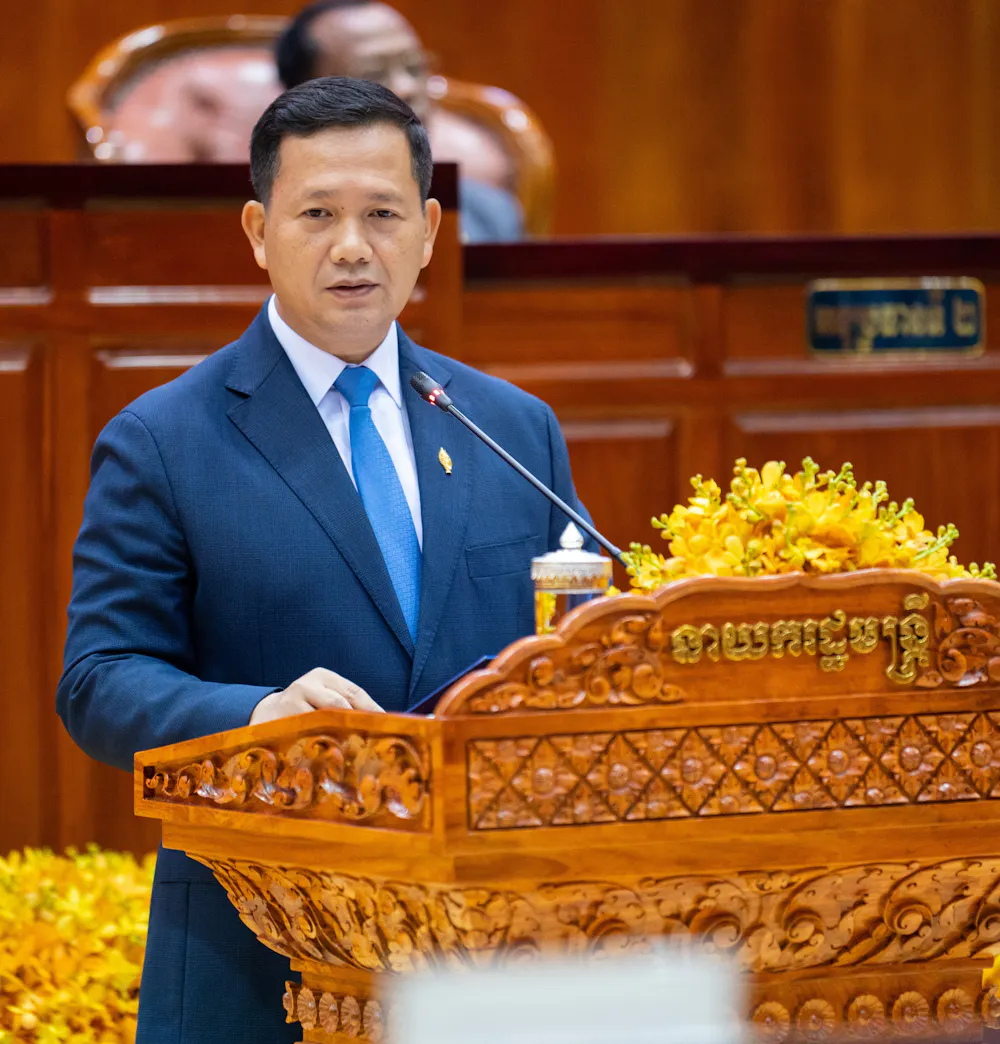
Cambodian prime minister, Hun Manet, who succeeded his father Hun Sen in 2023. Sa sola / Shutterstock
Some observers believed that the softly spoken and sharp-suited Manet might possess a more liberal worldview than that of his father, ushering a new era of renewed democracy.
Hun Sen’s reign in Cambodia was characterised by an increasing reliance on what researcher Neil Loughlin terms the “politics of coercion” to cement his hold on power. The Hun family are at the centre of a network of tightly entwined business and state elites that exert a stranglehold over Cambodia’s politics and economy.
This kleptocratic coalition is accused of asset-stripping the kingdom of its once-abundant natural resources, enriching themselves at the cost of impoverishing the many. As a result, popular dissent has grown.
To quell any threat to its longevity, the ruling Cambodian People’s party (CPP) has led a concerted crackdown on freedoms of association, assembly and expression. Over the past decade, this has included the shuttering of almost all independent news outlets, the dissolution of the opposition Cambodian National Rescue party, and the detention of its leader, Kem Sokha, under house arrest.
As the architect of the Paris Peace Accords that brokered the end to Cambodia’s civil war, the old guard of the party has sought to legitimise its heavyhanded approach by stressing the continued need to preserve order and stability to prevent descent into further unrest.
A false dawn
Manet has been keen to present himself as part of a new guard, ready to reengage with major powers such as the US and EU. Both the US and EU had cooled relations with Cambodia following the democratic deficits unleashed during Hun Sen’s premiership.
Yet the cyberscam story and its growing repercussions have embarrassed Cambodia on the international stage. By apparently censoring Mech Dara for uncovering the scandal, rather than seeking to control party elements responsible for the cyberscam scourge, Manet appears to be showing where his true loyalties and sentiments lie.
Dara is but one of a long line of dissenters charged with “incitement” by the CPP-controlled courts. With its explicit reference to the conjured threat of renewed social chaos, it harks to the CPP’s past as custodian of order and stability.
The heavyhanded nature of the arrest itself, where Dara was apprehended by a convoy of six military vehicles while on vacation with his family, is also straight out of the CPP’s historic playbook. Persecution not by stealth but by flourish, it sends a wider message to civil society to deter any would-be imitators.
More crucially, it signals a forceful intent to preserve the power, plunder and impunity of Cambodia’s elites, and a commitment to the continued silencing of dissenting voices who threaten their supremacy.
Sabina Lawreniuk receives funding from UKRI’s Future Leaders Fellowship scheme.
Source: The Conversation – UK – By Matthew Addicoat, Senior Lecturer in Functional Materials, Nottingham Trent University
The 2024 Nobel prize in chemistry has been awarded to three scientists for their work on describing and predicting proteins with the help of computers. One half of the prize goes to David Baker from the University of Washington in the US “for computational protein design”, with the other half jointly awarded to Demis Hassabis and John M. Jumper, both from Google Deepmind, UK, “for protein structure prediction”.
Using computers to carry out protein design and for predicting protein structures are two sides of the same coin. They are separately very powerful – and combined, even more so.
Proteins are the building blocks of life, building and powering our muscles and organs. Proteins are molecular machines: they read and copy our DNA to make new cells, and pump ions (electrically charged atoms or groups of atoms) into and out of our cells, so these always have what they need to work properly. Proteins act as sensors, detecting what’s in their environment. They also activate our immune systems.
The molecular building blocks of proteins are amino acids. These connect, one end to another, like letters joining to form a word. Exactly like a word, scientists give a letter to each amino acid, and these can spell out any given protein.
Just having that protein sequence – the “word” – isn’t enough, though. It’s the three-dimensional shape of the protein that determines how it works. So, if we want to make a protein for some purpose, we need a way to determine what its three-dimensional shape will be from the amino acid sequence alone. This is protein structure prediction.
Some proteins can be prepared in such a way that their structure can be determined by X-ray, but most cannot. This is why computational structure prediction is vitally important.
It is still an extraordinarily difficult problem. Even a small protein, of around 100 “letters” or amino acids, has an impossibly high number of possible ways it can be arranged in three dimensions. To visualise this, imagine arranging strands of cooked spaghetti in a bowl.
For this reason, until the last decade, computational structure prediction had very low accuracy – less than 50%, in fact. Then, in 2020, Hassabis and Jumper developed an AI tool called AlphaFold2. This can predict the three-dimensional structure of a protein, using only the sequence of letters, with over 90% accuracy.
To make such a leap in accuracy, AlphaFold2 uses deep learning and neural networks. Deep learning is a computer-based approach that simulates the way the human brain makes decisions. Neural networks mimic the human brain’s structure and function to process data.
AlphaFold2 also makes use of massive databases of known protein structures and sequences. The neural network correlates the known three-dimensional shapes with the amino acid sequence. It can then derive rules for what shape a given sequence – the “letters” – will adopt.
The opposite problem, computational protein design, can be summed up by the following question: “I want a protein with this three-dimensional shape; what is the sequence that gives me that shape?”
This challenge was actually solved first. In 2003, Baker wrote a computer program called Rosetta that begins with the desired three-dimensional structure, and produces the amino acid sequence that will give that structure. It uses the idea that the three-dimensional structure of the entire protein can be built from the structures of small fragments.
Computational protein design has many applications. Proteins have been designed to bind and inactivate viruses, to detect drugs like fentanyl, and even to degrade plastic in the environment.
So, why has this prize been awarded for these advances now? Protein design and prediction are both inherently complex problems. There is no way to shortcut the large number of possible structures. But the rapid rise in the capabilities and use of artificial intelligence methods has given us a way to address this complexity. AI can efficiently derive correlations from millions of protein structures.
The pace of development in AI approaches is highlighted by this year’s Nobel prize in physics, which was awarded for the development of neural networks.
The twin methods of computational protein design and computational protein structure prediction are now real tools, used by millions of scientists worldwide. Proteins to counter pandemic viruses can now be designed in a matter of weeks.
It therefore wouldn’t be surprising if we see many other Nobels in future being awarded for breakthroughs that use the power of artificial intelligence.
Matthew Addicoat receives funding from EPSRC and the Royal Society.
Source: The Conversation – UK – By Nicolas Forsans, Professor of Management and Co-director of the Centre for Latin American & Caribbean Studies, University of Essex
Mexico’s first female president, leftwing academic and climate scientist Claudia Sheinbaum, has set out her agenda. She pledged to maintain the social policies of her mentor and predecessor, the widely popular former president Andrés Manuel López Obrador (commonly known by his initials, AMLO).
She promised a transition to green energy, and set out the need for new infrastructure in railways, ports and airports. Sheinbaum inherits a US$1.79 trillion (£1.4 trillion) economy closely integrated to that of the US – in fact, Mexico has the second-largest economy in Latin America. It is also the most populous Spanish-speaking country in the world with 128 million people.
Despite social policies that have seen 9.5 million Mexicans lifted from poverty during AMLO’s six-year term, 36% of Mexicans are still poor and 7% live in extreme poverty. Access to health services remains problematic, and has worsened for those living in deprivation.
Gross domestic product per capita, a measure of wealth, actually fell during the previous administration, which means the “average” Mexican is worse off now than at the start of AMLO’s presidency. And next year, the central bank estimates GDP will grow by only 1.2%, which will inevitably constrain Sheinbaum in her early years in office.
While campaigning, she promised to continue the social and political policies of her predecessor. Now in office, she will not only grapple with the country’s security situation but also navigate serious economic and fiscal challenges.
In 2018, AMLO took office in a relatively stable fiscal environment. His predecessor, Enrique Peña Nieto, had implemented significant reforms early in his term aimed at reducing reliance on oil revenues and energy subsidies.
Nieto also sought to strengthen the country’s two stabilisation funds. The Oil Revenue Stabilisation Fund is aimed at protecting Mexico’s budget from fluctuations in oil revenues. Meanwhile, the Budget Income Stabilisation Fund seeks to stabilise budget revenues from non-oil sources, such as taxes.
These funds have been crucial for maintaining economic stability given the volatility of commodity prices, especially since oil has historically been a key contributor to Mexico’s public finances. However, under AMLO’s administration, both funds were used to plug gaps, leaving them depleted and raising concerns about the country’s ability to weather economic downturns. The country has not balanced its books since 2007.
High energy subsidies introduced in 2019 are putting a strain on public finances. Driven by a commitment by AMLO to shield consumers from rising international oil prices, subsidies increased as a result of the COVID pandemic in 2020, and again in 2022 amid the war in Ukraine.
The recent rise in social spending to fund universal state pensions, social programmes and debt servicing has created considerable strain, pushing the deficit close to 6% of GDP. Mexico’s debt-to-GDP ratio is 50% this year, up from its 2018 level.
The tax issue
In most countries, tax revenues are used to fund social investment. But Mexico’s ability to raise taxes has been extremely limited – tax revenues amount to just 17% of the country’s GDP, below the Latin American average of 22%, and well below that of countries in the Organisation for Economic Co-operation and Development (OECD) at 34%.
Mexico has a large informal economy, with many workers and businesses not registered with tax authorities. Corruption, inefficiencies in tax administration and lack of trust in government institutions have led to low tax compliance, while efforts to increase taxes on the wealthy have met political resistance.
Mexico has high levels of income inequality, and the wealthiest segments of society contribute relatively little to the overall tax revenue. Instead, the country had historically relied on oil revenues – which have declined – to fund public services and investment.
AMLO had launched popular social programmes aimed at reducing poverty and inequalities. Now Sheinbaum has promised increased social spending while maintaining “fiscal responsibility” and not reforming tax (at least in her early presidency). That promise seems unrealistic. Without a change of approach, a fiscal crisis looms.
However, she is expected to be a more pragmatic president than her predecessor. In part because she is less ideology-driven, but also because she won’t have a choice. If she wants to boost the economy and keep reducing poverty, she will need to attract foreign investment and encourage the private sector to play a much bigger role.
Infrastructure will be a key focus, not least to ensure Mexico can benefit from the process of “near-shoring” – the relocation by multinationals of key processes away from Asia closer to the US market in order to minimise supply chain disruptions.
Mexico stands to gain from the current desire by many companies to operate closer to the USA. As a result of the US-Mexico-Canada Agreement (USMCA), and its predecessor Nafta (North American Free Trade Agreement), Mexico enjoys tariff-free trade with its northern neighbours.
But the country has not fully benefited from those opportunities. It lacks a consolidated investment promotion strategy and needs to produce more energy, ensuring it is from cleaner sources.
It’s expected that Sheinbaum will continue government efforts to lift disadvantaged Mexicans out of poverty.
Companies keen to invest in Mexico need access to low-emission hydrocarbons, as well as renewable energy. But AMLO viewed oil as a key part of Mexico’s sovereignty, eradicating previous reforms that had opened up the energy sector to private companies and preventing private investment in renewable energy. Instead, public finances were used to prop up ailing state-owned oil monopoly Pemex and national electricity company CFE.
Given the fiscal challenges Sheinbaum inherits, Mexicans can expect the private sector to play a much greater role in infrastructure investment and in making the green energy transition a reality.
As mayor of Mexico City, she championed public-private partnerships (PPP) while promoting solar energy. But to entice factories from Asia, she will also have to weaken the grip of the criminal organisations which are believed to control as much as a third of Mexico.
During her tenure as mayor she halved the number of murders in the capital. But attempting to replicate this success throughout the country will be no small undertaking.
Nicolas Forsans does not work for, consult, own shares in or receive funding from any company or organisation that would benefit from this article, and has disclosed no relevant affiliations beyond their academic appointment.
When the Paris agreement on climate change was gavelled into being in December 2015, it briefly looked like that rarest of things: a political victory for climate activists and delegates from the poorest regions of the world that, due to colonisation by today’s wealthy nations, have contributed little to the climate crisis – but stand to suffer its worst ravages.
The world had finally agreed an upper limit for global warming. And in a move that stunned most experts, it had embraced the stretch target of 1.5°C, the boundary that small island states, acutely threatened by sea-level rise, had tirelessly pushed for years.
Or so, at least, it seemed. For soon, the ambitious Paris agreement limit turned out to be not much of a limit at all. When the Intergovernmental Panel on Climate Change (or IPCC, the world’s foremost body of climate experts) lent its authority to the 1.5°C temperature target with its 2018 special report, something odd transpired.
Nearly all modelled pathways for limiting global heating to 1.5°C above pre-industrial levels involved temporarily transgressing this target. Each still arrived back at 1.5°C eventually (the deadline being the random end point of 2100), but not before first shooting past it.
Scientists responsible for modelling the response of Earth’s climate to greenhouse gas emissions – primarily caused by burning fossil fuels – called these “overshoot” scenarios. They became the dominant path along which mitigating climate change was imagined to proceed, almost as soon as talk of temperature limits emerged.
De facto, what they said was this: staying below a temperature limit is the same as first crossing it and then, a few decades hence, using methods of removing carbon from the atmosphere to dial temperatures back down again.
From some corners of the scientific literature came the assertion that this was nothing more than fantasy. A new study published in Nature has now confirmed this critique. It found that humanity’s ability to restore Earth’s temperature below 1.5°C of warming, after overshooting it, cannot be guaranteed. Many impacts of climate change are essentially irreversible. Those that are might take decades to undo, well beyond the relevant horizon for climate politics. For policy makers of the future, it matters little that temperatures might eventually fall back again; the impacts they will need to plan for are those of the overshoot period itself.
Even if global average surface temperatures are ultimately reversed, climate conditions at regional levels might not necessarily follow the global trend and might end up different from before. Delayed changes in ocean currents, for instance, could mean that the North Atlantic or Southern Ocean continue warming while the rest of the planet does not.
Any losses and damages that accumulate during the overshoot period itself would of course be permanent. For a farmer in Sudan whose livestock perishes in a heatwave that would have been avoided at 1.5°C, it will be scant consolation to know that temperatures are scheduled to return to that level when her children have grown up.
Then there is the dubious feasibility of planetary-scale carbon removal. Planting enough trees or energy crops to make a dent in global temperatures would require whole continents of land. Direct air capture of gigatonnes of carbon would consume prodigious amounts of renewable energy and so compete with decarbonisation. Whose land are we going to use for this? Who will shoulder the burdens for all this excess energy use?
If reversal cannot be guaranteed, then clearly it is irresponsible to sanction a supposedly temporary overshoot of the Paris targets. And yet this is exactly what scientists have done. What compelled them to go down this dangerous route?
Our own book on this topic (Overshoot: How the World Surrendered to Climate Breakdown, published last week by Verso) offers a history and critique of the idea.
When overshoot scenarios were summoned into being in the early 2000s, the single most important reason was economics. Rapid, near-term emissions cuts were deemed prohibitively costly and so unpalatable. Cost optimisation mandated that they be pushed into the future to the extent possible.
The models for projecting possible mitigation trajectories had these principles written into their code and so for the most part could not compute “low” temperature targets like 1.5 or 2°C. And because modellers could not imagine transgressing the deeply conservative constraints that they worked within, something else had to be transgressed.
One team stumbled upon the idea that large-scale removal of carbon might be possible in the future, and so help reverse climate change. The EU and then the IPCC picked up on it, and before long, overshoot scenarios had colonised the expert literature. Deference to mainstream economics yielded a defence of the political status quo. This in turn translated into reckless experimentation with the climate system. Conservatism or fatalism about society’s capacity for change flipped into extreme adventurism about nature.
Time to bury the time machine
Just as the climate movement scored an important political victory, compelling the world to rally behind an ambitious temperature limit, an influential group of scientists, amplified by the world’s most authoritative scientific body on the subject, effectively helped water it down. When all is said and written about the post-Paris era, this surely should stand as one of its greatest tragedies.
By conjuring up the fantasy of overshoot-and-return, scientists invented a mechanism for delaying climate action and unwittingly lent credibility to those (and they are many) who have no real interest in reigning in emissions here and now; who will seize on any excuse to keep the oil and gas and coal flowing just a little longer.
The findings of this new paper make it perfectly clear: There is no time machine waiting in the wings. Once 1.5°C lies behind us, we must consider that threshold permanently broken.
There then remains only one road to ambitious mitigation of climate change, and no amount of carbon dioxide removal can absolve us of its inconvenient political implications.
Avoiding climate breakdown demands that we bury the fantasy of overshoot-and-return and with it another illusion as well: that the Paris targets can be met without uprooting the status-quo. One limit after the other will be broken unless we manage to strand fossil fuel assets and curtail opportunities for continuing to profit from oil and gas and coal.
We will not mitigate climate change without confronting and defeating fossil fuel interests. We should expect climate scientists to be candid about this.
Don’t have time to read about climate change as much as you’d like?
Wim Carton receives funding for his work on carbon removal from the Swedish Research Council for Sustainable Development (Formas), the Swedish Energy Agency, the Marianne and Marcus Wallenberg Foundation, and the Independent Research Fund Denmark (DFF).
Andreas Malm receives funding for his work on carbon removal from the Swedish Research Council for Sustainable Development (Formas).