Blog

  • MIL-OSI New Zealand: Further action to tackle driver licence wait times

    Source: New Zealand Government

    The Government is taking further action to tackle the unacceptable wait times facing people trying to sit their driver licence test by temporarily extending the amount of time people can drive on overseas licences from 12 months to 18 months, Transport Minister Simeon Brown says. 

    “The previous government removed fees for re-sits of theory and practical tests which led to a huge demand on driver testing officers and unacceptable wait times. People applying to sit their licence tests were left waiting for more than 60 days, and a backlog of over 70,000 waiting to sit a practical licence test soon developed,” Mr Brown says.

    “The Government has taken several actions to reduce wait times and progress is taking place, but there is still more work to do. Through these actions, the wait times have eased to an average of 35 days for a full driver licence, and to 46 days for a restricted driver licence test. However, there is still more work to do as this is above the target of 90 per cent of practical tests being taken within 30 days of booking. 

    “One of the challenges alongside the unlimited free re-sits, has been the surge in the number of overseas licence conversions with overseas licence conversions outnumbering domestic tests since November last year.

    “Cabinet has agreed to temporarily extend the time that people can drive on their overseas driver licence from 12 months to 18 months from the date of their last entry into New Zealand. After that time, they will need to convert to a New Zealand licence or stop driving altogether.”

    This change will help to reduce demand for practical driver licence tests to help NZTA get through the backlog of tests, and builds upon the actions the Government and NZTA have already taken to reduce driver licence wait times by:
     

    • Introducing a limit of one free re-sit for Class 1 driver licence tests
    • Putting a 10 day stand down in place following a second failed theory test attempt on the same day. 
    • Removing free re-sits for overseas licence conversions
    • Recruiting 52 additional Driver Testing Officers and 19 temporary Driver Testing Officers to increase the number of tests able to be completed each week. 

    “Getting a driver licence makes a big difference in a person’s life, is a critical step in supporting safety on our roads, and helps people access employment opportunities. The changes the Government is making is aimed at helping to reduce this backlog and ensure people can sit their driver licence test without undue delays.

    The extension for converting an overseas driver licence from 12 months to 18 months requires a change to driver licensing rules and will take effect from November 2024. It will be in place for two years before reverting to the 12-month requirement. 

    MIL OSI New Zealand News

  • MIL-OSI New Zealand: Op Curly: Police remain focused on locating missing children

    Source: New Zealand Police (District News)

    Please attribute to Detective Inspector Andrew Saunders:

    Thursday’s sighting of Tom Phillips has opened a positive line of enquiry that’s now being looked into by the investigation team.

    Investigators received information about 7pm on Thursday that Tom had been seen in bush area west of Coutts Road in Marokopa with Jayda, Maverick and Ember. This was a credible sighting, and Police believe it was indeed Tom and his children.

    Patrols began in the area on Thursday night and a search was launched the following morning.

    For operational security reasons, we are not providing details of when Police arrived on the ground, or specific details around the resources involved.

    While we cannot go into detail, we want to reassure the public that we have the resources in place to respond to any information or reports of sightings that come in. Our focus is very much on the safe return of Jayda, Maverick and Ember to their whānau and we are doing all that we can to make that happen.

    We still need the public’s assistance, however. If you have any information that could help our enquiries, please update us online now or call 105.

    Please use reference number 211218/5611.

    Information can also be provided anonymously via Crime Stoppers on 0800 555 111.

    ENDS

    Issued by Police Media Centre

    MIL OSI New Zealand News

  • MIL-OSI New Zealand: Deep concerns as TVNZ signal more significant changes – E tū

    Source: Etu Union

    E tū, the union representing TVNZ workers, is raising significant concerns over the broadcaster’s proposed sweeping changes, which could reshape not just TVNZ, but Aotearoa New Zealand’s wider media landscape.

    E tū Negotiation Specialist, Michael Wood, has called for full and meaningful engagement as these proposals are considered, emphasising the potential risks to both TVNZ and the country’s media ecosystem.

    “The scale of change being proposed here is enormous,” Michael says.

    “This is not just a transformation within TVNZ, but one that could have far-reaching consequences for the entire media sector. These changes must be worked through with great care, and E tū and its members will accept nothing less than genuine engagement from all parties involved.”

    While E tū acknowledges the necessity of shifting towards a digital future, the union is deeply concerned about the potential loss of TVNZ’s core strengths, particularly its skilled staff and capacity to deliver in-depth, quality journalism.

    “We support the move towards a more digital service, but this must be done in a way that preserves the essence of what makes TVNZ valuable. It’s crucial to safeguard the ability to investigate and report on the stories that matter.

    “Cutting back on text-based content while simultaneously removing successful video programmes like Fair Go and Sunday raises serious questions about the direction of these changes. If TVNZ is serious about a video-first strategy, they need to invest – not simply slash resources.”

    A key concern is the proposal to outsource jobs, potentially overseas.

    “Outsourcing jobs threatens TVNZ’s most important asset – skilled, experienced staff, with deep institutional knowledge. Outsourcing not only risks losing these skills but can lead to higher costs and a weaker organisation. We’ve seen this play out in other sectors, and it’s not a path we should go down.”

    E tū is also questioning the Government’s role in pressuring TVNZ to deliver a dividend during such a pivotal moment for the organisation.

    “It’s difficult to understand why the Government would maintain pressure for a dividend in this environment. TVNZ is undergoing major upheaval, and it would be wise for the Government to reconsider its expectations while these significant changes are being negotiated.”

    E tū members will hold a union meeting on Thursday to fully discuss the proposals and decide the next steps.

    MIL OSI New Zealand News

  • MIL-OSI New Zealand: Release: Politics over police safety puts shame on PM

    Source: New Zealand Labour Party

    The Prime Minister’s decision to back his firearms minister on gun law changes despite multiple warnings shows his political judgement has failed him yet again.

    “It is the second time in two weeks Christopher Luxon has backed a junior minister from a coalition party rather than listening to warnings about public safety,” Labour firearms spokesperson Ginny Andersen said.

    “This time it’s Nicole McKee who is the ‘ace out of place’ as Christopher Luxon would say, having made changes to legislation loosening reporting requirements for clubs and ranges.

    “Police have raised safety concerns, given this change may create a loophole for gangs, extremists, or other criminals to get easy access to ammunition. But the changes were labelled ‘minor tweaks’ by the Prime Minister to media yesterday, and by doing so he effectively threw police and concerns for their safety under a bus.

    “Christopher Luxon is putting the interests of New Zealanders second to the short-term political deals that have seen him back incompetent ministerial decisions. We need better leadership than this and he should end the distraction Nicole McKee is causing.

    The Government has:

    • Dismissed warnings from Police in a Cabinet paper about the loophole Nicole McKee is creating for ammunition sales
    • Dismissed former Police Minister and deputy PM Paula Bennett’s version of events about advice she received from Nicole McKee
    • Ignored pleas from ethnic communities to not weaken firearms laws
    • Failed to heed the advice of Parliament’s cross party Petitions Committee that questioned the capability of gun clubs and shooting range operators to screen, assess, monitor and report their users. According to the Firearms Safety Authority this can legally include unlicensed people if they shoot under supervision of a licence holder.

    “Christopher Luxon fails to understand the risks he is opening up and should heed the report of the Royal Commission into the terror attacks, which are under renewed scrutiny this week at the Coronial inquiry in Christchurch,” Ginny Andersen said.


    Stay in the loop by signing up to our mailing list and following us on FacebookInstagram, and X.

    MIL OSI New Zealand News

  • MIL-OSI China: UN refugee agency chief visits Syria-Lebanon border

    Source: China State Council Information Office 3

    United Nations High Commissioner for Refugees (UNHCR) Filippo Grandi (1st R, Front) visits the Jdeidet Yabous crossing between Syria and Lebanon, on Oct. 7, 2024. [Photo/Xinhua]

    United Nations High Commissioner for Refugees (UNHCR) Filippo Grandi visited the Jdeidet Yabous crossing on the border between Syria and Lebanon on Monday, Syria’s state news agency SANA reported.

    “I’m at the Syrian/Lebanese border, where a quarter of a million people have crossed since September 23, when Israeli airstrikes in Lebanon escalated,” Grandi said Monday on the social media platform X, adding that more than 1.2 million people have currently been displaced in Lebanon.

    He noted that local authorities, the Syrian Red Crescent, the United Nations, and other partners “are working 24/7 with UNHCR to ensure a humane and efficient welcome” for those arriving in Syria.

    Grandi also mentioned that he has appealed for 324 million U.S. dollars “to meet the needs of all people fleeing from Lebanon to Syria and the families hosting many of them.”

    “This crisis occurs at a time when millions of Syrians live in hardship. Humanitarian and early recovery aid are urgently needed,” he added.

    Earlier on Monday, Syria’s Al-Watan Online newspaper quoted the country’s Directorate of Immigration and Passports as saying that 91,000 Lebanese and 239,000 Syrians have arrived in Syria from Lebanon since Sept. 23, when the Israeli army began conducting intensive attacks on Lebanon in a dangerous escalation with Hezbollah.

    MIL OSI China News

  • MIL-OSI China: Ethiopian parliament appoints FM as new president

    Source: China State Council Information Office 3

    The two houses of the Ethiopian parliament on Monday appointed Foreign Minister Taye Atske Selassie as the new president.

    The appointment followed the end of the term of current President Sahle-Work Zewde after six years of service as the country’s head of state.

    The newly-appointed president was sworn in on Monday before members of Ethiopia’s House of Peoples’ Representatives (HoPR) and House of Federation as the new leader of Africa’s second most populous nation.

    With a diplomatic career spanning three decades, including his role as Ethiopia’s permanent representative to the United Nations, Atske Selassie has served as the country’s foreign minister since February this year until his new appointment.

    Prior to his appointment as the country’s foreign minister, he also held the position of foreign policy adviser to Prime Minister Abiy Ahmed.

    Zewde was elected as Ethiopia’s first female president in October 2018.

    In his acceptance speech following his appointment, Atske Selassie expressed his strong commitment to serving Ethiopia and its people, with a particular focus on fostering national unity and togetherness.

    “Deep foresight and patience are the poles of Ethiopia’s endurance. Hence, it is necessary to move forward by moving away from distractive ideas,” he told members of the Ethiopian parliament.

    He further stressed the collective responsibility to maintain national harmony to tackle socioeconomic and governance challenges while preserving recent positive achievements.

    Atske Selassie also called on Ethiopians from all walks of life to exert concerted efforts towards the realization of the country’s development aspirations.

    Addressing a joint session of the two houses, Atske Selassie said the government is striving to achieve 8.4 percent economic growth in the current fiscal year starting on July 8. To reach this goal, efforts are being made to address foreign currency shortages, curb inflation, and build a resilient agricultural sector that can withstand the impacts of climate change.

    He noted that Ethiopia achieved 8.1 percent economic growth last fiscal year, significantly reducing inflation and creating job opportunities for over 4 million people.

    “The government will focus on expanding mechanized agriculture, creating a favorable investment climate, substituting imported commodities, implementing macroeconomic reforms, and improving tax and non-tax collections to meet the target,” the new president said.

    Atske Selassie also highlighted Ethiopia’s deepening diplomatic relations with China, which have been elevated to an all-weather strategic partnership. He emphasized that Ethiopia’s engagement with China continues to gain momentum.

    He also said that Ethiopia’s diplomatic influence in multilateralism has strengthened with its recent entry into the BRICS mechanism earlier this year.

    Ethiopia, which operates under a parliamentary political system, grants its president largely ceremonial powers. These include granting amnesty to prisoners, officially opening the annual sessions of the parliament’s two houses, receiving foreign ambassadors, and presenting the country’s annual objectives to the parliament.

    In contrast, the prime minister serves as the head of government, with the party or coalition holding at least 51 percent of the seats in the HoPR, the parliament’s lower house, forming the government.

    MIL OSI China News

  • MIL-OSI China: China supports UN to be more active, effective

    Source: China State Council Information Office

    China is ready to work with all parties to support the United Nations to be more active and effective, and transform the political commitments of the Pact for the Future into concrete actions, said Fu Cong, China’s permanent representative to the United Nations, on Monday.

    In remarks at the UN General Assembly plenary meeting on the implementation of the outcomes of the major UN conferences and summits and the strengthening and reform of the UN system, Fu said the current international situation is undergoing a turbulent transition, while the lack of security order, uneven development, and ineffective governance have become increasingly prominent and the shadow of war lingers with heartbreaking humanitarian disasters.

    People of all countries call for a more equal, secure, prosperous and sustainable world, and they look to the United Nations to play a key role to that end, he said.

    “Whether we can unite and act effectively now will not only determine the safety and well-being of the present generation, but will also have a profound impact on the generations to come,” Fu pointed out.

    Through arduous efforts, the Summit of the Future, held at the UN headquarters in New York on Sept. 22-23, adopted the Pact for the Future, sending a clear political signal for strengthening unity and cooperation to improve global governance and pointing the direction of the efforts to meet global challenges, said the ambassador. “We must maintain the positive momentum of the Summit, promote the implementation of the outcomes with greater determination and courage, and work together for our common future.”

    Fu stated that accelerating the implementation of the 2030 Agenda for Sustainable Development is the purpose and mission of the Summit of the Future, and the Pact for the Future puts the development agenda at its center, reaffirms the principle of common but differentiated responsibilities across all areas of development, and clarifies the direction of the reform of international financial architecture.

    “We call on developed countries to use the implementation of the Pact as an opportunity to effectively shoulder their historical responsibilities such as development assistance and climate financing, take concrete actions, and provide financing support to truly help developing countries overcome practical difficulties,” he said.

    The Pact for the Future and the Global Digital Compact as its annex have sent a clear political signal on the governance of artificial intelligence, he said, underscoring the importance of upholding and maintaining the leading role of the United Nations in international governance of artificial intelligence.

    The ambassador noted that the international community, faced with geopolitical conflicts occurring one after another, expects more and better from the Security Council.

    “Reasonable reform of the Security Council is necessary,” said Fu, adding that “the key is to ensure the right direction, to truly enhance the representation and voice of the vast developing countries, including African countries, and allow more small- and medium-sized countries with independent foreign policies to participate in the decision-making of the Security Council.”

    “The Pact for the Future is not an end, but rather a starting point,” the envoy noted, adding that the more complex the situation and the more prominent the challenges, “the more we must uphold the authority of the United Nations and leverage its central role.”

    China is “ready to work with all parties to support the United Nations to be more active and effective, transform the political commitments of the Pact for the Future into concrete actions, jointly build a community with a shared future for mankind, and embrace a brighter future for all,” he said.

    MIL OSI China News

  • MIL-OSI China: Humanitarian situation in Lebanon continues to deteriorate

    Source: China State Council Information Office

    Smoke billows after Israeli airstrikes in the town of Adaisseh, Lebanon, Oct. 5, 2024. [Photo/Xinhua]

    Driven by increasingly intense exchange of hostilities across the Blue Line, the humanitarian situation in Lebanon continues to rapidly deteriorate, UN humanitarians said on Monday.

    The UN Office for the Coordination of Humanitarian Affairs (OCHA) said it continues to be concerned over attacks on the health system, with airstrikes expanding geographically affecting civilians and civilian infrastructure.

    The office said that according to Lebanese authorities, 36 incidents targeting health care facilities were reported between Oct. 8, 2023, and Oct. 4, 2024. At least 96 primary health care centers, and three hospitals have been forced to close due to the hostilities.

    “Attacks have not only impacted facilities but also health personnel with the World Health Organization putting the number of health workers on duty killed in the same period to 77,” OCHA said. Water infrastructure is also affected with at least 25 water facilities damaged affecting more than 300,000 people.

    The ongoing hostilities and displacement orders continue to displace people, particularly from the south of the country and the capital’s southern suburbs, the office said. The International Organization for Migration has recorded more than 540,000 displaced people since Oct. 8 last year.

    The United Nations and its partners in Lebanon, in close collaboration with the Lebanese government, continues to lead and coordinate relief efforts for displaced and affected populations. OCHA said that on the health front, health partners are supporting the Lebanese health authorities and delivering additional trauma and emergency surgery kits to hospitals. They are also providing medicines.

    “The 426 million U.S. dollars Flash Appeal for Lebanon is currently 12 percent funded with 53 million dollars received,” the office said.

    Meanwhile, the UN Special Coordinator for Lebanon, Jeannine Hennis-Plasschaert, continues her close engagements with all actors, urging an immediate ceasefire and that space be created for diplomatic initiatives, said Stephane Dujarric, spokesperson for UN Secretary-General Antonio Guterres, at a daily briefing on Monday.

    Heavy strikes in both directions across the Blue Line continued through the weekend and Monday, with casualties reported from Israeli strikes including in Beirut and southern Lebanon, he said.

    The spokesperson said the UN Interim Force in Lebanon (UNIFIL) noted in a statement their deep concern with respect to recent activities by the Israeli army immediately adjacent to one of the peacekeeping mission’s position, southeast of Marun ar Ras in Sector West, which is inside Lebanese territory.

    “It is unacceptable to compromise the safety of UN peacekeepers carrying out their mandate handed over to them by the Security Council, and UNIFIL reminds all actors of their obligations to protect United Nations personnel and United Nations property,” he said.

    MIL OSI China News

  • MIL-OSI China: 2024 Nobel Prize in Medicine honors 2 scientists for discovering mircoRNA

    Source: China State Council Information Office

    Portraits of the 2024 Nobel laureates in Physiology or Medicine, Victor Ambros and Gary Ruvkun, are seen at the Karolinska Institute in Stockholm, Sweden, on Oct. 7, 2024. [Photo/Xinhua]

    The 2024 Nobel Prize in Medicine was awarded Monday to two American scientists, Victor Ambros and Gary Ruvkun, for their discovery of microRNA and its role in post-transcriptional gene regulation.

    MicroRNAs are a new class of tiny RNA molecules that are essential in gene regulation. It is now known that the human genome codes for over 1,000 microRNAs.

    The Nobel Assembly said that the pair’s surprising discovery revealed an entirely new dimension to gene regulation. “MicroRNAs are proving to be fundamentally important for how organisms develop and function,” the assembly added.

    The announcement marked the start of this year’s Nobel Prize award season. The Nobel announcements will proceed with the physics prize on Tuesday, followed by chemistry on Wednesday, and literature on Thursday. The Nobel Peace Prize will be revealed on Friday, and the Nobel Memorial Prize in Economic Sciences will be announced on Oct. 14.

    MIL OSI China News

  • MIL-OSI China: Hamas claims killing of Israeli soldiers in Gaza City

    Source: China State Council Information Office

    The Al-Qassam Brigades, the military wing of Hamas, announced on Monday that they had killed and wounded several Israeli soldiers in an attack in northern Gaza City.

    According to a press statement from the Al-Qassam Brigades, their members successfully targeted a group of 10 Israeli soldiers with an anti-personnel bomb, resulting in casualties in the area.

    The statement also noted that the brigades observed a helicopter landing for evacuation but did not provide further details about the incident.

    In a separate announcement, the brigades claimed they had targeted an Israeli armored personnel carrier with a “Yassin 105” missile in the Tuwam area, north of Gaza City.

    The Israeli army did not immediately comment on the incidents. However, public Israeli radio reported that military forces in northern Gaza faced significant security challenges and that helicopters were deployed to evacuate wounded soldiers.

    The Al-Qassam Brigades also stated they targeted the “Sderot” area in southern Israel, along with military gatherings and operational centers east of Rafah city, using several “Rajum” short-range missiles with a 114-mm caliber. No casualties or damage were reported from these missile launches.

    Earlier on Monday, the Al-Qassam Brigades declared their readiness for a protracted conflict against Israel in the Gaza Strip.

    “We choose to continue a long and painful war of attrition against Israel,” Al-Qassam Brigades spokesman Abu Ubaida said in a video statement marking the first anniversary of Hamas’ Oct. 7 assault on Israel. He emphasized that the ongoing battles have demonstrated the effectiveness of this strategy.

    Ubaida claimed that Hamas has inflicted significant damage, saying, “On all fronts of combat and throughout Gaza, we have killed and targeted hundreds of soldiers, destroyed Israeli vehicles, and refined our tactics.”

    The northern Gaza Strip has been subjected to heavy Israeli air and artillery bombardment since Sunday, coinciding with the army’s announcement of a ground operation in Jabalia, northern Gaza, aimed at Hamas.

    The conflict, which began on Oct. 7, 2023 with a Hamas attack on southern Israel that killed 1,200 people, has entered its second year. Israel’s subsequent military campaign in Gaza has resulted in nearly 42,000 Palestinian deaths, according to Gaza health officials.

    MIL OSI China News

  • MIL-OSI China: DPRK top leader says would never allow destruction of balance of force on Korean peninsula

    Source: China State Council Information Office

    The top leader of the Democratic People’s Republic of Korea (DPRK) would never allow the destruction of the balance of force on the Korean peninsula, but develop defence science and industry to bolster up the war deterrent for self-defence “limitlessly,” the official Korean Central News Agency (KCNA) reported on Tuesday.

    Kim Jong Un, general secretary of the Workers’ Party of Korea and president of the State Affairs of the DPRK, made the remarks during a speech at the Kim Jong Un University of National Defence on Monday.

    During the address to the teaching staff and students of the elite military academy, Kim underscored the validity of the DPRK’s logic of building self-defence capability, saying the country should have physical strength capable of always deterring the enemy and keeping the situation under control, according to the KCNA report.

    He also stressed the need to “neutralize the imperialists’ aggressive and adventurous military activities with absolute superiority of the defence sci-tech capabilities,” the KCNA said.

    MIL OSI China News

  • MIL-OSI China: Chinese mainland records 13.57M entry, exit trips in National Day holiday

    Source: China State Council Information Office 2

    Border control authorities on the Chinese mainland recorded about 13.57 million inbound and outbound trips during the National Day holiday from Oct. 1 to 7, according to the Ministry of Public Security.
    They also recorded 606,000 vehicles crossing the border during the seven days, one of the longest public holidays on the mainland, according to a statement released by the ministry on Monday.
    The number of criminal cases and public security incidents reported on the mainland during the holiday decreased by 5.7 percent and 20.4 percent, respectively, compared to the same period last year, according to the statement.
    A daily average of 580,000 police and auxiliary police officers worked to protect tourists from public security threats during the holiday, it added.

    MIL OSI China News

  • MIL-Evening Report: I have a stuffy nose, how can I tell if it’s hay fever, COVID or something else?

    Source: The Conversation (Au and NZ) – By Deryn Thompson, Eczema and Allergy Nurse; Lecturer, University of South Australia

    Lysenko Andrii/Shutterstock

    Hay fever (also called allergic rhinitis) affects 24% of Australians. Symptoms include sneezing, a runny nose (which may feel blocked or stuffy) and itchy eyes. People can also experience an itchy nose, throat or ears.

    But COVID is still spreading, and other viruses can cause cold-like symptoms. So how do you know which one you’ve got?

    Remind me, how does hay fever cause symptoms?

    Hay fever happens when a person has become “sensitised” to an allergen trigger. This means a person’s body is always primed to react to this trigger.

    Triggers can include allergens in the air (such as pollen from trees, grasses and flowers), mould spores, animals or house dust mites which mostly live in people’s mattresses and bedding, and feed on shed skin.

    When the body is exposed to the trigger, it produces IgE (immunoglobulin E) antibodies. These cause the release of many of the body’s own chemicals, including histamine, which result in hay fever symptoms.

    People who have asthma may find their asthma symptoms (cough, wheeze, tight chest or trouble breathing) worsen when exposed to airborne allergens. Spring and sometimes into summer can be the worst time for people with grass, tree or flower allergies.

    However, animal and house dust mite symptoms usually happen year-round.

    Ryegrass pollen is a common culprit.
    bangku ceria/Shutterstock

    What else might be causing my symptoms?

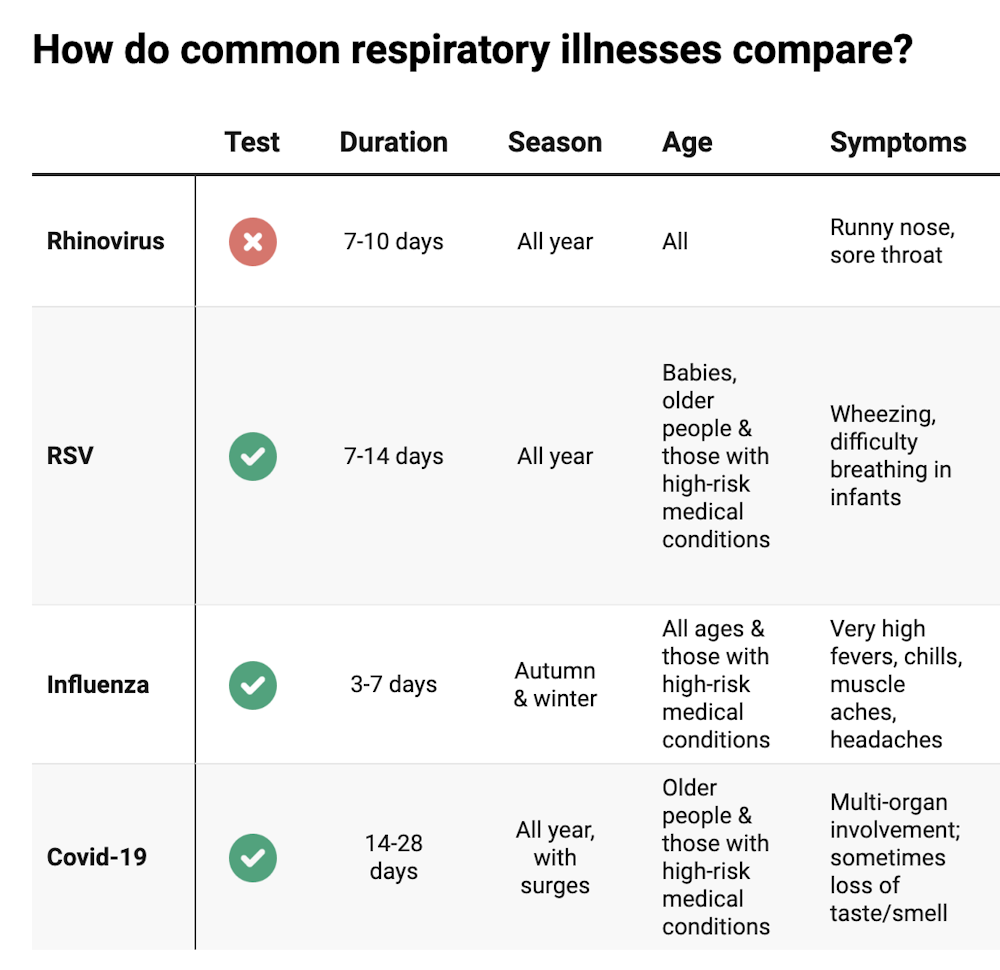
    Hay fever does not cause a fever, sore throat, muscle aches and pains, weakness, loss of taste or smell, nor does it cause you to cough up mucus.

    These symptoms are likely to be caused by a virus, such as COVID, influenza, respiratory syncytial virus (RSV) or a “cold” (often caused by rhinoviruses). These conditions can occur all year round, with some overlap of symptoms:


    Natasha Yates/The Conversation

    COVID still surrounds us. RSV and influenza rates appear higher than before the COVID pandemic, but it may be due to more testing.

    So if you have a fever, sore throat, muscle aches/pains, weakness, fatigue, or are coughing up mucus, stay home and avoid mixing with others to limit transmission.

    People with COVID symptoms can take a rapid antigen test (RAT), ideally when symptoms start, then isolate until symptoms disappear. One negative RAT alone can’t rule out COVID if symptoms are still present, so test again 24–48 hours after your initial test if symptoms persist.

    You can now test yourself for COVID, RSV and influenza in a combined RAT. But again, a negative test doesn’t rule out the virus. If your symptoms continue, test again 24–48 hours after the previous test.

    If it’s hay fever, how do I treat it?

    Treatment involves blocking the body’s histamine release, by taking antihistamine medication which helps reduce the symptoms.

    Doctors, nurse practitioners and pharmacists can develop a hay fever care plan. This may include using a nasal spray containing a topical corticosteroid to help reduce the swelling inside the nose, which causes stuffiness or blockage.

    Nasal sprays need to delivered using correct technique and used over several weeks to work properly. Often these sprays can also help lessen the itchy eyes of hay fever.

    Drying bed linen and pyjamas inside during spring can lessen symptoms, as can putting a smear of Vaseline in the nostrils when going outside. Pollen sticks to the Vaseline, and gently blowing your nose later removes it.

    People with asthma should also have an asthma plan, created by their doctor or nurse practitioner, explaining how to adjust their asthma reliever and preventer medications in hay fever seasons or on allergen exposure.

    People with asthma also need to be alert for thunderstorms, where pollens can burst into tinier particles, be inhaled deeper in the lungs and cause a severe asthma attack, and even death.

    What if it’s COVID, RSV or the flu?

    Australians aged 70 and over and others with underlying health conditions who test positive for COVID are eligible for antivirals to reduce their chance of severe illness.

    Most other people with COVID, RSV and influenza will recover at home with rest, fluids and paracetamol to relieve symptoms. However some groups are at greater risk of serious illness and may require additional treatment or hospitalisation.

    For RSV, this includes premature infants, babies 12 months and younger, children under two who have other medical conditions, adults over 75, people with heart and lung conditions, or health conditions that lessens the immune system response.

    For influenza, people at higher risk of severe illness are pregnant women, Aboriginal people, people under five or over 65 years, or people with long-term medical conditions, such as kidney, heart, lung or liver disease, diabetes and decreased immunity.

    If you’re concerned about severe symptoms of COVID, RSV or influenza, consult your doctor or call 000 in an emergency.

    If your symptoms are mild but persist, and you’re not sure what’s causing them, book an appointment with your doctor or nurse practitioner. Although hay fever season is here, we need to avoid spreading other serious infectious.

    For more information, you can call the healthdirect helpline on 1800 022 222 (known as NURSE-ON-CALL in Victoria); use the online Symptom Checker; or visit healthdirect.gov.au or the Australian Society of Clinical Immunology and Allergy.

    Deryn Thompson is affiliated with Loreal, Ego Pharmaceuticals and Quality Use of Medicines Alliance having received honorariums for educational talks or advisory work.

    ref. I have a stuffy nose, how can I tell if it’s hay fever, COVID or something else? – https://theconversation.com/i-have-a-stuffy-nose-how-can-i-tell-if-its-hay-fever-covid-or-something-else-240453

    MIL OSI AnalysisEveningReport.nz

  • MIL-Evening Report: Grave cleaning videos are going viral on TikTok. Are they honouring the dead, or exploiting them?

    Source: The Conversation (Au and NZ) – By Edith Jennifer Hill, Associate Lecturer, Learning & Teaching Innovation, Flinders University

    Shutterstock

    Cleaning the graves of strangers is the latest content trend taking over TikTok. But as millions tune in to watch the videos, it’s becoming clear not all of them are created equal. Two grave-cleaning creators in particular seem to reside at opposite ends of the trend.

    One of the first accounts to gain popularity for grave cleaning was @ladytaphos. This account is run by Alicia Williams, a Virginia resident who treats the graves with great dignity. Williams will often share the story of the person residing within, and acts with grace and kindness as she restores beauty to the graves.

    On the other end of the spectrum is Kaeli Mae McEwen, or @the_clean_girl, who leans into more clickbait-y tactics. McEwen is known for throwing a pink spiky ball through a graveyard and cleaning the grave it lands on. She also uses her videos to promote her own pink foamy cleaner (which at one point could be purchased via a link in her bio).

    Cleaning and death

    While Williams’ and McEwen’s videos may seem novel to some, death and cleaning have a long and varied relationship that spans time and cultures.

    Washing a loved one’s body before burial or cremation isn’t just practical – it’s a significant ritual that provides meaning during a period of grief. In certain cultures and religions it’s also a process of purification, or preparation for the afterlife.

    Much has been written about cleaning and clearing out the homes of deceased people. Family members often won’t agree on how to approach such a task. In his essay on death and objects, author Tony Birch writes about his mother clearing out his grandmother’s house.

    “My mother decided that our first task after her death was to empty out her Housing Commission flat and scrub it clean,” Birch writes.

    He first laments the move, but later recognises the value of cleaning together before sorting – and treasuring – the items his grandmother left behind.

    Grave cleaning is a practice steeped in history.
    Shutterstock

    Margaretta Magnuson’s 2017 book, The Gentle Art of Swedish Death Cleaning, is a humorous and thoughtful introduction to the Swedish movement of döstädning. The book (and subsequent reality TV series) has sparked various conversations on death and cleaning, and especially on cleaning before you yourself pass away so you don’t leave a mess for your loved ones.

    Grave cleaning can be seen as another continuation of caring for the deceased. People who decide to clean the graves of strangers may do so out of respect, or in an attempt to give them “their name back” (as names on graves become visible following the removal of debris).

    Two very different approaches

    Williams and McEwen are received quite differently by viewers. Anecdotally, viewers respond more positively to the calmer and more respectful cleaning videos by Williams, who takes time to explain the process while ensuring the correct products are used.

    Meanwhile, many find McEwen’s videos problematic and criticise her for not adhering to proper graveyard decorum. McEwen makes a spectacle of sites of mourning, such as by pretending to vacuum graves, replacing flowers placed by others and making jokes. Viewers also speculate the products she uses may cause damage to the graves.

    Perceived intent plays a role in how each creator’s content is received. While Williams focuses on respectfully restoring graves to their former glory, McEwen positions herself as the focus and merely uses the graves for content.

    A complex emotional object

    Similar to other funerary objects such as coffins and urns, graves are associated with both the person who died and the fact of their death. As such, they are emotionally complex objects that bring both strength and sadness to those left behind.

    But graves are unique also in that they are private objects of grief exposed in a public context. Anyone visiting the graveyard can view and interact with them. Does that make them “fair game” for content creators?

    Graves don’t just represent deceased loves ones. They can also act as stand-ins in their absence, becoming stone bodies of sorts. As sociologist Margaret Gibson describes in her book Objects of the Dead: Mourning and Memory in Everyday Life, “death reconstructs our experience of objects”.

    “There is the strangeness of realising that things have outlived persons, and, in this regard, the materiality of things is shown to be more permanent than the materiality of the body,” she says.

    Caring for and cleaning graves can therefore be interpreted as caring for the deceased, by extending their existence through the materiality of their resting place.

    Psychological researcher Svend Brinkmann asserts artefacts such as graves are “culturally sanctioned”, gaining “significance from a collective system of meaning”.

    In other words, we as a community create and uphold reverence for such items. This is partly why the desecration of graves is viewed as abhorrent. It is societally understood to be a desecration of the person themselves. It’s also why content creators must tread lightly.

    A reason for haunting?

    There are ways to interact with gravestones (and even create content) which acknowledge their complexity and connection to their owners.

    TikTok creator Rosie Grant (@ghostlyarchive) bakes recipes found on headstones and records the process. She has even met with the families of the deceased to make the recipes together and learn more about the people behind the engraving-worthy food.

    However, randomly cleaning the graves of strangers is fraught territory – and rife with potential privacy issues. It isn’t clear whether McEwen seeks permission from loved ones before cleaning graves, but contextually this seems unlikely.

    Recent discussions have also uncovered questionable editing in her videos. Some graves in her before-and-after videos have been edited to appear cleaner and to have their structure altered. McEwen’s pink foaming cleaner also appears to be a blue cleaner edited to appear pink, raising even more questions about intent and responsibility.

    While McEwen claims to be “honouring” lives by cleaning “final resting places”, the consensus from viewers is her actions are dishonourable. As one host commented on a in podcast discussing McEwen cleaning a baby’s grave while speaking in a kiddish voice: “Fuck you, you’re going to get haunted.”

    The authors do not work for, consult, own shares in or receive funding from any company or organisation that would benefit from this article, and have disclosed no relevant affiliations beyond their academic appointment.

    ref. Grave cleaning videos are going viral on TikTok. Are they honouring the dead, or exploiting them? – https://theconversation.com/grave-cleaning-videos-are-going-viral-on-tiktok-are-they-honouring-the-dead-or-exploiting-them-240553

    MIL OSI AnalysisEveningReport.nz

  • MIL-OSI China: Hong Kong, Macao aim to be global talent hubs

    Source: China State Council Information Office 2

    Fireworks celebrating the 75th anniversary of the founding of the People’s Republic of China illuminate the sky over Victoria Harbour in Hong Kong, Oct 1, 2024. [Photo/Xinhua]
    Experts from the Hong Kong and Macao special administrative regions said the central government’s new directive to transform the two regions into international hubs for top-tier talent will fulfill local demand for talent while propelling the country’s high-quality development.
    To achieve this objective, both regions should leverage their distinct advantages and policy incentives to attract and retain external talent, while strengthening mechanisms to nurture local talent, they said.
    The resolution on further deepening reform comprehensively to advance Chinese modernization, which was adopted on July 18 at the third plenary session of the 20th Central Committee of the Communist Party of China, voiced support for Hong Kong and Macao in building themselves into international hubs for high-caliber talent.
    Luo Yong, chairman of the Hong Kong Quality and Talent Migrants Association, said the resolution marks the first explicit directive from the central authorities regarding the SAR’s talent policies, demonstrating Hong Kong’s significant importance to national development.
    Daniel Lee Ho-wah, president of the Hong Kong People Management Association, a professional human resources management body, said that Hong Kong will be a direct beneficiary of the resolution.
    Official data shows that the city’s population is projected to reach 8.19 million by mid-2046, with one-third being age 65 or older.
    Building Hong Kong into an international talent hub will help address the city’s challenges related to its aging population and labor shortage.
    The welcome influx of talent will also spur the growth of various industries in Hong Kong, upgrade the city’s economic structure and attract more investment, Lee said.
    Lau Siu-kai, a consultant with the Chinese Association of Hong Kong and Macao Studies, a Beijing-based think tank, said he believes that professionals attracted to Hong Kong will leverage the city as a gateway to the Chinese mainland and overseas.
    These professionals will not only contribute to the development of Hong Kong and the mainland but also help foster a positive global narrative of the country, Lau added.
    The Hong Kong SAR government has ramped up talent-attraction initiatives since late 2022. As of June 30, the city had received more than 320,000 applications through various talent programs, of which 200,000 had been approved, and more than 130,000 of the applicants had arrived in Hong Kong.
    Leveraging advantage
    Luo of the Hong Kong Quality and Talent Migrants Association said the “one country, two systems” principle has always been a magnet for global professionals, and the city should further leverage this advantage to enhance its appeal. Considering Hong Kong’s relatively narrow industry scope, the city needs to collaborate with mainland cities in the Guangdong-Hong Kong-Macao Greater Bay Area on talent policies.
    Luo’s association has been hosting talent summits and fostering exchanges with high-end talent organizations and international talent groups. He noted that professionals, whether from Hong Kong, the mainland or overseas, share a common interest in exploring growth prospects in the city, especially for foreigners who hope to tap mainland opportunities through Hong Kong.
    Luo emphasized the magnetic effect of career-advancement prospects on high-caliber professionals, suggesting that providing such opportunities is key to attracting the world’s best.
    Shang Hailong, a lawmaker and chairman of the Hong Kong Top Talent Services Association, proposed targeted scholarship programs to entice people from countries involved in the Belt and Road Initiative to study in Hong Kong.
    Hong Kong should not just attract professionals, but also needs to retain them, Shang said.
    As the city prepares for a wave of visa renewals in the coming years, the government could use the opportunity to address the practical challenges faced by newcomers.
    Lee of the Hong Kong People Management Association underlined the need to address expatriates’ concerns in finding suitable accommodations for their families and the right schools for their children.
    Lee suggested that the government collaborate with international or English-language schools to reserve spots for the children of senior professionals. Additionally, enterprises can help provide them with affordable transitional housing.
    He emphasized that going to Hong Kong is not just an individual decision by the professionals, but a family matter as well. Resolving livelihood challenges is essential to encouraging them to relocate to the city, Lee said.
    Zhou Ping, director of the Macao One Belt, One Road Research Center at City University of Macao, said the plenary session’s resolution provides crucial guidance for advancing Macao’s talent framework.
    He said Macao’s emphasis on new industries in recent years boasts several advantages that are distinct from those of Hong Kong in attracting talent. Macao’s “1+4” industry diversification strategy, unveiled in 2023, involves promoting the growth of one key sector — tourism and leisure — alongside the advancement of the big health, modern finance and high-tech industries, as well as conventions, exhibitions, culture and sports.
    This strategic approach opens doors for experts to swiftly assume leadership positions within these industries, Zhou said.
    Wong Kam-fai, a legislator and an associate dean of the faculty of engineering at Chinese University of Hong Kong, said fostering local talent is critical for the long-term development of Hong Kong’s talent base.
    Despite Hong Kong’s established prowess in finance, innovation and technology, trade and aviation, there remains a shortage of skilled human resources in some applied technology disciplines such as information technology, electrical and mechanical engineering, maritime engineering and logistics, he said.
    To address this gap, Wong proposed strengthening cooperation with the city of Shenzhen, Guangdong province, in training talent with applied skills.
    Hong Kong can establish vocational training colleges on the mainland, offering programs with mutually recognized qualifications, Wong said, adding that graduates from these colleges could be allowed to work in Hong Kong, becoming a force in the city’s talent pool.
    The government could also construct primary and secondary boarding schools, offering mainland and international curriculums that cater to the needs of families from Shenzhen and Hong Kong. These institutions could serve as incubators for Hong Kong’s future professionals.
    Addressing challenges
    Addressing the challenges in fostering innovation and technology talent, Wong suggested that the government establish a committee to focus on the issue. This committee could help the Education Bureau of the Hong Kong SAR create and update the innovation and technology program framework, and systematically develop the professionals required by various industries, he added.
    Zhou from City University of Macao also emphasized the importance of local talent development. He said the Macao SAR government should offer greater support to the region’s 10 higher education institutions, with a focus on disciplines integral to the city’s future growth.
    He also encouraged these institutions to consider establishing branches on Hengqin island of Zhuhai, Guangdong province, to capitalize on the synergy of the whole Greater Bay Area.

    MIL OSI China News

  • MIL-OSI Economics: Money Market Operations as on October 07, 2024

    Source: Reserve Bank of India


    (Amount in ₹ crore, Rate in Per cent)

      Volume
    (One Leg)
    Weighted
    Average Rate
    Range
    A. Overnight Segment (I+II+III+IV) 5,23,299.71 6.23 1.93-6.50
         I. Call Money 11,161.74 6.43 5.10-6.50
         II. Triparty Repo 3,51,569.00 6.20 6.11-6.31
         III. Market Repo 1,59,200.97 6.30 1.93-6.45
         IV. Repo in Corporate Bond 1,368.00 6.40 6.40-6.48
    B. Term Segment      
         I. Notice Money** 313.50 6.34 5.95-6.50
         II. Term Money@@ 432.25 6.50-7.20
         III. Triparty Repo 150.00 6.32 6.32-6.32
         IV. Market Repo 399.99 6.47 6.30-6.65
         V. Repo in Corporate Bond 0.00
      Auction Date Tenor (Days) Maturity Date Amount Current Rate /
    Cut off Rate
    C. Liquidity Adjustment Facility (LAF), Marginal Standing Facility (MSF) & Standing Deposit Facility (SDF)
    I. Today’s Operations
    1. Fixed Rate          
    2. Variable Rate&          
      (I) Main Operation          
         (a) Repo          
         (b) Reverse Repo          
      (II) Fine Tuning Operations          
         (a) Repo          
         (b) Reverse Repo Mon, 07/10/2024 4 Fri, 11/10/2024 36,825.00 6.49
    3. MSF# Mon, 07/10/2024 1 Tue, 08/10/2024 2,730.00 6.75
    4. SDFΔ# Mon, 07/10/2024 1 Tue, 08/10/2024 89,452.00 6.25
    5. Net liquidity injected from today’s operations [injection (+)/absorption (-)]*       -123,547.00  
    II. Outstanding Operations
    1. Fixed Rate          
    2. Variable Rate&          
      (I) Main Operation          
         (a) Repo          
         (b) Reverse Repo Fri, 04/10/2024 14 Fri, 18/10/2024 44,275.00 6.49
      (II) Fine Tuning Operations          
         (a) Repo          
         (b) Reverse Repo          
    3. MSF#          
    4. SDFΔ#          
    5. On Tap Targeted Long Term Repo Operations Mon, 15/11/2021 1095 Thu, 14/11/2024 250.00 4.00
    Mon, 27/12/2021 1095 Thu, 26/12/2024 2,275.00 4.00
    6. Special Long-Term Repo Operations (SLTRO) for Small Finance Banks (SFBs)£ Mon, 15/11/2021 1095 Thu, 14/11/2024 105.00 4.00
    Mon, 22/11/2021 1095 Thu, 21/11/2024 100.00 4.00
    Mon, 29/11/2021 1095 Thu, 28/11/2024 305.00 4.00
    Mon, 13/12/2021 1095 Thu, 12/12/2024 150.00 4.00
    Mon, 20/12/2021 1095 Thu, 19/12/2024 100.00 4.00
    Mon, 27/12/2021 1095 Thu, 26/12/2024 255.00 4.00
    D. Standing Liquidity Facility (SLF) Availed from RBI$       6,850.74  
    E. Net liquidity injected from outstanding operations [injection (+)/absorption (-)]*     -33,884.26  
    F. Net liquidity injected (outstanding including today’s operations) [injection (+)/absorption (-)]*     -157,431.26  
    G. Cash Reserves Position of Scheduled Commercial Banks
         (i) Cash balances with RBI as on October 07, 2024 10,27,404.10  
         (ii) Average daily cash reserve requirement for the fortnight ending October 18, 2024 10,01,756.00  
    H. Government of India Surplus Cash Balance Reckoned for Auction as on¥ October 07, 2024 0.00  
    I. Net durable liquidity [surplus (+)/deficit (-)] as on September 20, 2024 4,18,318.00  
    @ Based on Reserve Bank of India (RBI) / Clearing Corporation of India Limited (CCIL).
    – Not Applicable / No Transaction.
    ** Relates to uncollateralized transactions of 2 to 14 days tenor.
    @@ Relates to uncollateralized transactions of 15 days to one year tenor.
    $ Includes refinance facilities extended by RBI.
    & As per the Press Release No. 2019-2020/1900 dated February 06, 2020.
    Δ As per the Press Release No. 2022-2023/41 dated April 08, 2022.
    * Net liquidity is calculated as Repo+MSF+SLF-Reverse Repo-SDF.
    As per the Press Release No. 2020-2021/520 dated October 21, 2020, Press Release No. 2020-2021/763 dated December 11, 2020, Press Release No. 2020-2021/1057 dated February 05, 2021 and Press Release No. 2021-2022/695 dated August 13, 2021.
    ¥ As per the Press Release No. 2014-2015/1971 dated March 19, 2015.
    £ As per the Press Release No. 2021-2022/181 dated May 07, 2021 and Press Release No. 2021-2022/1023 dated October 11, 2021.
    # As per the Press Release No. 2023-2024/1548 dated December 27, 2023.
    Ajit Prasad            
    Deputy General Manager
    (Communications)    
    Press Release: 2024-2025/1243

    MIL OSI Economics

  • MIL-OSI Australia: Antarctic season begins

    Source: Australian Government – Antarctic Division

    Australia’s Antarctic science and logistics season has started, with RSV Nuyina leaving Hobart on a six-week resupply voyage to Davis research station.
    The ship has 100 expeditioners on board, two helicopters, a hot pink Antarctic tractor, 240,000 litres of water, 13 tonnes of dry food and more than 20 tonnes of fresh and frozen food.
    It marks the start of an ambitious year for science and infrastructure at Australia’s Antarctic and sub-Antarctic stations.

    “We’re all very excited to be underway,” Voyage Leader Anthea Fisher said.
    “We’ve been chatting to the team who are down at Davis – they’ve been there for a year now – and they’re pretty excited for us to turn up too, to resupply the station and bring them home again.”
    The journey south will take 15 days and require the ship to break ice for the last nine or ten kilometres.
    “At this time of year there’s a section of ice breaking through the pack ice and then the fast ice,” the voyage leader said.
    “We’ll break into that and park about a kilometre out from station and once we’re parked in there, people will be able to just walk off the ship across the ice to station.”
    The trades team travelling to Davis will aim to complete work on a new reverse osmosis plant, which creates drinking water from sea water.
    Along with a third water tank installed last year, it will give the station the water capacity it needs to support station populations in future.
     “Davis station doesn’t have a fresh water source so we have to produce fresh water from salt water via a desalination plant and then store that water for most of the year until we can produce fresh water for a short window in summer,” Construction Supervisor for summer, Tom de Leon, said.
    “A huge amount of planning goes into making sure we don’t run out of materials.
    “There’s no Bunnings down there we can duck into so we have to think very carefully about what we bring and what we use when we’re down there.”
    There are also science project teams on board.
    “We have an important season of science ahead of us this year, kicking off with this first voyage,” Head of the Australian Antarctic Division’s Science Branch, Rhonda Bartley, said.
    Two seabird scientists on board will stop at Davis for a few weeks to monitor local seabird colonies and look for any signs of avian influenza in bird populations and seals near the station. They will then go to Mawson research station for the rest of the summer season to monitor and conduct research on penguins and flying seabirds.
    “We haven’t had any signs of avian influenza in East Antarctica yet but it’s really important that we have people there to look for those signs and assess the impacts of any outbreak,”
     “We’re also very concerned for the health and welfare of our expeditioners so a lot of our planning is around having good biosecurity measures in place and being able to respond to protect our people.”
    Three scientists on the voyage from the Cleaner Antarctica program – which assesses and remediates legacy waste at Antarctic and sub-Antarctic stations – will also carry out work at Davis before transiting to Mawson for the summer’s program of works.
    Three scientific technicians are doing the round trip to maintain key geophysical and atmospheric monitoring equipment on board Nuyina.
    In December, scientists will return to Bunger Hills for the third and final year of the Denman Terrestrial Campaign, which aims to increase our understanding of the glacier’s stability and possible contribution to sea level rise, through research projects carried out inland.
    After the scientists leave in January, trades teams and expeditioners will start the mammoth task of packing the camp up and remediating the site.
    Then in February, RSV Nuyina leaves for the 60-day Denman Marine Voyage, the ship’s first dedicated marine science journey.
    The voyage will take 60 scientists from a range of universities and disciplines to the Denman Glacier region so they can study the system from the sea.
    This content was last updated 14 hours ago on 8 October 2024.

    MIL OSI News

  • MIL-OSI USA News: Remarks by APNSA Jake Sullivan on the Anniversary of the October 7th  Attacks

    Source: The White House

    Embassy of Israel
    Washington, D.C.

    MR. SULLIVAN:  Thank you all for having me here today. 

    Ambassador Herzog, Mike, thank you — both for your hospitality here and for a year that has been difficult and challenging, but you have always stayed committed to the strength of the U.S.-Israel relationship and see it as larger than any two people, and I’m grateful to you for that.

    And it means a lot to me that I’ve been invited here to mark this solemn occasion with all of you.

    As you know, President Biden spoke with President Herzog earlier today, and he shared his deepest condolences with the President and the people of Israel as they commemorate this godawful anniversary. 

    He lit a candle in the White House together with the First Lady, and they said a prayer in remembrance of those lost, loved ones massacred by terrorists who exalted in the assault and murder of innocent Jewish men, women, and children. 

    Perhaps for the first time ever, this morning, the traditional mourning prayer, El Malei Rachamim, was read in Hebrew in the quiet of the residence of the White House.  One line from that prayer, as many of you know: “God full of mercy…grant rest on the wings of the Divine.” 

    The thousands of miles between Washington and Israel do not feel so distant today.  As the President shared in his statement this morning, we grieve with the families and communities who are still in mourning, just as we share in the excruciating pain of those whose loved ones are still held hostage by Hamas, including American citizens. 

    I’ve spent a lot of time with the families of the American hostages over the past year.  I remain humbled by their resilience and their courage.  Instead of succumbing to the dark paralysis of grief, they are working every day to secure the return of their loved ones — always thoughtful, always constructive, always pushing us hard, as they should. 

    I look around this room and I see colleagues here that I’ve gotten to know very, very well through these challenging times.  In the days that followed October 7th, our defense, intelligence, and national security teams were in constant touch.  At President Biden’s direction, we moved military assets into the region, including carrier strike groups with their destroyer escorts and air wings, the finest on the planet, to protect U.S. forces in the region and, yes, to support the defense of the State of Israel. 

    I traveled with President Biden to Israel on October 18th, the first president to visit Israel in a time of war.  And I was with him this past Tuesday.  He was scheduled to be in the Oval Office for his annual Rosh Hashanah call with Jewish leaders.  Instead, he was in the Situation Room, where, for the second time in five months, he ordered the U.S. military to take action to defend Israel from a significant attack by Iran. 

    Side by side, U.S. naval destroyers joined Israeli air defense units in again intercepting a rainfall of inbound missiles — ballistic missiles from Iran.  We thank God we were successful in rendering that attack ineffective, but we remain highly vigilant to the further threats and attacks from Iran and its proxies, including Hamas, Hezbollah, and the Houthis.

    Backed by the ironclad security partnership of the United States, Israel has demonstrated its remarkable capacity, including through impressive operations that killed terrorists with Israeli and, yes, with American blood on their hands. 

    The challenge going forward is to turn tactical wins in battle into a strategy that secures Israel’s people and its future.  That takes real discipline, it takes courage, it takes foresight to match the conduct of war to a clear and sustainable set of objectives and to turn tactical advantage into enduring strategic gains.  That is never easy, but it’s imperative, and we are here to work with you on that. 

    Because as I look around this room, I see colleagues that I haven’t just gotten to know in the crucible of the past year but in the work that preceded it, a project to make real the vision of broader peace, stability, and economic connectivity across the Middle East and to make real a future where Israelis and Palestinians can live alongside one another in security, dignity, self-determination, and peace.

    As the President said in his statement this morning, “I believe that history will also remember October 7th as a dark day for the Palestinian people because of the conflict that Hamas unleashed that day.  Far too many civilians have suffered far too much during this year of conflict — and tens of thousands have been killed, a human toll made far worse by terrorists hiding and operating among innocent people.” 

    Ambassador Herzog spoke in his remarks of the Jewish commandment that every innocent life has value, whether it’s American or Israeli, Lebanese or Palestinian.  Every innocent life.

    In my family, we read the poet John Donne, who said, and I quote, “Any man’s death diminishes me, / because I am involved in mankind.”  And we have to bring that spirit to this conflict as well. 

    We have continued to actively pursue a pathway to a future where Israel enjoys normalized relations with all of its Arab neighbors, where Palestinians have a state of their own, and where Israel’s security is assured forever. 

    And we have continued to stand strong against the antisemitism that still burns in America, around the world, and that has gotten oxygen since October 7th, as the Ambassador said.  And we will continue, from the President through every member of his administration, to stand firmly against it. 

    I’m not blind to the difficulties of this moment.  I’m not blind to their deep roots.  The challenges are many.  The suffering and trauma is real, and it’s with me always.  And no one is ever criticized for predicting that things will only get worse in the Middle East.  The hard thing is to push past the hopelessness and put the pieces down that build toward a genuinely brighter future, even as we navigate the heightened risks and exacting human toll of the present day. 

    This is a focus of my own conversations, President Biden’s conversations, the Vice President’s conversations, the Secretary of State, every member of our team, with leaders across the Middle East who recognize that this future I’m describing can still be the ultimate legacy of October 7th.  And we stand ready to work with all of you, everyone here, everyone of good faith across the region. 

    But this future, as you all know and has been shown to us so many times, is far from assured.  We have to work to make it so. 

    So, may God protect our troops and watch over the hostages.  May the memory of those lost be a blessing, just as the joyousness of their lives remains our light and inspiration forward. 

    Thank you.  (Applause.)

    MIL OSI USA News

  • MIL-OSI USA: Senator Marshall and Colleagues Sound Alarm After DHS Whistleblowers Exposes Biden-Harris Breaking the Law

    US Senate News:

    Source: United States Senator for Kansas Roger Marshall
    Washington, D.C. – U.S. Senator Roger Marshall, M.D. joined a letter led by Senator Chuck Grassley (R-IA) demanding President Joe Biden and Vice President Kamala Harris collect DNA samples from every immigrant the Department of Homeland Security (DHS) encounters, per the DNA Fingerprint Act of 2005.  
    Legally protected whistleblowers have exposed how DHS’s failure to collect DNA hampers law enforcement efforts to stop violent crime. Notably, DHS missed three separate opportunities to gather DNA from the illegal immigrant who murdered Rachel Morin, a Maryland mother of five.  
    “It is beyond heartbreaking to know that my daughter’s brutal death could have been prevented. This isn’t just a bureaucratic oversight; it’s a deadly failure that turned a protective measure into a hollow promise,” said Patty Morin, mother of Rachel Morin. “President Biden and Vice President Harris’ reckless disregard for border security puts every American family in imminent danger. How many more precious lives have to be lost before they decide to protect the people they were elected to serve?”  
    “Following the law, protecting whistleblowers and ensuring the safety of American citizens like Rachel Morin shouldn’t be controversial,” Senators Marshall and Grassley wrote to President Biden and Vice President Harris. “The Biden-Harris administration’s DHS must follow the law—the consequences are stark when they don’t.” 
    Read the full letter HERE.  
    Background: 
    The DNA Fingerprint Act of 2005 requires federal law enforcement to collect DNA from every individual Customs and Border Protections (CBP) arrests, charges, convicts or detains. Yet, per whistleblower disclosures, DHS has collected DNA samples from less than than approximately 40 percent of the more than 10 million known illegal immigrants who have entered the country during the Biden-Harris administration.   Whistleblowers additionally revealed that a CBP official who recently visited major border facilities in Arizona and California did not observe any DNA collection taking place. As a result of disclosing DHS’s failures to Congress, whistleblowers have suffered long-term, severe retaliation. 

    MIL OSI USA News

  • MIL-OSI Economics: Targeted Policies for Digital Creative Industries Can Drive Economic Growth in Asia and Pacific

    Source: Asia Development Bank

    MANILA, PHILIPPINES (8 October 2024) — Coherent national strategies that develop talent and expand digital creative industries can help developing countries tap into the global creative economy, generating high-quality jobs that contribute to economic growth, according to a new report published today by the Asian Development Bank (ADB).

    “Digital disruption of creative industries can present huge economic potential in Asia and the Pacific,” said ADB Director General for Climate Change and Sustainable Development Bruno Carrasco about the launch of A Review of Digital Creative Industries in Asia: Opportunities and Policies to Foster Growth and Create High-Quality Jobs.

    “Yet the policy environment does not always allow creatives to thrive and connect with the global value chain,” added Mr. Carrasco. “This report can help industry and policy makers shape Asia and the Pacific’s digital creative industries, foster opportunities to bridge the region’s rich cultural heritage with the rest of the world and drive economic growth.”

    Based on more than 40 interviews with key individuals across India, Indonesia, Thailand, and Viet Nam—including with industry associations and creative professionals in the film, gaming and music industries—the report highlights opportunities for emerging countries to boost their digital creative industries, assess domestic talent development, and encourage policies that create high-quality jobs.

    While there is strong demand from global entertainment companies to produce local content and work with local talent, there are not enough skilled local producers, screenwriters, and programmers. To address this, the report recommends that governments and industry define the essential knowledge and skills required to perform different creative roles, build lifelong training systems, incentivize businesses to upskill their workers, and improve creative industry working standards.

    Such long-term strategies have helped creative powerhouses—such as Canada, the Republic of Korea, Singapore, and the United Kingdom—to grow their domestic talent pools and attract foreign investment. The report distills key lessons from these countries that can help guide policymakers aiming to develop creative industries.

    Another barrier identified is a severe lack of funding in the four countries examined in South and Southeast Asia. This limits the potential for local film producers, game developers, and musicians to grow, even as high-speed internet, streaming platforms, and portable devices have enabled them to reach much wider audiences.

    Establishing structured funding facilities, including loans, credit guarantees, grants, and venture capital financing, can transform creative ideas into concrete projects, according to the report. With sufficient support from the government or through public–private collaboration, these businesses can be provided with a financial safety net to innovate.

    The report was produced with support from Netflix, the video entertainment streaming service. As ADB’s knowledge partner, Netflix provided experts to be interviewed for the report and enabled access to key stakeholders in the digital creative industry. The work on the report is part of the two organizations’ ongoing collaboration to generate knowledge and boost Asia and the Pacific’s creative industries.
        
    ADB is committed to achieving a prosperous, inclusive, resilient, and sustainable Asia and the Pacific, while sustaining its efforts to eradicate extreme poverty. Established in 1966, it is owned by 69 members—49 from the region.

    MIL OSI Economics

  • MIL-OSI Economics: Additional ADB Grant to Strengthen Energy Security in Central Asia

    Source: Asia Development Bank

    DUSHANBE, TAJIKISTAN (8 October 2024) — The Asian Development Bank (ADB) has approved additional grant financing of $15 million to help Tajikistan scale up an ongoing project to reconnect the country’s power system to the Central Asian Power System (CAPS) through interconnections with neighboring Uzbekistan.

    “Through the Central Asia Regional Economic Cooperation (CAREC) program, ADB actively promotes regional power trade among countries in Central Asia and beyond,” said ADB Director General for Central and West Asia Yevgeniy Zhukov. “Our support improves the sustainability of the regional power system and helps reduce greenhouse gas emissions in the region.”

    The additional financing will construct a new 22 kilometer, 500-kilovolt transmission line in northern Tajikistan—between the country’s Sughd substation and the New Syrdarya substation in Uzbekistan. It will scale up the transmission capacity for power exports and imports among CAPS countries, which include Kazakhstan, the Kyrgyz Republic, Tajikistan, and Uzbekistan, and strengthen infrastructure to prevent grid failures which lead to blackouts.

    The project will also help ensure Tajikistan’s power system is ready to provide regulating capacity for the smooth integration of renewable energy in the region. In the long term, it will become a key component of the power evacuation scheme for the Rogun hydropower plant in Tajikistan.

    Tajikistan joined ADB in 1998. For 26 years, ADB has supported a wide range of sectors from strategic road and energy infrastructure to health, education, agriculture, urban development, public sector management and finance for a total of over $2.7 billion in assistance—including over $2.1 billion in grants.

    ADB is committed to achieving a prosperous, inclusive, resilient, and sustainable Asia and the Pacific, while sustaining its efforts to eradicate extreme poverty. Established in 1966, it is owned by 69 members—49 from the region.

    MIL OSI Economics

  • MIL-OSI Economics: New ADB Country Director for Azerbaijan Assumes Office

    Source: Asia Development Bank

    BAKU, AZERBAIJAN (7 October 2024) — The Asian Development Bank (ADB) has appointed Sunniya Durrani-Jamal as its new Country Director for Azerbaijan. She joined the Azerbaijan Resident Mission today to officially commence her role.

    Ms. Durrani-Jamal will lead ADB’s operations in Azerbaijan and manage the bank’s relationships with the government and other stakeholders. She will oversee the preparation and implementation of the bank’s new country partnership strategy (CPS). The new CPS will build on ADB’s existing work in Azerbaijan, and its strategic focus areas will be aligned with the government’s development strategy and ADB’s Strategy 2030.

    “It is an honor to lead ADB’s efforts in Azerbaijan, a country of rich culture and significant economic potential,” said Ms. Durrani-Jamal. “My priority is to extend ADB’s enduring collaboration with the government, help diversify the economy and improve the quality of life for people in Azerbaijan. This includes expanding renewable energy, addressing climate change, and helping the Caucasus nation transition to a private-sector-led green economy.”

    Azerbaijan’s 10-year development strategy, Azerbaijan 2030: National Priorities for Socio-Economic Development, outlines the country’s ambitions to develop a sustainable and competitive economy, foster an inclusive society, improve human capital, transition to green growth, and improve infrastructure.

    As Asia and the Pacific’s climate bank, ADB is also supporting Azerbaijan’s Presidency of COP29, including via capacity building ahead of the landmark United Nations climate summit set to take place in Baku next month

    Ms. Durrani-Jamal has more than 25 years’ professional experience, including 16 years with ADB where she has held key senior roles. These include country director for Cambodia, senior advisor to ADB’s vice president for east Asia, southeast Asia, and the pacific; and senior economist.

    Ms. Durrani-Jamal holds a master’s degree in economics (human development) from the University of Sussex, United Kingdom, and a master of science in economics (monetary policy) from Quaid-i-Azam University, Pakistan. She succeeds outgoing Country Director Candice McDeigan who held this position from 2021.

    Since Azerbaijan joined the bank in 1999, ADB has committed more than $5 billion in sovereign and private sector assistance, including in transport, energy, health care, and agriculture.

    ADB is committed to achieving a prosperous, inclusive, resilient, and sustainable Asia and the Pacific, while sustaining its efforts to eradicate extreme poverty. Established in 1966, it is owned by 69 members—49 from the region.

    MIL OSI Economics

  • MIL-OSI Asia-Pac: Appointment of Director of Hong Kong International Legal Talents Training Office announced

    Source: Hong Kong Government special administrative region

    Appointment of Director of Hong Kong International Legal Talents Training Office announced
    Appointment of Director of Hong Kong International Legal Talents Training Office announced
    ******************************************************************************************

         The Department of Justice announced today (October 8) that following an open recruitment exercise, Dr Yang Ling will take up the appointment as the Director of the Hong Kong International Legal Talents Training Office. Dr Yang will take up the appointment on November 1. The Secretary for Justice, Mr Paul Lam, SC, welcomed the appointment.     Commenting on Dr Yang’s appointment, Mr Lam said, “Dr Yang is a recognised scholar in international legal and dispute resolution with extensive management experience, including from her time at the Hong Kong International Arbitration Centre. I am confident that she will be able to lead the office to take forward the policy initiatives of developing Hong Kong as a capacity-building centre for legal talent in domestic, foreign and international law.”     The Hong Kong International Legal Talents Training Office has been set up to serve as the co-ordinating body to take forward the establishment of the Hong Kong International Legal Talents Training Academy set out in the 2023 Policy Address. The Office will also serve as the secretariat for the Hong Kong International Legal Talents Training Expert Committee, which has been established and formed by three advisory boards comprising eminent legal experts and scholars from renowned international, Mainland and local legal organisations, and universities as members. Members of the Expert Committee are appointed in their personal capacity, and the list of membership is set out in the Appendix.     Capitalising on Hong Kong’s bilingual common law system and international status, the Academy will regularly organise practical training courses, seminars, international exchange programmes and more to promote exchanges among talent in regions along the Belt and Road. It will also provide training for talent in the practice of foreign-related legal affairs for the country, and nurture legal talent conversant with international law, common law, civil law and the country’s legal system. This initiative will be conducive in consolidating Hong Kong’s position as an international legal and dispute resolution services centre in the Asia-Pacific region.     A brief biographical note of Dr Yang is set out below:     Dr Yang was admitted to the Chinese Bar in 2004 and currently holds the position of the Deputy Secretary-General and Head of China Relations of the Hong Kong International Arbitration Centre (HKIAC). She obtained an LL.M. in International Law in 2006 and a PhD in 2009 from Wuhan University. Prior to joining the HKIAC in 2018, she was an Associate Professor at the East China University of Political Science and Law where she taught international arbitration for more than eight years. In addition, she was a visiting scholar at the University of Aix-en-Provence Marseille III in 2008 and at Boston University School of Law in 2017. Dr Yang has published widely on issues of international dispute resolution and arbitration in China, and currently serves as Executive Editor-in-Chief for the Shanghai International Arbitration Review. She has also been appointed as an arbitrator.

     
    Ends/Tuesday, October 8, 2024Issued at HKT 11:30

    NNNN

    MIL OSI Asia Pacific News

  • MIL-OSI New Zealand: Funding and payments – MPTT

    Source: Tertiary Education Commission

    For the full requirements, see the MPTT funding conditions for the relevant year.
    Funding mechanism
    The Minister responsible for tertiary education issues the MPTT funding mechanism. The funding mechanism outlines the general form and essential components of the fund. It provides the mandate for the Tertiary Education Commission (TEC) to allocate the funding and what the funding can be used for, and details how we administer the fund.
    Funding is agreed off-Plan via a funding confirmation letter.
    A TEO that receives MPTT funding is required to:

    The overall amount of MPTT funding available is set through the Government’s annual budget process. We determine the appropriate amount of MPTT funding for a TEO through an off-Plan assessment process.
    Funding allocation and payments
    Funding allocations, including any amendments, are available through the My Allocations and Payments app on Ngā Kete.
    MPTT funding is paid in accordance with your funding confirmation documentation, which specifies the amount of funding payable for consortium activities and/or fees top-ups, and/or brokerage services (as applicable).
    For the calculation of indicative allocations see the methodology from the relevant year. The most recent information is at the top.
    For more details regarding your specific allocation, please contact customerservice@tec.govt.nz or your Relationship Manager.
    Fees top-ups and brokerage services (first 50%)
    MPTT fees top-ups and brokerage services is paid in equal monthly instalments, except for the brokerage incentive success payment (second 50%).
    Brokerage success (second 50%)
    Brokerage success payments (second 50%) are made three times per year, based on the MPTT Actuals reports provisioned on Workspace 2.
    For the TEO to receive the success payment:

    the learner must achieve the successful outcome within 18 months of leaving the MPTT programme, and
    the TEO must report the successful outcome through Workspace 2 using the provisioned MPTT Actuals template.

    Both brokerage payments are made to the TEO that the learner first enrolled with.
    Consortium activities funding
    MPTT consortium activities funding is paid in equal monthly instalments.
    Learner Support Funding
    As of 30 June 2020, Learner Support Funding has replaced the MPTT Transitional Tools Grant. Learner Support Funding is allocated to each consortium. 
    Learners have access to the support funding when they need it, as assessed by the consortium.
    Consortia will receive the learner support funding via monthly instalments as part of their consortium funding.
    We determine the amount of funding that each consortium receives by using the number of learners the consortium is funded for. Any unspent funding will be recovered.
    Funding rates
    This page provides information on the MPTT funding rates.
    Interactions with Fees Free
    MPTT interaction with Fees Free
    If a learner enrolled in MPTT on or after 1 July 2020, their MPTT training does not count towards the use of a learner’s fees-free entitlement, or count as prior study. This means learners will not be disadvantaged by enrolling in MPTT initiatives.
    Learners must meet all other Fees Free eligibility criteria to qualify to receive Fees Free.
    See the Fees Free website for more information on eligibility requirements.
    Fees free for learners who completed an MPTT course that started after 1 July 2020
    If a learner completed an MPTT course that started on or after 1 July 2020, this study will not impact their eligibility for Fees Free tertiary education. If the learner has previously accessed Fees Free, and has remaining entitlement, they may be able to use this at a later date (should they meet the criteria applicable at the time of enrolment in further study).
    Credits obtained from MPTT courses that started on or after 1 July 2020 are not included as part of the prior study criteria 60 credits limit. 
    Fees Free for learners who completed an MPTT course prior to 1 July 2020
    Any MPTT study that started before 1 July 2020 will continue to be included in prior study calculations for fees-free eligibility.
    This table shows entitlement based on when a learner started MPTT

    MPTT course start/end date

    Outcome

    Starts on, or after, 1 January 2018, and ends prior to 30 June 2020

    This study will count towards the use of a learner’s fees-free entitlement.

    Starts on, or after, 1 January 2020 and continues after July 2020

    See table below.

    Starts on, or after, 1 July 2020

    The study will not count towards the use of a learner’s fees-free entitlement.

    This table shows the proportion of a course that does count towards a learner’s fees-free entitlement use.

    Course start date 

    Percentage of course post 1 July 

    Proportion of course that counts towards entitlement use

     1 January – 30 April 2020

     Less than 50%

     100%

     1 January – 30 April 2020

     50% to less than 75%

     50%

     1 January – 30 April 2020

     75% or more

     0%

     1 May – 30 June 2020

     33% or more

     0%

     1 May – 30 June 2020

     Less than 33%

     100%

    Funding wash-ups
    For the calculation of funding wash-ups see the methodology and technical specifications from the relevant year. The most recent information is at the top.

    MIL OSI New Zealand News

  • MIL-OSI Economics: RBI to conduct 3-day Variable Rate Reverse Repo (VRRR) auction under LAF on October 08, 2024

    Source: Reserve Bank of India

    On a review of the current and evolving liquidity conditions, it has been decided to conduct a Variable Rate Reverse Repo (VRRR) auction on October 08, 2024, Tuesday, as under:

    Sl. No. Notified Amount
    (₹ crore)
    Tenor
    (day)
    Window Timing Date of Reversal
    1 50,000 3 11:00 AM to 11:30 AM October 11, 2024
    (Friday)

    2. The operational guidelines for the auction as given in the Reserve Bank’s Press Release 2019-2020/1947 dated February 13, 2020 will remain the same.

    (Puneet Pancholy)  
    Chief General Manager

    Press Release: 2024-2025/1244

    MIL OSI Economics

  • MIL-OSI Security: International appeal seeks to uncover identities of 46 deceased women

    Source: Interpol (news and events)

    8 October 2024

    LYON, France – Six European countries and INTERPOL have joined forces to solve 46 cold cases involving unidentified women whose remains were found across Europe years ago.

    Most of the women were either murdered or had died in suspicious or unexplained circumstances. Some of the cases date from decades ago.

    The initiative builds on the success of the Identify Me appeal launched in May 2023 to identify 22 deceased women, with some 1,800 tips received from the public. It has now been expanded to include additional cold cases from Belgium, Germany, and the Netherlands, as well as cases from new participating countries France, Italy, and Spain.

    The appeal highlights the importance of public involvement and international cooperation in solving cold cases. It provides hope that crucial leads can be generated, so more of these women can be identified and that justice is served if murder has been established.

    Identify Me has already seen noteworthy results after a case was solved after 31 years. Within two days of the launch of the first phase of Identify Me on 10 May 2023, relatives of Rita Roberts in the United Kingdom contacted the appeal hotline after they recognized their relative’s tattoo from news coverage.

    Rita Roberts was 31 when she left Cardiff, Wales in February 1992. Her family last heard from her in May 1992, and her unidentified body was discovered in Antwerp on 3 June 1992. An investigation determined that she was a victim of murder. That case remains part of the international effort to request information, identify and seek justice for these deceased women.

    Celebrity ambassadors

    The appeal features the strong support – including in the video below – of the following leading actresses, singers, and sports figures from the participating countries, to help raise awareness of the cold cases and encourage public involvement:

    Belgium: Veerle Baetens and Axelle Red

    France: Marie-José Pérec and Sarah Biasini

    Germany: Regina Halmich and Katrin Müller-Hohenstein

    Italy: Carolina Kostner and Alice Bellandi

    Netherlands: Carice van Houten and Stien den Hollander

    Spain: Luisa Martin and Mabel Lozano

    The cold cases

    Details on each case have been made available on INTERPOL’s Identify Me web page, depicting facial reconstructions of some of the women.

    There are also images of items such as jewellery and clothing which were discovered at the various land and water sites where the women’s remains were abandoned.

    These cases underscore the difficulties in identifying human remains, often found years ago in remote or isolated locations, as well as the challenge of tracing some of these deceased women back to their home countries.

    INTERPOL Secretary General Jürgen Stock said:

    “Our goal in the Identify Me campaign is simple. We want to identify the deceased women, bring answers to families, and deliver justice to the victims. But we can’t do it alone. That is why we are appealing to the public to join us in this effort. Their help could make the difference.

    “Even the smallest piece of information can be vital in helping solve these cold cases. Whether it is a memory, a tip, or a shared story, the smallest detail could help uncover the truth. The public could be the key to unlocking a name, a past, and in delivering long-overdue justice.”

    Role of forensics in cold cases

    The participating member countries and INTERPOL are working closely together in the appeal to leverage their analytical capabilities and advanced forensic methods, such as DNA profiling, facial reconstruction, and isotopic analysis. These techniques can provide significant clues about the victim’s origin, lifestyle, and cause of death. 

    Since 2021, INTERPOL has been providing investigators with a new global tool, the I-Familia database, which contains some 20,000 profiles from almost 80 countries. It has already solved cases by helping identify unknown bodies through international family DNA kinship matching.

    Such cases draw on the voluntary DNA contributions made by relatives of the missing, and underline the role played by the public and partners when it comes to identifying missing persons.

    INTERPOL Black Notices

    INTERPOL has published a Black Notice alert for each of the unknown women, to seek information on the unidentified bodies and determine the circumstances of their death.

    While these alerts are intended for the police only, Identify Me represents the first time INTERPOL has publicly released extracts from Black Notices.

    Black Notices can include information on the location where the body was found, biometric information (DNA, fingerprints, facial images), dental charts, physical descriptions of the body or clothing, and any other details relevant to identifying the deceased.

    What you can do

    Each of these deceased women has a story and relatives who deserve answers. We urge anyone with information to come forward and assist in this vital effort.

    Members of the public, particularly those who remember a missing friend or family member, are invited to consult the INTERPOL website and contact the relevant national police team should they have any information. Details can be found on http://www.interpol.int/IM

    For biological relatives who believe one of the women could be their missing loved one, national police can liaise with INTERPOL for international DNA comparison.

    Contact forms are at the bottom of each case summary, providing a crucial link for families seeking answers and justice.

    MIL Security OSI

  • MIL-OSI Australia: Sharing the National Collection: Griffith gets decked out in dazzling jewels

    Source: Australian Ministers for Regional Development

    A stunning display of almost 40 pieces of Australian contemporary jewellery from the National Gallery will travel to Griffith Regional Art Gallery in regional NSW for two years as part of the Albanese Labor Government’s Sharing the National Collection program. 

    The pieces – including brooches, rings, necklaces, pendants, bracelets and more – were created by a variety of Australian artists from the 1970s to the 2010s.

    The display will complement a selection of works from the Griffith Regional Art Gallery’s own collection and will coincide with the opening of the National Contemporary Jewellery Awards on 8 November 2024.

    Minister for the Arts, Tony Burke, said the Sharing the National Collection program is already having a positive impact on regional galleries.

    “We’ve seen participating galleries report a serious uptick in visitors as a result of being able to display locally-significant pieces from the National Gallery, and I’m sure it will be the same for Griffith.

    “At any one time 98 per cent of the National Gallery’s collection is in storage. Thanks to this program these pieces are travelling the distance so you don’t have to – being seen and appreciated right across the country.”

    Senator for New South Wales Deborah O’Neill said, “The loan of these beautiful pieces will be the perfect counterpart to the Griffith Regional Art Gallery’s celebrated Jewellery Awards, I hope both the art and the awards will attract even more visitors to the gallery.”

    National Gallery Director Dr Nick Mitzevich said, “This partnership between the National Gallery and Griffith Regional Art Gallery has been made possible through the Sharing the National Collection initiative. 

    “It will bring a significant selection of jewellery to the Western Riverina, reflecting the venue and region’s important contemporary jewellery collection.”

    Raymond Wholohan, Griffith Regional Gallery Coordinator said “This is an incredible opportunity to elevate the Griffith Regional Gallery’s audience around our bi-annual contemporary Jewellery Prize which coincides with the showcasing of treasures from the National Gallery through the Sharing the National Collection initiative.

    “The works of arts that will come on loan reflect the Australian Jewellers represented in our own collection, providing students and artist in the region with a unique opportunity to learn about Australian contemporary jewellery practice in our own community.”

    Sharing the National Collection is part of Revive, Australia’s new national cultural policy, with $11.8m over four years to fund the costs of transporting, installing and insuring works in the national art collection so that they can be seen across the country for extended periods.

    The works can be viewed via the National Gallery’s website.

    Regional and suburban galleries can register their expressions of interest via this link. 

    MIL OSI News

  • MIL-OSI New Zealand: Plan ahead for three nights partial road closures of SH6, Kawarau Gorge

    Source: New Zealand Transport Agency

    NZ Transport Agency Waka Kotahi (NZTA) is advising drivers to plan ahead for upcoming night closures on sections of SH6 through the Kawarau Gorge, between Cromwell and Frankton. 

    Three separate sections of SH6 will be closed over three nights, Monday to Wednesday/Thursday morning, for essential post-winter maintenance works at the times listed below: 

    Monday, 14 October  – Thursday morning 17 October: Road closed from 9pm to 5:30am. The road will be under a soft closure and traffic will be piloted through the site.  Expect delays of up to half an hour, says Peter Standring, Maintenance Contract Manager for NZTA in Central Otago.

    Because the Kawarau Gorge is sensitive to weather conditions, work may be postponed at short notice to keep workers safe, says Mr Standring.   

    NZTA is urging drivers to plan their journeys around the closures, and if possible to postpone travel during the closure times. 

    Please check the NZTA on-line Journey Planner at http://www.journeys.nzta.govt.nz(external link) for the latest up to date road conditions.

    MIL OSI New Zealand News

  • MIL-OSI New Zealand: Spring is sprung, the grass is riz… I wonder where those roadworks is?*

    Source: New Zealand Transport Agency

    Spring is upon us, and so too is the summer roadworks programme on Southland’s state highways.

    “Two road reconstructions are in the final stages of being completed at Wallacetown and Lowther, and another is underway on SH6 near Centre Bush.  We appreciate the patience of road users while we have had traffic management at these sites,” says Justin Reid, Maintenance Contract Manager for NZ Transport Agency Waka Kotahi (NZTA) in Southland. “Two more reconstruction sites near Mossburn and another near Balfour will also be underway in the next few weeks.” 

    “Our Highways South team will be reconstructing and resurfacing highways from now until the end of March as daylight hours increase, and the warmer temperatures and dry air help new seals stick as intended to the road surface,” he says.  “Major construction and resurfacing work are not possible in Southland outside of this time due to our cooler temperatures.”

    Oreti highway rehabilitation currently under construction.

    “We know that road works can be disruptive for all road users and often residents too, but these are critical reconstruction projects which will improve everyone’s journeys long-term.” 

    • The first road rehabilitation projects began mid-September near Wallacetown, in Lowther and early October Centre Bush. 
    • There is asphalting planned for inner-city Invercargill in the New Year also, with details being finalised.
    • All work is funded through the State Highway Maintenance and Pothole Prevention activity classes in the National Land Transport Programme (NLTP).

    Any road closures required for works will be notified closer to the time.

    The compendium of Southland road rehabilitation projects

    Before the end of the season in March, Highways South is aiming to complete 11 projects:

    • SH1 Bluff highway at Kekeno Place
    • SH6 Dipton-Winton highway at Centre Bush
    • SH6 Five Rivers-Lumsden highway south of Five Rivers
    • SH6 Athol-Five Rivers highway at Jollies Hill
    • SH94 Mossburn-Lumsden highway east of Mossburn township
    • SH94 Te Anau-Mossburn highway west of Mossburn
    • SH94 Lumsden-Riversdale highway west of Balfour
    • SH96 Glencoe highway at Brydone-Glencoe Road
    • SH99 at Lorneville overbridge
    • SH99 Riverton Wallacetown highway west of Wallacetown
    • SH99 Main Road Tuatapere at Jenkins Road.

    “NZTA and our Highways South crews acknowledge that this work will cause disruption and appreciates the patience of our community,” says Mr Reid.   “Give them a wave and keep the mood on the highways relaxed this summer.”

    If there are concerns or questions around these works, road users can call 03 211 1561 to speak with the Highways South team, or sign up for email updates regarding interruptions and possible delays on Southland highways via our Facebook page:

    wwe.facebook.com/HighwaysSouthNZ(external link)

    *(Apologies to the poet, be it Anon, Ogden Nash, or ee cummings)

    MIL OSI New Zealand News

  • MIL-OSI New Zealand: New local road layout between Bethlehem and Tauriko – Takitimu North Link 

    Source: New Zealand Transport Agency

    There is now a new road layout between Bethlehem and Tauriko as part of the Takitimu North Link project.  

    Finishing the local roads in this area makes way for the 4-lane expressway to be built underneath.  

    This big job has seen the relocation of underground cables and pipes, installation of 1660m of subsoil drains, 15,000 cubic metres of dirt moved, construction of the new 100m long bridge and associated tie-in works, as well as construction of the new road and roundabout at St Andrews Drive, and the relocation of Harrison and Cambridge roads. 

    A massive 445 truck and trailer loads of pavement aggregates and over 50,000 litres of bitumen were delivered to site.  

    “Working with our partners Tauranga City Council we have been able to improve the Cambridge/Moffat roads intersection, which was previously a tricky spot for road users. Now there are better sight lines and a safer intersection with left and right turning lanes,” says NZ Transport Agency Waka Kotahi Senior Manager Project Services, Jo Wilton. 

    Works in the area have also allowed for future development of the Smiths Farm area, with a 25m bridge under construction and a fourth leg from St Andrews Drive roundabout, which will provide access. 

    “Completing extensive work in this area is another great step forward for the project. We’re grateful to our neighbours and the surrounding community for their support and patience as we’ve moved through the different phases. We also acknowledge the mahi of local hapū, who have carried out kaitiaki responsibilities throughout, and played an important role,” Ms Wilton says. 

    There are a couple of finishing touches to do in the coming week as the final chip beds in, including final line-marking. 

    Crews expect to break through the ground underneath Cambridge Road overbridge, as part of the 2024/25 earthworks programme soon, to link the new road sections on either side of Moffatt Road. 

    The project has enjoyed a productive winter earthworks season shifting 120,000 cubic metres of material in the cooler months of the year.  

    “We are now preparing for the upcoming earthworks season with a target of shifting a further 600,000 cubic metres of material over the warmer months,” says Ms Wilton. 

    Major work sites are at SH2/Fifteenth Ave, State Highway 29/Takitimu Drive Toll Road, and Minden Road, Te Puna. These sites will have traffic management in place and changes to road layout while works are underway.  

    Notes to editor 

    Service relocations on Cambridge Road:   

    • 1660m of watermain 
    • 1900m of communication 
    • 2130m of power 
    • 155m of sewer main  

    Takitimu North Link Stage 1 will connect Tauranga and Te Puna with a new 4-lane expressway. This Road of National Significance contributes to building a transport network that enables people and freight to move around efficiently, quickly, and safely.   

    Contractors Fulton Hogan/HEB Joint Venture are designing and constructing the project, with BBO the principal’s advisor. The design of Takitimu North Link is being delivered by Beca, with Holmes Consultancy Limited Partnership as a subconsultant. 

    Read more here:

    Cambridge Road

    The intersection at Cambridge/Moffat roads, to St Andrews Drive roundabout, opened 7 October 2024.

    The connection from St Andrews Drive roundabout to Cambridge/Moffat roads opened 7 October 2024, the new bridge at Cambridge Road is pictured in the background – earthworks are due to break through underneath this summer.  

    Pavements crew make the finishing touches to the local roads between Bethlehem and Tauriko, as part of works on the Takitimu North Link project. 

    Artist impression – bridge at Cambridge Road, Takitimu North Link.

    MIL OSI New Zealand News