Blog

  • MIL-OSI Europe: Focus on global health issues at UN General Assembly Session

    Source: Government of Sweden

    On 26 September, Ms Ankarberg Johansson took part in a High-level Meeting of the UN General Assembly on antimicrobial resistance (AMR). AMR means that infectious agents (bacteria, viruses, parasites and fungi) develop resistance to treatment.

    “Thanks to Sweden’s prominent work to counter antimicrobial resistance, we are well-equipped to contribute to global efforts. That’s why the General Assembly is a very important forum in which to participate and share Swedish experiences,” says Ms Ankarberg Johansson.

    The Meeting was the second of its kind, with the first having taken place in 2016. The Meeting included the ceremonial adoption of a political declaration on undertakings to counter AMR. Sweden was one of the most active EU countries during negotiations on the declaration, and many of Sweden’s priority issues have in some way been incorporated into the political declaration.

    Sweden’s AMR Ambassador Malin Grape also took part in the High-level Meeting.

    Swedish side event emphasises cooperation against AMR across borders

    On 25 September, the day before the High-level Meeting, Ms Ankarberg Johansson delivered the opening address at the side event Fostering Cross-Country Solidarity to Address Antimicrobial Resistance in the WHO European Region and Beyond. The event was organised by the Public Health Agency of Sweden together with the WHO Regional Office for Europe (WHO/Europe). The starting point for discussions during the event was the roadmap to counteract AMR agreed upon by the WHO/Europe’s members at the end of 2023. During the event, participants discussed issues such as how support from WHO and cooperation with other countries work in practice.

    Along with Ms Ankarberg Johansson, European Commissioner for Health and Food Safety Stella Kyriakides and WHO Regional Director for Europe Hans Kluge were in attendance.

    In conjunction with the side event, Ms Ankarberg Johansson met bilaterally with Ukrainian First Deputy Minister of Health of Ukraine Serhii Dubrov. During their meeting, Ms Ankarberg Johansson re-emphasised Sweden’s support to Ukraine’s health and medical care in light of Russia’s ongoing full-scale invasion that began in February 2022.

    Panel discussion on measures to combat cervical cancer

    On 25 September, the American publication Foreign Policy organised a livestreamed panel discussion on cervical cancer, in which Ms Ankarberg Johansson took part. Cervical cancer is caused by human papillomavirus (HPV) in approximately 98 per cent of all cases. Thanks to vaccination and screening against HPV, it is now possible to completely eradicate HPV and cervical cancer.

    MIL OSI Europe News

  • MIL-OSI Europe: UN political declaration focuses on efforts to counter antimicrobial resistance

    Source: Government of Sweden

    On 26 September, a High-level Meeting on antimicrobial resistance (AMR) was held during the United Nations General Assembly. The Meeting is the second of its type, with the first having been held in 2016. The meeting included the ceremonial adoption of a political declaration on global and national undertakings in efforts to counter AMR. Minister for Health Care Acko Ankarberg Johansson headed Sweden’s participation in the Meeting.

    “A global problem must be addressed at global level, because AMR does not respect national borders. Sweden welcomes that the world’s countries have agreed on a collective approach. That being said, the declaration is not the end of our work, but rather the beginning of a greater global and national responsibility to safeguard access to antibiotics for all,” says Ms Ankarberg Johansson.

    AMR and antibiotic resistance are a major and growing threat to people’s and animals’ health, and our food production. Access to effective antibiotics is a prerequisite for providing modern medical care and saving lives. Efforts to combat AMR have been one of the Government’s priorities for many years. Sweden is a global leader in efforts to counter antibiotic resistance through measures such as responsible use of antibiotics on people and animals, monitoring of prescriptions and resistance, infection prevention and control, and good animal husbandry practices.

    Political declaration advances global efforts

    The political declaration contains almost 50 undertakings towards combating AMR. This includes global goals, such as reducing the global number of deaths associated with AMR by 19 per cent by 2030. The declaration also includes undertakings by the member countries to set and follow up on national goals. The declaration includes a clear focus on both access to antibiotics and preventive measures such as vaccination, infection prevention and control, and access to water, sanitation and hygiene.

    Sweden was one of the most active EU countries during negotiations on the declaration, and many of Sweden’s priority issues have in some way been incorporated into the political declaration.

    Sweden’s AMR Ambassador Malin Grape also took part in the Meeting.

    “The next High-level Meeting will take place in five years–2029. The most important thing we can do, apart from implementing the undertakings in the declaration, is to continue to raise awareness about the problem, broaden the issue from an infection problem to a patient safety issue, expand the perspective from a health problem to a long-term socioeconomic problem, where several actors need to contribute more actively,” says Ms Grape.

    MIL OSI Europe News

  • MIL-OSI New Zealand: Housing Finance Analysis – Difficult mortgage decisions for borrowers likely to continue

    Analysis by Kelvin Davidson, CoreLogic NZ Chief Property Economist

    The ‘perfect’ strategy for fixing mortgage rates through time is only ever known in hindsight, however new data points to a strong preference for short-term loans. 

    At a macro level this means any reduction in rates will flow through to balance sheets quickly, but with the labour market weakening there are clear ‘tail risks’ to watch for in terms of rising loan repayment problems.

    As it’s become clear in recent months that the medium-term outlook is for fairly steady declines in the official cash rate and mortgage interest rates, there’s been a strong preference for borrowers to take out short-term fixed loans. 

    In December last year, for example, 36% of new loans (by value) were taken out for a fixed term of up to 12 months. But that had spiked to 56% by February and reached a new record high of 68% in August – driven by an especially large surge in six-month activity, off the back of that first OCR cut. 

    Our analysis suggests that existing borrowers who are rolling over their loans onto a new fixed rate will have been behaving in a very similar way to new borrowers, and indeed the Reserve Bank’s figures show that the share of existing loans that are currently fixed but due to change mortgage rates (‘reprice’) within the next 12 months has now risen back to around 66% – matching a peak previously seen in the first half of 2021.
    Some of that stock growth will have also come from all of those recent new borrowers who have been fixing short too.
    In hindsight, it might not have been the best decision for borrowers – in aggregate – to fix for such short periods back in mid-2021 (unless they wanted loan flexibility for lump sum repayments, as an example).
    Indeed, anybody who bucked the trend and took out a five-year rate of around 3% at that time will still have about 18 months to run at those ultra-low rates. On the other hand, one can understand why borrowers are now choosing to take shorter fixed periods in the hope they will benefit from a series of loan renewals in the coming year or two at ever-lower rates.

    On that note, the one-year change in the average ‘special’ (high equity) one-year fixed mortgage rate, for example, has recently turned negative for the first time since mid-2021; i.e. people currently rolling off a one-year rate from October 2023 will be seeing their costs fall. 

    Some of the currently available market interest rates have recently dropped below the average rate prevailing across the stock of existing fixed loans for the first time in about three years too.
    Of course, much like it wasn’t necessarily an easy decision to decide on the ‘best’ fixed rate back in mid-2021 (although it’s clearer in hindsight what should have happened), it’s not necessarily straight-forward now either. 
    After all, the very short-term rates (e.g. six months fixed at 6.7%) remain quite a bit higher than the slightly longer terms (e.g. 12 months fixed at 6.2%) – so for the strategy of taking two consecutive six-month fixes to pay off (i.e. to get the lowest average rate over the relevant term), that rate basically needs to drop to 5.7% or less by April next year.
    Could that happen? Nothing’s out of the question, especially given the continued weakness of the economy and an emerging risk that inflation falls much more sharply than has been anticipated; which would likely see the OCR also fall more rapidly, alongside extra downward pressure on mortgage rates. 
    But at the same time, there could also be a sense at the moment that some of the potential future falls in the OCR have already been captured (‘priced in’) by current mortgage rates, meaning that the scope for more declines from here, regardless of the fixed term, could be a bit slower/smaller than what we’ve seen to date. Either way, the delicate decisions currently faced by mortgage borrowers may continue for a while yet.
    In addition, even though interest rates are now falling, it doesn’t necessarily mean we’ve passed the worst for financial stress amongst mortgage borrowers. Indeed, the non-performing loans ratio (loans that are at least 90 days in arrears or regarded as impaired) on banks’ books has recently edged up to around 0.6% of existing mortgages, the highest figure in more than a decade. 
    It was close to double that figure in 2009-10, however, these numbers are surely still a concern – and could continue to rise, given the job losses that we’re now seeing.
    Based on RBNZ figures, the trading banks themselves recently seem to have been raising provisions for possible future ‘bad’ housing loans, to the point where these allowances are now about 40% above even the largest COVID-era figure. 
    Mortgage stress will remain a factor to watch for some time to come yet and is another reason to be cautious about the size and strength of any upturn in house sales and prices as we head into 2025.

    MIL OSI New Zealand News

  • MIL-OSI Video: Senior Deputy Press Secretary Emilie Simons and Michael Regan Gaggle Aboard Air Force One

    Source: United States of America – The White House (video statements)

    Senior Deputy Press Secretary Emilie Simons and EPA Administrator Michael Regan Gaggle aboard Air Force One en route to Milwaukee, WI.

    Air Force One

    https://www.youtube.com/watch?v=OobnQ5HLBtg

    MIL OSI Video

  • MIL-OSI United Kingdom: Racecourse reading hub proves a hit

    Source: City of Derby

    A new reading hub has been created at a Derby football and community venue. Derby City Council’s Derby Libraries service has provided the facility for visitors to Derby Racecourse Hub.

    The state-of-the-art Racecourse Hub opened earlier this year as a centre for football, fitness and community activities. Managed by Leisure United, it’s already attracted thousands of visitors.

    By bringing books to the Racecourse Hub, the aim is to engage with the wider community and make reading more accessible to those who might not usually visit a library.

    The reading hub has a wide selection of books to choose from, from popular fiction and thrillers, books on health and wellbeing and lots of picture books and board books to keep little ones entertained.

    It operates on an honesty basis, where everyone is welcome to borrow a book to read at the hub or at home and then return the book for someone else to enjoy.

    Derby Libraries now wants to start Rhymetimes sessions for children and Book Club events at the Racecourse Hub and is looking for volunteers to help run them. These popular programmes are already offered at libraries throughout the city.

    Councillor Sarah Chambers, Derby City Council Cabinet Member for Cost of Living, Equalities and Communities, said:

    The reading hub has already been very popular, particularly at weekends when the Racecourse is busy. One example of the great impact it’s having is parents taking the opportunity to share books with their younger children while older siblings play football.

    As a Labour administration, we recognise that Derby’s libraries are a valuable community resource that enrich people’s lives. We’re really pleased that Leisure United share that view and we can provide this facility.

    We want reading to be accessible people of all ages and backgrounds, and the reading hub could help us reach people who may not already be a member of our libraries. If you’ve enjoyed using it and want to read more, you can join Derby Libraries for free.

    We’d love to see Rhymetimes and Book Club sessions running at the hub. If you’re interested in helping children develop a love of reading, or you’re an enthusiastic reader who loves talking about books over a coffee, why not volunteer?

    The Racecourse Hub was jointly funded by Derby City Council and the Premier League, The FA, and the Government’s Football Foundation.

    Richard Smith, regional manager for Leisure United, said:

    We are extremely proud to support the reading hub. Initiatives like this goes to show that the Racecourse Hub is not just about football, but a flexible space for positive initiatives like this one.

    We’ve seen many people from the local community using the library – and even some of the staff – and we look forward to supporting it for years to come.

    Find out how to volunteer on the Derby Libraries website. For more information about Derby Racecourse Hub, go to the Leisure United website.

    MIL OSI United Kingdom

  • MIL-OSI United Kingdom: Freedom of Religion or Belief: UK Statement to the OSCE Warsaw Human Dimension Conference, 2024

    Source: United Kingdom – Executive Government & Departments

    The UK calls on OSCE participating States to build mutual understanding and combat intolerance based on religion or belief.

    Thank you, Madam Moderator, good morning colleagues.  

    Human rights and fundamental freedoms are interdependent, mutually reinforcing and crucial to securing lasting peace and security in the world. With more countries engaged in conflict than at any time since the Second World War, we must work harder to ensure respect for human rights. 

    Vibrant and diverse civic spaces where people can access and enjoy their rights to the freedoms of peaceful assembly, association, and expression are foundational to governance and democracy. A world where civic space continues to decline is one which is less secure.  

    Similarly, religious intolerance and persecution fuels instability, impeding both conflict prevention and resolution. However, when freedom of religion or belief is respected, and interreligious dialogue is promoted, we can build trust and understanding between communities, helping to secure sustainable peace. 

    Last year, the UK was pleased to lead with the UAE a landmark UN Security Council resolution on “Tolerance and International Peace and Security,” which directly addresses, for the first time, the persecution of religious minorities in conflict settings. 

    In putting into practice our commitment to Freedom of Religion or Belief, we must learn the lessons of the past. The global surge in both antisemitism and Islamophobia since October 7th 2023 highlights that there is still much work to be done. All forms of religious hatred are completely unacceptable. 

    Antisemitism has no place in society, and the UK is determined to tackle it in all its forms. We have committed further funding to the Community Security Trust, enabling them to continue their vital work in protecting UK Jewish communities until 2028. 

    Alongside domestic action, the UK proudly holds the presidency of the International Holocaust Remembrance Alliance this year. Our presidency’s theme is “In Plain Sight”, drawing attention to the fact that the Holocaust did not happen in a dark corner. Our presidency is focussing on safeguarding remembrance of the Holocaust, securing the narrative for the future and tackling Holocaust distortion. 

    We are also taking action to support Muslim communities in the UK. Islamophobia is abhorrent and has no place in society. Our Protective Security for Mosques Scheme provides physical protective security measures in both mosques and associated Muslim faith community centres. The Government is also committed to supporting programmes which monitor and support victims of Islamophobia. 

    The UK welcomes the work of the Office for Democratic Institutions and Human Rights to foster tolerance and non-discrimination.  We proudly support the Office’s programme combatting hate crime in our region.   

    We must all, individually and collectively, work to build mutual understanding and combat intolerance based on religion or belief.  Thank you.

    Updates to this page

    Published 8 October 2024

    MIL OSI United Kingdom

  • MIL-OSI: Lucinity and Facctum Partner for AI-Powered, Real-Time Watchlist Screening and Investigations

    Source: GlobeNewswire (MIL-OSI)

    LONDON, Oct. 08, 2024 (GLOBE NEWSWIRE) — Lucinity, a leader in AI-driven financial crime investigation tools, and Facctum, a provider of watchlist screening technology, have announced a strategic partnership. This collaboration offers a seamless, end-to-end financial crime prevention solution by integrating Facctum’s real-time screening capabilities into Lucinity’s platform.

    By combining their strengths, Lucinity and Facctum will handle alerts across watchlist screening use cases including sanctions and PEP screening. Facctum’s flexible solution allows customers to configure their own watchlists or utilize third-party sources such as LSEG (WorldCheck), Dow Jones, Kharon, and many others, providing institutions with the agility needed to adapt to evolving compliance challenges.

    Key Benefits for Customers:

    • Regulatory Compliance: Integrating Facctum will provide customers with real-time updates to sanctions lists within 15 minutes – an industry-leading capability that helps institutions stay compliant with fast-changing regulatory requirements like SEPA Instant Payments.
    • Customizable Screening: Institutions can create custom watchlists or use external sources, reducing false positives and improving screening accuracy.
    • End-to-End Management with AI-Powered Efficiency: The integrated solution embeds watchlist screening into Lucinity’s Case Management platform, providing a comprehensive view of financial crime risks. With Luci, Lucinity’s AI copilot, screening results are analysed in real-time, offering suggestions and insights to speed up the review and decision-making process.
    • Real-time Decisioning and Automatic Payment Holds: Analysts can block or release transactions directly from the Lucinity interface as part of reviewing matches. Additionally, payments suspected of fraud are temporarily held, ensuring verification before processing.
    • Quick Integration and Deployment: Lucinity’s system-agnostic platform integrates seamlessly with various data sources and systems. Customers can quickly implement the joint solution and start seeing results without disrupting their existing workflows.

    Facctum’s advanced matching engines drastically reduce false positives, improving the efficiency of compliance processes. Additionally, the platform helps financial institutions stay ahead of regulatory changes, such as the SEPA Instant Payment Regulation, which requires screening as soon as possible after new EU sanctions are announced.

    Lucinity’s platform also reduces investigation times from three hours to just 30 minutes, delivering productivity gains that can save large banks up to $25 million annually. The combined solution offers immense productivity gains, cost savings, and faster compliance with rigorous regulatory requirements.

    “At Lucinity, we’ve always aimed to provide comprehensive solutions that simplify financial crime management for our customers,” said Udi, President and Chief Revenue Officer at Lucinity. “Our partnership with Facctum enables us to offer real-time screening alerts alongside fraud and AML monitoring and investigations, all within one platform. This allows institutions to remain compliant with rapidly changing regulations while efficiently managing investigations.”

    “Our partnership with Lucinity meets the growing demand for fast, accurate sanctions screening,” said KK Gupta, CEO of Facctum. “By integrating our solutions, we help financial institutions stay compliant and reduce the risk of costly penalties from regulators.”

    Contact

    celina@lucinity.com

    The MIL Network

  • MIL-OSI: Invesco Ltd: Form 8.3 – Centamin PLC; Public dealing disclosure

    Source: GlobeNewswire (MIL-OSI)

    FORM 8.3

    PUBLIC DEALING DISCLOSURE BY
    A PERSON WITH INTERESTS IN RELEVANT SECURITIES REPRESENTING 1% OR MORE
    Rule 8.3 of the Takeover Code (the “Code”)

    1. KEY INFORMATION  
       
    (a) Full name of discloser: Invesco Ltd.  
    (b) Owner or controller of interests and short positions disclosed, if different from 1(a):
    The naming of nominee or vehicle companies is insufficient. For a trust, the trustee(s), settlor and beneficiaries must be named.
       
    (c) Name of offeror/offeree in relation to whose relevant securities this form relates:
    Use a separate form for each offeror/offeree
    Centamin PLC  
    (d) If an exempt fund manager connected with an offeror/offeree, state this and specify identity of offeror/offeree:    
    (e) Date position held/dealing undertaken:
    For an opening position disclosure, state the latest practicable date prior to the disclosure
    07.10.2024  
    (f) In addition to the company in 1(c) above, is the discloser making disclosures in respect of any other party to the offer?
    If it is a cash offer or possible cash offer, state “N/A”
    Yes, AngloGold Ashanti PLC  
       
    2. POSITIONS OF THE PERSON MAKING THE DISCLOSURE  
       
    If there are positions or rights to subscribe to disclose in more than one class of relevant securities of the offeror or offeree named in 1(c), copy table 2(a) or (b) (as appropriate) for each additional class of relevant security.  
    (a) Interests and short positions in the relevant securities of the offeror or offeree to which the disclosure relates following the dealing (if any)  
       
    Class of relevant security: Ordinary NPV JE00B5TT1872  
      Interests Short Positions  
      Number % Number %  
    (1) Relevant securities owned and/or controlled: 21,152,041* 1.82      
    (2) Cash-settled derivatives:          
    (3) Stock-settled derivatives (including options) and agreements to purchase/sell:          
      Total 21,152,041* 1.82      
    *The change in the holding of 6,280 shares since the last disclosure on 18.09.2024 is due to the transfer out of a discretionary holding at 1.53 GBP.  
       
    All interests and all short positions should be disclosed.

    Details of any open stock-settled derivative positions (including traded options), or agreements to purchase or sell relevant securities, should be given on a Supplemental Form 8 (Open Positions).


    (b) Rights to subscribe for new securities (including directors’ and other employee options)  
       
    Class of relevant security in relation to which subscription right exists:    
    Details, including nature of the rights concerned and relevant percentages:    
       
    3. DEALINGS (IF ANY) BY THE PERSON MAKING THE DISCLOSURE  
       
    Where there have been dealings in more than one class of relevant securities of the offeror or offeree named in 1(c), copy table 3(a), (b), (c) or (d) (as appropriate) for each additional class of relevant security dealt in.

    The currency of all prices and other monetary amounts should be stated.

     
    (a) Purchases and sales  
       
    Class of relevant security Purchase/sale Number of securities Price per unit  
    Ordinary NPV JE00B5TT1872 Sale 491,319 1.46 GBP  
       
    (b) Cash-settled derivative transactions  
       
    Class of relevant security Product description e.g. CFD Nature of dealing e.g. opening/closing a long/short position, increasing/reducing a long/short position Number of reference securities Price per unit  
               
       
    (c) Stock-settled derivative transactions (including options)
     
    (i) Writing, selling, purchasing or varying
     
    Class of relevant security Product description e.g. call option Writing, purchasing, selling, varying etc. Number of securities to which option relates Exercise price per unit Type e.g. American, European etc. Expiry date Option money paid/ received per unit
                   
       
    (ii) Exercise  
       
    Class of relevant security Product description e.g. call option Exercising/ exercised against Number of securities Exercise price per unit  
               
       
    (d) Other dealings (including subscribing for new securities)  
                 
    Class of relevant security Nature of dealing e.g. subscription, conversion Details Price per unit (if applicable)  


    4. OTHER INFORMATION  
       
    (a) Indemnity and other dealing arrangements  
       
    Details of any indemnity or option arrangement, or any agreement or understanding, formal or informal, relating to relevant securities which may be an inducement to deal or refrain from dealing entered into by the person making the disclosure and any party to the offer or any person acting in concert with a party to the offer:
    Irrevocable commitments and letters of intent should not be included. If there are no such agreements, arrangements or understandings, state “none”
     
    None  
       
    (b) Agreements, arrangements, or understandings relating to options or derivatives  
       
    Details of any agreement, arrangement or understanding, formal or informal, between the person making the disclosure and any other person relating to:
    (i) the voting rights of any relevant securities under any option; or
    (ii) the voting rights or future acquisition or disposal of any relevant securities to which any derivative is referenced:
    If there are no such agreements, arrangements or understandings, state “none”
     
    None  
       
    (c) Attachments  
       
    Is a Supplemental Form 8 (Open Positions) attached? NO  
       
    Date of disclosure 08.10.2024  
    Contact name Philippa Holmes  
    Telephone number +441491417447  
       

    Public disclosures under Rule 8 of the Code must be made to a Regulatory Information Service.

    The Panel’s Market Surveillance Unit is available for consultation in relation to the Code’s disclosure requirements on +44 (0)20 7638 0129.

    The Code can be viewed on the Panel’s website at http://www.thetakeoverpanel.org.uk.

    The MIL Network

  • MIL-Evening Report: From mass deportations to huge tariff hikes, here’s what Trump’s economic program would do to the US and Australia

    Source: The Conversation (Au and NZ) – By Peter Martin, Visiting Fellow, Crawford School of Public Policy, Australian National University

    Prashantrajsingh/Shutterstock

    It’s time to take Donald Trump seriously. Betting markets say it’s as likely as not he will be elected US president four weeks from today.

    And unlike in 2016 when his program wasn’t clearly defined, he has set out plainly what he intends to do. Which means it’s possible to model the consequences.

    The three Trump promises with the greatest economic impact are

    • the deportation of millions of US residents

    • steep restrictions on imports, especially from China

    • presidential influence over interest rates.

    The best way to model the consequences is with an established model of the kind used by the International Monetary Fund and central banks around the world rather than one set up for the purpose that could be seen as designed to favour or not favour Trump.

    The Washington-based Peterson Institute for International Economics has just done that, noting that during Trump’s first term as president he “by and large” did what he said he would do.

    It finds

    ironically, despite his ‘make the foreigners pay rhetoric’, Trump’s package of policies does more damage to the US economy than to any other in the world.

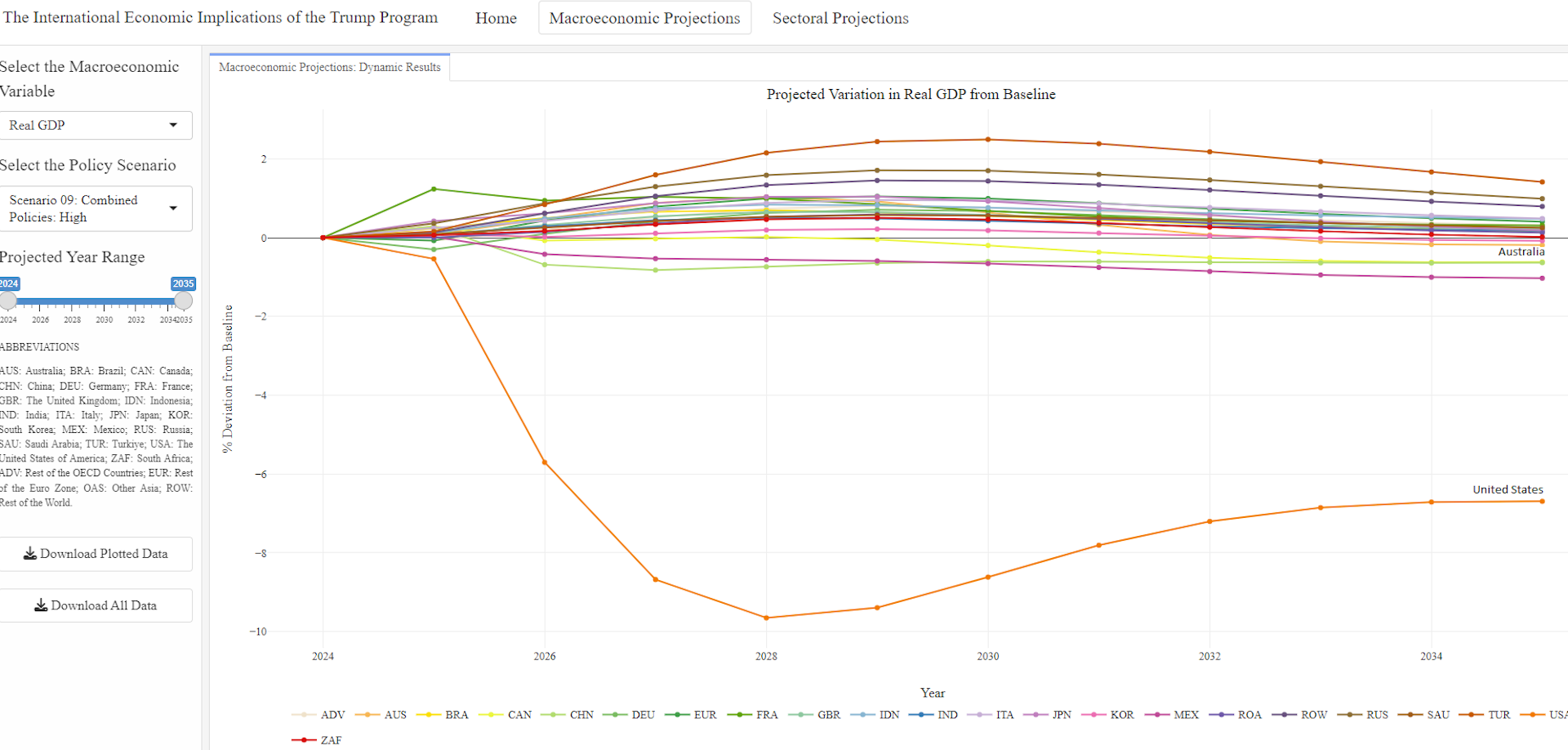
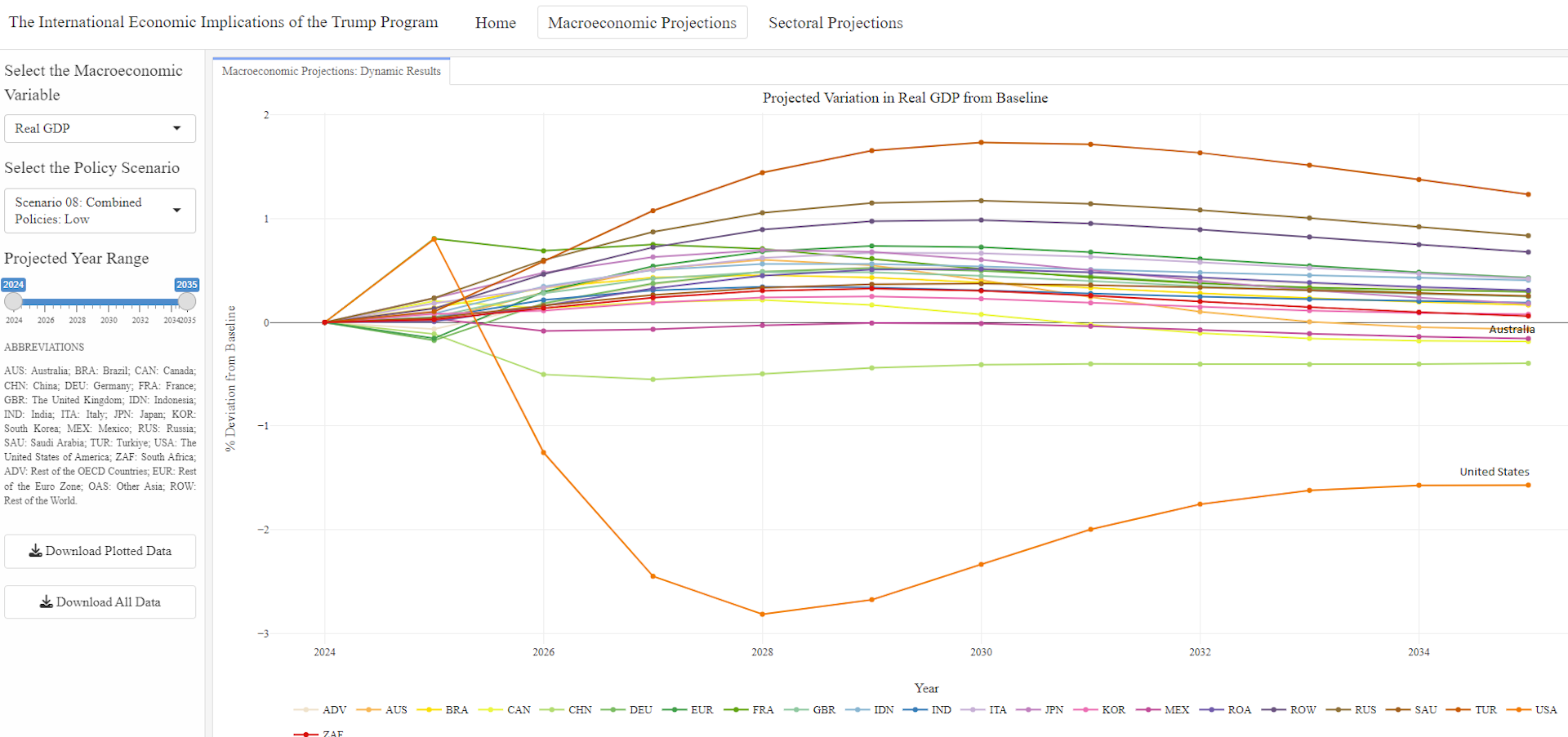
    No other country in the world would be hurt by Trump’s program as much as the US – not even China – although several US allies would suffer, including Australia, which would be the fourth-worst hit by the most extreme version of what Trump is proposing.

    Peterson Institute for International Economics.

    Mass deportations

    Trump has repeatedly promised the “largest domestic deportation operation in American history,” targeting up to 20 million unauthorised immigrants, including about 8.3 million thought to be in the workforce.

    He says his model is Operation Wetback – a 1956 Eisenhower administration program that used military-style tactics to deport 1.3 million Mexicans.

    The institute says Eisenhower’s success makes it easy to believe Trump could remove 1.3 million immigrant workers. It has modelled two scenarios: removing 1.3 million and 8.3 million, both over two years in 2025 and 2026.

    Both slash employment, including the employment of non-immigrants, both push up inflation, which eventually is brought under control, and both make the US a less attractive place to invest, which benefits much of the rest of the world.

    The institute says the low and high scenarios differ “only by the degree of damage inflicted on people, households, firms, and the overall economy”.

    Huge tariff hikes

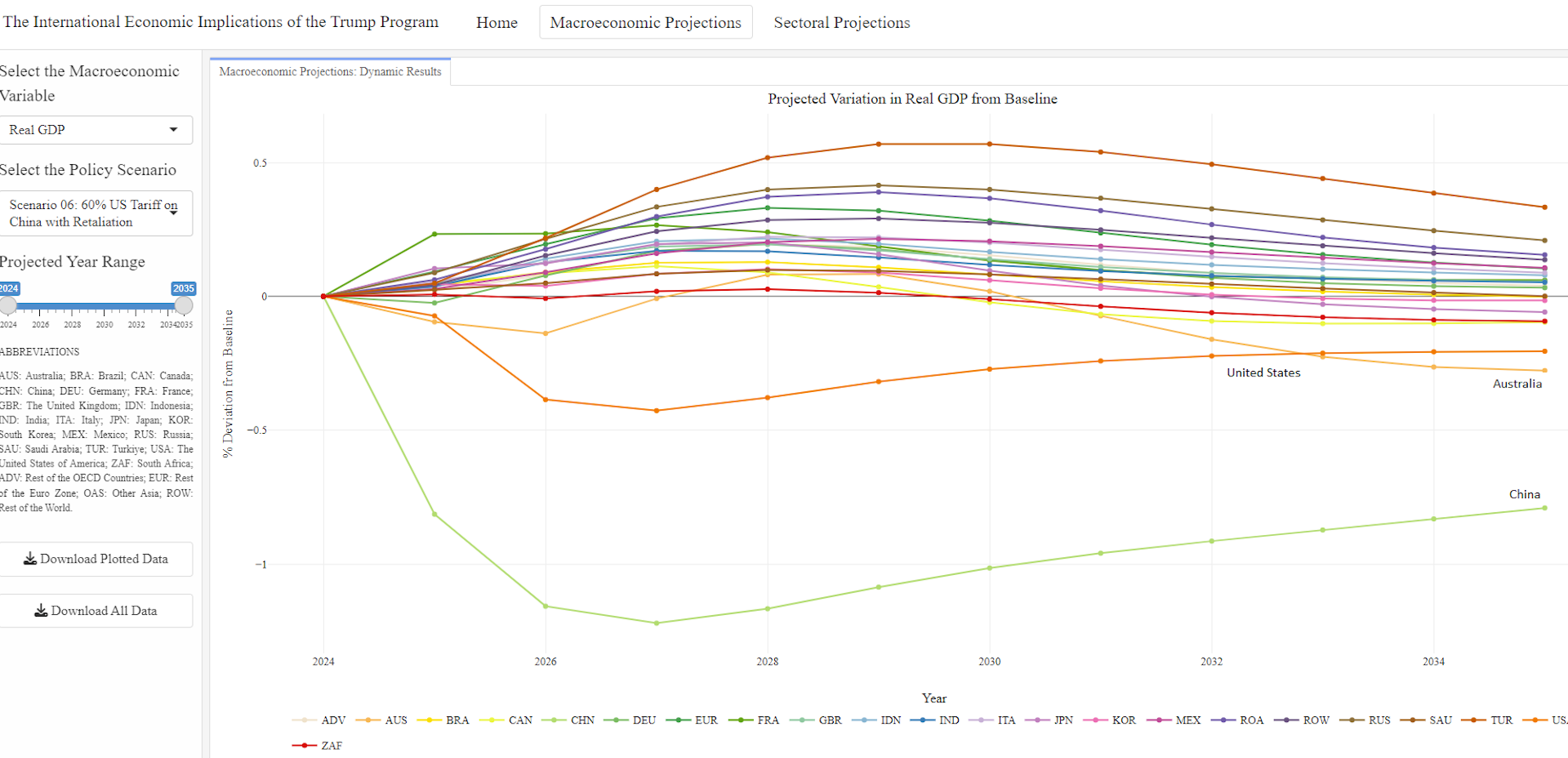
    Trump wants to increase every tariff on goods imported to the US by 10 percentage points, including where there is at present no tariff. And he wants at least a 60% tariff on imports from China. The institute has modelled both, with and without retaliatory tariffs from China and the rest of the world.

    It finds, unsurprisingly, that extra tariffs push up the price of US imports and the prices of US-produced goods that compete with imports. Many are used as inputs in manufacturing, which means US manufacturing suffers (which is probably not what Trump had in mind).

    Fewer imports mean less demand for foreign exchange within the US, which means a higher US dollar which makes US exports less competitive. The US economy is weaker as a result, although China’s is weaker still and Australia’s is weakened as much as the US given its role in providing resources to China.

    Nobbling the Fed

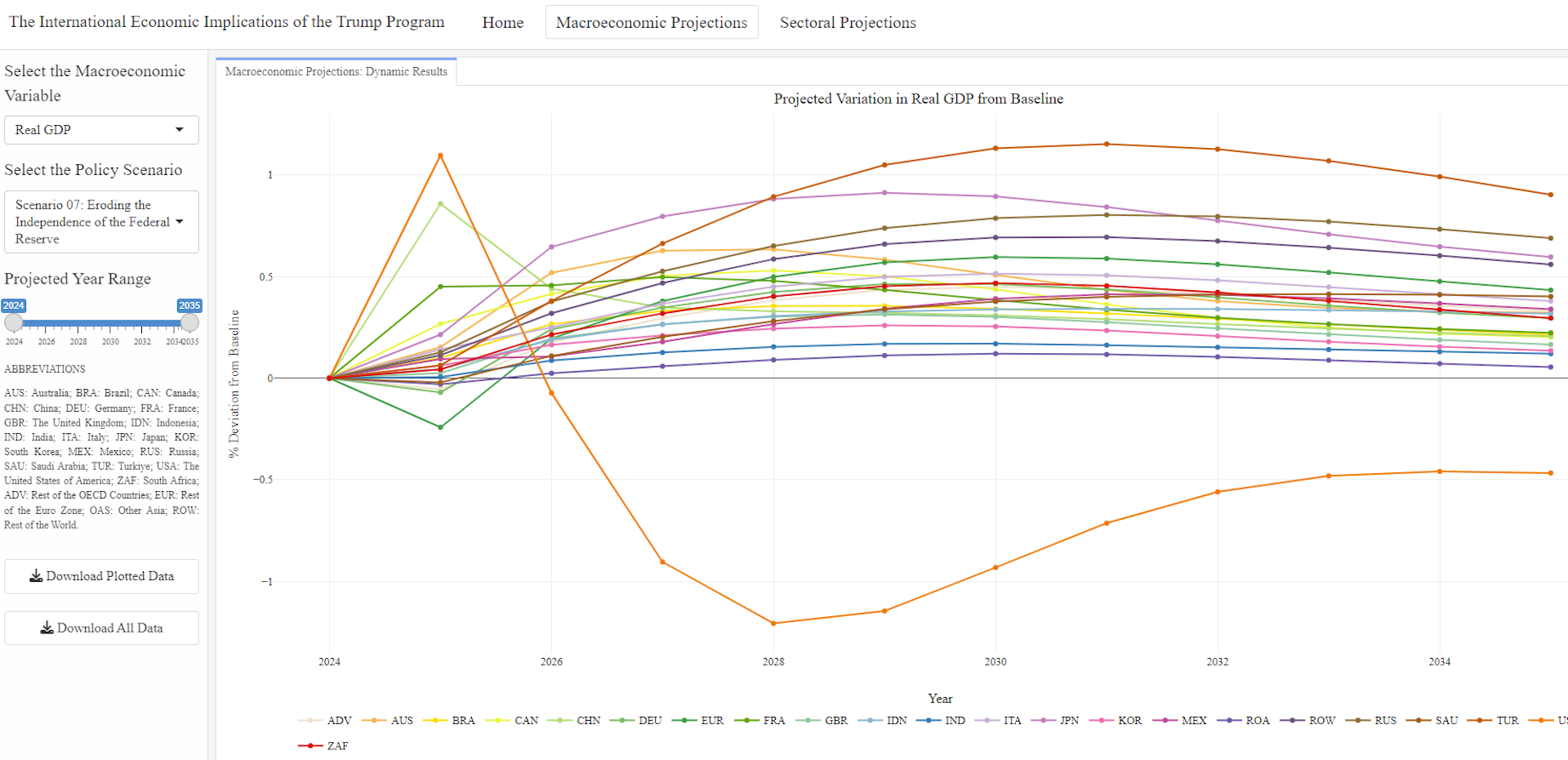
    Trump has raised the prospect of more presidential influence over interest rates, saying he thinks he has “a better instinct than, in many cases” the board of US Federal Reserve. This could be achieved by requiring the president to be consulted on rate decisions or by appointing a compliant chair.

    However it’s done, the institute’s “conservative” assumption based on what happens in developing countries with less central bank independence is that it will push inflation two percentage points higher.

    The modelled result is capital flight. While the US economy is initially stronger than it would have been because of the Fed’s willingness to tolerate higher inflation, after a few years it is weaker and every other economy is stronger.

    When all the measures are combined, under the extreme scenarios the US economy is 6.7% weaker than it would have been by 2035 and Australia’s is 0.2% weaker. Under the more modest scenarios, the US economy is 1.6% weaker and Australia’s is 0.06% weaker.

    Why not examine Harris?

    Despite a history of non-partisanship, the Peterson Institute is prepared for criticism. It points out that the economic model it used is regarded as the best in the world for scenario planning and is Australian, built by Warwick McKibbin of the Australian National University.

    And it says it has modelled the Trump policies rather than the Harris policies because only Trump’s represent a departure from business as usual.

    As the Institute’s president Adam Posen put it in Washington last month, the Harris campaign has said it will not impose across-the-board tariffs, will not engage in mass deportations and will not interfere with the independence of the US Federal Reserve.

    The Trump campaign has indicated it will do all three.

    It’s entirely possible that in office Trump wouldn’t do everything he proposed while campaigning, and it’s entirely possible that he would change course if what was doing damaged the US in the way the modelling suggests.

    But there’s something to be said for taking people at their word, at least to get an idea of what we could be in store for after a knife-edge election.

    Peter Martin is Economics Editor of The Conversation.

    ref. From mass deportations to huge tariff hikes, here’s what Trump’s economic program would do to the US and Australia – https://theconversation.com/from-mass-deportations-to-huge-tariff-hikes-heres-what-trumps-economic-program-would-do-to-the-us-and-australia-240650

    MIL OSI AnalysisEveningReport.nz

  • MIL-OSI Economics: Publication of financial reports: Federal Office of Justice imposes disciplinary fine on Panamax Aktiengesellschaft

    Source: Bundesanstalt für Finanzdienstleistungsaufsicht – In English

    The disciplinary fine order related to a breach of section 325 of the German Commercial Code (Handelsgesetzbuch – HGB). Panamax Aktiengesellschaft failed to submit its accounting documents in full for the financial year 2022 for the purpose of disclosure to the operator of the German Federal Gazette (Bundesanzeiger) in electronic form within the prescribed period. The legal basis for the sanction is section 335 of the HGB.

    The company lodged an appeal against the Federal Office of Justice’s decision to impose a disciplinary fine.

    MIL OSI Economics

  • MIL-OSI Economics: Frank Elderson: Interview with Delo

    Source: European Central Bank

    Interview with Frank Elderson, Member of the Executive Board of the ECB and Vice-Chair of the Supervisory Board of the ECB, conducted by Miha Jenko

    8 October 2024

    You hold two high positions in the European Central Bank: you are a member of the ECB’s Executive Board as well as the Vice-Chair of its Supervisory Board. You are responsible for both monetary matters and banking supervision in the euro area. Can you explain your dual role at the ECB?

    Let me clarify that, at the ECB, decision-making on monetary policy and banking supervision is separate, and for good reason. We want these two functions to pursue their specific objectives and we want to avoid potential conflicts of interest.

    That being said, it is important for each side to be aware of what the other is thinking and to understand how the decisions being taken affect the other side. Let me give you a couple of examples. During our strategy review in 2021 we explicitly recognised the importance of safe and sound banks for our price stability mandate, acknowledging that financial stability is a precondition for price stability. Moreover, banks that are safe and sound are able to effectively pass through our monetary policy.

    So in the governance of the ECB there is a bridge between the two sides. And I currently occupy this bridge as a member of the Executive Board, which has six members including President Lagarde, as a member of the Governing Council and as Vice-Chair of the Supervisory Board. In practice, this means that I inform the Executive Board about what was discussed in the Supervisory Board, and I debrief the Supervisory Board on the decisions taken by the Governing Council. In short, my role is to help ensure that the ECB does not carry out these two separate tasks in isolation.

    What is the purpose of your current visit to Slovenia?

    The ECB’s two decision-making bodies – the Supervisory Board and the Governing Council – will meet in Slovenia in the space of a week. The Supervisory Board will meet for its regular retreat to discuss strategic issues, while the Governing Council will hold its next monetary policy meeting here. Our colleagues at Banka Slovenije are kindly hosting both events.

    Turning to banking supervision, how are banks’ activities and lending affected by the current environment of weak economic growth and deteriorating economic trends, which include increasing bankruptcies in some euro area countries? How resilient is the banking sector in Europe?

    European banks are resilient. They have sufficient and adequate capital and liquidity buffers which enable them to absorb losses and withstand shocks. But they should not be complacent, especially in the context of the worsening geopolitical environment, which could have direct and indirect effects on banks. Near-term growth prospects have deteriorated and are subject to high uncertainty because of these rising geopolitical risks. And banks also face several medium-term, more structural challenges.

    In this context, our supervisory priorities, which we update every year, help us focus on both the near-term and medium-term challenges faced by banks. We want to ensure that banks are resilient not only today, but also in the long run. As part of our priorities, we want to increase their resilience to sudden macroeconomic and geopolitical shocks and to accelerate the remediation of shortcomings in the governance and management of climate-related and environmental risks. At the same time, banks need to make further progress with their digital transformation and build up their operational resilience.

    In short, banks are resilient, but we should not be complacent amid these longer-term challenges, which we will address through our supervision over the coming years.

    What lessons have the ECB and the Eurosystem learned from the last financial crisis in order to be better prepared for a possible new crisis, which will not necessarily originate in the banking sector itself, but in companies connected to it?

    Since the global financial crisis we have created strong pan-European supervision – the Single Supervisory Mechanism. The financial reforms implemented after that crisis have strengthened banks without compromising their lending capacity. Several things have happened since the global financial crisis: we have had a pandemic, Russia’s invasion of Ukraine, an energy shock and high inflation. So European economies have been exposed to unforeseen challenges. We also witnessed turmoil in international banking markets last year, which exposed fragilities in banks’ risk management and internal governance.

    The European banking sector has shown itself to be resilient in the face of these challenges. Take non-performing loans, for example, which have fallen significantly in the European banking system. In 2015, their share was 7%, while in 2023 it was below 2%. That is a big step forward. And as I said, capital and liquidity indicators are now much higher than they were a decade ago. But as supervisors, we should never be complacent, especially given the new risk drivers, such as energy prices, cyberattacks, climate and nature-related risks and geopolitical risks.

    Turning now to current developments in the European banking sector, where UniCredit Group’s intention to take over the German bank Commerzbank has recently made headlines. What is your view as euro area banking supervisor?

    Let me first say that I cannot comment on individual banks, so my answer will be more general.

    We have been crystal clear that cross-border consolidation can be an instrument for further integration of the European banking sector, and we stand by that. Consolidation can also help address long-standing issues in the European banking sector, such as low profitability.

    Nonetheless, mergers always carry risks and, as supervisors, we assess them carefully, always applying the limitative criteria set out in Article 23 of the Capital Requirements Directive. Our job is to ensure that every banking transaction – whether at cross-border or national level – results in a banking group that can comply with supervisory requirements in the foreseeable future.

    What is your view of the banking sector in our country? What is your message to Slovenia?

    Thanks to the reforms implemented after the great financial crisis, banks in Slovenia have come a long way, and in the right direction. When the crisis hit, the Government had to support the three largest banks with a recapitalisation of €3.5 billion. And, naturally, it has taken several years for lending to strengthen. More recently, the privatisation of state-owned banks increased competition in the sector, and this has attracted international banks. Slovenian banks are now well-capitalised, highly profitable and are above the euro area average for profitability, mainly on account of very high net interest margins. Some of this progress can also be attributed to the work of supervisors, including those at Banka Slovenije, with whom we work very well.

    So, like in the rest of Europe, your banks are robust but they will continue to face a number of headwinds stemming from the macro-financial environment, geopolitical shocks and challenges related to the green and digital transitions.

    As mentioned, our central bank will host a Governing Council meeting next week. Do you expect a new interest rate decision at this meeting?

    We will come to Slovenia with an open mind, so I am looking forward to the trip to Ljubljana and to a very genuine and open discussion. Before the meeting, we will take note of all the data and analysis and, as we have said many times before, we will take a meeting-by-meeting approach. A number of recent indicators suggest that downside risks to economic growth are already materialising, so we will need to carefully assess whether this has any implications for our inflation outlook.

    What is very clear, however, is the direction of travel in the period ahead. If our projections that inflation will converge towards our 2% target in the second half of 2025 continue to be confirmed, we will continue to gradually ease our restrictive policy stance. At the same time, we need to maintain flexibility regarding the pace of adjustments. This will depend on incoming data, on the economic situation and on inflation. The latest data will of course be taken into account in whatever decision we take in Slovenia.

    What specific downside risks to growth do you have in mind?

    Economic growth came in at 0.2% in the second quarter, falling somewhat short of our projections. We look at a broad range of data, but we have seen that households are consuming less than anticipated and firms are less keen to invest than we had projected.

    What is your view on the exact nature of inflation in the euro area? In particular, services price inflation remains very persistent. Why?

    We expect inflation to decline to our target in the second half of 2025. Headline inflation is projected to average 2.5% in 2024, then 2.2% in 2025 and 1.9% in 2026. Services inflation remains strong but, according to our projections, we will see a deceleration going into the new year.

    We always look at the upside and downside risks surrounding these projections. Geopolitical tensions could raise energy prices, shipping costs and other transport costs in the short term, which could also lead to disruptions to global trade, which would push prices up. Inflation could also increase if wages rise more than expected or if profit margins increase, and extreme weather events and the climate crisis could increase food prices. However, there are also downside risks to inflation, such as lower than expected demand or an unexpected deterioration in the economic environment in the United States and globally.

    At the ECB, you are also responsible for monitoring the effects of climate change, in addition to the dual tasks mentioned at the beginning. This year we saw the catastrophic effects of floods in some central European countries, and last year we experienced them in Slovenia as well. Greece, Spain and other parts of southern Europe are ravaged by catastrophic droughts and fires. Can the ECB and national central banks contribute more effectively to mitigating the effects of climate change? After all, you have the power – you have monetary policy and banking supervision in your hands…

    I am very aware of the consequences of floods, and of those last year in Slovenia. They caused €10 billion of damage and more than two-thirds of the country was affected. Some places in the Koroška region were cut off from the world and most roads were completely submerged. Recently, we have seen similar things in several other EU countries.

    When talking about climate, nature and the ECB, I always say that we are not climate policymakers. We are not involved in climate policy. This is a task for governments, who implement legislation and policies like the European Climate Law and the EU “Fit for 55” plan, for example.

    But this topic is also extremely relevant for our mandate, because extreme events like flooding, wildfires and summer droughts also lead to financial risks for banks and the wider economy. In our banking supervision, we check whether banks are adequately managing their climate and nature-related risks. We also take climate and nature into account in our macroeconomic projections.

    Are you in favour of introducing more decisive measures that would offer banks more targeted incentives to grant loans for more environmentally friendly or “greener” purposes?

    It would be speculative to talk about possible measures that we might hypothetically take in the future. What is clear is that any measure we implement must be consistent with our primary objective of price stability. Our current monetary policy stance is restrictive, so a green lending facility would be something for us to consider in the future, in another phase of the cycle.

    That being said, climate change is part of our monetary policy strategy, and we have committed to regularly reviewing our climate-related measures to ensure that we continue to support a decarbonisation path that is consistent with the EU’s climate objectives. For this, within our mandate, all options are on the table. If we were to design new instruments in the future, it’s fair to assume that they would include climate considerations.

    In terms of global competitiveness, the EU is falling behind the United States and China. Former ECB President Mario Draghi recently presented a very ambitious plan to increase European competitiveness, including investments of up to €800 billion per year. In his opinion, this money could also be raised through European borrowing, so common European debt. What is your take on this proposal and Mr Draghi’s other recommendations?

    We welcome the publication of this report, how concrete it is and its call for urgent action. Competitiveness is critical for sustainable growth, improving the living standards of citizens and boosting economic resilience, especially in the current environment of heightened geopolitical fragmentation. We strongly support this urgent call for coordinated action at the European and national levels. It is now a matter of turning these proposals into concrete measures.

    Meeting the strategic investment needs identified in the report requires completing the capital markets union, which we have been advocating for a long time.

    The private sector will not be able to finance all of these investment needs alone. European initiatives, including financing through common European funds, could help finance common European public goods such as defence, public procurement, energy grids, disruptive innovation and cross-border infrastructure. Under the right conditions, the potential issuance of common European debt could help bridge the financing gap.

    Finally, a new European Commission is expected to start its work in a few weeks’ time. How do you see your cooperation, including on the common objective of making Europe more competitive?

    I am very much looking forward to continuing our excellent interactions with the European Commission, both with the outgoing Commission and the incoming one. There are a number of common European initiatives that we both have a very strong interest in. I have already mentioned the capital markets union. Further progress could be made on that, as well as on finalising all aspects of the banking union. And we know from the ECB’s stress tests that the longer we take to complete the green transition, the more it will cost us, so we would very much welcome further progress on that front as well.
    MIL OSI Economics

  • MIL-OSI Economics: Hera planetary defence mission successfully launched

    Source: Thales Group

    Headline: Hera planetary defence mission successfully launched

    • Hera aims to confirm if it is possible to deflect a hazardous asteroid on a collision course with the Earth, as a repeatable strategy ready for use in case of an actual asteroid threat
    • Thales Alenia Space provided key technologies onboard the Hera spacecraft, which will send essential data from the Didymos binary asteroid, similar to one that could potentially impact our Planet

    Madrid, 8 October, 2024 – Hera, the European Space Agency’s (ESA) first planetary defence mission,  was successfully launched yesterday aboard a SpaceX Falcon 9 rocket, from Cape Canaveral in Florida. The satellite is now heading to a unique target among the 1.3 million known asteroids of our Solar System.

    If an incoming asteroid were to threaten Earth, what could be done to cope with the situation? On September 26th 2022, NASA’s Double Asteroid Redirection Test (DART) mission performed humankind’s first test of asteroid deflection by crashing into the Great-Pyramid-sized Dimorphos moonlet. This resulted in a shift of its orbit around the mountain-sized Didymos main asteroid.

    Hera networking with Cubesats ©ESA 

    Next comes ESA’s own contribution to the international Asteroid Impact & Deflection Assessment (AIDA) collaboration: the Hera mission will travel to Dimorphos so as to gather vital close-up data regarding the deflected body and turn DART’s grand-scale kinetic impact experiment into a well-understood and potentially repeatable planetary defence technique. Hera will provide in particular accurate measurements concerning the asteroid’s mass, as well as crucial information about its make-up and structure, which are essential to interpret the outcome of the impact.

    The Hera mission, will also carry out the most detailed exploration to date of a binary asteroid system – although binaries make up 15% of all known asteroids, they have never been studied in detail. Hera will also perform technology demonstration experiments, including the deployment of ESA’s first deep space ‘CubeSats’ – shoebox-sized spacecraft to venture closer than the main mission then eventually land – and an ambitious test of ‘self-driving’ for the main spacecraft, based on vision-based navigation. The OHB System AG (Germany), as prime contractor of Hera, led the industrial consortium, including responsibility for the overall spacecraft design, development, assembly, and testing.

    Thales Alenia Space’s contribution: a teamwork between Spain, Italy and Belgium

    Thales Alenia Space, a joint venture between Thales (67%) and Leonardo (33%), provided key technologies onboard Hera spacecraft. Thales Alenia Space in Spain was responsible for the communications subsystem, which allows to control and track the spacecraft from a distance up to 500 million kilometre away and to send all the information gathered by Hera back to Earth. Thales Alenia Space in Italy developed the state-of-art Deep Space Transponder, while Thales Alenia Space in Belgium developed the Travelling Wave Tube Amplifiers (TWTA), as well as the Power Conditioning and Distribution Unit (PCDU), which provides power to the spacecraft during all its lifetime.

    Safeguarding our planet

    Asteroids are bodies originated in the young stars nebulae that never grew to planets, formed of rock and metal. Among them, those that have an orbit that brings them close to Earth (within 45 million kilometres), known as near-Earth asteroids, represent a risk of hitting the Earth. There are plenty of such bodies in our Solar system, from tiny little ones measuring a few meters (there are 40-50 millions of them) up to larger ones, measuring more than 1 km but much more scarce (there’s less than 1000 of them).

    Neither the smaller near-Earth asteroids nor the larger ones represent a real threat to humanity. Small asteroids actually hit the Earth quite frequently (every two weeks) with no consequences. The larger ones, although potentially dangerous, are well known and tracked, and it takes millions of years to have one of them hitting the Earth. Actually, a 10km asteroid impact is the most accepted theory of the Cretaceous extinction around 66 million years ago, ending with three-quarters of the plant and animal species, among others the dinosaurs.

    Hera scans DART’s impact crater ©ESA 

    The mid-sized class asteroids of more than 100 meters are the ones we need to worry about. There are about 30,000 near-Earth asteroids of the 100 to 300 meter size class, 82% of them still to be spotted, hitting the Earth every 10,000 years. The impact energy of such an asteroid is equivalent to around 50 megatons of TNT, the power of a “Tsar Bomba”. The effect of such an impact would be devastating if it reached a populated area, capable of destroying an entire city or to create a tsunami if it impacted a sea.

    The Didymos binary asteroid system is prototypical in terms of size of the thousands of asteroids that pose a hazardous risk of impact to our planet. Around the Dydimos main body, 780 meter in diameter, orbits the 150 meter Dimorphos moonlet, which is the first body in the Solar System to have had its orbit measurably changed through human action, by the DART impact, and it is also the smallest asteroid yet visited by humankind.

    The Hera spacecraft will reach the binary asteroid in October 2026, after a two-year cruise phase. The day Hera reaches Didymos, it will be 195 million km away from Earth.

    ABOUT THALES ALENIA SPACE

    Drawing on over 40 years of experience and a unique combination of skills, expertise and cultures, Thales Alenia Space delivers cost-effective solutions for telecommunications, navigation, Earth observation, environmental management, exploration, science and orbital infrastructures. Governments and private industry alike count on Thales Alenia Space to design satellite-based systems that provide anytime, anywhere connections and positioning, monitor our planet, enhance management of its resources and explore our Solar System and beyond. Thales Alenia Space sees space as a new horizon, helping to build a better, more sustainable life on Earth. A joint venture between Thales (67%) and Leonardo (33%), Thales Alenia Space also teams up with Telespazio to form the parent companies’ Space Alliance, which offers a complete range of services. Thales Alenia Space posted consolidated revenues of approximately €2.2 billion in 2023. Thales Alenia Space has around 8,600 employees in 9 countries, with 16 sites in Europe and a plant in the US.

    http://www.thalesaleniaspace.com

    THALES ALENIA SPACE – PRESS CONTACTS

    Oriol Casas Thió
    Tel.: +34 618 509 197
    oriol.casasthio@thalesaleniaspace.com

    Tarik Lahlou
    Tel: +33 (0)6 87 95 89 56
    tarik.lahlou@thalesaleniaspace.com

    Catherine des Arcis
    Tel: +33 (0)6 78 64 63 97
    catherine.des-arcis@thalesaleniaspace.com

    MIL OSI Economics

  • MIL-OSI Economics: WTO initiates selection process for next Director-General

    Source: World Trade Organization

    The process will be led by Ambassador Petter Ølberg of Norway, the Chair of the General Council, in accordance with the WTO’s “Procedures for the Appointment of Directors-General” (WT/L/509).

    Ambassador Ølberg issued a statement on 4 October, indicating that WTO members supported an early start of the process ahead of the originally planned schedule. The selection process will adhere to the established procedures, ensuring transparency, inclusiveness and alignment with the Organization’s best interests.

    WTO members have until 8 November to submit nominations. After nominations close, candidates will have a three-month window, ending on 8 February 2025, to engage with members and present their qualifications.

    A final two-month period, until 8 April 2025, will be devoted to a process of consultations to allow the General Council ultimately to arrive at its choice for appointment.  

    The incumbent, Director-General Ngozi Okonjo-Iweala, who began her term in March 2021, has confirmed her intention to seek reappointment. Her current term is scheduled to conclude on 31 August 2025.

    Share

    MIL OSI Economics

  • MIL-OSI: Bread Financial Schedules Third Quarter 2024 Earnings Conference Call for Oct. 24

    Source: GlobeNewswire (MIL-OSI)

    COLUMBUS, Ohio, Oct. 08, 2024 (GLOBE NEWSWIRE) — Bread Financial® Holdings, Inc. (NYSE: BFH), a tech-forward financial services company that provides simple, flexible payment, lending and saving solutions, will host a conference call on Thursday, Oct. 24, 2024, at 8:30 a.m. ET to discuss the company’s third quarter 2024 results.

    Conference Call/Webcast Information
    Participants can register in advance here, and the conference call will be available at the company’s investor relations website. Analysts planning to participate in the Q&A can register in advance here. Additionally, there will be several slides accompanying the webcast. Please go to the website at least 15 minutes prior to the call to register, as well as download and install any necessary software. The webcast will also be archived on the investor relations website.

    About Bread Financial® 
    Bread Financial® (NYSE: BFH) is a tech-forward financial services company providing simple, personalized payment, lending and saving solutions. The company creates opportunities for its customers and partners through digitally enabled choices that offer ease, empowerment, financial flexibility and exceptional customer experiences. Driven by a digital-first approach, data insights and white-label technology, Bread Financial delivers growth for its partners through a comprehensive suite of payment solutions that includes private label and co-brand credit cards and Bread Pay® buy now, pay later products. Bread Financial also offers direct-to-consumer products that give customers more access, choice and freedom through its branded Bread Cashback® American Express® Credit Card, Bread Rewards™ American Express® Credit Card and Bread Savings® products.    
         
    Headquartered in Columbus, Ohio, Bread Financial is powered by its approximately 7,000 global associates and is committed to sustainable business practices. To learn more about Bread Financial, visit breadfinancial.com or follow us on Facebook, LinkedIn, X and Instagram.

    Contacts
    Brian Vereb — Investor Relations
    Brian.Vereb@breadfinancial.com

    Susan Haugen – Investor Relations
    Susan.Haugen@breadfinancial.com

    Rachel Stultz — Media
    Rachel.Stultz@breadfinancial.com

    The MIL Network

  • MIL-OSI: Draganfly Announces Board Update

    Source: GlobeNewswire (MIL-OSI)

    Advisory Board Welcomes Former White House Chief of Staff Andy Card and Kim Moody as Audit Chair

    Saskatoon, SK, Oct. 08, 2024 (GLOBE NEWSWIRE) — Draganfly Inc. (NASDAQ: DPRO) (CSE: DPRO) (FSE: 3U8A) (“Draganfly” or the “Company”), an award-winning, industry-leading drone solutions and systems developer, is pleased to announce updates to its Board of Directors and Advisory Board. Olen Aasen is stepping down from the Draganfly Board, and Kim Moody has been appointed as the new Audit Chair. Additionally, Draganfly is welcoming back Andy Card, former White House Chief of Staff, to the Advisory Board.

    Andy Card, who previously served on Draganfly’s Board of Directors, is rejoining the Company as a member of its Advisory Board, brings decades of leadership experience. He served as White House Chief of Staff under President George W. Bush from 2000 to 2006, managing the Executive Office of the President and shaping U.S. policy during critical moments, including the September 11th attacks. Andy’s career also includes roles as U.S. Secretary of Transportation and Vice President of Government Relations for General Motors.

    “We are thrilled to welcome Andy back to the Draganfly team in this advisory capacity,” commented Cameron Chell, Draganfly CEO. “His leadership experience and trusted counsel have been critical to the Company’s growth, and we look forward to his continued insights as we drive innovation and expand our presence in the UAV industry.”

    Kim Moody has been appointed as the new Audit Chair, replacing Olen Aasen, who is stepping down to pursue new opportunities after servings as a director for over five years. Kim is the Founder of Moodys Private Client LLP, bringing extensive expertise in tax advisory, accounting, and financial governance. “On behalf of the Board and management, I would like to thank Olen for his exceptional service and contributions to Draganfly. We look forward to his continued advice when possible,” added Chell.

    New Committee Appointments

    • Julie Myers Wood, Chief Executive Officer at Guidepost Solutions, has been appointed as the head of the Compensation Committee. With over 25 years of experience in regulatory and enforcement issues, Julie brings a wealth of knowledge from her time as Assistant Secretary of Homeland Security for Immigration and Customs Enforcement (ICE) under President George W. Bush and her work in both public and private sectors.
    • Tim Dunnigan, CEO & President of MMS Products, Inc., and a retired U.S. Army Infantry Officer, will join the Audit Committee. Tim is a seasoned defense technology entrepreneur with a proven track record of developing leadership solutions for warfighters. He also holds multiple patents and has extensive experience supporting the Department of Defense.
    • Thomas B. Modly, former Acting Secretary of the Navy and Under Secretary of the Navy, will serve on the Audit and Nominating Committee. Throughout his career, Tom has focused on improving the agility and accountability of the Department of Defense. His vast experience in leadership, education, and defense operations and audit will be invaluable to Draganfly as it continues to grow in defense-related markets.

    Cameron Chell further commented, “With the addition of such seasoned leaders as Andy Card, Kim Moody, Tim Dunnigan, and Thomas B. Modly, our board brings an important level of defense and government expertise. This positions Draganfly to leverage our advanced drone technology in defense applications and address emerging challenges in national security. Their knowledge will guide us as we continue to innovate and expand our presence in these critical sectors.”

    About Draganfly

    Draganfly Inc. (NASDAQ: DPRO; CSE: DPRO; FSE: 3U8A) is the creator of quality, cutting-edge drone solutions, software, and AI systems that revolutionize how organizations do business and serve their stakeholders. Recognized as being at the forefront of technology for over 24 years, Draganfly is an award-winning industry leader serving the public safety, agriculture, industrial inspections, security, mapping, and surveying markets. Draganfly is a company driven by passion, ingenuity, and the need to provide efficient solutions and first-class services to its customers around the world with the goal of saving time, money, and lives.

    For more information on Draganfly, please visit us at http://www.draganfly.com. For additional investor information, visit:

    CSE Listing
    NASDAQ Listing
    Frankfurt Listing

    Media Contact
    Email: media@draganfly.com

    Company Contact
    Email: info@draganfly.com

    The MIL Network

  • MIL-OSI: Stardust Power Secures Exclusivity to Negotiate Licensing Arrangement for Lithium Brine Concentration Technology from KMX Technologies

    Source: GlobeNewswire (MIL-OSI)

    GREENWICH, Conn., Oct. 08, 2024 (GLOBE NEWSWIRE) — Stardust Power Inc. (NASDAQ: SDST) (“Stardust Power” or the “Company”), an American developer of battery-grade lithium products, and KMX Technologies, Inc. (“KMX”) announced that it has entered into a 90-day exclusivity period during which Stardust Power and KMX will negotiate the terms and conditions related to Stardust Power’s exclusive use of lithium brine concentration technology from KMX (the “Licensing Arrangement”). The transaction is subject to the negotiation and execution of definitive documentation and the parties’ mutual board approvals.

    This important technology would allow Stardust Power to potentially lower operating costs and capital expenditures across its supply chain, including at its 50,000 metric tons per annum battery-grade lithium refinery under development in Muskogee, Oklahoma, while also potentially reducing the energy and carbon intensity of the refining process. A definitive agreement could give Stardust Power exclusive use of the technology for lithium in the United States and Canada, as well as certain other jurisdictions around the world.

    Stardust Power remains focused on increasing its sustainability and recycling water following commencement of its operations. KMX’s unique technology, known as vacuum membrane distillation (“VMD”), uses hydrophobic membranes to separate lithium while creating a high quality water as its byproduct. This process is less costly and potentially less energy-intensive than many competing solutions. The distilled quality water can also be used by lithium project developers as part of their direct lithium extraction washing process, in lieu of tapping sparse local freshwater resources and other uses.

    Stardust Power’s Chief Executive Officer and Founder, Roshan Pujari, commented: “Creating battery-grade lithium requires energy and water, and KMX’s technology is highly efficient on both fronts. Their VMD technology produces an extremely high-quality concentrate with significantly improved water recycling. Following the execution of definitive documentation, Stardust Power would intend to deploy this technology across the supply chain at its Oklahoma refinery, when it is put into operation, and at upstream sites. This is another step forward for Stardust Power, leading at the forefront of sustainability within the U.S. lithium supply chain.”

    Zachary Sadow, KMX Chief Executive Officer, said, “We are proud to partner with Stardust Power, pioneers in the critical mineral industry, as they build out the North American lithium supply chain.”

    KMX’s lithium concentration technology has been publicly validated by the Canadian government, showing its ability to concentrate lithium without significant losses, generating substantially enhanced project economics.

    About Stardust Power Inc.

    Stardust Power is a developer of battery-grade lithium products designed to supply the electric vehicle (EV) industry and bolster America’s energy leadership by building resilient supply chains. Stardust Power is developing a strategically central lithium refinery in Muskogee, Oklahoma with the anticipated capacity of producing up to 50,000 metric tons per annum of battery-grade lithium. The company is committed to sustainability at each point in the process. Stardust Power trades on the Nasdaq under the ticker symbol “SDST.” For more information, visit http://www.stardust-power.com

    Stardust Power Contacts

    For Investors:
    Johanna Gonzalez
    investor.relations@stardust-power.com

    For Media:
    Michael Thompson
    media@stardust-power.com

    About KMX Technologies

    KMX Technologies is solving the most critical environmental and energy challenges of the 21st century. Through its proprietary membrane distillation technology, the company sustainably sources critical minerals necessary for next generation supply chains and infrastructure, is advancing wastewater treatment, and is accelerating energy storage with its direct lithium recovery enhancement processes.

    Cautionary Note Regarding Forward-Looking Statements

    Certain statements in this press release constitute “forward-looking statements.” Such forward-looking statements are often identified by words such as “believe,” “may,” “will,” “estimate,” “continue,” “anticipate,” “intend,” “expect,” “should,” “would,” “plan,” “predict,” “forecasted,” “projected,” “potential,” “seem,” “future,” “outlook,” and similar expressions that predict or indicate future events or trends or otherwise indicate statements that are not of historical matters, but the absence of these words does not mean that a statement is not forward-looking. These forward-looking statements and factors that may cause actual results to differ materially from current expectations include, but are not limited to: the negotiation and execution of definitive documentation regarding the Licensing Arrangement, the ability of Stardust Power to realize the anticipated benefits of KMX’s technology, the ability of Stardust Power to grow and manage growth profitably, maintain key relationships and retain its management and key employees; risks related to the uncertainty of the projected financial information with respect to Stardust Power; risks related to the price of Stardust Power’s securities, including volatility resulting from changes in the competitive and highly regulated industries in which Stardust Power plans to operate, variations in performance across competitors, changes in laws and regulations affecting Stardust Power’s business and changes in the combined capital structure; and risks related to the ability to implement business plans, forecasts, and other expectations and identify and realize additional opportunities. The foregoing list of factors is not exhaustive.

    Stockholders and prospective investors should carefully consider the foregoing factors and the other risks and uncertainties described in documents filed by Stardust Power from time to time with the SEC.

    Stockholders and prospective investors are cautioned not to place undue reliance on these forward-looking statements, which only speak as of the date made, are not a guarantee of future performance and are subject to a number of uncertainties, risks, assumptions and other factors, many of which are outside the control of Stardust Power. Stardust Power expressly disclaims any obligations or undertaking to release publicly any updates or revisions to any forward-looking statements contained herein to reflect any change in the expectations of Stardust Power with respect thereto or any change in events, conditions or circumstances on which any statement is based.

    The MIL Network

  • MIL-OSI: Efabless Unveils New Custom Chip Platform Designed for Edge ML Products

    Source: GlobeNewswire (MIL-OSI)

    • Achieve a 10x improvement in performance and power efficiency compared to current solutions
    • Partnership with SensiML delivers a complete end-to-end solution for ML edge applications such as keyword spotting

    PALO ALTO, Calif., Oct. 08, 2024 (GLOBE NEWSWIRE) — Efabless Corporation, the creator platform for chips, today announced the launch of chipIgnite ML, a new system-on-chip (SoC) platform. This empowers developers to create custom silicon solutions ten times more efficient than traditional off-the-shelf hardware, redefining possibilities for edge Machine Learning (ML) applications.

    Designed with ML in mind, the SoC platform offers dedicated functionality, which can be accessed using SensiML’s development tools. This integration allows developers to reduce development time and maximize the ML capabilities for edge applications. By leveraging these tools, engineers can efficiently deploy advanced ML models on custom silicon tailored to specific edge use cases, ensuring scalable and effective solutions such as keyword spotting.

    Power and Performance for Edge ML Applications
    The new SoC platform delivers an impressive 10x improvement in power efficiency and performance compared to microcontrollers (MCUs) with general-purpose Neural Processing Units (NPUs). This allows developers to optimize performance while reducing power consumption, which is crucial for battery-operated edge devices.

    “With our chipIgnite ML custom silicon platform, developers can create solutions that are perfectly tailored to their edge applications, offering significantly improved power efficiency and performance compared to existing solutions,” said Mohamed Kassem, CTO at Efabless. “This creates numerous opportunities for specialized ML edge applications that require both optimal performance and reduced power consumption.”

    Partnership with SensiML
    Efabless and SensiML have joined forces to deliver an open source enabled hardware and software solution for ML edge processing in IoT applications. SensiML’s AutoML platform enables embedded developers—regardless of their data science experience—to quickly create ultra-efficient sensor inference algorithms that run autonomously on resource-limited edge devices. Similarly, Efabless equips developers with easy-to-use, open-source tools to design optimized custom SoCs without requiring deep expertise in IC design. Together, Efabless and SensiML are eliminating two of the biggest barriers to IoT innovation by providing a seamless path from development to deployment.

    Key Benefits

    • Unmatched Performance: Leverage chipIgnite ML custom silicon platform to achieve dramatically faster performance compared to traditional MCU-based solutions.
    • Optimized Power Efficiency: Reduce power consumption by 10x, enabling longer battery life.
    • Tailored Solutions: Our combined expertise allows you to customize your silicon design to meet the specific requirements of your edge ML applications. Profiling and optimization of ML inference workloads can be accomplished in pre-hardware simulation to assist in sizing inference models appropriately.
    • Seamless Integration: Benefit from a complete development path, from data to silicon, powered by Efabless and SensiML.
    • Open-Source: Open-source hardware and software development tools provide transparency, customization, and a cost-effective path to ML at the edge products.

    “We’re excited to collaborate with Efabless to offer a comprehensive development pathway for intelligent edge devices,” said Chris Rogers, CEO of SensiML. “By combining our strengths, this joint platform tackles the complex hardware and software challenges developers face, enabling the creation of truly differentiated IoT edge sensing products and applications.”

    Availability
    Efabless has already taped out the chipIgnite ML, marking a major milestone in the platform’s development. A design kit will be available for early evaluation starting in November 2024, providing developers with the tools they need to explore and design using the platform. The first shuttle for prototyping is scheduled for April 2025, with full-scale production expected to follow.

    The introduction of this chipIgnite ML platform marks a significant advancement in the field of edge ML applications, giving innovators the ability to design custom silicon that delivers both performance and power efficiency, all at a fraction of the cost traditionally associated with custom hardware.

    For more information about Efabless’ SoC platform and partnership with SensiML, please visit http://www.efabless.com/chipignite-ml

    About SensiML
    SensiML, a subsidiary of QuickLogic (NASDAQ: QUIK), offers cutting-edge software that enables ultra-low power IoT endpoints that implement AI to transform raw sensor data into meaningful insight at the device itself. The company’s flagship solution, the SensiML Analytics Toolkit, provides an end-to-end development platform spanning data collection, labeling, algorithm and firmware auto-generation, and testing. The SensiML Toolkit supports a growing list of hardware including 8/16/32-bit MCUs from Microchip®, Arm® Cortex®-M class and higher microcontroller cores, Intel® x86 instruction set processors, and heterogeneous core AI/ML optimized SoCs. For more information, visit https://sensiml.com.

    About Efabless
    Efabless offers a platform applying open source and community models to enable a global community of chip experts and non-experts to collaboratively design, share, prototype and commercialize special purpose chips. Over the past three years, 1,400 designs and six hundred tapeouts have been executed on Efabless. The company’s customers include startups, Fortune 500 companies, universities, and research institutions around the world. For more information, please visit http://www.efabless.com.

    Press Contact:
    Andrea Vedanayagam
    andrea@efabless.com
    408.656.4494

    The MIL Network

  • MIL-OSI: Eviden launches PQC HSMaaS, a EU sovereign, Post-Quantum Cryptography Hardware Security Module as a Service

    Source: GlobeNewswire (MIL-OSI)

    Press Release

    Eviden launches PQC HSMaaS, a EU sovereign, Post-Quantum Cryptography
    Hardware Security Module as a Service

    This secure cloud-independent solution, based on ANSSI’s Highest Qualified HSM,
    helps organizations meet the most stringent NIS2 requirements

    Les Assises de la Sécurité, Monaco and Paris, France – October 8, 2024Eviden, the Atos Group business leading in digital, cloud, big data and security today announces PQC HSMaaS, its EU sovereign, post-quantum cryptography Hardware Security Module (HSM) as a Service, powered by the Eviden HSM Trustway Proteccio™ brand.

    This secure, cloud-independent solution is the only HSM available on the market today which is based on ANSSI’s (Agence Nationale de la Sécurité des Systèmes d’Information1) Highest Security Qualification (“reinforced qualification”), thereby providing businesses with the highest level of security possible.

    Post-quantum-ready and EU sovereign for NIS2 compliance

    In addition to being based upon one of the most certified HSM on the market, Eviden’s PQC HSMaaS supports Post-Quantum Cryptography (PQC) algorithms, providing encryption that is future-proof against the advances of quantum computing.

    As a fully EU sovereign solution, Eviden’s PQC HSMaaS is hosted in resilient, sovereign data centers in France and managed by French teams, ensuring full control over sensitive data. This minimizes dependence on public cloud providers, reinforcing both data sovereignty and regulatory compliance. Furthermore, Eviden’s PQC HSMaaS helps businesses meet the stringent requirements of the NIS22Directive, securing sensitive data with robust encryption practices that guarantee confidentiality, integrity, and availability.

    Antoine Schweitzer-Chaput, Head of Trustway Business Unit, Eviden, Atos Group said: This solution not only empowers companies to protect against emerging threats such as quantum computing through Post-Quantum Cryptography support, but it also established us as a strategic partner in helping organizations meet the stringent requirements of the NIS2 Directive. We take pride in offering an HSMaaS that blends the highest levels of security with the flexibility and control businesses need in today’s evolving landscape.”

    Eviden customers can now benefit from the PQC HSMaaS solution, via a monthly subscription. For more information, please visit : https://eviden.com/solutions/digital-security/data-encryption/trustway-proteccio-nethsm/

    ***

    About Eviden

    Eviden is a next-gen technology leader in data-driven, trusted and sustainable digital transformation with a strong portfolio of patented technologies. With worldwide leading positions in advanced computing, security, AI, cloud and digital platforms, it provides deep expertise for all industries in more than 47 countries. Bringing together 47,000 world-class talents, Eviden expands the possibilities of data and technology across the digital continuum, now and for generations to come. Eviden is an Atos Group company with an annual revenue of c. € 5 billion.

    About Atos

    Atos is a global leader in digital transformation with c. 92,000 employees and annual revenue of c. € 10 billion. European number one in cybersecurity, cloud and high-performance computing, the Group provides tailored end-to-end solutions for all industries in 69 countries. A pioneer in decarbonization services and products, Atos is committed to a secure and decarbonized digital for its clients. Atos is a SE (Societas Europaea) and listed on Euronext Paris.

    The purpose of Atos is to help design the future of the information space. Its expertise and services support the development of knowledge, education and research in a multicultural approach and contribute to the development of scientific and technological excellence. Across the world, the Group enables its customers and employees, and members of societies at large to live, work and develop sustainably, in a safe and secure information space.

    Press contact

    Zohra Dali – zohra.dali.external@eviden.com – +33 (0) 6 71 92 71 87


    1 National Cybersecurity Agency of France responsible for ensuring the security of information systems across France, particularly within government institutions and critical infrastructure.
    2 The NIS2 Directive (Directive on security of network and information systems) is a European Union regulation aimed at enhancing cybersecurity across the EU. It updates and expands upon the original NIS Directive (2016) to address the evolving landscape of cyber threats and improve the overall level of cybersecurity within member states.

    3 Eviden business is operated through the following brands: AppCentrica, ATHEA, Cloudamize, Cloudreach, Cryptovision, DataSentics, Edifixio, Energy4U, Engage ESM, Evidian, Forensik, IDEAL GRP, In Fidem, Ipsotek, Maven Wave, Profit4SF, SEC Consult, Visual BI, Worldgrid, X-Perion.

    Eviden is a registered trademark. © Eviden SAS, 2024.

    Attachment

    The MIL Network

  • MIL-OSI Canada: Funding available to support documentary heritage organizations

    Source: Government of Canada News

    The call for proposals for the Documentary Heritage Communities Program 2025–2026 is now open

    Gatineau, Quebec, October 8, 2024

    Documentary heritage organizations across the country can now apply for funding for the 2025–2026 cycle of Library and Archives Canada’s (LAC) Documentary Heritage Communities Program (DHCP).

    LAC gives close to $1.5 million every year to community organizations so they can dedicate the necessary resources to projects aimed at promoting their collections and making them more accessible, while strengthening their capacity to preserve Canada’s documentary heritage.

    These organizations play a vital role in preserving Canada’s history. LAC is proud to contribute to documenting, preserving and making accessible to the public stories that reflect the diverse experiences and cultures of Canadian society.

    Visit the DHCP web page to obtain all the details, such as eligibility criteria and the application form, or for help filling out an application. Eligible organizations are invited to submit their application by January 9, 2025, at 11:59 p.m. (PST).

    If you have any questions about the DHCP, contact us by email at contributions@bac-lac.gc.ca, or by telephone at 819-997-0893 or 1-844-757-8035. Subscribe to the DHCP mailing list for the latest news.

    “Our government is committed to helping our country’s documentary heritage organizations preserve this heritage. I invite them to submit their projects to the Program. Besides enriching our collective memory, they make our society, our culture and our history more representative.”

    —The Honourable Pascale St-Onge, Minister of Canadian Heritage

    Please contact the Media Relations team to obtain a copy of the media kit.

    MIL OSI Canada News

  • MIL-OSI Russia: SPbGASU took part in the International Construction Week

    MILES AXLE Translation. Region: Russian Federation –

    Source: Saint Petersburg State University of Architecture and Civil Engineering – Saint Petersburg State University of Architecture and Civil Engineering – From left to right: Andrey Nikulin, Sergey Mikhailov, Svetlana Golovina, Inna Sukhanova, Dmitry Ulrikh and Denis Nizhegorodtsev

    From October 1 to 4, the International Construction Week was held in Yekaterinburg. It was attended by a delegation from SPbGASU, consisting of First Vice-Rector Svetlana Golovina, Vice-Rector for Educational Activities Sergey Mikhailov, Director of the Educational Center for Digital Competencies Inna Sukhanova, Deputy Director of the Educational Center for Digital Competencies Denis Nizhegorodtsev, Dean of the Faculty of Civil Engineering Andrey Nikulin, Dean of the Faculty of Environmental Engineering and Urban Management Dmitry Ulrikh, Head of the Department of Construction Organization Roman Motylev and fourth-year bachelor’s student of the Faculty of Civil Engineering Angelina Koroleva.

    Representatives of our university took part in the IV International Construction Championship, as well as the XI International Construction Forum and Exhibition 100 TechnoBuild, within the framework of which a meeting of the board of the Association of Construction Universities and the presidium of the Federal Educational and Methodological Association was held.

    Andrey Nikulin shared his impressions. According to him, the key event of the forum and exhibition was the plenary session “Construction of the Future”, at which representatives of developers and authorities discussed the transformation of residential spaces, the development of small towns, and trends in industrial and infrastructure construction.

    – The speakers disagreed on the prospects of the “15-minute city” concept and even noted that this innovative format, actively promoted by Western countries, resembles the Khrushchev period of Soviet development, where all everyday human needs were provided within walking distance within the microdistrict. This is economically beneficial for government bodies and developers, but, of course, it harms the moral and ethical development of a person, artificially confined to the sphere of consumption. At the same time, the speakers noted the need to develop transport infrastructure, which would allow people to leave the microdistricts and reach key cultural and historical centers in 15 minutes. However, this requires significant infrastructure costs, which is beyond the capabilities of regional budgets. As the speakers noted, the city of the future will be managed by artificial intelligence, and for its residents it will become commonplace to accept the delivery of goods, carried out by drones, at floor-by-floor reception points (new residential complexes are designed for this possibility).

    Andrey Nikolaevich noted a wide range of modern software products of domestic production that use TIM models of buildings and structures to control construction production, optimize costs for the purchase of building materials and equipment. Particularly memorable were BIM scanners and solutions based on artificial intelligence, which allow improving the quality of design solutions and minimizing the “human factor” in construction.

    According to Andrey Nikulin, the main result of participation in events of this level is the professional calibration of knowledge, ideas and vision of the future. In addition, this is, of course, the expansion of business contacts, “building professional bridges” with representatives of the real sector of the economy, which is very important for the development of scientific and educational areas of activity.

    Representatives of the companies Ascon, BRIO, PlanRadar, Jetstyle, Gectaro, TehnoPar and others received invitations to international conferences that will be held at SPbGASU in the near future.

    Inna Sukhanova and Denis Nizhegorodtsev joined the expert committee of the School League of the International Construction Championship. Roman Motylev acted as an expert of the Professional League. Angelina Koroleva, who participated in the Student League competition in the nomination “Labor Protection”, was awarded third place.

    Denis Nizhegorodtsev spoke about his work:

    – We were able to listen to and evaluate the works of the participants in the nomination “TIM-specialist”, in which schoolchildren of grades 8–11 from different regions of Russia competed. Their task was to model architectural solutions in the classrooms of a new school in Yekaterinburg. I would like to note the high level of the participants’ works. I am very glad that modern educational projects on construction topics are already available to schoolchildren and allow them to get acquainted with the profession in advance.

    Please note: This information is raw content directly from the source of the information. It is exactly what the source states and does not reflect the position of MIL-OSI or its clients.

    Please note; This information is raw content directly from the information source. It is accurate to what the source is stating and does not reflect the position of MIL-OSI or its clients.

    http://www.spbgasu.ru/nevs-and-events/nevs/spbgasu-took-participation-in-international-construction-week/

    EDITOR’S NOTE: This article is a translation. Apologies should the grammar and or sentence structure not be perfect.

    MIL OSI Russia News

  • MIL-OSI United Kingdom: OPCW 107th Executive Council: UK national statement

    Source: United Kingdom – Executive Government & Departments 3

    Statement by UK Permanent Representative to the Organisation for the Prohibition of Chemical Weapons (OPCW) Joanna Roper, at the 107th Executive Council.

    Mr Chair, Director General, Excellencies, Distinguished Delegates,

    I would like to express my thanks to you, His Excellency, Ambassador Parral for his continuing strong leadership of this Executive Council and reiterate our support for your chairing of this 107th Session. I would also like to thank the Director General, His Excellency, Mr Fernando Arias, for his comprehensive report detailing this organisation’s continuing determined efforts to rid the world of chemical weapons. The achievements are even more remarkable considering the growing challenges presented by a difficult international security environment.

    Mr Chair,

    The United Kingdom’s national statement will be posted online but I would like to take this opportunity to comment on the appalling situation in Ukraine and the UK’s response.    

    Russia used the lethal nerve agent, Novichok, on the streets of the UK in 2018, ultimately leading to the death of Dawn Sturgess. Russia used Novichok again to poison Alexei Navalny in 2020. And now we are witness to Russian breaches of the Chemical Weapons Convention on the frontlines in Ukraine. Russia is making systematic use of chemical weapons against Ukrainian forces, including multiple reports of the use of the choking agent chloropicrin, with complete contempt for its legal and moral obligations to uphold the CWC.

    The UK will hold all those who use these barbaric weapons to account. Today, my government has therefore announced sanctions on Russia’s Radiological, Chemical and Biological Defence Troops and their commander Igor Kirillov, and 2 of their subordinate laboratories, for their role in Russia’s use of chemical weapons in Ukraine.

    We call on Russia to immediately cease its use of these appalling weapons and to meet its obligations under the Chemical Weapons Convention.

    Foreign Secretary David Lammy has sent a clear message to President Putin – and I quote – that “Russia’s cruel and inhumane tactics on the battlefield are abhorrent and I will use the full arsenal of powers at my disposal to combat Russia’s malign activity.”

    Alongside these sanctions, we remain committed to working through this Council and other international forums to reduce the growing threat to international security posed by Russia’s chemical weapon use. We reiterate our request to the Executive Council under Article IX paragraph 3 to assist in clarifying reports that Russian armed forces have repeatedly breached the Chemical Weapon Convention in Ukraine.

    The UK is committed to supporting Ukraine’s fight for freedom, liberty and victory in the face of these inhumane attacks. The UK has now committed £12.8 billion in military, humanitarian and economic support to Ukraine. As part of this package of support, we have recently announced a further voluntary contribution to the OPCW’s Assistance to Ukraine trust fund. The UK welcomes the recent OPCW technical assistance visit to Ukraine – delivering vital equipment and training to ensure Ukraine can protect its people.

    Mr Chair,

    The OPCW remains one of the foremost arms control bodies, fundamental to international security. Yet, the challenges it faces are growing. The UK is fully committed to working with other states and the Technical Secretariat to meet these challenges to achieve a world free of chemical weapons.

    Updates to this page

    Published 8 October 2024

    MIL OSI United Kingdom

  • MIL-OSI United Kingdom: Kampala: invitation to submit tender for media consultancy services

    Source: United Kingdom – Executive Government & Departments

    The British High Commission in Kampala is inviting tender submissions for consultancy services by 14 October 2024.

    Client British High Commission (BHC) Kampala
    Expected starting date 1 November 2024
    Duration of consultancy 5 months (1 November 2024 to 15 March 2025)

    The UK is committed to strengthening a closer UK-Uganda partnership that supports mutual prosperity, ensures stability, reduces poverty, and strengthens democracy.

    The UK invests in strengthening its economic partnership with Uganda, supporting climate change adaptation efforts, building broader UK-Uganda connections, and supporting Uganda’s engagements that stabilise the region. Through all these efforts the UK has consistently used their science, innovation, and technology (SIT) strengths to partner with Uganda and deliver progress and impact.

    Through a focused 5-month campaign, the British High Commission (BHC) Kampala would like to better highlight breadth of the work of the UK in Uganda, by capturing the impact, diversity, and innovation of work over the years and creatively telling the story to the Ugandan people. While we would like to use the lens of SIT as a theme, we want the work of climate, growth, energy, stability, and other priority areas to be included as part of the storytelling.

    The UK is looking to strengthen its partnership with Uganda, by building new awareness of the work, new collaborations and strengthening existing ones, including but not limited to, Uganda’s young creators and innovators, women, and academic institutions around areas of research, innovation, and emerging tech.

    Objectives

    This Terms of Reference (ToR) is to enlist supplier(s) to:

    • support BHC Kampala in breaking down its broader policy and program work, achievements and impact into engaging narratives while understanding stakeholder perceptions and refining our outreach strategy

    • enhance and execute communication efforts through compelling storytelling, strategic content development – specifically using radio as the main platform

    Work packages

    Due to the breadth of the work and specialisations required in some areas, this ToR has been broken down into two packages (Package A and Package B). The supplier may bid for either one or both packages.

    Up to £21,750 is available to the winning bidder for each work package. With an overall total budget for both packages not exceeding £43,500, taxes inclusive. If you are planning to bid for both packages you should clearly separate your deliverables and budgets for both in a single return.

    Package ‘A’

    Scope of work

    The exact approach for this work will be discussed further with BHC Kampala and set out in the Supplier Proposal. However, it will require the consultant to engage in joint ideation and conceptualisation session(s) with the BHC, engage with the full breadth of the BHC’s policy and program work around areas of SIT, and proceed to breakdown the highlights and impact of this work into engaging and visually appealing content tailored for different audiences.     

    During the content gathering and creation process, the consultant may be required to travel up to two times outside of Kampala with responsible BHC staff in the field and produce content as required by the campaign implementation plan. The travel costs should be accounted for in the bid, with the many flexible to be re-allocated if not needed for travel.

    The entire work will cut across the following four areas:

    Content development

    • collaborate with our team to identify key projects and initiatives
    • extract impactful stories and results that highlight the organization’s impact

    Content processing and design

    • create multiple formats of content that may include articles and a series of human impact stories
    • develop visual assets such as infographics, motion graphics, and short videos
    • adapt content for various digital platforms, including social media, websites, and presentations

    Stakeholder mapping and analysis

    • identify and categorise key stakeholders based on their influence, interest, and impact on the BHC’s goals
    • develop stakeholder profiles and relationship dynamics to map engagement opportunities and risks
    • provide recommendations for targeted messaging and relationship-building strategies tailored to each stakeholder group

    Deliverables

    In close consultation and collaboration with the BHC, the consultant is expected to deliver the following:

    Content outputs

    Overall, the BHC would like to have a set of high-quality pieces of impact storytelling that highlight our different areas of work. This will include print, visuals, digital and other potential content. Pace of content creation can be discussed.

    Stakeholder Mapping Report

    • detailed stakeholder map, including profiles, influence, and interest levels
    • strategic recommendations on how to engage each stakeholder group more effectively

    Client responsibilities

    The BHC will be responsible for:

    • availing data and all information material needed by the consultant in their content generation and program production work
    • approving all content, broadcast or digital before it is aired or published
    • facilitating the consultant’s representatives with access to its program sites, activities, or project beneficiaries for purposes of gathering content as part of this partnership     
    • proven experience in content creation, storytelling, and digital strategy

    Timelines

    All work will need to be completed by end of February 2025 or not later than the 15th of March 2025 at the latest. Specific timelines will be agreed upon with the BHC at our first engagement meeting after which they will be spelt out in the engagement contract.

    Qualifications

    • expertise in conducting perception research and stakeholder mapping
    • ability to deliver high-quality outputs within tight deadlines
    • knowledge of Ugandan media consumption trends, preferences, and audience dynamics
    • demonstrable experience in Data and Information design and visualisation

    The following are desirable:

    • flexibility and adaptability: the consultant will have to work closely with the team from the BHC in the execution of this work, which may require them to be flexible in adapting to new deliverable dynamics during the duration of consultancy
    • experience working with the UK or similar development partners: demonstrating keen understanding of development work, programming, and impact assessment of the same will be an added advantage as it is an important first step towards communicating such work effectively
    • ability to speak at least 3 local languages intelligibly would be useful but is not essential

    Package ‘B’

    Scope of work

    The supplier will be expected to, in consultation with the British High Commission (BHC) Kampala, design and produce a 1-hour monthly radio program devoted to the BHC’s SIT policy work, which will be co-hosted by the British High Commissioner in Uganda and a co-host agreed upon by the two parties.

    The supplier will also be expected to report at least one weekly story on the BHC’s SIT-related work across its policy and program areas and do at least one ground activation from one of the areas where the BHC’s SIT-related interventions is taking place.

    The supplier will also be expected to promote all stories and programs delivered as part of this partnership on all its social media programs pre, during and after the said programs, and generally produce visually appealing multimedia content communicating the BHC’s SIT work to run on the radio partner and the BHC’s official media platforms. 

    Occasionally, especially during the content gathering and creation process, representatives of the supplier may be required to travel with responsible BHC staff in the field and produce content as required.

    Deliverables

    In close consultation and collaboration with the BHC, the supplier will be expected to:

    • design, produce and host a 1-hour monthly program devoted to the BHC’s SIT policy work, which will be co-hosted by the British High Commissioner in Uganda and a co-host agreed upon by the two parties
    • report/host at least one story or radio-discussion per week on the BHC’ SIT-related work across its policy and program areas
    • undertake at least one on-ground activation per month to report live on the impact of the BHC’s SIT-focused interventions on people and/communities
    • come up with social media promotion material for all stories and programs to be hosted and reported on the radio partner station as part of this partnership, pre, during and after the said programs
    • come up with a data and information visualisation strategy to complement the radio broadcasts of this partnership’s activities. This will involve producing appealing multimedia content communicating the BHC’s SIT work which will run on the supplier’s and the BHC’s official media platforms

    Client responsibilities

    The BHC will be responsible for:

    • availing data and all information material needed by the radio partner in its content generation and program production work
    • approving all content, broadcast or digital before it is aired or published
    • facilitating the radio partner’s representatives with access to its program sites, activities, or project beneficiaries for purposes of gathering content as part of this partnership

    Timelines

    All work will need to be completed by end of February or not later than the 15th of March 2025 at the latest. Specific timelines will be agreed upon with the BHC at our first engagement meeting after which they will be spelt out in the engagement contract.

    Requirements

    • verifiable data of audience size and reach
    • experience of providing similar broadcast support to recognisable organisations/development partners.
    • the supplier should demonstrate a keen understanding of diverse demographic content preferences and audience peak hours and how both will be used to ensure a maximum audience for the stories, programs and content produced under this partnership

    The following are desirable:

    • flexibility and adaptability:  the supplier will have to work closely with the team from the BHC in the execution of this work, which may require them to be flexible in adapting to new deliverable dynamics during the duration of consultancy
    • experience working with the UK or similar development partners: demonstrating keen understanding of development work, programming, and impact assessment of the same will be an added advantage as it is an important first step towards communicating such work effectively
    • ability to broadcast in more than one language would be useful but is not essential
    • experience in Data and Information Visualisation: The consultant should have demonstrable skill and expertise in designing and producing creative, visually appealing multimedia content that can give visual appeal to the UK’s work in Uganda

    Budget and payment terms

    Any submissions in response to this ToR must include a technical and commercial proposal. The commercial proposal will need to include a budget with a comprehensive breakdown of costs per activity for the full duration of the work.

    The BHC will make available up to £21,750 to the winning bidder for each work package, with an overall total budget for both packages not exceeding £43,500, including taxes. Payments to the winning bidder(s) will be made in arrears following review of agreed deliverables in the stipulated timeframes. These will be agreed in detail with the winning bidder, prior to signing the contract with the BHC.

    Intellectual Property Rights

    The BHC will own all intellectual property rights to the final designs and materials created under this agreement. The designer may include the work in their portfolio with the BHC’s permission.

    Application process

    Interested suppliers can bid for either options – package (A) or package (B) or both, and proceed to submit a proposal outlining their approach, relevant experience, and pricing by 14 October 2024. In your submission, include samples of previous work, details of methodologies and a sample stakeholder mapping framework.

    Submit your proposal (s) to Kampala.Bhcinfo@fcdo.gov.uk and include “Bid for media consultancy” in the subject line of your email.

    Key documents

    Commercial Pro Forma

    Annex A

    Scoring methodology and evaluation criteria

    Technical evaluation

    BHC will convene an evaluation panel to score the supplier proposal based on the evaluation criteria below. The proposal will need to achieve a score of 6 ‘good’ in order to proceed.

    Technical scoring methodology

    The Evaluation Team will apply the following scoring methodology to the Technical Criteria:

    Score Comment
    10 (Expert) Demonstrates expert understanding of Terms of Reference and proposes excellent and accurate solutions which address all requirements, and which are innovative where appropriate. Responses are excellently tailored to the customer’s requirements in all aspects. Level of detail and quality of information provides the highest degree of confidence in certainty of delivery.
    8 (Very Good) Demonstrates a very good understanding of the majority of issues relating to delivery of the Terms of Reference. Responses are relevantly tailored to the customer’s requirements in the majority of aspects. Provides sufficient detail and quality of information to give a strong level of confidence that they will deliver.
    6 (Good) Demonstrates a good understanding of many of the issues relating to the delivery of the Terms of Reference. Responses are reasonably tailored to the customer’s requirements for many of the of aspects. Provides a good level of detail and quality  of information to give a good level of confidence that they will deliver.
    4 (Satisfactory) Demonstrates a satisfactory understanding of some of the issues relating to delivery of the Terms of Reference. Only some appetite to tailor to customers requirements where required. Provides only some level of detail and quality of information to give only some level of confidence they will be able to deliver.
    2 (Unsatisfactory) Demonstrates a poor understanding of the issues relating to delivery of the Terms of Reference. Poor appetite to tailor to the customers requirements where required. Generally, an unsatisfactory and a low level of quality information and detail leading to a low level of confidence that they will deliver.
    0 (Fail) Complete failure to address all material requirements of the Terms of Reference. No tailoring of responses to meet customer requirements. No quality responses providing no confidence that they will deliver.

    Technical evaluation criteria

    The Evaluation Criteria and Weightings that will be applied to bids are detailed in the ‘Main Criteria’ table below. The Total Score for each Criteria will comprise of the score awarded (0, 2, 4, 6, 8, 10) multiplied by the weighting allocated to each Criteria.

    Main criteria Weighting Score 0, 2, 4, 6, 8, 10 Total score
    Team leader:
    Demonstrate the ability to meet all criteria outlined in the qualifications section, including individual experience and organisational track record of delivering.

    Team leader should be a highly experienced individual with 8+ years in related work.

    Provider will have experience of gathering evidence from multiple sources simultaneously and quality assuring data and show how this is intended to be undertaken.

    [20] 0-6 [0-6×20]
    Quality of personnel:
    Appropriateness of Project Team. Will be judged in relation to the skills required as set out in the ToRs.  This includes an appropriate mix of qualified staff with not less than five years of experience in relation to methodology and need. CVs and 3 references will be required.
    [40] 0-6 [0-6×40]
    Methodology:
    Evidence that suppliers understand and are responding to the ToRs. This could include a work-plan and analysis that clearly shows how they will deliver the assignment e.g., what processes they will use.

    Evidence that methodology will provide a high-quality outcome capturing, the key requirements in the TORs.

    [40] 0-6 [0-6×40]
    Overall total [100]   [600]

    Updates to this page

    Published 8 October 2024

    MIL OSI United Kingdom

  • MIL-OSI Video: Department of State Daily Press Briefing – October 8, 2024 – 1:15 PM

    Source: United States of America – Department of State (video statements)

    Spokesperson Matthew Miller leads the Department Press Briefing, at the Department of State, on October 8, 2024

    ———-
    Under the leadership of the President and Secretary of State, the U.S. Department of State leads America’s foreign policy through diplomacy, advocacy, and assistance by advancing the interests of the American people, their safety and economic prosperity. On behalf of the American people we promote and demonstrate democratic values and advance a free, peaceful, and prosperous world.

    The Secretary of State, appointed by the President with the advice and consent of the Senate, is the President’s chief foreign affairs adviser. The Secretary carries out the President’s foreign policies through the State Department, which includes the Foreign Service, Civil Service and U.S. Agency for International Development.

    Get updates from the U.S. Department of State at http://www.state.gov and on social media!
    Facebook: https://www.facebook.com/statedept
    Twitter: https://twitter.com/StateDept
    Instagram: https://www.instagram.com/statedept
    Flickr: https://flickr.com/photos/statephotos/

    Subscribe to the State Department Blog: https://www.state.gov/blogs
    Watch on-demand State Department videos: https://video.state.gov/
    Subscribe to The Week at State e-newsletter: http://ow.ly/diiN30ro7Cw

    State Department website: https://www.state.gov/
    Careers website: https://careers.state.gov/
    White House website: https://www.whitehouse.gov/
    Terms of Use: https://state.gov/tou

    #StateDepartment #DepartmentofState #Diplomacy

    https://www.youtube.com/watch?v=FrnkZ_Wlopk

    MIL OSI Video

  • MIL-OSI Video: ECB Governing Council Press Conference – 17 October 2024

    Source: European Central Bank (video statements)

    ECB President Christine Lagarde explains the Governing Council’s monetary policy decisions and will answer questions from journalists at the Governing Council press conference to be held on 17 October 2024 at 14:45 CET in Ljubljana.

    https://www.youtube.com/watch?v=YaA5OUdugk4

    MIL OSI Video

  • MIL-OSI Global: Trump and Harris are sharply divided on science, but share common ground on US technology policy

    Source: The Conversation – USA – By Kenneth Evans, Scholar in Science and Technology Policy, Baker Institute for Public Policy, Rice University

    Science topics don’t always come up during presidential debates – but they did on Sept. 10, 2024. Mario Tama via Getty Images

    For the first time in American history, quantum computing was mentioned by a candidate during a presidential debate, on Sept. 10, 2024. After Vice President Kamala Harris brought up quantum technology, she and former President Donald Trump went on to have a heated back-and-forth about American chipmaking and China’s rise in semiconductor manufacturing. Science and technology policy usually takes a back seat to issues such as immigration, the economy and health care during election season.

    What’s changed for 2024?

    From COVID-19 to climate change, ChatGPT to, yes, quantum computers, science-related issues are on the minds of American policymakers and voters alike. The federal government spends nearly US$200 billion each year on scientific research and development to address these challenges and many others. Presidents and Congress, however, rarely agree on how – and how much – money should be spent on science.

    With the increasing public focus on global competitiveness, the climate crisis and artificial intelligence, a closer look at Trump’s and Harris’ records on science and technology policy could provide a hint about how they’d approach these topics if elected this fall.

    Two distinct visions for science funding

    If politics can be described as “who gets what and when,” U.S. science and technology policy can be assessed through the annual budget process for R&D. By this measure, the differences between the Trump and Biden-Harris administrations couldn’t be starker.

    In his first budget request to Congress, in 2017, Trump spurned decades of precedent, proposing historic cuts across nearly every federal science agency. In particular, Trump targeted climate-related programs at the Department of Energy, the National Oceanic and Atmospheric Administration and the Environmental Protection Agency.

    Trump’s fiscal policy took a page from Reagan-era conservative orthodoxy, prioritizing military spending over social programs, including R&D. Unlike Reagan, however, Trump also took aim at basic research funding, an area with long-standing bipartisan support in Congress. His three subsequent budget proposals were no different: across-the-board reductions to federal research programs, while pushing for increases to defense technology development and demonstration projects.

    Congress rebuked nearly all of Trump’s requests. Instead, it passed some of the largest increases to federal R&D programs in U.S. history, even before accounting for emergency spending packages funded as part of the government’s pandemic response.

    In contrast, the Biden-Harris administration made science and innovation a centerpiece of its early policy agenda – with budgets to match. Leveraging the slim Democratic majority during the 117th Congress, Biden and Harris shepherded three landmark bills into law: the Infrastructure Investment and Jobs Act, the Inflation Reduction Act and the CHIPS and Science Act. These laws contain significant R&D provisions focused on environmental projects (IIJA), clean energy (IRA) and American semiconductor manufacturing (CHIPS).

    CHIPS set up programs within the National Science Foundation and the Department of Commerce to create regional technology hubs in support of American manufacturing. The act also set ambitious funding targets for federal science agencies, especially at NSF, calling for its budget to be doubled from $9 billion to over $18 billion over the course of five years.

    Despite its initial push for R&D, the Biden-Harris administration’s final two budget proposals offered far less to science. Years of deficit spending and a new Republican majority in the House cast a cloud of budget austerity over Congress. Instead of moving toward doubling NSF’s budget, the agency suffered an 8% decrease in fiscal year 2024 – its biggest cut in over three decades. For FY2025, which runs from Oct. 1, 2024, through Sept. 30, 2025, Biden and Harris requested a meager 3% increase for NSF, billions of dollars short of CHIPS-enacted spending levels.

    An emerging consensus on China

    On technology policy, Biden and Harris share more with Trump than they let on.

    Their approach to competing with China on tech follows Trump’s lead: They’ve expanded tariffs on Chinese goods and severely limited China’s access to American-made computer chips and semiconductor manufacturing equipment.

    Biden and Harris have also ramped up research security efforts intended to protect U.S. ideas and innovation from China. Trump launched the China Initiative as an attempt to stop the Chinese government from stealing American research. The Biden-Harris administration ended the program in 2022, but pieces of it remain in place. Scientific collaborations between the United States and China continue to decline, to the detriment of American scientific leadership.

    Semiconductor manufacturing is a key to many technologies; by extension, where it happens can be a security issue.
    Costfoto/NurPhoto via Getty Images

    The Biden-Harris administration has also drawn from Trump-era policy to strengthen America’s leadership in “industries of the future.” The term, coined by Trump’s then-chief science adviser Kelvin Droegemeier, refers to five emerging technology areas: AI, quantum science, advanced manufacturing, advanced communications and biotechnology. This language has been parroted by the Biden-Harris administration as part of its focus on American manufacturing and throughout Harris’ campaign, including during the debate.

    In short, both candidates align with the emerging Washington bipartisan consensus on China: innovation policy at home, strategic decoupling abroad.

    Science advice not always a welcome resource

    Trump’s dismissal of and at times outright contempt for scientific consensus is well documented. From “Sharpiegate,” when he mapped his own projected path for Hurricane Dorian, to pulling out of the Paris climate agreement, World Health Organization and the Iran nuclear deal, Trump has demonstrated an unwillingness to accept any advice, let alone from scientists.

    Indeed, Trump took over two years to hire Droegemeier as director of the White House Office of Science and Technology Policy, or OSTP, doubling the previous record for the length of time a president has gone without a scientific adviser. This absence was no doubt reflected in Trump’s short-on-science budget requests to Congress, especially during the beginning of his administration.

    On the other hand, the Biden-Harris administration has promoted science and innovation as a core part of its broader economic policy agenda. It elevated the role of OSTP: Biden is the first president to name his science adviser – a position currently held by Arati Prabhakar – as a member of his Cabinet.

    By law, the president is required to appoint an OSTP director. But it is up to the president to decide how and when to use their advice. If the new White House wants the U.S. to remain a global leader in R&D, the science adviser will need to continue to fight for it.

    Kenneth Evans receives funding from the National Science Foundation, the American Institute of Physics, and the Clinton Foundation. He is affiliated with Rice University and Rice University’s Baker Institute for Public Policy.

    ref. Trump and Harris are sharply divided on science, but share common ground on US technology policy – https://theconversation.com/trump-and-harris-are-sharply-divided-on-science-but-share-common-ground-on-us-technology-policy-239053

    MIL OSI – Global Reports

  • MIL-OSI Global: How foreign operations are manipulating social media to influence your views

    Source: The Conversation – USA – By Filippo Menczer, Professor of Informatics and Computer Science, Indiana University

    Russians, Chinese, Iranians – even Israelis – are trying to affect what you believe. Sean Gladwell/Moment via Getty Images

    Foreign influence campaigns, or information operations, have been widespread in the run-up to the 2024 U.S. presidential election. Influence campaigns are large-scale efforts to shift public opinion, push false narratives or change behaviors among a target population. Russia, China, Iran, Israel and other nations have run these campaigns by exploiting social bots, influencers, media companies and generative AI.

    At the Indiana University Observatory on Social Media, my colleagues and I study influence campaigns and design technical solutions – algorithms – to detect and counter them. State-of-the-art methods developed in our center use several indicators of this type of online activity, which researchers call inauthentic coordinated behavior. We identify clusters of social media accounts that post in a synchronized fashion, amplify the same groups of users, share identical sets of links, images or hashtags, or perform suspiciously similar sequences of actions.

    We have uncovered many examples of coordinated inauthentic behavior. For example, we found accounts that flood the network with tens or hundreds of thousands of posts in a single day. The same campaign can post a message with one account and then have other accounts that its organizers also control “like” and “unlike” it hundreds of times in a short time span. Once the campaign achieves its objective, all these messages can be deleted to evade detection. Using these tricks, foreign governments and their agents can manipulate social media algorithms that determine what is trending and what is engaging to decide what users see in their feeds.

    Adversaries such as Russia, China and Iran aren’t the only foreign governments manipulating social media to influence U.S. politics.

    Generative AI

    One technique increasingly being used is creating and managing armies of fake accounts with generative artificial intelligence. We analyzed 1,420 fake Twitter – now X – accounts that used AI-generated faces for their profile pictures. These accounts were used to spread scams, disseminate spam and amplify coordinated messages, among other activities.

    We estimate that at least 10,000 accounts like these were active daily on the platform, and that was before X CEO Elon Musk dramatically cut the platform’s trust and safety teams. We also identified a network of 1,140 bots that used ChatGPT to generate humanlike content to promote fake news websites and cryptocurrency scams.

    In addition to posting machine-generated content, harmful comments and stolen images, these bots engaged with each other and with humans through replies and retweets. Current state-of-the-art large language model content detectors are unable to distinguish between AI-enabled social bots and human accounts in the wild.

    Model misbehavior

    The consequences of such operations are difficult to evaluate due to the challenges posed by collecting data and carrying out ethical experiments that would influence online communities. Therefore it is unclear, for example, whether online influence campaigns can sway election outcomes. Yet, it is vital to understand society’s vulnerability to different manipulation tactics.

    In a recent paper, we introduced a social media model called SimSoM that simulates how information spreads through the social network. The model has the key ingredients of platforms such as Instagram, X, Threads, Bluesky and Mastodon: an empirical follower network, a feed algorithm, sharing and resharing mechanisms, and metrics for content quality, appeal and engagement.

    SimSoM allows researchers to explore scenarios in which the network is manipulated by malicious agents who control inauthentic accounts. These bad actors aim to spread low-quality information, such as disinformation, conspiracy theories, malware or other harmful messages. We can estimate the effects of adversarial manipulation tactics by measuring the quality of information that targeted users are exposed to in the network.

    We simulated scenarios to evaluate the effect of three manipulation tactics. First, infiltration: having fake accounts create believable interactions with human users in a target community, getting those users to follow them. Second, deception: having the fake accounts post engaging content, likely to be reshared by the target users. Bots can do this by, for example, leveraging emotional responses and political alignment. Third, flooding: posting high volumes of content.

    Our model shows that infiltration is the most effective tactic, reducing the average quality of content in the system by more than 50%. Such harm can be further compounded by flooding the network with low-quality yet appealing content, thus reducing quality by 70%.

    Curbing coordinated manipulation

    We have observed all these tactics in the wild. Of particular concern is that generative AI models can make it much easier and cheaper for malicious agents to create and manage believable accounts. Further, they can use generative AI to interact nonstop with humans and create and post harmful but engaging content on a wide scale. All these capabilities are being used to infiltrate social media users’ networks and flood their feeds with deceptive posts.

    These insights suggest that social media platforms should engage in more – not less – content moderation to identify and hinder manipulation campaigns and thereby increase their users’ resilience to the campaigns.

    The platforms can do this by making it more difficult for malicious agents to create fake accounts and to post automatically. They can also challenge accounts that post at very high rates to prove that they are human. They can add friction in combination with educational efforts, such as nudging users to reshare accurate information. And they can educate users about their vulnerability to deceptive AI-generated content.

    Open-source AI models and data make it possible for malicious agents to build their own generative AI tools. Regulation should therefore target AI content dissemination via social media platforms rather then AI content generation. For instance, before a large number of people can be exposed to some content, a platform could require its creator to prove its accuracy or provenance.

    These types of content moderation would protect, rather than censor, free speech in the modern public squares. The right of free speech is not a right of exposure, and since people’s attention is limited, influence operations can be, in effect, a form of censorship by making authentic voices and opinions less visible.

    Filippo Menczer receives funding from the Knight Foundation, Sloan Foundation, NSF, DoD, and the Swiss National Science Foundation.

    ref. How foreign operations are manipulating social media to influence your views – https://theconversation.com/how-foreign-operations-are-manipulating-social-media-to-influence-your-views-240089

    MIL OSI – Global Reports

  • MIL-OSI Global: Is it COVID-19? Flu? At-home rapid tests could help you and your doctor decide on a treatment plan

    Source: The Conversation – USA – By Julie Sullivan, Chief Operating Officer of RADx Tech, Emory University

    Over-the-counter multiplex tests for more than one illness may soon come to a pharmacy near you. Paco Burgada/iStock via Getty Images

    A scratchy, sore throat, a relentless fever, a pounding head and a nasty cough – these symptoms all scream upper respiratory illness. But which one?

    Many of the viruses that cause upper respiratory infections such as influenza A or B and the virus that causes COVID-19 all employ similar tactics. They target the same areas in your body – primarily the upper and lower airways – and this shared battleground triggers a similar response from your immune system. Overlapping symptoms – fever, cough, fatigue, aches and pains – make it difficult to determine what may be the underlying cause.

    Now, at-home rapid tests can simultaneously determine whether someone has COVID-19 or the flu. Thanks in part to the National Institutes of Health’s Rapid Acceleration of Diagnostics, or RADx, program, the Food and Drug Administration has provided emergency use authorization for seven at-home rapid tests that can distinguish between COVID-19, influenza A and influenza B.

    Our team in Atlanta – composed of biomedical engineers, clinicians and researchers at Emory University, Children’s Healthcare of Atlanta and Georgia Institute of Technology – is part of the RADx Test Verification Core. We closely collaborate with other institutions and agencies to determine whether and how well COVID-19 and influenza diagnostics work, effectively testing the tests. Our center has worked with almost every COVID and flu diagnostic on the market, and our data helped inform the instructions you might see in many of the home test kits on the market.

    While no test is perfect, to now be able to test for certain viruses at home when symptoms begin can help patients and their doctors come up with appropriate care plans sooner.

    A new era of at-home tests

    Traditionally, identifying the virus causing upper respiratory illness symptoms required going to a clinic or hospital for a trained medical professional to collect a nasopharyngeal sample. This involves inserting a long, fiber-tipped swab that looks like a skinny Q-tip into one of your nostrils and all the way to the back of your nose and throat to collect virus-containing secretions. The sample is then typically sent to a lab for analysis, which could take hours to days for results.

    The COVID-19 pandemic made over-the-counter tests for respiratory illnesses commonplace.
    DuKai/Moment via Getty Images

    Thanks to the COVID-19 pandemic, the possibility of using over-the-counter tests to diagnose respiratory illnesses at home became a reality. These tests used a much gentler and less invasive nasal swab and could also be done by anyone, anytime and in their own home. However, these tests were designed to diagnose only COVID-19 and could not distinguish between other types of illnesses.

    Since then, researchers have developed over-the-counter multiplex tests that can screen for more than one respiratory infection at once. In 2023, Pfizer’s Lucira test became the first at-home diagnostic test for both COVID-19 and influenza to gain emergency use authorization.

    What are multiplex rapid tests?

    There are two primary forms of at-home COVID-19 and COVID-19/flu combination tests: molecular tests such as PCR that detect genetic material from the virus, and antigen tests – commonly referred to as rapid tests – that detect proteins called antigens from the virus.

    The majority of over-the-counter COVID-19 and COVID-19/flu tests on the market are antigen tests. They detect the presence of antigens in your nasal secretions that act as a biological signature for a specific virus. If viral antigens are present, that means you’re likely infected.

    Respiratory illnesses such as flu, COVID-19 and RSV can be hard to tell apart.

    To detect these antigens, rapid tests have paper-like strips coated with specially engineered antibodies that function like a molecular Velcro, sticking only to a specific antigen. Scientists design and manufacture specialized strips to recognize specific viral antigens, like those belonging to influenza A, influenza B or the virus that causes COVID-19.

    The antibodies for these viral targets are placed on the strip, and when someone’s nasal sample has viral proteins that are applied to the test strip, a line will appear for that virus in particular.

    Advancing rapid antigen tests

    Like all technologies, rapid antigen tests have limitations.

    Compared with lab-based PCR tests that can detect the presence of small amounts of pathogen by amplifying them, antigen tests are typically less sensitive than PCR and could miss an infection in some cases.

    All at-home COVID-19 and COVID-19/flu antigen tests are authorized for repeat use. This means if someone is experiencing symptoms – or has been exposed to someone with COVID-19 but is not experiencing symptoms – and has a negative result for their first test, they should retest 48 hours later.

    Another limitation to rapid antigen tests is that currently they are designed to test only for COVID-19, influenza A and influenza B. Currently available over-the-counter tests aren’t able to detect illnesses from pathogens that look like these viruses and cause similar symptoms, such as adenovirus or strep.

    Because multiplex texts can detect several different viruses, they can also produce findings that are more complex to interpret than tests for single viruses. This may increase the risk of a patient incorrectly interpreting their results, misreading one infection for another.

    Researchers are actively developing even more sophisticated tests that are more sensitive and can simultaneously screen for a wider range of viruses or even bacterial infections. Scientists are also examining the potential of using saliva samples in tests for bacterial or viral infections.

    Additionally, scientists are exploring integrating multiplex tests with smartphones for rapid at-home diagnosis and reporting to health care providers. This may increase the accessibility of these tests for people with vision impairment, low dexterity or other challenges with conducting and interpreting at-home tests.

    Faster and more accurate diagnoses lead to more targeted and effective treatment plans, potentially reducing unnecessary antibiotic use and improving patient outcomes. The ability to rapidly identify and track outbreaks can also empower public health officials to better mitigate the spread of infectious diseases.

    Research conducted by ACME POCT received funding by the National Institutes of Health.

    Wilbur Lam receives funding from the National Institutes of Health.

    ref. Is it COVID-19? Flu? At-home rapid tests could help you and your doctor decide on a treatment plan – https://theconversation.com/is-it-covid-19-flu-at-home-rapid-tests-could-help-you-and-your-doctor-decide-on-a-treatment-plan-231253

    MIL OSI – Global Reports

  • MIL-OSI Global: Why wildfires started by human activities can be more destructive and harder to contain

    Source: The Conversation – USA – By Virginia Iglesias, Interim Earth Lab Director, University of Colorado Boulder

    Heavy equipment working near dry brush sparked a destructive wildfire near Riverside, Calif., in September 2024. AP Photo/Eric Thayer

    Wildfires are becoming increasingly destructive across the U.S., as the country is seeing in 2024. Firefighters were battling large blazes in several states from California to North Dakota in early October 2024, including fires burning near homes and communities.

    Research shows wildfires are up to four times larger and three times more frequent than they were in the 1980s and ‘90s, with some consuming hundreds of thousands of acres in a single blaze.

    Lightning strikes are one cause, but the majority of wildfires that threaten communities are sparked by human activities.

    Metal from cars or mowers dragging on the ground can spark fires. So can power lines touching trees. Officials confirmed on Oct. 2 that a broken power line started the deadly 2023 Maui fire that destroyed the town of Lahaina, Hawaii. California’s largest fire in 2024 started when a man pushed a burning car into a ravine near Chico. The fire destroyed more than 700 homes and buildings.

    Although the number of fires in 2024 has not been unusually high, the acreage burned has far surpassed the 10-year average, displacing thousands of people, destroying homes and straining firefighting resources.

    What makes these wildfires so destructive and difficult to contain?

    The answer lies in a mix of changing climate, the legacy of past land-management practices, and current human activities that are reshaping fire behavior and increasing the risk they pose.

    Fire’s perfect storm

    Wildfires rely on three key elements to spread: conducive weather, dry fuel and an ignition source. Each of these factors has undergone pronounced changes in recent decades. While climate change sets the stage for larger and more intense fires, humans are actively fanning the flames.

    Climate and weather

    Extreme temperatures play a dangerous role in wildfires. Heat dries out vegetation, making it more flammable. Under these conditions, wildfires ignite more easily, spread faster and burn with greater intensity. In the western U.S., aridity attributed to climate change has doubled the amount of forestland that has burned since 1984.

    Compounding the problem is the rapid rise in nighttime temperatures, now increasing faster than daytime temperatures. Nights, which used to offer a reprieve with cooler conditions and higher humidity, do so less often, allowing fires to continue raging without pause.

    Ranchers watch as firefighting planes battle the Park Fire, which was fueled by extremely hot, dry conditions in Butte County, Calif.
    AP Photo/Noah Berger

    Fuel

    Fire is a natural process that has shaped ecosystems for over 420 million years. Indigenous people historically used controlled burns to manage landscapes and reduce fuel buildup. However, a century of fire suppression has allowed vast areas to accumulate dense fuels, priming them for larger and more intense wildfires.

    Invasive species, such as certain grasses, have exacerbated the issue by creating continuous fuel beds that accelerate fire spread, often doubling or tripling fire activity.

    Additionally, human development in fire-prone regions, especially in the wildland-urban interface, where neighborhoods intermingle with forest and grassland vegetation, has introduced new, highly flammable fuels. Buildings, vehicles and infrastructure often ignite easily and burn hotter and faster than natural vegetation. These changes have significantly altered fuel patterns, creating conditions conducive to more severe and harder-to-control wildfires.

    Ignition

    Lightning can ignite wildfires, but humans are responsible for an increasing share. From unattended campfires to arson or sparks from power lines, over 84% of the wildfires affecting communities are human-ignited.

    Human activities have not only tripled the length of the fire season, but they also have resulted in fires that pose a higher risk to people.

    More than 600 homes and buildings burned in the Park Fire, one of California’s largest fires on record. Officials say the fire was started by a man pushing a burning car into a ravine near Chico.
    AP Photo/Eugene Garcia

    Lightning-started fires often coincide with storms that carry rain or higher humidity, which slows fires’ spread. Human-started fires, however, typically ignite under more extreme conditions – hotter temperatures, lower humidity and stronger winds. This leads to greater flame heights, faster spread in the critical early days before crews can respond, and more severe ecosystem effects, such as killing more trees and degrading the soil.

    Human-ignited fires often occur in or near populated areas, where flammable structures and vegetation create even more hazardous conditions. As urban development expands into wildlands, the probability of human-started fires and the property potentially exposed to fire increase, creating a feedback loop of escalating wildfire risk.

    2024 fire season’s whiplash weather

    The record-breaking summer heat in 2024 intensified fire hazards, with vegetation rapidly drying out and leaving landscapes parched in many areas. In addition, a phenomenon known as whiplash weather, marked by unusually wet winters and springs followed by extreme summer heat, has been especially pronounced in Southern California.

    A wet spring fostered vegetation growth, which then dried out under scorching summer temperatures, turning into highly combustible fuel. Severe heat waves, along with the associated lack of nighttime cooling, created conditions where fires not only spread faster, but were also more difficult to contain.

    This cycle has fueled some of the biggest fires of the 2024 season, several of which were started by humans. Atmospheric instability during some of these fires also led to the formation of pyrocumulonimbus clouds – massive, fire-fueled thunderheads that can generate their own weather, including lightning and tornado-like winds that drive flames even further.

    As these factors converge, the potential for increasingly severe wildfires looms ever larger. Severe fires also release large amounts of carbon from trees, vegetation and soils into the atmosphere, increasing greenhouse gas emissions and exacerbating climate change, contributing to more extreme fire seasons.

    Virginia Iglesias receives funding from the National Science Foundation.

    ref. Why wildfires started by human activities can be more destructive and harder to contain – https://theconversation.com/why-wildfires-started-by-human-activities-can-be-more-destructive-and-harder-to-contain-239058

    MIL OSI – Global Reports

  • MIL-OSI China: Foreign Minister Lin hosts welcome luncheon for Ukrainian parliamentary delegation

    Source: Republic of Taiwan – Ministry of Foreign Affairs

    Foreign Minister Lin hosts welcome luncheon for Ukrainian parliamentary delegation

    • Date:2024-10-04
    • Data Source:Department of European Affairs

    October 4, 2024  

    No. 329  

    Minister of Foreign Affairs Lin Chia-lung hosted a luncheon on October 4 to welcome a delegation of Ukrainian parliamentarians led by MP Mykola Kniazhytskyi, Cochair of the Inter-Parliamentary Alliance on China (IPAC), and MP Akhtem Chyihoz. The two sides exchanged views on the Russia-Ukraine war, the peaceful development of Ukraine, and potential cooperation projects. 


    Minister Lin said that although Taiwan and Ukraine were geographically distant, both nations stood on the front line of democratic defense against the expansion of authoritarian regimes. He commended Ukraine for demonstrating resilience as well as defense and disaster response capabilities in its war against Russia, adding that this served as a valuable lesson and inspiration to all democratic countries. Minister Lin stated that Taiwan had actively assisted Ukraine with rebuilding critical infrastructure, schools, churches, and hospitals in the spirit of humanitarianism. He pledged that Taiwan would continue to support Ukraine through this difficult time. 


    The members of the Ukrainian delegation thanked the government of Taiwan and expressed appreciation for Taiwan’s humanitarian assistance and support. They stated that the people of Ukraine were deeply touched by Taiwan’s goodwill. Noting that Taiwan and Ukraine shared the core values of freedom, democracy, and human rights, they expressed the hope that the two countries would continue to support each other and cooperate on the basis of friendship and mutual trust. 


    Both Taiwan and Ukraine enjoy the common values shared by democracies and are faced with authoritarian expansionism. Since the outbreak of the Russia-Ukraine war in February 2022, Taiwan has extended consistent and unwavering support to Ukraine, staunchly backing democracy and freedom. Taiwan will continue to work with like-minded nations to assist Ukraine in overcoming adversity and returning to normal life as soon as possible. (E)

    MIL OSI China News

  • MIL-OSI China: MOFA sincerely congratulates Japanese Representative Ishiba on his election as LDP president

    Source: Republic of Taiwan – Ministry of Foreign Affairs

    MOFA sincerely congratulates Japanese Representative Ishiba on his election as LDP president

    • Date:2024-09-27
    • Data Source:TAIWAN-JAPAN RELATIONS ASSOCIATION

    September 27, 2024

    No. 319

    The ruling Liberal Democratic Party (LDP) of Japan elected Shigeru Ishiba, a member of the House of Representatives, as its new president after two rounds of voting on September 27. The Ministry of Foreign Affairs (MOFA) extends its sincere congratulations and has instructed the Taipei Economic and Cultural Representative Office in Japan to promptly send a message of felicitations on behalf of the government of Taiwan. 


    Taiwan and the LDP have enjoyed close interactions over the years, sharing a robust partnership and like-minded friendship. LDP parliamentary delegations have often visited Taiwan, proactively fostering Taiwan-Japan cooperation and exchanges across various domains and enhancing bilateral relations with concrete actions through values-based and alliance diplomacy. 


    Representative Ishiba recently led a delegation to Taiwan to exchange views on security issues with various sectors in Taiwan. During the visit, he announced his decision to run in the LDP election. In recent years, the Japanese government, led by the LDP, has reiterated the importance of peace and stability across the Taiwan Strait at major international events and endorsed Taiwan’s participation in the World Health Organization and other international organizations. Taiwan expresses deep appreciation for this support.


    MOFA sincerely hopes that the LDP, under the leadership of President Ishiba, will continue to strengthen cooperation with Taiwan, as well as promoting a comprehensive and substantive bilateral partnership to jointly uphold peace, stability, and prosperity in the Indo-Pacific. (E)

    MIL OSI China News