Blog

  • MIL-OSI Europe: Answer to a written question – Irregularities in the election process in Belgium – E-001511/2024(ASW)

    Source: European Parliament

    The Commission does not have a general competence to intervene in elections of the Member States. Subject to the respect of certain basic principles, such as those laid down in Articles 2 and 10 of the Treaty on European Union, and their international commitments, it is the competence and the responsibility of the Member States to lay down the specific conditions for the conduct of elections, including on electronic voting, and of the competent national administrative and judicial authorities to ensure compliance with applicable law and relevant international standards. Such standards may include transparency, fairness and reliability.

    As regards the elections to the European Parliament, national electoral procedures must also comply with the principles set out in the Act concerning the election of the Members of the European Parliament by direct universal suffrage, which do not specify who may vote[1].

    The Court explained in Delvigne[2] that the definition of the persons entitled to exercise that right therefore falls within the competence of each Member State in compliance with EU law.

    In December 2023, the Commission issued a Compendium of electronic voting practices[3] which includes specific information on ensuring integrity of electronic voting systems, including through effective testing and auditing of systems.

    In 2023, the Commission presented a recommendation on inclusive and resilient elections[4] which highlighted, among others, the importance of ensuring necessary safeguards and appropriate training for election officials when introducing e-voting.

    The Commission intends to review the follow-up being given to the recommendation by Member States in the context of the Commission’s Report on the 2024 European elections.

    • [1] https://eur-lex.europa.eu/legal-content/en/TXT/?uri=CELEX%3A01976X1008%2801%29-20020923
    • [2] https://eur-lex.europa.eu/legal-content/en/TXT/?uri=CELEX:62013CJ0650
    • [3] https://commission.europa.eu/system/files/2023-12/compendium.pdf
    • [4] https://eur-lex.europa.eu/legal-content/EN/TXT/?uri=CELEX%3A32023H2829
    Last updated: 7 October 2024

    MIL OSI Europe News

  • MIL-OSI Europe: Answer to a written question – Urgent measures to restore Mediterranean maritime traffic to normal and support Italian supply chains impacted by Houti attacks – E-001436/2024(ASW)

    Source: European Parliament

    The EU has repeatedly condemned[1] the Houthi threats and attacks against commercial ships, including the illegal seizure of the ‘Galaxy Leader’ vessel and its 25-member crew, as unacceptable violations of international law threatening maritime security, peace and stability in the region.

    The EU underlined that they must stop, notably through the High Representative/Vice-President’s (HR/VP) declaration on behalf of the EU and its Member States of 12 January 2024[2], welcoming the 10 January 2024 United Nations Security Council resolution 2722[3] condemning the Houthi attacks.

    On 19 February 2024, the EU deployed its Naval Force (EUNAVFOR) ASPIDES[4] in the Red Sea, with a mandate to protect ships under attack, accompany vessels and reinforce maritime situational awareness, in cooperation with partners.

    Over the last six months of deployment, EUNAVFOR ASPIDES has contributed to uphold the freedom of navigation in the Red Sea and beyond by protecting more than 220 merchant vessels during their transits under missiles and drones threats.

    In addition, it has established in a record time a network of cooperation with the shipping industry. The decision to sail back in the Red Sea is taken by private actors based on their evaluation of the risk analysis between costs and dangers.

    Last updated: 7 October 2024

    MIL OSI Europe News

  • MIL-OSI Europe: Answer to a written question – Protecting the European music industry by making broadcasting rights payments to third-country nationals subject to reciprocity – E-001423/2024(ASW)

    Source: European Parliament

    The Commission has intensively worked on analysing the consequences of the judgment of the Court of Justice of the European Union in Case C-265/19 on the remuneration of phonogram producers and performers[1].

    The Commission conducted a comprehensive evidence-gathering and engaged in discussions with Member States and stakeholders on this matter. More details and references may be found in the reply to Written Question E-001161/2024.

    The discussions with Member States and the feedback from the stakeholders highlighted significant differences across Member States in the practices of remunerating third-country phonogram producers and performers, based on national treatment or material reciprocity.

    There were as well varying opinions on the necessity of any form of regulatory intervention especially if that intervention would be for the purposes of reversing the judgment of the Court of Justice with the risk of fragmenting the internal market.

    Accordingly, the review of Directive 2006/115/EC[2] was not identified as one of the matters for which the Commission would bring forward proposals under the 2019-2024 mandate. The matter may be further examined under the new Commission.

    • [1] Judgment of 8 September 2020, Recorded Artists Actors Performers Ltd v Phonographic Performance (Ireland) Ltd and Others, C-265/19, EU:C:2020:677.
    • [2] https://eur-lex.europa.eu/legal-content/EN/ALL/?uri=celex%3A32006L0115
    Last updated: 7 October 2024

    MIL OSI Europe News

  • MIL-OSI Europe: Written question – The European Union’s double standard in relation to Ukraine and Cyprus – E-001884/2024

    Source: European Parliament

    Question for written answer  E-001884/2024
    to the Commission
    Rule 144
    Loucas Fourlas (PPE)

    The European Union has shown a strong and immediate response to Russia’s illegal invasion of Ukraine, imposing tough sanctions, providing military and humanitarian assistance and supporting the territorial integrity of the country.

    However, it seems that this same determination and solidarity does not apply in relation to the Republic of Cyprus – a Member State of the European Union – part of which has been illegally occupied by Türkiye for 50 years. The EU has not imposed corresponding sanctions against Türkiye, nor has it exerted the same political pressure to end the occupation.

    In view of this:

    • 1.Given that both Ukraine and Cyprus are facing illegal military occupations, how does the Commission justify the double standard in its approach to the situations in the two countries?
    • 2.Will the Commission review its policy and adopt a more assertive stance towards Türkiye with regard to the illegal occupation of Cyprus, imposing sanctions and other measures equivalent to those in place against Russia?

    Submitted: 30.9.2024

    Last updated: 7 October 2024

    MIL OSI Europe News

  • MIL-OSI Europe: Written question – Black spot detected in citrus fruits imported from South Africa – E-001876/2024

    Source: European Parliament

    Question for written answer  E-001876/2024
    to the Commission
    Rule 144
    Esther Herranz García (PPE)

    As we have been warning since at least 2015, a fungus that causes citrus black spot disease (Phyllosticta citricarpa) is being frequently detected every season in citrus fruits imported from South Africa.

    Twenty shipments of citrus fruits contaminated with citrus black spot were intercepted in June, July and August. As these are the first three months of the importing season, we fear that the number is set to rise.

    In view of this situation, which has been ongoing for years:

    • 1.What measures does the European Commission intend to take to ensure that this plague does not reach European crops? Is the Commission considering closing its borders to citrus fruit imports from South Africa?
    • 2.Given that imports contaminated with citrus black spot and false codling moth (Thaumatotibia leucotreta) have also been detected in imports from Zimbabwe, when does the Commission intend to extend mandatory cold treatment to imports from that country?

    Submitted: 30.9.2024

    Last updated: 7 October 2024

    MIL OSI Europe News

  • MIL-OSI Europe: MOTION FOR A RESOLUTION on strengthening Moldova’s resilience against Russian interference ahead of the upcoming presidential elections and a constitutional referendum on EU integration – B10-0080/2024

    Source: European Parliament

    to wind up the debate on the statement by the Vice-President of the Commission / High Representative of the Union for Foreign Affairs and Security Policy

    Siegfried Mureşan, Andrzej Halicki, Michael Gahler, Sebastião Bugalho, David McAllister, Željana Zovko, Nicolás Pascual De La Parte, Isabel Wiseler‑Lima, Antonio López‑Istúriz White, Wouter Beke, Krzysztof Brejza, Daniel Caspary, Rasa Juknevičienė, Sandra Kalniete, Ondřej Kolář, Andrey Kovatchev, Andrius Kubilius, Miriam Lexmann, Vangelis Meimarakis, Ana Miguel Pedro, Davor Ivo Stier, Michał Szczerba, Ingeborg Ter Laak, Matej Tonin, Milan Zver, Ioan‑Rareş Bogdan, Daniel Buda, Gheorghe Falcă, Mircea‑Gheorghe Hava, Dan‑Ştefan Motreanu, Virgil‑Daniel Popescu, Adina Vălean, Loránt Vincze, Iuliu Winkler
    on behalf of the PPE Group

    B10‑0080/2024

    European Parliament resolution on strengthening Moldova’s resilience against Russian interference ahead of the upcoming presidential elections and a constitutional referendum on EU integration

    (2024/2821(RSP))

    The European Parliament,

     having regard to its recent resolutions on the Republic of Moldova,

     having regard to the Association Agreement between the European Union and the European Atomic Energy Community and their Member States, of the one part, and the Republic of Moldova, of the other part[1], which includes a Deep and Comprehensive Free Trade Area,

     having regard to the Republic of Moldova’s application for EU membership of 3 March 2022, and the European Council’s consequent granting of candidate status on 23 June 2022 based on a positive assessment by the Commission and in line with the views expressed by Parliament,

     having regard to the convening of the first intergovernmental conference on Moldova’s accession to the EU, held in June 2024,

     having regard to Articles 2 and 49 of the Treaty on European Union,

     having regard to Rule 136(2) of its Rules of Procedure,

    A. whereas the Republic of Moldova will hold presidential elections and a constitutional referendum on EU integration on 20 October 2024;

    B. whereas the Russian Federation has been using provocation, disinformation, illegal funding of political parties, cyberattacks and other hybrid means to undermine the stability, sovereignty, constitutional order and democratic institutions of the Republic of Moldova; whereas Russia’s subversive activities in Moldova seek to undermine popular support for the European path chosen by the Moldovan people and foster destabilisation;

    C. whereas in 2023, the EU imposed sanctions on key Moldovan oligarchs and pro-Russian sympathisers, such as Ilan Shor, Vladimir Plahotniuc, Igor Ceaika, Gheorghe Cavaliuc and Marina Tauber, on the basis of a recently established sanctions regime targeting persons responsible for actions aimed at destabilising, undermining or threatening the sovereignty and independence of the Republic of Moldova;

    D. whereas in June 2024, the US, together with the UK and Canada, exposed Russia’s efforts to engage in subversive activities and electoral interference targeting the Republic of Moldova;

    E. whereas in September 2024, the US designated three entities and two individuals for their involvement in Russia’s destabilising actions abroad, highlighting the covert capabilities of state-funded RT, formerly Russia Today; whereas the US revealed that RT has moved beyond media operations and is actively engaged in cyber activities, covert influence, military procurement, information warfare across multiple regions and efforts to interfere in Moldova’s electoral processes, as well as directly supporting fugitive Moldovan oligarch Ilan Shor and coordinating with Russian intelligence to influence the outcome of Moldova’s October 2024 presidential elections and constitutional referendum on EU accession;

    F. whereas the Republic of Moldova has taken steps to combat Russian interference, including by banning pro-Russian political parties, sanctioning oligarchs, suspending media outlets that spread disinformation, and increasing customs controls;

    G. whereas, despite all these attempts at destabilisation, the Moldovan people and the Moldovan leadership have remained determined to follow their chosen pro-European path;

    H. whereas on 3 March 2022, the Republic of Moldova applied for EU membership and, on 17 June 2022, the Commission presented its opinions on the applications submitted by Ukraine, Georgia and Moldova; whereas Moldova was granted the status of EU candidate country on 23 June 2022; whereas the Commission outlined nine steps for Moldova to address in its 2023 enlargement package report, which was presented on 8 November 2023, recommending the opening of accession negotiations, provided that remaining reforms in justice, anti-corruption and deoligarchisation were accomplished; whereas the European Council decided to open accession negotiations on 14 December 2023, and the first intergovernmental conference formally launching these negotiations was held on 25 June 2024; whereas EU accession remains a merit-based process that requires fulfilment of the EU membership criteria;

    I. whereas the Moldovan Government has been pursuing an ambitious political, judicial and institutional reform process; whereas despite the dramatic effects of the war on Ukraine, the Republic of Moldova has managed to significantly consolidate its democracy and maintain the reform trajectory; whereas the improvements in the country’s democratic system have been reflected in its progress on various international indexes;

    J. whereas on 24 April 2023, the EU set up the Partnership Mission in Moldova under the common security and defence policy, with the objective of enhancing the security sector’s resilience in the areas of crisis management, hybrid threats and countering foreign information manipulation and interference;

    K. whereas on 21 May 2024, Moldova became the first country to sign a Security and Defence Partnership with the EU, which will help strengthen cooperation on security and defence policy between the EU and Moldova;

    1. Reaffirms its commitment to the Republic of Moldova’s future membership of the EU and acknowledges that its place is in the EU; believes that its membership in the EU would constitute a geostrategic investment in a united and strong Europe;

    2. Calls on the Commission to accelerate the completion of the bilateral screening process, which will allow for the swift organisation of future intergovernmental conferences and for the opening of negotiations under Cluster I on Fundamentals as soon as possible;

    3. Condemns the increasing malicious activities, interference and hybrid warfare deployed by the Russian Federation, its institutions and proxies, with the aim of undermining and subverting the democratic electoral process, stability and sovereignty of the Republic of Moldova ahead of the presidential elections and the constitutional referendum on EU integration;

    4. Reiterates its call on the Russian authorities to respect the Republic of Moldova’s independence, sovereignty and territorial integrity, and to cease its provocations and attempts to destabilise the country and undermine its constitutional order and democratic institutions;

    5. Calls for the EU and its Member States to ensure that all necessary assistance is provided to the Republic of Moldova to strengthen its institutional mechanisms and its ability to respond to hybrid threats and counter disinformation and cyberattacks; underlines the importance of the EU Partnership Mission in the Republic of Moldova in strengthening the resilience of Moldova’s security sector in the areas of crisis management and hybrid threats, including cybersecurity and countering foreign information manipulation and interference, and calls for its mandate to be extended;

    6. Encourages the EU and its Member States to actively support Moldova in countering disinformation, hybrid threats, cyberattacks and multifaceted Russian interference; emphasises the particular importance of countering Russia’s falsification and instrumentalisation of history, which underscores its malign interference in the Republic of Moldova and is used to justify its war of aggression against Ukraine and its threats of further aggression against other states; considers that this should include enhancing the Republic of Moldova’s capacity to combat disinformation, strengthen its cybersecurity infrastructure and improve resilience against foreign malign influence, ensuring a secure and democratic environment; calls for increased support for Moldova’s Center for Strategic Communication and Combating Disinformation;

    7. Calls for the EU and like-minded states to closely monitor Russian interference in the Moldovan electoral process and to stand ready to use existing sanctions regimes against individuals and entities that actively participate in subverting and destabilising the political landscape, spread disinformation and sow chaos;

    8. Underlines the importance of continuing the country’s reform process, not only in order to achieve the political objective of EU membership, but above all to tangibly improve the standard of living for all sections of society in the country; welcomes the widespread support in the Republic of Moldova for its European integration;

    9. Calls for the EU and its Member States to increase financial and technical assistance to the Republic of Moldova to facilitate the process of the country’s swift and effective integration into the EU; recommends the creation of robust and flexible tools tailored to Moldova’s specific needs in order to efficiently address its economic and structural challenges, ensuring the country remains resilient and capable of implementing necessary reforms on its EU accession path, and ensuring that it is adequately funded; calls on the Commission, in this regard, to include the Republic of Moldova in the Instrument for Pre-accession Assistance and to prioritise funding for candidate countries in its proposal for the next multiannual financial framework (2028-2034), ensuring the path towards EU membership;

    10. Calls for the adoption of a new growth plan for the Republic of Moldova so as to adequately finance and support Moldova in achieving economic convergence with the EU; believes that this plan should finance investments in infrastructure, human capital and the digital and green transitions, facilitating sustainable economic growth;

    11. Reiterates its call for an innovative, complementary and flexible interaction between the implementation of the Association Agreement and the accession negotiation process, allowing for the Republic of Moldova’s gradual integration into the EU single market, based on a priority action plan and relevant sectoral programmes and providing access to relevant EU funds, enabling Moldovan citizens to reap the benefits of accession during the process rather than only at its completion;

    12. Advocates increased financial assistance from the European Peace Facility to further enhance Moldova’s defence capabilities, with a particular focus on air defence systems, mobility and transport, command and control, electronic warfare and logistics;

    13. Welcomes the Moldovan authorities’ considerable efforts to advance the reform agenda in order to progress towards EU membership; commends the progress made by the Republic of Moldova on justice-sector reform, especially in the context of the implementation of the Commission recommendations on Moldova’s accession application; encourages the Moldovan Government to continue working with all stakeholders towards a sustainable and comprehensive justice and anti-corruption reform, in line with EU and Venice Commission recommendations; emphasises the absolute priority of strengthening the rule of law, which has substantially gained in importance in the EU accession process and remains one of the most important conditions for EU membership to ensure that EU enlargement strengthens rather than weakens the EU and its single market;

    14. Encourages the Commission to assist the Republic of Moldova in strengthening its energy security by supporting the construction of new electricity interconnections with neighbouring countries; calls on the Commission to stand ready to offer emergency assistance in case of an energy crisis ahead of and during the heating season; calls for the EU to support energy efficiency and renewable energy projects as a clean and sustainable way of diversifying Moldova’s energy supply;

    15. Commends Moldova’s accession to EU programmes such as EU4Health, Customs, Horizon Europe, LIFE, FISCALIS, Connecting Europe Facility, the Single Market Programme, Digital Europe, Creative Europe, the EU Civil Protection Mechanism, Joint Procurement Agreement to procure medical countermeasures, Employment and Social Innovation Programme, Interreg NEXT Black Sea Basin Programme 2021-2027, Interreg Danube Region Programme 2021-2027, Interreg NEXT Romania-Republic of Moldova Programme 2021-2027 and Erasmus+; supports the inclusion of Moldova in the ‘roam like at home’ initiative;

    16. Calls on the Commission and the European External Action Service to improve strategic communication about the EU in the Republic of Moldova; calls on the Commission and the Member States to continue to support media literacy and the independence of the media in the Republic of Moldova, and to support the digital hardening of its critical infrastructure and the replacement of Russian-origin information and communications technology systems;

    17. Instructs its President to forward this resolution to the Council, the Commission, the Vice-President of the Commission / High Representative of the Union for Foreign Affairs and Security Policy, the Government and Parliament of the Republic of Moldova, the Russian Federation, the United Nations, the Organization for Security and Co-operation in Europe and the Council of Europe.


    MIL OSI Europe News

  • MIL-OSI Europe: MOTION FOR A RESOLUTION on the democratic backsliding and threats to political pluralism in Georgia – B10-0086/2024

    Source: European Parliament

    to wind up the debate on the statement by the Vice-President of the Commission / High Representative of the Union for Foreign Affairs and Security Policy

    B10‑0086/2024

    European Parliament resolution on the democratic backsliding and threats to political pluralism in

    Georgia

    (2024/2822(RSP))

    The European Parliament,

     having regard to its previous resolutions on Georgia,

     having regard to the European Council conclusions of 14 and 15 December 2023 and of 27 June 2024,

     having regard to the Commission communication of 8 November 2023 entitled ‘2023 Communication on EU Enlargement Policy’ (COM(2023)0690) and to the accompanying Commission staff working document entitled ‘Georgia 2023 Report’ (SWD(2023)0697),

     having regard to the joint statement of 8 November 2023 by the Chair of the Delegation for relations with the South Caucasus and the European Parliament’s Standing Rapporteur on Georgia on the Commission recommendation of 8 November 2023 on the EU membership application of Georgia,

     having regard to the Association Agreement between the European Union and the European Atomic Energy Community and their Member States, of the one part, and Georgia, of the other part[1], which entered into force on 1 July 2016,

     having regard to the Treaty on the Functioning of the European Union, in particular Article 215(2) thereof, and to the Treaty on European Union, in particular Article 29 thereof,

     having regard to the Independent International Fact-Finding Mission on the Conflict in Georgia and to its September 2009 report,

     having regard to Rule 136(2) of its Rules of Procedure,

    A. whereas the exercise of freedom of opinion, expression, association and peaceful assembly is a fundamental right enshrined in the Georgian Constitution;

    B. whereas Georgia, as a signatory to the Universal Declaration of Human Rights and the European Convention on Human Rights, as well as a member of the Council of Europe and the Organization for Security and Co-operation in Europe, has committed itself to the principles of democracy, the rule of law and respect for fundamental freedoms and human rights;

    C. whereas Russia has occupied Abkhazia and South Ossetia since the August 2008 conflict that followed Georgia’s attack on Tskhinvali on the night of 7 to 8 August 2008;

    D. whereas in June 2014, the EU and Georgia signed an Association Agreement that entered into force on 1 July 2016;

    E. whereas in December 2023, the European Council granted Georgia the status of EU candidate country;

    F. whereas in March 2017, the EU visa liberalisation agreement with Georgia came into effect, following Georgia’s successful implementation of all the benchmarks set in its visa liberalisation action plan;

    G. whereas parliamentary elections are scheduled to be held in Georgia on 26 October 2024;

    H. whereas Georgia has over 26 000 NGOs –1 for every 142 citizens, which is greater than the EU average;

    I. whereas following the 2020 parliamentary elections, the NGO International Society for Fair Elections and Democracy (ISFED), which received external funding, challenged the official election results and questioned their legitimacy, but later admitted that it had made a significant error in its calculations;

    J. whereas the Parliament of Georgia adopted the ‘transparency of foreign influence’ law, which was signed into law on 3 June 2024 despite the President’s veto; whereas the law was met with protest from parts of Georgian civil society; whereas the law requires organisations receiving more than 20 % of their funding from overseas to register as ‘agents of foreign influence’;

    K. whereas on 17 September 2024, the Parliament of Georgia adopted the ‘family values and the protection of minors’ law, which bans gender transition, prohibits adoption by gay and transgender people, nullifies, on Georgian territory, same-sex marriages performed abroad, and provides a legal basis for the authorities to outlaw Pride events and public displays of the LGBTQ+ rainbow flag and to impose the censorship of films and books;

    L. whereas the Venice Commission stresses that international standards recognise that ensuring gender equality is a positive obligation of the state; whereas on 4 April 2024, the Parliament of Georgia repealed the 2020 amendments introducing gender quotas for candidate lists in parliamentary and local elections, and abolished the associated financial incentives for political parties;

    1. Stresses that Georgia’s future must reflect the will of its people; underlines the necessity of holding free and fair elections, without foreign intervention from any side;

    2. Recalls that the EU accession process is based on objective criteria; regrets the European Council’s decision to suspend financial assistance to Georgia; underlines the benefits of the visa liberalisation agreement and the need to maintain it; emphasises the need for a constructive dialogue between the Government of Georgia and the EU;

    3. Rejects, with deep concern, the adoption of the ‘family values and the protection of minors’ law, and considers it an attack on the LGBTQ+ community and a threat to civil liberties as a whole; rejects, furthermore, the law’s implications for the media, given that it imposes censorship by banning broadcasters from reporting freely on LGBTQ+ issues; reiterates that media freedom and tolerance towards sexual minorities are key factors for the functioning of a democracy;

    4. Notes that the ‘transparency of foreign influence’ law entails the risk that NGOs, civil society organisations, opposition media outlets and other organisations that receive funds from other countries will be labelled as ‘foreign agents’;

    5. Emphasises that the rights to freedom of expression and assembly and to peaceful protest are fundamental freedoms and must be respected in all circumstances; expresses concern over reports of the unnecessary and disproportionate use of force against demonstrators; highlights that the UN High Commissioner for Human Rights, Volker Türk, stated that ‘[a]ny restrictions to these rights must abide by principles of legality, necessity and proportionality. The use of force during protests should always be exceptional and a measure of last resort when facing an imminent threat’;

    6. Expresses its readiness to participate in an impartial and independent international election observation mission;

    7. Takes note of the Parliament of Georgia’s decision to abolish mandatory gender quotas; reiterates the need for balanced gender representation in political participation; calls on the Government of Georgia to undertake initiatives in this regard;

    8. Takes note of Russian Foreign Minister Sergey Lavrov’s statements at a press conference at the UN General Assembly in New York and the corresponding willingness of Georgian officials to resolve outstanding issues in a peaceful, diplomatic way; encourages both sides to undertake solid initiatives in this direction;

    9. Instructs its President to forward this resolution to the Vice-President of the Commission / High Representative of the Union for Foreign Affairs and Security Policy, the Council, the Commission, the governments and parliaments of the Member States, the Council of Europe, the Organization for Security and Co-operation in Europe and the President, Government and Parliament of Georgia.

    MIL OSI Europe News

  • MIL-OSI Europe: Written question – Another pro-Hamas university being funded by the Commission – P-001922/2024

    Source: European Parliament

    Priority question for written answer  P-001922/2024
    to the Commission
    Rule 144
    Fabrice Leggeri (PfE)

    On 30 September 2024[1], Le Journal du Dimanche reported that the Commission has once again provided funding to a pro-Hamas university through the Erasmus+ programme. The EU had previously given funds to the Islamic University of Gaza, which some call the ‘Hamas campus’.

    This time, the Commission has handed over funds to a Turkish university whose rector paid tribute to the ‘martyr’ Ismail Haniyeh, the Hamas leader killed by an Israeli airstrike on 31 July 2024. It seems that there was no problem with that, since the Commission renewed its Erasmus+ partnership with the university shortly thereafter, for the third consecutive year.

    On 12 September 2024, the university in question even announced that it was to lead a research project funded entirely by the Commission – to the tune of EUR 250 000 – in a partnership with several European universities. A few days later, it was approved to take part in the European Solidarity Corps, a Commission-run international volunteer programme for young people who want to get involved in solidarity projects.

    Does the Commission plan to put an end to its partnerships with this university – whose rector paid tribute to the ‘martyr’ Ismail Haniyeh, the Hamas leader – and stop financing Islamism in this way?

    Submitted: 2.10.2024

    • [1] https://www.lejdd.fr/societe/erasmus-lunion-europeenne-sous-le-feu-des-critiques-pour-avoir-integre-une-universite-pro-hamas-150023
    Last updated: 7 October 2024

    MIL OSI Europe News

  • MIL-OSI Europe: MOTION FOR A RESOLUTION on the democratic backsliding and threats to political pluralism in Georgia – B10-0084/2024

    Source: European Parliament

    to wind up the debate on the statement by the Vice-President of the Commission / High Representative of the Union for Foreign Affairs and Security Policy

    B10‑0084/2024

    European Parliament resolution on the democratic backsliding and threats to political pluralism in Georgia

    (2024/2822(RSP))

    The European Parliament,

     having regard to its previous resolutions on Georgia,

     having regard to the statement by the spokesperson for the European External Action Service of 4 September 2024 on the legislative package on ‘family values and protection of minors’,

     having regard to the statement by the High Representative with the European Commission of 15 May 2024 on the adoption of the ‘transparency of foreign influence’ law,

     having regard to the European Council conclusions of 27 June 2024,

     having regard to the International Covenant on Civil and Political Rights,

     having regard to the European Convention for the Protection of Human Rights and Fundamental Freedoms,

     having regard to Rule 136(2) of its Rules of Procedure,

    A. whereas the exercise of freedom of opinion, expression, association and peaceful assembly are fundamental rights enshrined in the Georgian Constitution;

    B. whereas Georgia, as a signatory to the Universal Declaration of Human Rights and the European Convention on Human Rights, as well as a member of the Council of Europe and the Organization for Security and Co-operation in Europe, has committed itself to the principles of democracy, the rule of law and respect for fundamental freedoms and human rights;

    C. whereas the European Union expects Georgia, a candidate country for EU accession, to abide fully by the international commitments it has made and, in particular, to fulfil the recommendations set out in the Commission’s recommendation of 8 November 2023, on the basis of which the European Council decided to grant candidate status to Georgia;

    D. whereas on 14 May 2024 the Georgian Parliament adopted the ‘transparency of foreign influence’ law despite mass protests of Georgian citizens and repeated calls from Georgia’s European partners to withdraw the draft law which, in spirit and content, contradicts EU norms and values;

    E. whereas the European Council, in its conclusions of 27 June 2024, called on Georgia’s authorities to ‘clarify their intentions by reversing the current course of action which jeopardises Georgia’s EU path, de facto leading to a halt of the accession process’;

    F. whereas on 17 September 2024, the Georgian Parliament adopted another controversial legislative package, namely on ‘family values and protection of minors’;

    1. Condemns the adoption of laws such as those on ‘transparency of foreign influence’ and ‘family values and protection of minors’, which have been met with massive protests by the Georgian public, civil society organisations, independent media, prominent public figures and the country’s European and international partners alike, and which are abused by the government to impose restrictions on critical voices in civil society and the non-governmental organisation (NGO) sector or to discriminate against vulnerable persons;

    2. Expresses its concern about the climate of hatred and antagonism fuelled by statements by Georgian Government representatives and political leaders, as well as by the government’s attacks against political pluralism, such as its threats to ban opposition parties;

    3. Underlines that the aforementioned laws are incompatible with EU values and democratic principles, run against Georgia’s ambitions for EU membership and endanger the country’s Euro-Atlantic integration;

    4. Calls on the Georgian Parliament to withdraw these laws and to refrain from submitting any further legislative proposals that contradict the principles of democracy, the rule of law, human rights and fundamental freedoms and which would therefore directly contradict the criteria for EU membership;

    5. Highlights that the controversial laws betray the aspirations of the large majority of the Georgian people to live in a democratic society, continue democratic and rule of law reforms, pursue close cooperation with Euro-Atlantic partners and engage on a path towards EU membership;

    6. Underlines that the public watchdog role exercised by civil society and independent media is essential to a democratic society and crucial in advancing EU accession-related reforms and therefore calls on the Georgian authorities to do their utmost to guarantee an enabling environment in which civil society and independent media can thrive; emphasises that the legitimate aim of ensuring the transparency of NGOs receiving foreign funding cannot in any way justify measures which restrict their activities, especially not in the field of democracy, the rule of law and human rights;

    7. Condemns the murder of a prominent human rights activist belonging to the transgender community the day after the adoption of the law on ‘family values and protection of minors’, as well as the many recent cases of intimidation and attacks against critical voices in civil society;

    8. Recalls that the European Council granted Georgia candidate status at its summit of 14-15 December 2023 on the understanding that the relevant steps set out in the Commission recommendation of 8 November 2023 would be taken; stresses that this recommendation called on Georgia to ensure, among other things, that civil society was able to operate freely and to fight disinformation against the EU and its values; urges the Georgian Government, therefore, to reverse its current political course and return to a path that is aligned with the will of the Georgian people for continued democratic reforms that open up the perspective of future EU membership;

    9. Reiterates its call on the Vice-President of the Commission / High Representative of the Union for Foreign Affairs and Security Policy, the Commissioner for Neighbourhood and Enlargement and the President of the Commission to remind the Georgian Government of the commitments it made and the values and principles it subscribed to when it applied for EU membership;

    10. Urges the Georgian Government to uphold its commitment to respect, strengthen and promote democracy, the rule of law, human rights and fundamental freedoms, and genuinely engage in the full implementation of the steps required to fulfil the conditions for candidate status and EU membership, in a spirit of engagement and cooperation with Georgia’s civil society and political opposition;

    11. Reiterates its unwavering support for the Georgian people’s legitimate European aspirations and to their wish to see their country join the European family, and expresses its hope that Georgia will return to its path of democratic reform;

    12. Instructs its President to forward this resolution to the Vice-President of the Commission / High Representative of the Union for Foreign Affairs and Security Policy, the Council, the Commission, the governments and parliaments of the Member States, the Council of Europe, the Organization for Security and Co-operation in Europe and the President, Government and Parliament of Georgia.


    MIL OSI Europe News

  • MIL-OSI USA: Hawley Statement on Anniversary of October 7 Attacks

    US Senate News:

    Source: United States Senator Josh Hawley (R-Mo)

    Monday, October 07, 2024

    Today U.S. Senator Josh Hawley (R-Mo.) issued the following statement on the one-year anniversary of the brutal October 7th Hamas attacks on Israel:”One year ago today our great ally Israel was savagely attacked. A year later, they’re still fighting to defend their nation,” Sen. Hawley wrote. “Now more than ever, we must stand with Israel.” 

    Sen. Hawley has been a vocal supporter of Israel. Last year, the Senate passed his resolution condemning Hamas and the antisemitic student groups on college campuses that celebrated the Oct. 7 attack.

    Senator Hawley demanded Secretary Mayorkas terminate a DHS employee who has a documented history of making blatantly antisemitic, pro-Hamas statements.  

    He has also called for a DOJ investigation into third-party funding behind the violent antisemitic protests that convulsed college campuses across the country, supported deportations and visa cancellations for undocumented students participating in these protests, and exposed Biden administration nominees with antisemitic ties.   

    MIL OSI USA News

  • MIL-OSI Global: Many stable atoms have ‘magic numbers’ of protons and neutrons − 75 years ago, 2 physicists discovered their special properties

    Source: The Conversation – USA – By Artemis Spyrou, Professor of Nuclear Physics, Michigan State University

    The linear accelerator at the Facility for Rare Isotope Beams, where researchers study rare isotopes of elements. Facility for Rare Isotope Beams

    The word magic is not often used in the context of science. But in the early 1930s, scientists discovered that some atomic nuclei – the center part of atoms, which make up all matter – were more stable than others. These nuclei had specific numbers of protons or neutrons, or magic numbers, as physicist Eugene Wigner called them.

    Maria Goeppert Mayer won the 1963 Nobel Prize in physics.
    Argonne National Laboratory, CC BY-NC-SA

    The race to figure out what made these nuclei so stable began. Understanding these magic numbers would allow scientists to predict the properties of other nuclei, such as their mass or how long they are expected to live. With that, scientists could also predict which combinations of protons and neutrons can result in a nucleus.

    The solution to the puzzle came in 1949 from two directions simultaneously. In the U.S., physicist Maria Goeppert Mayer published an explanation, at the same time as a group of scientists led by J. Hans D. Jensen in Germany found the same solution.

    Hans Daniel Jensen won the 1963 Nobel Prize in physics.
    The Nobel Foundation

    For their discovery, the two physicists each got a quarter of the 1963 Nobel Prize in physics. We’re two nuclear scientists whose work is built on Goeppert Mayer’s and Jensen’s discoveries 75 years ago. These magic numbers continue to play an important role in our research, only now we can study them in nuclei that live for just a fraction of a second.

    Stability in the atom

    The atom is a complex system of particles. It’s made up of a central nucleus consisting of protons and neutrons, called nucleons, with electrons orbiting around the nucleus.

    Nobel prize-winning physicist Niels Bohr described these electrons in the atom as existing in a shell structure. The electrons circulate around the nucleus in particular energy levels, or orbits. These orbits have specific energies, and each orbit can hold only so many electrons.

    Chemical reactions result from interactions between the electrons in two atoms. In Bohr’s model, if an electron orbit is not already filled, then it’s easier for the atoms to exchange or share those electrons and induce chemical reactions.

    The Bohr model of the atom.
    AG Caesar/Wikimedia Commons, CC BY-SA

    One class of elements, the noble gases, hardly ever react with other elements. In noble gases, the electrons occupy completely filled orbits, and as a result the atoms greedily hold onto their electrons instead of sharing and undergoing a chemical reaction.

    In the 1930s, scientists wondered whether protons and neutrons might also occupy orbits, like electrons. But nobody could show this conclusively. For more than a decade, the scientific community was unable to describe the nucleus in terms of individual protons and neutrons. Scientists used a more simplified picture, one that treated protons and neutrons as one single system, like a drop of water.

    Magic numbers

    In 1949, Goeppert Mayer and Jensen developed the so-called shell model of the nucleus.
    Protons and neutrons occupy particular orbits, analogous to electrons, but they also have a property called spin – similar to a spinning top. Goeppert Mayer and Jensen found that when combining the two properties in their calculations, they were able to reproduce the experimental observations.

    Through some experiments, they found that nuclei with certain magic numbers of neutrons or protons are unusually stable and hold onto their nucleons more than researchers previously expected, just like how noble gases hold onto their electrons.

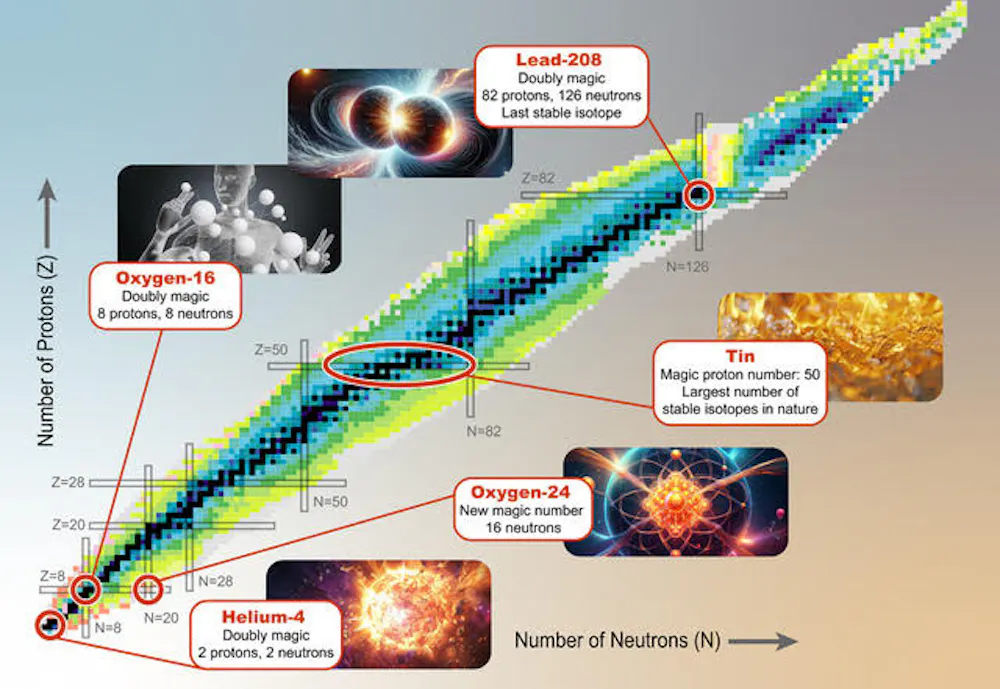
    The magic numbers known to scientists are 2, 8, 20, 28, 50, 82 and 126. They are the same for both protons and neutrons. When a nucleus has a magic number of protons or neutrons, then the particular orbit is filled, and the nucleus is not very reactive, similar to the noble gases.

    For example, the element tin has a magic number of protons. Tin always has 50 protons, and its most common isotope has 70 neutrons. Isotopes are atoms of the same element that have a different number of neutrons.

    There are nine other stable isotopes of tin that can exist – it’s the element with the largest number of stable isotopes. A stable isotope will never spontaneously change into a different element, which is what happens to radioactive isotopes.

    Helium, with two protons and two neutrons, is the lightest “doubly magic” nucleus. Both its neutron count and its proton count are a magic number. The forces that hold the helium-4 nucleus together are so strong that it’s impossible to attach another proton or neutron. If you tried to add another proton or neutron, the resulting atom would fall apart instantaneously.

    On the other hand, the heaviest stable nucleus in existence, lead-208, is also a doubly magic nucleus. It has magic numbers of 82 protons and 126 neutrons.

    Many stable isotopes have magic numbers of protons and neutrons.
    The Facility for Rare Isotope Beams

    Examples of magic numbers and stable nuclei exist everywhere – but scientists couldn’t explain them without the introduction of the shell model.

    Stable nuclei in nature

    The shell structure in nuclei tells researchers about how elements are distributed across the Earth and throughout the universe.

    One of the most abundant elements on our planet and in the human body is oxygen, in particular the isotope oxygen-16.

    With eight protons and eight neutrons, oxygen-16 has an extremely stable nucleus. A nearby star produced the oxygen we find on Earth through nuclear reactions in its core sometime before the solar system was formed.

    Since oxygen nuclei are doubly magic, these nuclei in the star did not interact very much with other nuclei. So more oxygen was left around to eventually act as an essential ingredient for life on Earth.

    In her Nobel lecture, Maria Goeppert Mayer talked about the work she did with physicist Edward Teller. The two had attempted to describe how these elements formed in stars. In the 1930s, it was impossible for them to explain why certain elements and isotopes were more abundant in stars than others. She later found that the increased abundances corresponded to nuclei with something in common: They all had magic numbers of neutrons.

    With the shell model and the explanation of magic numbers, the production of elements in stars was possible and was published in 1957.

    Scientists today continue to use ideas from the nuclear shell model to explain new phenomena in nuclear science. A few accelerator facilities, such as the Facility for Rare Isotope Beams, where we work, aim to create more exotic nuclei to understand how their properties change compared with their stable counterparts.

    At the Facility for Rare Isotope Beams, scientists produce new isotopes by accelerating stable isotopes to about half the speed of light and smashing them at a target. Out of the pieces, we select the rarest ones and study their properties.

    Possibly the most profound modern discovery is the fact that the magic numbers change in exotic nuclei like the type we create here. So, 75 years after the original discovery, the race to discover the next magic number is still on.

    Artemis Spyrou receives funding from the US National Science Foundation.

    Sean Liddick receives funding from the Department of Energy, Office of Science and the Department of Energy, National Nuclear Security Administration.

    ref. Many stable atoms have ‘magic numbers’ of protons and neutrons − 75 years ago, 2 physicists discovered their special properties – https://theconversation.com/many-stable-atoms-have-magic-numbers-of-protons-and-neutrons-75-years-ago-2-physicists-discovered-their-special-properties-239690

    MIL OSI – Global Reports

  • MIL-Evening Report: Failure to launch: why the Albanese government is in trouble

    Source: The Conversation (Au and NZ) – By Carol Johnson, Emerita Professor, Department of Politics and International Relations, University of Adelaide

    It wasn’t meant to be like this.

    In her 2022 study of Anthony Albanese, Katharine Murphy describes a prime minister who thought he’d be successfully managing an idealistic, collaborative and positive “new politics” that would favour the Teal independents rather than Dutton’s Liberals. Albanese seemed confident that Labor was destined for an extended period in office. Given he later appointed Murphy to his communications team, he apparently approved of her analysis.

    However, even at the time Murphy’s Lone Wolf: Albanese and the New Politics was published, various commentators, including myself, queried the “new politics” scenario. While the Teals may represent a new politics, it is clear that the old Liberal politics — of culture wars and denouncing Labor’s economic and climate change policies — is also still very much with us.

    Labor and the Liberals are now neck-and-neck in some polls, with minority government (or worse) potentially looming for Labor. Meanwhile, Gareth Evans and Bill Kelty, key figures from the Hawke/Keating period, have excoriated the Albanese government’s allegedly lacklustre performance.

    How did it all go so wrong?

    Great expectations; modest reality

    Some of the reasons can be traced back to difficulties addressing unrealistic expectations in Labor’s 2022 election strategy. Albanese went to the 2022 election with a “new politics”, collaborative style agenda that sought to bring all Australians, including business, labour, Indigenous and non-Indigenous Australians together. It was a small target strategy based on assumed common interests, kindness and compassion rather than divisiveness.

    As a result, Labor successfully countered Scott Morrison’s populist, “us versus them” campaign strategy. However, Labor’s approach was to prove easier to implement as an election strategy than in government, as three examples show.

    First, Albanese was channelling Bob Hawke when it came to bringing business and labour together. Yet, the Hawke government’s rapprochement with business was based on business being able to pay lower wages, because workers would be compensated by a government-funded “social wage” in the form of benefits and entitlements.

    By contrast, the Albanese government pledged to end the wage stagnation of the Liberal years and generally increase wages. A major emphasis was placed on improving the wages of low-paid women workers. In the process, Labor tackled issues that arose from Keating’s flawed, neoliberal-influenced, enterprise bargaining model.

    However, key business groups criticised Labor’s resulting industrial relations measures, including multi-employer bargaining, increases in the minimum wage, and measures designed to address precarious and contract work. The Liberals have largely sided with business critiques.

    Second, Labor’s attempts to bring Indigenous and non-Indigenous Australians together, via the Voice referendum, fell victim to a divisive, populist campaign by Dutton and others. Dutton depicted the Voice proposal not as arising from a major national meeting of Indigenous representatives but as being an elite “Canberra voice” that would give special rights to Indigenous Australians that were denied to others. Furthermore, he argued that government was so focused on elite “woke” issues such as the Voice, it was neglecting Australian workers’ cost-of-living crisis. Labor’s strategy for countering right-wing populism was in disarray.

    Albanese’s response to the Voice loss was to go even more “small target” in ways that alienated progressive supporters. He abandoned key commitments ranging from the Indigenous Makarrata commission process of Treaty and Truth-telling, to protecting LGBTQI+ teachers and students from being sacked by religious schools. The debacle over including gender identity questions in the census was another result.

    Third, international events, and other parties’ politicisation of them, have impeded the government’s attempts at social cohesion. Australian political debate has become so polarised over developments in the Middle East that the Albanese government is accused of abandoning support for Israel by the Liberals and the Murdoch press, while simultaneously being accused of being “complicit in Israel’s genocide” by the Greens and pro-Palestinian groups.

    Narrative failure

    As its original story of bringing Australians together has been increasingly undermined, the government has floundered when it comes to telling a clear narrative about itself. By contrast, Dutton’s relentless, focused and simply expressed negativity has been cutting through.

    Part of Labor’s problem in countering Dutton is that he is targeting them for things that are often beyond their control.

    For example, Dutton’s claim the government has been too distracted by so-called “woke” issues to address the cost-of-living crisis has been particularly electorally damaging for Labor. So have his claims that Labor’s renewable energy policies are fuelling inflation and pushing up the cost of living still further.

    The government argues it has been providing extensive cost-of-living relief in the form of tax cuts, energy bill relief, rental assistance, wage increases, cheaper medicines and reduced child care costs. However, the problem is that such government measures are being continually undercut by inflation, price increases, high interest rates, and the housing affordability and supply crisis.

    Yet, the housing affordability and supply crisis has been aggravated by decades of poor housing policy that long predate the Albanese government. Furthermore, Labor’s attempts to address it are currently being stymied by a combination of Coalition and Greens opposition, once again sandwiching Labor.

    Meanwhile, the Coalition argues that government spending is exacerbating inflation and high interest rates. However, even the independent Reserve Bank, which sets cash interest rates and is also critical of government spending, has drawn attention to multiple international factors playing a role in inflation. Price increase gouging by some businesses to augment their profits has exacerbated the problem.

    Furthermore, Treasurer Jim Chalmers argues that existing government spending levels have been essential to preventing Australia sliding into recession, while still enabling a budget surplus.

    Chalmers has struggled to cut through in the way that Keating’s messages did. However, Keating benefited from the Coalition largely agreeing with his neoliberal-influenced “reform” agenda, despite arguing it wasn’t going far enough. By contrast, Chalmers has been facing a fundamentally hostile opposition, unsympathetic to key influences on his thought, such as Mariana Mazzucato.

    Labor has also had trouble selling the government’s achievements because, as I argue in a recent book, some of the Albanese government’s most successful reform measures have been in gender equality (although much more still needs to be done). Despite women making up more than half of the population, reforms that affect women tend to be undervalued in what is still a male defined political culture. Furthermore, the working class is often conceived in terms of blue collar male employment, so benefits for women workers are not being adequately recognised. This is particularly the case in Dutton’s hyper-masculine, strongman discourse.

    Mobilising gendered leadership stereotypes has been central to Dutton’s populist “us” versus “them” politics. Dutton consistently depicts Albanese as an emasculated “weak” leader on issues ranging from addressing the cost of living crisis to detaining asylum seekers freed by a High Court decision, and supporting Israel. By contrast, Dutton is depicted as the strong leader who will stand up for everyday Australians allegedly abandoned by Labor and the so-called elites.

    This does not look like a “new politics” at all and it is a divisive, populist terrain that Labor is finding very difficult to negotiate.

    Carol Johnson has received past funding from the Australian Research Council for work on Labor governments and on gender equality policy. .

    ref. Failure to launch: why the Albanese government is in trouble – https://theconversation.com/failure-to-launch-why-the-albanese-government-is-in-trouble-239730

    MIL OSI AnalysisEveningReport.nz

  • MIL-Evening Report: One of science’s greatest achievements: how the rapid development of COVID vaccines prepares us for future pandemics

    Source: The Conversation (Au and NZ) – By Paul Griffin, Professor, Infectious Diseases and Microbiology, The University of Queensland

    Since COVID was first reported in December 2019, there have been more than 775 million recorded infections and more than 7 million deaths from the disease. This makes COVID the seventh-deadliest pandemic in recorded history.

    Factors including climate change, disruption of animal habitats, poverty and global travel mean we’re only likely to see more pandemics in the future.

    It’s impossible to predict exactly when the next pandemic will happen, or what it will be. But experts around the world are working to prepare for this inevitable “disease X”.

    One of the cornerstones of being prepared for the next pandemic is being in the best possible position to design and deploy a suitable vaccine. To this end, scientists and researchers can learn a lot from COVID vaccine development.

    A look back

    After SARS-CoV-2 (the virus that causes COVID) was discovered, vaccine development moved very quickly. In February 2020 the first batch of vaccines was completed (from Moderna) and the first clinical trials began in March.

    An mRNA vaccine from Pfizer/BioNTech was the first to be approved, on December 2 2020 in the United Kingdom. Approvals for this and other vaccines, including shots developed by Moderna (another mRNA vaccine) and Oxford/AstraZeneca (a viral vector vaccine), followed elsewhere soon afterwards.

    Previously the fastest vaccine developed took around four years (for mumps in the 1960s). Had COVID vaccines taken this long it would mean we would only just be rolling them out this year.

    An estimated 13.72 billion COVID vaccine doses have now been administered, with more than 70% of the world’s population having received at least one dose.

    The rapid development and rollout of COVID vaccines is likely to be one of the greatest achievements of medical science ever. It also means we are in a much better position to respond to future emerging pathogens.

    New vaccine technology

    A lot of work over many years prepared us to develop COVID vaccines as quickly as we did. This included developing new platforms such as viral vector and mRNA vaccines that can be adapted quickly to new pathogens.

    While scientists had been working on mRNA vaccines for decades before the COVID pandemic, the COVID shots from Pfizer/BioNTech and Moderna were the first mRNA vaccines to be approved for human use.

    These vaccines work by giving our body instructions (the “m” in mRNA stands for messenger) to make SARS-CoV-2 spike proteins. These are proteins on the surface of the virus which it uses to attach to our cells. This means when we encounter SARS-CoV-2, our immune system is poised to respond.

    This technology will almost certainly be used to protect against other diseases, and could potentially help with a future pandemic.

    In the meantime, scientists are working to improve mRNA technology even further. For example, “self-amplifying RNA” has the potential to enhance immune responses at lower doses compared with conventional mRNA.

    mRNA vaccines teach our bodies to make SARS-CoV-2’s spike protein.
    Kateryna Kon/Shutterstock

    While our current COVID vaccines are safe and very effective at protecting against severe disease, they’re not perfect. We may never be able to achieve a “perfect” vaccine, but some additional properties we’d like to see in future COVID vaccines include being better at reducing transmission, lasting longer, and needing to be updated less often as new variants emerge.

    Even now there are many COVID vaccines in clinical trials. So hopefully, COVID vaccines that improve on the initial shots will be available relatively soon.

    Other desirable attributes include vaccines we can administer by alternate routes to needles. For COVID and other diseases such as influenza, we’re seeing significant developments locally and internationally on vaccines than can be administered via skin patches, through the nose, and even orally.

    Some challenges

    Developing vaccines for COVID was a huge challenge, but one that can mostly be judged a success. Research has estimated COVID vaccines saved 14.4 million lives across 185 countries in just their first year.

    However, the story of COVID vaccination has also had many other challenges, and arguably a number of failures.

    First, the distribution of vaccines was not equitable. Analysis of the initial rollout suggested nearly 80% of eligible people in high-income countries were vaccinated, compared with just over 10% in low-income nations.

    Supply of vaccines was an issue in many parts of the world, so expanding local capacity to enable more rapid production and distribution of vaccines will be important for the next pandemic.

    Further, adverse events linked to COVID vaccines, such as rare blood clots after the AstraZeneca vaccine, affected perceptions of vaccine safety. While every serious adverse event is significant, these incidents were very rare.

    However, these issues exacerbated other challenges that hampered vaccine uptake, including the spread of misinformation.

    Misinformation remains a problem now and will probably still be prevalent whenever we face the next pandemic. Addressing this challenge involves understanding what’s deterring people from getting vaccinated, then informing and educating, addressing misinformation both about vaccination and the risks of the disease itself.

    Restoring and building trust in public health authorities also needs to continue to be a focus. Trust in governments and health authorities declined during the COVID pandemic, and evidence shows lower trust is associated with lower vaccine uptake.

    The COVID vaccine rollout faced a variety of challenges.
    Yuganov Konstantin/Shutterstock

    Ongoing preparation

    There’s no doubt our recent experience with COVID, particularly the rapid development of multiple safe and effective vaccines, has put us in a better position for the next pandemic.

    This didn’t happen by accident. There was a lot of preparation even before COVID was first discovered that facilitated this. Organisations like the Coalition for Epidemic Preparedness Innovations (CEPI) have been supporting research to develop vaccines rapidly to respond to a new threat for some time.

    CEPI has an ongoing program that aims to be able to develop a vaccine against a new threat, or disease X, in just 100 days. While COVID vaccines have been a huge achievement, work continues in the hope we will be able to develop a vaccine even faster next time.

    This article is part of a series on the next pandemic.

    Paul Griffin is a director and scientific advisory board member of the immunisation coalition. He has served on Medical Advisory Boards including for AstraZeneca, GSK, MSD, Moderna, Biocelect/Novavax, Seqirus and Pfizer and has received speaker honoraria including from Seqirus, Novartis, Gilead, Sanofi, MSD and Janssen.

    ref. One of science’s greatest achievements: how the rapid development of COVID vaccines prepares us for future pandemics – https://theconversation.com/one-of-sciences-greatest-achievements-how-the-rapid-development-of-covid-vaccines-prepares-us-for-future-pandemics-228787

    MIL OSI AnalysisEveningReport.nz

  • MIL-Evening Report: Ocean protection accounts for 10% of fish in the world’s coral reefs – but we could save so much more

    Source: The Conversation (Au and NZ) – By Joshua Cinner, Professor & ARC Laureate Fellow, Thriving Oceans Research Hub, School of Geosciences, University of Sydney

    Ocean fish populations have fallen dramatically in the past half-century, and climate change is expected to make the problem worse. Governments have designated “marine protected areas”, where where human activity is constrained to protect ocean life. But have these efforts worked?

    About 8% of Earth’s oceans are protected, including about 3% where fishing is banned altogether. Our new study of nearly 2,600 tropical coral reefs around the world is the first to examine whether these areas have helped fish populations.

    We found about one in ten kilograms of fish on coral reefs is the result of efforts such as marine protected areas and other restrictions on fishing. This is promising news. But our study also reveals great room for improvement.

    A video discussing how Earth’s fish stocks are declining.

    Getting to grips with marine protection

    Maintaining healthy fish populations is important. Many communities depend on fishing for their food and livelihoods. And fish play a vital role in ocean ecosystems.

    Marine protected areas are a key policy tool used to increase fish populations. They cover a range of ocean areas including lagoons, coastal waters, deep seabed waters and coral reefs.

    The areas go by several names, including marine parks and conservation zones. Some, where fishing is prohibited, are known as no-take zones.

    Governments often quote figures on the area of ocean protected when seeking to tout their conservation policies. For example in Australia, we are told the federal, state and territory governments have established marine parks covering 4.3 million square kilometres or 48% of our oceans.

    But the extent to which marine protected areas actually conserve marine life varies enormously from place to place. So simply counting up the protected ocean area doesn’t tell you much about what has actually been achieved.


    Measuring success

    We and our colleagues wanted to assess the extent to which marine protection efforts have increased the amount of fish on coral reefs.

    We developed a computer model based on about 2,600 reefs across the global tropics, which includes reefs in the Pacific, Indian, and Atlantic oceans. From that, we estimated the amount of fish currently on each reef – measured in the kilograms of fish per hectare, or “biomass”.

    The estimations were based on information such as:

    • environmental conditions such as ocean temperature and the type of habitat where the reef is located

    • the intensity of fishing activity, known as “fishing pressure”

    • how strong the protection is – for example whether it bans fishing, or just restricts it

    • the level of compliance with no-take zones.

    We then simulated what would happen if we changed the type of protection strategy in each location while keeping everything else the same.

    We ran a few scenarios:

    • no coral reef conservation existed anywhere and all reefs could be fished without constraint

    • sites currently fished without constraint (which amounted to over half of our sites) had restrictions in place

    • fishing was prohibited on 30% of all reefs.

    And the results?

    We found both marine protected areas and other fishing restrictions account for about 10% of the fish “biomass” on reefs. In other words, about one in ten kilograms of fish on coral reefs is due to protection efforts.

    No-take zones punch above their weight. Of the fish biomass attributable to protection efforts, about 20% comes from just 3% of sites in no-take zones. This proportion would be even higher if illegal fishing in no-take zones was stamped out.

    But we found any type of fishing restriction was useful. If everywhere currently fished without constraint was subject to some level of protection – such as banning nets or spear guns – the biomass of fish globally would be another 10.5% higher, our study found. This essentially matches all conservation efforts to date.

    Our modelling also showed fish on coral reefs could be increased by up to 28% globally if the area of no-take zones rose to 30%.

    But these reefs must be chosen strategically. That’s because protection strategies can lead to wildly different results, depending on local conditions. For example, sites with lower fishing pressure in the surrounding seascape got a bigger boost from protection than places surrounded by intensive fishing effort.

    This may be because at heavily fished locations, algae often overtakes coral as the dominant feature. Algae is less fish-friendly than coral, so fish populations may not bounce back quickly even when fishing pressure is reduced.

    Grounds for optimism

    Our study tested the mettle of global coral reef conservation. On one hand, we found conservation efforts have made a contribution to the amount of fish on global coral reefs, which provides grounds for cautious optimism.

    But on the other hand, this contribution is quite modest. Our study shows much greater gains could be made not only by expanding protected marine areas, but also by improving compliance in existing ones.

    Most nations have signed a global agreement to protect 30% of Earth’s land and waters by 2030. That means the amount of ocean in marine protected areas globally will increase nearly fourfold in just six years.

    As governments continue this task, we hope our results help identify ocean sites that will benefit most from protection.

    Joshua Cinner receives funding from the Australian Research Council and National Geographic Society. He is a Fellow of the Academy of Social Sciences in Australia and the International Coral Reef Society.

    Iain R. Caldwell is affiliated with the Wildlife Conservation Society

    ref. Ocean protection accounts for 10% of fish in the world’s coral reefs – but we could save so much more – https://theconversation.com/ocean-protection-accounts-for-10-of-fish-in-the-worlds-coral-reefs-but-we-could-save-so-much-more-239188

    MIL OSI AnalysisEveningReport.nz

  • MIL-Evening Report: I think my child might need a tutor. What do I need to consider first?

    Source: The Conversation (Au and NZ) – By Matthew White, Lecturer and Researcher Australian Catholic University, Australian Catholic University

    School tutoring is a huge business. Australian estimates suggest it was worth more than of A$1.5 billion as of 2021.

    In Australia, we see frequent media reports of parents using tutors to help their children through school.

    How can you tell if tutoring is right for your child?

    What is tutoring?

    Private tutoring can be take many forms, but involves parents paying for additional lessons outside of schools hours. These are either one-to-one or in small groups.

    There are services available for students in primary school through to senior high school.

    Some tutoring services target specific skills, such as literacy or numeracy. Others offer support for young people with organisation skills and homework or preparation for certain exams.

    Tutoring can go for a short burst over a few weeks to prepare for an exam or it may be regular and ongoing to maintain learning.

    Tutoring could be to catch up on one element of school, such as handwriting or reading.
    Deyan Georgiev/ Shutterstock

    Why do people get tutoring?

    Families can get tutoring for a student for a wide range of reasons.

    A child may be struggling with certain elements of schooling – such as reading, writing, or maths. Tutoring can provide an opportunity to catch-up with tailored support.

    Tutoring can also help children prepare for tests and exams, such as NAPLAN or Year 12.

    Tutoring is used to prepare students for government selective school programs or private school scholarship exams.

    Researchers have highlighted some cultural backgrounds see investing in tutoring as an essential part of educating their children and helping them reach their full potential.

    The tutoring debate

    Tutoring can be expensive and time consuming for families. Families may pay between $30 and $200 a session, depending on the subject and qualifications of the tutor.

    Some argue this gives some children an unfair advantage and students should instead rely on their natural ability.

    Despite the criticism, there are benefits to tutoring. This includes giving students extra opportunities to consolidate their knowledge – we know this can help students learn.

    It can also help build their confidence if a tutor can step through learning in a less pressured environment. As my research has shown, academic progress relies heavily on a students’ belief in their capacity to succeed.

    Does my child need a tutor?

    All students can benefit from personalised support and coaching in whatever they wish to peruse. However, all students do not need a tutor. The choice to engage a tutor should be attached to a goal that you and your child agree on.

    If the young person does not want to engage in tutoring having a tutor is not going to help. Rather, it is more likely to lead to stress and arguments.

    It may help to talk to your child’s teacher and review school reports before starting with a tutor to work out which particular areas need extra attention.

    Depending on what you need, your child’s tutor may be a university student or someone who has made a career out of tutoring.
    Dmytro Zinkevvych/Shutterstock

    If your shared goal is to catch up or help with certain academic skills, it is important to find a tutor who is experienced and can explain the approach they take and what evidence it is based on.

    If the goal is organisation, homework or even just to improve confidence, you could at first try a university student who has past success themselves or with other students. For more specialised goals, seek out tutors who are open about their qualifications, experience and past success.

    Child safety should also be a consideration. The Australian Tutoring Association provides practical advice for parents choosing a tutor and a code of conduct for tutors.

    There is no requirement for tutors to be a member of the association. So parents should make sure any tutor has a current Working with Children check. You can of course also talk to other parents and teachers for recommendations.

    Matthew White does not work for, consult, own shares in or receive funding from any company or organisation that would benefit from this article, and has disclosed no relevant affiliations beyond their academic appointment.

    ref. I think my child might need a tutor. What do I need to consider first? – https://theconversation.com/i-think-my-child-might-need-a-tutor-what-do-i-need-to-consider-first-240091

    MIL OSI AnalysisEveningReport.nz

  • MIL-Evening Report: Still with the Tony Soprano memes? Young audiences are watching the series with fresh eyes

    Source: The Conversation (Au and NZ) – By Alexander H. Beare, Lecturer in Media, University of Adelaide

    HBO’s latest crime drama The Penguin came with a flood of memes on TikTok, X and Instagram. They compare actor Colin Farrell’s Oswald Cobblepot to James Gandolfini’s Tony Soprano.

    It’s true, there are undeniable similarities between the two portrayals and shows. HBO’s official TikTok account went so far as to upload an edit of The Penguin trailer cut to the rhythm of Alabama 3’s Woke Up This Morning – the title theme for The Sopranos.

    Running for six seasons from 1999 to 2007, The Sopranos is enjoying a sustained cultural relevancy in 2024 – something other prestige dramas of the same era such as Six Feet Under and The Shield have not achieved. A new two-part documentary about the making of the The Sopranos just premiered on HBO, 25 years after the show made its debut.

    For the last couple of years, fans have been discovering the show and making it their own. But how does it fit the present moment?

    The Sopranos as catharsis

    My research and upcoming book is based on in-depth interviews with a group of new Sopranos fans all aged between 19–26. In other words, not old enough to have watched the show when it first aired.

    During the pandemic, The Sopranos saw a surge in viewership and interest that outstripped its contemporaries like Deadwood.

    Superficially, the show is visually comparable to COVID lockdown. Tony and his kids are regularly shown sleeping in, dressed in baggy clothes, and shuffling around the kitchen picking at cold cuts.

    For those I spoke with, viewing The Sopranos wasn’t a way to escape from lockdown: it was a way to purge pent-up emotion.

    For Darcy, the show became:

    Like a cathartic tool, like, I can relate, this is how life feels right now […] A bit of relief, and a sense of relatability, you know? It was always comforting when things are not good.

    Tom shared this feeling:

    One of the cool things about The Sopranos is that a lot of the stuff is really mundane […] It’s about drudgery more than anything […] That’s what lockdown feels like – and it definitely is what a lot of daily life feels like […] it’s those moments of opening up the fridge and just eating like 20 slices of gabagool because you can’t be fucked making something to eat.

    The Sopranos as nostalgia

    The Sopranos is a profoundly negative show and yet it was being viewed by the young people I spoke to through quite an optimistic lens.

    Alannah said:

    It makes me feel nostalgic for a time when things felt a little bit like […] simpler, even though they have complications. It just seemed like a good stage of history to be in.

    In a similar vein, Callum positively characterised this feeling as an “added bonus” that “drew him into watching the show”. Selina fondly remembered the fashion and music of the show.

    Watching with a new lens

    During its original run, The Sopranos was often lauded by scholars for its deconstruction of patriarchal masculinity. This was not so much the case for the people I spoke to.

    Alannah worried The Sopranos could easily be placed in the toxic online “manosphere”:

    [The Sopranos is] like Fight Club and American Psycho. White dudes will watch it and be like, ‘Yeah, this is fucking sick – that’s me man’. And it’s like, you don’t want to be these people! You have to criticise it yourself because it is not overt in my opinion.

    Stuart expressed a similar concern about The Sopranos’ ability to be a dangerous power fantasy.

    In his experience with online Sopranos content, he observed:

    [There are fans] who see Tony Soprano as the ideal man and don’t notice that the show is supposed to be critiquing his behaviour.

    These concerns about “misunderstanding” the show very much reflect current anxieties. The reporting about how the 2019 Joker film might incite violence from white men provides a salient reference point for these worries.

    For the new viewers I spoke to, there was a real concern The Sopranos could combine dangerously with today’s toxic misogynistic online content. They were worried Tony Soprano could be interpreted as a celebration of patriarchal masculinity rather than a critique.

    Born under a bad sign

    In 2024, The Sopranos is still managing to click with new audiences. But these fans interpret the show differently and take new meaning from it. When we look at their responses, we can see how The Sopranos intersects with the attitudes and anxieties of modern audiences.

    Next time you see a meme about Tony Soprano, consider what context today’s viewers place him in – and whether an audience from 20 years ago would have done the same. Today, he might be considered even more dangerous.

    Alexander H. Beare does not work for, consult, own shares in or receive funding from any company or organisation that would benefit from this article, and has disclosed no relevant affiliations beyond their academic appointment.

    ref. Still with the Tony Soprano memes? Young audiences are watching the series with fresh eyes – https://theconversation.com/still-with-the-tony-soprano-memes-young-audiences-are-watching-the-series-with-fresh-eyes-237982

    MIL OSI AnalysisEveningReport.nz

  • MIL-OSI USA: Casey Delivers $4.5 Million to Lower Energy Costs for Farmers and Small Business Owners

    US Senate News:

    Source: United States Senator for Pennsylvania Bob Casey
    Grants funded by Casey-backed Inflation Reduction Act
    Grants will go towards purchasing and installing solar energy systems and improving waste digestion to help farmers and small businesses save on energy costs  
    Washington, D.C. – U.S. Senator Bob Casey (D-PA) secured a total of $4,537,255 to lower energy costs for farmers and small businesses across the Commonwealth. The twenty awards will help businesses and farms purchase and install solar photovoltaic systems, which will convert captured solar energy into electricity to power machines and operations and save Pennsylvanians thousands of dollars per year. These funds will also help a Pennsylvania dairy farm purchase and install a new engine for their anerobic digester. The funding comes from the U.S Department of Agriculture’s (USDA) Rural Energy for America (REAP) program, made possible by the Inflation Reduction Act.
    “When we invest in technology that lowers energy costs for our businesses and farmers, we are investing in the Commonwealth’s long-term success,” said Senator Casey. “Thanks to the Inflation Reduction Act, farmers and small businesses can continue supporting their families and their communities and save thousands of dollars each year. I will always fight for investments that lower costs, support businesses, and protect our Commonwealth’s environment for generations to come.”
    See below for a list of project recipients of the Inflation Reduction Act funding.
    Table of Funding Recipients
    Recipient
    Grant
    City/County

    Denis Beachel

    $329,831

    Danville, Montour County

    Charles L. Fisher

    $648,800

    Unionville, Centre County

    McNaughton Bros Inc.

    $152,600

    Indiana, Indiana County

    GeoTech Engineering Inc.

    $49,894

    Morrisdale, Clearfield County

    Ambassador Towers LLC

    $483,300

    Huntington County

    Pax-Terra LLC

    $610,420

    Meyersdale, Somerset County

    Schrack Farms LP

    $479,161

    Loganton, Clinton County

    Unity Lab Corp.

    $387,300

    Dunshore, Sullivan County

    Bruce King Jr.

    $306,150

    Troy, Bradford County

    Ebensburg Animal Hospital Inc.

    $165,773

    Ebensburg, Cambria County

    Mr. B’s Lawn Service Inc.

    $29,080

    Ellwood City, Lawrence County

    Talview Dairy LLC

    $200,704

    Lebanon, Lebanon County

    Philip Wise

    $79,000

    Berks County

    Mann Plumbing and Heating LLC

    $49,810

    Fayetteville, Franklin County

    Shree Sai Nivas LLC

    $81,142

    Mifflin County

    Joeseph Nolt

    $81,216

    Lancaster County

    Bellaire Farms LLC

    $184,050

    Elizabethtown, Lancaster County

    McCartney’s Inc.

    $56,024

    Altoona, Blair County

    Peter G. Reifsnyder Inc.

    $66,250

    Bernville, Berks County

    Eagle Rental Inc.

    $96,750

    Lebanon County

    MIL OSI USA News

  • MIL-OSI USA: Casey, Fetterman, Reschenthaler, Deluzio, Lee Urge Army Corps to Respond to Navigation Concerns on Monongahela River, Help Mon Valley Economy

    US Senate News:

    Source: United States Senator for Pennsylvania Bob Casey
    Army Corps is leading on lock and dam removal in broader effort to modernize Monongahela River, key for region’s economy
    Members: “We understand that the various agencies of the Commonwealth are already standing ready to support the needed work on the Mon River. The Corps must do the same, as quickly as possible”  
    Washington, D.C. – Today, U.S. Senators Bob Casey (D-PA) and John Fetterman (D-PA) and U.S. Representatives Guy Reschenthaler (R-PA-14), Chris Deluzio (D-PA-17), and Summer Lee (D-PA-12) continued to demand action on significant navigation issues on the Monongahela River and the ongoing impacts to the local economy. Due to significant changes in water levels, commercial barges continue to encounter shallow areas that damage equipment and impede regional commerce. The Members pressed the U.S. Army Corps of Engineers (USACE) to act swiftly to do all in its power to help alleviate the depth and navigational issues to keep the Mon—and Southwestern Pennsylvania’s economy—flowing.
    “We recognize that addressing shallow areas that hinder navigation is a shared priority for all stakeholders involved. Because the dam removal led to the current navigational challenges, we believe it is imperative that the Corps does everything in its power to assist in remedying the navigational issues on the Mon River,” the Members wrote.
    In the letter, the Members highlighted how the project will be extensive and require a multi-party effort to address and urged USACE to commit to assist in determining outstanding dredging needs with the U.S Coast Guard, the Pennsylvania Department of Transportation (PennDOT), and industry stakeholders.
    The Members continued, “We understand that the various agencies of the Commonwealth are already standing ready to support the needed work on the Mon River. The Corps must do the same, as quickly as possible.”
    The removal of the Elizabeth Locks and Dam is part of a broader effort to modernize the Monongahela River, a key waterway for Southwestern Pennsylvania’s economy. Earlier this summer, USACE began the dam removal project with help from the U.S. Coast Guard to keep the river safe and navigable during the project. Unfortunately, due to a resulting shallowness in the lock chamber, commercial barges could not initially navigate the Mon River at standard draft. The Members alerted the Corps to the ongoing issue and urged the Corps to do everything in its power to remedy the navigational challenges that continue to threaten the economy in Southwestern Pennsylvania.
    Senators Casey and Fetterman and Representatives Reschenthaler, Deluzio, and Lee have consistently pressed USACE to act swiftly to restore commercial barge navigability to normal. In August, the Members raised alarms to the Corps after learning that the water levels in the Elizabeth Locks were too shallow to accommodate traditional commercial vessels. In July, the Members urged USACE to prioritize the restoration of the nine-foot draft and provide ongoing updates about the project’s status. They also reminded USACE about the steep economic costs of delaying this project.  
    Read the letter HERE or below:
    Dear Lieutenant General Graham:
    We write to reiterate our ongoing concerns with the impact of the dam removal at Locks and Dam (LD) 3 on navigation traffic on the Monongahela River (“Mon River”) near Elizabeth, Pennsylvania. The project’s goal was to create one, continuous pool of water between Charleroi, PA and Braddock, PA, reducing travel times for commercial vessels and boosting the regional economy. While some overall reduction in water levels were expected, the drop observed after the initial demolition at Elizabeth has been unexpectedly detrimental to navigation. The resulting low water levels have created new navigational challenges on the river, that must be remedied to ensure that the benefits of the removal become a reality. 
    We recognize that addressing shallow areas that hinder navigation is a shared priority for all stakeholders involved. Because the dam removal led to the current navigational challenges, we believe it is imperative that the Corps does everything in its power to assist in remedying the navigational issues on the Mon River. We understand that the Corps’ support for this work could include, but is not limited to:
    Developing and sharing all relevant data, including all survey results that may be helpful to determining outstanding dredging needs with the Coast Guard, the Pennsylvania Department of Transportation (PennDOT), and industry stakeholders;
    Exploring potential beneficial uses of dredged materials produced as a result of Corps dredging and any supplementary dredging;
    Expediting permitting for dredge work on the Mon River;
    We appreciate the Corps’ ongoing work to respond as it can to the high points by using existing funding to quickly begin dredge work on problematic areas. However, the outstanding work required to return the river to its pre-demolition functionality is extensive and will require a multi-party effort to address. To facilitate that essential collaboration, we respectfully request answers to the following questions:
    Will USACE commit to taking all action possible to return the Mon to its pre-demolition functionality, including but not limited to sharing all relevant river survey results with the Coast Guard, PennDOT, and industry stakeholders, exploring potential beneficial uses of dredged material, and expediting permitting as possible and appropriate? 
    What is USACE’s plan for the remainder of the dam at the Elizabeth Locks and Dam? Will USACE and its contractors continue to detonate and remove the dam? If so, does USACE anticipate that this will have any impact on water levels?
    How is USACE prepared to work with other permitting agencies to expedite any needed permit adjustments?
    We understand that the various agencies of the Commonwealth are already standing ready to support the needed work on the Mon River. The Corps must do the same, as quickly as possible. We appreciate your prompt attention to the urgent needs on the Mon River and the questions above. 

    MIL OSI USA News

  • MIL-OSI New Zealand: Significant investment for affordable housing with Waikato-Tainui

    Source: New Zealand Government

    Mehemea he pai mō te tangata, mahia! If it’s good for the people, get on with it!

    A $35 million Government investment will enable the delivery of 100 affordable rental homes in partnership with Waikato-Tainui, Associate Minister of Housing Tama Potaka says.

    Investment for the partnership, signed and announced today in Waikato, will go toward the delivery of 57 affordable rental homes and enable the infrastructure of a further 43 affordable rentals just north of Ngāruawāhia.

    “The Hopuhopu Housing Development will help deliver better social and community outcomes for whānau who will live, work, and build cultural identity there,” Potaka says.

    “Waikato has the highest number of emergency housing use, and nearby Hamilton has the third highest number of applicants on the Housing Register of any territorial authority.

    “Solving the housing crisis is one of this Government’s top priorities. In addition to our efforts to reduce emergency housing numbers, this partnership is another example of how we are taking action with Iwi to help address the housing shortage.”

    The Hopuhopu Housing Development will be on 170 hectares of land owned by Waikato-Tanui within the Hamilton to Auckland transport corridor. The land was initially confiscated and established as a military camp from 1920 until its return to Waikato-Tainui in 1993 

    Chair of the Waikato-Tainui executive, Te Arataura, Tukoroirangi Morgan said Hopuhopu was the first land parcel to be given back under the Waikato Raupatu Lands Settlement – its significance to Waikato-Tainui cannot be understated. 

    “Providing stable housing for our whānau further activates our focus to scale our investment,” says Morgan.

    “For us, the Hopuhopu Development will enable Waikato-Tainui to realise aspirations for a unique, vibrant, interconnected working, living and learning community that inspires unity, collaboration and innovation. 

    “We want to drive social returns in a way that enables the investment capital to be recycled in perpetuity.

    “The new homes will be for whānau with genuine housing need including kaumātua, and will include the building of larger whānau homes which may not be readily available or affordable on the private rental market.”

    The first construction contracts will be awarded in the final quarter of 2024, and it is expected Iwi members will be involved in the construction mahi. 

    The Government’s funding contribution has been led out of Te Tūāpapa Kura Kāinga – Ministry of Housing and Urban Development and is delivered through the Whai Kāinga Whai Oranga programme, which enables local affordable housing solutions that are delivered in partnership with Iwi and other Māori land owning entities.

    MIL OSI New Zealand News

  • MIL-OSI Translation: 03/10/2024 Armed Forces Innovation Forum 2024

    MIL AXIS Translation. Region: Polish/Europe –

    Fuente: Gobierno de Polonia en poleco.

    Armed Forces Innovation Forum 202403.10.202416 in energy in 2024 The 4th edition of the Armed Forces Innovation Forum of the Republic of Poland will be held in the complex of the Military University of Technology, a flagship undertaking of the Ministry of National Defence, constituting a meeting platform for the army, science and industry.

    FORO DE ASSUMPTIONS:Placing emphasis on the role of innovation in the development of the Polish Armed Forces and the need for the Ministry of National Defence to take decisive action in this direction.Promoting innovation in building and strengthening the capabilities of the Polish Armed Forces.Increasing competitiveness among project contractors – an opportunity for innovative enterprises.Specialization, building and strengthening the potential of domestic research and development entities and industries in the area of new and breakthrough technologies.Promoting new international tools as an opportunity for the development of innovation.Promoting the use of the capabilities of the Polish space industry in meeting the needs of the Polish Armed Forces as part of the implementation of the operational domain of space.FORO GOALS:UNDERTAKING ACTIONS FOR THE DEVELOPMENT OF THE INNOVATION SYSTEM IN THE FORUM is a good platform for starting a debate on the needs of the Polish Armed Forces and the possibilities of meeting them through the use of new solutions, including dual-use technologies. The implementation of this goal requires the creation of an appropriate system that promotes innovation in the RON, which is also to be served by the currently developed departmental innovation strategy. Initiating a debate on the role of tactical level commanders in the process of identifying, developing and using dual-use products for the needs of the Polish Armed Forces. PERFORMING THE FUNCTION OF A MEETING PLATFORM FOR THE ARMY, SCIENCE AND INDUSTRY A platform for meetings of representatives of the army, science and industry. During the sessions (discussion panels), a discussion will be held on the needs of the Polish army and the opportunities and innovation in science and industry in Poland and around the world. During the Forum, experiences will be exchanged and cooperation will be established between representatives of various environments. PRESENTATION OF CONCEPTS AND SOLUTIONS BY RESEARCH CENTRES, UNIVERSITIES AND POLISH INDUSTRY The Innovation Forum enables the presentation of new concepts and ideas that may have an impact on increasing the potential of the Polish Armed Forces, while at the same time being a platform for cooperation, exchange of information and experiences with research centers, universities and representatives of the Polish defense industry. Participation in the Forum of Polish Scientists is an opportunity for them to use their ideas and concepts for the benefit of Poland’s security and defence. STRENGTHENING COOPERATION FOR POLAND’S DEFENCE AND SECURITY The Forum has become one of many mechanisms that support the use of the research potential of Polish centers and the discovery of new opportunities among Polish scientific entities (or among Polish scientists). THEMATIC PANELS Three thematic panels will be held during the Forum: Dual-use technologies – a new trend that will pass, or a way to build the capabilities of the Polish Armed Forces? The prospect of developing the innovation system in the Ministry of National Defense. The area of outer space – the needs of the Polish Armed Forces and the capabilities of Polish industry and science. FORO PARTICIPATION IN THE INNOVATION OF THE ARMED FORCES 2024 The Forum will be held in a stationary form on October 16, 2024. The event will be a closed conference, in which invited participants will participate guests. An online broadcast will be held simultaneously for interested representatives of the world of science, industry, the Polish army and communities dealing with security and defense. Please send your online applications by October 11 to the electrifying director: forum@mon.gov.pl. Participation will be confirmed via the link to the online broadcast of the event. In case of questions or concerns, please contact the electrifying director: forum@mon.gov.pl.

    MILES AXIS

    EDITOR’S NOTE: This article is a translation. Apologies should the grammar and/or sentence structure not be perfect.

    MIL Translation OSI

  • MIL-OSI Translation: 07/10/2024 Minister Radosław Sikorski commemorated the victims of the terrorist attack of October 7, 2023.

    MIL ASI Translation. Region: Polish/Europe –

    Fuente: Gobierno de Polonia en poleco.

    Minister Radosław Sikorski honored the memory of the victims of the terrorist attack of October 7, 2023.07.10.2024The ceremony took place in the gardens of the Embassy of Israel in Warsaw in the presence of the Minister in the Chancellery of the President Wojciech Kolarski, the diplomatic corps, representatives of Jewish organizations. El embajador Yacov Livne expressed gratitude to the president, the government and the Polish nation for unanimously condemning the attack a year ago.

    In the October attack by Hamas and other groups on Israeli territory, approximately 1,200 people were killed, including over 800 civilians. In addition, 251 people were kidnapped to the Gaza Strip – 117 of whom were released, most of whom were released in November last year as a result of a short-term ceasefire. As a result of these events and further actions in the Gaza Strip, at least 19 people of Polish origin were killed, including 9 people with dual Polish and Israeli citizenship. One of the victims – the historian Alex Dancyg, born in Warsaw and distinguished for Polish-Jewish dialogue, was remembered by his son Yuval Dancyg. Minister Sikorski recalled that Poland has always condemned terrorism in any form and hopes that in the future the inhabitants of the Middle East will live in harmony. Those participating in the ceremony expressed solidarity with the group of 101 hostages still held in the Gaza Strip. The fate of most of them remains unknown.

    MILES AXIS

    EDITOR’S NOTE: This article is a translation. Apologies should the grammar and/or sentence structure not be perfect.

    MIL Translation OSI

  • MIL-OSI USA: Gov. Justice amends special session call with several new items for consideration

    Source: US State of West Virginia

    CategoriesEnglish, MIL OSI, US State Governments, US State of West Virginia

    CHARLESTON, WV — Gov. Jim Justice has issued a proclamation amending his original call for the West Virginia Legislature to convene in Special Session, adding several new items for consideration.

    Some of the additional items include: 

    • A 2% reduction in the personal income tax.
    • A resolution to honor Hershel “Woody” Williams with a statue in the National Statuary Hall Collection.
    • Funding for certain federally-funded broadband expansion programs to come from the West Virginia Economic Development Authority.
    • Supplemental funding for West Virginia University, Marshall University, Concord University, Shepherd University, and New River Community and Technical College.
    • The allocation of $5 million for statewide EMS program support.

    MIL OSI USA News

  • MIL-OSI USA: Governor Newsom statement marking one year since Hamas attack on Israel

    Source: US State of California 2

    Oct 7, 2024

    SACRAMENTO – Governor Gavin Newsom today issued the following statement marking one year since the October 7, 2023 attack by Hamas on Israel:

    “For the last year, the people of Israel – and Jewish communities across the globe – have mourned for their lost loved ones, prayed for the return of the hostages, and come together to show incredible strength in the face of rising antisemitism. The Jewish spirit is one of resilience and commitment to community, especially in times of great trauma, and California stands beside the people of Israel and the innocent families impacted by this ongoing conflict. As Jews around the world observe the Days of Awe and celebrate this most holy of times, may we pray for peace for all in the new year.”

    Governor Newsom visited Israel following the attacks and met with survivors  impacted families, and officials. The State of California shipped medical supplies — including field hospitals — to support humanitarian relief efforts in Israel and Gaza. Earlier this year, the Governor issued a Golden State Plan to Counter Antisemitism and penned an open letter to California’s Muslim, Palestinian American, and Arab American communities.

    Press Releases

    Recent news

    News Lo que necesita saber: El Estado lanzó una versión renovada de CA.gov, el portal insignia de California que conecta a las personas con cientos de servicios y programas estatales, como por ejemplo CalFresh, certificados de nacimiento, licencias comerciales,…

    News What you need to know: The state launched a refreshed version of CA.gov, California’s flagship portal that connects people to hundreds of state services and programs. Haga clic aquí para español.SACRAMENTO – Governor Gavin Newsom today announced the launch of the…

    News What you need to know: California is providing 18 local communities with nearly $131 million to help people experiencing homelessness in dangerous encampments — with robust new accountability requirements and expectations for local governments. Governor Newsom is…

    MIL OSI USA News

  • MIL-OSI USA: California takes bold step to revolutionize youth sports with 25×25 Coaches Challenge

    Source: US State of California 2

    Oct 7, 2024

    What you need to know: Governor Newsom’s Advisory Council and Million Coaches Challenge are joining forces to train 25,000 youth coaches in California by 2025, setting a new standard for positive youth development and equity in sports.

    Sacramento, California –  Governor Gavin Newsom and First Partner Jennifer Siebel Newsom announced today that the California Governor’s Advisory Council on Physical Fitness and Mental Well-being is teaming up with the Susan Crown Exchange’s Million Coaches Challenge (MCC) to launch 25×25: The California Coaches Challenge. This initiative aims to train 25,000 coaches in positive youth coaching across California by the end of 2025. 

    Through the Council’s Move Your Body, Calm Your Mind campaign, MCC partners Positive Coaching Alliance (PCA) and the Center for Healing and Justice through Sport (CHJS) will spearhead a statewide effort to instill the principles of positive youth development, social-emotional learning, healing-centered practices, and culturally responsive coaching in youth coaches. Coaches will learn a range of youth-centered strategies, including creating safe spaces for all young people, fostering a sense of belonging, and coaching with empathy. The American Institutes for Research (AIR), which leads the multiyear implementation study of the MCC, will provide research support for the 25×25 California Coaches Challenge.

    “Sports are a hugely important tool for helping kids develop teamwork, confidence, and physical and mental health, while also meeting strong role models in their coaches. As leaders, we have an obligation to make sure those coaches have the tools to meet that high bar. Working with the Governor’s Advisory Council on Physical Fitness and Mental Well-being and Million Coaches Challenge, I’m confident that we can build a new generation of coaches that are ready to meet every challenge our young athletes throw at them.”

    Governor Gavin Newsom

    “A positive and empowering youth sports culture is critical to the mental health and overall well-being of our children. When coaches are trained to prioritize character development, teamwork, grit, and emotional resilience, young people are more likely to stay engaged in sports and build essential life skills. The partnership between the Governor’s Advisory Council on Physical Fitness and Mental Well-being and Million Coaches Challenge will ensure that our youth not only experience the physical benefits of sports but also gain the social and emotional support they need to thrive on and off the field.”

    First Partner Jennifer Siebel Newsom

    Why this matters

    Physical activity and sports participation rates are declining nationally, and California is no exception. Today many children in California are not meeting daily physical activity recommendations, and only half of California’s youth participate in sports. With around 70% of children discontinuing organized sports before reaching high school, the 25×25 California Coaches Challenge aims to create a more positive and inclusive sports and fitness culture that keeps youth engaged in sport and helps them develop the skills needed to thrive.

    Through existing relationships with parks and recreation systems, schools, community-based organizations, and club teams, PCA and CHJS will provide training to at least 25,000 coaches across California by December 2025. The Governor’s Advisory Council will promote the initiative statewide, reaching communities with significant need and underrepresentation in youth sports. CHJS has existing coach training partnerships across the state. Notable examples include the Dodgers Foundation, the Los Angeles Clippers, the YMCA of Greater Los Angeles, and, together with Nike, the Los Angeles Recreation and Parks Department. PCA, with its robust state-wide infrastructure, also has planned trainings this fall with the LA Jr. Clippers, USTA Southern California, Boys and Girls Club of Burbank, Irvine Ice Foundation, Santa Maria Swim Club, and numerous high schools across the state. 

    Kevin Connors, Managing Director of the Susan Crown Exchange, funder of the Million Coaches Challenge: “California is setting a powerful example for the country. This initiative will help ensure that hundreds of thousands of young athletes experience sports in ways that promote physical, emotional, and mental well-being.”

    The California Governor’s Advisory Council on Physical Fitness and Mental Well-being

    Move Your Body, Calm Your Mind is a California campaign launched in 2023 by the Governor’s Advisory Council on Physical Fitness and Mental Well-Being, with a goal to provide guidance and resources on physical activity and mental well-being for Californians of all ages; increase awareness among all age groups about the benefits of movement, sport, nutrition, and overall mental wellness; encourage intergenerational physical fitness activities; promote equitable access to outdoor and physical activities for underserved communities; and facilitate collaboration among federal, state, and local agencies, education, business and industry, the private sector, and others in the promotion of movement and mental wellness. The campaign provides easy ways for Californians to get active and to take steps to increase mental well-being. Move Your Body, Calm Your Mind provides resources for both individuals and organizations.

    The Million Coaches Challenge

    The Million Coaches Challenge partners have embarked on a journey to grow a generation of coaches trained in youth development. Coach training is essential to creating quality sports experiences and we envision a world in which all young athletes, regardless of their family’s income, their gender, their race, or their ability status, have access to coaches who are well-versed in youth development and skill-building techniques that help kids succeed on and off the field. The first step: train one million coaches in youth development practices by 2025. The Million Coaches Challenge is funded by the Susan Crown Exchange.

    Recent news

    News SACRAMENTO – Governor Gavin Newsom today issued the following statement marking one year since the October 7, 2023 attack by Hamas on Israel:“For the last year, the people of Israel – and Jewish communities across the globe – have mourned for their lost loved…

    News Lo que necesita saber: El Estado lanzó una versión renovada de CA.gov, el portal insignia de California que conecta a las personas con cientos de servicios y programas estatales, como por ejemplo CalFresh, certificados de nacimiento, licencias comerciales,…

    News What you need to know: The state launched a refreshed version of CA.gov, California’s flagship portal that connects people to hundreds of state services and programs. Haga clic aquí para español.SACRAMENTO – Governor Gavin Newsom today announced the launch of the…

    MIL OSI USA News

  • MIL-OSI USA: Governor Shapiro Visits Weitzman National Museum of American Jewish History to Tour Nova Exhibition Honoring Victims of October 7th Massacre in Israel

    Source: US State of Pennsylvania

    October 07, 2024Philadelphia, PA

    Governor Shapiro Visits Weitzman National Museum of American Jewish History to Tour Nova Exhibition Honoring Victims of October 7th Massacre in Israel

    Governor Josh Shapiro visited the Weitzman National Museum of American Jewish History for a tour of The Moment the Music Stood Still: The Nova Music Festival Exhibition alongside business leaders, elected officials, and leaders from various faith communities in recognition of the first anniversary of the October 7, 2023, massacre in Israel.

    The exhibition includes both interior and exterior installations aimed at memorializing the victims of the Hamas-led massacre, including personal belongings of festivalgoers, such as burned cars, bullet-riddled structures, and objects left behind by survivors of the attack at the Nova Music Festival.

    To commemorate the first anniversary of the October 7th attacks, Governor Shapiro led a delegation of business leaders, elected officials, and leaders from various faith communities through the exhibit, including Lieutenant Governor Austin Davis and Senator Bob Casey. Before the tour, Governor Shapiro, Lt. Gov. Davis, and Sen. Casey met with Sigal Manzuri and members of her family, whose two daughters, Norelle and Roya, attended the Nova Music Festival and were killed on October 7, 2023 – to hear their stories of strength and remembrance.

    List of Speakers:
    Governor Josh Shapiro
    Sigi Manzuri
    Senator Bob Casey
    Lt. Governor Austin Davis

    MIL OSI USA News

  • MIL-OSI USA: UConn Health Minute: Breast Cancer Screening

    Source: US State of Connecticut

    Having regular mammograms can lower the risk of dying from breast cancer and with more younger women being diagnosed, it’s important to pay attention to the new screening guidelines. Dr. Alex Merkulov, section chief of women’s imaging at UConn Health, discusses the guidelines and how artificial intelligence (AI) is changing the way mammograms are reviewed.

    To schedule your mammogram, call UConn Health Imaging at 860-679-2800.

    [embedded content]

    MIL OSI USA News

  • MIL-OSI Europe: Commissioner Johansson’s speech at the Plenary debate on internal border controls and their impact in Schengen

    Source: European Commission – Justice

    European Commission Speech Strasbourg, 07 Oct 2024 I am proud to live in the Schengen area.
    And I think all of us are.
    The biggest area of free movement in the world.
    450 million people in 29 countries, who can …

    MIL OSI Europe News

  • MIL-OSI USA: Golden introduces bill for congressional oversight of postmaster general, blasts proposed rural mail delays

    Source: United States House of Representatives – Congressman Jared Golden (ME-02)

    WASHINGTON — Congressmen Jared Golden (ME-02) and August Pfluger (TX-11) today introduced the bipartisan Postmaster General Reform Act, which would establish term limits for the United States Postal Service’s (USPS) postmaster general and require nominations to be confirmed by the Senate. Golden’s bill comes after he co-led a new bipartisan letter to Postmaster General Louis DeJoy criticizing the agency’s announcement that it will further slow mail delivery for rural communities. 

    “The Postal Service should be accountable to the people it serves,” Golden said. “Requiring congressional approval for the head of the agency is a basic yet necessary step to make the postmaster general more responsive and attentive to the communities who justifiably feel ignored by current USPS leadership.”

    As Americans across the country experience mail delays and difficulties, especially in rural areas, it is important to uphold standards of efficiency and attention to detail in our postal service,” Pfluger said.By giving the President and Senate the power to appoint a postmaster general we are holding an incredibly important agency accountable.”

    Currently, only the Postal Service Board of Governors has the power to appoint or fire the postmaster general, who may serve an unlimited term. The Board of Governors is composed of nine presidential appointees that must be confirmed by the Senate. 

    The Postmaster General Reform Act would move these authorities to the president and require the Senate to approve any postmaster general nominee. After the conclusion of a five year term, the Senate would have the ability to extend the postmaster general’s term to a second and final five year term.

    A Senate version of the Postmaster General Reform Act is led by Senator Jon Ossoff (D-GA).

    “We look forward to more oversight and control over the Postmaster General, as the current system is failing,” Scott Adams, president of the American Postal Workers Union Local 458 said. 

    Golden’s newest bipartisan letter to Postmaster DeJoy — signed by 20 House lawmakers  — follows the Postal Service’s announcement that it will lengthen delivery times by at least 24 hours for communities further than 50 miles from a USPS processing center. Maine’s only processing centers are located in Scarborough and Hampden.

    “While we understand the need for modernization and financial changes across the Postal Service, these changes cannot come at the expense of rural residents who rely on the USPS,” the lawmakers wrote. “Americans, particularly those living in rural areas depend on the Postal Service for medicine, food, paychecks and bills. For many families that we represent, a one-day delivery delay could mean late fees on a bill, a held-up paycheck creating financial stress and increased health risks awaiting critical medication. This is especially important for rural constituents who may not live near a hospital or doctor’s office.”

    Golden has been a champion of holding the Postal Service accountable to Mainers throughout his time in Congress. Following his outreach to Postmaster General DeJoy earlier this summer,USPS signed a new lease for its West Paris facility, which had been closed for more than three years.USPS reopened its Etna facility earlier this year after pressure from Golden. Last month, USPS announced that it was postponing plans to consolidate the Eastern Maine Processing & Distribution Facility in Hampden after bipartisan efforts led by Golden and other members of Congress. His bipartisan Timely Mail Delivery and Postal Services Protection Act — which he introduced in April — would permanently block the process USPS uses to consolidate mail processing facilities across the country. 

    Text of the Postmaster General Reform Act can be found here. Golden’s letter can be found here, and is attached below in full:


    +++

    September 30, 2024

    Postmaster General Louis DeJoy
    USPS – Headquarters
    475 L’Enfant Plaza, SW
    Washington, DC 20260

    Postmaster General DeJoy:

    We are writing to express our extreme concern with the United States Postal Service’s (USPS) August 22, 2024, announcement that you will be adjusting mail delivery times, resulting in additional delays for our constituents who live in rural areas and areas that are more than 50 miles from a USPS processing center.

    While we understand the need for modernization and financial changes across the Postal Service, these changes cannot come at the expense of rural residents who rely on the USPS. Americans, particularly those living in rural areas depend on the Postal Service for medicine, food, paychecks and bills. For many families that we represent, a one-day delivery delay could mean late fees on a bill, a held-up paycheck creating financial stress and increased health risks awaiting critical medication. This is especially important for rural constituents who may not live near a hospital or doctor’s office.

    With this in mind, we ask you to reconsider your proposed changes to service standards, which could result in longer shipping times for those who do not live near a major USPS hub. While we understand that our constituents, regardless of proximity to larger postal facilities, would still be under the existing one-to-five-day service standards, USPS has already been failing to meet these delivery standards for many of our constituents. Adding up to 24 hours of additional delays for rural residents will only exacerbate the existing on-time delivery problems our constituents are facing.

    In the second quarter of fiscal year 2024, USPS reported that their on-time quarterly performance fell to 69.9% for three-to-five-day First Class mail delivery, far below USPS’s target of 90.3% on-time delivery for three-to-five day mail. This means that even before these changes take effect, nearly a third of USPS customers who use the three-to-five-day mailing options are not receiving their mail on time. Increased delays for some consumers will only increase delivery issues for our rural constituents and further decrease public faith in USPS’s ability to deliver on-time mail for all constituents, regardless of location.

    Given the information provided, we strongly urge you to reconsider these plans. We also ask that you provide us with a list of counties, towns and ZIP codes that will face longer wait times for mail as a result of this plan. We request a response in writing by October 18, 2024.

    We appreciate your prompt attention to this matter.

    ###


    MIL OSI USA News

  • MIL-OSI USA: Statement from Rep. Adam Smith on the one-year anniversary of the October 7 attack

    Source: United States House of Representatives – Congressman Adam Smith (9th District of Washington)

    Statement from Rep. Adam Smith on the one-year anniversary of the October 7 attack 

    Today, Representative Smith released a statement on the one-year anniversary of the October 7 attack, reiterating the importance of a ceasefire and a return of the hostages. 

    “Today marks the one-year anniversary of the horrific attack on Israel by Hamas. On October 7, 2023, over 1,200 men, women, and children were brutally murdered, including 46 U.S. citizens, and hundreds more were taken hostage. My thoughts are with the victims of this staggering act of terrorist violence, as well as their loved ones and survivors. 

    “As I have said before, I vehemently condemn that attack, and Israel has a right and a duty to ensure Hamas is never able to commit such an atrocity again. Israel also has a right to defend against hostilities from Iran, Hezbollah, and other threats. I support the U.S.’s financial and military commitment to Israel’s security. Attacks on Israel from regional actors have significantly increased, threatening civilians across the Middle East and in Israel. We must continue to assist Israel in their defense against these existential threats.

    “The U.S. must also remain committed to working with all partners in the region to try to reduce hostilities and ultimately get to a ceasefire. The war in Gaza has killed tens of thousands of people and, despite countless attempts to rescue them, more than 100 hostages remain in captivity – including four American citizens. Civilians in the Gaza strip are struggling to survive in catastrophic conditions lacking basic necessities like food, water, medical care, and shelter. It is crucial that Israel do everything they can to safeguard civilians and facilitate the delivery of humanitarian assistance to Gaza. Ensuring a future of self-governance for the Palestinian people is in the best interest of not only the Palestinians, but also of Israel and the Middle East. It is the only path that offers viable long-term security for Israel and peace, prosperity, and dignity for the Palestinian people. Israel, the United States, and allies and partners in the region must keep working toward that end.”  

    MIL OSI USA News

  • MIL-OSI USA: CLARKE ISSUES STATEMENT MARKING ONE YEAR SINCE THE OCTOBER 7 ATTACK ON ISRAEL

    Source: United States House of Representatives – Congresswoman Yvette D Clarke (9th District of New York)

    FOR IMMEDIATE RELEASE:

    October 7, 2024

    MEDIA CONTACT: 

    e: jessica.myers@mail.house.gov

    c: 202.913.0126

    Washington, D.C. — Today, Congresswoman Yvette D. Clarke (NY-09) issued the following statement:

    “It has been a difficult year since October 7th, 2023, where we watched in horror as 1,200 innocent people, including 46 Americans, were brutally killed by Hamas terrorists. We must all condemn the heinous acts of brutality they perpetrated on the people of Kfar Aza, the Nova Music Festival, and the oppressive hold that Hamas has over the people of Gaza – the victims of this war. The indifference to killing must end.

    “As, we continue to mourn all those lost on that terrible day, and as we continue our work to free the hostages from their captors, I am mindful that this tragic chapter is only the most recent in a long and devastating history of antisemitism, hatred, and pain that the Jewish community has confronted over the millennia. But it has also reaffirmed the spirit of perseverance that will forever define the Jewish people.

    “In this painful and pivotal moment, it is imperative for the United States to maintain its commitment to the our ally Israel and continue in its efforts to bring about the release of the hostages that have been held in Gaza for the past year and secure a pathway to peace and stability to the war that is engulfing the Middle East.

    “Through this past year, too much blood has been shed, and too many lives have been lost. Too much pain has found innocent people, and too many families have been torn apart. The trauma and aftershocks of the October 7th attack continue to be felt beyond our shores as war and tragedy continues to plague the Middle East. Here at home, we are confronting rising hate and antisemitism and Islamophobia in our own communities. Sadly, too many of our visibly religious neighbors feel unsafe walking their own streets. As the Congressional representative of one of our nation’s most diverse populations, like any blended community, we take great pride in supporting one another during trying times. We pray and work for brighter days, because these times of conflict and hardship must come to an end.

    “As we mark today’s devastating anniversary, let it remind each of us that Israelis and Palestinians deserve to live in dignity, safety, and security. In memory of all those innocent people that we have lost, and in full consideration of all those we hope to save, it is time to embrace a lasting ceasefire and to, at long last, begin walking the path towards peace.”

    ###

    MIL OSI USA News