The annual growth rate of the broad monetary aggregate M3 increased to 2.9% in August 2024 from 2.3% in July, averaging 2.5% in the three months up to August. The components of M3 showed the following developments. The annual growth rate of the narrower aggregate M1, which comprises currency in circulation and overnight deposits, was -2.1% in August, compared with -3.1% in July. The annual growth rate of short-term deposits other than overnight deposits (M2-M1) decreased to 10.6% in August from 11.4% in July. The annual growth rate of marketable instruments (M3-M2) increased to 22.0% in August from 21.4% in July.
Looking at the components’ contributions to the annual growth rate of M3, the narrower aggregate M1 contributed -1.4 percentage points (up from -2.1 percentage points in July), short-term deposits other than overnight deposits (M2-M1) contributed 3.0 percentage points (down from 3.2 percentage points) and marketable instruments (M3-M2) contributed 1.3 percentage points (up from 1.2 percentage points).
Among the holding sectors of deposits in M3, the annual growth rate of deposits placed by households increased to 2.3% in August from 2.1% in July, while the annual growth rate of deposits placed by non-financial corporations stood at 1.8% in August, compared with 1.7% in July. Finally, the annual growth rate of deposits placed by investment funds other than money market funds increased to 11.7% in August from 6.3% in July.
Counterparts of the broad monetary aggregate M3
The annual growth rate of M3 in August 2024, as a reflection of changes in the items on the monetary financial institution (MFI) consolidated balance sheet other than M3 (counterparts of M3), can be broken down as follows: net external assets contributed 4.0 percentage points (up from 3.8 percentage points in July), claims on the private sector contributed 1.2 percentage points (up from 0.9 percentage points), claims on general government contributed -0.4 percentage points (as in the previous month), longer-term liabilities contributed -1.8 percentage points (up from -1.9 percentage points), and the remaining counterparts of M3 contributed 0.0 percentage points (up from -0.1 percentage points).
Chart 2
Contribution of the M3 counterparts to the annual growth rate of M3
The annual growth rate of total claims on euro area residents increased to 0.6% in August 2024 from 0.3% in the previous month. The annual growth rate of claims on general government stood at -1.1% in August, unchanged from the previous month, while the annual growth rate of claims on the private sector increased to 1.2% in August from 0.9% in July.
Data in this press release are adjusted for seasonal and end-of-month calendar effects, unless stated otherwise.
“Private sector” refers to euro area non-MFIs excluding general government.
Hyperlinks lead to data that may change with subsequent releases as a result of revisions. Figures shown in annex tables are a snapshot of the data as at the time of the current release.
Source: Republic of France in English The Republic of France has issued the following statement:
President,
Secretary-General,
Ladies and gentlemen,
Ukraine has now been exercising its right to self-defence for two and half years with a bravery that can only fill us with admiration and compel us to act. That right that our Charter clearly grants it. The right to defend its freedom, its territory, its independence and its existence.
I, too, would like to welcome the presence of President Zelenskyy, who is with us here today and who embodies this combat being fought by the Ukrainian people. This combat is also our combat.
How can we not be outraged by this brutal, illegal, unjustifiable war of aggression that Russia is waging on Ukraine, by this massive and continual violation of the most fundamental principles of the Charter of the United Nations? By Russia’s obstinacy and refusal to pay heed while we are more than 140 countries condemning it, in our unequivocal votes, at the United Nations General Assembly?
How can we not be outraged by the systematic and deliberate pounding of civilian targets, by the cold and methodical destruction of energy infrastructure plunging Ukrainians into the cold and darkness? How can we not be outraged by these repeated atrocities and violations of human rights and international humanitarian law? How can we not condemn rape being used a weapon of war? Nothing and nobody are being spared in Ukraine. This must end, the suffering must end.
How can we not be outraged by the tragic fate of Ukraine’s children? By the young patients undergoing cancer treatment near the ruins of Kyiv’s Children’s Hospital. By the young Ukrainians whose mental health is failing.
By the orphaned girls and boys. By the children and babies who have been killed in Russia’s strikes. By the thousands and perhaps tens of thousands of children taken from their families and undergoing “re-education” in Russia and Belarus, which is an unspeakably cruel way to be treated. What has happened to them? What will they become?
France will continue to stand with those who are fighting for Ukrainian children’s return to Ukraine and supports the initiatives under way.
There can be no impunity for the crimes being committed. The International Criminal Court has already issued six arrest warrants against Russian officials. Russia must be held accountable for its actions.
No one should be complicit in these crimes against humanity. Let it not be said that supporting Ukraine is the same as supporting Russia: Russia is flouting all the rules and attacking its democratic and peaceful neighbour, while Ukraine is exercising its right to self-defence that laws and moral standards justify. No one should support Russia! France therefore urges all States to refrain from providing Russia with weapons, dual-use goods and components that could fuel its war of aggression, the first being North Korea and Iran. We condemn in the strongest terms Iran’s delivery of ballistic missiles to Russia, which has recently been confirmed. It constitutes significant escalation and directly threatens European security.
We are especially concerned about Russia’s continuation of its aggressive and dangerous moves on the European continent, which are increasingly bold. The territorial integrity of several European countries has been repeatedly violated this year and Russia is continuing its efforts to destabilize democracies such as Moldova and Armenia – two democratic States whose only error according to Moscow is to have chosen freedom.
But, ladies and gentlemen, Russia’s war of aggression affects us all, beyond the European continent where it is happening, it is something that concerns the whole world. It is a war against food and energy insecurity. So many States and peoples are impacted by its consequences. And it is not Russia today, but France and its partners, who are enabling Ukrainian grain to be sent to the civilian population in Gaza.
Lastly, Russia’s war of aggression is a war against the international order.
To accept Russia’s fait accompli would be to accept the idea that “might is right”. It would leave the door open to other border changes. It would mean abandoning the fundamental principles of the Charter of the United Nations, including territorial integrity and sovereignty. It would mean abandoning the possibility of establishing collective security. There is no collective security without the United Nations and there is no United Nations without compliance with the Charter, which serves as its foundation. It is our raison d’être, here at the United Nations, that is being attacked.
For all these reasons, Russia is counting on our fatigue and disengagement, and it is wrong. France will continue to support Ukraine, at every level and over the long term. We will activate all European instruments and ensure Ukraine has a path to the European Union and NATO.
A path other than that of aggression and devastation is possible.
A path to just peace, which should be based solely on international law, with respect for its territorial integrity. It cannot take the form of the surrender of those being attacked. Because there are definitely those who are attacking and those who are being attacked. France will continue to provide its support to President Zelenskyy’s peace plan. Ukraine must be free to choose its alliances and its path.
President,
If Russia chooses to stop being a source of insecurity and instability, another future can be envisaged.
The 2024 OpenAtom Open Source Eco-conference opened in Beijing on Sept. 25, focusing on empowering industries through open-source technology and collaborative future building. The conference explored how open-source ecosystems can drive innovations in fields such as artificial intelligence and cloud computing across various sectors. Minister of Industry and Information Technology Jin Zhuanglong highlighted open source’s crucial role in China’s development strategy. He noted the national software development strategy and the 14th Five-Year Plan have set key guidelines for promoting open-source development. Calling for enhancing infrastructure, Jin emphasized the need to bolster national organizations and integrate open source into enterprise strategies. He also called for improved governance and international cooperation. Beijing Mayor Yin Yong noted that the city has fostered open-source software development, attracting over half of the nation’s commercial startups in this sector. He outlined plans to enhance Beijing’s open source sector by focusing on “platforms, projects, talents, and cooperation.” He said the city aims to create an attractive environment for developers, capital and technology. Initiatives will include consolidating open-source infrastructure, promoting international collaboration, and encouraging partnerships among universities and research institutions. At the opening ceremony, officials launched the second OpenAtom Competition and recognized state-owned enterprises contributing to the open-source ecosystem. A signing ceremony for interconnection and cooperation among open-source platforms was held, and the OpenAtom Model License was released. The OpenAtom Foundation is a non-profit organization in China dedicated to promoting the development and application of open-source technology.
Beijing on Wednesday unveiled 20 new routes for science and technology museum tours, aiming to enhance educational experiences for students and the public. The initiative, launched at the 2024 “City of Science and Technology Museums” ceremony, includes eight “textbook” routes, six popular venue routes and six thematic routes. The “textbook” routes align with school curricula, allowing students to experience science concepts in their textbooks firsthand. For example, sixth-graders can examine the ancient star map of the Longfu Temple caisson ceiling at the Beijing Ancient Architecture Museum, which is depicted in their science textbooks. Meanwhile, first-year high school students can visit the solar telescope at the Huairou Solar Observing Station, as mentioned in their geography textbooks. The six popular venue routes released at the event integrate similar museums in Beijing, providing more options for museum tours. For example, when tickets to the National Museum of Natural History are in short supply, people can visit the Institute of Botany at the Chinese Academy of Sciences to appreciate diverse plants instead. In addition, the six thematic routes focus on current scientific trends and popular topics, providing insights into cutting-edge developments.
In the past months, the planet has experienced the hottest months of June and August, boreal summer and day on record, with a global average temperature of 17.16°C on 22 July. While many have been getting on with their lives as best as they can, there are many more who are feeling the heat, as levels of climate anxiety continue to rise. At risk are people experiencing climate impacts in the Global South, but also professionals in the Earth sciences documenting and modelling them.
So, how can we channel our alarm in a way that doesn’t paralyse us, but propel us into action? To answer this question, The Conversation Europe spoke to one of the world’s most public-facing climate scientists, the Vice-Chair of the Intergovernmental Panel on Climate Change (IPCC), Diána Ürge-Vorsatz.
Could you start off by describing your work? According to you, what have been the highlights of your career as a climate scientist?
So I mostly work in the area of energy efficiency. I have done a lot of modelling, including to demonstrate how higher efficiency buildings could reduce carbon emissions. Among others, I have alerted the world of what we call the carbon lock-in risks of inefficient building retrofits — when fossil fuel-intensive systems perpetuate, delay, or prevent the transition to low-carbon alternatives.
I’ve always tried to concentrate on solutions which not only allow us to solve environmental issues, but also to increase human well-being and meet other societal goals. That’s because I come from a country [Hungary] where I see that while the environment and climate change are important, they typically play second fiddle to other priorities. Hence, I believe we have to solve these things in a way that makes it worthwhile.
Diána Ürge-Vorsatz, 2024. Fourni par l’auteur
My work therefore prompted lawmakers to revise the EU’s legislation to boost building energy efficiency – the Energy Performance of Buildings Directive – in 2010. On the first day the Fidesz government was reelected that year, I showed them how many jobs could be created through high efficiency building retrofits. Based on our research, they committed that the entire building stock would be refurbished to slash energy consumption by 60 %, which would have been really very ambitious, the first such commitment in the world. Unfortunately, a few months later, they changed their direction and they rather went into other energy policy priorities.
That’s one of my concerns, yes, because it’s amongst the tipping points that would exert its impact the earliest.
If we look at other Earth system tipping points, most of them require a century, several centuries, if not several millennia until they exert a full impact. If AMOC collapses, it would exert its full impact within two to three decades, potentially. These are very strong impacts predicted clearly, on Europe as well as other regions. More and more papers have shown evidence that its collapse could already be underway. That’s definitely been alarming.
When you started on this career path, would you describe yourself as prey to eco-anxiety? And if not, was there a turning point when it appeared?
No, when I started I don’t think we had any knowledge that would have amounted to any existential threat, and it was still not so tangible that so many things could go wrong.
I was studying for my PhD at UCLA, at UC Berkeley from 1992-96. In the LA Times, there was a two page advertisement calling for artists to design artwork that would scare anyone away, which they could put above the Yucca Mountain deep high-level based nuclear repository so that even if people didn’t speak English or they didn’t understand our script anymore, they could still understand that there was something really dangerous under that.
At that point, I remember thinking: “Oh my God, if you just can’t dig or walk wherever you want anymore, that’s just wrong. We cannot do that to future generations.”
Then there’s the never-ending news cycle, making it hard to pinpoint specific moments that alarm you. One that comes to mind has been the discovery over time that forever chemicals – Per and polyfluoroalkyl substances (PFAS) – are everywhere, even in the most remote parts of the earth and rain is no longer of drinking water quality even in Antarctica. This isn’t going to go away — precisely because PFAS are what we call forever chemicals. We will never be able to vacuum clean the planet from PFAS. Likewise with microplastics. When you start looking ahead with your eyes open, it can be really scary.
And how do you experience the intimate knowledge of that alarming data on the one hand, and the public’s, and above all the elites’, climate inaction on the other?
Well, I wouldn’t quite call it “climate inaction”. It’s easy to dwell on the idea that the glass is half empty. But in fact, the glass is half full. Lots has been done since the 2015 Paris Agreement, which was itself a miracle.
You were there when the deal was struck, weren’t you? Could you tell us what it was like?
Well, it was truly euphoric, because before that, if a scientist dared mentioning [the threshold of] 1.5°C [of warming above pre-industrial levels], you were a tree-hugger and an advocate, not a scientist. You did not get funding.
And suddenly that became a political reality, or at least a political goal. I think that was really amazing for me because that time we didn’t have science clearly backing that you actually could achieve 1.5°C. So in the run-up to the Paris Agreement, the United Nations Framework Convention on Climate Change (UNFCCC) asked the IPCC to produce a report on 1.5°C. I remember talking about it with colleagues at the time, who told me: “That’s crazy, this train is gone, let’s not do it”.
Then the months went by and and those voices faded. By the time we got to the plenary meeting in January there was not a single voice saying “We shouldn’t do this report”. Scientists changed course and put so much effort in on trying to say “Okay can this be done well? Let’s actually see”. Then they ran their models to figure out that actually not only can it be done — but there are so many ways we can get there. Yes, I know that it’s now increasingly unlikely that we still will meet it, but it still created a lot of momentum.
One fact that we don’t emphasize enough: we have prevented the world from warming by five to six degrees by the end of the century, and we are now at worst saying perhaps four degrees, but more likely 2.5°C to 3.5°C.
How do you communicate with your children about the climate crisis? For example, are there things that you choose not to tell them in order to protect them?
I don’t hide anything from them. We quite frequently talk about the gravity of the situation because I cannot help bearing on them in the evening all the negative experiences and facts I learned during the day and I just have to unload these for them at dinners and so on.
One of my daughters did experience quite severe environmental anxiety for almost two years when she was about nine years old. She had come with me to a TV shooting and they allowed her into the studio. And before my interview, they just played this intense clip about storms and fires – typical climate impacts. But after that, she was really very afraid for a long time.
How did that fear translate itself?
She couldn’t sleep very well. She was constantly afraid physically. She would tell me: “My god, is this going to burn around us? Are we going to have floods?”
And it’s that a nine year old cannot, of course, fully comprehend yet how these risks will unfold in the future. I think she was put in this state of fear and anxiety. So that’s why it was also hard to manage because it wasn’t anything concrete or anything that she could verbally express or phrase nicely.
And I couldn’t say, “Look darling, it’s not going to happen.”
And how did she manage to surface from that state of paralysis?
After a while, I think she understood that it wasn’t yet threatening her life. But all of my children are still concerned and many of them want to contribute to fighting climate change in some way.
For example, my eldest daughter was studying medicine, but after her second year, she spent the entire summer in tears. She was deeply passionate about climate action and believed there were only two paths forward. Either she could still save the planet by becoming an architect to design zero-energy buildings, or, if it was too late, she should focus on mitigating the damage by remaining in medicine. After two months of struggling with this dilemma, she abandoned her dream of architecture and decided to continue with medical school. It was heartbreaking for me to see how little hope they had of solving the climate crisis.
What would your advice be for parents whose children are suffering from eco-anxiety?
I think the best way is to turn anxiety into action — to explain to them that they have and we still have agency. Even though we are small, we have a very important impact. We can vote. We can choose a profession where we can change the world. We can be role models and we can influence our peers through social media and many other ways.
So if we tell them the five scenarios that the IPCC presents (investor, consumer, citizen, role model, professional) in the 6th Assessment Report as individual roles we can play to curb climate change, it’s not only through whether we choose to take a plastic bag or not. The future isn’t something that happens to us, but in our hands. We are all part of systems where each of us can influence more than we think.
If your children were to start striking for the climate, would you support them?
Yes, I think protests are one of the very important ways how we can have an impact. Besides, children often don’t have any other tools. And that’s why they also feel anxiety because they don’t yet have influence. They don’t have any money to spend, or any voting rights yet. They don’t yet have a profession through which they can influence the world. They feel powerless.
And often children’s only power is to protest. If we give them other means to where they can influence the processes, that’d be even better.
Diána Ürge-Vorsatz ne travaille pas, ne conseille pas, ne possède pas de parts, ne reçoit pas de fonds d’une organisation qui pourrait tirer profit de cet article, et n’a déclaré aucune autre affiliation que son organisme de recherche.
In the past months, the planet has experienced the hottest months of June and August, boreal summer and day on record, with a global average temperature of 17.16°C on 22 July. While many have been getting on with their lives as best as they can, there are many more who are feeling the heat, as levels of climate anxiety continue to rise. At risk are people experiencing climate impacts in the Global South, but also professionals in the Earth sciences documenting and modelling them.
So, how can we channel our alarm in a way that doesn’t paralyse us, but propel us into action? To answer this question, The Conversation Europe spoke to one of the world’s most public-facing climate scientists, the Vice-Chair of the Intergovernmental Panel on Climate Change (IPCC), Diána Ürge-Vorsatz.
Could you start off by describing your work? According to you, what have been the highlights of your career as a climate scientist?
So I mostly work in the area of energy efficiency. I have done a lot of modelling, including to demonstrate how higher efficiency buildings could reduce carbon emissions. Among others, I have alerted the world of what we call the carbon lock-in risks of inefficient building retrofits — when fossil fuel-intensive systems perpetuate, delay, or prevent the transition to low-carbon alternatives.
I’ve always tried to concentrate on solutions which not only allow us to solve environmental issues, but also to increase human well-being and meet other societal goals. That’s because I come from a country [Hungary] where I see that while the environment and climate change are important, they typically play second fiddle to other priorities. Hence, I believe we have to solve these things in a way that makes it worthwhile.
Diána Ürge-Vorsatz, 2024. Fourni par l’auteur
My work therefore prompted lawmakers to revise the EU’s legislation to boost building energy efficiency – the Energy Performance of Buildings Directive – in 2010. On the first day the Fidesz government was reelected that year, I showed them how many jobs could be created through high efficiency building retrofits. Based on our research, they committed that the entire building stock would be refurbished to slash energy consumption by 60 %, which would have been really very ambitious, the first such commitment in the world. Unfortunately, a few months later, they changed their direction and they rather went into other energy policy priorities.
That’s one of my concerns, yes, because it’s amongst the tipping points that would exert its impact the earliest.
If we look at other Earth system tipping points, most of them require a century, several centuries, if not several millennia until they exert a full impact. If AMOC collapses, it would exert its full impact within two to three decades, potentially. These are very strong impacts predicted clearly, on Europe as well as other regions. More and more papers have shown evidence that its collapse could already be underway. That’s definitely been alarming.
When you started on this career path, would you describe yourself as prey to eco-anxiety? And if not, was there a turning point when it appeared?
No, when I started I don’t think we had any knowledge that would have amounted to any existential threat, and it was still not so tangible that so many things could go wrong.
I was studying for my PhD at UCLA, at UC Berkeley from 1992-96. In the LA Times, there was a two page advertisement calling for artists to design artwork that would scare anyone away, which they could put above the Yucca Mountain deep high-level based nuclear repository so that even if people didn’t speak English or they didn’t understand our script anymore, they could still understand that there was something really dangerous under that.
At that point, I remember thinking: “Oh my God, if you just can’t dig or walk wherever you want anymore, that’s just wrong. We cannot do that to future generations.”
Then there’s the never-ending news cycle, making it hard to pinpoint specific moments that alarm you. One that comes to mind has been the discovery over time that forever chemicals – Per and polyfluoroalkyl substances (PFAS) – are everywhere, even in the most remote parts of the earth and rain is no longer of drinking water quality even in Antarctica. This isn’t going to go away — precisely because PFAS are what we call forever chemicals. We will never be able to vacuum clean the planet from PFAS. Likewise with microplastics. When you start looking ahead with your eyes open, it can be really scary.
And how do you experience the intimate knowledge of that alarming data on the one hand, and the public’s, and above all the elites’, climate inaction on the other?
Well, I wouldn’t quite call it “climate inaction”. It’s easy to dwell on the idea that the glass is half empty. But in fact, the glass is half full. Lots has been done since the 2015 Paris Agreement, which was itself a miracle.
You were there when the deal was struck, weren’t you? Could you tell us what it was like?
Well, it was truly euphoric, because before that, if a scientist dared mentioning [the threshold of] 1.5°C [of warming above pre-industrial levels], you were a tree-hugger and an advocate, not a scientist. You did not get funding.
And suddenly that became a political reality, or at least a political goal. I think that was really amazing for me because that time we didn’t have science clearly backing that you actually could achieve 1.5°C. So in the run-up to the Paris Agreement, the United Nations Framework Convention on Climate Change (UNFCCC) asked the IPCC to produce a report on 1.5°C. I remember talking about it with colleagues at the time, who told me: “That’s crazy, this train is gone, let’s not do it”.
Then the months went by and and those voices faded. By the time we got to the plenary meeting in January there was not a single voice saying “We shouldn’t do this report”. Scientists changed course and put so much effort in on trying to say “Okay can this be done well? Let’s actually see”. Then they ran their models to figure out that actually not only can it be done — but there are so many ways we can get there. Yes, I know that it’s now increasingly unlikely that we still will meet it, but it still created a lot of momentum.
One fact that we don’t emphasize enough: we have prevented the world from warming by five to six degrees by the end of the century, and we are now at worst saying perhaps four degrees, but more likely 2.5°C to 3.5°C.
How do you communicate with your children about the climate crisis? For example, are there things that you choose not to tell them in order to protect them?
I don’t hide anything from them. We quite frequently talk about the gravity of the situation because I cannot help bearing on them in the evening all the negative experiences and facts I learned during the day and I just have to unload these for them at dinners and so on.
One of my daughters did experience quite severe environmental anxiety for almost two years when she was about nine years old. She had come with me to a TV shooting and they allowed her into the studio. And before my interview, they just played this intense clip about storms and fires – typical climate impacts. But after that, she was really very afraid for a long time.
How did that fear translate itself?
She couldn’t sleep very well. She was constantly afraid physically. She would tell me: “My god, is this going to burn around us? Are we going to have floods?”
And it’s that a nine year old cannot, of course, fully comprehend yet how these risks will unfold in the future. I think she was put in this state of fear and anxiety. So that’s why it was also hard to manage because it wasn’t anything concrete or anything that she could verbally express or phrase nicely.
And I couldn’t say, “Look darling, it’s not going to happen.”
And how did she manage to surface from that state of paralysis?
After a while, I think she understood that it wasn’t yet threatening her life. But all of my children are still concerned and many of them want to contribute to fighting climate change in some way.
For example, my eldest daughter was studying medicine, but after her second year, she spent the entire summer in tears. She was deeply passionate about climate action and believed there were only two paths forward. Either she could still save the planet by becoming an architect to design zero-energy buildings, or, if it was too late, she should focus on mitigating the damage by remaining in medicine. After two months of struggling with this dilemma, she abandoned her dream of architecture and decided to continue with medical school. It was heartbreaking for me to see how little hope they had of solving the climate crisis.
What would your advice be for parents whose children are suffering from eco-anxiety?
I think the best way is to turn anxiety into action — to explain to them that they have and we still have agency. Even though we are small, we have a very important impact. We can vote. We can choose a profession where we can change the world. We can be role models and we can influence our peers through social media and many other ways.
So if we tell them the five scenarios that the IPCC presents (investor, consumer, citizen, role model, professional) in the 6th Assessment Report as individual roles we can play to curb climate change, it’s not only through whether we choose to take a plastic bag or not. The future isn’t something that happens to us, but in our hands. We are all part of systems where each of us can influence more than we think.
If your children were to start striking for the climate, would you support them?
Yes, I think protests are one of the very important ways how we can have an impact. Besides, children often don’t have any other tools. And that’s why they also feel anxiety because they don’t yet have influence. They don’t have any money to spend, or any voting rights yet. They don’t yet have a profession through which they can influence the world. They feel powerless.
And often children’s only power is to protest. If we give them other means to where they can influence the processes, that’d be even better.
Diána Ürge-Vorsatz ne travaille pas, ne conseille pas, ne possède pas de parts, ne reçoit pas de fonds d’une organisation qui pourrait tirer profit de cet article, et n’a déclaré aucune autre affiliation que son organisme de recherche.
The South African government has received the remains of 49 liberation fighters who died in exile in Zimbabwe and Zambia.
The remains were received at the Waterkloof Airforce Base on an emotional Wednesday evening (25 September 2024) for families of the fallen freedom fighters.
Speaking to SAnews, Minister of Defence and Military Veterans, Angie Motshekga, said the handover of the remains was a moment of sombre reflection on the sacrifices it took for South Africa to gain its freedom.
“The message is of gratitude to…families who have daughters, sons, fathers and mothers who gave the ultimate price for our freedom. We are able to be here because they gave the final sacrifice.
“It is also for us as a people, to remember where we came from because this didn’t come easy. There are people who died, and we should not be casual about how we use that power because it is a power that came from people who gave their lives,” Motshekga said.
The Minister added that the repatriation of struggle heroes will continue as there are more struggle heroes who died outside of the country.
“The plan is to now do mass repatriations and that’s what has been in the plans for the past two years. But because it takes time, we’ll see if we can do it in gaps of two years. This has been a good lesson in terms of mass repatriations and when we move to other countries…we will have learnt the lessons on how to deal with most of the issues,” she said.
Families remember their heroes
The remains of freedom fighter Basil February – who died in Zimbabwe – arrived with the cohort. Speaking to SAnews, his brother Terry said the return of his remains marks the beginning of healing for the family.
“My mother died 11 years ago and…I would like my mother to have been here. I would have liked for this occasion to have happened 12 or 15 years ago, so that she could have been here. My mother died when she was 92 years old. She asked me to make her a promise that I will bring Basil’s remains home and I said I will. Today is such a historic day for our family.
“It does not yet bring closure. It will take a little while. This whole process has…opened some old, deep wounds and it will take a while for those wounds to heal.
“But I can feel that the process has already started. That closure is starting to kick in. I feel a relief and I feel a genuine excitedness because Basil is finally coming home,” February said.
Onica Mahlangu – whose brother Bennet Sibanyoni died in Zambia nearly 40 years ago – described to SAnews, the peacefulness that her brother’s remains brings as the brutal Apartheid security forces took everything that belonged to him – leaving them with nothing to remember him by.
“I have mixed emotions. I feel like this is the first time I have been informed of his death. That’s how much it still hurts. Unfortunately, my mother died with a broken heart…crying for her son. She pleaded with us not to stop searching for his remains. I feel happy that government has not forgotten us and has helped us.
“The repatriation will bring peace to our spirits…our family was tortured. We didn’t even have a photo of him because the Apartheid government took everything that belonged to him and left us with nothing that we could look at and remember him by,” Mahlangu said.
Makabelo Msiza remarked to SAnews that without government, they would not have been able to bring her brother home.
“I am filled with joy because we finally have my sibling back. I know where I will bury him and even when I miss him, I will now know where to go to visit him at his gravesite. I will bury him near my parents’ graves.
“President [Cyril] Ramaphosa has done such a big thing for us. I have been on this road [of trying to get the remains] since Mandela was alive. I have knocked on many doors with no help but today, because of President Cyril Ramaphosa, everything has now been resolved and we can bury our loved ones in peace,” Msiza said.
President Ramaphosa is expected to lead a repatriation and restitution ceremony for the remains at the Freedom Park Heritage Site and Museum in Tshwane on Friday.
In a statement on Monday, the Government Communication and Information System (GCIS) said that following the arrival of the remains, government will host the official homecoming ceremony to mark the return of these liberation fighters to the country of their birth.
“Thereafter, reburial ceremonies will be held in the provinces of their origin, ensuring they are laid to rest with the dignity and respect they deserve,” said the GCIS.
The Exile Repatriation Programme is guided by the National Policy of Repatriation and Restitution of Human Remains and Heritage Objects of 2021. This policy was adopted as part of South Africa’s broader commitment to ensuring that former liberation fighters who died in exile are returned home and buried with dignity.
The repatriation process is being conducted in close collaboration with regional governments, historical experts, and local communities to guarantee a respectful and well-coordinated return.
Headline: Threat landscape for industrial automation systems, Q2 2024
Statistics across all threats
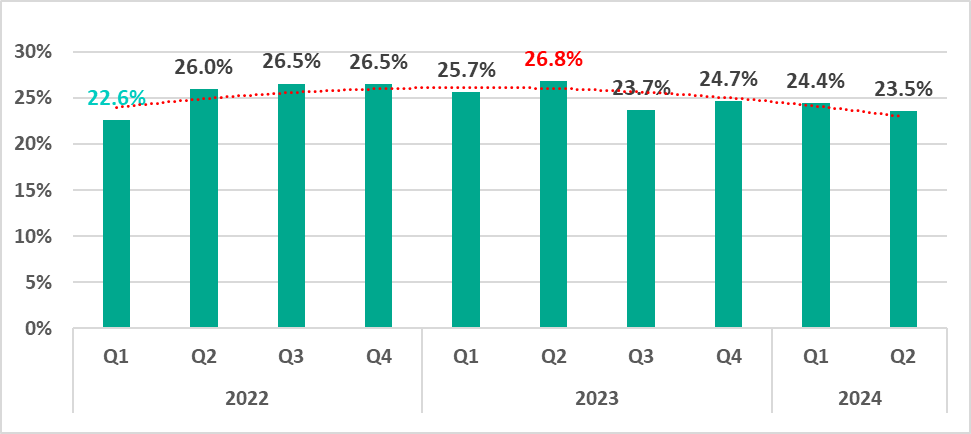
In the second quarter of 2024, the percentage of ICS computers on which malicious objects were blocked decreased by 0.9 pp from the previous quarter to 23.5%.
The percentage has decreased by 3.3 pp compared to the second quarter of 2023, when the indicator reached its highest level since records began in 2022.
Percentage of ICS computers on which malicious objects were blocked, by quarter, 2022-2024
Regions ranking
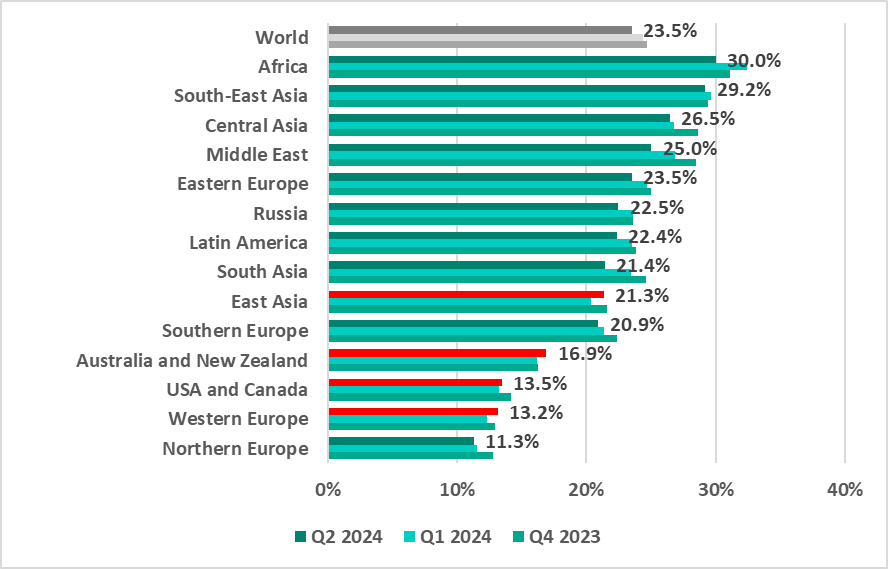
In most regions, the percentage of ICS computers that blocked malicious objects decreased compared to the first quarter of 2024. The indicator increased only in East Asia (by 1.0 pp), Western Europe (by 0.8 pp), Australia and New Zealand (by 0.7 pp) and the USA and Canada (by 0.2 pp).
Regions ranked by percentage of ICS computers where malicious objects were blocked, Q2 2024
Industries ranking
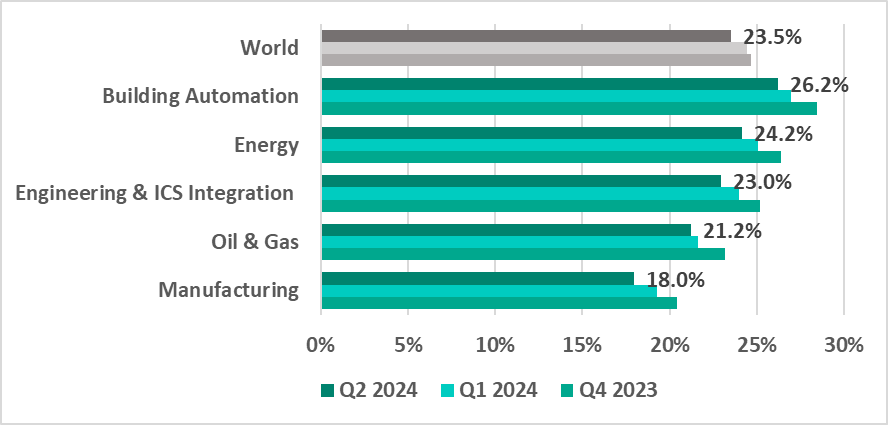
The building automation sector continues to lead the surveyed industries in terms of the percentage of ICS computers on which malicious objects were blocked. In general, this indicator continues to decrease across all industries for the second quarter in a row.
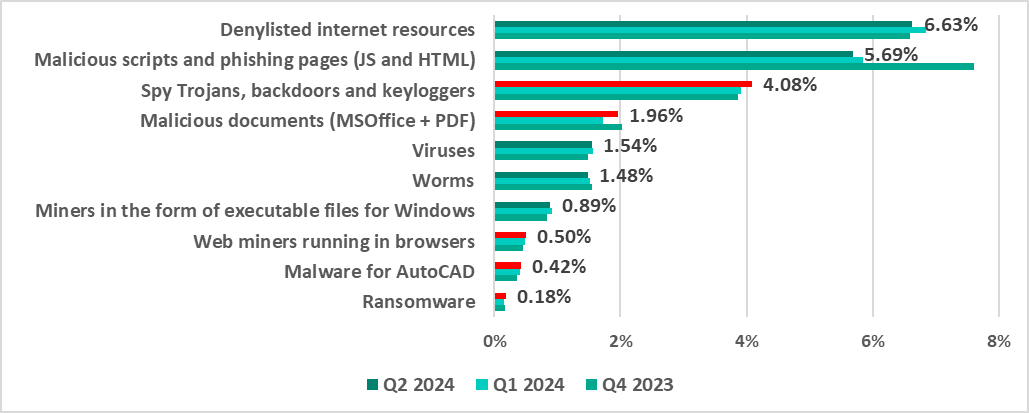
Percentage of ICS computers on which the activity of malicious objects of various categories was prevented
Diversity of detected malware
In the second quarter of 2024, Kaspersky’s protection solutions blocked malware from 11,349 different malware families of various categories on industrial automation systems.
Percentage of ICS computers on which the activity of malicious objects of various categories was prevented
Compared to the previous quarter, the most noticeable proportional increase in the second quarter of 2024 was in the percentage of ICS computers on which ransomware was blocked – a 1.2-fold increase.
Malicious object categories in numbers
Malicious objects used for initial infection
This category includes dangerous web resources, malicious scripts and malicious documents.
Denylisted internet resources – 6.63% (-0.21 pp compared to the first quarter of 2024);
Malicious scripts and phishing pages (JS and HTML) – 5.69% (-0.15 pp);
Malicious objects used to initially infect computers deliver next-stage malware – spyware, ransomware, and miners – to victims’ computers. As a rule, the higher the percentage of ICS computers on which the initial infection malware is blocked, the higher the percentage for next-stage malware.
Spyware (spy Trojans, backdoors and keyloggers) – 4.08% (+0.18 pp);
Ransomware – 0.18% (+0.03 pp);
Miners (in the form of executable files for Windows) – 0.89% (-0.03 pp).
Self-propagating malware
These are worms and viruses. Worms and virus-infected files were originally used for initial infection, but as botnet functionality evolved, they took on next-stage characteristics.
To spread across ICS networks, viruses and worms rely on removable media, network folders, infected files including backups, and network attacks on outdated software.
Worms – 1.48% (-0.03 pp);
Viruses – 1.54% (-0.02 pp).
AutoCAD malware
This category of malware is typically a low-level threat, coming last in the malware category rankings in terms of the percentage of ICS computers on which it was blocked.
AutoCAD malware – 0.42% (+0.01 pp).
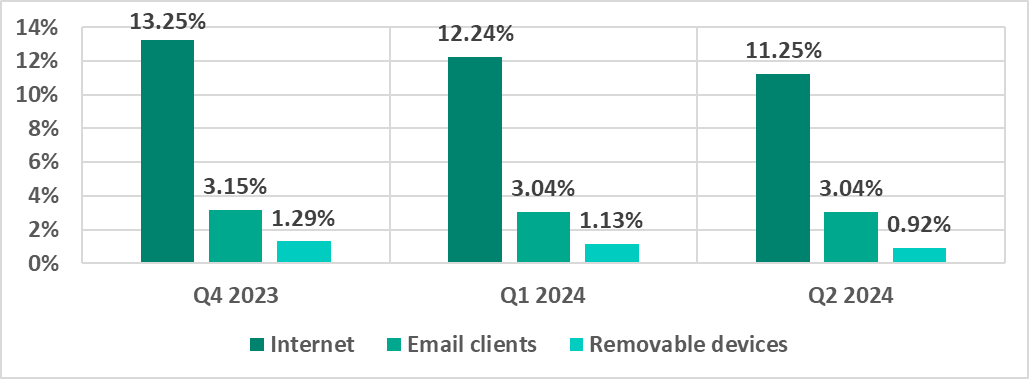
Main threat sources
The internet, email clients and removable storage devices remain the primary sources of threats to computers in an organization’s technology infrastructure. (Note that the sources of blocked threats cannot be reliably identified in all cases.)
Percentage of ICS computers on which malicious objects from various sources were blocked
Atos récompensé pour la cinquième année consécutive par une médaille ‘EcoVadis Platine’ pour son engagement en matière de développement durable
Paris (France), le 26 octobre 2024 – Atos annonce aujourd’hui avoir reçu une nouvelle fois, pour la cinquième année consécutive, la médaille ’Platine’ d’EcoVadis pour sa performance en matière de Responsabilité Sociale de l’Entreprise (RSE), avec 80 points sur 100.
Atos confirme ainsi sa position aux côtés des 1% des entreprises les plus performantes évaluées par EcoVadis dans son secteur (programmation informatique, conseil et activités connexes).
L’évaluation d’EcoVadis porte sur quatre catégories : Environnement, Travail et Droits de l’homme, Éthique, Achats durables. Atos a obtenu d’excellents résultats dans chacune d’entre elles, en particulier dans la catégorie Environnement.
Après avoir reçu pendant huit années consécutives la médaille d’or EcoVadis, Atos s’est vu décerner, depuis 2020, une médaille de platine, en reconnaissance de son engagement durable. Cette médaille, associée à un excellent score dans la catégorie Environnement, confirme le rôle d’Atos en tant que leader mondial de la décarbonation numérique et reflète son engagement à atteindre des objectifs climatiques ambitieux.
Le leadership d’Atos pour les sujets climatiques et son programme environnemental ont été récompensés année après année par des organisations et des classements internationaux, telles que l’indice DJSI et le Carbon Disclosure Project.
Atos est un leader international de la transformation digitale avec environ 92 000 collaborateurs et un chiffre d’affaires annuel d’environ 10 milliards d’euros. Numéro un européen du cloud, de la cybersécurité et des supercalculateurs, le Groupe fournit des solutions intégrées pour tous les secteurs, dans 69 pays. Pionnier des services et produits de décarbonation, Atos s’engage à fournir des solutions numériques sécurisées et décarbonées à ses clients. Atos est une SE (Société Européenne) cotée sur Euronext Paris.
La raison d’être d’Atos est de contribuer à façonner l’espace informationnel. Avec ses compétences et ses services, le Groupe supporte le développement de la connaissance, de l’éducation et de la recherche dans une approche pluriculturelle et contribue au développement de l’excellence scientifique et technologique. Partout dans le monde, Atos permet à ses clients et à ses collaborateurs, et plus généralement au plus grand nombre, de vivre, travailler et progresser durablement et en toute confiance dans l’espace informationnel.
CHEYENNE, Wyo., Sept. 26, 2024 (GLOBE NEWSWIRE) — US-based fintech startup Adeah LLC has announced the development of its Asset Timing Analyst (ATA) software project, which uses a mathematical modeling cycle to predict the swing days of assets in financial markets and giving pricing for entries and profit targeting. This model, grounded in mathematical inferences, minimizes market risks and enables high-yield trading opportunities.
Supported by GlobalTrader.Club, which has built a strong presence in the trader community since 2005, Adeah, a fintech startup focused on mathematical success in financial markets, invites angel investors interested in early-stage investments in fintech companies to revolutionize fund management and short term or day trading in financial markets.
Know What Will Happen Before It Happens. Timing is critical in financial markets
Swing days are the days when asset price fluctuations, such as those of stocks, commodities, and currency pairs, become more pronounced or take a turn. When traders time the days and the hours correctly, they can capitalize on buying or selling opportunities while also reducing risk tremendously.
Adeah LLC Founder and CEO Marty Meydan stated, “In financial markets, where timing is crucial for performance, ATA enables traders to identify the right time and ATAM indicator provides the right pricing, reducing risks while capitalizing on opportunities at just the right moment,” and emphasized that ATA conducts dynamic calculations based on market movements, measured in hours, days, weeks, and months. Knowing the days and the hours to trade before markets even open with clear pricing, allows to plan much better in a 24 hour global market, without getting stuck to the screen.
As a unique financial markets technology company and a market education company, Adeah brings a new dimension to the process of predicting market movements through mechanisms based on mathematical models. Data from ATA software’s performance in the first half of 2024 shows success rates of 80.95% in gold, 74.55% in the S&P 500, and 66% in the EUR/USD pair.
Consistently demonstrated the predictability of market swings and major day movements up to weeks in advance!
“Trading and investing in financial markets have always been portrayed as unpredictable and filled with uncertainties,” said Marty Meydan, adding, “However, the model we developed at Adeah has shown that market swings and major day movements can often be calculated with a high probability of success.”
In addition to its software development, fintech startup Adeah offers educational programs that teach traders how to invest in financial markets with timing calculations and the intricacies of technical analysis. The “101 Day Trader Career Program” includes live market analysis following the education.
According to Marty Meydan, the technical analysis strategy based on accurate swing timing calculations provides traders with a mathematical, model-driven approach that increase their chances of success and profitability across any financial asset they chose to trade.
Aboriginal and Torres Strait Islander Social Justice Commissioner Katie Kiss has welcomed the appointment of the NSW Treaty Commissioners announced today.
“These appointments are a milestone in the beginning of the truth and treaty process in NSW,” Commissioner Kiss said.
“I congratulate the NSW Government in taking this crucial step and working with the community towards self-determination and healing.”
Appointed for two-year terms, the Treaty Commissioners are former senator Aden Ridgeway, academic Todd Fernando and Koori Mail newspaper editor Naomi Moran.
The Commissioners will work with Australia’s largest Aboriginal population to hear whether they want a treaty process, and if they do, what form it would take.
Treaty discussions in Queensland, Victoria, Tasmania, the Northern Territory and the ACT have highlighted the need to improve service delivery and to close the gap.
“However, treaty and truth-telling is also about reframing and repairing relationships. It has the potential to set a solid foundation for the future, based on recognition and respect,” Commissioner Kiss said.
Commissioner Kiss also welcomed today’s release of the recommendations provided by the Coalition of Aboriginal Peak Organisations (CAPO) to progress the development of a NSW Independent Aboriginal-led Government Accountability Mechanism.
“These recommendations have been informed by Aboriginal people in NSW, and demonstrate the involvement of our people in decisions that affect us. I look forward to seeing further progress in other jurisdictions,” Commissioner Kiss said.
Source: Australian Ministers for Regional Development
The Australian Government is delivering on its commitment to strengthen Norfolk Island connectivity, with the community now benefitting from faster, more efficient satellite internet.
Thanks to a $7.35 million investment from the Government, Norfolk Telecom’s satellite internet service is now delivering network speeds that are four times faster.
This is supporting Norfolk Island Central School students to access online study services, with increased bandwidth available for individual use inside and outside of school hours.
Faster connectivity is also supporting more reliable access to medical support from the mainland – including telehealth appointments.
The upgraded satellite service was delivered in partnership with Norfolk Island Regional Council’s Norfolk Telecom and Telstra.
The use of satellites to transmit data between networks in remote locations is vital to helping close the digital divide – increasing access to reliable and more resilient connectivity.
Quotes attributable to Federal Minister for Territories, Kristy McBain MP:
“We’re committed to boosting the resilience of communication networks in our external territories, which is why we invested $7.35 million towards this faster and more reliable satellite internet service on Norfolk Island.
“We need fast and reliable connectivity to run our businesses, to access education and health services, and to keep in touch with family and friends – which is why this upgraded satellite service will make a huge impact on Norfolk Island.”
Quotes attributable to Federal Member for Bean, David Smith MP:
“Improving Norfolk Island’s connectivity is something that the local community have long called for, which is why we worked with Norfolk Telecom, Council and Telstra to deliver this significant upgrade.
“Better internet capability will improve learning at Norfolk Island Central School, boost the services at Norfolk Island Health and Residential Aged Care Service, and also unlock new opportunities for on-island businesses.
“I’ll continue working with the community to advocate for the projects they want to get off the ground.”
Quotes attributable to Norfolk Island Regional Council Administrator, Mike Colreavy:
“We are continuing to improve and ensure the quality of Norfolk’s telecommunications services through targeted projects, like this satellite backhaul upgrade.
“We provided these upgrades centrally through Norfolk Telecom, in partnership with Telstra and the Australian Government, so that community can have confidence that we are working to deliver local solutions to local challenges, through partners they can trust.”
The Australian Government is delivering on its commitment to strengthen Norfolk Island connectivity, with the community now benefitting from faster, more efficient satellite internet.
Thanks to a $7.35 million investment from the Government, Norfolk Telecom’s satellite internet service is now delivering network speeds that are four times faster.
This is supporting Norfolk Island Central School students to access online study services, with increased bandwidth available for individual use inside and outside of school hours.
Faster connectivity is also supporting more reliable access to medical support from the mainland – including telehealth appointments.
The upgraded satellite service was delivered in partnership with Norfolk Island Regional Council’s Norfolk Telecom and Telstra.
The use of satellites to transmit data between networks in remote locations is vital to helping close the digital divide – increasing access to reliable and more resilient connectivity.
Quotes attributable to Federal Minister for Territories, Kristy McBain MP:
“We’re committed to boosting the resilience of communication networks in our external territories, which is why we invested $7.35 million towards this faster and more reliable satellite internet service on Norfolk Island.
“We need fast and reliable connectivity to run our businesses, to access education and health services, and to keep in touch with family and friends – which is why this upgraded satellite service will make a huge impact on Norfolk Island.”
Quotes attributable to Federal Member for Bean, David Smith MP:
“Improving Norfolk Island’s connectivity is something that the local community have long called for, which is why we worked with Norfolk Telecom, Council and Telstra to deliver this significant upgrade.
“Better internet capability will improve learning at Norfolk Island Central School, boost the services at Norfolk Island Health and Residential Aged Care Service, and also unlock new opportunities for on-island businesses.
“I’ll continue working with the community to advocate for the projects they want to get off the ground.”
Quotes attributable to Norfolk Island Regional Council Administrator, Mike Colreavy:
“We are continuing to improve and ensure the quality of Norfolk’s telecommunications services through targeted projects, like this satellite backhaul upgrade.
“We provided these upgrades centrally through Norfolk Telecom, in partnership with Telstra and the Australian Government, so that community can have confidence that we are working to deliver local solutions to local challenges, through partners they can trust.”
Source: Hong Kong Government special administrative region
SCS tours Government Career Fair at Hong Kong Polytechnic University (with photos) SCS tours Government Career Fair at Hong Kong Polytechnic University (with photos) **********************************************************************************
The Secretary for the Civil Service, Mrs Ingrid Yeung, attended the Government Career Fair at the Hong Kong Polytechnic University (PolyU) today (September 26) and reminded those interested in applying for four civil service graduate posts to submit their applications through the online application system on the Civil Service Bureau (CSB) website by next Friday (October 4). Mrs Yeung toured the career fair with the Vice President (Student and Global Affairs) of PolyU, Professor Ben Young. It is the first time for the career fair to take place at PolyU, with the participation of officers from various departments and civil service grades to introduce the entry requirements of respective grades and share their personal work experience, as well as to encourage students to join the civil service. “Thirty government bureaux and departments took part in the career fair today, covering over 50 civil service grades. Apart from the general grades, there are also professional grades and the disciplined services. In view of the characteristics of the courses offered by PolyU, we have arranged officers from the relevant departments to introduce their grades to students. For instance, today’s career fair highlights civil service job opportunities relating to surveying and maritime fields, so that PolyU students who are currently enrolled in the relevant courses can gain a better understanding of the grades concerned. We hope that students will join the Government after graduation and put their knowledge and skills in the relevant professional fields to good use,” Mrs Yeung said. The CSB is organising Government Career Fairs at 10 local universities from mid-September to early October. In addition to PolyU, Government Career Fairs were held at City University of Hong Kong, the Education University of Hong Kong, the University of Hong Kong, Hong Kong Metropolitan University, Hong Kong University of Science and Technology, Hong Kong Shue Yan University and Hong Kong Baptist University. The remaining two career fairs will take place at the Hang Seng University of Hong Kong and the Chinese University of Hong Kong. Mrs Yeung encouraged those who are aspiring to serve the community to join the civil service to unleash their potential, pursue their dreams and contribute to Hong Kong. She pointed out that since July 2022 all candidates for civil service jobs must attain a pass result in the Basic Law and National Security Law Test (BLNST) in order to be considered for appointment. By the end of 2023, the number of applicants for the BLNST had reached nearly 140 000. The Government has strengthened its recruitment efforts in recent years and a number of grades have recorded a noticeable increase in the number of applicants. In particular, the number of candidates applying for Administrative Officer (AO), Executive Officer II (EOII) and other grades under the joint recruitment exercise in 2023-24 had surged by nearly 40 per cent, showing that a career in the Government is quite attractive to job seekers. The Government has launched a joint recruitment exercise for the appointment of four civil service grades, namely AO, EOII, Assistant Trade Officer II and Transport Officer II. Students graduating in the years of 2025 or 2026 may also apply this year. The deadline for submitting applications is 11.59pm on October 4. Candidates interested in applying for posts under the joint recruitment exercise must attain the requisite results in the relevant paper(s) of the Common Recruitment Examination and the BLNST. For details, please refer to the CSB website.
Ends/Thursday, September 26, 2024Issued at HKT 16:15
Source: Hong Kong Government special administrative region
The following is issued on behalf of the Hong Kong Monetary Authority:
The Hong Kong Monetary Authority (HKMA) and the Securities and Futures Commission (SFC) today (September 26) jointly published the conclusions paper on a further consultation on enhancements to the over-the-counter (OTC) derivatives reporting regime in Hong Kong.
To keep up with international developments, the HKMA and the SFC launched the further consultation in March 2024 on mandating the use of Unique Transaction Identifier and Unique Product Identifier and the reporting of Critical Data Elements (Notes 1, 2 and 3). This is in line with the Group of Twenty’s commitment to reform OTC derivatives markets, and will facilitate the analysis of OTC derivatives transactions by regulators.
In general, respondents supported the proposal and recognised the benefits brought by the international standardisation and harmonisation of data elements reported to different OTC derivatives reporting regimes globally. After considering the feedback received, the HKMA and the SFC have fine-tuned certain proposals to facilitate a smooth implementation.
The conclusions paper also sets out the concluded list of data elements subject to mandatory reporting and confirms the implementation of the proposals in September 2025.
Respondents’ feedback and the conclusions paper can be downloaded from the websites of the HKMA or the SFC.
Note 1: Unique Transaction Identifier is a unique identifier assigned to identify each reported OTC derivatives transaction with the structure and format as set out in the Technical Guidance on Harmonisation of the Unique Transaction Identifier issued by the Committee on Payments and Market Infrastructures (CPMI) and the International Organization of Securities Commissions (IOSCO) in February 2017.
Note 2: Unique Product Identifier is a unique identifier to denote a specific OTC derivatives product with the structure and format as set out in the Technical Guidance on Harmonisation of the Unique Product Identifier issued by the CPMI and IOSCO in September 2017.
Note 3: Critical Data Elements are a standard set of OTC derivatives transaction data elements (other than Unique Transaction Identifier and Unique Product Identifier), formats and allowable values published by the CPMI and IOSCO in April 2018 and by the Regulatory Oversight Committee of the Global Legal Entity Identifier Foundation in September 2021 and September 2023.
Source: United Kingdom – Prime Minister’s Office 10 Downing Street
The Prime Minister met Palestinian President Mahmoud Abbas at UNGA this afternoon.
The Prime Minister met Palestinian President Mahmoud Abbas at UNGA this afternoon.
President Abbas opened by condemning the Hamas attacks of October 7th. He also highlighted the civilian death toll in Gaza since then, with 41k killed and 100k injured, plus 70% of infrastructure devastated. The Prime Minister agreed that the loss of civilian life had been intolerable.
The President and Prime Minister also condemned the increase in settler violence and settlement activity there has been on the West Bank.
The President and Prime Minister agreed that we need an immediate ceasefire, the release of the hostages and a surge in humanitarian aid getting in.
They also discussed what needed to come next in terms of supporting and reforming the Palestinian Authority and working towards a political horizon which was the only long term solution to this crisis: a viable Palestinian state along a safe and secure Israel.
Source: United Kingdom – Prime Minister’s Office 10 Downing Street
The Prime Minister met President Luiz Inacio da Silva at UNGA this afternoon.
The Prime Minister met President Luiz Inacio da Silva at UNGA this afternoon.
They discussed their shared commitment to tackling global challenges, including the importance of global ambition on climate change and poverty.
The Prime Minister congratulated President Lula on his leadership on tackling both these challenges as President of the G20 and looked forward to the Summit in Rio.
The leaders shared their plans to accelerate the energy transition at home and internationally, and agreed to work closely on this agenda including for COP30.
The Prime Minister also confirmed strong support for President Lula’s G20 Global Alliance against Hunger and Poverty.
They also discussed the conflicts in Ukraine, Gaza, and Lebanon. The Prime Minister set out his steadfast support for Ukraine and upholding the UN Charter. On the Middle East, the Leaders underlined the importance of ceasefires in both Lebanon and in Gaza.
Source: United Kingdom – Prime Minister’s Office 10 Downing Street
The Prime Minister met Kenyan President William Ruto at UNGA this afternoon.
The Prime Minister met Kenyan President William Ruto at UNGA this afternoon.
The two leaders stressed how pleased they were to meet each other for the first time, and agreed the UK and Kenya share a close and important partnership.
They agreed to take forward work to further strengthen the bilateral relationship, building on the existing Strategic Partnership between our two countries.
In particular, both leaders shared their determination to deliver world-leading action to tackle climate change and accelerate the energy transition.
The Prime Minister praised President Ruto’s extensive and pioneering leadership in this area, both in Kenya and through his international work across Africa and the world to accelerate the clean energy transition, and reiterated his ambition to turn the UK into a clean energy superpower.
Both looked forward to working together more closely and agreed to take forward work to champion clean power internationally– including leveraging the power of private sector investment and international financial institution reform to deliver on their climate ambitions.
Source: United Kingdom – Executive Government & Departments
The Prime Minister met Palestinian President Mahmoud Abbas at UNGA this afternoon.
The Prime Minister met Palestinian President Mahmoud Abbas at UNGA this afternoon.
President Abbas opened by condemning the Hamas attacks of October 7th. He also highlighted the civilian death toll in Gaza since then, with 41k killed and 100k injured, plus 70% of infrastructure devastated. The Prime Minister agreed that the loss of civilian life had been intolerable.
The President and Prime Minister also condemned the increase in settler violence and settlement activity there has been on the West Bank.
The President and Prime Minister agreed that we need an immediate ceasefire, the release of the hostages and a surge in humanitarian aid getting in.
They also discussed what needed to come next in terms of supporting and reforming the Palestinian Authority and working towards a political horizon which was the only long term solution to this crisis: a viable Palestinian state along a safe and secure Israel.
Source: United Kingdom – Executive Government & Departments
The Prime Minister met Kenyan President William Ruto at UNGA this afternoon.
The Prime Minister met Kenyan President William Ruto at UNGA this afternoon.
The two leaders stressed how pleased they were to meet each other for the first time, and agreed the UK and Kenya share a close and important partnership.
They agreed to take forward work to further strengthen the bilateral relationship, building on the existing Strategic Partnership between our two countries.
In particular, both leaders shared their determination to deliver world-leading action to tackle climate change and accelerate the energy transition.
The Prime Minister praised President Ruto’s extensive and pioneering leadership in this area, both in Kenya and through his international work across Africa and the world to accelerate the clean energy transition, and reiterated his ambition to turn the UK into a clean energy superpower.
Both looked forward to working together more closely and agreed to take forward work to champion clean power internationally– including leveraging the power of private sector investment and international financial institution reform to deliver on their climate ambitions.
Source: United Kingdom – Executive Government & Departments
The Prime Minister met President Luiz Inacio da Silva at UNGA this afternoon.
The Prime Minister met President Luiz Inacio da Silva at UNGA this afternoon.
They discussed their shared commitment to tackling global challenges, including the importance of global ambition on climate change and poverty.
The Prime Minister congratulated President Lula on his leadership on tackling both these challenges as President of the G20 and looked forward to the Summit in Rio.
The leaders shared their plans to accelerate the energy transition at home and internationally, and agreed to work closely on this agenda including for COP30.
The Prime Minister also confirmed strong support for President Lula’s G20 Global Alliance against Hunger and Poverty.
They also discussed the conflicts in Ukraine, Gaza, and Lebanon. The Prime Minister set out his steadfast support for Ukraine and upholding the UN Charter. On the Middle East, the Leaders underlined the importance of ceasefires in both Lebanon and in Gaza.
Source: The Conversation – Africa – By Danny Bradlow, Professor/Senior Research Fellow, Centre for Advancement of Scholarship, University of Pretoria
The statistics are stark: 54 governments, of which 25 are African, are spending at least 10% of their revenues on servicing their debts; 48 countries, home to 3.3 billion people, are spending more on debt service than on health or education.
Among them, 23 African countries are spending more on debt service than on health or education.
While the international community stands by, these countries are servicing their debts and defaulting on their development goals.
It requires the debtor to first discuss its problems with the International Monetary Fund (IMF) and obtain its assessment of how much debt relief it needs. Then it must negotiate with its official creditors – international organisations, governments and government agencies – over how much debt relief they will provide. Only then can the debtor reach an agreement – on comparable terms to the official creditors – with its commercial creditors.
Unfortunately, this process has been sub-optimal.
One reason is that it works too slowly to meet the urgent needs of distressed borrowers. As a result, it condemns debtor countries to financial limbo. The resulting uncertainty is not in anyone’s interest. For example, Zambia has been working through the G20’s cumbersome process for more than three and a half years and has not yet finalised agreements with all its creditors.
We propose a two-part approach that would improve the situation of sovereign debtors and their creditors. This proposal is based on the lessons we have learned from our work on the legal and economic aspects of developing country debt, particularly African debt.
First, we suggest that official creditors and the IMF create a strategic buyer of “last resort” that can purchase the bonds of debt distressed countries and refinance them on better terms.
Second, we recommend that all parties involved in sovereign debt restructurings adopt a set of principles that they can use to guide the debtor and its creditors in reaching an optimal agreement and monitoring its implementation.
The current approach fails to deal effectively and fairly with both the concerns of the creditors and all the debtor’s legal obligations and responsibilities. Our proposed solution would offer debtors debt relief that does not undermine their ability to meet their other legal obligations and responsibilities, while also accommodating private creditors’ preference for cash payments.
Our proposal is not risk-free. And buybacks are not appropriate for all debtors. Nevertheless it offers a principled and feasible approach to dealing with a silent debt crisis that threatens to undermine international efforts to address global challenges such as climate, poverty and inequality.
It uses the IMF’s existing resources to meet both the bondholders’ preferences for immediate cash and the developing countries’ need to reduce their debt burdens in a transparent and principled way.
It also helps the international community avoid a widespread default on debt and development.
Bondholders are a major problem
Foreign bondholders, who are the major creditors of many developing countries, have proven to be particularly challenging in providing substantive debt relief in a timely manner. In theory, they should be more flexible than official creditors.
Developing countries have been paying bondholders a premium to compensate them for providing financing to borrowers that are perceived to be risky. As a result, bondholders have already received larger payouts than official creditors. Therefore, they should be better placed than official creditors to assist the debtor in the restructuring processes.
However, despite having received large returns from defaulted bonds, bondholders have remained obstinate in debt restructurings.
Our proposal seeks to overcome this hurdle in a way that is fair to debtors, creditors and their respective stakeholders.
How it would work
First, the official creditors and the IMF should create and fund a strategic buyer “of last resort” who can purchase distressed (and expensive) debt at a discount from bondholders. The buyer, now the creditor of the country in distress, can repackage the debt and sell it to the debtor country on more manageable terms. The net result is that the bondholders receive cash for their bonds, while the debtor country benefits from substantial debt relief. In addition, the debtor and its remaining official creditors benefit from a simplified debt restructuring process.
This concept has precedent. In 1989, as part of the Highly Indebted Poor Countries Initiative, the international community’s effort to deal with the then existing debt burdens of poor countries, the World Bank Group established the Debt Reduction Facility, which helped eligible governments repurchase their external commercial debts at deep discounts. It completed 25 transactions which helped erase approximately US$10.3 billion in debt principal and over US$3.5 billion in interest arrears.
Some individual countries have also bought back their own debt. In 2009, Ecuador repurchased 93% of its defaulted debt at a deep discount. This enabled the government to reduce its debt stock by 27% and promote economic growth in subsequent years.
Unfortunately, the countries currently in debt distress lack sufficient foreign reserves to pursue such a strategy. Hence, they need to find a “friendly” buyer of last resort.
The IMF is well positioned to play this role. It has the mandate to support countries during financial crises. It also has the resources to fund such a facility. It can use a mix of its own resources, including its gold reserves, and donor funding, such as a portion of the US$100 billion in Special Drawing Rights (SDR), the IMF’s own reserve currency, which rich economies committed to reallocate for development purposes.
Such a facility, for example, would have enabled Kenya to refinance its debts at the SDR interest rate, currently at 3.75% per year, rather than at the 10.375% rate it paid in the financial markets.
It is noteworthy that the 47 low-income countries identified as in need of debt relief have just US$60 billion in outstanding debts owed to bondholders. Our proposed buyer of last resort would help reduce the burden of these countries to manageable levels.
Second, we propose that both debtors and creditors should commit to the following set of shared principles, based on internationally accepted norms and standards for debt restructurings.
Guiding principles
1. Guiding norms: Sovereign debt restructurings should be guided by six norms: credibility, responsibility, good faith, optimality, inclusiveness and effectiveness.
Optimality means that the negotiating parties should aim to achieve an outcome that, considering the circumstances in which the parties are negotiating and their respective rights, obligations and responsibilities, offers each of them the best possible mix of economic, financial, environmental, social, human rights and governance benefits.
2. Transparency: All parties should have access to the information that they need to make informed decisions.
3. Due diligence: The sovereign debtor and its creditors should each undertake appropriate due diligence before concluding a sovereign debt restructuring process.
4. Optimal outcome assessment: The parties should publicly disclose why they expect their restructuring agreement to result in an optimal outcome.
5. Monitoring: There should be credible mechanisms for monitoring the implementation of the restructuring agreement.
6. Inter-creditor comparability: All creditors should make a comparable contribution to the restructuring of debt.
7. Fair burden sharing: The burden of the restructuring should be fairly allocated between the negotiating parties.
8. Maintaining market access: The process should be designed to facilitate future market access for the borrower at affordable rates.
The G20’s current efforts to address the silent debt crisis are failing. They are contributing to the likely failure of low income countries in Africa and the rest of the global south to offer all their residents the possibility of leading lives of dignity and opportunity.
Danny Bradlow, in addition to his university position, is Co-Chair of the T20 task force on sovereign debt, and Co-Chair of the Academic Circle on the Right to Development.
Marina Zucker-Marques is a co-chair for the Brazil T20 Task Force 3 on reforming the International Financial Architecture
Kevin P. Gallagher does not work for, consult, own shares in or receive funding from any company or organisation that would benefit from this article, and has disclosed no relevant affiliations beyond their academic appointment.
Source: US Department of Health and Human Services – 3
Department of Justice U.S. Attorney’s Office District of Massachusetts
FOR IMMEDIATE RELEASE Wednesday, September 18, 2024
BOSTON – A former nurse was sentenced yesterday for tampering with liquid oxycodone syringes at a local rehabilitation center.
Jaclyn McQueen, 44, of Dedham, was sentenced by U.S. District Court Judge Julia E. Kobick to three years of probation. In January 2024, McQueen pleaded guilty to one count of tampering with a consumer product. McQueen was charged by Information on Dec. 7, 2023.
From approximately February through May 2020, McQueen worked as a registered nurse at a rehabilitation center in Dedham that provided long-term chronic and post-acute care to patients. In her capacity as a nurse, McQueen had access to oxycodone, a Schedule II narcotic, prescribed to patients at the rehabilitation center. During her work shifts, McQueen removed liquid oxycodone from syringes intended for use by patients, consumed the oxycodone herself and refilled the syringes with water to avoid detection. McQueen returned the diluted syringes to the medication carts where they could have been administered to patients.
Acting United States Attorney Joshua S. Levy; Fernando McMillan, Special Agent in Charge of the Food and Drug Administration, Office of Criminal Investigations; and Robert H. Goldstein, MD, PhD, Commissioner of the Massachusetts Department of Public Health made the announcement. Assistant U.S. Attorney Kelly Begg Lawrence, Chief of the Health Care Fraud Unit, prosecuted the case.
Source: US Department of Health and Human Services – 3
Department of Justice U.S. Attorney’s Office District of Massachusetts
FOR IMMEDIATE RELEASE Thursday, August 29, 2024
BOSTON – A California man pleaded guilty today for conspiracy to sell the illegal depressant Etizolam over the internet.
Paul Z. Lamberty, 52, of Folsom, Calif., pleaded guilty to one count of conspiracy to defraud the United States and one count of the introduction of misbranded drugs with the intent to defraud and mislead. U.S. District Court Chief Judge F. Dennis Saylor IV scheduled sentencing for Dec. 13, 2024.
Lamberty operated websites Encern.com and Ohmod.com and used those sites to sell the drug etizolam to customers throughout the United States, including Massachusetts. Payments for etizolam through those websites could only be made through cryptocurrency and it would be shipped to customers through U.S. Priority Mail. Encern.com has no corporate records in the State of California and the Encern.com website did not provide a physical address for the business. The Food and Drug Administration (FDA) has not approved etizolam for use as a drug, and thus it cannot be sold or prescribed in the United States. Despite this, Lamberty purchased drugs from suppliers in China and imported those drugs into the United States and sold the drugs with false labelling stating that the products were sold “For Research Purposes Only” and “Not for Human Consumption.” Based on an analysis of bank and cryptocurrency records, Lamberty and his co-conspirator conducted gross sales of over $550,000 of etizolam through the internet during the course of the conspiracy.
According to the charging document, etizolam is a drug known as a thienodiazepine, a class of drugs chemically related to benzodiazepines, which produce central nervous system depression. Physicians may prescribe FDA-approved benzodiazepines to treat insomnia and anxiety, but benzodiazepines and thienodiazepines also carry risks of dependency, toxicity, and even fatal overdose, particularly when combined with other central nervous system depressants.
The charge of conspiracy to defraud the United States provides for a sentence of up to five years in prison, three years of supervised release and a fine of $250,000. The charge of introduction of misbranded drugs with the intent to defraud and mislead provides for a sentence up to three years in prison, three years of supervised release and a fine of up to $250,000. Sentences are imposed by a federal district court judge based upon the U.S. Sentencing Guidelines and statutes that govern the determination of a sentence in a criminal case.
Acting United States Attorney Joshua S. Levy; Fernando P. McMillan, Special Agent in Charge of the New York Field Office of the U.S. Food and Drug Administration, Office of Criminal Investigations; and Ketty Larco-Ward, Inspector in Charge of the U.S. Postal Inspection Service, Boston Division. Assistant U.S. Attorneys Jared C. Dolan and Lauren A. Graber of the Criminal Division are prosecuting the case.
Source: US Department of Health and Human Services – 3
Department of Justice Office of Public Affairs
FOR IMMEDIATE RELEASE Tuesday, August 27, 2024
Company Agrees to Pay More than $1.1M in Criminal Penalties
A Mississippi seafood distributor and two company managers pleaded guilty today to conspiring with others to mislabel seafood and to commit wire fraud by marketing inexpensive and frozen imported substitutes as more expensive and premium local species.
Quality Poultry and Seafood Inc. (QPS), the largest seafood wholesaler on the Mississippi Gulf Coast, has agreed to pay the United States $1 million in forfeitures and a criminal fine of $150,000. QPS sales manager Todd A. Rosetti and business manager James W. Gunkel, both of Ocean Springs, Mississippi, also pleaded guilty to misbranding seafood to facilitate QPS’ fraud.
QPS admitted to participating in this fish substitution scheme from as early as 2002 and continuing through November 2019. The indictment alleges that QPS recommended and sold to its restaurant customers foreign-sourced fish that could serve as convincing substitutes for the local species the restaurants advertised on their menus. QPS also labeled the cheap imports that it sold to customers at its own retail shop and café as premium local fish.
“QPS and company officials went to great lengths in conspiring with others to perpetuate fraud for more than a decade, even after they knew they were under federal investigation,” said Assistant Attorney General Todd Kim of the Justice Department’s Environment and Natural Resources Division. “Mislabeling seafood harms local wholesalers and fishermen who compete to sell locally sourced, premium fish in a market unfairly flooded with less expensive fish, frozen and imported from overseas.”
“When imported substitutes are marketed as local domestic seafood, it depresses the value of authentic Gulf Coast seafood, which means that honest local fishermen and wholesalers have a harder time making a profit,” said U.S. Attorney Todd W. Gee for the Southern District of Mississippi. “This kind of mislabeling fraud hurts the overall local seafood market and rips off restaurant customers who were paying extra to eat a premium local product. These convictions should serve as a warning: restaurants and wholesalers will face criminal prosecution if they are not honest with customers about what they are actually buying.”
“U.S. consumers expect their seafood to be correctly identified. When sellers purposefully substitute one fish species for another, they deceive consumers and cause potential food safety hazards to be overlooked or misidentified by processors or end users,” said Special Agent in Charge Justin Fielder of the Food and Drug Administration (FDA)’s Office of Criminal Investigations, Miami Field Office. “We will continue to investigate and bring to justice those who put profits above public health.”
The indictment alleges that even after agents from the FDA executed a criminal search warrant at QPS to investigate its sale of mislabeled fish, QPS continued for over a year to sell frozen fish imported from Africa, South America and India for use as substitutes for local premium species.
Mary Mahoney’s, which pleaded guilty in May, admitted that between December 2013 and November 2019, it fraudulently sold, as local premium species, approximately 58,750 pounds (over 29 tons) of fish that was not the species identified on its menu. QPS supplied seafood to Mary Mahoney’s and many other restaurant restaurants and retailers.
QPS, Rosetti and Gunkel will be sentenced on Dec. 11. A federal district court judge will determine any sentence after considering the U.S. Sentencing Guidelines and other statutory factors.
FDA’s Office of Criminal Investigations is investigating the case.
Senior Trial Attorney Jeremy F. Korzenik of the Environment and Natural Resources Division’s Environmental Crimes Section and Assistant U.S. Attorney Andrea Jones for the Southern District of Mississippi are prosecuting the case.
Source: US Department of Health and Human Services – 3
Department of Justice Office of Public Affairs
FOR IMMEDIATE RELEASE Tuesday, August 27, 2024
The founder and chief executive officer of a California-based company that marketed stem cell-based products linked to multiple hospitalizations pleaded guilty yesterday to a felony violation of the Federal Food, Drug and Cosmetic Act.
John W. Kosolcharoen, 53, most recently of Orange County, California, pleaded guilty to introducing an unapproved new drug into interstate commerce with the intent to defraud and mislead. Kosolcharoen is currently in custody serving a sentence for a separate, unconnected conviction. U.S. District Judge Otis D. Wright II for the Central District of California presided over the hearing pursuant to a plea agreement with the government. The court set Kosolcharoen’s sentencing for Sept. 23.
According to court documents, beginning in 2016, Kosolcharoen created two companies, Liveyon LLC and Genetech Inc., to manufacture and distribute injectable stem cell products made from human umbilical cord blood. Liveyon marketed the products under different brand names, including “ReGen.” In pleading guilty, Kosolcharoen admitted that he and others misrepresented ReGen as suitable for the treatment of a variety of conditions, such as lung and heart diseases, autoimmune disorders, Alzheimer’s disease, Parkinson’s disease and others. Liveyon marketed the products throughout the United States until about April 2019 using advertising materials that contained multiple false and misleading statements about their purported safety and effectiveness.
In recent years, the U.S. Food and Drug Administration (FDA) has warned consumers that patients seeking cures and remedies for serious diseases and conditions may be misled about unapproved stem cell products that are illegally marketed, have not been shown to be safe or effective, and, in some cases, may have significant safety issues that put patients at risk. Stem cell products are regulated by FDA, and generally they must have FDA approval before being introduced into interstate commerce.
As part of the plea agreement, Kosolcharoen admitted that to mislead FDA about Liveyon’s activities, he directed Liveyon’s purchase orders to falsely state that the stem cell products were being sold “for research purposes only.” In 2018, FDA and the Centers for Disease Control and Prevention (CDC) received reports of patients in multiple states requiring hospitalization for bacterial infections after receiving Liveyon products. Kosolcharoen admitted that he and others fraudulently induced customers into purchasing stem cell-derived Liveyon products by, among other things, misleading the public about the cause and severity of adverse events suffered by Liveyon patients, and falsely reporting and concealing material facts regarding the outcome of an FDA inspection of Genetech. According to FDA records, that inspection documented evidence of significant deviations from good manufacturing and tissue practices.
“Unapproved stem cell treatments not only endanger public health but also exploit the hopes of patients who seek relief from the most serious of diseases,” said Principal Deputy Assistant Attorney General Brian Boynton, head of the Justice Department’s Civil Division. “The Department of Justice is committed to safeguarding the public from these schemes and will vigorously pursue legal action to hold accountable those who unlawfully market and sell these unproven therapies.”
“This defendant recklessly put people’s lives in danger, giving false hope to patients with serious illnesses,” said U.S. Attorney Martin Estrada for the Central District of California. “Today’s guilty plea shows that we will hold accountable corporate executives and healthcare professionals who put profits over patients.”
“We are grateful for the work by the Department of Justice to hold accountable establishments that prey upon vulnerable populations by marketing potentially dangerous stem cell products with false and misleading claims about their safety and effectiveness,” said Director Peter Marks, M.D., Ph.D. of FDA’s Center for Biologics Evaluation and Research.
“When unscrupulous providers offer umbilical cord blood stem cell products and treatments that are both unapproved and unproven, they put consumers’ health at risk, and multiple users of this firm’s products in fact suffered adverse events,” said Special Agent in Charge Robert Iwanicki of FDA Office of Criminal Investigations Los Angeles Field Office. “FDA will continue to investigate and bring to justice those who endanger the public’s health for material gain.”
“This investigation was a joint effort between multiple federal agencies and state and local health departments to quickly put a stop to the distribution of unsafe, contaminated products,” said Director Michael Bell, M.D. of CDC’s Division of Healthcare Quality Promotion. “The rapid response by our public health system identified products marketed as stem cell treatments to be the source of serious infections in dozens of patients. Our message to all consumers and providers is to heed the warning against the use of unapproved products like these with unproven claims of effectiveness for conditions like joint disease, chronic pain, or COVID-19. Please don’t let products like these put you or your patients’ health at risk.”
FDA’s Office of Criminal Investigations, FBI, Amtrak Office of Inspector General, Defense Criminal Investigative Service, Department of Health and Human Services Office of Inspector General, Department of Labor Employment Benefits Security Administration and California Department of Health Care Services investigated the case.
Assistant U.S. Attorneys Mark Aveis and David Chao for the Central District of California, Assistant Director Ross S. Goldstein and Trial Attorneys Meredith B. Healy, Kathryn A. Schmidt and Peter J. Leininger of the Justice Department’s Consumer Protection Branch are prosecuting the case.
Additional information about the Consumer Protection Branch and its enforcement efforts can be found at www.justice.gov/civil/consumer-protection-branch.
Source: US Department of Health and Human Services – 3
Department of Justice U.S. Attorney’s Office Western District of Virginia
FOR IMMEDIATE RELEASE Monday, August 26, 2024
Dillon Breeding Will Serve 24 Months in Federal Prison
ABINGDON, Va. – A Gate City, Virginia pharmacist who tampered with oxycodone and hydromorphone was sentenced last week to 24 months in federal prison.
Dillon West Breeding, 34, pled guilty in June 2024 to one count of tampering with consumer products.
“Ensuring the integrity of our prescription drugs is vital to maintaining the public’s confidence in our healthcare system,” United States Attorney Christopher R. Kavanaugh said today. “When patients go to the pharmacy, they trust the medicines they receive are legitimate, and prosecutions like this one go a long way towards ensuring that trust. I am grateful to the FDA, Virginia Department of Health Professions, Virginia State Police, and the Gate City Police for bringing this important matter forward.”
“FDA-OCI remains committed to safeguarding the drug supply chain from individuals who endanger public health and safety by tampering with products,” said George Scavdis, Special Agent in Charge, FDA Office of Criminal Investigations, Metropolitan Washington Field Office. “When pharmacists betray their customers’ trust by tampering with narcotic medications, they not only risk causing needless suffering from ineffective substitutes but also put lives at risk by introducing potentially harmful substances into the drug supply chain. The foundational work of the Gate City Police Department and our valued partnership with the Virginia State Police were integral to our efforts in safeguarding public health and safety in this case.”
According to court documents, Breeding swapped oxycodone tablets with prednisone, a steroid used to treat inflammation, and replaced hydromorphone tablets with leflunomide, a drug used to treat rheumatoid arthritis.
Additionally, Breeding would dispense medication to patients and short them pills, keeping the additional pills for himself.
Because Breeding tampered with these products, a pharmacist could have filled and dispensed the wrong drug to a customer, placing them in danger of death or bodily injury.
The Food and Drug Administration – Office of Inspector General, the Virginia Department of Health Professions, along with the Gate City Police Department and the Virginia State Police, investigated the case.
Assistant U.S. Attorney Carrie Macon prosecuted the case for the United States.
Source: US Department of Health and Human Services – 3
Department of Justice U.S. Attorney’s Office Eastern District of California
FOR IMMEDIATE RELEASE Thursday, August 15, 2024
FRESNO, Calif. — The operator of a Reedley lab, who was indicted in November 2023, faces additional charges of conspiracy and wire fraud after a federal grand jury returned a 12-count superseding indictment today, U.S. Attorney Phillip A. Talbert announced.
Jia Bei Zhu, 62, a citizen of China, was previously indicted for distributing adulterated and misbranded COVID-19 test kits in violation of the federal Food, Drug, and Cosmetic Act and making false statements to authorities about his identity and involvement with the biolabs. The superseding indictment also charges Zhu’s romantic and business partner, Zhaoyan Wang, 38, a citizen of China, who operated the biolabs Universal Meditech Inc. (UMI) and Prestige Biotech Inc. (PBI) in Fresno and Reedley along with Zhu. UMI and PBI distributed COVID-19, pregnancy, and other types of test kits.
According to court documents, from August 2020 through March 2023, Zhu and Wang conspired to defraud buyers of UMI and PBI’s COVID-19 test kits. They imported hundreds of thousands of COVID-19 test kits from Ai De Ltd., which was a company in China that they controlled, and falsely represented to the buyers that the test kits were made in the United States. They illegally imported the COVID-19 test kits, which they were not approved to import, by falsely declaring them as pregnancy test kits, which they were approved to import.
Zhu and Wang also falsely represented to the buyers that UMI and PBI could make up to 100,000 COVID-19 test kits per week in the United States and that the test kits were made in connection with other labs that were certified by the Centers for Disease Control and Prevention. Finally, they falsely represented to the buyers that the test kits were approved by the Food and Drug Administration (FDA). Zhu and Wang made over $1.7 million through their fraud.
When buyers requested to inspect UMI and PBI’s facilities in Fresno and Reedley, Zhu and Wang denied them access and fabricated reasons for the denial. The fabricated reasons included that the facilities were undergoing construction and renovation, and that proprietary and confidential information and technology was inside. In reality, however, they did not want the buyers to know that UMI and PBI were obtaining the COVID-19 test kits from China.
Zhu is currently detained in custody pending his federal trial. His next status conference is scheduled for Sept. 11, 2024. Wang is not in custody.
This case is the product of an investigation by the Federal Bureau of Investigation and the FDA Office of Criminal Investigations. Assistant U.S. Attorneys Arelis Clemente, Joseph Barton, and Henry Carbajal III are prosecuting the case.
If convicted, Zhu and Wang each face maximum statutory penalties of 20 years in prison for the conspiracy and wire fraud charges, and an additional three years in prison for the distribution of adulterated and misbranded medical device charges. Zhu also faces another five years in prison for the false statements charge. Any sentences, however, would be determined at the discretion of the court after consideration of any applicable statutory factors and the Federal Sentencing Guidelines, which take into account a number of variables. The charges are only allegations. Zhu and Wang are presumed innocent until and unless proven guilty beyond a reasonable doubt.
Source: Hong Kong Government special administrative region
Transport Department alerts public to fraudulent SMS messages purportedly from HKeToll Transport Department alerts public to fraudulent SMS messages purportedly from HKeToll **************************************************************************************
The Transport Department (TD) today (September 26) alerted members of the public to fraudulent SMS messages purportedly issued by the HKeToll. The SMS messages spoofed the name of “HKeToll” and provided hyperlinks with the domain names (https://hketollio[.]top/hk, https://hke-toll[.]top/hk and https://hketoll[.]info/hk) that lead to fake HKeToll websites, which seek to deceive recipients into making payments to obtain their credit card information. The TD clarifies that the SMS messages were not issued by the HKeToll, and has referred the case to the Police for follow-up. Members of the public are reminded that the HKeToll will not send SMS messages or emails to vehicle owners with hyperlinks which direct them to the websites to carry out transactions. If a vehicle owner wishes to pay an outstanding toll online, they must log in to the HKeToll website (hketoll.gov.hk) or mobile app. Members of the public should stay alert when receiving unidentified messages. They should not visit suspicious websites and disclose any personal information. Anyone who has provided his or her personal information to the websites concerned should contact the Police. For enquiries about the HKeToll, please call 3853 7333.
Ends/Thursday, September 26, 2024Issued at HKT 15:31
Source: Government of the Russian Federation – An important disclaimer is at the bottom of this article.
The forum is taking place in Veliky Novgorod on September 26-27.
Dear colleagues!
I welcome you to Veliky Novgorod at the All-Russian Forum of Multifunctional Centers for the Provision of State and Municipal Services, where the professional community will be able to exchange experiences, demonstrate best practices, and outline ways for the further development of MFCs.
Russia occupies a leading position in the world in the implementation of high technologies. Strengthening leadership in this area is a key state task. A striking example of the digitalization of public administration is the implementation of the MFC project, which has become an effective mechanism for interaction between citizens and businesses with departments and organizations.
My Documents centers operate in all regions of the country, implement lean manufacturing technologies, provide municipal and government services both in person and online. This allows us to simplify bureaucratic procedures for Russians and reduce the administrative burden on entrepreneurs. Every day, thanks to the government services portal and MFC, each person can quickly and conveniently solve life issues. It is important that today much is being done to improve the work of the centers and expand their functions.
Traditionally, the winners of the tenth All-Russian competition “The Best Multifunctional Center of Russia” will receive awards at the forum. I sincerely congratulate the winners, wish them new successes, and fruitful communication and constructive discussions to all participants of the meeting. I am confident that the solutions you developed during the event will allow us to continue to provide assistance to millions of our citizens.
M. Mishustin
Please note: This information is raw content directly from the source of the information. It is exactly what the source states and does not reflect the position of MIL-OSI or its clients.
Please note; This information is raw content directly from the information source. It is accurate to what the source is stating and does not reflect the position of MIL-OSI or its clients.