Blog

  • MIL-OSI USA: Welch Cosponsors Sanders’ Resolutions to Block Certain Offensive Weapons Sales to Israel 

    US Senate News:

    Source: United States Senator Peter Welch (D-Vermont)

    WASHINGTON, D.C. – U.S. Senator Peter Welch (D-Vt.) has cosponsored U.S. Senator Bernie Sanders’ (I-Vt.) Joint Resolutions of Disapproval (JRD) to block the sales of certain offensive weapons to Israel. The JRDs would prohibit the U.S.-financed sale of $675 million for bombs and guidance kits, plus 20,000 fully automatic assault rifles to Israel. The Senate is expected to vote on the JRDs tonight.  
    “The Israeli-inflicted starvation of Palestinians in Gaza must end. This bombing campaign, which has killed and wounded tens of thousands of people and destroyed Gaza, must end. We cannot continue to be complicit. History will judge us for not standing up against this humanitarian catastrophe and these war crimes,” said Senator Welch. “The United States needs to say: Enough.” 
    Yesterday, Senator Welch spoke on the Senate floor about the ongoing humanitarian catastrophe in Gaza, and the need for the United States Senate to take immediate action. He condemned Hamas, pushed for a ceasefire, and demanded the release of the remaining hostages. Senator Welch also rejected the Netanyahu government’s illegal use of starvation as a weapon of war.  
    “We all condemn Hamas. We all want the release of the remaining hostages. But we have to ask ourselves the question: is it at all justifiable that there is a policy that has to be recognized that starvation is being used as a tool of warfare? I reject the legitimacy of that act. It’s a war crime, Mr. President. It’s a war crime to starve a population to get what you want from your enemy, as righteous as your defense against an enemy may be,” Senator Welch said in his remarks… “We cannot separate the current starvation in Gaza from the Netanyahu government’s strategy of forcibly displacing Palestinians from their land.” 
    Watch his remarks here: 

    The text of the JRDs can be found below:    

    S.J.Res.34 – To prohibit the U.S.-taxpayer financed $675.7 million sale of 201 MK 83 1,000-pound bombs; 4,799 BLU-110A/B General Purpose 1,000-pound bombs; 1,500 Joint Direct Attack Munition (JDAM) guidance kits for MK 83 bombs; 3,500 JDAM guidance kits for MK 83 bombs; and related logistics and technical support services. 

    S.J.Res.41 – To prohibit the sale of tens of thousands of fully automatic assault rifles. 

    MIL OSI USA News

  • MIL-OSI Europe: Ireland joins the Equal Pay International Coalition (EPIC)

    Source: Government of Ireland – Department of Jobs Enterprise and Innovation

    Minister of State for Small Business, Retail and Employment Alan Dillon has today announced Ireland’s accession to the Equal Pay International Coalition; a multilateral partnership working to reduce the gender pay gap at global, regional and national levels.

    Minister Dillon made the announcement on the margins of the G20 Labour and Employment Ministerial Meeting, taking place on 30-31 July in George, South Africa.

    Minister Dillon said: 

    “I am proud to announce that Ireland has officially become a member of the Equal Pay International Coalition. This marks a significant step forward in our commitment, as a nation, in ensuring that all individuals, regardless of gender, receive equal pay for work of equal value. Aligned with the vision of the United Nations Agenda for Sustainable Development, the Coalition works to accelerate progress toward this goal, recognising that sustained and collective efforts are needed to close the gender pay gap.” 

    EPIC is a global initiative that brings together governments, employer and worker organisations, academia, civil society and private sector entities to tackle the gender pay gap through coordinated action. It operates at global, regional and national levels, making it the only coalition of its kind to focus on equal pay.  

    Gilbert Houngbo, International Labour Organization (ILO) Director General, said:

    “On behalf of the ILO, I warmly welcome Ireland to the Equal Pay International Coalition. As a co-lead of EPIC, together with UN Women and the OECD, we are pleased to witness the growing momentum behind this global effort to redress pay inequalities. Ireland’s strong legal framework and commitment to social dialogue further strengthen the Coalition. We look forward to Ireland’s active engagement as we work together to advance equal pay for work of equal value everywhere.” 

    Maíra Lacerda, Head of the Special Advisory Office for International Affairs at the Ministry of Labor and Employment of Brazil and Chair of EPIC said: 

    “As the Chair of EPIC, I warmly welcome Ireland to the Coalition. Every new member brings valuable expertise and fresh momentum to our shared mission. Ireland’s longstanding commitment to pay equity and social dialogue strengthens our collective efforts to tackle persistent pay inequalities and promote fairer, more inclusive labour markets. Together, we grow stronger and closer to the goal of equal pay for work of equal value.”

    Minister Dillon went on to say: 

    “As an EPIC member, Ireland will benefit from membership including through access to a wealth of global resources. We will also have the opportunity to exchange best practices with international counterparts and tap into a dynamic network of policy and equality experts. Joining EPIC is a joint initiative between the Department of Enterprise, Tourism and Employment and the Department of Children, Disability and Equality, which leads on gender equality and gender pay gap policy.  This combined approach is designed to maximise the impact of Ireland’s membership of EPIC.” 

    ENDS

    Notes for Editors

    • The Equal Pay International Coalition (EPIC) is led by the International Labour Organization (ILO), UN Women, and the Organisation for Economic Co-operation and Development (OECD). 
    • It is currently the only multi-stakeholder partnership working to reduce the gender pay gap at global, regional and national levels.
    • The Coalition’s goal is to achieve equal pay for women and men everywhere. EPIC supports governments, employers, workers, and their organisations to make concrete and coordinated progress towards this goal. 
    • The Coalition comprises 67 members, including government entities from 28 countries, international and national employer and worker organisations, international organisations, academia, civil society organisations, as well as the private sector. 
    • The Irish Congress of Trade Unions is a member of the Coalition. 

    MIL OSI Europe News

  • MIL-OSI United Nations: Governments, Partners Mobilizing School Meals Coalition to Equip Youth with Nutrition, Health, Education They Deserve, Deputy Secretary-General Says at Stocktake Event

    Source: United Nations MIL OSI

    Following are UN Deputy Secretary-General Amina Mohammed’s remarks, as prepared for delivery, at the UN Food Systems Summit+4 Stocktake (UNFSS+4) School Meals Coalition Featured Event:  “Unlocking Sustainable Investments for Home-Grown School Meals”, in Addis Ababa today:

    It is truly inspiring to witness how far the School Meals Coalition has come.  With over 100 Governments working together to expand and improve these strategic programmes, it is now one of the most successful global mobilizations in recent years.

    First, I want to recognize the leadership that has brought us here, especially of the three co-chairs — Brazil, France and Finland — whose early and continued support has been instrumental to the Coalition’s success.

    I also want to commend all Governments in the Coalition that are working resolutely to expand and strengthen their school meal programmes and that have achieved clear and measurable progress since the last Stocktake.

    Today’s speakers are excellent examples.  The progress we witness is being driven by Governments, but they are not walking alone.  Partners across the School Meals Coalition are working hand in hand with Governments to deliver on their national commitments.

    But, why is there so much momentum behind school meals?  Why are so many Governments and partners making this a priority?  Because school meals are more than just a plate of food.  They are a lever to building more inclusive, sustainable food systems, and to equipping the next generation with the health, nutrition and education they deserve to reach their potential.

    To truly pull that lever — to unlock its full power — we must focus on four key priorities.

    First:  Expand coverage and raise collective ambitions.  As we’ve just heard from our distinguished speakers, momentum is building.  Next to our Governments on stage, countries like Rwanda, which has achieved near-universal primary school coverage, and Indonesia, which is scaling up at an unprecedented pace, are showing what’s possible.

    Now, the Global Alliance Against Hunger and Poverty has joined forces with the School Meals Coalition to rally Governments and development partners behind a bold global target:  to reach an additional 150 million children in low- and middle-income countries by 2030, as agreed at the Group of 20 (G20) last year.  This means moving from commitment to delivery with the School Meals Coalition and the Global Alliance working with countries ready to lead the way.

    Second:  Pull the lever — use procurement to transform food systems.  Countries continue to harness the potential of school meal programmes to catalyse food systems transformation, including ambitious targets regarding procurement from smallholder farmers, but we must go further by aligning school-meal menus and procurement with nutrition, sustainability and social goals; by using clean cooking solutions in schools; by reducing food loss and waste; and through food, nutrition and climate education in schools.

    Third:  Integrate school meals into climate finance.  When rooted in sustainability, school meals have enormous potential to advance climate mitigation and adaptationm and to promote biodiversity.  The thirtieth session of the Conference of the Parties to the United Nations Framework Convention on Climate Change (COP30) in Brazil offers us a chance to move school meals from a climate blind spot to a climate solution. Let’s work to ensure these programmes are included in future Nationally Determined Contributions and embedded in climate financing pipelines where they belong.

    Fourth:  Plug the financing gap.  The Sevilla Commitment, adopted a few weeks ago, calls on all of us to close the gap between ambition and means.  But, with 35 low- and middle-income countries in high risk of or in debt distress, we must explore innovative financing solutions to ensure an economically stable future for those countries– from health taxes and natural resource revenues to debt swaps and Multilateral Development Bank investments.

    We have much to learn from the innovation that has taken place in countries for the last two years since we last met in Rome as reported in the UNFSS+4 Report of the Secretary-General.  Let’s make sure we use the momentum of the Sevilla Commitment to attract the finance that is needed.

    Let me close with a powerful motto from a dear friend and leading advocate, Ndidi Nwuneli of the ONE Campaign.  “Our job is not to scale our work.  It’s to scale what works.”  This is what we see across the School Meals Coalition:  Governments and partners coming together to expand a solution that works.

    So, let’s build on the progress we’ve made — and finish what we started in 2021:  by 2030, every child receiving a healthy, nutritious meal in school.  Let’s feed the future together.

    MIL OSI United Nations News

  • Canada could use thermal infrastructure to turn wasted heat emissions into energy

    Source: ForeignAffairs4

    Source: The Conversation – Canada – By James (Jim) S. Cotton, Professor, Department of Mechanical Engineering, McMaster University

    Buildings are the third-largest source of greenhouse gas emissions in Canada. In many cities, including Vancouver, Toronto and Calgary, buildings are the single highest source of emissions.

    The recently launched Infrastructure for Good barometer, released by consulting firm Deloitte, suggests that Canada’s infrastructure investments already top the global list in terms of positive societal, economic and environmental benefits.

    In fact, over the past 150 years, Canada has built railways, roads, clean water systems, electrical grids, pipelines and communication networks to connect and serve people across the country.

    Now, there’s an opportunity to build on Canada’s impressive tradition by creating a new form of infrastructure: capturing, storing and sharing the massive amounts of heat lost from industry, electricity generation and communities, even in summer.

    Natural gas precedent

    Indoor heating often comes from burning fossil fuels — three-quarters of Ontario homes, for example, are heated by natural gas. Until about 1966, homes across Canada were primarily heated by wood stoves, coal boilers, oil furnaces or heaters using electricity from coal-fired power plants.

    After the oil crisis of the 1970s, many of those fuels were replaced by natural gas, delivered directly to individual homes. The cost of the natural gas infrastructure, including a national network of pipelines, was amortized over more than 50 years to make the cost more practical.

    two pie charts showing the source of Ontario's greenhouse gas emissions
    Sources of greenhouse gas emissions in Ontario.
    (J. Cotton), CC BY

    This reliable, low-cost energy source quickly proved to be popular. The change cut heating emissions across Ontario by roughly half throughout the 1970s and 1980s, long before climate change was the concern it is today.

    Now, as the need to decarbonize becomes more pressing, recent studies not only emphasize the often-overstated emissions reductions benefits from using natural gas; they also indicate that burning this fuel source is still far from net-zero.

    However, there’s no reason why Canadian governments can’t invest in new infrastructure-based alternative heating solutions. This time, they could replace natural gas with an alternative, net-zero source: the wasted heat already emitted by other energy uses.

    Heat capture and storage

    Depending on the source temperature, technology used and system design, heat can be captured throughout the year, stored and distributed as needed. A type of infrastructure called thermal networks could capture leftover heat from factories and nuclear and gas-fired power plants.

    In essence, thermal networks take excess thermal energy from industrial processes (though thermal energy can theoretically be captured from a variety of different sources), and use it as a centralized heating source for a series of insulated underground pipelines connected to multiple other buildings. These pipelines, in turn, are used to heat or cool these connected buildings.

    A substantial potential to capture heat similarly exists in every neighbourhood. Heat is produced by data centres, grocery stores, laundromats, restaurants, sewage systems and even hockey arenas.

    In Ontario, the amount of energy we dump in the form of heat is greater than all the natural gas we use to heat our homes.

    A restaurant, for example, can produce enough heat for seven family homes. To take advantage of the wasted heat, Canada needs to build thermal networks, corridors and storage to capture and distribute heat directly to consumers.

    The effort demands substantial leadership from all levels of government. Creating these systems would be expensive, but the technology does exist, and the one-time cost would pay for itself many times over.

    Such systems are already working in other cold countries. Thermal networks heat half the homes in Sweden and two-thirds of homes in Denmark.

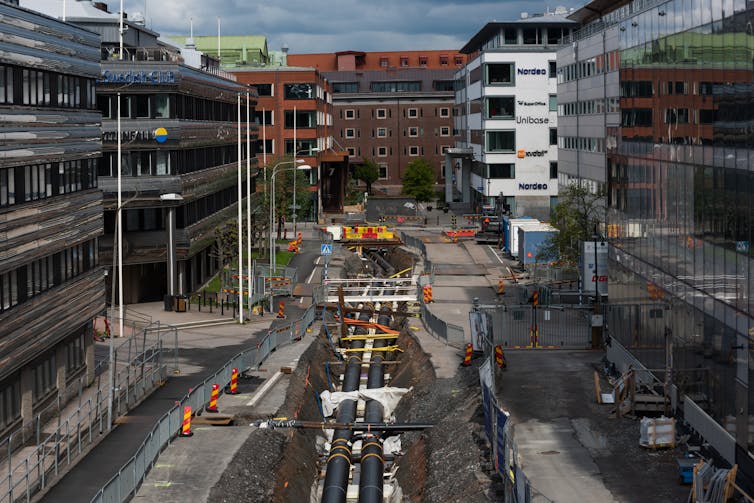
    pipes being laid under a city street
    District heating pipes being laid at Gullbergs Strandgata in Gothenburg, Sweden in May 2021.
    (Shutterstock)

    The oil crisis of the 1970s motivated both countries to find new domestic heating sources. They financed their new infrastructure over 50 years and reduced their investment risks through low-interest bonds (loaned by public banks) and generous subsidies.

    These were offered to utility companies looking to expand district energy operations, and to consumers by incentivizing connections to such systems. Additionally, in Denmark, controlled consumer prices served a similar function.

    At least seven American states have established thermal energy networks, with New York being the first. The state’s Utility Thermal Energy Network and Jobs Act allows public utilities to own, operate and manage thermal networks.

    They can supply thermal energy, but so can private producers such as data centres, all with public oversight. Such a strategy avoids monopolies and allows gas and electric utilities to deliver services through central networks.

    An opportunity for Canada

    Canada has a real opportunity to learn from the experiences of Sweden, Denmark and New York. In doing so, Canada can create a beneficial and truly national heating system in the process. Beginning with federal government leadership, thermal networks could be built across Canada, tailored to the unique and individual needs, strengths and opportunities of municipalities and provinces.

    Such a shift would reduce emissions and generate greater energy sovereignty for Canada. It could drive a just energy strategy that could provide employment opportunities for those displaced by the transition away from fossil fuels, while simultaneously increasing Canada’s economic independence in the process.

    Thermal networks could be built using pipelines made from Canadian steel. Oil-well drillers from Alberta could dig borehole heat-storage systems. A new market for heat-recovery pumps would create good advanced-manufacturing jobs in Canada.


    Read more:
    How heat storage technologies could keep Canada’s roads and bridges ice-free all winter long


    Funding for the infrastructure could come through public-private partnerships, with major investments from public banks and pension funds, earning a solid and secure rate of return. A regulated approach and process could permit this infrastructure cost to be amortized over decades, similar to the way past governments have financed gas, electrical and water networks.

    As researchers studying the engineering and policy potential of such an opportunity, we view such actions as essential if net-zero is to be achieved in the Canadian building sector. They are also a win-win solution for incumbent industry, various levels of government and citizens across Canada alike.

    Yet efforts to install robust thermal networks remain stalled by institutional inertia, the strong influence of the oil industry, limited citizen awareness of the technology’s potential and a tendency for government to view the electrification of heating as the primary solution to building decarbonization.

    In this time of environmental crisis and international uncertainty, pushing past these barriers, drawing on Canada’s lengthy history of constructing infrastructure and creating this new form thermal energy infrastructure would be a safe, beneficial and conscientious way to move Canada into a more climate-friendly future.

    The Conversation

    James (Jim) S. Cotton receives funding from the Natural Sciences and Engineering Research Council of Canada.

    Caleb Duffield does not work for, consult, own shares in or receive funding from any company or organisation that would benefit from this article, and has disclosed no relevant affiliations beyond their academic appointment.

    ref. Canada could use thermal infrastructure to turn wasted heat emissions into energy – https://theconversation.com/canada-could-use-thermal-infrastructure-to-turn-wasted-heat-emissions-into-energy-254972

  • MIL-OSI Asia-Pac: DoIT MOEA AI-Enhanced Vaccines and Anti-Pulmonary Inflammatory Drugs Shine at BIO Asia-Taiwan 2025: Health Maintenance, Prevention, and Treatment-A Triple Strategy for a Resilient and Healthy Taiwan

    Source: Republic of China Taiwan

    The Department of Industrial Technology (DoIT) of the Ministry of Economic Affairs (MOEA) convened three research foundations-ITRI (Industrial Technology Research Institute), FIRDI (Food Industry Research and Development Institute), and the Development Center for Biotechnology (DCB)-to establish the DoIT pavilion, which held its opening ceremony at BIO Asia-Taiwan 2025. The pavilion showcases 12 innovative technological achievements in health maintenance, disease prevention, and treatment, highlighting Taiwan’s capabilities in biomedical research and development while injecting new momentum into the health industry. Key exhibit technologies include the “Smart Processing & Equipment Integration for Plant-Based Drinks,” designed for the elderly; the “Long-Lasting Immunity of CD40 Ligand Ribonucleic Acid Vaccine Adjuvant,” developed to extend vaccine effectiveness; and the “Novel Selective FPR1 Antagonist,” which reduces side effects while improving therapeutic outcomes.

    Senior Technical Specialist of the Department of Industrial Technology (DoIT), Mr. Tai Chien-Cheng , indicated that in the face of global political and economic uncertainties, pharmaceuticals have become essential strategic commodities vital to public well-being and safety. Taiwan’s strengths in research and development (R&D), regulatory frameworks, and manufacturing processes position it as a reliable partner for international pharmaceutical companies. To enhance global integration and expand cooperation, Taiwan should improve collaboration across both upstream and downstream industries, thereby increasing technical density and strengthening global competitiveness. He advocated for DoIT to continue connecting foundational resources and implementing supportive policies for R&D funding and tools to facilitate industrial advancement. The pavilion symbolizes the long-term commitment of research institutions to the “Three-Stage, Five-Level Prevention” framework, linking applications from “precision medicine” to “palliative care,” and showcasing the government’s proactive efforts in realizing the “Healthy Taiwan” policy.

    In addition, several breakthroughs driven by or related to artificial intelligence (AI) are highlighted among the 12 innovative technologies showcased in the pavilion.

    ITRI presents “Tumor-Derived Exosomes Enrichment and Detection Platform”, and “One-Stop Exosome Isolation and Characterization Services”. FIRDI showcases “Intelligent Preparation of Nutritional Beverages” in AI-powered biomedicine research and development.

    ITRI’s “In Vivo Delivery of mRNA Encoding CAR to Macrophages for Solid Tumor Therapy” and “An Eye Drop Product for Dry AMD Treatment”. DCB showcases “Rejuvenating CAR-T Cells Through the Secretion of Antibodies Targeting Immunosuppressive Axis” and “NTSR1-ADC: A Novel Therapeutics for Head and Neck Cancer” for cancer and ophthalmic conditions. These technologies highlight the progress in therapeutic drug development and the emergence of new treatment breakthroughs.

    Additionally, FIRDI contributes its technical expertise through the development of “Plant-based animal fat alternative technology” and “Microorganisms in the Modification of Food Texture and Flavor”. These innovations aim to redefine the texture and quality of plant-based meats, infusing the plant-based industry with dynamic advancements.

    Spokesperson: Ministry of Economic Affairs Department of Industrial Technology (Taiwan) Deputy Director General Chou Chung-Pin
    Telephone:02-23212200 extension 8121
    Email:cbjou@moea.gov.tw

    Contact person:Ministry of Economic Affairs Department of Industrial Technology (Taiwan) Technical Specialist Tai Chien-Cheng
    Telephone:02-23212200 extension 8180
    Email:cctai@moea.gov.tw

    Media contact:Ministry of Economic Affairs Department of Industrial Technology (Taiwan) Researcher
    Telephone:02-23212200 extension 8155,0910-660322
    Email:yschi@moea.gov.tw

    MIL OSI Asia Pacific News

  • MIL-OSI: Questerre announces definitive agreement to acquire 100% of PX Energy

    Source: GlobeNewswire (MIL-OSI)

    THIS NEWS RELEASE IS NOT FOR DISSEMINATION OR DISTRIBUTION IN THE UNITED STATES OF AMERICA TO UNITED STATES NEWSWIRE SERVICES OR UNITED STATES PERSONS

    CALGARY, Alberta, July 29, 2025 (GLOBE NEWSWIRE) — Questerre Energy Corporation (“Questerre” or the “Company”) (TSX,OSE:QEC) is pleased to announce that it has entered into a definitive agreement (the “Definitive Agreement”) to acquire 100% of Parana Xisto SA (“PX Energy”), a privately held shale oil production and refining company based in southern Brazil by way of acquisition of the shares of its indirect parent companies, Forbes & Manhattan Resources Inc. (“F&M Resources”) and Forbes Participaҫões Ltda (the “Acquisition”).

    “This acquisition is a rare opportunity for us to gain the expertise and capacity to advance our multi-billion barrel oil shale resource in Jordan(1). I’m very pleased we were able to structure it to ensure the Quebec Assets are not affected by this deal.” said Michael Binnion, President and Chief Executive Officer of Questerre. “PX Energy has operated for over thirty years using technology developed by Petrobras. We believe the PX Energy platform will also provide us with the operational base, deep expertise, and capital foundation needed to advance the Red Leaf oil shale and biofuel technology to the next stage. We are in active discussions with potential co-investors for up to 50% of this acquisition.”

    Transaction Highlights

    Assets acquired: PX Energy currently produces approximately 4,500 boe per day, with a targeted increase to 6,000 boe per day by August 31, 2026, supported by growth capital projects currently underway.

    Purchase consideration: 65 million common shares of Questerre, structured as follows:

    • 15 million common shares issued upon closing, which will be subject to a voting and lock-up agreement;
       
    • 50 million common shares, released in two tranches based on the achievement of key performance milestones:
      • With respect to the first tranche of 25 million common shares, US$30 million Free Cash Flow achieved no later than September 30, 2027, with respect to the second tranche of 25 million common shares, US$40 million Free Cash Flow achieved no later than September 30, 2028; or
      • Equity financings completed at or above C$0.50 per share with respect to the first tranche for aggregate proceeds of at least C$25 million completed no later than September 30, 2027 and with respect to the second tranche, an equity financing at or above C$1.00 per share for aggregate proceeds of at least C$25 million no later than September 30, 2028.

    Quebec asset spin-out: It is anticipated that Questerre’s Quebec-based assets (the “Quebec Assets”) will be transferred into a separate sidecar subsidiary company (the “Quebec Spin-out”). Questerre anticipates either distributing preferred shares of Questerre or of the new entity to its existing shareholders ahead of the closing of the acquisition of PX Energy in order not to dilute its existing shareholders’ position in the Quebec Assets.

    Closing conditions: Completion of the Acquisition is subject to a number of conditions, including satisfactory due diligence review, board approval, standard regulatory approvals (including acceptance from the Toronto Stock Exchange and Oslo Stock Exchange (collectively, the “Exchanges”)) and third-party approvals including satisfactory waivers by the bond holders and convertible noteholders in favor of Questerre. Where applicable, the proposed Acquisition cannot close until the required shareholder approval is obtained. There can be no assurance that the Acquisition will be completed as proposed or at all.

    The Company has retained Clarksons Securities AS, a Norwegian based investment banking firm as financial advisor to advise on the existing outstanding debt of PX Energy including US$80 million in senior secured bonds in Forbes Resources Brazil Holding SA (the parent company of PX Energy). The Company is anticipating that a stronger sponsor will be well received by the debt holders and the holders of US$8 million in convertible promissory notes in F&M Resources. Financial information on Forbes Resources Brazil Holding SA is available online at: https://investidores.pxenergy.com.br/.

    Strategic Rationale

    PX Energy is a vertically integrated refining and shale oil operation with established ESG performance, favorable cost structures, and a strong growth trajectory. Its operations generate US Dollar-linked revenues with Brazil reais-denominated costs, providing robust margin potential in a dynamic macroeconomic environment.

    The acquisition strengthens Questerre’s oil shale footprint and complements its commitment to advancing environmentally responsible hydrocarbon technologies through its investee Red Leaf Resources Inc.

    About Questerre Energy Corporation

    Questerre Energy Corporation is a Calgary-based energy technology company focused on the responsible development of oil and gas resources across the Americas. Questerre integrates leading-edge technologies with a disciplined capital strategy to unlock long-term value while maintaining strong environmental and social governance standards.

    About PX Energy Inc.

    PX Energy is a Brazilian shale oil and refining company operating since the 1990s. It employs advanced pyrolysis technology, integrates mining and refinery operations, and maintains some of the region’s lowest carbon intensity per barrel. With secured offtake agreements and robust infrastructure, PX Energy is a platform for scalable, sustainable energy production. More information about PX Energy is available online at https://pxenergy.com.br/

    All information contained in this news release with respect to PX Energy was supplied by the F&M Resources, for inclusion herein, without independent review by Questerre, and Questerre and its directors and officers have relied on F&M Resources for any information concerning the PX Energy.

    For further information, please contact:

    Questerre Energy Corporation
    Jason D’Silva, Chief Financial Officer
    (403) 777-1185 | (403) 777-1578 (FAX) 

    Advisory Regarding Forward-Looking Statements

    This news release contains certain statements which constitute forward-looking statements or information (“forward-looking statements”) within the meaning of applicable securities laws in Canada. Any statements about Questerre’s expectations, beliefs, plans, goals, targets, predictions, forecasts, objectives, assumptions, information and statements about possible future events, conditions and results of operations or performance are not historical facts and may be forward-looking. Forward-looking information is often, but not always, made through the use of words or phrases such as “anticipates”, “aims”, “strives”, “seeks”, “believes”, “can”, “could”, “may”, “predicts”, “potential”, “should”, “will”, “estimates”, “plans”, “mileposts”, “projects”, “continuing”, “ongoing”, “expects”, “intends” and similar words or phrases suggesting future outcomes. Forward-looking information in this news release includes, but is not limited to, statements in respect of:

    • anticipated benefits of the Acquisition to the Company and its shareholders, including any operational and economic synergies;
    • the timing and receipt of any required securityholder, third-party (including, satisfactory waivers by the bondholders and convertible noteholders), Exchanges, or regulatory approvals;
    • the ability of the Company and PX Energy to satisfy the conditions to, and to negotiate and execute a Definitive Agreement and to complete, the Acquisition;
    • the anticipated timing for executing a Definitive Agreement;
    • the form of the Quebec Spin-out, and any changes to the anticipated structure thereof;
    • the closing of the Acquisition and the Quebec Spin-out, including the timing thereof, if it is to close at all;
    • the application of the HCCO technology to, and the overall integration of, the PX Energy Platform being acquired, and any operational synergies or economic benefits that may result;
    • PX Energy’s predicted production rates, and its production at similar rates upon completion of the Acquisition; and
    • the achievement of the performance milestones attached to the consideration payable, and the timing thereof, if at all.

    The forward-looking information that may be in this news release is based on current expectations, estimates, projections and assumptions, having regard to the Company’s experience and its perception of historical trend which have been used to develop such statements and information, but which may prove to be incorrect, and includes, but is not limited to, expectations, estimates, projections and assumptions relating to:

    • the timely receipt of approval of the Acquisition by the Exchanges, third parties, and other regulatory bodies;
    • all closing conditions to the Acquisition being satisfied and the closing of the Acquisition occurring as anticipated;
    • all closing conditions to the Quebec Spin-out being satisfied and the closing of the Quebec Spin-out occurring as anticipated;
    • foreign currency exchange rates and interest rates;
    • future crude oil, natural gas liquids, and natural gas prices;
    • management’s expectations relating to the timing and results of its other exploration and development activities;
    • ability of management to execute on key priorities;
    • the effectiveness of various actions resulting from the Company’s strategic priorities;
    • the Company’s ability to integrate the PX Energy platform to advance its oil shale and biofuel technology to the next stage;
    • the Company’s ability to maintain PX Energy predicted rate of production; and
    • the Company’s ability to apply its HCCO technology to the assets being acquired.

    Although Questerre believes that the expectations reflected in these forward-looking statements are reasonable, undue reliance should not be placed on them because Questerre can give no assurance that they will prove to be correct. Since forward-looking statements address future events and conditions, by their very nature they involve inherent risks and uncertainties. Current conditions, economic and otherwise, render assumptions, although reasonable when made, subject to greater uncertainty. Undue reliance should not be placed on forward-looking information as actual results may differ materially from those expressed or implied by forward-looking information.

    Events or circumstances may cause actual results to differ materially from those predicted as a result of numerous known and unknown risks, uncertainties, and other factors, many of which are beyond the control of the Company, including, without limitation, the following risk factors:

    • the Acquisition not being completed on the terms anticipated or at all, including due to a closing condition not being satisfied, including, the inability to obtain receipt of all necessary securityholder, third parties (including satisfactory waivers by the bond holders and convertible noteholders), Exchanges, and regulatory approvals or consents, lack of material changes with respect to the parties and their respective businesses;
    • the Quebec Spin-out not being completed on the terms anticipated or at all;
    • the synergies expected from the Acquisition not being realized;
    • loss of key personnel of PX Energy upon completion of the Acquisition;
    • the implementation of Bill 21 by the Government of Quebec;
    • additional funding requirements;
    • exploration, development and production risks;
    • volatility in the oil and gas industry;
    • prices, markets and marketing of crude oil and natural gas;
    • liquidity and the company’s substantial capital requirements;
    • prices, markets and marketing of crude oil and natural gas;
    • political uncertainty;
    • non-government organizations;
    • changing investor sentiment;
    • global financial market volatility;
    • adverse economic conditions;
    • alternatives to and changing demand for petroleum products;
    • environmental risks;
    • regulatory risks;
    • inability of management to execute its business plan;
    • competition from other issuers;
    • expiration of licenses and leases;
    • Indigenous claims;
    • possible failure to realize anticipated benefits of acquisitions; and
    • reputational risks.

    Additional information regarding some of these risks, expectations or assumptions and other risk factors may be found in the Company’s Annual Information Form for the year ended December 31, 2024, and other documents available on the Company’s profile at www.sedarplus.ca. Readers are cautioned not to place undue reliance on these forward-looking statements. The forward-looking statements contained in this news release are made as of the date hereof and Questerre undertakes no obligations to update publicly or revise any forward-looking statements, whether as a result of new information, future events or otherwise, unless so required by applicable securities laws.

    Barrel of oil equivalent (“boe”) amounts may be misleading, particularly if used in isolation. A boe conversion ratio has been calculated using a conversion rate of six thousand cubic feet of natural gas to one barrel of oil and the conversion ratio of one barrel to six thousand cubic feet is based on an energy equivalent conversion method application at the burner tip and does not necessarily represent an economic value equivalent at the wellhead. Given that the value ratio based on the current price of crude oil as compared to natural gas is significantly different from the energy equivalent of 6:1, utilizing a conversion on a 6:1 basis may be misleading as an indication of value.

    This news release is not an offer of securities for sale in the United States. Securities may not be offered or sold in the United States or to or for the account or benefit of US persons (as such terms are defined in Regulation S under the United States Securities Act of 1933, as amended (the “U.S. Securities Act“)), absent registration or an exemption from registration. The securities offered have not been and will not be registered under the U.S. Securities Act or any state securities laws and, therefore, may not be offered for sale in the United States, except in transactions exempt from registration under the U.S. Securities Act and applicable state securities laws. This news release shall not constitute an offer to sell or the solicitation of an offer to buy nor shall there be any sale of the securities in any State in which such offer, solicitation or sale would be unlawful.

    (1) There is no certainty that it will be commercially viable to produce any portion of the resources. In October 2016, Questerre commissioned an independent assessment of its oil shale resources in Jordan (the “Millcreek Report”). The Millcreek Report was conducted by Millcreek Mining Group, an independent qualified reserves evaluator, as defined by NI 51-101 with an effective date of September 30, 2016. The assessment was prepared in accordance with NI 51-101 and the COGE Handbook. The assessment indicated a best estimate of discovered petroleum initially in place of between 7.8 billion barrels to 12.2 billion barrels. Given the preliminary nature of the Millcreek Report, it does not contain any estimates regarding the timing or cost to obtain commercial development nor has Questerre finalized the specific technology to be used. Please reference the Annual Information Form for the year ended December 31, 2016, and dated March 24, 2017, as filed under the Corporation’s profile on www.sedarplus.ca.

    The MIL Network

  • MIL-OSI: SDHG’s Lead in Electricity-Computing Integration Helps Market Cap Hit HK$100 Billion

    Source: GlobeNewswire (MIL-OSI)

    • SDHG market cap hit HK$100 billion for the first time, as stock price surged 200+ percent in 2025
    • From 2021 to 2024, SDHG’s total assets more than tripled, from RMB 21.43 billion to RMB 66.17 billion
    • Dazzling success attributed to SDHG’s two-pronged strategy of smart investing in new energy and computing power
    • Electricity-Computing Integration model places SDHG in unique position to lead industry
    • SDHG’s outstanding ability to align key businesses with national policy priorities wins dedicated government support

    HONG KONG, July 29, 2025 (GLOBE NEWSWIRE) — Shandong Hi-Speed Holdings Group Ltd. (00412.HK) shares rose to HK$17.26 at closing on Monday, July 28, sending the market cap of the strongly growing company to HK$103.9 billion. SDHG market cap exceeded HK$100 billion for the first time on July 11. The fact that it has since remained steadily above the HK$100 billion mark indicates the market’s unequivocal endorsement of SDHG as a leader in Electricity-Computing Integration and AI-ready infrastructure.

    SDHG’s Lead in Electricity-Computing Integration Helps Market Cap Hit HK$100 Billion

    As global competition in AI innovation intensifies to a breakneck pace, the demand for computing power has skyrocketed, which led renewable energy and computing power to become critical battlegrounds for serious contenders in the field. SDHG, a pioneer strategic investor in Electricity-Computing Integration, is widely believed to lead the race.

    Pivot to AI infrastructure builder
    The demand for both computing power and the electricity to run the data centers in China is forecast to see exponential growth in the coming years. In 2025, data center electricity consumption is expected to account for 5 percent of China’s total electricity usage. The country’s intelligent computing power is projected to reach 1,037.3 EFLOPS in 2025 and to surge to 2,781.9 EFLOPS in 2028. The highly centralized GPU clusters required for intelligent computing centers will have to consume more power.

    On the eve of AI innovation booms, SDHG has made a strategic transition from primarily making financial investments toward becoming an investment holding platform focused on emerging industries. It has since emerged as China’s leading company owning premium assets in both renewable energy and computing power, creating a unique Electricity-Computing Integration model.

    In 2022, SDHG acquired Shandong Hi-Speed New Energy Group Ltd. (SHNE, 01250.HK) and now owns 56.97 percent of the company’s stakes. In 2023, SDHG made a strategic investment worth US$299 million in VNET Group Inc. (NASDAQ: VNET). SHNE owns clean energy projects in more than 20 provinces in China and has been actively exploring international markets. VNET started focusing on selling data center services to retail clients in China and has grown to serve hyperscale customers including Alibaba Cloud, Tencent Cloud, and Huawei Cloud.

    These and other smart investment moves have helped the company gain a strong foothold in traditional infrastructure as well as in new infrastructure.

    Alignment with national policy priorities
    SDHG has shown outstanding ability to align its key businesses with major national policy priorities, namely renewable energy and computing power. As a result, SDHG enjoys full policy dividends from such national projects as “East Data, West Computing” and secures dedicated government support in energy-rich provinces, especially support for its Electricity-Computing Integration model.

    Partnering with local governments and companies, SDHG has been able to achieve great success in experimenting with innovative business models that hand the company a unique advantage in both Chinese and international markets. The Ulanqab Source-Grid-Load-Storage Integration Project in Inner Mongolia is one of SDHG’s flagship projects and epitomizes the innovativeness of Electricity-Computing Integration.

    SDHG is building power generation and storage facilities (solar and wind) right next to AIDC and other computing power centers in grassland town Ulanqab. The model breaks down traditional power grid constraints by enabling direct electricity trading (“selling electricity across the wall”). It thus establishes an ecosystem of power generation, transmission, and consumption in the same physical space. This self-contained green ecosystem, with tremendous environmental and economic value, operates on the principles of:

    – Instant Utilization (power consumed immediately upon generation)
    – On-Demand Availability (guaranteed supply for computing facilities)
    – Market-Based Pricing (dynamic cost optimization)
    – Mutual Benefit (win-win for energy producers and computing operators)

    Upon completion, the SDHG Ulanqab project will generate approximately 860 million kWh of electricity annually, supplying a significant part of the power to run VNET’s 150MW computing centers in Ulanqab. When the 1GW Ulanqab III is in full operation and powered by SDHG, an additional RMB 1.3 billion worth of economic benefits will be created for the company.

    The SDHG Ulanqab project with its pioneering Electricity-Computing Integration model is set to play a major role in AI’s transformation of Chinese tech industry, the same way as Stargate and other mega projects contribute to the building of AI infrastructure in their respective countries.

    Reliable financing toolkit
    SDHG’s solid background in licensed financial transactions and ability to leverage Hong Kong’s status as an international financial center have also been crucial in its success in financing the new energy and computer power projects with a reliable world-class toolkit.

    In May 2024, SDHG issued US$900 million worth of perpetual bonds — the largest USD senior perpetual bond issuing by any Chinese issuer since 2021, which were subscribed by 280 institutional accounts across Asia, Europe, the Middle East and Africa. In March 2025, SDHG’s portfolio company VNET Group Inc. completed a $430 million convertible preferred notes offering — the largest such issuance relative to market cap by a Chinese firm since early 2024 which secured foundational capital for its domestic expansion.

    Endowed with the above-mentioned advantages, SDHG has established itself as a market leader with proven operational excellence, attracting more and more major companies to become customers and partners.

    In May 2025, SDHG signed a strategic cooperation agreement with Chinese tech giant Huawei Technologies Co., Ltd. to build projects driven by “green computing power and clean energy”, develop “zero-carbon smart parks”, and collaborate in the field of intelligent transportation, including vehicle-road coordination and large-scale intelligent driving models.

    The capital market has also reacted to SDHG’s new strategy and remarkable business performance enthusiastically. In June 2025, multiple brokerages issued initiating coverage reports with “Outperform” ratings for SDHG, including Soochow Securities (Hong Kong), Zhongtai Securities, Tebon Securities, and SXC Securities.

    “Through smart strategic maneuvers, SDHG has managed to build a complete ecosystem in new energy and new infrastructure, greatly enhancing the company’s core competitiveness,” the Zhongtai Securities report states.

    SDHG was incorporated as China New Financial Group Limited. The company was acquired by Shandong Hi-Speed Group in 2017 and adopted its current name in 2022. It was listed on the Hong Kong Stock Exchange in the same year and is now a constituent stock of the Hang Seng Composite Index. The company currently holds an Fitch “A-” Issuer Default Rating (IDR) with an ESG Entity Rating of “2” (Sustainable Fitch).

    SHDG has been on a phenomenal growth trajectory in the last 4 years despite macroeconomic challenges in the world and in the region. From 2021 to 2024, its total assets more than tripled — expanding from RMB 21.43 billion to RMB 66.17 billion. Its stock price has soared over 200 percent in 2025, while annual revenues are forecast to grow to RMB 6.59 billion, RMB 6.77 billion, and RMB 7.37 billion for 2025, 2026, and 2027, respectively. Net profit attributable to parent company shareholders is expected to more than double in the period, from RMB 216 million in 2025 to RMB 555 million in 2027.

    “We expect SDHG to keep its growth momentum in the coming years, benefiting from and contributing to national policy initiatives in new energy and computing power. In particular, SDHG’s Electricity-Computing Integration model powering AIDC will cement the company’s lead in the industry and help realize its full potential as a market innovator,” the Zhongtai Securities report concludes.

    Media Contact
    Company Name: Shandong Hi-Speed Holdings Group
    Contact: Stanley Shi
    Website: https://www.sdhg.com.hk/en/
    Email: stanleyshi@sdhg.com.hk

    A photo accompanying this announcement is available at https://www.globenewswire.com/NewsRoom/AttachmentNg/19edaee3-12ec-4982-8ee3-ecf0bfa533d8

    The MIL Network

  • Gunman kills four, including police officer, in Manhattan skyscraper, then takes own life

    Source: Government of India

    Source: Government of India (4)

    A gunman opened fire on Monday inside a Midtown Manhattan skyscraper housing NFL headquarters and offices of several financial firms, including Blackstone, killing four people before fatally shooting himself, New York City officials said.

    One of the four victims slain in the gun violence was a 36-year-old New York Police Department officer who had been on the force for about 3 1/2 years. The three others killed by the suspect were civilians.

    New York Police Commissioner Jessica Tisch said the gunman, who resided in Las Vegas and drove cross-country to New York in recent days, fatally shot himself in the chest at the end of his shooting spree.

    Tisch said the gunman was believed to have acted alone, and investigators had yet to determine a possible motive for the shooting.

    A photo of the suspect that CNN said was shared by police showing a gunman walking into the building carrying a rifle was published by a number of major news media outlets. Preliminary checks of the suspect’s background did not show a significant criminal history, the report added, citing officials.

    The skyscraper at 345 Park Avenue houses offices of a number of financial institutions, including Blackstone and KPMG, along with the NFL headquarters.

    A large police presence converged on the area around the tower, according to Reuters journalists near the scene.

    “I just saw a lot of commotion and cops and people screaming,” said Russ McGee, a 31-year-old sports bettor who was working out in a gym adjacent to the skyscraper, told Reuters in an interview near the scene.

    The FBI said agents from its New York field office were also responding to provide support at the scene.

    (Reuters)

  • MIL-OSI Banking: RBA and APRA Update Their Memorandum of Understanding to Strengthen Cooperation to Support Financial Stability

    Source: Reserve Bank of Australia

    The Reserve Bank of Australia (RBA) and the Australian Prudential Regulation Authority (APRA) have today published an updated Memorandum of Understanding (MOU), to further strengthen their cooperation and coordination arrangements in support of financial stability in Australia. The updated MOU sets out the RBA and APRA’s respective roles and responsibilities for contributing to financial stability, as well as arrangements for consultation, liaison and information sharing between the two agencies. The MOU also sets out specific arrangements for coordination between the RBA and APRA in relation to macroprudential policy, liquidity support, payments policy and crisis management.

    Both the RBA and APRA have responsibilities in relation to financial stability in Australia, and it is therefore important that they continue to engage closely with one other. The RBA and APRA also cooperate and coordinate with each other and other regulatory agencies on a multilateral basis through the Council of Financial Regulators. The Council of Financial Regulators has today published an updated Charter.

    MIL OSI Global Banks

  • MIL-OSI Russia: Tbilisi celebrated the 98th anniversary of the founding of the People’s Liberation Army of China

    Translation. Region: Russian Federal

    Source: People’s Republic of China in Russian – People’s Republic of China in Russian –

    An important disclaimer is at the bottom of this article.

    Source: People’s Republic of China – State Council News

    Tbilisi, July 29 (Xinhua) — The Chinese Embassy in Georgia held a reception in Tbilisi to mark the 98th anniversary of the founding of the People’s Liberation Army (PLA).

    The event was attended by employees of the Georgian Ministry of Defense, high-ranking government officials, members of parliament, foreign ambassadors, military attachés, as well as representatives of the media, Chinese and Georgian companies and public circles.

    The ceremonial part began with the performance of the national anthems of China and Georgia. The first vice-speaker of the Georgian Parliament, Gia Volski, delivered a congratulatory message on behalf of the country’s legislative body. He noted that China was one of the first countries to recognize Georgia’s independence, stressed the importance of China’s support for Georgia’s sovereignty and territorial integrity within its internationally recognized borders, and reaffirmed Georgia’s unwavering commitment to the one-China principle.

    G. Volsky also emphasized the strategic importance of Georgia as a bridge between Europe and Asia and noted the country’s role in the Belt and Road initiative, especially within the framework of the Trans-Caspian International Transport Route.

    He recalled the results achieved in bilateral cooperation, including the free trade agreement of 2018, the establishment of a strategic partnership in 2023 and the introduction of a visa-free regime from 2024. According to him, in 2024, trade turnover between Georgia and China exceeded $1.9 billion. The Vice Speaker expressed confidence in the further strengthening of the Georgian-Chinese partnership and thanked the Ambassador of the People’s Republic of China to Georgia Zhou Qian for his contribution to the development of bilateral relations.

    In his speech, Zhou Qian noted that the PLA, created and led by the Communist Party of China, has grown from nothing to become strong in its 98-year history. The army has made invaluable contributions to the liberation of the Chinese people, the construction of a socialist country, the protection of national sovereignty and security, and the maintenance of peace and stability throughout the world, he added.

    The ambassador stressed that China deeply appreciates the contribution of the Georgian people to the victory in the world anti-fascist war. According to the diplomat, China and Georgia are countries with an ancient civilization and a rich historical heritage. China has always supported Georgia in protecting its sovereignty and territorial integrity, as well as in striving for sustainable development in accordance with national conditions, Zhou Qian said.

    The Ambassador emphasized that China, as one of the first countries to sign the UN Charter and a permanent member of the Security Council, is ready to continue to actively cooperate with all countries of the world, including Georgia. He expressed readiness to jointly promote the correct view of history, defend the results of the victory in World War II and support the international system, the core of which is the UN. –0–

    Please note: This information is raw content obtained directly from the source of the information. It is an accurate report of what the source claims and does not necessarily reflect the position of MIL-OSI or its clients.

    .

    MIL OSI Russia News

  • MIL-OSI Russia: Gugong and National Museum of China in Beijing closed to visitors due to heavy rains

    Translation. Region: Russian Federal

    Source: People’s Republic of China in Russian – People’s Republic of China in Russian –

    An important disclaimer is at the bottom of this article.

    Source: People’s Republic of China – State Council News

    BEIJING, July 29 (Xinhua) — The Forbidden City and the National Museum of China in Beijing were closed to visitors on Tuesday, reportedly for safety reasons after the capital’s authorities issued a flood alert over heavy rains.

    Both institutions announced that all pre-booked tickets can be returned or exchanged for another date. -0-

    Please note: This information is raw content obtained directly from the source of the information. It is an accurate report of what the source claims and does not necessarily reflect the position of MIL-OSI or its clients.

    .

    MIL OSI Russia News

  • MIL-OSI Russia: At least two people were shot in an attack at an office building in New York.

    Translation. Region: Russian Federal

    Source: People’s Republic of China in Russian – People’s Republic of China in Russian –

    An important disclaimer is at the bottom of this article.

    Source: People’s Republic of China – State Council News

    NEW YORK, July 28 (Xinhua) — At least two people, including a police officer, were injured in an attack at an office building in New York’s Manhattan on Monday, local media reported.

    Police arrived at the scene and urged residents to stay away from the east side of 52nd Street between Park and Lexington Avenues.

    “The situation on the scene is now under control and the lone shooter has been neutralized,” NYPD Commissioner Jessica Tisch said on social media. –0–

    Please note: This information is raw content obtained directly from the source of the information. It is an accurate report of what the source claims and does not necessarily reflect the position of MIL-OSI or its clients.

    .

    MIL OSI Russia News

  • MIL-OSI Russia: B. Netanyahu to present Gaza annexation plan in case Hamas refuses deal – media

    Translation. Region: Russian Federal

    Source: People’s Republic of China in Russian – People’s Republic of China in Russian –

    An important disclaimer is at the bottom of this article.

    Source: People’s Republic of China – State Council News

    JERUSALEM, July 29 (Xinhua) — Israeli Prime Minister Benjamin Netanyahu is expected to present a plan to annex part of the Gaza Strip to the country’s security cabinet, the Israeli newspaper Haaretz reported on Monday evening.

    According to her, B. Netanyahu told the ministers that Israel gave Hamas several days to agree on a ceasefire. If it refuses the agreement, Israel will begin to gradually annex parts of the Gaza Strip until the Palestinian movement surrenders, the prime minister added.

    The article notes that B. Netanyahu has chosen this course of action in order to secure the support of the far-right Religious Zionism party, which opposes both the ceasefire and increased humanitarian aid to Gaza. Keeping this party in the coalition is crucial to preventing the collapse of the current government.

    According to media reports, Religious Zionism leader and cabinet member Bezalel Smotrich told his associates that the party is pushing a “good strategic move” and it will soon become clear whether it will be successful.

    Haaretz writes that during his conversations with ministers, B. Netanyahu stated that his plan was approved by the administration of US President Donald Trump.

    Also on Monday, the Prime Minister’s Office said Israel would continue to work with international organizations, as well as the United States and European countries, to ensure that large amounts of humanitarian aid reach the Gaza Strip. “While the situation in Gaza remains difficult and Israel works to ensure that aid reaches the Strip, Hamas is benefiting from attempts to create the impression of a humanitarian crisis,” the office said. -0-

    Please note: This information is raw content obtained directly from the source of the information. It is an accurate report of what the source claims and does not necessarily reflect the position of MIL-OSI or its clients.

    .

    MIL OSI Russia News

  • MIL-OSI Russia: Portugal questions fairness of EU-US trade deal

    Translation. Region: Russian Federal

    Source: People’s Republic of China in Russian – People’s Republic of China in Russian –

    An important disclaimer is at the bottom of this article.

    Source: People’s Republic of China – State Council News

    LISBON, July 29 (Xinhua) — Portugal has expressed concern over the recently concluded tariff deal between the EU and the United States, calling it a limited improvement that is not in line with genuine free trade principles and comes at a high cost to both sides.

    The country’s Ministry of Economy and Territorial Integrity acknowledged that the agreement, which sets US tariffs on European goods at 15 percent, could provide some predictability. However, “nothing can replace free trade,” and Portugal will continue to actively advocate for the gradual elimination of tariffs and other trade barriers, the ministry stressed.

    The Confederation of Portuguese Businesses (CPB) expressed only “relative relief” at the agreement, noting that the price to be paid was “high for both sides.”

    “When you were expecting a hurricane, you are glad that it is just a normal storm,” said CBP Director General Rafael Alves Rocha. However, he warned that the agreed duties were significantly higher than the current average of around 2.5 percent, representing a setback for exporters and highlighting the asymmetry of the EU and US tariff structures.

    The CPB said the agreement was unbalanced and put European producers at a disadvantage.

    The Portuguese government responded to the potential negative consequences with financial support measures for businesses.

    The Reforcar programme, aimed at protecting companies from adverse trade consequences, was launched in April. To date, 14,000 applications have been submitted for a total of €3.2 billion, of which €2.5 billion has been approved and €1.6 billion has already been spent.

    In addition, a special credit line has been created to support export-oriented small and medium-sized enterprises. The Ministry of Economy received 2.6 thousand applications for 1.3 billion euros, of which 600 million euros were approved.

    The new PT2030 incentive programme has launched a non-repayable grant pipeline to support internationalisation, targeting joint projects and cooperation strategies in foreign markets. The ministry announced that public applications for collective internationalisation initiatives will open on 31 July.

    Despite these supportive measures, Lisbon’s cautious tone and criticism from the business community reflect significant doubts about the long-term benefits of the EU-US trade deal. –0–

    Please note: This information is raw content obtained directly from the source of the information. It is an accurate report of what the source claims and does not necessarily reflect the position of MIL-OSI or its clients.

    .

    MIL OSI Russia News

  • MIL-OSI USA: LEADER JEFFRIES STATEMENT ON MASS SHOOTING IN MIDTOWN MANHATTAN

    Source: United States House of Representatives – Congressman Hakeem Jeffries (8th District of New York)

    Know Your Immigration Rights

    If you or a loved one encounter immigration enforcement officials, it is essential that you know your rights and have prepared your household for all possible outcomes.

    Ask for a warrant: The Fourth Amendment of the Constitution protects you from unreasonable search and seizure. You do not have to open your door until you see a valid warrant to enter your home or search your belongings.

    Your right to remain silent: The Fifth Amendment protects your right to remain silent and not incriminate yourself. You are not required to share any personal information such as your place of birth, immigration status or criminal history.

    Always consult an attorney: You have a right to speak with an attorney. You do not have to sign anything or hand officials any documents without speaking to an attorney. Try to identify and consult one in advance.

    The New York City Office of Civil Justice and the Mayor’s Office of Immigrant Affairs (MOIA) support a variety of free immigration legal services through local nonprofit legal organizations. To access these resources, dial 311 and say “Action NYC,” call the MOIA Immigration Legal Support Hotline at 800-354-0365 Monday through Friday from 9:00 a.m. to 6:00 p.m. or visit MOIA’s website.

    Learn more here: KNOW YOUR IMMIGRATION RIGHTS  – Congressman Hakeem Jeffries

    MIL OSI USA News

  • MIL-OSI Security: Delaware County Man Arrested for Sexual Exploitation of a Child

    Source: Office of United States Attorneys

    Brent G. Trimbell had Been Released from State Pretrial Custody on Rape and Aggravated Sexual Abuse Charges Before Being Charged Federally

    SYRACUSE, NEW YORK – Brent G. Trimbell, age 44, of Delaware County was arrested Sunday evening and had his initial appearance today on a charge of sexual exploitation of a child. Acting United States Attorney John A. Sarcone III and Craig L. Tremaroli, Special Agent in Charge of the Albany Field Office of the Federal Bureau of Investigation (FBI), made the announcement.

    The complaint alleges that Trimbell exchanged sexually explicit messages with a female child victim, including messages persuading her to create and send him videos of her engaged in sexually explicit conduct. The child created the content Trimbell requested and sent it to him over social media. The complaint also alleges that Trimbell had sexual contact with the victim on at least three occasions and sent the victim videos depicting him masturbating.

    Trimbell was first charged by state authorities with state sex offenses related to the foregoing conduct, but late last week he was released on bail.

    If convicted of sexual exploitation of a child, Trimbell faces a maximum term of imprisonment of 30 years and a mandatory minimum term of imprisonment of 15 years, a term of supervised release of at least five years and up to life, a fine of $250,000, forfeiture of property used to commit the offense, and restitution to the victim. Trimbell also would be required to register as a sex offender.

    Acting U.S. Attorney John A. Sarcone III stated: “Trimbell was charged with serious state sex offenses but was released on bail. Now, Trimbell is in federal custody—facing serious federal offenses—which if convicted, will result in a mandatory term of imprisonment of 15 years.  This is how we keep the children in our community safe.”

    FBI Special Agent in Charge Craig L. Tremaroli stated: “FBI Albany is incredibly thankful for the swift coordination from our partners at the Delaware County Sheriff’s Office and United States Attorney’s Office that has now resulted in serious federal charges against Mr. Trimbell. The FBI, together with our law enforcement partners, will continue to coordinate with our state and local partners to share the information and resources needed to ensure anyone hurting our most vulnerable is investigated and brought to justice.”

    Following the initial appearance, Trimbell was remanded to the custody of the United States Marshals Service pending further proceedings.

    The charges in the indictment are merely accusations. The defendant is presumed innocent unless and until proven guilty.

    This case is being investigated by the Federal Bureau of Investigation and the Delaware County Sheriff’s Office. Assistant U.S. Attorney Michael D. Gadarian is prosecuting the case as part of Project Safe Childhood.

    Project Safe Childhood is a nationwide initiative to combat the growing epidemic of child sexual exploitation and abuse. Led by the U.S. Attorneys’ Offices and the Criminal Division’s Child Exploitation and Obscenity Section (CEOS), Project Safe Childhood marshals federal, state and local resources to better locate, apprehend and prosecute individuals who exploit children via the Internet, as well as to identify and rescue victims. For more information about Project Safe Childhood, please visit https://www.justice.gov/psc.

    MIL Security OSI

  • MIL-OSI: Bitget Launchpool Features GAIA with over 4.7M Tokens in Rewards

    Source: GlobeNewswire (MIL-OSI)

    VICTORIA, Seychelles, July 29, 2025 (GLOBE NEWSWIRE) — Bitget, the leading cryptocurrency exchange and Web3 company, has announced the feature of Gaia (GAIA) on its launchpool as well as a listing for spot trading. Gaia is a decentralized computing infrastructure that enables everyone to create, deploy, scale, and monetize their own AI agents. Trading for the GAIA/USDT pair will begin on 30 July 2025, 09:00 (UTC).

    Bitget’s GAIA Launchpool campaign is offering 4,741,300 GAIA in total rewards. Eligible users can participate by locking BGB during the event, which runs from 30 July 2025, 09:00 to 1 August 2025, 09:00 (UTC). In the BGB locking pool, users can lock between 5 and 50,000 BGB, with maximum limits determined by their VIP tier, for a chance to earn a share of 3,858,300 GAIA.

    Alongside the listing, Bitget will launch a CandyBomb campaign with 633,000 GAIA available in rewards. Of this, 211,000 GAIA will be allocated to the GAIA, BTC and BGB trading pool for new users, while 422,000 GAIA will be up for grabs in the GAIA trading pool for existing users. The campaign will run from 30 July 2025, 9:00 till 6 Aug 2025, 9:00 (UTC).

    Bitget will also run an X Giveaway, where 750 qualified users will have the chance to win a share of 125,000 GAIA. The campaign runs from 30 July 2025, 9:00 to 1 August 2025, 9:00 (UTC). To participate, users must follow Bitget and Gaia on X, quote the giveaway post with the hashtag #GAIAxBitgetLaunchpool, tag a friend, sign up, deposit or trade GAIA on Bitget, and complete the form linked in the post.

    In addition, a community campaign will run from 30 July 2025, 9:00 to 6 Aug 2025, 9:00 (UTC), offering another 125,000 GAIA to be shared among 750 qualified users. To join, users need to become members of both the Bitget Discord and BGB Holders Group, sign up, make a net deposit of over 100 USDT, and complete any GAIA/USDT spot trade.

    Gaia is a decentralized AI network that enables users to host, own, and interact with autonomous AI agents in a secure and transparent environment. Built on blockchain technology, Gaia ensures each AI node operates independently while contributing to a broader, interconnected ecosystem. Users can deploy advanced models such as Qwen2 0.5B Instruct and customize them using personal or business data to create tailored AI services.

    By prioritizing data sovereignty and privacy, Gaia introduces a new model for decentralized AI development and monetization. Its user-friendly infrastructure allows individuals to easily install node software, configure models, and participate in domain-based AI collaboration, unlocking new possibilities for innovation in the Web3 space.

    Bitget continues to expand its offerings, positioning itself as a leading platform for cryptocurrency trading. The exchange has established a reputation for innovative solutions that empower users to explore crypto within a secure CeDeFi ecosystem.

    With an extensive selection of over 800 cryptocurrency pairs and a commitment to broaden its offerings to more than 900 trading pairs, Bitget connects users to various ecosystems, including Bitcoin, Ethereum, Solana, Base, and TON. The addition of Gaia into Bitget’s portfolio marks a significant step toward expanding its ecosystem by embracing decentralized AI innovation, empowering users with greater control over data privacy, and supporting the next generation of AI-driven Web3 applications.

    For more details on Gaia, visit here.

    About Bitget

    Established in 2018, Bitget is the world’s leading cryptocurrency exchange and Web3 company. Serving over 120 million users in 150+ countries and regions, the Bitget exchange is committed to helping users trade smarter with its pioneering copy trading feature and other trading solutions, while offering real-time access to Bitcoin price, Ethereum price, and other cryptocurrency prices. Formerly known as BitKeep, Bitget Wallet is a leading non-custodial crypto wallet supporting 130+ blockchains and millions of tokens. It offers multi-chain trading, staking, payments, and direct access to 20,000+ DApps, with advanced swaps and market insights built into a single platform.

    Bitget is driving crypto adoption through strategic partnerships, such as its role as the Official Crypto Partner of the World’s Top Football League, LALIGA, in EASTERN, SEA and LATAM markets, as well as a global partner of Turkish National athletes Buse Tosun Çavuşoğlu (Wrestling world champion), Samet Gümüş (Boxing gold medalist) and İlkin Aydın (Volleyball national team), to inspire the global community to embrace the future of cryptocurrency.

    Aligned with its global impact strategy, Bitget has joined hands with UNICEF to support blockchain education for 1.1 million people by 2027. In the world of motorsports, Bitget is the exclusive cryptocurrency exchange partner of MotoGP™, one of the world’s most thrilling championships.

    For more information, visit: Website | Twitter | Telegram | LinkedIn | Discord | Bitget Wallet

    For media inquiries, please contact: media@bitget.com

    Risk Warning: Digital asset prices are subject to fluctuation and may experience significant volatility. Investors are advised to only allocate funds they can afford to lose. The value of any investment may be impacted, and there is a possibility that financial objectives may not be met, nor the principal investment recovered. Independent financial advice should always be sought, and personal financial experience and standing carefully considered. Past performance is not a reliable indicator of future results. Bitget accepts no liability for any potential losses incurred. Nothing contained herein should be construed as financial advice. For further information, please refer to our Terms of Use.

    A photo accompanying this announcement is available at https://www.globenewswire.com/NewsRoom/AttachmentNg/7730d634-b088-4a1c-b437-c1051b2dd570

    The MIL Network

  • MIL-OSI Australia: Concern for welfare – Alice Springs Region

    Source: Northern Territory Police and Fire Services

    The Northern Territory Police Force holds concerns for the welfare of 26-year-old Gach, who was last seen leaving his home in Alice Springs yesterday afternoon at 3:30pm.

    Gach last spoke to family later in the day at 5:30pm via phone, however he failed to attend work for a rostered shift that night.

    Gach was driving his red Mazda CX5 with NT registration CG05CH, which was located this morning by police 14.5km west of John Flynn’s Grave Historical Reserve on Larapinta Drive.

    He is described as being of Sudanese appearance, with dark skin and a slim build. He was last seen wearing cream tracksuit pants, a black t-shirt and black shoes.

    Police are urging anyone who may have been travelling along Larapinta Drive between 5:30pm Monday 28 July and 8:00am this morning that may have seen Gach or his vehicle, or has dash cam footage, to please contact police on 131 444 and quote reference number NTP2500075979.

    MIL OSI News

  • MIL-OSI Economics: Desert-to-Power: SEFA commits €6 million to Dédougou Solar Project in Burkina Faso

    Source: African Development Bank Group
    The Sustainable Energy Fund for Africa (SEFA), managed by the African Development Bank, has committed a €6 million concessional finance package for the development of the 18 MW Dédougou Solar Power Plant in Burkina Faso, marking a significant milestone towards increasing the country’s energy generation capacity.

    MIL OSI Economics

  • MIL-OSI Economics: Secretary-General of ASEAN participates in the 17th FJCCIA Dialogue in Jakarta

    Source: ASEAN

    Secretary-General of ASEAN, Dr. Kao Kim Hourn, and the Federation of Japanese Chambers of Commerce and Industry in ASEAN (FJCCIA) Chairman, Mr. Wakabayashi Koichi, today led the 17th Dialogue between the Secretary-General of ASEAN and the FJCCIA at the ASEAN Headquarters/ASEAN Secretariat. Joined by Japan External Trade Organization (JETRO) President, Mr. Kataoka Susumu, Japanese government representatives and key members of Japanese chambers across ASEAN, the dialogue explored critical areas such as resilient supply chains, green economy & sustainability, and digital economy & emerging technologies. The high-level exchange aligned with ASEAN’s priorities, fostering actionable policies to enhance regional competitiveness and deepen the ASEAN-Japan Comprehensive Strategic Partnership.
     
    Download the full remarks here.
     

    The post Secretary-General of ASEAN participates in the 17th FJCCIA Dialogue in Jakarta appeared first on ASEAN Main Portal.

    MIL OSI Economics

  • MIL-OSI Australia: RBA and APRA Update Their Memorandum of Understanding to Strengthen Cooperation to Support Financial Stability

    Source: Airservices Australia

    The Reserve Bank of Australia (RBA) and the Australian Prudential Regulation Authority (APRA) have today published an updated Memorandum of Understanding (MOU), to further strengthen their cooperation and coordination arrangements in support of financial stability in Australia. The updated MOU sets out the RBA and APRA’s respective roles and responsibilities for contributing to financial stability, as well as arrangements for consultation, liaison and information sharing between the two agencies. The MOU also sets out specific arrangements for coordination between the RBA and APRA in relation to macroprudential policy, liquidity support, payments policy and crisis management.

    Both the RBA and APRA have responsibilities in relation to financial stability in Australia, and it is therefore important that they continue to engage closely with one other. The RBA and APRA also cooperate and coordinate with each other and other regulatory agencies on a multilateral basis through the Council of Financial Regulators. The Council of Financial Regulators has today published an updated Charter.

    MIL OSI News

  • MIL-OSI New Zealand: Heathcare – NZ hosts first-of-its-kind course on life-saving heart technique that halves deaths

    Source: Kia Manawanui Trust | The Heart of Aotearoa New Zealand

    Patients are often told they are “in the best hands”, yet many New Zealanders with blocked arteries in the heart are treated using outdated techniques.
    Most stents are guided into place using angiography – a decades-old imaging method that provides a 2D black-and-white image of the arteries, but offers little detail from inside the vessel itself. Although widely used, it leaves cardiologists making critical decisions without the full picture.
    This week, 30 cardiologists from around New Zealand and Australia will attend a specific teaching course that certifies them in two cutting-edge cardiac imaging techniques – Optical Coherence Tomography (OCT) and Intravascular Ultrasound (IVUS). These techniques provide detailed 3D images from inside the coronary arteries, reducing the risk of thrombosis, and subsequent heart attacks and death.
    The course is being hosted by The Heart of Aotearoa – The Kia Manawanui Trust, alongside the Transcontinental Coronary Imaging and Physiology Club (TCIP) and Asian Pacific Society of Cardiology (APSC) and is the first course of its kind to be offered in New Zealand and Australia.
    The Heart of Aotearoa – The Kia Manawanui Trust Chief Executive Ms Letitia Harding says New Zealanders deserve access to the best-practice cardiac care, and this course is an important step toward delivering it.
    “For years, our heart patients have had stents placed using a technique that is technically adequate, but not optimal.
    “It is now clear that using IVUS or OCT imaging significantly improves patient outcomes and is strongly recommended internationally,” Ms Harding says.
    “We have some of the best cardiologists in the world, and this course draws on their expertise to teach a technique that should become the gold standard in New Zealand.”
    The evidence shows that using these imaging techniques leads to a 45 per cent reduction in cardiac death, she says.
    “The data is clear – these imaging techniques reduce complications, improve outcomes, and lower the risk of death. We can’t ignore that.”
    Trust Medical Director Dr Sarah Fairley – who is one of the course directors and a Wellington-based interventional cardiologist – says this training is an important moment for education in heart healthcare in New Zealand.
    “This isn’t about showcasing novel technology – the aim is to share knowledge and provide colleagues with the training to use intravascular imaging with confidence, so they can deliver the best possible heart healthcare throughout Aotearoa.”

    MIL OSI New Zealand News

  • MIL-OSI New Zealand: Greenpeace: Governments must rise to the moment and vote in favour of a moratorium on deep sea mining

    Source: Greenpeace

    The 30th session of the International Seabed Authority (ISA) has ended with Greenpeace saying governments are continuing to fall short in protecting the deep sea.
    While high-level representatives from Palau, France and Panama attended to rally the international community, Greenpeace is calling for greater efforts from more governments to put a legal barrier between mining machines and the deep ocean.
    Upcoming ISA meetings must secure a moratorium and leave no room for rushed attempts to adopt a Mining Code. Recent developments have made it clear that outstanding political and scientific concerns cannot be hastily resolved under industry-driven pressure.
    Louisa Casson, Campaigner, Greenpeace International who attended the meeting, says: “Governments have yet to rise to the moment. They remain disconnected from global concerns and the pressing need for courageous leadership to protect the deep ocean. We call on the international community to rise up and defend multilateralism against rogue actors like The Metals Company. Leaders must respond by establishing a moratorium and reaffirming that authority over the international seabed lies collectively with all States-for the benefit of humanity as a whole.”
    Juressa Lee, Greenpeace Aotearoa seabed mining campaigner, says: “Deep sea mining is the latest form of colonisation and extraction. Pacific civil society is overwhelmingly opposed to deep sea mining and must not be ignored in the rush by companies and states based in the Global North to start plundering the ocean.”
    While calls for a moratorium on deep sea mining have not yet gained global consensus, they continue to gain momentum, supported by compelling arguments from a diverse group of countries. Croatia has just become the 38th government calling for a precautionary pause, moratorium or ban on deep sea mining.
    On Tuesday His Excellency Surangel S. Whipps Jr., President of the Republic of Palau, addressed the Assembly, drawing attention to persistent efforts and intense pressure from the industry to rush the negotiations and finalise a Mining Code. He stated: “Exploiting the seabed is not a necessity – it is a choice. And it is reckless. It is gambling with the future of Pacific Island children, who will inherit the dire consequences of decisions made far from their shores.”
    In the first meeting of the ISA since The Metals Company (TMC) submitted the world’s first-ever application to commercially mine the international seabed, governments at the ISA Council responded by launching an investigation into whether mining contractors, including TMC’s subsidiaries Nauru Ocean Resources Inc. (NORI) and Tonga Offshore Mining Limited (TOML), are complying with contractual obligations to act in accordance with the international legal framework.

    MIL OSI New Zealand News

  • MIL-OSI New Zealand: Economy – Job decline continues, wages not growing with inflation – CTU

    Source: NZCTU Te Kauae Kaimahi 

    NZCTU Te Kauae Kaimahi President Richard Wagstaff has said that today’s release of labour market data shows the continued economic pain that is being felt by workers.

    “This new data shows that unemployment is rising, wages are not keeping up with rising costs, and young people are bearing the brunt of the Government’s failure to protect jobs and grow the economy,” said Wagstaff.

    “According to Stats NZ, the number of filled jobs was down 27,850 from this time last year and is down by more than 30,000 over two years. There are 10% fewer 15–19-year-olds in work than this time last year. The Government doesn’t have a plan to tackle unemployment.

    “Total wages grew 1.2% last year. Inflation is currently 2.7%. We have had two years in a row where the minimum wage was cut in real terms, and the Government has cut the living wage from government contracts. Working people’s pay isn’t keeping up with the cost of living, and there is no relief in sight.

    “When we look at the data, there are 12,169 fewer people working in construction than this time last year, nearly 6,000 fewer in manufacturing and 5,000 fewer in professional, scientific, and technical services. It’s no wonder employment confidence is at near record lows.

    “The government’s plan for the economy isn’t working and is only compounding the cost-of-living crisis for working people. They are delivering tax cuts for businesses and the wealthy, and spending cuts for everyone else.

    “The longer that we leave unemployment to grow, the harder it will be to tackle.  It’s time we had policies like fair pay agreements to help deliver the strong working conditions needed right now, and social insurance to support workers in transition. It’s time we had a government that cared for working people and their families,” said Wagstaff.

    MIL OSI New Zealand News

  • MIL-OSI New Zealand: Rural News – Practical safety reforms welcome news for farmers – Federated Farmers

    Source: Federated Farmers

    Federated Farmers is welcoming new Government proposals to make farm health and safety rules more practical and grounded in real-world farming.
    Workplace Relations and Safety Minister Brooke van Velden today announced targeted consultation with farmers and the wider agriculture sector on health and safety rule changes.
    Many of the proposed changes reflect what Federated Farmers and its members have been calling for, health and safety spokesperson David Birkett says .
    “We’re really pleased the Minister has announced a raft of changes, and that she’ll be consulting directly with our sector to make sure any new rules are fit for the realities of farm life.
    “This commitment to targeted consultation is a good sign farmers will be properly heard.”
    Minister van Velden has announced the development of two new Approved Codes of Practice (ACOPs) – one on the roles and responsibilities in agriculture, and one on the safe use of farm vehicles and machinery.
    “We’re very pleased to see WorkSafe will be developing an ACOP to provide clearer guidance on overlapping duties and PCBU responsibilities in agriculture.
    “Farms are dynamic workplaces and we need greater clarity around who on the farm – whether it’s farmers, contractors or someone else – is responsible for particular health and safety duties, and how they can work together to manage risks.
    “It’s also great to see movement on quad bike safety, because this is where most fatalities are happening. If we’re going to reduce harm, that’s the place to start.”
    The Minister confirmed the Government will strengthen the ACOP model so businesses that comply with them have confidence they’re meeting their legal duties.
    “This is something we’ve been calling for, and it will give farmers clarity and confidence,” Birkett says.
    “We’re committed to working closely with WorkSafe throughout the process to make sure these codes are developed with farmers, not prescribed by Wellington bureaucrats.”
    The Minister also announced a review of the rules around children carrying out light chores on family farms, such as feeding animals and watering plants.
    “We strongly support clarification around what kinds of farm activities children can safely take part in,” Birkett says.
    “Family farms are unique in that they are both a home and a workplace, and kids can learn a lot when they’re safely involved.”
    Federated Farmers has worked closely with Minister van Velden since she first announced the health and safety review at the organisation’s Rural Advocacy Hub at Fieldays 2024.
    Since then, the Minister has joined Federated Farmers for a national webinar and visited farmers to hear firsthand about the practical challenges they face.
    “We’re proud to have played a meaningful role in helping get this reform process off the ground,” Birkett says.
    “Farm safety is absolutely vital, but the rules need to be grounded in fairness, practicality and common sense.
    “These proposals show we’re finally moving in the right direction, with clearer and more workable expectations for farmers.
    “That said, we know there’s still work needed to lift the bar in our sector. Our priority now is helping farmers feel supported and confident to engage with health and safety in a way that genuinely reduces risk on-farm – not just ticks boxes.”

    MIL OSI New Zealand News

  • MIL-OSI: Amundi: First half and second quarter 2025 results

    Source: GlobeNewswire (MIL-OSI)

    Amundi: First half and second quarter 2025 results

    Record inflows of +€52bn in the first half of the year

    Inflows
    already at
    full year 2024
    level
      Assets under management1at an all-time high of €2.27tn at end-June 2025, +5% June/June despite the negative forex effect

    Net inflows +€52bn in H1, of which +€20bn in Q2

    • +€48bn in medium-to-long-term assets2(MLT) in H1
    • Record half-year net inflows for Institutionals: +€31bn
         
    Growth in
    profit before tax
      First half 2025: profit before tax3,4€895m, up +4% H1/H14:

    • Driven by revenue growth (+5%)
    • Cost control, with a cost-income ratio at 52.5%3
         
    Continued success on strategic pillars   Partnership with Victory Capital finalised on 1 April
    Strong H1 inflows in strategic priorities:

    • Third-party distribution +€13bn, of which 40% with digital players
    • Asia +€22bn, of which +€13bn in JVs and +€8bn in direct distribution
    • ETFs +€19bn, with success in European strategies and innovation
    • Responsible investment: wins of key institutional mandates

    Amundi Technology: revenues up +48% H1/H1, strong organic growth and integration of aixigo
    Fund Channel: €613bn in assets under distribution, Ambitions 2025 target achieved

    Paris, 29 July 2025

    Amundi’s Board of Directors met on 28 July 2025 under the chairmanship of Olivier Gavalda, and approved the financial statements for the first half of 2025.

    Valérie Baudson, Chief Executive Officer, said: “With net inflows of +€52bn, Amundi’s performance in the first half of the year was equivalent to the whole of 2024. The depth of our offering and our extensive expertise allow us to respond effectively to our clients’ needs, through our active strategies, passive management, responsible investment, employee savings schemes, technology services and fund distribution solutions.

    Amundi has continued to grow both in terms of activity and results, with first half revenues3up +5% and profit before tax3up +4% year-on-year4.

    Amundi has also leveraged its position as Europe’s leading asset manager, as our clients look for greater diversification in their allocations, with a renewed interest in Europe. With €2.3tn in assets under management, Amundi is the only European player among the top 10 global asset managers, and a preferred gateway for players wishing to invest on the continent. Our comprehensive range of solutions enables investors to finance European companies and economies, and we continue to expand, through ETFs and actively managed funds focused on European sovereignty.»

    * * * * *

    Highlights

    Continued organic growth thanks to continued successes in the strategic pillars

    2025 marks the final year of Ambitions 2025 plan, which set a number of strategic pillars aimed at accelerating the diversification of the Group’s growth drivers and exploiting development opportunities. Several objectives were achieved in 2024 and the first half of 2025 confirms Amundi’s growth momentum.

    • Amundi, the European expert: Amundi is the leading European asset manager, and the only European player among the world’s top 105; this positioning allows the Group to manage ~€1.7tn in assets under management on behalf of European clients, who have entrusted it with an additional +€29bn€ in the first half to manage; Amundi invests, on behalf of its clients, more than half of its assets6 in euro-denominated securities; this European expertise is a key differentiator for Amundi’s comprehensive and innovative platform; the launch of new products, such as ETFs or actively managed funds to invest in the European defence sector, make it possible to nurture this distinctive element strongly quarter after quarter;
    • The Institutional division generated healthy net inflows of +€31bn in the fist half, thanks to several major wins, including the award of a Defined Contribution mandate with The People’s Pension in the UK(+€22bn), successes in Asia (+€5bn, particularly in China), record net inflows in Employee Savings and Retirement and the renewed interest in France in tradition life insurance “euro” contracts; in addition, Amundi secured several innovative mandates, for example with a German pension fund in private debt via the expertise of Amundi Alpha Associates, and a low-carbon mandate for Chile’s sovereign wealth fund thanks to the index and ESG expertise;
    • Third-Party Distribution continued to grow strongly, with assets under management up by more than +18% year-on-year excluding the contribution of US Distribution to Victory Capital (scope effect of -€62bn), thanks to 12-month net inflows of +€33bn, of which +€13bn7 was in the first half of 2025, mainly in MLT assets8, (+€12.1bn); net inflows were driven by ETFs and positive in active management, diversified by geographical areas and positive in almost all countries in terms of MLT assets8, particularly in Asia (+€3bn); the strong commercial momentum with digital platforms is confirmed, with this type of client accounting for around 40% of net inflows for the first half; it should be noted that a workshop dedicated to Third-Party Distribution was held on 19 June, in London to highlight the growth potential of this strategic focus of the MTP;
    • Asia: assets under management were up +2% year-on-year despite the decline in the US dollar and the Indian rupee, to reach €460bn; half-year net inflows reached +€22bn, of which +€14bn was in the second quarter; half-year net inflows were split +€14bn from JVs (including Amundi BOC WM) and +€8bn from direct distribution; it is also diversified by countries: India (+€7bn), China (+€5bn) with the two JVs, institutional clients and now the QDLP9 license in Third-Party Distribution10, Korea (+€5bn) thanks to the JV, Hong Kong (+€3bn) and Singapore (+€1bn) thanks to institutional investors and third-party distributors;
    • ETFs gathered +€19bn this half-year, placing Amundi in second place in the European ETF market in terms of net inflows as well as assets under management, which reached €288bn; this high level of activity was achieved thanks to the diversification of the business line by client types, geographies and asset classes covered: Asia and Latin America contributed +€4bn in net inflows over the half-year; the net inflows also reflect the success of the business line’s flagship products: the Stoxx Europe 600 ETF collected nearly +€3bn in the first half and assets now exceed €12bn; European strategies continued to benefit from investors’ renewed interest in the European markets, with +€4bn attracted in the second quarter alone; innovative products were launched, such as the low-duration euro zone sovereign green bonds ETF, capitalising on the success of the long-duration version, which reached €3bn in assets under management, and the launch in May of the European Defence ETF, in partnership with STOXX, on a platform and with partners only in Europe;
    • Amundi Technology continues to grow, with revenues up +48% H1/H1, thanks to strong organic growth amplified by the integration of aixigo; Amundi Technology has won new clients during this period, including AJ Bell in the UK.
    • Fund Channel, the fund distribution platform, has exceeded its target Ambitions 2025 target six months ahead of schedule, with €613bn in assets under distribution; the subsidiary has launched Fund Channel Liquidity, a multi-management platform for treasury products, in partnership with the Liquidity Solutions teams of Amundi and CACEIS; the platform has already been recognised with the innovation award of the AFTE (French association of corporate treasurers);
    • Following the success of Ambitions 2025, a new three-year strategic plan will be presented in the fourth quarter.

    On 1 April, Amundi finalised its partnership with Victory Capital and received shares representing 26% of the share capital in return for contributing Amundi US to Victory. This stake is consolidated in the second quarter accounts under the equity method, with a one-quarter lag compared to Victory Capital’s publications because the company, listed on the Nasdaq, publishes its accounts after those of Amundi (on 8 August for its second quarter 2025 results). Assets under management are consolidated at 26% in a separate line (Victory Capital – US distribution” for the portion distributed to US clients, and at 100% in the relevant client segments and asset classes for the portion managed by Victory Capital but distributed by Amundi to clients outside the United States.

    Activity

    Record inflows in the first half of the year of +€52bn, already at the level of the whole of 2024

    Assets under management1as at 30 June 2025 rose by +5.2% year-on-year, to reach an all-time high at €2,267bn. They benefited over 12 months from a high level of net inflows, +€75bn, the positive effect of market appreciation for +€109bn, more than half reduced by the unfavourable impact of currency moves (-€60bn) linked to the fall in the US dollar and the Indian rupee.

    These two currencies fell vs. the euro in average for the second quarter by -5% and -7% respectively year-on-year and by -7% and -6% quarter-on-quarter. In the first half of 2025 and also in average terms, the US dollar is down by -1% and the Indian rupee by -4% compared to the first half of 2024.

    In the first half of 2025, the market effect and the forex effect amounted to +€58bn and -€73bn respectively,

    Amundi recorded a scope effect of -€10bn related to the finalisation of the partnership with the American asset manager Victory Capital in the second quarter.

    Net inflows were healthy at +€52bn in the first half of the year, almost reaching the level of the whole of 2024 (+€55bn), and far exceeding it in assets MLT8 excluding JVs and US distribution at +€48bn (compared to +€34bn for the whole of 2024).

    These MLT net inflows8 (+€26bn) were driven by passive management (+€44bn), in particular ETFs (+€19bn) and active management (+€9bn), driven by fixed income strategies.

    Treasury products excluding JVs and US distribution posted outflows of -€9bn over the half-year, entirely due to withdrawals from corporate clients, which were particularly strong over the first half (€15bn); on the contrary, all other client segments posted net inflows on this asset class, reflecting the wait-and-see attitude in the face of volatility in risky asset markets.

    The three main client segments contributed to the net inflows of +€52bn:

    • the Retail segment, at +€7bn, thanks to Third-Party Distributors (+€13bn) and Amundi BOC WM (+€1.0bn), while risk aversion continues to affect net inflows from Partner networks;
    • the Institutional segment, at +€31bn, particularly in fixed income and equities thanks to the gain in the first quarter of The People’s Pension mandate (+€21bn, +22 in H1); all sub-segments contributed, to note the very high level of activity in Employee Savings & Retirement, at +€4bn, a record since the creation of Amundi, and the mandates of the insurers of Crédit Agricole and Société Générale, at +€9bn, which benefited from the renewed interest of French savers in life “euro” contracts;
    • and finally, JVs (+€13bn) posted a very positive performance over the half-year; despite market volatility in India, the SBI MF subsidiary gathered +€7bn thanks to a rebound in the second quarter, NH-Amundi (South Korea) +€5bn, and ABC-CA (China) +€2bn (excluding the discontinued Channel business), mainly driven by treasury products.
    • The net inflows from the US distribution of Victory Capital, recorded only over one quarter and only for the Group’s share of 26%, were at breakeven.

    In the second quarter, net inflows reached +€20.4bn, divided between:

    • the MLT assets8 at +€11.1bn, driven by Third-Party Distributors (+€5bn) and the Institutional division (+€10.8bn); the activity was at a record level in Employee Savings & Retirement, even for a seasonally high quarter (+€4.1bn) and Crédit Agricole and Société Générale insurance mandates recorded a good performance (+4.6bn€), in the context already mentioned of the renewed interest in life “euro” contracts and the arbitrage of treasury products in favour of short-duration bonds; as regards asset classes, ETFs confirmed their success (+€8.2bn), but also positive net inflows in active management (+€2.9 billion), driven by fixed income;
    • JVs, for +€10.3bn, thanks in particular to the rebound in SBI MF’s activity in India (+€7.8bn) after two quarters of market volatility and withdrawals related to the end of the fiscal year in the first quarter; ABC-CA (China, +€1.2bn excluding Channel Business) also confirmed the recovery of its activity, particularly in fixed income, driven by a more favourable local market;
    • Treasury products posted outflows (-€1.0bn), with the continuation of seasonal withdrawals from Corporates (-€3.8bn), while all other segments posted net inflows or at least breakeven.

    First half 2025 results

    The income statement for the first half of 2025 includes, in the first quarter, Amundi US fully integrated in each line of the P&L and, in the second quarter, the equity-accounted contribution of Victory Capital (Group share, i.e. 26%). As Victory Capital has not yet published its earnings for this period, this contribution is estimated by taking Group share of the net profit for the first quarter of 2025.

    The first half of 2024 has been restated in a comparable manner, i.e. as if Amundi US had been fully integrated in the first quarter and accounted for using the equity method in the second quarter (@100%)

    Profit before tax3+4% H1/H14

    Adjusted data3

    The Group’s results for the first half of 2025 include, in addition to the 26% equity contribution of Victory Capital, the contribution of aixigo, acquisition of which was finalised in early November 2024, as well as Alpha Associates, an acquisition finalised early April 2024, which were therefore not integrated or only partially integrated in the first half of 2024.

    Victory Capital’s contribution is accounted for under the equity method for its 26% share with a one-quarter lag.

    The profit before tax3reached €895m in up +4.2% compared to the first half of 2024 pro forma4. This growth comes mainly from revenue growth.

    Adjusted net revenues3 reached €1,703m, +4.9% compared to the first half of 2024 (+4,0% excluding the integration of aixigo and an additional quarter of Alpha Associates). Contributing to this progression, at current scope:

    • Net Management Fees grew by +4.6% compared to the first half of 2024 pro forma4, at €1,542m, and reflect the increase in average assets under management2 thanks to the good level of activity, despite the negative effect of the product mix on revenue margins;
    • Amundi Technology’s revenues, at €52m, grew strongly (+48.0% compared to the first half of 2024), amplified by the consolidation of aixigo (+€8m), organic growth was +25%;
    • Financial and other revenues3 amounted to €52m, +10.4% compared to the first half of 2024 on a pro forma basis4 thanks to capital gains on seed private equity investments and the portfolio’s positive mark-to-market in the first quarter, although the half-year remains characterised by the negative impact on voluntary investments of the fall in short-term rates in the euro zone, which halved in one year;
    • Performance fees (€58m), on the other hand, decreased by -13.2% compared to the first half of 2024 on a pro forma basis4, reflecting greater market volatility since the beginning of the year, particularly in the second quarter; however, the performance of Amundi′s management remains good, with more than 70% of assets under management ranked in the first or second quartiles according to Morningstar11 over 1, 3 or 5 years, and 243 Amundi funds rated 4 or 5 stars by Morningstar as at 30 June.

    The increase in adjusted operating expenses3, €894m, is +5,3% compared to the first half of 2024 pro forma4 and +3,4% excluding the integration of aixigo and an additional quarter of Alpha Associates. The jaws effect is therefore slightly positive on a like-for-like basis, reflecting the Group’s operational efficiency.

    In addition to the scope effect, this increase is mainly due to investments in the development initiatives of the Ambitions 2025 plan, particularly in technology, third-party distribution and Asia.

    The cost-income ratio at 52,5%, on an adjusted basis3, is stable compared to the first half of last year, and in line with the Ambitions 2025 target (<53%).

    The adjusted gross operating income3reached €808m, up +4,5% compared to the first half of 2024 pro forma4, reflecting growth in revenues and cost control.

    The contribution of equity-accounted JVs12, at €66m, up +7.1% compared to the first half of 2024, reflects the strong momentum of the Indian JV SBI MF (+7.4%), which accounts for nearly 80% of the contribution of JVs. The commercial dynamism of the JV allowed the continued growth of its management fees and more than offset the effects of the depreciation of the Indian rupee (-€3m, or -6 percentage points of growth). The half-year contribution also benefited from the profitability of the Chinese JV ABC-CA.

    The adjusted contribution3of the U.S. operations, accounted for under the equity method, which includes Victory Capital’s Group share (26%) contribution from the second quarter onward, amounts to €26m. As explained, this figure corresponds to Victory Capital’s first quarter adjusted net income, due to the lag in publication and therefore does not take into account the synergies that were announced as part of the combination with Amundi US ($110m at 100%, full year before tax) and of which $50m had already been achieved at the time of the finalisation of the partnership. The comparison with Amundi US contribution in the second quarter of 2024, at €32m, which also included positive non-recurring items, is therefore not relevant.

    The adjusted corporate tax expense3 of the first half of 2025 reached -€259m, a very strong increase – +35.0% – compared to the first half of 2024 pro forma4.

    In France, in accordance with the Finance Act for 2025, an exceptional tax contribution is recorded in the 2025 fiscal year. It is calculated on the average of the taxable profits made in France in 2024 and 2025. This exceptional contribution is estimated13 to -€72m for the year as a whole, and is not accounted for on a straight-line basis over the quarters. Thus, it amounted to -€54m in the first half of 2025. Excluding this exceptional contribution, the adjusted tax expense3 would have been -€205m and the adjusted effective tax rate3 would be equivalent to that of the first half of 2024.

    Adjusted net income3 rose to €638m. Excluding the exceptional corporate income tax contribution, it would have reached €692m, up +4% compared to the first half of 2024 pro forma4.

    Adjusted3earnings per share was €3.11 in the first half of 2025, including -€0.26 related to the exceptional tax contribution in France. Excluding this exceptional contribution, adjusted3 earnings per share would therefore have been €3.37, up +3.3% compared to the first half of 2024 pro forma4.

    Accounting data in the first half of 2025

    Accounting net income group share amounted to nearly one billion euros, at €998m. It includes a non-cash capital gain of €402m related to the finalisation of the partnership with Victory Capital.

    As a reminder, this operation took the form of a share swap and did not give result in any cash payment. The accounting capital gain corresponds to the difference between the market value of what Amundi Group received at the transaction date, namely 26% of the share capital of the new entity Victory Capital, and the historical accounting price of Amundi US that the Group contributed to Victory Capital.

    As in the other half-years, the reported net income includes various non-cash expenses as well as integration costs related to the partnership with Victory Capital, finalised on 1 April 2025. Finally, Victory Capital’s contribution also includes a number of expenses, including the amortisation of intangible assets. See the details of all these elements in p. 17).

    Accounting earnings per share in the first half of 2025 was €4.86, including the capital gain and the exceptional tax contribution in France.

    Second quarter 2025 results

    The quarterly series have been restated as if Amundi US had been consolidated using the 100% equity method up to and including the first quarter of 2025. In the second quarter, following the finalisation of the partnership with Victory Capital, the contribution of Amundi US was replaced by the consolidation under the equity method of the Group share (26%) in Victory Capital, with a one-quarter lag in publication (integration for the second quarter 2025 of the net income published by Victory Capital in the first quarter of 2025).

    Q2/Q2 decline in profit before tax3due to performance fees and financial revenues

    Adjusted data3

    The results include aixigo, acquisition of which was finalised in early November 2024. 

    Adjusted net revenues3 totalled €790m, down -1.0% compared to the second quarter of 2024 pro forma4, but business-related revenues, management fees and technology revenues, were up:

    • Net Management Fees grew by +1.2% compared to the second quarter of 2024 pro forma4, at €717m, thanks to the increase in average assets under management2 over the same period, despite the unfavourable effect of the product mix on margins and the negative impact of the depreciation of the US dollar, which is the currency of approximately 25% of invested assets2; compared to the first quarter of 2025 pro forma4, two-thirds of the decline in these fees are explained by the fall in the US dollar;
    • Amundi Technology’s revenues, at €26m, continued their sustained growth (+46.2% compared to the second quarter of 2024), amplified by the consolidation of aixigo (+€3m); excluding aixigo, these revenues were up +30% organically;
    • Performance fees were down due to market volatility (28.9% compared to the second quarter of 2024 pro forma4), but they are higher than in the first quarter on a pro forma basis4 (+53,5%);
    • Financial revenues (-47.2%) were down due to the fall in short-term rates in the euro zone over the period.

    Adjusted operating expenses3 are under control at €417m, i.e. +1,6% compared to the second quarter of 2024 pro forma4 and were stable excluding aixigo, reflecting the Group’s operational efficiency. Investments in the development initiatives of the Ambitions 2025 plan continued, particularly in technology, third-party distribution and Asia. 

    The cost-income ratio at 52,7% on an adjusted data basis3 is in line with the Ambitions 2025 objective (<53%).

    The optimisation plan, which was announced in the first quarter, has been launched and will finance the acceleration of investments by generating between €35 and €40m in savings from 2026. The first concrete announcements were made in the second quarter, including the merger between CPR and BFT to create a leader in asset management in France within the Group, with around €100bn in assets under management. The restructuring costs of this plan will be recorded for an amount of €70 to 80m14in the second half of the year

    The Adjusted gross operating income3(GOI) amounted to €374m, down -3,8% compared to the second quarter of 2024 pro forma4.

    The contribution of JVs15, at €38m (+16.6%), increased strongly thanks to the growth in activity and management fees of the main contributing entity, the Indian JV SBI MF (+19%), as well as the good profitability of the JV in China ABC-CA.

    The adjusted contribution3of the U.S. operations, accounted for like JVs under the equity method, reflects for the first time this quarter the contribution of Victory Capital to the group share (26%), at €26m. As explained, this figure corresponds to Victory Capital’s first quarter result due to the publication lag, and therefore does not yet take into account the synergies that were announced as part of the combination with Amundi US ($110m at 100%, full-year before tax) and of which $50m were realised at the time of the finalisation of the partnership on 1 April 2025. The comparison with Amundi US’s contribution to Group net income in the second quarter of 2024 (€32m), which also included positive non-recurring items, is therefore not relevant. In addition, the average US dollar fell by -5% year-on-year, also weighing on this contribution.

    Adjusted income before tax3reached €437m, down -1.8% compared to the second quarter of 2024 pro forma4.

    The adjusted corporate tax expense3 of the second quarter of 2025 reached -€104m, up +9% compared to the second quarter of 2024 pro forma4.

    In France, in accordance with the Finance Act for 2025, an exceptional tax contribution is recorded in the 2025 fiscal year. It is calculated on the average of the profits made in France in 2024 and 2025. This exceptional contribution is estimated16 at -€72m for the full year, is not accounted for on a straight-line basis. It amounted to -€9m in the second quarter of 2025, compared to -€46m in the first quarter. Excluding this exceptional contribution, the adjusted tax expense3 would have been -€95m and the adjusted3 effective tax rate 25.4%, equivalent to that of the second quarter of 2024 pro forma4.

    Adjusted net income3 was €334m. Excluding the exceptional tax contribution, it would have been €343m.

    Adjusted3earnings per share in the second quarter of 2025 achieved €1.63, including -4 cents related to the exceptional tax contribution in France.

    Accounting data in the second quarter of 2025

    Accounting net income group share amounted to €715m. It includes the non-cash capital gain of €402m related to the completion of the partnership with Victory Capital.

    As in the previous quarters, reported net income includes various non-cash expenses as well as integration costs related to the partnership with Victory Capital, finalised on 1 April 2025. Finally, Victory Capital’s contribution also includes a number of expenses, including the amortisation of intangible assets. See the details of all these elements in p. 17).

    Accounting earnings per share in the second quarter of 2025 reached €3.48, including the capital gain on the Victory Capital transaction and the exceptional tax contribution in France.

    A solid financial structure, €1.3bn in surplus capital 

    Tangible equity17 amounted to 4.3bn as at 30 June 2025, down slightly compared to the end of 2024 due to the payment of dividends (-€0.9bn) for the fiscal year 2024 and the impact of foreign exchange (-€0.2bn), most of which were offset by accounting net income for the first half of the year, including the capital gain related to this transaction (+€1.0bn), including the capital gain related to the partnership with Victory Capital (+€0.4bn).

    As indicated at the time of signing in July 2024, the partnership with Victory Capital did not have a significant effect on the CET1 ratio.

    The capital surplus at the end of the first quarter stood at €1.3bn. 

    In a press release dated 4 July, the rating agency FitchRatings confirmed Amundi’s A+ issuer rating18 with a stable outlook, the best in the sector.

    * * * * *

    APPENDICES

    Adjusted income statement3of the first half of 2025

    (M€)   H1 2025 H1 2024* % ch. H1/H1*
             
    Net revenue – adjusted   1,703 1,623, +4.9%
    Management fees   1,542 1,475 +4.6%
    Performance fees   58 66 -13.2%
    Technology   52 35 +48.0%
    Financial income and other revenues   52 47 +10.4%
    Operating expenses – adjusted   (894) (849) +5.3%
    Cost/income ratio – adjusted (%)   52.5% 52.3% +0.2pp
    Gross operating income – adjusted   808, 773, +4.5%
    Cost of risk & others   (6) (8) -28.7%
    Equity-accounted companies – JVs   66 61 +7.1%
    Equity-accounted companies – Adjusted Victory Capital   26 32 -16.8%
    Income before tax – adjusted   895 858, +4.2%
    Corporate tax – adjusted   (259) (192) +35.0%
    Non-controlling interests   2 1 +88.1%
    Net income group share – adjusted   638, 668, -4.5%
    Amortization of intangible assets after tax   (28) (32) -10.8%
    Integration costs and amortisation of the PPA after tax   (7) 0 NS
    Victory Capital adjustments (after tax, on a co-payment basis)   (7) 0 NS
    Victory Capital Capital Capital Gain, after tax   402 0 NS
    Net income group share   998 636 +56.9%
    Earnings per share (€)   4.86 3.11 +56.3%
    Earnings per share – adjusted (€)   3.11 3.26 -4.8%

    * Quarterly series have been restated as if Amundi US had been consolidated using the 100% equity method up to and including Q1 2025; in H1 2025 no restatement was applied and Amundi US is therefore fully consolidated in Q1 2025, and H1 2024 was restated accordingly, ie as if Amundi US had been fully integrated in Q1 2024 and equity-accounted in Q2 2024.

    Adjusted income statement3of the second quarter

    (M€)   Q2 2025 Q2 2024* % var. T2/T2*   Q1 2025* % ch. Q2/Q1*
                   
    Net revenue – adjusted   790 799 -1.0%   823 -3.9%
    Management fees   717 709 +1.2%   737 -2.7%
    Performance fees   35 49 -28.9%   23 +53.5%
    Technology   26 17 +49.8%   26 +0.7%
    Financial income & other revenues   12 23 -47.2%   37 -66.9%
    Operating expenses – adjusted   (417) (410) +1.6%   (416) +0.2%
    Cost/income ratio – adjusted (%)   52,7% 51,4% +1.4pp   50.6% +2.2pp
    gross operating income – adjusted   374 388 -3.8%   407 -8.1%
    Cost of risk & others   (1) (8) -82.4%   (4) -67.4%
    Equity-accounted companies – JVs   38 33 +16.6%   28 +38.6%
    Equity-accounted companies – Adjusted Victory Capital   26 32 -16.8%   22 +21.2%
    Income before tax – adjusted   437 445 -1.8%   452 -3.3%
    Corporate tax – adjusted   (104) (95) +9.0%   (149) -30.6%
    Non-controlling interests   1 0 NS   1 +32.6%
    Net income group share – adjusted   334 350 -4.5%   303 +10.2%
    Amortization of intangible assets after tax   (15) (17) -13.7%   (14) +8.8%
    Integration costs and amortisation of the PPA after tax   (1) 0 NS   (3) -78.2%
    Victory Capital adjustments (after tax, on a co-payment basis)   (7) 0 NS   (4) +62.2%
    Victory Capital Capital Capital Gain, after tax   402 0 NS   0 NS
    Net income group share   715 333 NS   283 NS
    Earnings per share (€)   3.48 1.63 NS   1.38 NS
    Earnings per share – adjusted (€)   1.63 1.71 -4.8%   1.48 +10.2%

    * Quarterly series have been restated as if Amundi US had been consolidated using the 100% equity method up to and including Q1 2025; In H1 2025 no restatement was applied and Amundi US is therefore fully consolidated in Q1 2025, and H1 2024 was restated accordingly, ie as if Amundi US had been fully integrated in Q1 2024 and equity-accounted in Q2 2024.

    Pro Forma Historical Series3Adjusted4– First semester

    (m€)   H1 2025   H1 2024 -Contrib. Amundi US
    T2 2024
    H1 2024
    pro forma
      % ch. 25/24 % ch. 25/24
    pro forma
                       
    Net management fees   1,542   1,560 85 1,475   -1.2% -1.4%
    Performance fees   58   67 1 66   -14.1% -13.6%
    Net asset management revenues   1,599   1,627 86 1 541   -1.7% -1.9%
    Technology   52   35 0 35   +48.0% +48.0%
    financial income & other revenues   12   6 3 3   NS NS
    Financial income & other revenues – adjusted   52   50 3 47   +4.1% +6.6%
    Net revenue (a)   1,663   1 667 89 1,578   -0.3% -0.3%
    Net revenue – adjusted (b)   1,703   1 711 89 1,623   -0.5% -0.6%
    Operating expenses (c)   (905)   (900) (51) (849)   +0.6% -1.4%
    Operating expenses – adjusted (d)   (894)   (900) (51) (849)   -0.6% -2.0%
    Gross operating income (e)=(a)+(c)   758   767 38 729   -1.2% +0.9%
    Gross operating income – adjusted (f)=(b)+(d)   808   811 38 773   -0.4% +0.9%
    Cost/income ratio (%) -(c)/(a)   54.4%   54.0% 57.2% 53.8%   0.44pp -0.56pp
    Cost/income ratio – adjusted (%) -(d)/(b)   52.5%   52.6% 57.2% 52.3%   -0.06pp -0.72pp
    Cost of risk & others (g)   397   (5) 3 (8)   NS NS
    Cost of risk & others – adjusted (h)   (6)   (5) 3 (8)   +16.4% -29.7%
    Equity-accounted companies – JV (i)   66   61   61   +7.1% +7.1%
    Equity-accounted companies – US operations (j)   20   0 (32) 32   NS +18.1%
    Equity-accounted companies – U.S. operations – adjusted (k)   26   0 (32) 32   NS +51.8%
    Income before tax (l)=(e)+(g)+(i)+(j)   1,240   824 9 814   +50.6% +51.8%
    Income before tax – adjusted (m)=(f)+(h)+(i)+(k)   895   868 9 858   +3.1% +3.5%
    Corporate tax (n)   (245)   (189) (9) (179)   +29.6% +33.8%
    Corporate tax – adjusted (o)   (259)   (201) (9) (192)   +28.8% +32.0%
    Non-controlling interests (p)   2   1 0 1   +88.1% +88.1%
    Net income group share (q)=(l)+(n)+(p)   998   636 0 636   +56.9% +56.9%
    Net income group share – adjusted (r)=(m)+(o)+(p)   638   668 0 668   -4.5% -4.5%
                       
    Earnings per share (€)   4.86   3.11   3.11   +56.3% +56.3%
    Earnings per share – adjusted (€)   3.11   3.26   3.26   -4.8% -4.8%

    * Quarterly series have been restated as if Amundi US had been consolidated using the 100% equity method up to and including Q1 2025; in H1 2025 no restatement was applied and Amundi US is therefore fully consolidated in Q1 2025, and H1 2024 was restated accordingly, ie as if Amundi US had been fully integrated in Q1 2024 and equity-accounted in Q2 2024.        


    Pro Forma Historical Series3Adjusted4– Quarters 2024-2025

    (m€)   Q2 2025   Q2 2024 -Contrib. Amundi US
    Q2 2024
    Q2 2024
    pro forma
      % ch. T2/T2 % var. Q2/Q2
    pro forma
      Q1 2025* -Contrib. Amundi US
    T1 2025
    Q1 2025
    pro forma
      % ch. T2/T1 % var. Q2/Q1
    pro forma
    Net management fees   717   794 85 709   -9.7% +1.2%   824 88 737   -13.0% -2.7%
    Performance fees   35   50 1 49   -29.9% -28.9%   23 0 23   +52.0% +53.5%
    Net asset management revenues   752   844 86 758   -10.9% -0.8%   847 88 760   -11.2% -1.0%
    Technology   26   17 0 17   +49.8% +49.8%   26 0 26   +0.7% +0.7%
    Financial income and other revenues   (7)   3 3 (0)   NS NS   19 2 18   NS NS
    Financial income and other revenues – adjusted   12   26 3 22   -52.9% -43.7%   39 2 37   -68.4% -66.9%
    Net income (a)   771   864 89 775   -10.8% -0.6%   892 90 803   -13.7% -4.0%
    Net income – adjusted (b)   790   887 89 799   -10.9% -1.0%   912 90 823   -13.4% -3.9%
    Operating expenses (c)   (418)   (461) (51) (410)   -9.2% +2.0%   (486) (67) (419)   -14.0% -0.2%
    Operating expenses – adjusted (d)   (417)   (461) (51) (410)   -9.6% +1.6%   (478) (62) (416)   -12.8% +0.2%
    Gross Operating Income (e)=(a)+(c)   352   403 38 365   -12.6% -3.5%   406 22 384   -13.3% -8.2%
    Rross operating income – adjusted (f)=(b)+(d)   374   426 38 388   -12.4% -3.8%   434 28 407   -14.0% -8.1%
    Cost/income ratio (%) -(c)/(a)   54.3%   53.4% 57.2% 52.9%   0.95pp 1.38pp   54.5% 75.0% 52.2%   -0.20pp 2.08pp
    Cost/income ratio – adjusted (%) -(d)/(b)   52.7%   51.9% 57.2% 51.4%   0.79pp 1.37pp   52.4% 69.0% 50.6%   0.35pp 2.16pp
    Cost of risk & others (g)   401   (5) 3 (8)   NS NS   (4) (0) (4)   NS NS
    Cost of Risk & Other – adjusted (h)   (1)   (5) 3 (8)   -71.0% -82.4%   (4) (0) (4)   -67.9% -67.4%
    Equity-accounted companies – JV (i)   38   33 0 33   +16.6% +16.6%   28 0 28   +38.6% +38.6%
    Equity-accounted companies – US operations (j)   20   0 (32) 32   NS -37.7%   0 (18) 18   NS +11.7%
    Equity-accounted companies – U.S. operations – adjusted (k)   26   0 (32) 32   NS -16.8%   0 (22) 22   NS +21.2%
    Profit before tax (l)=(e)+(g)+(i)+(j)   811   431 9 421   +88.3% +92.5%   429 5 425   +89.0% +91.0%
    Profit before tax – adjusted (m)=(f)+(h)+(i)+(k)   437   454 9 445   -3.8% -1.8%   458 10 452   -4.5% -3.3%
    Corporate tax (n)   (97)   (98) (9) (89)   -0.5% +10.1%   (147) (5) (143)   -33.7% -31.6%
    Corporate tax – adjusted (o)   (104)   (105) (9) (95)   -0.8% +9.0%   (155) (6) (149)   -33.2% -30.6%
    Non-controlling interests (p)   1   0 0 0   NS NS   1 0 1   +32.6% +32.6%
    Net income group share (q)=(l)+(n)+(p)   715   333 0 333   NS NS   283 0 283   NS NS
    Net income group share – adjusted (r)=(m)+(o)+(p)   334   350 0 350   -4.5% -4.5%   303 0 303   +10.2% +10.2%
                                     
    Earnings per share (€)   3.48   1.63   1.63   NS NS   1.38   1.38   NS NS
    Earnings per share – adjusted (€)   1.63   1.71   1.71   -4.8% -4.8%   1.48   1.48   +10.2% +10.2%

    Definition of assets under management

    Assets under management and net inflows including assets under advisory and marketed and funds of funds, including 100% of assets under management and net inflows from Asian JVs; for Wafa Gestion in Morocco, assets under management and net inflows are taken over by Amundi in the capital of the JV

    Evolution of assets under management from the end of 2021 to the end of June 2025

    (€bn) Assets under management Collection

    Net

    Market and exchange rate effect Scope
    effect
      Change in assets under management
    vs. prior quarter
    As of 31/12/2021 2,064         +14%19
    Q1 2022   +3.2 -46.4    
    As of 31/03/2022 2,021         -2.1%
    Q2 2022   +1.8 -97.7    
    As of 30/06/2022 1,925         -4.8%
    Q3 2022   -12.9 -16.3    
    As of 30/09/2022 1,895         -1.6%
    Q4 2022   +15.0 -6.2    
    As of 31/12/2022 1,904         +0.5%
    Q1 2023   -11.1 +40.9    
    As of 31/03/2023 1,934         +1.6%
    Q2 2023   +3.7 +23.8    
    As of 31/06/2023 1,961         +1.4%
    Q3 2023   +13.7 -1.7    
    As of 30/09/2023 1,973         +0.6%
    Q4 2023   +19.5 +63.8   -20  
    As of 31/12/2023 2,037         +3.2%
    Q1 2024   +16.6 +62.9    
    As of 31/03/2024 2,116         +3.9%
    Q2 2024   +15.5 +16.6   +7.9  
    30/06/2024 2,156         +1.9%
    Q3 2024   +2.9 +32.5    
    30/09/2024 2,192         +1.6%
    Q4 2024   +20.5 +28.1    
    31/12/2024 2,240         +2.2%
    Q1 2025   +31.1 -24.0    
    31/03/2025 2,247         +0.3%
    Q2 2025   +20.4 +10.1   -10.6  
    30/06/2025 2,267         +0.9%

    Total over one year between 30 June 2024 and 30 June 2025: +5.2%

    • Net inflows        +€74.9bn
    • Market effect        +€108.8bn
    • Forex effect        -€62.1bn
    • Scope effects        -€10.6bn        
      (Q2 2025 effect of the exit of Amundi US assets under management from Amundi US and the acquisition of 26% of Victory Capital assets under management in the US, the acquisition of aixigo has no effect on assets under management)

    Details of assets under management and net inflows by client segments20

    (€bn) AuM

    30.06.2025

    AuM 30.06.24 % change /30.06.24 Q2 2025 inflows Q2 2024 inflows H1 2025 inflows H1 2024 inflows
    Networks France 139 133 +4.3% -0.7 -2.4 -0.5 -0.9
    International networks 161 165 -2.5% -2.9 -0.8 -5.6 -2.8
    Of which Amundi BOC WM 3 3 -15.0% +0.7 +0.4 +1.0 +0.1
    Third-Party Distributors 350 359 -2.5% +5.0 +5.4 +13.3 +12.4
    Retail 650 658 -1.1% +1.4 +2.2 +7.2 +8.7
    Institutional & Sovereigns (*) 548 520 +5.4% +1.7 +1.1 +31.8 +10.7
    Corporates 107 108 -1.4% -3.7 -3.9 -14.0 -8.1
    Company savings 101 90 +12.8% +4.9 +3.8 +4.0 +2.9
    CA & SG Insurers 445 424 +4.8% +5.9 +0.8 +9.4 +1.7
    Institutional 1,201 1,142 +5.1% +8.7 +1.7 +31.2 +7.3
    JVs 359 356 +0.6% +10.3 +11.6 +13.2 +16.1
    Victory- US distribution 58 0 NS -0.0 0.0 -0.0 0.0
    Total 2,267 2,156 +5.2% +20.4 +15.5 +51.6 +32.1

    (*) Including funds of funds

    Details of assets under management and net inflows by asset classes20

    (€bn) AuM

    30.06.2025

    AuM 30.06.2024 % change /30.06.2024 Q2 2025 inflows Q2 2024 inflows H1 2025 inflows H1 2024 inflows
    Actions 556 515 +8.0% +6.9 +3.2 +33.3 +0.7
    Diversified 270 282 -4.3% +0.1 +0.7 -0.9 -6.9
    Obligations 737 706 +4.3% +6.6 +10.1 +20.9 +24.0
    Real, alternative, and structured 108 112 -4.0% -2.5 +1.0 -5.2 +0.7
    TOTAL MLT ASSETS
    excl. JV & US Distribution
    1,671 1,616 +3.4% +11.1 +15.1 +48.0 +18.5
    Treasury products
    excl. JVs & US Distribution
    180 184 -2.1% -1.0 -11.2 -9.6 -2.5
    TOTAL ASSETS
    excl. JV & US Distribution
    1,851 1,800 +2.8% +10.2 +3.9 +38.4 +16.0
    JVs 359 356 +0.6% +10.3 +11.6 +13.2 +16.1
    Victory-distribution US 58 0 NS -0.0 0.0 -0.0 0.0
    TOTAL 2,267 2,156 +5.2% +20.4 +15.5 +51.6 +32.1
    Of which MLT assets 2,051 1,938 +5.8% +16.5 +23.7 +56.3 +31.5
    Of which treasury products 216 218 -0.9% +3.9 -8.3 -4.7 +0.6

    Details of assets under management and net inflows by type of management and asset classes20

    (€bn) AuM

    30.06.2025

    AuM 30.06.24 % change /30.06.24 Q2 2025 inflows Q2 2024 inflows H1 2025 inflows H1 2024 inflows
    Active management 1,118 1,122 -0.4% +2.9 +8.0 +9.1 +9.3
    Equities 196 207 -5.4% -0.8 -0.4 -4.8 -3.1
    Multi-assets 261 272 -3.8% +0.0 +0.3 -0.9 -7.7
    Bonds 661 643 +2.7% +3.7 +8.1 +14.9 +20.2
    Structured products 41 42 -0.3% -1.4 +1.3 -3.5 +1.9
    Passive management 446 382 +16.7% +10.7 +6.0 +44.2 +8.5
    ETFs & ETC 288 237 +21.2% +8.2 +4.5 +18.6 +9.5
    Index & Smart beta 158 144 +9.2% +2.5 +1.5 +25.6 -1.0
    Real & Alternative Assets 67 71 -6.2% -1.0 -0.3 -1.8 -1.2
    Real assets 63 67 -5.4% -0.6 -0.1 -1.2 -0.3
    Alternative 4 4 -18.4% -0.4 -0.2 -0.5 -1.0
    TOTAL MLT ASSETS
    excl. JV & US Distribution
    1,671 1,616 +3.4% +11.1 +15.1 +48.0 +18.5
    Treasury products
    excl. JVs & US Distribution
    180 184 -2.1% -1.0 -11.2 -9.6 -2.5
    TOTAL ASSETS
    excl. JV & US Distribution
    1,851 1,800 +2.8% +10.2 +3.9 +38.4 +16.0
    JVs 359 356 +19.8% +11.6 -0.9 +16.1 -1.7
    Victory-US Distribution 58 0, NS -0.0 0.0, -0.0 0.0,
    TOTAL 2,267 2,156 +5.2% +20.4 +15.5 +51.6 +32.1
    Of which MLT assets 2,051 1,938 +5.8% +16.5 +23.7 +56.3 +31.5
    Of which treasury products 216 218 -0.9% +3.9 -8.3 -4.7 +0.6

    Details of assets under management and net inflows by geographic area20

    (€bn) AuM

    30.06.2025

    AuM 30.06.2024 % change /30.06.2024 Q2 2025 inflows Q2 2024 inflows H1 2025 inflows H1 2024 inflows
    France 1,028 971 +5.9% +8.7 +0.0 +9.3 +10.0
    Italy 199 207 -3.9% -1.4 -1.8 -3.4 -2.9
    Europe excluding France & Italy 461 406 +13.6% -1.0 +0.1 +22.8 +4.1
    Asia 460 451 +2.0% +13.8 +15.4 +21.6 +22.3
    Rest of the world 119 121 -1.5% +0.3 +1.7 +1.3 -1.3
    TOTAL 2,267 2,156 +5.2% +20.4 +15.5 +51.6 +32.1
    TOTAL outside France 1,239 1,185 +4.6% +11.7 +15.5 +42.3 +22.1

    Methodological Annex – Alternative Performance Indicators (APIs)

    Accounting and adjusted data

    Accounting data – These include

    • the amortisation of intangible assets, recorded in other revenues, and from Q2 2024, other non-cash expenses spread according to the schedule of price adjustment payments until the end of 2029; these expenses are recognised as deductions from net revenues, in financial expenses.
    • integration costs related to the transaction with Victory Capital and PPA amortization related to the acquisition of aixigo are recognized in the fourth quarter of 2024 and in the first quarter of 2025 as operating expenses. No such costs were recorded in the first nine months of 2024.

    The aggregate amounts of these items are as follows for the different periods under review:

    • Q1 2024: -€20m before tax and -€15m after tax
    • H1 2024: -€44m before tax and -€28m after tax
    • Q4 2024: -€38m before tax and -€28m after tax
    • Q1 2025: -€29m before tax and -€20m after tax
    • Q2 2025: -€28m before tax and -€22m after tax + €402m of capital gain (not taxable)
    • H1 2025: -€57m before tax and -€42m after tax + €402m of capital gain (not taxable)

    Adjusted data – In order to present an income statement that is closer to economic reality, the following adjustments have been made: restatement of the amortization of distribution agreements with Bawag, UniCredit and Banco Sabadell, intangible assets representing the client contracts of Lyxor and, since the second quarter of 2024, Alpha Associates, as well as other non-cash expenses related to the acquisition of Alpha Associates; These depreciation and amortization and non-cash expenses are recognized as a deduction from net revenues; restatement of the amortization of a technology asset related to the acquisition of AIXIGO recognized in operating expenses. The integration costs for the transaction with Victory Capital are also restated.

    Partnership with Victory Capital

    Victory Capital adjusts its US GAAP accounts to better reflect the Group’s economic performance. These US GAAP to Non-GAAP adjustments include, with the figures for the first quarter of 2025 included in Amundi’s financial statements for the second quarter of 2025, the amortisation of intangible assets and other acquisition-related charges, certain business tax, stock-based compensation, acquisition, restructuring and exit costs, Debt issuance costs and the tax benefit of goodwill and acquired intangible assets.

    Alternative Performance Indicators21

    In order to present an income statement that is closer to economic reality, Amundi publishes adjusted data that are calculated in accordance with the methodological appendix presented above.

    The adjusted data can be reconciled with the accounting data as follows:

    = accounting data
    = adjusted data
    (M€)   H1 2025 H1 2024*   Q2 2025 Q2 2024 Q2 2024*   Q1 2025 Q1 2025*
                         
                         
    Net revenue (a)   1,663 1,578   771 864 775   892 803
    – Amortisation of intangible assets (bef. Tax)   (37) (43)   (18) (22) (22)   (18) (18)
    – Other non-cash charges related to Alpha Associates   (3) (1)   (1) (1) (1)   (1) (1)
    Net revenue – adjusted (b)   1,703 1, 623   790 887 799   912 823
                         
    Operating expenses (c)   (905) (849)   (418) (461) (410)   (486) (419)
    – Integration costs (bef. tax)   (7) 0   0 0 0   (7) (2)
    – Amortisation related to aixigo PPA (bef. Tax)   (4) 0   (2) 0 0   (2) (2)
    Operating expenses – adjusted (d)   (894) (849)   (417) (461) (410)   (478) (416)
                         
    Gross operating income (e)=(a)+(c)   758 729   352 403 365   406 384
    Gross operating income – adjusted (f)=(b)+(d)   808 773   374 426 388   434 407
    Cost / Income ratio (%) -(c)/(a)   54.4% 53.8%   54.3% 53.4% 52.9%   54.5% 52.2%
    Cost / Income ratio, adjusted (%) -(d)/(b)   52.5% 52.3%   52.7% 51.9% 51.4%   52.4% 50.6%
    Cost of risk & others (g)   397 (8)   401 (5) (8)   (4) (4)
    Cost of risk & others – Adjusted (h)   (6) (8)   (1) (5) (8)   (4) (4)
    Share of net income from JVs (i)   66 61   38 33 33   28 28
    Share of net income from Victory Capital (j)   20 32   20 0 32   0 18
    Share of net income from Victory Capital – Adjusted (k)   26 32   26 0 32   0 22
    Income before tax (l)=(e)+(g)+(i)+(j)   1,240 814   811 431 421   429 425
    Income before tax – adjusted (m)=(f)+(h)+(i)+(k)   895 858   437 454 445   458 452
    Corporate tax (m)   (245) (179)   (97) (98) (89)   (147) (143)
    Corporate tax – adjusted (n)   (259) (192)   (104) (105) (95)   (155) (149)
    Non-controlling interests (o)   2 1   1 0 0   1 1
    Net income group share (q)=(l)+(n)+(p)   998 636   715 333 333   283 283
    Net income group share – adjusted (r)=(m)+(o)+(p)   638 668   334 350 350   303 303
                         
    Earnings per share (€)   4.86 3.11   3.48 1.63 1.63   1.38 1.38
    Earnings per share – adjusted (€)   3.11 3.26   1.63 1.71 1.71   1.48 1.48
                         

    * Quarterly series have been restated as if Amundi US had been consolidated using the 100% equity method up to and including Q1 2025; in H1 2025 no restatement was applied and Amundi US is therefore fully consolidated in Q1 2025, and H1 2024 was restated accordingly, ie as if Amundi US had been fully integrated in Q1 2024 and equity-accounted in Q2 2024.

    Shareholding

        30 June 2025   31 March 2025   31 December 2024   30 June 2024
    (units)   Number
    of shares
    % of capital   Number
    of shares
    % of capital   Number
    of shares
    % of capital   Number
    of shares
    % of capital
    Crédit Agricole Group   141,057,399 68.67%   141,057,399 68.67%   141,057,399 68.67%   141,057,399 68.93%
    Employees   4,398,054 2.14%   4,128,079 2.01%   4,272,132 2.08%   2,879,073 1.41%
    Self   1,625,258 0.79%   1,961,141 0.95%   1,992,485 0.97%   963,625 0.47%
    Floating   58,338,551 28.40%   58,272,643 28.37%   58,097,246 28.28%   59,747,537 29.20%
                             
    Number of equities at the end of the period   205,419,262 100.0%   205,419,262 100.0%   205,419,262 100.0%   204,647,634 100.0%
    Average number of equities since the beginning of the year   205,419,262   205,419,262   204,776,239   204,647,634
    Average number of equities quarter-to-date   205,419,262   205,419,262   205,159,257   204,647,634

    Average number of shares prorata temporis.

    • The average number of shares was unchanged between Q1 2025 and Q2 2025 and increased by +0.4% between Q2 2024 and Q2 2025.
    • A capital increase reserved for employees was recorded on 31 October 2024. 771,628 shares were created (approximately 0.4% of the share capital before the transaction).
    • Amundi announced on 7 October 2024 a buyback program of up to 1 million shares (i.e. ~0.5% of the share capital before the transaction) to cover performance shares plans, which was finalised on 27 November 2024.                                                

    Financial communication calendar

    • Tuesday 28 October 2025: Q3 and 9-month 2025 results
    • Fourth quarter 2025: new medium-term strategic plan

    About Amundi

    Amundi, the leading European asset manager, ranking among the top 10 global players22, offers its 100 million clients – retail, institutional and corporate – a complete range of savings and investment solutions in active and passive management, in traditional or real assets. This offering is enhanced with IT tools and services to cover the entire savings value chain. A subsidiary of the Crédit Agricole group and listed on the stock exchange, Amundi currently manages close to €2.3 trillion of assets23.

    With its six international investment hubs24, financial and extra-financial research capabilities and long-standing commitment to responsible investment, Amundi is a key player in the asset management landscape.

    Amundi clients benefit from the expertise and advice of 5,500 employees in 35 countries.

    Amundi, a trusted partner, working every day in the interest of its clients and society

    www.amundi.com          

    Press contacts:        
    Natacha Andermahr 
    Tel. +33 1 76 37 86 05
    natacha.andermahr@amundi.com 

    Corentin Henry
    Tel. +33 1 76 36 26 96
    corentin.henry@amundi.com

    Investor contacts:
    Cyril Meilland, CFA
    Tel. +33 1 76 32 62 67
    cyril.meilland@amundi.com 

    Thomas Lapeyre
    Tel. +33 1 76 33 70 54
    thomas.lapeyre@amundi.com 

    Annabelle Wiriath

    Tel. + 33 1 76 32 43 92

    annabelle.wiriath@amundi.com

    DISCLAIMER

    This document does not constitute an offer or invitation to sell or purchase, or any solicitation of any offer to purchase or subscribe for, any securities of Amundi in the United States of America or in France. Securities may not be offered, subscribed or sold in the United States of America absent registration under the U.S. Securities Act of 1933, as amended (the “U.S. Securities Act”), except pursuant to an exemption from, or in a transaction not subject to, the registration requirements thereof. The securities of Amundi have not been and will not be registered under the U.S. Securities Act and Amundi does not intend to make a public offer of its securities in the United States of America or in France.

    This document may contain forward looking statements concerning Amundi’s financial position and results. The data provided do not constitute a profit “forecast” or “estimate” as defined in Commission Delegated Regulation (EU) 2019/980. 

    These forward looking statements include projections and financial estimates based on scenarios that employ a number of economic assumptions in a given competitive and regulatory context, assumptions regarding plans, objectives and expectations in connection with future events, transactions, products and services, and assumptions in terms of future performance and synergies. By their very nature, they are therefore subject to known and unknown risks and uncertainties, which could lead to their non-fulfilment. Consequently, no assurance can be given that these forward looking statement will come to fruition, and Amundi’s actual financial position and results may differ materially from those projected or implied in these forward looking statements.

    Amundi undertakes no obligation to publicly revise or update any forward looking statements provided as at the date of this document. Risks that may affect Amundi’s financial position and results are further detailed in the “Risk Factors” section of our Universal Registration Document filed with the French Autorité des Marchés Financiers. The reader should take all these uncertainties and risks into consideration before forming their own opinion. 

    The figures presented have been subject to a limited review from the statutory auditors and have been prepared in accordance with applicable prudential regulations and IFRS guidelines, as adopted by the European Union and applicable at that date.

    Unless otherwise specified, sources for rankings and market positions are internal. The information contained in this document, to the extent that it relates to parties other than Amundi or comes from external sources, has not been verified by a supervisory authority or, more generally, subject to independent verification, and no representation or warranty has been expressed as to, nor should any reliance be placed on, the fairness, accuracy, correctness or completeness of the information or opinions contained herein. Neither Amundi nor its representatives can be held liable for any decision made, negligence or loss that may result from the use of this document or its contents, or anything related to them, or any document or information to which this document may refer.

    The sum of values set out in the tables and analyses may differ slightly from the total reported due to rounding.


    1        See definition of assets under management p.14
    2        Excluding JV and Victory Capital – US Distribution US, whose contributions are equity-accounted
    3        Adjusted data: see p. 16
    4        For explanations of pro forma variations, see p. 12 and 13
    5        Source: IPE “Top 500 Asset Managers” published in June 2025
    6        Including JV and Victory Capital – US Distribution
    7        The inflows presented in this section are not cumulative, as they may overlap in part, for example an ETF sold to a third-party distributor in Asia.
    8        Medium to Long-Term Assets, excluding JVs
    9        Qualified Domestic Limited Partner, ie asset managers allowed to invest in overseas markets and raise Renminbi funds from domestic investors
    10        See Third-Party Distribution Investor Workshop of 19 June 2025
    11        Source: Morningstar Direct, Broadridge FundFile – Open-ended funds and ETFs, global fund scope, March 2025; as a percentage of the assets under management of the funds in question; the number of Amundi open-ended funds rated by Morningstar was 1071 at the end of March 2025. © 2025 Morningstar, all rights reserved
    12        Reflecting Amundi’s share of the net income of minority JVs in India (SBI FM), China (ABC-CA), South Korea (NH-Amundi) and Morocco (Wafa Gestion), accounted for by the equity method after tax
    13        Under the assumption that the 2025 tax result in France will be equivalent to that of 2024 and before adjusting the average to take into account the final 2025 tax result
    14        Currently being estimated
    15        Reflecting Amundi’s share of the net income of minority JVs in India (SBI FM), China (ABC-CA), South Korea (NH-Amundi) and Morocco (Wafa Gestion), accounted for by the equity method after tax
    16        Under the assumption that the 2025 tax result in France will be equivalent to that of 2024 and before adjusting the average to take into account the final 2025 tax result
    17        Net equity minus goodwill and intangible assets
    18        Long-Term Issuer Default Rating (IDR)
    19        Lyxor, integrated as of 31/12/2021; sale of Lyxor Inc. in Q4 2023
    20        See definition of assets under management, p.14
    21        See also the section 4.3 of the 2024 Universal Registration Document filed with the AMF on April 16, 2025 under number D25-0272
    22Source: IPE “Top 500 Asset Managers” published in June 2025, based on assets under management as at 31/12/2024
    23Amundi data as at 30/06/2025
    24Paris, London, Dublin, Milan, Tokyo and San Antonio (via our strategic partnership with Victory Capital)

    Attachment

    The MIL Network

  • MIL-OSI: WISeKey Renews WebTrust Compliance for OISTE/WISeKey Global Root of Trust

    Source: GlobeNewswire (MIL-OSI)

    WISeKey Renews WebTrust Compliance for OISTE/WISeKey Global Root of Trust

    Geneva and Zug, Switzerland – July 29, 2025 – WISeKey International Holding Ltd (“WISeKey”, SIX: WIHN; Nasdaq: WKEY), a global leader in cybersecurity and IoT, today announced the successful renewal of its WebTrust Seal of Assurance. This renewal confirms that WISeKey’s OISTE/WISeKey Trust Model and Certification Authority (CA) services meet the rigorous audit criteria established by the WebTrust program.

    The WebTrust for Certification Authorities program, now overseen by CPA Canada, is designed to strengthen public trust in digital certificate services and the broader PKI ecosystem. By maintaining this prestigious certification, WISeKey reinforces its position as a trusted provider of secure digital identity and cybersecurity solutions.

    Comprehensive Audit Scope
    WISeKey has successfully passed WebTrust audits in the following critical domains:

    • WebTrust for Certification Authorities – validates WISeKey’s operational integrity in the issuance and lifecycle management of digital certificates.
    • WebTrust for Baseline Requirements – confirms compliance with the CA/B Forum’s security and issuance standards for publicly trusted certificates.
    • WebTrust for Extended Validation (EV) – verifies WISeKey’s adherence to strict requirements for issuing EV SSL certificates.
    • WebTrust for S/MIME – introduced in 2024, it confirms WISeKey’s secure practices in issuing digital certificates for encrypted email communications.
    • WebTrust for Network Security – newly added in 2025, itattests to WISeKey’s robust cybersecurity controls across its infrastructure.

    Advancing Trust Services
    WISeKey delivers its trust services via next-generation certificate management platforms, which offer automated provisioning (via ACME and APIs), crypto-agility, and streamlined renewal and revocation processes, reducing operational risks and improving efficiency.

    This latest certification also covers WISeKey’s newly deployed Root Certification Authorities, which serve as the foundation for its post-quantum trust services. Through its subsidiary, SEALSQ Corp (Nasdaq: LAES), WISeKey is investing heavily in quantum-resistant solutions that integrate both software and hardware components.

    Carlos Moreira, Founder and CEO of WISeKey, stated: “The renewal of our WebTrust assurance demonstrates the reliability and resilience of WISeKey’s Trust Services. It reflects our commitment to maintaining the highest standards of security and compliance for our global clients.”

    Expanding Global Recognition
    In addition to WebTrust accreditation, WISeKey undergoes regular assessments to meet the diverse compliance requirements of its multinational clientele. These include accreditations for:

    • Matter, the smart home standard supported by CSA, Google, Apple, and Amazon.
    • Wi-SUN Alliance, reflects WISeKey’s standing as a trusted root for critical IoT and home automation.
    • GSMA, ensurs compliance with mobile security standards, such as the issuance of digital certificates for eSIM.

    The Role of OISTE Roots in PKI and WISeKey Trust Services delivered by the WISeKey Holding
    OISTE Root Certificate Authorities (Root CAs) sit at the top of the PKI hierarchy. They issue and validate subordinate CAs, anchoring trust for all digital certificates downstream. If a Root CA is compromised, the entire trust chain can be invalidated, making trustworthiness and security paramount.
    Certificates issued by trusted CAs enable authentication, encryption, and integrity for digital communications. EV certificates, in particular, offer enhanced validation and are preferred for high-assurance applications.

    By maintaining WebTrust accreditation, OISTE’s Root CAs remain embedded in major browsers and operating systems, ensuring seamless interoperability and global recognition.

    WISeKey SA, another WISeKey subsidiary which specializes in RoT and PKI solutions for secure authentication and identification in IoT, Blockchain, and AI, acts as a “Trust Center” for the rest of companies of the group, centralizing and optimizing the investment in datacenter and PKI technologies.

    For more information, visit: www.oiste.org and www.wisekey.com

    About WISeKey

    WISeKey International Holding Ltd (“WISeKey”, SIX: WIHN; Nasdaq: WKEY) is a global leader in cybersecurity, digital identity, and IoT solutions platform. It operates as a Swiss-based holding company through several operational subsidiaries, each dedicated to specific aspects of its technology portfolio. The subsidiaries include (i) SEALSQ Corp (Nasdaq: LAES), which focuses on semiconductors, PKI, and post-quantum technology products, (ii) WISeKey SA which specializes in RoT and PKI solutions for secure authentication and identification in IoT, Blockchain, and AI, (iii) WISeSat AG which focuses on space technology for secure satellite communication, specifically for IoT applications, (iv) WISe.ART Corp which focuses on trusted blockchain NFTs and operates the WISe.ART marketplace for secure NFT transactions, and (v) SEALCOIN AG which focuses on decentralized physical internet with DePIN technology and house the development of the SEALCOIN platform.

    Each subsidiary contributes to WISeKey’s mission of securing the internet while focusing on their respective areas of research and expertise. Their technologies seamlessly integrate into the comprehensive WISeKey platform. WISeKey secures digital identity ecosystems for individuals and objects using Blockchain, AI, and IoT technologies. With over 1.6 billion microchips deployed across various IoT sectors, WISeKey plays a vital role in securing the Internet of Everything. The company’s semiconductors generate valuable Big Data that, when analyzed with AI, enable predictive equipment failure prevention. Trusted by the OISTE/WISeKey cryptographic Root of Trust, WISeKey provides secure authentication and identification for IoT, Blockchain, and AI applications. The WISeKey Root of Trust ensures the integrity of online transactions between objects and people. For more information on WISeKey’s strategic direction and its subsidiary companies, please visit www.wisekey.com.

    Disclaimer
    This communication expressly or implicitly contains certain forward-looking statements concerning WISeKey International Holding Ltd and its business. Such statements involve certain known and unknown risks, uncertainties and other factors, which could cause the actual results, financial condition, performance or achievements of WISeKey International Holding Ltd to be materially different from any future results, performance or achievements expressed or implied by such forward-looking statements. WISeKey International Holding Ltd is providing this communication as of this date and does not undertake to update any forward-looking statements contained herein as a result of new information, future events or otherwise.

    This press release does not constitute an offer to sell, or a solicitation of an offer to buy, any securities, and it does not constitute an offering prospectus within the meaning of the Swiss Financial Services Act (“FinSA”), the FinSa’s predecessor legislation or advertising within the meaning of the FinSA. Investors must rely on their own evaluation of WISeKey and its securities, including the merits and risks involved. Nothing contained herein is, or shall be relied on as, a promise or representation as to the future performance of WISeKey.

    Press and Investor Contacts

    WISeKey International Holding Ltd
    Company Contact: Carlos Moreira
    Chairman & CEO
    Tel: +41 22 594 3000
    info@wisekey.com 
    WISeKey Investor Relations (US) 
    The Equity Group Inc.
    Lena Cati
    Tel: +1 212 836-9611
    lcati@theequitygroup.com

    The MIL Network

  • MIL-OSI Economics: Result of the 3-day Variable Rate Reverse Repo (VRRR) auction held on July 29, 2025

    Source: Reserve Bank of India

    Tenor 3-day
    Notified Amount (in ₹ crore) 50,000
    Total amount of offers received (in ₹ crore) 46,058
    Amount accepted (in ₹ crore) 46,058
    Cut off Rate (%) 5.49
    Weighted Average Rate (%) 5.48
    Partial Acceptance Percentage of offers received at cut off rate NA

    Ajit Prasad          
    Deputy General Manager
    (Communications)    

    Press Release: 2025-2026/800

    MIL OSI Economics

  • Thailand-Cambodia border calm as military-level talks postponed

    Source: Government of India

    Source: Government of India (4)

    The ThailandCambodia border, where fighting has raged since last week, was calm on Tuesday following a ceasefire deal and military commanders from both sides are set to meet for talks later in the day, acting Thai Prime Minister Phumtham Wechayachai said.

    Phumtham and Cambodian Prime Minister Hun Manet met in Malaysia on Monday and agreed to halt their deadliest conflict in more than a decade following five days of intense fighting that killed at least 38 people, mostly civilians, and displaced over 300,000.

    The Thai army said in a statement there had been attacks by Cambodian troops in at least five locations early on Tuesday, violating the ceasefire that had come into effect from midnight, and Thailand‘s military had retaliated proportionately.

    Phumtham played down the clashes, and said he had spoken with Cambodia‘s defence minister ahead of the talks between military commanders.

    “There is no escalation,” Phumtham told reporters. “Right now things are calm.”

    Thai military officials in two areas had met with their Cambodian counterparts, but commanders along the stretch of the frontier that has seen the heaviest fighting during the conflict were yet to hold talks, Thai army spokesman Major Gen. Winthai Suvaree said in a statement.

    The parley had been scheduled for 10 a.m. local time (0300 GMT), but it was postponed and no new time had yet been set, he added.

    Maly Socheata, a spokesperson for the Cambodian Defence Ministry, said at a briefing on Tuesday that there had been no new fighting along the border.

    Vehicular traffic and daily activity resumed in the Kantharalak district of Thailand‘s Sisaket province on Tuesday, about 30 km (20 miles) from the frontlines, where Thai and Cambodian troops remain amassed.

    Cars and motorbikes returned to the streets, which had been largely empty since the border clashes began on Thursday, with military vehicles among civilian traffic.

    Chaiya Phumjaroen, 51, said he returned to town to reopen his shop early on Tuesday, after hearing of the ceasefire deal on the news.

    “I am very happy that a ceasefire happened,” he said. “If they continue to fight, we have no opportunity to make money.”


    TALKS AND TRADE

    The Southeast Asian neighbours have wrangled for decades over their disputed frontier and have been on a conflict footing since the killing of a Cambodian soldier in a skirmish late in May, which led to a troop buildup on both sides and a full-blown diplomatic crisis.

    Monday’s peace talks came after a sustained push by Malaysian Premier Anwar Ibrahim and U.S. President Donald Trump, with the latter warning Thai and Cambodian leaders that trade negotiations would not progress if fighting continued.

    Thailand and Cambodia face a tariff of 36% on their goods in the U.S., their biggest export market, unless a reduction can be negotiated. After the ceasefire deal was reached, Trump said he had spoken to both leaders and had instructed his trade team to restart tariff talks.

    Pichai Chunhavajira, Thailand‘s finance minister, said on Tuesday that trade talks with Washington are expected to be concluded before August 1, and that U.S. tariffs on the country are not expected to be as high as 36%.

    (Reuters)