Blog

  • MIL-OSI Submissions: Invasive carp threaten the Great Lakes − and reveal a surprising twist in national politics

    Source: The Conversation – USA – By Mike Shriberg, Professor of Practice & Engagement, School for Environment & Sustainability, University of Michigan

    Invasive Asian carp are spreading up the Mississippi River system and already clog the Illinois River. AP Photo/John Flesher

    In his second term, President Donald Trump has not taken many actions that draw near-universal praise from across the political spectrum. But there is at least one of these political anomalies, and it illustrates the broad appeal of environmental protection and conservation projects – particularly when it concerns an ecosystem of vital importance to millions of Americans.

    In May 2025, Trump issued a presidential memorandum supporting the construction of a physical barrier that is key to keeping invasive carp out of the Great Lakes. These fish have made their way up the Mississippi River system and could have dire ecological consequences if they enter the Great Lakes.

    It was not a given that Trump would back this project, which had long been supported by environmental and conservation organizations. But two very different strategies from two Democratic governors – both potential presidential candidates in 2028 – reflected the importance of the Great Lakes to America.

    As a water policy and politics scholar focused on the Great Lakes, I see this development not only as an environmental and conservation milestone, but also a potential pathway for more political unity in the U.S.

    A feared invasion

    Perhaps nothing alarms Great Lakes ecologists more than the potential for invasive carp from Asia to establish a breeding population in the Great Lakes. These fish were intentionally introduced in the U.S. Southeast by private fish farm and wastewater treatment operators as a means to control algae in aquaculture and sewage treatment ponds. Sometime in the 1990s, the fish escaped from those ponds and moved rapidly up the Mississippi River system, including into the Illinois River, which connects to the Great Lakes.

    Sometimes said to “breed like mosquitoes and eat like hogs,” these fish can consume up to 40% of their body weight each day, outcompeting many native species and literally sucking up other species and food sources.

    Studies of Lake Erie, for example, predict that if the carp enter and thrive, they could make up approximately one-third of the fish biomass of the entire lake within 20 years, replacing popular sportfishing species such as walleye and other ecologically and economically important species.

    Invasive carp are generally not eaten in the U.S. and are not desirable for sportfishing. In fact, silver carp have a propensity to jump up to 10 feet out of the water when startled by a boat motor. That can make parts of the Illinois River, which is packed with the invasive fish, almost impossible to fish or even maneuver a boat.

    Look out! Silver carp fly out of the water, obstructing boats and hitting people trying to enjoy a river in Indiana.

    The Brandon Road Lock and Dam solution

    Originally, the Great Lakes and the Mississippi River were not connected to each other. But in 1900, the city of Chicago connected them to avoid sending its sewage into Lake Michigan, from which the city draws its drinking water.

    The most complete way to block the carp from invading the Great Lakes would be to undo that connection – but that would recreate sewage and flooding issues for Chicago, or require other expensive infrastructure upgrades. The more practical, short-term alternative is to modify the historic Brandon Road Lock and Dam in Joliet, Illinois, by adding several obstacles that together would block the carp from swimming farther upriver toward the Great Lakes.

    The barrier, estimated to cost US$1.15 billion, was authorized by Congress in 2020 and 2022 after many years of intense planning and negotiations. For the first phase of construction, the project received $226 million in federal money from the Bipartisan Infrastructure Law to complement $114 million in state funding – $64 million from Michigan and $50 million from Illinois.

    On the first day of Trump’s second term, however, he paused a wide swath of federal funding, including funding from the Bipartisan Infrastructure Law. And that’s when two different political strategies emerged.

    A brief documentary explains the construction of a connection between the Great Lakes and the Mississippi River basin.

    Pritzker vs. Whitmer vs. Trump

    Illinois, a state that has voted for the Democratic candidate in every presidential election since 1992, has the most financially at stake in the Brandon Road project because the project requires the state to acquire land and operate the barrier. When Trump issued his order, Illinois Gov. JB Pritzker, a Democrat, postponed the purchase of a key piece of land, blaming the “Trump Administration’s lack of clarity and commitment” to the project. Pritzker essentially dared Trump to be the reason for the collapse of the Great Lakes ecosystem and fisheries.

    Another Democrat, Gov. Gretchen Whitmer of Michigan, a swing state with the most at stake economically and ecologically if these carp species enter the Great Lakes, took a very different approach. She went to the White House to talk with Trump about invasive carp and other issues. She defended her nonconfrontational approach to critics, though she also hid her face from cameras when Trump surprised her with an Oval Office press conference. When Trump visited Michigan, she stood beside him as they praised each other.

    When Trump released the federal funding in early May, Pritzker kept up his adversarial language, saying he was “glad that the Trump administration heard our calls … and decided to finally meet their obligation.” Whitmer stayed more conciliatory, calling the funding decision a “huge win that will protect our Great Lakes and secure our economy.” She said she was “grateful to the president for his commitment.”

    Michigan Gov. Gretchen Whitmer greets President Donald Trump as he arrives in her state in late April 2025.
    AP Photo/Alex Brandon

    Why unity on carp?

    Whether coordinated or not, the net result of Pritzker’s and Whitmer’s actions drew praise from both sides of the aisle but was little noticed nationally.

    Trump’s support for the project was a rare moment of political unity and an extremely unusual example of leading Democrats being on the same page as Trump. I attribute this surprising outcome to two key factors.

    First, the Great Lakes region holds disproportionate power in presidential elections. Michigan, Wisconsin and Pennsylvania have backed the eventual winner in every presidential race for the past 20 years. This swing state power has been used by advocates and state political leaders to drive funding for Great Lakes protection for many years.

    Second, Great Lakes are the uniting force in the region. According to polling from the International Joint Commission, the binational body charged with overseeing waterways that cross the U.S.-Canada border, there is “nearly unanimous support (96%) for the importance of government investment in Great Lakes protections” from residents of the region.

    There aren’t any other issues with such high voter resonance, so politicians want to be sure Great Lakes voters are happy. For example, Vice President JD Vance has been particularly vocal about the Great Lakes. And Great Lakes restoration funding was one of the few things in the presidential budget that Democrats and Republicans agreed on.

    Both Pritzker and Whitmer likely had state-based and national motivations in mind and big aspirations at stake.

    Their combined effort has put the project back on track: As of May 12, 2025, Pritzker authorized Illinois to sign the land-purchase agreement he had paused back in February.

    And perhaps the governors have identified a new area for unity in a divided United States: Conservation and environmental issues have broad public support, particularly when they involve iconic natural resources, shared values and popular outdoor pursuits such as fishing and boating. Even when political strategies diverge, the results can bring bipartisan satisfaction.

    Mike Shriberg was previously the Great Lakes Regional Executive Director of the National Wildlife Federation, which entailed being a co-chair (and, for part of the time, Director) of the Healing Our Waters – Great Lakes Coalition.

    ref. Invasive carp threaten the Great Lakes − and reveal a surprising twist in national politics – https://theconversation.com/invasive-carp-threaten-the-great-lakes-and-reveal-a-surprising-twist-in-national-politics-257707

    MIL OSI

  • MIL-OSI Submissions: Mexican flags flown during immigration protests bother white people a lot more than other Americans

    Source: The Conversation – USA – By Edward D. Vargas, Associate Professor, School of Transborder Studies, Arizona State University

    Protesters wave the Mexican flag in Los Angeles on June 9, 2025. Luke Johnson/Los Angeles Times via Getty Images

    Agents with U.S. Immigration and Customs Enforcement conducted a series of raids throughout Los Angeles and Southern California in early June 2025, sparking protests in downtown Los Angeles and other cities, including New York, Chicago and Austin, Texas.

    Some demonstrators expressed growing frustration with ICE by showcasing the Mexican flag, which has become the defining symbol of the protests in Los Angeles.

    The use of the flag has also become the subject of intense debate in the media.

    Some outlets have depicted the flag as symbolizing ethnic pride, solidarity with immigrants and opposition to the Trump administration.

    Others have called it the “perfect propaganda” tool for Republicans and conservatives, some of whom have referred to the Mexican flag as the “confederate banner of the L.A. riots.” They point to its use as evidence of anarchy and a city taken over by immigrants.

    But what do Americans think about protesters waving the Mexican flag, and why?

    Much of our knowledge surrounding this question is based on the 2006 immigrant rights protests across the United States, which occurred in a much less politically polarized era. Additionally, a vast majority of protesters then brought U.S. flags compared with other national flags, including the Mexican flag.

    Research published in 2010 found that even though the public was more likely to be bothered by protesters waving the Mexican flag than the U.S. flag, that difference was largely absent once you divided the public into subgroups, including white people, Latinos and immigrants.

    To reexamine public attitudes toward protesters waving the Mexican flag, we conducted an online survey experiment among 10,145 U.S. adults in 2016.

    As political scientists who specialize in Latino politics and immigration-related issues, we tested how exposure to the Mexican flag versus the American flag shaped opinion about protests during Trump’s first presidential campaign in 2016.

    We found that even though much of the public continued to be less bothered by the American flag than the Mexican flag, there were also important and perhaps surprising differences in protest attitudes between white Americans and other racial and ethnic groups.

    A demonstrator holds a Mexican flag in front of law enforcement during a protest on June 13, 2025, in Los Angeles.
    AP Photo/Wally Skalij

    More or less bothered

    In the study, we randomly divided respondents into two groups: a treatment group and a control group. Respondents in the treatment group were shown an image of protesters waving a Mexican flag. Respondents in the control group were shown an image of protesters waving the U.S. flag. After viewing the image, respondents were then asked about the extent to which they supported or were bothered by the protests.

    Overall, 41% of the respondents said they were bothered by protesters waving the Mexican flag, and 28% said protesters waving the U.S. flag bothered them.

    Our results show important differences in opinion between racial and ethnic groups.

    White respondents were more likely than any other racial and ethnic group to say they were bothered by protesters waving Mexican flags. Sixty-nine percent of white respondents said they were bothered, 31 percentage points more than the average of nonwhite respondents.

    However, 51% of white respondents were also bothered by the image of protesters waving U.S. flags. By contrast, just 20% of Latinos, 33% of Black Americans and 34% of Asian Americans said they were bothered by protesters waving U.S. flags.

    Put differently, large majorities of nonwhite respondents were supportive of showing U.S. flags at protests despite their more positive views toward Mexican flags.

    What explains racial differences?

    When taking a deeper look at what causes Americans to feel bothered about protesters waving Mexican flags, some clear patterns emerge.

    On average, older Americans were more likely to be bothered relative to younger Americans. This was particularly true for Americans over 40 years of age compared with millennials, born between 1981 and 1996, and Gen Z respondents, born between 1997 and 2012.

    However, there are some nuances when examining age groups and whether they had attended a protest, march or rally in the previous year.

    Our findings suggest that older Americans who had not engaged in protests were most likely to be bothered when they saw images of protesters waving Mexican flags. Millennials and Gen Z respondents who participated in a protest were least likely to be bothered.

    Given that this issue intersects nationality, race, ethnicity, gender and citizenship status, it’s logical that these factors explained why Americans supported or opposed the use of Mexican flags at immigration protests.

    A woman carrying a flag with details of the United States and Mexican flags walks past members of the United States Marine Corps on June 14, 2025, in Los Angeles.
    Cristopher Rogel Blanquet/Getty Images

    For example, racial minorities who have a stronger sense of ethnic or racial identity were more likely to be supportive of protesters waving Mexican and U.S. flags. In other words, group identity is a strong predictor of support for protests in general, regardless of what flag is being flown.

    However, minorities who lack a sense of ethnic pride and identity were most likely to be upset when they saw others expressing their First Amendment right to peaceably assemble.

    The reality is that recent immigration protests across the country are the first time many of the Latino youth who are citizens have participated in these types of protests. Anyone under age 22 would not have memory of, or been alive during, the last large pro-immigrant protests in 2006.

    The Mexican flag represents more than nationalistic pride. It represents their parents’ heritage, hard work and their binational experience as Americans engaged in politics.

    The authors do not work for, consult, own shares in or receive funding from any company or organization that would benefit from this article, and have disclosed no relevant affiliations beyond their academic appointment.

    ref. Mexican flags flown during immigration protests bother white people a lot more than other Americans – https://theconversation.com/mexican-flags-flown-during-immigration-protests-bother-white-people-a-lot-more-than-other-americans-259004

    MIL OSI

  • MIL-OSI Submissions: The hidden cost of convenience: How your data pulls in hundreds of billions of dollars for app and social media companies

    Source: The Conversation – USA – By Kassem Fawaz, Associate Professor of Electrical and Computer Engineering, University of Wisconsin-Madison

    Many apps and social media platforms collect detailed information about you as you use them, and sometimes even when you’re not using them. Malte Mueller/fStop via Getty images

    You wake up in the morning and, first thing, you open your weather app. You close that pesky ad that opens first and check the forecast. You like your weather app, which shows hourly weather forecasts for your location. And the app is free!

    But do you know why it’s free? Look at the app’s privacy settings. You help keep it free by allowing it to collect your information, including:

    • What devices you use and their IP and Media Access Control addresses.
    • Information you provide when signing up, such as your name, email address and home address.
    • App settings, such as whether you choose Celsius or Fahrenheit.
    • Your interactions with the app, including what content you view and what ads you click.
    • Inferences based on your interactions with the app.
    • Your location at a given time, including, depending on your settings, continuous tracking.
    • What websites or apps that you interact with after you use the weather app.
    • Information you give to ad vendors.
    • Information gleaned by analytics vendors that analyze and optimize the app.

    This type of data collection is standard fare. The app company can use this to customize ads and content. The more customized and personalized an ad is, the more money it generates for the app owner. The owner might also sell your data to other companies.

    Many apps, including the weather channel app, send you targeted advertising and sell your personal data by default.
    Jack West, CC BY-ND

    You might also check a social media account like Instagram. The subtle price that you pay is, again, your data. Many “free” mobile apps gather information about you as you interact with them.

    As an associate professor of electrical and computer engineering and a doctoral student in computer science, we follow the ways software collects information about people. Your data allows companies to learn about your habits and exploit them.

    It’s no secret that social media and mobile applications collect information about you. Meta’s business model depends on it. The company, which operates Facebook, Instagram and WhatsApp, is worth US$1.48 trillion. Just under 98% of its profits come from advertising, which leverages user data from more than 7 billion monthly users.


    Read more:
    How Internet of Things devices affect your privacy – even when they’re not yours


    What your data is worth

    Before mobile phones gained apps and social media became ubiquitous, companies conducted large-scale demographic surveys to assess how well a product performed and to get information about the best places to sell it. They used the information to create coarsely targeted ads that they placed on billboards, print ads and TV spots.

    Mobile apps and social media platforms now let companies gather much more fine-grained information about people at a lower cost. Through apps and social media, people willingly trade personal information for convenience. In 2007 – a year after the introduction of targeted ads – Facebook made over $153 million, triple the previous year’s revenue. In the past 17 years, that number has increased by more than 1,000 times.

    Five ways to leave your data

    App and social media companies collect your data in many ways. Meta is a representative case. The company’s privacy policy highlights five ways it gathers your data:

    First, it collects the profile information you fill in. Second, it collects the actions you take on its social media platforms. Third, it collects the people you follow and friend. Fourth, it keeps track of each phone, tablet and computer you use to access its platforms. And fifth, it collects information about how you interact with apps that corporate partners connect to its platforms. Many apps and social media platforms follow similar privacy practices.

    Your data and activity

    When you create an account on an app or social media platform, you provide the company that owns it with information like your age, birth date, identified sex, location and workplace. In the early years of Facebook, selling profile information to advertisers was that company’s main source of revenue. This information is valuable because it allows advertisers to target specific demographics like age, identified gender and location.

    And once you start using an app or social media platform, the company behind it can collect data about how you use the app or social media. Social media keeps you engaged as you interact with other people’s posts by liking, commenting or sharing them. Meanwhile, the social media company gains information about what content you view and how you communicate with other people.

    Advertisers can find out how much time you spent reading a Facebook post or that you spent a few more seconds on a particular TikTok video. This activity information tells advertisers about your interests. Modern algorithms can quickly pick up subtleties and automatically change the content to engage you in a sponsored post, a targeted advertisement or general content.

    Your devices and applications

    Companies can also note what devices, including mobile phones, tablets and computers, you use to access their apps and social media platforms. This shows advertisers your brand loyalty, how old your devices are and how much they’re worth.

    Because mobile devices travel with you, they have access to information about where you’re going, what you’re doing and who you’re near. In a lawsuit against Kochava Inc., the Federal Trade Commission called out the company for selling customer geolocation data in August 2022, shortly after Roe v Wade was overruled. The company’s customers, including people who had abortions after the ruling was overturned, often didn’t know that data tracking their movements was being collected, according to the commission. The FTC alleged that the data could be used to identify households.

    Kochava has denied the FTC’s allegations.

    Information that apps can gain from your mobile devices includes anything you have given an app permission to have, such as your location, who you have in your contact list or photos in your gallery.

    If you give an app permission to see where you are while the app is running, for instance, the platform can access your location anytime the app is running. Providing access to contacts may provide an app with the phone numbers, names and emails of all the people that you know.

    Cross-application data collection

    Companies can also gain information about what you do across different apps by acquiring information collected by other apps and platforms.

    The settings on an Android phone show that Meta uses information it collects about you to target ads it shows you in its apps – and also in other apps and on other platforms – by default.
    Jack West, CC BY-ND

    This is common with social media companies. This allows companies to, for example, show you ads based on what you like or recently looked at on other apps. If you’ve searched for something on Amazon and then noticed an ad for it on Instagram, it’s probably because Amazon shared that information with Instagram.

    This combined data collection has made targeted advertising so accurate that people have reported that they feel like their devices are listening to them.

    Companies, including Google, Meta, X, TikTok and Snapchat, can build detailed user profiles based on collected information from all the apps and social media platforms you use. They use the profiles to show you ads and posts that match your interests to keep you engaged. They also sell the profile information to advertisers.

    Meanwhile, researchers have found that Meta and Yandex, a Russian search engine, have overcome controls in mobile operating system software that ordinarily keep people’s web-browsing data anonymous. Each company puts code on its webpages that used local IPs to pass a person’s browsing history, which is supposed to remain private, to mobile apps installed on that person’s phone, de-anonymizing the data. Yandex has been conducting this tracking since 2017, while Meta began in September 2024, according to the researchers.

    What you can do about it

    If you use apps that collect your data in some way, including those that give you directions, track your workouts or help you contact someone, or if you use social media platforms, your privacy is at risk.

    Aside from entirely abandoning modern technology, there are several steps you can take to limit access – at least in part – to your private information.

    Read the privacy policy of each app or social media platform you use. Although privacy policy documents can be long, tedious and sometimes hard to read, they explain how social media platforms collect, process, store and share your data.

    Check a policy by making sure it can answer three questions: what data does the app collect, how does it collect the data, and what is the data used for. If you can’t answer all three questions by reading the policy, or if any of the answers don’t sit well with you, consider skipping the app until there’s a change in its data practices.

    Remove unnecessary permissions from mobile apps to limit the amount of information that applications can gather from you.

    Be aware of the privacy settings that might be offered by the apps or social media platforms you use, including any setting that allows your personal data to affect your experience or shares information about you with other users or applications.

    These privacy settings can give you some control. We recommend that you disable “off-app activity” and “personalization” settings. “Off-app activity” allows an app to record which other apps are installed on your phone and what you do on them. Personalization settings allow an app to use your data to tailor what it shows you, including advertisements.

    Review and update these settings regularly because permissions sometimes change when apps or your phone update. App updates may also add new features that can collect your data. Phone updates may also give apps new ways to collect your data or add new ways to preserve your privacy.

    Use private browser windows or reputable virtual private networks software, commonly referred to as VPNs, when using apps that connect to the internet and social media platforms. Private browsers don’t store any account information, which limits the information that can be collected. VPNs change the IP address of your machine so that apps and platforms can’t discover your location.

    Finally, ask yourself whether you really need every app that’s on your phone. And when using social media, consider how much information you want to reveal about yourself in liking and commenting on posts, sharing updates about your life, revealing locations you visited and following celebrities you like.


    This article is part of a series on data privacy that explores who collects your data, what and how they collect, who sells and buys your data, what they all do with it, and what you can do about it.

    Kassem Fawaz receives funding from the National Science Foundation. In the past, his research group has received unrestricted gifts from Meta and Google.

    Jack West does not work for, consult, own shares in or receive funding from any company or organization that would benefit from this article, and has disclosed no relevant affiliations beyond their academic appointment.

    ref. The hidden cost of convenience: How your data pulls in hundreds of billions of dollars for app and social media companies – https://theconversation.com/the-hidden-cost-of-convenience-how-your-data-pulls-in-hundreds-of-billions-of-dollars-for-app-and-social-media-companies-251698

    MIL OSI

  • MIL-OSI Submissions: Why the US bombed a bunch of metal tubes − a nuclear engineer explains the importance of centrifuges to Iranian efforts to build nuclear weapons

    Source: The Conversation – USA – By Anna Erickson, Professor of Nuclear and Radiological Engineering, Georgia Institute of Technology

    An image from Iranian television shows centrifuges lining a hall at Iran’s Natanz uranium enrichment facility in 2021. IRIB via APPEAR

    When U.S. forces attacked Iran’s nuclear facilities on June 21, 2025, the main target was metal tubes in laboratories deep underground. The tubes are centrifuges that produce highly enriched uranium needed to build nuclear weapons.

    Inside of a centrifuge, a rotor spins in the range of 50,000 to 100,000 revolutions per minute, 10 times faster than a Corvette engine’s crankshaft. High speeds are needed to separate lighter uranium-235 from heavier uranium-238 for further collection and processing. Producing this level of force means the rotor itself must be well balanced and strong and rely on high-speed magnetic bearings to reduce friction.

    Over the years, Iran has produced thousands of centrifuges. They work together to enrich uranium to dangerous levels – close to weapons-grade uranium. Most of them are deployed in three enrichment sites: Natanz, the country’s main enrichment facility, Fordow and Isfahan. Inside of these facilities, the centrifuges are arranged into cascades – series of machines connected to each other. This way, each machine yields slightly more enriched uranium, feeding the gas produced into its neighbor to maximize production efficiency.

    As a nuclear engineer who works on nuclear nonproliferation, I track centrifuge technology, including the Iranian enrichment facilities targeted by the U.S. and Israel. A typical cascade deployed in Iran is composed of 164 centrifuges, working in series to produce enriched uranium. The Natanz facility was designed to hold over 50,000 centrifuges.

    Iran’s early intentions to field centrifuges on a very large scale were clear. At the peak of the program in the early 2010s it deployed over 19,000 units. Iran later scaled down the number of its centrifuges in part due to international agreements such as the since scrapped Joint Comprehensive Plan of Action signed in 2015.

    Legacy of enrichment

    Iran has a long history of enriching uranium.

    In the late 1990s, it acquired a Pakistani centrifuge design known as P-1. The blueprints and some components were supplied via the A.Q. Khan black market network – the mastermind of the Pakistani program and a serious source of nuclear proliferation globally. Today, the P-1 design is known as IR-1. IR-1 centrifuges use aluminum and a high-strength alloy, known as maraging steel.

    About one-third of the centrifuges that were deployed at the sites of the recent strike on June 21 are IR-1. Each one produces on the order of 0.8 separative work units, which is the unit for measuring the amount of energy and effort needed to separate uranium-235 molecules from the rest of the uranium gas. To put this in perspective, one centrifuge would yield about 0.2 ounces (6 grams) of 60%-enriched uranium-235 per year.

    A typical uranium-based weapon requires 55 pounds (25 kilograms) of 90%-enriched uranium. To get to weapons-grade level, a single centrifuge would produce only 0.14 ounces (4 grams) per year. It requires more work to go higher in enrichment. While capable of doing the job, the IR-1 is quite inefficient.

    The author explains the uranium enrichment process to CBS News.

    More and better centrifuges

    Small yields mean that over 6,000 centrifuges would need to work together for a year to get enough material for one weapon such as a nuclear warhead. Or the efficiency of the centrifuges would have to be improved. Iran did both.

    Before the strike by U.S. forces, Iran was operating close to 7,000 IR-1 centrifuges. In addition, Iran designed, built and operated more efficient centrifuges such as the IR-2m, IR-4 and IR-6 designs. Comparing the IR-1 with the latest designs is like comparing a golf cart with the latest electric vehicles in terms of range and payload.

    Iran’s latest centrifuge designs contain carbon fiber composites with exceptional strength and durability and low weight. This is a recipe for producing light and compact centrifuges that are easier to conceal from inspections. According to the international nuclear watchdog International Atomic Energy Agency, before the strike Iran was operating 6,500 IR-2m centrifuges, close to 4,000 IR-4 centrifuges and over 3,000 IR-6 centrifuges.

    With each new generation, the separative work unit efficiency increased significantly. IR-6 centrifuges, with their carbon fiber rotors, can achieve up to 10 separative work units per year. That’s about 2.8 ounces (80 grams) of 60%-enriched uranium-235 per year. The International Atomic Energy Agency verified that the IR-6 cascades have been actively used to ramp up production of 60%-enriched uranium.

    The most recent and advanced centrifuges developed by Iran, known as IR-9, can achieve 50 separative work units per year. This cuts down the time needed to produce highly enriched uranium for weapon purposes from months to weeks. The other aspect of IR-9 advanced centrifuges is their compactness. They are easier to conceal from inspections or move underground, and they require less energy to operate.

    Advanced centrifuges such as the IR-9 drive up the risk of nuclear weapons proliferation significantly. Fortunately, the International Atomic Energy Agency reports that only one exists in testing laboratories, and there is no evidence Iran has deployed them widely. However, it’s possible more are concealed.

    Bombs or talks?

    Uranium enrichment of 60% is far beyond the needs of any civilian use. The International Atomic Energy Agency confirmed that Iran stockpiled about 880 pounds (400 kilograms) of highly enriched uranium before the attack, and it might have escaped intact. That’s enough to make 10 weapons. The newer centrifuges – IR-2m, IR-4 and IR-6 – would need a bit over eight months to produce that much.

    It’s not clear what the U.S. attack has accomplished, but destroying the facilities targeted in the attack and hindering Iran’s ability to continue enriching uranium might be a way to slow Iran’s move toward producing nuclear weapons. However, based on my work and research on preventing nuclear proliferation, I believe a more reliable means of preventing Iran from achieving its nuclear aims would be for diplomacy and cooperation to prevail.

    Anna Erickson receives funding from Department of Energy National Nuclear Security Administration (NNSA) related to nuclear nonproliferation technologies. She has previously served on the Board of Directors of the American Nuclear Society.

    ref. Why the US bombed a bunch of metal tubes − a nuclear engineer explains the importance of centrifuges to Iranian efforts to build nuclear weapons – https://theconversation.com/why-the-us-bombed-a-bunch-of-metal-tubes-a-nuclear-engineer-explains-the-importance-of-centrifuges-to-iranian-efforts-to-build-nuclear-weapons-259883

    MIL OSI

  • MIL-OSI Submissions: Humans and animals can both think logically − but testing what kind of logic they’re using is tricky

    Source: The Conversation – USA – By Olga Lazareva, Professor of Psychology, Drake University

    For some mental processes, humans and animals likely follow similar lines of thinking. Catherine Falls Commercial/Moment via Getty Images

    Can a monkey, a pigeon or a fish reason like a person? It’s a question scientists have been testing in increasingly creative ways – and what we’ve found so far paints a more complicated picture than you’d think.

    Imagine you’re filling out a March Madness bracket. You hear that Team A beat Team B, and Team B beat Team C – so you assume Team A is probably better than Team C. That’s a kind of logical reasoning known as transitive inference. It’s so automatic that you barely notice you’re doing it.

    It turns out humans are not the only ones who can make these kinds of mental leaps. In labs around the world, researchers have tested many animals, from primates to birds to insects, on tasks designed to probe transitive inference, and most pass with flying colors.

    As a scientist focused on animal learning and behavior, I work with pigeons to understand how they make sense of relationships, patterns and rules. In other words, I study the minds of animals that will never fill out a March Madness bracket – but might still be able to guess the winner.

    Logic test without words

    The basic idea is simple: If an animal learns that A is better than B, and B is better than C, can it figure out that A is better than C – even though it’s never seen A and C together?

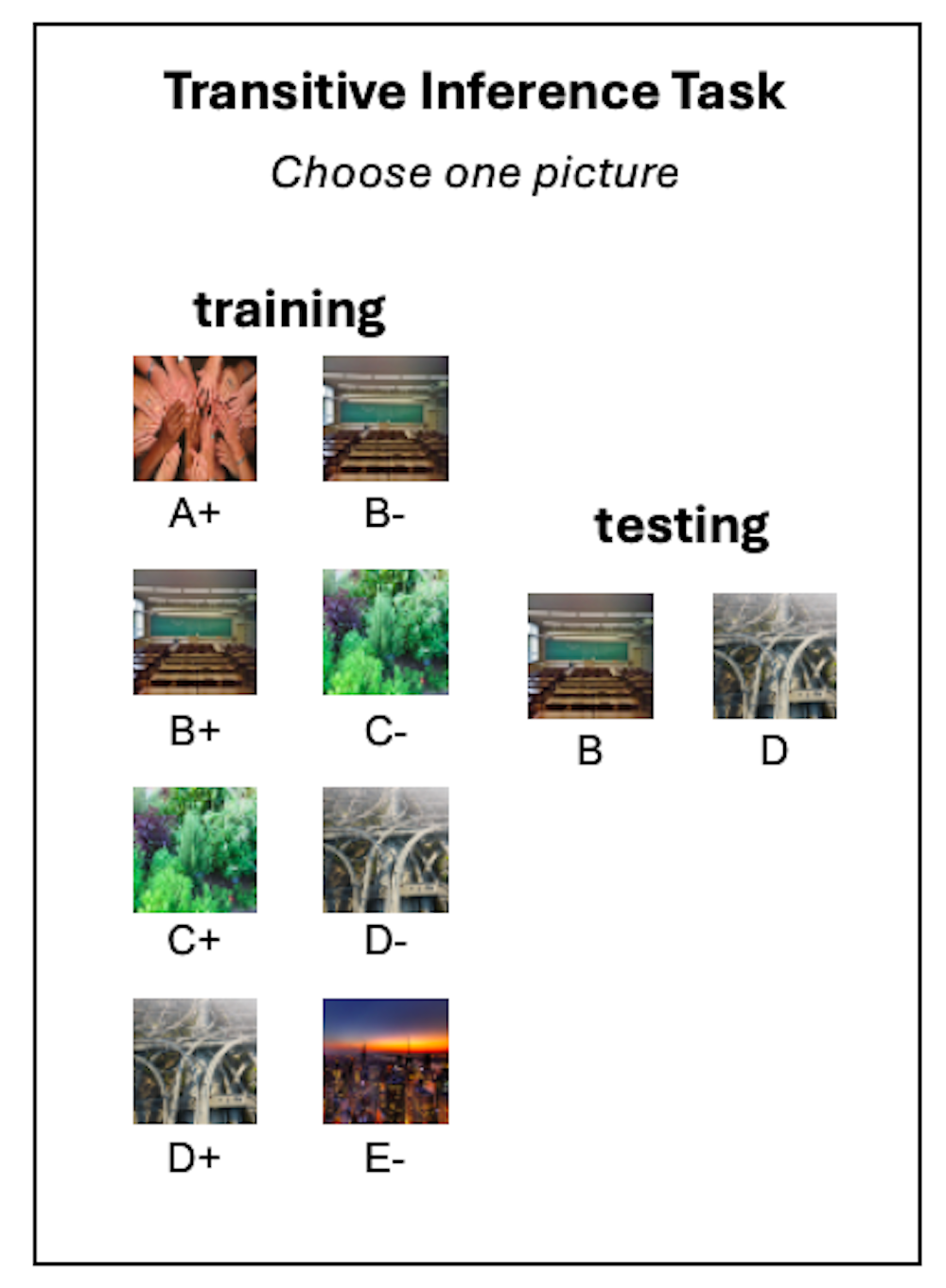
    In the lab, researchers test this by giving animals randomly paired images, one pair at a time, and rewarding them with food for picking the correct one. For example, animals learn that a photo of hands (A) is correct when paired with a classroom (B), a classroom (B) is correct when paired with bushes (C), bushes (C) are correct when paired with a highway (D), and a highway (D) is correct when paired with a sunset (E). We don’t know whether they “understand” what’s in the picture, and it is not particularly important for the experiment that they do.

    In a transitive inference task, subjects learn a series of rewarded pairs – such as A+ vs. B–, B+ vs. C– – and are later tested on novel pairings, like B vs. D, to see whether they infer an overall ranking.
    Olga Lazareva, CC BY-ND

    One possible explanation is that the animals that learn all the tasks create a mental ranking of these images: A > B > C > D > E. We test this idea by giving them new pairs they’ve never seen before, such as classroom (B) vs. highway (D). If they consistently pick the higher-ranked item, they’ve inferred the underlying order.

    What’s fascinating is how many species succeed at this task. Monkeys, rats, pigeons – even fish and wasps – have all demonstrated transitive inference in one form or another.

    The twist: Not all tasks are easy

    But not all types of reasoning come so easily. There’s another kind of rule called transitivity that is different from transitive inference, despite the similar name. Instead of asking which picture is better, transitivity is about equivalence.

    In this task, animals are shown a set of three pictures and asked which one goes with the center image. For example, if white triangle (A1) is shown, choosing red square (B1) earns a reward, while choosing blue square (B2) does not. Later, when red square (B1) is shown, choosing white cross (C1) earns a reward while choosing white circle (C2) does not. Now comes the test: white triangle (A1) is shown with white cross (C1) and white circle (C2) as choices. If they pick white cross (C1), then they’ve demonstrated transitivity.

    In a transitivity task, subjects learn matching rules across overlapping sets – such as A1 matches B1, B1 matches C1 – and are tested on new combinations, such as A1 with C1 or C2, to assess whether they infer the relationship between A1 and C1.
    Olga Lazareva, CC BY-ND

    The change may seem small, but species that succeed in those first transitive inference tasks often stumble in this task. In fact, they tend to treat the white triangle and the white cross as completely separate things, despite their common relationship with the red square. In my recently published review of research using the two tasks, I concluded that more evidence is needed to determine whether these tests tap into the same cognitive ability.

    Small differences, big consequences

    Why does the difference between transitive inference and transitivity matter? At first glance, they may seem like two versions of the same ability – logical reasoning. But when animals succeed at one and struggle with the other, it raises an important question: Are these tasks measuring the same kind of thinking?

    The apparent difference between the two tasks isn’t just a quirk of animal behavior. Psychology researchers apply these tasks to humans in order to draw conclusions about how people reason.

    For example, say you’re trying to pick a new almond milk. You know that Brand A is creamier than Brand B, and your friend told you that Brand C is even waterier than Brand B. Based on that, because you like a thicker milk, you might assume Brand A is better than Brand C, an example of transitive inference.

    But now imagine the store labels both Brand A and Brand C as “barista blends.” Even without tasting them, you might treat them as functionally equivalent, because they belong to the same category. That’s more like transitivity, where items are grouped based on shared relationships. In this case, “barista blend” signals the brands share similar quality.

    How researchers define logical reasoning determines how they interpret results.
    Svetlana Mishchenko/iStock via Getty Images

    Researchers often treat these types of reasoning as measuring the same ability. But if they rely on different mental processes, they might not be interchangeable. In other words, the way scientists ask their questions may shape the answer – and that has big implications for how they interpret success in animals and in people.

    This difference could affect how researchers interpret decision-making not only in the lab, but also in everyday choices and in clinical settings. Tasks like these are sometimes used in research on autism, brain injury or age-related cognitive decline.

    If two tasks look similar on the surface, then choosing the wrong one might lead to inaccurate conclusions about someone’s cognitive abilities. That’s why ongoing work in my lab is exploring whether the same distinction between these logical processes holds true for people.

    Just like a March Madness bracket doesn’t always predict the winner, a reasoning task doesn’t always show how someone got to the right answer. That’s the puzzle researchers are still working on – figuring out whether different tasks really tap into the same kind of thinking or just look like they do. It’s what keeps scientists like me in the lab, asking questions, running experiments and trying to understand what it really means to reason – no matter who’s doing the thinking.

    Olga Lazareva does not work for, consult, own shares in or receive funding from any company or organization that would benefit from this article, and has disclosed no relevant affiliations beyond their academic appointment.

    ref. Humans and animals can both think logically − but testing what kind of logic they’re using is tricky – https://theconversation.com/humans-and-animals-can-both-think-logically-but-testing-what-kind-of-logic-theyre-using-is-tricky-253001

    MIL OSI

  • MIL-OSI Submissions: Toxic fungus from King Tutankhamun’s tomb yields cancer-fighting compounds – new study

    Source: The Conversation – UK – By Justin Stebbing, Professor of Biomedical Sciences, Anglia Ruskin University

    Miro Varcek / Shutterstock.com

    In November 1922, archaeologist Howard Carter peered through a small hole into the sealed tomb of King Tutankhamun. When asked if he could see anything, he replied: “Yes, wonderful things.” Within months, however, Carter’s financial backer Lord Carnarvon was dead from a mysterious illness. Over the following years, several other members of the excavation team would meet similar fates, fuelling legends of the “pharaoh’s curse” that have captivated the public imagination for just over a century.

    For decades, these mysterious deaths were attributed to supernatural forces. But modern science has revealed a more likely culprit: a toxic fungus known as Aspergillus flavus. Now, in an unexpected twist, this same deadly organism is being transformed into a powerful new weapon in the fight against cancer.

    Aspergillus flavus is a common mould found in soil, decaying vegetation and stored grains. It is infamous for its ability to survive in harsh environments, including the sealed chambers of ancient tombs, where it can lie dormant for thousands of years.

    When disturbed, the fungus releases spores that can cause severe respiratory infections, particularly in people with weakened immune systems. This may explain the so-called “curse” of King Tutankhamun and similar incidents, such as the deaths of several scientists who entered the tomb of Casimir IV in Poland in the 1970s. In both cases, investigations later found that A flavus was present, and its toxins were probably responsible for the illnesses and deaths.

    Despite its deadly reputation, Aspergillus flavus is now at the centre of a remarkable scientific finding. Researchers at the University of Pennsylvania have discovered that this fungus produces a unique class of molecules with the potential to fight cancer.

    These molecules belong to a group called ribosomally synthesised and post-translationally modified peptides, or RiPPs. RiPPs are made by the ribosome – the cell’s protein factory – and are later chemically altered to enhance their function.

    While thousands of RiPPs have been identified in bacteria, only a handful have been found in fungi – until now.

    The process of finding these fungal RiPPs was far from simple. The research team screened a dozen different strains or types of aspergillus, searching for chemical clues that might indicate the presence of these promising molecules. Aspergillus flavus quickly stood out as a prime candidate.

    The researchers compared the chemicals from different fungal strains to known RiPP compounds and found promising matches. To confirm their discovery, they switched off the relevant genes and, sure enough, the target chemicals vanished, proving they had found the source.

    Purifying these chemicals proved to be a significant challenge. However, this complexity is also what gives fungal RiPPs their remarkable biological activity.

    The team eventually succeeded in isolating four different RiPPs from Aspergillus flavus. These molecules shared a unique structure of interlocking rings, a feature that had never been described before. The researchers named these new compounds “asperigimycins”, after the fungus in which they were found.

    The next step was to test these asperigimycins against human cancer cells. In some cases, they stopped the growth of cancer cells, suggesting that asperigimycins could one day become a new treatment for certain types of cancer.

    The team also worked out how these chemicals get inside cancer cells. This discovery is significant because many chemicals, like asperigimycins, have medicinal properties but struggle to enter cells in large enough quantities to be useful. Knowing that particular fats (lipids) can enhance this process gives scientists a new tool for drug development.

    Further experiments revealed that asperigimycins probably disrupt the process of cell division in cancer cells. Cancer cells divide uncontrollably, and these compounds appear to block the formation of microtubules, the scaffolding inside cells that are essential for cell division.

    Tremendous untapped potential

    This disruption is specific to certain types of cells, so this may in turn reduce the risk of side-effects. But the discovery of asperigimycins is just the beginning. The researchers also identified similar clusters of genes in other fungi, suggesting that many more fungal RiPPs remain to be discovered.

    Almost all the fungal RiPPs found so far have strong biological activity, making this an area with tremendous untapped potential. The next step is to test asperigimycins in other systems and models, with the hope of eventually moving to human clinical trials. If successful, these molecules could join the ranks of other fungal-derived medicines, such as penicillin, which revolutionised modern medicine.

    The story of Aspergillus flavus is a powerful example of how nature can be both a source of danger and a wellspring of healing. For centuries, this fungus was feared as a silent killer lurking in ancient tombs, responsible for mysterious deaths and the legend of the pharaoh’s curse. Today, scientists are turning that fear into hope, harnessing the same deadly spores to create life-saving medicines.

    This transformation, from curse to cure, highlights the importance of continued exploration and innovation in the natural world. Nature has in fact provided us with an incredible pharmacy, filled with compounds that can heal as well as harm. It is up to scientists and engineers to uncover these secrets, using the latest technologies to identify, modify and test new molecules for their potential to treat disease.

    The discovery of asperigimycins is a reminder that even the most unlikely sources – such as a toxic tomb fungus – can hold the key to revolutionary new treatments. As researchers continue to explore the hidden world of fungi, who knows what other medical breakthroughs may lie just beneath the surface?

    Justin Stebbing does not work for, consult, own shares in or receive funding from any company or organisation that would benefit from this article, and has disclosed no relevant affiliations beyond their academic appointment.

    ref. Toxic fungus from King Tutankhamun’s tomb yields cancer-fighting compounds – new study – https://theconversation.com/toxic-fungus-from-king-tutankhamuns-tomb-yields-cancer-fighting-compounds-new-study-259706

    MIL OSI

  • MIL-OSI Submissions: When do we first feel pain?

    Source: The Conversation – UK – By Laurenz Casser, Leverhulme Trust Early Career Fellow, University of Sheffield

    Alina Troeva/Shutterstock.com

    At some point between conception and early childhood, pain makes its debut. But when exactly that happens remains one of medicine’s most challenging questions.

    Some have claimed that foetuses as young as twelve weeks can already be seen wincing in agony, while others have flat-out denied that even infants show any true signs of pain until long after birth.

    New research from University College London offers fresh insights into this puzzle. By mapping the development of pain-processing networks in the brain – what researchers call the “pain connectome” – scientists have begun to trace exactly when and how our capacity for pain emerges. What they discovered challenges simple answers about when pain “begins”.


    Get your news from actual experts, straight to your inbox. Sign up to our daily newsletter to receive all The Conversation UK’s latest coverage of news and research, from politics and business to the arts and sciences.


    The researchers used advanced brain imaging to compare the neural networks of foetuses and infants with those of adults, tracking how different components of pain processing mature over time. Until about 32 weeks after conception, all pain-related brain networks remain significantly underdeveloped compared with adult brains. But then development accelerates dramatically.

    The sensory aspects of pain – the basic detection of harmful stimuli – mature first, becoming functional around 34 to 36 weeks of pregnancy. The emotional components that make pain distressing follow shortly after, developing between 36 and 38 weeks. However, the cognitive centres responsible for consciously interpreting and evaluating pain lag far behind, and remain largely immature by the time of birth, about 40 weeks after conception.

    This staged development suggests that while late-term foetuses and newborns can detect and respond to harmful stimuli, they probably experience pain very differently from older children and adults. Most significantly, newborns probably can’t consciously evaluate their pain – they can’t form the thought: “This hurts and it’s bad!”

    Does it hurt?
    Martin Valigursky/Shutterstock.com

    A history of changing views

    These findings represent the latest chapter in a long-running scientific debate that has swung dramatically over the centuries, often with profound consequences for medical practice.

    For most physiologists in the 18th and 19th centuries, the perceived delicacy of the infant’s body meant that it must be exquisitely sensitive to pain, so much so that some have had their doubts if infants ever felt anything else. Birth, in particular, was imagined to be an extremely painful event for a newborn.

    However, advances in embryology during the 1870s reversed this thinking. As scientists discovered that infant brains and nervous systems were far less developed than adult versions, many began questioning whether babies could truly feel pain at all. If the neural machinery wasn’t fully formed, how could genuine pain experiences exist?

    This scepticism had troubling practical consequences. For nearly a century, many doctors performed surgery on infants without anaesthesia, convinced that their patients were essentially immune to suffering. The practice continued well into the 1980s in some medical centres.

    Towards the end of the 20th century, public outrage about the medical treatment of infants and new scientific results turned the tables yet again. It was found that newborns exhibited many of the signs (neurological, physiological and behavioural) of pain after all, and that, if anything, pain in infants had probably been underestimated.

    The ambiguous brain

    The reason why there has been endless disagreement about infant pain is that we cannot access their experiences directly.

    Sure, we can observe their behaviour and study their brains, but these are not the same thing. Pain is an experience, something that’s felt in the privacy of a person’s own mind, and that’s inaccessible to anyone but the person whose pain it is.

    Of course, pain experiences are typically accompanied by telltale signs: be it the retraction of a body part from a sharp object or the increased activity of certain brain regions. Those we can measure. But the trouble is that no one behaviour or brain event is ever unambiguous.

    The fact that an infant pulls back their hand from a pin prick may mean that it experiences the pricking as painful, but it may also just be an unconscious reflex. Similarly, the fact that the brain is simultaneously showing pain-related activity may be a sign of pain, but it may also be that the processing unfolds entirely unconsciously. We simply don’t know.

    Perhaps the infant knows. But even if they do, they can’t tell us about their experiences yet, and until they can, scientists are left guessing. Fortunately, their guesses are becoming increasingly well informed, but for now, that is all they can be – guesses.

    What would it take to get certainty? Well, it would require an explanation that connects our brains and behaviour to our conscious experiences. But so far, no scientifically respectable explanation of this kind has been forthcoming.

    Laurenz Casser receives funding from the Leverhulme Trust.

    ref. When do we first feel pain? – https://theconversation.com/when-do-we-first-feel-pain-259588

    MIL OSI

  • MIL-OSI Submissions: From Roman drains to ancient filters, these artefacts show how solutions to water contamination have evolved

    Source: The Conversation – UK – By Rosa Busquets, Associate Professor, School of Life Sciences, Pharmacy and Chemistry, Kingston University

    Thirst: In Search of Freshwater, an exhibition at Wellcome Collection. Benjamin Gilbert., CC BY-NC-ND

    A new exhibition in London (open until February 2026) called Thirst: In search of freshwater highlights how civilisations have treasured – and been intrinsically linked to – safe, clean water.

    As a chemist, I research how freshwater is polluted by modern civilisation. Common contaminants in rivers include pharmaceuticals,
    microplastics
    (which degrade further when exposed to sunlight and wave power), and forever chemicals or per- and polyfluoroalkyl substances (PFAS) (some of which are carcinogenic).

    Synthetic toxic chemicals are introduced into the environment from the products we make, use and dispose of. This wasn’t a problem centuries ago, where we had a totally different manufacturing industry and technologies.

    Some, such as PFAS from stain-resistant textiles or nonstick materials such as cookware, can be particularly difficult to remove from wastewater. PFAS don’t degrade easily, they resist conventional heat treatments and can easily pass through wastewater treatments, so they contaminate rivers or lakes that are sources of our drinking water.


    Get your news from actual experts, straight to your inbox. Sign up to our daily newsletter to receive all The Conversation UK’s latest coverage of news and research, from politics and business to the arts and sciences.


    Testing for pollutants is even more critical in developing nations that lack sanitation and face drought or flooding.
    Having to protect and conserve drinking water and its sources is as relevant today as it always has been.

    For this exhibition, curator at the Wellcome Collection in London, Janice Li, has selected 125 historical objects, photographs and feats of engineering that link to drought, rain, glaciers, rivers and lakes. These three artefacts from Thirst illustrate how our relationship with water contamination has evolved:

    1. Ancient water filters

    Made from natural materials such as clay, water jug filters have been used for hundreds of years in every continent by ancient civilisations. They show that purifying water for drinking was commonplace. The sand and soil particles that naturally get suspended in water and removed by these filters would have carried microbes.

    Water jug filters with Arabic inscription, found in Egypt, dating back to 900-1,200.
    Victoria and Albert Museum London/Wellcome Collection, CC BY-NC-ND

    But in ancient times, pharmaceuticals and other drugs, pesticides, forever chemicals and microplastics would not have been a problem. Those filters could work relatively well despite being made of simple materials with wide pores.

    Today, those ancient filters would no longer be effective. Modern water filters are made using more advanced materials which typically have small pores (called micropores and mesopores). For example, filters often include activated carbon (a highly porous type of carbon that can be manufactured to capture contaminants) or membranes that filter water. Only then is it safe for people to drink.


    Read more:
    Forever chemicals are in our drinking water – here’s how to reduce them


    2. Roman water pipes

    Lead water pipes (known as fistulae) were useful parts of a relatively advanced plumbing system that distributed drinking water throughout Roman cities. They are still common in water systems in our cities today. In the US, there are about 9.2 million lead service lines in use. Exposure to lead causes severe human health problems. Lead exposure, not necessarily from drinking water only, was attributed to more than 1.5 million deaths in 2021.

    A Roman lead water pipe that dates back to 1-300CE.
    Courtesy of Wellcome Collection/Science Museum Group., CC BY-NC-ND

    It’s now understood that lead is neurotoxic and it can diffuse or spread from the pipes to drinking water. Lead from paints and batteries, including car batteries, can also contaminate drinking water.

    To protect us from lead leaching or flaking off from pipes, some government agencies are calling for the replacement of lead pipes with copper or plastic pipes. Water companies routinely add phosphates (mined powder that contains phosphorus) to drinking water to help capture potential lead contamination and make it safe to drink.

    3. The horror of unhealthy water

    One caricature titled The Monster Soup by artist William Heath (1828) is part of the Wellcome Trust’s permanent collection. The graphics read “microcosms dedicated to the London Water companies” and “Monster soup, commonly called Thames Water being a correct representation of the precious stuff doled out to us”. The cartoon shows a lady so terrified at the sight of microbes in river water from the Thames that she drops her cup of tea.

    Monster Soup by William Heath.
    Courtesy of the Wellcome Collection., CC BY-NC-ND

    Even today, many people remain shocked at the toxic contamination in rivers and sewage pollution prevents people from swimming.

    By 2030, 2 billion people will still not have safely managed drinking water and 1.2 billion will lack basic hygiene services. Drinking water will still be contaminated by bacteria such as E. coli and other dangerous pathogens that cause waterborne diseases. So advancing technologies to filter out contamination will be just as crucial in the future as it has been in the past.


    Don’t have time to read about climate change as much as you’d like?

    Get a weekly roundup in your inbox instead. Every Wednesday, The Conversation’s environment editor writes Imagine, a short email that goes a little deeper into just one climate issue. Join the 45,000+ readers who’ve subscribed so far.


    Rosa Busquets receives funding from UKRI/ EU Horizons MSCA Staff exchanges Clean Water project 101131182, DASA, project ACC6093561. She is affiliated with Kingston University, UCL, Al-Farabi Kazakh National University, UNEP EEAP.

    ref. From Roman drains to ancient filters, these artefacts show how solutions to water contamination have evolved – https://theconversation.com/from-roman-drains-to-ancient-filters-these-artefacts-show-how-solutions-to-water-contamination-have-evolved-253876

    MIL OSI

  • MIL-OSI Submissions: How Trump plays with new media says a lot about him – as it did with FDR, Kennedy and Obama

    Source: The Conversation – UK – By Sara Polak, University Lecturer in American Studies, Leiden University

    There is a strange and worrying parallel between the breakneck speed at which Donald Trump has operated in the first few months of his presidency and the ever-accelerating pace at which information moves on social media platforms. Where in his first term he used Twitter, now, the 47th US president is using his own platform, TruthSocial, to announce changes of direction that are sometimes so fundamental that they change decades of US policy.

    Social media has become a key tool of governing for Trump’s administration. He uses it both to make announcements and to drum up support for those announcements. His social media posts can move the markets and make or break careers. They can even, it seems, stop wars.

    So when he used TruthSocial to announce a ceasefire between Israel and Iran on June 23, giving the two countries a deadline to stop firing missiles, it appears that neither of the antagonists were fully aware of the situation, given they carried on attacking each other. So an all-caps message followed: “ISRAEL. DO NOT DROP THOSE BOMBS,” he posted. “BRING YOUR PILOTS HOME, NOW!” – adding, just in case anyone had any doubt he was serious: “DONALD J. TRUMP, PRESIDENT OF THE UNITED STATES.”

    Trump’s use of his TruthSocial platform began as he sought to re-establish himself from the political wilderness after the insurrection of January 6 2021. It has now become a tool of his extreme power and his willingness to use (and abuse) it – globally as well as domestically.


    Get your news from actual experts, straight to your inbox. Sign up to our daily newsletter to receive all The Conversation UK’s latest coverage of news and research, from politics and business to the arts and sciences.


    He’s the latest in a string of US presidents known for their adroit use of whichever is the medium most guaranteed to connect with the greatest number of people. From Theodore “Teddy” Roosevelt’s adept cultivation of print journalists in the early 20th century through Franklin D. Roosevelt’s comforting use of radio as it gained popularity and John F. Kennedy’s mastery of the rising medium of television, presidents have expanded their reach and influence through adept use of media.

    FDR’s “fireside chats”, broadcast on the radio throughout the US in the 1930s, reached an estimated 80% of the population, showing he understood the key media principle of reach. Roosevelt would address his listeners as “my friends” and Americans came to understand them as seemingly intimate conversations with their president.

    FDR dominated the airwaves at a time when many Americans hardly understood the important role that the federal government played in their own lives – and millions of households were only just getting mains electricity (thanks to the Rural Electrification Act of 1936). But radios were becoming a common mass medium and FDR perfectly understood how to use it. If you listen to the fireside chats, FDR may sound patrician – and at times formal – but his tone is also friendly, thoughtful and reassuring.

    In Germany at around the same time, Adolf Hitler’s massive stadium speeches were very effective for people who were in the stadium and being lifted by the intensity of the crowd and all the carefully thought out visual cues. But when broadcast on radio, Hitler had nothing like Roosevelt’s ability to connect with people on a personal level.

    Roosevelt was hardly the first leader – or even the first US president – to speak on the radio. But he was the first to master the medium. He figured out how to use its potential to deliver a key implicit message: that his government should and did take on a central role in people’s lives.

    Equally, John F. Kennedy can be said to have “discovered” political television. Not just as a medium for political campaigns, debates and speeches – but also for putting across to a mass audience his role as the embodiment of American decency, beauty and masculinity: JFK’s White House as Camelot.

    JFK was considered a master of the fast-growing medium of television.

    Both Roosevelt and Kennedy were in several ways physically disabled and lived with chronic illness, yet through the “new medium” of their time were able to project an image of quintessentially American strength and trustworthiness. In part this was their own doing – but it’s also a testament to the power of the media they used for their time.

    Mastering the medium

    These possibilities of a medium used to its best advantage – for example, to be heard around the US, but still to project a sense of intimacy – have become known as the “affordances” of a medium. The medium afforded Roosevelt space to be authentic without showing his disability. Kennedy appeared young, fit and handsome – even when dependent on painkillers.

    When a new medium is introduced, people start to play around with its affordances – and this applies to politicians too. Political leaders who develop a special aptitude for using the new medium to emphasise their unique style can become particularly successful, as has Donald Trump with his use of social media.

    The US president rose to power helped by his adept use of many of Twitter’s attributes – the imposed brevity of his messages, the ease of retweeting, the tendency for other users to “pile on” (and the user anonymity, which tends to encourage pile-ons) to polarise American public debate.

    Trump was forced off Twitter after the Capitol Hill insurrection of January 6 2021. So he came back with his own platform, TruthSocial, where he can also make the rules. And now he uses the platform to make foreign policy, trumpeting his positions (which can change with bewildering speed) on TruthSocial well before they can be announced by the White House press team, which often has to scramble to catch up.

    When Canadian communication theorist Marshall McLuhan penned his famous phrase: “The medium is the message” in his groundbreaking 1964 study, Understanding Media: The Extensions of Man, he meant to say that media form and content are not as distinct from one another as one might think and that the form of a medium of communication can shape society as much as its content. In Donald Trump’s use of social media, we are seeing this idea at work.

    Sara Polak does not work for, consult, own shares in or receive funding from any company or organisation that would benefit from this article, and has disclosed no relevant affiliations beyond their academic appointment.

    ref. How Trump plays with new media says a lot about him – as it did with FDR, Kennedy and Obama – https://theconversation.com/how-trump-plays-with-new-media-says-a-lot-about-him-as-it-did-with-fdr-kennedy-and-obama-248923

    MIL OSI

  • MIL-OSI Submissions: Why Asos should be wary of banning customers returning unwanted goods

    Source: The Conversation – UK – By Nic Sanders, Senior Lecturer in Management and Marketing, University of Westminster

    ‘Now where’s that returns label?’ Cast of Thousands.Shutterstock

    Shopping for clothes online is a risky business. How do you know if that top will be a good fit, or those shoes will definitely be the right colour? One popular solution to this predicament is to order lots of tops and lots of shoes, try them on at home, and send back all the ones you don’t want – often at no cost.

    But that tactic can be expensive for the fashion retailer, which needs to pay for all those deliveries and returns. And now Asos, which sends millions of shipments every month, has started banning some customers for over-returning items – prompting something of a backlash.

    The response by the retail giant, which says it wants to maintain a “commitment to offering free returns to all customers across all core markets”, also raises questions about the sustainability of the online fashion business model which Asos helped to create.

    Many online retailers rely on the emotional highs of shopping. The excitement of placing an order, the anticipation of delivery, and the dopamine hit of unpacking a purchase is central to its popular customer experience.


    Get your news from actual experts, straight to your inbox. Sign up to our daily newsletter to receive all The Conversation UK’s latest coverage of news and research, from politics and business to the arts and sciences.


    Online shopping generally has thrived on impulsive buying, with the option of returning items treated as a normal part of the process. Of course, even in the days before online shopping there would be customers who routinely returned items.

    But by digitising and simplifying the process, the likes of Asos have helped this to happen on a massive scale. Shoppers have become completely used to ordering multiple sizes or styles with the express intention of returning most of the items they receive. Their homes effectively become fitting rooms.

    And those customers could reasonably argue that online retailers often use digital strategies which encourage multi-item purchases.

    Some sites remind shoppers of recently viewed products and provide suggestions of similar items, for example. There may be are prompts and nudges towards clothes which are frequently bought together.

    Items are then sometimes temporarily reserved in a shopper’s basket for 60 minutes, creating a sense of urgency. Targeted emails and limited time offers drive bulging shopping baskets, encouraging more risk purchases and returns.

    Yet returned items carry a significant cost. They may be unfit for resale and ultimately disposed of, which beyond the financial burden, has an environmental price.

    In addition to creating landfill, each delivery and return has a carbon footprint. And although many younger consumers express support for sustainable practices, their buying behaviour continues to prioritise price and convenience.

    But free returns have become part of the online fashion industry landscape. Research suggests that customers are simply more likely to buy something if returns are free.

    And today’s tricky financial climate, marked by inflation and rising living costs will surely have made consumers even more cautious. Many will be reluctant to buy items that incur delivery and return costs.

    Shopping around

    Frustrations can then arise from unclear return policies, often buried in lengthy terms and conditions documents. Some of those banned by Asos say they were confused about the rules.

    Automated customer service systems offering generic responses may then leave shoppers with no clear way to challenge these decisions.

    Perhaps the wider issue here is that online shopping cannot fully replicate the benefits of shopping in store. In physical shops, customers can try on items before deciding.

    But online, this can’t happen, so returns become fundamental to the decision-making process. For cost-conscious shoppers, avoiding unnecessary spending is essential. But if returns policies become harder to access, they may turn to other retailers which offer more certainty.

    Return to sender?
    A08/Shutterstock

    For example, retailers such as Zara and H&M, with a business model which mixes online convenience with a high street (or shopping mall) presence, offer the option to order online and then return in person.

    This hybrid (or “omni-channel”) model appears to be driving consumers to physical shops for a blended experience which provides convenience and helps reduce return costs.

    For Asos, doing something similar would require major investment (in bricks and mortar) and increased operational costs – so is perhaps an unlikely solution for the company.

    But to balance sustainability, cost and customer satisfaction, Asos could explore other options. These might include clearer, more visible communication regarding “fair use” policies and their consequences. It could aim for more human interactions and better dialogue with customers it plans to ban.

    Offering physical retail locations or return collection points to simplify the process and reduce the environmental impact and costs will provide customer flexibility. Overall, these areas will help create a better customer service experience.

    Ultimately, Asos and other similar online clothing retailers must evolve. With changing consumer expectations, a challenging economic climate and rising operational costs, the model that defined these retailers’ early success cannot remain unchanged.

    If they make adjustments, they may emerge stronger. If they do not, they risk sparking a customer exodus that would be hard to reverse.

    Nic Sanders does not work for, consult, own shares in or receive funding from any company or organisation that would benefit from this article, and has disclosed no relevant affiliations beyond their academic appointment.

    ref. Why Asos should be wary of banning customers returning unwanted goods – https://theconversation.com/why-asos-should-be-wary-of-banning-customers-returning-unwanted-goods-259952

    MIL OSI

  • MIL-OSI Submissions: Self determination theory: how to use it to boost wellbeing

    Source: The Conversation – UK – By Mark Fabian, Reader of Public Policy, University of Warwick

    Self-determination theory (SDT) is one of the most well established and powerful approaches to wellbeing in psychological research literature. Yet it doesn’t seem to have broken through into popular discussions about wellbeing, happiness and self-help. That’s a shame, because it has so much to contribute.

    A foundational idea in self-determination theory is that we have three basic psychological needs: for autonomy, competence and relatedness.

    Autonomy is the need to be in control of your own life rather than being controlled by others. Competence is the need to feel skilful at the tasks one values or needs to thrive. Relatedness refers to feeling loved and cared for, and a sense of belonging to a group that provides social support.

    If our basic psychological needs are met, then we are more likely to experience wellbeing. Symptoms include emotions such as joy, vitality and excitement because we’re doing the things we love, for example. We’ll probably have a sense of meaning and purpose because we live within a community whose culture we value.


    Get your news from actual experts, straight to your inbox. Sign up to our daily newsletter to receive all The Conversation UK’s latest coverage of news and research, from politics and business to the arts and sciences.


    Conversely, when our basic needs are thwarted we should see symptoms of illbeing. Anger, frustration and boredom grow when our behaviour is controlled by parents, bureaucrats, bosses or other forces that press our energies towards their ends instead of ours.

    Depression is liable when we our competence is overwhelmed by failure. And anxiety is often a social emotion that arises when we’re worried about whether our group cares for us.

    So we should cultivate our basic psychological needs – but how? You need to discover what you want to do with your life, what skills to become competent in, who to relate to and what communities to contribute to.

    Using motivation to find your way

    Here’s where the second foundational idea in SDT can be super helpful, as I explain in my new book, Beyond Happy: How to rethink happiness and find fulfilment. SDT proposes a motivational spectrum running from extrinsic at one end to intrinsic at the other. Finding out where you are on the spectrum for a certain activity or task can help you work out how to be happier.

    The more extrinsically motivated something is, the more self-regulation it requires. For example, when refugees flee their homes due to encroaching war, there is often a large part of them that wants to stay. Willpower is required to act. In contrast, intrinsically motivated behaviour springs spontaneously from us. You don’t need willpower to get stuck into your hobbies.

    Each type of motivation comes with different emotional signals and deciphering them can help us find what values, behaviour and groups suit us.

    The spectrum of motivation according to self-determination theory.
    CC BY-NC

    “Identified” motivation, for example, sits between extrinsic and intrinsic motivation. It occurs when we value an activity but don’t inherently enjoy it. That’s why success in identified behaviour is usually met with a feeling of accomplishment or the warm and fuzzy feeling you get when you do the right thing, like going a bit out of your way to put your rubbish in a bin.

    In contrast, “introjected” motivation is where you value something contingent to the behaviour itself. Many of us loathe the gym, for example, but we want to be healthy. A child might not want to practice the cello, but they do want their parent’s approval.

    Because introjection is relatively extrinsic, it requires willpower, and probably a bit more of it than for identified behaviour. Completion of an introjected activity is often met with relief rather than accomplishment and little desire to keep going.

    Sometimes things that are dependent on introjected behaviour can make us unhappy. In teen dramas, for example, the protagonist often does something because they want to be popular, but when they win the approval of the cool kids they realise those kids are mean and lame.

    Why money, power and status won’t make you happy

    If that’s how you feel, you’ve found something inauthentic to you. Then there’s very little chance the introjected activity will lead to your wellbeing. In fact, SDT has identified some common values. You’ll recognise them immediately: popularity, fame, status, power, wealth and success.

    They’re extrinsic because they’re not peculiar to you. If you get rich doing the thing you love, that’s great, but many of us never even think about what we love because we’re too busy thinking about how to get rich.

    Extrinsic pursuits are ultimately bad for our wellbeing because they’re all poor substitutes for basic psychological needs. When our autonomy is thwarted by strict parents or disciplinarian teachers, we crave power. When we don’t know what sort of life to build and thus what skills we need competence in, we adopt other people’s notions of success instead.

    Extrinsic pursuits often emerge from a wounded place and a defensive reaction. When we’re lonely or feel unloved for who we are, for example, we might compensate by seeking fame or popularity. We’ll start talking about our accomplishments on LinkedIn, for example.

    The problem is that the people this attracts don’t value you specifically, only your power, status or money. You sense that if you ever lost those things, you would lose these people too.

    SDT can help you learn to listen to your emotions and interpret your motivations instead, and use them to guide you towards the values, activities and people that are right for you.

    For example, if you feel joyful and fulfilled when you solve a complex puzzle, perhaps consider a career that involves that activity, such as law or engineering. If such puzzles feel like torture, that’s a signal too. Perhaps something more relational or intuitive, like social work, would work better.

    When you pursue things that are authentic to you it will nourish your sense of autonomy. You’ll build competence in those activities because they’re intrinsically motivated. And you’ll form deep relationships with the people you encounter because you genuinely like each other. Wellbeing will follow.

    Mark Fabian does not work for, consult, own shares in or receive funding from any company or organisation that would benefit from this article, and has disclosed no relevant affiliations beyond their academic appointment.

    ref. Self determination theory: how to use it to boost wellbeing – https://theconversation.com/self-determination-theory-how-to-use-it-to-boost-wellbeing-259829

    MIL OSI

  • MIL-OSI Submissions: Dune director Denis Villeneuve will helm the next Bond – but what will his 007 be like?

    Source: The Conversation – UK – By William Proctor, Associate Professor in Popular Culture, Bournemouth University

    Wiki Commons/Canva, CC BY-SA

    The James Bond franchise has lain dormant for four years, since Daniel Craig’s swansong as 007, No Time to Die. A legal quarrel between Bond’s producers, Michael G. Wilson and Barbara Broccoli, and Amazon Studios resulted in a stalemate and production on a new Bond film has remained in limbo.

    Nevertheless, speculation has been rife about which actor will next play Ian Fleming’s super-spy (the latest actor to be associated with the role is former Spider-man Tom Holland).

    When news surfaced in February 2025 that Amazon MGM (Amazon purchased MGM in 2021) had effectively become Bond’s new custodians, critics and audiences alike expressed concern – to put it lightly. Many feared that Jeff Bezos was more interested in stimulating Amazon Prime membership by driving multiple content streams through spin-offs and merchandising than protecting Fleming’s legacy.

    However, last week’s announcement that Denis Villeneuve has been appointed as the director of the 26th Bond film is a savvy move. It’s a declaration of intent that seeks to promote and market Amazon MGM as safe harbour for the Bond franchise.


    Looking for something good? Cut through the noise with a carefully curated selection of the latest releases, live events and exhibitions, straight to your inbox every fortnight, on Fridays. Sign up here.


    The announcement positions the next era of Bond as a prestigious exercise helmed by “a cinematic master”, not a journeyman director. Villeneuve was previously offered the opportunity to direct No Time to Die, but turned the role down because of his commitment to the Dune films.

    By appointing Villeneuve, Amazon has managed to radically shift the public debate. Villeneuve is “much more than a technical director”, wrote Guardian film critic Peter Bradshaw. “He is an alpha-grade auteur in the same league as Christopher Nolan.”

    Other critics have pointed to his rare ability to “combine blockbuster momentum (and ticket sales) with the finer, more nuanced sensibilities of a filmmaker always concerned with slowing down, honing in on character and theme”.

    Although Sam Mendes, director of Skyfall (2012) and Spectre (2015), came with artistic status, Villeneuve is something different – a marquee name frequently described as an auteur.

    Villeneuve talks about his love for Bond.

    Since his transition from making mostly low-key independent films in his native Canada to his arrival in Hollywood with Prisoners, starring Hugh Jackman and Jake Gyllenhaal (2013), Villeneuve has amassed an impressively eclectic filmography.

    He has proven that he is as comfortable shooting realistic crime thrillers (Sicario, 2015) and surrealist cinema that David Lynch would be proud of (Enemy, 2013), as he is with science fiction (Arrival, 2016, Blade Runner 2049, 2017, and the Dune films, 2021 and 2024).

    Villeneuve’s Bond

    Although Sicario may be the closest in terms of genre to the Bond films, establishing Villeneuve as a director who can expertly shoot action sequences, it is nevertheless difficult at this stage to conceptualise what a Villeneuve Bond film might be like.

    Some critics have suggested that the director’s cinematic resume, eclectic as it is, might not bode well for Bond. The Hollywood Reporter’s film critic Benjamin Svetkey, for instance, worries that Villeneuve’s “lugubrious, meditative filmmaking” is sorely lacking in humour – which could be fatal for 007. “A certain amount of wit and winking is critical to the character,” he claims.

    It is early days for Amazon MGM and Villeneuve. As yet, there is reportedly no treatment, no script, no writer and – more pointedly – no actor appointed to the role. Whatever happens, the 26th Bond film is likely to be a hard reboot that wipes the slate clean (again) after the fate of 007 in No Time to Die.

    Villeneuve’s choice for Bond is unlikely to be as cartoonish as Pierce Brosnan’s iteration.

    Although Villeneuve has said that he intends to honour tradition and that Bond is “sacred territory” for him, Bond’s capacity for revision and regeneration has been key to the franchise’s longevity.

    As socoiologists Tony Bennett and Janet Woollacott argue in their seminal study, Bond and Beyond, the figure of Bond has over the past six decades “been differently constructed at different moments,” with “different sets of ideological and cultural concerns”.

    So what kind of Bond film Villeneuve ends up directing largely depends on the story and whichever actor is anointed as the next James Bond. It is doubtful that audiences will expect a campy pantomime Bond like Roger Moore, or a Bond with an invisible car, like Pierce Brosnan in the cartoonish Die Another Day (2002). Villeneuve’s choice of Casino Royale as his favourite 007 may provide a clue. But it is also unlikely that the director will be satisfied with slavishly repeating the past.

    William Proctor does not work for, consult, own shares in or receive funding from any company or organisation that would benefit from this article, and has disclosed no relevant affiliations beyond their academic appointment.

    ref. Dune director Denis Villeneuve will helm the next Bond – but what will his 007 be like? – https://theconversation.com/dune-director-denis-villeneuve-will-helm-the-next-bond-but-what-will-his-007-be-like-260140

    MIL OSI

  • MIL-OSI Submissions: Why frequent nightmares may shorten your life by years

    Source: The Conversation – UK – By Timothy Hearn, Senior Lecturer in Bioinformatics, Anglia Ruskin University

    Lightfield Studios/Shutterstock.com

    Waking up from a nightmare can leave your heart pounding, but the effects may reach far beyond a restless night. Adults who suffer bad dreams every week were almost three times more likely to die before age 75 than people who rarely have them.

    This alarming conclusion – which is yet to be peer reviewed – comes from researchers who combined data from four large long-term studies in the US, following more than 4,000 people between the ages of 26 and 74. At the beginning, participants reported how often nightmares disrupted their sleep. Over the next 18 years, the researchers kept track of how many participants died prematurely – 227 in total.

    Even after considering common risk factors like age, sex, mental health, smoking and weight, people who had nightmares every week were still found to be nearly three times more likely to die prematurely – about the same risk as heavy smoking.

    The team also examined “epigenetic clocks” – chemical marks on DNA that act as biological mileage counters. People haunted by frequent nightmares were biologically older than their birth certificates suggested, across all three clocks used (DunedinPACE, GrimAge and PhenoAge).

    The science behind the silent scream

    Faster ageing accounted for about 39% of the link between nightmares and early death, implying that whatever is driving the bad dreams is simultaneously driving the body’s cells towards the finish line.

    How might a scream you never utter leave a mark on your genome? Nightmares happen during so-called rapid-eye-movement sleep when the brain is highly active but muscles are paralysed. The sudden surge of adrenaline, cortisol and other fight-or-flight chemicals can be as strong as anything experienced while awake. If that alarm bell rings night after night, the stress response may stay partially switched on throughout the day.

    Continuous stress takes its toll on the body. It triggers inflammation, raises blood pressure and speeds up the ageing process by wearing down the protective tips of our chromosomes.

    On top of that, being jolted awake by nightmares disrupts deep sleep, the crucial time when the body repairs itself and clears out waste at the cellular level. Together, these two effects – constant stress and poor sleep – may be the main reasons the body seems to age faster.

    Your brain clears out waste when you sleep.
    Teeradej/Shutterstock.com

    The idea that disturbing dreams foreshadow poor health is not entirely new. Earlier studies have shown that adults tormented by weekly nightmares are more likely to develop dementia and Parkinson’s disease, years before any daytime symptoms appear.

    Growing evidence suggests that the brain areas involved in dreaming are also those affected by brain diseases, so frequent nightmares might be an early warning sign of neurological problems.

    Nightmares are also surprisingly common. Roughly 5% of adults report at least one each week and another 12.5% experience them monthly.

    Because they are both frequent and treatable, the new findings elevate bad dreams from a spooky nuisance to a potential public health target. Cognitive behavioural therapy for insomnia, imagery-rehearsal therapy – where sufferers rewrite the ending of a recurrent nightmare while awake – and simple steps such as keeping bedrooms cool, dark and screen free have all been shown to curb nightmare frequency.

    Before jumping to conclusions, there are a few important things to keep in mind. The study used people’s own reports of their dreams, which can make it hard to tell the difference between a typical bad dream and a true nightmare. Also, most of the people in the study were white Americans, so the findings might not apply to everyone.

    And biological age was measured only once, so we cannot yet say whether treating nightmares slows the clock. Crucially, the work was presented as a conference abstract and has not yet navigated the gauntlet of peer review.

    Despite these limitations, the study has important strengths that make it worth taking seriously. The researchers used multiple groups of participants, followed them for many years and relied on official death records rather than self-reported data. This means we can’t simply dismiss the findings as a statistical fluke.

    If other research teams can replicate these results, doctors might start asking patients about their nightmares during routine check-ups – alongside taking blood pressure and checking cholesterol levels.

    Therapies that tame frightening dreams are inexpensive, non-invasive and already available. Scaling them could offer a rare chance to add years to life while improving the quality of the hours we spend asleep.

    Timothy Hearn does not work for, consult, own shares in or receive funding from any company or organisation that would benefit from this article, and has disclosed no relevant affiliations beyond their academic appointment.

    ref. Why frequent nightmares may shorten your life by years – https://theconversation.com/why-frequent-nightmares-may-shorten-your-life-by-years-260008

    MIL OSI

  • MIL-OSI Submissions: Where does the UK most need more public EV chargers?

    Source: The Conversation – UK – By Labib Azzouz, Research Associate in Transport and Energy Innovation, University of Oxford

    Electric vehicle chargers at a motorway service station in Grantham, England. Angus Reid/Shutterstock

    The automotive and EV industry has repeatedly insisted that the UK needs more electric vehicle (EV) chargers to help motorists make the switch from conventional fossil-fuel burning cars.

    The Labour government has announced £400 million to install EV chargers, mainly on streets in poorer residential neighbourhoods, in place of the Conservative’s £950 million rapid charging fund that was directed at installing chargers in motorway service stations.

    Does it matter where these chargers are – and who pays to build them?

    The short answer is yes, it does matter. Our research conducted at motorway and local EV charging stations across England – including those located in residential areas, high streets and community centres – indicates that these two types of infrastructure serve distinct groups of users and fulfil different purposes.

    Suggesting that one can substitute for the other risks sending mixed signals to both the industry and the driving public.

    We found that motorway charging stations tend to cater to wealthier men, who are more likely to own premium EVs with long-range batteries and better performance. Many of these drivers have access to home chargers, so their use of public chargers is only for occasional, long-distance travel for business, leisure, or holidays – trips that require chargers along motorways.

    Convenience and charging speed are often more important than the price of public charging, particularly when the travel costs of these drivers are covered by their employers.

    Local public charging stations, on the other hand, serve more diverse groups. These include drivers from lower-income households who are more likely to own older and smaller EVs with shorter ranges. Access to home charging is often limited, especially for people living in flats or urban areas without driveways, garages or off-street parking.

    Not everyone can plug in at home.
    Andersen EV/Shutterstock

    Local chargers are also vital for taxi and delivery drivers who depend on their vehicles for work and make frequent short trips throughout the day. There are many professional drivers without access to workplace charging stations who need alternative local provision – something the Conservative government recognised in its 2022 EV charging strategy.

    Ultimately, the transition to EVs should take a balanced approach that carefully considers social equity, economic viability and environmental impact.

    Different locations serve different drivers

    Motorway charging stations are commercially attractive to private investors, such as energy companies, specialist charging providers and car manufacturers, despite their higher upfront costs and complex requirements.

    This is because service stations offer greater short-term revenue due to their ability to set premium prices. This is a result of there being limited alternatives and high demand for rapid charging, especially among long-distance travellers, and the willingness of EV drivers to pay for speed and convenience – unlike in more price-sensitive neighbourhood settings.

    Unsurprisingly, the government found that the rapid deployment of motorway chargers in recent years has been largely driven by the private sector. Our research highlighted that these revenues could be enhanced by a broader range of retail, dining and relaxation amenities, turning the time waiting for a car to charge into a more productive and pleasurable experience.

    Residential charging stations may not offer high profits per charge, but they typically require lower capital investment and benefit from consistent and predictable use. They are also suited to measures for reducing strain on the grid and balancing energy supply and demand.

    These measures include tariffs that make it cheaper to charge EVs during off-peak hours, or technology that allows cars to feed electricity stored in batteries back into the grid. These features make them appropriate for public funding, where return on investment is measured not just in profit but in value for the public.

    Considering that local EV charging serves those who do not have access to home charging and who drive for a living, the case for public funding is even stronger. These sorts of chargers make switching to an EV easier for different groups.

    For example, safe and carefully placed public chargers could help more women switch to EVs – although our research suggests that, while “careful placement” might refer to residential areas, it doesn’t necessarily mean on streets. Well-lit car parks and community destinations are sometimes considered safer options.

    Charging points outside a community centre in the Outer Hebrides, Scotland.
    AlanMorris/Shutterstock

    By helping EV drivers make frequent short trips, local chargers can also significantly reduce urban air pollution, emissions and noise, contributing to more liveable, healthier cities.

    That said, motorway charging stations and those near key transport corridors still play a crucial role in a comprehensive national network, and public funding may be required in more peripheral and rural areas of the UK where installations lag and commercial interest is limited.

    While long-distance trips are less frequent than short ones, they account for a disproportionately large share of energy use and emissions. Switching such trips to electric will be essential to reaching net zero goals.

    It seems reasonable to prioritise public investment in local EV charging infrastructure to support a fairer EV transition, but this should not be limited to on-street chargers. Investment is needed in residential and non-residential areas, public car parks, community centres and workplaces.

    Different types of EV charging are not interchangeable – all are needed to support the switch.


    Don’t have time to read about climate change as much as you’d like?

    Get a weekly roundup in your inbox instead. Every Wednesday, The Conversation’s environment editor writes Imagine, a short email that goes a little deeper into just one climate issue. Join the 45,000+ readers who’ve subscribed so far.


    Labib Azzouz has received funding from the UK Research and Innovation via the UK Energy Research Centre and Innovate UK as part of the Energy Superhub Oxford (ESO) project.

    Hannah Budnitz receives government funding from UK Research and Innovation grants via the Economic and Social Research Council and the Engineering and Physical Sciences Research Council. She has also previously received funding from Innovate UK and the Department for Transport.

    ref. Where does the UK most need more public EV chargers? – https://theconversation.com/where-does-the-uk-most-need-more-public-ev-chargers-259623

    MIL OSI

  • MIL-OSI Submissions: The Bear season 4: this meaty restaurant drama is still an enticing bingeable prospect

    Source: The Conversation – UK – By Jane Steventon, Course Leader, BA (Hons) Screenwriting; Deputy Course Leader & Senior Lecturer, BA (Hons) Film Production, University of Portsmouth

    Take a soupçon of identity crisis, a pinch of perfectionism, a scoop of burnout and mix thoroughly with a large measure of fraternal grief and sear over a hot grill and voilà! You have The Bear, a perfectly blended drama about a chef on the edge, driven by relentless ambition and exacting standards as he turns his family’s humble sandwich shop into a fine-dining restaurant.

    This intoxicating family drama was eaten up by critics and audiences alike in 2022, its first season garnering a rare perfect 100% score on Rotten Tomatoes, the subsequent two reaching scores of 99% and 89% respectively. It’s certainly a hard act to follow for season four.

    The first ten minutes of The Bear’s pilot episode thrillingly defined what was to come in high-octane style and scene-setting detail. The first season delivered a clever mix of authentic dialogue and setting, relatable family dysfunction and dynamic production style.

    Showstopping scenes of stressful kitchen heat were served up alongside a delectable range of new and established talent in the form of Jeremy Allen White (Carmy), Ebon Moss-Bachrach (Richie), Ayo Edebiri (Sydney) and Oliver Platt (Cicero/Uncle Jimmy).


    Looking for something good? Cut through the noise with a carefully curated selection of the latest releases, live events and exhibitions, straight to your inbox every fortnight, on Fridays. Sign up here.


    In charge is showrunner Christopher Storer, who came up with the concept after being inspired by his friend’s father Chris Zucchero, the owner of Chicago sandwich joint Mr Beef.

    With his professional chef sister also serving as a consultant, Storer succeeded in creating a deliciously authentic and intensely real drama. Buoyed along the way by 21 Emmys and five Golden Globes, Storer also watched his cast ascend, the tortured-soul performance of White garnering particular praise.

    Testing the parameters of a long-running show, Storer focused in on the entire cast of characters and their backstories, a successful tactic used by shows such as Orange is the New Black to keep the drama – largely confined to a kitchen set – fresh.

    Pulling in Hollywood die-hards Oliver Platt and Jamie Lee Curtis for familial tough-love roles further enriched the mix, often using a non-chronological timeframe to go back to moments of family turbulence and tension. This made for three-dimensional characters and enabled evolution around difficult themes such as the aftermath of suicide and generational trauma.

    The Bear has come a long way in three seasons, starting with a spit and sawdust establishment serving up the lunchtime beef sandwiches for its working customers.

    Carmy’s experience and longing for the high-end restaurant of his dreams hurtled forward in season two, as he sent his core crew off in different directions to hone their skills and help form his vision. A restaurant trying to win success but plagued with challenges, there were exhausting familial tensions embedded in every episode of season three.

    Several themes play out in The Bear: love, family, loyalty, community and purpose. The relationship between Carmy and cousin Richie (not a real cousin, but a term of endearment) is key to linking past and future. Richie provides some of the highlights of comedy and pathos as he spits truth bombs, most frequently at talented sous-chef Syd.

    It is Syd who follows Carmy’s aspirations for gastronomic perfection but can’t abide the lack of order or the intense highs and lows that inevitably go hand in hand with his talent. And this is one central question to consider for the latest series: just how long will the audience remain loyal to Carmy and his endless quest for artistry in a high-failure rate industry?

    It’s all in the sauce

    Storer begins season four with a ghost. Carmy and his dead brother Mikey (Jon Berthal) banter in a seven-minute scene, with Carmy ultimately confiding the dream of a restaurant as Mikey watches him make tomato sauce (“too much garlic”). The tomatoes resonate: Mikey left behind money hidden in tomato cans that ended up saving Carmy’s sanity and his dream of a proper restaurant.

    Just as oranges represent death to Frances Ford Coppola, Storer uses tomatoes to underscore themes; here they symbolise familial loyalty and history, a solid base to a meal, a core ingredient. Mikey was one of the core ingredients in Carmy’s life, and now he’s gone.

    Carmy awakens to a rerun of Groundhog Day on late-night TV and fittingly, we too are back – same dish, now more seasoned and enriched with its core ingredients and ready to serve up a big bowlful of family, love, ambition, strife and grief.

    The episode furthers the theme of loyalty as the restaurant receives The Tribune’s review – the cliffhanger of the season three finale. Naturally, Storer doesn’t let up – the food critic highlights “dissonance” and Carmy is back in emotional chaos, with Syd urging him to lighten up and lose the misery.

    In truth, this series could do with adding some more humour in the mix; the teasing and frivolous banter of season one has got somewhat lost in the seasons that followed.

    Storer ramps up the tension, setting several ticking clocks in place: chiefly Uncle Jimmy’s notice period for the business to turn a profit is literally installed on a digital clock in the kitchen. Then Syd’s headhunter calls, offering her desired autonomy and an exit strategy from the chaos.

    And Carmy raises the stakes with an intention to gain a Michelin star. Thus a heroic journey is set in place for the whole cast, with future battles both internal and external laid out.

    There’s too much going on at this feast and the feeling of being stuffed full of story is tangible by the end of the first episode. Still, with a season lining up more emotional turbulence steered by White, more celebrity cameos (Brie Larson and Rob Reiner are lined up) and the excellent cinematography and performances that we have come to expect, Storer stirs his secret sauce.

    The Bear still offers an entertaining and enticing proposition, bingeable and mostly satisfying.

    Jane Steventon does not work for, consult, own shares in or receive funding from any company or organisation that would benefit from this article, and has disclosed no relevant affiliations beyond their academic appointment.

    ref. The Bear season 4: this meaty restaurant drama is still an enticing bingeable prospect – https://theconversation.com/the-bear-season-4-this-meaty-restaurant-drama-is-still-an-enticing-bingeable-prospect-260143

    MIL OSI

  • MIL-OSI Submissions: Five ways to avoid illness like the Lionesses

    Source: The Conversation – UK – By Samantha Abbott, Doctoral Researcher, Department of Sport Science, Nottingham Trent University

    England’s Beth Mead cheering on podium after win v Germany in the Women European Championship Final 2022 photographyjp/Shutterstock

    Think back to the last time you had a cold or the flu. Now imagine stepping onto the pitch for a European Cup final, while battling through those symptoms. For elite athletes, illness can strike at the worst possible time – and it could hit women harder.

    Research suggests that female athletes are more susceptible to cold and flu-like illnesses than their male counterparts. For England women’s national football team, the Lionesses, this risk only increases before a major tournament like the Euros.

    Close contact, shared kit, disrupted sleep and travel all add up to a perfect storm for infection. But targeted nutritional strategies, alongside good sleep and hand hygiene, can offer a crucial line of defence.


    Get your news from actual experts, straight to your inbox. Sign up to our daily newsletter to receive all The Conversation UK’s latest coverage of news and research, from politics and business to the arts and sciences.


    1. Fuel first: energy matters for immunity

    Before anything else, players need to eat enough. Energy supports both performance and immune function. In fact, female athletes who didn’t meet their energy needs in the run-up to the 2016 Olympics were four times more likely to report cold or flu symptoms.

    This is especially relevant in women’s football, where low energy and carbohydrate intake has been documented among professional players and recreational players too. Regular meals and snacks that include carbohydrate-rich foods like oats, bread and pasta, especially around training, are essential to meet energy demands and support immune health.

    2. Eat the rainbow

    Athletes are often encouraged to go beyond the public’s five-a-day fruit and veg target, aiming instead for eight to ten portions daily. Why? Because colourful plant foods are packed with vitamins, minerals, antioxidants and anti-inflammatory compounds: all vital for immunity.


    Read more:
    We’re told to ‘eat a rainbow’ of fruit and vegetables. Here’s what each colour does in our body


    Each colour offers unique benefits. For instance, red fruits and vegetables, such as tomatoes, contain lycopene, a powerful antioxidant. Orange produce like carrots get their colour from beta-carotene, which is converted by the body into vitamin A – a key vitamin for immune health.

    Eating a rainbow of colours means getting a wide range of nutrients.

    3. Vitamin C: powerful but timing matters

    Vitamin C has long been linked with reducing the risk and severity of cold and flu symptoms. One Cochrane review found that regular vitamin C intake halved the risk of illness in physically active people.

    However, more isn’t always better. Long-term use of high-dose vitamin C supplements could blunt training adaptations – the structural and functional changes the body undergoes in response to repeated exercise – because of its anti-inflammatory effects. That’s why vitamin C is most effective when used strategically, such as during high-risk periods like travel or intense competition. Good food sources include oranges, kiwis, blackcurrants, red and yellow peppers, broccoli and even potatoes.

    4. Gut health supports immune health

    Around 70% of the immune system is located in the gut, making gut health a key player in illness prevention. This is where probiotics (live bacteria) and prebiotics (which feed those bacteria) come in.

    Probiotics, found in fermented foods like kefir and kimchi or in supplement form, have been shown to reduce the duration and severity of respiratory illnesses in athletes. Prebiotics have similarly shown promise. In one study, a 24-week prebiotic intervention in elite rugby players reduced the duration of cold and flu symptoms by over two days.


    Read more:
    Gut microbiome: meet Lactobacillus acidophilus – the gut health superhero


    In the build-up to the Euros, including probiotic-rich foods in their diet or taking a daily prebiotic and probiotic supplement may help players stay healthy and return to training faster if they do get ill.

    5. Zinc lozenges: first aid for a sore throat

    If cold-like symptoms do appear, zinc lozenges can offer fast-acting relief. Zinc has antiviral, antioxidant and anti-inflammatory properties. When zinc is delivered as a lozenge, it acts directly in the throat, where many infections begin. Taken within 24 hours of symptoms starting, zinc lozenges could shorten illness duration by a third.

    But caution is key. Long-term use of high-dose zinc supplements can actually suppress immune function. Zinc lozenges should only be used short-term at symptom onset, not as a daily supplement.

    Staying match-ready during major tournaments means more than just tactical drills and fitness. Nutrition is a powerful ally in illness prevention, especially for women’s teams like the Lionesses. From fuelling adequately to supporting gut health and knowing when to supplement, these nutritional strategies can make the difference between sitting on the bench and bringing a trophy home.

    The authors do not work for, consult, own shares in or receive funding from any company or organisation that would benefit from this article, and have disclosed no relevant affiliations beyond their academic appointment.

    ref. Five ways to avoid illness like the Lionesses – https://theconversation.com/five-ways-to-avoid-illness-like-the-lionesses-259302

    MIL OSI

  • MIL-OSI Submissions: Why is Islamophobia so hard to define?

    Source: The Conversation – UK – By Julian Hargreaves, Lecturer, Department of Sociology and Criminology, City St George’s, University of London

    The UK government wants a new definition of Islamophobia and has created a working group of politicians, academics and independent experts to provide one. It aims to settle long-running political debates over the term.

    The concept of Islamophobia describes anti-Muslim and anti-Islamic prejudices and their impact on Muslim communities. The term became familiar in the UK following publication of the Runnymede Trust report, Islamophobia: A Challenge for Us All, in 1997.

    The concept is now used to discuss negative public opinion towards Muslims and Islam, biased media reporting, verbal and physical assaults and online attacks. It is also used when discussing social and economic inequalities, discrimination within various institutional settings and unfair treatment from the police and security services.

    Previous definitions have been controversial, failing to unite politicians, academics and British Muslims, and leading to charged debates over free speech.

    Some academics have argued that the word “Islamophobia” – which suggests a phobia or fear of Islam – is an inaccurate label for a prejudice which often targets skin colour, ethnicity and culture.

    Many Muslim-led organisations accept that the term is imperfect and interchangeable with others such as “anti-Muslim hatred”. However, they maintain the term “Islamophobia” is needed to focus attention on a growing problem.

    Definitions and controversy

    The 1997 Runnymede Trust report defined Islamophobia as an “unfounded hostility towards Islam”, “the practical consequences of such hostility in unfair discrimination against Muslim individuals and communities” and “the exclusion of Muslims from mainstream political and social affairs”.

    The Runnymede Trust revised its definition in a follow-up report published in 2017. The report defines Islamophobia in two ways.

    The first is “anti-Muslim racism”. A longer, second version amends the United Nation’s 1965 definition of “racial discrimination”. These revised definitions are important because they re-framed Islamophobia as a product of racist thinking rather than religious prejudices.

    Other attempts to define Islamophobia include British academic Chris Allen’s 200-word definition. Allen defined it as an ideology like racism that spreads negative views of Muslims and Islam, influencing social attitudes and leading to discrimination and violence. US political scientist Erik Bleich defined it more succinctly as “indiscriminate negative attitudes or emotions directed at Islam or Muslims”.

    In 2018, the all-party parliamentary group on British Muslims published another definition linking Islamophobia to racism. According to the APPG, “Islamophobia is rooted in racism and is a type of racism that targets expressions of Muslimness or perceived Muslimness.” The APPG called for its definition to be legally binding.

    The APPG definition was adopted by various organisations including local authorities, UK universities and the Labour party while in opposition. But it was rejected by the then Conservative government and later by the current Labour government, which argued it was seeking “a more integrated and cohesive approach”.

    This lack of consensus over previous definitions led Angela Rayner, the deputy prime minister, to announce the working group in March 2025. The group’s aim is to provide a new definition of “anti-Muslim hatred and Islamophobia” which is “reflective of a wide range of perspectives and priorities for British Muslims”.

    Former Conservative MP and attorney general Dominic Grieve was appointed to chair the group, evidence of Labour’s ambition to build consensus.

    A march in London against Islamophobia, racism and anti-migrant views.
    Shutterstock

    Some are concerned that use of the term “Islamophobia”, and particularly the APPG definition, stifles legitimate criticism of Islam. Free speech campaigners have argued that it is “blasphemy via the back door”.

    The centre-right thinktank Policy Exchange published a report claiming that the term is used in bad faith to divert attention away from serious social problems within some Muslim communities – specifically, discussion of the grooming gangs scandal.

    These debates bear resemblance to those surrounding the term “antisemitism” and the adoption of a definition proposed by the International Holocaust Memorial Alliance. The term is widely accepted, although critics have argued this specific definition stifles legitimate criticism of the Israeli state.

    A new approach

    A new definition of “Islamophobia” must balance the protection of Muslim communities and freedoms of religion, expression and assembly for all Muslims and non-Muslims in the UK. It must be clear enough for everyday use, specific enough for academic and policy research, and capable of generating support across the UK’s diverse Muslim population.

    A proposed definition by an emerging thought leader on British Islam addresses these challenges. Mamnun Khan is a writer whose work explores the social integration of Muslims in contemporary British society. Khan is associated with Equi, a thinktank which describes its work as “drawing on Muslim insight”. Other members of Equi are members of the government’s working group.

    Khan sets out three tests that a definition must pass, based on Islamic law, moral teachings within Islam and other more universal values. First, a definition must serve the public interest. Second, it must be just and balanced and preserve freedom of expression. Third, it must uphold the dignity of Muslim communities.

    For Khan, “Islamophobia, also known as anti-Muslim hatred, is an irrational fear, hostility, or prejudice toward Muslims that leads to discrimination, unequal treatment, exclusion, social and political marginalisation, or violence.”

    Khan’s definition has many good qualities. It brings together stronger elements of previous definitions – for, example, the separation of negative attitudes and outcomes – without being weakened by jargon or strong political ideology. On the other hand, some social scientists may question whether defining something as “irrational” is a matter of preference rather than academic research.

    The working group also needs to decide whether Islamophobia and anti-Muslim hatred are closely related or exactly the same. Failure to do so will cause confusion and inconsistency among those wishing to apply the term precisely. Regardless, Khan’s example is a strong step in the right direction. A better definition of Islamophobia is needed, and now within reach.

    Julian Hargreaves is an Affiliated Researcher at the Prince Alwaleed bin Talal Centre of Islamic Studies, University of Cambridge.

    ref. Why is Islamophobia so hard to define? – https://theconversation.com/why-is-islamophobia-so-hard-to-define-258522

    MIL OSI

  • MIL-OSI Submissions: Could electric brain stimulation lead to better maths skills?

    Source: The Conversation – UK – By Roi Cohen Kadosh, Professor of Cognitive Neuroscience, University of Surrey

    Triff/Shutterstock

    A painless, non-invasive brain stimulation technique can significantly improve how young adults learn maths, my colleagues and I found in a recent study. In a paper in PLOS Biology, we describe how this might be most helpful for those who are likely to struggle with mathematical learning because of how their brain areas involved in this skill communicate with each other.

    Maths is essential for many jobs, especially in science, technology, engineering and finance. However, a 2016 OECD report suggested that a large proportion of adults in developed countries (24% to 29%) have maths skills no better than a typical seven-year-old. This lack of numeracy can contribute to lower income, poor health, reduced political participation and even diminished trust in others.

    Education often widens rather than closes the gap between high and low
    achievers, a phenomenon known as the Matthew effect. Those who start with an advantage, such as being able to read more words when starting school, tend to pull further ahead. Stronger educational achievement has been also associated with socioeconomic status, higher motivation and greater engagement with material learned during a class.

    Biological factors, such as genes, brain connectivity, and chemical signalling, have been shown in some studies to play a stronger role in learning outcomes than environmental ones. This has been well-documented in different areas, including maths, where differences in biology may explain educational achievements.


    Get your news from actual experts, straight to your inbox. Sign up to our daily newsletter to receive all The Conversation UK’s latest coverage of news and research, from politics and business to the arts and sciences.


    To explore this question, we recruited 72 young adults (18–30 years old) and taught them new maths calculation techniques over five days. Some received a placebo treatment. Others received transcranial random noise stimulation (tRNS), which delivers gentle electrical currents to the brain. It is painless and often imperceptible, unless you focus hard to try and sense it.

    It is possible tRNS may cause long term side effects, but in previous studies my team assessed participants for cognitive side effects and found no evidence for it.

    Could tRNS help people improve their maths skills?
    Prostock-studio/Shutterstock

    Participants who received tRNS were randomly assigned to receive it in one of two different brain areas. Some received it over the dorsolateral prefrontal cortex, a region critical for memory, attention, or when we acquire a new cognitive skill. Others had tRNS over the posterior parietal cortex, which processes maths information, mainly when the learning has been accomplished.

    Before and after the training, we also scanned their brains and measured levels of key neurochemicals such as gamma-aminobutyric acid (gaba), which we showed previously, in a 2021 study, to play a role in brain plasticity and learning, including maths.

    Some participants started with weaker connections between the prefrontal and parietal brain regions, a biological profile that is associated with poorer learning. The study results showed these participants made significant gains in learning when they received tRNS over the prefrontal cortex.

    Stimulation helped them catch up with peers who had stronger natural connectivity. This finding shows the critical role of the prefrontal cortex in learning and could help reduce educational inequalities that are grounded in neurobiology.

    How does this work? One explanation lies in a principle called stochastic resonance. This is when a weak signal becomes clearer when a small amount of random noise is added.

    In the brain, tRNS may enhance learning by gently boosting the activity of underperforming neurons, helping them get closer to the point at which they become active and send signals. This is a point known as the “firing threshold”, especially in people whose brain activity is suboptimal for a task like maths learning.

    It is important to note what this technique does not do. It does not make the best
    learners even better. That is what makes this approach promising for bridging gaps,
    not widening them. This form of brain stimulation helps level the playing field.

    Our study focused on healthy, high-performing university students. But in similar studies on children with maths learning disabilities (2017) and with attention-deficit/hyperactivity disorder (2023) my colleagues and I found tRNS seemed to improve their learning and performance in cognitive training.

    I argue our findings could open a new direction in education. The biology of the learner matters, and with advances in knowledge and technology, we can develop tools that act on the brain directly, not just work around it. This could give more people the chance to get the best benefit from education.

    In time, perhaps personalised, brain-based interventions like tRNS could support learners who are being left behind not because of poor teaching or personal circumstances, but because of natural differences in how their brains work.

    Of course, very often education systems aren’t operating to their full potential because of inadequate resources, social disadvantage or systemic barriers. And so any brain-based tools must go hand-in-hand with efforts to tackle these obstacles.

    Roi Cohen Kadosh serves on the scientific advisory boards of Neuroelectrics Inc., and Innosphere Ltd. He is the founder and shareholder of Cognite Neurotechnology Ltd. He received funding from the Wellcome Trust, UKRI, the British Academy, IARPA, DASA, Joy Ventures, the James S McDonnell Foundation, and the European Union. He is affiliated with the University of Surrey.

    ref. Could electric brain stimulation lead to better maths skills? – https://theconversation.com/could-electric-brain-stimulation-lead-to-better-maths-skills-260134

    MIL OSI

  • MIL-OSI USA: Team Maryland Statement on Administration Attempt to Reprogram FBI Headquarters Funding

    Source: United States House of Representatives – Congressman Glenn Ivey – Maryland (4th District)

    WASHINGTON – Today, U.S. Senator Chris Van Hollen, Ranking Member of the Senate Appropriations Subcommittee on Commerce, Justice, Science, and Related Agencies and Representative Steny Hoyer, Ranking Member of the House Appropriations Subcommittee on Financial Services and General Government, along with Governor Wes Moore, Senator Angela Alsobrooks and Representatives Glenn Ivey, Kweisi Mfume, Jamie Raskin, Sarah Elfreth, and Johnny Olszewski (all D-Md.), and Prince George’s County Executive Aisha N. Braveboy released the following statement regarding the Administration’s attempt to reprogram funding intended for the new FBI Headquarters in Greenbelt, Md. 

    “The FBI deserves a headquarters that meets their security and mission needs – and following an extensive, thorough, and transparent process, Greenbelt, Maryland, was selected as the site that best meets those requirements. Not only was this decision final, the Congress appropriated funds specifically for the purpose of the new, consolidated campus to be built in Maryland. Now the Administration is attempting to redirect those funds – both undermining Congressional intent and dealing a blow to the men and women of the FBI – since we know that a headquarters located within the District would not satisfy their security needs. Simply moving down the street would ignore the real threats the Bureau faces and further jeopardize the safety of those protecting our communities. That’s why we will be fighting back against this proposal with every tool we have.” 

    ###


    MIL OSI USA News

  • MIL-OSI USA: Team Maryland Statement on Administration Attempt to Reprogram FBI Headquarters Funding

    Source: United States House of Representatives – Congressman Glenn Ivey – Maryland (4th District)

    WASHINGTON – Today, U.S. Senator Chris Van Hollen, Ranking Member of the Senate Appropriations Subcommittee on Commerce, Justice, Science, and Related Agencies and Representative Steny Hoyer, Ranking Member of the House Appropriations Subcommittee on Financial Services and General Government, along with Governor Wes Moore, Senator Angela Alsobrooks and Representatives Glenn Ivey, Kweisi Mfume, Jamie Raskin, Sarah Elfreth, and Johnny Olszewski (all D-Md.), and Prince George’s County Executive Aisha N. Braveboy released the following statement regarding the Administration’s attempt to reprogram funding intended for the new FBI Headquarters in Greenbelt, Md. 

    “The FBI deserves a headquarters that meets their security and mission needs – and following an extensive, thorough, and transparent process, Greenbelt, Maryland, was selected as the site that best meets those requirements. Not only was this decision final, the Congress appropriated funds specifically for the purpose of the new, consolidated campus to be built in Maryland. Now the Administration is attempting to redirect those funds – both undermining Congressional intent and dealing a blow to the men and women of the FBI – since we know that a headquarters located within the District would not satisfy their security needs. Simply moving down the street would ignore the real threats the Bureau faces and further jeopardize the safety of those protecting our communities. That’s why we will be fighting back against this proposal with every tool we have.” 

    ###


    MIL OSI USA News

  • MIL-OSI USA: Rep. Young Kim, Bipartisan Colleagues Condemn Violent LA Riots, Stand with Law Enforcement and Peaceful Protestors

    Source: United States House of Representatives – Representative Young Kim (CA-39)

    Washington, DC – Today, the House voted to pass H.Res.516, led by U.S. Representative Young Kim (CA-40), to condemn the violent riots in Los Angeles earlier this month and commend law enforcement for their bravery. 

    The resolution expresses that the House of Representatives: 

    • Recognizes the right to assemble and protest peacefully;  
    • Condemns unequivocally the violence perpetrated against Federal, State, and local law enforcement;  
    • Calls on local and State elected leadership to work with the Federal government to end the violent riots and restore peace; and   
    • Expresses gratitude to law enforcement officers for keeping our communities safe in the face of danger.  

    Watch Congresswoman Kim urge for support of this bill HERE and read the full resolution text HERE.  

    “Peaceful protests are a constitutional right, but vandalism, looting, violence, and other crimes are not. Condemning violence and protecting public safety shouldn’t be controversial, which is why I am leading the California Republican delegation in a resolution to support law and order as our communities see unrest enabled by California’s soft-on-crime policies,” said Congresswoman Young Kim. “I thank our law enforcement on the ground and hope we can come together to stop riots in our communities, lower the temperature, and keep our neighborhoods safe.” 

    “As unrest continues in our communities, residents shouldn’t be living in fear, and ICE’s immigration efforts should be focused on finding illegal immigrants with criminal records and removing them from our community,” Congresswoman Kim continued. 

    Congresswoman Kim was joined in leading this resolution by the California Republican delegation, including Reps. Ken Calvert (CA-41), David Valadao (CA-22), Vince Fong (CA-20), Doug LaMalfa (CA-01), Darrell Issa (CA-48), Tom McClintock (CA-05), Jay Obernolte (CA-23), and Kevin Kiley (CA-03). 

    “As members of Congress, we have an obligation to protect our communities and the brave men and women who answer the call to serve,” said Congressman Vince Fong (CA-20). “I strongly support this resolution to condemn the violent acts that hurt our law enforcement officers, shut down freeways, burned cars, and harmed local businesses. These are not peaceful protests, and we must draw a definitive line against such dangerous and destructive actions that have no place in our society. Today’s resolution reaffirms my commitment to restoring public safety and makes it clear that acts of looting and assault will not be tolerated.” 

    “The violence in Los Angeles is a direct result of reckless policies, like the sanctuary city and state policies that are specifically designed to protect criminals. This is the time for California to do away with its disastrous Sanctuary State status, once and for all,” said Congressman Kiley. 

    “What happened in Los Angeles wasn’t a protest, it was a riot, plain and simple. ICE agents were attempting to do their jobs and enforce the law. They were met with violent mobs encouraged by politicians who’ve spent years urging people to resist law enforcement,” said Rep. LaMalfa. “Cars were burned, businesses looted, American flags were torn down, and officers were attacked by hoards waiving foreign flags; all while local officials were silent instead of backing them. Law and order are still a public priority. I’m glad the House stood up to condemn the chaos and back those who fought to restore order.” 

    “The First Amendment right to peacefully protest is fundamental, but the violence and vandalism that occurred in Los Angeles went far beyond free speech,” said Congressman Valadao. “This resolution reaffirms our commitment to standing with law and order, and I’m happy to see common sense win.” 

    “The violence that unfolded in Los Angeles was unacceptable. While peaceful protest is a cornerstone of our democracy, targeting law enforcement, destroying property, and endangering innocent lives clearly crosses the line,” said Congressman Obernolte. “I was proud to cosponsor and vote for this resolution to make it clear: we stand with the officers who put themselves in harm’s way to restore order, and we must hold accountable those who incite chaos. Californians deserve safe communities and leadership that puts public safety above political theater.” 

    “Like all Americans, Californians have a Constitutional right to express their opinion, but they don’t have the right to commit violence or attack law enforcement officers. By passing this resolution, the House is standing up for and thanking our law enforcement officers. There is no room for riots and other violence in our streets,” said Congressman Calvert. 

    “There is no justification for the violence, looting, and destruction that occurred in the streets of Los Angeles. While peaceful protest is a right protected by our Constitution, lawlessness is not. We must stand firmly with law enforcement, uphold justice, and ensure that those who seek to destroy our communities are held accountable,” said Congressman McClintock. 

    MIL OSI USA News

  • MIL-OSI USA: Rep. Young Kim, Bipartisan Colleagues Condemn Violent LA Riots, Stand with Law Enforcement and Peaceful Protestors

    Source: United States House of Representatives – Representative Young Kim (CA-39)

    Washington, DC – Today, the House voted to pass H.Res.516, led by U.S. Representative Young Kim (CA-40), to condemn the violent riots in Los Angeles earlier this month and commend law enforcement for their bravery. 

    The resolution expresses that the House of Representatives: 

    • Recognizes the right to assemble and protest peacefully;  
    • Condemns unequivocally the violence perpetrated against Federal, State, and local law enforcement;  
    • Calls on local and State elected leadership to work with the Federal government to end the violent riots and restore peace; and   
    • Expresses gratitude to law enforcement officers for keeping our communities safe in the face of danger.  

    Watch Congresswoman Kim urge for support of this bill HERE and read the full resolution text HERE.  

    “Peaceful protests are a constitutional right, but vandalism, looting, violence, and other crimes are not. Condemning violence and protecting public safety shouldn’t be controversial, which is why I am leading the California Republican delegation in a resolution to support law and order as our communities see unrest enabled by California’s soft-on-crime policies,” said Congresswoman Young Kim. “I thank our law enforcement on the ground and hope we can come together to stop riots in our communities, lower the temperature, and keep our neighborhoods safe.” 

    “As unrest continues in our communities, residents shouldn’t be living in fear, and ICE’s immigration efforts should be focused on finding illegal immigrants with criminal records and removing them from our community,” Congresswoman Kim continued. 

    Congresswoman Kim was joined in leading this resolution by the California Republican delegation, including Reps. Ken Calvert (CA-41), David Valadao (CA-22), Vince Fong (CA-20), Doug LaMalfa (CA-01), Darrell Issa (CA-48), Tom McClintock (CA-05), Jay Obernolte (CA-23), and Kevin Kiley (CA-03). 

    “As members of Congress, we have an obligation to protect our communities and the brave men and women who answer the call to serve,” said Congressman Vince Fong (CA-20). “I strongly support this resolution to condemn the violent acts that hurt our law enforcement officers, shut down freeways, burned cars, and harmed local businesses. These are not peaceful protests, and we must draw a definitive line against such dangerous and destructive actions that have no place in our society. Today’s resolution reaffirms my commitment to restoring public safety and makes it clear that acts of looting and assault will not be tolerated.” 

    “The violence in Los Angeles is a direct result of reckless policies, like the sanctuary city and state policies that are specifically designed to protect criminals. This is the time for California to do away with its disastrous Sanctuary State status, once and for all,” said Congressman Kiley. 

    “What happened in Los Angeles wasn’t a protest, it was a riot, plain and simple. ICE agents were attempting to do their jobs and enforce the law. They were met with violent mobs encouraged by politicians who’ve spent years urging people to resist law enforcement,” said Rep. LaMalfa. “Cars were burned, businesses looted, American flags were torn down, and officers were attacked by hoards waiving foreign flags; all while local officials were silent instead of backing them. Law and order are still a public priority. I’m glad the House stood up to condemn the chaos and back those who fought to restore order.” 

    “The First Amendment right to peacefully protest is fundamental, but the violence and vandalism that occurred in Los Angeles went far beyond free speech,” said Congressman Valadao. “This resolution reaffirms our commitment to standing with law and order, and I’m happy to see common sense win.” 

    “The violence that unfolded in Los Angeles was unacceptable. While peaceful protest is a cornerstone of our democracy, targeting law enforcement, destroying property, and endangering innocent lives clearly crosses the line,” said Congressman Obernolte. “I was proud to cosponsor and vote for this resolution to make it clear: we stand with the officers who put themselves in harm’s way to restore order, and we must hold accountable those who incite chaos. Californians deserve safe communities and leadership that puts public safety above political theater.” 

    “Like all Americans, Californians have a Constitutional right to express their opinion, but they don’t have the right to commit violence or attack law enforcement officers. By passing this resolution, the House is standing up for and thanking our law enforcement officers. There is no room for riots and other violence in our streets,” said Congressman Calvert. 

    “There is no justification for the violence, looting, and destruction that occurred in the streets of Los Angeles. While peaceful protest is a right protected by our Constitution, lawlessness is not. We must stand firmly with law enforcement, uphold justice, and ensure that those who seek to destroy our communities are held accountable,” said Congressman McClintock. 

    MIL OSI USA News

  • MIL-OSI USA: Congresswoman Lauren Boebert’s “Finish the Arkansas Valley Conduit” Act Passes through House Natural Resources Committee

    Source: United States House of Representatives – Representative Lauren Boebert (Colorado, 3)

    WASHINGTON, D.C.— Congresswoman Lauren Boebert (CO-04) successfully passed H.R. 131, the “Finish the Arkansas Valley Conduit” Act, through the House Natural Resources Committee this morning. The bill eliminates interest payments on construction costs endured by non-federal entities and extends the repayment period to 75 years, allowing local communities more flexibility to finish their investments in this critical project. Congressman Jeff Hurd (CO-03) is a cosponsor of the bill, while Colorado Senator Michael Bennet and John Hickenlooper have introduced companion legislation in the U.S. Senate.

    Upon completion, the Arkansas Valley Conduit would provide access to clean water to 50,000 residents in Southeast Colorado, including Bent, Prowers, Kiowa and Baca Counties. The project was originally started back in 1962 and has been delayed by bureaucracy and, most recently, rising construction and labor costs. The “Finish the AVC” Act addresses these issues in an effort to make this long-standing vision a finished product.

    “I’m very pleased to see my Finish the AVC Act get through Committee and continue to advance through Congress as a responsible solution for Southeast Coloradans,” said Congresswoman Boebert. “I’ve emphasized the need for every resident in the 4th District to have reliable access to clean water, whether it’s in Morgan County or down in our Southeast region. The Arkansas Valley Conduit has been pushed to the side for too long and it’s time we got this project done. I look forward to getting the Finish the AVC Act through the House and eventually to President Trump’s desk for signing.”

    “Rural water providers in our area often struggle to secure the funding needed to meet the needs of the communities they serve. Completing the Arkansas Valley Conduit (AVC), which has been stalled for decades as labor and construction costs continue to rise, would help reduce the financial burden on these providers and enhance their ability to deliver a higher quality and a more reliable water supply,” said Prowers County Commissioners Ty Harmon, Roger Cook, and Roger Stagner. “In addition to supporting households and businesses, a stable water supply is essential for agriculture — the backbone of our community’s economy. Reliable water access ensures that farmers and ranchers can maintain production, adapt to drought conditions, and sustain the long-term viability of their operations. We’re grateful for Congresswoman Boebert’s work on this project and her efforts to support Southeast Colorado.”

    “In the west, it is critical that we have sound water infrastructure to meet communities’ needs,”said HNR Committee Chairman Bruce Westerman (AR-04).“Rep. Boebert’s legislation will help get the Arkansas Valley Conduit project across the finish line more than 50 years after it was authorized. I thank her for her work to move this important project forward and her leadership on western water issues.”

    The full text of Congresswoman Boebert’s H.R. 131 can be read HERE.

    MIL OSI USA News

  • MIL-OSI USA: Congresswoman Lauren Boebert’s “Finish the Arkansas Valley Conduit” Act Passes through House Natural Resources Committee

    Source: United States House of Representatives – Representative Lauren Boebert (Colorado, 3)

    WASHINGTON, D.C.— Congresswoman Lauren Boebert (CO-04) successfully passed H.R. 131, the “Finish the Arkansas Valley Conduit” Act, through the House Natural Resources Committee this morning. The bill eliminates interest payments on construction costs endured by non-federal entities and extends the repayment period to 75 years, allowing local communities more flexibility to finish their investments in this critical project. Congressman Jeff Hurd (CO-03) is a cosponsor of the bill, while Colorado Senator Michael Bennet and John Hickenlooper have introduced companion legislation in the U.S. Senate.

    Upon completion, the Arkansas Valley Conduit would provide access to clean water to 50,000 residents in Southeast Colorado, including Bent, Prowers, Kiowa and Baca Counties. The project was originally started back in 1962 and has been delayed by bureaucracy and, most recently, rising construction and labor costs. The “Finish the AVC” Act addresses these issues in an effort to make this long-standing vision a finished product.

    “I’m very pleased to see my Finish the AVC Act get through Committee and continue to advance through Congress as a responsible solution for Southeast Coloradans,” said Congresswoman Boebert. “I’ve emphasized the need for every resident in the 4th District to have reliable access to clean water, whether it’s in Morgan County or down in our Southeast region. The Arkansas Valley Conduit has been pushed to the side for too long and it’s time we got this project done. I look forward to getting the Finish the AVC Act through the House and eventually to President Trump’s desk for signing.”

    “Rural water providers in our area often struggle to secure the funding needed to meet the needs of the communities they serve. Completing the Arkansas Valley Conduit (AVC), which has been stalled for decades as labor and construction costs continue to rise, would help reduce the financial burden on these providers and enhance their ability to deliver a higher quality and a more reliable water supply,” said Prowers County Commissioners Ty Harmon, Roger Cook, and Roger Stagner. “In addition to supporting households and businesses, a stable water supply is essential for agriculture — the backbone of our community’s economy. Reliable water access ensures that farmers and ranchers can maintain production, adapt to drought conditions, and sustain the long-term viability of their operations. We’re grateful for Congresswoman Boebert’s work on this project and her efforts to support Southeast Colorado.”

    “In the west, it is critical that we have sound water infrastructure to meet communities’ needs,”said HNR Committee Chairman Bruce Westerman (AR-04).“Rep. Boebert’s legislation will help get the Arkansas Valley Conduit project across the finish line more than 50 years after it was authorized. I thank her for her work to move this important project forward and her leadership on western water issues.”

    The full text of Congresswoman Boebert’s H.R. 131 can be read HERE.

    MIL OSI USA News

  • MIL-OSI USA: Congresswoman Lauren Boebert’s “Finish the Arkansas Valley Conduit” Act Passes through House Natural Resources Committee

    Source: United States House of Representatives – Representative Lauren Boebert (Colorado, 3)

    WASHINGTON, D.C.— Congresswoman Lauren Boebert (CO-04) successfully passed H.R. 131, the “Finish the Arkansas Valley Conduit” Act, through the House Natural Resources Committee this morning. The bill eliminates interest payments on construction costs endured by non-federal entities and extends the repayment period to 75 years, allowing local communities more flexibility to finish their investments in this critical project. Congressman Jeff Hurd (CO-03) is a cosponsor of the bill, while Colorado Senator Michael Bennet and John Hickenlooper have introduced companion legislation in the U.S. Senate.

    Upon completion, the Arkansas Valley Conduit would provide access to clean water to 50,000 residents in Southeast Colorado, including Bent, Prowers, Kiowa and Baca Counties. The project was originally started back in 1962 and has been delayed by bureaucracy and, most recently, rising construction and labor costs. The “Finish the AVC” Act addresses these issues in an effort to make this long-standing vision a finished product.

    “I’m very pleased to see my Finish the AVC Act get through Committee and continue to advance through Congress as a responsible solution for Southeast Coloradans,” said Congresswoman Boebert. “I’ve emphasized the need for every resident in the 4th District to have reliable access to clean water, whether it’s in Morgan County or down in our Southeast region. The Arkansas Valley Conduit has been pushed to the side for too long and it’s time we got this project done. I look forward to getting the Finish the AVC Act through the House and eventually to President Trump’s desk for signing.”

    “Rural water providers in our area often struggle to secure the funding needed to meet the needs of the communities they serve. Completing the Arkansas Valley Conduit (AVC), which has been stalled for decades as labor and construction costs continue to rise, would help reduce the financial burden on these providers and enhance their ability to deliver a higher quality and a more reliable water supply,” said Prowers County Commissioners Ty Harmon, Roger Cook, and Roger Stagner. “In addition to supporting households and businesses, a stable water supply is essential for agriculture — the backbone of our community’s economy. Reliable water access ensures that farmers and ranchers can maintain production, adapt to drought conditions, and sustain the long-term viability of their operations. We’re grateful for Congresswoman Boebert’s work on this project and her efforts to support Southeast Colorado.”

    “In the west, it is critical that we have sound water infrastructure to meet communities’ needs,”said HNR Committee Chairman Bruce Westerman (AR-04).“Rep. Boebert’s legislation will help get the Arkansas Valley Conduit project across the finish line more than 50 years after it was authorized. I thank her for her work to move this important project forward and her leadership on western water issues.”

    The full text of Congresswoman Boebert’s H.R. 131 can be read HERE.

    MIL OSI USA News

  • MIL-OSI USA: Congresswoman Lauren Boebert’s “Finish the Arkansas Valley Conduit” Act Passes through House Natural Resources Committee

    Source: United States House of Representatives – Representative Lauren Boebert (Colorado, 3)

    WASHINGTON, D.C.— Congresswoman Lauren Boebert (CO-04) successfully passed H.R. 131, the “Finish the Arkansas Valley Conduit” Act, through the House Natural Resources Committee this morning. The bill eliminates interest payments on construction costs endured by non-federal entities and extends the repayment period to 75 years, allowing local communities more flexibility to finish their investments in this critical project. Congressman Jeff Hurd (CO-03) is a cosponsor of the bill, while Colorado Senator Michael Bennet and John Hickenlooper have introduced companion legislation in the U.S. Senate.

    Upon completion, the Arkansas Valley Conduit would provide access to clean water to 50,000 residents in Southeast Colorado, including Bent, Prowers, Kiowa and Baca Counties. The project was originally started back in 1962 and has been delayed by bureaucracy and, most recently, rising construction and labor costs. The “Finish the AVC” Act addresses these issues in an effort to make this long-standing vision a finished product.

    “I’m very pleased to see my Finish the AVC Act get through Committee and continue to advance through Congress as a responsible solution for Southeast Coloradans,” said Congresswoman Boebert. “I’ve emphasized the need for every resident in the 4th District to have reliable access to clean water, whether it’s in Morgan County or down in our Southeast region. The Arkansas Valley Conduit has been pushed to the side for too long and it’s time we got this project done. I look forward to getting the Finish the AVC Act through the House and eventually to President Trump’s desk for signing.”

    “Rural water providers in our area often struggle to secure the funding needed to meet the needs of the communities they serve. Completing the Arkansas Valley Conduit (AVC), which has been stalled for decades as labor and construction costs continue to rise, would help reduce the financial burden on these providers and enhance their ability to deliver a higher quality and a more reliable water supply,” said Prowers County Commissioners Ty Harmon, Roger Cook, and Roger Stagner. “In addition to supporting households and businesses, a stable water supply is essential for agriculture — the backbone of our community’s economy. Reliable water access ensures that farmers and ranchers can maintain production, adapt to drought conditions, and sustain the long-term viability of their operations. We’re grateful for Congresswoman Boebert’s work on this project and her efforts to support Southeast Colorado.”

    “In the west, it is critical that we have sound water infrastructure to meet communities’ needs,”said HNR Committee Chairman Bruce Westerman (AR-04).“Rep. Boebert’s legislation will help get the Arkansas Valley Conduit project across the finish line more than 50 years after it was authorized. I thank her for her work to move this important project forward and her leadership on western water issues.”

    The full text of Congresswoman Boebert’s H.R. 131 can be read HERE.

    MIL OSI USA News

  • MIL-OSI USA: July 01, 2025 I’m Voting NO on Trump’s Big Ugly Budget I believe in supporting working families. That’s why I am voting NO on Republicans’ big, ugly bill that would gut health care, food assistance, and basic needs programs that everyday Americans rely on. It is a handout to billionaires at… Read More

    Source: United States House of Representatives – Representative Kevin Mullin California (15th District)

    I believe in supporting working families. That’s why I am voting NO on Republicans’ big, ugly bill that would gut health care, food assistance, and basic needs programs that everyday Americans rely on. It is a handout to billionaires at the expense of middle-class and working families. 

    According to the nonpartisan Congressional Budget Office, Trump’s budget would:

    • Cause 17 million Americans to lose their health coverage, including seniors, children, and people with disabilities.
    • Make the deepest cuts to food assistance in our nation’s history, stripping SNAP benefits and putting millions of children at risk of losing their school lunches. 
    • Gut federal programs that support wind and solar power, which could increase utility bills while reversing our nation’s progress on deploying clean energy and fighting the climate crisis.
    • Add $4 TRILLION to the national debt, which threatens our economic stability and could drive up inflation. Our kids and grandkids are going to be paying for this utterly irresponsible Republican budget.

    For months, my Democratic colleagues and I have been fighting these harmful policies. When Republicans first brought their budget to the House floor in February, I went straight from my hospital bed post-surgery to the airport to fly to DC and vote no on this disastrous proposal. Last month, when Republicans jammed their Medicaid cuts through the Energy & Commerce Committee in the middle of the night, my Democratic colleagues and I fought to defend Americans’ health care for over 26 hours straight.

    Everyday Americans rely on federal programs to stay healthy, put food on the table, and improve our environment. That’s why I am voting NO on Trump’s big ugly budget bill.

    ###

    MIL OSI USA News

  • Djokovic passes Muller test to reach Wimbledon second round

    Source: Government of India

    Source: Government of India (4)

    Seven-time Wimbledon champion Novak Djokovic was made to work hard after a strong start as he began his bid for a 25th Grand Slam title by beating unseeded Frenchman Alexandre Muller 6-1 6-7(7) 6-2 6-2 to reach the second round on Tuesday.

    The sixth seed, who is aiming to equal Roger Federer’s haul at the All England Club and move past Margaret Court in the all-time list of major champions, will take on British wild card Dan Evans in the next round.

    “I wouldn’t be here if I didn’t think I have a chance, to be honest,” Djokovic said.

    “I think I always have a chance, I’ve earned my right to feel I can go all the way to the title. I’ve had arguably the most success of any Grand Slam here in the last decade.

    “It’s just the beginning of the tournament. There are many fantastic players in the draw. I’m going to be playing a Briton in the next round. That’s going to be a tough one, but I look forward to it.

    “I’ve always felt like grass, particularly in the second part of my career, was really the surface where I played my best tennis, so why not do it again?”

    Djokovic, who endured a poor year before lifting his 100th tour-level trophy in Geneva ahead of a run to the semi-finals of the French Open, powered through the opening set against Muller by winning six games on the trot.

    Muller put up much more of a fight in the next set, saving five breakpoints to hold for 4-4 before forcing a tiebreak where he raised his game again to battle from 2-5 down and draw level in the match.

    Djokovic caught his breath when the Centre Court roof was closed and then took a medical timeout early in the third set for a stomach problem, before going up 3-2 with a break after Muller hit his sixth double fault of the match.

    Having wrapped up the third set, Djokovic racked up a 4-2 advantage in the fourth set with an exquisite backhand winner and there was no looking back from there as he completed the victory by holding to love.

    “I went from feeling my absolute best for a set and a half to my absolute worst for about 45 minutes,” Djokovic added.

    “Whether it was a stomach bug, I don’t know what it was, but I just struggled with that. The energy kicked back in after some doctor’s miracle pills.

    “I managed to finish the match on a good note.”

    -Reuters

  • Djokovic passes Muller test to reach Wimbledon second round

    Source: Government of India

    Source: Government of India (4)

    Seven-time Wimbledon champion Novak Djokovic was made to work hard after a strong start as he began his bid for a 25th Grand Slam title by beating unseeded Frenchman Alexandre Muller 6-1 6-7(7) 6-2 6-2 to reach the second round on Tuesday.

    The sixth seed, who is aiming to equal Roger Federer’s haul at the All England Club and move past Margaret Court in the all-time list of major champions, will take on British wild card Dan Evans in the next round.

    “I wouldn’t be here if I didn’t think I have a chance, to be honest,” Djokovic said.

    “I think I always have a chance, I’ve earned my right to feel I can go all the way to the title. I’ve had arguably the most success of any Grand Slam here in the last decade.

    “It’s just the beginning of the tournament. There are many fantastic players in the draw. I’m going to be playing a Briton in the next round. That’s going to be a tough one, but I look forward to it.

    “I’ve always felt like grass, particularly in the second part of my career, was really the surface where I played my best tennis, so why not do it again?”

    Djokovic, who endured a poor year before lifting his 100th tour-level trophy in Geneva ahead of a run to the semi-finals of the French Open, powered through the opening set against Muller by winning six games on the trot.

    Muller put up much more of a fight in the next set, saving five breakpoints to hold for 4-4 before forcing a tiebreak where he raised his game again to battle from 2-5 down and draw level in the match.

    Djokovic caught his breath when the Centre Court roof was closed and then took a medical timeout early in the third set for a stomach problem, before going up 3-2 with a break after Muller hit his sixth double fault of the match.

    Having wrapped up the third set, Djokovic racked up a 4-2 advantage in the fourth set with an exquisite backhand winner and there was no looking back from there as he completed the victory by holding to love.

    “I went from feeling my absolute best for a set and a half to my absolute worst for about 45 minutes,” Djokovic added.

    “Whether it was a stomach bug, I don’t know what it was, but I just struggled with that. The energy kicked back in after some doctor’s miracle pills.

    “I managed to finish the match on a good note.”

    -Reuters

  • MIL-OSI United Nations: Unlock Financing through UN Joint SDG Fund, Urges Deputy Secretary-General at Sevilla Conference

    Source: United Nations 4

    Following are UN Deputy Secretary-General Amina Mohammed’s remarks at the side event, “Catalysing Change:  Unlocking Impactful Financing at Scale through the UN Joint SDG Fund”, during the Financing for Development Conference in Sevilla, Spain:

    I am delighted to join you today to showcase how the UN Joint SDG Fund is turning the Financing for Development 4 vision into a reality on the ground.  Ten years into the implementation of the 2030 Agenda [for Sustainable Development], we face a stark reality:  while progress on the SDGs [Sustainable Development Goals] has delivered for millions, it has not kept pace with the scale of global challenges. The financing gap for the SDGs now exceeds $4 trillion annually, while multiple crises and shifting priorities threaten our collective ambition.

    Delivering on the vision of the 2030 Agenda requires finding and scaling-up innovative solutions.  This is the purpose of the Joint SDG Fund.  The Fund is an innovative and powerful instrument to drive change, break siloed approaches, and unlock financing at scale.

    Since its inception, the Fund has committed over $380 million, enabling a whole-of-UN-system response to pressing challenges.  This commitment has leveraged a further $6.6 billion in contributions from the wider ecosystem of development partners at country level.

    This is a clear demonstration of how finite resources, applied strategically, can crowd-in far greater volumes of capital, and result in far greater impact for the SDGs.

    The secret to the Fund’s success is its innovative approach to financing. Through blended and innovative finance mechanisms — from SDG bonds to energy financing facilities to credit enhancement guarantees — the Fund demonstrates how strategic risk-sharing can attract private capital for sustainable development, while bringing partners together to deliver solutions.

    Consider the following five examples:

    In Indonesia, the Joint SDG Fund supported green and social investments, mobilizing $4.6 billion through specialized bonds that benefited over 7.5 million students and restored 50,000 hectares of mangrove forests.

    In Uruguay, the Renewable Energy Innovation Fund achieved a 1:6 leverage ratio by partnering with seven banks that together account for 80 per cent of the country’s financial sector.

    Kenya’s innovative health financing reached over 1.5 million young people through results-based payment mechanisms working with impact investors.

    North Macedonia’s Green Finance Facility channels resources through six local banks, directing $46.5 million toward environmental projects while supporting women-headed households, Roma communities, and persons with disabilities.  This was achieved in partnership with the European Bank for Reconstruction and Development and others.

    And Zimbabwe’s Renewable Energy Fund showcases how partnerships with private equity funds, such as Old Mutual, can mobilize capital for women and youth-led enterprises in challenging markets.

    These are just a few powerful examples.

    The Fund’s success also stems from its unique positioning within the UN development system, leveraging UN resident coordinators’ convening role and UN country teams’ technical expertise.

    Fundamentally, the Fund represents multilateralism at its most effective — creating a collaborative platform extending beyond the UN system to enable and grow partnerships across the development and finance community.

    But delivering on the Fund’s full potential requires expanded partnership. I call on all Member States, development finance institutions, and private sector partners to deepen engagement with the Fund — not only through financial commitments but through strategic partnerships to keep pushing the boundaries of what is possible.

    Today, we will hear about success stories from Zimbabwe to North Macedonia, from Cabo Verde to Suriname.  These prove that, with the right instruments and partnerships, we can turn global commitments into tangible local transformation.

    The Financing for Development 4 outcome document, the “Sevilla Commitment,” calls for a global SDG investment push.  This is possible by elevating the role of governments in guiding strategic investments; by all development partners, including development banks, working as a system; by removing barriers to private capital; and by ensuring that investments from all partners are designed to deliver the greatest possible impact.

    The Fund stands ready to support and enable this important vision.  With innovation, partnerships, and the catalytic financing that the Joint SDG Fund provides, sustainable development for all remains within our reach.  Let’s get there together.

    MIL OSI United Nations News