Blog

  • MIL-OSI Global: When do we first feel pain?

    Source: The Conversation – UK – By Laurenz Casser, Leverhulme Trust Early Career Fellow, University of Sheffield

    Alina Troeva/Shutterstock.com

    At some point between conception and early childhood, pain makes its debut. But when exactly that happens remains one of medicine’s most challenging questions.

    Some have claimed that foetuses as young as twelve weeks can already be seen wincing in agony, while others have flat-out denied that even infants show any true signs of pain until long after birth.

    New research from University College London offers fresh insights into this puzzle. By mapping the development of pain-processing networks in the brain – what researchers call the “pain connectome” – scientists have begun to trace exactly when and how our capacity for pain emerges. What they discovered challenges simple answers about when pain “begins”.


    Get your news from actual experts, straight to your inbox. Sign up to our daily newsletter to receive all The Conversation UK’s latest coverage of news and research, from politics and business to the arts and sciences.


    The researchers used advanced brain imaging to compare the neural networks of foetuses and infants with those of adults, tracking how different components of pain processing mature over time. Until about 32 weeks after conception, all pain-related brain networks remain significantly underdeveloped compared with adult brains. But then development accelerates dramatically.

    The sensory aspects of pain – the basic detection of harmful stimuli – mature first, becoming functional around 34 to 36 weeks of pregnancy. The emotional components that make pain distressing follow shortly after, developing between 36 and 38 weeks. However, the cognitive centres responsible for consciously interpreting and evaluating pain lag far behind, and remain largely immature by the time of birth, about 40 weeks after conception.

    This staged development suggests that while late-term foetuses and newborns can detect and respond to harmful stimuli, they probably experience pain very differently from older children and adults. Most significantly, newborns probably can’t consciously evaluate their pain – they can’t form the thought: “This hurts and it’s bad!”

    Does it hurt?
    Martin Valigursky/Shutterstock.com

    A history of changing views

    These findings represent the latest chapter in a long-running scientific debate that has swung dramatically over the centuries, often with profound consequences for medical practice.

    For most physiologists in the 18th and 19th centuries, the perceived delicacy of the infant’s body meant that it must be exquisitely sensitive to pain, so much so that some have had their doubts if infants ever felt anything else. Birth, in particular, was imagined to be an extremely painful event for a newborn.

    However, advances in embryology during the 1870s reversed this thinking. As scientists discovered that infant brains and nervous systems were far less developed than adult versions, many began questioning whether babies could truly feel pain at all. If the neural machinery wasn’t fully formed, how could genuine pain experiences exist?

    This scepticism had troubling practical consequences. For nearly a century, many doctors performed surgery on infants without anaesthesia, convinced that their patients were essentially immune to suffering. The practice continued well into the 1980s in some medical centres.

    Towards the end of the 20th century, public outrage about the medical treatment of infants and new scientific results turned the tables yet again. It was found that newborns exhibited many of the signs (neurological, physiological and behavioural) of pain after all, and that, if anything, pain in infants had probably been underestimated.

    The ambiguous brain

    The reason why there has been endless disagreement about infant pain is that we cannot access their experiences directly.

    Sure, we can observe their behaviour and study their brains, but these are not the same thing. Pain is an experience, something that’s felt in the privacy of a person’s own mind, and that’s inaccessible to anyone but the person whose pain it is.

    Of course, pain experiences are typically accompanied by telltale signs: be it the retraction of a body part from a sharp object or the increased activity of certain brain regions. Those we can measure. But the trouble is that no one behaviour or brain event is ever unambiguous.

    The fact that an infant pulls back their hand from a pin prick may mean that it experiences the pricking as painful, but it may also just be an unconscious reflex. Similarly, the fact that the brain is simultaneously showing pain-related activity may be a sign of pain, but it may also be that the processing unfolds entirely unconsciously. We simply don’t know.

    Perhaps the infant knows. But even if they do, they can’t tell us about their experiences yet, and until they can, scientists are left guessing. Fortunately, their guesses are becoming increasingly well informed, but for now, that is all they can be – guesses.

    What would it take to get certainty? Well, it would require an explanation that connects our brains and behaviour to our conscious experiences. But so far, no scientifically respectable explanation of this kind has been forthcoming.

    Laurenz Casser receives funding from the Leverhulme Trust.

    ref. When do we first feel pain? – https://theconversation.com/when-do-we-first-feel-pain-259588

    MIL OSI – Global Reports

  • MIL-OSI Global: From Roman drains to ancient filters, these artefacts show how solutions to water contamination have evolved

    Source: The Conversation – UK – By Rosa Busquets, Associate Professor, School of Life Sciences, Pharmacy and Chemistry, Kingston University

    Thirst: In Search of Freshwater, an exhibition at Wellcome Collection. Benjamin Gilbert., CC BY-NC-ND

    A new exhibition in London (open until February 2026) called Thirst: In search of freshwater highlights how civilisations have treasured – and been intrinsically linked to – safe, clean water.

    As a chemist, I research how freshwater is polluted by modern civilisation. Common contaminants in rivers include pharmaceuticals,
    microplastics
    (which degrade further when exposed to sunlight and wave power), and forever chemicals or per- and polyfluoroalkyl substances (PFAS) (some of which are carcinogenic).

    Synthetic toxic chemicals are introduced into the environment from the products we make, use and dispose of. This wasn’t a problem centuries ago, where we had a totally different manufacturing industry and technologies.

    Some, such as PFAS from stain-resistant textiles or nonstick materials such as cookware, can be particularly difficult to remove from wastewater. PFAS don’t degrade easily, they resist conventional heat treatments and can easily pass through wastewater treatments, so they contaminate rivers or lakes that are sources of our drinking water.


    Get your news from actual experts, straight to your inbox. Sign up to our daily newsletter to receive all The Conversation UK’s latest coverage of news and research, from politics and business to the arts and sciences.


    Testing for pollutants is even more critical in developing nations that lack sanitation and face drought or flooding.
    Having to protect and conserve drinking water and its sources is as relevant today as it always has been.

    For this exhibition, curator at the Wellcome Collection in London, Janice Li, has selected 125 historical objects, photographs and feats of engineering that link to drought, rain, glaciers, rivers and lakes. These three artefacts from Thirst illustrate how our relationship with water contamination has evolved:

    1. Ancient water filters

    Made from natural materials such as clay, water jug filters have been used for hundreds of years in every continent by ancient civilisations. They show that purifying water for drinking was commonplace. The sand and soil particles that naturally get suspended in water and removed by these filters would have carried microbes.

    Water jug filters with Arabic inscription, found in Egypt, dating back to 900-1,200.
    Victoria and Albert Museum London/Wellcome Collection, CC BY-NC-ND

    But in ancient times, pharmaceuticals and other drugs, pesticides, forever chemicals and microplastics would not have been a problem. Those filters could work relatively well despite being made of simple materials with wide pores.

    Today, those ancient filters would no longer be effective. Modern water filters are made using more advanced materials which typically have small pores (called micropores and mesopores). For example, filters often include activated carbon (a highly porous type of carbon that can be manufactured to capture contaminants) or membranes that filter water. Only then is it safe for people to drink.


    Read more:
    Forever chemicals are in our drinking water – here’s how to reduce them


    2. Roman water pipes

    Lead water pipes (known as fistulae) were useful parts of a relatively advanced plumbing system that distributed drinking water throughout Roman cities. They are still common in water systems in our cities today. In the US, there are about 9.2 million lead service lines in use. Exposure to lead causes severe human health problems. Lead exposure, not necessarily from drinking water only, was attributed to more than 1.5 million deaths in 2021.

    A Roman lead water pipe that dates back to 1-300CE.
    Courtesy of Wellcome Collection/Science Museum Group., CC BY-NC-ND

    It’s now understood that lead is neurotoxic and it can diffuse or spread from the pipes to drinking water. Lead from paints and batteries, including car batteries, can also contaminate drinking water.

    To protect us from lead leaching or flaking off from pipes, some government agencies are calling for the replacement of lead pipes with copper or plastic pipes. Water companies routinely add phosphates (mined powder that contains phosphorus) to drinking water to help capture potential lead contamination and make it safe to drink.

    3. The horror of unhealthy water

    One caricature titled The Monster Soup by artist William Heath (1828) is part of the Wellcome Trust’s permanent collection. The graphics read “microcosms dedicated to the London Water companies” and “Monster soup, commonly called Thames Water being a correct representation of the precious stuff doled out to us”. The cartoon shows a lady so terrified at the sight of microbes in river water from the Thames that she drops her cup of tea.

    Monster Soup by William Heath.
    Courtesy of the Wellcome Collection., CC BY-NC-ND

    Even today, many people remain shocked at the toxic contamination in rivers and sewage pollution prevents people from swimming.

    By 2030, 2 billion people will still not have safely managed drinking water and 1.2 billion will lack basic hygiene services. Drinking water will still be contaminated by bacteria such as E. coli and other dangerous pathogens that cause waterborne diseases. So advancing technologies to filter out contamination will be just as crucial in the future as it has been in the past.


    Don’t have time to read about climate change as much as you’d like?

    Get a weekly roundup in your inbox instead. Every Wednesday, The Conversation’s environment editor writes Imagine, a short email that goes a little deeper into just one climate issue. Join the 45,000+ readers who’ve subscribed so far.


    Rosa Busquets receives funding from UKRI/ EU Horizons MSCA Staff exchanges Clean Water project 101131182, DASA, project ACC6093561. She is affiliated with Kingston University, UCL, Al-Farabi Kazakh National University, UNEP EEAP.

    ref. From Roman drains to ancient filters, these artefacts show how solutions to water contamination have evolved – https://theconversation.com/from-roman-drains-to-ancient-filters-these-artefacts-show-how-solutions-to-water-contamination-have-evolved-253876

    MIL OSI – Global Reports

  • MIL-OSI Global: How Trump plays with new media says a lot about him – as it did with FDR, Kennedy and Obama

    Source: The Conversation – UK – By Sara Polak, University Lecturer in American Studies, Leiden University

    There is a strange and worrying parallel between the breakneck speed at which Donald Trump has operated in the first few months of his presidency and the ever-accelerating pace at which information moves on social media platforms. Where in his first term he used Twitter, now, the 47th US president is using his own platform, TruthSocial, to announce changes of direction that are sometimes so fundamental that they change decades of US policy.

    Social media has become a key tool of governing for Trump’s administration. He uses it both to make announcements and to drum up support for those announcements. His social media posts can move the markets and make or break careers. They can even, it seems, stop wars.

    So when he used TruthSocial to announce a ceasefire between Israel and Iran on June 23, giving the two countries a deadline to stop firing missiles, it appears that neither of the antagonists were fully aware of the situation, given they carried on attacking each other. So an all-caps message followed: “ISRAEL. DO NOT DROP THOSE BOMBS,” he posted. “BRING YOUR PILOTS HOME, NOW!” – adding, just in case anyone had any doubt he was serious: “DONALD J. TRUMP, PRESIDENT OF THE UNITED STATES.”

    Trump’s use of his TruthSocial platform began as he sought to re-establish himself from the political wilderness after the insurrection of January 6 2021. It has now become a tool of his extreme power and his willingness to use (and abuse) it – globally as well as domestically.


    Get your news from actual experts, straight to your inbox. Sign up to our daily newsletter to receive all The Conversation UK’s latest coverage of news and research, from politics and business to the arts and sciences.


    He’s the latest in a string of US presidents known for their adroit use of whichever is the medium most guaranteed to connect with the greatest number of people. From Theodore “Teddy” Roosevelt’s adept cultivation of print journalists in the early 20th century through Franklin D. Roosevelt’s comforting use of radio as it gained popularity and John F. Kennedy’s mastery of the rising medium of television, presidents have expanded their reach and influence through adept use of media.

    FDR’s “fireside chats”, broadcast on the radio throughout the US in the 1930s, reached an estimated 80% of the population, showing he understood the key media principle of reach. Roosevelt would address his listeners as “my friends” and Americans came to understand them as seemingly intimate conversations with their president.

    FDR dominated the airwaves at a time when many Americans hardly understood the important role that the federal government played in their own lives – and millions of households were only just getting mains electricity (thanks to the Rural Electrification Act of 1936). But radios were becoming a common mass medium and FDR perfectly understood how to use it. If you listen to the fireside chats, FDR may sound patrician – and at times formal – but his tone is also friendly, thoughtful and reassuring.

    In Germany at around the same time, Adolf Hitler’s massive stadium speeches were very effective for people who were in the stadium and being lifted by the intensity of the crowd and all the carefully thought out visual cues. But when broadcast on radio, Hitler had nothing like Roosevelt’s ability to connect with people on a personal level.

    Roosevelt was hardly the first leader – or even the first US president – to speak on the radio. But he was the first to master the medium. He figured out how to use its potential to deliver a key implicit message: that his government should and did take on a central role in people’s lives.

    Equally, John F. Kennedy can be said to have “discovered” political television. Not just as a medium for political campaigns, debates and speeches – but also for putting across to a mass audience his role as the embodiment of American decency, beauty and masculinity: JFK’s White House as Camelot.

    JFK was considered a master of the fast-growing medium of television.

    Both Roosevelt and Kennedy were in several ways physically disabled and lived with chronic illness, yet through the “new medium” of their time were able to project an image of quintessentially American strength and trustworthiness. In part this was their own doing – but it’s also a testament to the power of the media they used for their time.

    Mastering the medium

    These possibilities of a medium used to its best advantage – for example, to be heard around the US, but still to project a sense of intimacy – have become known as the “affordances” of a medium. The medium afforded Roosevelt space to be authentic without showing his disability. Kennedy appeared young, fit and handsome – even when dependent on painkillers.

    When a new medium is introduced, people start to play around with its affordances – and this applies to politicians too. Political leaders who develop a special aptitude for using the new medium to emphasise their unique style can become particularly successful, as has Donald Trump with his use of social media.

    The US president rose to power helped by his adept use of many of Twitter’s attributes – the imposed brevity of his messages, the ease of retweeting, the tendency for other users to “pile on” (and the user anonymity, which tends to encourage pile-ons) to polarise American public debate.

    Trump was forced off Twitter after the Capitol Hill insurrection of January 6 2021. So he came back with his own platform, TruthSocial, where he can also make the rules. And now he uses the platform to make foreign policy, trumpeting his positions (which can change with bewildering speed) on TruthSocial well before they can be announced by the White House press team, which often has to scramble to catch up.

    When Canadian communication theorist Marshall McLuhan penned his famous phrase: “The medium is the message” in his groundbreaking 1964 study, Understanding Media: The Extensions of Man, he meant to say that media form and content are not as distinct from one another as one might think and that the form of a medium of communication can shape society as much as its content. In Donald Trump’s use of social media, we are seeing this idea at work.

    Sara Polak does not work for, consult, own shares in or receive funding from any company or organisation that would benefit from this article, and has disclosed no relevant affiliations beyond their academic appointment.

    ref. How Trump plays with new media says a lot about him – as it did with FDR, Kennedy and Obama – https://theconversation.com/how-trump-plays-with-new-media-says-a-lot-about-him-as-it-did-with-fdr-kennedy-and-obama-248923

    MIL OSI – Global Reports

  • MIL-OSI Global: Why Asos should be wary of banning customers returning unwanted goods

    Source: The Conversation – UK – By Nic Sanders, Senior Lecturer in Management and Marketing, University of Westminster

    ‘Now where’s that returns label?’ Cast of Thousands.Shutterstock

    Shopping for clothes online is a risky business. How do you know if that top will be a good fit, or those shoes will definitely be the right colour? One popular solution to this predicament is to order lots of tops and lots of shoes, try them on at home, and send back all the ones you don’t want – often at no cost.

    But that tactic can be expensive for the fashion retailer, which needs to pay for all those deliveries and returns. And now Asos, which sends millions of shipments every month, has started banning some customers for over-returning items – prompting something of a backlash.

    The response by the retail giant, which says it wants to maintain a “commitment to offering free returns to all customers across all core markets”, also raises questions about the sustainability of the online fashion business model which Asos helped to create.

    Many online retailers rely on the emotional highs of shopping. The excitement of placing an order, the anticipation of delivery, and the dopamine hit of unpacking a purchase is central to its popular customer experience.


    Get your news from actual experts, straight to your inbox. Sign up to our daily newsletter to receive all The Conversation UK’s latest coverage of news and research, from politics and business to the arts and sciences.


    Online shopping generally has thrived on impulsive buying, with the option of returning items treated as a normal part of the process. Of course, even in the days before online shopping there would be customers who routinely returned items.

    But by digitising and simplifying the process, the likes of Asos have helped this to happen on a massive scale. Shoppers have become completely used to ordering multiple sizes or styles with the express intention of returning most of the items they receive. Their homes effectively become fitting rooms.

    And those customers could reasonably argue that online retailers often use digital strategies which encourage multi-item purchases.

    Some sites remind shoppers of recently viewed products and provide suggestions of similar items, for example. There may be are prompts and nudges towards clothes which are frequently bought together.

    Items are then sometimes temporarily reserved in a shopper’s basket for 60 minutes, creating a sense of urgency. Targeted emails and limited time offers drive bulging shopping baskets, encouraging more risk purchases and returns.

    Yet returned items carry a significant cost. They may be unfit for resale and ultimately disposed of, which beyond the financial burden, has an environmental price.

    In addition to creating landfill, each delivery and return has a carbon footprint. And although many younger consumers express support for sustainable practices, their buying behaviour continues to prioritise price and convenience.

    But free returns have become part of the online fashion industry landscape. Research suggests that customers are simply more likely to buy something if returns are free.

    And today’s tricky financial climate, marked by inflation and rising living costs will surely have made consumers even more cautious. Many will be reluctant to buy items that incur delivery and return costs.

    Shopping around

    Frustrations can then arise from unclear return policies, often buried in lengthy terms and conditions documents. Some of those banned by Asos say they were confused about the rules.

    Automated customer service systems offering generic responses may then leave shoppers with no clear way to challenge these decisions.

    Perhaps the wider issue here is that online shopping cannot fully replicate the benefits of shopping in store. In physical shops, customers can try on items before deciding.

    But online, this can’t happen, so returns become fundamental to the decision-making process. For cost-conscious shoppers, avoiding unnecessary spending is essential. But if returns policies become harder to access, they may turn to other retailers which offer more certainty.

    Return to sender?
    A08/Shutterstock

    For example, retailers such as Zara and H&M, with a business model which mixes online convenience with a high street (or shopping mall) presence, offer the option to order online and then return in person.

    This hybrid (or “omni-channel”) model appears to be driving consumers to physical shops for a blended experience which provides convenience and helps reduce return costs.

    For Asos, doing something similar would require major investment (in bricks and mortar) and increased operational costs – so is perhaps an unlikely solution for the company.

    But to balance sustainability, cost and customer satisfaction, Asos could explore other options. These might include clearer, more visible communication regarding “fair use” policies and their consequences. It could aim for more human interactions and better dialogue with customers it plans to ban.

    Offering physical retail locations or return collection points to simplify the process and reduce the environmental impact and costs will provide customer flexibility. Overall, these areas will help create a better customer service experience.

    Ultimately, Asos and other similar online clothing retailers must evolve. With changing consumer expectations, a challenging economic climate and rising operational costs, the model that defined these retailers’ early success cannot remain unchanged.

    If they make adjustments, they may emerge stronger. If they do not, they risk sparking a customer exodus that would be hard to reverse.

    Nic Sanders does not work for, consult, own shares in or receive funding from any company or organisation that would benefit from this article, and has disclosed no relevant affiliations beyond their academic appointment.

    ref. Why Asos should be wary of banning customers returning unwanted goods – https://theconversation.com/why-asos-should-be-wary-of-banning-customers-returning-unwanted-goods-259952

    MIL OSI – Global Reports

  • MIL-OSI Global: Humans and animals can both think logically − but testing what kind of logic they’re using is tricky

    Source: The Conversation – USA – By Olga Lazareva, Professor of Psychology, Drake University

    For some mental processes, humans and animals likely follow similar lines of thinking. Catherine Falls Commercial/Moment via Getty Images

    Can a monkey, a pigeon or a fish reason like a person? It’s a question scientists have been testing in increasingly creative ways – and what we’ve found so far paints a more complicated picture than you’d think.

    Imagine you’re filling out a March Madness bracket. You hear that Team A beat Team B, and Team B beat Team C – so you assume Team A is probably better than Team C. That’s a kind of logical reasoning known as transitive inference. It’s so automatic that you barely notice you’re doing it.

    It turns out humans are not the only ones who can make these kinds of mental leaps. In labs around the world, researchers have tested many animals, from primates to birds to insects, on tasks designed to probe transitive inference, and most pass with flying colors.

    As a scientist focused on animal learning and behavior, I work with pigeons to understand how they make sense of relationships, patterns and rules. In other words, I study the minds of animals that will never fill out a March Madness bracket – but might still be able to guess the winner.

    Logic test without words

    The basic idea is simple: If an animal learns that A is better than B, and B is better than C, can it figure out that A is better than C – even though it’s never seen A and C together?

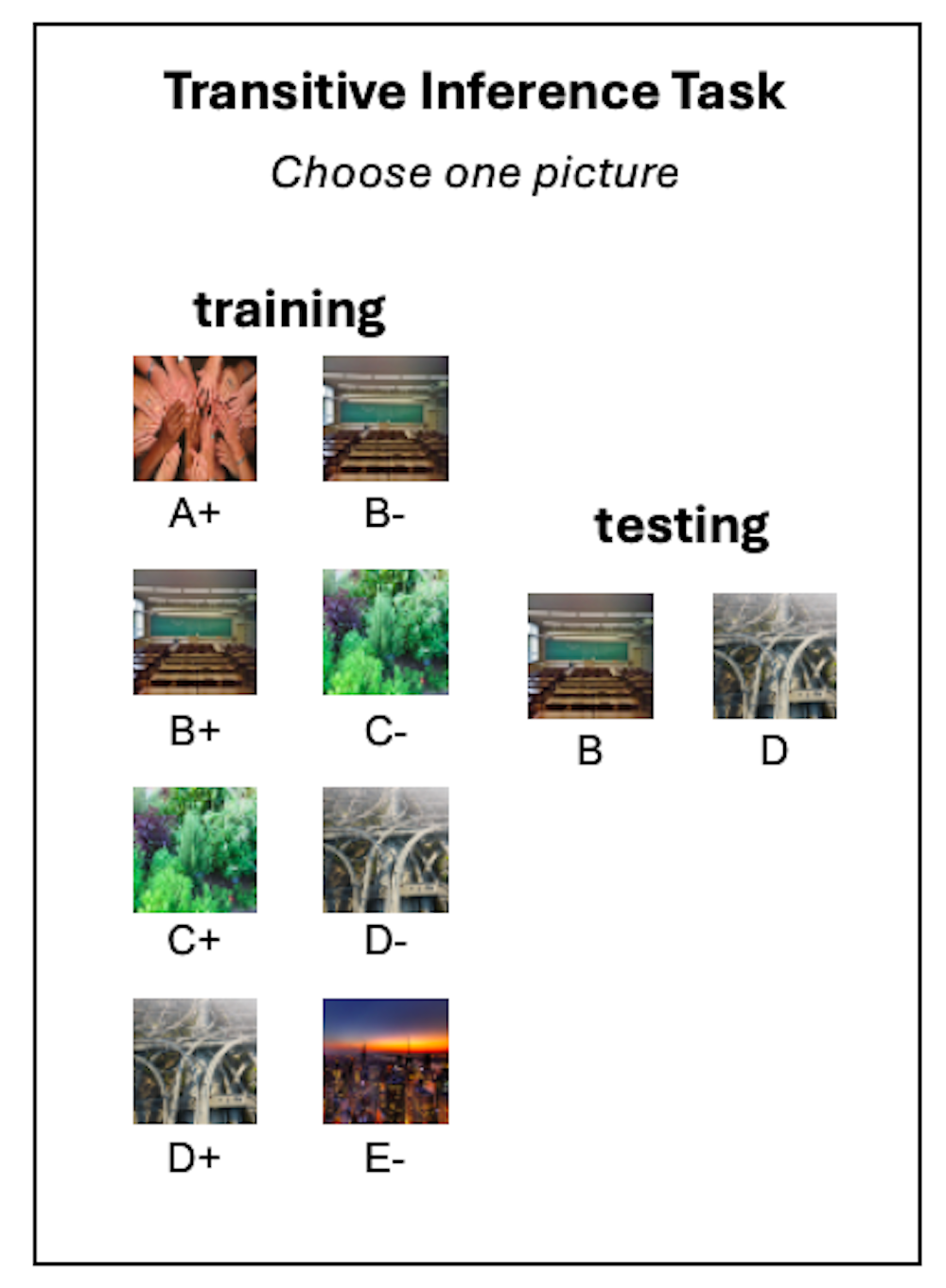
    In the lab, researchers test this by giving animals randomly paired images, one pair at a time, and rewarding them with food for picking the correct one. For example, animals learn that a photo of hands (A) is correct when paired with a classroom (B), a classroom (B) is correct when paired with bushes (C), bushes (C) are correct when paired with a highway (D), and a highway (D) is correct when paired with a sunset (E). We don’t know whether they “understand” what’s in the picture, and it is not particularly important for the experiment that they do.

    In a transitive inference task, subjects learn a series of rewarded pairs – such as A+ vs. B–, B+ vs. C– – and are later tested on novel pairings, like B vs. D, to see whether they infer an overall ranking.
    Olga Lazareva, CC BY-ND

    One possible explanation is that the animals that learn all the tasks create a mental ranking of these images: A > B > C > D > E. We test this idea by giving them new pairs they’ve never seen before, such as classroom (B) vs. highway (D). If they consistently pick the higher-ranked item, they’ve inferred the underlying order.

    What’s fascinating is how many species succeed at this task. Monkeys, rats, pigeons – even fish and wasps – have all demonstrated transitive inference in one form or another.

    The twist: Not all tasks are easy

    But not all types of reasoning come so easily. There’s another kind of rule called transitivity that is different from transitive inference, despite the similar name. Instead of asking which picture is better, transitivity is about equivalence.

    In this task, animals are shown a set of three pictures and asked which one goes with the center image. For example, if white triangle (A1) is shown, choosing red square (B1) earns a reward, while choosing blue square (B2) does not. Later, when red square (B1) is shown, choosing white cross (C1) earns a reward while choosing white circle (C2) does not. Now comes the test: white triangle (A1) is shown with white cross (C1) and white circle (C2) as choices. If they pick white cross (C1), then they’ve demonstrated transitivity.

    In a transitivity task, subjects learn matching rules across overlapping sets – such as A1 matches B1, B1 matches C1 – and are tested on new combinations, such as A1 with C1 or C2, to assess whether they infer the relationship between A1 and C1.
    Olga Lazareva, CC BY-ND

    The change may seem small, but species that succeed in those first transitive inference tasks often stumble in this task. In fact, they tend to treat the white triangle and the white cross as completely separate things, despite their common relationship with the red square. In my recently published review of research using the two tasks, I concluded that more evidence is needed to determine whether these tests tap into the same cognitive ability.

    Small differences, big consequences

    Why does the difference between transitive inference and transitivity matter? At first glance, they may seem like two versions of the same ability – logical reasoning. But when animals succeed at one and struggle with the other, it raises an important question: Are these tasks measuring the same kind of thinking?

    The apparent difference between the two tasks isn’t just a quirk of animal behavior. Psychology researchers apply these tasks to humans in order to draw conclusions about how people reason.

    For example, say you’re trying to pick a new almond milk. You know that Brand A is creamier than Brand B, and your friend told you that Brand C is even waterier than Brand B. Based on that, because you like a thicker milk, you might assume Brand A is better than Brand C, an example of transitive inference.

    But now imagine the store labels both Brand A and Brand C as “barista blends.” Even without tasting them, you might treat them as functionally equivalent, because they belong to the same category. That’s more like transitivity, where items are grouped based on shared relationships. In this case, “barista blend” signals the brands share similar quality.

    How researchers define logical reasoning determines how they interpret results.
    Svetlana Mishchenko/iStock via Getty Images

    Researchers often treat these types of reasoning as measuring the same ability. But if they rely on different mental processes, they might not be interchangeable. In other words, the way scientists ask their questions may shape the answer – and that has big implications for how they interpret success in animals and in people.

    This difference could affect how researchers interpret decision-making not only in the lab, but also in everyday choices and in clinical settings. Tasks like these are sometimes used in research on autism, brain injury or age-related cognitive decline.

    If two tasks look similar on the surface, then choosing the wrong one might lead to inaccurate conclusions about someone’s cognitive abilities. That’s why ongoing work in my lab is exploring whether the same distinction between these logical processes holds true for people.

    Just like a March Madness bracket doesn’t always predict the winner, a reasoning task doesn’t always show how someone got to the right answer. That’s the puzzle researchers are still working on – figuring out whether different tasks really tap into the same kind of thinking or just look like they do. It’s what keeps scientists like me in the lab, asking questions, running experiments and trying to understand what it really means to reason – no matter who’s doing the thinking.

    Olga Lazareva does not work for, consult, own shares in or receive funding from any company or organization that would benefit from this article, and has disclosed no relevant affiliations beyond their academic appointment.

    ref. Humans and animals can both think logically − but testing what kind of logic they’re using is tricky – https://theconversation.com/humans-and-animals-can-both-think-logically-but-testing-what-kind-of-logic-theyre-using-is-tricky-253001

    MIL OSI – Global Reports

  • MIL-OSI USA: GOP Votes Down Warnock Amendment to Save Georgia Jobs, Protect Rural Manufacturing Boom

    US Senate News:

    Source: United States Senator Reverend Raphael Warnock – Georgia

    GOP Votes Down Warnock Amendment to Save Georgia Jobs, Protect Rural Manufacturing Boom

    Senator Reverend Warnock took to the Senate floor to offer a bipartisan amendment to protect hundreds of thousands of clean energy jobs across the country
    Senator Warnock was instrumental in passing these clean energy tax credits, which are responsible for 42,000 good-paying jobs in Georgia
    In his effort to save these Georgia jobs, Senator Warnock penned an op-ed in the AJC, held a press conference in Savannah, and published a report on the risks posed to Georgia should the tax credits be repealed
     Senator Reverend Warnock: “Those 42,000 Georgia jobs and hundreds of thousands of jobs nationwide are at risk if Republicans have their way and roll back these tax credits”
    Washington, D.C. – Today, U.S. Senator Reverend Raphael Warnock (D-GA) took to the floor of the United States Senate to urge his GOP colleagues to pass a bipartisan amendment to protect hundreds of thousands of jobs in communities across the country. Senate Republicans voted down his motion by a vote of 48-51.
    As currently written, the GOP spending bill would eliminate many of the clean energy tax credits included in the Inflation Reduction Act (IRA) that have brought a manufacturing boom to communities across the U.S.
    “Mr. President, I rise to protect pro-business tax credits that are creating hundreds of thousands of American jobs, many of which don’t require a college degree…” said Senator Warnock. “42,000 Georgia jobs and hundreds of thousands of jobs nationwide are at risk if Republicans have their way and roll back these tax credits.”
    Senator Warnock has warned his colleagues repeatedly of the risks that repealing clean energy tax credits will have on Americans across the country. In May, Senator Warnock published a report highlighting the impact that the cuts would have on Georgia and its economy. The Senator followed his report with a press conference in Savannah at the Georgia Ports Authority warning of the impact on rural communities and an op-ed in the Atlanta Journal-Constitution. Georgia is the single largest recipient of IRA tax credits in the U.S., with over $28 billion in investment, 42,000 jobs, and 51 projects announced in the state.
    The Warnock Amendment would force the Senate to reconsider its current path toward repealing the clean energy tax credits in the GOP spending bill by returning the bill to the Senate Finance Committee for additional consideration.
    In recent days, a bipartisan push urging GOP senators to reverse their proposed cuts has swept the country. Last week, Georgia lawmakers sent a letter to Senate Finance Committee Chairman Mike Crapo (R-ID) asking him to reconsider his support for the rollback of solar energy tax credits, writing: “We urge you not to weaken the tax credits, as doing so would only harm the manufacturing renaissance in Georgia while creating opportunities for Chinese companies to take over the solar industry.”
    Nationwide analyses show that the “vast majority” of projects announced following the passage of the clean energy tax credits have been investments in Congressional districts currently held by Republicans. This is particularly true in Georgia where 83 percent of the projects, 94 percent of the total investment, and 75 percent of the jobs are in Republican districts. More than 95 percent of the new jobs and investments are in counties where the percentage of people with a bachelor’s degree is below the national average. 
    Full remarks available below:
    Mr. President. I rise to protect pro-business, pro-worker tax credits that are creating hundreds of thousands of American clean energy manufacturing jobs, many of which don’t require a college degree.
    Put simply, these tax credits are working: I know firsthand because they’re working right now in Georgia.
    Businesses which we’ve invested $1 [federally], we’ve seen [private] investments as much as $4.50.
    They’ve helped create 42,000 new manufacturing and construction jobs, many in rural parts of our state that are too often left behind by Washington politicians. Those 42,000 Georgia jobs and hundreds of thousands of jobs nationwide are at risk if Republicans have their way and roll back these tax credits.
    That’s why North America’s Building Trades Unions called this bill the “biggest job-killing bill in the history of this country.”
    I urge my colleagues to vote with America’s workers and vote YES on my Motion to Commit.

    MIL OSI USA News

  • MIL-OSI Security: Defense News in Brief: Koa Moana 25 U.S. Marines and Sailors Lifesaving Kits Empowering Palau in Time for Pacific Mini Games

    Source: United States Navy

    KOROR, Palau – On June 25, 2025, U.S. Marines and Sailors with Koa Moana 25 delivered 100 first aid kits to the Belau National Hospital in Palau. Koa Moana is a recurring exercise that fosters partnerships with Compact of Free Association nations like the Republic of Palau and the Federated States of Micronesia through medical aid, engineering, and security cooperation.

    MIL Security OSI

  • MIL-OSI Security: Defense News in Brief: U.S., Malaysian forces conclude Bersama Warrior 25

    Source: United States Navy

    KUANTAN, Malaysia — Service members with the Malaysian Armed Forces (MAF), U.S. Indo-Pacific Command, and U.S. joint forces – including active duty and reserve components – concluded Bersama Warrior 25 on June 26, following 10 days of bilateral staff integration and scenario-based planning in Kuantan, Malaysia.

    MIL Security OSI

  • MIL-OSI Security: Defense News in Brief: 300 Strong: Information Warfare WTI Cadre Reaches Milestone, Sharpening Warfighting Edge

    Source: United States Navy

    NORFOLK, Va. – Naval Information Warfighting Development Center (NIWDC), commanded by Rear Adm. Brian Harding, celebrated the graduation of 17 new Information Warfare (IW) Warfare Tactics Instructors (WTIs) during a ceremony where Vice Adm. Mike Vernazza, Commander, Naval Information Forces, served as the guest speaker.  This graduation marks a significant milestone, bringing the total number of IW WTIs in the cadre to 300.

    MIL Security OSI

  • MIL-OSI Russia: A memorial plaque in memory of Alexander Shirvindt will be installed in Moscow

    Translation. Region: Russian Federal

    Source: Moscow Government – Government of Moscow –

    A memorial plaque in memory of the People’s Artist of the RSFSR, director and teacher, artistic director and president of the Moscow Academic Satire Theater Alexander Anatolyevich Shirvindt will be installed on the house where he lived. The Moscow Government order on this issue was signed by Sergei Sobyanin.

    The memorial plaque will be installed at the address: Kotelnicheskaya Embankment, Building 1/15, Block A. The work is planned to be completed by the end of 2025.

    Alexander Anatolyevich Shirvindt (1934-2024) left a large and bright mark in the history of Russian art. He played dozens of roles in plays and films that became classics of theater and cinema. In addition, as a director, Alexander Shirvindt staged more than 20 plays on the stage of the Satire Theater.

    Please note: This information is raw content directly from the source of the information. It is exactly what the source states and does not reflect the position of MIL-OSI or its clients.

    Please Note; This Information is Raw Content Directly from the Information Source. It is access to What the Source Is Stating and Does Not Reflect

    https: //vv.mos.ru/mayor/tkhemes/13017050/

    MIL OSI Russia News

  • MIL-OSI Canada: Statement by Minister Guilbeault on Canada Day

    Source: Government of Canada News

    OTTAWA, July 1, 2025

    The Honourable Steven Guilbeault, Minister of Canadian Identity and Culture and Minister responsible for Official Languages, made the following statement on Canada Day:

    “Happy Canada Day!

    This year, Canadians have much to be proud of—from our resilience and solidarity to the way we stood up for who we are. July 1is the perfect occasion to come together with our neighbours, friends and families, and celebrate the bonds that unite us and make us strong.

    Across the country, let’s honour what makes Canada so unique: our rich heritage, our diverse cultural mosaic, the breathtaking beauty of our landscapes, our creators and innovators, and the values we hold dear: democracy, fairness and inclusion.

    Wherever you are, I invite you to take part in the many Canada Day activities organized in your community across the country.

    Today, Canadian identity shines from coast to coast to coast and beyond our borders. From the shores of Halifax to the coast of Vancouver, and through the vast and pure North, Canada stands strong, united and free. And in the shadow of our national flag, let’s remember that we will always have the power to dream and build a future that lives up to our aspirations.”

    MIL OSI Canada News

  • MIL-OSI Canada: Statement by the Minister of National Defence on Canada Day 2025

    Source: Government of Canada News

    July 1, 2025 – Ottawa, Ontario

    “I am privileged to join Canadians in celebrating our nation and the values that define us: freedom, democracy, rule of law, compassion, and service to others. We honour the diverse communities and countless Canadians who contribute every day to making Canada more resilient.

    “Our identity is deeply rooted in our people – from Indigenous Peoples who have stewarded this land for generations, to newcomers who bring fresh perspectives and dreams, and the  families who have called Canada home for many years, to members of the Canadian Armed Forces who have stood ready to defend Canada, support our allies, and respond when called upon.

    “Whether you are gathering with family, attending local celebrations, or reflecting on the journey of our nation, I invite you to take pride in all we have accomplished together.

    “On behalf of the Department of National Defence and the Canadian Armed Forces, I wish every Canadian a happy Canada Day!”

    MIL OSI Canada News

  • MIL-OSI China: Cable-stayed bridge across Yinjiang River in China’s Jiangsu joined together

    Source: People’s Republic of China – State Council News

    MIL OSI China News

  • MIL-OSI USA: Governor Ivey Announces CHOOSE Act ESAs Now Available for 2025-2026 Recipients

    Source: US State of Alabama

    MONTGOMERY — Governor Kay Ivey on Tuesday announced that education savings accounts (ESAs) established by the state’s CHOOSE Act program are now fully funded and available for the 2025-2026 school year. Families that were approved through the application process earlier this year can access their funding through the ClassWallet platform to help pay for school tuition, tutoring, educational therapies and other qualifying educational expenses at approved education service providers (ESPs).

    Since CHOOSE Act applications opened in January 2025, students in every county throughout the state have applied, totaling 36,873 students. Funding for eligible students includes:

    • $7,000 per eligible student enrolled in a participating school
    • $2,000 per participating student enrolled in a home education program (maximum of $4,000 per family)

    “Our CHOOSE Act education saving accounts are officially ready to support thousands of Alabama families and students with their unique educational needs,” said Governor Ivey. “In just the first year, our state’s ESA program is incredibly popular, providing opportunity, flexibility and choice when it comes to our children’s education. I am excited to see the program in action this year.”

    According to the Alabama Department of Revenue (ALDOR), which administers the program, students from every grade level applied for funding this year, with over 23,000 students receiving approval. This equates to over $124 million in ESAs supporting school choice for Alabama families and students.

    Families approved for ESA funding will receive a welcome email on or around July 1 from ClassWallet, ALDOR’s program support partner, with instructions on how to access their funds and guidance on how to use them. The email will also include information on how to attend upcoming webinars that will provide additional support and information for participating families and students.

    For information, visit www.chooseact.alabama.gov, which has program information such as a Parent Guide, a Program FAQ and a list of approved education service providers. The application process for the 2026-2027 academic year will begin in January 2026.

    ###

    MIL OSI USA News

  • MIL-OSI Security: IAEA Holds Rays of Hope Forum To Increase Access to Cancer Care

    Source: International Atomic Energy Agency – IAEA

    Cancer remains one of the leading causes of death on the continent, claiming around 2,000 lives every day.

    Three years ago, to close the global cancer care gap, we launched the IAEA’s #RaysOfHope initiative at the African Union headquarters in Addis Ababa.

    Today, we returned to take stock:

    • More than 90 countries have joined
    • Over €90 million mobilized
    • Hospitals upgraded
    • PET/CTs, SPECTs, mammography units and LINACs delivered
    • Radiotherapy centres coming online across several countries
    • Staff trained and networks developed

    Building on this momentum, we signed a $4.5 million partnership with St. Jude Children’s Research Hospital – the largest contribution from a non-traditional partner to our cancer care work to date. We also launched a new nuclear medicine service at Black Lion Hospital – one of four radiotherapy centres supported by the IAEA in Ethiopia. The hospital now has SPECT/CT scanners, a linear accelerator, trained staff, and a mammography unit on the way.

    Learn more: Rays of Hope IAEA Flagship Initiative →

    MIL Security OSI

  • MIL-OSI Security: IAEA Holds Rays of Hope Forum To Increase Access to Cancer Care

    Source: International Atomic Energy Agency – IAEA

    Cancer remains one of the leading causes of death on the continent, claiming around 2,000 lives every day.

    Three years ago, to close the global cancer care gap, we launched the IAEA’s #RaysOfHope initiative at the African Union headquarters in Addis Ababa.

    Today, we returned to take stock:

    • More than 90 countries have joined
    • Over €90 million mobilized
    • Hospitals upgraded
    • PET/CTs, SPECTs, mammography units and LINACs delivered
    • Radiotherapy centres coming online across several countries
    • Staff trained and networks developed

    Building on this momentum, we signed a $4.5 million partnership with St. Jude Children’s Research Hospital – the largest contribution from a non-traditional partner to our cancer care work to date. We also launched a new nuclear medicine service at Black Lion Hospital – one of four radiotherapy centres supported by the IAEA in Ethiopia. The hospital now has SPECT/CT scanners, a linear accelerator, trained staff, and a mammography unit on the way.

    Learn more: Rays of Hope IAEA Flagship Initiative →

    MIL Security OSI

  • MIL-OSI: SUTNTIB AB Tewox publishes its NAV for June 2025

    Source: GlobeNewswire (MIL-OSI)

    Vilnius, Lithuania, July 01, 2025 (GLOBE NEWSWIRE) — As at the end of June 2025, the net asset value (NAV) of SUTNTIB AB Tewox decreased to EUR 46,370,405, compared to the previously determined NAV of EUR 46,740,384 at the end of May 2025.

    The share price decreased to EUR 1.1077, from EUR 1.1165 at the end of May 2025. The pro-forma internal rate of return (IRR) decreased to 3.26%, compared to previously announced IRR of 3.62% at the end of May 2025.

    Contact person for further information:

    Paulius Nevinskas

    Manager of the Investment Company

    paulius.nevinskas@lordslb.lt

    https://lordslb.lt/tewox_bonds/

    The MIL Network

  • MIL-OSI: SUTNTIB AB Tewox publishes its NAV for June 2025

    Source: GlobeNewswire (MIL-OSI)

    Vilnius, Lithuania, July 01, 2025 (GLOBE NEWSWIRE) — As at the end of June 2025, the net asset value (NAV) of SUTNTIB AB Tewox decreased to EUR 46,370,405, compared to the previously determined NAV of EUR 46,740,384 at the end of May 2025.

    The share price decreased to EUR 1.1077, from EUR 1.1165 at the end of May 2025. The pro-forma internal rate of return (IRR) decreased to 3.26%, compared to previously announced IRR of 3.62% at the end of May 2025.

    Contact person for further information:

    Paulius Nevinskas

    Manager of the Investment Company

    paulius.nevinskas@lordslb.lt

    https://lordslb.lt/tewox_bonds/

    The MIL Network

  • MIL-OSI: Relm Appoints Dr Rayyan Zafar As Senior Scientific Advisor As Part Of Strategic Expansion In Alternative Therapeutics Sector

    Source: GlobeNewswire (MIL-OSI)

    Bermuda, July 01, 2025 (GLOBE NEWSWIRE) — – Relm Insurance (‘Relm’), the leading insurer for emerging and innovative industries, today announced the appointment of Dr. Rayyan Zafar, PhD, MRSB, as a Senior Scientific Advisor to the firm. In this role, Dr. Zafar will inform Relm’s strategic expansion into the emerging field of Psychedelics and Alternative Therapeutics, leveraging his world-class expertise to deepen Relm’s understanding of novel treatments for addiction and mental health disorders.

    With over a decade of experience in neuropsychopharmacology, Dr. Zafar brings unparalleled insight from his postdoctoral fellowship at the Centre for Psychedelic Research and Neuropsychopharmacology, Imperial College London, and his senior research role at Drug Science. Working alongside Professor David Nutt, Dr. Zafar has led groundbreaking investigations into the brain mechanisms underpinning addiction and therapeutic applications of psychedelics — including psilocybin, DMT, LSD, ketamine, MDMA, and cannabis.

    Currently conducting the world’s first clinical and neuroimaging study of psilocybin therapy in gambling addiction, Dr. Zafar will advise Relm on research partnerships, therapeutic program design, and regulatory strategy to accelerate safe, science-backed interventions.

    “I’m excited to join Relm as they continue to lead the way in underwriting transformative and emerging industries. As a neuropsychopharmacologist, I believe psychedelic and alternative therapeutics represent some of the most promising advances in mental health and psychiatric treatment in a generation.” said Dr. Zafar. “With global regulatory landscapes shifting and momentum building to improve patient access, I look forward to supporting Relm in reimagining how insurance can drive innovation, de-risk investment, and help bring these groundbreaking treatments to those who need them most.”

    Dr. Zafar’s advisory roles span biotech startups and global charities, positioning him to cultivate interdisciplinary collaborations that drive real-world impact. 

    Relm Founder and CEO, Joseph Ziolkowski, said: “Partnering with Dr. Zafar reinforces our commitment to ground innovative insurance in real science and sound governance, giving psychedelics companies the resilience they need to scale responsibly.”

    —————————END——————————

    About Relm Insurance 

    Relm Insurance Ltd. (Relm) is a Bermuda-domiciled specialty insurance carrier that supports emerging industries driving innovation and next-generation technologies. Launched in 2019, Relm offers a wide range of insurance products to high-growth markets, including digital assets, blockchain, AI, biotech, and the space economy. With a Financial Stability Rating of A (Exceptional) from Demotech, Relm is widely recognised for its industry expertise and solutions-driven approach, making it a trusted risk partner for businesses operating at the frontier of technological innovation. 

    The MIL Network

  • MIL-OSI: Relm Appoints Dr Rayyan Zafar As Senior Scientific Advisor As Part Of Strategic Expansion In Alternative Therapeutics Sector

    Source: GlobeNewswire (MIL-OSI)

    Bermuda, July 01, 2025 (GLOBE NEWSWIRE) — – Relm Insurance (‘Relm’), the leading insurer for emerging and innovative industries, today announced the appointment of Dr. Rayyan Zafar, PhD, MRSB, as a Senior Scientific Advisor to the firm. In this role, Dr. Zafar will inform Relm’s strategic expansion into the emerging field of Psychedelics and Alternative Therapeutics, leveraging his world-class expertise to deepen Relm’s understanding of novel treatments for addiction and mental health disorders.

    With over a decade of experience in neuropsychopharmacology, Dr. Zafar brings unparalleled insight from his postdoctoral fellowship at the Centre for Psychedelic Research and Neuropsychopharmacology, Imperial College London, and his senior research role at Drug Science. Working alongside Professor David Nutt, Dr. Zafar has led groundbreaking investigations into the brain mechanisms underpinning addiction and therapeutic applications of psychedelics — including psilocybin, DMT, LSD, ketamine, MDMA, and cannabis.

    Currently conducting the world’s first clinical and neuroimaging study of psilocybin therapy in gambling addiction, Dr. Zafar will advise Relm on research partnerships, therapeutic program design, and regulatory strategy to accelerate safe, science-backed interventions.

    “I’m excited to join Relm as they continue to lead the way in underwriting transformative and emerging industries. As a neuropsychopharmacologist, I believe psychedelic and alternative therapeutics represent some of the most promising advances in mental health and psychiatric treatment in a generation.” said Dr. Zafar. “With global regulatory landscapes shifting and momentum building to improve patient access, I look forward to supporting Relm in reimagining how insurance can drive innovation, de-risk investment, and help bring these groundbreaking treatments to those who need them most.”

    Dr. Zafar’s advisory roles span biotech startups and global charities, positioning him to cultivate interdisciplinary collaborations that drive real-world impact. 

    Relm Founder and CEO, Joseph Ziolkowski, said: “Partnering with Dr. Zafar reinforces our commitment to ground innovative insurance in real science and sound governance, giving psychedelics companies the resilience they need to scale responsibly.”

    —————————END——————————

    About Relm Insurance 

    Relm Insurance Ltd. (Relm) is a Bermuda-domiciled specialty insurance carrier that supports emerging industries driving innovation and next-generation technologies. Launched in 2019, Relm offers a wide range of insurance products to high-growth markets, including digital assets, blockchain, AI, biotech, and the space economy. With a Financial Stability Rating of A (Exceptional) from Demotech, Relm is widely recognised for its industry expertise and solutions-driven approach, making it a trusted risk partner for businesses operating at the frontier of technological innovation. 

    The MIL Network

  • MIL-OSI Security: Kansas City Man Sentenced to 10 Years for Fentanyl Conspiracy

    Source: US FBI

    KANSAS CITY, Mo. – A Kansas City, Mo., man was sentenced in federal court today for his role in a conspiracy to distribute fentanyl.

    Jose Amparan, 22, was sentenced by U.S. District Judge Roseann Ketchmark to 10 years in federal prison without parole.

    On Nov. 20, 2024, Amparan pleaded guilty to one count of conspiracy to distribute fentanyl and one count of conspiracy to commit money laundering.

    Amparan was a source of supply of fentanyl pills for co-defendant Tiger Draggoo.  Based upon text messages from seized cell phones and Cash App records, it was determined that Tiger Draggoo purchased at least 22,364 pills from co-defendants, including Amparan.  Tiger Draggoo paid $34,363 through Cash App and an unknown amount via cash.  Of this amount, Amparan sold at least 3,000 pills to Tiger Draggoo over 15 separate transactions, between approximately Dec. 10, 2022, through approximately Jan. 14, 2023.  Amparan was paid approximately $4,835 through Cash App and an additional amount via cash for these transactions.  Amparan and Tiger Draggoo conspired to conceal and disguise the nature of the transfer of funds through Cash App by referring to the payments being for items such as “groceries,” “reimbursement,” and “car work.”

    On Jan. 10, 2023, a confidential informant purchased 500 counterfeit M30 pills containing fentanyl for $1,750 from Amparan and another.

    Amparan and his co-defendants have all pleaded guilty in this case, with only, Tiger Draggoo, left to be sentenced at a later date.

    This case is being prosecuted by Assistant U.S. Attorneys Brad K. Kavanaugh and Robert Smith. It was investigated by the Jackson County Drug Task Force, the Bureau of Alcohol, Tobacco, Firearms and Explosives, the Belton, Mo., Police Department, the Raymore, Mo., Police Department, the Cass County, Mo., Sheriff’s Department, and the FBI.

    MIL Security OSI

  • MIL-OSI: Maris-Tech Expands Asia-Pacific Reach with New Distribution Agreement in Singapore

    Source: GlobeNewswire (MIL-OSI)

    Distribution Agreement with Precision Technologies Strengthens Presence in Key Defense and Security Markets

    Rehovot, Israel, July 01, 2025 (GLOBE NEWSWIRE) — Maris-Tech Ltd. (Nasdaq: MTEK, MTEKW) (“Maris-Tech” or the “Company”), a global leader in video and artificial intelligence (“AI”)- based edge computing technology, today announced that it has entered into a distribution agreement with Precision Technologies Pte Ltd. (“Precision Technologies”), a leading Singapore-based supplier of cutting-edge defense and security solutions.

    The agreement marks an important milestone for Maris-Tech as it continues to expand its global footprint by strengthening its presence in the Asia-Pacific region. Under the terms of the agreement, Precision Technologies will promote and distribute the Company’s full range of video-based edge AI computing solutions, serving key markets including defense, homeland security, aerospace, and commercial sectors throughout Singapore.

    “Collaborating with a respected and established player like Precision Technologies is an important milestone for Maris-Tech,” said Israel Bar, Chief Executive Officer of Maris-Tech. “The Asia-Pacific region is a key growth area, and we believe that this collaboration represents a strong vote of confidence in our technology and products. We believe that customers in this region will greatly benefit from our advanced solutions for AI-powered video intelligence and edge computing.”

    About Maris-Tech Ltd.

    Maris-Tech is a global leader in video and AI-based edge computing technology, pioneering intelligent video transmission solutions that conquer complex encoding-decoding challenges. Our miniature, lightweight, and low-power products deliver high-performance capabilities, including raw data processing, seamless transfer, advanced image processing, and AI-driven analytics. Founded by Israeli technology sector veterans, Maris-Tech serves leading manufacturers worldwide in defense, aerospace, Intelligence gathering, homeland security (HLS), and communication industries. We’re pushing the boundaries of video transmission and edge computing, driving innovation in mission-critical applications across commercial and defense sectors.

    For more information, visit https://www.maris-tech.com/

    Forward-Looking Statement Disclaimer

    This press release contains “forward-looking statements” within the meaning of Section 27A of the Securities Act of 1933, as amended, and Section 21E of the Securities Exchange Act of 1934, as amended, that are intended to be covered by the “safe harbor” created by those sections. Forward-looking statements, which are based on certain assumptions and describe our future plans, strategies and expectations, can generally be identified by the use of forward-looking terms such as “believe,” “expect”,” “may”, “should,” “could,” “seek,” “intend,” “plan,” “goal,” “estimate,” “anticipate” or other comparable terms. For example, the Company is using forward-looking statements when it is discussing the Company’s growth strategy and presence in the Asia-Pacific region; potential benefits of the collaboration between the Company and Precision Technologies; and that customers in the Asia-Pacific region will greatly benefit from the Company’s advanced solutions for AI-powered video intelligence and edge computing. The Company’s actual results and financial condition may differ materially from those indicated in the forward-looking statements. Therefore, you should not rely on any of these forward-looking statements. Important factors that could cause our actual results and financial condition to differ materially from those indicated in the forward-looking statements include, among others, the following: its ability to successfully market its products and services, including in the United States; the acceptance of its products and services by customers; its continued ability to pay operating costs and ability to meet demand for its products and services; the amount and nature of competition from other security and telecom products and services; the effects of changes in the cybersecurity and telecom markets; its ability to successfully develop new products and services; its success establishing and maintaining collaborative, strategic alliance agreements, licensing and supplier arrangements; its ability to comply with applicable regulations; and the other risks and uncertainties described in the Annual Report on Form 20-F for the year ended December 31, 2024, filed with the SEC on March 28, 2025, and its other filings with the Securities and Exchange Commission. The Company undertakes no obligation to publicly update any forward-looking statement, whether written or oral, that may be made from time to time, whether as a result of new information, future developments or otherwise.

    Investor Relations:

    Nir Bussy, CFO
    Tel: +972-72-2424022
    Nir@maris-tech.com

    The MIL Network

  • MIL-OSI: Wavetek Deploys Silvaco’s Victory TCAD™ to Drive Innovation in GaN-Based Connectivity Solutions

    Source: GlobeNewswire (MIL-OSI)

    SANTA CLARA, Calif., July 01, 2025 (GLOBE NEWSWIRE) — Silvaco Group, Inc. (“Silvaco”) (NASDAQ: SVCO), a provider of TCAD, EDA software, and SIP solutions that enable semiconductor design and digital twin modeling through AI software and innovation, today announced that Wavetek has adopted Silvaco’s Victory TCAD™ solution for the development of next-generation Gallium Nitride (GaN) devices targeting high-performance connectivity applications in 5G, Wi-Fi, and IoT markets.

    As demand for high-efficiency, high-frequency GaN devices continues to rise, Wavetek is leveraging Silvaco’s advanced simulation tools to design and optimize high electron mobility transistors (HEMT) and pseudomorphic HEMTs (pHEMT). Silvaco’s Victory TCAD solution delivers accurate GaN-based device models, enabling rapid prototyping and robust device performance evaluation before fabrication.

    “Silvaco’s Victory TCAD platform gives us the ability to precisely model GaN device behavior under real-world conditions,” said Dr. Barry Lin, CTO of Wavetek. “This level of insight is critical for achieving the performance and reliability targets demanded by next-generation RF and power applications.”

    Silvaco’s Victory suite supports a wide range of advanced technologies including RF, Power, Photonics, CMOS, Memory, and Display. With powerful device simulation, process modeling, and parameter extraction capabilities, Victory TCAD helps leading semiconductor companies accelerate R&D cycles and reduce time-to-market.

    “We are pleased to support Wavetek in their development of cutting-edge GaN technologies,” said Eric Guichard, Ph.D., Senior Vice President and General Manager of Silvaco’s TCAD Division. “Our simulation solutions are engineered to meet the rigorous demands of modern semiconductor innovation in high-frequency and Wide Band-gap market segments.”

    For more information about Silvaco’s Victory TCAD platform, visit www.silvaco.com.

    About Silvaco Group, Inc.
    Silvaco is a provider of TCAD, EDA software, and SIP solutions that enable semiconductor design and digital twin modeling through AI software and innovation. Silvaco’s solutions are used for semiconductor and photonics processes, devices, and systems development across display, power devices, automotive, memory, high performance compute, foundries, photonics, internet of things, and 5G/6G mobile markets for complex SoC design. Silvaco is headquartered in Santa Clara, California, and has a global presence with offices located in North America, Europe, Brazil, China, Japan, Korea, Singapore, and Taiwan. Learn more at silvaco.com.

    Contacts
    Media Relations:
    Tiffany Behany, press@silvaco.com

    Investor Relations:
    Greg McNiff, investors@silvaco.com

    The MIL Network

  • MIL-OSI Video: Launch of the Sevilla Platform for Action – UN Chief remarks | #FFD4 | United Nations

    Source: United Nations (video statements)

    Remarks by António Guterres, Secretary-General of the United Nations, at the Launch of the Sevilla Platform for Action – 4th International Conference on Financing for Development FFD4 (Sevilla, Spain).

    “Mr. President of the Government of Spain, dear Pedro Sánchez,

    Excellencies, ladies and gentlemen,

    Thank you for joining this launch of the Sevilla Platform for Action.

    Respected President of the Government of Spain — I commend you and your government for your vision and leadership as hosts of the Fourth International Conference on Financing for Development.

    We are all here to respond to a global development crisis that threatens people and planet alike.

    Our roadmap to a better future — the Sustainable Development Goals — is in danger.

    Two-thirds of the targets are not progressing fast enough — or at all.

    Solutions depend on financing.

    Developing countries need over $4 trillion a year to deliver on the 2030 Agenda.

    But they are being battered by limited fiscal space, slowing growth, crushing debt burdens and growing systemic risks.

    The Sevilla Commitment document represents a bold plan to get the engine of development revving again:

    Through new domestic and global commitments that can channel public and private finance to the areas of greatest need…

    By overhauling the world’s approach to debt to make borrowing work in service of sustainable development…

    And by reforming the global financial architecture to reflect today’s realities and the urgent needs of developing countries.

    But we need all hands on deck.

    And that’s why the Sevilla Platform for Action is so critical — and so significant.

    In the midst of a world of division, conflict and economic uncertainty, this Platform contains more than 130 specific initiatives that demonstrate what we can achieve by working together.

    Governments, private sector partners, international institutions, and civil society groups all together are teaming up to launch high-impact initiatives to bring the Sevilla Commitment to life.

    This includes a global hub for debt swaps at the World Bank as part of a broader facility aimed at relieving liquidity constraints and lowering the cost of borrowing.

    A debt pause alliance to help countries in times of crisis.

    A global coalition to scale-up pre-arranged finance that can be readily deployed when disasters strike.

    A blended finance platform to bring public and private finance together in a new and expanded way.

    A new tool for Multilateral Development Banks to manage currency risks.

    And a commission to explore the future of development cooperation.

    In December, I appointed a group of experts on debt who today are announcing 11 immediately actionable proposals to help resolve the debt crisis.

    This includes the commitment to establish a borrowers forum for countries to learn from one another and coordinate their approaches in debt management and restructuring.

    I look forward to working closely with Member States — including the G20 — to bring this forum to life, to empower borrower countries, and create a fairer system.

    Excellencies, ladies and gentlemen,

    The Sevilla Platform for Action offers an ambitious, action-oriented response to the global financing challenge.

    It provides a springboard toward a more just, inclusive, and sustainable world for all countries.

    And above all, it proves that progress and change are possible if we work together.

    I hope the Platform inspires countries to work as one to tackle other challenges facing our world today.

    Once again, I thank Prime Minister Sánchez and all of you for your leadership.

    Thank you”.

    https://www.youtube.com/watch?v=Wh9SxgKKHmw

    MIL OSI Video

  • MIL-OSI Europe: AFRICA/DR CONGO – Peace agreement between the Democratic Party and Rwanda: another mockery

    Source: Agenzia Fides – MIL OSI

    Kinshasa (Agenzia Fides) – “The impression created by the people of Bukavu, exhausted by more than four months of occupation, is one of perplexity and the feeling of being deceived again and again, even if they do not give up hope that something will change on the ground. But what? New reports of killings by the M23 are coming from the city and the province,” said a Church source in Bukavu, the capital of South Kivu, occupied by Rwandan troops and the M23 movement since mid-February (see Fides, 17/2/2025), commenting on the peace agreement signed on June 27 in Washington by Rwanda and the Democratic Republic of Congo under the auspices of the Trump administration (see Fides, 27/6/2025).The agreement provides for the “lifting of Rwandan defense measures” within three months, with the withdrawal of Rwandan soldiers from the Democratic Republic of Congo, and the neutralization of the Democratic Forces for the Liberation of Rwanda (FDLR), founded by former Hutu leaders, linked to the 1994 Rwandan genocide, and viewed by Kigali as an existential threat.The agreement also contains an economic aspect, which has not yet been specified, but which is said to provide for the exploitation of Congolese natural resources by American companies.”Many people were even willing to lose the country’s natural resources to regain peace, but this remains in question,” the Fides source reports. “Because Rwanda, which occupies and exploits the provinces of North and South Kivu under the guise of the M23, does not seem to be affected by the agreement.So, at the moment, nothing is moving forward. Precisely where change is most needed.” “There is one fundamental change that everyone, except those who have changed their colors, is waiting for: the withdrawal of all Rwandan soldiers, who are to return to their homeland. This is not explicitly stated in the agreement; it only speaks of a cessation of hostilities. Even though it cites UN Resolution 2773, which calls for such a return”.”Upon reading, the text seems to me to be full of pitfalls. Another obvious pitfall is the fact that it mentions six times that the FDLR is to be neutralized. As if this were the real problem. It is a pretext, perhaps to avoid having to say out loud to Rwanda: The king is naked and he attacked an independent country. The FDLR are few in number, are repeatedly repatriated, and are completely unsuitable for an attack on Rwanda. But they are suitable to justify the presence of the Rwandan army in Congo.” “And they demand the disarmament of all militias: including this militia, which is of course often disorganized, sometimes infiltrated by bandits, but which, alone or with the few remaining Congolese soldiers, is blocking the advance of the M23. Meanwhile, the occupying forces continue to murder, rape, and humiliate a population that is now starving. You have to experience these things to feel the humiliation of those who ask why they do not know how to feed their children and the helplessness of those who respond: ‘I’m sorry, but we have no money to give you because the banks are closed,’” the source said. “Another pitfall is the return of refugees. There are hardly any Congolese refugees in Rwanda. Rather, there are hordes of self-proclaimed Rwandan refugees just waiting to enter Congo to settle there and continue to nurture the dream of a Greater Rwanda. It is true that reference is made to traditional institutions: they will have to say whether the person is truly from a particular place or not. We shall see,” the report continues. “And what about economic cooperation with a country that continues to plunder everything it can, crossing the borders of the occupied territories? The prospect, as some say, is that Congo will remain the great mine where people suffer and even die for little money, while Rwanda will be the site of refineries, and the large multinationals and the States that support them will be the big winners. With the blessing of their opportunistic friends, the United States. Is it a coincidence that the word ‘justice’ is not mentioned in the document? What about the millions of victims, the dead and the traumatized survivors, the children deprived of schooling, the young people robbed of their youth, the adults deprived of the vital minimum that makes a person’s dignity?None of this would have happened without the pressure from the Congolese authorities, who create the impression that they betrayed their country and their people in order to stay in power,” the source emphasizes. “Congolese civil society, especially in the east of the Democratic Republic of Congo, had prepared several clarifying documents and addressed them to the highest authorities, expressing their concerns. This was ignored. Nobel laureate Mukwege had raised his voice with a speech that was initially humanitarian and then political, tackling the root causes of the problems. Yet it was as if no one had said anything. The overall impression is therefore a mockery. It is bad to oppress a people. It is even worse to make them believe that you are helping them,” the source concludes. (Agenzia Fides, 1/7/2025)
    Share:

    MIL OSI Europe News

  • MIL-OSI United Kingdom: Draft Central Lancashire Local Plan submitted to the Secretary of State

    Source: City of Preston

    Preston City Council, Chorley Council and South Ribble Borough Council has submitted the draft Central Lancashire Local Plan (CLLP) to the Secretary of State.

    This is a significant milestone for the plan which has been in development between the three councils since 2018.

    The submission comes after a series of extensive consultations with residents and other stakeholders ending with a final consultation (known as the ‘Regulation 19’ consultation) which ran from February to April this year, which was the final opportunity for the public to give feedback on the plan.

    The CLLP is a strategic plan for the areas of Chorley, Preston and South Ribble and sets out the three councils’ approach to managing and delivering development (residential, employment and other infrastructure) and protecting the environment for the three districts between 2023 and 2041.  

    It is an important strategy which supports delivery of corporate ambitions and objectives, such as provision of affordable housing, tackling health and social inequalities and tackling the climate emergency.

    Councillor Matthew Brown, Leader of Preston City Council said:

    Reaching this point in the Central Lancashire Local Plan process is a significant achievement, and I would like to thank everyone who has been involved over the years, from our dedicated officers to the residents and organisations who took the time to share their views. 

    This Local Plan is vital in helping us manage future growth in Preston in a way that is both sustainable and sensitive to the needs of our communities. The plan aligns with our Community Wealth Building strategy, fostering the creation of more and better-quality job opportunities and supporting skills development.

     It ensures we have a clear, shared vision for where new homes, jobs, and services should be located, while protecting the spaces and places that matter most to local people.”

    Councillor Colin Sharples, Cabinet Member for Economic Growth and Planning at South Ribble Borough Council said:

    It’s been a long journey to get the draft Central Lancashire Local Plan to this stage, and I want to thank all those who have worked since 2018 to make it happen, along with all those who provided vital feedback. The Local Plan allows us to be in a strong position to support sustainable development which will enhance South Ribble, allowing the borough to continue to see growth and to make sure we can keep up with the housing and employment demand.”

    Councillor Alistair Bradley, Leader of Chorley Council said:

    I am pleased that we have reached this milestone and that the plan is now with the Secretary of State for her review. There has been an incredible amount of hard work to get to this stage, and I want to acknowledge all the residents and other stakeholders who have provided valuable feedback and helped to shape the plan. 

    The Local Plan allows us to shape the future landscape of Chorley by outlining areas for development, ensuring that we can see sustainable and considered growth in the borough, whilst seeking to protect our precious green space.”

    For more information about the Central Lancashire Local Plan visit Central Lancashire Local Plan.

    MIL OSI United Kingdom

  • MIL-OSI Russia: Two KRT projects have been approved in the Teply Stan and Sokolinaya Gora districts

    Translation. Region: Russian Federal

    Source: Moscow Government – Government of Moscow –

    A decision was made on the comprehensive development of two territories: an undeveloped territory with an area of 4.74 hectares in the Teply Stan district in the southwest of the capital and five non-residential development sites with an area of 2.69 hectares in the Sokolinaya Gora district in the east of the capital.

    Resolutions on these issues were signed by Sergei Sobyanin.

    The reorganized territory in the Teply Stan district is located in the area of the 41st kilometer of the Moscow Ring Road, near General Tyulenev Street. The urban development potential of the site is 151.1 thousand square meters of real estate. A modern residential quarter will be built here, including housing for the purposes of the renovation program, and public and business facilities. In addition, landscaping of the territory and organization of the street and road network are planned.

    The implementation of the integrated development project for the territory will create approximately 900 jobs.

    The second area to be reorganized concerns 8th Sokolina Gora Street, Shcherbakovskaya Street and Mazhorov Lane. Currently, there are obsolete buildings there.

    The urban development potential of the sites in the east of Moscow is 59.5 thousand square meters of real estate, which will allow the construction of a modern residential quarter (41.6 thousand square meters) for the implementation of the renovation program and public and business facilities, including multifunctional public and medical centers.

    The implementation of the integrated development project for the territory will create approximately 290 jobs.

    As of July 1, 2025, the Moscow Government has approved and is in the implementation stage of 117 projects for the integrated development of territories with a total area of about 1.4 thousand hectares, within the framework of which it is planned to build over 28.5 million square meters of real estate. As a result, about 340 thousand jobs will be created.

    Please note: This information is raw content directly from the source of the information. It is exactly what the source states and does not reflect the position of MIL-OSI or its clients.

    Please Note; This Information is Raw Content Directly from the Information Source. It is access to What the Source Is Stating and Does Not Reflect

    https: //vv.mos.ru/mayor/tkhemes/13016050/

    MIL OSI Russia News

  • MIL-OSI USA News: No Tax on Social Security is a Reality in the One Big Beautiful Bill

    Source: US Whitehouse

    Under the One Big Beautiful Bill, the vast majority of senior citizens — 88% of all seniors who receive Social Security — will pay NO TAX on their Social Security benefits, according to a brand new analysis from the Council of Economic Advisers.

    • A senior who files as a single taxpayer and receives the current average retirement benefit (approx. $24,000) will see deductions that exceed their taxable Social Security income.
    • Married seniors who both receive the average $24,000 Social Security income — a total of $48,000 in annual income — will also see deductions that exceed their taxable Social Security income.

    This amounts to the largest tax break in history for America’s seniors — and makes sure that after years of earning their Social Security, seniors can save more of their money.

    Promises made, promises kept.

    MIL OSI USA News