Category: Academic Analysis

  • MIL-OSI Global: How to manage financial stress in uncertain times

    Source: The Conversation – USA – By Jeffrey Anvari-Clark, Assistant Professor of Social Work, University of North Dakota

    Having an action plan for personal finance is critical in uncertain times. Photo by Nicolas Guyonnet/Hans Lucas/AFP via Getty Images

    American families are struggling to keep up with their bills.

    The cost of food soared by more than 23% from 2020 to 2024. Other price increases, which are especially steep for vehicles, insurance, child care and housing, come as nearly 40% more people are behind on their credit card payments than in 2022.

    Now, uncertainty arising from zigzagging tariffs, firing of tens of thousands of federal workers and contractors, and massive cuts and freezes to federally funded programs means that more people are increasingly pessimistic about the economy.

    As an assistant professor of social work, I have found through my research that differences in how people experience, behave toward and feel about their personal finances have as much of an impact as do their age and gender on certain financial decisions. And those decisions, in turn, can affect their income and wealth moving forward.

    Improving your ‘financial efficacy’

    Scholars like me use the term “financial efficacy” when we’re assessing whether someone has personal finance know-how and the ability to put it to good use. People with a high level of financial efficacy can be more able to weather bouts of financial hardship and build wealth.

    Although everyone’s situation is unique and individual resources vary, there are still five broad areas that personal finance experts say are linked to good financial outcomes: emotional regulation, problem-solving skills, an ability to achieve goals, self-confidence and risk management.

    1. Being calm and carrying on

    Remaining calm in the face of a potential – or real – financial crisis tends to make it easier to think through important decisions. In contrast, reacting out of fear often leads to mistakes or quick fixes with costly long-term consequences. For example, rushing to fix a problem could lead you to take out a pay-day loan with high interest rates and fees.

    That’s why you should avoid making big financial decisions in a hurry.

    Waiting until you feel calm, perhaps giving yourself 24 hours to think it over, can protect you from making a bad situation worse. But don’t wait too long – procrastination can lead to late fees and compound your problems.

    Keeping your emotions under control depends on having healthy coping mechanisms for stressful situations. And having healthy habits helps to manage that stress.

    Consult an expert if you’re not sure how to tackle a financial challenge.
    Photo by Jeff Gritchen/Digital First Media/Orange County Register via Getty Images

    2. Problem solving with some creativity

    Solving financial problems is an exercise in improvisation. This includes finding creative ways to increase your income through a new job or side hustles and to reduce your expenses. Or look for solutions that will buy you more time, such as negotiating a repayment plan for an outstanding bill.

    This perseverance and resourcefulness often requires relying on skills you’ve used in the past. And it may help if you seek advice from people who you know have made good financial choices before.

    When in doubt about how to solve a financial problem, go see a financial counselor or social worker who can help assess your situation and identify the next steps. But be wary of the so-called finfluencers – short for financial influencers – who are active on social media. Instead, learn from the experts who focus on consumer protection and unbiased education.

    3. Setting goals and keeping track of them

    Achieving goals can be a short-term activity, like solving an immediate problem, or a longer-term process. It means keeping a clear outcome in mind and being able to tell when you’ve met a goal. More complex goals may need to be broken down into multiple milestones to stay on track.

    Whenever you’re in deep financial trouble, try to closely monitor your income and expenses. Adapt your budget according to what’s important to you. This will increase your sense of control over the situation.

    Tally up all your debt, including from credit cards, autos, student loans, medical or utility bills, and home mortgages. Figure out what you owe and to whom, and put together a plan to repay them. And if this feels overwhelming, that’s OK: A credit counseling nonprofit can help walk you through the process.

    Listing all your debt on paper or in a spreadsheet helps reduce anxiety and fear of the unknown. Having the plan helps you see a real way toward a financially stronger future. Then, take action and start paying them down.

    One possibility is to ask creditors for an extension or modified repayment schedule for a mortgage or car loan. Communicating with them up front shows them you are taking responsibility, and they will be more likely to work with you.

    Americans now owe an average of $6,455 in credit card debt. Paying in full during the grace period instead of later, with interest, can result in a substantial difference in what you owe.

    You never know when extra savings will come in handy.
    Faga Almeida/Universal Images Group via Getty Images

    4. Gaining more self-confidence through practice

    It’s always easier to be confident that you can achieve something if you’ve done it before. This is how confidence builds on itself.

    But what if you’re in a new situation? It can help reflecting back on your personal history, realizing that you’ve met challenges in the past, and being reasonably assured that you can do it again. Such confidence then helps you keep calm, think through some solutions and see that you can achieve your goals.

    Improving your money management confidence and skills can reduce your anxiety and stress in the moment. It can show you those areas of your financial life that are within your control and illumine the way forward to a healthier financial future.

    5. Planning ahead reduces your risks

    Even if your finances are OK today, I would advise you to plan ahead. It’s important to identify your own informal safety nets before you need them.

    Let’s say you had to pay an unexpected $400 bill. How would you handle it?

    Would you call a friend or a relative? Have that amount saved up, ready and waiting for emergency use? Cover it with your income? According to the Federal Reserve, only 63% of Americans could cover a $400 financial shock with the cash they have on hand.

    By regularly setting aside some of the money you earn, you can simultaneously manage your risks better and develop the skills to achieve bigger goals.

    Managing your own financial risks means doing your best to prevent a bad situation from getting worse. It also means you might be able to prevent a catastrophe in the future or be able to deal with it better.

    Having insurance policies, such as life and disability, homeowners or renters, and health and auto, is part of this. But so are maintaining enough savings to cover an emergency or having multiple income streams.

    The steps you take can also include something less tangible, such as caring for your health or tending to your relationships with friends and relatives so you can call on them when times are truly tough. Or better yet, they’ll be able to call on you.

    Jeffrey Anvari-Clark does not work for, consult, own shares in or receive funding from any company or organization that would benefit from this article, and has disclosed no relevant affiliations beyond their academic appointment.

    ref. How to manage financial stress in uncertain times – https://theconversation.com/how-to-manage-financial-stress-in-uncertain-times-255583


    MIL OSI – Global Reports

  • MIL-OSI Global: Repealing the estate tax could create headaches for the rich – as well as worsen inequality

    Source: The Conversation – USA – By Reid Kress Weisbord, Distinguished Professor of Law and Judge Norma Shapiro Scholar, Rutgers University – Newark

    As it stands, only a tiny fraction of America’s wealthy are ever subjected to the estate tax. Krisanapong Detraphiphat/Getty Images

    Nothing is more certain than death and taxes, Benjamin Franklin famously declared. And, since 1916, the federal government has imposed an estate tax on the transfer of property owned at death.

    But the Trump administration and Republican lawmakers may be on the verge of changing all that. GOP legislators are now considering a massive bill that includes major tax law changes and could pass by June or July 2025. Among the measures under consideration in both the House and Senate is the Death Tax Repeal Act, which would end the federal estate tax and reduce the tax rate on lifetime gifts.

    If the Death Tax Repeal Act were to become law, it would happen at a pivotal moment. In the coming years, baby boomers are expected to leave an estimated US$84 trillion to their heirs, in what’s been called the largest wealth transfer in human history.

    As law professors who specialize in trusts and estates, we’re interested in what might happen next. Interestingly, while the long-term impact to the federal budget would be significant, repealing the estate tax would complicate estate planning for the wealthy taxpayers who might not save all that much money. To understand why, let’s consider how the estate tax works now.

    Estate planning under current law

    The estate tax – which opponents of the policy have long derided as “the death tax” – is imposed on property that is transferred at death. It is part of the federal gift and estate tax system, which imposes a 40% tax on gifts made during life or transferred at death. Supporters of the estate tax argue that it reduces inequality and encourages charitable giving.

    But most Americans, even the very rich, will never pay any gift or estate tax. That’s because millions of dollars of assets transferred after death are completely exempt from it.

    For 2025, the cumulative gift and estate tax exemption is $13.99 million for individuals and $27.98 million for married couples. The current exemption doubled under the Tax Cuts and Jobs Act, which President Donald Trump signed into law in 2017. And it sunsets this year. Unless Congress passes new legislation, the exemption amount will go back to its 2017 base of $5 million for individuals, plus an inflation adjustment. That would increase the number of estates on which it would be levied.

    If the Death Tax Repeal Act passes, of course, then there will be no federal transfer tax imposed on estates.

    The estate tax is a lightning rod on Capitol Hill, even though it doesn’t affect many Americans. In 2022, the U.S. Treasury collected $22.5 billion in estate tax revenues from 3,170 estates. More than 3 million people died, so only 0.1% of decedents left enough assets for their estates to pay the tax.

    The big freeze: How the ultrarich reduce their tax liability

    Beyond taking advantage of this generous exemption, wealthy taxpayers currently use several planning techniques to reduce or eliminate estate taxes.

    A common strategy involves minimizing tax on assets that are likely to grow in value. Suppose, for example, a person owns property worth $25 million, and they have already used up their exemption (currently $13.99 million). If that $25 million property appreciates in value to $125 million, and the person waits until death to transfer it to the next generation, the entire investment – all $125 million – would be subject to the 40% estate tax.

    To reduce those taxes without entirely giving up control, sophisticated “estate freeze” planning techniques allow owners to keep some powers over the gifted property while transferring it for gift tax purposes before assets appreciate in value. In our example, if the $25 million asset were transferred through a freeze device such as an intentionally defective grantor trust, then the only tax would be a 40% gift tax on the $25 million. All of the appreciation – the other $100 million – would incur no gift or estate tax.

    Other estate planning techniques could further reduce the valuation for transfer tax purposes through minority interest, lack of marketability and other discounts. It’s through techniques like this that wealthy Americans are able to pass along approximately $200 billion each year in inherited assets without paying estate taxes.

    The Death Tax Repeal Act would not directly affect the tax treatment of charitable giving at death – over $40 billion – but it could alter incentives for philanthropic giving.

    Repealing the estate tax could upend existing estate plans

    If Congress repeals the estate tax but keeps the gift tax as proposed, many estate freeze planning techniques previously used by the ultrarich would become obsolete. There would be no incentive to make a lifetime gift of property that would appreciate: Individuals who hold onto their property until death would avoid both federal transfer and capital gains taxes.

    As a result, repealing the estate tax would turn existing estate plans on their head. Estate freeze strategies are premised on a calculated trade-off: To reduce or eliminate estate taxation at death, wealthy donors choose to make lifetime gifts even though doing so alters lifetime ownership rights, generates gift tax liability and sacrifices other tax benefits at death.

    Without an estate tax, existing estate freeze plans lock in the costs of lifetime gifting without any payoff at death. What’s more, some estate freeze plans can’t be changed. For example, an intentionally defective grantor trust must be irrevocable to freeze valuation for gift tax purposes.

    So while repealing the estate tax might seem appealing to wealthy Americans, the actual tax benefit could be modest at best for taxpayers who established estate plans under the current system. Financial advisers have also expressed concern about creating new estate plans designed to benefit from estate tax repeal because a future Congress could revive the tax.

    Repealing the estate tax could also have macroeconomic implications. Tax incentives to retain ownership until death could tie up capital in ways that dampen economic growth. Individuals tend to become increasingly risk-averse with age, so the Death Tax Repeal Act could skew investments toward safer asset classes. That could deprive younger generations of access to capital for new ventures, such as startups.

    The bottom line is that repealing the estate tax may hurt both taxpayers and the government. People with sufficient wealth to exhaust the high exemption are likely to have established estate plans that can’t be changed to benefit from estate tax repeal. Meanwhile, for new estate plans that seek to retain property ownership until death, the government will lose an important source of tax revenue – $22.5 billion in 2022 – collected from a tiny number of very wealthy estates that can afford to pay the tax.

    And, of course, repeal would also abandon the original purpose of the estate tax, which sought to reduce extreme concentrations of wealth.

    The authors do not work for, consult, own shares in or receive funding from any company or organization that would benefit from this article, and have disclosed no relevant affiliations beyond their academic appointment.

    ref. Repealing the estate tax could create headaches for the rich – as well as worsen inequality – https://theconversation.com/repealing-the-estate-tax-could-create-headaches-for-the-rich-as-well-as-worsen-inequality-254871

    MIL OSI – Global Reports

  • MIL-OSI Global: Measles could again become widespread as cases surge worldwide

    Source: The Conversation – USA – By Rebecca Schein, Assistant Professor of Infectious Disease Pediatrics, Michigan State University

    Measles is one of the most infectious diseases on the planet. Kateryna Kon/Science Photo Library via Getty Images

    Globally, measles is on the rise across the U.S., Canada, Mexico, South America and parts of Europe. In 2025, North and South America saw 11 times more cases than during the same period last year. In Europe, measles rates are at their highest point in 25 years.

    In the U.S., as of May 2, 2025, health authorities have confirmed 935 cases of measles affecting 30 states. This is a huge surge compared with the 285 cases reported in 2024. A large measles outbreak is happening in Canada, too, with over 1,000 cases.

    The Conversation asked Rebecca Schein, a specialist in pediatric infectious diseases, to explain what this spike at home and abroad might mean for a disease that was declared eliminated from the U.S. in 2000.

    How do measles cases this year compare with previous years?

    From 2000 to 2010, less than 100 measles cases were reported each year in the U.S. Since 2010, there have been isolated outbreaks, mainly in unvaccinated communities, with approximately 200 to 300 cases a year. The latest major outbreak in the U.S. was in 2019, with 1,274 cases, primarily in the New York City metropolitan area and parts of New Jersey.

    Cases fell in 2020 to 2023 during the COVID-19 pandemic, returning to prepandemic levels in 2024. Currently, most U.S. cases are coming from an epidemic in Texas, with 702 confirmed cases as of May 6. Of these, 91 people were hospitalized and three people, two of them children, died. Measles cases are still being reported. Texas is one of 12 measles outbreaks documented in the U.S. in 2025 to date.

    The World Health Organization has declared both North and South America to be at high risk for measles. Canada reported a total of 1,177 cases as of April 19, with 951 of them linked to an outbreak that began in New Brunswick in October 2024 and spread to seven provinces. In 2023, there were 12 measles cases in all of Canada.

    Mexico reported 421 confirmed measles cases as of April 18, and another 384 cases are under investigation. There are also small measles outbreaks in South America, with Belize reporting its first two cases since 1991. Brazil reported five cases, and in Argentina there are 21 confirmed cases of measles, mainly in the capital city of Buenos Aires.

    U.S. exports these days include measles.

    In Europe, measles cases rose tenfold, hitting 35,212 in 2024, according to the European Centre for Disease Prevention and Control.

    How did the US eliminate measles?

    Measles is one of the most contagious infections ever identified. One person with measles can spread the infection to 12 to 18 others. That number, which epidemiologists call R0, is 1 to 4 for the flu and 2 to 5 for COVID-19.

    In 1912, measles became a nationally reportable disease tracked by all the health departments in the U.S. At that time, there were about 3 million to 4 million cases and 6,000 deaths each year in the country. Medical care improved and the death rate decreased, but cases spiked to epidemic levels every two to three years.

    It was not until 1963, when the first measles vaccine became widely available, that cases dropped dramatically. The current measles vaccine, which is called the MMR vaccine because it also includes vaccines against mumps and rubella, was released in 1971. In 1977, the U.S. government launched the National Childhood Immunization Initiative to ensure that school children received vaccination against polio, diphtheria, pertussis, tetanus, mumps, rubella and measles. Vaccination rates in children starting elementary school rose to 96% by 1981. Beginning in 1993, the Vaccines for Children program helped ensure that every child could receive vaccinations regardless of ability to pay.

    Vaccination programs were a resounding success. By 2000, measles cases arising in the U.S. had fallen to zero, with infections occurring only in people who traveled abroad. That year, the Centers for Disease Control and Prevention declared that measles was eliminated in the country.

    Why are rising measles rates so worrisome?

    Measles is a virus, like the common cold. Unlike bacterial infections, which can be treated with antibiotics, viral infections are typically not treatable but can often be prevented through vaccination programs.

    Vaccination stimulates the body’s immune system to make antibodies to fight a specific infection. For most people, just one dose of the measles vaccine protects them from infection. The second dose helps ensure long-term protection. Measles is so infectious that 95% of the population must be vaccinated to protect the community, a concept called herd immunity.

    A man holds a sign at a rally for science in St. Paul, Minn., on March 7, 2025.
    Universal Images Group via Getty Images

    During the past 20 years, however, vaccination rates are decreasing globally, with an especially sharp drop during the pandemic from limited exposure to medical care. Aligned with this trend, measles cases in the U.S. have been rising. As a result, some infectious disease experts worry that measles is heading toward becoming a common infection again.

    What happens if measles rates continue to rise?

    Public health officials define endemic infections as being consistently present within a region. For example, the common cold and now COVID-19 are endemic in the U.S.

    A higher-than-normal number of cases in an area is termed an outbreak. For measles, an outbreak is defined as more than three cases in a county or local area. When cases from an outbreak spread outside the local area, that is an epidemic, and if an epidemic spreads into many countries across the world, it becomes a pandemic.

    The measles outbreak in Texas started in January 2025 as an outbreak in six counties and quickly reached epidemic levels, hitting a total of 29 counties and a count of 702 cases as of May 6.

    A 2022 study used a computer algorithm to model the trajectory of measles cases in the U.S. given the drop in vaccination rates during the pandemic. If children who missed vaccines due to the pandemic do not receive catch-up vaccinations, and vaccine hesitancy continues at current rates, the study found, then 21% of U.S. children – about 15 million – will be vulnerable to measles over the following five years. That is well below the number needed to prevent measles outbreaks.

    A study using a similar approach published in April 2025 found that measles is likely to become endemic again in the U.S. and predicted that the country could experience 850,000 cases over the next 25 years if vaccination rates remain the same. If vaccine rates decrease further, the study found, case numbers could increase to 11 million over the next 25 years.

    What would it take to reverse the rise in measles?

    Reversing this trend will require steadily increasing community vaccination rates. The April 2025 study found that boosting community vaccination rates by 5% would tamp down the increase in cases to between 3,000 and 19,000 over the next 25 years.

    Another epidemiological model that estimates measles spread, published in February, predicted that by intervening early in an outbreak with local health department support, measles outbreaks can be contained as long as 85% of the population is vaccinated against the disease.

    That, of course, requires ensured ongoing access to free and accessible childhood vaccinations and restoration of the public’s trust in measles vaccines.

    Rebecca Schein does not work for, consult, own shares in or receive funding from any company or organization that would benefit from this article, and has disclosed no relevant affiliations beyond their academic appointment.

    ref. Measles could again become widespread as cases surge worldwide – https://theconversation.com/measles-could-again-become-widespread-as-cases-surge-worldwide-255501

    MIL OSI – Global Reports

  • MIL-OSI Global: Contaminated milk from one plant in Illinois sickened thousands with ‘Salmonella’ in 1985 − as outbreaks rise in the US, lessons from this one remain true

    Source: The Conversation – USA – By Michael Petros, Clinical Assistant Professor of Environmental and Occupational Health Sciences, University of Illinois Chicago

    A valve that mixed raw milk with pasteurized milk at Hillfarm Dairy may have been the source of contamination. This was the milk processing area of the plant. AP Photo/Mark Elias

    In 1985, contaminated milk in Illinois led to a Salmonella outbreak that infected hundreds of thousands of people across the United States and caused at least 12 deaths. At the time, it was the largest single outbreak of foodborne illness in the U.S. and remains the worst outbreak of Salmonella food poisoning in American history.

    Many questions circulated during the outbreak. How could this contamination occur in a modern dairy farm? Was it caused by a flaw in engineering or processing, or was this the result of deliberate sabotage? What roles, if any, did politics and failed leadership play?

    From my 50 years of working in public health, I’ve found that reflecting on the past can help researchers and officials prepare for future challenges. Revisiting this investigation and its outcome provides lessons on how food safety inspections go hand in hand with consumer protection and public health, especially as hospitalizations and deaths from foodborne illnesses rise.

    Contamination, investigation and intrigue

    The Illinois Department of Public Health and the U.S. Centers for Disease Control and Prevention led the investigation into the outbreak. The public health laboratories of the city of Chicago and state of Illinois were also closely involved in testing milk samples.

    Investigators and epidemiologists from local, state and federal public health agencies found that specific lots of milk with expiration dates up to April 17, 1985, were contaminated with Salmonella. The outbreak may have been caused by a valve at a processing plant that allowed pasteurized milk to mix with raw milk, which can carry several harmful microorganisms, including Salmonella.

    Overall, labs and hospitals in Illinois and five other Midwest states – Indiana, Iowa, Michigan, Minnesota and Wisconsin – reported over 16,100 cases of suspected Salmonella poisoning to health officials.

    To make dairy products, skimmed milk is usually separated from cream, then blended back together in different levels to achieve the desired fat content. While most dairies pasteurize their products after blending, Hillfarm Dairy in Melrose Park, Illinois, pasteurized the milk first before blending it into various products such as skim milk and 2% milk.

    Subsequent examination of the production process suggested that Salmonella may have grown in the threads of a screw-on cap used to seal an end of a mixing pipe. Investigators also found this strain of Salmonella 10 months earlier in a much smaller outbreak in the Chicago area.

    Salmonella is a common cause of food poisoning.
    Volker Brinkmann/Max Planck Institute for Infection Biology via PLoS One, CC BY-SA

    Finding the source

    The contaminated milk was produced at Hillfarm Dairy in Melrose Park, which was operated at the time by Jewel Companies Inc. During an April 3 inspection of the company’s plant, the Food and Drug Administration found 13 health and safety violations.

    The legal fallout of the outbreak expanded when the Illinois attorney general filed suit against Jewel Companies Inc., alleging that employees at as many as 18 stores in the grocery chain violated water pollution laws when they dumped potentially contaminated milk into storm sewers. Later, a Cook County judge found Jewel Companies Inc. in violation of the court order to preserve milk products suspected of contamination and maintain a record of what happened to milk returned to the Hillfarm Dairy.

    Political fallout also ensued. The Illinois governor at the time, James Thompson, fired the director of the Illinois Public Health Department when it was discovered that he was vacationing in Mexico at the onset of the outbreak and failed to return to Illinois. Notably, the health director at the time of the outbreak was not a health professional. Following this episode, the governor appointed public health professional and medical doctor Bernard Turnock as director of the Illinois Department of Public Health.

    In 1987, after a nine-month trial, a jury determined that Jewel officials did not act recklessly when Salmonella-tainted milk caused one of the largest food poisoning outbreaks in U.S. history. No punitive damages were awarded to victims, and the Illinois Appellate Court later upheld the jury’s decision.

    Raw milk is linked to many foodborne illnesses.

    Lessons learned

    History teaches more than facts, figures and incidents. It provides an opportunity to reflect on how to learn from past mistakes in order to adapt to future challenges. The largest Salmonella outbreak in the U.S. to date provides several lessons.

    For one, disease surveillance is indispensable to preventing outbreaks, both then and now. People remain vulnerable to ubiquitous microorganisms such as Salmonella and E. coli, and early detection of an outbreak could stop it from spreading and getting worse.

    Additionally, food production facilities can maintain a safe food supply with careful design and monitoring. Revisiting consumer protections can help regulators keep pace with new threats from new or unfamiliar pathogens.

    Finally, there is no substitute for professional public health leadership with the competence and expertise to respond effectively to an emergency.

    Michael Petros does not work for, consult, own shares in or receive funding from any company or organization that would benefit from this article, and has disclosed no relevant affiliations beyond their academic appointment.

    ref. Contaminated milk from one plant in Illinois sickened thousands with ‘Salmonella’ in 1985 − as outbreaks rise in the US, lessons from this one remain true – https://theconversation.com/contaminated-milk-from-one-plant-in-illinois-sickened-thousands-with-salmonella-in-1985-as-outbreaks-rise-in-the-us-lessons-from-this-one-remain-true-254036

    MIL OSI – Global Reports

  • MIL-OSI Global: Spacecraft can ‘brake’ in space using drag − advancing craft agility, space safety and planetary missions

    Source: The Conversation – USA – By Piyush Mehta, Associate Professor of Space Systems, West Virginia University

    Planetary space probes such as Mars Odyssey use a technique called aerobraking to save fuel. NASA/JPL

    When you put your hand out the window of a moving car, you feel a force pushing against you called drag. This force opposes a moving vehicle, and it’s part of the reason why your car naturally slows to a stop if you take your foot off the gas pedal. But drag doesn’t just slow down cars.

    Aerospace engineers are working on using the drag force in space to develop more fuel-efficient spacecraft and missions, deorbit spacecraft without creating as much space junk, and even place probes in orbit around other planets.

    Space is not a complete vacuum − at least not all of it. Earth’s atmosphere gets thinner with altitude, but it has enough air to impart a force of drag on orbiting spacecraft, even up to about 620 miles (1,000 kilometers).

    As an aerospace engineering professor, I study how drag affects the movement of spacecraft in orbit. Aerobraking, as the name suggests, is a type of maneuver that uses the thin air in space to apply a drag force in the direction opposite to a spacecraft’s motion, much like braking in a car.

    Changing an orbit

    In space, aerobraking can change the orbit of a spacecraft while minimizing the use of its propulsion system and fuel.

    Spacecraft that orbit around Earth do so in two types of orbits: circular and elliptical. In a circular orbit, the spacecraft is always at the same distance from the center of the Earth. As a result, it’s always moving at the same speed. An elliptical orbit is stretched, so the distance from Earth − and the speed the craft moves at − changes as the spacecraft travels along the orbit.

    The closest point in an elliptical orbit around Earth, where the satellite or spacecraft is moving fastest, is called the perigee. The farthest point, where it’s moving slowest, is called the apogee.

    The apogee is the point farthest from Earth in an elliptical orbit, while the perigee is the point closest to Earth.
    Iketsi/Wikimedia Commons, CC BY-SA

    The general idea behind aerobraking is to start in a large circular orbit and maneuver the spacecraft into a highly elliptical orbit, so that the lowest point in the orbit − the perigree − lies in the denser part of the upper atmosphere. For Earth, that’s between about 62 and 310 miles (100 and 500 kilometers), with the choice depending on time required to complete the orbit change.

    As the spacecraft passes through this lowest point, the air exerts a drag force on it, which reduces the stretch of the orbit over time. This force pulls the craft toward a circular orbit smaller than the original orbit.

    Aerobraking brings a spacecraft from a large, circular orbit into a highly elliptical orbit, into a smaller, more circular one.
    Moneya/Wikimedia Commons, CC BY-SA

    The first maneuver to put the spacecraft in an elliptical orbit so that drag can take effect does require using a propulsion system and some fuel. But once it’s in the elliptical orbit, drag from the atmosphere slows the craft, and it doesn’t need to use much, if any, fuel.

    Aerobraking brings a craft from a large orbit to a small orbit and is not reversible − it can’t increase the size of an orbit. Increasing the size of an orbit or raising the spacecraft to a higher orbit requires propulsion and fuel.

    Aerobraking uses

    A common case where spacecraft controllers use aerobraking is when changing the craft’s orbit from a geostationary orbit − GEO − to a low Earth orbit, LEO. A GEO orbit is a circular orbit with an altitude of roughly 22,236 miles (35,786 km). In GEO, the spacecraft makes one orbit around Earth in 24 hours, so the spacecraft always stays above the same point on Earth’s surface.

    In GEO orbit, a spacecraft orbits with Earth and stays above the same point on the surface the whole time.
    MikeRun/Wikimedia Commons, CC BY-SA

    Before aerobraking, the spacecraft’s onboard propulsion system thrusts in the opposite direction of the GEO orbit’s motion. This thrust puts it into an elliptical orbit. The craft passes through the atmosphere multiple times, which eventually circularizes the orbit.

    Once it makes it to LEO, the spacecraft may need to use a little bit of fuel to propel itself up into its target orbit. Usually, the lowest point of the original elliptical orbit is lower than the final target circular orbit.

    This process is conceptually similar to how the U.S. Space Force’s X-37B used aerobraking in early 2025.

    The U.S. Space Force reported that its unmanned spaceplane, X-37B, used aerobraking. This test demonstrated the craft’s agility and maneuverability.

    Another application for aerobraking is to make a spacecraft deorbit − or reenter the atmosphere − after it has stopped working. This way, the company or agency can dispose of the spacecraft and avoid creating space junk, since it will burn up in the lower atmosphere.

    NASA’s Mars reconnaissance orbiter used aerobraking to orbit around Mars.
    NASA/JPL

    Aerobraking for interplanetary missions

    A few Mars missions, including the Mars reconnaissance orbiter and the Mars Odyssey orbiter, have used aerobraking to reach their target orbits around the red planet.

    For interplanetary missions like these, scientists use aerobraking in conjunction with the craft’s onboard propulsion system. When a spacecraft arrives at Mars, it does so in a hyperbolic orbit.

    While an elliptical orbit is closed, a hyperbolic orbit doesn’t go all the way around a planet.
    Maxmath12/Wikimedia Commons

    Unlike a circular or an elliptical orbit, the spacecraft’s path in hyperbolic orbit won’t keep it orbiting around Mars. Instead, it would fly through and depart Mars − unless it uses thrust from its propulsion system to get “captured” into a closed elliptical orbit.

    As the spacecraft arrives at Mars, the onboard propulsion system fires to provide the force necessary to capture the spacecraft into a highly elliptical orbit around Mars. Once captured, scientists use aerobraking over several orbital passes through the atmosphere to achieve the final orbit, generally a circular one.

    Aerobraking maneuvers can result in significant fuel savings. As humans get closer to landing on the surface of the red planet, the fuel savings enabled by aerobraking could save mass and allow each spacecraft headed to Mars to take more supplies.

    In the grand arc of space exploration, aerobraking is not just a maneuver. It has a crucial role to play in the future of space operations and planetary missions and colonization.

    Piyush Mehta receives funding from multiple federal agencies – NASA, NSF, NOAA, IARPA, and DoD.

    ref. Spacecraft can ‘brake’ in space using drag − advancing craft agility, space safety and planetary missions – https://theconversation.com/spacecraft-can-brake-in-space-using-drag-advancing-craft-agility-space-safety-and-planetary-missions-254038

    MIL OSI – Global Reports

  • MIL-OSI Global: Was it a stone tool or just a rock? An archaeologist explains how scientists can tell the difference

    Source: The Conversation – USA – By John K. Murray, Ph.D. Candidate in Anthropology, Arizona State University

    Stone tools are deliberately made by the hands of hominins, like these worked on by the author. John K. Murray

    Have you ever found yourself in a museum’s gallery of human origins, staring at a glass case full of rocks labeled “stone tools,” muttering under your breath, “How do they know it’s not just any old rock?”

    At first glance, it might seem impossible to decipher. But as an experimental archaeologist with over a decade of experience studying and manufacturing stone tools, I can say that there are telltale signs that a rock has been modified by humans or our very ancient ancestors, hominins.

    This process, known as flintknapping, can be boiled down to mastering force, angles and rock structure. When done properly, flintknapping creates the recognizable features that archaeologists use to identify stone tools.

    A demonstration of traditional flintknapping techniques.

    Why do stone tools matter?

    John Murray demonstrates his flintknapping skills for the Glendale Community College Anthropology Club.
    John K. Murray

    Stone tools are rocks that have been selected for use or intentionally altered. This technology appeared around 3.3 million years ago and became essential to hominins – all the living and extinct species that belong to the human lineage. Currently, we Homo sapiens are the only living hominin.

    We are not the only living species to make and use stone tools, though – many other primates do – but the extent to which hominins modify them is unparalleled in the animal kingdom. Monkeys and other apes may hold a large stone in their hands to crack a nut on a flat, tablelike stone.

    But most hominins don’t rely on stones collected as-is. They modify and shape them into useful tools for a variety of tasks, including cutting meat or plants, woodworking, scraping hide and even as projectiles.

    Stone tools are important to archaeologists because they are durable and preserve well. This makes them some of the best evidence for hominin behavior and allows us to better understand how different populations adapted to local environments across time and large geographic regions.

    How are stone tools made?

    Hominins manufacture stone tools by fracturing or abrading rock. Here, I am going to focus on fractured or flaked stone technology because tools made through this technique dominate the archaeological record.

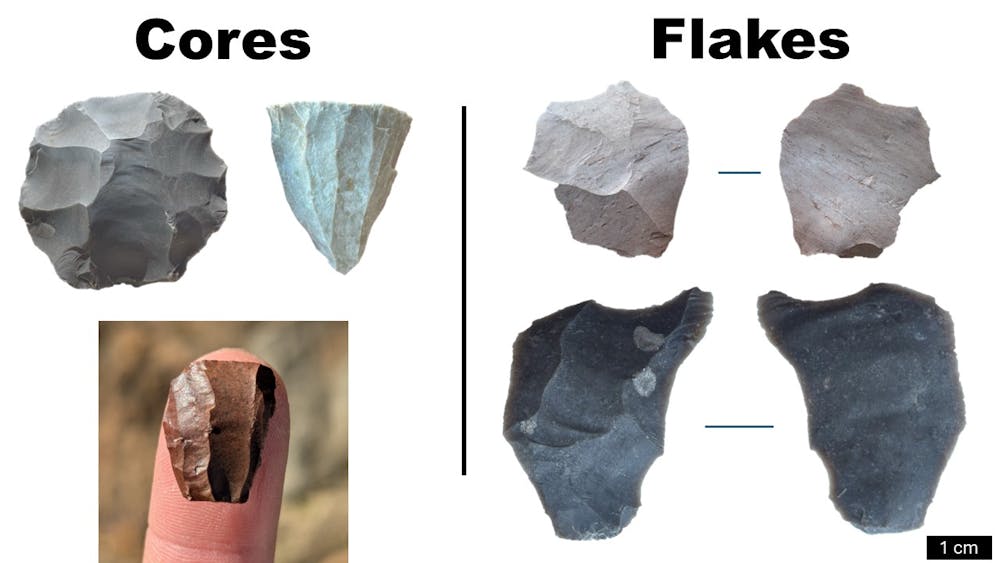
    The process of flaking involves applying force to the edge of a stone, known as the striking platform, through percussion or pressure to remove portions of the rock, which are called flakes. With some guidance from a teacher and plenty of practice, flintknappers can learn how to identify a promising platform on a chunk of stone, called a core, and consistently remove flakes from it. When struck, the platform is removed from the core and is a key feature of the flake.

    Flakes offer an immediate sharp cutting edge. A flintknapper can also further modify them into more specific shapes for other uses. An iconic example of this is the hand ax, which is a core that’s been flaked into a teardrop shape.

    Cores, left, are the object being struck by the flintknapper, and flakes, right, are the sharp-edged material removed from the core. Some cores, like this one from the archaeological site Pinnacle Point 5-6 in South Africa, can be as small as the tip of a finger.
    John K. Murray

    We often use hammerstones or large pieces of antler, called billets, to strike the core’s edge. Repetitive flaking not only allows a flintknapper to produce a significant amount of sharp cutting edge in the form of flakes, but gives them the ability to shape the core to their desired form … often with the risk of personal injury along the way. My fingers can attest to this!

    A modern flintknapper’s toolkit consists of leather pads, gloves, safety glasses, antler billets (left), hard hammerstones (right), and abraders (center-right with grooves), used to rub the edge of the stone to strengthen the platform before striking.
    John K. Murray

    However, not every type of rock has the characteristics needed to be flaked into a tool. You want the stone to exhibit what’s called conchoidal fracture. If you’ve ever seen glass break, you’ve witnessed conchoidal fracture. This smooth break, with concentric wavelike ripples, is defined by the physics of how force moves through different materials.

    Obsidian hand ax made by John Murray, showcasing examples of conchoidal fracture produced while making flakes to shape it.
    John K. Murray

    When an experienced knapper is preparing to remove a flake, we understand how the material we’re working will break when we strike it, so we can predict the shape and size of the tools that we are producing. A stone like obsidian, which is volcanic glass, is the poster child for conchoidal fracture.

    Of course, there is a lot of variation in the quality of rock that hominins have used for manufacturing stone tools, and many have made use of lesser quality stone. Even some of the earliest toolmakers were preferentially selecting rocks for certain properties, such as durability.

    How can you recognize stone tools?

    You may hear people saying that rocks that they found in their garden were tools because they “fit perfectly in the hand” or are “tool shaped.” But it’s not quite that straightforward. Although shape and function may play a role in the final product of a stone tool, it is not the smoking gun.

    Archaeologists can determine whether a chunk of rock is a stone tool based on clues left behind from the process of conchoidal fracture during flintknapping.

    One such clue is the presence of flake scars, or what we call negative removals, which can be found on both cores and flakes. These have characteristic ridges on one or more sides of the rock that outline previous flake removals – hence the use of the term scar.

    When we see multiple flake scars that are consistent in their orientation and size as opposed to being random, it is likely the stone in question was deliberately worked on by a hominin.

    The second feature is what we call the bulb of percussion. This is a bulge in the flake, just below the striking platform, that results from the concentration of force when the knapper struck it.

    Considering that producing a bulb of percussion requires the rock to be struck on a platform at a specific angle with enough force to detach it from the stone, it is improbable that this feature would be created through natural processes – but not impossible. Scientists have found naturally produced sharp stone fragments, or naturaliths, all over the world, even in Antarctica.

    However, when a lot of flakes with these diagnostic characteristics are found together, it’s unlikely they were created naturally.

    A hand ax made by John Murray shows many flake scars, some of which are outlined in black. The inner surface of three flakes shows the bulb of percussion just below the platform.
    John K. Murray

    The final thing to consider when determining whether a rock is a stone tool is the context in which it was found. Are there many stones in the area that exhibit the characteristics that we look for when trying to identify a stone tool? Is the stone tool made of an exotic material, or is it like the rest of the rocks near it?

    If you find a lot of stone tools in the same area made from one type of rock, you might have stumbled across an ancient flintknapping workshop. However, if you discover a tool that was made from a type of stone that can only be found hundreds of miles away, maybe someone traded for this material or carried it with them.

    Try it for yourself

    I think the best way for you to be able to learn to recognize whether a chunk of stone was a tool or just a rock is to try flintknapping yourself. I have taught more than 100 people of all ages to manufacture stone tools, and most agree: It is harder than you’d think.

    This experience puts you into the minds of our hominin ancestors, trying to tackle one of the earliest problems our lineage faced: getting a sharp edge from a chunky piece of rock.

    John K. Murray does not work for, consult, own shares in or receive funding from any company or organization that would benefit from this article, and has disclosed no relevant affiliations beyond their academic appointment.

    ref. Was it a stone tool or just a rock? An archaeologist explains how scientists can tell the difference – https://theconversation.com/was-it-a-stone-tool-or-just-a-rock-an-archaeologist-explains-how-scientists-can-tell-the-difference-251126

    MIL OSI – Global Reports

  • MIL-OSI Global: The dangerous business of predicting the death of popes – a history

    Source: The Conversation – UK – By Michelle Pfeffer, Research Fellow in Early Modern History, University of Oxford

    Portrait of Michel de Nostredame (Nostradamus), painted by his son César de Nostredame. Wiki Commons

    Michel de Nostredame (1503-66), better known as Nostradamus, is often hailed as one of the most successful prophets of all time. Said to have foreseen major world events from the rise of Hitler to COVID, the 16th-century astrologer was recently credited with predicting Pope Francis’s death – and what would happen next.

    ‘Through the death of a very old Pontiff

    A Roman of good age will be elected.

    Of him it will be said that he weakens his seat

    But long will he sit in biting activity.

    Like all the quatrains in Nostradamus’s collection of prophecies, Les Prophéties (1555-68), this one is as enigmatic as it is flexible. Short, sweet and decontextualised, his prophetic poems feel timeless, and it is deliciously satisfying to recognise a real-world correlation. The problem is that his prophecies are so vague that they can be linked to any number of events – or old Pontiffs.

    Nostradamus’s “dark and cryptic” language was intentional. If he had been more explicit, not only his career, but perhaps even his life, may have been at risk.


    Looking for something good? Cut through the noise with a carefully curated selection of the latest releases, live events and exhibitions, straight to your inbox every fortnight, on Fridays. Sign up here.


    Many of his prophecies concerned the rise and fall of the great and the good, and political prophecy was a high-risk business. In ancient Rome, astrologers had been expelled from the city for forecasting the death of emperors, and Renaissance leaders were no less paranoid. To avoid “scandalising and upsetting”, Nostradamus chose to veil his true meaning.

    This was not just a matter of self-preservation, but also a way to obscure politically explosive information. Claiming to know when a civic or church leader might die was valuable intelligence. This made astrology a key tool of Renaissance spy-craft, but also a dangerous weapon that needed to be monitored and regulated.

    Astrology, politics and the papal court

    As a system that promised to forecast plagues, natural disasters, war, and even the economy, astrology was a logical interest for Renaissance rulers.

    Universities taught their students how to make these predictions, and for some lucky graduates this led to a job in a royal, princely, or even papal court. Here their horoscopes could inform political decision-making and produce potent astrological propaganda.

    A horoscope for the founding of St. Peter’s Basilica in the Vatican in April 1506, cast by the astrologer Luca Gaurico. Luca Gaurico (1552).
    Tractatus Astrologicus

    Despite the condemnations of theologians, many popes patronised astrologers and sought their guidance.

    Julius II (1443-1513) chose the start date for the construction of Saint Peter’s Basilica based on astrological counsel. Leo X (1475-1521) founded a professorship in astrology at Rome’s first university, La Sapienza. And Paul III (1468-1549), heeding the judgment of the astrologer Luca Gaurico, appointed his grandson a cardinal at just 14.

    In a period in which popes could have a decisive impact on international politics, speculation about the health of the pontiff was rampant. Astrologers capitalised on this.

    When Ludovico Sforza (1452-1508), de facto ruler of Milan, asked his astrologer to predict the death of Innocent VIII, it was nothing unusual. The answer was that the pope would die around August 10 1492, if not sooner. When Innocent died on July 25, Ludovico was no doubt pleased. As the historian Monica Azzolini has shown, he had consulted his astrologer in the hope the next pope would be more supportive of his illegitimate regime.

    Some popes asked astrologers about their own deaths. But they didn’t like it so much when others did so – especially when the forecasts were made public. Even worse, such predictions often fed into Protestant propaganda.

    Popes knew public predictions about their death were politically destabilising, not to mention humiliating. At the end of 1559, the Index of Prohibited Books, a list of books forbidden by the Roman Catholic Church, banned texts containing astrological “divinations” about “future contingent events”.

    Earlier that year, just as Pope Paul IV was trying to conceal a serious illness from the public, the sighting of a comet had led to widespread speculation about his death. As the pope knew all too well, astrology could be a political liability.

    Orazio Morandi and Urban VIII

    Such legislation did not stop astrologers from making political predictions, not least because their clients never stopped asking. But increasingly these astrologers were playing with fire. As the historian Brendan Dooley has shown, Orazio Morandi learned this the hard way in 1630.

    Morandi made predictions about Pope Urban VII.
    Vatican Museums

    Morandi was an abbot at the monastery of Santa Prassede in Rome. He had been practising astrology for years, and he had been careful, framing his political forecasts in allusive language. But soon he went too far.

    In 1629, Morandi wrote an astrological commentary on various past papacies, critiquing their flaws. When he came to the present incumbent, Urban VIII (1568-1644), he not only predicted that his pro-French allies would destroy Italy, but that the pope himself would very soon suffer great violence, then death.

    There are several astrological techniques for predicting someone’s death. As above, astronomical phenomena like comets and eclipses could prompt speculation about an upcoming papal demise. But Morandi used the gold standard – a technique called “prorogation”. This required access to the person’s birth chart, from which astrologers could identify the planets or luminaries that were their “giver of life” and “giver of years”.

    Different planets gave different lifespans. For example, if the sun was your “giver of years”, and it was in a good position on your horoscope, you might expect to live to 120. If the sun was badly placed, your life expectancy might be just 19 years. Other parts of the horoscope could then modify these figures.

    Morandi identified the sun as Urban’s life giver. But the positions of the more nefarious planets on his birth chart meant he was lucky to have lived beyond the age of seven. In June 1630, Morandi concluded, a solar eclipse would seal the pope’s fate.

    Morandi’s prediction spread widely in clandestine circles, and it wasn’t long until his prediction was reported as fact. The pro-Spanish faction in Rome was thrilled. It was even rumoured that Spanish and German cardinals had begun the long journey to Rome for a new conclave.

    The earth surrounded by the planets, luminaries, and zodiac signs (1708).
    Andreas Cellarius, Harmonia Macrocosmica

    Embarrassingly, Urban first learned of the prophecy not through his own informants, but from the powerful French prelate Cardinal Richelieu. Himself an avid believer in astrology, Urban was greatly disturbed. He had Morandi arrested and jailed. During the trial, a young man called Matteo, servant to the current prior of Santa Prassede, was interrogated and tortured. Morandi himself soon died in prison under suspicious circumstances.

    But Urban lived on. The next year, he decreed it punishable by death to predict “the life or death of the sitting Roman Pontiff, including his blood relatives to the third degree inclusive”.

    Making a career in political forecasting was – and is – risky. But astrologers were ambitious and knew their efforts would be well remunerated. Predicting the death of a pope could help you quickly build a public profile, expanding your business. But after 1630, it was a risk many astrologers were no longer willing to take.

    Michelle Pfeffer does not work for, consult, own shares in or receive funding from any company or organisation that would benefit from this article, and has disclosed no relevant affiliations beyond their academic appointment.

    ref. The dangerous business of predicting the death of popes – a history – https://theconversation.com/the-dangerous-business-of-predicting-the-death-of-popes-a-history-255816

    MIL OSI – Global Reports

  • MIL-OSI Global: How Captain Planet cartoons shaped my awareness of the nature crisis

    Source: The Conversation – UK – By Muzammal Ahmad Khan, Lecturer in Business and Management, University of the West of Scotland

    Captain Planet is set to return more than three decades since it first broadcast on TV. A new comic book series by Dynamite Entertainment promises to bring the 1990s environmental hero to a new generation.

    For those of us who grew up watching the original show, the message feels just as urgent today as it did then. As a researcher in sustainability and education, I often reflect on how early experiences shape our environmental values. Captain Planet was one of the first moments that made me think about our responsibility to the world around us.

    Writer of the new series David Pepose has said he wants to stay true to the original, while updating the story for today’s world. He stressed: “The reason Captain Planet fights for the environment is because he doesn’t want to see anyone die, and that’s something really powerful and timeless.” The villains, still driven by greed and destruction, seem even more real now than they did in the early 1990s.

    At the time, my family lived in a small village in rural Punjab, Pakistan, a place untouched by city life or the concept of climate change. Life was calm and slow. Each morning started with the call to prayer. Most evenings ended in darkness due to regular power cuts. As children, we had few distractions, playing cricket or hide-and-seek in the street.

    But in one corner of our living room stood something that connected us to a different world – a colour television. It was rare in the village, and it quickly became a shared object of wonder. Children from the neighbourhood would gather in our home during the brief hours when state television allowed Cartoon Network to air, around 3pm to 5pm. Among all the shows, one cartoon series stood out: Captain Planet and the Planeteers.

    The plot was simple but powerful. Captain Planet is a superhero fighting pollution, corporate greed and environmental destruction. He could only be summoned by the Planeteers, a group of five internationally diverse teens with magical rings: Kwame (Africa, Earth), Wheeler (North America, Fire), Linka (Eastern Europe, Wind), Gi (Asia, Water) and finally Ma-Ti (South America, Heart). With all those powers combined, Captain Planet would rise majestically into the air, ready to do battle with pollution-spreading villains.

    The executive producer of the original 1990 series, Barbara Pyle, said the goal was to inspire and teach young people about protecting the environment. Pyle mentioned that the show’s success was not about selling toys, but about including real environmental issues in the storylines. In my view, they achieved their goal.


    Read more:
    Why ocean pollution is a clear danger to human health


    None of us understood English well enough to follow every word, but we understood the energy and emotions. Rage when forests were burned. Sadness when oceans were poisoned. Joy when villains were defeated. Above all, a sense that the natural world mattered.

    I remember the day I was walking with my father past the fields near our village. A newly built factory was releasing black smoke into the sky, and its pipes discharged foul-smelling water into a stream used by some animals. I felt uneasy, even angry. It reminded me of the villains from the show’s characters such as Hoggish Greedly and Dr. Blight who treated the Earth like something disposable. I asked my father why nobody could stop this. He was surprised. I wished I were a Planeteer with a magic ring to call Captain Planet.

    That cartoon did more than entertain. It gave names and faces to ideas we had never heard in school. Our textbooks did not talk about pollution. Nobody taught us the value of trees or clean water. But Captain Planet made those things feel important. It suggested that someone should care. That maybe, that someone could be you.

    The show’s message stayed with me. Today, my research focuses on sustainability and education. I often reflect on how a cartoon played a part in shaping that interest. I did not realise it then, but those glowing rings and the famous line “the power is yours” planted an idea that never left me.


    Read more:
    Five satellite images that show how fast our planet is changing


    Captain Planet’s message still matters

    Children today grow up surrounded by technology. They scroll before they can cycle. The connection to nature that felt instinctive in our childhood is fading. And yet, the message of Captain Planet is still relevant. Perhaps more than ever.

    Children who watched the original series are now adults. We have careers, votes and voices. We understand that the threat is not fictional. The planet is under the same threats – pressure from rising temperatures, deforestation, polluted oceans and the relentless push for profit over preservation – only now the stakes are much higher.

    The message remains the same – small actions matter. Our choices can combine to create something powerful. The power to care, to act and to inspire others never disappeared. It was passed to us.


    Read more:
    Deforestation is causing more storms in west Africa, finds 30-year satellite study


    I often think about the importance of early environmental messages. Captain Planet did that in the 1990s for me. We cannot expect people to care about the future of the planet if they have never been encouraged to think about it. Now, with the return of Captain Planet, there is a chance to inspire a new generation to believe that the power is theirs.


    Don’t have time to read about climate change as much as you’d like?

    Get a weekly roundup in your inbox instead. Every Wednesday, The Conversation’s environment editor writes Imagine, a short email that goes a little deeper into just one climate issue. Join the 45,000+ readers who’ve subscribed so far.


    Muzammal Ahmad Khan does not work for, consult, own shares in or receive funding from any company or organisation that would benefit from this article, and has disclosed no relevant affiliations beyond their academic appointment.

    ref. How Captain Planet cartoons shaped my awareness of the nature crisis – https://theconversation.com/how-captain-planet-cartoons-shaped-my-awareness-of-the-nature-crisis-255161

    MIL OSI – Global Reports

  • MIL-OSI Global: By VE Day in 1945, Stalin had got what he wanted in Poland – now Putin may get what he wants in Ukraine

    Source: The Conversation – UK – By Wendy Webster, Professor of Modern Cultural History, University of Huddersfield

    Sell out: most Polish people felt they had been abandoned by their allies in the US and Great Britain at the Yalta Conference. US government

    As Britain celebrated Victory in Europe (VE) Day on May 8 1945, the Polish airmen of RAF 305 Bomber Squadron captured a starkly different sentiment in their diary. “‘Victory!’ every Anglo-Saxon says in greeting instead of the traditional ‘Hello!’. The word ‘Victory!’ is devoid of meaning, power and any sense today only for the Poles.”

    Despite their critical contributions to the allied war effort, from the Battle of Britain to Monte Cassino, Polish forces felt isolated and betrayed, their hopes of a free Poland crushed by the Yalta agreement. On that first VE Day, many Poles who fought with the allied forces recorded feeling sad, isolated or bitter.

    Tadeusz Szumowski, who served in the RAF in Britain found it almost impossible to join in the celebrations. He wrote in his diary: “Our war is lost, the war which we fought so hard and so long to win … It is a very long time since I felt so alone.”

    A Polish soldier in Italy wrote: “The war is over – but not for us. The population of the greater part of the world are happy, in consequence; but we are sad. I am afraid that we have lost so many of our best men all for nothing.”


    Get your news from actual experts, straight to your inbox. Sign up to our daily newsletter to receive all The Conversation UK’s latest coverage of news and research, from politics and business to the arts and sciences. Join The Conversation for free today.


    What made “victory” devoid of meaning for Poles? In her study of Poland during the second world war, historian Halik Kochanski quotes the famed American journalist Martha Gellhorn, who reported from Italy: “All the Poles talk about Russia all the time. The soldiers gather several times a day around the car which houses the radio and listen to the news.”

    Many of these soldiers came from eastern Poland, which was invaded by the Soviet Union in 1939. Along with their families, they had been deported to Siberia or Kazakhstan and came out only under a so-called “amnesty” after Russia entered the war on the allied side. Gellhorn reported: “They follow the Russian advance across Poland with agonized interest.”

    As I found when researching my book about the diverse nationalities fighting alongside Britain in the second world war, Polish soldiers wrote about Russia all the time as well as talking about it. Their letters were censored and quoted in censorship reports.

    As they watched the Russian advance and heard news of the Yalta agreement which consigned Poland to the Soviet sphere of influence, they express anger, fear, bitterness, desolation, a sense of loss and betrayal, shock, bewilderment.

    The letters are striking for the many words which take on meanings that demonstrate a gulf that opens up, separating Poles from other allied soldiers. Victory belongs to others while Poles have gone down to a catastrophic defeat.

    Russia, widely regarded as a valued ally, is the enemy of Poles. The Polish slogan “For our freedom and yours” is rewritten in one letter: “We are fighting for yours and our freedom, but now I think rather only for yours.” Another letter asks: “What are we fighting for if Poland is to be enslaved?”

    Polish pilots of RAF 303 (Polish) Fighter Squadron during the second world war.
    Imprial War Museum

    Poles find it unbearable to be told that Russia is liberating Poland, using heavy irony. “The ‘liberation’ of Poland by our so-called Allies is causing us great anxiety. Probably my own home will soon be ‘liberated’.”

    Another soldier cautions: “Never, never congratulate our people of Warsaw and Poland being ‘liberated’. This sounds like the most cruel irony and is deeply resented by every Pole. You could speak about a lamb being liberated from a bear by a tiger.”

    The concept of “home” also acquires new meanings that are devoid of any association with pleasure or belonging. As the war ends, allied soldiers’ thoughts are increasingly about the prospect of returning home – but censors reported in 1944: “Thousands of letters written by Polish soldiers in the last days repeat as a cardinal topic that to Poland governed by communists they won’t return.”

    One soldier writes: “It would be better to be killed here on the battlefield than to be alive in the new ‘Red Paradise’ in Poland.” Another writes: “There is no return for us to the Soviet republic of Poland which seems to be the newest invention of our Allies.”

    Echoes of Yalta

    The Yalta agreement of February 1945 between America, Britain and Russia, the “Big Three” powers, confirmed Poles’ worst fears. Censors report that in the soldiers’ letters, it “overshadows all other topics”, and has “evoked a terrible shock amongst the Polish troops … they find that they are lost and betrayed”.

    One soldier writes: “For the last few days I have been in a state of dumb bewilderment. Occasionally I ask myself, ‘Can it be true?’ … I cannot believe that it has really happened.”

    Another soldier writes to his “Britisher friend” about his feelings of betrayal: “When this morning we heard the news about the statements from the Big Three meeting we got deadly silent … We sacrificed most of all countries – more than you even. We trusted you so much, and what have we got. Our biger [sic] friend let us go down.”

    Yalta is in Crimea – part of the territory annexed by Russia before its full-scale invasion of Ukraine in 2022. The Russian president, Vladimir Putin, has made it clear he will offer no concessions on Ukraine, which he has argued all along he sees as an inalienable part of Russia. This is a stark reminder of Yalta when Josef Stalin made concessions on other matters, but none on Poland.

    Trump’s administration has offered Ukraine no security guarantees. Its framework to end the war will allow Russia to retain the territory it has seized. There are now echoes of what one Polish soldier wrote in 1945 of the Yalta agreement: “This business smells and no high-sounding words can disguise the stench of a bad deed.”

    Wendy Webster receives funding from the Arts and Humanities Research Council

    ref. By VE Day in 1945, Stalin had got what he wanted in Poland – now Putin may get what he wants in Ukraine – https://theconversation.com/by-ve-day-in-1945-stalin-had-got-what-he-wanted-in-poland-now-putin-may-get-what-he-wants-in-ukraine-255982

    MIL OSI – Global Reports

  • MIL-OSI Global: Italy’s areas of wartime fascist resistance remain less susceptible to the far right today

    Source: The Conversation – UK – By Juan Masullo, Assistant Professor, Institute of Political Science, Leiden University

    Across Europe, far-right parties are making unforeseen breakthroughs – from local councils to national and supranational parliaments. As their presence becomes normalised, these parties promote nationalist rhetoric, challenge democratic institutions, and attempt to reshape a political present rooted in hard-won struggles against authoritarianism.

    Yet, not all communities are equally permeable to these growing forces. Some actively resist, mobilising to block authoritarian ideologies and defend democratic values.

    Our recent research in Italy offers one explanation as to why some communities are less easily enticed into far-right politics than others. Local histories of wartime resistance continue to shape political cultures in ways that, even generations later, inspire people to push back against the resurgence of fascist and neo-fascist ideologies.

    In areas where anti-fascist resistance movements were active during the second world war, civic engagement to defend democratic values is stronger. In these communities, support for far-right parties is weaker.


    Get your news from actual experts, straight to your inbox. Sign up to our daily newsletter to receive all The Conversation UK’s latest coverage of news and research, from politics and business to the arts and sciences. Join The Conversation for free today.


    These legacies aren’t accidental. They are cultivated, reinforced, and passed on through intensive and continuous local memory work.

    During Italy’s civil war (1943–1945), students, workers, farmers and clergy mobilised into bands of resistance to fight the Nazi-fascist regime. Their efforts were central to Italy’s liberation and the establishment of its democratic republic. While this story is often told at the national level, our research examines its enduring local consequences.

    Using an original dataset mapping resistance activity across about 8,000 Italian municipalities, we compared places with strong partisan mobilisation to those without. Even today, eight decades later, residents of areas with a resistance past are more likely to support initiatives that counter far-right ideologies.

    This was especially evident in the response to a recent initiative. In 2020 and 2021, a grassroots campaign proposed a law to ban the public glorification of fascism. To bring it for discussion before parliament, the campaign needed 50,000 signatures.

    Despite the pandemic, it collected over 240,000 within a few months. While support was widespread, municipalities with strong resistance histories were significantly more likely to participate. Our estimates show roughly 40% more signatures in these places.

    These patterns suggest that wartime resistance can leave legacies that translate into contemporary political behaviour. But data alone can’t explain how these legacies endure. That’s where our fieldwork comes in.

    We have been closely studying towns with deep resistance roots and strong support for the 2021 initiative to see how they keep these legacies alive and who is involved.

    We have followed (and participated in) memorialisation efforts in the Cuneo region, one of the main centres of wartime resistance, and in areas deeply affected by Nazi violence and known for creating some of the strongest partisan brigades. These include villages around Stazzema in Tuscany and Marzabotto in Emilia.

    The main insight is that remembrance isn’t just ceremonial – it’s part of daily life. Schools, hiking clubs, cultural associations, and city halls all contribute to preserving and activating the memory of resistance.

    One public elementary school in the rural hills around Bologna, for example, created a “memory garden” to honour local residents who died fighting fascism. Through interviews, art and storytelling, students have engaged directly with their community’s past, creating not only a commemorative space but a living bridge between generations.

    The memorial garden planted by students in.
    J Masullo, CC BY-ND

    Similarly, local Alpine clubs in Emilia Romagna and Piedmont restored partisan trails through the mountains, now used for memory treks. These hikes attract people who might not otherwise engage politically but who, by walking the paths of wartime partisans, connect with stories of sacrifice and solidarity. What begins as recreation becomes an encounter with democratic values.

    These deeply localised memory efforts – anchored in the names, stories and spaces of the community – often intensify during democratic threats. The 2021 campaign emerged amid growing support for parties like Lega and Fratelli d’Italia (Brothers of Italy).

    Related studies show that when exclusionary welfare policies gain ground, local communities sometime organise in defence of vulnerable groups. In towns with a resistance past, local “memory entrepreneurs” doubled their efforts in response to far-right victories.

    Memory as a political battle

    This is not just an Italian phenomenon. Across Europe, historical memory is a political battleground. In Germany, the Stolpersteine – brass plaques in sidewalks commemorating Nazi victims – serve as grassroots reminders that shape civic attitudes. In Hungary, activists have created “living memorials” to Holocaust victims, directly contesting government efforts to whitewash fascist collaboration.

    These commemorations also have measurable political effects. In Berlin, neighbourhoods where one or more Stolpersteine was placed before an election saw fewer votes for the far-right AfD (a 0.96%-point decrease) compared to those with no Stolpersteine. This happened across federal, state and EU elections between 2013 and 2021.

    A stolperstein in Berlin.
    Wikipedia/Drrcs15, CC BY-SA

    What unites these efforts is a belief that remembering the past matters – not only to honour it, but to shape the future. Local narratives of wartime resistance and victimisation help instil democratic values and inoculate communities against authoritarianism.

    But this doesn’t happen automatically. It requires effort. Teachers, students, parents, associations, and local councils all play a role in keeping memory alive and politically meaningful.

    Recognising this is especially vital today, when the meaning of anti-fascism itself is a polarising subject. Far-right leaders, including those in office, downplay and discredit the resistance’s legacy, replacing it with revisionist myths.

    A local cycling club marks liberation day with a tour of monuments dedicated to partisans.
    J Masullo, CC BY-ND

    When communities take ownership of their histories, they are more likely to uphold democratic principles not only in ceremonies, but at the ballot box and in everyday actions. The past is never just the past. The legacies of wartime resistance continue to shape how people view democracy, justice, and belonging. In times like these, remembering the resistance is more than homage – it is civic defence.

    Juan Masullo has received funding for this research from UNUWIDER and Leiden University.

    He is affiliated with the University of Milan.

    Simone Cremaschi has received funding for this research from UNUWIDER, the European Research Council (grant number 864687), and Leiden University.

    ref. Italy’s areas of wartime fascist resistance remain less susceptible to the far right today – https://theconversation.com/italys-areas-of-wartime-fascist-resistance-remain-less-susceptible-to-the-far-right-today-255859

    MIL OSI – Global Reports

  • MIL-OSI Global: Conclave: the chemistry behind the black and white smoke

    Source: The Conversation – UK – By Mark Lorch, Professor of Science Communication and Chemistry, University of Hull

    White smoke from the chimney on top of the Sistine Chapel (Vatican City) indicates that the Pope has been elected. MartiBstock/Shutterstock

    This week, 133 cardinals have gathered in the Vatican to elect a new leader of the Catholic church. During their deliberations, the only indications of their progress are the regular plumes of smoke wafting from a freshly installed chimney perched on the roof of the Sistine Chapel.

    Tradition holds that black smoke indicates the cardinals have not yet agreed on a new leader, while white smoke signals that a new Pope has been elected. But what kind of smoke is it exactly? Let’s take a look at the science.

    The tradition of cardinals burning their ballot papers to maintain secrecy dates back to at least the 15th century. However, it wasn’t until the 18th century — when a chimney was installed in the Sistine Chapel to protect Michelangelo’s frescoes from soot — that the resulting smoke became visible to anyone outside the chapel.

    At the time, the smoke was not intended as a public signal, but once it was visible, onlookers began interpreting it as an indicator of the voting outcome.


    Get your news from actual experts, straight to your inbox. Sign up to our daily newsletter to receive all The Conversation UK’s latest coverage of news and research, from politics and business to the arts and sciences. Join The Conversation for free today.


    By the 19th century, it had become customary to use smoke deliberately: if smoke was seen, it meant no Pope had been elected, whereas no smoke indicated a successful election. This of course lacked clarity and often caused confusion.

    The Vatican eventually sought to clarify matters by formalising the practice of fumata nera (black smoke) and fumata bianca (white smoke). Initially, damp straw and tar were added to the burning ballots. As anyone who has tried to light a damp bonfire knows, wet oily fuel can be difficult to ignite, but once it gets going, it produces plenty of dark smoke.

    This is the result of incomplete combustion: the energy from the flames is initially used to evaporate the water, which keeps the fire’s temperature low. As a result, many of the larger molecules in the tar do not fully combust, leading to the production of soot and dark smoke.

    However, once the moisture is driven off, the fire burns more efficiently, producing mainly steam and carbon dioxide. At that stage, the smoke diminishes and becomes much lighter.

    This fluctuating fumata — combined with the subjective interpretation of its colour — caused considerable confusion, particularly during the 1939 and 1958 conclaves. It wasn’t clear whether grey smoke was closer to black or white, for example. By the 1970s, the straw method had been abandoned in favour of more controllable chemical mixtures. This has since evolved into an unambiguous method for generating the required smoke signals.

    Current recipe

    In 2013, the Vatican confirmed that their fumata recipes now consist of a clear black smoke recipe: potassium perchlorate (KClO₄), an “oxidising substance” that provides oxygen to the reaction; anthracene, a hydrocarbon derived from coal tar that serves as a heavy smoke-producing fuel; and sulphur, added to adjust the burn rate and temperature.

    The result is a deliberately inefficient combustion reaction, producing a high volume of unburnt carbon particles. This abundance of carbon (soot) makes the smoke thick and black — akin to the smoke you might see from burning oil or rubber, which is rich in carbon-based particles.

    Black smoke from the Sistine Chapel, indicating that there was not a two-thirds majority in the papal election at the Conclave.
    wikipedia

    Meanwhile, white smoke is produced using a much cleaner fuel mix and a more powerful oxidiser. Potassium chlorate (KClO₃) — even more reactive than perchlorate — ensures a hot, vigorous burn. Lactose acts as the fuel, burning quickly and cleanly into water vapour and carbon dioxide.

    The rapid combustion of sugar yields large amounts of gaseous output (steam and CO₂), generating a voluminous white cloud. The final ingredient, pine rosin, produces thick white smoke when heated – releasing tiny droplets and light-coloured ash that appear whitish. It also contains terpenes that burn to yield a pale, visible smoke.

    When combined, the oxidising power of potassium chlorate allows the lactose and rosin to burn hot and fast, yielding mostly clean combustion products along with a cloud of vapour and resin particles.

    Rather than soot, the smoke contains microscopic droplets and fine solids that are transparent or white. The result is a mixture of steam and white or light gray smoke that contrasts sharply with the dark, carbon-rich black smoke.

    Over the years, the papal conclave smoke signal has evolved from an incidental byproduct of burning ballots into a carefully engineered communication tool.

    Today, thanks to modern chemistry, the smoke is unmistakable — thick black billows for inconclusive votes, or a bright white plume when a new pope is elected.

    Mark Lorch does not work for, consult, own shares in or receive funding from any company or organisation that would benefit from this article, and has disclosed no relevant affiliations beyond their academic appointment.

    ref. Conclave: the chemistry behind the black and white smoke – https://theconversation.com/conclave-the-chemistry-behind-the-black-and-white-smoke-255980

    MIL OSI – Global Reports

  • MIL-OSI Global: A new pope’s first appearance on St. Peter’s balcony is rich with symbols − and Francis’ decision to rein in the pomp spoke volumes

    Source: The Conversation – USA – By Daniel Speed Thompson, Associate Professor of Religious Studies, University of Dayton

    Pope Francis stands at the central balcony of St. Peter’s Basilica at the Vatican on March 13, 2013, just after being announced as pontiff. AP Photo/Andrew Medichini

    As the College of Cardinals gathers in the Sistine Chapel to vote for a new pope, crowds outside will watch for the most dramatic moment of the conclave, when a wisp of white smoke appears above the chimney.

    This smoke – made by burning the ballots – indicates that a new pope has been elected and he has accepted.

    After a short period of time, a cardinal appears on the balcony of St. Peter’s Basilica and makes the announcement in Latin: “Habemus papam!” – “We have a pope!” He then announces which cardinal has been selected and which name the new pope has chosen for himself.

    Finally, the new pope appears on the balcony and greets the crowd in St. Peter’s Square – a tradition full of symbolism.

    I am a scholar who studies Roman Catholic theology and history. I am particularly interested in how popes exercise authority and leadership today, including their use of symbols. When Pope Francis first appeared on that balcony in 2013, he used and adapted the ritual to convey a message about his intentions for his papacy.

    He did this in four ways.

    What’s in a name?

    First, he chose the name Francis. Since the sixth century C.E., new bishops of Rome have often taken a new name when they assumed the papacy.

    Over time, certain names have indicated to observers the direction that a pope wished to take or a model whom he wished to emulate. Jorge Mario Bergoglio opted for “Francis,” the first time that any pope had assumed that name.

    It refers to Francis of Assisi, an Italian saint who lived at the turn of the 13th century who was renowned for his simplicity, poverty, concern for the Earth and desire to imitate Jesus. Over the next 12 years, these traits proved central to his papacy.

    Not a king

    Second, Francis wore simple white papal garments instead of the more elaborate adornments worn by some of his predecessors. He wore his old, simple cross across his chest, rather than a new, more luxurious one.

    Francis waves during his first appearance as pope on March 13, 2013.
    AP Photo/Dmitry Lovetsky

    Popes have worn white garments as a symbol of their office for centuries. But many of them also used symbols of monarchy, such as the triple papal tiara or crown. Pope Paul VI, whose papacy was from 1963-1978, was the last to wear the tiara and to have a coronation ceremony. The following year, he sold the crown and donated the proceeds to emphasize the church’s commitment to the poor.

    Later popes have followed Paul’s example of avoiding royal symbolism, such as by no longer using a “sedia gestatoria,” the portable throne that traditionally carried the pope in formal processions. Francis took this trend even further and made simplicity of dress and lifestyle a hallmark of his time in office.

    Bishop of Rome

    Third, when Francis first addressed the crowd in St. Peter’s, he described himself as the new bishop of Rome.

    In Catholicism, the pope holds many titles representing the scope and duties of his office. For starters, he is not only the spiritual leader of the Roman Catholic Church but “sovereign of the State of Vatican City.”

    In terms of religious titles, some accentuate the pope’s authority. “Vicar of Christ,” for example, means he is Jesus’ representative on Earth. Others, such as “servus servorum Dei” – “servant of the servants of God” – emphasize his role as a support to other bishops and ministers of the church.

    Francis certainly did not deny the traditional authority of the pope’s office. However, he chose to identify himself first as the local bishop of the diocese of Rome, emphasizing how even the pope was first part of a local community. In the official Vatican yearbook for 2020, Francis listed his only title as “Bishop of Rome” and listed the rest as “historic.”

    Catholics from the parish of St. Joan Antida in Rome arrive to attend Pope Francis’ inaugural Mass at the Vatican on March 19, 2013.
    AP Photo/Domenico Stinellis

    ‘Pray for me’

    Fourth, Francis asked the assembled crowd to pray for him before he offered his first papal blessing.

    Traditionally, popes making their first appearance would offer a blessing to the people gathered in St. Peter’s Square. Francis took this ritual and reversed it. In harmony with his views on simplicity and his role as the bishop of Rome, he emphasized the mutual connection between him and the people. He downplayed the view of the pope as a hierarchical ruler above the people.

    Sometime soon a new pope will be introduced to the world. He will likely use these symbols of name, dress, title and blessing in his own way, pointing to his intentions for his papacy and for the Catholic Church.

    Daniel Speed Thompson does not work for, consult, own shares in or receive funding from any company or organization that would benefit from this article, and has disclosed no relevant affiliations beyond their academic appointment.

    ref. A new pope’s first appearance on St. Peter’s balcony is rich with symbols − and Francis’ decision to rein in the pomp spoke volumes – https://theconversation.com/a-new-popes-first-appearance-on-st-peters-balcony-is-rich-with-symbols-and-francis-decision-to-rein-in-the-pomp-spoke-volumes-255585

    MIL OSI – Global Reports

  • MIL-OSI Global: ‘Milkshake tax’: why it’s about innovative approaches to health, not household costs

    Source: The Conversation – UK – By David M. Evans, Professor of Sociotechnical Futures, University of Bristol Business School, University of Bristol

    Luis Molinero/Shutterstock

    The UK government is considering expanding its sugar tax on fizzy drinks to include milkshakes and other sweetened beverages, as part of new proposals announced in April 2025. The Treasury confirmed it plans to move forward not only with broadening the tax but also with lowering the sugar threshold that triggers it from 5g to 4g of sugar per 100ml.

    The changes, dubbed by critics as the “milkshake tax”, would end the current exemption for dairy-based drinks, as well as plant-based alternatives such as oat and rice milk. Chancellor Rachel Reeves first signalled the potential expansion in the 2024 budget, suggesting the soft drinks industry levy (SDIL), to give it its official name, could be widened to cover a broader range of high-sugar drinks.

    Based on our research into dietary change, conducted as part of the H3 project on food system transformation, we see this as a welcome and timely development.

    Not everyone shares this optimism. Opponents of what they see as “nanny state” interventionist policies argue that the SDIL has failed to deliver any real improvements to public health. In a UK newspaper’s straw poll, for example, 88% of respondents claimed the sugar tax has not significantly reduced obesity rates. Shadow Chancellor Melvyn Stride described the proposed expansion as a “sucker punch” to households, particularly given the ongoing cost of living crisis.

    Scepticism around these proposals is not surprising. Many people, regardless of political affiliation, are wary of additional taxation. And indeed, there is evidence suggesting that fiscal tools such as taxes and subsidies can be blunt instruments. They are also often regressive, placing a disproportionate burden on lower-income households.

    These concerns are valid – but they don’t quite apply to the SDIL.

    Crucially, the SDIL is not a tax on consumers. It is levied on manufacturers and importers, who are incentivised to reduce the sugar content of their products to avoid the charge. According to Treasury figures, since the introduction of the SDIL, 89% of fizzy drinks sold in the UK have been reformulated to fall below the taxable threshold.

    For instance, the Japanese multinational brewing and distilling company group Suntory invested £13 million in reformulating drinks like Ribena and Lucozade, removing 25,000 tonnes of sugar, making the products exempt from the levy. This means households aren’t priced out of soft drinks – they can simply choose reformulated and presumably cheaper versions.

    It’s true that the UK is still grappling with a serious obesity problem. In England alone, 29% of adultsand 15% of children aged two to 15 are obese.

    But the SDIL is having an effect. Excessive sugar consumption is consistently associated with rising obesity rates in the UK and globally. There has been a clear reduction in the sales of sugar from soft drinks, and the SDIL is reported to have generated £1.9 billion in revenue since its introduction in 2018.

    Early signs suggest health benefits, too. One study found a drop in obesity rates among 10 to 11-year-old girls following the levy’s implementation. Another analysis suggests that the greatest health benefits will be seen in more deprived areas, and that it may actually help to narrow some health inequalities for children in England.


    Read more:
    Child obesity is linked to deprivation, so why do poor parents still cop the blame?


    Shifting responsibilty

    The government’s 2016 announcement of the sugar tax gave manufacturers time to reformulate products before the tax’s introduction in 2018.

    Of course, the SDIL is no silver bullet. There are many contributing factors to the obesity epidemic, ranging from genetic predisposition to “obesogenic” environmentssocial contexts that promote unhealthy eating and sedentary behaviour, such as areas with a lot of fast food restaurants, limited access to healthy food options and a lack of pavements, parks, or safe places to exercise.

    Questions remain about the negative health effects of reformulated drinks, some of which still contain high levels of sweeteners or additives. And in the broader context of the need for food system transformation, focusing solely on soft drinks may be too narrow an approach.


    Read more:
    Are artificial sweeteners okay for our health? Here’s what the current evidence says


    But the SDIL’s success lies not just in outcomes but in its design. It shifts responsibility from individuals to industry, encouraging systemic change rather than simply blaming people for making “bad” choices. The government’s 2016 announcement of the levy gave manufacturers a two-year head start, allowing them to reformulate and get their products to market before it took effect in 2018.

    It’s also telling that the idea of taxing milkshakes has sparked such outrage, while most people now accept the high taxation of tobacco. That’s because smoking, as a public health issue, has matured: its risks are well understood and widely acknowledged. Obesity, meanwhile, is still catching up, despite posing similar health threats, including as a leading cause of cancer.

    In the UK, there’s still a strong social stigma around discussing diet and weight. But given the scale and urgency of the obesity crisis, it could be time to overcome this reluctance. Effective change will require bold, systemic policies – not just public awareness campaigns – but multipronged and targeted interventions that reshape the economic and cultural environments in which people make food choices.

    Expanding the SDIL may not be a cure-all, but the evidence so far suggests it’s a smart step in the right direction.

    David M. Evans receives funding from the UKRI Strategic Priorities Fund (grant ref: BB/V004719/1).
    He is affiliated with Defra (the Department of Environment, Food and Rural Affairs) as a member of their Social Science Expert Group.

    Jonathan Beacham receives funding from the UKRI Strategic Priorities Fund (grant ref: BB/V004719/1).

    ref. ‘Milkshake tax’: why it’s about innovative approaches to health, not household costs – https://theconversation.com/milkshake-tax-why-its-about-innovative-approaches-to-health-not-household-costs-255646

    MIL OSI – Global Reports

  • MIL-OSI Global: Mark Carney tells Donald Trump ‘Canada is not for sale’ in a high-stakes Oval Office meeting

    Source: The Conversation – Canada – By Stewart Prest, Lecturer, Political Science, University of British Columbia

    In a day of congenial menace at the White House, Canadian Prime Minister Mark Carney picked his spots carefully. He got his key message across — but got a largely unrelated earful in exchange from United States President Donald Trump.

    A trip to the White House has become a rite of passage for leaders around the world, with a series of predictable elements in the Trump era — from the blindside on social media to the handshake and the tense sitdown in the newly gilded Oval Office.

    Within the first few minutes of the meeting, Carney took an opportunity to interject with a clear pushback against Trump’s repeated assertions that Canada should become the “51st state.”

    The comments were carefully calibrated, using Trump’s own preferred language of real estate. After pointing out that some properties simply are not for sale, like the White House and Buckingham Palace, Carney asserted that Canada “will not be for sale, ever.”

    Trump repeatedly demurred in response, replying “never say never” and later in the meeting, “time will tell.” Carney, however, mouthed “never” as the president spoke — ostensibly joking but, in fact, clearly serious.

    Much of the rest of the meeting was dominated by Trump’s commentary, holding forth on everything from Carney’s recent election victory — for which the president claimed credit — to American attacks on Yemen and trade with China.

    Carney didn’t bite

    Without mentioning them by name, Trump also found time to remind the assembled media of his contempt for Carney’s predecessor, Justin Trudeau, and Canada’s former finance minister Chrystia Freeland — now handling the transport and internal trade portfolio for Carney — referring to her as “terrible.”

    Carney didn’t take the bait, and for the most part, seemed content to let Trump hold court, interjecting a couple of times to correct or redirect points Trump raised.

    In particular, Carney made clear that he sees the United States-Mexico-Canada trade agreement (USCMA) as a basis for future talks, committed Canada to a “step change” in its military investment and vowed to contribute to the president’s war on largely fictional fentanyl trafficking across the Canada-U.S. border.

    Carney also pushed back against Trump’s insistence that the U.S. does not need Canada, noting that the country is America’s “biggest client.” He was alluding to the fact that Canada buys more goods from the U.S. than any other country.

    Carney’s verbal pushback was further reinforced with some very effective face acting, reminiscent of Kamala Harris’s debate performance. The Carney head tilt seems destined to join the internet meme pantheon, a shortcut for “that’s sus” — “suspect” — that belongs to the ages.

    At the same time, almost everything Carney did say was met with skepticism and rebuttal.

    Indeed, the very idea of a new trade agreement and an end to tariffs on Canada was treated as an open question by Trump, who suggested that while USMCA was a “fine” agreement — miles better in his view than the very similar NAFTA agreement that preceded it — such a deal may no longer be needed.

    At one point, he even suggested USMCA be terminated outright.

    False claims

    As always, misinformation featured prominently in the president’s comments throughout the meeting with Carney. He returned repeatedly to his false claims about the U.S. subsidizing Canada. In doing so, he again confused a trade deficit with a financial subsidy. These falsehoods, moreover, were never directly rebutted by Carney.


    Read more:
    Trump’s obsession with trade deficits has no basis in economics. And it’s a bad reason for tariffs


    At another point, Trump said Canada could do nothing to convince him to remove tariffs.

    He later expanded on the point, returning to the idea that tariffs on things like Canadian energy, steel, aluminium and cars were not part of a trade negotiation, but rather an explicit attempt to end trade between the two countries in an attempt to reindustrialize the American economy.

    Simply put, under a thin veneer of supposed friendship and convivial conversation, Trump implied the U.S. no longer wants fair trade between the two countries, but no trade — unless it comes with an end to Canadian independence.

    Given the importance of the bilateral relationship, the meeting went as well as Canadians — and sympathetic Americans — could reasonably hope. Trump and his assembled cabinet secretaries did not gang up on Carney as they did on Ukraine’s Volodymyr Zelenskyy earlier this year.

    Instead, the meeting reinforced the idea that the two countries are indeed friends and they will continue to talk about the issues that divide them.

    Carney came across as polite yet assertive, and was largely treated with the respect due to a foreign head of government.

    Tariffs, trade

    At the same time, the two sides could not even agree on what they disagreed on. Carney emphasized the need for a refurbished agreement between the two countries addressing trade irritants in much the same way the two countries have done for decades. He went so far as to point out that the U.S. has taken advantage of the agreement with its approach to tariffs.


    Read more:
    Trump’s proposed tariffs against Canada and Mexico may be illegal, but that’s not the real problem


    Trump, conversely, remained committed to a project to fundamentally reorganize the American economy in a way that does not include Canada as an independent trading partner.

    As the president said, “time will tell” whose vision ultimately triumphs. But in the meantime, Canadians should expect a decidedly frosty friendship to continue.

    Stewart Prest does not work for, consult, own shares in or receive funding from any company or organisation that would benefit from this article, and has disclosed no relevant affiliations beyond their academic appointment.

    ref. Mark Carney tells Donald Trump ‘Canada is not for sale’ in a high-stakes Oval Office meeting – https://theconversation.com/mark-carney-tells-donald-trump-canada-is-not-for-sale-in-a-high-stakes-oval-office-meeting-255931

    MIL OSI – Global Reports

  • MIL-OSI Global: Why ‘The Calling of Saint Matthew’ by Caravaggio was Pope Francis’ favorite painting − an art historian explains

    Source: The Conversation – USA – By Virginia Raguin, Distinguished Professor of Humanities Emerita, College of the Holy Cross

    ‘Calling of Saint Matthew,’ in Chapel San Luigi. Virginia Raguin, CC BY

    Pope Francis left a lasting legacy, not least his appreciation for art.
    In his 2025 biography, “Hope,” Francis spoke of his admiration for the Baroque painter Caravaggio. He recalled that during his travels to Rome as a cardinal, he prayed in front of the painting by Caravaggio – “The Calling of Saint Matthew.”

    The painting is found in the chapel dedicated to St. Matthew in the Church of San Luigi dei Francesi. The donor of the chapel was a French cardinal, Matthieu Cointerel, who died in 1585. This was the first commission for Michelangelo Merisi da Caravaggio, who was hired in July 1599. A year later, “The Calling of Saint Matthew” and “The Martyrdom of Saint Matthew,” depicting the beginning and the end of the apostle Matthew’s ministry, were installed.

    The motto that Francis selected for his papacy, “miserando atque eligendo,” translated as “looking at him with mercy, he chose him,” is directly connected with this painting. The words “miserando atque eligendo” come from a sermon on the calling of Matthew written in the eighth century by the celebrated monk and historian Bede the Venerable. It is used in the readings for the Feast of St. Matthew on Sept. 21.

    ‘The Calling of Saint Matthew’

    Matthew is described in the Bible as a tax collector, viewed at the time as a highly dubious occupation. In the painting, Christ enters the room from the right. We see only his silhouetted head and outstretched arm pointing in Matthew’s direction.

    The ‘Calling of Saint Matthew,’ by Caravaggio.
    Caravaggio via Wikimedia Commons

    Light from the window behind Christ, which aligns with the actual light from the window in the chapel, falls on a group of men, including some handsome youths in fancy clothes, counting money. Matthew, the bearded man in the center, makes a gesture that suggests, “Who, me?”

    Matthew became one of four disciples of Christ – along with Mark, Luke and John – whose accounts of Christ’s life, called Gospels, are included in the Bible.

    Francis and Jesuit training

    Francis’ thinking about this painting was shaped by his training as a Jesuit, a Catholic order that he entered in 1958. Jesuits practice something called a process of “discernment.” The painting represents God calling to Matthew to show him his will for the future, one that requires discernment. The founder of the order, Ignatius of Loyola, stressed a humble but vigorous effort to understand God’s will for each individual, as part of this process.

    Ignatius’ own life demonstrated this search for God’s will. His initial career as a soldier ended when he was gravely wounded in the battle of Pamplona in 1521, permanently damaging his leg. He subsequently tried to follow the life of a hermit, meditating in solitude, and then tried to become a missionary to the Holy Land.

    At the age of 33, he entered a university in order to become a priest, ultimately initiating the most influential transformation of religious education since the Middle Ages. Jesuits became a great teaching force, stressing individual study and debate over memorization. Ignatius was named a saint in 1622.

    ‘The Inspiration of St. Matthew’

    Caravaggio’s ‘The Inspiration of St. Matthew.’
    Gonzaloferjar via Wikimedia Commons, CC BY-SA

    The central painting in the chapel, “Inspiration of Saint Matthew” is Caravaggio’s third painting, which was put in place in 1602. The patrons originally planned to install statues at the center, but upon their arrival they rejected the idea and commissioned Caravaggio instead. This painting also shows the saint searching to understand God’s directions.

    In this painting, Matthew is in conversation with his symbol, a winged man. Each of the four evangelists are represented in art through symbols. The winged man symbol for Matthew refers to the beginning of his Gospel that records the genealogy of Christ.

    The angel-like figure, resembling one of the young men depicted alongside the saint in Caravaggio’s “The Calling of St. Matthew,” appears to hold his left index finger with his right hand, as if to signal that this is the first and most important point. Matthew seems careworn, even distracted, struggling to write while leaning his knee on a bench.

    Francis remarked in his biography that Caravaggio increased viewers’ empathy by using “contemporary figures from the artist’s own time.” The figures in the painting are dressed in clothes worn in Italy in the late 16th century, so that the viewers in Caravaggio’s time could see themselves in the painting.

    Viewers come to art with different perspectives derived from their own experiences and challenges. Francis, too, connected to art through his own experiences.

    Virginia Raguin does not work for, consult, own shares in or receive funding from any company or organization that would benefit from this article, and has disclosed no relevant affiliations beyond their academic appointment.

    ref. Why ‘The Calling of Saint Matthew’ by Caravaggio was Pope Francis’ favorite painting − an art historian explains – https://theconversation.com/why-the-calling-of-saint-matthew-by-caravaggio-was-pope-francis-favorite-painting-an-art-historian-explains-255577

    MIL OSI – Global Reports

  • MIL-OSI Global: Buddha’s foster mother played a key role in the orphaned prince’s life – and is a model for Buddhists on Mother’s Day

    Source: The Conversation – USA – By Megan Bryson, Associate Professor of Religious Studies, University of Tennessee

    Prince Siddhartha with his foster mother Mahaprajapati. A 1910 painting by Maligawage Sarlis. Photo by MediaJet, 2009 via Wikimedia Commons

    Mother’s Day offers an opportunity to reflect on what motherhood means in different religions and cultures. As a scholar of Buddhism and gender, I know how complicated Buddhist attitudes toward mothers can be.

    The historical Buddha, Siddhartha Gautama, taught that family ties were obstacles to enlightenment. According to the Buddha, attachment to family causes suffering because family relationships eventually end and cannot offer lasting contentment. The main goal of Buddhism is to break the cycle of rebirth, which is characterized by suffering.

    However, one family tie remained important for the Buddha – his relationship with his mother. Even after the Buddha left home, he continued to honor two mother figures – his biological mother, Maya, and his foster mother, known as Mahaprajapati Gautami in Sanskrit and Mahapajapati Gotami in the Pali language, which was used for early Buddhist scriptures in ancient India. These women played key roles in the Buddha’s life story, and they continue to inspire Buddhists today. Mahaprajapati specifically inspires women as the first Buddhist nun.

    Many Buddhist scriptures describe reproduction and pregnancy in negative terms because they continue the cycle of rebirth. But Buddhist scriptures also express love and gratitude for mothers, especially the Buddha’s two mother figures.

    Maya, the birth mother

    Maya and Mahaprajapati were sisters who both married the Buddha’s father, Suddhodana, who ruled the region of Kapilavastu along the India-Nepal border. Maya’s name means “illusion,” which refers to a Hindu and Buddhist concept that the material world conceals the true nature of reality.

    Maya’s dream of the Buddha’s conception. Pakistan, second to third centuries C.E.
    © The Trustees of the British Museum, CC BY-NC-SA

    Miracles related to Maya appear throughout stories of the future Buddha Siddhartha’s conception, gestation and delivery. Siddhartha is the Buddha of the current world cycle, but in Buddhist tradition there were other Buddhas in the past and there will be more Buddhas in the future. Each one goes through many rebirths before they attain Buddhahood, and each Buddha’s final rebirth follows the same pattern. According to Buddhist texts, Buddhas-to-be wait for the right time to be born, they choose their own parents, and they are not conceived through sexual intercourse.

    Early Buddhist texts claim that Siddhartha chose Maya as his mother because of her purity and entered her right side in the form of an elephant while she was sleeping. According to some Buddhist scriptures, during Maya’s pregnancy the future Buddha never actually touched her womb, which was considered impure in early Indian Buddhism. When Siddhartha was born, he is said to have emerged from Maya’s right side as she stood, holding onto a tree branch.

    The future Buddha Siddhartha being born from Maya’s right side as she stands, holding the tree. India, 11th century C.E.
    Collection of the Metropolitan Museum of Art. Purchase, Gift of Dr. Mortimer D. Sackler, Theresa Sackler and Family, and Joseph Pulitzer Bequest, 2007

    Maya died seven days after her son’s birth, meaning that she did not live to see him become an enlightened Buddha. As the Buddha, even though Siddhartha encouraged his followers to leave domestic life and cut family ties, he never forgot his birth mother.

    Thanks to her good karma, Maya had been reborn in the heavens as a god, but in Buddhism gods are not as spiritually advanced as Buddhas. The Buddha used his spiritual powers to travel to the heavens, where he preached to Maya and encouraged her progress on the Buddhist path.

    One Chinese text claims that Maya spontaneously lactated upon hearing her son’s words, showing that the bond between mother and son remained strong even after her death.

    Mahaprajapati, the foster mother

    Siddhartha’s aunt Mahaprajapati became his foster mother after Maya died. She cared for the young Siddhartha and breastfed him, having just given birth to her own biological son, Nanda.

    When Siddhartha was preparing to leave home to follow a spiritual path, the chariot driver tried to convince him to stay by reminding Siddhartha how Mahaprajapati nursed him and telling Siddhartha he should be grateful for her motherly kindness.

    Siddhartha left home anyway, which caused Mahaprajapati to collapse out of grief. According to the Mahavastu, the earliest Sanskrit biography of the Buddha, her “eyes, as a result of her tears and grief, had become covered as with scales, and she had become blind.” It was only after Siddhartha returned as the Buddha that her sight was restored.

    A scene depicting the Buddha in the center with Mahaprajapati to his right, pleading with him to establish a nuns’ order. Pakistan, second to third centuries C.E.
    © The Trustees of the British Museum, CC BY-NC-SA

    At around the same time as the Buddha’s return to his kingdom of Kapilavastu, his father Suddhodana died, making Mahaprajapati a widow. The books with rules for Buddhist monks and nuns, known as the Vinaya, report that Mahaprajapati approached the Buddha to ask whether women like her, as well as women whose husbands had become monks, could leave home to join the Buddha’s monastic order.

    The Buddha eventually agreed to this request but warned that including women as nuns would cut short the lifespan of Buddhist teachings in the world from 1,000 years to 500 years. Mahaprajapati became the first Buddhist nun, reaching enlightenment before passing away at the age of 120.

    Scholars of Buddhism do not necessarily treat this episode as literally true, but instead see it as a reflection of mixed attitudes toward admitting women as nuns in the early Buddhist community. These mixed attitudes can still be seen today – for example, in the unwillingness to reinstate the order of nuns in Southeast Asia, which died out centuries ago.

    In Buddhism, nuns must be ordained by a group of 10 fully ordained monks and fully ordained nuns. An order of nuns still survives in China, Japan, Korea and Vietnam, where Mahayana Buddhism is practiced. However, the monastic leaders in Southeast Asia, where Theravada Buddhism is practiced, decided that Mahayana nuns could not ordain Theravada nuns, leaving countries such as Thailand, Laos, Cambodia and Myanmar without fully ordained nuns.

    Legacies of the Buddha’s mothers

    Both Maya and Mahaprajapati were loving mothers in the Buddha’s life story, but it is Mahaprajapati who has remained more of an inspiration for Buddhist women.

    Reiko Ohnuma, a scholar of South Asian Buddhism, argues that Maya is remembered in Buddhist tradition as an idealized, if passive, maternal figure. Her death shortly after the future Buddha’s birth serves as a reminder that life is impermanent and characterized by suffering.

    In contrast, Mahaprajapati lived a full life and played an active role in both raising the future Buddha and in advocating for women to join the monastic community. Early Buddhists may not have fully supported the inclusion of women in the Buddhist monastic community, but the nuns’ order was established nonetheless.

    Mahaprajapati made this opportunity possible thanks to her unique position as the Buddha’s foster mother.

    Megan Bryson does not work for, consult, own shares in or receive funding from any company or organization that would benefit from this article, and has disclosed no relevant affiliations beyond their academic appointment.

    ref. Buddha’s foster mother played a key role in the orphaned prince’s life – and is a model for Buddhists on Mother’s Day – https://theconversation.com/buddhas-foster-mother-played-a-key-role-in-the-orphaned-princes-life-and-is-a-model-for-buddhists-on-mothers-day-255368

    MIL OSI – Global Reports

  • MIL-OSI Global: Popes have been European for hundreds of years. Is it time for one from Africa or Asia?

    Source: The Conversation – Global Perspectives – By Darius von Guttner Sporzynski, Historian, Australian Catholic University

    Catholicism did not begin as a “white” faith. Born on the eastern rim of the Mediterranean, it spread through the trading routes and legions of the Roman Empire into Africa, Asia and, only later, what we now call Europe.

    Three early bishops of Rome: Victor I (c. 189–199), Miltiades (311–314) and Gelasius I (492–496), were Africans whose teaching shaped the church’s developing doctrine.

    They are venerated as saints, a reminder the papal office has never been racially defined.

    However, that history sits uneasily with the unbroken run of European popes that stretches from the early Middle Ages to the death of Francis last month. Francis, an Argentine, was the first pope from Latin America, but he was the son of an Italian immigrant family.

    Why, in a global communion of 1.4 billion faithful, has the modern conclave not looked beyond Europeans for a new pope? And what would need to change for it to do so?

    Change has been gradual

    The explanation lies less in colour than in logistics and culture.

    Europe was the political and demographic centre of Catholicism for centuries. Until the 19th century, travel to Rome from beyond Europe was protracted, dangerous and expensive. An elector who missed the start of a conclave was simply excluded.

    Papal politics, therefore, became tightly entwined with Italian city factions and, after 1870, the diplomatic rivalries of European powers.

    Even after steamships and railways made travel easier, longstanding practice and patronage ensured most future cardinals were trained at Roman universities, served in the Curia (the bureaucracy of the Vatican), and moved within a Euro-centric network of friendships. The College of Cardinals became overwhelmingly European in composition and culture.

    The 20th-century popes began to chip away at this European dominance in internal church governance:

    • Pius X abolished the secular veto in 1903 (used by Catholic monarchs to veto papal candidates)
    • Pius XI named the first modern Chinese cardinal in 1946
    • Paul VI limited papal electors to those under the age of 80 and started appointing non-European bishops in greater numbers.

    John Paul II and Benedict XVI continued this trend, while Francis made a point of elevating pastors from places as varied as Tonga, Lesotho and Myanmar.

    While Europe still claims the single largest bloc of votes in the conclave, there has been a decline in its cardinal representation from almost 70% in 1963 to 39% in 2025. The representatives from Africa and Asia have steadily increased.

    Of the 135 electors who are eligible to enter the Sistine Chapel to cast ballots for the new pope on May 7, 53 are European. Africa has 18 electors, Asia 23, Latin America 21, North America 16, and Oceania four. (Two, however, are sick and will not attend – one from Europe and one from Africa).

    This representation is disproportionately European, reflecting the gradual nature of shifts in the church’s structures.

    Shifting demographics

    The demographics of the Catholic church, meanwhile, are changing rapidly.

    Between 1980 and 2023, the Catholic population of Europe fell from 286 million to just under 250 million. Weekly mass attendance declined even more steeply.

    Over the same period, the number of Catholics in Africa almost tripled to 255 million. Asia climbed to about 160 million. And Latin America, though no longer expanding, remains home to roughly 40% of all Catholics, at 425 million.

    Vocations follow the same curve: seminaries in France and Germany are closing for lack of students, while Nigeria, India and the Philippines are sending their priests abroad to ease shortages in Europe.

    Africa and Asia have also significantly increased their representation among Cardinals at the highest level of the Church, from less than 10% in 1963 to more than 30% in 2025.

    Ultimately, these numbers will expand even further, catching up with baptismal registers in Africa, Asia and Latin America.

    What matters most during the conclave

    Observers often describe papal candidates as “progressive” or “conservative”, or speculate about a “Global South bloc” ready to storm the papal throne. Such language obscures what the electors actually consider when casting a ballot.

    Five practical questions tend to be important:

    1. Is the candidate known and trusted, and a man of faith and wisdom?

    Personal acquaintance still matters. Cardinals who have worked in Rome are well-placed because most electors have met them repeatedly.

    2. Can he govern the Curia?

    Leading the world’s oldest bureaucracy demands stamina, political tact, leadership acumen, relational skills and fluency in Italian, the everyday language of Vatican administration.

    There is also the ongoing issue of reform, particularly around the church’s sexual abuse crisis and financial matters.

    3. Will he be heard beyond Rome?

    A pope must travel, address parliaments and give press conferences. Because communication and symbolism are important, a command of English and comfort in front of the global media matter greatly.

    4. Is he a pastor?

    The ability to preach the Gospel compellingly, comfort the afflicted and speak credibly about the poor has been vital since John Paul II.

    5. Does he know and inhabit the tradition of the church?

    As part of this, a pope should also be able to represent and deepen the church’s teachings.

    Non-European papal candidates

    These criteria help explain why previous non-European hopefuls have fallen short.

    In 1978, for instance, Cardinal Aloísio Lorscheider of Brazil was judged too youthful and untested.

    In 2005, Cardinal Francis Arinze of Nigeria, though admired, was seen as a transition figure at the age of 72. He also lacked experience in the Curia.

    In 2013, Cardinal Odilo Scherer of Brazil was persuasive on pastoral questions but hampered by his limited English and Italian, and by concerns the Vatican Bank needed a strong financial reformer.

    Could it change this year? There are several non-European candidates in the current conclave:

    • Luis Antonio Tagle (Philippines): the former archbishop of Manila, he is a gifted communicator in Italian and English. Some voters may fear he is not administratively capable and too closely identified with Francis, yet others see that continuity as an advantage.

    • Fridolin Ambongo Besungu (Democratic Republic of the Congo): a leading African voice on ecology and conflict mediation, he is admired for his courage and leadership in strife-torn Congo. Sceptics point to his limited network outside Africa and France. He may also be too conservative for some cardinals.

    • Peter Turkson (Ghana): a long-time curial prefect and articulate champion of economic justice. Age counts against him (he is 76), yet he could emerge as a compromise if the conclave stalls, as he seen to be doctrinally solid, open and charismatic.

    Any one of them would break the post-medieval pattern. None, however, would (or should) campaign as a flag-bearer for his continent.

    The church neither keeps a scorecard by hemisphere nor anoints popes to gratify civil notions of representation.

    The most important thing is whether a candidate can carry forward the mission of the church and speak in an effective way in an era marked by war, the climate crisis and rapid secularisation.

    Would a non-European pope be seismic?

    Symbolically, yes.

    A Filipino or Congolese pope would signal that Catholicism’s demographic heart now beats in Manila and Kinshasa, rather than Milan and Cologne.

    Practically, though, the change might be less dramatic.

    Whoever is elected inherits the same threefold task:

    • to guard church unity while being a place for all nations and peoples
    • to preach convincingly in a sceptical age and serve the poor and marginalised
    • to lead the a very diverse institution and reform the Curia so it serves rather than stifles evangelisation.

    Those challenges transcend region and skin tone.

    If the next pope happens to be African, Asian or Latin American, history will have turned a page. The universal body will have recognised, in the face of its evolving demographics, the gifts of a shepherd able to speak to followers in Kinshasa, Manila, Sao Paulo and Munich with equal conviction.

    The mystery of the conclave is that when the doors close, regional and political calculations fade. What remains is prayerful discernment about who can carry Saint Peter’s keys into an uncertain future.

    The authors do not work for, consult, own shares in or receive funding from any company or organisation that would benefit from this article, and have disclosed no relevant affiliations beyond their academic appointment.

    ref. Popes have been European for hundreds of years. Is it time for one from Africa or Asia? – https://theconversation.com/popes-have-been-european-for-hundreds-of-years-is-it-time-for-one-from-africa-or-asia-255506

    MIL OSI – Global Reports

  • MIL-OSI Global: The election of a new pope is announced with smoke: what do the colours mean, and how are they made?

    Source: The Conversation – Global Perspectives – By Clare Johnson, Professor of Liturgical Studies and Sacramental Theology and Director of the ACU Centre for Liturgy, Australian Catholic University

    For nearly 800 years the Catholic Church has utilised the process of the conclave to elect a new pope. “Conclave” means “with a key”, indicating the cardinal-electors are locked up with a key to conduct their deliberations.

    With no direct communication to the outside world, a key feature of the papal election process is the use of smoke to signal the result of ballots and to announce the election of a new pope.

    Black smoke means a new pope has not been elected. White smoke means there is a new pope.

    So where does this tradition come from – and how do they achieve the different coloured smoke?

    Sending messages with smoke

    Smoke signals are one of the oldest forms of long-distance communication between humans. For millennia, smoke signals have been used to indicate danger, to call for a gathering of tribes/nations, to transmit news and to warn of enemy invasions

    Many indigenous peoples (such as those of North America, South America, China and Australia) are known for their sophisticated use of smoke signalling techniques to indicate specific messages to those at a distance.

    These techniques can include changing the location of the fire (such as halfway up or at the top of a hill), adjusting the colour of smoke (using different types of foliage or damp/dry foliage) and the interruption or diversion of the smoke column at different intervals to produce particular patterns of smoke.

    Catholic incense

    Catholics utilise smoke in many rituals in the form of incense.

    Incense (from the Latin incendere, meaning “to burn”) signifies prayer, sacrifice and reverence for people and objects. This fragrant smoke symbolises the prayer of the assembly rising up to God. Psalm 141:2 asks “may prayer be set before you like incense”. In Revelations 8:3–5, an angel is “given much incense to offer, with the prayers of all God’s people”.

    Catholics use incense during entrance processions, as with these altar boys swinging the thurible.
    Bilderstoeckchen/Shutterstock

    Catholics inherited their use of incense from its use in Jewish temple rituals and Greek imperial court rituals.

    The smoke from the incense is used to show reverence toward the Gospel book, the presiding celebrant, the gifts of bread and wine offered at Mass, the altar, cross, the Easter Candle and the body of the deceased at a funeral.

    This holy smoke is a visual and olfactory signal of the congregation’s offerings of supplication and praise rising up to God.

    Crafting the smoke

    Once the conclave begins, the only form of communication between the cardinal-electors and the outside world will be smoke signals sent through the chimney of a stove specially installed in the Sistine Chapel for the duration of the conclave.

    The 1878 conclave was held at the Sistine Chapel. Smoke, depicted here, indicated there was no new pope.
    Wikimedia Commons

    The tradition of burning the ballots goes back to at least 1417, though it wasn’t until the 18th century that the first chimney was installed in the Sistine Chapel. At this time, the appearance of smoke at set times indicated no new pope had been elected; while the absence of smoke indicated there was a new pope.

    Prior to this it is likely that a new pope was simply announced from the loggia (central balcony) of St Peter’s Basilica and a written announcement was posted outside for people to read.

    Since 1914, white smoke has indicated the election of a new pope. A stereotypical association of the colour of the smoke – white (positive) and black (negative) – lies behind the use of the two contrasting smoke colours.

    In 1904, Pius X (who was pope from 1903–14) mandated that all notes taken by cardinals during the election were to be burned along with the ballots themselves. This burning of notes also increased the volume of smoke, making it clearly visible to the public outside when his successor Pope Benedict XV was elected in 1914.

    The use of chemicals to ensure either black or white smoke was introduced after the 1958 conclave when damp straw added to papers from an unsuccessful ballot did not ignite at first. White smoke appeared before eventually turning black, causing confusion among the crowd gathered outside.

    A crowd watches as black smoke rises from the Sistine Chapel at the 1922 conclave.
    Wikimedia Commons/Bibliothèque nationale de France

    In 2013, the Vatican Press Office released the chemical formulae used to create black and white smoke.

    To generate black smoke, potassium perchlorate and anthracene (a component of coal tar) fuelled with sulfur are electrically ignited. To generate white smoke, potassium chlorate, milk sugar and pine rosin are ignited.

    Using these smoke signals, the cardinals can communicate from within the conclave immediately and directly to the faithful awaiting the announcement of the Church’s 267th Pope.

    Clare Johnson does not work for, consult, own shares in or receive funding from any company or organisation that would benefit from this article, and has disclosed no relevant affiliations beyond their academic appointment.

    ref. The election of a new pope is announced with smoke: what do the colours mean, and how are they made? – https://theconversation.com/the-election-of-a-new-pope-is-announced-with-smoke-what-do-the-colours-mean-and-how-are-they-made-255595

    MIL OSI – Global Reports

  • MIL-OSI Global: India and Pakistan have fought many wars in the past. Are we on the precipice of a new one?

    Source: The Conversation – Global Perspectives – By Ian Hall, Professor of International Relations, Griffith University

    India conducted military strikes against Pakistan overnight, hitting numerous sites in Pakistan-controlled Kashmir and deeper into Pakistan itself. Security officials say precision strike weapon systems, including drones, were used to carry out the strikes.

    Pakistan says at least eight civilians have been killed and many more injured.

    While there’s still much uncertainty around what’s happened, it is clear both sides are closer to a major conflict than they have been in years – perhaps decades.

    We’ve seen these kinds of crises before. India and Pakistan have fought full-scale wars many times over the years, in 1947, 1965, 1971 and 1999.

    There were also cross-border strikes between the two sides in 2016 and 2019 that did not lead to a larger war.

    These conflicts were limited because there was an understanding, given both sides possess nuclear weapons, that escalating to a full-scale war would be very dangerous. That imposed some control on both sides, or at least some caution.

    There was also external pressure from the United States and others on both occasions not to allow those conflicts to spiral out of control.

    While it’s possible both sides will exercise similar restraint now, there may be less pressure from other countries to compel them to do so.

    In this context, tensions can escalate quickly. And when they do, it’s difficult to get both sides to back down and return to where they were before.

    Why did India strike now?

    India says it was retaliating for a terror attack last month on mostly Indian tourists in heavily militarised Kashmir, which both sides claim. The attack left 26 dead.

    There was a claim of responsibility after the attack from a group called the Resistance Front, but it was subsequently withdrawn, so there’s some uncertainty about that.

    Indian sources suggest this group, which is relatively new, is an extension of a pre-existing militant group, Lashkar-e-Taiba, which has been based in Pakistan for many years.

    Pakistan has denied any involvement in the tourist attack. However, there’s been good evidence in the past suggesting that even if the Pakistani government hasn’t officially sanctioned these groups operating on its territory, there are parts of the Pakistani establishment or military that do support them. This could be ideologically, financially, or through other types of assistance.

    In previous terror attacks in India, weapons and other equipment have been sourced from Pakistan. In the Mumbai terror attack in 2008, for instance, the Indian government produced evidence it claimed showed the gunmen were being directed by handlers in Pakistan by phone.

    But as yet, we have no such evidence demonstrating Pakistan is connected to the tourist attack in Kashmir.

    India has also repeatedly asked Pakistan to shut down these groups. While the leaders have occasionally been put in jail, they’ve later been released, including the alleged mastermind of the 2008 Mumbai attack.

    And madrassas (religious schools) that have long been accused of supplying recruits for militant groups are still permitted to operate in Pakistan, with little state control.

    Pakistan, meanwhile, claims that attacks in Kashmir are committed by local Kashmiris protesting against Indian “occupation” or Pakistanis spontaneously moved to take action.

    These two positions obviously don’t match up in any way, shape or form.

    A political cost to pay for not acting

    It remains to be seen what cost either side is willing to pay to escalate tensions further.

    From an economic standpoint, there’s very little cost to either side if a larger conflict breaks out. There’s practically no trade between India and Pakistan.

    New Delhi has likely calculated that its fast-growing economy will not be harmed by its strikes and others will continue to trade and invest in India. The conclusion of a trade deal with the United Kingdom, after three years of negotiations, will reinforce that impression. The deal was signed on May 6, just before the Pakistan strikes.

    And from the standpoint of international reputation, neither side has much to lose.

    In past crises, Western countries were quick to condemn and criticise military actions committed by either side. But these days, most take the view that the long-simmering conflict is a bilateral issue, which India and Pakistan need to settle themselves.

    The main concern for both sides, then, is the political cost they would suffer from not taking military action.

    Before the terrorist attack on April 22, the government of Indian Prime Minister Narendra Modi had claimed the security situation in Kashmir was improving, and ordinary Indians could safely travel in the region. Those claims were undermined by what occurred that day, making it crucial for the government to respond.

    And now, if Pakistan doesn’t react to the Indian strikes, its government and especially its military would have a cost to pay, too.

    Despite a patchy record of success, Pakistan’s army has long justified its outsize role in national politics by claiming that it alone stands between the Pakistani people and Indian aggression. If it fails to act now, that claim might look hollow.

    Little external mediation to bank on

    So, how does this play out? The hope would be there’s limited military action, lasting a few days, and then things calm down rapidly, as they have in the past. But there are no guarantees.

    And there are few others willing to step in and help deescalate the dispute. US President Donald Trump is mired in other conflicts in Ukraine, Gaza and with the Houthi rebels in Yemen, and his administration’s diplomacy has so far been inept and ineffective.

    When asked about the Indian strike today, Trump replied it was a “shame” and he “hopes” it ends quickly.

    That’s very different from the strong rhetoric we’ve seen from US presidents in the past when India and Pakistan have come to blows.

    New Delhi and Islamabad will likely have to settle this round themselves. And for whoever decides to blink or back down first, there may be a substantial political cost to pay.

    Ian Hall receives funding from the Department of Foreign Affairs and Trade. He is also an honorary academic fellow of the Australia India Institute at the University of Melbourne.

    ref. India and Pakistan have fought many wars in the past. Are we on the precipice of a new one? – https://theconversation.com/india-and-pakistan-have-fought-many-wars-in-the-past-are-we-on-the-precipice-of-a-new-one-256080

    MIL OSI – Global Reports

  • MIL-OSI Global: The Conversation Africa’s first 10 years: a story of new media powered by generosity

    Source: The Conversation – Africa – By Candice Bailey, Strategic Initiatives Editor

    Starting from scratch is daunting. And exhilarating. Your heart pounds, you can taste adrenaline, the sense of urgency and anticipation makes you high. I can recall each of these sensations 10 years after the thrilling moment when The Conversation Africa went live, and our first newsletter was sent out. Thanks to some nifty software, we were able to watch readers open their emails in real time in cities and towns in South Africa, Kenya, Nigeria, Ghana, Senegal, Malawi, Zimbabwe as well as beyond in the US, the UK, India, France, Japan and Australia.

    We’d gone live. People were reading us. We’d launched and there was no going back.

    It was a tiny team that celebrated the moment: nine of us in an office in Johannesburg plus two colleagues from TC Australia who’d flown over to show us the ropes. Our promise when we launched was that we would “work with academics across Africa and internationally to bring informed expertise to a global audience”.

    It’s a promise we’ve kept. From a small team in an office in Johannesburg we’ve gone on to open offices in Kenya, Nigeria, Ghana and Senegal. We’ve published 11,775 articles about African research, written by 7,540 academics, attracting over 180 million reads, helped by 935 republishers.

    It’s a model that works because of the generosity of donors, universities, academics and readers. And because we offer evidence-based insight you can trust.

    In retrospect the whole idea might have seemed mad. The impact of the 2008 financial crisis was still being felt. Nobody was in an expansive mood: governments were cutting budgets, economic growth was slow. At the time the media landscape was in bad shape as more titles hit the wall and those that elected to keep going were shrinking their operations.

    What tipped the balance to go for it was that The Conversation offered the opportunity of building – at scale – a partnership between academics and journalists anchored on the simple premise that researchers would be the writers, and the journalists would be the editors.

    The second factor was that the prototype had been built and was working extremely well. Four years prior to our launch The Conversation Australia (the mothership) had gone live. This was followed by editions in the UK, then in the US.

    All three were incredibly successful. It was clear to me that tapping into the vast world of academic research as the primary source of articles, and coupling this with the skills of journalists trained as editors, was a winning formula. Academics were keen to write (without being paid), there were journalists eager to apply their editing skills, and media outlets were hungry to pick up articles put out under a Creative Commons licence.

    The “why” all made sense. The “how” proved to be trickier.

    Money was a problem. The university sectors in other regions were the mainstay of the earlier editions. But universities on the continent were cash-strapped and hardly in a position to bankroll our endeavour. The answer was two-fold: find donors that were supporting the higher education sector in the hope that they would see the merits of the project; and secondly, ask universities for support, either in the form of money or by offering us rent-free accommodation.

    Both strategies worked. We raised enough cash to pay for the small team based in rent-free offices at the University of the Witwatersrand.

    The second tricky bit was fulfilling the promise of being The Conversation Africa. An office in Johannesburg wasn’t going to cut it. We set about finding more money so that we could expand our footprint. By 2017 our team could boast a colleague in Kenya working from an office gifted by the African Population and Health Research Centre. It took another two years to fulfil the promise with colleagues in Lagos (in an office at the Nigerian Academy of Sciences) and a colleague in Accra. The final piece of the puzzle fell into place with the launch of TC Afrique in 2023 with a team of two in Dakar.

    I put The Conversation Africa’s success down to generosity. The generosity of spirit of my colleagues. The generosity of donors. The generosity of universities. The generosity of academics who have volunteered to share their knowledge and approached the rigours of our editing with grace and forbearance. And finally the generosity of you, our readers, who express your appreciation in a host of different ways, not least by sharing articles you come across far and wide. Thank you.

    It’s been a remarkable and hugely fulfilling 10 years. The Conversation Africa has established itself as the source of articles you can trust. A rare commodity in these tricky times. Please continue to support us. We need you in our corner.

    ref. The Conversation Africa’s first 10 years: a story of new media powered by generosity – https://theconversation.com/the-conversation-africas-first-10-years-a-story-of-new-media-powered-by-generosity-256011

    MIL OSI – Global Reports

  • MIL-Evening Report: Cheap overseas, ruinous in Australia: here’s how to make double-glazed windows the norm

    Source: The Conversation (Au and NZ) – By Trivess Moore, Associate Professor in Property, Construction and Project Management, RMIT University

    New Africa/Shutterstock

    In Europe, double-glazed windows are standard. But in Australia, these energy-saving windows are remarkably uncommon.

    Correctly installed, the effect of double-glazing is remarkable. Instead of a house losing or gaining huge amounts of heat through its windows, double-glazed windows help keep the indoor temperature at a consistent temperature – reducing the need to crank up the air-con or heater.

    In hot parts of Australia, these windows would keep out heat. In cold, they would keep heat in. They also slash outside noise. Houses with double-glazing can add resale value and even improve occupant health.

    Why are they not standard? There are several reasons. But our research in Victoria found the main one is cost – double-glazing costs much more than a standard single-glazed window.

    Heat loss and gain through windows is responsible for about 1.5% of Australia’s total energy use. As climate change intensifies, making double-glazing standard in Australia would cut household energy bills and make life indoors more pleasant. Other countries are moving to even higher performance triple-glazed windows. But Australia is stuck.

    Why does double glazing work so well?

    Windows let light and often air into a home. But they can also be the main way heat enters or leaves. Double-glazing works by adding a gap between two panes, often filled with dense argon gas, which doesn’t transfer heat well. The window frame material is important, too, to reduce heat transfer.

    We measure the insulating quality of a window with a U-value – essentially, how much heat can be transferred through the glass. The lower this value, the more insulating the window.

    A basic single-glazed window has a U-value of about 6. On a typical Australian home, these windows mean significant air conditioning is often required to maintain a comfortable temperature indoors during summer and winter.

    Double-glazed windows with advanced design features common in North America and Europe typically have a U-value of 2.4 or less. When combined with wall and roof insulation, they can significantly reduce the need for heating or cooling. Triple-glazed are better still, with a U-value of 0.8 or less.

    Many countries with snowy winters have taken to double-glazed windows as a way to reduce heating costs.
    brizmaker/Shutterstock

    Standard overseas, rare in Australia

    In the United States, Canada, the United Kingdom and much of Europe, double-glazed windows have been the norm for several decades. Commonly, these windows use argon gas between the two sheets and improve insulation further with low emittance coatings, thin transparent layers of metal which block solar rays.

    In many of these countries, single-glazed windows have largely disappeared and retrofitting older houses with double-glazing is routine.

    Anyone embarking on a renovation in Australia will soon discover double-glazing tends to be seen as a specialist eco-retrofit measure rather than something done as standard.

    In 2016, only 6% of windows installed in new houses in Australia had U-values below 4. In 2024, that figure was 19%, indicating high performance windows are slowly becoming more common. But there’s still much to do to make them the norm.

    Why is progress slow? We spoke to stakeholders in window manufacturing and building in Australia.

    These industry experts explained why Australia is lagging:

    • historically low-cost energy means the typical response to heat or cold is to install air conditioning

    • single-glazed windows have long been the norm

    • Australians often haven’t heard of high-performance windows or understand why they matter

    • only a few companies make these windows in Australia, meaning competition is limited and costs remain high

    • at present, there’s no requirement to include double-glazed windows in new builds or renovations

    • housing affordability issues mean owners want to keep upfront construction costs as low as possible.

    Window manufacturers in Australia are interested in moving into double-glazing, but the demand isn’t there yet.
    Anatoliy Cherkas/Shutterstock

    What should be done?

    In our research, many windows industry insiders told us they were ready to scale up production of higher performance windows. The skills and technologies needed are here. What’s missing was the demand.

    When we interviewed builders, they told us the choice of windows wasn’t simple. They had to weigh up material costs, existing supplier relationships and industry practices. Some told us it was cheaper at times to import from Europe or Asia than to buy Australian-made.

    In part, this is a chicken and egg problem. Prices are high because there’s little demand and demand is limited because prices are high.

    So what should be done?

    Overseas experience has shown boosting demand is the key. If double-glazed windows become more common, more manufacturers will enter the Australian market and prices will drop.

    The quickest way to do this would be to require their use in new construction and renovation.

    At first, the industry might struggle to meet this demand. But that would create clear incentives for new players here or overseas to meet the demand.

    Government support could help window manufacturers upgrade machinery and processes to be able to meet new demand.

    Subsidies could help offset the costs to households, if designed to sunset after a set period. Any subsidies should target groups such as vulnerable older Australians affected by energy poverty as well as renters on low incomes.

    Making this a reality is doable. After all, New Zealand did exactly this. In 2007, policymakers introduced new minimum performance requirements for windows. It took about four years to shift the market from single-glazed to predominantly double-glazed. Australia could do the same.

    Trivess Moore has received funding from various organisations including the Australian Research Council, Australian Housing and Urban Research Institute, Victorian government and various industry partners. He is a trustee of the Fuel Poverty Research Network.

    Lisa de Kleyn received funding from Sustainability Victoria, Melbourne, Victoria, Australia, 3000, for a short-term research project on the high performance window industry in 2023.

    Ralph Horne has received funding from various sources including the Australian Research Council, the Australian Housing and Urban Research Institute and the Victorian government to support research related to this topic.

    Tom Simko does not work for, consult, own shares in or receive funding from any company or organisation that would benefit from this article, and has disclosed no relevant affiliations beyond their academic appointment.

    ref. Cheap overseas, ruinous in Australia: here’s how to make double-glazed windows the norm – https://theconversation.com/cheap-overseas-ruinous-in-australia-heres-how-to-make-double-glazed-windows-the-norm-250280

    MIL OSI AnalysisEveningReport.nz

  • MIL-Evening Report: The Premier League champions have already been crowned but there’s still a lot on the line – mainly money

    Source: The Conversation (Au and NZ) – By Ronnie Das, Associate Professor in Data Analytics, The University of Western Australia

    The English Premier League (EPL) is one of the most prestigious and widely consumed soccer competitions in the world.

    Yet it is also manifestly lopsided when it comes to competitive balance. Only a handful of teams are title contenders each season.

    The rest mainly aim to avoid relegation to the second-tier Championship, or strive to qualify for lucrative Europe-wide competitions that run alongside the domestic season.

    Despite the dominance of a handful of teams, and this year’s title race already being decided in Liverpool’s favour, there is still major fan interest, even among neutrals.

    The reason why is prestige and the financial windfalls for the teams that qualify for European leagues.

    Soccer’s uneven playing field

    Competitiveness in the Premier League has significantly declined since 1997 due to growing overseas investments.

    Super-wealthy investors such as Roman Abramovich and Sheikh Mansour have permanently changed the fortunes of Chelsea and Manchester City, respectively. Since foreign acquisitions, these clubs experienced meteoric rises and dominated the league, and in Manchester City’s case, have enjoyed a near-monopoly on the league title in recent years.

    Superior financial backing provides unfair advantages in the player transfer market, wage affordability, and modernising training facilities that domestically funded clubs can’t match.

    This is probably a major reason why in 33 years of the EPL’s existence, there have only ever been seven different winners.

    This isn’t a unique feature of the English competition.

    Among the major European leagues, Barcelona and Real Madrid have combined 18 Spanish La Liga titles since 2004, Bayern Munich has won 15 German Bundesliga championships, and in Italy’s Serie A, Juventus (nine), Inter Milan (seven) and AC Milan (two) have shared the vast majority of titles over the past two decades.

    This is an illustration of what economists call industrial concentration – market domination by a small number of organisations.

    Normally, a fundamental principle when designing a sports league is the idea that every team should have a chance of winning it.

    In US sports, such as the National Basketball Association, this is enshrined within the sport’s rules and governance.

    One can argue it has been a long time since there was any such equality in English football.

    Despite the criticism, there is still major interest in the Premier League, due mainly to the jostling for European qualification.

    Why it’s not all about the title

    Liverpool and its fans are still celebrating their title win, which they clinched with four games to spare. The victory, the club’s 20th in top-tier English soccer, equals their arch-rival Manchester United’s record.

    The league’s often thrilling relegation battle has also already been decided.

    But interest in the league’s final few games is still high because many clubs are jostling for European qualification.

    These European-wide competitions are, in descending order of prestige, the Champions League, Europa League and the recently launched Conference League.

    Organised by the Union of European Football Associations (UEFA), these competitions bring together the top teams from each major European soccer league to compete against each other.

    This year, the top five English clubs (instead of the usual top four) will be offered a confirmed Champions League position. This is due to the collective best performance of English clubs this season in the Champions League.

    At the time of writing, there is only a seven-point spread between the six teams still vying for a top-five finish, with three games left to play.

    The sixth team in the league table, and the FA Cup winner, also receives the opportunity to join Europe’s second-tier club league tournament, the Europa League.

    And the Carabao Cup winner secures a spot in the third-tier Conference League.

    With Newcastle United (Carabao Cup winner) and Manchester City (favourite for FA Cup final) likely to finish in the top five Premier League places, the race for Europe is getting more intense with mathematical permutations suggesting up to ten Premier League places may be open to European league qualification.

    This means 12 EPL teams are still fighting for every single point.

    European qualification delivers enormous financial incentives. For many of the smaller competing clubs, such as Bournemouth, Nottingham Forest and Fulham, this is a once-in-a-generation opportunity.

    Money matters

    Champions League qualification offers the largest financial rewards, with a €2.467 billion prize pool (A$4.34 billion), and minimum €18.62 million (A$32.7 million) reward per club for participation.

    Each victory during the tournament’s league stage also attracts a further €2.1 million (A$3.69 million) performance bonus, and bonuses for qualifying for the knockout stage range from €1 million to €18.5 million (A$1.75 million to $32.4 million) per club, depending on how far they progress.

    For Europa League participation, the reward is €4.31 million (A$7.57 million) per team, and €3.17 million (A$5.57 million) for the Conference League.

    This money is vital for clubs’ survival, especially as player wages and the transfer market have skyrocketed in recent years.

    For example, Manchester City’s Erling Haaland, the highest-paid Premier League player, earns £500,000 (A$1.028 million) per week.

    So, having the financial means to purchase top-quality players and sustain a strong team is becoming incredibly difficult for clubs with limited investments and earnings.

    For smaller clubs, qualifying for European competition can be a lifeline, which is why there’s still so much interest in the Premier League’s upper mid-table battles – despite Liverpool already being a week into the title celebrations.

    The authors do not work for, consult, own shares in or receive funding from any company or organisation that would benefit from this article, and have disclosed no relevant affiliations beyond their academic appointment.

    ref. The Premier League champions have already been crowned but there’s still a lot on the line – mainly money – https://theconversation.com/the-premier-league-champions-have-already-been-crowned-but-theres-still-a-lot-on-the-line-mainly-money-254700

    MIL OSI AnalysisEveningReport.nz

  • MIL-Evening Report: More than 50 years after trying to reach Venus, a failed Soviet spacecraft is about to return to Earth

    Source: The Conversation (Au and NZ) – By Alice Gorman, Associate Professor in Archaeology and Space Studies, Flinders University

    A postage stamp from the Soviet Union celebrating its Venus space program from the 1960s and 1970s. Soviet Union/Wikipedia

    During the height of the Cold War in the 1960s and 1970s, the USSR launched 29 spacecraft towards Venus, the planet scientists call Earth’s “twin sister”.

    Three flew past Venus, and went into orbit around the Sun. Sixteen orbited or landed on Venus, where they experienced a climate often described as “hellish”.

    Ten got stuck in Earth orbit. All of them re-entered Earth’s atmosphere the same year they were launched – except Kosmos 482, which has stayed aloft for 53 more years. As the last remnant of the Soviet Venus program left in Earth orbit, it’s not your average piece of space junk.

    Because it was designed to withstand Venusian conditions, many think the lander may make planetfall on Earth instead of incinerating in the atmosphere. And that is expected to happen this week.

    Destination Morning Star

    Venus was a target of interest because its thick clouds might be hiding life on the surface. But the spacecraft were also Cold War weapons aimed at demonstrating the superiority of socialist science.

    Venera 1 was launched in 1961, only four years after Sputnik 1, the first satellite. Venera 7, in 1970, was the first spacecraft to successfully soft-land instead of crashing on a planet. Vega 2 was the last USSR Venus mission in 1984.

    The Venera probes were launched in pairs, a few days apart. If one failed, the other might succeed. Venera 8 was launched on March 27 1972 and reached Venus 117 days later. On March 31, its twin left Earth but failed to escape Earth orbit, earning the designation Kosmos 482.

    Venera 8 (pictured here) was identical to Kosmos 482 and made it to Venus.
    Lavochkin/Roscosmos/Wikipedia

    The spacecraft comprised a delivery “bus” about 3.5 metres tall, with a propulsion system, solar panels and a mesh dish antenna at one end, and the spherical landing craft at the other end. The landers had their own refrigeration system to cool them down and a heat shield to protect them. If all went to plan, the buses would eject the landers from orbit. The landers would hit the upper cloud decks at a speed of nearly 12km per second.

    At 60km altitude, the main parachute was released to float the lander down to the surface. A range of instruments would then measure the temperature, pressure, wind speed, visibility, atmospheric gases and rock composition, and radio the results back to Earth. Each lander carried a USSR medallion inside.

    But all didn’t go to plan. Venera 8 sped on its way to Venus, sending its lander down on July 22.

    Fate had something different in store for Kosmos 482.

    How to be space junk in one easy step

    The upper rocket stage that was meant to propel the Kosmos 482 bus out of Earth orbit shut off too early because the timer wasn’t set correctly. The rocket stage fell back to Earth and burnt up, while titanium pressure vessels from its fuel system fell onto fields in Aotearoa New Zealand.

    The bus and landing craft came apart in mid-June and the bus fell back into the atmosphere in 1981. The 465kg lander continued its orbit alone.

    At its farthest, the lander was 9,000km away, coming as close as 210km in its highly elliptical orbit around Earth. Over 50 years, that orbit has lowered to only 2,000km at its farthest point. Now the atmosphere is dragging it back towards Earth with a predicted re-entry of May 10. You can get updates on Kosmos 482’s position here.

    Venera 9 took the first images of the surface in 1975. The Venera 13 and 14 missions took the first colour photos.

    Will the lander fall on Earth?

    The lander had a titanium body designed to withstand Venus surface conditions of 90 times the atmospheric pressure of Earth and 470°C. After more than 50 years it won’t have the refrigeration, the capacity to aerobrake or a working parachute to slow it down and keep it cool. Its reentry will be uncontrolled.

    Typically, space junk reenters at around seven kilometres per second and can reach temperatures of 1,600°C as it tears through the atmosphere. Titanium alloys have a melting point of around 1,700°C. This is why the so-called “space balls” that landed in New Zealand in April 1972 survived reentry. If they did, then the lander could as well.

    Six of the nine other failed Kosmos reentries had landers or impactors, but we don’t know where they are – either they did not survive, fell into the ocean, or have not yet been found on land. This may also be the fate of the Kosmos 482 lander.

    The Kosmos 482 lander filmed from Leiden in 2020 by space tracking expert Marco Langbroek (Delft Technical University)

    Danger from Venus

    Venus might be the planet of love, but in popular culture, it has been associated with danger.

    In the 1960 East German film The Silent Star (later dubbed into English as First Spaceship on Venus), the Venusians plan to bombard Earth with radiation so they can conquer it.

    In the 1968 film Night of the Living Dead, an American Venus probe returns bringing a deadly radiation which turns the dead into zombies.

    An episode of the hit 1970s TV series The Six Million Dollar Man characterised a Russian Venus spacecraft as a “death probe” when it accidentally returned to Earth.

    These representations reflect Cold War fears of nuclear war and war waged from space.

    In the 21st century, we have a new source of anxiety: the environmental impacts of space junk. But spacecraft such as Kosmos 482 are not the junk people should be worried about.

    In the past five years, there’s been a massive increase in the number of rocket launches and the number of spacecraft in low Earth orbit. More and more space junk is reentering the atmosphere. For example, it’s estimated that a Starlink satellite reenters almost every day. When it burns up, it leaves behind damaging chemicals and soot particles.

    In the meantime, Venera 8 is still waiting silently on the surface of Venus for its twin to arrive.

    Alice Gorman is an expert member of the International Council on Monuments and Sites (ICOMOS) International Scientific Committee on Aerospace Heritage and a Fellow of the Outer Space Institute.

    ref. More than 50 years after trying to reach Venus, a failed Soviet spacecraft is about to return to Earth – https://theconversation.com/more-than-50-years-after-trying-to-reach-venus-a-failed-soviet-spacecraft-is-about-to-return-to-earth-255836

    MIL OSI AnalysisEveningReport.nz

  • MIL-Evening Report: For 100 years, we have marvelled at planetariums. Here’s a brief history of how humans brought the stars indoors

    Source: The Conversation (Au and NZ) – By Martin Bush, Senior Lecturer in History and Philosophy of Science, The University of Melbourne

    Ulverstone Planetarium, Hive Tasmania

    Picture this: a small audience is quietly ushered into a darkened room. They gasp in awe, as a brilliant night sky shines above. They wonder – as many after them will do – what trickery has made the roof above their heads disappear?

    But this is a performance; the stars above an ingenious projection. For the first time a public audience has experienced the spectacle of the opto-mechanical planetarium. The location is the newly opened Deutsches Museum in Munich, built to celebrate science and technology. The date is May 7 1925.

    Visualising the heavens

    Throughout time, cultures around the world have used the stars to help make sense of the world, to understand where we come from and determine our place in the cosmos.

    People have tried to recreate the movements of the stars and planets since antiquity. In the 1700s, the orrery, a clockwork model of the Solar System, was developed. The word “planetarium” was invented to describe orreries that featured the planets.

    One room-sized orrery example was built by the self-taught Frisian astronomer Eise Eisinga. It’s still operational today in Franeker, Netherlands.

    No human has ever been to the edge of the Solar System to see this view. Orreries, and other mechanical models of the universe like celestial globes, present views from impossible, external perspectives.

    Eise Eisinga’s orrery was constructed on a scale of 1mm:1 million km with the pendulum clock that drives the mechanism located in the ceiling above.
    Erik Zachte, CC BY-SA

    The first planetariums

    The desire for a realistic view of the stars and planets, created from a perspective we actually see, gathered pace in the early 20th century as light pollution from growing cities diminished the view of the night sky.

    People like Oskar von Miller, first director of the Deutsches Museum in Munich, Germany, wanted to return this vision of the stars and planets to everyone. (Ironically, von Miller’s earlier career was as an electrical engineer, rolling out the city lighting that contributed to light pollution.)

    One early attempt to create this view of the night sky was the Atwood Sphere, installed in Chicago in 1913.

    Approximately five metres across, it was made of sheet metal perforated with a star map. When viewed from the inside, the light shining through 692 pinholes replicated the Chicago night sky. The whole structure could even be rotated to simulate the motion of the stars.

    A realistic display of the stars is one thing. Representing the planets, whose positions in the sky change from night to night, is a different one. Von Miller and others at the Deutsches Museum knew that fixed holes could not represent the complexity of a moving planet.

    What if the planets were displayed by projection? If so, couldn’t the stars be projected, as well? With this realisation, a new kind of planetarium was born, borrowing the name from earlier orreries but working in a completely different way.

    The task of building such a device was given to the German optical company Carl Zeiss AG. After many setbacks, their first planetarium projector was completed in 1923, with the first performance at the Deutsches Museum a century ago today.

    Planetariums were a hit with the public. Within decades, they had spread around the world – the first planetarium in the United States opened in Chicago in 1930, while the first one in Asia opened in Osaka, Japan in 1937. The popularity of planetariums particularly accelerated in the US during the space race of the 1960s.

    Australia’s oldest operating planetarium is the Melbourne Planetarium, managed by Museums Victoria since 1965. In Aotearoa New Zealand, Auckland’s Stardome Observatory has been in operation since 1997. The current longest-running planetarium in the southern hemisphere is in Montevideo, Uruguay, operational since 1955.

    Changing pace of technology

    The opto-mechanical planetarium projector remains a technological wonder of the modern world. Individual plates, perforated with pinholes, are illuminated by a bright central light. Separate lenses focus each projection from one of these star maps to fill the entire dome with about 5,000 stars.

    The Sun, Moon and planets have separate projectors driven by gears and rods that mechanically calculate the object’s position in the sky for any time or place.

    The Zeiss ZKP-1 star projector was installed at Adelaide Planetarium in 1972.
    Adelaide Planetarium

    By the 1990s, a digital revolution had begun. With the advent of computers, the positions of the planets could now be calculated digitally. The Melbourne Planetarium became the first digital planetarium in the southern hemisphere when it installed the Digistar II in 1999.

    This system, developed by computer graphics company Evans and Sutherland, replaced the multiple lenses of earlier projectors with a fisheye lens. A single beam of light swept across the whole dome so rapidly that it seemed to create a single image – albeit in a bizarre green colour, rendering a starfield of fuzzy green blobs.

    The first accurate fly-through of a star field was created by Evans and Sutherland and used as the opening credits of Star Trek II: Wrath of Khan (1982).

    The trade-off for a less crisp starfield was a 3D database with more than 9,000 stars. For the first time, planetarium audiences could fly through space, far beyond the edge of the Solar System.

    Planetarium technology continues to develop. Today, most planetariums operate through video projection. Known as fulldome, the output from multiple projectors is blended together to create a seamless video, transforming the planetarium into a sophisticated 360-degree theatre.

    A still fulldome frame from Melbourne Planetarium’s production Moonbase One, released in 2018.
    Museums Victoria

    A gateway to the stars

    Astronomy has also changed over the last century. Just as Zeiss was completing its first projector, astronomer Edwin Hubble discovered that other galaxies exist beyond our Milky Way galaxy.

    The stars shown on the dome in Munich in 1925 turned out to be just a tiny part of the universe that we know today.

    Planetariums’ digital systems now incorporate data from telescopes and space agencies around the world. Audiences can fly off Earth, orbit the planets and moons of the Solar System, and explore the billions of known galaxies.

    In the planetarium, data from the GAIA spacecraft shows the little Sagittarius Dwarf Galaxy dropping stars like breadcrumbs as it orbits the Milky Way.
    Museums Victoria, CC BY-SA

    Yet some things have not changed. From orreries and lantern slides to opto-mechanical and digital planetariums, the communication of astronomy has always been about more than just the latest results of science.

    The power of the planetarium over the last 100 years has been its ability to evoke wonder and awe. It taps into our enduring fascination with the vast mystery of the night sky.

    Tanya Hill works at the Melbourne Planetarium operated by Museums Victoria.

    Martin Bush does not work for, consult, own shares in or receive funding from any company or organisation that would benefit from this article, and has disclosed no relevant affiliations beyond their academic appointment.

    ref. For 100 years, we have marvelled at planetariums. Here’s a brief history of how humans brought the stars indoors – https://theconversation.com/for-100-years-we-have-marvelled-at-planetariums-heres-a-brief-history-of-how-humans-brought-the-stars-indoors-255228

    MIL OSI AnalysisEveningReport.nz

  • MIL-Evening Report: Greens leader Adam Bandt and Teal Zoe Daniel likely to lose their seats

    Source: The Conversation (Au and NZ) – By Adrian Beaumont, Election Analyst (Psephologist) at The Conversation; and Honorary Associate, School of Mathematics and Statistics, The University of Melbourne

    With 80% of enrolled voters counted, the ABC is giving Labor 87 of the 150 House of Representatives seats, the Coalition 40, the Greens zero and all Others ten, with 13 seats remaining undecided.

    Based on votes realigned to a Greens vs Labor two candidate count in Melbourne, the ABC has Greens leader Adam Bandt trailing Labor by almost 4,400 votes (52.9–47.1). This would be a 9.4% swing to Labor from the Greens since the 2022 election. Analyst Kevin Bonham agrees with the ABC’s estimate. Primary votes are 40.3% Bandt (down 4.4%), 31.5% Labor (up 5.8%) and 19.1% Liberals (down 0.5%).

    Bandt had won Melbourne by 60.2–39.8 against Labor at the 2022 election, but his margin was reduced to 56.5–43.5 by an unfavourable redistribution. Bandt has become hated by the right, so it’s natural that their preferences would go to Labor ahead of Bandt.

    If this result is confirmed, the Greens will have lost three of their four House seats. In the fourth seat (Ryan), The Poll Bludger’s projections have the Greens just ahead of Labor when one of these parties is excluded, so they will probably beat the Liberal National Party on Labor preferences.

    Despite these losses, the Greens overall vote has held up, down 0.5% to 11.8%. It’s likely the Greens will improve when absent votes start being counted; these votes were cast outside a voter’s home electorate.

    The problem for the Greens is that their vote has become too dispersed and not concentrated enough to win single-member seats. In the proportional Senate, the Greens have performed far better, holding all their six seats that were last elected in 2019 (one from each state).

    Liberal Tim Wilson gains Goldstein

    The ABC has called a Liberal gain in Goldstein, with Teal independent incumbent Zoe Daniel defeated by a current margin of 684 votes. Daniel won on ordinary votes, which include election day and pre-poll votes cast within Goldstein, by 51.8–48.2. But the nearly 14,000 postals counted so far have favoured Wilson by a huge 64–36, and there’s still at least 6,000 postals to be counted.

    In other close Teal vs Liberal contests, an amendment to a pre-poll booth hurt the Teal in Liberal-held Bradfield, and she now trails by 178 votes. Postals that have heavily favoured the Liberal are almost finished, and the Teal may be able to regain the lead on other vote types.

    In Kooyong, incumbent Teal Monique Ryan leads the Liberals by 622 votes. Ryan won ordinary votes by 52.3–47.7, but she’s losing the 14,000 postals counted so far by 62–38, and there’s still at least 6,500 postals to be counted.

    Other close seats

    The electoral commission is still realigning the two candidate count in Bendigo, Bean and Fremantle. he ABC estimates Labor has an 1,183 vote lead over the Nationals in Bendigo, a 355 vote lead over a Teal independent in Fremantle, but Labor trails a Teal independent in Bean by 943 votes.

    In Liberal-held Menzies, Labor leads by almost 1,400 votes and should win, as the Liberal-favouring postals are nearly finished. In Labor-held Bullwinkel, Labor leads the Liberals by 50 votes and should extend their lead once vote types other than postals start being counted. In LNP-held Longman, the LNP leads Labor by 439 votes, but postals are nearly finished and Labor may regain the lead on other vote types.

    Adrian Beaumont does not work for, consult, own shares in or receive funding from any company or organisation that would benefit from this article, and has disclosed no relevant affiliations beyond their academic appointment.

    ref. Greens leader Adam Bandt and Teal Zoe Daniel likely to lose their seats – https://theconversation.com/greens-leader-adam-bandt-and-teal-zoe-daniel-likely-to-lose-their-seats-256067

    MIL OSI AnalysisEveningReport.nz

  • MIL-Evening Report: How having no pants in public went from a nightmare to the Met Gala’s hottest fashion trend

    Source: The Conversation (Au and NZ) – By Jye Marshall, Lecturer, Fashion Design, School of Design and Architecture, Swinburne University of Technology

    While the official theme of the 2025 Met Gala was Superfine: Tailoring Black Style, another trend emerged among those on the red carpet: no pants.

    While many might shudder at the thought of wearing their underwear in public, the no-pants trend has picked up steam in recent years, with celebrities such as Kristen Stewart, Kendall Jenner, Bella Hadid, Sydney Sweeney and many more rocking the look.

    Lisa’s outfit confuses the internet

    Pop singer Sabrina Carpenter and K-pop star Lisa in particular rocked the internet with their pantless outfits at the Met Gala – although the latter has stirred up some controversy.

    Social media users were offended by Lisa’s underwear – part of a lacy bodysuit designed by Louis Vuitton – which seems to have an image of civil rights activist Rosa Parks embroidered onto it (although this hasn’t been confirmed), along with a number of other figures.

    It’s possible the look wouldn’t seem quite as offensive if the rest of the bodysuit wasn’t concealed by the blazer. Nonetheless, it’s a less successful attempt at marrying the gala’s theme of Black dandyism with one of the hottest trends in fashion right now.

    But where exactly does the no-pants trend come from? Is it as “new” as it seems? And do we have Bridget Jones herself to thank?

    The modern revival of no pants

    The revival of no pants, or mini shorts, marks a shift towards individualism in fashion, and is possibly also leveraging shock value. We’ve seen the trend slowly reemerge since 2022, with celebrity outfits and a series of runway adoptions.

    The latest runways have continued to deliver collections with hot pants, mini shorts and simply no pants, including Miu Miu Spring 2024 RTW, Alexander Wang Spring 2025 RTW and Louis Vuitton Spring 2025.

    The body positive movement may also be a factor in the way celebrities are expressing themselves. The no-pants trend is a moment to celebrate the legs. It’s also particularly useful for people who are shorter, as it creates the illusion of longer legs by pulling the focus to the torso.

    Sabrina Carpenter told Vogue she was specifically advised by Pharrell Williams – Louis Vuitton’s men’s creative director – to not wear pants at the Met Gala due to her short stature.

    Back to the origins

    While fashion is often seen as frivolous, the way we dress is actually closely linked with cultural, economic and political movements.

    Pants for women have a long and complex history. Before the mid-19th century, it was considered unacceptable for women in Western societies to wear bloomers (pants), as this was seen as a threat to male power.

    This 1896 satirical cartoon by William H. Walker (1871-1938) shows a navy ship crewed by women.
    untitled; William H. Walker Cartoon Collection, MC068, Public Policy Papers, Department of Special Collections, Princeton University Library

    The taboo continued up until the early 19th century, with one 1903 men’s magazine presenting a special issue of “bifurcated girls” – that is, women posing in trousers.

    And it was only in 2013 that France officially overturned a 200-year-old (unenforced) ban that said women could only wear trousers with permission from the police.

    If the no-pants trend seems overtly or subtly transgressive, it is because of the centuries women have spent trying to negotiate how much they can show of their bodies.

    Exoticism also has a big role to play in the way women adopted trends to expose their body. In the past, each time women revealed parts of their body they weren’t “supposed to”, they’ve been met with public shock.

    As for the no-pants trend, we can probably trace the first contemporary examples of this back to the rise of ballet clothing and dancewear, particularly the leotard, from the 1950s onward.

    The workout videos of the 1980s (hello, Jane Fonda) also boosted the popularity of the look.

    The fashion life cycle

    For women, pants provided practicality and freedom of movement, which was especially important as they took on men’s roles during the first and second world wars. So it’s no surprise womens’ pants became a fashion mainstay.

    Other trends, such as going pantless, will usually come into mainstream fashion in one of two ways. Either they trickle down from runways and celebrities, or bubble up from street style or social media.

    Trend cycles begin with “innovators” and “early adopters” – the bold among us who are ready to take the risk before others. Research into fashion trends suggests about 1% to 2.5% of the population are innovators who will adopt a style before it gains traction among the public.

    Trends will generally die when they hit a point of saturation and people become tired of them. While a trend that’s closer to classic fashion may last ten years, fashion “fads” tend to fizzle out after about one to two years.

    Given the Met Gala appearances, I think the no-pants look will be sticking around for at least another year. We can also expect it to dilute as it trickles down into mainstream fashion, which means we might see more mini shorts in stores instead.

    Jye Marshall is a member of the Australian Fashion Council and Ethical Clothing Australia Accreditation.

    ref. How having no pants in public went from a nightmare to the Met Gala’s hottest fashion trend – https://theconversation.com/how-having-no-pants-in-public-went-from-a-nightmare-to-the-met-galas-hottest-fashion-trend-255952

    MIL OSI AnalysisEveningReport.nz

  • MIL-Evening Report: Labor has promised fast action to cut student debt, but arts students will have to wait for lower fees

    Source: The Conversation (Au and NZ) – By Andrew Norton, Professor of Higher Education Policy, Monash University

    Labor’s federal election win means university fees and costs are set to change. But some of these changes will not be immediate.

    Prime Minister Anthony Albanese has already said planned cuts to student debt will be a top priority for the the new parliament. A new student debt repayment system will follow soon after.

    But humanities students paying nearly A$17,000 a year for their studies – thanks to the Job-ready Graduates scheme introduced by the Morrison government – will probably have to wait until 2027 for lower fees.

    Reduction in student debt

    People with student debt will benefit from a 20% cut to how much they owe. As the Greens support wiping student debt entirely, Labor is likely to only need one or two other senators to pass the cut.

    With more Labor senators elected, Labor will be less reliant on crossbenchers to get legislation through parliament.

    Labor says the debt reduction will apply before 3.2% indexation is applied to HELP loan balances on June 1 this year. Given this deadline is mere weeks away, the necessary legislation will probably need to be retrospective.

    On average, the 20% reduction will save Australia’s 3 million student debtors about $5,500 each.

    A new student debt repayment system

    Another promised Labor change will deliver quick cash benefits to the about 1.2 million people making compulsory student debt repayments.

    If the Senate agrees, for the 2025-26 financial year, the income threshold to start repaying student loans will increase from $56,156 to $67,000. Anyone earning less than $67,000 in 2025-26 will repay nothing that financial year, compared to between $561 and $1,340 under current settings.

    Once the $67,000 income threshold is reached, student debtors will repay 15% of their income above this amount up to an income of $125,000, when the rate moves up to 17%. For example, a person earning $68,000 will be $1,000 above the new threshold – 15% of $1,000 equals a repayment of $150. Under the current system, somebody earning $68,000 would repay $1,360.

    Employers will deduct lower HELP repayments from their payroll, delivering extra cash to student debtor employees. Given the limited time before the thresholds are scheduled to change on July 1, employers may start with the old repayment system and transition to the new one after the necessary legislation passes.

    Understand the fine print

    During the election campaign, the Parliamentary Budget Office released work it did on HELP repayment scenarios for independent ACT Senator David Pocock, who was reelected on Saturday.

    This showed how under Labor’s proposed system, people with student debt will take longer to repay and incur higher indexation costs. If student debtors are concerned about this they can make voluntary repayments.

    What happens to the Job-ready Graduates scheme?

    A key to reducing repayment times is students accruing less debt in the first place. The Morrison government’s Job-ready Graduates policy increased student contributions for business, law and most arts subjects. Currently they pay $16,992 a year for their studies.

    The Coalition introduced this change in 2022 in a bid to encourage more university students to study “job-ready” teaching, nursing and STEM subjects.

    A new Australian Tertiary Education Commission, which Labor plans to legislate in the second half of 2025, will review student contribution levels as part of its broader role in managing the domestic student funding system.

    Last year, the Australian Universities Accord final report recommended student contributions should no longer be designed to steer course choices. Instead they should be based on expected future earnings.

    Using this principle, humanities students would pay the cheapest student contribution level. But this will not happen quickly.

    The new commission has a lot of work to do, with new student contributions forming part of a broader funding overhaul. The government then needs to accept any recommendations and legislate the new rates.

    Unfortunately for current students, this process means that student contributions are unlikely to change before 2027 at the earliest.

    International students

    While many domestic students are set to eventually pay less for their education, international students face early increases in costs. During the election campaign, Labor announced student visa application fees will increase from $1,600 to $2,000. As recently as June 2024 the visa application fee was only $710.

    This latest visa increase adds another item to an already long list of policies designed to discourage or block potential international students. It probably isn’t the last.

    Although student visa applications have trended down, the number of student visa holders in Australia at the end of March 2025 was higher than at the same time in 2023 or 2024.

    The government might try again to legislate formal caps on international student numbers. The Greens combined with the Liberals to block this in 2024.

    Commonwealth Prac Payments

    With Labor returned, eligible teaching, nursing and social work students will receive $331.65 a week when on mandatory work placements.

    While the “Commonwealth Prac Payments” policy is scheduled to start on July 1, the necessary legal instrument is not yet in place.

    Late in the election campaign the Coalition announced that, if elected, it would proceed with Prac Payments as a loan, rather than a grant.

    With the election result, Prac Payments can go ahead as originally planned. The minister can authorise the necessary delegated legislation before parliament sits. While the Senate could later “disallow” Prac Payments, the new Senate numbers make this very unlikely.

    Needs-based funding

    Labor’s election win should see another so far unlegislated program – needs-based funding for equity students – proceed as promised from January 1 2026.

    This will be a per student payment made to universities for each low socioeconomic status and First Nations student, along with each student enrolled at a regional campus. The idea is similar to needs-based funding for schools.

    Whether or not current education minister Jason Clare remains in the portfolio, Labor has a large higher education agenda to implement. In some areas the detail is already clear. But significant work remains to develop the new Australian Tertiary Education Commission and a new domestic student funding system.

    With several policy start dates due in the next eight weeks, the government will need to move quickly.

    Andrew Norton provided higher education policy advice to previous Liberal governments and served on the Universities Accord reference group during the first Albanese government.

    His current employer, Monash University, is significantly affected by policies on international students.

    ref. Labor has promised fast action to cut student debt, but arts students will have to wait for lower fees – https://theconversation.com/labor-has-promised-fast-action-to-cut-student-debt-but-arts-students-will-have-to-wait-for-lower-fees-255872

    MIL OSI AnalysisEveningReport.nz

  • MIL-Evening Report: In an election that played out on social media as much as TV, do leaders’ debates still matter?

    Source: The Conversation (Au and NZ) – By Stephen Mills, Honorary Senior Lecturer, School of Social and Political Sciences, University of Sydney

    With the election campaign now fading into the rear-view mirror, the parties, particularly the Liberals, will be reviewing their campaign strategies. A part of this will likely be the use of televised debates.

    Leaders’ debates have been part of Australian election campaigns since 1984, but the 2025 campaign set a record of four televised exchanges between Prime Minister Anthony Albanese and Opposition Leader Peter Dutton.

    The increased frequency, ever-evolving formats and fragmenting audiences of these televised campaign rituals do not guarantee improved voter information.

    Debates are idealised in international academic research as a “public service event”.

    But the evolution of Australian debates over four decades suggests voter education tends to be compromised by considerations of electoral strategy and network marketing.

    Risk versus reward

    Back in the 1980s, debates were a more stately affair – one-off events hosted by the National Press Club and carried by the national broadcaster.

    1984 Great Debate: Bob Hawke and Andrew Peacock.
    National Library of Australia29.9 MB (download)

    This year, all four of the Albanese–Dutton exchanges were conducted in-house by the rival television networks.

    In total, the four debates reached nearly six million viewers – though “reach” only measures “the total amount of people who dipped in for at least 60 seconds on linear TV, and 15 seconds on streaming”, according to media publication Mumbrella.


    Even allowing for party officials, election nerds and political scientists who watched more than one debate, these are still significant numbers, if lower than in decades past. The Australian electorate, it seems, is not yet entirely jaded about politics and politicians.

    Notably, squeezing four debates into a five-week campaign meant the last two took place with pre-polling under way.

    For the networks, hosting a debate presents an opportunity to showcase their stars, generate “exclusives” and maximise audiences. Their interest lies in mistakes or conflict, not policy rundowns.

    By contrast, for the Labor and Liberal campaign professionals, debates are primarily about risk minimisation. Debates are high-risk verbal combat: any gaffe, “gotcha” moment, forgotten statistic or ill-disciplined response in front of a live television audience carries a potentially high cost.

    So leaders spend valuable campaign hours preparing for debates, rehearsing their talking points, workshopping zingers, probing ways of exploiting the other’s weaknesses and responding to their taunts and challenges.

    They are structured such that they are not debates at all. There is no exchange, no rebuttal, no counterargument. For the most part, they resemble press conferences or studio interviews: formats in which the leaders are well practised and journalists are elevated to equal prominence with the political leaders.

    What’s the appeal?

    The principal motivation for both incumbent and challenger is that debates offer direct and protracted opportunities to articulate their key messages.

    In an era of fragmented audiences and shortened attention spans, each network promoted and gathered the viewers for them.

    Opening and closing statements in which the leaders outline their contrasting visions and policy themes operate like paid advertisements – but without the payment.

    The parties can then repackage the highlights into snackable short videos for social media, giving it a long tail. Both parties did this in this election.

    Indeed, debates are all about whose voice is heard in an election campaign. Leaders’ debates reinforce the dominance of the major parties. Labor and Liberal strategists alike resist any suggestion that they should share the debate platform with minor parties.

    But while it remains true that only the major party leaders have a chance of forming a new government, the new reality of Australian elections is that the majors rely heavily on preference flows from minor parties and independents, who thus have a legitimate claim to be heard on a debate stage.

    Perhaps those in the live TV audiences who judged neither Albanese nor Dutton as winners of the debates were not “undecideds”, but minor party supporters.

    Do debates shift votes?

    Previous research suggests debates tend to assist challengers more than incumbents. Opposition leaders have the additional advantage of standing on an equal footing with the prime minister.

    The exceptions generally occur when incumbents look likely to lose the election and want to gain ground against their challenger. Think Paul Keating in 1996, Kevin Rudd in 2013 and Scott Morrison in 2019, who all agreed to multiple debates.

    In 2025, Albanese joins that list, given his poor poll standings before the campaign began.

    It is not possible to measure what, if any, effect the four debates had on Albanese’s turnaround during the campaign. Voter effects are notoriously difficult to measure.

    The Australian Electoral Study has identified only modest effects in previous campaigns. Perhaps thanks to confirmation bias, debates are more likely to reinforce than change opinions.

    But the 2025 campaign may suggest something more. The campaign certainly saw significant shifts in opinion, including in perceptions of the two leaders. In Newspoll, Albanese surged as preferred prime minister, and as more likely to make Australians better off over the next three years.

    With hindsight, it seems clear that voters warmed to Albanese’s confidence, consistency and plans for the future, and cooled on Dutton’s policy-light focus on grievance.

    My hunch is the extended exposure of the leaders over four debates, right through the campaign and into the early voting period, provided some fuel for that change in perception.

    Stephen Mills was a staff member (1986-91) for Labor Prime Minister Bob Hawke and since 2015 has volunteered for local Labor election campaigns.

    ref. In an election that played out on social media as much as TV, do leaders’ debates still matter? – https://theconversation.com/in-an-election-that-played-out-on-social-media-as-much-as-tv-do-leaders-debates-still-matter-255771

    MIL OSI AnalysisEveningReport.nz

  • MIL-Evening Report: COVID is still around and a risk to vulnerable people. What are the symptoms in 2025? And how long does it last?

    Source: The Conversation (Au and NZ) – By Meru Sheel, Associate Professor and Epidemiologist, Infectious Diseases, Immunisation and Emergencies (IDIE) Group, Sydney School of Public Health, University of Sydney

    Five years ago, COVID was all we could think about. Today, we’d rather forget about lockdowns, testing queues and social distancing. But the virus that sparked the pandemic, SARS-CoV-2, is still circulating.

    Most people who get COVID today will experience only a mild illness. But some people are still at risk of severe illness and are more likely to be hospitalised with COVID. This includes older people, those who are immunocompromised by conditions such as cancer, and people with other health conditions such as diabetes.

    Outcomes also tend to be more severe in those who experience social inequities such as homelessness. In the United Kingdom, people living in the 20% most deprived areas have double chance of being hospitalised from infectious diseases than those in the least deprived areas.

    How many cases and hospitalisations?

    In Australia, 58,000 COVID cases have been reported so far in 2025. However, testing rates have declined and not all positive cases are reported to the government, so case numbers in the community are likely much higher.

    Latest data from FluCan, a network of 14 hospitals, found 781 people were hospitalised for COVID complications in the first three months of the year. This “sentinel surveillance” data gives a snapshot from a handful of hospitals, so the actual number of hospitalisations across Australia is expected to be much higher.

    While deaths are lower than previous years, 289 people died from COVID-related respiratory infections in the first two months of the year.

    What can we expect as we head into winter?

    We often see an increase in respiratory infections in winter.

    However, COVID peaks aren’t just necessarily seasonal. Over the past few years, peaks have tended to appear around every six months.

    What are the most common COVID symptoms?

    Typical early symptoms of COVID included fever, cough, sore throat, runny nose and shortness of breath. These have remained the most common COVID symptoms across the multiple variant waves.

    Early in the pandemic, we realised COVID caused a unique symptom called anosmia – the changed sense of taste or smell. Anosmia lasts about a week and in some cases can last longer.
    Anosmia was more frequently reported from infections due to the ancestral, Gamma, and Delta variants but not for the Omicron variant, which emerged in 2021.

    However, loss of smell still seems to be associated with some newer variants. A recent French study found anosmia was more frequently reported in people with JN.1.

    But the researchers didn’t find any differences for other COVID symptoms between older and newer variants.

    Should you bother doing a test?

    Yes. Testing is particularly important if you experience COVID-like symptoms or were recently exposed to someone with COVID and are at high-risk of severe COVID. You might require timely treatment.

    If you are at risk of severe COVID, you can see a doctor or visit a clinic with point-of-care testing services to access confirmatory PCR (polymerase chain reaction) testing.

    Rapid antigen tests (RATs) approved by Australia’s regulator are also still available for personal use.

    But a negative RAT doesn’t mean that you don’t have COVID – especially if you are symptomatic.


    Read more:
    COVID-19 rapid tests still work against new variants – researchers keep ‘testing the tests,’ and they pass


    If you do test positive, while you don’t have to isolate, it’s best to stay at home.

    If you do leave the house while experiencing COVID symptoms, minimise the spread to others by wearing a well-fitted mask, avoiding public places such as hospitals and avoiding contact with those at higher risk of severe COVID.

    How long does COVID last these days?

    In most people with mild to moderate COVID, it can last 7–10 days.

    Symptomatic people can spread the infection to others from about 48 hours before you develop symptoms to about ten days after developing symptoms. Few people are infectious beyond that.

    But symptoms can persist in more severe cases for longer.

    A UK study which tracked the persistence of symptoms in 5,000 health-care workers found symptoms were less likely to last for more than 12 weeks in subsequent infections.

    General fatigue, for example, was reported in 17.3% of people after the first infection compared with 12.8% after the second infection and 10.8% following the third infection.

    Unvaccinated people also had more persistent symptoms.


    Read more:
    How long are you infectious when you have coronavirus?


    Vaccinated people who catch COVID tend to present with milder disease and recover faster. This may be because vaccination prevents over-activation of the innate immune response.

    Vaccination remains the best way to prevent COVID

    Vaccination against COVID continues to be one of the most effective ways to prevent COVID and protect against it. Data from Europe’s most recent winter, which is yet to be peer reviewed, reports COVID vaccines were 66% effective at preventing symptomatic, confirmed COVID cases.

    Most people in Australia have had at least one dose of the COVID vaccine. But if you haven’t, people over 18 years of age are recommended to have a COVID vaccine.

    Boosters are available for adults over 18 years of age. If you don’t have any underlying immune issues, you’re eligible to receive a funded dose every 12 months.

    Boosters are recommended for adults 65–74 years every 12 months and for those over 75 years every six months.

    Adults over 18 years who are at higher risk because of weaker immune systems are recommended to get a COVID vaccine every 12 months and are eligible every six months.

    Check your status and eligibility using this booster eligibility tool and you can access your vaccine history here.

    A new review of more than 4,300 studies found full vaccination before a SARS-CoV-2 infection could reduce the risk of long COVID by 27% relative to no vaccination for the general adult population.

    With ongoing circulation of COVID, hybrid immunity from natural infection supplemented with booster vaccination can help prevent large-scale COVID waves.

    Meru Sheel receives funding from National Health and Medical Research Council and Department of Foreign Affairs and Trade. She serves on WHO’s Immunization and Vaccines Related Implementation Research Advisory Committee (IVIR-AC)

    ref. COVID is still around and a risk to vulnerable people. What are the symptoms in 2025? And how long does it last? – https://theconversation.com/covid-is-still-around-and-a-risk-to-vulnerable-people-what-are-the-symptoms-in-2025-and-how-long-does-it-last-253840

    MIL OSI AnalysisEveningReport.nz

  • MIL-Evening Report: 10 reasons why banning social media for New Zealanders under 16 is a bad idea – and will affect adults too

    Source: The Conversation (Au and NZ) – By Alex Beattie, Lecturer, Media and Communication, Te Herenga Waka — Victoria University of Wellington

    metamorworks/Getty Images

    Government coalition partners National and Act are at odds over proposed restrictions on social media use by New Zealanders aged 16 and under.

    Prime Minister Christopher Luxon recently announced a National Party private member’s bill that would require social media companies to verify someone is aged 16 or older. Luxon said social media was not “always a safe place for young people”.

    But ACT Party leader David Seymour has dismissed National’s proposal, saying it was “simple, neat and wrong”.

    Even if the member’s bill is not chosen out of the parliament biscuit tin, global interest in getting young people off social media is increasing.

    In late 2024, Australia passed a law banning children aged under 16 from social media platforms. Advocates, police and politicians in the United Kingdom, United States and elsewhere have all proposed similar laws.

    While there is merit in young people spending more time offline, and there are real concerns about the impact of social media on wider society, it’s not clear that outright prohibition will achieve what is hoped for. Here are ten reasons a blanket ban is not the answer.

    1. The addiction fallacy

    Lobby group Before 16 has compared social media to tobacco, saying the platforms should be treated as a public health harm. The implication is that young people could get addicted to social media.

    But the standard for diagnosing addiction is high. Most young people are not addicted to social media; they have a habitual relationship with it that is hard to change.

    Likewise, comparing digital experiences to food may not capture the full range of interactions and impacts. This often implies value judgements, suggesting online experiences are all about “dopamine hits” (similar to sweet treats) and inherently less valuable or “unhealthy” compared to offline experiences.

    Prime Minister Christopher Luxon has introduced a members bill banning social media for people under 16 years old.
    Hagen Hopkins/Getty Images

    2. People are not ‘exposed to’ social media

    The language of the ban seems to suggest the relationship between social media and users goes in one direction – that people are simply exposed to the good and bad of platforms such as Facebook, TikTok and X. But using social media is not like going outside and getting burnt by the sun.

    While social media affects people, it’s also a tool we use to actively shape and create meaning for ourselves. It provides social scaffolding for day-to-day lives, identity formation, communication with family overseas, community support, and even a place to complain about parents.

    3. Murky science

    One of most influential books behind the ban is Jonathan Haidt’s The Anxious Generation. Haidt claims a causal link between social media use and increased anxiety and depression in Gen Z (those born between 1995 and 2012).

    But this claim is highly contentious and has been criticised for failing to consider other causes for the rise in anxiety in young people.

    At best, there may be a correlation between social media and poor mental health – they are happening at the same time. Young people are also grappling with the climate crisis, increasing inequality and global instability. These variables are difficult to isolate in a study, meaning social media becomes an easy target.

    4. A range of experiences

    Critics of social media also assume everyone has a negative experience online. And yes, if you tend to compare yourself to others on social media then you might end up feeling bad about your life.

    But not everyone thinks this way or uses social media to compare what they have (and don’t have) with others.

    5. The moral panic factor

    Moral panics can occur when emerging technologies challenge established social norms.

    Phenomena such as “phubbing” (using a phone to snub someone) challenge what is considered “socially acceptable” behaviour, triggering a deluge of think pieces about how they hurt society.

    While some skills may decline (such as reading and writing) with new technology, others like visual or oral storytelling practiced on social media are on the rise.

    Banning social media could mean young people miss out on valuable digital skills.

    ACT Party leader David Seymour has called the social media ban bill ‘simple, neat and wrong’.
    Hagen Hopkins/Getty Images

    6. Marginalised groups lose out

    Getting young people off social media might not be a big deal for kids who fit within their community. But if you are young, gay and live in a small town, for example, social media may provide the only space where you can feel safe or celebrated for who you are.

    Social media is also a key means for immigrants to stay in touch with their families and culture.

    7. Enforcement challenges

    There are also problems with how the ban is supposed to work – something Australia is still grappling with despite already passing a ban into law (which comes into effect at the end of this year).

    Policymakers have yet to explain how age verification technologies would work without giving away more personal data to media platforms. And everyone would have to verify their age, regardless of whether they are under 16 years old or not.

    8. Losing innovation

    Young people are savvier with technology than older generations. They lead with innovations such as FINSTA (fake Instagram) accounts – fake profiles that allow people to post more privately on Instagram without the pressure of conforming to expectations or judgement of people who know you.

    Blanket bans could hurt this technological adeptness and creativity and stop young people from teaching us how to navigate our online and offline lives.

    9. Learning how to disconnect

    Media literacy is also a crucial skill in today’s media saturated age. The skill of unplugging could become part of that curriculum.

    Temporarily going offline is an excellent way to make students aware of their relationship with social media. Schools could have media-free classes or courses to build awareness, encourage new habits and support students to develop new routines.

    10. Better options than a ban

    No one is arguing that social media hasn’t had a negative effect on individuals and society as a whole. But instead of a ban, why not work to improve the platforms?

    We could focus regulatory efforts on creating safer spaces, like we do with physical buildings.

    Overseas advocacy work on children’s digital rights shows how we can protect children from algorithms, gamification and other predatory tactics used by social media platforms, rather than introducing an outright ban.

    Alex Beattie receives funding from The Royal Society of New Zealand. He has previously won a Marsden Fast Start Grant.

    ref. 10 reasons why banning social media for New Zealanders under 16 is a bad idea – and will affect adults too – https://theconversation.com/10-reasons-why-banning-social-media-for-new-zealanders-under-16-is-a-bad-idea-and-will-affect-adults-too-256065

    MIL OSI AnalysisEveningReport.nz