Category: Academic Analysis

  • MIL-Evening Report: The Removalists remains a brutal commentary on Australian masculinity. This new production treats women with empathy

    Source: The Conversation (Au and NZ) – By Denise Varney, Professor of Theatre Studies, The University of Melbourne

    Pia Johnson/MTC

    The Removalists was first performed in 1971 at La Mama Theatre, Carlton, by the Australian Performing Group, an ensemble of young graduates, artists and friends.

    A beacon of the New Wave of Australian drama, David Williamson was part of a new generation of theatre artists who were interested in reflecting Australia back to its audiences. Now one of Australia’s most prolific playwrights, Williamson’s early plays are part of the repertoire of modern Australian classics.

    The Removalists was just his fourth play. A brutal commentary on Australian masculinity, it was a dark turn for the young artist.

    A crooked cop, an easily corruptible young constable, a boozy husband and father who beats his wife and demands his dinner, and a removalist who sees no evil, does no evil. A new production by the Melbourne Theatre Company, directed by Anne-Louise Sarks, celebrates the enduring appeal of the play.

    A suburban police station

    We begin in a police station. Young constable Neville Ross (William McKenna) is being inducted into the force by a bitter, manipulative, rule-bending sergeant, Dan Simmons (played with menace by the moustachioed Steve Mouzakis).

    When middle class sisters Kate (Jessica Clarke) and Fiona (Eloise Mignon) enter to report domestic violence, Simmonds asks invasive questions about Fiona’s relationship to her beer-swilling loudmouth husband Kenny (Michael Whalley).

    Fiona initially expressed uncertainty about making the complaint. Kate insisted on going to the police. The action that follows exposes the humiliation that accompanies reports of domestic violence.

    The production exposes the humiliation that accompanies reports of domestic violence.
    Pia Johnson/MTC

    In an excruciating moment, Kate stands by watching while Simmonds asks Fiona to show him the bruises on her back and upper thigh. Fiona is unsure as she turns her back to the auditorium, slowly pulls up her jumper and exposes the bruises on her bare back.

    Under Sarks’ direction, it is a moment filled with empathy.

    Enter the removalist

    The action shifts in act two to Fiona’s place. Expecting Kenny to be out drinking, Simmonds – who is expecting sexual favours from Kate – and Ross arrive to help Fiona move into her new flat. But Kenny is home, and sprays a string of obscenities at the policemen. Simmonds cuffs him – and lands a few quiet punches.

    The removalist (Martin Blum) interrupts the action, while turning a blind eye to the mayhem. The entrances and exits of the removalist and Ross and the moving of furniture, punctuate the drama with comic effect, injecting a light touch in the midst of the play’s violence.

    The removal of furniture injects a light touch in the midst of the play’s violence.
    Pia Johnson/MTC

    When the sisters and the removalist leave, the cops beat Kenny in an orgy of violence that is so relentless and brutal, it descends into farce.

    The bloody ending has something of the Grand Guignol to it – the 19th century theatre of revenge that descends into comic horror but also raises serious questions about violence in the contemporary real life world.

    Critiquing white Australia

    Clever balancing of humour and social commentary is the key to Williamson’s critique of the law in relation to violence against women.

    In an era of diverse casting, Sarks has cast The Removalists with an all white cast, laying the violence of the play at the feet of white Australian culture.

    Matilda Woodroofe’s costumes contribute to the play’s critique of Australian culture. Kenny wears a pair of footy shorts and a t-shirt, Blundstone boots and short black socks, evoking the unoffical uniform of the ocker male Australian.

    Onstage seating echos the intimate space of the original theatre, La Mama.
    Pia Johnson/MTC

    In a novel touch, Dale Ferguson’s set adds rows of onstage seating for those who would like a much closer view of the action. Not only do they get a stronger sense of the onstage actors’ energy and presence, they experience the play as the original audience did in the tiny La Mama theatre.

    Just as playwright Williamson targeted a conservative macho ocker culture in the early 1970s, this revival can be understood as its contemporary counterpart. Sarks highlights the particular kinds of violence that is systemic within Australian culture that continues today.

    Sarks accords the female characters more dignity and independence than earlier versions. They deliver the same lines, but with confidence that speaks of their self-assurance. Kate uses her gaze to put Simmonds, the disgusting older cop, in his place. After her humiliation at the police station, Fiona rejects Kenny’s appeals.

    Sarks accords the female characters dignity and independence.
    Pia Johnson/MTC

    These subtle and not so subtle changes in the delivery of the women’s lines show how directing an historical play can resist the ideologies that determined more passive roles for women in the past.

    The Removalists is at Melbourne Theatre Company until April 17.

    Denise Varney received funding from the Australian Research Council Discovery Project Scheme.

    ref. The Removalists remains a brutal commentary on Australian masculinity. This new production treats women with empathy – https://theconversation.com/the-removalists-remains-a-brutal-commentary-on-australian-masculinity-this-new-production-treats-women-with-empathy-252040

    MIL OSI AnalysisEveningReport.nz

  • MIL-Evening Report: NZ has no dedicated database to track losses from weather disasters – without it, we’re planning in the dark

    Source: The Conversation (Au and NZ) – By Ilan Noy, Chair in the Economics of Disasters and Climate Change, Te Herenga Waka — Victoria University of Wellington

    STR/AFP via Getty Images

    Following the Trump administration’s abrupt cuts to USAID funding last month, the online international disaster database EM-DAT (normally funded by USAID) went dark for a week.

    EM-DAT collates data on the occurrence and impacts of thousands of mass disasters worldwide and records both human and economic losses in a publicly available dataset. It relies on various sources, including United Nations agencies and non-governmental organisations, but also news reports.

    The vulnerability of this database to the Trump administration’s cuts highlights the need for New Zealand to take charge of its own data on the damage caused by extreme events.

    Currently, New Zealand has no dedicated disaster loss database. This means we don’t know how much extreme weather events and other types of disasters are costing us.

    But as such events are becoming more frequent and more intense with worsening climate change, this lack of data is increasingly detrimental to our long-term prosperity.

    Two events in 2023 – Cyclone Gabrielle and the Auckland floods – illustrate this problem. They were by far the costliest weather disasters in New Zealand’s modern history and we know they were exceptionally damaging.

    But we don’t know the aggregate financial losses they caused, and the different sources shown in the table below provide conflicting numbers, none of them comprehensive.


    Without understanding the magnitude of the problem, our ability to prevent damage or recover from extreme weather is diminished. It is indeed difficult to manage what we don’t measure.

    In the face of these unknowns, most other countries, including Australia, are investing in the collection, collation and analysis of their own data to make informed decisions about disaster risk management. It is high time New Zealand did the same.

    The limits of New Zealand’s data on loss and damage

    Currently, data on extreme weather costs have come primarily from the Insurance Council of New Zealand (ICNZ) or from EM-DAT, whose data sometimes come from less reliable sources. New Zealand’s reliance on a private source and an international organisation leaves us with data that could charitably be described as fragmented, incomplete and unreliable.

    ICNZ figures showing insurance payouts for disasters are commonly used by the government and media as a proxy for total cost. But private insurance accounts for only a small share of the losses resulting from some extreme weather. Roads, bridges and many other parts of public infrastructure are not insured; many private assets are not insured either.

    Furthermore, wealthier communities tend to be better insured and hence receive higher payouts. The ICNZ data imply they experience more damages than poorer, less insured communities, even when that is not the case.

    As climate change brings more extreme weather, more homes will likely be under-insured.
    Phil Walter/Getty Images

    Globally, insurance tends to retreat when the risks become too high to be covered affordably. We expect that in the future a higher number of homes and businesses will be under-insured. Relying solely on data on insured damages will hence provide us with an increasingly partial picture of damages caused by extreme weather.

    The second main source of disaster loss data is EM-DAT. In principle, it aims to include all damage costs (not just insured ones), but the approach does not necessarily result in more accurate numbers.

    As the graph below shows, ICNZ can be counted on to provide reliable data for all large events, but there are frequent gaps in EM-DAT’s data for New Zealand. It is also clear that the difference between ICNZ private insurance payouts and total cost estimates from EM-DAT is too small to accurately reflect uninsured losses.


    In previous research (co-authored with Rebecca Newman) we identified other gaps in the EM-DAT international estimates of extreme-weather costs, most notably for wildfires, droughts and heatwaves.

    Damages from these events are largely uninsured and so are not included in the ICNZ data either. Yet their likelihood is increasing because of dramatic changes in our climate.

    We only have a partial picture, and a potentially very misleading one at that – both in terms of the size of the problem and how the problem is changing.
    Nevertheless, the data from the ICNZ and EM-DAT are still the best we have for understanding what is happening.

    When EM-DAT temporarily went offline last month following the termination of its funding from USAID, we received a crude reminder of how critical this resource is in the global context. How can we talk about disaster risk management and risk reduction when we have no idea what is going on?

    Effective policy relies on accurate data

    There are myriad ways in which a disaster-loss database for New Zealand could be used effectively by central and local government, insurance and banking companies, weather-exposed industries such as agriculture, community organisations and by individuals.

    Policies about flood protection, planned relocation (managed retreat), climate adaptation, insurance pricing, banking regulation, home loans and infrastructure maintenance should all be informed by knowledge of the risks from extreme-weather events and other hazards.

    A concrete example of how useful this data would be is for planned relocations. We need a clear perspective of the history of flood events in different communities and comprehensive assessments of past damages in order to quantify the future costs of relocations. Without these data, how can we decide which financial arrangements for relocation are fiscally sound?

    A comprehensive New Zealand disaster-loss database is possible. As a nation we have the datasets we need, but these are held within different government agencies and other organisations, with no centralised collection or reporting.

    Hidden there is everything we need to understand the current situation and plan better for the future. We just have to make the decision to invest in collecting and curating this data.

    Stats NZ would be the data’s logical host, given the agency’s extensive experience in collecting and posting data to help us organise our society. Cyclone Gabrielle and the Auckland floods should have convinced us we need this. Maybe EM-DAT going dark, and thus obscuring a worldwide risk, should convince us even more.


    I am grateful for the contribution of Jo-Anne Hazel (writing) and Tom Uher (data collection).


    Ilan Noy is a member of the scientific committee of EM-DAT (pro bono).

    ref. NZ has no dedicated database to track losses from weather disasters – without it, we’re planning in the dark – https://theconversation.com/nz-has-no-dedicated-database-to-track-losses-from-weather-disasters-without-it-were-planning-in-the-dark-251224

    MIL OSI AnalysisEveningReport.nz

  • MIL-Evening Report: Why do plastic containers always come out wet from the dishwasher? Science has the answer

    Source: The Conversation (Au and NZ) – By Kamil Zuber, Senior Industry Research Fellow, Future Industries Institute, University of South Australia

    ShowRecMedia/Shutterstock

    It’s annoying to open your dishwasher after the cycle is finished only to find half of the dishes still wet. Instead of being able to stack them away, you end up with a full drying rack.

    And you’ve probably noticed it’s always plastic items that end up the most wet. What’s going on?

    The answer is a bit convoluted and requires some materials and physics knowledge, but bear with me.

    Plastics have very different properties to ceramics and metals – the stuff your plates and cutlery are most likely made out of. Two key things play a role: one is how the materials store heat, and the other is what happens on their surfaces.

    How dishes store heat

    If you take your dishes out of the dishwasher promptly after the cycle ends, you’ve likely noticed that plates, glasses and ceramic mugs are still hot, while plastic containers don’t feel warm at all.

    This relates to their heat capacity, sometimes also referred to as the “thermal mass” of these materials. Ceramics, glass and metals can store more heat, and it takes longer for them to give it away to their surroundings than it does for plastics. In other words, ceramics and metals cool down more slowly.

    Since evaporating water takes energy and cools the surface – which is also how your body cools down on a hot day as you sweat – plastics cool down faster, leaving much of the water on the surface.

    Ceramic, metal and glass items retain heat better than plastics – so they dry faster.
    Velik/Shutterstock

    How water behaves on different surfaces

    The other part of the problem is in surface energy, which tells us how water wets different surfaces.

    You’ve probably seen water droplets bead up on things like high-end rain jackets or non-stick frying pans. These surfaces are called hydrophobic, meaning they “fear” water. This is also the case for most plastics, although not always to such a dramatic effect.

    On the other end of the spectrum, surfaces like many ceramics and metals are coated with water easily. That’s because they are more hydrophilic or “water-loving”.

    On a hydrophobic material such as a rain jacket, water will bead into droplets.
    Ondra Vacek/Shutterstock

    But there’s another factor here – and it has to do with dishwashers, in particular. Dishwasher detergent contains a mixture of chemicals, mainly surfactants – substances that lower the surface tension of water.

    Surface tension is the property of the material’s interface (for example, between solid and liquid, or liquid and gas) that tells us how much energy it takes to create a larger surface. By adding detergent to water, we reduce its surface tension. This makes it easier for the water to spread over surfaces it encounters (even over these hydrophobic plastics), in turn making it easier to wash your dishes.

    More importantly, the surfactants in detergent are molecules that have both hydrophobic and hydrophilic chemical groups. This makes them a kind of link between water and fats. Since oil and water don’t like to mix, a surfactant helps to “blend” the latter and have it float in water, helping remove any oily residues from your dishes.

    This happens in the main washing cycle. After rinsing, the chemicals get removed and your dishes are sprayed with clean water so you don’t have to taste the detergent in your tea.

    So, at the end, water beads up on your hydrophobic plastic dishes and spreads all over your more hydrophilic ceramic plates, cups and metal pots. A large bead of water evaporates more slowly than when the same amount of water is spread more thinly over your plates and pots.

    On top of that, ceramic dishes retain more heat, which makes them dry more quickly – the water that’s already spread more thinly just evaporates faster.

    Rinse aids can help water run off the surfaces of dishes more quickly.
    Potashev Aleksandr/Shutterstock

    Is there anything I can do to make plastics dry faster?

    You’ve probably heard about rinse aids that are added to the rinse cycle. Their key ingredients are different types of low-foaming surfactants and chemicals that make water softer. Some “all in one” dishwasher tablets may already contain a small amount of rinse aid and the makers provide instructions on how to use them in a safe and efficient way.

    Rinse aids also lower the surface tension of water, making it easier for water to wet and run off the surfaces, preventing it from beading up and reducing streaks.

    This also works on plastic dishes, leaving much less water behind. Some dishwasher manufacturers recommend using rinse aids because in addition to drying dishes faster, they can prevent corrosion of dishwasher parts from detergent residues.

    Is there anything else you can do to dry the dishes faster?

    There is one thing that is really simple: just crack the door open as soon as the cycle is finished and it’s safe to do so, so that water vapour can escape. If hot air and moisture instead remain trapped in the dishwasher, the water vapour will condense on all surfaces, like dew before dawn.

    At the end, you have a way to make most of your dishes drier after the cycle, although you may still end up with a first-world problem in the form of some wet plasticware. There will be less water on it if you use a rinse aid according to instructions, and open the dishwasher when safe, after the cycle is completed.

    Kamil Zuber does not work for, consult, own shares in or receive funding from any company or organisation that would benefit from this article, and has disclosed no relevant affiliations beyond their academic appointment.

    ref. Why do plastic containers always come out wet from the dishwasher? Science has the answer – https://theconversation.com/why-do-plastic-containers-always-come-out-wet-from-the-dishwasher-science-has-the-answer-250656

    MIL OSI AnalysisEveningReport.nz

  • MIL-OSI Global: Beatings, overcrowding and food deprivation: US deportees face distressing human rights conditions in El Salvador’s mega-prison

    Source: The Conversation – USA – By Mneesha Gellman, Associate Professor of Political Science, Emerson College

    Shackled and bent over – some of the 250-plus deportees arriving in El Salvador. El Salvador Presidency / Handout/Anadolu via Getty Images

    El Salvador President Nayib Bukele framed his offer to house “dangerous American criminals” and “criminals from any country” as a win-win for all.

    The fee for transferring detainees to a newly built Salvadoran mega-prison “would be relatively low” for the U.S. but enough to make El Salvador’s “entire prison system sustainable,” Bukele wrote in a post on the social media platform X dated Feb. 3, 2025.

    What was left unsaid is that the individuals would be knowingly placed into a prison system in which a range of sources have reported widespread human rights abuses at the hands of state forces.

    A first transfer of U.S. deportees from Venezuela has now arrived into that system. On March 16, the U.S. government flew around 250 deportees to El Salvador despite a judge’s order temporarily blocking the move. Bukele later posted a video online showing the deportees arriving in El Salvador with their hands and feet shackled and forcibly bent over by armed guards.

    As experts who have researched human rights and prison conditions in El Salvador, we have documented an alarming democratic decline amid Bukele’s attempts to conceal ongoing violence both in prisons and throughout the country.

    We have also heard firsthand of the human rights abuses that deportees and Salvadorans alike say they have suffered while incarcerated in El Salvador, and we have worked on hundreds of asylum cases as expert witnesses, testifying in U.S. immigration court about the nature and scope of human rights abuses in the country. We are deeply concerned both over the conditions into which deportees are arriving and as to what the U.S. administration’s decision signals about its commitments to international human rights standards.

    Eroding democratic norms

    Bukele has led El Salvador since 2019, winning the presidency by vowing to crack down on the crime and corruption that had plagued the nation. But he has also circumvented democratic norms – for example, by rewriting the constitution so that he could be reelected in 2024.

    For the past three years, Bukele has governed with few checks and balances under a self-imposed “state of exception.” This emergency status has allowed Bukele to suspend many rights as he wages what he calls a “war on gangs.”

    The crackdown manifests in mass arbitrary arrests of anyone who fits stereotypical demographic characteristics of gang members, like having tattoos, a prior criminal record or even just “looking nervous.”

    As a result of the ongoing mass arrests, El Salvador now has the highest incarceration rate in the world. The proportion of its population that El Salvador incarcerates is more than triple that of the U.S. and double that of the next nearest country, Cuba.

    Safest country in Latin America?

    Bukele’s tough-on-gangs persona has earned him widespread popularity at home and abroad – he has fostered an immediate friendship with the new U.S. administration in particular.

    But maintaining this popularity has involved, it is widely alleged, manipulating crime statistics, attacking journalists who criticize him and denying involvement in a widely documented secret gang pact that unraveled just before the start of the state of exception.

    Bukele and pro-government Salvadoran media insist that the crackdown on gangs has transformed El Salvador into the safest country in Latin America.

    But on the ground, Salvadorans have described how police, military personnel and Mexican cartels have taken over the exploitative practices previously carried out by gangs like MS-13 and Barrio 18. One Salvadoran woman whose son died in prison just a few days after he was arbitrarily detained told a reporter from Al Jazeera: “One is always afraid. Before it was fear of the gangs, now it’s also the security forces who take innocent people.”

    Torture as state policy

    Bukele’s crackdown on gangs has come at a huge cost to human rights – and nowhere is this seen more than in El Salvador’s prison system.

    Bukele has ordered a communication blackout between incarcerated people and their loved ones. This means no visits, no letters and no phone calls.

    Such lack of contact makes it nearly impossible for people to determine the well-being of their incarcerated family members, many of whom are parents with young children now cared for by extended family.

    Despite the blackout, scholars, international and national rights’ groups and investigative journalists have been able to build up a picture of conditions inside El Salvador’s prisons through interviews with victims and their family members, medical records and forensic analysis of cases of prison deaths. What they describe is a hellscape.

    Incarcerated Salvadorans are packed into grossly overcrowded cells, beaten regularly by prison personnel and denied medicines even when they are available. Inmates are frequently subjected to punishments including food deprivation and electric shocks. Indeed, a U.S. State Department’s 2023 country report on El Salvador noted the “harsh and life-threatening prison conditions.”

    The human rights organization Cristosal estimates that hundreds have died from malnutrition, blunt force trauma, strangulation and lack of lifesaving medical treatment.

    Often, their bodies are buried by government workers in mass graves without notifying families.

    Although El Salvador is a signatory to the United Nations’ Convention Against Torture, Amnesty International concluded after multiple missions to the country and interviews with victims and their families that there is “systemic use of torture” in Salvadoran prisons.

    Likewise, a case-by-case study by Cristosal, which included forensic analysis of exhumed bodies of people who died in prison, determined in 2024 that “torture has become a state policy.”

    ‘At risk of irreparable harm’

    What makes this all the more worrying is the scale of potential abuse.

    El Salvador now houses a prison population of around 110,000 – more than three times the number of inmates before the state of exception began.

    To increase the country’s capacity for ongoing mass incarceration, Bukele built and opened the Terrorism Confinement Center mega-prison in 2023. An analysis of the center using satellite footage showed that if the prison were to reach its full supposed capacity of 40,000, each prisoner would have less than 2 feet of space in their cells.

    It is to this prison that deportees from the U.S. have been taken.

    President Donald Trump invoked the 1798 Alien Enemies Act in transferring the detainees. The wartime act has been invoked only three times, including to justify Japanese internment during World War II.

    There are serious concerns over both the process and the legality of transferring U.S. prisoners to a nation that has not protected the human rights of its detained population.

    El Salvador’s Terrorism Confinement Center mega-prison.
    El Salvador Presidency/Handout/Anadolu via Getty Images

    While Trump said the deportees were members of the gangs Tren de Aragua and MS-13, the incarcerated individuals did not receive a hearing to contest allegations of their gang membership, eliciting questions as to the viability of that claim.

    Moreover, the agreement through which the Trump administration is seeking to moving migrants detained in the U.S. to El Salvador faces scrutiny under international law, given what is known about the country’s prison conditions.

    International human rights is governed by laws that prohibit nations from transferring people into harm’s way, be it returning foreign nationals to countries where “there are substantial grounds for believing that the person would be at risk of irreparable harm,” or transferring detainees to jurisdictions in which they are at risk of being tortured or cruel, inhuman or degrading treatment.

    The efforts of human rights organizations, journalists and scholars to document prison conditions point to an unequivocal conclusion: El Salvador does not meet the terms necessary to protect the human rights of deported and incarcerated migrants.

    To the contrary, the government of El Salvador has repeatedly been accused by rights groups of committing crimes against humanity, including against its prison population.

    Mneesha Gellman received funding from Emerson College’s Faculty Development Fund. She is the Director of the Emerson Prison Initiative.

    Sarah C. Bishop has received research funding from the Fulbright Organization, The Waterhouse Family Institute for the Study of Communication and Society at Villanova University, the Robert Bosch Stiftung Foundation, and the Professional Staff Congress at the City University of New York. She serves on the board of directors of the nonprofit organization Mixteca.

    ref. Beatings, overcrowding and food deprivation: US deportees face distressing human rights conditions in El Salvador’s mega-prison – https://theconversation.com/beatings-overcrowding-and-food-deprivation-us-deportees-face-distressing-human-rights-conditions-in-el-salvadors-mega-prison-250739

    MIL OSI – Global Reports

  • MIL-OSI Global: Why Americans care so much about egg prices – and how this issue got so political

    Source: The Conversation – UK – By Clodagh Harrington, Lecturer in American Politics, University College Cork

    The price of eggs has risen dramatically in recent years across the US. A dozen eggs cost US$1.20 (92p) in June 2019, but the price is now around US$4.90 (with a peak of US$8.17 in early March).

    Some restaurants have imposed surcharges on egg-based dishes, bringing even more attention to escalating costs. And there are also shortages on supermarket shelves.

    In the coming months, the US plans to import up to 100 million of this consumer staple. Government officials are approaching countries from Turkey to Brazil with enquiries about eggs for export.

    Agriculture secretary Brooke Rollins, who previously said that one option to the crisis was for people to get a chicken for their backyard, suggested in the Wall Street Journal that prices are unlikely to stabilise for some months. And Donald Trump recently shared an article on Truth Social calling on the public to “shut up about egg prices”.

    The main cause of the problem is an outbreak of avian flu that has resulted in over 166 million birds in the US being slaughtered. Around 98% of the nation’s chickens are produced on factory farms, which are ripe for contagion.

    According to the Centers for Disease Control, the flu has already spread to several hundred dairy cattle and to one human. The USDA recently announced a US$1 billion plan to counter the problem, with funding for improved bio-security, vaccine research and compensation to farmers.

    In January 2025, Donald Trump’s White House press secretary, Karoline Leavitt, blamed the previous administration for high egg prices. It is true that birds were slaughtered on President Joe Biden’s watch, but this was and remains standard practice at times of bird flu outbreaks and had also been the case during the Obama and first Trump administrations.

    However, this points to the way the rising price of eggs has become a political touchstone. It was referred to regularly in campaign speeches and press briefings as a sign of things going wrong and a symbol of the US economy faced. Donald Trump promised to fix the price of eggs swiftly if elected, but so far the issue shows no sign of going away.

    Prices are still trending up. Even when prices suddenly drop, as they have this week, the public know how much cheaper they used to be until recently, and do not tend to feel better.

    There are a number of reasons why egg prices have become an important to US politicians. First, almost everyone buys eggs. So the shortage and subsequent price rise is newsworthy and affects consumers in all income brackets.

    Secondly, they are a measure of broader economic vulnerabilities, so egg-related problems tend to be part of a larger story about how weak the economy is. And thirdly, egg prices are political because of Trump’s promise to bring them down.


    Read more:
    US inflation has increased since Trump took office – why prices are unlikely to come down soon


    Polls showed that the economy and inflation were key factors in voter choice on election day 2024. In February 2025, Donald Trump did an interview with NBC News in which he said he won the election on the border and groceries.

    On immigration, voters often base their opinions on what they perceive to be true. For example, tough rhetoric on building a wall may equate with a sense of feeling that the president is taking strong action, whether anything tangible actually materialises or not.

    With groceries, reality trumps perception. The price of eggs is printed on the box and the cost is paid directly by voters.

    Donald Trump on what he’s doing on egg prices and the economy.

    Then there are the egg producers. US farmers tended to overwhelmingly support Trump on election day, so it is prudent for him to feel their pain, or at least appear to. Farming areas voted for him increasingly in his three election efforts, even increasing their support for him in 2020 after trade wars and price increases which would have negatively impacted them.

    Another factor that may push up egg prices is that an estimated 70% of the factory farm workforce is immigrant labour, and as many as 40% are undocumented. Should the administration’s plans for high tariffs and mass deportations come to fruition, the industry would struggle to function.

    Further food price increases will be inevitable, with potential exacerbation via the funding freezes for some USDA programmes that Trump has enacted. As of March 2025, US$1 billion in cuts has been announced, the consequences of which are already being felt by farmers. The “pain now for gain later” message is a tricky political sell.

    Even in the current era of international turbulence, elections are largely won on more pedestrian matters. Specifically, “kitchen-table” economics is relatable to every voter, regardless of how grand, or not, their table is.

    Americans will be aware that in neighbouring Canada, egg prices have not risen dramatically and there have not been shortages. But prices in Canada have been traditionally higher than the US, this is in part at least because farming standards differ.

    The US does not have high welfare standards for agricultural workers or animals, and this shortcoming needs to be addressed in order to help reduce future risk of flu, but this is likely to also raise prices.

    Blaming the previous incumbent is not a durable stance for Donald Trump. As former president Harry Truman might remind him: “The buck stops here.” Right at his desk.

    Clodagh Harrington does not work for, consult, own shares in or receive funding from any company or organisation that would benefit from this article, and has disclosed no relevant affiliations beyond their academic appointment.

    ref. Why Americans care so much about egg prices – and how this issue got so political – https://theconversation.com/why-americans-care-so-much-about-egg-prices-and-how-this-issue-got-so-political-251752

    MIL OSI – Global Reports

  • MIL-OSI Global: Fungi are among the planet’s most important organisms — yet they’re overlooked in conservation strategies

    Source: The Conversation – Canada – By Jonathan Cazabonne, Doctorant en mycologie et écologie des vieilles forêts, Université du Québec en Abitibi-Témiscamingue (UQAT)

    Fungi are among the most important organisms on Earth. Even though most of the world’s described 157,000 fungal species are only visible with a microscope, these organisms are essential to our ecosystems, our societies and economies.

    They break down organic matter and interact with all groups of organisms — including other fungi. They’re key actors in forest carbon storage, nutrient cycling, as well as plant growth and resistance to environmental stress.

    Fungi are also important to human cultures — including as a source of food, medicine and art. Economically, fungi also support a growing economy centred around mycotourism — with a growing number of travellers visiting Canada and Spain each year to forage for wild mushrooms.


    Read more:
    Rural communities in Québec are embracing ‘mushroom tourism’ to boost local economies


    All the benefits fungi provide to humans are estimated to be worth the equivalent of US$54.57 trillion. This is why it’s an understatement to say that the world’s ecosystems and human societies are shaped by fungi.

    And yet fungi continue to be an important but overlooked element of conservation strategies.

    Why fungi are forgotten

    Conservation efforts have long focused on protecting well-studied animals and plants. This is reflected in the number of species that have been assigned a conservation status by the International Union for the Conservation of Nature (IUCN).

    Around 84 per cent of known species of vertebrates have received an IUCN conservation status. But just 0.5 per cent of all described fungi — 818 fungal species — are currently present on the IUCN Red List of Threatened Species. Considering scientists estimate that there could be around 2.5 million fungal species in the world — of which we currently only know about six per cent of them — this means just 0.03 per cent of all fungi have been assigned a conservation status.

    Several factors explain this alarming reality.

    Fungi are difficult to study in both nature and under experimental conditions. This is because of many species’ microscopic size, their short lifespan and the hidden habitats they call home — such as soils, the tissues of other organisms and dung deposits.

    Many species of fungi are difficult to study because of their microscopic size.
    (Shutterstock)

    Fungi are also considered “uncharismatic” — meaning they don’t have the level of human appeal that some other species have. Much of their diversity is cryptic, as well. This means that while many fungi were once considered to be a single species, in reality they’re made up of multiple species that may look similar but are genetically distinct from one another. Because of this, conservation projects for fungi are poorly funded and do not easily capture public interest.

    Protecting the unknown

    In recent years, there’s been momentum within the scientific community to recognise fungi as a distinct kingdom within conservation strategies — one that’s on equal footing with animals and plants.

    A significant milestone in this movement has been the adoption of the term “funga,” which mirrors “fauna” and “flora”. This designates the fungal diversity within a given environment or habitat.

    Another important advancement was the recent pledge for fungal conservation that was presented at the 2024 Conference of Parties (COP16) in Colombia. This pledge urged parties to make fungal conservation a priority given fungi are central to achieving the biodiversity targets set out by the Kunming-Montréal Global Biodiversity Framework.

    More local initiatives are also emerging. In Québec, over 70 mycologists and biologists signed an opinion letter encouraging the government to integrate fungi into its legislative framework.

    Such progress is not trivial and may help correct misconceptions about fungi that continue to be present among the public, economic sectors and policymakers. For example, the misconception that fungi are plants is something that still persists to this day. Allowing this misconception to continue being perpetuated is harmful to the field of mycology, and may be preventing it from becoming a standalone discipline that deserves dedicated funding and specialists.

    Still, there’s much we don’t know about these unique, important organisms. And in order for us to be able to protect and preserve the planet’s fungi, we need to begin by formally identifying areas where knowledge is lacking and close these gaps.

    Last year, researchers used Laboulbeniomycetes — a class of poorly understood microfungi — as a case study to understand what biodiversity and conservation shortfalls continue to affect funga. This group of fungi includes species that rely on arthropods to disperse their spores or act as hosts for them. Many of these fungi live as minute parasites on the surface of insects such as cockroaches and ladybirds.

    The case study uncovered four major biodiversity shortfalls that are undermining the conservation of funga. These include knowledge gaps in species diversity, distribution, conservation assessments and species persistence.

    Part of conservation

    Failing to protect fungi means, by extension, failing to protect the roles they play in our ecosystems and daily lives.

    This is especially timely, as fungi, like animals and plants, are also facing numerous threats. Habitat degradation, pollution, invasive species and climate change may all increase their risks of extinction.

    And, as recently exemplified in vertebrates, many undescribed species of fungi may be even more at peril than we might know. This is because they’re most likely to be found in remote geographical regions — such as tropical rainforests — and thus heavily susceptible to human-induced changes.

    A key priority to better integrate fungi into conservation biology is to accumulate data on species diversity. But in order to accumulate data and understand how we can better protect fungal species worldwide, we need to fund research on fungi and make mycology a more attractive field for young scientists.

    One thing remains certain: the more we explore, the more we realise just how little we know.

    Jonathan Cazabonne is financially supported by a B2X doctoral research fellowship from the Fonds de Recherche du Québec – Nature et technologies (FRQNT).

    Danny Haelewaters receives funding from the Czech Academy of Sciences (Lumina Quaeruntur Fellowship LQ200962501).

    ref. Fungi are among the planet’s most important organisms — yet they’re overlooked in conservation strategies – https://theconversation.com/fungi-are-among-the-planets-most-important-organisms-yet-theyre-overlooked-in-conservation-strategies-250483

    MIL OSI – Global Reports

  • MIL-OSI Global: Trump is using the Alien Enemies Act to deport immigrants – but the 18th-century law has been invoked only during times of war

    Source: The Conversation – USA – By Daniel Tichenor, Professor of Political Science, University of Oregon

    Prison guards transfer alleged Venezuelan gang members to a detention center in Tecoluca, El Salvador, on March 16, 2025. El Salvador presidential press office via AP

    As President Donald Trump often promised during his 2024 presidential campaign, on March 15, 2025, he invoked an obscure 18th-century law called the Alien Enemies Act to justify deporting 137 Venezuelans he says are associated with a Venezuelan gang.

    A federal judge swiftly blocked the deportations and ordered the planes carrying Venezuelans heading to El Salvador to return. But the White House, which has appealed the ruling, said that the court order came too late on a Saturday night, after it had already sent the Venezuelan immigrants to El Salvador.

    The Justice Department has appealed the federal judge’s decision and is arguing that the en-route planes carrying the immigrants to El Salvador were outside of the judge’s jurisdiction.

    “Oopsie. Too late,” Nayib Bukele, president of El Salvador, posted on the social media platform X on March 16, in a message that U.S. Secretary of State Marco Rubio reposted.

    Legal analysts were trying to determine where the planes carrying the Venezuelans were shortly before 7 p.m. on March 15, when the judge issued the order stopping their removal, in an attempt to determine if the Trump administration had violated the judge’s order.

    The Alien Enemies Act empowers presidents to apprehend and remove foreign nationals from countries that are at war with the United States. U.S. presidents have issued executive proclamations and invoked this law three times: during the War of 1812, World War I and World War II. All three instances followed Congress declaring war.

    Why bother dusting off a 227-year-old law?

    Invoking the Alien Enemies Act could make it far easier for the Trump administration to quickly apprehend, detain and deport immigrants living without legal authorization in the U.S. That’s because the law lets presidents bypass court review of the deportation.

    U.S. Secretary of State Marco Rubio meets with El Salvador President Nayib Bukele at his residence at Lake Coatepeque in El Salvador, on Feb. 3, 2025.
    AP Photo/Mark Schiefelbein, Pool

    Repressive origins and populist backlash

    The Alien Enemies Act traces back to the late 1700s, when the Federalists, an early political party, controlled Congress. The Federalists wanted strong national government as well as harmonious diplomatic and trade relations with Great Britain.

    The Federalists became outraged when the French government began seizing U.S. merchant ships in the Caribbean that were trading with Britain, which France was waging war against at that time.

    The opposing Democratic-Republican Party, led by Thomas Jefferson, supported France in its fight against Great Britain.

    The Federalists in Congress considered Jefferson’s pro-France position to be against U.S. interests. They also were troubled that the Democratic-Republicans were backed by thousands of French and Irish immigrants who had some political clout in big cities such as Philadelphia and New York.

    So in 1798, the Federalists tried to quell domestic opposition by passing the Alien and Sedition Acts, a series of controversial laws that banned political dissent by limiting free speech. The laws also made it harder for immigrants to become citizens.

    One of these laws was the Alien Enemies Act, which gave presidents broad authority to control or remove noncitizens ages 14 or older if they had ties to foreign enemies during times of a declared war.

    The Alien and Sedition Acts elicited a firestorm of criticism soon after they were passed, including from Jefferson and James Madison, who asserted that states have the right and duty to declare some federal laws unconstitutional. The populist backlash against the Alien and Sedition Acts helped propel Jefferson and Democratic-Republicans to victory in the 1800 presidential election. Nearly all of the Alien and Sedition Acts were then either repealed or allowed to expire.

    Only the Alien Enemies Act, a law enacted without an expiration date, survived.

    History of the Alien Enemies Act

    Madison, the fourth U.S. president, first invoked the Alien Enemies Act during the War of 1812 with Great Britain, which was sparked for several reasons, including trade and territorial control of North America.

    Madison invoked the act in 1812 by proclaiming that “all subjects of His Britannic Majesty, residing within the United States, have become alien enemies.”

    But rather than imposing mass deportations, Madison’s administration simply required British nationals living in the U.S. to report their age, home address, length of residency and whether they applied for naturalization.

    More than 100 years later, President Woodrow Wilson invoked the Alien Enemies Act during World War I in April 1918.

    Wilson used the Alien Enemies Act to impose sweeping restrictions on the residency, work, possessions, speech and activities of foreign nationals from places that the U.S. was at war with – Germany, Austria-Hungary, the Ottoman Empire and Bulgaria. U.S.-born women married to any people born in these places were also deemed “enemy aliens.”

    The U.S. Marshals Service carefully monitored about half a million Germans in the U.S. to make sure they followed Wilson’s restrictions.

    Another 6,000 German “enemy aliens” were arrested and sent to internment camps in Georgia and Utah, where they were confined until after an armistice was signed between the Allies and Germany in November 1918.

    Two decades later, President Franklin D. Roosevelt notoriously used the Alien Enemies Act in World War II.

    In 1941, Roosevelt authorized special restrictions on German, Italian and Japanese nationals living in the U.S. More than 30,000 of these foreign nationals, including Jewish refugees from Germany, spent the war imprisoned at internment camps because the government considered them potentially dangerous. The U.S. government released these detainees after World War II ended.

    The vast majority of the 110,000 Japanese American men, women and children interned during the war were not held under the Alien Enemies Act. The government used a separate executive order during World War II to intern most people of Japanese descent, some of whom were born in the U.S.

    Donald Trump speaks about immigration at Montezuma Pass, Ariz., along the U.S.-Mexico border, on Aug. 22, 2024.
    Olivier Touron/AFP via Getty Images

    What’s very old is new again

    Civil liberties and immigrant rights groups pledged to fight Trump’s use of the act by filing legal challenges if Trump invoked it.

    The Trump administration wrote in its order that the Venezuelan criminal organization Tren de Aragua is “conducting irregular warfare and undertaking hostile actions against the United States.”

    The American Civil Liberties Union and another legal nonprofit, Democracy Forward, filed a lawsuit on March 15, the same day the Trump administration announced it was invoking the act.

    The Alien Enemies Act’s text and history present formidable legal hurdles for the Trump administration proving that Tren de Aragua is at war with the U.S. While the organization is primarily based in Venezuela, Tren de Aragua members in the U.S. have been arrested in Pennsylvania, Florida, New York, Texas and California for crimes including shooting New York police officers.

    The 1798 law is clear that an “invasion or predatory incursion” must be undertaken by a “foreign nation or government” in order for it to be invoked.

    Yet Congress has not declared war on any country, including Venezuela, in over 80 years, nor has another government launched an invasion against U.S. territory.

    And drug cartels are not actual national governments running Latin American countries, so they don’t meet the criteria in the Alien Enemies Act.

    In the past, Trump’s senior advisers have said with no clear evidence that the administration can justly claim that some Latin American governments, such as Mexico and Venezuela, are run by drug cartels that are attacking U.S. security.

    Whatever the argument, the tenacious problem that the Trump administration will face is that neither the letter of the law nor historical precedents support peacetime use of the Alien Enemies Act.

    None of these textual and historical realities will matter, however, if the courts ultimately decide that a president – simply saying that the country is being invaded by a foreign nation – is sufficient to legally invoke the act and is not subject to judicial review.

    This makes it impossible to automatically dismiss blueprints for using an 18th-century law, however dubious, and it appears the Venezuelan deportations case appears headed for the Supreme Court. If Trump succeeds at invoking the Alien Enemies Act, I believe it would add another chapter to the Alien Enemies Act’s sordid history.

    This is an updated version of a story originally published on Dec. 11, 2024.

    Daniel Tichenor does not work for, consult, own shares in or receive funding from any company or organization that would benefit from this article, and has disclosed no relevant affiliations beyond their academic appointment.

    ref. Trump is using the Alien Enemies Act to deport immigrants – but the 18th-century law has been invoked only during times of war – https://theconversation.com/trump-is-using-the-alien-enemies-act-to-deport-immigrants-but-the-18th-century-law-has-been-invoked-only-during-times-of-war-252434

    MIL OSI – Global Reports

  • MIL-OSI Global: Cells lining your skin and organs can generate electricity when injured − potentially opening new doors to treating wounds

    Source: The Conversation – USA – By Sun-Min Yu, Postdoctoral Research Fellow in Polymer Science and Engineering, UMass Amherst

    Your skin cells can generate electricity when wounded. Torsten Wittmann, University of California, San Francisco/NIH via Flickr, CC BY-NC

    Your cells constantly generate and conduct electricity that runs through your body to perform various functions. One such example of this bioelectricity is the nerve signals that power thoughts in your brain. Others include the cardiac signals that control the beating of your heart, along with other signals that tell your muscles to contract.

    As bioengineers, we became interested in the epithelial cells that make up human skin and the outer layer of people’s intestinal tissues. These cells aren’t known to be able to generate bioelectricity. Textbooks state that they primarily act as a barrier against pathogens and poisons; epithelial cells are thought to do their jobs passively, like how plastic wrapping protects food against spoilage.

    To our surprise, however, we found that wounded epithelial cells can propagate electrical signals across dozens of cells that persist for several hours. In this newly published research, we were able to show that even epithelial cells use bioelectricity to coordinate with their neighbors when the emergency of an injury demands it. Understanding this unexpected twist in how the body operates may lead to improved treatments for wounds.

    Discovering a new source of bioelectricity

    Don’t laugh: Our interest in this topic began with a gut feeling. Think of how your skin heals itself after a scratch. Epithelial cells may look silent and calm, but they’re busy coordinating with each other to extrude damaged cells and replace them with new ones. We thought bioelectric signals might orchestrate this, so our intuition told us to search for them.

    Almost all the vendors we contacted to obtain the instrument we needed to test our idea warned us not to try these experiments. Only one company agreed with reluctance. “Your experiment won’t work,” they insisted. If we made the attempt and found nothing worthwhile to study, they feared it would make their product look bad.

    But we did our experiments anyway – with tantalizing results.

    We grew a layer of epithelial cells on a chip patterned with what’s called a microelectrode array – dozens of tiny electric wires that measure where bioelectric signals appear, how strong the signals are and how fast they travel from spot to spot. Then, we used a laser to zap a wound in one location and searched for electric signals on a different part of the cell layer.

    Microelectrode arrays detect electrical signals in cells.
    Kwayyy/Wikimedia Commons, CC BY-SA

    Several hours of recording confirmed our intuition: When faced with the emergency need to repair themselves, bioelectrical signals appear when epithelial cells need a quick way to communicate over long distances.

    We found that wounded epithelial cells can send bioelectric signals to neighboring cells over distances more than 40 times their body length with voltages similar to those of neurons. The shapes of these voltage spikes are also like those of neurons except about 1,000 times slower, indicating they might be a more primitive form of intercellular communication over long distances.

    Powering the bioelectric generator

    But how do epithelial cells generate bioelectricity?

    We hypothesized that calcium ions might play a key role. Calcium ions show up prominently in any good biology textbook’s list of major molecules that help cells function. Since calcium ions regulate the forces that contract cells, a function necessary to remove damaged cells after wounding, we hypothesized that calcium ions ought to be critical to bioelectricity.

    To test our theory, we used a molecule called EDTA that tightly binds to calcium ions. When we added EDTA to the epithelial cells and so removed the calcium ions, we found that the voltage spikes were no longer present. This meant that calcium ions were likely necessary for epithelial cells to generate the bioelectric signals that guide wound healing.

    We then blocked the ion channels that allow calcium and other positively charged ions to enter epithelial cells. As a result, the frequency and strength of the electrical signals that epithelial cells produce were reduced. These findings suggest that while calcium ions may play a particularly crucial role in allowing epithelial cells to produce bioelectricity, other molecules may also matter.

    Further research can help identify those other ion channels and pathways that allow epithelial cells to generate bioelectricity.

    Epithelial cells line your large intestine.
    Choksawatdikorn/Science Photo Library via Getty Images

    Improving wound healing

    Our discovery that epithelial cells can electrically speak up during a crisis without compromising their primary role as a barrier opens doors for new ways to treat wounds.

    Previous work from other researchers had demonstrated that it’s possible to enhance wound healing in skin and intestinal tissues by electrically stimulating them. But these studies used electrical frequencies many times higher than what we’ve found epithelial cells naturally produce. We wonder whether reevaluating and refining optimal electric stimulation conditions may help improve biomedical devices for wound healing.

    Further down the road of possibility, we wonder whether electrically stimulating individual cells might offer even more healing potential. Currently, researchers have been electrically stimulating the whole tissue to treat injury. If we could direct these electrical signals to go specifically to where a remedy is needed, would stimulating individual cells be even more effective at treating wounds?

    Our hope is that these findings could become a classic case of curiosity-driven science that leads to useful discovery. While our dream may carry a high risk of failure, it also offers potentially high rewards.

    The authors do not work for, consult, own shares in or receive funding from any company or organization that would benefit from this article, and have disclosed no relevant affiliations beyond their academic appointment.

    ref. Cells lining your skin and organs can generate electricity when injured − potentially opening new doors to treating wounds – https://theconversation.com/cells-lining-your-skin-and-organs-can-generate-electricity-when-injured-potentially-opening-new-doors-to-treating-wounds-252255

    MIL OSI – Global Reports

  • MIL-OSI Global: Researchers created sound that can bend itself through space, reaching only your ear in a crowd

    Source: The Conversation – USA – By Jiaxin Zhong, Postdoctoral Researcher in Acoustics, Penn State

    For your ears only. Cinefootage Visuals/iStock via Getty Images Plus

    What if you could listen to music or a podcast without headphones or earbuds and without disturbing anyone around you? Or have a private conversation in public without other people hearing you?

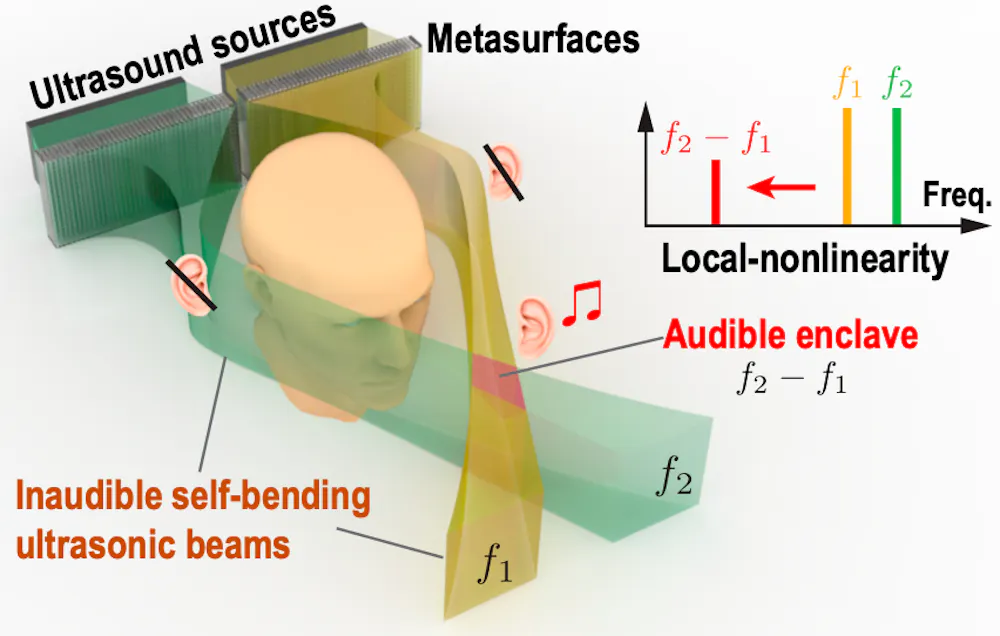
    Our newly published research introduces a way to create audible enclaves – localized pockets of sound that are isolated from their surroundings. In other words, we’ve developed a technology that could create sound exactly where it needs to be.

    The ability to send sound that becomes audible only at a specific location could transform entertainment, communication and spatial audio experiences.

    What is sound?

    Sound is a vibration that travels through air as a wave. These waves are created when an object moves back and forth, compressing and decompressing air molecules.

    The frequency of these vibrations is what determines pitch. Low frequencies correspond to deep sounds, like a bass drum; high frequencies correspond to sharp sounds, like a whistle.

    Sound is composed of particles moving in a continuous wave.
    Daniel A. Russell, CC BY-NC-ND

    Controlling where sound goes is difficult because of a phenomenon called diffraction – the tendency of sound waves to spread out as they travel. This effect is particularly strong for low-frequency sounds because of their longer wavelengths, making it nearly impossible to keep sound confined to a specific area.

    Certain audio technologies, such as parametric array loudspeakers, can create focused sound beams aimed in a specific direction. However, these technologies will still emit sound that is audible along its entire path as it travels through space.

    The science of audible enclaves

    We found a new way to send sound to one specific listener: through self-bending ultrasound beams and a concept called nonlinear acoustics.

    Ultrasound refers to sound waves with frequencies above the human hearing range, or above 20 kHz. These waves travel through the air like normal sound waves but are inaudible to people. Because ultrasound can penetrate through many materials and interact with objects in unique ways, it’s widely used for medical imaging and many industrial applications.

    In our work, we used ultrasound as a carrier for audible sound. It can transport sound through space silently – becoming audible only when desired. How did we do this?

    Normally, sound waves combine linearly, meaning they just proportionally add up into a bigger wave. However, when sound waves are intense enough, they can interact nonlinearly, generating new frequencies that were not present before.

    This is the key to our technique: We use two ultrasound beams at different frequencies that are completely silent on their own. But when they intersect in space, nonlinear effects cause them to generate a new sound wave at an audible frequency that would be heard only in that specific region.

    Audible enclaves are created at the intersection of two ultrasound beams.
    Jiaxin Zhong et al./PNAS, CC BY-NC-ND

    Crucially, we designed ultrasonic beams that can bend on their own. Normally, sound waves travel in straight lines unless something blocks or reflects them. However, by using acoustic metasurfaces – specialized materials that manipulate sound waves – we can shape ultrasound beams to bend as they travel. Similar to how an optical lens bends light, acoustic metasurfaces change the shape of the path of sound waves. By precisely controlling the phase of the ultrasound waves, we create curved sound paths that can navigate around obstacles and meet at a specific target location.

    The key phenomenon at play is what’s called difference frequency generation. When two ultrasonic beams of slightly different frequencies, such as 40 kHz and 39.5 kHz, overlap, they create a new sound wave at the difference between their frequencies – in this case 0.5 kHz, or 500 Hz, which is well within the human hearing range. Sound can be heard only where the beams cross. Outside of that intersection, the ultrasound waves remain silent.

    This means you can deliver audio to a specific location or person without disturbing other people as the sound travels.

    Advancing sound control

    The ability to create audio enclaves has many potential applications.

    Audio enclaves could enable personalized audio in public spaces. For example, museums could provide different audio guides to visitors without headphones, and libraries could allow students to study with audio lessons without disturbing others.

    In a car, passengers could listen to music without distracting the driver from hearing navigation instructions. Offices and military settings could also benefit from localized speech zones for confidential conversations. Audio enclaves could also be adapted to cancel out noise in designated areas, creating quiet zones to improve focus in workplaces or reduce noise pollution in cities.

    A sound only you can hear.
    Daly and Newton/The Image Bank via Getty Images

    This isn’t something that’s going to be on the shelf in the immediate future. For instance, challenges remain for our technology. Nonlinear distortion can affect sound quality. And power efficiency is another issue – converting ultrasound to audible sound requires high-intensity fields that can be energy intensive to generate.

    Despite these hurdles, audio enclaves present a fundamental shift in sound control. By redefining how sound interacts with space, we open up new possibilities for immersive, efficient and personalized audio experiences.

    Yun Jing receives funding from NSF.

    Jiaxin Zhong does not work for, consult, own shares in or receive funding from any company or organization that would benefit from this article, and has disclosed no relevant affiliations beyond their academic appointment.

    ref. Researchers created sound that can bend itself through space, reaching only your ear in a crowd – https://theconversation.com/researchers-created-sound-that-can-bend-itself-through-space-reaching-only-your-ear-in-a-crowd-252266

    MIL OSI – Global Reports

  • MIL-OSI Global: Trump shrugs off stock market slump, but economic warning signs loom

    Source: The Conversation – UK – By Conor O’Kane, Senior Lecturer in Economics, Bournemouth University

    bodrumsurf / Shutterstock

    During Donald Trump’s first term as US president, he regularly referred to rising stock markets as evidence of the success of his economic policies. “Highest Stock Market EVER”, Trump wrote on social media in 2017 after record gains. “That doesn’t just happen!”

    And after securing a second term in November 2024, some of Trump’s close advisers told the New York Times that the president “sees the market as a barometer of his success and abhors the idea that his actions might drive down stock prices”.

    This, in addition to a broader economic policy agenda committed to lower regulation and significant tax cuts, had Wall Street investors bullish about their prospects under the new Trump administration.

    But fears of an escalating trade war have seen the S&P 500, an index of the leading 500 publicly traded companies in the US, drop more than 10% from its February 2025 high. A decline of this magnitude in a major index is what professional traders refer to as a “correction”. In less than a month, roughly US$5 trillion (£3.9 trillion) has been wiped off the value of US stocks.

    So, what exactly is driving down stock prices? Economists cite the president’s brinkmanship, as well as his start-stop approach to tariffs with Canada and Mexico, as having rattled global investors. Some commentators believe this “chaotic” trade agenda has created huge uncertainty for consumers, investors and businesses.

    In view of such policies, a recent JP Morgan report said that US economic policy was “tilting away from growth”, and put the chances of a US recession at 40%, up from 30% at the start of the year. Moody’s Analytics has upped the odds of a US recession from 15% to 35%, citing tariffs as a key factor driving the downturn in its outlook.

    Any economic downturn would have an adverse impact on the profitability of US corporations, and the declining share prices reflect the negative outlook from investors.

    So far, the Trump administration appears unfazed by the US stock market decline. In an address to Congress on March 4, Trump declared his use of tariffs was all about making America rich again. “There will be a little disturbance, but we’re okay with that,” he said.

    The White House has, since then, announced that some short-term pain may be necessary for Trump to implement his trade agenda successfully, which is designed to bring manufacturing jobs back to the US.

    So, should we read this economic turbulence as a temporary blip? Or is it symptomatic of a more fundamental shift in the US economy?

    Change of strategy

    Stephen Miran, who was recently confirmed as chairman of Trump’s council of economic advisers, wrote a paper in November 2024 titled: A User’s Guide to Restructuring the Global Trading System. The paper gives us an insight into the Trump administration’s wider economic strategy.

    It sets out Trump’s desire “to reform the global trading system and put American industry on fairer ground vis-a-vis the rest of the world”. Miran cites persistent US dollar overvaluation as the root cause of economic imbalances.

    Miran does not believe that tariffs are inflationary, and argues that their use during Trump’s first presidential term had little discernible macroeconomic consequences. He does concede that tariffs may eventually lead to an appreciation – or further overvaluation – of the US dollar. However, Miran sees the extent of that appreciation as “debatable”.

    He sees tariffs as a tool for leverage in trade negotiations. The administration could, for example, agree to a reduction in tariffs in exchange for significant investment is the US by key trading partners. China investing in car manufacturing in the US is specifically mentioned in his analysis.

    Miran also states his belief that tariffs can be used to raise tax revenues from foreigners in order to retain low tax rates on American citizens.

    Some economists agree that the US dollar is overvalued. A combination of its role as the world’s reserve currency, as well as the attractiveness of the US economy as an investment destination, fuels demand for the US dollar and makes it stronger.

    A strong US dollar has made American manufacturing exports less competitive. This has cost American jobs. The “rust belt” states of the north-eastern and mid-western US have experienced a decline in manufacturing employment over the past 40 years, which is evidence of this.

    However, it is worth noting that the many US manufacturers who import manufactured parts or components to make their products do benefit from a stronger dollar. This is because it makes the parts and materials they are importing cheaper. US mortgage holders and investors also benefit from a stronger dollar through lower interest rates on loans.

    Steven Englander, the head of research and strategy at Standard Chartered bank, believes there are some contradictions in the Trump administration’s approach.

    In a recent interview with the Financial Times, Englander said: “The problem for the new administration is that it simultaneously wants a weaker dollar, a reduced trade deficit, capital inflows, and the dollar to remain the key currency in international reserves and payments.”

    Reduced trade deficits and capital inflows would typically strengthen the US dollar, as does its position as the world’s reserve currency.

    As Miran says in his paper: “There is a path by which the Trump administration can reconfigure the global trading and financial systems to America’s benefit. But it is narrow, and will require careful planning, precise execution, and attention to steps to minimise adverse consequences.”

    Only time will tell whether the Trump administration can successfully navigate this “narrow” path. In the meantime, the recent turbulence in US stock prices appears to be acceptable to the Trump administration in their pursuit of reforming the global financial system.

    Conor O’Kane does not work for, consult, own shares in or receive funding from any company or organisation that would benefit from this article, and has disclosed no relevant affiliations beyond their academic appointment.

    ref. Trump shrugs off stock market slump, but economic warning signs loom – https://theconversation.com/trump-shrugs-off-stock-market-slump-but-economic-warning-signs-loom-251988

    MIL OSI – Global Reports

  • MIL-OSI Global: The women spies who fooled the Nazis with simple tricks

    Source: The Conversation – UK – By Josephine Durant des Aulnois, PhD student in Sociology, University of Oxford

    If spy films have taught us anything, it’s that the people chosen for a career in espionage are special. They are the cream of the crop selected because they exhibit unique skills: high levels of intelligence and certain emotional traits that made them perfect for spying.

    During the second world war, the Special Operations Executive (SOE) was a British agency tasked with training spies to conduct espionage, sabotage and reconnaissance in German-occupied Europe and in east Asia. Active from 1940 to 1946, SOE was a pioneering British secret service. This is because it employed civilians, from all backgrounds, including women, which was unusual at a time where most spies were recruited from the army.

    The women hired by the agency were the only ones allowed to take on a combatant role by the British Army during the second world war. However, many have been unjustly forgotten.

    These women were active throughout Nazi-occupied Europe, but most women worked in France. They were not French, but French speakers who tried to pass for local. On paper, this might seem impossible, since being fluent in a language does not make you a spy.

    SOE recruited prospective agents on the basis of their language skills, and trained most of them in England before sending them into the field. Despite their lack of experience, many SOE women successfully duped German soldiers. Here are some of the simple but effective ways they managed such deception.


    Looking for something good? Cut through the noise with a carefully curated selection of the latest releases, live events and exhibitions, straight to your inbox every fortnight, on Fridays. Sign up here.


    Emotional control

    First, women spies sometimes fooled people simply by appearing calm. Irish agent Maureen Patricia “Paddy” O’Sullivan had grown-up in Belgium and was renowned for her daring personality. In a post-war interview, she described how she avoided a thorough search while carrying compromising documents. O’Sullivan acted confident and friendly to divert the soldier’s attention from her bag:

    As she laughed and joked with the German, he was distracted from making a closer examination.

    The spies’ cool was frequently praised in post-war commendations. Remaining calm was no mean feat, especially since most SOE recruits had never worked undercover. In France, they could be questioned by Nazis at any time and nervousness made them look suspicious.

    Agent Yvonne Cormeau joined SOE after losing her husband during a bombing at the beginning of the war. In a 1989 interview, she summarised the situation perfectly: “We learned to live with fear.”

    Physical appearance

    SOE spies did alter their appearance in order not to be recognised, but for most, this merely involved picking clothes which matched their cover. Yvonne Cormeau was sent to a farm in southern France, where the pro-Allied owners gave her new clothes and an apron. She was supposed to pass as their assistant and needed to look like one.

    A few agents went a step further and dyed their hair. This was the case of Noor Inayat Khan (code name Madeleine), a Sufi Muslim of royal lineage born to Indian and American parents. Betrayed to the Germans, she was executed at Dachau concentration camp in 1944.

    Noor Inayat Khan.
    Imperial War Museums/Wikimedia, CC BY

    Inayat Khan’s contribution to SOE proved invaluable. For several months in 1943, she was the sole radio operator still active in Paris amid the growing Gestapo presence.

    However, her constant hair dyeing was less effective. To try and escape the notice of the Gestapo, she regularly bleached her hair blonde, but this actually brought her to the attention of the Germans.

    They questioned Alfred and Emilie Balachowsky, her contacts who lived near Paris and led a local resistance network, about the presence of a woman “sometimes blonde and sometimes brunette”. The agent was not arrested on that occasion, but her efforts had backfired.

    Everyday habits

    Locals like the Balachowskys provided crucial support for SOE women, who could be given away by any small gesture. Despite having grown up near Paris, Inayat Khan threatened her cover just by pouring tea.

    Shortly after her arrival, Mrs Balachowsky invited neighbours to a tea party, during which the SOE agent poured the milk first into her cup, leading a neighbour to comment that she behaved like a Brit. Emilie Balachowsky quickly corrected Inayat Khan, who was not the only spy to make errors based on cultural differences.

    Yvonne Cormeau.
    Imperial War Museums/Wikimedia, CC BY

    While at the farm, Yvonne Cormeau was asked to watch the owner’s cows. She was about to bring her knitting kit, until her contact explained that this would give her away: “I was forbidden from knitting, as we Englishwomen knit differently.”

    These anecdotes are a testament to the importance of everyday habits and of the agents’ local contacts. For SOE women, espionage in France was very much about teamwork.

    While Inayat Khan was compromised and executed, for the most part the SOE’s civilian programme for women was a success. The SOE paved the way for other agencies which gradually started to recruit civilians of all genders after the second world war.

    Some of its methods are also used by modern secret services, such as the illegals programme, a Russian initiative which involves sending Russian operatives fluent in English undercover in the US.

    Despite this success, the contribution of women like Patricia O’Sullivan, Yvonne Cormeau and Noor Inayat Khan has remained widely overlooked. They deserve to be remembered along with the period’s male spies.

    Josephine Durant des Aulnois receives funding from the Clarendon Fund, managed by Oxford University.

    ref. The women spies who fooled the Nazis with simple tricks – https://theconversation.com/the-women-spies-who-fooled-the-nazis-with-simple-tricks-251653

    MIL OSI – Global Reports

  • MIL-OSI Global: Why Americans care so much about eggs prices – and how this issue got so political

    Source: The Conversation – UK – By Clodagh Harrington, Lecturer in American Politics, University College Cork

    The price of eggs has risen dramatically in recent years across the US. A dozen eggs cost US$1.20 (92p) in June 2019, but the price is now around US$4.90 (with a peak of US$8.17 in early March).

    Some restaurants have imposed surcharges on egg-based dishes, bringing even more attention to escalating costs. And there are also shortages on supermarket shelves.

    In the coming months, the US plans to import up to 100 million of this consumer staple. Government officials are approaching countries from Turkey to Brazil with enquiries about eggs for export.

    Agriculture secretary Brooke Rollins, who previously said that one option to the crisis was for people to get a chicken for their backyard, suggested in the Wall Street Journal that prices are unlikely to stabilise for some months. And Donald Trump recently shared an article on Truth Social calling on the public to “shut up about egg prices”.

    The main cause of the problem is an outbreak of avian flu that has resulted in over 166 million birds in the US being slaughtered. Around 98% of the nation’s chickens are produced on factory farms, which are ripe for contagion.

    According to the Centers for Disease Control, the flu has already spread to several hundred dairy cattle and to one human. The USDA recently announced a US$1 billion plan to counter the problem, with funding for improved bio-security, vaccine research and compensation to farmers.

    In January 2025, Donald Trump’s White House press secretary, Karoline Leavitt, blamed the previous administration for high egg prices. It is true that birds were slaughtered on President Joe Biden’s watch, but this was and remains standard practice at times of bird flu outbreaks and had also been the case during the Obama and first Trump administrations.

    However, this points to the way the rising price of eggs has become a political touchstone. It was referred to regularly in campaign speeches and press briefings as a sign of things going wrong and a symbol of the US economy faced. Donald Trump promised to fix the price of eggs swiftly if elected, but so far the issue shows no sign of going away.

    Prices are still trending up. Even when prices suddenly drop, as they have this week, the public know how much cheaper they used to be until recently, and do not tend to feel better.

    There are a number of reasons why egg prices have become an important to US politicians. First, almost everyone buys eggs. So the shortage and subsequent price rise is newsworthy and affects consumers in all income brackets.

    Secondly, they are a measure of broader economic vulnerabilities, so egg-related problems tend to be part of a larger story about how weak the economy is. And thirdly, egg prices are political because of Trump’s promise to bring them down.


    Read more:
    US inflation has increased since Trump took office – why prices are unlikely to come down soon


    Polls showed that the economy and inflation were key factors in voter choice on election day 2024. In February 2025, Donald Trump did an interview with NBC News in which he said he won the election on the border and groceries.

    On immigration, voters often base their opinions on what they perceive to be true. For example, tough rhetoric on building a wall may equate with a sense of feeling that the president is taking strong action, whether anything tangible actually materialises or not.

    With groceries, reality trumps perception. The price of eggs is printed on the box and the cost is paid directly by voters.

    Donald Trump on what he’s doing on egg prices and the economy.

    Then there are the egg producers. US farmers tended to overwhelmingly support Trump on election day, so it is prudent for him to feel their pain, or at least appear to. Farming areas voted for him increasingly in his three election efforts, even increasing their support for him in 2020 after trade wars and price increases which would have negatively impacted them.

    Another factor that may push up egg prices is that an estimated 70% of the factory farm workforce is immigrant labour, and as many as 40% are undocumented. Should the administration’s plans for high tariffs and mass deportations come to fruition, the industry would struggle to function.

    Further food price increases will be inevitable, with potential exacerbation via the funding freezes for some USDA programmes that Trump has enacted. As of March 2025, US$1 billion in cuts has been announced, the consequences of which are already being felt by farmers. The “pain now for gain later” message is a tricky political sell.

    Even in the current era of international turbulence, elections are largely won on more pedestrian matters. Specifically, “kitchen-table” economics is relatable to every voter, regardless of how grand, or not, their table is.

    Americans will be aware that in neighbouring Canada, egg prices have not risen dramatically and there have not been shortages. But prices in Canada have been traditionally higher than the US, this is in part at least because farming standards differ.

    The US does not have high welfare standards for agricultural workers or animals, and this shortcoming needs to be addressed in order to help reduce future risk of flu, but this is likely to also raise prices.

    Blaming the previous incumbent is not a durable stance for Donald Trump. As former president Harry Truman might remind him: “The buck stops here.” Right at his desk.

    Clodagh Harrington does not work for, consult, own shares in or receive funding from any company or organisation that would benefit from this article, and has disclosed no relevant affiliations beyond their academic appointment.

    ref. Why Americans care so much about eggs prices – and how this issue got so political – https://theconversation.com/why-americans-care-so-much-about-eggs-prices-and-how-this-issue-got-so-political-251752

    MIL OSI – Global Reports

  • MIL-OSI Global: Plans to link electricity bills to where you live are unlikely to bring down prices – and that’s a big problem for net zero

    Source: The Conversation – UK – By Nicholas Harrington, Research Associate in Electricity Market Reform, University of Glasgow

    Diana Mower/Shutterstock

    A proposed reform to the way electricity is priced in Britain could see households pay a different bill based on their postcode.

    Presently, Britain’s electricity system operates as a single market across England, Wales and Scotland. Around 30% of electricity is traded through half-hourly auctions, known as the spot market, while the remaining 70% is traded in forward markets via contracts covering weeks, months, or even years of demand in advance.

    The price of electricity is, broadly speaking, determined by the spot market, as forward market contracts are hedged on the basis of current and expected future spot market prices.

    “Zonal pricing” would divide the British market into multiple separate zones instead, each with its own spot and forward markets to serve demand within it. In effect, zonal pricing would split one large market into a series of smaller, interconnected markets.

    Whether it is the right approach depends on what you expect it to achieve, and where your interests lie. The UK’s Department for Energy Security and Net Zero, tasked with the decision, has three main objectives: decarbonising the country’s power sector, securing the supply of power and lowering the prices consumers pay.

    I’m an academic investigating the factors that influence the UK’s ability to decarbonise the housing sector, in particular, the way people heat their homes. I’m most concerned with the affordability of electricity, since I take the view that the lower the price of electricity, the easier our journey to net zero emissions will be – and vice versa.

    A lower electricity price would make clean heating systems (such as heat pumps, which run on electricity) more attractive to consumers and reduce the scale of insulation and draughtproofing required to make the running cost of these systems competitive with gas boilers. My research suggests that the UK’s high electricity price is behind the country’s comparably low rate of heat pump adoption.

    Zonal pricing, as an electricity market reform, seems unlikely to lower electricity prices and drive decarbonisation on its own. Closer scrutiny of the electricity system and its mechanisms suggests it may only make things more complicated.

    The root cause of high bills

    At €0.321 (£0.27) per kilowatt-hour (kWh), the UK has the second-highest electricity price when compared to European Union countries. The EU average is €0.218 per kWh, meaning UK electricity costs around 47% more than it does for most of our EU neighbours.

    Despite Russia’s invasion of Ukraine (which triggered a spike in energy prices) starting more than three years ago now, electricity prices across the UK remain about 53% higher than pre-crisis levels. If the UK is generating more electricity from renewables each year — and renewable electricity is the cheapest on the market — why do prices keep rising instead of falling, as one might expect?

    The UK’s high electricity prices are the result of system marginal pricing, which lies at the heart of the spot market. At the end of each half-hourly auction, all electricity that is bid into the market is purchased at the price of the last unit required to meet demand.

    Since total demand is rarely met by renewables, the much more expensive gas generators typically set the price. It’s like going to a fruit market to buy ten apples, finding the first nine for £1 each, the last one for £3, and then having to pay £30 for the lot, rather than the expected £13.

    Because forward markets follow the spot market, and the spot market operates under system marginal pricing, UK consumers end up paying gas-generated electricity prices 98% of the time.


    Read more:
    How gas keeps the UK’s electricity bills so high – despite lots of cheap wind power


    Will zonal pricing lower these prices? On its own, no. This is because all zones under the scheme will still have spot markets operating under the marginal pricing model. Zonal pricing doesn’t address the fundamental problem that’s keeping electricity prices in Britain so high.

    Advocates of zonal pricing argue that it will encourage investment in the infrastructure required to lower electricity prices – namely, storage and transmission.

    Grid-scale and home batteries, pumped hydro and thermal energy storage help reduce final electricity prices by storing excess renewable energy for use when the wind isn’t blowing or the sun isn’t shining, so grid operators don’t have to rely on expensive gas-generated electricity to fill supply gaps. Meanwhile, transmission lines and cables ensure that renewable electricity is delivered where it is needed.

    By creating price differences between zones, so the argument goes, the market receives clear signals about where such investments would be most profitable.

    Would zonal pricing help build more of these?
    EOSMan/Shutterstock

    This argument, however, assumes that electricity prices will fall in some zones, and that the market has a strong incentive to invest in high-price areas.

    I’m compelled to ask two questions. What prevents zones that generate a lot of renewable electricity from selling their supply at higher prices in other zones, which could prevent renewables from meeting total demand and lead to the same price distortions currently seen due to marginal pricing?

    And if investments in storage and transmission are underwhelming when electricity prices are high everywhere, why would they suddenly become more likely when prices are only high in specific areas?

    Overall, I think the argument in favour of zonal pricing is unconvincing as it doesn’t address the structural issue underlying the UK’s high electricity prices: spot markets that operate according to system marginal pricing.

    If zonal pricing neither lowers consumer electricity prices nor significantly stimulates investment in storage and transmission on its own — and does not alter the geographic and planning factors that determine wind and solar farm locations — then it is unclear what it would achieve beyond adding complexity to an already complex electricity system.


    Don’t have time to read about climate change as much as you’d like?

    Get a weekly roundup in your inbox instead. Every Wednesday, The Conversation’s environment editor writes Imagine, a short email that goes a little deeper into just one climate issue. Join the 40,000+ readers who’ve subscribed so far.


    Nicholas Harrington receives funding from the Engineering & Physical Sciences Research Council (EPSCR).

    ref. Plans to link electricity bills to where you live are unlikely to bring down prices – and that’s a big problem for net zero – https://theconversation.com/plans-to-link-electricity-bills-to-where-you-live-are-unlikely-to-bring-down-prices-and-thats-a-big-problem-for-net-zero-251922

    MIL OSI – Global Reports

  • MIL-OSI Global: BBC Gaza documentary: how an editorial blame game overshadowed an important film and destroyed trust

    Source: The Conversation – UK – By Dorothy Byrne, President of Murray Edwards College, University of Cambridge

    The war in Gaza has been a notoriously controversial and difficult story to cover as a journalist. The Israeli government banned international journalists from the territory. At least 171 journalists and media workers in Gaza, Lebanon and the West Bank have been killed since the war began.

    The BBC has faced relentless accusations of bias from all sides. You would think, then, that when it commissioned the film Gaza: How to Survive a Warzone, billed as a “vivid and unflinching view of life” in Gaza seen through the eyes of children, it would have been meticulous in its commissioning and oversight.

    Yet almost as soon as the programme was broadcast on February 17, a journalist outside the BBC revealed that one of the children featured in the film, 13-year-old Abdullah, who also acted as its narrator, was the son of a Hamas official. His father, Ayman Al-Yazouri, is a deputy minister of agriculture and therefore, as Hamas runs the government of Gaza, a Hamas official.

    No major investigation was required to find out who this man was – an expert on wastewater treatment, in particular on the removal of heavy metals from industrial wastewater, who received degrees from UK universities. No evidence has emerged that he is linked to Hamas’s militant operations. But getting someone with any link to what is classified as a terrorist organisation by western governments to narrate the film was inevitably going to be criticised – especially because the link wasn’t explained to viewers.

    The BBC pulled the film four days after its premiere and said it would investigate the matter. Where it really went wrong was that, for 12 days, the BBC tried to pin the blame elsewhere. It dumped on the production company, Hoyo Films, stating: “The production team had full editorial control of filming with Abdullah.” T

    I argue this is a weak defence. A broadcaster can’t blame someone else when a mistake appears in a film.

    Under Ofcom regulations, the broadcaster has full editorial responsibility, regardless of whether a freelance or independent crew carried out filming. Any mistake is the BBC’s mistake.

    I was head of news and current affairs at Channel 4 for 17 years. We sometimes made mistakes. It happens. But the key is not to make things worse by trying to wriggle out of blame.

    As it happens, Channel 4 also featured this child in some of its news coverage without initially disclosing his father’s role. “As international media access is restricted, Abdullah was sourced through an established journalist who has also worked for other major global media outlets,” Channel 4 News said in a statement.

    Ofcom regulations

    The BBC’s second excuse was even weaker. It said that filmmakers were asked in writing a number of times whether this child had any connection with Hamas.

    Here is a journalistic tip for the BBC’s news bosses: if you ask someone a question and they don’t answer, you don’t just keep asking. You demand answers or you go and get the answer yourself. As a former news boss myself, I would have demanded to see the boy’s entire family tree.

    Finally, after 12 days, the BBC took responsibility and issued an apology.
    BBC chair Samir Shah told MPs that people “weren’t doing their job” when it came to oversight of the production. Shah described it as “a dagger to the heart of the BBC claim to be impartial and to be trustworthy”.

    A child of 13 should arguably not have narrated the film at all. He was not narrating his own words but a script written by the programme makers, which included facts about the history and geopolitics of Gaza. I would point the BBC to Ofcom guidance that children under 16 should not be asked for views on matters likely to be beyond their capacity to answer properly without the consent of a responsible adult.

    On a subject like this, I would not have had a child narrate a film – especially not when one of the responsible adults in his life was a Hamas official.

    This was a powerful and beautifully shot film. It’s hard to see how any of its content could be described as pro-Hamas propaganda. The strongest moment was when a child said he hated Hamas because they had caused the war and all the misery being suffered now. But it’s almost certainly politically impossible for an amended version of the documentary to now be shown, which is a great loss.

    This debacle even resulted in a bizarre decision by the Royal Television Society to drop an award recognising the brave and brilliant work of journalists in Gaza (it has since reversed this after backlash from journalists). We have relied on journalists in Gaza to show us what is happening.

    They have continued filming when their own families have been killed. Their reports have been powerful and moving and true. Why should they be punished for a BBC cock-up?

    Falling trust

    I have never worked for the BBC, but I have always admired it for two things. First, for the brilliance of its journalists. Second, for its ability to turn a mistake into a PR catastrophe.

    The film contained editorial errors, but in my view the outrage built over days, resulting in calls not just for a public inquiry, but even a police inquiry, because the BBC wouldn’t take the rap. My journalistic heart went out to the great people who work at the BBC.

    This ghastly incident sits alongside other (quite different) recent scandals about the BBC: the bad behaviour (whether alleged or proven) of powerful presenters and figures Huw Edwards, Russell Brand, Tim Westwood and Gregg Wallace. In each case, it turned out that BBC bigwigs had received complaints over long periods of time before the stories went public.

    For many reasons beyond the BBC’s control, trust in the broadcaster is falling. It is constantly being attacked by the right-wing press, and undermined by conspiracy theorists who say you can’t trust the so-called mainstream media and that there is no such thing as truth.

    In a 2023 YouGov survey on trust in media, only 44% of Britons said they trust BBC journalists to tell the truth. That was nearly half the level of trust in the BBC 20 years earlier, yet it still made the BBC the most trusted media outlet in the UK. Other surveys by Ofcom of people who actually watch TV news put trust in its accuracy much higher – something like 70%.

    There is a general fall in trust in all institutions in the UK. The politicians and tabloids who attack the BBC are trusted far less than BBC journalists. But their unfair assaults make it all the more essential that the BBC avoids errors like this, and is transparent when those errors are revealed.

    Dorothy Byrne was formerly Head of News and Current Affairs at Channel Four, and Editor at Large at Channel Four.

    ref. BBC Gaza documentary: how an editorial blame game overshadowed an important film and destroyed trust – https://theconversation.com/bbc-gaza-documentary-how-an-editorial-blame-game-overshadowed-an-important-film-and-destroyed-trust-251760

    MIL OSI – Global Reports

  • MIL-OSI Global: Why we are so scared of space – and how this fear can drive conspiracy theories

    Source: The Conversation – UK – By Tony Milligan, Research Fellow in the Philosophy of Ethics, King’s College London

    klyaksun/Shutterstock

    There are many home-grown problems on Earth, but there’s still time to worry about bad things arriving from above. The most recent is the asteroid 2024 YR4, which could be a “city killer” if it hits a heavily populated area of our planet in the early years of the next decade.

    The chances of that happening are now estimated to be around 0.001%. But there was a brief moment after the asteroid’s discovery last year when the estimated danger of a direct hit crossed the 1% threshold of comfortable risk.

    There’s a need to worry about planetary defence if we are to avoid going the way of the dinosaurs. But there are many other things that could kill us, including climate change and wars. So what is it about space that grabs our attention? And how do these fears affect us – individually and as a society?

    In the long run, something big will hit us, unless we can redirect it. The responsibility for preparation begins with us.

    Yet preparation also carries risks. Daniel Deudney, a professor of political science at Johns Hopkins University in the US, has warned that the technologies used for planetary defence can not only guide asteroids away from Earth – they can also guide them towards it as a tool in a military conflict.

    As explained in his book Dark Skies, Deudney’s solution is to reverse, regulate and relinquish most of our human activities in space for several centuries to come. The more we do in space, he believes, the greater the likelihood that states will end up in catastrophic conflict. “The avoidance of civilisation’s disaster and species extinction now depends on discerning what not to do, and then making sure it is not done,” he writes.

    He ultimately argues space expansion has come too soon, and we must reverse the process until we are ready. That said, he thinks we may still need some form of planetary defence, but that it can be limited.

    Holding off for centuries is an unlikely option though. The chances of an asteroid strike may well be too high. And the political interest in space expansion is, at this point, irreversible.

    Fear of space has grown alongside space programs. Worries about asteroid strikes and over-militarisation lean into deeper fears about space as the unknown. Yet they also lean into worries about the self-destructive side of humanity.

    Both fears are very old. One of our earliest traceable human tales, the story of the Cosmic Hunt dating back at least 15,000 years, combines the two.

    An indigenous Sami version, surviving in Scandinavia, describes how a great hunt in the skies would go wrong if the hunter is impatient and fires an arrow which misses its target and accidentally strikes the pole star. This would bring the canopy of the night sky crashing down to Earth. Again, fears about misguided human actions and the threat from above fuse.

    We can see this in modern technologically driven fears such as UFOlogy. Some hard-core believers in UFOs are not only concerned about hostile visitors, but about secret collaborations among scientists on Earth, or, an entire conspiracy to keep the truth from the public.

    Without belief in a conspiracy to suppress the evidence, the whole idea falls apart. But without belief that there is actually something to fear from space, there is nothing for the conspiracy to be about. Fear of space is a necessary part of this picture.

    This is an idea neatly captured in recent times by the Chinese science fiction author Cixin Liu, who compares space to a “dark forest” in which alien civilisations are trying to hide from each other.

    All of this presupposes something of a bunker mentality, an over-separation of Earth and space, or sky and ground. This is something I have referred to as ground bias. The bias allows space to appear as a threatening outside, rather than something that we, too, are part of.

    Alien viruses

    The rationalisation for such fear shifts about and is not restricted to asteroids, aliens, meteors and runaway military conflict. There is even a theory that viruses come from space.

    When COVID sceptics went looking for an idea to explain why mask wearing was pointless, what many of them struck upon was an obscure theory put together by the astrophysicists Fred Hoyle and Chandra Wickramsinghe in 1979.

    Some believe Covid came from space.
    Viacheslav Lopatin

    The duo ultimately had a good idea which they followed up with a bad idea. The good idea was that the components for the emergence of life may have come from space. The bad idea was that they came ready formed, as viruses and bacteria, and that they are still coming.

    According this theory, well known pandemics of the past (such as the lethal 1918 flu pandemic and even epidemics in antiquity) were apparently the result of viruses from space and could not be the result of person-to-person transmission – least of all from asymptomatic carriers.

    The COVID version involved a meteor exploding over China. In an interview, Wickramsinghe claimed “a piece of this bolide containing trillions of the COVID-19 virus broke off from the bolide as it was entering the stratosphere” releasing viral particles which were then carried by prevailing winds.

    The idea illustrates the way in which fears about space are used to drive anxiety about human failings or wrongdoing. COVID scepticism has since gone all the way into the White House.

    But fears about space can also be used to critique those in power. In our own times, they are used to fuel narratives about billionaires with private space agendas and presidential access, wealthy space tourists and even wealthier prospective colonisers of Mars and beyond. It is a tempting narrative, but one that sees Earth as closed system, which should not be opened to the outside.

    We may, at some level, be afraid of space itself. We certainly have an exaggerated sense our our Earthly separateness from it. And there are some particular things that we do have cause to worry about. But there is also the risk that a fear of space can combine with suspicions about governments, leading us to embrace conspiracy theories as a way to consolidate different kinds of worries into a single, manageable, set of beliefs.

    Tony Milligan receives funding from the European Research Council (ERC) under the European Union’s Horizon 2020 research and innovation programme (Grant agreement No. 856543).

    ref. Why we are so scared of space – and how this fear can drive conspiracy theories – https://theconversation.com/why-we-are-so-scared-of-space-and-how-this-fear-can-drive-conspiracy-theories-252195

    MIL OSI – Global Reports

  • MIL-Evening Report: Streaming, surveillance and the power of suggestion: the hidden cost of 10 years of Netflix

    Source: The Conversation (Au and NZ) – By Marc C-Scott, Associate Professor of Screen Media | Deputy Associate Dean of Learning & Teaching, Victoria University

    Shutterstock

    This month marks a decade since Netflix – the world’s most influential and widely subscribed streaming service – launched in Australia.

    Since then the media landscape has undergone significant transformation, particularly in terms of how we consume content. According to a 2024 Deloitte report, Australians aged 16–38 spent twice as much time watching subscription streaming services as free-to-air TV (both live and on-demand).

    Part of the success of streaming services lies in their ability to provide content that feels handpicked. And this is made possible through the use of sophisticated recommender systems fuelled by vast amounts of user data.

    As streaming viewership continues to rise, so too do the risks associated with how these platforms collect and handle user data.

    Changing methods of data collection

    Subscription streaming platforms aren’t the first to collect user data. They just do it differently.

    Broadcasters have always been invested in collecting viewers’ information (via TV ratings) to inform promotional schedules and attract potential advertisers. These data are publicly available.

    In Australia, TV data are collected anonymously via the OzTam TV ratings system, based on the viewing habits of more than 12,000 individuals.

    Each television in a recruited household is connected to a metering box. Members of the household select a letter that corresponds to them, after which the box records their viewing data, including the program, channel and viewing time. But this system doesn’t include broadcasters’ video-on-demand services, which have been around since the late 2000s (with ABC iView being the first).

    In 2016 a new system was launched to measure broadcast video-on-demand data separately from OzTam ratings.

    However, it collected data in a rolling seven-day report, in the form of total minutes a particular program had been watched online (rather than the number of individuals watching, as was the measurement for TV). This meant the two data sources couldn’t be combined.

    In 2018, OzTAM and Nielsen announced the Virtual Australia (VoZ) database which would integrate both broadcast TV and video-on-demand data. It took six years following the announcement for the VoZ system to become the industry’s official trading currency.

    Streamers’ approach

    Streaming platforms such as Netflix have a markedly different approach to acquiring data, as they can source it directly from users. These data are therefore much more granular, larger in volume, and far less publicly accessible due to commercial confidence.

    In recent years, Netflix has shared some of its viewing data through a half-yearly report titled What We Watched. It offers macro-level details such as total hours watched that year, as well as information about specific content, including how many times a particular show was viewed.

    Netflix also supplies information to its shareholders, although much of this focuses on subscriber numbers rather than specific user details.

    The best publicly accessible Netflix data we have is presented on its Tudum website, which includes global Top 10 lists that can be filtered by country.

    The main data Netflix doesn’t share are related to viewer demographics: who is watching what programs.

    Why does it matter?

    Ratings and user data offer valuable insights to both broadcasters and streaming services, and can influence decisions regarding what content is produced.

    User data would presumably have been a significant factor in Netflix‘s decision to move into live content such as stand-up comedy, the US National Football League (NFL) and an exclusive US$5 billion deal with World Wrestling Entertainment.

    Streaming companies also use personal data to provide users with targeted viewing suggestions, with an aim to reduce the time users spend browsing catalogues.

    Netflix has an entire research department dedicated to enhancing user experience. According to Justin Basilico, Netflix’s Director of Machine Learning and Recommender Systems, more than 80% of what Netflix users watch is driven by its recommender system.

    As noted in its privacy statement, Netflix draws on a range of information to provide recommendations, including:

    • the user’s interactions with the service, such as their viewing history and title ratings
    • other users with similar tastes and preferences
    • information about the titles, such as genre, categories, actors and release year
    • the time of day the user is watching
    • the language/s the user prefers
    • the device/s they are watching on
    • how long they watch a particular Netflix title.

    If a user isn’t happy with their recommendations, they can try to change them by editing their viewing and ratings history.

    Personalised or predetermined?

    The rise of streaming hasn’t only transformed how we watch TV, but also how our viewing habits are tracked and how this information informs future decisions.

    While traditional broadcasters have long relied on sample anonymised data to measure engagement, streaming platforms operate in a landscape in which detailed user data can be used to shape content, recommendations and business decisions.

    While personalisation makes streaming more appealing, it also raises important questions about privacy, transparency and control. How much do streaming platforms really know about us? And are they catering to our preferences – or shaping them?

    Marc C-Scott does not work for, consult, own shares in or receive funding from any company or organisation that would benefit from this article, and has disclosed no relevant affiliations beyond their academic appointment.

    ref. Streaming, surveillance and the power of suggestion: the hidden cost of 10 years of Netflix – https://theconversation.com/streaming-surveillance-and-the-power-of-suggestion-the-hidden-cost-of-10-years-of-netflix-244921

    MIL OSI AnalysisEveningReport.nz

  • MIL-Evening Report: ASIC puts payday lenders on notice they may be breaching the law

    Source: The Conversation (Au and NZ) – By Jeannie Marie Paterson, Professor of Law (consumer protections and credit law), The University of Melbourne

    Late last week, corporate watchdog the Australian Securities and Investments Commission (ASIC) issued a warning to lenders that provide high-fee small-amount loans – known as payday lenders – that they may be breaching consumer-lending laws.

    Trying to provide effective protections to borrowers of these small loans is fiendishly difficult. People in financial hardship turn to payday loans, even though they are expensive. Lenders can charge high fees for such loans but may change products to avoid regulation.

    If access to payday loans dries up, borrowers in need are likely to turn to other products. And so the cycle begins again.

    The regulator’s report might be a prompt to government to think about other strategies.

    What is payday lending and why is it a concern?

    Payday lending is the name commonly given to loans of small amounts (under A$2,000) for short periods of time (16 days to one year) that promise quick credit checks and don’t require collateral.

    They are called payday loans because the original idea was borrowers would pay them back when they got their next pay cheque. But often that is not how it works, and borrowers struggle to repay.

    Payday lenders offer fast cash, but there are strings attached.

    ASIC said the total value of small and medium loans provided to consumers in 2023–24 was $1.3 billion. An earlier study by Consumer Action Law Centre found 4.7 million individual payday loans were written over three years to July 2019.

    Why do borrowers use (expensive) payday loans?

    Small, short-term loans like payday loans have been around for a long time – and in part, they respond to a reality that, for many people, their income is not sufficient to give them buffers.

    Payday loans can be used by borrowers who don’t have savings or credit cards to pay for one-off unexpected bills – a broken fridge, an emergency medical appointment or even utilities bills. But they can also be used to meet daily living expenses.

    There are limited other practical options – for some types of bills, there are hardship schemes, but these are not always well-known. For one-off expenses, there are low and no-interest loan schemes but they can be quite restrictive. Free financial counselling may also help, but knowledge and access can be an issue.

    Payday lenders have been moving customers into bigger loans that are harder to repay.
    Doucefleur/Shutterstock

    Why were new laws dealing with payday loans introduced?

    Payday lenders have typically charged very high fees. In 2013, concerns about the high cost of payday loans led to specific provisions to limit the fees that could be charged.

    Nonetheless, regulators and consumer advocates remain concerned these kinds of loans lock borrowers into debt spirals because they keep accumulating and that lenders manage to avoid many of the restrictions.

    Further reforms in 2022 introduced a presumption a loan is unsuitable if the borrower has already taken out two payday loans in the preceding 90 days. The reforms also prohibit payday lenders from offering loans where the repayments would exceed a prescribed proportion of a borrower’s income.

    What did ASIC say?

    ASIC said it found a trend of payday lenders moving borrowers who previously might have borrowed relatively small amounts ($700 to $2,000) to medium-sized loans ($2,000 to $5,000), which are not subject to the same consumer protections.

    The regulator said small loan credit contracts fell from 80% of loans in the December quarter of 2022 to less than 60% of loans by the August 2023 quarter.

    It said it was concerned by this approach and reminded lenders they were still subject to the reasonable lending regime. This effectively means not lending amounts that would be unsuitable for borrowers.

    Why are payday lenders moving consumers to larger loans?

    It’s a concern that lenders change products to avoid restrictive rules. But it is not altogether surprising.

    One response from increasing restrictions on one form of credit might be that lenders decide to focus on other, less restricted, products like medium-sized loans – this is what ASIC seems to have found.

    This is problematic if those larger loans are not meeting consumers’ needs and objectives (for instance, if they only needed a smaller amount), or complying with the loan would cause substantial hardship. It’s important to remind lenders that the responsible lending obligations apply to medium size loans, and for ASIC to take enforcement action where appropriate.

    What might be a better approach?

    The ASIC report highlights the increasing complexity of the National Consumer Credit Act regime – with the standard obligations complemented by specific and unique rules for a range of credit products. These include small amount credit, standard home loans, credit cards, reverse mortgages, and Buy Now Pay Later.

    It’s worth thinking about whether a better strategy might be to go back to a simpler approach, where one set of rules applied to all consumer credit products. Regulatory exceptions and qualifications are minimised.

    If access to payday loans becomes more restrictive, borrowers are likely to turn to other products. This means ASIC should also be looking at other products that are used to provide short-term small loans. These are likely to include buy now pay later schemes and pawn broking.

    Buy now pay later products are subject to their own regulations, including responsible lending obligations. But
    pawn brokers aren’t covered by the Consumer Credit laws and are subject to little regulatory scrutiny. This is also something that should change.

    We also need to consider whether there are financial inclusion options not dependent on lenders out to make a profit from borrowers struggling with the cost of living.

    Jeannie Marie Paterson receives funding from the Australian Research Council for a project on Treating Consumers Fairly.

    Nicola Howell receives funding from funding from the Australian Research Council for a project on Treating Consumers Fairly. She is affiliated with the Consumers’ Federation of Australia, as a member of the CFA Executive.

    ref. ASIC puts payday lenders on notice they may be breaching the law – https://theconversation.com/asic-puts-payday-lenders-on-notice-they-may-be-breaching-the-law-252375

    MIL OSI AnalysisEveningReport.nz

  • MIL-Evening Report: Why build nuclear power in place of old coal, when you could have pumped hydropower instead?

    Source: The Conversation (Au and NZ) – By Timothy Weber, Research Officer for School of Engineering, Australian National University

    Phillip Wittke, Shutterstock

    Australia’s energy policy would take a sharp turn if the Coalition wins the upcoming federal election. A Dutton government would seek to build seven nuclear power plants at the sites of old coal-fired power stations.

    The Coalition says its plan makes smart use of the existing transmission network and other infrastructure. But solar and wind power would need to be curtailed to make room in the grid for nuclear energy. This means polluting coal and gas power stations would remain active for longer, releasing an extra 1 billion to 2 billion tonnes of carbon dioxide.

    So is there another option? Yes: pumped hydro storage plants. This technology is quicker and cheaper to develop than nuclear power, and can store solar and wind rather than curtail it. It’s better suited to Australia’s electricity grid and would ultimately lead to fewer emissions. Drawing on our recent global analysis, we found the technology could be deployed near all but one of the seven sites the Coalition has earmarked for nuclear power.

    The Coalition is likely to spend anywhere from A$116 billion to $600 billion of taxpayers’ money to deliver up to 14 gigawatts of nuclear energy. Experts say the plan will not lower power prices and will take too long to build. Our findings suggest cheap storage of solar and wind, in the form of pumped hydro, is a better way forward.

    This way, we can continue to build renewable energy capacity while stabilising the grid. More than 45GW of solar and wind is already up and running, with a further 23GW being supported by the Capacity Investment Scheme until 2027. Only a handful of the pumped hydro sites we found would be needed to decarbonise the energy system, reaching the 1,046 gigawatt-hours of storage CSIRO estimates Australia needs.

    Building pumped hydro storage systems near old coal-fired power generators has some advantages, such as access to transmission lines – although more will be needed as electricity demand increases. But plenty of other suitable sites exist, too.

    Filling the gaps

    Pumped hydro is a cheap, mature technology that currently provides more than 90% of the world’s electrical energy storage.

    It involves pumping water uphill from one reservoir to another at a higher elevation for storage. Then, when power is needed, water is released to flow downhill through turbines, generating electricity on its way to the lower reservoir.

    Together with battery storage, pumped hydro solves the very real problem of keeping the grid stable and reliable when it is dominated by solar and wind power.

    By 2030, 82% of Australia’s electricity supply is expected to come from renewables, up from about 40% today.

    But solar panels only work during the day and don’t produce as much power when it’s cloudy. And wind turbines don’t generate power when it’s calm. That’s where storage systems come in. They can charge up when electricity is plentiful and then release electricity when it’s needed.

    Grid-connected batteries can fill short-term gaps (from seconds to a few hours). Pumped hydro can store electricity overnight, and longer still. These two technologies can be used together to supply electricity through winter, and other periods of calm or cloudy weather.

    Two types of pumped-storage hydropower, one doesn’t require dams on rivers.
    NREL

    Finding pumped hydro near the Coalitions’s proposed nuclear sites

    Australia has three operating pumped hydro systems: Tumut 3 in the Snowy Mountains, Wivenhoe in Queensland, and Shoalhaven in the Kangaroo Valley of New South Wales.

    Two more are under construction, including Snowy 2.0. Even after all the cost blowouts, Snowy 2.0 comes at a modest construction cost of A$34 per kilowatt-hour of energy storage, which is ten times cheaper than the cost CSIRO estimates for large, new batteries.

    We previously developed a “global atlas” to identify potential locations for pumped hydro facilities around the world.

    More recently, we created a publicly available tool to filter results based on construction cost, system size, distance from transmission lines or roads, and away from environmentally sensitive locations.

    In this new analysis, we used the tool to find pumped hydro options near the sites the Coalition has chosen for nuclear power plants.

    Mapping 300 potential pumped hydro sites

    The proposed nuclear sites are:

    • Liddell Power Station, New South Wales
    • Mount Piper Power Station, New South Wales
    • Loy Yang Power Stations, Victoria
    • Tarong Power Station, Queensland
    • Callide Power Station, Queensland
    • Northern Power Station, South Australia (small modular reactor only)
    • Muja Power Station, Western Australia (small modular reactor only).

    We used our tool to identify which of these seven sites would instead be suitable for a pumped hydro project, using the following criteria:

    • low construction cost (for a pumped hydro project)

    • located within 85km of the proposed nuclear sites.

    We included various reservoir types in our search:


    Exactly 300 sites matched our search criteria. No options emerged near the proposed nuclear site in Western Australia, but suitable sites lie further north in the mining region of the Pilbara.

    One option east of Melbourne, depicted in the image below, has a storage capacity of 500 gigawatt-hours. Compared with Snowy 2.0, this option has a much shorter tunnel, larger energy capacity, and larger height difference between the two reservoirs (increasing the potential energy stored in the water). And unlike Snowy 2.0, it is not located in a national park.


    Of course, shortlisted sites would require detailed assessment to confirm the local geology is suitable for pumped hydro, and to evaluate potential environmental and social impacts.

    More where that came from

    We restricted our search to sites near the Coalition’s proposed nuclear plants. But there are hundreds of potential pumped hydro sites along Australia’s east coast.

    Developers can use our free tool to identify the best sites.

    So far, the Australian electricity transition has mainly been driven by private investment in solar and wind power. With all this renewable energy entering the grid, there’s money to be made in storage, too.

    Large, centralised, baseload electricity generators, such as coal and nuclear plants, are becoming a thing of the past. A smarter energy policy would balance solar and wind with technologies such as pumped hydro, to secure a reliable electricity supply.

    Timothy Weber receives funding from the Australian government Department of Foreign Affairs and Trade, and the Australian Centre for Advanced Photovoltaics.

    Andrew Blakers receives funding from the Australian government Department of Foreign Affairs and Trade and other organisations.

    ref. Why build nuclear power in place of old coal, when you could have pumped hydropower instead? – https://theconversation.com/why-build-nuclear-power-in-place-of-old-coal-when-you-could-have-pumped-hydropower-instead-252017

    MIL OSI AnalysisEveningReport.nz

  • MIL-Evening Report: I’m avoiding a hearing test because I don’t want chunky hearing aids. What are my options?

    Source: The Conversation (Au and NZ) – By Katie Ekberg, Senior Lecturer, College of Nursing and Health Sciences, Flinders University

    Ksenia Shestakova/Shutterstock

    One in six Australians have hearing loss and, for most adults, hearing starts to decline from middle age onwards.

    Many of us, however, hesitate to seek help or testing for our hearing. Perhaps you’re afraid you’ll be told to wear hearing aids, and envision the large and bulky hearing aids you might have seen on your grandparents decades ago.

    In fact, hearing aids have changed a lot since then. They’re often now very small; some are barely noticeable. And hearing aids aren’t the only option available for people experiencing hearing loss.

    The earlier you do something about your hearing, the greater the likelihood that you can prevent further hearing decline.
    PeopleImages.com – Yuri A/Shutterstock

    Why you shouldn’t ignore hearing loss

    Acquired hearing loss can have a serious impact on our life. It is associated with or can contribute to:

    • social isolation
    • loneliness
    • not being able to work as much, or at all
    • memory problems
    • trouble thinking clearly
    • conditions such as dementia.

    Hearing loss has also been associated with depression, anxiety and stress. A systematic review and meta-analysis found adults with hearing loss are 1.5 times more likely to experience depression than those without hearing loss.

    A large population study in the US found self-reported hearing loss was associated with:

    • higher levels of psychological distress
    • increased use of antidepressant and anti-anxiety medications, and
    • greater utilisation of mental health services.

    The good news is that doing something about your hearing loss can help you live a happier and longer life.

    So why don’t people get their hearing checked?

    Research has found adults with hearing loss typically wait ten years to seek help for their hearing.

    Less than a quarter of those who need hearing aids actually go ahead with them.

    Hearing declines slowly, so people may perceive their hearing difficulties aren’t concerning. They may feel they’re now used to not being able to hear properly, without fully appreciating the impact it’s having on their life.

    Some people harbour negative attitudes to hearing aids or don’t think they’ll actually help.

    Others may have overheard their partner, family or friends say negative things or make jokes about hearing aids, which can put people off getting their hearing checked.

    Stigma can play a big part.

    People often associate hearing loss with negative stereotypes such as ageing, weakness and “being different”.

    Our recent research found that around one in four people never tell anyone about their hearing loss because of experiences of stigma.

    Adults with hearing loss who experience stigma and choose not to disclose their hearing loss were also likely not to go ahead with hearing aids, we found.

    Modern hearing aids may be a lot smaller than you realise.
    Daisy Daisy/Shutterstock

    What are my options for helping my hearing?

    The first step in helping your hearing is to have a hearing check with a hearing care professional such as an an audiologist. You can also speak to your GP.

    If you’ve got hearing loss, hearing aids aren’t the only option.

    Others include:

    • other assistive listening devices (such as amplified phones, personal amplifiers and TV headphones)
    • doing a short course or program (such as the Active Communication Education program developed via University of Queensland researchers) aimed at giving you strategies to manage your hearing, for instance, in noisy environments
    • monitoring your hearing with regular checkups
    • strategies for protecting your hearing in future (such as wearing earplugs or earmuffs in loud environments, and not having headphone speakers too loud)
    • a cochlear implant (if hearing loss is severe)

    Hearing care professionals should take a holistic approach to hearing rehabilitation.

    That means coming up with individualised solutions based on your preferences and circumstances.

    What are modern hearing aids like?

    If you do need hearing aids, it’s worth knowing there are several different types. All modern hearing aids are extremely small and discrete.

    Some sit behind your ear, while others sit within your ear. Some look the same as air pods.

    Some are even completely invisible. These hearing aids are custom fitted to sit deep within your ear canal and contain no external tubes and wires.

    Some types of hearing aids are more expensive than others, but even the basic styles are discrete.

    In Australia, children and many adults are eligible for free or subsidised hearing services and many health funds offer hearing aid rebates as part of their extras cover.

    Despite being small, modern hearing aids have advanced technology including the ability to:

    • reduce background noise
    • direct microphones to where sound is coming from (directional microphones)
    • use Bluetooth so you can hear audio from your phone, TV and other devices directly in your hearing aids.

    When used with a smartphone, some hearing aids can even track your health, detect if you have fallen, and translate languages in real time.

    Modern hearing aids use Bluetooth so you can hear audio from your phone.
    Daisy Daisy/Shutterstock

    What should I do next?

    If you think you might be having hearing difficulties or are curious about the status of your hearing, then it’s a good idea to get a hearing check.

    The earlier you do something about your hearing, the greater the likelihood that you can prevent further hearing decline and reduce other health risks.

    And rest assured, there’s a suitable option for everyone.

    Katie Ekberg has previously received funding from the Hearing Industry Research Consortium, which funded research into stigma associated with hearing loss and hearing aids.

    Barbra Timmer is a part-time employee of Sonova AG, a global hearing care company. She was a Chief Investigator on a Hearing Industry Research Consortium grant that investigated the experiences of stigma for adults with hearing loss. She is the president of Audiology Australia.

    ref. I’m avoiding a hearing test because I don’t want chunky hearing aids. What are my options? – https://theconversation.com/im-avoiding-a-hearing-test-because-i-dont-want-chunky-hearing-aids-what-are-my-options-250925

    MIL OSI AnalysisEveningReport.nz

  • MIL-Evening Report: Local newspapers are a lifeline in Ukraine, but USAID cuts may force many to close or become biased mouthpieces

    Source: The Conversation (Au and NZ) – By Galyna Piskorska, Associate Professor, Faculty of Journalism, Borys Grinchenko Kyiv University (Ukraine) and Honorary Principal Fellow at the Advanced Centre for Journalism, The University of Melbourne

    Three years into Russia’s full-scale war in Ukraine, Ukrainian journalists are facing enormously difficult challenges to continue their work.

    Since Russia’s invasion in 2022, 40% of Ukrainian media outlets have been forced to close down, mostly due to the Russian occupation or financial difficulties caused by the war. Many of these are in Russian-occupied eastern Ukraine.

    Ukrainian journalists and media outlets have also become targets. More than 100 media workers have been killed since the full-scale war began.

    Some, like 28-year-old journalist Viktoriya Roshchyna, were captured by Russian forces and died in brutal conditions in captivity. More than 30 media workers are still in Russian captivity.

    Others were killed by Russian missile and drone attacks, like Tetiana Kulyk, who died alongside her husband, a surgeon, after her home was hit by a drone in late February.

    For those journalists that remain, fatigue is a major issue. Many are emotionally exhausted. Some cannot cope and leave their jobs. The National Union of Journalists of Ukraine (NUJU) helps with seminars and psychological support.

    Despite the dangers, local media remains in high demand near the front lines of the war. These outlets have lost so much – advertising, subscribers and staff – but their journalists still have the passion and determination to continue their work documenting history.

    The role of local media on the front lines

    According to researchers who interviewed 43 independent local media outlets last year, the key challenges for newsrooms have not changed since the start of the war:

    • a shortage of employees (22% of respondents said this was a challenge in 2023, compared to 16% in 2022);

    • psychological stress (18% in 2023, 16% in 2022)

    • lack of funds (16% in both years).

    Often, journalists must perform different roles in their work, including being a driver, mail carrier and even a psychotherapist.

    Without working telephones or internet in areas near the front lines, print newspapers remain the only source of trusted information for many people. This includes up-to-date information on evacuation plans and humanitarian aid, as well as content not related to the war, such as public transport schedules and how to access medicines and necessary items for home repairs.

    Tetiana Velika, editor in chief of the Voice of Huliaipillia in southeastern Ukraine, was one of about 120 journalists who took part in a recent online conference organised by the National Union of Journalists of Ukraine to discuss the state of Ukraine’s media.

    She said media have remained connected with readers through both openness and authenticity. This includes having active social media networks, publishing journalists’ mobile phone numbers and allowing people to reach out anytime.

    Vasyl Myroshnyk, the editor in chief of Zorya, a newspaper in eastern Ukraine, described how he travelled 400 kilometres each week to deliver copies of his newspaper to even the most dangerous places.

    Svitlana Ovcharenko, editor of the newspaper Vpered in the city of Bakhmut, which was destroyed by Russian forces in the opening weeks of the war, said the paper has remained a lifeline for a displaced population.

    We have a unique situation — we don’t have a city. It’s virtual, it’s only on the map, it doesn’t physically exist. Not only is it destroyed, but it’s also been bombed with phosphorus bombs, and no one lives there.

    Ovcharenko, who now lives in the city of Odesa, said her newspaper’s readers are scattered all over the world. (There are 6,000 printed copies distributed each week across Ukraine.) The coverage focuses on how former Bakhmut residents have restarted their lives elsewhere, while also paying homage to the city’s past.

    Independent media is now at stake

    Funding remains a formidable challenge. Advertising revenue has dried up for many outlets, leaving international donors as the primary journalism funding source.

    Now, the Trump administration in the United States is gutting much of this funding through its dismantling of the US Agency for International Development (USAID). According to one estimate, 80% of Ukrainian media outlets received funding through USAID. As Oksana Romaniuk, director of the Institute of Mass Information, said:

    The problem is that almost everyone had grants. The question is that for some, these grants amounted to 100% of their income and they could only survive thanks to grants. These grants amounted to 40–60% for some, less for others.

    According to media researchers, without donor aid or state budget support in 2025, newspapers and magazines may decrease by a further 20% in Ukraine, while subscription circulation could drop by 25–30%.

    The heavy reliance on such funding has already led to the closure of some outlets, while others have been forced to launch public fundraising campaigns.

    Donor funding has also given Ukrainian outlets a measure of independence, allowing them to report on corruption within the Ukrainian government, for example. Many independent outlets are now vulnerable to being taken over by commercial or political entities. When these groups gain control, they can influence media coverage to benefit their own interests. This is known as “media capture”.

    Research shows how this has occurred in other post-conflict and developing countries where independent media outlets have been transformed into business entities more focused on profits and maintaining good relations with authorities than on producing quality journalism.

    This is a critical time for the future of Ukrainian media, to ensure it remains financially self-sufficient and free from the influence of both Russian propaganda and Ukrainian oligarchs. Without this funding, the preservation of Ukraine’s independent media and democracy remain under dire threat.

    Galyna Piskorska does not work for, consult, own shares in or receive funding from any company or organisation that would benefit from this article, and has disclosed no relevant affiliations beyond their academic appointment.

    ref. Local newspapers are a lifeline in Ukraine, but USAID cuts may force many to close or become biased mouthpieces – https://theconversation.com/local-newspapers-are-a-lifeline-in-ukraine-but-usaid-cuts-may-force-many-to-close-or-become-biased-mouthpieces-250917

    MIL OSI AnalysisEveningReport.nz

  • MIL-Evening Report: Scientific misconduct is on the rise. But what exactly is it?

    Source: The Conversation (Au and NZ) – By Nham Tran, Associate Professor, School of Biomedical Engineering, University of Technology Sydney

    PowerUp/Shutterstock

    German anaesthesiologist Joachim Boldt has an unfortunate claim to fame. According to Retraction Watch, a public database of research retractions, he is the most retracted scientist of all time. To date, 220 of his roughly 400 published research papers have been retracted by academic journals.

    Boldt may be a world leader, but he has plenty of competition. In 2023, more than 10,000 research papers were retracted globally – more than any previous year on record. According to a recent investigation by Nature, a disproportionate number of retracted papers over the past ten years have been written by authors affiliated with several hospitals, universities and research institutes in Asia.

    Academic journals retract papers when they are concerned that the published data is faked, altered, or not “reproducible” (meaning it would yield the same results if analysed again).

    Some errors are honest mistakes. However, the majority of retractions are associated with scientific misconduct.

    But what exactly is scientific misconduct? And what can be done about it?

    From fabrication to plagiarism

    The National Health and Medical Research Council is Australia’s primary government agency for medical funding. It defines misconduct as breaches of the Code for the Responsible Conduct of Research.

    In Australia, there are broadly eight recognised types of breaches. Research misconduct is the most severe.

    These breaches may include failure to obtain ethics approval, plagiarism, data fabrication, falsification and misrepresentation.

    This is what was behind many of Boldt’s retractions. He made up data for a large number of studies, which ultimately led to his dismissal from the Klinikum Ludwigshafen, a teaching hospital in Germany, in 2010.

    In another case, China’s He Jiankui was sentenced to three years in prison in 2019 for creating the world’s first genetically edited babies using the gene-editing technology known as CRISPR. His crime was that he falsified documents to recruit couples for his research.

    The “publish or perish” culture within academia fuels scientific misconduct. It puts pressure on academics to meet publication quotas. It also rewards them for greater research output, in the form of promotions, funding and recognition. And this can mean research quality is sacrificed for quantity.

    Honest mistakes

    But not all research misconduct is premeditated. Some is the result of honest mistakes made by scientists.

    For example, Sergio Gonzalez, a young scientist at the Institute for Neurosciences of Montpellier in France, mistakenly uploaded several wrong images to an academic paper and its supplementary material. This didn’t have any effect on the findings of the paper, which were based on the correct images.

    But it still represented a case of image duplication and misrepresentation of data. This lead to the journal retracting the paper and launching an investigation. The investigation concluded the breach was unintentional and resulted from the pressures of academic research.

    Fewer than 20% of all retractions are due to honest mistakes. Researchers usually contact the publisher to correct errors when they are detected, with no major consequences.

    The need for a national oversight body

    In many countries, an independent national body oversees research integrity.

    In the United Kingdom, this body is known as the Committee on Research Integrity. It is responsible for improving research integrity and addressing misconduct cases. Similarly, in the United States, the Office of Research Integrity handles allegations of research misconduct.

    In contrast, Australia lacks an independent body directly tasked with investigating research misconduct. There is a body known as the Australian Research Integrity Committee. But it only reviews the institutional procedures and governance of investigations to ensure they are conducted fairly and transparently – and with limited effectiveness. For example, last year it received 13 complaints, only five of which were investigated.

    Instead Australia relies on a self-regulation model. This means each university and research institute aligns its own policy with the Code for the Responsible Conduct of Research. Although this code originated in medical research, its principles apply across all disciplines.

    For example, in archaeology, falsifying an image or deliberately reporting inaccurate carbon dating results constitutes data fabrication. Another common breach is plagiarism, which can also be applied to all fields.

    But self-governance on integrity matters is fraught with problems.

    Investigations often lack transparency and are carried out internally, creating a conflict of interest. Often the investigative teams are under immense pressure to safeguard their institution’s reputation rather than uphold accountability.

    A 2023 report by the Australia Institute called for the urgent establishment of an independent, government-funded research integrity watchdog.

    The report recommended the watchdog have direct investigatory powers and that academic institutions be bound by its findings.

    The report also recommended the watchdog should release its findings publicly, create whistleblower protections, establish a proper appeals process and allow people to directly raise complaints with it.

    Research credibility is on the line

    The consequences of inadequate oversight are already evident.

    One of the biggest research integrity scandals in Australian history involved Ali Nazari, an engineer from Swinburne University. In 2022 an anonymous whistleblower alleged Nazari was part of an international research fraud cartel involving multiple teams.

    Investigations cast doubt on the validity of the 287 papers Nazari and the other researchers had collectively published. The investigations uncovered numerous violations, including 71 instances of falsified results, plagiarism and duplication, and 208 instances of self-plagiarism.

    Similarly, Mark Smyth, formerly of the Queensland Institute of Medical Research, fabricated research data to support grant applications and clinical trials. An independent inquiry concluded he used his reputation, status and authority to bully and intimidate junior colleagues.

    If Australia had a independent research integrity body, there would be a clear governance structure and an established and transparent pathway for reporting breaches at a much earlier stage.

    Timely intervention would help reduce further breaches through swift investigation and corrective action. Importantly, consistent governance across Australian institutions would help ensure fairness. It would also reduce bias and uphold the same standards across all misconduct cases.

    The call for an independent research integrity watchdog is long overdue.

    Only through impartial oversight can we uphold the values of scientific excellence, protect public trust, and foster a culture of accountability that strengthens the integrity of research for all Australians.

    Nham Tran has received funding from Australian Research Council.

    ref. Scientific misconduct is on the rise. But what exactly is it? – https://theconversation.com/scientific-misconduct-is-on-the-rise-but-what-exactly-is-it-247352

    MIL OSI AnalysisEveningReport.nz

  • MIL-Evening Report: Less than 1% of the world’s biggest radio telescope is complete – but its first image reveals a sky dotted with ancient galaxies

    Source: The Conversation (Au and NZ) – By Randall Wayth, SKA-Low Senior Commissioning Scientist and Adjunct Associate Professor, Curtin Institute of Radio Astronomy, Curtin University

    The first image from an early working version of the SKA-Low telescope, showing around 85 galaxies. SKAO

    Part of the world’s biggest mega-science facility – the SKA Observatory – is being built in outback Western Australia.

    After decades of planning, countless hours of work, and more than a few setbacks, an early working version of the telescope has captured its first glimpse of the sky.

    Using 1,024 of what will eventually be 131,072 radio antennas, the first SKA-Low image shows a tiny sliver of sky dotted with ancient galaxies billions of light-years from Earth.

    This first snapshot shows the system works, and will improve dramatically in the coming months and years – and starts a new chapter in our exploration of the universe.

    A glimpse of the universe

    The SKA-Low telescope is currently under construction on Wajarri Yamaji Country in Western Australia, around 600 kilometres north of Perth. Together with the SKA-Mid telescope (under construction in South Africa), the two telescopes will make up the world’s largest and most sensitive radio observatory.

    SKA-Low will consist of thousands of antennas spread across a vast area. It is designed to detect low-frequency radio signals from some of the most distant and ancient objects in the universe.

    The first image, made using just 1,024 of the planned 131,000 antennas, is remarkably clear, confirming that the complex systems for transmitting and processing data from the antennas are working properly. Now we can move on to more detailed observations to analyse and verify the telescope’s scientific output.

    Bright galaxies, billions of years old

    The image shows a patch of the sky, approximately 25 square degrees in area, as seen in radio waves.

    Twenty-five square degrees is an area of sky that would fit 100 full Moons. For comparison, it would be about the area of sky that a small apple would cover if you held it at arm’s length.

    The first image from an early working version of the SKA-Low telescope, showing around 85 galaxies.
    SKAO

    The dots in the image look like stars, but are actually some of the brightest galaxies in the universe. These galaxies are billions of light-years away, so the galaxies we are seeing now were emitting this light when the universe was half its current age.

    They are so bright because each of these distant galaxies contains a supermassive black hole. Gas orbiting around black holes is very hot and moves very quickly, emitting energy in X-rays and radio waves. SKA-Low can detect these radio waves that have travelled billions of light years across the universe to reach Earth.

    The world’s largest radio telescope

    SKA-Low and SKA-Mid are both being built by the SKAO, a global project to build cutting-edge telescopes that will revolutionise our understanding of the universe and deliver benefits to society. (SKA stands for “square kilometre array”, describing the initial estimated collecting area of all the antennas and radio dishes put together.)

    My own involvement in the project began in 2014. Since then I, along with many local and international colleagues, have deployed and verified several prototype systems on the path to SKA-Low. To now be part of the team that is making the first images with the rapidly growing telescope is extremely satisfying.

    A complex system with no moving parts

    SKA-Low will be made up of 512 aperture arrays (or stations), each comprised of 256 antennas.

    Unlike traditional telescopes, aperture arrays have no moving parts, which makes them easier to maintain. The individual antennas receive signals from all directions at once and – to produce images – we use complex mathematics to combine the signals from each individual antenna and “steer” the telescope.

    The SKA-Low telescope uses arrays of radio antennas (called stations) to create images of the universe.
    SKAO / Max Alexander

    The advantages and flexibility of aperture arrays come at the cost of complex signal processing and software systems. Any errors in signal timing, calibration or processing can distort the final image or introduce noise.

    For this reason, the successful production of the first image is a key validation – it can only happen if the entire system is working.

    The shape of the universe and beyond

    As SKA-Low grows, it will see more detail. Simulations show the full telescope may detect up to 600,000 galaxies in the same patch of sky shown in the first test image.
    SKAO

    Once completed, SKA-Low promises to transform our understanding of the early universe.

    The antennas of the full telescope will be spread across an area approximately 70 kilometres in diameter, making it the most sensitive low-frequency radio array ever built.

    This unprecedented sensitivity to low-frequency radio signals will allow scientists to detect the faint signals from the first stars and galaxies that formed after the Big Bang – the so-called “cosmic dawn”. SKA-Low will be the first radio telescope capable of imaging this very early period of our universe.

    It will also help map the large-scale structure of the universe. We expect the telescope will also provide new insights into cosmic magnetism, the behaviour of interstellar gas, and the mysterious nature of dark matter and dark energy.

    The sensitivity and resolution of SKA-Low gives it a huge discovery potential. Seven out of the top 10 discoveries from the Hubble Space Telescope were not part of the original science motivation. Like the HST, SKA-Low promises to be a transformative telescope. Who knows what new discoveries await?

    What’s next

    SKA-Low’s commissioning process will ramp up over the course of the year, as more antenna arrays are installed and brought online. With each additional station, the sensitivity and resolution of the telescope will increase. This growth will also bring greater technical challenges in handling the growing complexity and data rates.

    By the end of 2025, SKA-Low is expected to have 16 working stations. The increased volume of output data at this stage will be the next major test for the telescope’s software systems.

    By the end of 2026, the array is planned to expand to 68 working stations at which point it will be the the most sensitive low-frequency radio telescope on Earth.

    This phase will be the next big test of the end-to-end telescope system. When we get to this stage, the same field you see in the image above will be able to comprehensively map and detect up to 600,000 galaxies. I’m personally looking forward to helping bring it together.

    Randall Wayth does not work for, consult, own shares in or receive funding from any company or organisation that would benefit from this article, and has disclosed no relevant affiliations beyond their academic appointment.

    ref. Less than 1% of the world’s biggest radio telescope is complete – but its first image reveals a sky dotted with ancient galaxies – https://theconversation.com/less-than-1-of-the-worlds-biggest-radio-telescope-is-complete-but-its-first-image-reveals-a-sky-dotted-with-ancient-galaxies-252382

    MIL OSI AnalysisEveningReport.nz

  • MIL-Evening Report: Rwanda has moved people into model ‘green’ villages: is life better there?

    Source: The Conversation (Au and NZ) – By Lisa Allyn Dale, Director of the MA in Climate and Society program at the Columbia Climate School, Columbia University

    After the devastating 1994 genocide, Rwandans returning from the violence established homes and began farming where they could find land.

    Since then, the Rwandan government has aimed to bring people scattered across rural parts of the country into grouped settlements which they have called “model villages”. These are intended to provide extra support for highly vulnerable residents, such as the homeless and those who are living in “high risk zones” – areas prone to floods, drought and mudslides, and which are likely to be affected by climate change in the future.

    Rwanda has a population of 14.5 million. An estimated 62,000 rural families have been resettled into 14,815 villages, of which 253 are considered “model villages”. Some of them are considered “green”, because they use solar power and biofuels as energy sources. Rainwater harvesting, tree planting, and terraced vegetable plots are other features of the green, environmentally friendly model villages.

    We conducted a study to understand the impact of relocating rural communities from high risk zones where they face threats from a changing climate, such as erratic rainfall, drought, floods and landslides. We looked at two lake island communities who were experiencing floods. They also suffered a lack of health and education services and security problems from being too close to an unguarded border.

    We used the Rweru Model Green Village as a case study. Based on our interviews with families who were moved there, we found that relocating people can be double-edged. On the positive side, resettlement increased access to modern facilities and social services. On the downside, people found it hard to earn a living. They lacked access to natural and financial capital and had to adapt to a different climate.

    The resettlement programme overall is now understood to be part of the government of Rwanda’s approach to climate change adaptation. However, our findings suggest that this should be done with care, considering factors like community expectations and government development plans.

    Why people were moved

    The Rweru Model Green Village was set up in 2016 to house residents from two nearby islands on Lake Rweru, Sharita and Mazane. Located along the southern border with Burundi, these islands were home to generations of Rwandans. But they lived in relative isolation without access to services like education, healthcare or markets.

    We interviewed and surveyed people from 64 households in the Rweru village. At the time of our research, 1,777 people had been moved in, all from Sharita and Mazane islands.


    Read more:
    Rising risks of climate disasters mean some communities will need to move – we need a national conversation about relocation now


    Participants said fishing had been a way of life on the islands, providing them with a consistent source of protein. Beans, potatoes, cassava and sorghum grew successfully. Even relatively impoverished households said they had enough food to live on: 55% said the productivity of the land was high.

    However, 84% of respondents also described an isolated life without services. As one put it:

    we were cut off from the rest of the world.

    Many mentioned the lack of drinking water, roads and electricity as a major drawback to living on the islands. While primary school was available, older children could only get to a secondary school by a two hour boat ride. Some dropped out of school.

    Healthcare was absent, and respondents described harrowing journeys to find medical attention. As one woman said:

    When we were still there in Sharita, a woman could want to deliver a baby but getting a boat it takes a long time, a woman can even lose her life waiting.

    The boat rides were dangerous because of hippos in the lake, malaria-carrying mosquitoes, and the risk of drowning.

    Others said that people from Burundi could access the islands easily and sometimes assaulted or killed the island residents. About 76% of the people we interviewed described their lives before relocation as dangerous. Residents had been asking to be resettled for some time because of these problems.

    One of the driving forces for organising rural life into model villages is to enhance the capacity of residents to adapt to changes, including climate impacts such as the increased risks of flooding, drought or landslides. In that way, the model green village programme is also understood to have climate change adaptation elements.

    The pros and cons after resettlement

    After resettlement, most respondents described improvements in their overall quality of life. They were less exposed to floods, which they’d experienced on the islands. They had improved access to healthcare, social services and quality housing.

    Many (66%) described the housing they received as the most important advantage of their new lives:

    Above all, the nicest thing I was given was the house.

    They also described clean water (26%), markets (50%), healthcare (55%), schools (50%) and electricity (24%) as benefits of living in the new model village. It was the first time they’d been able to manage livestock, having only had chickens on the islands. Their children were benefiting from having milk.


    Read more:
    Climate change will force up to 113m people to relocate within Africa by 2050


    Some residents appreciated having a mattress for the first time; 50% indicated furniture and kitchen equipment as advantages. About 34% of respondents were pleased that they no longer needed to travel by boat.

    They also felt safer. But despite these positive outcomes, they said they were poorer and had less food. Unlike the islands, the micro-climate inland was very hot, with little rain and increasing drought.

    Most people we interviewed (55%) said their new, smaller plots of land were “infertile”, “unproductive” or “barren”. They couldn’t fish or grow enough fruit or vegetables. One person said many of the elderly people who were moved only ate one meal a day in the village “and others are starving completely”.

    Increased hunger caused children to miss school:

    Sometimes I cannot put food on the table, my son sleeps with an empty stomach and he cannot go to school the next day.

    The future of model green villages

    The Rwandan government plans to continue setting up model villages, and wants these to be sustainable for many years.

    More research is needed to determine whether living in a model village provides young people with a better quality of life. The government will also need to address the economic challenges, food insecurity and welfare needs of residents in the new villages.

    The authors do not work for, consult, own shares in or receive funding from any company or organisation that would benefit from this article, and have disclosed no relevant affiliations beyond their academic appointment.

    ref. Rwanda has moved people into model ‘green’ villages: is life better there? – https://theconversation.com/rwanda-has-moved-people-into-model-green-villages-is-life-better-there-250975

    MIL OSI AnalysisEveningReport.nz

  • MIL-Evening Report: Christian nationalism in the U.S. is eerily reminiscent of ‘dominionist’ reformers in history

    Source: The Conversation (Au and NZ) – By Gary K. Waite, Professor Emeritus, Early Modern European History, University of New Brunswick

    In this etching from Dutch theologian Lambertus Hortensius’ 1614 book ‘Van den oproer der weder-dooperen,’ Anabaptists warn the residents of Amsterdam of the coming vengeance of Christ in 1535. (Lambertus Hortensius)

    Far-right politics and Christian nationalism are on the rise in North America and Europe, leading to growing concerns about what it means for human rights and democracy.

    As an historian of the demonizing language of the 16th century, I have been watching current events, around QAnon and Christian nationalist support for United States President Donald Trump with considerable trepidation.

    Why? Because we’ve seen before what happens when religious groups use government to force their beliefs and morality upon society.

    Religion scholar Bradley Onishi writes that the Christian nationalist movement known as the “New Apostolic Reformation (NAR) is one of the most influential and dangerous Christian nationalist movements in the United States” and has become “a global phenomenon.”


    Read more:
    New Apostolic Reformation evangelicals see Trump as God’s warrior in their battle to win America from satanic forces and Christianize it


    This movement has reshaped its theology in ways eerily reminiscent of the prophets of the Anabaptist kingdom of Münster of the 1530s in present-day Germany. As my scholarship has examined, those religious dissenters faced polemical demonizing by religious authorities and faced violent oppression, via torture and execution.

    Today’s Christian nationalists, however, have faced no such maltreatment. Yet, like persecuted dissenters of the 1530s, they claim divine authority to remake society.

    The Anabaptists of Münster

    A portrait of Jan van Leiden, a leader of the Münster Anabaptists, by Dutch artist Jan Muller circa 1615.
    (The Metropolitan Museum of Art)

    The 16th-century Reformation had originally broken down the religious state of medieval Europe. However, Protestant leaders like Martin Luther and John Calvin quickly saw the advantage of having civic governments force conformity to their reforms, and punish dissent.

    Among those targeted were the small groups of dissenters whose Biblical interpretation, congruent with the life and teaching of Jesus, led them to follow the Gospel’s command to preach and baptize “on confession of faith” and a person’s commitment to discipleship.“ By contrast, reformers, and the church they sought to reform, “practised and required infant baptism for the entire population (usually required by law).

    Derisively called Anabaptists, the small group of dissenters also refused to participate in government. For these practices they were persecuted, with hundreds horrifically tortured and executed.

    Driven to desperation, some Anabaptists in northwestern Europe and northern Germany looked for hope to the Westphalian city of Münster in present-day Germany.

    Here the city’s major preacher, Bernhard Rothmann, was moving the city into the Reformed Protestant camp, rather than that of their Lutheran neighbours. When large numbers of Anabaptist refugees arrived in 1533, they won the civic election and Münster became an Anabaptist city.

    The Catholic bishop of Münster had other ideas. Hiring Catholic and Lutheran troops, he laid siege to the city and things became desperate. Enraged by persecution, the Münsterite Anabaptists changed their image of Jesus from the peacemaker of the Gospels to the apocalyptic Jesus of Revelation.

    The Jesus of Anabaptist Münster

    Rothmann’s original theology was like what Calvin would develop for Geneva. What made the two cities distinct was the charismatic leadership of the Dutch Anabaptist prophet Jan Matthijs, who predicted that Christ would return on Easter Day, 1534, adding both urgency and confidence in applying God’s directives.

    Now besieged, Matthijs and Rothmann took their reform movement in a more “dominionist” direction, meaning they believed their movement should take moral, spiritual and religious control over society. They expelled anyone who refused to co-operate.

    When Christ did not return on Easter 1534 and Matthijs was killed by the besiegers, his successor, Jan van Leiden, simply postponed Christ’s return to the following Easter and declared himself a semi-divine king.

    He also abandoned the message of the Jesus of the Sermon on the Mount in favour of the vengeful Jesus of the Book of Revelation. Rothmann justified this in a tract which I translated as:

    “It was … the intention of our hearts in our baptism, that we would suffer for Christ, whatever men did to us. But it has pleased the Lord … that now we and all Christians at this time may not only ward off the violence of the godless with the sword, but also, that he has put the sword into our hands to avenge all injustice and evil over the entire world.”

    King van Leiden sent people out to spread this revolutionary message and take over other cities. This led to several militant episodes, including in Amsterdam, where in February 1535, 11 Anabaptists paraded naked through the streets proclaiming the “naked truth” of God’s anger.

    Others delivered the message while waving swords. Finally, in May, 1535 about 40 Anabaptists captured Amsterdam’s city hall. All were arrested and executed. These were the actions of desperate people inspired by their prophets’ assurances of divine authority. When, however, Münster fell at the end of June 1535, the result was massive disillusionment, a return to non-violence and increased persecution.

    This etching (circa 1629-1652) by Dutch artist Pieter de Hooch depicts Anabaptists walking naked through the streets of Amsterdam after being inspired to remove and burn their clothes in February 1535.
    (Rijksmuseum)

    Divine authority to remake society?

    This transformation of the Münster Anabaptists into vengeful militants reminds me of the New Apostolic Reformation (NAR). As Matthew D. Taylor has revealed, this movement sees itself as fighting a “spiritual battle” against the demonic forces opposing Trump; some participated (non-violently) in the Jan. 6, 2020 riot.

    Taylor concludes with a warning that the NAR act as “spiritual warmongers, constantly expanding the arena of spiritual warfare, mapping it onto geographical territory and divisive politics in a deeply destabilizing and antidemocratic manner.” It is as if we are listening to Rothmann’s fiery sermons again.

    One difference, of course, is that the NAR folk are not under persecution, despite what they might claim. Taylor describes this as “the Evangelical Persecution Neurosis.”

    Three of the NAR’s principle components are:

    1. A charismatic approach to Christian life that affirms God speaks directly to them. They see themselves as biblical prophets who speak God’s commands which must be implemented regardless of social impact.

    2. The Evangelical Christian belief of living in the end-times on the eve of Jesus Christ’s return for judgment. NAR preachers proclaim that while Jesus in the Gospels taught to “turn the other cheek,” they now follow the judgmental Jesus of the apocalyptical Book of Revelation and mobilize a struggle with Satan to rely on scapegoat ideology.

    3. Derived from a group of Reformed or Calvinist theologians called “Christian Reconstructionists,” and building on Calvin’s theology of the “godly city,” they pursue a broader “dominionist” rationale to take over all of society for Christ. Believing one is living in the end-times means that society must be taken over and cleansed immediately, adding to urgency.


    Read more:
    I went to CPAC as an anthropologist to see how Trump supporters are feeling − for them, a ‘golden age’ has begun


    Believers, drawing on these three beliefs, derive an assurance they speak with God’s voice. This was the case for the Münster Anabaptists, and now similarly, for the NAR. As the example of the Münster Anabaptists suggests, we’ve seen this many times before throughout history, and it doesn’t end well.

    A 1685 engraving by Dutch poet and engraver Jan Luyken depicting the 1571 burning of Anabaptist woman Anneken Hendriks from Thieleman van Braght’s 1660 book ‘The Bloody Theatre or Martyrs Mirror.’
    (Allard Pierson Museum)

    There have been many more recent episodes of Christian groups claiming divine authority to remake society. Like Jan van Leiden, those in the NAR or who concur with its theology have recast the Jesus of the Gospels, and U.S. President Donald Trump, in apocalyptic terms.

    U.S. congresswoman Lauren Boebert, for example, who has been described as a Christian nationalist and is a strong gun advocate, is among those who say God anointed Trump to the presidency.

    This gives a gloss of divine approval for Trump’s autocratic goals. As authoritarianism and Christian nationalism rises, the fusion of charismatic authority with Reformed Protestant certitude and end-times fervour continues to attract followers.

    Gary K. Waite has received funding from the Social Sciences and Humanities Research Council of Canada.

    ref. Christian nationalism in the U.S. is eerily reminiscent of ‘dominionist’ reformers in history – https://theconversation.com/christian-nationalism-in-the-u-s-is-eerily-reminiscent-of-dominionist-reformers-in-history-250600

    MIL OSI AnalysisEveningReport.nz

  • MIL-Evening Report: Bug drugs: bacteria-based cancer therapies are finally overcoming barriers

    Source: The Conversation (Au and NZ) – By Justin Stebbing, Professor of Biomedical Sciences, Anglia Ruskin University

    Lightspring/Shutterstock

    Imagine a world where bacteria, typically feared for causing disease, are turned into powerful weapons against cancer. That’s exactly what some scientists are working on. And they are beginning to unravel the mechanisms for doing so, using genetically engineered bacteria to target and destroy cancer cells.

    Using bacteria to fight cancer dates back to the 1860s when William B. Coley, often called the father of immunotherapy, injected bacteria called streptococci into a young patient with inoperable bone cancer. Surprisingly, this unconventional approach led to the tumour shrinking, marking one of the first examples of immunotherapy.

    William Coley (centre), a pioneer of bug drugs.
    Wikimedia Commons

    Over the next few decades, as head of the Bone Tumour Service at Memorial Hospital in New York, Coley injected over 1,000 cancer patients with bacteria or bacterial products. These products became known as Coley’s toxins.

    Despite this early promise, progress in bacteria-based cancer therapies has been slow. The development of radiation therapy and chemotherapy overshadowed Coley’s work, and his approach faced scepticism from the medical community.

    However, modern immunology has vindicated many of Coley’s principles, showing that some cancers are indeed very sensitive to an enhanced immune system, an approach we can often capture to treat patients.

    How bacteria-based cancer therapies work

    These therapies take advantage of the unique ability of certain bacteria to proliferate inside tumours. The low oxygen, acidic and dead tissue in the area around the cancer – the tumour “microenvironment” (an area I am especially interested in) – create an ideal niche for some bacteria to thrive. Once there, bacteria can, in theory, directly kill tumour cells or activate the body’s immune responses against the cancer. However, several difficulties have hindered the widespread adoption of this approach.

    Safety concerns are paramount because introducing live bacteria into a patient’s body can cause harm. Researchers have had to carefully attenuate (weaken) bacterial strains to ensure they don’t damage healthy tissue. Additionally, controlling the bacteria’s behaviour within the tumour and preventing them from spreading to other parts of the body has been difficult.

    Bacteria live inside us, known as the microbiome, and treatments, disease and, of course, new bacteria that are introduced can interfere with this natural environment. Another significant hurdle has been our incomplete understanding of how bacteria interact with the complex tumour microenvironment and the immune system.

    Questions remain about how to optimise bacterial strains for maximum anti-tumour effects while minimising side-effects. We’re also not sure of the dose – and some approaches give one bacteria and others entire colonies and multiple bug species together.

    Recent advances

    Despite these challenges, recent advances in scientific fields, such as synthetic biology and genetic engineering, have breathed new life into the field. Scientists can now program bacteria with sophisticated functions, such as producing and delivering specific anti-cancer agents directly within tumours.

    This targeted approach could overcome some limitations of traditional cancer treatments, including side-effects and the inability to reach deeper tumour tissues.

    Emerging research suggests that bacteria-based therapies could be particularly promising for certain types of cancer. Solid tumours, especially those that have a poor blood supply and are resistant to conventional therapies, might benefit most from this approach.

    Colon cancer, ovarian cancer and metastatic breast cancer are among the high-mortality cancers that researchers are targeting with these innovative therapies.
    One area we have the best evidence for is that “bug drugs” may help the body fight cancer by interacting with routinely used immunotherapy drugs.

    Recent studies have shown encouraging results. For instance, researchers have engineered strains of E coli bacteria to deliver small tumour protein fragments to immune cells, effectively training them to recognise and attack cancer cells. In lab animals, this approach has led to tumour shrinkage and, sometimes, complete elimination.

    E coli have been used to deliver cancer tumour fragments to immune cells.
    Kateryna Kon/Shutterstock

    By exploiting these mechanisms, bacterial therapies can selectively colonise tumours while largely sparing healthy tissues, potentially overcoming limitations of conventional cancer treatments.

    Ultimately, we need human trials to give us the answer about whether this works, by controlling or eradicating cancer and, of course, if there are side-effects, its toxicity.

    In one study I worked on, we showed that part of a bacterial cell wall, when injected into patients, could safely help control melanoma – the most deadly form of skin cancer.

    While we’re still in the early stages, the potential of bacteria-based cancer therapies is becoming increasingly clear. As our understanding of tumour biology and bacterial engineering improves, we may be on the cusp of a new era in cancer treatment.

    Bacterial-based cancer therapies take advantage of several unique mechanisms to specifically target tumour cells. As a result, these therapies could offer a powerful new tool in our arsenal against cancer, working in synergy with existing treatments like immunotherapy and chemotherapy. And, as we look to the future, bacteria-based cancer therapies represent a fascinating convergence of historical insight and groundbreaking science.

    While challenges remain, the progress in this field offers hope for more effective, targeted treatments that could significantly improve outcomes for cancer patients.

    Justin Stebbing does not work for, consult, own shares in or receive funding from any company or organisation that would benefit from this article, and has disclosed no relevant affiliations beyond their academic appointment.

    ref. Bug drugs: bacteria-based cancer therapies are finally overcoming barriers – https://theconversation.com/bug-drugs-bacteria-based-cancer-therapies-are-finally-overcoming-barriers-251278

    MIL OSI AnalysisEveningReport.nz

  • MIL-Evening Report: Stop waiting for a foreign hero: NZ’s supermarket sector needs competition from within

    Source: The Conversation (Au and NZ) – By Lisa M. Katerina Asher, Retail Academic Researcher, PhD Candidate & Sessional Academic, University of Sydney

    non c/Shutterstock

    New Zealand’s concentrated supermarket sector is back in the spotlight after Finance Minister Nicola Willis said she was open to offering “VIP treatment” to a third international player willing to create competition.

    However, New Zealanders hoping for a foreign hero to break up the current supermarket concentration will be waiting a long time.

    It could take five years or more for an international brand such as Aldi to enter New Zealand and establish a nationwide chain. It is a risky bet. So far, no foreign operator has expressed interest publicly in setting up shop here on a national scale.

    To create more competition in the supermarket sector, the New Zealand government needs go back to where the issues began: allowing multiple companies to merge until there were few alternatives for shoppers.

    Breaking up two of the major entities in the sector would be a relatively quick way to reintroduce competition and improve affordability for everyone.

    The rise in concentration

    The current state of New Zealand’s supermarket sector – dominated by Woolworths (formerly Countdown), Foodstuffs North Island and Foodstuffs South Island – is a result of successive mergers and acquisitions along two tracks.

    The first was Progressive Enterprises’ (owner of Foodtown, Countdown and Five Guys banners) purchase of Woolworths New Zealand (which also owned Big Fresh and Price Chopper) in 2001.

    Progressive Enterprises was sold to Woolworths Australia, its’ current owner, in 2005. In less than 25 years, six brands owned by multiple companies were whittled down to a single brand, Woolworths.

    The second was the concentration of the “Foodstuffs cooperatives” network. This network once included four regional cooperatives and multiple banners including Mark’n Pak and Cut Price, as well as New World, PAK’nSave and Four Square.

    The decision of the four legally separate cooperatives to include “Foodstuffs” in their company name blurred the lines between them. The companies looked similar but remained legally separate.

    As a result of mergers, these four separate companies have now become Foodstuffs North Island – franchise limited share company, operating according to “cooperative principlies” and Foodstuffs South Island, a legal cooperative.

    In a recent failed application to merge into one company, Foodstuffs North Island and Foodstuffs South Island admitted to sharing information between the two legally separate companies. They are also not meaningfully competing with each other as they operate in regions which do not overlap.

    Breaking up the current players to compete

    While the Commerce Commission declined the clearance for Foodstuffs North Island Limited and Foodstuffs South Island to merge into one single national grocery entity, more can be done to drive competition in the supermarket sector.

    The fastest option would be to break up the “Foodstuffs” companies into smaller entities, with the breakaway and re-branding of PAK’nSave across both islands.

    But to do this the government would need to update legislation to allow parliament to force divestiture, consistent with the United Kingdom and the United States.

    This would allow New Zealand to go from three supermarket companies to five or more in a short period of time.

    Reducing the power dependency of suppliers and customers on the current companies would also reduce barriers to entry for overseas brands.

    Global players will take too long

    Breaking up the local dominant supermarket players is simply faster, and more straightforward, than waiting for a foreign company to enter New Zealand. It takes time and is expensive to build scale with stores. It can also be risky, as recent history in Australia shows.

    Aldi Australia, a favourite of New Zealand consumers hoping for a global alternative, took 20 years to reach scale as a third major player in that country. Originally from Germany, Aldi entered Australia as a declining brand – Franklins – left the market.

    In 2017, another German company, Kaufland, announced ambitious plans to enter the Australian market, starting with 20 stores. It purchased its first site in 2018 and hired 200 staff. However, the company abandoned launch plans in 2020 and divested completely from the market.

    Additionally, it took US-based bulk retail store Costco three years – and NZ$100 million – to go from announcing its plans for one New Zealand store to open. The retailer has hinted at opening a second location but this has not yet happened.

    In the end, the solution to New Zealand’s concentrated supermarket sector needs to come from within. Breaking up the power held by the dominant supermarket companies will allow prices to come down more quickly than waiting for a foreign supermarket to arrive.

    The government allowed the market to become concentrated, so it can now fix it. An international brand is not the hero – local, New Zealand-owned competition is.

    The authors do not work for, consult, own shares in or receive funding from any company or organisation that would benefit from this article, and have disclosed no relevant affiliations beyond their academic appointment.

    ref. Stop waiting for a foreign hero: NZ’s supermarket sector needs competition from within – https://theconversation.com/stop-waiting-for-a-foreign-hero-nzs-supermarket-sector-needs-competition-from-within-251910

    MIL OSI AnalysisEveningReport.nz

  • MIL-OSI Global: Thirty years ago Ukraine got rid of its nuclear arsenal – now some people regret that decision

    Source: The Conversation – UK – By Jennifer Mathers, Senior Lecturer in International Politics, Aberystwyth University

    Around 73% of Ukrainians now want their country to “restore” its nuclear weapons, according to a recent opinion poll. Most Ukrainians (58%) were in favour of their country owning nuclear weapons, even if it meant losing western allies.

    This suggests an underlying regret that Ukraine agreed to relinquish the world’s third largest nuclear arsenal as part of the Budapest Memorandum around 30 years ago. This agreement, signed in December 1994, provided security guarantees for Ukraine from the US, the UK and Russia in return for giving up the weapons. Ukraine also agreed it would not acquire nuclear weapons in the future.

    The focus on nuclear weapons is intensifying all over Europe. This week the Polish president, Andrzej Duda, called on the US to station its nuclear weapons in his country to deter Russian attacks. He cited Moscow’s decision to deploy nuclear weapons just across the border in Belarus during 2023 as part of his reasoning.

    Trump’s apparent weakening commitment to Nato has also prompted the French president, Emmanuel Macron, to suggest that France could extend protection of its own nuclear weapons to its allies.

    It’s clear that some Ukrainians now believe that their country would have been less likely to have experienced a Russian invasion if it had held on to its nuclear capacity. Ukrainians now question how much they can rely on other states after the failure of security guarantees that were central to the 1994 agreement.

    The pledges by the US, UK and Russia to protect the sovereignty and independence of Ukraine were put to the test in 2014 when Russia invaded and then annexed Crimea and began providing financial and military backing for militia leaders in eastern Ukraine who claimed to lead pro-Russian separatist movements.


    Read more:
    Are Ukrainians ready for ceasefire and concessions? Here’s what the polls say


    The US and UK imposed economic sanctions against Russia and provided training, equipment and non-lethal weapons to the Ukrainian armed forces. But these measures fell well short of ensuring Ukraine’s sovereignty and were insufficient to help Ukraine retake its territory.

    Similarly, US and UK support for Ukraine since the start of Russia’s full-scale invasion in 2022, although valuable and much appreciated by the Ukrainians, has not been enough to allow Kyiv to completely expel Russian troops from Ukrainian territory.

    What was the Budapest Memorandum?

    What if Ukraine still had nuclear weapons?

    But what if Ukraine had never given up its nuclear weapons? The logic of deterrence suggests that Putin would have not have invaded and attacked a nuclear-armed Ukraine. But the argument that Ukraine should not have surrendered the Soviet nuclear weapons on its territory overlooks the specific circumstances. For while physical components of a nuclear weapons capability – delivery vehicles and nuclear warheads – were within Ukraine’s grasp, the launch codes remained in Moscow, and Russian leaders showed no willingness to relinquish them.

    So, Kyiv would have had no control over whether, when or against whom those weapons might have been used. The risk to Ukraine of becoming the target of another state’s nuclear strike would have been considerable, and the Kyiv government would have been unable to do anything to reduce that risk. Retaining nuclear weapons left over from the Soviet period would have probably made Ukrainians less rather than more secure.


    Read more:
    What is the value of US security guarantees? Here’s what history shows


    Ukraine also lacked the economic resources to maintain the nuclear weapons on its territory, or develop them into a credible deterrent force. In exchange for giving up nuclear weapons, Ukraine received much-needed economic assistance from the west.

    In the 1990s Ukrainian views were shaped by the 1986 accident at the Chernobyl nuclear power plant. This had a devastating and lasting impact on the land and the people in that part of Ukraine, highlighting the risks of the nuclear sector. In 1994, when the Budapest Memorandum was being negotiated, only 30% of Ukrainians were in favour of Ukraine possessing nuclear weapons.

    What now?

    Ukraine would face considerable technical challenges in developing nuclear weapons today, both in creating the necessary quantities of fissile material for warheads and manufacturing delivery vehicles.

    Kyiv would also need to pay for an expensive nuclear weapons development programme at a time when the Ukrainian economy is struggling to supply its soldiers with conventional weapons and meet the needs of civilians.

    And unless Ukraine’s international supporters were on board, Kyiv might face the withdrawal of economic and military aid at a crucial juncture. If Moscow detected any move on Ukraine’s part to develop nuclear weapons, there would be a strong motive for a preemptive Russian strike to put an end to that plan.

    But even though it may not be feasible for Ukraine to develop an independent nuclear deterrent in the short term, Kyiv may feel compelled to pursue a nuclear weapons programme unless Ukraine is provided with serious and reliable security guarantees. With the Trump administration apparently ruling out Nato membership for Ukraine, the onus is on the country’s international supporters to come up with an alternative unless they want to see further nuclear proliferation in Europe.

    Jennifer Mathers does not work for, consult, own shares in or receive funding from any company or organisation that would benefit from this article, and has disclosed no relevant affiliations beyond their academic appointment.

    ref. Thirty years ago Ukraine got rid of its nuclear arsenal – now some people regret that decision – https://theconversation.com/thirty-years-ago-ukraine-got-rid-of-its-nuclear-arsenal-now-some-people-regret-that-decision-251733

    MIL OSI – Global Reports

  • MIL-Evening Report: What is the rules-based order? How this global system has shifted from ‘liberal’ origins − and where it could be heading next

    Source: The Conversation (Au and NZ) – By Andrew Latham, Professor of Political Science, Macalester College

    Global order? Put a pin in it. Getty Images

    The phrase “international rules-based order” has long been a fixture in global politics.

    Western leaders often use it to describe a framework of rules, norms and institutions designed to guide state behavior. Advocates argue that this framework has provided the foundation for decades of stability and prosperity, while critics question its fairness and relevance in today’s multipolar world.

    But what exactly is the international rules-based order, when did it come about, and why do people increasingly hear about challenges to it today?

    The birth of a universal vision

    The rules-based international order, initially known as the “liberal international order,” emerged from the devastation of World War II. The vision was ambitious and universal: to create a global system based on liberal democratic values, market capitalism and multilateral cooperation.

    At its core, however, this project was driven by the United States, which saw itself as the unmatched leader of the new order.

    The idea was to replace the chaos of great power politics and shifting alliances with a predictable world governed by shared rules and norms.

    Central to this vision was the establishment of institutions such as the United Nations, the International Monetary Fund and the World Bank. These institutions, alongside widely accepted norms and formalized rules, aimed to promote political cooperation, the peaceful resolution of disputes, and economic recovery for countries damaged by war.

    However, the vision of a truly universal liberal international order quickly unraveled. As the Cold War set in, the world split into two competing blocs. The Western bloc, led by the United States, adhered to the principles of the liberal international order.

    Meanwhile, the Soviet-led communist bloc established a parallel system with its own norms, rules and institutions. The Warsaw Pact provided military alignment, while the Council for Mutual Economic Assistance managed economic cooperation. The communist bloc emphasized state-led economic planning and single-party rule, rejecting the liberal order’s emphasis on democracy and free markets.

    Emerging cracks

    When the Soviet Union collapsed in the early 1990s, the liberal international order appeared to have triumphed. The United States became the world’s sole superpower, and many former communist states integrated into Western institutions. For a brief period, the order’s universal vision seemed within reach.

    By the 1990s and early 2000s, however, new cracks began to appear.

    NATO expansion, the creation of the World Trade Organization and greater emphasis on human rights through institutions such as the International Criminal Court all closely aligned with Western liberal values. The spread of these norms and the institutions enforcing them appeared, to many outside the West, as Western ideology dressed up as universal principles.

    In response to mounting criticism, Western leaders began using the term rules-based international order instead of liberal international order. This shift aimed to emphasize procedural fairness – rules that all states, in theory, had agreed upon – rather than a system explicitly rooted in liberal ideological commitments. The focus moved from promoting specific liberal norms to maintaining stability and predictability.

    New challenges to the status quo

    China’s rise has brought these tensions into sharp relief. While China participates in many institutions underpinning the rules-based international order, it also seeks to reshape them.

    The Belt and Road Initiative and the Asian Infrastructure Investment Bank illustrate Beijing’s efforts to establish alternative frameworks more aligned with its interests. These initiatives challenge existing rules and norms by offering new institutional pathways for economic and political influence.

    Meanwhile, Russia’s actions in Ukraine – especially the annexation of Crimea in 2014 and the 2022 invasion – challenge the order’s core principles of sovereignty and territorial integrity.

    Western inconsistencies have long undermined the credibility of the rules-based order. The 2003 U.S.-led invasion of Iraq, widely criticized for bypassing international norms and institutions, exemplified a selective application of the rules. This double standard extends toward Washington’s selective engagement with international legal bodies and its inconsistent approach to sovereignty and intervention.

    An uncertain future

    Supporters argue that the rules-based order remains vital for addressing global challenges such as climate change, pandemics and nuclear proliferation.

    However, ambiguity surrounds what these “rules” actually entail, which norms are genuinely universal, and who enforces them.

    This lack of clarity, coupled with shifting global power dynamics, complicates efforts to sustain the system.

    The future of the rules-based international order is uncertain. The shift from “liberal” to “rules-based” reflected an ongoing struggle to adapt a complex web of rules, norms and institutions to a rapidly changing international environment.

    Whether it evolves further, splinters or endures as is will depend on how well it balances fairness, inclusivity and stability in an increasingly multipolar world.

    Andrew Latham does not work for, consult, own shares in or receive funding from any company or organization that would benefit from this article, and has disclosed no relevant affiliations beyond their academic appointment.

    ref. What is the rules-based order? How this global system has shifted from ‘liberal’ origins − and where it could be heading next – https://theconversation.com/what-is-the-rules-based-order-how-this-global-system-has-shifted-from-liberal-origins-and-where-it-could-be-heading-next-250978

    MIL OSI AnalysisEveningReport.nz

  • MIL-OSI Global: Europe had worst measles outbreak since 1997 – new data

    Source: The Conversation – UK – By Michael Head, Senior Research Fellow in Global Health, University of Southampton

    SamaraHeisz5/Shutterstock

    Europe has had the highest number of measles cases since 1997, according to a new report from the World Health Organization (WHO). There were 127,350 cases in 2024 – about double the number from 2023.

    “Measles is back, and it’s a wake-up call,” says Dr Hans Henri P. Kluge, WHO regional director for Europe. “Without high vaccination rates, there is no health security.” Last year, there were 38 deaths from measles.

    Transmission is similar to COVID, with respiratory droplets and aerosols (airborne transmission) spreading the virus between people. The infection produces a rash and fever in mild cases, and encephalitis (brain swelling), pneumonia and blindness in severe cases.

    Hospitalisation and deaths are overwhelmingly in unvaccinated people, with mortality rates in developed countries around one in 1,000 to one in 5,000 measles cases.

    Each person infected with measles will, on average, spread the virus to between 12 and 18 other people. This is more infectious than COVID. For example, someone with the omicron variant would spread the virus to around eight others.

    In 2022 the WHO had described measles as an “imminent threat in every region of the world”. The widespread impact of COVID made it harder for people to access healthcare, reducing the ability of regular health services, like vaccinations, to function properly.

    These new stark figures from WHO Europe are an inevitable consequence of lower vaccination rates. Measles is almost entirely vaccine-preventable, with two doses providing greater than 99% protection against infection. The vaccine has an excellent safety record, with severe harm being extremely rare.

    The proportion of the population that needs to be vaccinated to keep local transmission low and prevent outbreaks (so-called “herd immunity”) is around 95%.

    WHO Europe highlighted some examples of where there are clear gaps in vaccine coverage. In Bosnia and Herzegovina, Montenegro, North Macedonia and Romania, fewer than 80% of eligible children were vaccinated in 2023, with rates below 50% for the past five or more years. Romania had the highest number of measles cases in Europe in 2024 – an estimated 30,692 cases.

    Misinformation is the driver

    Misinformation is an important factor that reduces vaccine uptake. For example, in the UK, former physician Andrew Wakefield presented falsified data in 2002 claiming the MMR (measles, mumps and rubella) vaccine caused autism. He somehow got these claims published in The Lancet – although the paper was later retracted.

    This fake scare received sustained media coverage, which resulted in lower uptake in young children at the time and was then a key factor a large measles outbreak among teenagers in England in 2012.

    The claims have spread internationally. In 2020, a US population survey found that “18% of our respondents mistakenly state that it is very or somewhat accurate to say that vaccines cause autism”.

    Sadly, misinformation about health can even be found at the highest levels of government. US President Donald Trump repeatedly made false claims during the COVID pandemic, including the suggestion that injecting disinfectant might cure COVID. In 2025, he appointed Robert F. Kennedy as the Secretary of Health and Human Services. Kennedy has long espoused anti-vaccine viewpoints, including being required to apologise in 2015 for comparing vaccination programmes to the Holocaust.

    RFK Jr. was made to apologise for comparing vaccination programmes with the Holocaust.
    Maxim Elramsisy/Shutterstock

    In a recent interview with Fox’s Sean Hannity, Kennedy said of the MMR vaccine: “It does cause deaths every year. It causes — it causes all the illnesses that measles itself causes, encephalitis and blindness, et cetera.”

    This is untrue. The Infectious Disease Society of America points out that there have been “no deaths related to the measles, mumps and rubella vaccine in healthy individuals”. This is amid two measles deaths in unvaccinated people in the US, the first such deaths since 2003. There are estimates that the measles vaccine prevented 94 million deaths globally between 1974 to 2024.

    The US National Institute for Health, one of the world’s biggest funders of health research, announced on March 10 2025 that it was axing research that aimed to understand and address vaccine hesitancy.

    This goes alongside the US Centers for Disease Control and Prevention (CDC) apparently planning a large study into potential associations between vaccines and autism, despite dozens of studies indicating there being no such link.

    This volatility coming from the US and elsewhere matters for Europe. Trump and the US have political supporters in Europe, so their messaging carries weight and could do harm. Anti-vaccine sentiment promoted on Facebook from within the US resulted in comments on the posts from multiple countries. The use of social media has been observed to spread misinformation internationally, for example, within Europe. Russian trolls are also involved in creating arguments about vaccines.

    There is an urgent need for outbreaks to be brought back under control and for accurate information about vaccines to be the key message in public discussions. As Dr Kluge highlights: “The measles virus never rests – and neither can we.”

    Michael Head has previously received funding from the Bill & Melinda Gates Foundation, Research England and the UK Department for International Development, and currently receives funding from the UK Medical Research Foundation.

    ref. Europe had worst measles outbreak since 1997 – new data – https://theconversation.com/europe-had-worst-measles-outbreak-since-1997-new-data-252327

    MIL OSI – Global Reports

  • MIL-OSI Global: Bug drugs: bacteria-based cancer therapies are finally overcoming barriers

    Source: The Conversation – UK – By Justin Stebbing, Professor of Biomedical Sciences, Anglia Ruskin University

    Lightspring/Shutterstock

    Imagine a world where bacteria, typically feared for causing disease, are turned into powerful weapons against cancer. That’s exactly what some scientists are working on. And they are beginning to unravel the mechanisms for doing so, using genetically engineered bacteria to target and destroy cancer cells.

    Using bacteria to fight cancer dates back to the 1860s when William B. Coley, often called the father of immunotherapy, injected bacteria called streptococci into a young patient with inoperable bone cancer. Surprisingly, this unconventional approach led to the tumour shrinking, marking one of the first examples of immunotherapy.

    William Coley (centre), a pioneer of bug drugs.
    Wikimedia Commons

    Over the next few decades, as head of the Bone Tumour Service at Memorial Hospital in New York, Coley injected over 1,000 cancer patients with bacteria or bacterial products. These products became known as Coley’s toxins.

    Despite this early promise, progress in bacteria-based cancer therapies has been slow. The development of radiation therapy and chemotherapy overshadowed Coley’s work, and his approach faced scepticism from the medical community.

    However, modern immunology has vindicated many of Coley’s principles, showing that some cancers are indeed very sensitive to an enhanced immune system, an approach we can often capture to treat patients.

    How bacteria-based cancer therapies work

    These therapies take advantage of the unique ability of certain bacteria to proliferate inside tumours. The low oxygen, acidic and dead tissue in the area around the cancer – the tumour “microenvironment” (an area I am especially interested in) – create an ideal niche for some bacteria to thrive. Once there, bacteria can, in theory, directly kill tumour cells or activate the body’s immune responses against the cancer. However, several difficulties have hindered the widespread adoption of this approach.

    Safety concerns are paramount because introducing live bacteria into a patient’s body can cause harm. Researchers have had to carefully attenuate (weaken) bacterial strains to ensure they don’t damage healthy tissue. Additionally, controlling the bacteria’s behaviour within the tumour and preventing them from spreading to other parts of the body has been difficult.

    Bacteria live inside us, known as the microbiome, and treatments, disease and, of course, new bacteria that are introduced can interfere with this natural environment. Another significant hurdle has been our incomplete understanding of how bacteria interact with the complex tumour microenvironment and the immune system.

    Questions remain about how to optimise bacterial strains for maximum anti-tumour effects while minimising side-effects. We’re also not sure of the dose – and some approaches give one bacteria and others entire colonies and multiple bug species together.

    Recent advances

    Despite these challenges, recent advances in scientific fields, such as synthetic biology and genetic engineering, have breathed new life into the field. Scientists can now program bacteria with sophisticated functions, such as producing and delivering specific anti-cancer agents directly within tumours.

    This targeted approach could overcome some limitations of traditional cancer treatments, including side-effects and the inability to reach deeper tumour tissues.

    Emerging research suggests that bacteria-based therapies could be particularly promising for certain types of cancer. Solid tumours, especially those that have a poor blood supply and are resistant to conventional therapies, might benefit most from this approach.

    Colon cancer, ovarian cancer and metastatic breast cancer are among the high-mortality cancers that researchers are targeting with these innovative therapies.
    One area we have the best evidence for is that “bug drugs” may help the body fight cancer by interacting with routinely used immunotherapy drugs.

    Recent studies have shown encouraging results. For instance, researchers have engineered strains of E coli bacteria to deliver small tumour protein fragments to immune cells, effectively training them to recognise and attack cancer cells. In lab animals, this approach has led to tumour shrinkage and, sometimes, complete elimination.

    E coli have been used to deliver cancer tumour fragments to immune cells.
    Kateryna Kon/Shutterstock

    By exploiting these mechanisms, bacterial therapies can selectively colonise tumours while largely sparing healthy tissues, potentially overcoming limitations of conventional cancer treatments.

    Ultimately, we need human trials to give us the answer about whether this works, by controlling or eradicating cancer and, of course, if there are side-effects, its toxicity.

    In one study I worked on, we showed that part of a bacterial cell wall, when injected into patients, could safely help control melanoma – the most deadly form of skin cancer.

    While we’re still in the early stages, the potential of bacteria-based cancer therapies is becoming increasingly clear. As our understanding of tumour biology and bacterial engineering improves, we may be on the cusp of a new era in cancer treatment.

    Bacterial-based cancer therapies take advantage of several unique mechanisms to specifically target tumour cells. As a result, these therapies could offer a powerful new tool in our arsenal against cancer, working in synergy with existing treatments like immunotherapy and chemotherapy. And, as we look to the future, bacteria-based cancer therapies represent a fascinating convergence of historical insight and groundbreaking science.

    While challenges remain, the progress in this field offers hope for more effective, targeted treatments that could significantly improve outcomes for cancer patients.

    Justin Stebbing does not work for, consult, own shares in or receive funding from any company or organisation that would benefit from this article, and has disclosed no relevant affiliations beyond their academic appointment.

    ref. Bug drugs: bacteria-based cancer therapies are finally overcoming barriers – https://theconversation.com/bug-drugs-bacteria-based-cancer-therapies-are-finally-overcoming-barriers-251278

    MIL OSI – Global Reports