Category: Academic Analysis

  • MIL-OSI Global: Online performance reviews: How technology has changed manners and etiquette

    Source: The Conversation – France – By George Kassar, Full-time Faculty, Research Associate, Performance Analyst, Ascencia Business School

    Thoughtful netiquette can help create a respectful, clear and productive virtual appraisal experience. Gerd Altmann/Pixabay

    As we settle into the new year, one meeting often weighs heavily on the minds of employees: the performance appraisal review. For some, it’s a time of validation and recognition, while for others, it brings a mix of anticipation and uncertainty.

    These meetings are a common practice in human resource management and are an important part of the performance management process. Despite some debates on the effectiveness of these systematic assessments, they are still frequently used to help organizations evaluate employee output, provide feedback and set future goals and rewards.

    With the rise of modern technologies, the dynamics of these appraisals have changed dramatically, especially in terms of manners and etiquette.

    What are performance appraisal reviews?

    Performance appraisals are a set of structured evaluations of employees’ job performance against set criteria and organizational goals. These evaluations are essential for managing human resources effectively. They provide insights into employee productivity, help identify training needs and align individual goals with the broader organizational mission. They also play a critical role in career development by offering feedback that helps employees understand their strengths and areas for improvement. And they are a key factor in management decisions about promotions, compensation, and sometimes, terminations.

    Employee reactions to performance appraisals can vary greatly depending on multiple factors. Active participation in the appraisal process can lead to more positive perceptions of its fairness and effectiveness. Further, fair and constructive appraisals can boost employee satisfaction and commitment, whereas poorly conducted ones can lead to dissatisfaction and disengagement.

    On the other hand, performance appraisals can also be a significant source of stress for employees. The anticipation of critical feedback and the high stakes associated with these evaluations can induce anxiety and tension. In fact, some studies suggests that performance appraisals contribute to employee burn-out.

    This stress-inducing aspect of appraisals can greatly influence the manners, attitudes and behaviors of employees during these meetings.

    The influence of modern technologies on manners and etiquette

    In the last few years, especially during the Covid pandemic, modern technologies have transformed performance appraisal reviews. Video conferencing and communication tools integrated into performance management software have made remote and flexible appraisals possible. These tools have significantly altered communication styles, shifting the focus to digital interactions that often lack non-verbal cues. Some behavioral scientists even noted that while online communication was essential during the pandemic, it lacks the richness of face-to-face interaction, which can affect the clarity and warmth of communication.

    Netiquette, or Internet etiquette, consists of the polite behaviors expected in online communications. The importance of netiquette in performance appraisals is basically to ensure clear and respectful communication. Adhering to netiquette helps maintain a professional tone and reduces the risk of misunderstandings in virtual settings.

    So while digital communication has led to new norms and expectations for politeness, clarity and respect remain crucial factors. Without physical presence, explicit expressions of politeness and consideration are more important than ever, helping to replicate the nuances of face-to-face communication in a virtual environment.

    Theoretical perspectives on manners and etiquette

    The late sociologist Norbert Elias’s theories offer a historical perspective on how manners and societal norms evolve. In his book, The Civilizing Process, Elias traces the development of manners from medieval times to the modern era, arguing that societal norms become more regulated and refined over time. This process involves both sociogenetic aspects, which concern social changes over long periods, and psychogenetic ones, which concern the internalization of social norms.

    Elias’s theories can also help us understand how manners and etiquette in modern organizations are evolving. His ideas have been shown to apply to organizational behavior, highlighting the importance of self-regulation and refinement in professional settings. As performance appraisals become more formalized, they reflect broader societal trends in these directions.

    Further applying Elias’s civilizing process to the digital age involves understanding how manners and etiquette adapt to technological advancements. Developing new norms for digital behavior helps maintain respectful and effective communication; netiquette is a contemporary extension of the civilizing process. As performance appraisals increasingly move online, adhering to netiquette helps ensure positive and constructive experiences.

    Implications for performance appraisals

    Modern technologies have blurred the traditional boundaries of place, time and organization, affecting employee behavior and manners. These changes challenge traditional notions of hierarchy and authority, encouraging more egalitarian and flexible interactions. This shift requires employees to adapt to the new culture of organizations. Observing the netiquette guidelines that follow can significantly enhance the online appraisal experience for both employees and managers.

    Preparation as self-regulation: Testing the Internet connection, camera and microphone reflects Elias’s concept of internalized norms as self-regulatory practices that enhance interactions. Creating a quiet, well-lit space shows respect for the meeting and fosters a focused environment.

    Professional presentation: Dressing appropriately and using a distraction-free background reflect Elias’s view of manners as societal refinement markers. A clean, professional setup conveys respect for the occasion and the participants.

    Simulated social cues: Making eye contact by looking at the camera, maintaining good posture, and using natural gestures to recreate in-person cues help make for effective communication.

    Clarity of speech: Speaking clearly and avoiding vague terminology aligns with Elias’s view that refined language is essential for civilized interactions. Clarity helps overcome the comparative lack of non-verbal cues in virtual settings.

    Time management: Joining the meeting a few minutes early and silencing notifications reflect Elias’s ideals of punctuality and order, showing respect for everyone’s time.

    Follow-up: A thank-you message after the appraisal supports Elias’s civilizing process by reinforcing professional gratitude and respect.


    If your next performance appraisal review is scheduled online, consider these straightforward yet impactful practices. Thoughtful netiquette – when adopted by both managers and employees – can create a respectful, clear and productive virtual appraisal experience, making a real difference on how feedback is communicated and received.

    George Kassar ne travaille pas, ne conseille pas, ne possède pas de parts, ne reçoit pas de fonds d’une organisation qui pourrait tirer profit de cet article, et n’a déclaré aucune autre affiliation que son organisme de recherche.

    ref. Online performance reviews: How technology has changed manners and etiquette – https://theconversation.com/online-performance-reviews-how-technology-has-changed-manners-and-etiquette-244056

    MIL OSI – Global Reports

  • MIL-OSI Global: Lake beds are rich environmental records — studying them reveals much about a place’s history

    Source: The Conversation – Canada – By Irene Gregory-Eaves, Professor, Biology, McGill University

    It’s important to study how climate change and human activity affects our lakes. (Shutterstock)

    Canada has more lakes than any other country in the world, with a huge diversity of lake sizes, depths, shapes, water chemistries, underlying geologies and hydrologies (the waters that flow in and out of them). Sediments accumulate on lake floors which, at the offshore and undisturbed depths, act as archival records.

    Paleolimnology is the study of lake sediments to identify changes in climate and human activity.

    When a lake develops algal blooms, fishless conditions or masses of weeds, it is difficult to determine whether this is part of the lake’s natural cycle or the result of human activities. To understand this, we need to know a lake’s history, and particularly what it was like before humans settled in the area in large numbers.

    As researchers in paleolimnology, the historical study of freshwater sediments, we examine the sediments that settles at the bottom of lakes. This accumulation of both organic and inorganic matter from within and outside then lake ecosystem helps us understand the history of these lakes and how they may have changed over time.

    Seeing through glass walls

    One group of microbes that preserve very well in lake sediments is the diatoms. These single-celled algae have delicately ornamented cell walls, of which each species is characterized by its distinct morphology. Because diatom cell walls are comprised of opaline silica — essentially, glass — they remain preserved in sediments even after their organic components have decomposed.

    Freshwater diatoms and plankton viewed under a microscope.
    (Shutterstock)

    The shape of diatom cell walls often reflects their habitats in the lake — whether they lived floating in the open water (planktic species) or nearer to the shoreline or lake bottom, often attached to rocks, sediments or vegetation (benthic species). Additionally, different species are adapted to distinct environments, for example high or low nutrient concentrations, different salinity levels or lake acidity. As such, we can use the diatom remains in sediments to reconstruct past lake environments.

    Unfortunately, not everything that lives in lakes will be preserved, and much of the cellular material of photosynthetic microbes decomposes over time. The main photosynthetic pigment across all photosynthetic organisms is chlorophyll a, which gradually breaks down over time. However, the molecules into which it degrades are more stable.

    By measuring chlorophyll a and its degradation products in lake sediments, we can get a sense of how lake primary production (the amount of photosynthetic biomass produced in the lake) has changed through time. This is done by using spectroscopy to measure how sediments absorb and reflect light, since chlorophyll a and its degradation products absorb light in specific wavelengths.

    By examining changes in the diatom species combined with sedimentary chlorophyll a from different core intervals, we can infer how the fundamental “producers” at the base of the lake food web have changed over the centuries, and even millennia.

    Canada’s changing lakes

    Our research team examined diatoms and sedimentary chlorophyll a from more than 200 lakes across Canada as part of a large-scale sampling program known as LakePulse.

    Collecting sediment cores from lake beds.
    (D. Akeya), CC BY

    At each lake, we collected a sediment core and samples from the upper-most and bottom-most sections of the mud were analyzed. These represented modern (deposited in the last few years) and pre-industrial (laid down more than 150 years ago, before the establishment of industrialized practices) samples. Comparing modern and pre-industrial diatoms in each lake, we found two clear patterns resulting from the impacts of direct human development and climate warming.

    The first pattern was that lakes with high concentrations of agriculture or urban development surrounding them showed the biggest changes. Diatom species composition changed to forms better adapted to higher nutrients and salinity. The most pronounced changes occurred in the Prairies, which are currently characterized by intense agricultural development and relatively shallow lakes that are more susceptible to nutrient pollution.

    The second pattern that we identified was a general increase in planktic diatoms. During the summer, a pattern known as thermal stratification develops in many lakes, where the upper water is heated by the sun and sits on top of colder water. As climates warm, the period during which lakes are stratified in summer has been getting longer.

    Based on earlier research, we know that planktic diatoms thrive in thermally stratified, open water environments. LakePulse researchers noticed an increase of planktic diatoms in the majority of lakes across Canada regardless of the degree of human impacts, which suggested that climate change is having a marked effect on the composition of these primary producers.

    Sedimentary chlorophyll a also indicated increased primary production in a majority of Canadian lakes, reflecting longer open-water periods (when most lakes show their maximum production) as ice duration decreases due to climate change.


    Read more:
    Climate change could alter the chemistry of deepwater lakes and harm ecosystems


    Manitou Lake, Sask. is a fishless lake in western Saskatchewan that has been severely impacted by drainage for urban, industrial and agricultural purposes.
    (Shutterstock)

    Preserving lakes

    Across Canada, the effects of climate change and human activities are changing primary producers in lake food webs. Physical conditions are also changing, with transitions towards stronger and longer periods of stratification for many lakes, and increased nutrients and salinity levels in lakes with high human impacts.

    These changes can have major negative consequences. Increased algal production means that as the organisms die and settle to the lake bottom, they are decomposed, which uses up the oxygen in bottom waters. Longer stratified periods can lead to greater oxygen depletion, as the time between episodes of mixing that renew oxygen in cold bottom waters increases.

    This can have devastating impacts for cold-water species, such as lake trout, that need high-oxygen cold water to survive through the summer months.

    By using paleolimnology to understand how ecosystems have changed over time, we gain valuable insights into the impacts that human activity and climate change may have on Canadian lakes. This knowledge will serve to preserve the health of our freshwater resources for future generations.

    Katherine Griffiths of Champlain College Saint-Lambert co-authored this article.

    Irene Gregory-Eaves receives funding from Natural Sciences and Engineering Research Council (NSERC), Fonds de recherche du Québec -nature et technologies (FRQNT) and the Canada Research Chairs (CRC) programs.

    Dermot Antoniades receives funding from NSERC, FRQNT, CFI and CRC.

    Hamid Ghanbari does not work for, consult, own shares in or receive funding from any company or organisation that would benefit from this article, and has disclosed no relevant affiliations beyond their academic appointment.

    ref. Lake beds are rich environmental records — studying them reveals much about a place’s history – https://theconversation.com/lake-beds-are-rich-environmental-records-studying-them-reveals-much-about-a-places-history-247504

    MIL OSI – Global Reports

  • MIL-OSI Global: Students cheating with generative AI reflects a revenue-driven post-secondary sector

    Source: The Conversation – Canada – By Salmaan Khan, Assistant Professor (LTF), Department of Criminology, Toronto Metropolitan University

    The higher education sector continues to grapple with the advent of generative artificial intelligence (genAI), with much of the concern focused on ethical issues around student misconduct.

    GenAI models such as ChatGPT offer students untraceable and economic means of churning out answers and term papers on any given subject.

    For many instructors, this means traditional forms of course evaluation are now ineffective. The question that faculty and administration across the sector are asking is: how can we effectively assess and evaluate student competence on a given subject?

    An equally significant question that needs to be asked — but remains relatively absent in current discussion — is the following: what existing conditions in higher education are shaping the scale and nature of the impact of genAI on learning?

    As I argue in a recent article in the Journal of Interactive Technology and Pedagogy, widespread use of genAI among students needs to be understood as reflecting economic, structural and learning conditions specific to post-secondary education today.

    This is not to justify violations of academic integrity codes. Rather, it is to emphasize that only by considering the realities of their milieu can educators contemplate more critical and engaged learning. It is also to underscore that this problem begs more systemic reforms.

    The context

    Since the mid-1980s, a political ideology that values the free market and the deregulation of government services has continued to inform federal and provincial levels of government — neoliberalism.


    Read more:
    What exactly is neoliberalism?


    In this context of deregulation, higher education has been undergoing what can be described as a “neoliberal turn.” This has happened as successive governments have either initiated or tacitly allowed for consistent funding cuts to public services in the education, health-care and social-service sectors.

    In Ontario, while provincial funding made up 78 per cent of university operating revenue in the 1987-88 fiscal year, by 2022 it made up only 24 per cent.

    Similar trends have been identified for federal and provincial government funding for higher education across the country, which is in steady decline as revenues from tuition fees continue to make up an increasing share.

    The impacts of neoliberal policies have, for higher education, translated into a number of effects:

    • The marketization of education as a private investment for individual students, as opposed to a public good, as public investment shrinks;

    • A rise in tuition fees and increase in student debt;

    • A restructuring of academic labour where casual and low-paid contract faculty now make up half the academic workforce.

    A 2018 Policy Options report notes a correlation between a decrease in public funding and increased class sizes: “In 2005, just under 25 per cent of first-year Ontario university courses had more than 100 students. By 2018, that number was 32 per cent.” Large classes, the report notes, reduce opportunities for more student-faculty contact, and result in a poorer learning experience for the students.

    Institutions have shifted as they increasingly adopt the competitive and cost-cutting measures needed to survive amid receding public funding.

    Universities are now more “revenue-driven and expenditure-adverse,” with administrators prioritizing activities that enhance the institution’s revenue, such as research work or the securing of grants. Falling by the wayside is the practice of teaching and the education of students.


    Read more:
    With precarious jobs, work identities shift — including for contract academics


    The impact on students

    A recent report published by Wiley surveyed more than 2,000 undergraduate students at institutions of higher education in North America on the topic of academic integrity in the era of AI.

    Of the students surveyed, a majority noted the role of emerging technologies, such as ChatGPT, in making it easier to cheat than before. When asked why more students may turn toward cheating, almost half responded that because education is so expensive, there is an added pressure to pass or attain certain grades.

    Thirty six per cent of students said they are more willing to cheat because it is hard to balance going to school with work or family commitments.


    Read more:
    ChatGPT: Student insights are necessary to help universities plan for the future


    Many students face significant hardships in making ends meet while the cost of living rises.
    (Shutterstock)

    Pressures facing students

    There are innumerable pressures facing undergraduate students today. Neoliberal cuts to education have drastically increased the cost of education, and many students face significant hardships in making ends meet as wages stagnate while the cost of living rises.

    When I ask my students about their employment situation, most are working part-time. Many are working full-time while juggling a full course load and some even take more than a full course load.

    When larger numbers of students are batched into lecture halls, there are fewer opportunities for active student-teacher engagement, characterized by dialogue,
    which is a key ingredient in fostering engaged and critical learning. In this context, should we be surprised if students feel disconnected?

    In the same Wiley report, students noted they are more likely to resort to cheating if they do not sense the significance of the course material to either their own lives or to the real world.

    A case for structural change

    These conditions are not isolated, nor are they the flaw of only one educational institution. They reflect broader structural conditions.

    The crisis spurred by concerns with student ethics or of the use of genAI to cheat on assigned work must be understood within this larger context, as opposed to being seen as emerging from features specific to genAI.

    If provided with the right conditions, genAI — as with other digital learning tools like PowerPoint slides or game-based platforms — can be harnessed in the service of developing more engaged learning practices.

    However, doing so will require fundamental transformations to the higher education industry, and to its existing pedagogical commitments.

    Salmaan Khan does not work for, consult, own shares in or receive funding from any company or organisation that would benefit from this article, and has disclosed no relevant affiliations beyond their academic appointment.

    ref. Students cheating with generative AI reflects a revenue-driven post-secondary sector – https://theconversation.com/students-cheating-with-generative-ai-reflects-a-revenue-driven-post-secondary-sector-247304

    MIL OSI – Global Reports

  • MIL-OSI Global: How political polarization informed Mexico’s protests against femicide

    Source: The Conversation – Canada – By Arturo Tejeda Torres, Sessional instructor, Department of Social Sciences, University of Alberta

    Between 2015 and 2024, more than 8,000 women were killed in Mexico because of their gender.

    These crimes are referred to as femicides and, unlike homicides, are not the consequence of private or personal disputes. Instead, they are the result of a culture of oppression and domination that historically has targeted women and perpetuated a patriarchal society.

    While the number of femicides has decreased in recent years, there has not been any significant decline, and it remains a serious crisis. According to government data, around 10 women and girls across Mexico are killed every day by intimate partners or other family members. Worsening the crisis is Mexico’s systemic impunity, with many crimes going unreported or uninvestigated, and unreliable data masking the true scale of this problem.

    As a result, femicides in Mexico have been described as “another pandemic” — one driven by a deeply embedded machismo culture of violence against women, combined with a lack of transparency and justice from the state.

    In response to this crisis, protests led by feminist groups have gained increasing attention in recent years. They have urged Mexican society to recognize the severity of this problem and called on authorities to act. However, the polarized political climate in Mexico has undermined the demands of these demonstrations.

    Polarization shaped public conversation

    My doctoral research focused on examining the political and public discourse surrounding protests against gender-based violence in Mexico. More specifically, my work analysed how polarizing narratives, especially on social media platforms, affected these demonstrations.

    In 2020, feminist collectives organized the annual International Women’s Day march alongside a silent strike called #UnDiaSinNosotras (#ADayWithoutUs) in which women abstained from all public activities for an entire day.

    While the support for these protests grew, even from conservative groups traditionally opposed to feminist ideals, speculations emerged about the movement being used opportunistically to undermine the left-wing federal government.

    Initially, then-president Andrés Manuel López Obrador expressed solidarity with feminist groups. However, after refusing to revise his strategy on femicide, he warned that conservative elements could be infiltrating the protests. This created an unusual scenario where conservative groups backed feminist demands while the left-wing federal government dismissed them.

    Such a turbulent political climate raises several questions: Did conservative groups suddenly embrace progressive feminist ideals? Did feminist groups align with conservatives despite historically opposing their ideas? Did the left-wing government adopt conservative positions to counter feminist movements? More importantly, how did this scenario impact the calls of the protests against femicide?

    A fluid polarization

    Polarization is typically framed as a stark and often stagnant political divisions between two dominant and opposing narratives. However, the interactions produced in scenarios like Mexico’s feminist protests suggest more fluid dynamics.

    Rather than a rigid conflict between two opposing sets of ideals, polarization here should been seen as a relationship between narratives that are constantly reshaped and defined by each other.

    This can be observed in how the narratives aligned with the federal government and those opposing it demonstrated apparent contradictions based on the other’s positioning regarding the protests.

    Following this, it can be interpreted that conservative groups backed the protests as a way of reinforcing their opposition to the government. Similarly, the left-wing governing party, typically associated with more progressive ideals, appeared as dismissive of the protests and their demands to distance itself from perceived conservative influences.

    Viewing polarization this way helps explain how unlikely allies find themselves on the same side of particular issues. In this context, polarization is less about fixed beliefs and values and more about maintaining a distinct identity relative to the opposing side. In essence, polarization becomes an exercises in being as opposed as possible to the other side.

    Obscuring social issues

    My analysis of social media comments about the protests revealed they centred on two themes: debates on whether the feminist movement was being co-opted by conservative forces and criticism of López Obrador and his administration.

    In both cases, the discussions shifted away from the urgent issue of femicides, ignoring the protests’ central calls. Moreover, these conversations reinforced existing political divisions rather than addressing the root problem. This way, the interplay between the narratives involved created a polarized environment in which political rivalries overshadowed meaningful discussion of the structural violence against women.

    In other words, polarized dynamics can obscure urgent and immediate social issues, contributing to impunity and a lack of action.

    The Mexican political landscape reveals how forms of violence and oppression can be reproduced and reinforced through the interactions happening around them. In this sense, addressing femicides requires not only structural modifications to current strategies but also changing how this issue is discussed.

    It’s also essential to recognize how polarization, as a fluid dynamic, shapes the public space. Doing this can provide insights into how meaningful action can happen in the context of today’s social and political debates framed by stark perceived divisions.

    Arturo Tejeda Torres does not work for, consult, own shares in or receive funding from any company or organisation that would benefit from this article, and has disclosed no relevant affiliations beyond their academic appointment.

    ref. How political polarization informed Mexico’s protests against femicide – https://theconversation.com/how-political-polarization-informed-mexicos-protests-against-femicide-246974

    MIL OSI – Global Reports

  • MIL-OSI Global: Syrian regime change: How rebel victories often lead to unstable, non-inclusive governments

    Source: The Conversation – Canada – By Sally Sharif, Lecturer in Political Science, University of British Columbia

    Syria’s rebel leader, Ahmed al-Sharaa, has defended his decision to fill his cabinet with wartime loyalists and delay constitutional and electoral processes, describing these moves as pragmatic necessities for the country’s fragile transition.

    At the same time, he has called for the disarmament of all rival factions, especially the Kurds in northern Syria. In a recent Al-Arabiya interview, al-Sharaa outlined a vision for a presidential system, with appointed, not elected, delegates shaping Syria’s new constitution before elections could be held.

    His blueprint leaves little room for international oversight, as he insisted the United Nations and foreign powers should play only a minimal role in the process.


    Read more:
    Syria after Assad: A fresh chance for inclusive governance and power-sharing, or more of the same?


    Many observers are focusing on Hayat Tahrir al-Sham (HTS), the factional winner of Syria’s protracted war, and its troubling history of ties to al-Qaida and ISIS.

    Questions abound: Will the group’s past alliances shape its governance? Can a group with such a violent legacy chart a path to inclusive peace?

    These questions are vital, but my research with colleagues at the universities of Notre Dame and Pittsburgh suggests that regimes emerging from rebel victories tend to share strikingly similar governance challenges. The question isn’t just whether Syria will chart a different course — it’s whether it can defy the grim lessons of history.

    Rebel victories

    Rebel victories tend to follow a predictable script: a regime born of war seeks to solidify power under the guise of stability.

    The Taliban’s takeover of Afghanistan in 1996 offers a stark example. After their military triumph, they penned a constitution in private, with input solely from Islamic scholars. No civil society entities were invited to the table. The resulting document prioritized ideology over inclusivity, and laid the groundwork for a repressive regime.

    Rebel victories are not mere regime changes; they are seismic upheavals. Unlike negotiated transitions or elite-led coups, these regimes arise from violent conflict.

    Our research has found that since 1946, 45 countries have experienced one or more episodes of rebel victory, leaving behind weak states with fragile institutions and deep societal divides. Governance in these situations often becomes synonymous with survival, with leaders prioritizing the consolidation of authority over fostering broad-based stability.

    Cases of rebel victory underline a troubling trend: rebel leaders often use constitutional processes to centralize power rather than create institutions that can manage grievances or prevent renewed violence.

    Expropriation of private property

    Our research indicates that constitutions drafted by rebel regimes frequently allow for selective enforcement of property rights, granting broad powers to expropriate under vague justifications. For instance, constitutions of rebel regimes are more likely to allow the government to expropriate private property for “general public purposes,” often without compensation or legal recourse.

    Most victorious rebels use constitutional changes to maintain property insecurity as a strategy for consolidating power in an uncertain environment. After the fall of the Derg regime in Ethiopia in 1991, the country’s rebel regime used constitutional provisions to expropriate land for “public use,” selectively targeting marginalized communities and dissenting regions. It consolidated power under the guise of reform while undermining property rights and economic liberalization.

    While such measures may temporarily stabilize power, they also fuel grievances, erode trust in state institutions, and often sow the seeds of future conflict.

    A small number of rebel regimes, however, take a different path, opting for negotiated constitutional reform. By including rival groups in the process and extending political, social and civic rights to marginalized populations, these regimes can lay the groundwork for more inclusive governance and lasting peace.

    Between 1989 and 2012, 56 per cent of comprehensive peace accords included provisions for constitutional reform. Such reforms often serve as nation-building mechanisms in newly formed states, or promote peace among divided communities. By creating a written, negotiated framework for governance, constitutions incentivize non-violent engagement and provide citizens and international entities with tools to hold rebel incumbents accountable.

    Helping rebel regimes

    There are two ways the global community can influence what happens in rebel regimes — by being punitive and/or by incentivizing. When the Taliban won in Afghanistan in 2021, the international community quickly imposed sanctions on the new rebel regime and froze Afghan assets abroad.

    In our analysis, we found that sanctions and arms embargoes — examples of punitive actions — do not significantly reduce the likelihood of civil wars recurring in rebel regimes.

    Instead of punitive measures, the Global North in particular should try to influence Syria’s new leaders with incentivizing measures, such as offering economic aid in exchange for peace agreements and facilitating peace-building processes.

    The good news for the international community is that, unlike the Taliban, al-Sharaa has shown an openness to collaborate with the West. This presents a critical opportunity to encourage Syria’s rebel leaders to adopt inclusive governance practices, which, in the long run, will reduce the risk of renewed conflict.

    Instead of calling for the complete disarmament of rival factions and drafting a new constitution solely by delegates of the rebel winners, al-Sharaa should sign a peace agreement with rival factions which includes the terms for a negotiated, inclusive constitutional reform process.

    Sally Sharif does not work for, consult, own shares in or receive funding from any company or organisation that would benefit from this article, and has disclosed no relevant affiliations beyond their academic appointment.

    ref. Syrian regime change: How rebel victories often lead to unstable, non-inclusive governments – https://theconversation.com/syrian-regime-change-how-rebel-victories-often-lead-to-unstable-non-inclusive-governments-247540

    MIL OSI – Global Reports

  • MIL-OSI Global: Canada-U.S. tariff war: How it will impact different products and industries

    Source: The Conversation – Canada – By Sylvanus Kwaku Afesorgbor, Associate Professor of Agri-Food Trade and Policy, University of Guelph

    U.S. President Donald Trump has imposed a 25 per cent tariff on most Canadian goods. A senior governmental official said they are expected to come into effect on Feb. 4.

    This tariff will have significant economic consequences on both sides of the border, as the U.S. and Canada share one of the largest bilateral trade relationships in the world.

    A key concern is the highly integrated supply chains between the two countries. Many goods cross the border multiple times as intermediate inputs before becoming final products. Imposing tariffs at any point in this supply chain will raise production costs and increase prices for a wide range of goods traded between the U.S. and Canada.

    For Canada, the tariffs on Canadian products will significantly affect Canada’s competitiveness in the U.S. market by driving up prices. Such tariffs could pose serious challenges for various sectors in Canada, given the country’s heavy reliance on the U.S. economy.

    Effects on different sectors

    The impact of U.S. tariffs on Canadian prices is likely to differ across sectors and products, depending on their reliance on the U.S. market.

    Sectors with a higher dependence on U.S. trade are likely to experience more severe disruptions. If the tariffs make certain products uncompetitive, Canadian producers may struggle to secure alternative markets in the short term.

    Industries such as agriculture, manufacturing and energy will experience varying degrees of impact. Energy products and motor vehicles, which represent Canada’s largest exports to the U.S., are expected to be among the most adversely affected.

    In the agricultural and forestry sector, wood and paper products, along with cereals, are among Canada’s largest exports to the U.S., with the U.S. accounting for 86 to 96 per cent of these exports, according to data from the World Integrated Trade Solution.

    In the energy and mineral sector, crude oil is Canada’s top export, reaching US$143 billion in 2023, with 90 per cent destined for the U.S. Given its critical role as Canada’s largest export across all sectors, it is not surprising that Trump has noted crude oil would subject to a lower tariff of 10 per cent.

    Canada’s dependence on U.S. trade

    When examining the impact on different products, it’s not only the value of trade that matters, but also the share of trade. The share of trade indicates how reliant Canada is on the U.S. compared to other markets.

    A high trade share with the U.S. suggests a product is particularly vulnerable to trade disruptions, as Canada depends heavily on the U.S. market for that product. Conversely, a lower share indicates that Canada has diversified suppliers, which reduces its dependence on the U.S.


    Read more:
    Trump’s tariff threat could shake North American trade relations and upend agri-food trade


    For instance, in 2023, Canada’s top exports to the U.S. included vehicles and parts, nuclear machinery and plastics, according to data from the World Integrated Trade Solution. The U.S. accounted for 93 per cent of vehicle and parts exports, 82 per cent of nuclear machinery exports, and 91 per cent of plastics exports.

    This data highlights Canada’s extreme dependence on the U.S. market, making these industries within the manufacturing sector highly susceptible to the tariff. This could harm jobs in the manufacturing sector, which is vital to employment in Canada, providing jobs for over 1.8 million people.

    Canada’s reliance on the U.S. is also evident in imports. In 2023, vehicle imports totalled US$92 billion, with the U.S. accounting for 58 per cent of that amount.

    The dependence is also evident in the agri-food and forestry sector, where Canada heavily relies on U.S. imports. This suggests that retaliatory tariffs on agricultural goods from the U.S. could have a substantial impact on food prices in Canada.

    Retaliatory tariffs and inflationary pressures

    Canada has announced it’s imposing $155 billion of retaliatory tariffs on U.S. imports in response. This could contribute to inflationary pressures within Canada.

    Prime Minister Justin Trudeau says this includes immediate tariffs on $30 billion worth of goods as of Tuesday, followed by further tariffs on $125 billion worth of American products in 21 days’ time to “allow Canadian companies and supply chains to seek to find alternatives.”

    This will include tariffs on “everyday items such as American beer, wine and bourbon, fruits and fruit juices, including orange juice, along with vegetables, perfume, clothing and shoes,” and also on major consumer products like household appliances, furniture and sports equipment, and materials like lumber and plastics.

    Given Canada’s significant dependence on U.S. imports, the retaliatory tariffs will raise the cost of American goods entering the country, further driving up consumer prices and exacerbating inflation.

    In its latest policy rate announcement, the Bank of Canada warned of the severe economic consequences of Trump’s tariffs, highlighting their potential to reverse the current downward trend in inflation.

    What should Canada do now?

    Canada must extend its economic diplomacy efforts beyond the Trump administration, engaging with the U.S. Congress and Senate to advocate for the reconsideration of tariffs on Canadian goods. The Canadian government should persist in leveraging this channel to push for a reversal of the tariffs. This kind of broader negotiation remains the most effective approach to mitigating trade tensions and ensuring stable economic relations with the U.S.

    At the same time, Canada must reduce dependence on the U.S. market by adopting a comprehensive export diversification strategy. While the U.S. remains a convenient and accessible trade partner, expanding into emerging and developing markets would help mitigate risks and create more stable long-term trade opportunities.


    Read more:
    Trump’s tariff threat is a sign that Canada should be diversifying beyond the U.S.


    One effective way to achieve export diversification is by expanding free trade agreements (FTAs) with emerging and developing economies. Currently, Canada has 15 FTAs covering about 51 countries, but there is room for expansion. However, signing FTAs alone is insufficient; Canada must ensure these agreements translate into tangible trade growth with partner countries.

    International politics is increasingly shaping global trade, making it imperative for Canada to proactively manage diplomatic and trade relations. In recent years, tensions have emerged with key partners such as China, India and Saudi Arabia. These countries could all become potential markets for Canadian products. Given that China is Canada’s second-largest export destination, there is significant potential to expand trade ties.

    Additionally, countries like the United Arab Emirates present promising markets, particularly for agricultural products, as the UAE imports about 90 per cent of its food.

    Boosting innovation and productivity

    Canada stands at a critical juncture in its trade relationship with the U.S. While diplomatic efforts remain essential to averting harmful tariffs, they cannot be the country’s only line of defence.

    Boosting productivity is one of the most effective ways for Canada to improve its competitiveness in global markets. Canadian producers should prioritize innovation and the adoption of advanced technologies to enhance efficiency and maintain a competitive edge, particularly as they seek to expand beyond the U.S.

    In response to potential U.S. tariffs, the Canadian government should implement a bailout strategy to provide short-term relief and mitigate revenue losses to firms that will be mostly affected. Additionally, Canada should leverage its embassies and consulates worldwide to promote exports and help affected firms identify and access new market opportunities.

    By doing this, Canada can position itself as a more self-reliant and competitive player in the global economy — one less vulnerable to shifting U.S. policies.

    Sylvanus Kwaku Afesorgbor receives funding from the OMAFRA and the USDA. He is affiliated with the Centre for Trade Analysis and Development (CeTAD Africa).

    Naduni Uduwe Welage and Promesse Essolema do not work for, consult, own shares in or receive funding from any company or organisation that would benefit from this article, and have disclosed no relevant affiliations beyond their academic appointment.

    ref. Canada-U.S. tariff war: How it will impact different products and industries – https://theconversation.com/canada-u-s-tariff-war-how-it-will-impact-different-products-and-industries-248824

    MIL OSI – Global Reports

  • MIL-OSI Global: Education in Zimbabwe has lost its value: study asks young people how they feel about that

    Source: The Conversation – Africa – By Kristina Pikovskaia, Leverhulme Early Career Research Fellow, University of Edinburgh

    Zimbabwean students and graduates are actively seeking change to the education system. AFP via Getty Images

    Education, especially higher education, is a step towards adulthood and a foundation for the future.

    But what happens when education loses its value as a way to climb the social ladder? What if a degree is no guarantee of getting stable work, being able to provide for one’s family, or owning a house or car?

    This devaluing of higher education as a path to social mobility is a grim reality for young Zimbabweans. Over the past two decades the southern African country has been beset by economic, financial, political and social challenges.

    These crises have severely undermined the premises and promises of education, especially at a tertiary level. A recent survey by independent research organisation Afrobarometer found that 90% of young Zimbabweans had secondary and post-secondary education compared to 83% of those aged between 36 and 55. But 41% of the youth were unemployed and looking for a job as opposed to 26% of the older generation.

    The situation is so dire that it’s become a recurring theme in Zimdancehall, a popular music genre produced and consumed by young Zimbabweans. “Hustling” (attempts to create income-generating opportunities), informal livelihoods and young people’s collapsed dreams are recurrent topics in songs like Winky D’s Twenty Five, Junior Tatenda’s Kusvikira Rinhi and She Calaz’s Kurarama.

    I study the way people experience the informal economy in Zimbabwe and Zambia. In a recent study I explored the loss of education’s value as a social mobility tool in the Zimbabwean context.

    My research revealed how recent school and university graduates think about the role of education in their lives. My respondents felt let down by the fact that education no longer provided social mobility. They were disappointed that there was no longer a direct association between education and employment.

    However, the graduates I interviewed were not giving up. Some were working towards new qualifications, hoping and preparing for economic improvements. They also thought deeply about how the educational system could be improved. Many young people got involved in protests. These included actions by the Coalition of Unemployed Graduates and the #ThisGown protests, which addressed graduate unemployment issues. Some also took part in #ThisFlag and #Tajamuka protests, which had wider socio-economic and political agendas.

    Understanding history

    To understand the current status and state of education in Zimbabwe it’s important to look to the country’s history.

    Zimbabwe was colonised by the British from the late 19th century. The colonial education system was racialised. Education for white students was academic. For Black students, it was mostly practice-oriented, to create a pool of semi-skilled workers.

    In the 1930s education was instrumental in the formation of Zimbabwe’s Black middle class. A small number of Black graduates entered white collar jobs, using education as a social mobility tool. The educational system also opened up somewhat for women.

    Despite some university reforms during the 1950s, the system remained deeply racialised until the 1980s. That’s when the post-colonial government democratised the education system. Primary school enrolment went up by 242%, and 915% more students entered secondary school. In the 1990s nine more state universities were opened.

    However, worsening economic conditions throughout the 1990s put pressure on the system. A presidential commission in 1999 noted that secondary schools were producing graduates with non-marketable skills – they were too academic and focused on examinations. Students’ experiences, including at the university level, have worsened since then.

    The decline has been driven by systemic and institutional problems in primary and secondary education, like reduced government spending, teachers’ poor working conditions, political interference and brain drain. This, coupled with the collapse of the formal economic sector and a sharp drop in formal employment opportunities, severely undermined education’s social mobility function.

    ‘A key, but no door to open’

    My recent article was based on my wider doctoral research. For this, I studied economic informalisation in Zimbabwe’s capital city, Harare. It involved more than 120 interviews during eight months of in-country research.

    This particular paper builds on seven core interviews with recent school and university graduates in the informal sector, as well as former student leaders.

    Winky D’s “Twenty Five” is about young Zimbabweans’ grievances.

    Some noted that education had lost part of its value as it related to one’s progression in society. As one of my respondents, Ashlegh Pfunye (former secretary-general of the Zimbabwe National Students Union), described it, young people were told that education was a key to success – but there was no door to open.

    Some of my respondents were working in the informal sector, as vendors and small-scale producers. Some could not use their degrees to secure jobs, while others gave up their dreams of obtaining a university degree. Lisa, for example, was very upset about giving up on her dream to pursue post-secondary education and tried to re-adjust to her current circumstances:

    I used to dream that I will have my own office, now I dream that one day I’ll have my own shop.

    Those who had university qualifications stressed that, despite being unable to apply their degrees in the current circumstances, they kept going to school and getting more certification. This prepared them for future opportunities in the event of what everyone hoped for: economic improvement.

    Historical tensions

    Some of my interviewees, especially recent university graduates and activists, were looking for possible solutions – like changing the curriculum and approach to education that trains workers rather than producers and entrepreneurs. As Makomborero Haruzivishe, former secretary-general of the Zimbabwe National Students’ Union, said: “Our educational system was created to train human robots who would follow the instructions.”

    Entrepreneurship education is a popular approach in many countries to changing the structure of classic education. In the absence of employment opportunities for skilled graduates, it is supposed to provide them with the tools to create such opportunities for themselves and others.


    Read more:
    Nigeria’s universities need to revamp their entrepreneurship courses — they’re not meeting student needs


    In 2018, the government introduced what it calls the education 5.0 framework. It has a strong entrepreneurship component. It’s too soon to say whether it will bear fruit. And it may be held back by history.

    For example, the introduction of the Education-with-Production model in the 1980s, which included practical subjects and vocational training, was met with resistance because it was seen as a return to the dual system.

    Because of Zimbabwe’s historically racialised education system, many students and parents favour the UK-designed Cambridge curriculum and traditional academic educational programmes. Zimbabwe has the highest number of entrants into the Cambridge International exam in Africa.

    Feeling let down

    The link between education and employment in Zimbabwe has many tensions: modernity and survival, academic pursuits and practicality, promises and reality. It’s clear from my study that graduates feel let down because the modernist promises of education have failed them.

    Parts of this research have been funded by the University of Oxford and the Leverhulme Trust (ECF-2022-055).

    ref. Education in Zimbabwe has lost its value: study asks young people how they feel about that – https://theconversation.com/education-in-zimbabwe-has-lost-its-value-study-asks-young-people-how-they-feel-about-that-244661

    MIL OSI – Global Reports

  • MIL-OSI Global: Sudan war: ethnic divisions are being used to cover up army failures – peace scholar

    Source: The Conversation – Africa – By Jan Pospisil, Associate Professor at the Centre for Peace and Security, Coventry University

    Sudan’s civil war has devastated the country and strained relations with neighbouring South Sudan. Events in January 2025 have stirred up xenophobic feelings in Sudan and outrage in its southern neighbour, heightening the risk of regional instability.

    Early in the year, the Sudanese Armed Forces captured Wad Madani, a town in Sudan’s central Al Gazira state. The paramilitary Rapid Support Forces had seized control of the town at the start of Sudan’s civil war in April 2023.

    In the days following the army’s takeover of Wad Madani, various images and videos surfaced online. They showed brutal reprisals from the soldiers, including systemic killings and torture. Some of these acts were ethnically targeted against South Sudanese workers employed in the region’s agricultural schemes.

    These images sparked outrage in South Sudan. This led to anti-Sudanese riots in the capital Juba and other cities on 16 January 2025, resulting in fatalities, injuries and widespread looting.

    The Sudanese army formed a committee to investigate the attacks in Wad Madani. The credibility of these investigation is questionable, however, given that the committee is composed of army loyalists.

    Further hurting the investigation’s credibility was a statement a few days later from the army’s second-in-command, Mohamed al-Atta, alleging that South Sudanese fighters constitute 65% of the Rapid Support Forces.

    These events have strained relations between Sudan and South Sudan, compounding an already volatile association.

    They also highlight a war strategy the Sudanese army is pursuing to gain domestic support: that the Rapid Support Forces is primarily composed of foreigners, in this case, South Sudanese fighters.


    Read more:
    War in Sudan puts South Sudan in danger too: the world’s youngest nation needs a stable neighbour


    This rhetoric has been fuelled by historical tensions between Sudan and South Sudan arising from the liberation war and the latter’s subsequent independence. South Sudan’s independence resulted in the loss of valuable oil resources for Sudan.

    Further, the narrative that the Rapid Support Forces largely comprises foreign fighters – helpfully for the army – feeds and taps into nationalistic and xenophobic sentiments in Sudan. These sentiments date back to the post-independence efforts of the ruling elite to establish an Islamic and Arab state. This marginalised smaller ethnic groups.

    The army’s rhetoric is further supported by the overlap of tribal and ethnic affiliations across Sudan’s borders, including South Sudan and Chad. There are also the numerous reports of the paramilitary group receiving support from foreign players like the United Arab Emirates.

    I have studied transition processes and conflict dynamics in Sudan and South Sudan for more than 15 years. In my view, the army has used the narrative that the Rapid Support Forces is a foreign one to rally domestic support – and distract attention from its own actions and failures.

    The strategy

    The leadership of the Sudanese Armed Forces has frequently emphasised the Rizeigat origins of the paramilitary forces’ leader, Mohamed Hamdan Dagalo, or Hemedti.

    The Rizeigat tribe spans both the Darfur and Chad border. This has supported claims that the Rapid Support Forces includes Chadians. Reports of the paramilitary group recruiting in Chad and the presence of Chadian militants in Khartoum have further reinforced this portrayal.

    When it comes to South Sudanese involvement, there is documented evidence of South Sudanese fighters participating in the Sudan conflict. However, the scale of their involvement is grossly overstated. Even the highest estimates from my research contacts suggest fewer than 5,000 South Sudanese fighters have been involved. This is a mere fraction of the Rapid Support Forces’ estimated 100,000-strong militia.


    Read more:
    Sudan is burning and foreign powers are benefiting – what’s in it for the UAE


    Another contributing factor to the narrative around South Sudanese involvement is the South Sudan People’s Movement/Army. This is an opposition group that operates along the Sudan-South Sudan border. It targets South Sudanese government forces, sometimes using Sudan as a base of operations.

    Since the onset of the war, I have learned in the course of my work that some South Sudan People’s Movement/Army troops have aligned with the Rapid Support Forces and participated in battles across Khartoum. Others have used their time in Sudan to acquire weapons and supplies for operations in South Sudan.

    However, these opposition fighters are primarily motivated by pragmatic considerations. These include access to resources and political leverage, rather than any ideological alignment with the paramilitary group’s broader goals. These goals include reshaping the power dynamics in Sudan.

    The South Sudanese group’s leader Stephen Buay has formally denied any links with the Rapid Support Forces. However, he has occasionally praised the paramilitary troops’ push against the Sudanese army.

    Buay is participating in peace talks in Nairobi, where he has collaborated with other South Sudanese opposition figures to form a new joint force. This underscores his focus on South Sudan rather than Sudan.

    The implications

    Against this background, al-Atta’s claim that South Sudanese fighters make up most of the Rapid Support Forces is best understood as part of a broader strategy to justify the army’s actions and rally nationalist sentiment.

    This strategy, however, worsens ethnic and regional tensions. It scapegoats South Sudanese fighters and further entrenches divisions between the two nations.


    Read more:
    How militia groups capture states and ruin countries: the case of Sudan’s Rapid Support Forces


    This rhetoric aligns with the Sudanese army regime’s broader propaganda efforts, which frequently vilify perceived outsiders or adversaries to consolidate power and justify its actions on the battlefield.

    This approach risks perpetuating the cycle of violence, mistrust and regional instability.

    Jan Pospisil receives funding from the UK Foreign, Commonwealth and Development Office (FCDO) through the PeaceRep research programme.

    ref. Sudan war: ethnic divisions are being used to cover up army failures – peace scholar – https://theconversation.com/sudan-war-ethnic-divisions-are-being-used-to-cover-up-army-failures-peace-scholar-248325

    MIL OSI – Global Reports

  • MIL-Evening Report: Albanese will pitch to blue collar men with heavy warnings on Dutton’s workplace policies

    Source: The Conversation (Au and NZ) – By Michelle Grattan, Professorial Fellow, University of Canberra

    Prime Minister Anthony Albanese in conversation with Michelle Grattan.

    Anthony Albanese has outlined his pitch to improve his and his government’s standing among men, as he insists he can hold onto majority government at the election to be held in April or May.

    In a wide-ranging interview on The Conversation’s Politics podcast, canvassing both his plans and current issues, the Prime Minister addresses the gender voter gap the polls have been showing, which is worrying Labor strategists.

    On a two-party basis, a December Essential poll had the Coalition on 51% among men, and Labor on 44%, with 4% undecided. Among women, Labor was on 49% and the Coalition on 46%, with 5% undecided.

    In a Resolve poll on preferred prime minister, Peter Dutton polled 40% among men, and Albanese 34%. Among women, Albanese was on 36% and Dutton on 31%.

    Albanese tells the podcast: “One of the things that we will be really campaigning very hard on is the impact on blue collar workers of the Coalition promises to get rid of same job, same pay [law], the definition of casual in employment [and] their plan to essentially go back to wages going backwards, not forwards.”

    Targeting younger voters

    As Labor crafts its election policy, Albanese also flags he is looking to do more for young people.

    Asked who he feels is being “left behind” in Australia at the moment, he points to the issue of “intergenerational equity”.

    “I think that young people feel like they’ve got the rough end of the pineapple compared with previous generations,” he says. This is “something I’m really conscious of”.

    Outlining what the government has done or announced already on student debt, housing supply, schools, the universities accord and free TAFE, he suggests there will be further policies targeted towards younger voters.

    The likeliest election dates

    Albanese confirms he has not locked in an election date. “We make decisions when we finalise them and I’ll consult,” he says.

    “But I’ve always said […] one of the problems with three year terms is that they are too short.”

    The speculation is the election will be either April 12, or one of the first three Saturdays in May, with May 17 the last practical date.

    April 12 would mean scrapping the scheduled March 25 budget. “We certainly are working to hand down a budget in March,” Albanese says. “The ERC [Expenditure Review Committee] will be meeting this week, as it met last week.”

    Asked whether he is confident he could still deliver his program if the election resulted in a minority Labor government, Albanese says: “I’m confident that we can achieve an ongoing majority government at this election. I think there are seats that we currently hold that we have good prospects in.”

    He names two Victorian Liberal seats he had just visited – Menzies and Deakin – among those he believes Labor can win from the Coalition. (After the redistribution, Menzies is notionally a Labor seat by a tiny margin.)

    Watching for a rate cut and trade wars

    Asked when Australia might come out of the present per capital recession, Albanese says things are “heading in a positive direction”, but does not nominate a time.

    He sounds confident about interest rates falling soon:

    All of the economic commentators are saying that that is the most likely prediction of markets. It’s not up to me as prime minister to tell the independent Reserve Bank what to do, but I’m certain that we have created the conditions through, as well as our responsible economic management, producing two budget surpluses – the massive turnaround that we have seen, compared with what the Morrison 2022 budget handed down by the Coalition […] was predicting.

    Prompted about the Reserve Bank’s next meeting on February 18, he says “I’m certainly conscious of that date”.

    With United States President Donald Trump slapping tariffs on Canada, Mexico and China while foreshadowing wider tariffs, Albanese recalls his phone conversation after Trump was elected, in which he reminded the incoming president that America has a trade surplus with Australia. Australia would “put our arguments forward very clearly” if it faced the threat of tariffs, Albanese says.

    Looking ahead

    Looking ahead to this fortnight’s parliamentary sitting, Albanese confirmed to The Conversation that he will not proceed with the Nature Positive legislation. It had been strongly opposed by the Western Australian government, which has its election on March 8.

    But he hopes the Senate will pass the legislation for political donation and spending caps, indicating the government is willing to compromise to get the bill through.

    Looking to a second term, Albanese highlights in particular the opportunities presented by the energy transition.

    “We are positioned better than anywhere else in the world to benefit, in my view, from this transition that’s occurring.”

    He contrasts Dutton’s energy plan, which he describes as a “myopic vision” to make Australia smaller.

    “I want Australia to be more successful, to be enlarged in our optimism and our vision. And I want to lead a government that does that.”

    Michelle Grattan does not work for, consult, own shares in or receive funding from any company or organisation that would benefit from this article, and has disclosed no relevant affiliations beyond their academic appointment.

    ref. Albanese will pitch to blue collar men with heavy warnings on Dutton’s workplace policies – https://theconversation.com/albanese-will-pitch-to-blue-collar-men-with-heavy-warnings-on-duttons-workplace-policies-248851

    MIL OSI AnalysisEveningReport.nz

  • MIL-Evening Report: What’s driving north Queensland’s deadly, record-breaking floods?

    Source: The Conversation (Au and NZ) – By Steve Turton, Adjunct Professor of Environmental Geography, CQUniversity Australia

    A flooded street in Townsville John Wilkinson/Facebook

    Record-breaking floods across north Queensland have now turned deadly, with one woman drowning while being rescued on Sunday morning. And the floodwaters are still rising, with rain set to continue.

    Over the 48 hours to Sunday, there were reports of up to 1 metre of rainfall in parts of northeast Queensland. The torrential rain continues, particularly in the Herbert Coast region and north to around Tully.

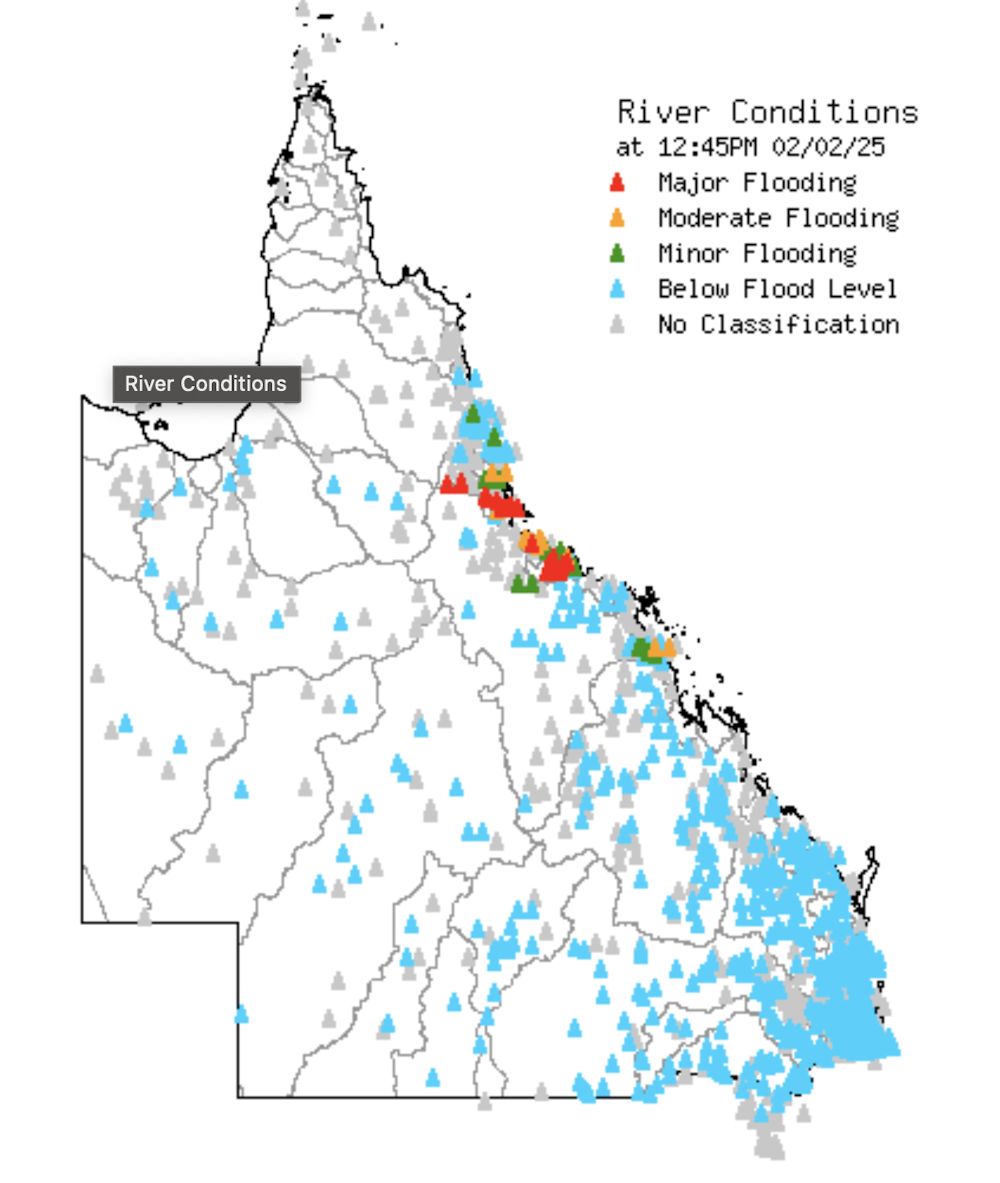
    Major flooding in northern Queensland rivers, as of 12.45pm February 2.
    Bureau of Meteorology

    Residents of Ingham and nearby towns, about 100km from Townsville, are witnessing flooding from the nearby Herbert River. This morning, it was at 15 metres and rising. With more heavy rain forecast for the next 24 hours, the Herbert River is likely to break the 1967 record of 15.2 metres later today.

    Queensland Premier David Crisafulli – who grew up on his family’s sugar cane farm in Ingham – has said the floods will be a “once in a century” event for the town. To make matters worse, authorities say the town has lost power and an extended outage is likely.

    The atmospheric factors behind these floods are very similar to recent floods in the region – and climate change is no doubt playing a role.

    The flood level for the Herbert River at Ingham set in 1967 was 15.2 metres. It’s likely to be breached this afternoon (Sunday February 2).
    Australian Bureau of Meteorology, CC BY

    Where are the floods hitting?

    For many people in Townsville – the largest city in Northern Australia – the unfolding emergency will bring back memories of the devastating February 2019 floods, which caused A$1.24 billion in damage. Residents have been asked to evacuate from several low-lying suburbs which were inundated in 2019.

    Authorities in Townsville asked all residents in the low-lying black zone to evacuate by midday Sunday February 2. Floodwaters could reach second-storey heights in this zone. Residents in pink suburbs have been asked to be on standby.
    Townsville Council, CC BY

    It is too early to say if this flood event will be worse. Fortunately, water levels in the city’s Ross River Dam are much lower than 2019. Townsville Airport has recorded 545mm of rain over the past 48 hours, with many northwest suburbs recording much higher levels. The township of Rollingstone – 60km northwest of Townsville – recorded a whopping 702mm over the 24 hours to 9am Sunday.

    Further north in the Cairns to Daintree region, residents are watching with concern, with many still raw after the record-breaking floods of December 2023.

    What’s behind these floods?

    The ongoing 2025 extreme rainfall event, the 2019 Townsville floods and the 2023 Cairns and Daintree floods are remarkably similar in many ways.

    What triggered each of these floods was prolonged heavy rain falling on the southeast flank of a stationary tropical low weather system. Normally, tropical lows bring wind and rain, but move through quite quickly. But in recent years, we have seen a tendency for these systems to stall, sitting in place over or near land and dumping huge volumes of rain.

    Last week, the Bureau of Meteorology warned that five tropical lows were forming around northern Australia. Most tropical cyclones form from tropical lows embedded in the region’s monsoon trough, a large low pressure band which forms over summer and draws in warm, moist air from the adjacent tropical seas.

    But significant rain events like this one don’t necessarily require a tropical cyclone. Slow-moving deep monsoon lows over land can also deliver huge amounts of rain and widespread flooding.

    These atmospheric conditions allow intense rain bands to form between converging winds: warm, moist winds from the northeast and southeast winds originating from the Coral Sea. As the winds collide, they push the moist air up into the cooler parts of the atmosphere where it condenses and falls as torrential rain.

    More extreme rainfall and higher frequencies of flooded rivers and flash floods around the world have a clear link to climate change and ongoing global heating.

    The main drivers behind these events include warming of the atmosphere. For every 1°C of warming, the atmosphere holds 7% more water vapour. Recent research suggests this figure could be even higher for short duration rainfall.

    Hotter oceans hold more energy, meaning they can also amplify the global water cycle when atmospheric conditions are suitable.

    This year’s latest ever monsoon

    This year, sea surface temperatures in the northwest Coral Sea are 1-2°C above average. Ocean temperatures have risen because of a lack of cloud cover and rain last month. In northwestern Australia, this has given rise to an intensifying marine heatwave.

    This ocean heat is likely to be driven by the Australian monsoon’s latest ever arrival. The monsoon brings heavy rains to northern Australia, triggering the wet season. When it arrives, sea surface temperatures generally drop due to a combination of high cloud cover and the cooling effect of rainwater.

    After a slow start, the North Australian monsoon season is now in full swing.

    The Bureau of Meteorology is monitoring an active monsoon trough for any low pressure systems, which may develop into tropical cyclones over the next week or so. If any cyclone does form, it will gain energy from warmer than usual sea surface temperatures.

    What’s next for north Queensland?

    The flood emergency in north Queensland is far from over. All global circulation models predict heavy rain to continue in the region, extending up towards Cape York and the Gulf Country as an active monsoon surge moves in from Indonesia.

    As river catchments get saturated, more and more water will run off and engorge rivers. Forecasts are for rain to continue well into tonight and the next few days. We are likely to see more flooding in more places this week.

    For the latest updates, check the Bureau of Meteorology’s Queensland flood warnings, ABC Emergency or local ABC radio stations.

    Steve Turton has received funding from the Australian Government.

    ref. What’s driving north Queensland’s deadly, record-breaking floods? – https://theconversation.com/whats-driving-north-queenslands-deadly-record-breaking-floods-248847

    MIL OSI AnalysisEveningReport.nz

  • MIL-Evening Report: What’s driving north Queensland’s record-breaking, deadly floods?

    Source: The Conversation (Au and NZ) – By Steve Turton, Adjunct Professor of Environmental Geography, CQUniversity Australia

    A flooded street in Townsville John Wilkinson/Facebook

    Record-breaking floods across north Queensland have now turned deadly, with one woman drowning while being rescued on Sunday morning. And the floodwaters are still rising, with rain set to continue.

    Over the 48 hours to Sunday, there were reports of up to 1 metre of rainfall in parts of northeast Queensland. The torrential rain continues, particularly in the Herbert Coast region and north to around Tully.

    Major flooding in northern Queensland rivers, as of 12.45pm February 2.
    Bureau of Meteorology

    Residents of Ingham and nearby towns, about 100km from Townsville, are witnessing flooding from the nearby Herbert River. This morning, it was at 15 metres and rising. With more heavy rain forecast for the next 24 hours, the Herbert River is likely to break the 1967 record of 15.2 metres later today.

    Queensland Premier David Crisafulli – who grew up on his family’s sugar cane farm in Ingham – has said the floods will be a “once in a century” event for the town. To make matters worse, authorities say the town has lost power and an extended outage is likely.

    The atmospheric factors behind these floods are very similar to recent floods in the region – and climate change is no doubt playing a role.

    The flood level for the Herbert River at Ingham set in 1967 was 15.2 metres. It’s likely to be breached this afternoon (Sunday February 2).
    Australian Bureau of Meteorology, CC BY

    Where are the floods hitting?

    For many people in Townsville – the largest city in Northern Australia – the unfolding emergency will bring back memories of the devastating February 2019 floods, which caused A$1.24 billion in damage. Residents have been asked to evacuate from several low-lying suburbs which were inundated in 2019.

    Authorities in Townsville asked all residents in the low-lying black zone to evacuate by midday Sunday February 2. Floodwaters could reach second-storey heights in this zone. Residents in pink suburbs have been asked to be on standby.
    Townsville Council, CC BY

    It is too early to say if this flood event will be worse. Fortunately, water levels in the city’s Ross River Dam are much lower than 2019. Townsville Airport has recorded 545mm of rain over the past 48 hours, with many northwest suburbs recording much higher levels. The township of Rollingstone – 60km northwest of Townsville – recorded a whopping 702mm over the 24 hours to 9am Sunday.

    Further north in the Cairns to Daintree region, residents are watching with concern, with many still raw after the record-breaking floods of December 2023.

    What’s behind these floods?

    The ongoing 2025 extreme rainfall event, the 2019 Townsville floods and the 2023 Cairns and Daintree floods are remarkably similar in many ways.

    What triggered each of these floods was prolonged heavy rain falling on the southeast flank of a stationary tropical low weather system. Normally, tropical lows bring wind and rain, but move through quite quickly. But in recent years, we have seen a tendency for these systems to stall, sitting in place over or near land and dumping huge volumes of rain.

    Last week, the Bureau of Meteorology warned that five tropical lows were forming around northern Australia. Most tropical cyclones form from tropical lows embedded in the region’s monsoon trough, a large low pressure band which forms over summer and draws in warm, moist air from the adjacent tropical seas.

    But significant rain events like this one don’t necessarily require a tropical cyclone. Slow-moving deep monsoon lows over land can also deliver huge amounts of rain and widespread flooding.

    These atmospheric conditions allow intense rain bands to form between converging winds: warm, moist winds from the northeast and southeast winds originating from the Coral Sea. As the winds collide, they push the moist air up into the cooler parts of the atmosphere where it condenses and falls as torrential rain.

    More extreme rainfall and higher frequencies of flooded rivers and flash floods around the world have a clear link to climate change and ongoing global heating.

    The main drivers behind these events include warming of the atmosphere. For every 1°C of warming, the atmosphere holds 7% more water vapour. Recent research suggests this figure could be even higher for short duration rainfall.

    Hotter oceans hold more energy, meaning they can also amplify the global water cycle when atmospheric conditions are suitable.

    This year’s latest ever monsoon

    This year, sea surface temperatures in the northwest Coral Sea are 1-2°C above average. Ocean temperatures have risen because of a lack of cloud cover and rain last month. In northwestern Australia, this has given rise to an intensifying marine heatwave.

    This ocean heat is likely to be driven by the Australian monsoon’s latest ever arrival. The monsoon brings heavy rains to northern Australia, triggering the wet season. When it arrives, sea surface temperatures generally drop due to a combination of high cloud cover and the cooling effect of rainwater.

    After a slow start, the North Australian monsoon season is now in full swing.

    The Bureau of Meteorology is monitoring an active monsoon trough for any low pressure systems, which may develop into tropical cyclones over the next week or so. If any cyclone does form, it will gain energy from warmer than usual sea surface temperatures.

    What’s next for north Queensland?

    The flood emergency in north Queensland is far from over. All global circulation models predict heavy rain to continue in the region, extending up towards Cape York and the Gulf Country as an active monsoon surge moves in from Indonesia.

    As river catchments get saturated, more and more water will run off and engorge rivers. Forecasts are for rain to continue well into tonight and the next few days. We are likely to see more flooding in more places this week.

    For the latest updates, check the Bureau of Meteorology’s Queensland flood warnings, ABC Emergency or local ABC radio stations.

    Steve Turton has received funding from the Australian Government.

    ref. What’s driving north Queensland’s record-breaking, deadly floods? – https://theconversation.com/whats-driving-north-queenslands-record-breaking-deadly-floods-248847

    MIL OSI AnalysisEveningReport.nz

  • MIL-Evening Report: Delayed monsoon and a stalled tropical low: what’s behind north Queensland’s record-breaking floods

    Source: The Conversation (Au and NZ) – By Steve Turton, Adjunct Professor of Environmental Geography, CQUniversity Australia

    A flooded street in Townsville John Wilkinson/Facebook

    Record-breaking floods across north Queensland have now turned deadly, with one woman drowning while being rescued on Sunday morning. And the floodwaters are still rising, with rain set to continue.

    Over the 48 hours to Sunday, there were reports of up to 1 metre of rainfall in parts of northeast Queensland. The torrential rain continues, particularly in the Herbert Coast region and north to around Tully.

    Major flooding in northern Queensland rivers, as of 12.45pm February 2.
    Bureau of Meteorology

    Residents of Ingham and nearby towns, about 100km from Townsville, are witnessing flooding from the nearby Herbert River. This morning, it was at 15 metres and rising. With more heavy rain forecast for the next 24 hours, the Herbert River is likely to break the 1967 record of 15.2 metres later today.

    Queensland Premier David Crisafulli – who grew up on his family’s sugar cane farm in Ingham – has said the floods will be a “once in a century” event for the town. To make matters worse, authorities say the town has lost power and an extended outage is likely.

    The atmospheric factors behind these floods are very similar to recent floods in the region – and climate change is no doubt playing a role.

    The flood level for the Herbert River at Ingham set in 1967 was 15.2 metres. It’s likely to be breached this afternoon (Sunday February 2).
    Australian Bureau of Meteorology, CC BY

    Where are the floods hitting?

    For many people in Townsville – the largest city in Northern Australia – the unfolding emergency will bring back memories of the devastating February 2019 floods, which caused A$1.24 billion in damage. Residents have been asked to evacuate from several low-lying suburbs which were inundated in 2019.

    Authorities in Townsville asked all residents in the low-lying black zone to evacuate by midday Sunday February 2. Floodwaters could reach second-storey heights in this zone. Residents in pink suburbs have been asked to be on standby.
    Townsville Council, CC BY

    It is too early to say if this flood event will be worse. Fortunately, water levels in the city’s Ross River Dam are much lower than 2019. Townsville Airport has recorded 545mm of rain over the past 48 hours, with many northwest suburbs recording much higher levels. The township of Rollingstone – 60km northwest of Townsville – recorded a whopping 702mm over the 24 hours to 9am Sunday.

    Further north in the Cairns to Daintree region, residents are watching with concern, with many still raw after the record-breaking floods of December 2023.

    What’s behind these floods?

    The ongoing 2025 extreme rainfall event, the 2019 Townsville floods and the 2023 Cairns and Daintree floods are remarkably similar in many ways.

    What triggered each of these floods was prolonged heavy rain falling on the southeast flank of a stationary tropical low weather system. Normally, tropical lows bring wind and rain, but move through quite quickly. But in recent years, we have seen a tendency for these systems to stall, sitting in place over or near land and dumping huge volumes of rain.

    Last week, the Bureau of Meteorology warned that five tropical lows were forming around northern Australia. Most tropical cyclones form from tropical lows embedded in the region’s monsoon trough, a large low pressure band which forms over summer and draws in warm, moist air from the adjacent tropical seas.

    But significant rain events like this one don’t necessarily require a tropical cyclone. Slow-moving deep monsoon lows over land can also deliver huge amounts of rain and widespread flooding.

    These atmospheric conditions allow intense rain bands to form between converging winds: warm, moist winds from the northeast and southeast winds originating from the Coral Sea. As the winds collide, they push the moist air up into the cooler parts of the atmosphere where it condenses and falls as torrential rain.

    More extreme rainfall and higher frequencies of flooded rivers and flash floods around the world have a clear link to climate change and ongoing global heating.

    The main drivers behind these events include warming of the atmosphere. For every 1°C of warming, the atmosphere holds 7% more water vapour. Recent research suggests this figure could be even higher for short duration rainfall.

    Hotter oceans hold more energy, meaning they can also amplify the global water cycle when atmospheric conditions are suitable.

    This year’s latest ever monsoon

    This year, sea surface temperatures in the northwest Coral Sea are 1-2°C above average. Ocean temperatures have risen because of a lack of cloud cover and rain last month. In northwestern Australia, this has given rise to an intensifying marine heatwave.

    This ocean heat is likely to be driven by the Australian monsoon’s latest ever arrival. The monsoon brings heavy rains to northern Australia, triggering the wet season. When it arrives, sea surface temperatures generally drop due to a combination of high cloud cover and the cooling effect of rainwater.

    After a slow start, the North Australian monsoon season is now in full swing.

    The Bureau of Meteorology is monitoring an active monsoon trough for any low pressure systems, which may develop into tropical cyclones over the next week or so. If any cyclone does form, it will gain energy from warmer than usual sea surface temperatures.

    What’s next for north Queensland?

    The flood emergency in north Queensland is far from over. All global circulation models predict heavy rain to continue in the region, extending up towards Cape York and the Gulf Country as an active monsoon surge moves in from Indonesia.

    As river catchments get saturated, more and more water will run off and engorge rivers. Forecasts are for rain to continue well into tonight and the next few days. We are likely to see more flooding in more places this week.

    For the latest updates, check the Bureau of Meteorology’s Queensland flood warnings, ABC Emergency or local ABC radio stations.

    Steve Turton has received funding from the Australian Government.

    ref. Delayed monsoon and a stalled tropical low: what’s behind north Queensland’s record-breaking floods – https://theconversation.com/delayed-monsoon-and-a-stalled-tropical-low-whats-behind-north-queenslands-record-breaking-floods-248847

    MIL OSI AnalysisEveningReport.nz

  • MIL-Evening Report: Politics with Michelle Grattan: Albanese dumps Nature Positive legislation and considers shrinking the electoral reform bill

    Source: The Conversation (Au and NZ) – By Michelle Grattan, Professorial Fellow, University of Canberra

    Prime Minister Anthony Albanese has dumped – for the second time – the government’s controversial “Nature Positive” legislation, which had run into strong opposition from the Western Australian Labor government.

    Albanese, speaking on The Conversation’s Politics podcast ahead of a fortnight parliamentary sitting starting next week, said there was not enough support for the legislation, which had been on the draft list of bills for next week, circulated by the government.

    This is the second time the Prime Minister has pulled back from the legislation. Late last year he also said it did not have enough support, despite Environment Minister Tanya Plibersek believing she had a deal with the Greens and crossbench for its passage.

    The legislation would set up a federal Environment Protection Agency, which has riled miners who claim it would add to bureaucracy and delay approvals.

    In recent days WA premier Roger Cook, who was instrumental in heading off the legislation last year, has been lobbying the federal government again. WA faces an election on March 8.

    In an interview on Saturday, Albanese told The Conversation: “I can’t see that it has a path to success. So at this stage, I can say that we won’t be proceeding with it this term. There simply isn’t a [Senate] majority, as there wasn’t last year.

    “The Greens Party on one hand have changed their views”, making another demand during the week, he said. While the Liberals – who began the review of the present Environment Protection Act – “have chosen an obstructionist path,” he said.

    Albanese said the government would continue to discuss the issue with stakeholders in the next term of parliament.

    “Does the environment and protection act need revision from where it was last century? Quite clearly it does. Everyone says that that’s the case. It’s a matter of working to, in a practical way, a commonsense reform that delivers something that supports industry.

    “I want to see faster approvals. We in fact have speeded up approvals substantially.

    “But we also want proper sustainability as well.”

    Albanese also flagged the government might cut back its legislation to reform rules covering electoral donations and spending in order to get a deal to pass it.

    Special Minister of State Don Farrell and the Liberals had been on the brink of a deal in the final week of parliament last year, but negotiations imploded at the eleventh hour.

    Albanese told The Conversation he hoped the legislation could still be passed. “I spoke with [Farrell] today, he is consulting with people across the parliament.

    “What I would say is that we are looking to get reform through. Now whether that is a bigger, broader reform or whether it needs to be narrowed down, we’ll wait and see.

    “But we’re very serious about the reform which would lower the donation declarations, that would put a cap on donations, a cap on expenditure, that would lead to more transparency as well. It’s an important part of supporting our democracy.

    “We see overseas and we’ve seen people like Clive Palmer here spend over $100 million on a campaign. That’s a distortion of democracy – if one person can spend that much money to try to influence an election and we don’t find out all of that information till much later on.”

    The reforms would not start operating until the next term of parliament.

    Albanese said he thought the reform would have “overwhelming support” with the public “and I hope that it receives overwhelming support in the Senate as well”.

    Michelle Grattan does not work for, consult, own shares in or receive funding from any company or organisation that would benefit from this article, and has disclosed no relevant affiliations beyond their academic appointment.

    ref. Politics with Michelle Grattan: Albanese dumps Nature Positive legislation and considers shrinking the electoral reform bill – https://theconversation.com/politics-with-michelle-grattan-albanese-dumps-nature-positive-legislation-and-considers-shrinking-the-electoral-reform-bill-248848

    MIL OSI AnalysisEveningReport.nz

  • MIL-Evening Report: The far-right is rising at a crucial time in Germany, boosted by Elon Musk

    Source: The Conversation (Au and NZ) – By Matt Fitzpatrick, Professor in International History, Flinders University

    With only a few weeks until Germany’s election, Elon Musk has unambiguously thrown his support behind the far-right Alternative for Germany (AfD) party. In a video address to a party rally last week, he appeared to urge Germans to “move on” from any “past guilt” related to the Holocaust.

    It’s good to be proud of German culture, German values, and not to lose that in some sort of multiculturalism that dilutes everything.

    Troublingly, the AfD is now firmly entrenched as Germany’s second-most popular political party, behind the centre-right Christian Democratic Union (CDU). Like all parties in German elections, however, it cannot win an outright majority. It is also unlikely to be invited to join any ruling coalition that emerges from the February 23 election.

    But the AfD’s anti-migrant, anti-government sloganeering has already seriously distorted Germany’s public debate and democratic culture, leaving many to ask whether it even needs to win elections to see its policies implemented.

    This was evident following a dramatic week in Germany’s Bundestag.

    First, in a radical break with Germany’s political norms, opposition leader Friedrich Merz deliberately drew on the votes of the AfD on Wednesday to ram a radical anti-asylum seeker motion through the parliament.

    It was the first time in the history of the Bundestag that a parliamentary majority was reached with the help of the far right. Merz’s action was widely condemned as a “taboo-breaking” step towards legitimising the AfD.

    Merz tried to take this a step further with a far-reaching bill to tighten immigration controls on Friday. Although the bill narrowly failed, all of the AfD voted with Merz. Twelve members of his own CDU party refused to back him.

    Merz’s courting of the far right is widely seen as politically unnecessary, given his conservative CDU is already leading the national polls, making him the favourite to succeed the Social Democratic Party (SDP)‘s Olaf Scholz as chancellor.

    This raises a couple crucial questions heading into the election. Is it insiders or outsiders that are playing the biggest role in bringing the far right into the mainstream? And just how big a role will the AfD play after the election?

    The Musk effect

    Musk’s embrace of the AfD should come as no surprise, given the integral part he played in Donald Trump’s election victory in the United States. In the German context, however, his behaviour and statements have taken on darker hues.

    Germans know only too well what is at stake when democracy is eroded by those who abuse its freedoms to attack it. Had Musk’s now notorious Nazi salutes following Trump’s inauguration been performed in Berlin, for example, he might have faced up to three years in prison.

    The catchphrase “never again” has underpinned German politics since the second world war. Yet, the response to Musk’s recent provocations was oddly muted in some sections of the German media.

    The German tabloid Bild made embarrassing excuses for his Hitlerian salute, while others spoke vaguely of a “questionable gesture”.

    With a few notable exceptions, it was left to activists to remind Germans of the severity of this gesture – projecting an image of Musk’s salute on a German Tesla plant, alongside the word “heil”.

    Given the seriousness with which Germany patrols representations of its Nazi past, it was surprising just how few journalists were prepared to state without equivocation that “a Hitler salute is a Hitler salute is a Hitler salute”.

    Merz’s embrace of the far right

    Initially, there were some signs Germany’s main political leaders would decry Musk’s attempts to normalise far-right politics in the country.

    When Musk called the AfD the “last spark of hope” in December, both Scholz and Merz quickly condemned his meddling.

    Scholz has continued to label Musk’s blatant attempts to influence German politics as “unacceptable” and “disgusting”.

    Merz claims to be keeping his distance from Musk. But it appears his strategy for winning the election is not far from what Musk is suggesting – mimicking AfD policies and collaborating with the party on anti-immigration votes.

    In his most radical break with the centrism that characterised the CDU under former Chancellor Angela Merkel, Merz cracked the “firewall” against working with the far-right this week. Knowing just what it meant, he used the AfD’s support to pass the starkly worded nationalist border protection motion in the Bundestag.

    The AfD publicly celebrated their good fortune, calling it a “historic day for Germany”.

    Democratic party leaders, meanwhile, registered their shock and dismay. Merkel herself spoke out against Merz, saying it was “wrong” to “knowingly” work with the AfD.

    Her intervention appears to have been critical to the immigration bill failing on Friday, with many of her former supporters in the CDU withholding their votes.

    What AfD’s rise could mean

    Given the two votes in the past week and Musk’s high-profile intervention, many in Germany now fear a CDU victory in the election could signal more collaboration with the AfD.

    The Left Party has denounced Merz as an AfD puppet and demanded Musk be forbidden from entering Germany.

    The Greens’ Robert Habeck, Germany’s vice chancellor, has said Merz’s nationalist coalition would “destroy Europe”. He has also warned Musk to keep his “hands off our democracy”, prompting Musk to label Habeck “a traitor to the German people”.

    Musk is by no means the cause of the AfD’s popularity, but his embrace of the extremist party has given it a global profile and credibility in circles that might not have otherwise considered supporting it.

    Musk has been a controversial figure in Germany ever since his Tesla “gigafactory” arrived in Brandenburg and was promptly accused of felling 500,000 trees and irreparably damaging precious groundwater reserves. Accusations of Tesla breaching German labour laws and even conducting surprise checks on sick workers have also not endeared him to progressive Germans.

    As some commentators have suggested, it is probably not coincidental the AfD’s plans for the German economy would benefit Musk’s business interests. Economic self-interest alone seems insufficient, however, to explain why Musk has gravitated to the extreme right.

    The same might be said of Merz. Electoral calculations alone cannot explain his risky courting of the far right. He has long been the frontrunner to win the next election. Cosying up to the AfD will only make it harder to form a coalition with either Scholz’s Social Democratic Party or the Greens.

    If these two parties refuse to deal with Merz, the only other bloc large enough to deliver his party control of the government would be the AfD. Would he go so far?

    Whether it is formally part of the next government or not, the AfD and its camp followers (such as Musk) could be set to have a much bigger influence on German politics. How this will change Germany in the long term remains to be seen.

    Matt Fitzpatrick receives funding from the Australian Research Council.

    ref. The far-right is rising at a crucial time in Germany, boosted by Elon Musk – https://theconversation.com/the-far-right-is-rising-at-a-crucial-time-in-germany-boosted-by-elon-musk-247895

    MIL OSI AnalysisEveningReport.nz

  • MIL-OSI Global: Trump’s 25% tariffs on Canada and Mexico amp up the risk of a broader trade war

    Source: The Conversation – Global Perspectives – By Markus Wagner, Professor of Law and Director of the UOW Transnational Law and Policy Centre, University of Wollongong

    It’s official. On February 1, US President Donald Trump will introduce a sweeping set of new 25% tariffs on imports from Canada and Mexico. China will also face new tariffs of 10%.

    During the presidential campaign, Trump threatened tariffs against all three countries, claiming they weren’t doing enough to prevent an influx of “drugs, in particular fentanyl” into the US, while also accusing Canada and Mexico of not doing enough to stop “illegal aliens”.

    There will be some nuance. On Friday, Trump said tariffs on oil and gas would come into effect later, on February 18, and that Canadian oil would likely face a lower tariff of 10%.

    This may only be the first move against China. Trump has previously threatened the country with 60% tariffs, asserting this will bring jobs back to America.

    But the US’ move against its neighbours will have an almost immediate impact on the three countries involved and the landscape of North American trade. It marks the beginning of what could be a radical reshaping of international trade and political governance around the world.

    What Trump wants from Canada and Mexico

    While border security and drug trade concerns are the official rationale for this move, Trump’s tariffs have broader motivations.

    The first one is protectionist. In all his presidential campaigning, Trump portrayed himself as a champion of US workers. Back in October, he said tariff was “the most beautiful word in the dictionary”.

    Trump hasn’t hidden his fondness for protectionist trade measures.

    This reflects the ongoing scepticism toward international trade that Trump – and politicians more generally on both ends of the political spectrum in the US – have held for some time.

    It’s a significant shift in the close trade links between these neighbours. The US, Mexico and Canada are parties to the successor of the North American Free Trade Agreement (NAFTA): the United States-Mexico-Canada Agreement (USMCA).

    Trump has not hidden his willingness to use tariffs as a weapon to pressure other countries to achieve unrelated geopolitical goals. This is the epitome of what a research project team I co-lead calls “Weaponised Trade”.

    This was on full display in late January. When the president of Colombia prohibited US military airplanes carrying Colombian nationals deported from the US to land, Trump successfully used the threat of tariffs to force Colombia to reverse course.


    Read more:
    What are tariffs?


    The economic stakes

    The volume of trade between the US, Canada, and Mexico is enormous, encompassing a wide range of goods and services. Some of the biggest sectors are automotive manufacturing, energy, agriculture, and consumer goods.

    In 2022, the value of all goods and services traded between the US and Canada came to about US$909 billion (A$1.46 trillion). Between the US and Mexico that same year, it came to more than US$855 billion (A$1.37 trillion).

    One of the hardest hit industries will be the automotive industry, which depends on cross-border trade. A car assembled in Canada, Mexico or the US relies heavily on a supply of parts from throughout North America.

    Tariffs will raise costs throughout this supply chain, which could lead to higher prices for consumers and make US-based manufacturers less competitive.

    Auto manufacturing stands to be hit hard by Trump’s tariffs.
    Around the World Photos/Shutterstock

    There could also be ripple effects for agriculture. The US exports billions of dollars in corn, soybeans, and meat to Canada and Mexico, while importing fresh produce such as avocados and tomatoes from Mexico.

    Tariffs may provoke retaliatory measures, putting farmers and food suppliers in all three countries at risk.

    Trump’s decision to delay and reduce tariffs on oil was somewhat predictable. US imports of Canadian oil have increased steadily over recent decades, meaning tariffs would immediately bite US consumers at the fuel pump.

    We’ve been here before

    This isn’t the first time the world has dealt with Trump’s tariff-heavy approach to trade policy. Looking back to his first term may provide some clues about what we might expect.

    In 2018, the US levied duties on steel and aluminium. Both Canada and Mexico are both major exporters of steel to the US.

    In his first term, Trump imposed major tariffs on US steel imports.
    ABCDstock/Shutterstock

    Canada and Mexico imposed retaliatory tariffs. Ultimately, all countries removed tariffs on steel and aluminium in the process of finalising the United States-Mexico-Canada Agreement.

    Notably, though, many of Trump’s trade policies remained in place even after President Joe Biden took office.

    This signalled a bipartisan scepticism of unfettered trade and a shift toward on-shoring or re-shoring in US policy circles.

    The options for Canada and Mexico

    This time, Canada and Mexico’s have again responded with threats of retaliatory tariffs.

    But they’ve also made attempts to mollify Trump – such as Canada launching a “crackdown” on fentanyl trade.

    Generally speaking, responses to these tariffs could range from measured diplomacy to aggressive retaliation. Canada and Mexico may target politically sensitive industries such as agriculture or gasoline, where Trump’s base could feel the pinch.

    There are legal options, too. Canada and Mexico could pursue legal action through the United States-Mexico-Canada Agreement’s dispute resolution mechanisms or the World Trade Organization (WTO).

    Both venues provide pathways for challenging unfair trade practices. But these practices can be slow-moving, uncertain in their outcomes and are susceptible to being ignored.

    A more long-term option for businesses in Canada and Mexico is to diversify their trade relationships to reduce reliance on the US market. However, the facts of geography, and the large base of consumers in the US mean that’s easier said than done.

    The looming threat of a global trade war

    Trump’s latest tariffs underscore a broader trend: the widening of the so-called “Overton window” to achieve unrelated geopolitical goals.

    The Overton Window refers to the range of policy options politicians have because they are accepted among the general public.

    Arguments for bringing critical industries back to the US, protecting domestic jobs, and reducing reliance on foreign supply chains gained traction after the ascent of China as a geopolitical and geoeconomic rival.

    These arguments picked up steam during the COVID-19 pandemic and have increasingly been turned into actual policy.

    The potential for a broader trade war looms large. Trump’s short-term goal may be to leverage tariffs as a tool to secure concessions from other jurisdictions.

    Trump’s threats against Denmark – in his quest to obtain control over Greenland – are a prime example. The European Union (EU), a far more potent economic player, has pledged its support for Denmark.

    A North American trade war – foreshadowed by the Canadian and Mexican governments – might then only be harbinger of things to come: significant economic harm, the erosion of trust among trading partners, and increased volatility in global markets.

    Markus Wagner receives funding from the Department of Defence, Australia as a Chief Investigator on a project titled Weaponised Trade.

    ref. Trump’s 25% tariffs on Canada and Mexico amp up the risk of a broader trade war – https://theconversation.com/trumps-25-tariffs-on-canada-and-mexico-amp-up-the-risk-of-a-broader-trade-war-248667

    MIL OSI – Global Reports

  • MIL-OSI Global: The far-right is rising at a crucial time in Germany, boosted by Elon Musk

    Source: The Conversation – Global Perspectives – By Matt Fitzpatrick, Professor in International History, Flinders University

    With only a few weeks until Germany’s election, Elon Musk has unambiguously thrown his support behind the far-right Alternative for Germany (AfD) party. In a video address to a party rally last week, he appeared to urge Germans to “move on” from any “past guilt” related to the Holocaust.

    It’s good to be proud of German culture, German values, and not to lose that in some sort of multiculturalism that dilutes everything.

    Troublingly, the AfD is now firmly entrenched as Germany’s second-most popular political party, behind the centre-right Christian Democratic Union (CDU). Like all parties in German elections, however, it cannot win an outright majority. It is also unlikely to be invited to join any ruling coalition that emerges from the February 23 election.

    But the AfD’s anti-migrant, anti-government sloganeering has already seriously distorted Germany’s public debate and democratic culture, leaving many to ask whether it even needs to win elections to see its policies implemented.

    This was evident following a dramatic week in Germany’s Bundestag.

    First, in a radical break with Germany’s political norms, opposition leader Friedrich Merz deliberately drew on the votes of the AfD on Wednesday to ram a radical anti-asylum seeker motion through the parliament.

    It was the first time in the history of the Bundestag that a parliamentary majority was reached with the help of the far right. Merz’s action was widely condemned as a “taboo-breaking” step towards legitimising the AfD.

    Merz tried to take this a step further with a far-reaching bill to tighten immigration controls on Friday. Although the bill narrowly failed, all of the AfD voted with Merz. Twelve members of his own CDU party refused to back him.

    Merz’s courting of the far right is widely seen as politically unnecessary, given his conservative CDU is already leading the national polls, making him the favourite to succeed the Social Democratic Party (SDP)‘s Olaf Scholz as chancellor.

    This raises a couple crucial questions heading into the election. Is it insiders or outsiders that are playing the biggest role in bringing the far right into the mainstream? And just how big a role will the AfD play after the election?

    The Musk effect

    Musk’s embrace of the AfD should come as no surprise, given the integral part he played in Donald Trump’s election victory in the United States. In the German context, however, his behaviour and statements have taken on darker hues.

    Germans know only too well what is at stake when democracy is eroded by those who abuse its freedoms to attack it. Had Musk’s now notorious Nazi salutes following Trump’s inauguration been performed in Berlin, for example, he might have faced up to three years in prison.

    The catchphrase “never again” has underpinned German politics since the second world war. Yet, the response to Musk’s recent provocations was oddly muted in some sections of the German media.

    The German tabloid Bild made embarrassing excuses for his Hitlerian salute, while others spoke vaguely of a “questionable gesture”.

    With a few notable exceptions, it was left to activists to remind Germans of the severity of this gesture – projecting an image of Musk’s salute on a German Tesla plant, alongside the word “heil”.

    Given the seriousness with which Germany patrols representations of its Nazi past, it was surprising just how few journalists were prepared to state without equivocation that “a Hitler salute is a Hitler salute is a Hitler salute”.

    Merz’s embrace of the far right

    Initially, there were some signs Germany’s main political leaders would decry Musk’s attempts to normalise far-right politics in the country.

    When Musk called the AfD the “last spark of hope” in December, both Scholz and Merz quickly condemned his meddling.

    Scholz has continued to label Musk’s blatant attempts to influence German politics as “unacceptable” and “disgusting”.

    Merz claims to be keeping his distance from Musk. But it appears his strategy for winning the election is not far from what Musk is suggesting – mimicking AfD policies and collaborating with the party on anti-immigration votes.

    In his most radical break with the centrism that characterised the CDU under former Chancellor Angela Merkel, Merz cracked the “firewall” against working with the far-right this week. Knowing just what it meant, he used the AfD’s support to pass the starkly worded nationalist border protection motion in the Bundestag.

    The AfD publicly celebrated their good fortune, calling it a “historic day for Germany”.

    Democratic party leaders, meanwhile, registered their shock and dismay. Merkel herself spoke out against Merz, saying it was “wrong” to “knowingly” work with the AfD.

    Her intervention appears to have been critical to the immigration bill failing on Friday, with many of her former supporters in the CDU withholding their votes.

    What AfD’s rise could mean

    Given the two votes in the past week and Musk’s high-profile intervention, many in Germany now fear a CDU victory in the election could signal more collaboration with the AfD.

    The Left Party has denounced Merz as an AfD puppet and demanded Musk be forbidden from entering Germany.

    The Greens’ Robert Habeck, Germany’s vice chancellor, has said Merz’s nationalist coalition would “destroy Europe”. He has also warned Musk to keep his “hands off our democracy”, prompting Musk to label Habeck “a traitor to the German people”.

    Musk is by no means the cause of the AfD’s popularity, but his embrace of the extremist party has given it a global profile and credibility in circles that might not have otherwise considered supporting it.

    Musk has been a controversial figure in Germany ever since his Tesla “gigafactory” arrived in Brandenburg and was promptly accused of felling 500,000 trees and irreparably damaging precious groundwater reserves. Accusations of Tesla breaching German labour laws and even conducting surprise checks on sick workers have also not endeared him to progressive Germans.

    As some commentators have suggested, it is probably not coincidental the AfD’s plans for the German economy would benefit Musk’s business interests. Economic self-interest alone seems insufficient, however, to explain why Musk has gravitated to the extreme right.

    The same might be said of Merz. Electoral calculations alone cannot explain his risky courting of the far right. He has long been the frontrunner to win the next election. Cosying up to the AfD will only make it harder to form a coalition with either Scholz’s Social Democratic Party or the Greens.

    If these two parties refuse to deal with Merz, the only other bloc large enough to deliver his party control of the government would be the AfD. Would he go so far?

    Whether it is formally part of the next government or not, the AfD and its camp followers (such as Musk) could be set to have a much bigger influence on German politics. How this will change Germany in the long term remains to be seen.

    Matt Fitzpatrick receives funding from the Australian Research Council.

    ref. The far-right is rising at a crucial time in Germany, boosted by Elon Musk – https://theconversation.com/the-far-right-is-rising-at-a-crucial-time-in-germany-boosted-by-elon-musk-247895

    MIL OSI – Global Reports

  • MIL-Evening Report: Trump’s 25% tariffs on Canada and Mexico amp up the risk of a broader trade war

    Source: The Conversation (Au and NZ) – By Markus Wagner, Professor of Law and Director of the UOW Transnational Law and Policy Centre, University of Wollongong

    It’s official. On February 1, US President Donald Trump will introduce a sweeping set of new 25% tariffs on imports from Canada and Mexico. China will also face new tariffs of 10%.

    During the presidential campaign, Trump threatened tariffs against all three countries, claiming they weren’t doing enough to prevent an influx of “drugs, in particular fentanyl” into the US, while also accusing Canada and Mexico of not doing enough to stop “illegal aliens”.

    There will be some nuance. On Friday, Trump said tariffs on oil and gas would come into effect later, on February 18, and that Canadian oil would likely face a lower tariff of 10%.

    This may only be the first move against China. Trump has previously threatened the country with 60% tariffs, asserting this will bring jobs back to America.

    But the US’ move against its neighbours will have an almost immediate impact on the three countries involved and the landscape of North American trade. It marks the beginning of what could be a radical reshaping of international trade and political governance around the world.

    What Trump wants from Canada and Mexico

    While border security and drug trade concerns are the official rationale for this move, Trump’s tariffs have broader motivations.

    The first one is protectionist. In all his presidential campaigning, Trump portrayed himself as a champion of US workers. Back in October, he said tariff was “the most beautiful word in the dictionary”.

    Trump hasn’t hidden his fondness for protectionist trade measures.

    This reflects the ongoing scepticism toward international trade that Trump – and politicians more generally on both ends of the political spectrum in the US – have held for some time.

    It’s a significant shift in the close trade links between these neighbours. The US, Mexico and Canada are parties to the successor of the North American Free Trade Agreement (NAFTA): the United States-Mexico-Canada Agreement (USMCA).

    Trump has not hidden his willingness to use tariffs as a weapon to pressure other countries to achieve unrelated geopolitical goals. This is the epitome of what a research project team I co-lead calls “Weaponised Trade”.

    This was on full display in late January. When the president of Colombia prohibited US military airplanes carrying Colombian nationals deported from the US to land, Trump successfully used the threat of tariffs to force Colombia to reverse course.


    Read more:
    What are tariffs?


    The economic stakes

    The volume of trade between the US, Canada, and Mexico is enormous, encompassing a wide range of goods and services. Some of the biggest sectors are automotive manufacturing, energy, agriculture, and consumer goods.

    In 2022, the value of all goods and services traded between the US and Canada came to about US$909 billion (A$1.46 trillion). Between the US and Mexico that same year, it came to more than US$855 billion (A$1.37 trillion).

    One of the hardest hit industries will be the automotive industry, which depends on cross-border trade. A car assembled in Canada, Mexico or the US relies heavily on a supply of parts from throughout North America.

    Tariffs will raise costs throughout this supply chain, which could lead to higher prices for consumers and make US-based manufacturers less competitive.

    Auto manufacturing stands to be hit hard by Trump’s tariffs.
    Around the World Photos/Shutterstock

    There could also be ripple effects for agriculture. The US exports billions of dollars in corn, soybeans, and meat to Canada and Mexico, while importing fresh produce such as avocados and tomatoes from Mexico.

    Tariffs may provoke retaliatory measures, putting farmers and food suppliers in all three countries at risk.

    Trump’s decision to delay and reduce tariffs on oil was somewhat predictable. US imports of Canadian oil have increased steadily over recent decades, meaning tariffs would immediately bite US consumers at the fuel pump.

    We’ve been here before

    This isn’t the first time the world has dealt with Trump’s tariff-heavy approach to trade policy. Looking back to his first term may provide some clues about what we might expect.

    In 2018, the US levied duties on steel and aluminium. Both Canada and Mexico are both major exporters of steel to the US.

    In his first term, Trump imposed major tariffs on US steel imports.
    ABCDstock/Shutterstock

    Canada and Mexico imposed retaliatory tariffs. Ultimately, all countries removed tariffs on steel and aluminium in the process of finalising the United States-Mexico-Canada Agreement.

    Notably, though, many of Trump’s trade policies remained in place even after President Joe Biden took office.

    This signalled a bipartisan scepticism of unfettered trade and a shift toward on-shoring or re-shoring in US policy circles.

    The options for Canada and Mexico

    This time, Canada and Mexico’s have again responded with threats of retaliatory tariffs.

    But they’ve also made attempts to mollify Trump – such as Canada launching a “crackdown” on fentanyl trade.

    Generally speaking, responses to these tariffs could range from measured diplomacy to aggressive retaliation. Canada and Mexico may target politically sensitive industries such as agriculture or gasoline, where Trump’s base could feel the pinch.

    There are legal options, too. Canada and Mexico could pursue legal action through the United States-Mexico-Canada Agreement’s dispute resolution mechanisms or the World Trade Organization (WTO).

    Both venues provide pathways for challenging unfair trade practices. But these practices can be slow-moving, uncertain in their outcomes and are susceptible to being ignored.

    A more long-term option for businesses in Canada and Mexico is to diversify their trade relationships to reduce reliance on the US market. However, the facts of geography, and the large base of consumers in the US mean that’s easier said than done.

    The looming threat of a global trade war

    Trump’s latest tariffs underscore a broader trend: the widening of the so-called “Overton window” to achieve unrelated geopolitical goals.

    The Overton Window refers to the range of policy options politicians have because they are accepted among the general public.

    Arguments for bringing critical industries back to the US, protecting domestic jobs, and reducing reliance on foreign supply chains gained traction after the ascent of China as a geopolitical and geoeconomic rival.

    These arguments picked up steam during the COVID-19 pandemic and have increasingly been turned into actual policy.

    The potential for a broader trade war looms large. Trump’s short-term goal may be to leverage tariffs as a tool to secure concessions from other jurisdictions.

    Trump’s threats against Denmark – in his quest to obtain control over Greenland – are a prime example. The European Union (EU), a far more potent economic player, has pledged its support for Denmark.

    A North American trade war – foreshadowed by the Canadian and Mexican governments – might then only be harbinger of things to come: significant economic harm, the erosion of trust among trading partners, and increased volatility in global markets.

    Markus Wagner receives funding from the Department of Defence, Australia as a Chief Investigator on a project titled Weaponised Trade.

    ref. Trump’s 25% tariffs on Canada and Mexico amp up the risk of a broader trade war – https://theconversation.com/trumps-25-tariffs-on-canada-and-mexico-amp-up-the-risk-of-a-broader-trade-war-248667

    MIL OSI AnalysisEveningReport.nz

  • MIL-OSI Global: The Austin 7 is back – a short history of the iconic British car that changed the automotive industry

    Source: The Conversation – UK – By Tom Stacey, Senior Lecturer in Operations and Supply Chain Management, Anglia Ruskin University

    In perhaps one of the greatest brand comeback stories in automotive since the Fiat 500 in 2007, British car company Austin announced the return of the Austin Arrow.

    Its name is an unashamed reference to one of the most memorable Austin 7 models – first introduced in the 1920s the Arrow was the original “everyman sportscar”, before the muscle cars (think of the Dodge Challenger) of the US became popular in the 1960s. Now reimagined as an electric Vehicle (EV), the Arrow is designed and made in the UK and aims to be to 2020s consumers what the original was 90 years ago.

    A number of cars are synonymous with the British car industry. In fact, as a small nation, Britain punches above its weight when it comes to classic automobile brands – The Mini, the Range Rover, London black cabs, James Bond’s Aston Martins, and even the London red bus. However, if one car can be credited for creating the dawn of the motor vehicle in the UK, it would be the diminutive Austin 7.

    The car was created in the 1920s at the time when Austin was struggling. New laws were pushing manufacturers to produce smaller, less powerful cars. But Austin’s board of directors didn’t support a cheap, small car with low profit margins. Austin was known for its larger, luxury products.

    However, Sir Herbert Austin and his 18-year-old apprentice Stanley Edge decided to secretly create a small car. Thank god they didn’t heed the board, because they ended up creating the greatest democratising automotive product Britain had ever seen (until they repeated it with the Austin Mini).

    The reason why products such as the Austin 7 come to define their period is rarely due to their technical prowess or exhilarating performance – it’s because they bring to the masses a technology that is both useful and traditionally seen as out of reach.

    The Austin 7 was a bit like the iPhone. There were smartphones that came before it, like the Sony Ericsson p800. However, these were considered expensive and out of reach for the average consumer. The Iphone did the same thing but at a cheaper price and so came to be the definitive smartphone.


    Looking for something good? Cut through the noise with a carefully curated selection of the latest releases, live events and exhibitions, straight to your inbox every fortnight, on Fridays. Sign up here.


    With the Austin 7, Herbert Austin’s team applied the key lessons from Ford’s Model T – creating a simple, modestly powered car with just enough features for mass appeal while incorporating clever design elements that earned the respect of car enthusiasts.

    When the Austin 7 was unveiled in July 1922, it was priced at just £165, when an Austin 20 was between £600 and £700. At a time when the average British worker earned around £5 per week, the only real affordable car had been Ford’s basic and utilitarian Model T at around £250.

    The 7’s ingenious design was the key to its success. With a shared base frame for the car, it could be a four-seater family car, a stylish coupe, or even a racing car.

    This cheap, tiny car not only was a legend in its own right and familiar around the world, but it influenced other legends too.

    Colin Chapman, the founder of Lotus Cars, based his first Lotus 1 on the Austin 7. What is less known is that German car manufacturer BMW built Austin 7s under licence in the 1920s and 30s but called them “Dixis”. Nissan did the same in Japan in the pre-war period. Such licensing deals helped set up both manufacturers’ future success as the powerhouses they are today.

    Austin 7s were produced all over Europe, Asia and even in Australia. The 7 was also produced in the US as the “American Bantam” and its design contributed to the “Willy’s Jeep”, one of the US’s most famous vehicles.

    Ultimately, the beginning of the second world war marked the end of Austin 7 production as the Austin factory at Longbridge, near Birmingham, needed to be repurposed to produce munitions. When the war ended, tastes for vehicles had changed and factories started to produce more modern designs, and not those from the 1920s, marking the end of a British automotive icon in 1939.

    Now it’s back, thanks to the engineer John Stubbs who bought the Austin brand after noticing the brand and trademarks were available. The rights to these had been owned by the Nanjing Automobile Group, which bought MG Rover when it collapsed in 2005. However, Nanjing had let these lapse and Stubbs bought them for £170 in 2015.

    The new Essex-based Austin Motor Company aims to recreate this classic brand, tugging at the heartstrings of those looking nostalgically at Britain’s automotive heyday. The announcement featured images of fun, cheap (£31,000) and light cars driving around the B-roads of Britain, or perhaps being taken to a racetrack for an amateur competition, harking back to earlier days. However, this car is thoroughly modern, featuring an electric motor.

    The new Austin Arrow is not meant to be the usable “everyman” car the original 7 was. For starters, to be compliant with quadricycle (a micro car with less than 6kW of power and an unladen mass no more than 425 kg) legislation it is limited to 60mph as a top speed and the range will be a maximum of 100 miles on one charge.

    However, as that fun, racy, open-top car that it’s predecessors were, it very much captures the spirit of the original Austin 7 Arrow.

    Tom Stacey does not work for, consult, own shares in or receive funding from any company or organisation that would benefit from this article, and has disclosed no relevant affiliations beyond their academic appointment.

    ref. The Austin 7 is back – a short history of the iconic British car that changed the automotive industry – https://theconversation.com/the-austin-7-is-back-a-short-history-of-the-iconic-british-car-that-changed-the-automotive-industry-248712

    MIL OSI – Global Reports

  • MIL-OSI Global: Leonardo da Vinci’s incredible studies of human anatomy still don’t get the recognition they deserve

    Source: The Conversation – UK – By Michael Carroll, Reader / Associate Professor in Reproductive Science, Manchester Metropolitan University

    Wikimedia, CC BY-SA

    The mere mention of Leonardo da Vinci evokes genius. We know him as a polymath whose interests spanned astronomy, geology, hydrology, engineering and physics. As a painter, his Mona Lisa and Last Supper are considered works of mastery.

    Yet one great achievement that frequently goes unrecognised is his studies of human anatomy. More than 500 years after his death, it’s time this changed.

    Leonardo is thought to have been born on April 15 1452 in Anchiano, a small hamlet near the town of Vinci, close to Florence. His mother was a 16-year-old peasant girl called Caterina di Meo Lippi, and his father was Ser Piero da Vinci, a 26-year-old notary.

    Being illegitimate, the young Leonardo was only permitted an elementary education in reading, writing and arithmetic. He was also barred from becoming a notary, but this worked out to his advantage. Instead of being constrained by life as an officiate, he was free to be creative and explore the world of nature, satisfying his insatiable appetite for knowledge.

    The human anatomy became one of his great interests. This was seeded during his time as an apprentice in Andrea del Verrocchio’s bottega (studio) in Florence, where studying the human form was crucial for achieving realistic depictions.

    Creating detailed anatomical drawings required precise sketching skills and the ability to accurately depict the structures being studied. As Leonardo’s fascination grew, he would delve deeper into anatomy as a discipline.

    Pioneers

    This traces back to the 2nd-century Greek physician Galen of Pergamum, whose anatomical descriptions were mostly based on insights he had gained through dissecting animals and studying wounded gladiators. However, he did no human dissections – they were illegal during his time – and many of his extrapolations from animal to human anatomy were wrong.

    Galen dissecting a monkey, Veloso Salgado (1906).
    wikimedia

    It wasn’t until the 14th century that anatomy and medical science advanced thanks to the start of systematic human cadaver dissections. The physician Mondino de Liuzzi, who practised the first public dissections of human cadavers at the University of Bologna, published the first modern anatomical text, Anathomia Corporis Humani, in 1316.

    The text was mostly descriptive in nature, like that of Galen, lacking drawings to illustrate anatomy. Subsequent texts on the subject during the 14th and early 15th centuries did contain drawings, but these were basic and unrealistic.

    Leonardo advanced this discipline through his remarkable observational skills, knowledge of perspective and, most notably, his outstanding drawing abilities. His anatomical sketches were unlike anything seen before. For example, his sketches of the muscles of the arms and human skull are comparable to illustrations in today’s medical anatomy texts.

    Sketches of human muscles, 1515.
    Italian Renaissance Art, CC BY-SA

    According to Leonardo’s biographer, Giorgio Vasari, the artist “was one of the first who, with Galen’s teachings, began to bring honour to medical studies and to shed real light upon anatomy, which had until that time been shrouded in the deepest shadows of ignorance”.

    Leonardo was the first to depict a detailed study of the human spine, showing its natural curvature and correctly numbered vertebrae. He drew and described nearly all the bones and muscles of the body in beautiful detail, as well as investigating their biomechanics.

    His studies on the heart combined both experimentation and observation. Using an ox’s heart to understand blood flow though the aortic valves, Leonardo poured molten wax into the surrounding cavities to make a wax cast, from which a glass model of the heart was made. He then pumped water mixed with grass seeds through this model to visualise the flow pattern. From this experiment, he concluded that the vortex-like flow of blood through the aortic valves was responsible for closing them during each heartbeat.

    Sketches of the heart, c1507.
    MAG, CC BY-SA

    Over 450 years later, in 1968, scientists used dyes and radiography methods to observe this blood flow and prove that Leonardo was correct. A study in 2014 using MRI (magnetic resonance imaging) also demonstrated that he had provided a strikingly precise depiction of these vortex-like flows.

    Shortcomings

    Leonardo may have dissected around 30 human corpses during his lifetime. Most took place at the Santa Maria Nuova hospital in Florence, and later at the Santo Spirito hospital in Rome. The fact he didn’t have more human cadavers to study probably helps to explain why he also got things wrong.

    In addition, Leonardo was very influenced by Galen, through his readings of both Mondino de Liuzzi and the Persian writer Avicenna (c980-1037), while also dissecting animals such as dogs, cattle and horses to fill in human anatomical gaps.

    This approach is evident in his study of the male and female reproductive system, as I found when carrying out a detailed review of his work in this area. Misconceptions included the presence of three channels in the penis for semen, urine and “animal spirit”. The prostate gland is also missing in all his sketches of the male reproductive system. Meanwhile, he made the uterus spherical (derived from cow dissections), and similarly misrepresented the fallopian tubes and ovaries.

    Even then, Leonardo still got a lot right. He correctly depicts the position of the foetus in the uterus, and the umbilical cord anatomy. He also correctly argued that penile erections were caused by blood engorgement and not by air or “vital spirits” flowing into the penis, as suggested by Galen.

    Sketch of baby in the womb, c1510-1513.
    Wikimedia, CC BY-SA

    Where he got things wrong, Leonardo’s shifting focus may also have played a part. His restlessness, disorganised notes and unfinished work suggest ADHD (attention deficit hyperactivity disorder). Equally, this may also explain his boundless curiosity and incredible creativity.

    Despite his shortcomings, Leonardo’s anatomical studies were centuries ahead of their time, rivalling modern standards. His work in this area might have been more appreciated had he published it in a book: he had planned one, and is said to have been collaborating with the Renaissance physician and professor, Marc’Antonio della Torre.

    Unfortunately, this was cut short with Marc’Antonio’s death in 1511. Leonardo died in 1519 at the age of 67, and while his gifts to the world have received endless attention, his important contributions to anatomy remain overshadowed, and deserve greater recognition.

    Michael Carroll does not work for, consult, own shares in or receive funding from any company or organisation that would benefit from this article, and has disclosed no relevant affiliations beyond their academic appointment.

    ref. Leonardo da Vinci’s incredible studies of human anatomy still don’t get the recognition they deserve – https://theconversation.com/leonardo-da-vincis-incredible-studies-of-human-anatomy-still-dont-get-the-recognition-they-deserve-248708

    MIL OSI – Global Reports

  • MIL-OSI Global: Why bats need tunnels

    Source: The Conversation – UK – By Eleanor Harrison, Lecturer in Ecology, Keele University

    A soprano pipistrelle, one of the commonest UK species, often roosts in buildings. Bearacreative/Shutterstock

    Developers need not “worry about bats and newts” before they start building, Chancellor Rachel Reeves has said in a speech that outlined her plans to reform the UK’s planning process. Reeves’ comments suggest construction firms and housebuilders will be allowed to destroy habitat if they pay into “a nature fund” that might finance restoration elsewhere.

    As an ecologist (with a passion for bats), I have serious concerns about what this would mean for the UK’s dwindling biodiversity. The comments from the chancellor are, at best, disheartening at a critical time for nature conservation.

    Bats and newts are derided as the gum in the wheels of the planning system. But the idea that nature inherently obstructs development and stymies our collective prosperity is wrong. There are many ways infrastucture can be designed to work with nature in mind from the start – often with low cost.

    The chancellor’s own calculations are off if she attaches no economic value to nature. In one scientific study that tried to quantify the economic contribution of wildlife, researchers found that losing pest-eating bats in North American farmland would cost farmers several billions of dollars in crop losses.

    Blaming wildlife for economic challenges will only worsen the biodiversity crisis. A report from 2023 found that nearly one in six UK species are at risk of extinction, and that the country is one of the most nature depleted in the world.

    Rather than weakening protections for nature, the UK should be doing much more to help the plants and animals that call these islands home.

    Why we should worry about bats and newts

    Populations of the great crested newt halved between 1965 and 1975 and have continued to decline by 2% every five years since. The enormous loss of habitat is partly to blame: half of all ponds vanished in the 20th century and 80% of those remaining are in poor condition. These figures highlight the long-running failure of the planning system to protect nature.

    Newts need ponds to breed in, but they also traverse surrounding grasslands and marshes to find food and new homes. Destruction of these habitats will not be easily remedied by digging a new pond elsewhere, with money from the chancellor’s new fund. Connections between habitats are also essential – isolated, artificial ponds are of little use if wildlife cannot reach them.

    The UK has lost a vast area of nature habitat within a generation.
    Kyaw Thiha/Shutterstock

    This approach will be even less helpful to bats, whose habitat requirements are even more varied.

    Bats are highly sensitive to environmental changes. The UK is home to 18 species, including the brown long-eared bat and the pug-like barbastelle. Far from being the menace of developers, bats have suffered greatly as changes to buildings have excluded them from making roosts while changes to the wider landscape have made it harder for them to find feeding and breeding sites.

    The numbers of some species have shown a small increase since monitoring began in 1998, but a wider perspective is instructive: the barbastelle bat, for instance, has declined by 99% in the UK over the past few hundred years.

    The wider decline of nature now poses a terrible strain. Local bat conservation groups have reported an uptick in the number of starving or underweight bats. All UK bats eat insects, so their health is linked with moths and butterflies and other pollinators that knit ecosystems together. Bats are an early warning system for the overall health of our environment.

    Develop with nature, not against it

    Conservation measures have to be tailored to the relevant species and setting. Careful deliberation in the planning system is important to protect species – it cannot be replaced with a pot of money that each developer pays into.

    Take “bat tunnels”, the structures designed to help bats safely navigate developments which recently drew the chancellor’s ire. These tunnels have been installed along the HS2 trainline and, in theory, protect bats from the 220-mph train as it intersects their flight paths.

    Bat tunnels maintain connections between habitats, enabling bats to reach their roosting, feeding and breeding sites without risking their lives near roads or other man-made barriers. It’s not just a fatal collision bats risk – noise and pollution also perturb bats and the insects they eat.

    While some species might benefit from a simple bat box that allows bats to roost by providing a roosting structure either outside of a building or on trees, others might need more complex changes. Bats rely on sound to navigate, emitting squeaks that bounce around their environment to create an audible impression of the world.

    Conservationists might build them flight paths composed of hedgerows and other features that bats can use to orient themselves. This can be particularly important for developments over a large area.

    In these instances, it’s important that bats, who may travel several kilometres from their roosts to feeding sites, have well-connected habitats. Fragmenting the landscape leaves smaller and smaller pockets of available habitat which in turn support fewer and fewer species.

    Some measures to help wildlife are cheap and easy to implement.
    Heather Wharram/Shutterstock

    Instead of being an expensive burden, most measures for mitigating development are fairly easy to implement. It could be as simple as maintaining and improving hedgerows or preserving old trees. More ambitious schemes include designing rail lines that allow animals to pass over or beneath.

    Instead of weakening protections and treating biodiversity as a hindrance, a smarter approach would be to integrate nature into development from the outset, and so prevent harm to protected sites and reduce the need for compensation later. The Woodland Trust said that “HS2’s assessment of woodland was significantly deficient” and its impacts to ancient woodland could have been avoided with alternative routes or proposals. In lieu of better assessment, the developers ran into avoidable delays.

    There is no one-size-fits-all approach to conservation – no big pot of funding that can pay to repair all the damage later. It requires careful, species-specific strategies, because the needs of wildlife vary greatly. Ignoring the necessity of protecting wildlife jeopardises ecosystems which underpin the economy.

    Effective conservation is not a barrier to development, but rather, key to a sustainable future, for people, nature and industries.


    Don’t have time to read about climate change as much as you’d like?

    Get a weekly roundup in your inbox instead. Every Wednesday, The Conversation’s environment editor writes Imagine, a short email that goes a little deeper into just one climate issue. Join the 40,000+ readers who’ve subscribed so far.


    Eleanor Harrison is affiliated with Staffordshire Bat Group, who aid in bat conservation locally.

    ref. Why bats need tunnels – https://theconversation.com/why-bats-need-tunnels-248782

    MIL OSI – Global Reports

  • MIL-OSI Global: DeepSeek claims to have cured AI’s environmental headache. The Jevons paradox suggests it might make things worse

    Source: The Conversation – UK – By Peter Howson, Assistant Professor in International Development, Northumbria University, Newcastle

    William Stanley Jevons also invented an early computer. University of Manchester Libraries / wiki, CC BY-SA

    AI burns through a lot of resources. And thanks to a paradox first identified way back in the 1860s, even a more energy-efficient AI is likely to simply mean more energy is used in the long run.

    For most users, “large language models” such as OpenAI’s ChatGPT work like intuitive search engines. But unlike regular web-searches that find and retrieve data from anywhere along a global network of servers, AI models return data they’ve generated from scratch. Like powering up a nuclear reactor to use a calculator, this tailored process is very inefficient.

    One study suggests the AI industry will be consuming somewhere between 85 and 134 terrawatt-hours (TWh) of electricity by 2027. That’s a similar amount of energy as the Netherlands consumes each year. One prominent researcher predicts that by 2030, over 20% of all electricity produced in the US will be feeding AI data centres (huge warehouses filled with computers).

    Big tech firms have always claimed to be heavy investors in wind and solar energy. But AI’s appetite for 24/7 power means most are developing their own nuclear options. Microsoft even plans to revive the infamous Three Mile Island power plant, scene of America’s worst ever civil nuclear accident.

    Despite Google’s ambitious target of being carbon neutral by 2030, the company’s AI developments mean its emissions have climbed 48% in the past few years. And the computing power needed to train these models increases tenfold each year.

    However, Chinese start-up DeepSeek claims to have created a fix: a model that matches the performance of established US rivals like OpenAI, but at a fraction of the cost and carbon footprint.

    An environmental game changer?

    DeepSeek has created a powerful open-source, relatively energy-lite model. The company claims it spent just US$6 million renting the hardware needed to train its new R1 model, compared with over $60 million for Meta’s Llama, which used 11 times the computing resources.

    DeepSeek uses a “mixture-of-experts” architecture, a machine-learning method that allows the model to scale up and down depending on the complexity of prompts. The company claims its model can also store more data and be trained without the need for huge amounts of expensive processor chips.

    Compared with its US rivals, DeepSeek promises to do more with less.
    Chitaika / shutterstock

    In reaction, US chip manufacturing and energy stocks plummeted following investor concerns that AI companies would rethink their energy-intensive data centre developments. As the world’s largest supplier of specialist AI processors, Nvidia saw its share price fall by US$589 billion, the biggest one-day loss in Wall Street history.

    Paradoxically, as well as upsetting the performance of US tech stocks, improving the energy efficiency of AI platforms could actually worsen the industry’s environmental performance as a whole.

    With tech stocks crashing, Microsoft CEO Satya Nadella tried to bring a longer-term perspective: “Jevons paradox strikes again!” he posted on X. “As AI gets more efficient and accessible, we will see its use skyrocket, turning it into a commodity we just can’t get enough of.”

    The Jevons paradox

    The idea that energy efficiency isn’t always a good thing for Earth’s resources has been around for well over a century. In 1865, a young Englishman named William Stanley Jevons wrote “The Coal Question”, a book in which he suggested that Britain’s place as an industrial superpower might soon come to an end, due to its rapidly depleting coal reserves.

    But to Jevons, frugality was not the solution. He argued: “It is wholly a confusion of ideas to suppose that the economical use of fuel is equivalent to a diminished consumption. The very contrary is the truth.”

    According to Jevons, any increase in resource efficiency generates an increase in long-term resource consumption, rather than a decrease. Because greater energy efficiency has the effect of reducing energy’s implicit price, it increases the rate of return – and demand.

    Jevons offered the example of the British iron industry. If technological advancements helped a blast furnace produce iron with less coal, profits would rise and new investment in iron production would be attracted. At the same time, falling prices would stimulate additional demand. He concluded: “The greater number of furnaces will more than make up for the diminished [coal] consumption of each.”

    More recently, the economist William Nordhaus applied this idea to the efficiency of lighting since the dawn of human civilisation. In a paper published in 1998, he concluded that in ancient Babylon, the average labourer might need to work more than 40 hours to purchase enough fuel to produce the equivalent amount of light emitted by a modern lightbulb for one hour. But by 1992, an average American would need to work for less than half a second to produce the same.

    Throughout time, efficiency gains haven’t reduced the energy we expend on lighting or shrunk our energy consumption. On the contrary, we now generate so much electric light that areas without it have become tourist attractions.

    Warming and lighting our homes efficiently, driving our cars, mining Bitcoin and, indeed, building AI models are all subject to the same so-called rebound effects identified in the Jevons paradox. And this is why it will be impossible to ensure a more efficient AI industry actually leads to an overall reduction in energy use.

    A Sputnik moment

    In the 1950s, the US was horrified when the Soviets launched Sputnik, the first space satellite. The emergence of a more efficient rival caused America to allocate more resources to the space race, not less.

    DeepSeek is Silicon Valley’s Sputnik moment. More efficient AI will probably mean more distributed and powerful models, in an arms race that is no longer made up only of US tech giants. AI offers superpower status, and the floodgates may now be fully open for the UK and other global competitors, as well as China.

    What’s for certain is that in the long term, the AI industry’s appetite for energy and other resources is only going to increase.

    Peter Howson has received research funding from the British Academy.

    ref. DeepSeek claims to have cured AI’s environmental headache. The Jevons paradox suggests it might make things worse – https://theconversation.com/deepseek-claims-to-have-cured-ais-environmental-headache-the-jevons-paradox-suggests-it-might-make-things-worse-248720

    MIL OSI – Global Reports

  • MIL-OSI Global: Can aching joints really predict the weather? Exploring the science behind the stormy debate

    Source: The Conversation – UK – By Michelle Spear, Professor of Anatomy, University of Bristol

    For centuries, people have claimed that their aching joints can predict changes in the weather, often reporting increased discomfort before rain or cold fronts. Given the scale and duration, there is a sense of legitimacy to these anecdotes – but this phenomenon remains scientifically contentious.

    From shifts in barometric pressure to temperature fluctuations, many theories attempt to explain how environmental factors might influence joint pain. But is there an anatomical basis for this claim, or is it simply an enduring weather-related myth? Are our joints any more reliable than the Met Office?

    At the heart of this debate lies barometric pressure, also known as atmospheric pressure – the force exerted by air molecules in the Earth’s atmosphere. While invisible, air has mass, and the “weight” pressing down on us fluctuates with altitude and weather systems.

    Higher barometric pressure often signals fair-weather conditions with clear skies and calm winds, whereas lower pressure typically precedes unsettled weather, such as cloudy skies, precipitation and humidity.

    Moveable joints are intricate structures cushioned by synovial fluid, the viscous liquid that lubricates joints, and encased in capsules rich in nerve endings. In healthy joints, these components should allow smooth, pain-free movement. However, when joints are compromised by cartilage damage (as in osteoarthritis) or inflammation (as in rheumatoid arthritis), even subtle changes in the environment may be acutely felt.

    One leading hypothesis suggests that changes in barometric pressure may directly influence joint discomfort. When atmospheric pressure drops ahead of storms, it can allow inflamed tissues within joints to expand slightly, increasing stress on surrounding nerves and amplifying pain. Conversely, rapid increases in pressure, characteristic of fair-weather systems, may compress already sensitive tissues, leading to discomfort in some people.

    Scientific studies offer some support for these claims, though results remain mixed. For instance, a 2007 study published in the American Journal of Medicine found a slight but significant correlation between dropping barometric pressure and increased knee pain in osteoarthritis patients. However, this pattern is not universally observed across all joint conditions.

    A 2011 systematic review in Arthritis Research & Therapy examined the relationship between weather and pain in rheumatoid arthritis patients. It revealed highly variable responses: while some people reported increased pain under low-pressure conditions, others noted no change. A few even experienced discomfort during high-pressure fronts.

    More recently, a [2019 citizen-science project] called Cloudy with a chance of pain used app-based pain tracking to explore this connection. The study found a modest association between falling pressure and heightened joint pain, but it also highlighted substantial individual differences in how people perceive weather-related pain.

    These findings suggest that while changes in barometric pressure may influence joint pain for some, responses are far from uniform and depend on a complex interplay of factors, including the individual’s underlying joint condition and overall pain sensitivity.

    Why responses differ

    Barometric pressure rarely acts in isolation. Fluctuations in temperature and humidity often accompany pressure changes, complicating the picture.

    Cold weather can have a pronounced effect on joints, particularly in people with existing joint conditions. Low temperatures cause muscles to contract and become stiffer, which can lead to reduced flexibility and a greater risk of strain or discomfort.

    Ligaments, which connect bones to one another, and tendons, which anchor muscles to bones, may also lose some of their elasticity in colder conditions. This decreased pliability can make joint movement feel more restricted and exacerbate pain in conditions like arthritis.

    Cold weather can also cause blood vessels to narrow — particularly in the extremities, as the body prioritises maintaining core temperature. This reduced blood flow can deprive affected areas of essential oxygen and nutrients, slowing the removal of metabolic waste products like lactic acid, which may accumulate in tissues and exacerbate inflammation and discomfort.

    For people with inflammatory conditions, the reduced circulation can aggravate swelling and stiffness, especially in small joints like those in the fingers and toes.

    Cold also slows the activity of synovial fluid. In lower temperatures, the fluid becomes less effective at reducing friction, which can heighten joint stiffness and make motion more painful, particularly for people with degenerative conditions such as osteoarthritis.

    Sudden temperature changes may also play a role. Rapid shifts can challenge the body’s ability to adapt, which might worsen pain in people with chronic conditions. Similarly, high humidity can intensify sensations of heat or dampness in already inflamed areas, further complicating the experience of pain.

    However, isolating a single variable – whether humidity, temperature or pressure –proves difficult because of the interplay of overlapping factors.

    Responses to weather also depend on individual factors, including the extent of joint damage, overall pain sensitivity and psychological expectations. This variability makes it difficult to link a single meteorological factor to a biological response.

    Still, the evidence suggests that people with joint conditions tend to be more attuned to environmental changes, particularly pressure fluctuations.

    While the relationship between weather and joint pain remains an imperfect science, the collective evidence indicates that there may be some truth to the age-old belief. For those with chronic joint conditions, shifts in barometric pressure and accompanying weather changes might indeed serve as nature’s warning system – albeit one that’s far from foolproof.

    Michelle Spear does not work for, consult, own shares in or receive funding from any company or organisation that would benefit from this article, and has disclosed no relevant affiliations beyond their academic appointment.

    ref. Can aching joints really predict the weather? Exploring the science behind the stormy debate – https://theconversation.com/can-aching-joints-really-predict-the-weather-exploring-the-science-behind-the-stormy-debate-247728

    MIL OSI – Global Reports

  • MIL-OSI Global: DeepSeek: what you need to know about the Chinese firm disrupting the AI landscape

    Source: The Conversation – UK – By Stuart Mills, Assistant Professor of Economics, University of Leeds

    Before January 27 2025, it’s fair to say that Chinese tech company DeepSeek was flying under the radar. And then it came dramatically into view.

    Suddenly, everyone was talking about it – not least the shareholders and executives at US tech firms like Nvidia, Microsoft and Google, which all saw their company values tumble thanks to the success of this AI startup research lab.

    Founded by a successful Chinese hedge fund manager, the lab has taken a different approach to artificial intelligence. One of the major differences is cost.

    The development costs for Open AI’s ChatGPT-4 were said to be in excess of US$100 million (£81 million). DeepSeek’s R1 model – which is used to generate content, solve logic problems and create computer code – was reportedly made using much fewer, less powerful computer chips than the likes of GPT-4, resulting in costs claimed (but unverified) to be as low as US$6 million.

    This has both financial and geopolitical effects. China is subject to US sanctions on importing the most advanced computer chips. But the fact that a Chinese startup has been able to build such an advanced model raises questions about the effectiveness of these sanctions, and whether Chinese innovators can work around them.

    The timing of DeepSeek’s new release on January 20, as Donald Trump was being sworn in as president, signalled a challenge to US dominance in AI. Trump responded by describing the moment as a “wake-up call”.

    From a financial point of view, the most noticeable effect may be on consumers. Unlike rivals such as OpenAI, which recently began charging US$200 per month for access to their premium models, DeepSeek’s comparable tools are currently free. They are also “open source”, allowing anyone to poke around in the code and reconfigure things as they wish.

    Low costs of development and efficient use of hardware seem to have afforded DeepSeek this cost advantage, and have already forced some Chinese rivals to lower their prices. Consumers should anticipate lower costs from other AI services too.

    Artificial investment

    Longer term – which, in the AI industry, can still be remarkably soon – the success of DeepSeek could have a big impact on AI investment.

    This is because so far, almost all of the big AI companies – OpenAI, Meta, Google – have been struggling to commercialise their models and be profitable.

    Until now, this was not necessarily a problem. Companies like Twitter and Uber went years without making profits, prioritising a commanding market share (lots of users) instead.

    And companies like OpenAI have been doing the same. In exchange for continuous investment from hedge funds and other organisations, they promise to build even more powerful models.

    These models, the business pitch probably goes, will massively boost productivity and then profitability for businesses, which will end up happy to pay for AI products. In the mean time, all the tech companies need to do is collect more data, buy more powerful chips (and more of them), and develop their models for longer.

    But this costs a lot of money.

    Nvidia’s Blackwell chip – the world’s most powerful AI chip to date – costs around US$40,000 per unit, and AI companies often need tens of thousands of them. But up to now, AI companies haven’t really struggled to attract the necessary investment, even if the sums are huge.

    DeepSeek might change all this.

    By demonstrating that innovations with existing (and perhaps less advanced) hardware can achieve similar performance, it has given a warning that throwing money at AI is not guaranteed to pay off.

    For example, prior to January 20, it may have been assumed that the most advanced AI models require massive data centres and other infrastructure. This meant the likes of Google, Microsoft and OpenAI would face limited competition because of the high barriers (the vast expense) to enter this industry.

    Money worries

    But if those barriers to entry are much lower than everyone thinks – as DeepSeek’s success suggests – then many massive AI investments suddenly look a lot riskier. Hence the abrupt effect on big tech share prices.

    Shares in chipmaker Nvidia fell by around 17% and ASML, which creates the machines needed to manufacture advanced chips, also saw its share price fall. (While there has been a slight bounceback in Nvidia’s stock price, it appears to have settled below its previous highs, reflecting a new market reality.)

    Nvidia and ASML are “pick-and-shovel” companies that make the tools necessary to create a product, rather than the product itself. (The term comes from the idea that in a goldrush, the only person guaranteed to make money is the one selling the picks and shovels.)

    The “shovels” they sell are chips and chip-making equipment. The fall in their share prices came from the sense that if DeepSeek’s much cheaper approach works, the billions of dollars of future sales that investors have priced into these companies may not materialise.

    ‘When we find some gold we can invest in AI.’
    Everett Collection/Shutterstock

    For the likes of Microsoft, Google and Meta (OpenAI is not publicly traded), the cost of building advanced AI may now have fallen, meaning these firms will have to spend less to remain competitive. That, for them, could be a good thing.

    But there is now doubt as to whether these companies can successfully monetise their AI programmes.

    US stocks make up a historically large percentage of global investment right now, and technology companies make up a historically large percentage of the value of the US stock market. Losses in this industry might force investors to sell off other investments to cover their losses in tech, leading to a whole-market downturn.

    And it shouldn’t have come as a surprise. In 2023, a leaked Google memo warned that the AI industry was exposed to outsider disruption. The memo argued that AI companies “had no moat” – no protection – against rival models. DeepSeek’s success may be the proof that this is true.

    Richard Whittle receives funding from the ESRC, Research England and was the recipient of a CAPE Fellowship.

    Stuart Mills does not work for, consult, own shares in or receive funding from any company or organisation that would benefit from this article, and has disclosed no relevant affiliations beyond their academic appointment.

    ref. DeepSeek: what you need to know about the Chinese firm disrupting the AI landscape – https://theconversation.com/deepseek-what-you-need-to-know-about-the-chinese-firm-disrupting-the-ai-landscape-248621

    MIL OSI – Global Reports

  • MIL-OSI Global: Exploring bacopa: the science behind the latest brain health trend

    Source: The Conversation – UK – By James Goodwin, Professor in the Physiology of Ageing, Loughborough University

    Koldunov/Shutterstock

    As I’ve grown older and experienced the vagaries of my ageing memory, I’ve often reflected on the possibility of a miracle cure that would rejuvenate it. As if in answer to my wishful thinking, not one but several reports recently appeared simultaneously in the scientific news, highlighting a trending solution of which I was blissfully unaware.

    A welter of articles – The Times of India, MSN, New York Post and others – spoke of an Indian herb called bacopa, or to give it its full botanical name, Bacopa monnieri, an aquatic flower. This wave of publicity resulted in a massive spike in interest: 2,000 monthly searches on Google and a weekly average of 13,000 views on TikTok.

    The reason for its global popularity? A new study which concluded that ingesting bacopa brought significant improvements in both memory and cognition skills (concentration, alertness, reasoning and mental flexibility).

    All types of memory were improved – short-term memory (verbal and spatial), working memory and episodic memory (memory of everyday events).

    The researchers also reported other brain health-related benefits. Anxiety and cortisol levels in the blood were significantly reduced, and sleep quality and serum BDNF were increased by taking a bacopa supplement (BDNF is a naturally produced protein in the brain that stimulates the production of new brain cells in every decade of our life). If I had wanted a miracle, perhaps I had found it.

    But one swallow doesn’t make a summer. And neither should a single study set a law in stone.

    So, curious as to the weight of evidence, I delved deeper. My search led me to a surprising source – Ayurvedic medicine.

    Over many thousands of years, this traditional Indian medical system has expounded the benefits of bacopa. Bacopa is a medhya rasayana, meaning a class of herbs believed to improve mental health, memory and intellect, and promote rejuvenation and longevity.

    It would be true to say that millions of people over the centuries have relied on this supplement for health and mental health benefits. However, history and tradition teach us many things, but not all of them are true. And, therefore, I asked myself: what of the scientific evidence?

    One of the earliest papers on the effects of taking bacopa was in 2008. And though, over the years, it stimulated several more studies favourable to the use of bacopa, the picture of its effectiveness is mixed.

    It’s true to say that most of the papers – many of them using the gold standard method of a randomised controlled trial – find that bacopa is positive for improved memory and reduced anxiety. And there is a biological explanation.

    Bacopa extract contains many potent substances called “bacosides” that have, among other effects, antioxidant, anti-inflammatory and anxiolytic (anxiety-reducing) properties. But by no means do all studies show that bacopa improves memory and anxiety. In fact, in 2021 a review of bacopa research stated that there are only limited studies (six to date) to establish the memory-enhancing and brain-protecting effects of bacopa.

    Safety

    Then I asked myself, is it safe? I turned to the US Food and Drug Administration (FDA). If there is an issue with safety and side-effects, the FDA would know.

    The FDA has not approved bacopa as a drug and therefore has not made any statements as to its safety or efficacy. However, the way in which a supplement is marketed can lead to the FDA categorising it as a drug. For example, in 2024, a US company selling veterinary products was censured because their marketing of one of them intended it to be used in the cure of chronic seizures and epilepsy in dogs.

    The FDA can investigate, censor or fine – without limit – any company which says that its supplement acts like a drug by implying it can be used to prevent, mitigate, treat or cure any illness.

    There is a very fine line here. For example, marketing such as, “the control of blood pressure” may lead to a US federal investigation. A company in Houston, Texas, making medical claims for bacopa was given 15 days in a warning letter by the FDA to correct their marketing or face sanctions including fines.

    The FDA states: “Dietary supplements are regulated by the FDA as food, not as drugs. However, many dietary supplements contain ingredients that have strong biological effects which may conflict with a medicine you are taking or a medical condition you may have.”

    Such effects are known in bacopa because it inhibits an important brain chemical called acetylcholine and therefore could counteract cholinergic drugs for conditions such as dementia, glaucoma and urinary retention.

    It is generally safe for most people, but is inadvisable where there are thyroid conditions, asthma, COPD, genital problems, stomach ulcers or if pregnant.

    What are we to make of all this? All that glisters is not gold. And the wisdom of the ages is not irrevocable. There may be a frenzy of popularity in the media but that makes bacopa neither effective nor safe.

    The moral here is that before spending your hard-earned money on a promising product that has been seized upon by millions, you should pause, read, research, think and then, based on real evidence, commit – one way or the other. After all, since the days of Newton, science has served us pretty well.

    James Goodwin does not work for, consult, own shares in or receive funding from any company or organisation that would benefit from this article, and has disclosed no relevant affiliations beyond their academic appointment.

    ref. Exploring bacopa: the science behind the latest brain health trend – https://theconversation.com/exploring-bacopa-the-science-behind-the-latest-brain-health-trend-247154

    MIL OSI – Global Reports

  • MIL-OSI Global: Marianne Faithfull: the singer with an inimitable voice was a Romantic poet at heart

    Source: The Conversation – UK – By Stephanie Hernandez, PhD Candidate, Literature and Music, University of Liverpool

    Marianne Faithfull, the London-born singer with an inimitable voice, has passed away at the age of 78. She was known for many things: she was a pop star, an actress and a muse. But she was probably best known for her voice.

    When she first entered the world of pop in 1964, her high-pitched tones rang with mellifluous vibrato. As she grew older and lived an increasingly excessive lifestyle, she developed a rasp – a quality borne of her unique experiences.

    Faithfull’s final musical releases were works that incorporated Romantic poetry in different ways. She Walks in Beauty (2021) is a spoken-word album of canonical Romantic poetry by the likes of Lord Byron, Percy Shelley and John Keats. Songs of Innocence and Experience 1965-1995 (2022) is a chronological retrospective of her career which uses the name of William Blake’s poetry collection (1789) as its title.

    As a PhD student focused on the legacy of Romanticism in 1960s and 1970s popular music, I’ve closely examined Faithfull’s engagement with Romantic literature throughout her career. These final two albums represent a beautiful culmination of her artistic journey, and are a testament to her unique voice and strong poetic influences.


    Looking for something good? Cut through the noise with a carefully curated selection of the latest releases, live events and exhibitions, straight to your inbox every fortnight, on Fridays. Sign up here.


    Songs of Innocence and Experience 1965-1995, like Blake’s poetry collection, is broken up into the sections Innocence and Experience.

    The Innocence portion of the album covers Faithfull’s youth, featuring early hits such as This Little Bird. Her early sound incorporated baroque pop instrumentation, including harps, harpsichord and horn arrangements (Come and Stay with Me), as well as folk styles with the acoustic guitar at the centre of the sound (Cockleshells).

    Faithfull’s voice in this section portrays her as an “innocent” girl in pop stardom, as its high pitch and pure tone embody a sense of naivete that is also reflected in her lyrics about young love, such as in Come and Stay With Me:

    We’ll live a life no one has ever known
    But I know you’re thinking that I’m hardly grown
    But oh thank God, at last and finally
    I can see you’re gonna stay with me

    There is a noticeable shift in the Innocence section of the album with the song Sister Morphine. As the song was made in collaboration with her then-boyfriend, Mick Jagger, it features a noticeably more rock sound in contrast to her previous pop productions. You can also hear subtle changes in Faithfull’s voice: it cracks and sounds strained in places.

    The song’s lyrics (“Please, Sister Morphine, turn my nightmares into dreams”) reflect the darker side of the mythologised “swinging sixties” lifestyle and its drug culture, which Faithfull has come to symbolise.

    Blake’s Songs of Innocence features a piper as the presiding narrator over the poems. In contrast, Songs of Experience is meant to be heard through the voice of an ancient bard, as established in Introduction to the Songs of Experience:

    Hear the voice of the Bard!
    Who Present, Past, & Future sees
    Whose ears have heard,
    The Holy Word
    That walk’d among the ancient trees.

    The Experience section of Faithfull’s album features music from Broken English (1979) and her re-recording of As Tears Go By, from Strange Weather (1987). The songs in this portion of the album exhibit her completely transformed voice: from piper to bard, it is deeper, raw and more weathered as a result of her struggles with addiction and bouts of illness. This brought a distinct edge to her music, marking a new phase in her career.

    Beyond the qualities of her voice, Faithfull’s song selection reflects Blake’s notions of Experience. Strange Weather (“Will you take me across the Channel / London Bridge is falling down”) aligns with Blake’s London geographically and thematically, as both explore entrapment and decay. Faithfull’s depiction of societal monotony, as in “Strangers talk only about the weather / All over the world / It’s the same …” echo Blake’s “charter’d street(s)” and “mind-forg’d manacles”.

    Faithfull’s connection to Romantic poetry is most overt in She Walks in Beauty, which she made with Warren Ellis (Australian composer and member of Nick Cave and the Bad Seeds). In this album, she recites Romantic poetry set to Ellis’s music.

    The poems she selected to recite are all by male poets and many feature voiceless female subjects, such as Byron’s She Walks in Beauty or Thomas Hood’s The Bridge of Sighs. On the album’s liner notes, Faithfull described how she related with these women, particularly Alfred, Lord Tennyson’s Lady of Shalott.

    The Lady of Shalott is a woman cursed to live alone in a tower near Camelot – unable to look directly at the world, forced to weave what she sees in the mirror. Faithfull uses the Lady to reflect on the pressure she felt to conform to the expectations imposed on her by the press and music industry. There is a parallel between the Lady’s forced isolation and her struggles with being controlled and defined by external forces, as she explained:

    Do I identify with the Lady? Oh yeah, always. I’m nothing like the Lady of Shalott, but I guess I wanted to be … When Mick Jagger wrote the lyrics for As Tears Go By, he knew this poem. There’s a bit he always said he used from here, the thing about ‘it was the closing of the day’.

    In the liner notes, Faithfull also mentioned that her love of poetry was thanks to her English teacher at St Joseph’s Convent in Reading, Mrs Simpson, and to Palgrave’s Golden Treasury, an anthology of English poetry, which she had bought as a teenager.

    Faithfull’s lifelong interest in literature came to fruition in her two final projects. They exemplify how she was a pop star, muse and chanteuse – and also a Romantic.

    Stephanie Hernandez does not work for, consult, own shares in or receive funding from any company or organisation that would benefit from this article, and has disclosed no relevant affiliations beyond their academic appointment.

    ref. Marianne Faithfull: the singer with an inimitable voice was a Romantic poet at heart – https://theconversation.com/marianne-faithfull-the-singer-with-an-inimitable-voice-was-a-romantic-poet-at-heart-248805

    MIL OSI – Global Reports

  • MIL-OSI Global: How should Keir Starmer handle Donald Trump – and how’s it going so far?

    Source: The Conversation – UK – By Martin Farr, Senior Lecturer in Contemporary British History, Newcastle University

    The pairing of British prime minister Keir Starmer and US president Donald Trump connotes many imponderables. The only certainty happens to be the most significant: they will be in office together for four years.

    It is rare for a prime minister and a president to have the luxury of knowing – barring extreme unpredictabilities, such as death or incapacity – they have a full term in harness. And personal chemistry matters.

    Trump emphasises (rather too much for the liking of America’s allies) the deal, the handshake, the gaze; the bond that only the lonely, only those who lead, can have. Starmer emphasises level-headedness (although his government has not been particulary conspicuous in evincing it).

    Opposites may well attract, but the precedents for coterminous presidents and prime ministers are not encouraging. John Major and Bill Clinton, elected seven months apart, spent 1992 to 1997 together. But in the very definition of what not to do before an election, London had made its preference for the result of the election in America known – and the other guy won. The Conservative and the Democrat were no more than coolly cordial thereafter.

    On his re-election in 2001, Tony Blair knew he had George W. Bush for at least four years – it turned out to be eight – but the consequences for him were disastrous once the two decided to partake in a war on “terror”.

    In 1964, Harold Wilson and Lyndon Johnson were elected almost simultaneously, and spent 1964 to 1968 together. Though they were Labour and Democrat, and therefore from sister parties, it was not a harmonious pairing. Wilson’s meddling in, but lack of support for, Johnson’s war in Vietnam was a source of unbridled irritation in the White House.

    Trump and May

    The last time Trump became president, Theresa May was prime minister and she travelled with undisguised haste to the White House. There she achieved a highly untypical diplomatic coup in getting Trump to commit publicly to Nato (that bars should be so low was a general feature of the presidency).

    Their subsequent relationship was, however, toxic. No prime minister has been less likely to gaze, to bond (despite pictures of them holding hands), and the president held her as having mangled Brexit, a bid for freedom with which he was keen to associate himself.

    Before the US election, Starmer displayed a unfamiliar deftness of touch, and banked some credit. His immediate phone call to candidate Trump following an attempt on his life in July was both bold and smart. There followed the fabled Trump Tower two-hour chicken dinner.

    It was more typical for Starmer that when it emerged, in a most unfortunate echo of 1992, Labour activists – and Starmer’s own pollster – were working on the Kamala Harris campaign, Trump’s people cried foreign interference and threatened legal action.

    And the two in Starmer’s team who will have the most exposure to the new administration have both been publicly rude about Trump. David Lammy, now foreign secretary, called him “deluded, dishonest, xenophobic [and] narcissistic” in 2019.

    Peter Mandelson, nominated but not yet confirmed as the UK ambassador to the US, has made comments about Trump being a “bully” and a “danger to the world”. To appease opposition in DC on his appointment, Mandelson has since turned on a sixpence (or perhaps a dime).

    This is, at root, about Trump. No other president would have attracted such comments from frontline politicians. But from TV studio to TV studio, Lammy and Mandelson will have those quotes hung about their necks as if they were modern-day ancient mariners. Starmer’s innate caution in public utterance, in this area at least, has inured him.

    Indeed, the repercussions of his unusual boldness in picking Mandelson over a career diplomat may discourage Starmer from ever thinking imaginatively again.

    Most members of the Trump administration would be naturally hostile to a Labour government even without its leading figures insulting their boss or campaigning for his opponent. Certainly, the grounds for disagreement are great: the threat of tariffs, demanded increases in defence spending, the sovereignty of the Chagos Islands, co-operation with China and support for Ukraine.

    Thus Morgan McSweeney – architect of Labour’s 2024 victory, planner of its re-election and Starmer’s chief of staff – flew out to meet Susie Wiles, his equivalent in the White House. (It did not, a person privy to such information told me, go well. Voices were raised.)

    Elon Musk, this moment’s most prominent presidential acolyte inveighed on X, “Starmer must go”, adding for good measure, “He is a national embarrassment.” It is indeed embarrassing – for Starmer – but he will be consoled with the well-founded suspicion that the life-expectancy of Musk and Trump’s tech bromance will be much less than four years.

    Cause for self-reflection

    The return of Trump, emboldened and more powerful than before, has effectively forced the posing of the age-old question: over which expanse of sea should Britain gaze – the Channel or the Atlantic? Churchill thought it should – and that only Britain could – do both.

    Hence, perhaps, Trump’s own public statement about the possible destination of his first international trip: “It could be UK. Traditionally, it’s been UK.”

    It hasn’t. Only Jimmy Carter, in 1977, and Joe Biden, in 2021, visited the UK first – and then because of summits. More than a few presidents (most recently Ford and Johnson) didn’t visit at all.

    But even what might have been a supportive comment was laced with arsenic: “Last time, I went to Saudi Arabia because they agreed to buy 450 billion dollars’ worth of United States merchandise … And if that offer were right, I’d do that again.” Which at least may free the British government to be as unsentimentally transactional.

    Trump and Starmer achieved big victories, albeit when painted in the most flattering terms. Starmer’s came on a historically low combination of vote share and voter turnout, Trump’s with fewer votes than Biden. But Trump will like that Starmer won a large majority. When May managed to lose hers in 2017, what little respect Trump had for her went with it.

    Starmer would much rather have had four years with Biden, and even more with Harris, another public prosecutor of the left. But he has to deal with the transatlantic relationship as it is, rather than as he would wish it to be, and this one is most unlikely to be special.

    Starmer is, moreover, a realist. Which is why he’ll also know that the second Trump presidency will be much more consequential than the first. Caution may have limited effect.

    Martin Farr does not work for, consult, own shares in or receive funding from any company or organisation that would benefit from this article, and has disclosed no relevant affiliations beyond their academic appointment.

    ref. How should Keir Starmer handle Donald Trump – and how’s it going so far? – https://theconversation.com/how-should-keir-starmer-handle-donald-trump-and-hows-it-going-so-far-248697

    MIL OSI – Global Reports

  • MIL-OSI Global: Property and sovereignty in space − as countries and companies take to the stars, they could run into disputes

    Source: The Conversation – USA – By Wayne N White Jr, Adjunct Professor of Aviation and Space Law, Embry-Riddle Aeronautical University

    As travel to the Moon grows more accessible, countries may have to navigate territorial disputes. Neil A. Armstrong/NASA via AP

    Private citizens and companies may one day begin to permanently settle outer space and celestial bodies. But if we don’t enact governing laws in the meantime, space settlers may face legal chaos.

    Many wars on Earth start over territorial disputes. In order to avoid such disputes in outer space, nations should consider enacting national laws that specify the extent of each settler’s authority in outer space and provide a process to resolve conflicts.

    I have been researching and writing about space law for over 40 years. Through my work, I’ve studied ways to avoid war and resolve disputes in space.

    Property in space

    Space is an international area, and companies and individuals are free to land their space objects – including satellites, human-crewed and robotic spacecraft and human-inhabited facilities – on celestial bodies and conduct operations anywhere they please. This includes both outer space and celestial bodies such as the Moon.

    Space objects include landers, rovers, satellites and other objects on the surface of or in orbit around a celestial body.
    Stocktrek Images/Stocktrek Images via Getty Images

    The 1967 Outer Space Treaty prohibits territorial claims in outer space and on celestial bodies in order to avoid disputes. But without national laws governing space settlers, a nation might attempt to protect its citizens’ and companies’ interests by withdrawing from the treaty. They could then claim the territory where its citizens have placed their space objects.

    Nations enforce territorial claims through military force, which would likely cost money and lives. An alternative to territorial claims, which I’ve been investigating and have come to prefer, would be to enact real property rights that are consistent with the Outer Space Treaty.

    Territorial claims can be asserted only by national governments, while property rights apply to private citizens, companies and national governments that own property. A property rights law could specify how much authority settlers have and protect their investments in outer space and on celestial bodies.

    The Outer Space Treaty

    In 1967, the Outer Space Treaty went into effect. As of January 2025, 115 countries are party to this treaty, including the United States and most nations that have a space program.

    The Outer Space Treaty is the main international agreement governing outer space. However, it is not self-executing.

    The Outer Space Treaty outlines principles for the peaceful exploration and use of outer space and celestial bodies. However, the treaty does not specify how it will apply to the citizens and companies of nations that are parties to the treaty.

    For this reason, the Outer Space Treaty is largely not a self-executing treaty. This means U.S. courts cannot apply the terms of the treaty to individual citizens and companies. For that to happen, the United States would need to enact national legislation that explains how the terms of the treaty apply to nongovernmental entities.

    One article of the Outer Space Treaty says that participating countries should make sure that all of their citizens’ space activities comply with the treaty’s terms. Another article then gives these nations the authority to enact laws governing their citizens’ and companies’ private space activities.

    This is particularly relevant to the U.S., where commercial activity in space is rapidly increasing.

    UN Charter

    It is important to note that the Outer Space Treaty requires participating nations to comply with international law and the United Nations Charter.

    In the U.N. Charter, there are two international law concepts that are relevant to property rights. One is a country’s right to defend itself, and the other is the noninterference principle.

    The international law principle of noninterference gives nations the right to exclude others from their space objects and the areas where they have ongoing activity.

    But how will nations apply this concept to their private citizens and companies? Do individual people and companies have the right to exclude others in order to prevent interference with their activities? What can they do if a foreign person interferes or causes damage?

    The noninterference principle in the U.N. Charter governs relations between nations, not individuals. Consequently, U.S. courts likely wouldn’t enforce the noninterference principle in a case involving two private parties.

    So, U.S. citizens and companies do not have the right to exclude others from their space objects and areas of ongoing activity unless the U.S. enacts legislation giving them that right.

    US laws and regulations

    The United States has recognized the need for more specific laws to govern private space activities. It has sought international support for this effort through the nonbinding Artemis Accords.

    The Artemis Accords outline a framework for the peaceful exploration of outer space.
    Brendan Smialowski/AFP via Getty Images

    As of January 2025, 50 nations have signed the Artemis Accords.

    The accords explain how important components of the Outer Space Treaty will apply to private space activities. One section of the accords allows for safety zones, where public and private personnel, equipment and operations are protected from harmful interference by other people. The rights to self-defense and noninterference from the U.N. Charter provide a legal basis for safety zones.

    Aside from satellite and rocket-launch regulations, the United States has enacted only a few laws – including the Commercial Space Launch Competitiveness Act of 2015 – to govern private activities in outer space and on celestial bodies.

    As part of this act, any U.S. citizen collecting mineral resources in outer space or on celestial bodies has a right to own, transport, use and sell those resources. This act is an example of national legislation that clarifies how the Outer Space Treaty applies to U.S. citizens and companies.

    Property rights

    Enacting property rights for outer space would make it clear what rights and obligations property owners have and the extent of their authority over their property.

    All nations on Earth have a form of property rights in their legal systems. Property rights typically include the rights to possess, control, develop, exclude, enjoy, sell, lease and mortgage properties. Enacting real property rights in space would create a marketplace for buying, selling, renting and mortgaging property.

    Because the Outer Space Treaty prohibits territorial claims, space property rights would not necessarily be “land grabs.” Property rights would operate a little differently in space than on Earth.

    Property rights in space would have to be based on the authority that the Outer Space Treaty gives to nations. This authority allows them to govern their citizens and their assets by enacting laws and enforcing them in their courts.

    Space property rights would include safety zones around property to prevent interference. So, people would have to get the property owner’s permission before entering a safety zone.

    If a U.S. property owner were to sell a space property to a foreign citizen or company, the space objects on the property would have to stay on the property or be replaced with the purchaser’s space objects. That would ensure that the owner’s country still has authority over the property.

    Also, if someone transferred their space objects to a foreign citizen or company, the buyer would have to change their objects’ international registration, which would give the buyer’s nation authority over the space objects and the surrounding property.

    Nations could likely avoid some territorial disputes if they enact real property laws in space that clearly describe how national authority over property changes when it is sold. Enacting property rights could reduce the legal risks for commercial space companies and support the permanent settlement of outer space and celestial bodies.

    U.S. property rights law could also contain a reciprocity provision, which would encourage other nations to pass similar laws and allow participating countries to mutually recognize each other’s property rights.

    With a reciprocity provision, property rights could support economic development as commercial companies around the world begin to look to outer space as the next big area of economic growth.

    Wayne N White Jr consults with One Space Technologies Inc. He is a member and former Director of The National Space Society and an Associate Fellow of AIAA.

    ref. Property and sovereignty in space − as countries and companies take to the stars, they could run into disputes – https://theconversation.com/property-and-sovereignty-in-space-as-countries-and-companies-take-to-the-stars-they-could-run-into-disputes-245334

    MIL OSI – Global Reports

  • MIL-OSI Global: Bogus scientific papers are enriching fraudsters and slowing lifesaving medical research

    Source: The Conversation – USA – By Frederik Joelving, Contributing editor, Retraction Watch

    Assistant professor Frank Cackowski, left, and researcher Steven Zielske at Wayne State University in Detroit became suspicious of a paper on cancer research that was eventually retracted. Amy Sacka, CC BY-ND

    Over the past decade, furtive commercial entities around the world have industrialized the production, sale and dissemination of bogus scholarly research. These paper mills are profiting by undermining the literature that everyone from doctors to engineers rely on to make decisions about human lives.

    It is exceedingly difficult to get a handle on exactly how big the problem is. About 55,000 scholarly papers have been retracted to date, for a variety of reasons, but scientists and companies who screen the scientific literature for telltale signs of fraud estimate that there are many more fake papers circulating – possibly as many as several hundred thousand. This fake research can confound legitimate researchers who must wade through dense equations, evidence, images and methodologies, only to find that they were made up.

    Even when bogus papers are spotted – usually by amateur sleuths on their own time – academic journals are often slow to retract the papers, allowing the articles to taint what many consider sacrosanct: the vast global library of scholarly work that introduces new ideas, reviews and other research and discusses findings.

    These fake papers are slowing research that has helped millions of people with lifesaving medicine and therapies, from cancer to COVID-19. Analysts’ data shows that fields related to cancer and medicine are particularly hard-hit, while areas such as philosophy and art are less affected.

    To better understand the scope, ramifications and potential solutions of this metastasizing assault on science, we – a contributing editor at Retraction Watch, a website that reports on retractions of scientific papers and related topics, and two computer scientists at France’s Université Toulouse III–Paul Sabatier and Université Grenoble Alpes who specialize in detecting bogus publications – spent six months investigating paper mills.

    Co-author Guillaume Cabanac also developed the Problematic Paper Screener, which filters 130 million new and old scholarly papers every week looking for nine types of clues that a paper might be fake or contain errors.

    An obscure molecule

    Frank Cackowski at Detroit’s Wayne State University was confused.

    The oncologist was studying a sequence of chemical reactions in cells to see whether they could be a target for drugs against prostate cancer. A paper from 2018 in the American Journal of Cancer Research piqued his interest when he read that a little-known molecule called SNHG1 might interact with the chemical reactions he was exploring. He and fellow Wayne State researcher Steven Zielske began experiments but found no link.

    Meanwhile, Zielske had grown suspicious of the paper. Two graphs showing results for different cell lines were identical, he noticed, which “would be like pouring water into two glasses with your eyes closed and the levels coming out exactly the same.” Another graph and a table in the article also inexplicably contained identical data.

    Zielske described his misgivings in an anonymous post in 2020 at PubPeer, an online forum where many scientists report potential research misconduct, and also contacted the journal’s editor. The journal pulled the paper, citing “falsified materials and/or data.”

    “Science is hard enough as it is if people are actually being genuine and trying to do real work,” said Cackowski, who also works at the Karmanos Cancer Institute in Michigan.

    Wayne State scientists Cackowsi and Zielske carried out experiments based on a paper they later found to contain false data.
    Amy Sacka, CC BY-ND

    Legitimate academic journals evaluate papers before publication by having other researchers in the field carefully read them over. But this peer review process is far from perfect. Reviewers volunteer their time, typically assume research is real and so don’t look for fraud.

    Some publishers may try to pick reviewers they deem more likely to accept papers, because rejecting a manuscript can mean losing out on thousands of dollars in publication fees.

    Worse, some corrupt scientists form peer review rings. Paper mills may create fake peer reviewers. Others may bribe editors or plant agents on journal editorial boards.

    An ‘absolutely huge’ problem

    It’s unclear when paper mills began to operate at scale. The earliest suspected paper mill article retracted was published in 2004, according to the Retraction Watch database, which details retractions and is operated by The Center for Scientific Integrity, the parent nonprofit of Retraction Watch.

    An analysis of 53,000 papers submitted to six publishers – but not necessarily published – found 2% to 46% suspect submissions across journals. The American publisher Wiley, which has retracted more than 11,300 articles and closed 19 heavily affected journals in its erstwhile Hindawi division, said its new paper mill detection tool flags up to 1 in 7 submissions.

    As many as 2% of the several million scientific works published in 2022 were milled, according to Adam Day, who directs Clear Skies, a company in London that develops tools to spot fake papers. Some fields are worse than others: biology and medicine are closer to 3%, and some subfields, such as cancer, may be much larger, Day said.

    The paper mill problem is “absolutely huge,” said Sabina Alam, director of Publishing Ethics and Integrity at Taylor & Francis, a major academic publisher. In 2019, none of the 175 ethics cases escalated to her team was about paper mills, Alam said. Ethics cases include submissions and already published papers. “We had almost 4,000 cases” in 2023, she said. “And half of those were paper mills.”

    Jennifer Byrne, an Australian scientist who now heads up a research group to improve the reliability of medical research, testified at a July 2022 U.S. House of Representatives hearing that nearly 6% of 12,000 cancer research papers screened had errors that could signal paper mill involvement. Byrne shuttered her cancer research lab in 2017 because genes she had spent two decades researching and writing about became the target of fake papers.

    In 2022, Byrne and colleagues, including two of us, found that suspect genetics research, despite not immediately affecting patient care, informs scientists’ work, including clinical trials. But publishers are often slow to retract tainted papers, even when alerted to obvious fraud. We found that 97% of the 712 problematic genetics research articles we identified remained uncorrected.

    Potential solutions

    The Cochrane Collaboration has a policy excluding suspect studies from its analyses of medical evidence and is developing a tool to spot problematic medical trials. And publishers have begun to share data and technologies among themselves to combat fraud, including image fraud.

    Technology startups are also offering help. The website Argos, launched in September 2024 by Scitility, an alert service based in Sparks, Nevada, allows authors to check collaborators for retractions or misconduct. Morressier, a scientific conference and communications company in Berlin, offers research integrity tools. Paper-checking tools include Signals, by London-based Research Signals, and Clear Skies’ Papermill Alarm.

    But Alam acknowledges that the fight against paper mills won’t be won as long as the booming demand for papers remains.

    Today’s commercial publishing is part of the problem, Byrne said. Cleaning up the literature is a vast and expensive undertaking. “Either we have to monetize corrections such that publishers are paid for their work, or forget the publishers and do it ourselves,” she said.

    There’s a fundamental bias in for-profit publishing: “We pay them for accepting papers,” said Bodo Stern, a former editor of the journal Cell and chief of Strategic Initiatives at Howard Hughes Medical Institute, a nonprofit research organization and funder in Chevy Chase, Maryland. With more than 50,000 journals on the market, bad papers shopped around long enough eventually find a home, Stern said.

    To prevent this, we could stop paying journals for accepting papers and look at them as public utilities that serve a greater good. “We should pay for transparent and rigorous quality-control mechanisms,” he said.

    Peer review, meanwhile, “should be recognized as a true scholarly product, just like the original article,” Stern said. And journals should make all peer-review reports publicly available, even for manuscripts they turn down.

    This article is republished from The Conversation under a Creative Commons license. This is a condensed version. To learn more about how fraudsters around the globe use paper mills to enrich themselves and harm scientific research, read the full version.

    Labbé receives funding from the European Research Council.
    He has also received funding from the French National Research Agency (ANR), and the U.S. Office of Research Integrity.
    Labbé has been in touch with most of the major publishers and their integrity officers, offering pro-bono consulting regarding detection tools to various actors in the field including STM-Hub and Morressier.

    Cabanac receives funding from the European Research Council (ERC) and the Institut Universitaire de France (IUF). He is the administrator of the Problematic Paper Screener, a public platform that uses metadata from Digital Science and PubPeer via no-cost agreements. Cabanac has been in touch with most of the major publishers and their integrity officers, offering pro bono consulting regarding detection tools to various actors in the field including ClearSkies, Morressier, River Valley, Signals, and STM.

    Frederik Joelving does not work for, consult, own shares in or receive funding from any company or organization that would benefit from this article, and has disclosed no relevant affiliations beyond their academic appointment.

    ref. Bogus scientific papers are enriching fraudsters and slowing lifesaving medical research – https://theconversation.com/bogus-scientific-papers-are-enriching-fraudsters-and-slowing-lifesaving-medical-research-248291

    MIL OSI – Global Reports

  • MIL-OSI Global: What happened in the German parliament and why is the far right hailing it as a ‘historic’ moment?

    Source: The Conversation – UK – By Ed Turner, Reader in Politics, Co-Director, Aston Centre for Europe, Aston University

    A vote in Germany’s national parliament (Bundestag) has led to fears that the firewall supposedly separating mainstream political parties and the far-right Alternative for Germany (AfD) has been blown apart.

    Until now, Germany’s largest parties, including the union of Christian democratic parties the CDU and CSU, and the social democrat SPD, have ruled out any form of cooperation with the AfD. Friedrich Merz, CDU leader and most likely chancellor following the election to be held on February 23, had previously said that decisions in the Bundestag should not be passed if they relied on AfD votes.

    And while Merz’s commitment to the firewall had occasionally wavered in some interviews, the CDU had resisted any temptation to do deals with the AfD nationally or in state parliaments. There is some cooperation on a local level, but beyond a vote on local taxation in Thuringia in 2023, mainstream parties have eschewed any hint of state or national level cooperation.

    That has now changed. Apparently in response to the AfD’s promising polling ahead of the election on February 23, the CDU has tacked dramatically to the right on immigration policy. Merz introduced a five-point plan into the Bundestag proposing a significant tightening of Germany’s immigration system.

    Most radical among the proposals is the reintroduction of border controls at German borders and for migrants without permission to reside in Germany to be turned back. These measures would be questionable, at best, in their conformity with European law.

    Merz made it plain he would put this plan to a vote, even if it could pass only with AfD support. This it did, by 348 to 345. The CDU and its sister party the CSU voted in favour, alongside the AfD and the Free Democratic Party (barring a handful of rebels). The SPD, Greens and Left party voted against while the anti-immigration “left populist” Sarah Wagenknecht Alliance abstained.

    This was not a binding vote but Merz can now push for a more formal process to make his five-point plan law. It is also highly symbolic.

    The AfD was gleeful, hailing a “turning point”, or Zeitenwende, in migration policy. It celebrated the “fall of the firewall” and a “great day for democracy”. The SPD and Greens were furious, with outgoing chancellor Olaf Scholz accusing Merz of breaking his word – and breaking with the tradition of former chancellors from Konrad Adenauer to Angela Merkel by relying on votes from the far right. Merkel subsequently underlined Scholz’s point by criticising Merz’s move.

    The Greens talked of a “dark day for our democracy”. A Left Party parliamentarian called out “to the barricades”, and some spontaneous demonstrations occurred around the country. Merz said he “regretted” that the vote had only been possible with AfD support but added that “doing the right thing does not become wrong when the wrong people – the AfD – vote for it”.

    An election ahead

    Merz’s changed position on immigration and the AfD has come a few weeks ahead of an election that had initially got off to a slow start. The campaign is now suddenly polarised and angry on all sides.

    The election is being held because the three-party governing coalition of social democratic SPD, Greens and liberal FDP collapsed in November over disputes on fiscal policy. Opinion polls have been quite stable, showing the CDU/CSU leading. However, Merz’s party would need a coalition partner.

    The AfD has been consistently in second place but the firewall would prevent a coalition. This helps explain why reactions to the Bundestag vote have been so fierce.

    And while the government collapsed because of disagreements over the economy, several high-profile stabbings by migrants have turned this into an election about immigration. Indeed, migration, asylum and security questions are now right at the top of the list of voters’ concerns.

    The AfD has the wind in its sails and is basking in the glow of Elon Musk’s noisy endorsements. It has adopted an even more hardline manifesto than its previous offerings, proposing “remigration” as a policy – code for removing legal migrants who are no longer welcome.

    However, it is important to note that with this vote, Merz has not declared open season for a coalition with the AfD. And if a coalition was formed with the SPD or Greens, there is no way it would survive Merz turning to the AfD for support on issues where the coalition partner disagreed.

    Scholz has warned of the risk of events similar to Austria, where the CDU/CSU’s sister party, the ÖVP, initially ruled out going into government with the far-right FPÖ but changed its stance when negotiations with mainstream parties failed. Merz insists this won’t happen but moderate CDU/CSU voters may heed Scholz’s warnings and look elsewhere. Merz’s gamble is that such losses would be offset by voters who support a harder line on migration – and even that he will win voters back from the AfD.

    These events highlight the debate being had ever more often across Europe. Are far-right parties weakened if their positions are, to a degree, accommodated by the political mainstream? Or does this in fact strengthen and embolden them?

    That debate will continue but there are more immediate consequences in the wake of the Bundestag vote. Germany’s neighbours will look on uneasily, both because of the febrile political atmosphere in the largest EU member state at a time of substantial geopolitical pressure and because, if Germany were to be found to have set aside European law, that could trigger a total unravelling.

    Ed Turner receives funding from the German Academic Exchange Service.

    ref. What happened in the German parliament and why is the far right hailing it as a ‘historic’ moment? – https://theconversation.com/what-happened-in-the-german-parliament-and-why-is-the-far-right-hailing-it-as-a-historic-moment-248706

    MIL OSI – Global Reports

  • MIL-OSI Global: The Black librarian who rewrote the rules of power, gender and passing as white

    Source: The Conversation – USA – By Deborah W. Parker, Professor of Italian, University of Virginia

    A 1910 watercolor portrait of Belle da Costa Greene by Laura Coombs Hills. The Morgan Library & Museum, New York, gift of the Estate of Belle da Costa Greene.

    “Just Because I am a Librarian doesn’t mean I have to dress like one.”

    With this breezy pronouncement, Belle da Costa Greene handily differentiated herself from most librarians.

    She stood out for other reasons, too.

    In the early 20th century – a time when men held most positions of authority – Greene was a celebrated book agent, a curator and the first director of the Morgan Library. She also earned US$10,000 a year, about $280,000 today, while other librarians were making roughly $400.

    She was also a Black woman who passed as white.

    Born in 1879, Belle was the daughter of two light-skinned Black Americans, Genevieve Fleet and Richard T. Greener, the first Black man to graduate from Harvard. When the two separated in 1897, Fleet changed the family’s last name to Greene and, along with her five children, crossed the color line. Belle Marion Greener became Belle da Costa Greene – the “da Costa” a subtle claim to her Portuguese ancestry.

    One of the nine known portraits of Belle da Costa Greene that photographer Clarence H. White made in 1911.
    Biblioteca Berenson, I Tatti, the Harvard University Center for Italian Renaissance Studies

    When banking magnate J.P. Morgan sought a librarian in 1905, his nephew Junius Morgan recommended Greene, who had been one of his co-workers at the Princeton Library.

    Henceforth, Greene’s life didn’t just kick into a higher gear. It was supercharged. She became a lively fixture at social gatherings among America’s wealthiest families. Her world encompassed Gilded Age mansions, country retreats, rare book enclaves, auction houses, museums and art galleries. Bold, vivacious and glamorous, the keenly intelligent Greene attracted attention wherever she went.

    I found myself drawn to the worlds Greene entered and the people she described in her lively letters to her lover, art scholar Bernard Berenson. In 2024, I published a book, “Becoming Belle Da Costa Greene,” which explores her voice, her self-invention, her love of art and literature, and her path-breaking work as a librarian.

    Yet I’m often asked whether Greene mentions her passing as white in her writings. She did not. Greene was one of hundreds of thousands of light-skinned Black Americans who passed as white in the Jim Crow era. While speculation about Greene’s background circulated in her lifetime, nothing was confirmed until historian Jean Strouse revealed the identities of Greene’s parents in her 1999 biography, “Morgan: American Financier.” Until that point, only Greene’s mother and siblings knew the story of their Black heritage.

    “Passing” can often raise more questions than answers. But Greene did not largely define herself through one category, such as her racial identity. Instead, she constructed a self through the things she loved.

    ‘I love this life – don’t you?’

    In my view, any consideration of Greene’s attitudes toward her own race must remain an open question. And uncertainty can be acknowledged – even embraced – with judgments suspended.

    The Morgan Library & Museum currently has an exhibition on Greene that will run until May 4, 2025 – one that’s already generated debates about Greene and the significance of her passing.

    One section of the exhibition, “Questioning the Color Line,” includes novels on passing, paintings such as Archibald J. Motley Jr.’s “The Octoroon Girl,” photographs of Greene, and clips from Oscar Micheaux’s 1932 film “Veiled Aristocrats” and John M. Stahl’s 1934 film “Imitation of Life,” which portray painful scenes between white-passing characters and their family members.

    None of these objects clarifies Greene’s particular relationship to passing. Instead, they place the librarian within melodramatic and conventional representations about passing that stress self-division and angst.

    We don’t know – perhaps we will never know – whether Greene had similar moments of self-doubt.

    Greene frequently received glowing press coverage.
    The Morgan Library & Museum

    Yet some critics have concluded as much. In his review of the exhibition for The New Yorker, critic Hilton Als laments what Greene’s passing had cost her. He describes her as a “girl who loved power,” a woman who “became a member of another race – not Black or white but alternately grandiose and self-despising.”

    There’s a lot of certainty in such a pronouncement – and scant evidence furnished to support such declarations.

    New York Times columnist John McWhorter takes issue with Als’s depiction of the librarian’s passing in a Jan. 23, 2025, article.

    Citing passages from her letters in which Greene excitedly describes reading the Arabic folktales “The Thousand and One Nights” and seeing exhibitions of modern art, McWhorter asks readers to reconsider this “witty, puckish soul who savored books and art” and “had an active social life.”

    What if Greene gave her race little thought, McWhorter wonders. What if she simply saw the notion of race and racial categorization as “a fiction” and instead lived her life to its fullest? Of course, her light skin afforded her the opportunity that other Black people of her era didn’t have. But does that necessarily mean that she was self-loathing or conflicted?

    “[W]e are all wearing trousers and I love them,” Greene writes in one letter to Berenson, adding, “The Library grows more wonderful every day and I am terribly happy in my work here … I love this life – don’t you?”

    Greene’s vitality captivated Berenson, who once described the librarian as “incredibly and miraculously responsive.”

    The connoisseur was not the only contemporary who admired Greene’s effervescence. In “The Living Present,” an account of the activities of women before and after World War II, Greene’s friend Gertrude Atherton paid tribute to Greene, a “girl so fond of society, so fashionable in dress and appointments” that she could impress any stranger with her “overflowing joie de vivre.”

    Crafting an aura

    Viewed through a more expansive lens, Greene’s passing can be seen as part of an exercise in self-fashioning and self-invention.

    Greene dressed to be noticed – and she was. Meta Harrsen, the librarian Greene hired in 1922, offers a rare eye-witness account. On the day Greene interviewed Harrsen, “she wore a dress of dark red Italian brocade shot with silver threads, a gold braided girdle, and an emerald necklace.”

    Greene understood well the power of clothes to project a distinct identity – a highly crafted one in this case, and one befitting a connoisseur of rare books.

    Greene poses for a Time magazine portrait in 1915.
    The Morgan Library & Museum

    At that, she excelled. She became known for her stunning acquisition coups: her purchase of 16 rare editions of the works of English printer William Caxton at an auction; her procurement of the highly coveted Crusader’s Bible through a private negotiation; and her acquisition of the Spanish Apocalypse Commentary, a medieval text written by a Spanish monk that Greene was able to buy at a steep discount.

    To me, a 1915 photo captures Greene’s confidence and aura more than any other image of the librarian.

    She posed in her home and wasn’t shot in soft focus with a studio backdrop as other photographs tend to portray her. Sitting on the arm of a large chair upholstered in a tapestry weave, she wears an elaborate hat with a large ostrich plume, a high-necked blouse under a long, loosely belted jacket with a ruffled cuff over a long dark skirt. The decor is no less striking: Flemish tapestries decorate the walls behind her, and a liturgical vestment is draped over the bookcase. Looking directly at the viewer, Greene is assured and poised.

    Greene’s stylish flair was not simply decorative. It was a testament to her vibrant personality and the joy she took in her work. Rather than judge her according to contemporary notions of racial identity, I prefer to marvel over her achievements and how she became a model for generations of future librarians.

    Greene didn’t just pass. She surpassed – in spectacular ways.

    Deborah W. Parker does not work for, consult, own shares in or receive funding from any company or organization that would benefit from this article, and has disclosed no relevant affiliations beyond their academic appointment.

    ref. The Black librarian who rewrote the rules of power, gender and passing as white – https://theconversation.com/the-black-librarian-who-rewrote-the-rules-of-power-gender-and-passing-as-white-246469

    MIL OSI – Global Reports