Category: Academic Analysis

  • MIL-OSI Global: Can Kemi Badenoch claim to have ‘become working class’ while working in McDonald’s – and why would she want to?

    Source: The Conversation – UK – By Michael Rees, Senior Lecturer in Sociology, Nottingham Trent University

    Conservative MP Kemi Badenoch recently caused controversy by claiming that while she was born to a middle-class family, she “became working class” when working in McDonald’s to earn money while she was in college. In fairness to Badenoch, having a diversity of experience is an admirable attribute for an MP – something you wouldn’t associate with someone like recently deposed Tory MP Jacob Rees-Mogg for example.

    Badenoch, who was born in the UK but spent the first part of her life in Nigeria before returning as a teenager, said her time at the fast food chain helped her understand the life of “single mothers” struggling to make ends meet – insight that might have made her object to the policies enacted by her government that made life harder for the working classes. She said of the job:

    There’s a humility there as well. You had to wash toilets, there were no special cleaners coming in. You had to wash toilets, you had to flip burgers, you had to handle money.

    Badenoch’s assertion – during her bid to become leader of the Conservative party – raises several interesting questions, not least whether you can “become working class”. Part of the issue is that class is increasingly hard to define in 2024.

    Is class subjective and something that we feel (as Badenoch’s claim suggests) or is it something objective that we can measure? This is a question that has been troubling sociologists – and others – for years.


    Want more politics coverage from academic experts? Every week, we bring you informed analysis of developments in government and fact check the claims being made.

    Sign up for our weekly politics newsletter, delivered every Friday.


    In social sciences, the most widely used measure of social class is the Office for National Statistics’ (ONS) national statistics socioeconomic classification (NS-SEC). It is also the measure used by the UK government, most notably to measure social mobility – the movement of people between classes.

    The NS-SEC defines class by placing individuals in one of eight different classes according to their occupation. The scales runs from one (for higher managerial and professional positions) to eight (long-term unemployed).

    The classes are further simplified into three categories of professional/managerial (1 and 2), intermediate (3 and 4) and working class (5 to 7). It’s a hierarchy but it also shows that there is no easily identifiable dividing line between classes. Examples of those in professional/managerial would include directors of major companies, those teaching in higher education and journalists. Those in intermediate professions include travel agents, police officers (sergeant and below) and hotel managers. Those in the working class would include farm workers, building site labourers and workers in the service industry, such as in McDonald’s.

    Using the NS-SEC occupational coding tool, we can place both Badenoch’s parents (a GP and a professor) in social class 1. While she acknowledges that she is from a middle-class background, it is clear that both her parents occupy positions at the top of the social class hierarchy. As an MP, Badenoch herself is now also clearly social class 1. Her previous roles before entering politics, as a digital director for The Spectator and associate director at private bank Coutts return class 2 and 1 respectively. It is evident that Badenoch has lived, and continues to live, a very privileged, and middle-class, life. Given this, why would she claim to be working class?

    Does working in McDonald’s make you working class?
    Shutterstock/Jessica Girvan

    The first thing to note is that Badenoch is not unique in citing a working-class identity of some kind. The prime minister, Sir Keir Starmer, is by now notorious for his frequent references to his father’s job as a toolmaker. Nigel Farage, leader of Reform UK, is also regularly photographed in pubs while drinking a pint and smoking a cigarette – something that sociologist Pierre Bourdieu would define as him attempting to evidence a working-class habitus, those tastes and behaviours that we typically associated with members of a particular social class.

    The rationale for this is that Britain is quite unique in its perspective on class. People will often claim they are working class, or have working-class roots. This would be unheard of in other parts of the world, where claiming to be middle class is aspirational.

    People in Britain will continue to claim they are working class even when evidence indicates that they are, and have been, middle class for several generations. This largely seems to be an inheritance of Britain’s history as an industrial country and the national obsession with “getting on” as well as a the country having a reputation for being particularly divided by social class. British people want to prove that they have been successful on merit rather than because of unearned privilege.

    Large fries and a majority in 2029?

    Britain’s changing political landscape is also an important part of the picture, as we look back at Badenoch’s McDonald’s career.

    Throughout the 20th century the dividing line between political parties was evident. The working classes typically voted for the Labour party and the middle classes typically voted for the Conservative party. The dividing lines between political parties have become more complicated in the 21st century, particularly in the post-Brexit years; notably evidenced by Boris Johnson’s 2019 election win and the crumbling of the red wall.

    This helps us understand why Badenoch would want to find a way to show that she is in touch with working-class people – and how she was able to do it, at least according to her own reasoning.

    Votes are always on a politician’s mind – and the increasing willingness of voters to switch allegiances means more votes than ever are up for grabs. The nebulous nature of class and the difficulty we have in defining it, becomes the vehicle for appealing for those votes.

    Badenoch’s claim that she became working class appears to be a longer-term strategy. She is looking ahead to the next election. Nevertheless, it seems difficult to argue that a short period working in McDonald’s made Badenoch working class. An adulthood of privilege also makes her claim rather insulting to those who, in her own words, struggle to make ends meet.

    Michael Rees does not work for, consult, own shares in or receive funding from any company or organisation that would benefit from this article, and has disclosed no relevant affiliations beyond their academic appointment.

    ref. Can Kemi Badenoch claim to have ‘become working class’ while working in McDonald’s – and why would she want to? – https://theconversation.com/can-kemi-badenoch-claim-to-have-become-working-class-while-working-in-mcdonalds-and-why-would-she-want-to-240638

    MIL OSI – Global Reports

  • MIL-OSI Global: Football acts like referees are the issue but they are just following the rules

    Source: The Conversation – UK – By Daniel Hough, Professor of Politics, University of Sussex

    Football seems to have a problem with referees. Barely a weekend goes by without someone – a manager, a player, a pundit – making it abundantly clear that many of those who officiate are (apparently) not very good at their jobs.

    Arsenal’s manager, Mikel Arteta, for example, was furious with referee Michael Oliver for sending off Leandro Trossard during his side’s top-of-the-table clash with Manchester City on September 22. He described it as “really, really worrying” that referees were giving out cards for what Arteta seemed to regard as trivial offences.

    In this case it was Oliver’s decision to award a yellow card to Trossard after the Belgian booted the ball away to stop City taking a quick free kick. On top of a yellow card Trossard had already earned for a foul earlier in the game, the second offence, bringing a second yellow card, added up to a red card, meaning Trossard had to be sent off. Arteta’s criticism came even though it’s crystal clear that such offences merit exactly the punishments that were being meted out.

    The previous week, referee Anthony Taylor was the man in the firing line. He dished out 14 yellow cards (a premier league record) for a range of offences committed during the Chelsea v Bournemouth game on 14 September. Perhaps unsurprisingly, a whole host of self-appointed social media experts were quick to express their dissatisfaction with Taylor’s officiating. As a result, the Premier League is currently investigating a number of those social media posts for allegedly making threats against Taylor and his family.

    A significant part of the story in both of these cases concerns dissent and player petulance. Taylor, in particular, wasn’t standing for any of that, yellow-carding four players for inappropriately chatting back to the referee and one for excessive celebrations following a goal.

    The story, or so one of the narratives around poor referring would have it, is officials are being over-zealous. The players themselves seem to have no agency in this. It’s the referees that are the problem.

    If football is going to stop looking like a game primed for spoilt, stroppy schoolboys, then it’s precisely that narrative that needs to change. As I argue in a new book on integrity and football, there are three dimensions to cases like these.

    Firstly, players continue – again and again, and at all levels of the game – to think that verbally abusing the referee when they make decisions that the player doesn’t like is part and parcel of football. “Shithousery”, to use the contemporary parlance, is frequently seen as a virtue. It shouldn’t be. Players push and push the rules to their limits and yet when they are called out the instinct is often to whine and bleat about how unfair it all is.

    Football doesn’t have to look far to see how this can be done differently. Rugby referees have broadly similar sets of tools at their disposal and yet rugby players treat officials very differently. Diving about to win a free kick, for example, is not just frowned upon in rugby union, players trying it on are openly ridiculed. There is certainly bad behaviour in rugby, but you only very rarely see any players disrespecting the officials.

    One way of shifting the balance is by doing what Taylor did in the Chelsea v Bournemouth fixture, which is to pull players up immediately on what he saw as disrespectful behaviour. A few months of rugby-style refereeing and football will be much the better for it.

    Secondly, fans need to understand not just how difficult a referee’s job is but also to appreciate that regardless of whether referees get decisions right or wrong they, the fans, need to deal with it. Abusing officials and players is now a depressingly predictable part of football’s story.

    And, as the pleayers themselves will tell you, it’s not just the referees who are singled out for abuse. Research by Ofcom and the Alan Turing Institute in 2022 showed that, 34% of all tweets directed at Newcastle United defender Ciaran Clark in the first five months of the 2021-22 season were deemed “offensive” by OfCom. OfCom further claimed that an offensive tweet was sent to a premier league footballer once every four minutes across that same time period. Players getting things wrong is part and parcel of the game – verbally abusing them for it should not be.

    Finally, the administrators have a role to play in pushing stakeholders (fans, players, analysts) to show just a bit more spine. The FA needs to come out and explain that football will no longer stand for many of the antics that we currently see on the field. At the beginning of 2023-24 referees started giving yellow cards when players kicked the ball away to stop free kicks being taken. The result was that players for the most part simply stopped doing it. Sadly, no one appeared to tell Trossard.

    The FA has long argued that those within football need to show the game more respect. Yet the FA itself needs to show the backbone to stand up and defend, openly and forcefully, those who try to practically implement all these nice words.

    Whether Michael Oliver and Anthony Taylor thought they were fighting for the game’s integrity is largely irrelevant. They were just doing their job by interpreting the rules as they saw them. But there is something about the reaction of players, fans and indeed the FA that says that too many people still don’t really get it. Integrity matters. And it really is about time that they all start to take it seriously.


    Looking for something good? Cut through the noise with a carefully curated selection of the latest releases, live events and exhibitions, straight to your inbox every fortnight, on Fridays. Sign up here.


    Daniel Hough does not work for, consult, own shares in or receive funding from any company or organisation that would benefit from this article, and has disclosed no relevant affiliations beyond their academic appointment.

    ref. Football acts like referees are the issue but they are just following the rules – https://theconversation.com/football-acts-like-referees-are-the-issue-but-they-are-just-following-the-rules-239962

    MIL OSI – Global Reports

  • MIL-OSI Global: Marburg virus outbreak in Rwanda – what you need to know

    Source: The Conversation – UK – By Manal Mohammed, Senior Lecturer, Medical Microbiology, University of Westminster

    Rwanda is in the midst of its first outbreak of Marburg virus – an often fatal disease with symptoms similar to Ebola. So far, 46 cases have been recorded and 12 deaths. The source of the outbreak is still not known.

    Seven hundred doses of an experimental vaccine against the virus have just been shipped from the US to Rwanda. The vaccine is currently being administered, largely to healthcare workers, who have made up the bulk of the victims so far.

    The roll out is part of a clinical trial, so it will be a while before the vaccine’s efficacy is known.

    Marburg virus is named after the town in Germany where it first emerged. In 1967, there were simultaneous outbreaks at laboratories in Marburg and Belgrade in Serbia (then part of Yugoslavia). The outbreak was caused by African green monkeys imported from Uganda for use in experiments. Seven people died.

    Since then, there have been several Marburg virus outbreaks in sub-Saharan Africa, including in countries bordering Rwanda.

    Previous outbreaks have been reported in the Democratic Republic of Congo, Uganda and Tanzania. The most recent outbreaks were reported in Equatorial Guinea and Tanzania between February and June 2023, where nine cases were reported and six deaths.

    Other countries that previously reported outbreaks include Angola, Ghana, Guinea, Kenya and South Africa. The outbreak in Angola in 2005 killed 300 people.

    Outbreaks typically occur when people come in contact with infected green monkeys, pigs or Egyptian rousette bats (a type of Old World fruit bat) – a common carrier of the virus. These bats are often found in mines and caves. Once the disease jumps from an infected animal to a human – so-called zoonotic spillover – it can spread from person to person through bodily fluids or by contact with contaminated surfaces, such as bedding.

    There are no antiviral drugs to treat patients. People infected with Marburg virus are kept hydrated and any blood loss is replaced through transfusion.

    The incubation period, which is the time between the exposure to Marburg virus and the start of symptoms, is five to ten days. Symptoms of Marburg virus disease can appear suddenly and include fever, muscle pains, diarrhoea and vomiting.

    The virus damages blood vessels and interferes with the ability of blood to clot, which can lead to uncontrolled bleeding from the nose, eyes, gums, rectum and, in women, the vagina. The disease has a very high “case fatality rate”. Between 24 and 88% of people infected with Marburg virus die – usually through extreme blood loss and shock.

    Marburg virus disease is not an airborne illness and is not thought to be contagious before symptoms appear. However, people can remain infectious for months after they have recovered, and pass the disease on through bodily fluids. Men are advised to wear a condom for a year after symptoms first appear.

    Looking for clues

    The Rwandan authorities are working to identify the source of the outbreak, how far it has spread and when the first case occurred.

    Although Marburg virus disease has been reported in seven of 30 districts in the east African nation, the readiness of unaffected districts is also being ensured to mitigate the spread and quickly identify any spillover.

    The World Health Organization (WHO) is working with Rwanda’s neighbouring countries, including the Democratic Republic of Congo, Burundi, Kenya, Tanzania and Uganda, to review their readiness to respond to the outbreak.

    The WHO assesses the risk of the Marburg virus outbreak as “very high” at the national level and “high” at the regional level. However, at a global level, the risk remains low.

    Manal Mohammed does not work for, consult, own shares in or receive funding from any company or organisation that would benefit from this article, and has disclosed no relevant affiliations beyond their academic appointment.

    ref. Marburg virus outbreak in Rwanda – what you need to know – https://theconversation.com/marburg-virus-outbreak-in-rwanda-what-you-need-to-know-240252

    MIL OSI – Global Reports

  • MIL-OSI Global: Chagos islands: what the UK-Mauritius agreement means for displaced Chagossians

    Source: The Conversation – UK – By Laura Jeffery, Professor of Anthropology of Migration, University of Edinburgh

    Coconut palm fronds are an integral part of Chagossian handicraft. Laura Jeffery, CC BY-NC-ND

    After years of negotiations and legal pressure, the UK and the Republic of Mauritius have agreed that Mauritius is sovereign over the Chagos Archipelago.

    The Chagos Archipelago is a group of seven coral atolls which comprise more than 60 islands in the Indian Ocean. In 1965, as part of negotiations leading to Mauritian independence, the UK government excised the Chagos Archipelago from colonial Mauritius. The UK kept the islands, which are in a globally strategic location, to make the island of Diego Garcia available to the US military for 50 years, later extended by 20 years.

    The islands have been the subject of a diplomatic dispute for decades, with Mauritius maintaining its sovereignty and arguing it was illegally forced to give the archipelago away in exchange for independence.


    Read more:
    UK hands Chagos Islands to Mauritius, marking the end of a longstanding sovereignty dispute


    Under the new political agreement, the UK will provide financial support to Mauritius, including a new trust fund for displaced Chagossians. Mauritius will be able to resettle the Chagos islands, other than Diego Garcia. This island will remain the site of a US-UK military facility for at least 99 years.

    This is a significant moment for decolonisation (albeit incomplete), and potentially a landmark moment for the displaced Chagossian community. Decades after being forcibly exiled, they may finally be able to resettle on some of the Chagos islands.

    Who are the Chagossians?

    The Chagos Archipelago was unpopulated before European expansion in the Indian Ocean, when it was administered as a dependency of colonial Mauritius. French, and later British, colonists populated the islands. This took place first with enslaved labourers, mostly from east Africa and Madagascar via Mauritius, and later with contract workers, mostly from India via Mauritius.

    The economy relied on coconut plantations, which became central to Chagossian culture. Coconut features in Chagossian cuisine, handicrafts and song.

    The population of the Chagos islands rose over the 19th century. It hovered around 1,000 in the first half of the 20th century.

    At the request of the US, the UK authorities depopulated the Chagos Archipelago to make way for the military base. From 1967 to 1973, they forcibly evicted more than 1,500 islanders to Mauritius and Seychelles.

    They did this first by preventing the return of islanders who had gone on trips to Mauritius and Seychelles. Later, they restricted supplies and wound down work on coconut plantations. Finally, they coerced the remaining islanders onto crowded ships.


    Read more:
    How the US and UK worked together to recolonise the Chagos Islands and evict Chagossians


    By 1973, between 1,328 and 1,522 Chagos islanders had been relocated to Mauritius, and 232 to Seychelles. Their forced displacement led to further economic, psychological and cultural harms.

    The British Overseas Territories Act 2002 and the Nationality and Borders Act 2022 awarded UK citizenship to Chagos islanders and their descendants born in exile. Today, several thousand members of the extended Chagossian community live in the UK, while many still live in Mauritius and Seychelles.

    Since 2002, I have conducted anthropological research with the extended and geographically dispersed Chagossian communities. I have witnessed their chronic marginalisation firsthand.

    My research has studied how members of this dispersed and fractured community have sustained their relationships to Chagos through shared cultural practices.

    One example of this is through music. Chagossian sega songs composed on Chagos paint a nuanced picture of the complexities and turbulence of colonial plantation life. Lyrics protest unfavourable social, political, and economic conditions. They lament personal suffering, depict joyful occasions, or jest via suggestive double entendres.

    Meanwhile, sega songs are now also composed in exile. They contrast depictions of the island as an idyllic paradise, with the community’s subsequent experiences of displacement, dislocation and loss.

    These cultural practices have brought the exiled Chagossian community together, and served as a vehicle for cultural and political mobilisation. They have also, I argue, drawn attention to the Chagossian cause from outside communities.

    Resettlement

    Chagossian activists have long campaigned for compensation for their forcible displacement and their legal right of return. They secured limited compensation from the UK government in 1978 and 1982. But they have not yet achieved resettlement in practice.

    It is not yet clear whether displaced Chagossians will be able to return to the islands under the new agreement.

    Members of the Chagossian community hold differing opinions about resettlement and sovereignty. Some are hopeful that the Mauritian government will facilitate resettlement: something the UK refused to do.

    Some Mauritian citizens and Chagos islanders from Diego Garcia are critical of the exclusion of Diego Garcia from the agreement. And many Chagossians are worried that Mauritius might prioritise the interests of Mauritian citizens over non-citizens, or that it might prioritise its economic and military interests over resettlement.

    Many Chagossians are concerned
    that the negotiations involved representatives of the two governments, but not of the displaced Chagossian community.

    The political agreement is subject to the finalisation of a treaty and supporting legal documents. This means there is still time for the governments to involve Chagossians in the conversation.

    Laura Jeffery has previously received funding for Chagos research from the UK Economic and Social Research Council (ESRC) and the UK Arts and Humanities Research Council (AHRC).

    ref. Chagos islands: what the UK-Mauritius agreement means for displaced Chagossians – https://theconversation.com/chagos-islands-what-the-uk-mauritius-agreement-means-for-displaced-chagossians-240581

    MIL OSI – Global Reports

  • MIL-OSI Global: Whale sharks on collision course as warming seas may force them into shipping lanes – new study

    Source: The Conversation – UK – By Freya Womersley, Postdoctoral Research Scientist, Marine Biological Association

    Global warming has the potential to reshuffle the spaces used by life on Earth, across all ecosystems. And our new research shows whale sharks – the world’s largest fish – could be at risk, as warming oceans may force them into busy human shipping lanes.

    More than 12,000 marine species are expected to redistribute in future as seas warm up. Those animals that are unable to move to remain within suitable environments risk being wiped out entirely.

    But things are different for larger and highly mobile animals that can move freely to find conditions that suit their needs. For them, changing ocean conditions may not be such a huge threat in isolation, as they can migrate to cooler seas. Rather, shifting conditions may force species into new and more dangerous areas where they come into contact with ship propellers and other direct human threats.

    We fear this will happen with whale sharks. These huge sharks can reach up to 18 metres – about four cars end to end – but despite their size and robust appearance, their numbers have already declined by over 50% in the last 75 years.

    Whale sharks are big and slow (and are sharks not whales).
    Sean Steininger / shutterstock

    In previous research we discovered this decline may be partly due to collisions with large ships. Whale sharks are particularly vulnerable as they cruise around feeding on plankton and other tiny organisms, rarely needing to swim faster than human walking pace. While spending long periods moving slowly near the surface, they’re often struck by ships and killed.

    Our new research builds on this previous work. We find that climate change will put these docile giants in even greater danger as their preferred habitats move in into new areas with heavy ship traffic.

    An uncertain future

    The research was carried out by an international team of over 50 scientists from 18 countries involved in the Global Shark Movement Project, using 15 years’ worth of satellite tracking data from almost 350 individually tagged whale sharks.

    Movement tracks were matched to temperature, salinity and other environmental conditions at the time to determine what sort of habitat the sharks preferred. These relationships were then projected forward in time based on climate models (powerful computer programmes that simulate the climate) to reveal which parts of the ocean may in future have similar conditions to those used by the species today.

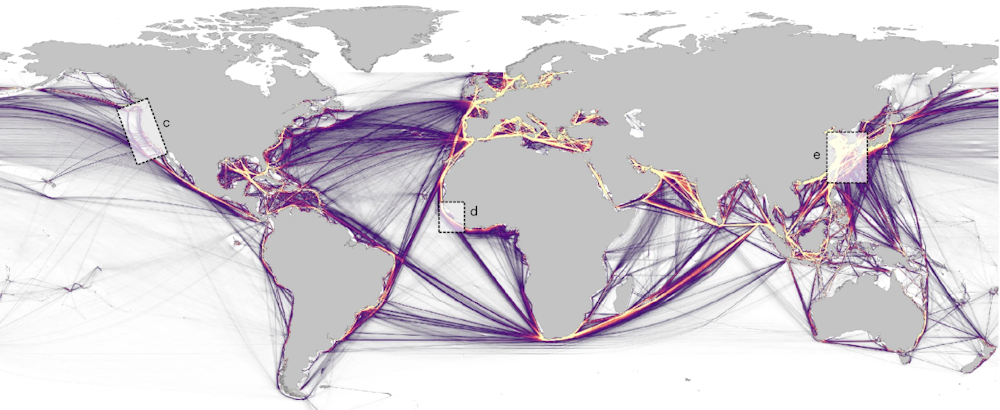
    Our state-of-the-art approach uncovered totally new areas that may be able to support whale sharks in future, such as US waters in the Pacific in the region of the California bight, Japanese waters in the eastern China Sea and the Atlantic waters of many west African countries. We quickly realised that these regions are home to some of the world’s busiest sea ports and shipping highways, so we overlaid our maps of habitat preference with those of global shipping to determine sharks are expected to run into ships.

    The world’s main shipping lanes, with the busiest lanes coloured yellow. Areas C (US west coast), D (west Africa) and E (east Asia) are expected to become more suitable for whale sharks as the oceans warm.
    Womersley et al / Nature Climate Change, CC BY-SA

    Through this we project that co-occurrence between sharks and ships will be be 15,000 times greater by the end of this century if we continue to rely heavily on fossil fuels, compared to only 20 times greater if we follow a sustainable development scenario.

    This does not mean that collisions will increase by 15,000 times, or even by 20 times, as we can only predict where whale sharks will be in future and the precise number of ships will vary. However, if the sharks do move into these new areas and their busy shipping lanes, increased mortality is a very real possibility.

    We’ve already recorded shark-attached satellite tags abruptly stopping transmissions in shipping lanes, with depth-recording tags showing the sharks slowly sinking – likely dead – to the seafloor.

    Changing tack

    Our results are alarming but highlight that we do have the capacity to change the population trajectory for whale sharks. In this case, through mitigating climate change, we can also indirectly ensure that the ocean is a safer place for some of its largest residents.

    We already know which strategies to trial for limiting collisions between ships and sharks. In February 2024 a meeting of signatories to the UN’s convention on the conservation of migratory species put forward a series of recommendations with specific focus on whale sharks. These include slowing speeds and re-routing around key sites, and setting up a collision-reporting network. It is now up to individual governments to take action.

    It’s possible that other species will experience similar pressures as a result of climate change. For example, heat waves in the oceans may force other sharks into cooler surface waters which are being exploited by longline fisheries, or into deeper depths where there is less oxygen.

    It’s time to shift our focus on to these interacting stressors in future, so that we can start to quantify the mosaic of threats that marine animals must endure in the oceans of tomorrow and protect those most at risk.

    Freya Womersley receives funding from the Natural Environment Research Council (NERC) through a University of Southampton INSPIRE DTP PhD Studentship. She is affiliated with the Marine Biological Association (MBA) in Plymouth, UK and the Global Shark Movement Project, which is based at the MBA.

    David Sims receives funding from the Natural Environment Research Council (NERC), the European Research Council (ERC), and the Gordon and Betty Moore Foundation. He is affiliated with the Marine Biological Association (MBA) in Plymouth, UK, and the Global Shark Movement Project, which is based at the MBA.

    ref. Whale sharks on collision course as warming seas may force them into shipping lanes – new study – https://theconversation.com/whale-sharks-on-collision-course-as-warming-seas-may-force-them-into-shipping-lanes-new-study-240727

    MIL OSI – Global Reports

  • MIL-Evening Report: Too good to be true? New study shows people reject freebies and cheap deals for fear of hidden costs

    Source: The Conversation (Au and NZ) – By Andrew Vonasch, Senior Lecturer in Psychology, University of Canterbury

    If you’re offered a free cookie, you might say yes. But if you’re paid to eat a free cookie, would your response be the same?

    In our new research, twice as many people were willing to eat a cookie when they weren’t offered payment compared with when they were.

    From a purely economic perspective, our findings reflect irrational decision making. Objectively, a cookie plus money is better than just a cookie.

    But people aren’t purely economic. They’re social animals with a tendency to look for hidden reasons behind other people’s behaviours.

    In the case of overly generous deals, people are expecting a “phantom cost” – one hidden in the initial offer. And this expectation influences their decision to accept something or not.

    Research participants who were offered a free cookie plus payment thought maybe the cookies were poisoned. Or maybe someone spat on them. Or they expected they would then owe a favour to the person handing out the treats once the cookie was eaten.

    Too good to be true

    Our cookies study was just one of ten experiments involving 4,205 participants in the United States and Iran.

    We tested how phantom costs influenced people’s choices to accept or reject overly generous economic offers.

    Each study gave people an offer. They had to decide whether to accept or not, and then explain why.

    One study asked participants to imagine they were a truck driver and looking online for a job. All the jobs were described the same way, but we varied the wage. People offered the normal US$15 per hour were perfectly willing to take the job.

    Others were offered more than the normal wage. The participants in this group imagined phantom costs. And the higher the wage they were offered, the worse the costs they imagined.

    When offered $20 or $25 per hour, participants imagined the role involved more responsibilities or harder work. But they considered this to be worth it. Most people preferred a job that paid a bit more than normal, despite the expectation of phantom costs.

    However, when we offered way too much money – more than $900 per hour – most people rejected the job they were willing to do for $15.

    Why? They imagined far worse phantom costs: driving for the mob, carrying dangerous radioactive waste or smuggling drugs across the border. A suspiciously high hourly rate or wage can end up putting people off.

    Suspicion is global

    We repeated this experiment with different jobs, different normal wages, and in different countries.

    In both the US and Iran, despite very different types of economy, people showed the same pattern of suspicion and rejected very high wages. The only difference was that in Iran the expected wages were lower, so the wages didn’t have to be high by US standards to become suspicious.

    Another experiment tested how phantom costs could affect purchases of plane tickets involving a hypothetical choice between three flights.

    One cost $235, another $275. When the third option was $205, most people chose that. However, if the third option was $15, hardly anyone chose the cheapest flight. They rejected it because they imagined horrible phantom costs such as terrorists and plane crashes.

    However, when we provided a reason for the low price – very uncomfortable seats – most people preferred the $15 flight. Uncomfortable seats are not usually a selling point. But they explained the cheap price, so people didn’t search for other, dangerous explanations.

    Sufficient explanations for something being a great deal remove people’s tendency to imagine phantom costs.

    A good offer, not a suspicious one

    Businesses face a balancing act when it comes to offering customers a good deal.

    On the one hand, the expectation of phantom costs decreases interest in the offer. On the other hand, price-sensitive consumers are often looking for ways to get the best deal.

    To avoid the pitfalls of phantom costs, businesses need to communicate their reasons for offering a particularly good deal. A “holiday sale” or “end-of-season sale”, for example, may explain why items are discounted.

    In the job market, identifying “good performance” as a reason for an employee’s pay raise can sidestep the expectation of hidden downsides – such as an increased workload.

    It’s clear people are not merely self-interested economic beings. We’re savvy, psychological beings capable of reading into the motivations of others to protect ourselves from offers that seem too good to be true.

    Andrew Vonasch does not work for, consult, own shares in or receive funding from any company or organisation that would benefit from this article, and has disclosed no relevant affiliations beyond their academic appointment.

    ref. Too good to be true? New study shows people reject freebies and cheap deals for fear of hidden costs – https://theconversation.com/too-good-to-be-true-new-study-shows-people-reject-freebies-and-cheap-deals-for-fear-of-hidden-costs-238869

    MIL OSI AnalysisEveningReport.nz

  • MIL-Evening Report: Failure to launch: why the Albanese government is in trouble

    Source: The Conversation (Au and NZ) – By Carol Johnson, Emerita Professor, Department of Politics and International Relations, University of Adelaide

    It wasn’t meant to be like this.

    In her 2022 study of Anthony Albanese, Katharine Murphy describes a prime minister who thought he’d be successfully managing an idealistic, collaborative and positive “new politics” that would favour the Teal independents rather than Dutton’s Liberals. Albanese seemed confident that Labor was destined for an extended period in office. Given he later appointed Murphy to his communications team, he apparently approved of her analysis.

    However, even at the time Murphy’s Lone Wolf: Albanese and the New Politics was published, various commentators, including myself, queried the “new politics” scenario. While the Teals may represent a new politics, it is clear that the old Liberal politics — of culture wars and denouncing Labor’s economic and climate change policies — is also still very much with us.

    Labor and the Liberals are now neck-and-neck in some polls, with minority government (or worse) potentially looming for Labor. Meanwhile, Gareth Evans and Bill Kelty, key figures from the Hawke/Keating period, have excoriated the Albanese government’s allegedly lacklustre performance.

    How did it all go so wrong?

    Great expectations; modest reality

    Some of the reasons can be traced back to difficulties addressing unrealistic expectations in Labor’s 2022 election strategy. Albanese went to the 2022 election with a “new politics”, collaborative style agenda that sought to bring all Australians, including business, labour, Indigenous and non-Indigenous Australians together. It was a small target strategy based on assumed common interests, kindness and compassion rather than divisiveness.

    As a result, Labor successfully countered Scott Morrison’s populist, “us versus them” campaign strategy. However, Labor’s approach was to prove easier to implement as an election strategy than in government, as three examples show.

    First, Albanese was channelling Bob Hawke when it came to bringing business and labour together. Yet, the Hawke government’s rapprochement with business was based on business being able to pay lower wages, because workers would be compensated by a government-funded “social wage” in the form of benefits and entitlements.

    By contrast, the Albanese government pledged to end the wage stagnation of the Liberal years and generally increase wages. A major emphasis was placed on improving the wages of low-paid women workers. In the process, Labor tackled issues that arose from Keating’s flawed, neoliberal-influenced, enterprise bargaining model.

    However, key business groups criticised Labor’s resulting industrial relations measures, including multi-employer bargaining, increases in the minimum wage, and measures designed to address precarious and contract work. The Liberals have largely sided with business critiques.

    Second, Labor’s attempts to bring Indigenous and non-Indigenous Australians together, via the Voice referendum, fell victim to a divisive, populist campaign by Dutton and others. Dutton depicted the Voice proposal not as arising from a major national meeting of Indigenous representatives but as being an elite “Canberra voice” that would give special rights to Indigenous Australians that were denied to others. Furthermore, he argued that government was so focused on elite “woke” issues such as the Voice, it was neglecting Australian workers’ cost-of-living crisis. Labor’s strategy for countering right-wing populism was in disarray.

    Albanese’s response to the Voice loss was to go even more “small target” in ways that alienated progressive supporters. He abandoned key commitments ranging from the Indigenous Makarrata commission process of Treaty and Truth-telling, to protecting LGBTQI+ teachers and students from being sacked by religious schools. The debacle over including gender identity questions in the census was another result.

    Third, international events, and other parties’ politicisation of them, have impeded the government’s attempts at social cohesion. Australian political debate has become so polarised over developments in the Middle East that the Albanese government is accused of abandoning support for Israel by the Liberals and the Murdoch press, while simultaneously being accused of being “complicit in Israel’s genocide” by the Greens and pro-Palestinian groups.

    Narrative failure

    As its original story of bringing Australians together has been increasingly undermined, the government has floundered when it comes to telling a clear narrative about itself. By contrast, Dutton’s relentless, focused and simply expressed negativity has been cutting through.

    Part of Labor’s problem in countering Dutton is that he is targeting them for things that are often beyond their control.

    For example, Dutton’s claim the government has been too distracted by so-called “woke” issues to address the cost-of-living crisis has been particularly electorally damaging for Labor. So have his claims that Labor’s renewable energy policies are fuelling inflation and pushing up the cost of living still further.

    The government argues it has been providing extensive cost-of-living relief in the form of tax cuts, energy bill relief, rental assistance, wage increases, cheaper medicines and reduced child care costs. However, the problem is that such government measures are being continually undercut by inflation, price increases, high interest rates, and the housing affordability and supply crisis.

    Yet, the housing affordability and supply crisis has been aggravated by decades of poor housing policy that long predate the Albanese government. Furthermore, Labor’s attempts to address it are currently being stymied by a combination of Coalition and Greens opposition, once again sandwiching Labor.

    Meanwhile, the Coalition argues that government spending is exacerbating inflation and high interest rates. However, even the independent Reserve Bank, which sets cash interest rates and is also critical of government spending, has drawn attention to multiple international factors playing a role in inflation. Price increase gouging by some businesses to augment their profits has exacerbated the problem.

    Furthermore, Treasurer Jim Chalmers argues that existing government spending levels have been essential to preventing Australia sliding into recession, while still enabling a budget surplus.

    Chalmers has struggled to cut through in the way that Keating’s messages did. However, Keating benefited from the Coalition largely agreeing with his neoliberal-influenced “reform” agenda, despite arguing it wasn’t going far enough. By contrast, Chalmers has been facing a fundamentally hostile opposition, unsympathetic to key influences on his thought, such as Mariana Mazzucato.

    Labor has also had trouble selling the government’s achievements because, as I argue in a recent book, some of the Albanese government’s most successful reform measures have been in gender equality (although much more still needs to be done). Despite women making up more than half of the population, reforms that affect women tend to be undervalued in what is still a male defined political culture. Furthermore, the working class is often conceived in terms of blue collar male employment, so benefits for women workers are not being adequately recognised. This is particularly the case in Dutton’s hyper-masculine, strongman discourse.

    Mobilising gendered leadership stereotypes has been central to Dutton’s populist “us” versus “them” politics. Dutton consistently depicts Albanese as an emasculated “weak” leader on issues ranging from addressing the cost of living crisis to detaining asylum seekers freed by a High Court decision, and supporting Israel. By contrast, Dutton is depicted as the strong leader who will stand up for everyday Australians allegedly abandoned by Labor and the so-called elites.

    This does not look like a “new politics” at all and it is a divisive, populist terrain that Labor is finding very difficult to negotiate.

    Carol Johnson has received past funding from the Australian Research Council for work on Labor governments and on gender equality policy. .

    ref. Failure to launch: why the Albanese government is in trouble – https://theconversation.com/failure-to-launch-why-the-albanese-government-is-in-trouble-239730

    MIL OSI AnalysisEveningReport.nz

  • MIL-OSI Global: Many stable atoms have ‘magic numbers’ of protons and neutrons − 75 years ago, 2 physicists discovered their special properties

    Source: The Conversation – USA – By Artemis Spyrou, Professor of Nuclear Physics, Michigan State University

    The linear accelerator at the Facility for Rare Isotope Beams, where researchers study rare isotopes of elements. Facility for Rare Isotope Beams

    The word magic is not often used in the context of science. But in the early 1930s, scientists discovered that some atomic nuclei – the center part of atoms, which make up all matter – were more stable than others. These nuclei had specific numbers of protons or neutrons, or magic numbers, as physicist Eugene Wigner called them.

    Maria Goeppert Mayer won the 1963 Nobel Prize in physics.
    Argonne National Laboratory, CC BY-NC-SA

    The race to figure out what made these nuclei so stable began. Understanding these magic numbers would allow scientists to predict the properties of other nuclei, such as their mass or how long they are expected to live. With that, scientists could also predict which combinations of protons and neutrons can result in a nucleus.

    The solution to the puzzle came in 1949 from two directions simultaneously. In the U.S., physicist Maria Goeppert Mayer published an explanation, at the same time as a group of scientists led by J. Hans D. Jensen in Germany found the same solution.

    Hans Daniel Jensen won the 1963 Nobel Prize in physics.
    The Nobel Foundation

    For their discovery, the two physicists each got a quarter of the 1963 Nobel Prize in physics. We’re two nuclear scientists whose work is built on Goeppert Mayer’s and Jensen’s discoveries 75 years ago. These magic numbers continue to play an important role in our research, only now we can study them in nuclei that live for just a fraction of a second.

    Stability in the atom

    The atom is a complex system of particles. It’s made up of a central nucleus consisting of protons and neutrons, called nucleons, with electrons orbiting around the nucleus.

    Nobel prize-winning physicist Niels Bohr described these electrons in the atom as existing in a shell structure. The electrons circulate around the nucleus in particular energy levels, or orbits. These orbits have specific energies, and each orbit can hold only so many electrons.

    Chemical reactions result from interactions between the electrons in two atoms. In Bohr’s model, if an electron orbit is not already filled, then it’s easier for the atoms to exchange or share those electrons and induce chemical reactions.

    The Bohr model of the atom.
    AG Caesar/Wikimedia Commons, CC BY-SA

    One class of elements, the noble gases, hardly ever react with other elements. In noble gases, the electrons occupy completely filled orbits, and as a result the atoms greedily hold onto their electrons instead of sharing and undergoing a chemical reaction.

    In the 1930s, scientists wondered whether protons and neutrons might also occupy orbits, like electrons. But nobody could show this conclusively. For more than a decade, the scientific community was unable to describe the nucleus in terms of individual protons and neutrons. Scientists used a more simplified picture, one that treated protons and neutrons as one single system, like a drop of water.

    Magic numbers

    In 1949, Goeppert Mayer and Jensen developed the so-called shell model of the nucleus.
    Protons and neutrons occupy particular orbits, analogous to electrons, but they also have a property called spin – similar to a spinning top. Goeppert Mayer and Jensen found that when combining the two properties in their calculations, they were able to reproduce the experimental observations.

    Through some experiments, they found that nuclei with certain magic numbers of neutrons or protons are unusually stable and hold onto their nucleons more than researchers previously expected, just like how noble gases hold onto their electrons.

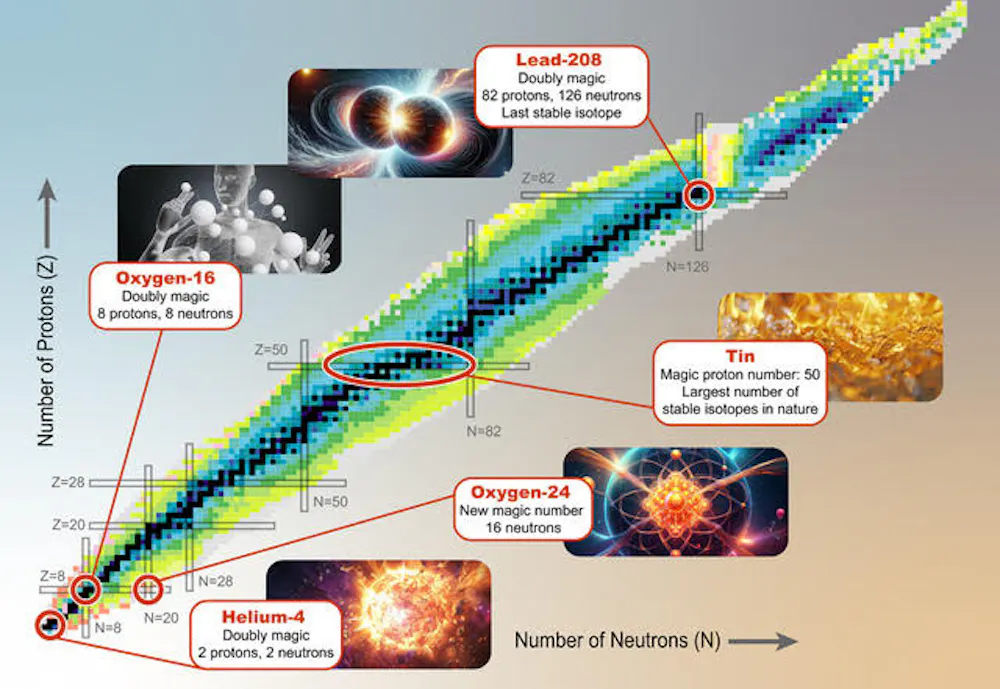
    The magic numbers known to scientists are 2, 8, 20, 28, 50, 82 and 126. They are the same for both protons and neutrons. When a nucleus has a magic number of protons or neutrons, then the particular orbit is filled, and the nucleus is not very reactive, similar to the noble gases.

    For example, the element tin has a magic number of protons. Tin always has 50 protons, and its most common isotope has 70 neutrons. Isotopes are atoms of the same element that have a different number of neutrons.

    There are nine other stable isotopes of tin that can exist – it’s the element with the largest number of stable isotopes. A stable isotope will never spontaneously change into a different element, which is what happens to radioactive isotopes.

    Helium, with two protons and two neutrons, is the lightest “doubly magic” nucleus. Both its neutron count and its proton count are a magic number. The forces that hold the helium-4 nucleus together are so strong that it’s impossible to attach another proton or neutron. If you tried to add another proton or neutron, the resulting atom would fall apart instantaneously.

    On the other hand, the heaviest stable nucleus in existence, lead-208, is also a doubly magic nucleus. It has magic numbers of 82 protons and 126 neutrons.

    Many stable isotopes have magic numbers of protons and neutrons.
    The Facility for Rare Isotope Beams

    Examples of magic numbers and stable nuclei exist everywhere – but scientists couldn’t explain them without the introduction of the shell model.

    Stable nuclei in nature

    The shell structure in nuclei tells researchers about how elements are distributed across the Earth and throughout the universe.

    One of the most abundant elements on our planet and in the human body is oxygen, in particular the isotope oxygen-16.

    With eight protons and eight neutrons, oxygen-16 has an extremely stable nucleus. A nearby star produced the oxygen we find on Earth through nuclear reactions in its core sometime before the solar system was formed.

    Since oxygen nuclei are doubly magic, these nuclei in the star did not interact very much with other nuclei. So more oxygen was left around to eventually act as an essential ingredient for life on Earth.

    In her Nobel lecture, Maria Goeppert Mayer talked about the work she did with physicist Edward Teller. The two had attempted to describe how these elements formed in stars. In the 1930s, it was impossible for them to explain why certain elements and isotopes were more abundant in stars than others. She later found that the increased abundances corresponded to nuclei with something in common: They all had magic numbers of neutrons.

    With the shell model and the explanation of magic numbers, the production of elements in stars was possible and was published in 1957.

    Scientists today continue to use ideas from the nuclear shell model to explain new phenomena in nuclear science. A few accelerator facilities, such as the Facility for Rare Isotope Beams, where we work, aim to create more exotic nuclei to understand how their properties change compared with their stable counterparts.

    At the Facility for Rare Isotope Beams, scientists produce new isotopes by accelerating stable isotopes to about half the speed of light and smashing them at a target. Out of the pieces, we select the rarest ones and study their properties.

    Possibly the most profound modern discovery is the fact that the magic numbers change in exotic nuclei like the type we create here. So, 75 years after the original discovery, the race to discover the next magic number is still on.

    Artemis Spyrou receives funding from the US National Science Foundation.

    Sean Liddick receives funding from the Department of Energy, Office of Science and the Department of Energy, National Nuclear Security Administration.

    ref. Many stable atoms have ‘magic numbers’ of protons and neutrons − 75 years ago, 2 physicists discovered their special properties – https://theconversation.com/many-stable-atoms-have-magic-numbers-of-protons-and-neutrons-75-years-ago-2-physicists-discovered-their-special-properties-239690

    MIL OSI – Global Reports

  • MIL-Evening Report: One of science’s greatest achievements: how the rapid development of COVID vaccines prepares us for future pandemics

    Source: The Conversation (Au and NZ) – By Paul Griffin, Professor, Infectious Diseases and Microbiology, The University of Queensland

    Since COVID was first reported in December 2019, there have been more than 775 million recorded infections and more than 7 million deaths from the disease. This makes COVID the seventh-deadliest pandemic in recorded history.

    Factors including climate change, disruption of animal habitats, poverty and global travel mean we’re only likely to see more pandemics in the future.

    It’s impossible to predict exactly when the next pandemic will happen, or what it will be. But experts around the world are working to prepare for this inevitable “disease X”.

    One of the cornerstones of being prepared for the next pandemic is being in the best possible position to design and deploy a suitable vaccine. To this end, scientists and researchers can learn a lot from COVID vaccine development.

    A look back

    After SARS-CoV-2 (the virus that causes COVID) was discovered, vaccine development moved very quickly. In February 2020 the first batch of vaccines was completed (from Moderna) and the first clinical trials began in March.

    An mRNA vaccine from Pfizer/BioNTech was the first to be approved, on December 2 2020 in the United Kingdom. Approvals for this and other vaccines, including shots developed by Moderna (another mRNA vaccine) and Oxford/AstraZeneca (a viral vector vaccine), followed elsewhere soon afterwards.

    Previously the fastest vaccine developed took around four years (for mumps in the 1960s). Had COVID vaccines taken this long it would mean we would only just be rolling them out this year.

    An estimated 13.72 billion COVID vaccine doses have now been administered, with more than 70% of the world’s population having received at least one dose.

    The rapid development and rollout of COVID vaccines is likely to be one of the greatest achievements of medical science ever. It also means we are in a much better position to respond to future emerging pathogens.

    New vaccine technology

    A lot of work over many years prepared us to develop COVID vaccines as quickly as we did. This included developing new platforms such as viral vector and mRNA vaccines that can be adapted quickly to new pathogens.

    While scientists had been working on mRNA vaccines for decades before the COVID pandemic, the COVID shots from Pfizer/BioNTech and Moderna were the first mRNA vaccines to be approved for human use.

    These vaccines work by giving our body instructions (the “m” in mRNA stands for messenger) to make SARS-CoV-2 spike proteins. These are proteins on the surface of the virus which it uses to attach to our cells. This means when we encounter SARS-CoV-2, our immune system is poised to respond.

    This technology will almost certainly be used to protect against other diseases, and could potentially help with a future pandemic.

    In the meantime, scientists are working to improve mRNA technology even further. For example, “self-amplifying RNA” has the potential to enhance immune responses at lower doses compared with conventional mRNA.

    mRNA vaccines teach our bodies to make SARS-CoV-2’s spike protein.
    Kateryna Kon/Shutterstock

    While our current COVID vaccines are safe and very effective at protecting against severe disease, they’re not perfect. We may never be able to achieve a “perfect” vaccine, but some additional properties we’d like to see in future COVID vaccines include being better at reducing transmission, lasting longer, and needing to be updated less often as new variants emerge.

    Even now there are many COVID vaccines in clinical trials. So hopefully, COVID vaccines that improve on the initial shots will be available relatively soon.

    Other desirable attributes include vaccines we can administer by alternate routes to needles. For COVID and other diseases such as influenza, we’re seeing significant developments locally and internationally on vaccines than can be administered via skin patches, through the nose, and even orally.

    Some challenges

    Developing vaccines for COVID was a huge challenge, but one that can mostly be judged a success. Research has estimated COVID vaccines saved 14.4 million lives across 185 countries in just their first year.

    However, the story of COVID vaccination has also had many other challenges, and arguably a number of failures.

    First, the distribution of vaccines was not equitable. Analysis of the initial rollout suggested nearly 80% of eligible people in high-income countries were vaccinated, compared with just over 10% in low-income nations.

    Supply of vaccines was an issue in many parts of the world, so expanding local capacity to enable more rapid production and distribution of vaccines will be important for the next pandemic.

    Further, adverse events linked to COVID vaccines, such as rare blood clots after the AstraZeneca vaccine, affected perceptions of vaccine safety. While every serious adverse event is significant, these incidents were very rare.

    However, these issues exacerbated other challenges that hampered vaccine uptake, including the spread of misinformation.

    Misinformation remains a problem now and will probably still be prevalent whenever we face the next pandemic. Addressing this challenge involves understanding what’s deterring people from getting vaccinated, then informing and educating, addressing misinformation both about vaccination and the risks of the disease itself.

    Restoring and building trust in public health authorities also needs to continue to be a focus. Trust in governments and health authorities declined during the COVID pandemic, and evidence shows lower trust is associated with lower vaccine uptake.

    The COVID vaccine rollout faced a variety of challenges.
    Yuganov Konstantin/Shutterstock

    Ongoing preparation

    There’s no doubt our recent experience with COVID, particularly the rapid development of multiple safe and effective vaccines, has put us in a better position for the next pandemic.

    This didn’t happen by accident. There was a lot of preparation even before COVID was first discovered that facilitated this. Organisations like the Coalition for Epidemic Preparedness Innovations (CEPI) have been supporting research to develop vaccines rapidly to respond to a new threat for some time.

    CEPI has an ongoing program that aims to be able to develop a vaccine against a new threat, or disease X, in just 100 days. While COVID vaccines have been a huge achievement, work continues in the hope we will be able to develop a vaccine even faster next time.

    This article is part of a series on the next pandemic.

    Paul Griffin is a director and scientific advisory board member of the immunisation coalition. He has served on Medical Advisory Boards including for AstraZeneca, GSK, MSD, Moderna, Biocelect/Novavax, Seqirus and Pfizer and has received speaker honoraria including from Seqirus, Novartis, Gilead, Sanofi, MSD and Janssen.

    ref. One of science’s greatest achievements: how the rapid development of COVID vaccines prepares us for future pandemics – https://theconversation.com/one-of-sciences-greatest-achievements-how-the-rapid-development-of-covid-vaccines-prepares-us-for-future-pandemics-228787

    MIL OSI AnalysisEveningReport.nz

  • MIL-Evening Report: I think my child might need a tutor. What do I need to consider first?

    Source: The Conversation (Au and NZ) – By Matthew White, Lecturer and Researcher Australian Catholic University, Australian Catholic University

    School tutoring is a huge business. Australian estimates suggest it was worth more than of A$1.5 billion as of 2021.

    In Australia, we see frequent media reports of parents using tutors to help their children through school.

    How can you tell if tutoring is right for your child?

    What is tutoring?

    Private tutoring can be take many forms, but involves parents paying for additional lessons outside of schools hours. These are either one-to-one or in small groups.

    There are services available for students in primary school through to senior high school.

    Some tutoring services target specific skills, such as literacy or numeracy. Others offer support for young people with organisation skills and homework or preparation for certain exams.

    Tutoring can go for a short burst over a few weeks to prepare for an exam or it may be regular and ongoing to maintain learning.

    Tutoring could be to catch up on one element of school, such as handwriting or reading.
    Deyan Georgiev/ Shutterstock

    Why do people get tutoring?

    Families can get tutoring for a student for a wide range of reasons.

    A child may be struggling with certain elements of schooling – such as reading, writing, or maths. Tutoring can provide an opportunity to catch-up with tailored support.

    Tutoring can also help children prepare for tests and exams, such as NAPLAN or Year 12.

    Tutoring is used to prepare students for government selective school programs or private school scholarship exams.

    Researchers have highlighted some cultural backgrounds see investing in tutoring as an essential part of educating their children and helping them reach their full potential.

    The tutoring debate

    Tutoring can be expensive and time consuming for families. Families may pay between $30 and $200 a session, depending on the subject and qualifications of the tutor.

    Some argue this gives some children an unfair advantage and students should instead rely on their natural ability.

    Despite the criticism, there are benefits to tutoring. This includes giving students extra opportunities to consolidate their knowledge – we know this can help students learn.

    It can also help build their confidence if a tutor can step through learning in a less pressured environment. As my research has shown, academic progress relies heavily on a students’ belief in their capacity to succeed.

    Does my child need a tutor?

    All students can benefit from personalised support and coaching in whatever they wish to peruse. However, all students do not need a tutor. The choice to engage a tutor should be attached to a goal that you and your child agree on.

    If the young person does not want to engage in tutoring having a tutor is not going to help. Rather, it is more likely to lead to stress and arguments.

    It may help to talk to your child’s teacher and review school reports before starting with a tutor to work out which particular areas need extra attention.

    Depending on what you need, your child’s tutor may be a university student or someone who has made a career out of tutoring.
    Dmytro Zinkevvych/Shutterstock

    If your shared goal is to catch up or help with certain academic skills, it is important to find a tutor who is experienced and can explain the approach they take and what evidence it is based on.

    If the goal is organisation, homework or even just to improve confidence, you could at first try a university student who has past success themselves or with other students. For more specialised goals, seek out tutors who are open about their qualifications, experience and past success.

    Child safety should also be a consideration. The Australian Tutoring Association provides practical advice for parents choosing a tutor and a code of conduct for tutors.

    There is no requirement for tutors to be a member of the association. So parents should make sure any tutor has a current Working with Children check. You can of course also talk to other parents and teachers for recommendations.

    Matthew White does not work for, consult, own shares in or receive funding from any company or organisation that would benefit from this article, and has disclosed no relevant affiliations beyond their academic appointment.

    ref. I think my child might need a tutor. What do I need to consider first? – https://theconversation.com/i-think-my-child-might-need-a-tutor-what-do-i-need-to-consider-first-240091

    MIL OSI AnalysisEveningReport.nz

  • MIL-Evening Report: Ocean protection accounts for 10% of fish in the world’s coral reefs – but we could save so much more

    Source: The Conversation (Au and NZ) – By Joshua Cinner, Professor & ARC Laureate Fellow, Thriving Oceans Research Hub, School of Geosciences, University of Sydney

    Ocean fish populations have fallen dramatically in the past half-century, and climate change is expected to make the problem worse. Governments have designated “marine protected areas”, where where human activity is constrained to protect ocean life. But have these efforts worked?

    About 8% of Earth’s oceans are protected, including about 3% where fishing is banned altogether. Our new study of nearly 2,600 tropical coral reefs around the world is the first to examine whether these areas have helped fish populations.

    We found about one in ten kilograms of fish on coral reefs is the result of efforts such as marine protected areas and other restrictions on fishing. This is promising news. But our study also reveals great room for improvement.

    A video discussing how Earth’s fish stocks are declining.

    Getting to grips with marine protection

    Maintaining healthy fish populations is important. Many communities depend on fishing for their food and livelihoods. And fish play a vital role in ocean ecosystems.

    Marine protected areas are a key policy tool used to increase fish populations. They cover a range of ocean areas including lagoons, coastal waters, deep seabed waters and coral reefs.

    The areas go by several names, including marine parks and conservation zones. Some, where fishing is prohibited, are known as no-take zones.

    Governments often quote figures on the area of ocean protected when seeking to tout their conservation policies. For example in Australia, we are told the federal, state and territory governments have established marine parks covering 4.3 million square kilometres or 48% of our oceans.

    But the extent to which marine protected areas actually conserve marine life varies enormously from place to place. So simply counting up the protected ocean area doesn’t tell you much about what has actually been achieved.


    Measuring success

    We and our colleagues wanted to assess the extent to which marine protection efforts have increased the amount of fish on coral reefs.

    We developed a computer model based on about 2,600 reefs across the global tropics, which includes reefs in the Pacific, Indian, and Atlantic oceans. From that, we estimated the amount of fish currently on each reef – measured in the kilograms of fish per hectare, or “biomass”.

    The estimations were based on information such as:

    • environmental conditions such as ocean temperature and the type of habitat where the reef is located

    • the intensity of fishing activity, known as “fishing pressure”

    • how strong the protection is – for example whether it bans fishing, or just restricts it

    • the level of compliance with no-take zones.

    We then simulated what would happen if we changed the type of protection strategy in each location while keeping everything else the same.

    We ran a few scenarios:

    • no coral reef conservation existed anywhere and all reefs could be fished without constraint

    • sites currently fished without constraint (which amounted to over half of our sites) had restrictions in place

    • fishing was prohibited on 30% of all reefs.

    And the results?

    We found both marine protected areas and other fishing restrictions account for about 10% of the fish “biomass” on reefs. In other words, about one in ten kilograms of fish on coral reefs is due to protection efforts.

    No-take zones punch above their weight. Of the fish biomass attributable to protection efforts, about 20% comes from just 3% of sites in no-take zones. This proportion would be even higher if illegal fishing in no-take zones was stamped out.

    But we found any type of fishing restriction was useful. If everywhere currently fished without constraint was subject to some level of protection – such as banning nets or spear guns – the biomass of fish globally would be another 10.5% higher, our study found. This essentially matches all conservation efforts to date.

    Our modelling also showed fish on coral reefs could be increased by up to 28% globally if the area of no-take zones rose to 30%.

    But these reefs must be chosen strategically. That’s because protection strategies can lead to wildly different results, depending on local conditions. For example, sites with lower fishing pressure in the surrounding seascape got a bigger boost from protection than places surrounded by intensive fishing effort.

    This may be because at heavily fished locations, algae often overtakes coral as the dominant feature. Algae is less fish-friendly than coral, so fish populations may not bounce back quickly even when fishing pressure is reduced.

    Grounds for optimism

    Our study tested the mettle of global coral reef conservation. On one hand, we found conservation efforts have made a contribution to the amount of fish on global coral reefs, which provides grounds for cautious optimism.

    But on the other hand, this contribution is quite modest. Our study shows much greater gains could be made not only by expanding protected marine areas, but also by improving compliance in existing ones.

    Most nations have signed a global agreement to protect 30% of Earth’s land and waters by 2030. That means the amount of ocean in marine protected areas globally will increase nearly fourfold in just six years.

    As governments continue this task, we hope our results help identify ocean sites that will benefit most from protection.

    Joshua Cinner receives funding from the Australian Research Council and National Geographic Society. He is a Fellow of the Academy of Social Sciences in Australia and the International Coral Reef Society.

    Iain R. Caldwell is affiliated with the Wildlife Conservation Society

    ref. Ocean protection accounts for 10% of fish in the world’s coral reefs – but we could save so much more – https://theconversation.com/ocean-protection-accounts-for-10-of-fish-in-the-worlds-coral-reefs-but-we-could-save-so-much-more-239188

    MIL OSI AnalysisEveningReport.nz

  • MIL-Evening Report: Still with the Tony Soprano memes? Young audiences are watching the series with fresh eyes

    Source: The Conversation (Au and NZ) – By Alexander H. Beare, Lecturer in Media, University of Adelaide

    HBO’s latest crime drama The Penguin came with a flood of memes on TikTok, X and Instagram. They compare actor Colin Farrell’s Oswald Cobblepot to James Gandolfini’s Tony Soprano.

    It’s true, there are undeniable similarities between the two portrayals and shows. HBO’s official TikTok account went so far as to upload an edit of The Penguin trailer cut to the rhythm of Alabama 3’s Woke Up This Morning – the title theme for The Sopranos.

    Running for six seasons from 1999 to 2007, The Sopranos is enjoying a sustained cultural relevancy in 2024 – something other prestige dramas of the same era such as Six Feet Under and The Shield have not achieved. A new two-part documentary about the making of the The Sopranos just premiered on HBO, 25 years after the show made its debut.

    For the last couple of years, fans have been discovering the show and making it their own. But how does it fit the present moment?

    The Sopranos as catharsis

    My research and upcoming book is based on in-depth interviews with a group of new Sopranos fans all aged between 19–26. In other words, not old enough to have watched the show when it first aired.

    During the pandemic, The Sopranos saw a surge in viewership and interest that outstripped its contemporaries like Deadwood.

    Superficially, the show is visually comparable to COVID lockdown. Tony and his kids are regularly shown sleeping in, dressed in baggy clothes, and shuffling around the kitchen picking at cold cuts.

    For those I spoke with, viewing The Sopranos wasn’t a way to escape from lockdown: it was a way to purge pent-up emotion.

    For Darcy, the show became:

    Like a cathartic tool, like, I can relate, this is how life feels right now […] A bit of relief, and a sense of relatability, you know? It was always comforting when things are not good.

    Tom shared this feeling:

    One of the cool things about The Sopranos is that a lot of the stuff is really mundane […] It’s about drudgery more than anything […] That’s what lockdown feels like – and it definitely is what a lot of daily life feels like […] it’s those moments of opening up the fridge and just eating like 20 slices of gabagool because you can’t be fucked making something to eat.

    The Sopranos as nostalgia

    The Sopranos is a profoundly negative show and yet it was being viewed by the young people I spoke to through quite an optimistic lens.

    Alannah said:

    It makes me feel nostalgic for a time when things felt a little bit like […] simpler, even though they have complications. It just seemed like a good stage of history to be in.

    In a similar vein, Callum positively characterised this feeling as an “added bonus” that “drew him into watching the show”. Selina fondly remembered the fashion and music of the show.

    Watching with a new lens

    During its original run, The Sopranos was often lauded by scholars for its deconstruction of patriarchal masculinity. This was not so much the case for the people I spoke to.

    Alannah worried The Sopranos could easily be placed in the toxic online “manosphere”:

    [The Sopranos is] like Fight Club and American Psycho. White dudes will watch it and be like, ‘Yeah, this is fucking sick – that’s me man’. And it’s like, you don’t want to be these people! You have to criticise it yourself because it is not overt in my opinion.

    Stuart expressed a similar concern about The Sopranos’ ability to be a dangerous power fantasy.

    In his experience with online Sopranos content, he observed:

    [There are fans] who see Tony Soprano as the ideal man and don’t notice that the show is supposed to be critiquing his behaviour.

    These concerns about “misunderstanding” the show very much reflect current anxieties. The reporting about how the 2019 Joker film might incite violence from white men provides a salient reference point for these worries.

    For the new viewers I spoke to, there was a real concern The Sopranos could combine dangerously with today’s toxic misogynistic online content. They were worried Tony Soprano could be interpreted as a celebration of patriarchal masculinity rather than a critique.

    Born under a bad sign

    In 2024, The Sopranos is still managing to click with new audiences. But these fans interpret the show differently and take new meaning from it. When we look at their responses, we can see how The Sopranos intersects with the attitudes and anxieties of modern audiences.

    Next time you see a meme about Tony Soprano, consider what context today’s viewers place him in – and whether an audience from 20 years ago would have done the same. Today, he might be considered even more dangerous.

    Alexander H. Beare does not work for, consult, own shares in or receive funding from any company or organisation that would benefit from this article, and has disclosed no relevant affiliations beyond their academic appointment.

    ref. Still with the Tony Soprano memes? Young audiences are watching the series with fresh eyes – https://theconversation.com/still-with-the-tony-soprano-memes-young-audiences-are-watching-the-series-with-fresh-eyes-237982

    MIL OSI AnalysisEveningReport.nz

  • MIL-OSI Global: South Africa’s unity government is being tested – the toppling of a mayor in a key city exposes faultlines

    Source: The Conversation – Africa – By Susan Booysen, Visiting Professor and Professor Emeritus, University of the Witwatersrand

    South Africa’s long-governing party, the ANC, performed disastrously in the country’s May 2024 elections. Its electoral fortunes are now tied to regaining support in Gauteng, the most populous and economically important province, which it had governed with outright majorities since 1994. In 2024 the ANC’s Gauteng result of 34.8%, along with its 17% in KwaZulu-Natal, sealed the party’s loss of its national outright majority. We asked political scientist Susan Booysen for her perspective on the ANC’s battle for Tshwane, the administrative seat of the national government, where the party used a newly constituted coalition to topple the Democratic Alliance mayor, Cilliers Brink.

    What lies behind the Gauteng ANC’s toppling of the DA mayor of Tshwane?

    For the ANC (African National Congress) to regain majority electoral support, much will depend on the Gauteng province’s populous base. The three Gauteng metropolitan municipalities of Tshwane, Johannesburg, and Ekurhuleni are key in this project. Besides constituting South Africa’s financial hub and having huge budgets, these metropolitan councils (metros) symbolise the country’s cultural heartbeat, and are a gateway to the rest of the continent.

    The ANC’s political control of these bases has been lessening. It fears further lapses may make the losses irreversible. It lost outright control of the Gauteng metros in 2016: it slipped to 49% in Ekurhuleni, 46% in Johannesburg and 41% in Tshwane. The 2021 local elections confirmed both the ANC’s slide and rule by unstable coalition governments.

    Since the 2021 elections, the metros have had multiple coalition governments. The ANC has, through coalition, reclaimed control of the top council positions in Johannesburg and Ekurhuleni.

    What does the toppling of Brink say about internal ANC party dynamics?

    Following their national coalition agreement of June 2024, parties to the coalition government have been discussing cascading the agreement to the provincial and local levels. These talks have been inconclusive.

    The ouster of the mayor of Tshwane was not explicitly or publicly condoned by the ANC’s national leadership. Neither did they stop it. The Tshwane crisis exposes the ANC’s internal party dynamics.

    The ANC in the province and in the Tshwane council constituted an alternative alliance – between the party, Economic Freedom Fighters (EFF) and ActionSA. ActionSA broke its previous alignment with the Democratic Alliance in favour of the ANC.

    Jointly the ANC, EFF and ActionSA hold 117 out of the 214 Tshwane council seats. They used this majority to pass a motion of no confidence against Brink and, in effect, his entire mayoral committee. A small band of one-seat parties reinforced Brink’s ejection.

    The Tshwane development highlighted one of the key faultlines in the government of national unity: the Gauteng ANC’s disdain for the unity government agreement. The national unity government comprises the ANC, DA, Inkatha Freedom Party, Patriotic Alliance, Freedom Front Plus and five other tiny parties. The agreement has the support of the majority in the ANC’s national executive committee (NEC), its highest decision-making body between elective conferences.

    The NEC had originally been strongly divided on forming a coalition with the DA.

    After being elected Gauteng premier with the support of the DA, Panyaza Lesufi constituted the Gauteng executive with the Patriotic Alliance, Rise Mzansi and Inkatha Freedom Party. It excludes the DA.

    Lesufi had offered the DA executive posts that would have placed it in a minor and subjected position in the province. The ANC’s national leadership accepted this. The DA rejected it.

    What are the implications for ANC-DA cooperation in the national government and other municipalities?

    The DA is fighting to have Cilliers Brink reinstated as mayor of Tshwane. It argues that the ANC’s capturing of the position threatens the unity government.

    The DA appears to be angling for a fairer dispensation within the overall coalition formation, given its importance as the second largest party in the coalition government, rather than rejection of the GNU government. The DA needs the coalition as much as the ANC does.

    The coalition government’s statement of intent, and how it is reflected in the lower provincial and municipal levels, are the key issue at stake.

    The Tshwane crisis stands in the context of other local governments where new alliances are forming outside the formula of the national coalition government.

    The crisis is in all probability not threatening the national coalition. But it may result in the fleshing out of the generally vaguely defined and minimalist Statement of Intent (the coalition agreement). In recent weeks more clarity has already emerged regarding conflict resolution in the unity government. The Tshwane crisis is likely to show whether and how the national level agreement resonates provincially and locally.

    In fact, the lesson from the Tshwane coalition fiasco might be that there ought to be no expectations that the coalition government’s formula of approximate proportionality among its constituent parties will be reflected in the executives of the lower-level structures.

    The DA stressed at the time of Brink’s removal that it had been in discussions with ANC national secretary general Fikile Mbalula and ANC negotiator David Makhura – and progress had been made for the two parties to jointly “stabilise” the Gauteng metros (read “exercise power-sharing”). It may have entailed the DA supporting the ANC in Ekurhuleni, and the ANC the DA in Tshwane.

    But the proposal came to naught when the ANC proceeded to capture Tshwane, which it last governed in 2016.

    The effect of the Tshwane fallout is likely to be heightened instability in South Africa’s metro councils. Without ANC-DA cooperation, much of the coalitions detente that had become possible in the wake of the national coalition agreement may dissipate. Instead, alternating coalition governments, through motions of no confidence, may proliferate.

    The instability caused by such party political tit-for-tats and coalition musical chairs, both in the large metropolitan councils and the local municipalities, will contribute to citizens suffering poor delivery of services – although it is not the sole cause.

    What does the ANC’s failure to sing from the same hymn book mean for the party?

    The Tshwane crisis goes to the heart of the struggles unfolding in the ANC.

    The ANC of 2024 is inherently unstable as it fights for electoral survival.

    Its national executive committee and presidency act in ways that hint at them lacking the power to call the shots in relation to coalitions in some provinces and municipalities; and reining in its Gauteng premier and provincial executive committee.

    This, as the party is trying to position itself favourably, through leadership changes, ahead of its national general council meeting next year, and its elective conference of 2027, in the hope of reversing electoral declines in local, provincial and national elections.

    Besides KwaZulu-Natal’s centrality to this process, Gauteng holds the base of ANC succession given that it is political home to its deputy president, Paul Mashatile, and Lesufi.

    The search for a new mayor for Tshwane unleashed a candidacy contest within the ANC. ANC mayoralty candidates are proliferating. They are emerging from the ranks of the politically powerful, anointed by high-level ANC power holders, along with candidates in the local ANC party structures and in the council itself.

    The legacy of the 2016 violent struggles and mayhem in the city amid anger about succession are invoked to justify some proposals. These struggles seem oblivious to new coalition contexts, and the ANC’s loss of majority power.

    Unless the fractious and divided ANC finds a united and consistent voice on coalitions, it may lose out on the possibility of using coalitions to regain electoral support. Unless the ANC in Gauteng is using the metros to confirm its alternative to the national formula.

    Susan Booysen in the past had received funding from HSRC, via various (completed) university projects; and has until recently been employed full-time by MISTRA.

    ref. South Africa’s unity government is being tested – the toppling of a mayor in a key city exposes faultlines – https://theconversation.com/south-africas-unity-government-is-being-tested-the-toppling-of-a-mayor-in-a-key-city-exposes-faultlines-239986

    MIL OSI – Global Reports

  • MIL-OSI Global: The youth-led research giving voice to teen mothers in Uganda

    Source: The Conversation – Canada – By Doris Kakuru, Professor, School of Child and Youth Care, University of Victoria

    Pregnancy can be a stressful enough time for any expecting mother, but it can be even more so for teenage girls navigating the added challenges they face. (Shutterstock)

    The global rate of teen pregnancies has been decreasing in recent decades. According to the World Health Organization, worldwide adolescent birth rates have decreased from 64.5 births per 1,000 women aged 15–19 years in 2000 to 41.3 births per 1,000 women in 2023.

    However, those numbers can differ significantly by region. Every year, around 21 million teenage girls in developing countries become pregnant, and around 12 million give birth.

    In Uganda, the teenage pregnancy rate remains among the highest in Sub-Saharan Africa, at 25 per cent. Cultural and religious norms often make adolescent sexuality a highly sensitive subject. Many girls can be ostracized or face marginalization if they become pregnant. And the long-term impacts on their lives can be significant. Almost 60 per cent of school dropouts in Uganda are due to pregnancy, and many never return to the education system.

    Pregnancy can be a stressful enough time for any expecting mother, but it can be even more so for a pregnant teenager in places where engaging in sexual relations is taboo, especially for girls.

    Along with colleagues in Uganda and Canada, we are conducting a community-engaged research project to understand the experiences of young mothers. Our project, Centering Marginal Voices, aims to build research and advocacy skills for young mothers in Uganda.

    A clip outlining the Centering Marginal Voices project.

    Community-engaged research

    Community-engaged research has emerged in social work as an important approach that empowers communities experiencing particular issues to make decisions concerning those issues. This approach cultivates long-term relationships and promotes the development of sustainable solutions for community problems.

    One form of this approach focuses on engaging youth in researching about their experiences with the issues affecting their lives. This can boost our understanding as researchers and make young people feel heard and empowered.

    Engaging young people in research requires clear communication, the use of appropriate channels of communication, constant feedback and listening. It can also mean providing logistical support like transportation or food, among other things. It is vital for researchers to listen to young people when they describe what they need to be participants in the research process.

    Many adolescent girls already face vulnerabilities and challenges when it comes to their reproductive health. Pregnancy can often add another layer of complexity to those challenges.

    While there is much discussion about teenage pregnancy in Uganda, rarely are young mothers given platforms to speak their truths to help policymakers understand and address the root causes. Their voices are muted and their lived experiences are not represented in policy.

    Teen motherhood presents girls with numerous challenges. They must navigate parenthood while still at a young age. They must figure out ways to support their children while still being dependents themselves. They also have to make important decisions and provide child care with limited experience to draw from, and manage their health needs alongside maternal care, among others.

    Their ability to conduct research may be influenced by a combination of these factors and by the skills they have, how they navigate relational dynamics, and the stigmatization they face being teen mothers.

    A webinar with the researchers and young mothers on the Centering Marginal Voices project.

    Centering young mothers in research

    As we began the research process, we held consultative meetings with community leaders who identified 40 young mothers from urban and rural parts of Uganda. We engaged the young mothers in discussions about their life journeys and in team building exercises. We later divided them into groups based on their villages. Each group then selected two peers to continue on the project as 12 youth peer researchers.

    When conducting this kind of community-engaged project, it is important for researchers to consider the ways they approach and include youth participants:

    Consent — Our first aim with the 12 selected young mothers was to seek consent from their parents or guardians. The young mothers also told us to speak with their live-in partners, whom we had not initially considered. They spoke to their parents or guardians, who were already expecting our team and eased the consent process for us.

    Communication — Young mothers in the capital Kampala preferred phone calls, WhatsApp and physical meetings. However, those in the rural areas did not all have smartphones or understand social media. This posed a challenge as our project entailed them conducting surveys using smartphones. We therefore revised our training to include basics on how to use the smartphone.

    Designing tools — We further engaged the youth peer researchers to refine our research tools. They helped us rephrase questions in local languages, especially those related to sexual relations.

    Mutual support — The youth peer researchers were trained to lead a survey and collect quantitative data from 766 participants in total. They prioritized teamwork and support, with some collecting more data than others. They also requested autonomy in scheduling their data collection to balance their research activities with their maternal duties and caring for their families.

    Navigating environments — The young mothers provided us with a descriptive tour of their environments. They advised us on where to go and how to behave when visiting. They always accompanied us within their community, acting as our guides.

    Young mothers know best about their own experiences, and this accords them a legitimate space in research as researchers. Practitioners and planners should be intent on being open to meaningfully engaging them while learning from them.

    Doris Kakuru has received funding from the Social Sciences and Humanities Research Council of Canada. The Centering Marginal Voices project is supported by a consortium partnership of Makerere University, Nascent Research and Development Organization, and the University of Victoria.

    Jacqueline Nassimbwa does not work for, consult, own shares in or receive funding from any company or organisation that would benefit from this article, and has disclosed no relevant affiliations beyond their academic appointment.

    ref. The youth-led research giving voice to teen mothers in Uganda – https://theconversation.com/the-youth-led-research-giving-voice-to-teen-mothers-in-uganda-239876

    MIL OSI – Global Reports

  • MIL-OSI Global: Wealthier Canadians live longer and are less likely to be dependent as they age, new research finds

    Source: The Conversation – Canada – By Marie-Louise Leroux, Professeure titulaire en Sciences Economiques, Université du Québec à Montréal (UQAM)

    Population aging is a growing challenge for developed countries like Canada, with significant implications for health care and long-term care systems. In OECD (Organisation for Economic Co-operation and Development) countries, the population of people aged 80 and above is projected to more than double by 2050, reaching 9.8 per cent of the population.

    This demographic shift highlights the increasing demand for high-quality long-term care services. Older individuals frequently experience limitations in daily living activities, such as dressing, washing and household tasks.

    By 2050, half of people aged 65 or older in OECD nations are expected to report some limitation in daily living, and dementia cases are projected to reach 42 million. Canada is not exempt from this trend.


    Read more:
    Enabling better aging: The 4 things seniors need, and the 4 things that need to change


    In Québec, for instance, around 315,000 individuals require help with daily activities — a number expected to nearly double by 2050.

    As the number of elderly people needing care grows, the demand for long-term care services will present significant financial challenges for both individuals and governments. Understanding the economic and demographic factors driving long-term care needs, as well as their implications, is crucial for building a more equitable and robust care system.

    Low-income individuals face double penalty

    Research has shown that while life expectancy has increased, it’s unevenly distributed across socioeconomic groups. Factors such as age, ethnicity, gender, income and education play a significant role in determining longevity.

    In Canada, men in the top five per cent of earners live, on average, 11 per cent longer than those in the bottom five per cent. For women, the longevity gap between those with the highest earnings and the lowest earnings is 3.6 years. These findings are consistent with research from other countries, including the United States.

    However, research on the relationship between income and loss of autonomy is still limited. Some studies suggest that lower socioeconomic status is associated with poorer health outcomes and higher disability rates among older adults.

    In the United Kingdom and the U.S., individuals in the bottom third of wealth distribution live seven to nine fewer years without disability compared to those in the top third. Similarly, in Europe, less wealthy individuals have a higher likelihood of becoming dependent and they remain dependent longer.

    Understanding these socioeconomic disparities is crucial for shaping public policy and identifying which groups are the most vulnerable. Low-income individuals face a double penalty: they are both more likely to need long-term care and they are less financially equipped to bear the associated costs.

    As a result, public long-term care policies might consider prioritizing the support of low-income individuals, since wealthier individuals can more easily afford care.

    High-income Canadians live longer

    Our research explored the relationships between longevity, dependency and income using data from a 2016 survey of 2,000 Canadians aged 50 to 69.

    The data combined both subjective self-reports with objective data about the likelihood of living to age 85, developing limitations in daily living activities or entering a nursing home. Financial resources were measured through reported income and savings.

    Our findings show that Canadians with higher incomes are more likely to live to age 85 and are less likely to become dependent. After controlling for several socioeconomic factors, we found that a one per cent increase in income was associated with the following:

    • nearly a five per cent increase in survival probability;
    • a one per cent decrease in the likelihood of having limitations in daily living activities;
    • and a two per cent decrease in the likelihood of entering a long-term care home.

    The relationship between income and dependency was particularly strong among individuals in the top third of the income distribution. This suggests that financial resources play a significant role in extending life and maintaining independence as people age.

    Interestingly, despite their lower objective likelihood of needing nursing home care, higher-income individuals perceived themselves as more likely to require it. A one per cent increase in income was associated with a four per cent increase in the self-reported probability of entering a nursing home, even though the actual probability of this happening dropped by two per cent.

    This discrepancy may be explained by wealthier individuals considering other factors, such as their financial resources and the possibility of receiving care at home from a professional caregiver.

    Targeted support is needed

    The socio-demographic relationships from our study have important implications for designing equitable long-term care policies. Wealthier individuals tend to live longer and are less often dependent, meaning they are in a better position to pay for long-term care expenses.

    On the other hand, low income individuals are more likely to become dependent and may experience greater financial strain if they need to pay for long-term care costs over an extended period, potentially driving them into poverty.

    Our findings recommend that provincial and territorial governments should adopt redistributive policies for long-term care. These policies could involve providing additional subsidies aimed at low-income older individuals, either as a preventive measure or when they first become dependent.

    This approach aligns with the proposal made by Québec Health Minister Réjean Hébert in 2015, who suggested implementing “autonomy insurance” to help retirees above a certain age manage long-term care costs.

    Redistributive policies are critical not only because low-income individuals have fewer financial resources, but also because they face a higher likelihood of dependency. Without targeted support, these individuals could be left struggling to afford the care they need. Designing policies that recognize these disparities can help ensure a more equitable and sustainable long-term care system in Canada.

    Marie-Louise Leroux receives funding from FRQSC and SSHRC-CRSH. She is affiliated with CIRANO (Montréal) and CESifo (Munich).

    Marie Connolly receives funding from FRQSC and SSHRC-CRSH. She is affiliated with CIRANO (Montréal).

    ref. Wealthier Canadians live longer and are less likely to be dependent as they age, new research finds – https://theconversation.com/wealthier-canadians-live-longer-and-are-less-likely-to-be-dependent-as-they-age-new-research-finds-240081

    MIL OSI – Global Reports

  • MIL-OSI Global: Smokers have a higher level of harmful bacteria in the mouth – new study

    Source: The Conversation – Africa – By Yvonne Prince, PhD in Biomedical Science (Microbiology), Cape Peninsula University of Technology

    A recent report by the World Health Organization (WHO) estimated that 8 million people die annually from smoking related complications. Despite efforts by governments and various organisations to create awareness about the dangers, around 1.3 billion people still use some form of tobacco and 80% of them live in low to middle income countries.

    There is no safe level of smoking. Even second-hand smoke can lead to serious complications such as cardiovascular disease and cancer.

    The mouth (oral cavity) is the first port of entry to the rest of the body and is home to a complex and diverse community of microorganisms, known as the oral microbiome. These organisms live in harmony with one another. They protect the normal oral environment, aid digestion, regulate the immune system and promote health.

    If this balance is disturbed however, it can lead to the development of periodontitis (gum infections), inflammation and serious diseases, such as heart disease, cancer, liver and renal disease.

    Changes to the bacterial composition of the mouth can be caused by several factors, such as bad oral hygiene, diet, alcohol and smoking.

    We’ve looked into exactly what types of bacteria are affected. Our research did this by examining the oral health of 128 individuals who had participated in a 2014/2016 study of vascular and metabolic health.

    We found clear differences in the bacteria present in the mouths of smokers compared to non-smokers.

    Smokers had higher levels of harmful bacteria – like Fusobacterium, Campylobacter and Tannerella forsythia – in their mouths.

    These bacteria can cause gum disease and may increase the risk of heart disease because they can trigger inflammation and other harmful effects in the body.

    How smoking affects the oral biome

    Tobacco and cigarettes contain several toxic substances which include nicotine, tar, radioactive chemicals, lead and ammonia. Many of these are formed from burning the tobacco. As a cigarette is smoked, these chemicals enter the oral cavity and change the surrounding environment by reducing oxygen levels, changing the pH (level of acidity) and preventing adequate production of saliva.

    Saliva not only keeps the mouth moist and helps digestion, but also has important antibacterial properties which assist in destroying dangerous germs and keeping the oral cavity healthy.

    A dry mouth together with low oxygen levels in the mouth allows harmful bacteria to multiply.

    The overgrowth of these organisms destroys the balance of the healthy bacteria normally found on the surfaces of the teeth, tongue and palate.

    Nicotine

    One common chemical found in cigarettes is nicotine. This toxin can increase the number of proteins on the surface of certain harmful bacteria such as P. gingivalis.

    These proteins or receptors give the bacteria an advantage over the normal microorganisms and allows them to attach firmly to surfaces where they multiply into colonies and form biofilms. Dental biofilms are a complex community of microorganisms which can form on the teeth and other hard surfaces. If not controlled, they can lead to plaque formation, periodontitis, gum disease and tooth decay.

    Smoking and serious diseases

    These abnormal colonies can influence the immune system, leading to slow healing, inflammation and even antibiotic resistance. The chronic inflammation caused by gum disease can lead to tooth loss and the destruction of gum tissue, which has been linked to systemic diseases such as cardiovascular disease.

    Another bacterium, Streptococcus mutans, can also become abundant in people who smoke heavily. This organism is often present in healthy conditions but when the environment is disrupted, it can multiply and form part of dental biofilms,
    leading to tooth decay and oral cancer.

    Vaping and e-cigarettes

    Electronic cigarettes or vapes operate with a battery and heating element which heats up a liquid. This produces an aerosol which is inhaled by the user. The liquid contains different flavourings as well as harmful chemicals such as nicotine and lead.

    Early research seems to suggest that e-cigarettes are not a good alternative to smoking tobacco. Although their effects on the oral microbiota have not been well studied, the increased growth of bacteria such as Fusobacterium and Bacteroidales has been observed in people who vape.

    Both of these bacteria can cause periodontitis (gum disease).

    Can these changes be reversed?

    It is clear that the harmful chemicals in cigarettes and other forms of tobacco can lead to serious diseases which often begin in the oral cavity. The good news is that these can be prevented and the risk reduced.

    Although it may take time, the healthy diversity of the oral biome can be restored by quitting smoking. This reduces the risk of gum disease, promotes the production of saliva and improves health.

    Prevention is better than cure and governments and organisations such as the WHO need to continue to create awareness around the dangers of smoking, particularly among the youth.

    Glenda Mary Davison receives funding from the National Research Foundation as the Interim DSI-NRF Nedbank SARChI chair.

    Tandi Matsha-Erasmus and Yvonne Prince do not work for, consult, own shares in or receive funding from any company or organisation that would benefit from this article, and have disclosed no relevant affiliations beyond their academic appointment.

    ref. Smokers have a higher level of harmful bacteria in the mouth – new study – https://theconversation.com/smokers-have-a-higher-level-of-harmful-bacteria-in-the-mouth-new-study-239250

    MIL OSI – Global Reports

  • MIL-OSI Global: Children in west Africa are often sent to live with other families to help them get ahead – but fostering may be doing the opposite

    Source: The Conversation – Africa – By Pearl S. Kyei, Senior lecturer, University of Ghana

    In west Africa, it’s common for families to foster children informally. This helps ease the burden on parents and can give children from poorer families a chance to improve their lives.

    An estimated 20% to 40% of mothers in the region have sent at least one child to live with another household for an extended period. That household acts as a “social parent”.

    Education is one of the leading reasons for the practice: children can be in households with more resources for schooling or closer to schools.

    Whether this fostering is beneficial or harmful depends on how much the host families are willing to support and invest in the fostered children.

    The practice of child fostering differs from the formal foster care systems that are common in many parts of the world. Fostering arrangements in sub-Saharan Africa are typically informal and unregulated. Without legal or economic incentives, there’s a risk that host households may not be as invested in the welfare of fostered children, including their education, as they are in their own.

    My research studied the relationship between fostering and school attendance. I looked at how this has changed over time and whether it is affected by how wealthy a fostering household is.

    I found that in some west African countries, fostered children were less likely to attend school than children who were not fostered. And children fostered by wealthier households were the least likely to attend school compared to their non-fostered counterparts.

    The findings highlight the need to set up or improve systems to monitor how fostered children are doing. They also suggest more research is needed to understand fostering in wealthier families.

    Comparing change over time

    The research used data from five countries that conducted similar surveys about a decade apart, in 2005/06 and 2017/18. The countries were The Gambia, Ghana, Guinea-Bissau, Sierra Leone and Togo.

    The sample comprised 86,803 children aged 6 to 12 whose biological parents were alive. The analysis compared school enrolment of fostered children with children who were not fostered over the two periods.

    In 2005/06, 16.7% of the children in the sample were fostered. In 2017/18, 19.4% were fostered.

    I expected to find that fostered children would be less likely to attend school than children who were not fostered. This is because it is possible that the purposes for which parents send their children away may not align exactly with the reasons the host households agree to have them.

    I also expected that the difference in school attendance between fostered and non-fostered children would decrease over time, because free primary education policies were being introduced.

    But instead, the findings showed that in 2017/18, children who were fostered were much less likely to have ever attended school than was the case in 2005/06. In 2017/18, fostered children were 0.49 times as likely to have ever attended school compared to children who were not fostered. In 2005/06, there was no difference between fostered and non-fostered children.

    I also expected that wealthier households would be able to invest more in children – both fostered and their own.

    However, this was not the case. It was only in the poorest hosting households that foster children were more likely to attend school in 2005/06 and in 2017/18 compared to children who were not fostered. In wealthier households, foster children faced greater disadvantages in school attendance as the household’s wealth increased.

    Worrying inequalities

    The findings are worrying because they suggest that wealthier families might take in children not necessarily to improve their welfare, but to use them for household chores. There is some research suggesting that households’ decisions to foster in children are driven by demand for child labour. This could prevent foster children from attending school regularly.

    It is also possible that poor parents might not have the power to step in if the wealthier hosting households are disrupting their children’s education.

    The results indicate that there has been an increase in the proportion of children who have ever attended school over the two periods. However, the finding that more than one-tenth of children in the sample have never attended school in the most recent period is suggestive of challenges in the implementation of free education policies.

    The challenges include:

    • competing demands for children’s time in households where child labour is required

    • the inability of households to pay for transport, books and uniforms.

    The observed disparity in school attendance by foster status, particularly for richer households, highlights inequality in education. This has implications for achieving Sustainable Development Goal 4, which targets equitable education. The African Union declared 2024 the Year of Education, further highlighting the importance of ensuring all children on the continent attend school.

    Pearl S. Kyei does not work for, consult, own shares in or receive funding from any company or organisation that would benefit from this article, and has disclosed no relevant affiliations beyond their academic appointment.

    ref. Children in west Africa are often sent to live with other families to help them get ahead – but fostering may be doing the opposite – https://theconversation.com/children-in-west-africa-are-often-sent-to-live-with-other-families-to-help-them-get-ahead-but-fostering-may-be-doing-the-opposite-239865

    MIL OSI – Global Reports

  • MIL-OSI Global: Palestinians want to choose their own leaders – a year of war has distanced them further from this democratic goal

    Source: The Conversation – USA – By Maha Nassar, Associate Professor in the School of Middle Eastern and North African Studies, University of Arizona

    A Palestinian university student casts a ballot in Gaza City in 2006. Abid Katib/Getty Images

    Over the summer as Israel continued to bombard Gaza, representatives from 14 Palestinian factions, including the two main parties – Hamas and Fatah – met in China. Following the most inclusive talks in years, all the parties agreed to a future unity government and to hold national elections.

    Such talk of “day after” governance may seem fanciful as the current war marks its first anniversary. The idea of holding Palestinian elections seems a long way off given the current destruction and humanitarian crisis, especially in the Gaza Strip. Meanwhile, any democratic process including Hamas – whose leadership Israeli forces have spent a year trying to eliminate following the the group’s attack of Oct. 7, 2023 – would be vehemently opposed by Israel. As such, it should come as little surprise that 72% of Palestinians recently polled said they saw no hope of the provisions agreed to in China being implemented any time soon.

    But the alternative “day after” plan for Gaza reconstruction being pushed by the United States – “revitilzing” the Palestinian Authority, the Fatah-led body that semi-governs parts of the West Bank – also seems like a non-starter. Critics of that plan warn that a simple reshuffling of existing figures would further delegitimize the deeply unpopular authority.

    As a scholar of Palestinian history and politics, I see talk of reforming existing bodies or propping up a unity government made up of the same players as missing a larger point: Palestinians are increasingly frustrated by their political representation; they want the opportunity to choose their own leaders.

    Even before the attack of Oct. 7, surveys showed that Palestinians were dissatisfied with governance they viewed as corrupt and dysfunctional. And as the war drags into a second year, the latest polls indicate that support for Hamas has dropped moderately; yet support for its main rival, Fatah, has risen only slightly. More than a third of those polled do not support either party.

    Divided leadership

    Despite talk of a unity government, Palestinian leadership is as bitterly divided as it has been for decades.

    Following a brief conflict in 2007, the Palestinian Authority split into two. The secular Fatah party, led by Mahmoud Abbas, controlled the authority in the West Bank, while its Islamist rival, Hamas, governed in Gaza.

    Since then, Palestinian representatives have held over a dozen reconciliation talks to try to bridge the divide, the last taking place in Beijing in July 2024. While several of these meetings have yielded joint agreements, such as the recent “Beijing Declaration,” none have led to the different factions working more closely together.

    A generation of Palestinians have never experienced a national vote.
    Hani Alshaer/Anadolu via Getty Images

    The current Palestinian Authority president, 88-year-old Abbas, is especially unpopular. First elected in 2005 to a four-year term, he unilaterally extended his term in 2009, declaring he would remain in office until the next election. But he has not allowed elections to be held since then. Summing up the views of many, analyst Khaled Elgindy described Abbas today as “an erratic and small-minded authoritarian with a virtually unbroken record of failure.”

    That helps explain why, according to a September 2024 poll conducted by the Palestinian Center for Policy and Survey Research, 84% of Palestinians in the West Bank and Gaza Strip want Abbas to resign.

    When asked about a hypothetical presidential election between the leaders of both Hamas and Fatah, 45% of Palestinians reported they would rather just sit out the election. The question had to be hypothetical – elections are not even on the horizon. In fact, Palestinians in the West Bank or Gaza have not voted in presidential or legislative elections since 2006. And three-quarters of Palestinians see no prospect of elections taking place any time soon.

    Absence of elections

    That pessimism among Palestinians over having a democratic say in how they are governed has grown in recent years. It has no doubt been knocked further by a year of relentless Israeli bombardment and internal political dysfunction.

    A glimmer of hope for greater democratic representation had appeared in January 2021, when Abbas announced that legislative elections would be held later that year.

    Many on the candidate lists then were third-party figures and independents. Young Palestinians were especially excited – half of all eligible voters would have been aged 18 to 33, and it would have been their first opportunity to chose leaders who could claim to speak for them.

    But with less than one month before election day, Abbas postponed the vote indefinitely. While he blamed Israel for the postponement, other Palestinians also pointed to interference from Egypt and Jordan.

    Palestinian men cast ballots in 2006, the last time Palestinians were able to vote in national elections.
    Menahem Kahana/AFP via Getty Images

    With no elections in sight, Palestinians have undertaken several grassroots initiatives to try to enact democratic reforms from the ground up.

    For example, in November 2022, a Palestinian Popular Conference was held in several cities. It called for reforming Palestinian institutions to be more democratically representative of the 14 million Palestinians living around the world. Meetings were held in Gaza and Haifa, and Palestinians from around the world joined in person and virtually.

    But Palestinian Authority forces in the West Bank violently cracked down on the gathering in Ramallah and detained several conference leaders. The harsh repression signaled to many that Abbas and the Palestinian Authority were scared of an alternative, democratically elected Palestinian leadership emerging.

    Maintaining the occupation

    Many Palestinians see Abbas and his government as a “puppet authority,” propped up by Israel and the United States.

    Despite its name, the body does not have the “authority” that governments typically have. It cannot collect its own taxes, control its own border or protect its own citizens. Rather, Israel collects taxes in the West Bank and decides when – and whether – to hand them over to the Palestinian Authority. Israel has to authorize what enters and exits the West Bank and Gaza Strip.

    And, as has been evident throughout the current war, the Israeli military has pretty much free rein to invade “Area A”, the parts of the West Bank that are supposed to be under full Palestinian Authority security control.

    Yet Palestinians in the West Bank are not even able to express their opposition to these measures. In recent years, the Palestinian Authority has grown increasingly repressive, arresting a growing number of Palestinians on political grounds.

    Moreover, in the year since the Oct. 7 attacks, the Palestinian Authority has allowed Israel to arrest and detain over 7,000 Palestinians in the West Bank. Many are held for months without charge or trial and subjected to widespread torture and sexual abuse, according to Israeli human rights group B’Tselem.

    As such, the Palestinian Authority is viewed by many Palestinians as little more than a “subcontractor” of the Israeli occupation.

    Looking ahead

    So what does the the “day after” the conflict look like for Palestinians, and their hopes for democratic political representation?

    The International Court of Justice’s recent ruling that Israel’s occupation is illegal and that settlers must withdraw from the West Bank has given added legitimacy to Palestinians’ demand to end the occupation once and for all.

    But a future Palestinian government will only be credible if it represents the will of the people.

    Mussa Abu Marzuk, a senior member of Hamas, signs the Beijing Declaration as China Foreign Minister Wang Yi and Fatah Vice Chairman Mahmoud al-Aloul look on.
    Pedro Pardo/AFP via Getty Images

    To be sure, holding Palestinian elections to achieve this aim would be difficult given the ongoing Israeli occupation and the widespread destruction in Gaza. But it is clear that elections are what Palestinians want. When elections were last touted in 2021, 93.3% of eligible voters registered – only to have their hopes later dashed.

    At the reconciliation talks held in Beijing, all 14 Palestinian parties agreed to “prepare for the holding of general elections under the supervision of the Palestinian Central Elections Committee as soon as possible.”

    While Israel, the U.S. and regional actors worry that elections could legitimize Hamas’ rule over the Gaza Strip, that would not necessarily be the case. The latest polls show that only 36% of respondents in Gaza said they would prefer that outcome.

    For now, many Palestinians believe the first step should be the formation of a national reconciliation government that can negotiate reconstruction.

    But to have any chance of succeeding, such a body would need to be Palestinian-led. A government consisting of the same old actors forced upon Palestinians by the U.S. or Israel would suffer from crippling legitimacy problems.

    One thing is certain: The death and destruction of the past year have shown that the old approaches to Palestinian politics have not worked. Perhaps it is time for a new approach, one that centers Palestinian representation.

    Maha Nassar was a 2022 Palestinian non-resident fellow at the Foundation for Middle East Peace and currently serves on its board of directors.

    ref. Palestinians want to choose their own leaders – a year of war has distanced them further from this democratic goal – https://theconversation.com/palestinians-want-to-choose-their-own-leaders-a-year-of-war-has-distanced-them-further-from-this-democratic-goal-239463

    MIL OSI – Global Reports

  • MIL-OSI Global: Gen Z knowledge about the Holocaust matters for ongoing reconciliation with a troubled history

    Source: The Conversation – Canada – By Regan Lipes, Extended Sessional Instructor, English and Comparative Literature, MacEwan University

    Since last Oct. 7, the world has seen mass death catalyzed by terrorist attacks in Israel, Israel’s mission to recover hostages still being detained and retaliation in Gaza — and now a long-dreaded war erupting through the Middle East.

    As a scholar of Jewish and Holocaust literature, in the past year following Oct. 7, I have been aware that how students engage with the history of the Holocaust has been impacted.

    Eighty thousand Israelis remain displaced from their homes in the north. Over 40,000 Palestinians have now been killed in Gaza, and and following a United Nations expert accusing Israel of acts of genocide, UN delegates have amplified calls for an immediate ceasefire.

    Others assert Israel’s actions are a defensive response. While all Israeli citizens have been affected by violence in Israel, Israel is a Jewish state, and the kind of violence and hate directed at Israel is being felt by Jews globally. For many Jews the Oct. 7 attacks themselves resonated hauntingly of Kristallnacht, with the Jewish people again put in a position of needing to defend their right to exist.


    Read more:
    Holocaust comparisons are overused — but in the case of Hamas’ Oct. 7 attack on Israel they may reflect more than just the emotional response of a traumatized people


    The definition of genocide acknowledged in the international Genocide Convention drew on the term coined by Polish-born lawyer Raphael Lemkin who fled persecution of the meticulously orchestrated genocide against European Jewry during the Second World War.

    Globally, we are seeing a time of re-aligning geopolitics, including both the Global South and West becoming increasingly aware of pro-Palestinian perspectives. Many Gen Zs have been quick to rally against Zionism.

    At the same time, Holocaust denialism, antisemitic hate acts and terrorist threats have accompanied a rise in anti-Israel sentiment — with frightening effects on Jews globally, sometimes fanned by propagandists seeking to exploit and augment conflict and polarization.

    Even before events of the past year, as the 1940s recede in time, fewer and fewer Gen Zs have identified themselves as feeling knowledgeable about the Holocaust. The way knowledge is transmitted must adapt with the times.

    Memory through time

    In 2019 I was the faculty fellow for a partnership between the Auschwitz Jewish Center and the Museum of Jewish Heritage (MJH). As a scholar I have had the benefit of meeting with Holocaust survivors to learn about their experiences.

    During my fellowship, the ongoing question rattling in my brain was how to safeguard the lived testimonies of survivors as their numbers dwindle.

    When I teach literature of the Holocaust and second-generation efforts to preserve memory, I have noticed students’ limited knowledge of the Holocaust when I do an informal poll of what they know already. Many students admit an awareness limited exclusively to Hollywood films.

    Six-part documentary

    Director Joe Berlinger’s recent documentary Hitler and the Nazis: Evil on Trial is conscious of deficits in Gen Z education and seeks to remedy this.

    ‘Hitler and the Nazis: Evil on Trial,’ documentary by Joe Berlinger.

    Berlinger’s six-part Netflix documentary takes a unique approach to examining and exploring Hitler’s rise to power and the lasting global impact.

    He frames this analysis by using the writings and broadcasts of journalist and foreign corespondent William L. Shirer, who authored the iconic The Rise and Fall of the Third Reich (1960), in concert with narration from Shirer’s granddaughter, Deirdre van Dyk.

    Within the context of her grandfather’s historically significant coverage of the European political landscape throughout the 1930s and 40s, van Dyk is able to offer insights regarding how Shirer spoke about this period going beyond his public writings.

    Preserving history

    On an online discussion panel organized by the MJH in July 2024, Berlinger acknowledged the plethora of documentaries examining the Second World War, but explained that this work is a targeted effort to preserve history while connecting and resonating with Gen Z viewers.

    Van Dyk’s participation plays a key role in bridging the present with the lived experience of Shirer, a witness of Nazi corruption and totalitarianism.

    Similarly second- and third-generation Holocaust survivors are instrumental in ensuring that their parents and grandparents’ suffering and trauma can be used to caution current learners who will be the politicians, jurists and educators of the future about dangers of antisemitism.

    Online discussion with director Joe Berlinger with Museum of Jewish Heritage.

    Alberta initiative

    An initiative in Alberta, the Second Voices Project is working to help Gen Z students understand the Holocaust in a way that feels authentic and less like distant history.

    The initiative, with the support of the Government of Alberta, uses video testimony given by survivors, and pairs this with discussion, commentary and observations provided by their children and grandchildren.

    Robert Jackson, chief counsel of the International Military Tribunal (IMT) at Nuremberg, noted in his opening statement at the Nuremberg Trial in 1945:

    “The wrongs which we seek to condemn and punish have been so calculated, so malignant and so devastating that civilization cannot tolerate their being ignored because it cannot survive their being repeated.”

    Jackson’s remarks now seem prophetic as society reexamines how best to impart this vital knowledge.

    Increased consciousness

    When the Second Voices Project travels to secondary and post-secondary institutions it is with the hope that seeds for increased tolerance and social consciousness be planted.

    ‘The Pages In Between’ by Erin Einhorn.
    (Simon and Schuster)

    During the winter 2024 semester, in a Jewish literature course I taught, I saw the Second Voices Project in action. The course sees students examine the search for resolution in untenable situations, with reporter Erin Einhorn’s The Pages In Between.

    They grapple with depictions of trauma and extreme loss in Cynthia Ozick’s short story The Shawl and examine how American-born Jews negotiated feelings of misplaced guilt following learning about the extent of the Holocaust.

    Accompanied by a Holocaust education specialist from the Jewish Federation of Edmonton, my students met second-generation survivor and retired physician Dr. Francie Cyngiser.

    Cyngiser’s parents survived the Nazi concentration camps, and she brought her father, Sidney Cyngiser’s, recorded Shoah Foundation testimony, narrated by her son and nephew, to my class.

    Sidney Cyngiser was dedicated to combating Holocaust denial by sharing his story. Instead of simply watching a video of Cyngiser testifying, the documentary was contextualized for students by inter-generational survivors not much younger than their parents.

    Addressing trauma fatigue

    Although Berlinger’s viewers cannot speak directly with van Dyk the way my students did with Dr. Cyngiser, his documentary is an important innovation to engage Gen Z learners.

    To appeal to this targeted viewership, the Shirer family consented to use AI voice approximations of William Shirer’s writings to help narrate Berlinger’s documentary. Although original recordings from his news broadcasts also feature prominently, many of his diaries, smuggled out of Nazi Germany at great risk, needed vocalization for the film.

    By adapting, Holocaust educators can also combat trauma fatigue which can impair capacity for awareness, recognition and response. In Germany, where Holocaust education is mandatory, feelings of frustration over inherited guilt for the Holocaust can breed apathy and resentment.

    Both pro-Zionist and Zionist-critical Jews have highlighted that such sentiments are dangerous in the current global climate.

    Apathy fails to serve any humanitarian function and dangerously anaesthetises all sides to the pain of others.


    Read more:
    Middle East student dialogue: As an expert in deep conflict, what I’ve learned about making conversation possible


    The German term Vergangenheitsbewältigung describes the process of ongoing reconciliation with a troubled history. The past is a reality that humanity as whole must contend with, but a lack of understanding is fertile ground for denial, revisionism and antisemitism.

    I cannot help but wonder if greater awareness of Holocaust history, and political and cultural histories of how to safeguard human rights, would promote more tolerance and compassion universally.

    Regan Lipes does not work for, consult, own shares in or receive funding from any company or organisation that would benefit from this article, and has disclosed no relevant affiliations beyond their academic appointment.

    ref. Gen Z knowledge about the Holocaust matters for ongoing reconciliation with a troubled history – https://theconversation.com/gen-z-knowledge-about-the-holocaust-matters-for-ongoing-reconciliation-with-a-troubled-history-235296

    MIL OSI – Global Reports

  • MIL-Evening Report: A year of devastation: with hope and trust shattered, what can bring an end to the violence in Israel-Palestine?

    Source: The Conversation (Au and NZ) – By Eyal Mayroz, Senior Lecturer in Peace and Conflict Studies, University of Sydney

    On October 7 2023, Hamas launched a savage attack on southern Israel, massacring around 1,200 people, mostly civilians, and abducting another 240 people. The following day, I wrote in an analysis for The Conversation:

    For many Palestinians, this weekend’s events offered Israelis a small taste of what their own lives have been like under decades of occupation. However, the early celebrations will likely soon turn into anger and frustration as the numbers of Palestinian civilian casualties will continue to rise. Violence begets violence.

    As the Israeli retaliation had only just begun, no one could have imagined how devastating it would end up being for the people of Gaza. There are now well over 40,000 Palestinians dead, mostly civilians, and countless wounded. Nearly 2 million people have been displaced within the coastal strip.

    The ferociousness of the Israel Defence Forces’ aerial bombings – and its subsequent ground invasion of Gaza – triggered intense global pressure to stop the violence. This was coupled with a worldwide campaign to end Israel’s decades-long illegal occupation of Palestinian territories.

    This popular movement was able to place its agenda at the forefront of the international media’s attention and sustain it there for many months.

    A year later, however, concern for the people of Gaza – and for the dozens of Israeli hostages still locked up in Hamas’ tunnels – has begun to wane. The world’s focus is shifting to the fast-expanding misery along the Israel–Lebanon border, and to a possible full-scale war between Israel and Iran.

    As the fighting in Gaza grinds on with no end in sight, the prospects for resolving the most intractable conflict in the world between Israeli-Jews and Palestinians seem ever dimmer. But is it so?

    One conflict, two peoples and many onlookers

    In a century-long struggle between two societies over the same small parcel of land, the cycle of violence has barely stopped.

    The challenges today remain frustratingly robust – entrenched territorial claims, grave errors by leaders on both sides and many missed opportunities. Years of polarising narratives have also bred mistrust, competing accounts of victimisation, debilitating fears and animosity — to the point of mutual dehumanisation.

    On the Israeli-Jewish side, there’s a strong sense of an existential security threat, compounded by the inter-generational trauma of the Holocaust and ongoing fears of terrorist attacks. This sharply contrasts with Palestinians’ experiences of decades of dispossession, humiliation, continuous rights violations and feelings of abandonment by the world.

    To further undermine a solution to the conflict, religious and radical nationalist influences – on both sides – have turned an already complex, asymmetric conflict into an unyielding impasse.

    Over the years, international failures to help resolve the conflict drove many states to recalibrate their foreign policies away from constructive engagement. Arguably, this was to avoid harmful impacts to their reputations over future failures, or accusations of bias, from one or both sides.

    Fear, victimhood and tit-for-tat revenge

    The 1948 Nakba, or “catastrophe”, followed by decades of oppressive Israeli occupation, have inflicted immeasurable suffering on Palestinians. In turn, this occupation has also inflicted significant and often unappreciated damage to Israel’s social fabric, cohesion, economy, international standing, security and moral stature.

    Hamas’ brutal massacres and Israel’s vicious retaliations have only exacerbated these effects, for both sides. And they are now threatening to extinguish what tiny hope may have existed before October 2023 for a path towards a liveable future for both people.

    Should the tit-for-tat cycle of violence continue, the blowback will hurt not only Israel’s efforts to attain safety and security for its citizens, but the prospects for a political future for the Palestinians, as well.

    Arguably, existential fear may be the most underappreciated and damaging element behind the conflict’s intractability.

    Outside observers tend to view security concerns rationally, and as a national concern, based on the threat to the state or to the people as a whole.

    But in the Israel-Palestine conflict, people react to such fears emotionally, focusing first on their own safety. And the fear is ever-present – a rocket exploding in my house, or my child being shot at by a sniper on the way to school.

    These worries and experiences have been etched in the minds of generations of Palestinians and Israelis. We need to appreciate this fact to make sense of how both sides have dehumanised one another and excluded the “other” from their spheres of moral concern, particularly following the October 7 attack and in the weeks and months after.

    The late Israeli Prime Minister Yitzhak Rabin, assassinated in 1995 by a Jewish extremist for engaging in peace efforts, once said you don’t make peace with friends, but with enemies.

    However, absent a minimum sense of safety and trust – if not in the other side, than at least in the mediators and future outside guarantors – the security arrangements required to sustain a peace agreement would be difficult, if not impossible, for both sides to agree on.


    Read more:
    10 books to help you understand Israel and Palestine, recommended by experts


    Entrenched views and dangerous simplifications

    As the war in Gaza has not yet ended, a detailed assessment of the successes and failures of the campaign for a Palestinian state is still ahead of us.

    During the fighting, misinformation and disinformation have been rife. With both sides waging a propaganda war, the manipulation of facts ratcheted up divisions and increased polarisation between “pro-Israel” and “pro-Palestine” groups across the globe.

    Selectively embracing information that could validate one’s own position and omitting or rejecting everything else have become the norm.

    Once we choose a side, we can go to great lengths to defend its actions. Our conditioned responses challenge or cast doubt on any claim or information put forth by the other side. And the more emotionally invested we become, the harder it is for us to empathise with the suffering of the “other”.

    Simplistic misconceptions, for example, that an aggressor cannot also be a victim or vice versa, have added fuel to the fire and to the conflict’s polarisation. This has had negative consequences for empathy, reconciliation, trust and peace-building.

    We could debate without end who has suffered more. But how useful would that be, at this stage, for the prospects of a future peace?

    Despite the strong emphasis in the global debate on the “pro-Palestinian” versus “pro-Israeli” dichotomy, an important reality is that meeting the basic needs of one side could never be achieved without addressing those of the other.

    These needs for peace, safety, security and dignity are mutual. As such, they should be promoted in the public debate over the incompatible needs ramped up by minorities in the two camps.

    Rather than taking sides, efforts should focus on reconciling both parties’ objectives: a ceasefire in Gaza, an end to the unjust occupation, self-determination for Palestinians, and safety and security for Israelis.

    As the future welfare of one side is inextricably linked to the security needs of the other, zero-sum solutions won’t achieve anything. Rather, they will only fan the suspicions, animosities and victimhood grievances on both sides, and lead to more violence.


    Read more:
    Why is the Gaza war tearing us apart?


    It’s the world’s turn

    Most Palestinians and Israelis have lost what little desire or capacity they had prior to October 7 for trusting or empathising with the misery of the other. The anger, fear and suffering today are too overwhelming.

    In the short term, meaningful solutions must come from the outside.

    In addition to a critically needed change of leadership on both sides, it is time for more sincere collaborative efforts by key states in the international community.

    It is time to replace years of empty condemnations with more meaningful and sustained commitments.

    It is time to help both societies, through carrots but also strong sticks, to free themselves from the chokeholds of illusory, all-or-nothing radical ideologies that have brought so much suffering and devastation to all.

    It is time for a better future for both Palestinian and Israeli children, even at the price of painful concessions. And concessions will have to be made on both sides for the promise of a lasting peace.

    To pressure governments to do more, protests should continue, but their voices should call for peace for all and against harming innocents on all sides, regardless of who they are.

    Peace, or at this stage an end to violence, has to come first – even if this would slow down (not prevent!) accountability and justice for all victims.

    Hate comes easily in the face of injustices. It is hard to empathise with the misfortunes of “others” who may or may not have brought their miseries upon themselves. But selective denunciation of crimes perpetrated by the other side, based on one’s support or rejection of a cause, is not only morally flawed, but counterproductive.

    Those who have been severely aggrieved by this human tragedy may struggle to apply the same yardstick to others, certainly in the near future. But the rest of us can, and should, do better.

    Eyal Mayroz does not work for, consult, own shares in or receive funding from any company or organisation that would benefit from this article, and has disclosed no relevant affiliations beyond their academic appointment.

    ref. A year of devastation: with hope and trust shattered, what can bring an end to the violence in Israel-Palestine? – https://theconversation.com/a-year-of-devastation-with-hope-and-trust-shattered-what-can-bring-an-end-to-the-violence-in-israel-palestine-239204

    MIL OSI AnalysisEveningReport.nz

  • MIL-Evening Report: Getting antivirals for COVID too often depends on where you live and how wealthy you are

    Source: The Conversation (Au and NZ) – By Peter Breadon, Program Director, Health and Aged Care, Grattan Institute

    CGN089/Shutterstock

    Medical experts recommend antivirals for people aged 70 and older who get COVID, and for other groups at risk of severe illness and hospitalisation from COVID.

    But many older Australians have missed out on antivirals after getting sick with COVID. It is yet another way the health system is failing the most vulnerable.

    Who missed out?

    We analysed COVID antiviral uptake between March 2022 and September 2023. We found some groups were more likely to miss out on antivirals including Indigenous people, people from disadvantaged areas, and people from culturally and linguistically diverse backgrounds.

    Some of the differences will be due to different rates of infection. But across this 18-month period, many older Australians were infected at least once, and rates of infection were higher in some disadvantaged communities.

    How stark are the differences?

    Compared to the national average, Indigenous Australians were nearly 25% less likely to get antivirals, older people living in disadvantaged areas were 20% less likely to get them, and people with a culturally or linguistically diverse background were 13% less likely to get a script.

    People in remote areas were 37% less likely to get antivirals than people living in major cities. People in outer regional areas were 25% less likely.

    Dispensing rates by group.
    Grattan Institute

    Even within the same city, the differences are stark. In Sydney, people older than 70 in the affluent eastern suburbs (including Vaucluse, Point Piper and Bondi) were nearly twice as likely to have had an antiviral as those in Fairfield, in Sydney’s south-west.

    Older people in leafy inner-eastern Melbourne (including Canterbury, Hawthorn and Kew) were 1.8 times more likely to have had an antiviral as those in Brimbank (which includes Sunshine) in the city’s west.

    Why are people missing out?

    COVID antivirals should be taken when symptoms first appear. While awareness of COVID antivirals is generally strong, people often don’t realise they would benefit from the medication. They wait until symptoms get worse and it is too late.

    Frequent GP visits make a big difference. Our analysis found people 70 and older who see a GP more frequently were much more likely to be dispensed a COVID antiviral.

    Regular visits give an opportunity for preventive care and patient education. For example, GPs can provide high-risk patients with “COVID treatment plans” as a reminder to get tested and seek treatment as soon as they are unwell.

    Difficulty seeing a GP could help explain low antiviral use in rural areas. Compared to people in major cities, people in small rural towns have about 35% fewer GPs, see their GP about half as often, and are 30% more likely to report waiting too long for an appointment.

    Just like for vaccination, a GP’s focus on antivirals probably matters, as does providing care that is accessible to people from different cultural backgrounds.

    Care should go those who need it

    Since the period we looked at, evidence has emerged that raises doubts about how effective antivirals are, particularly for people at lower risk of severe illness. That means getting vaccinated is more important than getting antivirals.

    But all Australians who are eligible for antivirals should have the same chance of getting them.

    These drugs have cost more than A$1.7 billion, with the vast majority of that money coming from the federal government. While dispensing rates have fallen, more than 30,000 packs of COVID antivirals were dispensed in August, costing about $35 million.

    Such a huge investment shouldn’t be leaving so many people behind. Getting treatment shouldn’t depend on your income, cultural background or where you live. Instead, care should go to those who need it the most.

    Getting antivirals shouldn’t depend on who your GP is.
    National Cancer Institute/Unsplash

    People born overseas have been 40% more likely to die from COVID than those born here. Indigenous Australians have been 60% more likely to die from COVID than non-Indigenous people. And the most disadvantaged people have been 2.8 times more likely to die from COVID than those in the wealthiest areas.

    All those at-risk groups have been more likely to miss out on antivirals.

    It’s not just a problem with antivirals. The same groups are also disproportionately missing out on COVID vaccination, compounding their risk of severe illness. The pattern is repeated for other important preventive health care, such as cancer screening.

    A 3-step plan to meet patients’ needs

    The federal government should do three things to close these gaps in preventive care.

    First, the government should make Primary Health Networks (PHNs) responsible for reducing them. PHNs, the regional bodies responsible for improving primary care, should share data with GPs and step in to boost uptake in communities that are missing out.

    Second, the government should extend its MyMedicare reforms. MyMedicare gives general practices flexible funding to care for patients who live in residential aged care or who visit hospital frequently. That approach should be expanded to all patients, with more funding for poorer and sicker patients. That will give GP clinics time to advise patients about preventive health, including COVID vaccines and antivirals, before they get sick.

    Third, team-based pharmacist prescribing should be introduced. Then pharmacists could quickly dispense antivirals for patients if they have a prior agreement with the patient’s GP. It’s an approach that would also work for medications for chronic diseases, such as cardiovascular disease.

    COVID antivirals, unlike vaccines, have been keeping up with new variants without the need for updates. If a new and more harmful variant emerges, or when a new pandemic hits, governments should have these systems in place to make sure everyone who needs treatment can get it fast.

    In the meantime, fairer access to care will help close the big and persistent gaps in health between different groups of Australians.

    Grattan Institute has been supported in its work by government, corporates, and philanthropic gifts.

    A full list of supporting organisations is published at http://www.grattan.edu.au.

    ref. Getting antivirals for COVID too often depends on where you live and how wealthy you are – https://theconversation.com/getting-antivirals-for-covid-too-often-depends-on-where-you-live-and-how-wealthy-you-are-239497

    MIL OSI AnalysisEveningReport.nz

  • MIL-Evening Report: Australia has an extraordinary 13 million spare bedrooms. Here’s how to use at least some of them to ease the housing crisis

    Source: The Conversation (Au and NZ) – By Lyndall Bryant, Lecturer in Property Economics, Queensland University of Technology

    While there’s little relief in sight for Australia’s housing crisis, with new projects years away from completion, there appear to be as many as 13 million unused spare bedrooms across the country.

    In a new briefing paper for the QUT Centre for Justice I suggest that, at least in the interim, these spare rooms ought to be part of the solution.

    Here’s where you find them. The census says about 3.2 million Australian homes have one spare bedroom, another 3 million have two spare rooms and 1.2 million have three spare bedrooms or more.

    They are more common in the homes of older than younger Australians.

    A survey by the Australian Housing and Urban Research Institute found that more than three-quarters of homeowners aged 74 and older had spare rooms compared to less than two-thirds of homeowners aged 55 and younger.

    These older owners are often “asset rich and income poor”. Most rely at least in part on the age pension and could do with the income that would come from renting out a room, so long as it didn’t cut into their pension or present them with a capital gains tax bill when their home is eventually sold.

    My work suggests these fears are largely unfounded, even though it’s hard to convince many older Australians of that.

    Rent needn’t mean income tax

    The Tax Office has long provided for “domestic arrangements” and other arrangements where board and lodging provided at non-commercial rates is not considered assessable income for taxation purposes.

    The downside is that expenses are not tax deductible.

    These arrangements are said to occur when all residents including the owner bear an appropriate proportion of the costs actually incurred on food, electricity, heating and other costs of running the home.

    “Homestay” for international students is an example. Homestay hosts can receive about $350 per week for providing a fully furnished room, main meals and utilities in an arrangement the Tax Office has ruled need not be taxable.

    Rent needn’t cut off the pension

    All pensioners are currently eligible for the work bonus scheme that allows additional earnings of up to $504 a fortnight for singles and $660 per fortnight for couples without loss of any pension.

    It ought to be easy enough to apply the scheme to rent as well as income from work, as it arguably already does given that renting out spare bedrooms is a form of self-employment and hence “work”.

    As important would be making pensioners aware of any changes or clarifications to the rules in a way that normalised “taking in boarders”.

    Rent needn’t mean capital gains tax

    Anecdotal evidence suggests homeowners fear that renting out a spare bedroom will make their home liable for the capital gains tax that applies to rented properties when they are eventually sold.

    While this may be true in some situations, it is somewhat of an urban myth, and the amounts of tax involved can be small.

    According to the Tax Office

    • capital gains tax only applies to properties bought after September 20 1985

    • any gain is taxed only at the marginal rate in the year the property is sold

    • only half of each gain is taxed

    • gains can be offset against capital losses

    • only the net gain is taxed after costs.

    And capital gains tax only applies for the portion of the home that is rented out, and for the portion of time it is rented out.

    In my paper I explain how an apparent capital gain of $100,000 is taxed less where a room is only let for one year in five and is one of three bedrooms in the home, cutting the taxable capital gain to just $3,333.

    If the very concept of the calculation remains a barrier, it might be possible to offer homeowners who let out rooms a short-term “capital gains tax holiday” for the next three to five years while new housing stock is being built.

    Rules for safety and boarder matching essential

    Another barrier is concern about safety, both personal and financial for older homeowners. Surprisingly, there are few rules governing boarding, with tenancy legislation saying little, forcing homeowners and tenants to rely on common law.

    Australians letting out rooms need legislated protections from elder abuse and spurious claims of cohabitation and other rights.

    Tenant matching and management systems could make the process simpler.

    Imagine being able to walk into your local real estate agency and list your spare room to rent. If the agency offered boarder management services you could outline your preferences and ask it to put forward a list of candidates to interview.

    Good matches would provide benefits for both older Australians and younger companions. Boarder management could become a new business model for real estate agents as well as non-profits.


    Please note: This article does not provide tax or financial advice. It is general in nature and should not be relied on for taxation or financial purposes.

    Lyndall Bryant does not work for, consult, own shares in or receive funding from any company or organisation that would benefit from this article, and has disclosed no relevant affiliations beyond their academic appointment.

    ref. Australia has an extraordinary 13 million spare bedrooms. Here’s how to use at least some of them to ease the housing crisis – https://theconversation.com/australia-has-an-extraordinary-13-million-spare-bedrooms-heres-how-to-use-at-least-some-of-them-to-ease-the-housing-crisis-239490

    MIL OSI AnalysisEveningReport.nz

  • MIL-Evening Report: Australia is hosting the world’s first ‘nature positive’ summit. What is it, and why does it matter?

    Source: The Conversation (Au and NZ) – By Andrew Lowe, Director, Environment Institute, University of Adelaide

    MPIX, Shutterstock

    This week, Australia hosts the inaugural Global Nature Positive Summit in Sydney. It comes at a crucial time: biodiversity loss and ecosystem collapse is one of the biggest risks the world faces in the next decade.

    The event, which begins tomorrow, brings together leaders from government, business, academia, environment groups and Indigenous Peoples. Together, they will seek ways to drive investment in nature and improve its protection and repair.

    More than half the world’s economy directly depends on nature. Biodiversity loss threatens global financial stability, putting at least US$44 trillion (A$64 trillion) of economic value at risk.

    Industries such as agriculture, fishing, forestry, tourism, water and resources rely heavily on nature. But ultimately, all of humanity depends on the natural world – for clean air, water, food, and a liveable climate.

    In Australia significant investment is needed to reverse the decline in our natural environment. It will require action from governments, landholders and the private sector.

    That’s why this week’s summit is so important. Nature conservation and restoration is expensive and often difficult. The task is beyond the capacity of governments alone.

    What’s going on at the summit?

    According to the World Economic Forum, “nature positive” is an economic worldview that goes beyond limiting environmental damage and aims to actually improve ecosystems.

    Under the Kunming-Montreal Global Biodiversity Framework, to which almost 200 countries have signed up, at least 30% of land and waters must be protected or restored by 2030. The summit is exploring ways to realise this global commitment, which is also known as the 30×30 target.

    The federal and New South Wales governments are co-hosting the event.

    Federal Environment Minister Tanya Plibersek will address the summit on day one, outlining her government’s Nature Positive Plan. It commits to the 30×30 target as well as “zero new extinctions”. Achieving these commitments involves environmental law reform, setting up a Nature Repair Market and establishing a national Environment Protection Agency.

    Delegates are expected to demonstrate their commitment and progress towards the 30×30 goal. They will then turn to the main point of the summit: building consensus on the economic settings needed to increase private investment in nature.

    Finance models and corporate partnerships are on the agenda, along with how to make this work, including how to measure, monitor and report on progress and manage risk.

    Sessions will focus on specific sectors of the environment such as agriculture and farming, cities, oceans and forests. On Thursday, delegates will visit nature sites around Sydney.

    Creating a market to incentivise biodiversity investment | 7.30.

    Investing in a market for nature repair

    Substantial co-investment from the private sector, including landholders, will be required to repair and protect nature at the scale required.

    Market-based approaches can drive private investment in natural resources. But most existing environmental markets focus on water and carbon. A more holistic approach, including nature repair, is needed.

    Australia’s Nature Positive Plan includes building a nature repair market. This world-first measure is a legislated, national, voluntary biodiversity market in which individuals and organisations undertake nature repair projects to generate a tradeable certificate. The certificate can be sold to generate income. Demand for certificates is expected to grow over time.

    But the role the government will take remains unclear. For example, will the government both regulate market prices and decide what, in a scientific sense, amounts to repairing nature?

    On day two, the summit explores how nature markets can unlock new sources of finance. We can expect this discussion to include ways carbon and biodiversity markets can work together: so-called “carbon-plus” outcomes.

    For example, when landholders conserve vegetation, the plants can both draw carbon dioxide from the atmosphere and provide habitat for animals, preventing biodiversity loss. Markets could be designed so landholders are rewarded for achieving these dual results.

    Significant economic returns

    Under optimistic estimates, the global nature-positive transition will unlock business opportunities worth an estimated US$10 trillion (almost A$15 trillion) a year and create 395 million jobs by 2030.

    The potential benefits for Australia are also substantial. They include benefits to nature such as restoring habitat for wildlife, while storing carbon. It can also provide returns for agriculture, by improving land value, yield and quality.

    A strong nature-positive stance from Australia will also help safeguard our access to global markets. For example, the European Union has already established trade barriers to imports that damage forests. This could have serious consequences for the Australian beef industry.

    So the potential benefits have to be weighed against the risks of not doing anything. The summit is a chance to get a wide range of people on board, working towards a shared vision of a more positive future.

    It’s time for a nature-positive mindset

    The Albanese Labor government came to power promising to overhaul Australia’s national environment laws, following a scathing independent review.

    When the summit was conceived, the government may have envisaged having cause for celebration by now. But some proposed reforms stalled in the Senate.

    Nonetheless, the Nature Repair Market, a significant government win, is taking shape.

    This week’s summit offers Australia an opportunity to show the world we have embraced the nature-positive mindset. There really is no time to waste.

    Australia, the sixth most biodiverse country in the world, has listed 2,224 species and ecological communities as threatened with extinction. These losses are predicted to escalate if we continue business as usual and allow continued decline of ecosystems.

    Despite having pledged to end deforestation by 2030, Australia is the only deforestation hotspot among developed nations. Land clearing continues apace in northern Australia, often without being assessed under national environmental laws.

    We desperately need to reverse the decline in nature, once and for all.

    Andrew Lowe receives funding from a range of national and international funding sources including the Australian Research Council, Australian Centre for International Agricultural Research, The International Tropical Timber Organization.

    This article was crafted following conversations with the Advisory Committee of the Nature Positive Economy CRC bid, including Daisy Mallett – Lawyer / International Abitrator; Ian Overton – Principal, Natural Economy Consulting; Professor Hugh Possingham – University of Queensland; Nicki Hutley – Climate Council; Cheryl Hayman – Beston Global Food Company; Robert Waterworth – FLINTPro; Kate Andrews – NRM Regions Australia; Tim King – Melior Investment Management; Peter Boyd – Rozetta Institute; David Shelmerdine – ClimateWorks; Wendy Mackay – Pollination Group; Tim Jarvis – Fauna & Flora International; Jody Gunn – Australian Land Conservation Alliance; Joshua Bishop – University of Sydney; Phil Duncan – University of Canberra; Dr Paul Dalby – Rozetta Project Director.

    ref. Australia is hosting the world’s first ‘nature positive’ summit. What is it, and why does it matter? – https://theconversation.com/australia-is-hosting-the-worlds-first-nature-positive-summit-what-is-it-and-why-does-it-matter-236236

    MIL OSI AnalysisEveningReport.nz

  • MIL-OSI Global: Why heart patients have trouble sticking to a healthy diet, and 3 things that help them eat better

    Source: The Conversation – Canada – By Gabriela Ghisi, Affiliate Scientist, KITE Research Institute, Adjunct Professor, Department of Physical Therapy, University of Toronto

    Following nutritional recommendations is vital for managing cardiovascular disease, but it’s not always easy, especially for those with limited resources. (Shutterstock)

    Cardiovascular disease remains a leading cause of death worldwide, and managing it effectively requires more than just medical intervention: what you eat plays a crucial role in your heart’s health.

    For cardiac patients, following nutritional recommendations isn’t just a suggestion; it’s a lifeline. A heart-healthy diet can help control risk factors like high blood pressure, cholesterol levels and obesity, all of which are key contributors to heart disease.

    For cardiac patients, following nutritional recommendations isn’t just a suggestion; it’s a lifeline.
    (Shutterstock)

    A healthy diet will help you prevent new heart problems, which is called secondary prevention, and it will help improve functional capacity and quality of life, giving you more independence for daily activities. But for many patients, adhering to these dietary guidelines can be a significant challenge even while they are in a cardiac rehabilitation program. This is especially challenging for those who live in low-resourced settings (areas or communities with few resources and little support for health and wellness).


    Read more:
    Cardiac rehab is a proven but underused therapy in women, but tailored resources aim to change that


    Cardiac rehab is an interdisciplinary approach focused on interventions for secondary prevention and improving cardiovascular prognosis, to reduce the global impact of cardiovascular disease. We recently conducted a study aimed at understanding the barriers and facilitators that low-resourced patients face when trying to follow nutritional recommendations in cardiac rehab.

    The findings underscore how critical, yet complex, it is for patients to maintain a heart-healthy diet. The results of this study are not just informative — they are a call to action for health-care providers, policymakers and communities alike.

    The cost of healthy eating

    Many heart-healthy foods — like fresh fruits, vegetables, and lean proteins — can be expensive, especially for individuals or families living on a tight budget.
    (Shutterstock)

    One of the primary barriers we identified is the cost of healthy foods. Many heart-healthy foods — like fresh fruits, vegetables, and lean proteins — can be expensive, especially for individuals or families living on a tight budget. In low-income areas, access to these foods is often limited, with more affordable but less healthy options readily available.


    Read more:
    Why are grocery bills so high? A new study looks at the science behind food price reporting


    This economic reality makes it difficult for patients to consistently choose foods that support their heart health. In the last few years the cost of healthy food in Canada, a high-income setting, has been rising due to high food inflation. Despite that, the current Canada’s Food Guide is less expensive for adults to follow compared to the previous ones.

    Another significant barrier is the complexity of nutritional information. Patients are often bombarded with a wealth of dietary guidelines, which can be confusing and overwhelming. Without proper guidance, including education and individualization, it’s easy for someone to feel lost or discouraged, particularly if they lack basic nutritional knowledge. This can lead to frustration and, ultimately, poor adherence to dietary recommendations.

    Cultural factors also play a role. In many cases, traditional diets may not align with the standard dietary guidelines recommended for heart health. Patients may find it challenging to adapt their eating habits without feeling like they are losing an important part of their cultural identity. This disconnect can make it even harder for patients to stick to a heart-healthy diet.

    Empowering patients to eat better

    Despite these challenges, our study also highlighted several facilitators that can make a significant difference. One of the most effective is community support. Programs that provide affordable access to healthy foods, like food banks or community gardens, can help alleviate some of the financial pressures.

    Additionally, accessible information sources that break down complex nutritional advice into simple, actionable steps can empower patients to make healthier choices.

    Programs that provide affordable access to healthy foods, like food banks or community gardens, can help alleviate some of the financial pressures of healthy eating.
    (Shutterstock)

    Importantly, incorporating culturally relevant foods into dietary plans can make the transition to a heart-healthy diet more manageable and acceptable. When patients see that their traditional foods can be part of their diet, they are more likely to embrace and maintain the recommended changes.

    Our findings emphasize the importance of a tailored approach to nutritional guidance in cardiac rehab, especially for low-resourced patients. It’s not enough to simply tell patients what to eat — health-care providers need to listen and understand the unique challenges patients face and provide practical, sustainable solutions. This means working closely with patients, offering personalized advice that considers their financial situation, providing access to resources and considering cultural preferences.

    Making heart-healthy diets accessible

    The implications of our research extend beyond individual patient care. They highlight the need for systemic changes that make healthy eating more accessible for everyone. This could include policies that subsidize healthy foods, increase the availability of fresh produce in underserved areas or create educational programs that are accessible to all.

    Following nutritional recommendations is vital for managing cardiovascular disease, but it’s not always easy, especially for those with limited resources. Identifying and addressing the specific barriers these patients face can help them make lasting, positive changes to their diet and, ultimately, their heart health.

    This research underscores the need for a more equitable approach to health care, one that ensures all patients have the support they need to live healthier, longer lives.

    The authors do not work for, consult, own shares in or receive funding from any company or organisation that would benefit from this article, and have disclosed no relevant affiliations beyond their academic appointment.

    ref. Why heart patients have trouble sticking to a healthy diet, and 3 things that help them eat better – https://theconversation.com/why-heart-patients-have-trouble-sticking-to-a-healthy-diet-and-3-things-that-help-them-eat-better-239172

    MIL OSI – Global Reports

  • MIL-OSI Global: The chemistry behind beer brewing is still shrouded in mystery, but tiny microfluidic chips could change that

    Source: The Conversation – Canada – By Katherine Elvira, Associate Professor and Canada Research Chair, Department of Chemistry, University of Victoria

    As the brewing industry expands and new beer styles, such as hazy pale ales, emerge, brewers are constantly looking for new ways to analyze the composition of their beers to preserve the carefully crafted sensory quality of their products.

    However, analyzing how the molecules in beer affect its flavour is challenging because of the sheer amount of different types of molecules present in the beverage. To address this issue, our research team at the University of Victoria has developed a user-friendly lab-on-a-chip device to investigate how we can add more hop flavours to beer by making oil-in-beer emulsions.

    Lab-on-a-chip, or microfluidic, technologies are tiny devices usually made from a transparent, rubbery material that can be used to transport and analyze liquids in pipes the size of a human hair.

    While these technologies are not commonly used in the food sciences, they are perfectly suited for the creation of emulsions, which are widely used in the food industry. Emulsions are formed by creating tiny drops of one liquid in another immiscible liquid.


    Read more:
    Microfluidics: The tiny, beautiful tech hidden all around you


    For example, salad dressing is usually made by mixing oil and vinegar, a water-like liquid. Oil and water do not mix, so to create an oil-in-vinegar emulsion, a stabilizer like mustard or egg is added. This allows tiny oil drops to be suspended in the vinegar, giving a pleasant texture to the salad dressing.

    Similarly, in beer, hop oils (essential oils from hops) are stabilized in the water-like beer. Understanding the type of molecule responsible for this stabilization could help brewers create more highly hop-flavoured beers.

    Katherine Elvira explains how her lab makes and uses microfluidic devices. Video by Julian Sketchley.

    Creating a new method

    Brewing beer requires a precise understanding of four main ingredients: malted barley, hops, water and yeast. Each of these ingredients contains a complex mixture of components, and their interactions, while used by humans for thousands of years, are still not well-understood chemically.

    The wealth of ingredients in beer makes it hard to tease out the behaviour and interactions of specific molecules, and how these relate to the flavour and composition of the beverage. Each ingredient interacts with others in complex ways, influencing the brewing process and the final product.


    Read more:
    Brewing Mesopotamian beer brings a sip of this vibrant ancient drinking culture back to life


    This is where our lab-on-a-chip device comes in. Our research, conducted in lead author Katherine Elvira’s laboratory at the University of Victoria’s Department of Chemistry, was done in collaboration with local microbrewery Phillips Brewing and Malting Co.

    The new method for making oil-in-beer emulsions was developed by undergraduate students Danielle Hanke, Jaling Kersen, Alexandra Schauman, Caitland Stagg and Nicole York, and graduate students Alex McDonald, Jaime Korner and Kaitlyn Ramsay.

    Together, they created a simple microfluidic platform designed to be usable by non-experts in the academic and industrial sectors, making it a valuable tool for advancing the science of brewing.

    Unlocking new possibilities

    Our research explored the role of gluten, a protein present in beer, in stablizing hop oil emulsions. By gaining a better understanding of this, brewers can fine-tune the composition of their ingredients to influence the final visual and sensory quality of beer.

    We tested two different hop oils, alpha-terpene and linalool, that are commonly present in hoppy beers. The two hop oils differed in droplet stability with protein and enzyme treatment, suggesting this effect may also be dependent on the type of hop oils present.

    This research could help brewers decide which types of grains and hops to include in their hazy beers — a style characterized by their cloudy appearance and strong hop flavour — to create the most shelf-stable and flavoursome beers.

    The future of brewing

    Our beer-on-a-chip platform can be used to generate experimental conditions that reflect full-scale brewing operations on a smaller, more manageable scale. By doing this, we can gain better insight into the brewing process, which still contains many chemical mysteries.

    Traditionally, these technologies have not been widely used in the brewing industry, but our research shows how microfluidic platforms can be more widely used in the food sciences to study emulsions.

    Whether it’s developing new beer styles, improving the shelf life of existing ones or enhancing flavour profiles, this technology could become an invaluable tool for brewers worldwide. Future work on microfluidic brewing may yet reveal more interesting and delicious insights into brewing.

    Alex McDonald, a graduate of the Master of Science in Chemistry program from the University of Victoria, co-authored this story.

    Katherine Elvira received funding from the Natural Sciences and Engineering Research Council of Canada (NSERC) Engage program to fund this research.

    ref. The chemistry behind beer brewing is still shrouded in mystery, but tiny microfluidic chips could change that – https://theconversation.com/the-chemistry-behind-beer-brewing-is-still-shrouded-in-mystery-but-tiny-microfluidic-chips-could-change-that-238182

    MIL OSI – Global Reports

  • MIL-OSI Global: Canada has always had a ‘tap on, tap off’ immigration policy aimed primarily at filling jobs

    Source: The Conversation – Canada – By Thomas Klassen, Professor, School of Public Policy and Administration, York University, Canada

    The federal government will soon announce its immigration plan and immigration levels for the next three years. Prime Minister Justin Trudeau’s Liberals have already signalled, however, that the number of immigrants will decline from the levels of the past several years.

    The government has been under fire for its immigration policy and must move carefully with a federal election likely next year. The increase in housing costs is cited by critics as consequence of too many immigrants arriving in Canada over a short period of time.


    Read more:
    What’s behind the dramatic shift in Canadian public opinion about immigration levels?


    Sharp increases and decreases in the number of immigrants are nothing new in Canada’s history. Historically, immigration policy has been “tap on, tap off,” with immigration levels increased when the unemployment rate falls and reduced when unemployment rises. Immigration has always been thinly veiled labour market policy; that is, a way to fill jobs.

    Influx of immigrants

    In 1913, an estimated 400,900 immigrants arrived in Canada, accounting for five per cent of the country’s population. At that time, the government sought farmers to settle the Prairies and allow the western expansion of Canada.

    It took more than a century — until 2021 under Trudeau — before a larger number of immigrants was accepted in a single year; 406,000 were admitted.

    But those who came in 2021 accounted for only one per cent of the nation’s much larger population, rather than five per cent in 1913.

    When the Liberals came to power in late 2015, the national unemployment rate was seven per cent and dropping. By 2019, it was under six per cent, a level not experienced for nearly half a century.

    The economy was humming with low unemployment and inflation, allowing the immigration tap to be turned on. From 2017-19, 300,000 immigrants were accepted each year, but from 2021 to 2023, that increased to a record high of about 430,000 annually.

    In the past decade, employers have benefited from high levels of immigration and voiced few complaints. Businesses know that labour costs are kept low when immigrants flood into the job market.

    International students

    What has made the nation’s immigration policy distinct under Trudeau is that the tap has also been turned on for international students. These students are not immigrants, but rather are allowed to enter Canada and, initially, remain only during the time they are studying.

    In the past several decades Canada, Australia, the United Kingdom and the United States have become extraordinarily attractive for college and university students.

    Middle-class families in China, India, Brazil and other countries are willing to spend what is required to send their children to study abroad.

    Universities and colleges covet international students as a source of income since they pay twice or more what local students pay in tuition.

    The additional income earned by post-secondary institutions from international students has allowed provincial governments to limit tuition fee increases for Canadian students. For example, the Ontario government reduced tuition fees by 10 per cent in 2019 and has kept tuition frozen for local students ever since.

    Permanent citizenship pathways

    When the Liberals came to power, there were about 300,000 international students in Canada. Last year, that number reached one million. Immigration rules were tweaked in the past decade to open paths to permanent citizenship for some international students and their families.

    Some believe the combination of high immigration rates and a large number of international students has created an unsustainable situation as housing costs in many parts of Canada increase significantly over the past several years.


    Read more:
    International students are not to blame for Canada’s housing crisis


    Suddenly, earlier this year, the federal government placed limits on the number of student visas it would issue annually to reduce the flow of students coming from abroad. Provinces and educational institutions were furious, especially by the lack of advance notice and the loss of expected revenues.

    However, rapid swings in immigration policy are a feature of Canada’s history. After welcoming 400,000 immigrants in 1913, only 10 per cent of that number were granted entry five years later.

    Sharp U-turns

    The causes that necessitated the recent sharp U-turn in the number of international student visas — and limiting the pathways to students and their dependants to become immigrants — are instructive.

    The federal government ignored the fact that colleges and universities were not equipped for the massive ramp-up of foreign student enrolment. Some post-secondary institutions, particularly those operated for profit, took advantage of incoming students by providing sub-standard education.

    A closer monitoring of the impact of high numbers of international students would have allowed the federal government to more gradually adjust the visa tap. More consultation between all levels of government would have permitted problems to quickly reach the appropriate decision-makers.

    Moving forward, the federal government would do well to better monitor the impacts of immigration levels. More consultation with other levels of government, employers and stakeholders will result in more gradual adjustments to the number of newcomers who are — and always have been — critical to Canada’s economic and cultural successes.

    Thomas Klassen does not work for, consult, own shares in or receive funding from any company or organisation that would benefit from this article, and has disclosed no relevant affiliations beyond their academic appointment.

    ref. Canada has always had a ‘tap on, tap off’ immigration policy aimed primarily at filling jobs – https://theconversation.com/canada-has-always-had-a-tap-on-tap-off-immigration-policy-aimed-primarily-at-filling-jobs-239896

    MIL OSI – Global Reports

  • MIL-Evening Report: Could NZ foreign policy be Trumped? Why the government will be hoping Kamala Harris wins the US election

    Source: The Conversation (Au and NZ) – By Robert G. Patman, Professor of International Relations, University of Otago

    Getty Images

    One of the political ironies of the race for the White House is that the foreign policy interests of New Zealand’s centre-right government are probably best served by Democratic candidate Kamala Harris winning.

    Since the end of World War II, all New Zealand governments have supported multilateralism and an international rules-based order enshrined in the institutions of the United Nations.

    The relationship with the United States has reflected that, and tends to outlast the periodic fluctuations associated with changes in government and policy in Wellington or Washington.

    New Zealand’s current National-led coalition inherited close relations with the US, too. American visitor numbers were second only to Australians last year. The US is our third largest export market. And the two countries remain strategically linked within the Five Eyes intelligence sharing arrangement.

    Nevertheless, one of the key foreign policy goals of the coalition is to strengthen alignment with traditional allies such as the US. Given the very different worldviews of Kamala Harris and Donald Trump, the November 5 election will have a large bearing on how successful any push for closer relations with the US can be.

    Closer relations in the balance

    On the one hand, Republican candidate Trump is opposed to multilateral institutions, unless they explicitly serve US national interests. And he wants to reverse the impact of globalisation by constraining immigration, free trade and global governance.

    Nationalist slogans like “America First” promise a return to a so-called golden era of patriotism and sovereignty: a top-down world where the greatest power of all is unencumbered and free to assert its dominance.

    On the other hand, Harris would seem to support a more traditional US foreign policy agenda. This recognises the importance of international institutions and alliances in a world where “isolation is not insulation”.

    Whoever occupies the White House next, then, is likely to have a significant impact on New Zealand foreign policy.

    Isolation and dominance: Trump plays the immigration card at Republican National Convention in July 18.
    Getty Images

    Power plays and the Pacific

    First, Trump’s belief in an international system run by great powers would seem to be a recipe for depriving smaller states like New Zealand of a voice on international issues that affect them.

    Second, New Zealand’s regional focus on ties with Pacific Island nations – underpinned by close people-to-people links and a significant proportion of the country’s overseas development aid programme – is more likely to be complemented by a Harris foreign policy.

    Outgoing president Joe Biden reversed decades of US neglect of much of the Pacific, which had played to the advantage of other external powers – notably China.

    The Biden team launched the annual US-Pacific Islands Summit in 2022. And Kamala Harris played an active role in delivering US$800 million in development and climate assistance to Pacific Island nations in 2022-23.

    Whether Trump will maintain this enhanced diplomatic and economic engagement in the Pacific (and elsewhere) is questionable. Similarly, after Biden rejoined the Paris Climate Accord, Trump will probably quit it for a second time.

    Kamala Harris hosts Ukraine’s Volodymyr Zelenskyy at the White House in September.
    Getty Images

    AUKUS and Ukraine

    Third, the New Zealand government faces the delicate task of navigating relations with an increasingly assertive China – the country’s biggest trade partner – while pursuing its goal of moving closer to the US.

    Since March 2023, successive New Zealand governments have been considering joining an arrangement to share advanced defence technologies under pillar two of the AUKUS security partnership that aims to deter a rising China in the Indo-Pacific region.

    It remains to be seen how China would react if New Zealand did join. But Trump’s insistence on US primacy in any multilateral agreement could make it more difficult for the government to win domestic support for pillar two membership.

    Even outside the AUKUS debate, Trump is more likely to insist allies spend more on defence than they did traditionally.

    Fourth, New Zealand has a big stake in the failure of Russia’s attempted annexation of Ukraine. Wellington’s interests are clearly more in line with Harris’ pledge to maintain support for Ukraine to restore its territorial integrity.

    Trump’s promise to end the war within 24 hours, on the other hand, could probably only be achieved by giving Vladimir Putin what he wants.

    The Middle East and the UN

    Finally, there do not seem to be substantive policy differences between Trump and Harris on the catastrophic situation in Gaza, and increasingly Lebanon.

    There remains a slim possibility a Harris administration might recognise unconditional support for the Israeli government of Benjamin Netanyahu is not sustainable for a superpower whose foreign policy is supposed to be driven by universal values and respect for international law.

    But this would be near impossible for Trump. Indeed, he would probably provide Netanyahu with even greater support.

    Overall, the foreign policy interests of the National-led coalition seem to align more with a Harris presidency than one led by Trump.

    But even if Harris wins, the alignment of interests will not be perfect. US exceptionalism – an informal ideology that claims the nation is a political exemplar for the rest of the world – and Washington’s veto power in the UN security Council are likely to remain constraining factors on the New Zealand-US relationship.

    The authors do not work for, consult, own shares in or receive funding from any company or organisation that would benefit from this article, and have disclosed no relevant affiliations beyond their academic appointment.

    ref. Could NZ foreign policy be Trumped? Why the government will be hoping Kamala Harris wins the US election – https://theconversation.com/could-nz-foreign-policy-be-trumped-why-the-government-will-be-hoping-kamala-harris-wins-the-us-election-240538

    MIL OSI AnalysisEveningReport.nz

  • MIL-Evening Report: Kamala Harris maintains narrow lead in key states in US presidential race

    Source: The Conversation (Au and NZ) – By Adrian Beaumont, Election Analyst (Psephologist) at The Conversation; and Honorary Associate, School of Mathematics and Statistics, The University of Melbourne

    The United States presidential election will be held on November 5. In analyst Nate Silver’s aggregate of national polls, Democrat Kamala Harris leads Republican Donald Trump by 49.3–46.2, a slight gain for Trump since last Monday, when Harris led Trump by 49.3–46.0.

    Joe Biden’s final position before his withdrawal as Democratic candidate on July 21 was a national poll deficit against Trump of 45.2–41.2.

    In economic data, the US added 254,000 jobs in September and the unemployment rate slid 0.1% to 4.1%. The unemployment rate had peaked at 4.3% in July.

    The US president isn’t elected by the national popular vote, but by the Electoral College, in which each state receives electoral votes equal to its federal House seats (population based) and senators (always two). Almost all states award their electoral votes as winner-takes-all, and it takes 270 electoral votes to win (out of 538 total).

    Relative to the national popular vote, the Electoral College is biased to Trump, with Harris needing at least a two-point popular vote win to be the Electoral College favourite in Silver’s model.

    In the key states, Harris remains ahead in Silver’s poll aggregates by one to two points in Pennsylvania (19 electoral votes), Michigan (15), Wisconsin (ten) and Nevada (six). If Harris wins these four states, she probably wins the Electoral College by at least 276–262. Trump leads by 0.5 points in North Carolina (16 electoral votes), one point in Georgia (16) and 1.2 points in Arizona (11).


    Read more:
    Kamala Harris the slight favourite to win US election as she narrowly leads in key states


    In Silver’s model, Harris has a 56% chance to win the Electoral College, unchanged since last Monday’s article. The FiveThirtyEight model was more favourable to Harris in September, but now gives her a 55% chance to win. It’s close to a 50–50 probability for either candidate, but Harris remains a slight favourite.

    There are still more than four weeks to go until the election, so there’s time for the polls to change and for one candidate to have a decisive Electoral College advantage on election day. Or the polls could be understating either Harris or Trump, in which case the candidate that benefits from the poll error could have a decisive win.

    Thumping lead for LNP in Queensland

    The Queensland state election is on October 26. A Freshwater poll for The Financial Review, conducted September 26–29 from a sample of 1,067, gave the Liberal National Party (LNP) a 56–44 lead, a five-point gain for the LNP since the previous Freshwater poll in July 2023.

    Primary votes were 43% LNP (up three), 30% Labor (down four), 12% Greens (up one), 8% One Nation (up one) and 7% for all Others (down one).

    Labor Premier Steven Miles had a net approval of -5, while LNP leader David Crisafulli had a +15 net approval. Crisafulli led Miles by 46–38 as preferred premier.

    The poll asked about the federal leaders’ Queensland ratings, with Anthony Albanese at net -17, while Peter Dutton was at net zero. Queensland is a Coalition-friendly state at federal elections relative to the national results.

    Federal Newspoll quarterly data

    On September 30, The Australian released aggregate data for the four Newspolls taken from July to September, which had a combined sample size of 5,035. The Poll Bludger said the Coalition led in New South Wales by 51–49, unchanged on the June quarter.

    In Victoria, Labor led by 52–48, a two-point gain for the Coalition. In Queensland, the Coalition led by an unchanged 54–46. In Western Australia, Labor led by an unchanged 52–48. In South Australia, Labor led by 54–46, a one-point gain for Labor.

    The Poll Bludger’s BludgerTrack data shows the results by educational attainment. In the September quarter, Labor led by 53–47 among university-educated people, a one-point gain for Labor. With TAFE-educated people, there was a 50–50 tie, a one-point gain for the Coalition. Those with no tertiary education favoured the Coalition by 51–49, a one-point gain for the Coalition.

    Coalition gains lead in Morgan poll

    A national Morgan poll, conducted September 23–29 from a sample of 1,668, gave the Coalition a 51–49 lead, a 1.5-point gain for the Coalition since the September 16–22 Morgan poll.

    Primary votes were 38% Coalition (up 0.5), 30% Labor (down two), 13.5% Greens (up one), 4.5% One Nation (down 0.5), 9.5% independents (steady) and 4.5% others (up one).

    The headline figure uses respondent preferences. But if preferences were assigned using the 2022 election flows, Labor led by 51.5–48.5, a 0.5-point gain for the Coalition. There was an unusually large gap last week between the two measures.

    Resolve poll on Middle East conflict

    Voting intentions have not yet been released from a national Resolve poll for Nine newspapers that was conducted October 1–5 from a sample of 1,606. Regarding the political response in Australia to the Middle East conflict, 22% thought Dutton and the Liberals had responded best, 18% Albanese and Labor and 6% Adam Bandt and the Greens, while 55% said none had responded best or were unsure.

    On Australia’s actions, 23% thought we should voice in-principle support for Israel, 12% Gaza and 65% both or none. On accepting refugees, 52% don’t want any refugees accepted, 24% would accept refugees from either Israel or Gaza, 13% Gaza only and 11% Israel only.

    Adrian Beaumont does not work for, consult, own shares in or receive funding from any company or organisation that would benefit from this article, and has disclosed no relevant affiliations beyond their academic appointment.

    ref. Kamala Harris maintains narrow lead in key states in US presidential race – https://theconversation.com/kamala-harris-maintains-narrow-lead-in-key-states-in-us-presidential-race-240117

    MIL OSI AnalysisEveningReport.nz

  • MIL-Evening Report: Why a portrait of a former NRL great could spark greater concussion awareness in Australia

    Source: The Conversation (Au and NZ) – By Stephen Townsend, Research Fellow, UQ School of Human Movement and Nutrition Sciences, The University of Queensland

    A new portrait of NRL legend Wally Lewis conveys a striking message about the consequences of brain trauma in sport.

    The portrait, created by visual artist Jamie van Leeuwen in cooperation with Lewis, is currently entered in the 2024 Brisbane Portrait Prize.

    It uses artificial intelligence (AI) and traditional photography to depict Lewis contemplating his own brain, prompting viewers to consider the consequences of athletes subjecting their bodies (and brains) to a lifetime of physical trauma in contact sports.

    It further suggests that art has an important role to play in science communication.

    Heavy lies the crown

    Lewis is one of Queensland’s most beloved figures and one of Australia’s greatest rugby league players.

    His intelligence was matched by a rugged playing style. He thrilled crowds by appearing to relish hard tackles and seeking confrontation.

    Lewis’ State of Origin performances for Queensland, the Australian representative team, and multiple clubs earned him the nickname “The King” and the “Emperor of Lang Park,” where he is celebrated with a life-size statue.

    In short, it is difficult to overstate the affection many Queenslanders have for Lewis and the magnitude of his reputation in the Australian rugby league community.

    The King speaks

    Although rugby league gave a lot to Lewis, it also took a heavy toll.

    After retiring he moved into broadcasting, becoming the long-term sports anchor for Channel Nine in Queensland.

    In late 2006, he had two successive epileptic episodes on live television.

    Following the second episode, Lewis announced publicly that he had been diagnosed with epilepsy during his playing career but hid the condition for decades. He further revealed his epilepsy was caused by repeated concussions.

    Wally Lewis has spoken out about his epilepsy struggles.

    More recently, Lewis has become one of the most prominent figures in the broader conversation around brain trauma in sport, particularly following his 2023 diagnosis of traumatic encephalopathy syndrome (TES), the symptomatic precursor of the brain disease chronic traumatic encephalopathy (CTE).

    This diagnosis is likely linked to his lifetime accumulation of brain trauma in rugby league.

    Who is listening?

    Many Australian sports and athletes are being impacted by concussion, with a cacophony of experts and advocates attempting to make themselves heard.

    Scientists, researchers, doctors, athletes, parents, families, and politicians are all straining to communicate the potentially serious consequences of brain trauma to the sporting public.

    This portrait of Lewis cuts through the noise and conveys a complex and sometimes controversial narrative: the neurological consequences of contact sport can outweigh its benefits.

    This is a particularly fraught conversation in light of a recent study that argued the opposite.

    The King’s Battle

    The portrait conveys the duality of contact sport in an instant.

    As the artist states, the meaning of the piece is “about legacy […] both sides of legacy.”

    Lewis’ successes are evidenced by the 1987 Maroons jersey he wears and the crown atop his head.

    The costs are equally visible.

    His wearied expression, the blood and grime on his collar and the disembodied brain resting in his palms prompt the viewer to imagine Lewis’s thoughts.

    Is he re-imagining past victories? Planning an uncertain future? Harbouring fears for his fellow athletes?

    After viewing the image for the first time, Lewis said:

    It pretty much tells the story straight away […] there is great hope in the future that I’m going to be able to deal with some of the difficulties.

    The image is emotionally freighted in a way that researchers and medical practitioners usually try to avoid, particularly in discussions about sports concussion where advocates for player safety have been accused of being overly emotional or scare-mongering.

    The King’s Battle reminds us brain trauma is an emotional issue as much as a scientific one.

    As ANU science media researcher Matt Ventresca says, some of the most effective advocates for player welfare are former and current athletes who “in the absence of scientific certainty, express fear about the health of their brains.”

    Art and the future of science

    Arts and science are often viewed as contradictory, but creative expressions like The King’s Battle should play a role in science communication.

    Think Susan Sontag’s brilliant essay Illness as Metaphor or the haunting lyrical description of cancer in Blood by Australian band The Middle East.

    “Blood”, by Australian indie band The Middle East, became the band’s signature song.

    The concussion crisis is a potent space for artistic representation – the 2015 film Concussion starring Will Smith is a landmark in public perceptions of brain trauma in sport.

    The upcoming ABC television program Plum also tells the story of a brain damaged former sports star.

    A 2024 portrait of former Australian NFL player Colin Scotts shows the consequences of a life in contact sport.

    Artistic representations such as The King’s Battle are important because they bring home the consequences of brain trauma in ways that traditional science communication struggles to achieve.

    It reminds us that understanding the emotion of health is just as important as understanding its scientific and medical aspects.

    For CTE researchers, van Leeuwen’s portrait also carries abstract echoes of another hope for the future.

    His use of AI technology to disembody Lewis’ brain in the artwork is reminiscent of current methods of CTE diagnosis: post-mortem removal and dissection of the brain.

    The difference in The King’s Battle is that Lewis can look on the damage done to his brain while still very much alive.

    In much the same way, we hope in the near future that technological advances will allow us to see CTE in the brains of living athletes and help them to live better lives with the disease.

    Alan Pearce is currently unfunded. Alan is a non-executive director for the Concussion Legacy Foundation (unpaid position) and Adjunct research manager for the Australian Sports Brain Bank (unpaid position). He has previously received funding from Erasmus+ strategic partnerships program (2019-1-IE01-KA202-051555), Sports Health Check Charity (Australia), Australian Football League, Impact Technologies Inc., and Samsung Corporation, and is remunerated for expert advice to medico-legal practices.

    Stephen Townsend does not work for, consult, own shares in or receive funding from any company or organisation that would benefit from this article, and has disclosed no relevant affiliations beyond their academic appointment.

    ref. Why a portrait of a former NRL great could spark greater concussion awareness in Australia – https://theconversation.com/why-a-portrait-of-a-former-nrl-great-could-spark-greater-concussion-awareness-in-australia-238882

    MIL OSI AnalysisEveningReport.nz

  • MIL-Evening Report: NASA is launching a major mission to look for habitable spots on Jupiter’s moon Europa

    Source: The Conversation (Au and NZ) – By James Lloyd, Research Fellow, ARC CoE Plants for Space, School of Molecular Sciences, The University of Western Australia

    Illustration of the spacecraft above Europa’s icy surface. NASA/JPL-Caltech

    On October 10, NASA is launching a hotly anticipated new mission to Jupiter’s fourth-largest moon, Europa.

    Called Europa Clipper, the spacecraft will conduct a detailed study of the moon, looking for potential places where Europa might host alien life.

    It’s the largest planetary exploration spacecraft NASA has ever made: as wide as a basketball court when its solar sails are unfolded. It has a mass of about 6,000 kilograms – the weight of a large African elephant.

    But why are we sending a hulking spacecraft all the way to Europa?

    Looking for life away from Earth

    The search for life in places other than Earth usually focuses on our neighbour Mars, a planet that’s technically in the “habitable zone” of our Solar System. But Mars is not an attractive place to live, due to its lack of atmosphere and high levels of radiation. However, it’s close to Earth, making it relatively easy to send missions to explore it.

    But there are other places in the Solar System that could support life – some of the moons of Jupiter and Saturn. Why? They have liquid water.

    Here on Earth, water is the solvent of life: water dissolves salts and sugars, and facilitates the chemical reactions needed for life on Earth to proceed. It’s possible life forms exist elsewhere that rely on liquid methane or carbon dioxide or something else, but life as we know it uses water.

    The reason there’s liquid water so far out in the Solar System is because Jupiter and Saturn, the gas giants, wield immense gravitational power over their moons.

    Saturn’s moons, Titan and Enceladus, are stretched and compressed by gravity as they go around their host planet. This movement results in vast underground oceans with a surface of solid ice, with plumes of water vapour exploding 9,600 kilometres from the surface.

    It is strongly suspected that Europa is the same. While we know a lot about Europa from more than four centuries of observation, we have not confirmed it has an under-ice liquid ocean like Titan and Enceladus.

    But all clues point to yes. Europa has a smooth surface despite being hit by many meteors, suggesting the surface is young, recently replaced. Ice volcanoes raining down water over the surface would make sense.

    It also has a magnetic field, suggesting that like Earth, Europa has a liquid layer inside (on Earth, this liquid is molten rock).

    This artist’s concept (not to scale) shows what Europa’s insides might look like: an outer shell of ice, perhaps with plumes venting out; a deep layer of liquid water; and a rocky interior, potentially with hydrothermal vents on the seafloor.
    NASA/JPL-Caltech

    What will Europa Clipper do?

    At the surface, Europa is bombarded by high levels of space radiation, concentrated by Jupiter. But deeper down, the thick ice sheet could be protecting life in the liquid subsurface ocean.

    This means it would be difficult for us to find concrete evidence for life without drilling down deep. But where to look? Through flybys of the icy moon, Europa Clipper will be looking at areas where life could be dwelling under the icy shell.

    To achieve this, Europa Clipper has nine scientific instruments. These include a wide-angle camera to study geologic activity and a thermal imaging system to measure surface texture and detect warmer regions on the surface.

    There’s also a spectrometer for looking at the chemical composition of the gases and surface of Europa, and for any explosive plumes of water from the surface. The mission also has tools for mapping the moon’s surface.

    Other instruments will measure the depth and salt levels of the moon’s ocean and the thickness of its ice shell, and also how Europa flexes within the strong gravitational pull of Jupiter.

    Excitingly, a mass spectrometer will analyse the gases of the moon’s faint atmosphere and potential plumes of water. By examining the material ejected from the plumes, we can understand what is hidden within the under-ice oceans of Europa.

    A dust analyser will also look at matter that has been ejected from Europa’s surface by tiny meteorites or released from the plumes.

    Unfortunately, we will have to wait a while for any discoveries. Europa Clipper will take more than five years to reach Jupiter. And the mission is only equipped to look for the potential of life, not life itself. If we see evidence that might point towards life, we will need future missions to return and explore Europa in depth.

    So we must be patient. But this is an exciting opportunity for humanity to get one step closer to find life beyond our own home planet.

    James Lloyd does not work for, consult, own shares in or receive funding from any company or organisation that would benefit from this article, and has disclosed no relevant affiliations beyond their academic appointment.

    ref. NASA is launching a major mission to look for habitable spots on Jupiter’s moon Europa – https://theconversation.com/nasa-is-launching-a-major-mission-to-look-for-habitable-spots-on-jupiters-moon-europa-239928

    MIL OSI AnalysisEveningReport.nz