As the ceasefire between Israel and Iran seems to be holding for now, it is important to reflect on whether this whole episode was worth the risks.
Wider escalation was (and remains) possible, and we do not know whether Iran will seek a nuclear weapon with renewed vigour in the future.
So, could we live with a nuclear-armed Iran, if it does indeed continue to pursue a bomb?
Is an Iranian bomb an existential threat?
The conventional wisdom, at least in the Western world, is that an Iranian nuclear weapon would pose an existential threat to Israel, and possibly the United States as well.
Israeli Prime Minister Benjamin Netanyahu said his country’s strikes on Iran’s nuclear facilities were aimed at rolling back “the Iranian threat to Israel’s very survival”.
White House press secretary Karoline Leavitt described an Iranian bomb as “an existential threat, not just to Israel, but to the United States, and to the entire world”.
Iran, of course, did not yet possess a nuclear weapon when the strikes occurred, as the UN nuclear watchdog attested. The strikes were aimed at preventing Iran from being able to do so in the future – a prospect seen by Israel and the US as simply “unthinkable”.
But if Iran had built a nuclear weapon before the Israeli and US strikes – or manages to do so in the future – would this pose an existential threat to Israel or the US?
The Israeli government officially neither confirms nor denies the existence of its nuclear arsenal. But thanks to leaks from inside the Israeli nuclear program – as well as the best assessments from around the world – we can be quite sure they exist. It also explains why Israel has never signed the Nuclear Non-proliferation Treaty – it can’t without giving up this stockpile.
The US, of course, has been nuclear-armed since 1945 and openly maintains an inventory of thousands of nuclear warheads. These provide a deterrent against nuclear attacks on the United States.
Washington also provides extended nuclear deterrence guarantees to over 30 states, including members of NATO, Japan, South Korea and Australia. It does not need to provide this for Israel given the Israeli arsenal. But if there was ever any doubt about Israel’s stockpile, it certainly could.
After 80 years of living with nuclear weapons, we know the deterrent effect of assured nuclear retaliation is very powerful. It deterred both the Soviets and Americans from using nuclear weapons against each other through multiple Cold War crises. It has deterred both India and Pakistan from using them in multiple standoffs, including quite recently. It has deterred both North Korea and the US from striking each other.
Similarly, Iran would no doubt be deterred from using a nuclear weapon by a certain Israeli or American response.
Iranian leaders have called for the destruction of Israel, and the chants of “death to Israel” and “death to America” are a common occurrence at rallies held by supporters of the regime.
But beneath the fiery rhetoric lies a truism: no Iranian leader would destroy Israel with a nuclear weapon if it came at the expense of the destruction of Iran.
In the history of the nation-state, not a single one has ever knowingly committed suicide. Not for any reason – ideological, religious, political or any other. All nations value survival over everything else because this allows for the achievement of other goals, such as power and prosperity.
Further, Iran is ruled by a brutally authoritarian, theocratic regime. And for authoritarian regimes, staying in power is the number one priority. There is no staying in power the day after a nuclear exchange.
Not a panacea
This does not mean an Iranian nuclear weapon would be a welcome development. Far from it.
There is no doubt the existence of over 12,000 nuclear weapons globally poses a potentially existential risk to all of humanity.
But the idea that a nuclear-armed Iran would pose a unique risk to Israel or the United States simply does not stand up to scrutiny. If we can live with a nuclear-armed North Korea, nuclear-armed Pakistan, and for that matter, a nuclear-armed Israel, we can live, however reluctantly, with a nuclear-armed Iran.
Regardless of whether the current proposed ceasefire between Israel and Iran holds, the military operation initiated by Israel and bolstered by the United States was extremely dangerous and unnecessary, based on both countries’ justification.
The regime in Tehran is brutal, authoritarian, openly antisemitic and worthy of our disdain. But there is no evidence it is suicidal.
The claim an Iranian nuclear bomb would pose an existential threat to Israel or the United States and justifies unilateral, preventive military attacks makes no sense.
It is time to stop repeating it.
Benjamin Zala has received funding from the Stanton Foundation, a US philanthropic group that funds nuclear research. He is an honorary fellow at the University of Leicester on a project that is funded by the European Research Council.
As the ceasefire between Israel and Iran seems to be holding for now, it is important to reflect on whether this whole episode was worth the risks.
Wider escalation was (and remains) possible, and we do not know whether Iran will seek a nuclear weapon with renewed vigour in the future.
So, could we live with a nuclear-armed Iran, if it does indeed continue to pursue a bomb?
Is an Iranian bomb an existential threat?
The conventional wisdom, at least in the Western world, is that an Iranian nuclear weapon would pose an existential threat to Israel, and possibly the United States as well.
Israeli Prime Minister Benjamin Netanyahu said his country’s strikes on Iran’s nuclear facilities were aimed at rolling back “the Iranian threat to Israel’s very survival”.
White House press secretary Karoline Leavitt described an Iranian bomb as “an existential threat, not just to Israel, but to the United States, and to the entire world”.
Iran, of course, did not yet possess a nuclear weapon when the strikes occurred, as the UN nuclear watchdog attested. The strikes were aimed at preventing Iran from being able to do so in the future – a prospect seen by Israel and the US as simply “unthinkable”.
But if Iran had built a nuclear weapon before the Israeli and US strikes – or manages to do so in the future – would this pose an existential threat to Israel or the US?
The Israeli government officially neither confirms nor denies the existence of its nuclear arsenal. But thanks to leaks from inside the Israeli nuclear program – as well as the best assessments from around the world – we can be quite sure they exist. It also explains why Israel has never signed the Nuclear Non-proliferation Treaty – it can’t without giving up this stockpile.
The US, of course, has been nuclear-armed since 1945 and openly maintains an inventory of thousands of nuclear warheads. These provide a deterrent against nuclear attacks on the United States.
Washington also provides extended nuclear deterrence guarantees to over 30 states, including members of NATO, Japan, South Korea and Australia. It does not need to provide this for Israel given the Israeli arsenal. But if there was ever any doubt about Israel’s stockpile, it certainly could.
After 80 years of living with nuclear weapons, we know the deterrent effect of assured nuclear retaliation is very powerful. It deterred both the Soviets and Americans from using nuclear weapons against each other through multiple Cold War crises. It has deterred both India and Pakistan from using them in multiple standoffs, including quite recently. It has deterred both North Korea and the US from striking each other.
Similarly, Iran would no doubt be deterred from using a nuclear weapon by a certain Israeli or American response.
Iranian leaders have called for the destruction of Israel, and the chants of “death to Israel” and “death to America” are a common occurrence at rallies held by supporters of the regime.
But beneath the fiery rhetoric lies a truism: no Iranian leader would destroy Israel with a nuclear weapon if it came at the expense of the destruction of Iran.
In the history of the nation-state, not a single one has ever knowingly committed suicide. Not for any reason – ideological, religious, political or any other. All nations value survival over everything else because this allows for the achievement of other goals, such as power and prosperity.
Further, Iran is ruled by a brutally authoritarian, theocratic regime. And for authoritarian regimes, staying in power is the number one priority. There is no staying in power the day after a nuclear exchange.
Not a panacea
This does not mean an Iranian nuclear weapon would be a welcome development. Far from it.
There is no doubt the existence of over 12,000 nuclear weapons globally poses a potentially existential risk to all of humanity.
But the idea that a nuclear-armed Iran would pose a unique risk to Israel or the United States simply does not stand up to scrutiny. If we can live with a nuclear-armed North Korea, nuclear-armed Pakistan, and for that matter, a nuclear-armed Israel, we can live, however reluctantly, with a nuclear-armed Iran.
Regardless of whether the current proposed ceasefire between Israel and Iran holds, the military operation initiated by Israel and bolstered by the United States was extremely dangerous and unnecessary, based on both countries’ justification.
The regime in Tehran is brutal, authoritarian, openly antisemitic and worthy of our disdain. But there is no evidence it is suicidal.
The claim an Iranian nuclear bomb would pose an existential threat to Israel or the United States and justifies unilateral, preventive military attacks makes no sense.
It is time to stop repeating it.
Benjamin Zala has received funding from the Stanton Foundation, a US philanthropic group that funds nuclear research. He is an honorary fellow at the University of Leicester on a project that is funded by the European Research Council.
The scientists who precisely measure the position of Earth are in a bit of trouble. Their measurements are essential for the satellites we use for navigation, communication and Earth observation every day.
But you might be surprised to learn that making these measurements – using the science of geodesy – depends on tracking the locations of black holes in distant galaxies.
The problem is, the scientists need to use specific frequency lanes on the radio spectrum highway to track those black holes.
Satellites and the services they provide have become essential for modern life. From precision navigation in our pockets to measuring climate change, running global supply chains and making power grids and online banking possible, our civilisation cannot function without its orbiting companions.
To use satellites, we need to know exactly where they are at any given time. Precise satellite positioning relies on the so-called “global geodesy supply chain”.
This supply chain starts by establishing a reliable reference frame as a basis for all other measurements. Because satellites are constantly moving around Earth, Earth is constantly moving around the Sun, and the Sun is constantly moving through the galaxy, this reference frame needs to be carefully calibrated via some relatively fixed external objects.
These black holes are the most distant and stable objects we know. Using a technique called very long baseline interferometry, we can use a network of radio telescopes to lock onto the black hole signals and disentangle Earth’s own rotation and wobble in space from the satellites’ movement.
Different lanes on the radio highway
We use radio telescopes because we want to detect the radio waves coming from the black holes. Radio waves pass cleanly through the atmosphere and we can receive them during day and night and in all weather conditions.
Radio waves are also used for communication on Earth – including things such as wifi and mobile phones. The use of different radio frequencies – different lanes on the radio highway – is closely regulated, and a few narrow lanes are reserved for radio astronomy.
However, in previous decades the radio highway had relatively little traffic. Scientists commonly strayed from the radio astronomy lanes to receive the black hole signals.
To reach the very high precision needed for modern technology, geodesy today relies on more than just the lanes exclusively reserved for astronomy.
Radio traffic on the rise
In recent years, human-made electromagnetic pollution has vastly increased. When wifi and mobile phone services emerged, scientists reacted by moving to higher frequencies.
However, they are running out of lanes. Six generations of mobile phone services (each occupying a new lane) are crowding the spectrum, not to mention internet connections directly sent by a fleet of thousands of satellites.
Today, the multitude of signals are often too strong for geodetic observatories to see through them to the very weak signals emitted by black holes. This puts many satellite services at risk.
What can be done?
To keep working into the future – to maintain the services on which we all depend – geodesy needs some more lanes on the radio highway. When the spectrum is divided up via international treaties at world radio conferences, geodesists need a seat at the table.
Other potential fixes might include radio quiet zones around our essential radio telescopes. Work is also underway with satellite providers to avoid pointing radio emissions directly at radio telescopes.
Any solution has to be global. For our geodetic measurements, we link radio telescopes together from all over the world, allowing us to mimic a telescope the size of Earth. The radio spectrum is primarily regulated by each nation individually, making this a huge challenge.
But perhaps the first step is increasing awareness. If we want satellite navigation to work, our supermarkets to be stocked and our online money transfers arriving safely, we need to make sure we have a clear view of those black holes in distant galaxies – and that means clearing up the radio highway.
Lucia McCallum does not work for, consult, own shares in or receive funding from any company or organisation that would benefit from this article, and has disclosed no relevant affiliations beyond their academic appointment.
The scientists who precisely measure the position of Earth are in a bit of trouble. Their measurements are essential for the satellites we use for navigation, communication and Earth observation every day.
But you might be surprised to learn that making these measurements – using the science of geodesy – depends on tracking the locations of black holes in distant galaxies.
The problem is, the scientists need to use specific frequency lanes on the radio spectrum highway to track those black holes.
Satellites and the services they provide have become essential for modern life. From precision navigation in our pockets to measuring climate change, running global supply chains and making power grids and online banking possible, our civilisation cannot function without its orbiting companions.
To use satellites, we need to know exactly where they are at any given time. Precise satellite positioning relies on the so-called “global geodesy supply chain”.
This supply chain starts by establishing a reliable reference frame as a basis for all other measurements. Because satellites are constantly moving around Earth, Earth is constantly moving around the Sun, and the Sun is constantly moving through the galaxy, this reference frame needs to be carefully calibrated via some relatively fixed external objects.
These black holes are the most distant and stable objects we know. Using a technique called very long baseline interferometry, we can use a network of radio telescopes to lock onto the black hole signals and disentangle Earth’s own rotation and wobble in space from the satellites’ movement.
Different lanes on the radio highway
We use radio telescopes because we want to detect the radio waves coming from the black holes. Radio waves pass cleanly through the atmosphere and we can receive them during day and night and in all weather conditions.
Radio waves are also used for communication on Earth – including things such as wifi and mobile phones. The use of different radio frequencies – different lanes on the radio highway – is closely regulated, and a few narrow lanes are reserved for radio astronomy.
However, in previous decades the radio highway had relatively little traffic. Scientists commonly strayed from the radio astronomy lanes to receive the black hole signals.
To reach the very high precision needed for modern technology, geodesy today relies on more than just the lanes exclusively reserved for astronomy.
Radio traffic on the rise
In recent years, human-made electromagnetic pollution has vastly increased. When wifi and mobile phone services emerged, scientists reacted by moving to higher frequencies.
However, they are running out of lanes. Six generations of mobile phone services (each occupying a new lane) are crowding the spectrum, not to mention internet connections directly sent by a fleet of thousands of satellites.
Today, the multitude of signals are often too strong for geodetic observatories to see through them to the very weak signals emitted by black holes. This puts many satellite services at risk.
What can be done?
To keep working into the future – to maintain the services on which we all depend – geodesy needs some more lanes on the radio highway. When the spectrum is divided up via international treaties at world radio conferences, geodesists need a seat at the table.
Other potential fixes might include radio quiet zones around our essential radio telescopes. Work is also underway with satellite providers to avoid pointing radio emissions directly at radio telescopes.
Any solution has to be global. For our geodetic measurements, we link radio telescopes together from all over the world, allowing us to mimic a telescope the size of Earth. The radio spectrum is primarily regulated by each nation individually, making this a huge challenge.
But perhaps the first step is increasing awareness. If we want satellite navigation to work, our supermarkets to be stocked and our online money transfers arriving safely, we need to make sure we have a clear view of those black holes in distant galaxies – and that means clearing up the radio highway.
Lucia McCallum does not work for, consult, own shares in or receive funding from any company or organisation that would benefit from this article, and has disclosed no relevant affiliations beyond their academic appointment.
Cities have a central role to play tackling climate change. They contribute 67–72% of the greenhouse gas emissions which are heating up the planet.
At the same time, cities are increasingly at risk from global warming. Flood, fire and drought are affecting everything from the cost of insuring homes and businesses, through to impacts on health and safety.
This is critical given 90% of Australians live in urban areas. Globally, cities are home to more than four billion people.
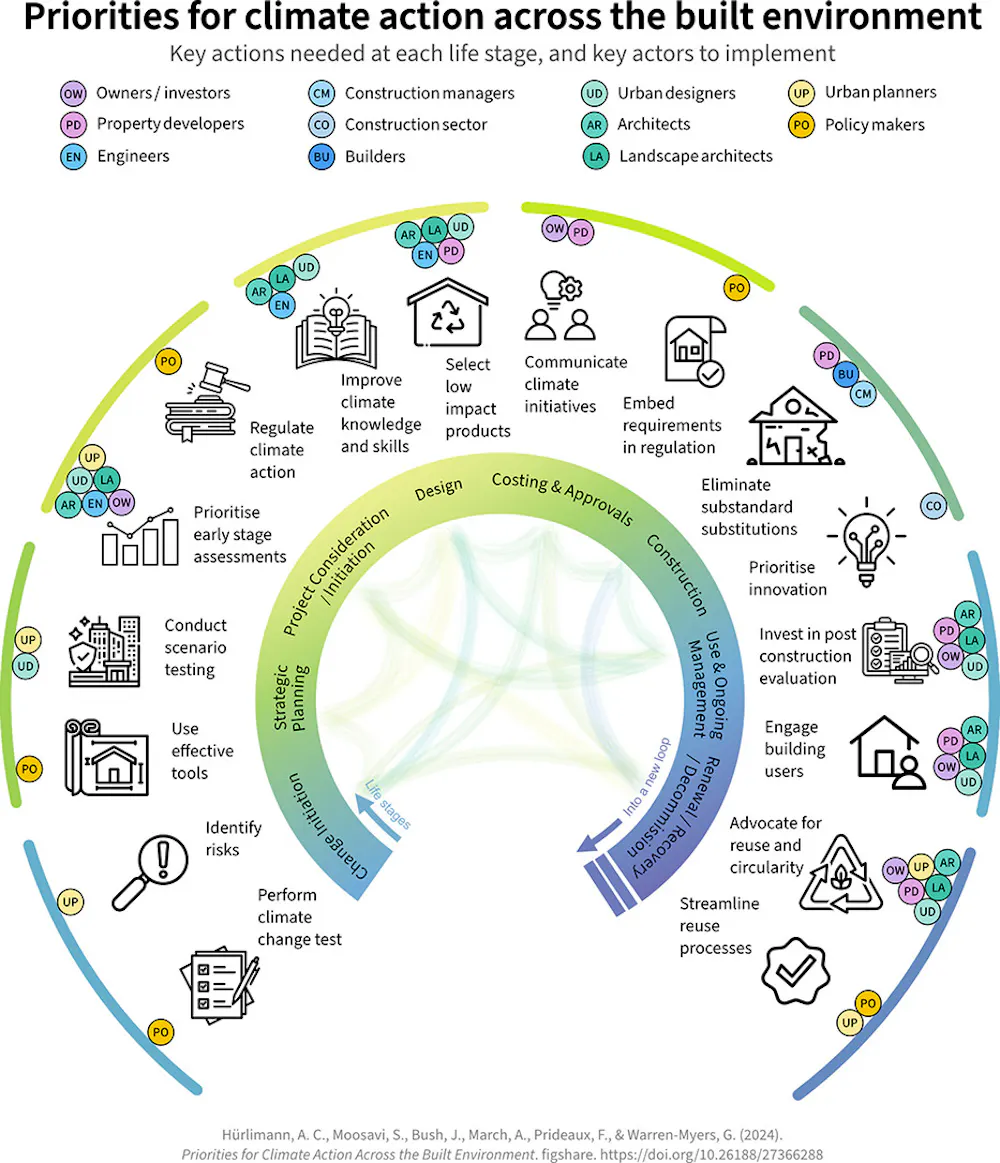
Our new study identifies 16 priority actions to address climate change in the construction and management of cities.
Building smarter
Climate change must be a key consideration when designing, building and managing our cities. The emissions generated need to be minimised and eventually eliminated.
We must build in locations, and in ways, that reduce climate risks. But policies governing how our cities are designed and constructed don’t achieve this.
A recent study of three local government areas identified only limited action on adaptation and mitigation. Other research has found few urban development policies include carbon reduction goals that meet international targets.
The National Housing Accord will see more than one million houses built by 2029. These new homes must address the climate challenge.
16 areas for priority action
The priority areas in our new study were informed by interviews with more than 150 stakeholders working in urban planning, architecture, landscape architecture, urban design, sustainability, construction and property.
Priority areas for minimising damaging emissions generated by cities. CC BY
The actions they identified cover the entire life cycle of the built environment.
One of the first barriers to overcome is the perceived lack of agency among industry professionals to initiate or demand climate action. They perceive others, such as property owners or clients, to have more influence.
Climate change risks should be identified in the early stages of planning new developments, backed up by effective tools to make risk identification and action easier:
There were areas that were identified as being flood prone or risk prone. But there was no strategy to deal with what happens to those areas – An urban planner
Once specific projects are being considered it is important to prioritise early stage climate assessments, supported by policies which mandate climate action:
Everyone has good intentions but without big formal legislation around it, everyone’s just sort of making their way in the dark – A construction industry professional
In the design stage, steps to improve the climate knowledge and skills of the workforce beyond disciplinary boundaries is critical. The selection of low-impact products and materials will also help ensure design is more climate responsive.
The highest number of hurdles to climate action were found to occur during the costing and approvals stage. Participants spoke of a highly competitive building industry. If climate change initiatives introduced at an earlier stage aren’t required by law, they are likely to be cut.
unless there’s something in it for them in terms of return on investment, it’s going to be hard to get them to do it, unless we make them – An urban planner
During the construction phase, product and material substitutions that have detrimental environmental impact should be eliminated. Innovation should be encouraged:
If you want to push the envelope a little bit in terms of using recycled materials […] that’s a bit of a barrier. To push innovation is difficult – A landscape architect
Post-construction
Once construction is complete and buildings and public spaces are being used, it is important to invest in a thorough evaluation process. Building users should be involved to ensure buildings are maintained for optimal climate outcomes:
[We] tried to achieve the six star rating […] the client has to maintain it [the building] for a year, and that’s when things start to fall off – An architect
When it comes to area upgrades or building renewals, advocating for reuse and materials circularity is important. But the custom of demolishing and building anew, is hard to shift:
The reuse of the existing building obviously generates significantly less waste and involves less material. So, design decisions and strategic decisions around using existing buildings is really important – An urban designer
Working together
This is a time of significant change in our urban areas.
We need to make sure climate action is embedded in every stage of decision making. This may mean more efficient use, and reuse, of the existing built stock. This will require an overhaul of policies regarding building retrofits, and a change in mindsets.
The priority actions to address climate change in cities can be implemented across a range of levels for:
individual professionals – pursue development of their climate change skills, including opportunities provided by professional associations
professional practices – review internal processes to ensure climate action is mainstreamed across projects, and in company decision making
universities teaching built environment professional degrees – embed climate change knowledge, skills, and competencies across the curriculum
governments at all levels – review policy settings to mandate mitigation and adaption.
By addressing these actions, we can collectively work towards achieving our emission reduction targets and making sure our cities minimise climate change risks.
Anna Hurlimann received funding for the research reported in this article from the Australian Research Council – Discovery Grant DP200101378, with co-chief investigators Georgia Warren-Myers, Alan March, Sareh Moosavi and Judy Bush. She is a member of the Planning Institute of Australia.
Sareh Moosavi received funding for the research reported in this article from the Australian Research Council – Discovery Grant DP200101378, with co-chief investigators Anna Hurlimann, Georgia Warren-Myers, Alan March, and Judy Bush.
If you want to advertise a house online in Australia, you don’t have many options. Just two companies dominate the market.
Australia’s largest property listings platform, realestate.com.au, belongs to digital media company REA Group, which is majority-owned by Rupert Murdoch’s US-based media conglomerate News Corporation (News Corp).
REA claims average traffic of 11.9 million viewers per month, substantially more than that of its nearest rival, Domain.
That’s led to widespread concern about REA’s dominant market power and the potential for price-gouging, which are currently subject to an ongoing probe by the Australian Competition and Consumer Commission (ACCC).
Meanwhile, my research has revealed that REA has expanded into mortgage lending, an important new direction which, until now, has escaped attention.
The implications here are worth considering. News Corp, a foreign-owned media company, now has a direct stake in framing the Australian housing narrative and influencing policy, while profiting through its property platform from listings, data, and its own mortgages.
It’s a shrewd business strategy. But Australia currently doesn’t have a regulator fit for overseeing such a hybrid entity, raising serious questions about who is keeping watch.
‘Good debt’
Australian households have long accepted the prevailing narrative, promoted by the media, that housing investment is their “path to wealth”. Mortgages are endorsed as the way to manage the growing gap between flatlined wages and rising house prices.
Primed for finance in this way, many households have come to embrace mortgages as an aspirational form of “good debt”, the mark of a savvy player rather than a long-term financial burden.
This has helped fuel what could be described as a housing “frenzy”, a volatile situation in which escalating housing prices and indebtedness undermine household wellbeing. Younger generations and the disadvantaged, among others, are left out in the cold.
From newspapers to platforms to finance
As digitisation has forced legacy media players such as News Corp to seek new strategies to stay viable, so too has it disrupted the finance industry by opening it up to non-bank players.
Taking advantage of this opportunity, REA Group entered the mortgage market in 2016, starting with a partnership with National Australia Bank. It purchased mortgage brokerages the following year.
The realestate.com.au platform was then redesigned to include a mortgage portal to direct millions of Australian homeseekers to lending through those channels. This provides REA with revenue from platform leads to the bank, as well as up-front and trailing mortgage commissions from their brokers.
REA also harvests the extensive financial data supplied by millions of users via their financial profiles and the calculator tools embedded in the website.
That data, an increasingly valuable asset, can be monetised through the platform’s advertiser and homebuyer markets, and News Corp’s extensive partnerships with data broker and analytics companies.
Selling mortgages
Most recently, REA Group has taken its finance strategy one step further. In October 2024, it purchased a 19.9% stake in digital non-bank lender Athena Home Loans.
This allows REA to profit directly from its own mortgages offered to platform users through its current brokerage, Mortgage Choice.
For REA Group (and its owner, News Corp), this move is both logical and strategically compelling in a challenging media environment. As well as influencing policy, REA Group and News Corp are proficient in crafting and cross-promoting a powerful message about housing and debt to the public.
With their profit now even more directly tied to the housing mortgage market – and thereby customers’ debt – the Athena acquisition can only strengthen REA’s vested interest in the continued rise in house prices and household indebtedness. This has the potential to undermine policies to improve housing affordability.
The law can’t keep up
The power imbalance against consumers is stark. So which regulator is keeping an eye on it?
Such an initiative combining housing, finance and media can slip through the cracks in Australia’s fragmented regulatory system with its narrowly-focused legislation.
The legislation lags behind the technology as well. A platform’s persuasive design, with its algorithmic tools, predetermined paths and data harvesting, obscures its prioritisation of commercial interests over that of consumers.
Players from different industries interacting through the “black box” of a platform appear to come under looser regulatory oversight than those from a single industry or operating outside a platform.
the legislation isn’t updated in the way that […] keeps pace with the evolving technology, trends and emerging markets.
In a landscape where such complex digital initiatives are becoming the norm, regulators urgently need to update their understanding and broaden their jurisdiction to include them.
And not just in Australia. REA has confirmed that a successful trial of its initiative here will lead to its rollout across its broad global property platform network.
Nor just REA. Other companies are eyeing this space. REA’s closest competitor, Domain, is currently under acquisition by CoStar, a major digital real estate player in the United States, with the aim to challenge REA.
The rapid and major disruptions caused by such initiatives, such as Airbnb’s negative impact on housing affordability globally, can be difficult to redress retrospectively.
Somebody needs to keep watch.
REA Group declined to comment on this article.
Roberta Esbitt does not work for, consult, own shares in or receive funding from any company or organisation that would benefit from this article, and has disclosed no relevant affiliations beyond their academic appointment.
If you want to advertise a house online in Australia, you don’t have many options. Just two companies dominate the market.
Australia’s largest property listings platform, realestate.com.au, belongs to digital media company REA Group, which is majority-owned by Rupert Murdoch’s US-based media conglomerate News Corporation (News Corp).
REA claims average traffic of 11.9 million viewers per month, substantially more than that of its nearest rival, Domain.
That’s led to widespread concern about REA’s dominant market power and the potential for price-gouging, which are currently subject to an ongoing probe by the Australian Competition and Consumer Commission (ACCC).
Meanwhile, my research has revealed that REA has expanded into mortgage lending, an important new direction which, until now, has escaped attention.
The implications here are worth considering. News Corp, a foreign-owned media company, now has a direct stake in framing the Australian housing narrative and influencing policy, while profiting through its property platform from listings, data, and its own mortgages.
It’s a shrewd business strategy. But Australia currently doesn’t have a regulator fit for overseeing such a hybrid entity, raising serious questions about who is keeping watch.
‘Good debt’
Australian households have long accepted the prevailing narrative, promoted by the media, that housing investment is their “path to wealth”. Mortgages are endorsed as the way to manage the growing gap between flatlined wages and rising house prices.
Primed for finance in this way, many households have come to embrace mortgages as an aspirational form of “good debt”, the mark of a savvy player rather than a long-term financial burden.
This has helped fuel what could be described as a housing “frenzy”, a volatile situation in which escalating housing prices and indebtedness undermine household wellbeing. Younger generations and the disadvantaged, among others, are left out in the cold.
From newspapers to platforms to finance
As digitisation has forced legacy media players such as News Corp to seek new strategies to stay viable, so too has it disrupted the finance industry by opening it up to non-bank players.
Taking advantage of this opportunity, REA Group entered the mortgage market in 2016, starting with a partnership with National Australia Bank. It purchased mortgage brokerages the following year.
The realestate.com.au platform was then redesigned to include a mortgage portal to direct millions of Australian homeseekers to lending through those channels. This provides REA with revenue from platform leads to the bank, as well as up-front and trailing mortgage commissions from their brokers.
REA also harvests the extensive financial data supplied by millions of users via their financial profiles and the calculator tools embedded in the website.
That data, an increasingly valuable asset, can be monetised through the platform’s advertiser and homebuyer markets, and News Corp’s extensive partnerships with data broker and analytics companies.
Selling mortgages
Most recently, REA Group has taken its finance strategy one step further. In October 2024, it purchased a 19.9% stake in digital non-bank lender Athena Home Loans.
This allows REA to profit directly from its own mortgages offered to platform users through its current brokerage, Mortgage Choice.
For REA Group (and its owner, News Corp), this move is both logical and strategically compelling in a challenging media environment. As well as influencing policy, REA Group and News Corp are proficient in crafting and cross-promoting a powerful message about housing and debt to the public.
With their profit now even more directly tied to the housing mortgage market – and thereby customers’ debt – the Athena acquisition can only strengthen REA’s vested interest in the continued rise in house prices and household indebtedness. This has the potential to undermine policies to improve housing affordability.
The law can’t keep up
The power imbalance against consumers is stark. So which regulator is keeping an eye on it?
Such an initiative combining housing, finance and media can slip through the cracks in Australia’s fragmented regulatory system with its narrowly-focused legislation.
The legislation lags behind the technology as well. A platform’s persuasive design, with its algorithmic tools, predetermined paths and data harvesting, obscures its prioritisation of commercial interests over that of consumers.
Players from different industries interacting through the “black box” of a platform appear to come under looser regulatory oversight than those from a single industry or operating outside a platform.
the legislation isn’t updated in the way that […] keeps pace with the evolving technology, trends and emerging markets.
In a landscape where such complex digital initiatives are becoming the norm, regulators urgently need to update their understanding and broaden their jurisdiction to include them.
And not just in Australia. REA has confirmed that a successful trial of its initiative here will lead to its rollout across its broad global property platform network.
Nor just REA. Other companies are eyeing this space. REA’s closest competitor, Domain, is currently under acquisition by CoStar, a major digital real estate player in the United States, with the aim to challenge REA.
The rapid and major disruptions caused by such initiatives, such as Airbnb’s negative impact on housing affordability globally, can be difficult to redress retrospectively.
Somebody needs to keep watch.
REA Group declined to comment on this article.
Roberta Esbitt does not work for, consult, own shares in or receive funding from any company or organisation that would benefit from this article, and has disclosed no relevant affiliations beyond their academic appointment.
Stand on any car park on a sunny day in February and the heat will radiate through your shoes. At 30°C air temperature, that asphalt hits 50–55°C – hot enough to cause second-degree burns to skin in seconds.
Right now, in the northern hemisphere summer, 100 million Americans are dealing with 38°C temperatures. Britain is preparing for hundreds of heat deaths. In New Zealand, of course, we’re still lighting fires and complaining about the cold.
But that gives us time to prepare for our own heatwaves. Open-air car parks that sit empty for 20 hours a day could become cooling infrastructure instead. Transport routes can become cooling corridors.
Replace asphalt with trees, grass and permeable surfaces, and you can drop surface temperatures by 12°C. It’s not complicated. It’s not even expensive.
It’s getting hotter
NIWA data shows New Zealand is already experiencing extreme temperatures five times more frequently than historical baselines. Wellington hit 30.3°C and Hamilton 32.9°C in January, both all-time records. Marine heatwaves are persisting around South Island coasts months longer than usual.
A quarter of New Zealand’s population will be over 65 by 2043, an age when heat regulation becomes harder and fixed incomes make cooling costs a real burden.
Currently, 14 heat-related deaths occur annually among Auckland’s over-65 population when temperatures exceed just 20°C. As the mercury rises, our older population will be at a greater risk.
Summer in the city: a vendor sells drinks and ice cream during a severe heat wave in Washington DC, June 23. Getty Images
Greener is cooler
While global average temperature increases of 1.5°C might appear modest, the actual temperatures we experience in our cities is far more extreme. The built environment – all that concrete and asphalt – traps heat like an oven.
But converting car parks back to green space can knock the temperature down dramatically.
Research from Osaka Prefecture in Japan recorded surface temperature reductions of up to 14.7°C when comparing asphalt to grass-covered parking during sunny summer conditions.
Trees are the heavy lifters here. Stand under a tree on a hot day, and it can feel 17°C cooler than standing in the sun. Add rain gardens (shallow, planted areas designed to capture and filter stormwater) and ground cover for another 2-4°C reduction. Layer these elements together, and you get cooling that works even on overcast days.
Roads as cooling corridors
Grassy and tree-covered car parks are just a starting point. Auckland’s 7,800 kilometres of roads could become the city’s cooling system. Every bus lane, cycleway and walking path is an opportunity for green infrastructure.
If we stop thinking of transport corridors as merely a way to get from one place to another, and see them as multifunctional cooling networks, the possibilities multiply while the costs remain relatively low.
Melbourne’s COVID-era parklet program proved this works: 594 small conversions created 15,000 square metres of public space at just A$300–900 per square metre.
Converting even a small percentage of New Zealand’s parking infrastructure could create connected cooling corridors throughout our cities.
Protecting cycleways with a tree canopy would encourage active transport while cooling neighbourhoods. Bus lanes with rain garden medians would improve service reliability while managing stormwater.
5 things councils can do
Summer is six months away – maybe not enough time to do all the work needed, but certainly enough to get a plan in place. Here are five things councils could do.
Plant trees now: winter is planting season. Focus on car parks and heat-vulnerable neighbourhoods. Use fast-growing natives and protective rings to ensure survival. Trees planted now will provide shade by December.
Install modular planters: test cooling locations with movable infrastructure before committing to permanent changes. Order now for spring placement when residents can see the benefits.
Schedule paving replacements: when resurfacing is needed, switch to permeable options and get heat-reducing surfaces in place before summer.
Design shade structures: plan and budget pop-up shade for the hottest areas. Having designs ready means quick installation when temperatures spike.
Organise spring planting days: line up community groups now, source trees through winter nursery contracts, and hit the ground running in September. Small investments in coordination yield big cooling dividends.
Auckland Council’s NZ$1 billion climate action package includes grants of $1,000 to $50,000 for climate projects. Wellington’s Climate and Sustainability Fund and Christchurch’s 50-year Urban Forest Plan provide similar frameworks.
The Ministry for the Environment’s National Policy Statement on Urban Development creates opportunity by removing minimum parking requirements. This frees up land for trees, gardens and public spaces instead of underused asphalt, maximising climate co-benefits: cooler surfaces, better stormwater management and more pleasant streetscapes.
By next February, we can either be thanking ourselves for planting trees and converting car parks, or feeling the heat from that 50°C asphalt.
Timothy Welch does not work for, consult, own shares in or receive funding from any company or organisation that would benefit from this article, and has disclosed no relevant affiliations beyond their academic appointment.
When you went to school, did you call your teacher Mrs, Ms or Mr, followed by their surname? Perhaps you even called them Sir or Miss.
The tradition of addressing teachers in a formal manner goes back centuries. For many of us, calling a teacher by their first name would have been unthinkable.
But that’s not automatically the case anymore. Some teachers in mainstream schools now ask students to call them by their first name.
Why is this? And what impact can teachers’ names have in the classroom?
There’s no rule
There’s no official rule in Australia on what students should call teachers.
Naming is usually decided by schools or individual teachers. This is no official training on this topic before teachers start in classrooms.
Some primary school teachers now use first names or a less formal name such as “Mr D”. Teachers say this helps break down barriers, especially for young students or those who are learning English as an additional language.
High schools are more likely to stick with tradition, partly to maintain structure and boundaries, especially with teenagers. Using formal titles can also support early-career teachers or those from minority
backgrounds assert their authority in a classroom.
But even so, some high school teachers are using their first names to foster a sense of trust and encourage students to see them as a partner in learning, rather than simply an authority figure.
What does the research say?
Research – which is mainly from the United States – suggests names have an impact on how students perceive their teachers and feel about school.
In one study of US high school students, teenagers described teachers they addressed with formal titles as more distant and harder to connect with. Teachers who invited students to use their first name were seen as more supportive, approachable and trustworthy.
A secondary school principal in the state of Maryland reported students felt more included and respected when they could use teachers’ first names. It made classrooms feel less hierarchical and more collaborative.
A 2020 US study on teaching students doing practical placements found those who used their first name observed greater student engagement than those who did not. This came as a surprise to the student teachers who expected students would not respect them if they used their first names.
These findings don’t necessarily mean titles are bad. Rather, they show first names can support stronger teacher-student relationships.
It’s important to note society in general has become less formal in recent decades in terms of how we address and refer to each other.
So, what should students call their teachers?
What works in one school, or even one classroom, may not work in another.
For example, for Indigenous students or students from non-English speaking households, name practices that show cultural respect and mutual choice can be vital. They help create a sense of safety and inclusion.
But for other teachers, being called by their title may be a key part of their professional persona.
That’s why it’s important for naming decisions to be thoughtful and based on the needs of the teacher, students and broader school community.
The key is to treat naming as part of the broader relationship, not just a habit or automatic tradition. Whether students say “Mrs Lee” or “Jess” matters less than whether they feel safe, respected and included. It’s about the tone and relationship behind the name, not simply what someone is called.
Nicole Brownlie does not work for, consult, own shares in or receive funding from any company or organisation that would benefit from this article, and has disclosed no relevant affiliations beyond their academic appointment.
Australia is spending more than ever on disability services – and yet many people with disability still aren’t receiving the support they need.
Since the National Disability Insurance Scheme (NDIS) began in 2013, it has transformed the lives of hundreds of thousands of disabled Australians and their families.
New “foundational supports” – disability-specific services outside individual NDIS packages – are part of the answer to reduce demand on the NDIS and make the scheme sustainable. They were supposed to be operational from July 1 2025. That’s tomorrow, but they are nowhere to be seen.
A new Grattan Institute report shows how the government can fund these vital supports and save the NDIS – without spending more money.
Spending is too concentrated in the NDIS
All Australian governments are spending more on disability services than they were before the NDIS.
Note: Includes all expenditure on direct disability service delivery by Australian governments. Sources: Productivity Commission Return on Government Services report 2025/Grattan Institute
This is a good thing. But most of this expenditure is for individual NDIS funding packages. The NDIS funds packages for about 700,000 Australians.
Many other disabled Australians might only require occasional or low-intensity support such as peer support, supported decision-making, or self-advocacy – supports which are poorly funded and targeted under current arrangements.
So there’s a huge incentive for people to get into the NDIS, regardless of whether an individualised funding package best meets their needs.
The NDIS supports more people than intended
We’re seeing this incentive play out in ballooning numbers of people entering the NDIS.
The number of adults in the scheme is only a little higher than originally expected, but the number of children is nearly double.
Note: Productivity Commission estimates have been inflated based on population growth for 0-64 year-olds between the reference year (2009) and 2024, using Australian Bureau of Statistics Estimated Resident Population data. Sources: Productivity Commission Disability Care and Support 2011, National Disability Insurance Agency Explore Data 2024, Australian Bureau of Statistics Estimated Resident Population 2024/Grattan Institute
About 10% of children aged five to seven are now in the NDIS, including 15% of six-year-old boys.
The expectation was that many children would only require short-term early intervention supports. Instead, most children are staying in the scheme long term.
Our research shows the current NDIS design is poorly suited to delivering early intervention, which works best for children when it is delivered in the places they live, learn and play. This includes in playgroups, libraries and early childhood education settings.
An individualised funding model makes this difficult. Yet this is the only option available for most families, because the NDIS has led to reduced investment in services that could work far better for their children.
Support more Australians with disability
The problem isn’t the amount of funding in the system, but the way it is used.
Foundational supports are services and supports for people with disability that do not involve individualised funding from the NDIS.
To meet the needs of more disabled Australians and take pressure off the NDIS, it is imperative that governments establish an ambitious program of these lower-intensity supports.
These should include supports available to all disabled Australians who need them, such as information and advice, support with decision-making, and access to peer support or self-advocacy.
They should also include evidence-based early intervention supports for children with disability and/or developmental delay. And they should include psychosocial supports for people with severe mental illness who don’t meet the threshold for an individualised NDIS package.
The current impasse in Commonwealth-state funding negotiations could be overcome by governments agreeing to repurpose a small portion – about 10% – of their existing NDIS contributions.
Our report outlines a plan to fully fund foundational supports using this repurposed funding and better allocate individualised funding. This would ensure more people get the support they need within an affordable NDIS that grows more slowly.
Don’t save money by delaying access
NDIS growth has fallen in recent quarters and is on track to be 10.6% in 2024-25.
This compares with an average growth rate of more than 24% a year over the past five years.
But it is too early to attribute that reduction in growth to policy changes.
A significant downturn in operational performance is very likely to be a contributing factor. The NDIS is groaning under the weight of unsustainable work volumes.
Since September 2023, it has been taking longer to approve new applicants trying to get access to the NDIS, and to reassess the plans of people already on the scheme.
Notes: Data is unavailable for December 2023 due to the NDIA upgrading to a new computer system. Sources: NDIA Quarterly reports, Q4 2021-22 to Q3 2024-25/Grattan Institute
We know what drives growth in NDIS expenditure: more people joining the scheme, and existing NDIS participants’ plans increasing over time.
At the moment, slowing down how fast the NDIS is growing is coming at the expense of the disabled people who need support from the NDIS and are waiting too long to get it.
It is important that necessary growth moderation is achieved through measures that do not result in vital supports being delayed, or disabled peoples’ experience of, and results from, the NDIS being undermined.
The NDIS is worth saving. Making necessary policy changes now to rebalance the NDIS will ensure it endures for future generations.
Grattan Institute’s Disability Program has support from the Summer Foundation.
As the ceasefire between Israel and Iran seems to be holding for now, it is important to reflect on whether this whole episode was worth the risks.
Wider escalation was (and remains) possible, and we do not know whether Iran will seek a nuclear weapon with renewed vigour in the future.
So, could we live with a nuclear-armed Iran, if it does indeed continue to pursue a bomb?
Is an Iranian bomb an existential threat?
The conventional wisdom, at least in the Western world, is that an Iranian nuclear weapon would pose an existential threat to Israel, and possibly the United States as well.
Israeli Prime Minister Benjamin Netanyahu said his country’s strikes on Iran’s nuclear facilities were aimed at rolling back “the Iranian threat to Israel’s very survival”.
White House press secretary Karoline Leavitt described an Iranian bomb as “an existential threat, not just to Israel, but to the United States, and to the entire world”.
Iran, of course, did not yet possess a nuclear weapon when the strikes occurred, as the UN nuclear watchdog attested. The strikes were aimed at preventing Iran from being able to do so in the future – a prospect seen by Israel and the US as simply “unthinkable”.
But if Iran had built a nuclear weapon before the Israeli and US strikes – or manages to do so in the future – would this pose an existential threat to Israel or the US?
The Israeli government officially neither confirms nor denies the existence of its nuclear arsenal. But thanks to leaks from inside the Israeli nuclear program – as well as the best assessments from around the world – we can be quite sure they exist. It also explains why Israel has never signed the Nuclear Non-proliferation Treaty – it can’t without giving up this stockpile.
The US, of course, has been nuclear-armed since 1945 and openly maintains an inventory of thousands of nuclear warheads. These provide a deterrent against nuclear attacks on the United States.
Washington also provides extended nuclear deterrence guarantees to over 30 states, including members of NATO, Japan, South Korea and Australia. It does not need to provide this for Israel given the Israeli arsenal. But if there was ever any doubt about Israel’s stockpile, it certainly could.
After 80 years of living with nuclear weapons, we know the deterrent effect of assured nuclear retaliation is very powerful. It deterred both the Soviets and Americans from using nuclear weapons against each other through multiple Cold War crises. It has deterred both India and Pakistan from using them in multiple standoffs, including quite recently. It has deterred both North Korea and the US from striking each other.
Similarly, Iran would no doubt be deterred from using a nuclear weapon by a certain Israeli or American response.
Iranian leaders have called for the destruction of Israel, and the chants of “death to Israel” and “death to America” are a common occurrence at rallies held by supporters of the regime.
But beneath the fiery rhetoric lies a truism: no Iranian leader would destroy Israel with a nuclear weapon if it came at the expense of the destruction of Iran.
In the history of the nation-state, not a single one has ever knowingly committed suicide. Not for any reason – ideological, religious, political or any other. All nations value survival over everything else because this allows for the achievement of other goals, such as power and prosperity.
Further, Iran is ruled by a brutally authoritarian, theocratic regime. And for authoritarian regimes, staying in power is the number one priority. There is no staying in power the day after a nuclear exchange.
Not a panacea
This does not mean an Iranian nuclear weapon would be a welcome development. Far from it.
There is no doubt the existence of over 12,000 nuclear weapons globally poses a potentially existential risk to all of humanity.
But the idea that a nuclear-armed Iran would pose a unique risk to Israel or the United States simply does not stand up to scrutiny. If we can live with a nuclear-armed North Korea, nuclear-armed Pakistan, and for that matter, a nuclear-armed Israel, we can live, however reluctantly, with a nuclear-armed Iran.
Regardless of whether the current proposed ceasefire between Israel and Iran holds, the military operation initiated by Israel and bolstered by the United States was extremely dangerous and unnecessary, based on both countries’ justification.
The regime in Tehran is brutal, authoritarian, openly antisemitic and worthy of our disdain. But there is no evidence it is suicidal.
The claim an Iranian nuclear bomb would pose an existential threat to Israel or the United States and justifies unilateral, preventive military attacks makes no sense.
It is time to stop repeating it.
Benjamin Zala has received funding from the Stanton Foundation, a US philanthropic group that funds nuclear research. He is an honorary fellow at the University of Leicester on a project that is funded by the European Research Council.
The scientists who precisely measure the position of Earth are in a bit of trouble. Their measurements are essential for the satellites we use for navigation, communication and Earth observation every day.
But you might be surprised to learn that making these measurements – using the science of geodesy – depends on tracking the locations of black holes in distant galaxies.
The problem is, the scientists need to use specific frequency lanes on the radio spectrum highway to track those black holes.
Satellites and the services they provide have become essential for modern life. From precision navigation in our pockets to measuring climate change, running global supply chains and making power grids and online banking possible, our civilisation cannot function without its orbiting companions.
To use satellites, we need to know exactly where they are at any given time. Precise satellite positioning relies on the so-called “global geodesy supply chain”.
This supply chain starts by establishing a reliable reference frame as a basis for all other measurements. Because satellites are constantly moving around Earth, Earth is constantly moving around the Sun, and the Sun is constantly moving through the galaxy, this reference frame needs to be carefully calibrated via some relatively fixed external objects.
These black holes are the most distant and stable objects we know. Using a technique called very long baseline interferometry, we can use a network of radio telescopes to lock onto the black hole signals and disentangle Earth’s own rotation and wobble in space from the satellites’ movement.
Different lanes on the radio highway
We use radio telescopes because we want to detect the radio waves coming from the black holes. Radio waves pass cleanly through the atmosphere and we can receive them during day and night and in all weather conditions.
Radio waves are also used for communication on Earth – including things such as wifi and mobile phones. The use of different radio frequencies – different lanes on the radio highway – is closely regulated, and a few narrow lanes are reserved for radio astronomy.
However, in previous decades the radio highway had relatively little traffic. Scientists commonly strayed from the radio astronomy lanes to receive the black hole signals.
To reach the very high precision needed for modern technology, geodesy today relies on more than just the lanes exclusively reserved for astronomy.
Radio traffic on the rise
In recent years, human-made electromagnetic pollution has vastly increased. When wifi and mobile phone services emerged, scientists reacted by moving to higher frequencies.
However, they are running out of lanes. Six generations of mobile phone services (each occupying a new lane) are crowding the spectrum, not to mention internet connections directly sent by a fleet of thousands of satellites.
Today, the multitude of signals are often too strong for geodetic observatories to see through them to the very weak signals emitted by black holes. This puts many satellite services at risk.
What can be done?
To keep working into the future – to maintain the services on which we all depend – geodesy needs some more lanes on the radio highway. When the spectrum is divided up via international treaties at world radio conferences, geodesists need a seat at the table.
Other potential fixes might include radio quiet zones around our essential radio telescopes. Work is also underway with satellite providers to avoid pointing radio emissions directly at radio telescopes.
Any solution has to be global. For our geodetic measurements, we link radio telescopes together from all over the world, allowing us to mimic a telescope the size of Earth. The radio spectrum is primarily regulated by each nation individually, making this a huge challenge.
But perhaps the first step is increasing awareness. If we want satellite navigation to work, our supermarkets to be stocked and our online money transfers arriving safely, we need to make sure we have a clear view of those black holes in distant galaxies – and that means clearing up the radio highway.
Lucia McCallum does not work for, consult, own shares in or receive funding from any company or organisation that would benefit from this article, and has disclosed no relevant affiliations beyond their academic appointment.
Even though the survey says these Americans are doing so “just for fun” and claim they rely on the information gained by divination “only a little,” the persistence — and apparent rise — of these practices suggests something deeper is at play.
Tarot card: The High Priestess (Waite–Smith deck), c. 1909. (Pamela Colman Smith), CC BY
I study ancient divination, but to better understand how diviners work, I have observed contemporary diviners at work and talked with them about their practices. They say their clients request tarot consultations more frequently than they did in the past.
Divination methods, including tarot and astrology, offer a way to ask questions when other systems fail to provide answers. These questions can be highly personal and difficult to address in a formal religious setting. The divinatory answers allow people to feel they’ve gained insight, which in turn gives a perception of control over an uncertain future.
Apart from astrology and tarot, some of the best known divination methods include: the interpreting of dreams, reading coffee cups or tea leaves, observing animals and nature, reading palms and other body features such as nose shape and eye placement.
When a diviner uses things, such as cards, tea leaves, dice or shells, the connecting thread to many of these methods is that people cannot control the signs they produce. For example, divination consultants typically mix the tarot card deck to make sure the result are randomized. People should not manipulate the results.
Many people turn to religion when they face the unknown in their lives. They address their insecurities in worship, asking for divine help.
But there have always been people who did not have access to organized religion. Divinatory practices can be especially appealing to those who have been excluded from traditional religion and had to come up with alternative ways to address uncertainties.
In an age marked by ongoing anxiety, political instability and waning trust in institutions, centuries-old divination rituals offer alternative ways for folks to seek entertainment but also to gain a sense of insight, agency and connection. What may seem like harmless fun can also serve as a serious response to a chaotic world. Divinatory practices can provide both spiritual exploration and emotional validation.
Besides increasing political insecurity, another reason for the increased interest in tarot may be the visual aspect. Increased interest in the decorated cards may be a reflection of our highly visual culture. Interest in the cards with images may reflect interest in other images we watch. They are like photos with messages.
The fascination with tarot may also speak about a need to control the consultation as a diviner and their client see exactly the same thing. The images in the cards are also symbolic, and they can be interpreted in different ways.
In principle, the cards can be consulted anywhere without particular preparations. The only material one needs is a deck of cards. The accessible materiality may be adding to their popularity.
Even though the survey says these Americans are doing so “just for fun” and claim they rely on the information gained by divination “only a little,” the persistence — and apparent rise — of these practices suggests something deeper is at play.
Tarot card: The High Priestess (Waite–Smith deck), c. 1909. (Pamela Colman Smith), CC BY
I study ancient divination, but to better understand how diviners work, I have observed contemporary diviners at work and talked with them about their practices. They say their clients request tarot consultations more frequently than they did in the past.
Divination methods, including tarot and astrology, offer a way to ask questions when other systems fail to provide answers. These questions can be highly personal and difficult to address in a formal religious setting. The divinatory answers allow people to feel they’ve gained insight, which in turn gives a perception of control over an uncertain future.
Apart from astrology and tarot, some of the best known divination methods include: the interpreting of dreams, reading coffee cups or tea leaves, observing animals and nature, reading palms and other body features such as nose shape and eye placement.
When a diviner uses things, such as cards, tea leaves, dice or shells, the connecting thread to many of these methods is that people cannot control the signs they produce. For example, divination consultants typically mix the tarot card deck to make sure the result are randomized. People should not manipulate the results.
Many people turn to religion when they face the unknown in their lives. They address their insecurities in worship, asking for divine help.
But there have always been people who did not have access to organized religion. Divinatory practices can be especially appealing to those who have been excluded from traditional religion and had to come up with alternative ways to address uncertainties.
In an age marked by ongoing anxiety, political instability and waning trust in institutions, centuries-old divination rituals offer alternative ways for folks to seek entertainment but also to gain a sense of insight, agency and connection. What may seem like harmless fun can also serve as a serious response to a chaotic world. Divinatory practices can provide both spiritual exploration and emotional validation.
Besides increasing political insecurity, another reason for the increased interest in tarot may be the visual aspect. Increased interest in the decorated cards may be a reflection of our highly visual culture. Interest in the cards with images may reflect interest in other images we watch. They are like photos with messages.
The fascination with tarot may also speak about a need to control the consultation as a diviner and their client see exactly the same thing. The images in the cards are also symbolic, and they can be interpreted in different ways.
In principle, the cards can be consulted anywhere without particular preparations. The only material one needs is a deck of cards. The accessible materiality may be adding to their popularity.
Source: The Conversation – Canada – By Beatrix Beisner, Professor, Aquatic ecology; Groupe de recherche interuniversitaire en limnologie (GRIL), Université du Québec à Montréal (UQAM)
Plankton have inspired and influenced art, science and architecture.(Shutterstock)
Not much attention is paid to plankton because these creatures are usually hidden from sight. They are mostly microscopic in size and live in aquatic environments, but human lives are intricately connected with plankton.
The etymology of “plankton” originates from the ancient Greek word for “drifter.” Plankton refers to all organisms suspended in all types of waters (oceans, lakes, rivers and even groundwaters), including viruses, bacteria, insects, larval fish and jellyfish. Plankton come in many shapes and sizes, but what unites all of them is a tendency to drift with currents.
There are both plant (phytoplankton) and animal (zooplankton) types, as well as organisms that blur the line by belonging to both. These include carnivorous plants or photosynthesizing animals (mixoplankton).
Phytoplankton are an essential part of aquatic ecosystems. (Shutterstock)
Understanding plankton
We are an international group of researchers working on plankton that inhabit aquatic waters from high alpine lakes to the deep oceans. We represent a much larger consortium of researchers (the Plankton Passionates) who have recently considered all the ways in which plankton are crucial for human well-being, society, activity and life on our planet.
In our work, we have identified six broad themes that allow us to classify the value of plankton.
Plankton are integral to the ecological functioning of all aquatic environments. For example, phytoplankton use photosynthesis to create biomass that is transferred throughout the ecosystem, much as plants and trees do on land. Phytoplankton are mostly eaten by zooplankton, which are in turn prime food for fish like sardines and herring. These small fish are fed upon by larger fish and birds. That means healthy food-web functioning is critically sustained by plankton.
Plankton play a critical role in other ways that affect the ecological functioning of aquatic environments. Specifically, plankton affect the cycles of matter and the bio-geochemistry of their ecosystems. While phytoplankton use sunlight to grow and reproduce, they also move nutrients, oxygen and carbon around.
Phytoplankton are an essential climate variable — studying them provides key indicators for planetary health and climate change — because they capture carbon dioxide (CO2). When phytoplankton are eaten by zooplankton, and these animals die and sink to the bottom of water bodies, this stores carbon away from the atmosphere to where it can no longer contribute to climate change; this process is known as the biological carbon pump.
Plankton have also played a role in several human endeavours, including the evolution of science itself advancing many theoretical developments in ecology, such as the study of biodiversity. This diversity of plankton forms — including organisms that look like crystals or jewelry — have fascinated researchers.
Jellyfish are plankton because they are carried by currents through the water. (Shutterstock)
Several theories or frameworks used throughout ecology have emerged from studying plankton, but their applications go further. For example, Russian biologist Georgy Gause observed competition among plankton, leading to his competitive exclusion principle that’s now commonly applied in socioeconomic contexts.
Because of their foundational role in aquatic food webs, plankton are critical to many human economies. Many planktonic organisms are cultured directly for human consumption including jellyfish, krill, shrimp and copepod zooplankton.
Virtually all protein in aquatic ecosystems comes from plankton. Some are used as supplements, such as spirulina powder or omega-3 vitamins from krill or copepods.
Several plankton-derived compounds are highly prized in medicine, cosmetics and pharmaceuticals, including some plankton toxins used for their immune-stimulating effects. Luciferases are a group of enzymes produced by bioluminescent organisms, including many marine plankton, and are also important in biomedical research.
On the other hand, plankton can also lead to high economic costs when harmful algal blooms, like toxic red tides, occur along coastlines or cyanobacterial blooms arise in lakes.
Plankton benefits for humans
Finally, our research considers the role of plankton in human culture, recreation and well-being. Beyond their use as a food source and in medicine, plankton can be culturally important.
Bioluminescent marine dinoflagellates create incredibly powerful nighttime displays in coastal regions, forming the basis for cultural events and tourist attractions. Diatoms are a type of phytoplankton present in all aquatic ecosystems, and their silica-rich skeletons have been used for flint tools during the Stone Age and as opal in jewelry.
An illustration from the 1887 book ‘Report on the Radiolaria collected by H.M.S. Challenger during the years 1873-76.’ (Illus. by E. Haeckel/engraving by A. Giltsch)
Plankton are critical to all of these components. We all benefit from plankton due to their essential role in regulating aquatic habitats, their long-term involvement in climate regulation and the vital resources they provide to humanity.
Humanity lives with plankton as their incredible diversity connects life across land and water and is one of the driving forces behind Earth’s ecological stability and ecosystem services that we value. Plankton are part of humanity’s living in nature, which emphasizes their vital role in our identity, lifestyles and culture.
Plankton profoundly affect communities bordering water, but also those further away through plankton-inspired art and design. Finally, living as nature highlights the physical, mental and spiritual interconnectedness with the natural world.
We need to better recognize the value of plankton as a resource, and as an essential part of stabilizing Earth systems and maintaining them for human well-being.
Beatrix Beisner receives funding from NSERC. She is Editor-in-Chief of the Journal of Plankton Research (Oxford University Press) and a member of the Groupe de recherche interuniversitaire en limnologie (GRIL), an FRQNT-funded network.
Maria Grigoratou receives funding from the NSF project WARMEM (OCE-1851866) and the EU-funded HORIZON Europe projects EU4OceanObs2.0 and BioEcoOcean (101136748) to Maria Grigoratou. Maria is now affiliated with the European Polar Board.
Sakina-Dorothée Ayata receives funding from the European Commission (NECCTON, iMagine, Blue-Cloud2026 projects), the French National Research Agency (ANR, Traitzoo project), and the Institut Universitaire de France (IUF).
Susanne Menden-Deuer receives funding from the U.S. National Science Foundation and NASA.
Source: The Conversation – Canada – By Beatrix Beisner, Professor, Aquatic ecology; Groupe de recherche interuniversitaire en limnologie (GRIL), Université du Québec à Montréal (UQAM)
Plankton have inspired and influenced art, science and architecture.(Shutterstock)
Not much attention is paid to plankton because these creatures are usually hidden from sight. They are mostly microscopic in size and live in aquatic environments, but human lives are intricately connected with plankton.
The etymology of “plankton” originates from the ancient Greek word for “drifter.” Plankton refers to all organisms suspended in all types of waters (oceans, lakes, rivers and even groundwaters), including viruses, bacteria, insects, larval fish and jellyfish. Plankton come in many shapes and sizes, but what unites all of them is a tendency to drift with currents.
There are both plant (phytoplankton) and animal (zooplankton) types, as well as organisms that blur the line by belonging to both. These include carnivorous plants or photosynthesizing animals (mixoplankton).
Phytoplankton are an essential part of aquatic ecosystems. (Shutterstock)
Understanding plankton
We are an international group of researchers working on plankton that inhabit aquatic waters from high alpine lakes to the deep oceans. We represent a much larger consortium of researchers (the Plankton Passionates) who have recently considered all the ways in which plankton are crucial for human well-being, society, activity and life on our planet.
In our work, we have identified six broad themes that allow us to classify the value of plankton.
Plankton are integral to the ecological functioning of all aquatic environments. For example, phytoplankton use photosynthesis to create biomass that is transferred throughout the ecosystem, much as plants and trees do on land. Phytoplankton are mostly eaten by zooplankton, which are in turn prime food for fish like sardines and herring. These small fish are fed upon by larger fish and birds. That means healthy food-web functioning is critically sustained by plankton.
Plankton play a critical role in other ways that affect the ecological functioning of aquatic environments. Specifically, plankton affect the cycles of matter and the bio-geochemistry of their ecosystems. While phytoplankton use sunlight to grow and reproduce, they also move nutrients, oxygen and carbon around.
Phytoplankton are an essential climate variable — studying them provides key indicators for planetary health and climate change — because they capture carbon dioxide (CO2). When phytoplankton are eaten by zooplankton, and these animals die and sink to the bottom of water bodies, this stores carbon away from the atmosphere to where it can no longer contribute to climate change; this process is known as the biological carbon pump.
Plankton have also played a role in several human endeavours, including the evolution of science itself advancing many theoretical developments in ecology, such as the study of biodiversity. This diversity of plankton forms — including organisms that look like crystals or jewelry — have fascinated researchers.
Jellyfish are plankton because they are carried by currents through the water. (Shutterstock)
Several theories or frameworks used throughout ecology have emerged from studying plankton, but their applications go further. For example, Russian biologist Georgy Gause observed competition among plankton, leading to his competitive exclusion principle that’s now commonly applied in socioeconomic contexts.
Because of their foundational role in aquatic food webs, plankton are critical to many human economies. Many planktonic organisms are cultured directly for human consumption including jellyfish, krill, shrimp and copepod zooplankton.
Virtually all protein in aquatic ecosystems comes from plankton. Some are used as supplements, such as spirulina powder or omega-3 vitamins from krill or copepods.
Several plankton-derived compounds are highly prized in medicine, cosmetics and pharmaceuticals, including some plankton toxins used for their immune-stimulating effects. Luciferases are a group of enzymes produced by bioluminescent organisms, including many marine plankton, and are also important in biomedical research.
On the other hand, plankton can also lead to high economic costs when harmful algal blooms, like toxic red tides, occur along coastlines or cyanobacterial blooms arise in lakes.
Plankton benefits for humans
Finally, our research considers the role of plankton in human culture, recreation and well-being. Beyond their use as a food source and in medicine, plankton can be culturally important.
Bioluminescent marine dinoflagellates create incredibly powerful nighttime displays in coastal regions, forming the basis for cultural events and tourist attractions. Diatoms are a type of phytoplankton present in all aquatic ecosystems, and their silica-rich skeletons have been used for flint tools during the Stone Age and as opal in jewelry.
An illustration from the 1887 book ‘Report on the Radiolaria collected by H.M.S. Challenger during the years 1873-76.’ (Illus. by E. Haeckel/engraving by A. Giltsch)
Plankton are critical to all of these components. We all benefit from plankton due to their essential role in regulating aquatic habitats, their long-term involvement in climate regulation and the vital resources they provide to humanity.
Humanity lives with plankton as their incredible diversity connects life across land and water and is one of the driving forces behind Earth’s ecological stability and ecosystem services that we value. Plankton are part of humanity’s living in nature, which emphasizes their vital role in our identity, lifestyles and culture.
Plankton profoundly affect communities bordering water, but also those further away through plankton-inspired art and design. Finally, living as nature highlights the physical, mental and spiritual interconnectedness with the natural world.
We need to better recognize the value of plankton as a resource, and as an essential part of stabilizing Earth systems and maintaining them for human well-being.
Beatrix Beisner receives funding from NSERC. She is Editor-in-Chief of the Journal of Plankton Research (Oxford University Press) and a member of the Groupe de recherche interuniversitaire en limnologie (GRIL), an FRQNT-funded network.
Maria Grigoratou receives funding from the NSF project WARMEM (OCE-1851866) and the EU-funded HORIZON Europe projects EU4OceanObs2.0 and BioEcoOcean (101136748) to Maria Grigoratou. Maria is now affiliated with the European Polar Board.
Sakina-Dorothée Ayata receives funding from the European Commission (NECCTON, iMagine, Blue-Cloud2026 projects), the French National Research Agency (ANR, Traitzoo project), and the Institut Universitaire de France (IUF).
Susanne Menden-Deuer receives funding from the U.S. National Science Foundation and NASA.
According to Statistics Canada, the unemployment rate for youth aged 15-24 is 12.2 per cent — over double that of the prime working-age population.
The outlook is bleaker for students planning to return to full-time studies in the fall. Unemployment for this group has reached just over 20 per cent, the highest level since 2009, when the global economy was reeling from the Great Recession.
Roles in retail, hospitality and customer service often serve as a first taste of working life, helping young people build confidence, develop transferable skills and expand their professional networks. Without access to these opportunities, many young Canadians risk falling behind before their careers even begin.
The long-term implications are serious. According to a 2024 report from consulting firm Deloitte, Canada stands to lose $18.5 billion in GDP over the next decade if youth unemployment remains high.
Young Canadians are facing one of the toughest hiring seasons in years. (Shutterstock)
Many young job-seekers are understandably discouraged by today’s labour market. But as digital natives, Gen Z have advantages to bring to the table, including creativity, values-driven mindsets and fluency in technology.
The key is to stay open, proactive and creative by pursuing non-linear experiences that can serve as legitimate entry points into the workforce. Here are four actionable strategies for Gen Z starting their careers:
Side projects, such as building websites or freelancing, can also help people start their careers. These are increasingly recognized as valid ways to break into the job market.
2. Build core skills that matter.
The World Economic Forum’s Future of Jobs Report identifies analytical thinking, resilience, creativity, leadership and self-awareness as the most in-demand skills for the future. These can be developed through volunteer work, community leadership, mentorship or personal projects.
As workplaces adopt AI and automation, tech literacy is becoming increasingly valuable. Microcredentials can help build specialized skills, while apprenticeships and other experiential learning opportunities offer experiences that employers value.
Networks are also a key part of job success. Relationships with peers, mentors and community members can provide support, broaden perspectives and lead to unexpected opportunities. Participating in interest groups or volunteering can help young workers feel more connected and confident while developing skills that matter.
A new working generation
While these steps won’t solve the systemic challenges facing the labour market, they can help young Canadians gain traction in a system that is still catching up to the needs of their generation.
This will require the collaboration of government, employers, educational institutions and community service providers to innovatively reduce existing barriers. Importantly, these sectors are being asked to “walk the talk” when it comes to addressing youth unemployment.
Gen Z is entering the workforce during a time of profound economic and social change. But they also have unparalleled access to information, supportive communities and platforms to share ideas and make a meaningful impact.
By acting with intention, young Canadians can navigate this landscape with agency, laying the foundation not only for jobs but for careers that reflect their values and ambitions.
Leda Stawnychko receives funding from SSHRC.
Warren Boyd Ferguson does not work for, consult, own shares in or receive funding from any company or organisation that would benefit from this article, and has disclosed no relevant affiliations beyond their academic appointment.
According to Statistics Canada, the unemployment rate for youth aged 15-24 is 12.2 per cent — over double that of the prime working-age population.
The outlook is bleaker for students planning to return to full-time studies in the fall. Unemployment for this group has reached just over 20 per cent, the highest level since 2009, when the global economy was reeling from the Great Recession.
Roles in retail, hospitality and customer service often serve as a first taste of working life, helping young people build confidence, develop transferable skills and expand their professional networks. Without access to these opportunities, many young Canadians risk falling behind before their careers even begin.
The long-term implications are serious. According to a 2024 report from consulting firm Deloitte, Canada stands to lose $18.5 billion in GDP over the next decade if youth unemployment remains high.
Young Canadians are facing one of the toughest hiring seasons in years. (Shutterstock)
Many young job-seekers are understandably discouraged by today’s labour market. But as digital natives, Gen Z have advantages to bring to the table, including creativity, values-driven mindsets and fluency in technology.
The key is to stay open, proactive and creative by pursuing non-linear experiences that can serve as legitimate entry points into the workforce. Here are four actionable strategies for Gen Z starting their careers:
Side projects, such as building websites or freelancing, can also help people start their careers. These are increasingly recognized as valid ways to break into the job market.
2. Build core skills that matter.
The World Economic Forum’s Future of Jobs Report identifies analytical thinking, resilience, creativity, leadership and self-awareness as the most in-demand skills for the future. These can be developed through volunteer work, community leadership, mentorship or personal projects.
As workplaces adopt AI and automation, tech literacy is becoming increasingly valuable. Microcredentials can help build specialized skills, while apprenticeships and other experiential learning opportunities offer experiences that employers value.
Networks are also a key part of job success. Relationships with peers, mentors and community members can provide support, broaden perspectives and lead to unexpected opportunities. Participating in interest groups or volunteering can help young workers feel more connected and confident while developing skills that matter.
A new working generation
While these steps won’t solve the systemic challenges facing the labour market, they can help young Canadians gain traction in a system that is still catching up to the needs of their generation.
This will require the collaboration of government, employers, educational institutions and community service providers to innovatively reduce existing barriers. Importantly, these sectors are being asked to “walk the talk” when it comes to addressing youth unemployment.
Gen Z is entering the workforce during a time of profound economic and social change. But they also have unparalleled access to information, supportive communities and platforms to share ideas and make a meaningful impact.
By acting with intention, young Canadians can navigate this landscape with agency, laying the foundation not only for jobs but for careers that reflect their values and ambitions.
Leda Stawnychko receives funding from SSHRC.
Warren Boyd Ferguson does not work for, consult, own shares in or receive funding from any company or organisation that would benefit from this article, and has disclosed no relevant affiliations beyond their academic appointment.
Source: The Conversation – Canada – By Karen S. Acton, Assistant Professor, Educational Leadership and Policy, OISE, University of Toronto
Only nine per cent of Canadian students learn about climate change often in school, while 42 per cent say it’s rarely or never discussed in the classroom.
These are some of the concerning findings from the new 2025 national survey at the nonprofit Learning for a Sustainable Future (LSF), where I serve as a research consultant. Our team surveyed over 4,200 people, including students, educators, parents and the general public.
The message is clear: Canadians want schools to do more. A strong majority of respondents (62 per cent) believe climate change should be a high priority in education. More than half (56 per cent) believe it should be taught by all teachers.
Understanding is slipping
According to the survey, 80 per cent of Canadians accept that climate change is real and impacting their lives. Most (67 per cent) believe we are in a climate emergency, yet this belief has declined from 72 per cent in 2022.
Also slipping is Canadians’ understanding of climate change, as the pass rate for the survey’s 10-question quiz dipped to 57 per cent in 2025 from 67 per cent in 2022.
Fewer respondents correctly identified human activities as the primary cause of climate change, or named greenhouse gas emissions as the predominant factor. Many still mistakenly believe the ozone hole is to blame, highlighting one of many persistent climate misconceptions.
Also concerning was the increase in Canadians who felt that the seriousness of climate change is exaggerated.
A recent report by climate communications centre Re.Climate noted a similar decline in public perception of how much of a threat climate change poses. In 2023, 44 per cent of Canadians said reducing carbon emissions was a top energy policy priority. By 2025, that number had dropped to 31 per cent.
The LSF survey highlights Canadians’ dissatisfaction with climate education. When asked to grade schools on how well they were addressing climate change issues, only four per cent gave schools an “A.” Three-quarters of Canadians gave a “C” or lower.
One dominant concern included addressing the spread of climate misinformation. Only 17 per cent of Canadians felt confident in their ability to distinguish between real and false climate news.
Misinformation is a growing barrier to public understanding and action on climate issues. For many young people, social media is a dominant source of climate information, but it’s not always a reliable one.
To address this, almost 80 per cent of respondents, and in particular 87 per cent of educators, agree that climate education in schools should focus more on critical thinking and media literacy.
Teachers willing, but under-supported
The good news is that almost half of the educators we surveyed felt confident about their ability to teach climate change. Many are incorporating more climate-related projects and lifestyle and consumer changes into the classroom.
However, many barriers remain. Most educators still spend fewer than 10 hours per year on climate topics, and 42 per cent rarely address it at all. A full 60 per cent of teachers told us they want to do more but need professional development to feel equipped.
Teachers need more time, resources and strategies to address how climate change connects to broader issues like mental health, social justice and Indigenous knowledge.
Educators are also seeking a school-wide culture that promotes climate change education, but nearly half said they lack support from their principal or school boards.
Unsurprisingly, given the global nature of climate change, the challenges voiced by educators are not unique to Canada. Surveys of teachers in England and the United States found they face similar obstacles, compounded by low teacher confidence, the complexity of the topic and leadership not supporting climate change as a priority.
Almost half of the educators surveyed felt confident about their ability to teach climate change, and many are incorporating more climate-related projects and lifestyle and consumer changes into the classroom. (Shutterstock)
Students need the opportunity
One of the most hopeful takeaways is that students want to learn more about climate change at school, beginning in the early grades. When asked what they would tell their teacher, students told us they wanted lessons that go beyond the science to include real-world solutions and personal empowerment.
They called for open classroom discussions, a clearer understanding of the impacts of climate change and concrete strategies for action.
As one student put it: “Present it to me in a way that’s relevant that I can understand, and tell me how I can personally make an impact.”
Another added: “Everyone needs to do their part or nothing will change!”
These appeals echo those from the recent Voice of 1,000 Kids survey, which found young people want adults to take the climate crisis more seriously and step up to help solve it.
The LSF survey found that 76 per cent of respondents recognize that systemic change is needed to address climate challenges, yet only 19 per cent believe government is doing a good job.
This suggests strong public demand for policy action. Canadian governments must introduce mandatory climate curriculum standards, increased funding for teacher professional learning and resources, and transformative teaching strategies to foster critical thinking and empowerment.
Almost 70 per cent of respondents said they believe young people can inspire important climate action. Supporting school-wide cultures that embrace sustainability isn’t just good teaching — it’s a pathway to broader social change.
Now more than ever, we need a reimagined education system that values climate learning as a core competency. Policymakers and education leaders must rise to meet this challenge before another generation of students graduate feeling unprepared to face the defining issue of their time.
Karen S. Acton works as a consultant for Learning for a Sustainable Future (LSF).
Source: The Conversation – Canada – By Karen S. Acton, Assistant Professor, Educational Leadership and Policy, OISE, University of Toronto
Only nine per cent of Canadian students learn about climate change often in school, while 42 per cent say it’s rarely or never discussed in the classroom.
These are some of the concerning findings from the new 2025 national survey at the nonprofit Learning for a Sustainable Future (LSF), where I serve as a research consultant. Our team surveyed over 4,200 people, including students, educators, parents and the general public.
The message is clear: Canadians want schools to do more. A strong majority of respondents (62 per cent) believe climate change should be a high priority in education. More than half (56 per cent) believe it should be taught by all teachers.
Understanding is slipping
According to the survey, 80 per cent of Canadians accept that climate change is real and impacting their lives. Most (67 per cent) believe we are in a climate emergency, yet this belief has declined from 72 per cent in 2022.
Also slipping is Canadians’ understanding of climate change, as the pass rate for the survey’s 10-question quiz dipped to 57 per cent in 2025 from 67 per cent in 2022.
Fewer respondents correctly identified human activities as the primary cause of climate change, or named greenhouse gas emissions as the predominant factor. Many still mistakenly believe the ozone hole is to blame, highlighting one of many persistent climate misconceptions.
Also concerning was the increase in Canadians who felt that the seriousness of climate change is exaggerated.
A recent report by climate communications centre Re.Climate noted a similar decline in public perception of how much of a threat climate change poses. In 2023, 44 per cent of Canadians said reducing carbon emissions was a top energy policy priority. By 2025, that number had dropped to 31 per cent.
The LSF survey highlights Canadians’ dissatisfaction with climate education. When asked to grade schools on how well they were addressing climate change issues, only four per cent gave schools an “A.” Three-quarters of Canadians gave a “C” or lower.
One dominant concern included addressing the spread of climate misinformation. Only 17 per cent of Canadians felt confident in their ability to distinguish between real and false climate news.
Misinformation is a growing barrier to public understanding and action on climate issues. For many young people, social media is a dominant source of climate information, but it’s not always a reliable one.
To address this, almost 80 per cent of respondents, and in particular 87 per cent of educators, agree that climate education in schools should focus more on critical thinking and media literacy.
Teachers willing, but under-supported
The good news is that almost half of the educators we surveyed felt confident about their ability to teach climate change. Many are incorporating more climate-related projects and lifestyle and consumer changes into the classroom.
However, many barriers remain. Most educators still spend fewer than 10 hours per year on climate topics, and 42 per cent rarely address it at all. A full 60 per cent of teachers told us they want to do more but need professional development to feel equipped.
Teachers need more time, resources and strategies to address how climate change connects to broader issues like mental health, social justice and Indigenous knowledge.
Educators are also seeking a school-wide culture that promotes climate change education, but nearly half said they lack support from their principal or school boards.
Unsurprisingly, given the global nature of climate change, the challenges voiced by educators are not unique to Canada. Surveys of teachers in England and the United States found they face similar obstacles, compounded by low teacher confidence, the complexity of the topic and leadership not supporting climate change as a priority.
Almost half of the educators surveyed felt confident about their ability to teach climate change, and many are incorporating more climate-related projects and lifestyle and consumer changes into the classroom. (Shutterstock)
Students need the opportunity
One of the most hopeful takeaways is that students want to learn more about climate change at school, beginning in the early grades. When asked what they would tell their teacher, students told us they wanted lessons that go beyond the science to include real-world solutions and personal empowerment.
They called for open classroom discussions, a clearer understanding of the impacts of climate change and concrete strategies for action.
As one student put it: “Present it to me in a way that’s relevant that I can understand, and tell me how I can personally make an impact.”
Another added: “Everyone needs to do their part or nothing will change!”
These appeals echo those from the recent Voice of 1,000 Kids survey, which found young people want adults to take the climate crisis more seriously and step up to help solve it.
The LSF survey found that 76 per cent of respondents recognize that systemic change is needed to address climate challenges, yet only 19 per cent believe government is doing a good job.
This suggests strong public demand for policy action. Canadian governments must introduce mandatory climate curriculum standards, increased funding for teacher professional learning and resources, and transformative teaching strategies to foster critical thinking and empowerment.
Almost 70 per cent of respondents said they believe young people can inspire important climate action. Supporting school-wide cultures that embrace sustainability isn’t just good teaching — it’s a pathway to broader social change.
Now more than ever, we need a reimagined education system that values climate learning as a core competency. Policymakers and education leaders must rise to meet this challenge before another generation of students graduate feeling unprepared to face the defining issue of their time.
Karen S. Acton works as a consultant for Learning for a Sustainable Future (LSF).
Source: The Conversation (Au and NZ) – By Simon Theobald, Postdoctoral researcher, Institute for Ethics and Society, University of Notre Dame Australia
From 2015 to 2018, I spent 15 months doing researchwork in Mashhad, Iran’s second-largest city. As an anthropologist, I was interested in everyday life in Iran outside the capital Tehran. I was also interested in understanding whether the ambitions of the 1979 Revolution lived on among “ordinary” Iranians, not just political elites.
I first lived on a university campus, where I learned Persian, and later with Iranian families. I conducted hundreds of interviews with people who had a broad spectrum of political, social and religious views. They included opponents of the Islamic Republic, supporters, and many who were in between.
What these interviews revealed to me was both the diversity of opinion and experience in Iran, and the difficulty of making uniform statements about what Iranians believe.
Measuring the depth of antipathy for the regime
When Israel’s strikes on Iran began on June 13, killing many top military commanders, many news outlets – both international and those run by the Iranian diaspora – featured images of Iranians cheering the deaths of these hated regime figures.
Friends from my fieldwork also pointed to these celebrations, while not always agreeing with them. Many feared the impact of a larger conflict between Iran and Israel.
Trying to put these sentiments in context, many analysts have pointed to a 2019 survey by the GAMAAN Institute, an independent organisation based in the Netherlands that tracks Iranian public opinion. This survey showed 79% of Iranians living in the country would vote against the Islamic Republic if a free referendum were held on its rule.
Viewing these examples as an indicator of the lack of support for the Islamic Republic is not wrong. But when used as factoids in news reports, they become detached from the complexities of life in Iran. This can discourage us from asking deeper questions about the relationships between ideology and pragmatism, support and opposition to the regime, and state and society.
A more nuanced view
The news reporting on Iran has encouraged a tendency to see the Iranian state as homogeneous, highly ideological and radically separate from the population.
But where do we draw the line between the state and the people? There is no easy answer to this.
When I lived in Iran, many of the people who took part in my research were state employees – teachers at state institutions, university lecturers, administrative workers. Many of them had strong and diverse views about the legacy of the revolution and the future of the country.
They sometimes pointed to state discourse they agreed with, for example Iran’s right to national self-determination, free from foreign influence. They also disagreed with much, such as the slogans of “death to America”.
This ambivalence was evident in one of my Persian teachers. An employee of the state, she refused to attend the annual parades celebrating the anniversary of the revolution. “We have warm feelings towards America,” she said. On the other hand, she happily attended protests, also organised by the government, in favour of Palestinian liberation.
Or take the young government worker I met in Mashhad: “We want to be independent of other countries, but not like this.”
In a narrower sense, discussions about the “state” may refer more to organisations like the Islamic Revolutionary Guard Corps (IRGC) and the Basij, the paramilitary force within the IRGC that has cracked down harshly on dissent in recent decades. Both are often understood as being deeply ideologically committed.
Said Golkar, a US-based Iranian academic and author, for instance, calls Iran a “captive society”. Rather than having a civil society, he believes Iranians are trapped by the feared Basij, who maintain control through their presence in many institutions like universities and schools.
Again, this view is not wrong. But even among the Basij and Revolutionary Guard, it can be difficult to gauge just how ideological and homogeneous these organisations truly are.
For a start, the IRGC relies on both ideologically selected supporters, as well as conscripts, to fill its ranks. They are also not always ideologically uniform, as the US-based anthropologist Narges Bajoghli, who worked with pro-state filmmakers in Tehran, has noted.
As part of my research, I also interviewed members of the Basij, which, unlike the IRGC proper, is a wholly volunteer organisation.
Even though ideological commitment was certainly an important factor for some of the Basij members I met, there were also pragmatic reasons to join. These included access to better jobs, scholarships and social mobility. Sometimes, factors overlapped. But participation did not always equate to a singular or sustained commitment to revolutionary values.
For example, Sāsān, a friend I made attending discussion groups in Mashhad, was quick to note that time spent in the Basij “reduced your [compulsory] military service”.
This isn’t to suggest there are not ideologically committed people in Iran. They clearly exist, and many are ready to use violence. Some of those who join these institutions for pragmatic reasons use violence, too.
Looking in between
In addition, Iran is an ethnically diverse country. It has a population of 92 million people, a bare majority of whom are Persians. Other minorities include Azeris, Kurds, Arabs, Baloch, Turkmen and others.
It is also religiously diverse. While there is a sizeable, nominally Shi’a majority, there are also large Sunni communities (about 10-15% of the population) and smaller communities of Christians, Jews, Zoroastrians, Baha’is and other religions.
Often overlooked, there are also important differences in class and social strata in Iran, too.
One of the things I noticed about state propaganda was that it flattened this diversity. James Barry, an Australian scholar of Iran, noticed a similar phenomenon.
State propaganda made it seem like there was one voice in the country. Protests could be dismissed out of hand because they did not represent the “authentic” view of Iranians. Foreign agitators supported protests. Iranians supported the Islamic Republic.
Since leaving Iran, I have followed many voices of Iranians in the diaspora. Opposition groups are loud on social media, especially the monarchists who support Reza Pahlavi, the son of the deposed Shah.
In following these groups, I have noticed a similar tendency to speak as though they represent the voice of all Iranians. Iranians support the shah. Or Iranians support Maryam Rajavi, leader of a Paris-based opposition group.
Both within Iran, and in the diaspora, the regime, too, is sometimes held to be the imposition of a foreign conspiracy. This allows the Islamic Republic and the complex relations it has created to be dismissed out of hand. Once again, such a view flattens diversity.
Over the past few years, political identities and societal divisions seem to have become harder and clearer. This means there is an increasing perception among many Iranians of a gulf between the state and Iranian society. This is the case both inside Iran, and especially in the Iranian diaspora.
Decades of intermittent protests and civil disobedience across the country also show that for many, the current system no longer represents the hopes and aspirations of many people. This is especially the case for the youth, who make up a large percentage of the population.
I am not an Iranian, and I strongly believe it is up to Iranians to determine their own futures. I also do not aim to excuse the Islamic Republic – it is brutal and tyrannical. But its brutality should not let us shy away from asking complex questions.
If the regime did fall tomorrow, Iran’s diversity means there is little unanimity of opinion as to what should come next. And if a more pluralist form of politics is to emerge, it must encompass the whole of Iran’s diversity, without assuming a uniform position.
It, too, will have to wrestle with the difficult questions and sometimes ambivalent relations the Islamic Republic has created.
Simon Theobald received funding from the Australian National University during his research.
Source: The Conversation – Africa – By Alexander Richard Braczkowski, Research Fellow at the Centre for Planetary Health and Resilient Conservation Group, Griffith University
In the shadows of Python Cave, Uganda, a leopard leaps from a guano mound – formed by bat excrement – and sinks its teeth into a bat. But this is no ordinary bat colony. The thousands of Egyptian fruit bats (Rousettus aegyptiacus) found in this cave are known carriers of one of the world’s deadliest viruses: Marburg, a close cousin of Ebola.
I am a conservation scientist with over 17 years of experience in wildlife ecology, monitoring and human-wildlife conflict. I’m the co-founder of the Kyambura Lion Project, which made this discovery.
For years, scientists studying how diseases spread from animals to humans have hypothesised that zoonotic diseases jump from a wildlife reservoir (like a bat) to an intermediate host (monkey) and potentially to us, humans.
For past Marburg outbreaks in Uganda, two spillover pathways have been identified: the first, involves humans coming into contact with a fruit bat habitat (namely caves filled with bat guano). Indeed, fruit bats are thought to have infected two tourists at Python Cave in 2007 and 2008.
The second pathway involves humans and animals eating the same fruit that bats have fed upon or made contact with. This second spillover pathway was identified by Centers for Disease Control and Prevention scientists in 2023. They tracked bats from the cave entering cultivated gardens to feed.
But Atukwatse and the team of young Ugandan scientists (Yahaya Ssemakula, Johnson Muhereza, Orin Cornille and Winfred Nsabimana) have potentially found another pathway: predation by at least 14 species.
Such rich visual evidence of a viral interface – bats, predators and people – is virtually non-existent in the literature. Many theoretical depictions of this process exist, and there are isolated incidents of a monkey predating on a bat or wildlife feeding on bat guano, but Atukwatse’s discovery of this many different predators repeatedly feeding on a known Marburg virus reservoir is a first.
His discovery highlights two uncomfortable truths:
many potential zoonotic interfaces remain undocumented – often right under our noses
the people most likely to detect them first are those living closest to wild frontiers.
But the bigger message is this: global health institutions need to stop overlooking local scientists and start funding field-based detection systems across Africa and Asia.
If we want to detect the next outbreak early, we should be empowering more Atukwatses, not waiting for the next lab test.
Atukwatse had heard from nearby guides that a large bat cave lay close to the survey grid. That kind of site, he reasoned, could be perfect leopard territory: a place to hunt, rest or avoid the heat.
This is ecological attentiveness at its best – the field biology equivalent of a commodities trader spotting volatility in a geopolitical flashpoint.
Atukwatse had his radar on and acted on instinct, setting five camera traps at the cave’s entrance and along the surrounding animal trails. Just one week later, he got what he hoped for: three separate clips of a leopard hunting bats in broad daylight. He left the cameras in place in protective casing. He checked them every 7–10 days.
But that was just the beginning.
The scale of the discovery
When I first looked at Atukwatse’s videos, our joint excitement was around the leopard footage. We knew they were adaptable and could even eat small rodents , but no one had ever recorded them eating bats in Africa.
As more clips came in, we realised something bigger was unfolding. Blue monkeys were seen grabbing bats mid-roost. A crowned eagle and a Nile monitor fought over two bat carcasses. A fish eagle – typically a piscivore, which is a carnivorous species that primarily eats fish – was filmed clutching bats in its talons.
Over 304 trap-nights, Atukwatse’s traps recorded 261 independent predator events from at least 14 different species.
Then came the second shock: over 400 human visitors – many of them tourists – were filmed approaching the cave mouth without any protective gear. Some stood just metres from a known Marburg virus reservoir. Importantly, the Uganda Wildlife Authority has built a sanctioned viewing platform about 35 metres from the cave. However, tourists broke park rules and walked within two metres of the cave mouth.
It was only after I visited the cave myself to take stills of the team that we put this all together. Atukwatse had just found the first visual evidence, at a large scale in nature, of at least 14 predators feeding on a known wildlife virus reservoir harbouring one of Earth’s deadliest viruses.
This wasn’t the result of million-dollar pathogen surveillance. It wasn’t even the core aim of our leopard survey. This happened because a young Ugandan field scientist followed his ecological gut.
Why does the discovery matter?
For decades, disease ecologists have known that major outbreaks often originate in wildlife – swine flu, avian flu and even SARS-CoV-2 all trace back to animal hosts. But what’s often missing is direct observation of spillover interfaces – the exact moments when a virus jumps from a bat, goose, or other animal into new species like humans, livestock or other wildlife.
Atukwatse’s discovery may be the first large-scale visual record of such an interface in nature: a roost of Egyptian fruit bats known to harbour a deadly virus, actively predated upon by at least 14 species, with hundreds of humans visiting the same cave mouth unprotected.
This may be a Rosetta Stone moment for spillover ecology – shifting our understanding from hypothetical models to a real, observable interface.
These kinds of spillover sites exist in other places in nature: in a Chinese wet market where a civet meets a meat processor, or in a Gabonese village where a bat is butchered for bushmeat. The difference? Most of them go undocumented. Atukwatse just filmed one.
Alexander Richard Braczkowski is the scientific director of the Volcanoes Safaris Partnership Trust Kyambura Lion Project.
Source: The Conversation – Africa – By Alexander Richard Braczkowski, Research Fellow at the Centre for Planetary Health and Resilient Conservation Group, Griffith University
In the shadows of Python Cave, Uganda, a leopard leaps from a guano mound – formed by bat excrement – and sinks its teeth into a bat. But this is no ordinary bat colony. The thousands of Egyptian fruit bats (Rousettus aegyptiacus) found in this cave are known carriers of one of the world’s deadliest viruses: Marburg, a close cousin of Ebola.
I am a conservation scientist with over 17 years of experience in wildlife ecology, monitoring and human-wildlife conflict. I’m the co-founder of the Kyambura Lion Project, which made this discovery.
For years, scientists studying how diseases spread from animals to humans have hypothesised that zoonotic diseases jump from a wildlife reservoir (like a bat) to an intermediate host (monkey) and potentially to us, humans.
For past Marburg outbreaks in Uganda, two spillover pathways have been identified: the first, involves humans coming into contact with a fruit bat habitat (namely caves filled with bat guano). Indeed, fruit bats are thought to have infected two tourists at Python Cave in 2007 and 2008.
The second pathway involves humans and animals eating the same fruit that bats have fed upon or made contact with. This second spillover pathway was identified by Centers for Disease Control and Prevention scientists in 2023. They tracked bats from the cave entering cultivated gardens to feed.
But Atukwatse and the team of young Ugandan scientists (Yahaya Ssemakula, Johnson Muhereza, Orin Cornille and Winfred Nsabimana) have potentially found another pathway: predation by at least 14 species.
Such rich visual evidence of a viral interface – bats, predators and people – is virtually non-existent in the literature. Many theoretical depictions of this process exist, and there are isolated incidents of a monkey predating on a bat or wildlife feeding on bat guano, but Atukwatse’s discovery of this many different predators repeatedly feeding on a known Marburg virus reservoir is a first.
His discovery highlights two uncomfortable truths:
many potential zoonotic interfaces remain undocumented – often right under our noses
the people most likely to detect them first are those living closest to wild frontiers.
But the bigger message is this: global health institutions need to stop overlooking local scientists and start funding field-based detection systems across Africa and Asia.
If we want to detect the next outbreak early, we should be empowering more Atukwatses, not waiting for the next lab test.
Atukwatse had heard from nearby guides that a large bat cave lay close to the survey grid. That kind of site, he reasoned, could be perfect leopard territory: a place to hunt, rest or avoid the heat.
This is ecological attentiveness at its best – the field biology equivalent of a commodities trader spotting volatility in a geopolitical flashpoint.
Atukwatse had his radar on and acted on instinct, setting five camera traps at the cave’s entrance and along the surrounding animal trails. Just one week later, he got what he hoped for: three separate clips of a leopard hunting bats in broad daylight. He left the cameras in place in protective casing. He checked them every 7–10 days.
But that was just the beginning.
The scale of the discovery
When I first looked at Atukwatse’s videos, our joint excitement was around the leopard footage. We knew they were adaptable and could even eat small rodents , but no one had ever recorded them eating bats in Africa.
As more clips came in, we realised something bigger was unfolding. Blue monkeys were seen grabbing bats mid-roost. A crowned eagle and a Nile monitor fought over two bat carcasses. A fish eagle – typically a piscivore, which is a carnivorous species that primarily eats fish – was filmed clutching bats in its talons.
Over 304 trap-nights, Atukwatse’s traps recorded 261 independent predator events from at least 14 different species.
Then came the second shock: over 400 human visitors – many of them tourists – were filmed approaching the cave mouth without any protective gear. Some stood just metres from a known Marburg virus reservoir. Importantly, the Uganda Wildlife Authority has built a sanctioned viewing platform about 35 metres from the cave. However, tourists broke park rules and walked within two metres of the cave mouth.
It was only after I visited the cave myself to take stills of the team that we put this all together. Atukwatse had just found the first visual evidence, at a large scale in nature, of at least 14 predators feeding on a known wildlife virus reservoir harbouring one of Earth’s deadliest viruses.
This wasn’t the result of million-dollar pathogen surveillance. It wasn’t even the core aim of our leopard survey. This happened because a young Ugandan field scientist followed his ecological gut.
Why does the discovery matter?
For decades, disease ecologists have known that major outbreaks often originate in wildlife – swine flu, avian flu and even SARS-CoV-2 all trace back to animal hosts. But what’s often missing is direct observation of spillover interfaces – the exact moments when a virus jumps from a bat, goose, or other animal into new species like humans, livestock or other wildlife.
Atukwatse’s discovery may be the first large-scale visual record of such an interface in nature: a roost of Egyptian fruit bats known to harbour a deadly virus, actively predated upon by at least 14 species, with hundreds of humans visiting the same cave mouth unprotected.
This may be a Rosetta Stone moment for spillover ecology – shifting our understanding from hypothetical models to a real, observable interface.
These kinds of spillover sites exist in other places in nature: in a Chinese wet market where a civet meets a meat processor, or in a Gabonese village where a bat is butchered for bushmeat. The difference? Most of them go undocumented. Atukwatse just filmed one.
Alexander Richard Braczkowski is the scientific director of the Volcanoes Safaris Partnership Trust Kyambura Lion Project.
Summer is the UK’s best-loved season. It’s easy to see why, with the warmer, sunnier weather it brings. But the temperature isn’t the only reason people prefer midsummer to the dark days of winter. Many also report their mood is better during the warmer months.
But why is it that our mood changes so much through the seasons? While there are many complex reasons why the weather can have such a significant affect on our mood and wellbeing, the key answer lies in our brain – and the way almost all of our body’s systems are hardwired to respond to what’s going on around us.
Your body’s core temperature is set at 37°C. Temperature is regulated by an area of the brain known as the hypothalamus. This nerve centre receives information about temperature from all over the body and initiates actions to either cool down or warm up accordingly.
The outside temperature can also affect our biological clock – otherwise known as our circadian rhythms. These govern, among other functions, our sleep-wake cycles.
Our circadian rhythms are also regulated by the hypothalamus – more specifically, a part of it called the suprachiasmatic nucleus. The fact that both temperature control and sleep-wake cycles are governed from within the same region of the brain suggests they are inextricably connected.
This connection can also partly help to explain why our moods can shift so much from winter to summer. It’s the interaction between these nervous pathways that are believed to impact mood through their effect on sleep, mood-influencing neurotransmitters, and more.
For instance, in winter, many people find their mood takes a dip – especially during the long, dark days of midwinter. Some people even develop seasonal affective disorder (Sad), a condition associated with depressive episodes that fluctuate with the comings-and-goings of the different seasons – though it’s typically more common in the winter because of the darker days and cold temperatures.
Sad can also cause sleep disturbances, lethargy and appetite changes – particularly cravings for carbohydrates. As the summer months arrive, people with winter Sad usually find their symptoms significantly improve.
There’s some evidence that Sad is linked to secretion of a hormone called melatonin – a hormone that’s also linked to our circadian rhythms. Melatonin is produced by the pineal gland, which shares nervous connections with the hypothalamus and acts to control timing and quality of sleep.
Melatonin levels typically remain relatively low during the day – but levels start to creep up in the evening, reaching their highest levels in the middle of the night. But the lower levels of daylight in the winter can cause dysfunction with melatonin levels, typically increasing it’s secretion. This probably explains why people feel sleepier and more fatigued in winter – and which may in turn trigger depression.
But it’s not just melatonin that’s linked to Sad. Other neurotransmitters which act as mood boosters (such as serotonin) appear to be affected by dark and cold days too. There also seems to be a link with geographical location – with evidence showing the condition is more common in regions furthest from the equator, where there are extremes of daylight and temperature.
Summertime sadness
When summer finally makes an appearance, the effect of sunshine and heat upon the energy-boosting neurotransmitters (such as serotonin) makes a notable difference to mood. This may be partly due to increased amounts of vitamin D – which is made in the skin, and requires sunlight exposure to reach higher levels. Vitamin D has been proven to positively affect serotonin levels.
But not everyone finds themselves pleased by summer’s hotter temperatures and longer days. Some may find they feel more miserable this season.
It’s less clear why some people get Sad in the summertime – and is probably due to a range of factors. It may be due to the heat and humidity or even feelings of self-consciousness. It could possibly even be due to sleep disruptions – since the longer days might disrupt our circadian rhythm.
Certain health conditions may also influence how we cope with the warmer temperatures. Take the menopause, where symptoms such as hot flushes may be exacerbated by the warmer weather. Those dealing with these symptoms may find it becomes even more difficult during heat waves – and this may take a toll on their mental wellbeing.
Some research does show that rising temperatures can be a precipitant for acute mental illness. One study examined a population of patients with bipolar disorder and found there was a significant peak in the number of hospital admissions in the summer months compared to patients with other psychiatric disorders. Their statistical analysis demonstrated that higher temperatures and solar radiation levels were the most significant determinants of acute episodes.
Another study has also suggested a link between increased temperatures and risk of suicidal behaviour.
The body’s natural responses to heat also feeds into the biological stress response. The mechanisms by which the body cools down, such as sweating and promoting blood flow to the skin, can cause dehydration and skin flushing. This may make people feel of frustrated and irritable, have trouble concentrating and may even impact the quality of sleep.
The interplay between temperature, sunlight, the body’s circadian clock and mood is a complex and intriguing conundrum – and one which is as unique as each person. While some of us are hard-wired to be sunchasers, others eagerly look forward to the dark days of winter. But in a world where climate change is a definite reality, we need to better understand how a warming world is going to affect our wellbeing.
Dan Baumgardt does not work for, consult, own shares in or receive funding from any company or organisation that would benefit from this article, and has disclosed no relevant affiliations beyond their academic appointment.
After eight years of renovations, the Waldorf Astoria in New York has reopened and is welcoming new guests. The Waldorf – as most people know it – introduced room service, velvet ropes, red-velvet cake and Thousand Island dressing. It gave its name to a salad, a chain of lunchrooms, as well as a now obscure form of democracy.
In 1907, the novelist Henry James said the Waldorf embodied what he called the “hotel spirit”: it was a place where everyone was equal – as long as they could afford the price of admission. To James, hotels defined America’s emerging culture and ideals. He said this new “spirit” was one of opportunity; of a new elite that was accessible not only by lineage, but by money.
As the historian and journalist David Freeland wrote, the Waldorf generally made room for all who were “able and ready to pay” and who displayed a willingness to “conduct themselves properly”. The Waldorf ethos was developed by its first maître d’, Oscar Tschirky – known simply as “Oscar of the Waldorf” because people struggled to pronounce his name. “Our innovations were startling and sensational”, Tschirky said in his ghost-written autobiography in 1943, “but they were always genteel”.
Those early innovations included the invention of the “presidential suite”, which saw the hotel become an unlikely early force for American feminism when it became a hub of high-level talks between suffragists and President Woodrow Wilson.
The Waldorf, then, is an American institution – or, at least, it used to be.
It is now in the hands of Chinese owners and has been shunned by presidents since Barack Obama, worried over potential security risks. The brand itself has been watered down as there are currently 32 “Waldorf Astorias” dotted around the globe.
The story of the Waldorf encapsulates modern America’s crisis of the establishment. Few places better personify the creation of the US version of the establishment (much more about money than breeding or class). And in the past decade, the hotel’s position, like the US establishment more generally, has come under assault by a rival hotel owner, Donald Trump.
The Insights section is committed to high-quality longform journalism. Our editors work with academics from many different backgrounds who are tackling a wide range of societal and scientific challenges.
Trump has his own ideas about how to use these modern palaces to project power – and his innovations are anything but genteel. So what can the beginnings of this former American institution tell us about America today? As a researcher of political and democratic institutions, I have been examining the role of hotels in the story of American democracy. And this particular story begins with a Swiss-born waiter.
Oscar of the Waldorf
Tschirky was born in the Swiss Alpine village of Le Locle in 1866. He and his mother boarded the steamer La France in 1883, bound for New York. In his book, he recalled his mother’s announcement:
Yes, Oscar, we’re going to go to America and live with your brother in that great land of plenty where we can have everything we’ve always wanted.
That night, according to his book, was “the beginning of Oscar’s career as beloved servitor and counsellor to the great and near great of this world”.
Although it would be ten years after arriving in New York, that Tschirky would join the Waldorf (which was just about to open) as maître d’. His contract and salary commenced on January 1 1893, ahead of the grand opening of the Fifth Avenue hotel in March. He would occupy his post for the next half-century as “host to the world”.
Tschirky would remain in place as the hotel expanded in 1897 when John Jacob Astor IV built and connected the larger, taller Astoria Hotel next door. Then in 1931 the hotel was forced to relocate when its Fifth Avenue location was razed for the Empire State Building. The “new” Waldorf Astoria New York reopened on Park Avenue with the addition of its famous towers, making it the tallest hotel in the world at the time.
Tschirky was born just one year after the end of the American Civil War. It was an America of Jim Crow laws and segregation. He would live to see women’s suffrage, but not the civil rights reforms of the mid-1960s.
In this turbulent context, it appears that Tschirky did his best to keep the Waldorf out of politics. He stuck to the advice given by the Waldorf’s manager, George Boldt (himself a German immigrant) who told him that it was “not up to the hotel to settle international affairs”.
Tschirky came to understand, realise, and represent the “hotel spirit” of a new America as he presided over the establishment of hotels as American palaces: not only for visitors, but for the new American aristocracy.
A presidential palace
The Waldorf famously hosted every US president from Grover Cleveland to Franklin Roosevelt. In spring 1897, Cleveland was at the Waldorf with members of his former cabinet, who wanted him as Democratic candidate in the 1900 election. This was the first reported instance of “Waldorf democracy” – in this case, the term was used to identify this new group within (and in some respects differentiate it from) “the democracy”, that was the Democrats.
President Grover Cleveland (sitting on the far left) and his cabinet, between 1895 and 1896. Shutterstock/Everett Collection
This politics was not embraced by all. As reported in The Ohio Democrat, Congressman Edward W. Carmack of Tennessee dismissed it as “the walled-off Democracy, because they are by themselves, representing nobody, and unable to influence a vote”.
Nevertheless, political elites liked the luxury that the Waldorf offered. Presidential suites were established during Woodrow Wilson’s presidency (1913-21). In the Waldorf, this famous suite emulates the furniture of the White House and still contains several presidential souvenirs, (including John F. Kennedy’s rocking chair).
The hotel was also popular among the famous “Four Hundred of the Gilded Age” – the highest echelons of New York society. The group was originally led by Caroline Schermerhorn Astor. The Astors’ ancestral family home, the town of Walldorf, in western Germany, had even given the hotel its name. According to Tschirky’s book, the Waldorf’s grand ballroom was:
… where Teddy Roosevelt had dined, where presidents McKinley, Taft, Wilson, Harding, Coolidge and Hoover had spoken historic words to the nation, where princes of royal blood had been welcomed, where the great people in every walk of life had been honored.
The Waldorf proved a suitable palace for US presidents and their entourages and Tschirky, a suitable “servant”. When interviewed by Washington DC’s Evening Star, Tschirky “wouldn’t talk about presidents except to say that Franklin D. Roosevelt calls him, ‘my neighbor across the Hudson’”.
But Tschirky, “for all his celebrity acquaintances, never forgot that he was, in the end, a servant”, as Freeland wrote. The Waldorf likewise applied the term to its staff.
Exclusivity, exclusion and ‘democracy’
The world famous hotelier Conrad Hilton, who acquired the Waldorf in 1949, recalled in his autobiography, Be My Guest:
Originally the Waldorf was said to purvey exclusiveness to the exclusive. Later [the writer and artist] Oliver Herford announced that it ‘brought exclusiveness to the masses’. But that exclusiveness remained whether the hotel catered to a convention of three thousand or a tête-à-tête between crowned heads.
The Waldorf ethos projected “taste” and imbued it in others. Tschirky “subtly schooled Americans in fine European dining”. In 1956 – six years after Tschirky’s death – the New York Times recalled that, alongside Boldt, he undertook to teach people how to spend their money. The Waldorf embodied good taste by enforcing it, for example in its expectation of “proper conduct”.
But with exclusivity comes exclusion. Hence, the hotel’s introduction of the velvet rope. According to the Waldorf’s luxury suite specialists, this was done “to create order … the fact that it created a sense of stature and separation was secondary”.
Tschirky’s statement that “all who pay their bills are on an equal footing” reflects one of his “rules for success”:
… be as courteous to the man in a five dollar room as to the occupant of the royal suite. It is an old rule, but it never changes.
We can see from this mindset how the hotel was seen to possess, as American Studies scholar Annabella Fick put it, “a democratic quality … even though it is also elitist. In that, it invokes the democratic understanding of early America, which also differentiated between land-owning gentry and the mob”.
This was not the only differentiation. Just two years after the Waldorf opened, the 1895 New York State Equal Rights Law (commonly known as the Malby Law) – which aimed to abolish racial discrimination in public places – had aroused Boldt’s indignation. According to Freeland, Boldt described the law to reporters as “an outrage, as it prevents us from making any selection of our patrons. A man who runs a first-class hotel must respect the wishes of his guests as to the sort of people that he entertains, and the law should not dictate to him.”
In his paradoxical desire for the freedom to discriminate and persecute as he wished – and on behalf of his customers, real or imagined – Boldt illustrated the exclusion inherent in exclusivity. Boldt’s statement also presaged a system of informal segregation, in which Black Americans were allowed in the Waldorf (and elsewhere), but were certainly not welcome.
Despite this the Waldorf was at the heart of a fundamental shift in American culture which “invited” ordinary Americans access beyond the velvet rope – as long as they could afford it. As James McCarthy and John Rutherford said in their 1931 book, Peacock Alley: “The average man and woman … frowned upon grand display – chiefly because the average person knew it was beyond his or her own horizon of enjoyment. The arrival of the Waldorf, however, was an invitation to the public to taste of this grandeur.”
And it wasn’t just the paying customers. During its 30th anniversary in 1923, the Waldorf elevated its staff – its servants – to the level of guests. Reporters for the Birmingham Age-Herald noted: “Practically the entire staff of the hotel were guests … the affair reached the topnotch of Waldorf democracy, for the waiters and financiers, telephone girls and captains of industry, coat-room clerks and merchant princes sat side by side and swapped reminiscences with each other.” The article continues:
Oscar sat [at] the head of his own table as guest of honor. For a brief time Oscar was no longer the solicitous host … For an hour or two Oscar was himself the guest, and the entire kitchen menage of the Waldorf-Astoria was kept hopping filling his wants and those of his fellow guests.
Oscar and his wife Louise, in the Birmingham Age-Herald above ‘Father Knickerbocker’ – a personification of New York City (hence The Knicks) – celebrating the Waldorf at 30. Library of Congress
But being a guest was a temporary experience.
The “Waldorf democracy” described during this event – of people from every walk of life and status mixing and socialising – was very different to that of the Cleveland entourage. It was not party-political, but institutional.
Democracy meant different things, at different times, within the Waldorf; just like in the broader US. The Waldorf, in turn, began to change, and perhaps even lose its meaning within the US by the time of Obama’s presidency.
Chinese ownership
The Waldorf lost its status as presidential palace in 2014. It was bought for $1.95bn by a Chinese company that was later seized by the Chinese government. Security concerns a year later prompted President Obama to stay at the Lotte New York Palace Hotel instead.
Obama’s choice of where to stay – and where not to stay – was widely discussed in the media. The decision was seen to “break with decades of tradition”. ABC News recognised and portrayed it as the end of an era, bidding “Goodbye to the Waldorf Astoria, welcome to the Lotte New York Palace Hotel”. This new era was also framed in geopolitical terms, for example by the New York Times:
With Chinese spies rummaging through White House emails, President Obama has decided not to risk making their spying any easier: He will break with tradition and abandon the Waldorf Astoria … Mr. Obama and other officials will instead take up residence a few blocks away at the Lotte New York Palace.
The same article also pointed out that “hotels have long represented a weak link in security for travelling officials and others”. In fact, Nikita Khrushchev had once got stuck in an elevator at the Waldorf, and “probably thought it was an attempt to assassinate him”.
Covering up an assassination as an “elevator accident” is probably not what Hilton had in mind when he envisaged his hotels as “a means of combating communism”. On the contrary – as Professor Mairi Maclean, a researcher of business elites, put it – Hilton envisaged hotels as a means of “facilitating world peace through international trade and travel”.
Women’s suffrage
It may not have brought about world peace, but the Waldorf did play a part in certain moments of US history because it was always seen as a key arena to lobby rulers, most notably in 1916. Women’s suffrage in America was still four years away. On one side of the debate (and the Waldorf itself) were two hundred suffragists, occupying the East Room. On the other was Woodrow Wilson, occupying the Presidential Suite.
Tschirky recalled being “appointed diplomatic courier … and delegated to carry the first communiqué of the morning … In the midst of it all I stood my ground, swearing myself an ice cold neutral”.
Though neutral on the question of suffrage, Tschirky was willing to reduce boundaries within the hotel, especially if it was good for business. Even as the hotel was being built, Tschirky remembered that “there was not, in all America, such a thing as a motor car, a radio … Nor were cocktails ever seen in private homes; or divorces tolerated in society; nor did women smoke, or wear dresses above their ankles”.
Then in 1907 a notice was put up in the Waldorf: “Women would be served in the hotel restaurants at any time, with or without male escorts.” Freeland noted Tschirky’s simple confirmation that: “We will serve women. What else can you do in a hotel?”
Crowd of women’s suffrage supporters demonstrating with signs reading, ‘Wilson Against Women’, in Chicago on October 20, 1916. Wilson withheld his support for Votes of Women until 1918. Shutterstock/Everett Collection
A few years later, discussing women’s right to smoke in the dining rooms, Tschirky said: “We do not regulate the public taste. Public taste does and should regulate us.”
During the Waldorf’s 30th anniversary in 1923, newspapers such as El Imparcial celebrated it as “a civic asset of unique importance. And to its other accolades must be added that of contributing effectively to the progress of feminism. It was a memorable day in the women’s rights movement when The Waldorf Astoria granted female access to the Peacock Alley.”
Nevertheless, even the naming of Peacock Alley – a corridor in the hotel that became an important place of congregation, especially for women – was a recognition of exclusivity. It was where people gathered to parade themselves. As the recollection goes in Tschirky’s memoirs: “The Waldorf Hotel was a triumphant picture of the Best People at their best”.
Trump
With their ostentatious decor and gilded interiors, Trump’s hotels could be seen as the modern incarnation of Peacock Alley.
But the tenets of politeness, respect and decorum that Tschirky set down seem like echoes from another age when compared to a recent AI video showing Trump and Israeli Prime Minister Benjamin Netanyahu sitting shirtless at a pool with drinks at an imaginary “Trump Gaza hotel”. The video appears to have been a spoof, but that didn’t stop the president from sharing it on Truth Social, his own social media platform, and Instagram.
Like Hilton (who was immortalised in Mad Men, demanding a Hilton on the moon) hotels have always been a part of Trump’s brand. Trump recalled, in How to Get Rich, that his “first big deal, in 1974, involved the old Commodore Hotel site near Grand Central Station” on 42nd Street.
The former Trump International Hotel in Washington DC, opened in 2016, was described as “the epicenter of the president’s business interests in [the capital]”. It was also “a popular choice for lobbyists and Republican Congress members during Trump’s presidency”.
“The Trump Organization sold the hotel’s lease to CGI in 2022, when the hotel was reflagged as a Waldorf Astoria”, though Trump’s firm is rumoured to be in talks to reacquire it.
Another similarity between Hilton and Trump is their use of hotels as symbols for the nation. Each hotel of Hilton’s was envisaged as a “Little America”, “to show the countries most exposed to communism the other side of the coin”.
It had all of the ingredients of greatness, but it had been neglected and left to deteriorate for many many decades … It had the foundation of success. All of the elements were here. Our job is to restore our former glory, honor its heritage, but also imagine a brand new and exciting vision for the future.
Forbes commented that this event “could’ve easily been mistaken for a Trump rally”, for example in his statement that “my theme today is five words: ‘under budget and ahead of schedule’ … We don’t hear those words too often in government – but you will!”
Similarly, in an interview with the New York Post, Trump’s son Eric Trump used familiar Maga rhetoric: “Our family has saved the hotel once. If asked, we would save it again”.
What would Tschirky have made of all this? As a political neutral he would have decried Trump’s frequent hotel plugs during political campaigns. No doubt his behaviour would have seemed crass.
Perhaps this reflects two different eras of hotels and their intended functions. Grand hotels such as the Waldorf were shaped by European colonialism, by immigrants like Tschirky and Boldt. But as historian Annabel Wharton describes, the Hiltons “were constructed not, as in the nineteenth century, to meet an established need, but to create one. They suggest that this pressure was not produced simply by the desire for profit, but from a remarkable political commitment to the system that promoted profit-making”. I think we can read Trump’s hotels, and now his politics, in the same way.
The hotel spirit has entered a new phase with Trump’s proposals to “own, level, and develop” the Gaza Strip and create a “Riviera of the Middle East” – riding roughshod over the democratic will of Palestinians in Gaza who dismissed Trump’s vision.
Less than two decades after opening, Tschirky remarked that “many of the great events, financial, diplomatic, political, had had their inception within [the Waldorf’s] stone walls”. For him, it was “an international crossroad where men from all lands came to exchange goods and ideas” and to plan the changes in the world which he would later see come to pass.
Tschirky saw hotels as the most democratic places on Earth. But the “hotel spirit” he espoused – that uniquely American narrative within which he “became a citizen almost overnight” (a feat that seems vanishingly unlikely today) – seems to have been consigned to the past.
“I know that better times will come again”, he says in the preface to his book, “but in terms of the past, I think I have seen the best. New York has changed. America has changed.”
To hear about new Insights articles, join the hundreds of thousands of people who value The Conversation’s evidence-based news. Subscribe to our newsletter.
Alex Prior does not work for, consult, own shares in or receive funding from any company or organisation that would benefit from this article, and has disclosed no relevant affiliations beyond their academic appointment.
From 2015 to 2018, I spent 15 months doing researchwork in Mashhad, Iran’s second-largest city. As an anthropologist, I was interested in everyday life in Iran outside the capital Tehran. I was also interested in understanding whether the ambitions of the 1979 Revolution lived on among “ordinary” Iranians, not just political elites.
I first lived on a university campus, where I learned Persian, and later with Iranian families. I conducted hundreds of interviews with people who had a broad spectrum of political, social and religious views. They included opponents of the Islamic Republic, supporters, and many who were in between.
What these interviews revealed to me was both the diversity of opinion and experience in Iran, and the difficulty of making uniform statements about what Iranians believe.
Measuring the depth of antipathy for the regime
When Israel’s strikes on Iran began on June 13, killing many top military commanders, many news outlets – both international and those run by the Iranian diaspora – featured images of Iranians cheering the deaths of these hated regime figures.
Friends from my fieldwork also pointed to these celebrations, while not always agreeing with them. Many feared the impact of a larger conflict between Iran and Israel.
Trying to put these sentiments in context, many analysts have pointed to a 2019 survey by the GAMAAN Institute, an independent organisation based in the Netherlands that tracks Iranian public opinion. This survey showed 79% of Iranians living in the country would vote against the Islamic Republic if a free referendum were held on its rule.
Viewing these examples as an indicator of the lack of support for the Islamic Republic is not wrong. But when used as factoids in news reports, they become detached from the complexities of life in Iran. This can discourage us from asking deeper questions about the relationships between ideology and pragmatism, support and opposition to the regime, and state and society.
A more nuanced view
The news reporting on Iran has encouraged a tendency to see the Iranian state as homogeneous, highly ideological and radically separate from the population.
But where do we draw the line between the state and the people? There is no easy answer to this.
When I lived in Iran, many of the people who took part in my research were state employees – teachers at state institutions, university lecturers, administrative workers. Many of them had strong and diverse views about the legacy of the revolution and the future of the country.
They sometimes pointed to state discourse they agreed with, for example Iran’s right to national self-determination, free from foreign influence. They also disagreed with much, such as the slogans of “death to America”.
This ambivalence was evident in one of my Persian teachers. An employee of the state, she refused to attend the annual parades celebrating the anniversary of the revolution. “We have warm feelings towards America,” she said. On the other hand, she happily attended protests, also organised by the government, in favour of Palestinian liberation.
Or take the young government worker I met in Mashhad: “We want to be independent of other countries, but not like this.”
In a narrower sense, discussions about the “state” may refer more to organisations like the Islamic Revolutionary Guard Corps (IRGC) and the Basij, the paramilitary force within the IRGC that has cracked down harshly on dissent in recent decades. Both are often understood as being deeply ideologically committed.
Said Golkar, a US-based Iranian academic and author, for instance, calls Iran a “captive society”. Rather than having a civil society, he believes Iranians are trapped by the feared Basij, who maintain control through their presence in many institutions like universities and schools.
Again, this view is not wrong. But even among the Basij and Revolutionary Guard, it can be difficult to gauge just how ideological and homogeneous these organisations truly are.
For a start, the IRGC relies on both ideologically selected supporters, as well as conscripts, to fill its ranks. They are also not always ideologically uniform, as the US-based anthropologist Narges Bajoghli, who worked with pro-state filmmakers in Tehran, has noted.
As part of my research, I also interviewed members of the Basij, which, unlike the IRGC proper, is a wholly volunteer organisation.
Even though ideological commitment was certainly an important factor for some of the Basij members I met, there were also pragmatic reasons to join. These included access to better jobs, scholarships and social mobility. Sometimes, factors overlapped. But participation did not always equate to a singular or sustained commitment to revolutionary values.
For example, Sāsān, a friend I made attending discussion groups in Mashhad, was quick to note that time spent in the Basij “reduced your [compulsory] military service”.
This isn’t to suggest there are not ideologically committed people in Iran. They clearly exist, and many are ready to use violence. Some of those who join these institutions for pragmatic reasons use violence, too.
Looking in between
In addition, Iran is an ethnically diverse country. It has a population of 92 million people, a bare majority of whom are Persians. Other minorities include Azeris, Kurds, Arabs, Baloch, Turkmen and others.
It is also religiously diverse. While there is a sizeable, nominally Shi’a majority, there are also large Sunni communities (about 10-15% of the population) and smaller communities of Christians, Jews, Zoroastrians, Baha’is and other religions.
Often overlooked, there are also important differences in class and social strata in Iran, too.
One of the things I noticed about state propaganda was that it flattened this diversity. James Barry, an Australian scholar of Iran, noticed a similar phenomenon.
State propaganda made it seem like there was one voice in the country. Protests could be dismissed out of hand because they did not represent the “authentic” view of Iranians. Foreign agitators supported protests. Iranians supported the Islamic Republic.
Since leaving Iran, I have followed many voices of Iranians in the diaspora. Opposition groups are loud on social media, especially the monarchists who support Reza Pahlavi, the son of the deposed Shah.
In following these groups, I have noticed a similar tendency to speak as though they represent the voice of all Iranians. Iranians support the shah. Or Iranians support Maryam Rajavi, leader of a Paris-based opposition group.
Both within Iran, and in the diaspora, the regime, too, is sometimes held to be the imposition of a foreign conspiracy. This allows the Islamic Republic and the complex relations it has created to be dismissed out of hand. Once again, such a view flattens diversity.
Over the past few years, political identities and societal divisions seem to have become harder and clearer. This means there is an increasing perception among many Iranians of a gulf between the state and Iranian society. This is the case both inside Iran, and especially in the Iranian diaspora.
Decades of intermittent protests and civil disobedience across the country also show that for many, the current system no longer represents the hopes and aspirations of many people. This is especially the case for the youth, who make up a large percentage of the population.
I am not an Iranian, and I strongly believe it is up to Iranians to determine their own futures. I also do not aim to excuse the Islamic Republic – it is brutal and tyrannical. But its brutality should not let us shy away from asking complex questions.
If the regime did fall tomorrow, Iran’s diversity means there is little unanimity of opinion as to what should come next. And if a more pluralist form of politics is to emerge, it must encompass the whole of Iran’s diversity, without assuming a uniform position.
It, too, will have to wrestle with the difficult questions and sometimes ambivalent relations the Islamic Republic has created.
Simon Theobald received funding from the Australian National University during his research.
Source: The Conversation – USA – By Meg Leta Jones, Associate Professor of Technology Law & Policy, Georgetown University
The Supreme Court greenlights states’ efforts to block kids from online porn by requiring age verification.AP Photo/J. Scott Applewhite
The U.S. Supreme Court handed down a decision on June 27, 2025, that will reshape how states protect children online. In a case assessing a Texas law requiring age verification to access porn sites, the court created a new legal path that makes it easier for states to craft laws regulating what kids see and do on the internet.
In a 6-3 decision, the court ruled in Free Speech Coalition Inc. v. Paxton that Texas’ law obligating porn sites to block access to underage users is constitutional. The law requires pornographic websites to verify users’ ages – for example by making users scan and upload their driver’s license – before granting access to content that is deemed obscene for minors but not adults.
The majority on the court rejected both the porn industry’s argument for strict scrutiny – the toughest legal test that requires the government to prove a law is absolutely necessary – and Texas’ argument for mere rational basis review, which requires only a rational connection between the law’s legitimate aims and its actions. Instead, Justice Clarence Thomas’ opinion established intermediate scrutiny, a middle ground that requires laws to serve important government interests without being overly burdensome, as the appropriate standard.
The court’s reasoning hinged on characterizing the law as only “incidentally” burdening adults’ First Amendment rights. Since minors have no constitutional right to access pornography, the state can require age verification to prevent that unprotected activity. Any burden on adults is, according to the ruling, merely a side effect of this legitimate regulation.
The court also pointed to dramatic technological changes since earlier similar laws were struck down in the 1990s and early 2000s. Back then, only 2 in 5 households had internet access, mostly through slow dial-up connections on desktop computers. Today, 95% of teens carry smartphones with constant internet access to massive libraries of content. Porn site Pornhub alone published over 150 years of new material in 2019. The court argued that earlier decisions “could not have conceived of these developments,” making age verification more necessary than judges could have imagined decades ago.
More importantly for future legislation, the court embraced an “ordinary and appropriate means” doctrine: When states have authority to govern an area, they may use traditional methods to exercise that power. Since age verification is common for alcohol and tobacco, tattoos and piercings, firearms, driver’s licenses and voting, the court held that it’s similarly appropriate for regulating minors’ access to sexual content.
The key takeaway: When states are trying to keep kids away from certain types of content that kids have no legal right to see anyway, requiring age verification is an ordinary and appropriate way to enforce that boundary.
Implications for other laws
This decision could resolve a fundamental enforcement problem in child privacy laws. Current laws like the Children’s Online Privacy Protection Act protect children only when companies have actual knowledge a user is under 13. But platforms routinely avoid this requirement by not asking users’ ages or letting them enter whatever age they want. Without age verification, there’s no actual knowledge and thus no privacy protections.
The Supreme Court’s reasoning changes this dynamic. Since the court emphasized that children lack the same constitutional rights as adults regarding certain protections, states may now be able to require age verification before data collection. California’s Age-Appropriate Design Code and similar state privacy laws would gain substantially more regulatory power under this framework.
Meanwhile, social media platforms could face more restrictions. Several states have tried to limit how social media platforms interact with minors. Florida recently banned kids under 14 from having social media accounts entirely, while other states have targeted specific features such as endless scrolling or push notifications designed to keep kids hooked.
The Supreme Court’s reasoning could protect laws that require age verification before kids can use certain platform features, such as direct messaging with strangers or livestreaming. However, laws that try to block kids from seeing general social media content would still face tough legal challenges, since that content is typically protected speech for everyone.
The decision also supports state laws regulating how minors interact with app stores and gaming platforms. Minors generally can’t enter binding contracts without parental consent in the physical world, so states could require the same online. Proposed legislation such as the App Store Accountability Act would require parental approval before kids can download apps or agree to terms of service. States have also considered restrictions on “loot boxes” – digital gambling-like features – and surprise in-app purchases that can result in massive charges to parents.
Since states already require an ID to buy lottery tickets or enter casinos, requiring age verification before kids can spend money on digital gambling mechanics follows the court’s logic.
What comes next?
But this decision doesn’t give states free rein to regulate the internet. The court’s reasoning applies to content that children have no legal right to access in the first place, specifically sexually explicit material. For most online content such as news, educational materials, general entertainment and political discussions, both adults and kids have constitutional rights to access.
Laws trying to age-gate this protected content would still likely face the strict scrutiny’s standard and be struck down, but what online content and experiences underage users are constitutionally entitled to is not settled. Many advocates worry that while the “obscene for minors” standard in this case appears legally narrow, states will try to expand it or use similar reasoning to classify LGBTQ+-related educational content, health resources or community support materials as inherently sexual and inappropriate for minors.
The court also emphasized that even under this more permissive standard, laws still have to be reasonable. Age verification requirements that are overly burdensome, sweep too broadly or create serious privacy problems could still be ruled unconstitutional. The court’s decision in this case gives state lawmakers much more room to effectively regulate how online platforms interact with children, but I believe successful laws will need to be carefully written.
For parents worried about their kids’ online safety, this could mean more tools and protections. For tech companies, it likely means more compliance requirements and age verification systems. And for the broader internet, it represents a significant shift toward treating online spaces more like physical ones, where people have long accepted that some doors require showing ID to enter.
Meg Leta Jones does not work for, consult, own shares in or receive funding from any company or organization that would benefit from this article, and has disclosed no relevant affiliations beyond their academic appointment.
Source: The Conversation – USA – By Meg Leta Jones, Associate Professor of Technology Law & Policy, Georgetown University
The Supreme Court greenlights states’ efforts to block kids from online porn by requiring age verification.AP Photo/J. Scott Applewhite
The U.S. Supreme Court handed down a decision on June 27, 2025, that will reshape how states protect children online. In a case assessing a Texas law requiring age verification to access porn sites, the court created a new legal path that makes it easier for states to craft laws regulating what kids see and do on the internet.
In a 6-3 decision, the court ruled in Free Speech Coalition Inc. v. Paxton that Texas’ law obligating porn sites to block access to underage users is constitutional. The law requires pornographic websites to verify users’ ages – for example by making users scan and upload their driver’s license – before granting access to content that is deemed obscene for minors but not adults.
The majority on the court rejected both the porn industry’s argument for strict scrutiny – the toughest legal test that requires the government to prove a law is absolutely necessary – and Texas’ argument for mere rational basis review, which requires only a rational connection between the law’s legitimate aims and its actions. Instead, Justice Clarence Thomas’ opinion established intermediate scrutiny, a middle ground that requires laws to serve important government interests without being overly burdensome, as the appropriate standard.
The court’s reasoning hinged on characterizing the law as only “incidentally” burdening adults’ First Amendment rights. Since minors have no constitutional right to access pornography, the state can require age verification to prevent that unprotected activity. Any burden on adults is, according to the ruling, merely a side effect of this legitimate regulation.
The court also pointed to dramatic technological changes since earlier similar laws were struck down in the 1990s and early 2000s. Back then, only 2 in 5 households had internet access, mostly through slow dial-up connections on desktop computers. Today, 95% of teens carry smartphones with constant internet access to massive libraries of content. Porn site Pornhub alone published over 150 years of new material in 2019. The court argued that earlier decisions “could not have conceived of these developments,” making age verification more necessary than judges could have imagined decades ago.
More importantly for future legislation, the court embraced an “ordinary and appropriate means” doctrine: When states have authority to govern an area, they may use traditional methods to exercise that power. Since age verification is common for alcohol and tobacco, tattoos and piercings, firearms, driver’s licenses and voting, the court held that it’s similarly appropriate for regulating minors’ access to sexual content.
The key takeaway: When states are trying to keep kids away from certain types of content that kids have no legal right to see anyway, requiring age verification is an ordinary and appropriate way to enforce that boundary.
Implications for other laws
This decision could resolve a fundamental enforcement problem in child privacy laws. Current laws like the Children’s Online Privacy Protection Act protect children only when companies have actual knowledge a user is under 13. But platforms routinely avoid this requirement by not asking users’ ages or letting them enter whatever age they want. Without age verification, there’s no actual knowledge and thus no privacy protections.
The Supreme Court’s reasoning changes this dynamic. Since the court emphasized that children lack the same constitutional rights as adults regarding certain protections, states may now be able to require age verification before data collection. California’s Age-Appropriate Design Code and similar state privacy laws would gain substantially more regulatory power under this framework.
Meanwhile, social media platforms could face more restrictions. Several states have tried to limit how social media platforms interact with minors. Florida recently banned kids under 14 from having social media accounts entirely, while other states have targeted specific features such as endless scrolling or push notifications designed to keep kids hooked.
The Supreme Court’s reasoning could protect laws that require age verification before kids can use certain platform features, such as direct messaging with strangers or livestreaming. However, laws that try to block kids from seeing general social media content would still face tough legal challenges, since that content is typically protected speech for everyone.
The decision also supports state laws regulating how minors interact with app stores and gaming platforms. Minors generally can’t enter binding contracts without parental consent in the physical world, so states could require the same online. Proposed legislation such as the App Store Accountability Act would require parental approval before kids can download apps or agree to terms of service. States have also considered restrictions on “loot boxes” – digital gambling-like features – and surprise in-app purchases that can result in massive charges to parents.
Since states already require an ID to buy lottery tickets or enter casinos, requiring age verification before kids can spend money on digital gambling mechanics follows the court’s logic.
What comes next?
But this decision doesn’t give states free rein to regulate the internet. The court’s reasoning applies to content that children have no legal right to access in the first place, specifically sexually explicit material. For most online content such as news, educational materials, general entertainment and political discussions, both adults and kids have constitutional rights to access.
Laws trying to age-gate this protected content would still likely face the strict scrutiny’s standard and be struck down, but what online content and experiences underage users are constitutionally entitled to is not settled. Many advocates worry that while the “obscene for minors” standard in this case appears legally narrow, states will try to expand it or use similar reasoning to classify LGBTQ+-related educational content, health resources or community support materials as inherently sexual and inappropriate for minors.
The court also emphasized that even under this more permissive standard, laws still have to be reasonable. Age verification requirements that are overly burdensome, sweep too broadly or create serious privacy problems could still be ruled unconstitutional. The court’s decision in this case gives state lawmakers much more room to effectively regulate how online platforms interact with children, but I believe successful laws will need to be carefully written.
For parents worried about their kids’ online safety, this could mean more tools and protections. For tech companies, it likely means more compliance requirements and age verification systems. And for the broader internet, it represents a significant shift toward treating online spaces more like physical ones, where people have long accepted that some doors require showing ID to enter.
Meg Leta Jones does not work for, consult, own shares in or receive funding from any company or organization that would benefit from this article, and has disclosed no relevant affiliations beyond their academic appointment.
Source: The Conversation – USA – By Meg Leta Jones, Associate Professor of Technology Law & Policy, Georgetown University
The Supreme Court greenlights states’ efforts to block kids from online porn by requiring age verification.AP Photo/J. Scott Applewhite
The U.S. Supreme Court handed down a decision on June 27, 2025, that will reshape how states protect children online. In a case assessing a Texas law requiring age verification to access porn sites, the court created a new legal path that makes it easier for states to craft laws regulating what kids see and do on the internet.
In a 6-3 decision, the court ruled in Free Speech Coalition Inc. v. Paxton that Texas’ law obligating porn sites to block access to underage users is constitutional. The law requires pornographic websites to verify users’ ages – for example by making users scan and upload their driver’s license – before granting access to content that is deemed obscene for minors but not adults.
The majority on the court rejected both the porn industry’s argument for strict scrutiny – the toughest legal test that requires the government to prove a law is absolutely necessary – and Texas’ argument for mere rational basis review, which requires only a rational connection between the law’s legitimate aims and its actions. Instead, Justice Clarence Thomas’ opinion established intermediate scrutiny, a middle ground that requires laws to serve important government interests without being overly burdensome, as the appropriate standard.
The court’s reasoning hinged on characterizing the law as only “incidentally” burdening adults’ First Amendment rights. Since minors have no constitutional right to access pornography, the state can require age verification to prevent that unprotected activity. Any burden on adults is, according to the ruling, merely a side effect of this legitimate regulation.
The court also pointed to dramatic technological changes since earlier similar laws were struck down in the 1990s and early 2000s. Back then, only 2 in 5 households had internet access, mostly through slow dial-up connections on desktop computers. Today, 95% of teens carry smartphones with constant internet access to massive libraries of content. Porn site Pornhub alone published over 150 years of new material in 2019. The court argued that earlier decisions “could not have conceived of these developments,” making age verification more necessary than judges could have imagined decades ago.
More importantly for future legislation, the court embraced an “ordinary and appropriate means” doctrine: When states have authority to govern an area, they may use traditional methods to exercise that power. Since age verification is common for alcohol and tobacco, tattoos and piercings, firearms, driver’s licenses and voting, the court held that it’s similarly appropriate for regulating minors’ access to sexual content.
The key takeaway: When states are trying to keep kids away from certain types of content that kids have no legal right to see anyway, requiring age verification is an ordinary and appropriate way to enforce that boundary.
Implications for other laws
This decision could resolve a fundamental enforcement problem in child privacy laws. Current laws like the Children’s Online Privacy Protection Act protect children only when companies have actual knowledge a user is under 13. But platforms routinely avoid this requirement by not asking users’ ages or letting them enter whatever age they want. Without age verification, there’s no actual knowledge and thus no privacy protections.
The Supreme Court’s reasoning changes this dynamic. Since the court emphasized that children lack the same constitutional rights as adults regarding certain protections, states may now be able to require age verification before data collection. California’s Age-Appropriate Design Code and similar state privacy laws would gain substantially more regulatory power under this framework.
Meanwhile, social media platforms could face more restrictions. Several states have tried to limit how social media platforms interact with minors. Florida recently banned kids under 14 from having social media accounts entirely, while other states have targeted specific features such as endless scrolling or push notifications designed to keep kids hooked.
The Supreme Court’s reasoning could protect laws that require age verification before kids can use certain platform features, such as direct messaging with strangers or livestreaming. However, laws that try to block kids from seeing general social media content would still face tough legal challenges, since that content is typically protected speech for everyone.
The decision also supports state laws regulating how minors interact with app stores and gaming platforms. Minors generally can’t enter binding contracts without parental consent in the physical world, so states could require the same online. Proposed legislation such as the App Store Accountability Act would require parental approval before kids can download apps or agree to terms of service. States have also considered restrictions on “loot boxes” – digital gambling-like features – and surprise in-app purchases that can result in massive charges to parents.
Since states already require an ID to buy lottery tickets or enter casinos, requiring age verification before kids can spend money on digital gambling mechanics follows the court’s logic.
What comes next?
But this decision doesn’t give states free rein to regulate the internet. The court’s reasoning applies to content that children have no legal right to access in the first place, specifically sexually explicit material. For most online content such as news, educational materials, general entertainment and political discussions, both adults and kids have constitutional rights to access.
Laws trying to age-gate this protected content would still likely face the strict scrutiny’s standard and be struck down, but what online content and experiences underage users are constitutionally entitled to is not settled. Many advocates worry that while the “obscene for minors” standard in this case appears legally narrow, states will try to expand it or use similar reasoning to classify LGBTQ+-related educational content, health resources or community support materials as inherently sexual and inappropriate for minors.
The court also emphasized that even under this more permissive standard, laws still have to be reasonable. Age verification requirements that are overly burdensome, sweep too broadly or create serious privacy problems could still be ruled unconstitutional. The court’s decision in this case gives state lawmakers much more room to effectively regulate how online platforms interact with children, but I believe successful laws will need to be carefully written.
For parents worried about their kids’ online safety, this could mean more tools and protections. For tech companies, it likely means more compliance requirements and age verification systems. And for the broader internet, it represents a significant shift toward treating online spaces more like physical ones, where people have long accepted that some doors require showing ID to enter.
Meg Leta Jones does not work for, consult, own shares in or receive funding from any company or organization that would benefit from this article, and has disclosed no relevant affiliations beyond their academic appointment.
Source: The Conversation – USA – By Meg Leta Jones, Associate Professor of Technology Law & Policy, Georgetown University
The Supreme Court greenlights states’ efforts to block kids from online porn by requiring age verification.AP Photo/J. Scott Applewhite
The U.S. Supreme Court handed down a decision on June 27, 2025, that will reshape how states protect children online. In a case assessing a Texas law requiring age verification to access porn sites, the court created a new legal path that makes it easier for states to craft laws regulating what kids see and do on the internet.
In a 6-3 decision, the court ruled in Free Speech Coalition Inc. v. Paxton that Texas’ law obligating porn sites to block access to underage users is constitutional. The law requires pornographic websites to verify users’ ages – for example by making users scan and upload their driver’s license – before granting access to content that is deemed obscene for minors but not adults.
The majority on the court rejected both the porn industry’s argument for strict scrutiny – the toughest legal test that requires the government to prove a law is absolutely necessary – and Texas’ argument for mere rational basis review, which requires only a rational connection between the law’s legitimate aims and its actions. Instead, Justice Clarence Thomas’ opinion established intermediate scrutiny, a middle ground that requires laws to serve important government interests without being overly burdensome, as the appropriate standard.
The court’s reasoning hinged on characterizing the law as only “incidentally” burdening adults’ First Amendment rights. Since minors have no constitutional right to access pornography, the state can require age verification to prevent that unprotected activity. Any burden on adults is, according to the ruling, merely a side effect of this legitimate regulation.
The court also pointed to dramatic technological changes since earlier similar laws were struck down in the 1990s and early 2000s. Back then, only 2 in 5 households had internet access, mostly through slow dial-up connections on desktop computers. Today, 95% of teens carry smartphones with constant internet access to massive libraries of content. Porn site Pornhub alone published over 150 years of new material in 2019. The court argued that earlier decisions “could not have conceived of these developments,” making age verification more necessary than judges could have imagined decades ago.
More importantly for future legislation, the court embraced an “ordinary and appropriate means” doctrine: When states have authority to govern an area, they may use traditional methods to exercise that power. Since age verification is common for alcohol and tobacco, tattoos and piercings, firearms, driver’s licenses and voting, the court held that it’s similarly appropriate for regulating minors’ access to sexual content.
The key takeaway: When states are trying to keep kids away from certain types of content that kids have no legal right to see anyway, requiring age verification is an ordinary and appropriate way to enforce that boundary.
Implications for other laws
This decision could resolve a fundamental enforcement problem in child privacy laws. Current laws like the Children’s Online Privacy Protection Act protect children only when companies have actual knowledge a user is under 13. But platforms routinely avoid this requirement by not asking users’ ages or letting them enter whatever age they want. Without age verification, there’s no actual knowledge and thus no privacy protections.
The Supreme Court’s reasoning changes this dynamic. Since the court emphasized that children lack the same constitutional rights as adults regarding certain protections, states may now be able to require age verification before data collection. California’s Age-Appropriate Design Code and similar state privacy laws would gain substantially more regulatory power under this framework.
Meanwhile, social media platforms could face more restrictions. Several states have tried to limit how social media platforms interact with minors. Florida recently banned kids under 14 from having social media accounts entirely, while other states have targeted specific features such as endless scrolling or push notifications designed to keep kids hooked.
The Supreme Court’s reasoning could protect laws that require age verification before kids can use certain platform features, such as direct messaging with strangers or livestreaming. However, laws that try to block kids from seeing general social media content would still face tough legal challenges, since that content is typically protected speech for everyone.
The decision also supports state laws regulating how minors interact with app stores and gaming platforms. Minors generally can’t enter binding contracts without parental consent in the physical world, so states could require the same online. Proposed legislation such as the App Store Accountability Act would require parental approval before kids can download apps or agree to terms of service. States have also considered restrictions on “loot boxes” – digital gambling-like features – and surprise in-app purchases that can result in massive charges to parents.
Since states already require an ID to buy lottery tickets or enter casinos, requiring age verification before kids can spend money on digital gambling mechanics follows the court’s logic.
What comes next?
But this decision doesn’t give states free rein to regulate the internet. The court’s reasoning applies to content that children have no legal right to access in the first place, specifically sexually explicit material. For most online content such as news, educational materials, general entertainment and political discussions, both adults and kids have constitutional rights to access.
Laws trying to age-gate this protected content would still likely face the strict scrutiny’s standard and be struck down, but what online content and experiences underage users are constitutionally entitled to is not settled. Many advocates worry that while the “obscene for minors” standard in this case appears legally narrow, states will try to expand it or use similar reasoning to classify LGBTQ+-related educational content, health resources or community support materials as inherently sexual and inappropriate for minors.
The court also emphasized that even under this more permissive standard, laws still have to be reasonable. Age verification requirements that are overly burdensome, sweep too broadly or create serious privacy problems could still be ruled unconstitutional. The court’s decision in this case gives state lawmakers much more room to effectively regulate how online platforms interact with children, but I believe successful laws will need to be carefully written.
For parents worried about their kids’ online safety, this could mean more tools and protections. For tech companies, it likely means more compliance requirements and age verification systems. And for the broader internet, it represents a significant shift toward treating online spaces more like physical ones, where people have long accepted that some doors require showing ID to enter.
Meg Leta Jones does not work for, consult, own shares in or receive funding from any company or organization that would benefit from this article, and has disclosed no relevant affiliations beyond their academic appointment.