Western Cape MEC for Agriculture, Economic Development, and Tourism, Dr Ivan Meyer, has welcomed delegates from across the world to the Future Hospitality Summit Africa which is currently underway in Cape Town.
For over a decade the Future Hospitality Summit Africa – previously known as AHIF – has served as a launchpad for hospitality investment across the continent, driving growth, connecting visionaries, and transforming Africa’s tourism and hospitality landscape.
The summit, which began on Tuesday at the Cape Town International Convention Centre (CTICC), gathers global investors, developers, operators, and industry leaders who are dedicated to turning potential into reality. The summit concludes on Thursday, 19 June.
In his address, Meyer emphasised the province’s dynamic role in shaping the future of the hospitality and tourism sectors.
“Cape Town is not just a backdrop; it is a beacon of possibility. But our world-class infrastructure, stable governance, and vibrant economic ecosystem make the Western Cape Africa’s gateway to investment,” Meyer said.
The MEC also touched on the upcoming Western Cape Investment Summit 2025, which is set to take place from 5-7 November.
This summit serves as a transformative platform aimed at connecting global capital with high-impact opportunities.
Aligned with the province’s Growth for Jobs Strategy, the summit seeks to attract R200 billion in direct investment, to develop an inclusive R1 trillion economy that grows at an annual rate of 3-5% by 2035.
According to the provincial department, the hospitality and tourism sectors are essential components of this vision.
In April 2025, Cape Town’s hotels recorded an impressive occupancy rate of 72.5%, along with a 20.1% year-on-year increase in revenue per available room (RevPAR).
Meanwhile, the luxury properties led the charge, reinforcing the city’s status as a global tourism hub.
The summit will showcase investment-ready projects across nine sectors, with tourism and hospitality offering premium experiences, cultural capital, and tech-driven innovation.
The gathering will provide streamlined regulatory support, expedited approvals, and direct access to key decision-makers. Meyer concluded with a call to action to join the Western Cape Investment Summit 2025, aiming to shape the future of hospitality and tourism in Africa.
“Together, we can create jobs, uplift communities, and position the Western Cape as Africa’s investment leader.” – SAnews.gov.za
Source: United Kingdom – Executive Government & Departments
Scientists comment on UKHSA announcing a rabies case in an individual that had contact with an animal in Morocco.
Dr Chris Smith, Clinical Associate Professor, London School of Hygiene & Tropical Medicine (LSHTM), said:
“Rabies is a fatal but preventable disease. Although cases in UK travellers are very rare, this recent tragic case underscores the importance of awareness and timely treatment.
“Rabies is endemic in many parts of the world, including popular holiday destinations such as Morocco, Turkey, India, Thailand, the Philippines, and Indonesia. All human rabies cases reported in the UK since 1902 have been acquired abroad: typically through dog bites. Since 1946, 26 imported cases have been reported, with the most recent prior to this being in 2018, following a bite from a cat in Morocco.
“Travellers to countries where rabies is present should seek pre-travel advice regarding vaccination.
“Rabies is usually transmitted to humans through the bite or scratch of an infected animal, most often dogs, but also cats and bats. Even a minor scratch or lick on broken skin can pose a risk. If exposed, immediate first aid is essential: the wound should be thoroughly washed with soap and water, and prompt post-exposure prophylaxis (PEP) – including a course of rabies vaccinations and, in some cases, rabies immunoglobulin – should be sought. These interventions are highly effective when started early.”
“The key public health messages are:
Rabies is a deadly but preventable disease
Seek pre-travel advice regarding vaccination when visiting high-risk countries
Avoid contact with animals abroad; if bitten or scratched, seek medical care immediately — don’t wait for symptoms to appear”
Source: Peter the Great St Petersburg Polytechnic University – Peter the Great St Petersburg Polytechnic University –
Polytechnic University scientists have developed a new chemical composition with increased anti-cancer activity and virtually zero toxicity.
Malignant neoplasms are one of the most serious problems of modern healthcare. Globally, about 20 million new cases of the disease are registered annually, and global mortality from cancer reaches 9-10 million people per year. In Russia, more than 640 thousand new cases of cancer are detected annually. At the same time, about 40% of patients seek medical help when the disease has already reached stage III-IV, which significantly reduces the effectiveness of treatment and worsens survival. The most common types are breast cancer, lung cancer and colorectal cancer.
High morbidity and a significant proportion of cases of late diagnosis require the introduction of new, effective and affordable methods of therapy, which scientists in all countries are working on. Over the past ten years, a breakthrough has been achieved in the treatment of malignant neoplasms after the approval of tyrosine kinase inhibitors and immune checkpoint inhibitors, which have significantly changed approaches to the treatment of patients with cancer tumors. Small-molecule inhibitors of poly(ADP-ribose) polymerase (PARP) are a promising group of new antitumor agents that can selectively inhibit the enzyme responsible for the restoration of genotoxic damage in cells, which ultimately leads to apoptosis and death of tumor cells.
In Russia, under the conditions of sanctions pressure and the rising cost of modern foreign medicines, the creation of domestic antitumor drugs with high efficiency and low toxicity is especially relevant. This is the task that a group of scientists from Peter the Great St. Petersburg Polytechnic University is solving. They have selected chemical substances and invented a method for obtaining a new compound that has not only high anticancer activity, but also low toxicity.
Standard tests using resazurin revealed that the obtained compound has more than 50 times the anti-cancer activity of its FDA-approved analogue. We determined the toxicity of the compound using the method of G. N. Pershin on mice. The results of the experiments showed that, according to the current classification, the compound belongs to class V of virtually non-toxic drugs. The obtained characteristics make it possible to use this compound to create new targeted drugs with low toxicity to healthy tissues, – said one of the authors of the invention, head of the Laboratory of Nano- and Microencapsulation of Biologically Active Substances of the Institute of Cardiovascular and Biological Problems of St. Petersburg Polytechnic University Alexander Timin.
The potential of the drug for further production of anti-cancer drugs is highly appreciated by specialists participating in testing the new compound, in accordance with the agreement concluded between the N. N. Petrov National Medical Research Center of Oncology of the Ministry of Health of Russia and SPbPU.
Currently, there are no registered inhibitors of domestic development in Russia. Therefore, it is especially important that the compound created by the scientists of the Polytechnic University of Petrovsky already demonstrates encouraging results at the early stages. This is an original molecule with characteristics comparable to foreign drugs. We continue research on biological models and are preparing for preclinical trials in accordance with international standards in order to provide patients with an effective and affordable antitumor agent in the future. Now we are waiting for the decision of the Ministry of Health on financing the project within the framework of the State assignment – the first stage of expert evaluation has already been successfully completed, – said Artem Poltoratsky, Head of the Department of Organization of Preclinical and Clinical Research, Leading Researcher and Oncologist at the N.N. Petrov National Medical Research Center of Oncology.
Conducting preclinical studies and, in general, bringing the drug to market will be significantly cheaper also because Polytechnic scientists use artificial intelligence technologies. They conduct retrosynthetic analysis of large data sets (Big Data), establishing the relationship between the structure and biological activity of the compounds being studied.
The neural network we trained generates potential structures with the required properties and predicts binding affinities with target molecules. The proposed approach allows us to calculate properties based on the structure, create training samples based on more than 40,000 molecules and predict the structures of leading compounds. These solutions and the developed neural network approach, which tracks the effect of molecules on the body, significantly reduce the time and material costs of preclinical studies, – said the leading researcher of the laboratory of nano- and microencapsulation of biologically active substances, one of the authors of the invention Sergey Shipilovskikh.
Please note: This information is raw content directly from the source of the information. It is exactly what the source states and does not reflect the position of MIL-OSI or its clients.
eThekwini Municipality strengthens ties in UAE to advance smart city
The eThekwini Municipality has embarked on a high-level international engagement mission in the United Arab Emirates (UAE), reinforcing its commitment to sustainable urban development, cutting-edge transport systems, and smart city transformation.
City Manager, Musa Mbhele is currently leading a series of high-level strategic engagements with government and business leaders in Abu Dhabi to explore strategic partnerships that could unlock economic opportunities and introduce advanced infrastructure innovation solutions.
This follows a successful initial round of discussions with major Abu Dhabi institutions, which laid a robust foundation for collaboration in integrated mobility, urban planning, and digital governance.
Key objectives of the UAE mission
The current leg of the mission, taking place from 16 to 19 June 2025, aims to: • Finalise agreements with the Integrated Transport Center (ITC) and the Department of Municipalities and Transport (DMT) to implement forward-looking transport innovations aligned to the needs of the eThekwini region. • Explore technology-driven investment platforms with Maqta Technologies, a subsidiary of Abu Dhabi Ports Group, focusing on digital investment portals, such as the Single Window and the proposed “Invest in KZN” prototype. • Consolidate the Abu Dhabi-Dubai-KZN knowledge exchange corridor, focusing on smart logistics, sustainable infrastructure, and advanced technologies in customs clearance and risk analytics through platforms like BorderVision, RiskLab, and BorderMeter.
Mbhele is joined by Project Executive in the Chief Operations Office, Lungelo Buthelezi, and Acting Head of the eThekwini Transport Authority, Nelisiwe Zama.
On 16 June, the team led constructive discussions with senior leaders in Dubai’s Department of Municipalities and Transport, centred on building urban spaces, where mobility is seamless, sustainable, and intelligently connected.
“As urban landscapes evolve, the integration of smart transport systems, thoughtful urban planning, and municipal coordination has become more crucial than ever. We are in the United Arab Emirates to leverage international best practices.
“By embracing innovation and strategic planning, we pave the way for a connected and resilient urban future for our city of Durban,” said Mbhele.
Collaboration with UAE mobility and infrastructure leaders
The eThekwini delegation also engaged with key stakeholders in Abu Dhabi’s intelligent mobility and digital infrastructure sectors.
Among the stakeholders included Dr Emily Mogano, Vice President of Partnerships at the Sheikh Maktoum NEO Technologies Office, who expressed enthusiasm for the growing collaboration.
Senior representatives from the UAE’s transport sector, led by Minister Abdulla Al Hashmi, Director of Traffic Systems at the Integrated Transport Center, shared insights on Abu Dhabi’s Intelligent Transport Systems (ITS). These include smart mobility advancements, traffic infrastructure optimisation, and road safety enhancements driven by cutting-edge technologies.
Al Hashmi emphasised the UAE’s readiness to collaborate with eThekwini on solutions tailored for Durban’s urban context.
These engagements underscores eThekwini’s commitment to proactive global cooperation and innovation-driven development, positioning Durban as a hub for international investment, mobility innovation, and smart governance. – SAnews.gov.za
SPECIAL REPORT:By Saige England in Ōtautahi and Ava Mulla in Cairo
Hope for freedom for Palestinians remains high among a group of trauma-struck New Zealanders in Cairo.
In spite of extensive planning, the Global March To Gaza (GMTG) delegation of about 4000 international aid volunteers was thwarted in its mission to walk from Cairo to Gaza to lend support.
The land of oranges and pyramids became the land of autocracy last week as peace aid volunteers — young, middle-aged, and elderly — were herded like cattle and cordoned behind fences.
Their passports were initially seized — and later returned. Several New Zealanders were among those dragged and beaten.
While ordinary Egyptians showed “huge support” for the GMTG, the militant Egyptian regime showed its hand in supporting Israel rather than Palestine.
A member of the delegation, Natasha*, said she and other members pursued every available diplomatic channel to ensure that the peaceful, humanitarian, march would reach Gaza.
Moved by love, they were met with hate.
Violently attacked “When I stepped toward the crowd’s edge and began instinctually with heart break to chant, ‘Free Palestine,’ I was violently attacked by five plainclothes men.
“They screamed, grabbed, shoved, and even spat on me,” she said.
Tackled, she was dragged to an unmarked van. She did not resist, posed no threat, yet the violence escalated instantly.
“I saw hatred in their eyes.”
Egyptian state security forces and embedded provocateurs were intent on dismantling and discrediting the Global March activists. Image: GMTG
Another GMTG member, a woman who tried to intervene was also “viciously assaulted”. She witnessed at least three other women and two men being attacked.
The peacemakers escaped from the unmarked van the aggressors were distracted, seemingly confused about their destination, she said.
It is now clear that from the beginning Egyptian State forces and embedded provocateurs were intent on dismantling and discrediting the GMTG.
Authorities as provocateurs The peace participants witnessed plainclothed authorities act as provacateurs, “shoving people, stepping on them, throwing objects” to create a false image for media.
New Zealand actor Will Alexander . . . “This is only a fraction of what Palestinians experience every day.” GMTG
New Zealand actor Will Alexander said the experience had inflated rather than deflated his passion for human rights, and compassion for Palestinians.
“This is only a fraction of what Palestinians experience everyday. Palestinians pushed into smaller and smaller areas are murdered for wanting to stand on their own land,” he said.
“The reason that ordinary New Zealanders like us need to put our bodies on the line is because our government has failed to uphold its obligations under the Genocide Convention.
“Israel has blatantly breached international law for decades with total impunity.”
While the New Zealanders are all safe, a small number of people in the wider movement had been forcibly ‘disappeared’,” said GMTG New Zealand member Sam Leason.
Their whereabouts was still unknown, he said.
Arab members targeted “It must be emphasised that it is primarily — and possibly strictly — Arab members of the March who are the targets of the most dramatic and violent excesses committed by the Egyptian authorities, including all forced disappearances.”
Global March to Gaza activists being attacked . . . the genocide cannot be sustained when people from around the world push against the Israeli regime and support the people on the ground with food and healthcare. Image: GMTG screenshot APR
This did, however, continuously add to the mounting sense of stress, tension, anxiety and fear, felt by the contingent, he said.
“Especially given the Egyptian authorities’ disregard to their own legal system, which leaves us blindsided and in a thick fog of uncertainty.”
Moving swiftly through the streets of Cairo in the pitch of night, from hotel to hotel and safehouse to safehouse, was a “surreal and dystopian” experience for the New Zealanders and other GMTG members.
The group says that the genocide cannot be sustained when people from around the world push against the Israeli regime and support the people on the ground with food and healthcare.
“For 20 months our hearts have raced and our eyes have filled in unison with the elderly, men, women, and children, and the babies in Palestine,” said Billie*, a participant who preferred, for safety reasons, not to reveal their surname.
“If we do not react to the carnage, suffering and complete injustice and recognise our shared need for sane governance and a liveable planet what is the point?”
Experienced despair Aqua*, another New Zealand GMTG member, had experienced despair seeing the suffering of Palestinians, but she said it was important to nurture hope, as that was the only way to stop the genocide.
“We cling to every glimmer of hope that presents itself. Like an oasis in a desert devoid of human emotion we chase any potential igniter of the flame of change.”
Activist Eva Mulla . . . inspired by the courage of the Palestinians. Image: GMTG screenshot APR
Ava Mulla, said from Cairo, that the group was inspired by the courage of the Palestinians.
“They’ve been fighting for freedom and justice for decades against the world’s strongest powers. They are courageous and steadfast.”
Mulla referred to the “We Were Seeds” saying inspired by Greek poet Dinos Christianopoulos.
“We are millions of seeds. Every act of injustice fuels our growth,” she said.
Helplessness an illusion The GMTG members agreed that “impotence and helplessness was an illusion” that led to inaction but such inaction allowed “unspeakable atrocities” to take place.
“This is the holocaust of our age,” said Sam Leason.
“We need the world to leave the rhetorical and symbolic field of discourse and move promptly towards the camp of concrete action to protect the people of Palestine from a clear campaign of extermination.”
Saige England is an Aotearoa New Zealand journalist, author, and poet, member of the Palestinian Solidarity Network of Aotearoa (PSNA), and a contributor to Asia Pacific Report.
*Several protesters quoted in this article requested that their family names not be reported for security reasons. Ava Mulla was born in Germany and lives in Aotearoa with her partner, actor Will Alexander. She studied industrial engineering and is passionate about innovative housing solutions for developing countries. She is a member of the Palestine Solidarity Network Aotearoa (PSNA).
New Zealand and other activists with Tino Rangatiratanga and Palestine flags taking part in the Global March To Gaza. Will Alexander (far left) is in the back row and Ava Mulla (pink tee shirt) is in the front row. Image: GMTG screenshot APR
SPECIAL REPORT:By Saige England in Ōtautahi and Ava Mulla in Cairo
Hope for freedom for Palestinians remains high among a group of trauma-struck New Zealanders in Cairo.
In spite of extensive planning, the Global March To Gaza (GMTG) delegation of about 4000 international aid volunteers was thwarted in its mission to walk from Cairo to Gaza to lend support.
The land of oranges and pyramids became the land of autocracy last week as peace aid volunteers — young, middle-aged, and elderly — were herded like cattle and cordoned behind fences.
Their passports were initially seized — and later returned. Several New Zealanders were among those dragged and beaten.
While ordinary Egyptians showed “huge support” for the GMTG, the militant Egyptian regime showed its hand in supporting Israel rather than Palestine.
A member of the delegation, Natasha*, said she and other members pursued every available diplomatic channel to ensure that the peaceful, humanitarian, march would reach Gaza.
Moved by love, they were met with hate.
Violently attacked “When I stepped toward the crowd’s edge and began instinctually with heart break to chant, ‘Free Palestine,’ I was violently attacked by five plainclothes men.
“They screamed, grabbed, shoved, and even spat on me,” she said.
Tackled, she was dragged to an unmarked van. She did not resist, posed no threat, yet the violence escalated instantly.
“I saw hatred in their eyes.”
Egyptian state security forces and embedded provocateurs were intent on dismantling and discrediting the Global March activists. Image: GMTG
Another GMTG member, a woman who tried to intervene was also “viciously assaulted”. She witnessed at least three other women and two men being attacked.
The peacemakers escaped from the unmarked van the aggressors were distracted, seemingly confused about their destination, she said.
It is now clear that from the beginning Egyptian State forces and embedded provocateurs were intent on dismantling and discrediting the GMTG.
Authorities as provocateurs The peace participants witnessed plainclothed authorities act as provacateurs, “shoving people, stepping on them, throwing objects” to create a false image for media.
New Zealand actor Will Alexander . . . “This is only a fraction of what Palestinians experience every day.” GMTG
New Zealand actor Will Alexander said the experience had inflated rather than deflated his passion for human rights, and compassion for Palestinians.
“This is only a fraction of what Palestinians experience everyday. Palestinians pushed into smaller and smaller areas are murdered for wanting to stand on their own land,” he said.
“The reason that ordinary New Zealanders like us need to put our bodies on the line is because our government has failed to uphold its obligations under the Genocide Convention.
“Israel has blatantly breached international law for decades with total impunity.”
While the New Zealanders are all safe, a small number of people in the wider movement had been forcibly ‘disappeared’,” said GMTG New Zealand member Sam Leason.
Their whereabouts was still unknown, he said.
Arab members targeted “It must be emphasised that it is primarily — and possibly strictly — Arab members of the March who are the targets of the most dramatic and violent excesses committed by the Egyptian authorities, including all forced disappearances.”
Global March to Gaza activists being attacked . . . the genocide cannot be sustained when people from around the world push against the Israeli regime and support the people on the ground with food and healthcare. Image: GMTG screenshot APR
This did, however, continuously add to the mounting sense of stress, tension, anxiety and fear, felt by the contingent, he said.
“Especially given the Egyptian authorities’ disregard to their own legal system, which leaves us blindsided and in a thick fog of uncertainty.”
Moving swiftly through the streets of Cairo in the pitch of night, from hotel to hotel and safehouse to safehouse, was a “surreal and dystopian” experience for the New Zealanders and other GMTG members.
The group says that the genocide cannot be sustained when people from around the world push against the Israeli regime and support the people on the ground with food and healthcare.
“For 20 months our hearts have raced and our eyes have filled in unison with the elderly, men, women, and children, and the babies in Palestine,” said Billie*, a participant who preferred, for safety reasons, not to reveal their surname.
“If we do not react to the carnage, suffering and complete injustice and recognise our shared need for sane governance and a liveable planet what is the point?”
Experienced despair Aqua*, another New Zealand GMTG member, had experienced despair seeing the suffering of Palestinians, but she said it was important to nurture hope, as that was the only way to stop the genocide.
“We cling to every glimmer of hope that presents itself. Like an oasis in a desert devoid of human emotion we chase any potential igniter of the flame of change.”
Activist Eva Mulla . . . inspired by the courage of the Palestinians. Image: GMTG screenshot APR
Ava Mulla, said from Cairo, that the group was inspired by the courage of the Palestinians.
“They’ve been fighting for freedom and justice for decades against the world’s strongest powers. They are courageous and steadfast.”
Mulla referred to the “We Were Seeds” saying inspired by Greek poet Dinos Christianopoulos.
“We are millions of seeds. Every act of injustice fuels our growth,” she said.
Helplessness an illusion The GMTG members agreed that “impotence and helplessness was an illusion” that led to inaction but such inaction allowed “unspeakable atrocities” to take place.
“This is the holocaust of our age,” said Sam Leason.
“We need the world to leave the rhetorical and symbolic field of discourse and move promptly towards the camp of concrete action to protect the people of Palestine from a clear campaign of extermination.”
Saige England is an Aotearoa New Zealand journalist, author, and poet, member of the Palestinian Solidarity Network of Aotearoa (PSNA), and a contributor to Asia Pacific Report.
*Several protesters quoted in this article requested that their family names not be reported for security reasons. Ava Mulla was born in Germany and lives in Aotearoa with her partner, actor Will Alexander. She studied industrial engineering and is passionate about innovative housing solutions for developing countries. She is a member of the Palestine Solidarity Network Aotearoa (PSNA).
New Zealand and other activists with Tino Rangatiratanga and Palestine flags taking part in the Global March To Gaza. Will Alexander (far left) is in the back row and Ava Mulla (pink tee shirt) is in the front row. Image: GMTG screenshot APR
The BRICS Competition Law and Policy Centre (www.BRICSCompetition.org), in collaboration with mathematicians, programmers, ecologists and biologists from the International Institute for Applied Systems Analysis (IIASA, Vienna), has developed a systemic approach to deepen the understanding of how digital ecosystems function. The research group proposes applying mathematical models and biological theories from the natural sciences to describe processes in the digital economy. Their comprehensive approach to analysing and regulating ecosystems is built on analogies between natural and digital ecosystems—both are complex adaptive systems that share structural and functional characteristics. The results have been published in the interdisciplinary journal npj Complexity in the open-access article “An ecological perspective to master the complexities of the digital economy” (Elena Rovenskaya, Alexey Ivanov, Sarah Hathiari, Daria Kotova, Ursula M. Scharler, Gergely Boza) (www.nature.com) and in the Springer Nature Research Communities “Behind the Paper” post “Taming the Digital Giants: Why Regulators Need an Ecological Lens on Platform Power” (Elena Rovenskaya, Alexey Ivanov, Sarah Hathiari, Daria Kotova, Ursula M. Scharler, Gergely Boza) (www.communities.springernature.com).
The scientists formulated this idea as the 5M System (5M Framework), which describes the digital realm in ecological terms and draws analogies between natural and digital phenomena across five levels: Micro (“genes”) — elements of technology, knowledge, and business strategy (including user behaviour data); Meso (“species”) — products; Macro (“ecosystems”) — digital platform ecosystems; Mega (“biomes”) — wider societies hosting platform ecosystems; Meta — interactions among the four previous levels occur here.
For example, optimal foraging theory can explain why Uber avoids sparsely populated areas: like an animal that leaves a food-poor patch because the energy gained per unit of search time is too low, Uber steers clear of rural zones where ride requests are infrequent, driver utilisation drops, and the “return” on each kilometre driven fails to justify the effort. The flexibility of digital-product boundaries is akin to the blurred definition of biological species, within which finer subspecies are often distinguished: LinkedIn can be viewed either as a Microsoft service or as a set of related products—job marketplace, professional social network, advertising platform, and so on.
Elena Rovenkaya, the IIASA Advancing Systems Analysis (ASA) Program Director and Principal Research Scholar:
“Digital ecosystems are an entirely new economic object, fundamentally different from the standard economic agents regulators are used to dealing with. The analogy we propose between natural and digital ecosystems will allow antitrust authorities to look at digital ecosystems from a new angle and obtain intuitive explanations for business strategies that often seem complex. Moreover, applying well-established mathematical and ecological approaches may be more effective than designing new methods from scratch.”
Aleksey Ivanov, Director of the BRICS Competition Law and Policy Centre:
“The published article is expected to be the first in a series of interdisciplinary publications devoted to new antitrust approaches for regulating the digital environment. In the AI sector and adjacent fields, the number of partnerships and investment agreements resembling mergers is growing, yet companies often evade antitrust scrutiny by sidestepping formal filing thresholds. A systemic-analysis response—particularly mathematical modelling and the systems-mapping method that the BRICS Centre is developing with partners—can depict a complex phenomenon in a model of all its cause-and-effect links. This will significantly accelerate research and make antitrust analysis more precise.”
In the future, the researchers also plan to create a digital tool using AI for BRICS antitrust coordination — the “Merger Radar.” This system will detect economic-concentration deals and shape preliminary positions on such transactions.
The article forms part of the BRICS Centre’s research track on the antitrust challenges created by digitalisation. The project was launched in 2018 to provide expert and methodological support to antitrust agencies in the BRICS Working Group for Research on Competition Issues in Digital Markets; in 2019 the Centre first highlighted the threats posed by digital platforms and the need for special oversight; from 2020 the Working Group shifted its focus to ecosystem regulation — today the most advanced debate in antitrust law. At the 7th BRICS Competition Conference (China, 2021) the Centre publicly presented the “eco-antitrust” concept; in 2022, in Brazil, it organised the first BRICS Digital Competition Forum, which has since been held annually. At the latest forum, in autumn 2024, representatives of Brazil’s antitrust authority CADE announced the drafting of a new bill to regulate ecosystems, which is now before the Brazilian parliament. The experts are currently analysing the impact of AI on competition and preparing a new report.
Distributed by APO Group on behalf of BRICS Competition Law and Policy Centre.
As Nigeria advances its mining ambitions through high-impact deals and project milestones, African Mining Week (AMW) – Africa’s premier mining gathering, taking place October 1–3, 2025, in Cape Town – will feature a dedicated session on the country. The session will showcase current projects and opportunities, reinforcing Nigeria’s position as an emerging mining hub.
Public and private stakeholders are working to harness Nigeria’s vast mineral wealth to diversify the economy and boost GDP. In April 2025, Nigeria signed a cooperation agreement (http://apo-opa.co/449iMLC) with South Africa – the continent’s leading mining nation – to promote investment, technology transfer and knowledge sharing. This partnership is expected to accelerate Nigeria’s mining growth by drawing on South Africa’s expertise and mature sector.
On the ground, Titan Minerals Limited (https://apo-opa.co/44872Zw) is leading exploration for phosphate in Sokoto, bitumen in Edo and Ondo and gold along the Schist Belt, while seeking partners to advance new gold, base metals and PGM deposits toward feasibility. Meanwhile, Thor Explorations (http://apo-opa.co/3TAhEvi) launched underground drilling at its Segilola Gold Mine – Nigeria’s first industrial gold operation – aiming to scale production to 85,000–95,000 ounces in 2025.
Additionally, Nigeria resumed gold, lithium and copper exploration in Zamfara in early 2025, underscoring its drive to attract fresh investment. The country’s mineral resources (http://apo-opa.co/4e6dpRM) include 42.5 billion tons of probable bitumen (sixth-largest globally), 10.6 billion tons of limestone, 2.75 billion tons of coal, over 3 billion tons of iron ore and 21.4 metric tons of gold – offering significant investor opportunities. Together, these resources position Nigeria as a potential mining powerhouse capable of driving industrialization, creating jobs and delivering long-term economic growth.
Against this backdrop, AMW 2025 provides an ideal platform for Nigeria to showcase its progress and engage investors to secure its role in Africa’s mining future. The event will not only highlight key projects, but also foster dialogue on policy, infrastructure and partnerships needed to unlock the sector’s full potential. With growing international interest, Nigeria is poised to position itself as a leading destination for sustainable mineral development.
African Mining Week serves as a premier platform for exploring the full spectrum of mining opportunities across Africa. The event is held alongside the African Energy Week: Invest in African Energies 2025 conference from October 1-3 in Cape Town. Sponsors, exhibitors and delegates can learn more by contacting sales@energycapitalpower.com.
Distributed by APO Group on behalf of Energy Capital & Power.
The award-winning VUKA Group (www.WeareVuka.com) has officially launched the Carbon Markets Africa Summit (CMAS), a purpose-driven, high-level continental gathering that will take place from 21 to 23 October 2025 in Johannesburg. Designed as Africa’s flagship platform for carbon finance, CMAS brings together policymakers, investors, standards bodies, developers and corporates to drive practical, inclusive climate action and unlock Africa’s carbon value at scale.
Carbon markets are quickly becoming one of Africa’s most promising opportunities for climate finance and sustainable development. Yet the complexity of validation, verification, regulation and monetisation continues to challenge project developers, financiers and governments alike.
“This isn’t mining or retail. The returns, timelines and requirements are different,” says Olivia Tuchten, Principal Climate Change Advisor at Promethium Carbon. “There’s money to be made and good to be done – but only if stakeholders upskill and understand the process.”
CMAS is Africa’s response – a strategic event focused on building confidence, closing knowledge gaps and accelerating real transactions.
Strategic Moment: Africa’s Carbon Future and the Global Agenda
The timing of CMAS is particularly significant. With growing global momentum around carbon pricing and the operationalisation of Article 6, the outcomes of the upcoming G20 Leaders’ Summit in November are expected to influence the future architecture of global carbon markets.
As the G20 debates issues like carbon border adjustment mechanisms and international credit standards, Africa must be ready to respond with a united, informed voice. CMAS provides a platform for African stakeholders to strategically align, share technical insights, and sharpen positions – not only for G20, but also in preparation for COP30, where climate finance and carbon market governance will again take centre stage.
“We are in the right place and at the right time today to ensure that Africa benefits from carbon markets,” says Prof Anthony Nyong, Director of Climate Change and Green Growth at the African Development Bank.
A Unique Value Proposition: What Sets CMAS Apart
Pan-African Focus with Global Reach: Prioritising African leadership while connecting to international buyers, standards and financiers.
Ministerial Roundtable(21 October): A closed-door session convening African environment, climate and finance ministers to align policy priorities and amplify Africa’s voice at COP30 and G20.
Deal-Making Platforms: Investor roundtables, project showcases, deep-dive workshops and curated networking designed to convert conversations into transactions.
Integrity & Compliance: Navigate voluntary and compliance carbon markets with rigor, exploring Article 6, regional frameworks and global best practice.
Project Visibility: Spotlight on investable, Africa-based carbon projects with real climate and community impact.
Pre-COP30 Momentum: CMAS will help unify African market positions and technical readiness in the lead-up to multilateral climate finance negotiations.
Advisory Board: A Multi-Sectoral Powerhouse
To ensure CMAS reflects Africa’s diverse needs and opportunities in carbon markets, an influential advisory board has been convened, including:
Andrew Gilder – Director, Climate Legal, South Africa
Andrew Ocama – Eastern Africa Alliance on Carbon Markets and Climate Finance, Uganda
Bianca Gichangi – Regional Lead – Africa, VCMI, Kenya
Brett Stacey – Director, Carbon Zero Verification, United Kingdom
Dr Olufunso Somorin – Regional Principal Officer, AfDB, Kenya
Heather McEwan – Regional Representative, Verra, South Africa
Javier Mazanares – CEO, Allen Manza, Panama
Lawrence Cole-Morgan – Carbon Credit Trading Lead, Standard Bank, South Africa
Mathis Granjon – Trader, Green Steps, Netherlands
Maxime Bayen – Operating Partner, Catalyst Fund, Spain
Olivia Tuchten – Promethium Carbon, South Africa
Reshma Shah – Lead, Carbon Markets, FSD Africa, Kenya
Bernardin Uzayisaba, Carbon Market Programme Specialist, UNDP, South Africa
Ibrahim Shelleng, Senior Special Assistant to the President, Government of Nigeria
A Pathway to African Ownership
“Africa is still not maximising its potential. We need to do things differently,” says Olufunso Somorin, AfDB. “One of the challenges is that there are many good project developers who have very good ideas, but they don’t have the resource to jumpstart their idea into an investable project.” Somorin continues: “The AfDB has created the African Carbon Support Facility, and we are hoping to start off with a $100 million capitalisation.” Among the goals are supporting countries towards market-creating policy shifts, and the bulk of the funds will provide resources to project developers and assist in validation costs. “The AfDB wants to increase the number of African-owned, African-based and African-led project developments on the ground,” he adds.
According to Lawrence Cole-Morgan, Standard Bank, “the carbon markets provide Africa with the ability to monetise its significant carbon sequestration potential to fund socio-economic development and badly needed adaptation, while making a meaningful contribution to combatting climate change.”
Meanwhile, Andrew Ocama, Eastern Africa Alliance on Carbon Markets and Climate Finance, is of the opinion that “each country is at a different level of readiness to actively participate in the carbon markets. To the seven Alliance countries, these markets are an important avenue for finance owing to their accountability and the measurability of their outcomes.”
Event Details
21 October – Pre-Summit Day
Carbon 101 seminar
High-impact dialogue by the Global Trust Project
22–23 October – Main Summit
Plenaries
Ministerial Roundtable
Investor roundtables
Hands-on workshops
Sector-focused dialogues
Deal-making and networking
Location: Johannesburg, South Africa
Organised by VUKA Group
With more than 20 years of experience delivering high-impact B2B events across Africa, VUKA Group is the independent, B-BBEE-compliant force behind platforms like Africa’s Green Economy Summit, Enlit Africa, Smarter Mobility Africa, and DRC Mining Week.
Source: People’s Republic of China – State Council News
Manchester City and Juventus eased to wins while Real Madrid stumbled and Salzburg found a late winner at the FIFA Club World Cup on Wednesday.
In Philadelphia, Phil Foden scored one goal and set up another as Manchester City secured a 2-0 victory over Morocco’s Wydad Casablanca.
Despite resting key players, the Premier League side controlled the match from the outset with Foden firing home in the second minute after Savinho’s effort was parried away by goalkeeper Mehdi Benabid.
Jeremy Doku doubled the lead just before halftime when he volleyed home at the far post following Foden’s corner.
Pep Guardiola’s team cruised through much of the second half but failed to extend its lead, even after introducing Erling Haaland, Rodri and Ilkay Gundogan from the bench.
City finished the match with 10 men after Rico Lewis was shown a straight red card for catching Samuel Obeng in the face with his boot during a sliding challenge.
“We are pretty pleased with what we saw today from those who played,” Guardiola said. “We have new players; some players played in different positions. We have so many players that we need to give minutes to. Otherwise, they never can get it. The next game, 10 new players are going to be there to try to win again.”
In Miami, Federico Valverde missed a late penalty as Real Madrid was held to a 1-1 draw by Saudi Arabia’s Al-Hilal.
The Spanish side took the lead just after the half hour through Gonzalo Garcia, who finished a swift counterattacking move by side-footing home after Rodrygo’s perfectly weighted through ball.
Ruben Neves equalized from the penalty spot after Raul Asencio brought down Marcos Leonardo just before halftime.
Uruguayan midfielder Valverde squandered a chance to restore his side’s lead when his stoppage-time penalty was saved by Yassine Bounou.
“I didn’t enjoy the first half too much but in the second half we were better,” Real Madrid manager Xabi Alonso said. “We were better balanced, had better possession and pushed them deeper. The only thing we were missing was a goal. I’ll take that with me, and we’ll build on that.”
In Cincinnati, Karim Onisiwo scored late as Austria’s Salzburg clinched a 2-1 victory over Mexican side Pachuca.
Israel international midfielder Oscar Gloukh opened the scoring by curling a 20-yard shot into the far corner. Bryan Gonzalez equalized with a rasping free-kick that beat goalkeeper Christian Zawieschitzky at his near post.
Salzburg wrested back the lead when Onisiwo rose highest to nod home from Mads Bidstrup’s cross.
In Wednesday’s late match, Randal Kolo Muani and Francisco Conceicao scored two goals each as Juventus romped to a 5-0 win over United Arab Emirates outfit Al Ain.
Turkey international forward Kenan Yildiz was also on target in Washington DC as the Italian Serie A side went top of Group G.
The action day led to the following results:8 arrests, including the leaders of the criminal organisation (4 in Algeciras, 3 in Ceuta and 1 in Ibiza)7 property searches in Algeciras, Ceuta and IbizaSeizure of 22 kilos of cannabis and 10 800 tablets of a type of medication used by criminals to prepare a dangerous hallucinogenic mix known as “poor man’s…
Since the outbreak of conflict on 15 April 2023, Sudan has witnessed one of the world’s fastest-growing displacement crises. Over 12 million people have been forced to flee their homes as of 16 June 2025, including more than 2 million women and girls, many of whom are now living in overcrowded shelters or with host communities across the country. In Gadaref State, hundreds of thousands have sought refuge, placing immense pressure on services and resources—particularly for women facing heightened protection risks.
When the war broke out, 35-year-old Marwa—not her real name—left Khartoum to seek refuge and safety. Like many internally displaced persons (IDPs), she found herself in Hay Al-Malik, a densely populated neighborhood in the heart of Gadaref State, sheltering thousands of displaced people by the ongoing conflict. Here, IDPs and host community members live side-by-side, often sharing houses due to soaring rents and limited resources.
Marwa’s early days were marked by intense psychological stress. Living with more than ten people in a small house without privacy, especially for women, left her feeling isolated and overwhelmed. Cultural differences deepened her sense of displacement, and she struggled to adapt. “I rarely left the house or spoke to other women,” she shared. “I didn’t know how to adjust or where to turn.”
A turning point came when Marwa heard about a new women’s safe space established by Hope and Friendship for Development Organization (HOPE), in partnership with UN Women, and supported by the Government of Japan. Encouraged by outreach efforts in the community, she visited the Al-Malik Safe Space and immediately felt a sense of belonging. It was a space created by and for women—a place to talk, share, heal, and grow.
With each visit, Marwa’s confidence grew. She joined a life skills training and received psychosocial support that helped her regain emotional balance. She also participated in awareness sessions on harmful traditional practices, gaining tools to inform and uplift others. Over time, she became actively involved in managing activities alongside social workers, transforming herself from a participant into a leader.
“From the first day, I felt that this space belonged to us,” she said. “It’s our duty to protect it and keep it going.”
Now, Marwa supports other displaced women and girls in accessing the safe space and envisions expanding it further. She emphasizes the need to include children, especially those with special needs, in future programming. She also expresses a strong desire to help sustain the space beyond the program’s timeline, working with other women to preserve what they’ve built together.
Marwa’s story illustrates how access to a safe, inclusive space—combined with psychosocial and life skills support—can plant the seeds for long-term empowerment and resilience. With continued support from the Government of Japan and implementing partners, women like Marwa are not only rebuilding their own lives but helping others do the same.
*Marwa’s name has been changed to protect her privacy
Distributed by APO Group on behalf of UN Women – Africa.
The Ministry of Foreign Affairs, in collaboration with the National Investment Commission (NIC) and the Liberia Chamber of Commerce (LCC), is proud to announce the upcoming Liberia Trade and Investment Conference under the theme “Bridge to Prosperity.” Scheduled to take place from June 17 to 21, 2025 in Monrovia, the five-day event will bring together a delegation of prominent U.S. investors and business leaders to explore trade and investment opportunities across Liberia’s key economic sectors. This flagship initiative is a hallmark of the Ministry’s economic diplomacy agenda, under the leadership of H.E. Sara Beysolow Nyanti, and is closely aligned with the Trump Administration’s renewed commercial diplomacy efforts in Africa. The five-day conference will welcome a delegation of prominent U.S. investors and business leaders, targeting companies with interest in key sectors across Liberia’s economy.
A special reception will be hosted in their honor by the U.S. Ambassador to Liberia, underscoring the significance of this bilateral investment initiative. As part of the U.S. business delegation’s visit, participating companies will engage in sector specific site visits, project briefings, and one-on-one meetings with public and private sector leaders. The event will feature a dynamic lineup of panel discussions, business-to-business networking sessions, site visits, and government briefings, all designed to provide U.S. investors with comprehensive insights into Liberia’s economic potential and investment friendly climate. This conference underscores Liberia’s commitment to expanding its economic frontiers by leveraging international partnerships to drive sustainable development, job creation, and infrastructure growth. Key sectors to be showcased include agriculture, energy, infrastructure, tourism, mining, and digital economy, among others.
The “Bridge to Prosperity” conference is also a strategic pillar of the ARREST Agenda for Inclusive Development (AAID), Liberia’s national development framework. The event underscores the government’s commitment to mobilizing international investment as a means to accelerate job creation, infrastructure development, and economic transformation. Participants will include senior government officials, international development partners, private sector leaders, U.S. trade delegations, and representatives from multilateral institutions. The event aims to generate concrete commitments that will translate into job creation, technology transfer, and inclusive development. With this initiative, Liberia continues to chart a forward looking path in economic diplomacy, positioning itself as a gateway for U.S. investors into West Africa.
Distributed by APO Group on behalf of Ministry of Foreign Affairs of Liberia.
CityBlue Hotels (www.CityBlueHotels.com), Africa’s fastest-growing local hotel chain, today announced the unveiling of Kilua Residences by CityBlue in Mombasa, Kenya. This significant milestone marks CityBlue Hotels’ second property in the vibrant coastal city, further solidifying its commitment to expanding its footprint in key East African destinations and offering diverse accommodation options to travelers.
The opening of Kilua Residences by CityBlue, nestled along the pristine shores of Shanzu, offers an exquisite blend of luxury and comfort for both short- and long-term stays. This 4-star beachfront aparthotel features elegantly furnished 1 and 2-bedroom apartments, designed to provide guests with a serene and upscale coastal retreat. Each residence is meticulously crafted to international standards, ensuring a premium living experience.
Guests at Kilua Residences by CityBlue will have access to an extensive array of world-class amenities, including a sparkling outdoor swimming pool, a rejuvenating full-service spa, a state-of-the-art gym, and a dedicated playground for families. The property boasts stunning sea views and a tranquil terrace, perfect for unwinding. With its prime location, Kilua Residences by CityBlue offers convenient access to Mombasa’s popular attractions, making it an ideal choice for leisure and business travelers seeking an unforgettable stay.
“The announcement of Kilua Residences by CityBlue marks a proud moment for us, further strengthening our presence in the dynamic city of Mombasa,” said Jameel Verjee, CEO of CityBlue Hotels. “Following the success of CityBlue Creekside Hotel & Suites, our first property in Mombasa, Kilua Residences represents our continued commitment to providing diverse and high-quality accommodation options in key African markets. This new property embodies our dedication to delivering exceptional hospitality experiences, combining luxurious living with the unparalleled beauty of Kenya’s coast.”
“We are incredibly proud to see Kilua Residences by CityBlue come to fruition, a project that embodies our commitment to developing high-quality, desirable properties in prime locations,” said Samir Shahbal, Director of Gulf Homes Management Limited. “Our partnership with CityBlue Hotels has been instrumental in bringing this vision to life, combining our development expertise with their renowned hospitality management. Kilua Residences by CityBlue offers a unique blend of luxury, comfort, and convenience, and we are confident it will become a cherished destination for residents and visitors alike in Mombasa.”
CityBlue Creekside Hotel & Suites, located on the tidal Tudor creek, has been a cornerstone of CityBlue Hotels’ operations in Mombasa since its opening in December 2017. With 100 rooms and suites, a bar, restaurant, fitness center, and pool, it has consistently provided a superior experience for guests. The addition of Kilua Residences by CityBlue, with its focus on serviced apartments and beachfront living, complements CityBlue Hotels’ existing offerings, catering to a broader range of traveler preferences and solidifying its position as a leading hospitality provider in Mombasa.
Distributed by APO Group on behalf of CityBlue Hotels.
About CityBlue Hotels: CityBlue Hotels is Africa’s fastest-growing customer-centric hotel chain, renowned for its commitment to providing world-class hospitality across Eastern and Southern Africa’s major cities. With a focus on seamless, tech-supported experiences, CityBlue Hotels aims to redefine comfort and convenience for business and leisure travelers alike. The brand is dedicated to expanding its footprint and diversifying its offerings to meet the evolving demands of the African hospitality market.
The Gabriel L. Dennis Foreign Service Institute (FSI) of the Ministry of Foreign Affairs of Liberia, in partnership with the United Nations Institute for Training and Research (UNITAR), have formally entered into a Memorandum of Understanding (MOU) to advance diplomatic training and institutional collaboration. The signing ceremony was held at UNITAR Headquarters in Geneva, Switzerland, May 13, 2025. The agreement was signed by Amb. Reginald B. Goodridge, Sr. Director General of the Foreign Service Institute, and Ms. Michelle Gyles-McDonnough, United Nations Assistant Secretary General and Executive Director of UNITAR.
In his remarks, Director General Goodridge highlighted the mission of the FSI and outlined several flagship programs of the Institute, including: The foundational academic curriculum for prospective diplomats; A 6-week refresher program for foreign service officers and newly appointed ambassadors designated by the President of Liberia; The 10-month All-Female Diplomatic Training Program, the first of its kind in Africa, aimed at promoting women’s leadership in diplomacy. Director General Goodridge further noted that the dialogue leading to this partnership between the FSI and UNITAR was initiated by Mr. Charles Allen, whose efforts were instrumental in establishing this collaboration. He also shared that he is reviewing a number of agreements signed by his predecessors—including those with Qatar, Saudi Arabia, Cameroon, Morocco, Guinea and Egypt—with a view to developing a distinctly African framework for diplomacy rooted in inter-African cooperation.
Speaking on behalf of UNITAR, Ms. Michelle Gyles-McDonnough, Assistant UN Secretary General and Executive Director of UNITAR, welcomed the partnership and reaffirmed UNITAR’s commitment to a robust and impactful collaboration with the FSI, particularly in co-developing relevant and responsive foreign service training programs tailored to Liberia’s needs. Mr. Philippe Aubert, Senior Program Specialist in the Division for Multilateral Diplomacy, presented an overview of UNITAR’s offerings, including: An 18-month Master’s Program delivered in hybrid and online formats for diplomats; Targeted training linked to the national priorities of host countries; and Various fellowship opportunities, some open to all applicants and others coordinated with academic institutions. He also highlighted UNITAR’s long-standing relationships with countries such as Qatar and Saudi Arabia, and mentioned Qatar’s recent proposal to establish a UNITAR Academy. Also forming part of the Liberian delegation were Permanent Representative (Amb.) Paul Wolokollie Tate and Counselor Abraham Kamara, representatives of the Permanent Mission of Liberia to the United Nations Office and other International Organizations in Geneva. This landmark MOU represents a critical step forward in enhancing the professional development of Liberian diplomats and reaffirms Liberia’s commitment to global standards in foreign service training and diplomacy.
Distributed by APO Group on behalf of Ministry of Foreign Affairs of Liberia.
The Republic of Seychelles marked the 32nd anniversary of Constitution Day with dignified flag hoisting ceremonies held consecutively on Mahé, Praslin, and La Digue. Leading the nation in this significant commemoration was President Wavel Ramkalawan, accompanied by First Lady Linda Ramkalawan, as Seychellois from across the archipelago reflected on the adoption of the Constitution of the Third Republic, a landmark moment in the country’s democratic evolution.
Constitution Day honours a pivotal chapter in Seychelles’ history, when the nation collectively embraced a constitution that charted a new democratic course. The document enshrines the fundamental rights to life, liberty, and dignity, while establishing the shared duty of all Seychellois to uphold these core principles.
This year’s official proceedings began with a march by the Guard of Honour, featuring distinguished units from the Seychelles Defence Forces, Police Force, Air Force, Coast Guard, and Special Operations Unit. The symbolic highlight was the hoisting of the National Flag, followed by a stirring performance of the National Anthem—a moment that echoed the solemn pride of the occasion.
The Seychelles National Flag, with its five striking oblique bands radiating from the base, captures the nation’s dynamic spirit and progressive vision. Each colour holds deep meaning: blue for the ocean and sky, yellow for the sun as the source of life, red for the unity and passion of the people, white for peace and social justice, and green for the natural environment that sustains the islands.
The programme also featured cultural performances by youth, celebrating Seychellois heritage and patriotism. Readings from the Constitution underscored the enduring relevance of the nation’s legal framework, while patriotic songs performed by young talents from each island added a vibrant cultural dimension to the day’s events.
Among the attendees were Vice-President Ahmed Afif, the Cabinet of Ministers, numerous high-level government officials, and other distinguished guests.
The 32nd Constitution Day celebrations successfully united citizens across the islands in a shared reflection on the values, rights, and responsibilities that form the bedrock of Seychelles’ democratic society. The annual observance continues to serve as a powerful reminder of the nation’s constitutional journey, and reaffirms the collective commitment to building a prosperous, inclusive, and harmonious future.
Distributed by APO Group on behalf of State House Seychelles.
As Israel continues its attacks on Iran, US President Donald Trump and other global leaders are hardening their stance against the Islamic Republic.
While considering a US attack on Iran’s nuclear sites, Trump has threatened Iran’s supreme leader, claiming to know his location and calling him “an easy target”. He has demanded “unconditional surrender” from Iran.
Meanwhile, countries such as Germany, Canada, the UK and Australia have toughened their rhetoric, demanding Iran fully abandon its nuclear program.
So, as the pressure mounts on Iran, has it been left to fight alone? Or does it have allies that could come to its aid?
Has Iran’s ‘axis of resistance’ fully collapsed?
Iran has long relied on a network of allied paramilitary groups across the Middle East as part of its deterrence strategy. This approach has largely shielded it from direct military strikes by the US or Israel, despite constant threats and pressure.
This so-called “axis of resistance” includes groups such as Hezbollah in Lebanon, the Popular Mobilisation Forces (PMF) in Iraq, the Houthi militants in Yemen, as well as Hamas in Gaza, which has long been under Iran’s influence to varying degrees. Iran also supported Bashar al-Assad’s regime in Syria before it was toppled last year.
These groups have served both as a regional buffer and as a means for Iran to project power without direct engagement.
However, over the past two years, Israel has dealt significant blows to the network.
Hezbollah — once Iran’s most powerful non-state ally — has been effectively neutralised after months of attacks by Israel. Its weapons stocks were systematically targeted and destroyed across Lebanon. And the group suffered a major psychological and strategic loss with the assassination of its most influential leader, Hassan Nasrallah.
In Syria, Iranian-backed militias have been largely expelled following the fall of Assad’s regime, stripping Iran of another key foothold in the region.
That said, Iran maintains strong influence in Iraq and Yemen.
Should the situation escalate into an existential threat to Iran — as the region’s only Shiite-led state — religious solidarity could drive these groups to become actively involved. This would rapidly expand the war across the region.
The PMF, for instance, could launch attacks on the 2,500 US troops stationed in Iraq. Indeed, the head of Kata’ib Hezbollah, one of the PMF’s more hardline factions, promised to do so:
If America dares to intervene in the war, we will directly target its interests and military bases spread across the region without hesitation.
Iran itself could also target US bases in the Persian Gulf countries with ballistic missiles, as well as close the Strait of Hormuz, through which about 20% of the world’s oil supply flows.
Will Iran’s regional and global allies step in?
Several regional powers maintain close ties with Iran. The most notable among them is Pakistan — the only Islamic country with a nuclear arsenal.
For weeks, Iranian Supreme Leader Ali Khamenei has tried to align Iran more closely with Pakistan in countering Israel’s actions in Gaza.
In a sign of Pakistan’s importance in the Israel-Iran war, Trump has met with the country’s army chief in Washington as he weighs a possible strike on its neighbour.
Pakistan’s leaders have also made their allegiances very clear. Prime Minister Shehbaz Sharif has offered Iran’s president “unwavering solidarity” in the “face of Israel’s unprovoked aggression”. And Pakistani Defence Minister Khawaja Asif recently said in an interview Israel will “think many times before taking on Pakistan”.
These statements signal a firm stance without explicitly committing to intervention.
Yet, Pakistan has also been working to de-escalate tensions. It has urged other Muslim-majority nations and its strategic partner, China, to intervene diplomatically before the violence spirals into a broader regional war.
In recent years, Iran has also made diplomatic overtures to former regional rivals, such as Saudi Arabia and Egypt, in order to improve relations.
These shifts have helped rally broader regional support for Iran. Nearly two dozen Muslim-majority countries — including some that maintain diplomatic relations with Israel — have jointly condemned Israel’s actions and urged de-escalation.
It’s unlikely, though, that regional powers such as Saudi Arabia, Egypt, the United Arab Emirates and Turkey would support Iran materially, given their strong alliances with the US.
However, neither power appears willing — at least for now — to escalate the confrontation by providing direct military support to Iran or engaging in a standoff with Israel and the US.
Theoretically, this could change if the conflict widens and Washington openly pursues a regime change strategy in Tehran. Both nations have major geopolitical and security interests in Iran’s stability. This is due to Iran’s long-standing “Look East” policy and the impact its instability could have on the region and the global economy.
However, at the current stage, many analysts believe both are unlikely to get involved directly.
Moscow stayed on the sidelines when Assad’s regime collapsed in Syria, one of Russia’s closest allies in the region. Not only is it focused on its war in Ukraine, Russia also wouldn’t want to endanger improving ties with the Trump administration.
China has offered Iran strong rhetorical support, but history suggests it has little interest in getting directly involved in Middle Eastern conflicts.
Ali Mamouri does not work for, consult, own shares in or receive funding from any company or organisation that would benefit from this article, and has disclosed no relevant affiliations beyond their academic appointment.
Israel’s major military operation against Iran has targeted its nuclear program, including its facilities and scientists, as well as its military leadership.
In response, the United Nations Security Council has quickly convened an emergency sitting. There, the Israeli ambassador to the UN Danny Danon defended Israel’s actions as a “preventative strike” carried out with “precision, purpose, and the most advanced intelligence”. It aimed, he said, to:
dismantle Iran’s nuclear programme, eliminate the architects of its terror and aggression and neutralise the regime’s ability to follow through on its repeated public promise to destroy the state of Israel.
So, what does international law say about self-defence? And were Israel’s actions illegal under international law?
All members shall refrain in their international relations from the threat or use of force against the territorial integrity or political independence of any state, or in any other manner inconsistent with the Purposes of the United Nations.
There are only two exceptions:
when the UN Security Council authorises force, and
when a state acts in self-defence.
This “inherent right of individual or collective self-defence”, as article 51 of the UN charter puts it, persists until the Security Council acts to restore international peace and security.
So what’s ‘self-defence’ actually mean?
The International Court of Justice (ICJ) has consistently interpreted self-defence narrowly.
In manycases, it has rejected arguments from states such as the United States, Uganda and Israel that have sought to promote a more expansive interpretation of self-defence.
The 9/11 attacks marked a turning point. The UN Security Council affirmed in resolutions 1368 and 1373 that the right to self-defence extends to defending against attacks by non-state actors, such as terrorist groups. The US, invoking this right, launched its military action in Afghanistan.
The classic understanding of self-defence – that it’s justified when a state responds reactively to an actual, armed attack – was regarded as being too restrictive in the age of missiles, cyberattacks and terrorism.
This helped give rise to the idea of using force before an imminent attack, in anticipatory self-defence.
The threshold for anticipatory self-defence is widely seen by scholars as high. It requires what’s known as “imminence”. In other words, this is the “last possible window of opportunity” to act to stop an unavoidable attack.
As set out by then-UN Secretary-General Kofi Annan in 2005:
as long as the threatened attack is imminent, no other means would deflect it and the action is proportionate, this would meet the accepted interpretation of self defence under article 51.
As international law expert Donald Rothwell points out, the legitimacy of anticipatory self-defence hinges on factual scrutiny and strict criteria, balancing urgency, legality and accountability.
This argued new threats – such as terrorism and weapons of mass destruction – justified using force to forestall attacks before they occurred.
Critics, including Annan, warned that if the notion of preventive self-defence was widely accepted, it would undermine the prohibition on the use of force. It would basically allow states to act unilaterally on speculative intelligence.
if there are good arguments for preventive military action, with good evidence to support them, they should be put to the Security Council, which can authorise such action if it chooses to.
If it does not so choose, there will be, by definition, time to pursue other strategies, including persuasion, negotiation, deterrence and containment – and to visit again the military option.
This is exactly what Israel has failed to do before attacking Iran.
Lessons from history
Israel’s stated goal was to damage Iran’s nuclear program and prevent it from developing a nuclear weapon that could be used against it.
This is explicitly about preventing an alleged, threatened, future attack by Iran with a nuclear weapon that, according to all publicly available information, Iran does not currently possess.
This is not the first time Israel has advanced a broad interpretation of self-defence.
As international law stands, unless an armed attack is imminent and unavoidable, such strikes are likely to be considered unlawful uses of force.
While there is still time and opportunity to use non-forcible means to prevent the threatened attack, there’s no necessity to act now in self defence.
Diplomatic engagement, sanction, and international monitoring of Iran’s nuclear program – such as through the International Atomic Energy Agency – remain the lawful means of addressing the emerging threat posed by Tehran.
Preserving the rule of law
The right to self-defence is not a blank cheque.
Anticipatory self-defence remains legally unsettled and highly contested.
So were Israel’s attacks on Iran a legitimate use of “self-defence”? I would argue no.
I concur with international law expert Marko Milanovic that Israel’s claim to be acting in preventive self-defence must be rejected on the facts available to us.
In a volatile world, preserving these legal limits is essential to avoiding unchecked aggression and preserving the rule of law.
Shannon Bosch does not work for, consult, own shares in or receive funding from any company or organisation that would benefit from this article, and has disclosed no relevant affiliations beyond their academic appointment.
It’s been 50 years since Steven Spielberg’s movie Jaws first cast a terrifying shadow across our screens.
At a low point during production, Spielberg worried he’d only ever be known for “a big fish story”. The film, however, did not tank.
Jaws broke box office records and became the highest-grossing movie at the time, only surpassed by the first Star Wars released two years later in 1977.
A combination of mass advertising, familiar “hero” tropes and old-school showmanship launched Jaws as the first modern blockbuster.
Hollywood, and our relationship to oceans and the sharks within them, would never be the same.
In Peter Benchley’s 1974 novel that Jaws is based on, the shark is 6 metres long. For added screen excitement, in the movie it grew to a whopping 7.6 metres.
However, that’s unrealistically large.
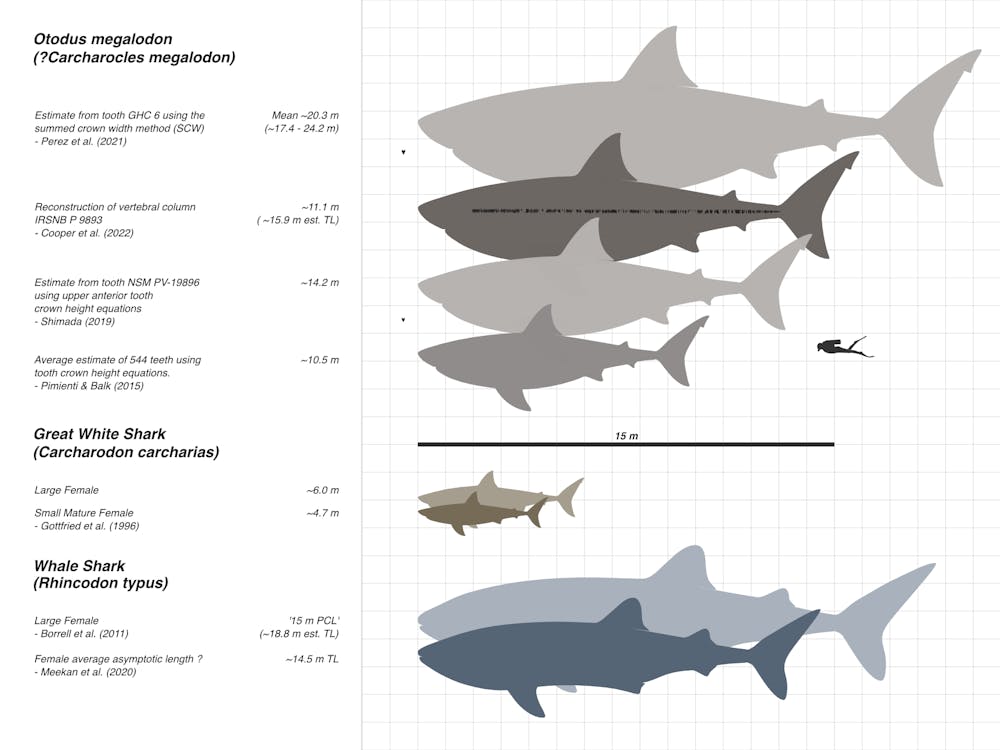
The average size of a mature great white (Carcharodon carcharias, also known as the white shark) is between 4.6 and 4.9 metres for female sharks and up to 4 metres for male sharks.
The largest recorded living specimens peak at about 6 metres, with one monster specimen caught in Cuba in 1945 reaching 6.4 metres.
Earth’s oceans have seen bigger predatory sharks in the past. The biggest one of all time was the megalodon (Otodus megalodon) which lived from 23 to 3 million years ago, and may have been up to 24 metres in length. However, it looked nothing like the modern white shark.
But white sharks are not directly related to the megalodon, whose lineage began with a shark called Cretalamna during the age of dinosaurs about 100 million years ago.
By contrast, the white shark lineage began with an ancient mako shark, Carcharodon hastalis. It was 7 to 8 metres long and had large, similarly shaped teeth to the modern white shark but lacking serrated edges.
A fossil intermediate species, Carcharodon hubbelli shows the transition over time from weakly serrated to strongly serrated teeth.
White shark fossil species. Left, the serrated fossil tooth teeth of the extant white shark; right, a similarly shaped unserrated tooth of the extinct giant mako shark which gave rise to white sharks. John Long, CC BY
How did Jaws affect white shark populations?
Last year, the International Shark Attack File reported 47 unprovoked shark bites to humans worldwide, resulting in seven fatalities. This was well below the previous ten-year average of 70 bites per year; your chances of getting bitten by a shark are extremely rare.
Following the movies that made up the Jaws franchise, there was an increase in hunting and killing sharks – with a particular focus on great white sharks that were already going into a decline due to overfishing, trophy hunting and lethal control programs.
When Jaws first aired, scientists didn’t know how long sharks took to reproduce, or how many offspring a white shark could have each year. We now know it takes about 26 years for a male and 33 years for a female to sexually mature before they can start having pups.
Now that we know just how slow they are to breed, it’s clear it will take many decades to reestablish the “pre-Jaws” population of white sharks – important apex predators in the marine ecosystem.
Charlie Huveneers from Flinders University about to take a tissue sample for research on white sharks. There is still a lot we don’t know about their biology. Andrew Fox, Adelaide, CC BY
This classification means if we don’t change the current living conditions for white sharks, including impacts caused by human activities such as commercial fishing, and the impacts of climate change and ocean pollution, they will continue to decline and eventually could go extinct.
Currently, white sharks are protected in several countries and form the basis for an important tourist industry in Australia, South Africa, western United States and most recently Nova Scotia, Canada.
These sharks are iconic apex predators that fascinate people. One of us (John) went cage diving with them recently off the Neptune Islands of South Australia and can attest to how breathtaking it is to watch them in their natural environment.
In terms of economic impact, they are worth far more alive than dead.
White sharks are a growing tourism draw in several countries. Andrew Fox, Adelaide, CC BY
There’s still much we don’t know about white sharks
The complete white shark genome was first published only in 2019. It has 4.63 billion base pairs, making it much larger than the human genome (3.2 billion base pairs).
The genome revealed some surprising things, like how white sharks show strong molecular adaptations for wound-healing processes, and a suite of “genome stability” genes – those used in DNA repair or DNA damage response.
The transcriptome (or sum total of the messenger RNA) of the white shark showed greater similarity to the human transcriptome than to that of other fishes. This hints that “unexpressed genes” in the shark could one day play a role in uncovering genetic pathways for potential cures in human diseases.
Jaws and its sequels certainly brought white sharks to the attention (and nightmares) of humans, with devastating impacts on how we treated them as a species.
Our relationship with white sharks reflects our relationship with nature more broadly – a feared antagonist within the current capitalist paradigm; an enemy to be tamed, contained or consumed.
As we learn more of the peril and potential of these remarkable creatures, we can learn how to live with them, to see beyond our fears and value their role within our delicate ocean ecosystems.
John Long receives funding from The Australian Research Council.
Heather L. Robinson does not work for, consult, own shares in or receive funding from any company or organisation that would benefit from this article, and has disclosed no relevant affiliations beyond their academic appointment.
Since 2018, the number of African sites on the World Heritage List has risen from 93 to 108. Today, UNESCO is supporting the remaining 11 non-represented African countries to prepare new nominations while mentoring the next generation of heritage professionals, as highlighted at the International Conference on Cultural Heritage in Africa that took place recently in Kenya.
“We need to make sure that World Heritage is truly benefiting Africa and African communities,”
She was one of many heritage professionals gathered at the UNESCO International Conference on Cultural Heritage in Africa, which took place from 6 to 9 May 2025 in Nairobi, Kenya. Bringing together 54 countries and global experts, this event aimed to redefine how heritage is understood and managed across the continent.
Communities at the heart of heritage preservation and promotion
This conference comes at an important time: since 2018, the Director-General of UNESCO, Audrey Azoulay, has committed to increasing the representation of African sites on the World Heritage List. As a result, the number of sites in the sub-Saharan region has risen from 93 to 108 in recent years.
However, 11 African countries are still not represented on UNESCO’s World Heritage List. The continent also has a significant number of endangered sites. To preserve and promote African heritage, the conference identified a number of solutions – first and foremost the need for African-led initiatives that engage local communities.
For young Africans in particular, the cultural and creative industries offer promising professional opportunities. To develop their expertise, UNESCO launched a Mentorship Programme for African Heritage Professionals in 2021, in partnership with the African World Heritage Fund, ICCROM, ICOMOS and IUCN. To date, 60 experts – 30 men and 30 women – from 46 countries have already received mentoring, notably in the 11 non-represented African countries.
“The UNESCO mentorship Programme for African heritage professionals has given me deeper insights into the intrigues of nominating heritage sites,”
Beyond new inscriptions, UNESCO programmes bring greater visibility and protection to these African sites.
“The purpose of heritage management is not just to keep it in isolation. We need to talk about it and tell it and educate people about it”
These efforts are yielding real results: in July 2025, two nominations from non-represented countries will be presented to the World Heritage Committee: the Réserve de Biosphère de l’Archipel des Bijagos in Guinea-Bissau, and the Gola Tiwai Complex in Sierra Leone. Seven more are expected to submit their first nominations by 2027.
Several sites have also been removed from the List of World Heritage in Danger, including the Tombs of Buganda Kings at Kasubi in Uganda and Niokolo-Koba National Park in Senegal, thanks to cooperation between national authorities, local experts and UNESCO.
The Nairobi Document on Heritage Authenticity
To guide this increase in African World Heritage inscriptions, participants at the conference adopted the Nairobi Document on Heritage Authenticity. Designed to act as a blueprint, it includes provisions to improve the preservation of the sites already listed, and to increase the involvement of local and Indigenous communities.
“It all began in Africa, in Abu Simbel – when the world came together to save the Nubian Temples, inspiring the World Heritage Convention. Today, this international conference in Nairobi reflects and bolsters all our efforts to support African Member States and to recognize and protect African heritage.”
This means recognizing the richness, vibrancy and complexity of natural and cultural sites across Africa.
As emphasized throughout the 2025 Nairobi Conference, African heritage is plural, dynamic, and community centred. The Outcome Document reflects the depth of African perspectives and sets a forward-looking agenda for enriching the global understanding of authenticity in heritage. I am honoured to officially receive the Nairobi Outcome Document on Heritage Authenticity. May it guide us towards a more just, inclusive, and representative global heritage future.”
Source: United States House of Representatives – Congressman Danny K Davis (7th District of Illinois)
Chicago Members of Congress Denied Entry to ICE Processing Center in Broadview, IL
CHICAGO — Today, Members of Congress Danny K. Davis (IL-07), Jesús “Chuy” García (IL-04), Delia C. Ramirez (IL-03), and Jonathan Jackson (IL-01) joined immigration lawyers and advocates to conduct a visit to the U.S. Immigration and Customs Enforcement (ICE) Processing Center in Broadview, Illinois. The Members were unlawfully denied entry, even after identifying themselves with their official Congressional voting cards.
The visit was prompted by reports that the center is unlawfully being used against city and state ordinances as a detention center, where migrants are being denied access to their attorneys and held in inhumane and unsanitary conditions, sleeping on the floor, and without complete meals. Under appropriation laws, Members of Congress have the authority to enter any facility operated by or for the Department of Homeland Security (DHS) used to detain or otherwise house people without advance notice.
“Today, I visited the Broadview Processing Center in our district to stand with my colleagues and families navigating the uncertainty of Homeland Security processes. Providing direct services—legal counsel, translation help, connection to community support—is not just a gesture, it’s a responsibility,” said Congressman Davis. “Our constituents deserve dignity and clarity, especially when they’re at their most vulnerable. I’ll continue to advocate for transparency and fair treatment, and fight to ensure federal agencies in our district operate with accountability and humanity.”
“We came to this center today and respectfully asked to be allowed to conduct an oversight visit, but were denied entry. Last week about 200 people received texts and emails ordering them to report to this processing center and then were detained,” said Congressman García. “Some families were told to come to the processing center on a day when families should have been celebrating Father’s Day. But with the cruelty that has characterized this administration, their children found themselves not knowing where their dads were or when they would see them again. These are not criminals. These are hard working people who are contributing to our country.”
“Under Kristi Noem’s leadership, ICE has spent billions of dollars to terrorize our communities and violate our rights. We have heard of inhumane conditions in which our neighbors are unlawfully held in these detention centers, without access to their medication, legal counsel, or basic necessities. The abuses must stop,” said Congresswoman Ramirez, who serves on the Homeland Security Committee. “We came to the ICE Processing Center at Broadview to observe the conditions here and fulfill our oversight authority, granted under appropriation laws. But this Administration continues to break the law and bypass Congressional authority because they do not want us to see the cruelty behind these doors. They do not want us to shine a light on the ways they are abusing the power of DHS to violate our rights, undermine due process, and tear our communities apart. For my constituents, our neighbors, and our country, I will continue to call for Noem’s resignation and do everything in my power to hold her accountable.”
“Our visit to Broadview today was absolutely essential, a vital step in our unyielding fight for transparency and accountability in our immigration system. As elected officials, it is our sacred duty to witness these facilities firsthand, to look into the eyes of those being processed, and to ensure that operations align with every fiber of our American values and uphold the inherent dignity of every single human being,” said Congressman Jackson. “What I faced yesterday in the South Loop as well -being actively barred from performing congressional oversight- is an outrage. It doesn’t just underscore the urgent need for open access; it demands immediate answers from ICE regarding their deplorable practices and the well-being of those trapped in their custody.
“The Broadview processing center has been a central site in the Chicago area that ICE has used to entrap and disappear immigrants, trampling on due process and other constitutional protections. NIJC demands that ICE end this inhumane practice of using check-ins to tear apart our families and communities,” said Cecilia Mendoza, Associate Director of Government Relations for NIJC.
“After being denied access to the ICE processing center in Broadview today, we are forced to ask: what is ICE trying to hide?” said Lawrence Benito, Executive Director of the Illinois Coalition for Immigrant and Refugee Rights. “It’s clear that ICE is trying to hide inhumane conditions inside their facilities as they terrorize our communities in broad daylight. We thank Congress members Davis, Garcia, Ramirez, and Jackson for standing up for immigrant communities today by calling for accountability and transparency from ICE. We further ask them to continue fighting in DC to stop deportations, and stop Trump’s efforts to cut healthcare to fund even more aggressive ICE enforcement.”
BACKGROUND:
Under the Trump administration, multiple media outlets and human rights organizations have reported inhumane conditions at ICE facilities. Reports include the unlawful detention of citizens, permanent residents, and undocumented immigrants in facilities without access to basic necessities, medical assistance, due process, and legal counsel. At the moment, ICE seeks to expand detention space in the U.S. and abroad. Given the lack of legal protections, immigrants are being wrongfully deported to offshore prisons, including in El Salvador, Guantanamo, and Djibouti.
To meet the detention and deportation quotas set by the Trump Administration, it is estimated that the cost of ICE’s operation has exceeded by $1 billion the budget approved for the fiscal year 2025. DHS recently shifted approximately $500 million within its accounts to continue immigration operations and is requesting that Congress allocate at least $2 billion more by the end of September. It is expected that the agency will run out of money by next month, putting DHS at risk of violating federal spending laws.
ER Report: Here is a summary of significant articles published on EveningReport.nz on June 19, 2025.
Australian citizens in Iran and Israel are desperate to leave. Is the government required to help? Source: The Conversation (Au and NZ) – By Jane McAdam, Scientia Professor and ARC Laureate Fellow, Kaldor Centre for International Refugee Law, UNSW Sydney As thousands of Australian citizens and permanent residents stuck in Iran and Israel continue to register for repatriation flights, the government is scrambling to find safe ways to evacuate them. With
Popular period-tracking apps can hold years of personal data – new NZ research finds mixed awareness of risk Source: The Conversation (Au and NZ) – By Anna Friedlander, PhD Candidate in Sociology, University of Waikato Shutterstock/Krotnakro Period-tracking apps are popular digital tools for a range of menstrual, reproductive and general health purposes. But the way these apps collect and use data involves risk. Many apps encourage users to log information well beyond their
Migrating bogong moths use the stars and Earth’s magnetic field to find ancestral summer caves each year Source: The Conversation (Au and NZ) – By Eric Warrant, Professor of Zoology at the University of Lund, Visiting Fellow at the Australian National University, and Adjunct Professor, University of South Australia Vik Dunis/iNaturalist, CC BY-NC It’s a warm January summer afternoon, and as I traverse the flower-strewn western slopes of Australia’s highest mountain, Mount
Jaws at 50: how a single movie changed our perception of white sharks forever Source: The Conversation (Au and NZ) – By John Long, Strategic Professor in Palaeontology, Flinders University Shane Myers Photography/Shutterstock It’s been 50 years since Steven Spielberg’s movie Jaws first cast a terrifying shadow across our screens. At a low point during production, Spielberg worried he’d only ever be known for “a big fish story”. The
Robot eyes are power hungry. What if we gave them tools inspired by the human brain? Source: The Conversation (Au and NZ) – By Adam D Hines, Research Fellow, Centre for Robotics, Queensland University of Technology A hexapod robot navigating outdoors. Adam Hines Robots are increasingly becoming a part of our lives – from warehouse automation to robotic vacuum cleaners. And just like humans, robots need to know where they are
Winter viruses can trigger a heart attack or stroke, our study shows. It’s another good reason to get a flu or COVID shot Source: The Conversation (Au and NZ) – By Tu Nguyen, PhD Candidate, Department of Paediatrics, University of Melbourne, Murdoch Children’s Research Institute Irina Shatilova/Shutterstock Winter is here, along with cold days and the inevitable seasonal surge in respiratory viruses. But it’s not only the sniffles we need to worry about. Heart attacks and strokes also
School playgrounds are one of the main locations for bullying. How can they be set up to stop it? Source: The Conversation (Au and NZ) – By Brendon Hyndman, Associate Dean (Academic), Faculty of Arts and Education, Charles Sturt University Dan Kenyon/ Getty Images Children spend thousands of hours in playgrounds at school. A lot of this time does not have the same levels of teacher preparation and supervision as classrooms do. Research shows
Would you cheat on your tax? It’s a risky move, the tax office knows a lot about you Source: The Conversation (Au and NZ) – By Robert B Whait, Senior Lecturer in Taxation Law, University of South Australia Soon, more than 15 million Australians should be lodging a tax return with the Australian Taxation Office in the hope of receiving at least a small refund. About 60% of taxpayers use an accountant to
Companies are betting on AI to help lift productivity. Workers need to be part of the process Source: The Conversation (Au and NZ) – By Llewellyn Spink, AI Corporate Governance Lead, Human Technology Institute, University of Technology Sydney The Conversation, CC BY-NC Australia’s productivity is flatlining, posting the worst vitals we’ve seen in 60 years. Politicians and chief executives are prescribing artificial intelligence (AI) like it’s the new penicillin – a wonder
Is Sabrina Carpenter’s Man’s Best Friend album cover satire or self-degradation? A psychology expert explores our reactions Source: The Conversation (Au and NZ) – By Katrina Muller-Townsend, Lecturer in Psychology, Edith Cowan University Island Records Sabrina Carpenter’s Man’s Best Friend album cover has fans divided. Carpenter poses on all fours, her glossy blond hair grasped by a male figure cropped from the frame. Her wide-eyed expression intensifies an ambiguous performance of subservience,
Kicked out for coming out: more than half of LGBTIQ+ flatmates face discrimination for their identity Source: The Conversation (Au and NZ) – By Brodie Fraser, Senior Research Fellow, He Kāinga Oranga Housing and Health Research Programme, University of Otago Sangar Akreyi/Getty Images People who belong to the LGBTIQ+ community say flatting is fraught with difficulties that go well beyond learning new routines and sharing space with strangers. Our new research
Tracing the Drax family’s millions – a story of British landed gentry, slavery and sugar plantations Source: The Conversation (Au and NZ) – By Paul Lashmar, Reader in Journalism, City St George’s, University of London ‘Planting the sugar-cane’: vast fortunes were made from the trades in both sugar and human slaves in the Americas. Schomburg Center for Research in Black Culture, Photographs and Prints Division, The New York Public Library Rich
Nineteen Eighty-Four might have been inspired by George Orwell’s fear of drowning Source: The Conversation (Au and NZ) – By Nathan Waddell, Associate Professor in Twentieth-Century Literature, University of Birmingham George Orwell had a traumatic relationship with the sea. In August 1947, while he was writing Nineteen Eighty-Four (1949) on the island of Jura in the Scottish Hebrides, he went on a fishing trip with his young
What happens when aid is cut to a large refugee camp? Kenyan study paints a bleak picture Source: The Conversation (Au and NZ) – By Olivier Sterck, Associate professor, University of Oxford Humanitarian needs are rising around the world. At the same time, major donors such as the US and the UK are pulling back support, placing increasing strain on already overstretched aid systems. Global humanitarian needs have quadrupled since 2015, driven
Grok’s ‘white genocide’ responses show how generative AI can be weaponized Source: The Conversation (Au and NZ) – By James Foulds, Associate Professor of Information Systems, University of Maryland, Baltimore County Someone altered the AI chatbot Grok to make it insert text about a debunked conspiracy theory in unrelated responses. Cheng Xin/Getty Images The AI chatbot Grok spent one day in May 2025 spreading debunked conspiracy
Politics with Michelle Grattan: an ‘impatient’ Jim Chalmers on taking political risks in Labor’s second term Source: The Conversation (Au and NZ) – By Michelle Grattan, Professorial Fellow, University of Canberra Asanka Ratnayake/Getty Images While the world’s media is largely focused on conflict in the Middle East, the focus for many Australians remains at home, with the government preparing the long task ahead of trying to lift Australia’s productivity. Last week,
View from The Hill: Jim Chalmers wants to get on with economic reform and tax is in his sights Source: The Conversation (Au and NZ) – By Michelle Grattan, Professorial Fellow, University of Canberra Jim Chalmers speaking to the National Press Club June 18, 2025. Screenshot from the ABC Broadcast, CC BY-NC Jim Chalmers cast his Wednesday National Press Club speech as a second instalment in a two-part presentation that was kicked off by
Iran’s long history of revolution, defiance and outside interference – and why its future is so uncertain Source: The Conversation (Au and NZ) – By Amin Saikal, Emeritus Professor of Middle Eastern and Central Asian Studies, Australian National University; and Vice Chancellor’s Strategic Fellow, Victoria University Israeli Prime Minister Benjamin Netanyahu has gone beyond his initial aim of destroying Iran’s ability to produce nuclear weapons. He has called on the Iranian people
95 lawyers demand stronger NZ stand over Israel amid Middle East tensions Asia Pacific Report Ninety-five New Zealand lawyers — including nine king’s counsel — have signed a letter demanding Prime Minister Christopher Luxon, Foreign Minister Winston Peters and two other ministers urge the government to take a stronger stand against Israel’s “catastrophic” actions in Gaza. The letter has been sent amid rising tensions in the region,
Gay and bisexual men will soon be able to donate blood and plasma Source: The Conversation (Au and NZ) – By Yasmin Mowat, Clinical Project Manager, Kirby Institute, UNSW Sydney AnnaStills/Getty Images Many gay and bisexual men have been excluded from donating blood and plasma (the liquid portion of blood) for decades because of rules developed during the HIV crisis in the 1980s. The Australian Red Cross’ blood
ER Report: Here is a summary of significant articles published on EveningReport.nz on June 19, 2025.
Australian citizens in Iran and Israel are desperate to leave. Is the government required to help? Source: The Conversation (Au and NZ) – By Jane McAdam, Scientia Professor and ARC Laureate Fellow, Kaldor Centre for International Refugee Law, UNSW Sydney As thousands of Australian citizens and permanent residents stuck in Iran and Israel continue to register for repatriation flights, the government is scrambling to find safe ways to evacuate them. With
Popular period-tracking apps can hold years of personal data – new NZ research finds mixed awareness of risk Source: The Conversation (Au and NZ) – By Anna Friedlander, PhD Candidate in Sociology, University of Waikato Shutterstock/Krotnakro Period-tracking apps are popular digital tools for a range of menstrual, reproductive and general health purposes. But the way these apps collect and use data involves risk. Many apps encourage users to log information well beyond their
Migrating bogong moths use the stars and Earth’s magnetic field to find ancestral summer caves each year Source: The Conversation (Au and NZ) – By Eric Warrant, Professor of Zoology at the University of Lund, Visiting Fellow at the Australian National University, and Adjunct Professor, University of South Australia Vik Dunis/iNaturalist, CC BY-NC It’s a warm January summer afternoon, and as I traverse the flower-strewn western slopes of Australia’s highest mountain, Mount
Jaws at 50: how a single movie changed our perception of white sharks forever Source: The Conversation (Au and NZ) – By John Long, Strategic Professor in Palaeontology, Flinders University Shane Myers Photography/Shutterstock It’s been 50 years since Steven Spielberg’s movie Jaws first cast a terrifying shadow across our screens. At a low point during production, Spielberg worried he’d only ever be known for “a big fish story”. The
Robot eyes are power hungry. What if we gave them tools inspired by the human brain? Source: The Conversation (Au and NZ) – By Adam D Hines, Research Fellow, Centre for Robotics, Queensland University of Technology A hexapod robot navigating outdoors. Adam Hines Robots are increasingly becoming a part of our lives – from warehouse automation to robotic vacuum cleaners. And just like humans, robots need to know where they are
Winter viruses can trigger a heart attack or stroke, our study shows. It’s another good reason to get a flu or COVID shot Source: The Conversation (Au and NZ) – By Tu Nguyen, PhD Candidate, Department of Paediatrics, University of Melbourne, Murdoch Children’s Research Institute Irina Shatilova/Shutterstock Winter is here, along with cold days and the inevitable seasonal surge in respiratory viruses. But it’s not only the sniffles we need to worry about. Heart attacks and strokes also
School playgrounds are one of the main locations for bullying. How can they be set up to stop it? Source: The Conversation (Au and NZ) – By Brendon Hyndman, Associate Dean (Academic), Faculty of Arts and Education, Charles Sturt University Dan Kenyon/ Getty Images Children spend thousands of hours in playgrounds at school. A lot of this time does not have the same levels of teacher preparation and supervision as classrooms do. Research shows
Would you cheat on your tax? It’s a risky move, the tax office knows a lot about you Source: The Conversation (Au and NZ) – By Robert B Whait, Senior Lecturer in Taxation Law, University of South Australia Soon, more than 15 million Australians should be lodging a tax return with the Australian Taxation Office in the hope of receiving at least a small refund. About 60% of taxpayers use an accountant to
Companies are betting on AI to help lift productivity. Workers need to be part of the process Source: The Conversation (Au and NZ) – By Llewellyn Spink, AI Corporate Governance Lead, Human Technology Institute, University of Technology Sydney The Conversation, CC BY-NC Australia’s productivity is flatlining, posting the worst vitals we’ve seen in 60 years. Politicians and chief executives are prescribing artificial intelligence (AI) like it’s the new penicillin – a wonder
Is Sabrina Carpenter’s Man’s Best Friend album cover satire or self-degradation? A psychology expert explores our reactions Source: The Conversation (Au and NZ) – By Katrina Muller-Townsend, Lecturer in Psychology, Edith Cowan University Island Records Sabrina Carpenter’s Man’s Best Friend album cover has fans divided. Carpenter poses on all fours, her glossy blond hair grasped by a male figure cropped from the frame. Her wide-eyed expression intensifies an ambiguous performance of subservience,
Kicked out for coming out: more than half of LGBTIQ+ flatmates face discrimination for their identity Source: The Conversation (Au and NZ) – By Brodie Fraser, Senior Research Fellow, He Kāinga Oranga Housing and Health Research Programme, University of Otago Sangar Akreyi/Getty Images People who belong to the LGBTIQ+ community say flatting is fraught with difficulties that go well beyond learning new routines and sharing space with strangers. Our new research
Tracing the Drax family’s millions – a story of British landed gentry, slavery and sugar plantations Source: The Conversation (Au and NZ) – By Paul Lashmar, Reader in Journalism, City St George’s, University of London ‘Planting the sugar-cane’: vast fortunes were made from the trades in both sugar and human slaves in the Americas. Schomburg Center for Research in Black Culture, Photographs and Prints Division, The New York Public Library Rich
Nineteen Eighty-Four might have been inspired by George Orwell’s fear of drowning Source: The Conversation (Au and NZ) – By Nathan Waddell, Associate Professor in Twentieth-Century Literature, University of Birmingham George Orwell had a traumatic relationship with the sea. In August 1947, while he was writing Nineteen Eighty-Four (1949) on the island of Jura in the Scottish Hebrides, he went on a fishing trip with his young
What happens when aid is cut to a large refugee camp? Kenyan study paints a bleak picture Source: The Conversation (Au and NZ) – By Olivier Sterck, Associate professor, University of Oxford Humanitarian needs are rising around the world. At the same time, major donors such as the US and the UK are pulling back support, placing increasing strain on already overstretched aid systems. Global humanitarian needs have quadrupled since 2015, driven
Grok’s ‘white genocide’ responses show how generative AI can be weaponized Source: The Conversation (Au and NZ) – By James Foulds, Associate Professor of Information Systems, University of Maryland, Baltimore County Someone altered the AI chatbot Grok to make it insert text about a debunked conspiracy theory in unrelated responses. Cheng Xin/Getty Images The AI chatbot Grok spent one day in May 2025 spreading debunked conspiracy
Politics with Michelle Grattan: an ‘impatient’ Jim Chalmers on taking political risks in Labor’s second term Source: The Conversation (Au and NZ) – By Michelle Grattan, Professorial Fellow, University of Canberra Asanka Ratnayake/Getty Images While the world’s media is largely focused on conflict in the Middle East, the focus for many Australians remains at home, with the government preparing the long task ahead of trying to lift Australia’s productivity. Last week,
View from The Hill: Jim Chalmers wants to get on with economic reform and tax is in his sights Source: The Conversation (Au and NZ) – By Michelle Grattan, Professorial Fellow, University of Canberra Jim Chalmers speaking to the National Press Club June 18, 2025. Screenshot from the ABC Broadcast, CC BY-NC Jim Chalmers cast his Wednesday National Press Club speech as a second instalment in a two-part presentation that was kicked off by
Iran’s long history of revolution, defiance and outside interference – and why its future is so uncertain Source: The Conversation (Au and NZ) – By Amin Saikal, Emeritus Professor of Middle Eastern and Central Asian Studies, Australian National University; and Vice Chancellor’s Strategic Fellow, Victoria University Israeli Prime Minister Benjamin Netanyahu has gone beyond his initial aim of destroying Iran’s ability to produce nuclear weapons. He has called on the Iranian people
95 lawyers demand stronger NZ stand over Israel amid Middle East tensions Asia Pacific Report Ninety-five New Zealand lawyers — including nine king’s counsel — have signed a letter demanding Prime Minister Christopher Luxon, Foreign Minister Winston Peters and two other ministers urge the government to take a stronger stand against Israel’s “catastrophic” actions in Gaza. The letter has been sent amid rising tensions in the region,
Gay and bisexual men will soon be able to donate blood and plasma Source: The Conversation (Au and NZ) – By Yasmin Mowat, Clinical Project Manager, Kirby Institute, UNSW Sydney AnnaStills/Getty Images Many gay and bisexual men have been excluded from donating blood and plasma (the liquid portion of blood) for decades because of rules developed during the HIV crisis in the 1980s. The Australian Red Cross’ blood
“Time, memory and history must always be revisited and questioned. Art gives us the freedom to do so without constraint.”
— Basim Magdy, renowned artist
Basim Magdy is a visionary Egyptian artist whose work merges dreamlike imagery with thought-provoking, philosophical narratives. Through layered photography and vibrant, otherworldly visuals, he invites viewers into worlds shaped by memory, myth and speculative futures. Now featured on Samsung Art Store as part of the Art Basel in Basel collection, his distinctive aesthetic brings moments of reflection into daily life.
Magdy’s work reimagines living spaces as portals to imagined futures and poetic memories. Available exclusively on Samsung Art TVs, these pieces blur the line between art and atmosphere to deliver a gallery-quality experience at home. Expert-validated colors reveal every detail of his layered textures and experimental techniques — encouraging deeper engagement and sparking conversation.
Samsung Newsroom sat down with Magdy to explore his creative process and the transformative power of art in everyday environments.
▲ Artist Basim Magdy poses at Samsung ArtCube at Art Basel in Basel.
Partnerships, Presence and Possibilities
Q: How has Art Basel in Basel played a role in your career?
For over a decade, I’ve attended Art Basel in Basel every year — it continues to be one of the most exciting and inspiring art events for me. A recent highlight was having a large-scale photographic work presented in Art Basel Unlimited in 2022.
This year, alongside the presentation of my work at the Samsung ArtCube lounge, I’m exhibiting expanded photography with Gypsum Gallery (Cairo) and paintings with hunt kastner (Prague).
▲ “An Intergalactic Messenger Teleported us to a Cave Settlement Ruled by Shared Compassion and Humility” (2022) by Basim Magdy
Q: What led to your partnership with Samsung Art Store for this year’s Art Basel in Basel?
It happened naturally. I was drawn to the idea of my work existing in a different context — one where it could reach new audiences including those who may not typically visit galleries or museums but who are still curious about art.
Reframing Time Through Art
Q: How did your visual and conceptual style develop into something both surreal and poetic?
It took years of curiosity, experimentation and a desire to create a visual language that reflects who I am. Both poetry and the strange layers of reality have long shaped my thinking. Over time, my style evolved as I explored different artistic tools and mediums. Creating something surreal and poetic has allowed me to propose new ideas and reinterpret familiar ones in unexpected ways.
“Art expresses what can’t be said in words.”
— Basim Magdy, contemporary artist
Q: Storytelling, memory and imagined futures are recurring themes in your art. What drives your interest in these narratives?
I’ve become increasingly interested in how we perceive time. I think that awareness deepens with age — the realization that each passing moment is gone and what lies ahead will be different yet oddly familiar.
Though time is a construct, its rhythms — like sunrises and sunsets — form the backdrop of our lives. History shapes how we understand the past and determines how memories are kept alive — an incredibly subjective process, often told through one point of view.
That’s what fascinates me. It raises questions about what gets recorded and what was deemed unworthy of preservation. What about the countless lives that pass without being remembered or documented? Time, memory and history must always be revisited and questioned. Art gives us the freedom to do so without constraint.
Art Without Rules, Technology Without Limits
Q: Your media include chemically altered film and layered photography. How do you preserve their texture and nuance when translating these physical processes into digital formats for display?
The urge to experiment is what drives me to work across different media. It’s rooted in asking questions and pushing limits. Translating analog processes into digital form is one of those explorations — and with it comes the challenge of maintaining texture, depth and complexity.
▲ Artist Basim Magdy is well known for his fusion of dreamlike imagery with thought-provoking, philosophical narratives.
Q: With technology playing a bigger role in creating and experiencing art, how has it shaped your creative process or your approach to audience engagement?
Technology is evolving constantly, and with it, the way we experience the world — not just art. Today, reality often exists simultaneously in physical space and on screens. In the end, I think my lived experiences — whether encountered in real life or on a screen — inform my art just as much as my imagination does.
For me, art expresses what can’t be said in words. Technology is largely shaped by scientific research that operates within defined rules and systems. Art, on the other hand, is free from those constraints — so when artists engage with new technologies, the results are often surprising.
▲ Basim Magdy experiences the new Art Basel in Basel Collection at Samsung ArtCube.
From Exhibition to Everyday
Q: Your work is now featured on Samsung Art Store and displayed in homes around the world. How does being part of someone’s everyday environment shift your perspective on your art?
It’s humbling. We each experience art through our own lens — shaped by who we are and where we’ve been. I hope my work resonates in ways that invite thought, emotion or a quiet moment of connection. For me, that kind of unspoken, personal response is the most fulfilling outcome.
Q: Samsung Art Store turns a screen into a gallery. How do you feel your work resonates differently in a digital home setting compared to a traditional gallery or museum?
Seeing art in a gallery or a museum is still ideal — but it’s also limited. A piece only exists in one place and not everyone can travel to see it, especially if it’s halfway across the world.
Samsung Art Store offers a more intimate way to experience art. Someone can engage with a piece they connect with at their own pace, free from the limitations of gallery hours or institutional settings. The platform also gives access to audiences who may not have a chance to view my work through traditional means.
Digital representations of art continue to evolve — and so do the ways we engage with them. I look forward to a future where we can project fully detailed images into space and where the digital experience of art might one day include touch, texture or even scent.
“[Through Samsung Art Store, one] can engage with a piece at their own pace, free from the limitations of gallery hours or institutional settings.”
— Basim Magdy, contemporary artist
Q: If someone is encountering your work for the first time through Samsung Art Store in their home, what would you like them to notice or feel?
I hope they experience something that stays with them — whether it’s a thought, feeling or subtle moment of curiosity. The way someone connects to art is deeply individual, and I try not to shape or influence that. It’s more meaningful when that sense of intimacy is preserved.
Source: The Conversation (Au and NZ) – By Jane McAdam, Scientia Professor and ARC Laureate Fellow, Kaldor Centre for International Refugee Law, UNSW Sydney
As thousands of Australian citizens and permanent residents stuck in Iran and Israel continue to register for repatriation flights, the government is scrambling to find safe ways to evacuate them.
With the airspace over both countries closed, the government is considering other ways to bring them home.
The current plan is to charter buses from private companies to take people from Israel into neighbouring Jordan. As Prime Minister Anthony Albanese stressed: “We want to make sure people are looked after, but they need to be looked after safely as well”.
This is not the first time Australia has faced challenges in evacuating nationals stranded abroad. When conflict, disasters or other emergencies occur overseas, the government regularly works to bring Australians home.
In the early days of the COVID pandemic, for instance, the government arranged repatriation flights and established quarantine facilities to assist Australians who were stuck outside the country. Australia has repeatedly assisted its citizens caught in conflict zones to get back home, including from Afghanistan in 2021 and Lebanon in 2024.
And when an earthquake devasted Vanuatu last December, Australia moved swiftly to get Australians out.
Is Australia legally required to repatriate people?
While there is a longstanding and widespread practice of governments repatriating their nationals in emergencies, countries generally do not have a legal responsibility to do so.
Instead, governments’ decisions are discretionary and made on a case-by-case basis. They are often influenced by diplomatic, logistical and security considerations.
Governments have a right – but not a duty – to provide consular assistance to their nationals abroad. This includes issuing travel documents, liaising with local authorities and, in exceptional cases, facilitating evacuations.
The Consular Services Charter outlines what Australians abroad can expect from their government. It makes clear that while the government will do what it can, there are limits. Assistance is not guaranteed, especially in areas where Australia has no diplomatic presence or where security conditions make intervention too dangerous.
Repatriation efforts are guided by the Australian Government Plan for the Reception of Australian Citizens and Approved Foreign Nationals Evacuated from Overseas (AUSRECEPLAN). This arrangement that sets out a process for “the safe repatriation of Australians, their immediate dependants, permanent residents and approved foreign nationals (evacuees) following an Australian government-led evacuation in response to an overseas disaster or adverse security situation”. It outlines how federal, state and territory agencies coordinate to receive and support evacuees once they arrive in Australia, ensuring that returns are not only swift, but also safe and orderly.
Challenges and constraints
Repatriation during a crisis is a complex undertaking. Quite aside from the emergency conditions, which may close off usual travel options or routes, the Australian government cannot force another country to allow an evacuation. It also cannot guarantee safe passage, especially in conflicts.
Identifying and communicating with citizens overseas can also be tricky, often requiring people to have self-registered with consular authorities to receive updates. In addition, consular services may be strained when embassies and consular offices have closed, as is the case in Israel and Iran.
For these reasons, countries sometimes band together to assist each other. For instance, Australia and Canada have agreed that where one has a consular presence but the other does not, they will help to repatriate the other’s citizens.
Similarly, the United States helped evacuate Australians and other allies’ nationals from Afghanistan after the Taliban takeover in 2021. Countries in the European Union can activate a special regional mechanism to facilitate the repatriation of their citizens caught up in emergencies abroad.
In exceptional circumstances, countries have sometimes extracted their stranded nationals through military operations, known as “non-combatant evacuation operations” (NEOs). This involves the military temporarily occupying a location on foreign soil to evacuate people. Some recent examples include the large-scale evacuations of foreign nationals from Afghanistan in 2021, Sudan during the civil war that began in 2023 and Lebanon during the 2024 Israeli–Hezbollah conflict.
NEOs generally require the consent of the country from where the evacuation takes place, but their precise legal basis remains ambiguous under international law.
In all cases, the evacuation of nationals is operationally complex – as exemplified by the current situation in Iran and Israel. Countries with limited resources may struggle to repatriate their nationals at all. This can mean some foreign nationals are “rescued”, while others are left behind.
And, of course, local populations generally aren’t eligible for evacuation at all. This can leave people in extremely dangerous circumstances.
That is why we have proposed the creation of an Australian framework for humanitarian emergencies that, among other things, would facilitate the safe and swift departure of certain non-citizens at particular risk. This would underscore that Australia’s approach to evacuations is, at its heart, about protecting people during crises.
Jane McAdam receives funding from the Australian Research Council (ARC) and is the Director of the ARC Evacuations Research Hub at the Kaldor Centre for International Refugee Law, UNSW Sydney.
Regina Jefferies and Thomas Mulder do not work for, consult, own shares in or receive funding from any company or organisation that would benefit from this article, and have disclosed no relevant affiliations beyond their academic appointment.
Source: People’s Republic of China – State Council News
BEIJING, June 18 — Chinese Foreign Minister Wang Yi on Wednesday had a phone call with his Egyptian counterpart, Badr Abdelatty.
Wang, also a member of the Political Bureau of the Communist Party of China Central Committee, said that Israel’s disregard for international law and norms has abruptly escalated tensions in the Middle East.
China once again calls on all parties to the conflict, particularly Israel, to immediately cease fire and de-escalate the situation, Wang said.
He said that at this critical juncture, the international community, especially regional countries, should further build consensus and take more unified actions.
China stands ready to work with Egypt to enhance communication and coordination at multilateral platforms such as the United Nations, making every effort to push peace talks and reconciliation, Wang added.
Source: People’s Republic of China – State Council News
From durian plantations to iron ore mines, producers around the world are placing their bets on China’s consumption boom.
As the world’s second-largest importer, China boasts a vast market of 1.4 billion increasingly prosperous individuals. This market is offering much-needed stability amid subdued global growth and rising protectionism and unilateralism.
Vendors transport packaged durians at Haijixing Market, a large wholesale fruit market, in Nanning, south China’s Guangxi Zhuang Autonomous Region, April 25, 2023. [Photo/Xinhua]
As China strives to stimulate domestic demand across the board while expanding voluntary and unilateral opening up in an orderly manner, its vast market will create more opportunities and choices for the world.
A market too big to ingnore
A freshly harvested durian in Malaysia can now land on a Chinese plate within a day — a logistic sprint to satisfy China’s growing appetite for the “king of fruits.”
Eyeing a bigger slice of the multi-billion-U.S. dollar market in China, the Southeast Asian country began exporting fresh durian to China last August, adding to its existing trade in frozen pulp and processed products.
“Over 70 percent of Malaysia’s durian exports went to China between 2017 and 2023,” said Edwyn Chiang, secretary general of the Malaysia International Durian Industry Development Association.
The durian frenzy in China, the world’s top consumer of the spiky fruit, epitomizes the nation’s broad import appetite. From Brazilian soybeans to German machinery, the breadth of China’s consumption continues to buoy global trade even as other engines sputter.
Boosting imports is critical to China’s high-quality development. By bringing in high-quality foreign goods and services, they not only directly meet domestic production and consumption needs, but also stimulate market competition, elevate overall supply standards, and ultimately fulfill people’s aspirations for better lives, said Yu Chunhai, a professor at Renmin University of China.
An anchor of stability
Nearly half a world away, in Nyagatare, a district in Rwanda’s eastern province, the sun beats down on the vibrant chili fields of Gashora Farm PLC, where a story of cooperation and prosperity is unfolding.
The farm’s link to the Chinese market began in 2018 when Managing Director Dieudonne Twahirwa attended the China International Import Expo in Shanghai. “The Chinese market is enormous. We saw strong demand for Rwandan dried chili,” Twahirwa said.
In 2024, the Gashora Farm partnered China’s Hunan Modern Agriculture International Development Co., Ltd. to launch the Rwanda-Hunan Chili Pepper Industry Demonstration Project. Under a contract farming model, the project covers 100 hectares and spans the entire value chain — from seedling cultivation to export. In the first season following the signing of the deal, 200 tonnes of dried chili were shipped to China.
“The Chinese market offers more than orders. It brings stability and investment,” said Twahirwa.
Chili is among the growing number of African products entering the Chinese market. In the first five months of 2025, China’s imports of African coffee, cocoa beans and frozen strawberries surged 145.7 percent, 88.6 percent, and 82 percent, respectively, according to Chinese customs data.
“China’s expanding imports directly benefit other countries by creating more trade opportunities. For instance, more African products are entering the Chinese market thanks to China’s favorable trade policy for the region,” said Bai Ming, a researcher at the Chinese Academy of International Trade and Economic Cooperation.
China has recently announced that it is ready to negotiate and sign the agreement of China-Africa Economic Partnership for Shared Development to implement the zero-tariff treatment for 100 percent tariff lines for 53 African countries that have diplomatic relations with China.
Challenges remain
Despite China’s huge potential to expand imports, challenges and difficulties remain due to the uncertainty of international trade policies and slowing global economic growth, experts cautioned. This trend is evident in the recent decline of imports into China.
Commenting on the decline of imports in May, National Bureau of Statistics (NBS) spokesperson Fu Linghui said at a press conference early this week that slowing global trade growth inevitably affected China’s import growth and the restrictive trade measures by some countries also had adverse effects on imports. The drop in international commodity prices, meanwhile, also impacted import data. In the first five months of 2025, the average prices of China’s imported iron ore, crude oil, coal and soybeans all decreased.
As China makes efforts to promote economic restructuring and consumption-led growth, Bai noted that it would be an exaggeration to say that the decline in imports in recent months indicates weak progress in China’s transition toward consumption-driven growth.
The latest NBS data showed that China’s consumer spending in May posted its strongest growth in nearly 18 months, with retail sales of consumer goods expanding 6.4 percent year on year in May, a 1.3-percentage-point increase from April.
Bai said China’s import expansion would also hinge on the availability of high-quality and price-friendly foreign products, and whether foreign supplies can match the country’s consumption needs. He added that some countries’ restrictive measures on exports to China further complicated the matter.
Source: United States Senator for Mississippi Roger Wicker
Watch Video Here
WASHINGTON –U.S. Senator Roger Wicker, R-Miss., Chairman of the Senate Armed Services Committee, today led a hearing to receive testimony from the Pentagon’s senior leaders on the department’s fiscal year 2026 budget.
In his opening remarks, Chairman Wicker praised President Trump’s “peace through strength” leadership and Secretary Hegseth’s achievements in implementing that agenda at the Pentagon. The chairman also noted that maintaining the national defense budget at $893 billion, even with an additive $150 billion from defense reconciliation, would result in United States military spending falling far below 3 percent of GDP by 2029.
Read Chairman Wicker’s hearing opening statement as delivered.
The committee convenes this morning to hear testimony concerning the president’s fiscal year 2026 budget request. I welcome Secretary Hegseth, Chairman Caine, and Acting Comptroller MacDonnell.
As we review the past five months, the president and the Department of Defense have much to be proud of. The administration has largely succeeded in refocusing the Pentagon on warfighting. Our recruitment numbers have dramatically improved. That is a very important achievement and one we will continue to celebrate.
The U.S. military has played a significant supporting role in the president’s wholesale success at our southern border. He has achieved operational control over the situation – a position the vast majority of Americans support.
In Operation Rough Rider, the president imposed costs on the Houthis. The operation was well executed by our service members, and it appears to have achieved its stated objectives for now. Similarly, the president has relentlessly struck al-Qaeda and ISIS terrorists. Those strikes have helped to open up space for diplomatic breakthroughs in Syria, and they have prevented significant external attacks that could have emanated from Somalia.
Unfortunately, the Axis of Aggressors is resilient. It is hell-bent on challenging American global leadership.
It is clearer than ever that Vladimir Putin is uninterested in President Trump’s and President Zelenskyy’s offers for real peace negotiations. The Europeans are heeding the president’s call to re-arm, but we are in a tenuous period: A precipitate withdrawal of U.S. forces from Europe could undo all that progress.
In Asia, the Chinese Communist Party continues its campaign of aggression against its neighbors and still displays open ambitions to retake Taiwan. Secretary Hegseth recently made this crucial point in an important speech in Shangri-La. He said, “China seeks to become a hegemonic power in Asia.” He is right. China intends to use military force to achieve Xi Jinping’s goals.
Meanwhile, in the Middle East, the Ayatollah is hiding as his regime crumbles. He still refusing to negotiate.
In short, this is the most dangerous national security moment since World War II. Unconstrained, aggressive dictators are on the move. And, importantly, the character of warfare is rapidly changing. That is a dangerous combination. We cannot have an American-led Golden Age of peace and prosperity if we fail to navigate these historic security challenges.
President Trump is actively working to protect American interests against four main adversaries: Xi Jinping and his Chinese Communist Party, Vladimir Putin’s militarized Russia, Kim Jong Un’s North Korea, and the Ayatollah’s religious fanatics, including his web of terrorists. Our commander-in-chief deserves a military capable of maintaining deterrence and applying force when necessary to protect U.S. interests – as he has done in Yemen. I regret to say that this fiscal year 2026 budget request will not deliver that military.
When Secretary Hegseth testified before this committee in his confirmation hearing, he made the correct point that spending less than 3 percent of GDP on defense would be, and I quote, “very dangerous.” What we have in front of us is an inadequate budget request with precious little detail and no follow-on data about fiscal years 2027, 2028, or 2029. We must assume – and, in fact, we have heard – that OMB intends to maintain defense spending at $893 billion across the four years of this administration. Even with a one-time $150 billion reconciliation infusion, this would leave us at 2.65 percent of GDP by 2029 – below the 3% of GDP, and well below the 5% of GDP that we really really need. Clearly, such a budget plan would allow the military balance to continue – as it has been, to tilt away from the United States and toward Communist China. Communist China has increased its budget by over 7% each year for the past decade.
I know the secretary fought for a stronger fiscal year 2026 discretionary request, but we need to acknowledge that a flat fiscal year 2026 budget is what OMB delivered. I expect we will spend today reviewing the numerous significant holes in this request – gaps that will make it much more difficult for President Trump to equip our service members and for his advisors to develop credible military options.
Across the budget, we see significant holes: shipbuilding, tactical fighters, basic maintenance money, and more – all insufficient. The budget seems to be written as if there are many items in the reconciliation package that simply are not in that bill. This is confusing, because the text of the reconciliation bill has been public for quite some time. Chairman Rogers, of the House, and I worked closely with the executive branch on the contents of the package. This budget threatens to undermine the good work we have done together on that bill, and it leads me to question whether some officials in the administration plan to ignore congressional intent.
I believe ignoring congressional intent would be a wrong-headed decision for the United States of America. We all work for the American people and share largely identical goals when it comes to deterring Xi Jinping, Vladimir Putin, and other threats. We need to work much more closely together on investment strategies and actions necessary to rebuild our industrial base. The president and the Congress want action on reindustrialization. We want to rebuild the Arsenal of Democracy. We need action on industrial base integration, streamlined weapons sales, and cooperation with our allies and partners. We agree on fundamentally changing the way the DOD budgets and handles acquisition. Now, we need to agree on providing the men and women of the Department of Defense with the resources they need to do their jobs. We have no time to waste, and we must commit to continued collaboration now.
The IMF Executive Board today completed the Sixth Reviews of Benin’s Extended Fund Facility (EFF) and the Extended Credit Facility (ECF) and the Third Review under the Resilience and Sustainability Facility (RSF). The decision allows for an immediate disbursement of about US$ 90 million.
Benin’s successful fiscal reforms supported the convergence to the West African Economic and Monetary Union (WAEMU) fiscal deficit norm of 3 percent of GDP one year ahead of schedule, with sustained domestic revenue mobilization and prioritized social spending. The 2025 budget is designed to sustain this achievement.
A key challenge ahead for Benin is to preserve the reform momentum and strengthen policies that foster inclusive growth and an economic transformation that benefits all Beninese.
Washington, DC: The Executive Board of the International Monetary Fund (IMF) has completed the Sixth Reviews under the 42-month blended Extended Fund Facility (EFF) and the Extended Credit Facility (ECF) arrangements, and the Third Review under the Resilience and Sustainability Facility (RSF) arrangement. The EFF/ECF was approved by the IMF Executive Board in July 2022 (see PR 22/252) and complemented by the RSF in December 2023 (see PR 23/452).
The completion of the reviews allows for the immediate disbursement of about US$ 36 million (SDR 26.2 million) under the EFF/ECF—bringing total disbursements under the program to about US$ 623 million (SDR 457.6 million)—and of about US$ 54 million (SDR 39.616 million) under the RSF arrangement.
Economic activity in Benin accelerated over the past five years, and markedly in 2024. Growth reached 7.5 percent year-over-year—its highest level yet— and it is expected to remain strong in the medium term. The current account of the balance of payments deteriorated temporarily, due to large professional services imports related to the Glo-Djigbé Industrial Zone (GDIZ). It is expected to recover gradually, as exports from the special economic zones increase and the services deficit continues to moderate over time.
Program performance under the EFF/ECF has been strong, with all end-December 2024 quantitative targets met and structural benchmarks completed. On the RSF front, the authorities adopted new regulations for water resources monitoring, construction, and renewable energy. They also revised electricity tariff regulations to improve the financial sustainability of electricity production and distribution companies. Benin’s partners have pledged financial support for the country’s climate agenda following COP29 and the 2024 climate finance roundtable. Accordingly, the authorities are working on a climate-related taxonomy that is aimed at further catalyzing climate finance.
Following the Executive Board discussion on Benin, Mr. Okamura, Deputy Managing Director, and acting chair, issued the following statement:
“Benin’s performance under its Fund-supported arrangements has been strong. Its strong institutional foundation and the authorities’ economic reform drive and sound macroeconomic management have yielded tangible dividends, with high and more stable growth, favorable access to international markets, and continued support from development partners. The authorities should nonetheless remain vigilant to regional and global risks, maintain fiscal discipline and reform momentum, and strengthen inclusive policies.
“Frontloaded fiscal consolidation in 2024 supported Benin’s convergence to the West African Economic and Monetary Union (WAEMU) fiscal deficit norm of 3 percent of GDP, one year in advance. The 2025 budget continues to target compliance with the deficit norm, while the fiscal adjustment remains anchored in the Medium-Term Revenue Strategy. In that context, maintaining the tax collection efforts coupled with prudent spending will preserve fiscal discipline. Rebalancing the debt portfolio toward domestic debt over time while remaining cognizant of refinancing risks, in line with the authorities’ Medium-Term Debt Strategy, and together with continued proactive debt management, will help mitigate external rollover risks.
“The authorities should continue laying the foundation for inclusive private sector-led growth to entrench the ongoing economic transformation. Fiscal transparency and good governance are key to maintaining market confidence. Further efforts are needed to support the development of SMEs. Regularly updating the social registry and developing a comprehensive mapping of social protection programs will improve the efficiency and targeting of social assistance initiatives toward vulnerable households across the country.
“Continued vigilance by supervisory authorities vis-à-vis public and non-public financial sector risks will help safeguard financial stability and limit contingent liability risks.
“The authorities have revised regulations for water resources monitoring, construction, electricity tariffs, and renewable energy in line with their climate agenda. The authorities should accelerate the reforms aimed at enhancing resilience to climate change and continue to advance their agenda under the Resilience and Sustainability Facility (RSF), to promote long-term balance of payments stability and catalyze private-led climate finance.”
SACRAMENTO – Governor Gavin Newsom today announced the following appointments:
Dina El-Tawansy, of San Leandro, has been appointed Director of the California Department of Transportation. El-Tawansy has been District 4 Director at the California Department of Transportation since 2021, where she has held multiple positions since 1998, including District 4 Acting Director, District 4 Chief Deputy Director, District 12 Deputy Director of Operations and Maintenance, Acting Assistant Divisions Chief of Program and Project Management, Regional Project Manager, Project Manager, and Regional Engineer. She earned a Master of Science degree in Construction Management from California State University, Long Beach and a Bachelor of Science degree in Civil Engineering from California Polytechnic State University, Pomona. This position requires Senate confirmation, and the compensation is $227,388. El-Tawansy is a Democrat.
Marta Barlow, of El Dorado Hills, has been appointed Chief Counsel at the Office of the Inspector General. Barlow has been an Attorney IV at the State Personnel Board since 2022. She was a Special Assistant Inspector General at the Office of the Inspector General from 2019 to 2022. Barlow was an Attorney IV at the California Department of Pesticide Regulation from 2011 to 2018. She was a Deputy Attorney General of the Civil Law Division at the Correctional Law Section, California Office of the Attorney General from 2007 to 2010. Barlow was an Associate Attorney at Finnegan, Marks, Hampton & Theofel from 2005 to 2007. She was an Attorney at the Law Offices of Scott Wechsler and Moore & Browning from 2004 to 2005. Barlow was a Contract Attorney at the Law Offices of Panos Lagos from 2004 to 2005. She earned a Juris Doctor degree from the University of California, Davis School of Law and a Bachelor of the Arts degree in International Relations from United States International University. This position does not require Senate confirmation, and the compensation is $208,440. Barlow is a Democrat.
Patricia “Patti” Ochoa, of Elk Grove, has been appointed Special Assistant to the Secretary at the California Business, Consumer Services and Housing Agency. Ochoa has been Staff Services Manager I at the California Business, Consumer Services and Housing Agency since 2016, where she has held multiple roles since 2013, including Administrative Assistant II and Administrative Assistant I. She was the Administrative/Executive Assistant at the California Air Resources Board from 2008 to 2013. This position does not require Senate confirmation, and the compensation, is $108,000. Ochoa is a Democrat.
Press releases, Recent news
Recent news
Jun 18, 2025
News What you need to know: President Trump’s illegal militarization of Los Angeles has already left crews fighting fires across the state short-staffed. SACRAMENTO – As multiple fires burn across the state today, a critical firefighting resource is short-staffed due…
Jun 18, 2025
News Sacramento, California – Governor Gavin Newsom today issued a proclamation declaring June 2025, as “LGBTQ+ Pride Month.”The text of the proclamation and a copy can be found below: PROCLAMATIONThis month – and every month – California supports and celebrates the…
Jun 18, 2025
News SACRAMENTO – Governor Gavin Newsom today issued an emergency proclamation for the City of Malibu to assist in recovery from the December 2024 Franklin Fire that caused significant damage to the local area and threatened the lives of thousands. The emergency…