Category: Africa

  • MIL-OSI Banking: Analysis of the latest Mirai wave exploiting TBK DVR devices with CVE-2024-3721

    Source: Securelist – Kaspersky

    Headline: Analysis of the latest Mirai wave exploiting TBK DVR devices with CVE-2024-3721

    The abuse of known security flaws to deploy bots on vulnerable systems is a widely recognized problem. Many automated bots constantly search the web for known vulnerabilities in servers and devices connected to the internet, especially those running popular services. These bots often carry Remote Code Execution (RCE) exploits targeting HTTP services, allowing attackers to embed Linux commands within GET or POST requests.

    We recently observed the use of CVE-2024-3721 in attempts to deploy a bot in one of our honeypot services. This bot variant turned out to be part of the infamous Mirai botnet, targeting DVR-based monitoring systems. DVR devices are designed to record data from cameras, widely used by many manufacturers and can be managed remotely. In this article, we describe the new Mirai bot features and its revamped infection vector.

    Exploitation

    During a review of the logs in our Linux honeypot system, we noticed an unusual request line linked to a CVE-2024-3721. This vulnerability allows for the execution of system commands on TBK DVR devices without proper authorization as an entry point, using a specific POST request:

    The POST request contains a malicious command that is a single-line shell script which downloads and executes an ARM32 binary on the compromised machine.

    Typically, bot infections involve shell scripts that initially survey the target machine to determine its architecture and select the corresponding binary. However, in this case, since the attack is specifically targeted at devices that only support ARM32 binaries, the reconnaissance stage is unnecessary.

    Malware implant – Mirai variant

    The source code of the Mirai botnet was published on the internet nearly a decade ago, and since then, it has been adapted and modified by various cybercriminal groups to create large-scale botnets mostly focused on DDoS and resource hijacking.

    The DVR bot is also based on the Mirai source code but it includes different features as well, such as string encryption using RC4, anti-VM checks, and anti-emulation techniques. We’ve already covered Mirai in many posts, so we’ll focus on the new features of this specific variant.

    Data decryption

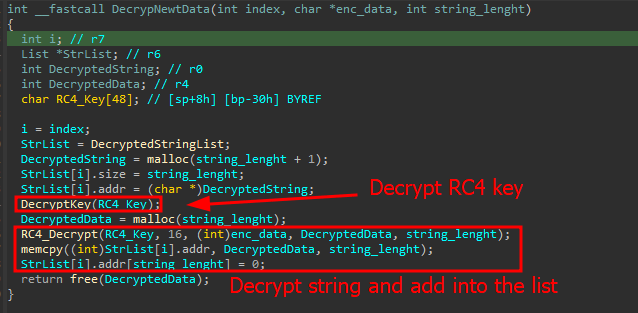
    The data decryption routine in this variant is implemented as a simple RC4 algorithm.

    The RC4 key is encrypted with XOR. After the key decryption, we were able to obtain its value: 6e7976666525a97639777d2d7f303177.

    The decrypted RC4 key is used to decrypt the strings. After each piece of data is decrypted, it is inserted into a vector of a custom DataDecrypted structure, which is a simple string list:

    Data decryption routine

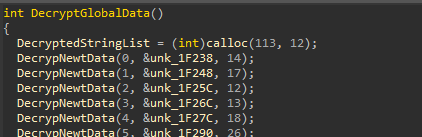
    The global linked list with decrypted data is accessed whenever the malware needs particular strings.

    Adding decrypted strings to the global list

    Anti-VM and anti-emulation

    To detect if it is currently running inside a virtual machine or QEMU, the malware lists all processes until it finds any mention of VMware or QEMU-arm. Listing running processes is simply a matter of opening the /proc directory, which is the proc filesystem on Linux.

    Each process ID (PID) has its own folder containing useful information, such as cmdline, which describes the command used to start the process. Using this information, the malware verifies if there are any processes with VMware or QEMU-arm in their command line.

    Process check

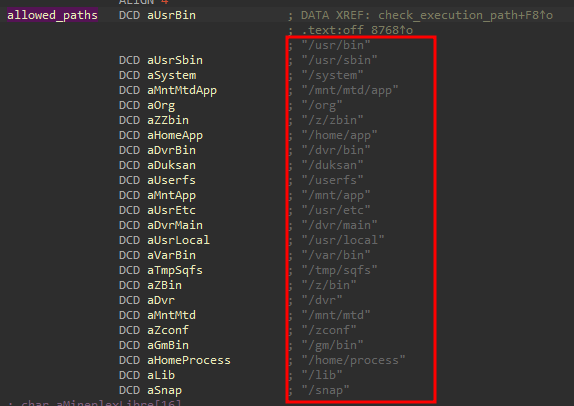
    The implant also verifies if the bot process is running outside an expected directory, based on a hardcoded list of allowed ones:

    Allowed directories

    Once those checks are successfully completed, Mirai will continue normal execution, preparing the vulnerable device for receiving commands from the operator.

    Infection statistics

    According to our telemetry data, the majority of infected victims are located in countries such as China, India, Egypt, Ukraine, Russia, Turkey, and Brazil. It’s challenging to ascertain the exact number of vulnerable and infected devices globally. However, by analyzing public sources, we’ve identified over 50,000 exposed DVR devices online, indicating that attackers have numerous opportunities to target unpatched, vulnerable devices.

    Conclusion

    Exploiting known security flaws in IoT devices and servers that haven’t been patched, along with the widespread use of malware targeting Linux-based systems, leads to a significant number of bots constantly searching the internet for devices to infect.

    The main goal of such bots is to carry out attacks that overwhelm websites and services (DDoS attacks). Most of these bots don’t stay active after the device restarts because some device firmware doesn’t allow changes to the file system. To protect against infections like these, we recommend updating vulnerable devices as soon as security patches become available. Another thing to consider is a factory reset if your device is indeed vulnerable and exposed.

    All Kaspersky products detect the threat as HEUR:Backdoor.Linux.Mirai and HEUR:Backdoor.Linux.Gafgyt.

    Indicators of compromise

    Host-based (MD5 hashes)
    011a406e89e603e93640b10325ebbdc8
    24fd043f9175680d0c061b28a2801dfc
    29b83f0aae7ed38d27ea37d26f3c9117
    2e9920b21df472b4dd1e8db4863720bf
    3120a5920f8ff70ec6c5a45d7bf2acc8
    3c2f6175894bee698c61c6ce76ff9674
    45a41ce9f4d8bb2592e8450a1de95dcc
    524a57c8c595d9d4cd364612fe2f057c
    74dee23eaa98e2e8a7fc355f06a11d97
    761909a234ee4f1d856267abe30a3935
    7eb3d72fa7d730d3dbca4df34fe26274
    8a3e1176cb160fb42357fa3f46f0cbde
    8d92e79b7940f0ac5b01bbb77737ca6c
    95eaa3fa47a609ceefa24e8c7787bd99
    96ee8cc2edc8227a640cef77d4a24e83
    aaf34c27edfc3531cf1cf2f2e9a9c45b
    ba32f4eef7de6bae9507a63bde1a43aa
    IPs
    116.203.104[.]203
    130.61.64[.]122
    161.97.219[.]84
    130.61.69[.]123
    185.84.81[.]194
    54.36.111[.]116
    192.3.165[.]37
    162.243.19[.]47
    63.231.92[.]27
    80.152.203[.]134
    42.112.26[.]36

    MIL OSI Global Banks

  • MIL-OSI: Axi Showcases Their Capital Allocation Program, Axi Select, at the Finance Magnates Africa Summit

    Source: GlobeNewswire (MIL-OSI)

    SYDNEY, June 06, 2025 (GLOBE NEWSWIRE) — Leading online FX and CFD broker Axi attended the Finance Magnates Africa Summit (FMAS:25), held on May 29-30, 2025, at the Cape Town International Convention Centre in Cape Town, South Africa.

    Event attendees were introduced to Axi Select, Axi’s capital allocation program launched in 2023. The program, designed to empower ambitious traders on their trading journey, has been a game-changer in the trading field. Tens of thousands of traders worldwide have signed up to Axi Select, with many now reaching significant milestones and accessing funding amounts of $100,000, $200,000, and $500,000, and the top funding milestone, $1,000,000.

    Attendees of the expo also had the opportunity to explore Axi’s Introducing Broker (IB) and Affiliate programs, learn more about the broker’s partnership with Premier League Champions, Man City, as well as snap exclusive photos with Man City’s Premier League memorabilia and the club’s mascot, brought in especially for the event. 

    Further to the broker’s collaboration with Premier League club, Manchester City FC, Axi also partners with Brazilian club, Esporte Clube Bahia, LaLiga club, Girona FC, and named England international John Stones as their Brand Ambassador in 2023. Over the past several months, Axi has garnered significant recognition for its innovation in the trading industry. The broker was recently named ‘Best Funded Trader Programme’ by the ADVFN International Financial Awards 2025, acknowledging the excellence of its capital allocation program, Axi Select. In 2024, Axi was also celebrated at the 2024 Dubai Forex Expo with the ‘Innovator of the Year’ award, and was named ‘Most Innovative Proprietary Trading Firm’ by Finance Feeds, highlighting the broker’s continued focus to providing their traders with the competitive edge they need to succeed.

    View highlights here: https://youtu.be/Ec2VYV8vOi4

    *Granted to the Axi Group of Companies.

    The Axi Select programme is only available to clients of AxiTrader Limited. CFDs carry a high risk of investment loss. In our dealings with you, we will act as a principal counterparty to all of your positions. This content is not available to AU, NZ, EU and UK residents. For more information, refer to our Terms of Service.

    About Axi

    Axi is a global online FX and CFD trading company, with thousands of customers in 100+ countries worldwide. Axi offers CFDs for several asset classes including Forex, Shares, Gold, Oil, Coffee, and more.

    For more information or additional comments from Axi, please contact: mediaenquiries@axi.com

    The MIL Network

  • MIL-OSI China: Regular Press Conference of the Ministry of National Defense on May 29, 2025 2025-06-06 Senior Colonel Zhang Xiaogang, spokesperson for the Ministry of National Defense (MND) of the People’s Republic of China (PRC), answers questions at a regular press conference on the afternoon of May 29, 2025.

    Source: People’s Republic of China – Ministry of National Defense

    By Senior Colonel Zhang Xiaogang, Spokesperson for the Ministry of National Defense (MND)

    Senior Colonel Zhang Xiaogang, spokesperson for the Ministry of National Defense (MND) of the People’s Republic of China (PRC), answers questions at a regular press conference on the afternoon of May 29, 2025. (mod.gov.cn)

    (The following English text is for reference. In case of any divergence of interpretation, the Chinese text shall prevail.)

    Zhang Xiaogang: Friends from the media, good afternoon, welcome to this month’s regular press conference of the Ministry of National Defense of the People’s Republic of China

    I have a piece of news to release at the top.

    The PLA National Defense University (NDU) sent a delegation to attend the 22nd Shangri-La Dialogue (SLD) upon invitation on May 29. The visit is scheduled till June 2, during which the delegation will also have exchanges with military and civilian units in Singapore.

    Journalist: Not long ago, the 4th Ministerial Meeting of the China-CELAC Forum was held in Beijing. President Xi Jinping attended the opening ceremony and delivered an important speech. Could you please provide more details about military cooperation between China and Latin American and Caribbean (LAC) countries?

    Zhang Xiaogang: Recently, President Xi Jinping attended the 4th Ministerial Meeting of the China-CELAC Forum and delivered a keynote address. He summarized the best practices for developing China-LAC relations, and announced the launch of five programs of Solidarity, Development, Civilization, Peace and People-to-People Connectivity. In the speech, President Xi has charted the course for building a China-LAC Community with a Shared Future.

    China-LAC cooperation has withstood winds and rains, and transcended mountains and oceans across half a globe. The cooperation has bolstered economic growth and improved the livelihoods of the LAC region, bringing tangible benefits to the local people. In recent years, the Chinese and LAC militaries have had frequent high-level exchange, and conducted numerous working level meetings. Events such as the China-LAC States Defense Forum, China-LAC Military Medicine Forum and Seminar for Senior Military Officers from LAC Countries have been held multiple times. China-LAC defense cooperation has been productive, deepening our friendship and mutual trust. The Chinese side stands ready to work with the defense establishments and militaries of LAC countries to act on the Global Security Initiative, and deepen substantive cooperation in such areas as mutual visits, professional exchanges and personnel training. Together, we will promote sustained and solid progress in building a China-LAC Community with a Shared Future.

    Journalist: In his recent speech, Lai Ching-te said that Taiwan would continue to strengthen its defenses and avoid war by preparing for it. Will the PLA conduct military exercises as countermeasures as before?

    Zhang Xiaogang: As long as Lai Ching-te continues his provocations for “Taiwan independence”, there will be no tranquility in the Taiwan Strait and no stability for our Taiwan compatriots. We warn the DPP authorities that “Taiwan independence” separatists will come to no good end. The PLA will remain combat-ready at all times, enhance combat readiness, and safeguard our national sovereignty and territorial integrity.

    Journalist: The US recently unveiled plans for the Golden Dome missile defense system, and announced that it would be completed in 3 years. May I have your comments on this?

    Zhang Xiaogang: The US presses ahead with the Golden Dome system and deploys space-based weapons, continuously expands its military build-up and stokes an arms race in outer space. Such acts violate relevant principles of the Outer Space Treaty, heighten the risk of turning the space into a war zone and triggering a space arms race, and shake the international security and arms control regime. Its actions will once again open the Pandora’s box. This proves again that no country has done more than the US in militarizing the space and making it a battlefield. We urge the US side to stop expanding military build-up in space, and take concrete actions to uphold global strategic stability.

    Journalist: I have two questions. The first one is that Japan’s Defense Ministry recently announced that Chinese aircraft carrier PLANS Liaoning conducted take-off and landing operations of ship-borne aircraft in the East China Sea. Officials of the Japan Self-Defense Forces said that similar activities were conducted by Chinese aircraft carriers before, but this training occurred in waters closer to Japan. The Japanese Defense Ministry therefore decided to make it public and this is the first time for the Ministry to release such information. What’s your comment on this?

    The second question is that the US President Donald Trump recently said that the US was mass-producing hypersonic missiles. As one of the major countries that develop hypersonic technologies, how does the Chinese side view the impact on the global arms control regime caused by the US accelerating its deployment of such strategic weapons?

    Zhang Xiaogang: On the first question, the task fleet led by PLANS Liaoning conducted training in relevant waters, which does not target any specific country or entity and is in line with international law and practice. I think the Japanese side overreacted.

    On your second question, We pursue a national defense policy that is defensive in nature, never engage in arms race with any other country, and are committed to global strategic stability.

    Journalist: I have two questions. The first one is that the US Carrier Strike Group led by USS Nimitz re-entered the South China Sea through the Singapore Strait on May 26 after its visit to Malaysia. What’s your comment on this?

    The second question is that reports suggest that the Indian side recovered an undetonated PL-15E air-air missile during the India-Pakistan conflict. Can you confirm this? Will this give the Indian side assess to relevant military technology?

    Zhang Xiaogang: On your first question, activities to flex its muscle and stir up troubles in the South China Sea will find no support. The Chinese side will firmly safeguard our territorial sovereignty and maritime rights and interests, and maintain peace and stability in the South China Sea.

    On your second question, the type of missile you mentioned is for export and has also been exhibited in international and domestic defense expos multiple times.

    Journalist: I have two questions. The first is the Commander of the US Army Pacific recently claimed that China’s increasingly aggressive behavior in the Indo-Pacific had made the situation more dangerous. He said that no one would have imagined that Beijing would conduct drills simulating a blockade of Taiwan five years ago, but now such moves were commonplace. In addition, head of the US Indo-Pacific Command said that the Chinese side was conducting comprehensive exercises in preparation for recovering Taiwan and was increasingly active in other regions of the Pacific. May I have your comments on this?

    The second question is that according to Taiwan media reports, the DPP authorities have stepped up its procurement of the Patriot missiles, drawn personnel from its Marine Corps to form combat units for the “Greater Taipei Area”, and launched several drills on responses to the so-called “PLA attacks on Taiwan”. Public opinion in Taiwan believes that these actions are preparing for Lai Ching-te’s desertion in the face of war. Do you have any comment?

    Zhang Xiaogang: For your first question, Taiwan is part of China. Resolving the Taiwan question is a matter for the Chinese, which brooks no external interference. For the cross-Strait situation, there is no factor more destabilizing than the provocations made by the “Taiwan independence” separatists and the disruptions by foreign forces. It’s legitimate, necessary, lawful and justified for the Chinese side to take actions to safeguard national sovereignty and territorial integrity. We urge the US side to stop fanning the flames on the Taiwan question. Such behaviors would only backfire.

    For your second question. Don’t be fooled by Lai Ching-te’s reckless provocations now. When the day comes, people like him will be the first to run away. For the PLA, defeating military elements of the “Taiwan independence” separatist forces is like shooting fish in a barrel. Those notorious separatists have no chance to escape.

    Senior Colonel Zhang Xiaogang, spokesperson for the Ministry of National Defense (MND) of the People’s Republic of China (PRC), answers questions at a regular press conference on the afternoon of May 29, 2025. (mod.gov.cn)

    Journalist: I have two questions. Firstly, you just announced that the PLA NDU sent a delegation to attend this year’s SLD. Why didn’t the Chinese side send higher level military officials to attend the dialogue? The US Department of Defense has already announced its attendance at the dialogue, and said that the US was a more credible regional partner than China. What’s your comment on that? My second question is that this year marks the 80th year of the World Anti-Fascist War. Many European countries have held celebrations commemorating this victory. September 3rd marks the 80th anniversary of the victory of the Chinese People’s War of Resistance against Japanese Aggression. Many people are expecting the Chinese side to hold a military parade to commemorate this anniversary. What’s your comment on that?

    Zhang Xiaogang: On your first question, China consistently engages in constructive dialogues to articulate our vision and initiatives. We are committed to enhancing mutual trust and deepening cooperation through these exchanges, contributing Chinese wisdom to the building of a community with a shared future for mankind. The PLA NDU delegation attending this year’s SLD will have in-depth exchanges with participating parties to build more consensus.

    As for the second question, I have no information to release here.

    Journalist: What is the Chinese Ministry of National Defense’s assessment on the equipment supplied by the Chinese military to Pakistan in the recent conflict between India and Pakistan? An Indian official said that China provided satellite and air defense systems for Pakistan, but these systems performed below average. What’s your comment on that?

    Zhang Xiaogang: Pakistan and India are neighbors who cannot move away from each other. We call on the both sides to keep calm, exercise restraint and avoid complicating the situation. China will continue to play a constructive role in maintaining regional peace and stability.

    Journalist: It’s reported that US Defense Secretary recently said that the US side would build up its military to meet China’s “threat” at every turn, and counter China in the Indo-Pacific. In addition, Commander of the US Army Pacific said that the US army was building agile new units in response to potential conflicts with China. What’s your comment on

    Zhang Xiaogang: Conflict and confrontation should not be the choice of either side. Mutual respect, peaceful coexistence and win-win cooperation is the right way for China and the US to deal with each other. The US side should stop conjuring up a powerful enemy for itself whether intentionally or unintentionally. Such imagination is not rational and extremely dangerous. The Chinese military will make all-out efforts to enhance our combat readiness, and firmly safeguard national sovereignty, security and development interests.

    Journalist: Some US and Israeli media outlets call on the US to stop its military assistance to Egypt, because of Egypt’s close cooperation with China. What’s your comment on this?

    Zhang Xiaogang: China-Egypt cooperation is not aimed at any third party, nor will it be interfered by any third party. The Chinese and Egyptian militaries will continue to deepen friendship, mutual trust and practical cooperation.

    Journalist: As China’s first aircraft carrier with catapult system, PLANS Fujian is undergoing a series of intensive sea trials. What kind of signal does that send out?

    Senior Colonel Zhang Xiaogang, spokesperson for the Ministry of National Defense (MND) of the People’s Republic of China (PRC), answers questions at a regular press conference on the afternoon of May 29, 2025. (mod.gov.cn)

    Zhang Xiaogang: The sea trial is a necessary part for the construction of aircraft carriers. PLANS Fujian will conduct relevant tests as planned.

    Journalist: According to a satellite image revealed last week, H-6 bombers and a KJ-500 airborne early warning aircraft were seen on Yongxing Dao of Xisha Qundao. What is the purpose of this deployment? Some experts suggest that it is to send signals to the Philippines and Vietnam. What’s your comment on that?

    Zhang Xiaogang: I am not aware of the information you mentioned. I want to emphasize that the Xisha Qundao is an inherent part of the Chinese territory. We oppose the hype about relevant military activities.

    Journalist: An African Young Officers Delegation visited China recently. Some commentary regarded the trip as one that combines culture, technology and friendship. Could you please provide more details on this?

    Zhang Xiaogang: The African Young Officers Delegation concluded its 10-day visit to China on May 15. During the visit, nearly a hundred military officers from over 40 African countries, including Egypt, Mozambique, Tanzania and Kenya, came to cities such as Beijing, Changsha and Shaoshan. They visited military units, academies and high-tech enterprises, attended themed lectures and seminars, toured the Museum of the Communist Party of China and the former residence of Comrade Mao Zedong, and had in-depth exchanges with their Chinese counterparts. Members of the delegation expressed how impressive and inspiring this visit was. This is the 4th African Young Officers Delegation invited to China by the Chinese Ministry of National Defense. This visit deepened the traditional friendship between the Chinese and African militaries, and advanced the building of an All-weather China-Africa Community with a Shared Future for the New Era.

    Journalist: I have two questions. The first one is that the US Indo-Pacific Commander reportedly said that China was outpacing the US in the production of warships and other equipment. He said that the rates of changes on the depth and breadth of PLA’s exercises was what kept him up at night. May I have your comments on this?

    The second question is that it’s reported that China’s third large hospital ship PLANS Ark Auspicious has been commissioned, marking the deployment of large ocean-going hospital ship to the Eastern Theater Command, South Theater Command and North Theater Command respectively. What’s your comment on this?

    Zhang Xiaogang: On your first question, China does not engage in arms race with any other country. We develop our military to defend China’s national sovereignty, security and development interests and to bring stability and positive energy to global peace and security.

    On your second question, PLANS Ark Auspicious is the third 10,000-ton-class ocean-going hospital ship domestically designed and built by China. It features a combat-oriented layout and is equipped with advanced medical equipment. PLANS Ark Auspicious, together with Ark Peace and Ark Silk Road, not only forms the backbone of medical support on the sea, but also executes tasks of international humanitarian medical services, emergency medical rescue in major disasters, and foreign exchanges and cooperation on military medicine. PLAN hospital ships will help the Chinese military materialize the vision of building a maritime community with a shared future and offer the world more public security goods of higher quality.

    Journalist: Does the Chinese delegation plan to meet with any other delegations on the sidelines of the Shangri-La Dialogue? Is there any planned meeting with the US delegation?

    Zhang Xiaogang: Regarding this, we will release information in due course. The Chinese side values our defense relations with the US military and is open to communications at different levels. We hope the US side will earnestly respect China’s core interests and major concerns, work with us in the same direction, and promote the steady and sound development of military-to-military relations.

    Journalist: Minister of National Defense Admiral Dong Jun recently visited France and Germany, and attended the 6th UN Peacekeeping Ministerial. Please provide further details about this.

    Zhang Xiaogang:Minister of National Defense Admiral Dong Jun led a delegation to visit France and Germany and attend the 6th UN Peacekeeping Ministerial in Berlin from May 11 to 17. Minister Dong held talks with French Minister of the Armed Forces Sébastien Lecornu and German Federal Minister of Defence Boris Pistorius respectively. The leaders had an in-depth exchange of view on international and regional issues of mutual interests, and reached consensus on strengthening substantive engagements and cooperation between the Chinese and French and the Chinese and German militaries. Minister Dong also met with UN Secretary-General António Guterres and Under Secretary-General Jean-Pierre Lacroix on the sidelines of the 6th UN Peacekeeping Ministerial. In his speech delivered at the conference, Minister Dong emphasized that the Chinese side will work with different parties to act on the Global Security Initiative, uphold the core position of the UN, redouble efforts on the United Nations Peacekeeping Operations (UNPKOs), support the training of professional peacekeepers, optimize the composition and capabilities of Chinese Peacekeeping Standby Force, advance continuous innovation of UNPKOs, and contribute more to UNPKOs.

    Journalist: Lately, official new media accounts of PLA theater commands and services and arms have been opened on the ‘China Bugle” app. What’s your comment on that?

    Zhang Xiaogang: China Bugle is the mobile flagship platform of information release launched by the PLA News Media Center. As of now, the PLA Army, Navy, Air Force, Rocket Force, and the PAP, as well as the PLA Eastern, Southern, Western, Northern and Central Theater Commands have opened their official new media accounts on this app. This demonstrates the deep integration of different forms of military media, and provides an important channel for the public to learn about defense and military development in an all-round manner. Going forward, more military units and media outlets will join the “China Bugle” app to form an integrated new media platform for military news.

    Journalist: The draft of the Japanese defense ministry’s Defense White Paper 2025 was revealed. The draft claims that China is ramping up its nuclear, missile, maritime and aviation capabilities; that PLA’s activities near Taiwan demonstrate that Beijing is trying to improve its combat capabilities; and strengthened China-Russia military cooperation is a concern for Japan. What’s your comment on this?

    Zhang Xiaogang: In the draft of its Defense White Paper, the Japanese side repeats its irresponsible comments about China’s military development, and points fingers at China’s legitimate military activities and external military cooperation. We are strongly opposed to this. This year marks the 80th year of the victory of the Chinese People’s War of Resistance Against Japanese Aggression and the World Anti-Fascist War. At this special historical juncture, it’s even more important for Japan to reflect on its behaviors, instead of making unfounded smears and accusations against others. We urge the Japanese side to follow the path of peaceful development, act prudently in the domain of military and security, and earn the trust of its Asian neighbors and the rest of the international community with concrete actions.

    Journalist: Head of Taiwan’s defense authorities Koo Li-hsiung reportedly said in an interview that US forces and alliances across Asia was crucial for holding Beijing in check. He also expressed hope for the US to expedite arms sales to Taiwan to help Taiwan address military threats from China.What’s your comments on this?

    Zhang Xiaogang: The Taiwan question is purely an internal affair of China, which brooks no interference. We will strive for the prospect of peaceful reunification with utmost sincerity and greatest effort. However, should the “Taiwan independence” separatists make provocations, challenge our bottom lines, or even cross the red lines, we will have to take decisive measures. The US side supports “Taiwan independence” separatists through arms sales. Such acts are self-defeating and will push Taiwan into the abyss of war.

    Journalist: Recently, the Chinese and Cambodian militaries successfully held the Golden Dragon 2025 joint exercise. Please provide more details.

    Zhang Xiaogang: The Chinese and Cambodian armed forces conducted the Golden Dragon 2025 joint exercise in Kampong Chhnang Province and the airspace and waters off the Sihanoukville Port from May 14 to 28. As the 7th iteration of the Golden Dragon series, this year’s exercise has three highlights. First, it focused on counter-terrorism and humanitarian assistance operations, conducting drills on relevant subjects. Second, the China-Cambodia Joint Support and Training Center at Port Ream provided support for drills on the sea for the first time. Air force helicopters took part in the exercise for the first time. Land, naval, air and joint logistic support components from both sides conducted drills together. Third, the exercise consisted of two parts: naval & air operations and ground & air operations. Participating troops were organized into mixed groups to learn from each other during tactical training and comprehensive drills, which helped to enhance command coordination and emergency response capabilities of the two sides. During the joint exercise, the PLA contingent also donated school supplies and provided free medical services to the local community. China and Cambodia are iron-clad friends with rock-solid relations. The Chinese and Cambodian militaries will work in concert to act on the important consensus between leaders of the two countries, and make greater contributions to building a China-Cambodia All-weather Community with a Shared Future for the New Era, and to preserving regional security and stability.

    Journalist: The Philippine Coast Guard said that the Coast Guard and Armed Forces of the Philippines and the US Coast Guard conducted a joint patrol in waters off Palawan, which reaffirmed the Philippines’ commitment to maritime security and the “rule-based international order”. What’s your comment on this?

    Senior Colonel Zhang Xiaogang, spokesperson for the Ministry of National Defense (MND) of the People’s Republic of China (PRC), answers questions at a regular press conference on the afternoon of May 29, 2025. (mod.gov.cn)

    Zhang Xiaogang: At present, the situation in the South China Sea remains generally stable. The freedom of navigation and overflight entitled to all countries under international law has never been an issue. Some countries provoke confrontation in the name of cooperation, flex muscles under the guise of freedom, and create chaos with the pretext of order. They have become the biggest source of risks that undermines peace and stability in the South China Sea. We urge relevant countries to stop ganging up and stirring up troubles in the South China Sea, and stop harming regional peace and stability.

    Journalist: I have two questions. The first question is about the PLA aircraft carrier Liaoning and its task fleet. They are currently off the southeast coast of Taiwan. The Taiwan authority said that they have taken joint intelligence means to monitor relevant operations throughout the whole process. Some people suggest that the PLA will probably conduct military exercises before or after the Dragon Boat Festival. Can you confirm whether the PLA has relevant plans? My second question. According to media reports, the CIA is about to release its annual report, suggesting that the Chinese mainland poses the greatest threat to the world and increasing menace against Taiwan. It also said that the rapid modernization of the PLA would prevent the US from entering the Pacific. What’s your comment on this?

    Zhang Xiaogang: On your first question. Relevant military activities organized by the PLA recently are routine arrangements according to our annual training plan.

    On your second question, as we all know, China is unwavering in our commitment to peace, development and international order. The biggest threat to the current cross-Strait situation comes from separatist activities for “Taiwan independence” and support from foreign forces. If relevant countries truly care about stability in the Taiwan Strait, they should abide by the one-China principle and unequivocally oppose “Taiwan independence”.

    If there are no other questions, this concludes today’s press conference. Thank you.

    MIL OSI China News

  • MIL-OSI Russia: Happy Russian Language Day! Celebrate the holiday with GUU

    Translation. Region: Russian Federal

    Source: State University of Management – Official website of the State –

    Every year on June 6, Russia and the world celebrate Russian Language Day. This day was established in 2010 by decision of the UN General Assembly in honor of the birthday of the great Russian poet Alexander Sergeevich Pushkin.

    The Russian language is not just a means of communication. It is the language of a rich culture, centuries-old history and great works of literature, philosophy and art that continue to inspire new generations around the world.

    The State University of Management congratulates all native Russian speakers on the holiday, especially the Department of Russian Language and General Disciplines of the State University of Management. On this special day, we wish you the desire to learn and love your native language. Let the study of the Russian language open up new horizons, allow you to understand Russian culture and traditions more deeply, and help you establish strong ties with people from other countries.

    We invite you to celebrate this day together with the SUM Scientific Library and the book club “Let’s Discuss?” and discuss the work of the great poet over a cup of tea, recall famous works, and read your favorite excerpts. SUM students from Guinea-Bissau will also take part in the event.

    We are waiting for everyone at 12:00 on June 6 in reading room No. 2 of the Scientific Library of the State University of Management.

    In addition, a festive quiz on the knowledge of the book preferences of Alexander Sergeevich himself will be held in the GUU telegram channel. Subscribe to the channel so as not to miss the start of the quiz and always be aware of the news of the first management.

    Please note: This information is raw content directly from the source of the information. It is exactly what the source states and does not reflect the position of MIL-OSI or its clients.

    MIL OSI Russia News

  • MIL-OSI Africa: African countries are bad at issuing bonds, so debt costs more than it should: what needs to change

    Source: The Conversation – Africa – By Misheck Mutize, Post Doctoral Researcher, Graduate School of Business (GSB), University of Cape Town

    Over the past two decades, African countries have increasingly turned to international capital markets to meet their development financing needs. For example, Kenya and Benin raised a combined US$2.5 billion through bond issuances during the first half of 2025. Proceeds were used to repay maturing bonds. This means new bonds, with unfavourable terms, are being issued to pay previous lenders.

    Yet African bonds are substantially mispriced, resulting in excessively high yields that are not justified by fundamentals – based on economic, fiscal and institutional strengths. Mispricing occurs when a country has high economic growth, stable institutions that support government policy implementation, rule of law and accountability, yet its bonds trade at higher yields than those of its peers. In other words, there will be every reason for investors to trust that the country will repay what it owes, but they still expect a higher return. This is happening because of lack of information and biases perpetuated by global entities that are facilitating bond sells in Africa.

    Côte d’Ivoire and Senegal have strong growth (5% to 6.5%), yet they face high yields on their bonds (7.8% to 8.2%) compared to Namibia and Morocco with approximately 3% growth and bond interest of 6%.

    This mispricing imposes a heavy debt servicing burden on already constrained public budgets.

    At the same time African countries face a puzzling paradox: while they’re paying more for the debt they’re raising, the demand for these bonds is much higher (oversubscribed). All bond issuances in Africa are subscribed by as much as over five times. This has only been common in Africa. It is puzzling why governments are not leveraging on the high demand to bargain for lower interest rates.

    In my view, based on my bond pricing modelling expertise, I believe that mispricing of Eurobonds in Africa – debt instruments issued by a country in a currency different from its own – is not a market anomaly. It shows internal capacity failures in African countries, structural market biases and insufficient understanding of the complex mechanics of global debt markets.

    Oversubscription of Eurobonds should be a source of power for African governments, not a missed opportunity. African countries can move from being price takers to price negotiators. They should be able to reduce debt costs, freeing up resources for development.

    But to get there African countries need to address the power imbalance in the markets.

    Governments need to invest in bond pricing expertise to increase their negotiating power.

    The false success signal of oversubscription

    There are several reasons why African bonds remain mispriced at a higher interest despite the oversubscriptions.

    Firstly, a lack of technical expertise in primary bond issuance in the debt management offices of the majority of African governments. Very few on the continent have intelligence systems for gathering information on financial markets and formal investor relations programmes. Neither do they have in-house quantitative analysts or pricing specialists capable of engaging investment banks on an equal footing during roadshows and negotiations.

    The debt management offices are unable to engage confidently and critically with financial intermediaries to challenge assumptions, simulate pricing scenarios and conduct their own comparative market analysis.

    After initial public offers, most governments don’t engage with holders of their bonds on the secondary market. Nor do they monitor bond post-issuance performance. The lack of interest in the secondary market has created a feedback loop where poor market intelligence has contributed to high coupons on new issuances.

    Secondly, advanced economies engage investors regularly through briefings, roadshows and timely reports. Communication by African governments is often ad hoc and usually limited to the period around a new bond issuance.

    This prevents investors from forming informed, long-term views. It leads to a default risk premium in pricing.

    Thirdly, debt issuance by African governments is often politically driven rather than strategically timed. Often this leads to rushed or ill-prepared entries.

    Sometimes it’s done when the cost of debt is rising globally, close to election cycles, or because governments are facing a financial crunch caused by falling reserves.


    Read more: African governments have developed a taste for Eurobonds: why it’s dangerous


    Fourth, African sovereigns often approach the Eurobond market with weak negotiating power. They are heavily reliant on a small pool of western investment banks as technical advisors to manage the bond issuance. These banks tend to be more inclined towards their own global investment client networks. Their incentives are not aligned with achieving the lowest possible yield for the issuers.

    African issuers often accept the initial price guidance from advisors and agree to high yields even in oversubscribed situations. Even when demand could support a lower yield, African issuers fail to negotiate pricing downwards. Issuing syndicates have no incentive to push for optimal pricing for the issuer as they receive transaction-based fees.


    Read more: African countries aren’t borrowing too much: they’re paying too much for debt


    The role of bond issuing syndicates is a major factor in the mispricing. In bond issuance, a syndicate is a group of financial institutions that structures the bond, price and market (also known bookbuilding), underwrite the unsold portion of the bond, sell the bond to their investors, and ensure compliance and documentation. These syndicates set coupon rates higher than necessary as a conservative hedge against perceived investor scepticism.

    African governments have become passive participants rather than active price-setters. African-based bond syndicates are systematically bypassed despite growing regional capacity and distribution networks. Bond issues are also allocated to offshore buyers, sidelining local institutional investors.

    Breaking the cycle of mispricing

    To correct the systemic Eurobond mispricing and reduce debt servicing costs, African countries must undertake reforms.

    First, governments should invest in debt management capacity.

    Second, they must actively monitor secondary market trading to identify opportunities such as bond buybacks and exchanges that could improve the debt profile. Real-time analytics on bond trading performance should inform future issuance terms and investor communication strategies.

    Third, governments must build institutional routines for submitting data, and proactively engage investors and rating agencies. This will challenge and influence risk assumptions. Investors need consistent assurances, especially on the ability to easily exit positions.

    Fourth, African countries need to maintain and monitor up-to-date benchmarks from peers with comparable pricing data. Without accurate comparisons, it is difficult to know whether the proposed bond pricing by syndicates is fair and accurate. They must stop solely relying on what investment banks recommends.

    Lastly, African governments should involve at least one African-based syndicate member, prioritise allocation to African institutional investors and promote regional arrangements with international banks to ensure knowledge transfer and equitable participation.

    – African countries are bad at issuing bonds, so debt costs more than it should: what needs to change
    – https://theconversation.com/african-countries-are-bad-at-issuing-bonds-so-debt-costs-more-than-it-should-what-needs-to-change-257128

    MIL OSI Africa

  • MIL-OSI Banking: New Development Bank, Bank of China and Haitong Unitrust Financial Leasing sign RMB 1.2 billion Syndicated Loan Agreement to Support Environmental Projects in China

    Source: New Development Bank

    The New Development Bank (NDB), Bank of China and Haitong Unitrust International Financial Leasing (HUIFL) have signed a syndicated loan agreement totalling RMB 1.2 billion to finance green leasing sub-projects that support China’s environmental goals and climate commitments.

    The signed loan agreement supports China’s transition toward a new growth model centred on low-carbon development, climate resilience, and environmental protection. Despite progress in recent years, environmental protection and climate change mitigation continue to be considered national priorities, and this Project aligns directly with that policy direction.

    Under the loan agreement, NDB will provide RMB 713.32 million, Bank of China will contribute RMB 500 million, and HUIFL will use the funds to acquire and lease equipment to lessees implementing sub-projects related to wastewater treatment, solid waste management, and metallurgical waste gas utilization for power generation. To promote balanced development, eligible sub-projects will be located outside China’s four Tier I cities, channelling investment into less-developed regions.

    This is the first time NDB mobilizes private capital in a syndicated operation, marking a significant evolution in the Bank’s development financing approach. Since the adoption of the Addis Ababa Action Agenda in 2015, multilateral development banks have increasingly prioritized the mobilisation of private capital to help bridge the significant financing gap required to achieve the 2030 Agenda. In line with this collective commitment, NDB is scaling up private capital mobilization, and this transaction represents a concrete step in implementing that strategy, positioning NDB as a project orchestrator within its member countries.

    Aligned with NDB’s General Strategy for 2022–2026, this operation reinforces New Development Bank’s commitment to financing sustainable development projects using local currency instruments, while strengthening domestic financial markets and fostering private sector participation.

    “NDB is proud to partner with Bank of China and Haitong Unitrust Financial Leasing to finance green sub-projects that promote sustainable development and support China’s environmental goals and climate commitments. This initiative addresses the need for climate resilience and environmental protection and contributes to increasing investment in less-developed regions in China,” said Mr. Vladimir Kazbekov, NDB Vice-President and Chief Operating Officer. “In helping to address the infrastructure financing gap, New Development Bank is playing a catalytic role in mobilizing resources from diversified funding sources, particularly from the private sector, in line with its General Strategy.”

    “The successful launch of this environmental protection syndicated loan represents not only a concrete initiative by Bank of China Shanghai Branch, NDB, and HUIFL to actively implement national strategies, but also an innovative collaboration among the three parties. Taking this opportunity, Bank of China Shanghai Branch will further leverage its global advantages and comprehensive strengths to provide more professional services to NDB and HUIFL, jointly injecting green and sustainable momentum into high-quality economic and social development,” said Mr. Xiao Wang, General Manager of Bank of China, Shanghai Branch.

    “Taking this cooperation as a starting point, Guotai Haitong Securities and HUIFL will leverage the group’s global resources and partner with NDB and Bank of China to proactively serve the national strategies, actively increase support to areas of environmental protection and energy efficiency and jointly address issues in green development,” said Mr. Yuxing Mao, Vice-President of Guotai Haitong Securities Company.

    Background Information

    New Development Bank

    NDB was established by Brazil, Russia, India, China and South Africa to mobilize resources for infrastructure and sustainable development projects in BRICS and other emerging market economies and developing countries, complementing the existing efforts of multilateral and regional financial institutions for global growth and development.

    For more information on NDB, please visit www.ndb.int

    Haitong Unitrust International Financial Leasing

    Established in 2004 and headquartered in Shanghai, HUIFL is a leading financial leasing company in China, with operations across sectors including advanced manufacturing, energy and environmental protection, construction, urban utilities and transportation & logistics. HUIFL is listed on the Hong Kong Stock Exchange and has a strong track record in green leasing. In March 2025, the indirect controlling shareholder of HUIFL was changed to Guotai Haitong Securities Company, and the actual controller was Shanghai International Group.

    For more information on HUIFL, please visit www.utfinancing.com

    Bank of China

    Bank of China was established in 1912 and is the oldest continuously operating state-owned commercial bank in China. In 2011, it became the first global systemically important bank from an emerging economy, with its international standing, competitiveness, and comprehensive strength ranking among the top tier of global banks. It operates branches across the Chinese mainland as well as in 64 countries and regions overseas.

    For more information on Bank of China, please visit https://www.boc.cn/

    MIL OSI Global Banks

  • MIL-OSI Global: African countries are bad at issuing bonds, so debt costs more than it should: what needs to change

    Source: The Conversation – Africa – By Misheck Mutize, Post Doctoral Researcher, Graduate School of Business (GSB), University of Cape Town

    Over the past two decades, African countries have increasingly turned to international capital markets to meet their development financing needs. For example, Kenya and Benin raised a combined US$2.5 billion through bond issuances during the first half of 2025. Proceeds were used to repay maturing bonds. This means new bonds, with unfavourable terms, are being issued to pay previous lenders.

    Yet African bonds are substantially mispriced, resulting in excessively high yields that are not justified by fundamentals – based on economic, fiscal and institutional strengths. Mispricing occurs when a country has high economic growth, stable institutions that support government policy implementation, rule of law and accountability, yet its bonds trade at higher yields than those of its peers. In other words, there will be every reason for investors to trust that the country will repay what it owes, but they still expect a higher return. This is happening because of lack of information and biases perpetuated by global entities that are facilitating bond sells in Africa.

    Côte d’Ivoire and Senegal have strong growth (5% to 6.5%), yet they face high yields on their bonds (7.8% to 8.2%) compared to Namibia and Morocco with approximately 3% growth and bond interest of 6%.

    This mispricing imposes a heavy debt servicing burden on already constrained public budgets.

    At the same time African countries face a puzzling paradox: while they’re paying more for the debt they’re raising, the demand for these bonds is much higher (oversubscribed). All bond issuances in Africa are subscribed by as much as over five times. This has only been common in Africa. It is puzzling why governments are not leveraging on the high demand to bargain for lower interest rates.

    In my view, based on my bond pricing modelling expertise, I believe that mispricing of Eurobonds in Africa – debt instruments issued by a country in a currency different from its own – is not a market anomaly. It shows internal capacity failures in African countries, structural market biases and insufficient understanding of the complex mechanics of global debt markets.

    Oversubscription of Eurobonds should be a source of power for African governments, not a missed opportunity. African countries can move from being price takers to price negotiators. They should be able to reduce debt costs, freeing up resources for development.

    But to get there African countries need to address the power imbalance in the markets.

    Governments need to invest in bond pricing expertise to increase their negotiating power.

    The false success signal of oversubscription

    There are several reasons why African bonds remain mispriced at a higher interest despite the oversubscriptions.

    Firstly, a lack of technical expertise in primary bond issuance in the debt management offices of the majority of African governments. Very few on the continent have intelligence systems for gathering information on financial markets and formal investor relations programmes. Neither do they have in-house quantitative analysts or pricing specialists capable of engaging investment banks on an equal footing during roadshows and negotiations.

    The debt management offices are unable to engage confidently and critically with financial intermediaries to challenge assumptions, simulate pricing scenarios and conduct their own comparative market analysis.

    After initial public offers, most governments don’t engage with holders of their bonds on the secondary market. Nor do they monitor bond post-issuance performance. The lack of interest in the secondary market has created a feedback loop where poor market intelligence has contributed to high coupons on new issuances.

    Secondly, advanced economies engage investors regularly through briefings, roadshows and timely reports. Communication by African governments is often ad hoc and usually limited to the period around a new bond issuance.

    This prevents investors from forming informed, long-term views. It leads to a default risk premium in pricing.

    Thirdly, debt issuance by African governments is often politically driven rather than strategically timed. Often this leads to rushed or ill-prepared entries.

    Sometimes it’s done when the cost of debt is rising globally, close to election cycles, or because governments are facing a financial crunch caused by falling reserves.


    Read more:
    African governments have developed a taste for Eurobonds: why it’s dangerous


    Fourth, African sovereigns often approach the Eurobond market with weak negotiating power. They are heavily reliant on a small pool of western investment banks as technical advisors to manage the bond issuance. These banks tend to be more inclined towards their own global investment client networks. Their incentives are not aligned with achieving the lowest possible yield for the issuers.

    African issuers often accept the initial price guidance from advisors and agree to high yields even in oversubscribed situations. Even when demand could support a lower yield, African issuers fail to negotiate pricing downwards. Issuing syndicates have no incentive to push for optimal pricing for the issuer as they receive transaction-based fees.


    Read more:
    African countries aren’t borrowing too much: they’re paying too much for debt


    The role of bond issuing syndicates is a major factor in the mispricing. In bond issuance, a syndicate is a group of financial institutions that structures the bond, price and market (also known bookbuilding), underwrite the unsold portion of the bond, sell the bond to their investors, and ensure compliance and documentation. These syndicates set coupon rates higher than necessary as a conservative hedge against perceived investor scepticism.

    African governments have become passive participants rather than active price-setters. African-based bond syndicates are systematically bypassed despite growing regional capacity and distribution networks. Bond issues are also allocated to offshore buyers, sidelining local institutional investors.

    Breaking the cycle of mispricing

    To correct the systemic Eurobond mispricing and reduce debt servicing costs, African countries must undertake reforms.

    First, governments should invest in debt management capacity.

    Second, they must actively monitor secondary market trading to identify opportunities such as bond buybacks and exchanges that could improve the debt profile. Real-time analytics on bond trading performance should inform future issuance terms and investor communication strategies.

    Third, governments must build institutional routines for submitting data, and proactively engage investors and rating agencies. This will challenge and influence risk assumptions. Investors need consistent assurances, especially on the ability to easily exit positions.

    Fourth, African countries need to maintain and monitor up-to-date benchmarks from peers with comparable pricing data. Without accurate comparisons, it is difficult to know whether the proposed bond pricing by syndicates is fair and accurate. They must stop solely relying on what investment banks recommends.

    Lastly, African governments should involve at least one African-based syndicate member, prioritise allocation to African institutional investors and promote regional arrangements with international banks to ensure knowledge transfer and equitable participation.

    Misheck Mutize is affiliated with the African Union as a Lead Expert on Credit Ratings

    ref. African countries are bad at issuing bonds, so debt costs more than it should: what needs to change – https://theconversation.com/african-countries-are-bad-at-issuing-bonds-so-debt-costs-more-than-it-should-what-needs-to-change-257128

    MIL OSI – Global Reports

  • MIL-OSI Video: Portfolio Committee on Planning, Monitoring and Evaluation

    Source: Republic of South Africa (video statements-2)

    Portfolio Committee on Planning, Monitoring and Evaluation (National Assembly) ,Statistics South Africa and Brand SA briefings on Budget Vote 14 and their 2025 Annual Performance Plan tabled in Parliament. Department of Planning, Monitoring and Evaluation briefing on Budget Vote 9. Tabled Strategic and Annual performance plan. Virtual Meeting Platform, 09:30

    https://www.youtube.com/watch?v=OsFLJu0j6uE

    MIL OSI Video

  • India calls for global facility on DRR financing at Geneva meet

    Source: Government of India

    Source: Government of India (4)

    India urged the international community to adopt concrete, time-bound measures and establish a dedicated global facility to support Disaster Risk Reduction (DRR) financing, Principal Secretary to the Prime Minister Dr. P. K. Mishra said today at the Ministerial Roundtable on DRR Financing in Geneva. He praised the United Nations Office for Disaster Risk Reduction (UNDRR) and its partners for convening the discussion and acknowledged Brazil and South Africa for sustaining global dialogue through their G20 presidencies.
     
    Dr. Mishra told delegates that financing for disaster risk reduction bears directly on a country’s ability to protect development gains as climate and disaster threats grow. He noted that, in India’s early years, Finance Commission allocations for DRR amounted to only INR 60 million (approximately USD 0.7 million). Today, outlays under the 15th Finance Commission top INR 2.32 trillion (around USD 28 billion). “Over time, India has transformed DRR financing from a reactive measure into a planned, predictable framework,” he said, explaining that the Disaster Management Act of 2005 laid the groundwork for rule-based fund transfers from national authorities down to states and districts.
     
    According to Dr. Mishra, India’s approach rests on ensuring that budgets cover preparedness, mitigation, relief, and recovery in one integrated flow of funds. He emphasized that the needs of vulnerable communities remain at the forefront of allocation decisions. He added that, by making resources accessible at every level—central, state, and local—the government ensures timely assistance for all affected areas. “We have built accountability and transparency into every stage of expenditure, so outcomes can be measured and lessons learned applied,” he explained.
     
    Dr. Mishra stressed that while each country must design a financing system suited to its governance, fiscal context, and risk profile, guidance from global benchmarks is essential. He said: “Countries need to take ownership of DRR financing, while benefiting from technical support and experience sharing. At the same time, international cooperation can help mobilize resources that go beyond traditional public finance.”
     
    He proposed that risk-pooling arrangements, insurance schemes, and other innovative tools be developed in line with local fiscal capacity, noting that these instruments can complement public budgets without imposing unsustainable debt burdens. “It is not enough to wait for disasters and then allocate funds; we need a mix of financial instruments that can smooth the impact of shocks,” he argued.
     
    At the global level, Dr. Mishra observed that no dedicated international mechanism currently exists to help countries set up or strengthen DRR financing frameworks. He called for the creation of a global facility under the UN system and in partnership with multilateral development banks, one that would provide catalytic funding, technical assistance, and a platform for knowledge exchange. “Such a facility would help countries move from intent to action with clear, time-bound milestones,” he said.
  • MIL-OSI: Kenyan government has revealed plans to adopt the Danish F2 platform

    Source: GlobeNewswire (MIL-OSI)

    Press Release no. 03/2025

    Kenyan government has revealed plans to adopt the Danish F2 platform

    Copenhagen, June 6, 2025

    cBrain (NASDAQ: CBRAIN) is pleased to share that the Kenyan Ministry of Information, Communications, and the Digital Economy has revealed plans to roll out the F2 digital platform across all government departments, thereby transitioning into paperless working environments.

    The plans were shared with Kenyan media by Cabinet Secretary William Kabogo on June 4, following a high-level meeting with the Danish Ambassador to Kenya, Stephan Schønemann. The project is being implemented with support from the Danish government, and cBrain is proud to contribute its technology to this strategic collaboration.

    According to the Cabinet Secretary, the new digital platform will be fundamental in reinforcing transparency and accountability in the Kenyan public service. “To ensure efficient service delivery, the government requires clear processes and decision-making that can be traced, transparent, accountable, and timely. This is fundamental to ensure every action is fully auditable,” he told the media.

    This comes two months after the Cabinet Secretary told the media that the Ministry was piloting a paperless system, aiming to eliminate bureaucracies that slow down service delivery.

    F2 is a commercial off-the-shelf (COTS) digital platform designed specifically for government use, developed in close collaboration with the Danish government. F2 serves as the digital backbone for Denmark’s central administration and is actively used by the Danish ministries and more than 75 Danish government organizations. 

    Internationally, the F2 COTS for government platform has been deployed by government authorities across five continents. Purpose-built to support public sector workflows, compliance, and documentation needs, F2 enables fast, scalable, and legally compliant digital operations across the public sector. 

    Best regards

    Per Tejs Knudsen, CEO

    Inquiries regarding this Press Release may be directed to 

    Ejvind Jørgensen, CFO & Head of Investor Relations, cBrain A/S, ir@cbrain.com, +45 2594 4973

    Attachment

    The MIL Network

  • MIL-OSI Video: Portfolio Committee on Planning, Monitoring and Evaluation (National Assembly)

    Source: Republic of South Africa (video statements)

    Portfolio Committee on Planning, Monitoring and Evaluation (National Assembly) ,Statistics South Africa and Brand SA briefings on Budget Vote 14 and their 2025 Annual Performance Plan tabled in Parliament. Department of Planning, Monitoring and Evaluation briefing on Budget Vote 9. Tabled Strategic and Annual performance plan. Virtual Meeting Platform, 09:30

    https://www.youtube.com/watch?v=GEChseYazD0

    MIL OSI Video

  • Trump administration imposes sanctions on four ICC judges in unprecedented move

    Source: Government of India

    Source: Government of India (4)

    President Donald Trump’s administration on Thursday imposed sanctions on four judges at the International Criminal Court, an unprecedented retaliation over the war tribunal’s issuance of an arrest warrant for Israeli Prime Minister Benjamin Netanyahu and a past decision to open a case into alleged war crimes by U.S. troops in Afghanistan.

    Washington designated Solomy Balungi Bossa of Uganda, Luz del Carmen Ibanez Carranza of Peru, Reine Adelaide Sophie Alapini Gansou of Benin and Beti Hohler of Slovenia, according to a statement from U.S. Secretary of State Marco Rubio.

    “As ICC judges, these four individuals have actively engaged in the ICC’s illegitimate and baseless actions targeting America or our close ally, Israel. The ICC is politicized and falsely claims unfettered discretion to investigate, charge, and prosecute nationals of the United States and our allies,” Rubio said.

    The ICC slammed the move, saying it was an attempt to undermine the independence of an international judicial institution that provides hope and justice to millions of victims of “unimaginable atrocities.”

    Both judges Bossa and Ibanez Carranza have been on the ICC bench since 2018. In 2020 they were involved in an appeals chamber decision that allowed the ICC prosecutor to open a formal investigation into alleged war crimes by American troops in Afghanistan.

    Since 2021, the court had deprioritized the investigation into American troops in Afghanistan and focused on alleged crimes committed by the Afghan government and the Taliban forces.

    ICC judges also issued arrest warrants for Netanyahu, former Israeli defense chief Yoav Gallant and Hamas leader Ibrahim Al-Masri last November for alleged war crimes and crimes against humanity during the Gaza conflict. Alapini Gansou and Hohler ruled to authorize the arrest warrant against Netanyahu and Gallant, Rubio said.

    The move deepens the administration’s animosity toward the court. During the first Trump administration in 2020, Washington imposed sanctions on then-prosecutor Fatou Bensouda and one of her top aides over the court’s work on Afghanistan.

    The measures also follow a January vote at the U.S. House of Representatives to punish the ICC in protest over its Netanyahu arrest warrant. The move underscored strong support among Trump’s fellow Republicans for Israel’s government.

    DIFFICULT TIME FOR ICC

    The measures triggered uproar among human-rights advocates. Liz Evenson, international justice director at Human Rights Watch, said the punitive measures were a “flagrant attack on the rule of law at the same time as President Trump is working to undercut it at home.”

    Sanctions severely hamper individuals’ abilities to carry out even routine financial transactions as any banks with ties to the United States, or that conduct transactions in dollars, are expected to have to comply with the restrictions.

    But the Treasury Department also issued general licenses, including one allowing the wind-down of any existing transactions involving those targeted on Thursday until July 8, as long as any payment to them is made to a blocked, interest-bearing account located in the U.S.

    The new sanctions come at a difficult time for the ICC, which is already reeling from earlier U.S. sanctions against its chief prosecutor, Karim Khan, who last month stepped aside temporarily amid a United Nations investigation into his alleged sexual misconduct.

    The ICC, which was established in 2002, has international jurisdiction to prosecute genocide, crimes against humanity and war crimes in member states or if a situation is referred by the U.N. Security Council. The United States, China, Russia and Israel are not members.

    It has high-profile war crimes investigations under way into the Israel-Hamas conflict and Russia’s war in Ukraine as well as in Sudan, Myanmar, the Philippines, Venezuela and Afghanistan.

    The ICC has issued arrest warrants for President Vladimir Putin on suspicion of deporting children from Ukraine, and for Netanyahu for alleged war crimes in Gaza. Neither country is a member of the court and both deny the accusations and reject ICC jurisdiction.

    (Reuters)

  • JP Nadda chairs high-level meeting to review availability, distribution of fertilisers in Kharif season

    Source: Government of India

    Source: Government of India (4)

    Union Minister for Chemicals and Fertilizers, JP Nadda, chaired a high-level meeting on Thursday to review the availability and distribution of fertilizers during the ongoing Kharif season. The meeting, held with officials from the Department of Fertilizers, focused on ensuring timely supply and promoting sustainable agricultural practices.

    During the meeting, Nadda highlighted the vital role of agriculture in ensuring national food security and stressed the importance of making essential nutrients available to support crop productivity. He was briefed on the current status of fertilizer supply and preparations for Kharif 2025. Officials informed that domestic fertilizer production is being maintained at an optimum level, with diammonium phosphate (DAP) production reaching 3.84 lakh metric tonnes—the highest in recent months.

    To bridge the gap between demand and domestic supply, Indian fertilizer companies have secured agreements with key exporters, including Saudi Arabia, Morocco, and Russia. These tie-ups aim to ensure consistent imports throughout the year. Nadda instructed officials to ensure fertilizers are promptly distributed across all states to meet farmers’ requirements. He also emphasised the need for close coordination with state governments, fertilizer companies, Indian Railways, and port authorities to streamline the supply chain.

    Expressing concern over the increasing reliance on chemical fertilizers, especially urea, the minister called for a renewed focus on sustainable agriculture. He directed officials to intensify the implementation of PM-PRANAM (PM Programme for Restoration, Awareness Generation, Nourishment, and Amelioration of Mother-Earth). The initiative promotes balanced fertilizer use, adoption of alternatives, and encourages organic and natural farming. States demonstrating a reduction in chemical fertilizer use will be eligible for incentives under the scheme.

    Nadda also underlined the need for strict action to curb the illegal diversion, hoarding, and black marketing of fertilizers. He called for coordinated efforts with state governments to prevent such practices and ensure fertilizers reach the intended beneficiaries.

    The meeting was attended by Rajat Kumar Mishra, Secretary, Department of Fertilizers, along with senior officials including Anita Meshram and Aparna S. Sharma, Additional Secretaries, and Abhay Sharma, Director (Movement).

  • MIL-OSI: BW Energy: Fixed Income Investor Meetings 

    Source: GlobeNewswire (MIL-OSI)

    Fixed Income Investor Meetings 

    06 June 2025 

    BW Energy has engaged Pareto Securities as Global Coordinator together with Arctic Securities as Joint Bookrunners to arrange a series of fixed income investor meetings. Fearnley Securities and Sparebank1 Markets are acting as Co-Managers. Subject to inter alia market conditions and acceptable terms, a new senior unsecured bond issue of USD 300 million with a tenor of five years may follow. The purpose of the bond issue is for general corporate purposes. Holders of BWE01 bonds will be offered to roll-over their bonds into the new contemplated bond issue. 

    BW Group (76.5% shareholder and primary insider through Mr. Andreas Sohmen-Pao) has the intention to subscribe and be allocated USD 100 million in the new bond including roll-over of USD  38.5 million of their existing BWE01 bonds. CEO Carl Arnet will also subscribe and be allocated USD 2.5 million in the new bond including roll-over of USD 2 million of his existing BWE01 bonds.  

    For further information, please contact: 
    Brice Morlot, CFO BW Energy   
    +33.7.81.11.41.16 
    ir@bwenergy.no 

    About BW Energy: 

    BW Energy is a growth E&P company with a differentiated strategy targeting proven offshore oil and gas reservoirs through low risk phased developments. The Company has access to existing production facilities to reduce time to first oil and cashflow with lower investments than traditional offshore developments. The Company’s assets are 73.5% of the producing Dussafu Marine licence offshore Gabon, 100% interest in the Golfinho and Camarupim fields, a 76.5% interest in the BM-ES-23 block, a 95% interest in the Maromba field in Brazil, a 95% interest in the Kudu field in Namibia, all operated by BW Energy. In addition, BW Energy holds approximately 6.6% of the common shares in Reconnaissance Energy Africa Ltd. and a 20% non-operating interest in the onshore Petroleum Exploration License 73 (“PEL 73”) in Namibia. Total net 2P+2C reserves and resources were 599 million barrels of oil equivalent at the start of 2025. 

    This information is considered inside information pursuant to the EU Market Abuse Regulation and is subject to the disclosure requirements pursuant to Section 5-12 the Norwegian Securities Trading Act. This stock exchange release was published by Regine Andersen, 06 June 2025 

    The MIL Network

  • MIL-OSI Russia: /Voice of the South/ Expert’s view|The establishment of the International Mediation Organization is particularly relevant in the context of the current unstable situation

    Translation. Region: Russian Federal

    Source: People’s Republic of China in Russian – People’s Republic of China in Russian –

    Source: People’s Republic of China – State Council News

    Author: Serik Korzhumbayev

    On May 30, a historic event took place in Hong Kong that could revolutionize the approach to international dispute resolution. Representatives of 32 countries signed the Convention Establishing the International Mediation Organization (IOM). Delegations from more than 85 countries and nearly 20 international organizations, including the UN, also attended the ceremony. The IOM became the world’s first intergovernmental body created exclusively for the peaceful resolution of international conflicts through mediation. China was the main initiator of this initiative, demonstrating new strategic thinking focused on dialogue, mutual respect, and joint search for solutions. In this analytical material, we examine the significance of the new body, China’s role in its development, and the IOM’s potential to promote peace and global cooperation.

    The ceremony in Hong Kong’s Wanzai Business District was not just a diplomatic act, but a symbol of the beginning of a new era in international relations. In his speech, Wang Yi, member of the Politburo of the CPC Central Committee and head of the PRC Foreign Ministry, emphasized that the IOM reflects the spirit of the UN Charter, in particular Article 33, which mentions mediation as one of the preferred instruments for the peaceful resolution of disputes. For a long time, the international community lacked a specialized legal framework focused on dialogue. The IOM fills this gap by offering a universal platform for states, investors and commercial organizations.

    The establishment of the IOM is particularly relevant in the context of the current unstable situation: growing geopolitical contradictions, trade wars, regional conflicts. In 2025, the world celebrates the 80th anniversary of the creation of the UN and the victory in World War II – it is symbolic that right now a mechanism is emerging that can replace confrontation with dialogue.

    China’s initiative is not accidental. In recent years, Beijing has confidently positioned itself as a supporter of peace and diplomacy, acting as a mediator in resolving crises in Africa, the Middle East and Asia. The proposal to establish the IOM was put forward by China three years ago and became a logical continuation of the idea of a “community with a shared future for mankind” put forward by Chinese President Xi Jinping. This idea has now received institutional embodiment – with its center in Hong Kong.

    China’s role in the creation of the IOM is not only a diplomatic success, but also a testament to its growing influence as a responsible global power. Unlike Western approaches, which often rely on coercion or rigid legal procedures, the Chinese model of mediation is based on principles of harmony, Confucian ethics, and consensus-seeking.

    Chinese Foreign Minister Wang Yi noted that mediation is a “natural continuation” of China’s historical tradition of resolving disputes through mutual respect. The effectiveness of this approach has been proven in practice. In 2023, China brokered a historic rapprochement between Saudi Arabia and Iran, which was a breakthrough for the Middle East. Beijing has also played an active role in peace processes in Sudan, Myanmar and other countries, avoiding interference and relying on trust.

    The choice of Hong Kong as the IOM headquarters has symbolic and strategic significance. As Wang Yi emphasized, Hong Kong’s return to China in 1997 is an example of a successful diplomatic settlement. The city, with its Anglo-Chinese legal system, business infrastructure, and status as an arbitration center in Asia, is ideal for such a structure. According to the International Arbitration Review of Queen Mary, University of London, in 2025 Hong Kong tied with Singapore as the preferred jurisdiction for dispute resolution.

    The IOM also reflects China’s broader ambition to reform the global governance system. In a context of growing great power competition, China offers an inclusive, equitable order. The support of 32 founding members, including Indonesia, Pakistan, Serbia, and Cambodia, underscores the credibility of the Chinese initiative, especially among countries in the Global South.

    IOM’s mission is to create a universal platform for resolving interstate, investment and commercial disputes through dialogue and voluntary participation. Unlike courts, where one often wins at the expense of the other, mediation involves a win-win solution, strengthening trust and stability in the long term.

    IOM is based on the principles of equality, fairness and respect for sovereignty. The organization takes into account the specifics of different legal systems and offers a flexible approach that reduces the costs and time spent on dispute resolution. This makes mediation attractive not only for states, but also for businesses.

    The creation of the IOM also offers an alternative to existing Western institutions, such as the International Court of Justice or the Permanent Court of Arbitration. While these bodies remain important, their procedures often exacerbate conflicts. China’s concept of a “culture of harmony” offers a different path – cooperation instead of confrontation, which is especially relevant in a context of global interdependence.

    Despite the bright start, IOM has a difficult path ahead. One of the main challenges will be to ensure trust from a wide range of countries, including Western powers. Some analysts are already expressing doubts about IOM’s ability to remain a neutral structure amid global turbulence. However, professional mechanisms are being created for this purpose – training of mediators, uniform protocols, procedures for implementing decisions.

    Ratification of the Convention by member states and expansion of membership, including major powers, will be of great significance. China has already promised to establish a team of high-level international mediators, which will give the organization credibility.

    IOM can be a key instrument for de-escalation in hot spots from the South China Sea to the Middle East. In Central Asia, where integration and sustainable development are important, mediation can be used to resolve disputes over trade, investment, water, and energy. Kazakhstan, as a strategic partner of China, can also benefit from such an approach.

    In closing, Wang Yi recalled the ancient Chinese parable of the “six-foot alley”: two neighbors each gave each other three feet to walk down a narrow street. The story is a metaphor for the IOM philosophy: the path to cooperation is through compromise. In a world where conflicts are becoming chronic, this idea sounds like a call to reason.

    The creation of the IOM under the auspices of China is not just a diplomatic victory. It is an invitation to the world to resolve disputes not from a position of strength, but through equal dialogue. And if this structure works effectively, it will become the basis for a new architecture of international relations – more just, peaceful and inclusive.

    Note: Serik Korzhumbayev is the editor-in-chief of the newspaper “Business Kazakhstan”.

    The views expressed in this article are those of the author and do not necessarily reflect the views of Xinhua News Agency. –0–

    MIL OSI Russia News

  • India, England to now play for the Tendulkar-Anderson trophy

    Source: Government of India

    Source: Government of India (4)

    The India-England Test series will now be known as the Tendulkar-Anderson Trophy, rechristened in honour of two legends of the game, Sachin Tendulkar and James Anderson.

    The new identity was jointly announced on Thursday by the England and Wales Cricket Board (ECB) and the Board of Control for Cricket in India (BCCI). According to a report by ESPNcricinfo, the trophy will be officially unveiled by Tendulkar and Anderson on the first day of the World Test Championship (WTC) final between Australia and South Africa, on June 11 at Lord’s.

    Notably, India and England are set to begin the new WTC cycle with a five-Test series starting 20 June at Headingley, Leeds.

    Anderson, the most successful fast bowler in Test cricket with 188 appearances, retired in July 2024. Over a career spanning more than two decades, the English seamer took over 700 Test wickets and became the first fast bowler in history to reach that milestone. Known for his relentless accuracy, late swing, and ability to adapt across conditions, Anderson was a mainstay of England’s attack and remains one of the most respected figures in the game.

    Tendulkar, widely regarded as one of the greatest batters in cricket history, retired in 2013 after becoming the first — and so far only — player to feature in 200 Test matches. He scored 15,921 runs in the format, including 51 centuries, and carried the weight of a cricket-obsessed nation for much of his 24-year international career. His technique, temperament, and unmatched consistency made him a global icon and a symbol of Indian cricket’s golden generation.

    Previously, the India-England series was played for different trophies depending on the host country. In England, it was the Pataudi Trophy, named after former India captain Mansur Ali Khan Pataudi. In India, it was the Anthony de Mello Trophy, named after one of the early architects of Indian cricket administration.

    The Tendulkar-Anderson Trophy replaces both to establish a uniform identity across series, while celebrating the legacy of two modern greats who defined the era they played in.

  • MIL-OSI Banking: NDB Board of Directors 47th Meeting Held in Shanghai

    Source: New Development Bank

    On May 30, 2025, the Board of Directors (Board) of the New Development Bank (NDB) convened its 47th Meeting at the NDB Headquarters in Shanghai.

    Operations

    The Board approved the amended General Conditions (Loans to Sovereigns or Loans with Sovereign Guarantees).

    During the meeting, an update on the Bank’s strong and dynamic project pipeline was provided to the Board. Members of the Board were briefed on project implementation, disbursement as well as project procurement in non-member countries.

    The Board engaged in a discussion on the benefits and value additions of NDB projects, underscoring that supporting infrastructure and sustainable development projects that bring development impact to the Bank’s member countries and the international community remains an overarching objective for NDB, in line with the General Strategy for 2022–2026.

    Treasury and Finance

    An update on funding for Q1 2025 was presented to the Board. It also evaluated the extension of the single currency funding limit and approved the Treasury Contingency Plan.

    Membership Expansion

    The Board warmly welcomed that Algeria had been become a full member of NDB on May 19, 2025

    Tenth Annual Meeting of the NDB Board of Governors

    The Board took note of the preparation work for the upcoming Tenth Annual Meeting of the Board of Governors, scheduled to take place on July 4-5, 2025, in Rio de Janeiro, Brazil.

    Committee Meetings

    The 35th Meeting of the Audit, Risk and Compliance Committee and the 31st Meeting of the Budget, Human Resources and Compensation Committee were held on May 29, 2025.

    MIL OSI Global Banks

  • MIL-Evening Report: ER Report: A Roundup of Significant Articles on EveningReport.nz for June 6, 2025

    ER Report: Here is a summary of significant articles published on EveningReport.nz on June 6, 2025.

    Defections are fairly common in Australian politics. But history shows they are rarely a good career move
    Source: The Conversation (Au and NZ) – By Frank Bongiorno, Professor of History, ANU College of Arts and Social Sciences, Australian National University For many years now, Australian political scientists have pointed out that that established partisan allegiance is in decline. In 1967, 36% of Coalition supporters and 32% of Labor voters reported lifetime voting

    Premature babies are given sucrose for pain relief – but new research shows it doesn’t stop long-term impacts on development
    Source: The Conversation (Au and NZ) – By Mia Mclean, Senior lecturer, Auckland University of Technology Getty Images Infants born very preterm spend weeks or even months in the neonatal intensive care unit (NICU) while their immature brains are still developing. During this time, they receive up to 16 painful procedures every day. The most

    Spit or swallow? What’s the best way to deal with phlegm?
    Source: The Conversation (Au and NZ) – By Niall Johnston, Conjoint Associate Lecturer, Faculty of Medicine, UNSW Sydney Pop Paul-Catalin/Shutterstock A spitting pot I consider as an essential part of the bed-room apparatus. That’s what French physician René Laennec wrote in 1821. Laennec, who invented the stethoscope, spent his days gazing at his patients’ phlegm.

    Australia is in the firing line of Trump’s looming ‘revenge tax’. It’s a fight we’re unlikely to win
    Source: The Conversation (Au and NZ) – By Graeme Cooper, Professor of Taxation Law, University of Sydney Alexey_Arz/Shutterstock The Australian Labor Party just won an election victory for the ages. Now, it may be forced to walk back one of the key achievements of its first term. Here’s why: United States President Donald Trump is

    ‘HIV shouldn’t be death sentence in Fiji’ – call for testing amid outbreak
    By Christina Persico, RNZ Pacific bulletin editor Fiji’s Minister for Health and Medical Services has revealed the latest HIV numbers in the country to a development partner roundtable discussing the national response. The minister reported 490 new HIV cases between October and December last year, bringing the 2024 total to 1583. “Included in this number

    E-bikes and e-scooters are popular – but dangerous. A transport expert explains how to make them safer
    Source: The Conversation (Au and NZ) – By Geoff Rose, Professor in Transport Engineering, Monash Institute of Transport Studies, Monash University nazar_ab/Getty Last weekend a pedestrian in Perth tragically died after being struck by an e-scooter. This followed the death of another person in Victoria last month who was hit and killed by a modified

    ‘There are too many unpleasant things in life without creating more’: why Impressionism is the world’s favourite art movement
    Source: The Conversation (Au and NZ) – By Sasha Grishin, Adjunct Professor of Art History, Australian National University Installation view of French Impressionism from the Museum of Fine Arts, Boston on display from June 6 to October 5, at NGV International, Melbourne. Photo: Sean Fennessy Impressionism is the world’s favourite art movement. Impressionist paintings create

    ‘Deadly’ sports diplomacy: why Australia’s Indigenous people must be a part of our sports strategy
    Source: The Conversation (Au and NZ) – By Stuart Murray, Associate Professor, International Relations and Diplomacy, Bond University Sean Garnsworthy/ALLSPORT Since coming to power in 2022, the Albanese government has focused strongly on the Indo-Pacific. The prime minister’s recent trip to Indonesia was the latest high-level bilateral summit as Australia seeks to recalibrate relationships, enhance

    Making it easier to build a granny flat makes sense – but it’s no solution to a housing crisis
    Source: The Conversation (Au and NZ) – By Timothy Welch, Senior Lecturer in Urban Planning, University of Auckland, Waipapa Taumata Rau RyanJLane/Getty Images As part of its resource management reforms, the government will soon allow “super-sized granny flats” to be built without consent – potentially adding 13,000 dwellings over the next decade to provide “families

    Is black mould really as bad for us as we think? A toxicologist explains
    Source: The Conversation (Au and NZ) – By Ian Musgrave, Senior lecturer in Pharmacology, University of Adelaide Peeradontax/Shutterstock Mould in houses is unsightly and may cause unpleasant odours. More important though, mould has been linked to a range of health effects – especially triggering asthma. However, is mould exposure linked to a serious lung disease

    Resident-to-resident aggression is common in nursing homes. Here’s how we can improve residents’ safety
    Source: The Conversation (Au and NZ) – By Joseph Ibrahim, Professor, Aged Care Medical Research Australian Centre for Evidence Based Aged Care, La Trobe University Wbmul/Shutterstock The Coroners Court of Victoria is undertaking an inquest into the deaths of eight aged care residents across six facilities, over a nine-month period in 2021. Each death occurred

    We tracked 13,000 giants of the ocean over 30 years, to uncover their hidden highways
    Source: The Conversation (Au and NZ) – By Ana M. M. Sequeira, Associate Professor, Research School of Biology, Australian National University Alexandra Vautin, Shutterstock Big animals of the ocean go about their days mostly hidden from view. Scientists know this marine megafauna – such as whales, sharks, seal, turtles and birds – travel vast distances

    ‘No one knew what was happening’: new research shows how domestic violence harms young people’s schooling
    Source: The Conversation (Au and NZ) – By Steven Roberts, Professor of Education and Social Justice, Monash University Taiki Ishikawa/ Unsplash, CC BY Every school around Australia is almost certain to have students who are victim-survivors of family and domestic violence. The 2023 Australian Child Maltreatment Study found neglect and physical, sexual and emotional abuse

    Internal tensions throw PNG anti-corruption body into crisis
    By Scott Waide, RNZ Pacific PNG correspondent Three staffers from Papua New Guinea’s peak anti-corruption body are embroiled in a standoff that has brought into question the integrity of the organisation. Police Commissioner David Manning has confirmed that he received a formal complaint. Commissioner Manning said that initial inquiries were underway to inform the “sensitive

    Tasmania could go to an election just 16 months after its last one. What’s going on?
    Source: The Conversation (Au and NZ) – By Robert Hortle, Deputy Director, Tasmanian Policy Exchange, University of Tasmania Tasmania’s Liberal government and its premier, Jeremy Rockliff, have come under huge pressure since the state budget was handed down last week. It’s culminated in the Tasmanian House of Assembly voting to pass a motion of no

    Grattan on Friday: Albanese will need some nuance in facing a female opposition leader
    Source: The Conversation (Au and NZ) – By Michelle Grattan, Professorial Fellow, University of Canberra Anthony Albanese loves a trophy, especially a human one. He prides himself on his various “captain’s pick” candidates – good campaigners he has steered into seats. Way back in the Gillard days, he was key in persuading discontented Liberal Peter

    Punishment for Te Pāti Māori over Treaty haka stands – but MPs ‘will not be silenced’
    RNZ News Aotearoa New Zealand’s Parliament has confirmed the unprecedented punishments proposed for opposition indigenous Te Pāti Māori MPs who performed a haka in protest against the Treaty Principles Bill. Te Pāti Māori co-leaders Debbie Ngarewa-Packer and Rawiri Waititi will be suspended for 21 days, and MP Hana-Rawhiti Maipi-Clarke suspended for seven days, taking effect

    Virgin Australia is coming back to the share market. Here’s what this new chapter could mean
    Source: The Conversation (Au and NZ) – By Rico Merkert, Professor in Transport and Supply Chain Management and Deputy Director, Institute of Transport and Logistics Studies (ITLS), University of Sydney Business School, University of Sydney Petr Podrouzek/Shutterstock It is finally happening. After five years of being a private company, Virgin Australia will relist on the

    GPs asking men about their behaviour in relationships could help reduce domestic violence
    Source: The Conversation (Au and NZ) – By Kelsey Hegarty, Professor of Family Violence Prevention, The University of Melbourne Domestic violence is increasing in Australia. A new report shows one in three men have ever made a partner feel frightened or anxious. One in 11 have used physical violence when angry. And one in 50

    The Top End’s tropical savannas are a natural wonder – but weak environment laws mean their future is uncertain
    Source: The Conversation (Au and NZ) – By Euan Ritchie, Professor in Wildlife Ecology and Conservation, School of Life & Environmental Sciences, Deakin University François Brassard The Top End of Australia’s Northern Territory contains an extensive, awe-inspiring expanse of tropical savanna landscapes. It includes well-known and much-loved regions such as Darwin, Kakadu National Park, Arnhem

    MIL OSI AnalysisEveningReport.nz

  • MIL-OSI Russia: UN High Commissioner for Human Rights expresses concern over US travel ban from 12 countries

    Translation. Region: Russian Federal

    Source: People’s Republic of China in Russian –

    Source: People’s Republic of China – State Council News

    GENEVA, June 6 (Xinhua) — United Nations High Commissioner for Human Rights Volker Turk on Thursday expressed concern over the new travel ban imposed by the United States.

    In a statement sent to Xinhua, he said the broad and comprehensive nature of the new restrictions raises concerns “from the perspective of international law.”

    According to F. Türk, although international law allows states to regulate their borders sovereignly, they “have an obligation to ensure equal protection of all persons before the law and to prevent discrimination on any grounds, including nationality, origin, religion, migration or other status.”

    “We are also generally concerned that the extremely unfortunate official public statements containing disparaging assessments of those affected by these measures contribute to the stigmatization of people from the countries concerned both in the United States and abroad and may increase their likelihood of facing xenophobic hostility and harassment,” the High Commissioner added.

    US President Donald Trump signed a proclamation on Wednesday completely banning entry into the country for citizens of 12 countries: Afghanistan, Haiti, Iran, Yemen, Libya, Myanmar, the Republic of Congo, Somalia, Sudan, Chad, Equatorial Guinea and Eritrea. The document will go into effect on June 9. –0–

    MIL OSI Russia News

  • MIL-OSI Global: We tracked 13,000 giants of the ocean over 30 years, to uncover their hidden highways

    Source: The Conversation – Global Perspectives – By Ana M. M. Sequeira, Associate Professor, Research School of Biology, Australian National University

    Alexandra Vautin, Shutterstock

    Big animals of the ocean go about their days mostly hidden from view. Scientists know this marine megafauna – such as whales, sharks, seal, turtles and birds – travel vast distances to feed and breed.

    But almost a third are now at risk of extinction due largely to fishing, shipping, pollution and global warming.

    Protecting them can be difficult, because we don’t often know where these animals are.

    New research I led sought to shed light on the issue. My colleagues and I gathered 30 years of satellite tracking data to map hotspots of megafauna activity around the globe.

    We tracked 12,794 animals from 111 species to find out where they go. The results reveal underwater “highways” where megafauna crisscross the global Ocean. They also show where megafauna dwell for feeding and breeding. Now we know where these special places are, we have a better chance of protecting them.

    Satellite tracking reveals marine megafauna migration pathways and places of residence.
    Sequeira et al (2025) Science

    Pulling all the data together: a mega task

    For more than 30 years, marine biologists have tagged large animals in the sea with electronic devices and tracked their movements via satellite. The trackers capture data on everything from speed of travel, to direction of movement and where the animals spend most of their time.

    I put a call out to the global research community to bring together the tracking data. I hoped it would help scientists better understand the animals’ movements and identify their favourite places.

    Some 378 scientists from 50 countries responded. We assembled the world’s largest tracking dataset of marine megafauna. It includes species of flying birds, whales, fishes (mostly sharks), penguins, polar bears, seals, dugongs, manatees and turtles. They were tracked between 1985 and 2018, throughout the world’s oceans.

    Ana Sequeira swimming with a whale shark in Ningaloo Reef, Western Australia, to collect samples.
    Australian Institute of Marine Science

    Mapping reveals a lack of protection

    When we started analysing the data, it showed the tagged animals used some parts of the ocean more frequently than others. Most of them travelled to the central Indian Ocean, northeast Pacific Ocean, Atlantic north, and waters around Mozambique and South Africa.

    It’s likely this reflects a lack of data from elsewhere. However, these species are known to go to places where they are most likely to find food, so we expect some areas to be used more than others (including the areas we detected).

    Then we were able to identify the world’s most “ecologically and biologically significant areas” for the tracked animals.

    Currently only about 8% of the global ocean is protected. And only 5% of the important marine megafauna areas we identified occur within these existing marine protected areas.

    This leaves all of the other important marine megafauna areas we identified unprotected. In other words, the species using those areas are likely to suffer harm from human activities taking place at sea.

    More than 90% of the important marine megafauna areas we identified are exposed to high plastic pollution, shipping traffic or to intensifying global warming. And about 75% are exposed to industrial fishing.

    We also found marine megafauna tend to spend most of their time within exclusive economic zones. This area lies beyond the territorial sea or belt of water 12 nautical miles from the coast of each country, extending 200 nautical miles from shore. The presence of megafauna in these exclusive economic zones means individual countries could increase the protection afforded within their jurisdictions.

    About 40% of the important marine megafauna areas were located in these zones. But about 60% were on the high seas.

    The future of marine megafauna conservation

    The High Seas Treaty, recently adopted by the United Nations and signed by 115 countries, governs the conservation and sustainable use of marine biological biodiversity on the open ocean.

    Working alongside this treaty, the Kunming-Montreal Global Biodiversity Framework aims to protect 30% of the global ocean by 2030. This presents an opportunity to ensure important marine megafauna areas are well represented.

    We used an optimisation algorithm to identify the best areas to protect, when it comes to marine megafauna. We gave priority to areas that are potentially used for feeding, breeding, resting and migrating across all the different species.

    But even if important marine megafauna areas are selected when 30% of the ocean is protected, about 60% of these areas would still stay unprotected.

    Significant risks from human activities will remain. Management efforts must also focus on reducing harm from fishing and shipping. Fighting climate change and cutting down noise and plastic pollution should also be key priorities.

    Like for most megafauna on land, the reign of marine megafauna might come to an end if humanity does not afford these species greater protection.

    Ana M. M. Sequeira receives funding from the Australian Research Council and a Pew Marine Fellowship from the Pew Charitable Trusts. She is also affiliated with the University of Western Australia.

    ref. We tracked 13,000 giants of the ocean over 30 years, to uncover their hidden highways – https://theconversation.com/we-tracked-13-000-giants-of-the-ocean-over-30-years-to-uncover-their-hidden-highways-254610

    MIL OSI – Global Reports

  • MIL-OSI China: South Africa unveils plan to tackle climate change in coastal areas

    Source: People’s Republic of China – State Council News

    A man works at the Extrupet plastic recycling center in Wadeville, near Johannesburg, South Africa, on June 5, 2025. [Photo/Xinhua]

    To mark World Environment Day, South Africa on Thursday unveiled its inaugural Coastal Climate Change Adaptation Response Plan, a strategic initiative to enhance resilience in coastal areas facing climate threats.

    Minister of Forestry, Fisheries, and the Environment Dion George said the initiative aligns with South Africa’s commitments under the Paris Agreement and supports the country’s ocean economy goals while safeguarding critical sectors like tourism and fisheries.

    “This plan provides a strategic framework to guide national, provincial, and local government efforts in building coastal resilience. It emphasizes the importance of protecting coastal communities, infrastructure, and natural systems through proactive planning, risk-informed development, and collaborative governance,” said George.

    The minister called on all sectors, government, business, civil society, and individuals, to join hands in implementing the plan.

    “By aligning climate adaptation with economic development, South Africa can build a thriving, inclusive, and climate-resilient blue economy that benefits both people and the planet,” he said.

    South Africa’s coastline is facing growing climate challenges that threaten coastal communities, key economic sectors, critical infrastructure, and ecosystems.

    Scientific projections indicate worsening impacts such as accelerated sea-level rise, intensifying coastal erosion, and more frequent severe storms that trigger destructive flooding and forced displacement of vulnerable residents. 

    MIL OSI China News

  • MIL-OSI China: China’s efforts on environment inspire countries

    Source: People’s Republic of China – State Council News

    China Daily | June 6, 2025

    In Minchinabad, Pakistan’s Punjab province, Muhammad Basit Ghauri, a keen observer of the country’s energy transition, is excited about the progress made there.

    Nearly every home, public building, shop and mosque in the city is adorned with glistening solar panels, many of which were imported from China. This scene was something Ghauri didn’t expect to see in areas so far away from major cities, but the sight of solar panels is becoming ever more common in Pakistan.

    “What used to be a luxury — solar energy — has now become a practical solution for the lower-middle and even lower income households,” said Ghauri, who works for Renewables First, a Pakistani think tank, in an interview ahead of World Environment Day, which fell on Thursday.

    As China pioneers the development of an ecological civilization, the ripple effects of the unwavering commitment of the world’s largest developing nation have extended far beyond its borders, notably benefiting other developing countries like Pakistan.

    Experts and officials are envisioning greener, more sustainable futures for countries in the Global South, drawing inspiration from China’s pioneering advancements in environmental and climate initiatives.

    This resonates strongly with one of the key tenets of Xi Jinping Thought on Ecological Civilization, which emphasizes China’s commitment to jointly promote the construction of a global ecological civilization and get deeply involved in global environmental governance, in order to come up with a worldwide solution for environmental protection and sustainable development.

    For Ghauri, the ongoing energy transition in Pakistan has primarily been propelled by the declining costs of solar energy and the increasing prices of electricity from the country’s unreliable grid, with solar panels from China playing a crucial role in facilitating this shift.

    Pakistan purchased some 16 gigawatts of solar panels from China last year at a cost of more than $2 billion, Ghauri said.

    According to the International Energy Agency, China accounts for approximately 80 percent of global solar photovoltaic module manufacturing and has driven a more than 80 percent reduction in the price of solar panels over the past decade.

    Ghauri said that instead of just importing its solar products, Pakistan can also learn from China’s experiences in developing its solar energy industry.

    “No one has built a stronger solar supply chain than China. They dominate global manufacturing not by accident, but through smart investments and a long-term strategy,” he said.

    Punjab Chief Minister Maryam Nawaz Sharif visited China in December, engaging in an in-depth discussion with Minister of Ecology and Environment Huang Runqiu.

    While praising China’s significant achievements in air pollution control, Sharif expressed a sincere desire to strengthen communication and collaboration with China on air quality management, the renewable energy industry and low-carbon development, according to the ministry.

    In interviews with China Daily during the COP29 United Nations climate change conference in Azerbaijan late last year, the environment ministers of Cambodia and Nigeria also expressed their hopes of learning from China’s experiences to advance environmental and climate initiatives in their respective countries.

    Eang Sophalleth, Cambodia’s minister for the environment, said: “China has been through so much in the past 20 years. Those experiences are very rich. Cambodia is going through the same phase of developing. And with that experience, it can help us to minimize the impact on the environment in Cambodia.”

    Balarabe Abbas Lawal, Nigeria’s minister for the environment, underscored that there is significant potential for China to assist developing nations in addressing their climate challenges.

    “China is a country that understands what we are going through because they have gone through it,” he said.

    Dimitri de Boer, director for China at ClientEarth, an environmental law organization, said there is a major opportunity for developing countries to learn from how China is moving toward green and low-carbon development.

    While China has enjoyed impressive economic growth, with people’s living standards having improved significantly, the country has also experienced significant environmental improvement in the past decade, he said.

    “Air pollution dropped by more than half, surface water quality is much better, and cities are becoming greener. China’s carbon emissions are starting to plateau, even while power demand continues to increase every year,” he said.

    De Boer emphasized China’s potential to collaborate with other developing nations in advancing their green and low-carbon development initiatives.

    Solar and wind power are now often more affordable than fossil fuels, with their cost continuing to drop, and electric vehicles are becoming very competitive, de Boer said.

    “Countries with a decent level of industrialization could be very well placed to start producing these green technologies in their countries, providing major new business and employment opportunities,” he added.

    MIL OSI China News

  • MIL-OSI China: FIFA announces draw for U17 Women’s World Cup

    Source: People’s Republic of China – State Council News

    The draw for the ninth FIFA Under-17 Women’s World Cup was announced Wednesday, with the 2025 edition set to feature 24 teams for the first time.

    The tournament will take place in Rabat, Morocco, from October 17 to November 8.

    It will also mark the first time the global event is held in Africa, with the draw ceremony staged at the Mohammed VI Football Academy in Rabat.

    Host Morocco will compete in Group A alongside Brazil, Costa Rica and Italy. Defending champion Democratic People’s Republic of Korea has been drawn into Group B with Cameroon, Mexico and the Netherlands.

    China is in Group C with Ecuador, Norway and the United States. Group D includes Canada, France, Nigeria and Samoa.

    Group E features Colombia, Cote d’Ivoire, South Korea and Spain, while Japan, New Zealand, Paraguay and Zambia make up Group F.

    The top two teams from each of the six groups, along with the four best third-placed teams, will advance to the round of 16. 

    MIL OSI China News

  • MIL-OSI Banking: Anzana Electric and African Development Bank Power Up Burundi’s Energy Future with $600,000 Grant to Weza Power

    Source: African Development Bank Group
    At the launch of Burundi’s National Energy Compact during the Mission 300 (M300) Private Sector Consultation in London, Anzana Electric Group and the African Development Bank announced a $600,000 project development grant from the Sustainable Energy Fund for Africa (SEFA).

    MIL OSI Global Banks

  • MIL-OSI USA: Federal Jury Convicts Pakistani Weapons Smuggler of Transporting Iranian Advanced Conventional Weapons Destined for the Houthis in Yemen

    Source: US State of California

    A federal jury convicted a Pakistani national today on charges related to smuggling Iranian-made advanced conventional weaponry destined for the Houthis in Yemen and threatening multiple witnesses.

    According to court records and evidence presented at trial, on the night of Jan. 11, 2024, U.S. Central Command Navy forces operating from the USS LEWIS B. PULLER, including Navy SEALs and members of the U.S. Coast Guard Maritime Security Response Team East, boarded an unflagged dhow, a small vessel, in the Arabian Sea off the coast of Somalia. The U.S. boarding team encountered 14 individual mariners on the vessel, including the captain, Muhammad Pahlawan, 49.

    During a search of the dhow, the U.S. boarding team located and seized Iranian-made advanced conventional weaponry, including ballistic missile components, anti-ship cruise missile components, and a warhead. The type of weaponry found aboard the dhow is consistent with the weaponry used by the Houthi rebel forces during the time of the charged conspiracy against merchant ships and U.S. military ships in the Red Sea and Gulf of Aden after the October 7 Hamas attack in Israel.  During the interdiction, Pahlawan lied to the boarding team, instructed other crewmembers to lie, and eventually threatened the lives of his crewmembers and their families.

    Pahlawan’s January 2024 trip was part of a larger operation. From in or around August 2023 through in or around January 2024, Pahlawan worked with two Iranian brothers, Shahab Mir’kazei (Shahab), and Yunus Mir’kazei (Yunus), affiliated with Iran’s Islamic Revolutionary Guard Corps (IRGC) to smuggle materials from Iran to the Houthi rebel forces in Yemen. Pahlawan completed multiple smuggling voyages, coordinated and funded by Shahab and Yunus, by traveling with cargo from Iran to the coast of Somalia and transporting that cargo to another vessel for a nighttime ship-to-ship transfer. Pahlawan worked with Shahab and Yunus to prepare the dhow for these smuggling voyages, received specific coordinates from them for the ship-to-ship transfers, and received multiple payments from them for his role in the smuggling operation.

    Pahlawan was convicted of: conspiring to provide material support and resources to terrorists, providing material support and resources to Iran’s weapons of mass destruction program, providing material support to the Islamic Revolutionary Guard Corps’s weapons of mass destruction program, conspiring to and indeed transporting explosive devices to the Houthis knowing those explosives would be used to cause harm, and threatening his crew. He is scheduled to be sentenced on Sept. 22 and most statutes of conviction include a maximum penalty of 20 years in prison. A federal district court judge will determine sentences after considering the U.S. Sentencing Guidelines and other statutory factors.

    Sue J. Bai, head of the Justice Department’s National Security Division, U.S. Attorney Erik S. Siebert for the Eastern District of Virginia, Assistant Director Donald M. Holstead of the FBI’s Counterterrorism Division; and Assistant Director in Charge Steven J. Jensen of the FBI Washington Field Office made the announcement.

    Assistant U.S. Attorneys Troy A. Edwards Jr. and Gavin R. Tisdale for the Eastern District of Virginia and Trial Attorney Joseph N. Kaster of the National Security Division’s Counterterrorism Section are prosecuting the case. Former Eastern District of Virginia prosecutor Danya Atiyeh and former National Security Division Trial Attorney Lesley Woods supported the case.

    The following government agencies provided invaluable support to the case: the Justice Department’s Office of International Affairs, the Naval Criminal Investigative Service, the Department of Defense, the Diplomatic Security Service, the Department of Homeland Security, and the Department of State.

    MIL OSI USA News

  • MIL-OSI Security: Federal Jury Convicts Pakistani Weapons Smuggler of Transporting Iranian Advanced Conventional Weapons Destined for the Houthis in Yemen

    Source: United States Attorneys General 7

    A federal jury convicted a Pakistani national today on charges related to smuggling Iranian-made advanced conventional weaponry destined for the Houthis in Yemen and threatening multiple witnesses.

    According to court records and evidence presented at trial, on the night of Jan. 11, 2024, U.S. Central Command Navy forces operating from the USS LEWIS B. PULLER, including Navy SEALs and members of the U.S. Coast Guard Maritime Security Response Team East, boarded an unflagged dhow, a small vessel, in the Arabian Sea off the coast of Somalia. The U.S. boarding team encountered 14 individual mariners on the vessel, including the captain, Muhammad Pahlawan, 49.

    During a search of the dhow, the U.S. boarding team located and seized Iranian-made advanced conventional weaponry, including ballistic missile components, anti-ship cruise missile components, and a warhead. The type of weaponry found aboard the dhow is consistent with the weaponry used by the Houthi rebel forces during the time of the charged conspiracy against merchant ships and U.S. military ships in the Red Sea and Gulf of Aden after the October 7 Hamas attack in Israel. During the interdiction, Pahlawan lied to the boarding team, instructed other crewmembers to lie, and eventually threatened the lives of his crewmembers and their families.

    Pahlawan’s January 2024 trip was part of a larger operation. From in or around August 2023 through in or around January 2024, Pahlawan worked with two Iranian brothers, Shahab Mir’kazei (Shahab), and Yunus Mir’kazei (Yunus), affiliated with Iran’s Islamic Revolutionary Guard Corps (IRGC) to smuggle materials from Iran to the Houthi rebel forces in Yemen. Pahlawan completed multiple smuggling voyages, coordinated and funded by Shahab and Yunus, by traveling with cargo from Iran to the coast of Somalia and transporting that cargo to another vessel for a nighttime ship-to-ship transfer. Pahlawan worked with Shahab and Yunus to prepare the dhow for these smuggling voyages, received specific coordinates from them for the ship-to-ship transfers, and received multiple payments from them for his role in the smuggling operation.

    Pahlawan was convicted of: conspiring to provide material support and resources to terrorists, providing material support and resources to Iran’s weapons of mass destruction program, providing material support to the Islamic Revolutionary Guard Corps’s weapons of mass destruction program, conspiring to and indeed transporting explosive devices to the Houthis knowing those explosives would be used to cause harm, and threatening his crew. He is scheduled to be sentenced on Sept. 22 and most statutes of conviction include a maximum penalty of 20 years in prison. A federal district court judge will determine sentences after considering the U.S. Sentencing Guidelines and other statutory factors.

    Sue J. Bai, head of the Justice Department’s National Security Division, U.S. Attorney Erik S. Siebert for the Eastern District of Virginia, Executive Assistant Director Jodi Cohen of the FBI’s National Security Branch; and Assistant Director in Charge Steven J. Jensen of the FBI Washington Field Office made the announcement.

    Assistant U.S. Attorneys Troy A. Edwards Jr. and Gavin R. Tisdale for the Eastern District of Virginia and Trial Attorney Joseph N. Kaster of the National Security Division’s Counterterrorism Section are prosecuting the case. Former Eastern District of Virginia prosecutor Danya Atiyeh, former U.S. Attorney for the Eastern District of Virginia Jessica Aber, and former National Security Division Trial Attorney Lesley Woods supported the case.

    The following government agencies provided invaluable support to the case: the Justice Department’s Office of International Affairs, the Naval Criminal Investigative Service, the Department of Defense, the Diplomatic Security Service, the Department of Homeland Security, and the Department of State.

    MIL Security OSI

  • MIL-OSI USA: WITH NEARLY 8,000 ‘ZOMBIE HOUSES’ PLAGUING ROCHESTER, SCHUMER CALLS ON FEDS TO IMMEDIATELY RENEW HUD PARTNERSHIP – EXPIRING IN LESS THAN 30 DAYS – FOR CITY TO TRANSFORM ABANDONED HOUSES INTO HOMES FOR…

    US Senate News:

    Source: United States Senator for New York Charles E Schumer

    Amid Nationwide Housing Shortage, Schumer Says Preserving HUD Partnership – Which Expires July 1 – Is Win-Win-Win For Getting Rid Of Zombie Houses, Revitalizing Neighborhoods & Creating Good-Paying Jobs For Monroe County

    City Of Rochester Has Transformed Over 850 Vacant Homes With Help From Agreement With HUD; With Contract Expiring In Less Than 30 Days, Schumer Calls On HUD To Act Quickly Before This Agreement Expires

    Schumer: Renewing This HUD-Rochester Agreement Is Vital So Rochester Can Transform Abandoned ‘Zombie Houses’ Into Homes For First-Time Home Buyers

    With the City of Rochester’s contract set to expire in less than 30 days, U.S. Senator Chuck Schumer called on the U.S. Department of Housing and Urban Development (HUD) to immediately renew its contract to convert abandoned “zombie houses” across Rochester into high-quality affordable housing for first-time homebuyers. Through this partnership, the City of Rochester has transformed hundreds of abandoned properties while creating good-paying construction jobs. Schumer said that with over 8,000 vacant houses across Rochester, HUD needs to cut the red tape and renew this agreement to support Rochester families, neighborhoods, and jobs.

    “With nearly 8,000 abandoned homes plaguing Rochester, we cannot let the City’s federal housing partnership expire in less than 30 days. HUD must cut the red tape and immediately approve the City’s plan to breathe new life into these zombie homes,” said Senator Schumer. “Thanks to this contract, we’ve already turned hundreds of abandoned ‘zombie houses’ into family houses for first-time homebuyers while creating good-paying construction jobs in Monroe County. With the nationwide housing shortage hitting Rochester hard, HUD renewing this agreement before it expires next month is the difference between hope and despair for countless Rochester families seeking the dream of home ownership.”

    The City of Rochester has a contract with HUD’s Asset Control Area Program to purchase vacant HUD-foreclosed homes and convert them to high-quality affordable housing for first-time homebuyers through a partnership with the Rochester Housing Development Fund Corporation (RHDFC). Since 2005, Rochester has renovated over 850 vacant homes through this program, boosting neighborhood property values by an average of $15,000 per house and generating more than $33.5 million in local contracting work creating good-paying construction jobs for Monroe County. As of the most recent census in 2020, there are more than 8,000 vacant homes in the City of Rochester. The City’s contract ends on July 1, and they are looking to renew the contract with HUD to help address the housing shortage in the region.

    “Securing this renewal will enable us to turn boarded-up, vacant houses into dream homes for first-time buyers and generate steady work for our skilled tradespeople and local contractors,” Rochester Mayor Malik D. Evans said. “With Senator Schumer urging HUD to act, we stand ready to patch the holes in the fabric our city’s housing inventory, breathe hope into every block, and build the safe, equitable, and prosperous Rochester our residents deserve.”

    In a letter to HUD Secretary Scott Turner, Schumer urged the department to cut the red tape, renew this contract, and work with Rochester to identify new HUD-foreclosed abandoned homes for inclusion in the program to maximize the number of properties covered by the partnership and further boost the supply of housing. The senator said amid the nationwide housing shortage that has hit the Rochester-Finger Lakes region hard, this contract is essential to helping buyers find and purchase homes while driving millions of dollars of new development into local neighborhoods.

    Schumer’s letter to U.S. Department of Housing and Urban Development Secretary Scott Turner can be found HERE or below:

    Dear Secretary Turner:

    I write to request the U.S. Department of Housing and Urban Development’s (HUD) prioritize and swiftly work with the City of Rochester to renew the Asset Control Area (ACA) Agreement between HUD and the City of Rochester that is now slated to lapse in less than 30 days on July 1, 2025. Without immediate full renewal, Rochester will lose access to being able to acquire and rehab now vacant HUD-foreclosed homes, transforming these “zombie properties” into safe, affordable housing for first-time homebuyers. If this contract is not renewed, a two decades-old partnership that has transformed 796 abandoned properties in the City of Rochester into quality homes for families and residents will be halted, at a time when Rochester, like much of the country, is facing a housing supply crisis. Because new homebuyers are struggling to find new affordable housing since demand now far exceeds housing inventory in Rochester, I request HUD structure the renewed ACA to make more of HUD’s vacant foreclosed homes available in the ACA pipeline.  This month, the National Association of Realtors ranked Rochester as the fifth most competitive housing market in the nation underscoring the new barriers prospective homeowners are confronting in the Rochester market.

    Since 2005, the ACA Agreement between HUD, the City of Rochester, and the Rochester Housing Development Fund Corporation (RHDFC) has enabled the City to acquire hundreds of vacant, FHA-foreclosed single-family homes, transfer them to RHDFC for rehabilitation, and sell them to income-qualified buyers through the HOME Rochester program. That initiative has rehabilitated over 850 “zombie homes”, the majority made possible through the ACA agreement, boosting neighboring property values by an average of $15,000 per house, generating more than $33.5 million in local contracting work, and creating good-paying jobs for Monroe County.

    Today, Rochester homebuyers face fresh headwinds in its housing market. In recent years, despite many vacant homes plaguing Rochester neighborhoods, a dwindling supply of quality housing has made it exceptionally challenging for buyers to find and purchase homes, leading to frustration and difficulty for those trying to navigate the market. As a result of these conditions, programs like HOME Rochester – the City’s vehicle for acquisition, rehabilitation, and resale – have become an even more vital pathway to homeownership for working families. Yet, beginning in 2020, the pipeline of HUD-foreclosed homes available through the ACA began to decrease, with just one property acquired in 2020 and one in 2021, compared with 29 acquisitions between 2017 and 2020. 

    Therefore I urge you to:

    1. Renew Rochester’s ACA Agreement for another two-year term, so that property acquisitions and HOME Rochester rehabilitations can proceed uninterrupted.
    1. Partner directly with the City of Rochester, RHDFC, and the Greater Rochester Housing Partnership to review the current inventory of HUD-foreclosed homes, identify new properties for inclusion, and structure a renewal that maximizes the number of properties, and the neighborhoods, covered under the agreement.
    1. Streamline HUD’s approval process by permitting bulk submission of property lists and rehabilitation plans – rather than negotiating each property one at a time – to eliminate red tape and accelerate delivery of homes to first-time buyers.

    Renewing this agreement and making more HUD vacant foreclosed homes available for rehabilitation can be the difference between hope and despair for countless Rochester families seeking their dream of homeownership and a boost to strengthen Rochester by reviving now-abandoned houses and driving millions of dollars of new development into local neighborhoods. 

    Thank you for your prompt attention to this urgent matter.

    MIL OSI USA News

  • MIL-OSI United Kingdom: Chagos Deal Sparks Parliamentary Backlash

    Source: Traditional Unionist Voice – Northern Ireland

    Statement by TUV MP Jim Allister:

    “The hand over the Chagos Islands is a shameful and exorbitantly expensive sell out of sovereignty.

    “The UK historically owns the Chagos Islands. Hence its large and strategically important military base there. Yet, under this deal the government is surrendering sovereignty to Mauritius and then leasing back for 99 years its own base! The amount of money is eye-watering, running to well over £20B.

    “There is much unease in Parliament about this deal. Yet, the only way there can even be a debate before the deal is implemented is by way of a ‘prayer of opposition’. This is what I have been involved in securing this week. I drafted such a motion and then secured joint submission of the ‘prayer’ under the lead signatures of Kemi Badenoch, Nigel Farage and myself.

    “Several dozen other MPs have now signed the motion with a view to trying to force the government to concede a debate. This is the work now in progress.”

    MIL OSI United Kingdom

  • MIL-Evening Report: We tracked 13,000 giants of the ocean over 30 years, to uncover their hidden highways

    Source: The Conversation (Au and NZ) – By Ana M. M. Sequeira, Associate Professor, Research School of Biology, Australian National University

    Alexandra Vautin, Shutterstock

    Big animals of the ocean go about their days mostly hidden from view. Scientists know this marine megafauna – such as whales, sharks, seal, turtles and birds – travel vast distances to feed and breed.

    But almost a third are now at risk of extinction due largely to fishing, shipping, pollution and global warming.

    Protecting them can be difficult, because we don’t often know where these animals are.

    New research I led sought to shed light on the issue. My colleagues and I gathered 30 years of satellite tracking data to map hotspots of megafauna activity around the globe.

    We tracked 12,794 animals from 111 species to find out where they go. The results reveal underwater “highways” where megafauna crisscross the global Ocean. They also show where megafauna dwell for feeding and breeding. Now we know where these special places are, we have a better chance of protecting them.

    Satellite tracking reveals marine megafauna migration pathways and places of residence.
    Sequeira et al (2025) Science

    Pulling all the data together: a mega task

    For more than 30 years, marine biologists have tagged large animals in the sea with electronic devices and tracked their movements via satellite. The trackers capture data on everything from speed of travel, to direction of movement and where the animals spend most of their time.

    I put a call out to the global research community to bring together the tracking data. I hoped it would help scientists better understand the animals’ movements and identify their favourite places.

    Some 378 scientists from 50 countries responded. We assembled the world’s largest tracking dataset of marine megafauna. It includes species of flying birds, whales, fishes (mostly sharks), penguins, polar bears, seals, dugongs, manatees and turtles. They were tracked between 1985 and 2018, throughout the world’s oceans.

    Ana Sequeira swimming with a whale shark in Ningaloo Reef, Western Australia, to collect samples.
    Australian Institute of Marine Science

    Mapping reveals a lack of protection

    When we started analysing the data, it showed the tagged animals used some parts of the ocean more frequently than others. Most of them travelled to the central Indian Ocean, northeast Pacific Ocean, Atlantic north, and waters around Mozambique and South Africa.

    It’s likely this reflects a lack of data from elsewhere. However, these species are known to go to places where they are most likely to find food, so we expect some areas to be used more than others (including the areas we detected).

    Then we were able to identify the world’s most “ecologically and biologically significant areas” for the tracked animals.

    Currently only about 8% of the global ocean is protected. And only 5% of the important marine megafauna areas we identified occur within these existing marine protected areas.

    This leaves all of the other important marine megafauna areas we identified unprotected. In other words, the species using those areas are likely to suffer harm from human activities taking place at sea.

    More than 90% of the important marine megafauna areas we identified are exposed to high plastic pollution, shipping traffic or to intensifying global warming. And about 75% are exposed to industrial fishing.

    We also found marine megafauna tend to spend most of their time within exclusive economic zones. This area lies beyond the territorial sea or belt of water 12 nautical miles from the coast of each country, extending 200 nautical miles from shore. The presence of megafauna in these exclusive economic zones means individual countries could increase the protection afforded within their jurisdictions.

    About 40% of the important marine megafauna areas were located in these zones. But about 60% were on the high seas.

    The future of marine megafauna conservation

    The High Seas Treaty, recently adopted by the United Nations and signed by 115 countries, governs the conservation and sustainable use of marine biological biodiversity on the open ocean.

    Working alongside this treaty, the Kunming-Montreal Global Biodiversity Framework aims to protect 30% of the global ocean by 2030. This presents an opportunity to ensure important marine megafauna areas are well represented.

    We used an optimisation algorithm to identify the best areas to protect, when it comes to marine megafauna. We gave priority to areas that are potentially used for feeding, breeding, resting and migrating across all the different species.

    But even if important marine megafauna areas are selected when 30% of the ocean is protected, about 60% of these areas would still stay unprotected.

    Significant risks from human activities will remain. Management efforts must also focus on reducing harm from fishing and shipping. Fighting climate change and cutting down noise and plastic pollution should also be key priorities.

    Like for most megafauna on land, the reign of marine megafauna might come to an end if humanity does not afford these species greater protection.

    Ana M. M. Sequeira receives funding from the Australian Research Council and a Pew Marine Fellowship from the Pew Charitable Trusts. She is also affiliated with the University of Western Australia.

    ref. We tracked 13,000 giants of the ocean over 30 years, to uncover their hidden highways – https://theconversation.com/we-tracked-13-000-giants-of-the-ocean-over-30-years-to-uncover-their-hidden-highways-254610

    MIL OSI AnalysisEveningReport.nz

  • MIL-Evening Report: ‘Deadly’ sports diplomacy: why Australia’s Indigenous people must be a part of our sports strategy

    Source: The Conversation (Au and NZ) – By Stuart Murray, Associate Professor, International Relations and Diplomacy, Bond University

    Sean Garnsworthy/ALLSPORT

    Since coming to power in 2022, the Albanese government has focused strongly on the Indo-Pacific.

    The prime minister’s recent trip to Indonesia was the latest high-level bilateral summit as Australia seeks to recalibrate relationships, enhance security and, where possible, win the battle for hearts and minds in the region.


    Read more:
    There’s no country more important to Australia than Indonesia. Trouble is, the feeling isn’t mutual


    In a world slipping further into “strategic atrophy,” art, music, food, culture, sport and other forms of soft power are no longer peripheral.

    In the foreword to the recently launched Australian Sports Diplomacy 2032+ strategy, for example, Labor MP Tim Watts stated:

    Sport is an important tool for Australia’s diplomatic engagement at a time when Australia needs to use every dimension of our national power to advance our interests.

    The First Nations of Australia are mentioned in this strategy but it fails to reflect the depth, power and influence Indigenous sports diplomats could bring.

    Arguably, our sports diplomacy would be more authentic, unique and effective (especially in the Pacific) if First Nations people, perspectives and programs were genuinely integrated from the outset – baked in, not bolted on.

    The epic history of First Nations sport

    Indigenous Australians were the first people to play sport on this land.

    Before colonisation, Australia’s population was around 750,000, divided into about 500 nations.

    Though sometimes hostile, these communities shared a common language: sport.

    Physical pursuits served, and still serve, many purposes for Aboriginal and Torres Strait Islander people: fostering communication, preserving lore, teaching youth to be effective providers and most importantly, practising survival skills.

    Sport was also a civilising force used for social, cultural and diplomatic ends. Games and carnivals increased contact between clans, easing tension, division, xenophobia and misunderstandings that could spark violence.

    Battendi (spear-throwing), Marngrook (football), Koolchee (ball games), and Prun (mock war) are examples of diplomatic games that predate the ancient Greek Olympics by tens of thousands of years.

    Sport became central to Aboriginal and Torres Strait Islander history, culture, identity and diplomacy.

    “Deadly” – a term meaning excellent – sports diplomacy is a more fitting way to describe this unique form of diplomacy. Done well, it offers a more accurate, authentic brand of Australia to the region and beyond.

    The battle for the Blue Pacific

    The “Blue Pacific” – a term describing a shared Pacific culture, identity and collective diplomatic strategy – offers an opportunity to harness the power of deadly sports diplomacy.

    If Australia hopes to win Pacific hearts and minds, it should send more Aboriginal and Torres Strait Islander sports diplomats and teams to countries such as Fiji, Papua New Guinea (PNG) and New Zealand, because the nations of the Blue Pacific deeply respect the old, wise First Peoples of Australia.

    These relationships are built on shared values: culture, family, spirituality and sport.

    The Black Swans – Australia’s First Nations netball team, which debuted at the PacificAus Sports netball series in 2024 – are included as a case study in Sports Diplomacy 2032+. However, it’s the government’s A$600 million NRL project in PNG that has dominated headlines.


    Read more:
    Sports diplomacy: why the Australian government is spending $600 million on a new NRL team in PNG


    The Albanese government’s backing of this initiative has sparked criticism among supporters of other codes in Australia with strong ties to Pacific nations – especially rugby union, which until recently was the code of choice in Fiji and throughout Polynesia.

    A rise in Pacific Island interest in rugby league may impact rugby union, some argue.

    However, rugby league may be a more effective sports diplomacy tool. It enjoys growing popularity in those locations and has undisputed national sport status in PNG, the most populous Pacific nation by far.

    It’s also arguably more “deadly,” with its Indigenous All Stars team and an Indigenous Round.

    In the NRL, 48% of players have Pasifika heritage, and 12% identify as Aboriginal or Torres Strait Islander, compared to 3% across the Australian population.

    Should rugby union receive similar support? Perhaps, but first, it must address the absence of Indigenous players.

    Since Rugby Australia’s founding in 1949, only 15 Aboriginal men have played Test rugby for Australia.

    What about similar funding for soccer, the national obsession of strategically important near neighbours Solomon Islands and Vanuatu?

    It too has had a relative absence of Indigenous players at Australia’s highest levels, notwithstanding the pioneering careers of Charlie Perkins, John Moriarty, Archie Thompson and recent Matildas Lydia Williams and Mackenzie Arnold.

    Extra time

    Integrating the world’s oldest living culture in Australia’s sports diplomacy program can only enhance our relationships, diplomacy and national brand.

    The Australian Institute of Sport (AIS)’s Share a Yarn initiative is helping lead the way.

    Established in 2020, it connects elite First Nations athletes with respected Aboriginal and Torres Strait Islander mentors.

    Throughout the year, athletes and mentors meet online, attend monthly storytelling sessions and attend an annual cultural connection camp at the AIS campus.

    As Marissa Williamson Pohlman, the first Aboriginal woman to compete in boxing at the Olympics in 2024, noted:

    Mainstream sport can be challenging but having the unwavering support of mob keeps me grounded and focused on my goals.

    The fact Aboriginal and Torres Strait Islanders have practised sports diplomacy for more than 60,000 years is a powerful story. It is one that should be celebrated at every international sporting event we attend, bid for, or host.

    Including Aboriginal and Torres Strait Islander people, programs and perspectives would strengthen and innovate our strategies, add vital cultural iconography, inspire like-minded nations and help win hearts and minds from Honiara to Hawaii.

    The authors would like to thank Kombumerri woman Emily Pugin (DFAT) and Butchulla/Goreng Goreng Paul Martin for their contribution, teaching and help in commissioning and drafting the report that informs this article.

    Stuart Murray receives funding from The Department of Foreign Affairs and Trade

    Narelle Bedford does not work for, consult, own shares in or receive funding from any company or organisation that would benefit from this article, and has disclosed no relevant affiliations beyond their academic appointment.

    ref. ‘Deadly’ sports diplomacy: why Australia’s Indigenous people must be a part of our sports strategy – https://theconversation.com/deadly-sports-diplomacy-why-australias-indigenous-people-must-be-a-part-of-our-sports-strategy-257542

    MIL OSI AnalysisEveningReport.nz