Category: Africa

  • MIL-OSI Africa: Sexism in science: 7 women whose trailblazing work shattered stereotypes

    Source: The Conversation – Africa – By Christa Kuljian, Research Associate, WiSER, University of the Witwatersrand

    Seven women were part of a trailblazing network of feminist scientists in the 1970s, 1980s, and 1990s in the Boston area in the US. Christa Kuljian is a science writer and historian of science who focuses much of her research on issues of science and society, gender and race. She is the author of two previous books of narrative nonfiction – Sanctuary and Darwin’s Hunch. In her new book Our Science, Ourselves she focuses on the life stories of the seven women. We asked her about her book.

    How did you choose the scientists you focused on in the book?

    I grew up in the Boston area in the 1970s, and in high school, my parents gave me a copy of the revolutionary guide to women’s health, Our Bodies, Ourselves, which was published by the Boston Women’s Health Book Collective. In the early 1980s, I studied the history of science at Harvard and took a course with Ruth Hubbard called Bio 109: Biology and Women’s Issues.

    Hubbard, in 1974, was the first woman to achieve tenure in biology at Harvard, and she features in the book. Her course taught about how scientists, including Charles Darwin, promoted stereotypes and myths about women’s biology. The idea for Our Science, Ourselves grew from that formative experience in Hubbard’s course.

    But it also had roots in another, more recent experience. In 2016, I published Darwin’s Hunch: Science, Race and the Search for Human Origins, about the history of palaeoanthropology in South Africa. The book explores questions that some of my history of science professors might have asked. What influence did the social and political context of colonialism and apartheid have on the search for human origins?

    After it was published, I was struck by several stories that brought science and sexism into the popular media. In July 2017, James Damore at Google wrote that “the gender gap in tech” likely existed because of biological differences between men and women, and he received support from popular psychologist Jordan Peterson.

    In September 2018, an Italian physicist, Alessandro Strumia, said that the low number of women in physics was proof that women were innately less capable than men. He suggested that male scientists were being discriminated against to give opportunities to women.

    These statements reminded me of what former Harvard president Larry Summers had said back in 2005. Drawing on the work of psychologist and popular writer Steven Pinker, Summers spoke of women having a “different availability of aptitude” in science and math.

    Why were these myths about women’s biology still having an impact in the 21st century? I decided to go back to my class notes and look more closely at Hubbard’s research. Who had she worked with at the time? What were other scientists with a feminist awareness saying in the 1970s and 1980s?

    As a result of many interviews, and research in the archives, I discovered a fascinating network of women, all of whom contributed to feminist critiques of science, and ultimately to the field of feminist science studies.

    Our Science, Ourselves follows the lives of Ruth Hubbard, Rita Arditti, Evelyn Fox Keller, Evelynn Hammonds, Anne Fausto-Sterling, Banu Subramaniam and Nancy Hopkins.

    None of these women scientists were born in Boston, but they all moved there to study, take a job, conduct research, or network with other scientists. Part of what made Boston interesting to me was the critical mass of colleges, universities and scientists, but also the presence of social movements that influenced these women, including Science for the People, the Combahee River Collective and others.

    Could you tell us about one or two of these women’s stories?

    One of them is Rita Arditti. An Argentinian geneticist at Harvard Medical School, she led a protest in December 1969 at the annual conference of the American Association for the Advancement of Science in Boston. Along with 12 colleagues carrying posters and pamphlets, she arrived unannounced at a special luncheon for women scientists, calling for an end to discrimination against women in science. Most of the women ignored Arditti, but Hubbard was in the audience and paid attention. The protest did have a ripple effect on the association.

    Rita Arditti in the lab circa late 1960s. Courtesy Federicho Muchnik.

    Over time, Arditti and Hubbard became friends, became active in a new organisation called Science for the People, and began to write not only about discrimination against women scientists, but also about how science portrayed women’s biology in stereotypical ways.

    Ruth Hubbard and student Kathy Kleeman in the lab, circa early 1970s. Photography by Starr Ockenga, courtesy Schlesinger Library, Harvard University.

    Another is Evelynn Hammonds, who studied physics at Spelman College, a historically Black women’s college in Atlanta. In 1976, she read an important report, The Double Bind: The Price of Being a Minority Woman in Science, co-authored by Shirley Malcom and published by the American Association for the Advancement of Science.

    Evelynn Hammonds at the podium, 1994. Courtesy MIT Museum.

    With Malcom’s encouragement, Hammonds applied to and was accepted at MIT in the Boston area. Over time, she joined a growing network of women who were critiquing their science. She became a teaching assistant for Hubbard and rented an apartment from Arditti, and became a foundational influence in gender, race and the history of science.

    Hammonds emphasised that when speaking out against scientific sexism it was important to speak out against scientific racism as well, and that it was critical to address both.

    How do the current US administration policies on science and diversity relate to your book?

    Sudip Parikh, the CEO of the American Association for the Advancement of Science, said in testimony before the US Senate appropriations committee on 30 April 2025:

    The scientific community is in paralysis right now.

    The current attack on science has had a major impact, ending funding for important scientific research. Young scientists and science students are concerned for their future. The US administration’s policy of cutting funds to any programmes related to diversity or equity is an onslaught on decades of progress in this area, and will have a grave impact on the scientific research agenda.

    There is a growing list of words that have been scrubbed from US government websites and documents, including “women”, “race”, “racism”, “feminism”, “activist” and “bias”. The use of any of these words in scientific research proposals can result in federal funding being cut. For example, the US Food and Drug Administration published an announcement in mid-2024 that discussed the importance of diversity in clinical trials. That document is no longer available on the website.

    The women in Our Science, Ourselves made important contributions by highlighting how scientific institutions historically have been exclusionary. They also shone a light on how scientific research questions and analysis can be biased (rather than always neutral or objective), thereby affecting the knowledge they produce.

    The tools that feminist science studies has developed are critical to the sciences because they ask new questions, and develop new methodologies that help science account for gender and racial bias. Who is doing science? Who decides on the research questions? Who offers analysis and who benefits?

    The US administration’s actions are a major setback for science and scientific research, as well as gender, race and sexuality studies, which have made vital contributions to science, medicine and technology. The history of these fields and the life stories of some of the dynamic women in them, can offer readers inspiration for the present moment.

    Our Science, Ourselves is available from University of Massachusetts Press and Amazon in the US, on Kindle, and from Love Books in Johannesburg, South Africa.

    – Sexism in science: 7 women whose trailblazing work shattered stereotypes
    – https://theconversation.com/sexism-in-science-7-women-whose-trailblazing-work-shattered-stereotypes-257265

    MIL OSI Africa

  • MIL-OSI Africa: Togo’s citizens want to leave Ecowas – new survey suggests why

    Source: The Conversation – Africa – By Koffi Améssou Adaba, Enseignant et chercheur en sociologie politique, Université de Lomé

    A survey of Togolese citizens recently looked into perceptions of their government’s handling of the terrorist threat in the northern region and of the Alliance of Sahel States – Mali, Burkina Faso and Niger. The survey was carried out by Afrobarometer, an independent, pan-African research network, in partnership with the Center for Research and Opinion Polls.

    The Savanes region in northern Togo, bordering Burkina Faso, has become an area of insecurity since a jihadist attack in 2021. This security crisis is part of a broader context of growing destabilisation in west African countries, centred on the Sahel region. It led to the creation of the Alliance of Sahel States in July 2024. The survey also covered perceptions of foreign influence in Togo and discrimination against women and girls.

    Koffi Amessou Adaba, a political sociologist and one of the lead authors of the study, shares insights into the survey’s key findings, and the potential implications for Togo’s future.

    What are the key findings of the survey?

    The survey, which involved 53,444 people, reveals that 64% of Togolese believe the withdrawal of Mali, Burkina Faso and Niger from the Economic Community of West African States (Ecowas) to form the Alliance of Sahel States is “somewhat” or “very” justified. This view is driven by three main factors:

    • a perception that Ecowas is influenced by foreign powers

    • a widespread rejection of Ecowas sanctions against Sahel states

    • the belief that Ecowas failed to provide military support during those countries’ security crises.

    In addition, 54% of Togolese consider the presence of Russia (or the Wagner Group, now known as Africa Corps) in the Alliance of Sahel States to be beneficial. This trust in a non-western external actor reflects a profound shift in geopolitical perceptions in the region.

    Another important finding of this study is that 54% of Togolese believe their country would benefit from leaving Ecowas to join the Alliance of Sahel States.

    But opinions are split on whether the Alliance of Sahel States helps or hurts west African integration: 39% believe it doesn’t undermine regional integration, but 37% think it does.


    Read more: West Africa is changing: five essential reads on breakaways from Ecowas


    How do you make sense of the Togolese push to leave Ecowas?

    This sentiment reflects growing frustration with Ecowas, which many Togolese now see as out of touch with the region’s realities.

    The bloc is widely perceived as being too close to foreign powers and ineffective in responding to major security threats. Its repeated failures to help resolve Togo’s political crises (of 2005 and 2017 for example) have only deepened public disillusionment.

    This frustration is unfolding alongside a broader wave of pan-Africanism in the region, marked by a growing rejection of former colonial powers and their institutional ties.

    But this momentum should be approached with caution. The desire to leave Ecowas reflects anger and a strong appetite for change, not necessarily a clear assessment of the economic and diplomatic fallout such a move could bring.


    Read more: Ecowas breakup could push up food prices and worsen hunger in west Africa


    What do respondents think about terrorism in the north of the country?

    Nearly six in ten Togolese (59%) say they trust the government to contain or root out the terror threat. This shows broad support for official counter-terrorism efforts, although some question the current strategy.

    Opinions are especially split on how the crisis is communicated. Some find the messaging vague or lacking in transparency. Others think it helps keep people alert without sparking panic.

    The survey reveals deeper concerns. Even Togolese outside conflict zones report growing insecurity. The northern crisis appears to be fuelling nationwide anxiety.


    Read more: Mali is still unsafe under the military: why it hasn’t made progress against rebels and terrorists


    Should Togo leave Ecowas?

    Since tensions flared, Togo has been neutral. It has not openly condemned the Alliance of Sahel States countries and has maintained its membership of Ecowas. This careful stance reflects national sentiment – which leans towards support for the Alliance of Sahel States – while preserving Togo’s strategic and economic interests.

    This approach isn’t new. It’s part of a long-standing Togolese tradition of balanced, pragmatic diplomacy. The nation has always pursued pragmatic and independent foreign policy that adapts to regional dynamics.

    As west Africa’s geopolitical landscape shifts, Togo should:

    • maintain open cooperative relations with both Ecowas and the Alliance of Sahel States

    • preserve its strategic position as a logistics and trade hub for the region, particularly through the Port of Lomé

    • strengthen its image as a diplomatic force for stability in west Africa.


    Read more: Burkina Faso, Mali and Niger have a new defence alliance: an expert view of its chances of success


    Can Togo maintain its delicate balancing act?

    Togo’s careful balancing act remains its safest bet. The truth is, no one knows what the future holds for the Alliance of Sahel States bloc. But this middle ground gives Togo strategic flexibility regardless of how regional politics evolve.

    Togo’s position leaves it well-placed either way. If the Alliance of Sahel States countries rejoin Ecowas, Togo keeps its influence. If they don’t, it still benefits from its neutrality.

    Ultimately, Togo should keep playing this diplomatic card. Its measured approach offers rare stability in a volatile region.

    – Togo’s citizens want to leave Ecowas – new survey suggests why
    – https://theconversation.com/togos-citizens-want-to-leave-ecowas-new-survey-suggests-why-256928

    MIL OSI Africa

  • MIL-OSI Russia: Azerbaijan to host World Urban Forum in 2026

    Translation. Region: Russian Federal

    Source: People’s Republic of China in Russian – People’s Republic of China in Russian –

    Source: People’s Republic of China – State Council News

    NAIROBI, June 1 (Xinhua) — The 13th session of the World Urban Forum (WUF13) will be held in Baku, capital of Azerbaijan, in May 2026, it was announced on Friday at the resumed second session of the Assembly of the United Nations Human Settlements Programme (UN-Habitat) in Nairobi, capital of Kenya.

    UN-Habitat Executive Director Anacláudia Rossbach said WUF13 would draw the world’s attention to the urgent need to address the global housing crisis and its central role in sustainable urban development.

    She noted that the forum is one of the largest UN platforms where various parties come together to exchange views, build partnerships and take action on priority issues to promote the development of sustainable cities and communities in line with the priorities of the New Urban Agenda and the Sustainable Development Goals.

    WUF13 will be held under the theme “Housing Around the World: Safe and Sustainable Cities and Communities” and will focus on practical solutions that integrate housing into broader urban systems, such as climate change adaptation, land and tenure security, inclusive governance and locally-driven development, said Rossbach.

    Anar Guliyev, WUF13 National Coordinator and Chairman of the State Committee for Urban Development and Architecture of Azerbaijan, said the country’s government is committed to working closely with a wide range of partners to ensure the success of the five-day forum.

    Since its inception, the World Urban Forum has been held in 12 cities around the world. –0–

    MIL OSI Russia News

  • MIL-OSI China: Chinese medical team, peacekeepers donate essentials to orphans in South Sudan

    Source: People’s Republic of China – State Council News

    The 12th batch of the Chinese medical team, in partnership with the 11th Chinese peacekeeping infantry battalion in South Sudan, on Friday donated essential goods to orphaned children at the Confident Children out of Conflict (CCC) Orphanage.

    The group donated milk powder, mosquito nets, maize flour, washing powder, books, school bags, soap, flip-flops, tables, and chairs, among other items.

    Robert Bida Samson, executive director of the CCC, a charity organization, said support from the Chinese medical teams over the past years has helped ease the burden of taking care of these children.

    “The Chinese medical teams have stood with the CCC, making sure that all the children receive medical services, screening them both here at the center and also in Juba Teaching Hospital when the sickness is too serious,” Bida said during the donation ceremony in Juba, the capital of South Sudan.

    The ceremony, held under the theme “One Sky One Dream,” coincided with the celebration of the 100th visit of the Chinese medical team to orphanages in South Sudan.

    Established in 2007, the center is home to orphans, abandoned children, and survivors of revenge attacks and gender-based violence.

    Bida commended the regular visits by the Chinese medical team, noting that these are critical to their longstanding partnership, which has empowered many vulnerable children at the center.

    “Some of these children are soon finishing school. I urge that through your empowerment, some of them could get employed at Juba Teaching Hospital to share responsibility with you,” he said.

    Gift Gibson Natana, deputy director general at Juba Teaching Hospital, commended the Chinese medical team for their dedication to providing medical services to orphans and communities in remote areas.

    “These programs benefit tens of thousands of vulnerable people,” Natana said.

    The 12th batch of the Chinese medical team, prior to visiting the CCC, also visited Juba Orphanage and Rock City Orphanage.

    Liu Hongyong, commander of the Chinese peacekeeping infantry battalion to the United Nations Mission in South Sudan (UNMISS), expressed hope that the support provided to the children would empower them to realize their future dreams.

    “We wish the children of the orphanage a joyful International Children’s Day. May this contribution add color to their lives and wings to their dreams. May they grow up healthy and strong,” Liu said.

    Huo Ying, deputy chief of mission at the Chinese Embassy in South Sudan, expressed her gratitude to the Chinese medical team and the Chinese peacekeeping force for their contribution toward peace and development in South Sudan.

    “These contributions made by the Chinese medical team have been a valuable legacy in bilateral friendship,” Huo said.

    She noted that the Chinese peacekeeping forces are participating in the UN peacekeeping operations in South Sudan, while the Chinese medical team is protecting the public health security of the South Sudanese.

    Huo also commended the contributions of Chinese companies toward the development of South Sudan, stressing that the Chinese people will always be the friends of the South Sudanese people.

    MIL OSI China News

  • MIL-OSI Global: Forecasters expect a busy 2025 hurricane season – a storm scientist explains why and what meteorologists are watching

    Source: The Conversation – USA – By Colin Zarzycki, Associate Professor of Meteorology and Climate Dynamics, Penn State

    U.S. forecasters with the National Oceanic and Atmospheric Administration are expecting an above-normal 2025 Atlantic hurricane season, with 13 to 19 named storms, and 6 to 10 of those becoming hurricanes.

    But, how do they know what’s likely to happen months in the future?

    I’m an atmospheric scientist who studies extreme weather. Let’s take a look at what Atlantic hurricane forecasts are based on and why those forecasts can shift during the season, which runs from June 1 to Nov. 30.

    What goes into a seasonal forecast

    Think of the preseason hurricane forecast as the 30,000-foot view: It can’t predict if or when a storm will hit a particular location, but it can offer insight into how many storms are likely to form throughout the entire Atlantic, and how active the season overall might be.

    These outlooks rely heavily on two large-scale climate factors.

    The first is the sea surface temperature in areas where tropical cyclones tend to form and grow. Hurricanes draw their energy from warm ocean water. So when the Atlantic is unusually warm, as it has been in recent years, it provides more fuel for storms to form and intensify.

    Once water temperatures are 79 degrees Fahrenheit (26 degrees Celsius), hurricanes can form. Most of the Gulf was above that by late May 2025.
    NOAA/NESDIS

    The second key ingredient that meteorologists have their eye on is the El Niño–Southern Oscillation, which forecasters refer to as ENSO. ENSO is a climate cycle that shifts every few years between three main phases: El Niño, La Niña, and a neutral space that lives somewhere in between.

    During El Niño, winds over the Atlantic high up in the troposphere – roughly 25,000 to 40,000 feet – strengthen and can disrupt storms and hurricanes. La Niña, on the other hand, tends to reduce these winds, making it easier for storms to form and grow. When you look over the historical hurricane record, La Niña years have tended to be busier than their El Niño counterparts, as we saw from 2020 through 2023.

    We’re in the neutral phase as the 2025 hurricane season begins, and probably will be for at least a few more months. That means upper-level winds aren’t particularly hostile to hurricanes, but they’re not exactly rolling out the red carpet either.

    At the same time, sea surface temperatures are running warmer than the 30-year average, but not quite at the record-breaking levels seen in some recent seasons.

    Taken together, these conditions point to a moderately above-average hurricane season.

    It’s important to emphasize that these factors merely load the dice, tilting the odds toward more or fewer storms, but not guaranteeing an outcome. A host of other variables influence whether a storm actually forms, how strong it becomes, and whether it ever threatens land.

    The smaller influences forecasters can’t see yet

    Once hurricane season is underway, forecasters start paying close attention to shorter-term influences.

    These subseasonal factors evolve quickly enough that they don’t shape the entire season. However, they can noticeably raise or lower the chances for storms developing in the coming two to four weeks.

    One factor is dust lofted from the Sahara Desert by strong winds and carried from east to west across the Atlantic.

    These dust plumes tend to suppress hurricanes by drying out the atmosphere and reducing sunlight that reaches the ocean surface. Dust outbreaks are next-to-impossible to predict months in advance, but satellite observations of growing plumes can give forecasters a heads-up a couple weeks before the dust reaches the primary hurricane development region off the coast of Africa.

    Dust blowing in from the Sahara Desert can tamp down hurricane activities by shading the ocean over the main development region for hurricanes and drying out the atmosphere, just off the African coast. This plume spread over 2,000 miles in June 2020.
    NASA

    Another key ingredient that doesn’t go into seasonal forecasts but becomes important during the season are African easterly waves. These “waves” are clusters of thunderstorms that roll off the West African coast, tracking from east to west across the ocean. Most major storms in the Atlantic basin, especially in the peak months of August and September, can trace their origins back to one of these waves.

    Forecasters monitor strong waves as they begin their westward journey across the Atlantic, knowing they can provide some insight about potential risks to U.S. interests one to two weeks in advance.

    Also in this subseasonal mix is the Madden–Julian Oscillation. The MJO is a wave-like pulse of atmospheric activity that moves slowly around the tropics every 30 to 60 days. When the MJO is active over the Atlantic, it enhances the formation of thunderstorms associated with hurricanes. In its suppressed phase, storm activity tends to die down. The MJO doesn’t guarantee storms – or a lack of them – but it turns up or down the odds. Its phase and position can be tracked two or three weeks in advance.

    Lastly, forecasters will talk about the Loop Current, a deep river of warm water that flows from the Caribbean into the Gulf of Mexico.

    When storms pass over the Loop Current or its warm eddies, they can rapidly intensify because they are drawing energy from not just the warm surface water but from warm water that’s tens of meters deep. The Loop Current has helped power several historic Gulf storms, including Hurricanes Katrina in 2005 and Ida in 2021.

    The Loop Current stretched well into the Gulf in May 2022. The scale, in meters, shows the maximum depth at which temperatures were 78 F (26 C) or greater.
    Nick Shay/University of Miami, CC BY-ND

    But the Loop Current is always shifting. Its strength and location in early summer may look very different by late August or September.

    Combined, these subseasonal signals help forecasters fine-tune their outlooks as the season unfolds.

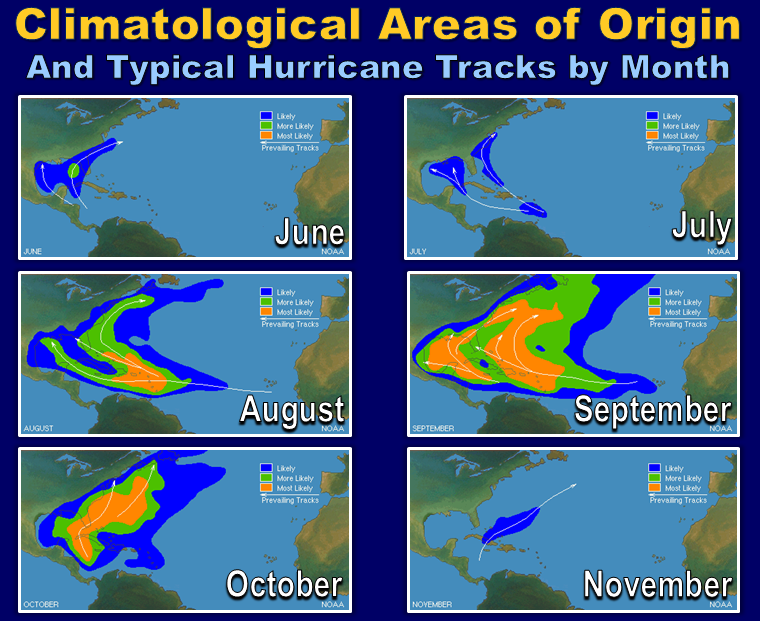
    Where hurricanes form shifts over the months

    Where storms are most likely to form and make landfall also changes as the pages of the calendar turn.

    In early summer, the Gulf of Mexico warms up faster than the open Atlantic, making it a notable hotspot for early-season tropical storm development, especially in June and July. The Texas coast, Louisiana, and the Florida Panhandle often face a higher early-season risk than locations along the Eastern seaboard.

    These are generally the busiest areas during each month of hurricane season, but that doesn’t mean hurricanes won’t make landfall elsewhere.
    NOAA

    By August and September, the season reaches its peak. This is when those waves moving off the coast of Africa become a primary source of storm activity. These long-track storms are sometimes called “Cape Verde hurricanes” because they originate near the Cape Verde Islands off the African coast. While many stay over open water, others can gather steam and track toward the Caribbean, Florida or the Carolinas.

    Later in the hurricane season, storms are more likely to form in the western Atlantic or Caribbean, where waters are still warm and upper-level winds remain favorable. These late-season systems have a higher probability of following atypical paths, as Sandy did in 2012 when it struck the New York City region and Milton did in 2024 before making landfall in Florida.

    At the end of the day, the safest way to think about hurricane season is this: If you live along the coast, don’t let your guard down. Areas susceptible to hurricanes are never totally immune from hurricanes, and it only takes one to make it a dangerous – and unforgettable – season.

    Colin Zarzycki’s research lab receives funding from the U.S. National Science Foundation, Department of Energy, and National Oceanic and Atmospheric Administration.

    ref. Forecasters expect a busy 2025 hurricane season – a storm scientist explains why and what meteorologists are watching – https://theconversation.com/forecasters-expect-a-busy-2025-hurricane-season-a-storm-scientist-explains-why-and-what-meteorologists-are-watching-257223

    MIL OSI – Global Reports

  • MIL-OSI Europe: AFRICA/SUDAN – Humanitarian situation worsens as conflict intensifies

    Source: Agenzia Fides – MIL OSI

    Khartoum (Agenzia Fides) – The humanitarian crisis in Sudan is worsening as the war intensifies. According to the UN Secretary-General’s spokesperson, Stéphane Dujarric de la Rivière, the situation remains particularly dire in the town of El Fasher and the Abu Shouk refugee camp. Both locations are besieged by the Rapid Support Forces (RSF), which are constantly shelling them.The situation is also critical in South Kordofan and West Kordofan. According to the International Organization for Migration, around 2,800 people, mostly women and children, fled the renewed fighting in the town of Dibebad last week in South Kordofan. In West Kordofan, members of the Arab Misseriya tribal group, previously allied with the RSF paramilitary forces, are divided over whether to continue supporting the rebels or reach an agreement with the armed forces in Khartoum in the face of the advance of the regular army (Sudan Armed Forces, SAF).It is no coincidence that clashes have intensified in key strongholds, particularly in Darfur and Kordofan, where the RSF is pursuing plans to form a parallel government. Both sides are also conducting drone strikes on their respective political-military command centers: Nyala, the capital of South Darfur and a strategic center of the RSF, and Port Sudan, the current seat of the SAF-allied administration.Meanwhile, according to the United Nations, the cholera epidemic in Khartoum State (which includes the capital) has worsened, with the number of suspected cases increasing by 80% to over 8,500 in the last two weeks. Although the World Health Organization has delivered some medical supplies to Khartoum hospitals, “much more is needed to contain the epidemic,” Dujarric said. (LM.) (Agenzia Fides, 31/5/2025)
    Share:

    MIL OSI Europe News

  • MIL-OSI: Afognak Native Corporation Hires New CEO

    Source: GlobeNewswire (MIL-OSI)

    KODIAK, Alaska, May 31, 2025 (GLOBE NEWSWIRE) — Afognak Native Corporation’s Board of Directors is pleased to announce the hiring of Daniel “Dan” M. Corbett as Chief Executive Officer, leading Afognak into its next phase of growth and business advancement.

    Corbett is a strategic and accomplished leader with a demonstrated track record of success in both business and community impact. Most recently, Corbett served as CEO of Valiant Integrated Services, where within 18 months he generated over $2 billion in new business growth, including expansion into the US intelligence and linguist sectors. Recognizing the importance of talent development, Corbett launched initiatives like Valiant University to improve benefits and attract and retain specialized talent—resulting in a workforce in which 25% are US veterans. He also helped establish the Valiant Foundation to support veterans and their families through scholarships, humanitarian relief, and disaster response efforts, demonstrating a commitment to corporate social responsibility.​

    Corbett also previously held leadership roles at PAE and Lockheed Martin. As Vice President and General Manager of PAE’s Global Stability and Development business unit, he led a $1B+ portfolio with over 9,000 employees worldwide. His tenure was marked by significant organic growth, with revenue expanding from $650M to over $1B and the launch of new business lines such as medical services. He led critical responses to global challenges, including the Ebola outbreak in Liberia and COVID-19 response efforts for the Navajo Nation. Corbett holds a Bachelor of Finance degree from Siena College and an MBA from Rensselaer Polytechnic Institute.

    Corbett assumes the role of CEO on May 31, 2025, as CEO/President Greg Hambright retires as CEO. The Board is grateful that Hambright will serve as Interim President during this important transition.

    Kristy Clement, Chair of Afognak’s Board of Directors, shared, “Dan joins Afognak at a pivotal moment in our journey, and we’re excited to welcome him as our new CEO. He brings valuable experience and a thoughtful approach to leadership and growth. The Board is confident in Dan’s ability to guide Afognak into its next chapter. We look forward to working closely with Dan to expand opportunities, serve our Shareholders, support our team, and continue building a corporation we can all be proud of.”

    Corbett remarked, “I’m honored to lead Afognak Native Corporation and committed to advancing sustainable growth that benefits our Shareholders and communities—guided always by the strength of the Alutiiq values and cultural heritage.”

    Malia Villegas
    (907) 222-9587

    The MIL Network

  • MIL-OSI Russia: Death toll from central Nigeria floods rises to 151

    Translation. Region: Russian Federal

    Source: People’s Republic of China in Russian – People’s Republic of China in Russian –

    Source: People’s Republic of China – State Council News

    ABUJA, May 31 (Xinhua) — The death toll from devastating floods triggered by heavy rains in Nigeria’s central Niger state has risen to at least 151, local authorities said Saturday.

    Ibrahim Hussaini, head of operations at the Niger State Disaster Management Agency, told Xinhua by telephone that more than 50 more bodies were found in Mokwa district, where the disaster occurred, on Saturday.

    I. Hussaini said 11 victims were rescued and taken to a nearby hospital. “So far, 318 people have been affected, as well as at least 503 households.

    He added that the search for bodies continues, with local divers and volunteers assisting in the rescue operation.

    Heavy rains on Thursday night caused chaos in Mokwa, flooding and washing away dozens of residential buildings, some of which still had people inside, I. Hussaini told reporters on Thursday.

    Earlier this week, the Nigerian Meteorological Agency issued a forecast warning of thunderstorms and heavy rainfall in the central part of the country, including Niger State. The agency said more rainfall was expected in the next 24 hours, with localized showers also possible in the southern region. –0–

    MIL OSI Russia News

  • MIL-OSI China: Chinese FM meets Mauritanian counterpart on ties

    Source: People’s Republic of China – State Council News

    HONG KONG, May 30 — Chinese Foreign Minister Wang Yi here on Friday night met with Mohamed Salem Ould Merzoug, Mauritania’s minister of foreign affairs, who was attending the signing ceremony of the Convention on the Establishment of the International Organization for Mediation (IOMed).

    Wang, also a member of the Political Bureau of the Communist Party of China Central Committee, said during the meeting that it is the general wish of all countries to settle disputes through dialogue and consultation, which is an important background for the birth of the IOMed.

    Mediation works only when all parties accept it willingly and it is conducive to better safeguarding the legitimate interests of developing countries, especially small- and medium-sized countries, Wang noted.

    Wang said this year marks the 60th anniversary of the establishment of diplomatic relations between China and Mauritania, adding that over the past 60 years, the two sides have always treated each other with mutual respect and equality, which has set a good example of developing countries’ mutual assistance and win-win cooperation.

    China is willing to work with Mauritania to continue the traditional friendship, consolidate unity and cooperation, and jointly safeguard peace and stability in the Sahel region, so as to continuously create new prospects for the development of the Sino-Mauritanian relations, said the Chinese foreign minister.

    Merzoug, for his part, congratulated the successful holding of the signing ceremony of the Convention on the Establishment of the IOMed. He wishes that the IOMed would play an important role in the maintenance of international peace and security.

    The friendly relations between Mauritania and China are strong, Merzoug said, adding that China is a true strategic partner of Mauritania.

    Mauritania firmly adheres to the one-China policy, he said, stressing that Taiwan is an inalienable part of China’s territory.

    Mauritania is willing to celebrate the 60th anniversary of the establishment of diplomatic relations with China, strengthen exchanges at all levels, deepen mutually beneficial cooperation and promote the continuous development of relations between the two countries, Merzoug said.

    MIL OSI China News

  • MIL-OSI China: Ancient Silk Road hub inspires global dialogue

    Source: People’s Republic of China – State Council News

    LANZHOU, May 31 — As dusk falls over the Gobi Desert, the golden hues of the Mogao Caves seem to whisper tales of a bygone era. Yet within these ancient grottoes lies something extraordinary: cutting-edge technology now breathes new life into millennia-old art.

    At the ongoing fourth Dialogue on Exchanges and Mutual Learning among Civilizations in Dunhuang, northwest China’s Gansu Province, this fusion of past and future has emerged as a central theme, positioning Dunhuang as both a guardian of heritage and a pioneer of 21st-century cultural innovation and cultural exchange.

    The “Digital Dunhuang” project, a decade-long endeavor to create virtual replicas of caves and murals, has drawn particular attention. Delegates examined 3D-printed replicas of eroded statues and augmented reality projections that restore faded pigments to their original brilliance.

    Jointly hosted by the Chinese People’s Association for Friendship with Foreign Countries and the Gansu Provincial Government, the dialogue gathered nearly 400 participants, including foreign political leaders, scholars, and representatives from international organizations.

    Marking the first time the dialogue has been held outside Beijing since its 2019 inception, the choice of Dunhuang — a UNESCO World Heritage site — underscores its enduring role as a bridge between civilizations.

    “It is interesting for this symposium to take place in Dunhuang, as part of the Silk Road where so many different items and ideas were traded for so very long,” said Christopher Merrill, director of the International Writing Program at the University of Iowa. “When people come together and exchange ideas, poems, and stories, they come away with different understandings not only of the culture they are exposed to, but of their very own ways of thinking about the world.”

    For centuries, Dunhuang’s Mogao Caves stood as a melting pot of Buddhist art, Persian motifs, and Hellenistic influences. Today, its frescoes tell timeless tales: Western traders with aquiline noses leading camels meet East Asian merchants; Hindu apsaras (celestial beings) mingle with Chinese mythological figures like Fuxi and Nuwa.

    “Dunhuang is where civilizations began to converse,” remarked Eliso Elisashvili, president of Georgian International University, marveling at the city’s “beautiful, magnetic” blend of histories.

    The dialogue’s agenda — spanning topics from AI-era cultural shifts to museum collaborations — reflects modern challenges. Delegates from Nepal, Egypt, and beyond emphasized that mutual respect for diversity must be the foundation of global discourse.

    “Dunhuang offers a blueprint for dialogue,” said one participant after touring the caves’ vibrant murals.

    “Dunhuang’s openness remains instructive,” noted Lee Kang-bum, professor emeritus and specialist in Confucian classics and classical Chinese texts at Chung-Ang University in the Republic of Korea.

    “In the digital age, we no longer depend solely on a singular ancient Silk Road, but instead embrace countless ‘digital Silk Roads’ that connect billions globally. Artificial intelligence is also reshaping the methods and depth of cross-cultural exchanges,” German sinologist Martin Woesler added.

    Fan Jinshi, the honorary president of Dunhuang Academy, said: “In today’s era, as nations worldwide share the mission of pursuing peaceful development, we hope countries can draw lessons from the Silk Road’s historical legacy of civilizational integration and cultural dialogue to advance the Silk Road Economic Belt and promote the flourishing of diverse cultures across the globe.”

    MIL OSI China News

  • MIL-OSI China: IOMed provides new choice for resolving disputes through dialogue, consultation: Wang Yi

    Source: People’s Republic of China – State Council News

    IOMed provides new choice for resolving disputes through dialogue, consultation: Wang Yi

    HONG KONG, May 30 — Chinese Foreign Minister Wang Yi said here on Friday that the International Organization for Mediation (IOMed) embodies the universal aspirations of developing countries, provides a new choice for resolving disputes through dialogue and consultation, and will also contribute to further improving the international rule of law.

    Wang, also a member of the Political Bureau of the Communist Party of China Central Committee, made the remarks when meeting with Zimbabwean Minister of Foreign Affairs and International Trade Amon Murwira, congratulating him on Zimbabwe’s IOMed founding membership.

    Wang said that the IOMed is an important public product of the rule of law that fulfills the purposes of the UN Charter, was jointly initiated by the countries of the Global South and reflects the common aspirations of developing countries, especially small- and medium-sized ones.

    Noting this year marks the 45th anniversary of the establishment of diplomatic relations between China and Zimbabwe, Wang said that bilateral friendship has withstood the tests of the international situation and remains as firm as a rock.

    China has always viewed the development of China-Zimbabwe relations from a strategic height and a long-term perspective, and China supports Zimbabwe in safeguarding its own interests and opposes external interference, Wang said, adding that China is willing to maintain a high level of strategic mutual trust with Zimbabwe, continue to firmly support each other on issues concerning each other’s core interests, strengthen exchanges of experience in governance, promote cooperation in various fields in a coordinated manner, and lead China-Zimbabwe relations to move steadily and far.

    Murwira said that Zimbabwe is willing to play an active role in promoting the settlement of disputes in a peaceful and mutually respectful manner, adding that his country is grateful for the valuable support provided by China for Zimbabwe’s economic and social development.

    Zimbabwe firmly adheres to the one-China principle, supports the Belt and Road Initiative, a series of global initiatives and the Forum on China-Africa Cooperation proposed by China, and is willing to continue to firmly support each other and closely cooperate with China to build a closer community with a shared future between Zimbabwe and China, said Murwira.

    MIL OSI China News

  • MIL-OSI Video: President Cyril Ramaphosa delivers the eulogy at the Official Funeral of the late Ma Gertrude Shope

    Source: Republic of South Africa (video statements)

    President Cyril Ramaphosa delivers the eulogy at the Special Official Funeral of the late Ma Gertrude Shope

    https://www.youtube.com/watch?v=txuaXc-vXoo

    MIL OSI Video

  • MIL-OSI Russia: Shanghai’s exports up 13.8 pct in first four months of 2025

    Translation. Region: Russian Federal

    Source: People’s Republic of China in Russian – People’s Republic of China in Russian –

    Source: People’s Republic of China – State Council News

    SHANGHAI, May 31 (Xinhua) — Shanghai’s export volume increased 13.8 percent year on year from January to April 2025, and its total foreign trade value hit a record high in April, data released by the Shanghai Municipal Customs showed.

    The city’s total foreign trade volume for the four months was 1.4 trillion yuan (about $194.7 billion), up 1 percent from a year earlier. In April alone, imports and exports reached 399.35 billion yuan, up more than 10 percent year-on-year and month-on-month. Exports in April rose 17.2 percent year-on-year, while imports rose 8.1 percent.

    Private enterprises were the key growth driver, accounting for more than 70 percent of Shanghai’s total foreign trade companies during the period. Their import and export volumes exceeded 500 billion yuan, up more than 20 percent year-on-year, indicating that domestic growth momentum is strengthening.

    During this period, Shanghai traded with more than 200 countries and regions around the world, achieving growth with 166 partners. Trade with countries participating in the Belt and Road Initiative reached nearly 600 billion yuan, up 11.9 percent year on year, while trade with countries in the Middle East and Eastern Europe increased by more than 20 percent.

    Machinery and electrical equipment exports totaled 398.8 billion yuan, accounting for more than 60 percent of the city’s total exports during the period. Meat and vegetable oil imports rose more than 10 percent year-on-year, while specialty foods such as Afghan nuts, Italian chocolate, Irish dairy products and Ethiopian coffee expanded the gastronomic choices for Chinese consumers. -0-

    MIL OSI Russia News

  • India leads major presence at Sharjah’s premier jewellery exhibition

    Source: Government of India

    Source: Government of India (4)

    The 55th Watch and Jewellery Middle East Show opened in Sharjah, running through June 1, 2025, with India mounting a significant pavilion showcasing 11 companies as part of the region’s premier luxury accessories exhibition. Organized by Expo Centre Sharjah with support from the Sharjah Chamber of Commerce and Industry, the biannual event features over 500 local and international exhibitors representing major global companies in luxury gold jewellery, timepieces, and precious gemstones.

    India’s participation is coordinated by the Gem and Jewellery Export Promotion Council (GJEPC), which established a dedicated India Pavilion to highlight the country’s design excellence and craftsmanship. According to GJEPC Chairman Kirit Bhansali, “The Watch and Jewellery Show Middle East in Sharjah is a key platform to highlight India’s design excellence and craftsmanship to a vital trade partner. Our continued presence at the show through the India Pavilion reflects this market’s growing importance.”

    The UAE represents a vital trade partner, with gem and jewellery exports surging over 60 percent following the India-UAE Comprehensive Economic Partnership Agreement. Exports grew from $4.95 billion in fiscal year 2022 to $8.04 billion in fiscal year 2024, demonstrating the strategic importance of such partnerships.

    The exhibition attracts over 1,800 high-profile designers, manufacturers, and industry professionals from countries including Russia, Mexico, Tanzania, Egypt, India, Italy, the United Kingdom, the United States, Singapore, China, Japan, Saudi Arabia, Bahrain, and Lebanon. Visitor turnout is projected to exceed 80,000, with the timing coinciding with the Eid Al Adha holiday, further enhancing its appeal among jewellery enthusiasts.Among the exhibition’s highlights is a record-breaking 108-meter diamond necklace presented by Amaar Jewels, designed to enter the Guinness World Records.

    According to the World Gold Council, gold sales in the UAE totaled 23.4 tonnes valued at $1.8 billion in the first half of 2024, representing 17.3 percent of the Middle East’s total sales. These figures underscore the exhibition’s strategic role in advancing the regional gold and jewellery industry.

    Spanning 30,000 square meters, the exhibition serves as a platform for deals, partnerships, and insights into design trends. Specialized programs and workshops run alongside the main exhibition, offering participants opportunities to enhance their skills and knowledge about recent developments in the global jewelry industry.

    The show represents the largest and longest-running jewelry exhibition in the UAE and broader region, having grown from a handful of exhibitors when first launched in 1993 to become an indispensable part of the regional jewellery industry calendar.

  • IPL 2025 Playoffs: Mumbai survive Sudharsan scare, enter Qualifier 2

    Source: Government of India

    Source: Government of India (4)

    Powerhouse Mumbai Indians kept alive their hopes of reaching the final of the Indian Premier League (IPL) with a 20-run victory against Gujarat Titans in the eliminator of the 10-team league on Friday.

    Electing to bat, Mumbai racked up a commanding 228-5 after their frontline batters hit a combined 17 sixes.

    Gujarat managed 208-6 in reply despite defiant knocks by opener Sai Sudharshan (80) and all-rounder Washington Sundar (48).

    Five-time champions Mumbai will play Punjab Kings on Sunday for a place in Tuesday’s final against Royal Challengers Bengaluru.

    After Mumbai skipper Hardik Pandya elected to bat, Jonny Bairstow, replacing Ryan Rickelton, smashed 47 off 22 balls in his first match of the season in a blistering opening stand of 84 with Rohit Sharma.

    Rohit, dropped twice early in his knock, struck 81 to punish Gujarat.

    Suryakumar Yadav (33), Tilak Varma (25) and Pandya (22 not out) produced whirlwind cameos to take Mumbai past the 200-mark.

    The chase was steep and Gujarat stuttered early in their reply losing skipper Shubman Gill trapped lbw by Trent Boult in the opening over of the innings.

    Kusal Mendis (20) fell hit wicket but Sudharsan, the tournament’s leading scorer, revived Gujarat’s chase with his sixth fifty of the tournament.

    He found an able ally in Sundar who smashed Boult for back-to-back sixes to turn the pressure back on Mumbai.

    Pandya brought back Jasprit Bumrah and the pace bowler slipped in a yorker between Sundar’s legs to flatten his leg stump.

    South African Richard Gleeson bowled Sudharsan as Mumbai reclaimed control of the contest through their seamers.

    (Reuters)

  • MIL-OSI Africa: Government welcomes sentencing in Joshlin Smith case

    Source: South Africa News Agency

    Government has welcomed the life sentences handed down by the Western Cape High Court to Racquel Smith, Jacquen Appollis, and Steveno van Rhyn who have been convicted of human trafficking and kidnapping in connection with the disappearance of six-year-old Joshlin Smith. 

    In addition to life imprisonment, the trio each received a further 10-year sentence for kidnapping. The judgment was delivered by Judge Nathan Erasmus in the High Court sitting in Saldanha Bay on Thursday.

    The judge also ordered that the names of three accused be entered into the national Child Protection Register since they were convicted of serious crimes involving children and that they cannot have contact with children for the foreseeable future.

    Delivering his ruling, Judge Erasmus said: “The accused did not show remorse and up until the eve of sentencing, still lied. With the overwhelming evidence against the accused, I could find no mitigating circumstances for the court to deviate from the minimum prescribed sentence.”

    Government Communication and Information System (GCIS) Acting Director-General, Nomonde Mnukwa, said that while this sentencing brings a measure of justice, it is a bittersweet moment. 

    “We remain steadfast in our commitment to uncovering the truth and ensuring that law enforcement continues to pursue every possible lead to find Joshlin. The protection of children is a national priority. 

    “We will continue to strengthen our laws, partnerships, and community efforts to ensure that every child in South Africa is safe, valued, and shielded from harm,” Mnukwa said. 

    Smith, her boyfriend Jacquen Appollis, and their friend Steveno van Rhyn were found guilty in connection with the disappearance of six-year-old Joshlin Smith from the Middelpos informal settlement in Saldanha Bay in February 2024. 

    The trio werre accused of selling Joshlin for R20,000. 

    Despite pleading not guilty and maintaining their innocence throughout the trial, Judge Erasmus  in delivering his verdict on 2 May, stated that Joshlin, a Grade 1 learner at Diazville Primary School, had been “exchanged.” – SAnews.gov.za

    MIL OSI Africa

  • MIL-OSI Africa: Land degradation neutrality- a pathway to sustainable futures for vulnerable communities 

    Source: South Africa News Agency

    By Bernice Swarts

    As the world battles escalating environmental challenges, from climate change to biodiversity loss, one crisis continues to be overshadowed – that is land degradation. Every year, over 100 million hectares of productive land are lost or degraded, affecting the lives of more than 1.3 billion people globally.

    In regions already grappling with poverty, hunger, and unemployment, this environmental degradation becomes a multiplier of vulnerability.

    The recent Global Land Degradation Neutrality – Integrated Land Use Planning (LDN–ILUP) Inception Workshop that took place in Sandton, South Africa marked a critical turning point in the global fight against Desertification, Land Degradation, and Drought (DLDD). For four days, experts, government representatives, and development partners from 18 participating countries gathered to refine targets and develop strategies aimed at restoring our planet’s productive land. This meeting was not just another technical gathering – it was a platform of hope for millions whose lives and livelihoods depend on healthy land.

    At the heart of this initiative is the principle of Land Degradation Neutrality (LDN), a concept rooted in sustainability and inclusivity. It recognises that land restoration cannot succeed without the active participation of people at the grassroots level. These are the farmers, herders, and communities whose daily decisions directly influence land and water resources. Empowering them to implement sustainable practices remains vital.

    Bringing the issue of land degradation home to our country, it must be noted that South Africa, is currently presiding over the G20 under the theme: “Solidarity, Equality and Sustainability.”  Our country will use its presidency of the G20 to place the issues of DLDD at the heart of G20 member states and tackle degradation in the country. Our argument is that the G20 – representing the world’s largest economies – must lead by example in addressing land degradation as an integral part of climate and development discourse.

    The G20 Environment and Climate Sustainability Working Group (ECSWG) – which is led by our department – will focus on DLDD, along with other critical areas such as biodiversity, climate change, and ocean health. But while global policy alignment is essential, real progress lies in concrete actions on the ground—large-scale restoration projects, transboundary collaboration, and integration of Sustainable Land Management (SLM) into national development plans.

    To this end, existing initiatives such as the Changwon Initiative, African Forest Landscape Restoration Initiative (AFR100), the Great Green Wall, and the United Nations Decade on Ecosystem Restoration must be harnessed and scaled up. These programmes provide tested frameworks for land restoration and resilience building.

    However, none of these ambitions will materialise without adequate and sustained financial support. Development and financial partners must step up their efforts. While we acknowledge the critical support provided by entities like the Global Mechanism of the UNCCD, Global Environment Facility, and development partners from Canada and Germany, there remains a significant financing gap. Innovation in resource mobilisation is urgently needed, whether through blended finance, public-private partnerships, or carbon markets. South Africa will therefore call on the developed nations under the G20 to provide more financial support to developed countries to tackle land degradation.

    It must also be noted that we cannot continue to formulate frameworks and strategies without addressing the daily realities faced by vulnerable communities. If we are serious about achieving the targets of the UNCCD, Convention on Biological Diversity, and the Paris Agreement, financial commitments must match the scale of ambition.

    I must commend all dignitaries from all over the world who attended the workshop. I want to reiterate that the workshop should not be seen as a standalone event. It must be viewed as a launchpad for action—an opportunity to demonstrate that LDN is not merely a technical term, but a vehicle for change, resilience, and hope. As global citizens, we owe it to future generations to restore the land they will inherit.

    Let this be the moment we stop talking and start restoring.
     

    *Bernice Swarts is the Deputy Minister of Forestry, Fisheries and the Environment

    MIL OSI Africa

  • MIL-OSI Africa: Cape Town commuters to benefit from Chris Hani to Cape Town line 

    Source: South Africa News Agency

    The Passenger Rail Agency of South Africa (PRASA) has officially re-opened the Chris Hani to Cape Town leg of the Central Line to commuters, bringing this very important rail artery to near-total recovery.

    “The Central Line is Cape Town’s most important rail corridor. It connects the communities of Khayelitsha and Mitchells Plain to the Cape Town CBD and the Bellville CBD [central business district].  At full capacity, the central line contributes 350 000 daily passenger trips of Cape Town’s 685 900 daily passenger trips,” Minister of Transport Barbara Creecy said on Thursday.

    She was addressing the launch of the Chris Hani- Cape Town line, which is part of the Presidential Rail Project, aimed at revamping and improving rail infrastructure in South Africa.

    WATCH | Minister Creecy Launches Chris Hani to Cape Town Passenger Rail Line
     

    The line was opened after extensive repair works on stations, substations, Overhead Traction Electrification (OHTE) systems and more.

    “A fully recovered central line has the potential to return a considerable number of commuters to rail, thereby easing the city’s unbearable traffic congestion. The numbers speak for themselves: nearly 700 000 daily passenger trips equate to a substantial number of cars that are taken off Cape Town’s Road network.

    “Given the capacity of a full 12-car Electric Multiple Unit (EMU) train to transport some 2400 passengers, the gains in affordable, safe and efficient public transport are considerable. 

    “The recovery of the Central Line provides residents of Cape Town a safer commuter experience, shorter travel times and a more integrated mobility environment. Due to its affordability, and the greater mobility that it enables, passenger rail has the potential to provide the working class with greater economic opportunities,” Creecy explained.

    The Central Line is a significant part of PRASA’s rail service in the Western Cape and following a halt in services as a result of theft, vandalism and the occupation of the perways along various parts of the route, the return of the Chris Hani station and service is a reflection of the synergy and collaboration between various tiers of government, law enforcement agencies as well as communities.

    “The recovery of the Central Line has not been easy—illegal occupation, vandalism of infrastructure, and a grim security environment all stood in the way. But what we have experienced today on the train ride from Chris Hani Station to Cape Town Station is a safe, reliable, and modern rail corridor that once again connects our people to opportunities, to work and to education,” she said.

    Impact 

    The Minister shared the impact of recovering parts of the Central Line using numbers.

    “Cape Town had 53,000 daily passenger trips in April 2024. With the reopening of Philippi and Nolungile stations, this number rose to 104,000. With the targeted July – December 2025 completion of Kapteinsklip’s second line, the number of daily trips is expected to reach 162,400. By April 2026, the number of trips is expected to climb to 342,951 per day.

    “This will signal the move towards an optimal service, characterised by improved frequencies, recovered signalling, higher train speeds and enhanced connectivity. This all bodes well for the commuter community, both for peak and off-peak travel,” Creecy said.

    The target for 2026-2027 is the delivery of an optimally operating service — fully recovered signalling, 90km/h speeds, digital environment and compliance with every aspect of the regulator’s safety standards.

    “The entire process of recovering the central line corridor – replacing and repairing overhead signalling equipment and substations, refurbishing stations and perway, and relocating those occupying the tracks – has so far cost R 1.3 billion.

    “During the recovery of the central line over 2,500 direct jobs have been created and 53 Small, Medium and Micro Enterprises (SMMEs) empowered, contributing to local economic upliftment,” the Minister said.

    PRASA recovery project

    PRASA has successfully revived 35 out of 40 service lines as part of restoring passenger rail services nationwide.
    “At present there are two trains departing Chris Hani Station per hour on the central line, however as we increase our signalling capacity, we hope to run an optimal service where we have six trains per hour. 

    “In Cape Town the southern line is 98% re-signalled. The focus has now shifted to fully restoring signalling on the central line, with completion scheduled for the end of the 2026/2027 financial year. This will increase service frequency and allow a more regular, punctual passenger service,” the Minister said.

    The reopening of these lines has led to a significant increase in passenger trips nationwide, reaching 77 million over the past year.
    This figure is projected to reach 123 million in the current year, indicating a clear trajectory towards the goal of 600 million passenger trips by 2030/31. –SAnews.gov.za

    MIL OSI Africa

  • MIL-OSI Africa: Suspect in Mongale case dies in fire exchange with police 

    Source: South Africa News Agency

    Friday, May 30, 2025

    The main suspect in the murder of Olorato Mongale has been shot and killed by police in KwaZulu-Natal.

    Philangenkosi Makhanya was found by the police in Amanzimtoti, south of Durban and when approached, he shot at the police who then returned fire killing him.

    At the time of the shooting, Makhanya was hiding out at a flat in Amanzimtoti. 

    He is believed to be the main suspect in the Mongale case, following her killing. Her body was found dumped on the side of the road in Lombardy West, Johannesburg last week.

    According to the South African Police Service (SAPS) spokesperson Athlenda Mathe, the suspect’s parents were arrested.

    “His mother was arrested for tipping him that the police were looking for him while his father was arrested as it was established that he is the owner of the white VW Polo used in the commission of crime,” Mathe said.

    A multidisciplinary team led by the SAPS’ anti-kidnapping task team seized the vehicle at a panel beater workshop in Phoenix, Durban.

    The mother’s actions allowed their son to evade arrest on Wednesday evening.

    The police are still searching for two additional suspects linked to the case.

    Mongale was last seen on Sunday when she went on a date with her alleged killer, who picked her up from her residential complex in Athol, Johannesburg, driving a white VW Polo with a cloned number plate that belonged to a Toyota Hilux.

    READ | Police find VW Polo used in Mongale’s murder

    Mongale’s body was later found in Lombardy West on the same day by the police with the assistance of community members.

    Two suspects believed to be involved in the murder are in custody. The investigation first led the team to a lodge in Kew, Johannesburg where two suspects had booked a room. – SAnews.gov.za  

    MIL OSI Africa

  • MIL-OSI Africa: Eskom, KEPCO KPS partner on Research and Business Improvement

    Source: South Africa News Agency

    Eskom has signed a Memorandum of Understanding (MoU) with Korea Plant Service & Engineering Co., Ltd. (KEPCO KPS) to establish a strategic partnership focused on non-commercial research, technical consulting and innovation. 

    In a statement on Thursday, the power utility said this agreement sets out a framework for collaboration aimed at enhancing Eskom’s operational performance and supporting its long-term sustainability objectives. 

    Under the MoU signed on Thursday, the two organisations will cooperate across six key focus areas, namely: 

    • Exploring strategic cooperation and exchange of information related to critical spares’ replenishment including, but not limited to, remanufacturing, reproducing, repairing or retrofitting of obsolete spares;
    • The identification, implementation and evaluation of potential research and consulting-related technical projects; projects supporting asset development plans, performance improvements of existing plant, and asset management;
    • Digitalisation (such as artificial intelligence, internet of things, and data analytics) and related focus areas, working together to leverage expertise on training, skills development and knowledge transfer on digitalisation expertise towards modernising and achieving an intelligent power grid;
    • Energy transition, green and smart research and development, plant construction focusing on socioeconomics, water generation with interest in the circular economy, and climate change risk mitigation;
    • Enhancing human resources development, skills transfer and training, employee exchange and training programmes, study tours, workshops and sharing of studies and reports. 

    Eskom Group Chief Executive, Dan Marokane, said that Eskom was a research-driven, people-centred, and technology-focused organisation. 

    “Our collaboration with KEPCO KPS across key strategic areas reinforces our commitment to continuous business improvement and long-term sustainability.

    “As we advance the recovery of our operations and work to strengthen long-term performance for the benefit of South Africans, businesses, and the broader economy, we are proud to partner with global institutions like KEPCO KPS. 

    “By combining our expertise and embracing international best practices in engineering and maintenance, we aim to accelerate innovation and build a more resilient, sustainable energy future for South Africa,” Marokane said.

    KEPCO KPS Chief Executive Officer, Jungnam Lee said: “With this MoU as an opportunity, the two companies plan to expand technological exchanges and contribute to improving the performance of aging power plants in South Africa based on KPS’ world-class technological capabilities.” 

    About KEPCO KPS 

    KPS is a public corporation specialising in providing total solutions for power plant facility diagnosis & performance improvement, power generation facility operation and maintenance (O&M), as well as new & renewable energy and industrial facilities. 

    KPS was established to contribute to the power industry’s stable power supply and development by improving the performance and reliability of power equipment for power generation and transmission. 

    Eskom Research Business Unit 

    Eskom is South Africa’s public electricity utility and is the largest producer of electricity in Africa. The company has a dedicated research business unit, the Eskom Research, Testing & Development (RT&D), which is proactively finding technology solutions that can be applied primarily within the company to embrace innovation, enhance efficiency and improve operations, improvements related to emissions management, Greenhouse Gas (GHG) abatement, and beyond. 

    One of the key areas of focus for RT&D is assisting the business in a differentiated approach with multiple pathways to move from high-carbon to low-carbon energy sources through identifying technology and processes that enable the economy to be competitive and sustainable while enabling Eskom to be as efficient as possible. – SAnews.gov.za

    MIL OSI Africa

  • MIL-OSI Africa: Postbank warns grant beneficiaries of card fraud scams

    Source: South Africa News Agency

    Friday, May 30, 2025

    South African Social Security Agency (SASSA) grant beneficiaries using the black Postbank cards as well as the gold SASSA cards have been urged to be wary of rising fraud scams targeting their cards and PIN information. 

    In a statement on Friday, Postbank said a recent scam involves fraudsters impersonating Postbank officials and targeting social beneficiaries in their homes. 

    “The beneficiaries are then duped into handing over their Postbank grant cards and PIN information under the pretext that there is something that requires fixing on the cards; or fear is instilled in them that they will not receive their future grant payments if they don’t handover their cards PIN information.

    “Postbank assures social grant beneficiaries that there is nothing that requires fixing on any of its black cards and SASSA gold cards, and that both cards will continue to work beyond 31 May 2025 for the payments of their grants,” Postbank said. 

    Beneficiaries must be wary of fraudsters who may pretend that they are from Postbank, even if they are wearing what may appear to be Postbank uniforms or branded cars. 

    Here is how they can be spotted:

    • They show up unannounced or without an appointment.
    • They ask you for your card PIN number.

    If fraudsters pretending to be from Postbank visit your home:

    • Quietly alert your neighbours and the community.
    • Alert the police.
    • Report the incident to Postbank on 0800 53 54 55.

    Protect you card PIN numbers:

    • Never give anyone your card PIN number, even to a Postbank official.
    • Postbank will never ask you for your card PIN as that is against banking
      rules. Your card PIN is your personal possession.
    • Memorise your PIN and don’t write it on a piece of paper (If you must
      write your PIN, ensure that the paper on which you write it is not kept in
      the same place as your card).

    Postbank will not visit beneficiaries’ homes unless invited.

    • Postbank will never visit your home unless you have requested that
      through the necessary home visits channels.
    • Beneficiaries must always remember that their cards and PINs are their
      personal keys to their money. They should never give them to anyone.

    “Beneficiaries are also reminded that they should not listen to anyone that tells them to change their SASSA gold cards or Postbank black cards to other banks payment methods, even if they are advised to do so by government officials.

    “Postbank is committed to protecting its social grant customers while offering them safe, secure and convenient ways of accessing their social grant payments,” Postbank said. 

    For any enquiries customers can contact Postbank on 0800 53 54 55. – SAnews.gov.za

    MIL OSI Africa

  • MIL-OSI Africa: Minister advocates for transparency and ethics at roundtable

    Source: South Africa News Agency

    Public Service and Administration Minister Mzamo Buthelezi has emphasised the critical need for a more transparent, ethical, and efficient relationship between the political leadership and public administration.

    He believes that the interface between politics and administration should be guided by mutual respect, clearly defined roles, and a shared commitment to the public good.

    The Minister was speaking during a roundtable discussion on strengthening the political and administrative interface led by Deputy President Paul Mashatile. 

    The gathering, which is currently underway, is focusing on improving governance, and the Minister highlighted several crucial points about governance reform.

    READ | Roundtable to focus on strengthening political and administrative interface

    Friday’s engagement is part of the broader efforts by the Presidency to support the implementation of the National Development Plan (NDP) 2030.

    The NDP emphasises the importance of establishing a capable and developmental state to address the country’s socio-economic challenges effectively.

    Buthelezi welcomed the platform to reflect the relationship between the political heads and the accounting officers.

    “The interface forms a crucial pillar of their capacity, as it invites us to look deeply at the architecture of our governance,” he told the attendees.

    The Minister identified key challenges, including unstable relationships between Ministers and senior officials, political interference in administrative decisions, accountability gaps and undermining service delivery.

    He believes that the inefficiency and tensions diminish public confidence.

    “This roundtable, therefore, helps us to ask important questions as to how we lead with clarity of efforts, while ensuring that the institutions entrusted to us implement policy are empowered, are ethical and efficient.”

    According to the Minister, the role of political facilities, including Ministers, is to provide strategic direction and mandate of government.

    Reflections 

    Meanwhile, he said it is also the responsibility of administrators and accounting officers, including Heads of Departments, to translate that direction into implementable plans within legal, fiscal, and ethical frameworks.

    He proposed reforms such as stronger tenure protection for Directors-General, more transparent performance contracts, better coordination across government departments and professionalising the public service.

    The Minister stressed that governance is not just a technical exercise, but a fundamental process of building a “people-centred, capable, and corruption-resistant state.”

    The roundtable called for honest reflection on internal party structures and their impact on governance, urging participants to move beyond discussions to concrete commitments for improving public service delivery.

    The meeting represents a significant step towards addressing systemic challenges in government administration and strengthening democratic governance.

    The Commissioner of the Public Service Commission (PSC), Professor Somadoda Fikeni, addressed the challenges facing South Africa’s administrative leadership.

    His talk centred on improving the relationship between political leaders and civil servants, highlighting the urgent need for a more professional and capable state.

    Fikeni said that the public sector is the largest employer and service provider, directly impacting citizens’ lives.

    His discussion drew parallels with successful developmental states like South Korea and Singapore, where strong collaboration between political leadership and civil service has driven national progress.

    Fikeni noted the persistent challenges, including high leadership turnover, potential political interference, and complex institutional dynamics.

    He also challenged the leaders to move beyond mere discussion to concrete implementation, with participants calling for evidence-based solutions that prioritise national interest over factional politics.

    “Whether you are from the private sector, you want to invest, you depend on the ethical capability of the state. You depend on this institution, whether you want to fight crime, GBV [gender-based violence], or you want to improve personal security; whether you want to see service delivery, it all depends on this one institution,” Fikeni said.

    The gathering represented a critical effort to rebuild state capacity and address long-standing inefficiencies in South Africa’s public service, with hopes of creating a more responsive and effective government. – SAnews.gov.za

    MIL OSI Africa

  • MIL-OSI Africa: Minister announces preferred bidders under BESIPPPP Bid Window 3

    Source: South Africa News Agency

    In an ongoing effort to ensure energy security and reduce the cost of electricity, Electricity and Energy Minister, Dr Kgosientsho Ramokgopa, has announced the appointment of five preferred bidders under the Battery Energy Storage Independent Power Producer Procurement Programme (BESIPPPP) Bid Window 3.

    These preferred bidders are expected to make a total investment of R9.5 billion into the South African economy.

    The Battery Energy Storage Programme is a critical initiative aimed at enhancing South Africa’s power system by providing essential ancillary services and increasing grid capacity through energy storage.

    “What we are announcing today… is another ‘peaker’ that is going to help us during the peak, instead of relying more and more on the open cycle gas turbines and on burning diesel.

    “We are going to use that excess generation capacity that we generated during the day when the sun was out … we store it and at the time when we need it, draw it. We are going to draw it from the batteries and [it will] be discharged and give us the kind capacity that we need. We are working on ensuring that we have additional generation capacity drawing from the technology that is out there in the world,” Ramokgopa said at a media briefing on Friday.
     

    WATCH | Bid Window 3 announcement 

    BESIPPPP Bid Window 3 is a site-specific procurement round designed to facilitate the procurement of up to 616 megawatts (MW) from facilities that will provide capacity, energy and ancillary services to the National Transmission Company of South Africa (NTCSA) as the buyer, at five specified sites in the Free State supply area.

    “This is part of our quest to ensure that we achieve energy security, bring down the cost of electricity – because this solution has been shown to be the most cost competitive of the energy solutions that we can have.

    “A combination of solar BPV [biological photovoltaics], wind and now storage capacity means that we are flattening the cost curve of electricity. We will make household lives more bearable – disposable income and more significantly for industry.

    “Electricity is the backbone of the economy. If the lights are off, there is no economy.”

    The department received a total of 33 bid responses on 28 November 2024. 

    The BESIPPPP BW3 round was again found to be highly competitive, with a marked increase in the number of bids relative to the previous bid windows, resulting in a 40% and 8% decrease in the average evaluation Price, compared to Bid Window 1 and 2 prices respectively.

    The five preferred bidders have made the following commitments:
    •    Black Shareholding: will contract at a minimum of 40% in the IPP Project Companies; up to 30% black shareholding by construction contractors; and up to 42% in operations contractors.
    •    Total Job Opportunities: 852 job opportunities for South African citizens (measured in job years), during construction and operations.
    •    Local Content Spend: Over R3.7 billion during construction and during the operation and maintenance phases.
    •    Preferential Procurement: Over R3 billion from Broad-Based Black Economic Empowerment (B-BBEE) companies, R1.3 billion from black-owned enterprises, R1.1 billion from Qualifying Small Enterprises (QSEs) and Exempted Micro Enterprises (EMEs) as well as R562 million from black women companies.
    •    Supplier development, skills development, bursaries for black students, skills development for Black disabled people, enterprise development and socio-economic development initiatives: R184 million over the lifetime of the projects.

    SAnews.gov.za
     

    MIL OSI Africa

  • MIL-OSI Africa: Call for reform of political-administrative interface 

    Source: South Africa News Agency

    Deputy President Paul Mashatile has recognised significant systemic weaknesses that undermine the effectiveness of the South African state, calling for the construction of a capable government and the reform of the political-administrative interface.

    The Deputy President cited the synthesis evaluation, conducted by the Human Sciences Research Council (HSRC), which reveals deep-rooted challenges in public service delivery and institutional stability.

    Key findings highlight critical issues, including high turnover among Directors-Generals(DGs), persistent political interference in administrative decisions, and weak performance management systems.

    The report found that these problems are eroding institutional memory, compromising policy continuity, and undermining public trust.

    “The significance of today’s engagement cannot be overstated as we progress in our commitment to establishing a capable and developmental state, which continues to be a key priority of the seventh administration,” he said on Friday. 

    Deputy President Mashatile was leading a roundtable discussion on strengthening the political and administrative interface at the Sefako Makgatho Presidential Guest House in Pretoria.

    WATCH | Deputy President leads roundtable on the Political and Administrative Interface
     

    The engagement is part of the broader efforts by the Presidency to support the implementation of the National Development Plan (NDP) 2030. 

    The NDP emphasises the importance of establishing a capable and developmental state to address the country’s socio-economic challenges effectively.

    To address these challenges, Deputy President Mashatile said government is implementing a comprehensive National Framework for Public Service Professionalisation.

    This initiative aims to create a more meritocratic, competent, and accountable public service, with plans to establish clearer lines of accountability and reduce political interference in administrative processes. 

    It also involves improving leadership stability in government departments and strengthening intergovernmental collaboration. 
    The Deputy President recognised that resolving these institutional weaknesses is crucial for achieving the Government of National Unity’s (GNU) strategic priorities of inclusive economic growth, poverty reduction, and building a developmental state.

    “Central to us attaining these three strategic priorities is ensuring sound institutional design that is responsive to the prevailing challenges and the nuances of a modern state that is agile enough to respond to a rapidly changing environment.”

    The Deputy President  has defined a capable and developmental state as a government that has essential resources and skills to successfully execute policies that foster economic growth and enhance the well-being of its citizens. 

    In addition, he said a developmental, capable and ethical state requires skilled managers, especially DGs and Heads of Department, with clear lines of authority and accountability to execute their duties in a way that achieves optimal outputs and agreed outcomes. 

    “This requires a political and administrative environment that is free from undue political interference, with effective systems, and with a consistent and fair application of rules.”

    He told the attendees that the urgency to enhance state capacity has never been more pressing. 

    “Our nation has made strides in the past, overcoming immense challenges to secure our democracy and pursue socio-economic progress. Yet, we acknowledge that there are areas where our state machinery still lags behind, hindering our ability to deliver on the promises of our Constitution.”

    He acknowledged that the tensions and instability in relationships at this interface remain a matter of great concern for all respondents, both accounting officers and executive authorities. 

    “Without doubt, these problems are compounded by a history of apartheid and its lingering effects, corruption, skills gaps, and a lack of accountability.”

    The country’s second-in-command has called for a state that will ensure that citizens have access to basic services, a growing economy that creates jobs and a youthful population is inspired to build viable start-ups that can compete on a global level.

    “If we are serious about building a capable, developmental and ethical state, we must recognise that reforming the interface is the precondition, not the afterthought.” 

    He also called for the establishment of war rooms focused on the economy, poverty, and clean governance, aiming to improve payment cycles and procurement processes, especially for small, medium and micro enterprises (SMMEs).

    In his address at the gathering, Public Service and Administration Minister Mzamo Buthelezi emphasised the critical need for a more transparent, ethical, and efficient relationship between the political leadership and public administration.

    READ | Minister advocates for transparency and ethics at roundtable

    Buthelezi welcomed the platform to reflect the relationship between the political heads and the accounting officers.

    “The interface forms a crucial pillar of their capacity, as it invites us to look deeply at the architecture of our governance,” he told the attendees. – SAnews.gov.za
     

    MIL OSI Africa

  • MIL-OSI Africa: Beware of scammers posing as SAPS

    Source: South Africa News Agency

    Friday, May 30, 2025

    The South African Police Service (SAPS) has warned members of the public about a scam that continues to circulate in various provinces involving fraudulent letters and phone calls that falsely appear to originate from the SAPS.

    “These fake letters, often distributed via WhatsApp, bear the SAPS logo and contain the names, contact details of senior SAPS officers and the addresses of legitimate SAPS offices. In some instances, the scammers also use the names of police stations that do not exist,” the South African Police Service said in a statement.

    “The scammers use this information to deceive recipients into sharing personal details under false pretences. 

    “The content of the letters is often tailored according to the victim’s location, with changes made to names, addresses and contact persons to make the communication appear authentic. 

    “Also, these WhatsApp messages are preceded by phone calls from individuals posing as police officials, who falsely claim that criminal cases have been opened against the victim. These ‘police officers’ then coerce the victim to pay over a certain amount to make his or her supposed case to ‘disappear’,” the police said. 

    Community members are urged to remain vigilant at all times:

    • Do not respond to these fraudulent messages or phone calls.
    • Do not provide or confirm any personal information such as ID numbers, addresses, or banking details.
    • Do not pay these “scammers” any money.

    Please note, the SAPS do not communicate with the public via WhatsApp or video calls. 

    Anyone who has received or responded to these fraudulent messages or phone calls is urged to report the matter and open a case at their nearest police station. – SAnews.gov.za

    MIL OSI Africa

  • MIL-OSI Russia: China’s Deputy Permanent Representative to the UN Criticizes US Actions on South Sudan Sanctions Resolution

    Translation. Region: Russian Federal

    Source: People’s Republic of China in Russian – People’s Republic of China in Russian –

    Source: People’s Republic of China – State Council News

    UNITED NATIONS, May 30 (Xinhua) — China’s Deputy Permanent Representative to the United Nations Sun Lei on Friday expressed dissatisfaction with the U.S. role in the adoption of a UN Security Council resolution on sanctions against South Sudan.

    During consultations on the draft resolution, African members of the UN Security Council proposed allowing the arms embargo to be lifted for the necessary joint force. According to the Chinese representative, this is a reasonable and feasible solution at this stage.

    However, the United States, as the author of the draft resolution, insisted on its national position, ignored the urgent demand of the country concerned, refused to discuss the constructive views of the countries of the region and insisted on maintaining the sanctions, the diplomat said, commenting on the vote. “This is disappointing,” he added.

    The US delayed the consultation process and shortened the limited time. It never asked for written comments on the text of the draft resolution from other members of the UN Security Council and insisted on holding a vote when there were still obvious differences among members, which is not in line with the established practice of the UN Security Council, Sun Lei said.

    “Such practices undermine the unity and cooperation of the Security Council. We urge the author of the draft resolution to adopt an objective and impartial approach, listen to the reasonable demands of the relevant country and countries in the region, work to overcome differences among UN Security Council members, and effectively fulfill its responsibilities,” the Chinese representative said. -0-

    MIL OSI Russia News

  • MIL-OSI Russia: Israel to Block Arab Foreign Ministers’ Visit to West Bank — Media

    Translation. Region: Russian Federal

    Source: People’s Republic of China in Russian – People’s Republic of China in Russian –

    Source: People’s Republic of China – State Council News

    JERUSALEM, May 31 (Xinhua) — Israel has decided to block the visit of foreign ministers from several Arab countries to the West Bank on Sunday to meet with Palestinian President Mahmoud Abbas, local state-run Kan TV reported on Friday evening.

    The planned visit by the foreign ministers of Jordan, Egypt, Saudi Arabia and the United Arab Emirates is a “provocative act” aimed at advancing discussions on the creation of a Palestinian state, Israeli Foreign Ministry officials said.

    The country’s Foreign Ministry representatives also noted that the Palestinian Authority continues to refuse to condemn the attack on Israel on October 7, 2023.

    “Israel will not cooperate with activities directed against it and its security,” the statement said. -0-

    MIL OSI Russia News

  • MIL-OSI China: Chinese proficiency competition held in South Africa

    Source: People’s Republic of China – State Council News

    A contestant performs a talent show during the South Africa finals of the 24th “Chinese Bridge” Chinese Proficiency Competition for Foreign College Students in Cape Town, South Africa, on May 30, 2025. [Photo/Xinhua]

    The South Africa finals of the 24th “Chinese Bridge” Chinese Proficiency Competition for Foreign College Students took place on Friday in Cape Town, the country’s legislative capital, where participants showcased remarkable language abilities and cultural talents.

    Hosted by the Chinese Embassy in South Africa and organized by the “Chinese Bridge” Club in Cape Town, the event was co-sponsored by Confucius Institutes across the country. This year’s competition, themed “One World, One Family,” consisted of three segments: a quiz on China-related knowledge, a Chinese language proficiency contest, and a showcase of Chinese cultural talents.

    Fifteen university students won rounds of applause and cheers from the audience. Thakane Masia, a second-year student from Rhodes University, emerged as the winner. Masia, whose Chinese name is Ma Kaini, will represent South Africa in the global finals to be held in China.

    Masia said the competition was intense and that all contestants performed well. She expressed her pride in winning first place and noted the value of Chinese as one of the official languages of the United Nations.

    Masia believed her Chinese language skills will be an asset in her future career. “With my politics degree, I also know Chinese. I can communicate with a lot of different people. It can also help if I have business or political engagement with China in the future,” she said.

    In a video message, Chinese Ambassador to South Africa Wu Peng highlighted the role of language cooperation as a key part of people-to-people exchanges.

    “As an important component of people-to-people exchanges, language cooperation between China and South Africa empowers mutual understanding between our peoples and contributes to the enduring friendship between our two nations,” he noted.

    Wu expressed hope for the contestants to find inspiration in the beauty of the Chinese language, form lasting friendships, and become active ambassadors for China-South Africa friendship and cooperation.

    Tang Chang’an, deputy consul general of the Chinese Consulate-General in Cape Town, attended the event, saying that language is not just about grammar or vocabulary — it is about understanding, connection, and respect.

    “Through your effort and your interest in language and culture, you are helping build a stronger, more connected world,” he added, encouraging the contestants to continuously bridge diverse cultures through the power of language, friendship, and shared dreams.

    Wu Changhong, chairperson of the “Chinese Bridge” Club in Cape Town, described the competition as a celebration of language and culture. She praised the participants for demonstrating excellent language proficiency and a deep appreciation of Chinese culture.

    “The event not only enhanced students’ language abilities but also fostered cross-cultural understanding and built bridges between people,” she said.

    MIL OSI China News

  • MIL-OSI China: IOMed serves as legal public good for improving global governance: Chinese FM

    Source: People’s Republic of China – State Council News

    Chinese Foreign Minister Wang Yi, also a member of the Political Bureau of the Communist Party of China Central Committee, poses for a group photo with other guests at the signing ceremony of the Convention on the Establishment of the International Organization for Mediation (IOMed) in Hong Kong, south China, May 30, 2025. The signing ceremony was held here on Friday. Wang Yi attended the ceremony and delivered a speech. [Photo/Xinhua]

    HONG KONG, May 30 — The International Organization for Mediation (IOMed) serves as an important public good in the field of the rule of law for better global governance, Chinese Foreign Minister Wang Yi said here on Friday.

    Wang, also a member of the Political Bureau of the Communist Party of China Central Committee, delivered a speech at the signing ceremony of the Convention on the Establishment of the IOMed in Hong Kong.

    Wang said that as an innovative step in international rule of law, the IOMed has great significance in the history of international relations.

    Wang noted that the establishment of the IOMed is an actualization of the purposes and principles of the UN Charter and will fill an institutional gap in international mediation.

    The birth of the IOMed can help transcend the “you-lose-I-win” zero-sum mentality, promote the amicable resolution of international disputes, and foster more harmonious international relations, Wang said.

    The IOMed respects the wishes of parties concerned, and draws upon the strengths of being more flexible, cost-effective, convenient, and efficient, he said, adding that it will complement and form synergies with litigation, arbitration and other existing international dispute settlement mechanisms.

    Emphasizing the importance of enhancing the participation of developing countries and improving the representation and say of the Global South in international governance, Wang called on parties to put in place at an early date a set of world-class mediation rules and mechanisms featuring autonomy, flexibility, pragmatism and high efficiency.

    As decided through consultation among countries participating in the negotiation of the convention, the IOMed will be headquartered in Hong Kong, Wang said, adding that the city, with affinity to the motherland and connection to the world, enjoys exceptional advantages in international mediation.

    China looks forward to the signatories’ early ratification of the convention and welcomes the active participation of more countries, said the foreign minister.

    About 400 high-level representatives from 85 countries and nearly 20 international organizations attended Friday’s signing event. Among them, 33 countries signed the convention on-site, making them the founding members of the IOMed.

    Pakistani Deputy Prime Minister and Foreign Minister Mohammad Ishaq Dar, Zimbabwean Minister of Foreign Affairs and International Trade Amon Murwira, Nicaragua’s Attorney General Wendy Carolina Morales Urbina, Serbian Minister of Justice Nenad Vujic, Swiss Foreign Minister Ignazio Cassis and UN Under-Secretary-General Li Junhua delivered speeches at the event.

    Acknowledging that the IOMed is in line with the purposes and principles of the UN Charter, they stressed its importance to multilateralism, global governance and global rule of law, and called on more countries to sign and ratify the convention.

    They also appreciated China’s role as a major country and expected the IOMed’s contribution to the peaceful settlement of disputes and friendly cooperation among countries.

    John Lee, chief executive of the Hong Kong Special Administrative Region, welcomed the establishment of the world’s first intergovernmental international legal organization dedicated to resolving international disputes through mediation in Hong Kong, adding that Hong Kong will give full play to its institutional advantages of “one country, two systems” and fully support the operation of the IOMed.

    Chinese Foreign Minister Wang Yi, also a member of the Political Bureau of the Communist Party of China Central Committee, attends the signing ceremony of the Convention on the Establishment of the International Organization for Mediation (IOMed) and delivers a speech, in Hong Kong, south China, May 30, 2025. The signing ceremony was held here on Friday. [Photo/Xinhua]

    MIL OSI China News

  • MIL-OSI China: Chinese, Cameroonian FMs meet on ties, IOMed establishment

    Source: People’s Republic of China – State Council News

    HONG KONG, May 30 — Chinese Foreign Minister Wang Yi on Friday met with Cameroonian Minister of External Relations Lejeune Mbella Mbella, who was in Hong Kong to attend the signing ceremony of the Convention on the Establishment of the International Organization for Mediation (IOMed).

    During the meeting, Wang, also a member of the Political Bureau of the Communist Party of China Central Committee, expressed appreciation for Cameroon’s active participation in the preparation for the establishment of the IOMed, and his hopes for Cameroon’s early ratification of the convention.

    Noting that the two countries lifted bilateral ties to a comprehensive strategic partnership last year, Wang said China appreciates the firm support that Cameroon has always given to issues related to China’s core interests, and is willing to strengthen exchanges with Cameroon at all levels and deepen their practical cooperation.

    Mbella said China’s advocacy for the establishment of the IOMed demonstrates its commitment and influence, and is in line with the spirit of the UN Charter.

    The Cameroonian foreign minister thanked China for their fruitful cooperation in energy, health, infrastructure and other fields, pledged to always abide by the one-China principle, and expressed hopes to maintain close contacts with China and strengthen the cooperation in all fields.

    MIL OSI China News