Source: Republic of South Africa (video statements-2)
G20 Financial Inclusion and Women Empowerment Conference closing ceremony
Source: Republic of South Africa (video statements-2)
G20 Financial Inclusion and Women Empowerment Conference closing ceremony
Source: Africa Press Organisation – English (2) – Report:
ABIDJAN, Ivory Coast, May 7, 2025/APO Group/ —
The Botswanan town of Lobatse, some 70 km south of Gaborone, has been transformed into a vibrant manufacturing centre. Across sprawling factory floors, hundreds of skilled hands meticulously assemble intricate wiring harnesses – components that will eventually power Volkswagen and Nissan vehicles across Africa and beyond.
In the automotive industry, wire harnesses are an intricate arrangement of wires, connectors, and components. They serve as vehicles’ central nervous systems, enabling the transmission of electrical signals and power throughout the automobile.
This is Delta Automotive Technologies, where strategic financing from the African Development Bank has catalysed a manufacturing renaissance that extends far beyond the factory wallsThe company makes wiring harnesses primarily for Volkswagen and Nissan.. For decades, Botswana’s economic history was written in diamonds. Today, a new chapter is unfolding as the African Development Bank’s $80 million credit line to the Botswana Development Corporation (BDC) for businesses in the country fuels Delta Automotive’s transformation into a manufacturing powerhouse.
“This funding hasn’t just built infrastructure – it’s built opportunity,” says Darryn Hattingh, Delta’s Director of Manufacturing. “We’ve built a world-class operation that competes globally while creating opportunity locally. The support enables us to industrialise not just today’s production lines, but tomorrow’s innovations. It will support us to industrialise future businesses obtained through Volkswagen.”
The firm, which is based in Botswana, makes wiring harnesses for Volkswagen’s Polo Vivo and Polo 270, and Nissan’s H60 brands.
It currently makes 120 vehicle harness sets for Volkswagen South Africa per day. By 2027, it hopes to create 340 vehicle sets for Volkswagen and 111 for Nissan in South Africa.
Women powering an industrial revolution
As one walks through Delta’s expansive manufacturing facility, one fact is immediately apparent: in a traditionally male-dominated industry, women’s expertise is driving this operation forward. An impressive 75% of Delta’s workforce is female, shattering glass ceilings with every wire harness assembled.
For Clara Kaekane, a product and process engineer at Delta, the significance goes beyond personal achievement: “Every component we make is a challenge to outdated assumptions about gender and engineering work. I’m not just building car parts – I’m building a new perception of what is possible for women in manufacturing across Africa.”
Kaekane feels empowered to work at the management level in the automotive industry, which is normally male-dominated.
“This is a great opportunity for our country and company,” she says.
Connecting communities to global value chains
The hum of activity at Delta’s plant represents more than manufacturing – it is the sound of Botswana’s integration into sophisticated global supply networks. Currently producing 120 vehicle wiring harnesses daily, with plans to nearly triple output by 2027, Delta is an example of how African manufacturers can excel in precision-demanding global industries.
“What is happening here is the physical manifestation of our High 5 development priorities, particularly ‘Industrialize Africa’ and ‘Integrate Africa’. It also provides skills to the people of Africa,” said the African Development Bank’s Deputy Director General for Southern Africa, Moono Mupotola. “Each wire harness connects not just vehicle components, but Botswana’s workforce to global value chains, rural communities to industrial opportunities, and traditional economies to a diversified future.”
Scaling impact: From hundreds to thousands
The numbers tell a compelling story: There are 327 employees today, expected to grow to 1,000 within four years. Behind those numbers are families supported, skills developed, and communities transformed. With 95% of the workforce Botswana nationals, the company has become a major driver of local economic empowerment.
“We’re seeing multiple development dividends from this single investment,” says Benedicta Abosi of BDC. “Delta’s growth is generating export earnings, creating quality jobs, developing technical skills and, perhaps most importantly, demonstrating what’s possible when development finance meets entrepreneurial vision.”
She explained that five years ago, the Botswana Development Corporation supported multiple businesses, including Delta Automotive Technologies, through a $80 million line of credit facility from the African Development Bank.
A blueprint for African industrial transformation, Delta’s success offers a replicable model for industrial development across the continent. By strategically supporting companies integrated into global supply chains, development finance can simultaneously address unemployment, gender inequality, economic diversification, and regional integration.
As workers at Delta Automotive Technologies continue to assemble the components that will power vehicles across the region; they’re also creating a template for how African development finance can catalyse inclusive industrial transformation.
“This has definitely been a good investment for the African Development Bank, and this is how we see development financing working in Africa, Mupotola added.
Source: The Conversation – USA – By John K. Murray, Ph.D. Candidate in Anthropology, Arizona State University
Have you ever found yourself in a museum’s gallery of human origins, staring at a glass case full of rocks labeled “stone tools,” muttering under your breath, “How do they know it’s not just any old rock?”
At first glance, it might seem impossible to decipher. But as an experimental archaeologist with over a decade of experience studying and manufacturing stone tools, I can say that there are telltale signs that a rock has been modified by humans or our very ancient ancestors, hominins.
This process, known as flintknapping, can be boiled down to mastering force, angles and rock structure. When done properly, flintknapping creates the recognizable features that archaeologists use to identify stone tools.
Stone tools are rocks that have been selected for use or intentionally altered. This technology appeared around 3.3 million years ago and became essential to hominins – all the living and extinct species that belong to the human lineage. Currently, we Homo sapiens are the only living hominin.
We are not the only living species to make and use stone tools, though – many other primates do – but the extent to which hominins modify them is unparalleled in the animal kingdom. Monkeys and other apes may hold a large stone in their hands to crack a nut on a flat, tablelike stone.
But most hominins don’t rely on stones collected as-is. They modify and shape them into useful tools for a variety of tasks, including cutting meat or plants, woodworking, scraping hide and even as projectiles.
Stone tools are important to archaeologists because they are durable and preserve well. This makes them some of the best evidence for hominin behavior and allows us to better understand how different populations adapted to local environments across time and large geographic regions.
Hominins manufacture stone tools by fracturing or abrading rock. Here, I am going to focus on fractured or flaked stone technology because tools made through this technique dominate the archaeological record.
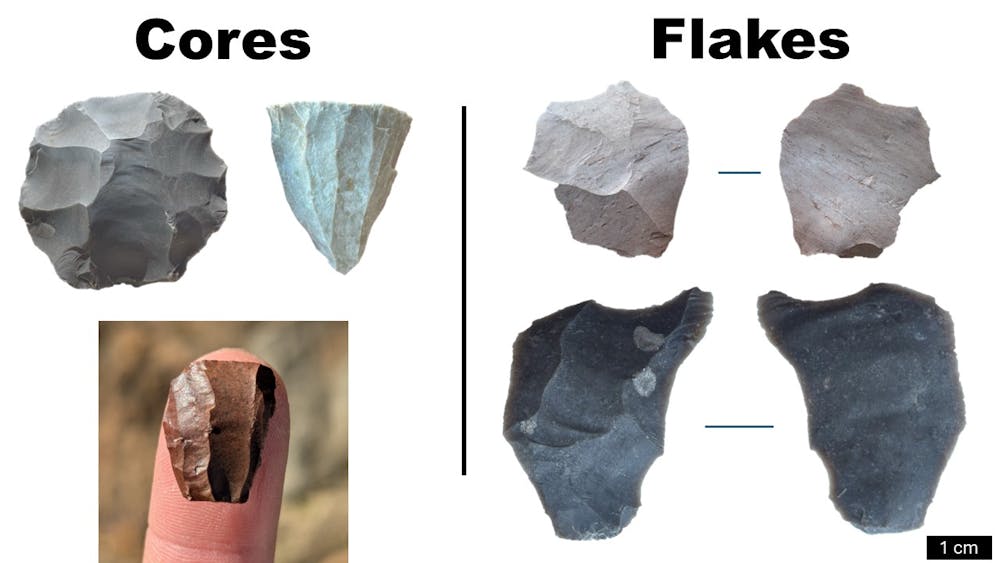
The process of flaking involves applying force to the edge of a stone, known as the striking platform, through percussion or pressure to remove portions of the rock, which are called flakes. With some guidance from a teacher and plenty of practice, flintknappers can learn how to identify a promising platform on a chunk of stone, called a core, and consistently remove flakes from it. When struck, the platform is removed from the core and is a key feature of the flake.
Flakes offer an immediate sharp cutting edge. A flintknapper can also further modify them into more specific shapes for other uses. An iconic example of this is the hand ax, which is a core that’s been flaked into a teardrop shape.
We often use hammerstones or large pieces of antler, called billets, to strike the core’s edge. Repetitive flaking not only allows a flintknapper to produce a significant amount of sharp cutting edge in the form of flakes, but gives them the ability to shape the core to their desired form … often with the risk of personal injury along the way. My fingers can attest to this!
However, not every type of rock has the characteristics needed to be flaked into a tool. You want the stone to exhibit what’s called conchoidal fracture. If you’ve ever seen glass break, you’ve witnessed conchoidal fracture. This smooth break, with concentric wavelike ripples, is defined by the physics of how force moves through different materials.
When an experienced knapper is preparing to remove a flake, we understand how the material we’re working will break when we strike it, so we can predict the shape and size of the tools that we are producing. A stone like obsidian, which is volcanic glass, is the poster child for conchoidal fracture.
Of course, there is a lot of variation in the quality of rock that hominins have used for manufacturing stone tools, and many have made use of lesser quality stone. Even some of the earliest toolmakers were preferentially selecting rocks for certain properties, such as durability.
You may hear people saying that rocks that they found in their garden were tools because they “fit perfectly in the hand” or are “tool shaped.” But it’s not quite that straightforward. Although shape and function may play a role in the final product of a stone tool, it is not the smoking gun.
Archaeologists can determine whether a chunk of rock is a stone tool based on clues left behind from the process of conchoidal fracture during flintknapping.
One such clue is the presence of flake scars, or what we call negative removals, which can be found on both cores and flakes. These have characteristic ridges on one or more sides of the rock that outline previous flake removals – hence the use of the term scar.
When we see multiple flake scars that are consistent in their orientation and size as opposed to being random, it is likely the stone in question was deliberately worked on by a hominin.
The second feature is what we call the bulb of percussion. This is a bulge in the flake, just below the striking platform, that results from the concentration of force when the knapper struck it.
Considering that producing a bulb of percussion requires the rock to be struck on a platform at a specific angle with enough force to detach it from the stone, it is improbable that this feature would be created through natural processes – but not impossible. Scientists have found naturally produced sharp stone fragments, or naturaliths, all over the world, even in Antarctica.
However, when a lot of flakes with these diagnostic characteristics are found together, it’s unlikely they were created naturally.
The final thing to consider when determining whether a rock is a stone tool is the context in which it was found. Are there many stones in the area that exhibit the characteristics that we look for when trying to identify a stone tool? Is the stone tool made of an exotic material, or is it like the rest of the rocks near it?
If you find a lot of stone tools in the same area made from one type of rock, you might have stumbled across an ancient flintknapping workshop. However, if you discover a tool that was made from a type of stone that can only be found hundreds of miles away, maybe someone traded for this material or carried it with them.
I think the best way for you to be able to learn to recognize whether a chunk of stone was a tool or just a rock is to try flintknapping yourself. I have taught more than 100 people of all ages to manufacture stone tools, and most agree: It is harder than you’d think.
This experience puts you into the minds of our hominin ancestors, trying to tackle one of the earliest problems our lineage faced: getting a sharp edge from a chunky piece of rock.
John K. Murray does not work for, consult, own shares in or receive funding from any company or organization that would benefit from this article, and has disclosed no relevant affiliations beyond their academic appointment.
– ref. Was it a stone tool or just a rock? An archaeologist explains how scientists can tell the difference – https://theconversation.com/was-it-a-stone-tool-or-just-a-rock-an-archaeologist-explains-how-scientists-can-tell-the-difference-251126
Source: GlobeNewswire (MIL-OSI)
JERSEY CITY, N.J., May 07, 2025 (GLOBE NEWSWIRE) — After testing various online casinos in NJ and looking into their bonuses and rewards, we finally found 7Bit Casino, which is one of the best online casinos in NJ. We are surprised by its welcome bonus and fastest payout feature. With over 10,000 games, including slots, table games, and live dealer options, 7Bit Casino caters to all players. Its robust security, 24/7 support, and mobile-friendly platform ensure a seamless experience, making it a top pick for New Jersey online casinos.
✅FEELING LUCKY? TEST YOUR SKILLS AND LUCK AT 7BIT CASINO!
Why 7Bit Casino Is One of the Best Online Casinos in NJ?
7Bit Casino has earned its place among the best New Jersey online casinos through its exceptional features and player-focused approach. Since its launch in 2014, it has built a reputation for reliability, operating under a Curacao eGaming license.
Here’s why it stands out as a top online casino in NJ:
Extensive Game Library:
Boasting over 10,000 games from providers like NetEnt, Microgaming, and Evolution Gaming, 7Bit Casino offers unmatched variety. From slots to live dealer games, every player finds their niche, making it a leader among NJ online casinos.
Lucrative Bonuses:
The welcome package offers a 325% match up to 5.25 BTC plus 250 free spins, alongside weekly reloads and cashback. These promotions enhance gameplay, positioning 7Bit Casino as the best NJ online casino.
Swift Payouts:
Cryptocurrency withdrawals are processed in under an hour, and fiat withdrawals within 24 hours, outpacing many NJ online casinos. This efficiency ensures players access their winnings quickly.
Robust Security:
With 128-bit SSL encryption, two-factor authentication (2FA), and certified RNG technology, 7Bit Casino guarantees a safe and fair gaming environment, a hallmark of top New Jersey online casinos.
Promotions & Bonuses at 7Bit Casino
7Bit Casino’s promotions are designed to maximize player value. Here’s what’s available for NJ Players:
Welcome Bonus:
New players receive a 325% match bonus up to 5.25 BTC plus 250 free spins across four deposits:
A 40x wagering requirement applies, making this one of the most generous offers among NJ online casinos.
✅SIGN UP, DEPOSIT, AND UNLOCK 325% MATCH BONUS + FREE SPINS!
Weekly Reload Bonuses:
Cashback:
Players receive up to 20% cashback on losses, credited weekly based on VIP level, softening losses and encouraging play.
Other Promotions:
Tournaments:
Seasonal Promotions:
Holiday specials, no-deposit bonuses, and VIP exclusives keep the promotions fresh, ensuring ongoing value for players.
Game Categories
7Bit Casino’s game library is a treasure trove for players, offering something for everyone. Here’s a detailed look:
Online Slots
Slots dominate with thousands of titles, from classic three-reel games to feature-rich video slots. Favorites like Starburst dazzle with vibrant graphics, while Book of Dead offers Egyptian-themed adventures with free spins. High-volatility slots like Gonzo’s Quest introduce innovative mechanics like the Avalanche feature. Progressive jackpots such as Mega Moolah promise life-changing wins, making 7Bit Casino a go-to for slot enthusiasts among NJ online casinos.
Table Games
Classic casino fans enjoy a robust selection of table games, including blackjack, roulette, baccarat, and craps. Variants like European Blackjack, American Roulette, and Punto Banco Baccarat cater to different strategies. High-quality graphics and smooth gameplay replicate a land-based casino, ensuring 7Bit Casino ranks high among New Jersey online casinos for table game lovers.
Video Poker
Video poker blends slots and poker, offering strategic gameplay in titles like Jacks or Better, Deuces Wild, and Joker Poker. With multiple pay lines and bonus features, these games appeal to skill-based players. The variety ensures video poker fans find ample options at this top NJ online casino.
✅JUMP INTO NONSTOP ACTION—PLAY TOP GAMES AT 7BIT TODAY!
Jackpot Games
For big-win seekers, 7Bit Casino’s jackpot games deliver. Progressive titles like Mega Moolah and Hall of Gods feature growing prize pools, while fixed jackpots offer substantial rewards. The thrill of chasing these prizes enhances 7Bit Casino’s appeal among the best NJ online casinos.
Live Casino Games
The live casino brings real-time excitement with professional dealers hosting blackjack, roulette, baccarat, and game shows like Crazy Time. High-definition streams and interactive features create a social, immersive experience, perfect for NJ online casino players craving authenticity.
Loyalty Program And Payment Options
Loyalty Program
The 12-level loyalty program rewards every wager with points convertible to bonuses. Higher tiers unlock up to 20% cashback, reduced wagering, and personalized perks, making it a standout feature among New Jersey online casinos.
Payment Options
7Bit Casino offers a wide range of secure and flexible payment options to suit every player’s preference. Whether you’re into crypto transactions or traditional fiat methods, 7Bit makes deposits and withdrawals fast and hassle-free.
Cryptocurrencies:
Fiat Methods:
Deposits are instant, and withdrawals are swift, with crypto processed in under an hour and fiat within 1-3 days.
✅GET IN. PLAY HARD. CASH-OUT FAST. ONLY AT 7BIT!
Pros And Cons Of 7Bit Casino
| Pros | Cons |
| Over 10,000 games from top providers | Some fiat withdrawals take 1-3 days |
| 325% welcome bonus up to 5.25 BTC + 250 free spins | |
| Fast crypto payouts (under an hour) | |
| 24/7 multilingual support | |
| Mobile-friendly, no app needed | |
| Crypto and fiat payment options | |
| SSL encryption and 2FA security | |
| 12-level VIP program with 20% cashback |
How To Get Started With 7Bit Casino? Key Steps to Follow
Joining 7Bit Casino is a breeze, whether you’re a first-time player or a seasoned gamer looking for a new platform. This easy-to-follow guide breaks down the steps to create an account, deposit funds, and dive into the action, showcasing why 7Bit is a top pick for both crypto and traditional currency users. Here’s how you can be playing in just a few minutes:
1. Go to the 7Bit Casino Website
Open your browser on any device—mobile or desktop—and head to the official 7Bit Casino site. The platform is designed to work smoothly on all devices, but double-check you’re on a legitimate site to stay safe from scams.
2. Hit the “Sign Up” Button
Find the “Sign Up” option in the top-right corner of the homepage and click it to begin creating your account.
3. Enter Your Information
Provide your email address, set a strong password, and choose your currency (options include USD, EUR, BTC, ETH, and more). Verify your legal age and your acceptance of the terms and conditions.
4. Verify Your Account
Check your email for a confirmation message from 7Bit. Click the link in the email to activate your account.
5. Deposit Funds
Select a payment option like a credit card, Neosurf, or cryptocurrency, then make your first deposit to claim the welcome bonus.
6. Jump into the Games
With your deposit and bonus ready, explore over 10,000 games. Keep playing to earn rewards and climb the VIP ranks for even more perks.
This simple process makes 7Bit Casino an inviting choice for players eager to enjoy a secure and exciting gaming experience.
✅PLAY SMART, AND EARN MORE—LOYAL PLAYERS WIN BIG AT 7BIT CASINO!
Safety And Trustworthiness At 7Bit Casino
When it comes to online gaming, safety is a top priority, and 7Bit Casino delivers a secure and reliable experience for its players. Operating under a reputable license from Curacao eGaming, the platform adheres to strict regulations to guarantee fairness and transparency.
All games use certified Random Number Generators (RNGs), which are regularly tested by independent third-party auditors to ensure unbiased outcomes. To safeguard personal and financial information, 7Bit employs advanced 128-bit SSL encryption, a gold standard in data protection, and offers optional two-factor authentication (2FA) for an extra layer of account security.
Additionally, the casino promotes responsible gaming by providing practical tools such as deposit limits, session reminders, and self-exclusion options, empowering players to stay in control of their gaming habits. With these robust measures, 7Bit Casino earns its reputation as a trusted and player-focused choice among New Jersey’s online casino community, offering peace of mind alongside an enjoyable gaming environment.
Responsive Support:
Available 24/7 via live chat, email, and phone, the multilingual support team resolves issues promptly, enhancing the player experience at this best NJ online casino.
These attributes make 7Bit Casino a standout in the competitive landscape of New Jersey online casinos, delivering quality and excitement to players.
Software Providers
7Bit Casino partners with industry leaders:
These providers ensure a high-quality, diverse game library.
User Interface And Experience
The vintage Las Vegas-themed website is intuitive, with clear menus and a powerful search function. Filters help sort games by type or provider. A ‘How to Play’ section guides beginners, and demo modes allow risk-free trials. The mobile site mirrors desktop functionality, ensuring seamless play on the go.
Summing Up 7Bit Casino’s Winning Edge
7Bit Casino stands out as a premier NJ online casino, offering an impressive array of over 10,000 games, enticing bonuses, and swift payouts that cater to diverse player preferences. Its robust security measures, intuitive interface, and responsive customer support create a seamless and trustworthy gaming environment. With a strong focus on mobile accessibility and player satisfaction, 7Bit Casino delivers a high-quality experience, making it a top choice for New Jersey players seeking variety, innovation, and rewarding gameplay.
Frequently Asked Questions
1. What makes 7Bit Casino one of the best NJ online casinos?
It’s 10,000+ games, generous bonuses, fast payouts, and top security set it apart. The mobile-friendly platform and 24/7 support enhance accessibility. It’s a top choice for New Jersey online casinos.
2. What games can I play at 7Bit Casino?
Enjoy slots, table games, video poker, jackpots, and live dealer games from providers like NetEnt and Evolution Gaming. The variety ensures something for every player. This diversity makes 7Bit Casino the best NJ online casino.
3. How do I claim the welcome bonus at 7Bit Casino?
Sign up, verify your email, and deposit. The 325% bonus up to 5.25 BTC plus 250 free spins spans four deposits. A 40x wagering requirement applies.
4. What payment methods are available at 7Bit Casino?
Use cryptocurrencies (BTC, ETH, LTC) or fiat methods (Visa, Skrill, Neteller). Deposits are instant, and crypto withdrawals are processed in under an hour. This flexibility suits NJ online casino players.
5. Is 7Bit Casino safe to play at?
Yes, it’s licensed by Curacao eGaming, uses SSL encryption, and offers 2FA. Third-party audits ensure fair play. It’s a secure choice among NJ online casinos.
6. How can I get in touch with 7Bit Casino customer service?
Reach support 24/7 via live chat, email (support@7bitcasino.com), or phone. The multilingual team is responsive, ensuring a smooth experience. This reliability makes 7Bit Casino the best New Jersey online casino.
Contact Information
Contact 7Bit Casino’s 24/7 support via live chat, email (support@7bitcasino.com), or phone.
Email: support@7bitcasino.com
Disclaimer and Affiliate Disclosure
Disclaimer: 7Bit Casino promotes responsible gambling. Verify local laws before playing, as it may not be licensed for New Jersey. Gamble only with funds you can afford to lose.
Gambling online comes with financial risks. Make sure you meet the legal age requirement (19+) in your region and follow local laws. Always engage in responsible gambling and check 7Bit’s official site for the latest terms, as promotions and payment methods may be updated.
General Disclaimer
This article is for informational and entertainment purposes only, not legal or financial advice. Content is based on research and user reviews as of writing. No warranties are made, and users must verify information before acting.
Casino and Gambling Disclaimer
Online gambling carries risks and isn’t for everyone. Confirm you’re of legal gambling age in your jurisdiction. Gambling laws vary, and compliance is your responsibility. We don’t promote gambling; participation is at your risk. 7Bit Casino is a third-party platform, and we’re not liable for losses or disputes.
Affiliate Disclosure
This article may include affiliate links, earning us a commission at no cost to you for qualifying actions. These support our content. Our reviews are unbiased, and we recommend only valuable products.
A photo accompanying this announcement is available at https://www.globenewswire.com/NewsRoom/AttachmentNg/2cf9608b-01d0-40c9-a2c3-85704b318828
Source: GlobeNewswire (MIL-OSI)
MIDDLETOWN, R.I., May 07, 2025 (GLOBE NEWSWIRE) — Today, KVH Industries, Inc. (Nasdaq: KVHI) unveiled the newest expansion to its CommBox™ Edge Communications Gateway–the Secure Suite threat detection and response service. Focused on detecting, preventing, and reporting cybersecurity threats, CommBox Edge Secure Suite actively identifies and blocks harmful traffic in real time to reduce the risks to vessel communications, operations, and network security. Secure Suite is fully compatible with both the CommBox Edge 6 and Edge 2 belowdeck appliances and the CommBox Edge virtual machine option, making it an easy-to-use and versatile cybersecurity upgrade to the CommBox Edge’s robust network and bandwidth management capabilities.
“The modern commercial vessel is an extension of the corporate office–a mobile, connected network node that can face the threat of malicious cyber activities that put people, cargo, vessels, and business operations at risk,” observed Chad Impey, KVH’s senior vice president of global sales. “CommBox Edge Secure Suite is designed for rapid, easy, and affordable deployment while delivering advanced detection, prevention, and reporting capabilities. Combined with the CommBox Edge network and bandwidth management capabilities, Secure Suite delivers enhanced security for individual vessels and entire fleets while simultaneously maximizing your IT team’s resources and optimizing your communications.”
CommBox Edge Secure Suite employs some of the most advanced cybersecurity and proactive monitoring technology available, including:
Secure Suite also includes a robust Intrusion Prevention System (IPS), active quarantine capabilities, and an intuitive cloud-based Threat Dashboard to reduce cyber risks to vessels, networks, and crews. The service helps mitigate those risks as part of a comprehensive network and onboard cybersecurity solution focused on:
“With this data and Secure Suite’s advanced features, you can enable new proactive responses to threats, minimize recovery time, pass security audits, remain compliant with industry standards, and identify resource-intensive threats to ensure optimal network performance,” concluded Impey.
Secure Suite is available now as a service option within CommBox Edge, KVH’s all-in-one management toolbox for maritime IT professionals who want to control the growing array of wide area network (WAN) options, such as the VSAT, low earth orbit (LEO) services, 5G cellular, and other services available through the KVH ONE® global network. CommBox Edge also supports as many as thirty onboard local area networks and provides secure remote access to any onboard networked device, high-speed VPN links, and deep packet inspection.
Note to Editors: For more information about CommBox Edge, please visit https://www.kvh.com/edge. High-resolution images of KVH products are available at the KVH Press Room Image Library, https://www.kvh.com/imagelibrary.
About KVH Industries, Inc.
KVH Industries, Inc. is a global leader in maritime and mobile connectivity delivered via the KVH ONE network. The company, founded in 1982, is based in Middletown, RI, with research, development, and manufacturing operations in Middletown, RI, and more than a dozen offices around the globe. KVH provides connectivity solutions for commercial maritime, leisure marine, military/government, and land mobile applications on vessels and vehicles, including the TracNet®, TracPhone®, and TracVision® product lines, CommBox Edge, the KVH ONE OpenNet Program for non-KVH antennas, AgilePlans® Connectivity as a Service (CaaS), and the KVH Link crew wellbeing content service.
This press release contains forward-looking statements that involve risks and uncertainties. For example, forward-looking statements include claims regarding the anticipated efficacy of cybersecurity features to minimize risks to networks, operations, and crews. These and other factors are discussed in more detail in KVH’s Annual Report on Form 10-K filed with the SEC on March 10, 2025. Copies are available through its Investor Relations department and website: https://investors.kvh.com. KVH does not assume any obligation to update our forward-looking statements to reflect new information and developments.
KVH Industries, Inc., has used, registered, or applied to register its trademarks in the USA and other countries around the world, including but not limited to the following marks: KVH, KVH ONE, TracVision, TracPhone, TracNet, CommBox, and AgilePlans. Other trademarks are the property of their respective companies.
For further information, please contact:
Chris Watson
Vice President, Marketing & Communications
KVH Industries, Inc.
Tel: +1 401 845 2441
cwatson@kvh.com
Source: Republic of Taiwan – Ministry of Foreign Affairs
May 1, 2025
In response to a question from Reuters on April 30, the Chinese Ministry of Foreign Affairs said that it highly commended Somalia for having banned the entry of Taiwan nationals. The comments from the Chinese ministry clearly show that the Somalian government’s extremely unfriendly action against Taiwan was instigated by China.
The Ministry of Foreign Affairs (MOFA) once again strongly condemns the Chinese authorities and demands that they immediately stop suppressing the Taiwanese people’s freedom of travel and deliberately misrepresenting United Nations General Assembly Resolution 2758. This egregious behavior of the Chinese and Somalian governments that ignores people’s freedom and safety of travel can do nothing but undermine international peace and cause more instability around the world.
Translation. Region: Russian Federal
Source: People’s Republic of China in Russian – People’s Republic of China in Russian –
Source: People’s Republic of China – State Council News
BEIJING, May 7 (Xinhua) — Egypt’s sovereignty over the Suez Canal and its right to manage and operate the canal are beyond question, Chinese Foreign Ministry spokesman Lin Jian said on Wednesday.
The Chinese diplomat made the statement at a regular departmental press conference, commenting at the request of journalists on a recent post by US President Donald Trump on the social platform Truth, in which he called for free transit of American commercial and military vessels through the Panama and Suez Canals, which provoked a strong protest from Egypt.
“China firmly supports the Egyptian government and people in safeguarding their sovereignty, legitimate rights and interests, and opposes any form of bullying in words or actions,” the Chinese Foreign Ministry spokesman stressed. -0-
Source: Republic of China Taiwan
MOFA response to Chinese Foreign Ministry affirming Somalia’s entry ban on Taiwan nationals
Date:2025-05-01
Data Source:Department of West Asian and African Affairs
May 1, 2025
In response to a question from Reuters on April 30, the Chinese Ministry of Foreign Affairs said that it highly commended Somalia for having banned the entry of Taiwan nationals. The comments from the Chinese ministry clearly show that the Somalian government’s extremely unfriendly action against Taiwan was instigated by China.
The Ministry of Foreign Affairs (MOFA) once again strongly condemns the Chinese authorities and demands that they immediately stop suppressing the Taiwanese people’s freedom of travel and deliberately misrepresenting United Nations General Assembly Resolution 2758. This egregious behavior of the Chinese and Somalian governments that ignores people’s freedom and safety of travel can do nothing but undermine international peace and cause more instability around the world.
Source: Republic of South Africa (video statements-2)
National Treasury Director-General Dr Duncan Pieterse’s remarks, followed by a panel of senior officials brief the media on Operation Vulindlela ahead of the official launch of the second phase of this initiative
Source: European Parliament
|
|
PV-10-2025-05-06
EN
EN
iPlPv_Sit
| Minutes | |||||||||||||||||||||||||||||||||||
| Tuesday, 6 May 2025 – Strasbourg | |||||||||||||||||||||||||||||||||||
|
|||||||||||||||||||||||||||||||||||
|
IN THE CHAIR: Martin HOJSÍK
The sitting opened at 09:02. |
The President had received two requests for urgent decisions in accordance with Rule 170(5): – REGI Committee – Amending ERDF, Cohesion Fund and Just Transition Fund as regards specific measures to address strategic challenges in the context of the mid-term review ***I (COM(2025)0123 – C10-0063/2025 – 2025/0084(COD)) – EMPL Committee – European Social Fund (ESF+): specific measures to address strategic challenges ***I (COM(2025)0164 – C10-0064/2025 – 2025/0085(COD)) The votes on both requests would be taken on Wednesday 7 May 2025. The agenda was amended accordingly. |
Council and Commission statements: A unified EU response to unjustified US trade measures and global trade opportunities for the EU (2025/2657(RSP)) Adam Szłapka (President-in-Office of the Council) and Maroš Šefčovič (Member of the Commission) made the statements. The following spoke: Jörgen Warborn, on behalf of the PPE Group, Iratxe García Pérez, on behalf of the S&D Group, Jordan Bardella, on behalf of the PfE Group, Nicola Procaccini, on behalf of the ECR Group, Valérie Hayer, on behalf of the Renew Group, Bas Eickhout, on behalf of the Verts/ALE Group, Martin Schirdewan, on behalf of The Left Group, René Aust, on behalf of the ESN Group, Michał Szczerba, Kathleen Van Brempt, Jorge Buxadé Villalba, Adam Bielan, Karin Karlsbro, Anna Cavazzini, Manon Aubry, Petr Bystron and Fabio De Masi. IN THE CHAIR: Esteban GONZÁLEZ PONS The following spoke: Lukas Sieper, to put a question to Fabio De Masi, who answered it, Juan Ignacio Zoido Álvarez, Bernd Lange, Anna Bryłka, Daniele Polato, Svenja Hahn, Saskia Bricmont, Lynn Boylan, Lukas Sieper, Eva Maydell, Brando Benifei, Enikő Győri, Jaak Madison, Benoit Cassart, Virginijus Sinkevičius, Pasquale Tridico, Željana Zovko, who also answered a blue-card question from Petras Gražulis, Yannis Maniatis, Isabella Tovaglieri, Rihards Kols, Ľubica Karvašová, Vicent Marzà Ibáñez, Li Andersson, Angelika Niebler, Camilla Laureti, Sebastian Kruis, Kris Van Dijck, Barry Cowen, Isabella Lövin, Lídia Pereira, who also answered a blue-card question from João Oliveira, Javier Moreno Sánchez, Petra Steger, Adrian-George Axinia, Marie-Pierre Vedrenne, Bogdan Andrzej Zdrojewski, Raphaël Glucksmann, Jean-Paul Garraud, Marion Maréchal, Paulo Do Nascimento Cabral, Francisco Assis, Alexandr Vondra, Mika Aaltola, Evin Incir, Francesco Torselli, Jüri Ratas, Andi Cristea, Maria Walsh, Tonino Picula, Borja Giménez Larraz, Aodhán Ó Ríordáin, Michał Wawrykiewicz, Nina Carberry, Salvatore De Meo, Carmen Crespo Díaz, Luděk Niedermayer, Ingeborg Ter Laak and Miriam Lexmann. The following spoke under the catch-the-eye procedure: Francisco José Millán Mon, Maria Grapini, Sebastian Tynkkynen, Hilde Vautmans, Jaume Asens Llodrà, Marc Botenga, Kostas Papadakis, Diana Iovanovici Şoşoacă, João Oliveira, Ana Miranda Paz, Juan Fernando López Aguilar, Lucia Annunziata, Vytenis Povilas Andriukaitis and Dariusz Joński. The following spoke: Maroš Šefčovič and Adam Szłapka. The debate closed. |
Statements by Parliament: CO2 emission performance standards for new passenger cars and new light commercial vehicles for 2025 to 2027 (2025/2700(RSP)) The following spoke: Jens Gieseke, on behalf of the PPE Group, Mohammed Chahim, on behalf of the S&D Group, Jordan Bardella, on behalf of the PfE Group, Carlo Fidanza, on behalf of the ECR Group, Gerben-Jan Gerbrandy, on behalf of the Renew Group, Kai Tegethoff, on behalf of the Verts/ALE Group, Per Clausen, on behalf of The Left Group, and Siegbert Frank Droese, on behalf of the ESN Group. The debate closed. (The sitting was suspended for a few moments.) |
|
IN THE CHAIR: Younous OMARJEE
The sitting resumed at 12:05. |
For detailed results of the votes, see also ‘Results of votes’ and ‘Results of roll-call votes’. |
Amending Regulation (EU) 2019/631 to include an additional flexibility as regards the calculation of manufacturers’ compliance with CO2 emission performance standards for new passenger cars and new light commercial vehicles for the calendar years 2025 to 2027 [COM(2025)0136 – C10-0062/2025 – 2025/0070(COD)] – ENVI Committee REQUEST FOR AN URGENT DECISION from the ECR Group, and jointly from the PPE, S&D and Renew groups (Rule 170(6)) Approved The following tabling deadlines had been set: – amendments: Wednesday 7 May 2025 at 13:00 Vote: 8 May 2025. The following had spoken: Ondřej Krutílek, on behalf of the ECR Group (author of the request), before the vote. Detailed voting results
|
The protection status of the wolf (Canis lupus) [COM(2025)0106 – C10-0044/2025 – 2025/0058(COD)] – ENVI Committee REQUEST FOR AN URGENT DECISION from the ENVI Committee (Rule 170(6)) Approved The following tabling deadlines had been set: – amendments: Wednesday 7 May 2025 at 13:00 Vote: 8 May 2025. The following had spoken: Sebastian Everding, against the request, before the vote. Detailed voting results
|
Amendments to the Capital Requirements Regulation as regards securities financing transactions under the net stable funding ratio [COM(2025)0146 – C10-0059/2025 – 2025/0077(COD)] – ECON Committee REQUEST FOR AN URGENT DECISION from the ECON Committee (Rule 170(6)) Approved The following tabling deadlines had been set: – amendments: Wednesday 7 May 2025 at 13:00 Vote: 8 May 2025. Detailed voting results
|
Report on the request for waiver of the immunity of Petr Bystron [2024/2047(IMM)] – Committee on Legal Affairs. Rapporteur: Pascale Piera (A10-0077/2025) (Majority of the votes cast) PROPOSAL FOR A DECISION Adopted (P10_TA(2025)67) Detailed voting results
|
Report on the request for waiver of the immunity of Petras Gražulis [2024/2089(IMM)] – Committee on Legal Affairs. Rapporteur: Pascale Piera (A10-0078/2025) (Majority of the votes cast) PROPOSAL FOR A DECISION Adopted (P10_TA(2025)68) Detailed voting results
|
Report on the request for the waiver of the immunity of Grzegorz Braun [2024/2102(IMM)] – Committee on Legal Affairs. Rapporteur: Dainius Žalimas (A10-0081/2025) (Majority of the votes cast) PROPOSAL FOR A DECISION Adopted (P10_TA(2025)69) Detailed voting results
|
Recommendation for second reading on the Council position at first reading with a view to the adoption of a proposal for a regulation of the European Parliament and of the Council on a mechanism to resolve legal and administrative obstacles in a cross-border context [17102/1/2024 – C10-0057/2025 – 2018/0198(COD)] – Committee on Regional Development. Rapporteur: Sandro Gozi (A10-0058/2025) The President informed the House that no proposals for rejection or amendment had been tabled in accordance with Rules 68 and 69 with regard to the Council’s position. The Council position was therefore deemed approved. The proposed act was thus adopted (P10_TA(2025)70) The following had spoken: Before the President’s announcement, Sandro Gozi (rapporteur), to make a statement under Rule 165(4). Detailed voting results
|
Recommendation for second reading on the Council position at first reading with a view to the adoption of a regulation of the European Parliament and of the Council amending Regulation (EU) 2016/1011 as regards the scope of the rules for benchmarks, the use in the Union of benchmarks provided by an administrator located in a third country, and certain reporting requirements [05123/1/2025 – C10-0055/2025 – 2023/0379(COD)] – Committee on Economic and Monetary Affairs. Rapporteur: Jonás Fernández (A10-0060/2025) The President informed the House that no proposals for rejection or amendment had been tabled in accordance with Rules 68 and 69 with regard to the Council’s position. The Council position was therefore deemed approved. The proposed act was thus adopted (P10_TA(2025)71) Detailed voting results
|
Recommendation for second reading on the Council position at first reading with a view to the adoption of a regulation of the European Parliament and of the Council on European Union labour market statistics on businesses, repealing Council Regulation (EC) No 530/1999 and Regulations (EC) No 450/2003 and (EC) No 453/2008 of the European Parliament and of the Council [17082/1/2024 – C10-0054/2025 – 2023/0288(COD)] – Committee on Economic and Monetary Affairs. Rapporteur: Irene Tinagli (A10-0057/2025) The President informed the House that no proposals for rejection or amendment had been tabled in accordance with Rules 68 and 69 with regard to the Council’s position. The Council position was therefore deemed approved. The proposed act was thus adopted (P10_TA(2025)72) Detailed voting results
|
Recommendation on the draft Council decision inviting Member States to accept, in the interest of the European Union, the amendments to the International Health Regulations (2005) contained in the Annex to Resolution WHA77.17 and adopted on 1 June 2024 [17046/2024 – COM(2024)0541 – C10-0005/2025 – 2024/0299(NLE)] – Committee on Public Health. Rapporteur: Adam Jarubas (A10-0064/2025) (Majority of the votes cast) DRAFT COUNCIL DECISION Approved (P10_TA(2025)73) Detailed voting results
|
Report on the proposal for a decision of the European Parliament and of the Council on the mobilisation of the European Globalisation Adjustment Fund for Displaced Workers following an application from Belgium – EGF/2024/003 BE/Van Hool [COM(2025)0001 – C10-0056/2025 – 2025/0061(BUD)] – Committee on Budgets. Rapporteur: Janusz Lewandowski (A10-0080/2025) (Majority of the votes cast) MOTION FOR A RESOLUTION Adopted (P10_TA(2025)74) Detailed voting results
|
Report on the protection of the European Union’s financial interests – combating fraud – annual report 2023 [2024/2083(INI)] – Committee on Budgetary Control. Rapporteur: Gilles Boyer (A10-0049/2025) The debate had taken place on 5 May 2025 (minutes of 5.5.2025, item 19). (Majority of the votes cast) MOTION FOR A RESOLUTION Adopted (P10_TA(2025)75) Detailed voting results
|
Report on the control of the financial activities of the European Investment Bank – annual report 2023 [2024/2052(INI)] – Committee on Budgetary Control. Rapporteur: Ondřej Knotek (A10-0068/2025) The debate had taken place on 5 May 2025 (minutes of 5.5.2025, item 21). (Majority of the votes cast) MOTION FOR A RESOLUTION Adopted (P10_TA(2025)76) Detailed voting results
13 (The sitting was suspended for a few moments.) |
The sitting resumed at 12:28. |
The minutes of the previous sitting were approved. |
Report on a revamped long-term budget for the Union in a changing world [2024/2051(INI)] – Committee on Budgets. Rapporteurs: Siegfried Mureşan and Carla Tavares (A10-0076/2025) Siegfried Mureşan and Carla Tavares introduced the report. The following spoke: Piotr Serafin (Member of the Commission). The following spoke: Hilde Vautmans (rapporteur for the opinion of the AFET Committee), Barry Andrews (rapporteur for the opinion of the DEVE Committee), Dirk Gotink (rapporteur for the opinion of the CONT Committee), Damian Boeselager (rapporteur for the opinion of the ECON Committee), Romana Tomc (rapporteur for the opinion of the EMPL Committee), Michalis Hadjipantela (rapporteur for the opinion of the ENVI Committee), Christian Ehler (rapporteur for the opinion of the ITRE Committee), Aura Salla (rapporteur for the opinion of the IMCO Committee), Rosa Serrano Sierra (rapporteur for the opinion of the TRAN Committee), Dragoş Benea (rapporteur for the opinion of the REGI Committee), Stefano Bonaccini (rapporteur for the opinion of the AGRI Committee), Hannes Heide (rapporteur for the opinion of the CULT Committee), Loucas Fourlas (rapporteur for the opinion of the LIBE Committee), Sven Simon (rapporteur for the opinion of the AFCO Committee), Alexandra Geese (rapporteur for the opinion of the FEMM Committee), Karlo Ressler, on behalf of the PPE Group, Jean-Marc Germain, on behalf of the S&D Group, Julien Sanchez, on behalf of the PfE Group, Bogdan Rzońca, on behalf of the ECR Group, Fabienne Keller, on behalf of the Renew Group, Rasmus Nordqvist, on behalf of the Verts/ALE Group, João Oliveira, on behalf of The Left Group, Milan Uhrík, on behalf of the ESN Group, Danuše Nerudová, Gabriele Bischoff, Jana Nagyová, Johan Van Overtveldt, Lucia Yar, Rasmus Andresen, Alexander Jungbluth, Isabel Benjumea Benjumea and Jens Geier. IN THE CHAIR: Roberts ZĪLE The following spoke: Annamária Vicsek, who also answered a blue-card question from Gabriella Gerzsenyi, Ruggero Razza, Joachim Streit, Maria Ohisalo, Janusz Lewandowski, Sandra Gómez López, Dick Erixon, Anouk Van Brug, Hélder Sousa Silva, Dario Nardella, Fernand Kartheiser, Moritz Körner, who also answered a blue-card question from Rasmus Andresen, Georgios Aftias, Estelle Ceulemans, Laurence Trochu, Charles Goerens, Nina Carberry, René Repasi, Kristoffer Storm, Katri Kulmuni, Herbert Dorfmann, Victor Negrescu, Sebastian Tynkkynen, Vlad Vasile-Voiculescu, Andrey Novakov, Giuseppe Lupo, Antonella Sberna, Péter Magyar, Marcos Ros Sempere, Elena Nevado del Campo, Evin Incir, Thomas Bajada, Matjaž Nemec and André Rodrigues. The following spoke under the catch-the-eye procedure: Paulo Do Nascimento Cabral, Juan Fernando López Aguilar, Lukas Sieper, Nikolina Brnjac, Vytenis Povilas Andriukaitis and Nils Ušakovs. The following spoke: Piotr Serafin, Siegfried Mureşan and Carla Tavares. The debate closed. Vote: 7 May 2025. |
Discharge 2023: EU general budget – Commission, executive agencies and European Development Funds Discharge 2023: EU general budget – European Parliament Discharge 2023: EU general budget – European Council and Council Discharge 2023: EU general budget – Court of Justice of the European Union Discharge 2023: EU general budget – Court of Auditors Discharge 2023: EU general budget – European Economic and Social Committee Discharge 2023: EU general budget – Committee of the Regions Discharge 2023: EU general budget – European Ombudsman Discharge 2023: EU general budget – European Data Protection Supervisor Discharge 2023: EU general budget – European External Action Service Discharge 2023: European Public Prosecutor’s Office Discharge 2023: Agencies Discharge 2023: Joint Undertakings Niclas Herbst, Joachim Stanisław Brudziński, Cristian Terheş, Dick Erixon, Monika Hohlmeier, Tomáš Zdechovský, Erik Marquardt and Michal Wiezik introduced the reports. The following spoke: Adam Szłapka (President-in-Office of the Council), Piotr Serafin (Member of the Commission) and Tony Murphy (President of the Court of Auditors). The following spoke: Michael Gahler (rapporteur for the opinion of the AFET Committee). IN THE CHAIR: Martin HOJSÍK The following spoke: Romana Tomc (rapporteur for the opinion of the EMPL Committee), Antonio Decaro (rapporteur for the opinion of the ENVI Committee), Gheorghe Falcă (rapporteur for the opinion of the TRAN Committee), Giuseppe Lupo (rapporteur for the opinion of the PECH Committee), Nela Riehl (rapporteur for the opinion of the CULT Committee), Sven Simon (rapporteur for the opinion of the AFCO Committee), Tomáš Zdechovský (rapporteur for the opinion of the LIBE Committee), Lina Gálvez (rapporteur for the opinion of the FEMM Committee), Dirk Gotink, on behalf of the PPE Group, Mohammed Chahim, on behalf of the S&D Group, Julien Sanchez, on behalf of the PfE Group, Marco Squarta, on behalf of the ECR Group, Olivier Chastel, on behalf of the Renew Group, Daniel Freund, on behalf of the Verts/ALE Group, Jonas Sjöstedt, on behalf of The Left Group, Sarah Knafo, on behalf of the ESN Group, Kinga Kollár, Carla Tavares, Angéline Furet, Bert-Jan Ruissen, Gilles Boyer, Pasquale Tridico, Arno Bausemer, who also answered a blue-card question from Lukas Sieper, Céline Imart, José Cepeda, Anders Vistisen, Marion Maréchal, Gerben-Jan Gerbrandy, Marit Maij, Nikola Bartůšek, Maciej Wąsik, Christophe Clergeau, Fabrice Leggeri, Gheorghe Piperea, Evin Incir and Tiago Moreira de Sá. IN THE CHAIR: Pina PICIERNO The following spoke: Fernand Kartheiser, Nils Ušakovs and Csaba Dömötör. The following spoke under the catch-the-eye procedure: Juan Fernando López Aguilar, Sebastian Tynkkynen and Lukas Sieper. The following spoke: Tony Murphy, Piotr Serafin, Adam Szłapka, Niclas Herbst, Monika Hohlmeier, Joachim Stanisław Brudziński, Cristian Terheş, Dick Erixon, Tomáš Zdechovský, Erik Marquardt and Michal Wiezik. The debate closed. Vote: 7 May 2025. |
Statement by the Vice-President of the Commission/High Representative of the Union for Foreign Affairs and Security Policy: Protecting Greenland’s right to decide its own future and maintain the rule-based world order (2025/2689(RSP)) Kaja Kallas (Vice President of the Commission / High Representative of the Union for Foreign Affairs and Security Policy) made the statement. The following spoke: Henrik Dahl, on behalf of the PPE Group, Christel Schaldemose, on behalf of the S&D Group, Anders Vistisen, on behalf of the PfE Group, Kristoffer Storm, on behalf of the ECR Group, Stine Bosse, on behalf of the Renew Group, Villy Søvndal, on behalf of the Verts/ALE Group, Emma Fourreau, on behalf of The Left Group, Niels Flemming Hansen, Yannis Maniatis, Pierre-Romain Thionnet, Urmas Paet, Ignazio Roberto Marino, Per Clausen, David McAllister, Niels Fuglsang, Morten Løkkegaard, Michael Gahler, Tonino Picula, Michał Szczerba, Mika Aaltola and Jüri Ratas. The following spoke under the catch-the-eye procedure: Juan Fernando López Aguilar, Pernando Barrena Arza and Lukas Sieper. The following spoke: Kaja Kallas. The debate closed. |
Statement by the Vice-President of the Commission/High Representative of the Union for Foreign Affairs and Security Policy: An urgent assessment of the applicability of the Political Dialogue and Cooperation Agreement (PDCA) with Cuba (2025/2697(RSP)) Kaja Kallas (Vice President of the Commission / High Representative of the Union for Foreign Affairs and Security Policy) made the statement. The following spoke: Gabriel Mato, on behalf of the PPE Group, Leire Pajín, on behalf of the S&D Group, Hermann Tertsch, on behalf of the PfE Group (the President reminded the speaker of the rules on conduct), Arkadiusz Mularczyk, on behalf of the ECR Group, Oihane Agirregoitia Martínez, on behalf of the Renew Group, Ana Miranda Paz, on behalf of the Verts/ALE Group, Irene Montero, on behalf of The Left Group, and Elena Nevado del Campo. IN THE CHAIR: Antonella SBERNA The following spoke: Nacho Sánchez Amor, Nora Junco García, who also answered a blue-card question from Anthony Smith, Pernando Barrena Arza, Ľuboš Blaha, who also answered blue-card questions from Arkadiusz Mularczyk and Anthony Smith, Alice Teodorescu Måwe, Francisco Assis, Mariusz Kamiński, Martin Sonneborn, Antonio López-Istúriz White and Francisco José Millán Mon. The following spoke under the catch-the-eye procedure: Jaume Asens Llodrà, João Oliveira, Maria Zacharia, Leila Chaibi, Lefteris Nikolaou-Alavanos, Kateřina Konečná and Lukas Sieper. The following spoke: Kaja Kallas. The debate closed. |
Report on the European Water Resilience Strategy [2024/2104(INI)] – Committee on the Environment, Climate and Food Safety. Rapporteur: Thomas Bajada (A10-0073/2025) Thomas Bajada introduced the report. The following spoke: Jessika Roswall (Member of the Commission). The following spoke: Michal Wiezik (rapporteur for the opinion of the AGRI Committee), Carmen Crespo Díaz, on behalf of the PPE Group, Christophe Clergeau, on behalf of the S&D Group, Mireia Borrás Pabón, on behalf of the PfE Group, Alexandr Vondra, on behalf of the ECR Group, Grégory Allione, on behalf of the Renew Group, Jutta Paulus, on behalf of the Verts/ALE Group (the President reminded the House of the rules on conduct), Giorgos Georgiou, on behalf of The Left Group, Anja Arndt, on behalf of the ESN Group, Peter Liese, Annalisa Corrado, André Rougé, Anna Zalewska, Ana Vasconcelos, Tilly Metz, Emma Fourreau, Ingeborg Ter Laak, César Luena, Rody Tolassy, Claudiu-Richard Târziu, Emma Wiesner, Pär Holmgren, Dimitris Tsiodras, Heléne Fritzon, Mathilde Androuët, Paolo Inselvini, Jeannette Baljeu, Cristina Guarda, Lídia Pereira, Antonio Decaro, Esther Herranz García, Günther Sidl, Dan-Ştefan Motreanu, András Tivadar Kulja, Stefan Köhler and Sander Smit. The following spoke under the catch-the-eye procedure: Krzysztof Hetman. IN THE CHAIR: Nicolae ŞTEFĂNUȚĂ The following spoke under the catch-the-eye procedure: Viktória Ferenc, Sebastian Tynkkynen, Ana Miranda Paz, Lukas Sieper, Kostas Papadakis and Maria Zacharia. The following spoke: Jessika Roswall and Thomas Bajada. The debate closed. Vote: 7 May 2025. |
2023 and 2024 Commission reports on Türkiye [2025/2023(INI)] – Committee on Foreign Affairs. Rapporteur: Nacho Sánchez Amor (A10-0067/2025) Nacho Sánchez Amor introduced the report. The following spoke: Marta Kos (Member of the Commission). The following spoke: Isabel Wiseler-Lima, on behalf of the PPE Group, Yannis Maniatis, on behalf of the S&D Group, Nikola Bartůšek, on behalf of the PfE Group, Geadis Geadi, on behalf of the ECR Group, Malik Azmani, on behalf of the Renew Group, Vladimir Prebilič, on behalf of the Verts/ALE Group, Giorgos Georgiou, on behalf of The Left Group, Tomasz Froelich, on behalf of the ESN Group, Emmanouil Kefalogiannis, Joanna Scheuring-Wielgus, Afroditi Latinopoulou, Emmanouil Fragkos, Lucia Yar, Mélissa Camara, Özlem Demirel, Kostas Papadakis, Loucas Fourlas, Vivien Costanzo, Matthieu Valet, Tineke Strik, Jonas Sjöstedt, who also answered a blue-card question from Beatrice Timgren, Maria Zacharia, Alice Teodorescu Måwe, Evin Incir, Silvia Sardone, Fidias Panayiotou, Łukasz Kohut, Andreas Schieder, Elissavet Vozemberg-Vrionidi, Davor Ivo Stier, who also answered a blue-card question from Geadis Geadi, Reinhold Lopatka and Michalis Hadjipantela. The following spoke under the catch-the-eye procedure: Costas Mavrides, Sebastian Tynkkynen, Sebastian Everding and Nikolas Farantouris. The following spoke: Marta Kos. IN THE CHAIR: Younous OMARJEE The following spoke: Nacho Sánchez Amor. The debate closed. Vote: 7 May 2025. |
On behalf of Parliament the President welcomed a group of young people from Serbia who had taken their seats in the distinguished visitors’ gallery. |
Report on the 2023 and 2024 Commission reports on Serbia [2025/2022(INI)] – Committee on Foreign Affairs. Rapporteur: Tonino Picula (A10-0072/2025) Tonino Picula introduced the report. The following spoke: Marta Kos (Member of the Commission). The following spoke: Davor Ivo Stier, on behalf of the PPE Group, Kathleen Van Brempt, on behalf of the S&D Group, Kinga Gál, on behalf of the PfE Group, Stephen Nikola Bartulica, on behalf of the ECR Group, Helmut Brandstätter, on behalf of the Renew Group, Vladimir Prebilič, on behalf of the Verts/ALE Group, Danilo Della Valle, on behalf of The Left Group, Michał Szczerba, Thijs Reuten, who also answered a blue-card question from Tomislav Sokol, António Tânger Corrêa, Cristian Terheş, Irena Joveva, Gordan Bosanac, Liudas Mažylis, Andreas Schieder, Annamária Vicsek, Matej Tonin, Thierry Mariani and Tomislav Sokol. The following spoke under the catch-the-eye procedure: Loucas Fourlas, Matjaž Nemec, Kristian Vigenin and Sebastian Tynkkynen. The following spoke: Marta Kos and Tonino Picula. The debate closed. Vote: 7 May 2025. |
Report on the 2023 and 2024 Commission Reports on Kosovo [2025/2019(INI)] – Committee on Foreign Affairs. Rapporteur: Riho Terras (A10-0075/2025) Riho Terras introduced the report. The following spoke: Marta Kos (Member of the Commission). The following spoke: Davor Ivo Stier, on behalf of the PPE Group, Elio Di Rupo, on behalf of the S&D Group, Matthieu Valet, on behalf of the PfE Group, Ivaylo Valchev, on behalf of the ECR Group, Ilhan Kyuchyuk, on behalf of the Renew Group, Thomas Waitz, on behalf of the Verts/ALE Group, Merja Kyllönen, on behalf of The Left Group, Stanislav Stoyanov, on behalf of the ESN Group, Liudas Mažylis, Matjaž Nemec and Alexander Sell. The following spoke under the catch-the-eye procedure: Thijs Reuten and Sebastian Tynkkynen. The following spoke: Marta Kos and Riho Terras. The debate closed. Vote: 7 May 2025. |
|
Explanations of vote submitted in writing under Rule 201 appear on the Members’ pages on Parliament’s website. |
The next sitting would be held the following day, 7 May 2025, starting at 09:00. The agenda was available on Parliament’s website. |
In accordance with Rule 208(3), the minutes of the sitting would be put to the House for approval at the beginning of the afternoon of the next sitting. |
The sitting closed at 22:29. |
| ATTENDANCE REGISTER | |
|
Present: Aaltola Mika, Abadía Jover Maravillas, Adamowicz Magdalena, Aftias Georgios, Agirregoitia Martínez Oihane, Agius Peter, Agius Saliba Alex, Alexandraki Galato, Allione Grégory, Al-Sahlani Abir, Anadiotis Nikolaos, Anderson Christine, Andersson Li, Andresen Rasmus, Andrews Barry, Andriukaitis Vytenis Povilas, Androuët Mathilde, Angel Marc, Annemans Gerolf, Annunziata Lucia, Antoci Giuseppe, Arias Echeverría Pablo, Arimont Pascal, Arłukowicz Bartosz, Arnaoutoglou Sakis, Arndt Anja, Arvanitis Konstantinos, Asens Llodrà Jaume, Assis Francisco, Attard Daniel, Aubry Manon, Auštrevičius Petras, Axinia Adrian-George, Azmani Malik, Bajada Thomas, Baljeu Jeannette, Ballarín Cereza Laura, Bardella Jordan, Barna Dan, Barrena Arza Pernando, Bartulica Stephen Nikola, Bartůšek Nikola, Bausemer Arno, Bay Nicolas, Bay Christophe, Beke Wouter, Beleris Fredis, Bellamy François-Xavier, Benea Dragoş, Benifei Brando, Benjumea Benjumea Isabel, Beňová Monika, Berendsen Tom, Berger Stefan, Berlato Sergio, Bernhuber Alexander, Biedroń Robert, Bielan Adam, Bischoff Gabriele, Blaha Ľuboš, Blinkevičiūtė Vilija, Blom Rachel, Bloss Michael, Bocheński Tobiasz, Boeselager Damian, Bogdan Ioan-Rareş, Bonaccini Stefano, Bonte Barbara, Borchia Paolo, Borrás Pabón Mireia, Borvendég Zsuzsanna, Borzan Biljana, Bosanac Gordan, Boßdorf Irmhild, Bosse Stine, Botenga Marc, Boyer Gilles, Boylan Lynn, Brandstätter Helmut, Brasier-Clain Marie-Luce, Bricmont Saskia, Brnjac Nikolina, Brudziński Joachim Stanisław, Bryłka Anna, Buchheit Markus, Buczek Tomasz, Buda Daniel, Buda Waldemar, Budka Borys, Bugalho Sebastião, Buła Andrzej, Bullmann Udo, Burkhardt Delara, Buxadé Villalba Jorge, Bystron Petr, Bžoch Jaroslav, Camara Mélissa, Canfin Pascal, Carberry Nina, Cârciu Gheorghe, Carême Damien, Casa David, Caspary Daniel, Cassart Benoit, Castillo Laurent, del Castillo Vera Pilar, Cavazzini Anna, Cepeda José, Ceulemans Estelle, Chahim Mohammed, Chaibi Leila, Chastel Olivier, Chinnici Caterina, Christensen Asger, Cifrová Ostrihoňová Veronika, Ciriani Alessandro, Cisint Anna Maria, Clausen Per, Clergeau Christophe, Cormand David, Corrado Annalisa, Costanzo Vivien, Cotrim De Figueiredo João, Cowen Barry, Cremer Tobias, Crespo Díaz Carmen, Cristea Andi, Crosetto Giovanni, Cunha Paulo, Dahl Henrik, Danielsson Johan, Dauchy Marie, Dávid Dóra, David Ivan, Decaro Antonio, de la Hoz Quintano Raúl, Della Valle Danilo, Deloge Valérie, De Masi Fabio, De Meo Salvatore, Demirel Özlem, Deutsch Tamás, Devaux Valérie, Dibrani Adnan, Diepeveen Ton, Dieringer Elisabeth, Dîncu Vasile, Di Rupo Elio, Disdier Mélanie, Dobrev Klára, Doherty Regina, Doleschal Christian, Dömötör Csaba, Do Nascimento Cabral Paulo, Donazzan Elena, Dorfmann Herbert, Dostalova Klara, Dostál Ondřej, Droese Siegbert Frank, Dworczyk Michał, Ecke Matthias, Ehler Christian, Ehlers Marieke, Eriksson Sofie, Erixon Dick, Eroglu Engin, Estaràs Ferragut Rosa, Everding Sebastian, Falcă Gheorghe, Falcone Marco, Farantouris Nikolas, Farreng Laurence, Farský Jan, Ferber Markus, Ferenc Viktória, Fernández Jonás, Fidanza Carlo, Fiocchi Pietro, Firea Gabriela, Firmenich Ruth, Fita Claire, Fourlas Loucas, Fourreau Emma, Fragkos Emmanouil, Freund Daniel, Frigout Anne-Sophie, Fritzon Heléne, Froelich Tomasz, Fuglsang Niels, Funchion Kathleen, Furet Angéline, Furore Mario, Gahler Michael, Gál Kinga, Galán Estrella, Gálvez Lina, Gambino Alberico, García Hermida-Van Der Walle Raquel, Garraud Jean-Paul, Gasiuk-Pihowicz Kamila, Geadi Geadis, Gedin Hanna, Geese Alexandra, Geier Jens, Geisel Thomas, Gemma Chiara, Georgiou Giorgos, Gerbrandy Gerben-Jan, Germain Jean-Marc, Gerzsenyi Gabriella, Geuking Niels, Gieseke Jens, Giménez Larraz Borja, Girauta Vidal Juan Carlos, Glavak Sunčana, Glück Andreas, Glucksmann Raphaël, Goerens Charles, Gomes Isilda, Gómez López Sandra, Gonçalves Bruno, Gonçalves Sérgio, González Casares Nicolás, González Pons Esteban, Gori Giorgio, Gosiewska Małgorzata, Gotink Dirk, Gozi Sandro, Grapini Maria, Gražulis Petras, Grims Branko, Griset Catherine, Gronkiewicz-Waltz Hanna, Grossmann Elisabeth, Grudler Christophe, Gualmini Elisabetta, Guarda Cristina, Guetta Bernard, Győri Enikő, Gyürk András, Hadjipantela Michalis, Hahn Svenja, Haider Roman, Halicki Andrzej, Hansen Niels Flemming, Hauser Gerald, Häusling Martin, Hava Mircea-Gheorghe, Heide Hannes, Heinäluoma Eero, Henriksson Anna-Maja, Herbst Niclas, Herranz García Esther, Hetman Krzysztof, Hohlmeier Monika, Hojsík Martin, Holmgren Pär, Hölvényi György, Homs Ginel Alicia, Humberto Sérgio, Imart Céline, Incir Evin, Inselvini Paolo, Iovanovici Şoşoacă Diana, Jamet France, Jarubas Adam, Jerković Romana, Jongen Marc, Joński Dariusz, Jouvet Pierre, Joveva Irena, Juknevičienė Rasa, Junco García Nora, Jungbluth Alexander, Kabilov Taner, Kalfon François, Kaliňák Erik, Kaljurand Marina, Kalniete Sandra, Kamiński Mariusz, Karlsbro Karin, Kartheiser Fernand, Karvašová Ľubica, Katainen Elsi, Kefalogiannis Emmanouil, Kelleher Billy, Keller Fabienne, Kelly Seán, Kennes Rudi, Khan Mary, Kircher Sophia, Knafo Sarah, Knotek Ondřej, Kobosko Michał, Köhler Stefan, Kohut Łukasz, Kokalari Arba, Kolář Ondřej, Kollár Kinga, Kols Rihards, Konečná Kateřina, Kopacz Ewa, Körner Moritz, Kountoura Elena, Kovařík Ondřej, Kovatchev Andrey, Krištopans Vilis, Kruis Sebastian, Krutílek Ondřej, Kubín Tomáš, Kuhnke Alice, Kulja András Tivadar, Kulmuni Katri, Kyllönen Merja, Kyuchyuk Ilhan, Lakos Eszter, Lalucq Aurore, Lange Bernd, Langensiepen Katrin, Laššáková Judita, László András, Latinopoulou Afroditi, Laurent Murielle, Laureti Camilla, Laykova Rada, Lazarov Ilia, Le Callennec Isabelle, Leggeri Fabrice, Lenaers Jeroen, Leonardelli Julien, Lewandowski Janusz, Lexmann Miriam, Liese Peter, Lins Norbert, Loiseau Nathalie, Løkkegaard Morten, Lopatka Reinhold, López Javi, López Aguilar Juan Fernando, López-Istúriz White Antonio, Lövin Isabella, Lucano Mimmo, Luena César, Łukacijewska Elżbieta Katarzyna, Lupo Giuseppe, McAllister David, Madison Jaak, Maestre Cristina, Magoni Lara, Magyar Péter, Maij Marit, Maląg Marlena, Manda Claudiu, Mandl Lukas, Maniatis Yannis, Mantovani Mario, Maran Pierfrancesco, Marczułajtis-Walczak Jagna, Maréchal Marion, Mariani Thierry, Marino Ignazio Roberto, Marquardt Erik, Martusciello Fulvio, Marzà Ibáñez Vicent, Mato Gabriel, Mavrides Costas, Maydell Eva, Mayer Georg, Mazurek Milan, Mažylis Liudas, McNamara Michael, Mebarek Nora, Mehnert Alexandra, Meimarakis Vangelis, Meleti Eleonora, Mendes Ana Catarina, Mendia Idoia, Mertens Verena, Mesure Marina, Metsola Roberta, Metz Tilly, Mikser Sven, Milazzo Giuseppe, Millán Mon Francisco José, Minchev Nikola, Miranda Paz Ana, Molnár Csaba, Montero Irene, Montserrat Dolors, Morace Carolina, Morano Nadine, Moratti Letizia, Moreira de Sá Tiago, Moreno Sánchez Javier, Moretti Alessandra, Motreanu Dan-Ştefan, Mularczyk Arkadiusz, Müller Piotr, Mullooly Ciaran, Mureşan Siegfried, Muşoiu Ştefan, Nagyová Jana, Nardella Dario, Navarrete Rojas Fernando, Negrescu Victor, Nemec Matjaž, Nerudová Danuše, Nesci Denis, Neuhoff Hans, Neumann Hannah, Nevado del Campo Elena, Nica Dan, Niebler Angelika, Niedermayer Luděk, Niinistö Ville, Nikolaou-Alavanos Lefteris, Nikolic Aleksandar, Ní Mhurchú Cynthia, Noichl Maria, Nordqvist Rasmus, Novakov Andrey, Nykiel Mirosława, Obajtek Daniel, Ódor Ľudovít, Oetjen Jan-Christoph, Ohisalo Maria, Oliveira João, Olivier Philippe, Omarjee Younous, Ondruš Branislav, Ó Ríordáin Aodhán, Ozdoba Jacek, Paet Urmas, Pajín Leire, Palmisano Valentina, Panayiotou Fidias, Papadakis Kostas, Pappas Nikos, Pascual de la Parte Nicolás, Paulus Jutta, Pedro Ana Miguel, Pedulla’ Gaetano, Pellerin-Carlin Thomas, Peltier Guillaume, Penkova Tsvetelina, Pennelle Gilles, Pereira Lídia, Peter-Hansen Kira Marie, Petrov Hristo, Picaro Michele, Picierno Pina, Picula Tonino, Piera Pascale, Pietikäinen Sirpa, Pimpie Pierre, Piperea Gheorghe, de la Pisa Carrión Margarita, Pokorná Jermanová Jaroslava, Polato Daniele, Polfjärd Jessica, Popescu Virgil-Daniel, Pozņaks Reinis, Prebilič Vladimir, Princi Giusi, Protas Jacek, Pürner Friedrich, Rackete Carola, Radev Emil, Radtke Dennis, Rafowicz Emma, Ratas Jüri, Razza Ruggero, Rechagneux Julie, Regner Evelyn, Repasi René, Repp Sabrina, Ressler Karlo, Reuten Thijs, Riba i Giner Diana, Ricci Matteo, Ridel Chloé, Riehl Nela, Ripa Manuela, Rodrigues André, Ros Sempere Marcos, Roth Neveďalová Katarína, Rougé André, Ruissen Bert-Jan, Ruotolo Sandro, Rzońca Bogdan, Saeidi Arash, Salini Massimiliano, Salis Ilaria, Salla Aura, Sánchez Amor Nacho, Sanchez Julien, Sancho Murillo Elena, Saramo Jussi, Sardone Silvia, Šarec Marjan, Sargiacomo Eric, Satouri Mounir, Saudargas Paulius, Sbai Majdouline, Sberna Antonella, Schaldemose Christel, Schaller-Baross Ernő, Schenk Oliver, Scheuring-Wielgus Joanna, Schieder Andreas, Schilling Lena, Schneider Christine, Schnurrbusch Volker, Schwab Andreas, Scuderi Benedetta, Seekatz Ralf, Sell Alexander, Serrano Sierra Rosa, Sidl Günther, Sienkiewicz Bartłomiej, Sieper Lukas, Simon Sven, Singer Christine, Sinkevičius Virginijus, Sippel Birgit, Sjöstedt Jonas, Śmiszek Krzysztof, Smith Anthony, Smit Sander, Sokol Tomislav, Solier Diego, Solís Pérez Susana, Sommen Liesbet, Sonneborn Martin, Sorel Malika, Sousa Silva Hélder, Søvndal Villy, Squarta Marco, Staķis Mārtiņš, Stancanelli Raffaele, Ştefănuță Nicolae, Steger Petra, Stier Davor Ivo, Storm Kristoffer, Stöteler Sebastiaan, Stoyanov Stanislav, Strack-Zimmermann Marie-Agnes, Strada Cecilia, Streit Joachim, Strik Tineke, Strolenberg Anna, Sturdza Şerban Dimitrie, Stürgkh Anna, Sypniewski Marcin, Szczerba Michał, Szekeres Pál, Szydło Beata, Tamburrano Dario, Tânger Corrêa António, Tarczyński Dominik, Tarquinio Marco, Tarr Zoltán, Târziu Claudiu-Richard, Tavares Carla, Tegethoff Kai, Teodorescu Georgiana, Teodorescu Måwe Alice, Terheş Cristian, Ter Laak Ingeborg, Terras Riho, Tertsch Hermann, Thionnet Pierre-Romain, Timgren Beatrice, Tinagli Irene, Tobback Bruno, Tobé Tomas, Tolassy Rody, Tomac Eugen, Tomašič Zala, Tomaszewski Waldemar, Tomc Romana, Tonin Matej, Toom Jana, Topo Raffaele, Torselli Francesco, Tosi Flavio, Toussaint Marie, Tovaglieri Isabella, Tridico Pasquale, Trochu Laurence, Tsiodras Dimitris, Tudose Mihai, Turek Filip, Tynkkynen Sebastian, Uhrík Milan, Ušakovs Nils, Vaidere Inese, Valchev Ivaylo, Vălean Adina, Valet Matthieu, Van Brempt Kathleen, Van Brug Anouk, van den Berg Brigitte, Vandendriessche Tom, Van Dijck Kris, Van Lanschot Reinier, Van Leeuwen Jessika, Vannacci Roberto, Van Overtveldt Johan, Van Sparrentak Kim, Varaut Alexandre, Vasconcelos Ana, Vasile-Voiculescu Vlad, Vautmans Hilde, Vedrenne Marie-Pierre, Verougstraete Yvan, Veryga Aurelijus, Vicsek Annamária, Vieira Catarina, Vigenin Kristian, Vilimsky Harald, Vincze Loránt, Vind Marianne, Vistisen Anders, Vivaldini Mariateresa, Volgin Petar, von der Schulenburg Michael, Vondra Alexandr, Voss Axel, Vozemberg-Vrionidi Elissavet, Vrecionová Veronika, Vázquez Lázara Adrián, Waitz Thomas, Walsh Maria, Walsmann Marion, Warborn Jörgen, Warnke Jan-Peter, Wąsik Maciej, Wawrykiewicz Michał, Wcisło Marta, Wechsler Andrea, Weimers Charlie, Werbrouck Séverine, Wiesner Emma, Wiezik Michal, Winkler Iuliu, Winzig Angelika, Wiseler-Lima Isabel, Wiśniewska Jadwiga, Wölken Tiemo, Wolters Lara, Yar Lucia, Yon-Courtin Stéphanie, Yoncheva Elena, Zacharia Maria, Zalewska Anna, Žalimas Dainius, Zan Alessandro, Zarzalejos Javier, Zdechovský Tomáš, Zdrojewski Bogdan Andrzej, Zijlstra Auke, Zīle Roberts, Zingaretti Nicola, Złotowski Kosma, Zoido Álvarez Juan Ignacio, Zovko Željana, Zver Milan Excused: Verheyen Sabine |
|
Source: European Parliament
Securing a just peace in Ukraine
At 9:00, MEPs, Commission President von der Leyen and Polish Minister for EU Affairs Szłapka will discuss how the EU can contribute to achieving a just, sustainable, and comprehensive peace deal for Ukraine. The debate is set to focus on the EU’s political, financial and military support for Ukraine, and its role in efforts to secure a peace settlement that preserves Ukraine’s sovereignty and territorial integrity and is based on international law.
(+32) 470 88 29 42
(+32) 470 96 08 19
Parliament to mark the 80th anniversary of the end of World War II in Europe
To commemorate the end of World War II in Europe, a flag raising will take place on the WEISS esplanade at 10:30, followed by a wreath laying ceremony by Presidents Metsola and Costa and World War II veterans. At 11:30, President Metsola will address plenary, followed by statements by President Costa and three war veterans from Belgium and Poland.
(+32) 498 98 33 22
(+32) 498 98 39 85
Parliament’s priorities for post-2027 long-term EU budget: vote on a resolution
At noon, MEPs are set to adopt a resolution outlining their vision and demands for the EU’s 2028-2034 budget. The draft text calls on the EU to deliver on the rising expectations of citizens for EU action and adopt a flexible post-2027 budget that reflects current geopolitical, economic, and environmental realities. A press conference with EP President Metsola and the two rapporteurs will take place at 14.00.
(+32) 477 99 20 73
In brief
Gas supply. In the early evening, MEPs and Commissioner Jørgensen will debate a proposal to prolong rules on gas storage refilling to address gas market speculation and bring down prices. The vote will take place on Thursday.
Iberian peninsula electricity blackout. In a debate at around 15:30, MEPs will discuss with Commissioner Jørgensen and Polish Minister Szłapka how to improve electricity grid resilience and interconnections in the wake of the recent blackout incident.
TikTok. MEPs and Commissioner McGrath will debate the fine against TikTok and the need to strengthen the protection of citizens’ rights on social media platforms, from round 20:30.
Malta’s ‘golden passport’ scheme. In the late afternoon, Parliament, Commissioner McGrath and Polish Minister Szłapka will debate the follow-up to the EU Court of Justice verdict that Malta’s citizenship by investment programme is illegal.
Erdoğan/Cyprus. In the evening, plenary will assess the illegal visit of President Erdoğan to the occupied areas of Cyprus in a debate with Commissioner Várhelyi.
Increase in food prices. Earlier in the afternoon, MEPs will discuss with Commissioner Kadis and Polish Minister Szłapka how high levels of retail food prices are affecting European consumers.
Human rights. In the evening, Parliament will debate the arrest and risk of execution of Tundu Lissu, Chair of Chadema, the main opposition party in Tanzania; the return of Ukrainian children forcibly transferred and deported by Russia; and violations of religious freedom in Tibet. MEPs will vote on three separate resolutions on Thursday.
Votes
At noon, MEPs will vote, among other files, on:
Live coverage of the plenary session can be found on Parliament’s webstreaming site and on EbS+.
For detailed information on the session, please also see our newsletter.
Find more information regarding plenary.
Source: GlobeNewswire (MIL-OSI)
SAV Associates, a leading CPA firm, has developed new audit processing technology that uses advanced algorithms and machine learning to streamline audits. The solution processes financial data quickly, enhances accuracy, reduces completion time, and allows the firm to provide more thorough audits without increasing resources or extending deadlines.
Photo Courtesy of SAV Associates
TORONTO, May 07, 2025 (GLOBE NEWSWIRE) — SAV Associates, a leading CPA firm with offices in Toronto, Edmonton, and the United States, has developed a new audit processing technology. This solution aims to transform the auditing industry by improving efficiency and accuracy in financial reporting and reviews.
SAV Associates’ team of experts developed the new technology, which uses advanced algorithms and machine learning capabilities to streamline audit procedures. It addresses the growing need for faster, more accurate financial assessments in an increasingly complex business world.
Sanjay Chadha, managing partner at SAV Associates, explained the importance of this development: “Our new audit processing technology represents a major leap forward in how we approach financial audits. We automate many time-consuming aspects of the audit process, allowing us to deliver more precise results to our clients in a fraction of the traditional time.”
The solution comes at a crucial time for the auditing industry. Expanding regulatory requirements and the need for more efficient auditing processes across various industries are driving substantial growth in the global audit software market.
Technology Implementation and Benefits
The new technology from SAV Associates addresses several key challenges auditors and their clients face. It processes vast amounts of financial data quickly, identifies potential discrepancies with greater accuracy, and generates comprehensive reports that adhere to the latest regulatory standards. This reduces the time required to complete audits and minimizes the risk of human error.
“Our clients constantly seek ways to improve their financial oversight while reducing costs,” Chadha noted. “This technology allows us to meet those needs by providing more thorough audits without increasing manpower or extending deadlines.”
The firm has already begun implementing the new technology in its audit processes for select clients, with plans for a full rollout by the end of 2025. Initial results have shown that the technology notably reduces audit completion time and improves identification of potential financial irregularities.
The company’s pursuit of advancement extends beyond this new technology. SAV Associates offers a comprehensive range of audit and assurance services, including SOC 1, SOC 2, and SOC 3 reports, ISAE 3402 attestations, and agreed-upon procedures engagements. Each service is tailored to meet clients’ specific needs across various industries.
Enhancing Client Services and Industry Standards
The introduction of this new audit processing technology will likely have far-reaching implications for SAV Associates’ clients and the auditing industry as a whole. The streamlined audit process will enable the firm to handle a larger volume of work without compromising quality or attention to detail.
“This technology benefits our firm and has the potential to elevate standards for the entire industry,” Chadha explained. “We continuously refine and improve our processes, creating new benchmarks for what clients can expect from their auditors.”
The enhanced efficiency of the new technology also enables SAV Associates to dedicate more time to providing valuable insights and recommendations to its clients. This shift from purely compliance-focused auditing to a more advisory role aligns with industry trends and client expectations.
Furthermore, the technology’s ability to quickly process and analyze large volumes of data creates new possibilities for continuous auditing and real-time financial monitoring. This is particularly valuable for clients operating in fast-paced industries or those with complex, multi-jurisdictional financial structures.
“We evolve our services while maintaining focus on providing unparalleled value to our clients,” Chadha concluded. “This new audit processing technology exemplifies how we work to stay at the forefront of the industry, guaranteeing our clients receive the most accurate, efficient, and insightful financial services possible.”
SAV Associates continues to invest in research and development to enhance its audit processing technology further and explore new ways to use artificial intelligence and machine learning in financial services.
Visit SAV Associates Website to learn more about its audit processing technology and comprehensive range of financial services.
About SAV Associates
SAV Associates is a leading CPA firm known for its excellence in financial services. The firm provides clients with a wide range of audit, assurance, and consulting services across various industries. SAV Associates has received recognition for its expertise in developing cutting-edge financial technologies and its dedication to maintaining the highest standards of quality and integrity in all its engagements.
Contact Information:
Contact Person’s Name: Sanjay Chadha
Organization / Company: SAV Associates
Company website: https://www.savassociates.ca/
Contact Email Address: sanjaychadha@savassociates.ca
City, State / Province, Country, Zip Code: Toronto, Ontario, Canada, M2N 0G2
A photo accompanying this announcement is available at https://www.globenewswire.com/NewsRoom/AttachmentNg/3066bbe2-dd62-4679-9395-3df0962e021b
Source: Amnesty International –
Ahead of Thursday’s start of the trial of Renaissance, an oil company to which Shell recently sold its stake in onshore oil extraction in Nigeria, for the damage caused by oil spills which impacted a large area of land belonging to the Bodo Community in the Niger Delta, Isa Sanusi, Amnesty International Nigeria Director said:
“Almost two decades since oil spills by Shell’s then-Nigerian subsidiary SPDC devastated huge swathes of mangrove habitat, the Bodo community whose lives and livelihoods were – and continue to be – affected by the pollution, have a final chance for justice.
This long-overdue trial must provide the Bodo communities the justice and remediation they have fought for
“Despite Shell admitting responsibility for the pollution over a decade ago, this case aims to prove that their promised clean-up is far from complete and contamination continues to pose a serious health risk to tens of thousands of people.
“It is shameful that it has taken so long and required legal action to get the companies responsible for this environmental destruction to face their responsibilities. We hope that this long-overdue trial will provide the affected Bodo communities the justice and remediation they have fought for and deserve. This is a historic moment that should serve as a reminder that a just transition to clean energy also means holding polluters to account for the harm they have caused in the past.”
Background
In 2008 there were two massive oil spills, caused by poorly maintained Shell pipelines, in a creek close to the Bodo community. Crude oil continuously leaked into the water for five weeks on each occasion. Shell settled with the community in 2014 but has yet to clean up Bodo’s devastated waterways despite a mediation process that started in 2015.
The Court of Appeal heard the Shell Nigeria oil spill appeal on 8 October 2024. On 11 October 2024, the Court of Appeal ruled in favour of Nigerian communities over alleged pollution by oil giant Shell. On 6 December 2024, a full trial of Nigerian communities’ claims against Shell was given the go ahead.
The Bodo community’s legal claim is being brought against Renaissance Africa Energy Company Limited (RAEC), which was formed after Shell divested from its Nigerian subsidiary Shell Petroleum Development Company of Nigeria Limited (SPDC) in March 2025. Ahead of the sale, Amnesty International called for Shell to be held accountable for the environmental damage they had caused in the Niger Delta.
Over the past 20 years, Amnesty International has conducted extensive research and documented the human rights and environmental impact of Shell’s operations in the Niger Delta. In Amnesty’s 2023 report, Nigeria: Tainted Sale?, the organization recommended a series of safeguards to protect the rights of people potentially affected by Shell’s planned disposal of its oil interests in Nigeria.
Source: Amnesty International –
New category celebrates an individual journalist’s contribution to human rights reporting over the past year
Finalists, including Lyse Doucet, Owen Jones and Nesrine Malek, were nominated by Amnesty UK supporters
Vote now goes to public who can submit their choice here
Amnesty International UK has today (Wednesday 7th May) launched the public vote for a new category in the 2025 Amnesty Media Awards.
As the awards enter their 33rd year, the ‘People’s Choice Award’ has been established to give the public the opportunity to vote for the UK journalist they believe has made an outstanding contribution to human rights reporting over the past year.
A shortlist of ten journalists, as nominated by Amnesty supporters, will be put to a public vote, which will be open for two weeks (closing at midnight on Wednesday 21 May). Voters will also have the chance to win tickets to the awards ceremony.
The winner of the People’s Choice Award will be announced on Wednesday 4 June at the BFI Southbank and will be livestreamed on the night on the Amnesty Media Awards website.
To vote, click here.
Nominees and links to their bios
What Amnesty supporters said:
‘Owen has been one of the very few journalists who has had the courage to speak the truth about the Genocide in Gaza.’
What Amnesty supporters said:
‘In his reporting, he provides deeply insightful, yet clear, easily readable and straight-to-the point analysis.’
What Amnesty supporters said:
‘[Nesrine’s] knowledge and research on matters of global justice and conflict shine through every piece. She is unafraid to take a different view if that enables us to better understand the people at the heart of the stories. I just love her journalism.’
What Amnesty supporters said:
‘He is always at the centre of any major story and focussing on the human story within which always highlight human rights issues.’
What Amnesty supporters said:
‘[Their work is] informative, balanced and heroic.’
‘Committed to independent, truthful journalism.’
What Amnesty supporters said:
‘Lyse is incredibly brave and always at the forefront of news in war regions.’
What Amnesty supporters said:
‘Every column, every week is full of humanity, understanding and knowledge in a world of soundbites he is always detailed and shows huge knowledge and understanding.’
What Amnesty supporters said:
‘Outstanding, well researched, independent and honest journalism.’
What Amnesty supporters said:
‘Brave, truthful and good as it gets.’
2024: The deadliest year yet for journalists
Each year Amnesty’s Media Awards showcase the incredible work of journalists and other media workers who strive to expose injustices being perpetrated around the world – often at a great deal of personal risk.
However, press freedom is more under attack than ever. Disturbingly, last year was the deadliest year for journalists since records began three decades ago. In 2024, at least 124 journalists and media workers were killed. A staggering 70% of those were at the hands of the Israeli military in Gaza and Lebanon. Other countries with high death tolls include Sudan, Pakistan, Mexico, Syria, Iraq and Haiti. Hundreds more languish in prison as a direct result of their work.*
Media workers across the world continue to operate under the threat of censorship, harassment, prosecution and worse, with many risking their lives to expose abuses and corruption.
Now, more than ever, it’s crucial we work to defend press freedoms and help enable journalists to continue doing their vital work.
Translation. Region: Russian Federal
Source: People’s Republic of China in Russian – People’s Republic of China in Russian –
Source: People’s Republic of China – State Council News
UNITED NATIONS, May 7 (Xinhua) — China will support the central role of the United Nations in promoting global governance of artificial intelligence (AI), China’s permanent representative to the United Nations Fu Cong said Tuesday at a meeting of the Group of Friends for International Cooperation on AI Capacity-Building.
According to him, AI, as a strategic technology leading to a new round of scientific and technological revolution and industrial transformation, is fundamentally changing the work and life of people.
Fu Cong recalled that in October 2023, China put forward the Initiative on Global AI Governance, proposing its approach to global AI governance – it should be discussed by everyone, promoted by everyone, and benefit everyone.
“Capacity building has long been a cornerstone of global AI governance,” he said.
In July 2024, the UN General Assembly (UNGA) adopted by consensus a resolution jointly proposed by China and the AI capacity-building core group. China has since launched the Action Plan on AI Capacity-Building for All and jointly initiated the establishment of the Group of Friends for International Cooperation on AI Capacity-Building with Zambia. These efforts aim to build broad partnerships and take concrete measures to implement the UNGA resolution and the Global Digital Compact, so that everyone can benefit from the digital transformation and no country or person is left behind, Fu added.
“When it comes to cooperation in building AI capabilities, China not only takes initiatives, but also takes corresponding actions,” the Chinese representative emphasized.
Fu Cong noted that since the adoption of the UNGA resolution, China has organized two productive workshops in Beijing and Shanghai, bringing together more than 180 participants from over 40 countries. These events have become valuable platforms for sharing best practices and discussing future actions on global AI governance.
In addition, last month, China and Zambia, on behalf of the Group of Friends, sent questionnaires to the wider UN membership and international organizations to gather their views and expectations on the Group. Based on the feedback received, China will regularly hold events to promote policy exchanges, knowledge sharing and practical cooperation.
China’s Permanent Representative to the UN reaffirmed China’s commitment to advancing AI for the good and for all.
“I am confident that through our joint efforts, we can contribute to a more inclusive AI development that benefits everyone,” Fu Cong concluded. –0–
Source: Africa Press Organisation – English (2) – Report:
PARIS, France, May 7, 2025/APO Group/ —
Namibia’s Ministry of Mines and Energy Petroleum Commissioner, Maggy Shino, will speak at the Invest in African Energy (IAE) 2025 forum in Paris, offering insights into the country’s rapidly evolving hydrocarbon sector and the broader opportunities it presents for upstream investment and partnerships.
Namibia has solidified its status as a premier frontier market, with a string of high-impact discoveries in the Orange Basin driving global investor interest. Galp’s Mopane series of light oil finds – estimated to hold at least 10 billion barrels – alongside TotalEnergies’ Venus and Shell’s Graff discoveries, have positioned the basin among the most prospective in the world. Rhino Resources announced a discovery with its Capricornus-1X well in April 2025, following confirmation of a hydrocarbon reservoir with the Sagittarius-1X well in February. First oil from the Venus field – estimated to hold over five billion barrels of in-place resources – is targeted by 2030, with efforts underway to accelerate the development timeline.
IAE 2025 (https://apo-opa.co/4k8B5a6) is an exclusive forum designed to facilitate investment between African energy markets and global investors. Taking place May 14-15, 2025 in Paris, the event offers delegates two days of intensive engagement with industry experts, project developers, investors and policymakers. For more information, please visit www.Invest-Africa-Energy.com. To sponsor or participate as a delegate, please contact sales@energycapitalpower.com.
Beyond the Orange Basin, Commissioner Shino will spotlight exploration activity in other emerging basins, including Chevron’s acquisition of an 80% operating stake in Blocks 2112B and 2212A in the Walvis Basin, underpinned by extensive seismic coverage. In the onshore Kavango Basin, ReconAfrica is advancing its 2024 drilling campaign targeting an estimated 3.4 billion barrels of recoverable oil in the Damara Fold Belt, with preparations currently underway to spud a second exploration well. Namibia’s recently implemented open-door licensing system further enhances the investment climate, offering streamlined access to upstream opportunities and flexible entry points for new and existing players.
“Namibia continues to command international attention as a frontier leader in upstream development. Commissioner Shino’s insights into new licensing, acreage availability and basin activity at IAE 2025 offer investors a rare opportunity to engage directly with the driving force behind Namibia’s energy boom,” says Sandra Jeque, Event & Project Director, Energy Capital & Power.
Source: Africa Press Organisation – English (2) – Report:
CAIRO, Egypt, May 7, 2025/APO Group/ —
African Export-Import Bank (Afreximbank) (www.Afreximbank.com) recently hosted a two-day meeting of the Steering Committee of the Partenariat pour le Coton (PPC), a global platform established to support transformation and value addition in the cotton-textile-garment (CTG) sector in developing countries.
With an initial focus on the C4+ countries (Benin, Burkina Faso, Chad, Mali, and Côte d’Ivoire), PPC aims to drive sustainable transformation and value addition in the CTG sector by enhancing economic returns, creating employment opportunities, and promoting economic, social and environmental sustainability.
Delivering the opening remarks at the meeting, held at Afreximbank Headquarters in Cairo from 28 to 29 April, Mrs. Kanayo Awani, Executive Vice President for Intra-African Trade and Export Development at Afreximbank, noted that development of the cotton sector presents significant opportunities to enhance economic growth across Africa— contributing between 45 and 60 per cent of GDP and foreign exchange earnings in some countries. However, she highlighted a recent study by the Steering Committee which revealed that textile and garment manufacturing sector in some C4+ countries remains at a nascent stage.
“Therefore, to upgrade and integrate into the global cotton sector value chain, we must address a range of issues, including low yields and limited processing capacity, climate change and variability, market fluctuations, global cotton prices, weak infrastructure and inadequate access to modern technology,” added Mrs. Awani.
She emphasised that, as a member of the C4+ initiative, Afreximbank is committed to supporting African countries to move up the cotton value chain – transforming raw cotton into textiles and clothing. Working with strategic partners, Afreximbank aims to help establish modern textile and garment industries in C4+ countries and across the continent to realise the development aspirations of the African Union’s Agenda 2063 and the United Nations Sustainable Development Goals.
Mrs. Awani noted that the Steering Committee’s deliberations were centred on mobilising capital and investment to transform the African cotton sector. She highlighted several financial and non-financial instruments that Afreximbank could deploy to support this goal, including project preparation funding, tailored financing and advisory solutions, debt and equity financing, export advisory services, SME support, insurance solutions, digital platforms to improve market access and compliance, and trade facilitation and investment promotion support.
“Through our active participation in the Partenariat pour le Coton, we reaffirm our commitment to supporting Africa’s drive for sustainable industrialisation and local value addition. By working alongside partners, we are helping unlock critical investments, strengthening technical capacity, and promoting sustainable practices across the cotton sector. The outcomes of this Steering Committee meeting represents an important step towards realising the C4+ countries’ vision of a globally competitive cotton-textile-garment industry. Afreximbank remains committed to championing initiatives that create jobs, boost trade and drive inclusive economic transformation,” Mrs. Awani informed participants during the meeting.
Emphasising the importance of the outcome in his opening remarks, Mr. Jean-Marie Paugam, Deputy Director-General of World Trade Organisation (WTO), and Chairperson of the steering committee stated: ‘I hope that the discussions over these two days will yield concrete results for the industrialisation and local processing of cotton in partner countries. We will be able to report these results to WTO members at our next discussion on cotton, scheduled for the 14th of May at the WTO, which will address all issues facing the cotton industry in the C4 and other developing countries.”
The meeting, which brought together key stakeholders working to advance sustainable industrialisation across Africa’s CTG value chain, also included the formal signing of an amendment to the Trust Fund Agreement between Afreximbank and UNIDO. This amendment reinforces Afreximbank’s US$ 80,230 grant to finance a baseline study critical to the development of the cotton-to-textile value chain under the PPC – delivered within a WTO-FIFA cooperation framework.
Participants included the Chairperson, Mr. Jean-Marie Paugam, Deputy Director-General of the World Trade Organisation (WTO); Mr. Gunther Berger, Managing Director at UNIDO; Ms. Alimatou Shadiya Assouman, Minister of Trade and Industry of Benin; and Mr. Eric Trachtenberg, Executive Director of the International Cotton Advisory Committee (ICAC), among others. Also present were technical partners including Gherzi Textile Organization, which has supported the PPC process since the baseline study phase, and Otto Group Scan-Thor Group.
Membership of the PPC includes Afreximbank, WTO, UNIDO, ICAC, the International Labour Organisation (ILO), the International Trade Centre (ITC), Better Cotton, FIFA, and the governments of the C4+ countries.
Source: The Conversation – USA – By Megan Bryson, Associate Professor of Religious Studies, University of Tennessee
Mother’s Day offers an opportunity to reflect on what motherhood means in different religions and cultures. As a scholar of Buddhism and gender, I know how complicated Buddhist attitudes toward mothers can be.
The historical Buddha, Siddhartha Gautama, taught that family ties were obstacles to enlightenment. According to the Buddha, attachment to family causes suffering because family relationships eventually end and cannot offer lasting contentment. The main goal of Buddhism is to break the cycle of rebirth, which is characterized by suffering.
However, one family tie remained important for the Buddha – his relationship with his mother. Even after the Buddha left home, he continued to honor two mother figures – his biological mother, Maya, and his foster mother, known as Mahaprajapati Gautami in Sanskrit and Mahapajapati Gotami in the Pali language, which was used for early Buddhist scriptures in ancient India. These women played key roles in the Buddha’s life story, and they continue to inspire Buddhists today. Mahaprajapati specifically inspires women as the first Buddhist nun.
Many Buddhist scriptures describe reproduction and pregnancy in negative terms because they continue the cycle of rebirth. But Buddhist scriptures also express love and gratitude for mothers, especially the Buddha’s two mother figures.
Maya and Mahaprajapati were sisters who both married the Buddha’s father, Suddhodana, who ruled the region of Kapilavastu along the India-Nepal border. Maya’s name means “illusion,” which refers to a Hindu and Buddhist concept that the material world conceals the true nature of reality.
Miracles related to Maya appear throughout stories of the future Buddha Siddhartha’s conception, gestation and delivery. Siddhartha is the Buddha of the current world cycle, but in Buddhist tradition there were other Buddhas in the past and there will be more Buddhas in the future. Each one goes through many rebirths before they attain Buddhahood, and each Buddha’s final rebirth follows the same pattern. According to Buddhist texts, Buddhas-to-be wait for the right time to be born, they choose their own parents, and they are not conceived through sexual intercourse.
Early Buddhist texts claim that Siddhartha chose Maya as his mother because of her purity and entered her right side in the form of an elephant while she was sleeping. According to some Buddhist scriptures, during Maya’s pregnancy the future Buddha never actually touched her womb, which was considered impure in early Indian Buddhism. When Siddhartha was born, he is said to have emerged from Maya’s right side as she stood, holding onto a tree branch.
Maya died seven days after her son’s birth, meaning that she did not live to see him become an enlightened Buddha. As the Buddha, even though Siddhartha encouraged his followers to leave domestic life and cut family ties, he never forgot his birth mother.
Thanks to her good karma, Maya had been reborn in the heavens as a god, but in Buddhism gods are not as spiritually advanced as Buddhas. The Buddha used his spiritual powers to travel to the heavens, where he preached to Maya and encouraged her progress on the Buddhist path.
One Chinese text claims that Maya spontaneously lactated upon hearing her son’s words, showing that the bond between mother and son remained strong even after her death.
Siddhartha’s aunt Mahaprajapati became his foster mother after Maya died. She cared for the young Siddhartha and breastfed him, having just given birth to her own biological son, Nanda.
When Siddhartha was preparing to leave home to follow a spiritual path, the chariot driver tried to convince him to stay by reminding Siddhartha how Mahaprajapati nursed him and telling Siddhartha he should be grateful for her motherly kindness.
Siddhartha left home anyway, which caused Mahaprajapati to collapse out of grief. According to the Mahavastu, the earliest Sanskrit biography of the Buddha, her “eyes, as a result of her tears and grief, had become covered as with scales, and she had become blind.” It was only after Siddhartha returned as the Buddha that her sight was restored.
At around the same time as the Buddha’s return to his kingdom of Kapilavastu, his father Suddhodana died, making Mahaprajapati a widow. The books with rules for Buddhist monks and nuns, known as the Vinaya, report that Mahaprajapati approached the Buddha to ask whether women like her, as well as women whose husbands had become monks, could leave home to join the Buddha’s monastic order.
The Buddha eventually agreed to this request but warned that including women as nuns would cut short the lifespan of Buddhist teachings in the world from 1,000 years to 500 years. Mahaprajapati became the first Buddhist nun, reaching enlightenment before passing away at the age of 120.
Scholars of Buddhism do not necessarily treat this episode as literally true, but instead see it as a reflection of mixed attitudes toward admitting women as nuns in the early Buddhist community. These mixed attitudes can still be seen today – for example, in the unwillingness to reinstate the order of nuns in Southeast Asia, which died out centuries ago.
In Buddhism, nuns must be ordained by a group of 10 fully ordained monks and fully ordained nuns. An order of nuns still survives in China, Japan, Korea and Vietnam, where Mahayana Buddhism is practiced. However, the monastic leaders in Southeast Asia, where Theravada Buddhism is practiced, decided that Mahayana nuns could not ordain Theravada nuns, leaving countries such as Thailand, Laos, Cambodia and Myanmar without fully ordained nuns.
Both Maya and Mahaprajapati were loving mothers in the Buddha’s life story, but it is Mahaprajapati who has remained more of an inspiration for Buddhist women.
Reiko Ohnuma, a scholar of South Asian Buddhism, argues that Maya is remembered in Buddhist tradition as an idealized, if passive, maternal figure. Her death shortly after the future Buddha’s birth serves as a reminder that life is impermanent and characterized by suffering.
In contrast, Mahaprajapati lived a full life and played an active role in both raising the future Buddha and in advocating for women to join the monastic community. Early Buddhists may not have fully supported the inclusion of women in the Buddhist monastic community, but the nuns’ order was established nonetheless.
Mahaprajapati made this opportunity possible thanks to her unique position as the Buddha’s foster mother.
Megan Bryson does not work for, consult, own shares in or receive funding from any company or organization that would benefit from this article, and has disclosed no relevant affiliations beyond their academic appointment.
– ref. Buddha’s foster mother played a key role in the orphaned prince’s life – and is a model for Buddhists on Mother’s Day – https://theconversation.com/buddhas-foster-mother-played-a-key-role-in-the-orphaned-princes-life-and-is-a-model-for-buddhists-on-mothers-day-255368
Source: The Conversation – Global Perspectives – By Darius von Guttner Sporzynski, Historian, Australian Catholic University
Catholicism did not begin as a “white” faith. Born on the eastern rim of the Mediterranean, it spread through the trading routes and legions of the Roman Empire into Africa, Asia and, only later, what we now call Europe.
Three early bishops of Rome: Victor I (c. 189–199), Miltiades (311–314) and Gelasius I (492–496), were Africans whose teaching shaped the church’s developing doctrine.
They are venerated as saints, a reminder the papal office has never been racially defined.
However, that history sits uneasily with the unbroken run of European popes that stretches from the early Middle Ages to the death of Francis last month. Francis, an Argentine, was the first pope from Latin America, but he was the son of an Italian immigrant family.
Why, in a global communion of 1.4 billion faithful, has the modern conclave not looked beyond Europeans for a new pope? And what would need to change for it to do so?
The explanation lies less in colour than in logistics and culture.
Europe was the political and demographic centre of Catholicism for centuries. Until the 19th century, travel to Rome from beyond Europe was protracted, dangerous and expensive. An elector who missed the start of a conclave was simply excluded.
Papal politics, therefore, became tightly entwined with Italian city factions and, after 1870, the diplomatic rivalries of European powers.
Even after steamships and railways made travel easier, longstanding practice and patronage ensured most future cardinals were trained at Roman universities, served in the Curia (the bureaucracy of the Vatican), and moved within a Euro-centric network of friendships. The College of Cardinals became overwhelmingly European in composition and culture.
The 20th-century popes began to chip away at this European dominance in internal church governance:
John Paul II and Benedict XVI continued this trend, while Francis made a point of elevating pastors from places as varied as Tonga, Lesotho and Myanmar.
While Europe still claims the single largest bloc of votes in the conclave, there has been a decline in its cardinal representation from almost 70% in 1963 to 39% in 2025. The representatives from Africa and Asia have steadily increased.
Of the 135 electors who are eligible to enter the Sistine Chapel to cast ballots for the new pope on May 7, 53 are European. Africa has 18 electors, Asia 23, Latin America 21, North America 16, and Oceania four. (Two, however, are sick and will not attend – one from Europe and one from Africa).
This representation is disproportionately European, reflecting the gradual nature of shifts in the church’s structures.
The demographics of the Catholic church, meanwhile, are changing rapidly.
Between 1980 and 2023, the Catholic population of Europe fell from 286 million to just under 250 million. Weekly mass attendance declined even more steeply.
Over the same period, the number of Catholics in Africa almost tripled to 255 million. Asia climbed to about 160 million. And Latin America, though no longer expanding, remains home to roughly 40% of all Catholics, at 425 million.
Vocations follow the same curve: seminaries in France and Germany are closing for lack of students, while Nigeria, India and the Philippines are sending their priests abroad to ease shortages in Europe.
Africa and Asia have also significantly increased their representation among Cardinals at the highest level of the Church, from less than 10% in 1963 to more than 30% in 2025.
Ultimately, these numbers will expand even further, catching up with baptismal registers in Africa, Asia and Latin America.
Observers often describe papal candidates as “progressive” or “conservative”, or speculate about a “Global South bloc” ready to storm the papal throne. Such language obscures what the electors actually consider when casting a ballot.
Five practical questions tend to be important:
1. Is the candidate known and trusted, and a man of faith and wisdom?
Personal acquaintance still matters. Cardinals who have worked in Rome are well-placed because most electors have met them repeatedly.
2. Can he govern the Curia?
Leading the world’s oldest bureaucracy demands stamina, political tact, leadership acumen, relational skills and fluency in Italian, the everyday language of Vatican administration.
There is also the ongoing issue of reform, particularly around the church’s sexual abuse crisis and financial matters.
3. Will he be heard beyond Rome?
A pope must travel, address parliaments and give press conferences. Because communication and symbolism are important, a command of English and comfort in front of the global media matter greatly.
4. Is he a pastor?
The ability to preach the Gospel compellingly, comfort the afflicted and speak credibly about the poor has been vital since John Paul II.
5. Does he know and inhabit the tradition of the church?
As part of this, a pope should also be able to represent and deepen the church’s teachings.
These criteria help explain why previous non-European hopefuls have fallen short.
In 1978, for instance, Cardinal Aloísio Lorscheider of Brazil was judged too youthful and untested.
In 2005, Cardinal Francis Arinze of Nigeria, though admired, was seen as a transition figure at the age of 72. He also lacked experience in the Curia.
In 2013, Cardinal Odilo Scherer of Brazil was persuasive on pastoral questions but hampered by his limited English and Italian, and by concerns the Vatican Bank needed a strong financial reformer.
Could it change this year? There are several non-European candidates in the current conclave:
Luis Antonio Tagle (Philippines): the former archbishop of Manila, he is a gifted communicator in Italian and English. Some voters may fear he is not administratively capable and too closely identified with Francis, yet others see that continuity as an advantage.
Fridolin Ambongo Besungu (Democratic Republic of the Congo): a leading African voice on ecology and conflict mediation, he is admired for his courage and leadership in strife-torn Congo. Sceptics point to his limited network outside Africa and France. He may also be too conservative for some cardinals.
Peter Turkson (Ghana): a long-time curial prefect and articulate champion of economic justice. Age counts against him (he is 76), yet he could emerge as a compromise if the conclave stalls, as he seen to be doctrinally solid, open and charismatic.
Any one of them would break the post-medieval pattern. None, however, would (or should) campaign as a flag-bearer for his continent.
The church neither keeps a scorecard by hemisphere nor anoints popes to gratify civil notions of representation.
The most important thing is whether a candidate can carry forward the mission of the church and speak in an effective way in an era marked by war, the climate crisis and rapid secularisation.
Symbolically, yes.
A Filipino or Congolese pope would signal that Catholicism’s demographic heart now beats in Manila and Kinshasa, rather than Milan and Cologne.
Practically, though, the change might be less dramatic.
Whoever is elected inherits the same threefold task:
Those challenges transcend region and skin tone.
If the next pope happens to be African, Asian or Latin American, history will have turned a page. The universal body will have recognised, in the face of its evolving demographics, the gifts of a shepherd able to speak to followers in Kinshasa, Manila, Sao Paulo and Munich with equal conviction.
The mystery of the conclave is that when the doors close, regional and political calculations fade. What remains is prayerful discernment about who can carry Saint Peter’s keys into an uncertain future.
The authors do not work for, consult, own shares in or receive funding from any company or organisation that would benefit from this article, and have disclosed no relevant affiliations beyond their academic appointment.
– ref. Popes have been European for hundreds of years. Is it time for one from Africa or Asia? – https://theconversation.com/popes-have-been-european-for-hundreds-of-years-is-it-time-for-one-from-africa-or-asia-255506
Source: The Conversation – Africa – By Candice Bailey, Strategic Initiatives Editor
Starting from scratch is daunting. And exhilarating. Your heart pounds, you can taste adrenaline, the sense of urgency and anticipation makes you high. I can recall each of these sensations 10 years after the thrilling moment when The Conversation Africa went live, and our first newsletter was sent out. Thanks to some nifty software, we were able to watch readers open their emails in real time in cities and towns in South Africa, Kenya, Nigeria, Ghana, Senegal, Malawi, Zimbabwe as well as beyond in the US, the UK, India, France, Japan and Australia.
We’d gone live. People were reading us. We’d launched and there was no going back.
It was a tiny team that celebrated the moment: nine of us in an office in Johannesburg plus two colleagues from TC Australia who’d flown over to show us the ropes. Our promise when we launched was that we would “work with academics across Africa and internationally to bring informed expertise to a global audience”.
It’s a promise we’ve kept. From a small team in an office in Johannesburg we’ve gone on to open offices in Kenya, Nigeria, Ghana and Senegal. We’ve published 11,775 articles about African research, written by 7,540 academics, attracting over 180 million reads, helped by 935 republishers.
It’s a model that works because of the generosity of donors, universities, academics and readers. And because we offer evidence-based insight you can trust.
In retrospect the whole idea might have seemed mad. The impact of the 2008 financial crisis was still being felt. Nobody was in an expansive mood: governments were cutting budgets, economic growth was slow. At the time the media landscape was in bad shape as more titles hit the wall and those that elected to keep going were shrinking their operations.
What tipped the balance to go for it was that The Conversation offered the opportunity of building – at scale – a partnership between academics and journalists anchored on the simple premise that researchers would be the writers, and the journalists would be the editors.
The second factor was that the prototype had been built and was working extremely well. Four years prior to our launch The Conversation Australia (the mothership) had gone live. This was followed by editions in the UK, then in the US.
All three were incredibly successful. It was clear to me that tapping into the vast world of academic research as the primary source of articles, and coupling this with the skills of journalists trained as editors, was a winning formula. Academics were keen to write (without being paid), there were journalists eager to apply their editing skills, and media outlets were hungry to pick up articles put out under a Creative Commons licence.
The “why” all made sense. The “how” proved to be trickier.
Money was a problem. The university sectors in other regions were the mainstay of the earlier editions. But universities on the continent were cash-strapped and hardly in a position to bankroll our endeavour. The answer was two-fold: find donors that were supporting the higher education sector in the hope that they would see the merits of the project; and secondly, ask universities for support, either in the form of money or by offering us rent-free accommodation.
Both strategies worked. We raised enough cash to pay for the small team based in rent-free offices at the University of the Witwatersrand.
The second tricky bit was fulfilling the promise of being The Conversation Africa. An office in Johannesburg wasn’t going to cut it. We set about finding more money so that we could expand our footprint. By 2017 our team could boast a colleague in Kenya working from an office gifted by the African Population and Health Research Centre. It took another two years to fulfil the promise with colleagues in Lagos (in an office at the Nigerian Academy of Sciences) and a colleague in Accra. The final piece of the puzzle fell into place with the launch of TC Afrique in 2023 with a team of two in Dakar.
I put The Conversation Africa’s success down to generosity. The generosity of spirit of my colleagues. The generosity of donors. The generosity of universities. The generosity of academics who have volunteered to share their knowledge and approached the rigours of our editing with grace and forbearance. And finally the generosity of you, our readers, who express your appreciation in a host of different ways, not least by sharing articles you come across far and wide. Thank you.
It’s been a remarkable and hugely fulfilling 10 years. The Conversation Africa has established itself as the source of articles you can trust. A rare commodity in these tricky times. Please continue to support us. We need you in our corner.
– ref. The Conversation Africa’s first 10 years: a story of new media powered by generosity – https://theconversation.com/the-conversation-africas-first-10-years-a-story-of-new-media-powered-by-generosity-256011
Source: United Nations (Video News)
Noon briefing by Farhan Haq, Deputy Spokesperson for the Secretary-General.
———————————
Highlights:
Sudan
Chad
South Sudan
Yemen
Occupied Palestinian Territory
Democratic Republic of the Congo / Humanitarian
Democratic Republic of the Congo
Libya
Ukraine
Security Council
Human Development Report
Science, Technology and Innovation
SUDAN
Our humanitarian colleagues said they’re deeply concerned by the intensifying drone attacks on civilian infrastructure in Port Sudan, in the east of the country. Early this morning, drone attacks reportedly struck the airport area, a fuel storage facility and a power transformer.
While no UN personnel or facilities were directly affected by the strikes, OCHA said that the latest violence poses a growing risk to the safety of humanitarian staff and operations with flights of the UN Humanitarian Air Service both to and from Port Sudan still on hold.
Elsewhere in the country, prolonged power outages due to drone attacks targeting power stations and facilities continue to disrupt civilian life. This is the case in Northern State, where a one-month power blackout prevented farmers from running electrical water pumps, leading to the destruction of more than 84 square kilometres of crops. And in River Nile State, the targeted destruction of power infrastructure has led to severe water supply shortages.
Despite hostilities, we continue to provide assistance to the most vulnerable people. In East Darfur, humanitarian organizations are mobilizing aid for 35,000 people in the town of Ed Daein who fled there from Khartoum and Aj Jazirah States. And in Kassala State, we are scaling up water, sanitation and hygiene efforts and public health outreach to curb the spread of hepatitis E.
CHAD
And staying in the region, the UN Refugee Agency is gravely concerned by the rapidly increasing number of Sudanese refugees crossing into eastern Chad. Nearly 20,000 people – mostly women and children – have arrived there in the past two weeks alone.
This sudden influx reflects the escalating violence in Sudan’s North Darfur region, particularly in and around El Fasher, which is triggering mass displacement. Refugees arriving in Chad report that over 10,000 people are still en route, trying to reach the border to escape the violence.
A rapid protection assessment by UNHCR and its partners indicates that 76 per cent of the newly arrived refugees were subjected to serious protection incidents, including extortion, theft and sexual violence.
Chad already hosts 1.3 million refugees, including 794,000 arrivals from Sudan since the conflict started more than two years ago. While the country continues to show remarkable solidarity in hosting refugees, it cannot bear this burden alone.
UNHCR urges the international community to urgently step up support for the response. Only 20 per cent of the $409 million required to respond to the refugee crisis in Chad has been funded.
SOUTH SUDAN
Our peacekeeping colleagues in South Sudan tell us of continued air strikes in Fangak, a remote county in Jonglei state. According to reports received by the Mission last night, further aerial bombardments have allegedly taken place in and around New Fangak town, residential areas near the Phow river, and other locations.
The Mission is working with all partners to verify civilian displacement figures, facilitate assistance for communities who have been affected by these events, and reduce tensions. Guang Cong, the Mission’s Deputy Special Representative, said that such attacks contravene the Revitalized Peace Agreement and severely undermine efforts to build lasting peace in the country. He called on involved parties to prioritize civilian protection by pursuing an immediate ceasefire.
YEMEN
Hans Grundberg, the UN Special Envoy for Yemen, said that the aerial attack carried out by Ansar Allah on Ben Gurion Airport in Israel, followed by strikes in response by Israel on Sana’a Airport and Hudaydah port in Yemen, mark a grave escalation in an already fragile and volatile regional context.
Mr. Grundberg once again urges all stakeholders to exercise the utmost restraint and refrain from escalatory actions that risk inflicting further suffering on civilians. It is imperative that all actors uphold their obligations under international law to protect civilians and civilian infrastructure.
A return to dialogue is the only sustainable path towards ensuring lasting safety and security for Yemen and the broader region, the Special Envoy said.
Full Highlights:
https://www.un.org/sg/en/content/noon-briefing-highlight?date%5Bvalue%5D%5Bdate%5D=06%20May%202025
Source: US Marshals Service
Rocky, a 2-year-old Belgian Malinois, works as a Tactical K-9 for the U.S. Marshals Service (USMS). On January 15, 2025, just a few months after finishing training, Rocky was tasked with finding a dangerous suspect in Houston, TX—who had shot and killed Brazoria County Sheriff’s Deputy Jesus Vargas earlier that day. Rocky is trained to locate suspects by tracking and other means. A small tactical team decided to conduct searches near the original shooting. Rocky found the suspect hiding in a dumpster and jumped in to apprehend him.
That is when the suspect fired his weapon, hitting Rocky twice. Rocky caught the suspect, but in doing so, he took one bullet to the neck and another in his nose. While law enforcement officers neutralized the suspect, Rocky was carried to a spot where he was airlifted to Westbury Animal Hospital.
The hospital had pre-established protocols for K-9 teams, ensuring the vets were prepared to triage and treat Rocky. He went into surgery, and it was determined that the bullets did not hit any of his vital organs, and one had narrowly missed his spine. After surgery, Rocky remained at the hospital to ensure his recovery went well. Two days later Rocky was released from the hospital and went home with his handler—who stayed at his side during all this—to rest and recover.
Outside of the hospital, the narrative was clear: Rocky is a hero. He was able to find the suspect, alert the Deputy US Marshals with him, and be the first line of attack in apprehending a violent, armed suspect.
“Rocky saved lives, he saved lives of deputies,” said T. Michael O’Connor, U.S. Marshal for the Southern District of Texas. “While that day was a tragedy for all of us in law enforcement with the loss of Deputy Vargas, it likely could have gone worse had Rocky not been there. He is a hero.”
This was echoed by the city on April 16, 2025, when Rocky was recognized at the Crime Stoppers Houston’s Heroes Awards Luncheon. He was awarded the Johnny Klevenhagen Award recognizing heroism in law enforcement. This represents just how valuable an asset Rocky, and other K-9 teams, are in fighting violent crime as they go out to work and save lives. Rocky is the first K-9 to ever receive this award.
Everyone—from the city of Houston to his coworkers—is proud and grateful for Rocky, but he was merely doing his job, what he’s trained to do. The USMS Canine (K-9) Operations program provides dedicated protective, investigative, and enforcement K-9 support to US Marshals Service missions. Rocky went into that dumpster to do his job, to protect people.
After leaving the hospital, Rocky went home with his family to rest and spend time playing with his family and just being a dog while healing. Once healed physically, Rocky still had to be cleared mentally. He had to pass testing after one week of training which created high stress scenarios to see if he was fit to go back to work. Rocky passed all these scenarios easily and was given a clean bill of both physical and mental health. The team he works with, the K-9 trainers, and his handler all agreed that just one month after the shooting, Rocky was ready to get back to work.
For the past few months, Rocky has been back on the job as usual. He has worked on multiple searches and apprehensions with both the USMS Special Operations Group and the Gulf Coast Violent Offenders Task Force. He is back to his normal day to day life and living it to the fullest.
Source: GlobeNewswire (MIL-OSI)
HOUSTON, May 07, 2025 (GLOBE NEWSWIRE) — Vaalco Energy, Inc. (NYSE: EGY; LSE: EGY) (“Vaalco” or the “Company”) today provided additional details regarding its Capital Markets Day presentation on Wednesday, May 14, 2025. The presentation will begin at 8 a.m. Central Time (2 p.m. London Time) and is expected to conclude by around 10:00 a.m. Central Time (4 p.m. London Time).
Participation in the Capital Markets Day is directed to Vaalco’s shareholders, buy side and sell side analysts, as well as large institutional investors and portfolio managers. The session will be webcast live along with related presentation materials, and the webcast will allow for questions to be asked of the management team.
Interested investors may sign up for the webcast using the link that is now available on Vaalco’s web site at www.vaalco.com in the “Investors” section of the web site under upcoming events, or use this link: https://event.choruscall.com/mediaframe/webcast.html?webcastid=nvILiLZm. A replay will be archived on the site shortly after the presentation concludes.
The agenda will include presentations by key members of management on topics including:
About Vaalco
Vaalco, founded in 1985 and incorporated under the laws of Delaware, is a Houston, Texas, USA based, independent energy company with a diverse portfolio of production, development and exploration assets across Gabon, Egypt, Côte d’Ivoire, Equatorial Guinea, Nigeria and Canada.
For Further Information
| Vaalco Energy, Inc. (General and Investor Enquiries) | +00 1 713 543 3422 |
| Website: | www.vaalco.com |
| Al Petrie Advisors (US Investor Relations) | +00 1 713 543 3422 |
| Al Petrie / Chris Delange | |
| Burson Buchanan (UK Financial PR) | +44 (0) 207 466 5000 |
| Ben Romney / Barry Archer | Vaalco@buchanan.uk.com |
Forward Looking Statements
This press release includes “forward-looking statements” within the meaning of Section 27A of the Securities Act of 1933, as amended (the “Securities Act”) and Section 21E of the Securities Exchange Act of 1934, as amended, which are intended to be covered by the safe harbors created by those laws and other applicable laws and may also include “forward-looking information” within the meaning of applicable Canadian securities law (collectively “forward-looking statements”). Where a forward-looking statement expresses or implies an expectation or belief as to future events or results, such expectation or belief is expressed in good faith and believed to have a reasonable basis. All statements other than statements of historical fact may be forward-looking statements. The words “anticipate,” “believe,” “estimate,” “expect,” “intend,” “forecast,” “outlook,” “aim,” “target,” “will,” “could,” “should,” “may,” “likely,” “plan” and “probably” or similar words may identify forward-looking statements, but the absence of these words does not mean that a statement is not forward-looking. Forward-looking statements in this press release may include, but are not limited to, statements relating to (i) estimates of future drilling, production, sales and costs of acquiring crude oil, natural gas and natural gas liquids; (ii) expectations regarding Vaalco’s ability to effectively integrate assets and properties it has acquired as a result of the Svenska acquisition into its operations; (iii) expectations regarding future exploration and the development, growth and potential of Vaalco’s operations, project pipeline and investments, and schedule and anticipated benefits to be derived therefrom; (iv) expectations regarding future acquisitions, investments or divestitures; (v) expectations of future dividends; (vi) expectations of future balance sheet strength; and (vii) expectations of future equity and enterprise value.
Such forward-looking statements are subject to risks, uncertainties and other factors, which could cause actual results to differ materially from future results expressed, projected or implied by the forward-looking statements. These risks and uncertainties include, but are not limited to: risks relating to any unforeseen liabilities of Vaalco; the ability to generate cash flows that, along with cash on hand, will be sufficient to support operations and cash requirements; risks relating to the timing and costs of completion for scheduled maintenance of the FPSO servicing the Baobab field; and the risks described under the caption “Risk Factors” in Vaalco’s 2024 Annual Report on Form 10-K filed with the SEC on March 17, 2025 and subsequent Quarterly Reports on Form 10-Q filed with the SEC.
Source: Securelist – Kaspersky
Headline: State of ransomware in 2025
With the International Anti-Ransomware Day just around the corner on May 12, Kaspersky explores the ever-changing ransomware threat landscape and its implications for cybersecurity. According to Kaspersky Security Network data, the number of ransomware detections decreased by 18% from 2023 to 2024 – from 5,715,892 to 4,668,229. At the same time, the share of users affected by ransomware attacks increased by 0.02 p.p. to 0.44%. This smaller percentage compared to other cyberthreats is explained by the fact that attackers often don’t distribute this type of malware on a mass scale, but prioritize high-value targets, which reduces the overall number of incidents.
That said, if we look at incidents at organizations requiring immediate incident response services that were mitigated by Kaspersky’s Global Emergency Response Team (GERT), we’ll see that 41.6% of them were related to ransomware in 2024, compared to 33.3% in 2023. Targeted ransomware is likely to remain the primary threat to organizations around the world for the foreseeable future.
Below are some of the global trends that Kaspersky observed with ransomware in 2024.
The RaaS model remains the predominant framework for ransomware attacks, fueling their proliferation by lowering the technical barrier for cybercriminals. In 2024, RaaS platforms like RansomHub thrived by offering malware, technical support and affiliate programs that split the ransom (e.g., 90/10 for affiliates/core group). This model enables less-skilled actors to execute sophisticated attacks, contributing to the emergence of multiple new ransomware groups in 2024 alone. While traditional ransomware still exists, the scalability and profitability of RaaS make it the primary engine, with platforms evolving to include services such as initial access brokering and data exfiltration, ensuring its dominance into 2025.
Many ransomware attacks still target Windows-based systems, reflecting the operating system’s widespread use in enterprise environments. The architecture of Windows, combined with vulnerabilities in software such as Remote Desktop Protocol (RDP) and unpatched systems, makes it a prime target for ransomware executables. In recent years, however, some attackers have diversified, with groups like RansomHub and Akira developing variants for Linux and VMware systems, particularly in cloud and virtualized environments. While Windows remains the epicenter, the growing focus on cross-platform ransomware signals a shift toward exploiting diverse infrastructures, especially as organizations adopt hybrid and cloud setups. This is not a new trend, and we expect it to persist in the coming years.
According to Chainalysis, ransomware payments dropped significantly in 2024 to approximately $813.55 million, down 35% from a record $1.25 billion in 2023. On the other hand, Sophos reports that the average ransom payment surged from $1,542,333 in 2023 to $3,960,917 in 2024, reflecting a trend of targeting larger organizations with higher demands. This report also highlights that more organizations paid ransoms to get their data back, although other reports indicate that fewer organizations paid ransoms than in 2023. For example, according to Coveware, a company that specializes in fighting ransomware, the payment rate hit a record low of 25% in Q4 2024, down from 29% in Q4 2023, driven by law enforcement crackdowns, improved cybersecurity and regulatory pressures discouraging payments.
In 2024, cybercriminals increasingly prioritized data exfiltration alongside, or sometimes instead of, encryption, focusing on stealing sensitive information to maximize leverage and profits or even extending threats to third parties such as customers, partners, suppliers, etc. Encryption is still widely used, but the rise of double and triple extortion tactics shows a strategic pivot. RansomHub and most modern ransomware groups often combine encryption with data theft, threatening to leak or sell stolen data if a ransom is not paid, making exfiltration a critical tactic.
Several major ransomware groups faced significant disruptions in 2024, though the ecosystem’s resilience limited the long-term impact. LockBit, responsible for 27.78% of attacks in 2023, was hit hard by Operation Cronos in February 2024, with law enforcement seizing its infrastructure, arresting members and unmasking its leader, Dmitry Khoroshev. However, despite these efforts, LockBit relaunched its operations and remained active throughout 2024.
ALPHV/BlackCat, another prolific group, was dismantled after an FBI operation in December 2023, though affiliates migrated to other groups such as RansomHub. The Radar/Dispossessor operation was disrupted by the FBI in August 2024, and German authorities seized 47 cryptocurrency exchanges linked to ransomware laundering. Despite these takedowns, groups like RansomHub and Play quickly filled the void, underscoring the challenge of eradicating ransomware networks. However, according to the latest research, the RansomHub group presumably paused their operations as of April 1, 2025.
When ransomware groups disband or disappear, their tools, tactics and infrastructure often remain accessible in the cybercriminal ecosystem, allowing other groups to adopt and enhance them. For example, groups like BlackMatter or REvil, after facing pressure from law enforcement, saw their code and methods reused by successors like BlackCat, which in turn was followed by Cicada3301. Disappearing groups may also sell their source code, exploit kits or affiliate models on dark web forums, enabling emerging or existing gangs to repurpose these resources. In addition, malicious tools are sometimes leaked to the internet, as was the case with LockBit 3.0. As a result, many smaller groups or individuals unrelated to the ransomware developers, including hacktivists and low-skilled cybercriminals, get hold of these tools and use them for their own purposes. This cycle of knowledge transfer accelerates the evolution of ransomware as new actors build on proven strategies, adapt to countermeasures, and exploit vulnerabilities faster than defenders can respond. In telemetry, these new groups using old toolkits can be identified as old groups (e.g., LockBit).
This is done to increase the effectiveness of their attacks and avoid detection. These toolkits often include exploitation tools, lateral movement tools, password attack tools, etc. that are tailored to specific targets or industries. By creating proprietary tools, these groups reduce their reliance on widely available, detectable exploits and maintain control over their operations. This in-house development also facilitates frequent updates to counter defenses and exploit new vulnerabilities, making their attacks more resilient and harder for cybersecurity measures to mitigate.
Targeted ransomware attacks, aimed at specific organizations for maximum disruption and payout, focus on high-value targets such as hospitals, financial institutions and government agencies, leveraging reconnaissance and zero-day exploits for precision. General ransomware, which spreads indiscriminately via phishing or external devices, often affects smaller businesses or individuals with weaker defenses. The focus on targeted attacks reflects cybercriminals’ preference for larger ransoms, though general ransomware persists due to its low-effort, high-volume potential.
According to Kaspersky research, RansomHub was the most active group executing targeted attacks in 2024, followed by Play.
Each group’s share of victims according to its data leak site (DLS) as a percentage of all reported victims of all groups during the period under review (download)
FunkSec emerged as a ransomware group in late 2024 and quickly gained notoriety, claiming multiple victims in December alone and outpacing established groups like Cl0p and RansomHub. Operating on a Ransomware-as-a-Service (RaaS) model, FunkSec employs a double extortion tactic that combines data encryption with exfiltration. The group targets sectors such as government, technology, finance and education in countries including India, Spain and Mongolia.
FunkSec is notable for its heavy reliance on AI-assisted tools, particularly in malware development. Its ransomware features AI-generated code with comments that are perfect from a language perspective, suggesting the use of large language models (LLMs) to streamline development and evade detection. Unlike typical ransomware groups that demand millions, FunkSec’s ransoms are unusually low, adopting a high-volume, low-cost approach.
Bring Your Own Vulnerable Driver (BYOVD) is an increasingly prevalent technique used in ransomware attacks to bypass security defenses and gain kernel-level access on Windows systems.
With BYOVD, attackers deploy a legitimate but vulnerable driver – often digitally signed by a trusted vendor or Microsoft – on a target system. These drivers, which operate at the kernel level (ring 0) with high privileges, contain exploitable flaws that allow attackers to disable security tools, escalate privileges or execute malicious code undetected. By leveraging signed drivers, attackers can evade Windows’ default security checks.
Although BYOVD is an advanced technique, there is a range of open-source tools like EDRSandblast and Backstab that lower the technical barriers and simplify such attacks. According to the Living Off The Land Drivers (LOLDrivers) project, hundreds of exploitable drivers are known, highlighting the scale of the problem. Attackers continue to find new vulnerable drivers, and tools like KDMapper allow mapping of unsigned drivers into memory via BYOVD, complicating defenses.
Share of users whose computers were attacked by crypto-ransomware, by region. Data from Kaspersky Security Network (download)
In the Middle East and Asia-Pacific regions, ransomware affected a higher share of users due to rapid digital transformation, expanding attack surfaces and varying levels of cybersecurity maturity. Enterprises in APAC were heavily targeted, driven by attacks on infrastructure and operational technology, especially in countries with growing economies and new data privacy laws.
Ransomware is less prevalent in Africa due to lower levels of digitization and economic constraints, which reduce the number of high-value targets. However, as countries like South Africa and Nigeria expand their digital economies, ransomware attacks are on the rise, particularly in the manufacturing, financial and government sectors. Limited cybersecurity awareness and resources leave many organizations vulnerable, though the smaller attack surface means the region remains behind global hotspots.
Latin America also experiences ransomware attacks, particularly in countries like Brazil, Argentina, Chile and Mexico. Manufacturing, agriculture, and retail, as well as critical sectors such as government and energy are targeted, but economic constraints and smaller ransoms deter some attackers. The region’s growing digital adoption is increasing exposure. For example, NightSpire ransomware compromised Chilean company EmoTrans, a logistics company serving key industries in Chile such as mining, agriculture and international trade. The group first appeared in March 2025, and attacked government institutions, manufacturers and other companies in various parts of the world. Like many other groups, NightSpire uses the double extortion strategy and has its own data leak site (DLS).
The Commonwealth of Independent States (CIS) sees a smaller share of users encountering ransomware attacks. However, hacktivist groups like Head Mare, Twelve and others active in the region often use ransomware such as LockBit 3.0 to inflict damage on target organizations. Manufacturing, government, and retail are the most targeted sectors, with varying levels of cybersecurity maturity across the region affecting security.
Europe is confronted with ransomware, but benefits from robust cybersecurity frameworks and regulations that deter some attackers. Sectors such as manufacturing, agriculture, and education are targeted, but mature incident response and awareness limit the scale of attacks. The region’s diversified economies and strong defenses make it less of a focal point for ransomware groups than regions with rapid, less secure digital growth.
For example, RansomHub claimed responsibility for a 2024 attack on Kawasaki’s European offices, disrupting operations across multiple countries. The breach compromised customer and operational data, affecting supply chains for Kawasaki’s motorcycle and industrial products in Europe. The regional impact was significant in countries such as Germany and the Netherlands, where Kawasaki has a strong market presence, highlighting vulnerabilities in Europe’s manufacturing sector.
Change in the share of users whose computers were attacked by crypto-ransomware, by region, 2024 compared to 2023. Data from Kaspersky Security Network (download)
Looking ahead to 2025, ransomware is expected to evolve by exploiting unconventional vulnerabilities, as demonstrated by the Akira gang’s use of a webcam to bypass endpoint detection and response systems and infiltrate internal networks. Attackers are likely to increasingly target overlooked entry points like IoT devices, smart appliances or misconfigured hardware in the workplace, capitalizing on the expanding attack surface created by interconnected systems. As organizations strengthen traditional defenses, cybercriminals will refine their tactics, focusing on stealthy reconnaissance and lateral movement within networks to deploy ransomware with greater precision, making it harder for defenders to detect and respond in time.
Ransomware groups are also likely to escalate their extortion strategies, moving beyond double extortion to more aggressive approaches such as threatening to leak sensitive data to regulators, competitors or the public. The Ransomware-as-a-Service model will continue to thrive, allowing less-skilled actors to launch sophisticated attacks by purchasing access to pre-built tools and exploit kits. Geopolitical tensions may further drive hacktivism and state-sponsored ransomware campaigns targeting critical assets, such as energy grids or healthcare systems, as part of hybrid warfare. Smaller organizations with limited cybersecurity budgets will face heightened risks as attackers exploit their weaker defenses. To adapt, businesses must adopt zero-trust security models, secure IoT ecosystems and prioritize employee training to mitigate phishing and social engineering threats.
The proliferation of large language models (LLMs) tailored for cybercrime will further amplify ransomware’s reach and impact. LLMs marketed on the dark web lower the technical barrier to creating malicious code, phishing campaigns and social engineering attacks, allowing even less-skilled actors to craft highly convincing lures or automate ransomware deployment. As more innovative concepts such as RPA (Robotic Process Automation) and LowCode, which provide an intuitive, visual, AI-assisted drag-and-drop interface for rapid software development, are quickly adopted by software developers, we can expect ransomware developers to use them to automate their attacks as well as new code development, making the ransomware threat even more prevalent.
To effectively counter ransomware in 2025, organizations and individuals must adopt a multi-layered defense strategy that addresses the evolving tactics of groups like FunkSec, RansomHub and others that leverage AI, Bring Your Own Vulnerable Driver (BYOVD) and double extortion.
Prioritize proactive prevention through patching and vulnerability management. Many ransomware attacks exploit unpatched systems, so organizations should implement automated patch management tools to ensure timely updates for operating systems, software and drivers. For Windows environments, enabling Microsoft’s Vulnerable Driver Blocklist is critical to thwarting BYOVD attacks. Regularly scan for vulnerabilities and prioritize high-severity flaws, especially in widely used software like Microsoft Exchange or VMware ESXi, which were increasingly targeted by ransomware in 2024.
Strengthen endpoint and network security with advanced detection and segmentation. Deploy robust endpoint detection and response solutions such as Kaspersky NEXT EDR to monitor for suspicious activity like driver loading or process termination. Network segmentation is equally important – limit lateral movement by isolating critical systems and using firewalls to restrict traffic. Implement a zero-trust architecture that requires continuous authentication for access.
Invest in backups, training and incident response planning. Maintain offline or immutable backups that are tested regularly to ensure rapid recovery without paying a ransom. Backups should cover critical data and systems and be stored in air-gapped environments to resist encryption or deletion. User education is essential to combat phishing, which remains one of the top attack vectors. Conduct simulated phishing exercises and train employees to recognize AI-crafted emails used by FunkSec and others for stealth. Kaspersky GERT can help develop and test an incident response plan to minimize potential downtime and costs.
The recommendation to not pay a ransom remains robust, especially given the risk of unavailable keys due to dismantled infrastructure, affiliate chaos or malicious intent, as seen in the 2024 disruptions. By investing in backups, incident response and preventive measures like patching and training, organizations can avoid funding criminals and mitigate the impact. Kaspersky also offers free decryptors for certain ransomware families. If you get hit by ransomware, check to see if there is a decryptor available for the ransomware family used in your case. Note that even if one isn’t available right now, it may be added later.
Talamua Online News
Samoa has dropped in its media and information freedom world ranking from 22 in 2024 to 44 in 2025 in the latest World Press Freedom Index compiled annually by the Paris-based Reporters Without Borders (RSF).
For the Pacific region, New Zealand is ranked highest at 16, Australia at 29, Fiji at 40, Samoa ranked 44 and Tonga at 46.
And for some comfort, the United States is ranked 57 in media freedom.
The 2025 World Press Freedom Index released in conjunction with the annual Media Freedom Day on May 3, says despite the vitality of some of its media groups, Samoa’s reputation as a regional model of press freedom has suffered in recent years due to “authoritarian pressure” from the previous prime minister and a political party that held power for four decades until 2021.
Media landscape
The report lists independent media outlets such as the Samoa Observer, “an independent daily founded in 1978, that has symbolised the fight for press freedom.”
It also lists state-owned Savali newspaper “that focuses on providing positive coverage of the government’s activities.”
TV1, is the product of the privatisation of the state-owned Samoa Broadcasting Corporation. The Talamua group operates Samoa FM and other media outlets, while the national radio station 2AP calls itself “the Voice of the Nation.”
Political context
Although Samoa is a parliamentary democracy with free elections, the Human Rights Protection Party (HRPP) held power for four decades until it was narrowly defeated in the April 2021 general election by Samoa United in Faith (Faʻatuatua i le Atua Samoa ua Tasi, or FAST).
The report says part of the reason for the HRPP’s defeat was its plan to overhaul Samoa’s constitutional and customary law framework, which would have threatened freedom of the press.
Championing media freedom
The Journalists Association of (Western) Samoa (JAWS) is the national media association and is press freedom’s leading champion. JAWS spearheaded a media journalism studies programme based at the National University of Samoa in the effort to train journalists and promote media freedom but the course is not producing the quality journalism students needed as its focus, time and resources have been given the course.
Meanwhile, the media standards continue to slide and there is fear that the standards will drop further in the face of rapid technological changes and misinformation via social media.
A new deal for journalism
The 2025 World Press Freedom Index by RSF revealed the dire state of the news economy and how it severely threatens newsrooms’ editorial independence and media pluralism.
In light of this alarming situation, RSF has called on public authorities, private actors and regional institutions to commit to a “New Deal for Journalism” by following 11 key recommendations.
Strengthen media literacy and journalism training
Part of this deal is “supporting reliable information means that everyone should be trained from an early age to recognise trustworthy information and be involved in media education initiatives. University and higher education programmes in journalism must also be supported, on the condition that they are independent.”
Finland (5th) is recognised worldwide for its media education, with media literacy programmes starting in primary school, contributing to greater resilience against disinformation.
Republished from Talamua Online News.
Source: European Parliament
with request for inclusion in the agenda for a debate on cases of breaches of human rights, democracy and the rule of law
NB: This motion for a resolution is available in the original language only.
B10‑0262/2025
Motion for a European Parliament resolution on the arrest and risk of execution of Tundu Lissu, Chair of Chadema, the main opposition party in Tanzania
The European Parliament,
– having regard to Rules 150(5) of its Rules of Procedure,
– having regard to Article 21 of the Constitution of the United Republic of Tanzania
– having regard to Article 13 of the African Charter on Human and Peoples Rights
A. whereas on 9 April 2025, Tundu Lissu, leader of Tanzania’s main opposition Party for Democracy and Progress (Chadema) was arrested; whereas on 10 April 2025, police charged him with the offence of treason;
B. whereas on 12 April 2025, the Independent National Elections Commission (INEC) barred Chadema from contesting the October 2025 elections;
C. whereas according to different reports, four government critics forcibly disappeared and one was unlawfully killed in 2024;
D. whereas in a 2022 survey, published by Afrobarometer in October 2023, a majority of Tanzanians report feeling free to say what they think and to join political organisations of their choice; whereas 76 % of Tanzanians expressed support for the government’s right to limit news or opinions that criticise or insult the president and 71 % approved restrictions of sharing of information that the government disapproves of;
E. whereas Tanzania 2025 population is estimated at 70,545,865 people at mid-year and is expected to grow to roughly 130 million people by 2050; whereas in 2025, 25.2 million Tanzanians live on a maximum of 1.90 US dollar per day;
F. whereas the EU supports Tanzania’s development through the Global Europe Multi-annual Indicative Programme 2021-2027 with EUR 726 million; whereas EU Member States bilateral support to Tanzania was approximately EUR 1.2 billion for 2021-2024;
1. Is concerned about the arrest of Tundu Lissu alongside the disqualification of the Chadema party from the 2025 elections;
2. Calls on the Tanzanian authorities to ensure that those responsible for politically motivated disappearances and murders are brought to justice;
3. Fully respects the collective preferences of the Tanzanian people and the internal electoral process of Tanzania, which must reflect the will of its people;
4. Encourages all political parties to contest the upcoming elections; encourages the ruling Chama Cha Mapinduzi party to hold talks with all of the opposition parties over their demands; is of the opinion that the release of Tundu Lissu would give a boost to these talks;
5. Calls on the African Union to engage with the Tanzanian government to find a solution;
6. Notes that EU development aid has only had a very limited effect as exemplified by Tanzania’s deepening health crisis, fuelled by the persisting brain drain of health care professionals;
7. Is worried that the persisting high poverty levels, combined with the very high population growth, will lead to mass emigration;
8. Instructs its President to forward this resolution to the Council, the Commission, the Vice- President of the Commission/High Representative of the Union for Foreign Affairs and Security Policy, the European External Action Service, the governments and parliaments of the Member States, and the President, government and parliament of Tanzania.
Source: European Parliament
|
|
| Verbatim report of proceedings |
|
|||
| Monday, 5 May 2025 – Strasbourg | ||||
|
|
|
|
|
|
|
|
|
|
|
|
|
|
|
|
|
|
|
|
|
|
|
|
|
US Senate News:
Source: United States Senator John Kennedy (Louisiana)
WASHINGTON – Sen. John Kennedy (R-La.), a member of the Senate Budget Committee, today introduced the Same Care, Lower Cost Act. The bill would fix a part of Medicare’s billing structure that allows hospital systems to charge patients for outpatient care at more expensive hospital rates—even when the medical procedures could be done safely at non-hospital settings.
“Patients should only pay for the care they receive, not for the sign on the door or where they get treated. My Same Care, Lower Cost Act is a common-sense reform that expands patients’ health care options, creates greater transparency and reduces taxpayer burden,” said Kennedy.
This unfair billing practice occurs due to a provision in the 2015 Bipartisan Budget Act. That law established “site-neutral” payments under Medicare, but only for certain newly-constructed facilities. This left most hospitals exempt from the policy. The Same Care, Lower Cost Act would close that loophole, cutting health care costs for many patients.
In a June 2023 report, the Medicare Payment Advisory Commission (MedPAC) recommended that 66 Medicare billing codes, also known as ambulatory payment classifications (APCs), be made eligible for site-neutral payment reform.
The Same Care, Lower Cost Act would:
Direct the Secretary of Health and Human Services to finally make the 66 APCs identified in MedPAC’s report eligible for site-neutral payments.
Give the Secretary the authority to add additional APCs for site neutrality consideration.
According to the Congressional Budget Office, implementing site-neutral payments for hospital outpatient departments could save the Medicare program and taxpayers roughly $157 billion over 10 years.
Some estimates also suggest that this reform could save Medicare recipients anywhere from $94 to $134 billion in lower premiums and cost sharing over 10 years.
Better Solutions for Healthcare, AMAC Action, Free2Care, Committee for a Responsible Federal Budget, Americans for Prosperity, the Libre Initiative and Concerned Veterans for America support the bill.
“High healthcare costs driven by dishonest hospital billing practices leave patients and employers with unsustainable financial burden. This legislation would put a check and balance on hospital pricing, and its introduction reflects the American public’s concern with how corporate hospital systems conduct business,” said Connie Partoyan, Executive Director, Better Solutions for Healthcare.
“The Same Care, Lower Cost Act equalizes Medicare payment rates across health care provider locations which would result in significant savings for the Medicare program. This legislation would also drive down wasteful spending within the program while reducing premiums, cost-sharing, and other out-of-pocket expenses for Medicare beneficiaries. AMAC Action has long advocated for site neutrality legislation to reduce health care costs for seniors and we are pleased to support this bill on behalf of AMAC’s 2-million-plus members,” said Andy Mangione, Senior Vice President, AMAC Action.
“The Same Care, Lower Cost Act will usher in reduced Medicare spending, decreased cost-sharing for seniors, and greater transparency in healthcare pricing. For the patients we represent, this means lower premiums and fewer out-of-pocket surprises. For physicians, it means a more level playing field and greater independence from hospital system acquisition pressures driven by payment disparities, not clinical necessity,” said Josie Gallagher, Executive Director, Free2Care.
“Site-neutral payments simply make sense. Medicare should pay the same price for the same service regardless of whether the service is provided in a physicians’ office or in a hospital outpatient department. We are happy to see a new site-neutral bill introduced by Senator Kennedy that would require the same rates at both on- and off-campus hospital outpatient departments. In a time of high and rising debt and deficits, it makes perfect sense to reduce deficits and save money for both taxpayers and Medicare beneficiaries,” said Maya MacGuineas, President, Committee for a Responsible Federal Budget.
“We applaud Senator Kennedy and his colleagues on introducing a sensible reform that will give patients more options and make health care more affordable, not just for seniors but for all Americans. For too long, Medicare’s archaic payment policies have enabled hospital corporations to get away with overcharging for care, an error that is fueling harmful local market consolidation and needlessly driving up costs for patients and taxpayers alike. This important legislation fixes a major flaw in our health care system, and our thousands of activists across the country will be working hard to enact it, this year,” said Dean Clancy, Senior Health Care Policy Advisor, Americans for Prosperity.
“Site neutrality ensures patients are treated based on the care they receive, not where they receive it. For Latino families and other minorities, who often rely on community-based providers and outpatient centers, site neutrality means lower costs, more choices, and better access to care close to home,” said Sandra Benitez, Executive Director, The LIBRE Initiative.
“Veterans, service members, and military families live all across our country, in settings from urban to deeply rural. Like our civilian neighbors, we deserve access to high quality, affordable health care of our choice. Site neutral payment reform for both TRICARE and VA community care providers would promote greater health care competition, expand treatment options and lower costs for taxpayers. In this way, Sen. Kennedy’s bill will enhance military and veterans’ health care, while creating a model the rest of America can emulate and expand access to quality affordable care for underserved patients everywhere,” said John Vick, Executive Director, Concerned Veterans for America.
Full text of the Same Care, Lower Cost Act is available here.
Source: US House Committee on Foreign Affairs
Media Contact 202-321-9747
WASHINGTON, D.C. – Today, House Foreign Affairs Middle East and North Africa Subcommittee Chairman Michael Lawler delivered opening remarks at a subcommittee hearing titled, “Maximum Impact: Assessing the Effectiveness of the Bureau of Counterterrorism and the Path Forward.”
Watch Here
-Remarks-
Good afternoon, and thank you to our witnesses for being here today. From the Houthis in Yemen to al-Shabaab in the Sahel to ISIS in Afghanistan, global terrorism remains a persistent and evolving threat to the safety and security of Americans both at home and abroad. Terrorism endangers lives, destabilizes regions, disrupts commerce, and undermines U.S. interests worldwide.
While countering violent extremism has long required a comprehensive whole-of-government approach, the threat landscape has evolved, yet our counterterrorism strategy has not kept pace. Today, we examine the critical role of the Coordinator for Counterterrorism and the Bureau of Counterterrorism at the U.S. Department of State.
Established by Congress in 1998, the Coordinator for Counterterrorism was created to serve as a central node for U.S. diplomatic efforts to combat terrorism abroad. Now housed within the Bureau of Counterterrorism, the Coordinator leads a team that advances U.S. counterterrorism policy and coordinates with partner nations globally.
The Bureau’s work includes diplomatic engagement, designating terrorist entities, implementing targeted assistance programs, and training foreign law enforcement, border control, and judicial officials to identify, disrupt, and prosecute terrorist actors and networks. These overseas investments provide national security benefits at home.
To succeed in today’s evolving environment, the Bureau must function effectively within the broader interagency framework, coordinating closely with partners such as the Department of the Treasury’s Office of Foreign Assets Control, the Department of Commerce’s Bureau of Industry and Security, and various intelligence and law enforcement agencies. A clearly defined mission and delineated authorities are essential to prevent duplication and conflict.
Effective coordination is especially critical when confronting state sponsors of terrorism, particularly Iran. In 2024, Iran exported an estimated 587 million barrels of oil, a 10.75% increase from the previous year. These revenues likely support terrorist proxies, including Hamas, Hezbollah, and the Houthis.
I’m especially interested in how the Bureau disrupts financial and trade networks fueling Iran’s terrorism, and whether our security assistance aligns with counterterrorism priorities. The Bureau can assess partner nation capabilities, but it’s unclear how these assessments influence funding decisions. For instance, Morocco and Lebanon face different threats but receive similar foreign military financing.
We should consider whether the Bureau should have a more formal role in prioritizing security assistance when counterterrorism is the primary objective. At a time when adversaries like China and Russia seek to undermine U.S. leadership, it’s critical for Congress to strengthen the authority, mission, and effectiveness of the Coordinator for Counterterrorism.
Through reauthorization, we must ensure every dollar spent and every diplomat deployed supports American safety and security. Under the Trump administration, we now have the opportunity to modernize our counterterrorism approach and chart a stronger path forward.
Our witnesses today bring valuable experience from leading the Bureau and analyzing U.S. security policy. Their testimony will help identify structural challenges and key reforms needed from Congress.
###
Translation. Region: Russian Federal
Source: People’s Republic of China in Russian –
Source: People’s Republic of China – State Council News
Moscow, May 7 (Xinhua) — China and Russia effectively shoulder the responsibilities befitting major powers and share the same views on promoting a multipolar world and democratizing international relations, Chinese Ambassador to Russia Zhang Hanhui said in an interview with Xinhua.
As the diplomat noted, China and Russia are major world powers and permanent members of the UN Security Council. Beijing and Moscow share the same views on promoting a multipolar world and democratizing international relations, and are firm in upholding the purposes and principles of the UN Charter and the basic norms of international relations, clearly opposing hegemonism and power politics. The two sides are jointly pursuing the path of promoting the building of a community with a shared future for mankind, supporting each other’s major international initiatives and achieving fruitful results in the application of the principle of multilateralism, Zhang Hanhui added.
The modern world is undergoing changes unseen in a century, the diplomat said. According to him, China and Russia will continue to expand the solidarity of the Global South, promote an equal and orderly multipolar world, as well as an inclusive and beneficial economic globalization. China and Russia will properly fulfill their responsibilities as major powers, hold high the banner of genuine multilateralism, jointly safeguard the international system with the UN as the core, expand and strengthen cooperation within the SCO and BRICS, protect the interests and unite the joint efforts of the Global South, and promote the development of the global governance system in the direction of greater fairness and rationality, the diplomat said.
This year, Beijing and Moscow are working together to ensure the success of the “Year of China” in the SCO, support Brazil in hosting the BRICS summit and the climate conference, and support South Africa in organizing the G20 summit, Zhang Hanhui noted. –0–