NewzIntel.com

    • Checkout Page
    • Contact Us
    • Default Redirect Page
    • Frontpage
    • Home-2
    • Home-3
    • Lost Password
    • Member Login
    • Member LogOut
    • Member TOS Page
    • My Account
    • NewzIntel Alert Control-Panel
    • NewzIntel Latest Reports
    • Post Views Counter
    • Privacy Policy
    • Public Individual Page
    • Register
    • Subscription Plan
    • Thank You Page

Category: Africa

  • MIL-OSI Africa: Ethiopia’s 2026 elections: without reforms, the vote may not be free or fair

    Source: The Conversation – Africa – By Bizuneh Yimenu, Lecturer in Comparative Politics, Queen’s University Belfast

    Ethiopia is due to hold elections in 2026. But will they be free and fair?

    Since 1995, Ethiopia has held elections every five years, except for the 2021 election, delayed by COVID-19. The incumbent party has consistently secured over 95% of national parliament seats, except for 2005, when the opposition won about 32%. In 2021, the ruling Prosperity Party won 96.8% of the seats.

    I specialise in Ethiopian politics and federalism, and recently published a paper on the country’s electoral landscape. In my study, I examined elections under the Ethiopian People’s Revolutionary Democratic Front, which ruled from 1991 to 2019, and its successor, the Prosperity Party.

    My aim was to see whether Ethiopia was moving towards political pluralism, where diverse voices are represented in government decision-making, or if it remained authoritarian.

    I conclude that the government still tends to suppress, detain and eliminate the opposition. I identified three main reasons for this.

    • Despite changes in leadership and ruling parties, state repression, vote-rigging and political exclusion have been common features in the country’s elections since 1995.

    • Ethiopia suffers from an uneven electoral playing field. Some regions experience contests while the ruling party tightly controls others.

    • Ethiopia’s first-past-the-post electoral system has excluded significant opposition voices from parliament. This allows the ruling party to dominate both federal and regional legislative seats.

    The way the electoral system works means that Ethiopia’s parliament is a one-party house, where other voices are drowned out.

    My research highlights the fact that elections can be both “free” and “unfair”. Citizens technically have the right to vote. But an unbalanced electoral system and an uneven playing field ensure that ruling parties retain power.

    The 2026 elections provide an opportunity for reforms that ensure greater political inclusion.

    How elections are run

    Ethiopia has held six rounds of elections since 1995. Despite some variations, the same patterns of electoral control persist. The ruling Prosperity Party has sustained and adapted authoritarian strategies to maintain dominance.

    The party still uses many of the Ethiopian People’s Revolutionary Democratic Front’s tactics, including harassing, detaining and eliminating political adversaries.

    It also has some new ways of looking for support, like selectively addressing regional grievances.

    Regional differences

    Opposition parties in different regions have faced varying degrees of repression. Electoral control has been strategic, rather than uniform.

    Unlike previous studies that broadly assess Ethiopia’s authoritarian past, my research zooms in on regional variations in electoral competition. I show that repression is not uniform but strategically applied based on political calculations. This adds a new dimension to discussions on African elections. It shows that ruling parties can finetune control tactics to target specific threats.

    In an ethnically diverse federal state like Ethiopia, an electoral system that promotes broad representation is essential for stability and inclusive governance.

    First-past-the-post system

    The current winner-takes-all system fosters a political monopoly. It sidelines critical perspectives and erodes trust in democratic processes.

    In the 2021 election, opposition parties performed better in ethnically diverse regions, such as the Southern Nations, Nationalities and Peoples. However, these parties were heavily suppressed in political strongholds like Oromia and Somali regions. The first-past-the-post system has consistently led to one-party dominance, even when opposition parties gained significant public support.

    For example, in 2005, opposition parties secured around 38% of the vote but ended up with far fewer parliamentary seats than their vote share justified.

    In 2021, the Prosperity Party won 96.8% of federal parliament seats, despite getting 90% of the total vote. In Addis Ababa, opposition groups such as Balderas and Ezema received 32% of the vote but won no seats in parliament. This is because the system gives all the seats to the party with the highest votes in each constituency. It doesn’t even matter if opposition parties collectively get a substantial vote.

    In Oromia and Somali regions, major opposition parties like the Oromo Liberation Front and the Ogaden National Liberation Front withdrew from fielding candidates due to repression. As a result, the ruling party was the sole option for two-thirds of federal seats and three-fourths of regional seats.

    A way forward

    So, what can be done? My research suggests three steps.

    First, moving towards a proportional representation system would help balance the political competition. Proportional representation means that if a party gets 20% of the vote, it receives 20% of the seats.

    About 130 countries, including South Africa, Namibia and Sierra Leone, use this system. Multi-party representation has led to more stable and inclusive governance. Fewer than 55 countries use first-past-the-post.

    Second, the government must guarantee that opposition parties can operate freely in all regions, not just in areas where they pose little threat. All parties should have an equal chance to compete.

    Third, independent electoral bodies and international observers need greater access to ensure fair play. Strengthening Ethiopia’s electoral board and making sure it’s impartial will foster public trust in elections.


    Read more: Ethiopia’s civil war: what’s behind the Amhara rebellion?


    Ethiopia’s democracy is at a tipping point. If the country continues with its current system, it risks further political alienation and instability. By embracing electoral reform, Ethiopia could move towards a more peaceful, inclusive, democratic and representative future.

    – Ethiopia’s 2026 elections: without reforms, the vote may not be free or fair
    – https://theconversation.com/ethiopias-2026-elections-without-reforms-the-vote-may-not-be-free-or-fair-253161

    MIL OSI Africa –

    April 16, 2025
  • MIL-OSI Africa: South Africans don’t donate enough blood – technology can help drive the numbers

    Source: The Conversation – Africa – By Relebohiseng Matubatuba, Lecturer in Marketing, University of the Witwatersrand

    The shortage of blood for medical use is a global challenge. South Africa is not exempt. Blood collection organisations such as the South African National Blood Service struggle to meet the demand for blood products, because of insufficient blood donations and the scarcity of loyal blood donors.

    Blood collection organisations rely on the goodwill of a few individuals who voluntarily donate blood. To maintain a sustainable supply of blood, the World Health Organization (WHO) has recommended that at least 1% of a country’s population donate blood. In South Africa the donation rate is below this.

    There are two blood collection organisations in South Africa – the Western Cape Blood Service operates exclusively in the Western Cape province while the South African National Blood Service, operates in the other eight provinces of the country.

    To increase the numbers, the country’s blood donation organisations have focused on the recruitment of new donors and awareness initiatives, using research findings that look at what motivates, and what deters, people from donating blood. But little focus has been put on the behaviour of those who already donate.


    Read more: Blood donation saves lives but few South Africans are regular donors


    I have conducted research in a bid to fill this gap. In a recent paper I examined factors influencing consumers’ intention to donate blood. In addition, in my recently completed PhD, I looked at the retention of existing blood donors and what drives their donation behaviour.

    The research suggests that blood collection organisations need to shift focus from acquiring new blood donors to building relationships with existing blood donors. Existing donors are an important cohort because they are reliable, and have higher donation eligibility and lower recruitment costs.

    The aim should be to drive loyalty.

    I considered the use of technology to encourage people to donate blood regularly. I concluded from my findings that blood collection organisations should customise appeals to various types of donors. They need to appeal to people in a personalised way if they want to drive loyalty.

    The drivers

    To understand what drives donor loyalty, it was important to understand why people donate blood.

    As part of my research, 658 blood donors completed the survey and I conducted interviews with 18 blood donors. The interviews revealed various reasons for donating blood. These included:

    • Awareness of the importance of donating blood

    As one participant in my research put it:

    I’ve been in and out of hospital for my kids and for my wife when she was pregnant. If I don’t donate, where are they going to get that blood from?

    • Contribution to society – saving or changing someone’s life

    This was articulated by one person:

    I’m past the point of only going for a reward, but I actually want to go, because I want to save someone’s life and do good in the community.

    • Moral responsibility

    As one participant put it:

    When I don’t donate blood, I feel bad because, as a universal donor, I could potentially be saving lives as my blood is not limited, as opposed to other groups.

    • Health-related benefits, like free health checks and the requirement to live a healthy lifestyle

    • Incentives

    The gifts make me feel appreciated. It makes me want to donate more and more.

    Beyond just donating blood, some donors also expressed that they shared their blood donation experiences with their friends, family, co-workers and on their social media platforms to encourage others to donate.

    The use of technology

    Findings from my PhD show that donors would like personalised communication from the blood collection organisations. This should include:

    • sharing information about blood donation achievements specific to them (the donor)

    • checking up on the donors who are not donating as they used to or may have stopped donating

    • following up on deferred donors to encourage them to return for a checkup and subsequent donation. Deferred donors are those who were unable to donate during a donation drive because they didn’t meet the donation requirements (for example they had low iron levels).

    • reminding donors of their upcoming donations.

    Others shared that they would like more interactive communication beyond being told that they have saved three lives after donating blood. This could include sharing specific information about the impact of the donors donation – “your donation helped a cancer patient recover” – and stories to make their contribution more tangible.

    What needs to be done

    Research has shown that digital technologies have been used successfully to foster customer engagement, enhance customer experiences and satisfaction, facilitate communication and information-sharing, and offer opportunities to shape and influence behaviour. To achieve this, donor organisations have large amounts of donor data and other data (big data) which they can use to gain insights that can be used in the following ways.

    Firstly, they should analyse donor data to identify patterns and segment donors based on factors such as how long an individual has been donating, donation frequency, blood type, location, and preferred communication channels.

    This information can be used to tailor communication and engagement strategies to specific donor groups. Donors follow different donor paths over time and cannot be viewed as a single segment.

    Secondly, organisations should monitor donation trends over time. This will help to understand seasonal fluctuations, identify peak donation periods, and anticipate potential donor needs. These insights can be used to plan targeted recruitment campaigns and allocate resources.


    Read more: Explainer: what are blood groups and why do they matter?


    Thirdly, organisations should consider personalised communication. This could include:

    • Targeted nudging: timely and relevant communication, like reminders for upcoming donation appointments, personalised thank-you messages, information about the donation they have made or invitations to special donor events.

    • Multi-channel engagement: reaching donors through their preferred communication channels, such as email, SMS, or social media.

    • Loyalty programmes: rewarding frequent donors with exclusive merchandise, discounts or special recognition, based on individual donor preferences and donation history.

    • Gamification: using game-like elements to make communication and the donation process more engaging and fun, using challenges, leaderboards and badges to motivate donors and foster a sense of community.

    • Predictive analytics: using data history and past events to establish donor patterns and predicts future outcomes. This data can be used to identify donors who might lapse and reach out to them with personalised communication.

    – South Africans don’t donate enough blood – technology can help drive the numbers
    – https://theconversation.com/south-africans-dont-donate-enough-blood-technology-can-help-drive-the-numbers-251827

    MIL OSI Africa –

    April 16, 2025
  • MIL-OSI Global: Ritual murder of children: study in Ghana and Kenya explores who’s doing it and why

    Source: The Conversation – Africa – By Emmanuel Sarpong Owusu, Doctoral Researcher and Lecturer, Aberystwyth University

    Superstition, an irrational belief in paranormal influences or a false attribution of events, is an age-old phenomenon found in probably all human societies or cultures. It encompasses a wide range of beliefs, practices and behaviours. Some of these have harmful or even deadly consequences.

    In many African communities, there are widespread beliefs relating to the use of human body parts for traditional healing rituals. Human body parts and blood are said to enhance the potency of traditional medicines and rituals that supposedly guarantee wealth, business success, fertility, protection and longevity, among others.

    Ritual killings, including those of children, are reported regularly around Africa. A case in point is the targeting of children with albinism for ritual purposes in Tanzania. One research report says one in five people in Mozambique and one in four people in South Africa believe that rituals and traditional medicines made with human body parts are more potent and effective than those using nonhuman objects.

    Children are particularly targeted for killing because they can’t repel attacks, and because of beliefs about the potency of their body parts. The victims in more than half of all the ritual murders reported in Ghana and Kenya in 2022 were children.

    I am a legal scholar with years of research on superstition-driven crimes against vulnerable groups in African settings and the criminal justice response to such crimes. In a recent study I explored the magnitude, characteristics and motivations, as well as the socio-cultural and economic contexts, of ritual child murder in Ghana and Kenya. My study was carried out through in-depth analysis of news reports of ritual murders for a period of 10 years, coupled with semi-structured interviews with academics and other experts.

    I found that the major factors contributing to the persistence of ritual child murders were superstition, economic hardship, illiteracy and inefficient criminal justice systems. A new consumerist ethos also plays a role: wanting a life of luxury and the admiration that comes with it.

    The study seeks to enhance awareness of the ritual child murder phenomenon and encourage support for the enforcement of child rights protection laws. When policymakers know more about the scale and circumstances of ritual child murders, they are better equipped to act on it.

    Ritual murders in Ghana and Kenya

    Belief in juju is widespread in Ghana and Kenya. This is the belief that people can mystically control events by using incantations (“magic words”) and, sometimes, objects.

    My study analysed data drawn from online news reports in eight media outlets in Ghana and Kenya. I used media content because the countries don’t have national data sets on ritual homicide, and empirical research is limited. Secondly, I interviewed 28 experts in criminology and criminal justice, sociology, African religions, and child and family welfare and social protection. These participants were selected using the purposeful sampling technique.

    In Ghana, the media reported at least 160 ritual murders between 2012 and 2021. Of this number, 94 (about 58.8%) were children. This suggests that an average of 9.4 children fall victim to ritual murder each year in the country. Of the 102 ritual murders in Kenya in the study period, 66 (64.7%) were children. This represents an annual average of 6.6 in the country.

    In both countries, most victims (over 80%) tend to be drawn from families of low socio-economic backgrounds in rural and semi-rural communities. In Kenya, children with albinism are also targeted.

    The overwhelming majority of offenders are males. There are three main categories of perpetrators of ritual child murders:

    • the juju practitioner or traditional healer who usually prescribes the required body parts and effects the medicine or ritual

    • the client who consults traditional healers and stands to benefit directly from the ritual or medicine

    • the (hired) ritual murderer, who abducts the victim and extracts the required body parts.

    Data from media reports show that most of the perpetrators apprehended are those directly involved in the killing. They are usually aged between 20 and 39 years and of low socio-economic status in rural communities. However, some interviewees insisted that some rich and prominent persons are also involved.

    In Ghana, uncles, fathers and stepfathers were the dominant perpetrators in cases where victims and perpetrators were known to be related. Unlike other types of homicide, ritual child murder generally involves strangers nearly as often as it involves family members and acquaintances.

    Motivations and responses

    The dominant motivation for ritual murder is financial gain. This conclusion is drawn from the media accounts and the interviews. Perpetrators are promised money in exchange for specific human body parts. Others kill to use the body parts for rituals that are supposed to ensure a long life, fertility, business growth, or protection against evil. In Kenya, some perpetrators kill in fulfilment of their obligations as members of occult sects.

    Other factors that sustain the practice – based on media reports and interviews – are superstition, unemployment and economic hardship. Adding to these are illiteracy, which fosters unfounded beliefs, and an inefficient criminal justice system, which enables these crimes to thrive.

    Poor parental supervision is an important risk factor for ritual child murder. In both countries, over 70% of the ritual murder victims were under 10 years old. They were abducted or murdered while going to or returning home from school. Others were abducted while running errands such as fetching water from a stream unaccompanied. Some may have been playing outside their homes unsupervised, or running errands by themselves for relatives.

    In both countries, the criminal justice system’s response is evidently ineffective. In Kenya, over 90% of perpetrators are not apprehended. Of 68 suspects arrested in Ghana, only four convictions were reported. Crime scenes are poorly managed and preserved by police officers and detectives in both countries.

    Crime scene videos show the victims’ remains being removed by authorities and conveyed to the morgue without diligent forensic examination of the body and the crime scene for evidence.

    What governments can do

    The belief in the power of juju and associated rituals and medicines cannot be wished away. It can only be combated in various ways:

    • bringing the activities of traditional healers and occult-related sects under closer scrutiny

    • promoting education and awareness, emphasising the need for supervision of children

    • stronger criminal justice systems.

    Emmanuel Sarpong Owusu does not work for, consult, own shares in or receive funding from any company or organisation that would benefit from this article, and has disclosed no relevant affiliations beyond their academic appointment.

    – ref. Ritual murder of children: study in Ghana and Kenya explores who’s doing it and why – https://theconversation.com/ritual-murder-of-children-study-in-ghana-and-kenya-explores-whos-doing-it-and-why-249173

    MIL OSI – Global Reports –

    April 16, 2025
  • MIL-OSI Global: Ethiopia’s 2026 elections: without reforms, the vote may not be free or fair

    Source: The Conversation – Africa – By Bizuneh Yimenu, Lecturer in Comparative Politics, Queen’s University Belfast

    Ethiopia is due to hold elections in 2026. But will they be free and fair?

    Since 1995, Ethiopia has held elections every five years, except for the 2021 election, delayed by COVID-19. The incumbent party has consistently secured over 95% of national parliament seats, except for 2005, when the opposition won about 32%. In 2021, the ruling Prosperity Party won 96.8% of the seats.

    I specialise in Ethiopian politics and federalism, and recently published a paper on the country’s electoral landscape. In my study, I examined elections under the Ethiopian People’s Revolutionary Democratic Front, which ruled from 1991 to 2019, and its successor, the Prosperity Party.

    My aim was to see whether Ethiopia was moving towards political pluralism, where diverse voices are represented in government decision-making, or if it remained authoritarian.

    I conclude that the government still tends to suppress, detain and eliminate the opposition. I identified three main reasons for this.

    • Despite changes in leadership and ruling parties, state repression, vote-rigging and political exclusion have been common features in the country’s elections since 1995.

    • Ethiopia suffers from an uneven electoral playing field. Some regions experience contests while the ruling party tightly controls others.

    • Ethiopia’s first-past-the-post electoral system has excluded significant opposition voices from parliament. This allows the ruling party to dominate both federal and regional legislative seats.

    The way the electoral system works means that Ethiopia’s parliament is a one-party house, where other voices are drowned out.

    My research highlights the fact that elections can be both “free” and “unfair”. Citizens technically have the right to vote. But an unbalanced electoral system and an uneven playing field ensure that ruling parties retain power.

    The 2026 elections provide an opportunity for reforms that ensure greater political inclusion.

    How elections are run

    Ethiopia has held six rounds of elections since 1995. Despite some variations, the same patterns of electoral control persist. The ruling Prosperity Party has sustained and adapted authoritarian strategies to maintain dominance.

    The party still uses many of the Ethiopian People’s Revolutionary Democratic Front’s tactics, including harassing, detaining and eliminating political adversaries.

    It also has some new ways of looking for support, like selectively addressing regional grievances.

    Regional differences

    Opposition parties in different regions have faced varying degrees of repression. Electoral control has been strategic, rather than uniform.

    Unlike previous studies that broadly assess Ethiopia’s authoritarian past, my research zooms in on regional variations in electoral competition. I show that repression is not uniform but strategically applied based on political calculations. This adds a new dimension to discussions on African elections. It shows that ruling parties can finetune control tactics to target specific threats.

    In an ethnically diverse federal state like Ethiopia, an electoral system that promotes broad representation is essential for stability and inclusive governance.

    First-past-the-post system

    The current winner-takes-all system fosters a political monopoly. It sidelines critical perspectives and erodes trust in democratic processes.

    In the 2021 election, opposition parties performed better in ethnically diverse regions, such as the Southern Nations, Nationalities and Peoples. However, these parties were heavily suppressed in political strongholds like Oromia and Somali regions. The first-past-the-post system has consistently led to one-party dominance, even when opposition parties gained significant public support.

    For example, in 2005, opposition parties secured around 38% of the vote but ended up with far fewer parliamentary seats than their vote share justified.

    In 2021, the Prosperity Party won 96.8% of federal parliament seats, despite getting 90% of the total vote. In Addis Ababa, opposition groups such as Balderas and Ezema received 32% of the vote but won no seats in parliament. This is because the system gives all the seats to the party with the highest votes in each constituency. It doesn’t even matter if opposition parties collectively get a substantial vote.

    In Oromia and Somali regions, major opposition parties like the Oromo Liberation Front and the Ogaden National Liberation Front withdrew from fielding candidates due to repression. As a result, the ruling party was the sole option for two-thirds of federal seats and three-fourths of regional seats.

    A way forward

    So, what can be done? My research suggests three steps.

    First, moving towards a proportional representation system would help balance the political competition. Proportional representation means that if a party gets 20% of the vote, it receives 20% of the seats.

    About 130 countries, including South Africa, Namibia and Sierra Leone, use this system. Multi-party representation has led to more stable and inclusive governance. Fewer than 55 countries use first-past-the-post.

    Second, the government must guarantee that opposition parties can operate freely in all regions, not just in areas where they pose little threat. All parties should have an equal chance to compete.

    Third, independent electoral bodies and international observers need greater access to ensure fair play. Strengthening Ethiopia’s electoral board and making sure it’s impartial will foster public trust in elections.


    Read more:
    Ethiopia’s civil war: what’s behind the Amhara rebellion?


    Ethiopia’s democracy is at a tipping point. If the country continues with its current system, it risks further political alienation and instability. By embracing electoral reform, Ethiopia could move towards a more peaceful, inclusive, democratic and representative future.

    Bizuneh Yimenu does not work for, consult, own shares in or receive funding from any company or organisation that would benefit from this article, and has disclosed no relevant affiliations beyond their academic appointment.

    – ref. Ethiopia’s 2026 elections: without reforms, the vote may not be free or fair – https://theconversation.com/ethiopias-2026-elections-without-reforms-the-vote-may-not-be-free-or-fair-253161

    MIL OSI – Global Reports –

    April 16, 2025
  • MIL-OSI Global: South Africans don’t donate enough blood – technology can help drive the numbers

    Source: The Conversation – Africa – By Relebohiseng Matubatuba, Lecturer in Marketing, University of the Witwatersrand

    The shortage of blood for medical use is a global challenge. South Africa is not exempt. Blood collection organisations such as the South African National Blood Service struggle to meet the demand for blood products, because of insufficient blood donations and the scarcity of loyal blood donors.

    Blood collection organisations rely on the goodwill of a few individuals who voluntarily donate blood. To maintain a sustainable supply of blood, the World Health Organization (WHO) has recommended that at least 1% of a country’s population donate blood. In South Africa the donation rate is below this.

    There are two blood collection organisations in South Africa – the Western Cape Blood Service operates exclusively in the Western Cape province while the South African National Blood Service, operates in the other eight provinces of the country.

    To increase the numbers, the country’s blood donation organisations have focused on the recruitment of new donors and awareness initiatives, using research findings that look at what motivates, and what deters, people from donating blood. But little focus has been put on the behaviour of those who already donate.


    Read more:
    Blood donation saves lives but few South Africans are regular donors


    I have conducted research in a bid to fill this gap. In a recent paper I examined factors influencing consumers’ intention to donate blood. In addition, in my recently completed PhD, I looked at the retention of existing blood donors and what drives their donation behaviour.

    The research suggests that blood collection organisations need to shift focus from acquiring new blood donors to building relationships with existing blood donors. Existing donors are an important cohort because they are reliable, and have higher donation eligibility and lower recruitment costs.

    The aim should be to drive loyalty.

    I considered the use of technology to encourage people to donate blood regularly. I concluded from my findings that blood collection organisations should customise appeals to various types of donors. They need to appeal to people in a personalised way if they want to drive loyalty.

    The drivers

    To understand what drives donor loyalty, it was important to understand why people donate blood.

    As part of my research, 658 blood donors completed the survey and I conducted interviews with 18 blood donors. The interviews revealed various reasons for donating blood. These included:

    • Awareness of the importance of donating blood

    As one participant in my research put it:

    I’ve been in and out of hospital for my kids and for my wife when she was pregnant. If I don’t donate, where are they going to get that blood from?

    • Contribution to society – saving or changing someone’s life

    This was articulated by one person:

    I’m past the point of only going for a reward, but I actually want to go, because I want to save someone’s life and do good in the community.

    • Moral responsibility

    As one participant put it:

    When I don’t donate blood, I feel bad because, as a universal donor, I could potentially be saving lives as my blood is not limited, as opposed to other groups.

    • Health-related benefits, like free health checks and the requirement to live a healthy lifestyle

    • Incentives

    The gifts make me feel appreciated. It makes me want to donate more and more.

    Beyond just donating blood, some donors also expressed that they shared their blood donation experiences with their friends, family, co-workers and on their social media platforms to encourage others to donate.

    The use of technology

    Findings from my PhD show that donors would like personalised communication from the blood collection organisations. This should include:

    • sharing information about blood donation achievements specific to them (the donor)

    • checking up on the donors who are not donating as they used to or may have stopped donating

    • following up on deferred donors to encourage them to return for a checkup and subsequent donation. Deferred donors are those who were unable to donate during a donation drive because they didn’t meet the donation requirements (for example they had low iron levels).

    • reminding donors of their upcoming donations.

    Others shared that they would like more interactive communication beyond being told that they have saved three lives after donating blood. This could include sharing specific information about the impact of the donors donation – “your donation helped a cancer patient recover” – and stories to make their contribution more tangible.

    What needs to be done

    Research has shown that digital technologies have been used successfully to foster customer engagement, enhance customer experiences and satisfaction, facilitate communication and information-sharing, and offer opportunities to shape and influence behaviour. To achieve this, donor organisations have large amounts of donor data and other data (big data) which they can use to gain insights that can be used in the following ways.

    Firstly, they should analyse donor data to identify patterns and segment donors based on factors such as how long an individual has been donating, donation frequency, blood type, location, and preferred communication channels.

    This information can be used to tailor communication and engagement strategies to specific donor groups. Donors follow different donor paths over time and cannot be viewed as a single segment.

    Secondly, organisations should monitor donation trends over time. This will help to understand seasonal fluctuations, identify peak donation periods, and anticipate potential donor needs. These insights can be used to plan targeted recruitment campaigns and allocate resources.


    Read more:
    Explainer: what are blood groups and why do they matter?


    Thirdly, organisations should consider personalised communication. This could include:

    • Targeted nudging: timely and relevant communication, like reminders for upcoming donation appointments, personalised thank-you messages, information about the donation they have made or invitations to special donor events.

    • Multi-channel engagement: reaching donors through their preferred communication channels, such as email, SMS, or social media.

    • Loyalty programmes: rewarding frequent donors with exclusive merchandise, discounts or special recognition, based on individual donor preferences and donation history.

    • Gamification: using game-like elements to make communication and the donation process more engaging and fun, using challenges, leaderboards and badges to motivate donors and foster a sense of community.

    • Predictive analytics: using data history and past events to establish donor patterns and predicts future outcomes. This data can be used to identify donors who might lapse and reach out to them with personalised communication.

    Relebohiseng Matubatuba does not work for, consult, own shares in or receive funding from any company or organisation that would benefit from this article, and has disclosed no relevant affiliations beyond their academic appointment.

    – ref. South Africans don’t donate enough blood – technology can help drive the numbers – https://theconversation.com/south-africans-dont-donate-enough-blood-technology-can-help-drive-the-numbers-251827

    MIL OSI – Global Reports –

    April 16, 2025
  • MIL-OSI USA: Governor Hochul Talks Budget & Other Issues on ‘Inside City Hall’

    Source: US State of New York

    arlier today, Governor Kathy Hochul was a guest on “Inside City Hall” with Errol Louis to discuss the State budget and other issues facing New York.

    AUDIO: The Governor’s remarks are available in audio form here.

    A rush transcript of the Governor’s remarks is available below:

    Errol Louis, NY1: Governor Hochul, thank you for joining me tonight. We have an open door policy, so we’re always glad to see you.

    Governor Hochul: Thank you.

    Errol Louis, NY1: But, when we spoke last time, it was after the Budget was passed. Are you taking a victory lap in advance? Is this positive thinking?

    Governor Hochul: No, well, I spoke to you when I first introduced the Budget in January, so I decided I’d give you a progress report.

    Errol Louis, NY1: Okay.

    Governor Hochul: And, you know, there’s no reason we can’t wrap it up in the near term, but people know what I’m holding out for — just like I had to do this with bail and significant housing reforms so you could build more housing because we have an affordability crisis — so, everyone knows what I’m standing for. And I’m not wavering on my belief that we need to make some significant reforms before we can say this Budget process is over.

    I’ll keep up the fight and I don’t think a lot of people are worried about the time clock — maybe some reporters are, but most people aren’t even aware there’s a late Budget because we’re continuing to fund government; it’s not like Washington when the government literally shuts down. So, all services are being provided and I have to use the leverage I have to say there’s policies that are important that I don’t believe will get done by the Legislature because this is who I’m fighting for, the people of this State, and they know it.

    Errol Louis, NY1: You know, I want to get into the substance of why this delay and why you’re standing fast on this — but, I wanted to play something for you. George Pataki, the former governor, Republican. The last time there was a Republican governor, it was George Pataki. Um, and he actually praised you for holding up the Budget. I wanted to play a little bit of what he said on ABC yesterday and get your reaction.

    […]

    Errol Louis, NY1: Okay, what do you make of that?

    Governor Hochul: That’s quite a compliment. I mean, I always am willing to stand up and take the heat to do what’s right, and I have done so many events with victims of crimes whose cases were thrown out of court on technicalities that had nothing to do with anything that would’ve been exculpatory for a defendant, anything that would’ve been important in that case — stuff that doesn’t matter: duplicate body cams or a piece of paper that you already have a record of and the cases are being thrown out; especially, 94 percent of domestic violence cases are being thrown out of court and those victims walk out, and they know their abuser can lie and wait and attack them again, or harm their families; 100 have been killed in the last year.

    We have records for it, two years ago — 100 New Yorkers died at the hands of someone who had been an intimate partner. I’m trying to stop that. I don’t want people cycling back out in the streets because of technicalities. But I support the original concept behind the changes in 2019 because I don’t want people languishing in court — I am sorry, in jail waiting to go to trial. There should be a timeframe on that. That’s not fair to the defendants. They’re not even guilty of a crime when they’re sitting in jail. And also, just the way it was skewed that prosecutors had the upper hand because they could wait till the last minute to give information to the defense.

    That was all wrong and I’d say that; I’m not changing that. I’m simply saying that it swung the other way, so we’re having judges believe under the law, they must dismiss these cases on technicalities. Serious dismissals? Yes. Someone hides important information? Yes, there has to be consequences, but it should be proportional to what the material is that you left behind.

    Errol Louis, NY1: Well, yeah. In fact, let me explain for my viewers. In criminal cases under the current law, and these were changed in 2019, everybody has to see all of the evidence — the defense and the prosecution — all of the evidence has to be presented. If, for some reason, important evidence is not presented in time, within a certain period of time, generally about 60 days or so, the judge is legally supposed to dismiss the case, and certainly, if there was no due diligence — if the prosecution, for example, didn’t even really try and go out and get all of the information that was relevant, then the case gets dismissed.

    And so, the thinking now is that that has gone too far, that there are cases where, say there were five cops at a crime scene and you forgot to get the records from the fifth cop — which would’ve duplicated the other four cops — should the case be dismissed? And, so, the judges are, in some cases, making that decision.

    What specific change would stop that from happening? Because, again, this is always a judgment call.

    Governor Hochul: Right, of course it is. But you said if it’s “important evidence.” We’re not talking about “important evidence.” I’m talking about something, as you gave that example, a recording on someone’s — a body cam of someone who came two hours after the crime and they didn’t think to get that because it’s not relevant.

    So the question right now is, is it relevant or is it related? Okay. Is it just related to the — yeah, that’s related to the case. Sure, that guy showed up later, he has a record, but is it really relevant to the guilt or innocence of that individual — and that’s what’s hanging a lot of this up. But also, the judges should be able to look at the severity of what has been neglected to be turned over and deal with it proportionally.

    If it’s really bad that they should have known and they should have turned it over, and it seems like there’s something sinister, they’re trying to hide it from the defense, I would definitely want those dismissed, right? You have the power to do that. But if it turns out that they worked all the way up until — you know, there’s a short timeframe to turn this over, they did everything they could; they exercised the due diligence, they tried to find everything and some record was missing that was not important to the disposition of the case. That one, they should say, you don’t dismiss, you let it go forward, and there should be a proportional response to what was the weight of that evidence, the proportional —

    Errol Louis, NY1: You know what I think may be happening, Governor? I saw something called — it’s an organization called scrutinize.org, and they went through hundreds and hundreds of unreported decisions; these are not ones you’re going to find online, but they went through a lot of judicial decisions — 300 of them, they said, when there were dismissals of this kind — and what you find over and over again is not malicious behavior by prosecutors, but kind of lazy behavior, you know? What I’ve heard from a number of sources is that sometimes the sticking point is not even with the prosecutor, but with the NYPD because they’re supposed to turn over disciplinary records of any cop that’s involved in the case and the NYPD can be somewhat reluctant and somewhat slow — maybe their systems are not up to speed.

    What do you want to do to fix that problem?

    Governor Hochul: I want to say this: New York’s discovery laws are by far the most progressive in the nation in terms of being, I would say, skewed toward more positive outcomes for the defense. The prosecutors, since 2019, now have to go through 21 categories of materials that must be turned over. No other state has that. What I’m trying to do is make sure that the judge will actually look at what was missing, how much weight that should have against the importance of the case. Is it important? Is it relevant? Is it just related?

    Let them make that decision. Let a judge be involved in that. Look at those factors from the 21 categories — I’m not saying get rid of those — but even if every one of the reforms I want changed is enacted, we will still, by far, have the most progressive discovery laws in the nation.

    We’re not rolling things back, and people who are mischaracterizing my motivation here — I’m just looking out for the public safety of everyday New Yorkers who are saying, “I want to be safe in my streets.” And this is not the only dynamic. People know that I fought hard to get the bail laws changed so we don’t have people cycling in and out of the system who committed crimes, who never should have been let out — they should have been held on bail. We know those stories, and now I just want to stop this insanity of a huge spike in dismissals in New York City and in the rest of the State resulting from these changes. Something has gone wrong where people who otherwise would’ve been held and gone to trial to determine guilt or innocence are now walking the streets without us ever knowing, and they’ll be back again if they’ve done it before.

    Errrol Louis, NY1: Okay. I mean, one last point. When I spoke with an advocate for domestic violence rights not long ago, one thing she pointed out was that there’s not always, in these cases, a clear line between victim and perpetrator as far as the law is concerned, meaning if there are cross complaints of domestic violence, it’s not clear who you’re protecting when a case is dismissed or kept in the court.

    Governor Hochul: Of course there’s always exceptions, and what I said, I never want to do it — I think the Legislature does a lot — we legislate to the exception and forget the vast number of people who are victims, who are turned on by someone they thought would love and take care of them. A lot of women, my mother was in a home where there was domestic violence and she grew up to be a champion and advocate. She changed laws in Albany when I was in high school. I watched my mom fight for them. We opened a home for victims of domestic violence, my family did, because I saw how this devastates people and it’s so hard for them to recover.

    My mom used to take women into court and sit with them, and if a case came up when they weren’t able to keep the defendant held and get an order of protection, and the woman had to go home and know that person is out there still stalking her and her children — I mean, this is what I’m fighting for and I just want more people to understand why I am doing this, why this is so important. But it’s not just domestic violence, it’s all crimes. People need to be held accountable for what they did, and you should not have a case where the police have arrested someone, brought forth evidence, making the case with the prosecutor.

    And, by the way, the prosecutor is an officer of the court; they’re not supposed to be pro-defendant, pro-victim — they have to be objective, right? And they’re not going to do something or they should not do something because there are consequences if they do something wrong in the first place. They can be disbarred, they can be brought up on disciplinary charges —

    Errol Louis, NY1: Sure.

    Governor Hochul: They can go through —

    Errol Louis, NY1: They can also be voted out of office.

    Governor Hochul: There’s a lot of things that can happen. I know there’s a mistrust of the system, I understand that —

    Errol Louis, NY1: This sounds personal for you and it doesn’t sound like the kind of thing that’s going to get bargained away the way so many things get sort of traded up in Albany.

    Governor Hochul: I held firm on bail as well. Anything that has to do with the safety of New Yorkers who are feeling this sense that we don’t care about them, we’re not looking out for them; they’re afraid to walk the streets, take our subways, have their kids walk home from school. I’m a mom, it is personal to me; the safety of every New Yorker is always going to be personal to me.

    Errol Louis, NY1: Let me ask you about some of the other things that are happening. In the wake of last week’s fatal helicopter crash in the Hudson River, Senator Schumer yesterday said he’d like to end helicopter tourism in New York City. The Mayor doesn’t sound like he’s inclined to go in that direction. I was wondering what your view of that is.

    Governor Hochul: Yeah. I have not had a chance to process. I mean, that is a horrible tragedy. When you see those children’s faces, and they’re so happy and excited to be in New York, and to know that they’re forever gone — it just makes your heart sink. I will look at the answers. I know there’s some bills introduced in the Legislature, and again, there’ll be many debates about this, but I think we need to, right now, process the sadness of that tragedy and the loss of life.

    Errol Louis, NY1: Do you take the State helicopter a lot? How do you feel about it? Is it a safe form of travel?

    Governor Hochul: I feel it is, but also I have the most experienced pilots probably in the nation. These people are battle-tested and they’re constantly, constantly inspecting helicopters for their safety and taking this one out of commission because it’s time for repairs. So, I do feel very secure.

    Errol Louis, NY1: Upstate, over the weekend, a family of six perished in the crash of a small airplane. Do you have any updates on that? Do we know if there was a safety —

    Governor Hochul: No. I have to say this. I want to know what’s going on. In this new administration in Washington where there have been cuts, where there has been this sense that we really don’t need government to be there to protect us or work for us anymore, this whole rethinking of the federal government’s responsibility — one of their responsibilities is to keep our skies safe, and that has not been happening. You look at what happened in Washington, my son could hear it from his house, the crash in the Potomac.

    What’s happened in New York? There’s been so many airplane crashes and near misses, so air traffic controllers run by the FAA, we should be looking to Washington asking questions of them. “What is going on here under your watch, Mr. Secretary of Transportation,” who’s more concerned about safety in the subways then he has safety in the skies — and that’s his job to make sure our skies are safe.

    I’m continuing to focus on safety with the Mayor in the subways. And guess what? They’re dramatically improved since they had been before the pandemic. Our numbers are still — no crime is acceptable. We’re going to keep working. We’re not done, but dramatically better. So I wish he’d focus on his job as well.

    Errol Louis, NY1: I was going to say, those concerns that you’re raising about the administration, when’s the last time you spoke to President Trump?

    Governor Hochul: The day he did the tariffs, I got a phone call from him. Was that two weeks ago now, the first wave of crisis? Unforced destruction of our economy? I cannot exaggerate the impact. I have Wall Street —

    Errol Louis, NY1: What did he do? He called to tell you to duck? Or “Wall Street might be a little busy today?”

    Governor Hochul: No, Wall Street. I have Main Street, I have farms, I have everything. But no, he actually actually talked to me about Amtrak, because we talked about this, I talked about Penn Station when I was in his office, right. We had a long meeting and I was talking about getting federal support for infrastructure projects. And I said, “We can work together. I’m trying to find some areas we can work together.”

    And I said, “I’ve got to fight. I’m going to fight you on everything else. You know that I don’t mind standing up and taking on the fights. But an area we can get some collaboration,” because I’ll need federal dollars, something like Penn Station, which I was letting him know that Amtrak was a barrier to why it’s taking so long. And maybe we can work together to do something about that. So he just called to let me talk about that. It was a very quick call. He goes, “I’m working on Amtrak.”

    Errol Louis, NY1: There is this reputation that the President has that either you’re with him and you’re kissing his ring or you’re a sworn enemy and he’ll try and destroy you. You seem to be steering a middle course.

    Governor Hochul: We’ll see how long it lasts. My job is to protect New York at all costs, and if that means standing up to someone who I think has been very destructive, who has now hurt our economy; and whether it’s the North Country where the commerce with Canada is now destroyed, visitors are way down in Buffalo — those local economies count on them shopping in stores, going to our sporting events and even just that snapshot of what’s happened to our State, and driving costs up.

    Errol, you heard me talk about this when I was here talking about my affordability agenda. I have a plan to put $5,000 back in the pockets of families with little kids: the child tax credit, the middle class tax cut, the inflation rebate. You name it, we’re finding a way to put it in your pocket. And at the same time, these tariffs are going to suck that money right out of your other pocket — anywhere from $3,000 to $6,000 more.

    It’s unconscionable, what he is doing. The President promised on Inauguration Day that prices would go down, and guess what? They’ve gone way up. And heaven help anybody who’s going to use real eggs on Easter. I have an Easter egg roll at the Governor’s Residence, inviting kids from the neighborhood over, but we can’t use, I have to use —

    Errol Louis, NY1: Yeah, don’t use real eggs.

    Governor Hochul: I can’t, I can’t afford them.

    Errol Louis, NY1: Lumps of tofu or something. What’s your reaction to the administration threatening to pull federal funding from Columbia University? That appears to be expanding, and now it includes the other New York Ivy, which is Cornell, which is partly a State school, as a matter of fact.

    Governor Hochul: It’s despicable. It is absolutely despicable. Threatening our educational institutions because they don’t teach the way you want them to — now, people who criticize the antisemitism on our campuses are not wrong. It is rampant in ways that are shocking to me, especially after October 7 and I stand with the Jewish community.

    I went to Cornell after the threats and right afterward I came back from my father’s funeral who passed away when I was in Israel after the attacks, and I went right to Cornell and sat with the kids in the Center for Jewish Life. And they were terrified because it was someone who was posting social media content that you should kill all the Jewish students.

    Errol Louis, NY1: Sure.

    Governor Hochul: And how are these kids supposed to learn and just socialize and have a normal college life when they’re being threatened like that? So we have to continue focusing on that right to speech, right to protest, yes. I was a protester. You were probably a protester on campus. We all did that. But it wasn’t against other students. I protested apartheid in South Africa. My parents protested the Vietnam War. But it was never hurtful to other students.

    Errol Louis, NY1: Right.

    Governor Hochul: And that’s what we’re seeing too much of. But that being said, to take away and threaten schools’ funding, which is used for research in vaccinations and cures for cancer — these institutions are also laboratories of ideas and especially in the health care space. So it’s a real crisis for New York to have that money gone from our institutions. And the problem is the State can’t make it up.

    We have $93 billion that we get from the federal government in our Budget. I can’t make up the loss of money if that goes, or with private institutions —

    Errol Louis, NY1: $93 billion with a “B”?

    Governor Hochul: Out of a $252 billion Budget, $93 billion covers — it’s Medicaid, it’s education money, it is child care money, it is nutrition money. We rely on the federal government. It’s why we pay federal taxes.

    Errol Louis, NY1: Well your proposed Budget increases spending by about $10 billion. Under the circumstances, the kind of turbulence that you’re talking about coming out of Washington, are you going to go to the rainy day fund or maybe make some adjustments?

    Governor Hochul: So much of it is mandated. Medicaid is one of the biggest drivers. Medicaid and education, the biggest, by far the largest part of our Budget. And Medicaid costs go up, I can’t stop that increase. I think it was an 11 percent or 14 percent increase this year without adding anything. That’s just how it happened.

    So, I’ve got to continue providing services. But I have been very financially smart about these budgets. When I first became Governor, we had 4 percent in reserves. We now have about 15 percent for that rainy day, which —

    Errol Louis, NY1: That was your target, yes.

    Governor Hochul: Could be a recession, we’re at $21 billion, but I can’t use it to backfill recurring expenses. What does that mean? I can do one time shot of something. I can do something to help put money in peoples’ pockets, which I’m going to do with our inflation rebate, but I can’t say that I’m going to invest more in a program that I need to have that money year after year, after year, after year. That’s called recurring expenses. We cannot do that. It’s going to be one shot only.

    Errol Louis, NY1: Before I let you go, there was something that just happened today. We just heard from the attorney for a Palestinian student, believe at Columbia, a 10 year green card holder was taken into custody by DHS today. Does DHS coordinate with the State? Do you hear about any of this in advance?

    Governor Hochul: No. No. And I have said this to Tom Homan, I said, “Our laws say we will work with you, State Police will work with you if you have a warrant, someone has committed crimes here, crimes in their own country, they’re on a terrorism watch list. We’ll cooperate with you in those circumstances easily.” We did that under Joe Biden. We did this, we’ve always done this.

    But what you’re trying to do is take — when you split up families like they did up in Sackets Harbor, if you’re familiar with this case, Tom Homan’s hometown, they had masks and people walking in with guns. The ICE agents at 6:00 a.m. roused this family of a couple teenage boys, their mom and a third grader, and took them for 11 days to a detention center in Texas and I said, “They’ve got to come back. You’ve got to bring them back. They didn’t do anything wrong.”

    I talked to the farmer and everybody else. This community was an uproar. And this is probably a pretty red area of our State, right? And politics didn’t matter. You just separated a family. And when they do that, I called and said they’ve got to come back. I talked to Homan a couple times. They did come back. But my God, if we hadn’t put on so much pressure. And the school, my God, the principal of that school fought so hard to get this family back united again.

    This is America for God’s sakes. Why should we have to worry about kids getting scooped off a campus or out of their beds in Sackets Harbor? I’m the Governor, I will fight for my State, but this has gone too far.

    Errol Louis, NY1: Okay. We’re going to leave it there for now. I’m going to guess that because it’s Holy Week and it’s Passover and Easter’s coming up that we may not see a Budget this week. Is that a safe bet?

    Governor Hochul: I would say April gets tough because we had Eid, we had Passover, we have Easter, so this would be a tough week to get it done. But I have been driving this with a sense of urgency even a month before the Budget process started, meeting with the leaders saying, “We can get this done. There’s a path. There’s a path we can get on down.”

    So I’m going to be pushing hard to get this done, but when we head into April, I’ll be able to get a lot more of the things that I think are important for New Yorkers, that they’re grateful I get in and the Legislature has the rest of Session to press their priorities.

    They have something that I don’t have, they introduce bills and pass them. So this is the time that I have an opportunity to talk about what I think, and I know what New Yorkers are looking for from us, and that’s public safety and affordability.

    Errol Louis, NY1: Okay. We’ll leave it there for now. Thanks so much for coming by. Great talking with you.

    Governor Hochul: Good to see you, thank you.

    MIL OSI USA News –

    April 16, 2025
  • MIL-OSI Global: Beggar thy neighbor, harm thyself: Tariffs like Trump’s come with pitfalls, history shows

    Source: The Conversation – USA – By Bedassa Tadesse, Professor of Economics, University of Minnesota Duluth

    Feeling tariff whiplash? You’re not alone. On April 2, 2025, President Donald Trump announced sweeping new tariffs – a 10% levy on nearly all U.S. imports, along with targeted duties aimed at punishing countries he accuses of exploiting American markets. Just a week later, on April 9, his administration abruptly paused much of the plan for 90 days, leaving markets and allies scrambling for clarity.

    The proposed tariffs were pitched as a way to revive U.S. manufacturing, reclaim jobs and counter what Trump considers unfair trade practices. But they immediately rattled the financial markets and raised alarms among economists and America’s global partners. Critics across the political spectrum revived a familiar warning: “beggar-thy-neighbor.”

    History shows that such policies rarely succeed. In today’s interconnected world, they’re more likely to provoke swift, precise and painful retaliation.

    What is the ‘beggar-thy-neighbor’ strategy?

    The phrase comes from economic history and refers to protectionist measures – tariffs, import restrictions or currency manipulation – designed to boost one country’s economy at the expense of its trading partners. Think of it like cleaning your yard by dumping the trash into your neighbor’s property: It looks tidy on your side until they respond.

    This approach starkly contrasts with the principles laid out by Adam Smith. In “The Wealth of Nations,” he argued that trade is not a zero-sum game. Specialization and open markets, he observed, create mutual benefit – a rising tide that lifts all boats. Trump’s tariffs disregard this logic.

    And history backs Smith. In the 1930s, the U.S. adopted a similar strategy to the one Trump is experimenting with through the Smoot-Hawley Tariff Act, raising duties to protect domestic jobs. The result was a wave of global retaliation that choked international trade and worsened the Great Depression.

    A case in point: Lesotho

    As an example, consider the 50% tariff the United States imposed on imports from Lesotho, a small landlocked African nation. The measure took effect at midnight on April 3 but was reportedly subject to the 90-day pause starting midday April 4.

    The tariff rate was calculated by taking the U.S. trade deficit with Lesotho – US$234.5 million in 2024 – dividing that by the total value of Lesotho’s exports to the U.S., or $237.3 million, and dividing that by two.

    The 50% tariff would have a negligible effect on the U.S. economy – after all, out of the $3.3 trillion the U.S. imported in 2024, only a tiny fraction came from Lesotho. But for Lesotho, a nation that relies heavily on garment exports and preferential U.S. market access, the consequences would be severe. Using the same tariff logic across all partners, big or small, overlooks basic economic realities: differences in scale, trade capacity and vulnerability. It epitomizes beggar-thy-neighbor thinking: offloading domestic frustrations onto weaker economies for short-term political optics.

    Lesotho is just one example. Even countries that import more from the U.S. than they export, such as Australia and the U.K., haven’t been spared. This “scoreboard” mentality – treating trade deficits as losses and surpluses as wins – risks reducing the complexity of global commerce to a tit-for-tat game.

    The return of a familiar — and risky — playbook

    Such thinking has consequences. During Trump’s first term, China retaliated against U.S. tariffs by slashing imports of American soybeans and pork. As a result, those exports plummeted from $14 billion in 2017 to just $3 billion in 2018, hitting politically sensitive states like Iowa hard. The European Union responded to U.S. steel and aluminum tariffs by threatening to target bourbon from Kentucky and motorcycles from Wisconsin – iconic products from the home states of former GOP leaders Mitch McConnell and Paul Ryan. Canada and the European Union have shown a willingness to use similar tactics this time around.

    This isn’t new. In 2002, President George W. Bush imposed tariffs of up to 30% on imported steel, prompting the European Union to threaten retaliatory tariffs targeting products such as Florida citrus and Carolina textiles made in key swing states. Facing domestic political pressure and a World Trade Organization ruling against the measure, Bush reversed course within 21 months.

    A decade earlier, the Clinton administration endured a long-running trade dispute with the EU known as the “banana wars,” in which European regulators structured import rules that disadvantaged U.S.-backed Latin American banana exporters in favor of former European colonies.

    During the Obama years, the U.S. increased visa fees that disproportionately impacted India’s technology services sector. India responded by delaying approvals for American drugmakers and large retail investments.

    Not all forms of trade retaliation grab headlines. Many are subtle, slow and bureaucratic – but no less damaging. Customs officials can delay paperwork or may impose arbitrary inspection or labeling requirements. Approval for U.S. pharmaceuticals, tech products or chemicals can be stalled for vague procedural reasons. Public procurement rules can be quietly rewritten to exclude U.S. companies.

    While these tactics rarely draw public attention, their cumulative cost is real: missed delivery deadlines, lost contracts and rising operational costs. Over time, American businesses may shift operations abroad – not because of labor costs or regulation at home, but to escape the slow drip of bureaucratic punishment they experience elsewhere.

    Tariffs in a connected economy

    Supporters of tariffs often argue that they protect domestic industries and create jobs. In theory, they might. But in practice, recent history shows they are more likely to invite retaliation, raise prices and disrupt supply chains.

    Modern manufacturing is deeply interconnected. A product may involve assembling components from a dozen countries, moving back and forth across borders. Tariffs hurt foreign suppliers and American manufacturers, workers and consumers.

    More strategically damaging, they erode U.S. influence. Allies grow weary of unpredictable trade moves, and rivals, including China and Russia, step in to forge deeper partnerships. Countries may reduce their exposure to the U.S. dollar, sell off Treasury bonds, or align with regional blocs like the BRICS group – led by Brazil, Russia, India, China and South Africa – not out of ideology, but necessity.

    In short, the U.S. weakens its own strategic hand. The long-term cost isn’t just economic – it’s geopolitical.

    Rather than resorting to beggar-thy-neighbor tactics, the U.S. could secure its future by investing in what truly drives long-term strength: smart workforce development, breakthrough innovation and savvy partnerships with allies. This approach would tackle trade imbalances through skillful diplomacy instead of brute force, while building resilience at home by equipping American workers and companies to thrive – not by scapegoating others.

    History makes a clear case: Ditching the obsession with bilateral trade deficits and focusing instead on value creation pays off. The U.S. can source components from around the world and elevate them through unmatched design, innovation and manufacturing excellence. That’s the heartbeat of real economic might.

    Bedassa Tadesse does not work for, consult, own shares in or receive funding from any company or organization that would benefit from this article, and has disclosed no relevant affiliations beyond their academic appointment.

    – ref. Beggar thy neighbor, harm thyself: Tariffs like Trump’s come with pitfalls, history shows – https://theconversation.com/beggar-thy-neighbor-harm-thyself-tariffs-like-trumps-come-with-pitfalls-history-shows-254141

    MIL OSI – Global Reports –

    April 16, 2025
  • MIL-OSI Global: Volcanic ash is a silent killer, more so than lava: What Alaska needs to know with Mount Spurr likely to erupt

    Source: The Conversation – USA – By David Kitchen, Associate Professor of Geology, University of Richmond

    One of two main craters on Alaska’s Mount Spurr, shown in 1991. Earthquake activity suggests the volcano is close to erupting again in 2025. R.G. McGimsey/Alaska Volcano Observatory/U.S. Geological Survey, CC BY

    Volcanoes inspire awe with spectacular eruptions and incandescent rivers of lava, but often their deadliest hazard is what quietly falls from the sky.

    When a large volcano erupts, as Mount Spurr appears close to doing about 80 miles from Anchorage, Alaska, it can release enormous volumes of ash. Fine ash can infiltrate the lungs of people and animals who breathe it in, poison crops and disrupt aquatic life. Thick deposits of ash can collapse roofs, cripple utilities and disrupt transport networks.

    Ash may lack the visual impact of flowing lava, but as a geologist who studies disasters, I’m aware that ash travels farther, lasts longer and leaves deep scars.

    Ash buried cars and buildings after the 1984 eruption of Rabaul in Papua New Guinea.
    Volcano Hazards Program, U.S. Geological Survey

    Volcanic ash: What it is, and why it matters

    Volcanic ash forms when viscous magma – molten rock from deep beneath Earth’s surface – erupts, exploding into shards of rock, mineral and glass carried in a near-supersonic stream of hot gas.

    Towering clouds of ash rise several miles into the atmosphere, where the ash is captured by high-altitude winds that can carry it hundreds or even thousands of miles.

    As the volcanic ash settles back to Earth, it accumulates in layers that typically decrease in thickness with distance from the eruption source. Near the vent, the ash may be several feet deep, but communities farther away may see only a dusting.

    When Mount Spurr erupted in 1992, a dark column of ash and gas shot into the atmosphere from the volcano’s Crater Peak vent. Wind patterns determine where the ash will fall.
    U.S. Geological Survey

    Breathing danger: Health risks from ash

    Breathing volcanic ash can irritate the throat and lungs, trigger asthma attacks and aggravate chronic respiratory conditions such as COPD.

    The finest particles pose the greatest risk because they can penetrate deep into the lungs and cause death by asphyxiation in the worst cases. Mild, short-term symptoms often resolve with rest. However, the long-term consequences of ash exposure can include silicosis, a lung disease and a possible cause of cancer.

    The danger increases in dry regions where fallen ash can be kicked up into the air again by wind or human activity.

    Risks to pets and livestock

    Humans aren’t the only ones at risk. Animals experience similar respiratory symptoms to humans.

    Domestic pets can develop respiratory distress, eye inflammation and paw irritation from exposure to ash.

    Ash covers sheep in Argentina after the 2011 Puyehue volcanic eruption in Chile.
    Federico Grosso/U.S. Geological Survey

    Livestock face greater dangers. If grazing animals eat volcanic ash, it can damage their teeth, block their intestines and poison them.

    During the 2010 Eyjafjallajökull eruption in Iceland, farmers were advised to shelter sheep and cattle because the ash contained fluoride concentrations above the recognized safety threshold of 400 parts per million. Animals that remained exposed became sick and some died.

    Harm to crops, soil and water

    Soil and crops can also be damaged. Volcanic ash alters the acidity of soil and introduces harmful elements such as arsenic and sulfur into the environment.

    While the ash can add nutrients such as potassium and phosphorus that enhance fertility, the immediate impact is mostly harmful.

    Ash can smother crops, block sunlight and clog the tiny stomata, or pores, in leaves that allow plants to exchange gases with the atmosphere. It can also introduce toxins that render food unmarketable. Vegetables, fruit trees and vines are particularly vulnerable, but even sturdy cereals and grasses can die if ash remains on leaves or poisons emerging shoots.

    Following the 1991 Mount Pinatubo eruption, vast tracts of farmland in central Luzon in the Philippines were rendered unproductive for years due to acidic ash and buried topsoil. If multiple ashfalls occur in a growing season, crop failure becomes a near certainty. It was the cause of a historic famine that followed the eruption of Mount Tambora in 1815.

    Ash from a 1953 eruption of Mount Spurr included very fine grains, like powder. The ash cloud reached about 70,000 feet high and left Anchorage under a blanket of ash up to a quarter-inch deep, according to a U.S. Geological Survey report at the time.
    James St. John via Wikimedia Commons, CC BY
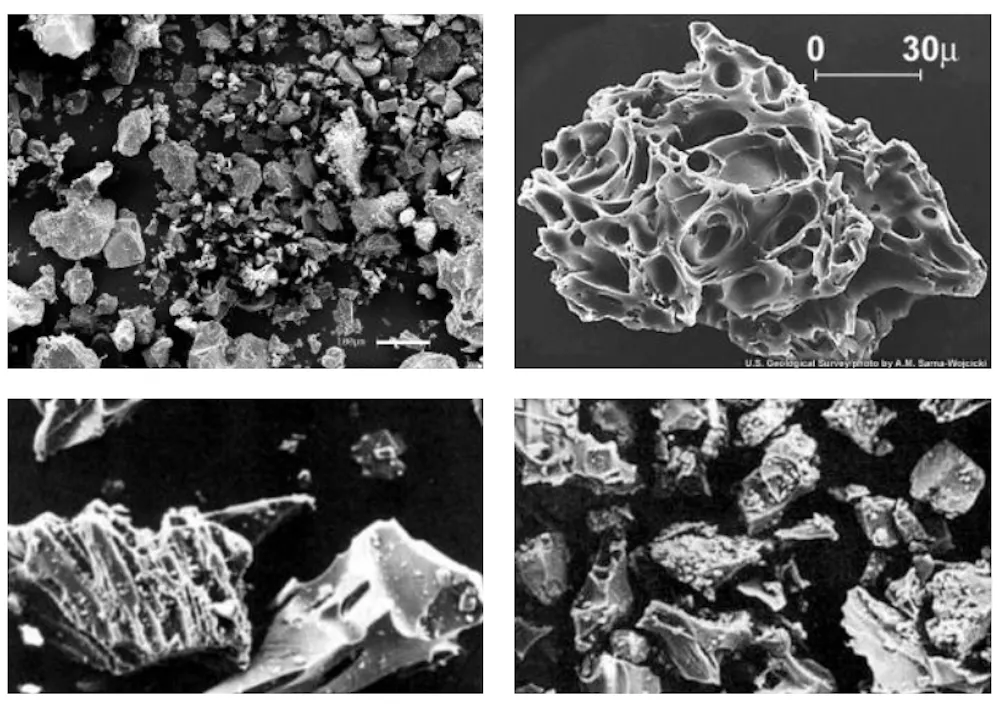
    Electron microscope images of ash show how sharp the shards are. The top left image of shards from Mount Etna in 2002 is 1 mm across. Top right is an ash particle from Mount St. Helens magnified 200 times. The shards in the lower images are less than 0.064 mm.
    Volcano Hazards Program, U.S. Geological Survey

    Ash can also contaminate surface water by introducing toxins and increasing the water’s acidity. The toxins can leach into groundwater, contaminating wells. Fine ash particles can also settle in waterways and smother aquatic plants and animals. During the 2008 Chaitén eruption in Chile, ash contamination led to widespread fish deaths in the Río Blanco.

    Ash can ground airplanes, gum up infrastructure

    Ash clouds are extremely dangerous to aircraft. The glassy ash particles melt when sucked into jet turbines, clog fuel systems and can stall engines in midair.

    In 1982, British Airways Flight 9 lost power in all four engines after flying through an ash cloud. A similar incident occurred in 1989 to KLM Flight 867 over Alaska. In 2010, Iceland’s Eyjafjallajökull eruption grounded more than 100,000 flights across Europe, disrupting travel for over 10 million passengers and costing the global economy billions of dollars.

    Volcanic ash can also wreak havoc on infrastructure by clogging water supplies, short-circuiting electrical systems and collapsing roofs under its weight. It can disrupt transportation, communication, rescue and power networks, as the 1991 eruption of Mount Pinatubo in the Philippines dramatically demonstrated.

    What to do during ashfall

    During an ashfall event, the most effective strategy to stay safe is to stay indoors as much as possible and avoid inhaling ash particles.

    Anyone who must go outside should wear a properly fitted N95 or P2 mask. Cloth masks provide little protection against fine ash. Rainwater tanks, troughs and open wells should be covered and monitored for contamination. Livestock should be moved to clean pastures or given uncontaminated fodder.

    The challenges Alaska is facing if Mount Spurr erupts.

    To reduce structural damage, ash should be cleared from roofs and gutters promptly, especially before rainfall.

    Older adults, children and people who are sick are at greatest risk, particularly those living in poorly ventilated homes. Rural communities that are dependent on agriculture and livestock are disproportionately affected by ashfall, as are low-income people who lack access to clean water, protective masks or safe shelter.

    Communities can stay informed about ash risks through official alerts, including those from the Volcanic Ash Advisory Centers, which monitor ash dispersion and issue timely warnings. The International Volcanic Health Hazard Network also offers guidelines on personal protection, emergency planning and ash cleanup.

    The long tail of ash

    Volcanic ash may fall quietly, but its effects are widespread, persistent and potentially deadly. It poses a chronic threat to health, agriculture, infrastructure and aquatic systems.

    Recognizing the risk is a crucial first step to protecting lives. Effective planning and public awareness can further help reduce the damage.

    David Kitchen does not work for, consult, own shares in or receive funding from any company or organization that would benefit from this article, and has disclosed no relevant affiliations beyond their academic appointment.

    – ref. Volcanic ash is a silent killer, more so than lava: What Alaska needs to know with Mount Spurr likely to erupt – https://theconversation.com/volcanic-ash-is-a-silent-killer-more-so-than-lava-what-alaska-needs-to-know-with-mount-spurr-likely-to-erupt-254461

    MIL OSI – Global Reports –

    April 16, 2025
  • MIL-OSI United Kingdom: London Sudan Conference: Foreign Secretary opening remarks

    Source: United Kingdom – Executive Government & Departments

    Speech

    London Sudan Conference: Foreign Secretary opening remarks

    The Foreign Secretary delivered opening remarks at the London Sudan conference.

    Two years on from this war starting, with frontlines shifting again, I fear many onlookers feel a sense of déjà vu. The country’s fraught history also means that some conclude that further conflict is effectively inevitable.

    Many have given up on Sudan. That is wrong. It’s morally wrong when we see so many civilians beheaded, infants as young as one subjected to sexual violence, more people facing famine than anywhere else in the world.

    We simply cannot look away. And as I speak, civilians and aid workers in El Fasher and Zamzam IDP camp are facing unimaginable violence.

    With over four million refugees having fled the country, and instability spreading far beyond Sudan’s border, it’s also strategically wrong to forget Sudan. And that’s why, as Foreign Secretary, I refused to turn away. I felt a duty to confront this war’s horrors head on.

    I have been to the Sudanese border and met with survivors. I have called out attacks on civilians and humanitarian workers in the United Nations.

    And I have doubled our aid to Sudan, and today I am announcing a further £120 million worth of support. But the biggest obstacle is not a lack of funding or texts at the United Nations, it’s lack of political will.

    Very simply, we have got to persuade the warring parties to protect civilians, to let aid in and across the country and to put peace first.

    And so we do need patient diplomacy. Bringing together this group today, focusing of course on the areas where we agree and building out from there is very very important today, indeed. Today’s goal is then to do just that. We all want to see Sudan’s sovereignty and territorial integrity upheld.

    We all want to see a united state, with functioning institutions. We all want to see Sudan’s civilians protected, and the millions of displaced people able to return to their homes.

    This is a strong basis to agree the steps needed then to relieve suffering and to end this awful war. I hope across our three sessions, we can agree a set of principles for our future diplomatic engagement.

    When I met with Sudanese refugees in Chad I was frankly humbled by their resilience.  In the face of unimaginable trauma, they had not given up on their country or the communities around them.

    For their sake, we cannot resign ourselves to inevitable conflict. We cannot be back here one year from now, having the same discussion. So today, let’s show them and the world we have not given up on them. We have not given up on Sudan.

    I am hugely grateful for the support from the African Union, and to my colleagues from France, Germany and the EU in supporting the shared endeavour.

    Updates to this page

    Published 15 April 2025

    MIL OSI United Kingdom –

    April 16, 2025
  • MIL-OSI: Eos Energy and Frontier Power Announce 5 GWh Memorandum of Understanding to Advance Long-Duration Energy Storage in the United Kingdom

    Source: GlobeNewswire (MIL-OSI)

    EDISON, N.J. and WARWICKSHIRE, United Kingdom, April 15, 2025 (GLOBE NEWSWIRE) — Eos Energy Enterprises, Inc. (NASDAQ: EOSE) (“Eos” or the “Company”), America’s leading innovator in designing, manufacturing, and providing zinc-based long duration energy storage systems sourced and manufactured in the United States, today announced it has signed a memorandum of understanding with Frontier Power Ltd. (“Frontier”), a UK-based energy developer, for a 5 GWh energy storage framework agreement. The agreement marks Eos’ entrance into a new international market and supports Frontier’s plans to submit multiple bids utilizing Eos’ Znyth™ battery technology in the first application window of Ofgem’s new long-duration energy storage (LDES) cap and floor scheme.

    “We are proud to partner with Frontier Power, a respected leader in UK energy development, to bring Eos’ safe and recyclable storage technology to a new market,” said Justin Vagnozzi, Senior Vice President of Global Sales at Eos Energy Enterprises. “The novel cap and floor scheme incentivizes investments in long-duration storage technologies that are critical for grid stability and renewable integration. Our participation in this scheme with an established global supply partner like Frontier furthers our commitment to scale our operations, expand our market reach and encourage the adoption of alternative technologies for the energy storage market.”

    Under the agreement, Eos and Frontier will also look to expand the collaboration globally to new international markets. This partnership also opens the door to developing local manufacturing in the UK. Should significant LDES project volumes materialize using Eos technology, it could incentivize the establishment of manufacturing operations in the UK, supporting domestic supply chains and job creation.

    “Our supply chain strategy was designed to be transportable,” said Joe Mastrangelo, Eos Chief Executive Officer. “We can co-locate manufacturing capacity near customer demand and not only provide innovative energy storage, but sustainable jobs in regions that have demand for our technology. As that demand grows, both domestically and internationally, we’ll expand our manufacturing footprint, and we’re excited to partner with Frontier to execute on that vision in the UK market and beyond.”

    “This agreement reflects Frontier Power’s commitment to driving innovation in clean energy while fostering international collaboration,” said Humza Malik, Frontier Power Chief Executive Officer. “By working with Eos, we are advancing our portfolio of long-duration storage projects and strengthening trade relations between the US and UK. The prospect of local manufacturing in the UK could further boost economic growth and job creation.”

    The UK’s cap and floor scheme, administered by Ofgem and the Department for Energy Security and Net Zero, is designed to provide long-term revenue certainty for innovative energy storage technologies and help incentivize investment in alternative technologies to lithium-ion in the UK market. Eos’ eight-hour technology is well suited for the program, which supports the UK’s broader goals of achieving grid stability and enables higher levels of renewable integration.

    This agreement will be incremental to Eos’ pipeline numbers as of March 31, 2025 when the Company reports first quarter 2025 results.

    About Eos Energy Enterprises

    Eos Energy Enterprises, Inc. is accelerating the shift to American energy independence with positively ingenious solutions that transform how the world stores power. Our breakthrough Znyth™ aqueous zinc battery was designed to overcome the limitations of conventional lithium-ion technology. It is safe, scalable, efficient, sustainable, manufactured in the U.S., and the core of our innovative systems that today provides utility, industrial, and commercial customers with a proven, reliable energy storage alternative for 3 to 12-hour applications. Eos was founded in 2008 and is headquartered in Edison, New Jersey. For more information about Eos (NASDAQ: EOSE), visit eose.com.

    About Frontier Power

    Founded in 2009, Frontier Power is a leading developer of innovative energy solutions with expertise spanning electricity interconnectors, offshore wind transmission, offshore wind generation and energy storage. With over £30 billion in combined investment experience in the team, Frontier Power is at the forefront of driving clean energy transitions globally. 


    Forward Looking Statements

    Except for the historical information contained herein, the matters set forth in this press release are forward-looking statements within the meaning of the “safe harbor” provisions of the Private Securities Litigation Reform Act of 1995. Forward-looking statements include, but are not limited to, statements regarding our expected revenue, for the fiscal years December 31, 2025, our path to profitability and strategic outlook, statements regarding orders backlog and opportunity pipeline, statements regarding our expectation that we can continue to increase product volume on our state-of-the-art manufacturing line, statements regarding our future expansion and its impact on our ability to scale up operations, statements regarding our expectation that we can continue to strengthen our overall supply chain, statements regarding our expectation that our new comprehensive insurance program will provide increased operational and economic certainty, statements that refer to the delayed draw term loan with Cerberus, milestones thereunder and the anticipated use of proceeds, statements that refer to outlook, projections, forecasts or other characterizations of future events or circumstances, including any underlying assumptions. The words “anticipate,” “believe,” “continue,” “could,” “estimate,” “expect,” “intends,” “may,” “might,” “plan,” “possible,” “potential,” “predict,” “project,” “should,” “would” and similar expressions may identify forward-looking statements, but the absence of these words does not mean that a statement is not forward-looking. Forward-looking statements are based on our management’s beliefs, as well as assumptions made by, and the information currently available to, them. Because such statements are based on expectations as to future financial and operating results and are not statements of fact, actual results may differ materially from those projected.

    Factors which may cause actual results to differ materially from current expectations include, but are not limited to: changes adversely affecting the business in which we are engaged; our ability to forecast trends accurately; our ability to generate cash, service indebtedness and incur additional indebtedness; our ability to achieve the operational milestones on the delayed draw term loan; our ability to raise financing in the future; risks associated with the credit agreement with Cerberus, including risks of default, dilution of outstanding Common Stock, consequences for failure to meet milestones and contractual lockup of shares; our customers’ ability to secure project financing; the amount of final tax credits available to our customers or to Eos pursuant to the Inflation Reduction Act; the timing and availability of future funding under the Department of Energy Loan Facility; our ability to continue to develop efficient manufacturing processes to scale and to forecast related costs and efficiencies accurately; fluctuations in our revenue and operating results; competition from existing or new competitors; our ability to convert firm order backlog and pipeline to revenue; risks associated with security breaches in our information technology systems; risks related to legal proceedings or claims; risks associated with evolving energy policies in the United States and other countries and the potential costs of regulatory compliance; risks associated with changes to the U.S. trade environment; our ability to maintain the listing of our shares of common stock on NASDAQ; our ability to grow our business and manage growth profitably, maintain relationships with customers and suppliers and retain our management and key employees; risks related to the adverse changes in general economic conditions, including inflationary pressures and increased interest rates; risk from supply chain disruptions and other impacts of geopolitical conflict; changes in applicable laws or regulations; the possibility that Eos may be adversely affected by other economic, business, and/or competitive factors; other factors beyond our control; risks related to adverse changes in general economic conditions; and other risks and uncertainties.

    The forward-looking statements contained in this press release are also subject to additional risks, uncertainties, and factors, including those more fully described in the Company’s most recent filings with the Securities and Exchange Commission, including the Company’s most recent Annual Report on Form 10-K and subsequent reports on Forms 10-Q and 8-K. Further information on potential risks that could affect actual results will be included in the subsequent periodic and current reports and other filings that the Company makes with the Securities and Exchange Commission from time to time. Moreover, the Company operates in a very competitive and rapidly changing environment, and new risks and uncertainties may emerge that could have an impact on the forward-looking statements contained in this press release.

    Forward-looking statements speak only as of the date they are made. Readers are cautioned not to put undue reliance on forward-looking statements, and, except as required by law, the Company assumes no obligation and does not intend to update or revise these forward-looking statements, whether as a result of new information, future events, or otherwise.

    The MIL Network –

    April 16, 2025
  • MIL-OSI Europe: AFRICA/DEMOCRATIC REPUBLIC OF CONGO – Appointment of bishop of Molegbe

    Source: Agenzia Fides – MIL OSI

    Tuesday, 15 April 2025

    Vatican City (Agenzia Fides) – The Holy Father has appointed the Reverend Joseph Mopepe Ngongo, doctoral candidate in theology at the Université Catholique du Congo, as bishop of the diocese of Molegbe, Democratic Republic of the Congo.Msgr. Joseph Mopepe Ngongo was born on 15 July 1966 in Gemena, diocese of Molegbe. He entered the Saint François d’Assise Preparatory Seminary of Katokoli and studied philosophy at the Saint Jean-Baptiste Major Seminary of Bamanya and theology at the Université Catholique du Congo.He received priestly ordination on 19 March 1995.After ordination, he was awarded a licentiate in theology from the Université Catholique du Congo (1995-1997), and held the roles of formator (1997-2002) and rector (2002-2011) of the Saint Pierre et Saint Paul Interdiocesan Major Seminary in Lisala.In 2011 he began his studies for a doctorate in France where, at the same time, he served as vicar of the Notre Dame Saint Jacques Cathedral in Reims (2011-2021). In addition, he was moderator of the parishes of the Espace missionnaire Sedan-Yvois and chaplain of the Equipes du Rosaire of the metropolitan archdiocese of Reims (2021-2024).In 2024 he returned to the Democratic Republic of the Congo to conclude his doctoral studies at the Université Catholique du Congo in Kinshasa. (EG) (Agenzia Fides, 15/4/2025)
    Share:

    MIL OSI Europe News –

    April 16, 2025
  • MIL-OSI: MEXC Sees 170% Surge in Trading Volume Amid Zero-Fee Campaign

    Source: GlobeNewswire (MIL-OSI)


    VICTORIA, Seychelles, April 15, 2025 (GLOBE NEWSWIRE) — MEXC, a leading global cryptocurrency exchange, has reported a notable increase in trading activity following the launch of its Zero-Fee Trading Campaign in the first quarter of 2025. The program aimed to remove fees from particular futures trading pairs while simultaneously boosting user interaction and substantial growth throughout essential platform metrics.

    During the first three months of the year, the platform witnessed an increase of 17.8% in monthly active traders and a 170.2% surge in trading volume, driven by the introduction of popular trading pairs such as SOL/USDT, HYPE/USDT, and S/USDT. These listings matched user preferences and overall market trends, reinforcing MEXC’s position as a leader in both exchange performance and liquidity depth.

    Top Performing Pairs: SOL/USDT and ADA/USDT
    The campaign’s most active trading pairs included SOL/USDT together with DOGE/USDT, ADA/USDT, TRUMPOFFICIAL/USDT and SUI/USDT.

    SOL/USDT achieved the highest trading volume increase of 185.62%, comprising 19% of total futures trading volume and becoming the leading pair of the quarter. ADA/USDT showed outstanding growth through a 369.44% increase in trading volume accompanied by a 393.05% increase in daily average share, highlighting the effectiveness of zero fees in boosting interest for promising assets.


    Market Share Growth: Dominance in Key Trading Pairs
    In terms of market share growth, AIXBT/USDT led the rankings with a 331% increase, followed by DOGE/USDT (+283%) and SOL/USDT (+209%). Notably, DOGE/USDT and SOL/USDT achieved the highest market share in their categories on CoinMarketCap, at 30.5% and 30.3%, respectively. ADA/USDT followed with a 20.6% share, securing second place in its category, while HYPE/USDT posted a 165% increase in market share.

    • AIXBT/USDT (+331%)
    • DOGE/USDT (+283%)
    • SOL/USDT (+209%)
    • ADA/USDT (+186%)
    • HYPE/USDT (+165%)

    A Breakthrough in Campaign Performance and Exchange Leadership
    During Q1 2025, the Zero Trading Fee Campaign established MEXC as a leading force behind market volume and activity for both well-known and up-and-coming tokens. MEXC achieved wider trader participation and increased liquidity by eliminating fees on popular trading pairs.

    The campaign’s success is attributed to precise timing, well-chosen trading pairs, and a clear, simplified fee structure — rather than external incentives or large-scale marketing. These results suggest that subtle adjustments to cost structures can have an outsized impact on user engagement and trading dynamics.

    MEXC continues to evaluate the results of the initiative and explore further opportunities to enhance user experience in the upcoming quarters.

    About MEXC
    Founded in 2018, MEXC is committed to being “Your Easiest Way to Crypto”. Serving over 36 million users across 170+ countries, MEXC is known for its broad selection of trending tokens, frequent airdrop opportunities, and low trading fees. Our user-friendly platform is designed to support both new traders and experienced investors, offering secure and efficient access to digital assets. MEXC prioritizes simplicity and innovation, making crypto trading more accessible and rewarding.

    For more information, visit: MEXC Website|X|Telegram|How to Sign Up on MEXC
    For media inquiries, please contact MEXC PR Manager Lucia Hu: lucia.hu@mexc.com

    Source

    Disclaimer: This press release is provided by MEXC. The statements, views, and opinions expressed in this content are solely those of the content provider and do not necessarily reflect the views of this media platform or its publisher. We do not endorse, verify, or guarantee the accuracy, completeness, or reliability of any information presented. This content is for informational purposes only and should not be considered financial, investment, or trading advice. Investing in crypto and mining related opportunities involves significant risks, including the potential loss of capital. Readers are strongly encouraged to conduct their own research and consult with a qualified financial advisor before making any investment decisions. However, due to the inherently speculative nature of the blockchain sector–including cryptocurrency, NFTs, and mining–complete accuracy cannot always be guaranteed. Neither the media platform nor the publisher shall be held responsible for any fraudulent activities, misrepresentations, or financial losses arising from the content of this press release.Speculate only with funds that you can afford to lose.Neither the media platform nor the publisher shall be held responsible for any fraudulent activities, misrepresentations, or financial losses arising from the content of this press release. In the event of any legal claims or charges against this article, we accept no liability or responsibility.

    Legal Disclaimer: This media platform provides the content of this article on an “as-is” basis, without any warranties or representations of any kind, express or implied. We do not assume any responsibility or liability for the accuracy, content, images, videos, licenses, completeness, legality, or reliability of the information presented herein. Any concerns, complaints, or copyright issues related to this article should be directed to the content provider mentioned above.

    A photo accompanying this announcement is available at:
    https://www.globenewswire.com/NewsRoom/AttachmentNg/8cd397ca-cf58-4026-8e47-82d170d6ae97
    https://www.globenewswire.com/NewsRoom/AttachmentNg/19053981-1bc0-4171-9a41-3444f28164e0
    https://www.globenewswire.com/NewsRoom/AttachmentNg/793e6557-ca50-45ee-98ff-122847da1aa9

    The MIL Network –

    April 16, 2025
  • MIL-OSI Video: Deputy Minister Nonceba Mhlauli hosts a successful Career Expo at Kaalfontein High School.

    Source: Republic of South Africa (video statements-2)

    Deputy Minister Nonceba Mhlauli hosts a successful Career Expo at Kaalfontein High School.

    https://www.youtube.com/watch?v=EkILFfaUHqs

    MIL OSI Video –

    April 16, 2025
  • MIL-OSI Economics: Key takeaways from the first ICC WCF African Summit 2025 

    Source: International Chamber of Commerce

    Headline: Key takeaways from the first ICC WCF African Summit 2025 

    With support from 20 National Committees and more than 130 chamber members, the event underscored the expanding influence of ICC in the region. It provided a valuable space for African businesses to engage in international trade and foster connections that will drive future growth.  

    In an inspiring opening keynote, the President of the Republic of Kenya, H.E. DR. William Ruto, said:

    “Africa is becoming more connected, integrated and entrepreneurial. Our success will depend on how ready we are to embrace change. Hosting this first ever WCF Africa Summit, it is such an honour. Chambers of commerce are indispensable because they bring smart solutions to business and help them navigate the world complexity.”

    ICC Chair Philipe Varin added :

    “The International Chamber of Commerce is firmly committed to working with individual African countries and pan-African organisations to ensure that the full potential of the continent can be fully realised – in line with the objectives set forth in the Agenda 2063, the continent’s blueprint for sustainable development.” 

    Making business work for Africa 

    This landmark event was organised under the African Continental Free Trade Area (AfCFTA) framework to foster economic growth, innovation, and collaboration. The two-day event highlighted Africa’s growing investment potential and innovative ecosystems while showcasing the region’s leadership in sustainable development. 

    Two key workshops were held focusing on the digitalisation of trade and the impact of global policy changes on Africa.  

    A masterclass led by Managing Director of ICC Digital Standards Initiative Pamela Mar, addressed major challenges in digital trade, including standards interoperability, digital trust, and legal frameworks. It highlighted the importance of policy and legal reforms in supporting Africa’s digital trade transformation. 

    Another masterclass on the recent U.S. tariff changes, was led by ICC Head of Trade, Valerie Picard, and explored recent tariffs’ impact on African exporters and trade policy. The session emphasised the role of chambers in helping members adapt and shape a responsive trade agenda for Africa. 

    The sessions aimed to provide African businesses and chambers with the tools to navigate challenges and seize new opportunities.   

    The African Summit was full of valuable insights into digitalisation of trade and shifting global policies. As the first major WCF event in 20 years held in Africa, the summit marked a crucial step in strengthening the continent’s trade position.  

    The next WCF event will be held in Melbourne, the host city for the 14th World Chambers Congress.  

    MIL OSI Economics –

    April 16, 2025
  • MIL-Evening Report: PNG’s ‘chief servant’ James Marape defeats no-confidence vote

    By Koroi Hawkins, RNZ Pacific editor

    Papua New Guinea Prime Minister James Marape has survived a motion of no confidence against him in Parliament.

    During the proceedings, livestreamed on EMTV, Speaker Job Pomat announced the results of the vote as 16 votes in favour and 89 against.

    In moving the motion, the member for Abau, Sir Puka Temu, nominated Sir Peter Ipatas as an alternative prime minister to Marape, and said the motion was moved on principle.

    “This is not a vote of ambition, it is a vote of accountability, it is a vote of conscience. Mr Speaker what is the role of government if not to uplift its people,” Sir Puka said.

    The seconder of the motion, Wabag Open MP Lino Tom acknowledged the government’s superior numbers, but said the opposition were acting in the interest of the people and challenged Marape to address them on the floor.

    “He needs to tell the people because he is the chief accountable officer of this country,” Tom said.

    “He can no longer blame his incompetent ministers. He can no longer blame any other person here on this floor.”

    Speaker put question
    The Speaker then went to immediately put the question, provoking the ire of the opposition bench with Madang MP Bryan Kramer accusing him of acting contrary to the Supreme Court order that had the House resume to hear the motion, which had initially been denied by the Parliament’s private business committee.

    “Mr Speaker must be consistent with the privileges and the spirit and intent of the constitution that provide every member the opportunity to debate,” he said.

    “This is a court order if you entertain this motion of ‘question be put’ then there will be contempt proceedings.”

    Despite multiple points of order from the opposition calling for the motion to be debated, Pomat proceeded to put the question and the results were overwhelmingly Marape’s favour.

    “Those in favour of this motion are 16 and those who are not in favour of this motion and who want the Honourable Member for Tari Pori, Honourable James Marape, to remain as prime minister are 89.”

    After the vote, Marape moved a motion to address the movers of the motion, and spoke at length about the achievements of his government, while throwing jabs at the opposition MPs, many of who had served as ministers in his government at different times.

    He finished by thanking all who supported him in today’s leadership challenge.

    Thanks to members
    “I want to say thank you for members on both sides of the House for your participation today.

    “A sincere thank you to the 89 on their feet, who stood up to vote and I want to say thank you as your chief servant.

    “I will try my absolute best to continue on leaving no place and no one behind as the ultimate aim of this government and should be for any government going forward into the future.”

    The nominated challenger, Sir Peter, also rose to thank the opposition for nominating him, and to all the people of Papua New Guinea who reached out to him with messages of support.

    He said he only accepted the nomination because so many MPs had complained about the prime minister’s performance.

    Sir Ipatas challenged government MPs to stop bickering and gossiping about James Marape behind his back.

    “As he rightly said, he is putting his time and effort into trying to make this country great,” he said.

    Call to ‘not gossip’
    “It is about our ministers and leaders and leaders of coalition partners not gossiping, but be open with the prime minister and talk about issues that we have for the country and for the people.

    “This country belongs to all of us. Our people.”

    Parliament is now adjourned until May 27.

    Under new laws passed last month, Marape now has an 18-month reprieve from votes of no confidence.

    With only two years left until the next election, RNZ Pacific understands this effectively gives him a clear run to the 2027 National General Election.

    Several opposition MPs in Parliament on Tuesday urged Marape to make the most of the upcoming period of stability, and deliver some real results for Papua New Guineans.

    This article is republished under a community partnership agreement with RNZ.

    MIL OSI Analysis – EveningReport.nz –

    April 16, 2025
  • MIL-OSI Africa: Secretary-General’s statement on the second anniversary of the Sudanese conflict

    Source: United Nations – English

    wo years into a devastating war, Sudan remains in a crisis of staggering proportions, with civilians paying the highest price.
     
    Indiscriminate shelling and air strikes continue to kill and maim. Markets, hospitals, schools, places of worship and displacement sites are being attacked. Sexual violence is rampant, with women and girls subjected to horrific acts. Civilians suffer from gross violations and abuses from all warring parties.
     
    Almost 12 million people have fled their homes, in what has become the world’s largest displacement crisis. More than 3.8 million of these have crossed into neighbouring countries.
     
    More than 30 million people require humanitarian support. Half of the population – some 25 million people – are acutely hungry. As the lean season looms, famine has been identified in at least five locations and is projected to spread further.
     
    Aid workers have been targeted: at least 90 have lost their lives since the fighting began.
     
    Basic services have been decimated, with millions of children deprived of education, and less than one-quarter of health facilities are functional in the hardest hit areas. Attacks on infrastructure have left people without electricity and access to safe water.
     
    Last year, the United Nations and its partners reached more than 15.6 million people with at least one form of assistance. But the needs remain overwhelming. Conflict and insecurity, coupled with bureaucratic impediments and drastic funding cuts, have kept humanitarians from increasing their presence in many areas where assistance is needed most.
     
    Civilians continue to bear the brunt of the parties’ disregard for human life. In addition to their obligations under international humanitarian and international human rights law, the warring parties have made commitments to protect civilians, including in the Jeddah Declaration of May 2023. Such commitments must be translated into concrete action. Independent, impartial and transparent investigations into all reports of violations and abuses are also crucial.
     
    The only way to ensure the protection of civilians is to end this senseless conflict.
     
    I am deeply concerned that weapons and fighters continue to flow into Sudan, allowing the conflict to persist and spread across the country. The external support and flow of weapons must end. Those with greatest influence on the parties must use it to better the lives of people in Sudan – not to perpetuate this disaster.
     
    Comprehensive, revitalised and well-coordinated political efforts are urgently needed to prevent Sudan’s further fragmentation. As an international community, we must find ways to help the Sudanese people bring this unspeakable catastrophe to an end and establish acceptable transitional arrangements.
     
    Sudan remains a highest priority for the United Nations. I will continue to engage with regional leaders on means to enhance our collective efforts for peace.
     
    This will complement the ongoing work of my Personal Envoy, Ramtane Lamamra, who will seek to ensure international mediation efforts are mutually reinforcing.
     
    He will also continue to explore with the parties ways to bring them closer to a peaceful solution and support and empower civilians as they work towards a common vision for Sudan’s future.
     
    We must renew our focus on finding an end to this brutal war. The world must not forget the people of Sudan.  
     

    MIL OSI Africa –

    April 16, 2025
  • MIL-OSI Africa: Afreximbank delivered exceptional 2024 financial performance, cementing its position as a systemic pan-African trade finance institution

    Source: Africa Press Organisation – English (2) – Report:

    CAIRO, Egypt, April 15, 2025/APO Group/ —

    African Export-Import Bank (“Afreximbank” or the “Group”) (www.Afreximbank.com) has released the consolidated financial statements of the Bank and its subsidiaries, for the year ended 31 December 2024.

    Financial Highlights

    Afreximbank reported strong financial performance despite a complex global economic landscape marked by geopolitical tensions, inflationary pressures, and elevated interest rate, posting a net income of US$973.5 million for FY 2024, a 29% increase from the previous year – with subsidiaries beginning to make meaningful contributions to the Group’s financial results.

    These impressive results highlight Afreximbank’s resilience, systemic relevance and its commitment to delivering on its mandate and the objectives set under its Sixth Strategic Plan. The Group’s total income increased by 23% to reach US$3.3 billion, driven by growth in business volumes and supported by higher market interest rates. As a result, net interest income for FY2024 amounted to US$1.8 billion, a 25% increase compared to FY2023, reflecting the effective and efficient management of borrowing costs.

    Despite rising operating expenses, Cost-to-Income ratio improved to 18% in FY 2024, down from 19% in the previous year – demonstrating enhanced operational efficiency. This was achieved even as total operating expenses rose by 21% to US$367.7 million (FY2023: US$304.5 million), primarily due to global inflationary pressures and increased investment in human capital to support expanded business activities.

    Group’s total assets, including contingencies, grew by 7.55%, reaching US$40.1 billion as of 31 December 2024, compared to US$37.3 billion at the close of FY’2023. The growth was largely driven by increases in net loans and advances to customers, guarantees and letters of credit, as well as investments at fair value, property and equipment.

    The carrying value of property and equipment increased by 33%, rising from US$328.1 million to US$436.4 million, primarily driven by the accelerated construction of the state-of-the-art Afreximbank African Trade Centre (AATC) facilities in Abuja, Nigeria, and Harare, Zimbabwe.

    The Group’s Shareholders’ funds grew by 17% in 2024, reaching US$7.2 billion (FY’2023: US$6.1 billion). This growth was largely driven by the Net income of US$973.5 million generated in 2024 which contributed to the increase in equity, while FY’2023 dividends of US$314.5 million were appropriated following the Shareholders’ approval in June 2024. Additionally, the successful capital-raising efforts under the second general capital increase (GCI II) programme, which secured fresh equity contributions totalling US$412.8 million during the year also contributed to the increase in Group shareholders’s funds.

    The Bank’s callable capital, a significant proportion of which was credit enhanced as part of the Bank’s Capital Management Strategy, amounted to US$4.3 billion as at 31 December 2024 (FY’2023: US$3.7 billion).

    Operating Highlights

    In 2024, Afreximbank was ranked number one in all three categories in the Bloomberg Capital Markets League Tables Report for African Capital Markets. The Bank was the top Sub-Saharan Africa bookrunner, administrative agent and mandated lead arranger. These rankings affirm the Bank’s role as a market leader in facilitating capital from within and outside of the continent from a diverse range of investors and stakeholders for financing needs for African member states and organizations.

    Afreximbank continued to expand its membership, further deepening its continental and diaspora reach. Libya’s accession to the Establishment Agreement brought the number of African member states to 53 by year-end, and just weeks later, Somalia became the 54th participating state. On the Caribbean front, membership momentum remained strong, with 12 of the 15 CARICOM countries having signed the Bank’s Participating Agreement, paving way for Afreximbank to expand its operations into the region.

    The Bank’s subsidiaries also delivered a robust growth and made a significant impact throughout the year. The Fund for Export Development (FEDA), the equity investment subsidiary of the Bank, expanded its impact portfolio to over US$0.5 billion, targeting key sectors such as industrial platforms, financial services, agribusiness, and healthcare. AfrexInsure, the Bank’s specialty insurance subsidiary, successfully deployed its solutions to an expanding customer base across multiple sectors and geographies. By year-end, AfrexInsure had completed transactions in seventeen countries, up from seven the previous year, covering US$3.54 billion in assets. Notably, AfrexInsure was able to place 97% of its premiums with pan-African players, in line with its mandate to keep premiums on the continent.

    The Pan African Payment and Settlement System (PAPSS) continued its upward trajectory in 2024, with 3 additional Central Banks and 50 commercial banks joining the platform, bringing the total number of Central Banks to 16 and commercial banks to 144. In addition, PAPSS launched the African Currency Marketplace (PACM) in 2024, which successfully handled 12 currencies during its pilot phase and becoming a useful platform for large corporates encountering difficulties in repatriating funds across the continent. Work is also progressing towar the launch of the PAPSS card, further enhancing the platform’s capacity to facilitate seamless financial transactions across the continent.

    In the last quarter of 2024, the Bank priced its debut Samurai bond, securing a regular 5 tranche JPY 67.2 billion. Concurrently, the Bank launched its inaugural Retail Samurai bond with a 3-year fixed-rated tranche valued at JPY 14.1 billion. The bonds are rated ‘A-’ by Japan Credit Rating Agency, Ltd and helped with diversifying the Bank’s funding sources.

    The fundraising opportunities were further validated by the AAA/Stable rating awarded to the Bank by China Chengxin International Credit Rating Co., Ltd (CCXI), the highest rating ever granted to an African multilateral financial institution. This prestigious rating not only affirms the Bank’s developmental impact and operational strength but also enhances our ability to diversify funding sources and strengthen our partnership with China, Africa’s largest trading partner.

    Afreximbank, in collaboration with the African Union and the AfCFTA Secretariat, and the Government of the People’s Democratic Republic of Algeria will hold the Intra-African Trade Fair 2025 (IATF2025) in Algiers, Algeria, from 4-10 September 2025. The event, the largest of its kind in Africa, champions the cause of changing the socio-economic landscape of Africa by devising progressive initiatives aimed at promoting intra-African trade, continental integration and a platform for bringing the AfCFTA vision to life.

    Mr. Denys Denya, Afreximbank’s Senior Executive Vice President, commented:

    “In a challenging and rapidly evolving global geopolitical and economic environment, the Group delivered robust financial performance, exceeding expectations and outperforming prior years. This achievement highlights management’s commitment to executing the 6th Strategic Plan, ensuring operational efficiency, and enhancing value. The Bank’s strong financial position is underpinned by solid liquidity, a well-capitalized balance sheet, and a high-quality asset portfolio. Management remains confident in the Group’s ability to navigate ongoing economic headwinds and sustain growth trajectory. Strategic initiatives to mitigate risks and optimize operations have reinforced the foundation for long-term success. Looking ahead, global economic conditions are expected to remain volatile, with inflationary pressures, tighter financial conditions, and geopolitical uncertainties posing potential risks. The Bank will continue to play its role as a systemically relevant institution, balancing growth, liquidity, profitability, and risk management while pursuing sustainable expansion.”

    Highlights of the results for the Group and Bank are shown below:

    Financial Metrics

    FY-2024

    FY-2023

    Gross Income (US$ billion)

    3.3

    2.6

    Operating Income (US$ billion)

    2.0

    1.6

    Net Income (US$ million)

    973.5

    756.1

    Total Assets (US$ billion)

    35.3

    33.5

    Total Liabilities (US$ billion)

    28.1

    27.3

    Shareholders’ Funds (US$ billion)

    7.2

    6.1

    Net asset value per share

    US$69,270

    US$63,683

     Financial Metrics

    FY-2024

    FY-2023

    Profitability

    Return on average assets (ROAA)

    Return on average equity (ROAE)

    2.96%

    15.31%

    2.56%

    13.31%

    Operating Efficiency

    Net interest spread

    Cost-to-income ratio

    4.07%

    18.35%

    4.09%

    19.09%

    Asset Quality

    Non-performing loans ratio (NPL)

    2.33%

    2.47%

    Liquidity and capital adequacy

    Cash/Total assets

    Capital Adequacy ratio (Basel II)

    13.18%

    24%

    16.80%

    25%

    MIL OSI Africa –

    April 16, 2025
  • MIL-OSI Africa: Newmont Africa’s Managing Director to Speak at Mining in Motion Conference

    Source: Africa Press Organisation – English (2) – Report:

    ACCRA, Ghana, April 15, 2025/APO Group/ —

    Abdul Raman, Managing Director, Newmont Africa will participate at the upcoming Mining in Motion Conference, taking place on 2 – 4 June, 2025 in Accra, Ghana.

    Raman will join key players driving the growth of Ghana’s mining sector in a panel session titled Environmental Impact of Mining and Rehabilitation Impacts, highlighting Newmont Africa’s commitment to sustainable mining practices in Ghana, Africa’s largest gold producer.

    Representing Ghana’s leading gold producer, Raman’s participation at the inaugural Mining in Motion Conference will be instrumental in showcasing Newmont Africa’s investment strategy as Ghana leverages gold mining to drive GDP growth. Under Raman’s leadership, Newmont Africa’s Ahafo South Gold Mine has maintained its position as Ghana’s Best Company in the Extractive Sector, ranking top in the Ghana Investment Promotion Center’s Ghana Club 100 Awards in 2024.

    In addition to Ahafo South, Newmont Africa operates Ghana’s third-largest gold mine, Akyem, which produces 422,000 ounces of gold per year. Newmont Africa is also spearheading industry growth through expansion projects, including the Akyem Underground and Layback Expansion, which will extend the Akyem mine’s lifespan beyond 2030. The company is also advancing the Ahafo North Project, expected to commence commercial production in the second half of 2025, with an annual output of up to 325,000 ounces of gold.

    Amidst these development, Mining in Motion represents an ideal platform for Raman to connect with Ghana’s regulatory authorities, key industry players and global partners to explore new opportunities within Ghana’s gold value chain.

    Mining in Motion is organized by the Ashanti Green Initiative, in collaboration with the World Bank, the World Gold Council, and other international partners. Held under the theme Sustainable Mining & Local Growth – Leveraging Resources for Global Impact, the event will bring together key decision-makers, including H.E. John Dramani Mahama, President of Ghana, as well as representatives from the African Union, ECOWAS, and the United Nations, to shape the future of mining in Ghana.

    MIL OSI Africa –

    April 16, 2025
  • MIL-OSI Africa: One Month to Invest in African Energy (IAE) 2025: Africa’s Energy Licensing Surge to Take Center Stage

    Source: Africa Press Organisation – English (2) – Report:

    PARIS, France, April 15, 2025/APO Group/ —

    With just one month to go to the Invest in African Energy (IAE) 2025 forum, the event is shaping up to be a milestone moment for upstream investment on the continent. IAE 2025 will spotlight Africa’s resurgence in exploration activity – with over 150 oil and gas blocks on offer across more than 10 countries on the continent. Backed by national oil companies (NOCs), regulators and government ministries, the forum stands to connect international capital and energy opportunities to investors and developers.

    Africa’s 2025 licensing calendar is one of the most active in recent years, with countries across North, West, Central and East Africa opening acreage and reforming terms to attract global explorers. Dozens of offshore and onshore blocks are being offered through both direct negotiations and competitive bidding, with new rounds in Libya, the Republic of Congo, Liberia, Sierra Leone, Algeria and Angola, among others. A central focus of the upcoming forum, these offerings are supported by revised fiscal frameworks, comprehensive seismic data and digitalized platforms aimed at streamlining investor engagement and lowering entry barriers.

    IAE 2025 (https://apo-opa.co/4jrAKig) is an exclusive forum designed to facilitate investment between African energy markets and global investors. Taking place May 13-14, 2025 in Paris, the event offers delegates two days of intensive engagement with industry experts, project developers, investors and policymakers. For more information, please visit www.Invest-Africa-Energy.com. To sponsor or participate as a delegate, please contact sales@energycapitalpower.com.

    The IAE 2025 program will feature dedicated sessions that highlight new opportunities, policy reforms and strategic deals. An Energy Reform Briefing on Sierra Leone will explore the structural changes aimed at enhancing the country’s competitiveness in upstream oil and gas. A high-profile session from the newly established South African National Petroleum Company (SANPC) will offer insight into the entity’s vision, followed by a live investor pitch. An “In Conversation” dialogue with TotalEnergies will explore the major’s evolving investment priorities in Africa and its role in the continent’s energy transition. Meanwhile, the Premier Invest Deal Room will showcase six major upstream transactions, providing a curated environment for qualified investors, lenders and project sponsors to engage in due diligence and financing discussions.

    IAE 2025 will welcome government officials, companies and financiers. Confirmed ministers include the Republic of Congo’s Minister of Hydrocarbons, Bruno Jean-Richard Itoua; Nigeria’s Minister of State for Petroleum Resources (Gas), Eperikpe Ekpo; Gabon’s Minister of Petroleum, Marcel Abéké; Mauritania’s Minister of Petroleum and Energy, Mohamed Ould Khaled; Senegal’s Minister of Energy, Oil and Mines, Birame Soulèye Diop; Guinea-Bissau’s Minister of Energy, Malam Sambu; and Liberia’s Minister of Mines and Energy, Wilmot Paye.

    Industry participation ranges from leading majors such as TotalEnergies, Eni and Perenco, to NOCs including SNPC, SANPC, Gabon Oil Company and Uganda National Petroleum Company. Junior explorers and independents like Afentra, Trident Energy, Oando, UTM Offshore and EcoAtlantic will also join the conversation, alongside key players in technology and finance such as Technip Energies, NOV, SLB, Wärtsilä, Africa Finance Corporation, Rand Merchant Bank and the Trade and Development Bank. Together, leaders from both public and private sectors will engage in high-level discussions on topics ranging from financing the next generation of energy projects, to optimizing value from mature and mid-life assets, as well as transforming power generation across the continent.

    As global investors seek scalable growth opportunities and secure supply options, Africa is presenting a compelling case for upstream development and gas-led industrialization. With one month to go, IAE 2025 offers a timely and focused opportunity to engage with the people, projects and policies shaping the next chapter of African energy.

    MIL OSI Africa –

    April 16, 2025
  • MIL-OSI Africa: GITEX AFRICA Morocco’s third edition opens to the continent’s largest gathering of globally influential tech leaders, government officials and innovators

    Source: Africa Press Organisation – English (2) – Report:

    RABAT, Morocco, April 15, 2025/APO Group/ —

    GITEX AFRICA Morocco (www.GITEXAfrica.com), the continent’s largest tech and startup show today opened its doors to the biggest players across the local, regional and international digital landscapes, turning the city of Marrakech into an epicentre of advanced technology, talent, and transformation.

    Running until 16 April, GITEX AFRICA Morocco is held under the high patronage of His Majesty King Mohammed VI, May God Assist Him, the authority of the Kingdom’s Ministry of Digital Transition and Administration Reform, in partnership with Digital Development Agency (ADD), and organised by KAOUN International – the overseas event agency of Dubai World Trade Centre (DWTC) and organiser of GITEX events globally.

    Her Excellency, Amal El Fallah Seghrouchni, Minister of Digital Transition and Administration Reform, Government of Morocco opened the show’s inauguration ceremony to welcome participants from over 130 countries, 1,450 exhibitors, 350 global investors, and 650 conference speakers.

    The opening address was delivered as part of the inauguration panel session made up from key dignitaries, including H.E. Dr. Mohamed Al Kuwaiti, Head of Cybersecurity, Government of the United Arab Emirates, and Mr. Chakib Alj, the President of the General Confederation of Moroccan Enterprises (CGEM).

    Her Excellency, Amal El Fallah Seghrouchni, Minister of Digital Transition and Administration Reform, Government of Morocco, said: “GITEX AFRICA affirms the growing importance of the digital economy, which represents today 15% of global GDP, or some $6.5 trillion. Aware of the challenges of this digital revolution, the Kingdom of Morocco is actively committed to building a future where digitalization, and through it AI, constitutes a lever for progress, for the benefit of all. It is in this sense that His Majesty King Mohammed VI, may God assist Him, affirmed in his speech to the Extraordinary Summit of heads of state and government of the African Union in Kigali, in March 2018: “Africa is on its way to becoming a global digital laboratory.” A wise and enlightened vision that continues to guide the initiatives of our country and our continent.”

    Mr. Mohammed Drissi Melyani, Director General of the Digital Development Agency, said: “This international event, organised under the High Patronage of His Majesty King Mohammed VI may God Assist Him, has become one of the most prominent digital and technological gatherings on the African and international levels. It is no longer just an occasion to showcase the latest innovations, but has become a strategic place to strengthen digital inclusion between African countries, to build bridges of cooperation with our international partners, and to accelerate the pace of sustainable digital transformation. This reflects our firm ambition and strong commitment to achieve an inclusive digital transition and to establishing a new digital culture that prioritises the advancement of administration, entrepreneurial fabric, and society, as well as to build of a developed and competitive digital economy.”

    Trixie LohMirmand, Chief Executive Officer, KAOUN International, said: “As we enter the third edition of GITEX AFRICA Morocco, there is a strong sense of momentum and purpose. This event has evolved into a powerful platform driving Africa’s digital future and, with AI at the forefront of global innovation, Morocco is positioning itself as a hub for an incredible transformation across the continent. This is backed by ambitious national strategies, a vibrant ecosystem of startups, and growing international partnerships. GITEX AFRICA Morocco serves not just as a showcase agenda-defining tech, but also as a catalyst for collaboration, investment, and scaling, connecting African innovators and talent with global markets and empowering the next generation to build, revolutionise, and lead the AI economy.”

    This year GITEX AFRICA Morocco is primed to forge new partnerships and explore new industries, thereby elevating its influence and impact on Africa’s digital landscape even further. The 2025 edition presents an expanded agenda and representation from new countries from the African, European and Asian continents including, Belgium, Gabon, Niger, Switzerland, Uzbekistan, Zambia. In addition to the show’s traditional focus on AI, cybersecurity, and telecoms the event will also cover energy transition, mobility, edutech, sports technologies, and agritech.

    GITEX AFRICA Morocco returns for its third year with support from institutional partners: ANRT, Royal Air Maroc, ONCF, OCP, ONDA, AMDIE, ONMT and CGEM.

    For news and updates on GITEX AFRICA Morocco, please visit: www.GITEXAfrica.com.

    MIL OSI Africa –

    April 16, 2025
  • MIL-OSI Europe: European Union – Main results of the Foreign Affairs Council (14 Apr. 2025)

    Source: France-Diplomatie – Ministry of Foreign Affairs and International Development

    M. Jean-Noël Barrot, Minister for Europe and Foreign Affairs, took part in the Foreign Affairs Council (FAC) today, Monday 14 April.

    On France’s initiative, the meeting provided an opportunity to adopt further European sanctions against nine individuals and entities responsible for Iran’s state-hostages policy, of which two of our compatriots, Cécile Kohler et Jacques Paris, are still victims – as are several other European citizens – and have been so for nearly three years. These sanctions target judges and prosecutors officiating in courts that do not respect basic rights, as well as detention centres.

    Regarding Ukraine, the Member States emphasized the importance of giving Ukraine the means to negotiate in a position of strength when the time comes. In the coming weeks it is necessary to adopt, as soon as possible, a new package of robust sanctions against Russia containing individual and sectoral measures.

    On Armenia and Azerbaijan, the Minister stressed the importance of signing the peace treaty swiftly, and shared his deep concern about the rising tensions on the border. The role of the European mission deployed on the ground is essential for observing incidents. He reiterated the need to immediately release the people arbitrarily held in Azerbaijan.

    As regards the situation in the Middle East, the Minister recalled President Macron’s visit to Egypt and the need for an immediate return to the ceasefire in Gaza, the release of the hostages and the resumption of humanitarian aid.

    Finally, on the situation in Bosnia and Herzegovina, the Member States reaffirmed their commitment to the country’s unity and constitutional order. France favours a firm response by the EU that harnesses all the levers available to it, in order to restore stability.

    MIL OSI Europe News –

    April 16, 2025
  • MIL-OSI: Bitget Unveils New Ad Featuring FC Barcelona Star Raphinha to Champion Smarter Crypto Solutions

    Source: GlobeNewswire (MIL-OSI)

    VICTORIA, Seychelles, April 15, 2025 (GLOBE NEWSWIRE) — Bitget, the leading cryptocurrency exchange, and Web3 company, is kicking off a dynamic new campaign with LALIGA, featuring Barcelona’s electrifying winger Raphinha. The new collaboration highlights Bitget’s innovative trading products—Copy Trading, Launchpool, and Pre-market—drawing a clever parallel between the precision of elite football and the strategy behind smart crypto trading via a series of videos that will be launched throughout the month of April.

    Just as Raphinha dances past defenders with samba flair or executes tiki-taka precision on the pitch, Bitget’s tools empower traders to navigate the crypto markets with agility and foresight. The campaign’s three commercials showcase this harmony, blending LALIGA’s cutting-edge approach to sports with Bitget’s tech-driven trading solutions.

    “In football, split-second decisions make the difference between a goal and a miss,” said Jorge de la Vega, LALIGA executive director. “Partnering with Bitget reflects our shared focus on innovation, performance, and strategy—whether on the field or in the markets.”

    Raphinha, who recently hit 50 goal contributions for FC Barcelona this season, echoed the sentiment: “Football and trading both demand quick thinking and the right tools. Bitget’s platform helps traders stay ahead, just like we do on the pitch.”

    The campaign isn’t just about star power; it’s about engagement. Bitget will roll out user education initiatives and trading challenges, allowing participants to win exclusive LALIGA prizes, including match tickets to see Raphinha in action for league leaders FC Barcelona. Think of it as a hat-trick of opportunities: learn, trade, and win.

    “What excites me most about this partnership isn’t just the shared spotlight between crypto and football; it’s how fundamentally alike these worlds are. When Raphinha receives the ball, he’s processing positioning, momentum, and opportunity in real-time, much like a skilled trader reading market movements,” said Gracy Chen, CEO at Bitget. She added, “We’ve built tools that give users that same edge: Copy Trading lets you learn from the pros, Launchpool brings effortless passive income, and Pre-market offers early winning opportunities. This campaign celebrates that strategic mindset whether you’re trading on our platform or watching Raphinha light up the Camp Nou.”

    LALIGA’s reputation for embracing technology aligns perfectly with Bitget’s mission to make crypto trading accessible and intuitive. Both industries thrive on strategy, timing, and execution—whether it’s a perfectly placed through ball or a well-timed trade. This campaign marks the latest chapter in Bitget’s growing sports legacy, having partnered with football legend Lionel Messi and the Italian football club Juventus. As the campaign unfolds, Bitget and LALIGA aim to inspire fans and traders alike to embrace a smarter, more strategic approach, both in crypto and beyond.

    Visit Bitget’s YouTube channel for part one of the Raphinha series.

    About Bitget

    Established in 2018, Bitget is the world’s leading cryptocurrency exchange and Web3 company. Serving over 100 million users in 150+ countries and regions, the Bitget exchange is committed to helping users trade smarter with its pioneering copy trading feature and other trading solutions while offering real-time access to Bitcoin price, Ethereum price, and other cryptocurrency prices. Formerly known as BitKeep, Bitget Wallet is a world-class multi-chain crypto wallet that offers an array of comprehensive Web3 solutions and features including wallet functionality, token swap, NFT Marketplace, DApp browser, and more.

    Bitget is at the forefront of driving crypto adoption through strategic partnerships, such as its role as the Official Crypto Partner of the World’s Top Football League, LALIGA, in EASTERN, SEA and LATAM markets, as well as a global partner of Turkish National athletes Buse Tosun Çavuşoğlu (Wrestling world champion), Samet Gümüş (Boxing gold medalist) and İlkin Aydın (Volleyball national team), to inspire the global community to embrace the future of cryptocurrency.

    For more information, visit: Website | Twitter | Telegram | LinkedIn | Discord | Bitget Wallet

    For media inquiries, please contact: media@bitget.com

    Risk Warning: Digital asset prices are subject to fluctuation and may experience significant volatility. Investors are advised to only allocate funds they can afford to lose. The value of any investment may be impacted, and there is a possibility that financial objectives may not be met, nor the principal investment recovered. Independent financial advice should always be sought, and personal financial experience and standing carefully considered. Past performance is not a reliable indicator of future results. Bitget accepts no liability for any potential losses incurred. Nothing contained herein should be construed as financial advice. For further information, please refer to our Terms of Use.

    A photo accompanying this announcement is available at https://www.globenewswire.com/NewsRoom/AttachmentNg/3d035087-a248-41fb-a491-eb9990eff6ab

    The MIL Network –

    April 15, 2025
  • MIL-OSI United Nations: WFP welcomes a contribution from Finland to boost school meals programme in Zambia

    Source: World Food Programme

    LUSAKA – The United Nations World Food Programme (WFP) welcomes a contribution of EUR 500,000 from the Government of Finland to strengthen Zambia’s national school meals programme. The one-year initiative will enhance the nutrition of over 34,000 learners in thirty-three schools across Zambia while promoting climate-resilient agriculture and sustainable food systems.

    Finland, as the co-chair of the School Meals Coalition, is a strong and longstanding supporter of school meals globally. For years, Finland has provided continuous support to several WFP school meals operations and remains committed to strengthening these efforts. 

    With Finland’s support, and in collaboration with the Ministries of Education and Agriculture, WFP will procure ninety-eight metric tonnes of beans to complement cereals provided for school meals by the Zambian government. The initiative will directly link the demand for nutritious food in schools with supply from local smallholder farmers, creating a stable market for their produce. In addition, irrigated school gardens will be established to further improve the diversity and quality of school meals.

    “Finland and Zambia share longstanding warm relations,” said Saana Halinen, Ambassador of Finland to Zambia. “School meals are an investment in the future of Zambia, and I am incredibly happy that Finnish support is complimenting the government’s efforts in expanding the school meals programme. Allocating resources to child nutrition is the single and most important investment any country can make.”

    To further boost sustainability and resilience, schools will receive energy efficient stoves and handwashing stations, while teachers, learners, and surrounding communities will benefit from training in sustainable agriculture, nutrition, and hygiene practices.

    “This support from Finland comes at a critical time for Zambia as we address the aftermath of last year’s drought, working closely with the Ministry of Education and the Ministry of Agriculture” said Cissy Kabasuuga, WFP Country Representative in Zambia. “The funding will not only meet the immediate nutritional needs of thousands of learners but also help build a stronger, more resilient food system for the future.” 

    WFP, in partnership with the Government of Zambia launched a comprehensive five-year strategic plan in 2023 which seeks to eliminate hunger, improve nutrition, and strengthen the resilience of vulnerable communities to food shocks. The plan allows for national institutions to take the lead, reducing the need for humanitarian interventions. 

    Finland, as the co-chair of the School Meals Coalition, is a strong and longstanding supporter of school meals globally. For years, Finland has provided continuous support to several WFP school meals operations and remains committed to strengthening these efforts. 

    About WFP

    The United Nations World Food Programme is the world’s largest humanitarian organization, saving lives in emergencies, building prosperity and supporting a sustainable future for people recovering from conflict, disasters and the impact of climate change.

    Follow us on X @wfp_media @WFP_Zambia, @wfp_southernafrica.

    MIL OSI United Nations News –

    April 15, 2025
  • MIL-OSI Asia-Pac: Union Minister Shri Shivraj Singh Chouhan to attend 15th BRICS Agriculture Ministers Meeting at Brasilia, Brazil

    Source: Government of India

    Union Minister Shri Shivraj Singh Chouhan to attend 15th BRICS Agriculture Ministers Meeting at Brasilia, Brazil

    Shir Chouhan to hold bilateral meetings with Brazil Minister of Agriculture & Livestock Mr Carlos Henrique Baqueta Fávaro, Minister of Agrarian Development and Family Farming Mr Luiz Paulo Teixeira,

    Theme of 15th BRICS Agricultural Ministerial Meeting is “Promoting Inclusive and Sustainable Agriculture through Cooperation, Innovation, and Equitable Trade among BRICS Countries”

    Posted On: 15 APR 2025 10:54AM by PIB Delhi

    Union Minister for Agriculture & Farmers’ Welfare and Rural Development, Shri Shivraj Singh Chouhan, is leading the Indian delegation to the 15th BRICS Agriculture Ministers’ Meeting (AMM), scheduled to be held on 17th April, 2025 in Brasilia, Brazil. The theme of 15th BRICS AMM is “Promoting Inclusive and Sustainable Agriculture through Cooperation, Innovation, and Equitable Trade among BRICS Countries”. Agriculture Ministers and senior officials from BRICS member countries, including Brazil, Russia, India, China, South Africa, Saudi Arabia, Egypt, United Arab Emirates, Ethiopia, Indonesia, and Iran are expected to attend the Meeting.

    During the visit, Shri Chouhan will hold bilateral meetings with key Brazilian counterparts, including Mr. Carlos Henrique Baqueta Fávaro, Minister of Agriculture and Livestock, and Mr. Luiz Paulo Teixeira, Minister of Agrarian Development and Family Farming (MDA). These meetings will focus on enhancing collaboration between India and Brazil in various areas of agriculture, agri-technology, rural development, and food security.

    The Minister will interact with leaders of major Brazilian agribusiness companies and representatives of the Brazilian Association of Vegetable Oil Industries in São Paulo, exploring avenues for partnership and investment in the agriculture value chain. As part of his visit, the Minister will also participate in a tree plantation drive at the Embassy of India in Brasilia, under the noble initiative “Ek Ped Maa Ke Naam”, aimed at raising environmental consciousness and honouring motherhood. In addition, the Minister will interact with the vibrant Indian diaspora in São Paulo, acknowledging their role as cultural ambassadors and contributors to bilateral ties. This visit reaffirms India’s commitment to deepen cooperation with BRICS nations and to advance South-South cooperation in agricultural innovation, resilience, and sustainability.

    ***

    PSF/KSR/AR

    (Release ID: 2121725) Visitor Counter : 83

    MIL OSI Asia Pacific News –

    April 15, 2025
  • MIL-OSI Asia-Pac: Raksha Rajya Mantri Shri Sanjay Seth calls on Tanzanian Vice-President Mr Philip Isdor Mpango and Minister of Defence & National Service Dr Stergomena Lawrence Tax in Dar es Salaam

    Source: Government of India

    Posted On: 14 APR 2025 11:00PM by PIB Delhi

    Raksha Rajya Mantri Shri Sanjay Seth called on Vice-President of Tanzania Mr Philip Isdor Mpango and Minister of Defence & National Service Dr Stergomena Lawrence Tax in Dar es Salaam on April 14, 2025. During his meeting with the Tanzanian Vice-President, Raksha Rajya Mantri updated him on the Africa-India Key Maritime Engagement cooperation from Indian defence industries to exercise (AIKEYME) and Defence Expo inaugurated on April 13, 2025. He offered to fulfil the defence requirements of Tanzania People’s Defence Force. India-Tanzania development partnership, cultural connections and cooperation in health and education were also discussed. 

    During the meeting between Tanzanian Minister of Defence & National Service and Raksha Rajya Mantri, the ongoing defence cooperation was reviewed and new ways were explored to further bolster the ties. Training of Tanzania officers in military training institutes of India, defence industry collaboration, cooperation in counter-insurgency and counter-terrorism operations, and cyber security were some of the key areas of cooperation deliberated upon during the meeting. 

    Raksha Rajya Mantri ended his day with an Indian Community event where he highlighted the progress India has made in various spheres in recent years. He dwelt upon the contribution of the Indian diaspora in growth and prosperity of not only India but Tanzania too. He visited Sanatan Dharma and Swaminarayan Mandir prior to the interaction with the Indian community. He also participated in the Ambedakar Jayanti celebrations organised in the High Commission of India in Tanzania.

     ****

    SR/Savvy

    (Release ID: 2121709) Visitor Counter : 87

    MIL OSI Asia Pacific News –

    April 15, 2025
  • MIL-OSI: MEXC Lists WalletConnect (WCT) with Airdrop+ Event Offering 273,000 WCT & 50,000 USDT in Rewards

    Source: GlobeNewswire (MIL-OSI)

    VICTORIA, Seychelles, April 15, 2025 (GLOBE NEWSWIRE) — MEXC, a leading global cryptocurrency exchange, announced it will list WalletConnect Network (WCT) on April 15, 2025 (UTC), accompanied by Airdrop+ rewards totaling 273,000 WCT and 50,000 USDT for users.

    WalletConnect is a leading network enabling seamless on-chain user experiences. As the backbone for wallet-to-DApp communication across blockchains like Ethereum, Solana, and Cosmos, it facilitates secure interactions without requiring users to switch wallets. With over 275 million connections and 45 million users worldwide, WalletConnect empowers users to engage with DeFi, NFTs, swaps, and staking applications through a unified interface. This infrastructure drives Web3 innovation by bridging wallets, applications, and blockchains effortlessly.

    $WCT is the native token of WalletConnect, used for network incentives, governance, and transaction fees. It also supports validator staking rewards and decentralized decision-making. By staking $WCT, holders contribute to network security and protocol upgrades, ensuring a decentralized, permissionless, and community-driven ecosystem.

    To celebrate the official listing of WalletConnect (WCT) on MEXC, MEXC is launching a limited-time Airdrop+ Event, open to both new and existing users.

    Event Period:
    April 9, 2025, 10:00 – April 25, 2025, 10:00 (UTC)

    Here are the key benefits of the event:
    Benefit 1: Deposit and share 195,000 WCT (Exclusive for new users)
    Benefit 2: Futures Challenge — Trade to share 50,000 USDT in Futures bonus (Open to all users)
    Benefit 3: Invite new users and share 78,000 WCT (Open to all users)

    For full event details and participation rules, please visit here.

    MEXC has established itself as an industry leader by consistently providing users with early access to promising crypto projects. In 2024, MEXC introduced 2,376 new tokens, with 1,716 initial listings. According to the latest TokenInsight report, from November 1, 2024, to February 15, 2025, MEXC led the industry with an impressive 461 spot listings. Additionally, during the bi-weekly periods, MEXC maintained a high listing frequency, consistently ranking among the top six exchanges and demonstrating its ability to capture market trends quickly. MEXC will continue to innovate and expand its offerings, providing users with the best opportunities in the ever-evolving crypto space.

    About MEXC
    Founded in 2018, MEXC is committed to being “Your Easiest Way to Crypto.” Serving over 36 million users across 170+ countries, MEXC is known for its broad selection of trending tokens, everyday airdrop opportunities, and low trading fees. Our user-friendly platform is designed to support both new traders and experienced investors, offering secure and efficient access to digital assets. MEXC prioritizes simplicity and innovation, making crypto trading more accessible and rewarding.
    MEXC Official Website| X | Telegram |How to Sign Up on MEXC

    Risk Disclaimer:
    The information provided in this article regarding cryptocurrencies does not constitute investment advice. Given the highly volatile nature of the cryptocurrency market, investors are encouraged to carefully assess market fluctuations, the fundamentals of projects, and potential financial risks before making any trading decisions.

    Source

    Contact:
    Lucia Hu
    lucia.hu@mexc.com

    Disclaimer: This press release is provided by MEXC. The statements, views, and opinions expressed in this content are solely those of the content provider and do not necessarily reflect the views of this media platform or its publisher. We do not endorse, verify, or guarantee the accuracy, completeness, or reliability of any information presented. This content is for informational purposes only and should not be considered financial, investment, or trading advice. Investing in crypto and mining related opportunities involves significant risks, including the potential loss of capital. Readers are strongly encouraged to conduct their own research and consult with a qualified financial advisor before making any investment decisions. However, due to the inherently speculative nature of the blockchain sector–including cryptocurrency, NFTs, and mining–complete accuracy cannot always be guaranteed. Neither the media platform nor the publisher shall be held responsible for any fraudulent activities, misrepresentations, or financial losses arising from the content of this press release.Speculate only with funds that you can afford to lose.Neither the media platform nor the publisher shall be held responsible for any fraudulent activities, misrepresentations, or financial losses arising from the content of this press release. In the event of any legal claims or charges against this article, we accept no liability or responsibility.

    Legal Disclaimer: This media platform provides the content of this article on an “as-is” basis, without any warranties or representations of any kind, express or implied. We do not assume any responsibility or liability for the accuracy, content, images, videos, licenses, completeness, legality, or reliability of the information presented herein. Any concerns, complaints, or copyright issues related to this article should be directed to the content provider mentioned above.

    A photo accompanying this announcement is available at https://www.globenewswire.com/NewsRoom/AttachmentNg/047b7c55-0330-4413-a078-b67cc1c448ec

    The MIL Network –

    April 15, 2025
  • MIL-OSI Europe: EU and Member States pledge over €522 million to address Sudan crisis

    Source: European Commission – Justice

    European Commission Press release Brussels, 15 Apr 2025 To help address the difficult humanitarian situation in Sudan, the European Commission and Member States have pledged €522 million in aid for 2025 at the High-level Conference for Sudan, co-hosted in London today by the Commission alongside the United Kingdom, France, Germany and the African Union.

    MIL OSI Europe News –

    April 15, 2025
  • MIL-OSI United Nations: Urgent Global Action Needed to Prevent Greater Regional Instability as Sudan War Enters Third Year

    Source: International Organization for Migration (IOM)

    Geneva/ Port Sudan, 15 April 2025 – As the brutal war in Sudan entered its third year today, the International Organization of Migration (IOM) called for immediate, coordinated international action to help alleviate the unimaginable scale of human suffering caused by the conflict and to prevent even greater instability across the region.

    The conflict has triggered the world’s largest displacement crisis and one of the most severe humanitarian emergencies. More than 11.3 million people are now internally displaced —8.6 million of them uprooted by the current conflict—while an additional 3.9 million have fled across borders into neighbouring countries in the past two years alone, desperately seeking safety, food, and shelter.

    Today, over 30 million people—two-thirds of Sudan’s population—are in urgent need of humanitarian assistance, including 16 million children.

    “The war has pushed Sudan to the brink. Thousands of lives have been lost to violence, families torn apart, and the hopes and aspirations of millions shattered in the face of starvation, disease, and the complete collapse of the economy,” said IOM Director General Amy Pope. “And even with the violence, many displaced people are attempting to return to their homes, only to find total devastation. Sudan desperately needs humanitarian aid, and equally important, longer-term investment to ensure people can return safely, and that they, and their communities, can recover and rebuild their lives.”

    Concurrently, as thousands struggle to survive in the ravaged Darfur region, humanitarians have a rapidly shrinking window to scale cross-border operations from Chad before the incoming rains disrupt this critical humanitarian lifeline.

    With continued cross-border displacement and fragile situations in neighbouring countries like South Sudan and Chad, the risk of regional destabilization is growing. Humanitarian response must be complemented with durable and sustainable solutions for returnees, refugees, their host communities and governments.

    Since the outbreak of the conflict, IOM has provided lifesaving assistance and protection – including emergency shelter, water, sanitation, and health services – to nearly four million people across Sudan and neighbouring countries.  Through its Displacement Tracking Matrix (DTM), IOM is also providing vital data to guide the entire humanitarian response plans.

    In Chad, South Sudan, and Ethiopia, IOM is assisting newly arrived refugees and returnees through border reception, onward transportation, health screenings, and basic relief. It also works with host communities to promote social cohesion and resilience – key to preventing further instability.

    Despite the scale of need, IOM’s response plan is only ten percent funded as of April 2025. Without immediate funding, operations will be severely disrupted. Data collection will halt. Over 100 humanitarian partners will lose access to essential supplies. Millions will be left without life-saving support.

    IOM urgently appeals to the international community for immediate and sustained funding to scale up operations; these include life-saving services under health, protection, movement assistance, shelter, and water, sanitation, and hygiene support, as well as support to key enabling services for the broader humanitarian response. Humanitarian partners must not be left without the tools to respond.

    “The people of Sudan cannot afford to be kept waiting. The international community must deliver a clear and united message: the people of Sudan are not forgotten,” DG Pope said.

    For more information, please contact IOM Media Centre

    MIL OSI United Nations News –

    April 15, 2025
  • MIL-OSI Economics: Pronounced spike in low-level crimes in Singapore Straits 

    Source: International Chamber of Commerce

    Headline: Pronounced spike in low-level crimes in Singapore Straits 

    A total of 45 cases of piracy and armed robbery against ships were recorded in the first three months of 2025 – an almost 35 percent increase compared to the same period in 2024.   

    Of the incidents reported, 37 vessels were boarded, four were hijacked and four had attempted attacks. The threat to crew safety remains high with 37 crew members taken hostage, 13 kidnapped, two threatened and one injured. 

    Rise of incidents in Singapore Straits 

    The Q1 report highlights a spike in recorded incidents in the Singapore Straits as 27 incidents were reported from vessels transiting these waters compared to seven for the same period in 2024.  

    While most incidents were considered low-level opportunistic crimes, crew members were at great risk with guns reported in 14 incidents. For the whole of 2024, guns were reported in 26 incidents globally. Ten crew members were taken hostage in six separate incidents, two were threatened and one was reported injured.  

    Ninety-two percent of all vessels targeted in the Singapore Straits were successfully boarded, including nine bulk carriers and tankers over 100,000 deadweight tonnage in size.  

    IMB Director Michael Howlett said:

    “The reported rise of incidents in the Singapore Straits is concerning, highlighting the urgent need to protect the safety of seafarers navigating these waters.  Ensuring the security of these vital routes is essential and all necessary measures must be taken to safeguard crew members.” 

    Caution advised in the Gulf of Guinea  

    Although the number of reported incidents within the Gulf of Guinea waters and adjoining littoral states continues to be at its lowest in nearly two decades, the IMB urges continued caution as crew members remain at risk.   

    All 13 kidnapped crew were reported in these waters in two separate attacks – with a total of six incidents reported in the first quarter of the year. In March, pirates hijacked a bitumen tanker southeast of Santo Antonio, in Sao Tome and Principe, kidnapping 10 crew members – while a fishing vessel south of Accra, Ghana, was boarded by armed pirates who kidnapped three crew members. 

    “While we welcome the reduction of incidents, the safety of crew members in the Gulf of Guinea remains at greater risk. It is essential to maintain a strong regional and international naval presence to address these incidents and ensure the protection of seafarers,”

    Mr Howlett said. 

    Somali piracy threat remains 

    Between 7 February and 16 March 2025, two fishing vessels and a dhow were hijacked off the coast of Somalia. In these incidents, 26 crew members were taken hostage, demonstrating the continued capabilities of Somali pirates. Reports indicate all crew have been released along with the vessels. 

    The IMB advises ships navigating these waters to exercise caution and to strictly follow the latest version of the Industry Best Management Practice (BMP). 

    Download your copy of the 2025 Jan – Mar Piracy and Armed Robbery Against Ships report here. 

    About the IMB Piracy Reporting Centre 

    Since its founding in 1991, IMB’s Piracy Reporting Centre has served as a crucial, 24-hour point of contact to report crimes of piracy and lend support to ships under threat. Quick reactions and a focus on coordinating with response agencies, sending out warning broadcasts and email alerts to ships have all helped bolster security on the high seas. The data gathered by the Centre also provides key insights on the nature and state of modern piracy. 

    IMB encourages all shipmasters and owners to report all actual, attempted and suspected global piracy and armed robbery incidents to the Piracy Reporting Centre as a vital first step to ensuring adequate resources are allocated by authorities to tackle maritime piracy.   

    MIL OSI Economics –

    April 15, 2025
  • MIL-OSI: BW Energy: Q1 2025 operational update

    Source: GlobeNewswire (MIL-OSI)

    Q1 2025 operational update

    BW Energy will publish financial figures for Q1 2025 and host a presentation at Hotel Continental, Oslo, on Monday, 5 May 2025.  
    Net production to BW Energy was 3.2 million barrels of oil (mmbbls) in Q1 2025, equal to 36,000 bbls per day, from the Dussafu licence in Gabon (73.5% working interest) and the Golfinho field (100% working interest) in Brazil.  

    Volume (mmbbls) Q1 2025 Q4 2024
    Net Production 3.2 3.1
    Dussafu 2.6 2.5
    Golfinho 0.7 0.6
         
    Net volume sold 3.7 3.2
    Dussafu* 3.2 2.7
    Golfinho 0.5 0.5
         
    Average realised price (USD/bbl)    
    Dussafu 74.8 72.5
    Golfinho 75.0 83.5

    *Includes State Profit Oil and DMO deliveries        

    DUSSAFU

    • Record quarterly production since inception
    • Eight producing Hibiscus / Ruche wells, and all Tortue wells on-line
    • Q1 production availability ~93% on FPSO BW Adolo, and ~99% on MaBoMo
    • 3 liftings to BW Energy, 1 lifting to GOC / State according to plan 
    • Operating cost1 of USD 9.9/bbl
    • Net volume sold (basis for revenue recognition), included 65,000 bbls of DMO deliveries and 320,889 bbls of state profit oil, with an over-lift position of 350,893 bbls at period-end
    • Takeover of BW Adolo FPSO operations ongoing with planned completion of transition period in Q2 2025
    • Substantial oil discovery with good reservoir quality made on the Bourdon prospect with initial data indicating the potential for establishing a new development cluster with a production facility

    GOLFINHO

    • Inventory at period end of 597,750 bbls
    • Operating cost1 of USD 42.2/bbl primarily due to increased production
    • Production positively impacted by resumed gaslift after completion of Petrobras maintenance
    • Q1 production availability ~84% on FPSO Cidade de Vitória
    • Final investment decision (FID) made for the Golfinho Boost project aiming to increase uptime, reduce operating expenses and add approximately 3,000 barrels per day of incremental oil production from 2027 

    MAROMBA

    • BW Energy expects to announce FID on the Maromba development project within the next few weeks

    HEDGING, LIQUIDITY AND DEBT

    • Oil hedging: Q1 net loss of USD 0.9 million from oil derivatives (USD 2.1 million unrealised loss and USD 1.2 million realised gain)
    • Period-end cash balance of USD 286 million vs. USD 221 million end-December 2024, with the change reflecting cash flow from operations, debt repayment and investments
    • Entered into a new and increased Dussafu RBL facility 
      Period-end gross debt of USD 583 million includes MaBoMo lease, Dussafu RBL, Golfinho prepayment facility and bond debt 

    For further information, please contact:
    Brice Morlot, CFO BW Energy
    +33.7.81.11.41.16
    ir@bwenergy.no
     
    About BW Energy:
    BW Energy is a growth E&P company with a differentiated strategy targeting proven offshore oil and gas reservoirs through low risk phased developments. The Company has access to existing production facilities to reduce time to first oil and cashflow with lower investments than traditional offshore developments. The Company’s assets are 73.5% of the producing Dussafu Marine licence offshore Gabon, 100% interest in the Golfinho and Camarupim fields, a 76.5% interest in the BM-ES-23 block, a 95% interest in the Maromba field in Brazil, a 95% interest in the Kudu field in Namibia, all operated by BW Energy. In addition, BW Energy holds approximately 6.6% of the common shares in Reconnaissance Energy Africa Ltd. and a 20% non-operating interest in the onshore Petroleum Exploration License 73 (“PEL 73”) in Namibia. Total net 2P+2C reserves and resources were 599 million barrels of oil equivalent at the start of 2025. 
    This information is subject to the disclosure requirements pursuant to section 5-12 of the Norwegian Securities Trading Act.

    1) Operational costs exclude royalties, tariffs, workovers, domestic market obligation purchases, production sharing costs in Gabon, and incorporates the impact of IFRS 16 adjustments 

    The MIL Network –

    April 15, 2025
←Previous Page
1 … 258 259 260 261 262 … 464
Next Page→
NewzIntel.com

NewzIntel.com

MIL Open Source Intelligence

  • Blog
  • About
  • FAQs
  • Authors
  • Events
  • Shop
  • Patterns
  • Themes

Twenty Twenty-Five

Designed with WordPress