Source: Republic of South Africa (video statements-2)
Deputy President Paul Mashatile’s address at the Ahmed Kathrada Legacy Fundraising Breakfast Series.
Source: Republic of South Africa (video statements-2)
Deputy President Paul Mashatile’s address at the Ahmed Kathrada Legacy Fundraising Breakfast Series.
Source: United Nations – Geneva
The Committee against Torture this morning opened its eighty-second session, which is being held in Geneva from 7 April to 2 May, during which it will review efforts by Armenia, France, Mauritius, Monaco, Turkmenistan and Ukraine to implement the provisions of the Convention against Torture and Other Cruel, Inhuman or Degrading Treatment or Punishment.
Mahamane Cisse-Gouro, Director of the Human Rights Council and Treaty Mechanisms Division at the Office of the United Nations High Commissioner for Human Rights, and Representative of the Secretary-General, opening the session, said that the international system was undergoing a tectonic change, and the edifice of human rights that had been built so painstakingly over the decades had never been under such pressure. At the root of this upheaval were the intensification of armed conflicts and crises; the growing influence of authoritarian regimes and the increasing control of autocrats over large swathes of the global economy; social tensions and resentments fuelled by growing inequalities and often directed against refugees, migrants and other vulnerable groups; the impact of climate change on the realisation of fundamental rights; and the misuse of digital technologies to repress, restrict and violate human rights.
In these difficult times, Mr. Cisse-Gouro said, independent voices from treaty bodies were more essential than ever to ensure respect for and implementation of international human rights law. The Committee against Torture played a fundamental role in monitoring and providing guidance to States parties through its concluding observations, general comments and jurisprudence. Mr. Cisse-Gouro encouraged the Committee to continue its invaluable work to strengthen and clarify the applicability of the Convention in a broad range of situations and promote human dignity and justice in all circumstances.
However, Mr. Cisse-Gouro said, in addition to ongoing chronic resource constraints, the current liquidity situation of the United Nations Secretariat had hampered, and continued to hamper, the planning and implementation of the Committee’s work. The Office of the High Commissioner was doing its utmost to ensure that the treaty bodies could carry out their mandates, including highlighting the direct impact of resource limitations on human rights protection on the ground. Nevertheless, all indications suggested that the challenging liquidity situation would persist for the foreseeable future.
The treaty body strengthening process had reached a crucial juncture, Mr. Cisse-Gouro noted. In December last year, the General Assembly adopted the biennial resolution on the treaty body system, which invited the treaty bodies and the Office of the High Commissioner to continue to work to achieve a clear and regularised schedule for reporting by States parties, and to increase their efforts to further use digital technologies in their work. However, the resolution did not endorse the proposal for an eight-year predictable schedule of country reviews.
On Human Rights Day last year, Mr. Cisse-Gouro said, the Geneva Human Rights Platform organised an informal meeting of the Chairs and focal points on working methods, which explored the latest developments in the treaty body system and sought to improve the harmonisation of procedures. The Chairs and focal points also had the opportunity to interact with the coordination committee of special procedures mandate holders, discussing independence and an “all mechanisms” approach to the many challenges the human rights mechanisms were facing. The High Commissioner’s Office would continue to work alongside the treaty bodies to harmonise working methods, particularly in preparation for the annual meeting of the treaty body Chairs in June.
Mr. Cisse-Gouro noted that, at the fifty-eighth session of the Human Rights Council, High Commissioner for Human Rights Volker Türk launched his Office’s report on good practices and lessons learned related to transitional justice processes in the context of sustaining peace and sustainable development, which illustrated powerful practices that were victim-centred, inclusive, gender-responsive and innovative. Additionally, the report presented by the Special Rapporteur on freedom of religion or belief explored the intersections between the right to freedom of religion or belief and the prohibition of torture and ill-treatment, with input from the Committee. It showed that States, courts and even those working directly with victims had not consistently taken these rights into consideration in cases raising overlapping concerns, potentially exposing victims to further abuse.
In closing, Mr. Cisse-Gouro expressed the Office of the High Commissioner’s strong support for the Committee’s critical mandate and wished it a successful session.
Claude Heller, Committee Chairperson, said that the Committee agreed that the increasingly deteriorating international situation was fracturing the multilateral system and questioning the values on which United Nations was built. This was a human rights crisis. It was deeply concerning to see States fall short of their obligations under human rights treaties or even withdraw from international human rights bodies. In this context, the Committee needed to continue to fight for these values and principles, the implementation of the Convention, and the prevention of torture.
The United Nations’ liquidity crisis had been felt more deeply recently, Mr. Heller said. States needed to shoulder their obligations to the treaty body system and do everything they could to maintain its operation. The Committee was concerned by the impact of the crisis on its activities but would cooperate with the Office of the High Commissioner to ensure that the efforts to address the situation were aligned.
During the session, Mr. Heller said, the Committee would conduct dialogues to review the reports of Armenia, France, Mauritius, Monaco, Turkmenistan and Ukraine, and would also prepare and adopt lists of issues for Pakistan and Tajikistan and lists of issues prior to reporting for Antigua and Barbuda, Botswana, Iceland, Iraq, Kenya, Montenegro, State of Palestine and Uruguay. Further, the Committee would examine 27 communications, considering 15 communications on the merits and on admissibility and 12 for discontinuance.
Mr. Heller reported that on Tuesday, 29 April, follow-up reports would be presented by the Committee’s Rapporteur for follow-up to concluding observations, the Rapporteur for follow-up on decisions adopted under article twenty-two, and the Rapporteur on reprisals. The Committee would hear a presentation from the Chair of the Subcommittee on Prevention of Torture and Other Cruel, Inhuman or Degrading Treatment on the Subcommittee’s sixteenth annual report in a public meeting on Monday, 14 April, and was also scheduled to adopt its own annual report in a public meeting on Friday, 2 May.
Mr. Heller concluded by thanking States, national human rights organizations, civil society organizations, particularly the World Organization against Torture, and the Committee’s Secretariat for their support of the Committee’s work.
During the meeting, the Committee adopted its provisional agenda for the session.
Documents relating to the Committee’s work, including reports submitted by States parties, will be available on the session’s webpage. Summaries of the public meetings of the Committee can be found here, and webcasts of the public meetings can be found here.
The Committee will next meet in public on Tuesday, 8 April at 10 a.m. to consider the seventh periodic report of Monaco
___________
Produced by the United Nations Information Service in Geneva for use of the media;
not an official record. English and French versions of our releases are different as they are the product of two separate coverage teams that work independently.
CAT25.001E
Source: Africa Press Organisation – English (2) – Report:
JOHANNESBURG, South Africa, April 7, 2025/APO Group/ —
APO Group (www.APO-opa.com), the award-winning pan-African communications consultancy and press release distribution service, is pleased to announce the integration of Telegram, the popular mobile instant messaging service, into its press release distribution channels. This exciting new development, which sees the company’s press releases available on the mobile app, further cements APO Group’s position as Africa’s premier digital PR and communications firm, with unmatched reach and engagement in the online space.
With an annual dissemination rate of over 10,000 press releases to more than 250 news websites and 450,000 journalists and bloggers across the continent and globally, APO Group is committed to ensuring that Africa’s stories are shared even more widely and in a manner that is convenient to the continent’s growing mobile population of journalists and news consumers.
Telegram gives these users direct access to the press releases published on APO Group’s www.Africa-Newsroom.com platform, enabling them to instantly share relevant real-time updates and exclusive content with their target audiences. Like the web platform, Telegram subscribers can choose their preferred language channel – English, Arabic, French, or Portuguese – providing bespoke, tailored access to APO Group’s press releases in mobile format.
With close to 53 million downloads (https://apo-opa.co/3FWfLWh) in Europe, the Middle East, and Africa in 2024, Telegram has rapidly gained traction amongst the region’s users, fundamentally transforming how news is consumed. Incorporating Telegram into its already comprehensive press release distribution channels supports APO Group’s vision of delivering state-of-the-art communications solutions for Africa and the world.
“At APO Group, we’re not only committed to sharing positive and compelling narratives about the African continent; we also want to make it as easy as possible for journalists to republish our content, enhancing exposure for our clients through a channel that is widely accessible and easy to use, with an unlimited audience size. Tailored functionality ensures that information is relevant, topical, and presented in a user-friendly manner,” explained APO Group CEO Bas Wijne.
“Innovation and digitalisation are key focus areas for us at APO Group when it comes to enhancing our press release distribution services. Telegram presents us with a unique opportunity to further enrich our advanced distribution service, offering journalists a wider range of options to access and share Africa’s stories. This aligns with how the market is evolving, how users are evolving, and how the mobile market is growing.”
In addition to its comprehensive online Africa Newsroom press release distribution platform and the newly launched Telegram mobile news-sharing channel, APO Group is working to provide additional innovative mobile solutions to its clients and the African media in the near future, broadening distribution options even further.
Subscribe to APO Group’s Africa Newsroom Telegram channels using the following links:
English: https://t.me/Africa_Newsroom
French: https://t.me/Africa_Newsroom_FR
Arabic: https://t.me/Africa_Newsroom_AR
Portuguese: https://t.me/Africa_Newsroom_PT
Source: United Nations – English
oday we mourn the one million children, women and men slaughtered in the 1994 genocide against the Tutsi in Rwanda.
This appalling chapter in human history was not a spontaneous frenzy of horrendous violence. It was intentional, premeditated and planned — including through hate speech that inflamed division, and spread lies and dehumanization. The overwhelming majority of victims were Tutsi, but also Hutu and others who opposed the genocide.
As we recall how these crimes came about, we must also reflect on resonance with our own times.
These are days of division. The narrative of “us” versus “them” is ascendant, polarizing societies. Digital technologies are being weaponized to further inflame hate, stoke division, and spread lies.
We must learn from the terrible history of the genocide in Rwanda, and act to stem the tide of hate speech, stop disunity and discontent mutating into violence, uphold human rights, and ensure accountability.
I urge all States to deliver on commitments made in the Global Digital Compact to tackle online falsehoods and hate, to comply with their obligations under international humanitarian and human rights law, and to become parties to the Convention on the Prevention and Punishment of the Crime of Genocide
without delay.
On this day of remembrance, let’s commit to be vigilant and to work together to build a world of justice and dignity for all – in honour of all the victims, and survivors of the genocide in Rwanda.
***
Aujourd’hui, nous pleurons le million d’enfants, de femmes et d’hommes massacrés lors du génocide des Tutsis au Rwanda en 1994.
Dans ce chapitre effroyable de l’histoire de l’humanité, le déchaînement de violence épouvantable n’était pas spontané. Il était intentionnel, prémédité et planifié, alimenté notamment par un discours de haine qui a servi à attiser la discorde et à propager des mensonges et a contribué à la déshumanisation. Les victimes étaient en grande majorité des Tutsis, mais aussi des Hutus et d’autres personnes qui s’opposaient au génocide.
Tout en nous nous souvenant de la manière dont ces crimes ont pris naissance, nous devons réfléchir à la façon dont ils résonnent à l’heure actuelle.
Nous vivons une époque de division. Le discours du « nous contre eux » se fait de plus en plus entendre et polarise les sociétés. Les technologies numériques sont instrumentalisées pour aviver la haine, attiser les dissensions et répandre des mensonges.
Nous devons tirer les leçons du sombre chapitre du génocide au Rwanda et agir pour endiguer la vague de discours haineux, empêcher la désunion et le mécontentement de se transformer en violence, faire respecter les droits humains et garantir l’application du principe de responsabilité.
Je demande instamment à tous les États de tenir les engagements qu’ils ont pris dans le cadre du Pacte numérique mondial afin de lutter contre les mensonges et la haine en ligne, d’honorer les obligations que leur font le droit international humanitaire et le droit des droits humains, et de devenir parties à la Convention pour la prévention et la répression du crime de génocide sans plus tarder.
En cette journée du souvenir, engageons-nous à être vigilants et à œuvrer de concert à bâtir un monde de justice et de dignité pour tous et toutes – en mémoire de toutes les victimes et de toutes les personnes rescapées du génocide au Rwanda.
***
Source: Government of India
“Indian Navy ensures that no nation in IOR suppresses another on the basis of overwhelming economy & military power”
“Our aim is to develop IOR as a symbol of brotherhood & shared interest”
RM also inaugurates Rs 2,000 crore modern operational, repair & logistic facilities constructed under Project Seabird
Posted On: 05 APR 2025 4:07PM by PIB Delhi
Raksha Mantri Shri Rajnath Singh flagged-off Indian Navy Offshore Patrol Vessel, INS Sunayna, as Indian Ocean Ship (IOS) SAGAR (Security & Growth for All in the Region) in Karwar, Karnataka on April 05, 2025. Raksha Mantri also inaugurated modern operational, repair and logistic facilities constructed under Project Seabird worth over Rs 2,000 crore. He was accompanied by Chief of Defence Staff General Anil Chauhan, Chief of the Naval Staff Admiral Dinesh K Tripathi, Defence Secretary Shri Rajesh Kumar Singh and other senior officials.
IOS Sagar
The flagging-off of the ship, with 44 naval personnel from nine friendly nations (Comoros, Kenya, Madagascar, Maldives, Mauritius, Mozambique, Seychelles, Sri Lanka & Tanzania), marks a significant step in reinforcing India’s commitment to regional maritime security and international cooperation.
Addressing the representatives from partner nations of the Indian Ocean Region (IOR), Shri Rajnath Singh termed the launch of IOS SAGAR as a reflection of India’s commitment to peace, prosperity, and collective security in maritime domain. He highlighted India’s growing presence in IOR, stating “It is not just related to our security and national interests, it also points towards the equality of rights and duties among our friendly countries in the region. Our Navy ensures that, in IOR, no nation suppresses another on the basis of overwhelming economy and military power. We ensure that the nations’ interests are protected without compromising their sovereignty,” he said.
Raksha Mantri also commended the Indian Navy for emerging as the first responder during incidents such as hijacking of ships and acts of pirates, in the region. He stated that the Navy ensures the security of not just Indian ships but also foreign ones, terming free navigation, rule-based order, anti-piracy and securing peace and stability in IOR as one of its biggest objectives. “Along with other stakeholders, Indian Navy is ensuring peace and prosperity in the region. Equipped with state-of-the-art ships, weapons & equipment and well-trained & motivated sailors, we resolve to move ahead with other friendly nations towards developing IOR as a symbol of brotherhood and shared interest,” he added.
The flag-off coincides with the 10thanniversary of the SAGAR initiative and the National Maritime Day. Shri Rajnath Singh referred to Prime Minister Shri Narendra Modi’s recent MAHASAGAR (Mutual and Holistic Advancement for Security and Growth Across Regions) initiative and stated that it will expand and strengthen the SAGAR vision in a more advanced and collaborative manner. “Now that India has transitioned from SAGAR to MAHASAGAR, there could be no better time to launch the voyage of IOS SAGAR,” he said.
The Raksha Mantri highlighted the historical significance of April 05, when India’s first merchant ship, SS Loyalty, sailed from Mumbai to London in 1919, describing it as a fitting occasion to launch the IOS SAGAR mission. “It’s a proud moment to see India leading the charge for regional cooperation on the same date we mark our maritime legacy,” he said.
Extending his best wishes to the crew, Shri Rajnath Singh exuded confidence that IOS SAGAR will achieve its broader goals of collective security & growth and maritime excellence.
IOS SAGAR is a pioneering effort aimed at bringing together the navies and maritime agencies of the Southwest IOR on an Indian Naval platform. The mission will serve as an opportunity to provide comprehensive training to sea-riders from friendly countries and marks an unprecedented collaboration in maritime security.
INS Sunayna, during its deployment, will visit Dar-es-Salaam, Nacala, Port Louis and Port Victoria. The international crew aboard will undertake training exercises and apply knowledge gained from various professional training schools at Kochi. The exercises/training planned include firefighting, damage control, Visit Board Search and Seizure, bridge operations, seamanship, engine room management, switchboard operations and boat handling – all of which will improve interoperability between the Indian Navy and its international partners.
IOS SAGAR will play a crucial role in shaping the future of the IOR. With this mission, India once again reaffirms its commitment to building stronger ties with its maritime neighbours and working towards a safer, more inclusive & secure maritime environment in the region.
Project Seabird Facilities
The facilities include marine infrastructure designed for berthing ships, submarines and harbour craft, an armament wharf, two piers specifically equipped for refits, marine utility complexes, residential infrastructure consisting 480 dwelling units for sailors and defence civilians, and support facilities comprising 25 km road network, 12 km storm water drainage, water reservoirs, waste management plants and security watch towers.
These facilities will boost the sustenance of assets operating off the West Coast, and augment the Indian Navy’s efforts in maintaining a future-ready force. The infrastructure has been developed in pursuit of the Government’s vision of Aatmanirbhar Bharat with more than 90% of the material and equipment being sourced from within the country. The progressive operationalisation of the Karwar base will generate industrial growth and enable substantial support to the local economy in the Uttar Kannada Region.
*******
VK/VM/Savvy/KB
(Release ID: 2119246) Visitor Counter : 91
Source: Government of India
Through the launch of the Unified Pension System, we are creating a robust foundation for secure retirement: Secretary, DFS
National Pension System (NPS) has emerged as a cornerstone of India’s pension sector, fostering financial security for millions: Dr. Deepak Mohanty
Posted On: 05 APR 2025 11:17AM by PIB Delhi
The First International Research Conference on Pension (IRCP) 2025 held in New Delhi concluded yesterday. It was inaugurated on 3rd April at Bharat Mandapam by Shri Pankaj Chaudhary, Minister of State for Finance, Government of India. The two-day event was organized by the Pension Fund Regulatory and Development Authority (PFRDA) in collaboration with the Indian Institute of Management Ahmedabad (IIMA), to mark a historic milestone in India’s journey toward robust old-age income security.
This platform brought together policymakers, scholars, industry leaders, and international experts to deliberate on the evolving dynamics of pension reforms, financial preparedness for retirement, and innovative strategies to secure the future of aging populations.
Highlighting a big change in India’s demographic landscape, necessitating urgent and inclusive pension reforms to secure a dignified future for its aging population, Shri Pankaj Chaudhary, Minister of State for Finance in his key note stated that India’s demographic landscape is on the profound shift in the coming decades. By 2050, one in five Indians will be over 60, and by 2047, the elderly will outnumber children. With 19 percent of the population projected to be elderly by mid-century—predominantly women—securing financial independence through inclusive pension schemes is not merely a goal, but a vital need for the country. ‘Pension for All’ must become a national priority, requiring policy action to ensure a dignified and secure future for our aging population.
In his address, Shri Nagaraju Maddirala, Secretary, Department of Financial Services highlighted that India’s pension framework stands at a pivotal moment of transformation and through the launch of the Unified Pension System and efforts to broaden coverage, we are creating a robust foundation for secure retirement. UPS provides an assured pension of 50 per cent of the average basic pay drawn over the last 12 months prior to superannuation. India’s pension assets, constituting roughly 17 percent of GDP, fall far short of the OECD average, where they typically exceed 80 percent, revealing a stark disparity in retirement readiness.
Welcoming distinguished guests, global thought leaders, and industry stakeholder, Dr. Deepak Mohanty, Chairperson of PFRDA in his address stated that the National Pension System (NPS) has emerged as a cornerstone of India’s pension sector, fostering financial security for millions, with an accumulated corpus of Rs 14.4 Lakh Cr and 8.4 crore subscribers under NPS and APY. As we embrace technology-driven initiatives and innovative policy solutions, our focus remains on expanding coverage, ensuring financial sustainability, and building a pension-inclusive society for future generations.
The opening day of the First International Research Conference on Pension (IRCP) 2025 at Bharat Mandapam was a resounding success, featuring three dynamic panel discussions that captivated attendees with their depth and diversity.
The first session, titled “Pension for Future: Building Resilient Old Age Income Security,” saw experts explore strategies adopted by various countries for enhanced pension coverage, building a sustainable pension system and challenges faced in inclusion of informal sector and gig economy workers. The panel was moderated by Somya Kanti Gosh, Member-16thFinance Commission and was addressed by Dr Deepak Mohanty, Chairperson, PFRDA, Ms. Astrid Ludin, Deputy Commissioner, FSCA, South Africa, Ms. Omolola Oloworaran, Director General, PENCOM, Nigeria and Mr. William Price, CEO, D3P Global.
This was followed by “Global Lessons on New and Innovative Investment Practices in the Pension Industry,” which showcased innovative investment methods, approaches for the product design and sharing of international success stories to inspire India’s pension sector. The session was moderated by Prof. Abhiman Das, Director , IIM Ahmedabad and co-moderated by Mr. Tushar Arora, Senior Financial Sector Specialist, World Bank and was addressed by Mr. Brian M. Miller, Vanguard, Dr. Paul Yu, Director, MPFSA, Hong Kong, China, Mr. William Price, CEO, D3P Global, Prof. Prachi Mishra, Director and Head, Ashoka Isaac Center for Public Policy and Mr. R. Mark Davis, Senior Financial Sector Specialist, World Bank.
The first day concluded with the “Pension Forum for Regulatory Coordination and Development of Pension Products,” where a panel of regulators and government debated harmonizing policies for pension products across regulators and innovative strategies to drive the growth and accessibility of pension products in India. The session was moderated by Dr M S Sahoo, ex-Chairperson, IBBI and was addressed by Mr. Pankaj Sharma, Joint Secretary, DFS, Mr. Ramesh Krishnamurthi, CEO, EPFO, Mr. Amarjeet Singh, Whole Time Member, SEBI, Mr. Rajay Kumar Sinha, Whole Time Member, IRDAI, Dr. Manoj Anand, Whole Time Member (Finance), PFRDA, and other esteemed organizations enriched the discussions with their expertise, making Day 1 a true melting pot of global insights on pension sector.
The second day, scheduled for April 4, 2025, witnessed elevated discourse with a series of Research Paper Presentations showcasing innovative studies on pension systems. The concluding day featured two additional panel discussions.
The first panel discussion was focussed on “Promoting Financial Literacy for Sustainable Retirement Planning” by the esteemed scholars from leading educational institutions. The key topics explored included strategies to enhance coverage while ensuring persistency, changing demographic trends, social pressures and gender biases, integrating financial literacy courses into school curricula under the National Education Policy (NEP), adopting a targeted approach for various population segments, and leveraging influencer marketing strategies. The session was moderated by Ms Mamta Shankar, WTM, PFRDA and addressed by Prof. Simrit Kaur, Principal, SRCC, Dr. Arvind Sahay, Director, MDI, Dr. Pawan Kumar Singh, Director, IIM Tiruchirappalli, Dr. Ashok Banerjee, Director, IIM Udaipur, Dr. Bhimaraya Metri, Director, IIM Nagpur, Sh. S Karthikeyan, Director, DFS, Ministry of Finance.
The second session was aimed to discuss ‘Pension Fund Investments with a Focus on Risk and Return’ focused on identifying strategies by the Pension Funds to address long-term pension obligations while maintaining the portfolio’s risk-return balance. Key considerations included optimizing asset allocation, diversifying investments, stress-testing, potential impact of AI/ML in investment decision making and incorporating liability-driven investing approaches to align cash flows with future pay-outs without compromising growth potential. The session was moderated by Prof. V Ravi Anshuman, IIM Bangalore and addressed by Prof. S.V.D. Nageswara Rao, Head, SOM, IIT Bombay, Prof. Rupamanjari Sinha Ray, Management Development Institute, Gurgaon and Mr. Vivek Iyer, Grant Thornton Bharat LLP
The panel discussion was followed by the award ceremony and Mr Rajan Raju, Invespar Pted Limited and Mr Ravi Saraogi, Samasthiti Advisors India and Ms. Pankhuri Sinha and Lokanandha Reddy Irala, University of Hyderabad were honored as top honorees for best research papers. The event concluded on a commemorative note, highlighting the insightful discussions and learnings from the Conference by Ms. Sumeet Kaur Kapoor, Executive Director, PFRDA. The Vote of Thanks was delivered by Mr. P Arumugarangarajan, Chief General Manager, PFRDA, who expressed gratitude to the esteemed speakers, panelists, researchers and participants for their valuable insights and contributions, marking a successful conclusion to the event.
*****
NB/AD
(Release ID: 2119157) Visitor Counter : 13
Source: GlobeNewswire (MIL-OSI)
VICTORIA, Seychelles, April 07, 2025 (GLOBE NEWSWIRE) — Bitget, the leading cryptocurrency exchange and Web3 company, has published an open letter by its Chief Legal Officer, Hon Ng, which highlights the exchange’s efforts in global regulatory compliance and expansion. The CEX continues to grow in the global crypto market by securing regulatory approvals and expanding its operations. With a strong focus on compliance, Bitget is navigating evolving regulatory landscapes with over eight licenses obtained while ensuring that users have access to a secure and transparent trading environment.
Hon Ng, Chief Legal Officer at Bitget, has addressed the company’s strategic direction in an open letter, providing plans to grow Bitget’s regulatory standing across multiple jurisdictions. His statements show the importance of regulatory dialogues and highlight upcoming initiatives that will shape the platform’s future.
“The regulatory environment surrounding digital assets is becoming more defined, and Bitget is taking proactive steps to work alongside authorities to ensure responsible growth. Compliance is not an obligation it’s a necessity; it’s about setting a standard for the industry and building a sustainable ecosystem for users,” said Hon Ng, Chief Legal Officer at Bitget.
Bitget has already secured registrations and approvals in several key markets, including Australia, Italy, Poland, Lithuania, the UK, the Czech Republic, and El Salvador. These achievements align with the company’s strategy of working within legal frameworks and supporting initiatives that promote advanced security and user protection. The legal and compliance teams are working closely to obtain additional licenses in jurisdictions that will further enhance the platform’s accessibility and credibility.
One of the primary objectives for the upcoming year is to refine the company’s compliance protocols. A strong Know Your Customer (KYC) process is being implemented to optimize user verification while adhering to anti-money laundering and counter-terrorism financing regulations. In parallel, Bitget is investing in advanced transaction monitoring tools to detect and prevent illicit activity, ensuring that all operations adhere to the highest standards of financial integrity.
Collaboration with regulators and law enforcement agencies remains a key aspect of Bitget’s compliance efforts. The company has established direct communication channels with authorities to facilitate transparent reporting and improve response times in cases of suspicious activity. By adopting new technological solutions, Bitget aims to enhance global cooperation while safeguarding user privacy.
In addition to regulatory advancements, Bitget is focused on introducing innovative products that align with compliance requirements. Bitget is already building even stronger user protection, risk management features, and enhanced security measures that strengthen the platform’s durability and credibility. This is in line with the company’s targets of maintaining a secure, compliant, and user-centric trading platform.
As part of its commitment to responsible operations, Bitget strictly adheres to international sanctions controls. Users from restricted regions are prohibited from accessing the platform, ensuring that all activities remain within legal boundaries. A dedicated compliance team continuously monitors global regulatory developments to adjust policies as needed.
Bitget’s legal and compliance strategy is designed to adapt to the rapidly changing digital asset landscape. With regulatory discussions evolving worldwide, the company is prepared to adjust its framework to align with new policies and emerging industry standards. The legal team remains engaged in conversations with policymakers to contribute to the responsible development of crypto regulations.
“Compliance is a continuous process that requires foresight and collaboration. Our goal here is simple: we comply, expand, operate, and grow. Our focus remains on making crypto accessible to everyone globally, and each license and approval is a step closer to it,” added Ng.
Bitget’s ongoing expansion and compliance efforts reaffirm its role as a leading player in the crypto market. By staying ahead of regulatory changes and implementing rigorous security measures, the company indeed plans to keep its title of being one of the top most trusted crypto exchanges globally.
About Bitget
Established in 2018, Bitget is the world’s leading cryptocurrency exchange and Web3 company. Serving over 100 million users in 150+ countries and regions, the Bitget exchange is committed to helping users trade smarter with its pioneering copy trading feature and other trading solutions, while offering real-time access to Bitcoin price, Ethereum price, and other cryptocurrency prices. Formerly known as BitKeep, Bitget Wallet is a world-class multi-chain crypto wallet that offers an array of comprehensive Web3 solutions and features including wallet functionality, token swap, NFT Marketplace, DApp browser, and more.
Bitget is at the forefront of driving crypto adoption through strategic partnerships, such as its role as the Official Crypto Partner of the World’s Top Football League, LALIGA, in EASTERN, SEA and LATAM markets, as well as a global partner of Turkish National athletes Buse Tosun Çavuşoğlu (Wrestling world champion), Samet Gümüş (Boxing gold medalist) and İlkin Aydın (Volleyball national team), to inspire the global community to embrace the future of cryptocurrency.
For more information, visit: Website | Twitter | Telegram | LinkedIn | Discord | Bitget Wallet
For media inquiries, please contact: media@bitget.com
Risk Warning: Digital asset prices are subject to fluctuation and may experience significant volatility. Investors are advised to only allocate funds they can afford to lose. The value of any investment may be impacted, and there is a possibility that financial objectives may not be met, nor the principal investment recovered. Independent financial advice should always be sought, and personal financial experience and standing carefully considered. Past performance is not a reliable indicator of future results. Bitget accepts no liability for any potential losses incurred. Nothing contained herein should be construed as financial advice. For further information, please refer to our Terms of Use.
A photo accompanying this announcement is available at https://www.globenewswire.com/NewsRoom/AttachmentNg/3ce89060-7391-4f7b-8779-f290efb24dc4
Source: Securelist – Kaspersky
Headline: How ToddyCat tried to hide behind AV software
To hide their activity in infected systems, APT groups resort to various techniques to bypass defenses. Most of these techniques are well known and detectable by both EPP solutions and EDR threat-monitoring and response tools. For example, to hide their activity in Windows systems, cybercriminals can use kernel-level rootkits, in particular malicious drivers. However, in the latest versions of Windows, kernel-mode drivers are loaded only if digitally signed by Microsoft. Attackers get round this protection mechanism by using legitimate drivers that have the right signature, but contain vulnerable functions that allow malicious actions in the context of the kernel. Monitoring tools track the installation of such drivers and check applications that perform it. But what if a security solution performs unsafe activity? Such software enjoys the trust of monitoring tools and doesn’t raise suspicions.
And that’s precisely what ToddyCat attackers exploited by running their tool in the context of a security solution.
In early 2024, while investigating ToddyCat-related incidents, we detected a suspicious file named version.dll in the temp directory on multiple devices.
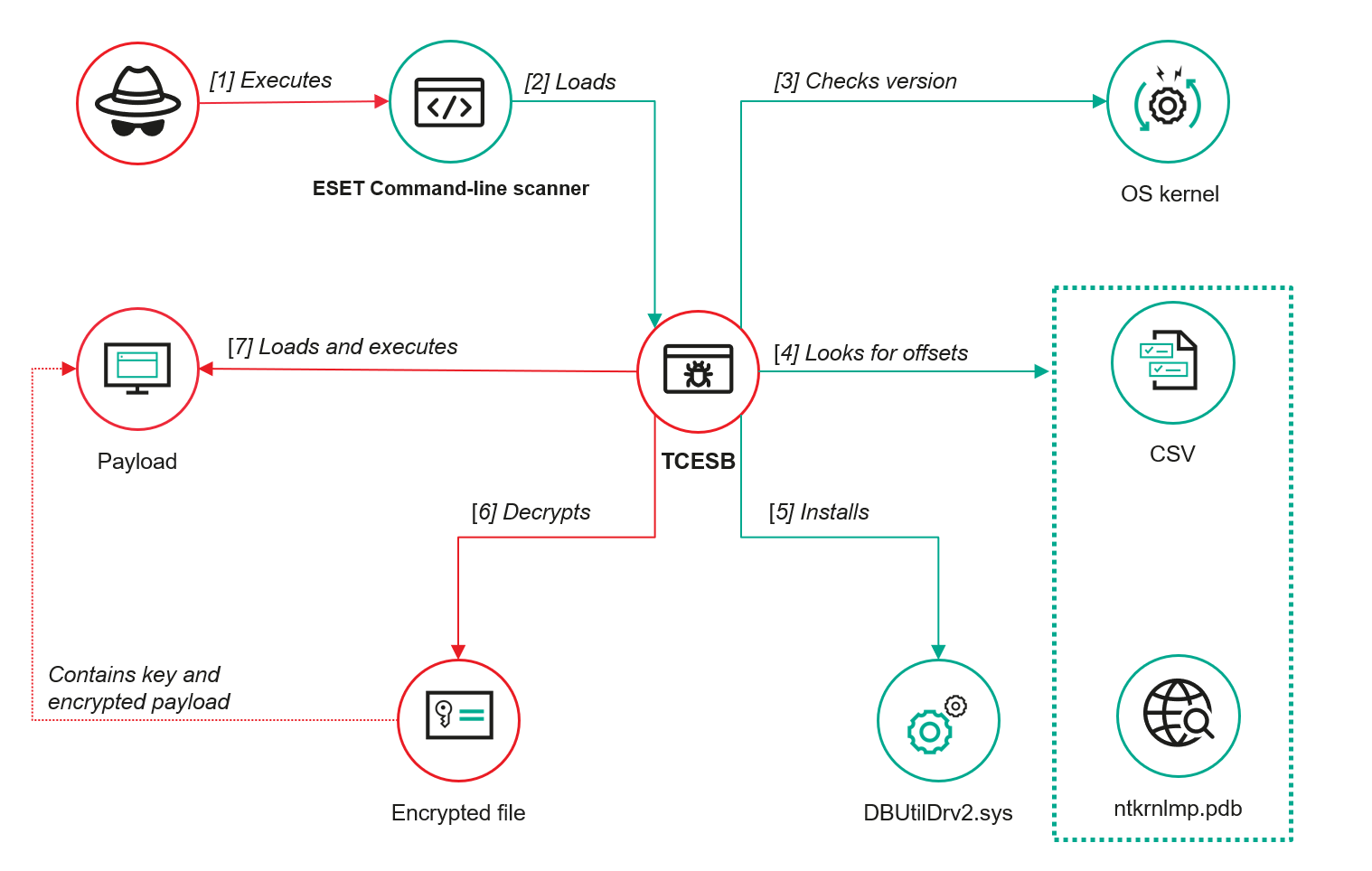
This 64-bit DLL, written in C++, turned out to be a complex tool called TCESB. Previously unseen in ToddyCat attacks, it is designed to stealthily execute payloads in circumvention of protection and monitoring tools installed on the device.
Kaspersky products detect this tool as Trojan.Win64.ToddyCat.a, Trojan.Win64.ToddyCat.b.
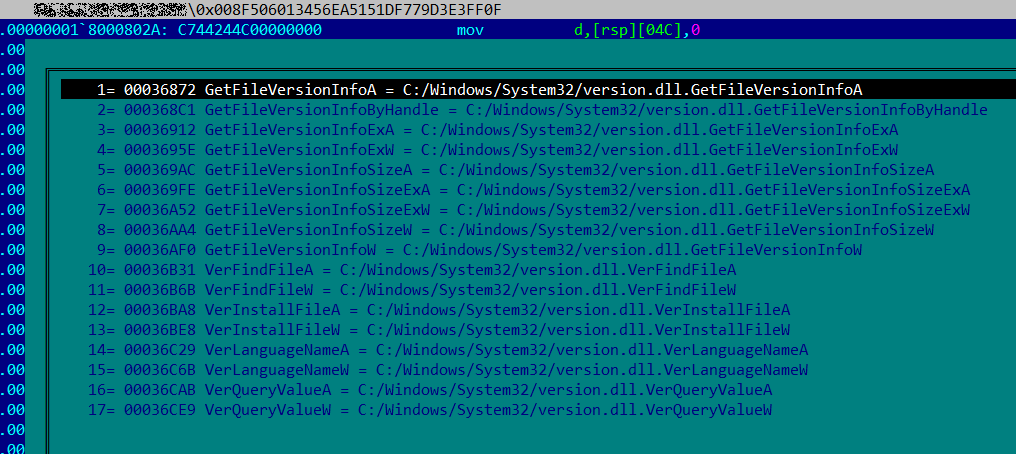
Static analysis of the DLL library showed that all functions exported by it import functions with the same names from the system file version.dll (Version Checking and File Installation Libraries).
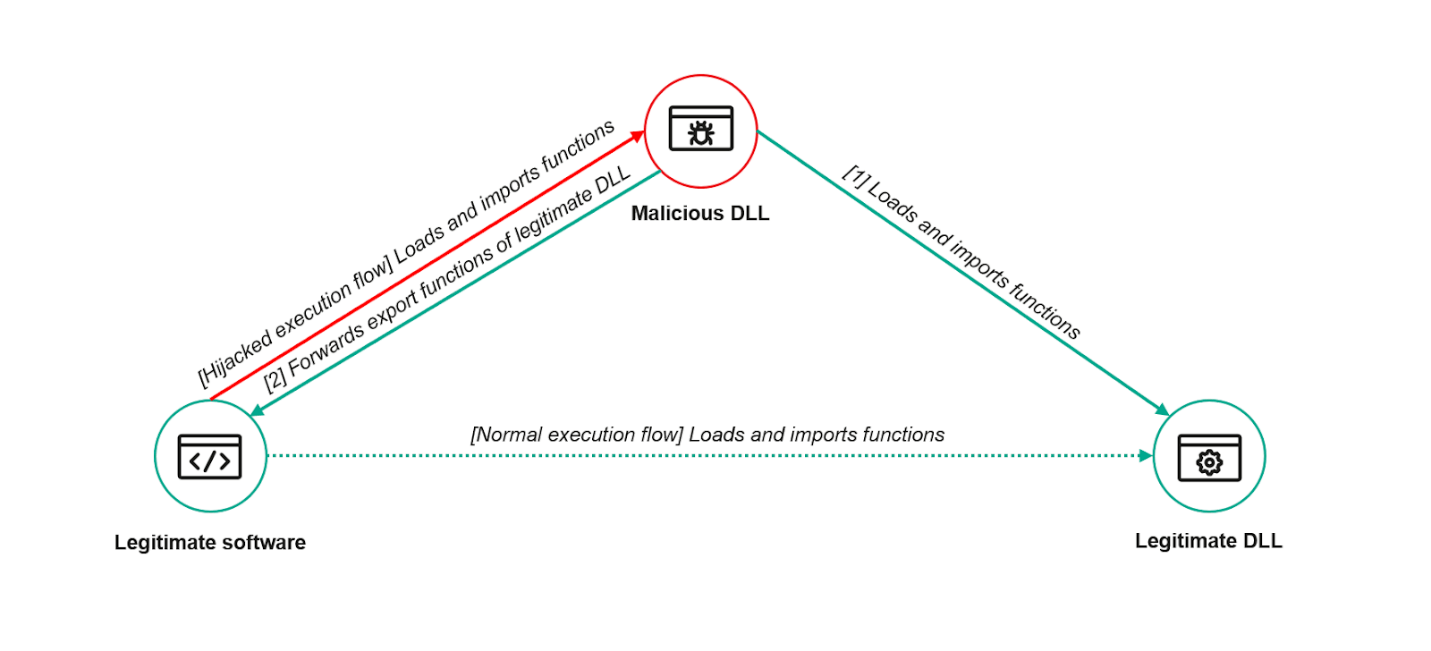
This indicates that the attackers use a DLL-proxying technique (Hijack Execution Flow, T1574) to run the malicious code. By means of this technique, a malicious DLL exports all functions of a legitimate one, but instead of implementing them, redirects calls to these functions to the original DLL. This way, an application that loads the malicious library will continue to work as normal, with the malicious code running in the context of this application in the background.
However, this is not enough to launch malware. For a malicious DLL to be able to take control, the application that loads it must contain insecure code. Such code searches for loaded dynamic library images in folders where they should not be located. If one of these folders contains a malicious library, the vulnerable application will load it instead of the legitimate one. Microsoft has an official advisory on preventing unsafe DLL loading.
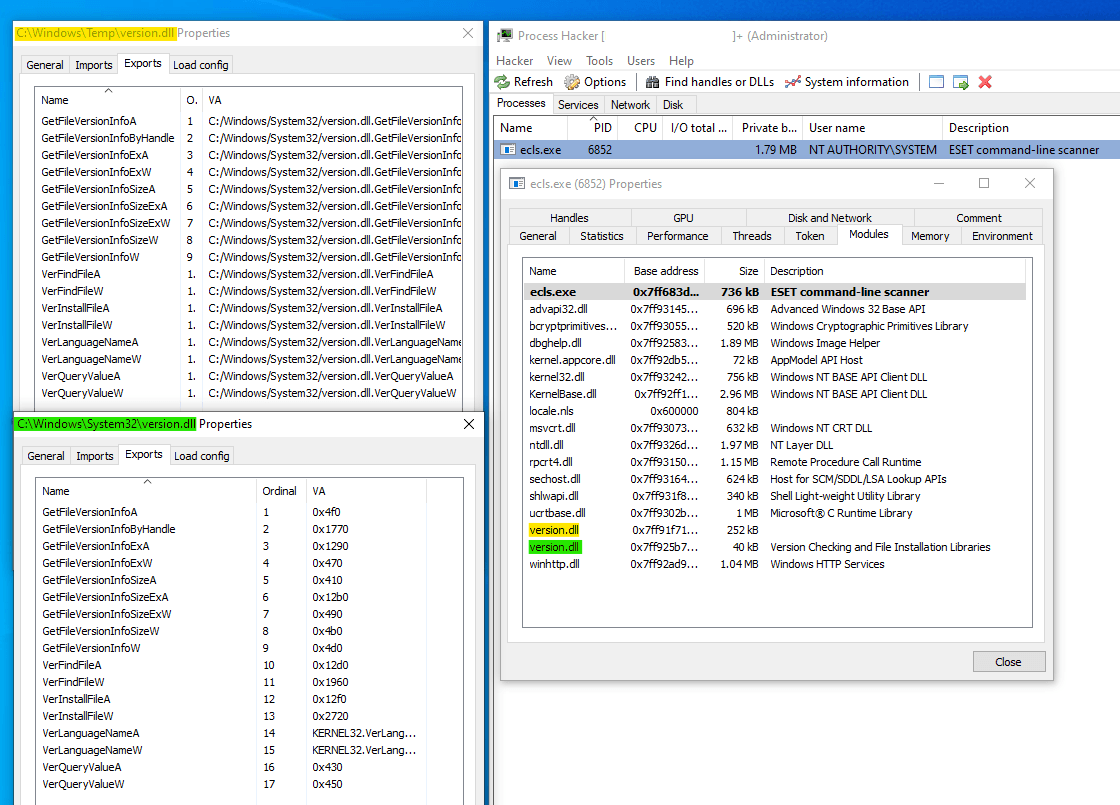
It took us a while to find the file that loads the TCESB tool. We studied the system directories on devices where the malicious DLLs were found. On one of these, in the same folder as TCESB, there was an extensionless executable file named ecls. We believe that the operator, when transferring files to the device, made a mistake in the filename and moved two copies of it. After performing malicious activity, the file with the extension was deleted, while the other one remained in the system. This file turned out to be a component of ESET’s EPP solution – a scanner launched from the command line (ESET Command line scanner). Dynamic analysis showed that the scanner insecurely loads the system library version.dll, first checking for the file in the current directory, then searching for it in the system directories. This can result in a malicious DLL library being loaded, which constitutes a vulnerability. We compiled a report with a detailed description of it, and sent it to ESET as part of the Coordinated Vulnerability Disclosure process. ESET registered the CVE-2024-11859 vulnerability, then on January 21, 2025 released an update for the ecls file patching the security issue. On April 4, information about this vulnerability appeared in an ESET security advisory.
To analyze TCESB, we ran it in a virtual environment. In the address space of the ESET Command-line scanner process, we can see two version.dll files. One is the system library, the other is the DLL of the TCESB tool.
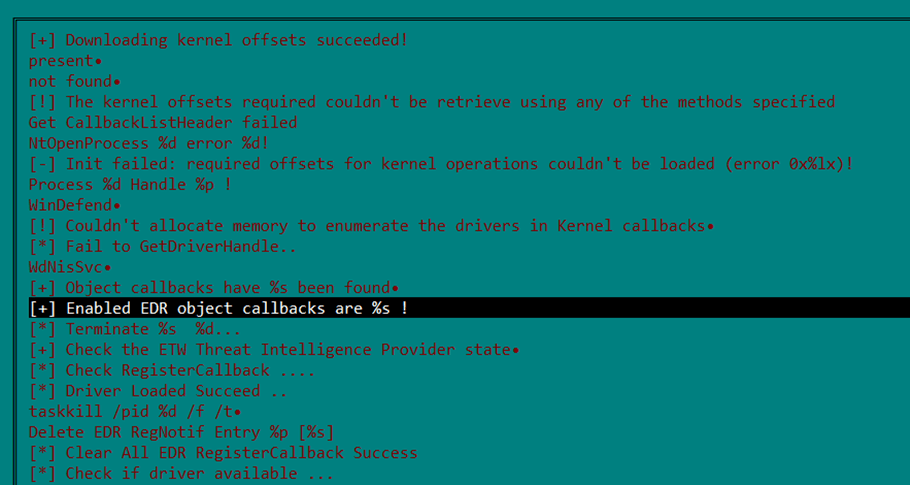
To determine the main functions of the malicious tool, we examined the strings located in its DLL.
The strings are not obfuscated. The search shows that most of them belong to the open-source malicious tool EDRSandBlast, designed to bypass security solutions. Kaspersky solutions detect it with the verdict HEUR:HackTool.Win64.EDRSandblast.a. ToddyCat created the TCESB DLL on its basis, modifying the original code to extend the malware’s functionality. The resulting tool’s capabilities include modifying operating system kernel structures to disable notification routines, for example, about a process creation event in the system or a load event.
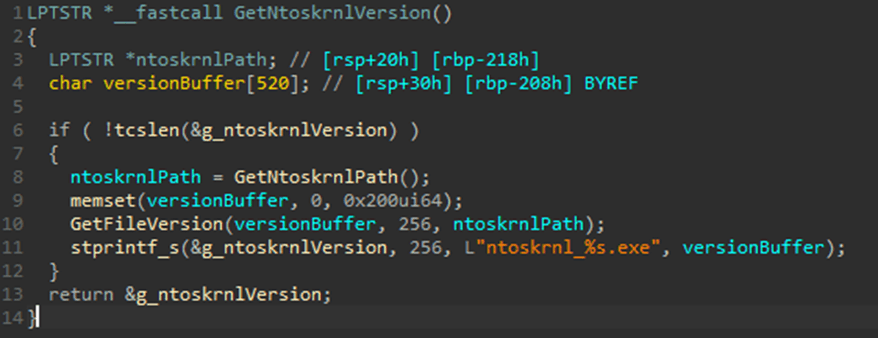
To find the structures in the kernel memory needed to disable notification routines, TCESB determines the version of the Windows kernel in the context of which it is running. To do this, it uses the GetNtoskrnlVersion() function.
Next, to get information about the memory offsets of the structures corresponding to the operating system kernel version, TCESB uses one of two data sources: a CSV or PDB file.
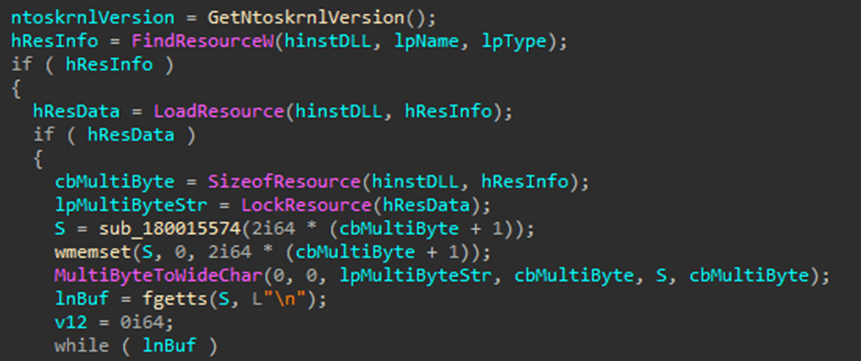
First, the tool checks the CSV file contained in its own resources section. Stored there in table form is information about several popular kernel versions and their corresponding offsets.
TCESB searches this file line by line for a match with the previously obtained version of the current Windows kernel.
We studied the CSV file in the EDRSandBlast repository and its change history. The contents of the TCESB CSV fully match the CSV data in the EDRSandBlast version of August 13, 2022, while the original malware commit of October 6, 2023 adds lines that are missing in the TCESB resource. This indicates a time period during which the creators of TCESB used the EDRSandBlast code.
If the CSV file does not contain data on structures corresponding to the required kernel version, TCESB reads their addresses from the PDB file. To get it, the malware accesses the file C:WindowsSystem32ntoskrnl.exe, which contains information about the kernel file version, and inserts the data from this file into the following template, generating a URL:
|
1 |
https://msdl.microsoft.com/download/symbols/%s/%08X%04hX%04hX%016llX%X/%s |
This is the address of Microsoft debug information server, where TCESB sends a GET request to download the PDB file. The received file is saved in the current TCESB directory, and data on the offsets of the required kernel memory structures are read from it.
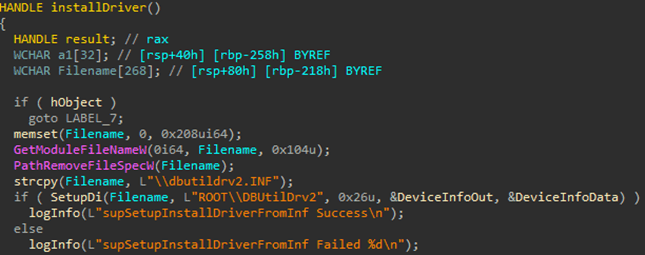
To modify the kernel structures that store callbacks used to notify applications of system events, TCESB deploys the Bring Your Own Vulnerable Driver (BYOVD) technique (Exploitation for Defense Evasion, T1211). It does this by installing a vulnerable driver in the system through the Device Manager interface, using an INF file with installation information.
TCESB uses the Dell DBUtilDrv2.sys driver, which contains the CVE-2021-36276 vulnerability. This is a utility driver used to update PC drivers, BIOS and firmware.
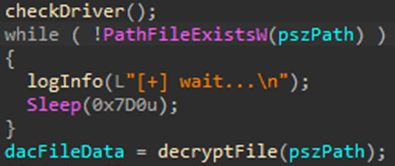
Once the vulnerable driver is installed in the system, TCESB runs a loop in which it checks every two seconds for the presence of a payload file with a specific name in the current directory – the payload may not be present at the time of launching the tool. Presumably, this is to allow the operator to verify that the tool was run without errors, so that the payload file can be moved without risk of detection. As soon as the file appears in the path being checked, it is passed to the decryption function.
The tool creates its own log file for recording all stages of execution in detail.
We studied two samples of the TCESB tool. Although we were unable to obtain the payload files, our research shows that they have different names ( kesp and ecore) and both are extensionless.
Our analysis of the tool code found that the data in the payload file is encrypted using AES-128.
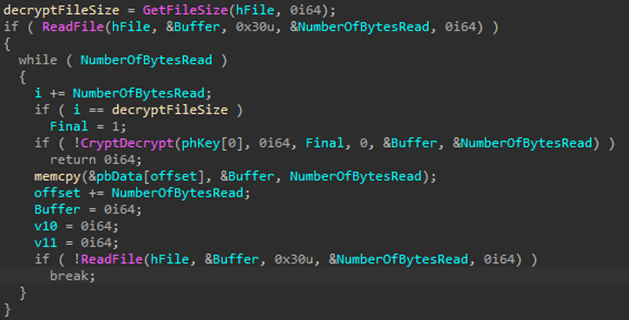
The decryption key is in the first 32 bytes of the payload file, followed by the encrypted data block. Below is a snippet of code for reading the key:
The key decrypts the data block:
The read data is placed in memory and executed.
We discovered a sophisticated tool that the ToddyCat APT group tried to use for stealth execution in compromised systems. This tool exploits a chain of vulnerabilities, as well as an old version of a known open-source malware that the attackers modified to extend its functionality.
To detect the activity of such tools, it’s recommended to monitor systems for installation events involving drivers with known vulnerabilities. Lists of such drivers can be found on the loldrivers project website, for example. It’s also worth monitoring events associated with loading Windows kernel debug symbols on devices where debugging of the operating system kernel is not expected. We also advise using operating system tools to check all loaded system library files for the presence of a digital signature.
D38E3830C8BA3A00794EF3077942AD96 version.dll 008F506013456EA5151DF779D3E3FF0F version.dll
8795271F02B30980EBD9950FCC141304 ESET Command-line scanner
B87944DCC444E4C6CE9BB9FB8A9C0DEF dbutildrv2.INF DE39EE41D03C97E37849AF90E408ABBE DBUtilDrv2.cat DACB62578B3EA191EA37486D15F4F83C dbutildrv2.sys
Source: European Parliament
The European Parliament,
– having regard to its previous resolutions on the Democratic Republic of the Congo (DRC),
– having regard to the Universal Declaration of Human Rights,
– having regard to the International Covenant on Civil and Political Rights,
– having regard to the Constitution of the Democratic Republic of the Congo (DRC), which guarantees the right to freedom of conscience and the free exercise of religious worship for all citizens,
– having regard to the UN Declaration on the Elimination of All Forms of Intolerance and of Discrimination Based on Religion or Belief, adopted by the UN General Assembly on 25 November 1981,
– having regard to the European Convention on Human Rights,
– having regard to Rules 136(2) and (4) of its Rules of Procedure,
A. whereas the eastern DRC has endured decades of widespread violence and instability; whereas the situation continues to deteriorate significantly, with persistent human rights violations by armed groups, mass displacement, attacks on civilians and alarming humanitarian conditions further exacerbated by armed conflicts, such as the conflict between the DRC Government, the Rwanda-backed armed rebel group March 23 Movement (M23) and other militias, which has already resulted in the forceful internal displacement of 4,6 million people in the eastern DRC; whereas around 100 separate armed groups are estimated to be operating in the eastern DRC; whereas a series of overlapping issues are driving destabilisation in the country;
B. whereas M23 has intensified attacks in North Kivu and on 19 March 2025, it seized the mineral-rich town of Walikale, defying the ceasefire;
C. whereas the Allied Democratic Forces (ADF) is one of the most prominent extremist groups with explicitly religious objectives, especially since its leader pledged allegiance to the so-called Islamic State of Iraq and Syria (ISIS) in 2019, becoming its Central Africa Province branch (ISCAP); whereas the ADF’s attacks need to be seen in the wider African context of a rise in the number of Islamist groups, in particular those affiliated to ISIS, in the Sahel region, the Horn of Africa, Mozambique, Nigeria and the DRC; whereas the ADF has been designated a terrorist group by Uganda and the United States;
D. whereas in May 2024, the UN Group of Experts on the DRC warned that the ‘armed group established strong networks in prisons, particularly in Kinshasa where ADF detainees were active in recruiting and mobilising combatants and collaborators’, using not only ideological means, but also coercion, deception, abduction and financial incentives to attract members and collaborators;
E. whereas the ADF has a long history of committing terrorist attacks in the eastern DRC, particularly in North Kivu and Ituri provinces; whereas North Kivu is a resource-rich region, with vast supplies of critical raw materials including cobalt, gold and tin, which are necessary for the global digital and energy transitions; whereas it is known that the ADF and other armed groups, including M23, have been relying on, among other sources of financing, the illegal exploitation of these resources to fund their activities; whereas the Congolese Catholic Church claims that the ADF is responsible for the deaths of around 6 000 civilians in Beni between 2013 and 2021 and more than 2 000 in Bunia in 2020 alone; whereas in 2024, a large number of Christians were killed in the DRC by jihadists; whereas civilians in the DRC’s eastern provinces are facing an increasing number of attacks, killings and abductions, as well as church bombings and the destruction of (religious) property, perpetrated by armed groups with extremist and jihadist ideologies; whereas most victims of ADF attacks have been Christian; whereas these attacks undermine religious freedom and exacerbate intercommunal tensions; whereas the Catholic bishops of the DRC spoke out in an April 2021 statement about the threat of the ‘Islamization of the region [North Kivu] as a sort of deeper strategy for a long-term negative influence on the general political situation of the country’;
F. whereas in 2021, a prominent local Muslim leader received death threats from the ADF, and he was later gunned down; whereas in 2023, the ADF bombed services at a Pentecostal church in Kasindi, killing 14 people; whereas the ADF has been linked to an attack on the village of Mukondi in 2023, in which at least 44 civilians were killed, according to local authorities; whereas the group claimed 48 attacks in December 2024 alone, killing over 200 people; whereas in January 2024, the ADF killed eight people in Beni during an attack on a Pentecostal church and, in May 2024, ADF assailants reportedly killed 14 Catholics in the North Kivu province for refusing to convert to Islam; whereas the ADF also reportedly executed 11 Christians in the village of Ndimo in Ituri province and kidnapped several others;
G. whereas local and international human rights organisations have documented numerous instances of religious violence in the DRC, while stressing the urgent need for the state to provide adequate protection; whereas, while the DRC Government has demonstrated a strong intention to address the impacts of armed group violence in the eastern DRC, other recent developments call into question the government’s commitment to safeguarding religious freedom specifically; whereas women and children are particularly vulnerable to rape as weapon of war, human trafficking and sexual slavery;
H. whereas the Armed Forces of the DRC have been conducting a joint military offensive, Operation Shujaa, with the Ugandan People’s Defence Force against the ADF and other insurgent forces in the eastern DRC since November 2021; whereas the conflict between the DRC Government and the Rwanda-backed M23 rebels has led to a decrease in the funds, personnel and equipment being allocated to this counterterrorism operation;
I. whereas the right to freedom of religion and belief is a fundamental human right and must be protected given the high level of violence and persecution; whereas the Constitution of the DRC provides for freedom of religion and prohibits discrimination based on religious belief;
J. whereas over 7 million people in the DRC are currently displaced because of the wider ongoing conflicts, with limited access to food, water, healthcare and essential services; whereas state authorities and rebel groups have obligations to civilians under international humanitarian law, including protecting and facilitating access to humanitarian assistance, and permitting freedom of movement;
K. whereas women and children in the DRC face increased levels of sexual and gender-based violence, including rape as a weapon of war, resulting in there being one victim of rape every four minutes;
L. whereas the illegal exploitation of mineral resources continues to fuel conflict in the region, necessitating stronger international oversight and responsible sourcing policies;
M. whereas in March 2025, President Félix Tshisekedi of the DRC and President Paul Kagame of Rwanda issued a joint statement announcing a ceasefire; whereas despite this, the violence perpetrated by the Rwanda-backed M23 rebels continues;
N. whereas the DRC has one of the highest rates of internal displacement in the world; whereas many women and children live in precarious conditions and are being exposed to the risk of harassment, assault, sexual exploitation and forced military recruitment; whereas displaced populations often receive no basic life-saving services and are at risk of malnutrition and disease; whereas cities that host internally displaced people in precarious circumstances are also targets of attacks by different militias, causing great distress to the displaced communities and to the local population;
O. whereas the EU has committed to supporting stability in the DRC through diplomatic engagement, financial assistance and targeted sanctions against individuals responsible for violence and human rights abuses; whereas on 17 March 2025, the EU imposed sanctions on nine individuals and one entity responsible for acts that constitute serious human rights violations and abuses or that sustain the conflict in the DRC, including through the illegal exploitation of resources, but further diplomatic and economic measures may be necessary;
P. whereas the Council has renewed the EU’s financial support for the deployment of Rwandan Defence Force (RDF) troops in Mozambique under the European Peace Facility (EPF); whereas the head of these forces was previously deployed in the eastern DRC to support abuses committed by the Rwanda-backed M23 rebels, giving rise to serious doubt as to whether there are sufficient safeguards attached to EPF support, including effective vetting and other human rights requirements;
Q. whereas the EU has repeatedly affirmed its commitment to the promotion and protection of religious freedom globally, and has taken steps to combat religious persecution and intolerance in various parts of the world; whereas Christians are the largest persecuted religious group in the world;
R. whereas Parliament has consistently called for the strengthening of international efforts to combat religious persecution and to hold accountable those responsible for attacks on minority communities;
1. Strongly condemns the occupation of Goma and other territories in the eastern DRC by M23 and the RDF as an unacceptable breach of the DRC’s sovereignty and territorial integrity; urges the Rwandan Government to withdraw its troops from DRC territory, the presence of whom is a clear violation of international law and the UN Charter, and cease cooperation with the M23 rebels; demands that Rwanda and all other potential state actors in the region cease their support for M23;
2. Expresses deep concern at the alarming continuation of violence; deplores the loss of life and the attacks, both indiscriminate and targeted, against civilians; expresses deep concern over the worsening security and humanitarian crises in the eastern DRC as a whole; calls for the immediate cessation of all forms of violence and for the commitment of all parties involved in the ongoing conflict in the eastern DRC to respect international humanitarian law;
3. Strongly condemns the targeted terrorist attacks carried out by the ADF against Christian communities in the eastern DRC, including killings, abductions and the destruction of religious property, and calls for an immediate halt to such acts of violence; expresses its solidarity with the families of the victims and with Christian communities;
4. Strongly condemns the Rwanda-backed M23 rebel group and the ADF, as well as other rebel groups, and their egregious human rights abuses that amount to crimes against humanity in accordance with the Rome Statute of the International Criminal Court (ICC); underlines that there must be no impunity for the perpetrators of these acts and that those responsible should be referred to the ICC; encourages the establishment of an international commission of inquiry to examine the human rights violations committed in the DRC, renewed investigations in North Kivu by the ICC Prosecutors Office and the creation of a special tribunal for atrocity crimes in the DRC, including crimes committed against Christian communities; backs the efforts by the National Episcopal Conference of Congo and the Church of Christ in Congo, which launched the ‘Social pact for peace and coexistence in the Democratic Republic of Congo and the Great Lakes Region’, with the aim of restoring peace in the country’s eastern provinces;
5. Supports the international efforts against the ADF, including the Shujaa counterterrorism operation carried out jointly by the DRC and Ugandan armed forces; encourages the EU Member States to consider ways of contributing to these efforts, including increased efforts to trace and interdict ISIS secret funds held overseas and to trace any raw materials stemming from their illegal exploitation by the ADF; calls for the EU to support the necessary capacity-building and expertise to combat ADF ideology and rhetoric, particularly within the Muslim communities of both Uganda and the DRC, to prevent recruitment among those communities; requests the application of the EU global human rights sanctions regime to those responsible for planning, ordering or participating in the killing of Christians in the DRC;
6. Calls for an immediate and effective ceasefire, and for the full implementation of diplomatic agreements, including the Luanda and Nairobi peace processes; underlines the urgent need for the stabilisation of the country and reiterates its call on M23 to halt its territorial advances and withdraw from the territory of the DRC;
7. Reiterates its full support for the UN Organization Stabilization Mission in the DRC (MONUSCO) in protecting civilians and stabilising the region; urges the EU to cooperate with all actors on the ground, in particular MONUSCO, to ensure the protection of civilians in the eastern DRC; calls on the UN to work towards a stronger mandate for MONUSCO in order to enable peacemaking; calls on the UN to ensure the protection of civilians and respect for international humanitarian law;
8. Urges the international community to increase support for services in the eastern DRC so that civilians who have been targeted can have access to legal services and psychological support; calls on the DRC Government to counter extremist propaganda; calls for the establishment of early warning mechanisms to more effectively prevent and respond to attacks by the ADF and other armed groups against civilians;
9. Reiterates its call for all parties, including armed groups operating in the eastern DRC, to allow and facilitate humanitarian access to address the urgent need for essential services in the eastern DRC and neighbouring countries, notably Burundi; emphasises that humanitarian workers must be able to operate safely to deliver life-saving assistance to Congolese civilians; stresses that this is a central obligation under international humanitarian law, and that perpetrators violating these obligations should be held to account; calls on all parties to provide a safe environment for civil society organisations;
10. Is appalled by the shocking use of sexual violence against women and children as a tool of repression and weapon of war in the eastern DRC, and by the unacceptable recruitment of child soldiers by the various rebel groups; demands that these matters be addressed by the international community without delay;
11. Calls for stricter enforcement of the EU regulation on conflict minerals(1) to prevent illicit trade from fuelling armed groups in the DRC; reiterates its previous call on the Commission to suspend the EU’s Memorandum of Understanding with Rwanda; requests that the Commission share detailed mapping of current projects with Rwandan authorities and its assessment of whether they may contribute to addressing or may fail to address human rights violations either inside Rwanda or in the DRC;
12. Calls for the EU and its Member States to support the DRC in implementing the recommendations of the 2010 mapping report by the Office of the UN High Commissioner for Human Rights (OHCHR), including reforming the security sector, strengthening its efforts to prevent further atrocities against civilians, and ending support for or collaboration with abusive armed groups; urges the DRC Government to ensure accountability for human rights violations and prosecute those responsible for attacks; calls for the EU and its Member States to support the DRC in fighting corruption, strengthening governance and the rule of law, improving security and ensuring the lasting protection of communities at risk, including religious communities, and to ensure that perpetrators of attacks are brought to justice;
13. Underlines the role of communities, including religious communities and faith-based organisations in the DRC, in promoting peace, social cohesion and the well-being of local communities;
14. Calls on the Commission and the European External Action Service to intensify diplomatic efforts by working closely with regional partners, including the African Union, the East African Community and the United Nations, in order to step up diplomatic efforts to achieve a sustainable resolution to the conflict and prevent extremist groups from using religion as a tool for violence and division;
15. Calls on the Commission and the Member States to increase humanitarian aid to address the urgent needs of displaced persons and vulnerable communities in the DRC, ensuring safe access to food, medical care and shelter;
16. Supports the imposition of further targeted EU sanctions against individuals and entities responsible for financing or engaging in violence, human rights abuses and resource exploitation; calls for the implementation of the sanctions outlined in the OHCHR mapping report;
17. Confirms its commitment to freedom of thought, conscience and religion as a fundamental human right guaranteed by international legal instruments recognised as holding universal value, and to which most countries in the world have committed, and which is enshrined in the Constitution of the DRC;
18. Echoes the calls for international solidarity in defending religious freedom and the protection of religious minorities in conflict zones, particularly in the DRC, while addressing the root causes of violent extremism in the DRC and its neighbourhood;
19. Urges the EU to uphold its commitment to the promotion of religious freedom and the protection of communities, including religious communities, ensuring that the rights of these groups are prioritised in the EU’s external policies;
20. Notes, with concern, the growing influence of the Russian Orthodox Church in Africa, which is a staunch supporter of the Putin regime and its violent, unlawful war in Ukraine; underlines that this development raises significant questions regarding the broader geopolitical and ideological objectives of the Russian Federation in Africa;
21. Deplores the fact that Rwanda announced the termination of its diplomatic relations with Belgium, and expresses its solidarity with Belgium;
22. Instructs its President to forward this resolution to the Council, the Commission, the Vice-President of the Commission / High Representative of the Union for Foreign Affairs and Security Policy, the Governments and Parliaments of the Democratic Republic of the Congo and Rwanda, the African Union, the secretariats of the United Nations Organization Stabilization Mission in the Democratic Republic of the Congo, the Southern African Development Community and the East African Community, and other relevant international bodies.
|
Source: European Parliament
The European Parliament,
– having regard to Rules 150(5) and 136(4) of its Rules of Procedure,
A. whereas press freedom in Cameroon is deteriorating; whereas the Cameroonian Constitution recognises freedom of expression and fundamental rights; whereas journalists are routinely detained, attacked, censored, and imprisoned on anti-state, criminal defamation, ‘fake news’, and retaliatory charges while reporting on the crisis in Cameroon’s English-speaking regions;
B. whereas Cameroon uses lengthy pre-trial and arbitrary detention; whereas journalists have been held incommunicado and convictions are handed down by military courts, among other serious violations of fair trial and due process rights;
C. whereas the UN Committee against Torture, Freedom House and the Committee to Protect Journalists recently reported that Cameroon’s police, gendarmes and other government agents have arrested, detained, physically attacked and intimidated journalists and that, once detained, journalists are often ill-treated, tortured and killed;
D. whereas Tsi Conrad, Mancho Bibixy, Kingsley Fomunyuy Njoka and Thomas Awah Junior are journalists who reported on the situation in Cameroon’s English-speaking regions, including on abuses perpetrated during the armed conflict and ongoing civil unrest; whereas Amadou Vamoulké, a journalist in poor health, was sentenced to 32 years in prison for his independent management of the state broadcaster;
E. whereas the journalists Martinez Zogo, Jean-Jacques Ola Bebe, Samuel Wazizi and Anye Nde Nsoh were killed between August 2019 and May 2023, and serious questions about accountability remain unanswered;
F. whereas the EU is Cameroon’s leading trade partner;
1. Condemns the structural violations of journalists’ human rights by the Cameroonian authorities, calls on those authorities to ensure that press freedom is respected, particularly in the run-up to Cameroon’s 2025 presidential elections, and urges them to immediately and unconditionally release Amadou Vamoulké, Kingsley Fomunyuy Njoka, Mancho Bibixy, Thomas Awah Junior and Tsi Conrad and ensure, in the meantime, that their basic rights are upheld and that they have access to medical treatment;
2. Calls for the EU and the Member States to raise cases of detained journalists with the Cameroonian authorities; calls for the EU to use its diplomatic and economic leverage to achieve tangible improvements in human rights in Cameroon;
3. Urges the Commission, the EEAS and the Member States’ diplomatic missions to actively respond to restrictions against journalists, including by ensuring comprehensive observation of trials, visiting journalists in detention and maintaining active contact with marginalised or at-risk journalists and with their families and colleagues;
4. Urges the Cameroonian authorities to end their practice of trying civilians in military courts, which does not comply with international law, and to stop abusively invoking terrorism, anti-state and ‘fake news’ charges in cases against journalists;
5. Reiterates its call on the Member States to support a UN Human Rights Council fact-finding mission to Cameroon, particularly in light of the conflict in the North-West and South-West Regions;
6. Calls on the Member States to facilitate humanitarian visa applications for Cameroonian journalists at risk of persecution;
7. Instructs its President to forward this resolution to the Council, the Commission, the VP/HR and the President, Government and Parliament of Cameroon.
Source: GlobeNewswire (MIL-OSI)
SINGAPORE, April 07, 2025 (GLOBE NEWSWIRE) — Trident Digital Tech Holdings Ltd (NASDAQ: TDTH) (“Trident” or the “Company”), a Singapore-based leader in digital transformation, technology optimization, and Web 3.0 activation, today announced progress in its pioneering public-private partnership (PPP) with the Democratic Republic of Congo (DRC). This follows a series of engagements in the country during a recent delegation led by Soon Huat Lim, Founder, Chairman, and Chief Executive Officer of Trident, showcasing the transformative potential of the Company’s digital identification technology.
On March 15th, 2025, a significant moment took place in Kinshasa as H.E. Augustin Kibassa Maliba, DRC Minister of Posts, Telecommunications, and Digital Technology, initiated the validation phase of the collaboration. At the event, Minister Kibassa detailed the government’s commitment to driving the initiative forward, including embedding the technology into public and private services, launching a nationwide awareness and training program, enhancing technological infrastructure with sovereign cloud systems and secure data centers, and promoting local innovation by empowering startups and digital stakeholders to strengthen the digital ecosystem.
Caption: Trident CEO Soon Huat Lim at the project validation work launch in Kinshasa, DRC, on March 15, 2025.
Mr. Lim joined the event and highlighted the transformative power of this secure digital identity solution: “This initiative will transform all sectors of our economy by reducing identity fraud and cybercrime to protect our digital future, revolutionizing public administration through less bureaucracy and greater transparency, accelerating financial inclusion by providing millions of unbanked citizens access to banking services and digital payments, facilitating student identification, online learning, and academic verification in education, and enabling better healthcare access with secure medical records.”
With validation efforts underway, Trident and the DRC government are set to deploy a secure, inclusive digital identity system that promises transformative opportunities for Congolese citizens, delivering significant impact such as the creation of over 30,000 direct and indirect jobs in digital technology, cybersecurity, administration, and services; a 40% increase in financial inclusion, enabling millions to access banking and digital services; a 50% reduction in administrative delays to enhance the efficiency and accessibility of public services; stimulation of economic growth through facilitated cross-border trade and investment; and, improved social protection and public services via secure digital identification for healthcare, education, and social assistance.
Minister Kibassa reinforced this outlook, emphasizing the project’s profound significance. He noted that this stands as a revolutionary step toward enhancing governance, inclusion, and transparency, serving as a vital foundation for economic transformation under the leadership of His Excellency President Félix Tshisekedi and Her Excellency Prime Minister Judith Suminwa, according to Minister Kibassa’s remarks.
“Thanks to the cutting-edge technologies such as Web 3.0 blockchain, artificial intelligence, biometrics, and zero-knowledge proofs, Trident will redefine trust in digital interactions. This is more than a tool—it’s a catalyst for transformation across the nation and the continent,” adds Lim.
Throughout his visit in the DRC, Lim also met with government officials, local innovators, and business leaders to foster collaboration and cultivate the digital ecosystem. He reaffirmed Trident’s commitment to empowering Congolese startups and digital enterprises, ensuring the project drives local economic growth while establishing the DRC as a leader in Africa’s digital revolution.
About Trident Digital Tech Holdings Ltd
Trident Digital Tech Holdings Ltd (NASDAQ: TDTH), headquartered in Singapore, is a global leader in digital optimization, technology services, and Web 3.0 activation. The Company delivers cutting-edge digital solutions to enhance client experiences and promote digital adoption. Its flagship product, Tridentity, is a blockchain-based identity platform offering secure single sign-on authentication for integrated third-party systems across industries. Designed with unparalleled security features, Tridentity protects sensitive data and mitigates threats, heralding a new era of trust in the global digital landscape. Beyond Tridentity, Trident aims to lead Web 3.0 activation worldwide, connecting businesses to reliable, tailored, and optimized technological platforms.
Media Relations
Brad Burgess, SVP
ICR, LLC
Email: Brad.Burgess@icrinc.com
A photo accompanying this announcement is available at https://www.globenewswire.com/NewsRoom/AttachmentNg/0f9be26d-abe5-42cf-8cd9-51768931bbe8
Source: GlobeNewswire (MIL-OSI)
Press contact:
Mollie Mellows
Tel.: + 44 (0)7342 709384
E-mail: mollie.mellows@capgemini.com
Capgemini to establish AI Center of Excellence in Egypt to accelerate AI-driven innovation for global clients
Cairo, April 7, 2025 – Capgemini today announced it will establish an AI Center of Excellence (CoE) in Egypt focused on accelerating the generative and agentic AI transformation journeys of clients worldwide. Through this new cutting-edge AI hub, Capgemini will invest in research and development, collaborate with local academic institutions, and leverage technology partnerships to help accelerate client adoption of AI at scale. This initiative bolsters Capgemini’s strong ties with Egypt as a strategic innovation hub for global organizations. It also further cements Capgemini’s leadership in AI, reinforcing its commitment to developing talent, leveraging strategic industry partnerships, and accelerating AI-driven innovation to unlock significant value for clients.
Capgemini is committed to driving continued growth and innovation in Egypt. By the end of 2025, it plans to double the number of employees in the country, reaching approximately 1200 highly talented professionals in the fields of digital transformation and innovation.
The new AI hub will house a diverse team of architects, data scientists, product engineers, and project managers, expert in delivering transformative projects from business operations and design to engineering. Clients will benefit from the advantages of time zone alignment, multi-lingual skills, and ease of travel to this conveniently located Global Delivery Center.
“The AI Center of Excellence in this strategic location allows us to support our clients in scaling AI within their own businesses, ensuring they remain at the forefront of innovation,” said Aiman Ezzat, CEO of Capgemini, on the occasion of the France-Egypt Investment Forum. “By investing in the region’s impressive talent and establishing this dedicated AI hub, we are not only fostering significant technological advancements but also creating a robust ecosystem for AI development. Our clients will benefit from enhanced service delivery, industry-specific solutions, and the unique advantages of being supported from Egypt.”
With implementation starting in May 2025, the new AI hub will apply Capgemini’s deep industry-specific expertise to develop intelligent agents that are bespoke to highly regulated industries, such as energy, life sciences and aerospace. It is designed for clients to explore, design and implement cutting-edge technologies that can optimize operations and strategically transform their business, including supply chain and product innovation. By applying advanced algorithms and machine learning techniques, Capgemini will help clients across Europe, America, the Middle East, and Asia elevate customer experience to a strategic value driver.
Hossam Seifeldin, CEO of Capgemini in Egypt, said “Egypt is experiencing an impressive growth trajectory, fueled by digitalization and exceptional talent in AI. I am excited to build on the strong foundation we have established in the region. Doubling our workforce and establishing this new AI Center of Excellence will not only drive cutting-edge innovation but also create valuable opportunities for local talent to thrive in a global arena.”
About Capgemini
Capgemini is a global business and technology transformation partner, helping organizations to accelerate their dual transition to a digital and sustainable world, while creating tangible impact for enterprises and society. It is a responsible and diverse group of 340,000 team members in more than 50 countries. With its strong over 55-year heritage, Capgemini is trusted by its clients to unlock the value of technology to address the entire breadth of their business needs. It delivers end-to-end services and solutions leveraging strengths from strategy and design to engineering, all fueled by its market leading capabilities in AI, generative AI, cloud and data, combined with its deep industry expertise and partner ecosystem. The Group reported 2024 global revenues of €22.1 billion.
Get The Future You Want | www.capgemini.com
Attachment
Source: United Kingdom – Government Statements
The UK Defence Secretary, John Healey MP, met family members of the late Agnes Wanjiru,to express his condolences.
The Defence Secretary meets the family of the late Agnes Wanjiru in Kenya.
The UK Defence Secretary, John Healey MP, today met family members of the late Agnes Wanjiru, who was killed in Nanyuki, Kenya in 2012 to express his condolences. Fulfilling the commitment he made soon after entering office.
This is the first time a UK Government Minister has met with Agnes Wanjiru’s family.
It was deeply humbling to meet the family of Agnes Wanjiru today. In the 13 years since her death, they have shown such strength in their long fight for justice. I reiterated my determination to see a resolution to the still unresolved case.
We will continue to offer our full support to the Kenyan investigatory authorities, which has included visits by Kenyan investigators to the UK to interview witnesses and of the Provost Marshal (Serious Crime) to Kenya. In my meeting with President Ruto later today, I will emphasise the need to accelerate progress in this case. Our Government will continue to do everything we can to help the family secure the justice they deserve.
The death of our beloved Agnes has had a profound and devastating impact on our family. It was not only the shock of losing Agnes at such a young age, but also the horrific circumstances in which her body was found and all the trauma and struggle our family has been put through in trying to seek justice and accountability for her death that has taken a very heavy toll on all of us.
It is now more than 13 years since Agnes was killed and almost 6 years since a Kenyan inquest found that she had been murdered by British soldiers, yet so little progress appears to have been made since then.
We are grateful to the Secretary of State for Defence agreeing to meet with us, but we have waited for too many years and been offered too many empty promises. We hope that our meeting with the Secretary of State marks the beginning of the UK government and Ministry of Defence taking decision action to ensure that what happened to Agnes is properly investigated in Kenya and in the UK and to make sure that what happened to Agnes never happens again. We expect the UK and Kenyan governments to act and bring closure to this matter.
Source: GlobeNewswire (MIL-OSI)
Press release
Driving the solar revolution in Africa together: EWIA Green Investments acquires SunErgy
Munich, 7th April 2025. Two years after launching their collaboration on solar projects in sub-Saharan Africa, EWIA Green Investments GmbH (EWIA), SunErgy GmbH, and KGAL have decided to convert their partnership into a merger. Under the terms of a new agreement, EWIA will acquire all shares in SunErgy. In turn, SunErgy’s existing shareholders will take stakes in EWIA Green Investments GmbH. The merger aims to establish a leading solar provider for Africa, overseeing projects from planning and financing to implementation.
“Investments in solar and infrastructure drive growth and prosperity in Africa while countering the climate crisis,” said Ralph Schneider, Managing Director of EWIA. “Simultaneously, this market offers unparalleled potential for investors globally.”
“With an average age of 19, Africa is not only the continent with the youngest population but also the one with the greatest growth opportunities,” emphasizes Dr. Alexander Ergenzinger, Investment Manager at SunErgy’s main shareholder KGAL, and Managing Director of SunErgy GmbH.
600 million people on the continent still have to manage completely without electricity supply. In many African countries, high and steadily rising electricity prices, combined with frequent, prolonged power outages, pose a severe challenge to the economy and social stability. These outages must be compensated for with expensive diesel generators (costing approximately €0.50–0.80/kWh) – an unsatisfactory situation both economically and ecologically.
Africa, the solar continent
Due to its proximity to the equator and an annual sunshine duration ranging from 1,800 to 3,000 hours, sub-Saharan Africa boasts enormous potential for solar energy generation.
SunErgy (https://sunergy-power.org/) was founded in Norway in 2010 and aims to provide communities in emerging markets with off-grid solar energy through small turnkey solar power plants that are connected directly to customers’ buildings via their own power grid, so-called mini-grids.
Synergy thanks to SunErgy
SunErgy complements EWIA’s business. To date, the company has focused on selling solar systems to commercial and industrial customers under a solar-as-a-service model tailored for medium-sized enterprises. EWIA manages the planning, financing, construction, and operation of these systems, which are designed to largely self-finance through cumulative savings on diesel and grid electricity costs for customers. Geographically, operations have centred on Ghana and Nigeria. Following the acquisition, EWIA now employs 76 people.
Mini Grids for villages in Cameroon
SunErgy’s activities have so far been organized through SunErgy GmbH in Germany and its two subsidiaries in Cameroon, SunErgy Ltd. and 2 Mites Ltd. SunErgy Cameroon is responsible for the construction and operation of solar power plants in Cameroon, as well as for building solar power plants in other African countries. In September 2014, the company signed an agreement with the Republic of Cameroon to supply solar power to 92 villages in the southwest region, encompassing approximately 115,000 families (600,000 people), as well as schools, health centres, and private and public enterprises. Twelve municipalities have now been electrified through the construction of mini-grids.
“The merger of EWIA and SunErgy is a meaningful step toward realising our strategy of becoming one of the leading providers of solar solutions for sub-Saharan Africa,” affirms Ralph Schneider. “In addition to geographical expansion and diversification into the stand-alone solutions market, another crucial factor is that, with shareholders like KGAL, we gain established and experienced investors and investment professionals with proven expertise in the infrastructure sector, which constitutes a substantial enhancement.”
“KGAL has been providing investors with investment strategies in the renewable energy sector for over 20 years,” adds Michael Ebner, Managing Director of Asset and Portfolio Management at KGAL. “We are pleased to entrust SunErgy to EWIA and support the company’s continued growth. The African renewable energy market offers impact investors a wide array of opportunities.”
About EWIA Green Investments
EWIA provides small and medium-sized businesses in Africa with access to clean solar energy and serves as a bridge builder to investors in Europe as well as for the transfer of technology know-how. Based in Munich, Germany, with operating entities in Ghana and Nigeria, EWIA offers private and institutional investors access to attractive impact investments in the fight against climate change and for sustainable economic growth in Africa. With EWIA’s flexible full-service financing solution, companies in Africa have the opportunity to obtain solar power, financing, security and service from a single source. In the infrastructure sector, EWIA funds and constructs mobile phone communication masts and traffic monitoring systems and equips them with PV systems.
www.ewiainvestments.com + + + https://ewiafinance.de/
Contact for queries:
EWIA Green Investments GmbH
Ralph Schneider, CEO
ralph.schneider@EWIAinvestments.com
+49 162 1366 984
Schwarz Financial Communication
Frank Schwarz
schwarz@schwarzfinancial.com
+49 611 58029290
About KGAL
KGAL is a leading independent investment and asset manager with over €15 billion in assets under management. The company specialises in long-term real asset investments for institutional and private investors across real estate, sustainable infrastructure, and aviation. Founded 56 years ago, the Europe-wide group is headquartered in Grünwald near Munich. Its 396 employees contribute to achieving sustainably stable returns by accounting for risk and return (as of December 31, 2024).
Contact for queries:
KGAL GMBH & Co. KG
Markus Lang, Head of Marketing & Communications
markus.lang@kgal.de
+49 89 64143-307
Attachment
Source: GlobeNewswire (MIL-OSI)
The following is an update to the first quarter 2025 outlook and gives an overview of our current expectations for the first quarter. Outlooks presented may vary from the actual first quarter 2025 results and are subject to finalisation of those results, which are scheduled to be published on May 2, 2025. Unless otherwise indicated, all outlook statements exclude identified items.
See appendix for the definition of the non-GAAP measure used and the most comparable GAAP measure.
Integrated Gas
| $ billions | Q4’24 | Q1’25 Outlook | Comment |
| Adjusted EBITDA: | |||
| Production (kboe/d) | 905 | 910 – 950 | Impacted by unplanned maintenance, including in Australia. |
| LNG liquefaction volumes (MT) | 7.1 | 6.4 – 6.8 | Reflects weather impact (cyclones) and unplanned maintenance in Australia. |
| Underlying opex | 1.0 | 0.9 – 1.1 | |
| Adjusted Earnings: | |||
| Pre-tax depreciation | 1.4 | 1.2 – 1.6 | |
| Taxation charge | 0.6 | 0.7 – 1.0 | |
| Other Considerations: | |||
| Trading & Optimisation results are expected to be in line with Q4’24, despite a higher (non-cash) impact from expiring hedge contracts compared to the previous quarter. | |||
Upstream
| $ billions | Q4’24 | Q1’25 Outlook | Comment |
| Adjusted EBITDA: | |||
| Production (kboe/d) | 1,859 | 1,790 – 1,890 | |
| Underlying opex | 2.5 | 2.1 – 2.7 | |
| Adjusted Earnings: | |||
| Pre-tax depreciation | 2.8 | 1.9 – 2.5 | |
| Taxation charge | 2.6 | 2.4 – 3.2 | |
| Other Considerations: | |||
| The share of profit / (loss) of joint ventures and associates in Q1’25 is expected to be ~$0.2 billion. Q1’25 exploration well write-offs are expected to be ~$0.1 billion. The Q1’25 outlook reflects the completion of the SPDC divestment in March 2025. |
|||
Marketing
| $ billions | Q4’24 | Q1’25 Outlook | Comment |
| Adjusted EBITDA: | |||
| Sales volumes (kb/d) | 2,795 | 2,500 – 2,900 | |
| Underlying opex | 2.5 | 2.3 – 2.7 | |
| Adjusted Earnings: | |||
| Pre-tax depreciation | 0.6 | 0.5 – 0.7 | |
| Taxation charge | 0.3 | 0.2 – 0.5 | |
| Other Considerations: | |||
| Combined Mobility & Lubricants results expected to be in line with Q4’24. Overall Marketing results are expected to be impacted by a lower contribution from Sectors & Decarbonisation. | |||
Chemicals and Products
| $ billions | Q4’24 | Q1’25 Outlook | Comment |
| Adjusted EBITDA: | |||
| Indicative refining margin | $5.5/bbl | $6.2/bbl | |
| Indicative chemicals margin | $138/tonne | $126/tonne | The Chemicals sub-segment adjusted earnings are expected to be in line with Q4’24. |
| Refinery utilisation | 76% | 83% – 87% | |
| Chemicals utilisation | 75% | 79% – 83% | |
| Underlying opex | 2.1 | 1.8 – 2.2 | |
| Adjusted Earnings: | |||
| Pre-tax depreciation | 0.9 | 0.8 – 1.0 | |
| Taxation charge / (credit) | (0.2) | (0.2) – 0.3 | |
| Other Considerations: | |||
| Trading & Optimisation in Q1’25 is expected to be significantly higher than Q4’24, in line with Q2’24 and Q3’24 contributions. | |||
Renewables and Energy Solutions
| $ billions | Q4’24 | Q1’25 Outlook | Comment |
| Adjusted Earnings | (0.3) | (0.3) – 0.3 |
Corporate
| $ billions | Q4’24 | Q1’25 Outlook | Comment |
| Adjusted Earnings | (0.4) | (0.6) – (0.4) |
Shell Group
| $ billions | Q4’24 | Q1’25 Outlook | Comment |
| CFFO: | |||
| Tax paid | 2.9 | 2.5 – 3.3 | |
| Derivative movements | 0.3 | (2) – 2 | |
| Working capital | 2.4 | (5) – 0 | Includes ~$0.5 billion of deferred German Mineral Oil Taxes settlements. |
| Other Shell Group Considerations: | |||
| The Q1’25 net debt movement will reflect a ~$1.5 billion increase related to loan facilities provided at completion of the sale of SPDC in Nigeria as well as lease additions associated with the Pavilion acquisition. | |||
Guidance
The ‘Quarterly Databook’ contains guidance on Indicative Refining Margin, Indicative Chemicals Margin and full-year price and margin sensitivities (Link).
Consensus
The consensus collection for quarterly Adjusted Earnings, Adjusted EBITDA is per the reporting segments and CFFO at a Shell group level, managed by Vara Research, is expected to be published on April 23, 2025.
Appendix
Indicative Margins
| Chemicals & Products | Q4’24 | Q1’25 Updated Outlook |
| Indicative refining margin | $5.5/bbl | $6.2/bbl |
| Indicative chemicals margin | $138/tonne | $126/tonne |
Volume Data
| Q4’24 Adjusted | Q1’25 QPR Outlook | Q1’25 Updated Outlook | |
| Integrated Gas | |||
| Production (kboe/d) | 905 | 930 – 990 | 910 – 950 |
| LNG liquefaction volumes (MT) | 7.1 | 6.6 – 7.2 | 6.4 – 6.8 |
| Upstream | |||
| Production (kboe/d) | 1,859 | 1,750 – 1,950 | 1,790 – 1,890 |
| Marketing | |||
| Sales volumes (kb/d) | 2,795 | 2,500 – 3,000 | 2,500 – 2,900 |
| Chemicals & Products | |||
| Refinery utilisation | 76% | 80% – 88% | 83% – 87% |
| Chemicals utilisation | 75% | 78% – 86% | 79% – 83% |
Underlying Opex
Underlying operating expenses is a measure aimed at facilitating a comparative understanding of performance from period to period by removing the effects of identified items, which, either individually or collectively, can cause volatility, in some cases driven by external factors. For further details see the 4th Quarter 2024 and full year unaudited results (Link).
| $ billions | Q4’24 | Q4’24 Adjusted | Q1’25 Updated Outlook |
| Production and manufacturing expenses | 5.8 | ||
| Selling, distribution and administrative expenses | 3.2 | ||
| Research and development | 0.3 | ||
| Operating Expenses (Opex) | 9.4 | 9.4 | |
| Less: Identified Items | 0.3 | ||
| Underlying Opex | 9.1 | ||
| of which: | |||
| Integrated Gas | 1.1 | 1.0 | 0.9 – 1.1 |
| Upstream | 2.6 | 2.5 | 2.1 – 2.7 |
| Marketing | 2.6 | 2.5 | 2.3 – 2.7 |
| Chemicals and Products | 2.1 | 2.1 | 1.8 – 2.2 |
| Renewables and Energy Solutions | 0.8 | 0.7 |
Depreciation, depletion and amortisation
| $ billions | Q4’24 | Q4’24 Adjusted | Q1’25 Updated Outlook |
| Depreciation, Depletion & Amortisation | 7.5 | 7.5 | |
| Less: Identified Items | 1.7 | ||
| Pre-tax depreciation (as Adjusted) | 5.8 | ||
| of which: | |||
| Integrated Gas | 2.0 | 1.4 | 1.2 – 1.6 |
| Upstream | 2.9 | 2.8 | 1.9 – 2.5 |
| Marketing | 1.0 | 0.6 | 0.5 – 0.7 |
| Chemicals and Products | 1.2 | 0.9 | 0.8 – 1.0 |
| Renewables and Energy Solutions | 0.5 | 0.1 |
Tax Charge
| $ billions | Q4’24 | Q4’24 Adjusted | Q1’25 Updated Outlook |
| Taxation Charge | 3.2 | 3.2 | |
| Less: Identified Items and Cost of supplies adjustment | (0.2) | ||
| Taxation Charge (as Adjusted) | 3.4 | ||
| of which: | |||
| Integrated Gas | 0.5 | 0.6 | 0.7 – 1.0 |
| Upstream | 2.8 | 2.6 | 2.4 – 3.2 |
| Marketing | 0.2 | 0.3 | 0.2 – 0.5 |
| Chemicals and Products | (0.4) | (0.2) | (0.2) – 0.3 |
| Renewables and Energy Solutions | 0.1 | 0.1 |
Adjusted Earnings
The “Adjusted Earnings” measure aims to facilitate a comparative understanding of Shell’s financial performance from period to period by removing the effects of oil price changes on inventory carrying amounts and removing the effects of identified items. These items are in some cases driven by external factors and may, either individually or collectively, hinder the comparative understanding of Shell’s financial results from period to period. This measure excludes earnings attributable to non-controlling interest. For further details see the 4th Quarter 2024 and full year unaudited results (Link).
| $ billions | Q4’24 | Q4’24 Adjusted | Q1’25 Updated Outlook |
| Income/(loss) attributable to Shell plc shareholders | 0.9 | 0.9 | |
| Add: Current cost of supplies adjustment attributable to Shell plc shareholders | — | ||
| Less: Identified items attributable to Shell plc shareholders | (2.8) | ||
| Adjusted Earnings | 3.7 | ||
| of which: | |||
| Renewables and Energy Solutions | (1.2) | (0.3) | (0.3) – 0.3 |
| Corporate | (0.3) | (0.4) | (0.6) – (0.4) |
Enquiries
Media International: +44 (0) 207 934 5550
Media Americas: +1 832 337 4355
Cautionary Note
The companies in which Shell plc directly and indirectly owns investments are separate legal entities. In this announcement “Shell”, “Shell Group” and “Group” are sometimes used for convenience to reference Shell plc and its subsidiaries in general. Likewise, the words “we”, “us” and “our” are also used to refer to Shell plc and its subsidiaries in general or to those who work for them. These terms are also used where no useful purpose is served by identifying the particular entity or entities. ‘‘Subsidiaries’’, “Shell subsidiaries” and “Shell companies” as used in this announcement refer to entities over which Shell plc either directly or indirectly has control. The terms “joint venture”, “joint operations”, “joint arrangements”, and “associates” may also be used to refer to a commercial arrangement in which Shell has a direct or indirect ownership interest with one or more parties. The term “Shell interest” is used for convenience to indicate the direct and/or indirect ownership interest held by Shell in an entity or unincorporated joint arrangement, after exclusion of all third-party interest.
The numbers presented in this announcement may not sum precisely to the totals provided and percentages may not precisely reflect the absolute figures due to rounding.
Forward-Looking statements
This announcement contains forward-looking statements (within the meaning of the U.S. Private Securities Litigation Reform Act of 1995) concerning the financial condition, results of operations and businesses of Shell. All statements other than statements of historical fact are, or may be deemed to be, forward-looking statements. Forward-looking statements are statements of future expectations that are based on management’s current expectations and assumptions and involve known and unknown risks and uncertainties that could cause actual results, performance or events to differ materially from those expressed or implied in these statements. Forward-looking statements include, among other things, statements concerning the potential exposure of Shell to market risks and statements expressing management’s expectations, beliefs, estimates, forecasts, projections and assumptions. These forward-looking statements are identified by their use of terms and phrases such as “aim”; “ambition”; ‘‘anticipate’’; “aspire”; “aspiration”; ‘‘believe’’; “commit”; “commitment”; ‘‘could’’; “desire”; ‘‘estimate’’; ‘‘expect’’; ‘‘goals’’; ‘‘intend’’; ‘‘may’’; “milestones”; ‘‘objectives’’; ‘‘outlook’’; ‘‘plan’’; ‘‘probably’’; ‘‘project’’; ‘‘risks’’; “schedule”; ‘‘seek’’; ‘‘should’’; ‘‘target’’; “vision”; ‘‘will’’; “would” and similar terms and phrases. There are a number of factors that could affect the future operations of Shell and could cause those results to differ materially from those expressed in the forward-looking statements included in this announcement, including (without limitation): (a) price fluctuations in crude oil and natural gas; (b) changes in demand for Shell’s products; (c) currency fluctuations; (d) drilling and production results; (e) reserves estimates; (f) loss of market share and industry competition; (g) environmental and physical risks, including climate change; (h) risks associated with the identification of suitable potential acquisition properties and targets, and successful negotiation and completion of such transactions; (i) the risk of doing business in developing countries and countries subject to international sanctions; (j) legislative, judicial, fiscal and regulatory developments including tariffs and regulatory measures addressing climate change; (k) economic and financial market conditions in various countries and regions; (l) political risks, including the risks of expropriation and renegotiation of the terms of contracts with governmental entities, delays or advancements in the approval of projects and delays in the reimbursement for shared costs; (m) risks associated with the impact of pandemics, regional conflicts, such as the Russia-Ukraine war and the conflict in the Middle East, and a significant cyber security, data privacy or IT incident; (n) the pace of the energy transition; and (o) changes in trading conditions. No assurance is provided that future dividend payments will match or exceed previous dividend payments. All forward-looking statements contained in this announcement are expressly qualified in their entirety by the cautionary statements contained or referred to in this section. Readers should not place undue reliance on forward-looking statements. Additional risk factors that may affect future results are contained in Shell plc’s Form 20-F for the year ended December 31, 2024 (available at www.shell.com/investors/news-and-filings/sec-filings.html and www.sec.gov). These risk factors also expressly qualify all forward-looking statements contained in this announcement and should be considered by the reader. Each forward-looking statement speaks only as of the date of this announcement, April 7, 2025. Neither Shell plc nor any of its subsidiaries undertake any obligation to publicly update or revise any forward-looking statement as a result of new information, future events or other information. In light of these risks, results could differ materially from those stated, implied or inferred from the forward-looking statements contained in this announcement.
Shell’s net carbon intensity
Also, in this announcement we may refer to Shell’s “net carbon intensity” (NCI), which includes Shell’s carbon emissions from the production of our energy products, our suppliers’ carbon emissions in supplying energy for that production and our customers’ carbon emissions associated with their use of the energy products we sell. Shell’s NCI also includes the emissions associated with the production and use of energy products produced by others which Shell purchases for resale. Shell only controls its own emissions. The use of the terms Shell’s “net carbon intensity” or NCI is for convenience only and not intended to suggest these emissions are those of Shell plc or its subsidiaries.
Shell’s net-zero emissions target
Shell’s operating plan and outlook are forecasted for a three-year period and ten-year period, respectively, and are updated every year. They reflect the current economic environment and what we can reasonably expect to see over the next three and ten years. Accordingly, the outlook reflects our Scope 1, Scope 2 and NCI targets over the next ten years. However, Shell’s operating plan and outlook cannot reflect our 2050 net-zero emissions target, as this target is outside our planning period. Such future operating plans and outlooks could include changes to our portfolio, efficiency improvements and the use of carbon capture and storage and carbon credits. In the future, as society moves towards net-zero emissions, we expect Shell’s operating plans and outlooks to reflect this movement. However, if society is not net zero in 2050, as of today, there would be significant risk that Shell may not meet this target.
Forward-Looking Non-GAAP measures
This announcement may contain certain forward-looking non-GAAP measures such as Adjusted Earnings, Adjusted EBITDA, Cash flow from operating activities excluding working capital movements, Cash capital expenditure, Net debt and Underlying operating expense.
Adjusted Earnings and Adjusted EBITDA are measures used to evaluate Shell’s performance in the period and over time.
The “Adjusted Earnings” and Adjusted EBITDA are measures which aim to facilitate a comparative understanding of Shell’s financial performance from period to period by removing the effects of oil price changes on inventory carrying amounts and removing the effects of identified items.
Adjusted Earnings is defined as income/(loss) attributable to shareholders adjusted for the current cost of supplies and excluding identified items. “Adjusted EBITDA (CCS basis)” is defined as “Income/(loss) for the period” adjusted for current cost of supplies; identified items; tax charge/(credit); depreciation, amortisation and depletion; exploration well write-offs and net interest expense. All items include the non-controlling interest component.
Cash flow from operating activities excluding working capital movements is a measure used by Shell to analyse its operating cash generation over time excluding the timing effects of changes in inventories and operating receivables and payables from period to period. Working capital movements are defined as the sum of the following items in the Consolidated Statement of Cash Flows: (i) (increase)/decrease in inventories, (ii) (increase)/decrease in current receivables, and (iii) increase/(decrease) in current payables. Cash capital expenditure is the sum of the following lines from the Consolidated Statement of Cash flows: Capital expenditure, Investments in joint ventures and associates and Investments in equity securities. Net debt is defined as the sum of current and non-current debt, less cash and cash equivalents, adjusted for the fair value of derivative financial instruments used to hedge foreign exchange and interest rate risks relating to debt, and associated collateral balances. Underlying operating expenses is a measure of Shell’s cost management performance and aimed at facilitating a comparative understanding of performance from period to period by removing the effects of identified items, which, either individually or collectively, can cause volatility, in some cases driven by external factors. Underlying operating expenses comprises the following items from the Consolidated statement of Income: production and manufacturing expenses; selling, distribution and administrative expenses; and research and development expenses and removes the effects of identified items such as redundancy and restructuring charges or reversals, provisions or reversals and others.
We are unable to provide a reconciliation of these forward-looking non-GAAP measures to the most comparable GAAP financial measures because certain information needed to reconcile those non-GAAP measures to the most comparable GAAP financial measures is dependent on future events some of which are outside the control of Shell, such as oil and gas prices, interest rates and exchange rates. Moreover, estimating such GAAP measures with the required precision necessary to provide a meaningful reconciliation is extremely difficult and could not be accomplished without unreasonable effort. Non-GAAP measures in respect of future periods which cannot be reconciled to the most comparable GAAP financial measure are calculated in a manner which is consistent with the accounting policies applied in Shell plc’s consolidated financial statements.
The contents of websites referred to in this announcement do not form part of this announcement.
We may have used certain terms, such as resources, in this announcement that the United States Securities and Exchange Commission (SEC) strictly prohibits us from including in our filings with the SEC. Investors are urged to consider closely the disclosure in our Form 20-F, File No 1-32575, available on the SEC website www.sec.gov.
LEI number of Shell plc: 21380068P1DRHMJ8KU70
Autonomous Bougainville Government President Ishmael Toroama has condemned the circulation of an artificial intelligence (AI)-generated video depicting a physical confrontation between him and Papua New Guinea Prime Minister James Marape.
The clip, first shared on Facebook last week, is generated from the above picture of Toroama and Marape taken at a news conference in September 2024, where the two leaders announced the appointment of former New Zealand Governor-General Sir Jerry Mateparae as the independent moderator for the Bougainville peace talks.
It shows Toroama punching Marape from a sitting position as both fall down. The post has amassed almost 190,000 views on Facebook and more than 360 comments.
In a statement today, President Toroama said such content could have a negative impact on Bougainville’s efforts toward independence.
He said the “reckless misuse of artificial intelligence and social media platforms has the potential to damage the hard-earned trust and mutual respect” between the two nations.
“This video is not only false and malicious — it is dangerous,” the ABG leader said.
“It threatens to undermine the ongoing spirit of dialogue, peace, and cooperation that both our governments have worked tirelessly to build.”
Toroama calls for identifying of source
Toroama wants the National Information and Communications Technology Authority (NICTA) of PNG to find the source of the video.
He said that while freedom of expression was a democratic value, it was also a privilege that carried responsibilities.
He said freedom of expression should not be twisted through misinformation.
“These freedoms must be exercised with respect for the truth. Misusing AI tools to spread falsehoods not only discredits individuals but can destabilise entire communities.”
He has urged the content creators to reflect on the ethical implications of their digital actions.
Toroama also called on social media platforms and regulatory bodies to play a bigger role in stopping the spread of misleading AI-generated content.
“As we move further into the digital age, we must develop a collective moral compass to guide the use of powerful technologies like artificial intelligence,” he said.
“Truth must remain the foundation of all communication, both online and offline.”
This article is republished under a community partnership agreement with RNZ.
Source:
We’ve reviewed our advice and continue to advise exercise a high degree of caution in Cameroon overall due to the threat of violent crime and risk of civil unrest. Higher levels apply in some areas. You must apply and pay for your visa through the Cameroon Government’s E-visa system prior to travel (see ‘Travel’).
Source: United Nations secretary general
Today we mourn the one million children, women and men slaughtered in the 1994 genocide against the Tutsi in Rwanda.
This appalling chapter in human history was not a spontaneous frenzy of horrendous violence. It was intentional, premeditated and planned — including through hate speech that inflamed division, and spread lies and dehumanization. The overwhelming majority of victims were Tutsi, but also Hutu and others who opposed the genocide.
As we recall how these crimes came about, we must also reflect on resonance with our own times.
These are days of division. The narrative of “us” versus “them” is ascendant, polarizing societies. Digital technologies are being weaponized to further inflame hate, stoke division, and spread lies.
We must learn from the terrible history of the genocide in Rwanda, and act to stem the tide of hate speech, stop disunity and discontent mutating into violence, uphold human rights, and ensure accountability.
I urge all States to deliver on commitments made in the Global Digital Compact to tackle online falsehoods and hate, to comply with their obligations under international humanitarian and human rights law, and to become parties to the Convention on the Prevention and Punishment of the Crime of Genocide
without delay.
On this day of remembrance, let’s commit to be vigilant and to work together to build a world of justice and dignity for all – in honour of all the victims, and survivors of the genocide in Rwanda.
***
Aujourd’hui, nous pleurons le million d’enfants, de femmes et d’hommes massacrés lors du génocide des Tutsis au Rwanda en 1994.
Dans ce chapitre effroyable de l’histoire de l’humanité, le déchaînement de violence épouvantable n’était pas spontané. Il était intentionnel, prémédité et planifié, alimenté notamment par un discours de haine qui a servi à attiser la discorde et à propager des mensonges et a contribué à la déshumanisation. Les victimes étaient en grande majorité des Tutsis, mais aussi des Hutus et d’autres personnes qui s’opposaient au génocide.
Tout en nous nous souvenant de la manière dont ces crimes ont pris naissance, nous devons réfléchir à la façon dont ils résonnent à l’heure actuelle.
Nous vivons une époque de division. Le discours du « nous contre eux » se fait de plus en plus entendre et polarise les sociétés. Les technologies numériques sont instrumentalisées pour aviver la haine, attiser les dissensions et répandre des mensonges.
Nous devons tirer les leçons du sombre chapitre du génocide au Rwanda et agir pour endiguer la vague de discours haineux, empêcher la désunion et le mécontentement de se transformer en violence, faire respecter les droits humains et garantir l’application du principe de responsabilité.
Je demande instamment à tous les États de tenir les engagements qu’ils ont pris dans le cadre du Pacte numérique mondial afin de lutter contre les mensonges et la haine en ligne, d’honorer les obligations que leur font le droit international humanitaire et le droit des droits humains, et de devenir parties à la Convention pour la prévention et la répression du crime de génocide sans plus tarder.
En cette journée du souvenir, engageons-nous à être vigilants et à œuvrer de concert à bâtir un monde de justice et de dignité pour tous et toutes – en mémoire de toutes les victimes et de toutes les personnes rescapées du génocide au Rwanda.
***
Source: China State Council Information Office 3
Israeli Prime Minister Benjamin Netanyahu is set to meet with U.S. President Donald Trump on Monday at 1 p.m. local time (1700 GMT) at the White House, according to a statement from his office issued Sunday evening.
The two leaders are expected to discuss several key issues, including the new tariffs recently imposed by Trump on Israel, the ongoing hostage negotiations with Hamas, potential tensions between Israel and Türkiye in Syria, and joint efforts to counter Iran and its proxy network, said the statement.
On Wednesday, Trump announced the decision to impose a 17 percent tariff on Israeli goods, as part of his so-called “reciprocal tariffs” on all trading partners. The day before Trump’s announcement, Israel had lifted all tariffs on imports from the United States, but this step did not prevent Trump from imposing tariffs on Israel.
The United States remains one of Israel’s top trade partners, with bilateral goods trade reaching an estimated 37 billion U.S. dollars in 2024, according to the U.S. Trade Representative.
In Gaza, a phased ceasefire deal between Israel and Hamas collapsed on March 18 after Israel refused to move to the second phase and resumed air and ground assaults on Gaza.
Hamas kidnapped 251 hostages during its attack in southern Israel on Oct. 7, 2023. According to Israeli tallies, 59 hostages remain in Gaza, with 35 of them presumed dead.
Efforts by Egypt, Qatar, and the United States to revive talks have yet to yield a breakthrough.
Source: United Nations Population Fund
GENEVA/ NEW YORK, 7th April 2025 — Women today are more likely than ever to survive pregnancy and childbirth according to a major new report released today, but United Nations (UN) agencies highlight the threat of major backsliding as unprecedented aid cuts take effect around the world.
Released on World Health Day, the UN report, Trends in maternal mortality, shows a 40% global decline in maternal deaths between 2000 and 2023 – largely due to improved access to essential health services. Still, the report reveals that the pace of improvement has slowed significantly since 2016, and that an estimated 260 000 women died in 2023 as a result of complications from pregnancy or childbirth – roughly equivalent to one maternal death every two minutes.
The report comes as humanitarian funding cuts are having severe impacts on essential health care in many parts of the world, forcing countries to roll back vital services for maternal, newborn and child health. These cuts have led to facility closures and loss of health workers, while also disrupting supply chains for lifesaving supplies and medicines such as treatments for haemorrhage, pre-eclampsia and malaria – all leading causes of maternal deaths.
Without urgent action, the agencies warn that pregnant women in multiple countries will face severe repercussions – particularly those in humanitarian settings where maternal deaths are already alarmingly high.
“While this report shows glimmers of hope, the data also highlights how dangerous pregnancy still is in much of the world today – despite the fact that solutions exist to prevent and treat the complications that cause the vast majority of maternal deaths,” said Dr Tedros Adhanom Ghebreyesus, Director-General of the World Health Organization (WHO). “In addition to ensuring access to quality maternity care, it will be critical to strengthen the underlying health and reproductive rights of women and girls- factors that underpin their prospects of healthy outcomes during pregnancy and beyond.”
The report also provides the first global account of the COVID-19 pandemic’s impact on maternal survival. In 2021, an estimated 40 000 more women died due to pregnancy or childbirth – increasing to 322 000 from 282 000 the previous year. This upsurge was linked not only to direct complications caused by COVID-19, but also widespread interruptions to maternity services. This highlights the importance of ensuring such care during pandemics and other emergencies, noting that pregnant women need reliable access to routine services and checks as well as round-the-clock urgent care.
“When a mother dies in pregnancy or childbirth, her baby’s life is also at risk. Too often, both are lost to causes we know how to prevent,” said UNICEF Executive Director Catherine Russell. “Global funding cuts to health services are putting more pregnant women at risk, especially in the most fragile settings, by limiting their access to essential care during pregnancy and the support they need when giving birth. The world must urgently invest in midwives, nurses, and community health workers to ensure every mother and baby has a chance to survive and thrive.”
The report highlights persistent inequalities between regions and countries, as well as uneven progress. With maternal mortality declining by around 40% between 2000 and 2023, sub-Saharan Africa achieved significant gains – and was one of just three UN regions alongside Australia and New Zealand, and Central and Southern Asia, to see significant drops after 2015. However, confronting high rates of poverty and multiple conflicts, the sub-Saharan Africa region still counted for approximately 70% of the global burden of maternal deaths in 2023.
Indicating slowing progress, maternal mortality stagnated in five regions after 2015: Northern Africa and Western Asia, Eastern and South-Eastern Asia, Oceania (excluding Australia and New Zealand), Europe and North America, and Latin America and the Caribbean.
“Access to quality maternal health services is a right, not a privilege, and we all share the urgent responsibility to build well-resourced health systems that safeguard the life of every pregnant woman and newborn,” said Dr. Natalia Kanem, UNFPA’s Executive Director. “By boosting supply chains, the midwifery workforce, and the disaggregated data needed to pinpoint those most at risk, we can and must end the tragedy of preventable maternal deaths and their enormous toll on families and societies.”
Pregnant women living in humanitarian emergencies face some of the highest risks globally, according to the report. Nearly two-thirds of global maternal deaths now occur in countries affected by fragility or conflict. For women in these settings, the risks are staggering: a 15-year-old girl faces a 1 in 51 risk of dying from a maternal cause at some point over her lifetime compared to 1 in 593 in more stable countries. The highest risks are in Chad and the Central African Republic (1 in 24), followed by Nigeria (1 in 25), Somalia (1 in 30), and Afghanistan (1 in 40).
Beyond ensuring critical services during pregnancy, childbirth and the postnatal period, the report notes the importance of efforts to enhance women’s overall health by improving access to family planning services, as well as preventing underlying health conditions like anaemias, malaria and noncommunicable diseases that increase risks. It will also be critical to ensure girls stay in school and that women and girls have the knowledge and resources to protect their health.
Urgent investment is needed to prevent maternal deaths. The world is currently off-track to meet the UN’s Sustainable Development Goal target for maternal survival. Globally, the maternal mortality ratio would need to fall by around 15% each year to meet the 2030 target – significantly increasing from current annual rates of decline of around 1.5%.
Notes to Editors
The report will be available here.
For more information, please contact:
About the United Nations Maternal Mortality Estimation Inter-Agency Group
The report was produced by WHO on behalf of the United Nations Maternal Mortality Estimation Inter-Agency Group comprising WHO, UNICEF, UNFPA, the World Bank Group and the Population Division of the United Nations Department of Economic and Social Affairs. It uses national data to estimate levels and trends of maternal mortality from 2000-2023. The data in this new publication covers 195 countries and territories. It supersedes all previous estimates published by WHO and the United Nations Maternal Mortality Estimation Inter-Agency Group.
About the data
The SDG target for maternal deaths is for a global maternal mortality ratio (MMR) of less than 70 maternal deaths per 100 000 live births by 2030. The global MMR in 2023 was estimated at 197 maternal deaths per 100 000 live births, down from 211 in 2020 and from 328 in 2000.
The report includes data disaggregated by the following regions, used for SDG reporting: Central Asia and Southern Asia; Sub-Saharan Africa; Northern America and Europe; Latin America & the Caribbean; Western Asia and Northern Africa; Australia and New Zealand; Eastern Asia and South-eastern Asia, and Oceania excluding Australia and New Zealand.
A maternal death is a death due to complications related to pregnancy or childbirth, occurring when a woman is pregnant, or within six weeks of the end of the pregnancy.
About World Health Day
World Health Day is marked around the world on 7th April. Each year, it draws attention to a specific health topic of concern to people all over the world. The World Health Day 2025 campaign focuses on improving maternal and newborn health and survival with the theme “Healthy beginnings, hopeful futures”. The campaign urges governments and the health community to ramp up efforts to end preventable maternal and newborn deaths, and to prioritize women’s longer-term health and well-being.
Source: United Nations 4
Unprecedented aid cuts are putting hard-won global progress in ending maternal deaths at risk, three UN agencies warned in a new report that calls for greater investment in midwives and other health workers.
The Trends in maternal mortality report was published by the UN Children’s Fund (UNICEF), the World Health Organization (WHO) and UN sexual and reproductive health agency UNFPA, in observance of World Health Day on 7 April.
It shows that maternal deaths declined by 40 per cent between 2000 and 2023, largely due to improved access to essential health services.
However, the pace of improvement has slowed significantly since 2016, and an estimated 260,000 women died in 2023 due to complications during pregnancy and childbirth, or roughly one death every two minutes.
As aid funding cuts force countries to roll back vital services for maternal, newborn and child health, the UN agencies call for urgent action to prevent maternal deaths, particularly in humanitarian settings where numbers are already alarmingly high.
“While this report shows glimmers of hope, the data also highlights how dangerous pregnancy still is in much of the world today – despite the fact that solutions exist to prevent and treat the complications that cause the vast majority of maternal deaths,” said WHO Director-General Tedros Adhanom Ghebreyesus.
“In addition to ensuring access to quality maternity care, it will be critical to strengthen the underlying health and reproductive rights of women and girls – factors that underpin their prospects of healthy outcomes during pregnancy and beyond.”
The report also provides the first global account of the COVID-19 pandemic’s impact on maternal survival.
An estimated 40,000 more women died due to pregnancy or childbirth in 2021, rising to 282,000 in 2022, and to 322,000 the following year.
This increase was linked not only to direct complications caused by COVID-19 but also widespread interruptions to maternity services, highlighting the importance of ensuring that this care is available during pandemics and other emergencies.
“When a mother dies in pregnancy or childbirth, her baby’s life is also at risk. Too often, both are lost to causes we know how to prevent,” said UNICEF Executive Director Catherine Russell.
With global funding cuts putting more mums-to-be at risk, especially in the most fragile settings, “the world must urgently invest in midwives, nurses, and community health workers to ensure every mother and baby has a chance to survive and thrive,” she added.
Inequalities and slow progress
The report also highlights persistent inequalities between regions and countries, as well as uneven progress.
With maternal mortality declining by around 40 per cent between 2000 and 2023, sub-Saharan Africa achieved significant gains. It was also among just three UN regions to see significant drops after 2015, with the others being Australia and New Zealand, and Central and Southern Asia.
Yet, sub-Saharan Africa still accounted for approximately 70 per cent of the global burden of maternal deaths in 2023 due to high rates of poverty and multiple conflicts.
Meanwhile, five regions saw progress stagnate after 2015: Northern Africa and Western Asia, Eastern and South-Eastern Asia, Oceania (excluding Australia and New Zealand), Europe and North America, and Latin America and the Caribbean.
A global responsibility
Dr. Natalia Kanem, UNFPA’s Executive Director, upheld that access to quality maternal health services is a right, not a privilege.
She stressed the urgent responsibility to build well-resourced health systems that safeguard the lives of pregnant women and newborns.
“By boosting supply chains, the midwifery workforce, and the disaggregated data needed to pinpoint those most at risk, we can and must end the tragedy of preventable maternal deaths and their enormous toll on families and societies,” she said.
Childbirth in crisis settings
The report also highlighted the plight of pregnant women living in humanitarian emergencies, who face some of the highest risks globally. Nearly two-thirds of global maternal deaths now occur in countries affected by fragility or conflict.
In these settings, a 15-year-old girl faces a 1 in 51 risk of dying from a maternal cause at some point over her lifetime compared to 1 in 593 in more stable countries. The highest risks are in Chad and the Central African Republic (1 in 24), Nigeria (1 in 25), Somalia (1 in 30), and Afghanistan (1 in 40).
Beyond ensuring critical services during pregnancy, childbirth and the postnatal period, the report emphasized the importance of efforts to enhance women’s overall health by improving access to family planning services, as well as preventing underlying health conditions that increase risks, such as anaemia, malaria and noncommunicable diseases.
Furthermore, it is also vital to ensure that girls stay in school, and that they and women have the knowledge and resources to protect their health.
Source: World Health Organisation
Women today are more likely than ever to survive pregnancy and childbirth according to a major new report released today, but United Nations (UN) agencies highlight the threat of major backsliding as unprecedented aid cuts take effect around the world.
Released on World Health Day, the UN report, Trends in maternal mortality, shows a 40% global decline in maternal deaths between 2000 and 2023 – largely due to improved access to essential health services. Still, the report reveals that the pace of improvement has slowed significantly since 2016, and that an estimated 260 000 women died in 2023 as a result of complications from pregnancy or childbirth – roughly equivalent to one maternal death every two minutes.
The report comes as humanitarian funding cuts are having severe impacts on essential health care in many parts of the world, forcing countries to roll back vital services for maternal, newborn and child health. These cuts have led to facility closures and loss of health workers, while also disrupting supply chains for lifesaving supplies and medicines such as treatments for haemorrhage, pre-eclampsia and malaria – all leading causes of maternal deaths.
Without urgent action, the agencies warn that pregnant women in multiple countries will face severe repercussions – particularly those in humanitarian settings where maternal deaths are already alarmingly high.
“While this report shows glimmers of hope, the data also highlights how dangerous pregnancy still is in much of the world today despite the fact that solutions exist to prevent and treat the complications that cause the vast majority of maternal deaths,” said Dr Tedros Adhanom Ghebreyesus, Director-General of the World Health Organization (WHO). “In addition to ensuring access to quality maternity care, it will be critical to strengthen the underlying health and reproductive rights of women and girls – factors that underpin their prospects of healthy outcomes during pregnancy and beyond.”
The report also provides the first global account of the COVID-19 pandemic’s impact on maternal survival. In 2021, an estimated 40 000 more women died due to pregnancy or childbirth – increasing to 322 000 from 282 000 the previous year. This upsurge was linked not only to direct complications caused by COVID-19, but also widespread interruptions to maternity services. This highlights the importance of ensuring such care during pandemics and other emergencies, noting that pregnant women need reliable access to routine services and checks as well as round-the-clock urgent care.
“When a mother dies in pregnancy or childbirth, her baby’s life is also at risk. Too often, both are lost to causes we know how to prevent,” said UNICEF Executive Director Catherine Russell. “Global funding cuts to health services are putting more pregnant women at risk, especially in the most fragile settings, by limiting their access to essential care during pregnancy and the support they need when giving birth. The world must urgently invest in midwives, nurses, and community health workers to ensure every mother and baby has a chance to survive and thrive.”
The report highlights persistent inequalities between regions and countries, as well as uneven progress. With maternal mortality declining by around 40% between 2000 and 2023, sub-Saharan Africa achieved significant gains – and was one of just three UN regions alongside Australia and New Zealand, and Central and Southern Asia, to see significant drops after 2015. However, confronting high rates of poverty and multiple conflicts, the sub-Saharan Africa region still counted for approximately 70% of the global burden of maternal deaths in 2023.
Indicating slowing progress, maternal mortality stagnated in five regions after 2015: Northern Africa and Western Asia, Eastern and South-Eastern Asia, Oceania (excluding Australia and New Zealand), Europe and North America, and Latin America and the Caribbean.
“Access to quality maternal health services is a right, not a privilege, and we all share the urgent responsibility to build well-resourced health systems that safeguard the life of every pregnant woman and newborn,” said Dr Natalia Kanem, UNFPA’s Executive Director. “By boosting supply chains, the midwifery workforce, and the disaggregated data needed to pinpoint those most at risk, we can and must end the tragedy of preventable maternal deaths and their enormous toll on families and societies.”
Pregnant women living in humanitarian emergencies face some of the highest risks globally, according to the report.Nearly two-thirds of global maternal deaths now occur in countries affected by fragility or conflict. For women in these settings, the risks are staggering: a 15-year-old girl faces a 1 in 51 risk of dying from a maternal cause at some point over her lifetime compared to 1 in 593 in more stable countries. The highest risks are in Chad and the Central African Republic (1 in 24), followed by Nigeria (1 in 25), Somalia (1 in 30), and Afghanistan (1 in 40).
Beyond ensuring critical services during pregnancy, childbirth and the postnatal period, the report notes the importance of efforts to enhance women’s overall health by improving access to family planning services, as well as preventing underlying health conditions like anaemias, malaria and noncommunicable diseases that increase risks. It will also be critical to ensure girls stay in school and that women and girls have the knowledge and resources to protect their health.
Urgent investment is needed to prevent maternal deaths. The world is currently off-track to meet the UN’s Sustainable Development Goal target for maternal survival. Globally, the maternal mortality ratio would need to fall by around 15% each year to meet the 2030 target – significantly increasing from current annual rates of decline of around 1.5%.
About the United Nations Maternal Mortality Estimation Inter-Agency Group
The report was produced by WHO on behalf of the United Nations Maternal Mortality Estimation Inter-Agency Group comprising WHO, UNICEF, UNFPA, the World Bank Group and the Population Division of the United Nations Department of Economic and Social Affairs. It uses national data to estimate levels and trends of maternal mortality from 2000–2023. The data in this new publication covers 195 countries and territories. It supersedes all previous estimates published by WHO and the United Nations Maternal Mortality Estimation Inter-Agency Group.
About the data
The SDG target for maternal deaths is for a global maternal mortality ratio (MMR) of less than 70 maternal deaths per 100 000 live births by 2030. The global MMR in 2023 was estimated at 197 maternal deaths per 100 000 live births, down from 211 in 2020 and from 328 in 2000.
The report includes data disaggregated by the following regions, used for SDG reporting: Central Asia and Southern Asia; Sub-Saharan Africa; Northern America and Europe; Latin America & the Caribbean; Western Asia and Northern Africa; Australia and New Zealand; Eastern Asia and South-eastern Asia, and Oceania excluding Australia and New Zealand.
A maternal death is a death due to complications related to pregnancy or childbirth, occurring when a woman is pregnant, or within six weeks of the end of the pregnancy.
About World Health Day
World Health Day is marked around the world on 7 April. Each year, it draws attention to a specific health topic of concern to people all over the world. The World Health Day 2025 campaign focuses on improving maternal and newborn health and survival with the theme “Healthy beginnings, hopeful futures”. The campaign urges governments and the health community to ramp up efforts to end preventable maternal and newborn deaths, and to prioritize women’s longer-term health and well-being.
Source: The Conversation – Africa – By Bright Alozie, Assistant Professor, Portland State University
Marriage in west Africa has played a central role in shaping aspects of society, and has evolved over time. While traditional heterosexual unions dominate discussions, a lesser-known but significant practice – woman-to-woman marriage – has existed for centuries.
In my research, I examined this institution, which allows a woman to assume the role of a husband by marrying another woman. There’s evidence of woman-to-woman marriage in more than 40 societies across west Africa, including the Igbo of Nigeria, the Frafra of Ghana and the Dahomeans of present-day Benin.
How it works is that a woman – often wealthy or of high status – pays a bride price and takes on a wife who is expected to bear children. A male relative or chosen partner, known as the genitor, fathers the children. The children will legally belong to the female husband and are considered part of her lineage. This reinforces kinship structures, or family ties within traditional communities and clans, vital to west African societies.
Unlike romantic same-sex unions, these are social contracts. They aim to preserve lineage, secure inheritance, and enhance a woman’s economic and political agency.
Female husbands gain significant control over property by assuming the role of head of household. This enables them to own and manage assets independently, a right typically reserved for men.
Securing heirs through their wives ensures the continuation of their lineage and the inheritance of their property and status. It solidifies their long-term agency and influence within the community.
The union also grants them more legal standing – they can enter into contracts, resolve disputes, and represent their family in legal matters, further empowering them in a patriarchal society.
This all translates into considerable influence. Female husbands can hold positions of authority, and command respect. They challenge traditional gender roles.
Colonial distortions and modern misconceptions have obscured the meaning and function of this historically prevalent practice. Despite its important role, it has declined over time. With growing stigma, the old customs have become less common.
My research seeks to underscore the historical value of woman-to-woman marriage. It offers a lens for understanding the complexities of African gender systems, female agency and social structures.
Using a combination of oral interviews, archival research and literature reviews, I found that there are various scenarios in which woman-to-woman marriage is practised in west Africa.
In Okrika, in Nigeria’s Rivers State, for example, I was told how a married woman who has no male child in her family is allowed to marry a woman so that a male child can be born into the family. If her marriage does not produce a male child and she has money, the culture allows her to marry more than one wife as long as she can take care of them and the union can produce a male child to carry the name of her family.
In my interview with Chief Nkemjirika Njoku, of the Mbaise Igbo in Nigeria, he described another scenario. He explained that if a man died without male heirs, his daughters could pay a bride price for a woman to bear children in his name. This ensured his lineage did not disappear.
Similarly, among the Frafra people of Ghana one study shows how:
a wealthy woman may marry one or more women for her husband by providing the bridewealth. These women bear children in her name in the event of her being childless or to offer extra labour.
These accounts illustrate how marriage and kinship complement each other and how this practice provided women with economic influence and social mobility, often rivalling men’s.
Despite the tradition’s important role, during the 19th century European colonial officials and Christian missionaries misunderstood and condemned the practice.
Viewing it through a Victorian moral framework – rigid and conservative values of 19th-century Britain which emphasised strict gender roles, sexual restraint and moral purity – they mistakenly equated it with homosexuality and sought to outlaw it. For instance, in 1882 British colonial authorities in Ghana criminalised same-sex relations. These laws included woman-to-woman marriages, despite their deeply rooted cultural significance.
The practice persisted in various forms, however, but did become less prevalent.
In some cases, the unions were subtly restructured to avoid colonial scrutiny. Participants framed them more as business partnerships or familial arrangements rather than marriages. For instance, many prominent traders would use the unions to expand their wealth and business networks. Among the Hausa-Fulani textile traders of the Sokoto Caliphate, for example, a wealthy widow could marry a woman to manage her trade. This ensured that children born within the union inherited her wealth.
Today, woman-to-woman marriage remains misunderstood. Some argue it reinforces patriarchal structures, while others conflate it with lesbian relationships.
The growing influence of Christianity and Islam has led to its stigmatisation. Meanwhile modern legal systems fail to recognise the unions, leaving female husbands and their children vulnerable in inheritance disputes.
Advancements in reproductive technology provide alternative means for childbearing, reducing the need for these marriages.
In my opinion, though, this tradition remains a valuable and powerful system. It highlights the ingenuity of African societies in creating alternative structures of power, kinship and economic security – especially for women.
Based on my research I concluded that woman-to-woman marriage is an example of flexible African gender constructs. Gender is not strictly tied to biological sex but to social roles and responsibilities. African societies have creatively adapted marriage and kinship to meet economic and social needs.
More than a marriage practice, woman-marriage has been an assertion of female agency, an economic strategy, and a means of preserving lineage.
– Woman-to-woman marriage in west Africa: a vanishing tradition of power and agency
– https://theconversation.com/woman-to-woman-marriage-in-west-africa-a-vanishing-tradition-of-power-and-agency-251919
Source: The Conversation – Africa – By Robert Mattes, Professor in Government and Public Policy, University of Strathclyde, and Adjunct Professor in the Nelson Mandela School of Public Governance, University of Cape Town, University of Strathclyde
By the end of 2025, 42 African countries will have held national elections in the previous 24 months. But do these elections produce parliaments that accurately reflect the societies they serve? Aside from studies of women in Africa’s legislatures, there is surprisingly little information about this important issue.
Elected parliaments are the essence of representative democracy. Law makers are more likely to know what voters need and want if they are alike in age, gender, language, education or occupation.
As scholars of African politics, we wanted to find out if African legislators actually represented their voters. We compared the results of two separate surveys conducted between 2009 and 2012 across the same 17 African countries.
The first comes from the African Legislatures Project. This interviewed 823 elected representatives (MPs). The second was produced by Afrobarometer, a pan-African research network.
Our study found wide gaps between citizens and their representatives in some respects, but a high degree of similarity in others.
Compared to ordinary African citizens, African legislators possess much higher levels of education. They are also far more likely to be older, male and to come from professional or business backgrounds. Yet the overall profile of legislators closely matches that of the voters in terms of ethnicity and religion.
One of the most striking findings is the match between the religious, language and ethnic make-up of African legislatures and voters.
Across all 17 countries, the proportion of law makers who are either Muslim or Christian closely resembles their electorates. They are also similar at the level of religious denomination (for example Catholic, Methodist or Pentecostal).
Legislatures closely mirror the languages spoken by citizens in their countries. In some countries the overlap is very high. In Lesotho, for example, almost all MPs and citizens speak the same language (Sesotho). In Zimbabwe, the distribution of Shona and Ndebele speaking MPs is much the same as it is for the public.
There’s less overlap in Tanzania (where many more parliamentarians point to Swahili as their home language than Kisukuma, which most citizens speak). And in Namibia and South Africa, most MPs claim English as their home language rather than the otherwise dominant Oshiwambo or Zulu, respectively.
Many scholars argue that proportional representation voting systems (where people vote for party lists, rather than candidates) are necessary to reflect ethnic diversity. Our findings demonstrate that this is not necessarily the case. We found high levels of correspondence in diverse societies that elect members from “first past the post” single member districts, such as Zimbabwe, Ghana, Malawi and Uganda. This is because political parties will strategically select candidates who reflect the religious and ethnic identities of specific constituencies so that candidates are seen as “one of us”.
Where presented with a choice between candidates of differing religious or ethnic backgrounds, voters will tend to prefer the one similar to them. They feel that candidates who come from their area, or speak their language, are more likely to understand their needs and preferences.
Our study also established that African elections produce legislatures that are older, more male, far more educated and wealthier than their voters.
While only 9% of citizens possessed a university degree across these 17 countries in the years under review, 58% of MPs had one. In Uganda, this figure climbed to 90%: a substantial educational disparity.
Occupational backgrounds also reveal a pronounced skew. A large proportion of parliamentarians come from business (24%) or professional (27%) sectors. Average citizens are likely to be blue collar or agricultural workers.
Despite making up roughly 50% of African societies, just 18% of the parliamentarians we interviewed were women.
Proportional representation voting systems do increase gender balance. This shows in Mozambique (40% of parliamentarians are female), Namibia (35%) and South Africa (28%). But other mechanisms such as gender quotas in the governing party nomination process (Tanzania, 32%), or reserved seats (Uganda, 27%), also increase women’s representation.
Finally, elected legislatures are almost always older than their electorate. But African legislators appear to be especially venerable. While the median age of the over-18 citizen population across these 17 societies is 33, the median age of our sample of MPs was 53. This raises questions about the ability of older legislators to fully understand and address the concerns of younger generations.
We also wondered whether the social and economic advantages provided by higher education and experience in business and the professions might keep MPs in power, and out of touch with the needs of citizens.
Two factors appear to work against this outcome.
First, we examined potential markers of status and influence: university education; high-status occupational background; and previously held positions in party leadership, national government, or local government. It turns out that the average MP had only accumulated two of these things.
Second, consistent with other studies of African legislatures that find surprising levels of turnover of individual parliamentarians, the typical law maker in our surveys had been in office for just five years. Whatever status or privilege they carry with them into the legislative chamber does not guarantee a long stay.
These results provide some insights for the continent’s next election season.
Most ruling parties were humbled at the polls in 2024, and several lost their majority in parliament (Botswana, Ghana, Mauritius, Senegal and South Africa). The trend of high legislator turnover seems likely to continue.
Thus, newly elected parliamentarians are unlikely to form a coherent “power elite”. The real challenge seems to be to harness the impressive skills African MPs bring to their jobs to enable them to play a more meaningful role in writing laws and holding their executives to account.
– Do African MPs reflect the people who vote for them? We studied 17 countries to find out
– https://theconversation.com/do-african-mps-reflect-the-people-who-vote-for-them-we-studied-17-countries-to-find-out-252055
Source: Department of Conservation
By Krysia Nowak and Karen Middlemiss
*While leatherback turtles don’t actually have a shell, they have pretty thick skins, so we think they wouldn’t mind the pun.
What if we told you the largest sea turtles in the world visit Aotearoa New Zealand and that our waters are important to their survival? That they’re Critically Endangered, and that we know almost nothing about how they spend their time here?
You might say it’s about time we learn about them, and that’s exactly what we’re doing in our new research collaborating with USA-based Upwell Turtles.
Turtles crossing borders
Leatherback turtles aren’t worried about international boundaries.
The leatherbacks which visit New Zealand waters are part of the Western Pacific population that forage on the US West Coast and then migrate some 12,000km to nesting beaches in Indonesia, Papua New Guinea, New Caledonia, and the Solomon Islands.
Leatherbacks have been tagged for monitoring when they come ashore at nesting beaches overseas, but there aren’t many known foraging areas where it’s possible to tag them in open water and study their movements. The Bay of Plenty is one of those known areas.
For the love of jelly(fish)
We have the opportunity to tag turtles at sea during summer and early autumn when our waters are full of their favourite food – jellyfish!
Leatherbacks can weigh more than 350 kilograms and need to eat more than 1/2 their body weight in jellyfish to get enough energy for long trips. The jellyfish-rich waters off the Bay of Plenty are important to leatherback migration success.
Running the gauntlet
Leatherbacks face many risks in various countries across the huge distances they travel between foraging grounds and nesting beaches. Threats can include unintentional capture by fisheries (bycatch), the harvesting of adult turtles and eggs, plastic pollution, nesting beach habitat loss, climate change, and vessel strike.
Currently, the biggest threat to leatherback turtles, globally, is from commercial fishing. Most turtles accidentally caught by fisheries in New Zealand waters are released alive, but we need to learn how to reduce bycatch numbers to better protect them.
It’s a minefield for a turtle travelling across international boundaries, and we’ve seen a decline in this population of over 80% in the last 40 years. That’s why international collaboration is so important for their research and conservation if we are to have any chance of recovering the population.
Collaborating for conservation
We’re working with scientists who have been studying leatherbacks for decades. Being able to work together to study their habitat use in New Zealand waters will be another piece in the migration puzzle for these ancient turtles.
Dr George Shillinger, Executive Director of Upwell Turtles, says leatherbacks are among the most highly migratory and transboundary marine species on the planet.
“Effective conservation requires international collaboration from nesting beaches all the way to distant foraging habitats.”
Taking to the air
Our turtle-team recently took to the air over the Bay of Plenty as a starting point to find out more about leatherbacks in New Zealand waters. We worked with Upwell Turtles, and with support and expertise from NIWA, Monash University (Australia), and Moss Landing Marine Laboratories (USA).
While we had George and Scott here from Upwell Turtles, they graciously gave us some of their time and expertise, to help develop our own techniques to catch and tag leatherbacks.
Practice Makes Perfect
Along with our international experts, we assembled an array of technical equipment, and formed a team including Tauranga DOC staff, Tuhua Island kaitiaki, and a local marine conservationist, all eager to embrace the challenge of finding and netting such large animals.
Heading out on our DOC boat off the coast of Tauranga on calm, sunny weekend in March we focused our efforts on a large rubber fender co-opted as a ‘pretend’ turtle. Few fenders have had such an exciting couple of days!
The team has now honed the required skills and techniques to safely net actual turtles. In future, when we do this for real, we will have a spotter plane in the air and other boats on the water to help us find turtles – leatherbacks can be tricky to spot from sea level.
Where to from here?
Because leatherback turtles have historically visited the Bay of Plenty, we’re working to build partnerships with local iwi and hapū, and the Bay of Plenty community, as well as collaborating with our research partners.
We’re starting to plan our next steps into the world of tagging, aiming for next summer when the turtles and jellyfish have returned to the Bay.
Everything we learn from tagging studies of leatherback turtles in our waters will help inform future conservation efforts for this species, which is so ancient we call it the tuatara of our oceans. We’ll be doing our part in the international effort to protect a species on the brink of extinction.
How you can help leatherback turtles:
• No marine turtles nest on beaches in New Zealand, any turtle on the beach should be reported immediately to 0800 DOC HOT (0800 362 468).
• Spot a sea turtle in the water around New Zealand? You can report sightings to turtles@doc.govt.nz
• You can help protect leatherbacks and other marine animals by preventing plastics and pollution from reaching our oceans.
Source: African Development Bank Group
The African Development Bank, the government of Mozambique, and Korea’s government agency Busan Technopark have launched an innovative drone-driven initiative to strengthen disaster preparedness in Mozambique, a country frequently hit by floods, mudslides, cyclones, and other weather-related crises.
The launch event took…
Source: United Nations MIL OSI
Close to 300,000 women continue to die during pregnancy or childbirth each year. More than two million babies die in their first month of life and around two million more are stillborn, says the World Health Organization (WHO) which is kicking off a year-long campaign on maternal and newborn health.
The data adds up to one preventable death every seven seconds, according to the UN health agency.
The Healthy beginnings, hopeful futures campaign is asking governments and health policy makers to ramp up efforts to end preventable maternal and newborn deaths, and prioritize women’s longer-term health and well-being.
Through a series of strategic actions, WHO aims to not only save lives but ensure both mothers and infants thrive. In collaboration with partners, it will focus on empowering healthcare professionals and sharing crucial information about healthy pregnancies, safe childbirth, and postnatal care.
Access to high-quality, compassionate care is essential for women and families everywhere, WHO emphasises. Health systems must evolve to address a wide range of health concerns, including obstetric complications, mental health issues, non-communicable diseases, and family planning – ensuring that women’s needs are met both before, during, and after childbirth.
© UNICEF/Eyad El Baba
Girls affected by the ongoing conflict in Gaza receive a care and protection package distributed by UNICEF.
At the same time, the proportion of women and girls caught in conflict zones has skyrocketed in the past year, with women now making up 40 per cent of all civilian deaths in armed conflicts.
Today, over 600 million women and girls live in areas affected by violence – an alarming 50 per cent increase since 2017.
As conflict intensifies across the globe, women and girls are bearing a heavy mental health toll. From Afghanistan and Gaza to Georgia and Ukraine, millions are grappling with Post Traumatic Stress Disorder (PTSD), anxiety, depression and trauma, with limited access to support and care.
Around one in five people affected by a humanitarian crisis will develop long-term mental health conditions. Despite this, only two per cent of those in need receive the care they require. Mental health funding globally represents between one and two percent of health spending.
The gap between high and low-income countries in mental health services is stark. In wealthy nations, there are more than 70 mental health workers for every 100,000 people. In contrast, in low-income countries, that number drops to fewer than one.
As conflicts drag on, the number of affected women continues to rise, making this crisis even more urgent. UN gender equality agency, UN Women, spoke to women in Afghanistan, Gaza, Georgia, and Ukraine to understand how these conflicts are stoking a mental health crisis.
© UNFPA Ukraine
UNFPA’s mobile psychosocial support teams travel across Ukraine, including to the front lines, offering immediate emergency interventions as well as access to longer-term assistance.
In Gaza, relentless bombing, displacement, and deprivation have created a humanitarian catastrophe. Living under siege and the constant threat of violence, women and girls face extreme levels of fear, trauma, and exhaustion.
Data from UN Women shows that 75 per cent feel regular depression, 62 per cent cannot sleep, and 65 per cent suffer from nightmares and anxiety – most are left to cope alone.
“My mental and psychological health is suffering,” said one 27-year-old pregnant mother of three from Khan Younis. “Sometimes I go to the toilet just to cry and cry until I feel better.”
Women are not only dealing with their own trauma – they are also trying to care for their children.
“I have not prioritized my health because I am the primary caregiver for my children, assuming the roles of both father and mother,” the 27-year-old mother added.
In Afghanistan, the return of the Taliban has dealt a crushing blow to women’s rights and mental health. Alison Davidian, UN Women’s Country Representative, warns that nearly four years of Taliban decrees have “eviscerated” women’s autonomy.
With no women in leadership roles and 98 per cent reporting no influence over local decisions, many feel trapped in a life of isolation and despair.
“Three years ago, an Afghan woman could run for president. Now, she may not even be able to decide when to buy groceries,” Davidian says. The result is overwhelming psychological distress, with 68 per cent of women in Afghanistan reporting their mental health as “bad” or “very bad.”
© IOM/Léo Torréton
An IOM mental health and psychosocial support counsellor leads a session with women in Paktika province, Afghanistan.
In Georgia, ongoing displacement and conflict have left many women with no access to adequate mental healthcare. Approximately 200,000 people remain internally displaced, with nearly 40 per cent living in shelters under dire conditions.
Mental health issues are widespread, with 23 per cent suffering from PTSD, 10 per cent reporting depression, and 9 per cent dealing with anxiety. Yet only about a third of those affected have sought care.
“We saw a sharp increase in antidepressant use, particularly in areas with high numbers of displaced people,” said Elene Rusetskaia of the Women’s Information Centre. “The mental health problem is very serious, especially among children.”
In Ukraine, the war stemming from Russia’s invasion has pushed women’s mental health into crisis. Gender-based violence has surged 36 per cent since 2022, and women are shouldering more unpaid care work – up to 56 hours per week. Forty-two percent are now at risk of depression, while 23 per cent report needing counseling.
Displaced women, many of them refugees, are facing some of the worst mental health challenges, with limited access to support services.
A recent survey by the International Migration Organization (IOM) found that 53 per cent of internally displaced people in Ukraine suffer from depression, yet assistance remains scarce.
In response, UN Women has provided protection, legal aid, and psychosocial support to more than 180,000 women and girls in Ukraine through the Women’s Peace and Humanitarian Fund.
The current humanitarian funding crisis, exacerbated by declining health spending in host countries, is affecting the scope and quality of public health and nutrition programmes for refugees and host communities, the UN refugee agency, UNHCR, has said.
In Jordan, 335,000 women of reproductive age are at risk of losing essential maternal health. Without enough funding, prenatal care, safe delivery and newborn health services will disappear.
In Bangladesh, around a million Rohingya refugees face a severe health crisis due to the funding freeze, threatening access to essential medical services. In UNHCR-supported programmes, over 40,000 pregnant women may lose access to critical antenatal care, with 5,000 at risk of delivering in unsafe conditions.
In Burundi, the suspension of nutrition programmes in several camps means that thousands of refugee children under five may not receive adequate treatment for malnutrition.
For women and girls in conflict zones, mental health care is a critical need, not a luxury. Recovery, dignity, and survival depend on access to trauma care, counseling, and community-based services.
As conflicts continue to devastate communities, the need for mental health support becomes more urgent than ever. Countries must invest in mental health as a core part of humanitarian response, especially in conflict settings, UN Women, emphasized, calling on governments to listen – and act.
Soundcloud
Source: The Conversation – Africa – By Bright Alozie, Assistant Professor, Portland State University
Marriage in west Africa has played a central role in shaping aspects of society, and has evolved over time. While traditional heterosexual unions dominate discussions, a lesser-known but significant practice – woman-to-woman marriage – has existed for centuries.
In my research, I examined this institution, which allows a woman to assume the role of a husband by marrying another woman. There’s evidence of woman-to-woman marriage in more than 40 societies across west Africa, including the Igbo of Nigeria, the Frafra of Ghana and the Dahomeans of present-day Benin.
How it works is that a woman – often wealthy or of high status – pays a bride price and takes on a wife who is expected to bear children. A male relative or chosen partner, known as the genitor, fathers the children. The children will legally belong to the female husband and are considered part of her lineage. This reinforces kinship structures, or family ties within traditional communities and clans, vital to west African societies.
Unlike romantic same-sex unions, these are social contracts. They aim to preserve lineage, secure inheritance, and enhance a woman’s economic and political agency.
Female husbands gain significant control over property by assuming the role of head of household. This enables them to own and manage assets independently, a right typically reserved for men.
Securing heirs through their wives ensures the continuation of their lineage and the inheritance of their property and status. It solidifies their long-term agency and influence within the community.
The union also grants them more legal standing – they can enter into contracts, resolve disputes, and represent their family in legal matters, further empowering them in a patriarchal society.
This all translates into considerable influence. Female husbands can hold positions of authority, and command respect. They challenge traditional gender roles.
Colonial distortions and modern misconceptions have obscured the meaning and function of this historically prevalent practice. Despite its important role, it has declined over time. With growing stigma, the old customs have become less common.
My research seeks to underscore the historical value of woman-to-woman marriage. It offers a lens for understanding the complexities of African gender systems, female agency and social structures.
Using a combination of oral interviews, archival research and literature reviews, I found that there are various scenarios in which woman-to-woman marriage is practised in west Africa.
In Okrika, in Nigeria’s Rivers State, for example, I was told how a married woman who has no male child in her family is allowed to marry a woman so that a male child can be born into the family. If her marriage does not produce a male child and she has money, the culture allows her to marry more than one wife as long as she can take care of them and the union can produce a male child to carry the name of her family.
In my interview with Chief Nkemjirika Njoku, of the Mbaise Igbo in Nigeria, he described another scenario. He explained that if a man died without male heirs, his daughters could pay a bride price for a woman to bear children in his name. This ensured his lineage did not disappear.
Similarly, among the Frafra people of Ghana one study shows how:
a wealthy woman may marry one or more women for her husband by providing the bridewealth. These women bear children in her name in the event of her being childless or to offer extra labour.
These accounts illustrate how marriage and kinship complement each other and how this practice provided women with economic influence and social mobility, often rivalling men’s.
Despite the tradition’s important role, during the 19th century European colonial officials and Christian missionaries misunderstood and condemned the practice.
Viewing it through a Victorian moral framework – rigid and conservative values of 19th-century Britain which emphasised strict gender roles, sexual restraint and moral purity – they mistakenly equated it with homosexuality and sought to outlaw it. For instance, in 1882 British colonial authorities in Ghana criminalised same-sex relations. These laws included woman-to-woman marriages, despite their deeply rooted cultural significance.
The practice persisted in various forms, however, but did become less prevalent.
In some cases, the unions were subtly restructured to avoid colonial scrutiny. Participants framed them more as business partnerships or familial arrangements rather than marriages. For instance, many prominent traders would use the unions to expand their wealth and business networks. Among the Hausa-Fulani textile traders of the Sokoto Caliphate, for example, a wealthy widow could marry a woman to manage her trade. This ensured that children born within the union inherited her wealth.
Today, woman-to-woman marriage remains misunderstood. Some argue it reinforces patriarchal structures, while others conflate it with lesbian relationships.
The growing influence of Christianity and Islam has led to its stigmatisation. Meanwhile modern legal systems fail to recognise the unions, leaving female husbands and their children vulnerable in inheritance disputes.
Advancements in reproductive technology provide alternative means for childbearing, reducing the need for these marriages.
In my opinion, though, this tradition remains a valuable and powerful system. It highlights the ingenuity of African societies in creating alternative structures of power, kinship and economic security – especially for women.
Based on my research I concluded that woman-to-woman marriage is an example of flexible African gender constructs. Gender is not strictly tied to biological sex but to social roles and responsibilities. African societies have creatively adapted marriage and kinship to meet economic and social needs.
More than a marriage practice, woman-marriage has been an assertion of female agency, an economic strategy, and a means of preserving lineage.
Bright Alozie does not work for, consult, own shares in or receive funding from any company or organisation that would benefit from this article, and has disclosed no relevant affiliations beyond their academic appointment.
– ref. Woman-to-woman marriage in west Africa: a vanishing tradition of power and agency – https://theconversation.com/woman-to-woman-marriage-in-west-africa-a-vanishing-tradition-of-power-and-agency-251919
Source: The Conversation – Africa – By Robert Mattes, Professor in Government and Public Policy, University of Strathclyde, and Adjunct Professor in the Nelson Mandela School of Public Governance, University of Cape Town, University of Strathclyde
By the end of 2025, 42 African countries will have held national elections in the previous 24 months. But do these elections produce parliaments that accurately reflect the societies they serve? Aside from studies of women in Africa’s legislatures, there is surprisingly little information about this important issue.
Elected parliaments are the essence of representative democracy. Law makers are more likely to know what voters need and want if they are alike in age, gender, language, education or occupation.
As scholars of African politics, we wanted to find out if African legislators actually represented their voters. We compared the results of two separate surveys conducted between 2009 and 2012 across the same 17 African countries.
The first comes from the African Legislatures Project. This interviewed 823 elected representatives (MPs). The second was produced by Afrobarometer, a pan-African research network.
Our study found wide gaps between citizens and their representatives in some respects, but a high degree of similarity in others.
Compared to ordinary African citizens, African legislators possess much higher levels of education. They are also far more likely to be older, male and to come from professional or business backgrounds. Yet the overall profile of legislators closely matches that of the voters in terms of ethnicity and religion.
One of the most striking findings is the match between the religious, language and ethnic make-up of African legislatures and voters.
Across all 17 countries, the proportion of law makers who are either Muslim or Christian closely resembles their electorates. They are also similar at the level of religious denomination (for example Catholic, Methodist or Pentecostal).
Legislatures closely mirror the languages spoken by citizens in their countries. In some countries the overlap is very high. In Lesotho, for example, almost all MPs and citizens speak the same language (Sesotho). In Zimbabwe, the distribution of Shona and Ndebele speaking MPs is much the same as it is for the public.
There’s less overlap in Tanzania (where many more parliamentarians point to Swahili as their home language than Kisukuma, which most citizens speak). And in Namibia and South Africa, most MPs claim English as their home language rather than the otherwise dominant Oshiwambo or Zulu, respectively.
Many scholars argue that proportional representation voting systems (where people vote for party lists, rather than candidates) are necessary to reflect ethnic diversity. Our findings demonstrate that this is not necessarily the case. We found high levels of correspondence in diverse societies that elect members from “first past the post” single member districts, such as Zimbabwe, Ghana, Malawi and Uganda. This is because political parties will strategically select candidates who reflect the religious and ethnic identities of specific constituencies so that candidates are seen as “one of us”.
Where presented with a choice between candidates of differing religious or ethnic backgrounds, voters will tend to prefer the one similar to them. They feel that candidates who come from their area, or speak their language, are more likely to understand their needs and preferences.
Our study also established that African elections produce legislatures that are older, more male, far more educated and wealthier than their voters.
While only 9% of citizens possessed a university degree across these 17 countries in the years under review, 58% of MPs had one. In Uganda, this figure climbed to 90%: a substantial educational disparity.
Occupational backgrounds also reveal a pronounced skew. A large proportion of parliamentarians come from business (24%) or professional (27%) sectors. Average citizens are likely to be blue collar or agricultural workers.
Despite making up roughly 50% of African societies, just 18% of the parliamentarians we interviewed were women.
Proportional representation voting systems do increase gender balance. This shows in Mozambique (40% of parliamentarians are female), Namibia (35%) and South Africa (28%). But other mechanisms such as gender quotas in the governing party nomination process (Tanzania, 32%), or reserved seats (Uganda, 27%), also increase women’s representation.
Finally, elected legislatures are almost always older than their electorate. But African legislators appear to be especially venerable. While the median age of the over-18 citizen population across these 17 societies is 33, the median age of our sample of MPs was 53. This raises questions about the ability of older legislators to fully understand and address the concerns of younger generations.
We also wondered whether the social and economic advantages provided by higher education and experience in business and the professions might keep MPs in power, and out of touch with the needs of citizens.
Two factors appear to work against this outcome.
First, we examined potential markers of status and influence: university education; high-status occupational background; and previously held positions in party leadership, national government, or local government. It turns out that the average MP had only accumulated two of these things.
Second, consistent with other studies of African legislatures that find surprising levels of turnover of individual parliamentarians, the typical law maker in our surveys had been in office for just five years. Whatever status or privilege they carry with them into the legislative chamber does not guarantee a long stay.
These results provide some insights for the continent’s next election season.
Most ruling parties were humbled at the polls in 2024, and several lost their majority in parliament (Botswana, Ghana, Mauritius, Senegal and South Africa). The trend of high legislator turnover seems likely to continue.
Thus, newly elected parliamentarians are unlikely to form a coherent “power elite”. The real challenge seems to be to harness the impressive skills African MPs bring to their jobs to enable them to play a more meaningful role in writing laws and holding their executives to account.
Robert Mattes is co-founder and Senior Advisor to Afrobarometer.
Matthias Krönke is affiliated with Afrobarometer.
Shaheen Mozaffar does not work for, consult, own shares in or receive funding from any company or organisation that would benefit from this article, and has disclosed no relevant affiliations beyond their academic appointment.
– ref. Do African MPs reflect the people who vote for them? We studied 17 countries to find out – https://theconversation.com/do-african-mps-reflect-the-people-who-vote-for-them-we-studied-17-countries-to-find-out-252055