A Chinese hospital specializing in cardiovascular care has widely applied a radiation-free percutaneous intervention method in its treatment of heart disease. The treatment, introduced by Fuwai Hospital under the Chinese Academy of Medical Sciences (CAMS), is guided by ultrasound images and involves sending the treatment instruments from the peripheral blood into the heart in a minimally invasive manner. This method avoids the use of surgery and radiation, and even allows patients to remain awake during the treatment process. Pregnant women, allergy sufferers and cancer patients can also receive this treatment, and the technical difficulty has been reduced as expensive imported large devices are not required, according to the hospital. This procedure is expected to enhance the capacity of primary medical services and make effective heart disease treatment available to outpatients. Therefore, access to heart disease treatment in countries and regions with limited medical resources will be improved. This form of heart treatment has received funding from the United Nations. Thus far, Fuwai Hospital has invented more than 17 new treatments to deal with different types of cardiovascular diseases such as congenital heart disease, valvular disease and arrhythmia — achieving 65 patents. In addition, the hospital has also developed a series of therapeutic instruments and equipment, including an ultrasonic catheter and a surgical robot. Of these items, 23 are available both in China and abroad. Medical teams from the hospital have been invited to conduct surgeries and introduce Chinese treatment solutions in more than 30 countries, including France, Germany, Canada, Russia and Kenya.
Headline: WTO-FIFA “Partenariat pour le Coton” initiative concludes national consultations
Launched in February 2024 following the WTO-FIFA Memorandum of Understanding (MoU) signed in 2022, the “Partenariat pour le Coton” initiative brings together public and private sector partners to support the C4+ countries in advancing along the cotton value chain and securing greater benefits for these nations.
The consultations focused on building upon the baseline study conducted by the United Nations Industrial Development Organization (UNIDO) and the International Trade Centre (ITC) and implementing its recommendations on developing the cotton sector at the national level. The consultations have helped to ensure that national strategies align with the broader objectives of the “Partenariat pour le Coton.”
Experts from the public and private sectors, as well as key stakeholders across the cotton value chain, took part in the consultations. The African Export-Import Bank (Afreximbank), the International Labour Organization (ILO) and the Enhanced Integrated Framework (EIF) provided financial support, while UNIDO and Gherzi, a textile management consulting company, offered technical expertise, presenting key findings from the baseline study and advising on concrete steps to transform national cotton sectors.
Government trade officials reiterated their commitment to fostering an environment conducive to reforms and investment in value-added cotton production. They also emphasized the need for enhanced public-private sector cooperation and explored ways to ensure the sustainable development of the cotton industry.
Private sector representatives, particularly from financial institutions, reaffirmed their support for value addition in the African cotton industry and pledged increased investment in the cotton-to-textile value chain. Participants also highlighted the need for stronger technical assistance to address capacity gaps identified in the baseline study.
Looking ahead, the outcomes of each national consultation will be compiled into individual country reports, contributing to a comprehensive regional report. This report will serve as a foundation for attracting significant investment in C4+ countries.
Participants hailed the successful conclusion of the consultation process and reiterated the importance of helping C4+ countries maximize the benefits of their cotton industries through the “Partenariat pour le Coton” initiative and other international partnerships.
The partners of the “Partenariat pour le Coton” initiative will reconvene at the World Cotton Day 2024 event, scheduled for 6-8 October in Cotonou, Benin.
DDG Ellard acknowledged the crucial role that parliaments play as the key link between international institutions and the public. She emphasized that parliamentary engagement on WTO issues is essential for ensuring that the Organization’s work is effective, tangible and meaningful.
Turning to current priorities, DDG Ellard first stressed the importance of bringing into force the Agreement on Fisheries Subsidies, adopted in June 2022, to end the worst form of fisheries subsidies. To do this, 111 WTO members — two-thirds of the WTO membership — must accept the Agreement. At this point, 83 members have already done so, leaving 28 remaining for entry into force. She expressed gratitude to members that have accepted the Agreement, commending parliamentarians for their unwavering support and efforts toward swift ratification. She urged those who have not yet done so to take action promptly.
DDG Ellard also highlighted significant progress made at MC13 on the second part of the Agreement on Fisheries Subsidies, aiming to address overcapacity and overfishing. While a final agreement is still pending, she noted that the negotiations have come closer to consensus than ever before, following more than 20 years of discussions. Since MC13, members have engaged intensively in efforts to conclude a comprehensive agreement on fisheries subsidies based on the revised text in document TN/RL/W/279, aiming to establish strong disciplines on major subsidizers and distant water fishing, while providing appropriate and effective flexibility for developing members.
DDG Ellard described the extensive work in the lead up to the WTO’s July 2024 General Council meeting. “We are very close,” she emphasized, urging political leaders to engage actively in finalizing the Agreement by the end of the year.
On the topic of dispute settlement reform, DDG Ellard commended Ambassador Usha Dwarka-Canabady of Mauritius and the six co-facilitator experts for their efforts in advancing the ongoing negotiations among WTO members towards achieving a fully and well-functioning dispute settlement system by 2024, as mandated by ministers at MC12 and MC13. The areas of particular focus are appeal/review and accessibility to developing members.
She emphasized that although the Appellate Body is not functioning, the system has not ground to a halt, with members continuing to bring disputes to the WTO. In 2024, members initiated seven new disputes, and there are seven panel proceedings under way, demonstrating ongoing confidence in the system.
She further emphasized the ongoing work to build the necessary multilateral consensus to incorporate the outcomes of the plurilateral initiatives of WTO members into the WTO rulebook, such as the Investment Facilitation for Development (IFD) Agreement and the outcomes of the Joint Statement Initiative on E-commerce. She pointed to the IFD Agreement as the first global accord on investment facilitation, with the support of two-thirds of WTO members, including developing members.
She also noted that the stabilized text on e-commerce (INF/ECOM/87) has garnered broad support, although some participants are still conducting internal consultations. The co-convenors of the e-commerce initiative are continuing to engage to determine next steps.
Priority question for written answer P-001864/2024/rev.1 to the Vice-President of the Commission / High Representative of the Union for Foreign Affairs and Security Policy Rule 144 Francisco Assis (S&D), Ana Catarina Mendes (S&D), Bruno Gonçalves (S&D), Carla Tavares (S&D), Sérgio Gonçalves (S&D), Isilda Gomes (S&D)
Since 2021, the Islamic militia Al-Shabab, an affiliate of Daesh, has been responsible for violations of the human rights of the Mozambican people in Cabo Delgado province, which has led to the exodus of tens of thousands of civilians. While all this has been going on, reports have also emerged of human rights abuses committed by the military forces tasked with stopping Al-Shabab – forces made up of Mozambican and Rwandan troops.
Recently, reports have come to light of heinous crimes committed in Afungi by Mozambican soldiers working for the French company TotalEnergies, who had been hired to protect an investment in natural gas extraction from the Al-Shabab militia. These crimes are reported to include the arbitrary executions of hundreds of people, crimes of torture, rape and the inhumane treatment of prisoners. A further issue is the possible cover-up of these crimes by senior TotalEnergies officials.
In view of the above:
1.Will the Commission call on the Mozambican Government to hold to account and punish those responsible?
2.What does the Vice-President / High Representative make of allegations implicating TotalEnergies, a multinational based in a Member State?
3.How will the Commission enforce Directive (EU) 2024/1760 on corporate sustainability due diligence, which obliges companies to reduce their adverse impact on human rights?
Source: Africa Press Organisation – English (2) – Report:
LUANDA, Angola, October 3, 2024/APO Group/ —
Energy supermajor Chevron will supply 600 million standard cubic feet of gas per day to the Angola LNG (ALNG) facility by the end of the year. This comes as the Sanha-Lean Gas Connection (SLGC) Project – developed by Chevron’s local subsidiary and set to deliver lean gas to the ALNG onshore plant – prepares for first production by Q4 2024.
The announcement was made by Chevron’s Managing Director of the Southern Africa Strategic Business Unit Billy Lacobie during an “In Conversation with” session at the Angola Oil & Gas conference in Luanda on Wednesday.
“It’s very exciting as you go forward and look at the immense opportunities when you go into gas,” said Lacobie. “When you talk about energy security, [gas] is one of the key enablers.”
According to Lacobie, Chevron’s gas production increase will be driven by the installation and tie-in of the SLGC Project to the existing Sanha Condensate Complex, which features pipelines connecting Chevron-operated Blocks 0 and 14 to ALNG.
When the Moulin Rouge first opened on October 6 1889, it drew audiences from across classes and countries.
The Moulin offered an array of fin-de-siècle (end-of-the-century) entertainments to Paris locals and visitors. Located in Montmartre, its name, the “red windmill”, alluded to Montmartre’s history as a rural idyll. The neighbourhood was also associated with artistic bohemia, crime, and revolutionary spirit. This setting added a certain thrill for bourgeois audiences.
From irreverent newcomer to a French institution, the Moulin Rouge has survived scandal, an inferno and found new ways to connect with audiences.
In 1889, the Moulin Rouge was not the only red landmark to open in Paris. The Eiffel Tower, built as part of the Universal Exhibition and originally painted red, had opened earlier that same year. What set them apart, however, was their popularity.
The Moulin Rouge was an instant hit, capitalising on the global popularity of a dance called the cancan. Dancers like Moulin Rouge headliner La Goulue(“The Glutton”, real name Louise Weber) were seen as more appropriate emblems for the city than the Tower, which many considered an eyesore.
In an illustration from Le Courrier Français newspaper, a dancer modelled on a photograph of La Goulue holds her leg aloft, flashing her underwear with the caption “Greetings to the provinces and abroad!”.
Every aspect of the Moulin spoke to the zeitgeist, from its design to the performances, the use of electric lights that adorned its façade, and its advertising.
Its managers, the impresario team of Joseph Oller and Charles Harold Zidler, had a string of successful venues and businesses to their names. They recognised the importance of modern marketing, using print media, publicity photographs, and posters to spark public interest.
Among the most iconic images of the Moulin is Henri de Toulouse-Lautrec’s 1891 poster. At its centre is La Goulue, kicking her legs amid swirling petticoats.
Henri Toulouse-Lautrec’s 1891 poster. Shutterstock
She certainly can cancan
Found primarily in working-class dance halls from as early as the 1820s, the cancan became a staple of popular entertainment the world over.
Part of the dance’s thrill lay in the dancers’ freedom of movement and titillation of spectators, as well as its anti-establishment energy. Women used the cancan to thumb their nose at authority via steps like the coup de cul (“arse flash”) or coup du chapeau (removing men’s hats with a high kick).
The cancan was not the only attraction at the Moulin. There were themed spaces, sideshows, and variety performances ranging from belly dancers and conjoined twins to Le Pétomane (“The Fartomaniac”) who was a flatulist and the highest-paid performer. People watching was equally popular.
Over the years, the Moulin has been no stranger to controversy.
In its early years, it cultivated an air of misbehaviour and featured in pleasure guides for visiting sex tourists.
In 1893 it hosted the Bal des Quat’z’Arts (Four-Arts Ball) held by students from local studios. Accusations of public indecency were made against the models and dancers in attendance, and violent protests followed after the women were arrested.
In 1907 the writer Colette appeared onstage at the Moulin in an Egyptian-inspired pantomime with her then-lover, Missy, the Marquise de Belbeuf. When the act culminated in a passionate kiss, a riot broke out.
Historical footage shows the Moulin Rouge as it was.
Kicking on and on
Over time, the Moulin Rouge shows changed their format to keep pace with public taste, though the cancan remained. The venue hosted revues and operettas, and various stars including Edith Piaf, Ella Fitzgerald, Frank Sinatra and Liza Minnelli.
Famous guests have included British royalty: from Edward VII (while Prince of Wales) to his great-granddaughter, Queen Elizabeth II, and her son, Prince Edward.
Since its opening, the Moulin’s fortunes have waxed and waned.
In 1915 the Moulin Rouge burned down but was rebuilt in 1921. Its famous windmill sails fell off overnight earlier this year but were swiftly repaired.
By the early 1960s, Jacki Clerico was managing the Moulin’s show after his father had revamped the venue as a dinner theatre destination. The younger Clérico oversaw additions like a giant aquarium where dancers swam with snakes, and its now-famous “nude line” – a chorus of topless dancers – in its shows.
In 1963, the Moulin Rouge struck upon a winning formula: revues, all named by Clérico with titles beginning with the letter “F” – from Frou Frou to Fantastique and Formidable. Since 1999, the revue Féerie (“Fairy”, also a French genre of stage extravaganza) has been performed almost without interruption.
Since COVID, the Moulin Rouge management have diversified. The windmill’s interior has been rented out via AirBnB and the Moulin’s dance troupe has performed on France’s televised New Year’s Eve celebrations. This year, the Moulin Rouge and its dancers were part of the Paris Olympics celebrations, dancing in heavy rain.
Though people have come to appreciate the Eiffel Tower too, the Moulin Rouge can still argue its status as the pinnacle of live entertainment in the French capital: immediately recognisable, internationally visible, and quintessentially Parisian.
Will Visconti is the author of Beyond the Moulin Rouge: The Life & Legacy of La Goulue (2022), published by the University of Virginia Press.
Source: The White House
The President’s Commission on White House Fellows is pleased to announce the appointment of the 2024-2025 class of White House Fellows. Founded in 1964, the White House Fellows program offers exceptional young leaders first-hand experience working at the highest levels of the Federal government. Fellows spend a year working with senior White House Staff, Cabinet Secretaries, and other top-ranking Administration officials, and leave the Administration equipped to serve as better leaders in their communities. Fellowships are awarded on a non-partisan basis.
This year’s Fellows advanced through a highly competitive selection process, and they are a remarkably gifted, passionate, and accomplished group. These Fellows bring experience from across the country and from a broad cross-section of professions, including from the private sector, state government, academia, non-profits, medicine, and the armed forces.
Applications for the 2025-2026 Fellowship year will be accepted starting November 1, 2024. The application link and additional information is available at: https://www.whitehouse.gov/get-involved/fellows/.
Class of 2024-2025 White House Fellows
Patrick Branco is from Kailua, Hawai‘i, and is placed at the Department of the Navy. He has been the Director of External Affairs with Hawai‘i Green Growth, a United Nations (UN) hub catalyzing action on the UN Sustainable Development Goals for the Asia-Pacific region. Branco is the first from Hawai‘i to receive the Congressman Rangel International Affairs Fellowship, funding his master’s degree at Johns Hopkins School of Advanced International Studies. He served at the State Department in Colombia, Pakistan, Venezuela and the Secretary of State’s Operations Center. In 2020, he was elected to the Hawai‘i State House of Representatives. Branco currently serves as a U.S. Navy officer reservist and is proficient in Spanish, Korean, and Hawaiian.
Nicholas Dockery is from Indianapolis, Indiana, and is placed at the Office of the First Lady: Joining Forces Initiative. With a distinguished career in the Infantry and Special Operations Community, Nick has deployed to numerous combat zones and operational areas worldwide. For bravery and wounds in combat, Nick was awarded two Silver Stars and two Purple Hearts. His military experience is complemented by his academic and advisory roles; he served as a research fellow at the Modern War Institute and as an advisor to the Military Times Charitable Foundation. Nick has received the West Point Nininger Award for Valor at Arms, the General Douglas MacArthur Leadership Award, and the title of 2022 Soldier of the Year. An advocate for equine therapy, Nick passionately supports its use in helping veterans cope with PTSD. Nick holds a Master of Public Policy from Yale University and a Bachelor of Science from the United States Military Academy at West Point.
Tawny Holmes Hlibok, Esq. is from West Palm Beach, Florida, and is placed at the Domestic Policy Council. As a third-generation Deaf person and attorney, she is a dedicated advocate for deaf children’s education rights and language equity including access to sign languages. Tawny is a tenured associate professor in Deaf Studies at the world’s only university for the Deaf, Gallaudet University, where she recently won $3.75 million funding to lead a national implementation and change center for early intervention with deaf babies and their families in partnership with HRSA and NICHQ. She also serves as the executive director of the Conference of Educational Administrators of Schools and Programs for the Deaf.
DeAnna Hoskins is from Cincinnati, Ohio, and is placed at the Department of the Army. She has served as President/CEO of JustLeadershipUSA (JLUSA), a national nonprofit that empowers people directly impacted by the criminal justice system. DeAnna is a nationally- recognized advocate and policy expert who has shifted the national narrative on the disparities and limitations of having a criminal background. She has served as Senior Policy Advisor and as Deputy Director of the Federal Interagency Reentry Council at the U.S. Department of Justice. DeAnna was also the founding Director of Reentry for Hamilton County Board of County Commissioners in Ohio.
Michael Kennedy is from Morehead City, North Carolina, and is placed at the United States Coast Guard. As a nurse practitioner, her career involves direct patient care while leading process improvement in rural and underserved settings. Michael attended Lenoir Community College to become a Registered Nurse and later earned a B.S. Nursing from Barton College. Witnessing disparities in practice led Michael to East Carolina University for an M.S. Adult Nurse Practitioner, Post-M.S. Nursing Leadership, Doctorate of Nursing Practice, and Post-DNP Nursing Education. To better serve her community, Michael completed a Post-M.S. Adult-Gerontological Acute Care NP and Post-DNP Psychiatric-Mental Health NP at Duke University. Michael is a Great 100 Nurse and Bonnie Jones Friedman Humanitarian Award recipient.
Hoa Nguyen is from Silver Spring, Maryland, and is placed at the National Economic Council and the United States Coast Guard. At Montgomery College, she is an associate professor and chair of the business department, where she helped implement a zero-textbook-cost Business degree, saving students thousands of dollars in education costs. Under her leadership, faculty and students have won multiple local, state and national awards and recognitions. Hoa also co-led numerous initiatives that led to the launch of the Asian American Native American Pacific Islander Taskforce at the college. Hoa received a Ph.D. in economics from the University of Arizona.
Amnahir Peña-Alcántara is from Bronx, New York, and is placed at the Department of Commerce: National Institute of Standards and Technology. She is pursuing a Ph.D. in Materials Science and Engineering at Stanford University funded by the NSF’s Graduate Research Fellowship Program and the Knight-Hennessy Scholarship. Her research focuses on polymer blends for stretchable electronics. She graduated from MIT with a bachelor’s degree in materials science and engineering, and was a researcher at Northwestern University, Oxford University, and MIT. She has interned in wearable technology and textile fabrication companies in the U.S., Canada, Puerto Rico, and India.
Padmini Pillai is from Newton, Massachusetts, and is placed at the Social Security Administration. Padmini is an immunoengineer bridging the gap between discoveries in immunology and advances in biomaterial design to treat human disease. She has led a team at MIT developing a tumor-selective nanotherapy to eliminate hard-to-treat cancers. During the COVID-19 pandemic, Padmini was featured in several media outlets including CNBC, The Atlantic, and The New York Times to discuss vaccination, immunity, and the disproportionate impact of the pandemic on vulnerable communities. Padmini received her Ph.D. in immunobiology from Yale University and a B.A. in biochemistry from Regis College.
Maddy Sharp is from San Diego, California, and is placed at the Office of the Second Gentleman. She is a physician leader committed to securing a healthier and more equitable future for all Americans. She has served as a health policy fellow for Senator Amy Klobuchar and a policy research fellow for Secretary John Kerry. Madison has performed clinical work and research in Nicaragua, Jordan, and the Navajo Nation to reduce health disparities and championed policies to enhance healthcare delivery. She completed her obstetrics and gynecology residency at the Hospital of the University of Pennsylvania. Madison holds an M.D. from the Yale School of Medicine and B.A. from Yale University, where she captained the NCAA Division I field hockey team.
Jason Spencer is from Medford, New York, and is placed at the Department of Commerce. Jason is a Lieutenant Commander in the U.S. Navy serving as an Information Warfare and Intelligence Officer. At sea, he was assigned to aircraft carriers and destroyers deployed to the Middle East and Europe. Ashore, Jason served as Targeting Officer and Aide-de-Camp to the Commander of U.S. Fifth Fleet in Bahrain and later as Aide-de-Camp to the Commander of U.S. Pacific Fleet in Hawaii. At the Pentagon, he served as Senior Intelligence Briefer for the Chief of Naval Operations – Intelligence Plot and as an Executive Officer to the Joint Staff’s Director for Intelligence. Jason earned a B.A. in international studies and political science from Virginia Military Institute, an M.A. from the Department of War Studies at King’s College London, and an M.P.A. from the Kennedy School of Government at Harvard University.
Nalini Tata is from New York City, New York, and is placed at the White House Office of Cabinet Affairs. She is a neurosurgery resident at New York-Presbyterian Weill Cornell Medical Center/Memorial Sloan Kettering Cancer Center, where she helps treat the spectrum of emergency and elective neurosurgical conditions between a level I trauma center and a world-renowned cancer institute. Her published work spans clinical and non-scientific journals with a focus on advancing equity in access to care. Her career in neurosurgery and long-standing interest in public policy are closely bound by a deep-rooted dedication to public service. She received her BSc in neurobiology from Brown University, MPhil from the University of Cambridge, M.D. from Northwestern Feinberg School of Medicine, and MPP in Democracy, Politics, and Institutions from the Harvard Kennedy School of Government.
Alexander Tenorio is from Los Angeles, California, and is placed at the Department of Veterans Affairs. He is a neurological surgery resident at the University of California, San Diego. He is the proud son of Mexican immigrants and dedicated to improving health disparities. He has led a research team investigating neurological traumatic injuries at the U.S.-Mexico border with his published work featured in the Los Angeles Times and New York Times. In his commitment for health equity, he partnered with Hospital General de Tijuana in Mexico to improve their neurosurgical care. He earned an M.D. from the University of California, San Francisco and B.A. from the University of California, Berkeley.
Zachary White II is from Birmingham, Alabama, and is placed at the Department of Veterans Affairs. He is a Radiation Oncology resident physician and cancer researcher at Stanford University. Passionate about health equity, Zach co-chairs Stanford Medicine’s GME Diversity Committee, promoting diverse medical trainees’ recruitment and development, and provides health education to communities to improve health literacy. Zach graduated summa cum laude from Tuskegee University with a B.S. in biology and earned an M.S. in biomedical and health sciences from the University of Alabama at Birmingham. He received his M.D. from the University of South Alabama, where he served as class president.
Ryan Wisz is from Aiken, South Carolina, and is placed at the Central Intelligence Agency. He is a Lieutenant Commander in the United States Navy serving as a Submarine Warfare officer. At sea, he has served aboard Attack and Ballistic Missile submarines and has deployed seven times, including missions vital to national security. Ashore, he has served as aide-de-camp to the Commander Submarine Force, U.S. Pacific Fleet, and as the Submarine Squadron Engineer in San Diego, California. Prior to military service, he was a Page in the South Carolina House of Representatives and Senate. He received his B.S. in economics from the University of South Carolina and is a Distinguished Graduate from the Naval Postgraduate School with his MBA and published master’s thesis. He has received numerous personal and unit awards during his Navy service, is active in local tutoring, and passionate about financial education and physical fitness.
Mark York is a seventh-generation farmer from Lake Wilson, Minnesota, and is placed at the Department of Defense Office of Strategic Capital. He is a Ph.D. candidate in computer science at Harvard, where he researches crowdsourcing and reinforcement learning algorithms in collaboration with MIT. He is the co-founder and President of Farm Yield Africa, a non-profit providing tractor services and microcredit to 1,500 farmers in Ghana since 2016. Mark has worked as a consultant, and before that he led a data science team at a startup building agricultural risk models. He began his career at Cargill as a commodity trader and data scientist. Mark studied agronomy and mathematics at South Dakota State University, where as Student Body President he introduced legislation at the state and local level.
Source: The White House
We, the Leaders of the G7, express deep concern over the deteriorating situation in the Middle East and condemn in the strongest terms Iran’s direct military attack against Israel, which constitutes a serious threat to regional stability.
We unequivocally reiterate our commitment to the security of Israel. Iran’s seriously destabilizing actions throughout the Middle East through terrorist proxies and armed groups—including the Houthis, Hezbollah, and Hamas— as well as Iran-aligned militia groups in Iraq, must stop. Yesterday we discussed coordinated efforts and actions to avoid escalation in the area.
A dangerous cycle of attacks and retaliation risks fueling uncontrollable escalation in the Middle East, which is in no one’s interest. Therefore, we call on all regional players to act responsibly and with restraint. We encourage all parties to engage constructively to de-escalate the current tensions. International humanitarian law must be respected.
On the eve of the tragic anniversary of Hamas’ attacks on October 7, 2023, we condemn once again in the strongest possible terms such unjustified acts of deliberate violence and stand with the families of the victims and the hostages taken by Hamas.
We also reiterate our call for an immediate ceasefire in Gaza, the unconditional release of all hostages, a significant and sustained increase in the flow of humanitarian assistance, and an end to the conflict. We fully endorse the efforts by the US, Qatar and Egypt to reach such a comprehensive deal, in line with United Nations Security Council Resolution 2735. The situation in Gaza is catastrophic, and tens of thousands of innocent lives have been lost. We reiterate the absolute need for the civilian population to be protected and that there must be full, rapid, safe, and unhindered humanitarian access, as a matter of absolute priority. We will continue working to set the conditions for a durable peace, leading to a two State solution, where Israel and Palestine coexist side-by-side in peace, with security for both.
We are also deeply concerned about the situation in Lebanon. We recall the need for a cessation of hostilities as soon as possible to create space for a diplomatic solution along the Blue Line, consistent with United Nations Security Council Resolution 1701. This is the only path to durably de-escalate tensions, stabilize the Israel-Lebanon border, fully restore the sovereignty, territorial integrity and stability of Lebanon, and return displaced citizens to their homes with safety and security on both sides. We urge all actors to protect civilian populations. We are committed to providing humanitarian assistance to address the urgent needs of civilians in Lebanon.
We also express our deep condolences to the families of the civilian victims in Israel, Gaza and Lebanon.
We underscore the importance of the United Nations in resolving armed conflict and mitigating the humanitarian impact in the Middle East. In this regard, we acknowledge the role of the United Nations Interim Force in Lebanon (UNIFIL) to restore peace and security. We are committed to reinforce our support to the mission, pursuant to applicable UN resolutions.
We will continue to be in close contact with all actors to this end.
We, the G7 leaders, express our deep concern about the deteriorating situation in the Middle East and condemn in the strongest terms Iran’s direct military attack on Israel, which poses a serious threat to the stability of the region.
We unequivocally reiterate our commitment to Israel’s security. Iran’s highly destabilizing actions across the Middle East, through proxy terrorist groups and armed groups, such as the Houthis, Hezbollah, and Hamas, and militias sympathetic to Iran, must cease. Yesterday, we discussed concerted measures and efforts to prevent escalation in the region.
A dangerous cycle of attacks and retaliation risks uncontrollable escalation across the Middle East, which is in no one’s interest. We therefore urge all regional actors to act responsibly and with restraint. We encourage all parties to engage constructively to de-escalate current tensions. International humanitarian law must be respected.
On the eve of the tragic anniversary of the October 7, 2023 attacks perpetrated by Hamas, we once again condemn in the strongest possible terms these unjustified acts of deliberate violence and stand with the families of the victims and the hostages held by Hamas.
Furthermore, we reiterate our call for an immediate ceasefire in Gaza, the unconditional release of all hostages, a significant and sustained increase in the flow of humanitarian aid and an end to the conflict. We fully support the efforts of the United States, Qatar and Egypt to reach such a comprehensive agreement, in line with United Nations Security Council resolution 2735. The situation in Gaza is dire and tens of thousands of innocent lives have been lost. We reiterate the absolute need to protect the civilian population and to allow full, rapid, safe and unhindered humanitarian access. We will continue our efforts to create the conditions for a lasting peace that will lead to a two-State solution, where Israel and Palestine can live side by side in peace and security.
Furthermore, we are deeply concerned about the situation in Lebanon. We recall the need for [a cessation of hostilities as soon as possible in order to create space for] a diplomatic solution along the Blue Line, in line with UN Security Council resolution 1701. This is the only way to de-escalate tensions in a sustainable manner, stabilize the border between Israel and Lebanon, fully restore Lebanon’s sovereignty, territorial integrity and stability, and allow displaced citizens to return home safely on both sides of the border. We urge all relevant actors to protect civilian populations. We are also determined to provide humanitarian assistance to Lebanese civilians to meet their urgent needs.
Furthermore, we offer our sincere condolences to the families of the civilian victims in Israel, Gaza and Lebanon.
We underline the importance of the United Nations in resolving armed conflicts and mitigating the humanitarian consequences in the Middle East. In this regard, we recognize the role of the United Nations Interim Force in Lebanon (UNIFIL) in restoring peace and security. We are determined to strengthen our support to the mission, in accordance with the relevant United Nations resolutions.
To this end, we will remain in close contact with all stakeholders concerned.
EDITOR’S NOTE: This article is a translation. Apologies should the grammar and/or sentence structure not be perfect.
MIL OSI Translation. Government of the Republic of France statements from French to English –
We, the G7 leaders, express our deep concern at the deteriorating situation in the Middle East and strongly condemn Iran’s direct military attack on Israel, which poses a serious threat to regional stability.
We unequivocally reiterate our commitment to Israel’s security. Iran’s deeply destabilizing actions throughout the Middle East, through terrorist proxies and armed groups – including the Houthis, Hezbollah, and Hamas – as well as Iran-aligned militias in Iraq, must cease. Yesterday, we discussed coordinated efforts and actions to prevent escalation in the region.
A dangerous cycle of attacks and retaliation risks fueling an uncontrollable escalation in the Middle East, which is in no one’s interest. We therefore call on all regional actors to act responsibly and with restraint. We encourage all parties to engage constructively to de-escalate current tensions. International humanitarian law must be respected.
On the eve of the tragic anniversary of the Hamas attacks of October 7, 2023, we once again condemn in the strongest terms these acts of deliberate and unjustified violence and remain in solidarity with the families of the victims and the Hamas hostages.
We also reiterate our call for an immediate ceasefire in Gaza, the unconditional release of all hostages, a significant and sustained increase in humanitarian assistance, and an end to the conflict. We fully support the efforts of the United States, Qatar, and Egypt to reach a comprehensive agreement, in line with United Nations Security Council Resolution 2735. The situation in Gaza is dire, with tens of thousands of innocent lives lost. We reiterate the absolute imperative to protect the civilian population. For this, full, rapid, safe, and unhindered humanitarian access is a top priority. We will continue to work to establish the conditions for a lasting peace, leading to a two-state solution, where Israel and Palestine coexist side by side in peace and security.
We are also deeply concerned about the situation in Lebanon. We reiterate the need for a cessation of hostilities as soon as possible to create the conditions for a diplomatic solution along the Blue Line, in line with United Nations Security Council resolution 1701. This is the only way to sustainably de-escalate tensions, stabilize the border between Israel and Lebanon, fully restore the sovereignty, territorial integrity and stability of Lebanon, and allow the return of displaced citizens to their homes in safety, on both sides. We urge all actors to protect civilian populations. We commit to providing humanitarian assistance to address the urgent needs of civilians in Lebanon.
We also express our sincere condolences to the families of the civilian victims in Israel, Gaza and Lebanon.
We underline the importance of the United Nations in resolving armed conflicts and mitigating the humanitarian impact in the Middle East. In this regard, we recognize the role of the United Nations Interim Force in Lebanon (UNIFIL) in restoring peace and security. We commit to strengthening our support to the mission, in line with the relevant United Nations resolutions.
We will continue to stay in close contact with all stakeholders to this end.
EDITOR’S NOTE: This article is a translation. Apologies should the grammar and/or sentence structure not be perfect.
Cooperation between the United Nations and regional and sub-regional organizations (AU) by members of the Joint Pledges on Climate, Peace and Security (France, Guyana, Japan, Malta, Mozambique, the Republic of Korea, Sierra Leone, Slovenia, Switzerland, the United Kingdom and the United States of America).
A Chinese envoy on Thursday called on all Somali parties to keep up the momentum, strengthen dialogue and unity, and stay committed to resolving differences through dialogue.
In remarks at the UN Security Council briefing on Somalia, Dai Bing, China’s deputy permanent representative to the United Nations, noted that in recent years, Somalia has made important headway in national reconstruction and peace and security, and both the UN and African Union (AU) missions have entered a critical transition period.
“At this important stage, the support and assistance of the international community cannot relax,” Dai said.
He emphasized three points — maintaining the overall situation of political stability; strengthening the foundation of security transition; and advancing UNSOM (UN Assistance Mission in Somalia) transition in an orderly manner.
Underscoring that the Somali federal government has maintained communication with the governments of federal member states and reached important consensus on the constitution, elections, and political parties, the ambassador said, “We expect all Somali parties to keep up the momentum, strengthen dialogue and unity, and stay committed to resolving differences through dialogue.”
He stressed that China has consistently supported the efforts of the Somali government to safeguard national unity, sovereignty, and territorial integrity, and called on the international community to support the country in exploring a development path that suits its national conditions, and provide guarantees for Somalia to embark on the path of long-term and stable development.
Dai noted that in the next phase, ATMIS (African Union Transition Mission in Somalia) will transition into a new AU mission, and expressed the hope that Somalia, the AU, the UN, and others will strengthen their communication and coordination to reach consensus on new mission arrangements and to ensure the smooth progress of the relevant work.
“Under-funding is an important challenge to AU missions’ mandate performance,” he said, calling on the European Union and other traditional donors to maintain their funding for the new mission and continue to contribute to the security and stability of Somalia. Dai also urged the Security Council to respond to the initiative of the AU and actively study various effective options to provide sustainable and predictable financial support for the new mission.
Noting that the Somali government has repeatedly called for the transition of UNSOM to a UN country team, and has recently submitted a two-year transition proposal to the Security Council, the ambassador called on the council to use this as a base and, in line with Somalia’s national development priorities, adjust and streamline UNSOM’s mandate, with a view to ensuring a smooth and orderly transition.
“China supports the peace and development process in Somalia, as well as the enhancement of Somalia’s capacity for autonomous development, counter-terrorism, and stability. We will continue to provide support to international peacekeeping operations in Somalia,” Dai said.
At least 87 people were killed Thursday after a ferry sank on Lake Kivu in the eastern Democratic Republic of the Congo (DRC), according to a report by local authorities seen by Xinhua.
People gather at a port after a ferry sank on Lake Kivu near Goma, North Kivu province, eastern Democratic Republic of the Congo (DRC), on Oct. 3, 2024. At least 87 people were killed Thursday after a ferry sank on Lake Kivu in the eastern Democratic Republic of the Congo (DRC), according to a report by local authorities seen by Xinhua. (Xinhua/Alain Uaykani)
The ferry, coming from the town of Minova in the South Kivu province, capsized near the port of Kituku, on the outskirts of Goma, capital of the North Kivu province.
In the report addressed to the central government in Kinshasa, the provincial government also spoke of 78 people still missing. The 87 bodies recovered were transported to the morgue of the general hospital in Goma and nine other survivors were taken to hospital.
The number of passengers aboard the boat remains unknown. Local sources, however, told Xinhua a “significant overload” of the boat.
The boat failed to withstand a violent wave before it capsized about 700 m away from the port, said staff of the Kituku port.
Till late Thursday, the population still gathered at the port of Kituku with anxiety and the hope of finding the bodies of their loved ones, observed Xinhua.
The roads between Goma and Minova have been cut off for months due to hostilities between armed groups and the DRC military. Cases of boat accidents are frequent on Lake Kivu due to strong winds and overloading.
In view of the rampant human rights violations against migrants, asylum seekers, and refugees in Tunisia, especially those who are Black; Tunisia’s lack of an asylum system; the Tunisian government’s crackdown on civil society, judicial independence, and the media; and the impossibility of fairly and individually determining nationalities or assessing the protection needs of migrants and asylum seekers while at sea, it is clear that Tunisia is not a safe place for the disembarkation of people intercepted or rescued at sea. The ongoing cooperation between the European Union (EU), EU member states, and Tunisia on migration control which includes reliance on the possibility to disembark people rescued or intercepted at sea in Tunisia – similar to previous cooperation with Libya – is contributing to human rights violations.
European policies to externalize border management to Tunisia are supporting security authorities who are committing serious violations. They are also obstructing people’s rights to leave any country and to seek asylum, containing refugees and migrants in countries where their human rights are at risk. Moreover, disembarkation in Tunisia can endanger individuals and expose them to serious harm, and further puts refugees and migrants at high risk of collective expulsion to Libya and Algeria, which can violate the principle of non-refoulement. The establishment on 19 June 2024 of the Tunisian Search and Rescue Region (SRR), called for and supported by the European Commission, risks becoming another tool to violate people’s rights rather than a legitimate fulfillment of the responsibility to protect safety at sea. Mirroring its cooperation with Libya, the EU and its member states’ engagement with Tunisia may have the effect of normalizing serious violations against people seeking protection and undermining the integrity of the international search and rescue system by twisting it to serve migration control purposes. 
As humanitarian and human rights organizations, we call on the EU and its member states to terminate their cooperation on migration control with Tunisian authorities responsible for serious human rights violations at sea and in Tunisia. Search and rescue NGOs and commercial ships should not be instructed to disembark anyone in Tunisia.
Widespread and repeated violations of human rights
Findings from Tunisian and international organizations, as well as UN bodies, over the past two years indicate that Tunisia cannot be considered a ‘Place of Safety’ for people intercepted or rescued at sea, most notably Black people as defined by the 1979 SAR Convention, the Maritime Safety Committee (MSC) and UN bodies.
Despite being party to the 1951 UN Refugee Convention, Tunisia has no national asylum law or system. People who enter, stay in, or exit the country irregularly are criminalized by law. Following interceptions at sea or after arbitrary arrests on Tunisian territory, Tunisian authorities have repeatedly abandoned refugees, asylum seekers, and migrants in the Tunisian desert or remote border regions with Libya and Algeria. These practices can amount to unlawful collective expulsions, demonstrate a total disregard for refugees’ and migrants’ right to life, and may violate the principle of non-refoulement. People expelled face the risk of serious human rights violations in Libya and onward expulsions from Algeria to Niger. According to reports citing information from the UN, Tunisian security forces have notably rounded up people presumed to be irregular migrants on land and directly transferred them to Libyan authorities, who subsequently subjected them to arbitrary detention, forced labour, extortion, torture and other ill-treatment, and unlawful killings.
According to the accounts of refugees, migrants and asylum seekers documented by Amnesty International, Human Rights Watch, OMCT, and Alarm Phone, Tunisian authorities at sea have committed abuses and put lives at risk during boat interceptions – including by high-speed manoeuvers threatening to capsize the boats, physical violence, firing tear gas at close range, and colliding with the boats – followed by a failure to systematically ensure individualized assessments of protection needs at disembarkation. Tunisian authorities have also subjected refugees, asylum seekers and migrants to torture and other ill-treatment in the contexts of disembarkations, detention, or collective expulsions.
At the same time, several international and local organizations, human rights defenders and lawyers have reported an alarming deterioration of civil liberties and fundamental rights in Tunisia, impacting both the migrant population and Tunisian citizens.. Since 2021, the country has witnessed a significant rollback of human rights, characterized by a dismantling of institutional safeguards for their protection, an erosion of judicial independence and a clampdown on freedom of expression, association and peaceful assembly. The disembarkation in Tunisia of Tunisian nationals intercepted or rescued at sea, which could include people fleeing persecution, torture or other serious harm and intending to seek asylum abroad, could effectively deny the right to seek asylum to those in need of international protection.
The European Union’s complicity in human rights abuses
Despite the documented human rights violations by Tunisian authorities, the EU and its member states have stepped up their support for Kais Saïed’s administration. Through the Memorandum of Understanding signed in July 2023, the EU promised Tunisia 1 billion Euros, including 105 million EUR dedicated to border and migration management, effectively in exchange for preventing sea departures towards Europe, which includes people in need of protection. With the implementation of a Tunisian Search and Rescue Region (SRR), the Tunisian government has met a long-standing priority set by the EU. While on the one hand this represents a formal step towards the fulfillment of Tunisia’s responsibility to protect life at sea, the reality is that European Rescue Coordination Centers (RCC) will now refer boats in distress within the Tunisian SRR to the Tunisian RCC, reinforcing a gradual disengagement of EU actors in favor of actors with a poor human rights record.
By supporting an increased role for the Tunisian Coast Guard (National Guard) – without any human rights benchmarks or monitoring system in place, nor arrangements to ensure that rescued people are disembarked in a place of safety which cannot be Tunisia – the EU is contributing to a risk of further serious human rights violations at sea and in Tunisia against refugees and migrants and people at risk of persecution in the country.
Humanitarian space for search and rescue (SAR) NGOs will also be further curtailed, if European RCCs instruct SAR NGOs to liaise with the newly established Tunisian MRCC for disembarkation, which they may refuse to respect the principle of non-refoulement. The UN refugee agency, UNHCR, has noted that vessels at sea are not the appropriate place for determining protection needs. Under international maritime law, states have the primary responsibility for coordinating rescues within their SRRs and for arranging disembarkation in a place of safety, which may be another state.
European support of human rights violations must end
These developments follow the pattern witnessed in Libya since 2016. In addition to material, technical and political support, the EU and Italy supported the establishment of a Libyan SRR and MRCC, thus leading to a transfer of SAR responsibility to the Libyan Coast Guard and increased pullbacks and disembarkations in Libya, all while being aware that this would expose refugees and migrants to a serious risk of horrific and deadly violations in Libya. Both the Italian government and EU institutions have not only continued this cooperation, but sought to extend it to other countries, including in Tunisia.
We therefore urge the EU and its member states to:
Call on Tunisian authorities to end human rights violations against refugees, asylum seekers, and migrants, including urgently with regards to life-threatening and unlawful collective expulsions.
Call on Tunisian authorities to end the crackdown on civil society.
Ensure that SAR NGOs and commercial ships are not instructed to disembark people they rescue at sea in Tunisia, given the risks of human rights violations there, and given that fair individual assessments concerning these risks cannot be made at sea. Tunisia cannot be considered a place of safety for people rescued at sea under applicable international law.
Terminate financial and technical support to Tunisian authorities responsible for serious human rights violations in relation to border and migration control.
Afrique-Europe Interact
Alarme Phone Sahara (APS)
All Included Amsterdam
Amnesty International
Associazione per gli Studi Giuridici sull’Immigrazione (ASGI)
Association CALAM
Association for Justice, Equality and Peace
Association Lina Ben Mhenni
Association Marocaine d’aide des Migrants en Situation Vulnérable (AMSV)
Association pour la promotion du droit à la différence (ADD)
Association Sentiers-Massarib
Association tunisienne de défense des libertés individuelles
Aswat Nissa
Avocats Sans Frontières (ASF)
BAOBAB EXPERIENCE
Campagna LasciateCIEntrare – MaipiuCIE
Carovane Migranti
CCFD-Terre Solidaire
Chkoun? Collective
Comité de Sauvegarde de la LADDH
Comité pour le respect des libertés et des droits de l’Homme en Tunisie (CRLDHT)
CompassCollective
Damj – l’Association Tunisienne pour la justice et l’égalité
Dance Beyond Borders
EMERGENCY
Fédération des Tunisiens pour une Citoyenneté des deux Rives (FTCR)
Fédération Internationale pour les Droits Humains (FIDH)
Forum Tunsien pour les Droits Economiques et Sociaux (FTDES)
FUNDACION SOLIDAIRE
Human Rights Watch
Intersection pour les droits et les libertés
iuventa-crew
L’association Tunisienne pour les Droits et les Libertés (ADL)
La Cimade
LDH (Ligue des droits de l’Homme)
Maldusa
Médecins Sans Frontières
MEDITERRANEA Saving Humans
Melting Pot Europa
migration-control.info project
Migreurop
Missing Voices (REER)
Mission Lifeline International e.V.
PRO ASYL Bundesweite Arbeitsgemeinschaft für Flüchtlinge e.V.
r42-SailAndRescue
Reclaim the Sea
Refugees in Libya – APS
Refugees Platform In Egypt (RPE) منصة اللاجئين في مصر
Resqship
SALVAMENTO MARITIMO HUMANITARIO -SMH
SARAH Seenotrettung gUG
Sea-Eye e.V.
Sea-Watch e.V.
Search and Rescue Malta Network
Seebrücke
SOS Humanity e.V.
SOS MEDITERRANEE
Statewatch
Union des diplômés-chômeurs (UDC)
United4Rescue – Gemeinsam retten e.V.
Univ. of Southern California Gould School of Law Immigration Clinic
The Ethiopian Industrial Parks Development Corporation (IPDC), a public enterprise overseeing the country’s manufacturing sector, has praised Chinese investors for their significant contributions to Ethiopia’s economy and job creation through their operations in the nation’s industrial parks and first free trade zone.
According to a statement released by the corporation Wednesday, IPDC Chief Executive Officer Fisseha Yitagesu made this remark during discussions with potential Chinese investors keen on entering Ethiopia’s industrial parks.
Chinese investors form the largest group of foreign investors in the 13 industrial parks and the recently established Dire Dawa Free Trade Zone, which the IPDC manages, Yitagesu said. He added that over 40 Chinese companies operate at full capacity within these parks, creating more than 25,000 jobs, primarily for Ethiopian youth.
As Africa’s second-most populous country, Ethiopia has demonstrated a strong commitment to deepening its cooperation with China in industrial park development, with the long-term goal of becoming the continent’s manufacturing hub. Recently, the Ethiopian government invited Chinese electric vehicle (EV) manufacturers to explore opportunities for producing and assembling EVs in the country.
Yitagesu encouraged Chinese investors to explore opportunities in Ethiopia’s industrial parks and free trade zone, as the Ethiopian government is focusing on strengthening its manufacturing sector. He also noted the incentive packages and support available to potential investors, which aim to ensure a smooth and swift start to operations for Chinese companies.
The IPDC, he said, will continue providing support and oversight throughout the investment process.
According to recent IPDC data, hundreds of local and foreign investors are active in Ethiopia’s industrial parks, many of which were developed by Chinese firms. These facilities have generated both permanent and temporary jobs for over 100,000 Ethiopians.
Source: Hong Kong Government special administrative region
Hong Kong Science Museum’s “2024 The Future Science Prize Exhibition” introduces contributions of laureates (with photos) Hong Kong Science Museum’s “2024 The Future Science Prize Exhibition” introduces contributions of laureates (with photos) ******************************************************************************************
The Hong Kong Science Museum (HKScM) is staging “2024 The Future Science Prize Exhibition” from today (October 4) to November 4 at the G/F Exhibition Hall, introducing the Future Science Prize, the Hong Kong scientists who had won the Prize over the years and the laureates of this year. It also showcases exhibits related to their research, allowing visitors to know more about their research journey and achievements while learning about the scientific concepts involved. The Future Science Prize, also regarded as China’s “Nobel Prize”, was established by the Future Science Awards Foundation in 2016. Initiated by a group of scientists and entrepreneurs, the prize aims to give recognition to scientists who have achieved outstanding scientific results on the Mainland and in Hong Kong, Macau or Taiwan, with the goal of inspiring China, the world and the next generation with the spirit of science. Three awards are presented, including the Life Science Prize, the Physical Science Prize, and the Mathematics and Computer Science Prize. Through panels, comics, videos and an interactive programme, the first zone of the exhibition shows the background, awards, selection process and laureates of the Future Science Prize over the past years. The second zone introduces five Hong Kong scientists who had been awarded the Future Science Prize in the past years, including 2016 the Life Science Prize Laureate Dennis Lo Yuk-ming, 2019 the Physical Science Prize Laureate Luk Kam-biu, 2021 the Life Science Prize Laureates Yuen Kwok-yung and Joseph Sriyal Malik Peiris, and 2022 the Mathematics and Computer Science Prize Laureate Mok Ngai-ming. Interactive exhibits related to their research are on display. Among them, visitors can take on the role of a doctor in the touchless interactive game “Decoding Plasma Cell-free DNA” to tell the foetal gender or potential chromosomal abnormalities in the fetus by arranging the DNA acquired from the plasma of pregnant women, so that they can know more about the principles behind the Non-invasive Prenatal Test developed by Professor Dennis Lo. The concept of the other interactive exhibit “Catch an Antineutrino” originates from highly stable liquid scintillators created by Professor Luk Kam-biu and collaborators for detecting antineutrinos. Through this interactive exhibit, visitors can simulate the emission of blue light by the liquid scintillator as it is excited by antineutrinos. The third zone introduces the four scientists who were awarded the Future Science Prize this year, including the Life Science Prize Laureate Deng Hongkui, the Physical Science Prize Laureates Zhang Tao and Li Yadong, and the Mathematics and Computer Science Prize Laureate Sun Binyong, as well as their research achievements and contributions. The one-month exhibition will take place alongside the 2024 Future Science Prize Week, which will be held from October 30 to November 3. Two of the activities will be held at the HKScM. In Science Symposiums, world-renowned scientists will share scientific discoveries on cutting-edge topics and explore interdisciplinary and innovative academic insights. In 2024 Future Science Prize Laureates’ Dialogue with the Youth, teenagers can exchange ideas with the scientists in person and gain inspiration in science. Other activities include Science and Technology Forum, 2024 Asian Young Scientist Fellowship Annual Conference, and 2024 Future Science Prize Award Ceremony. The exhibition is presented by the Leisure and Cultural Services Department, the Future Science Awards Foundation and the Hong Kong Academy of Sciences; organised by the HKScM, the Future Science Awards Foundation and the Hong Kong Academy of Sciences; and funded by the Innovation and Technology Commission. For details of the exhibition and activities, please visit hk.science.museum/en/web/scm/exhibition/fsp.html or call 2732 3232 for enquiries.
Source: World Trade Organization – WTO (video statements)
The WTO’s Cotton and Sub-Committee was established in 2004, with the aim of addressing cotton “ambitiously, expeditiously and specifically” within agricultural negotiations.
Kwabena Bandoh, part of the WTO team assisting the Sub-Committee, explains its work, ahead of the World Cotton Day on 7 and 8 October in Cotonou, Benin.
Source: Africa Press Organisation – English (2) – Report:
CAIRO, Egypt, October 4, 2024/APO Group/ —
African Export-Import Bank (Afreximbank) (www.Afreximbank.com) has approved a US$20.8 million financing facility for Nigeria-based Starlink Global & Ideal Limited to enable the company construct and operate a 30,000-metric tonne per annum cashew processing factory in Lagos.
According to the facility agreement signed in on July 22, 2024, Afreximbank will provide the funds in two tranches with the first tranche of US$7.48M going toward capital expenditure for the construction of the factory and the second, totalling US$13.25M to be deployed as working capital for the operations of the factory.
The facility is expected to promote value addition which will guarantee increased earnings to the company while also fostering the creation of about 400 new jobs once the factory becomes operational. It is also expected to support about 40 small and medium-sized enterprises.
Commenting on the transaction, Mrs. Kanayo Awani, Executive Vice President, Intra Africa Trade and Export Development, Afreximbank, said that by supporting Starlink Global to establish a modern processing facility, Afreximbank is making it possible for Africa to add value to its agro-commodities, thereby facilitating exports and subsequent inflow of much-needed foreign exchange into the continent.
“We are delighted at this partnership which promises to deliver significant impact on employment in Nigeria. It will contribute to value creation and to the development of the local community while also improving the lots of smallholder farmers and small business suppliers that will work with Starlink across the value chain,” Mrs. Awani added.
Source: Africa Press Organisation – English (2) – Report:
PARIS, France, October 4, 2024/APO Group/ —
Two weeks after the highly successful inaugural Tranoï Tokyo trade show held in Japan from September 4-5, over 20 exceptional fashion brands from across Africa and the diaspora showcased their designs at the Paris Fashion Week on 26-29 September at Tranoï, Palais Brongniart as part of Afreximbank’s CANEX Presents Africa initiative (www.Afreximbank.com).
Afreximbank’s dedicated scenographic exhibition space showcased a diverse array of brands, including Ethiopia’s Mafi Mafi, Kenya’s Adele Dejak, We Are NBO, and Katush, Zanzibar’s Doreen Mashika, and Nigeria’s Emmy Kasbit, WUMAN and Bloke. Representing South Africa were JUDY SANDERSON, David Tlale, and Thebe Magugu, while Zimbabwe was represented by Vanhu Vamwe.
Other incredible brands included The Cloth from Trinidad and Tobago, Olooh and Kente Gentlemen from Côte d’Ivoire, Ghana’s Christie Brown and Beyodoe, Late For Work from Morocco and Margaux Wong from Burundi.
The event climax was a highly anticipated runway show, celebrating the richness and diversity of Africa’s design talent. Held beneath the majestic columns of the iconic Palais Brongniart, the show marked a historic moment in the global fashion calendar.
Artistic Director Jenke Ahmed Tailly, renowned for his visionary approach, curated an exclusive fashion show featuring three distinguished African designers Sukeina, Lagos Space Programme and Thebe Magugu, each presenting unique collections that embodied the essence of African creativity and craftsmanship. This presentation highlighted the synergy between tradition and modernity, with designs that ranged from bold, avant-garde statements to intricate, culturally inspired pieces.
The event provided a powerful platform for these designers to showcase their work to an international audience, affirming Africa’s growing influence on the global fashion scene. From vibrant textiles and intricate patterns to contemporary silhouettes and sustainable innovations, the runway show captured the continent’s rich heritage and innovative approach to fashion. Each designer brought their distinct vision to life, offering a fresh perspective on what African fashion represents in the 21st century.
Commenting on the event, Mrs. Kanayo Awani, Afreximbank’s Executive Vice President, Intra-African Trade and Export Development, said: “We are immensely proud of our growing impact on Africa’s Creative and Cultural Industries through CANEX Presents Africa initiative which continues to spotlight the continent’s abundant talent. This moment is quite significant as it marks the first time three of our designers have taken to the prestigious runway at the Paris Fashion Week – a milestone only possible following years of consistent hard work and focus. By providing an exclusive platform to these brands to showcase their designs and engage with international buyers, we are not only developing the continent’s creative sectors but also expanding Africa’s influence in global cultural trade.”
Given the relevance and opportunities provided by the creative economy as a key driver for development and job creation, Afreximbank has deployed the Creative Africa Nexus Programme (CANEX) to facilitate the development and growth of the creative and cultural industries in Africa and the diaspora. The programme provides a range of financial and non-financial interventions to support Africa’s production, trade, and investment in creative content. CANEX Presents Africa provides emerging fashion designers with a platform for development through the transfer of skills, linkages and partnerships as well as market access opportunities aimed at equipping the participants with skills for creating financially sustainable businesses capable of being scaled.
The inaugural CANEX Presents Africa event took place in Porto, Portugal in October 2021. To date, 80 designers from 27 African countries and the Diaspora have benefited from the initiative.
While trying to deliver malware on victims’ devices and stay on them as long as they can, sometimes attackers are using quite unusual techniques. In a recent campaign starting in 2022, unknown malicious actors have been trying to mine cryptocurrency on victims’ devices without user consent; they’ve used large amounts of resources for distribution, but what’s more, used multiple unusual vectors for defense evasion and persistence. One of these vectors was abusing the open-source SIEM “Wazuh” agent.
We are quite sure that this campaign was a global one, but in this article, we’ll focus on an infection chain that, according to our telemetry, was targeting mainly Russian-speaking users. The attackers distributed the malicious files using websites for downloading popular software (uTorrent, Microsoft Office, Minecraft, etc.) for free. These websites were shown to users in the top search results in Yandex. Malware was also distributed through Telegram channels targeted at crypto investors and in descriptions and comments on YouTube videos about cryptocurrency, cheats and gambling.
Infection
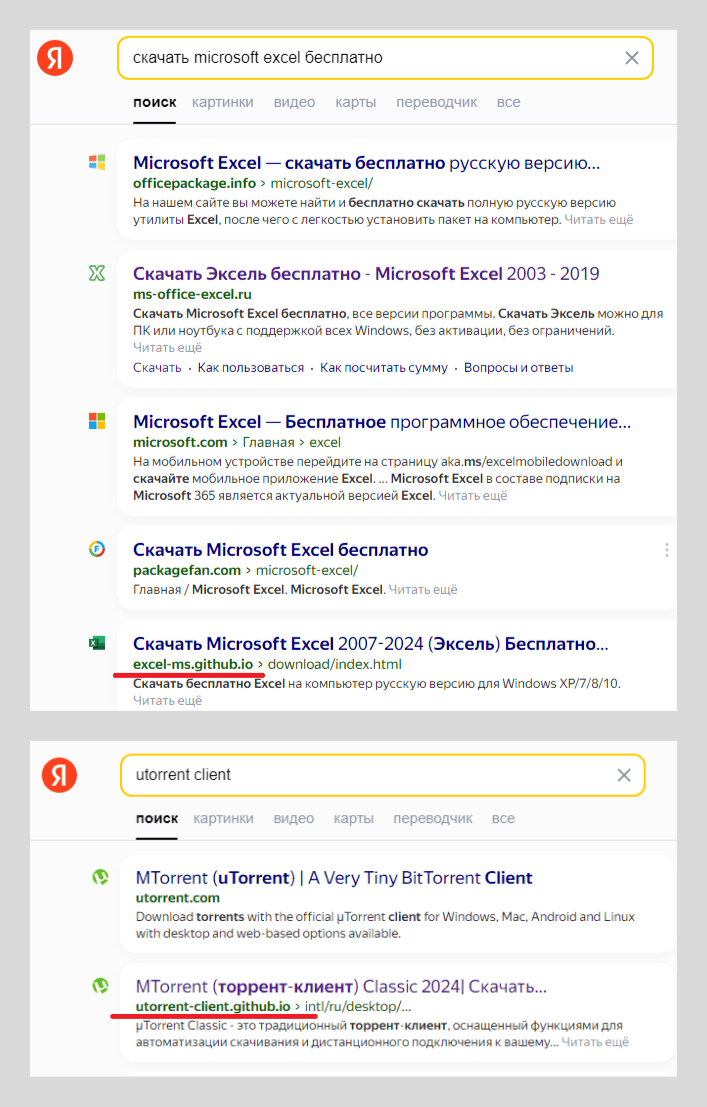
The attackers were advertising their websites in Yandex search results. Users would see these malicious sites in the top results when searching for resources freely distributing popular software like uTorrent, MS Excel, MS Word, Minecraft, Discord and so on.
Links to malicious websites in Yandex search results
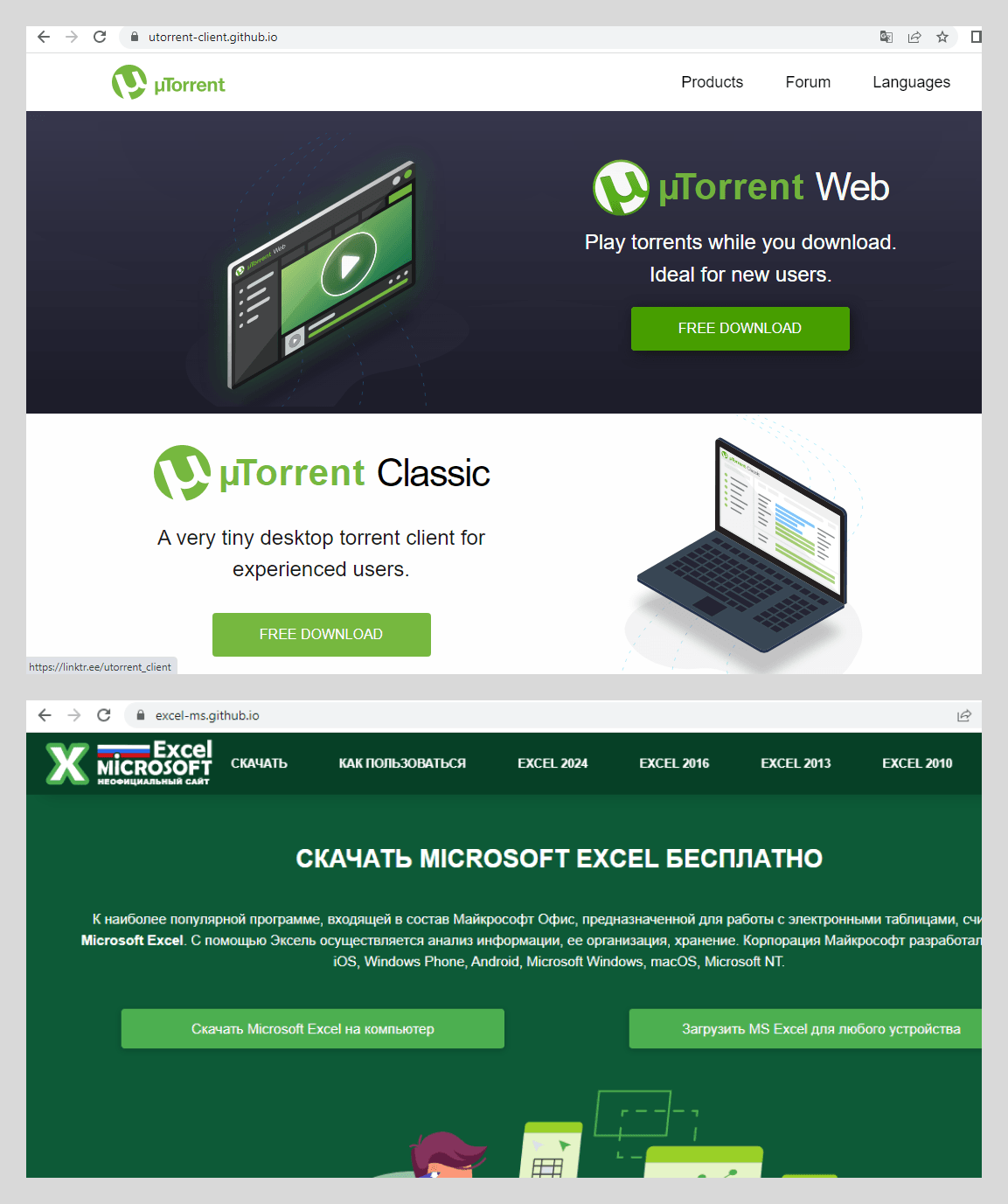
The frontend of these websites is a copy of either the official software website or a known piracy website distributing this kind of software:
Malicious websites
The attackers are running multiple Telegram channels distributing the malware in question. These channels are most definitely targeted at cryptocurrency owners or cheating gamers: they are offered to download specific software that presumably might be of interest to them. To prevent anyone trying to disclose information about these channels and the fraudulent activity of their creators, the administrators disabled message forwarding, screenshots, and previews of these channels in the Telegram web-version.
Malware in the attackers’ Telegram channel
Even more, the malware was also distributed via YouTube. The attackers uploaded numerous videos in English from multiple accounts which were presumably stolen. It’s also possible that the video content was downloaded from other YouTube channels and reuploaded without the authors’ consent. In the video description and in the top comment the attackers left links to their resources and instructions on how to launch the malware. Some of these links redirected users immediately to malicious websites, while others led to the aforementioned Telegram channels. We have also seen links to known IP logging websites, allowing the malicious actors to collect the IP addresses of anyone who follows the link and gets redirected to the malware-carrying website.
Examples of videos with malicious links in their description or comments
Comment with a link to a malicious Telegram channel
Persistence and defense evasion
After visiting the attackers’ website or channel, users might download a ZIP file being falsely advertised as popular software. Inside the archive is an MSI file and a TXT file with a password required for installation. There are also instructions on how to install the software, in which the attackers recommend disabling any installed antivirus and Windows Defender beforehand. In many cases, the instructions and the password are also provided on the websites and channels from which the user downloaded the malicious archive.
Content of text file
When launched, the MSI file asks for the password from the TXT file, which is one of the first countermeasures against sandbox analysis. If the user specifies the right password, the CustomAction field value of the MSI file is executed — this is effectively a VB script. This script launches a BAT file which extracts the next element of the attack chain from an encrypted archive. The first step is to escalate privileges by adding another BAT file to autorun, granting SYSTEM privileges for a single execution. After that, the system reboots.
CustomAction field value in the MSI file
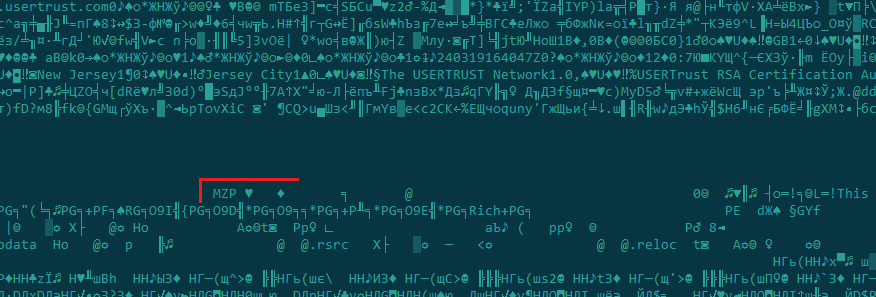
The BAT file from autorun extracts the encrypted RAR archive and runs the “start” command with two DLL files as arguments — these were previously extracted from the archive. One of these files is a legitimate AutoIt interpreter and the second is a legitimate dynamic library with a valid digital signature. The malicious payload is an A3X script which was compiled into an EXE file and injected right inside the second DLL file signature.
Malicious payload hidden inside a legit dynamic library signature
This technique is interesting for two reasons. First, the A3X script is added to the signature in such a way that its validity remains intact and the whole file is still considered as signed, even with the payload. Such a malicious addition is almost impossible to detect without file content analysis. Second, the AutoIt interpreter has an interesting way of reading files that were specified in its launch argument. The file is scanned for a specific AutoIt signature which is present only in compiled scripts, and all other contents of the file are ignored. This behavior allows the attackers to hide their malicious payload anywhere in the file where it won’t be harmful for the container itself.
Signature at the beginning of the A3X script
Placing malicious payloads in an arbitrary section of a file is not new. Such techniques have been used not only with AutoIt, but with other platforms too. But what makes this attack stand out is the bypass of signature verification, making it possible for the payload-bearing file to seem legitimate.
File with payload successfully bypasses signature verification
If the “start” command failed, the BAT file removes the entire directory with the installed files, including itself. Otherwise, the malicious A3X implant is launched, which checks all active processes in attempt to find anything related to debugging or anti-malware products. If anything is found, the script immediately exits, as you can see in the snippet of deobfuscated code below.
Security process name check by malicious implant
The compiled A3X script contains multiple FileInstall function calls. This function takes two arguments: a path to the file that will be installed, and its destination path. Before compilation, this call just copies the file from its source path to its destination, but during the compilation the interpreter stores the files for installation right inside the compiled script.
The resulting file contains not only the executable code itself, but also additional malicious files which will be installed directly from the implant. These files are required for persistence and to execute the next steps of the infection chain. The files are installed to the following paths:
For persistence purposes, the directories containing the installed files have system, hidden and read-only attributes. In addition, using the icacls utility, the implant forbids all users across all domains to remove these folders, change their permissions, own them, add any files or subdirectories, write to them any attributes (including extended ones), or remove files from them.
Files are copied to directories with unusual names for a reason. For example, the folder name “Classic.{BB64F8A7-BEE7-4E1A-AB8D-7D8273F7FDB6}” is treated specially by Windows Shell: Explorer will find the GUID in its name and treat it as a link — in this case to the Action Center. As a result, the user will not be able to view the contents of the directory.
Malicious directory in Explorer
After installing all the necessary files, the implant establishes persistence using WMI by creating filters which are activated by common events — common enough to guarantee filter activation. For each created filter, a polling frequency is specified. When a filter is activated, a specific command is executed using the __FilterToConsumerBinding class.
Once every three minutes, the netcat utility masked as StartMenuExperienceHost.exe is launched with the C&C address of the attackers (sportjump[.]ru) and “-e cmd.exe” as its arguments. It is then used as a reverse shell by the attackers.
Once every five to ten minutes, files named “nun.bat” are executed. They are copies of the same file which starts the next step of the infection chain. The attackers created two copies to increase the chance of malware execution, but if there are no outages, both of them are launched.
Once every fifteen minutes, the next step of the infection chain is launched directly via the “start” command.
All these methods are used again for a better persistence by launching the “insta.bat” file right before the end of the A3X implant execution.
Launch of the netcat utility
Persistence is established not only through WMI; the implant also directly starts netcat, the “nun.bat” files, and the “start” command. After that, it also abuses the registry keys “Image File Execution Options”, “Debugger” and “MonitorProcess” with the same goals.
One of the most interesting things about some variants of the malware is the download and use of the Wazuh SIEM agent for remote access and telemetry harvesting. To ensure that the attackers can execute any arbitrary command on the victim’s device, during the agent installation, the “remote_commands” option is set.
Installation and launch of the Wazuh agent
The first stage of the A3X implant collects the following information: computer name, username, OS version and architecture, CPU name, data about the GPU and installed AV software. All this information along with the current time is sent to a special Telegram bot chat controlled by the attackers. We’ve also seen some of the malware variants sending a screenshot of the user’s desktop or installing a malicious browser extension, which may replace cryptocurrency wallets in the clipboard.
Malicious browser extension
The next stage of the infection chain consists of two DLL files, that use the same technique as the first stage: a legitimate AutoIt interpreter and another A3X implant, located in the signature of the legitimate dynamic library. This implant is the final payload in the malware variant described here. It injects into a newly created explorer.exe process memory an open-source miner named SilentCryptoMiner, which contains the URL of the attacker’s mining configuration. This configuration specifies the cryptocurrency to be mined, the wallet, and so on. In the analyzed variants, we could see that the attackers mostly use anonymous cryptocurrencies like Monero or Zephyr.
Example of the miner configuration
Aside from its main purpose of generating cryptocurrency, SilentCryptoMiner can also hide its own activity from the processes specified in the “stealth-targets” argument and stop processes from the “kill-targets” process names list.
Attack geography
Most of the attacks with this infection chain targeted Russian users (87.63%). After that, the other top ten countries with the highest number of users affected by these attacks were Belarus, India, Uzbekistan, Kazakhstan, Germany, Algeria, Czech Republic, Mozambique, and Turkey.
TOP 10 countries where users were affected by the described infection chain, June — August 2024 (download)
Conclusion
The attack described in this article vividly illustrates the fact that even mass campaigns can be quite complex and open up a wide range of opportunities for attackers. As a result of the multistage infection chain, the attackers can establish persistence in users’ systems in multiple ways, gaining full access. Even though the main goal of the attackers is to make profit by stealthily mining cryptocurrency, some variants of the malware can perform additional malicious activity, such as replacing cryptocurrency wallets in the clipboard and taking screenshots. The most interesting action in this attack was the implementation of unusual techniques like using an SIEM agent as backdoor, adding the malicious payload to a legitimate digital signature, and hiding directories containing malicious files.
It’s important to mention that the websites, videos, and Telegram channels created by the attackers primarily target users seeking free versions of popular software or videogame cheats. This audience makes an easy target for the attackers because they are open to installing unofficial software from obscure sources and disabling security measures.
Our products detect this malware with the following names:
HEUR:Trojan-Dropper.OLE2.Agent.gen
HEUR:Trojan.BAT.Agent.gen
HEUR:Trojan.VBS.Agent.gen
Trojan.Script.AutoIt.ak
Trojan.BAT.Agent.cix
Trojan.BAT.Miner.id
HEUR:Trojan.Multi.Agent.gen
PDM:Trojan.Win32.Generic
MITRE ATT&CK Matrix
Tactic
Technique ID
Technique
Resource Development
T1608.006
Stage Capabilities: SEO Poisoning
T1608.001
Stage Capabilities: Upload Malware
Execution
T1204.001
User Execution: Malicious Link
T1204.002
User Execution: Malicious File
T1059.010
Command and Scripting Interpreter: AutoHotKey & AutoIT
T1059.003
Command and Scripting Interpreter: Windows Command Shell
President Cyril Ramaphosa is today on a Working Visit to the Kingdom of Lesotho at the invitation of His Majesty King Letsie III.
During Friday’s visit, the President will participate in the Kingdom’s 58th Independence Day and Bicentennial Celebrations.
The Bicentennial Celebration of the founding of the Basotho Nation by Morena Moshoeshoe I and Independence Day are being held at Setsoto Stadium in Maseru.
“President Ramaphosa will deliver remarks during the celebrations to commemorate the Basotho Nation’s rich heritage, as well as the extraordinary achievements of Morena Moshoeshoe I and the indelible impact he had on the people of the Kingdom of Lesotho,” the Presidency said in a statement.
The Republic of South Africa and the Kingdom of Lesotho enjoy strong and cordial bilateral relations and cooperation in a number of fields, including in the water sector.
Meanwhile, the Minister of Defence and Military Veterans, Angie Motshekga, will serve as the Acting President of the Republic during the duration of the President’s travel. – SAnews.gov.za
Deputy President Paul Mashatile says he is confident that his working visit to the United Kingdom and Ireland will improve trade and investment relations, which have been stagnant for years.
The Deputy President spoke during an engagement with the South African Chamber of Commerce (SACC) in London on Thursday. The SACC is an umbrella organisation and conduit for trade, community and investment into and out of South Africa.
The country’s second-in-command is in the United Kingdom for the second leg of his working visit to improve trade and investment relations between the nations and to woo investors following his travels to Ireland.
The country’s second-in-command reiterated that the political environment in South Africa is stable for investment because of the newly established GNU, which has been operational for less than 100 days and is already yielding results.
“Our numerous meetings with potential investors have revealed a shift in their attitudes and perceptions towards South Africa, indicating an optimistic outlook.
“Our alliance, based not on personal sentiments but on the aspiration to enhance South Africa and, consequently, the lives of our citizens, will undoubtedly sustain the GNU administration for five years.”
However, he said they will measure the GNU’s success based on the number of employment and entrepreneurs they assist in establishing sustainable enterprises.
“Businesses hope to continue working with the government in the public-private partnership that has reduced load shedding, improved transport and logistics infrastructure, and strengthened national capacity to combat crime and corruption,” the Deputy President said.
Shifting his focus to energy, he stated that investors have demonstrated that ending the load shedding that began in 2007 is the most positive news.
“They confirmed that it allows them to conduct business without uncertainty. The elimination of power outages was largely due to a series of measures implemented by the State-owned power utility, Eskom and government over the past two years.”
He also told the SACC that government was addressing the obstacles in the freight logistics system that continue to impede competitiveness and undermine economic growth.
“We are on a mission to create and sustain a bankable investment pipeline of priority, credible, quality and high-impact projects that span the country through Infrastructure South Africa, the primary driver of the National Infrastructure Plan 2050,” he explained.
Mashatile believes that the SACC plays an essential role in engaging with businesses to promote bilateral trade and investment links between the United Kingdom and South Africa.
“It is our responsibility as leaders in our respective regions to foster an atmosphere that encourages entrepreneurship, fosters innovation, and drives inclusive growth.”
In addition, he expressed his desire to increase South Africa’s exports of valuable goods and services to the United Kingdom.
“It is excellent that the two countries already exchange food and beverages. It is critical that we collaborate to create strategies to accelerate international trade and investment.”
Mashatile announced that the State was simplifying regulatory procedures through the Red Tape Task Team, making it easier for businesses to operate and invest locally.
He concluded his address with South Africa’s stance on peace and stability in Africa and globally, stressing that the nation is anti-war and pro-peace.
“We reaffirm our commitment to the inviolability of sovereignty and the importance of national security.
“More immediately, we support [silencing the guns]. We want to see peaceful and mutual coexistence between Russia, Ukraine, Israel, Sudan, and the rest of the globe, because war is terrible for business.” – SAnews.gov.za
Former Chief Financial Officer of Steinhoff, Andries Benjamin La Grange, has been sentenced to 10 years imprisonment, of which five years are suspended, for his role in the scandal that brought the multinational company to its eventual liquidation.
The sentence – meted out in the Pretoria Specialised Commercial Crimes Court – comes after La Grange entered a plea and sentence agreement in which he will give evidence for the state against other alleged actors in further related criminal proceedings.
“La Grange entered into a plea and sentence agreement…for one count of fraud of over R367 million, emanating from the manipulation of financial statements and failure to report fraudulent activities. He was convicted as such,” a joint statement by the National Prosecuting Authority (NPA) and the Directorate for Priority Crime Investigation (DPCI) read.
The joint statement explained La Grange’s role in the matter.
“From November to December 2016, the then Chief Executive Officer, Markus Johannes Jooste, who is now deceased, and La Grange defrauded a Steinhoff subsidiary, Steinhoff At Work, the board of directors of Steinhoff Manufacturing and Steinhoff South Africa of an amount of over R367 million.
“On the instruction of Jooste, La Grange created documentation of transactions that supported the fraudulent transactions used to inflate and falsify the annual financial statements of the Steinhoff Group for the financial year 2016.
“After investigations by the Johannesburg Stock Exchange (JSE) La Grange was fined R2 million for the role he played in the Steinhoff At Work transactions and barred from holding office in a public company for 10 years,” the joint statement said.
La Grange’s conviction and sentencing also comes after the NPA secured its first conviction, sentence and confiscation order related to the case.
“Securing a second conviction and sentence in the Steinhoff matter in just a week is a reflection that even though the wheels of justice turn slowly, impunity no longer prevails, and those accused of complex commercial crime now know that it is a matter of when the dreaded knock on their door comes.
“This shows the commitment by both DPCI and NPA in dealing with one of the biggest cases of corporate fraud in the history of South Africa. This case has been one of the most complex commercial crime cases that the DPCI and the NPA have had to deal with.
“At a point when a significant breakthrough was made to enrol the case earlier this year, the main accused, ex-CEO of Steinhoff Markus Jooste took his life on the eve of his arrest, thus escaping the hands of justice when it mattered the most,” the statement concluded.
Last week, the NPA secured its first conviction, sentence and confiscation order related to the Steinhoff case.
This after the Specialised Commercial Crimes Court in Pretoria sentenced former Steinhoff physician, Dr Gerhardus Burger, to some five years imprisonment – wholly suspended for five years, if he is not found guilty of contravention of section 78(2) of the Financial Markets Act within that period. – SAnews.gov.za
SA a trusted partner in delivering global business services
South Africa is a trusted partner in delivering key global business services such as financial risk, regulatory support and digital services to United Kingdom investors, says Deputy Minister of Trade, Industry and Competition Andrew Whitfield.
The Deputy Minister delivered the keynote address during the South Africa-UK roundtable on Global Business Services (GBS) in London. The session was hosted by Business Process Enabling South Africa in London.
“With a highly skilled, English-speaking workforce, South Africa has positioned itself as a go-to hub for outsourcing services ranging from legal support to digital transformation.
“South Africa’s competitive advantage in offering cutting-edge solutions at a fraction of the cost, saving companies up to 50% compared to other outsourcing destinations puts our country in good stead,” Whitfield explained.
According to the Department of Trade, Industry and Competition, the roundtable formed part of a high-level mission to the United Kingdom (UK) which is being led by Deputy President Paul Mashatile. The visit is focused on promoting South Africa as a premier investment destination.
Whitfield highlighted that the South African global business services (GBS) sector has evolved from traditional call centre services into providing high-value, complex services that meet the needs of global investors.
He added that the UK remained South Africa’s largest source market for GBS, accounting for over 56 000 jobs and generating £650 million in revenue through partnerships with leading UK firms such as British Gas, Scottish Power, and Virgin Atlantic.
Whitfield emphasised that since the introduction of the GBS incentive, more than 50 global companies have established operations in South Africa, generating R40 billion in export revenue.
The primary objective of the incentive which became effective from 1 January 2019, is to create employment in South Africa through servicing offshore activities. The secondary objectives of the programme are to: – Create employment opportunities for the youth (age 18-34 years); and – Contribute to the country’s export revenue from offshoring services.
Growth
He added that the workforce has grown significantly, from 26 700 jobs in 2015 to over 104 000 today.
In addition, the GBS Masterplan is playing an important role in this growth shifting the focus from low-cost call centres to more sophisticated, high-value services, such as data analytics, financial services, and digital risk management.
“Our GBS sector offers far more than cost savings; it delivers quality outcomes with proven resilience. South Africa has shown an exceptional ability to adapt, including the successful implementation of flexible work-from-home models.
“Additionally, we have not experienced any electricity outages for over 190 days, which is a critical factor for global businesses seeking reliable operations,” said the Deputy Minister.
Looking ahead, Whitfield said the GBS Masterplan envisions creating up to 500 000 cumulative jobs by 2030, through continued expansion and new investments.
The Global Business Services Masterplan was signed by the department and stakeholders on 18 November 2021.
The Masterplan process brings together government, industry, social partners and labour to set a common vision and action agenda for developing and growing the sector.
“We will work tirelessly with all stakeholders to realise this high-growth scenario, particularly as global businesses increasingly look to South Africa as a destination for innovative digital services and niche sector solutions.”
Furthermore, he urged UK businesses to explore the lucrative opportunities in South Africa’s GBS sector.
“Our value proposition is clear, quality services, major cost savings, and a stable environment. We invite British investors to take advantage of the opportunities our dynamic sector offers and contribute to its continued growth.
“Ultimately, this is a key sector to realising the Government of National Unity’s apex priority to rapid economic growth and job creation,” he said.
The Deputy Minister was pleased with the positive engagements and sentiment from GBS companies present, who have a healthy pipeline to expand their operations in South Africa in the next 12 months. –SAnews.gov.za
Briefing by Mr. James Swan, the Acting Special Representative of the Secretary-General for Somalia and Head of the United Nations Assistance Mission in Somalia, on the Somalia – Security Council, 9740th meeting.
———————————
The chief of the UN mission in Somalia (UNSOM) James Swan said that the mission will work closely with the Federal Government to implement the transition from UNSOM to a UN country team and to continuing its support to Somalia’s national priorities once a mandate is received from this Council.
The Acting Special Representative for Somalia briefed the Council today (03 Oct) on the situation in the country.
On elections, Swan noted that the transition from the previous indirect electoral system to the planned new system of universal suffrage will require broad and inclusive consultations, and a willingness of all stakeholders to engage in dialogue in order to build political consensus. He welcomed the meeting of the National Consultative Council.
He said that the adoption of implementable electoral laws and the establishment of an independent elections commission will be important indicators of progress toward delivering universal suffrage elections.
Swan stressed, “The United Nations is committed to supporting Somalia to address technical, logistical and other challenges and to mobilize financial support from donors to deliver timely and credible elections.”
The fight against Al-Shabaab continues to be the key security priority for the Government of Somalia, the Mission’s chief reiterated, adding that while making commendable efforts to sustain military operations against Al Shabaab, Somalia is at the same time tackling the challenges of force generation; taking over security responsibilities from the African Union Transition Mission in Somalia (ATMIS); planning the transition to the African Union Support and Stabilisation Mission in Somalia (AUSSOM); and implementing crucial stabilisation programmes in recovered areas.
“The United Nations continues to support the Federal Government on these activities, working closely with the African Union and other partners,” Swan reiterated.
He continued, “The United Nations Support Office in Somalia (UNSOS) continues to enable the ATMIS drawdown while fulfilling its ongoing support responsibilities.”
The Acting Special Representative continued, “ The lifting of the arms embargo on the national government has facilitated its access to additional weapons and supplies, and I remind other entities operating in Somalia of the requirement to respect the arms embargo established by resolution 2713.”
Al-Shabaab continues to demonstrate its disregard for civilian life, through its use of indirect fire on population centres, mainly Mogadishu and Baidoa, the use of improvised explosive devices, and suicide attacks against civilians, including the heinous 2 August attack on the Lido Beach in Mogadishu.
Swan underscored the condemnation issued by the Secretary-General of such attacks and reiterated the United Nations’ support to the Government and people of Somalia as” they stand against terrorism and violent extremism.”
He also note with concern the increased presence and activities of the Islamic State in Iraq and the Levant (Da’esh).
Minister of Mineral and Petroleum Resources, Gwede Mantashe, has told an indaba that there is evidence to suggest that mining is “the bedrock of our economy” and that the country is an attractive investment destination for mining.
According to the Minerals Council of South Africa, the industry contributed some 6.3% to South Africa’s nominal Gross Domestic Product (GDP) last year.
“There is a strong case emerging out of the study on ‘The State of Mining’ that the South African mining industry not only remains the bedrock of our economy, but an attractive investment destination for mining.
“Coupled with the draft South Africa’s ‘Critical Minerals Strategy’, the study points to the reality that the South African mining industry is diversifying from the gold mining era to an industry with wide-ranging mineral resources, including the world’s largest known deposits of platinum group metals (PGMs), manganese, chrome, coal, gold, copper, vanadium, and other natural resources that are considered critical for the just transition,” the Minister said at the Annual Joburg Indaba in Sandton on Thursday.
He added that with the diversification of the industry, its potential to continue growing remains high.
“Notwithstanding the challenges faced by the gold mining sector, including deep level mines and heightened safety concerns, the 2023 gold production statistics positioned South Africa as the world’s thirteenth and Africa’s fourth largest gold producer.
“Despite the fluctuating prices of palladium and rhodium, of which South Africa supplies 38% and 81%, respectively, to the global commodities market, the PGMs sector is poised to play a catalytic role in sustaining the South African mining industry, and in the growth of our economy.
“Considering South Africa’s reserves of known manganese and chrome deposits, as well as being the largest producer and exporter of manganese and chrome ore, the South African manganese and chrome sectors are poised to continue playing a significant role globally driven by their use in the automotive and construction industries,” Mantashe said.
Addressing challenges
He acknowledged that during last year’s Joburg Indaba, industry players raised issues that “we needed to resolve for the sector to thrive, including the need to ensure the necessary policy and regulatory certainty for investment”.
“Although the South African mining industry’s regulatory framework is stable and predictable, the Department of Mineral and Petroleum Resources is drafting amendments to the Mineral and Petroleum Resources Development Act (MPRDA).
“This is so as to address its shortcomings and ensure that areas that have been challenged legally are strengthened against international best practice. The amendments will further improve the business environment while keeping in sync with our socioeconomic fabric.
“The completion of the migration process to the new efficient and transparent mining licensing system, in June next year, is poised to modernise our licensing system, ensure regulatory certainty, and the sustainability of the South African mining industry.
“Having completed the first phase of the project, which included the assessment of the current environment to establish the baseline and its readiness, and the requirements with respect to system hosting, software integration, and the enhancement of cybersecurity, the development of the new system is therefore progressing very well,” the Minister explained.
Furthermore, the Minister told the industry leaders that between April 2023 and March this year, the department has processed and finalised 127 mining rights, 1 527 prospecting rights, and 2 313 mining permits and ancillaries.
There are no backlogs in the Western Cape and the Free State while backlogs in the Northern Cape, Limpopo, North West, Eastern Cape and KwaZulu-Natal have been significantly reduced. Mpumalanga is the only province with a significant backlog.
“As we come to the end of this year’s Indaba, we wish to encourage the South African mining industry to continue sharing insights about the realities of this industry, advance beneficiation at source, and support our exploration initiatives.
“We further encourage junior miners to take up the opportunities presented to them in order to transform the industry and ensure that the people of South Africa derive value from their country’s mineral endowment,” Mantashe concluded. – SAnews.gov.za
While government is fully cognisant that access to finance remains the most significant barrier to entry for new venture creation, small, medium and micro enterprises (SMMEs) and entrepreneurship, steps are being taken to address this.
This is according to the Deputy Minister of Trade, Industry and Competition, Zuko Godlimpi, who was during the Financial Inclusion Week session in Johannesburg.
“The consequences of government inability to increase the pace of transformation after 30 years are evidenced by the lack of economic growth, unsustainably high levels of unemployment, widening inequality and market concentration,” Godlimpi said.
“Though government policies have worked to dismantle many structures of the apartheid state and increase living standards, these efforts have not translated into the creation of job opportunities for many South Africans,” he said.
Godlimpi pointed out that the Department of Trade, Industry and Competition (the dtic) and its agencies, which include the Industrial Development Corporation (IDC) and the National Empowerment Fund (NEF), have managed to attract new business projects in which they will be investing R78 billion.
“We have also agreed to push the dtic and its entities to go beyond the Treasury standards to pay SMMEs. This ensures that we, as an institution of nine branches and 18 entities, do not contribute to the barriers that constrain our SMMEs.”
Glodlimpi explained that on the policy front, government is aware that SMMEs find it difficult to access different forms of finance, including debt.
He said when SMMEs approach debt markets, they are often faced with onerous credit checks and, at times, fall victim to negative reinforcement tools such as credit bureaus due to a lack of access to patient capital.
“When a small business owner misses debt repayment due to delayed payments from clients and, in many instances, the government, they are blacklisted. According to [the] Small Enterprise Development Agency’s SMME Quarterly and Stats SA, SMMEs contribute about 59% of total employment in the country,” he said.
Godlimpi said this picture demonstrates the unsustainable structure of credit market in South Africa, which is embedded in a consumption logic rather than a developmental and investment orientation.
“As part of the Minister Parks Tau’s new wall-to-wall approach, we have begun to look at sharing important economic data within the dtic to enhance our understanding of the economy and achieve complementarity in deploying the various tools to achieve our industrial policy objectives,” said Godlimpi. – SAnews.gov.za
Finance Minister Enoch Godongwana is set to table the Medium-Term Budget Policy Statement (MTBPS) in Parliament on 30 October 2024, his department has announced.
“The MTBPS sets government policy goals and priorities, forecasts the macroeconomy trajectory, and projects the fiscal framework over the next three years by outlining spending and revenue estimates, amongst others,” Godongwana said on Thursday.
An engagement session on the MTBPS logistics will be held and an invitation will be shared with media and economists in due course.
The MTBPS will take place on Wednesday, 30 October 2024 in Parliament at 14h00. – SAnews.gov.za
Basic Education Minister Siviwe Gwarube and Deputy Minister Dr Reginah Mhaule will today visit Gauteng as part of the ongoing National Listening and Learning Tour.
This tour aims to directly engage with provincial education stakeholders, school leadership and the broader community to address challenges in the province’s education sector.
“This provincial visit will focus on critical issues such as the annual influx of learners to the province, school safety, literacy and numeracy levels, teacher training, as well as budget constraints…
“The purpose of these engagements is to identify areas for improvement, share best practices, and collaboratively develop solutions to the unique challenges within the province’s educational landscape,” the Department of Basic Education said in a statement.
Gwarube and Mhaule will address the media following their engagements with provincial education stakeholders, providing updates on the outcomes of the visit and plans to strengthen the education system in Gauteng.
Government has extended its condolences to the family, friends, and fans of Siphiwe Sibisi, affectionately known as General GTZ, who passed away at the weekend.
Sibisi was a beloved figure in the music industry, widely recognised for his role in the iconic kwaito group Chiskop. He passed away on Sunday after a long battle with cancer.
“As a country, we sadly mourn the loss of Siphiwe Sibisi, a talented artist whose work will forever be remembered. His contribution to the music industry is immeasurable, and we send our deepest sympathies to his family and loved ones during this time of grief. May his soul rest in peace,” Government Communication and Information System (GCIS) Acting Director-General, Nomonde Mnukwa, said.
Formed in 1998, Chiskop featured Sibisi alongside the late Mduduzi Tshabalala (Mandoza), Sizwe Motaung (Lollipop) and Sibusiso Thanjekwayo (SB Bless).
The group played a pivotal role in shaping South Africa’s music, culture, and entertainment industry through their dynamic contribution to the kwaito genre.
Their music became a cultural force, resonating with millions and leaving a lasting legacy that transcended generations.
Sibisi’s passing marks the end of an era for many South Africans who grew up listening to Chiskop’s groundbreaking sound, which helped define the kwaito genre and shape the nation’s cultural identity. – SAnews.gov.za

_dite_la_Goulue_(%C3%A0_gauche)_et_de_Grille_d%27%C3%A9gout_(%C3%A0_droite),_da,_PH41845.jpg)


_1891.jpg)