Category: Agriculture

  • MIL-OSI USA: CONGRESSMAN BISHOP ANNOUNCES NEW ELIGIBILITY FOR HURRICANE HELENE FEMA DISASTER RELIEF

    Source: United States House of Representatives – Congressman Sanford D Bishop Jr (GA-02)

    THOMASVILLE, Ga. – Congressman Sanford D. Bishop, Jr. (GA-02) announced that several counties in Georgia’s Second Congressional District were added to the Federal Emergency Management Agency’s (FEMA) Major Disaster Declaration for Hurricane Helene. The counties include:

    • Thomas County – Individuals and households are now eligible to apply for financial and direct services (FEMA Individual Assistance)
    • Dooly County, Grady County, Mitchell County, and Thomas County – local governments are now eligible for FEMA Public Assistance for repairs or replacement of disaster-damaged facilities (roads, bridges, water control facilities, public buildings and equipment, public utilities, parks, recreational, other facilities)

    More information about these developments as well as federal, state, and local resources in response to Hurricane Helene are available on Congressman Bishop’s website at https://bishop.house.gov/resources-services/hurricane-preparedness.

    Before and since Hurricane Helene hit Georgia and the southeast United States, Congressman Bishop has been in contact with the White House, U.S. Department of Agriculture (USDA) and FEMA. He and his staff have also been in regular contact with the Georgia Governor’s office, Georgia Emergency Management and Homeland Security Agency (GEMA), and nongovernmental partners as they prepared for and responded to fallout from the hurricane.

    “I have worked with federal, state, and local officials to make sure our efforts are coordinated to expedite assistance to our families, farmers, business owners, cities, and counties,” said Congressman Bishop. “Working with Congressman Austin Scott, Senators Ossoff and Warnock, the entire Georgia Delegation, and our Georgia state government partners we helped guide President Biden, Vice President Harris, and other federal emergency agencies through our Georgia communities that were hit hard by this storm.”

    “Seeing the impact, first-hand, is crucial in understanding the challenges we face and appreciating the resilient spirit of Georgians as we rebuild,” added Congressman Bishop. “I will continue working to assure that Congress provides the needed resources to Georgia communities impacted by this hurricane.”

    In response to Hurricane Helene, Congressman Bishop, along with his congressional colleagues urged President Biden to issue an expedited major disaster declaration for Georgia counties significantly impacted by the storm. That request was honored within 24 hours. He also sent a letter to U.S. House and U.S. Senate leadership asking for appropriations to be made available as soon as possible to fully fund unmet agricultural disaster relief needs.

    Over 8,500 federal personnel have been on the ground, working side-by-side with state and local officials, to help survivors get what they need to begin their recovery. As of today, FEMA has approved over $860 million, which includes $507 million in assistance for individuals and communities affected and over $351.5 million for debris removal and activities to save lives, protect public health and safety and prevent damage to public and private property.

    Georgia residents that need emergency or immediate assistance should contact GEMA via https://gema.georgia.gov/hurricane-helene or apply for financial assistance at disasterassistance.gov. These websites provide updated information on resources and shelters.

    Georgia residents that need farm or ranch assistance can reach out to the USDA either by calling 877-508-8364 or visiting https://www.farmers.gov. For personalized assistance for your individual operation, use the Disaster Assistance Discovery Tool (https://www.farmers.gov/protection-recovery/disaster-tool) to determine eligibility.

    Local governments requiring rural development assistance, such as housing, sewer, and water, can reach out to USDA at https://www.rd.usda.gov/resources/rural-development-disaster-assistance.

    Poultry and livestock producers affected by Hurricane Helene can get assistance with emergency animal mortality disposal through USDA’s Natural Resources Conservation Service (NRCS) Environmental Quality Incentives Program. You can learn more at https://www.nrcs.usda.gov/programs-initiatives/eqip-environmental-quality-incentives or by contacting your local USDA Service Center (find yours here by visiting https://www.nrcs.usda.gov/contact/find-a-service-center).

    ###

    MIL OSI USA News

  • MIL-OSI New Zealand: Future focus critical for Doubtless Bay restoration | Conservation blog

    Source: Department of Conservation

    Erosion-prone banks, sedimented estuaries and waterways smothered with all the worst weeds. This is the confronting riverscape in Doubtless Bay on Northland’s east coast.  

    Scratch below the surface though and you find secretive native fish, kōura and insects thriving in little pockets, excellent swimming holes, hapū who care deeply for their awa and whenua, and a community that totally supports work to restore the rivers. It’s for their children, mokopuna and future generations.   

    Climate change effects in the bay   

    DOC’s Ngā Awa river ranger Maddy Jopling lives in the area and has seen issues with flooding, erosion and pollution after storms and heavy rain first-hand. She’s not alone.  

    Farmers have come to fear heavy rain warnings, knowing they will be faced with costs to move and repair fences. Slips destabilise plantation forests and add to fine sediment being carried downstream. Hapū have noticed the loss of prime cockle beds near the Taipā River mouth in the last 20 years. Lifestyle block owners are concerned about the rivers nibbling away at their land and its value diminishing. 

    “We’re already seeing climate change happening here with more intense weather and more frequent, damaging floods,” says Maddy.

    “And sadly, there are other things we’ll have to contend with in the future, such as worse droughts, increased risk of wildfires and sea-level rise affecting land around the coast.”

    Taipā River estuary where hapū have noticed increased sediment and falling numbers of cockles in the last 20 years. Image credit: Sarah Wilcox.

    Healthy rivers need healthy land 

    Maddy’s job as river ranger for Doubtless Bay is to work with hapū and community to restore the biodiversity of the rivers from source to sea. The bay’s three rivers and their tributaries are treated as a single catchment, so there’s a big area involved.  

    “It’s critical to think about the future when planting or restoring habitat for native species in Doubtless Bay. Otherwise we won’t get the improvements in river health and biodiversity that we all want.”  

    A local hapū collective and many local landowners, groups and agencies are interested in or are already involved in restoration work. There is also support from industry representatives.    

    “The hapū collective wanted to know more about how climate change is likely to affect their rohe and what they could do now to build resilience. I’d also heard a lot of people talk about how the trees they’d put in had collapsed or fencing that had been washed away by floods.” 

    River ranger Maddy Jopling pointing out locations of the day’s site visits. Image credit: Sarah Wilcox.

    Equipping the community with best practice revegetation information  

    Maddy says she saw an opportunity for DOC to support future work by providing best-practice, practical information to help advise and prioritise restoration planting in the catchment.  

    “We wanted to help people make the best decisions about what to plant where and how to tackle the really difficult issues.  

    “People also told me about what had worked for them in the past. So when we were setting up the project, we knew it was going to be important to visit a whole range of different places, especially those that are typical of many places here. It makes sense that local people know their land better than anyone.”  

    Drawing on ecology and mapping expertise  

    The project started with hapū, community members and DOC science and technical staff taking forest ecologist Dr Adam Forbes and mapping specialist Dr Brad Case on a tour of the catchment. The group visited more than 20 diverse sites in the in the Awapoko, Oruru and Oruaiti subcatchments over 3 days in late summer. 

    Brad Case presenting maps at a community seminar before the site visits. Image credit: Sarah Wilcox.

    Based on this information and the site visits, the pair have created treatments for 12 different types of habitat in the catchment. The treatments outline possible changes to the vegetation to take climate change and human preferences into account, protect the coast and freshwater and restore wetlands.  

    Adam says visiting all the different sites in Doubtless Bay was really important.  

    Adam Forbes discussing revegetation options on a site visit. Image credit: Sarah Wilcox.

    “I couldn’t have done this without going to the sites and talking to everyone. It enabled me to find out what’s out there and what the issues are.” 

    He has mined a range of databases to create the treatments, drawing on list of plants for the area, planting densities, flammability ratings and listed options to tackle some of the catchment’s big issues.  

    “I’ve included a list of species that are relevant for restoration in these catchments for both the pioneer stage and the enrichment stage, once the canopy has been established. There are some neat regionally specific endemic species included, which provide options for people.”  

    Adam has helpfully provided information on timing, risks, management, maintenance and avenues of support. 

    Some examples of revegetation treatments  

    One suggested treatment is for sites in the lower rivers where īnanga spawn. The areas are currently open and weedy with willows and poplars that can keel over into the river during floods. Adam suggests getting light native forest established, including species that īnanga favour for spawning.  

    Alligator weed, crack willow and ginger are among the profilic weeds established at many sites in the lower rivers. Image credit: Sarah Wilcox.

    Another treatment is for steep hill country with a tendency to slip. These areas are currently in pasture but establishing native vegetation would stabilise the hillsides and reduce erosion downstream.   

    Mapping reveals hotspots for priority work 

    Brad has created a series of catchment maps that show different information about the catchment such as susceptibility to erosion and flooding. Overlaying the maps highlights hotspots where multiple issues overlap.  

    Adam has included many of these areas in his 12 revegetation treatments.  

    Map of the Doubtless Bay catchment showing vulnerability to climate change effects from lowest (green) to highest (red). 

    Maddy continues, “When I saw the catchment mapping, I was really excited about the fact that it will help us prioritise restoration as a community at a landscape scale.”  

    “When you’re going out and doing your restoration work, the scale can be quite overwhelming. There’s so much to do! But the way Brad’s done the modelling makes it really obvious where we need to focus a bit more effort from a climate change perspective.”  

    Sharing the findings  

    The report is now available from our website: Doubtless Bay rivers webpage (or download Doubtless Bay revegetation options)

    “Adam and Brad have shared the report and discussed their findings with the community already. We’re really interested in feedback though and will continue to work with the community to put the information into practice.”  

    About Ngā Awa river restoration programme 

    Taking a whole catchment approach, Ngā Awa is working in partnership with iwi, hapū and communities to restore the biodiversity of 12 rivers from mountains to sea. The three rivers in Doubtless Bay are one of the restoration catchments.  

    The programme’s goal is to see river ecosystems and species thriving from mountains to sea, which enrich people’s lives. This is achieved by collaborating with others, co-designing and co-leading with iwi, hapū and whānau and recognising climate change. Planning the restoration work is underpinned by sound technical and scientific advice.

    From left, Adam Forbes, Brad Case and Tiger Tukariri (Matarahurahu, Kenana) checking possible sites to visit in the upper Oruaiti catchment. Image credit: Sarah Wilcox.

    MIL OSI New Zealand News

  • MIL-OSI Australia: Interview with Richard Glover, Sydney Drive, ABC Radio

    Source: Australian Treasurer

    RICHARD GLOVER:

    Is there a particular marketing tactic that really grinds your gears? Maybe it’s the subscription that’s impossible to quit from or the gym that won’t tell you their prices until you show up in person. Well, the federal government says they’re taking action to outlaw so‑called unfair trading practices. But what falls under that umbrella? Because, obviously, a lot of things are already outlawed by the regulations. Stephen Jones is Assistant Treasurer and Minister for Financial Services and joins us here on Drive. Minister, good afternoon.

    STEPHEN JONES:

    Good afternoon, Richard. Good to be back with you.

    GLOVER:

    Tell us about some of the things that you think are currently allowed under the law, but really, really shouldn’t be.

    JONES:

    Look, a bunch of these are in grey areas. They shouldn’t be happening, they should be unlawful, but they’re in grey areas. So, let me go through a couple of them. Dynamic pricing had a bit of conversation about this after a few pop concerts lately. It extends to practices in sporting events, the tennis, the cricket, where you go online, you see – when you get online that the price might be $100 a ticket, but over the course of the 15–20 minutes that you’re online and everyone else is trying to buy one at the same time, the price goes up and up and up and up.

    GLOVER:

    So, the computer algorithm is responding to demand by pushing up the price to a point where supply meets demands, I suppose?

    JONES:

    That’s exactly how it’s working. Dynamic pricing, sharp practice, consumers incredibly disgruntled about it. And we agree, the next one –

    GLOVER:

    – I mean, sorry, before we go on – I mean, it does happen with other things. Uber, for instance, has a form of that, don’t they? I mean, their argument is that if dynamic pricing can lead to better service because it attracts more, the higher price during, say, a storm attracts more drivers to the road. So, they argue it’s a good thing.

    JONES:

    Look, we’ll work through some of these issues. The target for this is some of the online services, I’ve got to say. And the big one in frame is ticket pricing, which – now, the other one I want to talk about is drip pricing. This is where you go online, the advertised price, the sticker price for something is at one level, and then as you go through the forms, they keep on adding additional charges or additional components to it, all of which are essential to the service or the product or can’t be separated from it, and you end up paying a lot more than the sticker price.

    GLOVER:

    Okay, so they add the GST later, or they add the postage later, or they add the insurance later.

    JONES:

    Booking fees or all of these other fees that are added on. They’re common, like your booking fee or your service fee or all – they’re all added on the top of it. It’s very misleading to consumers.

    GLOVER:

    I mean, I’ve heard the ACCC talk about that in the past. Isn’t that already illegal?

    JONES:

    Some of these things are in a grey area and we want to remove the grey and make it black and white. So, that’s one of them. And in many instances, depends on how it’s being done. But it’s driving consumers nuts. It’s deceptive. It’s sharp practice. We want to make it black and white to ensure that it can no longer rip consumers off through these sort of practices. The third one, which you mentioned in your intro, is what we call subscription traps. Big front door, easy to sign up, bloody small back door. You can’t get out. You can’t get out of them. So, you sign up to your streaming service. They’ve got your credit card details. Almost impossible to get out of it.

    GLOVER:

    I don’t subscribe to American papers, but some people say with one of the prominent American papers that you subscribe – it’s very easy to subscribe, of course, but to unsubscribe, you have to ring – you have to phone a number during business hours in the United States.

    JONES:

    A couple of examples like that, and that’s clearly unfair. It’s clearly designed to ensure that consumers can’t get out again. So, another example, there’s gyms examples that have been brought to us, subscribing to a gym service, all of that. There’s a bunch of different examples –

    GLOVER:

    – What are the gyms? What do the gyms tend to do that is deceptive – other than promise me a better body, Stephen?

    JONES:

    Well, that’s deceptive right there isn’t it. But no, all jokes aside, making it very difficult to unsubscribe, for example, having to go to a certain place during certain hours, having to go through a whole bunch of processes that should be as simple to subscribe as it is to unsubscribe to those services.

    GLOVER:

    Let’s go to the timetable for all this because we only got a couple of minutes left. When does this all happen and when can people be confident that they will be able to, for instance, unsubscribe with ease?

    JONES:

    Consultation paper out on some of the details over the next few months. So, out for consultation over the next few months and then legislation to be drafted and passed through Parliament in the early part of next year.

    GLOVER:

    Okay. Before the election?

    JONES:

    I’d be over the moon if we’re able to get this done before the election, Richard. We don’t control the Upper House but I’ll be over the moon if we’re able to get some of this stuff.

    GLOVER:

    It’s hard to imagine you’re going to get much opposition. I can’t imagine the Greens or David Pocock or Jacqui Lambie thinking any of these are unreasonable ideas.

    JONES:

    I’d hope that everyone looks at this and says this is just common sense. It’s in the interest of Australian consumers and they’ll back the Albanese government on it.

    GLOVER:

    Ok, we’ll see what happens. Stephen, thank you so much.

    JONES:

    Good on you.

    GLOVER:

    Stephen Jones, who’s the Assistant Treasurer as the government proposes making some things that are in the shadows actually black and white in terms of ease of subscription, things like drip pricing and the so called dynamic pricing, which I know some people fell not here so much, but in the UK recently fell foul of with the Oasis tickets which seemed to, once the demand was realised suddenly were incredibly inflated.

    MIL OSI News

  • MIL-OSI USA: Grassley Emphasizes Value ESOPs Bring Local Economies at IA-CEO Conference

    US Senate News:

    Source: United States Senator for Iowa Chuck Grassley

    POLK COUNTY, IOWA – U.S. Sen. Chuck Grassley (R-Iowa), a senior member and former chairman of the Senate Finance Committee, today delivered a keynote address at the 2024 Iowa CEO Employee Ownership Conference in Ankeny.

    Grassley discussed the future of our nation’s business landscape as the baby boomer generation enters retirement, as well as his longstanding support for Employee Stock Ownership Plans (ESOPs): “[…T]his tax-advantaged tool has helped boost productivity, create wealth among the workforce, expand prosperity and grow civic roots in communities across the country,he said

    Download photos HERE. Grassley’s prepared remarks follow. 

    Iowa Center for Employee Ownership (IA-CEO)

    Employee Ownership Conference

    FFA Enrichment Center/DMACC Campus, Ankeny

    Wednesday, October 16, 2024

    Good morning. It’s good to be here with all of you.

    Thank you, Randy, for your work with the University of Northern Iowa (UNI), a school near and dear to my heart. And thank you for the invitation to speak about another subject near and dear to my heart: building prosperity for Iowans across our state.

    Now, typically, I wouldn’t be able to join you in person on a weekday in the middle of October. But since we’re in the thick of a presidential election year, Congress is out of session until after November 5th.

    As you know, we’re also in the thick of harvest season. This week, my son and grandson are on our family farm in New Hartford running the combine and hauling grain from the fields. 

    I’m the second generation of our fourth-generation family farm, so I understand what weighs on the minds of Iowans looking to pass on the reins of a farm or small business. Although, a farmer never really retires.

    Like most family farms in Iowa, a lion’s share of our small- and medium-sized businesses are owned by baby boomers. These operations are expected to change ownership in the next five to 10 years. Finding the future stewards of these farms and businesses is top of mind for communities across Iowa. 

    It will have tremendous impact on the tax base, population, school enrollment, jobs, economic vitality and social capital of the local and regional community.

    This year, I completed my 44th year holding question-and-answer sessions with Iowans in all 99 counties in our state. Two issues that regularly come up at my meetings with small businesses and manufacturers are workforce shortages and employee retention. 

    The workforce and succession planning are top of mind for so many small businesses in Iowa, including those of you here in this room. As the baby boom generation prepares to pass the torch, a sizeable segment of our state’s economy will hinge on the strategic transition of farms and businesses. 

    Changing ownership of a business the same family has owned and operated for decades is complicated. Potential buyers and sellers need to navigate a maze of issues, including complex family dynamics, taxes, financing and more. 

    A decade or so ago, the impending demographic shift was often referred to as the Silver Tsunami. Since 2011, roughly 10,000 Americans turn 65 every day. I would suggest the so-called tsunami has delivered rolling waves of changes, instead of catastrophic disruptions to health care, housing, transportation and community services. I attribute that to forward-thinkers, like those of you attending today’s conference. 

    We’ve seen across many sectors of the economy that not all of the demographic disruptions hit the fan at once. 

    That’s partially because people are staying in the workforce longer, by choice or financial necessity. 

    Like I said earlier, a farmer never really retires. The same often goes for a family-run business, perhaps due to the fact owners don’t always have a viable succession plan or buyer. Having a succession plan can give families, landowners and small businesses much-needed peace of mind. After putting years of sweat and investments into their farm or business, many Iowans are what we call cash-poor and asset-rich.  

    As we look ahead to this era of transition in business ownership, it’s important for leaders in government, business and academia to collaborate. Together, we can anticipate the challenges and embrace the economic opportunities this demographic shift will present. 

    From that standpoint, I applaud the efforts of your organization, in partnership with my alma mater, UNI.  

    I want to commend you for taking a proactive approach. You’re grabbing the bull by the horns to identify the obstacles and possibilities that lie ahead. By engaging stakeholders and raising public awareness, your efforts can help expand local economic vitality and prosperity for generations to come. 

    You understand that a majority of the businesses owned by baby boomers will close for good if a viable buyer isn’t found. Usually, a viable buyer is restricted by the sale price, or there simply isn’t a buyer available at all. 

    Let’s not underestimate the benefits your efforts will bring workers and the community. Day in and day out, workers help build and grow a company. When workers are able to capture financial equity in their employing business, it fosters an ownership culture that strengthens morale and reinforces roots in the community. 

    These dynamics sow the seeds for broader advantages for nearby schools, civic clubs, volunteer fire departments, places of worship, and more.

    If you think about it, your mission kills two birds with one stone. On the one hand, you provide an off-ramp for business owners to pull wealth from their business, monetizing the retirement nest egg they’ve feathered for decades. 

    On the other hand, you’re expanding ownership opportunity and offering a piece of the financial pie to the workforce, empowering employees to share in the fruits of their own labor. 

    As a former chairman of the Senate Finance Committee, fostering economic growth is central to my philosophy on tax policy. That includes my support for federal tax advantages for Employee Stock Ownership Plans. 

    Everything these days goes by an acronym, but “ESOPs” have been around for decades.  

    A century ago, big corporations like Proctor & Gamble, J.C. Penney and Sears Roebuck provided stock ownership through a tax vehicle Congress added to the federal tax code in 1921. 

    The iteration we have today sprang up in the 1950s, for the purpose of transitioning ownership of a company to its employees. 

    ESOPs were formally recognized in law in 1974 thanks to the efforts of Senator Russell Long – one of my predecessors at the helm of the Senate Finance Committee.  

    An ESOP allows companies to use IRS tax-qualified plans as a tool for business succession, and as a workplace empowerment tool to foster an ownership culture. They provide the seller better options to manage tax liabilities from the sale of the business rather than what many consider tax confiscation at the point of sale. 

    Senator Long once declared ESOPs would be the perfect elixir to the economy. In fact, he used the term “Geritol,” if anyone here remembers that once-popular vitamin supplement. 

    The good news is ESOPs have outlasted Geritol. For decades, this tax-advantaged tool has helped boost productivity, create wealth among the workforce, expand prosperity and grow civic roots in communities across the country. 

    When Congress passed the Tax Reform Act of 1984 that included tax-free, roll-over treatment, Washington cleared the path for privately held businesses to transfer ownership, unlocking a burst of economic activity and new ownership to the next generation of employees. 

    To this day, ESOPs are a preferred tool for business succession in America.  

    From my platform on the Senate Finance Committee, once again, I will have a front row seat at the tax policymaking table in the new Congress. With 2025 will come a major tipping point for the U.S. economy, as lawmakers and a newly elected president confront a tax cliff. The Tax Cuts and Jobs Act that I helped shepherd into law in 2017 is set to expire at the end of next year.  

    This package enacted across-the-board tax cuts for every American taxpayer. As a result, businesses and families kept more of their hard-earned money in their pockets. 

    That means Iowans got to save, spend and invest more of their own money. If the 2017 Trump tax cuts expire, we will say good-bye to trillions of dollars in tax breaks. 

    The 2017 tax law also unlocked opportunities for small business across our state – the engines of the nation’s economy. Whether a business was structured as a “C” corporation or subchapter “S,” the law lowered tax rates on their income. This tax cut applies to ESOPs with partial employee-ownership. 

    The law lowered the maximum corporate tax rate from 35 percent to a single marginal rate of 21 percent, empowering businesses to expand, hire more people or raise wages. 

    Just as importantly, for pass-through businesses the law lowered tax rates across the board and created a new 20 percent business income deduction. 

    Together, those reforms shrunk the top federal income tax rate from 39.6 percent to 29.6 percent. Farmers and small businesses operate on tight margins. These tax breaks make a tremendous difference on the bottom line.  

    I’m always on the lookout for ways to continue to build on the success of ESOPs. A provision I’ve long cosponsored to make ESOPs a more attractive option for S corporations was incorporated into the SECURE 2.0 Act, which Congress passed at the end of 2022. 

    I’ve written tax policy in the U.S. Senate for more than four decades and counting. I’ll let you in on a secret: When you tax something – anything – you get less of it. 

    Tax laws influence purchase decisions on items ranging from cars and clothes to farm machinery and investments. Just consider back-to-school tax-free shopping weekends. Or how states with no state income tax attract people from high-tax states. 

    On the flip side, high taxes on cigarettes, gambling and alcohol aim to limit those behaviors. Tax incentives operate the same way, informing research and development, college savings and homeownership. 

    I’m sure many of you want to know what’s going to happen on those expiring tax cuts in 2025. That crystal ball will get some clarity after November 5th. 

    In closing, I want you to know I agree ESOPs are a key instrument for communities to foster economic prosperity across our state. 

    Ownership is a core principle in America’s promise of prosperity — and freedom itself — that our nation’s Founders enshrined in our Constitution. 

    In my 99 county meetings, I’ve seen good things happening and economic vitality thriving in communities with ESOP-structured businesses. 

    ESOPs can provide that pathway to prosperity.  

    Business owners preparing to retire can get tax-advantaged cash in their pockets, after many years of building their business. 

    Employees can build equity in the company and find greater satisfaction on the job. 

    With your advocacy, communities can realize more opportunities to keep valued businesses thriving and tap into the ownership culture that attracts a dynamic workforce. 

    Thank you again for inviting me to speak to you today. I look forward to continuing this conversation and welcome your feedback. I’m happy now to open up the floor to questions. 

    -30-

    MIL OSI USA News

  • MIL-OSI USA: State of Arizona and USDA Sign Shared Stewardship to Reduce Community Wildfire Risk and Increase Forest Health

    Source: US State of Arizona

    Phoenix, AZ – Today, the U.S. Department of Agriculture’s Undersecretary for Natural Resources and Environment Dr. Homer Wilkes and Arizona Governor Katie Hobbs signed a Shared Stewardship Agreement to strengthen collaboration between state and federal land management agencies in the State of Arizona.

    The State of Arizona and the USDA Forest Service have a long and successful record of collaborating on efforts to improve forest health and resilience. Today’s agreement focuses on federal and state agencies working together to respond to land management challenges and concerns across Arizona forests. Today’s agreement builds on a 2020 Shared Stewardship Memorandum of Understanding, aimed at accelerating the pace and scale of projects like the Four Forest Restoration Initiative (4FRI), and will assist the state and the Forest Service in their continued efforts to address the wildfire crisis in Arizona’s high priority “firesheds” using funding from the Biden-Harris Administration’s Bipartisan Infrastructure Law and Inflation Reduction Act.

    “I am thankful for Governor Hobbs’ commitment to the long-standing partnership between the USDA Forest Service and the State of Arizona,” said Under Secretary Wilkes. “Through Shared Stewardship, we continue to work on landscape-scale priorities and build capacity to improve forest conditions.”

    “Partnership is essential to protecting our people, infrastructure, and ecosystems from wildfires,” said Governor Katie Hobbs. “This Stewardship Agreement renews our commitment to working with the US Forest Service to mitigate wildfire threats to Arizona communities and ensure healthy forests and ample water supply. I thank Under Secretary Wilkes for his continued collaboration with Arizona and dedication to responsible forest management.”

    This collaboration between state and federal agencies uses a proven and collaborative approach to focus on landscape-scale forest restoration activities that increase resilience of at-risk communities and watersheds across national forests in Arizona.

    This agreement focuses on restoring fire-adapted ecosystems and reducing the risk of wildfire to communities; identifying, managing and reducing threats to forest and ecosystem health; and fostering economic development strategies that keep working forests productive.

    MIL OSI USA News

  • MIL-OSI Australia: 221-2024: Australian Fumigation Accreditation Scheme: treatment provider suspended – Comaco Survey Bureau Colombo (AEI: LK0005MB)

    Source: Australia Government Statements – Agriculture

    17 October 2024

    Who does this notice affect?

    Stakeholders in the import and shipping industries—including vessel masters, freight forwarders, offshore treatment providers, Biosecurity Industry Participants, importers, customs brokers, principal agents and master consolidators.

    What has changed?

    Following identification of critical non-compliance, we have suspended Comaco Survey Bureau Colombo (AEI: LK0005MB) from the…

    MIL OSI News

  • MIL-OSI USA: Sorensen Statement on Announced Layoffs at Deere & Company

    Source: United States House of Representatives – Congressman Eric Sorensen (IL-17)

    ROCK ISLAND, IL – Today, Congressman Eric Sorensen (IL-17) released the following statement on the news of an additional round of layoffs at Deere & Company.  

    “Every day, I’m proud to be a Quad Citizen and call this place my home. We have a special way of life here, we take pride in what we do, and how we do it. Deere & Company is part of the fabric of the Quad Cities and the UAW workers who build the Seeders & Harvesters that are used around the world help our community thrive and grow,” said Sorensen. 

    “Today is a hard day for our Quad Cities community and I pledge to do everything that I’m able to support the workers affected by these layoffs. Our Congressional Office has the resources to connect affected workers with services and benefits. We will work hand-in-hand with our partners in the Governor’s Office and UAW to make sure that we do everything we can to support workers.”  

    “Representing our district on the House Agriculture Committee has always been important, and it is clear from today’s decision that now more than ever we need to pass a bipartisan Farm Bill. Critical programs that impact the price of corn and soy are running out of money and need to be replenished and updated. This affects Deere & Company’s production and impacts workers as much as our family farmers. We must get a bipartisan Farm Bill passed, which will open up opportunities for Deere.” 

    “Deere & Company’s annual profits exceed $7 billion. Today’s stock price exceeded $410 per share. C-suite salaries are in the tens of millions of dollars. They can afford to better take care of their workers in John Deere’s hometown.” 

    Congressman Eric Sorensen serves on the House Committee on Agriculture and the House Committee on Science, Space, and Technology. Prior to serving in Congress, Sorensen was a local meteorologist in Rockford and the Quad Cities for nearly 20 years. His district includes Illinois’ Quad Cities, Rockford, Peoria, and Bloomington-Normal. 

    ###

    MIL OSI USA News

  • MIL-OSI New Zealand: Federated Farmers Calls for Fish & Game to be stripped of their advocacy function

    Source: Federated Farmers

    Federated Farmers Southland are calling for the Government to strip Fish & Game of their advocacy function and refocus the organisation on the management of hunting and fishing.
    “Fish & Game are a statutory body but in some parts of the country they’re acting like an environmental activist group,” Federated Farmers Southland president Jason Herrick says.
    “As an organisation they’ve gotten so far away from their core purpose of managing, maintaining, and enhancing sports fish, game birds and their habitats.
    “Farmers are sick of their obstructive behaviour, unnecessary litigation, and anti-farming rhetoric – and so are everyday hunters and fishers who just want to enjoy their sport.
    “Unfortunately, Fish & Game’s advocacy positions, particularly in Southland, are increasingly at odds with the views of most reasonable hunting and fishing licence holders.”
    Federated Farmers say many farmers are keen hunters and fishers themselves, and are more than happy to pay an annual licence fee to support the important work Fish & Game do.
    This includes assessing and monitoring species populations, maintaining and improving habitats, and promoting hunting and fishing activities.
    “All of that good work is completely undermined by the advocacy positions Fish & Game takes, which is why we are asking for that function to be completely removed,” Herrick says.
    “As a farmer, and a fisher, it’s incredibly frustrating to see money raised through a compulsory licence fee used to fund political activism and litigation that I fundamentally disagree with.
    “The issue is that if you want to hunt or fish, you need to buy a licence. You’ve got no choice but to fund their activism and court action – that’s why I no longer fish despite loving the sport.”
    Recent examples include Fish & Game Southland opposing resource consents for things like the opening of the Waituna Lagoon and the extraction of gravel from clogged waterways.
    Fish & Game have also taken unnecessary court action that will require more than 3000 Southland farmers to get expensive resource consents for no environmental gain.
    This has led Federated Farmers Southland to call for a boycott of Fish & Game in the province and for farmers to withhold fishing access across their land.
    “For generations farmers have allowed hunters onto our properties, or for fishers to walk across private land to access fishing spots, as a gesture of goodwill,” Herrick says.
    “Unfortunately, that goodwill has been completely eroded by the political activism of Southland Fish & Game. That’s why droves of farmers are now denying fishing access.
    “While I appreciate this will be frustrating for many of Southland’s fishermen, who are generally very decent salt-of-the-earth people, Fish & Game have left us no other option.
    “We now need Southland’s fishing community to stand with farmers and let Fish & Game know that enough is enough. The obstructive litigation and anti-farming advocacy needs to stop.” 

    MIL OSI New Zealand News

  • MIL-OSI Australia: $18 million funding for recreational fishing programs a win for fishers

    Source: New South Wales Department of Primary Industries

    16 Oct 2024

    The Minns Labor Government has today announced more than $18 million of funding for world-class programs to boost recreational fishing across the State.

    The Government’s commitment to making recreational fishing more accessible to everyone and ensuring its continues to contribute to the local economies of communities around NSW is being realised with today’s announcement.

    This investment in recreational fishing includes:

    • $5 million for recreational fishing enhancement and improving access
    • $3 million for Fishcare Volunteers, schools education,  fishing workshops and communication with recreational fishers
    • $3 million for research and monitoring programs
    • $3 million for detecting and preventing illegal fishing and protecting fisheries resources
    • $2 million to restore and improve fish habitat
    • $2 million for a digital and over-the-counter licence payment system.

    In 2023/24, more than 400,000 recreational fishing licences were issued, with revenue from these sales flowing into the Recreational Fishing Trusts and then back to fund programs and projects that support and grow recreational fishing activity and the environment for vibrant fish habitats.

    Some of the key programs for NSW approved for funding in 2024/25  include:

    • Deployment of additional Fish Aggregating Devices along the coast
    • Two new Offshore Artificial Reefs to be constructed and deployed in 2025
    • Fish stocking, to boost stocks of native fish, salmonids and marine species
    • Fishing workshops and Try Fishing Sessions for the community delivered by DPIRD
    • Fishcare Volunteer Program so volunteers can help run or participate in fishing workshops, surveys, school incursions and community fishing events
    • Habitat Action Grants and Flagship Habitat Grants to improve fish habitats

    Funding for these programs is reviewed by the Trust Expenditure Committees and the Recreational Fishing NSW Advisory Council, before going to the Minister for approval.

    In addition, last month the NSW Government announced that 24 projects that applied for grants from the Recreational Fishing Trusts in 2024/25 have received funding of $1.8 million.

    Minister for Agriculture and Regional NSW, Tara Moriarty said:

    “Recreational fishing is fun for families and good for small local regional businesses and that is why the Minns Government is keen to make good investments in programs and infrastructure that will ensure this activity can be sustainably ongoing.

    “As well as enhancing fishing, many of these programs help drive economic growth in the regions through fishing tourism and business opportunities, while also providing significant ecological and productivity benefits.

    “This year our world-leading fish stocking program has seen over 5.3 million freshwater and marine fish stocked into NSW waterways, providing a boost to recreational fishing, conservation outcomes, employment and local economies.

    “Fishing enhancement programs like the Offshore Artificial Reefs and fish attraction devices (FADs) deliver quality sportfishing opportunities and are a popular drawcard for locals and tourists alike.

    “To ensure that our fishing stocks and habitats are not depleted or over fished we also invest in compliance and administering fishing rules so that a small number of bad actors are not ruining it for everyone else.”

    Chair of Recreational Fishing NSW Advisory Council (RFNSW), Professor Johann Bell said:

    “It’s great to see the money raised through the recreational fishing licence fees going back to the programs that support recreational fishing across the State.

    “These wide-ranging programs will continue to roll out significant benefits for the sector and ensure quality fishing opportunities in NSW into the future.”

    MEDIA:
    Alastair Walton | Minister Moriarty | 0418 251 229

    MIL OSI News

  • MIL-OSI USA: Padilla, Ruiz Celebrate Groundbreaking of Salton Sea Species Conservation Habitat Project Expansion

    US Senate News:

    Source: United States Senator Alex Padilla (D-Calif.)

    Padilla, Ruiz Celebrate Groundbreaking of Salton Sea Species Conservation Habitat Project Expansion

    WATCH: Padilla highlights Inflation Reduction Act funding for Salton Sea habitat conservationSALTON SEA, CA — Today, U.S. Senator Alex Padilla (D-Calif.), Chair of the Senate Environment and Public Works Subcommittee on Fisheries, Water, and Wildlife, and Congressman Raul Ruiz, M.D. (D-Calif.-25) joined federal and state leaders to announce the expansion of a restoration project at the south end of the Salton Sea through the Salton Sea Management Program (SSMP). The event celebrated the groundbreaking of the expansion of the Species Conservation Habitat (SCH) Project after the U.S. Bureau of Reclamation awarded California $70 million from the Inflation Reduction Act for the project last December.
    The investment is a portion of the $250 million that Padilla, Ruiz, the late Senator Dianne Feinstein, and Representative Juan Vargas (D-Calif.-52) secured for the SSMP from funds included in the Inflation Reduction Act for drought resiliency. The federal funding commitments were made in the 2022 Commitment to Support Salton Sea Management Related to Water Conservation in the Lower Colorado River Basin Agreement.
    The expansion of the SCH Project represents a multiagency collaboration to address the ecological challenges facing the Salton Sea. The commitments made by the federal and state governments, as well as from regional agencies, will add 750 acres to the project’s footprint. This unprecedented support helps set the current project footprint at nearly 5,000 acres with the potential to expand to around 8,000 acres.
    “As the Salton Sea lakebed recedes, toxic dust is contaminating air quality and threatening the stability of the local ecosystem,” said Senator Padilla. “The $250 million in Inflation Reduction Act funding we secured for the Salton Sea Management Program is essential not only to protect public health in surrounding communities, but to restore the habitat of the abundant aquatic and avian wildlife in the region. Today’s exciting groundbreaking of the Species Conservation Habitat Project expansion will expand critical wetland habitat and improve air quality around the hazardous exposed lakebed.”
    “For years, my constituents have shared their concerns about the harmful impacts of the Salton Sea. As a physician in Congress, I have been committed to addressing this ongoing public health and environmental crisis,” said Congressman Ruiz, M.D. “Thanks to our partnership with the Biden-Harris administration and the $4 billion secured through the Inflation Reduction Act to stabilize the Colorado River Basin, we are bringing vital resources to our communities that will protect the health, environment, and economy of our region.”
    “Our largest project at the Salton Sea to suppress dust and restore habitat is getting bigger,” said Wade Crowfoot, Secretary for the California Natural Resources Agency. “The Biden-Harris Administration and our Congressional delegation delivered major funding to get this done, and it’s another step forward at the Sea. I’m proud of our partnerships and progress, while we all know much more work lies ahead.”
    “It was less than two years ago that we signed a memorandum of understanding for the Salton Sea, and here we are today breaking ground on phase two of the Species Conservation Habitat Project, on the heels of signing the largest water conservation agreement with the Imperial Irrigation District,” said Bureau of Reclamation Commissioner Camille Calimlim Touton. “We’re grateful to our partners in the State of California, the Imperial Irrigation District Board, and farmers and growers in the Imperial and Coachella Valley for leading the way for the Sea and the Colorado River Basin.” 
    “California’s commitment to protecting the Colorado River by conserving 1.6 million acre-feet under the Lower Basin Plan would not have been possible without the leadership of the Biden-Harris administration and Commissioner Touton,” said JB Hamby, Chairman for the Colorado River Board of California. “Their historic $250 million investment in California’s Species Conservation Habitat — the largest ever for Salton Sea restoration — marks a turning point. Together, these efforts protect both the Colorado River and the Salton Sea.”
    Located at the south end of the Salton Sea, near the community of Westmorland, the project aims to restore ecological value at the Salton Sea and help protect regional air quality by
    Creating a network of ponds and wetlands;
    Providing a habitat for fish and birds that visit the Salton Sea; and
    Suppressing dust within the project area.
    In August, the Bureau of Reclamation and the Imperial Irrigation District agreed to conserve nearly 230 billion gallons of water by 2026, facilitate land access for project implementation, and provide an additional $175 million in federal funding to accelerate California’s Salton Sea restoration efforts.
    Comprised of the California Natural Resources Agency, the California Department of Water Resources, and the California Department of Fish and Wildlife, the SSMP is implementing a 10-year plan to improve the conditions around the Salton Sea by constructing 29,800 acres of habitat and dust suppression projects while establishing a long-term pathway for the Salton Sea’s success.
    Senator Padilla worked to include $4 billion for drought resiliency and inland waterways, including for projects to address historic drought impacting the Colorado River Basin and Salton Sea, in the Inflation Reduction Act. The $250 million in federal funding Padilla secured for the SSMP allows the Department of the Interior to contribute to vital restoration projects at the Salton Sea, including to expedite existing projects that the State of California and California water users are contributing to, like the SCH Project. Last Congress, the Senate Energy and Natural Resources Committee advanced Padilla and Senator Feinstein’s Salton Sea Projects Improvements Act to give the Interior Department additional authorities to invest in Salton Sea ecological improvement projects and address the public health and environmental crises at the Salton Sea. Padilla also applauded the Department of the Interior last year for awarding approximately $367 million to California partners to protect the Colorado River Basin, including to restore the Salton Sea.
    Additional photos from the event are available here.

    MIL OSI USA News

  • MIL-OSI Global: Socially distanced layout of the world’s oldest cities helped early civilization evade diseases

    Source: The Conversation – USA – By R. Alexander Bentley, Professor of Anthropology, University of Tennessee

    Excavations at Çatalhöyük show how closely people lived before the settlement collapsed. Mark Nesbitt/Wikimedia Commons, CC BY

    In my research focused on early farmers of Europe, I have often wondered about a curious pattern through time: Farmers lived in large dense villages, then dispersed for centuries, then later formed cities again, only to abandon those as well. Why?

    Archaeologists often explain what we call urban collapse in terms of climate change, overpopulation, social pressures or some combination of these. Each likely has been true at different points in time.

    But scientists have added a new hypothesis to the mix: disease. Living closely with animals led to zoonotic diseases that came to also infect humans. Outbreaks could have led dense settlements to be abandoned, at least until later generations found a way to organize their settlement layout to be more resilient to disease. In a new study, my colleagues and I analyzed the intriguing layouts of later settlements to see how they might have interacted with disease transmission.

    Modern excavations at what was once Çatalhöyük, where inhabitants lived in mud-brick houses that weren’t separated by paths or streets.
    Murat Özsoy 1958/Wikimedia Commons, CC BY-SA

    Earliest cities: Dense with people and animals

    Çatalhöyük, in present-day Turkey, is the world’s oldest farming village, from over 9,000 years ago. Many thousands of people lived in mud-brick houses jammed so tightly together that residents entered via a ladder through a trapdoor on the roof. They even buried selected ancestors underneath the house floor. Despite plenty of space out there on the Anatolian Plateau, people packed in closely.

    Homes at Çatalhöyük were so tightly packed that people entered through the roof and even buried some ancestors beneath the floor.
    Illustration by Kathryn Killackey and The Çatalhöyük Research Project

    For centuries, people at Çatalhöyük herded sheep and cattle, cultivated barley and made cheese. Evocative paintings of bulls, dancing figures and a volcanic eruption suggest their folk traditions. They kept their well-organized houses tidy, sweeping floors and maintaining storage bins near the kitchen, located under the trapdoor to allow oven smoke to escape. Keeping clean meant they even replastered their interior house walls several times a year.

    These rich traditions ended by 6000 BCE, when Çatalhöyük was mysteriously abandoned. The population dispersed into smaller settlements out in the surrounding flood plain and beyond. Other large farming populations of the region had also dispersed, and nomadic livestock herding became more widespread. For those populations that persisted, the mud-brick houses were now separate, in contrast with the agglomerated houses of Çatalhöyük.

    Was disease a factor in the abandonment of dense settlements by 6000 BCE?

    At Çatalhöyük, archaeologists have found human bones intermingled with cattle bones in burials and refuse heaps. Crowding of people and animals likely bred zoonotic diseases at Çatalhöyük. Ancient DNA identifies tuberculosis from cattle in the region as far back as 8500 BCE and TB in human infant bones not long after. DNA in ancient human remains dates salmonella to as early as 4500 BCE. Assuming the contagiousness and virulence of Neolithic diseases increased through time, dense settlements such as Çatalhöyük may have reached a tipping point where the effects of disease outweighed the benefits of living closely together.

    A new layout 2,000 years later

    By about 4000 BCE, large urban populations had reappeared, at the mega-settlements of the ancient Trypillia culture, west of the Black Sea. Thousands of people lived at Trypillia mega-settlements such as Nebelivka and Maidanetske in what’s now Ukraine.

    If disease was a factor in dispersal millennia before, how were these mega-settlements possible?

    Geophysical plot of Nebelivka settlement shows its circular layout, divided into neighborhoods.
    Duncan Hale and Nebelivka Project, CC BY-NC

    This time, the layout was different than at jam-packed Çatalhöyük: The hundreds of wooden, two-story houses were regularly spaced in concentric ovals. They were also clustered in pie-shaped neighborhoods, each with its own large assembly house. The pottery excavated in the neighborhood assembly houses has many different compositions, suggesting these pots were brought there by different families coming together to share food.

    This layout suggests a theory. Whether the people of Nebelivka knew it or not, this lower-density, clustered layout could have helped prevent any disease outbreaks from consuming the entire settlement.

    Archaeologist Simon Carrignon and I set out to test this possibility by adapting computer models from a previous epidemiology project that modeled how social-distancing behaviors affect the spread of pandemics. To study how a Trypillian settlement layout would disrupt disease spread, we teamed up with cultural evolution scholar Mike O’Brien and with the archaeologists of Nebelivka: John Chapman, Bisserka Gaydarska and Brian Buchanan.

    Simulating socially distanced neighborhoods

    To simulate disease spread at Nebelivka, we had to make a few assumptions. First, we assumed that early diseases were spread through foods, such as milk or meat. Second, we assumed people visited other houses within their neighborhood more often than those outside of it.

    Would this neighborhood clustering be enough to suppress disease outbreaks? To test the effects of different possible rates of interaction, we ran millions of simulations, first on a network to represent clustered neighborhoods. We then ran the simulations again, this time on a virtual layout modeled after actual site plans, where houses in each neighborhood were given a higher chance of making contact with each other.

    Based on our simulations, we found that if people visited other neighborhoods infrequently – like a fifth to a tenth as often as visiting other houses within their own neighborhood – then the clustering layout of houses at Nebelivka would have significantly reduced outbreaks of early foodborne diseases. This is reasonable given that each neighborhood had its own assembly house. Overall, the results show how the Trypillian layout could help early farmers live together in low-density urban populations, at a time when zoonotic diseases were increasing.

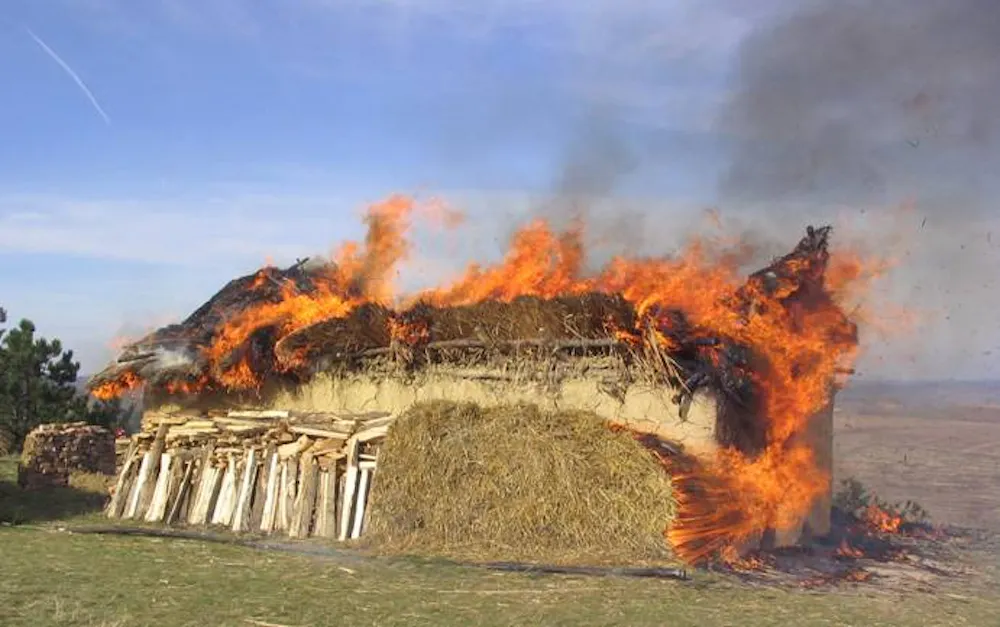
    The residents of Nebilevka didn’t need to have consciously planned for their neighborhood layout to help their population survive. But they may well have, as human instinct is to avoid signs of contagious disease. Like at Çatalhöyük, residents kept their houses clean. And about two-thirds of the houses at Nebelivka were deliberately burned at different times. These intentional periodic burns may have been a pest extermination tactic.

    Re-creation of a Trypillian house-burning, with additional straw and wood necessary to burn hot enough to match archaeological evidence.
    Arheoinvest/Wikimedia Commons, CC BY

    New cities and innovations

    Some of the early diseases eventually evolved to spread by means other than bad foods. Tuberculosis, for instance, became airborne at some point. When the bacterium that causes plague, Yersinia pestis, became adapted to fleas, it could be spread by rats, which would not care about neighborhood boundaries.

    Were new disease vectors too much for these ancient cities? The mega-settlements of Trypillia were abandoned by 3000 BCE. As at Çatalhöyük thousands of years before, people dispersed into smaller settlements. Some geneticists speculate that Trypillia settlements were abandoned due to the origins of plague in the region, about 5,000 years ago.

    The first cities in Mesopotamia developed around 3500 BCE, with others soon developing in Egypt, the Indus Valley and China. These cities of tens of thousands were filled with specialized craftspeople in distinct neighborhoods.

    This time around, people in the city centers weren’t living cheek by jowl with cattle or sheep. Cities were the centers of regional trade. Food was imported into the city and stored in large grain silos like the one at the Hittite capital of Hattusa, which could hold enough cereal grain to feed 20,000 people for a year. Sanitation was helped by public water works, such as canals in Uruk or water wells and a large public bath at the Indus city of Mohenjo Daro.

    These early cities, along with those in China, Africa and the Americas, were the foundations of civilization. Arguably, their form and function were shaped by millennia of diseases and human responses to them, all the way back to the world’s earliest farming villages.

    R. Alexander Bentley does not work for, consult, own shares in or receive funding from any company or organization that would benefit from this article, and has disclosed no relevant affiliations beyond their academic appointment.

    ref. Socially distanced layout of the world’s oldest cities helped early civilization evade diseases – https://theconversation.com/socially-distanced-layout-of-the-worlds-oldest-cities-helped-early-civilization-evade-diseases-239586

    MIL OSI – Global Reports

  • MIL-OSI Australia: Honey Bee Education Officer Kelly Lees awarded prestigious Churchill Fellowship

    Source: New South Wales Department of Primary Industries

    16 Oct 2024

    NSW Government Honey Bee Education Officer Kelly Lees has been recognised with a top industry honour, awarded the prestigious Churchill Fellowship for her dedication and groundbreaking work in education and training of Australian beekeepers managing Varroa mite.

    Each year, after a competitive selection process over several months, Churchill Fellowships are awarded to talented Australians who are eager to push the boundaries of science and make a real difference in NSW communities.

    Kelly will head overseas in 2025 to look at innovative new ways of managing parasitic mites of honeybees including Varroa and Tropilaelaps mites.

    NSW DPIRD Acting Executive Director Agriculture Darren Bayley said this fellowship not only recognizes her talent but also underscores the importance of addressing the challenges posed by parasitic mites to our vital bee populations and industries.

    “We are proud of Kelly for receiving the Churchill Fellowship, with this recognition highlighting her dedication and the impact her work will have on bee health and agricultural sustainability well into the future,” Mr Bayley said.

    “With Kelly’s participation in the Churchill Fellowship, we anticipate significant advancements in the management of parasitic mites that threaten Australian honeybee populations and look forward to knowledge she will impart on our staff and beekeepers across NSW.”

    Kelly will be working with leading researchers in the field including Dr Samuel Ramsey and Dr Cooper Schouten.

    Kelly’s fellowship has been sponsored by Colin and Maggie Beer through the Saskia Beer Fellowship in memory of their late daughter.

    Ms Lees said by sharing insights and techniques with other researchers, we can develop more effective management strategies that will not only benefit our honeybees but also ecosystems worldwide.

    “I am incredibly honoured to receive the Churchill Fellowship, it not only represents a great personal achievement in my career but will also allow me to have a direct impact on our local beekeepers and agricultural practices,” Ms Lees said.

    “This opportunity will allow me to collaborate with some of the world’s leading experts in honeybee health and explore innovative solutions for managing parasitic mites that threaten our bees.”

    The aim of the Churchill Fellowship is a part of the Winston Churchill Trust. The trust provides an opportunity to Australians to travel overseas to conduct research in their chosen field. It also aims to reward individuals who possess passion and a commitment to make a difference in Australian society. Since 1965 they have awarded over 4500 Fellowships.

    For more information on NSW DPIRD honeybee research, please visit our website

    For more information on the Chruchill Fellowship, please visit the Winston Churchill Trust website

    Images are available here

    Media contact:
    For more information, please contact: pi.media@dpird.nsw.gov.au

    MIL OSI News

  • MIL-OSI USA: Grassley Stands Up for Iowa Farmers, Calls Out Biden-Harris Ag Failures

    US Senate News:

    Source: United States Senator for Iowa Chuck Grassley
    BUTLER COUNTY, IOWA – U.S. Sen. Chuck Grassley (R-Iowa), a lifelong family farmer and a member of the Senate Agriculture Committee, is sharing Iowa farmers’ concerns regarding the Biden-Harris administration’s approach to agriculture, energy and trade. 
    “Farmers are struggling to stay afloat thanks to falling profitability, sky high input costs and burdensome regulations,” Grassley said of his letter to President Biden and Vice President Harris. “In order to forge a better future for farmers, Washington needs to listen to the real-world experience of those with dirt under their fingernails. I’m demanding the Biden-Harris administration wake up to the challenges our farmers are facing.”
    Grassley’s letter shines light on President Biden and Vice President Harris’ harmful ag and trade policies, including:
    Grassley is urging President Biden and Vice President Harris to prioritize agricultural issues and lend farmers a helping hand by issuing timely, science-backed guidance on the 45Z Clean Fuels tax credit and expanding market access.
    Download audio of Grassley discussing his letter HERE. Read the full letter HERE and below.
    Monday, October 14, 2024
    The Honorable Joseph R. Biden
    President of the United States
    1600 Pennsylvania Ave NW
    Washington, DC 20500
    Dear President Biden and Vice President Harris,
    I am writing to express my concerns regarding the impact of your administration’s policies on the agricultural community. As a lifelong family farmer, I know first-hand the decisions made at the federal level have far-reaching consequences. It is critical that these decisions support, rather than hinder, our farmers. 
    Many aspects of farming have changed over the last four years of your administration. Unfortunately, the most important aspect of farming, profitability, has declined. In 2021, net farm cash income for the United States was around $176 billion. This year, 2024, net farm cash income is estimated to be down to $154 billion. As any farmer could tell you, if you aren’t profitable, you won’t be farming for long. I would like to take this opportunity to address areas where I believe your administration has fallen short in supporting the agriculture sector.
    First, under your administration the regulatory environment has become increasingly burdensome. Farmers and businesses alike have faced a host of new regulations that complicate their operations and drive up costs. For example, your changes to the Waters of the United States (WOTUS) rule, would have covered over 90 percent or the State of lowa and made the government involved in any land management decision for farmers, developers, and businesses such as golf courses. Thankfully, all nine Supreme Court justices agreed that the Environmental Protection Agency’s expansive regulatory efforts violated the Clean Water Act.
    From electric vehicle mandates to overly complicated strategies for herbicides and insecticides, farmers are concerned that these regulations will impose additional compliance costs and restrictions on their ability to manage their land effectively. This is also seen clearly in the Department of Treasury’s guidance for the 40B sustainable aviation fuel tax credit. Instead of enabling farmers to benefit from science-backed farming practices that work for them, your administration’s guidance restricted American farmers and benefitted foreign feedstocks. While I understand the need for sustainable practices, pushing farmers to specific farming practices can undermine the autonomy of farmers to make decisions that best suit their unique circumstances, and edge them out of new markets.
    Trade policy is another area where your administration has missed the mark. The lack of new trade agreements and uncertainty around tariffs has left the United States agriculture sector with a record estimated $30.5 billion trade deficit this year. In March, I joined 21 of my Senate colleagues in a letter to Ambassador Tai and Secretary Vilsack to ask if your administration intended to pursue any new free trade agreements. As my colleagues and I expressed at that time, the increased deficit is, “exacerbated by an unambitious U.S. trade strategy that is failing to meaningfully expand market access or reduce tariff and non-tariff barriers to trade.” Though your administration has acted in trade disputes and other areas, it has been based on previous trade agreements established before your administration. The lack of a comprehensive strategy to expand market access for American agricultural products has been frustrating for farmers who rely on exporting their products to sustain their livelihoods.
    Lastly, I urge your administration to prioritize these important issues in the agricultural community. There are still important steps that you can take to support farmers. Issuing timely guidance on the 45Z clean fuels tax credit would help provide certainty to farmers looking to market the grain they are currently harvesting. Allowing farmers a seat at the table for 45Z guidance and reducing the complicated and unworkable structure from 40B would go a long way in ensuring farmers maintain their autonomy in farming practices.
    Thank you for your attention to these important issues. I look forward to your response and hope that in the coming months you work to support our farmers who continue to contribute to the nation’s food security, fuel independence, and economic stability.
    -30-

    MIL OSI USA News

  • MIL-OSI New Zealand: Palmerston North sheep farmer banned from being in charge of animals indefinitely, fined $13,000 over failure to treat flystrike and meet welfare needs for hundreds of sheep

    Source: Ministry for Primary Industries

    A Palmerston North sheep farmer has been disqualified indefinitely from being in charge of animals and fined $13,000 for failing to treat flystrike and meet welfare needs of hundreds of sheep.

    Alasdair Donald Currie (65) was sentenced in the Palmerston District Court on 6 charges yesterday (15 October) under the Animal Welfare Act, following a successful prosecution by the Ministry for Primary Industries (MPI).

    Following a complaint in February 2023, MPI sent an animal welfare inspector and a veterinarian to the farm to inspect his animals. They found some sheep recumbent or dead and others affected by fly strike – 2 of them had to be euthanised.

    The farmer was directed to muster all sheep and to take action to address a range of animal welfare issues, including shearing all woolly ewes to prevent flystrike. In April an animal welfare inspector and veterinarian returned to the farm and found Mr Currie had failed to effectively address the flystrike. Some sheep were still in full wool and a total of 48 sheep had either died or had to be euthanised.

    “Overall, 118 sheep were found to be affected by flystrike out of a mob of about 450. Our veterinarian found at least 70 of these sheep were in unnecessary pain and distress because of Mr Currie’s failure to act as directed.” says MPI regional manager Animal Welfare and National Animal Identification and Tracing (NAIT) Compliance, Gray Harrison.

    “This was aggravated by the fact Mr Currie admitted to us that he had not provided his sheep with any flystrike preventative during the 2022-2023 season.

    “The welfare of animals is our number one priority and when we find evidence of deliberate neglect – we will take action.” says Gray Harrison.

    Other animals were affected by parasites such as worms and a lamb that had a severed achilles tendon which occurred during crutching, had to be euthanised.

    Animal welfare is everyone’s responsibility and MPI strongly encourages any member of the public who is aware of animal ill-treatment or cruelty to report it to the MPI animal welfare complaints freephone 0800 00 83 33.

    For further information and general enquiries, email info@mpi.govt.nz

    For media enquiries, contact the media team on 029 894 0328.

    MIL OSI New Zealand News

  • MIL-OSI New Zealand: Trade Minister to attend G20 meeting in Brazil

    Source: New Zealand Government

    Trade Minister Todd McClay will attend the Group of Twenty (G20) Trade and Investment Ministerial Meeting in Brasilia next week. 

    “As an exporting nation reliant on trade, this is a significant opportunity to boost our interests with some of the world’s largest economies and many of our most important trading partners,” Mr McClay says.

    “New Zealand was invited to attend following our success in negotiating the E-Commerce agreement at this year’s WTO Ministerial Trade negotiation in Abu Dhabi, and our inaugural attendance at the G7 Trade Ministers meeting in Reggio Calabria.”

    Minister McClay will represent New Zealand alongside G20 members to discuss sustainable development, investment, global food security, reducing Non-Tariff Barriers (NTBs) and strengthening of the Multilateral system to grow trade. 

    In addition to G20 meetings, Mr McClay will look to engage directly with counterparts including from Brazil, Canada, Chile, the European Union, Germany, India, Mexico, Netherlands, South Africa, the United Kingdom and the United States.

    While in the region, the Minister will also lead a business delegation to São Paulo to boost New Zealand’s $242 million exported to Brazil and supporting the 40 Kiwi businesses already operating in the region.

    The delegation includes 13 organisations: Aroa Biosurgery, Auckland Council, Foot Science International, Framecad, Gallagher Animal Management, Latin America Centre of Asia-Pacific Excellence (CAPE), Latin America New Zealand Business Council (LANZBC), Livestock Improvement Corporation (LIC), Loadscan, Mindhive Global, New Zealand Brazil Business Chamber (NZBBC), Seequent, and Tait Communications.

    “We are committed to ensuring New Zealand remains competitive on the world stage and that our high-quality, safe and sustainable exports gain the recognition they deserve.”

    MIL OSI New Zealand News

  • MIL-OSI China: Blogging taxi driver takes road to fame

    Source: China State Council Information Office 3

    Donning a cowboy hat, Ge You, one of the most renowned actors in the country, takes on the role of an ambassador of justice in his latest film, The Hutong Cowboy.

    However, unlike the typical cowboy archetype, the “weapon” of Ge’s character, Zhang Beijing, isn’t a sixgun holstered at his side. Instead, it’s the essential tools of the digital age — a smartphone and a selfie stick.

    In the movie, Zhang, a Beijing taxi driver in his 50s, unexpectedly becomes an internet sensation after a video capturing his moment of anger goes viral online. He seizes this newfound fame to start his own video blog, where he helps everyday individuals defend their rights.

    The footage shows the irate protagonist riding a sightseeing mini-train, chasing a soap seller dressed as a Transformers-like robot portrayed by actress Li Xueqin. The protagonist is triggered by the seller’s violation of his image rights. Earlier, the “robot” claw snags his wig, revealing his bald head, and this embarrassing moment is subsequently showcased on a large screen aimed at attracting more passersby to buy her soaps.

    As the latest directorial effort of veteran director Ning Hao and emerging talent Xu Lei, the 113-minute comedy was released across domestic theaters on Oct 1.

    Starring actress Gong Beibi as Zhang’s former wife and actor Wu Lei as his son, the movie unfolds with Zhang’s determination to deliver a parental speech at the upcoming wedding, rather than allowing his son’s wealthy entrepreneur stepfather to do so.

    Despite his efforts, including trying to rent luxury cars for the wedding and purchasing an expensive wig, Zhang eventually conceives a plan to become an internet influencer, aiming to demonstrate that he too can achieve success after the incident. However, the situation takes an unexpected turn.

    Director Ning, one of the most renowned figures among China’s “sixth-generation directors”, tells China Daily that he has been considering shooting a feature-length film centered on Zhang, a chatty yet warmhearted taxi driver representing the Chinese capital’s unique hutong culture, since 2019.

    Zhang’s character was initially introduced in Ning’s Nihao Beijing (Hello Beijing), one of the six standalone short stories featured in the 2019 anthology blockbuster My People, My Country. The narrative of Zhang was revisited in Beijing Haoren (A Kind-hearted Beijing Native), also directed by Ning, and one of the five separate stories of the 2020 anthology My People, My Homeland, a sequel to the 2019 film.

    Ning unveils that the inspiration for Zhang stems from the uncle of Wang Ang, the film’s scriptwriter.

    “We had interviewed his uncle before developing the storyline for the 2019 film,” recalls Ning.

    The archetype individual, characterized by his helpful, hospitable, and talkative nature, embodies a subset of native Beijing taxi drivers, who enjoy exchanging perspectives on international and domestic affairs with passengers and typically possess a broad spectrum of knowledge, Ning says.

    After being invited on board to codirect the film, Xu, who shot to fame for the award-winning suspense comedy Summer Detective, recalls that he and the cameraman Cheng Ma sought out the ideal filming locations in Beijing’s hutong areas.

    Living in a community near the East Fifth Ring Road, Xu shares that the journey has helped him realize the unique charm of Beijing — from its labyrinthine alleyways to the close-knit relationships among neighbors and the picturesque courtyards adorned with gray tiles, gray walls and red doors.

    “The preservation of hutong houses within the Second Ring Road represents a preservation of traditional and classical ways of living,” Ning adds.

    A native of Taiyuan, Shanxi province, Ning says that he believes Beijing locals, especially those residing in hutong, are renowned across the country for their wit and convivial dispositions, shaped by their distinctive living environment.

    “For many families, they share one courtyard with neighbors and have to go out to use communal toilets. Residents frequently run into each other. If nobody speaks, it can create pressure and lead to anxiety. Therefore, they rely on conversations and jokes to navigate life more smoothly,” Ning explains.

    Moreover, the film aims to capture how everyday individuals navigate the challenges of embracing a modern era dominated by livestreams, short videos and online commerce.

    Ning, seeking insights through his observations of daily life, recalls several instances that shed light on this dynamic. Intrigued by late-night livestreamed plant sales, Ning watched sellers diligently maneuvering electric bikes across fields to fulfill customers’ requests for close-ups of saplings. Similarly, he observed a grill restaurant owner fervently promoting her dishes to just a few online viewers. Even Ning’s shy and introverted nephew, who is recruited as a livestreamer to sell vehicles, found his primary audience to be Ning’s own relatives, who needed to support the young man as he struggled to attract enough customers.

    “Though the internet has reshaped our lives, it’s heartening to witness the resilience and fervor of ordinary individuals in the face of difficulties and challenges. Every single one of them is working hard to keep pace with the changes of the era,” reflects Ning.

    Interestingly, the courtyard of Zhang, the protagonist, was filmed within a hutong near Zhihua Temple, a Buddhist temple constructed during the Ming Dynasty (1368-1644). The backdrop of the sweeping and fluid Galaxy SOHO complex, designed by the late Iraqi-British architect Zaha Hadid, adds a metaphorical depth to the film.

    Director Xu explains that this deliberate contrast aims to convey a message about the potential for harmonious coexistence between tradition and modernity in a vibrant metropolis like Beijing.

    MIL OSI China News

  • MIL-OSI New Zealand: Council appoints Craig Pauling as Chair

    Source: Environment Canterbury Regional Council

    There were no other nominations for the role.

    Councillor Deon Swiggs has been appointed as Deputy Chair.

    Councillor Pauling, who represents the Christchurch West/Ōpuna constituency, said it will be an honour and a privilege to lead the Council.

    “We have an ambitious work programme for the next 10 years, and I am proud of that. Now we just need to get on with it.”

    Pauling was nominated by Ngāi Tahu Councillor Tutehounuku ‘Nuk’ Korako and this was seconded by Ngāi Tahu Councillor Iaean Cranwell.

    “We are all on the same waka and we are paddling hard for our communities, most importantly for the precious place we call home, for our water and our land and our air and sea,” Pauling said shortly after his appointment.

    “A lot of our work goes unnoticed but it is happening – from the thousands of bus trips taken on our public transport each month to the 26,000 consents we manage. We have been a leader in setting rules for land use and farming consents.

    “We protect homes, farms and businesses through our river flood protection systems. We protect towns across Canterbury. Our regional parks provide multiple benefits, including sediment control, flood protection, biodiversity as well as being used for recreation. We clean up wrecked vessels and ensure safe use of our harbours and waterways.

    “We don’t always get it right, but at the end of the day, we’re doing a lot of good work for a lot of people,” Pauling said.

    Deputy Chair Swiggs, who represents Christchurch West/Ōpuna, said he’s looking forward to working alongside Chair Pauling.

    “I’m humbled to be appointed to this role of Deputy. For me, the priority will be ensuring we focus on our core services, and do it well.”

    MIL OSI New Zealand News

  • MIL-OSI Australia: Restart a Heart and save a life

    Source: New South Wales Premiere

    Published: 16 October 2024

    Released by: Minister for Health


    Minister for Health Ryan Park is calling on more people to sign up as a NSW Ambulance GoodSAM volunteer this Restart a Heart Day so they can help save a life if someone near them has a cardiac arrest.

    Minister for Health Ryan Park is calling on more people to sign up as a NSW Ambulance GoodSAM volunteer this Restart a Heart Day so they can help save a life if someone near them has a cardiac arrest.

    NSW Ambulance attends to around 9,000 people in NSW who experience an out-of-hospital cardiac arrest each year and statistics show only 12 per cent of people who receive resuscitation survive.

    The GoodSAM app works by alerting registered responders when someone near them goes into cardiac arrest and a Triple Zero (000) call has been received.

    The GoodSAM app has helped directly save 36 lives in NSW since it was launched in 2023.

    Responders can opt whether or not to accept the alert and respond by providing cardiopulmonary resuscitation (CPR), while at the same time, an ambulance is dispatched.

    NSW Ambulance has incorporated the NSW public access defibrillator registry into the GoodSAM app, meaning responders can also see if an automated external defibrillator (AED) is located near a person experiencing cardiac arrest and use it to improve that person’s chance of survival.

    John Cornell is one of the lucky survivors of a cardiac arrest, thanks to his fast-thinking teenage son and bystanders who sprang into action when he collapsed in March, and he is showing his support for Restart a Heart Day by sharing his story.

    John said his cardiac arrest came out of nowhere while he and his son were out for a walk in Lawson, in the NSW Blue Mountains.

    While John’s son Matthew called Triple Zero (000), community members began chest compressions and fetched an AED from a nearby public swimming pool, which they used to restart his heart.

    When they arrived, paramedics took John to the emergency department at Blue Mountains District Anzac Memorial Hospital, before he spent 12 days in the Intensive Care Unit at Nepean Hospital, where he had another heart attack.

    Fortunately, he has since made a full recovery.

    Restart a Heart Day is an international campaign, coordinated in Australia and New Zealand by the Council of Ambulance Authorities, reminding people how to respond if they believe someone has suffered a cardiac arrest:

    1. Call: Triple (000) and ask for Ambulance and follow their instructions
    2. Push: begin chest compressions by linking your hands and pushing hard and fast
    3. Shock: if available, use an AED to shock the person’s heart.

    Members of the community can sign up as a GoodSAM volunteer and learn lifesaving CPR and how to use a defibrillator with NSW Ambulance paramedics, who will be at Parramatta Farmers Market, Centenary Square, Parramatta from 7.30am to 2.00pm today.

    You can register as a GoodSAM responder if you’re 18 years old or over, and able and willing to provide chest compressions, which are easy and safe to do. You don’t need to have formal first aid or CPR training. To register, please visit: ambulance.nsw.gov.au/goodsam

    In 2022, the NSW Government announced a $2.5 million partnership between NSW Ambulance and the GoodSAM responder app.  

    Quotes attributable to Minister for Health, Ryan Park: 

    “The best chance of survival for anyone having an out-of-hospital cardiac arrest is receiving early chest compressions and defibrillation from an automated external defibrillator.

    “The first eight minutes after someone suffers a cardiac arrest is crucial and for every minute a patient is in cardiac arrest and does not receive CPR or a shock from a defibrillator, their chance of survival drops by 7 to 10 per cent.

    “Restart a Heart Day is a great opportunity to ask yourself if you know what to do if someone near you has a cardiac arrest and to familiarise yourself with the life-saving actions of ‘call, push and shock’ and sign up to GoodSAM.”

    Quotes attributable to NSW Ambulance Chief Executive Dr Dominic Morgan: 

    “If you see a community member who has had a cardiac arrest, the best thing you can do is call Triple Zero (000) and start chest compressions. 

    “Over 8,000 community members have already joined our free life-saving GoodSAM program and more volunteers will lead to more lives being saved.

    “GoodSAM volunteers nearby will be notified as an ambulance is being dispatched and our emergency medical call taker will give you clear instructions and stay with you on the phone until paramedics arrive.”

    Quotes attributable to John Cornell:

    “There are so many people that I need to thank, but unfortunately I don’t know who most of them are.

    “They call the blockage that I had in my heart ‘the widow maker’, and my family really took the brunt of the trauma of everything that happened.”

    MIL OSI News

  • MIL-OSI Asia-Pac: CE’s speech in delivering “The Chief Executive’s 2024 Policy Address” to LegCo (7)

    Source: Hong Kong Government special administrative region

    VI. Promote Integrated Development of Culture, Sports and Tourism and Foster Economic Diversification

    (A) East‑meets‑West Centre for International Cultural Exchange and Integrated Development of Culture, Sports and Tourism

    121. The current‑term Government set up the Culture, Sports and Tourism Bureau (CSTB) to consolidate the integrated development of culture, the creative industry, sports and tourism. To enhance Hong Kong’s role as the East‑meets‑West centre for international cultural exchange, the Government strives to deepen the institutional reform of our cultural system, improve the cultural and economic policies, and further enhance our cultural confidence.

    Enhance Cultural Soft Power and Promote Development of Cultural and Creative Industries

    122. The CSTB consulted the arts and cultural community last year on the formulation of the Blueprint for Arts and Culture and Creative Industries Development. The blueprint will cover four major development directions: promoting the development of diverse arts and culture with an international perspective, promoting Chinese culture, fostering arts and cultural exchange between China and the rest of the world, and driving industry development. The CSTB will consult the Culture Commission shortly and promulgate the blueprint later this year.

    123. Established in June, the Cultural and Creative Industries Development Agency adopts an industry‑oriented approach to promote the development of the cultural and creative industries. Relevant measures include:

    (i) incubating more cultural and creative projects with potential for industrialisation through the CreateSmart Initiative and strengthening cross‑sectoral collaboration and leveraging market resources, facilitating the industries to explore business opportunities;

    (ii) facilitating more registration of local and non‑local cultural and creative products on the Asia IP Exchange Portal to foster cross‑sectoral exchange, collaboration and business matching, and promoting transactions and transformation of cultural IP; and

    (iii) making the new flagship Hong Kong Fashion Design Week an annual signature event to develop Hong Kong into a fashion design hub in Asia.

    Strengthen Long-term Industry Development in the West Kowloon Cultural District

    124. The West Kowloon Cultural District (WKCD) is one of the largest arts and cultural projects in the world. The WKCD Authority will take a leading role in establishing an industry chain for the arts and culture and creative industries of Hong Kong, driving cultural and creative tourism, and enhancing its financial sustainability through diverse and innovative industrialisation measures, including:

    (i) further building Hong Kong’s strengths in arts trading – Promote the creation of a comprehensive arts trading ecosystem, and build storage, restoration and exhibition facilities for high‑end private art collections;

    (ii) promoting the WKCD as a prime destination for major international cultural, creative and commercial events – With more than 20 venues for different kinds of mega events, the WKCD Authority will step up efforts to host more major international cultural, creative and commercial events, attracting more inbound visitors and stimulating local spending;

    (iii) exporting more arts, cultural and creative projects – Organise and curate performing arts programmes and exhibitions to be staged as long‑run events locally, in the Mainland and overseas on a commercial basis, and expand the sales channels for cultural and creative merchandise; and

    (iv) branding the WKCD as a must‑visit landmark for cultural and creative tourism – Roll out more special experience activities, and step up worldwide promotion in collaboration with the Hong Kong Tourism Board (HKTB) to bring in more tourists.

    Promote Sports Development and Build Hong Kong into a Centre for Mega International Sports Events

    125. In recent years, Hong Kong athletes have achieved outstanding results in international competitions. Hong Kong has abundant resources and support. With our soon‑to‑complete new landmark Kai Tak Sports Park (KTSP), and our co‑hosting of the 15th National Games with Guangdong and Macao late next year, our city has unrivaled advantages for developing itself into a platform for international sports activities. The Government will continue to foster sports development by promoting sports in the community, supporting elite sports, maintaining Hong Kong as a centre for major international sports events, enhancing professionalism, and developing sports as an industry. Relevant measures include:

    (i) enhancing the development of elite athletes and coaches – The Government has invited the Hong Kong Sports Institute to review the mechanism of direct financial support for athletes (including athletes with disabilities) to enhance the training system, and has set up a committee to oversee the development of sports medicine and sports science. The Government will also strengthen training for coaches, and explore the feasibility of establishing a standardised accreditation system for coaches;

    (ii) boosting sports promotion in the community – Provide more sports and recreational facilities, including building a swimming complex suitable for hosting international competitions and a sports arena with fencing training and competition facilities. We will also regularise the Pilot Scheme on Subvention for New Sports;

    (iii) reforming the governance of national sports associations (NSAs) – The Sports Federation and Olympic Committee of Hong Kong, China will conclude its review on the governance and operation of NSAs, and make recommendations, ensuring the NSAs are operating effectively so that athletes (including athletes with disabilities) can realise their potential in a fair and professional environment; and

    (iv) developing a host city economy in the sports industry – The Government will continue to support athletes to participate in different large‑scale international competitions. We will make full use of the KTSP and other existing venues to host large‑scale international competitions so that Hong Kong teams can compete on home soil, building their own audience. These will be conducive to the long‑term development of the sports industry.

    126. The Government will review the redevelopment plan for the Hong Kong Stadium to ensure its synergy with the KTSP.

    Develop Kai Tak Sports Park into a Sports and Mega Event Landmark

    127. Opening in the first quarter of 2025, the KTSP is the largest sports infrastructure project ever commissioned in Hong Kong. It will boost sports development and inject impetus into related industries such as recreation, entertainment and tourism, and also mega‑event economy.

    128. The inter‑departmental Task Force on KTSP, led by the Chief Secretary for Administration, will ramp up efforts in overseeing the smooth completion and commissioning of the KTSP and its publicity work, fostering the synergistic development of major sports events, innovative entertainment, dining, conventions and exhibitions, as well as tourism activities. The task force will also formulate thorough plans and conduct comprehensive drills on security deployment, crowd management, emergency response, and other areas.

    Enhance Cultural Confidence and Revitalise Hong Kong’s Tourism Industry

    129. We will develop Hong Kong into a premier tourism destination through innovative thinking and making better use of our rich and unique resources such as the Victoria Harbour, outlying islands, rural areas, cultures, cuisines, lifestyles and historic buildings. These elements, combined with our edges in technology, animation and comics, the performing arts, film and television culture, and more, will help to instill the concept of “tourism is everywhere in Hong Kong”.

    130. The CSTB will publish the Development Blueprint for Hong Kong’s Tourism Industry 2.0 (Blueprint 2.0) later this year, with the focus on promoting culture, sports, ecology and mega events, covering such areas as:

    (i) developing eco‑tourism – We will explore more itineraries with characteristics related to the countryside and coastal routes, such as island‑hopping tours in Yan Chau Tong, and enhance related amenities; expedite the development of the South Lantau Eco‑recreation Corridor; develop the ex‑Lamma Quarry site into an area for resort and outdoor recreational uses; and develop Tsim Bei Tsui and Pak Nai into eco‑tourism nodes;

    (ii) developing visitor sources from the Middle East and ASEAN – We will actively encourage various sectors of the community to enhance tourism‑support measures for creating a friendly environment for visitors. They include providing information at the airport in Arabic and encouraging taxi fleets to provide fleet service information in Arabic; compiling a list of restaurants offering halal food; encouraging more commercial establishments to provide appropriate facilities, such as worship facilities in hotels; and stepping up staff training to strengthen their knowledge on receiving visitors from different cultural backgrounds;

    (iii) developing tourism products with characteristics – We will promote yacht tourism in the expansion area of Aberdeen Typhoon Shelter, the ex‑Lamma Quarry area and the development of the waterfront site in the vicinity of the Hung Hom Station. We will also promote panda tourism, horse racing tourism, and the like. The CSTB will promote cultural and eco‑tourism itineraries and products at Sha Tau Kok. The Security Bureau (SB) will increase the daily visitor quota under the Sha Tau Kok opening‑up plan to 3 000 by the end of this year. Facial recognition technology will be adopted to enable people living or working at Chung Ying Street to enter and leave the street unimpededly via a “contactless” mode on a pilot basis. The SB will explore the application of relevant technology to complement the future opening up of Chung Ying Street for tourism;

    (iv) developing mega‑event tourism economy – The Mega Events Coordination Group, led by the Deputy Financial Secretary, will continue to take a proactive role in attracting different mega events to Hong Kong with emphasis on quality and quantity, boosting the retail and hotel industries. We will drive the development of the site above the Exhibition Station in Wan Chai North, as well as the waterfront and pier sites in the vicinity of the Hung Hom Station, into new landmarks providing additional event venues;

    (v) strengthening the appeal of traditional tourism – The HKTB will draw up a gourmet guide covering the 18 districts, organise gastronomic events, and promote gourmet food in different districts. The CSTB will publish the action plan on the development of cruise tourism, alongside the Blueprint 2.0, to enhance the Kai Tak Cruise Terminal’s role as a homeport and a venue for conventions, exhibitions and other events; and

    (vi) promoting smart tourism and enhancing service quality of the tourism industry – The HKTB will strengthen its efforts in developing and promoting tourism products with Hong Kong characteristics to both locals and visitors, making use of technologies such as AI to provide one‑stop assistance and attraction recommendations. We will also launch a new outstanding services award scheme to consolidate our hospitable culture.

    Develop New Tourist Hotspots

    131. The Government will set up a Working Group on Developing Tourist Hotspots. Led by the Deputy Chief Secretary for Administration, it will strengthen cross departmental co‑ordination and leverage community efforts, identifying and developing tourist hotspots of high popularity and with strong appeal in various districts.

    Increase Tourist Arrivals

    132. The HKSAR Government has proposed to the Central Government further enhancements on Mainland residents’ tourism visit endorsements to Hong Kong, including resuming the “multiple‑entry” Individual Visit Endorsements for Shenzhen residents and expanding the coverage of pilot cities for implementing policies on the “one trip per week” Individual Visit Endorsements. The Central Government has advised that relevant departments are studying the expedited implementation of the proposal proactively.

    133. To foster closer people ties with ASEAN countries, starting today, the Government will relax the criteria for nationals of Cambodia, Laos and Myanmar applying for multiple‑entry visas for travel and business, and extend the validity period of multiple‑entry visas for these countries from two years to three years. The arrangement also applies to Vietnamese, who have benefitted from the relaxation of the visa policy since last year. Under a fast‑track arrangement, we will expedite the processing of visa applications from group visitors of ASEAN countries submitted via local travel agents. In addition, we will provide self‑service immigration clearance for invited persons participating in business, development and related activities from the 10 ASEAN countries, and provide one‑stop handling of their applications for self‑service immigration clearance and visa through a dedicated desk. Various bureaux will provide assistance in drawing up the list. Effective today, the requirement for visitors to furnish an arrival or departure card is cancelled, facilitating a faster and more convenient immigration clearance.

    (B) Foster Economic Diversification

    Support Small and Medium Enterprises

    134. To address the challenges commonly encountered by small and medium enterprises (SMEs) during economic restructuring, the Government will introduce the following support measures:

    (i) re‑launching the principal moratorium – Borrowing enterprises under the SME Financing Guarantee Scheme (including the existing loans already granted under the 80%, 90% and special 100% guarantee products as well as new loans under the 80% and 90% guarantee products) will be allowed to apply for principal moratorium for up to 12 months. The maximum loan guarantee periods of the 80% and 90% guarantee products will be extended to ten years and eight years respectively, while the partial principal repayment options will be offered to new loans under the two guarantee products. The HKMA is also actively considering to provide flexibility in banks’ capital requirement to facilitate their lending to SMEs;

    (ii) injecting $1 billion into the BUD Fund – Support will be provided for SMEs to upgrade their business operations and develop new markets through the Dedicated Fund on Branding, Upgrading and Domestic Sales (the BUD Fund), including expanding the geographical coverage of E‑commerce Easy to the 10 ASEAN countries, and providing targeted funding support for enterprises to implement green transformation projects;

    (iii) supporting digital transformation of SMEs and capitalising on e‑commerce opportunities – The scope of Cyberport’s Digital Transformation Support Pilot Programme will be expanded to cover the retail and food and beverage sectors, as well as industries such as tourism and personal services, subsidising SMEs for digital transformation on a one‑to‑one matching basis. The Hong Kong Shopping Festival is to be relaunched in the next two years to help SMEs tap into the Mainland e‑commerce sales market, and will be held in the ASEAN market in due course;

    (iv) strengthening brand development of SMEs – The HKTDC will formulate plans for setting up more Hong Kong Pavilions in Mainland and overseas exhibitions to further promote Hong Kong brands. The Trade and Industry Department and the HKTDC will also enhance support for SMEs in developing brands and expanding the sales network of e‑commerce;

    (v) enhancing the services of the Hong Kong Design Centre – The organisation and functions of the Hong Kong Design Centre will be re‑structured, so as to assist SMEs in the design industry to enhance their services in product and brand design, and strengthen collaboration and interface with start‑ups and Mainland enterprises operating in Hong Kong;

    (vi) enhancing incentives for recurrent exhibitions – An additional provision of $500 million will be allocated for launching the Incentive Scheme for Recurrent Exhibitions 2.0, targeting new and international exhibitions of large scale, in order to further promote mega‑event economy and the development of the convention and exhibition industry;

    (vii) supporting participation in government procurement – The HKHA will refine the application procedures for admission to the list of maintenance works contractors, providing more tendering opportunities for contractors; and

    (viii) enhancing security of payment in the construction industry – The Government has introduced the Construction Industry Security of Payment Bill, which prohibits the use of unfair payment terms such as “conditional payment” in contracts and introduces an adjudication mechanism to resolve payment disputes.

    Develop Silver Economy

    135. Given the rapid expansion of the silver market, there is growing demand for products and services catering to the elderly.  Developing new products and services to meet the needs of the elderly will help enhance their quality of life, and also generate business opportunities.

    136. The Government will set up a Working Group on Promoting Silver Economy, led by the Deputy Chief Secretary for Administration. The working group will implement measures in five areas:

    (i) boosting “silver consumption” – We will work with all sectors to foster elderly‑friendly consumption, and encourage incorporation of silver economy elements into their business, for example, by offering discounts to the elderly. Efforts will also be made to safeguard the rights and interests of elderly consumers;

    (ii) developing the “silver industry” – We will promote marketisation and industrialisation of products catering to the elderly by consolidating funding resources to support product provision and market expansion by the business sector;

    (iii) promoting “quality assurance of silver products” – We will promote the certification of products catering to the elderly to enhance their recognition and appeal. Standards adopted will be aligned with those of the Mainland and overseas to facilitate sales network expansion;

    (iv) enhancing “silver financial and security arrangements” – We will assist the elderly in making proper financial arrangements and strengthening their financial security. Relevant measures include promoting retirement financial planning products offered by the Hong Kong Mortgage Corporation Limited, and providing investor education for the elderly; and

    (v) unleashing “silver productivity” – We will help unleash the productivity of the elderly through retraining, re‑employment and other measures.

    Promote Sustainable Development of the Agriculture and Fisheries Industries

    137. The Government will continue to take forward the Blueprint for the Sustainable Development of Agriculture and Fisheries. Relevant work includes developing deep sea mariculture at Wong Chuk Kok Hoi and Mirs Bay new fish culture zones, conducting preparatory work for the Agricultural Park Phase 2 development, implementing urban farming strategy in NDAs, facilitating the livestock sector to construct modernised and environmental‑friendly multi‑storey livestock farms and promoting leisure farming and fisheries.

    (To be continued.)

    MIL OSI Asia Pacific News

  • MIL-OSI Australia: Interview with Susan Graham-Ryan, ABC North Queensland

    Source: Australian Executive Government Ministers

    SUSAN GRAHAM-RYAN, HOST: The 3G switch off has been very controversial, and now it’s less than two weeks away. It has been causing lots of debate, and lots of concerns, particularly for those in regional, rural and remote parts of Queensland. I spoke with Michelle Rowland, the Federal Communications Minister, and I asked her how prepared the country is for the 3G switch off.

    MICHELLE ROWLAND, MINISTER FOR COMMUNICATIONS: The biggest concern that the Government has had is around getting this switchover done in a safer way.

    Last time I was mentioning how there was initially a large number of handsets that we’re concerned about – that was around 740,000 handsets which relied on the 3G network to make Triple Zero calls. We set up a Working Group, and industry has been working hard on contacting affected customers. That number is now down to around 60,000 handsets, which is better news than it was before.
     
    But one of the key things here, too, is around getting people to check their technology. This is really the first mobile spectrum switchover that’s being done during the Internet of Things – so many of your listeners will have devices that are connected to mobile networks. If you’ve got loved ones who may have medical devices, or other monitored alarms, please get in touch with them. 
     
    In terms of handsets, you can text the numeral ‘3’ to the number ‘3498’ and receive an instant message about the compatibility of your handset after the switchover.
     
    GRAHAM-RYAN: Sixty thousand though, that’s still a lot of devices when there’s less than two weeks to go.

    ROWLAND: It is a large number of devices. Not all of these devices are necessarily being used now, but we know that they have been allocated by their mobile providers.

    We know that the carriers are still in contact with people, making sure that this public-awareness campaign gets as wide as it can. A key message to your listeners is that it is really important to check your tech with less than two weeks to go.

    GRAHAM-RYAN: Can you confidently say that Australians, especially those in regional, rural and remote parts, will not lose or drop out some of their service with this switch off?

    ROWLAND: Well, the carriers have given public coverage equivalence undertakings. We’ll continue to monitor that as a government. But again, I’d like to come back to one of the reasons why the switchover is important. We’ve had a regional telecommunications inquiry going right around Australia, including in regional Queensland. One of the biggest complaints that’s being received about mobile services is not just around coverage, but it’s around quality. The way in which better quality is delivered is by utilising the spectrum better, and that can be delivered through 4G and 5G. That signal goes further, it has less congestion and it has faster speeds. These are factors that are really important also during emergencies. So, the carriers have given undertakings on their coverage commitments when the switchover occurs. And, as a government, we will continue to monitor those commitments.

    GRAHAM-RYAN: What happens if the quality and coverage of the services fall away after the 3G switch off? That’s a huge safety risk. If that happens. What will happen for the telcos? Will there be penalties involved if people are put at risk because of this 3G switch off?

    ROWLAND: Well, we’ve got options for regulatory intervention if these are warranted in the public interest, subject to consultation and procedural processes. I can tell your listeners that potential regulatory action remains under consideration.

    Of course, we want this switchover to go well. We want the consumers and the small businesses in regional Queensland to get the best coverage that their counterparts enjoy in metropolitan parts of Australia, and that’s why this switchover is important. It does need to be done in a safer way. The carriers did delay their switchover to undertake a mass public education campaign.

    GRAHAM-RYAN: Minister, I want you to hear from a Queenslander, Monica. She’s a farmer. She also works in disaster response in the town of Mount Garnet. Here are her concerns.

    [Excerpt]

    CALLER MONICA: One bushfire we had in the hills between here and Chillagoe, fire department actually had to have two camps. No mobile service, UHF is line of sight. We also find that when the planes fly over to do the supposedly live stream of what they’re looking at, we don’t get any live stream until they’re actually back in service, which can be quite a while. And when we’re talking bushfires, we all know how fast they can move. The services just get worse and worse the more they improve the service. We have had satellite phones before. We were timber cutters and we used to be out in the bush a lot. When CDMA was very patchy out there, we had the satellite phone. And yeah, the cost, it’s just– it’s out of hand. And no, I wouldn’t be going to satellite. Honestly, it’s the cost.

    [End of excerpt]

    GRAHAM-RYAN: Michelle Rowland, Federal Communications Minister, what do you say to people like Monica about their concerns?

    ROWLAND: Well, firstly, people like Monica, as a disaster management representative, are doing a really tough task, particularly in Queensland, which is one of the most disaster-prone parts of Australia.

    There are probably three things that I’ll point out, and very insightful comments that she makes. A lot of the time following a natural disaster, part of the issue, of course, is access to power. Power is a massive issue; when you don’t have access– when you don’t have those towers with power, it really takes down the whole system. So, what we have been doing as a government, is investing in better resilience of the networks.

    There’s a couple of streams that we’ve got there, including our Telecommunications Disaster Resilience Innovation Program; hardening mobile networks through our Mobile Network Hardening Program. These are about keeping the services on air for longer with better generators, with better sources of alternative power as redundancy. And I would point out that 22 of the 33 approved projects in that Disaster Resilience Innovation Fund are actually in Queensland, which I think, again, points to the fact that there is such need in Queensland.

    On the issue of access to satellite technology, again, NBN has been investing in its SkyMuster satellite service to make that better fit-for-purpose. I think part of Monica’s comment, too, goes to new and emerging technologies. Your listeners might be familiar with LeoSats, low earth orbit satellites. We’ve been doing trials of those, including as part of looking at Universal Service reform. And that’s, again, one of the issues that came up in the Regional Telco Inquiry – the need to use better technology, more cutting-edge innovation to make sure that we stay connected for longer.

    I think the third thing that Monica spoke to was around, how do you get those messages out at important times? And sometimes when the mobile networks go down, your listeners will know you’re relying on broadcasting – on radio. We’ve committed $20 million to the Broadcasting Resilience Program to improve over 100 ABC radio sites that are specifically used for emergency broadcasting. They’re really important as well. As part of that, there’s a number in Far North Queensland and right across regional Queensland.

    Monica’s comments are really insightful, and I think it goes to really a suite of issues and a suite of policies that the Government has in place to make improvements. And I can tell your listeners, the biggest issue that we want to address is access to emergency services, and during natural disasters, which is why that’s been a really big focus.

    GRAHAM-RYAN: That’s Federal Communications Minister Michelle Rowland speaking there.

    MIL OSI News

  • MIL-OSI Australia: Interview with Steve Martin, Ballarat Breakfast, ABC Radio

    Source: Australian Treasurer

    STEVE MARTIN:

    It’s not often that I get to talk to the federal Treasurer, and it’s almost never that the federal Treasurer is sitting across from me in the studio. Jim Chalmers, good morning.

    JIM CHALMERS:

    Thanks for having me on your show, Steve.

    MARTIN:

    Why are you here?

    CHALMERS:

    I’m here because Catherine King invited me, and I go where Catherine King tells me to go. She’s a wonderful local member and Cabinet colleague. But more seriously, I wanted to be here to engage with some of the business leaders but also to spend some time at Ballarat High, which I’ll be doing later on this morning.

    But what we try and do as Cabinet Ministers is make sure that we govern for the whole place, and that means spending time in the wonderful regions of this country, including this beautiful region of yours in Ballarat and the South West.

    MARTIN:

    All right. What are you doing at Ballarat High School?

    CHALMERS:

    I’m going to speak to some of the students about the economy. This is one of the most enjoyable things I get to do as Treasurer. I’ve done a lot of it lately actually, because I like the sense that there’s a lot of intergenerational interest in what’s happening in the world. The world’s a difficult place right now. We’ve got a lot of important decisions to make about the future of our own country in that context, and I find knocking around with young people and taking some really often difficult, always smart, intelligent, well‑motivated questions is a really good thing to do when you’re in communities like this one.

    MARTIN:

    Okay. I want to stick with students at the moment, Jim Chalmers. What do they ask you? What do young people want to know about the economy, and are they, broadly speaking, engaged in that sort of part of the political debate?

    CHALMERS:

    More than they get credit for as a generation. People are incredibly engaged at that level. The main questions I get is what’s happening in the world – Russia, Ukraine, the Middle East – what’s happening closer to home in our own region – China and the US – so a lot of really top shelf questions about what’s happening in the world and where we fit.

    But from an economic point of view, like a lot of Australians, they want to know how are we going to get on top of these cost‑of‑living challenges that people are confronting right around the country, every generation, and in particular, housing. They are a big motivation for the tens of billions of dollars that we’re investing as a government in building more homes so that they can find it easier to find somewhere to rent or buy when the time comes.

    MARTIN:

    Is it right that you’re also going to be having a look at some of the properties involved in the First Home Guarantee while you’re in Ballarat? Is that part of your visit?

    CHALMERS:

    That was in prospect, but not on this occasion. I’m looking forward to doing that, but not on this occasion.

    MARTIN:

    Okay. Cost of living does come up endlessly at the moment because things are tough. Do you think that you have made a difference?

    CHALMERS:

    Definitely –

    MARTIN:

    – in what way –

    CHALMERS:

    – but in saying that, I don’t pretend that the fight against inflation is over. I know that people are still doing it tough even at the same time as inflation by some measures has more than halved since we came to office. But I do understand that for people who are under the pump, they don’t want to be told necessarily that everything is fine when it’s not.

    People are still doing it tough. That’s why the tax cuts are so important, the energy bill relief, cheaper early childhood education, cheaper medicines, rent assistance, getting wages moving again. Really our highest priority as a government has been to try and provide that cost‑of‑living help in the most substantial and meaningful way that we can, but also in the most responsible way that we can, which means doing that as well as, not instead of, delivering those couple of surpluses that we’ve been able to deliver at the same time.

    MARTIN:

    I wonder, with the surplus, I recall when that was announced, and generally that would be considered to be good news politically, but to quote Twitter –

    CHALMERS:

    That’s a dangerous practice, Steve.

    MARTIN:

    I know. I realise that, but the most common response it seems on Twitter is, ‘You can’t eat a surplus.’ So while people think that’s great at one end things are happening, but at the business end for most of us it’s not filtering through.

    CHALMERS:

    I’m really grateful you raised that, because we don’t see a surplus as an end in itself either. The fact that we’ve been able to deliver back‑to‑back surpluses for the first time in almost 2 decades in this country is not an end in itself, it’s how we make room to provide all of that cost‑of‑living relief that I just ran through. It’s how we make sure we avoid paying too much interest on all that debt we inherited from our predecessors.

    Also in the context where the global economy is really uncertain, we want to get the budget in much better nick as a bit of a buffer against that global economic uncertainty, because if things do turn down then we want to have more room to respond if we need to. So those are the reasons for the surplus.

    I say to those people who raise that issue that you’ve raised from social media, but I get it out and about in communities like this one, if we were choosing between a surplus or cost‑of‑living help, I would understand that. But we’ve found a way, because of our responsible economic management, to deliver surpluses and cost‑of‑living help, and we think that’s a good thing.

    MARTIN:

    All right. On the SMS Bea has sent this through. As I say, ‘Morning, Steve. Would you ask Jim Chalmers, please, how can we justify $360 billion on a few submarines and $600 million on a PNG rugby league team but struggle to find money to increase mental health services to adequately address demand?’

    CHALMERS:

    Thank you, Bea, for the question and for listening. I think in every budget you’ve got to find room for all of those things. There is mental health funding, of course, in the Budget. There is national security and defence funding. We are interested in investing in our region, particularly when you’ve got all of this global uncertainty, conflict around the world and economic uncertainty around the world, including closer to home. Some of those investments I know, Bea, can be contentious but we think we’ve broadly struck the right balance – huge investments in health at the same time as we invest in our national defence and national security.

    MARTIN:

    All right. I want to ask you about an item in the news today, Treasurer, and that is a crackdown on subscription traps and hidden fees. What’s happening there? What’s the plan from the government?

    CHALMERS:

    We want to crack down on dodgy deals so that we can save Australians money if we can and where we can. Most businesses do the right thing and they’ve got nothing to worry about, but there are these traps which we’re seeing more and more of, whether it’s making it hard to cancel a subscription, different fees at different stages of a purchase, when the price goes up while you’re actually making the transaction, requiring consumers to provide more information than is necessary to buy something, when it’s hard for you to contact the person or the business that’s selling you a good or a service.

    There are a bunch of dodgy practices that we are worried about and we want to crack down on them and so we are looking to ban unfair trading practices, and that’s the announcement that we’re making today.

    MARTIN:

    Okay. So that is with Australian Consumer Law?

    CHALMERS:

    Absolutely. We’ll do some consultation, as we always do, but look to bed it down at the beginning or the first half of next year. We get a lot of feedback about this, Steve. I’m sure you do as well on your SMS line and out and about. A lot of people, for good reason they do a lot of shopping online or in other ways, and there’s just been these practices which have sprung up which we think go too far. We don’t want people to be taken for mugs. We don’t want to see these dodgy business practices, and so we’re going to crack down on them.

    MARTIN:

    So that will come into effect next year, after the next federal election effectively?

    CHALMERS:

    We’ve said the first half of 2025, and we’ll do it as soon as we can. But what we’d like to do is we want to make sure there are no unintended consequences and the like, and so we’ll do a little bit of consultation, but we’ve said today that we’re going to ban unfair trading practices, and we’ll spend the next month or 2 consulting on the best way to go about it.

    MARTIN:

    Twelve minutes to the next news at 8. We’re talking with federal Treasurer Jim Chalmers. I did say earlier this morning, I had a text from Jamie Vogels, who’s a Corangamite Shire Councillor, and this is in relation to the transition of dairy country to blue gum timber land and the practices of the Foreign Investment Review Board when they look at this.

    Now, Jamie Vogels’ question to you directly, Treasurer, is: why aren’t we allowed to know the conditions placed by the Foreign Investment Review Board on the $200 million foreign investment by Munich RE into blue gum plantations that’s replacing that dairy country in Simpson and the Heytesbury? It’s causing economic and job losses, from Jamie Vogels. So why can’t a community know what the Foreign Investment Review Board has and does look at, or is that information publicly available? Because that group sounds like they can’t find out why the decision was made to allow this to happen?

    CHALMERS:

    First of all, thanks to Councillor Vogels for raising it. I know this is an issue, and in that very important part of our national economy there’s a lot of economic opportunity. The dairy industry is important to us and the timber industry is important to us as well, and we’ve got to strike the right balance.

    When it comes to the Foreign Investment Review Board process, we try and be as transparent as we can about the process. But often the fine details for – whether it’s commercial in confidence or other kinds of reasons – often those are kept confidential. So I’ll have another look at that case, I’m confident that we would have provided all of the information that we can. I’m not anticipating that we can provide additional information, but if we can after I have another look, then I’ll do that.

    MARTIN:

    The community concern, though, Treasurer, is that you’ve got prime agricultural land, not just for dairy; it could be used for other things. You have farm workers, you have houses, you have all sorts of activity going on. And when the trees come in, as much as they are needed, in this sort of land where smaller holdings are more common, you’re losing a community because the trees go in and there’s not nearly as many people moving around. Is that social effect on an area looked at by the FIRB?

    CHALMERS:

    It looks at the broader national interest and to be up front with you, typically the focus is more on, national security concerns or concerns around concentration or concerns about one company or another dominating a certain market, and so there are a range of considerations, including the ones that you raise. But primarily, typically, the advice that comes to me, including in this case, the Department of Agriculture was consulted and didn’t raise any issues with this particular transaction, we cast a pretty broad net, but typically the advice is more about managing risks in areas like critical minerals, critical infrastructure, critical data.

    MARTIN:

    Just finally on this, the member for Wannon did ask for a moratorium on additional land being purchased for expansion of the timber industry until some of the concerns raised in the petition he tabled are addressed. Will you consider that, or is the government even looking at that for a moment?

    CHALMERS:

    I think the Agriculture Minister, Julie Collins, is a wonderful colleague of ours. She looks at these sorts of issues all of the time. We know that there are contentious issues in farming communities and we know as our economy changes and demand for different goods change over time that often difficult issues like this pop up. So Julie Collins, being the diligent minister that she is, would have these sorts of considerations in front of her from time to time.

    MARTIN:

    All right. Just on other more general things, I notice that a number of banks are factoring in a rate cut for December. What’s your take on that?

    CHALMERS:

    I try not to pre‑empt decisions taken independently by the independent Reserve Bank. Treasurers of both political persuasions don’t get into the guessing game about future movements in rates.

    My job is to focus on being helpful in the fight against inflation and we have been. Australia’s made really quite considerable progress when it comes to getting on top of the inflation challenge in our economy, less than half what we inherited on the monthly gauge and that’s a good thing.

    But the Reserve Bank will weigh that up, they’ll weigh up what’s happening in the labour market, what’s happening around the world, and they’ll come to a decision independently in due course.

    MARTIN:

    In Queensland, right. I do wonder, just finally, Treasurer, we’ve been through 30‑odd years of pretty good economic times. It started with Hawke and Keating, continued with Howard and Costello, and then, I guess, governments that have followed haven’t been able or as willing to do as much as those 2 governments did all those years ago. That set us up pretty well. There are older people who say we are back to normal, that the current settings we have are more normal. The long‑term interest rate is 7.4 per cent over – I looked this up yesterday, between ’69 and 2004, that’s the long‑term average interest rate in Australia. So has the community got their expectations too high?

    CHALMERS:

    I wouldn’t say that. I wouldn’t blame the community for that. If you think about that longer sweep of history, yes, Hawke and Keating did a remarkable job setting this place up for 3 decades of economic expansion, absolutely outstanding contribution, history‑making contribution.

    If you think about really since the global financial crisis, we’ve had about 15 years of economic upheaval. The global financial crisis in ’08–09, obviously we had COVID, the war in Ukraine sent supply chains basically haywire around the world, and so we’ve had these 3 shocks in 15 years. And so governments of both persuasions, including this one, have been doing their best to manage the here and now – in our case inflation – at the same time as we invest in the future and that’s why our Future Made in Australia agenda, our housing agenda, energy transformation, skills and human capital are so important.

    But what we need to do and what we are doing is working out what does the next generation of prosperity look like. And it won’t be the same as the one that Bob and Paul set up so skilfully in the 1980s. It’s possible to admire their contribution and recognise ours will be different.

    For us the big thing that we’ll be judged on is nailing this energy transformation. That’s the big economic reform opportunity for our generation. And that’s why we call the 2020s the defining decade in the way that the 1980s were, because the situation calls for a new economy, leveraging all of those traditional strengths that we’ve had and will continue to have into the future, but building new strengths in energy, human capital, technology, services and the like.

    MARTIN:

    All right. I was going to let you go, but since you’ve mentioned the energy transformation, one last quick topic: what do you say to communities in this part of the world that are bearing the brunt of that energy transformation, with transmission lines, with wind farms, with very large‑scale change over a very short period of time to communities that are feeling completely and utterly overwhelmed by circumstances beyond their control?

    CHALMERS:

    We are listening to you. We know that the best version of this energy transformation, which is the opportunity of a lifetime for Australia, including for the regions, requires us to take communities along with us. We understand that.

    MARTIN:

    Well, you’re failing at that, because they’re not coming along with those that are pushing this through.

    CHALMERS:

    We can always do better. And even in the most recent Budget I funded, I think $20 million from memory, for better consultation with local communities because we see this as an opportunity for local communities, including regional communities. We need to make sure that we are listening and bringing people along with us. If we can do a better job of that, we will.

    MARTIN:

    Jim Chalmers, thanks for your time.

    CHALMERS:

    Thanks so much, Steve.

    MIL OSI News

  • MIL-OSI Australia: 220-2024: *Update* Scheduled Outage: Saturday 19 October to Sunday 20 October 2024 – BICON, DAFF messaging, EVE, SeaPest

    Source: Australia Government Statements – Agriculture

    16 October 2024

    Who does this notice affect?

    All clients required to use the following systems during this planned outage:

    • Biosecurity Import Conditions System (BICON)
    • External Verification for eCertificates (EVE)
    • Seasonal Pests (SeaPest)

    All clients submitting the below declarations during this planned outage:

    • Full Import Declaration (FID)
    • Long Form Self Assessed Clearance (LFSAC)
    • Short Form Self Assessed…

    MIL OSI News

  • MIL-OSI Asia-Pac: CE says culture to drive development

    Source: Hong Kong Information Services

    Chief Executive John Lee pledged in this morning’s 2024 Policy Address to promote the integrated development of culture, sports and tourism in Hong Kong, and to foster economic diversification in the city.

    Mr Lee shared plans to enhance Hong Kong’s cultural soft power, promote sports development, build Hong Kong into a centre for international sports mega-events, and revitalise the city’s tourism industry. He also outlined initiatives to support small and medium enterprises (SMEs), develop the “silver economy”, and promote the sustainable development of Hong Kong’s agriculture and fisheries industries.

    The Chief Executive said that in order to enhance Hong Kong’s role as the world’s East-meets-West centre for international cultural exchange and boost its cultural confidence, the Government would deepen institutional reforms to the city’s cultural system, and improve its cultural and economic policies.

    Updating the community on the formulation of the Culture, Sports and Tourism Bureau’s (CSTB) Blueprint for Arts and Culture and Creative Industries Development, Mr Lee said the CSTB is due to consult the Culture Commission on it and will promulgate the blueprint later this year.

    He added that the Cultural and Creative Industries Development Agency, established in June, is incubating cultural and creative projects with potential for commercialisation through the CreateSmart Initiative, and facilitating more registration of cultural and creative products on the Asia IP Exchange Portal. It is also turning Hong Kong Fashion Design Week into an annual signature event, with a view to establishing Hong Kong as a fashion design hub. 

    Mr Lee also iterated that the West Kowloon Cultural District (WKCD) Authority is taking the lead on establishing an industry chain for Hong Kong’s arts, cultural and creative industries. He reported that it will promote the creation of a comprehensive arts trading ecosystem; host more major international cultural, creative and commercial events; export more performing arts programmes and exhibitions to the Mainland and overseas on a commercial basis; and brand the WKCD as a must-visit cultural landmark in collaboration with the Hong Kong Tourism Board (HKTB). 

    On sports development, Mr Lee said the Government will continue to promote sports in the community, support elite sports, enhance the professionalism of Hong Kong athletes and sports teams, maintain Hong Kong as a centre for major international sports events, and develop sports as an industry.

    He mentioned that the Hong Kong Sports Institute is reviewing the mechanism for direct financial support of athletes, including those with disabilities, and has set up a committee to oversee the development of sports medicine and sports science. He added that the Government will provide more sports and recreational facilities, including a new swimming complex suitable for hosting international competitions and a new sports arena with fencing facilities.

    In terms of sports governance, the Sports Federation and Olympic Committee of Hong Kong, China will conclude its review of the governance and operation of national sports associations (NSAs). Mr Lee also outlined that the Government aims to develop Hong Kong as a host city economy and will make use of the new Kai Tak Sports Park (KTSP) and other existing venues to host large-scale international competitions so that Hong Kong athletes and teams can compete on home soil.

    He added that the KTSP, due to open in the first quarter of 2025, will boost sports development and foster the synergistic development of major sports events, innovative entertainment, dining, conventions and exhibitions, and tourism activities.

    With regard to tourism, the Chief Executive said the CSTB will publish its Development Blueprint for Hong Kong’s Tourism Industry 2.0 later this year. It will cover areas such as the development of eco-tourism, and the enhancement of tourism-support measures to encourage more visitor arrivals from the Middle East and Southeast Asia. There will also be efforts to create tourism products around specific themes, such as yachting, pandas and horse racing, build the city’s mega-event tourism economy, promote gastronomy tourism and cruise tourism, and develop “smart tourism” through the application of technologies such as AI (artificial intelligence).

    In addition, Mr Lee said the Government will set up a Working Group on Developing Tourist Hotspots to co-ordinate with the community and develop new tourist hotspots in various districts. It has also proposed to the central authorities that the “multiple-entry” Individual Visit Endorsements for Shenzhen residents be resumed and that the “one trip per week” Individual Visit Endorsements pilot scheme be expanded to cover more cities.

    Mr Lee added that starting from today the Government has relaxed the criteria for nationals of Cambodia, Laos and Myanmar in applying for multiple-entry visas for travel or business, and extended the validity period of the visas offered from two years to three.

    The Chief Executive also unveiled a number of support measures to address challenges encountered by SMEs. These include re-launching the principal moratorium, meaning that enterprises that borrow under the SME Financing Guarantee Scheme will be allowed to apply for a principal moratorium for up to 12 months. Existing loans already granted under the 80%, 90% and special 100% guarantee products, as well as new loans under the 80% and 90% guarantee products, will be covered.

    In addition, $1 billion will be injected into the Dedicated Fund on Branding, Upgrading and Domestic Sales to help SMEs upgrade their business operations and develop new markets, and the scope of Cyberport’s Digital Transformation Support Pilot Programme, which offers SMEs funding for digital transformation on a matching basis, will be expanded to cover the retail and food and beverage sectors.

    Mr Lee said the Hong Kong Trade Development Council will formulate plans to set up more Hong Kong Pavilions at Mainland and overseas exhibitions, while an additional provision of $500 million will be allocated for the launch of the Incentive Scheme for Recurrent Exhibitions 2.0, which aims to attract large-scale international exhibitions to Hong Kong.

    In terms of the development of a silver economy, the Chief Executive said new products and services must be developed in response to the rapid expansion of the elderly market. The Government will set up a “Working Group on Promoting Silver Economy”, led by the Deputy Chief Secretary, to implement measures to boost elderly-related consumption and support elderly consumers.

    Mr Lee reported that the Government will also take forward the Blueprint for the Sustainable Development of Agriculture and Fisheries.

    MIL OSI Asia Pacific News

  • MIL-OSI Asia-Pac: Import of poultry meat and products from areas in Hungary suspended

    Source: Hong Kong Government special administrative region

         â€‹The Centre for Food Safety (CFS) of the Food and Environmental Hygiene Department announced today (October 16) that in view of a notification from the Ministry of Agriculture of Hungary about outbreaks of highly pathogenic H5N1 avian influenza in Fejér County and Hajdú-Bihar County in Hungary, the CFS has instructed the trade to suspend the import of poultry meat and products from the above-mentioned areas with immediate effect to protect public health in Hong Kong.

         A CFS spokesman said that Hong Kong has currently established a protocol with Hungary for the import of poultry meat but not for poultry eggs. According to the Census and Statistics Department, Hong Kong imported about 40 tonnes of frozen poultry meat from Hungary in the first six months of this year.

         “The CFS has contacted the Hungarian authority over the issue and will closely monitor information issued by the World Organisation for Animal Health and the relevant authorities on the avian influenza outbreaks. Appropriate action will be taken in response to the development of the situation,” the spokesman said.

    MIL OSI Asia Pacific News

  • MIL-OSI Russia: ‘Distance is not a problem’: HSE develops cooperation with think tanks of BRICS countries

    MILES AXLE Translation. Region: Russian Federation –

    Source: State University Higher School of Economics – State University Higher School of Economics –

    At the end of September Institute for Statistical Studies and Economics of Knowledge (ISSEK) HSE held a meeting with representatives of analytical centers from Brazil, India, and Egypt. The participants considered the possibilities of cooperation, including conducting joint surveys and comparative studies, and discussed the formation of common databases and joint publications on foresight and scientific and technical policy. A decision was also made to prepare a draft multilateral agreement on the establishment of the BRICS Foresight Research Association.

    Leonid Gokhberg, First Vice-Rector of the National Research University Higher School of Economics and Director of the ISSEK, welcomed the participants and presented an overview of HSE research activities in areas of possible cooperation, focusing in particular on those conducted by the team of the Institute for Statistical Studies and Economics of Knowledge.

    ISSEK comprises 19 research centres and two international laboratories, with over 240 employees, making it the largest research unit of the Higher School of Economics. The key areas of the institute’s activities are statistical measurements and forecasting of development directions in science, technology, innovation, education, the digital economy and creative industries. ISSEK scientists analyse scientific, technical and innovation policies implemented in Russia and around the world, and study the factors of sustainable economic growth, social welfare and competitiveness.

    ISSEK is implementing a number of large-scale research projects. The Doing Science in Russia study analyzes the current state of Russian science and its development prospects. The Russian Cluster Observatory, which studies the innovative and creative development of cities and regions, publishes two ratings: the Innovative Development Rating of Russian Regions and the HSE Global Cities Innovation Index. In the third, recently published edition, the authors examine more than 1,000 agglomerations with the largest number of high technologies and creative leaders from 144 countries. Hundreds of ISSEK research projects use the results of the unique iFORA big data mining system developed by its team.

    Leonid Gokhberg outlined potential areas of cooperation between ISSEK and foreign partners in the framework of joint research, publications and courses in such areas as foresight, the use of big data, scientific and technical policy, the business climate in the field of science and technology, the digital economy, the creative economy, and innovative urban development.

    The Director of the ISSEK also proposed the creation of a BRICS Foresight Research Association, which would promote cooperation in the field of futures research.

    Fernando Rizzo, Director of the Center for Strategic Studies and Management in Science, Technology and Innovation (CGEE, Brazil), introduced the audience to the history and activities of the organization. CGEE was founded in 2001 and has 115 employees. The center supports decision-making processes on topics related to science, technology and innovation. CGEE experts evaluate and monitor public policies, identify promising technologies and competencies, conduct foresight studies, and provide strategic consulting services for decision-making. CGEE includes several research observatories: Information Services for Science, Technology and Innovation; Space Technology Observatory; Science, Technology and Innovation Observatory; Innovation Observatory for Sustainable Cities; Bioeconomy Observatory; Digital Transformation Observatory.

    In 2024, CGEE organized the 5th National Conference on Science, Technology and Innovation, a major event that attracted a total of 30,000 participants from 27 Brazilian states. The conference presented the Brazilian Plan for Artificial Intelligence (BPAI) 2024-2028.

    Dr. Mohamed Ramadan Rezk, Director of the Egyptian Science, Technology and Innovation Observatory (ESTIO, Egypt), began his presentation with the surprising idea that foresight existed as far back as Ancient Egypt, where the future, i.e. life after death, was depicted on bas-reliefs. In its modern sense, foresight research began in Egypt in 1975, when the Food and Agriculture Organization of the United Nations conducted a study on the demographic impact of potential development strategies from 1975 to 1985. ESTIO was established in February 2014 as a subordinate organization of the Academy of Scientific Research and Technology (ASRT) to develop science, technology and innovation indicators, conduct foresight studies and raise awareness of foresight in Egypt. Later, in 2021, the North African Applied Systems Analysis Center (NAASAC) was established as a collaboration between ASRT, the International Institute for Applied Systems Analysis (IIASA) in Austria and the National Planning Institute of Egypt. Its activities include developing an online educational program on applied research; organizing joint applied research on issues relevant to decision makers in Egypt, North Africa and the Arab States; and providing advisory services to governments and businesses. ASRT conducts foresight research in areas such as energy, water, the impact of COVID-19 on society, and climate change.

    Dr. Gautam Goswami, Principal Scientist, Technology Information, Forecasting and Assessment Council (TIFAC, India), shared the strengths of his organization. TIFAC is a technology think tank under the Ministry of Science and Technology, Government of India. It brings together eminent experts from government agencies, research institutes, universities and industry. TIFAC focuses on areas such as assessing the country’s technology needs and forecasting promising areas of technology development. Since 1996, TIFAC has been publishing a series of reports called “The Future of Technology” (the first and second editions set the forecast horizon for 2020 and 2035; the report “The Future of Technology – 2047” is currently being prepared). The council’s experts also prepare other short- and long-term foresight reports, as well as the Technology Market Research Report, which tracks new technologies, collects patent information, and maintains databases of technologies and experts. TIFAC also provides foresight training to industry professionals, government officials, and academics.

    Iwao Ohashi from Japan, Advisor for Japan and Asia Pacific Countries to the Association of Industrial Parks of Russia, shared his opinion on the prospects for Russia’s technological development under sanctions. He believes that Russia should develop cooperation in technology and innovation with the BRICS countries. Joint foresight studies are also very important, and Iwao Ohashi believes that the creation of the BRICS Foresight Research Association would be a very promising idea. Mr. Ohashi noted that in the near future, China will most likely become a global leader in innovation. At the same time, he emphasized that “we need to make a strategic bet on the creation of Russian innovation centers within the country and in its regions, as well as invite foreign experts to Russia.”

    Following the presentations, ISSEK scientists exchanged ideas for cooperation with foreign participants. Dirk Meissner, Head ofLaboratory of Innovation Economy and academic director of the master’s program “Governance in the field of science, technology and innovation“, mentioned cooperation with colleagues from the University of Campinas in Brazil. “Geographical distance is no longer a problem,” said Dirk Meissner, emphasizing the importance of communication and education online.

    Liliana Proskuryakova, Head of DepartmentLaboratory for Science and Technology Research, noted the issues of health care, energy and water resources as cross-cutting themes in the participants’ speeches. A comprehensive analysis of these basic needs of humanity can determine the priorities of cooperation, in addition, this agenda is also in line with the Sustainable Development Goals that are relevant for our countries. Mikhail Gershman, Director Center for Scientific, Technical, Innovation and Information Policy, head of the project “Making Science in Russia”, invited colleagues to join forces in the framework of comparative cross-country studies of the working conditions of scientists and state scientific and technical policy. Ekaterina Streltsova, director Center for Statistics and Monitoring of Science and Innovation, proposed establishing cooperation to conduct joint research on technological development, including using patent analysis tools.

    Evgeny Kutsenko, Director of the Russian Cluster Observatory, spoke about the project’s scientific plans, including cluster development, unicorn companies and creative industries. The possibilities of strengthening joint projects based on the results of big data analysis were demonstrated by showing the system developed at ISSEKiFORA, expert of the Center for Strategic Analytics and Big Data of the ISSEK Maria Antasheva.

    “I am pleased to meet you. CGEE started collaborating with HSE many years ago. And when Alexander Sokolov suggested intensifying scientific ties, most of the CGEE staff, who already had experience interacting with the Higher School of Economics, knowing the high level of its research, readily supported this idea,” said Fernando Rizzo, Director of CGEE. “At our center, we work in various areas, including sustainable cities, bioeconomy, energy, airspace, agriculture and education. Among the potential areas of our international cooperation, I see training and education in AI and data science, the use of generative AI for research and innovation, joint data infrastructure and the use of predictive modeling in big data analysis.”

    The meeting participants agreed to strengthen international ties and implement projects in areas of mutual interest, including within the framework of the planned multilateral agreement to create the BRICS Foresight Research Association.

    Please note: This information is raw content directly from the source of the information. It is exactly what the source states and does not reflect the position of MIL-OSI or its clients.

    Please note; This information is raw content directly from the information source. It is accurate to what the source is stating and does not reflect the position of MIL-OSI or its clients.

    http://vvv.hse.ru/nevs/expertise/975578115.html

    MIL OSI Russia News

  • MIL-OSI USA: Brown: Any National Disaster Package Must Deliver for Ohio Farmers Devastated by Historic Drought

    US Senate News:

    Source: United States Senator for Ohio Sherrod Brown

    CLEVELAND, OH – U.S. Senator Sherrod Brown (D-OH) is demanding that any national disaster package put together by Congress deliver for Ohio farmers affected by historic drought.

    As Congress considers a national emergency disaster package in the wake of Hurricanes Helene and Milton, Brown is making clear that any package must include emergency disaster assistance for Ohio farmers who are facing the worst drought in decades. Brown is also pushing his colleagues to include support for Ohio farmers facing drought in the next government funding package.

    “Ohio farmers are facing a historic drought, and any disaster package must provide the support they need to come out of this crisis,” said Brown. “We will not let Ohio farmers and the communities hurt by drought be forgotten – and I will fight to ensure that they have what they need to make it through this crisis.”  

    Drought conditions started in Ohio back in mid-June, intensified throughout summer, and are expected to continue into the fall and potentially into the winter, affecting spring planting season.  Half of Ohio’s 88 counties are currently covered by U.S. Department of Agriculture (USDA) disaster designations – an occurrence without any recent comparison. In response to the drought conditions, USDA has issued five natural disaster designations (Aug. 30, Sept. 3, Sept. 9, Sept. 16, and Oct. 1) which have in total designated 44 counties as primary disaster counties with an additional 12 counties classified as contiguous. USDA has made a number of disaster and emergency programs available to farmers struggling with the drought but Brown is concerned it will not be enough to help Ohio farmers and rural communities weather this historic drought. Brown is also concerned that many Ohio farms that are feeling the full brunt of the disaster are smaller operations, diversified farms, and agritourism operations in which current risk management and disaster assistance tools are not suited for their operations.

    Brown, the first Ohioan to serve on the Senate Agriculture Committee in nearly 50 years and a long time leader for Ohio rural communities, has been fighting for Ohio farmers during this historic drought. In early September, Brown hosted a webinar to help connect farmers and agriculture leaders with permanent Farm Bill disaster assistance programs available through the USDA Farm Service Agency (FSA). In September, Brown also hosted a conference call with Ohio Farm Bureau Executive Vice President, Adam Sharp and Ohio FSA State Executive Direct Dr. John Patterson to draw further attention to this historic drought. Brown has also called on the USDA to provide additional flexibility for Ohio farmers experiencing drought conditions to conduct emergency haying and grazing on Conservation Reserve Program enrolled land.  

    In addition to pushing for support for Ohio agriculture, Brown is working to ensure that any disaster relief and government funding package fully invests in the low-interest loan program for small businesses like those in downtown Youngstown affected by the Realty Tower explosion. Last week, Brown pushed the administration to approve Governor DeWine’s request to make Economic Injury Disaster Loans (EIDL) available to Youngstown businesses.

    MIL OSI USA News

  • MIL-OSI USA: Deadline Approaching in Washington for SBA Working Capital Loans Due to Excessive Heat

    Source: United States Small Business Administration

    SACRAMENTO, Calif. – Francisco Sánchez Jr., associate administrator for the Office of Disaster Recovery and Resilience at the Small Business Administration, today reminded small nonfarm businesses in 22 Washington counties and neighboring counties in Oregon of the Nov. 14, 2024, deadline to apply for an SBA federal disaster loan for economic injury. These low-interest loans are to offset economic losses because of reduced revenues caused by excessive heat in the following primary counties that occurred March 15–July 31, 2023.

    Primary Washington counties:  Adams, Benton, Chelan, Douglas, Franklin, Grant, Kittitas, Klickitat, Okanogan, Walla Walla and Yakima;
    Neighboring Washington counties: Columbia, Ferry, King, Lewis, Lincoln, Pierce, Skagit, Skamania, Snohomish, Whatcom and Whitman;
    Neighboring Oregon counties:  Hood River, Gilliam, Umatilla, Morrow, Wasco and Sherman.

    When farmers face crop losses and a disaster is declared by the Secretary of Agriculture, SBA working capital loans become a lifeline for eligible small businesses. “These loans are the backbone that helps rural communities bounce back and thrive after a disaster strikes,” Sánchez said.

    According to Sánchez, small nonfarm businesses, small agricultural cooperatives, small businesses engaged in aquaculture and most private nonprofit organizations of any size may apply for Economic Injury Disaster Loans of up to $2 million to help meet working capital needs caused by the disaster. “Economic Injury Disaster Loans may be used to pay fixed debts, payroll, accounts payable and other bills that cannot be paid because of the disaster’s impact,” Sánchez continued.

    “SBA eligibility covers both the economic impacts on businesses dependent on farmers and ranchers that have suffered agricultural production losses caused by the disaster and businesses directly impacted by the disaster. Economic injury assistance is available regardless of whether the applicant suffered any property damage,” Sánchez added.

    The interest rate is 4 percent for businesses and 2.375 percent for private nonprofit organizations with terms up to 30 years. Loan amounts and terms are set by SBA and are based on each applicant’s financial condition.

    Interest does not begin to accrue until 12 months from the date of the initial disaster loan disbursement. SBA disaster loan repayment begins 12 months from the date of the first disbursement.

    By law, SBA makes Economic Injury Disaster Loans available when the U.S. Secretary of Agriculture designates an agricultural disaster. The Secretary declared this disaster on March 14.

    Businesses primarily engaged in farming or ranching are not eligible for SBA disaster assistance. Agricultural enterprises should contact the Farm Services Agency about the U.S. Department of Agriculture assistance made available by the Secretary’s declaration.

    Applicants may apply online and receive additional disaster assistance information at SBA.gov/disaster. Applicants may also call SBA’s Customer Service Center at (800) 659-2955 or email disastercustomerservice@sba.gov for more information on SBA disaster assistance. For people who are deaf, hard of hearing, or have a speech disability, please dial 7-1-1 to access telecommunications relay services.

    ###

    About the U.S. Small Business Administration
    The U.S. Small Business Administration helps power the American dream of business ownership. As the only go-to resource and voice for small businesses backed by the strength of the federal government, the SBA empowers entrepreneurs and small business owners with the resources and support they need to start, grow, expand their businesses, or recover from a declared disaster. It delivers services through an extensive network of SBA field offices and partnerships with public and private organizations. To learn more, visit http://www.sba.gov.

    MIL OSI USA News

  • MIL-OSI Canada: Minister of Justice and Attorney General of Canada announces a judicial appointment in the province of Quebec

    Source: Government of Canada News (2)

    October 15, 2024 – Ottawa, Ontario – Department of Justice Canada  

    The Honourable Arif Virani, Minister of Justice and Attorney General of Canada, today announced the following appointment under the judicial application process established in 2016. This process emphasizes transparency, merit, and the diversity of the Canadian population, and will continue to ensure the appointment of jurists who meet the highest standards of excellence and integrity.

    Pierre Soucy, Counsel at Lambert Therrien in Trois-Rivières, is appointed a Judge of the Superior Court of Quebec for the district of Trois-Rivières. Justice Soucy replaces Justice J. Geoffroy (Trois-Rivières), who elected to become a supernumerary judge effective September 3, 2024.

    Quote

    “I wish Justice Soucy every success as he takes on his new role. I am confident he will serve Quebecers well as a member of the Superior Court of Quebec.”

    The Hon. Arif Virani, Minister of Justice and Attorney General of Canada

    Biography

    Justice Pierre Soucy obtained his Bachelor of Laws from Université Laval in 1993 and was admitted to the Barreau du Québec in 1994.

    Justice Soucy is originally from Trois-Rivières. Since 1999, he has been a partner in the law firm Lambert Therrien s.e.n.c. in Trois-Rivières. Until his judicial appointment, he specialized in civil and commercial litigation, and was widely recognized for his skills in labour and construction law. He has also been involved in major litigation cases, pleading before all levels of the Quebec judicial system.

    Justice Soucy has taught labour law, ethics, and deontology at the Université du Québec in Trois-Rivières, in addition to construction law at the Chemin-du-Roy school board. He was active in his community, participating in various charities and initiatives to benefit his fellow citizens. He was also a member of numerous boards of directors, and he served as Bâtonnier de la Mauricie in 2019. At the time of his appointment, he was also a member of the Comité d’enquête à l’éthique et à la déontologie for the school service centres in his region.

    Justice Soucy is a proud Trifluvian. He and his wife, Annie Jacques, are the proud parents of three children: Juliette, Pénélope, and Philippe.

    MIL OSI Canada News

  • MIL-OSI USA: Senate Study Committee on Artificial Intelligence to Hold Sixth Meeting

    Source: US State of Georgia

    ATLANTA (October 15, 2024) — On Wednesday, October 23rd,2024, at 10:00 a.m., the Senate Study Committee on Artificial Intelligence, chaired by Sen. John Albers (R–Roswell), will hold its sixth hearing, in conjunction with the House Technology and Infrastructure Innovation Subcommittee on AI.

    EVENT DETAILS:                      

    • Date: Wednesday, October 23rd, 2024
    • Time: 10:00 a.m.
    • Location: UGA Iron Horse Plant Sciences Farm, Watkinsville, GA 30677
    • This event is open to the public and will be live-streamed on the Georgia General Assembly website here.

    ABOUT THE MEETING:         

    The committee is tasked with promoting responsible innovation, competition, and collaboration in public and private sectors will allow Georgia to be a leader in ensuring that such technology will advance in a way that enforces the existing consumer protection laws and principles for its citizens while enacting any additional appropriate safeguards against, fraud, unintended bias, discrimination, infringements on privacy, and other potential harms from AI.

    MEDIA OPPORTUNITIES:

    We kindly request that members of the media confirm their attendance in advance by contacting Jantz Womack at senatepressinquiries@senate.ga.gov

    # # # #

    Sen. John Albers serves as Chairman of the Senate Committee on Public Safety. He represents the 56th Senate District, which includes portions of Cherokee, Cobb, and North Fulton counties. He may be reached at his office at 404.463.8055 or by email at john.albers@senate.ga.gov.

    MIL OSI USA News

  • MIL-OSI Canada: Minister MacAulay announces research funding for an innovative, sustainable poultry sector

    Source: Government of Canada News

    News release

    October 15, 2024 – Guelph, Ontario – Agriculture and Agri-Food Canada

    Today, the Honorable Lawrence MacAulay, Minister of Agriculture and Agri-Food, toured the University of Guelph’s research facilities to meet with researchers and learn about their innovative work in support of a sustainable poultry sector. As part of his visit, Minister MacAulay highlighted that the Government of Canada is delivering an investment of $5,155,608 to the Canadian Poultry Research Council (CPRC) through the AgriScience Program – Clusters Component, an initiative under the Sustainable Canadian Agricultural Partnership.

    This funding will allow the CPRC to partner on research that will ensure poultry welfare at all levels of the production chain, meeting the consumer demand for healthy and safe poultry products, and decreasing the environmental impacts of poultry farms—including ambient air quality, emissions, and the effect on humans and birds in the surrounding area.

    Some examples of Cluster activities include upcycling Canadian fruit waste to develop novel feed ingredients, managing environmental conditions to reduce the risk of avian influenza, researching alternatives to antimicrobials, and optimizing feed to reduce particulate matter emissions.

    Research funding in the poultry sector is crucial for the continued development of sustainable practices and improved animal welfare.

    Quotes

    “Investments in research are vitally important to the future of our agricultural sector. By making sure our hardworking poultry farmers are using best practices and adopting innovative solutions, we’re not only strengthening our economy, we’re building a resilient industry that meets the needs of consumers, while protecting our environment for generations to come.”

    – The Honourable Lawrence MacAulay, Minister of Agriculture and Agri-Food

    “This new injection of funding from AAFC will ensure continued innovation and excellence in research that benefits the entire Canadian poultry supply chain. Research will focus on three main areas – environment and climate change, economic growth, and sector resilience – looking for ways to reduce greenhouse gas emissions, find innovative approaches to disease management, and improve the overall strength of the poultry sector.”

    – Caroline Wilson, Executive Director of the Canadian Poultry Research Council

    Quick facts

    • The Canadian poultry industry contributed about $5.5 billion in farm cash receipts in 2021, with over 2,800 chicken producers, 1,200 egg producers, 513 turkey producers, and 232 hatching egg producers across the country.

    • The CPRC leads the industry in its national research endeavours and seeks to address national poultry and egg research priorities, driven by the National Research Strategy for Canada’s Poultry Sector.

    • The CPRC has delivered the 3 previous poultry clusters and is made up of five members: the Canadian Hatching Egg Producers, the Egg Farmers of Canada, the Turkey Farmers of Canada, the Chicken Farmers of Canada, and the Canadian Poultry and Egg Processors.

    • The Sustainable Canadian Agricultural Partnership (Sustainable CAP) is a $3.5-billion, 5-year agreement (2023 to 2028), between the federal, provincial and territorial governments to strengthen the competitiveness, innovation, and resiliency of the agriculture, agri‐food and agri‐based products sector.

    • The AgriScience Program, under the Sustainable CAP, aims to accelerate innovation by providing funding and support for pre-commercial science activities and research that benefits the agriculture and agri-food sector, and Canadians.

    • The AgriScience Program – Clusters Component supports projects intended to mobilize industry, government and academia through partnerships, and address priority national themes and horizontal issues.

    Associated links

    Contacts

    For media:

    Annie Cullinan
    Director of Communications
    Office of the Minister of Agriculture and Agri-Food
    annie.cullinan@agr.gc.ca

    Media Relations
    Agriculture and Agri-Food Canada
    Ottawa, Ontario
    613-773-7972
    1-866-345-7972
    aafc.mediarelations-relationsmedias.aac@agr.gc.ca
    Follow us on Twitter, Facebook, Instagram, and LinkedIn
    Web: Agriculture and Agri-Food Canada

    MIL OSI Canada News