Foreign Minister Lin hosts welcome luncheon for Eswatini Minister of Agriculture Tshawuka
Date:2025-05-29 Data Source:Department of West Asian and African Affairs
May 29, 2025 No. 187 Minister of Foreign Affairs Lin Chia-lung hosted a luncheon on May 29 in honor of a delegation led by Eswatini Minister of Agriculture Mandla Tshawuka. During the luncheon, Minister Lin welcomed Minister Tshawuka on behalf of the government as the two sides shared views on agricultural exchanges and cooperation. Minister Lin also thanked Eswatini for its long-term steadfast support of Taiwan’s participation in the international community.
In his remarks, Minister Lin pointed out that Eswatini was Taiwan’s staunch ally in Africa and thanked H.M. King Mswati III and the Eswatini government for their long-term support of bilateral diplomatic relations. He said that agriculture was one of the kingdom’s major industries and stressed that there had long been close collaboration between Taiwan and Eswatini in this area. Taiwan, he continued, was willing to share its developmental experience and know-how with Eswatini and would continue to implement more joint projects through the Taiwan Technical Mission of the International Cooperation and Development Fund (TaiwanICDF). Under the Diplomatic Allies Prosperity Project, Taiwan would utilize its technological prowess to help Eswatini promote a smart agriculture transition and increase food security which, he said, would bolster Eswatini’s economic development and improve the welfare of the people.
In his remarks, Minister Tshawuka thanked Taiwan for having provided assistance for Eswatini’s agriculture, especially the Taiwan-Africa Vegetable Initiative, a joint endeavor by the World Vegetable Center and the Taiwan government. This project had helped Eswatini to preserve the seeds of vegetables native to Africa and to advance the promotion of and education on the kingdom’s traditional vegetable crops, thereby increasing local food supply and benefiting the people. Minister Tshawuka also stated that the Taiwan-Eswatini relationship was strong and that the Eswatini government would continue to support Taiwan at international events and work with Taiwan to promote mutually beneficial cooperation.
Also in attendance at the luncheon were Eswatini Ambassador to the Republic of China (Taiwan) Promise Msibi, Ambassador-at-Large Richard Soong, Ministry of Agriculture Director-General of International Affairs Hsiou Dong-chong, TaiwanICDF Secretary General Huang Yu-lin, World Vegetable Center Director General Marco Wopereis, and Mt. Dadu Industrial Innovation Foundation CEO Liao Tsu-chen. The guests exchanged views with Minister Tshawuka on a wide variety of issues relating to Taiwan-Eswatini collaboration on smart agriculture as well as Eswatini’s agricultural development.
Taiwan and Eswatini have had diplomatic relations for 57 years and enjoy close ties in the area of agriculture. The Ministry of Foreign Affairs will continue to work with the government of Eswatini to promote the Diplomatic Allies Prosperity Project and develop a mutually beneficial relationship that contributes to the welfare of both nations’ people, thus bringing bilateral cooperation to a new level. (E)
Source: United States Small Business Administration
SACRAMENTO, Calif. – The U.S. Small Business Administration (SBA) is reminding eligible small businesses, nonprofits, and residents in Oklahoma of the July 11 deadline to apply for low interest federal disaster loans to offset physical damage caused by severe storms and flooding beginning April 19.
The disaster declaration covers the Oklahoma counties of Caddo, Comanche, Cotton, Grady, Kiowa, Stephens and Tillman.
Small businesses and nonprofits are eligible to apply for business physical disaster loans and may borrow up to $2 million to repair or replace disaster-damaged or destroyed real estate, machinery and equipment, inventory, and other business assets.
Homeowners and renters are eligible to apply for home and personal property loans and may borrow up to $100,000 to replace or repair personal property, such as clothing, furniture, cars, and appliances. Homeowners may apply for up to $500,000 to replace or repair their primary residence.
Applicants may also be eligible for a loan increase of up to 20% of their physical damage, as verified by the SBA, for mitigation purposes. Eligible mitigation improvements include strengthening structures to protect against high wind damage, upgrading to wind rated garage doors, and installing a safe room or storm shelter to help protect property and occupants from future damage.
“One distinct advantage of SBA’s disaster loan program is the opportunity to fund upgrades reducing the risk of future storm damage,” said Chris Stallings, associate administrator of the Office of Disaster Recovery and Resilience at the SBA. “I encourage businesses and homeowners to work with contractors and mitigation professionals to improve their storm readiness while taking advantage of SBA’s physical damage loans.”
SBA’s Economic Injury Disaster Loan (EIDL) program is available to eligible small businesses, small agricultural cooperatives, nurseries and private nonprofit (PNP) organizations impacted by financial losses directly related to this disaster. The SBA is unable to provide disaster loans to agricultural producers, farmers, or ranchers, except for aquaculture enterprises.
Interest rates can be as low as 4% for small businesses, 3.62% for nonprofits, and 2.75% for homeowners and renters with terms up to 30 years. Interest does not begin to accrue, and payments are not due until 12 months from the date of the first loan disbursement. The SBA sets loan amounts and terms, based on each applicant’s financial condition.
To apply online, visit sba.gov/disaster. Applicants may also call SBA’s Customer Service Center at (800) 659-2955 or email disastercustomerservice@sba.gov for more information on SBA disaster assistance. For people who are deaf, hard of hearing, or have a speech disability, please dial 7-1-1 to access telecommunications relay services.
The deadline to return physical damage applications is July 11.
###
About the U.S. Small Business Administration
The U.S. Small Business Administration helps power the American dream of business ownership. As the only go-to resource and voice for small businesses backed by the strength of the federal government, the SBA empowers entrepreneurs and small business owners with the resources and support they need to start, grow, expand their businesses, or recover from a declared disaster. It delivers services through an extensive network of SBA field offices and partnerships with public and private organizations. To learn more, visit www.sba.gov.
Union Minister for Agriculture and Farmers Welfare Shivraj Singh Chouhanon Thursday will interact with farmers in Bardoli, Gujarat, marking the culmination of the 15-day Viksit Krishi Sankalp Abhiyan. Gujarat Chief Minister Shri Bhupendrabhai Patel will also attend the event.
Launched on May 29 in Odisha, the nationwide campaign has seen the Union Minister engage with farmers across Odisha, Jammu, Haryana, Uttar Pradesh, Bihar, Maharashtra, Uttarakhand, Punjab, Madhya Pradesh, Karnataka, Telangana, and Delhi. In Bardoli, Chouhan will participate in a Kisan Chaupal to personally address farmers’ concerns and discuss practical challenges.
The campaign has mobilized 2,170 teams comprising 16,000 scientists, reaching over 1.08 crore farmers nationwide. It focuses on delivering region-specific agricultural research tailored to local climatic conditions, soil fertility, and other factors. The initiative also aims to identify farmers’ challenges and shape future agricultural research and policies.
Source: Africa Press Organisation – English (2) – Report:
Download logo
Just several weeks ago, Eritreans across the country and around the world – joined by innumerable friends and well-wishers – joyously celebrated the nation’s hard-won independence. The occasion, along with the period surrounding it, was marked by spirited festivities, exuberant gatherings, and a huge outpouring of pride and excitement. Eritrea’s independence, achieved through immense sacrifice in both blood and treasure, holds profound significance. Accordingly, Independence Day – together with Martyrs Day, which is commemorated in June – is recognized as one of the most important and revered dates on the national calendar.
A central and inspiring theme woven through the many events and activities, especially those held across various regions of Eritrea, was the celebration of the country’s rich and colourful diversity. For instance, attending events in Asmara provided a unique opportunity to witness and engage with individuals and groups that represented the broad tapestry of Eritrean society: men and women of all ages; residents from each of the country’s six administrative regions; followers of different religious faiths; people from various socioeconomic backgrounds; and members of the nation’s diverse ethnolinguistic communities.
These inclusive gatherings fostered an atmosphere of warmth, camaraderie, and national pride, where people came together to smile, share in the joy, and celebrate their collective identity. More than just a commemoration of independence, the period served as a vivid and powerful expression of one of Eritrea’s most beautiful and defining attributes: peace and unity in diversity.
Diversity – whether in terms of race, religion, ethnicity, language, or culture – can be a powerful catalyst for the flourishing of new perspectives, the birth of innovative ideas, and the cultivation of creativity and dynamism. It often acts as a driving force behind progress, enriching communities, societies, and nations alike. However, history – at both the global level and even the continental and regional level – offers many sobering examples where diversity, if poorly managed or misunderstood, has instead fuelled societal fragmentation, discord, and at times, violent conflict.
As a multi-ethnic and multicultural nation, Eritrea has remained firmly committed to promoting peaceful coexistence, mutual respect, and national unity. Its development and nation-building efforts are rooted in the foundational principles of equality and social justice. The country places unwavering emphasis on ensuring that all Eritreans – irrespective of ethnicity, religion, gender, or social status – have the right and opportunity to fully participate in, contribute to, and benefit from sustainable development.
The country’s laws, regulations, and policies, anchored in deeply held socio-cultural values, create a robust framework for inclusive political, social, and economic development. National legislation expressly prohibits and penalizes discrimination, exclusion, or preference based on disability, ethnicity, colour, religion, socioeconomic background, language, gender, or any similar distinction.
Over the past thirty years, Eritrea has developed and implemented a wide range of policies and legal instruments tailored to uplift and support vulnerable and marginalized groups. These include the poor, women, children, persons with disabilities, nomadic communities, and those living in remote or underserved regions.
These interventions are designed to close social and economic gaps and to foster equitable opportunities across all segments of society. The objective is clear: to ensure that every Eritrean is empowered to pursue success and partake in the benefits of inclusive growth and national progress.
To that end, essential health services are provided at no cost, and individuals with chronic illnesses or other serious conditions receive free medical care and necessary medications. Similarly, the country’s education policy guarantees free access to schooling from primary through tertiary levels. These commitments are bolstered by several complementary initiatives designed to promote inclusivity and equal opportunity, such as the mother-tongue education policy, adult literacy programs, and outreach learning efforts.
An additional cornerstone of inclusive development – especially relevant given the large proportion of the population that resides in rural areas and depends on agriculture and pastoralism for livelihood – is the Minimum Integrated Household Agricultural Package (MIHAP). Launched in 2007, MIHAP has positively impacted thousands of rural households, including many headed by women. The package includes one improved dairy cow (or 12 goats), 25 chickens, two beehives, 20 trees (a mix of fruit-bearing, leguminous, and firewood species), a vegetable plot, cropland, and sustained technical support from Ministry of Agriculture experts. This comprehensive approach promotes food security, increases household income, and strengthens community resilience.
In sum, Eritrea’s enduring dedication to social justice and equality has not only enhanced the inclusiveness and vibrancy of the nation but has also been instrumental in nurturing peace, stability, and cohesion. By valuing diversity and upholding the dignity of all its citizens, Eritrea continues to build a more united, equitable, and prosperous future. It is this very spirit – of unity in diversity, of resilience grounded in equality – that was so vividly on display during the recent Independence Day celebrations, offering a glimpse into the kind of future the nation continues to strive for.
Source: Africa Press Organisation – English (2) – Report:
In Zimbabwe’s Kariba District, a quiet transformation is taking place driven by knowledge, inclusion, and resilience. Supported by the Embassy of Ireland through UNDP and led by FAO in partnership with the Ministry of Lands, Agriculture, Fisheries, Water and Rural Development, the ZRBF 2 bridging fund project “Resilience Building in the Sebungwe Landscape” is unlocking the potential of local communities to lead the way in climate-smart agriculture and natural resources management.
Shifting mindsets: From command to collaboration
Simbarashe Kashiri, a young extension officer in Ward 4, Kariba shared how the training changed his outlook. “I initially thought extension work was all about giving orders to farmers,” Simbarashe reflects. “But now I understand the power of facilitation. In the Kujatana FFS group I helped establish, farmers are making their own decisions, and they’re thriving.” That group, aptly named Kujatana (which means “working together” in the local language), has 88 percent women, and is already reaping the rewards of collaboration. They are cultivating tomatoes and producing organic compost from goat manure using the Bokashi method – a climate-smart practice that enhances soil fertility while promoting food security and sustainable farming.
Simbarashe’s experience is just one among many inspired by the project’s holistic, community-driven approach. Across nine wards in Kariba, 13 AGRITEX officers have been trained in the FFS model, resulting in the establishment of 12 Farmer Field Schools. More than just learning hubs, these schools are becoming spaces of empowerment, experimentation, and collective problem-solving, particularly for women and youth, who are leading the way in building local resilience.
Linking local knowledge with strategic objectives
The FFS approach not only improves local agricultural practices but also aligns with national and global sustainability targets. It supports FAO’s Strategic Framework (2022–2031), which seeks to promote Better Production, Better Nutrition, a Better Environment, and a Better Life, leaving no one behind.
“This project contributes directly to FAO’s Strategic Framework by promoting sustainable food systems and inclusive rural transformation through capacity building, climate-smart agriculture, and stakeholder engagement. The adoption of the Farmer Field School approach exemplifies how local innovation and empowerment are essential to achieving resilience and sustainable development,” said Alexander Carr the Resilience Building in the Sebungwe Landscape, Project Coordinator.
The project supports UN SDGs 1, 2, and 10, reinforcing the right to food, gender equality, and decent rural livelihoods. “Particularly by advancing SDG Target 2.4 (sustainable food production systems) and promoting gender-sensitive value chains that create economic opportunities in rural areas,” asserted Obert Maminimini, FAO Crops and Extension Specialist.
From chickens to chilies: Creating climate-smart livelihoods
Through participatory processes involving over 240 farmers, seven climate-smart value chains were identified and analyzed: goats, cattle, indigenous chickens, sorghum, fish, sesame, and chilies. These value chains are being nurtured to enhance food and nutrition security, reduce environmental pressure, and increase household incomes. The promotion of these value chains reflects the project’s broader vision: to create a landscape of resilience, where ecological conservation and human development go hand in hand.
Alongside community empowerment, the project has laid a strong technical foundation for sustainable development. A high-resolution Land Use and Land Cover (LULC) map was developed using Sentinel-2 satellite imagery, and ecological connectivity for elephants was modelled to guide land planning. These tools are vital for aligning conservation priorities with local livelihoods.
More than 20 institutional stakeholders, including local government, conservation agencies, traditional leaders, and NGOs were engaged in mapping and consultation processes. This level of participation is essential for ensuring community ownership and policy alignment.
Collaboration for long-term impact
The Sebungwe project is not a standalone effort. It builds upon previous work under the EU-funded SWM 2 initiative and integrates FAO’s GEF-7 supported Integrated Landscape Planning Model. Together with partners such as Nyaminyami Rural District Council, Zimbabwe Parks and Wildlife Management Authority, African Parks, and Peace Parks, the project lays the groundwork for a comprehensive, coordinated resilience-building strategy in Zimbabwe.
In addition, the project’s success in integrating ecological and socio-economic priorities through land use planning, natural resources governance, and value chain development sets the stage for the larger European Union funded Zimbabwe Resilience Building Fund (ZRBF) Phase 2 implementation.
– on behalf of Food and Agriculture Organization of the United Nations (FAO): Regional Office for Africa.
Source: United Kingdom – Executive Government & Departments
News story
Badger TB vaccinations increase to a record high
Record levels of badger vaccination as part of new approach to move towards non-lethal disease control
Badger TB vaccinations increased to a record high by 24% across the country last year, as part of a major drive to increase badger vaccination and end the badger cull. It’s part of significant progress made in a range of areas to deliver on its manifesto pledge to end badger culling by the end of the Parliament.
A total of 4,110 badgers were vaccinated against the devastating animal disease in England last year, an increase of over 1,000 from 2023.
The government is also accelerating the rollout of the badger vaccination further with the launch of a new Badger Vaccinator Field Force coming into force next year which will increase badger vaccination at pace to drive down TB rates and protect badgers.
In addition, projects supporting farmers to carry out badger vaccinations themselves are set to launch later this year, with a revolutionary new programme working with the NFU and the Zoological Society of London (ZSL) in Cornwall.
The push is part of the government’s plans to end the badger cull through a range of measures to control Bovine TB including a wider rollout of the badger vaccine and trials of a cattle vaccine.
Latest figures released today show a significant reduction in the number of badgers culled over the past year as vaccinations increase. The number of badgers culled in England in 2024 fell by 12% compared to 2023 and is now less than half the number culled at the peak of the policy.
Bovine TB remains one of the most difficult and intractable animal health challenges faced by the livestock sector in England today. Over 278,000 cattle have been compulsorily slaughtered and over 230,000 badgers have been killed in efforts to control the disease, costing taxpayers over £100 million every year.
Farming Minister Daniel Zeichner said:
“Bovine tuberculosis has devastated British farmers and wildlife for far too long.
“It has placed dreadful hardship and stress on farmers who continue to suffer the loss of valued herds and has taken a terrible toll on our badger populations.
“We promised a comprehensive TB eradication package, which will allow us to end the badger cull by the end of this parliament, and that this what we are delivering – with today’s figures showing the clear progress we are making.”
Chief Veterinary Officer Dr Christine Middlemiss said:
“Bovine tuberculosis is one of the most difficult and prolonged animal disease challenges we face, causing devastation for farming communities.
“The disease is on a very positive downward trajectory following years of hard work, as vaccinations continues to increase and we remain committed to take a data-led and scientific approach as we transition to fully adopting non-lethal control methods for managing this insidious disease.”
Last August, this government announced plans for the first comprehensive new TB eradication strategy in a decade, to end the badger cull and drive down Bovine TB rates to save cattle and farmers’ livelihoods, working with farmers, vets, scientists and conservationists to rapidly strengthen and deploy a range of disease control measures. Work to end the badger cull began immediately, with progress already made on key scientific and evidence-based initiatives to support the transition:
The first major badger population survey in over a decade began in February, with the first round of fieldwork now complete. Further surveying will resume later this year to assess badger abundance and population recovery following widespread culling since 2013.
Continuing cattle vaccination field trials with the next phase launching this summer.
Reconvening the expert panel lead by Sir Charles Godfray, who led the 2018 government review. The panel is assessing if new evidence could influence the original conclusions of the report.
The work on the world-leading cattle vaccination trails continues to attract international interest. At the World Organisation of Animal Health General Session in May 2025, international trading partners welcomed the UK’s progress on the development of a TB cattle vaccine and showed keen interest in its potential to contribute to global eradication programmes.
Today’s announcement ensures the government meets its manifesto commitment and charts a new course in protecting both the farming community and wildlife from the devastating impacts of bovine TB.
Additional information:
Summary of badger control monitoring during 2024 including badger vaccination can be found here
Summary of supplementary badger control monitoring during 2024 can be found here
Existing cull processes will be honoured to ensure clarity for farmers involved in these culls whilst new measures can be rolled out and take effect. Limited supplementary badger culls will be allowed in 2025 to help reduce TB outbreaks reoccurring whilst we transition towards increased vaccination.
The Special Investigating Unit (SIU) has secured a preservation order from the Special Tribunal to freeze the immovable property at Portion 15 of the Farm Zandrivierspoort in Limpopo.
“This action is part of an investigation into the misappropriation of funds from the National Lotteries Commission (NLC), which were intended for the construction of old age homes,” the Special Investigating Unit said in a statement.
The SIU’s probe into NLC-funded projects uncovered a sophisticated scheme involving the hijacking of legitimate non-profit organisations (NPOs), falsified grant applications, and the diversion of funds to private entities and individuals.
The investigation focused on three NPOs, Matieni Community Centre, Lethabong Old Age Home and War Against Rape and Abuse (WAR RNA), which together received more than R66 million under false pretences.
“The SIU’s investigation revealed that Matieni Community Centre, a defunct NPO, was fraudulently revived to apply for NLC funding.
“The original members were unaware of the application and the individuals listed on the NLC application were not legitimate members,” the SIU said.
Lethabong Old Age Home and WAR RNA similarly had their identities misused, with falsified documents and unauthorised individuals submitting applications. Matieni received R23 million from the NLC, of which:
R5.975 million was transferred to the Mbidzo Development Programme, which was linked to Collin Tshisimba, who has been fingered in other NLC investigations.
R6.2 million was paid to Wa Rothe Construction, and Lethabong received R20 million, with R15 million diverted to Mbidzo’s bank account.
WAR RNA received R20 million, with R5 million transferred to Mbidzo.
Mbidzo, controlled by Tshisimba, channelled funds to attorneys for the purchase of the Louis Trichardt Farm, Limpopo, registered under Promise Kharivhe, Tshisimba’s life partner.
The order of the Special Tribunal is part of implementing SIU investigation outcomes and consequence management to recover financial losses suffered by State institutions because of corruption or negligence.
The order forms part of a broader investigation into corruption involving NLC grants intended for community development projects.
The SIU is empowered to institute a civil action in the High Court or a Special Tribunal to correct any wrongdoing uncovered during investigations caused by corruption, fraud, or maladministration.
In line with the Special Investigating Units and Special Tribunals Act 74 of 1996, the SIU refers any evidence pointing to criminal conduct it uncovers to the National Prosecuting Authority (NPA) for further action. – SAnews.gov.za
Imagine your parents leave you and your siblings a share of land that’s been in your family for generations. Several of your relatives already live on the land, and you’d like to do the same; but you can’t get a loan to build or renovate a home without permission from all the relatives who also share ownership. And at any moment, another heir could sell their share, triggering a court-ordered sale that could force you off the land – and lose everything you’ve invested in.
This is the reality of what’s known as heirs’ property: land passed down informally, without clear wills or deeds, which results in a “tangled” or “clouded” title.
It’s more common than you might think in the U.S., especially in rural areas, and it presents significant challenges to long-term housing stability.
Research shows that within 44 states and the District of Columbia, there are an estimated 508,371
heirs’ properties, with an assessed value of US$32 billion. (There wasn’t reliable enough data in six states.)
It’s more of an issue in some states, such as Alabama. But it’s also a problem in cities such as New York City and Philadelphia.
Because it’s so difficult to finance home construction on this land, sell it or leverage it, heirs’ property can leave families vulnerable to exploitation and perpetuate cycles of poverty. Despite these challenges, many families have nonetheless lived together and supported one another on shared land for generations.
As faculty and collaborators with Auburn University’s Rural Studio, we study heirs’ property and its role in shaping housing access. Based in Hale County, Alabama, Rural Studio has completed over 200 projects – many of them homes built on heirs’ property – providing critical housing for families facing complex land ownership challenges.
Land with no clear owner
The lack of a clear will or deed often happens due to inadequate access to – and distrust of – the legal system.
Once the land is passed down to the next generation, the heirs are known as “tenants in common,” meaning they own an undivided interest in the entire property. As the property continues to pass down from generation to generation, the number of tenants in common increases exponentially.
When a couple passes down land to their children – and then those kids pass it down to their kids – the number of heirs dramatically increases. Auburn University Rural Studio, CC BY-SA
Without clear title, no single person or group can make decisions about the property. Every heir must legally sign off on any action, which makes it nearly impossible to secure traditional forms of financing, obtain insurance, access disaster relief, or use the land as collateral.
Those living on the land often pay their share of property taxes, but distant or unaware heirs might not, which puts the entire property at risk of being lost through a tax lien sale. This leaves families with property in “tangled” status exposed to predatory land acquisition practices that often lead to land loss.
Any tenant in common can sell their share to an outside party. These outside parties – either individuals or companies – can then request a court to order what’s called a partition by sale, which can push every other owner off the land.
Imagine three siblings inherit a piece of land from their parents and are now tenants in common. One sibling sells their share to a real estate investor. That investor then goes to court and requests a partition by sale. The court then orders the entire property sold and the proceeds split among the owners, effectively forcing the other two siblings off the land, even if they wanted to keep it.
Our research in Hale County, Alabama, finds that Black families in particular have supported one another for generations while living on heirs’ property.
These multigenerational kinship networks rely on one another for child care, elder care, food, transportation and shared utility costs. But the value of this sort of living situation goes beyond social and economic benefits. The land can be woven into family lore or be steeped in the history of the surrounding area.
So, despite the legal and financial challenges, many extended families will do whatever they can to continue living together on their land. Even a small stake in heirs’ property offers connection to the past and a place to return home in the future.
Family members often live in different homes spread across heirs’ property, which often exists in a legal gray area. Auburn University Rural Studio, CC BY-SA
These informal kinship networks can provide support and resilience in ways that traditional forms of land and homeownership do not. Putting all of the people who own the land on the title – what’s known as “clearing title” – is not only costly and time-consuming, but it also often requires dividing up the property into smaller parcels, which can prevent some family members from living on the land altogether.
Meanwhile, traditional legal and financial products – think mortgages and land-use agreements with farmers – tend to be structured with sole ownership in mind. Most banks and institutions simply won’t lend to heirs’ property with tangled titles.
There have been recent efforts to protect these informal arrangements. The Uniform Partition of Heirs Property Act, which has been enacted in 25 states, ensures due process and sets up safeguards against immediate partition by sale actions.
For example, if a suit is brought by a co-owner, a fair market value appraisal – or an agreed-upon value by all parties – must be conducted. The other shareholders of the land also have the option to buy out the shareholder bringing the suit. Under the statute, additional partition methods may be considered. And if a sale is required, it’s done on the open market.
Many organizations are working to address issues related to heirs’ property and tangled titles. Most of the work centers on clearing title, establishing shared land agreements and teaching landowners how to avoid having their property fall into a tangled title situation. For example, the Florida Housing Coalition, Housing Assistance Council and the Alabama Heirs Property Alliance are actively engaged in community education, legal support, data mapping and policy advocacy.
Build first, ask permission later
Many rural families on heirs’ property have limited pathways to homeownership. Financial constraints, limited access to quality housing options and lot restrictions have often forced residents to settle for older, substandard, manufactured homes. Small utility sheds have even begun to replace broken-down trailer homes in many rural areas.
Utility sheds are increasingly being used as homes across the U.S. South. Auburn University Rural Studio, CC BY-SA
There’s clearly a need for safe, durable housing that enables these families to build generational wealth. And that’s where Rural Studio comes in.
Building new housing or renovating existing structures means dealing with a web of zoning laws, building codes and land development ordinances, which are all tied to financing and lending systems. While many efforts to address heirs’ property aim to change legal policies, we approach this issue through housing.
We use what we call a “build first” strategy. Using funds from research grants and donations, we simply start building on heirs’ properties with the permission of families. In the process, we show that if tangled titles were no longer an obstacle, much more housing could be built.
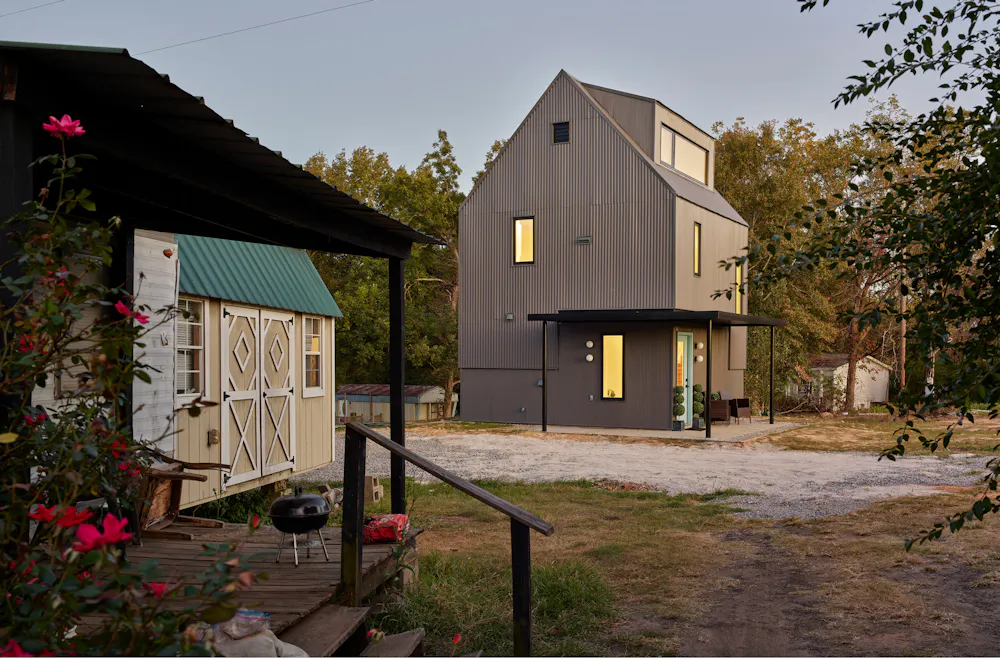
One of our recent Rural Studio projects is the 18×18 House, a compact, multistory home built for a young man living on heirs’ property in Alabama.
The 18X18 House is a multistory home that was on heirs’ property in Alabama. Auburn University Rural Studio. Photo by Timothy Hursley, CC BY-SA
The home is nestled between several other family members’ homes. We had to work around existing electrical lines, a septic field, roads and steep topography. Despite these site constraints, the house is an ideal starter home: big enough for the young man and a future partner to live comfortably on the family plot. If he ever decides to leave, other family members can move in.
Rather than focusing on one-off products, our goal with the 18×18 House is to develop replicable housing prototypes that respond to the realities of intergenerational living on family land. We also hope that tangible housing will help policymakers understand the value of reform.
The question isn’t whether design can respond to these challenges, but how it can lead by pushing antiquated regulatory and legal frameworks to evolve.
Jennifer Pindyck receives funding from Fannie Mae, Wells Fargo and the Center for Architecture, in partnership with AIA New York. She is affiliated with the Association of Collegiate Schools of Architecture and is a registered architect in the state of Georgia.
Christian Ayala Lopez work is funded through a diverse range of organizations such as Fannie Mae, USDA, and Center for Architecture NY. He is affiliated to Association of Collegiate Schools of Architecture, National Council of Architectural Registration Boards, and member of Florida Housing Coalition.
Rusty Smith receives funding from Fannie Mae, USDA, Wells Fargo and Regions Bank. He is affiliated with the Housing Assistance Council, the American Institute of Architects, the Association of Collegiate Schools of Architecture, the National Renewable Energy Laboratory Innovation Incubator, the EPA Collegiate/Underserved Community Partnership and the Bipartisan Policy Center.
Source: The Conversation – USA – By Peter C. Mancall, Andrew W. Mellon Professor of the Humanities, USC Dornsife College of Letters, Arts and Sciences
A statue of Christopher Columbus, toppled by protesters, is loaded onto a truck on the grounds of the state capitol on June 10, 2020, in St Paul, Minn.Stephen Maturen/Getty Images
Nonetheless, Trump posted in April 2025, “Christopher is going to make a major comeback.” By using Columbus’ name, which means “Christ-bearer,” a president who covets the praise of faith leaders yoked the explorer to his campaign promise: “For those who have been wronged and betrayed, I am your retribution.”
By reasserting the importance of Columbus, the president took a stand against the toppling and vandalism of statues of Columbus. In this case, his act of retribution for his supporters focused on the holiday, which he could declare more easily than returning icons of a fallen man to empty pedestals.
As a historian of early America, I am familiar with how grievance marked the colonial era. Throughout this period, grievance fueled rage and violence.
European grievance in America
Europeans who arrived in the Americas following Columbus’ 1492 journey claimed the territories in the Western Hemisphere through an obsolete legal theory known as the “doctrine of discovery.”
Spanish, English, French, Dutch and Portuguese rulers, according to this notion, owned portions of the Americas, regardless of the claims of Indigenous peoples. This presumption of ownership justified, in their minds, the use of violence against those who resisted them.
In 1598, for example, Spanish soldiers patrolling the pueblo of Acoma in New Mexico demanded food from local residents, whom the colonizers saw as their subordinates. The town’s inhabitants, believing the request excessive, fought instead, killing 11 Spaniards.
In response, the governor of New Mexico, a territory almost entirely populated by Indigenous peoples, ordered the systematic amputations of the hands or feet of residents whom the soldiers thought had participated in the attack. They also enslaved hundreds in the town. Roughly 1,500 residents of Acoma died in the conflict, according to the National Park Service, a response seemingly driven more by grievance than strategy.
English colonizers proved just as quick to deploy extraordinary violence if they believed Native Americans deprived them of what they thought was theirs.
The English labeled the event a “barbarous massacre,” using language that dehumanized the Powhatans and cast them as villainous raiders. An English pamphleteer named Edward Waterhouse castigated these Indigenous people as “wyld naked Natives,” “Pagan Infidels” and “perfidious and inhumane.”
Opechancanough was paramount chief of the Powhatan Confederacy in present-day Virginia from 1618 until his death in 1646. mikroman6/Getty Images
War began almost immediately. Colonial soldiers embraced a scorched-earth strategy, burning houses and crops when they could not locate their enemies. On May 22, 1623, one group sailed into Pamunkey territory to rescue captives.
As historians who have studied the Salem witch trials have argued, many of the accusers in agricultural Salem Village – modern-day Danvers – harbored resentments against neighbors who had closer ties to nearby Salem Town, which was more commercial.
The aggrieved found a spokesman in the Rev. Samuel Parris, whose own earlier failure in business had led him to look for a new path forward as a minister. Parris’ anger about his earlier disappointments fueled his indignation about what he saw as inadequate economic support from local authorities.
In a sermon, he underscored his financial irritation by emphasizing Judas’ betrayal of Jesus for “a poor & mean price,” as if it was the amount that mattered. The resentful residents and their bitter minister fueled the largest witch hunt in American history, which left at least 20 of the accused dead.
The most obvious forerunner of today’s grievance-fueled politics was a rebellion in the spring and summer of 1676 by backcountry colonists in Virginia who battled their Jamestown-based colonial government. They were led by Nathaniel Bacon, a tobacco farmer who believed that provincial officials were not doing enough to protect outlying farms from attacks by Susquehannocks and other Indigenous residents.
Acts of grievance come in different forms, depending on historical and political circumstance. But the urge to reclaim what someone thinks should be theirs can lead to deadly violence, as earlier Americans repeatedly discovered.
Peter C. Mancall has received support from the University of Southern California, the Huntington Library, the National Endowment for the Humanities, and Oxford University to support his research on early America.
Source: United States House of Representatives – Congressman Joe Neguse (D-Co 2)
Neguse and former Agriculture Secretary Tom Vilsack serve as this year’s honorees; prior recipients include John McCain and Bob Woodward.
Washington, D.C. —This week, Congressman Joe Neguse was recognized as a 2025 Keystone Leadership Award recipient by the Colorado-based Keystone Policy Center for his commitment to constructive policymaking and his successful legislative efforts to construct bipartisan solutions to the challenges facing the West—from land and water conservation to wildfire mitigation. In addition to the 41-year-old lawmaker, also receiving the award this year were former Agriculture Secretary Tom Vilsack and the CEO of the Nature Conservancy, Jennifer Morris.
Prior award recipients include the late U.S. Senator John McCain, current U.S. Senators Lisa Murkowski and Michael Bennet, PBS News Anchor Judy Woodruff, and legendary Pulitzer Prize-winning investigative journalist Bob Woodward, among others.
The nonpartisan organization noted Neguse’s dedication to bridging the divide between urban and rural communities in Colorado, and his leadership on rural challenges in particular, including forest health, public lands, and watershed protection. Neguse has worked to implement the unique approach through his “Lead Locally” initiative, which includes innovative Service Town-Halls and hosting more than 12 in-person town hall in just the past 5 months across Colorado’s Western Slope, Central Mountains, and Northern communities.
In receiving the Keystone Leadership Award, Neguse further cemented his legacy of delivering results for the state of Colorado. Earlier this year, he wasnamed the most effective member of the state’s federal delegation by the Center for Effective Lawmaking.
“When your congressional district is 12,000 square miles and larger than 8 states, you understand that service means showing up in — and listening to — every single community. That’s exactly what we’ve done as I’ve served the people of Northern and Western Colorado — from Walden to Fort Collins, and I’m proud of our work to cut through the chaos and partner with folks of all political stripes to address the challenges we face in the Rocky Mountain West.”Congressman Neguse continued, “It has never been more important to find ways to foster greater collaboration and dialogue with those with whom we may disagree. I’m grateful to the Keystone Policy Center for their recognition of our efforts on that front, and remain hopeful that we can address the consequential challenges of our time.”
“For five decades, Keystone Policy Center has brought people together to find collaborative, actionable solutions to the toughest public policy challenges. Each recipient of the Keystone Leadership Award embodies that mission and demonstrates that meaningful progress is possible when others say it can’t be done,” saidChristine Scanlan, president and CEO of the Keystone Policy Center.“We are proud to honor these leaders, among them Congressman Joe Neguse, who represents the district Keystone calls home. It was also a privilege to host these leaders for a one-on-one fireside conversation, offering a powerful opportunity to learn from their experiences and insights.”
The Keystone Policy Center established the Keystone Leadership Awards in 1994 to recognize extraordinary leadership by individuals and organizations whose work embraces their mission: inspiring leaders to rise above entrenched positions and find common ground. Keystone honors individuals and organizations within its areas of work as well as recognizes leaders in government and the media who create impact in the public interest.
About Neguse’s Collaborative Leadership Approach:
Congressman Joe Neguse is the founder and Co-Chair of both the Bipartisan Wildfire Caucus and the Bipartisan Colorado River Caucus, groups established to build consensus and elevate awareness around key issues like the rise of Western wildfires and worsening drought in the Colorado River Basin. He has leveraged these coalitions to introduce and pass legislation focused on preserving public lands, strengthening the outdoor economy, and confronting the wildfire crisis. Notably,he successfully enacted four bipartisan bills through last year’s Expanding Public Lands Outdoor Recreation Experiences (EXPLORE) Act: the Forest Service Flexible Housing Partnerships Act, the Biking On Long-Distance Trails (BOLT) Act, the Improving Access to Outdoor Recreation Coordination Act, and the Stop the Spread of Invasive Mussels Act. The EXPLORE Act also included the Simplifying Access for Outdoor Recreation Permitting (SOAR) Act, which Neguse co-led in the House. His efforts haveearned him recognition as the Member of Congress with the most bipartisan support for his legislative proposals.
Source: Africa Press Organisation – English (2) – Report:
The Nata-Gweta Block Beef Producers have been urged to invest in compliance, certification, and quality assurance frameworks that meet both regional and international standards. This would enable them to take advantage of the African Continental Free Trade Area (AfCFTA), which presents significant opportunities for Botswana’s beef sector and the livelihoods it supports.
Officiating at the Nata-Gweta Block Beef Producers Association (NGBBPA) Farmer Field Day in Zoroga Village on Saturday, 24 May, FAO Representative in Botswana, Carla Mucavi, emphasized the importance of preparing local farmers to meet these standards and fully benefit from a market of over 1.3 billion potential consumers.
Mucavi noted that although agriculture currently contributes less than 2% to Botswana’s GDP, it sustains over 80% of rural households and remains one of the nation’s most culturally and economically significant sectors. “The beef industry is not just about commerce; it is a symbol of national pride and rural resilience,” she said.
She commended the NGBBPA for uniting communal and ranch-based farmers into a strategic alliance that advocates for improved market access, enhanced animal health services, sustainable rangeland management, and the revitalization of Botswana’s cattle industry.
Importantly, Mucavi challenged prevailing narratives about rural vulnerability. “Farmers must not be viewed merely as victims of climate change, but as proactive agents of transformation,” she said. “FAO remains steadfast in supporting Botswana’s transition to climate-smart agriculture, strengthening early warning systems, and promoting sustainable land and water management.”
She highlighted the worsening impacts of climate change in Botswana, including prolonged and more frequent droughts, erratic rainfall, and rising temperatures, all of which contribute to declining soil fertility, reduced water availability, and increased risks of crop failure and livestock losses.
Beyond the climate conversation, Mucavi highlighted the urgent need to rebrand agriculture as an engine of youth empowerment and women’s inclusion. “Agriculture must be repositioned as a pathway to entrepreneurship and wealth creation, not a sector of last resort,” she asserted. She further added that young people and women bring digital skills, creativity, and bold thinking, appealing to stakeholders to create platforms, mentorship, access to land, finance, and training to help them realize their full potential.
NGBBPA Chairperson Gosata Mosweu echoed her sentiments, sharing that the association had recently secured an 18-hectare farm to establish a livestock feed production and packaging facility as part of a broader value addition initiative. This, he noted, would reduce dependency on external feed sources and enhance local production capacity.
The association is working closely with the Ministry of Lands and Agriculture and the Botswana University of Agriculture and Natural Resources (BUAN) to acquire skills in fodder production and innovative agricultural techniques. “We are also building strong networks with crop producers in the region and commercial farmers in Pandamatenga to source raw materials,” said Mosweu. “We welcome FAO’s continued support as we strive to build resilience and sustainability within our block.”
Representing the Ministry of Lands and Agriculture, Obert Mabuta, the District Agricultural Coordinator for the Tutume District, emphasized the importance of selective breeding for climate adaptation and productivity. He urged farmers to focus on livestock breeds that yield higher returns and can withstand the region’s harsh conditions.
He also stressed the need for sustainable pastoral practices. “Yes, the rains have been good this year,” he said, “but they also bring other challenges such as increased wildlife movement. We must remain vigilant develop firebreaks, raise community awareness, and prioritize environmental protection to safeguard food security.”
Mabuta applauded the association for organizing networking platforms where farmers share knowledge and gain practical skills. “These sessions are invaluable in building capacity and confidence among producers,” he concluded.
The Nata-Gweta Block Beef Producers Association (NGBBPA), established in 2007, hosts its annual Farmer Field Day in Zoroga Village, Tutume District. The event brings together both communal and ranch-based farmers to promote improved market access, enhanced animal health services, sustainable rangeland management, and the revitalization of Botswana’s cattle industry. The event was attended by community leaders from the region, farmers and private sector operating the in the agriculture sector.
– on behalf of Food and Agriculture Organization of the United Nations (FAO): Regional Office for Africa.
Source: Hong Kong Government special administrative region
LCQ15: Development of pet-related industries Question:
It has been reported that the number of households keeping pets has increased in recent years, with pet-related industries developing rapidly. However, there are views pointing out that Hong Kong still has room for improvement in veterinary medical care and pet-friendly public facilities, as well as in data management and policies regarding the pet industry. In this connection, will the Government inform this Council:
(1) as it is learnt that a number of private shopping centres have introduced pet-inclusive facilities, such as pet accesses and pet rest areas, to attract spending from pet owners and thereby further unleash the potential of the pet economy, whether the Hong Kong Housing Authority will consider drawing on the relevant experience to implement pet-friendly measures in the shopping centres of the public housing estates under its purview; if so, of the details; if not, the reasons for that;
(2) as it has been reported that public or charity-run veterinary organisations have been established one after another in Taiwan, such as in Taoyuan City and New Taipei City, to provide basic veterinary medical services at transparent charges, which not only enhance pet health protection but also boost the pet economy, whether the HKSAR Government has conducted studies or policy planning regarding the establishment of public or semi-public veterinary medical facilities; if so, of the details; if not, the reasons for that; and
(3) as there are views that maintaining pet-related data can help understand the risks of pet epidemics and diseases, as well as the market structure and potential of the pet industry, whether the Government will establish a territory-wide pet data management platform to systematically collect relevant data, including the number of pets, breed distribution, keeping and vaccination records, and pet disease trends, so as to provide a scientific basis for the formulation of policies on pet-friendliness and developing the pet economy policies; if so, of the details; if not, the reasons for that?
Reply:
President,
Having consulted the Housing Bureau, the reply to the question from the Hon Rock Chen is as follows:
(1) As pet keeping has become increasingly common in Hong Kong, there has been more attention in society to bringing animals to enter different premises and use public facilities. In general, the Government needs to take into account different factors when considering whether to further relax existing arrangements, including the nature of individual facilities, whether ancillary facilities are in place and the degree of social acceptance, in order to achieve the policy objective of facilitating people and animals to co-exist harmoniously.
The shopping centres under the Hong Kong Housing Authority (HA) are mainly “neighbourhood shopping centres” located in public housing estates/courts. These shopping centres provide local residents with shopping convenience, with the aim of catering for their basic needs in daily life. All along, guide dogs accompanying the visually impaired have been allowed to enter the HA’s shopping centres. The HA has further implemented some pet-friendly policies, such as allowing pets to enter shopping centres if they are placed in pet carrier bags or pet strollers and that no hygiene and environmental nuisance will be caused. The HA will keep in view the development and needs of the community for pet-friendly spaces and facilities, and design “neighbourhood shopping centres” that are in line with the actual situation.
On the other hand, the Domain located in Yau Tong is a large-scale regional shopping centre under the HA. Coupled with spacious indoor space, outdoor activity areas, wide passageways and multiple entrances at different locations, it is more equipped with the requisites for development into a pet-friendly mall than typical “neighbourhood shopping centres” located in housing estates. The HA will review whether it is appropriate to further provide pet-friendly measures in the Domain, such as installing relevant human-pet friendly facilities to appeal to pet owners for boosting consumption and visitor flow.
(2) The Agriculture, Fisheries and Conservation Department (AFCD) has been carrying out publicity and public education to remind the public to consider carefully before deciding to keep pets, to assess whether one could fulfil the duties of pet ownership in meeting the pets’ basic needs in diet, environment, daily care, healthcare, etc.
On veterinary services, the Veterinary Surgeons Board of Hong Kong (VSB) established under the Veterinary Surgeons Registration Ordinance (Cap. 529), is currently responsible for the regulation, registration and disciplinary control of veterinary surgeons, so as to ensure a high standard of veterinary services in Hong Kong. The VSB learns about the overall veterinary services through data gathered in the regulation of the veterinary profession. The number of registered veterinary surgeons (RVS) has been consistently on the rise since 2015, from 823 in 2015 to 1 364 in April this year, representing an increase of 65 per cent. RVS comprises many specialties, such as small animal internal medicine and surgery, dermatology, cardiology, neurology and veterinary pathology, and therefore animal owners should be able to find appropriate veterinary services for their pets. To meet unexpected medical expenses, members of the public may also purchase pet insurance products available in the market as appropriate.
Apart from private veterinarians, the City University of Hong Kong and some animal welfare organisations (such as the Hong Kong Society for the Prevention of Cruelty to Animals) also provide veterinary services and hence the Government currently has no plan to separately establish public medical facilities for pets.
(3) To safeguard public health and prevent the spread of animal diseases, the AFCD monitors and regulates animal activities in accordance with the law, and assesses the risk of pet animal diseases. The AFCD regulates the import of live animals through a permit system under the Public Health (Animals and Birds) Regulations (Cap. 139A) and the Rabies Regulation (Cap. 421A), so as to prevent the introduction of animal diseases into Hong Kong. Furthermore, the AFCD regulates the local animal activities through various licences, for example, regulating the animal trading and dog breeding activities through the Animal Trader Licence and Dog Breeder Licence respectively under the Public Health (Animals and Birds) (Trading and Breeding) Regulations (Cap. 139B), and to require dog keepers to have their dogs vaccinated against rabies, implanted with a microchip, and to apply for a dog licence under the Rabies Regulation, for the prevention of rabies.
The Government last conducted a Thematic Household Survey on pet ownership among households across Hong Kong in 2018. The AFCD and the Census and Statistics Department will conduct another survey later this year to gather the latest data on trends and preferences in pet ownership of Hong Kong families. These findings will assist the trade to learn about the latest trend of pet ownership, for their provision of products and services according to market demand. Issued at HKT 12:15
Source: Hong Kong Government special administrative region
Following is a question by Professor the Hon Priscilla Leung and a reply by the Secretary for Environment and Ecology, Mr Tse Chin-wan, in the Legislative Council today (June 11):
Question:
The Agriculture, Fisheries and Conservation Department has updated the quarantine arrangements for cats and dogs this month. Cats and dogs imported from the Mainland that meet the relevant quarantine requirements (including obtaining satisfactory results from testing conducted by recognised laboratories on the Mainland and having an animal health certificate issued by Mainland official veterinarians) will have their quarantine period significantly reduced from the current 120 days to 30 days upon arrival in Hong Kong. In this connection, will the Government inform this Council: Reply: Rabies is a contagious disease that causes fatality to mammals (including humans) and no specific treatment is available at present. To prevent the introduction of animal diseases such as rabies into Hong Kong, the Agriculture, Fisheries and Conservation Department (AFCD) regulates the import of live animals through a permit system, and controls the import of cats and dogs under the Public Health (Animals and Birds) Regulations (Cap. 139A) and the Rabies Regulation (Cap. 421A) to protect public and animal health. Under effective control measures, Hong Kong has long been widely recognised as a rabies-free place by other places. Animals of Hong Kong generally face less stringent quarantine requirements when entering other places.
On the quarantine arrangements of imported cats and dogs, the AFCD classifies places into different groups according to different risk of rabies, with reference to information about the surveillance of animal diseases from the World Organisation for Animal Health. Group I and Group II places are respectively rabies-free places and places where rabies cases are few and under effective control. Since these places are considered of lower risk of rabies, the imported cats and dogs are exempted from quarantine upon fulfilling specified requirements. Places that do not meet the requirements of Group I or Group II, or where their situations cannot be determined, will be included in Group III. Cats and dogs imported from these places are required to undergo a quarantine of not less than 120 days before December 2024.
Since December 2024, the AFCD has divided Group III into Group A and B according to the results of risk assessment. Quarantine period for cats and dogs of Group IIIA is significantly shortened from 120 days to 30 days upon their arrival in Hong Kong, provided that they meet the relevant quarantine requirements including that the animals must be vaccinated against rabies, conducted a valid rabies neutralising antibody titre test, had an animal health certificate issued or endorsed by a government veterinary officer of the place of export. The Macao Special Administrative Region, Lithuania and the Mainland have been included in Group IIIA successively. As regards Group IIIB places, since the risk of rabies is higher or uncertain, and the incubation period of rabies can be up to several months, the quarantine period for cats and dogs imported from those places is maintained at not less than 120 days.
The reply to the question from Professor the Hon Priscilla Leung is as follows:
(1) As mentioned just now, as long as cats and dogs imported from the newly added Group IIIA places (including the Mainland) meet the relevant quarantine requirements and hold an animal health certificate issued by an official veterinarian from the Mainland, the quarantine period upon arrival in Hong Kong will be significantly reduced from 120 days to 30 days. Because of this change, the cost of quarantine facilities that the owners of these cats and dogs have to pay has been greatly reduced to one-quarter of the previous cost, at the same time, the turnover rate of quarantine facilities will increase to four times than that of the past. The waiting time for quarantine facilities will be reduced correspondingly, and the usage effectiveness will be increased significantly.
As regards the quarantine arrangements, the current international practice is to isolate cats and dogs in officially supervised quarantine facilities to ensure that the animals will not have direct or indirect contact with other animals during the quarantine period, so as to avoid the transmission of animal disease into the community. As the mortality rate of rabies is close to 100 per cent, and animals have the opportunity to come into contact with other people or animals when they are quarantined in private premises, this will bring to them higher risk. Hence from a risk management perspective, home quarantine arrangement is not appropriate. The Department will continue to make reference to the latest animal disease situation announced by the World Organisation for Animal Health, and timely optimise the quarantine requirements for imported cats and dogs, taking into account factors such as international practices, operational experience and risk assessment.
(2) To facilitate animal owners to bring their pet cats and dogs to Hong Kong, the Government has not only optimised the quarantine requirements for cats and dogs, but also increased the number of quarantine facilities. The new quarantine facilities at the Kowloon Animal Management Centre under the AFCD have been put into service in May this year. The quarantine facilities provided for cats and dogs have increased from 21 and 20 to 34 and 30 respectively. Further, taking into account that the shortened quarantine period has increased the turnover speed to four times than that of the past, the handling capacity of the AFCD’s quarantine facilities could be increased by as much as six to seven times than that of the past. In addition, the AFCD encourages private animal welfare organisations to provide quarantine facilities for cats and dogs, and is reviewing the application of the Hong Kong Society for the Prevention of Cruelty to Animals (SPCA). It is expected that the quarantine facility will be put into service in the middle of this year. The Department will also provide information and assistance to other private animal welfare organisations interested in operating quarantine facilities for cats and dogs. On the basis of the above improvement measures, it is expected that the quarantine facilities will be able to meet the demand.
As regards the number and testing quality of recognised Mainland laboratories, after discussions with the Mainland authorities and taking into account the regional distribution and level of recognition of the laboratories in the Mainland, the AFCD has recognised four Mainland laboratories in Beijing, Shanghai, Guangzhou and Changchun for conducting rabies antibody titre tests for cats and dogs. All four laboratories are recognised by the Mainland authorities and the European Union, hence the quality of testing is assured. The AFCD will closely monitor the situation and will discuss with the Mainland authorities to adjust the list of approved laboratories when necessary.
(3) The Veterinary Surgeons Board of Hong Kong (VSB) is a statutory body established under the Veterinary Surgeons Registration Ordinance (Cap. 529), and is responsible for the regulation, registration and disciplinary control of veterinary surgeons, to ensure a high standard of veterinary services in Hong Kong. The VSB learns about the overall veterinary services through data gathered in the regulation of the veterinary profession.
The number of registered veterinary surgeons (RVS) has been consistently on the rise since 2015, from 823 in 2015 to 1 364 in April this year, representing an increase of 65 per cent. Moreover, RVS comprises many specialties, such as small animal internal medicine and surgery, dermatology, cardiology, neurology and veterinary pathology. Apart from private veterinary clinics, the City University of Hong Kong and some animal welfare organisations, such as the SPCA, also provide veterinary services, therefore animal owners should be able to find appropriate veterinary services for their pets.
Question for written answer E-002304/2025 to the Commission Rule 144 Kathleen Funchion (The Left)
Since the last reform of the common agricultural policy (CAP) and the implementation of that reform at the national level, the Agri-Climate Rural Environment Scheme (ACRES) in Ireland has had several issues. There are still farmers who have not received payments since 2023.
1.Has the Commission investigated the causes of these delays?
2.What assessment did the Commission carry out when this scheme was proposed?
3.In the upcoming reform of the CAP, will the Commission fully take into account that changes at the EU level can have long-term impacts on the ground for farmers, due to delays in their implementation at national level and additional administrative challenges, in order to ensure we do not have a repeat of these issues with ACRES?
High-income professionals over the age of 50 make up 70% of all consumers of bulk products. DCStudio/Shutterstock
The bulk distribution model has been in the news again lately, with well-known brands such as The Laughing Cow making their way into French supermarkets. Stakeholders in the bulk sector are seeking to introduce innovations in order to expand and democratise the concept. But is the bulk model such a clear-cut approach to consuming in a sustainable way?
Bulk can be described as a consumer practice with a lower impact on the environment, since it involves the sale of products with no packaging, plastic or unnecessary waste and the use of reusable containers by consumers. In this type of distribution, predetermined manufacturer packaging becomes a thing of the past.
In this model, distributors and consumers take on the task of packaging the product themselves to ensure the continuity of the multiple logistical and marketing functions that packaging usually fulfils. Unaccustomed to this new role, stakeholders in the bulk sector may make mistakes or act in ways that run counter to the environmental benefits that are generally expected to result from this practice.
Contrary to the usually positive discourse on bulk products, our research points to the perverse and harmful effects of bulk distribution. When bulk stakeholders are left to “cope with” this new task of packaging products, can bulk still be described as ecologically sound?
A new approach to packaging
Packaging has always played a key role. It performs multiple functions that are essential for product distribution and consumption:
Logistical functions to preserve, protect and store the product: packaging helps to limit damage and loss, particularly during transport.
Marketing functions for product or brand recognition, which is achieved by distinctive colours or shapes to create on-shelf appeal. Packaging also has a positioning function, visually conveying a particular range level, as well as an informative function, serving as a medium for communicating a number of key elements such as composition, best-before date, etc.
Environmental functions, such as limiting the size of packaging and promoting certain types of materials – in particular recycled and recyclable materials.
In the bulk market, it is up to consumers and distributors to fulfil these various functions in their own way: they may give them greater or lesser importance, giving priority to some over others. Insofar as manufacturers no longer offer predetermined packaging for their products, consumers and distributors have to take on this task jointly.
Assimilation or accommodation
Our study of how consumers and retailers appropriate these packaging functions used a variety of data: 54 interviews with bulk aisle and store managers and consumers of bulk products, as well as 190 Instagram posts and 428 photos taken in people’s homes and in stores.
The study shows that there are two modes of appropriating packaging functions:
by assimilation – when individuals find ways to imitate typical packaging and its attributes
by accommodation – when they imagine new packaging and new ways of working with it
Bulk packaging can lead to hygiene problems if consumers reuse packaging for a new purpose. GaldricPS/Shutterstock
Some consumers reuse industrial packaging, such as egg cartons and detergent cans, because of their proven practicality. But packaging may also mirror its owners’ identity. Some packaging is cobbled together, while other packaging is carefully chosen with an emphasis on certain materials like wax, a fabric popular in West Africa and used for reusable bags.
A weekly e-mail in English featuring expertise from scholars and researchers. It provides an introduction to the diversity of research coming out of the continent and considers some of the key issues facing European countries. Get the newsletter!
Once packaging disappears, so does relevant information
Appropriating the functions of packaging is not always easy. There is a “dark side” to bulk, with possible harmful effects on health or the environment, and social exclusion. Bulk can lead, for example, to hygiene-related problems or misinformation when consumers fail to label their jars correctly, or use packaging for another purpose. For example, using a glass juice bottle to store detergent can be hazardous if a household member is unaware of its contents.
Bulk shopping can also appear exclusive for people with less culinary education. (High-income professionals over the age of 50 make up 70% of all consumers of bulk products.) Once the packaging disappears, so does the relevant information. Some consumers actually do need packaging to recognize, store and know how to cook a product. Without this information, products may end up in the garbage can!
Our study also shows the ambivalence of the so-called “environmental function” of bulk shopping – the initial idea being that bulk should reduce the amount of waste generated by packaging. In fact, this function is not always fulfilled, as many consumers tend to buy a great deal of containers along with other items, such as labels, pens and so on, to customise them.
Some consumers’ priority is not so much to reuse old packaging, but to buy new storage containers, which are often manufactured in faraway lands! The result is the production of massive amounts of waste – the exact opposite of the original purpose of the bulk trade.
Lack of consumer guidance
After a period of strong growth, the bulk sector went through a difficult period during the Covid-19 pandemic, leading to closures for many specialist stores in France, according to a first survey on bulk and on reuse. In supermarkets though, some retailers invested to make their bulk aisles more attractive – though in the absence of any effective guidance, consumers failed to make them their own. Bulk aisles have become just one among a host of other aisles.
Things seem to be improving however, and innovation is on the rise. In France, 58% of the members of the “Bulk and Reuse Network” (réseau Vrac et réemploi) reported an increase in daily traffic between January and May 2023 compared with 2022.
Distributors need to adapt to changing regulations. These stipulate that, by 2030, stores of over 400 m2 will have to devote 20% of their FMCG (Fast-Moving Consumer Goods) sales areas to bulk sales. Moreover, bulk sales made their official entry into French legislation with the law on the fight against waste and the circular economy (loi relative à la lutte contre le gaspillage et à l’économie circulaire) published in the French official gazette on February 11, 2020.
In this context, it is all the more necessary and urgent to support bulk stakeholders, so that they can successfully adopt the practice and develop it further.
Fanny Reniou has received funding from Biocoop as part of a research partnership.
Elisa Robert-Monnot has received funding from Biocoop as part of a research partnership and collaboration.
Sarah Lasri ne travaille pas, ne conseille pas, ne possède pas de parts, ne reçoit pas de fonds d’une organisation qui pourrait tirer profit de cet article, et n’a déclaré aucune autre affiliation que son organisme de recherche.
Strabane Gears Up for a Spectacular Summer Jamm Festival
6 June 2025
Strabane is set to come alive this Saturday, June 7th, as the Summer Jamm Festival transforms the town into a vibrant hub of family fun and local talent. Running from 12pm until late, the festival offers a diverse lineup of attractions and events for all ages.
The town centre will be bustling with activities including the Kidz Farm petting zoo, dinosaur encounters, urban sports demonstrations, and interactive drumming circles. Castle Place will feature BMX biking, parkour workshops, and graffiti art sessions, while Castle Street hosts the Roar Roar Dinosaurs baby dinosaur petting zoo. Main Street will offer live music, market stalls, and performances by local arts groups such as Class Act, Much Ado Stage School, and Encore PAA. The Alley Theatre will present the FizzWizzPop Magic Show, face painting, and arts and crafts workshops.
As dusk falls, Strabane’s pubs will come alive with the inaugural Music Trail, featuring performances by local artists across venues including Christy’s Bar, The Railway Bar, Dicey’s Bar, and The Farmers’ Home. Artists such as DJ Ryan Doc, Adam Dolan, The Brambles, and Louis McTeggert will showcase the town’s rich musical heritage. The Music Trail begins at 4pm and offers attendees a unique opportunity to experience Strabane’s diverse musical scene in an intimate setting.
A highlight of the festival is the Bear Run ’74 Supercar event, featuring a stunning display of luxury vehicles, including the Lamborghini Revuelto, known for its impressive performance. The supercars will be showcased on Railway Street, providing a thrilling spectacle for attendees and raising funds for the Mayor’s chosen charities, PIPS Suicide Prevention Derry and The Castlederg Patient and Comfort Terminally ill fund.
Mayor of Derry City and Strabane District Council, Cllr Ruairí McHugh, expressed his excitement for this weekend’s festivities.
“Summer Jamm has become a cornerstone of our community calendar, bringing together businesses, residents and visitors alike to celebrate the best of Strabane. This year’s festival showcases our town’s creative spirit, local talent, and warm hospitality. It’s a wonderful opportunity for families to enjoy a day of fun and for everyone to support our local businesses. It will be one of my first engagements as Mayor and I am really looking forward to getting out and about to meet you all.”
To facilitate the event, the following roads will be closed to traffic from 7am to 7pm on Saturday, June 7th: Railway Street,Main Street, Castle Street and Castle Place.
Traffic diversions will be in place with alternative routes signposted. Visitors are advised that streets will be busy with lots of activities taking place in and around the town centre, so motorists should use the town centre car parks or, if possible, travel to the event using public transport. Please note that Canal Street car park will be closed to facilitate Cullen’s Fun Fair. Disabled parking will be available in the car parks at Canal Basin North, Railway Street, Butcher Street, and in Upper and Lower Main Street.
Alley Theatre to host Prestigious International Conference
11 June 2025
The 8th International Flann O’Brien Conference is set to bring a vibrant gathering of scholars and enthusiasts of Flann O Brien’s work to Strabane’s Alley Theatre from June 25th to 27th, 2025.
This prestigious event, hosted in Strabane for the first time, will delve into this year’s theme: An Fód Dúchais: Home, Heritage, and origins.
Jointly hosted by the International Flann O’Brien Society and Strabane History Society the conference marks a significant return to O ’Nolan’s birth town, Strabane. The town, with its unique geographical and historical position perfectly embodies themes of fluidity and contested spaces — concepts central to O’Brien’s satirical and often surreal literary output.
On Tuesday, June 24th, schools are invited to a free theatrical performance of “Flann O’Brien” by Justin Logue at 11am, followed by an informal pre-conference gathering of conference delegates at Farmer’s Home, Railway Street, Strabane.
This international gathering promises to be a rich exploration of Flann O’Brien’s literary genius, offering insights into his enduring relevance and the unique cultural landscape that shaped his extraordinary imagination.
The conference will feature three distinguished keynote speakers: Dr. Tobias W. Harris (Birkbeck, University of London); Dr. Michael Pierse (Queen’s University Belfast) and Dr. Emily Ridge (University of Galway).
The conference commences on Wednesday, June 25th, with a Walking Tour of Flann O’Brien’s Strabane led by members of The Alley Theatre team, scripted by Strabane History Society offering our international delegates a unique perspective on the town that influenced O ‘Nolan’s work. The day will also include a keynote address by Dr. Emily Ridge titled ‘Dul Siar, Dul Siar: The Ever-Receding West in An Béal Bocht’, followed by an Official Opening with a Civic Reception and performances led by local artists to welcome delegates to Strabane.
Attendees can look forward to a diverse range of academic panels throughout the three days, covering topics such as “Old and New,” “Science and Health,” “Technology and Media,” and “Social Contexts & Formative Communities.”
Thursday, June 26th, will feature a keynote address by Dr. Tobias Harris, ‘Ag Fuineadh Ama: Opening Closed Ground in the Works of Brian Ó Nualláin’, and a special Film Screening showcasing “Babble” (2008) by David O’Kane and “Re-enactment” (2009) by Eamon O’Kane, both inspired by O’Nolan’s work.
The evening will conclude with a Book launch for Flann O’Brien and the European Avant-Garde, 1934–45 (Bloomsbury Academic, 2025) and the launch of Micheál Ó Nualláin Art Exhibit by Anna Uí Nualláin in the museum services space at The Alley Theatre gallery. In the main gallery, O’Kane Family will also launch “Strange Enlightenments”; responses to the work of Brian O’ Nolan featuring artwork by Eddie O’Kane, Joanna O’Kane, Eamon O’Kane, Matthew O’Kane and David O’Kane which will be showcased throughout the summer months.
The final day, Friday, June 27th, includes a keynote address by Dr. Michael Pierse on ‘False Alternatives and Grim Absurdities: Flann O’Brien’s Social Critique of Independent Ireland in At Swim-Two-Birds and An Béal Bocht’.
Each lunchtime internationally renowned singer and songwriter Brian Hassan will provide music on our café stage.
Mayor of Derry City and Strabane District Council Cllr Ruairí McHugh said it was a huge honour for the Alley Theatre to host a conference of this calibre. Extending his best wishes to everyone involved in the event he said he hoped it would be a huge success.
He acknowledged the role played by officers of Derry City and Strabane District Council in working to bring this event to the Alley Theatre, while also showcasing what Strabane has to offer in what will be a great visitor experience and a chance for the local community to capture a taste of Flann O Brien from an academic perspective from his town of birth.
For further information and programme details please visit www.alley-theatre.com or contact Alley box office 02871384444 or visit. Opening hours: Monday to Saturday 10.00am – 4.30pm
Opposition parties say Aotearoa New Zealand’s government should be going much further, much faster in sanctioning Israel.
Foreign Minister Winston Peters overnight revealed New Zealand had joined Australia, Canada, the UK and Norway in imposing travel bans on Israel’s Finance Minister Bezalel Smotrich and National Security Minister Itamar Ben-Gvir.
Some of the partner countries went further, adding asset freezes and business restrictions on the far-right ministers.
Peters said the pair had used their leadership positions to actively undermine peace and security and remove prospects for a two-state solution.
Israel and the United States criticised the sanctions, with the US saying it undermined progress towards a ceasefire.
Prime Minister Christopher Luxon, attending Fieldays in Waikato, told reporters New Zealand still enjoyed a good relationship with the US administration, but would not be backing down.
“We have a view that this is the right course of action for us,” he said.
Behind the scenes job “We have differences in approach but the Americans are doing an excellent job of behind the scenes trying to get Israel and the Palestinians to the table to talk about a ceasefire.”
Asked if there could be further sanctions, Luxon said the government was “monitoring the situation all the time”.
Peters has been busy travelling in Europe and was unavailable to be interviewed. ACT — probably the most vocally pro-Israel party in Parliament — refused to comment on the situation.
The opposition parties also backed the move, but argued the government should have gone much further.
Greens co-leader Chlöe Swarbrick has since December been urging the coalition to back her bill imposing economic sanctions on Israel. With support from Labour and Te Pāti Māori it would need just six MPs to cross the floor to pass.
Calling the Israeli actions in Gaza “genocide”, she told RNZ the government’s sanctions fell far short of those imposed on Russia.
“This is symbolic, and it’s unfortunate that it’s taken so long to get to this point, nearly two years . . . the Minister of Foreign Affairs also invoked the similarities with Russia in his statement this morning, yet we have seen far less harsh sanctions applied to Israel.
“We’re well past the time for first steps.”
‘Cowardice’ by government The pushback from the US was “probably precisely part of the reason that our government has been so scared of doing the right thing”, she said, calling it “cowardice” on the government’s part.
“What else are you supposed to call it at the end of the day?,” she said, saying at a bare minimum the Israeli ambassador should be expelled, Palestinian statehood should be recognised, and a special category of visas for Palestinians should be introduced.
She rejected categorisation of her stance as anti-semitic, saying that made no sense.
“If we are critiquing a government of a certain country, that is not the same thing as critiquing the people of that country. I think it’s actually far more anti-semitic to conflate the actions of the Israeli government with the entire Jewish peoples.”
Te Pāti Māori co-leader Debbie Ngarewa-Packer . . . “It’s not a war, it’s an annihilation”. Image: RNZ/Samuel Rillstone
Te Pāti Māori co-leader Debbie Ngarewa-Packer said the sanctions were political hypocrisy.
“When it comes to war, human rights and the extent of violence and genocide that we’re seeing, Palestine is its own independent nation . . . why is this government sanctioning only two ministers? They should be sanctioning the whole of Israel,” she said.
“These two Israel far right ministers don’t act alone. They belong to an entire Israel government which has used its military might and everything it can possibly do to bombard, to murder and to commit genocide and occupy Gaza and the West Bank.”
Suspend diplomatic ties She also wanted all diplomatic ties with Israel suspended, along with sanctions against Israeli companies, military officials and additional support for the international courts — also saying the government should have done more.
“This government has been doing everything to do nothing . . . to appease allies that have dangerously overstepped unjustifiable marks, and they should not be silent.
“It’s not a war, it’s an annihilation, it’s an absolute annihilation of human beings . . . we’re way out there supporting those allies that are helping to weaponise Israel and the flattening and the continual cruel occupation of a nation, and it’s just nothing that I thought in my living days I’d be witnessing.”
She said the government should be pushing back against “a very polarised, very Trump attitude” to the conflict.
“Trumpism has arrived in Aotearoa . . . and we continue to go down that line, that is a really frightening part for this beautiful nation of ours.
“As a nation, we have a different set of values. We’re a Pacific-based country with a long history of going against the grain – the mainstream, easy grind. We’ve been a peaceful, loving nation that stood up against the big boys when it came to our anti nuclear stance and that’s our role in this, our role is not to follow blindly.”
Undermining two-state solution In a statement, Labour’s foreign affairs spokesperson Peeni Henare said the actions of Smotrich and Ben-Gvir had attempted to undermine the two-state solution and international law, and described the situation in Gaza as horrific.
“The travel bans echo the sanctions placed on Russian individuals and organisations that supported the illegal invasion of Ukraine,” he said.
He called for further action.
“Labour has been calling for stronger action from the government on Israel’s invasion of Gaza, including intervening in South Africa’s case against Israel in the International Court of Justice, creation of a special visa for family members of New Zealanders fleeing Gaza, and ending government procurement from companies operating illegally in the Occupied Territories.”
This article is republished under a community partnership agreement with RNZ.
Bank One (www.BankOne.mu) has extended a USD 5 million facility to ESATF, an African trade fund managed by the ESATAL fund management company, a TDB Group subsidiary, to support trade finance on the continent.
The facility is designed to support the Fund’s growing loan book. The financing will be deployed to meet the rising demand for trade finance across Africa, a key growth market for both institutions.
TDB Group and Bank One share a long-standing relationship which was first established with Bank One’s participation in the syndicated loans of TDB Group’s Trade and Development Banking operations.
This facility is a new area of collaboration between both institutions, and Bank One’s first direct lending engagement with ESATF. It reflects the institution’s confidence in the Fund as a strong and well-managed trade finance vehicle, with a diversified and de-risked loan portfolio.
ESATAL Executive Director Umulinga Karangwa said “We are pleased to strengthen our partnership with Bank One as we extend our trade finance reach across African markets. This latest collaboration builds on the existing relationship with TDB Group and reflects a shared commitment to unlocking capital for businesses that drive regional trade and economic development. As ESATF continues to scale-up, such partnerships are key to deepening our impact and expanding access to much-needed financing across the continent.”
Bank One CEO,Sunil Ramgobin adds: “Over the past few years, Bank One has joined TDB on two syndicated debt raises, demonstrating our shared mission to promote sustainable, inclusive growth across Africa. This third collaboration—a USD 5 million trade finance facility to ESATF—reinforces our joint ambition to deliver measurable social, environmental and developmental impact. By supporting ESATF’s growing loan book, we respond to rising demand for trade finance across African markets. We stand alongside TDB Group in building a stronger, more resilient Africa and look forward to achieving many more milestones together as we finance progress that truly matters.”
With USD 300 million in net assets under management as of June 2025, and over 60 investors in its diverse stable, the ESATF trade fund serves as a strong platform for institutional investors looking to support Africa’s growing trade finance sector, and its impact across several sectors, including for SMEs, women and smallholder farmers.
Distributed by APO Group on behalf of Bank One Limited.
Media contacts: Trade and Development Bank Group: Anne-Marie Iskandar Senior Communications Officer Corporate Affairs and Investor Relations Anne-Marie.Iskandar@tdbgroup.org
About TDB Group: Established in 1985, the Trade and Development Bank Group (TDB Group) is an African regional multilateral development bank, with a mandate to finance and foster trade, regional economic integration and sustainable development in Africa. TDB Group counts several subsidiaries and strategic business units including Trade and Development Banking, TDB Asset Management (TAM), the Trade and Development Fund (TDF), TDB Captive Insurance Company (TCI), the ESATAL fund management company and TDB Academy.
About ESATAL fund management company: The ESATAL fund management company, a wholly owned TDB Group subsidiary, manages trade finance funds aligned with TDB Group’s commitment to promoting trade-led economic and social development. One of its key initiatives is the ESATF trade fund, a collective investment scheme financing shortto medium-term trade transactions, particularly those involving small and medium-sized enterprises (SMEs). ESATAL and ESATF are part of TDB Group’s asset management activities which are focused on the design, origination, and growth of stand-alone investment vehicles for a wide range of investors and development partners. Domiciled in Mauritius, ESATAL and ESATF are regulated by the Financial Services Commission as collective investment scheme (CIS) fund manager and CIS expert fund, respectively.
About Bank One: Bank One is a joint venture between CIEL Finance Limited in Mauritius and Kenya-based I&M Group PLC. Bank One provides a wide range of banking products and services to its clients through a geographic footprint spread across the island of Mauritius, comprising 7 branches and a well-distributed ATM network. As the financial landscape in sub-Saharan Africa continues to evolve, Bank One is determined to play an active role in supporting individuals, businesses and communities through continuous innovation and value addition. Bank One has deep development finance institution relationships and long-term funding lines in place with the German Investment Corporation (DEG), the International Finance Corporation (IFC), and the French Development Agency (Proparco). Bank One has been rated ‘BB-‘ with a Stable Outlook by Fitch Ratings.
Mistral AI, Nebius, Nscale, Firebird, Fluidstack, Hydra Host, Scaleway and Together AI — Along With AWS and Microsoft Azure — Bring Compute Resources to DGX Cloud Lepton Marketplace to Meet AI Demand
Hugging Face Integrates DGX Cloud Lepton Into Training Cluster as a Service, Expanding AI Researcher Access to Scalable Compute for Model Training
NVIDIA and Leading European Venture Capitalists Offer Marketplace Credits to Portfolio Companies to Accelerate Startup Ecosystem
PARIS, June 11, 2025 (GLOBE NEWSWIRE) — NVIDIA GTC Paris at VivaTech — NVIDIA today announced the expansion of NVIDIA DGX Cloud Lepton™ — an AI platform featuring a global compute marketplace that connects developers building agentic and physical AI applications — with GPUs now available from a growing network of cloud providers.
Mistral AI, Nebius, Nscale, Firebird, Fluidstack, Hydra Host, Scaleway and Together AI are now contributing NVIDIA Blackwell and other NVIDIA architecture GPUs to the marketplace, expanding regional access to high-performance compute. AWS and Microsoft Azure will be the first large-scale cloud providers to participate in DGX Cloud Lepton. These companies join CoreWeave, Crusoe, Firmus, Foxconn, GMI Cloud, Lambda and Yotta Data Services in the marketplace.
To make accelerated computing more accessible to the global AI community, Hugging Face is introducing Training Cluster as a Service. This new offering integrates with DGX Cloud Lepton to seamlessly connect AI researchers and developers building foundation models with the NVIDIA compute ecosystem.
NVIDIA is also working with leading European venture capital firms Accel, Elaia, Partech and Sofinnova Partners to offer DGX Cloud Lepton marketplace credits to portfolio companies, enabling startups to access accelerated computing resources and scale regional development.
“DGX Cloud Lepton is connecting Europe’s developers to a global AI infrastructure,” said Jensen Huang, founder and CEO of NVIDIA. “With partners across the region, we’re building a network of AI factories that developers, researchers and enterprises can harness to scale local breakthroughs into global innovation.”
DGX Cloud Lepton simplifies the process of accessing reliable, high-performance GPU resources within specific regions by unifying cloud AI services and GPU capacity from across the NVIDIA compute ecosystem onto a single platform. This enables developers to keep their data local, supporting data governance and sovereign AI requirements.
In addition, by integrating with the NVIDIA software suite — including NVIDIA NIM™ and NeMo™ microservices and NVIDIA Cloud Functions — DGX Cloud Lepton streamlines and accelerates every stage of AI application development and deployment, at any scale. The marketplace works with a new NIM microservice container, which includes support for a broad range of large language models, including the most popular open LLM architectures and more than a million models hosted publicly and privately on Hugging Face.
For cloud providers, DGX Cloud Lepton includes management software that continuously monitors GPU health in real time and automates root-cause analysis, minimizing manual intervention and reducing downtime. This streamlines operations for providers and ensures more reliable access to high-performance computing for customers.
NVIDIA DGX Cloud Lepton Speeds Training and Deployment Early-access DGX Cloud Lepton customers using the platform to accelerate their strategic AI initiatives include:
Basecamp Research, which is speeding the discovery and design of new biological solutions for pharmaceuticals, food and industrial and environmental biotechnology by harnessing its 9.8 billion-protein database to pretrain and deploy large biological foundation models.
EY, which is standardizing multi-cloud access across the global organization to accelerate the development of AI agents for domain- and sector-specific solutions.
Outerbounds, which enables customers to build differentiated, production-grade AI products powered by the proven reliability of open-source Metaflow.
Prima Mente, which is advancing neurodegenerative disease research at scale by pretraining large brain foundation models to uncover new disease mechanisms and tools to stratify patient outcomes in clinical settings.
Reflection, which is building superintelligent autonomous coding systems that handle the most complex enterprise engineering tasks.
Hugging Face Developers Get Access to Scalable AI Training Across Clouds Integrating DGX Cloud Lepton with Hugging Face’s Training Cluster as a Service offering gives AI builders streamlined access to the GPU marketplace, making it easy to reserve, access and use NVIDIA compute resources in specific regions, close to their training data. Connected to a global network of cloud providers, Hugging Face customers can quickly secure the necessary GPU capacity for training runs using DGX Cloud Lepton. Mirror Physics, Project Numina and the Telethon Institute of Genetics and Medicine will be among the first Hugging Face customers to access Training Cluster as a Service, with compute resources provided through DGX Cloud Lepton. They will use the platform to advance state-of-the-art AI models in chemistry, materials science, mathematics and disease research.
“Access to large-scale, high-performance compute is essential for building the next generation of AI models across every domain and language,” said Clément Delangue, cofounder and CEO of Hugging Face. “The integration of DGX Cloud Lepton with Training Cluster as a Service will remove barriers for researchers and companies, unlocking the ability to train the most advanced models and push the boundaries of what’s possible in AI.”
DGX Cloud Lepton Boosts AI Startup Ecosystem NVIDIA is working with Accel, Elaia, Partech and Sofinnova Partners to offer up to $100,000 in GPU capacity credits and support from NVIDIA experts to eligible portfolio companies through DGX Cloud Lepton.
BioCorteX, Bioptimus and Latent Labs will be among the first to access DGX Cloud Lepton, where they can discover and purchase compute capacity and use NVIDIA software, services and AI expertise to build, customize and deploy applications across a global network of cloud providers.
Availability Developers can sign up for early access to NVIDIA DGX Cloud Lepton.
About NVIDIA NVIDIA (NASDAQ: NVDA) is the world leader in accelerated computing.
For further information, contact: Natalie Hereth NVIDIA Corporation +1-360-581-1088 nhereth@nvidia.com
Certain statements in this press release including, but not limited to, statements as to: DGX Cloud Lepton connecting Europe’s developers to a global AI infrastructure; with partners across the region, NVIDIA building a network of AI factories that developers, researchers and enterprises can harness to scale local breakthroughs into global innovation; the benefits, impact, performance, and availability of NVIDIA’s products, services, and technologies; expectations with respect to NVIDIA’s third party arrangements, including with its collaborators and partners; expectations with respect to technology developments; and other statements that are not historical facts are forward-looking statements within the meaning of Section 27A of the Securities Act of 1933, as amended, and Section 21E of the Securities Exchange Act of 1934, as amended, which are subject to the “safe harbor” created by those sections based on management’s beliefs and assumptions and on information currently available to management and are subject to risks and uncertainties that could cause results to be materially different than expectations. Important factors that could cause actual results to differ materially include: global economic and political conditions; NVIDIA’s reliance on third parties to manufacture, assemble, package and test NVIDIA’s products; the impact of technological development and competition; development of new products and technologies or enhancements to NVIDIA’s existing product and technologies; market acceptance of NVIDIA’s products or NVIDIA’s partners’ products; design, manufacturing or software defects; changes in consumer preferences or demands; changes in industry standards and interfaces; unexpected loss of performance of NVIDIA’s products or technologies when integrated into systems; and changes in applicable laws and regulations, as well as other factors detailed from time to time in the most recent reports NVIDIA files with the Securities and Exchange Commission, or SEC, including, but not limited to, its annual report on Form 10-K and quarterly reports on Form 10-Q. Copies of reports filed with the SEC are posted on the company’s website and are available from NVIDIA without charge. These forward-looking statements are not guarantees of future performance and speak only as of the date hereof, and, except as required by law, NVIDIA disclaims any obligation to update these forward-looking statements to reflect future events or circumstances.
Many of the products and features described herein remain in various stages and will be offered on a when-and-if-available basis. The statements above are not intended to be, and should not be interpreted as a commitment, promise, or legal obligation, and the development, release, and timing of any features or functionalities described for our products is subject to change and remains at the sole discretion of NVIDIA. NVIDIA will have no liability for failure to deliver or delay in the delivery of any of the products, features or functions set forth herein.
Statement from Captiva Homes on Horsebridge Hill roadworks
We recognise the roadworks on Horsebridge Hill are continuing to cause disruption and inconvenience to residents and businesses, for which we apologise. We continue to work with Island Roads, the Council and other stakeholders to ensure this is minimised as much as possible. We are pleased to report that the works are being delivered in line with the agreed schedule and remain on track to be completed during the week commencing 4 July. This will facilitate the first Island families moving into their new homes this summer.
On site, road widening and kerbing installation has now been completed; traffic signal ducting and the new water main have been installed (the latter will reduce future work for Southern Water in the area).
Planned works in the week ahead will see base tarmac laid to road and footpaths, installation of ducts and sockets to the northbound carriageway and commencement of entrance works to the Three Oaks development.
The diversion of northbound traffic from Newport to Cowes saw a 4-minute increase in average journey times last week (2.6.25 to 6.6.25, from 16mins to 20 mins). This does not tell the full story as the closure of Middle Road for planned utility works last Tuesday and Wednesday evenings plus road traffic accidents in the Newport area caused significant delays.
Southern Vectis bus services continue to run a full daytime service (between 06.00 – 20.00) from Newport to Cowes and southbound travel from Cowes to Newport continues to flow smoothly throughout the day.
All businesses in the area remain open with access via the diversion.
Important changes to the traffic management plans are scheduled in the coming weeks, details below;
Isle of Wight Festival week
All works on Horsebridge Hill will cease and traffic will return to two-way along Horsebridge Hill from 20.00 on Tuesday 17 June to 20.00 on Monday 23 June
The current one-way system and diversion will be re-instated from 20.00 on Monday 23 June
Traffic from Nicholson Street will have north and southbound access from Monday 23 June
Two weekend road closures are required to facilitate foul sewer connections and road surfacing;
Full closure from 20.00 Friday 27 June to 06.00 Monday 30 June
Full closure from 20.00 Friday 4 July to 06.00 Monday 7 July
During the two weekend closures the current diversion route will operate for north and south bound traffic. To facilitate the diversion route there will be a clearway order for both sides of Pallance Road for the length, the 3 way temporary lights will remain on the Whitehouse Road/Corf Road junction and there will also be 4 way lights installed on Forest Road/Whitehouse Road junction to make it safer for vehicles emerging from Whitehouse Road.
Agriculture Minister, John Steenhuisen, has proposed the development of a National Biosecurity Compact – shared commitment between government, industry, academia, and civil society to strengthen South Africa’s preparedness and resilience against biological threats.
Speaking at the National Biosecurity Summit 2025, held at the University of Pretoria’s Hatfield Campus on Tuesday, Steenhuisen outlined the objectives of the proposed compact, which aims to coordinate national responses to animal and plant health risks.
“This compact will define baseline vaccine stock levels; clarify roles and responsibilities during outbreaks; embed data-sharing mechanisms and institutional partnerships like the Biosecurity Hub; and provide a framework for coordinated, credible, and timely responses,” Steenhuisen said.
Steenhuisen argued that the initiative is not only about defending against risk, but “it is about enabling growth.”
He said export markets require sanitary and phytosanitary compliance, and they demand evidence of control, traceability, and institutional readiness.
“Strengthening our biosecurity systems opens the door to new trade opportunities, safeguards jobs, and boosts investor confidence in South African agriculture. Biosecurity is not a “nice-to-have”, [but] it is as fundamental to national stability as clean water, reliable electricity, or functioning roads.
“When it works, farmers prosper, food remains affordable, and our exports flourish. When it fails, the consequences are steep—economically, socially, and politically. We have the tools [and] the institutions, and now, we have the momentum,” the Minister said.
The Minister also noted one of the country’s most significant structural weaknesses, vaccine production, highlighting operational backlogs and infrastructure limitations at Onderstepoort Biological Products (OBP) – the country’s primary vaccine producer.
“We cannot afford to repeat the failures of the past. Vaccines are not a luxury – they are the first line of defence in any biosecurity system, and we will hold OBP accountable.”
To address these challenges, the Minister announced that his office has implemented quarterly performance reviews, brought independent oversight, and is actively investigating diversification options to reduce dependence on a single supplier.
Addressing veterinarian shortage
The Minister also raised concerns about the critical shortage of veterinarians, particularly in the poultry industry and rural areas. “Nationally, we require 400 veterinarians. We currently have around 70 in the public system,” the Minister said.
To close this gap, he said the department is expanding vet training posts, creating rural internships opportunities, and building regional partnerships.
“Through the Biosecurity Hub, we are also mapping career pathways to attract a new generation of animal health professionals.”
Biosecurity Hub at Innovation Africa
Launched in October 2022, the Biosecurity Hub is a joint initiative between the Department of Agriculture, then Department of Agriculture, Land Reform and Rural Development (DALRRD), and Department of Science Technology and Innovation.
The hub is an innovative platform designed to foster collaboration, enhance information sharing, and strengthen our collective capacity to respond to biological threats, not only for South Africa, but potentially across the continent.
It is a strategic outcome aligned with the overarching objectives of the Agricultural Agro-Processing Masterplan (AAPM) and the Decadal Plan. Both these national frameworks emphasise the importance of safeguarding agricultural value chains, promoting sustainable, trade, agro-processing, and ensuring food security utilising also biotechnologically advanced practices. – SAnews.gov.za
The Digital Transformation Flexible Fund (DTFF) has officially opened its fifth funding call, inviting small and micro businesses across the ABC borough to apply for grants ranging from £5,000 to £20,000.
This initiative aims to support the adoption of advanced digital technologies, enhancing competitiveness and driving innovation.
Craigavon-based manufacturing firm, Titus Solutions, exemplifies the impact of DTFF. After securing £20,000 funding in a previous call, the company invested in a robotic welder with desktop programming and simulation, significantly enhancing operational efficiency and reducing production times.
Lord Mayor of Armagh City, Banbridge and Craigavon Borough, Alderman Stephen Moutray, said:
“We welcome the fifth call of this funding programme that will hopefully aid our local businesses in their digital innovation endeavours. As the world around us is constantly moving forward in terms of digital advancements, it is crucial that the businesses in our borough get the support they need in order to be at the forefront of this transformation. I encourage businesses to find out more and attend one of the briefing sessions either online or in person.”
Simon Hewitt, Managing Director of Titus Solutions, stated:
“The DTFF grant was a game-changer for us. Implementing robotics and AI technology streamlined our processes, cut production times, and boosted overall productivity. It’s been instrumental in our growth.”
Eligible projects must focus on transformative technologies, including artificial intelligence, machine learning, process automation, big data analytics, immersive technologies, and the Internet of Things. The fund covers up to 70% of project costs, with applicants providing the remaining 30%.
Expressions of Interest for Call 5 close at 12 noon on Friday 11 July 2025. ABC Council and DTFF will host a series of pre-application briefing sessions which will provide detailed information on eligibility criteria, application processes, and insights into successful digital transformation projects just like Titus Solutions. Dates and registration details are available on the DTFF website: dtff.co.uk
Delivered by all 11 local councils under the Full Fibre Northern Ireland Consortium (FFNI) and supported by Invest NI, DTFF is part-funded by the NI Executive, UK Government, Department of Agriculture, Environment and Rural Affairs (DAERA), and local authorities.
Two long-running television current affairs programs are coming to an end at the same time, driving home the fact that no matter what the format, they have a shelf life.
The Project on Channel 10 will end this month after 16 years, and after 18 years on the ABC, Q+A will not return from its current hiatus.
Each was innovative in very different ways.
Q+A was designed specifically to generate public participation. Its format of five panellists, a host and a studio audience of up to 1,000 was a daring experiment, because the audience was invited to ask questions that were not vetted in advance.
This live-to-air approach gave it an edgy atmosphere not often achieved on television. From time to time, the edginess was real.
In 2022, an audience member made a statement supporting Vladimir Putin’s invasion of Ukraine and repeated Russian propaganda to the effect that Ukraine’s Azov battalion was a Nazi group that had killed an estimated 13,000 people in the Donbas region.
After a brief discussion of these allegations, the host Stan Grant asked the man to leave, saying other audience members had been talking about family members who were dying in the war, and he could not countenance the advocating of violence.
In 2017 the Sudanese-Australian writer Yassmin Abdel-Magied was involved in a fiery exchange with Senator Jacqui Lambie over sharia law.
They had been asked by an audience member if it was time to define new rules surrounding migration to avoid community conflict, to which Lambie replied: “Anyone that supports sharia law should be deported.”
Abdel-Magied questioned if Lambie even knew what that meant, before getting into a heated defence of feminism and Islam.
In 2024, an audience member listening to politicians on the panel debate family violence could not contain his frustration, calling out:
How dare you go into politics, in an environment like this, when one woman is murdered every four days, and all you […] can do is immediately talk about politics? That is just disgraceful.
His outburst went viral.
He had put his finger on what was an increasing problem with the program. It became hostage to fixed political positions among those of its panellists drawn from party politics.
As a result, it became predictable, and although the surprise element supplied by audience participation remained a strength, the panellists’ responses increasingly became echoes of their parties’ policies.
While the objective no doubt was to achieve a range of perspectives, it began to look like stage-managed political controversy.
This is not to criticise the established presenters – Tony Jones, who fronted the program for 11 years, Stan Grant and most recently Patricia Karvelas, all gifted journalists who adroitly managed the time bombs occasionally set off in their midst.
Unfortunately, especially for Grant, the program was a lightning rod for attacks on the ABC by The Australian newspaper. ABC management’s abandonment of him, after a particularly vicious attack in 2023 over his commentary during coverage of the king’s coronation, was disgraceful.
Resigning from the program, Grant said: “Since the king’s coronation, I have seen people in the media lie and distort my words. They have tried to depict me as hate filled. They have accused me of maligning Australia. Nothing could be further from the truth.”
The ABC is promising to continue with audience-participation programming along the lines of Your Say, a kind of online questionnaire which the ABC says was successfully tried during the 2025 federal election.
How such a format would translate to television is not clear.
Meanwhile at Ten, there is promise of a new current affairs program, but details are scant.
The Project will be a hard act to follow. It promised “news done differently” – and it delivered. News stories were given context and a touch of humanity by a combination of humour, accidents, slips of the tongue and the intellectual firepower of Waleed Aly.
Aly is a Sunni Muslim, and his “ISIL is weak” speech in 2015 spoke directly and passionately to the fears of the public at the peak of one of the many panics over terrorism.
Inevitably, much of the attention in the wake of the announced closure has been on the celebrated gaffes of long-time presenter Carrie Bickmore, a little rich to be reproduced in a sober article such as this, but findable here.
It may not be an auspicious time for launching a new current affairs program at Ten. Its ultimate parent company, Paramount, in the United States, is in the process of negotiating a settlement with US President Donald Trump over a trumped-up court case in which the president is suing the company for US$20 billion (A$30.7 billion).
He says an interview done by another Paramount company, CBS News, with the Democrats’ former presidential nominee Kamala Harris during the election campaign was “deceptively edited”.
This is said to have no prospect of succeeding in court, but Paramount wishes to merge with Skydance Media and fears the Trump administration would block it if the company doesn’t come across. The Wall Street Journal is reporting it is proposing to settle for $15 million.
Senior editorial staff at CBS have already resigned in protest at Paramount’s cowardice, so what price editorial independence at Ten?
Denis Muller does not work for, consult, own shares in or receive funding from any company or organisation that would benefit from this article, and has disclosed no relevant affiliations beyond their academic appointment.
Limpopo Premier Dr Phophi Ramathuba has called on the Diplomatic Corps to view Limpopo as a province of boundless opportunity.
“Our economy is powered by three key drivers, mining, agriculture, and tourism, each offering lucrative potential for investment and growth,” Ramathuba said.
Speaking at a Diplomatic Corps breakfast in Thohoyandou on Saturday, she said Limpopo was rich in mineral wealth, home to vast deposits of platinum, diamonds and rare earth minerals that are crucial to the modern world.
“The global demand for these resources continues to grow, and Limpopo is well-positioned to be a leading supplier, offering a stable and investor-friendly environment for responsible mining and beneficiation,” Ramathuba said.
Limpopo remains the breadbasket of South Africa, she said, producing a significant portion of the country’s fresh produce, including citrus, avocados and macadamia nuts.
“With fertile lands and a climate suited for year-round production, we are not just feeding the nation, we are feeding the world.
“We seek partnerships that will drive agro-processing, value addition and sustainable farming practices, ensuring that our agricultural sector remains a pillar of economic resilience.
“Our province is a place where nature, culture and heritage converge. From the breathtaking landscapes of the Kruger National Park to the ancient wonders of Mapungubwe, we offer an unparalleled tourism experience,” the Premier said.
Ramathuba said the hospitality of Limpopo people, combined with world-class facilities, makes the province a premier destination for both domestic and international travelers.
“We therefore invite you to join us in expanding this sector, developing eco-tourism, luxury lodges, and cultural heritage sites that will continue to draw visitors from across the globe.
“Our province is not just an economic hub, it is a strategic gateway to Africa. Limpopo shares borders with Botswana, Zimbabwe and Mozambique, making it a key trade corridor for goods and services moving across the continent.
“Our transfrontier parks and cross-border infrastructure position us as a link between SADC markets and global investors looking for an entry point into Africa’s growing economies,” the Premier said.
The province hosted the first Outreach Program of the Group of 20 (G20) on Friday. The Premier described it as a historic milestone.
“The G20 represents 85% of global GDP, 75% of global trade, and two-thirds of the world’s population. The outreach was more than just a dialogue, it was a powerful opportunity for the people of Limpopo to understand and engage with South Africa’s G20 Presidency.
“Moreover, it allowed us to showcase our investment potential in mining, agriculture, manufacturing, tourism and the green economy,” she said.
Ramathuba said Limpopo was ready to open doors to investors, to forge new partnerships and to build a future where the province stands as a global leader in industrialisation and sustainable development.
“Limpopo is open for business. Our investment landscape is rich with potential and we stand ready to work alongside you to turn vision into reality,” Ramathuba said.
At a gala dinner on Friday, the Premier told the Diplomatic Corps that Limpopo was a land of immense potential, rich in culture, heritage and economic opportunities.
“We encourage you to consider Limpopo not just as a tourist destination but as a region ripe for investment. Tourism is one of the key drivers of our economy, creating jobs and supporting local communities,” she said.
She said the province believed that investment in infrastructure, particularly in roads, bridges, and logistics would unlock the full economic potential of the province.
“When businesses and farmers have access to reliable roads, they can transport goods efficiently, engage in larger markets, and ultimately grow their enterprises.
“We invite our esteemed guests and members of the Diplomatic Corps to explore opportunities in infrastructure development, as we seek partnerships that will transform Limpopo into a well-connected economic hub,” she said.
Limpopo is blessed with fertile soil and a climate that supports diverse agricultural activities.
“We are committed to strengthening our farming industry by supporting small-scale farmers to transition into commercial farming,” the Premier said.
Friday’s launch of the G20 Outreach Programme forms part of a series of initiatives aimed at fostering wider public dialogue and participation in South Africa’s G20 Presidency.
South Africa assumed the G20 Presidency on 1 December 2024.
The G20 is a group of 19 countries, as well as the African Union and the European Union, which defines itself as the premier forum for global economic cooperation. – SAnews.gov.za
The Office of the Deputy President of the Republic of South Africa wishes to provide clarity regarding Deputy President Paul Mashatile’s international travel expenses which has recently gained much attention in the media, with reports and commentary coming from News24, City Press, Sunday Times/Timeslive, SowetanLIVE, Independent Media/IOL, The Citizen, BusinessLive, ENCA and others. Categorically, the office and the Deputy President have not, as seems to be suggested, misused State funds or been extravagant in financing the costs of the Deputy President’s international travel.
This unprecedented matter which involves the international work of the Deputy President’s travel costs, was first raised by Action SA, a political party represented in Parliament, in a written question to the Deputy President. In light of such an expected phenomena, the Deputy President replied to the question in full and also provided specific details which include; correct figures and breakdown of individual costs by members of the delegation supporting the Deputy President.
The Office of the Deputy President wishes to reiterate that Deputy President Mashatile undertakes all international working visits, not in his personal capacity but on behalf of the South African Government as delegated by President Cyril Ramaphosa. Moreover, the majority of these strategic international visits are aimed at strengthening existing bilateral, political, economic and diplomatic relations between South Africa and visited countries.
As part of South Africa’s global investment drive, and commitment to contribute to global peace and stability, South Africa, through the President and Deputy President as well as Ministers, have a role to play in advancing the global agenda, an aspect of which includes engagements with counterparts in other countries. For instance, the Deputy President co-chairs the SA-China BNC with Vice President Han Zheng and many other delegated countries including, but not limited to Vietnam and South Sudan.
In summary, in the comprehensive answer to the Parliamentary Question by Action SA, it was stated that since Deputy President Mashatile assumed office on 3 July 2024, he has undertaken the following International official visits:
• Ireland and United Kingdom Working Visits 26 September – 4 October 2024: Ireland 26 – 29 September 2024 and United Kingdom Working 30 September – 4 October 2024 • Standing for President Cyril Ramaphosa and the Republic of South Africa at the Inauguration of the President of Botswana, H.E Duma Boko on 8 November 2024 • Standing for President Ramaphosa and South Africa at the Extraordinary SADC Summit held on 20 November 2024 in Harare, Zimbabwe • Japan Working Visit 16 – 19 March 2025 • France Working Visit 19 – 24 May 2025
The Working Visit to Japan in particular, being the one raised by most media, was of strategic importance to South Africa, as it focussed on strengthening political, economic and social areas of cooperation between the two countries. The Working Visit came at the back of the two nations celebrating 115 years of strong diplomatic relations. The Deputy President was accompanied by Deputy Minister of International Relations and Cooperation, Ms Thandi Moraka; the Minister of Sport, Arts, and Culture, Mr Gayton McKenzie; the Minister of Higher Education, Dr Nobuhle Nkabane; the Minister of Agriculture, Mr John Steenhuisen; the Minister of Trade, Industry and Competition, Mr Parks Tau, and the Deputy Minister of Science, Technology and Innovation, Ms Nomalungelo Gina.
In addition, the Japan Working Visit achieved several key objectives including representing the first high-level engagement between South Africa and Japan in the last 10 years; signalling an acknowledgement and appreciation for the long-standing relationship between the two countries based on a wide area of cooperation not limited to trade and investment. This visit was beneficial in terms of South Africa’s African Agenda, the current confluence of South Africa’s G20 Chairship and Japan’s hosting of the 9th Tokyo International Conference on African Development (TICAD) in August, presenting a unique opportunity for South Africa to communicate its own and the continent’s position and priorities to Japan and the expected support and role that Japan could to play in this regard.
Finally, in our response to Parliament, the office has provided a breakdown of the cost to Government of all individual members of the delegation supporting the Deputy President. Regrettably, some of the figures presented by the media are significantly blown out of proportion and do not accurately reflect the cost of the trips. For example, one media liaison officer, referred to by Timeslive as the “most expensive supporting official”, is said to have cost R580, 582 for Japan alone, when in fact the total cost for that official is less than R66 000 including flights and accommodation.
While the cost of international travel is generally very high, these figures must always be seen in the context of their original currency in relation to the Rand Dollar exchange, as well as the going rate of such travel expenses, including ground transport, accommodation and flights.
In terms of the travel policy in the Presidential Handbook, transport for the President and Deputy President during travel outside South Africa is the responsibility and for the account of the State. Accommodation and incidental expenses of the President and Deputy President whilst on all official journeys abroad is arranged through, and paid for, by the Department of International Relations and Cooperation. The logistics and choice of accommodation is not the responsibility or competency of the Office of the Deputy President or Presidency. In fact, DIRCO plays an integral role in reviewing, advising and endorsing Government Delegation compositions, ensuring that participation aligns with formal policy guidelines that emphasise relevance, necessity, and cost-effectiveness. These guidelines reflect government directives aimed at optimising resource allocation while maintaining operational effectiveness during international engagements.
Regarding the financial aspects of the visits, responsibility for travel, accommodation, and other miscellaneous expenses is generally shared among DIRCO and other participating departments, depending on the officials’ affiliations and roles. Prior to the visit, DIRCO oversees the processing of budget submissions or cost estimates to ensure compliance with approved spending frameworks. This includes strict adherence to National Treasury guidelines on international travel, the Public Finance Management Act (PFMA) and other precepts governing public expenditure.
In all these visits, the Office of the Deputy President has insisted on the most cost-effective provisions for the Deputy President and his delegations, and has therefore not misused nor extravagantly used State funds as alluded.
Media enquiries: Mr Keith Khoza, Acting Spokesperson to the Deputy President on 065 195 8840
We’ve updated our website and PCG 2018/9Central management and control test of residency: identifying where a company’s central management and control is located to:
reflect the amendments to section 295 of the Corporations Act 2001 enacted in December 2024 regarding the Consolidated Entity Disclosure Statement (CEDS)
confirm the PCG may assist companies required to complete the CEDS for their annual financial reports
clarify that a company won’t be considered ‘low risk’ under the PCG if it self-assesses and reports as a non-resident for Australian tax purposes but has inconsistently reported as an Australian tax resident in the CEDS. This applies for financial years commencing on, or after, 1 July 2024.
We have tailored communication channels for medium, large and multinational businesses, to keep you up to date with updates and changes you need to know.
email notifications about new and updated information on our website – you can choose to receive updates relevant to your situation. Choose the ‘Business and organisations’ category to ensure your subscription includes notifications for more Business bulletins newsroom articles like this one.
A select committee report released today demonstrates Coalition parties support law changes that would prevent local government from being able to control pollution even when it is causing serious harm, say freshwater campaigners.
“The damage these changes would cause must not be underestimated. This is not only an attack on the health of our environment but also democracy as the proposals seek to give greater power to polluting industries and write local government out of regulating harmful pollution of freshwater,” says Choose Clean Water spokesperson Tom Kay.
“It beggars belief when you consider that the National-led Government came to power claiming to be champions of localism – they’ve thrown that out the window completely.”
For freshwater, two parts of the Environment Select Committee report are most significant; the proposals on Section 70 of the Resource Management Act and changes to farm plans, including more Ministerial control.
Currently, Section 70 says that councils cannot allow pollution that would cause “significant adverse effects on aquatic life” as a permitted activity. This means regional councils cannot allow for potentially polluting activities to happen without them going through a consenting process to assess whether they can avoid, remedy, or mitigate their impacts, even where an environment they want to operate in might already be polluted.
The Coalition parties support doing away with this and allowing polluting activities to go ahead, as long as the place those activities are occurring is already polluted and as long as there will be some reduction in that pollution over time.
“But it doesn’t make sense. It is laughable that the report suggests you could grant a consent for an activity to add pollution to a place or continue polluting it now as long as it reduces its pollution by a bit, later. Why would we say ‘We’ll make a waterbody really sick now so we can nurse it back to health over decades’!? Make it make sense.”
Even with standards for these permitted activities, campaigners regional councils will struggle to ensure they are sufficient to reduce or avoid “significant adverse effects on aquatic life” and will face significant lobbying to minimise any standards.
“This opens the door to more and worse pollution. Pollution that harms aquatic life inevitably has an impact on human lives, either directly due to illness or through impacts on livelihoods or taking away the things with love about the places we live in.”
The Coalition parties in the select committee also support changes that would bypass regional councils’ role in controlling pollution through farm plans.
“Not only is the value of farm plans in controlling pollution highly questionable,” says Kay, “the Select Committee’s proposal is to give Government the ability to support farm plans written and audited by polluting industries rather than regional councils, and to allow the Minister for the Environment to make the decision on which industry groups can play this role. This keeps regional councils at arms length from attempts to control pollution through farm plans, effectively writing them out as regulator.”
“This Government has demonstrated it has close and inappropriate relationships with some industry bodies. Having a Minister be responsible for such a decision opens the door to undue influence and allows for industry to capture the whole process around farm plans. We’re watching it happen now. This proposal effectively writes local government out of their regulatory role of controlling pollution.”
“It has never been clearer that the National-led Government is working for the polluters and not for the public. Our communities will pay for this through the impact on our quality of life, our drinking water sources, our opportunities to swim or fish, our pride in our beautiful environment, and our ability to be involved in local decision making.”
Union Minister for Agriculture and Farmers’ Welfare Shivraj Singh Chouhan is spearheading the ongoing Viksit Krishi Sankalp Abhiyan (VKSA), a national campaign launched on May 29 from Puri, Odisha. The 15-day initiative, which concludes on June 12, aims to connect scientific research with agricultural practice on the ground, targeting over 1.5 crore farmers across more than 700 districts. The effort is supported by 16,000 agricultural scientists and 2,170 interdisciplinary teams.
At the launch event in Bhubaneswar, the Minister said the campaign would focus on modern technologies, soil health, natural farming, and crop diversification to ensure food security and adequate reserves. He announced the deployment of expert teams to assist farmers with seed varieties, fertiliser use, crop selection, and sustainable practices.
During a visit to Jammu and Kashmir on May 30, Chouhan referred to farmers living in border areas as the second line of defence, acknowledging their continued efforts in agriculture despite adverse conditions. “VKSA is bringing Prime Minister Narendra Modi’s vision of ‘Lab to Land’ into action,” he said, adding that the campaign is contributing to the broader goal of developing Indian agriculture.
On May 31, in Panipat, Haryana, Chouhan reiterated the importance of direct farmer interaction. “I try to live the life of a farmer. I am a farmer’s son. I drive a tractor and also do the sowing myself,” he said, describing agriculture as central to the Indian economy. He added that even a small increase in productivity per hectare could lead to substantial gains at the national level.
In Dabthuwa village of Meerut, Uttar Pradesh, Chouhan interacted with farmers directly and later addressed a media gathering in Jangethi village. He said that the goal of VKSA is to increase production, reduce input costs, ensure fair pricing for produce, and prevent post-harvest losses.
In Bihar’s Motihari, the Minister announced ₹6 crore worth of upcoming agricultural projects at the local Krishi Vigyan Kendra (KVK) and emphasized the role of scientists in promoting advanced techniques to improve productivity.
In Pune, Maharashtra, Chouhan met farmers at the Narayangaon KVK and visited local farm markets and cold storage facilities. Speaking about inputs, he said, “The government is moving towards enacting a strict law for taking action against any company or person making fake fertilizers or pesticides and supplying those to farmers.” He also underlined the role of scientists in providing on-ground guidance tailored to regional agricultural needs.
During a Kisan Chaupal held in Patiala, Punjab, the Minister supported farmer-led policy feedback and encouraged the adoption of sustainable practices such as direct-seeded rice. “Policies will now be shaped by inputs from farmers—not by bureaucrats,” he said. He also addressed concerns about excessive pesticide use, noting its impact on costs and crop quality.
In Dehradun, Uttarakhand, Chouhan spoke about the export potential of the region’s agricultural produce. He called for a renewed focus on natural farming, water conservation, and technological innovation. “The sacred land of Uttarakhand brings renewed energy to the mind, intellect, and spirit,” he said, citing the importance of direct farmer engagement in evaluating the effectiveness of government schemes.
At the ICAR-Central Citrus Research Institute, Chouhan held a review meeting and urged scientists to focus on export-quality seed development and value addition. “Technology-driven, farmer-centric solutions are essential for increasing incomes in citriculture,” he said.
In Bhopal on June 7, Chouhan described the campaign’s intent as scientific, not political. “The government is working with the spirit of ‘One Nation, One Agriculture, One Team’,” he said. He credited record production of major crops to collaborative efforts between scientists and farmers.
On June 8, during his visit to the ICAR-Indian Institute of Horticultural Research in Bengaluru, Chouhan addressed 500 farmers and advocated for demand-driven research informed by farmer feedback. He emphasized the need for sustainable practices and a robust advisory system.
In Telangana’s Ranga Reddy district on June 9, the Minister held multiple interactions with farmers, many of whom shared positive outcomes from diversification and integrated farming. Speaking at a gathering in Ibrahimpatnam, he said, “Under the leadership of Prime Minister Narendra Modi, continuous efforts are being made for agricultural advancement.” He also noted that tomato, potato, and onion farmers will benefit from the Market Intervention Scheme.
According to official data, the campaign has reached approximately 87.8 lakh farmers across 85,480 villages through 46,181 field visits made by 2,170 dedicated teams between May 29 and June 8.
During his visit to the ICAR-Indian Institute of Millets Research (IIMR) in Hyderabad, Chouhan laid the foundation for a Global Centre of Excellence on Millets.
A $4 million Rural Wellbeing Fund announced today at the Federated Farmers Advocacy Hub at Fieldays is a great win for rural advocacy groups, Wayne Langford says.
The Federated Farmers president has led the way in pushing the Government to deliver increased investment into rural mental health – an issue close to his heart.
“It’s hugely rewarding to get this across the line. I’m absolutely stoked the Government are making such a meaningful investment in the mental health of our rural communities.
“Federated Farmers have been involved every step of the way – but we haven’t been alone. The likes of DairyNZ, Beef + Lamb, Young Farmers and Rural Women have been right there with us.”
Langford says the extra $4 million from both Ministers Todd McClay and Matt Doocey to expand the investment in community-based wellbeing initiatives may be matched by industry partners, for a total pool of $8 million.
“The investment is significant in terms of the dollar amount, but the real value will come in having a much more coordinated approach that brings all the energy and focus into one place.
“In practice, we’re going to see the sector coming together to ensure we’re investing in the initiatives that bring the best results and make a real difference in people’s lives.
“That will cut out a whole heap of waste, remove all the duplication, and make sure every dollar invested in rural mental health is working as hard as it possibly can.”
Langford says, as a country, we’ve moved past the stage of simply acknowledging and building awareness of the importance of strong mental health.
“It’s great that we’ve come such a long way with rural mental health awareness, but now it’s time for action.
“Supporting groups like Surfing for Farmers, Farmstrong, FirstMate and NZ Young Farmers, who are doing the mahi on the ground, is so important.”
A five-member panel with representation from the primary sector will be established to assess project applications.
Projects must demonstrate strong local delivery, provide clear benefits to rural people, and ability to attract co-investment from industry and sector partners.
In announcing the funding, Agriculture and Forestry Minister Todd McClay paid particular tribute to advocacy by Langford, who he described as a long-time champion of rural wellbeing and mental health.
However, Langford says a strength of the initiative is that all the primary industry groups are united in the desire for action.
“With funding in place, we can now get some changes happening and make a real difference.”