In a significant milestone in the fight against transnational organised crime, a high-level expert workshop was convened in Abuja, Nigeria, on 18 June 2025. The workshop brought together top officials from Eurojust, the Nigerian government, and EU Member States to discuss the judicial cooperation between partners.
The expert workshop between Eurojust and Nigeria aims to tackle the complex challenges posed by transnational organised crime, particularly in areas such as fraud, cybercrime, and human trafficking, and terrorism. The impact of these crimes is felt in both the EU and Nigeria, with significant consequences for regional security, economic stability, and good governance, underscoring the need for enhanced cooperation and collaboration.
During the workshop, participants could join sessions on the role of Eurojust, judicial cooperation procedures in Nigeria, and challenges to judicial cooperation. The workshop also provided a platform for constructive dialogue and knowledge-sharing. By exploring ways to enhance collaboration, participants aimed to identify opportunities for more effective cooperation between Nigeria and EU Member States in the fight against organised crime.
The workshop is a key event in the implementation of the Working Arrangement, signed between Eurojust and the Nigeria’s Federal Ministry of Justice in November 2023. Nigeria is the first sub-Saharan African country to partner with Eurojust, and the working arrangement lays the foundation for structured and closer cooperation.
In Abuja, the Eurojust delegation, led by Vice-President José de la Mata, also participated in several high-level meetings, including with the Attorney General of the Federation and Minister of Justice, the EU and EU Member States Ambassadors and the United Nations Office on Drugs and Crime (UNODC).
Environmental crime remains one of the most under-prioritised yet damaging threats in the Western Balkan region. Illegal logging, unregulated mining, hazardous waste trafficking, and other illicit environmental activities continue to endanger public health, biodiversity, and regional economies.
The conference brought together prosecutors, judges, law enforcement officials, customs authorities, and civil society experts from both the EU and the Western Balkans. Participants shared insights into successful cross-border investigations, discussed recent legislative developments, and explored best practices for coordinated action against environmental crime. Sessions involved case studies on waste trafficking investigations, as well as practical discussions on the roles of Eurojust and the WBCJ Project, Europol, CEPOL, ENPE and OLAF.
On the second day of the conference, a dedicated field visit to the Qafë Thanë–Kjafasan border station took place, offering participants a first-hand look at operational cross-border cooperation in action.
By convening key stakeholders from the Western Balkans and the EU, the conference facilitated collaboration, enabled the sharing of expertise and best practices, and strengthened our shared commitment to combating environmental crime through cross-border cooperation.
Reacting to news that a court in Georgia has ordered five independent civil society organizations to submit highly sensitive information about beneficiaries protected through their human rights work, as well as information on their activities and grants, to the Anti-Corruption Bureau, Denis Krivosheev, Amnesty International’s Deputy Director for Eastern Europe and Central Asia, said:
“This order is yet another example of the authorities’ escalating repression of the rights to freedom of expression and association in Georgia and weaponization of the country’s justice system and the Anti-Corruption Bureau to target and crackdown on human rights defenders, activists and independent civil society organizations. Targeting those who fight for justice and combat corruption is contrary to Georgia’s international human rights obligations including the rights to freedom of expression and association.
Targeting those who fight for justice and combat corruption is contrary to Georgia’s international human rights obligations including the rights to freedom of expression and association
Denis Krivosheev, Amnesty International’s Deputy Director for Eastern Europe and Central Asia
“Forcing non-governmental organizations to hand over sensitive information, including their beneficiaries’ names, photographs, banking records and health data limits the independence and autonomy of the organizations, and grants disproportionate governmental control over the operations of the organizations. It places impingements on the crucial work of Georgia’s vibrant civil society and human rights defenders who protect those who have suffered from torture, sexual violence, corruption or other human rights violations. This blatant violation of the rights to privacy and freedom of expression and association must stop.
“The authorities must immediately revert the order, repeal the repressive legislation which targets the independence and autonomy of civil society organizations, and guarantee and ensure that human rights defenders and activists can work free from fear of retaliation.”
Background
An order by the Tbilisi City Court, dated 12 June 2025, granted the Anti-Corruption Bureau the right to demand from five civil society organizations – Transparency International Georgia, Sapari, Civil Society Foundation, Economic Policy Research Center and Georgia’s Future Academy – vast amounts of programmatic, administrative, financial and personal information, including on all their contractors and individual beneficiaries, from 1 January 2024 to 10 June 2025.
The order invokes the Law on Grants, the Law on Political Associations of Citizens and the Law on Combatting Corruption, all recently amended by the ruling Georgian Dream party in its campaign aimed at curtailing the rights to freedom of association and expression and other human rights.
The NGOs have condemned the move and vowed to challenge it in court.
Extreme heat can become lethal quickly. A young man cools off at Washington, D.C.’s Yards Park during a heat wave in 2021.Olivier Douliery/AFP via Getty Images
Even in places where heat is recognized as a dangerous health threat, people can be caught off guard as the thermometer creeps higher, on average, each year. In some cases, dangerous heat can arise quickly. In 2021, a young family died of heat stroke on a California trail after setting out for a hike when temperatures were still in the 70s Fahrenheit (low to mid 20s Celsius).
I study health risks in a warming climate as a professor of public health, and I’ve seen heat become a growing concern. Here are some of the key warning signs to watch for when temperatures rise – and ways to keep cool when the heat and humidity get too high.
Mild forms of heat-related illness include heat cramps and heat rash, both of which can be caused by extensive sweating during hot conditions. Cooling the body and drinking cool fluids can help.
When heat-related illnesses progress into heat exhaustion, the situation is more serious. Heat exhaustion includes symptoms such as dizziness, nausea, excessive sweating, feeling weak, thirst and getting a headache.
Construction workers are often out in the heat for long periods of time while wearing long sleeves, durable long pants, gloves and hard hats considered necessary to stay safe. This worker faces a heat wave in Los Angeles in July 2024. Etienne Laurent/AFP via Getty Images
Heat exhaustion is a signal that the body is losing its ability to maintain a stable core temperature. Immediate action such as moving to a cool, ideally air-conditioned space, drinking liquids, loosening clothes and applying wet cloths are some of the recommended steps that can help keep heat exhaustion from progressing to the most dangerous form of heat-related illness, heat stroke.
Signs of heat exhaustion and heat stroke, from the National Weather Service and Centers for Disease Control and Prevention. NOAA/CDC
Typically, someone suffering heat stroke has exhausted their reserves of sweat and salt to stay cool, so sweating eventually stops during heat stroke. Their cognitive ability fails, and they cannot remove themselves from danger. Heat stroke can cause seizures or put someone into a coma as their core temperature rises. If the condition is not treated immediately, and the core temperature continues to rise, heat stroke becomes fatal.
Because heat exhaustion can lead to heat stroke, addressing heat-related illnesses before they progress is vital.
How to tell when the heat is too high
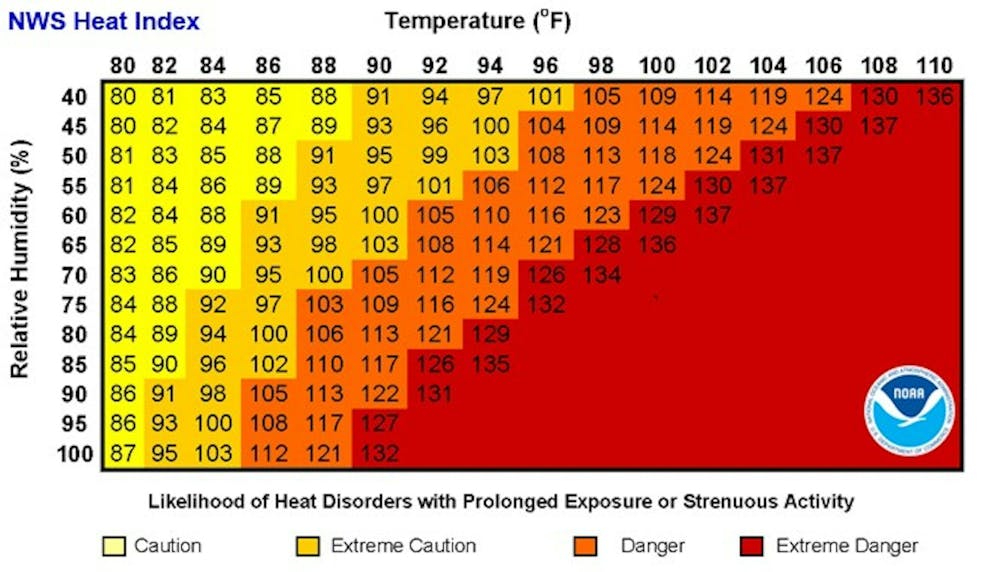
Heat risk isn’t just about temperature – humidity also increases the risk of heat-related illnesses because it affects how well sweating will cool the human body when it gets hot.
Instead of just looking at temperature when planning outdoor activities, check the heat index, which accounts for heat illness risk associated with temperature and relative humidity.
It doesn’t take very high temperatures or very high humidity for the heat index to enter dangerous territory.
A heat index chart shows how heat and humidity combine for dangerous conditions. NOAA
However, the heat index is still a conservative measure of the impact of heat on humans, particularly for outdoor workers and athletes at summer practices. This is because temperature measurements used in weather forecasting are taken in the shade and are not exposed to direct sunlight. If someone is outside and exposed to the direct sun, the actual heat index can be as much as 15 F higher than the heat index chart indicates.
A more sophisticated measurement of heat effects on human health is what’s known as the wet-bulb globe temperature, which takes into account other variables, such as wind speed and cloud cover. Neither takes into account a person’s physical exertion, which also raises their body temperature, whether working at a construction site or playing soccer.
Tips for staying safe in a heat wave
How can you stay cool when heat waves set in? The answer depends in part on where you are, but the main points are the same:
Avoid strenuous outdoor activities in high temperatures if possible. If you start to feel symptoms of heat-related illnesses, drink fluids that will hydrate you. Find shade, rest, and use cool, damp cloths to lower your body temperature. If you see signs of heat stroke in someone else, call for medical help.
Be careful with fans. Fans can be useful if the temperature isn’t too high because they wick sweat away from the body and induce evaporative cooling. But at very high temperatures, they can accelerate heat buildup in the body and lead to dangerous conditions. If indoor temperatures reaches 95 degrees or higher, using fans can actually be dangerous and raise the risk of heat-related illnesses.
Find a cooling center, library or community center where you can get inside and rest in an air-conditioned space in the hottest hours. In places such as Phoenix, where high temperatures are a regular hazard, cooling centers are typically opened in summer. Northern cities are also opening cooling centers as heat waves occur there more frequently than they did in the past. Urban areas with a lot of pavement and buildings – known as heat islands – can have temperatures well above the city’s average.
Hydrate, hydrate, hydrate! Drink plenty of fluids, and don’t forget about the importance of electrolytes. Heat-related dehydration can occur when people sweat excessively, losing water and necessary salts from the body. Some sports drinks or rehydration fluids restore electrolytes and hydration levels.
Older adults and people with disabilities often face higher risks from heat waves, particularly if they can’t easily move to a cooler environment. Communities and neighbors can help protect vulnerable populations by providing cooling centers and bottled water and making regular wellness checks during high heat.
Summer can be a season of fun. Just remember the risks, keep an eye on your friends and neighbors when temperatures rise, and plan ahead so you can beat the heat.
Brian Bossak is not currently receiving relevant external funding for heat-related illness research. In 2017-2019, he served as a consultant on a heat-related research award from the Southeastern Coastal Center for Agricultural Health and
Safety at the University of Florida.
66th Annual Oil & Gas Lifetime Achievement Award Presented to Discovery Operating, Inc. Chairman and Cofounder
WILLIAMSBURG, VA – At the 96th Annual Meeting of the Independent Petroleum Association of America (IPAA) in Williamsburg, VA, Don Sparks the cofounder and chairman of the board of Discovery Operating, Inc. was presented with the 2025 Chief Roughneck Award.
IPAA represents thousands of independent businesses that develop 91 percent of America’s oil and natural gas wells. The Chief Roughneck honor dates back to 1955 and has included pioneers in the industry. Sparks was selected by industry peers as the 66th recipient of the award. Past winners of the Chief Roughneck Award can view viewed on the American Oil & Gas Historical Society website.
The Chief Roughneck Award recognizes one individual whose accomplishments and character represented the highest ideals of the U.S. oil and natural gas industry. The award is considered one of the most meaningful honors in the industry; the award and the character behind it – Joe Roughneck – symbolize the spirit, determination, leadership and integrity of individuals who have made a lasting impression on the energy industry.
Jeff Eshelman, IPAA President and CEO: “It is the IPAA leadership’s honor to present the Chief Roughneck Award to Don Sparks. Don has made his mark on Midland, mark on the industry and mark on the country. We are immensely grateful to have had him and his family active in IPAA and our advocacy for decades. His technical consulting and independent producing background enables him to be especially sensitive to the particular needs of independent producers, along with working interest participants and royalty interest owners. He’s a true patriot and has played a significant role in our country achieving energy dominance. Don and the Sparks family are the embodiment of this award, and we wish them and Discovery Operating, Inc. success for many more years and generations.”
Don Sparks, cofounder and Chairman of the Board of Discovery Operating, Inc.: “I’ve been very blessed to work in an industry that I truly believe helps this world and all the people in it and I’m proud to be a part of it. I thank those that helped me get here, it was not by myself. It was one of my dreams to build a family company; My wife has been in partnership in Discovery Operating, Inc. with me from the beginning, and I’ve been blessed to have my sons and three grandchildren involved. I’ve been blessed with the guys that work with me in the field; they go out there everyday and put their bodies and their time and energy into making sure this industry survives and gets by no matter the oil price. Thank you to the IPAA for this recognition.”
Don Sparks was born in Pampa, Texas, raised in Amarillo, Texas, and received his bachelor’s degree in petroleum engineering from The University of Texas at Austin in 1962. After graduation, Sparks served as an officer in the U.S. Navy for four years and worked in various engineering and consulting capacities for Bailey, Sipes, Williamson and Runyan; Freeport Oil Company; and Shell Oil Company. He co-founded Discovery Operating, Inc. (DOI) in 1973. More than five decades later, Discovery Operating has evolved into a classic small family owned and operated independent oil and gas company with 31 full-time employees. Discovery operates approximately 420 wells located within a 300-400 mile radius of Midland. Today with the horizontal shale play, DOI’s operated production is over 15,000 BOPD and 35 million cubic feet per day of natural gas. He has been influential in the development of the Wolfcamp and Spraberry shales, and the logging suite and analysis he helped establish has been the basis for picking the landing zones in the horizontal wells drilled and completed in the Midland Basin today. Sparks also cofounded Platt, Sparks & Associates with Ronald Platt which evaluates properties, performs reservoir studies and provides expert testimony for hearings and litigations in Midland and Austin; both men retired from the firm in 2014.
Sparks is a registered professional engineer and a renowned member of the petroleum engineering community. He has received numerous awards in recognition of his accomplishments, including the IPAA’s Leadership Award, the University of Texas Cockrell School of Engineering Distinguished Graduate Award and the Hearst Lifetime Achievement Energy Award. He previously served as president of the Permian Basin Chapter of the Society of Petroleum Engineers, director of the Permian Basin Petroleum Association and regional vice president, governor and executive committee member of the IPAA. He also served as a member of the U.S. Department of Energy Unconventional Resources Technology Advisory Committee. He is an active member of the National Society of Petroleum Engineers, American Association of Drilling Engineers and Texas Alliance of Energy Producers. Don also served on the Executive Committee and as chairman of the Mountain States Legal Foundation Executive Board.
Sparks currently resides in Midland, Texas, with his wife, Gwyndolyn. They have three sons, eleven grandchildren and twelve great-grandchildren. All three of his children are partners in Discovery Operating, Inc. William Jeffrey Sparks is Chief Operating Officer, Kevin Don Sparks is Chief Executive Officer and Christopher Todd Sparks is Chief Financial Officer and takes care of outside investments. Gwyn Sparks works at Discovery in accounting.
About the Independent Petroleum Association of America
The Independent Petroleum Association of America (IPAA) is a national upstream trade association representing thousands of independent oil and natural gas producers and service companies across the United States. Independent producers develop 91 percent of the nation’s oil and natural gas wells. These companies account for 83 percent of America’s oil production, 90 percent of its natural gas and natural gas liquids (NGL) production, and support over 4.5 million American jobs. Learn more about IPAA by visiting www.ipaa.org and following @IPAAaccess on Twitter.
About Discovery Operating Company
Founded in 1973, Discovery Operating, Inc. is a family owned, independent exploration and production company located in Midland, Texas with 31 employees. The company currently operates over 400 wells across Texas.
Source: United States House of Representatives – Congressman Ron Estes (R-Kansas)
Rep. Ron Estes (R-Kansas), chair of the House Ways and Means Social Security Subcommittee, released the following statement after the Social Security Board of Trustees released its 2025 report.
“It’s time to be honest about the health of our Social Security Old-Age and Survivors Insurance Trust Fund and not use the program or the trustees’ report for political gamesmanship,” said Chairman Estes. “While the most recent report shows a slight acceleration for insolvency, it’s not new, and it’s something I’ve been concerned about for years. Republicans and Democrats agree that we need to protect and strengthen Social Security, but we can only do so in a responsible manner that safeguards it for current, near and future retirees when we don’t use Social Security as a political weapon.”
Background The report, released on June 18, 2025, highlighted the strength of the Disability Insurance (DI) Trust Fund, which will remain solvent and pay 100% of benefits through at least 2099, one year longer than the last report projected. Meanwhile, the report noted that the Old-Age and Survivors Insurance (OASI) Trust Fund would only remain solvent to pay 100% of benefits through 2033, three-quarters of a year earlier than the previous report’s projection, which was also in 2033. Chairman Estes has committed to focusing on improving Social Security customer service and processes, as well as strengthening the program.
Montpelier, Vt. – Governor Phil Scott today issued the following statement:
“On June 19, 1865, two and a half years after President Lincoln proclaimed all enslaved people in the Confederacy, “henceforth and forever free,” Union soldiers finally made their way to Texas to deliver the news to nearly 250,000 American slaves that the war was over, the south had lost, that each of them were now free.
“We celebrate Juneteenth as the end of slavery in America, but more importantly, we mark this day because we understand that equality is not created with the sweep of a pen and that we must never stop fighting for true equality and freedom for all, each and every day.”
Source: United States Senator for Kansas Roger Marshall
Washington – On Wednesday, U.S. Senator Roger Marshall, M.D. (R-Kansas) joined Senators Raphael Warnock (D-Georgia) and Ruben Gallego (D-Arizona) introduced The Dads Matter Act of 2025, which would direct the U.S. Department of Health and Human Services (HHS) to raise awareness about father inclusion and engagement and to provide state-level guidance aimed at strengthening the role of fathers in supporting healthy mothers and babies.
“As an OBGYN for more than 25 years, I know firsthand the challenges facing mothers, and how important a stable support system can be to both pediatric and maternal health outcomes,” said Senator Marshall. “Fathers play such a critical role in their households, and I am proud to support legislation that champions their role as providers, spouses, and caregivers.”
“Georgia’s maternal mortality rate is a crisis that we must address with every tool at our disposal. That includes redoubling our efforts to uplift the role of fathers in keeping their family healthy during pregnancy and early childhood,” said Senator Reverend Warnock. “Now is the time to spread awareness about the critical role of fathers in improving maternal health outcomes and creating thriving families and communities.”
“Too many women in Arizona die from pregnancy-related causes. This bill helps reverse this trend by recognizing that engaged fathers are part of the solution,” said Senator Gallego. When dads show up, maternal health outcomes are better, babies are healthier, and families are stronger.”
The Dads Matter Act of 2025 would also direct HHS to issue guidance to states to incentivize maternity care providers to offer training and education to health care professionals about the benefits of including and engaging fathers in the pregnancy, birth, and postpartum process. Additionally, it would direct the Government Accountability Office (GAO) to submit a report to Congress that describes the results and effectiveness of this legislation.
Source: United States Senator for Kansas Roger Marshall
Washington – On Wednesday, U.S. Senator Roger Marshall, M.D. (R-Kansas) joined Senator Tammy Baldwin (D-Wisconsin) in reintroducing the Reliable Rail Service Act, which addresses unreliable service and high rail shipping costs for farmers and manufacturers and aims to strengthen our rail supply chains. It ensures major freight railroads deliver reliable service at reasonable rates, enabling American businesses to get products to market more efficiently.
“Kansas’s farmers and ranchers depend upon reliable transport of their world-class goods to the rest of the country, and Class 1 railroads are not meeting expectations – this is a disservice to hard-working Kansans,” said Senator Marshall. “This bill lays out reasonable requirements for rail carriers to meet these important obligations, and I look forward to working with Senator Baldwin on getting this to the finish line.”
“Across the Badger State, our farmers, small businesses, and manufacturers rely on rail service to get their products to market and make ends meet,” said Senator Baldwin. “But when rail service is unreliable, it puts their livelihoods on the line, disrupts supply chains, and drives up costs for hardworking Wisconsin families. That’s why I am proud to work with my Republican colleague to once again introduce our Reliable Rail Service Act and help level the playing field for Wisconsin workers, grow our Made in Wisconsin economy, and keep costs down for consumers.”
The Reliable Rail Service Act is supported by members of the agricultural industry, labor organizations, energy producers, and manufacturers who know firsthand how poor service, significant disruptions, and sky-high prices are impacting their businesses and prices for consumers.
Click here to read the full text of the bill.
Source: United States Senator for Kansas Roger Marshall
Washington – On Wednesday, U.S. Senator Roger Marshall, M.D. (R-Kansas) joined Senator Tammy Baldwin (D-Wisconsin) in reintroducing the Reliable Rail Service Act, which addresses unreliable service and high rail shipping costs for farmers and manufacturers and aims to strengthen our rail supply chains. It ensures major freight railroads deliver reliable service at reasonable rates, enabling American businesses to get products to market more efficiently.
“Kansas’s farmers and ranchers depend upon reliable transport of their world-class goods to the rest of the country, and Class 1 railroads are not meeting expectations – this is a disservice to hard-working Kansans,” said Senator Marshall. “This bill lays out reasonable requirements for rail carriers to meet these important obligations, and I look forward to working with Senator Baldwin on getting this to the finish line.”
“Across the Badger State, our farmers, small businesses, and manufacturers rely on rail service to get their products to market and make ends meet,” said Senator Baldwin. “But when rail service is unreliable, it puts their livelihoods on the line, disrupts supply chains, and drives up costs for hardworking Wisconsin families. That’s why I am proud to work with my Republican colleague to once again introduce our Reliable Rail Service Act and help level the playing field for Wisconsin workers, grow our Made in Wisconsin economy, and keep costs down for consumers.”
The Reliable Rail Service Act is supported by members of the agricultural industry, labor organizations, energy producers, and manufacturers who know firsthand how poor service, significant disruptions, and sky-high prices are impacting their businesses and prices for consumers.
Click here to read the full text of the bill.
Source: United States Senator for Kansas Roger Marshall
Washington – On Wednesday, U.S. Senator Roger Marshall, M.D. (R-Kansas) joined Senator Tammy Baldwin (D-Wisconsin) in reintroducing the Reliable Rail Service Act, which addresses unreliable service and high rail shipping costs for farmers and manufacturers and aims to strengthen our rail supply chains. It ensures major freight railroads deliver reliable service at reasonable rates, enabling American businesses to get products to market more efficiently.
“Kansas’s farmers and ranchers depend upon reliable transport of their world-class goods to the rest of the country, and Class 1 railroads are not meeting expectations – this is a disservice to hard-working Kansans,” said Senator Marshall. “This bill lays out reasonable requirements for rail carriers to meet these important obligations, and I look forward to working with Senator Baldwin on getting this to the finish line.”
“Across the Badger State, our farmers, small businesses, and manufacturers rely on rail service to get their products to market and make ends meet,” said Senator Baldwin. “But when rail service is unreliable, it puts their livelihoods on the line, disrupts supply chains, and drives up costs for hardworking Wisconsin families. That’s why I am proud to work with my Republican colleague to once again introduce our Reliable Rail Service Act and help level the playing field for Wisconsin workers, grow our Made in Wisconsin economy, and keep costs down for consumers.”
The Reliable Rail Service Act is supported by members of the agricultural industry, labor organizations, energy producers, and manufacturers who know firsthand how poor service, significant disruptions, and sky-high prices are impacting their businesses and prices for consumers.
Click here to read the full text of the bill.
Source: United States Senator for Kansas Roger Marshall
SALINA, KS – On Thursday, Senator Roger Marshall, M.D. (R-Kansas) announced his office’s assistance in helping any Kansan in Israel safely evacuate to the U.S. The Senator’s office has previously helped Americans safely evacuate.
“My office has successfully helped Americans escape from other, dangerous situations in foreign nations, and we stand ready to do the same in Israel,” Senator Marshall said.
Any Kansans with family or loved ones in Israel are asked to email EvacHelp@marshall.senate.gov or call (785)829-9000.
Source: United States Senator for Kansas Roger Marshall
SALINA, KS – On Thursday, Senator Roger Marshall, M.D. (R-Kansas) announced his office’s assistance in helping any Kansan in Israel safely evacuate to the U.S. The Senator’s office has previously helped Americans safely evacuate.
“My office has successfully helped Americans escape from other, dangerous situations in foreign nations, and we stand ready to do the same in Israel,” Senator Marshall said.
Any Kansans with family or loved ones in Israel are asked to email EvacHelp@marshall.senate.gov or call (785)829-9000.
The Commission emphasises the need for large financial institutions to disclose alignment with Taxonomy criteria. The Commission intends to address issues with the methodology of the Green Asset Ratio as part of the planned review of the Taxonomy Disclosures Delegated Act[1]. A draft amending Delegated Regulation was published for consultation between 26 February and 26 March 2025[2].
Financial institutions are also expected to benefit from the possibility to disclose economic activities meeting only certain criteria, like climate change mitigation.
This is reflected in the proposed amendment to the Corporate Sustainability Reporting Directive to revise reporting rules and better reflect the transition efforts introducing disclosures of partial alignment with the Taxonomy.
In view of meeting the environment and climate objectives, the 8th Environment Action Programme Mid-Term Review[3] calls for collaborative efforts to render laws effective and promote clean solutions.
Simplification, modernisation, digitalisation and funding are pivotal. Successful implementation hinges on overcoming challenges to ensure stakeholder buy-in, showcasing the benefits of the green transition.
The Commission commits to ongoing dialogue with Member States, fostering understanding of climate risks and opportunities and building support for effective policies. This approach precedes legislative revisions, adhering to evidence-based policy-making aligned with Better Regulation guidelines.
In addition, inclusive dialogues with stakeholders ensure that policies enshrined in the European Green Deal contribute to a just and competitive transition.
Notably, the Clean Industrial Deal[4] that facilitates achievement of EU climate goals by incentivising industry decarbonisation, was supported by stakeholder initiatives like the Antwerp Declaration for a European Industrial Deal[5] and Clean Transition Dialogues[6], tailored to sectors such as automotive, steel, metals and chemicals.
[1] Commission Delegated Regulation (EU) 2021/2178 of 6 July 2021 supplementing Regulation (EU) 2020/852 of the European Parliament and of the Council by specifying the content and presentation of information to be disclosed by undertakings subject to Articles 19a or 29a of Directive 2013/34/EU concerning environmentally sustainable economic activities, and specifying the methodology to comply with that disclosure obligation OJ L 443, 10.12.2021, p. 9-67.
The Commission emphasises the need for large financial institutions to disclose alignment with Taxonomy criteria. The Commission intends to address issues with the methodology of the Green Asset Ratio as part of the planned review of the Taxonomy Disclosures Delegated Act[1]. A draft amending Delegated Regulation was published for consultation between 26 February and 26 March 2025[2].
Financial institutions are also expected to benefit from the possibility to disclose economic activities meeting only certain criteria, like climate change mitigation.
This is reflected in the proposed amendment to the Corporate Sustainability Reporting Directive to revise reporting rules and better reflect the transition efforts introducing disclosures of partial alignment with the Taxonomy.
In view of meeting the environment and climate objectives, the 8th Environment Action Programme Mid-Term Review[3] calls for collaborative efforts to render laws effective and promote clean solutions.
Simplification, modernisation, digitalisation and funding are pivotal. Successful implementation hinges on overcoming challenges to ensure stakeholder buy-in, showcasing the benefits of the green transition.
The Commission commits to ongoing dialogue with Member States, fostering understanding of climate risks and opportunities and building support for effective policies. This approach precedes legislative revisions, adhering to evidence-based policy-making aligned with Better Regulation guidelines.
In addition, inclusive dialogues with stakeholders ensure that policies enshrined in the European Green Deal contribute to a just and competitive transition.
Notably, the Clean Industrial Deal[4] that facilitates achievement of EU climate goals by incentivising industry decarbonisation, was supported by stakeholder initiatives like the Antwerp Declaration for a European Industrial Deal[5] and Clean Transition Dialogues[6], tailored to sectors such as automotive, steel, metals and chemicals.
[1] Commission Delegated Regulation (EU) 2021/2178 of 6 July 2021 supplementing Regulation (EU) 2020/852 of the European Parliament and of the Council by specifying the content and presentation of information to be disclosed by undertakings subject to Articles 19a or 29a of Directive 2013/34/EU concerning environmentally sustainable economic activities, and specifying the methodology to comply with that disclosure obligation OJ L 443, 10.12.2021, p. 9-67.
Hawala is an informal, trust-based money transfer system often used for money remittances. It operates outside traditional banking, without using authorised financial institutions.
Under EU legislation, all operators providing payment services[1] must become authorised payment institutions. This mandates such operators to perform customer due diligence[2] and report suspicious transactions to law enforcement authorities[3].
Enforcement actions have been ongoing since 2019, both at national level and through international monitoring mechanisms. The Commission actively participates in the Financial Action Task Force and MONEYVAL[4] mutual evaluation processes, which assess countries’ compliance with anti-money laundering and countering the financing of terrorism (AML/CFT) standards.
These evaluations have identified risks associated with informal value transfer systems, including hawala, in both EU Member States and third countries.
They recommend strengthening supervision and adopting measures, practices and detailed guidelines on effective parallel financial investigations.
Conducting these types of funds transfers informally and without authorisation already exposes their perpetrators to the risk of being severely sanctioned in all EU Member States. Hence, making a legislative proposal to limit the use of hawala has so far not been considered necessary.
Instead, the focus remains on practical enforcement and supervision. With the entry into application of the AML/CFT package adopted in 2024[5] and the establishment of the AML Authority (AMLA), the EU and its Member States will further enhance their capacities to supervise illicit financial flows, including when performed through unauthorised hawala activities.
[1] Which includes money remittance, as per Annex I, point 6 of Directive (EU) 2015/2366 of the European Parliament and of the Council of 25 November 2015 on payment services in the internal market (PSD2).
[2] As per Article 11 of Directive (EU) 2015/849, OJ L 141, 5.6.2015, p. 73-117.
[3] As per Article 33 of Directive (EU) 2015/849, OJ L 141, 5.6.2015, p. 73-117.
[4] Committee of Experts on the Evaluation of Anti-Money Laundering Measures and the Financing of Terrorism.
The Non-Performing Loans (NPL) Directive[1] applies as of 30 December 2023. According to Article 2 of the directive, its scope is limited to creditor’s rights under a non-performing credit agreement, or of the non-performing credit agreement itself, issued by a credit institution established in the EU.
From this perspective, the transfer of social insurance debt or due contributions are not in scope of this directive. This domain is therefore competence of national law, without prejudice to the application of Regulation (EU) 2016/679 (GDPR)[2].
The supervision and enforcement of the GDPR falls within the competence of the national supervisory authorities and courts, without prejudice to the competences of the Commission as guardian of the Treaties.
[1] Directive (EU) 2021/2167 of the European Parliament and of the Council of 24 November 2021 on credit servicers and credit purchasers and amending Directives 2008/48/EC and 2014/17/EU, OJ L 438, 8.12.2021, p.1.
[2] Regulation (EU) 2016/679 of the European Parliament and of the Council of 27 April 2016 on the protection of natural persons with regard to the processing of personal data and on the free movement of such data, and repealing Directive 95/46/EC (GDPR), OJ L 119, 4.5.2016, p. 1-88, and (EU) 2018/1725.
1. Regulation 656/2014[1] applies in the context of operational cooperation coordinated by the European Border and Coast Guard Agency (Frontex) and does not affect the division of competences between the EU and the Member States or the obligations of the national authorities under the relevant international conventions[2]. This also includes the responsibility for declaring and coordinating search and rescue (SAR) activities in cases such as the one in question. In line with international law, this competence belongs exclusively to the rescue coordination centre(s) that oversee the area in which the specific incident takes place.
2. The Commission has no competence to influence the way SAR activities are declared or performed by the responsible national authorities. Nevertheless, saving lives at sea is a moral duty, as well as a legal obligation for Member States under international law, independently from the circumstances that lead people to find themselves in distress at sea. The Commission remains committed to supporting the Member States to operate in line with this principle. The Commission repeatedly calls on all actors involved in SAR to always prioritise saving lives at sea and to comply with the relevant legal framework.
3. According to open sources, the persons stranded on the Miskar oil platform were rescued by Sea-Watch and subsequently safely disembarked in Lampedusa on 4 March 2025, upon instructions received by Sea-Watch from the Italian Coast Guard.
[1] Regulation (EU) No 656/2014 of the European Parliament and of the Council of 15 May 2014 establishing rules for the surveillance of the external sea borders in the context of operational cooperation coordinated by the European Agency for the Management of Operational Cooperation at the External Borders of the Member States of the European Union. OJ L 189, 27.6.2014, p. 93-107.
[2] Such as the International Convention on the Law of the Sea, the International Convention for the Safety of Life at Sea, and the International Convention on Maritime Search and Rescue.
The Commission has undertaken several initiatives to protect democracy in the EU, in particular with the European Democracy Action Plan of 2020 and the Defence of Democracy Package of 2023[1].
Their success is reflected, among other things, in the general satisfaction of respondents to standard Eurobarometer surveys with the way democracy works in the EU[2].
As regards transparency of financial flows, several pieces of EU legislation are relevant. Regulation (EU) 2024/900 on the transparency and targeting of political advertising[3], which will enter into full application on 10 October 2025, will support national oversight of funding of political advertising and minimise the risk of information manipulation and foreign interference by requiring the provision, among others, of oversight authorities and record-keeping of information on the amounts received for political advertising services.
As part of the Defence of Democracy package the Commission presented a legislative proposal that aims to enhance transparency and democratic accountability of interest representation activities on behalf of third countries which seek to influence policies, decision making and the democratic space. The proposal is currently being discussed by the co-legislators.
In terms of following the money in general, Member States’ competent authorities will have better access to the information they need with the application of the anti-money laundering package[4], which was adopted by the co-legislators in 2024, and will enter into application in July 2027.
In 2025, the Commission will propose a European Democracy Shield, which will, among other things, set out steps to combat foreign information manipulation, interference and disinformation.
The protection of personal data in the EU is ensured by the General Data Protection Regulation (GDPR)[1] which applies to both public and private organisations in the EU.
Genetic data fall within the special categories of personal data which can be processed only if one of the conditions in Article 9(2) GDPR is fulfilled. This provides an additional layer of protection considering the potential risks arising from the processing of this type of data.
Following the GDPR risk-based approach, controllers and processors must put in place adequate technical and organisational measures to ensure a level of security appropriate to the risk (Articles 5(1)(f) and 32 GDPR).
If the envisaged processing is likely to result in a high risk, the controller has to conduct a Data Protection Impact Assessment (DPIA), and in some situations, to consult the competent Data Protection Authority (DPA).
In line with Article 28 GDPR, the controller has to choose a processor that provides sufficient guarantees in terms of data protection.
The binding contract or other legal act governing their relationship shall stipulate, among others, that the processor must ensure that its staff authorised to process the data have committed themselves to confidentiality. The GDPR does not impose the public disclosure of the contract, nor the funding.
It follows that the Greek public authority, acting as controller, is responsible for ensuring that the data processing for the preventive screening meets the GDPR standards.
The monitoring and enforcement of the application of the GDPR falls within the competence of the national DPAs and courts, without prejudice to the Commission’s competences as guardian of the Treaties.
It is therefore for the Greek DPA to examine whether the ‘programmatic agreement’ complies with the GDPR.
[1] Regulation (EU) 2016/679 of the European Parliament and of the Council of 27 April 2016 on the protection of natural persons with regard to the processing of personal data and on the free movement of such data, and repealing Directive 95/46/EC (GDPR), OJ L 119, 4.5.2016, p. 1-88.
Directive (EU) 2016/343 sets out rules on public references by public authorities to the guilt of a suspect or accused person prior to a conviction.
It does not require specific limitations as to the publication by the press of procedural documents relating to the pre-trial stage of the proceedings.
Without prejudice to national law protecting the freedom of press and other media, the directive only establishes minimum rules, requiring that the dissemination of any information by public authorities to the media must respect the presumption of innocence and not create the impression that the person is guilty before his or her guilt has been proven according to law.
The 2024 Rule of Law report for Italy[1] noted that the legislative initiatives regulating access to and publication of certain judicial information were a source of concern for media stakeholders.
The report also notes that the Italian Government considers these initiatives to be justified to guarantee the right to privacy and the presumption of innocence. The Commission will continue monitoring the developments in this respect in the framework of the Rule of Law Report.
[1] E uropean Commission, 2024 Rule of Law Report, ‘Country Chapter on the rule of law situation in Italy’ (SWD(2024) 812 final); https://commission.europa.eu/document/download/60d79a4f-49cd-4061-a18f-d3a4495d6485_en?filename=29_1_58066_coun_chap_italy_en.pdf.
Question for written answer E-002381/2025 to the Commission Rule 144 Christine Schneider (PPE)
Numerous reports and observations from various Member States, in particular Germany, indicate that the practical implementation of Regulation (EU) 2020/741 has caused significant difficulties. Many farmers and municipalities lose access to treated waste water because many smaller projects are unable to meet the technical and administrative requirements of the Regulation. This runs counter to the Regulation’s objective of promoting water reuse and addressing water scarcity.
1.How does the Commission assess the practical implementation of Regulation (EU) 2020/741, in particular as regards access to treated waste water for irrigation in agriculture in the Member States, and is the Commission aware that, as a result of the above-mentioned requirements, smaller farms and municipalities in particular have lost access to treated waste water and are instead having to increasingly resort to using valuable drinking water for irrigation?
2.How does the Commission view the criticism that the current requirements of the Regulation could lead to a reduction in water reuse in practice, thus undermining the very objective of the Regulation?
3.Does the Commission intend to evaluate Regulation (EU) 2020/741 in the light of real-world practical experience and feedback so far and, if necessary, propose adjustments to facilitate water reuse?
Question for written answer E-002373/2025 to the Commission Rule 144 Mélanie Disdier (PfE), Hans Neuhoff (ESN), Alexander Sell (ESN), António Tânger Corrêa (PfE), Jan-Peter Warnke (NI), Rody Tolassy (PfE), Jean-Paul Garraud (PfE), Marie Dauchy (PfE), Virginie Joron (PfE), Anne-Sophie Frigout (PfE), Pierre Pimpie (PfE), Fernand Kartheiser (NI)
Under the Birds Directive (2009/147/EC), the killing or disturbance of protected species, as well as the degradation of their habitats, is strictly prohibited, in particular in Natura 2000 areas. However, the planned wind farm off the coast at Dunkirk, located in a Natura 2000 area, is raising concerns about its impact on protected species, such as seabirds and migratory birds[1].
The decision to temporarily cease operating the Aumelas wind farm in Hérault[2], taken in order to protect endangered species, serves as a reminder that preserving biodiversity takes precedence over industrial projects, in accordance with EU law.
1.Can the Commission confirm that the construction of the wind farm off the coast at Dunkirk fully complies with the obligations of the Birds Directive, in particular with regard to the assessment of the impact on protected species?
2.What specific steps does the Commission intend to take to prevent the disturbance or destruction of bird habitats in this Natura 2000 area?
3.How does the Commission ensure that the protective measures within the framework of this project are implemented and monitored?
In Europe’s Beating Cancer Plan[1], the Commission indicated that it will ‘explore measures on exposure to ultraviolet radiation, including from sunbeds, which increases the risk of melanoma…’.
Sunbeds are already covered by the EU’s Low Voltage Directive[2], which covers all safety aspects — including health risks — of electrical equipment. Therefore, all sunbeds used for tanning purposes must comply with the standards set in this directive, which covers cancer-related risks.
The Commission concluded that more information on the effectiveness of preventive and mitigation measures is needed to have a comprehensive understanding of how policy recommendations could lead to a better protection of EU citizens from health risks associated with the use of sunbeds, beyond the protection already provided under the Low Voltage Directive.
At this stage, further compelling new evidence including on the effectiveness of actions that would justify further measures is not available. Therefore, it would be premature to put forward a Commission Recommendation on sunbeds at this stage.
The fourth edition of the European Code Against Cancer[3] already includes clear guidance on avoiding the use of sunbeds, a recommendation that is being considered to be maintained in the forthcoming fifth edition of the Code.
[2] Directive 2014/35/EU of the European Parliament and of the Council of 26 February 2014 on the harmonisation of the laws of the Member States relating to the making available on the market of electrical equipment designed for use within certain voltage limits. OJ L 96, 29.3.2014, p. 357-374
The EU agri-food chain observatory (AFCO) was launched in 2024 as one of the actions that aim to strengthen the position of farmers in the food supply chain and reinforce trust between actors.
As set out in its Terms of Reference[1], the purpose of AFCO is to advise the Commission and to exchange information and discuss with a view to establishing a common diagnosis of the situation across markets, and bring increased transparency on prices, cost structure, margin distribution and added value in the supply chain, while respecting confidentiality and competition rules.
Market observatories, such as AFCO, provide advice and expertise and do not engage in policy discussions. In line with its Terms of Reference, by assessing and taking stock of the situation within the supply chain, the group provides inputs to inform policy responses by the Commission and other policy-makers.
Members of the AFCO exchange information based on available evidence and facts. These include existing data collected by the Commission, such as the Directorate General for Agriculture and Rural Development and Eurostat, as well as information made available by members in full respect of confidentiality and competition rules.
The Commission assesses the quality of data. Potential limitations in their use, comparability or interpretation are taken into account and clearly communicated when data are disseminated.
The AFCO has convened three times since its creation. Its work currently focuses on identifying relevant data sources and data gaps, with a view to enabling the group to monitor the agri-food supply chain.
Since 2020, the EU has set up a comprehensive regulatory framework to support the scale up of renewable hydrogen, including enabling financing under the European Hydrogen Bank (EHB).
After two auctions already implemented under this financial initiative to support hydrogen production in Europe[1], by the end of 2025 the Commission will launch a third auction, with a budget of up to EUR 1 billion from the Innovation Fund (IF).
The IF also provides funding to hydrogen-related projects through its regular grants[2]. By the end of 2025, the results of the latest regular grant call (IF24) will be published and a new call will be opened.
Moreover, to enhance impact from its calls, the IF implemented the ‘as-a-Service’ feature[3], allowing Member States[4] to allocate national funding in addition to the Innovation Fund. This feature will be available again in upcoming calls.
The Commission also works to establish joint European auctions for imports of renewable hydrogen. Under a Team Europe approach, willing Member States will be able to pool funding and attract competitive bids from third-country producers, thus further supporting the decarbonisation of their industry and transport sectors as well as contributing to wider goals such as the development of key import infrastructure corridors.
The Commission will launch the Mechanism to support market development of hydrogen[5] in the third quarter of 2025. It will bring together buyers and sellers[6] on an online platform, enabling them to find potential commercial partners, and connecting them with financial support.
[1] Through the three auction calls, the EHB will have made available EUR 3 billion in grants: https://climate.ec.europa.eu/eu-action/eu-funding-climate-action/innovation-fund/competitive-bidding_en.
[2] Under the IF, more than 40 projects covering the full hydrogen value chain are already receiving a total of EUR 3 billion in regular grants.
[4] Germany, Austria, Spain and Lithuania have already contributed, together, with almost EUR 1.2 billion in national resources in the IF23 and IF24 Auctions.
[5] In accordance with the mandate received pursuant to Regulation (EU) 1789/2024 of the European Parliament and of the Council of 13 June 2024 on the internal markets for renewable gas, natural gas and hydrogen.
[6] The Hydrogen Mechanism covers renewable and low-carbon hydrogen and its derivatives (ammonia, methanol, eSAFs).
On Thursday, Parliament adopted human rights resolutions on Georgia, Iran and Mali.
Media freedom in Georgia and the case of Mzia Amaglobeli
MEPs are deeply concerned about arbitrary detentions in Georgia and the government’s harassment of and violence against journalists. They demand the immediate and unconditional release of Georgian journalist Mzia Amaglobeli, condemning her arrest as politically motivated . They strongly condemn the Georgian Dream regime’s systemic assault on democratic institutions, political opposition, independent media, civil society and judicial independence. They call for independent investigations and urge the authorities to act immediately to ensure journalists’ safety.
Parliament also calls for the release of all political prisoners, including activists, opposition leaders and former President Mikheil Saakashvili. In the resolution, MEPs call urgently for the repeal of repressive laws, restoration of democracy, and full protection of media freedom and civil liberties. The EU must step up its support for Georgian civil society, while pressing for sanctions on officials responsible for democratic backsliding, MEPs add.
They also express grave concern at the latest wave of assaults against Georgian non‑governmental organisations, which is putting the work of targeted organisations at risk.
The resolution was adopted by 324 votes in favour, 25 against and 87 abstentions. For further details, the full version will be available here. (19.6.2025)
The case of Dr Ahmadreza Djalali in Iran
Parliament condemns Dr Ahmadreza Djalali’s sham trial, torture and lack of access to medical care, and urge Iran to provide him with legal representation and defence and allow contacts with his family.
MEPs call on Iran to put a moratorium on executions and abolish the death penalty. They urge Sweden and relevant member states and the European External Action Service to adopt targeted measures in response to Iran’s continued detention of EU nationals, including Cécile Kohler and Jacques Paris.
They reiterate their call on the Council to designate the Islamic Revolutionary Guard Corps a terrorist organisation and extend EU sanctions to those who take EU nationals hostage, execute opposition members en masse, and commit other human rights violations. They demand that UN human rights mechanisms be fully activated in Iran, including the Special Rapporteur. They also call on EU foreign policy chief Kaja Kallas to raise Djalali’s case in public and during all engagements with her Iranian counterparts.
The resolution was adopted by 486 votes in favour, 8 against and 29 abstentions. For further details, the full version will be available here. (19.6.2025)
Dissolution of political parties and crackdown on the opposition in Mali
Parliament condemns the dissolution of political parties in Mali and the repression of the opposition. MEPs criticise the authorities for actions that undermine democracy, human rights, and fundamental freedoms, including freedom of expression, association, and peaceful assembly, and demand respect for international human rights law and Mali’s own commitments.
They note the transitional president’s 2024 request to create conditions for transparent and peaceful elections, and call for the immediate release of those arrested or abducted for political reasons, an end to repression and intimidation, and guarantees for the safety of opposition members and civil society actors.
Parliament also denounces the ongoing violence and Islamist terrorism in Mali, and stresses the need for accountability for human rights violations and war crimes committed by the Wagner Group/Africa Corps, and reaffirms the EU’s support for multi-party democracy, civil society, and human rights in Mali. MEPs express serious concern over the growing illegal migration flows from Mali, fuelled by growing insecurity, political instability and economic stagnation and call on the Malian authorities to take full responsibility for preventing uncontrolled departures.
The resolution was adopted by 511 votes in favour, 14 against and with 25 abstentions. For further details, the full version will be available here. (19.6.2025)
A high level of protection of health and the environment underpins the EU legal framework on genetically modified food and feed, by requiring a prior authorisation based on a comprehensive risk assessment performed by the European Food Safety Authority (EFSA).
The risk assessment for soy leghemoglobin referred to by the Honourable Members was performed by two scientific Panels[1],[2], following established methodologies and relevant risk assessment guidance.
The data submitted concerned the actual strain used for producing this soy leghemoglobin ( MXY0541) and both EFSA Panels[3],[4] concluded favourably on the safety of the soy leghemoglobin produced from this strain.
Regulation (EC) No 1829/2003[5] provides for the protection of confidential information while ensuring that the key elements of the Genetically Modified Organisms (GMO) Panel opinion are disclosed to the public in accordance with its Article 30 and the relevant provisions of Regulation (EC) No 178/2002[6].
In compliance with Article 6(7) of Regulation (EC) No 1829/2003, EFSA did not disclose certain parts of the opinion in the published version.
The Commission is in the process of adopting a decision on the request for confidential treatment of certain information in the dossier, made by the applicant, which EFSA took into account when redacting parts of the Panel opinion.
Should the Commission decide not to grant confidentiality requested by the applicant for certain elements, the Commission will ask EFSA to adapt the published opinion accordingly and will reopen the public consultation based on the updated version.
The Commission is currently considering EFSA’s opinion in view of preparing a draft decision concerning this application in accordance with the procedure of Article 7 of Regulation (EC) No 1829/2003.
The Industrial Decarbonisation Bank and action plan for affordable energy are crucial for the competitiveness and resilience of European industry, MEPs say.
The resolution, adopted on Thursday 19 June in response to the European Commission’s Clean Industrial Deal plan, stresses the need to combine climate action with industrial competitiveness.
It underscores the importance of the newly established Industrial Decarbonisation Bank, which MEPs consider vital for scaling up investment in clean technologies. Investment should be based on carbon impact, scalability, and security of supply, they say.
Parliament welcomes lead markets for European-made clean, circular and low-carbon products, and stresses the need to stimulate demand through public and private procurement.
MEPs also advocate for the protection of the EU market from unfair competition and the dumping of industrial overcapacity from third countries. They underline the importance of an effective carbon border adjustment mechanism (CBAM) in the context of phasing out free allowances under the emissions trading system (ETS).
Faster permitting procedures
The resolution addresses the importance of regulatory simplification and the need to streamline permitting procedures to support the transition and innovation efforts of small businesses. MEPs want to simplify funding applications, reduce reporting obligations, and fast-track small projects.
They also want to build the business case for permanent carbon removals in upcoming legislative reviews, as carbon management, including capture, storage, transport, and utilisation, may be necessary for hard-to-abate sectors, they say.
Affordable energy action plan
MEPs support the action plan for affordable energy and demand measures to boost cross-border energy infrastructure and complete the energy union. The current fragmentation of regulatory oversight and investment planning across Member States is hampering integration and electrification, they say. MEPs also call on Member States, transmission system operators and the Commission to do more to promote cross-border electricity trading.
Quote
“European industry is facing enormous challenges, while a strong industrial base is essential for our competitiveness and strategic autonomy. The Clean Industrial Deal offers a strategy for a competitive and decarbonised European industry. At the same time, it seeks to protect our autonomy and secure jobs. This Deal is an important first step, but time is running out. We urge the Commission to act without delay and raise its level of ambition. When it comes to industrial policy, European cooperation is more crucial than ever” said lead MEP Tom Berendsen (EPP, Netherlands).
The resolution was adopted with 381 votes to 173, with 13 abstentions.
Background: Clean Industrial Deal
Presented by the European Commission in February, the Clean Industrial Deal aims to support the competitiveness and resilience of European industry. It focuses mainly on two sectors: energy-intensive industries and clean technology, and aims to lower energy costs via an action plan on affordable energy. The Clean Industrial Deal also seeks to boost demand for clean products, further finance the clean transition and improve circularity, access to critical raw materials and the establishment of sectoral skills for strategic industries.
The Maldives expressed interest in joining an Economic Partnership Agreement (EPA) during the third EU-Maldives Senior Officials’ Meeting (SOM) in 2022.
The Maldives’ objective in joining an EPA is to benefit from duty-free, quota-free access to the EU market, especially for their main export product (tuna), which they lost after their graduation from the Generalised System of Preferences in 2015.
At the fourth EU-Maldives SOM in 2023, the Maldives stressed their interest in joining the Samoa Agreement. This agreement provides a legal framework for EU relations with countries of Africa, Caribbean and Pacific, including a possibility of concluding with them economic partnership agreements. On 1 July 2024, the Maldives signed the Samoa Agreement.
In subsequent meetings with representatives of the government of the Maldives the Commission provided a non-paper outlining the steps required to join the EPA between the EU and the five Eastern and Southern African (ESA5) countries, the most relevant one given the Maldives’ geographical position.
To proceed, the Maldives need to (i) sign the Samoa Agreement (completed in 2024); (ii) join the ESA group in the Organisation of African, Caribbean, and Pacific States (status unclear); and (iii) submit a formal request to join the EU-ESA5 EPA and table a market access offer to the Commission.
An accession to the EPA would eventually require a joint EU-ESA5 decision in line with the EPA’s procedures.
Despite all the explanation provided by the Commission, to date, the Maldives have neither submitted a formal request to join the EPA nor tabled a market access offer. These steps are needed before a provisional timeline for the Maldives’ potential accession to the EU-ESA5 EPA can be established.