Category: AM-NC

  • MIL-Evening Report: School playgrounds are one of the main locations for bullying. How can they be set up to stop it?

    Source: The Conversation (Au and NZ) – By Brendon Hyndman, Associate Dean (Academic), Faculty of Arts and Education, Charles Sturt University

    Dan Kenyon/ Getty Images

    Children spend thousands of hours in playgrounds at school. A lot of this time does not have the same levels of teacher preparation and supervision as classrooms do.

    Research shows school playgrounds are one of the main locations where bullying occurs.

    The federal government is doing a rapid review into what works and what else needs to be done to stop bullying in schools. School playgrounds can sometimes be overlooked when considering anti-bullying approaches.

    What is the relationship between playgrounds and bullying? And how can we better set up playgrounds to help prevent this damaging behaviour?

    Why do play spaces matter?

    The reasons for bullying are complex and stem from a range of factors.

    But research suggests bullying is more common in confined or contested spaces – for example, when students are mixing with other year levels.

    This research also suggests some students are more likely to bully other students, lash out and break rules when they are bored and frustrated in school play spaces.

    A new report from not-for-profit group Play Australia estimates just 2% of all Australian schools are using innovative, research-informed strategies that best encourage and support healthy play behaviours.

    An example of ‘loose parts’ play for children. Well established in early childhood, yet innovative in primary schools.

    What happens in Australia?

    School play spaces are not regulated in the way playgrounds are for younger children. For example, there are no minimum space requirements per student in high schools. There are some emerging primary school space guidelines, but these are not always followed.

    The lack of regulation for playground space has also seen classroom buildings taking over play areas and rules stopping students from moving in some areas (for example, no running or ball games).

    Many primary schools still rely on fixed play equipment installed in the 1980s. But primary school students report they get bored of playing on the same equipment over and over again.

    In public high schools, playgrounds tend to be large open spaces with ovals, hard-surfaced courts and picnic tables or benches.

    Not only is this not particularly stimulating or inviting, the design can lead to some (typically male) students dominating the open spaces with games.

    This can exclude other students from the playground. Research suggests if students lack a sense of community and belonging to their school, they are more likely to bully others.

    What should primary schools do?

    A growing body of research based on interviews with teachers and student observations suggests positive behaviours can be encouraged if primary students have more options and fewer restrictions on how they engage in play.

    Resources that can be moved, adapted and selected by students (with varying colours, shapes, sizes, quantities and types) can help develop problem-solving and teamwork skills and reduce bullying because children are busy and engaged.

    Examples of resources include both natural (rocks and twigs), loose sports equipment (small hurdles, bats and frisbees, balls) and other manufactured items (blocks, boxes, pipes, planks and crates).

    Research also suggests teachers’ engagement with students in the playground can help reduce bullying and antisocial behaviour.

    The “active supervision” method is recognised as one of the most effective ways to to do this, as it can improve students’ sense of belonging and safety.

    The method includes adults using positive language, showing an interest in supporting play and modelling positive play behaviours, which increase students’ participation and cooperation.

    What about high schools?

    Research with school architects suggests high school spaces with well maintained, diverse features can help promote a more positive social culture.

    It also suggests multiple spaces for students – as opposed to a single dominant space in a playground – can support students to feel as though there is space for them, and they belong at school.

    It is important for high school students to be consulted about what they want – they are the main users and have evolving needs as they progress through school.

    A 2025 Australian study found high school students want opportunities to retreat and be themselves.

    Examples include maintained gardens and courtyards to help relax after the stresses of classroom rules and routines. Students suggested trees, rocks and gardens could break up open spaces. Providing sufficient shade can also ensure students have more accessible space to engage with each other throughout a school year.

    What next?

    Improving playgrounds to better address student needs will require more resources from governments.

    But addressing bullying is complex and we know physical settings can impact social dynamics. So we need to look more closely at school playgrounds as a key place where bullying occurs and the role they play in this behaviour.

    Brendon Hyndman’s work on school play is mentioned in the Play Australia report referenced in this article.

    ref. School playgrounds are one of the main locations for bullying. How can they be set up to stop it? – https://theconversation.com/school-playgrounds-are-one-of-the-main-locations-for-bullying-how-can-they-be-set-up-to-stop-it-258566

    MIL OSI AnalysisEveningReport.nz

  • MIL-Evening Report: Winter viruses can trigger a heart attack or stroke, our study shows. It’s another good reason to get a flu or COVID shot

    Source: The Conversation (Au and NZ) – By Tu Nguyen, PhD Candidate, Department of Paediatrics, University of Melbourne, Murdoch Children’s Research Institute

    Irina Shatilova/Shutterstock

    Winter is here, along with cold days and the inevitable seasonal surge in respiratory viruses.

    But it’s not only the sniffles we need to worry about. Heart attacks and strokes also tend to rise during the winter months.

    In new research out this week we show one reason why.

    Our study shows catching common respiratory viruses raises your short-term risk of a heart attack or stroke. In other words, common viruses, such as those that cause flu and COVID, can trigger them.

    Wait, viruses can trigger heart attacks?

    Traditional risk factors such as smoking, high cholesterol, high blood pressure, diabetes, obesity and lack of exercise are the main reasons for heart attacks and strokes.

    And rates of heart attacks and strokes can rise in winter for a number of reasons. Factors such as low temperature, less physical activity, more time spent indoors – perhaps with indoor air pollutants – can affect blood clotting and worsen the effects of traditional risk factors.

    But our new findings build on those from other researchers to show how respiratory viruses can also be a trigger.

    The theory is respiratory virus infections set off a heart attack or stroke, rather than directly cause them. If traditional risk factors are like dousing a house in petrol, the viral infection is like the matchstick that ignites the flame.

    Think of a viral infection as the matchstick that ignites the flame, leading to a heart attack or stroke.
    anokato/Shutterstock

    For healthy, young people, a newer, well-kept house is unlikely to spontaneously combust. But an older or even abandoned house with faulty electric wiring needs just a spark to lead to a blaze.

    People who are particularly vulnerable to a heart attack or stroke triggered by a respiratory virus are those with more than one of those traditional risk factors, especially older people.

    What we did and what we found

    Our team conducted a meta-analysis (a study of existing studies) to see which respiratory viruses play a role in triggering heart attacks and strokes, and the strength of the link. This meant studying more than 11,000 scientific papers, spanning 40 years of research.

    Overall, the influenza virus and SARS-CoV-2 (the virus that causes COVID) were the main triggers.

    If you catch the flu, we found the risk of a heart attack goes up almost 5.4 times and a stroke by 4.7 times compared with not being infected. The danger zone is short – within the first few days or weeks – and tapers off with time after being infected.

    Catching COVID can also trigger heart attacks and strokes, but there haven’t been enough studies to say exactly what the increased risk is.

    We also found an increased risk of heart attacks or strokes with other viruses, including respiratory syncytial virus (RSV), enterovirus and cytomegalovirus. But the links are not as strong, probably because these viruses are less commonly detected or tested for.

    What’s going on?

    Over a person’s lifetime, our bodies wear and tear and the inside wall of our blood vessels becomes rough. Fatty build-ups (plaques) stick easily to these rough areas, inevitably accumulating and causing tight spaces.

    Generally, blood can still pass through, and these build-ups don’t cause issues. Think of this as dousing the house in petrol, but it’s not yet alight.

    So how does a viral infection act like a matchstick to ignite the flame? Through a cascading process of inflammation.

    High levels of inflammation that follow a viral infection can crack open a plaque. The body activates blood clotting to fix the crack but this clot could inadvertently block a blood vessel completely, causing a heart attack or stroke.

    Some studies have found fragments of the COVID virus inside the blood clots that cause heart attacks – further evidence to back our findings.

    We don’t know whether younger, healthier people are also at increased risk of a heart attack or stroke after infection with a respiratory virus.

    That’s because people in the studies we analysed were almost always older adults with at least one of those traditional risk factors, so were already vulnerable.

    The bad news is we will all be vulnerable eventually, just by getting older.

    What can we do about it?

    The triggers we identified are mostly preventable by vaccination.

    There is good evidence from clinical trials the flu vaccine can reduce the risk of a heart attack or stroke, especially if someone already has heart problems.

    We aren’t clear exactly how this works. But the theory is that avoiding common infections, or having less severe symptoms, reduces the chances of setting off the inflammatory chain reaction.

    COVID vaccination could also indirectly protect against heart attacks and strokes. But the evidence is still emerging.

    Heart attacks and strokes are among Australia’s biggest killers. If vaccinations could help reduce even a small fraction of people having a heart attack or stroke, this could bring substantial benefit to their lives, the community, our stressed health system and the economy.

    What should I do?

    At-risk groups should get vaccinated against flu and COVID. Pregnant women, and people over 60 with medical problems, should receive RSV vaccination to reduce their risk of severe disease.

    So if you are older or have predisposing medical conditions, check Australia’s National Immunisation Program to see if you are eligible for a free vaccine.

    For younger people, a healthy lifestyle with regular exercise and balanced diet will set you up for life. Consider checking your heart age (a measure of your risk of heart disease), getting an annual flu vaccine and discuss COVID boosters with your GP.

    Tu Nguyen is supported by an Australian Government Research Training Program PhD Scholarship and a Murdoch Children’s Research Institute Top-Up Scholarship.

    Christopher Reid receives funding from National Health and Medical Research Council and the Medical Research Future Fund.

    Jim Buttery receives funding from the Medical Research Future Fund, the US Centres for Disease Control, the Coalition for Epidemic Preparedness and Innovation, Department of Foreign Affairs and Trade and the Victorian State Government.

    Diana Vlasenko and Hazel Clothier do not work for, consult, own shares in or receive funding from any company or organisation that would benefit from this article, and have disclosed no relevant affiliations beyond their academic appointment.

    ref. Winter viruses can trigger a heart attack or stroke, our study shows. It’s another good reason to get a flu or COVID shot – https://theconversation.com/winter-viruses-can-trigger-a-heart-attack-or-stroke-our-study-shows-its-another-good-reason-to-get-a-flu-or-covid-shot-256090

    MIL OSI AnalysisEveningReport.nz

  • MIL-Evening Report: Winter viruses can trigger a heart attack or stroke, our study shows. It’s another good reason to get a flu or COVID shot

    Source: The Conversation (Au and NZ) – By Tu Nguyen, PhD Candidate, Department of Paediatrics, University of Melbourne, Murdoch Children’s Research Institute

    Irina Shatilova/Shutterstock

    Winter is here, along with cold days and the inevitable seasonal surge in respiratory viruses.

    But it’s not only the sniffles we need to worry about. Heart attacks and strokes also tend to rise during the winter months.

    In new research out this week we show one reason why.

    Our study shows catching common respiratory viruses raises your short-term risk of a heart attack or stroke. In other words, common viruses, such as those that cause flu and COVID, can trigger them.

    Wait, viruses can trigger heart attacks?

    Traditional risk factors such as smoking, high cholesterol, high blood pressure, diabetes, obesity and lack of exercise are the main reasons for heart attacks and strokes.

    And rates of heart attacks and strokes can rise in winter for a number of reasons. Factors such as low temperature, less physical activity, more time spent indoors – perhaps with indoor air pollutants – can affect blood clotting and worsen the effects of traditional risk factors.

    But our new findings build on those from other researchers to show how respiratory viruses can also be a trigger.

    The theory is respiratory virus infections set off a heart attack or stroke, rather than directly cause them. If traditional risk factors are like dousing a house in petrol, the viral infection is like the matchstick that ignites the flame.

    Think of a viral infection as the matchstick that ignites the flame, leading to a heart attack or stroke.
    anokato/Shutterstock

    For healthy, young people, a newer, well-kept house is unlikely to spontaneously combust. But an older or even abandoned house with faulty electric wiring needs just a spark to lead to a blaze.

    People who are particularly vulnerable to a heart attack or stroke triggered by a respiratory virus are those with more than one of those traditional risk factors, especially older people.

    What we did and what we found

    Our team conducted a meta-analysis (a study of existing studies) to see which respiratory viruses play a role in triggering heart attacks and strokes, and the strength of the link. This meant studying more than 11,000 scientific papers, spanning 40 years of research.

    Overall, the influenza virus and SARS-CoV-2 (the virus that causes COVID) were the main triggers.

    If you catch the flu, we found the risk of a heart attack goes up almost 5.4 times and a stroke by 4.7 times compared with not being infected. The danger zone is short – within the first few days or weeks – and tapers off with time after being infected.

    Catching COVID can also trigger heart attacks and strokes, but there haven’t been enough studies to say exactly what the increased risk is.

    We also found an increased risk of heart attacks or strokes with other viruses, including respiratory syncytial virus (RSV), enterovirus and cytomegalovirus. But the links are not as strong, probably because these viruses are less commonly detected or tested for.

    What’s going on?

    Over a person’s lifetime, our bodies wear and tear and the inside wall of our blood vessels becomes rough. Fatty build-ups (plaques) stick easily to these rough areas, inevitably accumulating and causing tight spaces.

    Generally, blood can still pass through, and these build-ups don’t cause issues. Think of this as dousing the house in petrol, but it’s not yet alight.

    So how does a viral infection act like a matchstick to ignite the flame? Through a cascading process of inflammation.

    High levels of inflammation that follow a viral infection can crack open a plaque. The body activates blood clotting to fix the crack but this clot could inadvertently block a blood vessel completely, causing a heart attack or stroke.

    Some studies have found fragments of the COVID virus inside the blood clots that cause heart attacks – further evidence to back our findings.

    We don’t know whether younger, healthier people are also at increased risk of a heart attack or stroke after infection with a respiratory virus.

    That’s because people in the studies we analysed were almost always older adults with at least one of those traditional risk factors, so were already vulnerable.

    The bad news is we will all be vulnerable eventually, just by getting older.

    What can we do about it?

    The triggers we identified are mostly preventable by vaccination.

    There is good evidence from clinical trials the flu vaccine can reduce the risk of a heart attack or stroke, especially if someone already has heart problems.

    We aren’t clear exactly how this works. But the theory is that avoiding common infections, or having less severe symptoms, reduces the chances of setting off the inflammatory chain reaction.

    COVID vaccination could also indirectly protect against heart attacks and strokes. But the evidence is still emerging.

    Heart attacks and strokes are among Australia’s biggest killers. If vaccinations could help reduce even a small fraction of people having a heart attack or stroke, this could bring substantial benefit to their lives, the community, our stressed health system and the economy.

    What should I do?

    At-risk groups should get vaccinated against flu and COVID. Pregnant women, and people over 60 with medical problems, should receive RSV vaccination to reduce their risk of severe disease.

    So if you are older or have predisposing medical conditions, check Australia’s National Immunisation Program to see if you are eligible for a free vaccine.

    For younger people, a healthy lifestyle with regular exercise and balanced diet will set you up for life. Consider checking your heart age (a measure of your risk of heart disease), getting an annual flu vaccine and discuss COVID boosters with your GP.

    Tu Nguyen is supported by an Australian Government Research Training Program PhD Scholarship and a Murdoch Children’s Research Institute Top-Up Scholarship.

    Christopher Reid receives funding from National Health and Medical Research Council and the Medical Research Future Fund.

    Jim Buttery receives funding from the Medical Research Future Fund, the US Centres for Disease Control, the Coalition for Epidemic Preparedness and Innovation, Department of Foreign Affairs and Trade and the Victorian State Government.

    Diana Vlasenko and Hazel Clothier do not work for, consult, own shares in or receive funding from any company or organisation that would benefit from this article, and have disclosed no relevant affiliations beyond their academic appointment.

    ref. Winter viruses can trigger a heart attack or stroke, our study shows. It’s another good reason to get a flu or COVID shot – https://theconversation.com/winter-viruses-can-trigger-a-heart-attack-or-stroke-our-study-shows-its-another-good-reason-to-get-a-flu-or-covid-shot-256090

    MIL OSI AnalysisEveningReport.nz

  • MIL-Evening Report: Robot eyes are power hungry. What if we gave them tools inspired by the human brain?

    Source: The Conversation (Au and NZ) – By Adam D Hines, Research Fellow, Centre for Robotics, Queensland University of Technology

    A hexapod robot navigating outdoors. Adam Hines

    Robots are increasingly becoming a part of our lives – from warehouse automation to robotic vacuum cleaners. And just like humans, robots need to know where they are to reliably navigate from A to B.

    How far, and for how long, a robot can navigate depends on how much power it consumes over time. Robot navigation systems are especially energy hungry.

    But what if power consumption was no longer a concern?

    Our research on “brain-inspired” computing, published today in Science Robotics, could make navigational robots of the future more energy efficient than previously imagined.

    This could potentially extend and expand what’s possible for battery-powered systems working in challenging environments such as disaster zones, underwater, and even in space.

    How do robots ‘see’ the world?

    The battery going flat on your smartphone is usually just a minor inconvenience. For a robot, running out of power can mean the difference between life and death – including for the people it might be helping.

    Robots such as search and rescue drones, underwater robots monitoring the Great Barrier Reef, and space rovers all need to navigate while running on limited power supplies.

    Robots that navigate challenging environments need a lot of battery power for their cameras and other sensors.
    NASA/JPL-Caltech/MSSS

    Many of these robots can’t rely on GPS for navigation. They keep track of where they are using a process called visual place recognition. Visual place recognition lets a robot estimate where it’s located in the world using just what it “sees” through its camera.

    But this method uses a lot of energy. Robotic vision systems alone can use up to a third of the energy from a typical lithium ion battery found onboard a robot.

    This is because modern robotic vision, including visual place recognition, typically relies on power-hungry machine learning models, similar to the ones used in AI like ChatGPT.

    By comparison, our brains require just enough power to turn on a light bulb, while allowing us to see things and navigate the world with remarkable precision.

    Robotics engineers often look to biology for inspiration. In our new study, we turned to the human brain to help us create a new, energy-efficient visual place recognition system.

    Mimicking the brain

    Our system uses a brain-inspired technology called neuromorphic computing. As the name suggests, neuromorphic computers take principles from neuroscience to design computer chips and software that can learn and process information like human brains do.

    An important feature of neuromorphic computers is that they are highly energy-efficient. A regular computer can use up to 100 times more power than a neuromorphic chip.

    Neuromorphic computing is not limited to just computer chips, however. It can be paired with bio-inspired cameras that capture the world more like the human eye does. These are called dynamic vision sensors, and they work like motion detectors for each pixel. They only “wake up” and send information when something changes in the scene, rather than constantly streaming data like a regular camera.

    What a regular camera sees (left) compared to a bio-inspired camera (right).
    Adam Hines

    These bio-inspired cameras are also highly energy efficient, using less than 1% of the power of normal cameras.

    So if brain-inspired computers and bio-inspired cameras are so wonderful, why aren’t robots using them everywhere? Well, there are a range of challenges to overcome, which was the focus of our recent research.

    A new kind of LENS

    The unique properties of a dynamic vision sensor are, ironically, a limiting factor in many visual place recognition systems.

    Standard visual place recognition models are built on the foundation of static images, like the ones taken by your smartphone. Since a neuromorphic sensor doesn’t produce static images but senses the world in a constantly changing way, we need a brain-inspired computer to process what it “sees”.

    Our research overcomes this challenge by combining neuromorphic chips and sensors for robots that use visual place recognition. We call this system Locational Encoding with Neuromorphic Systems, or LENS for short.

    LENS uses the continuous information stream from a dynamic vision sensor directly on a neuromorphic chip. The system uses a machine learning method known as spiking neural networks. These process information like human brains do.

    By combining all these neuromorphic components, we reduced the power needed for visual place recognition by over 90%. Since nearly a third of the energy needed for a robot is vision related, this is a significant reduction.

    To achieve this, we used an off-the-shelf product called SynSense Speck, which combines a neuromorphic chip and a dynamic vision sensor all in one compact package.

    The entire system only required 180 kilobytes of memory to map an area of Brisbane eight kilometres in length. That’s a tiny fraction of what would be needed in a standard visual place recognition system.

    Hexapod robots have six legs and can walk on different surfaces both indoors and outdoors.

    A robot in the wild

    For testing, we placed our LENS system on a hexapod robot. Hexapods are multi-terrain robots that can navigate both indoors and outdoors.

    In our tests, the LENS performed as well as a typical visual place recognition system, but used much less energy.

    Our work comes at a time when AI development is trending towards creating bigger, more power-hungry solutions for improved performance. The energy needed to train and use systems like OpenAI’s ChatGPT is notoriously demanding, with concerns that modern AI represents unsustainable growth in energy demands.

    For robots that need to navigate, developing more compact, energy-efficient AI using neuromorphic computing could be key for being able to go farther and for longer periods of time. There are still challenges to solve, but we are closer to making it a reality.

    Michael Milford receives funding from the Australian Research Council, the Australian Economic Accelerator, the Queensland Government, Amazon, Ford Motor Company, iMOVE CRC, the DAAD Australia-Germany Co-operation Scheme and DSTG. He is affiliated with the Motor Trades Association of Queensland as a non-executive board member.

    Tobias Fischer receives funding from the Australian Research Council, the DAAD Australia-Germany Co-operation Scheme, the Great Barrier Reef Foundation via the Reef Restoration and Adaptation Program, and the Queensland Department of Environment, Science and Innovation.

    Adam D Hines does not work for, consult, own shares in or receive funding from any company or organisation that would benefit from this article, and has disclosed no relevant affiliations beyond their academic appointment.

    ref. Robot eyes are power hungry. What if we gave them tools inspired by the human brain? – https://theconversation.com/robot-eyes-are-power-hungry-what-if-we-gave-them-tools-inspired-by-the-human-brain-257978

    MIL OSI AnalysisEveningReport.nz

  • MIL-Evening Report: Robot eyes are power hungry. What if we gave them tools inspired by the human brain?

    Source: The Conversation (Au and NZ) – By Adam D Hines, Research Fellow, Centre for Robotics, Queensland University of Technology

    A hexapod robot navigating outdoors. Adam Hines

    Robots are increasingly becoming a part of our lives – from warehouse automation to robotic vacuum cleaners. And just like humans, robots need to know where they are to reliably navigate from A to B.

    How far, and for how long, a robot can navigate depends on how much power it consumes over time. Robot navigation systems are especially energy hungry.

    But what if power consumption was no longer a concern?

    Our research on “brain-inspired” computing, published today in Science Robotics, could make navigational robots of the future more energy efficient than previously imagined.

    This could potentially extend and expand what’s possible for battery-powered systems working in challenging environments such as disaster zones, underwater, and even in space.

    How do robots ‘see’ the world?

    The battery going flat on your smartphone is usually just a minor inconvenience. For a robot, running out of power can mean the difference between life and death – including for the people it might be helping.

    Robots such as search and rescue drones, underwater robots monitoring the Great Barrier Reef, and space rovers all need to navigate while running on limited power supplies.

    Robots that navigate challenging environments need a lot of battery power for their cameras and other sensors.
    NASA/JPL-Caltech/MSSS

    Many of these robots can’t rely on GPS for navigation. They keep track of where they are using a process called visual place recognition. Visual place recognition lets a robot estimate where it’s located in the world using just what it “sees” through its camera.

    But this method uses a lot of energy. Robotic vision systems alone can use up to a third of the energy from a typical lithium ion battery found onboard a robot.

    This is because modern robotic vision, including visual place recognition, typically relies on power-hungry machine learning models, similar to the ones used in AI like ChatGPT.

    By comparison, our brains require just enough power to turn on a light bulb, while allowing us to see things and navigate the world with remarkable precision.

    Robotics engineers often look to biology for inspiration. In our new study, we turned to the human brain to help us create a new, energy-efficient visual place recognition system.

    Mimicking the brain

    Our system uses a brain-inspired technology called neuromorphic computing. As the name suggests, neuromorphic computers take principles from neuroscience to design computer chips and software that can learn and process information like human brains do.

    An important feature of neuromorphic computers is that they are highly energy-efficient. A regular computer can use up to 100 times more power than a neuromorphic chip.

    Neuromorphic computing is not limited to just computer chips, however. It can be paired with bio-inspired cameras that capture the world more like the human eye does. These are called dynamic vision sensors, and they work like motion detectors for each pixel. They only “wake up” and send information when something changes in the scene, rather than constantly streaming data like a regular camera.

    What a regular camera sees (left) compared to a bio-inspired camera (right).
    Adam Hines

    These bio-inspired cameras are also highly energy efficient, using less than 1% of the power of normal cameras.

    So if brain-inspired computers and bio-inspired cameras are so wonderful, why aren’t robots using them everywhere? Well, there are a range of challenges to overcome, which was the focus of our recent research.

    A new kind of LENS

    The unique properties of a dynamic vision sensor are, ironically, a limiting factor in many visual place recognition systems.

    Standard visual place recognition models are built on the foundation of static images, like the ones taken by your smartphone. Since a neuromorphic sensor doesn’t produce static images but senses the world in a constantly changing way, we need a brain-inspired computer to process what it “sees”.

    Our research overcomes this challenge by combining neuromorphic chips and sensors for robots that use visual place recognition. We call this system Locational Encoding with Neuromorphic Systems, or LENS for short.

    LENS uses the continuous information stream from a dynamic vision sensor directly on a neuromorphic chip. The system uses a machine learning method known as spiking neural networks. These process information like human brains do.

    By combining all these neuromorphic components, we reduced the power needed for visual place recognition by over 90%. Since nearly a third of the energy needed for a robot is vision related, this is a significant reduction.

    To achieve this, we used an off-the-shelf product called SynSense Speck, which combines a neuromorphic chip and a dynamic vision sensor all in one compact package.

    The entire system only required 180 kilobytes of memory to map an area of Brisbane eight kilometres in length. That’s a tiny fraction of what would be needed in a standard visual place recognition system.

    Hexapod robots have six legs and can walk on different surfaces both indoors and outdoors.

    A robot in the wild

    For testing, we placed our LENS system on a hexapod robot. Hexapods are multi-terrain robots that can navigate both indoors and outdoors.

    In our tests, the LENS performed as well as a typical visual place recognition system, but used much less energy.

    Our work comes at a time when AI development is trending towards creating bigger, more power-hungry solutions for improved performance. The energy needed to train and use systems like OpenAI’s ChatGPT is notoriously demanding, with concerns that modern AI represents unsustainable growth in energy demands.

    For robots that need to navigate, developing more compact, energy-efficient AI using neuromorphic computing could be key for being able to go farther and for longer periods of time. There are still challenges to solve, but we are closer to making it a reality.

    Michael Milford receives funding from the Australian Research Council, the Australian Economic Accelerator, the Queensland Government, Amazon, Ford Motor Company, iMOVE CRC, the DAAD Australia-Germany Co-operation Scheme and DSTG. He is affiliated with the Motor Trades Association of Queensland as a non-executive board member.

    Tobias Fischer receives funding from the Australian Research Council, the DAAD Australia-Germany Co-operation Scheme, the Great Barrier Reef Foundation via the Reef Restoration and Adaptation Program, and the Queensland Department of Environment, Science and Innovation.

    Adam D Hines does not work for, consult, own shares in or receive funding from any company or organisation that would benefit from this article, and has disclosed no relevant affiliations beyond their academic appointment.

    ref. Robot eyes are power hungry. What if we gave them tools inspired by the human brain? – https://theconversation.com/robot-eyes-are-power-hungry-what-if-we-gave-them-tools-inspired-by-the-human-brain-257978

    MIL OSI AnalysisEveningReport.nz

  • MIL-Evening Report: Jaws at 50: how a single movie changed our perception of white sharks forever

    Source: The Conversation (Au and NZ) – By John Long, Strategic Professor in Palaeontology, Flinders University

    Shane Myers Photography/Shutterstock

    It’s been 50 years since Steven Spielberg’s movie Jaws first cast a terrifying shadow across our screens.

    At a low point during production, Spielberg worried he’d only ever be known for “a big fish story”. The film, however, did not tank.

    Jaws broke box office records and became the highest-grossing movie at the time, only surpassed by the first Star Wars released two years later in 1977.

    A combination of mass advertising, familiar “hero” tropes and old-school showmanship launched Jaws as the first modern blockbuster.

    Hollywood, and our relationship to oceans and the sharks within them, would never be the same.

    The novel Jaws was based on was a bestseller in its own right.
    Snap Shot/Shutterstock

    An unrealistic monster

    In Peter Benchley’s 1974 novel that Jaws is based on, the shark is 6 metres long. For added screen excitement, in the movie it grew to a whopping 7.6 metres.

    However, that’s unrealistically large.

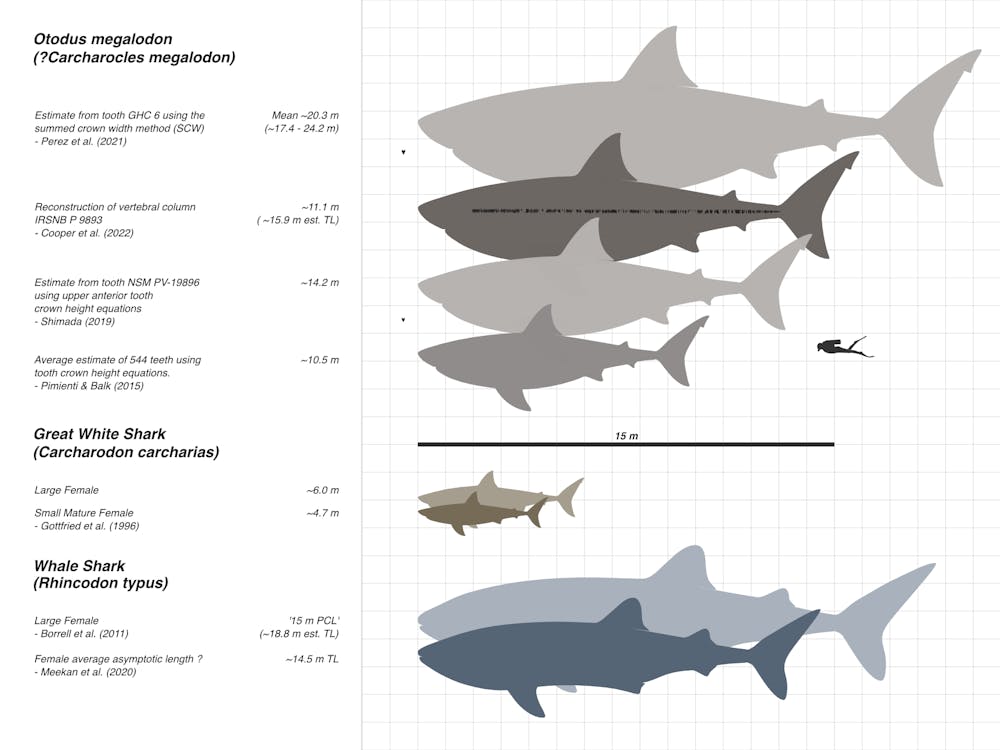
    The average size of a mature great white (Carcharodon carcharias, also known as the white shark) is between 4.6 and 4.9 metres for female sharks and up to 4 metres for male sharks.

    The largest recorded living specimens peak at about 6 metres, with one monster specimen caught in Cuba in 1945 reaching 6.4 metres.

    Earth’s oceans have seen bigger predatory sharks in the past. The biggest one of all time was the megalodon (Otodus megalodon) which lived from 23 to 3 million years ago, and may have been up to 24 metres in length. However, it looked nothing like the modern white shark.

    We don’t know precisely how big the megalodon was, but certainly larger than the great white shark.
    Steveoc 86/Wikimedia Commons, CC BY-SA

    They’re not even directly related – another thing scientists learned quite recently.

    Who was the megalodon, then?

    White sharks first evolved between 6 and 4 million years ago in the shadows of the megalodon. A recent study showed the megalodon’s large serrated teeth show signs of it being a supreme opportunistic super-predator.

    That means it ate just about anything, but especially liked whales and marine mammals.


    Read more:
    Friday essay: Giant shark megalodon was the most powerful superpredator ever. Why did it go extinct?


    But white sharks are not directly related to the megalodon, whose lineage began with a shark called Cretalamna during the age of dinosaurs about 100 million years ago.

    By contrast, the white shark lineage began with an ancient mako shark, Carcharodon hastalis. It was 7 to 8 metres long and had large, similarly shaped teeth to the modern white shark but lacking serrated edges.

    A fossil intermediate species, Carcharodon hubbelli shows the transition over time from weakly serrated to strongly serrated teeth.

    White shark fossil species. Left, the serrated fossil tooth teeth of the extant white shark; right, a similarly shaped unserrated tooth of the extinct giant mako shark which gave rise to white sharks.
    John Long, CC BY

    How did Jaws affect white shark populations?

    Last year, the International Shark Attack File reported 47 unprovoked shark bites to humans worldwide, resulting in seven fatalities. This was well below the previous ten-year average of 70 bites per year; your chances of getting bitten by a shark are extremely rare.

    Following the movies that made up the Jaws franchise, there was an increase in hunting and killing sharks – with a particular focus on great white sharks that were already going into a decline due to overfishing, trophy hunting and lethal control programs.

    Between 80% and 90% of white sharks have disappeared globally since the middle of the 20th century. Recent estimates calculate there are probably less than 500 individual white sharks in Australian waters right now.

    When Jaws first aired, scientists didn’t know how long sharks took to reproduce, or how many offspring a white shark could have each year. We now know it takes about 26 years for a male and 33 years for a female to sexually mature before they can start having pups.

    Data about white shark births is sparse, but recently a 5.6-metre-long female caught on a drum line off the coast of Queensland had just four large pups inside her. This is a very small number. Some large sharks, such as the whale shark, can give birth to up to 300 young.

    Now that we know just how slow they are to breed, it’s clear it will take many decades to reestablish the “pre-Jaws” population of white sharks – important apex predators in the marine ecosystem.

    Charlie Huveneers from Flinders University about to take a tissue sample for research on white sharks. There is still a lot we don’t know about their biology.
    Andrew Fox, Adelaide, CC BY

    Will white sharks survive?

    White sharks are currently listed as vulnerable.

    This classification means if we don’t change the current living conditions for white sharks, including impacts caused by human activities such as commercial fishing, and the impacts of climate change and ocean pollution, they will continue to decline and eventually could go extinct.

    Currently, white sharks are protected in several countries and form the basis for an important tourist industry in Australia, South Africa, western United States and most recently Nova Scotia, Canada.

    These sharks are iconic apex predators that fascinate people. One of us (John) went cage diving with them recently off the Neptune Islands of South Australia and can attest to how breathtaking it is to watch them in their natural environment.

    In terms of economic impact, they are worth far more alive than dead.

    White sharks are a growing tourism draw in several countries.
    Andrew Fox, Adelaide, CC BY

    There’s still much we don’t know about white sharks

    The complete white shark genome was first published only in 2019. It has 4.63 billion base pairs, making it much larger than the human genome (3.2 billion base pairs).

    The genome revealed some surprising things, like how white sharks show strong molecular adaptations for wound-healing processes, and a suite of “genome stability” genes – those used in DNA repair or DNA damage response.

    The transcriptome (or sum total of the messenger RNA) of the white shark showed greater similarity to the human transcriptome than to that of other fishes. This hints that “unexpressed genes” in the shark could one day play a role in uncovering genetic pathways for potential cures in human diseases.

    Jaws and its sequels certainly brought white sharks to the attention (and nightmares) of humans, with devastating impacts on how we treated them as a species.

    Our relationship with white sharks reflects our relationship with nature more broadly – a feared antagonist within the current capitalist paradigm; an enemy to be tamed, contained or consumed.

    As we learn more of the peril and potential of these remarkable creatures, we can learn how to live with them, to see beyond our fears and value their role within our delicate ocean ecosystems.

    John Long receives funding from The Australian Research Council.

    Heather L. Robinson does not work for, consult, own shares in or receive funding from any company or organisation that would benefit from this article, and has disclosed no relevant affiliations beyond their academic appointment.

    ref. Jaws at 50: how a single movie changed our perception of white sharks forever – https://theconversation.com/jaws-at-50-how-a-single-movie-changed-our-perception-of-white-sharks-forever-258306

    MIL OSI AnalysisEveningReport.nz

  • MIL-OSI New Zealand: Bachelor of Applied Science student lands internship mapping native bush remnants

    Source: Eastern Institute of Technology

    19 hours ago

    Bachelor of Applied Science (Biodiversity Management) student Emily Strong helped iwi identify remnants of the historic Seventy Mile Bush during a summer internship with Sustainable Hawke’s Bay.

    The internship was part of her third year of study, delivered by EIT in partnership with Unitec.

    EIT graduate Michael Strand (left) with current Bachelor of Applied Science (Biodiversity Management) student Emily Strong.

    During her internship, Emily worked under the guidance of EIT graduate Michael Strand, who works at Sustainable HB and secured a role as a geospatial analyst there before completing his studies. She contributed to a project focused on locating and assessing remaining areas of native bush in Southern Hawke’s Bay.

    The project involved the use of Geographic Information Systems (GIS) to overlay historical maps with satellite imagery, classify forest remnants, and assess vegetation health by calculating tree canopy height. Historical aerial imagery was also used to track vegetation change over time.

    “The Seventy Mile Bush was a massive podocarp forest that once stretched from Southern Hawke’s Bay to Wairarapa. Being able to contribute to a project that connects iwi with the remaining fragments of that landscape has been really rewarding.”

    Emily previously completed the Level 5 and 6 Diplomas in Environmental Management (Terrestrial strand) at EIT before progressing into the degree.

    Her interest in GIS and conservation has grown throughout her studies. In 2024, she completed a level 6 project focused on revegetation at Cape Sanctuary, comparing aerial images from the 1950s, 2014 and 2024 to assess habitat restoration over time.

    “I compared some aerial photography from the 1950s with current satellite images and then classified and analysed the difference. There was very much an increase in native vegetation. It was quite substantial actually and really cool to see.”

    Originally from Hawke’s Bay, Emily first enrolled at EIT in a teaching degree. After taking time off following the birth of her daughter, Eloise, she decided to return to study and pursue environmental management.

    “I’ve always had an interest in the environment, and once I started the primary industries course, I really enjoyed it,” she says.

    Balancing study and parenting hasn’t always been easy, but Emily says she’s had strong support around her.

    “It’s been quite tough but again I do have a fair amount of family support so that’s definitely been very helpful.”

    She credits her lecturers and tutors for being “really amazing”. “I’ve learned lots and lots and definitely improved from when I started in level 5.”

    Now 22, Emily is also involved in a local bat monitoring project with environmental researcher Kay Griffiths and is exploring future career opportunities that combine her skills in conservation and GIS.

    “There are so many different directions you can go with this degree, but I’d love to do something where I can use GIS to support conservation work.”

    EIT Environmental Management Senior Lecturer Dinusha Jayathilake said she is especially proud of this achievement.

    “This internship is a valuable opportunity for Emily’s professional growth and also benefits the Hawke’s Bay region, Sustainable HB, and EIT. In our Environmental Management programme, we always prefer community engagement. Through the GIS course, I am able to support the local community while introducing the latest  Geographic Information technologies to our region – something I am very proud of.”

    Dinusha said internships give students valuable work experience before they finish their studies, which helps them continue to produce skilled and experienced local graduates who are ready to join the workforce.

    MIL OSI New Zealand News

  • MIL-OSI Australia: ACT Budget 2025–26: supporting primary health care

    Source: Northern Territory Police and Fire Services

    Our CBR is the ACT Government’s key channel to connect with Canberrans and keep you up-to-date with what’s happening in the city. Our CBR includes a monthly print edition, email newsletter and website.

    You can easily opt in or out of the newsletter subscription at any time.

    MIL OSI News

  • MIL-OSI Australia: Stargazing flight: how Bogong moths use the night sky to navigate hundreds of kilometres

    Source:

    19 June 2025

    Bogong moth. Photo credit: Ajay Narendra, Macquarie University.

    In a world-first discovery, researchers have shown that Australia’s iconic Bogong moth uses constellations of stars and the Milky Way to navigate hundreds of kilometres across the country during its annual migration – making it the first known invertebrate to rely on a stellar compass for long-distance travel.

    The landmark study, published today in Nature, reveals how this unassuming nocturnal moth combines celestial navigation with Earth’s magnetic field to pinpoint a specific destination it has never visited before: the cool alpine caves of the Snowy Mountains, where it hibernates for the summer.

    Led by an international team of scientists from Lund University, the Australian National University (ANU), the University of South Australia (UniSA) and other global institutions, the research sheds new light on one of nature’s great migration mysteries, involving approximately four million moths each year.

    “Until now, we knew that some birds and even humans could use the stars to navigate long distances, but this is the first time that it’s been proven in an insect,” says Lund University Professor of Zoology, Eric Warrant, who is also a Visiting Fellow at the ANU and an Adjunct Professor at UniSA.

    “Bogong moths are incredibly precise. They use the stars as a compass to guide them over vast distances, adjusting their bearing based on the season and time of night.”

    Each spring, billions of Bogong moths (Agrotis infusa) emerge from breeding grounds across southeast Australia and fly up to 1000 kilometres to a small number of caves and rocky outcrops in the Australian Alps.

    A wall of Bogong moths, aestivating in a cave in the Australian Alps.

    The moths lie dormant in the cool, dark shelters throughout summer, and in autumn make the return journey to breed and die.

    Using sophisticated flight simulators and brain recordings in controlled, magnetically neutral environments, the researchers tested how moths orient themselves under different sky conditions.

    When presented with natural starry skies and no magnetic field, they consistently flew in the correct migratory direction for the season – southward in spring, northward in autumn.

    When the starry skies were rotated 180 degrees, the moths reversed direction accordingly, but when the stars were scrambled, their orientation vanished.

    “This proves they are not just flying towards the brightest light or following a simple visual cue,” says Prof Warrant. “They’re reading specific patterns in the night sky to determine a geographic direction, just like migratory birds do.”

    Interestingly, when stars were obscured by clouds, the moths maintained their direction using only the Earth’s magnetic field. This dual compass system ensures reliable navigation even in variable conditions.

    The team also delved into the neurological basis of this behaviour, identifying specialised neurons in the moth’s brain that respond to the orientation of the starry sky. These cells, found in brain regions responsible for navigation and steering, fire most strongly when the moth is facing southwards.

    “This kind of directional tuning shows that the Bogong moth brain encodes celestial information in a surprisingly sophisticated way. It’s a remarkable example of complex navigational ability packed into a tiny insect brain.”

    Researchers say the discovery could inform technologies in robotics, drone navigation, and even conservation strategies for species threatened by habitat loss or climate change.

    Bogong moth populations have declined sharply in recent years, promoting their listing as vulnerable.

    The study underscores the importance of protecting migratory pathways and the dark skies these moths rely on.

    “This is not just about a moth  ̶  it’s about how animals read the world around them,” says Prof Warrant. “The night sky has guided human explorers for millennia. Now we know that it guides moths, too.”

    Co-author Professor Javaan Chahl, a remote sensing engineer from the University of South Australia, made headlines in August 2024 using the discoveries from a previous study led by Lund University involving dung beetles, who use the Milky Way as a reference point to roll balls of dung in straight lines.

    Prof Chahl’s team modelled the same technique used by dung beetles to develop an AI sensor for robot navigation in low light.

    The Nature paper “Bogong moths use a stellar compass for long-distance navigation at night” is authored by researchers from Europe, the UK, China, Australia, Canada and Australia. DOI: 10.1038/s41586-025-09135-3

    A video produced by the Australian Academy of Science, explaining Prof Warrant’s research, is available at: www.youtube.com/watch?v=AqiG_xBUFE0.  Prof Warrant was elected a Corresponding Member of the Academy in 2024.

    …………………………………………………………………………………………………………………………

    Media contact: Candy Gibson M: +61 434 605 142 E: candy.gibson@unisa.edu.au

    MIL OSI News

  • MIL-OSI USA: Senator Markey Demands Answers from Verizon on Worker Exposure to Toxic Lead

    US Senate News:

    Source: United States Senator for Massachusetts Ed Markey
    Letter Text (PDF)
    Washington (June 18, 2025) – Senator Edward J. Markey (D-Mass.), a member of the Commerce, Science, and Transportation Committee and the Health, Education, Labor, and Pensions Committee, today wrote to Hans Vestberg, Chairman and CEO of Verizon, following the publication of a health evaluation from the National Institutes of Occupational Safety and Health (NIOSH) showing extremely high concentrations of toxic lead at Verizon worksites and elevated levels of lead in workers’ blood. In 2023, an extensive Wall Street Journal investigation documented a sprawling nationwide network of legacy lead-sheathed cables that telecommunications companies—including Verizon—installed in the nineteenth and twentieth centuries and left underground, underwater, and overhead.
    In the letter the Senator writes, “It is Verizon’s responsibility—both moral and legal—to safeguard the well-being of its workers and the communities in which it operates. The exposure of telecom workers in Massachusetts to lead-laced environments, including manholes where sediment contained lead concentrations as high as 30,000 parts per million—150 times the Environmental Protection Agency’s (EPA) current safety limit—demands the highest level of attention from Verizon. Verizon must act swiftly to eliminate lead exposure from its operations, remediate affected environments, and commit to full transparency and accountability moving forward.”
    Senator Markey continues, “Most recently, NIOSH completed a Health Hazard Evaluation confirming serious occupational exposures among Verizon workers in Massachusetts; we understand a copy of the final report has been provided to Verizon. NIOSH found that these workers were repeatedly exposed to lead because inadequate safety procedures in place failed to protect them. NIOSH also reviewed past blood-level testing by workers, which found examples of workers with elevated blood lead levels according to federal safety guidelines; this suggests recent worker exposure at unsafe levels of lead. Additionally, NIOSH hygienists found lead on workers hands, boots, and in their trucks, suggesting many may be unknowingly carrying home a substance that could endanger their families. Children are particularly sensitive to lead, with even low levels of exposure resulting in developmental delays, difficulty learning, and behavioral issues.”
    Senator Markey requests responses by July 9, 2025, to questions including:
    What is the status of Verizon’s efforts to compile a comprehensive inventory, including geographic mapping, of all known and suspected lead-sheathed cables it owns or for which it is responsible?
    What steps has Verizon taken since the publication of the Wall Street Journal investigation to:
    (a) Identify and monitor worker exposure to lead from lead-sheathed telecommunications cables?
    (b) Notify and protect workers performing duties in or near areas with lead-sheathed cables?
    (c) Inform the public, especially in environmental justice communities, about risks posed by lead-sheathed cables, and field and respond to concerns?
    (d) Test for and remediate environmental contamination around legacy infrastructure?
    (e) Provide medical monitoring, treatment, or compensation for lead-exposed workers?
    What is the status of any investigations by the U.S. Department of Justice, the EPA, or OSHA into Verizon’s handling of its lead-sheathed cables?
    Will Verizon commit to fully implementing all the NIOSH recommendations, including conducting routine BLL testing and retrofitting hygiene and PPE protocols across all affected facilities? Which recommendations, if any, has Verizon already implemented? What is the status of recommendations not yet implemented?
    Has Verizon conducted its own personal air sampling at work sites containing lead-sheathed cables? If so, please provide the results by year and location of the tests.
    (a) Does Verizon have an explanation for the personal air sample tested by NIOSH that exceeded OSHA limits?
    (b) How did Verizon previously determine whether to conduct a personal air sampling test?
    Has Verizon conducted its own manhole-soil-sediment testing at worksites containing lead-sheathed cables? Does Verizon have an explanation for the bulk sediment sampled that exceeded 30,000 ppm for lead?
    Why was Verizon not providing its workers in Massachusetts with lead removal wipes prior to the NIOSH Health Hazard Evaluation? Why did Verizon start to provide them—in place of wet wipes—between the first and second NIOSH site visits?
    What internal accountability measures is Verizon adopting to ensure executive leadership is fully informed and responsive to worker safety concerns related to lead exposure from legacy telecommunications cables?
    In February 2024, Senator Markey hosted a roundtable event in Chicopee, Massachusetts, along with state and local elected officials, public health leaders, and occupational safety and environmental experts, to discuss the environmental, public health, and occupational safety concerns posed by lead-sheathed telecommunications cables.
    In July 2023, Senator Markey, author of the 1996 Telecommunications Act, wrote to the United States Telecom Association (USTelecom) demanding answers to questions raised by the Wall Street Journal investigation, which found detectable levels of lead contamination in water and soil samples collected near lead-sheathed cables across the country.

    MIL OSI USA News

  • MIL-OSI USA: Senator Markey Statement on Supreme Court Ruling in United States v. Skrmetti to Restrict Gender-Affirming Care for Trans Youth

    US Senate News:

    Source: United States Senator for Massachusetts Ed Markey

    Washington (June 18, 2025) – Senator Edward J. Markey (D-Mass.), Ranking Member of the Health, Education, Labor and Pensions (HELP) Subcommittee on Primary Health and Retirement, today released the following statement after the U.S. Supreme Court announced its decision to uphold Tennessee’s cruel and discriminatory law that bans access to essential gender-affirming care for trans youth in United States v. Skrmetti.

    “Today, hate won. The far-right justices of the Supreme Court endorsed hate and discrimination by delivering a win for Republicans who have relentlessly and cruelly attacked transgender Americans for years. With 25 states already having laws in place that ban gender-affirming care for trans youth, the Supreme Court has cleared the way for families in half of the country to no longer access the medically necessary and life-saving care they need for their children. 

    “But here is what no Court nor politician can ever change: trans people will continue to exist. Their health care is lifesaving and essential, and trans rights are human rights. We have a fight ahead of us, but discrimination and hate cannot and must not win.”

    On September 3, 2024, Senator Markey and Senator Jeff Merkley (D-Ore.), and Representatives Mark Pocan (WI-02), Jerrold Nadler (NY-12), and Frank Pallone (NJ-06) led 159 of their colleagues in submitting an amicus brief in United States v. Skrmetti, urging the Supreme Court to strike Tennessee’s ban, highlighting that the ban is driven by animosity towards transgender people and how health care bans dictate decisions that should be made between patients, health providers, and their families.

    On March 30, 2023, Senator Markey and Representative Pramila Jayapal (WA-07) introduced the?Transgender Bill of Rights, a landmark resolution to recognize the federal government’s duty in protecting and codifying the rights of transgender and nonbinary people, as well as to ensure trans people have access to medical care, shelter, safety, and economic security. The resolution creates a comprehensive framework for these protections to ensure that trans and nonbinary Americans are not discriminated against on the basis of gender identity or expression.

    MIL OSI USA News

  • MIL-OSI USA: Following Trump Attacks on TPS, Markey, Van Hollen, Senate Democrats Put Forward Bill to Protect TPS and DED Recipients

    US Senate News:

    Source: United States Senator for Massachusetts Ed Markey

    Washington (June 18, 2025) – Today, U.S. Senator Chris Van Hollen (D-Md.) was joined by 30 Senate colleagues in putting forward legislation to provide qualified Temporary Protected Status (TPS) and Deferred Enforced Departure (DED) recipients a path to legal permanent residency. The Senators’ reintroduction of this legislation – the Safe Environment from Countries Under Repression and Emergency (SECURE) Act – comes as the Trump Administration and the right-wing Supreme Court undermine TPS, a program that has for years provided refuge to those living in America who have fled natural disasters, violence, and political insecurity. The Trump Administration has revoked TPS for an estimated 563,000 recipients from five countries – Venezuela, Haiti, Afghanistan, Cameroon, and Nepal – and while there have been legal challenges filed against this action, the Supreme Court has temporarily allowed the revocation to stand – putting hundreds of thousands at risk of deportation to their home countries where they would face serious danger.

    This legislation is endorsed by AFL-CIO, Laborers’ International Union of North America (LIUNA), International Union of Painters and Allied Trades (IUPAT), CASA, National TPS Alliance, Working Families United, the National Network for Arab American Communities, International Longshore and Warehouse Union (ILWU), Service Employees International Union (SEIU), and Communities United for Status and Protection (CUSP).

    “As Donald Trump continues to strip immigrant communities of critical legal protections, we must protect the individuals who came to our country seeking safe harbor and who cannot return home safely. I am proud to join my colleagues in introducing the SECURE Act, to ensure that individuals fleeing armed conflicts, political unrest, or environmental disasters have a guaranteed pathway to safety in the United States. Recipients of Temporary Protected Status and Deferred Enforced Departure are our friends, our neighbors, our colleagues, and we cannot turn our backs on them. We must be loud and clear – immigrants are welcome here,” said Senator Markey.

    “America has long used the TPS and DED programs to offer special legal protections to individuals in the United States whose lives would be put at extreme risk if forced to return to their countries of origin. As they’ve sought safety and stability here, TPS and DED recipients have built new lives in America, living here legally for years – sometimes decades – and making important contributions to our communities. But the Trump Administration is threatening both the lives they have built and the safety of these individuals – forcing TPS recipients to return to dangerous places like Haiti, Venezuela, Afghanistan, and more. This bill offers much-needed certainty to TPS and DED recipients – providing a path to stay safely in the U.S. and continue to call America their home,” said Senator Van Hollen.

    “TPS and DED recipients are valuable members of our communities. Many have lived here for years with U.S. children, spouses, and even businesses they’ve built — yet they are forced to live in uncertainty and fear that they may lose everything if they lose TPS or DED. I’m proud to introduce this legislation to give TPS and DED recipients a path to permanent residence so they can continue to contribute to America,” said Senator Kaine.

    “America is strengthened by the contributions and hard work of immigrants. But this Administration’s cruelty has left thousands of workers in limbo — without legal status and without work authorization,” said Senator Padilla. “The SECURE Act provides TPS holders who live and work in the United States legally, seeking safety after fleeing dangerous conditions in their home countries, the security of a pathway to permanent residency protections while continuing to contribute to our communities and economy.”

    “TPS recipients have come to the U.S. to escape widespread violence and environmental disasters in their countries that make returning home unsafe.  As they rebuild their lives here, TPS recipients, as longtime residents of the United States, deserve security and certainty about their immigration status,” said Senator Durbin. “I’m joining Senator Van Hollen to introduce the SECURE Act to provide TPS recipients a pathway to legal permanent residency.”

    “As the Trump administration terrorizes immigrant communities and arbitrarily revokes TPS and DED for law-abiding immigrants, it’s important that we speak up and push back every way we can, and support individuals who are contributing to our communities and would be at severe risk if they were to be forced to return to their countries of origin,” said Senator Murray. “I’m proud to join my colleagues in introducing the SECURE Act to provide immigrants with Temporary Protected Status and Deferred Enforced Departure a path to legal permanent residency.”

    “After escaping horrific violence and persecution in their home countries, TPS and DED recipients come to this country in search of a better life,” said Senator Cortez Masto. “These hardworking men and women have been living in and contributing to our communities for years, and it’s common sense to give them the certainty they need to fulfill the American Dream.”

    “Virginia is home to tens of thousands of law-abiding immigrants who are unable to return to their countries of origin due to painful extraordinary circumstances. Though these individuals benefit from certain protections from deportation, they remain in limbo despite having lived and worked in the U.S. for years,” said Senator Warner. “I’m proud to introduce this legislation to create a real pathway to permanent residency for TPS and DED recipients who drive our economy and make valuable contributions to their communities.”

    “The Temporary Protected Status program has been a lifeline that has allowed people and families facing unimaginable circumstances to find a safe refuge here in the United States,” said Senator Rosen. “TPS recipients contribute to our communities and our economy, and they deserve a pathway to permanent residency, which is why I’m proud to help introduce this bill. I’ll keep standing up to protect Nevada’s immigrant families.”

    “TPS holders deserve certainty, especially when the Trump administration is suddenly ending people’s status with no justification and forcing them to return to unsafe conditions,” said Senator Schatz. “Our bill would enable TPS holders to apply for permanent status so they can continue to live, work, and contribute in the United States without constantly being stuck in limbo.”

    “Families should have protection from ongoing wars, environmental disasters, widespread illness, and other dangers that make it difficult to return home,” said Senator Warren. “While Donald Trump makes it harder for immigrants to navigate our complex immigration system, Senate Democrats are fighting back to protect these vulnerable families.”

    “Scripture tells us: welcome the stranger in your midst,” said Senator Coons. “When we welcome those fleeing persecution and violence, hunger and poverty around the world, we show the world our values. That makes America safer, and it grows the economy in states like Delaware. The SECURE Act gives people searching for freedom and safety, who love this country, and who are already adding their valuable skills and gifts to our nation, a path to continue to do so.”

    “Our country has long supported families fleeing violence and seeking refuge,” said Senator Luján. “As this administration continues its attacks on TPS recipients, Congress must ensure a legal pathway to permanent residency for those who contribute to our communities every day. That’s why I’m partnering with my colleagues to reintroduce the SECURE Act to provide permanent protections for thousands of TPS recipients who live and work lawfully in the U.S.”

    “As immigrant communities continue to come under attack, the SECURE Act provides a clear pathway to permanent residency—offering overdue, necessary protections for immigrants and the lives they’ve built in our nation. America is a nation of immigrants and has a storied history of providing opportunity and refuge for those fleeing hardship or crisis. Individuals with TPS and DED have made America their home—using their talents and skills to strengthen our economies and enrich our communities—often while the countries from which they fled remain in turmoil,” said Senator Blumenthal.

    “Trump’s heartless immigration policies do nothing to make us safer and betray our core values—our nation always has been and always will be stronger because of our immigrant communities,” said Senator Duckworth. “While no one is arguing that we shouldn’t be deporting violent criminals who pose a danger to our country, it’s cruel to target people who fled from life-threatening situations and have been productive members of our communities for years. I’m proud to help Senator Van Hollen reintroduce this legislation to help give TPS and DED recipients a path to remain here as legal permanent residents.”

    “Our country should serve as a refuge for individuals who cannot return to their home country due to dangerous circumstances,” said Senator Hirono. “TPS holders and DED recipients living in our country are essential members of our communities, making up a significant amount of our workforce and contributing to our economy. As this administration continues its all-out attack on immigrants and their loved ones, I am proud to reintroduce this legislation to provide TPS and DED recipients peace of mind that they can remain in the country safely and with a path to lawful permanent residence.”

    “This bill is a necessary step in creating a pathway to legal permanent residency for TPS recipients,” said Senator Bennet. “They are already facing extraordinary and unstable conditions in their home countries; they shouldn’t have to face those same conditions here in the U.S.”

    “I’m joining the effort to pass the SECURE Act to stand by thousands in New Jersey who do not deserve to live in uncertainty and fear as the Trump administration arbitrarily revokes Temporary Protected Status,” said Senator Kim. “TPS recipients are friends and neighbors who are part of our communities and are essential to the economic growth of our state. We should use this moment to address disorder in our TPS program and immigration system – and deliver eligible families a pathway toward permanent stability and security.”

    “TPS provides protection for individuals and families who are unable to return to their countries due to dangerous conditions, including natural disasters, armed conflicts, and other disasters. Many find refuge in California where they can live and work lawfully under its protections. This legislation would provide a much-needed sense of security and stability to those who are living in the legal limbo caused by President Trump’s targeting of this program and his continued erosion of our nation’s commitment to helping those fleeing violence, famine, disease, and disaster,” said Senator Schiff.

    The legislation is cosponsored by Senators Angela Alsobrooks (D-Md.), Tammy Baldwin (D-Wis.), Michael Bennet (D-Colo.), Richard Blumenthal (D-Conn.), Cory Booker (D-N.J.), Chris Coons (D-Del.), Catherine Cortez-Masto (D-Nev.), Tammy Duckworth (D-Ill.), Dick Durbin (D-Ill.), Martin Heinrich (D-N.M.), John Hickenlooper (D-Colo.), Mazie Hirono (D-Hawaii), Tim Kaine (D-Va.), Andy Kim (D-N.J.) Amy Klobuchar (D-Minn.), Ben Ray Luján (D-N.M.), Patty Murray (D-Wash.), Alex Padilla (D-Calif.), Jack Reed (D-R.I.), Jacky Rosen (D-Nev.), Bernie Sanders (I-Vt.), Brian Schatz (D-Hawaii), Adam Schiff (D-Calif.), Tina Smith (D-Minn.), Mark Warner (D-Va.), Raphael Warnock (D-Ga.), Elizabeth Warren (D-Mass.), Sheldon Whitehouse (D-R.I.), and Ron Wyden (D-Ore.).

    “Immigrant workers are under unprecedented attack: hundreds of thousands of people have been stripped of their legal status and work authorization, throwing families and industries into chaos and uncertainty. Workers with Temporary Protected Status, many of whom have lived and worked in our country for decades, are vital members of our communities and our unions. The SECURE Act is common-sense legislation that would provide TPS holders with stable, permanent lawful status so they can continue to raise their families, work, and contribute to our economy,” said Liz Shuler, AFL-CIO President.

    “LIUNA commends Senator Van Hollen for his tireless efforts to protect workers and their family members who have Temporary Protected Status (TPS), many of whom are members of our union and who have lived and worked in the U.S. for decades. About 1/3 of TPS holders work in construction. The SECURE Act will not only provide permanence to these hard-working immigrants, but will also help the U.S. economy by retaining these valued immigrants in our workforce,” said Brent Booker, General President, LIUNA.

    “Every day, thousands of people with TPS and DED who have built their lives, families, and futures here are forced to live with fear and uncertainty. They deserve more than endless waiting; they deserve real, permanent protection. As attacks on immigrant communities grow across the country, we must act without hesitation. We are grateful to Senator Van Hollen’s leadership – in this time of growing instability, the SECURE Act will offer dignity, safety, and security for our community,” said Cathryn Jackson, Public Policy Director of CASA.

    “Immigrant families and allies continue to advocate for permanent protections. The National TPS Alliance calls for long-overdue justice to our immigrant communities. The reintroduction of the SECURE Act in the Senate addresses the uncertainty that our families have been living for years. This bill is timely, ensuring that TPS holders don’t fall out of status and in turn preventing irreparable harm to whole communities, continuing critical contributions to the nation’s economy. We urge congressional leaders to support this critical effort,” said Mardoel Hernandez, TPS recipient from Honduras and National TPS Alliance Executive Committee Member.

    “TPS holders, including members of my own union, contribute to our economy every single day. Some may not know it, but our society is dependent on TPS holders in different industries, including in the building and construction trades. We need the SECURE Act so these workers can continue living, working, and raising their families without fear,” said IUPAT General President Jimmy Williams, Jr.; IUPAT is a member of the Working Families United Coalition.

    “The SECURE Act offers overdue protection for hundreds of thousands living in fear of being uprooted from the families, homes, and careers they built. The National Network for Arab American Communities believes this bill reflects a critical truth: our democracy and safety are strongest when everyone has the opportunity to live and contribute freely and lawfully,” said Rima Meroueh, Director, National Network for Arab American Communities.

    “Now more than ever, we need a solution for immigrants with Temporary Protected Status from countries like El Salvador, Honduras, Venezuela and Haiti, whose lives have been in limbo under the chaos of this administration. We applaud the reintroduction of the SECURE Act by Senator Chris Van Hollen, which would create a path to citizenship for these individuals who contribute billions to our economy and whose lives would be in danger if they were sent back immediately to their home countries,” said Rocio Saenz, Secretary-Treasurer, SEIU.

    “The ILWU stands in strong support of the SECURE Act, a commonsense measure that serves our country’s interests and recognizes the dignity and contributions of TPS and DED holders — hardworking individuals who have paid their taxes, contributed to our economy, and been model members of our communities. These men and women have earned a chance to live without fear, continue to contribute to their communities and build their lives in the country they’ve long called home. We urge Congress to pass this vital legislation without delay,” said International Longshore and Warehouse Union President Robert Olvera.

    “Communities United for Status & Protection (CUSP) endorses the SECURE Act as a critical step toward justice and stability for immigrants with Temporary Protected Status (TPS) and Deferred Enforced Departure (DED). For decades, these communities—Black, Asian, brown, working-class immigrants from countries facing war, repression, and climate disaster—have lived, worked, and raised families in the U.S. They are essential to our economy, our neighborhoods, and our collective future. Yet they continue to live in uncertainty, without a pathway to permanent protection. The SECURE Act honors their dignity, recognizes their profound contributions, and upholds our nation’s values of fairness and humanitarian responsibility. We urge Congress to act with courage and conscience and pass this bill without delay,” said Carolyn Tran, Executive Director, Communities United for Status & Protection (CUSP).

    Additional Background

    TPS is a temporary, legal immigration status granted to foreign citizens who are endangered by conditions in their home country resulting from extraordinary events such as ongoing armed conflict, environmental disaster, or epidemic. TPS status is granted for set periods ranging from six to 18 months, requiring the Department of Homeland Security to extend a country’s status on a recurring basis. Each time a country is recertified, recipients must reapply and pass a thorough background check. Recent estimates found there are approximately 860,000 people with TPS in the United States.

    Deferred enforced departure (DED) is a temporary and discretionary administrative stay of removal granted to foreign citizens from designated countries. Unlike TPS, a DED designation emanates from the President’s constitutional powers to conduct foreign relations and has no statutory basis. Grants are usually in response to war, civil unrest, or natural disasters, through an executive order or presidential memorandum that provides eligibility guidelines.

    The SECURE Act will provide long-term stability for these individuals and their communities by giving them the ability to apply for legal permanent residency. Under the bill, all TPS recipients – current and past – and TPS and DED eligible individuals who have been continuously present in the United States for at least three years would be eligible to apply for legal permanent residency.

    Additionally, under the SECURE Act:

    • A spouse, domestic partner, child, or unmarried child of a qualifying non-citizen would be eligible to obtain permanent resident status (upon meeting certain requirements).
    • Individuals with a pending TPS application will receive work authorization and be eligible for travel authorization.
    • Non-citizens who have a pending application or is prima facie eligible for permanent status under the bill and intends to apply are shielded from deportation.
    • Information from an applicant’s application may not be shared or used for immigration enforcement purposes, with limited exceptions, such as for the identification of fraudulent claims.
    • DHS must report to Congress when terminating a country’s TPS designation with an explanation to justify the termination.

    MIL OSI USA News

  • MIL-OSI USA: Ricketts Introduces VARIANCE Act to Strengthen American Trucking

    US Senate News:

    Source: United States Senator Pete Ricketts (Nebraska)
    WASHINGTON, D.C. – Today, U.S. Senator Pete Ricketts (R-NE) introduced the Vehicle Axle Redistribution Increases Allow New Capacities for Efficiency (VARIANCE) Act.  The bill would improve regulations for American truckers by permitting a 10% axle variance for commercial motor vehicles transporting dry bulk goods.  Senator Adam Schiff (D-CA) is a co-lead of this legislation in the Senate.  Representatives Rick Crawford (R-AR-1) and Salud Carbajal (D-CA-24) are leading companion legislation in the House.
    “This is common-sense policymaking,” said Ricketts.  “Allowing flexibility for truckers with naturally shifting goods will help improve efficiency and safety in Nebraska’s agriculture industry.  American truckers want to carry the same sized load in loose dry bulk that they can for any other freight.  This bill is a win for every step along the supply chain.”
    “Providing commonsense flexibility to our transportation and agriculture sectors will ensure California consumers don’t face higher costs due to regulations that don’t acknowledge the realities of basic physics,” said Schiff.  ”The VARIANCE Act is a bipartisan and bicameral solution that will improve our supply chain, reduce congestion, and help California farmers and producers continue to feed the nation and the world.”
    The Variance Act would:
    Grant a 10% axle variance for commercial motor vehicles transporting dry bulk goods and increase the maximum weight on any tandem-axle trailer to 37,400 lbs. 
    Leave the maximum laden vehicle weight untouched at 80,000 lbs.
    The text of the bill is available here.
    “Farmers, manufacturers, miners, and many other industries depend on truckers to get their goods to market.  When dry bulk cargo is in transit, however, a simple physics problem arises: routine braking often causes the contents of trailers to shift,” said Henry Hanscom, American Trucking Associations SVP of Legislative Affairs.  “ATA applauds Senators Ricketts and Schiff for this bipartisan, commonsense solution that will prevent motor carriers from being unfairly penalized for weight variances, promote the efficient movement of freight, and support hardworking Americans in the trucking industry.”
    “The VARIANCE Act is a commonsense solution that helps address transportation bottlenecks in the grain and feed industry,” said Mike Seyfert, National Grain and Feed Association President and CEO.  “By allowing modest axle weight variances for dry bulk shipments, this legislation supports more efficient and sustainable supply chains while maintaining safety standards.”
    “For 37 years, the Agriculture Transportation Coalition has worked with truck, rail, and ocean carriers in pursuit of greater transport efficiency, in order to keep US agriculture and forest products competitive in the global marketplace,” said Peter Friedmann, Agriculture Transportation Coalition Executive Director.  “Domestic trucking is an important component of the international supply chain.  Thus the AgTC supports the VARIANCE Act to allow for variance in axle weight distribution, which will increase efficiency, safety, cost-effectiveness in transport of grains, feeds of our members.” 
    “This expanded partnership in the Senate showcases the broad support and practical impact of the VARIANCE Act. Thank you to Senator Ricketts and Senator Schiff for their commitment to improve the safe and efficient movement of dry bulk commodities across our country,” said Ryan Streblow, National Tank Truck Carriers President & CEO.  “By enhancing weight distribution for dry bulk trailers, we can increase payload efficiency, reduce highway congestion, and boost safety, all without additional infrastructure wear.  Today, many carriers’ underload, and this flexibility will enable them to hit gross vehicle weight limits and reduce truckloads on our roads.”
    “The Agricultural Retailers Association strongly supports the proposal to authorize a ten percent axle weight variance for commercial motor vehicles transporting dry bulk goods like fertilizer on the Interstate Highway System,” said Richard Gupton, Agricultural Retailers Association SVP of Public Policy & Counsel.  “This common-sense solution addresses the unique challenges posed by the natural shifting of dry bulk cargo during transport, ensuring that trucks can operate safely and efficiently without exceeding the maximum gross vehicle weight limit.  By granting this variance, Congress will not only improve the efficiency of transporting essential commodities like fertilizer and grain but also enhance the overall cost-effectiveness and safety of our nation’s infrastructure.  Agricultural retailers, farmers, and other supply chain stakeholders rely on policies like this to maintain the steady flow of critical goods that drive the U.S. economy.  We urge lawmakers to include this vital measure in the next surface transportation reauthorization bill.”
    “All fertilizer touches a truck at least once it its journey to the field.  Any delay in delivery can negatively impact crop yields and contribute to increased food prices for consumers,” said Corey Rosenbush, Fertilizer Institute President and CEO.  “The Fertilizer Institute thanks Senators Ricketts and Schiff, as well as Representatives Crawford and Carbajal, for their bipartisan leadership in introducing this important legislation to help ensure that fertilizer reaches farmers precisely when and where it is needed.”
    BACKGROUND:
    Corn, soybeans, and other dry bulk are key to Nebraska’s $9.9 billion in agricultural exports.  Nebraska has over 1,600 dry bulk trucking companies, with nearly 18,000 dry bulk drivers.
    Present law limits the maximum laden weight of a commercial truck to 80,000 lbs., including the weight of the cargo.  Most trailers transporting dry bulk goods are tandem axle, limiting the weight for each axle to 34,000 lbs.  Dry bulk goods include plastic pellets, flour, aggregates, and other solid substances with individual particles that easily separate.  Bulk loads of dry goods regularly shift during transport and cause the front trailer axle to exceed its maximum 34,000 lbs.  The force generated when braking compacts the cargo at the front end of the trailer, but the relatively weaker forces from acceleration and forward movement fail to evenly redistribute the weight across axles.  So, even when the cargo was properly loaded, the truck’s natural motion causes the load to become improperly distributed.  This bill would maintain maximum laden vehicle weight limits but allow for cargo to become unevenly distributed during the course of transportation.

    MIL OSI USA News

  • MIL-OSI USA: Senators Ricketts and Kaine Introduce the AUKUS Improvement Act

    US Senate News:

    Source: United States Senator Pete Ricketts (Nebraska)

    WASHINGTON, D.C. – Today, U.S. Senators Pete Ricketts (R-NE) and Tim Kaine (D-VA) introduced the AUKUS Improvement Act. Building upon the bipartisan, AUKUS-enabling legislation in the FY24 National Defense Authorization Act, the AUKUS Improvement Act will further streamline defense industrial base collaboration and co-production between the United States, Australia, and the United Kingdom.  The legislation was also sponsored by Senators John Cornyn (R-TX), Chris Murphy (D-CT), and Dan Sullivan (R-AK).

    The United States, Australia, and the United Kingdom collectively face our most challenging threat environment since WWII. As we approach the 4th anniversary of AUKUS, it’s clear more should be done to break down bureaucratic obstacles and ensure a more seamless defense innovation and trade environment,” said Ricketts. “By streamlining transfers of critical capabilities to two of our closest allies while also facilitating a more efficient co-production ecosystem, the AUKUS Improvement Act will strengthen our allies’ warfighting edge, improve interoperability, and support our own industrial base.”

    “The AUKUS partnership is critical to countering the threat from China and ensuring the Indo-Pacific remains free and open,” said Kaine. “I’m proud to introduce this bipartisan legislation to strengthen AUKUS and boost defense collaboration among our countries.”

    The AUKUS Improvement Act would:

    • Exempt State Department-vetted entities that have been approved as AUKUS Authorized Users from the requirement to obtain Third Party Transfer approvals under Foreign Military Sales. 
    • Exempt Australia and the United Kingdom from the need for Congressional Notification for overseas manufacturing.

    BACKGROUND:

    In the last five years, Australia has placed $23 billion in Foreign Military Sales (FMS) orders, making it one of the biggest users of the FMS process. FMS ensures Australia is procuring the exact same variant that the U.S. military uses, enabling greater interoperability. It also supports American deployed forces operating in Australia through access to spare parts. Australia is often required to transfer elements of equipment procured through FMS to industry for further development, operation, maintenance, and sustainment. In order to do this, it must obtain written consent from the State Department in the form of a Third Party Transfer (TPT) request. However, the TPT process can be slow, with applications often taking many months before being approved. By making TPTs made under FMS subject to similar export controls to those made under AUKUS for Direct Commercial Sales (DCS), the AUKUS Improvement Act will get capability in the hands of our allies faster.

    In March 2021, Australia established the Guided Weapons and Explosive Ordnance (GWEO) Enterprise to expand its munitions and missile stockpiles, establish domestic manufacturing ofguided weapons, and supplement international partners’ supply chains. As part of this announcement, Australia and the U.S. agreed to collaborate on a flexible guided weapons production capability in Australia, with an initial focus on the potential for co-production of Guided Multiple Launch Rocket Systems (GMLRS) by 2025, and eventual co-production of the Precision Strike Missile (PrSM).

    However, the Arms Export Control Act requires Congressional Notification (CN) 15 days prior to approving a commercial technical assistance or manufacturing license agreement to manufacture significant military equipment abroad, regardless of the value. Currently, State Department excludes any transfer of defense articles, technical data, or services that requires a CN from the license-free environment and expedited processing provisions under AUKUS. Therefore, Australia is required to obtain a Manufacturing License Agreement to receive the technical data and manufacturing know-how for each component of a precision-guided munition. This adds complexity, time, and cost, therebylimiting munitions co-production cooperation that benefits both the U.S. and Australia.

    Bill text can be found here.

    MIL OSI USA News

  • Yoga Maha Kumbh Unfolds Across India: A Panoramic Prelude to International Day of Yoga 2025

    Source: Government of India

    Source: Government of India (4)

    As the nation counts down to the 11th International Day of Yoga (IDY) on June 21, a sweeping wave of yogic celebrations is energizing communities across India under the grand initiative titled Yoga Maha Kumbh. The nationwide movement aims to spotlight India’s rich yogic heritage and promote holistic well-being under the overarching theme for 2025: “Yoga for One Earth, One Health.”

    Leading the charge, a major three-day event began today at the Heartfulness Meditation Centre in RK Puram, New Delhi. Jointly organized by the Container Corporation of India (CONCOR) and the Morarji Desai National Institute of Yoga (MDNIY), in collaboration with the Heartfulness Institute, the event features yoga demonstrations, wellness sessions, and cultural performances. The focus is on mindfulness, community well-being, and encouraging citizens to adopt yoga as a way of life.

    Adding a dynamic and creative touch to the Delhi event was a spirited Nukkad Natak performance, through which performers portrayed yoga’s significance in daily life. The street play highlighted the physical, mental, and emotional benefits of yoga, aiming to inspire the audience toward a more balanced and healthy lifestyle.

    Simultaneously, another landmark celebration began on June 15 in Ladakh, where the International Festival of Yoga and Meditation (IFYM) 2025 is underway. Set against the dramatic backdrop of Ladakh’s high-altitude landscape, the festival is capturing national and global attention with yoga sessions conducted at iconic locations including Pangong Lake (over 13,000 feet), Nubra Valley, Sindhu Ghat, and the Mahabodhi International Meditation Centre (MIMC) Devachan Campus. The event is being organized by the Ministry of Ayush in partnership with MIMC, the UT Administration of Ladakh, LAHDC Leh, and allied institutions.

    In Noida, Uttar Pradesh, Arham Dhyan Yog launched its edition of the Yoga Maha Kumbh on June 15 at Sector 50. The event brought together youth, families, and wellness enthusiasts for Harit Yoga sessions, along with essay and debate competitions held at Ved Van Park in Sector 78. As part of the ongoing celebrations, Arham Dhyan Yog is set to host another major event on June 21 at Shivalik Park in Sector 33A, in synchrony with the nationwide Yoga Sangam initiative. The organization is also conducting parallel sessions across the globe, further expanding the reach and resonance of IDY 2025.

    From the towering Himalayan peaks to the cultural heart of Delhi and the bustling parks of Noida, Yoga Maha Kumbh 2025 is unfolding as an inclusive and unifying celebration of India’s yogic legacy. As communities come together in breath, movement, and mindfulness, the events reaffirm yoga’s universal relevance and India’s leadership in championing a healthier, more harmonious world.

  • MIL-OSI USA: Pelosi Joins House Democrats in Defending NIH Grants Against Trump Administration’s Unlawful Termination

    Source: United States House of Representatives – Congresswoman Nancy Pelosi Representing the 12th District of California

    Washington, D.C. — Today, Speaker Emerita Nancy Pelosi joined 151 House Democrats in filing an amicus brief challenging the Trump Administration’s illegal and devastating cuts to life-saving medical research grants at the National Institutes of Health (NIH). The brief defends Congress’s Article I authority to appropriate federal funds and speaks up for every American who relies on crucial life-saving biomedical and public health research conducted at universities, medical schools, research hospitals, and other scientific institutions across the country. 

    House Democrats’ amicus brief was filed in the consolidated cases Commonwealth of Massachusetts v. NIH, Association of American Medical Colleges v. NIH, and Association of American Universities v. Department of Health and Human Services, all currently before the U.S. Court of Appeals for the First Circuit. These cases challenge the Trump Administration’s unlawful and unconstitutional efforts to reduce indirect cost reimbursements for projects funded by the NIH.

    In early February, the Trump Administration arbitrarily slashed the NIH reimbursement rate for indirect research costs. Without fair reimbursement for indirect costs, more than 300,000 scientists and researchers at 2,500 institutions that receive NIH funding will face devastating impacts, and Americans could be left without access to lifesaving and life-extending treatments. The ramifications would also ripple through global collaboration and the development of our future scientific leadership and workforce, limiting our ability to enhance health and reduce illness and disability in the future.

    The full brief is available HERE.

    MIL OSI USA News

  • MIL-OSI Canada: Tribunal Initiates Final Injury Inquiry—Polyethylene terephthalate from China and Pakistan

    Source: Government of Canada News (2)

    Ottawa, Ontario, June 18, 2025—The Canadian International Trade Tribunal today initiated an inquiry to determine whether the dumping of polyethylene terephthalate from China and Pakistan and the subsidizing of the above-mentioned goods from China have caused injury or retardation or are threatening to cause injury. This final injury inquiry was initiated further to a notice received from the Canada Border Services Agency stating that preliminary determinations had been made respecting the dumping and subsidizing of the above-mentioned goods.

    On October 15, 2025, the Tribunal will determine whether the dumping and subsidizing have caused injury or retardation or are threatening to cause injury to the domestic industry.

    The Tribunal is an independent quasi-judicial body that reports to Parliament through the Minister of Finance. It hears cases on dumped and subsidized imports, safeguard complaints, complaints about federal government procurement and appeals of customs and excise tax rulings. When requested by the federal government, the Tribunal also provides advice on other economic, trade and tariff matters.

    Any interested person, association or government that wishes to participate in the Tribunal’s inquiry may do so by filing Form I—Notice of Participation.

    MIL OSI Canada News

  • MIL-OSI Canada: Tribunal Continues Orders—Circular Copper Tube from Brazil, Greece, China, South Korea and Mexico

    Source: Government of Canada News (2)

    Ottawa, Ontario, June 18, 2025—The Canadian International Trade Tribunal today continued its orders made on September 25, 2019, in expiry review RR‑2018‑005, concerning the dumping of circular copper tube from Brazil, Greece, China, South Korea and Mexico, and the subsidizing of these goods from China.

    The Tribunal found that the expiry of the orders was likely to result in injury. As such, the Tribunal continued its orders. The Canada Border Services Agency will therefore continue to impose anti-dumping and countervailing duties on these goods.

    The Tribunal is an independent quasi-judicial body that reports to Parliament through the Minister of Finance. It hears cases on dumped and subsidized imports, safeguard complaints, complaints about federal government procurement and appeals of customs and excise tax rulings. When requested by the federal government, the Tribunal also provides advice on other economic, trade and tariff matters.

    MIL OSI Canada News

  • MIL-OSI USA: US Department of Labor awards $1M for disaster-relief jobs, training for Kentucky residents affected by severe storms, flooding

    Source: US Department of Labor

    WASHINGTON – The U.S. Department of Labor today awarded $1 million in grant funding to support disaster-relief jobs and employment and training services for Kentucky residents suffering from the aftermath of severe storms. 

    Beginning Feb. 14, 2025, through March 7, 2025, a severe weather system generated heavy torrential rain, flash flooding, and landslides that damaged public infrastructure, utility distribution systems, and private property in Kentucky. This followed severe weather and multiple disasters in the state that led to widespread destruction and numerous fatalities in 2024 and 2025 that impeded recovery efforts. The concurrent disaster events led to significant economic losses and challenges in rebuilding and recovery efforts and the state is assessing the full impact across the affected areas.

    The Federal Emergency Management Agency issued a major disaster declaration, enabling Kentucky to request federal assistance for recovery efforts in the 67 counties of Adair, Allen, Ballard, Barren, Bell, Boyd, Breathitt, Breckinridge, Bullitt, Butler, Caldwell, Carlisle, Clay, Crittenden, Cumberland, Edmonson, Elliott, Estill, Floyd, Franklin, Green, Greenup, Hancock, Harlan, Hart, Henderson, Henry, Hickman, Hopkins, Jackson, Jefferson, Johnson, Knott, Knox, Laurel, Lawrence, Lee, Leslie, Letcher, Lewis, Livingston, Magoffin, Marshall, Martin, McCreary, McLean, Menifee, Metcalfe, Monroe, Morgan, Muhlenberg, Nicholas, Ohio, Owsley, Perry, Pike, Powell, Pulaski, Robertson, Rockcastle, Russell, Spencer, Trigg, Union, Wayne, Whitley, and Wolfe counties. 

    This Disaster Recovery National Dislocated Worker Grant allows the Kentucky Office of Employment and Training to provide residents with temporary jobs focused on cleanup and recovery efforts, as well as offer employment and training services to eligible participants in affected communities. 

    Supported by the Workforce Innovation and Opportunity Act of 2014, National Dislocated Worker Grants provide a state or local board with funding for direct services and assistance in areas experiencing a major economic dislocation event that leads to workforce needs exceeding available resources.

    MIL OSI USA News

  • MIL-OSI USA: US Department of Labor awards $2M to Kentucky to help workers affected by layoffs in Bluegrass Area Development District

    Source: US Department of Labor

    WASHINGTON – The U.S. Department of Labor today awarded $2 million to Bluegrass Area Development District Inc. in Kentucky to support employment and training services for people affected by layoffs at the Bluegrass Chemical Agent Destruction Pilot Plant and Yokohama Industries Americas Inc.  

    In March 2025, Bluegrass Chemical Agent Destruction Pilot Plant layoffs began and are expected to continue into 2026. The total number of individuals impacted by the closure is estimated to be 1,500. In addition, Yokohama announced a closure that will impact 250 workers and begin at the end of May 2025Layoffs at suppliers and other local businesses are also anticipated because of these closures. 

    Administered by the department’s Employment and Training Administration, this National Dislocated Worker Grant will allow the Bluegrass Area Development District – one of 15 development districts in Kentucky – to provide retraining and skills development services for dislocated workers seeking assistance in Anderson, Bourbon, Boyle, Clark, Estill, Fayette, Franklin, Garrard, Harrison, Jessamine, Lincoln, Madison, Mercer, Nicholas, Powell, Scott, and Woodford counties. 

    Supported by the Workforce Innovation and Opportunity Act of 2014, National Dislocated Worker Grants provide a state or local board with funding for direct services and assistance in areas experiencing a major economic dislocation event that leads to workforce needs exceeding available resources. 

    MIL OSI USA News

  • MIL-OSI USA: Former Fort Hood soldiers sentenced to federal prison for alien smuggling as result of ICE El Paso investigation

    Source: US Immigration and Customs Enforcement

    ALPINE, Texas — A former U.S. Army soldier stationed at Fort Hood was sentenced in a federal court in Pecos, Texas, to 33 months in prison for aiding and abetting the transportation of illegal aliens for financial gain.

    U.S. Immigration and Customs Enforcement investigated the case with the assistance from the U.S. Border Patrol, and the Department of the Army Criminal Investigation Division, Central Texas Field Office.

    “The sentencing of these individuals underscores the serious consequences of engaging in human smuggling,” said Special Agent in Charge Jason T. Stevens of ICE Homeland Security Investigations El Paso. “Recruiting fellow soldiers to participate in illegal activities, culminating in a reckless high-speed chase with law enforcement, is a blatant betrayal of duty and public trust. HSI alongside our law enforcement partners, remain committed to dismantling smuggling networks and ensuring those responsible face justice.”

    According to court documents, Enrique Jauregui, 26, organized a smuggling event in 2024, recruiting fellow soldiers Angel Palma, 21, and Emilio Mendoza-Lopez, 22. Jauregui provided Palma and Mendoza-Lopez with the location information to pick up illegal aliens to smuggle, supported them with encouraging messages and instructions, and intended to pay the two co-conspirators after they dropped off the illegal aliens.

    On Nov. 27, 2024, Palma and Mendoza-Lopez drove from Fort Hood (known at the time as Fort Cavazos) to Presidio, Texas, to pick up three illegal aliens before leading Border Patrol agents on a high-speed chase. At one point, the defendants hit a marked Border Patrol vehicle with an agent inside, causing injuries. Palma and Mendoza-Lopez, along with the three illegal aliens, fled the vehicle on foot. All were apprehended except for Palma, who was located at a hotel in Odessa, Texas, and eventually arrested.

    All three co-defendants pleaded guilty in early 2025. Palma and Mendoza-Lopez were each sentenced in May to 24 months in federal prison. In addition to their imprisonment, Palma, Mendoza-Lopez, and Jauregui were also sentenced to three years of supervised release. Jauregui was also ordered to pay a $10,000 fine. U.S. District Judge David Counts presided over the hearings.

    “These three individuals turned their backs on their values in a way that put our nation at risk, and put at risk the lives of others, including the lives of law enforcement officers,” said U.S. Attorney Justin Simmons for the Western District of Texas. “Everyone in this district, regardless of whether you wear the uniform or not, should take note: if you seek to enrich yourself by moving illegal aliens into or through this country, you will face the consequences of federal prosecution and will likely find yourself in federal prison.”

    “This sentencing demonstrates the strong partnership between Army CID, Homeland Security Investigations, and the U.S. Border Patrol,” said Special Agent in Charge Lane Allen of the Department of the Army Criminal Investigation Division’s Central Texas Field Office. “Maintaining the readiness and integrity of our fighting force remains our top priority.”

    Assistant U.S. Attorney Kevin Cayton prosecuted the case.

    This case is part of Operation Take Back America, a nationwide initiative that marshals the full resources of the Department of Justice to repel the invasion of illegal immigration, achieve the total elimination of cartels and transnational criminal organizations, and protect our communities from the perpetrators of violent crime. Operation Take Back America streamlines efforts and resources from the Department’s Organized Crime Drug Enforcement Task Forces and Project Safe Neighborhood.

    MIL OSI USA News

  • MIL-OSI USA: Congressman Gabe Amo Introduces Bill to Close Gun Resale Loophole, Keep Dangerous Firearms from Returning to Rhode Island Streets

    Source: US Congressman Gabe Amo (Rhode Island 1st District)

    Washington, D.C. – Congressman Gabe Amo (D-RI), along with Congressmen Daniel Goldman (D-NY) and Maxwell Frost (D-FL) introduced the Firearm Destruction Licensure Act, legislation to close a gun loophole that is allowing firearms designated for destruction to be sold back into American communities and potentially into the hands of bad actors.

    “Gun violence is fueled by the large number of illegal firearms flooding our streets. Unscrupulous gun disposal companies claim to destroy firearms, when, in reality, they only destroy part of the weapon before reselling the rest as a kit which can be reassembled into a gun. This is unacceptable,” said Congressman Gabe Amo. “The Firearm Destruction Licensure Act would close this loophole and ensure gun disposal companies destroy the entire firearm. I’m grateful for Senator Adam Schiff’s work and the partnership of my colleagues Congressmen Maxwell Frost and Dan Goldman to get guns off our streets, especially during National Gun Violence Awareness Month.”

    Senator Adam Schiff (D-CA) introduced this legislation in the Senate. 

    “Guns that are taken off our streets through law enforcement seizures or buyback programs should stay off our streets for good. Unfortunately, some companies contracted to destroy these firearms are selling off parts for a profit. This bill will eliminate the loophole that allows these companies to turn a profit off of reselling these firearms, rather than destroying them in whole, as they should. This is a commonsense step toward making our neighborhoods safer for everyone,” Senator Schiff said.

    “The gun violence epidemic our communities are living through is being fueled by illegal guns that shouldn’t have been on our streets in the first place. Gun destruction companies that only destroy one part of the gun and resell the rest of the gun as a kit are a huge part of this problem. We need to make sure that every single gun that is retired, seized, and surrendered to a gun disposal company actually gets destroyed, not re-sold,” said Congressman Maxwell Frost.

    “Firearm buyback programs are designed to take dangerous weapons off of the street, not to be recycled and resold,” Congressman Dan Goldman said. “It is outrageous that companies like GunBusters, which claim to destroy firearms, are instead profiting by reselling do-it-yourself ghost gun kits. We must require these companies to be licensed and certified. When someone turns in a gun for destruction, they deserve the basic assurance that it won’t end up back on the street.”

    The bill requires companies that are contracted by local law enforcement to destroy firearms to be licensed, and adds additional guardrails to prevent guns in these programs from returning to the open market.

    Many states and localities are contracting with a growing private industry to handle the dismantling and destruction of hundreds of thousands of firearms each year that have been recovered by law enforcement through criminal investigations, gun buyback programs, or from their own officers at the end of their service. This has unwittingly fueled a secondary market for firearms parts, components, and accessories that are directly contributing to the gun violence epidemic in America.

    Specifically, the Firearm Destruction Licensure Act would:

    • Require those engaged in the business of firearm destruction to become licensed and certify that they will destroy all firearms received by federal, state, local, and tribal law enforcement in their entirety;

    • Direct the Attorney General to prescribe the acceptable methods of firearm destruction, all of which must render a firearm and all parts, attachments, accessories, or other components unable to be restored to working condition and otherwise reduced to scrap;

    • Offset the additional costs local governments or law enforcement may incur to pay for this service by establishing a new grant program for the purposes of having these firearms destroyed.

    The bill is endorsed by Brady,Giffords, and Newtown Action Alliance.

    “Every year, state and local law enforcement dispose of hundreds of thousands of firearms in their possession to firearm destruction companies for the purpose of destruction. However, many of these private companies are destroying only parts of the guns and are reselling their other components for profit — causing law enforcement to unwittingly become an incidental contributor to the criminal market. The Firearm Destruction Licensure Act of 2025 will put an end to this dangerous practice and ensure that law enforcement firearms are destroyed in their entirety so they cannot contribute to gun violence. Brady thanks Senator Schiff and Representative Amo for introducing this important bill and for their steadfast dedication to freeing America from gun violence,” said Mark Collins, Director of Federal Policy, Brady.

    ###

    MIL OSI USA News

  • MIL-OSI USA: Warner, Kaine, Scott Urge EPA to Reinstate Funding for Cancelled Community Resilience Grants

    US Senate News:

    Source: United States Senator for Virginia Tim Kaine

    WASHINGTON, D.C. – Today, U.S. Senators Mark R. Warner, Tim Kaine (both D-VA), and Rep. Bobby Scott (D-VA-03) sent a letter to Environmental Protection Agency (EPA) Administrator Lee Zeldin urging the agency to reverse its decision to terminate two major Community Change Grants in Virginia. The cancelled grants – approximately $40 million – would have supported dozens of community projects aimed at strengthening flood resilience, reducing pollution, and improving energy efficiency in Hampton and across Southwest Virginia.

    The grants, funded by the Inflation Reduction Act (IRA), were intended to support projects that increase resilience to major weather events, reduce pollution, and build community capacity.

    The City of Hampton received $20 million in federal funding to address severe flood risk in the Aberdeen Gardens neighborhood. That funding would have advanced 51 projects ranging from stormwater infrastructure upgrades and rain garden construction to stream restoration efforts and improved public health protections for an area where over 22 percent of properties fall within FEMA-designated flood zones.

    United Way of Southwest Virginia and the University of Virginia’s College at Wise also received nearly $20 million in federal funding to support flood resilient housing, the construction of a community center and flood shelter in Dickenson County, and energy efficiency upgrades at childcare centers in eight counties in Southwest Virginia. These investments would have delivered long-term savings, improved disaster readiness, and supported vulnerable Appalachian communities hit hard by extreme weather in recent years.

    In the letter, the lawmakers wrote, “We are deeply concerned that the EPA no longer considers community resiliency, environmental conservation, and economic development to be administration funding priorities.”

    They continued, “EPA’s decision to terminate these grants will leave communities in Virginia less resilient, less prosperous, and more vulnerable to extreme weather-related disasters. We urge you to reinstate this critical funding for communities throughout Virginia.”

    Warner, Kaine, and Scott have long advocated for resiliency efforts in Virginia, championing legislation and funding to help communities strengthen infrastructure against extreme weather. The senators were strong supporters of the Inflation Reduction Act, which authorized the Community Change Grants program to help historically neglected and underserved communities address flooding, pollution, and climate vulnerabilities.

    The lawmakers have also continuously stood up against the Trump administration’s efforts to cancel necessary federal funding for Virginia’s communities. Most recently, Warner, Kaine, and Scott wrote to Department of Homeland Security Secretary Kristi Noem to reversethe cancellation of critical infrastructure funding for the Commonwealth. 

    Text of the letter is available here and below.

    Dear Administrator Zeldin:

    We write regarding the Environmental Protection Agency’s (EPA) decision to terminate approximately $40 million in funding intended to prevent localized pollution and mitigate the effects of flooding in Hampton, Virginia, and to support economic development, enhance resilient infrastructure, and lower energy costs across seven counties in Southwest Virginia. We strongly urge you to reverse this decision that will impact efforts to improve resiliency, environmental conservation, energy efficiency, and economic outcomes in communities across the Commonwealth.

    The Inflation Reduction Act (IRA) provided approximately $2 billion to EPA to establish the Community Change Grants Program. Congress intended this funding to be used to support projects that increase community resilience, reduce pollution, and build community capacity. In 2024, EPA selected 105 projects, including two projects in Virginia.

    The City of Hampton, Virginia, was awarded just over $20 million to address significant flood risk in the historic Aberdeen Gardens neighborhood. In a locality where 22 percent of properties are in Federal Emergency Management Agency (FEMA)-designated Special Flood Hazard Areas, the city and their nonprofit partner, Wetlands Watch, planned to leverage federal funding to advance 51 projects to update stormwater infrastructure, initiate stream-restoration projects, and construct community rain gardens. These projects were intended to mitigate flood risk, lessen the financial burden of flooding on the neighborhood’s residents, and improve environmental and public health outcomes.

    The United Way of Southwest Virginia and the University of Virginia were awarded nearly $20 million to fund eight projects across the Virginia coalfields. Funding would have supported the construction of flood-resilient housing infrastructure in Buchanan County and a new community center and flood shelter in Dickenson County, two communities that have been devastated by flooding and extreme weather in recent years. Additionally, the grant would support energy efficiency upgrades at childcare facilities in eight counties, enabling thousands of dollars of energy cost savings to go towards childcare worker salaries.

    In terminating these grants, EPA wrote to awardees that, “the objectives of the award are no longer consistent with EPA funding priorities.” We are deeply concerned that the EPA no longer considers community resiliency, environmental conservation, and economic development to be administration funding priorities. EPA’s decision to terminate these grants will leave communities in Virginia less resilient, less prosperous, and more vulnerable to extreme weather-related disasters. We urge you to reinstate this critical funding for communities throughout Virginia. 

    Thank you for your attention to this letter. We look forward to your response.

    MIL OSI USA News

  • MIL-OSI USA: Senator Murray Grills EEOC Commissioner Lucas on Dismissal of Discrimination Cases Under Trump’s Gender EO

    US Senate News:

    Source: United States Senator for Washington State Patty Murray

    ***WATCH: Senator Murray’s questioning***

    Washington, D.C. — Today, at a Senate Health, Education, Labor, and Pensions (HELP) Committee hearing to consider pending labor and civil rights nominations, U.S. Senator Patty Murray (D-WA), a senior member and former Chair of the HELP Committee, grilled Equal Employment Opportunity Commission (EEOC) Acting Chair and Commissioner nominee Andrea Lucas on dismissal of discrimination cases involving people who are nonbinary and the importance of the Pregnant Workers Fairness Act. Senator Murray also spoke out against Trump’s illegal firing of EEOC Commissioners Charlotte Burrows and Jocelyn Samuels, which she forcefully condemned in January and led a letter in March demanding their immediate reinstatement.

    [FIRING OF COMMISSIONERS SAMUELS AND BURROWS]

    Senator Murray began by addressing President Trump’s unprecedented move earlier this year to fire two Democratic Commissioners on the EEOC: “On January 27, President Trump made the unprecedented and illegal move to fire two EEOC Commissioners—Jocelyn Samuels and Charlotte Burrows—without cause. In the EEOC’s 60-year history, the President has never fired a commissioner before their term expired. Commissioner Lucas, in 2021 you actually criticized President Biden’s move to fire the former General Counsel, calling the EEOC a ‘independent agency.’ Now that President Trump is in charge, all of the talk about the EEOC’s ‘independence’ has disappeared. These illegal firings are yet another example of the very long list of ways President Trump is weaponizing and making independent agencies political—in this case, the one Americans actually rely on for justice when they face discrimination at work.”

    “I led a letter to President Trump pressing him to reinstate Commissioners Samuels and Burrows, and I urge my colleagues to join me in opposing any nominations to the EEOC until President Trump does that,” SenatorMurray said.

    [DISMISSAL OF DISCRIMINATION CASES]

    Senator Murray moved onto her questioning, focusing on the EEOC’s recent move to dismiss nearly every lawsuit it had filed over the past year alleging discrimination against transgender and nonbinary workers following President Trump’s Executive Order on “Gender Ideology” that recognizing only two “immutable” sexes: “Under President Trump, the EEOC has moved to dismiss cases they had previously agreed on—by a majority vote—to litigate. For example, the Commission recently dismissed a case, Lush Cosmetics, where the EEOC itself had alleged that a manager: groped an employee, asked an employee for sex, commented on employees’ breasts, tried to engage employees in sexual discussions, and used sexual profanities. Commissioner Lucas, was it your decision to dismiss that case?”

    Commissioner Lucas first acknowledged that she had conveniently changed her position on the independence of the EEOC: “Thank you for the question, Senator, and for the opportunity to acknowledge my prior tweet and to note that I was wrong at that time…the agency is an executive branch agency. At the time that I indicated that, I was not aware of the long record that the agency had taken that position, and therefore it’s important for as an executive agency us to follow the President when he directs us in an Executive Order to defend women’s rights and to refer to individuals solely by their biological pronouns—”

    Senator Murray redirected Commissioner Lucas to answer her question, saying: “Can you answer the question on dismissing the case? You were Acting Chair of the Commission when Lush Cosmetics, was it your decision to drop the case?”

    “It was my decision in consultation with our career staff, unanimous decision of the career staff, that it was impossible to both comply with the President’s Executive Order as an executive branch agency and also zealously defend the workers who we had brought the case on behalf. We could not balance both of those interests and therefore we gave them an opportunity to intervene, and the case proceeds forward with those workers taking a position on their own,” Commissioner Lucas replied.

    “I just want to be clear—what you’re saying is that when an employee is groped, propositioned for sex, and called abject slurs at work, the EEOC will do absolutely nothing to enforce anti-discrimination laws if that employee happens to be nonbinary, or otherwise doesn’t conform to this administration’s ideas about gender,” Senator Murray responded. “Is that correct?”

    Commissioner Lucas replied, “Respectfully, I disagree with that conclusion.”

    “I don’t know what conclusion we come to other than that with that decision,” Senator Murray pushed back.

    “It shouldn’t matter what someone’s gender identity is. If they are harassed at work, they should be able to get the justice they are entitled to under the law,” Senator Murray concluded.

    ___________________________________

    Throughout her career, Senator Murray has championed workers’ rights and fought to combat employment discrimination, including as the top Democrat on the Senate labor committee from 2015-2022—among other things, Senator Murray fought back against a proposed DOL rule by the Trump administration that would allow federal contractors and subcontractors to justify discrimination against women, LGBTQ+ people, and members of certain religious groups on ideological grounds. Senator Murray first introduced the Protecting the Right to Organize (PRO) Act—comprehensive labor legislation to protect workers’ right to stand together and bargain for fairer wages, better benefits, and safer workplaces—in the 116th Congress, and also leads the Bringing an End to Harassment by Enhancing Accountability and Rejecting Discrimination (BE HEARD) in the Workplace Act, comprehensive legislation to prevent workplace harassment, strengthen and expand key protections for workers, and support workers in seeking accountability and justice.

    MIL OSI USA News

  • MIL-OSI USA: NEW: Trump Administration Announces Plan to Shutter 988 Lifeline for LGBTQ+ Youth in 30 Days

    US Senate News:

    Source: United States Senator for Wisconsin Tammy Baldwin

    WASHINGTON, D.C. – Today, U.S. Senator Tammy Baldwin (D-WI) released the following statement after the Trump Administration’s Substance Abuse and Mental Health Services Administration (SAMHSA) announced their plans to shut down the 988 Suicide and Crisis Lifeline’s specialized services for LGBTQ+ youth in 30 days. The Lifeline’s specialized services for LGBTQ+ youth has received over 1.2 million crisis contacts since 2022, with an increasing number of contacts each year. 

    “I worked hard to stand up a special line for LGBTQ+ youth because we are losing too many of our kids to suicide, and it’s well past time we did something about it. Children facing dark times and even contemplating taking their life often have nowhere else to turn besides this 988 Lifeline, and the Trump Administration is cruelly and needlessly taking that away,” said Senator Baldwin. “During Pride Month, a time to celebrate the progress we’ve made, the Trump Administration is taking us a step back and telling LGBTQ+ kids that they don’t matter and don’t deserve help when they are in crisis. This is not the final chapter of this story, and I’ll fight tooth and nail to protect these children. Suicide prevention has been and should continue to be a nonpartisan issue, and I call on my Republican colleagues who have long supported this program to fight for these kids, too. The children and teens who rely on 988 need our help, and it’s our duty to protect this literal lifeline for hundreds of thousands before it’s too late.”  

    Senator Baldwin wrote the legislation to create the three-digit 988 Suicide and Crisis Lifeline and fought to stand up a pilot program for LGBTQ+ youth to address higher rates of suicide and mental health challenges among this population. As chair of the appropriations subcommittee that funds 988, Senator Baldwin led the effort to ensure 988 was adequately funded, including providing funding for specialized services for LGBTQ+ youth. That funding has ultimately been included in appropriations bills that have passed with overwhelmingly bipartisan support. Recognizing the overwhelming need for these services, Congress expanded the program beyond a pilot in fiscal year 2023.

    The Trevor Project found that nearly 40 percent of LGBTQ+ young people seriously considered attempting suicide in the previous year, and 12 percent of LGBTQ+ young people attempted suicide – rates much higher than those present among non-LGBTQ+ youth. These specialized services connect LGBTQ+ youth with specially trained crisis counselors, similar to other dedicated programs for veterans and service members. In May, reports surfaced that President Trump’s proposed budget would eliminate 988’s LGBTQ+ Youth Specialized Services program, prompting Senator Baldwin to lead a letter condemning the proposal. 

    MIL OSI USA News

  • MIL-OSI USA: Padilla, Schiff, Blumenthal Introduce Legislation to Limit Unchecked Presidential Authority Under the Insurrection Act

    US Senate News:

    Source: United States Senator Alex Padilla (D-Calif.)

    Padilla, Schiff, Blumenthal Introduce Legislation to Limit Unchecked Presidential Authority Under the Insurrection Act

    WASHINGTON, D.C. — U.S. Senators Alex Padilla (D-Calif.), Adam Schiff (D-Calif.), and Richard Blumenthal (D-Conn.) led a group of 22 Senators in introducing legislation to restrict the President’s authority under the 217-year-old Insurrection Act.

    The new Insurrection Act of 2025 would reform centuries-old legislation that gives the President broad and vague authority to deploy troops — either with or without the request of a state — to suppress “any insurrection, domestic violence, unlawful combination, or conspiracy.” The current law has been used sparingly by other presidents given the potential for the military to escalate tensions, rather than restore order, during a domestic crisis.

    “Our military should be focused on defending our national security — not silencing speech a president disagrees with or policing our own citizens,” said Senator Padilla. “President Trump’s unprecedented deployment of the National Guard and Marines to Los Angeles to manufacture a crisis and distract from his failing political agenda is a clear warning sign: we must strengthen legal protections around the executive authority to use the military for standard domestic law enforcement. The archaic Insurrection Act is far too broad and grants nearly unchecked powers to a president to abuse the military for their own political purposes — and we must make sure it continues to only be invoked in the most extreme of circumstances.”

    “The president’s dangerous decision to deploy the National Guard and the U.S. Marine Corps in Los Angeles over the objection of our governor brings us closer to the very real possibility that the president could invoke the Insurrection Act to turn our military into a political tool. That must never be allowed to happen,” said Senator Schiff. “This bill would prevent any president from deploying military forces domestically when civilian state and local authorities are engaged. This abuse of military resources that we are seeing in Los Angeles risks being replicated around the country if Congress doesn’t stand up to President Trump’s creeping authoritarianism.”

    “Americans believe deeply that our military should be used to defend our national security, not to silence peaceful protest at home. I support – and the Constitution protects – free expression and protest when peaceful and nonviolent,” said Senator Blumenthal. “President Trump may not have invoked the Insurrection Act yet, but he has threated to use our military as an instrument to crush dissent and Congress must act quickly. These urgent reforms would impose oversight and accountability to the President’s broad, virtually unrestricted power to use military force against Americans at home.”

    The legislation is cosponsored by U.S. Senator Jack Reed (D-R.I.), Ranking Member of the Senate Armed Services Committee, and Senators Tammy Baldwin (D-Wis.), Cory Booker (D-N.J.), Chris Coons (D-Del.), Tammy Duckworth (D-Ill.), Kirsten Gillibrand (D-N.Y.), John Hickenlooper (D-Colo.), Mazie K. Hirono (D-Hawaii), Mark Kelly (D-Ariz.), Andy Kim (D-N.J.), Edward J. Markey (D-Mass.), Jeff Merkley (D-Ore.), Bernie Sanders (I-Vt.), Elissa Slotkin (D-Mich.), Chris Van Hollen (D-Md.), Mark Warner (D-Va.), Elizabeth Warren (D-Mass.), Peter Welch (D-Vt.), and Ron Wyden (D-Ore.).

    Specifically, the new Insurrection Act of 2025 would:

    • Narrow and clarify the criteria for the domestic deployment of military troops for law enforcement purposes.
    • Specify that the use of the military is a last resort and is authorized only if civilian law enforcement authorities are overwhelmed.
    • Clarify that the law cannot be used to suspend habeas corpus, impose martial law, or deputize private militias to act as soldiers.
    • Require the President to consult with Congress prior to invoking the Insurrection Act and receive Congressional approval if the President seeks to exercise authority under the Act for longer than seven days.
    • Require a report to Congress providing an explicit justification for the use of the Insurrection Act’s authority, as enumerated in this legislation, and a full description of the scope and duration of its use.
    • Provide for judicial review to ensure that individuals, or a state or local government, may bring a civil action if the President’s authority under the Insurrection Act is misused or abused.

    Full text of the bill is available here.

    MIL OSI USA News

  • MIL-OSI USA: Durbin: Instead Of Conducting Critical Oversight, Judiciary Committee Republicans Are Holding Partisan Hearing Armchair Diagnosing Former President Biden

    US Senate News:

    Source: United States Senator for Illinois Dick Durbin

    June 18, 2025

    WASHINGTON – U.S. Senate Democratic Whip Dick Durbin (D-IL), Ranking Member of the Senate Judiciary Committee, slammed Senate Judiciary Committee Republicans for holding a partisan hearing today where they plan to armchair diagnose former President Biden. In his opening remarks, Durbin called out the lack of oversight the Committee has conducted so far under the Trump Administration, despite the numerous, critical challenges facing the nation that are under the Committee’s jurisdiction.

    By this date in Durbin’s first year as Chair, the Committee had already held two major oversight hearings with Biden Administration agency heads, including one with FBI Director Wray on domestic terrorism threats. So far, the Republican majority on this Committee has not held a single oversight hearing.

    “This Committee has oversight responsibility over the Department of Justice, the Federal Bureau of Investigation, and the Department of Homeland Security. We have a constitutional duty to hold these agencies accountable with public hearings,” Durbin said. “In the last week alone, several events have demanded this Committee’s immediate attention: the horrific assassination in Minnesota, the treatment of our colleague Senator Padilla by federal agents in Los Angeles, and President Trump’s unprecedented deployment of the U.S. military in Los Angeles.”

    Durbin continued, “We should hear without delay from Attorney General Bondi and FBI Director Patel about what they are doing to address the unacceptable political violence in our country, including threats to Article III judges and justices, as well as members of Congress. And we need to hear from Homeland Security Secretary Noem about the treatment of our colleagues, Senator Padilla, and this Administration’s mass deportation campaign against immigrants. But instead of exercising this constitutional oversight duty, my Republican colleagues are holding this hearing. Apparently, armchair diagnosing former President Biden is more important than the current issues of grave concern that I have mentioned.”

    Durbin went on to note just a few examples of issues that the Senate Judiciary Committee should be addressing.

    “The Trump Administration has removed dozens of senior career prosecutors and FBI officials with decades of national security expertise, leaving our nation more vulnerable to terrorism and other national security threats. This should be explained to this Committee,” Durbin said. “The Justice Department has diverted hundreds of law enforcement agents away from combatting cartels, drug trafficking, and gun violence to participate in President Trump’s mass deportation campaign. This should be addressed in an open hearing of this Committee.”

    Durbin continued, “The Justice Department is also turning a blind eye to corruption. The Administration has gutted the Department of Justice’s Public Integrity Section, which oversees political corruption cases, just as the President’s shameful crypto scheme unfolds. And the Administration has removed the Department of Justice’s career ethics officials and shut down the office charged with investigating misconduct by DOJ attorneys.”

    Durbin then called out how his Republican colleagues are eager to discuss President Biden’s pardons, but are ignoring the actual pardon crisis of President Trump’s “pay-to-play” scheme. Durbin highlighted the story of Paul Walczak, whom President Trump pardoned after Walczak pleaded guilty in 2024 to withholding more than $7 million of taxes from his employees’ paychecks and failing to pay the IRS.

    “What warranted Mr. Walczak’s swift pardon by President Trump? His pardon application explicitly cited millions of dollars his mother raised for President Trump’s campaigns and other efforts to support the President. But that was not enough,” Durbin said. “It was three weeks after Mr. Walczak’s mother attended a $1 million a person Trump fundraiser in April of this year that Mr. Walczak was miraculously receiving his pardon—and now he no longer must pay $4.4 million to the taxpayers of this country. That’s one example of the many pardons granted to President Trump’s wealthy donors and political supporters.”

    Durbin continued, “And, of course, these pay-to-play pardons are in addition to the more than 1,500 January 6 rioters who received blanket pardons from President Trump, including 169 who violently assaulted law enforcement officials.”

    Durbin concluded, “If my colleagues are truly interested in issues of presidential succession and disability under the 25th Amendment, I would suggest they embark on this constitutional journey with a proposed amendment, not today’s political adventure.”

    Video of Durbin’s opening statement is available here.

    Audio of Durbin’s opening statement is available here.

    Footage of Durbin’s opening statement is available here for TV Stations.

    -30-

    MIL OSI USA News

  • MIL-OSI Africa: Food and Agriculture Organization (FAO) bilateral meeting with Minister for Food and Agriculture of Ghana Honourable Eric Opoku

    FAO Assistant Director-General and Regional Representative for Africa Abebe Haile-Gabriel met today with the Minister for Food and Agriculture of Ghana, Honourable Eric Opoku, at the Ministry’s headquarters in Accra.

    The FAO Assistant Director-General assured FAO’s continued close collaboration with the Government of Ghana.

    Discussions covered key upcoming global and regional milestones including the FAO 80th anniversary throughout 2025, the 44th  Session of the FAO Conference to be held in Rome from 28 June to 4 July 2025, the World Food Forum scheduled for October 2025, FAO’s global exhibition ‘From Seeds to Foods’ and the launch of the FAO Museum, both also scheduled in October during the World Food Forum, and the ongoing Country Office strengthening process to enhance FAO’s delivery as One FAO.

    The pair reaffirmed the long-standing partnership between FAO and Ghana and exchanged views on collaborating on priority areas for joint action, particularly the Feed Ghana Programme, launched by the Government with a view to boosting agricultural production, creating jobs, and reducing food imports.

    “The two of us have a common goal: achieving food security and nutrition for everybody,” the Minister said.

    FAO and Ghana have a special relationship because the FAO regional headquarters for Africa is based in Accra, as well as the FAO Ghana country office. This makes FAO the largest UN agency in Ghana.

    “We see FAO’s Regional Office for Africa as a huge blessing to the nation. This is an opportunity for us to impact on the lives of the people,” the Minister said. 

    FAO is currently supporting a range of initiatives in Ghana, including improving food security response in northern Ghana in partnership with the European Union, supporting women fonio producers, strengthening the soybean value chain under the One Country One Priority Product initiative, enhancing fisheries governance, and preventing transboundary animal diseases, among others.

    Distributed by APO Group on behalf of Food and Agriculture Organization of the United Nations (FAO): Regional Office for Africa.

    MIL OSI Africa

  • MIL-OSI Africa: Gabonese President Brice Oligui Nguema and African Development Bank’s (AfDB) Akinwumi Adesina Inaugurate Water Pumping Station for Greater Libreville

    • “Ten years without clean water: erased! Ten years without hope: forgotten! Ten years of suffering: over!”—Adesina to residents of Libreville’s outlying neighborhoods.
    • Adesina Receives Gabon’s Highest Civilian Honor

    Gabonese President Brice Oligui Nguema and African Development Bank Group President Dr. Akinwumi Adesina (www.AfDB.org) on Monday jointly inaugurated a new drinking water pumping station, marking the end of a decade-long water crisis in PK5, a densely populated district of Libreville.

    The new PK5 pumping station, with a daily capacity of 57,600 cubic meters, is designed to deliver clean water to 128,000 residents across seven northern districts of the capital.

    “These past few weeks, we’ve finally felt like citizens of real capital. Water is flowing from our taps at last,” said Sandrine Onanga, a 33-year-old mother living in PK5. “It has been eight years since we last saw a drop of water. We had even forgotten what a tap looked like,” added Astrid Momboukou, who joined the crowd to witness the inauguration of the facility.

    For years, taps had run dry in parts of Libreville. “That’s all behind us now. No more lugging water jugs for kilometers. No more waiting late into the night for police tankers to deliver water every two or three days,” said Sandrine, smiling under the light rain that fell over Libreville that Monday.

    The new station was inaugurated in the presence of senior government officials, members of the diplomatic corps, development partners, and an enthusiastic local population. It forms part of the Integrated Drinking Water Supply and Sanitation Program for Libreville (PAIEPAL). The program, with a total investment of €117.4 million, is financed through a €75.4 million loan from the African Development Bank and a €42 million loan from the Africa Growing Together Fund (AGTF), backed by the People’s Bank of China and administered by the Bank.

    The program aims to improve access to potable water and sanitation services in Libreville, strengthen sector governance, and build capacity for long-term transformation.

    The initiative ensures that more than 300,000 people—approximately 31% of Libreville’s 967,095 residents—now have sustainable and permanent access to clean water. The beneficiary communes include Libreville, Akanda, Owendo, and Ntoum.

    Adesina emphasized the life-changing impact of the new pumping station: “Ten years without drinking water: erased! Ten years without hope: forgotten! Ten years of suffering: ended!”

    The Bank, a reliable and strategic partner for Gabon

    Adesina also highlighted the Bank’s unwavering development support for Gabon during his ten-year tenure. “From 1974 to 2014, the Bank approved $1 billion in financing for Gabon. Since my election in 2015, we have committed an additional $1.5 billion—1.5 times the previous 40-year total,” he said.

    According to Philippe Tonangoye, Gabon’s Minister for Universal Access to Water and Energy, the project has significantly improved water infrastructure. It involved renewing 150 kilometers of pipelines, upgrading and extending another 150 kilometers of distribution networks, building and rehabilitating multiple water towers, and installing around 60 public standpipes across Libreville and surrounding areas.

    “The African Development Bank spared no effort to make this program a reality,” said Minister Tonangoye. “Some of these installations had not seen a single drop of water in ten years. My gratitude goes to the Bank for its commitment to Gabon.”

    President Adesina receives top Gabonese honor

    Ahead of the inauguration, Gabonese President Oligui Nguema conferred on Adesina the insignia of Grand Officer of the Order of the Gabonese Merit, one of Gabon’s highest civilian honors, in a ceremony witnessed by his wife, Grace Adesina.

    Recognized for his visionary leadership, Akinwumi Adesina—dubbed “Africa’s Chief Optimist”—will complete his second and final ten-year term as President of the African Development Bank Group on 31 August. Since 2015, he has led transformative projects across Africa under the Bank’s five strategic priorities, the “High 5s” (https://apo-opa.co/4n9ysad).

    Through these priorities, 565 million people have seen their lives transformed. In the water sector alone, 63 million people gained access to clean water and 34 million to sanitation services.

    Flagship projects in Gabon

    For decades, the Bank has supported Gabon’s socioeconomic development by helping diversify strategic sectors. It is now Gabon’s leading infrastructure partner.

    Among flagship projects, the Bank financed the New Owendo International Port. With a capacity of four million tonnes per year, this multi-purpose port (minerals, timber, containers) has reduced handling costs by 30% and become a critical link in Gabon’s logistics chain. In this context, the Gabonese President took Dr. Adesina on a tour of the La Baie des Rois Special Investment Zone, located 18 km from the port. The maritime façade of the Gabonese capital aims to be modern to attract international real estate investors to revitalize the country’s economy and create wealth for the population.

    The Bank is also helping Gabon develop the Kinguélé Aval hydroelectric power station—the country’s first energy PPP—which will add 40 megawatts of reliable, affordable, and clean energy. It is also financing the Ndende-Doussala road, a key segment of the Libreville-Brazzaville corridor that will connect Gabon and Congo and boost regional integration.

    With an active portfolio of $61.26 million, the African Development Bank Group’s strategy in Gabon focuses on two priority areas: supporting the development of sustainable infrastructure to drive industrialization, and strengthening economic governance and the business climate to promote social inclusion.

    Following the inauguration, President Oligui Nguema and Akinwumi Adesina visited two families in separate districts that were once severely impacted by water shortages. They also toured the National School for Hearing-Impaired Children, which serves hundreds of students. Since gaining access to clean drinking water, the school has seen a significant improvement in hygiene conditions.

    Distributed by APO Group on behalf of African Development Bank Group (AfDB).

    Contact: 
    Romaric Ollo Hien
    Communication and External Relations Department
    media@afdb.org

    About the African Development Bank Group:
    The African Development Bank Group (AfDB) is Africa’s premier development finance institution. It comprises three distinct entities: the African Development Bank (AfDB), the African Development Fund (ADF) and the Nigeria Trust Fund (NTF). On the ground in 44 African countries with an external office in Japan, the AfDB contributes to the economic development and the social progress of its 54 regional member states.

    For more information: www.AfDB.org

    MIL OSI Africa

  • ECI launches fast-track delivery of EPICs within 15 Days

    Source: Government of India

    Source: Government of India (4)

    In a major move aimed at enhancing voter convenience and efficiency in service delivery, the Election Commission of India (ECI) has announced a new Standard Operating Procedure (SOP) to ensure that Elector Photo Identity Cards (EPICs) are delivered within 15 days of any update in the electoral rolls. This includes both new enrolments and modifications to existing voter details.

    The initiative, introduced under the leadership of Chief Election Commissioner Shri Gyanesh Kumar and Election Commissioners Dr. Sukhbir Singh Sandhu and Dr. Vivek Joshi, is part of the Commission’s ongoing commitment to provide timely and citizen-centric services.

    Under the new system, each stage of EPIC processing—from generation by the Electoral Registration Officer (ERO) to final delivery by the Department of Posts (DoP)—will be tracked in real time. Electors will receive SMS notifications at every step, keeping them informed of their card’s status.

    The ECI has developed a dedicated IT module on its recently launched ECINet platform to support this initiative. This platform, designed to replace the older system, offers a streamlined workflow and enhanced data security. Integration with the DoP’s Application Programming Interface (API) ensures seamless coordination and quicker delivery of EPICs.