India has implemented a new visa module for Afghan nationals, effective from April 29, replacing the previous E-Emergency Ex-Miscellaneous Visa system. Announcing the change at a press briefing on Thursday, Ministry of External Affairs (MEA) spokesperson Randhir Jaiswal said the move is aimed at further strengthening people-to-people ties between India and Afghanistan.
The new module allows Afghan citizens to apply under six visa categories — medical, medical attendant, business, entry, student, and UN diplomatic. Afghan nationals currently in India under the previous system will need to convert their visas in accordance with the new policy by approaching the Foreigners Regional Registration Office (FRRO).
“The old visa module has been discontinued. Afghan nationals who arrived under the earlier policy must now apply under the new categories,” Jaiswal said. “We believe this move will enhance our close historical and cultural ties with the Afghan people.”
India had suspended visa services to Afghan nationals in 2021 following the Taliban takeover in Kabul, citing security concerns for Indian personnel. The resumption of visa issuance marks a significant shift in India’s engagement with Afghanistan, as New Delhi re-establishes its limited diplomatic presence in the country.
The rollout of the new visa system comes amid a flurry of bilateral engagements. On May 15, External Affairs Minister S Jaishankar held a telephonic conversation with Afghanistan’s Acting Foreign Minister Mawlawi Amir Khan Muttaqi, where both leaders discussed regional security, economic ties, and diplomatic cooperation.
In a post on X, Jaishankar said, “Deeply appreciate his condemnation of the Pahalgam terrorist attack… Welcomed his firm rejection of recent attempts to create distrust between India and Afghanistan through false and baseless reports.” He added that India reaffirmed its support for the Afghan people and their development needs.
Both sides also discussed enhancing trade connectivity, including through Chabahar Port, and addressed concerns related to Afghan traders, patients seeking medical treatment in India, and Afghan prisoners held in Indian jails.
A post by the Afghan Consulate in Mumbai echoed similar sentiments. It quoted Muttaqi as saying that Afghanistan views India as a “key regional country” and expressed hope that bilateral relations would continue to strengthen. He also called for expedited visa facilitation and the release of Afghan prisoners.
India has historically maintained strong ties with Afghanistan and has invested in numerous development projects there. The resumption of visa services and renewed diplomatic dialogue signal a cautious but significant step in rebuilding official engagement with the Taliban-led administration.
Source: United States House of Representatives – Congresswoman Mikie Sherrill (NJ-11)
LIVINGSTON, NJ — Yesterday, Representative Mikie Sherrill attended the ribbon cutting ceremony for The Forum at Madison, a first-of-its-kind energy-efficient affordable housing project in New Jersey—which received over $2 million in Community Project Funding in FY2023.
These 44 rental apartments are not only affordable, they are also a landmark for clean energy in the Garden State. This is the first multi-family affordable housing development in New Jersey to meet Passive House and Net Zero Energy standards. That means lower utility bills for families, reduced carbon emissions, and a healthier, more resilient community.
“Projects like this don’t happen in a vacuum. They happen because of strong local leadership, deep collaboration, and a shared commitment to ensure families in our community have a place to call home,”said Rep. Sherrill. “’I’m proud that we were able to bring back New Jerseyans’ hard-earned tax dollars to secure funding for this Community Project. Housing that is affordable plays a crucial role in easing the financial burden on middle-class families, making it possible for them to keep more of what they’ve earned and invest in their futures.”
Company Announcement Isabelle’s Kitchen, Inc., Harleysville, PA, is recalling 946 cases of refrigerated deli salads containing fresh cucumbers recalled by Bedner Grower’s, Inc. because they have potential to be contaminated with Salmonella, an organism which can cause serious and sometimes fatal infections in young children, frail or elderly people, and others with weakened immune systems. Healthy persons infected with Salmonella often experience fever, diarrhea (which may be bloody), nausea, vomiting, and abdominal pain. In rare circumstances, infection with Salmonella can result in the organism getting into the bloodstream and producing more severe illnesses such as arterial infections (i.e., infected aneurysms), endocarditis, and arthritis. The recalled refrigerated deli salads were sold to foodservice distributors in the following states: New Hampshire, Florida, Maryland, South Carolina, New Jersey, North Carolina, Pennsylvania, and Virginia and local supermarkets. Any repacked items sold at the supermarket level may not carry the same sell by date as identified on the original package, but would not exceed the original manufacture sell by date. The product is packed in a white plastic container inside a white or brown corrugated box under the brand names “Isabelle’s Kitchen,” “Maple Avenue Foods,” or “Kings.” Recalled product is identified by the Item Number located on the top right of the white product label, and by the Julian code date located on the right side of the “Use-By” sticker. Example of a Use By sticker: (See Image Below) The following table identifies the item name, manufacture date and use by date:
Item #4605 Kings
Kings Greek Pasta Salad
Mfg date Julian code 134
Use by: June 1, 2025
Item #5002B
IKI Greek Pasta Salad
Mfg date Julian code 134
Use by: June 1, 2025
Item #5002B
IKI Greek Pasta Salad
Mfg date Julian code 135
Use by: June 2, 2025
Item #5007B
MAF Mediterranean Pasta Salad
Mfg date Julian code 134
Use by: May 30, 2025
Item #5007B
MAF Mediterranean Pasta Salad
Mfg date Julian code 134
Use by: May 31, 2025
Item #8015B
MAF Crunchy Wheatberry Salad
Mfg date Julian code 134
Use by: June 1, 2025
Item #8031
MAF Quinoa Tabouli
Mfg date Julian code 134
Use by: May 30, 2025
Item #8031
MAF Quinoa Tabouli
Mfg date Julian code 135
Use by: May 31, 2025
Item #8103KT
Powerhouse Wheatberry Salad Kit
Mfg date Julian code 134
Use by: May 27, 2025
Item #8103KT
Powerhouse Wheatberry Salad Kit
Mfg date Julian code 135
Use by: May 28, 2025
Item #8103KT
Powerhouse Wheatberry Salad Kit
Mfg date Julian code 136
Use by: May 29, 2025
Only products listed above with the indicated Julian codes dates are being recalled. No other items manufactured by Isabelle’s Kitchen, Inc. are impacted by this recall. No known illnesses have been associated with the recalled products to date. All raw cucumbers are washed & treated as a processing step. Our firm was notified by our produce supplier that seven (7) cases of raw whole cucumbers received by Isabelle’s Kitchen are being recalled by Bedner Growers, Inc. (https://www.fda.gov/safety/recalls-market-withdrawals-safety-alerts/bedner-growers-inc-recalls-cucumbers-because-possible-health-risk) and have the potential to be contaminated with Salmonella. These recalled cucumbers were processed and used in production on May 14 and May 15, 2025. All distributors and customers have been notified of the recall. They have been instructed to cease sale/distribution of the recalled products, to remove recalled products from store shelves and/or warehouse locations, to destroy recalled products, and to notify consumers that were sold/may have been sold these recalled products. Consumers who have purchased these products are urged not to consume the products and to immediately discard any uneaten recalled product or return to the store for a refund. Consumers who have purchased the recalled products may obtain additional information by contacting Isabelle’s Kitchen, Inc. at 800-355-7252 (8AM to 5PM EST). Consumers with health concerns should consult directly with their health care providers. Isabelle’s Kitchen, Inc. is conducting this recall in coordination with the FDA. Link to FDA Outbreak Advisory
Researchers supported by the U.S. National Science Foundation have provided a new understanding of how and where learning occurs in the brain. The two-part finding has implications for understanding and treating neurodegenerative diseases like Alzheimer’s and other dementias, which impact more than 7 million people in the United States and account for $384 billion in health and long-term care costs, as well as for enhancing neural networks.
“Identifying how the brain actually forms new connections and learns is a question at the frontier of neuroscience,” said Paul Forlano, program officer in the NSF Directorate for Biological Sciences. “Knowing that influences our understanding of how we interact with our environment and pick up on and respond to cues, which opens the door to a range of new fundamental and applied research.”
The researchers, led by Kishore Kuchibhotla, assistant professor at Johns Hopkins University, used brain imaging to determine when mice learned a new skill. The imaging reinforced previous work, showing that mice learned quickly and that those that continued to make errors weren’t still learning; they were experimenting. The difference between mistakes and testing the rules was evident in changes in the neural activity that the researchers saw in the mice.
Kuchibhotla said the distinction between the brain dynamics in learning and the dynamics involved in using that skill could be mimicked in having a memory and being able to retrieve it. If a similar paradigm exists in humans, it could alter how scientists approach questions about neurodegenerative diseases like dementia and Alzheimer’s, as well as how those conditions are treated.
The other surprising outcome of the research was that learning occurs in the sensory cortex, a region of the brain generally associated with interpreting (for example, “this stove is hot”) but not having input on behavior (like removing one’s hand from the stove). The team argues that the cortex is better described as a sensory-enriched associative cortex, wherein sensory and associative learning functions are intrinsically intermingled. The parallel functions and how the brain accomplishes them could lead to advances in how neural networks, which are modelled on the brain, process information.
DAVENPORT, Iowa – A Burlington man was sentenced yesterday to 17 years in federal prison for distribution of methamphetamine.
According to public court documents, Larry Leroy Knotts, Jr., 61, sold approximately 125 grams of methamphetamine to a confidential source between November and December 2023. At the time of the controlled purchases, Knotts was on federal supervised release for a conviction from the Central District of Illinois for conspiracy to manufacture methamphetamine.
After completing his term of imprisonment, Knotts will be required to serve a five-year term of supervised release. There is no parole in the federal system.
United States Attorney Richard D. Westphal of the Southern District of Iowa made the announcement. This case was investigated by the Southeast Iowa Narcotics Task Force (SEINT) and the Burlington Police Department.
PROVIDENCE – A Guatemalan national deported in 2015 after having been convicted for drug trafficking in Connecticut today pleaded guilty in U.S. District Court in Rhode Island to a charge of illegal re-entry, announced Acting United States Attorney Sara Miron Bloom.
According to court records, Pedro Andony Alvarado Aguilar, 46, was convicted in federal court in Connecticut in November 2014 on charges of conspiracy to import 5,000 grams or more of cocaine and conspiracy to import 1,000 grams or more of heroin. He was deported on July 1, 2015.
On April 10, 2025, Immigration Officers learned through an automated biometric fingerprint match of fingerprints entered into the National Crime Information Center that the defendant was arrested in Rhode Island for driving on a suspended license and on an obstruction charge. Alvarado admitted to a federal judge today that he illegally reentered the United States.
Alvarado is scheduled to be sentenced on June 25, 2025. The sentence imposed will be determined by a federal district judge after consideration of the U.S. Sentencing Guidelines and other statutory factors.
The case is being prosecuted by Assistant United States Attorney Peter I. Roklan.
The matter was investigated by Homeland Security Investigations Immigration and Custom Enforcement.
This case is part of Operation Take Back America (https://www.justice.gov/dag/media/1393746/dl?inline), a nationwide initiative that marshals the full resources of the Department of Justice to repel the invasion of illegal immigration, achieve the total elimination of cartels and transnational criminal organizations (TCOs), and protect our communities from the perpetrators of violent crime. Operation Take Back America streamlines efforts and resources from the Department’s Organized Crime Drug Enforcement Task Forces (OCDETFs) and Project Safe Neighborhood (PSN).
Colchester County District RCMP executed a search warrant and seized a firearm as a result of several thefts that occurred in Bible Hill.
On May 25 at approximately 11:30 a.m., Colchester County District RCMP responded to a report of a theft from a vehicle that had been parked at a business on Main St. Through the investigation, officers found that five other vehicles appeared to have also been damaged and had items taken. The vehicles were parked overnight at several businesses in the area.
Later that day, based on information collected through the investigation with assistance from RCMP Forensic Identification Services, Colchester County District RCMP officers executed a search warrant at a residence on Bayview St. in Truro. During the search, officers located and seized multiple items believed to have been associated to ongoing theft investigations in Bible Hill and Truro, as well as an unsecured firearm and ammunition.
At the time of the warrant execution, police also arrested a Truro man. He will face charges of Mischief (five counts), Unsafe Storage of a Firearm, Unauthorized Possession of a Firearm, and Theft from Motor Vehicle. He was released on conditions pending a court appearance scheduled for August 27 at Truro Provincial Court, to the custody of another police agency as part of other ongoing investigations.
Anyone with information about these or other related property crime investigation is asked to contact Colchester County District RCMP at 902-893-6820 or the police of jurisdiction. To remain anonymous, call Nova Scotia Crime Stoppers, toll-free, at 1-800-222-TIPS (8477), submit a secure web tip at www.crimestoppers.ns.ca, or use the P3 Tips app.
Headline: App Store in the U.S. facilitated $406B in developer billings and sales in 2024
May 29, 2025
UPDATE
App Store in the U.S. facilitated over $400 billion in developer billings and sales in 2024
For more than 90 percent of billings and sales facilitated by the App Store, developers did not pay any commission to Apple
Earnings of U.S. developers more than doubled in the last five years
Apple today announced the App Store ecosystem in the U.S. facilitated $406 billion in developer billings and sales in 2024, according to a study conducted by Professor Andrey Fradkin from Boston University Questrom School of Business and economist Dr. Jessica Burley from Analysis Group. Importantly, for more than 90 percent of the billings and sales facilitated by the App Store, developers did not pay any commission to Apple.
Over the last five years, the size of the App Store ecosystem has nearly tripled from $142 billion in 2019 to $406 billion last year, and earnings for U.S.-based developers also more than doubled. Small developers in particular have done exceptionally well as their earnings increased by 76 percent between 2021 and 2024.
“For more than 15 years, the App Store has created incredible opportunity for app developers, entrepreneurs, and businesses of all sizes,” said Tim Cook, Apple’s CEO. “That includes the many U.S. developers who are innovating, building their businesses, and finding exceptional success on the App Store. We’ll continue to invest in powerful tools, technology, and resources to help developers in the U.S. and around the world take their apps to new heights and create transformative experiences for users.”
Strong Growth Across App Categories
Since its launch in 2008, the App Store has been a great business opportunity for developers. The new study estimates that in 2024 the App Store ecosystem facilitated $277 billion in total billings and sales from physical goods and services, $75 billion from in-app advertising, and $53 billion from digital goods and services. Key drivers included growth in food and grocery delivery, entertainment, and enterprise apps. And the App Store continues to be a global launchpad for innovation, with AI-powered apps increasingly shaping users’ daily lives.
Since 2019, spending on physical goods and services has more than tripled, while in-app spending on digital goods and services and in-app advertising more than doubled. In the physical goods and services category, general retail spending and grocery delivery increased more than fourfold. By 2024, spending on travel and food delivery and pickup both surpassed ride hailing, with users increasingly turning to apps to book travel, and restaurants increasingly offering delivery options through apps. U.S. developers also saw their earnings grow across top categories like productivity, education, and business, with the games category seeing the highest earnings in 2024.
Global Reach for U.S. Developers
U.S. developers have also found tremendous success globally, with the ability to list their apps on storefronts in 175 countries and regions. The support of the App Store’s seamless payment and commerce system has made it easy for these developers to monetize their apps in the U.S. and around the world. Many apps from U.S. developers have also appeared on the most-downloaded app charts in storefronts outside of the U.S. and ranked among the Top 5 most-downloaded apps in 170 out of 175 App Store storefronts.
The App Store remains a safe and trusted marketplace for users, thanks to Apple’s rigorous App Review process and robust privacy and security protections. In a recent report, Apple found that the App Store prevented more than $9 billion in fraudulent transactions over the last five years, and it also rejected 1.9 million app submissions in 2024 for failing to meet Apple’s standards for security, reliability, and user experience.
Developers in the U.S. Have an Increasing Number of Incredible Resources Available from Apple
Apple continues to invest in App Store features that make it easier for developers to distribute their apps and games and get discovered across the storefront. This includes continued investments to App Store Connect, which provides developers with tools and technologies to track app performance and engagement through App Analytics, enhancements to StoreKit, custom product pages, and new features like App Store Accessibility Nutrition Labels, available to developers later this year.
Designed to accelerate innovation and help propel app businesses forward, initiatives like the App Store Small Business Program support the next generation of groundbreaking apps by small developers like Slopes. Originally launched as a passion project by a solo developer, Slopes has now achieved international success and is trusted by over 5 million skiers and snowboarders. This app is designed for winter sports enthusiasts, enabling them to track and record their personal stats, locate friends on the mountain, and explore interactive resort maps. The team behind Slopes has integrated with many Apple technologies, including HealthKit, Live Activities, and ARKit, as well as expanding to Apple Watch.
Apple also offers developers a variety of online and in-person programs to support them in elevating their apps, including Meet with Apple. The Apple Developer Center in Cupertino also serves as home to year-round activities, and offers a supportive environment for developers to improve their apps through more than 250,000 APIs including as part of frameworks such as HealthKit, Metal, Core ML, MapKit, and SwiftUI. Resources like Pathways and Apple Developer Forums are available to better connect developers within the community and help them easily access tools, documentation, and videos to create their best products on Apple’s platforms.
Apple launched its first U.S.-based Apple Developer Academy in Detroit in 2021 in collaboration with Michigan State University to help students build foundational skills in coding, AI, design, and marketing. Since its launch, the academy has trained over 1,200 students. Separately, more than 900 students have also participated in the Apple Foundation Program, an intensive four-week course that teaches students the fundamentals of app development at the academy and Henry Ford College.
Apple supports more than 2.9 million jobs across the U.S. through direct employment, work with U.S.-based suppliers and manufacturers, and developer jobs in the thriving iOS app economy.
At last, the most infamous latecomer in all of literature has arrived – not in the flesh, but in South Africa’s Afrikaans language. Irish playwright Samuel Beckett’s best-known drama, Waiting for Godot, now also lives as Ons Wag vir Godot.
As a Beckett scholar, I think it’s worth asking why Afrikaans is so late on the scene – and why it matters.
Godot in many tongues
First written in French, En attendant Godot was published in 1952 and debuted on stage the next year.
The action involves two tramps, Vladimir and Estragon, who have a series of absurd conversations and encounters as they wait for a man called Godot who never arrives. Beckett would self-translate the drama into English in 1954, calling it “a tragicomedy in two acts”.
Since then, translations of the play have exploded. By 1969 – the year of Beckett’s Nobel Prize for Literature – Waiting for Godot could already be read in dozens of languages, including Albanian, Marathi, and even Icelandic.
Samuel Beckett and South Africa
Beckett’s connections with South Africa are surprisingly varied. As a young man, he unsuccessfully applied for a lectureship at the University of Cape Town. His 1951 novel, Molloy, was translated from French into English with the help of a South African student, Patrick Bowles. And in 1968, Beckett made a donation to the then-banned resistance party, the African National Congress, in the form of a manuscript for auction.
This gesture was unprecedented for the Irish writer, who was wary of political causes. Yet not only did Beckett feel strongly enough about apartheid’s injustices to make this donation, he also refused to let anyone perform his plays before South Africa’s racially segregated audiences.
Already in 1963 Beckett had signed the petition Playwrights Against Apartheid. He would continue to refuse performance rights in South Africa until 1980, when the Baxter Theatre was allowed to stage Waiting for Godot with a racially integrated cast.
Nevertheless, unauthorised Godots materialised before this. Athol Fugard, the South African playwright whose own dramas were influenced by Beckett, directed one of the earliest South African productions in 1962. Featuring an all-black cast, it testified to the play’s political charge, which Fugard emphasised:
It’s reasonable to think that Beckett would have supported this protest performance. But he would probably have denounced the first and unofficial Afrikaans version, Afspraak met Godot, translated by Suseth Brits and performed in 1970 at the Potchefstroom University College (now North-West University) behind closed doors.
For different reasons, Beckett would also have frowned on the substantial “borrowings” in Afrikaans novelist Willem Anker’s 2014 novel, Buys.
Domesticating a European classic
Fully sanctioned by Beckett’s estate and beautifully translated (from the French and English) by now-retired professor of French at the University of the Free State Naòmi Morgan, Ons Wag vir Godot arrives at a different moment altogether.
The translation retains the gallows humour of the original while adding local flavour. For instance, where Vladimir originally names the Eiffel Tower as a picturesque site to commit suicide, his Afrikaans counterpart nominates Van Stadensbrug, a bridge over a ravine in the Eastern Cape. The slave-like Lucky once entertained his master with European dances: “the farandole, the fling, the brawl, the jig, the fandango”. These now become a South African mix: “volkspele, die riel, die pantsula, selfs die horrelpyp” (folk games, riel dance, pantsula dance, a hiding).
In translation-speak, Ons Wag vir Godot is therefore fully “domesticated”: the play’s universality comes through even though – and perhaps even more so because – it’s anchored in a particular place and time.
This struck me when I attended the play’s limited-run production, expertly directed by Dion van Niekerk, at the 2024 Vrystaat Kunstefees (Free State arts festival). Its set managed to thread together subtle South African roadside details: a toppled rubbish bin, pylons on the horizon, a (broken) picnic bench.
In the text itself, we encounter familiar place names, sayings and cultural clues. Consider how Beckett’s abstract phrase “the essential doesn’t change” is grounded in African mythology: “Jakkals verander van hare, maar nie van streke nie” (The leopard doesn’t change its spots). Then there’s the charming touch of the dog in Vladimir’s song snatching “’n stukkie wors” (a piece of sausage particular to South Africa) rather than a measly “bone”.
Godot and the Afrikaans canon
Ons Wag vir Godot achieves its most profound tribute to Beckett and Afrikaans through its intertextual richness. Both the French and English originals are highly allusive texts: they invoke other works of literature to increase their range of meaning and subtlety. Morgan is attuned to this subtlety and to the parallels to be found in Afrikaans literature. There are references to works by canonical Afrikaans writers like Eugène Marais, Totius and C.J. Langenhoven, each adding its own resonance.
Yet the dilemma any translator faces is not so much in bringing in the new, but in striking a balance with the old. Consider the judicious swapping of a line from Percy Bysshe Shelley for a line from C. Louis Leipoldt.
In the English version, Estragon looks up forlornly at the moon and half-quotes the English Romantic poet: “Pale for weariness … Of climbing heaven and staring on the likes of us.” In the Afrikaans, he gives us a fragment from the wistful poem, Die Moormansgat: “ek kyk na die lig van die volle silwermaan” (I behold the light of the full silver moon). At face value, this lacks the detached, woeful quality of Shelley’s line. But read in the context of Leipoldt’s poem, it is every bit as poignant.
The virtue of waiting
“Vladimir would agree,” Morgan concludes in the preface to her translation, “that a century is a decent amount of time to hone a language for the translation of one of the best-known dramas in world literature”.
And indeed, the riches of the Afrikaans language are on display in this sensitive, witty and allusive rendering of Beckett’s European classic. But it’s also true that a certain amount of political baggage had to be shaken off before such a feat could be realised – not just in the right words, but in the right spirit. Of course, if Beckett’s play teaches us anything, it’s the virtue of waiting.
Rick de Villiers does not work for, consult, own shares in or receive funding from any company or organisation that would benefit from this article, and has disclosed no relevant affiliations beyond their academic appointment.
In the world of international child development and orphan care, it’s not uncommon for children with families to declare themselves orphans. In fact, this practice can be traced back to precolonial times in Kenya.
Andreana Prichard has done research on the practice in Kenya. We asked her to share her insights into it.
Why do some people in Kenya assume the identity of ‘orphan’?
We often think of “orphans” as children who have lost both parents and who lack kin networks. One might ask why someone would “opt in” to orphan status when they do not fall within the classical definition of the term.
In my paper I look at the issue of orphanhood over the last 160 years. Case studies from Kenya I examine illustrate that the practice I define as “opting in” to orphanhood has precolonial roots. I define “opting in” as choosing to take on the label of being an orphan. This can be done by parents, relatives or even, in some instances, the child. This is because the label “orphan” has come to confer unique opportunities.
The practice became increasingly popular in the mid-1990s, when parents in eastern and southern Africa who had contracted HIV began to die in large numbers. Activists feared many children would be left without caregivers.
In response, the number of orphanages proliferated as humanitarian actors, churches and states inundated east Africa with orphan-focused NGOs.
In 2020, officials in Kenya estimated that there were at least 910 residential institutions for children in the country (of which 581 were registered), housing between 26,198 and 85,733 Kenyan children.
The predicted “orphan crisis” never materialised, partly because families and communities stepped in to care for newly parentless children. But the idea of an “orphan crisis” remained, and so did the funding and infrastructure.
This phenomenon occurred across the continent, not just in Kenya. However, its effects were felt particularly acutely in eastern and southern Africa where HIV/Aids prevalence rates were higher and where there was more western tourism.
Today, many African families see orphan-focused NGOs as a path to access education and improve their lives. My research shows that children themselves sometimes affiliate with an institution that provides shelter, food and schooling. Children facing abuse from caregivers may also prefer the relative anonymity and safety of an institution.
In some cases, receiving orphan services actually raises the status of the “orphan” child above that of other children. They have access to more material resources than they might have had in their villages or at home. They might have more leisure time and less work. They may have access to better bedding, shoes and clothing. They are also likely able to attend school more consistently and have a real opportunity to attend university.
Does ‘opting in’ have a long history?
Yes, it does.
In the precolonial period, most parentless or vulnerable children were cared for through lasting community support systems. Orphanhood, as it exists today as a child lacking support, protection, or care from kin, was largely avoided.
However, the late 19th to mid-20th centuries brought new actors to the east African region. The practice of “opting in” became a strategic, temporary option used by families to access services from western humanitarians.
The earliest example of this shift I found in my research is from the 1890s. Fearing their children would be caught in the Indian Ocean slave trade, African parents sometimes chose to send their children to British missions until the region was safe. They knew the missionaries opposed the slave trade and knew they offered food and medical care.
African parents thought they were making temporary arrangements to keep their children safe. Missionaries, however, understood parents to have abandoned their children. When parents returned to repay the debt – with agricultural produce or trade goods – and to reclaim their children, missionaries refused them.
In another example from Kenya in the 1950s, the British colonial government opened “reform schools” for young men. The Wamumu Approved School was renowned for the relative quality of education it provided. But the state admitted only the “most vulnerable” for a free education. Feeling they had no way to access Wamumu, students claimed to be orphans.
What have been the negative effects of Kenya’s orphan system?
There are several problems with creating a situation in which people present themselves as vulnerable just to gain safety or improve their social and economic standing.
First, research has shown that building orphanages in poor communities incentivises parents to abandon their children if they’re not also given the help to remain together.
Second, research shows that children are often put at risk in these institutions. Institutionalisation exposes children to risks such as sexual abuse, gender-based violence and neglect.
Third, orphanages have become so lucrative that African orphanage owners will go to great lengths to fit African children into the categories westerners wish to fund. The phenomenon of “paper orphans” is a prime example. “Paper orphans” are children who are recruited from their homes by proprietors (or middlemen/brokers) of orphanages and residential-care facilities. Fraudulent documentation is created for them – often including false death certificates of parents and new identity registration documents – rendering them orphans on paper, and vulnerable in practice.
Based on my research I believe that working with families to support vulnerable children in their homes of origin or with extended families is a better option. This can be done through assistance programmes for vulnerable families as well as child welfare programmes. These allow families to remain intact when experiencing hardship.
In southern Africa townships were built as segregated urban zones for black people. They were created under colonial and white minority rule policies that controlled movement, confined opportunity, and kept people apart.
I grew up in a different historic black township in Zimbabwe, but Mbare was the first of its kind. It holds a unique place in the nation’s imagination.
Mbare was originally named Harare. But in 1982 that name was reassigned to the capital city that houses it. In its storied past, it was once the heartbeat of black urban life. At its centre is Rufaro Stadium, where Bob Marley and the Wailers famously performed at Zimbabwe’s independence celebrations.
The township was a hub of cultural energy, sports, and political activism, and the community beer hall served as a vital gathering point. Today, many of these beer halls stand derelict.
These once-thriving communal spaces reflect a broader neglect of civic infrastructure in post-independence Zimbabwe. Yet out of these ruins, new life is taking shape.
One of the most influential figures in Zimbabwe’s artist-run spaces movement, Moffat Takadiwa, has transformed one of these former beer halls into the Mbare Art Space. The dynamic arts hub reclaims the building’s original spirit of gathering, creativity and public engagement.
Operating under a long lease from the Harare City Council, this nonprofit initiative is part of a wider urban renewal and adaptive reuse project aimed at reimagining the city’s cultural infrastructure.
My ongoing work in archival research includes mapping and visiting historical and cultural spaces like this. Here Takadiwa saw the potential for not just studios and an exhibition venue, but also for dialogue and community regeneration.
Transforming spaces
Beer halls were established by British colonial authorities in Zimbabwe (then Rhodesia) as part of a strategy of social control over the African urban population. They were designed to regulate leisure, restrict political organising and generate revenue through the sale of alcohol. By centralising drinking in state-run facilities, colonial administrators aimed to monitor and contain African social life while profiting from it.
Situated in a repurposed colonial-era beer garden, Mbare Art Space turns a former site of segregation into a vibrant centre of artistic and communal revival. It redefines a legacy of constraint and control as one of creative freedom and empowerment. The place is now an artists’ haven with studios, office space, an exhibition hall and a digital hub.
Takadiwa’s vision is informed by global precedents, notably inspired by US artist Theaster Gates, whose work includes the transformation of a derelict bank on Chicago’s South Side. It became the Stony Island Arts Bank – a hybrid space for art, archives and community engagement.
Takadiwa opened Mbare Art Space in 2019 with a vision to support emerging artists through mentorship and access to resources. True to his artistic philosophy – resurrecting abandoned, often overlooked materials suffering the effects of urban decay – he revitalised a neglected site. Most of the artists working from this space follow his lead, upcycling and recycling found materials into compelling visual forms that speak to both history and possibility.
When I arrive, Takadiwa is on his way out, but offers me a quick tour of his studio, where works in progress for his upcoming participation in the São Paulo Biennale are taking shape.
Known for his lush, densely layered sculptures and tapestry-like works made from found objects – computer keyboards, bottle tops, toothbrushes, and toothpaste tubes – Takadiwa has garnered international acclaim. His works are collected by US rapper Jay-Z and major institutions like the Centre National d’Art Plastique in Paris, the European Parliament’s art collection in Brussels, and the National Gallery of Zimbabwe in Harare.
Collaboration
What Takadiwa is building is not just an arts centre – it’s a new model space rooted in history and responsive to the present. The site itself becomes an ongoing installation, activated by the artists, curators and community members who inhabit it.
Tafadzwa Chimbumu, the operations manager, takes over the tour, guiding me through the rest of the precinct. The site retains the bones of its beer hall architecture, but it bursts with new life. Colourful murals adorn the walls. Tents draped over smaller buildings animate the exposed brickwork.
Plans are underway to establish a library here, a resource where researchers and artists can engage with Zimbabwe’s under-documented art history. Much of this history is scattered across archives and unpublished dissertations, rather than in widely available books. The aim is to bring these materials together and make them more accessible to the public.
Mbare Art Space is also becoming an exciting hub for collaboration and education. Community workshops, for example, are led by resident artists. Local schools take part in art education initiatives. Through community outreach and educational programming, the centre is extending its impact beyond its immediate geography.
As it looks to the future, Mbare Art Space is focused on expanding its artist-in-residence programme, inviting both local and international artists to immerse themselves in the context of Mbare and Zimbabwe.
Ultimately, what the space offers is something intangible – a feeling, a memory, a vision of what is possible when history and imagination meet in a shared place.
Tinashe Mushakavanhu does not work for, consult, own shares in or receive funding from any company or organisation that would benefit from this article, and has disclosed no relevant affiliations beyond their academic appointment.
In February 2025, the New Republic, reported there were a growing number of Americans who wanted to leave the country following the election of Donald Trump.
Canadian reports backed up the assertion, particularly the news that three high-profile Yale professors would be joining the faculty of the University of Toronto in the fall of 2025.
For some Canadian observers, it may feel like a case of déjà vu. After Trump’s first election in 2016, some media predicted a sharp increase in Americans seeking to escape their country’s harsh social and political climate for Canada’s “sunny ways.”
According to Google Analytics, web searches originating in the United States involving “how to move to Canada” increased by 350 per cent on election night in 2016. A few months earlier, they’d increased by 1,500 per cent over normal search rates for the same phrase in March 2016, when Trump clinched the Republican nomination for president.
More Canadians head south
Despite such post-election musings nine years ago, the pending American mass exit didn’t materialize. According to migration data (a download is required) from Immigration, Refugees and Citizenship Canada (IRCC), the number of Americans applying for permanent residency from January through March 2017 rose only slightly. There were 1,882 applications, just 66 more than from the same period in 2016.
As for visas and authorizations issued to people from the U.S. during the same time period, they barely increased — from 2,497 in 2016 to just 2,523 in 2017.
Americans taking up permanent residency in Canada jumped from about 8,400 in 2016 to 10,800 in 2019. However, that increase in the modest number of moves from the U.S. to Canada can hardly be construed as an exodus. Over those same two years, the number of Canadians becoming permanent residents of the U.S. continued to exceed the number of Americans who headed north.
There has been, however, a decline in the number of Canadians moving to the U.S. In 2016, the year Trump was first elected, just over 19,300 Canadians moved to the U.S. In 2019, the year before Trump lost to Joe Biden, 14,700 Canadians took up residence in the U.S.
That trend didn’t last as the gap in cross-border permanent residency widened once more during the Biden era. In 2023, while 10,600 Americans moved to Canada, 18,600 Canadians moved to the U.S.
Looking at the data from 2016 to 2023 suggests politics isn’t the primary reason why Americans head to Canada. It’s more likely driven by economic considerations, better job offers or family ties.
In terms of the apparent uptick in migrants from the U.S. heading to Canada during Trumps’s second term, it’s too early to draw definitive conclusions. But numbers for the first quarter of 2025, according to the same IRCC datasets, show no signs of any significant uptake, with a drop from 2,485 Americans headed Canada’s way between January to March 2024 to 955 over the same period in 2025.
Moving to Canada isn’t easy
Despite the surge in American internet searches on moving to Canada in 2016, when Trump won the Republican nomination and then the presidency, acting on impulse in a moment of political turmoil is complicated.
Moving to Canada is not as simple as it may seem; it can be long and arduous. There’s a process and a waiting line with requirements that include an offer of employment in Canada, liquid assets and language proficiency in English, or French if Québec is the ultimate destination.
It’s easier to immigrate to Canada if there’s a close family member already living there, but still not guaranteed. Canada’s tax rate is a migration deterrent for some, even though these higher tax rates come with more services.
This means that people from these strife-torn countries must apply for permanent residency or “self-deport” — otherwise, they will become undocumented.
Haiti is currently unsafe. Gangs control the country’s cities and neighbourhoods and have staged a successful coup. The country is also still rebuilding after the devastating 2010 earthquake.
Afghanistan remains in the throes of a decades-long war where women have have no rights. Venezuela is in a state of civil unrest; about 19 million citizens do not have enough food or sanitation. Nearly 7.7 million people have fled the country.
The plight of asylum-seekers
The crackdown on other undocumented residents and the recent issuing of large “civil penalties” in the form of fines for failing to self-deport may force others to leave the U.S. Where might they go?
Many will return to their country of residence, but others may be unable to do so and could consider Canada a convenient and safe destination. In 2016, 23,919 people made asylum claims in Canada. That number slowly rose throughout the first Trump administration to 64,020 in 2019, the last full year of the president’s first term.
Those seeking asylum in Canada declined to 23,680 in 2020 — the first year of the COVID-19 pandemic — but had increased to 171,850 by the end of 2024.
The geographic distribution of these asylum-seekers was uneven. In 2017, 50 per cent of all asylum-seekers to Canada made their claim in Québec; in 2022, 64 per cent of asylum claims were made there.
So rather than seeing a large influx of American citizens migrating to Canada during Trump’s second administration, there will likely be a larger number of asylum-seekers, many of whom have legitimate fears of persecution. How Canada chooses to handle these claims remains to be seen — but it’s urgently important for Canadian elected officials to figure it out immediately.
Jack Jedwab, CEO of the Association for Canadian Studies and the Metropolis Institute, co-authored this article
Lori Wilkinson does not work for, consult, own shares in or receive funding from any company or organisation that would benefit from this article, and has disclosed no relevant affiliations beyond their academic appointment.
Four centuries ago, late Ming Dynasty scholar-official Yuan Hongdao (1568–1610) shifted from state administrative work to xiaopin — brief, personal essays celebrating everyday pleasures like gardening, leisurely excursions and long vigils beside a rare blossom.
The cover of ‘Burnout Society’ by Byung-Chul Han. (Stanford U Press)
Today, his Ming Dynasty-era practice resonates with uncanny urgency within our burnout epidemic.
Amid the Wanli Emperor’s neglect and escalating bureaucratic infighting in Beijing, Yuan turned away from what today we call a “toxic workplace.”
Instead, he found refuge in Jiangnan’s landscapes and literary circles. There he exchanged hierarchical pressures, administrative tedium and cut-throat careerism for moments of unhurried attention.
Yuan’s xiaopin, alongside those of his contemporaries, transformed fleeting sensory moments into radical acts of resilience, suggesting that beauty, not institutions, could outlast empires.
The Ming Dynasty: A literary rebellion
The late Ming Dynasty (1368–1644) was an era of contradictions.
While Europe hurtled toward colonialism and scientific rationalism, China’s Jiangnan region — the fertile Yangtze Delta in today’s Jiangsu and Zhejiang provinces — flourished via merchant wealth, global silver trade and a thriving print culture.
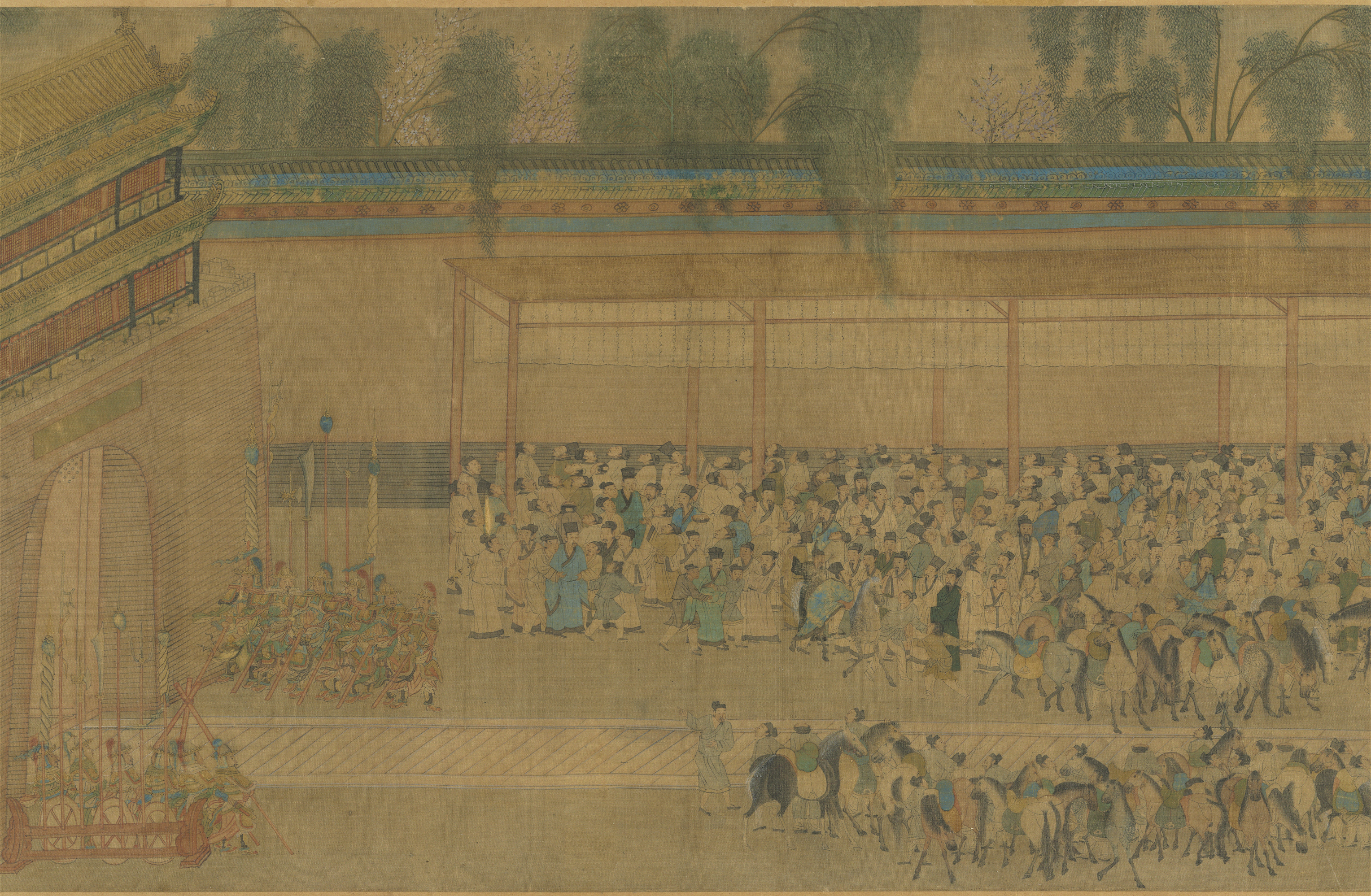
The imperial examination system, a civil service written exam — once a path to prestige — had become a bottleneck. Thousands of scholars languished in bureaucratic limbo, channelling their frustrations and exhaustion into xiaopin’s intimate vignettes.
Chinese imperial examination candidates gathering around the wall where the results are posted (painting by Qiu Ying, c. 1540) (National Palace Museum)
In his preface to Meiyou Pavilion, editor Zheng Yuanxun (1603–1644) praised the genre’s “flavour beyond flavour, rhythm beyond rhythm” — a poetic nod to its rich sensory detail and subtle musicality — rejecting moralizing orthodox prose by embracing immersive aesthetics.
Against neo-Confucianism’s rigid hierarchies, xiaopin elevated the private, the ephemeral and the esthetically oblique: a well-brewed pot of tea, the texture of moss on a garden rock and incense wafting through a study.
Wei Shang, professor of Chinese culture at Columbia University, has noted such playful text flourished among late Ming literati disillusioned with the era’s constraints. The texts reframed idleness and sensory pleasure as subtle dissent within a status-obsessed society.
When doing less becomes radical
Long before French poet Charles Baudelaire’s flâneur used dandyism and idle promenades to resist the alienating pace of western modernity, Ming literati like Chen Jiru (1558–1639) and Gao Lian (1573–1620) framed idleness as defiance.
Drawing on Daoist wu wei (non-action), Gao praised the “crystal clear retreat” that scrubbed the heart of “worldly grime” and cultivated “a tranquil heart and joyful spirit.” For him, human worth lay not in bureaucratic promotions but in savouring tea, listening to crickets or resting against a well-fluffed pillow.
Hung-tai Wang, a cultural historian at Academia Sinica in Taipei, identifies xiaopin as a “leisurely and elegant” esthetic rooted in nature’s rhythms.
Chen Jiru, a Ming Dynasty-era painter and essayist, embodied this framework by disallowing transactional logic. In one essay, Chen lauds those who possess “poetry without words, serenity without sutras, joy without wine.” In other words, he admired those whose lives resonated through prioritizing lived gestures over abstract ideals.
In the Jiangnan gardens, late Ming essayists saw landscapes infused with emotion. At the time, essayist Wu Congxian called it “lodging meaning among mountains and rivers:” moonlight turned into icy jade, oar splashes to cosmic echoes.
Chen Jiru had study rituals — fingering a bronze cauldron, tapping an inkstone — curated what he termed “incense for solitude, tea for clarity, stone for refinement.”
This cultivation of object-as-presence anticipates American academic Bill Brown’s “thing theory,” where everyday items invite embodied contemplation and challenge the subject-object binary that enables commodification.
The Ming Dynasty-era scholar-connoisseur, Wen Zhenheng (1585–1645), turned domestic minutiae into philosophical resistance.
His xiaopin framed everyday choices — snowmelt for tea, rooms facing narrow water, a skiff “like a study adrift” — as rejections of abstraction. Through details like cherries on porcelain or tangerines pickled before ripening, he asserted that value lies in presence, not utility.
Wen suggests that exhaustion stems not from labour but from disconnection.
The burnout rebellions: ‘Tang ping,’ ‘quiet quitting’
Just as xiaopin turned domestic rituals into resistance, today’s movements recast the mundane as a mode of defiance.
In April 2021, China’s tang ping (“lying flat”) movement surfaced with a post by former factory worker Luo Huazhong: “Lying flat is justice.” The message was simple and subversive: work had become intolerable, and opting out was not laziness but resistance.
In a backlash against China’s “996” work model extolled by tech moguls like Jack Ma, tang ping rejects the sacrifice of dignity and mental health for productivity and casts idleness as a quiet revolt against exploitative norms.
In the West, the COVID-19 pandemic sparked similar reckonings. The “Great Resignation” saw millions leave unfulfilling jobs. And “quiet quitting” rejected unpaid overtime and emotional labour. These movements emerged as a soft refusal of hustle culture.
As anthropologist David Graeber argues in Bullshit Jobs (2018), the “moral and spiritual damage” inflicted by meaningless work reflects a profound political failure.
Just like the late Ming literati who poured their lives into a state that repaid them with hollow titles and bureaucratic decay, today’s workers withdraw from institutions that exploit their labour yet treat them as disposable.
Unlike French philosopher Michel de Montaigne’s introspective self-examination in his Renaissance-era Essays, xiaopin refuses utility. In doing so, it inverts the contemporary self-help trend critiqued by Byung-Chul Han, which co-opts personal “healing” as a form of productivity through neoliberal logic.
Xiaopin proposes resistance as an existential shift beyond (self-)optimization. Its most radical gesture is not to demand change, but to live as if the system’s demands are irrelevant.
The revolution of pause
Xiaopin asks: What is progress without presence? Its fragments — on lotus ponds, summer naps, a cat’s shadow — prove that resistance need not be loud.
Like Japanese writer Haruki Murakami’s vision of contemporary literature as “space of individual recovery,” the genre shelters us from “hierarchy and efficiency.”
Here, time is not spent but reclaimed.
To pause in an age of weaponized ambition is in fact revolt. Tracing a petal’s vein, sipping tea until bitterness fades, lying flat as the machinery of productivity grinds on — these are not acts of shirking reality, but defiant gestures against the systems that feed on our exhaustion. They are affirmations of agency: microcosms where we rehearse what it means to belong to ourselves, and thus, to the world.
Xiaopin’s revolution awakens in a flicker of attention: a reminder that presence, too, is a language — one that hums beneath the buzz of progress, waiting to be heard.
The authors do not work for, consult, own shares in or receive funding from any company or organisation that would benefit from this article, and have disclosed no relevant affiliations beyond their academic appointment.
Source: The Conversation – Africa – By Rick de Villiers, Associate professor, University of the Free State
At last, the most infamous latecomer in all of literature has arrived – not in the flesh, but in South Africa’s Afrikaans language. Irish playwright Samuel Beckett’s best-known drama, Waiting for Godot, now also lives as Ons Wag vir Godot.
The action involves two tramps, Vladimir and Estragon, who have a series of absurd conversations and encounters as they wait for a man called Godot who never arrives. Beckett would self-translate the drama into English in 1954, calling it “a tragicomedy in two acts”.
Since then, translations of the play have exploded. By 1969 – the year of Beckett’s Nobel Prize for Literature – Waiting for Godot could already be read in dozens of languages, including Albanian, Marathi, and even Icelandic.
Samuel Beckett and South Africa
Beckett’s connections with South Africa are surprisingly varied. As a young man, he unsuccessfully applied for a lectureship at the University of Cape Town. His 1951 novel, Molloy, was translated from French into English with the help of a South African student, Patrick Bowles. And in 1968, Beckett made a donation to the then-banned resistance party, the African National Congress, in the form of a manuscript for auction.
This gesture was unprecedented for the Irish writer, who was wary of political causes. Yet not only did Beckett feel strongly enough about apartheid’s injustices to make this donation, he also refused to let anyone perform his plays before South Africa’s racially segregated audiences.
Already in 1963 Beckett had signed the petition Playwrights Against Apartheid. He would continue to refuse performance rights in South Africa until 1980, when the Baxter Theatre was allowed to stage Waiting for Godot with a racially integrated cast.
Nevertheless, unauthorised Godots materialised before this. Athol Fugard, the South African playwright whose own dramas were influenced by Beckett, directed one of the earliest South African productions in 1962. Featuring an all-black cast, it testified to the play’s political charge, which Fugard emphasised:
It’s reasonable to think that Beckett would have supported this protest performance. But he would probably have denounced the first and unofficial Afrikaans version, Afspraak met Godot, translated by Suseth Brits and performed in 1970 at the Potchefstroom University College (now North-West University) behind closed doors.
For different reasons, Beckett would also have frowned on the substantial “borrowings” in Afrikaans novelist Willem Anker’s 2014 novel, Buys.
Domesticating a European classic
Fully sanctioned by Beckett’s estate and beautifully translated (from the French and English) by now-retired professor of French at the University of the Free State Naòmi Morgan, Ons Wag vir Godot arrives at a different moment altogether.
From left: Peter Taljaard (Pozzo), Charl Henning, Chris Vorster and Gerben Kamper (Lucky).Leopold Frechow/UFS
The translation retains the gallows humour of the original while adding local flavour. For instance, where Vladimir originally names the Eiffel Tower as a picturesque site to commit suicide, his Afrikaans counterpart nominates Van Stadensbrug, a bridge over a ravine in the Eastern Cape. The slave-like Lucky once entertained his master with European dances: “the farandole, the fling, the brawl, the jig, the fandango”. These now become a South African mix: “volkspele, die riel, die pantsula, selfs die horrelpyp” (folk games, riel dance, pantsula dance, a hiding).
In translation-speak, Ons Wag vir Godot is therefore fully “domesticated”: the play’s universality comes through even though – and perhaps even more so because – it’s anchored in a particular place and time.
This struck me when I attended the play’s limited-run production, expertly directed by Dion van Niekerk, at the 2024 Vrystaat Kunstefees (Free State arts festival). Its set managed to thread together subtle South African roadside details: a toppled rubbish bin, pylons on the horizon, a (broken) picnic bench.
Chris Vorster as Vladimir and Sibabalwe Jokani as Seun/Boy.Leopold Frechow/UFS
In the text itself, we encounter familiar place names, sayings and cultural clues. Consider how Beckett’s abstract phrase “the essential doesn’t change” is grounded in African mythology: “Jakkals verander van hare, maar nie van streke nie” (The leopard doesn’t change its spots). Then there’s the charming touch of the dog in Vladimir’s song snatching “’n stukkie wors” (a piece of sausage particular to South Africa) rather than a measly “bone”.
Godot and the Afrikaans canon
Ons Wag vir Godot achieves its most profound tribute to Beckett and Afrikaans through its intertextual richness. Both the French and English originals are highly allusive texts: they invoke other works of literature to increase their range of meaning and subtlety. Morgan is attuned to this subtlety and to the parallels to be found in Afrikaans literature. There are references to works by canonical Afrikaans writers like Eugène Marais, Totius and C.J. Langenhoven, each adding its own resonance.
Yet the dilemma any translator faces is not so much in bringing in the new, but in striking a balance with the old. Consider the judicious swapping of a line from Percy Bysshe Shelley for a line from C. Louis Leipoldt.
In the English version, Estragon looks up forlornly at the moon and half-quotes the English Romantic poet: “Pale for weariness … Of climbing heaven and staring on the likes of us.” In the Afrikaans, he gives us a fragment from the wistful poem, Die Moormansgat: “ek kyk na die lig van die volle silwermaan” (I behold the light of the full silver moon). At face value, this lacks the detached, woeful quality of Shelley’s line. But read in the context of Leipoldt’s poem, it is every bit as poignant.
The virtue of waiting
“Vladimir would agree,” Morgan concludes in the preface to her translation, “that a century is a decent amount of time to hone a language for the translation of one of the best-known dramas in world literature”.
And indeed, the riches of the Afrikaans language are on display in this sensitive, witty and allusive rendering of Beckett’s European classic. But it’s also true that a certain amount of political baggage had to be shaken off before such a feat could be realised – not just in the right words, but in the right spirit. Of course, if Beckett’s play teaches us anything, it’s the virtue of waiting.
– Waiting for Godot has been translated into Afrikaans: what took so long – https://theconversation.com/waiting-for-godot-has-been-translated-into-afrikaans-what-took-so-long-257345
Source: The Conversation – Africa – By Tinashe Mushakavanhu, Research Associate, University of Oxford
In southern Africa townships were built as segregated urban zones for black people. They were created under colonial and white minority rule policies that controlled movement, confined opportunity, and kept people apart.
I grew up in a different historic black township in Zimbabwe, but Mbare was the first of its kind. It holds a unique place in the nation’s imagination.
Mbare was originally named Harare. But in 1982 that name was reassigned to the capital city that houses it. In its storied past, it was once the heartbeat of black urban life. At its centre is Rufaro Stadium, where Bob Marley and the Wailers famously performed at Zimbabwe’s independence celebrations.
The old beer hall that today houses artists.Tatenda Kanengoni
The township was a hub of cultural energy, sports, and political activism, and the community beer hall served as a vital gathering point. Today, many of these beer halls stand derelict.
These once-thriving communal spaces reflect a broader neglect of civic infrastructure in post-independence Zimbabwe. Yet out of these ruins, new life is taking shape.
One of the most influential figures in Zimbabwe’s artist-run spaces movement, Moffat Takadiwa, has transformed one of these former beer halls into the Mbare Art Space. The dynamic arts hub reclaims the building’s original spirit of gathering, creativity and public engagement.
Artists have transformed the beer hall.Tatenda Kanengoni
Operating under a long lease from the Harare City Council, this nonprofit initiative is part of a wider urban renewal and adaptive reuse project aimed at reimagining the city’s cultural infrastructure.
My ongoing work in archival research includes mapping and visiting historical and cultural spaces like this. Here Takadiwa saw the potential for not just studios and an exhibition venue, but also for dialogue and community regeneration.
Transforming spaces
Beer halls were established by British colonial authorities in Zimbabwe (then Rhodesia) as part of a strategy of social control over the African urban population. They were designed to regulate leisure, restrict political organising and generate revenue through the sale of alcohol. By centralising drinking in state-run facilities, colonial administrators aimed to monitor and contain African social life while profiting from it.
Situated in a repurposed colonial-era beer garden, Mbare Art Space turns a former site of segregation into a vibrant centre of artistic and communal revival. It redefines a legacy of constraint and control as one of creative freedom and empowerment. The place is now an artists’ haven with studios, office space, an exhibition hall and a digital hub.
Moffat Takadiwa, the artist behind the project.Tatenda Kanengoni
Takadiwa’s vision is informed by global precedents, notably inspired by US artist Theaster Gates, whose work includes the transformation of a derelict bank on Chicago’s South Side. It became the Stony Island Arts Bank – a hybrid space for art, archives and community engagement.
Takadiwa opened Mbare Art Space in 2019 with a vision to support emerging artists through mentorship and access to resources. True to his artistic philosophy – resurrecting abandoned, often overlooked materials suffering the effects of urban decay – he revitalised a neglected site. Most of the artists working from this space follow his lead, upcycling and recycling found materials into compelling visual forms that speak to both history and possibility.
Kimberly Tatenda Gakanje at work in the space.Tatenda Kanengoni
When I arrive, Takadiwa is on his way out, but offers me a quick tour of his studio, where works in progress for his upcoming participation in the São Paulo Biennale are taking shape.
Known for his lush, densely layered sculptures and tapestry-like works made from found objects – computer keyboards, bottle tops, toothbrushes, and toothpaste tubes – Takadiwa has garnered international acclaim. His works are collected by US rapper Jay-Z and major institutions like the Centre National d’Art Plastique in Paris, the European Parliament’s art collection in Brussels, and the National Gallery of Zimbabwe in Harare.
Collaboration
What Takadiwa is building is not just an arts centre – it’s a new model space rooted in history and responsive to the present. The site itself becomes an ongoing installation, activated by the artists, curators and community members who inhabit it.
Tafadzwa B Chataika works with recycled materials.Tatenda Kanengoni
Tafadzwa Chimbumu, the operations manager, takes over the tour, guiding me through the rest of the precinct. The site retains the bones of its beer hall architecture, but it bursts with new life. Colourful murals adorn the walls. Tents draped over smaller buildings animate the exposed brickwork.
Plans are underway to establish a library here, a resource where researchers and artists can engage with Zimbabwe’s under-documented art history. Much of this history is scattered across archives and unpublished dissertations, rather than in widely available books. The aim is to bring these materials together and make them more accessible to the public.
Mbare Art Space is also becoming an exciting hub for collaboration and education. Community workshops, for example, are led by resident artists. Local schools take part in art education initiatives. Through community outreach and educational programming, the centre is extending its impact beyond its immediate geography.
Nkosiyabo Frank Nyoni making art at the space.Tatenda Kanengoni
As it looks to the future, Mbare Art Space is focused on expanding its artist-in-residence programme, inviting both local and international artists to immerse themselves in the context of Mbare and Zimbabwe.
Ultimately, what the space offers is something intangible – a feeling, a memory, a vision of what is possible when history and imagination meet in a shared place.
– Mbare Art Space: a colonial beer hall in Zimbabwe has become a vibrant arts centre – https://theconversation.com/mbare-art-space-a-colonial-beer-hall-in-zimbabwe-has-become-a-vibrant-arts-centre-256528
Source: The Conversation – Africa – By Andreana Prichard, Associate Professor of Honors and African History, University of Oklahoma
In the world of international child development and orphan care, it’s not uncommon for children with families to declare themselves orphans. In fact, this practice can be traced back to precolonial times in Kenya.
Andreana Prichard has done research on the practice in Kenya. We asked her to share her insights into it.
Why do some people in Kenya assume the identity of ‘orphan’?
We often think of “orphans” as children who have lost both parents and who lack kin networks. One might ask why someone would “opt in” to orphan status when they do not fall within the classical definition of the term.
In my paper I look at the issue of orphanhood over the last 160 years. Case studies from Kenya I examine illustrate that the practice I define as “opting in” to orphanhood has precolonial roots. I define “opting in” as choosing to take on the label of being an orphan. This can be done by parents, relatives or even, in some instances, the child. This is because the label “orphan” has come to confer unique opportunities.
The practice became increasingly popular in the mid-1990s, when parents in eastern and southern Africa who had contracted HIV began to die in large numbers. Activists feared many children would be left without caregivers.
In response, the number of orphanages proliferated as humanitarian actors, churches and states inundated east Africa with orphan-focused NGOs.
In 2020, officials in Kenya estimated that there were at least 910 residential institutions for children in the country (of which 581 were registered), housing between 26,198 and 85,733 Kenyan children.
The predicted “orphan crisis” never materialised, partly because families and communities stepped in to care for newly parentless children. But the idea of an “orphan crisis” remained, and so did the funding and infrastructure.
This phenomenon occurred across the continent, not just in Kenya. However, its effects were felt particularly acutely in eastern and southern Africa where HIV/Aids prevalence rates were higher and where there was more western tourism.
Today, many African families see orphan-focused NGOs as a path to access education and improve their lives. My research shows that children themselves sometimes affiliate with an institution that provides shelter, food and schooling. Children facing abuse from caregivers may also prefer the relative anonymity and safety of an institution.
In some cases, receiving orphan services actually raises the status of the “orphan” child above that of other children. They have access to more material resources than they might have had in their villages or at home. They might have more leisure time and less work. They may have access to better bedding, shoes and clothing. They are also likely able to attend school more consistently and have a real opportunity to attend university.
Does ‘opting in’ have a long history?
Yes, it does.
In the precolonial period, most parentless or vulnerable children were cared for through lasting community support systems. Orphanhood, as it exists today as a child lacking support, protection, or care from kin, was largely avoided.
However, the late 19th to mid-20th centuries brought new actors to the east African region. The practice of “opting in” became a strategic, temporary option used by families to access services from western humanitarians.
The earliest example of this shift I found in my research is from the 1890s. Fearing their children would be caught in the Indian Ocean slave trade, African parents sometimes chose to send their children to British missions until the region was safe. They knew the missionaries opposed the slave trade and knew they offered food and medical care.
African parents thought they were making temporary arrangements to keep their children safe. Missionaries, however, understood parents to have abandoned their children. When parents returned to repay the debt – with agricultural produce or trade goods – and to reclaim their children, missionaries refused them.
In another example from Kenya in the 1950s, the British colonial government opened “reform schools” for young men. The Wamumu Approved School was renowned for the relative quality of education it provided. But the state admitted only the “most vulnerable” for a free education. Feeling they had no way to access Wamumu, students claimed to be orphans.
What have been the negative effects of Kenya’s orphan system?
There are several problems with creating a situation in which people present themselves as vulnerable just to gain safety or improve their social and economic standing.
First, research has shown that building orphanages in poor communities incentivises parents to abandon their children if they’re not also given the help to remain together.
Second, research shows that children are often put at risk in these institutions. Institutionalisation exposes children to risks such as sexual abuse, gender-based violence and neglect.
Third, orphanages have become so lucrative that African orphanage owners will go to great lengths to fit African children into the categories westerners wish to fund. The phenomenon of “paper orphans” is a prime example. “Paper orphans” are children who are recruited from their homes by proprietors (or middlemen/brokers) of orphanages and residential-care facilities. Fraudulent documentation is created for them – often including false death certificates of parents and new identity registration documents – rendering them orphans on paper, and vulnerable in practice.
Based on my research I believe that working with families to support vulnerable children in their homes of origin or with extended families is a better option. This can be done through assistance programmes for vulnerable families as well as child welfare programmes. These allow families to remain intact when experiencing hardship.
In addition to this, missionary and voluntourism trips to orphanages and residential care facilities should be banned or limited.
– Choosing to be an orphan: for some Kenyan families it’s a strategy for survival – https://theconversation.com/choosing-to-be-an-orphan-for-some-kenyan-families-its-a-strategy-for-survival-247371
Source: United States of America – Department of State (video statements)
Secretary of State Marco A. Rubio meets with North Macedonia Foreign Minister Timčo Mucunski at the Department of State, on May 29, 2025.
———-
Under the leadership of the President and Secretary of State, the U.S. Department of State leads America’s foreign policy through diplomacy, advocacy, and assistance by advancing the interests of the American people, their safety and economic prosperity. On behalf of the American people we promote and demonstrate democratic values and advance a free, peaceful, and prosperous world.
The Secretary of State, appointed by the President with the advice and consent of the Senate, is the President’s chief foreign affairs adviser. The Secretary carries out the President’s foreign policies through the State Department, which includes the Foreign Service, Civil Service and U.S. Agency for International Development.
Get updates from the U.S. Department of State at www.state.gov and on social media!
Facebook: https://www.facebook.com/statedept
X: https://x.com/StateDept
Instagram: https://www.instagram.com/statedept
Flickr: https://flickr.com/photos/statephotos/
Rumble: https://rumble.com/c/StateDept
Substack: https://statedept.substack.com
Watch on-demand State Department videos: https://video.state.gov/
Subscribe to The Week at State e-newsletter: https://public.govdelivery.com/accounts/USSTATEBPA/signup/32562
State Department website: https://www.state.gov/
Careers website: https://careers.state.gov/
White House website: https://www.whitehouse.gov/
Terms of Use: https://state.gov/tou
Source: United Kingdom – Executive Government & Departments
News story
Recruitment for an IT Service and Operations Manager
IT Service and Operations Manager, working on the running and maintenance of the VMD services available to users.
We have a vacancy for an IT Service and Operations Manager.
Job Title
IT Service and Operations Manager
Grade
G7
Salary & Pension
£59,900 per annum with Pension Scheme
Annual Leave entitlement
Commencing at 25 days
Role
As the IT Service and Operations Manager, you will agree and monitor IT service levels across all relevant business functions, managing an operations team with a user-centric support approach, focused on service availability, security and performance.
Source: United Kingdom – Executive Government & Departments
News story
Recruitment for a Distribution and Supply Chain Inspector for South East England
Distribution and Supply Chain Inspector vacancy, working on inspections and investigations to ensure compliance with the Veterinary Medicines Regulations (VMR).
We have a vacancy for a Distribution and Supply Chain Inspector.
Job Title
Distribution and Supply Chain Inspector for South East England
Grade
SEO
Salary & Pension
£41,220 per annum with Pension Scheme
Annual Leave entitlement
Commencing at 25 days
Role
This role contributes to the VMD’s aims and objectives through inspections and investigations to ensure that UK veterinary-only wholesale dealers, feed business operators and veterinary medicines retailers comply with the Veterinary Medicines Regulations (VMR).
Source: State University of Management – Official website of the State –
On May 27, 2025, within the framework of the 42nd Plenary Week of the Eurasian Group on Combating Money Laundering and Financing of Terrorism (EAG), the 22nd meeting of the Council of the International Network Institute in the field of AML/CFT and the conference of the International Movement for Financial Security were held with the participation of the management, teachers and students of the State University of Management, headed by Vice-Rector Dmitry Bryukhanov.
In 2025, GUU officially joined the International Movement for Financial Security, created on the initiative of a student from Brazil, Augusto Lemmertz, during a meeting between Russian President Vladimir Putin and the finalists of the III International Financial Security Olympiad in 2023. And on May 27, as part of the next conference of the International Movement for Financial Security, GUU Rector Vladimir Stroyev joined the Presidium of the movement. The Chairman of the Presidium of the movement is Deputy Prime Minister of the Russian Federation Dmitry Chernyshenko, and the Deputy Chairman is Director of Rosfinmonitoring Yuri Chikhanchin.
Let us recall that the State University of Management has been a member of the ISI in the field of AML/CFT since 2014, and has been actively participating in the Olympiad movement since the selection events of the 1st International Financial Security Olympiad in 2021. Since 2023, it has been actively working in the field of promoting the financial security Olympiad movement in historical territories, in particular, in 2023 it organized the selection of participants in the Olympiad finals among students and schoolchildren from the DPR, LPR, Zaporizhia and Kherson regions, in the same year it organized a summer school for finalists from historical territories and annually participates in the training of teachers of historical territories to conduct a thematic lesson on financial security.
Please note: This information is raw content directly from the source of the information. It is exactly what the source states and does not reflect the position of MIL-OSI or its clients.
The Government of Saskatchewan is increasing funding to the Autism Resource Centre (ARC) of Regina by providing $235,000 to support the expansion of a summer program for children and youth.
“Summer programs are a key and enriching part of the lives of many children and families,” Health Minister Jeremy Cockrill said. “Great memories and life lessons are often a part of these experiences, and I am pleased we can offer this support to the Autism Resource Centre to enable more summer programming options.”
The Autism Resource Centre provides the Therapeutic Summer Program for children and youth ages seven and up who are returning to school in fall. The summer camp program emphasizes individualized goals and life skill development.
“ARC’s summer program is a lifeline for many families – providing individualized, one-to-one support that helps autistic children maintain and develop critical skills, routines and social confidence,” Autism Resource Centre Executive Director Angela Ricci said. “Families consistently tell us how essential this program is, not just for their child’s development, but for their overall peace of mind.”
Ricci added that one parent shared: “As a mom of a very high-needs autistic child, I would not have survived the last 15 years without this summer program. It has given our family peace of mind and essential continuity.”
More information about the Autism Resource Centre and its camps can be found at: https://www.autismresourcecentre.com/
In 2025-26, the Saskatchewan Health Authority provided annual funding of $1.5 million to the Autism Resource Centre for a range of services and programs to individuals and their families impacted by Autism Spectrum Disorder.
Source: United States House of Representatives – Congresswoman Dina Titus (1st District of Nevada)
Congresswoman Dina Titus today introduced the Labor Income Fairness and Transparency Act (LIFT Act) to raise the minimum wage and all Fair Labor Standards Act subminimum wages to $17 per hour over the next three years with annual increases after that, provide income protections for tipped workers, and expand the Earned Income Tax Credit to cover more workers.
“This legislation is a fair way to increase the take-home pay of both tipped employees and employees who do not receive tips, giving all hospitality and other workers a needed boost in meeting an increasing cost of living. It also will protect tipped workers from unjustified employer deductions from their tips,” Congresswoman Titus said. “These measures are necessary to help employees afford their rent, support their children, and pay their medical bills.”
The LIFT Act would protect the incomes of tipped workers by requiring employers to provide a notice of tips received by an employee each day they work. It would prohibit managers from withholding tips to cover the cost of processing a tip. It would increase civil penalties for tip violations to equal those for other violations of the Fair Labor Standards Act.
The LIFT Act also prohibits Wage and Hour investigators at the Department of Labor from being subjected to reductions in force, establishes a grant program for states and localities to improve enforcement and compliance with wage laws, and creates a Department of Labor National Advisory Committee on the Hospitality Industry.
Further, benefiting all families, the LIFT Act would permanently extend changes to the Earned Income Tax Credit made by Congress during the COVID pandemic. These include increasing the maximum credit amount for workers without children, increasing the income threshold for earning the credit, and expanding the age range for eligible workers for those without children to include those 19-24 and over 65. It would also raise the maximum EITC for workers without children from $530 to $1,500, and the income cap for these adults to qualify from about $16,000 to at least $21,000.
“The Earned Income Tax Credit was changed to provide needed relief for workers who have not benefitted as much as they should have from the credit,” Congresswoman Titus said. “Making these changes permanent will make a big difference in the lives of millions of lower-paid American workers.”
The LIFT Act has been endorsed by One Fair Wage.
“Cutting taxes on tips might make for a good soundbite, but on its own, it’s a hollow fix that ignores the real crisis: wages so low that two-thirds of restaurant workers don’t even earn enough to pay federal income taxes,” said Saru Jayaraman, Cofounder and President of One Fair Wage. “In a time of skyrocketing costs, workers are drowning and need more than political gimmicks—they need a raise. Tips should be a bonus, not a substitute for a living wage. By ending all subminimum wages and requiring that all workers be paid a full livable wage with tips on top, the LIFT Act addresses what working people need most: a fair wage, a level playing field, and the dignity that comes with being able to provide for their families.”
Source: United States House of Representatives – Congressman Earl L Buddy Carter (GA-01)
Headline: Carter introduces bill to investigate the Biden cover-up
WASHINGTON, D.C. – Rep. Earl L. “Buddy” Carter (R-GA) today introduced a bill creating a Select Committee to investigate the White House cover-up of former President Biden’s cognitive and physical health decline.
The bipartisan Select Committee will be responsible for issuing a report to Congress detailing President Biden’s cognitive and physical health decline and the potential concealment of information from the American public.
“This is potentially the biggest political scandal of our lifetime, and the American people deserve to know the truth about who was really running the White House under Biden’s tenure as president. From using the autopen to pardon his own family members to likely concealing a cancer diagnosis, our government must restore trust with the public by fully investigating the former administration’s lies and getting to the bottom of one of the most consequential coverups in history,” said Rep. Carter.
Original Cosponsors include: Reps. Mark Alford (R-MO), John Rose (R-TN), Derrick Van Orden (R-WI), and Barry Moore (R-AL).
OAKLAND – California Attorney General Rob Bonta and Secretary of State Shirley N. Weber, Ph.D. today announced filing a notice of appeal in their lawsuit challenging Measure A, Huntington Beach’s voter identification (voter ID) law. Without citing any evidence that fraudulent voting occurs with any regularity in the city or has ever compromised the outcome of a municipal election, Measure A amended Huntington Beach’s charter to purportedly allow the city to impose voter ID requirements at the polls for all municipal elections starting in 2026. In their lawsuit, Attorney General Bonta and Secretary of State Weber argue that state law prohibits and overrides Measure A, and in their appeal, ask the California Fourth District Court of Appeal to reverse a lower court decision issued on April 7, 2025, denying the state’s petition for a writ of mandate.
“California’s elections are fair, safe, and secure,” said Attorney General Rob Bonta. “We respectfully ask the California Fourth District Court of Appeal to reverse the lower court’s decision and overturn Huntington Beach’s unlawful voter ID policy. State law supersedes local law when it comes to constitutional matters like the right to vote – and we will continue to fight to safeguard this fundamental right in court.”
“Municipalities should not be allowed to defy state laws in the name of solving nonexistent problems. I stand with Attorney General Bonta in fighting to reverse the lower court’s decision as we seek to overturn an unlawful voter ID policy,” said Secretary of State Shirley N. Weber, Ph.D.
In their lawsuit filed in April 2024, Attorney General Bonta and Secretary of State Weber argued that Measure A is preempted by state law and invalid. Under the California Constitution, charter cities have the right to govern “municipal affairs,” but local law cannot conflict with state law governing a “statewide concern.” Both the integrity of California’s elections and the protection of the constitutional right to vote are matters of statewide concern. The lawsuit argues that California already maintains a uniform and robust legal scheme for safeguarding the integrity of the electoral process and protecting the rights of eligible voters. Unlawfully departing from this legal framework, Huntington Beach’s voter ID law purportedly allows the city to require additional identification from voters before they can exercise their right to vote. By authorizing this requirement, Huntington Beach’s voter ID law conflicts with state law and threatens to unlawfully disenfranchise voters at the polls.
Ministers have decided not to pursue a proposal to designate Galloway and Ayrshire as a National Park.
Rural Affairs Secretary Mairi Gougeon confirmed that opposition to the nomination and the Reporter’s recommendations against it meant that the region in southwest Scotland would not join the Cairngorms and Loch Lomond & the Trossachs as the country’s third national park.
Speaking in the Scottish Parliament, Ms Gougeon said:
“While there is substantial support for a National Park and what it could deliver for the southwest of Scotland, there is also significant opposition. I realise that this decision will be very disappointing for those who have been campaigning for a new National Park in Galloway over many years.
“I also recognise the huge amount of work and time that has been invested by a great many people throughout this process. I would like to thank everyone involved, including members of the Galloway National Park Association and the Galloway and Southern Ayrshire UNESCO Biosphere.
“I would also like to thank NatureScot for its work carrying out such an important and extensive public consultation in a robust and professional way that was commended in the review of the process carried out by the Scottish Community Development Centre. The consultation raised some really important issues that local people care deeply about and we now have the opportunity to look at how we can address these.
“The Scottish Government remains committed to our existing National Parks and the vital leadership role that they play in tackling the climate and biodiversity crises, promoting sustainable land management and supporting the economic and social development of local communities. Our National Parks are achieving for people and nature.”
Background
The proposal to designate a new National Park in Galloway and Ayrshire was jointly put forward by the Galloway National Park Association and the Galloway and Southern Ayrshire UNESCO Biosphere, in response to the Scottish Government’s invitation to communities and organisations across Scotland to nominate their area to be considered for designation as a new National Park.
Five nominations were received through that process – from Galloway and Ayrshire, Lochaber, Loch Awe, Scottish Borders and Tay Forest.
NatureScot was appointed as the statutory Reporter, as specified in the National Parks legislation, to carry out this investigation, undertake a public consultation and report to the Scottish Government.
Following an initial period of engagement with local communities, public bodies and stakeholders, NatureScot ran a 14-week public consultation process from 7 November 2024 until 14 February 2025.
Over 5,000 surveys were completed and more than 1,000 people attended events that were held across Galloway and South and East Ayrshire – with the final results showing around 54% of responses opposed the National Park proposal and around 42% of responses supported it.
The Report found: “Our recommendation as Reporter is therefore not to proceed with the designation but instead to strengthen a range of existing arrangements, including a better resourced and more influential Galloway and Southern Ayrshire Biosphere Reserve, a renewed focus on people and nature alongside commercial forestry operations in the Galloway Forest Park and a new commitment to the implementation of management strategies for the three National Scenic Areas.”
Public-Private Partnership Advances Research That Turns US Biomass Into National Sources of Fuel, Rubber, and Battery Materials
Crysalis scaled up NREL’s original reactor operations to produce bio-based acetonitrile. The photo on the left shows NREL’s lab-scale reactor; the photo on the right shows the pilot-scale reactor in the Crysalis facility. Photos by Dennis Schroeder, NREL (left) and Gregory Cooper, NREL (right)
The U.S. Department of Energy’s (DOE’s) National Renewable Energy Laboratory (NREL) is known for its groundbreaking research in impactful bioenergy technologies and invention of performance-advantaged chemicals and materials. But some of its most exciting success stories happen when those innovations move beyond the lab and into the real world.
A prime example of this technology transfer in action is the collaboration between NREL and Crysalis Biosciences, a leading American manufacturer of next-generation biofuels and biochemicals. Based on research initially funded by DOE’s Bioenergy Technologies Office, NREL granted Crysalis commercial licenses to three novel biological technologies to produce bio-based chemicals and fuels, including:
2,3-Butanediol (2,3-BDO): This technology leverages a modified strain of Zymomonas mobilis to produce 2,3-BDO instead of ethanol, which can be used to produce polymers and butadiene, a key ingredient in bio-derived rubber for tires.
Carboxylic Acids to Aviation Fuel: This process converts America’s plentiful sources of waste and biomass into carboxylic acids, which can be upgraded to a jet fuel blendstock, serving as an abundant energy source for export and the domestic aviation industry.
Acetonitrile: This process allows for the production of ultrahigh purity acetonitrile, a high-demand solvent in pharmaceutical manufacturing, as well as other high-performance, high-volume materials like advanced batteries.
The licensing of these three technologies showcases how the NREL/Crysalis partnership can leverage America’s plentiful biomass and waste feedstocks—more than 1 billion tons according to a recent DOE study—to drive homegrown production of critical materials and agricultural products the country needs and reduce its reliance on imports.
From Lab Innovation to Market Impact
With these advancements in hand, Crysalis’ R&D facility in Louisville, Colorado, recently produced the world’s first 100% bio-based acetonitrile with the highest purity available on the market. The pathway was scaled up 300 times from NREL’s lab-scale technology.
Crysalis engineer Katherine Noon checks equipment that she helped customize and build in the Louisville facility. Photo by Gregory Cooper, NREL
“I don’t think anyone realized that we could achieve this scale and that the NREL technologies could get out into the world so quickly,” NREL Senior Licensing Executive Eric Payne said. “This project is so amazing; we are lucky to work with such dedicated partners.”
According to Crysalis Chief Technology Officer Eric Karp, the company purchased a shuttered manufacturing space and, in the span of only one-and-a-half years, Crysalis gutted, cleaned, and built out the new facility—often with refurbished equipment customized by their team to realize huge time and cost savings. The resulting Louisville pilot plant is unique in the industry and started producing acetonitrile in February 2025.
“The reactor designs came straight from NREL but were scaled up 300 times,” Karp said. “We built the system with plug-and-play capabilities to use in different ways, by moving and changing equipment around for different processes.”
Crysalis is poised to take this breakthrough development to the next stage with construction of a demonstration-scale manufacturing plant in the St. Louis area. That plant will then aid in the eventual construction of a full-scale bio-acetonitrile manufacturing facility, and the company anticipates commercial availability of the product within a year.
Making More Fuels and Chemicals Here at Home
All three of NREL’s technologies licensed to Crysalis will lead to more resilient supply chains of critical materials and chemicals needed by the U.S. economy.
For example, rubber is a critical strategic material for the United States, and the bio-derived rubber produced by Crysalis via the NREL 2,3-BDO process can fill this need with stateside manufacturing. Many U.S. petroleum refineries also rely on imported crude oil for their operations. NREL’s carboxylic acids-to-fuels technology produces ketones, which can be processed in existing petroleum refineries, thus reducing dependence on imported crude oil.
The left clear sample is the world’s first 100% bio-based acetonitrile that meets oligonucleotide-grade specifications. On the right is aviation fuel blendstock. Photo by Gregory Cooper, NREL
Finally, acetonitrile is a critically important industrial chemical with applications such as solvents for the pharmaceutical industry and batteries. Today’s fast-charging lithium-ion batteries rely on acetonitrile, and, accordingly, the market for this solvent is expected to be strained with increased demand from automotive applications. Ultrapure acetonitrile is also highly sought after by the pharmaceutical industry due to the expansion of oligonucleotide drug synthesis, a process to create short DNA or RNA sequences that target specific genes or proteins to treat or manage diseases. The Crysalis and NREL process will meet these growing demands with domestic resources and technology.
Revitalizing Local Economies by Creating Manufacturing Jobs
For Crysalis, these technologies also represent an opportunity to transform shuttered chemical plants into profitable, next-generation biomanufacturing hubs. In fact, Crysalis specializes in acquiring and retrofitting shuttered industrial assets—such as the St. Louis plant—to produce bio-based chemicals and fuels and to rehire former employees eager to reclaim their jobs.
“In this case, we bought an ethanol plant that had been shuttered since 2019, and we turned it back on within a year,” Karp said. “This is another thing we’ve learned from our projects—they are important to the community. There were a lot of jobs, and people are willing to come back to them when you reopen the plants. It’s amazing.”
Payne agreed: “What Crysalis is doing in St. Louis—in addition to making ethanol and eventually acetonitrile—is creating jobs and rehiring people,” he said. “That translates to jobs in Colorado, too—and I’m proud that NREL technology helped enable this.”
A Model for Future Collaborations
The licensing of these technologies represents a success story for industry–government partnerships. Payne emphasized the speed and scale at which these innovations are moving into the market.
“What is special is that it took less than a month from the time we sent Crysalis these three licenses to the time that we signed the paperwork,” Payne said. “It rarely goes that fast, but Crysalis was really motivated, and it’s been a great partnership.”
“In the future, we hope to purchase more facilities and do this over and over as our global business model,” Karp said. “Even just one retrofitted plant built from existing infrastructure is having a considerable impact, but if we can start increasing the number of projects down the road, it’ll make a substantial difference to the economy.”
As NREL continues to partner with companies like Crysalis, the laboratory’s research is not just advancing science—it is actively shaping the future of an abundant, resilient, and affordable energy industry.
Learn more about NREL’sscale-up and pilotingof bioenergy and bioeconomy technologies.
DENVER – Today, a court struck down President Trump’s tariffs that raised the cost for Americans on everyday goods. Colorado helped lead a lawsuit against this tariff tax. Governor Polis has been outspoken about the negative impacts these tariffs have on the American people and applauded the court for their decision today.
“This is great news for our economy and every American family. I am grateful that this court decision striking down many tariffs checks the sweeping presidential power that the President has attempted to impose on the American people and businesses. The President’s tariff tax on groceries and everyday items is bad for hardworking people, our economy and business certainty. Unfortunately, President Trump has already caused a lot of damage with his tariff tax and the uncertainty they’ve caused for business and our economy, effectively freezing investment, but I am thrilled with the court’s decision and encourage the President to strengthen trade with our allies and decreases taxes and barriers for imports and exports,” said Governor Polis.
In addition to raising prices, reports show that tariffs lead to increases in fraud and crime.
In 2024, Colorado exported a record $10.5 billion of goods to the world and imported $16.8 B in goods. Colorado’s top export partners are Mexico ($1.7B), Canada ($1.6B), China ($0.8B) South Korea ($0.6B), and Malaysia ($0.6 B), accounting for half of all Colorado exports in 2024. Top export commodities include meat (17%); nuclear reactors, boilers, machinery (15%); electric machinery (13%); optic, photo, medical or surgical instruments (11%); and aircraft, spacecraft, and related parts (5%). In 2022, exports from Colorado supported an estimated 40 thousand jobs.
Colorado in 2024 exported $500 million in aerospace, spacecraft, and related parts, accounting for roughly 4.8% of all Colorado exports. The European Union, Brazil, France, Canada and Mexico were the top five export destinations, accounting for 63% of Colorado’s aerospace exports. In 2024, Colorado imported $1 billion of aerospace, spacecraft and related parts, accounting for roughly 6.2% of all Colorado imports. Switzerland, the EU, Germany, Canada, and France were the top five import sources, accounting for over 90% of Colorado’s aerospace imports.
An estimated 820,200 jobs in Colorado are supported by international trade, representing 20.8% of all jobs in the state. Colorado’s top import partners are Canada ($5.4 B), China ($1.8 B), Mexico ($1.1 B), Switzerland ($0.9 B) and Germany ($0.9 B), accounting for 60% of imports in 2024. Top import commodities include oil, mineral fuel (20%); electric machinery (14%); nuclear reactors, boilers, machinery (11%); optic, photo, medical or surgical instruments (8%); and aircraft, spacecraft and related parts (6%).
In addition to the commodities traded, Colorado also trades services and runs a services trade surplus. In 2022, Colorado exported $16 B in services, supporting 97,260 jobs. Top services export markets were Canada ($1.3 B), the United Kingdom ($0.9 B), Mexico ($0.9 B), and China ($0.6 B). As a bloc, the EU was the top services export market with $3.8 B in services exports supporting over 18,900 jobs.
DENVER METRO AREA – Today, Governor Polis signed new laws across the Denver Metro area.
Governor Polis signedHB25-1097– Placement Transitions Plan for Children, sponsored by Representatives Lindsay Gilchrist and Meg Froelich, and Senators Dafna Michaelson Jenet and Lindsey Daugherty andHB25-1271– Federal Benefits for Youth in Foster Care, sponsored by Lindsay Gilchrist and Kyle Brown, and Senators Lindsey Daugherty and Dafna Michaelson Jenet.
“Now, Colorado will better support kids in foster care to help each child thrive. We are focused on ensuring that all kids in Colorado, no matter where they live, have access to the resources needed for a healthy and safe life, and these bills do exactly that for kids who need it most,” said Governor Polis.
Governor Polis also signedHB25-1328– Implement Recommendations Direct Care Worker Stabilization Board, sponsored by Majority Leader Monica Duran and Representative Emily Sirota and Senators Jessie Danielson and Jeff Bridges. This bill will support the health care workforce and increase access to quality affordable health care to help Coloradans live strong healthy lives.
“In Colorado, we are expanding access to the important health care Coloradans need, while taking action to lower barriers and costs. This new law will better support direct care workers and those they care for,” said Governor Polis.
Governor Polis also signedSB25-084– Medicaid Access to Parenteral Nutrition, sponsored by Senators Kyle Mullica and Cleave Simpson and Representatives Mary Bradfield and Gretchen Rydin andHB25-1213– Updates to Medicaid, sponsored by Representatives Lisa Feret and Ron Weinberg and Senators Lindsey Daugherty and Matt Ball, to further support Coloradans who rely on Medicaid for health care.
“In Washington, Republicans in Congress are leaving Coloradans behind with cruel cuts to people’s health care. With these new Colorado laws, we are expanding access to the care at-risk Coloradans need, while making changes to increase efficiency and better serve Coloradans,” said Governor Polis.
At La Clinica in Lafayette, Governor Polis signedSB25-289– Creation of a Drug Donation Program, sponsored by Senator Lisa Cutter and Representatives Kyle Brown and Emily Sirota
AndSB25-290– Stabilization Payments for Safety Net Providers, sponsored by Senators Kyle Mullica and Barbara Kirkmeyer and Representatives Shannon Bird and Kyle Brown.
“We are better supporting Colorado’s safety-net providers and these bipartisan laws will help do that. I look forward to seeing the benefits for low cost, high quality health care across Colorado,” said Governor Jared Polis.
Governor Polis also signed the following bills focused on reducing property insurance, reducing emissions and supporting Coloradans’ access to e-bikes:
HB25-1182– Risk Model Use in Property Insurance Policies, sponsored by Representatives Titone and Brown, and Senators Cutter and Simpson
SB25-182– Embodied Carbon Reduction, sponsored by Senators Ball and Simpson, and Representatives Brown and Weinberg
HB25-1197– Sale of Electrical Assisted Bicycles Requirements, sponsored by Representatives Smith and Taggart, and Senators Amabile and Ball
“Here in Colorado we are focused on helping Coloradans save money on property insurance and continuing to find ways to reduce emissions to improve air quality and save people money. These new laws move us in the right direction, and I look forward to building on these efforts for Coloradans,” said Governor Jared Polis.
Governor Polis also signed the following bills administratively:
HB25-1057– American Indian Affairs Interim Committee, sponsored by Majority Leader Duran and Representative Weinberg, and Senators Danielson and Simpson
HB25-1096– Automated Permits for Clean Energy Technology, sponsored by Representatives Smith and Brown, and Senators Ball and Kipp
HB25-1200– Modifications to Office of Child Protection Ombudsman, sponsored by Representatives Feret and Armagost, and Senators Cutter and Bright
HB25-1279– State-Level Data for Colorado Works Program, sponsored by Representative Stewart, and Senator Jodeh
SB25-020– Tenant and Landlord Law Enforcement, sponsored Senators Weissman and Gonzales, and Representatives Lindsay and Mabrey
SB25-061– Federally Recognized Tribes & Construction of Laws, sponsored by Senator Simpson, and Representatives Weinberg and Joseph
SB25-149– Local Government Duties Equestrian Protections, sponsored by Senator Daugherty and Representative Feret
SB25-303– Repeal Natural Disaster Grant Fund, sponsored by Senators Amabile and Bridges, and Senators Taggart and Bird
HB25-1319– County Commissioner Vacancies, sponsored by Minority Leader Pugliese, Majority Leader Duran, Senator Kirkmeyer and Majority Leader Rodriguez
MONTGOMERY – Governor Kay Ivey and the Alabama Department of Early Childhood Education (ADECE) on Thursday announced that 55 new classrooms will be funded through the Pre-K through 3rd Grade Integrated Approach to Early Learning (P-3) for the 2025-2026 school year.
This expansion will increase the number of classrooms implementing the P-3 approach to 454 across 29 counties. The ADECE, in partnership with the Alabama State Department of Education, is working to align instructional practices, assessments and leadership from First Class Pre-K through third grade.
“Each year, Alabama’s P-3 approach continues to build momentum and grow to provide a smooth transition from pre-k to third grade. Through my Strong Start, Strong Finish initiative, we are setting the stage for lifelong success and empowering every child to reach their fullest potential,” said Governor Ivey. “Strong students lead to a strong Alabama, and these learning efforts will ensure we continue to strengthen our schools and provide the best education for all students.”
The recipient schools are as follows:
Highland Park Elementary in Colbert County
Webster Elementary in Colbert County
Parkside Elementary School in Cullman County
Hollywood Elementary in Jackson County
Kilby Laboratory School in Lauderdale County
Brindlee Mountain Elementary in Marshall County
Asbury Elementary in Marshall County
Sloman Elementary in Marshall County
South Shades Crest Elementary School in Shelby County
Carbon Hill Elementary in Walker County
Oakman Middle School in Walker County
Parrish Elementary School in Walker County
Valley Jr. High School in Walker County
“We are excited to welcome these new classrooms to the P-3 network of schools dedicated to aligning practices and learning environments to what research tells us works for young children,” said ADECE Secretary Jan Hume.
The Alabama Pre-K–3rd Grade Integrated Approach to Early Learning (P-3) builds upon student success and narrows the achievement gap by expanding access to Alabama’s high-quality pre-k model. P-3 is funded by the ADECE through the governor’s Strong Start, Strong Finish education initiative. For more information, visit children.alabama.gov/educators/pre-k-3/.
NEWARK, N.J. — U.S. Immigration and Customs Enforcement arrested a Guatemalan fugitive wanted for two counts of attempted aggravated homicide in his home country.
ICE Homeland Security Investigations Newark administratively arrested Adelso Garcia Martinez, 29, a Guatemalan native, May 13 for violations of the Immigration and Naturalization Act.
“It is deplorable to imagine that a wanted fugitive would find illegal shelter in the United States with a child in tow and later go on to sponsor another alien,” said ICE HSI Newark Special Agent in Charge Ricky Patel. “Our investigation into this alien is part of our agency’s staunch effort to ensure unaccompanied alien children released from the care of the U.S. Department of Health and Human Services Office of Refugee Resettlement are not subjected to crimes of trafficking and exploitation.”
Garcia unlawfully entered the United States in Rio Grande, Texas on May 19, 2021. He was released into the United States by U.S. Border Patrol the same day.
According to the investigation, in April 2025, HSI Newark encountered Garcia pursuant to records checks. During this encounter, HSI Newark with the assistance of HSI Guatemala City identified that Garcia-Martinez has an outstanding and active arrest warrant issued Feb. 18, 2021, in his home country for attempted aggravated homicide.
Garcia was issued a notice to appear after ICE arrested him May 13. He is currently detained at the Delaney Hall Detention Facility in New Jersey, pending removal proceedings.