NewzIntel.com

    • Checkout Page
    • Contact Us
    • Default Redirect Page
    • Frontpage
    • Home-2
    • Home-3
    • Lost Password
    • Member Login
    • Member LogOut
    • Member TOS Page
    • My Account
    • NewzIntel Alert Control-Panel
    • NewzIntel Latest Reports
    • Post Views Counter
    • Privacy Policy
    • Public Individual Page
    • Register
    • Subscription Plan
    • Thank You Page

Category: AM-NC

  • MIL-OSI Security: Four Foreign Nationals Plead Guilty, Two Others Awaiting Trial in a Multi-State ATM and Retail Skimming Conspiracy

    Source: Office of United States Attorneys

    PROVIDENCE – Four foreign nationals illegally present in the United States have admitted to a federal judge in Rhode Island that they participated in a scheme that compromised more than 15,000  credit, debit, and Electronic Benefit Transfer (EBT) cards and that they made hundreds of thousands of dollars in unauthorized bank withdrawals and retail purchases, announced Acting United States Attorney Sara Miron Bloom.

    The defendants admitted that they used credit card “skimming” devices to steal debit and credit card users’ personal financial account information, which they then appropriated for their own use. Skimming devices were placed on retail outlet point-of-sale terminals and on ATMs at various financial institutions

    An investigation revealed that from May 2023 through February 2024, the defendants compromised more than 15,000 bank cards and gained users’ personal financial account information by placing card skimming devices on point-of-sale terminals at various locations of major retailers and on ATMs of various financial institutions in Virginia, Maryland, New Jersey, Pennsylvania, New York, Rhode Island, and Massachusetts.

    In Rhode Island, more than 200 debit cards were compromised at two Rhode Island financial institutions, resulting in over $280,000 of unauthorized ATM withdrawals from 67 customer accounts.

    Robby Vicson Codreanu, 21, a citizen of the United Kingdom; Isabela Ignat Codreanu, 24, a citizen of Romania; and Armando Ion Codreanu, 24, and Nicolas Longin Codreanu, 23, citizens of Ireland, each pleaded guilty to charges of conspiracy to commit access device fraud; producing, using and trafficking in counterfeit access devices; accessing fifteen or more counterfeit and unauthorized access devices; and access device making equipment. Nicolas and Armando Codreanu also pleaded guilty to a charge of access devices issued to another person.

    Nicolas Codreanu will be sentenced on October 14, 2025. Isabella, Armando, and Robby Codreanu will be sentenced on October 21, 2025. The sentences imposed will be determined by a federal district judge after consideration of the U.S. Sentencing Guidelines and other statutory factors.

    Two other defendants, Ionut Zamfir, 38, and Mila Ciuciu, 21, both citizens of Romania, are awaiting trial.

    The cases are being prosecuted by Assistant United States Attorney Ronald R. Gendron 

    The matter was investigated by Homeland Security Investigations and the Bristol Police Department, with the assistance of the Warwick Police Department, Coventry Police Department, Westerly Police Department, Johnston Police Department, Seekonk Police Department, United States Secret Service, and Homeland Security Investigations agents in Lafayette, LA, New York, NY, and Los Angeles, CA.

    ###

    MIL Security OSI –

    July 22, 2025
  • MIL-OSI Security: Jacksonville Convicted Child Sex Traveler Sentenced To More Than 17 Years In Prison For Attempting To Entice And Meet A 13-Year-Old Child To Engage In Sexual Activity

    Source: Office of United States Attorneys

    Jacksonville, Florida – Chief United States District Judge Marcia Morales Howard has sentenced Jeremy Wayne Leggett (37, Jacksonville) to 17 years and 6 months in federal prison for using the internet to attempt to entice and meet a 13-year-old child to engage in sexual activity. Leggett was arrested on June 19, 2023, and has remained been in federal custody. Leggett pleaded guilty on January 15, 2025.

    According to court records, Leggett is a registered child sex offender, having been previously convicted in Florida in 2020 of traveling to meet a minor to commit an unlawful sexual offense and transmitting harmful materials to a minor. 

    On June 16, 2023, an undercover FBI agent (UC) in the Jacksonville area, posing as a child, was working online in a social media application (app) to identify individuals seeking to meet children for sexual activity. The UC engaged in online conversation with an app user “dAddi” who posted a notice in a public chat room that read “Lookingfor [under 18 emoji] wannaspoiladaughter.” During this online conversation, user “dAddi,” who was identified as Leggett, was advised that the “child” was 13 years old. Leggett asked if the “child” “[l]ike[d] older men,” and sent the “child” a photo of himself. Leggett denied being a murderer or a kidnapper, telling the “child” that he was “just a pedophile.” He suggested that that they meet so he could perform oral sex on “her” in his vehicle. After more conversation, Leggett sent the “child” explicit photos of himself. On June 17, 18, and 19, 2023, Leggett initiated text messages with the UC and continued attempting to persuade the “child” to meet for sex.

    On June 19, 2023, Leggett and the “child” arranged through text messages to meet at a retail shopping center in Jacksonville. That evening, Leggett drove his vehicle to this location to meet the “child” and circled the parking lot. When law enforcement officers attempted to stop Leggett’s vehicle, he quickly reversed his vehicle and fled the scene. A short time later, officers with the Jacksonville Sheriff’s Office and FBI agents located Leggett at a residence in Jacksonville and he was arrested. 

    This case was investigated by the Federal Bureau of Investigation, the Jacksonville Sheriff’s Office, and the Naval Criminal Investigative Service. It was prosecuted by Assistant United States Attorney D. Rodney Brown.

    It is another case brought as part of Project Safe Childhood, a nationwide initiative launched in 2006 by the Department of Justice to combat the growing epidemic of child sexual exploitation and abuse. Led by the United States Attorneys’ Offices and the Criminal Division’s Child Exploitation and Obscenity Section, Project Safe Childhood marshals federal, state, and local resources to locate, apprehend, and prosecute individuals who sexually exploit children, and to identify and rescue child victims. For more information about Project Safe Childhood, please visit www.justice.gov/psc. 

    MIL Security OSI –

    July 22, 2025
  • MIL-OSI Security: José Adolfo “Fito” Macías Villamar, Leader of Los Choneros Transnational Criminal Organization Extradited to Brooklyn Federal Court to Face International Drug and Gun Charges

    Source: Office of United States Attorneys

    BROOKLYN, NY – José Adolfo Macías Villamar, also known as “Fito,” a citizen of Ecuador, will be arraigned today at the federal courthouse in Brooklyn for crimes committed as the leader of Los Choneros, a transnational criminal organization based in Ecuador that is responsible for significant drug trafficking into the United States, firearms trafficking from the United States, and acts of extreme violence.  Macías Villamar will be arraigned on a seven-count superseding indictment charging him with international cocaine distribution conspiracy; international cocaine distribution; using firearms in furtherance of drug trafficking; smuggling firearms from the United States; and straw purchasing of firearms conspiracy.  Macías Villamar will be arraigned before United States Chief Magistrate Judge Vera M. Scanlon after being extradited yesterday from Ecuador to the Eastern District of New York.

    Joseph Nocella, Jr., United States Attorney for the Eastern District of New York; Robert Murphy, Acting Administrator of the U.S. Drug Enforcement Administration (DEA); L.C. Cheeks, Jr., Special Agent in Charge, Bureau of Alcohol, Tobacco, Firearms and Explosives, Newark Field Division (ATF); and Jonathan Carson, Special Agent in Charge, U.S. Department of Commerce, Office of Export Enforcement, New York Field Office (OEE), announced the extradition and arraignment.

    “As alleged, the defendant served for years as the principal leader of Los Choneros, a notoriously violent transnational criminal organization, and was a ruthless and infamous drug and firearms trafficker.  The defendant and his co-conspirators flooded the United States and other countries with drugs and used extreme measures of violence in their quest for power and control,” stated United States Attorney Nocella.  “This case demonstrates our Office’s commitment to identifying and targeting the leadership of such organizations, wherever they may be located, and bringing them to face justice here in the United States.”

    “José ‘Fito’ Macias thought he could traffic poison into our country, smuggle American weapons back to his killers, and further his criminal enterprise using chaos and bloodshed. He was wrong,” stated DEA Acting Administrator Robert Murphy.  “Today, the kingpin of Los Choneros faces justice on U.S. soil for his crimes.”

    “ATF remains dedicated to working with our local, state, and federal partners to disrupt the shooting cycle by focusing on those individuals and criminal organizations responsible for the gun violence that plagues our neighborhoods,” stated ATF Special Agent in Charge Cheeks.  “ATF will continue to collaborate with our law enforcement partners to address violent gang and drug-related activity that endangers the safety of our communities.  Our joint efforts are essential in bringing accountability to violent offenders, combatting threats to the public, and reducing violent crime.”

    As alleged in the indictment and other public filings, from at least 2020 to 2025, Macías Villamar was the principal leader of Los Choneros, the most violent and powerful transnational criminal organization in Ecuador.  As the principal leader of Los Choneros, Macías Villamar employed members of the organization to carry out serious acts of violence on the organization’s behalf. At Macías Villamar’s direction, Los Choneros committed violent acts toward Ecuadorean law enforcement, Ecuadorian politicians, attorneys, prosecutors, and civilians.  Los Choneros obtained many of its firearms and weapons by illegally trafficking and exporting them from the United States to Ecuador.  As alleged, the defendant specifically employed individuals who purchased firearms, firearms components, and ammunition in the United States and then illegally smuggled them to Ecuador for use by Los Choneros.

    In 2011, Macías Villamar went to prison in Ecuador on murder, robbery, weapons possession, and drug trafficking charges.  He escaped in 2013 before being recaptured months later.  During his second imprisonment in Ecuador, Macías Villamar used contraband cell phones and the internet to continue to direct the activities of Los Choneros and publish external communications and threats on Los Choneros’ behalf.  In January 2024, he escaped from Ecuadorian prison a second time—just two days ahead of his planned move to a maximum-security facility. In response to his escape, Ecuador erupted in violence—including prison riots, gang attacks, kidnappings, and bombings—and the government of Ecuador declared a state of emergency.  Ecuadorian authorities recaptured Macías Villamar on June 25, 2025, and he was extradited from Ecuador yesterday.

    Macías Villamar and members and associates of his organization used firearms in furtherance of their weapon and drug trafficking activities, including machine guns, AK-47 assault rifles, and grenades.  Macías Villamar and the Los Choneros organization have also been sanctioned by the U.S. Department of the Treasury’s Office of Foreign Assets Control (OFAC).

    The Justice Department’s Office of International Affairs and Ecuadorian authorities provided substantial assistance to secure the extradition of Macías Villamar.  This marks Ecuador’s first extradition of an Ecuadorian national since an April 2024 popular referendum amended Ecuador’s constitution to allow for the extradition of Ecuadorian nationals.

    This case is part of Operation Take Back America, a nationwide initiative that marshals the full resources of the Department of Justice to achieve the total elimination of cartels and transnational criminal organizations (TCOs) and protect our communities from the perpetrators of violent crime.

    The charges in the superseding indictment are allegations, and the defendant is presumed innocent unless and until proven guilty.  If convicted, the defendant faces a mandatory minimum sentence of 20 years in prison and up to life.

    The government’s case is being handled by the Office’s International Narcotics and Money Laundering Section, and as part of the work of the Office’s Transnational Criminal Organizations Strike Force.  Assistant United States Attorneys Chand Edwards-Balfour, Lorena Michelen, and David Berman are in charge of the prosecution.

    The Defendant:

    JOSÉ ADOLFO MACÍAS VILLAMAR (also known as “Fito”)
    Age:  45
    Ecuador

    E.D.N.Y. Docket No.: 25-CR-114 (FB)

    MIL Security OSI –

    July 22, 2025
  • MIL-OSI Security: ICE Arrests Murderers, Pedophiles, and Rapists Over the Weekend

    Source: US Department of Homeland Security

    Under President Trump and Secretary Noem, ICE is working around-the-clock to remove the worst of the worst from American communities

    WASHINGTON – Today, the Department of Homeland Security (DHS) released the names and rap sheets of criminal illegal aliens arrested over the weekend—including murderers, pedophiles, and rapists. 

    “Over the weekend, our brave ICE agents arrested more depraved criminal illegal aliens including murderers, rapists, and three child pedophiles. These are the types of barbaric criminals our ICE law enforcement is arresting and removing from American communities every day,” said Assistant Secretary Tricia McLaughlin. “Despite an 830 percent surge in assaults against our ICE law enforcement officers, they continue to put their lives on the line to make American communities safer every day.”

    Below are some of the criminal illegal aliens arrested over the weekend:

    • ICE Dallas arrested Jose Arinaga-Ramirez, a 58-year-old illegal alien from Mexico, convicted of aggravated sexual assault of a child in San Antonio, TX. 
    • ICE Los Angeles arrested Chue Vue, a 37-year-old illegal alien from Laos, convicted of attempted murder and seven counts of assault with deadly weapon/instrument non-firearm that produced great bodily injury in Riverside, CA. 
    • ICE Philadelphia arrested Gil Salinas-Anaclo, a 35-year-old illegal alien from Peru, convicted of larceny in Northampton County, PA. 
    • ICE Houston arrested Gilmer Vertiz-Bustemante, a 37-year-old illegal alien from Mexico convicted of murder in Tarrant County, TX. 
    • ICE Buffalo arrested Andra Adams Scott, a 30-year-old illegal alien from Jamaica, convicted of attempted robbery in Queens County, NY. 
    • ICE Los Angeles arrested Henry Jose Marquez, a 55-year-old illegal alien from Venezuela, convicted of smuggling cocaine in Tampa, FL. 
    • ICE Boston arrested Jovinnel Giron Meneses, a 29-year-old illegal alien from the Philippines convicted of aggravated rape of a child, rape of a child with force, four counts of indecent assault and battery on a child under 14, and two counts of indecent assault and battery on a person over 14 in Middlesex, MA. 
    • ICE Philadelphia arrested Juan Ramirez-Velasquez, a 27-year-old illegal alien from Guatemala, convicted of rape of a victim under 12 years old in Dover, DE. 
    • ICE Atlanta arrested Emmanuel Evariste, a 39-year-old illegal alien from Haiti, convicted in the United States District Court, Boston District of conspiracy to possess with intent to distribute cocaine. 
    • ICE Buffalo arrested Sakir Akkan, a 22-year-old illegal alien from Turkey, convicted of rape three: anal sexual contact with a person incapable consent in Albany County, NY. 
    • ICE St. Louis arrested Nodir Negmatov, an illegal alien from Uzbekistan, who was attempting to pick up U.S. Department of State International Traffic in Arms Regulations (ITAR) controlled Joint Direct Attack Munition (JDAM) guidance kits, which convert unguided bombs into all-weather precision-guided munitions, at a Boeing plant in St. Charles, Missouri. 

    ###

    MIL Security OSI –

    July 22, 2025
  • PM Modi condoles loss of lives in Dhaka air crash, offers India’s support

    Source: Government of India

    Source: Government of India (4)

    Prime Minister Narendra Modi on Monday condoled the loss of lives in the tragic air crash in Dhaka. He assured that India stands in solidarity with Bangladesh and is ready to extend all possible support and assistance.

    In a post on X, the Prime Minister said:

    “Deeply shocked and saddened at the loss of lives, many of them young students, in a tragic air crash in Dhaka. Our hearts go out to the bereaved families. We pray for the swift recovery of those injured. India stands in solidarity with Bangladesh and is ready to extend all possible support and assistance.”

    At least 19 people were killed and 164 injured when a Bangladesh Air Force training jet crashed into a college and school campus in Dhaka on Monday. The aircraft experienced a technical problem shortly after take-off, a military spokesperson confirmed.

    The F-7 BGI jet took off at 1:06 p.m. local time (0706 GMT) from the Bangladesh Air Force base in Kurmitola, Dhaka, as part of a routine training mission. It encountered a mechanical failure soon after take-off, said military spokesperson Lieutenant Colonel Sami Ud Dowla Chowdhury.

    “The pilot made a valiant attempt to divert the aircraft away from densely populated areas. Despite his best efforts, the aircraft crashed into a two-storey building belonging to Milestone School and College,” he stated.

    The pilot was among those killed in the crash. The Bangladesh military has formed a committee to investigate the cause of the incident.

    July 22, 2025
  • 497 DPMUs under PM Vishwakarma scheme to ensure effective implementation

    Source: Government of India

    Source: Government of India (4)

    A total of 497 District Project Management Units (DPMUs) have been appointed across 618 districts in the country to facilitate on-ground execution and monitoring of the PM Vishwakarma Scheme

    The PM Vishwakarma Scheme is being jointly implemented by the Ministry of Micro, Small and Medium Enterprises (MoMSME), the Ministry of Skill Development and Entrepreneurship (MSDE), and the Department of Financial Services (DFS) under the Ministry of Finance. The MoMSME acts as the nodal ministry for overall implementation and coordination, while the MSDE is responsible for the skilling component, with the National Skill Development Corporation (NSDC) serving as the Project Implementing Agency (PIA).

    DPMUs play a key role in the effective outreach and coordination of the scheme. Their responsibilities include generating awareness among Vishwakarma beneficiaries, communicating training schedules, batch timings, training centre locations, and benefits. They also ensure regular monitoring of training centres to maintain adherence to established guidelines.

    As of July 16, 497 DPMUs have been deployed, with 107 of them assigned to manage multiple districts due to specific project needs and operational requirements. Despite multiple assignments, no instances of double payments have been reported, as payment processing is strictly based on verified personnel deployment.

    The functioning of DPMUs is closely monitored through a task-based review system. Daily tasks are assigned by the PIA, with weekly performance reviews in place. DPMUs undergo physical orientation sessions before deployment and are continuously guided through physical and virtual meetings by the PIA. They also work in coordination with the Regional Directorates of Skill Development and Entrepreneurship (RDSDEs) to ensure efficient implementation at the district level.

    A weekly tracking mechanism has been established by the PIA to monitor progress, and supervision and evaluation of DPMU operations are conducted on a weekly basis.

    The information was shared by Minister of State (Independent Charge) for the Ministry of Skill Development and Entrepreneurship, Shri Jayant Chaudhary, in a written reply to the Lok Sabha on Monday.

    For detailed State/UT-wise information on DPMUs, including those managing multiple districts, the public may refer to the Ministry’s official website at [www.msde.gov.in/documents]

    July 22, 2025
  • MIL-OSI United Kingdom: Scottish Greens unveil candidates ahead of crucial election for our planet

    Source: Scottish Greens

    21 Jul 2025

    Ahead of next year’s Holyrood election the Scottish Greens have unveiled their regional list candidates

    The Scottish Greens have announced their slate of candidates for regional lists ahead of next year’s Holyrood election. The party hopes to return a record number of MSPs at the ballot box next May

    The Scottish Greens are aiming to return a record number of MSPs, building on the eight elected in 2021. A recent poll indicated that the party could secure 15 MSPs, giving the Scottish Greens a stronger voice in Parliament to push for bold, fair and progressive policies that champion people and planet above corporate greed. 

    The lead candidates in each region are:

    Central Scotland & Lothians West

    1. Gillian Mackay MSP

    Edinburgh & Lothians East

    1. Lorna Slater MSP
    2. Kate Nevens
    3. Q Manivannan

    Glasgow

    1. Patrick Harvie MSP
    2. Ellie Gomersall
    3. Cllr Holly Bruce

    Highlands & Islands

    1. Ariane Burgess MSP
    2. Cllr Kristopher Leask

    Mid Scotland & Fife

    1. Mark Ruskell MSP
    2. Mags Hall

    North East Scotland

    1. Guy Ingerson

    South Scotland

    1. Laura Moodie

    West Scotland

    1. Ross Greer MSP
    2. Cara McKee

    Reacting to the announcement, Scottish Greens Co-Leader, Lorna Slater MSP said:

    “Next year’s election is pivotal for the future of Scotland and our planet, that’s why I am delighted that Scottish Green members have selected such a strong group of lead candidates who will deliver real change in Holyrood.

    “Greens have been the only influential left-wing force in the Scottish Parliament for decades, delivering free bus travel for young people, scrapping peak rail fares, and securing tax reforms to ensure the richest in society pay their fair share to support the services we all rely on, like our NHS. 

    “With more Green MSPs, we can continue to push for the climate emergency to be taken seriously by other parties who want to protect corporate profits rather than our planet, and to fight back against the toxic climate change denialism from the far-right. Scottish Greens won’t give up on our planet’s future.

    “Electing a record number of Scottish Greens is the only way to secure the pro-independence majority in Holyrood, and to continue advancing the case to rejoin the European Union. It is a cause that Scottish Green MSPs will continue to make on the doorsteps across the country and in the chamber at Holyrood.”

    MIL OSI United Kingdom –

    July 22, 2025
  • MIL-OSI USA: PRESS RELEASE: Congresswoman Barragán’s Statement on House Republicans Voting to Defund Public Broadcasting

    Source: United States House of Representatives – Representative Nanette Diaz Barragán (CA-44)

    FOR IMMEDIATE RELEASE
    July 18, 2025

    Contact: Jin.Choi@mail.house.gov


    Congresswoman Barragán’s Statement on House Republicans Voting to Defund Public Broadcasting 

    Washington, D.C. — Today, Congresswoman Nanette Barragán (CA-44) released the following statement:

    “House Republicans voted to defund public broadcasting — and Southern California families will feel the impact. They’re taking back $4.3 million from PBS SoCal, which provides trusted educational programming, like Sesame Street, and free learning materials from over 1 million children under the age of 5 in our region.

    It also eliminates funding for stations like KCRW in Santa Monica and KUSC in Los Angeles, jeopardizing access to local news, cultural programming, and emergency alerts that keep our communities safe and informed.

    I voted AGAINST this power grab that takes away money Congress has already allocated. This isn’t about saving money — it’s about silencing voices and access to programming that thin-skinned Donald Trump and his Rubber Stamp Republicans don’t like. That’s about as un-American as you can get.”

    ###

    MIL OSI USA News –

    July 22, 2025
  • MIL-OSI USA: Travel Advisory: Route 6 East on-ramp in Johnston to Close Two Nights for Paving

    Source: US State of Rhode Island

    For two nights, Tuesday, July 22 and Wednesday, July 23, from 9 p.m. to 6 a.m. both nights, the Rhode Island Department of Transportation (RIDOT) will temporarily close the on-ramp from Hartford Avenue to Route 6 East. During the closure, RIDOT will mill and resurface this deteriorated roadway and provide a smoother driving surface.

    During this closure, drivers can use the following detours:

    Hartford Avenue Eastbound: Remain on Hartford Avenue past the closed ramp. Turn left onto Killingly Street and use the on-ramp there to Route 6 East.

    Hartford Avenue Westbound: Remain on Hartford Avenue past the closed ramp. Turn left onto Atwood Avenue (Route 5) and follow it to the on-ramp to Route 6 East.

    All construction projects are subject to changes in schedule and scope depending on needs, circumstances, findings, and weather.

    These pavement repairs are made possible by RhodeWorks. RIDOT is committed to bringing Rhode Island’s infrastructure into a state of good repair while respecting the environment and striving to improve it. Learn more at www.ridot.net/RhodeWorks.

    MIL OSI USA News –

    July 22, 2025
  • MIL-OSI United Kingdom: TRA publishes Annual Report and Accounts 2024-25

    Source: United Kingdom – Executive Government & Departments

    News story

    TRA publishes Annual Report and Accounts 2024-25

    TRA releases 2024-25 Annual Report and Accounts and outlines how it is building stronger trade defences.

    The Trade Remedies Authority (TRA) has today published its Annual Report and Accounts for 2024-25, highlighting its work protecting UK businesses from unfair trading practices.

    Trade remedies (also known as trade defence instruments), are measures put in place to help protect UK businesses from unfair imports. Trade remedies include anti-dumping, countervailing and safeguard measures.

    The report details how the organisation has continued to investigate and review cases involving imported goods being sold at unfair prices (dumping) or subsidised imports that could harm UK industry.

    During 2024-25, the TRA has:

    • initiated reviews on schedule for the last of the 43 trade remedy measures the UK transitioned from the EU system. So far, after carrying out its reviews, the TRA have retained 25 of 30 of those transitioned measures to protect UK businesses against unfair international trading practices.
    • successfully completed five new dumping and subsidy cases on behalf of UK industries which had approached them to make an investigation into possible unfair imports.
    • begun preparing industries for the expiry of current measures that will reach their final year in 2026, so that they can seek extensions if they believe the measures are still needed.

    Newly appointed Chief Executives Carmen Suarez and Jessica Blakely said:

    This year’s report demonstrates our ongoing commitment to supporting fair trade for UK businesses. By conducting thorough and impartial investigations, we are helping to create a level playing field in international trade and defend the UK’s economic interests.

    The report also outlines the TRA’s financial performance and governance arrangements for the year and how the TRA has adapted to new challenges and demands as a still young organisation. The TRA is exploring further improvements to its investigations processes which will bring efficiencies in the coming years and ensure the organisation continues to support a thriving UK economy.

    The full Annual Report and Accounts 2024-25 can be found here.

    Notes to editors

    • As an independent body operating at arm’s length from the Department for Business & Trade, the TRA is guided in its work by its principles of proportionality, impartiality, transparency, and efficiency.
    • The TRA welcomes applications for trade remedies investigations from any business operating in the UK. Read our online guidance to find out more about how to apply and what information to provide.
    • The TRA’s Trade Remedies Advisory Service can be contacted on: contact@traderemedies.gov.uk. Previously known as the Pre-Application Office, it will provide support not only at the pre-application stage, but throughout the life of the case to interested parties who have questions about our investigation process.

    Share this page

    The following links open in a new tab

    • Share on Facebook (opens in new tab)
    • Share on Twitter (opens in new tab)

    Updates to this page

    Published 21 July 2025

    MIL OSI United Kingdom –

    July 22, 2025
  • MIL-OSI United Kingdom: Strategy will boost steps to create safer, healthier communities

    Source: City of Wolverhampton

    The Safer Wolverhampton Partnership Strategy sets out a clear and ambitious vision to create safer, healthier communities where people feel empowered and protected.

    It features strategic priorities across 5 themes agreed by key stakeholders from across the city. They are:

    • Public Place Violence: Using intelligence to identify hot spot areas, deliver targeted interventions and reduce repeat offending
    • Anti Social Behaviour: Expanding prevention measures, strengthening reporting channels and pursuing robust enforcement where necessary
    • Safety of Women and Girls: Improving public spaces, educating young people on healthy behaviours, and simplifying pathways for reporting harassment or violence
    • Alcohol and Substance Related Crime: Disrupting supply chains, enhancing support services, and enforcing public protection measures
    • Neighbourhood Crime: Addressing robbery, burglary and theft through community vigilance, education, and coordinated policing

    The strategy will be delivered through a monitored action plan which will be refreshed annually to ensure it adapts to any new crime trends and emerging local challenges.

    As well as identifying the key priorities for the year ahead, the draft strategy also reflects on achievements made through the previous strategy.

    In the past year alone, reported crime has fallen by 9.5%, with marked declines in serious youth violence, domestic abuse, theft, robbery and burglary, anti social behaviour and adult reoffending rates. There has also been significant work to prevent serious youth violence by investing in programmes in schools and the community, with a significant reduction in the number of young people entering the youth justice system.

    Meanwhile, the establishment of a new Public Space Protection Order (PSPO) in the city centre last summer has helped bring about a 16% reduction in recorded crime within its perimeter, including a 50% drop in the number of robberies.

    Councillor Obaida Ahmed, the City of Wolverhampton Council’s Cabinet Member for Health, Wellbeing and Community, said: “Preventing and tackling crime and promoting community safety are very complex and require an integrated partnership response. Working alongside the West Midlands Police and Crime Plan, this strategy sets out our plans for the next 4 years – to ensure residents feel safe and can live healthy lives in their community.

    “We’re proud of the partnership’s achievements over the last few years and remain fully committed to early intervention, community empowerment, and collective responsibility. This strategy is not just a plan – it’s a promise to our residents that Wolverhampton will continue to be a safe, thriving place to live, work, and grow.”

    The draft strategy will be presented to members of the council’s Cabinet on Wednesday (23 July).

    The Safer Wolverhampton Partnership is the statutory Community Safety Partnership and Local Police and Crime Board in Wolverhampton.

    It not only develops and delivers strategic plans for the city, but also works to implement section 17 of the Crime and Disorder Act, which places a duty on all statutory partners to consider issues of community safety at the centre of their delivery.

    MIL OSI United Kingdom –

    July 22, 2025
  • MIL-OSI USA: Cornyn, Hassan Introduce Bill to Help First Responders Fight the Opioid Crisis

    US Senate News:

    Source: United States Senator for Texas John Cornyn

    WASHINGTON – U.S. Senators John Cornyn (R-TX) and Maggie Hassan (D-NH) introduced their Halting the Epidemic of Addiction and Loss (HEAL) Act, which would expand access to new opioid overdose reversal agents in addition to naloxone by updating guidance and grant language from the U.S. Department of Health and Human Services (HHS):

    “The opioid crisis is ravaging communities across the nation, and far too many Texans have lost their lives as a tragic consequence,” said Sen. Cornyn. “This bill would help first responders save more lives by expanding access to new, life-saving overdose reversal medicines, and I urge my colleagues to pass it without delay.”  

    “Fentanyl has devastated communities across New Hampshire, and first responders deserve the most advanced and up-to-date tools to fight this epidemic,” said Sen. Hassan. “This bipartisan legislation will help more first responders get access to new types of overdose reversal agents, giving those on the front lines of responding to the fentanyl crisis all of the tools that they need to help save more lives.”

    Companion legislation passed the House of Representatives in June as part of the SUPPORT for Patients and Communities Reauthorization Act.

    Background:

    For the first time in years, new data revealed overdose deaths decreased nearly 30% from the previous year to more than 80,000 deaths in 2024, with 60% of those deaths involving synthetic opioids like fentanyl. As the U.S. continues to grapple with the opioid crisis, access to overdose reversal agents like naloxone is essential to preventing overdoses and deaths. Current HHS guidance and grant language has inadvertently created a monopoly by limiting regulations, guidance, and grants to naloxone, which restricts access to other FDA-approved and potential “next-generation” overdose reversal agents.

    Sen. Cornyn has long spearheaded the fight in the Senate to combat the fentanyl crisis and has held half a dozen events across Texas to raise awareness of the perils of this drug, including in Dallas, Austin, Carrollton, DFW, and San Antonio. He has also introduced legislation aimed at combatting illegal pill presses. Sen. Cornyn serves as chair of the U.S. Senate Caucus on International Narcotics Control for the 119th Congress.

    The HEAL Act would:

    • Ensure that whenever HHS issues a regulation or guidance for any grant program addressing opioid misuse and use disorders, any reference to an opioid overdose reversal agent, such as naloxone, is inclusive of any opioid overdose reversal agent that has been approved or otherwise authorized for use by the FDA.
    • Update naloxone-specific references to be “molecule agnostic” in regulation, guidance, and specific grant programs, including the State Opioid Response Grant (SOR) and the Tribal Opioid Response Grant (TOR).
    • Provide states, local governments, tribes, and nonprofits that receive HHS and SAMHSA grant funding or guidance the opportunity to use the product that best meets the needs of their communities.

    This legislation is endorsed by the National Alliance on Mental Illness, Addiction Policy Forum, Association of Prosecuting Attorneys, Association of State and Territorial Health Officials (ASTHO), Association for Addiction Professionals, National Association for Children Impacted by Addiction, National Association of State Alcohol and Drug Agency Directors (NASADAD), National Association of State Mental Health Program Directors, Office of Recovery & Reentry, and 30 others.

    MIL OSI USA News –

    July 22, 2025
  • MIL-OSI Canada: Supporting community-led responses to the illegal toxic drug and overdose crisis in Atlantic Canada

    Source: Government of Canada News

    Funding will prioritize urgent needs at community level

    July 21, 2025 | Fredericton, New Brunswick | Health Canada

    Today, the Honourable Marjorie Michel, Minister of Health, announced $2.8 million in funding from the Emergency Treatment Fund (ETF) to support four projects in Atlantic.

    These investments will directly support communities in Fredericton and Miramichi, New Brunswick, in Amherst, Nova Scotia, and in St. John’s, Newfoundland.

    The ETF is part of the Government of Canada’s efforts to help communities rapidly respond to emerging, critical needs related to the overdose crisis faced by municipalities and First Nations, Inuit, and Métis communities. It provides support for a wide range of urgent interventions to bolster local capacity to help the most affected populations.

    Minister Michel highlighted a mobile outreach project led by the City of Fredericton and the John Howard Society. This project will expand outreach efforts in Fredericton, New Brunswick, by adding overnight services to support vulnerable populations by delivering supplies, providing transport to critical services, distributing naloxone, and offering overdose support and weather warnings year-round. 

    MIL OSI Canada News –

    July 22, 2025
  • MIL-OSI USA: One Million Reasons to Celebrate Landsat 9

    Source: US Geological Survey

    Breadcrumb

    1. News

    One Million Reasons to Celebrate Landsat 9

    The USGS Earth Resources Observation and Science (EROS) Center archive now contains more than one million Landsat 9 Level-1 products (that’s over 1 billion megabytes of Earth observation data)!

    Since its launch on September 27, 2021, the Landsat 9 satellite has circled the Earth more than 20,000 times. The Operational Land Imager (OLI) and Thermal Infrared Sensor (TIRS) onboard capture around 750 medium-resolution images each day. 

    This image of Alaska’s northern shoreline near the Canadian border is one of hundreds that were captured and processed on July 13, 2025—the day the millionth image was added to the archive.

    Landsat 9, as along with its counterpart Landsat 8, holds a vital role in understanding and managing America’s natural resources. Areas that benefit from Landsat include water and food security, agriculture, disaster response, land use/land change science, and energy and mineral development,. 

    All Landsat products can be downloaded at no charge from the USGS EROS archive. Visit the Landsat Data Access webpage to explore download options. 

    The Landsat program is a partnership between USGS and NASA. Landsat satellites have been observing Earth for over 50 years—making it the longest-running continuous global record of the Earth’s surface. Visit the Landsat Satellite Missions webpage to learn more about the partnership in Earth observation that started in 1972. 

    Return to all Landsat Headlines

    MIL OSI USA News –

    July 22, 2025
  • MIL-OSI Submissions: Africa’s minerals are being bartered for security: why it’s a bad idea

    Source: The Conversation – Africa (2) – By Hanri Mostert, SARChI Chair for Mineral Law in Africa, University of Cape Town

    A US-brokered peace deal between the Democratic Republic of Congo (DRC) and Rwanda binds the two African nations to a worrying arrangement: one where a country signs away its mineral resources to a superpower in return for opaque assurances of security.

    The peace deal, signed in June 2025, aims to end three decades of conflict between the DRC and Rwanda.

    A key part of the agreement binds both nations to developing a regional economic integration framework. This arrangement would expand cooperation between the two states, the US government and American investors on “transparent, formalized end-to-end mineral chains”.

    Despite its immense mineral wealth, the DRC is among the five poorest countries in the world. It has been seeking US investment in its mineral sector.

    The US has in turn touted a potential multi-billion-dollar investment programme to anchor its mineral supply chains in the traumatised and poor territory.

    The peace that the June 2025 deal promises, therefore, hinges on chaining mineral supply to the US in exchange for Washington’s powerful – but vaguely formulated – military oversight.

    The peace agreement further establishes a joint oversight committee – with representatives from the African Union, Qatar and the US – to receive complaints and resolve disputes between the DRC and Rwanda.

    But beyond the joint oversight committee, the peace deal creates no specific security obligations for the US.

    The relationship between the DRC and Rwanda has been marred by war and tension since the bloody First (1996-1997) and Second (1998-2003) Congo wars. At the heart of much of this conflict is the DRC’s mineral wealth. It has fuelled competition, exploitation and armed violence.

    This latest peace deal introduces a resources-for-security arrangement. Such deals aren’t new in Africa. They first emerged in the early 2000s as resources-for-infrastructure transactions. Here, a foreign state would agree to build economic and social infrastructure (roads, ports, airports, hospitals) in an African state. In exchange, it would get a major stake in a government-owned mining company. Or gain preferential access to the host country’s minerals.

    We have studied mineral law and governance in Africa for more than 20 years. The question that emerges now is whether a US-brokered resources-for-security agreement will help the DRC benefit from its resources.

    Based on our research on mining, development and sustainability, we believe this is unlikely.

    This is because resources-for-security is the latest version of a resource-bartering approach that China and Russia pioneered in countries such as Angola, the Central African Republic and the DRC.

    Resource bartering in Africa has eroded the sovereignty and bargaining power of mineral-rich nations such as the DRC and Angola.

    Further, resources-for-security deals are less transparent and more complicated than prior resource bartering agreements.

    DRC’s security gaps

    The DRC is endowed with major deposits of critical minerals like cobalt, copper, lithium, manganese and tantalum. These are the building blocks for 21st century technologies: artificial intelligence, electric vehicles, wind energy and military security hardware. Rwanda has less mineral wealth than its neighbour, but is the world’s third-largest producer of tantalum, used in electronics, aerospace and medical devices.

    For almost 30 years, minerals have fuelled conflict and severe violence, especially in eastern DRC. Tungsten, tantalum and gold (referred to as 3TG) finance and drive conflict as government forces and an estimated 130 armed groups vie for control over lucrative mining sites. Several reports and studies have implicated the DRC’s neighbours – Rwanda and Uganda – in supporting the illegal extraction of 3TG in this region.

    The DRC government has failed to extend security over its vast (2.3 million square kilometres) and diverse territory (109 million people, representing 250 ethnic groups). Limited resources, logistical challenges and corruption have weakened its armed forces.

    This context makes the United States’ military backing enormously attractive. But our research shows there are traps.

    What states risk losing

    Resources-for-infrastructure and resources-for-security deals generally offer African nations short-term stability, financing or global goodwill. However, the costs are often long-term because of an erosion of sovereign control.

    Here’s how this happens:

    • certain clauses in such contracts can freeze future regulatory reforms, limiting legislative autonomy

    • other clauses may lock in low prices for years, leaving resource-selling states unable to benefit when commodity prices surge

    • arbitration clauses often shift disputes to international forums, bypassing local courts

    • infrastructure loans are often secured via resource revenues used as loan security. This effectively ringfences exports and undermines sovereign fiscal control.

    Examples of loss or near-loss of sovereignty from these sorts of deals abound in Africa.

    For instance, Angola’s US$2 billion oil-backed loan from China Eximbank in 2004. This was repayable in monthly deliveries of oil, with revenues directed to Chinese-controlled accounts. The loan’s design deprived Angolan authorities of decision-making power over that income stream even before the oil was extracted.

    These deals also fragment accountability. They often span multiple ministries (such as defence, mining and trade), avoiding robust oversight or accountability. Fragmentation makes resource sectors vulnerable to elite capture. Powerful insiders can manipulate agreements for private gain.

    In the DRC, this has created a violent kleptocracy, where resource wealth is systematically diverted away from popular benefit.

    Finally, there is the risk of re-entrenching extractive trauma. Communities displaced for mining and environmental degradation in many countries across Africa illustrate the long-standing harm to livelihoods, health and social cohesion.

    These are not new problems. But where extraction is tied to security or infrastructure, such damage risks becoming permanent features, not temporary costs.

    What needs to change

    Critical minerals are “critical” because they’re hard to mine or substitute. Additionally, their supply chains are strategically vulnerable and politically exposed. Whoever controls these minerals controls the future. Africa must make sure it doesn’t trade that future away.

    In a world being reshaped by global interests in critical minerals, African states must not underestimate the strategic value of their mineral resources. They hold considerable leverage.

    But leverage only works if it is wielded strategically. This means:

    • investing in institutional strength and legal capacity to negotiate better deals

    • demanding local value creation and addition

    • requiring transparency and parliamentary oversight for minerals-related agreements

    • refusing deals that bypass human rights, environmental or sovereignty standards.

    Africa has the resources. It must hold on to the power they wield.

    Hanri Mostert receives funding from the National Research Foundation (NRF) of South Africa. She is a member of the Expropriation Expert Group and a steering committee member of the International Bar Association’s (IBA) Academic Advisory Group (AAG) in the Sector for Energy, Environmental, Resources and Infrastructure Law (SEERIL).

    Tracy-Lynn Field receives funding from the Claude Leon Foundation. She is a non-executive director of the Wildlife and Environment Society of South Africa.

    – ref. Africa’s minerals are being bartered for security: why it’s a bad idea – https://theconversation.com/africas-minerals-are-being-bartered-for-security-why-its-a-bad-idea-260594

    MIL OSI –

    July 22, 2025
  • MIL-OSI Submissions: Ghana has a rare treasure, a crater made when a meteor hit Earth: why it needs to be protected

    Source: The Conversation – Africa – By Marian Selorm Sapah, Senior lecturer, University of Ghana

    Impact craters are formed when an object from space such as a meteoroid, asteroid or comet strikes the Earth at a very high velocity. This leaves an excavated circular hole on the Earth’s surface.

    It is a basic geological process that has shaped the planets from their formation to today. It creates landscapes and surface materials across our solar system. The moon is covered with them, as are planets like Mercury, Mars and Venus. On Earth, impacts have influenced the evolution of life and even provided valuable mineral and energy resources. However, very few of the impact craters on Earth are visible because of various processes that obscure or erase them.

    Most of the recognised impact craters on Earth are buried under sediments or have been deeply eroded. That means they no longer preserve their initial forms.

    The Bosumtwi impact crater in Ghana is different, however. It is well preserved (not deeply eroded or buried under sediments). Its well-defined, near-circular basin, filled by a lake, is surrounded by a prominent crater rim that rises above the surface of the lake and an outer circular plateau. This makes it a target for several research questions.

    As an Earth scientist, I joined a research team from 2019 to better understand the morphology of the crater. We carried out a morphological analysis of the crater (a study of its form, structure and geological features).

    This study concluded that the activities of illegal miners are a threat to the sustainability of the crater. We also discovered that the features of the Bosumtwi impact crater can be considered as a terrestrial representation for a special type of impact crater known as rampart craters. These are common on the planets Mars and Venus and are found on icy bodies of the outer solar system (like Ganymede, Europa, Dione, Tethys and Charon).

    For future studies, the Bosumtwi impact crater can be used to help understand how rampart craters form on Mars and Venus. So the Bosumtwi impact crater should be protected and preserved.


    Read more:
    Curious Kids: Why are there so few impact craters on Earth?


    The crater

    The Bosumtwi impact crater is in Ghana’s mineral-rich Ashanti gold belt. It is the location of the only natural inland lake in Ghana. As one of the world’s best-preserved young meteorite impact craters it is designated as an International Union of Geological Sciences geoheritage site.

    It is one of only 190 confirmed impact crater sites worldwide, one of only 20 on the African continent. Its lake is one of six meteoritic lakes in the world, recognised for their outstanding scientific value.

    At almost 1.07 million years old, the crater offers unparalleled opportunities for studying impact processes, climate history and planetary evolution. It’s an irreplaceable natural laboratory for researchers and educators.

    Beyond its scientific importance, the crater holds cultural significance for the Ashanti people of Ghana. The lake at its centre serves as a sacred site and spiritual landmark. The crater’s breathtaking landscape also supports eco-tourism and local livelihoods, contributing to Ghana’s economic development while maintaining exceptional aesthetic value.

    The research

    As part of further research work on the 2019 study, in 2025 we have discovered through field work and satellite data analysis that illegal artisanal mining is prevalent in the area and threatening the crater. This refers to informal, labour-intensive extraction of minerals, primarily gold. It is conducted by individuals or small groups using basic tools and rudimentary machinery. The use of toxic chemicals such as mercury and cyanide, and practices such as river dredging, cause severe environmental harm.

    Illegal miners are encroaching on and around the crater rim, posing severe threats to its environment and sustainability. Their activities have become more prevalent over the course of less than 10 years, indicating a growing problem. If unchecked, it could lead to irreversible damage to the crater.

    These mining operations risk contaminating the lake with toxic heavy metals. The consequences of these are grave. They include destroying critical geological evidence, accelerating deforestation, and degrading the land. All this damages the crater’s scientific, cultural and economic value.

    The International Union of Geological Sciences geoheritage designation of the crater underscores the urgent need for protection measures. The loss of this rare geological wonder would represent not just a national tragedy for Ghana, but a blow to global scientific heritage.

    Immediate action is required. This includes enhanced satellite monitoring (tracking illegal mining, deforestation and environmental changes) using optical imagery (such as Sentinel-2, Landsat, PlanetScope). These tools can detect forest loss, identify mining pits and sediment runoff, and analyse changes over time.

    Stricter enforcement of mining bans, and community engagement programmes, will help preserve the Bosumtwi impact crater’s unique attributes for future generations of scientists, students, tourists and local communities who depend on its resources.

    Marian Selorm Sapah does not work for, consult, own shares in or receive funding from any company or organisation that would benefit from this article, and has disclosed no relevant affiliations beyond their academic appointment.

    – ref. Ghana has a rare treasure, a crater made when a meteor hit Earth: why it needs to be protected – https://theconversation.com/ghana-has-a-rare-treasure-a-crater-made-when-a-meteor-hit-earth-why-it-needs-to-be-protected-260600

    MIL OSI –

    July 22, 2025
  • MIL-OSI USA: Rep. Dan Goldman, Bill Nye Discuss Importance of Protecting Public Broadcasting, Condemn Trump’s Rescissions Package

    Source: US Congressman Dan Goldman (NY-10)

    Goldman is Co-Chair of the Public Broadcasting Caucus  

    Rescissions Package Strips All Federal Funding for Corporation of Public Broadcasting  

    Watch the Discussion Here 

    Washington, D.C. — Congressman Dan Goldman (NY-10) hosted renowned kids’ science education advocate Bill Nye, “the Science Guy,” to highlight the vital role public broadcasting plays in K–12 education and community resilience. Following the Senate’s narrow approval earlier this week, House Republicans this morning passed President Trump’s $9 billion rescissions package, which eliminates all federal funding for the Corporation for Public Broadcasting (CPB). 

    Congressman Goldman led an amendment to strike the proposed cuts to CPB, an effort co-sponsored by 34 Democratic colleagues. House Republicans rejected the amendment, voting instead to gut critical support for public media that millions of Americans rely on for educational, cultural, and emergency programming. 

    The Republican-backed rescissions package deals a devastating blow to our democratic institutions at home, American leadership abroad, and the countless American citizens who rely on public broadcasting for emergency alerts, local news, and educational programming.  

    CPB-funded public media reaches nearly 99.7% percent of the American population, and its funding finances over 1,500 public television and radio stations across the country, supporting approximately 20,000 local jobs. 

    In addition to emergency response systems and local journalism, federal funding for CPB also enables public broadcasting to support educational content that parents nationwide rely on to help their children learn, averaging 16 million monthly users and more than 350 million monthly streams across digital platforms, allowing people at all income levels and from all parts of the country to access consistent, high-quality, educational content for free. 

    ### 

    MIL OSI USA News –

    July 22, 2025
  • MIL-OSI Africa: G20: Startup20 priorities unveiled

    Source: Government of South Africa

    Small Business Development Minister Stella Ndabeni has unveiled South Africa’s priorities for the Startup20 Engagement Group – an official engagement group under the country’s G20 presidency.

    The Minister was delivering remarks at the midterm meeting held at Birchwood in Boksburg on Monday.

    Startup20 serves as a platform for startups and Micro, Small, and Medium Enterprises (MSMEs) to engage with G20 leaders on the challenges and opportunities they face.

    The five priorities are: 

    • Foundation and alliance – with the focus on enabling policies, and ways to build a more supportive and resourced eco-system for early-stage entrepreneurs and scale-ups.
    • Finance and investment – with the focus on addressing gaps in early-stage financing, cross-border financing, and ways to derisk investment, for underserved regions and groups like women and youth, including through pre-investment capital readiness support.
    • Inclusion and sustainability – with the focus on circular economy models, green innovation incentives, and pre-investment business support for youth and women led enterprises to improve capital readiness.
    • Market access – with the focus on facilitating international trade, enabling e-commerce, reforming public procurement systems and supporting regional integration
    • Township and rural entrepreneurship – with the focus on strengthening local value chains, improving infrastructure and connectivity, and improving access to finance and eco-system support for supporting co-operatives and micro enterprises.

    “Task teams made up of South African and international representatives have been established in these five priority areas.

    “This Midterm Engagement Group Session provides the opportunity for these task forces together with others in the broader eco-system to develop policy recommendations that culminate in a clear programme of action to be finalised in the Startup20 Summit on the 13th and 14th of November.

    “This summit in November will also include the inaugural Startup20 Awards, where the best startups and eco-system enablers from the G20 countries will be recognised. We will also, as DSBD, integrate our Presidential MSME Awards where we recognise and reward our best local talent,” Ndabeni said.

    She emphasised that South Africa would utilise its G20 presidency to champion “issues of the Global South and Africa in particular, including issues of public debt, food security, market access, and the availability and cost of capital”.    

    “With the African Union’s induction as a permanent G20 member in 2023, Africa’s voice is now more prominent in global policymaking. South Africa plays a dual role: both as a sovereign G20 member and as a strategic member of the AU. As such we are well positioned to support the continent’s startup and MSME agenda.

    “This alignment allows for greater policy coherence, enabling South Africa to serve as a bridge between global discourse and regional development aspirations, particularly in areas such as startup financing, regulatory reform, and digital transformation,” the Minister said. – SAnews.gov.za

    MIL OSI Africa –

    July 22, 2025
  • MIL-OSI Africa: Prolific week for entrepreneurs

    Source: Government of South Africa

    Small Business Development Minister Stella Ndabeni has declared this a “historic week” for entrepreneurs and Micro, Small, and Medium Enterprises (MSMEs).

    She was addressing the Startup20 Midterm Engagement Group Meeting held in Gauteng on Monday.

    The meeting kicks off a busy week, with Global Trade Promotion Organisations holding a parallel meeting hosted by the Department of Small Business Development (DSBD), together with the Department of Trade, Industry and Competition.

    “They will consider how the global trade system is being reconfigured, and how MSMEs can build resilience and pivot towards new markets,” Ndabeni said.

    Later this week, the department will host the Global SME ministerial meeting with the International Trade Centre.

    “This meeting will see Ministers, Deputy Ministers and officials from more than 60 countries, as well as various multilateral organisations, converge to discuss entrepreneurship and MSME policy, and look at ways to scale global support for MSMEs, especially in underserved countries,” Ndabeni explained.

    The Global SME ministerial meeting will take aim at:

    • How to bridge the digital divide to empower MSMEs and startups with the infrastructure, skills, and tools needed to compete globally;
    • How to unlock capital access, especially for women- and youth-led businesses, through inclusive financial ecosystems;
    • How to position MSMEs as key actors in the green economy, supporting sustainable practices and circular innovation, and
    • How to foster inclusive trade policies that ensure MSMEs have a seat at the global economic table.

    “The outcome will be a Call to Action, endorsed by the 60 plus countries, which will contain practical policy measures and reforms that will be championed in the UN system and which we can integrate with our G20 MSME agenda.

    “Building on the work started in Brazil, as South Africa we want a dedicated G20 MSME and Startup Working Group, and this week’s deliberations will greatly assist us craft clear terms of reference and agenda for this working group,” Ndabeni said.

    The ministerial meeting will also allow opportunities for inputs from the Startup20 Midterm engagement.

    “Some of you… will be given space to share your thinking with the delegates at the ministerial meeting.

    “Together, we will build a more equal and sustainable future led by MSMEs and startups,” Ndabeni said. – SAnews.gov.za

    MIL OSI Africa –

    July 22, 2025
  • MIL-OSI Africa: Call for urgent overhaul of disease control framework amid ongoing FMD challenges

    Source: Government of South Africa

    Agriculture Minister John Steenhuisen, has called for urgent and proper regionalisation of South Africa’s disease control framework, amid ongoing challenges posed by widespread Foot-and-Mouth Disease (FMD) outbreaks.

    “Every credible trading nation in the world understands the principle of regionalisation, that an outbreak in one part of a country should not result in blanket trade restrictions for the entire nation,” Steenhuisen said.

    The Minister made the call during the Foot-and-Mouth Disease (FMD) Indaba, currently underway at the ARC-VIMP Campus in Roodeplaat, northeast of Pretoria.

    The Minister’s call comes as the country is currently experiencing significant and ongoing challenges with widespread outbreaks of Foot and Mouth disease, affecting several provinces, including KwaZulu-Natal, Mpumalanga, Gauteng and, most recently, the Free State.

    The resurgence of the disease has resulted in livestock movement restrictions and has also significantly impacted the country’s red meat trade on international markets.

    In response to this escalating crisis, the Department of Agriculture, in partnership with the Agricultural Research Council (ARC), the University of Pretoria, and Onderstepoort Biological Products (OBP), is hosting a national Foot and Mouth Disease Indaba.

    The two-day event, starting Monday, 21 July 2025, aims to bring together top veterinary scientists, agricultural experts, and key industry stakeholders, to deliberate on and develop long-term solutions to combat FMD.

    In his opening address, Steenhuisen said South Africa is falling behind in establishing, certifying, and maintaining internationally recognised disease control zones.

    He said the failure to regionalise is not due to a lack of veterinary science, but institutional coordination, legal clarity, and capacity.

    “It is unacceptable that South Africa takes years to respond to import health questionnaires, delays that have cost us market access and weakened our negotiating position. This is not a regulatory issue; it is a capacity issue, and we are taking steps to fix it,” the Minister said.

    To address this, the Minister announced the appointment of two senior veterinarians, Dr Emily Mogajane and Dr Nomsa Mnisi, to lead the development of a comprehensive national regionalisation framework.

    Mnisi and Mogajane bring extensive experience in veterinary science, government, and international trade.

    Their work will focus on:
    •    Defining and operationalising regional disease zones for all major livestock sectors, in consultation with industry;
    •    Supporting provinces to assume their responsibilities as prescribed in the Animal Health Act, 2002 (Act No.7 of 2002), aligning disease control with our Constitutional division of powers; and
    •    Strengthening interdepartmental capacity to process export and import applications swiftly and credibly.

    Public-private partnerships to improve vaccine security

    Steenhuisen also called for stronger public-private partnerships to improve vaccine security, particularly for controlled animal diseases.

    He urged the livestock industry, especially red meat, dairy, and game sectors to co-finance vaccine procurement.

    “This does not mean you will manage the vaccines or the cold chains. But it does mean that, like in other agro-industries, we establish structured partnerships that ensure we are not caught unprepared again,” Steenhuisen said.

    The Minister pointed to a recent breakdown in vaccine availability during the FMD outbreak, and that the national vaccine bank was depleted and the production cycle was misaligned with outbreak realities.

    “Most notably, Onderstepoort Biological Products (OBP) currently lacks the infrastructure to produce FMD vaccines at the scale and speed required to respond to outbreaks.

    “As a result, we were compelled to import vaccines from Botswana, to mount even a partial response. This situation is unsustainable for a country with South Africa’s livestock footprint and export ambitions,” the Minister said.

    In response to this, Steenhuisen said government is establishing OBP, but warned that this will take time.

    In the interim, he said efforts are underway to secure vaccine imports and establish forward-looking supply contracts to ensure minimum stock levels of FMD and other priority vaccines, “before the next outbreak, not after.”

    He however warned that the State cannot do this alone and urged the industry to invest.

    “If you want predictability, you must also invest. The time has come to build a nationally managed but jointly funded vaccine bank, not only for FMD, but for lumpy skin disease, brucellosis, Rift Valley Fever, and all other controlled diseases affecting trade and production,” SAnews.gov.za

    MIL OSI Africa –

    July 22, 2025
  • MIL-OSI Analysis: African media are threatened by governments and big tech – book tracks the latest trends

    Source: The Conversation – Africa – By Hayes Mabweazara, Senior Lecturer in Sociological & Cultural Studies (Media, Culture & Society), University of Glasgow

    Media capture happens when media outlets lose their independence and fall under the influence of political or financial interests. This often leads to news content that favours power instead of public accountability.

    Media Capture in Africa and Latin America: Power and Resistance is a new book edited by news media scholars Hayes Mawindi Mabweazara and Bethia Pearson. It explores how this dynamic plays out in the global south and how journalists and citizens are resisting it. We asked them four questions.


    What is media capture and how has it reshaped itself in recent times?

    Media capture describes how media outlets are influenced, manipulated or controlled by powerful actors – often governments or large corporations – to serve their interests. It’s an idea that helps us understand how powerful groups in society can have a negative influence on news media. While this idea isn’t new, what has changed is how subtly and pervasively it now operates.

    These groups include big technology organisations that own digital media platforms – such as X, owned by xAI (Elon Musk), and Instagram and Facebook, owned by Meta. But it’s also important to consider Google as a large search engine that shapes the news content and audience of many other platforms.

    This matters because the media are important for the functioning of democratic societies. Ideally, they provide information, represent different groups and issues in society, and hold powerful actors to account.

    For example, one of the key roles of the media is to provide accurate information for citizens to be able to decide how to vote in elections. Or to decide what they think about important issues. One big concern, then, is the effect of inaccurate or biased information on democracy.

    Or it might be that accurate information is harder to access because algorithms and platforms make it easier to access inaccurate or biased information. These can be intended and unintended consequences of the technology itself, but algorithms can amplify misinformation and fake news – especially if this content has the potential to go viral.

    So, what’s particular about media capture in the global south?

    This is a really interesting question that is still being investigated, but we have some ideas.

    First of all, it’s useful to know that media capture scholarship from the global north emerged around the time of the 2008 financial crisis. The influence of financial institutions on business journalists was one of the first areas of study. Since then, research in the US has focused on the capture of government-funded media organisations like Voice of America. And on how digital platforms like Google and Facebook can lead to capture.

    In the global south, scholars have drawn attention to the importance of large media corporations in understanding media capture. For example, in Latin America, there’s a high level of what’s called “media concentration”. This is when many media outlets are owned by a few companies. These companies often own companies in other sectors, which means that critical reporting on business interests presents a conflict of interest.


    Read more:
    Public trust in the media is at a new low: a radical rethink of journalism is needed


    But to focus on Africa, scholars have drawn attention to governments as a source of pressure on journalists and editors. This can be through direct pressure or what we might call “covert” pressure. Withholding advertising that helps to fund media outlets is an example, or offering financial incentives to stop investigating certain topics.

    Researchers are also concerned about the influence of big tech in Africa. Digital platforms like Google and Facebook can shape the news and information that citizens have access to.

    Can you share some of the studies from the book?

    Our book includes many interesting studies – from Colombia, Brazil and Mexico in Latin America to Ethiopia and Morocco in Africa. We’ll share a few African cases here to give an overview of the issues.

    The book’s contribution on Ghana warns us that although more overt “old” types of media capture may have subsided, transitional democracies can feature messier, more nuanced forms of media control. This can be evident in government pressures and through capture of regulators.

    In the Morocco chapter, we see the threat to media freedom presented by digital platforms owned by global tech giants. This is known as “infrastructural capture”. It means news organisations become dependent on tech giants to set the rules of the game for democratic communication.

    Another compelling case is Nigeria, where researchers explore ties between media ownership and political patronage. The authors argue that the Nigerian press is failing in its democratic duty because of its reliance on advertising and sponsorship income from the state. Added to this are ineffective regulatory mechanisms and close relationships with some big businesses that own newspapers and printing presses.

    How can media capture be resisted in the global south?

    The studies in the book show some ways forward and we do think it’s important to be optimistic! Resistance takes many forms. Sometimes it comes through legal and policy reform aimed at increasing transparency and media diversity. In other cases, it’s driven by social movements, investigative journalists and independent media who continue to operate under pressure.

    The chapter on Uganda shows that journalist groups working with media advocacy organisations can strategically act to resist government media capture and harmful regulations. For example, to push back against one legislative change, several groups formed a temporary network called Article 29 (named after the article in the Ugandan constitution protecting free speech) and the African Centre for Media Excellence produced a report criticising the proposed changes.


    Read more:
    Western media outlets are trying to fix their racist, stereotypical coverage of Africa. Is it time African media did the same?


    One of the chapters on Ghana also shows how networks such as journalists, media associations, human rights groups and legal organisations can mobilise to push back against government influence. Organisations including the Ghana Journalists Association and Ghana Independent Broadcasters Association have played key roles in, for example, taking the media regulator to court to overturn laws that would have led to censorship. These findings are echoed in Latin America, where research on Mexico and Colombia also found professional journalism to be a strong source of resistance.

    The conversation must also include rethinking how we define capture itself. If we frame it only as total control, we risk missing the everyday ways influence operates – and the spaces where it can be resisted. We would also say it’s really important that citizens are aware and alert to the issues when they think about how they access news media and what platforms they use. This is sometimes called “media literacy” and is about people being more knowledgeable about where trustworthy news comes from.


    You can listen to a podcast about the book over here.

    The authors do not work for, consult, own shares in or receive funding from any company or organisation that would benefit from this article, and have disclosed no relevant affiliations beyond their academic appointment.

    – ref. African media are threatened by governments and big tech – book tracks the latest trends – https://theconversation.com/african-media-are-threatened-by-governments-and-big-tech-book-tracks-the-latest-trends-258017

    MIL OSI Analysis –

    July 22, 2025
  • MIL-OSI Analysis: Johannesburg’s creative hubs are booming: how artists are rejuvenating a failing inner city

    Source: The Conversation – Africa – By Mariapaola McGurk, Lecturer in Innovation & Entrepreneurship, University of Auckland, Waipapa Taumata Rau

    Johannesburg is weathering a storm of crises. Nowhere is its complex tangle of challenges more visible than in the inner city, where crime, overcrowding, and infrastructure collapse – such as roads literally exploding – paint a grim picture. Cultural institutions haven’t been spared either, with long-standing landmarks like the Johannesburg Art Gallery caught in cycles of neglect and crisis.


    Read more:
    South Africa doesn’t need new cities: it needs to focus on fixing what it’s got


    Yet, while many avoid the inner city or speak only of its decline, the creative and cultural practitioners of Johannesburg never left. In fact, artists, architects, fashion designers, animators, musicians and the like have been hard at work. They’re building, dreaming and shaping a new urban reality that could become the beacon of hope this city needs.

    As a researcher and visual artist, I recently completed a PhD study that focused on Johannesburg’s cultural and creative industries. My research revealed that a clear understanding of the existing structures and dynamics within this industry is essential for developing effective strategies to strengthen its role in local economic development.

    Here I explore one such opportunity: creative hubs. I argue that they represent a low-hanging fruit for the inner city’s growth and revitalisation.

    Urban renewal

    Numerous articles have explored strategies for the city’s economic development and urban renewal. One group of scholars recently outlined four critical focus areas: coordinated efforts across government levels; an active civil society; a shift in political culture; and restored leadership in a revitalised administration.

    These are vital interventions, but they still beg a deeper question. What is the new “gold” of the “City of Gold”, the mining town founded in 1886 and on track to become a megacity by 2030?

    What is it that truly sets Johannesburg apart, nationally and globally? What strengths already exist that, if nurtured, could help address the city’s challenges? The answer may not lie in building something entirely new, but in recognising and investing in what already thrives. The city’s people, its culture, and its extraordinary creativity.

    In 2004, Unesco launched the Creative Cities Network. Today it comprises 246 cities in 80 member states. South Africa has three cities in the network: Cape Town (design), Durban (literature) and Overstrand (gastronomy). Johannesburg has never applied to belong.

    Cities are acknowledging the economic and social value of the cultural and creative industries, particularly in addressing challenges such as youth unemployment, micro-enterprise growth, equity and community development.

    Yet cities globally are grappling with how to retain creative professionals. This is the case in cities like Toronto, Sydney, Los Angeles, Cologne or Barcelona. Rising property prices, the redevelopment of industrial areas into commercial or luxury spaces, and short-term rental agreements are displacing these professionals from the urban cores they help energise. Cities are coming up with incentives and programmes to correct this.

    A recent World Cities Cultural Forum report offers a solution in the form of Creative Land Trusts. These permanently hold land and assets at affordable rates for creatives. They take property out of speculative real estate markets. They’re designed to support not galleries or theatres, but the studios and workspaces where creative production actually happens.

    Similar initiatives are happening in London, Helsinki and San Francisco.

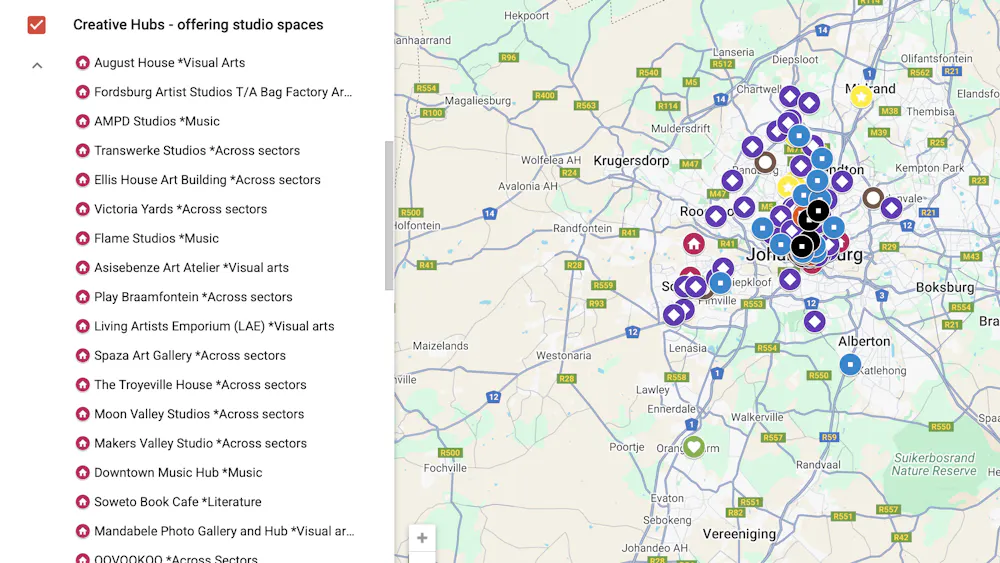
    Mapping Johannesburg’s creative hubs

    Unlike cities that are trying to reverse the exodus of creatives, Johannesburg’s inner city has seen a recent surge in creative hub development.

    A creative hub is a physical or digital space (in this case physical) designed to bring together cultural and creative professionals for studio space, collaboration, networking and the exchange of ideas.

    Over the last year, 21 creative hubs have been mapped in the city, the majority newly established. Notable examples include Transwerke Studios, Asisebenze Art Atelier, Victoria Yards and Oovookoo. Remarkably, 19 of the 21 hubs identified in my open-source mapping process are in the inner city. Only two are government run – Transwerke and Downtown Music Hub.

    Across Johannesburg, creative hubs buzz with independent activity, yet share a common commitment to cultivating talent, business support and community impact. They are evidence of innovative partnerships between creatives and property developers.

    Inside these spaces, artists and creatives get opportunities through gallerist and investor visits (access to markets). They build practical and entrepreneurial skills through tailored workshops. And they collaborate on projects that place social upliftment at their heart.

    Some hubs focus on offering studio spaces, while others extend their reach beyond their walls, blending artistic expression with community development and public engagement.

    By actively building community and opportunity, creative hubs are becoming

    lighthouses for the new urban economy.

    They are small business incubators, urban beautification engines and potential cultural tourism hotspots. An event like Contra Fair opens the doors of art studio hubs once a year. Entrepreneur and social activist Tebogo Moalusi has now taken the lead in the establishment of Creative20. This will become a platform for revitalising Johannesburg’s creative cities campaign.

    Neglected by the city

    And yet the cultural and creative industries remain almost entirely absent from the city’s strategic planning. The Johannesburg 2040: Growth and Development Strategy fails even to mention the sector.

    This is despite Gauteng, the province that houses Johannesburg, being the epicentre of South Africa’s creative economy. It contributes 46.3% of the industry’s gross domestic product and generates the highest employment impact. Johannesburg hosts the majority of creative businesses in the province.


    Read more:
    The real Johannesburg: 6 powerful photos from a gritty new book on the city


    The Gauteng 2030 Strategy highlights three high-growth sectors: agro-processing, cultural and creative industries, and high-tech/knowledge sectors, including digital and gaming. Two of these directly involve the creative economy. Yet there’s been little effort to integrate them into Johannesburg’s urban development agenda.

    If Johannesburg is serious about inclusive economic development and sustainable urban growth, it must recognise and invest in the cultural and creative industries which are already thriving within its borders.

    Mariapaola McGurk consults to Creative20 Organisation

    – ref. Johannesburg’s creative hubs are booming: how artists are rejuvenating a failing inner city – https://theconversation.com/johannesburgs-creative-hubs-are-booming-how-artists-are-rejuvenating-a-failing-inner-city-260224

    MIL OSI Analysis –

    July 22, 2025
  • MIL-OSI USA: NCDHHS, First Lady Anna Stein Celebrate Launch of Unshame NC, A Public Awareness Campaign to Reduce Stigma and Promote Evidence-Based Care for Substance Use Disorder

    Source: US State of North Carolina

    Headline: NCDHHS, First Lady Anna Stein Celebrate Launch of Unshame NC, A Public Awareness Campaign to Reduce Stigma and Promote Evidence-Based Care for Substance Use Disorder

    NCDHHS, First Lady Anna Stein Celebrate Launch of Unshame NC, A Public Awareness Campaign to Reduce Stigma and Promote Evidence-Based Care for Substance Use Disorder
    jawerner
    Fri, 07/18/2025 – 15:10

    The North Carolina Department of Health and Human Services and First Lady Anna Stein, in collaboration with Shatterproof, announced the launch of the Unshame North Carolina (Unshame NC) campaign to end stigma related to substance use disorder. Unshame NC has two primary goals: to increase knowledge and awareness of substance use disorder and medications for opioid use disorder (MOUD) as a treatment option.

    “Stigma is deeply rooted and causes real harm to people and communities across North Carolina,” said NC Health and Human Services Secretary Dev Sangvai. “Unshame NC is part of a collaborative effort from all of us to end stigma, build acceptance and increase support for treatment for people on their path to recovery.”

    Many people struggling with substance use don’t seek help because of stigma,” said North Carolina First Lady Anna Stein. “This campaign will highlight the stories of people who have experience with substance use disorder and recovery and bring greater awareness to effective methods of treatment for opioid use disorder.”

    NCDHHS and First Lady Stein launched Unshame NC this morning at the Wake County Drug Overdose Prevention Coalition meeting. The website, https://www.unshamenc.org/ includes testimonials from North Carolinians sharing their personal stories of substance use, hope and recovery. Facebook and Instagram content will help drive users to the website, which provides links to resources, including information on how to find the right treatment center, and guidance for providers and for family members seeking care for a loved one. NCDHHS contracted with national non-profit Shatterproof to develop and implement the Unshame NC campaign.

    Recent data from a statewide survey indicates 57% of North Carolinians know someone with opioid use disorder. Despite this widespread issue, only 34% of North Carolina residents know how to find quality treatment for themselves or their loved ones. Additionally, only one in five adults in North Carolina recognizes that opioid use disorder is a medical condition. These findings highlight the urgent need for comprehensive education that connects people to lifesaving resources and treatment.

    “There’s no better evidence that recovery is real than a life changed,” said Kelly Crosbie, MSW LCSW, NCDHHS Director of the Division of Mental Health, Developmental Disabilities and Substance Use Services. “We’re pairing the stories of people in recovery with a statewide effort to increase access to MOUD, so more people can benefit from evidence-based care. Real access means supporting people on the recovery journey that makes sense for them, without judgment—and offering them every opportunity for lifesaving treatment, that includes MOUD.”

    Unshame NC focuses on the voices and experiences of North Carolinians impacted by substance use disorder. Through storytelling, education, and grassroots activation, the campaign demonstrates that people with substance use disorder are valued members of our communities—our family, neighbors, and coworkers—and highlights actionable ways we can ensure everyone has the support they need to thrive.

    “While most North Carolinians believe that people with SUD can recover with treatment, stigma and misinformation can create barriers to care,” said Courtney McKeon, Senior Vice President for Shatterproof’s National Stigma Initiative and longtime resident of The Research Triangle. “We see this often regarding medications for opioid use disorder (MOUD), a gold standard of care. Through the stories of North Carolinians, we have the opportunity to increase understanding of all treatment options and support individuals on their path to improved health and wellness.”

    “It’s not just about overdoses. It’s not just about lives that were lost or lives that were saved,” says Michael, one of Unshame NC’s story sharers. “It’s also about how we treat the people who went through it and how we bring them out of the shadows. How do we welcome them back into society? How do we get them back to where we need to be? And that requires a lot of folks like me to speak out and help break the stigma.”

    People with substance use disorder flourish in environments that offer both community support and multiple pathways for treatment. If you want to share your story with NCDHHS and Unshame NC, you can get involved by filling out a Story Sharer Interest Form or joining the Unshame NC coalition. 

    Follow @UnshameNC on Facebook and Instagram or visit us at www.UnshameNC.org to hear people’s stories and learn more.

    If you or someone you know is in crisis, NCDHHS provides somewhere to go, someone to talk to and someone to respond. You can find the help that is right for you 24/7 on the NCDHHS Crisis Services website.

    The 988 Lifeline Chat and Text – 988 Suicide & Crisis Lifeline is free, confidential, and available to everyone 24/7 by call, text, or chat.

    North Carolinians can call the 24/7 Peer Warmline at 1-855-PEERS NC (855-733-7762) to speak with a Peer Support Specialist. Peer Support Specialists (or “peers”) are people living in recovery with mental illness and/or substance use disorder who provide support to others who may have similar life experiences and can benefit from their lived experiences. 

    The NC Recovery Helpline (800-688-4232) offers support and referrals for treatment and resources.

    ###

    About Shatterproof

    Shatterproof is a national nonprofit organization dedicated to reversing the addiction crisis in the U.S. Shatterproof is focused on guiding communities, removing systemic barriers to recovery, mobilizing the country to advocate for change, and ending stigma in the United States. Find Shatterproof on Facebook, X, and YouTube or follow us on Instagram. To learn more, visit www.Shatterproof.org.

    El Departamento de Salud y Servicios Humanos de Carolina del Norte (NCDHHS, por sus siglas en inglés) y la Primera Dama Anna Stein, en colaboración con Shatterproof, anunciaron el lanzamiento de la campaña Unshame North Carolina (Unshame NC) para poner fin al estigma relacionado con el trastorno por consumo de sustancias. Unshame NC tiene dos objetivos principales: aumentar el conocimiento y la conciencia del trastorno por consumo de sustancias y los medicamentos para el trastorno por consumo de opioides (MOUD) como opción de tratamiento.

    “El estigma está profundamente arraigado y causa un daño real a las personas y comunidades de Carolina del Norte”, dijo el secretario de Salud y Servicios Humanos de Carolina del Norte, Dev Sangvai. “Unshame NC es parte de un esfuerzo de colaboración de todos nosotros para poner fin al estigma, generar aceptación y aumentar el apoyo para el tratamiento de las personas en su camino hacia la recuperación”.

    Muchas personas que luchan con el uso de sustancias no buscan ayuda debido al estigma”, dijo la primera dama de Carolina del Norte, Anna Stein. “Esta campaña destacará las historias de las personas que tienen experiencia con el trastorno por consumo de sustancias y la recuperación y generará una mayor conciencia sobre los métodos efectivos de tratamiento para el trastorno por consumo de opioides”.

    NCDHHS y la Primera Dama Stein lanzaron Unshame NC esta mañana en la reunión de la Coalición de Prevención de Sobredosis de Drogas del Condado de Wake. El sitio web, https://www.unshamenc.org/ incluye testimonios de habitantes de Carolina del Norte que comparten sus historias personales sobre el uso de sustancias, la esperanza y la recuperación. El contenido de Facebook e Instagram ayudará a dirigir a los usuarios al sitio web, que proporciona enlaces a recursos, incluso la información sobre cómo encontrar el centro de tratamiento adecuado, y orientación para los proveedores y para los familiares que buscan atención para un ser querido. NCDHHS contrató a la organización nacional sin fines de lucro Shatterproof para desarrollar e implementar la campaña Unshame NC.

    Datos recientes de una encuesta estatal indican que el 57% de los habitantes de Carolina del Norte conocen a alguien con trastorno por consumo de opioides. A pesar de este problema generalizado, solo el 34% de los residentes de Carolina del Norte saben cómo encontrar un tratamiento de calidad para ellos o sus seres queridos. Además, solo uno de cada cinco adultos en Carolina del Norte reconoce que el trastorno por uso de opioides es una afección médica. Estos hallazgos resaltan la necesidad urgente de una educación integral que conecte a las personas con recursos y tratamientos que salvan vidas.

    “No hay mejor evidencia de que la recuperación es real que una vida cambiada”, dijo Kelly Crosbie, MSW LCSW, Directora de NCDHHS de la División de Salud Mental, Discapacidades del Desarrollo y Servicios de Uso de Sustancias. “Estamos combinando las historias de las personas en recuperación con un esfuerzo estatal para aumentar el acceso a medicamentos para el trastorno por uso de opioides (MOUD, por sus siglas en inglés), para que más personas puedan beneficiarse de la atención basada en la evidencia. El acceso real significa apoyar a las personas en el viaje de recuperación que tiene sentido para ellas, sin juzgarlas, y ofrecerles todas las oportunidades para un tratamiento que salve vidas, esto incluye MOUD”.

    Unshame NC se centra en las voces y experiencias de los habitantes de Carolina del Norte afectados por el trastorno por consumo de sustancias. A través de la narración de historias, la educación y la movilización popular, la campaña demuestra que las personas con trastorno por uso de sustancias son miembros valiosos de nuestras comunidades (nuestra familia, vecinos y compañeros de trabajo) y destaca las formas prácticas en que podemos garantizar que todos tengan el apoyo que necesitan para prosperar.

    “Si bien la mayoría de los habitantes de Carolina del Norte creen que las personas con trastornos por uso de sustancias (SUD, por sus siglas en inglés) pueden recuperarse con tratamiento, el estigma y la desinformación pueden crear barreras para la atención”, dijo Courtney McKeon, vicepresidenta senior de la Iniciativa Nacional de Estigma de Shatterproof (Shatterproof’s National Stigma Initiative) y habitante desde hace mucho tiempo del Research Triangle. “Vemos esto a menudo con respecto a los medicamentos para el trastorno por uso de opioides (MOUD), un estándar de oro de atención. A través de las historias de los habitantes de Carolina del Norte, tenemos la oportunidad de aumentar la comprensión de todas las opciones de tratamiento y apoyar a las personas en su camino hacia una mejor salud y bienestar”.

    “No se trata solo de sobredosis. No se trata solo de vidas que se perdieron o de vidas que se salvaron”, dice Michael, uno de los participantes de la historia de Unshame NC. “También se trata de cómo tratamos a las personas que pasaron por eso y cómo las sacamos de las sombras. ¿Cómo los recibimos de nuevo a la sociedad? ¿Cómo conseguir que vuelvan a estar a donde tenemos que estar? Y eso requiere que mucha gente como yo hable y ayude a romper el estigma”.

    Las personas con trastorno por uso de sustancias prosperan en entornos que ofrecen tanto apoyo comunitario como múltiples vías de tratamiento. Si quiere compartir su historia con NCDHHS y Unshame NC, puedes participar completando un Formulario de interés para compartir historias o uniéndose a la coalición Unshame NC. 

    Siga @UnshameNC en Facebook y Instagram o visítenos en el sitio web; www.UnshameNC.org para escuchar las historias de las personas y obtener más información.

    Si usted o alguien que conoce está en crisis, NCDHHS proporciona un lugar a donde ir, alguien con quien hablar y alguien quien responde. Puede encontrar la ayuda adecuada para usted las 24 horas del día, los 7 días de la semana en el sitio web de Servicios de crisis de NCDHHS.

    La línea 988 de Prevención del Suicidio y Crisis (988 Lifeline Chat and Text – 988 Suicide & Crisis Lifeline) es gratuita, confidencial y está disponible para todos 24/7 por llamada, mensaje de texto o chat.

    Los habitantes de Carolina del Norte pueden llamar a la Línea de Ayuda de Pares al 1-855-PEERS NC (855-733-7762) para hablar con un Especialista en Apoyo de Pares. Los especialistas en apoyo entre pares (o “pares”) son personas que viven en recuperación con enfermedades mentales y/o trastornos por uso de sustancias quienes brindan apoyo a otras personas que pueden tener experiencias de vida similares y pueden beneficiarse de sus experiencias vividas. La línea de ayuda para Recuperación NC (NC Recovery Helpline) (800-688-4232) ofrece apoyo y referencias para tratamiento y recursos.

    ###

    Acerca de Shatterproof

    Shatterproof es una organización nacional sin fines de lucro dedicada a revertir la crisis de adicción en los EE. UU. Shatterproof se centra en guiar a las comunidades, eliminar las barreras sistémicas para la recuperación, movilizar al país para abogar por el cambio y poner fin al estigma en los Estados Unidos. Encuentra Shatterproof en Facebook, X y YouTube o síguenos en Instagram. Para obtener más información, visita www.Shatterproof.org.

    Jul 21, 2025

    MIL OSI USA News –

    July 22, 2025
  • MIL-OSI Security: Giovanni Vicente Mosquera Serrano Added to FBI’s Ten Most Wanted Fugitives List

    Source: US FBI

    In June 2025, the U.S. District Court for the Southern District of Texas issued a federal arrest warrant for Mosquera Serrano after he was charged with conspiring to provide and providing material support to a foreign terrorist organization, as well as conspiracy and distribution of cocaine in Colombia intended for distribution in the U.S.

    Formed in the early 2010s, TdA has recently exploded in membership and criminal activity in the U. S.

    “At first, TdA was primarily composed of former inmates and individuals from Venezuela,” said Soyez. “Over time, the gang and the organization evolved. They became a more structured and powerful criminal group involved in various activities, including drug trafficking, extortion, and human trafficking.”

    The gang’s influence has spread throughout Latin America and into the U.S., and they have established major networks for drug distribution, weapons trafficking, and human trafficking—and have even partnered with other criminal organizations.

    For law enforcement trying to protect their communities, this transnational organized crime system creates a challenge.

    “What we’ve seen over time, as we look back in our history dealing with transnational organized crime, is how quickly these criminal organizations can spread,” said Soyez. “We know the instability they can cause to our cities and our communities, and so I think from the FBI’s perspective, it’s something we want to be ahead of.”

    The FBI and law enforcement partners are focused on finding these dangerous criminals and bringing justice to victims of their crimes. Adding Mosquera Serrano to the Ten Most Wanted Fugitives list provides an opportunity for law enforcement to work with the public in fighting transnational organized crime across the country.

    “With TdA, we’ve seen instances of extreme violence and intimidation, causing a terror in our communities,” said Soyez. “Naming Mosquera Serrano as a Top Ten fugitive really highlights TdA and shows our aggressiveness to go after its leadership.”

    Mosquera Serrano is 37 years old and has black hair and brown eyes. He is a Venezuelan national and speaks Spanish. Aliases include Jhovanni San Vicente, “El Viejo,” and Jhovanni Vicente Mosquera Serrano.

    Investigators believe that Mosquera Serrano may be in Venezuela or Colombia and that he should be considered armed and dangerous.

    “The FBI, along with our federal partners and international partners, can seek justice in foreign countries, and so, we would encourage those with any information, whether it’s inside the U.S. or another country, to please report that information because the FBI has the ability to bring justice and arrest Mosquera Serrano, even if it’s not within the United States,” said Soyez.

    If you have any information about Mosquera Serrano, please contact your local FBI office or the nearest American embassy or consulate or call the FBI at 1-800-CALL-FBI (1-800-225-5324). You can also submit a tip online at tips.fbi.gov or contact the FBI via WhatsApp at 571-379-3951. WhatsApp is neither a government-operated nor a government-controlled platform.

    MIL Security OSI –

    July 22, 2025
  • MIL-OSI Security: NATO Secretary General highlights new opportunity for support at Ukraine Defence Contact Group meeting

    Source: NATO

    On Monday (21 July 2025) NATO Secretary General Mark Rutte took part in an online meeting of the Ukraine Defence Contact Group (UDCG). The meeting was hosted by the German Minister of Defence, Boris Pistorius, and the UK Defence Secretary, John Healey.

    Speaking to Defence Ministers who joined for the meeting, the Secretary General highlighted the initiative that he and US President Donald J Trump announced last week to boost support for Ukraine by opening additional US assets to Ukraine through investment by Allies in Europe and Canada. This new initiative is open-ended and has already seen numerous Allies express interest in contributing. It complements a range of other initiatives through which Allies support Ukraine and provides new access to US equipment and technology that Ukraine has requested for urgent delivery. This voluntary effort will be coordinated by NATO, given the experience and infrastructure the Alliance provides, including through its command in Wiesbaden, Germany – NATO Security Assistance and Training for Ukraine (NSATU) – that is already coordinating support for Ukraine and has logistical hubs in the eastern part of the Alliance. The UDCG will also continue to play a vital role.

    This initiative and others bring together the three key decisions made by leaders at the NATO Summit in The Hague just a few weeks ago: increasing defence investment, ramping up defence production, and supporting Ukraine. The aim of all Allied security assistance to Ukraine is to bring the conflict to a just and lasting end as quickly as possible.

    MIL Security OSI –

    July 22, 2025
  • MIL-OSI Africa: African media are threatened by governments and big tech – book tracks the latest trends

    Source: The Conversation – Africa – By Hayes Mabweazara, Senior Lecturer in Sociological & Cultural Studies (Media, Culture & Society), University of Glasgow

    Media capture happens when media outlets lose their independence and fall under the influence of political or financial interests. This often leads to news content that favours power instead of public accountability.

    Media Capture in Africa and Latin America: Power and Resistance is a new book edited by news media scholars Hayes Mawindi Mabweazara and Bethia Pearson. It explores how this dynamic plays out in the global south and how journalists and citizens are resisting it. We asked them four questions.


    What is media capture and how has it reshaped itself in recent times?

    Media capture describes how media outlets are influenced, manipulated or controlled by powerful actors – often governments or large corporations – to serve their interests. It’s an idea that helps us understand how powerful groups in society can have a negative influence on news media. While this idea isn’t new, what has changed is how subtly and pervasively it now operates.

    These groups include big technology organisations that own digital media platforms – such as X, owned by xAI (Elon Musk), and Instagram and Facebook, owned by Meta. But it’s also important to consider Google as a large search engine that shapes the news content and audience of many other platforms.

    Palgrave Macmillan

    This matters because the media are important for the functioning of democratic societies. Ideally, they provide information, represent different groups and issues in society, and hold powerful actors to account.

    For example, one of the key roles of the media is to provide accurate information for citizens to be able to decide how to vote in elections. Or to decide what they think about important issues. One big concern, then, is the effect of inaccurate or biased information on democracy.

    Or it might be that accurate information is harder to access because algorithms and platforms make it easier to access inaccurate or biased information. These can be intended and unintended consequences of the technology itself, but algorithms can amplify misinformation and fake news – especially if this content has the potential to go viral.

    So, what’s particular about media capture in the global south?

    This is a really interesting question that is still being investigated, but we have some ideas.

    First of all, it’s useful to know that media capture scholarship from the global north emerged around the time of the 2008 financial crisis. The influence of financial institutions on business journalists was one of the first areas of study. Since then, research in the US has focused on the capture of government-funded media organisations like Voice of America. And on how digital platforms like Google and Facebook can lead to capture.

    In the global south, scholars have drawn attention to the importance of large media corporations in understanding media capture. For example, in Latin America, there’s a high level of what’s called “media concentration”. This is when many media outlets are owned by a few companies. These companies often own companies in other sectors, which means that critical reporting on business interests presents a conflict of interest.


    Read more: Public trust in the media is at a new low: a radical rethink of journalism is needed


    But to focus on Africa, scholars have drawn attention to governments as a source of pressure on journalists and editors. This can be through direct pressure or what we might call “covert” pressure. Withholding advertising that helps to fund media outlets is an example, or offering financial incentives to stop investigating certain topics.

    Researchers are also concerned about the influence of big tech in Africa. Digital platforms like Google and Facebook can shape the news and information that citizens have access to.

    Can you share some of the studies from the book?

    Our book includes many interesting studies – from Colombia, Brazil and Mexico in Latin America to Ethiopia and Morocco in Africa. We’ll share a few African cases here to give an overview of the issues.

    The book’s contribution on Ghana warns us that although more overt “old” types of media capture may have subsided, transitional democracies can feature messier, more nuanced forms of media control. This can be evident in government pressures and through capture of regulators.

    In the Morocco chapter, we see the threat to media freedom presented by digital platforms owned by global tech giants. This is known as “infrastructural capture”. It means news organisations become dependent on tech giants to set the rules of the game for democratic communication.

    Another compelling case is Nigeria, where researchers explore ties between media ownership and political patronage. The authors argue that the Nigerian press is failing in its democratic duty because of its reliance on advertising and sponsorship income from the state. Added to this are ineffective regulatory mechanisms and close relationships with some big businesses that own newspapers and printing presses.

    How can media capture be resisted in the global south?

    The studies in the book show some ways forward and we do think it’s important to be optimistic! Resistance takes many forms. Sometimes it comes through legal and policy reform aimed at increasing transparency and media diversity. In other cases, it’s driven by social movements, investigative journalists and independent media who continue to operate under pressure.

    The chapter on Uganda shows that journalist groups working with media advocacy organisations can strategically act to resist government media capture and harmful regulations. For example, to push back against one legislative change, several groups formed a temporary network called Article 29 (named after the article in the Ugandan constitution protecting free speech) and the African Centre for Media Excellence produced a report criticising the proposed changes.


    Read more: Western media outlets are trying to fix their racist, stereotypical coverage of Africa. Is it time African media did the same?


    One of the chapters on Ghana also shows how networks such as journalists, media associations, human rights groups and legal organisations can mobilise to push back against government influence. Organisations including the Ghana Journalists Association and Ghana Independent Broadcasters Association have played key roles in, for example, taking the media regulator to court to overturn laws that would have led to censorship. These findings are echoed in Latin America, where research on Mexico and Colombia also found professional journalism to be a strong source of resistance.

    The conversation must also include rethinking how we define capture itself. If we frame it only as total control, we risk missing the everyday ways influence operates – and the spaces where it can be resisted. We would also say it’s really important that citizens are aware and alert to the issues when they think about how they access news media and what platforms they use. This is sometimes called “media literacy” and is about people being more knowledgeable about where trustworthy news comes from.


    You can listen to a podcast about the book over here.

    – African media are threatened by governments and big tech – book tracks the latest trends
    – https://theconversation.com/african-media-are-threatened-by-governments-and-big-tech-book-tracks-the-latest-trends-258017

    MIL OSI Africa –

    July 22, 2025
  • MIL-OSI Africa: Johannesburg’s creative hubs are booming: how artists are rejuvenating a failing inner city

    Source: The Conversation – Africa – By Mariapaola McGurk, Lecturer in Innovation & Entrepreneurship, University of Auckland, Waipapa Taumata Rau

    Johannesburg is weathering a storm of crises. Nowhere is its complex tangle of challenges more visible than in the inner city, where crime, overcrowding, and infrastructure collapse – such as roads literally exploding – paint a grim picture. Cultural institutions haven’t been spared either, with long-standing landmarks like the Johannesburg Art Gallery caught in cycles of neglect and crisis.


    Read more: South Africa doesn’t need new cities: it needs to focus on fixing what it’s got


    Yet, while many avoid the inner city or speak only of its decline, the creative and cultural practitioners of Johannesburg never left. In fact, artists, architects, fashion designers, animators, musicians and the like have been hard at work. They’re building, dreaming and shaping a new urban reality that could become the beacon of hope this city needs.

    As a researcher and visual artist, I recently completed a PhD study that focused on Johannesburg’s cultural and creative industries. My research revealed that a clear understanding of the existing structures and dynamics within this industry is essential for developing effective strategies to strengthen its role in local economic development.

    Here I explore one such opportunity: creative hubs. I argue that they represent a low-hanging fruit for the inner city’s growth and revitalisation.

    Urban renewal

    Numerous articles have explored strategies for the city’s economic development and urban renewal. One group of scholars recently outlined four critical focus areas: coordinated efforts across government levels; an active civil society; a shift in political culture; and restored leadership in a revitalised administration.

    These are vital interventions, but they still beg a deeper question. What is the new “gold” of the “City of Gold”, the mining town founded in 1886 and on track to become a megacity by 2030?

    Work by artist Candice Kramer at Bag Factory Artists Studios. Mark Straw

    What is it that truly sets Johannesburg apart, nationally and globally? What strengths already exist that, if nurtured, could help address the city’s challenges? The answer may not lie in building something entirely new, but in recognising and investing in what already thrives. The city’s people, its culture, and its extraordinary creativity.

    In 2004, Unesco launched the Creative Cities Network. Today it comprises 246 cities in 80 member states. South Africa has three cities in the network: Cape Town (design), Durban (literature) and Overstrand (gastronomy). Johannesburg has never applied to belong.

    Cities are acknowledging the economic and social value of the cultural and creative industries, particularly in addressing challenges such as youth unemployment, micro-enterprise growth, equity and community development.

    Artist Mankebe Seakoe at Contra Fair. Mark Straw

    Yet cities globally are grappling with how to retain creative professionals. This is the case in cities like Toronto, Sydney, Los Angeles, Cologne or Barcelona. Rising property prices, the redevelopment of industrial areas into commercial or luxury spaces, and short-term rental agreements are displacing these professionals from the urban cores they help energise. Cities are coming up with incentives and programmes to correct this.

    A recent World Cities Cultural Forum report offers a solution in the form of Creative Land Trusts. These permanently hold land and assets at affordable rates for creatives. They take property out of speculative real estate markets. They’re designed to support not galleries or theatres, but the studios and workspaces where creative production actually happens.

    Similar initiatives are happening in London, Helsinki and San Francisco.

    Mapping Johannesburg’s creative hubs

    Unlike cities that are trying to reverse the exodus of creatives, Johannesburg’s inner city has seen a recent surge in creative hub development.

    A creative hub is a physical or digital space (in this case physical) designed to bring together cultural and creative professionals for studio space, collaboration, networking and the exchange of ideas.

    Some creative hubs offer gallery spaces. Mark Straw

    Over the last year, 21 creative hubs have been mapped in the city, the majority newly established. Notable examples include Transwerke Studios, Asisebenze Art Atelier, Victoria Yards and Oovookoo. Remarkably, 19 of the 21 hubs identified in my open-source mapping process are in the inner city. Only two are government run – Transwerke and Downtown Music Hub.

    Across Johannesburg, creative hubs buzz with independent activity, yet share a common commitment to cultivating talent, business support and community impact. They are evidence of innovative partnerships between creatives and property developers.

    Mapping Johannesburg’s creative hubs. Google Maps/Mariapaola McGurk

    Inside these spaces, artists and creatives get opportunities through gallerist and investor visits (access to markets). They build practical and entrepreneurial skills through tailored workshops. And they collaborate on projects that place social upliftment at their heart.

    Some hubs focus on offering studio spaces, while others extend their reach beyond their walls, blending artistic expression with community development and public engagement.

    By actively building community and opportunity, creative hubs are becoming

    lighthouses for the new urban economy.

    They are small business incubators, urban beautification engines and potential cultural tourism hotspots. An event like Contra Fair opens the doors of art studio hubs once a year. Entrepreneur and social activist Tebogo Moalusi has now taken the lead in the establishment of Creative20. This will become a platform for revitalising Johannesburg’s creative cities campaign.

    Neglected by the city

    And yet the cultural and creative industries remain almost entirely absent from the city’s strategic planning. The Johannesburg 2040: Growth and Development Strategy fails even to mention the sector.

    Bag Factory Artists Studios hosting a public event. Mark Straw

    This is despite Gauteng, the province that houses Johannesburg, being the epicentre of South Africa’s creative economy. It contributes 46.3% of the industry’s gross domestic product and generates the highest employment impact. Johannesburg hosts the majority of creative businesses in the province.


    Read more: The real Johannesburg: 6 powerful photos from a gritty new book on the city


    The Gauteng 2030 Strategy highlights three high-growth sectors: agro-processing, cultural and creative industries, and high-tech/knowledge sectors, including digital and gaming. Two of these directly involve the creative economy. Yet there’s been little effort to integrate them into Johannesburg’s urban development agenda.

    If Johannesburg is serious about inclusive economic development and sustainable urban growth, it must recognise and invest in the cultural and creative industries which are already thriving within its borders.

    – Johannesburg’s creative hubs are booming: how artists are rejuvenating a failing inner city
    – https://theconversation.com/johannesburgs-creative-hubs-are-booming-how-artists-are-rejuvenating-a-failing-inner-city-260224

    MIL OSI Africa –

    July 22, 2025
  • MIL-OSI Africa: Ghana has a rare treasure, a crater made when a meteor hit Earth: why it needs to be protected

    Source: The Conversation – Africa – By Marian Selorm Sapah, Senior lecturer, University of Ghana

    Impact craters are formed when an object from space such as a meteoroid, asteroid or comet strikes the Earth at a very high velocity. This leaves an excavated circular hole on the Earth’s surface.

    It is a basic geological process that has shaped the planets from their formation to today. It creates landscapes and surface materials across our solar system. The moon is covered with them, as are planets like Mercury, Mars and Venus. On Earth, impacts have influenced the evolution of life and even provided valuable mineral and energy resources. However, very few of the impact craters on Earth are visible because of various processes that obscure or erase them.

    Most of the recognised impact craters on Earth are buried under sediments or have been deeply eroded. That means they no longer preserve their initial forms.

    The Bosumtwi impact crater in Ghana is different, however. It is well preserved (not deeply eroded or buried under sediments). Its well-defined, near-circular basin, filled by a lake, is surrounded by a prominent crater rim that rises above the surface of the lake and an outer circular plateau. This makes it a target for several research questions.

    As an Earth scientist, I joined a research team from 2019 to better understand the morphology of the crater. We carried out a morphological analysis of the crater (a study of its form, structure and geological features).

    This study concluded that the activities of illegal miners are a threat to the sustainability of the crater. We also discovered that the features of the Bosumtwi impact crater can be considered as a terrestrial representation for a special type of impact crater known as rampart craters. These are common on the planets Mars and Venus and are found on icy bodies of the outer solar system (like Ganymede, Europa, Dione, Tethys and Charon).

    For future studies, the Bosumtwi impact crater can be used to help understand how rampart craters form on Mars and Venus. So the Bosumtwi impact crater should be protected and preserved.


    Read more: Curious Kids: Why are there so few impact craters on Earth?


    The crater

    The Bosumtwi impact crater is in Ghana’s mineral-rich Ashanti gold belt. It is the location of the only natural inland lake in Ghana. As one of the world’s best-preserved young meteorite impact craters it is designated as an International Union of Geological Sciences geoheritage site.

    It is one of only 190 confirmed impact crater sites worldwide, one of only 20 on the African continent. Its lake is one of six meteoritic lakes in the world, recognised for their outstanding scientific value.

    Satellite view of the Bosumtwi Impact Crater showing areas of Artisanal and Small scale Gold Mining activities. David Baratoux

    At almost 1.07 million years old, the crater offers unparalleled opportunities for studying impact processes, climate history and planetary evolution. It’s an irreplaceable natural laboratory for researchers and educators.

    Beyond its scientific importance, the crater holds cultural significance for the Ashanti people of Ghana. The lake at its centre serves as a sacred site and spiritual landmark. The crater’s breathtaking landscape also supports eco-tourism and local livelihoods, contributing to Ghana’s economic development while maintaining exceptional aesthetic value.

    The research

    As part of further research work on the 2019 study, in 2025 we have discovered through field work and satellite data analysis that illegal artisanal mining is prevalent in the area and threatening the crater. This refers to informal, labour-intensive extraction of minerals, primarily gold. It is conducted by individuals or small groups using basic tools and rudimentary machinery. The use of toxic chemicals such as mercury and cyanide, and practices such as river dredging, cause severe environmental harm.

    Illegal miners are encroaching on and around the crater rim, posing severe threats to its environment and sustainability. Their activities have become more prevalent over the course of less than 10 years, indicating a growing problem. If unchecked, it could lead to irreversible damage to the crater.

    These mining operations risk contaminating the lake with toxic heavy metals. The consequences of these are grave. They include destroying critical geological evidence, accelerating deforestation, and degrading the land. All this damages the crater’s scientific, cultural and economic value.

    The International Union of Geological Sciences geoheritage designation of the crater underscores the urgent need for protection measures. The loss of this rare geological wonder would represent not just a national tragedy for Ghana, but a blow to global scientific heritage.

    Immediate action is required. This includes enhanced satellite monitoring (tracking illegal mining, deforestation and environmental changes) using optical imagery (such as Sentinel-2, Landsat, PlanetScope). These tools can detect forest loss, identify mining pits and sediment runoff, and analyse changes over time.

    Stricter enforcement of mining bans, and community engagement programmes, will help preserve the Bosumtwi impact crater’s unique attributes for future generations of scientists, students, tourists and local communities who depend on its resources.

    – Ghana has a rare treasure, a crater made when a meteor hit Earth: why it needs to be protected
    – https://theconversation.com/ghana-has-a-rare-treasure-a-crater-made-when-a-meteor-hit-earth-why-it-needs-to-be-protected-260600

    MIL OSI Africa –

    July 22, 2025
  • MIL-OSI Africa: Africa’s minerals are being bartered for security: why it’s a bad idea

    Source: The Conversation – Africa – By Hanri Mostert, SARChI Chair for Mineral Law in Africa, University of Cape Town

    A US-brokered peace deal between the Democratic Republic of Congo (DRC) and Rwanda binds the two African nations to a worrying arrangement: one where a country signs away its mineral resources to a superpower in return for opaque assurances of security.

    The peace deal, signed in June 2025, aims to end three decades of conflict between the DRC and Rwanda.

    A key part of the agreement binds both nations to developing a regional economic integration framework. This arrangement would expand cooperation between the two states, the US government and American investors on “transparent, formalized end-to-end mineral chains”.

    Despite its immense mineral wealth, the DRC is among the five poorest countries in the world. It has been seeking US investment in its mineral sector.

    The US has in turn touted a potential multi-billion-dollar investment programme to anchor its mineral supply chains in the traumatised and poor territory.

    The peace that the June 2025 deal promises, therefore, hinges on chaining mineral supply to the US in exchange for Washington’s powerful – but vaguely formulated – military oversight.

    The peace agreement further establishes a joint oversight committee – with representatives from the African Union, Qatar and the US – to receive complaints and resolve disputes between the DRC and Rwanda.

    But beyond the joint oversight committee, the peace deal creates no specific security obligations for the US.

    The relationship between the DRC and Rwanda has been marred by war and tension since the bloody First (1996-1997) and Second (1998-2003) Congo wars. At the heart of much of this conflict is the DRC’s mineral wealth. It has fuelled competition, exploitation and armed violence.

    This latest peace deal introduces a resources-for-security arrangement. Such deals aren’t new in Africa. They first emerged in the early 2000s as resources-for-infrastructure transactions. Here, a foreign state would agree to build economic and social infrastructure (roads, ports, airports, hospitals) in an African state. In exchange, it would get a major stake in a government-owned mining company. Or gain preferential access to the host country’s minerals.

    We have studied mineral law and governance in Africa for more than 20 years. The question that emerges now is whether a US-brokered resources-for-security agreement will help the DRC benefit from its resources.

    Based on our research on mining, development and sustainability, we believe this is unlikely.

    This is because resources-for-security is the latest version of a resource-bartering approach that China and Russia pioneered in countries such as Angola, the Central African Republic and the DRC.

    Resource bartering in Africa has eroded the sovereignty and bargaining power of mineral-rich nations such as the DRC and Angola.

    Further, resources-for-security deals are less transparent and more complicated than prior resource bartering agreements.

    DRC’s security gaps

    The DRC is endowed with major deposits of critical minerals like cobalt, copper, lithium, manganese and tantalum. These are the building blocks for 21st century technologies: artificial intelligence, electric vehicles, wind energy and military security hardware. Rwanda has less mineral wealth than its neighbour, but is the world’s third-largest producer of tantalum, used in electronics, aerospace and medical devices.

    For almost 30 years, minerals have fuelled conflict and severe violence, especially in eastern DRC. Tungsten, tantalum and gold (referred to as 3TG) finance and drive conflict as government forces and an estimated 130 armed groups vie for control over lucrative mining sites. Several reports and studies have implicated the DRC’s neighbours – Rwanda and Uganda – in supporting the illegal extraction of 3TG in this region.

    The DRC government has failed to extend security over its vast (2.3 million square kilometres) and diverse territory (109 million people, representing 250 ethnic groups). Limited resources, logistical challenges and corruption have weakened its armed forces.

    This context makes the United States’ military backing enormously attractive. But our research shows there are traps.

    What states risk losing

    Resources-for-infrastructure and resources-for-security deals generally offer African nations short-term stability, financing or global goodwill. However, the costs are often long-term because of an erosion of sovereign control.

    Here’s how this happens:

    Examples of loss or near-loss of sovereignty from these sorts of deals abound in Africa.

    For instance, Angola’s US$2 billion oil-backed loan from China Eximbank in 2004. This was repayable in monthly deliveries of oil, with revenues directed to Chinese-controlled accounts. The loan’s design deprived Angolan authorities of decision-making power over that income stream even before the oil was extracted.

    These deals also fragment accountability. They often span multiple ministries (such as defence, mining and trade), avoiding robust oversight or accountability. Fragmentation makes resource sectors vulnerable to elite capture. Powerful insiders can manipulate agreements for private gain.

    In the DRC, this has created a violent kleptocracy, where resource wealth is systematically diverted away from popular benefit.

    Finally, there is the risk of re-entrenching extractive trauma. Communities displaced for mining and environmental degradation in many countries across Africa illustrate the long-standing harm to livelihoods, health and social cohesion.

    These are not new problems. But where extraction is tied to security or infrastructure, such damage risks becoming permanent features, not temporary costs.

    What needs to change

    Critical minerals are “critical” because they’re hard to mine or substitute. Additionally, their supply chains are strategically vulnerable and politically exposed. Whoever controls these minerals controls the future. Africa must make sure it doesn’t trade that future away.

    In a world being reshaped by global interests in critical minerals, African states must not underestimate the strategic value of their mineral resources. They hold considerable leverage.

    But leverage only works if it is wielded strategically. This means:

    • investing in institutional strength and legal capacity to negotiate better deals

    • demanding local value creation and addition

    • requiring transparency and parliamentary oversight for minerals-related agreements

    • refusing deals that bypass human rights, environmental or sovereignty standards.

    Africa has the resources. It must hold on to the power they wield.

    – Africa’s minerals are being bartered for security: why it’s a bad idea
    – https://theconversation.com/africas-minerals-are-being-bartered-for-security-why-its-a-bad-idea-260594

    MIL OSI Africa –

    July 22, 2025
  • MIL-OSI Africa: Unlocking Africa’s E-Mobility Future: Upcoming Webinar on Public Transport Electrification

    Source: APO

    Electrifying public transport is no longer just an aspiration for Africa—it is rapidly becoming a reality. On Wednesday, 23 July 2025, stakeholders from across the continent and beyond will convene virtually to explore the path forward in a high-impact webinar where industry experts discuss “The Future of Public Transport Electrification in Africa: Opportunities, Trends and Challenges.”

    The webinar will focus on unlocking practical solutions and scalable models to accelerate the shift to zero-emission mobility—particularly electric buses and paratransit systems, which form the backbone of Africa’s urban mobility landscape.

    Key Themes:

    • Energy and Charging Infrastructure
      Practical strategies for grid preparedness, depot-based and on-route charging, and strengthening public-private collaboration.
    • Innovative Procurement Models
      An exploration of models such as leasing, pay-as-you-go, and city-led ownership—what’s working, and where?
    • Electrifying Paratransit
      Addressing one of Africa’s most vital and informal transport systems—minibus taxis and other modes—and how e-mobility can integrate meaningfully into this space.

    Moderator:

    Prian Reddy, Senior Programme Manager: Zero Emission Buses (Africa), C40 Cities

    Expert Panel:

    • Hans van Toor, Strategy & Innovation, Roam
    • Moses Nderitu, Managing Director, BasiGo
    • Justin Coetzee, Founder, GoMetro

    Why You Should Attend:

    • Hear real-world insights from cities and transport operators already rolling out electric buses.
    • Learn about infrastructure readiness, energy strategies, and funding models fit for African cities.
    • Explore how electrification can include and uplift paratransit and informal transport sectors.
    • Connect with the experts and decision-makers shaping Africa’s low-carbon transport future.

    This event is designed for public officials, transport authorities, urban planners, mobility innovators, infrastructure investors, and all professionals interested in the continent’s clean, just energy transition.

    Join us for a crucial conversation that will help define the next phase of Africa’s transport transformation.

    Date: Wednesday, 23 July 2025
    Time: 10:00 WAT / 11:00 SAST & CAT / 12:00 EAT
    Register here: https://apo-opa.co/44GYAlJ

    Distributed by APO Group on behalf of VUKA Group.

    Additional Information:
    Link to Webinar: https://apo-opa.co/44GYAlJ 
    LinkedIN: https://apo-opa.co/4f24pxt 
    Website: https://apo-opa.co/40vphHw 
    Draft Programme: https://apo-opa.co/4f0Nxr4

    Media files

    .

    MIL OSI Africa –

    July 22, 2025
←Previous Page
1 … 215 216 217 218 219 … 5,172
Next Page→
NewzIntel.com

NewzIntel.com

MIL Open Source Intelligence

  • Blog
  • About
  • FAQs
  • Authors
  • Events
  • Shop
  • Patterns
  • Themes

Twenty Twenty-Five

Designed with WordPress