Category: AM-NC

  • MIL-Evening Report: The ‘singles tax’ means you often pay more for going it alone. Here’s how it works

    Source: The Conversation (Au and NZ) – By Alicia Bubb, Research & Teaching Sessional Academic, RMIT University

    lightman_pic/Shutterstock

    Heard of the “singles tax”? Going it alone can also come with a hidden financial burden you may not be aware of.

    Obviously, this isn’t an official levy paid to anyone in particular. It simply refers to the higher costs single people face compared to couples or families.

    Single-person households have been on the rise in Australia. It’s projected they’ll account for up to 28% of all households in 2046.

    People are marrying later, divorce rates remain high and an ageing population means more people live alone in older age. Many people also make a conscious decision to remain single, seeing it as a sign of independence and empowerment.

    This is part of a global trend, with singledom increasing in Europe, North America and Asia.

    So, how does the singles tax work – and is it worse for some groups than others? What, if anything, can we do about it?

    Why does being single cost more?

    One of the biggest drivers of the singles tax is the inability to split important everyday costs. For example, a single person renting a one-bedroom apartment has to bear the full cost, while a couple sharing it can split the rent.

    Being single can mean not being being able to split living costs like groceries.
    Gorodenkoff/Shutterstock

    Singles often miss out on the savings from bulk grocery purchases, as larger households consume more and can take better advantage of these deals.

    Fixed costs for a house like electricity, water and internet bills often don’t increase by much when you add an extra user or two. Living alone means you pay more.

    These are all examples of how couples benefit from economies of scale – the cost advantage that comes from sharing fixed or semi-fixed expenses – simply by living together.

    My calculations, based on the most recent data from the Australian Bureau of Statistics (ABS), show that singles spend about 3% more per person on goods and services compared to couples.

    Compared to couples with children, single parents spend about 19% more per person. While government support mechanisms such as the child care subsidy exist, many single parents find them insufficient, especially if they work irregular hours.

    Beyond the essentials

    The singles tax extends beyond our “essential needs” and into the costs of travel, socialising and entertainment.

    Solo travellers, for example, may encounter something called a “single supplement” – an extra fee charged for utilising an accommodation or travel product designed for two people.

    Streaming services such as Netflix and Spotify offer family plans at slightly higher prices than individual ones, making them more cost-effective for larger households.

    Couples and families can easily split fixed costs, such as streaming subscriptions.
    Vantage_DS/Shutterstock

    A global phenomenon

    Reports from around the world paint a similar picture.

    In the United States, research by real estate marketplace Zillow found singles pay on average US$7,000 ($A11,100) more annually for housing, compared to those sharing a two-bedroom apartment.

    In Europe, higher living costs and limited government supports put singles at a disadvantage. And in Canada, singles report feeling the pinch of rising rent and grocery prices.

    The tax systems of many countries can amplify the financial burden of being single, by favouring couples and families.

    In the United States, for example, tax policies intended to alleviate poverty often exclude childless adults, disproportionately taxing them into poverty.

    The Earned Income Tax Credit (EITC) reduces tax liabilities by providing refundable credits to low-income workers. It’s had some significant benefits for families, but offers minimal support to single, childless individuals.

    Many tax structures disadvantage single-person households.
    WPixz/Shutterstock

    As economist Patricia Apps argues, tax and transfer policies often fail to account for the complexities of household income distribution.

    These systems favour traditional family structures by providing benefits like spousal offsets or joint income tax breaks. Single individuals and single-parent households are left bearing a disproportionate financial burden.

    Who is affected the most?

    The singles tax disproportionately impacts women, who are more likely to live alone than men.

    This can compound existing financial pressures such as the gender pay gap, taking career breaks, and societal expectations leaving them with lower retirement savings.

    For older women, the singles tax adds another layer of difficulty to maintaining financial security.

    And it can seriously exacerbate financial pressures on single mothers. Many rely on child support payments, which are often inconsistent or inefficient, leaving them financially vulnerable.

    Working part-time or in casual roles due to caregiving responsibilities further limits their earning potential.

    Single mothers may be disproportionately impacted by the singles tax.
    Drazen Zigic/Shutterstock

    There are unique challenges for single men, too, who may lack the same access to family-oriented subsidies and workplace flexibility. Single men may also face societal expectations to spend more on dating or socialising.

    Alarmingly, men are disproportionately represented among the homeless population, making up 55.9% of people experiencing homelessness, and single men have a higher risk of premature death.

    Growing recognition

    While the singles tax highlights big systemic inequities, there are signs the issue is receiving more attention.

    Some advocacy groups are pushing for better financial protections and child support reforms for single mothers.

    Similarly, efforts to address homelessness have gained momentum, with increased attention to advocacy and services for single men facing housing insecurity.

    There is also the potential to design tax systems to reduce these inequities. Tax systems that treat individuals as economic units, instead of basing benefits on household structures, could mitigate the singles tax and create a fairer system for all.

    Nothing to disclose.

    Sarah Sinclair does not work for, consult, own shares in or receive funding from any company or organisation that would benefit from this article, and has disclosed no relevant affiliations beyond their academic appointment.

    ref. The ‘singles tax’ means you often pay more for going it alone. Here’s how it works – https://theconversation.com/the-singles-tax-means-you-often-pay-more-for-going-it-alone-heres-how-it-works-247578

    MIL OSI AnalysisEveningReport.nz

  • MIL-Evening Report: Take breaks, research your options and ditch your phone: how to take care of yourself during Year 12

    Source: The Conversation (Au and NZ) – By Steven Lewis, Associate Professor of Comparative Education, Australian Catholic University

    Karolina Grabowska/Pexels, CC BY

    Year 12 is arguably the most important year of school. It is full of exams, milestones and decisions.

    It is both the culmination of formal learning and the gateway to what lies beyond. It is an end and beginning all in one.

    Unsurprisingly, many Year 12s find it to be a demanding and stressful time. So, what mindsets and habits can you set up now to give yourself the stamina and support you need for the year ahead?

    Put your exams in context

    The academic focus of Year 12 is an obvious source of stress for many students. While this is natural, there are many things you can do to put all the assignments and assessments in context.

    Remember Year 12 should always be framed as preparing students for life after school. It is about working out where you want to go – be it further study or work – and then keeping open as many possible pathways to get you there.

    While students might have a particular career goal in mind, there are always many options and they don’t all hinge entirely on your ATAR.

    Know what the entrance requirements are for your preferred option (such as getting into a particular course at university), but also research other pathways if you don’t get your desired grades or preferences.

    There are always alternative ways into your dream course or field of study. A TAFE diploma can unlock entrance to a bachelor’s degree and a bachelor of arts can open entry into postgraduate law. Many universities also offer early entry schemes that don’t rely on Year 12 grades or ATAR rankings.

    Most of all, try to avoid thinking there is only one right path. It is about finding the right path for you at this point in time.

    Remember your ‘success’ this year does not hinge on your ATAR.
    Karolina Grabowska/Pexels, CC BY


    Read more:
    ‘Practically perfect’: why the media’s focus on ‘top’ Year 12 students needs to change


    Don’t study all the time

    While study is going to play a large role this year, it is important to make time for your mental, physical and emotional wellbeing. This will help give you stamina to face your study workload and the other demands of the year.

    For example, playing sport or making art can help to enhance cognition, reduce stress and improve self-confidence.

    Work out a schedule that allows time for study, rest and the things you enjoy. This could also include catch-ups with friends, walking your dog or cooking dinner with your family.

    Remember that it is recommended teenagers get 8-10 hours of sleep per day. If you don’t get enough sleep, it makes it harder to think, learn and regulate your emotions.

    And while it might be unpopular, it is also important to avoid excessive screen time. This can also help your sleep and decrease stress.

    Create habits that can make you less reactive to technology. For example, put your phone on “do not disturb” mode when you are studying, and try to avoid screens at least an hour before bed.

    Time with a furry friend can help as you manage the demands of Year 12.
    Samson Katt/ Pexels, CC BY


    Read more:
    Avoid cramming and don’t just highlight bits of text: how to help your memory when preparing for exams


    You’re not alone

    If you’re feeling overwhelmed, don’t be afraid to ask for help.

    This may be from teachers or school guidance officers, or it may be from parents, older siblings or friends. Reach out to trusted people early if you are worried or anxious, and support your fellow Year 12s to do the same.

    Look for signs in yourself and others that could suggest at-risk mental health.

    This might be difficulty concentrating, inability to sleep or significant changes in mood and behaviour. Seeking help early can help avoid these issues escalating.


    If this article has raised issues for you, or if you’re concerned about someone you know, call Lifeline on 13 11 14 or Kids Helpline on 1800 55 1800.

    Steven Lewis receives funding from the Australian Research Council.

    ref. Take breaks, research your options and ditch your phone: how to take care of yourself during Year 12 – https://theconversation.com/take-breaks-research-your-options-and-ditch-your-phone-how-to-take-care-of-yourself-during-year-12-247897

    MIL OSI AnalysisEveningReport.nz

  • MIL-Evening Report: 3 reasons to fear humanity won’t reach net-zero emissions – and 4 reasons we might just do it

    Source: The Conversation (Au and NZ) – By Nick Rowley, Honorary Associate Professor, The Crawford School of Public Policy, Australian National University

    UNIKYLUCKK/Shutterstock

    Within hours of taking office last week, President Donald Trump made good on his pledges to wind back the United States’ climate action – including withdrawing the US from the Paris Agreement.

    This political show comes barely a week after 2024 was revealed as the world’s hottest year and following the catastrophic Los Angeles fires. The fires directly killed 20 people; potentially many more will die from toxic smoke and other after-effects.

    The science is clear: achieving net-zero emissions by 2050 is humanity’s only hope of achieving some measure of climate security. It’s time to think deeply on our chances of getting there.

    Here, I outline a few reasons for pessimism, and for hope.

    Reasons for pessimism

    1. The data doesn’t lie

    The landmark Paris Agreement, signed by 196 nations in 2015, aimed to limit global temperature rise to well below 2°C above pre-industrial levels while pursuing efforts to limit it to 1.5°C. Achieving that requires reaching net-zero emissions by mid-century.

    Yet nearly a decade after the agreement, global emissions continue to rise. The Global Carbon Budget estimates a record-high 37.4 billion tonnes of CO₂ was emitted last year.

    And 2024 was not just the hottest year on record – it was the first year to exceed the 1.5°C temperature threshold.

    It’s not too late to change trajectory. But sadly, the data show the bathtub is fast filling, and the tap is still running hard.

    2. Renewable energy rollout is too slow

    Renewable energy deployment is increasing and the price is falling. But it’s not happening fast enough.

    According to the International Energy Agency, clean energy investment must more than double this decade if the net-zero goal is to be reached by 2050. In particular, clean energy investment in developing countries must increase significantly.

    Richer nations – which are largely responsible for the stock of emissions in the atmosphere driving the climate problem – are failing to help developing countries make the clean energy shift. At the COP29 climate talks in Baku last year, developed nations agreed to give only US$300 billion (A$474 billion) a year in climate finance to developing countries by 2035. It is nowhere near enough.

    Richer nations have not provided the funds the developing world needs to make the clean energy shift.
    PradeepGaurs/Shutterstock

    3. The net-zero smokescreen

    Net-zero emissions is not the same as zero emissions. It allows some industries to keep polluting, if equivalent emissions are removed from the atmosphere elsewhere to keep the balance at zero.

    This means nations that are purportedly committed to the net-zero goal can continue with business as usual, or worse.

    In 2023, for example, then-British Prime Minister Rishi Sunak announced 100 new oil and gas licences in the North Sea, saying it was “entirely consistent” with his government’s net-zero goal. The same logic has allowed Australia’s environment minister, Tanya Plibersek, to approve new coal mines.

    Both decisions came from governments that have pledged commitment to reaching net-zero – yet both are clearly making the goal harder to achieve.

    These are just a few of the reasons to feel pessimistic about getting to net-zero – there are many more.

    Barriers exist to extracting the critical minerals needed in low-emissions technology. Differences in human relationships to nature means we will never reach full agreement on how to respond to environmental risk. And globally, there is rising mistrust in international agreements and institutions.

    But it’s not all doom and gloom. Here’s why.

    Reasons for hope

    1. Renewable energy is cheap

    Renewable energy has become the cheapest form of new electricity in history. The technologies are now less expensive than coal and gas in most major countries.

    The International Energy Agency projects global renewable capacity will increase by more than 5,520 gigawatts between 2024 and 2030. This is 2.6 times more than the deployment over the six years to 2023.

    The growth in rooftop solar is expected to more than triple, as equipment costs decline and social acceptance increases.

    Renewable energy has become the [cheapest form of new electricity in history.
    Quality Stock Arts/Shutterstock

    2. Commitments to net-zero are many

    Global support for the net-zero goal is significant. According to Net Zero Tracker, 147 of 198 countries have set a net-zero target. Some 1,176 of the 2,000 largest publicly traded companies by revenue have also adopted it.

    Without seeing the plans, numbers, laws, regulations and investments required to achieve these ambitions, one should be sceptical – but not cynical.

    3. Tech innovation and climate response are in lock-step

    Twenty-five years ago, smartphones did not exist, email was new and we “surfed” a new thing called the worldwide web with a slow dial-up modem.

    Similarly, our technologies will look very different 25 years from now – and many developments will ultimately help deliver the net-zero goal.

    Smart electricity grids, for example, use digital technologies, sensors and software to precisely meet the demand of electricity users – making the system more efficient and reducing carbon emissions.

    The European Union, United States and China are all investing vast sums to support their development.

    Already, we can use smart meters to monitor electricity generation from our roofs to our cars and home batteries. This allows zero-emissions electricity to both be used and sold back to the grid.

    Tech innovation is not confined to the electricity sector. As Australia’s Climate Change Authority has stated, technology offers pathways to reduce emissions across the economy – in transport, agriculture, industry and more.

    We already have the means to monitor electricity generation and use at home.
    aslysun/Shutterstock

    4. Human talent and capacity

    Many of humanity’s best minds are now focused on reducing climate risk.

    Climate change mitigation is attracting remarkable professionals in roles unimaginable 25 years ago – from engineers developing breakthrough renewable technologies to financial experts designing green investment products, policy specialists crafting new regulations, and climate scientists refining our understanding of climate risk.

    And among much of the public, global support for climate action is strong.

    No time for despair

    The fact that humans caused climate change is an enabling truth: we also have the capacity to make decisions to address the problem.

    Our choices today will make a difference. It will be a bumpy road – but to achieve some measure of climate security, net-zero is a goal we must achieve.

    Nick Rowley does not work for, consult, own shares in or receive funding from any company or organisation that would benefit from this article, and has disclosed no relevant affiliations beyond their academic appointment.

    ref. 3 reasons to fear humanity won’t reach net-zero emissions – and 4 reasons we might just do it – https://theconversation.com/3-reasons-to-fear-humanity-wont-reach-net-zero-emissions-and-4-reasons-we-might-just-do-it-247992

    MIL OSI AnalysisEveningReport.nz

  • MIL-Evening Report: Too many Australians miss out on essential medical care every year. Here’s how to fix ‘GP deserts’

    Source: The Conversation (Au and NZ) – By Peter Breadon, Program Director, Health and Aged Care, Grattan Institute

    Zhuravlev Andrey/Shutterstock

    Some communities are “GP deserts”, where there are too few GPs to ensure everyone can get the care they need when they need it. These communities are typically sicker and poorer than the rest of Australia, but receive less care and face higher fees.

    At the 2025 federal election, all parties should commit to changing that. The next government – whether Labor or Coalition, majority or minority – should set a minimum level of access to GP care, and fund local schemes to fill the worst gaps.

    People in GP deserts miss out on care

    About half a million Australians live in GP deserts. These are communities in the bottom 5% for GP services per person. Most GP deserts are in remote Queensland, Western Australia and the Northern Territory, and some are in Canberra.

    People in GP deserts receive 40% fewer GP services than the national average. This means less of the essential check-ups, screening and medication management GPs provide.

    Nurses and Aboriginal health workers help plug some of the gap, but even then GP deserts aren’t close to catching up to other areas.

    And some people miss out altogether. Last year, 8% of people older than 65 in these areas didn’t see the GP at all, compared to less than 1% in the rest of the country.

    Poorer and sicker places miss out, year after year

    GP deserts are in the worst possible places. These communities are typically sicker and poorer, so they should be getting more care than the rest of Australia, not less.

    People in GP deserts are almost twice more likely to go to hospital for a condition that might have been avoided with good primary care, or to die from an avoidable cause.

    Most GP deserts are in the bottom 40% for wealth, yet pay more for care. Patients in GP deserts are bulk billed six percentage points less than the national average.


    These communities miss out year after year. While rises and falls in national bulk billing rates get headlines, the persistent gaps in GP care are ignored. The same communities have languished well below the national average for more than a decade.

    Policies to boost rural primary care don’t go far enough

    Most GP deserts are rural, so recent policies to boost rural primary care could help a bit.

    In response to rising out-of-pocket costs, the government has committed A$3.5 billion to triple bulk-billing payments for the most disadvantaged. Those payments are much higher for clinics in rural areas. An uptick in rural bulk billing last year is an early indication it may be working.

    Older people in GP deserts are much less likely to see a GP than their peers in other parts of the country.
    Theera Disayarat/Shutterstock

    New rural medical schools and programs should help boost rural GP supply, since students who come from, and train in, rural areas are more likely to work in them. A “rural generalist” pathway recognises GPs who have trained in an additional skill, such as obstetrics or mental health services.

    But broad-based rural policies are not enough. Not all rural areas are GP deserts, and not all GP deserts are rural. Australia also needs more tailored approaches.

    Local schemes can work

    Some communities have taken matters into their own hands.

    In Triabunna on Tasmania’s east coast, a retirement in 2020 saw residents left with only one GP, forcing people to travel to other areas for care, sometimes for well over an hour. This was a problem for other towns in the region too, such as Swansea and Bicheno, as well as much of rural Tasmania.

    In desperation, the local council has introduced a A$90 medical levy to help fund new clinics. It’s also trialling a new multidisciplinary care approach, bringing together many different health practitioners to provide care at a single contact point and reduce pressure on GPs. Residents get more care and spend less time and effort coordinating individual appointments.

    Murrumbidgee in New South Wales has taken a different approach. There, trainee doctors retain a single employer throughout their placements. That means they can work across the region, in clinics funded by the federal government and hospitals managed by the state government, without losing employment benefits. That helps trainees to stay closely connected to their communities and their patients. Murrumbidgee’s success has inspired similar trials in other parts of NSW, South Australia, Queensland and Tasmania.

    These are promising approaches, but they put the burden on communities to piece together funding to plug holes. Without secure funding, these fixes will remain piecemeal and precarious, and risk a bidding war to attract GPs, which would leave poorer communities behind.

    Australia should guarantee a minimum level of GP care

    The federal government should guarantee a minimum level of general practice for all communities. If services funded by Medicare and other sources stay below that level for years, funding should automatically become available to bridge the gap.

    The federal and state governments should be accountable for fixing GP deserts. These regions typically have small populations, few clinicians, and limited infrastructure. So governments must work together to make the best use of scarce resources.

    Some states have introduced schemes where doctors can work in a range of locations.
    Stephen Barnes/Shutterstock

    Funding must be flexible, because every GP desert is different. Sometimes the solution may be as simple as helping an existing clinic hire extra staff. Other communities may want to set up a new clinic, or introduce telehealth for routine check-ups. There is no lack of ideas about how to close gaps in care, the problem lies in funding them.

    Lifting all GP deserts to the top of the desert threshold – or guaranteeing at least 4.5 GP services per person per year, adjusted for age, would cost the federal government at least A$30 million a year in Medicare payments.

    Providing extra services in GP deserts will be more expensive than average. But even if the cost was doubled or tripled, it would still be only a fraction of the billions of dollars of extra incentives GPs are getting to bulk bill – and it would transform the communities that need help the most.

    GP deserts didn’t appear overnight. Successive governments have left some communities with too little primary care. The looming federal election gives every party the opportunity to make amends.

    If they do, the next term of government could see GP deserts eliminated for good.

    Peter Breadon and Wendy Hu do not work for, consult, own shares in or receive funding from any company or organisation that would benefit from this article, and has disclosed no relevant affiliations beyond their academic appointment. Grattan Institute has been supported in its work by government, corporates, and philanthropic gifts. A full list of supporting organisations is published at www.grattan.edu.au.

    .

    ref. Too many Australians miss out on essential medical care every year. Here’s how to fix ‘GP deserts’ – https://theconversation.com/too-many-australians-miss-out-on-essential-medical-care-every-year-heres-how-to-fix-gp-deserts-245253

    MIL OSI AnalysisEveningReport.nz

  • MIL-Evening Report: Elon Musk now has an office in the White House. What’s his political game plan?

    Source: The Conversation (Au and NZ) – By Henry Maher, Lecturer in Politics, Department of Government and International Relations, University of Sydney

    Shutterstock/The Conversation

    Elon Musk has emerged as one of the most influential and controversial powerbrokers in the new Trump administration. He spent at least US$277 million (about A$360 million) of his own money to help Donald Trump win re-election, campaigning alongside him around the country.

    This significant investment of time and money raises the question of what the world’s wealthiest person hopes to receive in return. Critics have wondered whether Musk’s support for Trump is just a straightforward commercial transaction, with Musk expecting to receive political favours.

    Or does it reflect Musk’s own genuinely held political views, and perhaps personal political ambition?

    From left to alt-right

    Decoding Musk’s political views and tracking how they have changed over time is a complex exercise. He’s hard to pin down, largely by design.

    Musk’s current X feed, for example, is a bewildering mix of far-right conspiracy theories about immigration, clips of neoliberal economist Milton Friedman warning about the dangers of inflation, and advertisements for Tesla.

    Historically, Musk professes to have been a left libertarian. He says he voted for Barack Obama in 2008 and 2012, Hillary Clinton in 2016 and Joe Biden in 2020.

    Musk claims that over time, the Democratic party has moved further to the left, leaving him feeling closer politically to the Republican party.

    Key to Musk’s political shift, at least by his own account, is his estrangement from his transgender daughter, Vivian Jenna Wilson.

    After Vivian’s transition, Musk claimed she was “dead, killed by the woke mind virus”. She is very much alive.

    He’s since repeatedly signalled his opposition to transgender rights and gender-affirming care, and diversity, equity and inclusion policies more broadly.

    However, if the mere existence of a trans person in his family was enough to cause a political meltdown, Musk was clearly already on a trajectory towards far-right politics.

    Rather than responding to a shift in the Democratic Party, it makes more sense to understand Musk’s changing politics as part of a much broader recent phenomenon known as as “the libertarian to alt-right pipeline”.

    The political science, explained

    Libertarianism has historically tended to be divided between left-wing and right-wing forms.

    Left libertarians support economic policies of limited government, such as cutting taxes and social spending, and deregulation more broadly. This is combined with progressive social policies, such as marriage equality and drug decriminalisation.

    By contrast, right libertarians support the same set of economic policies, but hold conservative social views, such as opposing abortion rights and celebrating patriotism.

    Historically, the Libertarian Party in the United States adopted an awkward middle ground between the two poles.

    The past decade, though, has seen the Libertarian Party, and libertarianism more generally, move strongly to the right. In particular, many libertarians have played leading roles in the alt-right movement.

    The alt-right or “alternative right” refers to the recent resurgence of far-right political movements opposing multiculturalism, gender equality and diversity, and supporting white nationalism.

    The alt-right is a very online movement, with its leading activists renowned for internet trolling and “edgelording” – that is, the posting of controversial and confronting content to deliberately stoke controversy and attract attention.

    Though some libertarians have resisted the pull of the alt-right, many have been swept along the pipeline, including prominent leaders in the movement.

    Making sense of Musk

    While this discussion of theory may seem abstract, it helps to understand what Musk’s values are (beneath the chaotic tweets and Nazi salutes).

    In economic terms, Musk remains a limited-government libertarian. He advocates cutting government spending, reducing taxes and repealing regulation – especially regulations that put limits on his businesses.

    His formal role in the Trump administration as head of the “Department of Government Efficiency”, also known as DOGE, is targeted at these goals.

    Musk has suggested that in cutting government spending, he will particularly target diversity, equity and inclusion (DEI) initiatives. This is the alt-right influence on display.

    Alt-right sensibilities are most evident, however, in Musk’s online persona.

    On X, Musk has deliberately stoked controversy by boosting and engaging with white nationalists and racist conspiracy theories.

    For example, he has favourably engaged with far-right politicians advocating for the antisemitic “Great Replacement theory”. This theory claims Jews are encouraging mass migration to the global north as part of a deliberate plot to eliminate the white race.

    More recently, Musk has endorsed the far-right in Germany. He’s also shared videos from known white supremacists outlining the racist “Muslim grooming gangs” conspiracy theory in the United Kingdom.

    Whether Musk actually believes these outlandish racist conspiracy theories is, in many ways, irrelevant.

    Rather, Musk’s public statements are better understood as reflecting philosopher Harry Frankfurt’s famous definition of “bullshit”. For Frankfurt, “bullshit” refers to statements made to impress or provoke in which the speaker is simply not concerned with whether the statement is actually true.

    Much of Musk’s online persona is part of a deliberate alt-right populist strategy to stoke controversy, upset “the left”, and then claim to be a persecuted victim when criticised.

    Theory vs practice

    Though Musk’s public statements might fit nicely into contemporary libertarianism, there are always contradictions when putting ideology into practice.

    For example, despite Musk’s oft-stated preference for limited government, it’s well documented that his companies have received extensive subsidies and support from various governments.

    Musk will expect this special treatment to continue under a quintessentially transactional president such as Trump.

    The vexed issue of immigration also presents some contradictions.

    Across the campaign, both Musk and Trump repeatedly criticised immigration to the US. Reprising the themes of the far-right Great Replacement theory, Musk claimed illegal immigration was a deliberate plot by Democrats to “replace” the existing electorate with “compliant illegals”.

    However, after the election Musk has argued Trump should preserve categories of skilled migration such as the H1-B visas. This angered more explicit white supremacists, such as Trump advisor Laura Loomer.

    Musk’s motives in arguing for the visas are not humanitarian. H1-B visas allow temporary workers to enter the country for up to six years, making them entirely dependent on the sponsoring company. It’s a situation some have called “indentured servitude”.

    These visas have been used heavily in the technology sector, including in companies owned by both Musk and Trump.

    An unsteady alliance

    So what might we expect from Musk now that he has both political office and influence?

    Musk’s stated aim of using DOGE to cut $2 trillion from the US budget would represent an unprecedented transformation of government. It also seems highly unlikely.

    Instead, expect Musk to focus on creating controversy by cutting DEI initiatives and other politically sensitive programs, such as support for women’s reproductive rights.

    Musk will clearly use his political influence to look after the interests of his companies. Shares in Tesla surged to record highs following Trump’s re-election, suggesting investors believe Musk will be a major financial beneficiary of the second Trump administration.

    Finally, Musk will undoubtedly use his new position to remain in the public eye. This last part might lead Musk into conflict with another expert in shaping the media cycle – Trump himself.

    Musk has already reportedly fallen out with Vivek Ramaswamy, who will now no longer co-lead DOGE with Musk.

    Exactly how stable the alliance between Trump and Musk is, and whether the egos and interests of the two billionaires can continue to coexist, remains to be seen.

    If the alliance persists, it will be a key factor in shaping what many are terming the emergence of a “new gilded age” of political corruption and soaring inequality.

    Henry Maher does not work for, consult, own shares in or receive funding from any company or organisation that would benefit from this article, and has disclosed no relevant affiliations beyond their academic appointment.

    ref. Elon Musk now has an office in the White House. What’s his political game plan? – https://theconversation.com/elon-musk-now-has-an-office-in-the-white-house-whats-his-political-game-plan-248011

    MIL OSI AnalysisEveningReport.nz

  • MIL-Evening Report: Online privacy policies can be 90,000 words long. Here are 3 ways to simplify them

    Source: The Conversation (Au and NZ) – By Adam Andreotta, Lecturer, School of Management and Marketing, Curtin University

    Rokas Tenys/Shutterstock

    Think about the last app you downloaded. Did you read every word of the associated privacy policy? If so, did you fully understand it?

    If you said “no” to either of these questions, you are not alone. Only 6% of Australians claim to read all the privacy policies that apply to them.

    Don’t blame yourself too much, though. Privacy policies are often long – sometimes up to 90,000 words – and hard to understand. And there may be hundreds that apply to the average internet user (one for each website, app, device, or even car you use).

    Regular reviews are also required. In 2023, for example, Elon Musk’s X updated its privacy policy to include the possibility of collecting biometric data.

    For these reasons, some privacy scholars have argued that it’s nearly impossible for us to properly manage how our personal data are collected and used online.

    But even though it might be hard to imagine, we can regain control over our data. Here are three possible reforms to online privacy policies that could help.

    1. Visuals-based privacy policies

    One way to shorten privacy policies is by replacing some text with visuals.

    Recently, the Australian bank Bankwest developed a visual-style terms and conditions policy to explain one of its products. A consulting engineering company also used visuals in its employment contract.

    There is evidence that suggests this promotes transparency and helps users understand the contents of a policy.

    Could visuals work with online privacy policies? I think companies should try. Visuals could not only shorten online privacy policies, but also make them more intelligible.

    2. Automated consent

    Adding visuals won’t solve all the problems with privacy policies, as there would still be too many to go through. Another idea is to automate consent. This essentially means getting software to consent for us.

    One example of this software, currently being developed at Carnegie Melon
    University in the United States, is personalised privacy assistants. The software promises to:

    learn our preferences and help us more effectively manage our privacy settings across a wide range of devices and environments without the need for frequent interruption.

    In the future, instead of reading through hundreds of polices, you might simply configure your privacy settings once and then leave the accepting or rejecting of polices up to software.

    The software could raise any red flags and make sure that your personal data are being collected and used only in ways that align with your preferences.

    The technology does, however, raise a series of ethical and legal issues that will need to be wrestled with before widespread adoption.

    For example, who would be liable if the software made a mistake and shared your data in a way that harmed you? Furthermore, privacy assistants would need their own privacy policies. Could users easily review them, and also track or review decisions the assistants made, in a way that was not overwhelming?

    3. Ethics review

    These techniques may have limited success, however, if the privacy policies themselves fail to offer user choices or are deceptive.

    A recent study found that some of the top fertility apps had deceptive privacy policies. And in 2022, the Federal Court of Australia fined Google for misleading people about how it used personal data.

    To help address this, privacy policies could be subject to ethical review, in much the same way that researchers must have their work reviewed by ethics committees before they are permitted to conduct research.

    If a policy was found to be misleading, lacked transparency, or simply failed to offer users meaningful options, then it would fail to get approval.

    Would this really work? And who would be included in the ethics committee? Further, why would companies subject their policies to external review, if they were not required to do so by law?

    These are difficult questions to answer. But companies who did subject their polices to review could build trust with users.

    In 2022, the Federal Court of Australia fine Google for misleading people about how it used personal data.
    JHVEPhoto/Shutterstock

    Testing the alternatives

    In 2024, Choice revealed that several prominent car brands, such as Tesla, Kia, and Hyundai, collect people’s driving data and sell it to third-party companies. Many people who drove these cars were not aware of this.

    How might the above ideas help?

    First, if privacy polices had visuals, data collection and use practices could be explained to users in easier-to-understand ways.

    Second, if automated consent software was being used, and users had a choice, the sharing of such driving data could be blocked in advance, without users even having to read the policy, if that was what they preferred. Ideally, users could pre-configure their privacy preferences, and the software could do the rest. For example, automated consent software could indicate to companies that users do not give consent for their driving data to be sold for advertising purposes.

    Third, an ethics review committee may suggest that users should be given a choice about whether to share driving data, and that the policy should be transparent and easy to understand.

    Some car companies, such as Tesla, collect people’s driving data and sell it to third-party companies.
    Jure Divich/Shutterstock

    Benefits of being transparent

    Recent reforms to privacy laws in Australia are a good start. These reforms promise to give Australians a legal right to take action over serious privacy violations, and have a greater focus on protecting children online.

    But many of the ways of empowering users will require companies to go beyond what is legally required.

    One of the biggest challenges will be motivating companies to want to change.

    It is important to keep in mind there are benefits of being transparent with users. It can help build trust and reputation. And in an era where consumers have become more privacy conscious, here lies an opportunity for companies to get ahead of the game.

    Adam Andreotta does not work for, consult, own shares in or receive funding from any company or organisation that would benefit from this article, and has disclosed no relevant affiliations beyond their academic appointment.

    ref. Online privacy policies can be 90,000 words long. Here are 3 ways to simplify them – https://theconversation.com/online-privacy-policies-can-be-90-000-words-long-here-are-3-ways-to-simplify-them-247095

    MIL OSI AnalysisEveningReport.nz

  • MIL-OSI United Kingdom: PM call with President Trump of the United States: 26 January 2025

    Source: United Kingdom – Government Statements

    The Prime Minister spoke to President Trump today.

    The Prime Minister spoke to President Trump today. 

    President Trump opened by sending his condolences to the Prime Minister on the loss of his brother. The Prime Minister thanked President Trump for his kind words and congratulated him on his inauguration. 

    The Prime Minister paid tribute to President Trump’s role in securing the landmark ceasefire and hostages deal in Gaza. The President welcomed the release of Emily Damari and sent his best wishes to her family. They discussed the importance of working together for security in the Middle East. 

    They also discussed trade and the economy, with the Prime Minister setting out how we are deregulating to boost growth. 

    The two leaders stressed the importance of the close and warm ties between the UK and the US, and the President spoke of his respect and affection for the Royal Family. 

    They agreed to meet soon and looked forward to further discussions then.

    Updates to this page

    Published 26 January 2025

    MIL OSI United Kingdom

  • MIL-OSI Canada: Government of Yukon ratifies a new Collective Agreement with the Yukon Association of Education Professionals

    Government of Yukon ratifies a new Collective Agreement with the Yukon Association of Education Professionals
    jlutz

    The Government of Yukon values the work of educators and is very pleased to announce a new collective agreement is in place with the Yukon Association of Education Professionals. The three-year agreement contains several updates and new provisions to benefit employees, including wage increases of 14.15 per cent over three years.

    The new collective agreement keeps Yukon educators among the highest paid in Canada while maintaining fiscal responsibility. 

    The Government of Yukon has 90 days following ratification by the union membership to implement the new collective agreement. Once in place, the new agreement will be in effect until June 30, 2027. 

    MIL OSI Canada News

  • MIL-OSI Canada: Statement from Minister McPhee for National Crime Stoppers Month

    Statement from Minister McPhee for National Crime Stoppers Month
    jlutz

    Minister of Justice Tracy-Anne McPhee has issued the following statement:

    “Every January is National Crime Stoppers Month. This year, the Yukon Chapter is hosting an awareness and information session at the Canada Games Centre on Saturday, January 25, from 11 am to 3 pm. This information session is to raise awareness about the Crime Stoppers tip app, which allows anyone to anonymously report a crime in their community. I encourage Yukoners to attend, learn more about this important organization and discover how we can all make a difference.

    “This independent, non-profit organization empowers Yukoners to take action by anonymously reporting suspicious activities or potential crimes through a secure tip line system, available by phone, online or on the app. Any tips received that help solve a case or lead to an arrest are eligible for a cash reward.

    “Crime Stoppers Yukon plays a key role in raising public awareness and educating the community about illegal activities. This organization is committed to stopping, solving and preventing crimes in the Yukon. Crime Stoppers collaborates with law enforcement and government agencies to provide information on supports and resources to help both offenders and victims. Our government will continue to work with Crime Stoppers Yukon and other organizations to help further reduce crime rates across the territory.

    “Public safety and community wellbeing remain top priorities for our government. We thank Crime Stoppers Yukon for their strong program and for their commitment to making communities safer for all Yukoners.”
     

    MIL OSI Canada News

  • MIL-OSI Canada: Government of Yukon highlighted territory’s mineral potential at conferences in Vancouver

    Government of Yukon highlighted territory’s mineral potential at conferences in Vancouver
    jlutz

    This week, Premier Ranj Pillai, Deputy Premier and Minister Responsible for Women and Gender Equity Directorate Jeanie McLean and Energy, Mines and Resources Minister John Streicker joined a delegation of representatives from the Government of Yukon, Yukon First Nations, the Yukon Geological Survey, the Yukon Mining Alliance, the Yukon First Nation Chamber of Commerce, the Yukon Chamber of Mines and Yukon businesses to promote Yukon jobs and industry at the Association for Mineral Exploration’s Roundup (AME Roundup) conference and the Vancouver Resource Investment Conference in Vancouver, British Columbia.

    Cabinet Ministers and Government of Yukon officials highlighted the importance of industry and government working with Yukon First Nations communities and shared upcoming plans for investment in the territory’s economic development through an emphasis on infrastructure upgrades and modernizing legislation. The Government of Yukon attended the conferences to provide information about mineral development opportunities in the territory.

    Investments in strategic infrastructure play a pivotal role in supporting Yukon residents, businesses and the territory’s mining industry. Ministers emphasized Government of Yukon priorities including improving access to Yukon communities through the Yukon Resource Gateway program, ongoing work with the Government of Canada to connect the Yukon and British Columbia’s electricity grids, as well as recent successes including the now-completed Dempster Fibre Line project.

    At AME Roundup, Minister John Streicker led a panel discussion on how industry and governments at all levels must work together to support community safety so that Yukon communities can truly benefit from the economic opportunities that industry presents. Geologists from the Yukon Geological Survey presented the results of their fieldwork to the mineral and investment community.

    Minister McLean joined Doris Bill, former Chief of the Kwanlin Dün First Nation, and Gina Nagano, President and Community Safety Specialist at House of Wolf, to lead a vital panel discussion at The Gathering Place on the importance of community safety as a foundation for equitable participation in the mining and resources industry. The session highlighted the critical role of safety and other foundational conditions in fostering inclusive opportunities, with a focus on Yukon-led initiatives such as the Yukon’s Missing and Murdered Indigenous Women, Girls and Two-Spirit+ Strategy. Minister McLean emphasized the importance of creating safe and supportive communities to ensure all Yukoners, particularly Indigenous women and Two-Spirit+ individuals, can benefit from the territory’s economic development.

    MIL OSI Canada News

  • MIL-OSI Canada: Statement from Minister McLean on International Day of Education 2025

    Statement from Minister McLean on International Day of Education 2025
    jlutz

    Minister of Education Jeanie McLean has issued the following statement:

    “Today, we celebrate International Day of Education. This year’s theme, Artificial Intelligence and Education: Preserving Human Agency in a World of Automation, encourages us to reflect on the role of education in preparing the next generation to understand the impact of artificial intelligence and to make thoughtful decisions about how they engage with technology.

    “In the Yukon, we are proud to prioritize digital literacy in our schools. Beginning in Grade 6, students are introduced to the responsible and ethical use of digital tools. As technology continues to advance, it’s critical that we not only teach students to use these tools effectively but also empower them to maintain their autonomy in a world increasingly shaped by automation and artificial intelligence.

    “By fostering critical thinking, problem-solving and creativity through digital literacy programs, we are helping ensure that Yukon students are informed and active participants when using technology. These skills are essential as artificial intelligence continues to transform various aspects of day-to-day life. The principles of digital literacy being taught today lay the groundwork for students to embrace the digital world with confidence, responsibility and critical awareness.

    “On this International Day of Education, join me in celebrating Yukon students and supporting them as they work toward a bright and promising future.”

    MIL OSI Canada News

  • MIL-OSI USA: Statement by US Immigration and Customs Enforcement

    Source: US Immigration and Customs Enforcement

    January 26, 2025Washington, DC, United StatesStatement

    U.S. Immigration and Customs Enforcement, along with federal partners, including the FBI, ATF, DEA, CBP and the U.S. Marshals Service, began conducting enhanced targeted operations today in Chicago to enforce U.S. immigration law and preserve public safety and national security by keeping potentially dangerous criminal aliens out of our communities.

    MIL OSI USA News

  • MIL-Evening Report: Wanting to ‘return to normal’ after a disaster is understandable, but often problematic

    Source: The Conversation (Au and NZ) – By Anthony Richardson, Senior Lecturer and Deputy Director, Te Puna Ako Centre for Tertiary Teaching and Learning, University of Waikato

    Media coverage of the recent fires in Los Angeles showed the heartbreaking damage in Pacific Palisades and elsewhere across Los Angeles County. People lost not only their houses but also the thriving communities of which they had been part.

    What was quickly apparent was the desire to rebuild. People often want their lives to bounce back from every crisis or disaster and to recreate what they have lost.

    And this points to a broader issue that emerges after many natural disasters. People want to rebuild and return to normal when, in the face of an increasingly volatile climate, the best option may be to adapt and change.

    There is a tension between a common understanding of personal resilience and the resilience of complex adaptive systems such as cities. People have a psychological and social need for stability and permanence, but all complex systems are resilient only because they adapt when forced to.

    In New Zealand, the same tension emerged in the aftermath of Cyclone Gabrielle. Ahead of the second anniversary of the devastating cyclone – and as Northland is battered, yet again, by severe weather and flooding – New Zealanders need to ask how we can balance our personal resilience and need for stability while also acknowledging the need for a managed retreat.

    The long history of fires in Los Angeles

    In his essay The Case for Letting Malibu Burn, writer Mike Davis outlines how fire is an inescapable part of Los Angeles history and how after each fire the city has always been rebuilt.

    Davis’ work focuses on Los Angeles but raises important questions about the future of all communities facing increasing risks from climate change.

    The repeated rebuilds in Los Angeles have created an expectation that the city will be rebuilt after every fire.

    But the city also has unique physical features that make such fires inescapable: the combination of the Santa Ana winds blowing from the desert with chaparral vegetation growing in the steep and dry canyons.

    Fire has always been a natural part of the cycle of regeneration in this landscape. What has changed is the encroachment of human dwellings at the foot of these hills and canyons, and into them. Between 1990 and 2020, nearly 45% of the homes built in California were placed in these high fire risk areas.

    Climate change is also making both localised rain events and droughts in the Los Angeles environs more extreme, creating larger and then drier fuel loads.

    From a systems perspective, a managed retreat from the areas of worst fire risk makes sense. The resilience of cities requires them to be adaptive.

    Yet adaptation in Los Angeles is largely not happening. After previous fires, rebuilding has generally occurred within six years and with minimal to no change in building design or placement. People have found comfort in the idea of “bouncing back” like a rubber ball.

    Pricing in the risk

    There is one group within this complex system which is actually adapting in the face of increasing climate change – in Los Angeles and elsewhere, including in New Zealand.

    Home insurers have drastically raised premiums in Los Angeles, or removed cover entirely from many homeowners, to cover ever-growing losses. The insurance bill for these recent fires is predicted to be US$30 billion and the frequency and cost of such climate disasters is increasing.

    Together, the 2023 Auckland Anniversary floods and Cyclone Gabrielle cost insurers more than NZ$3.5 billion. The cost of insurance in New Zealand rose by 14% in 2024, significantly outpacing general consumer price inflation.

    In system terms, increased insurance premiums represent some of the adaptive capacity of a community that insists on rebuilding in the face of increasing risks.

    In economic terms, you can also think of insurance premiums as a market signal which is pricing the ever-increasing risk of disaster into the cost of living in such fire or flood zones.

    Accepting risk or accepting change in NZ

    The approaching second anniversary of Cyclone Gabrielle and the ongoing debate over managed retreat demonstrates the same tension in Aotearoa New Zealand between increasing climate risks and our very human need to rebuild and restore what we have lost.

    City and regional councils are facing questions about whether to build (or rebuild) in high-risk areas.

    But with two thirds of our population living in flood risk areas and both flood risks and insurance costs increasing, how many times can New Zealand rebuild in these risky areas?

    In the end, we need to remember that a crucial, and sometimes overlooked, element of psychological resilience is acceptance of change.

    In a world of accelerating climate change and related disasters this is increasingly the more realistic response.

    Anthony Richardson does not work for, consult, own shares in or receive funding from any company or organisation that would benefit from this article, and has disclosed no relevant affiliations beyond their academic appointment.

    ref. Wanting to ‘return to normal’ after a disaster is understandable, but often problematic – https://theconversation.com/wanting-to-return-to-normal-after-a-disaster-is-understandable-but-often-problematic-247884

    MIL OSI AnalysisEveningReport.nz

  • MIL-OSI United Kingdom: The UK is deeply concerned by the scale and pace of recent M23 and Rwandan Defence Forces advances in eastern DRC: UK statement at the UN Security Council

    Source: United Kingdom – Executive Government & Departments

    Statement by Ambassador James Kariuki, UK Deputy Permanent Representative to the UN, at the UN Security Council meeting on the Democratic Republic of Congo.

    President, MONUSCO peacekeepers and personnel work bravely to deliver this Council’s mandate in the most difficult of circumstances.

    The United Kingdom reiterates clearly today that attacks on UN peacekeepers are absolutely unacceptable, and may constitute war crimes. 

    We also recall that planning, directing, sponsoring or conducting attacks against MONUSCO peacekeepers may constitute a basis for UN sanctions designations.

    The UK extends its sympathies to the families of the Blue Helmets from South Africa and Uruguay who have lost their lives serving in MONUSCO, and we extend our best wishes for a full recovery to those peacekeepers who have been injured.

    The UK also extends its condolences to the families of all troops from the Southern African Development Community Mission in DRC who have lost their lives in support of DRC’s stability and security.

    As we do so, we fully acknowledge that the numbers of those lost and injured is changing by the hour. It is a critical moment for DRC and for the region.

    President, I would now like to make three points.

    First, the United Kingdom once again condemns the violent actions of all armed groups, including FDLR and M23.

    We are deeply concerned by the scale and pace of recent M23 and Rwandan Defence Forces advances in eastern DRC.

    In December this Council renewed MONUSCO’s mandate. And in the four weeks since, M23’s unacceptable offensive, and that of the Rwanda Defence Forces, through North and South Kivu, has resulted in the capture of several towns and villages.

    As we’ve heard, hundreds of thousands of civilians have been displaced, and violence has intensified as a result.

    We are also deeply alarmed by M23’s declaration that they intend to take Goma, a city where the humanitarian situation is already catastrophic.

    The rising number of displaced people resulting from M23’s territorial expansion has placed further pressure on crowded IDP camps and exacerbates the challenges faced by humanitarian actors.

    This morning, the UK Foreign Secretary spoke with President Kagame and called for urgent de-escalation, outlining the need for Rwanda and the DRC to urgently return to the negotiating table.

    Now, more than ever, it is critical that MONUSCO is able to deliver its mandate. M23 attacks on peacekeepers, with support from the RDF, must stop immediately.

    These attacks prevent the force from being able to discharge its Security Council-mandated mission to protect civilians.

    Rwandan spoofing and jamming of GPS signals, which obstruct UN and humanitarian operations, must also stop.

    We urge all parties to remember their obligations under international humanitarian law.

    Finally, President, the United Kingdom once again extends its thanks to Angola for its leadership on mediation efforts.

    We encourage DRC and Rwanda to return to the negotiating table and to focus on making tangible progress on delivering on their commitments under the concept of operations.

    There can be no military solution. Fighting must stop. Civilians must be protected. And the parties should engage in good faith in the political process.

    Updates to this page

    Published 26 January 2025

    MIL OSI United Kingdom

  • MIL-OSI Europe: Statement on Belarus

    Source: Government of Sweden

    Statement on Belarus – Government.se

    Please enable javascript in your browser

    Published

    Joint Statement by Nordic Baltic Foreign Ministers on Belarus, 26 January 2025.

    The Nordic-Baltic countries support the statement by EU High Representative for Foreign Affairs and Security Policy Kaja Kallas on support to the Belarusian people.

    The Nordic-Baltic countries stand in solidarity with the Belarusian people who strive for a free, democratic, sovereign and independent Belarus. A future democratic Belarus has a place in the European family. Our countries will continue to support the tireless efforts of the Belarusian democratic forces led by Sviatlana Tsikhanouskaya and independent Belarusian civil society both inside and outside Belarus.

    The Nordic-Baltic countries continue to support the democratic right of the Belarusian people to choose their leaders through free and fair elections. This requires rule of law, political pluralism, and full respect for human rights and fundamental freedoms as genuine democratic preconditions. None of this is, regretfully, observed in today’s Belarus. Instead, the relentless and unprecedented level of repression, including arbitrary detention and torture, mass human rights violations, severe restrictions to political participation for opponents of the regime and highly restricted access to independent media have deprived the process that took place today of any legitimacy. This is also reflected in the decision of the Belarus’ authorities to invite the OSCE ODIHR mission only 10 days beforehand.

    The Nordic-Baltic countries strongly urge the immediate and unconditional release of all political prisoners, and their effective rehabilitation. Aliaksandr Lukashenka continues to lack any democratic legitimacy.

    MIL OSI Europe News

  • MIL-OSI USA: PHOTO RELEASE: Kristi Noem Sworn in as the Secretary of DHS

    Source: US Federal Emergency Management Agency

    Headline: PHOTO RELEASE: Kristi Noem Sworn in as the Secretary of DHS

    “It is such an honor to be sworn in as the United States Secretary of Homeland Security. It was made even more meaningful by being sworn in by Supreme Court Justice Clarence Thomas at his home. Thank you, President Trump for putting your trust in me to help keep America safe.”  
    — Secretary Kristi Noem  

    On January 25, Kristi Noem is sworn in as the Secretary of the Department of Homeland Security” data-asset-id=”58348″ data-asset-link=”1″ data-asset-type=”imageasset” data-entity-type=”emerald” data-image-style=”large” src=”https://www.dhs.gov/sites/default/files/styles/large/public/externals/d505d2c6eeb96b260e0bf3ec5f6b6333.jpg.webp?itok=Qj2BrOKq”>
    On January 25, Kristi Noem is sworn in as the Secretary of the Department of Homeland Security | View Original

    The swearing-in ceremony took place at the home of U.S. Supreme Court Justice Clarence Thomas.” data-asset-id=”58349″ data-asset-link=”1″ data-asset-type=”imageasset” data-entity-type=”emerald” data-image-style=”large” src=”https://www.dhs.gov/sites/default/files/styles/large/public/externals/b0642fea0bc46d5281a980c46b4a66c5.jpg.webp?itok=voFvGwUA”>
    The swearing-in ceremony took place at the home of U.S. Supreme Court Justice Clarence Thomas. | View Original

    On January 25, Kristi Noem is sworn in as the Secretary of the Department of Homeland Security” data-asset-id=”58347″ data-asset-link=”1″ data-asset-type=”imageasset” data-entity-type=”emerald” data-image-style=”large” src=”https://www.dhs.gov/sites/default/files/styles/large/public/externals/eeffcfca5c3db081f5303d7872426ff4.jpg.webp?itok=o7Q6ncNh”>
    On January 25, Kristi Noem is sworn in as the Secretary of the Department of Homeland Security | View Original

    On January 25, Kristi Noem is sworn in as the Secretary of the Department of Homeland Security” data-asset-id=”58346″ data-asset-link=”1″ data-asset-type=”imageasset” data-entity-type=”emerald” data-image-style=”large” src=”https://www.dhs.gov/sites/default/files/styles/large/public/externals/8a6abd552845ee30f4fda87ab732b217.jpg.webp?itok=zGe7jFfu”>
    On January 25, Kristi Noem is sworn in as the Secretary of the Department of Homeland Security | View Original

    MIL OSI USA News

  • MIL-OSI Security: Man charged following investigation into theft of high-value handbags from Wimbledon shop

    Source: United Kingdom London Metropolitan Police

    A man has been charged following a police investigation into the theft of high-value handbags from a shop on Wimbledon High Street.

    Joshua Grant McKenzie, 22 (18.09.02) of Hounslow Rd, Feltham, was charged with theft on Sunday, 26 January in relation to the incident which took place on Tuesday, 14 January.

    He is due to appear at Ealing Magistrates’ Court on Monday, 27 January.

    Met officers have been working closely with Surrey Police colleagues, and today, McKenzie has also been charged by Surrey Police with theft from a store owned by the same business in Oakdene Parade, Cobham, on Monday 13 January.

    The charges relate to the alleged theft of handbags, totalling around £15,000 in value, from the shops.

    The store owner has been updated by police.

    A 22-year-old man was arrested on Saturday, 25 January and charged as above.

    MIL Security OSI

  • MIL-OSI Security: PHOTO RELEASE: Kristi Noem Sworn in as the Secretary of DHS

    Source: US Department of Homeland Security

    WASHINGTON – Yesterday, Kristi Noem was confirmed by the U.S. Senate in a vote of 59-34  and sworn in as the Secretary of the Department of Homeland Security by U.S. Supreme Court Justice Clarence Thomas.  

    “It is such an honor to be sworn in as the United States Secretary of Homeland Security. It was made even more meaningful by being sworn in by Supreme Court Justice Clarence Thomas at his home. Thank you, President Trump for putting your trust in me to help keep America safe.”  

    — Secretary Kristi Noem  

    On January 25, Kristi Noem is sworn in as the Secretary of the Department of Homeland Security

    ” data-asset-id=”58348″ data-asset-link=”1″ data-asset-type=”imageasset” data-entity-type=”emerald” data-image-style=”large” src=”/sites/default/files/styles/large/public/externals/d505d2c6eeb96b260e0bf3ec5f6b6333.jpg.webp?itok=Qj2BrOKq”/>

    On January 25, Kristi Noem is sworn in as the Secretary of the Department of Homeland Security | View Original
    The swearing-in ceremony took place at the home of U.S. Supreme Court Justice Clarence Thomas.

    ” data-asset-id=”58349″ data-asset-link=”1″ data-asset-type=”imageasset” data-entity-type=”emerald” data-image-style=”large” src=”/sites/default/files/styles/large/public/externals/b0642fea0bc46d5281a980c46b4a66c5.jpg.webp?itok=voFvGwUA”/>

    The swearing-in ceremony took place at the home of U.S. Supreme Court Justice Clarence Thomas. | View Original
    On January 25, Kristi Noem is sworn in as the Secretary of the Department of Homeland Security

    ” data-asset-id=”58347″ data-asset-link=”1″ data-asset-type=”imageasset” data-entity-type=”emerald” data-image-style=”large” src=”/sites/default/files/styles/large/public/externals/eeffcfca5c3db081f5303d7872426ff4.jpg.webp?itok=o7Q6ncNh”/>

    On January 25, Kristi Noem is sworn in as the Secretary of the Department of Homeland Security | View Original
    On January 25, Kristi Noem is sworn in as the Secretary of the Department of Homeland Security

    ” data-asset-id=”58346″ data-asset-link=”1″ data-asset-type=”imageasset” data-entity-type=”emerald” data-image-style=”large” src=”/sites/default/files/styles/large/public/externals/8a6abd552845ee30f4fda87ab732b217.jpg.webp?itok=zGe7jFfu”/>

    On January 25, Kristi Noem is sworn in as the Secretary of the Department of Homeland Security | View Original

    MIL Security OSI

  • MIL-OSI Global: LA gets rain, but also risk of flooding and debris flows from wildfire burn scars – a geologist explains the threat

    Source: The Conversation – USA – By Jen Pierce, Professor of Geosciences, Boise State University

    A debris flow channel in a severely burned watershed in Idaho. Amirhossein Montazeri/Boise State University, CC BY-ND

    While firefighters work to extinguish the Los Angeles-area wildfires, city officials and emergency managers are also worried about what could come next.

    Light rain began falling on Jan. 25, 2025, helping firefighters who have been battling fires for nearly three weeks, but rain can also trigger dangerous floods and debris flows on burned hillslopes. The National Weather Service issued a flood watch for the burned areas through Jan. 27.

    Debris flows can move with the speed of a freight train, picking up or destroying anything in their path. They can move tons of sediment during a single storm, as Montecito, just up the coast from Los Angeles, saw in 2018.

    What causes these debris flows, sometimes called mudflows, and why are they so common and dangerous after a fire? I am a geologist whose research focuses on pyrogeomorphology, which is how fire affects the land. Here’s what we know.

    How debris flows begin

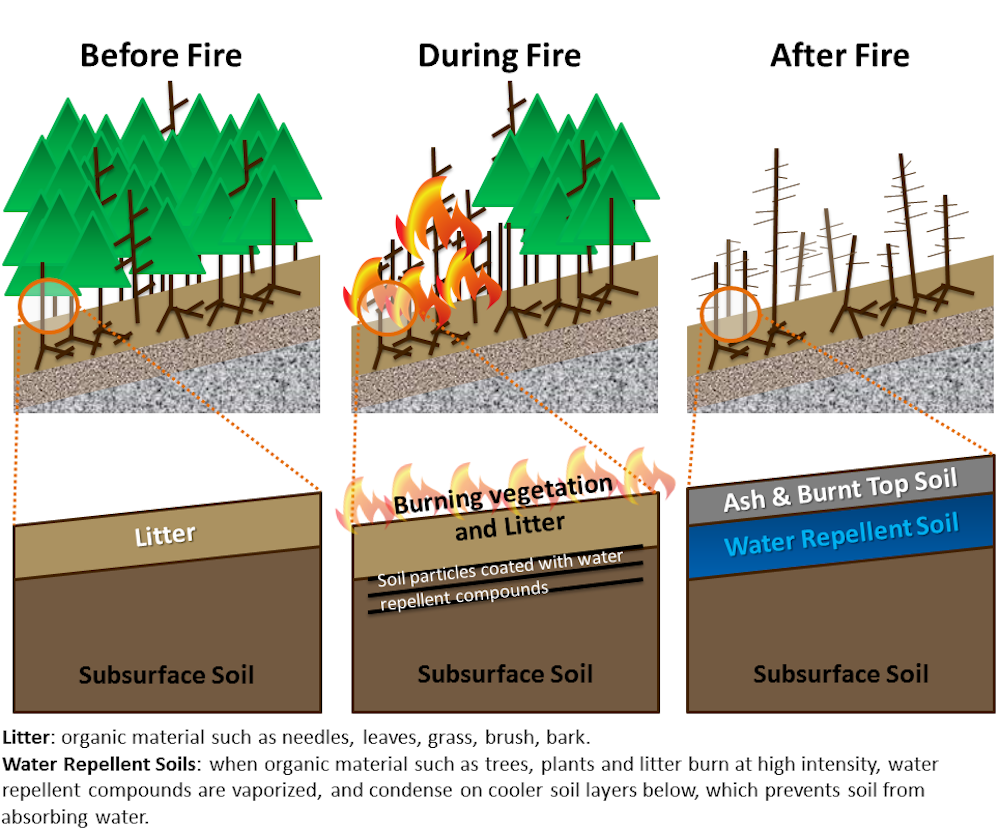
    When severe fires burn hillslopes, the high heat from the fires, sometimes exceeding 1,000 degrees Fahrenheit (538 degrees Celsius), completely destroys trees, shrubs, grass and structures, leaving behind a moonscape of gray ash. Not only that, the heat of the fire actually burns and damages the soil, creating a water-repellent, or hydrophobic, layer.

    What once was a vegetated hillslope, with leaves and trees to intercept rain and spongy soils to absorb water, is transformed into a barren landscape covered with ash, and burned soil where water cannot soak in.

    Illustrations show how fire can change the soil and landscape.
    National Weather Service

    When rain does fall on a burned area like this, water mixes with the ash, rocks and sediment to form a slurry. This slurry of debris then pours downhill in small gullies called rills, which then converge to form bigger and bigger rills, creating a torrent of sediment, water and debris rushing downhill. All this debris and water can transform small streams and usually dry gullies into a danger zone.

    Because the concentration of sediment is so high, especially when there is a large amount of ash and clay, debris flows behave more like a slurry of wet cement than a normal stream. This fluid can pick up and move large boulders, cars, trees and other debris rapidly downhill.

    A firefighter walks through knee-deep mud while checking for victims after a debris flow hit Montecito, Calif., in January 2018.
    Wally Skalij/Los Angeles Times via Getty Images

    In January 2018, a few weeks after the Thomas fire burned through the hills above Montecito, a storm triggered debris flows that killed 23 people and damaged at least 400 homes.

    What controls size and timing of debris flows

    The geography of the land, burn severity, storm intensity and soil characteristics all play important roles in if, when and where debris flows occur.

    Fire and debris flow scientists with the U.S. Geological Survey use these variables to create models to predict the likelihood and possible hazards from postfire debris flows. They are already developing maps to help residents, emergency managers and city officials prepare and predict postfire debris flows in 2025 burn areas in Los Angeles.

    The U.S. Geological Survey modeled debris flow risks after the Palisades Fire near Los Angeles. The map shows some of the highest-risk areas if hit by 15 minutes of rain falling at just under 1 inch (24 millimeters) per hour.
    USGS

    Some of the triggers of debris flows are literally part of the landscape.

    For example, the slope angle in a watershed and the amount of clay in the soil are important. Watersheds with gentle slopes – generally less than about 23 degrees – and a lack of clay and silt-sized particles are unlikely to produce debris flows.

    Other key factors that contribute to postfire debris flows relate to the proportion of the watershed that is severely burned and the intensity and duration of the rainstorm event.

    Early important research in the field of pyrogeomorphology demonstrated that while large, intense storms are more likely to cause large, intense debris flows, even small rainstorms can produce debris flows in burned areas.

    Debris flows are becoming more common

    A whopping 21.8 million Americans live within 3 miles of where a fire burned during the past two decades, and that population more than doubled from 2000 to 2019. A recent study from central and northern California indicates that nearly all the observed increases in area burned by wildfires in recent decades are due to human-caused climate change.

    The warming climate is also increasing the likelihood of more extreme downpours. The amount of moisture the atmosphere can hold increases by about 7% per degree Celsius of warming, leading to more intense downpours, particularly from ocean storms. In California, scientists project increases in rainfall intensity of 18% will result in an overall 110% increase in the probability of major debris flows.

    Jon Frye, of Santa Barbara Public Works, shows what happened in the January 2018 Montecito debris flow and why the risks to downslope communities would continue for several years. Source: County of Santa Barbara, 2018.

    Studies using models of fire, climate and erosion rates estimate that the amount of sediment flowing downhill after fires will increase by more than 10% in nine out of every 10 watersheds in the western U.S.

    Even without rain, debris on fire-damaged slopes can be unstable. A small slide in Pacific Palisades shortly after a fire burned through the area split a home in two. A phenomenon called “dry ravel” is a dominant form of hillslope erosion following wildfires in chaparral environments in Southern California

    Preparing for debris flow risks

    Research on charcoal pieces from ancient debris flows has shown fires and erosion have shaped Earth’s landscape for at least thousands of years. However, the rising risk of wildfires near populated areas and the potential for increasingly intense downpours mean a greater risk of damaging and potentially deadly debris flows.

    As their populations expand, community planners need to be aware of those risks and prepare.

    This article, originally published Jan. 23, 2025, has been updated with rainfall in Los Angeles.

    Jen Pierce receives funding from the National Science Foundation and is the chair of the Quaternary Geology and Geomorphology division of the Geological Society of America.

    ref. LA gets rain, but also risk of flooding and debris flows from wildfire burn scars – a geologist explains the threat – https://theconversation.com/la-gets-rain-but-also-risk-of-flooding-and-debris-flows-from-wildfire-burn-scars-a-geologist-explains-the-threat-247770

    MIL OSI – Global Reports

  • MIL-OSI Global: Rain falling on wildfire burn scars can trigger deadly debris flows – a geologist explains how

    Source: The Conversation – USA – By Jen Pierce, Professor of Geosciences, Boise State University

    A debris flow channel in a severely burned watershed in Idaho. Amirhossein Montazeri/Boise State University, CC BY-ND

    While firefighters work to extinguish the Los Angeles-area wildfires, city officials and emergency managers are also worried about what could come next.

    Light rain began falling on Jan. 25, 2025, helping firefighters who have been battling fires for nearly three weeks, but rain can also trigger dangerous floods and debris flows on burned hillslopes. The National Weather Service issued a flood watch for the burned areas through Jan. 27.

    Debris flows can move with the speed of a freight train, picking up or destroying anything in their path. They can move tons of sediment during a single storm, as Montecito, just up the coast from Los Angeles, saw in 2018.

    What causes these debris flows, sometimes called mudflows, and why are they so common and dangerous after a fire? I am a geologist whose research focuses on pyrogeomorphology, which is how fire affects the land. Here’s what we know.

    How debris flows begin

    When severe fires burn hillslopes, the high heat from the fires, sometimes exceeding 1,000 degrees Fahrenheit (538 degrees Celsius), completely destroys trees, shrubs, grass and structures, leaving behind a moonscape of gray ash. Not only that, the heat of the fire actually burns and damages the soil, creating a water-repellent, or hydrophobic, layer.

    What once was a vegetated hillslope, with leaves and trees to intercept rain and spongy soils to absorb water, is transformed into a barren landscape covered with ash, and burned soil where water cannot soak in.

    Illustrations show how fire can change the soil and landscape.
    National Weather Service

    When rain does fall on a burned area like this, water mixes with the ash, rocks and sediment to form a slurry. This slurry of debris then pours downhill in small gullies called rills, which then converge to form bigger and bigger rills, creating a torrent of sediment, water and debris rushing downhill. All this debris and water can transform small streams and usually dry gullies into a danger zone.

    Because the concentration of sediment is so high, especially when there is a large amount of ash and clay, debris flows behave more like a slurry of wet cement than a normal stream. This fluid can pick up and move large boulders, cars, trees and other debris rapidly downhill.

    A firefighter walks through knee-deep mud while checking for victims after a debris flow hit Montecito, Calif., in January 2018.
    Wally Skalij/Los Angeles Times via Getty Images

    In January 2018, a few weeks after the Thomas fire burned through the hills above Montecito, a storm triggered debris flows that killed 23 people and damaged at least 400 homes.

    What controls size and timing of debris flows

    The geography of the land, burn severity, storm intensity and soil characteristics all play important roles in if, when and where debris flows occur.

    Fire and debris flow scientists with the U.S. Geological Survey use these variables to create models to predict the likelihood and possible hazards from postfire debris flows. They are already developing maps to help residents, emergency managers and city officials prepare and predict postfire debris flows in 2025 burn areas in Los Angeles.

    The U.S. Geological Survey modeled debris flow risks after the Palisades Fire near Los Angeles. The map shows some of the highest-risk areas if hit by 15 minutes of rain falling at just under 1 inch (24 millimeters) per hour.
    USGS

    Some of the triggers of debris flows are literally part of the landscape.

    For example, the slope angle in a watershed and the amount of clay in the soil are important. Watersheds with gentle slopes – generally less than about 23 degrees – and a lack of clay and silt-sized particles are unlikely to produce debris flows.

    Other key factors that contribute to postfire debris flows relate to the proportion of the watershed that is severely burned and the intensity and duration of the rainstorm event.

    Early important research in the field of pyrogeomorphology demonstrated that while large, intense storms are more likely to cause large, intense debris flows, even small rainstorms can produce debris flows in burned areas.

    Debris flows are becoming more common

    A whopping 21.8 million Americans live within 3 miles of where a fire burned during the past two decades, and that population more than doubled from 2000 to 2019. A recent study from central and northern California indicates that nearly all the observed increases in area burned by wildfires in recent decades are due to human-caused climate change.

    The warming climate is also increasing the likelihood of more extreme downpours. The amount of moisture the atmosphere can hold increases by about 7% per degree Celsius of warming, leading to more intense downpours, particularly from ocean storms. In California, scientists project increases in rainfall intensity of 18% will result in an overall 110% increase in the probability of major debris flows.

    Jon Frye, of Santa Barbara Public Works, shows what happened in the January 2018 Montecito debris flow and why the risks to downslope communities would continue for several years. Source: County of Santa Barbara, 2018.

    Studies using models of fire, climate and erosion rates estimate that the amount of sediment flowing downhill after fires will increase by more than 10% in nine out of every 10 watersheds in the western U.S.

    Even without rain, debris on fire-damaged slopes can be unstable. A small slide in Pacific Palisades shortly after a fire burned through the area split a home in two. A phenomenon called “dry ravel” is a dominant form of hillslope erosion following wildfires in chaparral environments in Southern California

    Preparing for debris flow risks

    Research on charcoal pieces from ancient debris flows has shown fires and erosion have shaped Earth’s landscape for at least thousands of years. However, the rising risk of wildfires near populated areas and the potential for increasingly intense downpours mean a greater risk of damaging and potentially deadly debris flows.

    As their populations expand, community planners need to be aware of those risks and prepare.

    This article, originally published Jan. 23, 2025, has been updated with rainfall in Los Angeles.

    Jen Pierce receives funding from the National Science Foundation and is the chair of the Quaternary Geology and Geomorphology division of the Geological Society of America.

    ref. Rain falling on wildfire burn scars can trigger deadly debris flows – a geologist explains how – https://theconversation.com/rain-falling-on-wildfire-burn-scars-can-trigger-deadly-debris-flows-a-geologist-explains-how-247770

    MIL OSI – Global Reports

  • MIL-OSI United Nations: UN officials call for ceasefire compliance after 15 people killed in Lebanon

    Source: United Nations 4

    Peace and Security

    Top UN officials in Lebanon are calling for compliance with the ongoing ceasefire after reports that Israeli forces killed 15 people, including a Lebanese soldier, along the buffer zone with Israel, which Israel was due to withdraw from on Sunday under the agreement.

    The timelines envisaged in the November ceasefire agreement “have not been met”, according to a joint statement by UN Special Coordinator for Lebanon Jeanine Hennis-Plasschaert and head of the UN peacekeeping mission, UNIFIL, and force commander Aroldo Lázaro.

    The agreement between Israel and armed group Hezbollah had been reached after more than a year of fighting, stemming from the Israeli war in Gaza.

    As seen tragically this morning, conditions are not yet in place for the safe return of citizens to their villages along the Blue Line,” they said, referring to the buffer zone between Israel and Lebanon.

    Israel warned Lebanese civilians not to return to their homes in the south this weekend, stating it would not withdraw due to alleged violations of ceasefire terms. 

    Violations of resolution 1701 recorded daily

    “Displaced communities, already facing a long road to recovery and reconstruction, are therefore once again being called on to exercise caution. Also, violations of UN Security Council resolution 1701 continue to be recorded daily.”

    That landmark resolution, adopted in 2006, called for the creation of a buffer zone between the countries and the withdrawal of Israeli forces.

    By the terms of the November ceasefire agreement, Israel was meant to have fully withdrawn its forces from the area by Sunday.

    ‘So much at stake’

    The Special Coordinator and UNIFIL chief said “compliance by both parties with their obligations under the November agreement and the full implementation of resolution 1701 constitute the only way to bring closure to the recent, dark chapter of conflict and open a new one, heralding security, stability and prosperity on both sides of the Blue Line.”

    At the same time, the UN will continue to engage all actors towards this end and remains ready to support any action consistent with resolution 1701 and the efforts of the Implementation Mechanism to achieve the objectives of the November Understanding. 

    “With so much at stake for both Lebanon and Israel, recommitment is urgently needed from all sides,” they said in the statement.

    Much has changed since ceasefire

    The UN officials said much has changed in Lebanon since the Cessation of Hostilities Understanding came into force on 27 November 2024.

    Violence has dramatically decreased, and in many areas of southern Lebanon, hundreds of thousands of people have been able to return to their towns and villages.

    The Lebanese Armed Forces (LAF) have shown resolve in deploying to positions from which the Israel Defense Forces (IDF) are withdrawing, the UN officials said.

    Supported by UNIFIL, the Lebanese forces are helping to restore services and facilitating humanitarian access to communities most affected by conflict, they said.

    The ongoing government formation process, following the election of a president and the designation of a prime minister, is a critical step in building trust between Lebanese citizens and the State, they explained. These developments also augur well for prospective support to the full extension of state authority over all Lebanese territory and for the country’s recovery, reconstruction and growth.

    UNIFIL troops stand ready

    The UN Interim Force in Lebanon (UNIFIL) remains very concerned about reports of Lebanese civilians returning to villages where Israeli Defense Forces (IDF) are still present and of casualties due to Israeli fire, according to a statement by the mission on Sunday.

    At Lebanese Armed Forces request, UNIFIL peacekeepers are deploying to areas indicated by the Lebanese forces across the mission’s area of operations to monitor the situation and help prevent any further escalation.

    “However, the management of crowds remains outside our mandate,” according to UNFIL, which is tasked with supporting the implementation of resolution 1701.

    ‘IDF must stop firing on civilians in Lebanon’

    “It is imperative to avoid further deterioration of the situation,” the UN peacekeeping mission said, calling on the Lebanese population to adhere to the directives of the LAF, which aim to protect lives and prevent an escalation of violence in southern Lebanon.

    “The IDF must avoid firing at civilians within Lebanese territory. Further violence risks undermining the fragile security situation in the area and prospects for stability ushered in by the cessation of hostilities and the formation of a Government in Lebanon,” UNIFIL said.

    The UN mission emphasised the critical importance of fully implementing resolution 1701 and the cessation of hostilities arrangements through established mechanisms, which includes the complete withdrawal of the IDF from Lebanon, the removal of any unauthorised weapons and assets south of the Litani river, the redeployment of the Lebanese Armed Forces in all of south Lebanon and ensuring the safe and dignified return of displaced civilians on both sides of the Blue Line.

    MIL OSI United Nations News

  • MIL-OSI United Nations: DR CONGO CRISIS: Live updates as Security Council holds emergency meeting

    Source: United Nations 4

    Spiralling violence and killings in the eastern Democratic Republic of the Congo triggered an emergency Security Council meeting Sunday morning on the heels of the UN mission temporarily relocating non-essential staff from the area. App users can follow our live coverage here.

    MIL OSI United Nations News

  • MIL-OSI Security: Officer commended for bravery after disarming knife-wielding man

    Source: United Kingdom London Metropolitan Police

    An officer has been praised for his outstanding bravery in single-handedly tackling a suspect armed with a knife who was trying to stab another man.

    PC Morgan Younger managed to take him to the ground and disarm and restrain him while calling for further assistance.

    The incident happened at a petrol station in Lee High Road, Lewisham at around 15:00hrs on Saturday, 25 January.

    Deputy Assistant Commissioner Jon Savell, in charge of policing London this weekend, said: “This is outstanding work from an officer who was on patrol alone, saw a very violent crime in progress and, without hesitation, raced in to assist.

    “I cannot overstate how proud we are in the Met today of his quick-thinking and bravery. He was calm and professional and everything we want our police officers to be.

    “I have no doubt without his intervention, the victim would have been seriously injured.”

    PC Younger, who is attached to South East Command Unit and has five years’ service, was on patrol when he stopped at the petrol station to quickly buy a drink. At the entrance, he saw a man grab the victim around the throat and try to stab him with a large knife.

    The officer immediately responded, took hold of the suspect and struggled with him while he continued to wield the knife.

    He managed to bring him to the floor and disarm him without any help.

    He then restrained him single-handedly while calling for back-up and still managing to arrest the man for attempted murder and possession of an offensive weapon.

    He kept the man under control for five minutes until further officers arrived to help.

    The man, in his 60s, remains in custody at this stage. He was further arrested for handling stolen goods and being concerned in the supply of Class A drugs, after a quantity of drugs was found at his home address.

    The victim, aged in his 40s, was not injured thanks to PC Younger’s swift work.

    MIL Security OSI

  • MIL-OSI United Kingdom: Community Assistance

    Source: Northern Ireland – City of Derry

    Community Assistance

    26 January 2025

    Community Assistance for those affected by Storm

    The public are advised that the following Derry City and Strabane District Council Leisure Centres at Templemore, Foyle Arena and Melvin Leisure Centres are open today, Sunday,  from 9am – 6pm for anyone who is affected by the storm and who require help with heat, showers, water, phone charging and hot drinks.

    The Riversdale and Derg Valley Leisure Centres will also open from 1pm – 6pm.

    NIE Networks will have representatives at Foyle Arena today from 10am to 4pm to offer support to anyone who is without power.

    NI Network have issued more info at the following link –

    https://www.nienetworks.co.uk/news/article/2025/storm-eowyn-assistance-centres

    MIL OSI United Kingdom

  • MIL-OSI Russia: GUU launched the All-Russian competition “Family History. Immortal Memory”

    Translartion. Region: Russians Fedetion –

    Source: State University of Management – Official website of the State –

    The opening ceremony of the All-Russian competition “Family History. Immortal Memory” was held on Russian Students’ Day, January 25. The State University of Management is the organizer of the competition.

    Opening the official ceremony, Deputy Minister of Science and Higher Education Olga Petrova noted the significance of the fact that the competition is starting in the Year of the Defender of the Fatherland. “This is a continuation of the Year of the Family, because the values that they lay down are fundamental family values, these are the meanings and traditions that connect us, generations to generations.”

    Rector of the State University of Management Vladimir Stroyev emphasized that the day for the start of such an important competition was not chosen by chance. “The competition will be interesting and useful for the younger generation, and I would like the date of the great Victory to become close and dear to them,” the rector noted, adding that the competition will last until mid-summer and include many events.

    Member of the State Duma Committee on Security and Anti-Corruption, GUU graduate Biysultan Khamzaev emphasized Russian Student Day in his speech. “Everyone remembers their student days and I would like today’s youth not to miss this moment, so that they would later remember their university days with warmth. Happy holiday to everyone. And this year – the year of the great Victory of our ancestors – the competition starts. Guys, spend your time creatively, study, but also do not forget our veterans.”

    The award ceremony was followed by. Biysultan Khamzayev presented letters of gratitude “For contribution to the development of higher education, long-term conscientious work and assistance in the implementation of parliamentary activities” to Vladimir Stroyev, Vice-Rector Pavel Pavlovsky, Deputy Director of the Institute of Industry Management Andrey Lipatov, Head of the Patriotic Education Department of the Department of Youth Policy and Educational Work (UMPiVR) Almaz Akhayev, specialist of the youth policy department of the UMPiVR Marianna Loretsyan. “For special achievements in studies, conscientious attitude to the educational process and active civic position” – to students of the Institute of Public Administration and Law Ramazan Rakhmanov and the Institute of Industry Management Magomed Khadziev.

    The opening ceremony of the competition was also attended by Deputy State Secretary of the Union State Elena Bogdan, Vice-Rector of the Russian State Humanitarian University Irakli Balkvadze, Vice-Rector of the Yaroslavl State Pedagogical University named after K.D. Ushinsky Denis Palatnikov, representatives of the Kherson University and Vitebsk State University.

    The All-Russian competition “Family History. Immortal Memory” is a competition for students and teachers who would like to tell the stories of their families during the Great Patriotic War. The main goal is to preserve the connection between generations: today’s youth and their grandfathers and great-grandfathers who defeated fascism. The initiator of the competition was the State University of Management and personally the rector Vladimir Stroyev. The strategic partners of the competition were the Association “I am proud” and the “People’s Front” of the DPR. RUDN, RTU MIREA, and RSUH participated in the work on organizing the event.

    Subscribe to the TG channel “Our GUU” Date of publication: 01/26/2025

    является организатором конкурса….” data-yashareImage=”https://guu.ru/wp-content/uploads/Семейная-история-бессмертная-память-1.webp” data-yashareLink=”https://guu.ru/%d0%b3%d1%83%d1%83-%d0%b4%d0%b0%d0%bb-%d1%81%d1%82%d0%b0%d1%80%d1%82-%d0%b2%d1%81%d0%b5%d1%80%d0%be%d1%81%d1%81%d0%b8%d0%b9%d1%81%d0%ba%d0%be%d0%bc%d1%83-%d0%ba%d0%be%d0%bd%d0%ba%d1%83%d1%80%d1%81/”>

    Please note: This information is raw content directly from the source of the information. It is exactly what the source states and does not reflect the position of MIL-OSI or its clients.

    MIL OSI Russia News

  • MIL-OSI Australia: eInvoicing for government

    Source: Australian Department of Revenue

    Australian Government’s commitment

    The Australian Government has extended its commitment to increase Peppol eInvoicing adoption in the Budget 2024–25External Link (information found on page 180 of Budget Paper No.2 PDF document). By leading the implementation of eInvoicing, the Government aims to improve cash flow, disrupt payment redirection scams and boost productivity across the economy.

    For these and other benefits to be realised, governments across the country need to use eInvoicing and encourage the businesses they interact with to use it too.

    In July 2022 many Australian Government entities were mandated to be able to receive eInvoices and 16,000 Australian businesses were registered on the Peppol network. By January 2025 this number has jumped to over 410,000, with 129 Australian Government entities and more than 300 state and territory government entities and local councils also getting on board.

    With the network growing, we now need to focus on increasing the volume of transactions supporting the government’s supply chain.

    Australian Government entities

    Building on the 1 July 2022 mandate to receive eInvoices, the next stage for Australian Government entities is to increase the uptake of eInvoicing in Australia in line with the recommendations agreed to in the Government response to the Statutory Review of the Payment Times Reporting Act 2020External Link:

    • 13.1 – Promote the adoption of eInvoicing by all businesses.
    • 13.2 – Adopt the full functionality of eInvoicing across Commonwealth agencies.

    The main role for the government is as a buyer of goods and services and supporting businesses by paying eInvoices more quicklyExternal Link:

    • If you’re already able to receive eInvoices, but eInvoicing is not yet fully integrated with your finance or enterprise resource planning (ERP) system and automated workflows, consider uplifting your accounts payable capability. Also include eInvoicing in your procurement and contract templates as the preferred way to receive invoices.
    • Consider your accounts receivable volumes and processes and investigate how you may embed eInvoicing as your default channel when sending invoices to businesses or other government agencies.

    To find out more about how the ATO is helping agencies meet their obligations, or to join our GovTEAMS community for peer support and to tap into more detailed information, email einvoicing@ato.gov.au.

    Check the full list of eInvoicing-enabled Australian Government entities.

    State and territory governments

    The ATO is also working with state and territory governments who are then furthering eInvoicing adoption in their jurisdictions:

    To connect with the eInvoicing lead in your state or territory, email us at einvoicing@ato.gov.au.

    Local government

    For more information about eInvoicing and to find out how we can help your council, email us at einvoicing@ato.gov.au.

    Getting started and getting the most out of eInvoicing

    Many government entities are using eInvoicing, including here at the ATO.

    If you’ve not yet got onboard, adding eInvoicing as a channel to government finance systems is essentially the same as for medium and large businesses.

    To make sure your eInvoicing capabilities are appropriate and you’re maximising the efficiency and productivity benefits for both you and your suppliers, read our:

    For more technical advice or for tailored help to increase the volume of eInvoices you receive, contact eInvoicing@ato.gov.au.

    MIL OSI News

  • MIL-OSI Australia: Key committees

    Source: Australian Department of Revenue

    ATO committee system

    The ATO’s committee system comprises a tiered structure that creates clear lines of authority and enables issues to be escalated and resolved. At the same time, it supports a strong governance culture that values impartiality, integrity and accountability.

    ATO committees

    The ATO Executive Committee is the organisation’s most senior committee. It is supported by the Audit and Risk Committee and 5 enterprise-level committees (Finance, People, Risk, Security and Strategy). These committees are our most senior committees and they have defined responsibilities to approve, advise and monitor specified governance areas across the organisation.

    These committees include:

    • Audit and Risk Committee – an independent committee comprised of independent (external) members. It is responsible for the audit and risk management of the ATO. It provides the Commissioner of Taxation with independent assurance and advice on the appropriateness of the ATO listed entity’s
      • annual financial statements
      • performance statements
      • performance reporting
      • system of risk oversight and management, and
      • system of internal controls.

    Refer to Audit and Risk Committee Charter

    • Finance Committee – responsible for exercising governance responsibilities with respect to the ATO’s resource allocation, investment and program delivery, including monitoring financial risk.
    • People Committee – an advisory committee responsible for ensuring workforce and culture strategies support a contemporary and capable workforce.
    • Risk Committee – responsible for oversight and assurance of the ATO risk profile and advising on the management of key risks.
    • Security Committee – responsible for ensuring protective security and business continuity management capabilities are managed effectively across the ATO.
    • Strategy Committee – responsible for stewarding the end-to-end taxpayer experience by shaping discretionary and non-discretionary (NPP) investment priorities and ensuring peak taxpayer strategies are aligned, appropriate and on track.

    Organisational chart

    See our Organisational chart showing the reporting responsibilities within the ATO by group and business line.

    MIL OSI News

  • MIL-OSI Australia: Emissions reduction plan

    Source: Australian Department of Revenue

    Accountable Authority sign off

    The Australian Taxation Office (ATO) recognises it has a role to play in addressing climate change by implementing the Government’s Net Zero in Government Operations Strategy. We understand that our operations affect climate change, and we are committed to leading by example in the transition towards a low-carbon future.

    This Emissions Reduction Plan builds upon our agency’s previous targets and action plans to minimise our carbon footprint and contribute to the nation’s broader climate goals.

    Our plan reflects our commitment to transparency, accountability, and continuous improvement in our environmental performance.

    As the Commissioner of Taxation, I am the Accountable Authority for the Australian Taxation Office listed entity, which is comprised of the ATO, the Tax Practitioner’s Board and the Australian Charities and Not-for-profits Commission (the ACNC), including the ACNC Advisory Board.

    Through this plan, we pledge to:

    • substantially reduce our greenhouse gas emissions
    • improve energy efficiency across our operations
    • transition to renewable energy sources
    • promote sustainable practices in our operations
    • foster a culture of environmental responsibility among our staff.

    ‘The ATO is committed to achieving net zero emissions by 2030. Together, we can create a more sustainable future for our nation and contribute to the global fight against climate change.’

    Rob Heferen
    Commissioner of Taxation
    Registrar of the Australian Business Register, Australian Business Registry Services, and
    Register of Foreign Ownership of Australian Assets.

    Acknowledgement of Country

    We acknowledge the Traditional Owners and Custodians of Country throughout Australia and their continuing connection to land, waters and community. We pay our respects to them, their cultures, and Elders past and present.

    We recognise the unique relationship Aboriginal and Torres Strait Islander people have to Country, culture, and community, and the important role this plays in us all walking together as Australians.

    MIL OSI News

  • MIL-OSI Global: California depends on prison labour to deal with climate disasters — Canada must avoid a similar model

    Source: The Conversation – Canada – By Jordan House, Assistant Professor, Labour Studies, Brock University

    As wildfires continue to burn in and around Los Angeles, the fact that many of the firefighters battling the blazes are inmates from California’s prison system has drawn significant attention in news coverage.

    While the California Department of Corrections and Rehabilitation (CDCR) claims their fire camp program is voluntary and provides prisoners with meaningful opportunities, research demonstrates otherwise.

    Critics, including the American Civil Liberties Union (ACLU), argue that the program exploits incarcerated individuals, labelling it as “modern-day slavery.” One ex-prisoner described it as “involuntary servitude.”

    An inmate shares his experience fighting California wildfires (ABC News).

    The use of prison labour is particularly concerning, given Black Americans are incarcerated at nearly five times the rate of white Americans in state prisons. In 12 states, more than half of the prison population is Black.

    California prisoners are denied access to minimum wage provisions, prevented from forming labour unions and denied access to other workplace safety regulations. They’re also more likely to be injured or to die on the job than non-incarcerated firefighters. Their wages are capped at US$29.80 per day, compared to non-incarcerated firefighters, who earn up to US$358 daily, not including overtime.

    While serving in a fire crew gives prisoners the chance to shave time off of their sentences and have records expunged, neither of these benefits is guaranteed. Both are contingent on the CDCR or county jails deeming the service in a fire camp to be “successful.” This leaves prisoners vulnerable to being denied these benefits, despite risking injury or death.

    Prison labour in the Canadian context

    Some Canadian coverage of the L.A. fires has noted that provincial prisoners in British Columbia also work in a wildfire suppression program. However, little has been said about how that work relates to the larger system of prison labour in the country.

    Like their counterparts south of the border, Canadian prisoners are engaged in various forms of labour, including wildfire management, but are denied basic rights as workers.

    In 1975, Donald Griggs, then-superintendent of Ontario’s Monteith Correctional Complex, told the Globe and Mail that prison labour had been used in response to fires from time immemorial: “When a fire got bad, the jails were emptied and the men were shoved out on the fire line.”

    By the late 1960s, programs for prisoners to support wildfire suppression had become more formalized. During that time, for example, prisoners at Beaver Creek, a federal prison in Ontario, participated in regional bushfire response efforts. Working in the program offered prisoners, who were paid $1.25 an hour, a chance at some “action.”

    By the mid-1970s, some Ontario prisoners earned up to $50 a day battling wildfires. Today, however, most prisoners don’t earn anything close to those wages. Federal prisoner pay maxes out at $6.90 per day.

    In the rare situations where prisoners are relatively well-compensated, prison labour still offers employers unique benefits. Prisoners’ lack of freedom and limited ability to refuse work is touted as an advantage. Correctional Service of Canada (CSC) officials have argued that, compared to volunteer firefighters, prisoners “are always in one place and available for duty.”

    Prison labour in British Columbia

    Canada’s most prominent use of prison labour to manage wildfires is in B.C. While prisoners served in direct firefighting roles in the past, today provincial prisoners, who make between $2 and $8 per day, play a critical support role for wildfire-fighting crews by maintaining equipment and fire camps.

    Notably, all the participating prisoners have “open custody” status, having “behaved exceptionally well during previous experience on other community work crews.”

    In Canada, prisoners are supposed to work as part of their rehabilitation, not as punishment. However, the reality often prioritizes the needs of employers over the rehabilitation of prisoners. A review of the CSC’s Federal Work Release Program, which was established in 1992 and included a firefighting component, notes:

    “It is not necessary that the work be directly related to the offender’s correctional plan…work release is a very flexible program that allows correctional managers to respond to community projects and local needs for labour.”

    This is particularly concerning given that ex-prisoners often struggle to secure gainful employment upon release, despite their participation in employment programming.

    Prison labour as a response to climate disasters

    While the idea of keeping people incarcerated to maintain a labour force to fight disasters might sound like something out of science fiction, it’s not mere speculation. Responses to climate catastrophes like the L.A. fires demand huge amounts of resources and labour.

    Former U.S. vice-president Kamala Harris, as California attorney general, led a campaign to defy a U.S. Supreme Court order to reduce the state’s prison population partly because decarceration would “severely impact fire camp participation.”

    In Canada, prison labour has similarly been used in disaster responses. Most recently, CORCAN, the federal prison industry program, has been contracted to build temporary housing for people displaced by the 2024 wildfires in Jasper, Alta.

    Just as Black, Indigenous and racialized people in the U.S. are more likely to become incarcerated, these are also the populations that suffer disproportionately from the impacts of wildfires. Studies have shown that Indigenous communities in Canada are the hardest hit by wildfires, while Indigenous Peoples make up the fastest growing prison populations.

    Much like the U.S., Canada also disproportionately incarcerates Black, Indigenous and racialized people, while also depriving incarcerated labourers of access to minimum wage rights, workplace safety provisions and the right to unionize.

    The root cause of many of these disasters — climate change — is disproportionately driven by the world’s wealthiest elites. The use of prison labour to fight wildfires only further perpetuates the systemic inequalities exacerbated by climate injustice and reflects a continuation of indentured servitude.

    The authors do not work for, consult, own shares in or receive funding from any company or organisation that would benefit from this article, and have disclosed no relevant affiliations beyond their academic appointment.

    ref. California depends on prison labour to deal with climate disasters — Canada must avoid a similar model – https://theconversation.com/california-depends-on-prison-labour-to-deal-with-climate-disasters-canada-must-avoid-a-similar-model-248099

    MIL OSI – Global Reports

  • MIL-OSI Global: The legacy of anti-Black racism: The public health crisis of racial trauma

    Source: The Conversation – Canada – By Ingrid Waldron, Professor, Faculty of Humanities, HOPE Chair in Peace & Health, McMaster University

    The police killing of George Floyd in 2020 in the United States was an appalling act involving a group of officers who did not place much, if any, value on the life of a Black man. In the agonizing nine minutes before he died under the knee of Derek Chauvin, Floyd cried out for air and for his mother.

    Those moments, recorded by a passerby and shared widely and repeatedly over the days that followed, shocked the consciences of many Americans and others, triggering protests across the United States and in other countries, many of them led by the Black Lives Matter movement.

    Chauvin was convicted of murder, and three other officers were convicted of other serious crimes.


    Read more:
    How to deal with the pain of racism — and become a better advocate: Don’t Call Me Resilient EP 2


    While there is now greater awareness and scrutiny of racism and violence in policing, there is also a long record of reverting to old ways. Indeed, deeply entrenched racial bias is rooted in the soul and psyche of North American society and globally.

    When we think about Black Lives Matter, we typically think of criminal justice, but the movement also started a conversation about the lingering mental health impacts of police brutality on those who experience it directly, as well as those who experience it vicariously.

    Black trauma

    The traumatizing after-effects of anti-Black racism also result from Black people’s experiences within other social structures, such as employment, education and health care.

    The trauma resulting from multiple forms of anti-Black racism has a legacy that took root during the colonial era and has endured, impacting the spiritual, emotional, psychological and mental well-being of Black people in societies harmed by colonialism, such as Canada, the U.S. and the United Kingdom.

    I am a professor and the HOPE Chair in Peace and Health in the Global Peace and Social Justice Program at McMaster University. I have been studying Black trauma for almost 20 years, and recently published a book on the subject, From the Enlightenment to Black Lives Matter: Tracing the Impacts of Racial Trauma in Black Communities from the Colonial Era to the Present.

    The book documents that since the colonial era, Black bodies have been receptacles for trauma that carry the weight of the past and the present. Black trauma is deep, complex and continuing, and has harmful impacts on the mental health of Black people. It includes the dehumanizing and lingering consequences of the slave trade, the social and economic subjugation of Black people in Jim Crow America and the racist social structures that persist there and in Canada, the U.K. and elsewhere.

    For Black people, trauma results from racist assaults to their spiritual, emotional, mental, psychological and physical well-being. When racism resides in the body in these visceral ways, it manifests as emotional pain and rage, and its lingering after-effects endure over generations.

    Public health crisis

    Addressing the public health crisis of racial trauma for Black people requires that racism be recognized as a legitimate issue in health education and training, research, clinical practice, mental health services and policy, and in the mental health system more broadly.

    It also requires that mental health professionals not only become more culturally competent, but also develop skills in structural competency.

    That means being prepared to play a role in dismantling the inequities embedded within our social structures, including addressing the impact of upstream factors (poverty, poor public infrastructure, etc.) on the mental health of Black and other marginalized populations.

    Addressing racial trauma experienced by Black people also demands an analysis that appreciates racism’s inter-generational and multifaceted features. This analysis would examine how racism not only manifests itself over generations, but also at different levels, such as through everyday interactions between people (individual racism), within institutions (institutional racism), or through cultural dominance (cultural racism).

    Challenging legacies

    Addressing racial trauma experienced by Black people also demands an analysis that appreciates racism’s inter-generational and multifaceted features.
    (Shutterstock)

    For too long, efforts to address disparities between Black and white people in education, labour, employment, health and other social structures have focused on attributing these disparities to pathologies presumed to be inherent to Black culture and Black people. Instead, these efforts must be focused on identifying, dismantling and resolving the pathologies embedded within these social structures and peeling back the systems of power that impact mental health and well-being in Black communities.

    Resolving structural pathologies that harm Black people must be accompanied by a willingness to understand and appreciate the complexities of Black life, Black trauma and Black responses to trauma that may appear maladaptive to many, but that are normal and natural responses to racism’s intergenerational, multi-faceted and multilevel manifestations.

    Finally, resolving Black trauma must involve challenging the colonial and imperial legacies that reside within psychiatry and other mental health professions.

    Ingrid Waldron receives funding from CIHR, SSHRC.

    ref. The legacy of anti-Black racism: The public health crisis of racial trauma – https://theconversation.com/the-legacy-of-anti-black-racism-the-public-health-crisis-of-racial-trauma-246104

    MIL OSI – Global Reports