Category: AM-NC

  • MIL-OSI Australia: From the Shadows to the Podium: Central Banks and the Press

    Source: Reserve Bank of Australia

    It’s a privilege to be with you today and to announce the shortlist for the 2024 Walkley Business Journalism Award.

    I am not the first senior official of the RBA to address this event – but, to put it mildly, our central banking predecessors a hundred years ago would have been surprised to see us here.

    The high priest of central banking in the mid-1920s was Montagu Norman, Governor of the Bank of England. Norman was an extraordinary character – a devotee of mysticism, who wore a long flowing cloak and travelled under the fake name of Professor Clarence Skinner. His communications strategy was succinctly summarised in the pithy phrase ‘never explain, never apologise’.

    He regularly put those words into practice. When asked by a Parliamentary select committee in 1930 to rationalise a particular course of action, for example, he simply tapped the side of his nose three times and stared into the distance.

    Despite – or perhaps because of – this unusual behaviour, journalists loved him. A breathless 1932 New York Times pen portrait, entitled ‘Banker and Legend’, purred: ‘Mr Norman is all elusiveness, technique, finesse … he sits silent, discreet, unseen … exercising a power unthought of by old-fashioned tyrants and only glimpsed by alchemists of long ago poring over their crucibles.’

    Sadly, that passion went unreciprocated. Indeed, Norman made titanic efforts to avoid the press. Once, aboard ship in rough seas, word reached him that reporters were gathering to question him at the next port. He promptly leapt over the rails, shimmied down a rope ladder, and made his escape in a dinghy.

    ‘Never explain, never apologise’ permeated every aspect of the Bank of England’s operations at that time. Not for them, the modern paraphernalia of glossy reports, explainers and press conferences. For much of the 20th century, changes in official interest rates were communicated solely through the medium of a large printed card, placed in the Bank’s ornate lobby, and a simultaneous verbal announcement by the ‘government broker’ to traders in the government bond market. To effect that announcement, the broker removed his top hat, stood upon a bench, and bellowed at the top of his voice. Fleet Street’s finest played no role.

    Indeed, even when I joined the Bank of England in the early 1990s, the main job of the Head of the Press Office was still said to be, with little irony: ‘keep the Bank out of the press and the press out of the Bank’.

    That mindset extended well beyond the United Kingdom.

    The US Federal Reserve, for example, was established in conditions of such extreme secrecy, that those meeting to agree its charter in 1910 tried to pass off their discussions as a recreational duck hunting trip to Jekyll Island, Georgia. Three quarters of a century later, they were still at it. In 1987, Alan Greenspan famously told members of the US Congress: ‘since I’ve become a central banker, I’ve learned to mumble with great incoherence … if I seem unduly clear to you, you must have misunderstood what I said.’ He was only half joking.

    Over recent years, however, things have changed profoundly as central banks have emerged blinking into the sunlight of greater transparency – a process dubbed the ‘quiet revolution’ by Alan Blinder.

    The revolution certainly began quietly. The RBA, for example, only began announcing changes to its policy rate to the media in 1990. Prior to that, market participants were expected to draw their own conclusions about what had happened by scrutinising the detail of the Bank’s market operations.

    In the years since, however, the revolution has got louder. Central banks now produce a vast stream of material, from written inflation reports, research material and policy committee minutes, to increasingly interactive public appearances, including speeches, Parliamentary scrutiny, conference panels, on-the-record interviews and press conferences.

    All of that reflects two key drivers.

    The first is the recognition that the huge powers conferred on central banks by the granting of operational independence – powers that affect every citizen in the country – come with an essential quid pro quo. And that is the obligation to account for our actions: to explain, and to be scrutinised and challenged. That need for explicit public accountability has been further amplified by the burgeoning scale, scope and complexity of central bank operations; by back-to-back crises; and by the more demanding public expectations of public institutions generally.

    But transparency and challenge isn’t just something we have to do: it manifestly also drives better policymaking. Public understanding and trust in our mission helps to anchor inflation expectations – a vital component of effective monetary policy. Knowing how central banks see the economic outlook, and how policy will respond to changes to that outlook – our so-called ‘reaction functions’ – affects behaviour today. Indeed, for many economies, the vast majority of the effect of monetary policy comes not from changes in today’s official interest rate, but through expectations about how those rates will evolve in the future. So communications is everything – or almost everything.

    But those benefits only accrue if we get our message across – not just to the modern descendants of those top-hatted bankers, but to the public at large. And that’s where we need all of you in this room. Because, let’s face it, central bankers globally have had a mixed track record historically when it came to clear and effective communications – even when they were trying. Back in 2017, Andy Haldane – then Chief Economist of the Bank of England – estimated the minimum reading age required for a range of public communications, including central bank publications, the Economist, Elvis Presley’s lyrics and Donald Trump’s speeches. He found that Trump’s speeches could be understood by three-quarters of the population, and Elvis’s lyrics by only slightly less. But the complexity of most central banking communications at that time meant they could reach at most only 10 per cent of the public. That is no basis for building broad-based trust, credibility and understanding.

    It was clear we could do better – and we are. Research from the European Central Bank (ECB) shows that its current President, Christine Lagarde, uses language that is far more widely comprehensible than her predecessors, on Haldane’s measures. Similarly, the approach adopted by our own Governor, Michele Bullock, at the RBA’s new press conferences has won widespread praise for its clarity and simplicity.

    But the fact is that most people still hear about us through you. Despite the increasingly fractured landscape of social media and on-demand streaming, overwhelmingly the dominant source of information about central bank policy remains the good old press, TV and radio. So we need your skills as translators and explainers.

    More importantly still, we need your challenge. As public officials, knowing your analysis has to withstand public scrutiny drives an enormous lift in the quality and robustness of that analysis. I saw that up close at the Bank of England in the 1990s when we first embraced real transparency. Poor arguments, which once went unquestioned in grey smoke-filled rooms, did not survive the rigour of public examination. So, whatever may have been alleged in some quarters, both I and the RBA strongly welcome challenge, scrutiny and debate.

    Of course, it’s sometimes less fun when robust press scrutiny bleeds over from the purely technocratic to the personal. That’s certainly familiar to someone, like me, who comes from a country whose press managed to summarise a particularly salacious episode in the central bank’s life as ‘It’s the Bonk Of England’, filmed a live runoff between a recent prime minister and a decaying lettuce, and followed the Bank of England Governor to the office every day for a week during Covid in a somewhat confused attack on the Bank’s policy on working from home. Some past RBA Governors have had to face similar treatment.

    But all of us in public life must – and do – recognise the privilege that comes with our roles, and the accountability we owe, via you, to the public at large. So I want to thank you – not just for the vital role you play in helping to explain the complexities of economic policy, but also for your informed scrutiny and challenge, which forces us to raise our game and stay accountable for the huge powers we wield. If the cleansing effect of transparency is to continue to be effective, so must your role.

    With that, let me turn to my main task here today, which is to announce the finalists for the 2024 Walkley Business Journalism Award. The goal of these Awards is to encourage journalists to pursue rigorous and fearless reporting in the field of business, economics and finance. And they have certainly met that brief this year!

    And with that I look forward to our discussion here today. Thank you.
    MIL OSI News

  • MIL-OSI New Zealand: Asphalt repairs next week for section of SH3 Carlton Ave

    Source: New Zealand Transport Agency

    A stretch of State Highway 3 (SH3) Carlton Avenue in Whanganui will close to southbound traffic later next week for asphalt repairs.

    The work will take place over 3 days from next Wednesday 16 October, between 7am and 7pm each day.

    During these work times, a section of SH3, between Smithfield Road and Jackson Street, will be under a one-way closure for all southbound traffic. SH3 will remain open for all northbound traffic, with a 30km/h temporary speed limit in place.

    The below detours will be in place for light and heavy vehicles:

    • All southbound light vehicles (cars and other non-freight vehicles) will be detoured via Purnell Street to Guyton Street to Heads Road then back to SH3.
    • All southbound heavy vehicles (freight trucks) will be detoured via Montgomery Road to Mosston Road to Heads Road and back to SH3.

    The light vehicle detour is expected to add about 5 minutes to journey times. For heavy vehicles, please expect an extra 10 minutes to be added to your journey.

    Outside of the work hours, SH3 Carlton Ave will be fully open with a 30km/h temporary speed limit in place. Please note, access will remain to Smithfield Road from SH3. Access from Alma Road to the SH3 roundabout will be restricted to help ease traffic flow. Road users are advised to follow signage, reduced speeds and any directions from staff on site.

    In the event of bad weather, work will begin on the next fine day and may extend the programme out to include works on Saturday 19 October.

    Recent heavy and persistent rainfall has caused a number of potholes to open up in this area. Crews applied temporary fixes at the time while this longer-term fix could be arranged. A day-time closure allows crews to complete this road maintenance work as efficiently and safely as possible, while keeping road users moving.

    Thank you for your patience and understanding while we complete this important road maintenance work to strengthen this section of road and improve its long-term condition.

    MIL OSI New Zealand News

  • MIL-OSI USA: VIDEO: Pressley Observes Anniversary of October 7th Attack with Impacted Families, Faith Leaders, Advocates

    Source: United States House of Representatives – Congresswoman Ayanna Pressley (MA-07)

    “Every life is a universe. And every life lost to this violence is a tragedy. Our moral compass must never waver. Our shared humanity is counting on it. Our destinies and freedoms are tied.”

    Video | Photo

    BOSTON – This evening, Congresswoman Ayanna Pressley (MA-07) joined impacted families, faith leaders, and advocates to observe the anniversary of the horrific October 7, 2023 attack and commemorate the 1,200 Israelis killed by Hamas, the hostages killed and those still kidnapped, and the over 41,000 Palestinians in Gaza killed by the Israeli military over the past year. Congresswoman Pressley issued a statement marking the anniversary of the attack earlier today.

    At the Boston Public Garden, Rep. Pressley joined IfNotNow, faith leaders, and community advocates to deliver remarks at a memorial service to grieve lost Israeli, Palestinian, and Lebanese lives. At the Wang Theater, Rep. Pressley joined Combined Jewish Philanthropies and the Jewish Community Relations Council of Greater Boston for an Evening of Remembrance and Hope.

    A transcript of her remarks at the memorial service is available below and full video is available here. For photo of the event, click here.

    Transcript: Pressley’s Remarks at October 7th Memorial Service for Israeli, Palestinian, and Lebanese Lives

    October 7, 2024

    Boston Public Garden

    Good evening, movement family. And I mean it when I say family.

    We’re all here because we recognize, as one human family, that our destinies are tied. 

    Today is a heavy day. It is a solemn day. 

    The grief and trauma run deep in our communities. 

    I share in your heartbreak. Not only as your Congresswoman but as a woman of faith.

    A faith that affords me clarity, anchoring, a faith that was gifted to me by my mother, now an ancestor.

    My faith is enduring and abiding.

    It is a faith in a power that is greater than me, that is greater than you, that is greater than all of us. 

    It is a faith in the divine, a faith in humanity, a faith in the power and the practice of radical love.

    As someone who grew up in a small storefront church, pastored by my grandfather, I believe in the power of prayer and tradition.

    I believe that we are one human family, and I know that there is something truly powerful and transformative about the beloved, collective community that I’m bearing witness to in this moment.

    A year ago today, October 7, tragedy befell us.

    And today, 365 days later, we are still grieving.

    Grieving for the nearly 1,200 Israeli lives stolen in the horrific attack conducted by Hamas militants.

    Grieving for the over 250 Israeli hostages taken captive, torn away from their families, many of whom have been killed.

    I am grieving for the loved ones and communities they leave behind. 

    I am praying for the remaining hostages’ safe return.

    As people of faith, we believe we are all God’s children—Palestinian, Israeli, Americans alike.

    So I know we are all grieving. We have witnessed devastating losses and held space for the vulnerability that so many grapple with daily, including right here. 

    And we grieve for the Israelis murdered, and for the tens of thousands of Palestinians in Gaza murdered by the Israeli military in the last year.

    That number does not account for those still trapped under the rubble of their homes, their houses of worship, their hospitals.

    That number does not account for those slowly dying of hunger, from infections and from the cold.

    Horrific massacres. Severed limbs. Mass starvation. Forced displacement.

    While bomb after bomb continue rain down. U.S. made bombs. Shameful.

    Every life is a universe. We have been robbed of siblings and cousins, parents and elders, babies, people of flesh and bone who loved and were loved. 

    Today, I’m thinking of a young woman I met named Sara. A brilliant creative with a penchant for black leather jackets like me. 

    A 17-year-old from Gaza. She was severely burned and injured in an Israeli airstrike and her two younger brothers were killed.

    I’m thinking of the children of a mother and father—peace activists—who were murdered by Hamas on their daily morning walk. 

    The mother used to write haikus on her Facebook page. Her last poem was about a flower blooming with kindness and tolerance.

    I sat in horror as American doctors described in graphic detail what they witnessed when they returned from a field hospital in Gaza treating pediatric patients. 

    Every child deserves a future. These are babies who knew only pain for the few precious days and weeks that they were on this earth.

    A five-year-old whose body was covered in burns. A seven-year-old with gunshot wounds to the head and torso.

    No one should ever endure such horror and pain.

    I am outraged and I am heartbroken by the genocide we are witnessing of the Palestinian people. Babies, children, elders, entire generations of Palestinian families decimated.

    And as we reflect on the horrors of the past year, we must remember that are indeed one human family—regardless of religion or nation of birth—and our destinies are tied.

    And if this past year has taught us anything, it is that death and destruction beget death and destruction.

    Vengeance is not a foreign policy doctrine. And diplomacy is the only path forward.

    Since that horrific day exactly one year ago, I have been clear that diplomacy and saving lives must be the priority.

    As a policymaker, we have a moral, humanitarian, and righteous mandate to save lives.

    And every action taken by policymakers—from Congress to the White House to the Knesset—should be in pursuit of de-escalation, saving lives, and preventing a broader regional war.

    We need a permanent ceasefire now.

    And we must bring every last hostage safely home.

    We must stop sending bombs and bullets that will be used to kill women and children. Not another bomb.

    And we must save lives. We must save lives. In Israel, in Gaza, in Lebanon, and all across the region.

    Tonight, I am holding space for every Jewish, Muslim, Arab, American, Palestinian and Israeli person grieving today.

    Every life is sacred. 

    As Judaism reminds us, every life is a universe. And every life lost to this violence is a tragedy.

    Our moral compass must never waver. 

    Our shared humanity is counting on it. 

    Our destinies and freedoms are tied.

    So today and always, may we continue to pray for peace, to call for peace, to work for peace, to pursue a more just and equitable world.

    Thank you all for the honor of sharing this sacred space with you today. 

    It is an honor to be your interfaith sister in solidarity in the pursuit of justice and healing.

    Since the horrific October 7th attack, Congresswoman Pressley has consistently and stridently called for a ceasefire to save lives, return all hostages, and surge humanitarian aid to Gaza. To date, over 41,000 Palestinians have been killed by Israeli airstrikes and over 100 hostages are still held captive by Hamas in Gaza. Rep. Pressley delivered a floor speech in which she called for urgent de-escalation in the Middle East and renewed her calls for a ceasefire in Gaza and Israel to prevent a broader regional war. Rep. Pressley has also introduced an amendment to place a one-year moratorium on the transfer of offensive weapons to the Israeli military. 

    Throughout the Israel and Hamas conflict, Rep. Pressley has been a vocal and consistent advocate of diplomacy, de-escalation, and saving lives.

    • Rep. Pressley joined Congresswoman Haley Stevens (D-MI) and their colleagues on a resolution condemning Hamas’ brutal attack and hostage-taking, and demanding Hamas immediately release all hostages.
    • Rep. Pressley joined Reps. Jan Schakowsky (IL-09), Mark Pocan (WI-02), Pramila Jayapal (WA-07), James P. McGovern (MA-02), and 50 colleagues on a letter condemning the terrorist attacks by Hamas on the people of Israel, calling for Israeli military operations to follow the rules of international humanitarian law, and continuing to work toward peace in the region.
    • Rep. Pressley joined her colleagues in announcing a resolution urging the Biden Administration to call for an immediate de-escalation and ceasefire in Israel and Gaza, to send humanitarian aid and assistance to Gaza, and to save as many lives as possible. She later joined her colleagues and a multi-faith, multiracial coalition of faith leaders and organizers for a prayer and press conference to renew their calls for a ceasefire. Rep. Pressley also joined dozens of rabbis and Members of Congress for a press conference to renew calls for a ceasefire in Gaza.
    • Instead of attending Prime Minister Netanyahu’s address to Congress, Rep. Pressley spent the day centering people directly impacted by Israel’s ongoing war in Gaza
    • Rep. Pressley delivered a floor speech in which she condemned antisemitism, Islamophobia, and all forms of hate on college campuses.
    • Rep. Pressley joined a coalition of nearly 100 interfaith clergy and faith leaders on a joint statement on Martin Luther King Jr. Day calling for a ceasefire in Gaza.
    • Rep. Pressley joined Reps. Grace Meng (D-NY), Nicole Malliotakis (R-NY), and nearly 150 colleagues in urging the State Department to use all tools at its disposal help get Americans out of Israel and back home to the United States. She applauded the State Department for heeding her calls on October 12, 2023 and continues to press for the urgent evacuation of Americans in Gaza.
    • Rep. Pressley issued a statement following the safe evacuation of Massachusetts constituents Wafaa and Abood Okal and their one-year-old Yousef from Gaza.
    • Rep. Pressley and Rep. Jamie Raskin led a group of 60 House lawmakers in urging the State Department to affirm the United States’ strong opposition to the forced and permanent displacement of Palestinians from Gaza, and to support an increase in humanitarian aid to the region.
    • Rep. Pressley joined Representatives Alexandria Ocasio-Cortez (NY-14), Mark Pocan (WI-2), Betty McCollum (MN-4) and 20 of their colleagues in sending a letter to President Biden, asking him to support a bilateral ceasefire in Gaza to protect the one million children living there.
    • Rep. Pressley joined a coalition of interfaith clergy and faith leaders for a vigil to mourn the tens of thousands of Palestinians, Israelis, and innocent civilians killed since October 7th, and to renew calls for a ceasefire to save lives, return all hostages, and deliver humanitarian aid to the region.
    • Rep. Pressley joined her colleagues at a press conference to condemn the Israeli government’s pending invasion of Rafah and continued her calls for a ceasefire in Gaza.
    • Rep. Pressley joined her colleagues in calling for full funding of the United Nations Relief and Works Agency (UNRWA) to provide urgent humanitarian relief to Gaza.
    • Rep. Pressley joined Representatives Joaquín Castro, Jamie Raskin, Jan Schakowsky and 33 House Democrats to President Biden urging him to prevent an Israeli ground invasion of Rafah.
    • Rep. Pressley, amid heightened tensions in the region, delivered a floor speech in which she called for urgent de-escalation in the Middle East and renewed her calls for a ceasefire in Gaza to prevent a broader regional war.
    • Rep. Pressley filed a pair of amendments to increase funding to global humanitarian assistance and place a one-year moratorium on the transfer of offensive weapons to the Israeli military. The amendments were not adopted in the final legislation. 
    • Rep. Pressley voted against HR 8034 to send more offensive weapons and funding to the Israeli military, citing the Israeli military’s callous disregard for human life in Gaza and significant human rights violations.
    • Rep. Pressley issued a statement on the peaceful student protests taking place in Massachusetts and across the country.
    • Rep. Pressley issued a statement applauding the Boston City Council for passing a resolution calling for a ceasefire in Gaza.
    • Rep. Pressley joined Representatives Pramila Jayapal (WA-07), Madeleine Dean (PA-04) and 54 additional lawmakers in calling on the Biden Administration to use all tools possible to dissuade the Israeli government from moving forward with an offensive invasion into Rafah.
    • Rep. Pressley issued a statement in response to the escalating situation in the Middle East.

    ###

    MIL OSI USA News

  • MIL-OSI China: Shanghai sees photographers flock to gallery

    Source: China State Council Information Office 3

    Tourists taking a walk along the side streets of Shanghai lined with Shikumen houses, a chorus singing by the Huangpu River, and fanatic photographers gathering at the best location for a great shot… The ongoing exhibition at Bund 18 Art Gallery presents dramatic scenes in contemporary urban life.

    Going on from September 20 to Oct 27, the exhibition entitled Blossoms is open at the Bund 18 Jiushi Gallery, jointly hosted by the Shanghai municipal committee of the China Democratic League, Shanghai Artists’ Association and Shanghai Jiushi Art Museum.

    It is showcasing 50 paintings by Shanghai Portraiture Artists’ Society, as well as 12 paintings by the advisors for the society.

    MIL OSI China News

  • MIL-OSI Economics: TMG and Huawei join forces to offer AI Cloud Services for the first time in Egypt Oct 08, 2024

    Source: Huawei

    Headline: TMG and Huawei join forces to offer AI Cloud Services for the first time in Egypt
    Oct 08, 2024

    [Shenzhen, China, October 8, 2024] Huawei has partnered with Egypt’s Talaat Moustafa Group (TMG) to build and deploy cutting-edge AI-powered cloud technology for the first time in the Egyptian market.
    Under the agreement, signed in Shenzhen, China, TMG will leverage Huawei’s advanced cloud technologies in building and developing cloud data centers and AI technologies, providing a wide range of advantages in the Noor City project. This technology is an ideal option for smart city development as it will rely on scalable infrastructure, real-time data analytics, and seamless connectivity.
    TMG plans to offer comprehensive cloud services to the Egyptian market through “NOOR Cloud” and through the partnership will seek to meet the diverse needs of various urban communities with first-to-market cloud solutions.
    Mohamed Hisham Talaat Moustafa, Chief Recurring Income Officer at TMG, said: “We are thrilled to announce a strategic agreement with Huawei to develop a cutting-edge cloud aimed at providing essential services to the market. TMG will be leading the market by embracing cloud technology. TMG cloud-enabled applications will not only drive economic growth but also create new opportunities for innovation across industries, offering services to customers. By leveraging advanced technology, we aim to lead the market and empower businesses to thrive in a competitive landscape. Together, we will open doors to a future of limitless possibilities and drive transformative change.”
    Mohamed Salah, VP of Intelligent Cities – Recurring Income at TMG, added: “We are entering a transformative era in Egypt’s urban development. Our collaboration with Huawei is not merely about implementing technology; it’s about reimagining urban living to meet the needs of our communities. By integrating innovative and sustainable solutions, we are establishing new benchmarks for real estate development. Together, we are committed to creating smart cities that stimulate economic growth and foster resilient communities throughout the country.”
    Hank Chen, Vice President of Huawei Government Public Services Digitalization Business said, “Cloud technology is a game-changer for smart city development, offering unparalleled opportunities for cities to thrive in the digital era. By embracing Cloud, cities can fully unlock the potential of cloud technology to create a better future for urban living.”
    Commenting on the agreement, Felix Xu, CEO of Huawei Egypt Enterprise Business Group, said: “By expanding our partnership with TMG, we are committed to supporting their vision of a smart city that is not only technologically advanced but also sustainable, inclusive, and future-proof. Our comprehensive portfolio of cutting-edge products and technologies, including robust cloud services, next-generation networks, scalable storage solutions, and intelligent AI large models, positions us to support TMG in realizing their vision to transform cities into smarter, more connected environments, ensuring optimal performance and reliability of their infrastructure.”
    The new collaboration between Huawei and TMG builds on their longstanding partnership in developing cutting-edge smart cities and sustainable communities. By leveraging their combined expertise, TMG and Huawei aim to redefine the standards for urban development and digital innovation in Egypt.

    MIL OSI Economics

  • MIL-OSI Economics: TMG and Huawei join forces to offer AI Cloud Services for the first time in Egypt

    Source: Huawei

    Headline: TMG and Huawei join forces to offer AI Cloud Services for the first time in Egypt

    [Shenzhen, China, October 8, 2024] Huawei has partnered with Egypt’s Talaat Moustafa Group (TMG) to build and deploy cutting-edge AI-powered cloud technology for the first time in the Egyptian market.
    Under the agreement, signed in Shenzhen, China, TMG will leverage Huawei’s advanced cloud technologies in building and developing cloud data centers and AI technologies, providing a wide range of advantages in the Noor City project. This technology is an ideal option for smart city development as it will rely on scalable infrastructure, real-time data analytics, and seamless connectivity.
    TMG plans to offer comprehensive cloud services to the Egyptian market through “NOOR Cloud” and through the partnership will seek to meet the diverse needs of various urban communities with first-to-market cloud solutions.
    Mohamed Hisham Talaat Moustafa, Chief Recurring Income Officer at TMG, said: “We are thrilled to announce a strategic agreement with Huawei to develop a cutting-edge cloud aimed at providing essential services to the market. TMG will be leading the market by embracing cloud technology. TMG cloud-enabled applications will not only drive economic growth but also create new opportunities for innovation across industries, offering services to customers. By leveraging advanced technology, we aim to lead the market and empower businesses to thrive in a competitive landscape. Together, we will open doors to a future of limitless possibilities and drive transformative change.”
    Mohamed Salah, VP of Intelligent Cities – Recurring Income at TMG, added: “We are entering a transformative era in Egypt’s urban development. Our collaboration with Huawei is not merely about implementing technology; it’s about reimagining urban living to meet the needs of our communities. By integrating innovative and sustainable solutions, we are establishing new benchmarks for real estate development. Together, we are committed to creating smart cities that stimulate economic growth and foster resilient communities throughout the country.”
    Hank Chen, Vice President of Huawei Government Public Services Digitalization Business said, “Cloud technology is a game-changer for smart city development, offering unparalleled opportunities for cities to thrive in the digital era. By embracing Cloud, cities can fully unlock the potential of cloud technology to create a better future for urban living.”
    Commenting on the agreement, Felix Xu, CEO of Huawei Egypt Enterprise Business Group, said: “By expanding our partnership with TMG, we are committed to supporting their vision of a smart city that is not only technologically advanced but also sustainable, inclusive, and future-proof. Our comprehensive portfolio of cutting-edge products and technologies, including robust cloud services, next-generation networks, scalable storage solutions, and intelligent AI large models, positions us to support TMG in realizing their vision to transform cities into smarter, more connected environments, ensuring optimal performance and reliability of their infrastructure.”
    The new collaboration between Huawei and TMG builds on their longstanding partnership in developing cutting-edge smart cities and sustainable communities. By leveraging their combined expertise, TMG and Huawei aim to redefine the standards for urban development and digital innovation in Egypt.

    MIL OSI Economics

  • MIL-OSI Economics: Secretary-General of ASEAN participates in ASEAN Foreign Ministers’ Meeting in Vientiane

    Source: ASEAN

    Secretary-General of ASEAN, Dr. Kao Kim Hourn, today attended the ASEAN Foreign Ministers’ Meeting in Vientiane, Lao PDR. Chaired by Deputy Prime Minister and Minister of Foreign Affairs of Lao PDR, H.E. Saleumxay Kommasith, the ASEAN Foreign Ministers discussed the preparations for the 44th and 45th ASEAN Summits and Related Summits, including taking stock of ASEAN Community building efforts and ASEAN’s relations with external partners under Lao PDR’s ASEAN Chairmanship this year.

    The post Secretary-General of ASEAN participates in ASEAN Foreign Ministers’ Meeting in Vientiane appeared first on ASEAN Main Portal.

    MIL OSI Economics

  • MIL-OSI New Zealand: Name Release, Fatal crash, Tuamarina

    Source: New Zealand Police (District News)

    Police can now release the name of one of the young men who died following a single vehicle crash on SH1, Tuamarina, 1:45am Sunday 6 October.

    He was 19-year-old Brayden Charles Allen of Picton, Marlborough.

    Police would like to extend our deepest sympathies to the family of the deceased

    Enquiries into the circumstances of the crash are ongoing.

    A statement from Brayden’s family below: 

    We are heartbroken to announce the tragic passing of our beloved Brayden Charles Allen early Sunday morning. Brayden was the cherished son of Scott Allen and Erin Ellis and was also deeply loved by stepdad Zane Ellis and stepmum Jocelyne Allen.

    He was the most fun-loving, out-of-this-world character who truly lived life to the fullest, and his loss is incomprehensible to us all. The love between a parent and a child is beyond measure, and Brayden filled his parents’ lives with joy, laughter, and endless love. The loss of a child is a pain no parent should ever bear, and the grief we feel is overwhelming and unimaginable. Brayden’s life was a light in all our lives, and that light will forever remain in our hearts.

    Brayden’s bond with his younger brother Ajani was nothing short of extraordinary. They shared a connection that was deep, unshakable, and uniquely their own. Their relationship was built on love, understanding, and a shared sense of adventure. It was as if the two brothers had their own language, a silent connection that was felt by everyone around them.

    Whether they were exploring the outdoors or simply enjoying each other’s company, the bond between them was unbreakable. Brayden was more than just a big brother to Ajani—he was his protector, his best friend, and his biggest supporter.

    It was the kind of brotherly love that could never be explained but always felt deeply by those around them. It was a bond so special and strong, the love they shared was unexplainable but undeniably powerful. Their closeness was a joy to witness, a reflection of Brayden’s huge heart and his devotion to those he loved.

    Brayden passionately embraced the outdoors and lived every moment to the extreme with his adoring sidekick Busta. His adventurous spirit and love for life were infectious, making every moment with him feel larger than life. He had a way of bringing light into any situation, and his ability to lift up others knew no bounds. His family, including his aunts Carina, Raewyn, Megan, Bronwyn, uncles Ben, Sam, David, Luke, and Bendy, Alec and his adoring grandparents Ian and Paula, Karen and Phil, late Poppa, Colin and Melva, Gud, Nanna B, Daniel and Louise, Suzie and the late Jeffrey and the countless extended cousins, aunties and uncles are devastated by this unimaginable loss.

    With a heart bigger than he sometimes knew how to handle, Brayden was fiercely loyal and loving to all who were fortunate enough to know him. He was a devoted son, brother, friend, boyfriend, grandchild, and nephew, always aware of how others felt and going to the ends of the earth to make them feel wonderful.

    He was, without a doubt, a person whose joy for life and deep care for others left a mark on everyone he met. Brayden’s departure leaves an irreplaceable void in our hearts, but we are so incredibly grateful for the joy he brought into our lives. We will hold on to his memory, his love, and his adventurous spirit forever.

    Brayden’s family have requested that in lieu of flow, donations could be made to the Nelson/Marlborough rescue helicopter.

    ENDS

    Issued by Police Media Centre

    MIL OSI New Zealand News

  • MIL-OSI New Zealand: Deep concerns as TVNZ signal more significant changes – E tū

    Source: Etu Union

    E tū, the union representing TVNZ workers, is raising significant concerns over the broadcaster’s proposed sweeping changes, which could reshape not just TVNZ, but Aotearoa New Zealand’s wider media landscape.

    E tū Negotiation Specialist, Michael Wood, has called for full and meaningful engagement as these proposals are considered, emphasising the potential risks to both TVNZ and the country’s media ecosystem.

    “The scale of change being proposed here is enormous,” Michael says.

    “This is not just a transformation within TVNZ, but one that could have far-reaching consequences for the entire media sector. These changes must be worked through with great care, and E tū and its members will accept nothing less than genuine engagement from all parties involved.”

    While E tū acknowledges the necessity of shifting towards a digital future, the union is deeply concerned about the potential loss of TVNZ’s core strengths, particularly its skilled staff and capacity to deliver in-depth, quality journalism.

    “We support the move towards a more digital service, but this must be done in a way that preserves the essence of what makes TVNZ valuable. It’s crucial to safeguard the ability to investigate and report on the stories that matter.

    “Cutting back on text-based content while simultaneously removing successful video programmes like Fair Go and Sunday raises serious questions about the direction of these changes. If TVNZ is serious about a video-first strategy, they need to invest – not simply slash resources.”

    A key concern is the proposal to outsource jobs, potentially overseas.

    “Outsourcing jobs threatens TVNZ’s most important asset – skilled, experienced staff, with deep institutional knowledge. Outsourcing not only risks losing these skills but can lead to higher costs and a weaker organisation. We’ve seen this play out in other sectors, and it’s not a path we should go down.”

    E tū is also questioning the Government’s role in pressuring TVNZ to deliver a dividend during such a pivotal moment for the organisation.

    “It’s difficult to understand why the Government would maintain pressure for a dividend in this environment. TVNZ is undergoing major upheaval, and it would be wise for the Government to reconsider its expectations while these significant changes are being negotiated.”

    E tū members will hold a union meeting on Thursday to fully discuss the proposals and decide the next steps.

    MIL OSI New Zealand News

  • MIL-OSI New Zealand: Op Curly: Police remain focused on locating missing children

    Source: New Zealand Police (District News)

    Please attribute to Detective Inspector Andrew Saunders:

    Thursday’s sighting of Tom Phillips has opened a positive line of enquiry that’s now being looked into by the investigation team.

    Investigators received information about 7pm on Thursday that Tom had been seen in bush area west of Coutts Road in Marokopa with Jayda, Maverick and Ember. This was a credible sighting, and Police believe it was indeed Tom and his children.

    Patrols began in the area on Thursday night and a search was launched the following morning.

    For operational security reasons, we are not providing details of when Police arrived on the ground, or specific details around the resources involved.

    While we cannot go into detail, we want to reassure the public that we have the resources in place to respond to any information or reports of sightings that come in. Our focus is very much on the safe return of Jayda, Maverick and Ember to their whānau and we are doing all that we can to make that happen.

    We still need the public’s assistance, however. If you have any information that could help our enquiries, please update us online now or call 105.

    Please use reference number 211218/5611.

    Information can also be provided anonymously via Crime Stoppers on 0800 555 111.

    ENDS

    Issued by Police Media Centre

    MIL OSI New Zealand News

  • MIL-OSI New Zealand: Further action to tackle driver licence wait times

    Source: New Zealand Government

    The Government is taking further action to tackle the unacceptable wait times facing people trying to sit their driver licence test by temporarily extending the amount of time people can drive on overseas licences from 12 months to 18 months, Transport Minister Simeon Brown says. 

    “The previous government removed fees for re-sits of theory and practical tests which led to a huge demand on driver testing officers and unacceptable wait times. People applying to sit their licence tests were left waiting for more than 60 days, and a backlog of over 70,000 waiting to sit a practical licence test soon developed,” Mr Brown says.

    “The Government has taken several actions to reduce wait times and progress is taking place, but there is still more work to do. Through these actions, the wait times have eased to an average of 35 days for a full driver licence, and to 46 days for a restricted driver licence test. However, there is still more work to do as this is above the target of 90 per cent of practical tests being taken within 30 days of booking. 

    “One of the challenges alongside the unlimited free re-sits, has been the surge in the number of overseas licence conversions with overseas licence conversions outnumbering domestic tests since November last year.

    “Cabinet has agreed to temporarily extend the time that people can drive on their overseas driver licence from 12 months to 18 months from the date of their last entry into New Zealand. After that time, they will need to convert to a New Zealand licence or stop driving altogether.”

    This change will help to reduce demand for practical driver licence tests to help NZTA get through the backlog of tests, and builds upon the actions the Government and NZTA have already taken to reduce driver licence wait times by:
     

    • Introducing a limit of one free re-sit for Class 1 driver licence tests
    • Putting a 10 day stand down in place following a second failed theory test attempt on the same day. 
    • Removing free re-sits for overseas licence conversions
    • Recruiting 52 additional Driver Testing Officers and 19 temporary Driver Testing Officers to increase the number of tests able to be completed each week. 

    “Getting a driver licence makes a big difference in a person’s life, is a critical step in supporting safety on our roads, and helps people access employment opportunities. The changes the Government is making is aimed at helping to reduce this backlog and ensure people can sit their driver licence test without undue delays.

    The extension for converting an overseas driver licence from 12 months to 18 months requires a change to driver licensing rules and will take effect from November 2024. It will be in place for two years before reverting to the 12-month requirement. 

    MIL OSI New Zealand News

  • MIL-OSI China: UN refugee agency chief visits Syria-Lebanon border

    Source: China State Council Information Office 3

    United Nations High Commissioner for Refugees (UNHCR) Filippo Grandi (1st R, Front) visits the Jdeidet Yabous crossing between Syria and Lebanon, on Oct. 7, 2024. [Photo/Xinhua]

    United Nations High Commissioner for Refugees (UNHCR) Filippo Grandi visited the Jdeidet Yabous crossing on the border between Syria and Lebanon on Monday, Syria’s state news agency SANA reported.

    “I’m at the Syrian/Lebanese border, where a quarter of a million people have crossed since September 23, when Israeli airstrikes in Lebanon escalated,” Grandi said Monday on the social media platform X, adding that more than 1.2 million people have currently been displaced in Lebanon.

    He noted that local authorities, the Syrian Red Crescent, the United Nations, and other partners “are working 24/7 with UNHCR to ensure a humane and efficient welcome” for those arriving in Syria.

    Grandi also mentioned that he has appealed for 324 million U.S. dollars “to meet the needs of all people fleeing from Lebanon to Syria and the families hosting many of them.”

    “This crisis occurs at a time when millions of Syrians live in hardship. Humanitarian and early recovery aid are urgently needed,” he added.

    Earlier on Monday, Syria’s Al-Watan Online newspaper quoted the country’s Directorate of Immigration and Passports as saying that 91,000 Lebanese and 239,000 Syrians have arrived in Syria from Lebanon since Sept. 23, when the Israeli army began conducting intensive attacks on Lebanon in a dangerous escalation with Hezbollah.

    MIL OSI China News

  • MIL-OSI New Zealand: Release: Politics over police safety puts shame on PM

    Source: New Zealand Labour Party

    The Prime Minister’s decision to back his firearms minister on gun law changes despite multiple warnings shows his political judgement has failed him yet again.

    “It is the second time in two weeks Christopher Luxon has backed a junior minister from a coalition party rather than listening to warnings about public safety,” Labour firearms spokesperson Ginny Andersen said.

    “This time it’s Nicole McKee who is the ‘ace out of place’ as Christopher Luxon would say, having made changes to legislation loosening reporting requirements for clubs and ranges.

    “Police have raised safety concerns, given this change may create a loophole for gangs, extremists, or other criminals to get easy access to ammunition. But the changes were labelled ‘minor tweaks’ by the Prime Minister to media yesterday, and by doing so he effectively threw police and concerns for their safety under a bus.

    “Christopher Luxon is putting the interests of New Zealanders second to the short-term political deals that have seen him back incompetent ministerial decisions. We need better leadership than this and he should end the distraction Nicole McKee is causing.

    The Government has:

    • Dismissed warnings from Police in a Cabinet paper about the loophole Nicole McKee is creating for ammunition sales
    • Dismissed former Police Minister and deputy PM Paula Bennett’s version of events about advice she received from Nicole McKee
    • Ignored pleas from ethnic communities to not weaken firearms laws
    • Failed to heed the advice of Parliament’s cross party Petitions Committee that questioned the capability of gun clubs and shooting range operators to screen, assess, monitor and report their users. According to the Firearms Safety Authority this can legally include unlicensed people if they shoot under supervision of a licence holder.

    “Christopher Luxon fails to understand the risks he is opening up and should heed the report of the Royal Commission into the terror attacks, which are under renewed scrutiny this week at the Coronial inquiry in Christchurch,” Ginny Andersen said.


    Stay in the loop by signing up to our mailing list and following us on FacebookInstagram, and X.

    MIL OSI New Zealand News

  • MIL-OSI China: China supports UN to be more active, effective

    Source: China State Council Information Office

    China is ready to work with all parties to support the United Nations to be more active and effective, and transform the political commitments of the Pact for the Future into concrete actions, said Fu Cong, China’s permanent representative to the United Nations, on Monday.

    In remarks at the UN General Assembly plenary meeting on the implementation of the outcomes of the major UN conferences and summits and the strengthening and reform of the UN system, Fu said the current international situation is undergoing a turbulent transition, while the lack of security order, uneven development, and ineffective governance have become increasingly prominent and the shadow of war lingers with heartbreaking humanitarian disasters.

    People of all countries call for a more equal, secure, prosperous and sustainable world, and they look to the United Nations to play a key role to that end, he said.

    “Whether we can unite and act effectively now will not only determine the safety and well-being of the present generation, but will also have a profound impact on the generations to come,” Fu pointed out.

    Through arduous efforts, the Summit of the Future, held at the UN headquarters in New York on Sept. 22-23, adopted the Pact for the Future, sending a clear political signal for strengthening unity and cooperation to improve global governance and pointing the direction of the efforts to meet global challenges, said the ambassador. “We must maintain the positive momentum of the Summit, promote the implementation of the outcomes with greater determination and courage, and work together for our common future.”

    Fu stated that accelerating the implementation of the 2030 Agenda for Sustainable Development is the purpose and mission of the Summit of the Future, and the Pact for the Future puts the development agenda at its center, reaffirms the principle of common but differentiated responsibilities across all areas of development, and clarifies the direction of the reform of international financial architecture.

    “We call on developed countries to use the implementation of the Pact as an opportunity to effectively shoulder their historical responsibilities such as development assistance and climate financing, take concrete actions, and provide financing support to truly help developing countries overcome practical difficulties,” he said.

    The Pact for the Future and the Global Digital Compact as its annex have sent a clear political signal on the governance of artificial intelligence, he said, underscoring the importance of upholding and maintaining the leading role of the United Nations in international governance of artificial intelligence.

    The ambassador noted that the international community, faced with geopolitical conflicts occurring one after another, expects more and better from the Security Council.

    “Reasonable reform of the Security Council is necessary,” said Fu, adding that “the key is to ensure the right direction, to truly enhance the representation and voice of the vast developing countries, including African countries, and allow more small- and medium-sized countries with independent foreign policies to participate in the decision-making of the Security Council.”

    “The Pact for the Future is not an end, but rather a starting point,” the envoy noted, adding that the more complex the situation and the more prominent the challenges, “the more we must uphold the authority of the United Nations and leverage its central role.”

    China is “ready to work with all parties to support the United Nations to be more active and effective, transform the political commitments of the Pact for the Future into concrete actions, jointly build a community with a shared future for mankind, and embrace a brighter future for all,” he said.

    MIL OSI China News

  • MIL-OSI China: Ethiopian parliament appoints FM as new president

    Source: China State Council Information Office 3

    The two houses of the Ethiopian parliament on Monday appointed Foreign Minister Taye Atske Selassie as the new president.

    The appointment followed the end of the term of current President Sahle-Work Zewde after six years of service as the country’s head of state.

    The newly-appointed president was sworn in on Monday before members of Ethiopia’s House of Peoples’ Representatives (HoPR) and House of Federation as the new leader of Africa’s second most populous nation.

    With a diplomatic career spanning three decades, including his role as Ethiopia’s permanent representative to the United Nations, Atske Selassie has served as the country’s foreign minister since February this year until his new appointment.

    Prior to his appointment as the country’s foreign minister, he also held the position of foreign policy adviser to Prime Minister Abiy Ahmed.

    Zewde was elected as Ethiopia’s first female president in October 2018.

    In his acceptance speech following his appointment, Atske Selassie expressed his strong commitment to serving Ethiopia and its people, with a particular focus on fostering national unity and togetherness.

    “Deep foresight and patience are the poles of Ethiopia’s endurance. Hence, it is necessary to move forward by moving away from distractive ideas,” he told members of the Ethiopian parliament.

    He further stressed the collective responsibility to maintain national harmony to tackle socioeconomic and governance challenges while preserving recent positive achievements.

    Atske Selassie also called on Ethiopians from all walks of life to exert concerted efforts towards the realization of the country’s development aspirations.

    Addressing a joint session of the two houses, Atske Selassie said the government is striving to achieve 8.4 percent economic growth in the current fiscal year starting on July 8. To reach this goal, efforts are being made to address foreign currency shortages, curb inflation, and build a resilient agricultural sector that can withstand the impacts of climate change.

    He noted that Ethiopia achieved 8.1 percent economic growth last fiscal year, significantly reducing inflation and creating job opportunities for over 4 million people.

    “The government will focus on expanding mechanized agriculture, creating a favorable investment climate, substituting imported commodities, implementing macroeconomic reforms, and improving tax and non-tax collections to meet the target,” the new president said.

    Atske Selassie also highlighted Ethiopia’s deepening diplomatic relations with China, which have been elevated to an all-weather strategic partnership. He emphasized that Ethiopia’s engagement with China continues to gain momentum.

    He also said that Ethiopia’s diplomatic influence in multilateralism has strengthened with its recent entry into the BRICS mechanism earlier this year.

    Ethiopia, which operates under a parliamentary political system, grants its president largely ceremonial powers. These include granting amnesty to prisoners, officially opening the annual sessions of the parliament’s two houses, receiving foreign ambassadors, and presenting the country’s annual objectives to the parliament.

    In contrast, the prime minister serves as the head of government, with the party or coalition holding at least 51 percent of the seats in the HoPR, the parliament’s lower house, forming the government.

    MIL OSI China News

  • MIL-OSI China: 2024 Nobel Prize in Medicine honors 2 scientists for discovering mircoRNA

    Source: China State Council Information Office

    Portraits of the 2024 Nobel laureates in Physiology or Medicine, Victor Ambros and Gary Ruvkun, are seen at the Karolinska Institute in Stockholm, Sweden, on Oct. 7, 2024. [Photo/Xinhua]

    The 2024 Nobel Prize in Medicine was awarded Monday to two American scientists, Victor Ambros and Gary Ruvkun, for their discovery of microRNA and its role in post-transcriptional gene regulation.

    MicroRNAs are a new class of tiny RNA molecules that are essential in gene regulation. It is now known that the human genome codes for over 1,000 microRNAs.

    The Nobel Assembly said that the pair’s surprising discovery revealed an entirely new dimension to gene regulation. “MicroRNAs are proving to be fundamentally important for how organisms develop and function,” the assembly added.

    The announcement marked the start of this year’s Nobel Prize award season. The Nobel announcements will proceed with the physics prize on Tuesday, followed by chemistry on Wednesday, and literature on Thursday. The Nobel Peace Prize will be revealed on Friday, and the Nobel Memorial Prize in Economic Sciences will be announced on Oct. 14.

    MIL OSI China News

  • MIL-OSI China: Humanitarian situation in Lebanon continues to deteriorate

    Source: China State Council Information Office

    Smoke billows after Israeli airstrikes in the town of Adaisseh, Lebanon, Oct. 5, 2024. [Photo/Xinhua]

    Driven by increasingly intense exchange of hostilities across the Blue Line, the humanitarian situation in Lebanon continues to rapidly deteriorate, UN humanitarians said on Monday.

    The UN Office for the Coordination of Humanitarian Affairs (OCHA) said it continues to be concerned over attacks on the health system, with airstrikes expanding geographically affecting civilians and civilian infrastructure.

    The office said that according to Lebanese authorities, 36 incidents targeting health care facilities were reported between Oct. 8, 2023, and Oct. 4, 2024. At least 96 primary health care centers, and three hospitals have been forced to close due to the hostilities.

    “Attacks have not only impacted facilities but also health personnel with the World Health Organization putting the number of health workers on duty killed in the same period to 77,” OCHA said. Water infrastructure is also affected with at least 25 water facilities damaged affecting more than 300,000 people.

    The ongoing hostilities and displacement orders continue to displace people, particularly from the south of the country and the capital’s southern suburbs, the office said. The International Organization for Migration has recorded more than 540,000 displaced people since Oct. 8 last year.

    The United Nations and its partners in Lebanon, in close collaboration with the Lebanese government, continues to lead and coordinate relief efforts for displaced and affected populations. OCHA said that on the health front, health partners are supporting the Lebanese health authorities and delivering additional trauma and emergency surgery kits to hospitals. They are also providing medicines.

    “The 426 million U.S. dollars Flash Appeal for Lebanon is currently 12 percent funded with 53 million dollars received,” the office said.

    Meanwhile, the UN Special Coordinator for Lebanon, Jeannine Hennis-Plasschaert, continues her close engagements with all actors, urging an immediate ceasefire and that space be created for diplomatic initiatives, said Stephane Dujarric, spokesperson for UN Secretary-General Antonio Guterres, at a daily briefing on Monday.

    Heavy strikes in both directions across the Blue Line continued through the weekend and Monday, with casualties reported from Israeli strikes including in Beirut and southern Lebanon, he said.

    The spokesperson said the UN Interim Force in Lebanon (UNIFIL) noted in a statement their deep concern with respect to recent activities by the Israeli army immediately adjacent to one of the peacekeeping mission’s position, southeast of Marun ar Ras in Sector West, which is inside Lebanese territory.

    “It is unacceptable to compromise the safety of UN peacekeepers carrying out their mandate handed over to them by the Security Council, and UNIFIL reminds all actors of their obligations to protect United Nations personnel and United Nations property,” he said.

    MIL OSI China News

  • MIL-OSI China: DPRK top leader says would never allow destruction of balance of force on Korean peninsula

    Source: China State Council Information Office

    The top leader of the Democratic People’s Republic of Korea (DPRK) would never allow the destruction of the balance of force on the Korean peninsula, but develop defence science and industry to bolster up the war deterrent for self-defence “limitlessly,” the official Korean Central News Agency (KCNA) reported on Tuesday.

    Kim Jong Un, general secretary of the Workers’ Party of Korea and president of the State Affairs of the DPRK, made the remarks during a speech at the Kim Jong Un University of National Defence on Monday.

    During the address to the teaching staff and students of the elite military academy, Kim underscored the validity of the DPRK’s logic of building self-defence capability, saying the country should have physical strength capable of always deterring the enemy and keeping the situation under control, according to the KCNA report.

    He also stressed the need to “neutralize the imperialists’ aggressive and adventurous military activities with absolute superiority of the defence sci-tech capabilities,” the KCNA said.

    MIL OSI China News

  • MIL-OSI China: Hamas claims killing of Israeli soldiers in Gaza City

    Source: China State Council Information Office

    The Al-Qassam Brigades, the military wing of Hamas, announced on Monday that they had killed and wounded several Israeli soldiers in an attack in northern Gaza City.

    According to a press statement from the Al-Qassam Brigades, their members successfully targeted a group of 10 Israeli soldiers with an anti-personnel bomb, resulting in casualties in the area.

    The statement also noted that the brigades observed a helicopter landing for evacuation but did not provide further details about the incident.

    In a separate announcement, the brigades claimed they had targeted an Israeli armored personnel carrier with a “Yassin 105” missile in the Tuwam area, north of Gaza City.

    The Israeli army did not immediately comment on the incidents. However, public Israeli radio reported that military forces in northern Gaza faced significant security challenges and that helicopters were deployed to evacuate wounded soldiers.

    The Al-Qassam Brigades also stated they targeted the “Sderot” area in southern Israel, along with military gatherings and operational centers east of Rafah city, using several “Rajum” short-range missiles with a 114-mm caliber. No casualties or damage were reported from these missile launches.

    Earlier on Monday, the Al-Qassam Brigades declared their readiness for a protracted conflict against Israel in the Gaza Strip.

    “We choose to continue a long and painful war of attrition against Israel,” Al-Qassam Brigades spokesman Abu Ubaida said in a video statement marking the first anniversary of Hamas’ Oct. 7 assault on Israel. He emphasized that the ongoing battles have demonstrated the effectiveness of this strategy.

    Ubaida claimed that Hamas has inflicted significant damage, saying, “On all fronts of combat and throughout Gaza, we have killed and targeted hundreds of soldiers, destroyed Israeli vehicles, and refined our tactics.”

    The northern Gaza Strip has been subjected to heavy Israeli air and artillery bombardment since Sunday, coinciding with the army’s announcement of a ground operation in Jabalia, northern Gaza, aimed at Hamas.

    The conflict, which began on Oct. 7, 2023 with a Hamas attack on southern Israel that killed 1,200 people, has entered its second year. Israel’s subsequent military campaign in Gaza has resulted in nearly 42,000 Palestinian deaths, according to Gaza health officials.

    MIL OSI China News

  • MIL-OSI China: Chinese mainland records 13.57M entry, exit trips in National Day holiday

    Source: China State Council Information Office 2

    Border control authorities on the Chinese mainland recorded about 13.57 million inbound and outbound trips during the National Day holiday from Oct. 1 to 7, according to the Ministry of Public Security.
    They also recorded 606,000 vehicles crossing the border during the seven days, one of the longest public holidays on the mainland, according to a statement released by the ministry on Monday.
    The number of criminal cases and public security incidents reported on the mainland during the holiday decreased by 5.7 percent and 20.4 percent, respectively, compared to the same period last year, according to the statement.
    A daily average of 580,000 police and auxiliary police officers worked to protect tourists from public security threats during the holiday, it added.

    MIL OSI China News

  • MIL-Evening Report: I have a stuffy nose, how can I tell if it’s hay fever, COVID or something else?

    Source: The Conversation (Au and NZ) – By Deryn Thompson, Eczema and Allergy Nurse; Lecturer, University of South Australia

    Lysenko Andrii/Shutterstock

    Hay fever (also called allergic rhinitis) affects 24% of Australians. Symptoms include sneezing, a runny nose (which may feel blocked or stuffy) and itchy eyes. People can also experience an itchy nose, throat or ears.

    But COVID is still spreading, and other viruses can cause cold-like symptoms. So how do you know which one you’ve got?

    Remind me, how does hay fever cause symptoms?

    Hay fever happens when a person has become “sensitised” to an allergen trigger. This means a person’s body is always primed to react to this trigger.

    Triggers can include allergens in the air (such as pollen from trees, grasses and flowers), mould spores, animals or house dust mites which mostly live in people’s mattresses and bedding, and feed on shed skin.

    When the body is exposed to the trigger, it produces IgE (immunoglobulin E) antibodies. These cause the release of many of the body’s own chemicals, including histamine, which result in hay fever symptoms.

    People who have asthma may find their asthma symptoms (cough, wheeze, tight chest or trouble breathing) worsen when exposed to airborne allergens. Spring and sometimes into summer can be the worst time for people with grass, tree or flower allergies.

    However, animal and house dust mite symptoms usually happen year-round.

    Ryegrass pollen is a common culprit.
    bangku ceria/Shutterstock

    What else might be causing my symptoms?

    Hay fever does not cause a fever, sore throat, muscle aches and pains, weakness, loss of taste or smell, nor does it cause you to cough up mucus.

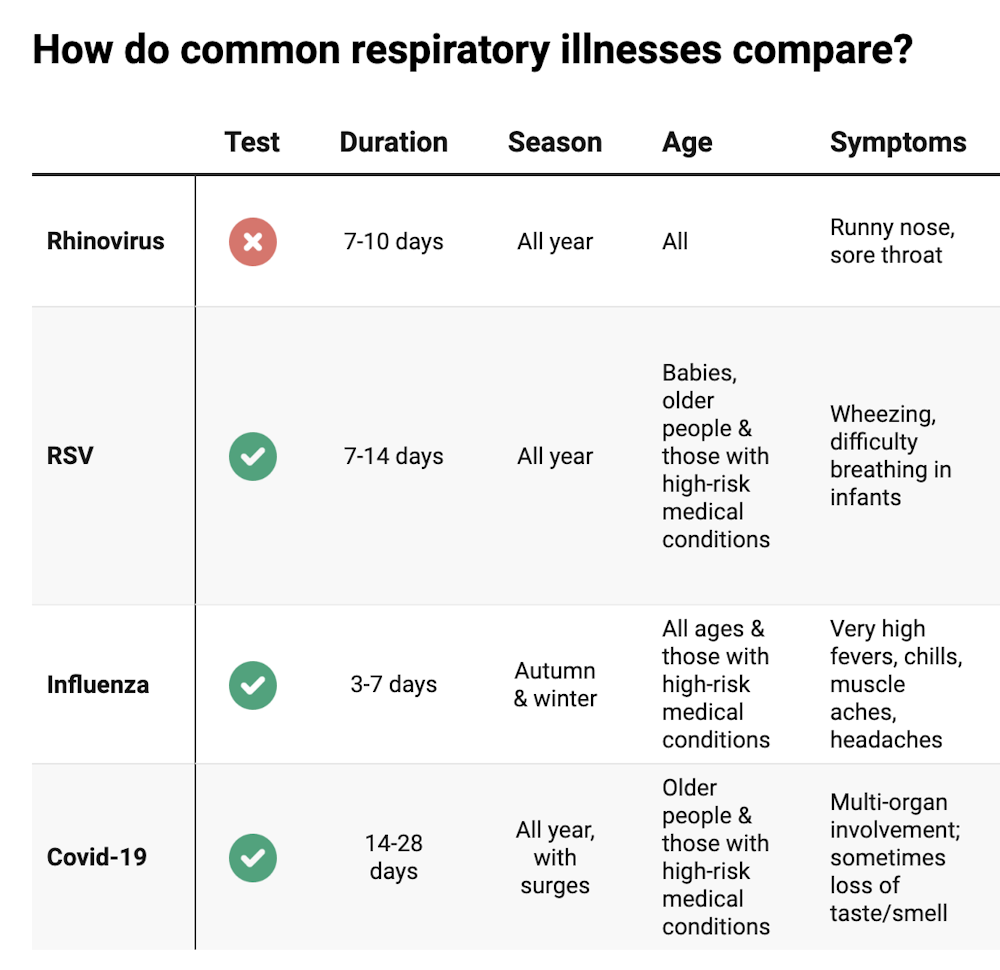
    These symptoms are likely to be caused by a virus, such as COVID, influenza, respiratory syncytial virus (RSV) or a “cold” (often caused by rhinoviruses). These conditions can occur all year round, with some overlap of symptoms:


    Natasha Yates/The Conversation

    COVID still surrounds us. RSV and influenza rates appear higher than before the COVID pandemic, but it may be due to more testing.

    So if you have a fever, sore throat, muscle aches/pains, weakness, fatigue, or are coughing up mucus, stay home and avoid mixing with others to limit transmission.

    People with COVID symptoms can take a rapid antigen test (RAT), ideally when symptoms start, then isolate until symptoms disappear. One negative RAT alone can’t rule out COVID if symptoms are still present, so test again 24–48 hours after your initial test if symptoms persist.

    You can now test yourself for COVID, RSV and influenza in a combined RAT. But again, a negative test doesn’t rule out the virus. If your symptoms continue, test again 24–48 hours after the previous test.

    If it’s hay fever, how do I treat it?

    Treatment involves blocking the body’s histamine release, by taking antihistamine medication which helps reduce the symptoms.

    Doctors, nurse practitioners and pharmacists can develop a hay fever care plan. This may include using a nasal spray containing a topical corticosteroid to help reduce the swelling inside the nose, which causes stuffiness or blockage.

    Nasal sprays need to delivered using correct technique and used over several weeks to work properly. Often these sprays can also help lessen the itchy eyes of hay fever.

    Drying bed linen and pyjamas inside during spring can lessen symptoms, as can putting a smear of Vaseline in the nostrils when going outside. Pollen sticks to the Vaseline, and gently blowing your nose later removes it.

    People with asthma should also have an asthma plan, created by their doctor or nurse practitioner, explaining how to adjust their asthma reliever and preventer medications in hay fever seasons or on allergen exposure.

    People with asthma also need to be alert for thunderstorms, where pollens can burst into tinier particles, be inhaled deeper in the lungs and cause a severe asthma attack, and even death.

    What if it’s COVID, RSV or the flu?

    Australians aged 70 and over and others with underlying health conditions who test positive for COVID are eligible for antivirals to reduce their chance of severe illness.

    Most other people with COVID, RSV and influenza will recover at home with rest, fluids and paracetamol to relieve symptoms. However some groups are at greater risk of serious illness and may require additional treatment or hospitalisation.

    For RSV, this includes premature infants, babies 12 months and younger, children under two who have other medical conditions, adults over 75, people with heart and lung conditions, or health conditions that lessens the immune system response.

    For influenza, people at higher risk of severe illness are pregnant women, Aboriginal people, people under five or over 65 years, or people with long-term medical conditions, such as kidney, heart, lung or liver disease, diabetes and decreased immunity.

    If you’re concerned about severe symptoms of COVID, RSV or influenza, consult your doctor or call 000 in an emergency.

    If your symptoms are mild but persist, and you’re not sure what’s causing them, book an appointment with your doctor or nurse practitioner. Although hay fever season is here, we need to avoid spreading other serious infectious.

    For more information, you can call the healthdirect helpline on 1800 022 222 (known as NURSE-ON-CALL in Victoria); use the online Symptom Checker; or visit healthdirect.gov.au or the Australian Society of Clinical Immunology and Allergy.

    Deryn Thompson is affiliated with Loreal, Ego Pharmaceuticals and Quality Use of Medicines Alliance having received honorariums for educational talks or advisory work.

    ref. I have a stuffy nose, how can I tell if it’s hay fever, COVID or something else? – https://theconversation.com/i-have-a-stuffy-nose-how-can-i-tell-if-its-hay-fever-covid-or-something-else-240453

    MIL OSI AnalysisEveningReport.nz

  • MIL-Evening Report: Grave cleaning videos are going viral on TikTok. Are they honouring the dead, or exploiting them?

    Source: The Conversation (Au and NZ) – By Edith Jennifer Hill, Associate Lecturer, Learning & Teaching Innovation, Flinders University

    Shutterstock

    Cleaning the graves of strangers is the latest content trend taking over TikTok. But as millions tune in to watch the videos, it’s becoming clear not all of them are created equal. Two grave-cleaning creators in particular seem to reside at opposite ends of the trend.

    One of the first accounts to gain popularity for grave cleaning was @ladytaphos. This account is run by Alicia Williams, a Virginia resident who treats the graves with great dignity. Williams will often share the story of the person residing within, and acts with grace and kindness as she restores beauty to the graves.

    On the other end of the spectrum is Kaeli Mae McEwen, or @the_clean_girl, who leans into more clickbait-y tactics. McEwen is known for throwing a pink spiky ball through a graveyard and cleaning the grave it lands on. She also uses her videos to promote her own pink foamy cleaner (which at one point could be purchased via a link in her bio).

    Cleaning and death

    While Williams’ and McEwen’s videos may seem novel to some, death and cleaning have a long and varied relationship that spans time and cultures.

    Washing a loved one’s body before burial or cremation isn’t just practical – it’s a significant ritual that provides meaning during a period of grief. In certain cultures and religions it’s also a process of purification, or preparation for the afterlife.

    Much has been written about cleaning and clearing out the homes of deceased people. Family members often won’t agree on how to approach such a task. In his essay on death and objects, author Tony Birch writes about his mother clearing out his grandmother’s house.

    “My mother decided that our first task after her death was to empty out her Housing Commission flat and scrub it clean,” Birch writes.

    He first laments the move, but later recognises the value of cleaning together before sorting – and treasuring – the items his grandmother left behind.

    Grave cleaning is a practice steeped in history.
    Shutterstock

    Margaretta Magnuson’s 2017 book, The Gentle Art of Swedish Death Cleaning, is a humorous and thoughtful introduction to the Swedish movement of döstädning. The book (and subsequent reality TV series) has sparked various conversations on death and cleaning, and especially on cleaning before you yourself pass away so you don’t leave a mess for your loved ones.

    Grave cleaning can be seen as another continuation of caring for the deceased. People who decide to clean the graves of strangers may do so out of respect, or in an attempt to give them “their name back” (as names on graves become visible following the removal of debris).

    Two very different approaches

    Williams and McEwen are received quite differently by viewers. Anecdotally, viewers respond more positively to the calmer and more respectful cleaning videos by Williams, who takes time to explain the process while ensuring the correct products are used.

    Meanwhile, many find McEwen’s videos problematic and criticise her for not adhering to proper graveyard decorum. McEwen makes a spectacle of sites of mourning, such as by pretending to vacuum graves, replacing flowers placed by others and making jokes. Viewers also speculate the products she uses may cause damage to the graves.

    Perceived intent plays a role in how each creator’s content is received. While Williams focuses on respectfully restoring graves to their former glory, McEwen positions herself as the focus and merely uses the graves for content.

    A complex emotional object

    Similar to other funerary objects such as coffins and urns, graves are associated with both the person who died and the fact of their death. As such, they are emotionally complex objects that bring both strength and sadness to those left behind.

    But graves are unique also in that they are private objects of grief exposed in a public context. Anyone visiting the graveyard can view and interact with them. Does that make them “fair game” for content creators?

    Graves don’t just represent deceased loves ones. They can also act as stand-ins in their absence, becoming stone bodies of sorts. As sociologist Margaret Gibson describes in her book Objects of the Dead: Mourning and Memory in Everyday Life, “death reconstructs our experience of objects”.

    “There is the strangeness of realising that things have outlived persons, and, in this regard, the materiality of things is shown to be more permanent than the materiality of the body,” she says.

    Caring for and cleaning graves can therefore be interpreted as caring for the deceased, by extending their existence through the materiality of their resting place.

    Psychological researcher Svend Brinkmann asserts artefacts such as graves are “culturally sanctioned”, gaining “significance from a collective system of meaning”.

    In other words, we as a community create and uphold reverence for such items. This is partly why the desecration of graves is viewed as abhorrent. It is societally understood to be a desecration of the person themselves. It’s also why content creators must tread lightly.

    A reason for haunting?

    There are ways to interact with gravestones (and even create content) which acknowledge their complexity and connection to their owners.

    TikTok creator Rosie Grant (@ghostlyarchive) bakes recipes found on headstones and records the process. She has even met with the families of the deceased to make the recipes together and learn more about the people behind the engraving-worthy food.

    However, randomly cleaning the graves of strangers is fraught territory – and rife with potential privacy issues. It isn’t clear whether McEwen seeks permission from loved ones before cleaning graves, but contextually this seems unlikely.

    Recent discussions have also uncovered questionable editing in her videos. Some graves in her before-and-after videos have been edited to appear cleaner and to have their structure altered. McEwen’s pink foaming cleaner also appears to be a blue cleaner edited to appear pink, raising even more questions about intent and responsibility.

    While McEwen claims to be “honouring” lives by cleaning “final resting places”, the consensus from viewers is her actions are dishonourable. As one host commented on a in podcast discussing McEwen cleaning a baby’s grave while speaking in a kiddish voice: “Fuck you, you’re going to get haunted.”

    The authors do not work for, consult, own shares in or receive funding from any company or organisation that would benefit from this article, and have disclosed no relevant affiliations beyond their academic appointment.

    ref. Grave cleaning videos are going viral on TikTok. Are they honouring the dead, or exploiting them? – https://theconversation.com/grave-cleaning-videos-are-going-viral-on-tiktok-are-they-honouring-the-dead-or-exploiting-them-240553

    MIL OSI AnalysisEveningReport.nz

  • MIL-OSI China: Hong Kong, Macao aim to be global talent hubs

    Source: China State Council Information Office 2

    Fireworks celebrating the 75th anniversary of the founding of the People’s Republic of China illuminate the sky over Victoria Harbour in Hong Kong, Oct 1, 2024. [Photo/Xinhua]
    Experts from the Hong Kong and Macao special administrative regions said the central government’s new directive to transform the two regions into international hubs for top-tier talent will fulfill local demand for talent while propelling the country’s high-quality development.
    To achieve this objective, both regions should leverage their distinct advantages and policy incentives to attract and retain external talent, while strengthening mechanisms to nurture local talent, they said.
    The resolution on further deepening reform comprehensively to advance Chinese modernization, which was adopted on July 18 at the third plenary session of the 20th Central Committee of the Communist Party of China, voiced support for Hong Kong and Macao in building themselves into international hubs for high-caliber talent.
    Luo Yong, chairman of the Hong Kong Quality and Talent Migrants Association, said the resolution marks the first explicit directive from the central authorities regarding the SAR’s talent policies, demonstrating Hong Kong’s significant importance to national development.
    Daniel Lee Ho-wah, president of the Hong Kong People Management Association, a professional human resources management body, said that Hong Kong will be a direct beneficiary of the resolution.
    Official data shows that the city’s population is projected to reach 8.19 million by mid-2046, with one-third being age 65 or older.
    Building Hong Kong into an international talent hub will help address the city’s challenges related to its aging population and labor shortage.
    The welcome influx of talent will also spur the growth of various industries in Hong Kong, upgrade the city’s economic structure and attract more investment, Lee said.
    Lau Siu-kai, a consultant with the Chinese Association of Hong Kong and Macao Studies, a Beijing-based think tank, said he believes that professionals attracted to Hong Kong will leverage the city as a gateway to the Chinese mainland and overseas.
    These professionals will not only contribute to the development of Hong Kong and the mainland but also help foster a positive global narrative of the country, Lau added.
    The Hong Kong SAR government has ramped up talent-attraction initiatives since late 2022. As of June 30, the city had received more than 320,000 applications through various talent programs, of which 200,000 had been approved, and more than 130,000 of the applicants had arrived in Hong Kong.
    Leveraging advantage
    Luo of the Hong Kong Quality and Talent Migrants Association said the “one country, two systems” principle has always been a magnet for global professionals, and the city should further leverage this advantage to enhance its appeal. Considering Hong Kong’s relatively narrow industry scope, the city needs to collaborate with mainland cities in the Guangdong-Hong Kong-Macao Greater Bay Area on talent policies.
    Luo’s association has been hosting talent summits and fostering exchanges with high-end talent organizations and international talent groups. He noted that professionals, whether from Hong Kong, the mainland or overseas, share a common interest in exploring growth prospects in the city, especially for foreigners who hope to tap mainland opportunities through Hong Kong.
    Luo emphasized the magnetic effect of career-advancement prospects on high-caliber professionals, suggesting that providing such opportunities is key to attracting the world’s best.
    Shang Hailong, a lawmaker and chairman of the Hong Kong Top Talent Services Association, proposed targeted scholarship programs to entice people from countries involved in the Belt and Road Initiative to study in Hong Kong.
    Hong Kong should not just attract professionals, but also needs to retain them, Shang said.
    As the city prepares for a wave of visa renewals in the coming years, the government could use the opportunity to address the practical challenges faced by newcomers.
    Lee of the Hong Kong People Management Association underlined the need to address expatriates’ concerns in finding suitable accommodations for their families and the right schools for their children.
    Lee suggested that the government collaborate with international or English-language schools to reserve spots for the children of senior professionals. Additionally, enterprises can help provide them with affordable transitional housing.
    He emphasized that going to Hong Kong is not just an individual decision by the professionals, but a family matter as well. Resolving livelihood challenges is essential to encouraging them to relocate to the city, Lee said.
    Zhou Ping, director of the Macao One Belt, One Road Research Center at City University of Macao, said the plenary session’s resolution provides crucial guidance for advancing Macao’s talent framework.
    He said Macao’s emphasis on new industries in recent years boasts several advantages that are distinct from those of Hong Kong in attracting talent. Macao’s “1+4” industry diversification strategy, unveiled in 2023, involves promoting the growth of one key sector — tourism and leisure — alongside the advancement of the big health, modern finance and high-tech industries, as well as conventions, exhibitions, culture and sports.
    This strategic approach opens doors for experts to swiftly assume leadership positions within these industries, Zhou said.
    Wong Kam-fai, a legislator and an associate dean of the faculty of engineering at Chinese University of Hong Kong, said fostering local talent is critical for the long-term development of Hong Kong’s talent base.
    Despite Hong Kong’s established prowess in finance, innovation and technology, trade and aviation, there remains a shortage of skilled human resources in some applied technology disciplines such as information technology, electrical and mechanical engineering, maritime engineering and logistics, he said.
    To address this gap, Wong proposed strengthening cooperation with the city of Shenzhen, Guangdong province, in training talent with applied skills.
    Hong Kong can establish vocational training colleges on the mainland, offering programs with mutually recognized qualifications, Wong said, adding that graduates from these colleges could be allowed to work in Hong Kong, becoming a force in the city’s talent pool.
    The government could also construct primary and secondary boarding schools, offering mainland and international curriculums that cater to the needs of families from Shenzhen and Hong Kong. These institutions could serve as incubators for Hong Kong’s future professionals.
    Addressing challenges
    Addressing the challenges in fostering innovation and technology talent, Wong suggested that the government establish a committee to focus on the issue. This committee could help the Education Bureau of the Hong Kong SAR create and update the innovation and technology program framework, and systematically develop the professionals required by various industries, he added.
    Zhou from City University of Macao also emphasized the importance of local talent development. He said the Macao SAR government should offer greater support to the region’s 10 higher education institutions, with a focus on disciplines integral to the city’s future growth.
    He also encouraged these institutions to consider establishing branches on Hengqin island of Zhuhai, Guangdong province, to capitalize on the synergy of the whole Greater Bay Area.

    MIL OSI China News

  • MIL-OSI Economics: Money Market Operations as on October 07, 2024

    Source: Reserve Bank of India


    (Amount in ₹ crore, Rate in Per cent)

      Volume
    (One Leg)
    Weighted
    Average Rate
    Range
    A. Overnight Segment (I+II+III+IV) 5,23,299.71 6.23 1.93-6.50
         I. Call Money 11,161.74 6.43 5.10-6.50
         II. Triparty Repo 3,51,569.00 6.20 6.11-6.31
         III. Market Repo 1,59,200.97 6.30 1.93-6.45
         IV. Repo in Corporate Bond 1,368.00 6.40 6.40-6.48
    B. Term Segment      
         I. Notice Money** 313.50 6.34 5.95-6.50
         II. Term Money@@ 432.25 6.50-7.20
         III. Triparty Repo 150.00 6.32 6.32-6.32
         IV. Market Repo 399.99 6.47 6.30-6.65
         V. Repo in Corporate Bond 0.00
      Auction Date Tenor (Days) Maturity Date Amount Current Rate /
    Cut off Rate
    C. Liquidity Adjustment Facility (LAF), Marginal Standing Facility (MSF) & Standing Deposit Facility (SDF)
    I. Today’s Operations
    1. Fixed Rate          
    2. Variable Rate&          
      (I) Main Operation          
         (a) Repo          
         (b) Reverse Repo          
      (II) Fine Tuning Operations          
         (a) Repo          
         (b) Reverse Repo Mon, 07/10/2024 4 Fri, 11/10/2024 36,825.00 6.49
    3. MSF# Mon, 07/10/2024 1 Tue, 08/10/2024 2,730.00 6.75
    4. SDFΔ# Mon, 07/10/2024 1 Tue, 08/10/2024 89,452.00 6.25
    5. Net liquidity injected from today’s operations [injection (+)/absorption (-)]*       -123,547.00  
    II. Outstanding Operations
    1. Fixed Rate          
    2. Variable Rate&          
      (I) Main Operation          
         (a) Repo          
         (b) Reverse Repo Fri, 04/10/2024 14 Fri, 18/10/2024 44,275.00 6.49
      (II) Fine Tuning Operations          
         (a) Repo          
         (b) Reverse Repo          
    3. MSF#          
    4. SDFΔ#          
    5. On Tap Targeted Long Term Repo Operations Mon, 15/11/2021 1095 Thu, 14/11/2024 250.00 4.00
    Mon, 27/12/2021 1095 Thu, 26/12/2024 2,275.00 4.00
    6. Special Long-Term Repo Operations (SLTRO) for Small Finance Banks (SFBs)£ Mon, 15/11/2021 1095 Thu, 14/11/2024 105.00 4.00
    Mon, 22/11/2021 1095 Thu, 21/11/2024 100.00 4.00
    Mon, 29/11/2021 1095 Thu, 28/11/2024 305.00 4.00
    Mon, 13/12/2021 1095 Thu, 12/12/2024 150.00 4.00
    Mon, 20/12/2021 1095 Thu, 19/12/2024 100.00 4.00
    Mon, 27/12/2021 1095 Thu, 26/12/2024 255.00 4.00
    D. Standing Liquidity Facility (SLF) Availed from RBI$       6,850.74  
    E. Net liquidity injected from outstanding operations [injection (+)/absorption (-)]*     -33,884.26  
    F. Net liquidity injected (outstanding including today’s operations) [injection (+)/absorption (-)]*     -157,431.26  
    G. Cash Reserves Position of Scheduled Commercial Banks
         (i) Cash balances with RBI as on October 07, 2024 10,27,404.10  
         (ii) Average daily cash reserve requirement for the fortnight ending October 18, 2024 10,01,756.00  
    H. Government of India Surplus Cash Balance Reckoned for Auction as on¥ October 07, 2024 0.00  
    I. Net durable liquidity [surplus (+)/deficit (-)] as on September 20, 2024 4,18,318.00  
    @ Based on Reserve Bank of India (RBI) / Clearing Corporation of India Limited (CCIL).
    – Not Applicable / No Transaction.
    ** Relates to uncollateralized transactions of 2 to 14 days tenor.
    @@ Relates to uncollateralized transactions of 15 days to one year tenor.
    $ Includes refinance facilities extended by RBI.
    & As per the Press Release No. 2019-2020/1900 dated February 06, 2020.
    Δ As per the Press Release No. 2022-2023/41 dated April 08, 2022.
    * Net liquidity is calculated as Repo+MSF+SLF-Reverse Repo-SDF.
    As per the Press Release No. 2020-2021/520 dated October 21, 2020, Press Release No. 2020-2021/763 dated December 11, 2020, Press Release No. 2020-2021/1057 dated February 05, 2021 and Press Release No. 2021-2022/695 dated August 13, 2021.
    ¥ As per the Press Release No. 2014-2015/1971 dated March 19, 2015.
    £ As per the Press Release No. 2021-2022/181 dated May 07, 2021 and Press Release No. 2021-2022/1023 dated October 11, 2021.
    # As per the Press Release No. 2023-2024/1548 dated December 27, 2023.
    Ajit Prasad            
    Deputy General Manager
    (Communications)    
    Press Release: 2024-2025/1243

    MIL OSI Economics

  • MIL-OSI Australia: Antarctic season begins

    Source: Australian Government – Antarctic Division

    Australia’s Antarctic science and logistics season has started, with RSV Nuyina leaving Hobart on a six-week resupply voyage to Davis research station.
    The ship has 100 expeditioners on board, two helicopters, a hot pink Antarctic tractor, 240,000 litres of water, 13 tonnes of dry food and more than 20 tonnes of fresh and frozen food.
    It marks the start of an ambitious year for science and infrastructure at Australia’s Antarctic and sub-Antarctic stations.

    “We’re all very excited to be underway,” Voyage Leader Anthea Fisher said.
    “We’ve been chatting to the team who are down at Davis – they’ve been there for a year now – and they’re pretty excited for us to turn up too, to resupply the station and bring them home again.”
    The journey south will take 15 days and require the ship to break ice for the last nine or ten kilometres.
    “At this time of year there’s a section of ice breaking through the pack ice and then the fast ice,” the voyage leader said.
    “We’ll break into that and park about a kilometre out from station and once we’re parked in there, people will be able to just walk off the ship across the ice to station.”
    The trades team travelling to Davis will aim to complete work on a new reverse osmosis plant, which creates drinking water from sea water.
    Along with a third water tank installed last year, it will give the station the water capacity it needs to support station populations in future.
     “Davis station doesn’t have a fresh water source so we have to produce fresh water from salt water via a desalination plant and then store that water for most of the year until we can produce fresh water for a short window in summer,” Construction Supervisor for summer, Tom de Leon, said.
    “A huge amount of planning goes into making sure we don’t run out of materials.
    “There’s no Bunnings down there we can duck into so we have to think very carefully about what we bring and what we use when we’re down there.”
    There are also science project teams on board.
    “We have an important season of science ahead of us this year, kicking off with this first voyage,” Head of the Australian Antarctic Division’s Science Branch, Rhonda Bartley, said.
    Two seabird scientists on board will stop at Davis for a few weeks to monitor local seabird colonies and look for any signs of avian influenza in bird populations and seals near the station. They will then go to Mawson research station for the rest of the summer season to monitor and conduct research on penguins and flying seabirds.
    “We haven’t had any signs of avian influenza in East Antarctica yet but it’s really important that we have people there to look for those signs and assess the impacts of any outbreak,”
     “We’re also very concerned for the health and welfare of our expeditioners so a lot of our planning is around having good biosecurity measures in place and being able to respond to protect our people.”
    Three scientists on the voyage from the Cleaner Antarctica program – which assesses and remediates legacy waste at Antarctic and sub-Antarctic stations – will also carry out work at Davis before transiting to Mawson for the summer’s program of works.
    Three scientific technicians are doing the round trip to maintain key geophysical and atmospheric monitoring equipment on board Nuyina.
    In December, scientists will return to Bunger Hills for the third and final year of the Denman Terrestrial Campaign, which aims to increase our understanding of the glacier’s stability and possible contribution to sea level rise, through research projects carried out inland.
    After the scientists leave in January, trades teams and expeditioners will start the mammoth task of packing the camp up and remediating the site.
    Then in February, RSV Nuyina leaves for the 60-day Denman Marine Voyage, the ship’s first dedicated marine science journey.
    The voyage will take 60 scientists from a range of universities and disciplines to the Denman Glacier region so they can study the system from the sea.
    This content was last updated 14 hours ago on 8 October 2024.

    MIL OSI News

  • MIL-OSI USA News: Remarks by APNSA Jake Sullivan on the Anniversary of the October 7th  Attacks

    Source: The White House

    Embassy of Israel
    Washington, D.C.

    MR. SULLIVAN:  Thank you all for having me here today. 

    Ambassador Herzog, Mike, thank you — both for your hospitality here and for a year that has been difficult and challenging, but you have always stayed committed to the strength of the U.S.-Israel relationship and see it as larger than any two people, and I’m grateful to you for that.

    And it means a lot to me that I’ve been invited here to mark this solemn occasion with all of you.

    As you know, President Biden spoke with President Herzog earlier today, and he shared his deepest condolences with the President and the people of Israel as they commemorate this godawful anniversary. 

    He lit a candle in the White House together with the First Lady, and they said a prayer in remembrance of those lost, loved ones massacred by terrorists who exalted in the assault and murder of innocent Jewish men, women, and children. 

    Perhaps for the first time ever, this morning, the traditional mourning prayer, El Malei Rachamim, was read in Hebrew in the quiet of the residence of the White House.  One line from that prayer, as many of you know: “God full of mercy…grant rest on the wings of the Divine.” 

    The thousands of miles between Washington and Israel do not feel so distant today.  As the President shared in his statement this morning, we grieve with the families and communities who are still in mourning, just as we share in the excruciating pain of those whose loved ones are still held hostage by Hamas, including American citizens. 

    I’ve spent a lot of time with the families of the American hostages over the past year.  I remain humbled by their resilience and their courage.  Instead of succumbing to the dark paralysis of grief, they are working every day to secure the return of their loved ones — always thoughtful, always constructive, always pushing us hard, as they should. 

    I look around this room and I see colleagues here that I’ve gotten to know very, very well through these challenging times.  In the days that followed October 7th, our defense, intelligence, and national security teams were in constant touch.  At President Biden’s direction, we moved military assets into the region, including carrier strike groups with their destroyer escorts and air wings, the finest on the planet, to protect U.S. forces in the region and, yes, to support the defense of the State of Israel. 

    I traveled with President Biden to Israel on October 18th, the first president to visit Israel in a time of war.  And I was with him this past Tuesday.  He was scheduled to be in the Oval Office for his annual Rosh Hashanah call with Jewish leaders.  Instead, he was in the Situation Room, where, for the second time in five months, he ordered the U.S. military to take action to defend Israel from a significant attack by Iran. 

    Side by side, U.S. naval destroyers joined Israeli air defense units in again intercepting a rainfall of inbound missiles — ballistic missiles from Iran.  We thank God we were successful in rendering that attack ineffective, but we remain highly vigilant to the further threats and attacks from Iran and its proxies, including Hamas, Hezbollah, and the Houthis.

    Backed by the ironclad security partnership of the United States, Israel has demonstrated its remarkable capacity, including through impressive operations that killed terrorists with Israeli and, yes, with American blood on their hands. 

    The challenge going forward is to turn tactical wins in battle into a strategy that secures Israel’s people and its future.  That takes real discipline, it takes courage, it takes foresight to match the conduct of war to a clear and sustainable set of objectives and to turn tactical advantage into enduring strategic gains.  That is never easy, but it’s imperative, and we are here to work with you on that. 

    Because as I look around this room, I see colleagues that I haven’t just gotten to know in the crucible of the past year but in the work that preceded it, a project to make real the vision of broader peace, stability, and economic connectivity across the Middle East and to make real a future where Israelis and Palestinians can live alongside one another in security, dignity, self-determination, and peace.

    As the President said in his statement this morning, “I believe that history will also remember October 7th as a dark day for the Palestinian people because of the conflict that Hamas unleashed that day.  Far too many civilians have suffered far too much during this year of conflict — and tens of thousands have been killed, a human toll made far worse by terrorists hiding and operating among innocent people.” 

    Ambassador Herzog spoke in his remarks of the Jewish commandment that every innocent life has value, whether it’s American or Israeli, Lebanese or Palestinian.  Every innocent life.

    In my family, we read the poet John Donne, who said, and I quote, “Any man’s death diminishes me, / because I am involved in mankind.”  And we have to bring that spirit to this conflict as well. 

    We have continued to actively pursue a pathway to a future where Israel enjoys normalized relations with all of its Arab neighbors, where Palestinians have a state of their own, and where Israel’s security is assured forever. 

    And we have continued to stand strong against the antisemitism that still burns in America, around the world, and that has gotten oxygen since October 7th, as the Ambassador said.  And we will continue, from the President through every member of his administration, to stand firmly against it. 

    I’m not blind to the difficulties of this moment.  I’m not blind to their deep roots.  The challenges are many.  The suffering and trauma is real, and it’s with me always.  And no one is ever criticized for predicting that things will only get worse in the Middle East.  The hard thing is to push past the hopelessness and put the pieces down that build toward a genuinely brighter future, even as we navigate the heightened risks and exacting human toll of the present day. 

    This is a focus of my own conversations, President Biden’s conversations, the Vice President’s conversations, the Secretary of State, every member of our team, with leaders across the Middle East who recognize that this future I’m describing can still be the ultimate legacy of October 7th.  And we stand ready to work with all of you, everyone here, everyone of good faith across the region. 

    But this future, as you all know and has been shown to us so many times, is far from assured.  We have to work to make it so. 

    So, may God protect our troops and watch over the hostages.  May the memory of those lost be a blessing, just as the joyousness of their lives remains our light and inspiration forward. 

    Thank you.  (Applause.)

    MIL OSI USA News

  • MIL-OSI USA: Senator Marshall and Colleagues Sound Alarm After DHS Whistleblowers Exposes Biden-Harris Breaking the Law

    US Senate News:

    Source: United States Senator for Kansas Roger Marshall
    Washington, D.C. – U.S. Senator Roger Marshall, M.D. joined a letter led by Senator Chuck Grassley (R-IA) demanding President Joe Biden and Vice President Kamala Harris collect DNA samples from every immigrant the Department of Homeland Security (DHS) encounters, per the DNA Fingerprint Act of 2005.  
    Legally protected whistleblowers have exposed how DHS’s failure to collect DNA hampers law enforcement efforts to stop violent crime. Notably, DHS missed three separate opportunities to gather DNA from the illegal immigrant who murdered Rachel Morin, a Maryland mother of five.  
    “It is beyond heartbreaking to know that my daughter’s brutal death could have been prevented. This isn’t just a bureaucratic oversight; it’s a deadly failure that turned a protective measure into a hollow promise,” said Patty Morin, mother of Rachel Morin. “President Biden and Vice President Harris’ reckless disregard for border security puts every American family in imminent danger. How many more precious lives have to be lost before they decide to protect the people they were elected to serve?”  
    “Following the law, protecting whistleblowers and ensuring the safety of American citizens like Rachel Morin shouldn’t be controversial,” Senators Marshall and Grassley wrote to President Biden and Vice President Harris. “The Biden-Harris administration’s DHS must follow the law—the consequences are stark when they don’t.” 
    Read the full letter HERE.  
    Background: 
    The DNA Fingerprint Act of 2005 requires federal law enforcement to collect DNA from every individual Customs and Border Protections (CBP) arrests, charges, convicts or detains. Yet, per whistleblower disclosures, DHS has collected DNA samples from less than than approximately 40 percent of the more than 10 million known illegal immigrants who have entered the country during the Biden-Harris administration.   Whistleblowers additionally revealed that a CBP official who recently visited major border facilities in Arizona and California did not observe any DNA collection taking place. As a result of disclosing DHS’s failures to Congress, whistleblowers have suffered long-term, severe retaliation. 

    MIL OSI USA News

  • MIL-OSI Economics: Targeted Policies for Digital Creative Industries Can Drive Economic Growth in Asia and Pacific

    Source: Asia Development Bank

    MANILA, PHILIPPINES (8 October 2024) — Coherent national strategies that develop talent and expand digital creative industries can help developing countries tap into the global creative economy, generating high-quality jobs that contribute to economic growth, according to a new report published today by the Asian Development Bank (ADB).

    “Digital disruption of creative industries can present huge economic potential in Asia and the Pacific,” said ADB Director General for Climate Change and Sustainable Development Bruno Carrasco about the launch of A Review of Digital Creative Industries in Asia: Opportunities and Policies to Foster Growth and Create High-Quality Jobs.

    “Yet the policy environment does not always allow creatives to thrive and connect with the global value chain,” added Mr. Carrasco. “This report can help industry and policy makers shape Asia and the Pacific’s digital creative industries, foster opportunities to bridge the region’s rich cultural heritage with the rest of the world and drive economic growth.”

    Based on more than 40 interviews with key individuals across India, Indonesia, Thailand, and Viet Nam—including with industry associations and creative professionals in the film, gaming and music industries—the report highlights opportunities for emerging countries to boost their digital creative industries, assess domestic talent development, and encourage policies that create high-quality jobs.

    While there is strong demand from global entertainment companies to produce local content and work with local talent, there are not enough skilled local producers, screenwriters, and programmers. To address this, the report recommends that governments and industry define the essential knowledge and skills required to perform different creative roles, build lifelong training systems, incentivize businesses to upskill their workers, and improve creative industry working standards.

    Such long-term strategies have helped creative powerhouses—such as Canada, the Republic of Korea, Singapore, and the United Kingdom—to grow their domestic talent pools and attract foreign investment. The report distills key lessons from these countries that can help guide policymakers aiming to develop creative industries.

    Another barrier identified is a severe lack of funding in the four countries examined in South and Southeast Asia. This limits the potential for local film producers, game developers, and musicians to grow, even as high-speed internet, streaming platforms, and portable devices have enabled them to reach much wider audiences.

    Establishing structured funding facilities, including loans, credit guarantees, grants, and venture capital financing, can transform creative ideas into concrete projects, according to the report. With sufficient support from the government or through public–private collaboration, these businesses can be provided with a financial safety net to innovate.

    The report was produced with support from Netflix, the video entertainment streaming service. As ADB’s knowledge partner, Netflix provided experts to be interviewed for the report and enabled access to key stakeholders in the digital creative industry. The work on the report is part of the two organizations’ ongoing collaboration to generate knowledge and boost Asia and the Pacific’s creative industries.
        
    ADB is committed to achieving a prosperous, inclusive, resilient, and sustainable Asia and the Pacific, while sustaining its efforts to eradicate extreme poverty. Established in 1966, it is owned by 69 members—49 from the region.

    MIL OSI Economics

  • MIL-OSI Economics: Additional ADB Grant to Strengthen Energy Security in Central Asia

    Source: Asia Development Bank

    DUSHANBE, TAJIKISTAN (8 October 2024) — The Asian Development Bank (ADB) has approved additional grant financing of $15 million to help Tajikistan scale up an ongoing project to reconnect the country’s power system to the Central Asian Power System (CAPS) through interconnections with neighboring Uzbekistan.

    “Through the Central Asia Regional Economic Cooperation (CAREC) program, ADB actively promotes regional power trade among countries in Central Asia and beyond,” said ADB Director General for Central and West Asia Yevgeniy Zhukov. “Our support improves the sustainability of the regional power system and helps reduce greenhouse gas emissions in the region.”

    The additional financing will construct a new 22 kilometer, 500-kilovolt transmission line in northern Tajikistan—between the country’s Sughd substation and the New Syrdarya substation in Uzbekistan. It will scale up the transmission capacity for power exports and imports among CAPS countries, which include Kazakhstan, the Kyrgyz Republic, Tajikistan, and Uzbekistan, and strengthen infrastructure to prevent grid failures which lead to blackouts.

    The project will also help ensure Tajikistan’s power system is ready to provide regulating capacity for the smooth integration of renewable energy in the region. In the long term, it will become a key component of the power evacuation scheme for the Rogun hydropower plant in Tajikistan.

    Tajikistan joined ADB in 1998. For 26 years, ADB has supported a wide range of sectors from strategic road and energy infrastructure to health, education, agriculture, urban development, public sector management and finance for a total of over $2.7 billion in assistance—including over $2.1 billion in grants.

    ADB is committed to achieving a prosperous, inclusive, resilient, and sustainable Asia and the Pacific, while sustaining its efforts to eradicate extreme poverty. Established in 1966, it is owned by 69 members—49 from the region.

    MIL OSI Economics

  • MIL-OSI Economics: New ADB Country Director for Azerbaijan Assumes Office

    Source: Asia Development Bank

    BAKU, AZERBAIJAN (7 October 2024) — The Asian Development Bank (ADB) has appointed Sunniya Durrani-Jamal as its new Country Director for Azerbaijan. She joined the Azerbaijan Resident Mission today to officially commence her role.

    Ms. Durrani-Jamal will lead ADB’s operations in Azerbaijan and manage the bank’s relationships with the government and other stakeholders. She will oversee the preparation and implementation of the bank’s new country partnership strategy (CPS). The new CPS will build on ADB’s existing work in Azerbaijan, and its strategic focus areas will be aligned with the government’s development strategy and ADB’s Strategy 2030.

    “It is an honor to lead ADB’s efforts in Azerbaijan, a country of rich culture and significant economic potential,” said Ms. Durrani-Jamal. “My priority is to extend ADB’s enduring collaboration with the government, help diversify the economy and improve the quality of life for people in Azerbaijan. This includes expanding renewable energy, addressing climate change, and helping the Caucasus nation transition to a private-sector-led green economy.”

    Azerbaijan’s 10-year development strategy, Azerbaijan 2030: National Priorities for Socio-Economic Development, outlines the country’s ambitions to develop a sustainable and competitive economy, foster an inclusive society, improve human capital, transition to green growth, and improve infrastructure.

    As Asia and the Pacific’s climate bank, ADB is also supporting Azerbaijan’s Presidency of COP29, including via capacity building ahead of the landmark United Nations climate summit set to take place in Baku next month

    Ms. Durrani-Jamal has more than 25 years’ professional experience, including 16 years with ADB where she has held key senior roles. These include country director for Cambodia, senior advisor to ADB’s vice president for east Asia, southeast Asia, and the pacific; and senior economist.

    Ms. Durrani-Jamal holds a master’s degree in economics (human development) from the University of Sussex, United Kingdom, and a master of science in economics (monetary policy) from Quaid-i-Azam University, Pakistan. She succeeds outgoing Country Director Candice McDeigan who held this position from 2021.

    Since Azerbaijan joined the bank in 1999, ADB has committed more than $5 billion in sovereign and private sector assistance, including in transport, energy, health care, and agriculture.

    ADB is committed to achieving a prosperous, inclusive, resilient, and sustainable Asia and the Pacific, while sustaining its efforts to eradicate extreme poverty. Established in 1966, it is owned by 69 members—49 from the region.

    MIL OSI Economics