Category: AM-NC

  • MIL-OSI Analysis: AI and art collide in this engineering course that puts human creativity first

    Source: The Conversation – USA (2) – By Francesco Fedele, Associate Professor of Civil and Environmental Engineering, Georgia Institute of Technology

    A Georgia Tech University course links art and artificial intelligence. Yuichiro Chino/Moment via Getty Images

    Uncommon Courses is an occasional series from The Conversation U.S. highlighting unconventional approaches to teaching.

    Title of course:

    Art and Generative AI

    What prompted the idea for the course?

    I see many students viewing artificial intelligence as humanlike simply because it can write essays, do complex math or answer questions. AI can mimic human behavior but lacks meaningful engagement with the world. This disconnect inspired the course and was shaped by the ideas of 20th-century German philosopher Martin Heidegger. His work highlights how we are deeply connected and present in the world. We find meaning through action, care and relationships. Human creativity and mastery come from this intuitive connection with the world. Modern AI, by contrast, simulates intelligence by processing symbols and patterns without understanding or care.

    In this course, we reject the illusion that machines fully master everything and put student expression first. In doing so, we value uncertainty, mistakes and imperfection as essential to the creative process.

    This vision expands beyond the classroom. In the 2025-26 academic year, the course will include a new community-based learning collaboration with Atlanta’s art communities. Local artists will co-teach with me to integrate artistic practice and AI.

    The course builds on my 2018 class, Art and Geometry, which I co-taught with local artists. The course explored Picasso’s cubism, which depicted reality as fractured from multiple perspectives; it also looked at Einstein’s relativity, the idea that time and space are not absolute and distinct but part of the same fabric.

    What does the course explore?

    We begin with exploring the first mathematical model of a neuron, the perceptron. Then, we study the Hopfield network, which mimics how our brain can remember a song from just listening to a few notes by filling in the rest. Next, we look at Hinton’s Boltzmann Machine, a generative model that can also imagine and create new, similar songs. Finally, we study today’s deep neural networks and transformers, AI models that mimic how the brain learns to recognize images, speech or text. Transformers are especially well suited for understanding sentences and conversations, and they power technologies such as ChatGPT.

    In addition to AI, we integrate artistic practice into the coursework. This approach broadens students’ perspectives on science and engineering through the lens of an artist. The first offering of the course in spring 2025 was co-taught with Mark Leibert, an artist and professor of the practice at Georgia Tech. His expertise is in art, AI and digital technologies. He taught students fundamentals of various artistic media, including charcoal drawing and oil painting. Students used these principles to create art using AI ethically and creatively. They critically examined the source of training data and ensured that their work respects authorship and originality.

    Students also learn to record brain activity using electroencephalography – EEG – headsets. Through AI models, they then learn to transform neural signals into music, images and storytelling. This work inspired performances where dancers improvised in response to AI-generated music.

    The Improv AI performance at Georgia Tech on April 15, 2025. Dancers improvised to music generated by AI from brain waves and sonified black hole data.

    Why is this course relevant now?

    AI entered our lives so rapidly that many people don’t fully grasp how it works, why it works, when it fails or what its mission is.

    In creating this course, the aim is to empower students by filling that gap. Whether they are new to AI or not, the goal is to make its inner algorithms clear, approachable and honest. We focus on what these tools actually do and how they can go wrong.

    We place students and their creativity first. We reject the illusion of a perfect machine, but we provoke the AI algorithm to confuse and hallucinate, when it generates inaccurate or nonsensical responses. To do so, we deliberately use a small dataset, reduce the model size or limit training. It’s in these flawed states of AI that students step in as conscious co-creators. The students are the missing algorithm that takes back control of the creative process. Their creations do not obey AI but reimagine it by the human hand. The artwork is rescued from automation.

    What’s a critical lesson from the course?

    Students learn to recognize AI’s limitations and harness its failures to reclaim creative authorship. The artwork isn’t generated by AI, but it’s reimagined by students.

    Students learn chatbot queries have an environmental cost because large AI models use a lot of power. They avoid unnecessary iterations when designing prompts or using AI. This helps reducing carbon emissions.

    The Improv AI performance on April 15, 2025, featured dancer Bekah Crosby responding to AI-generated music from brain waves.

    What will the course prepare students to do?

    The course prepares students to think like artists. Through abstraction and imagination they gain the confidence to tackle the engineering challenges of the 21st century. These include protecting the environment, building resilient cities and improving health.

    Students also realize that while AI has vast engineering and scientific applications, ethical implementation is crucial. Understanding the type and quality of training data that AI uses is essential. Without it, AI systems risk producing biased or flawed predictions.

    Francesco Fedele does not work for, consult, own shares in or receive funding from any company or organization that would benefit from this article, and has disclosed no relevant affiliations beyond their academic appointment.

    ref. AI and art collide in this engineering course that puts human creativity first – https://theconversation.com/ai-and-art-collide-in-this-engineering-course-that-puts-human-creativity-first-256673

    MIL OSI Analysis

  • MIL-OSI NGOs: ​​​​​​​‘Do not invest in US gas exports’ Greenpeace warns EU, backed by new report

    Source: Greenpeace Statement –

    ‘Do not invest in US gas exports’ Greenpeace warns EU, backed by new report

    Brussels – As European leaders and companies are pushing for increased imports of US liquefied gas (LNG), a new report by Greenpeace USA, Earthworks, and Oil Change International highlights the climate threats and financial risks posed by five major new liquefied gas export projects proposed for the US Gulf Coast, most of them still awaiting a final investment decision.[1]

    “What we found was crystal clear – any further investment in LNG is not compatible with a livable climate,” said Andres Chang, Senior Research Specialist at Greenpeace USA and lead author of the report. “The massive growth in infrastructure along the Texas and Louisiana Gulf Coast has already created significant public health and ecosystem impacts, threatening entire coastal communities. But it doesn’t stop there. We believe this report shows that, if built, these projects would put global climate goals even further out of reach.”

    The report analyses five major US LNG projects – Venture Global CP2, Cameron LNG Phase II, Sabine Pass Stage V, Cheniere Corpus Christi LNG Midscale 8-9, and Freeport LNG Expansion – and finds that each would fail the climate test derived from models in the US Department of Energy’s 2024 LNG Export public interest studies.[2] Each would increase greenhouse gas emissions by edging out renewable energy and driving up global fossil fuel use, undermining the world’s ability to meet the Paris Agreement targets and driving more frequent and intense extreme weather events. The report suggests that future US administrations could therefore revoke export authorisations issued under current US President Trump.

    Pressured by Trump and facing the threat of sweeping tariffs, the EU Commission is proposing increased LNG imports.[3] It has also agreed to look into direct public investments by the EU and its member states in gas export facilities outside the EU – including potentially the five US LNG projects analysed in this report – in its Affordable Energy Action Plan released in February 2025.[4]

    “Increasing US gas imports will deepen Europe’s dependence on the US, making the EU and national governments even more vulnerable to Trump’s political extortion. EU leaders must break free from fossil fuel dependency and take control of Europe’s future by investing in a renewable, secure and peaceful energy system. A ban on all new fossil fuel projects in the EU would be the right first step, certainly not funding projects abroad,” said Thomas Gelin, Greenpeace EU climate and energy campaigner.

    Another result of Trump’s pressure is the calls by some Member States and other EU policymakers to weaken the EU methane regulation, which was adopted just last year, in order to continue importing US liquefied gas despite the fact that its production – mostly coming from fracking – is associated with particularly high methane emissions.[5][6]

    “This report adds to a rapidly growing body of evidence that financing U.S. LNG is not a sound decision for insurers, investors, or purchasers – something the EU and America’s Asian allies must keep in mind as President Trump pressures them to increase their imports of U.S. LNG under threat of sweeping tariffs. Countries with climate commitments, such as those in the EU, should be very wary of the climate cost of importing US LNG,” said Dr Dakota Raynes, Senior Manager of Research, Policy, and Data at Earthworks.

    European energy companies have already signed long-term purchase agreements for four of the projects analysed in the report. These contracts extend well beyond 2035, the year by which Europe must phase-out fossil gas if it is serious about meeting its international climate commitments. These companies include SEFE (Germany), BASF (Germany), GASTRADE S.A. (Greece), DTEK (Ukraine), TotalEnergies (France), PKN Orlen (Poland), Gap (Portugal) and Equinor (Norway) – several of which are fully or partially state-owned.[7] 

    “Fossil fuel dependency has long externalized its true costs, forcing communities to bear the burden of pollution, sickness, and economic instability,” says James Hiatt, founder and director of For a Better Bayou. “For decades the oil and gas industry has known about the devastating health and climate impacts of its operations, yet it continues to expand, backed by billions in private and public financing. These harms are not isolated – they’re systemic, and they threaten all of us. This report is a call to conscience. It’s time we stop propping up deadly false solutions and start investing in a transition to energy systems that sustain life, not sacrifice it.”

    Greenpeace calls on EU leaders to stop new long-term purchase agreements for liquefied gas and drop the proposal for direct financial investments in gas export facilities. Instead, the EU should impose a ban on all new fossil fuel projects, including new liquefied gas import terminals, stop all public investments in fossil fuel infrastructure and agree to end fossil gas by 2035 at the latest.

    ENDS

    Notes

    Read the full report: Failing the climate test: LNG projects awaiting final investment decision do not stand up to US Government analysis

    Read the European media briefing

    Watch the press conference recording

    [1] At the time of drafting of the report, all five were awaiting a final investment decision. On June 24, 2025, Cheniere Corpus Christi LNG announced a positive final investment decision.

    [2] December 2024 | ENERGY, ECONOMIC, AND ENVIRONMENTAL ASSESSMENT OF US LNG EXPORTS

    [3] Trump says EU must buy $350B of US energy to get tariff relief – POLITICO

    [4] Action Plan for Affordable Energy 

    [5] The Member States are: Bulgaria, Czechia, Greece, Hungaria, Romania, Slovakia and Slovenia.

    [6] Liquefied natural gas carbon footprint is worse than coal | Cornell Chronicle

    [7] Source: Sierra Club US LNG Export Tracker, date as of 4 June 2025

    Contacts

    Greenpeace International Press Desk: [email protected], +31 (0) 20 718 2470 (available 24 hours)

    Katie Nelson, Senior Communications Specialist, Greenpeace USA, [email protected], +1 (678) 644-1681, (GMT -8)

    MIL OSI NGO

  • MIL-OSI Analysis: Exploring questions of meaning, ethics and belief through Japanese anime

    Source: The Conversation – USA (2) – By Ronald S. Green, Professor and Chair of the Department of Philosophy and Religious Studies, Coastal Carolina University

    A still from the Japanese anime ‘Spirited Away.’ Choo Yut Shing via Flickr, CC BY

    Uncommon Courses is an occasional series from The Conversation U.S. highlighting unconventional approaches to teaching.

    Title of course:

    Anime and Religious Identity: Cultural Aesthetics in Japanese Spiritual Worlds

    What prompted the idea for the course?

    As a scholar who studies Japanese religion and has a lifelong love of visual storytelling, I started using anime in my class to spark conversations around the Buddhist ideas of karma and Shintō notions of “kami,” or spirits in nature.

    When I introduced the idea of karma, a scene from “Mob Psycho 100” – a Japanese manga and anime series from 2016 to 2022 about a shy teenage boy with powerful psychic abilities – came up in discussion. It sparked a conversation about how our intentions and actions carry real moral weight. In Buddhism, karma is not just about punishment or reward in a future life. It is believed to play out in the present – shaping how we relate to others and how we grow or get stuck as people.

    Later, when I explained kami in Shintō, a quiet moment from “Mushishi” helped students think differently about the world around them. “Mushishi” is a slow-paced, atmospheric anime about a wandering healer who helps people affected by mysterious spiritlike beings called mushi. These beings are not gods or monsters but part of nature itself – barely seen, yet always present. The series gave students a visual language for imagining how spiritual forces might exist in ordinary places.

    The Japanese animation movie ‘Mushishi.’

    Over the years, two moments convinced me to create a full course. First was my students’ strong reaction to Gyōmei Himejima, the Pure Land Buddhist priest in “Demon Slayer.” He is a gentle but powerful guardian who refuses to hate the demons he must fight. His actions lead to honest and thoughtful conversations about compassion, fear and the limits of violence.

    One student asked, “If Gyōmei doesn’t hate even the demons, does that mean violence can be compassionate?” Another pointed out that Gyōmei’s strength does not come from anger, but from grief and empathy. These kinds of insights showed me that anime was helping students think through complex ethical questions that would have been harder to engage through abstract theory alone.

    The second moment came from watching “Dragon Ball Daima.” In this 2024 series, familiar heroes are turned into children. This reminded me of Buddhist stories about being reborn and starting over, and it prompted new questions: If someone loses all the strength they had built up over time, are they still the same person? What, if anything, remains constant about the self, and what changes?

    What does the course explore?

    This course helps students explore questions of meaning, ethics and belief that anime brings to life. It examines themes such as what happens when the past resurfaces? What does it mean to carry the weight of responsibility? How should we act when our personal desires come into conflict with what we know is right? And how can suffering become a path to transformation?

    What materials does the course feature?

    We start with “Spirited Away,” a 2001 animated film about a young girl who becomes trapped in a spirit world after her parents are transformed into pigs. The story draws on Shintō ideas such as purification, sacred space and kami. Students learn how these religious concepts are expressed through the film’s visual design, soundscape and narrative structure.

    Later in the semester, we watch “Your Name,” a 2016 film in which two teenagers mysteriously begin switching bodies across time and space. It’s a story about connection, memory and longing. The idea of “musubi,” a spiritual thread that binds people and places together, becomes central to understanding the film’s emotional impact.

    Attack on Titan,” which first aired in 2013, immerses students in a world marked by moral conflict, sacrifice and uncertainty. The series follows a group of young soldiers fighting to survive in a society under siege by giant humanoid creatures known as Titans. Students are often surprised to learn that this popular series engages with profound questions drawn from Buddhism and existential thought, such as the meaning of freedom, the tension between destiny and individual choice, and the deeper causes of human violence.

    The characters in these stories face real struggles. Some are spirit mediums or time travelers. But all of them must make hard decisions about who they are and what they believe.

    As the semester goes on, students develop visual or written projects such as short essays, podcasts, zines or illustrated stories. These projects help them explore the same questions as the anime, but in their own voices.

    Why is this course relevant now?

    Anime has become a global phenomenon. But even though millions of people watch it, many do not realize how deeply it draws on Japanese religious traditions. In this course, students learn to look closely at what anime is saying about life, morality and the choices we make.

    Through these characters’ journeys, students learn that religion is not just something found in ancient texts or sacred buildings. It can also live in the stories we tell, the art we create and the questions we ask about ourselves and the world.

    Ronald S. Green does not work for, consult, own shares in or receive funding from any company or organization that would benefit from this article, and has disclosed no relevant affiliations beyond their academic appointment.

    ref. Exploring questions of meaning, ethics and belief through Japanese anime – https://theconversation.com/exploring-questions-of-meaning-ethics-and-belief-through-japanese-anime-260035

    MIL OSI Analysis

  • MIL-OSI Analysis: My city was one of hundreds expecting federal funds to help manage rising heat wave risk – then EPA terminated the grants

    Source: The Conversation – USA – By Brian G. Henning, Professor of Philosophy and Environmental Studies and Science, Gonzaga University

    The Pacific Northwest heat wave of 2021 left cities across Washington state sweltering in dangerous temperatures. AP Photo/Ted S. Warren

    In June 2021, a deadly heat wave pushed temperatures to 109 degrees Fahrenheit (43 Celsius) in Spokane, Washington, a northern city near the Idaho border where many homes weren’t built with central air conditioning.

    As the heat lingered for over a week, 19 people died in Spokane County and about 300 visited hospitals with signs of heat-related illnesses.

    Scientists say it’s not a matter of if, but when, another deadly heat wave descends on the region. To help save lives, the city teamed up with my university, Gonzaga, to start preparing for a hotter future.

    A chart of all deaths, excluding COVID-19, shows the extraordinary impact the 2021 heat dome had in Washington.
    ‘In the Hot Seat’ report, 2022

    We were excited and relieved when the community was awarded a US$19.9 million grant from the Environmental Protection Agency to help it take concrete steps to adapt to climate change and boost the local economy in the process. The grant would help establish resilience hubs with microgrids and help residents without air conditioning install energy-efficient cooling systems. The city doesn’t have the means to make these improvements on its own, even if they would save lives and money in the long run.

    Less than a year later, the Trump administration abruptly terminated the funding.

    Spokane’s grant wasn’t the only one eliminated – about 350 similar grants that had been awarded to help communities across the country manage climate changes, from extreme heat and wildfire smoke to rising seas and flooding, were also terminated on the grounds that they don’t meet the White House’s priorities. Many other grants to help communities have also been terminated.

    Many of the communities that lost funding are like Spokane: They can’t afford to do this kind of work on their own.

    Why cities like Spokane need the help

    Like many communities in the American West, Spokane was founded in the late 19th century on wealth from railroads and resource extraction, especially gold, silver and timber.

    Today, it is a city of 230,000 in a metro area of a half-million people, the largest on the I-90 corridor between Minneapolis and Seattle. In many ways, Spokane could be on the cusp of a renaissance.

    In January 2025, the U.S. Department of Commerce announced a $48 million grant to develop a tech hub that could put the Inland Northwest on a path to become a global leader in advanced aerospace materials. But then, in May, the Trump administration rescinded that grant as well.

    The lost grants left the economy – and Spokane’s ability to adapt fast enough to keep up with climate changes – uncertain.

    Heat waves are becoming a growing risk in Spokane, known for its river and falls that tumble near downtown.
    Roman Eugeniusz/Wikimedia Commons, CC BY-SA

    This is not a wealthy area. The median household income is nearly $30,000 less than the state average. More than 13 out of every 100 people in Spokane live in poverty, above the national average, and over 67% of the children are eligible for free or reduced lunch.

    The city is a light blue island in a dark red sea, politically speaking, with a moderate mayor. Its congressional district has voted Republican by wide margins since 1995, the year that then-House Speaker Tom Foley lost his reelection bid.

    Lessons from the 2021 heat dome

    The 2021 heat wave was a catalyzing event for the community. The newly formed Gonzaga Institute for Climate, Water and the Environment brought together a coalition of government and community partners to apply for the EPA’s Climate and Environmental Justice Community Change Grant Program. The grants, funded by Congress under the Inflation Reduction Act of 2022, were intended to help communities most affected by pollution and climate change build adaptive capacity and boost the safety of their residents.

    A key lesson from the 2021 heat dome was that temporary, or pop-up, cooling centers don’t work well. People just weren’t showing up. Our research found that the best approach is to strengthen existing community facilities that people already turn to in moments of difficulty.

    Half the $19.9 million award was for outfitting five resilience hubs in existing libraries and community centers with solar arrays and battery backup microgrids, allowing them to continue providing a safe, cool space during a heat wave if the power shuts down.

    The locations and plans for five resilience hubs to serve Spokane, and the infrastructure they would receive.
    Gonzaga Institute for Climate, Water and the Environment

    Another $8 million in grant funding was meant to provide 300 low- to moderate-income homeowners with new high-efficiency electric heat pump heating, ventilation and air conditioning systems, providing more affordable utility bills while improving their ability to cool their homes and reducing fossil fuel emissions.

    Communities are left with few options

    Now, this and other work is at risk in Spokane and cities and towns like it around the country that also lost funding.

    According to the Trump administration, the program – designed to help hundreds of communities around the country become safer – was “no longer consistent with EPA funding priorities.”

    A class action lawsuit was recently filed over the termination of the grants by a coalition that includes Earth Justice and the Southern Environmental Law Center. If the case is successful, Spokane could see its funding restored.

    Meanwhile, the city and my team know we have to move fast, with whatever money and other resources we can find, to help Spokane prepare for worsening heat. We formed the Spokane Climate Resilience Collaborative – a partnership between community organizations, health officials and the city – as one way to advance planning for and responding to climate hazards such as extreme heat and wildfire smoke.

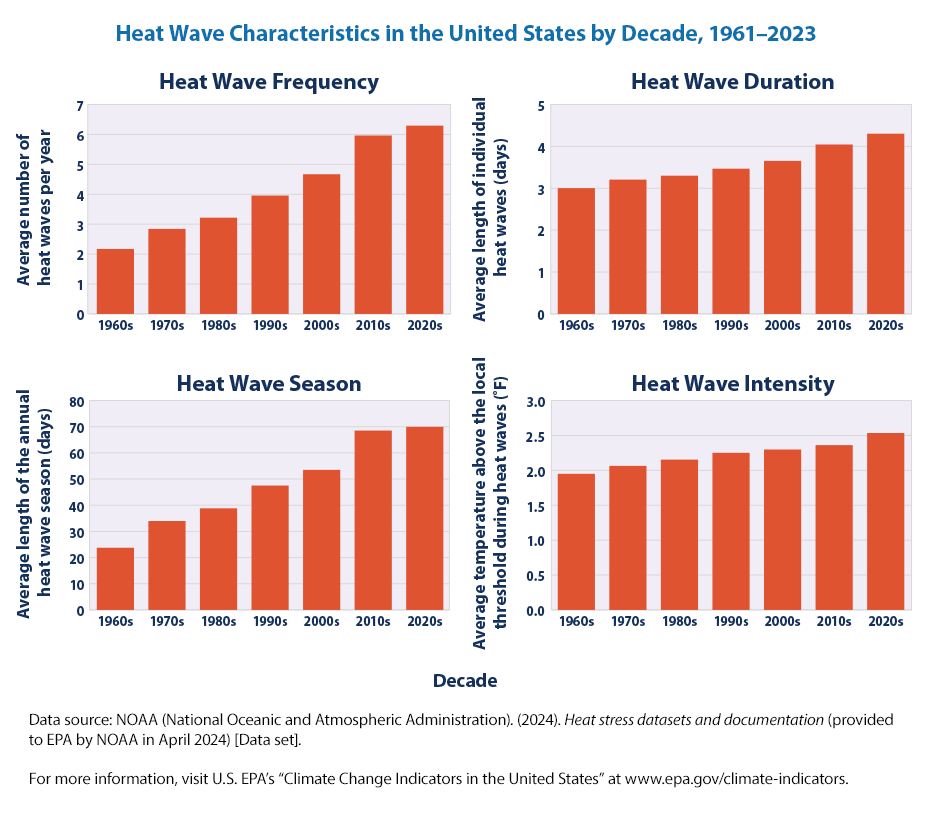
    As concentrations of heat-trapping gasses accumulate in the atmosphere, both the frequency and severity of heat waves increase. It is only a matter of time before another deadly heat dome arrives.

    Brian G. Henning receives funding from the Environmental Protection Agency.

    ref. My city was one of hundreds expecting federal funds to help manage rising heat wave risk – then EPA terminated the grants – https://theconversation.com/my-city-was-one-of-hundreds-expecting-federal-funds-to-help-manage-rising-heat-wave-risk-then-epa-terminated-the-grants-259009

    MIL OSI Analysis

  • MIL-OSI Analysis: Trump administration’s lie detector campaign against leakers is unlikely to succeed and could divert energy from national security priorities

    Source: The Conversation – USA – By Brian O’Neill, Professor of Practice, International Affairs, Georgia Institute of Technology

    The Department of Homeland Security and FBI are reportedly using polygraphs aggressively to identify dissenters. standret/Getty Images

    The Trump administration has recently directed that a new wave of polygraphs be administered across the executive branch, aimed at uncovering leaks to the press.

    As someone who has taken roughly a dozen polygraphs during my 27-year career with the CIA, I read this development with some skepticism.

    Polygraphs carry an ominous, almost mythological reputation among Americans. The more familiar and unofficial term – lie detector tests – likely fuels that perception. Television crime dramas have done their part, too, often portraying the device as an oracle for uncovering the truth when conventional methods fail.

    In those portrayals, the polygraph is not merely a tool – it’s a window into the soul.

    Among those entering government service, especially in national security, the greater anxiety is not the background check but passing the polygraph. My advice is always the same: Don’t lie.

    It’s the best – and perhaps only – guidance for a process that most assessments have concluded is a more subjective interpretation than empirical science.

    Why the polygraph persists

    Polygraphs are “pseudo-scientific” in that they measure physiological responses such as heart rate, blood pressure and perspiration. The assumption is that liars betray themselves through spikes in those signals. But this presumes a kind of psychological transparency that simply doesn’t hold up. A person might sweat and tremble simply from fear, anger or frustration – not deceit.

    There also are no specific physiological reactions associated with lying. The National Academy of Sciences in 2003, and the American Psychological Association in a 2004 review, concluded that the polygraph rests more on theater than fact. Recent assessments, published in 2019, have reached the same conclusion.

    Accordingly, polygraph results are not generally admissible in U.S. courts. Only a handful of states – such as Georgia, Arizona and California – permit their use even under limited conditions. And they typically require that both parties agree to admission and a judge to approve it. Unconditional admissibility remains the exception, not the rule.

    And yet, inside many national security agencies, polygraphs remain central to the clearance process – a fact I observed firsthand during my time overseeing personnel vetting and analytic hiring within the intelligence community.

    While not treated as conclusive, polygraph results often serve as a filter. A candidate’s visible discomfort – or the examiner’s subjective judgment that a response seems evasive – can stall or end the hiring process. For instance, I know that government agencies have halted clearances after an examiner flagged elevated reactions to questions about past drug use or foreign contacts, even when no disqualifying behavior was ultimately documented.

    The FBI’s J. Edgar Hoover headquarters building in Washington in 2016.
    AP Photo/Cliff Owen

    In some cases, an examiner’s suggestion that a chart shows an anomaly has led otherwise strong applicants to volunteer details they hadn’t planned to share – such as minor security infractions, undeclared relationships, or casual drug use from decades earlier – that, while not disqualifying on their own, reshape how their trustworthiness is perceived.

    The polygraph’s power lies in creating the conditions under which deception is confessed.

    A predictable pattern

    No administration has been immune to the impulse to investigate leaks. The reflex is bipartisan and familiar: An embarrassing disclosure appears in the press – contradicting official statements or exposing internal dissent – and the White House vows to identify and punish the source. Polygraphs are often part of this ritual.

    During his first term, Trump intensified efforts to expose internal dissent and media leaks. Department guidelines were revised to make it easier for agencies to obtain journalists’ phone and email records, and polygraphs were reportedly used to pressure officials suspected of talking to the press. That trend has continued – and, in some areas, escalated.

    Recent policies at the Pentagon now restrict unescorted press access, revoke office space for major outlets and favor ideologically aligned networks. The line between legitimate leak prevention and the surveillance or sidelining of critical press coverage has grown increasingly blurred.

    At agencies such as the Department of Homeland Security and the FBI, polygraphs are reportedly being used more frequently – and more punitively – to identify internal dissenters. Even “cold cases,” such as the leak of the Supreme Court’s Dobbs opinion ahead of its overturning of Roe v. Wade, have been reopened, despite prior investigations yielding no definitive source.

    Government reaction varies

    Not all leaks are treated the same. Disclosures that align with official narratives or offer strategic advantage may be quietly tolerated, even if unauthorized. Others, especially those that embarrass senior officials or reveal dysfunction, are more likely to prompt formal investigation.

    In 2003, for example, the leak of CIA officer Valerie Plame’s identity – widely seen as retaliation for her husband’s criticism of the Iraq War – triggered a federal investigation. The disclosure embarrassed senior officials, led to White House aide Scooter Libby’s conviction for perjury, later commuted, and drew intense political scrutiny.

    Lewis Libby, Vice President Dick Cheney’s chief of staff, rides in the backseat of a limousine on Oct. 27, 2005, in McLean, Va.
    Win McNamee/Getty Images

    Leaks involving classified material draw the sharpest response when they challenge presidential authority or expose internal disputes. That was the case in 2010 with Chelsea Manning, whose disclosure of diplomatic cables and battlefield reports embarrassed senior officials and sparked global backlash. Government reaction often depends less on what was disclosed than on who disclosed it – and to what effect.

    A narrow set of disclosures, such as those involving espionage or operational compromise, elicit broad consensus as grounds for prosecution. But most leaks fall outside that category. Most investigations fade quietly. The public rarely learns what became of them. Occasionally, there is a vague resignation, but direct accountability is rare.

    What the future holds

    Trump’s polygraph campaign is not likely to eliminate leaks to the press. But they may have a chilling effect that discourages internal candor while diverting investigative energy away from core security priorities.

    Even if such campaigns succeed in reducing unauthorized disclosures, they may come at the cost of institutional resilience. Historically, aggressive internal enforcement has been associated with declining morale and reduced information flow – factors that can hinder adaptation to complex threats.

    Some researchers have suggested that artificial intelligence may eventually offer reliable tools for detecting deception. One recent assessment raised the possibility, while cautioning that the technology is nowhere near operational readiness.

    For now, institutions will have to contend with the tools they have – imperfect, imprecise and more performative than predictive.

    As a former US intelligence officer, I am required to submit any written draft, before sharing it with other persons, for prepublication review. I submitted this draft to CIA’s Prepublication Review Board, which responded on 11 June: “No classified information was identified. Therefore, no changes are required for publication or sharing with others.”

    ref. Trump administration’s lie detector campaign against leakers is unlikely to succeed and could divert energy from national security priorities – https://theconversation.com/trump-administrations-lie-detector-campaign-against-leakers-is-unlikely-to-succeed-and-could-divert-energy-from-national-security-priorities-259128

    MIL OSI Analysis

  • MIL-OSI United Kingdom: Greens join protest to shut down Glasgow company shipping gas for Russia

    Source: Scottish Greens

    Putin’s enablers are not welcome in Scotland.

    Scottish Green MSP Ross Greer has joined members of the Ukrainian community in Scotland and the Ukraine Solidarity Campaign at a protest outside the Glasgow HQ of shipping company Seapeak, over their role in helping Russia to export gas despite the sanctions placed on it over Putin’s illegal invasion of Ukraine.

    Seapeak has been found to still ship over $5.5 billion of Russian Liquefied Natural Gas (LNG) each year.

    Ross Greer will be speaking at the rally in Glasgow today. He has previously demanded that the UK Government sanction Seapeak, but Labour Ministers have so far refused to take action. 

    Ross said:

    “It is appalling that the UK Labour government refuses to shut Seapeak down. People across Scotland are horrified when they learn that a company based here continues to fund Russia’s war machine. For as long as Seapeak remains untouched from sanctions, they will continue to ship gas out of Russia, throwing a lifeline to Putin’s war economy as a result.”

    In 2022, Ross was sanctioned by the Russian government for his work in solidarity with Ukraine. 

    Ross said:

    “Earlier this year, I wrote to UK Ministers, demanding that they shut down Seapeak’s UK operations. Despite the overwhelming evidence shared with them, they would not take action. They continue to allow Russia to profit from shipping operations here in the UK whilst claiming to stand with Ukraine.

    “Tens of thousands of Ukrainians have been killed and much of their country is left in ruins from Putin’s illegal invasion. If we were in Ukraine’s position, we would rightly be furious that our so-called allies were allowing complicit businesses like Seapeak to stay open. It is time to end this scandal and prove that Putin’s enablers are not welcome in Scotland.”

    MIL OSI United Kingdom

  • MIL-OSI United Kingdom: Regeneration of 291 Harrow Road secures planning consent | Westminster City Council

    Source: City of Westminster

    • Westminster City Council’s 291 Harrow Road development secured planning approval from the planning committee last night (Tuesday July 8th).
    • 144 new homes will be developed in the centre of London. Of these, 50% will be affordable or for Adult Social Care at social rent, with the remaining homes available for the market.
    • The development will comprise three buildings at 15, 10 and five storeys in height and will embrace passive principles in design, creating a highly efficient, low-carbon scheme.
    • Those principles will help to achieve a 70% sitewide carbon reduction over the baseline.
    • The site was part of the former Harrow Road wing of St Mary’s Hospital prior to its redevelopment in the 1980s.

    The latest housing development from Westminster City Council received approval from planning committee last night, the latest phase in the creation of more than 100 new homes.  

    Across three separate buildings, the 291 Harrow Road development will deliver 144 homes with 50% affordable housing. A total of 48 will be affordable homes, 24 will be Adult Social Care units at social rent and 72 homes will be available for private sale.

    The site was part of the former Harrow Road wing of St Mary’s Hospital prior to a period of redevelopment in the 1980s.

    At the Westminster City Council planning committee on July 8, the development secured approval by three votes to two. 

    Cllr Ellie Ormsby, Westminster City Council Cabinet Member for Regeneration and Renters, said:

     “291 Harrow Road presents a fantastic opportunity for us to deliver a greater number of high-quality homes for social rent – a necessary step considering there are over 6,000 households on Westminster’s housing waiting list – while also delivering on our ambitious sustainability commitments as one of the capital’s greenest developments. 

    “Moreover, a large proportion of these homes, a sixth of the total number, are allocated for use by adult social care services, where we are seeing growing demand. We’re excited to develop a building which embraces inclusivity and delivers for the diverse needs across our community.”

    Designs for 291 Harrow Road embrace the ‘Be Lean, Clean, Green and Seen’ energy hierarchy which utilises a fabric first approach to maximise reduction in energy through passive design measures. New, high efficiency servicing equipment and efficient façades will minimise the energy usage of the building.

    The scheme will make use of air source heat pumps and solar photo photovoltaic panels to maximise the use of renewable energy. It is anticipated that across the site build, and once occupied, 291 Harrow Road will achieve a 70% sitewide reduction over the baseline for the proposed development, far exceeding the Greater London Authority target of 35%.

    Westminster City Council has committed to 50% affordable housing across its development projects, made up of social rent and London Living Rent.

    MIL OSI United Kingdom

  • MIL-OSI Russia: Qingdao hosts first SCO conference on cooperation in standardization

    Translation. Region: Russian Federal

    Source: People’s Republic of China in Russian – People’s Republic of China in Russian –

    An important disclaimer is at the bottom of this article.

    Source: People’s Republic of China – State Council News

    QINGDAO, July 9 (Xinhua) — The first conference of the Shanghai Cooperation Organization (SCO) on standardization cooperation was held in Qingdao, east China’s Shandong Province, on Tuesday, marking the establishment of the first standardization cooperation mechanism within the SCO to provide institutional guarantees for such cooperation within the organization.

    The event was jointly initiated by the State Administration for Market Regulation of the People’s Republic of China and the Russian Federal Agency for Technical Regulation and Metrology (Rosstandart).

    The conference participants held an in-depth exchange of views on the creation of a mechanism for cooperation in the field of standardization within the SCO, strengthening cooperation on standardization in key areas, creating an information platform on standardization and building capacity in this area.

    Following the event, the Qingdao Initiative was adopted to strengthen cooperation between national standardization bodies of the SCO member states.

    As experts point out, the conference will help to build an information platform for SCO member states on standardization, facilitate the creation of working groups on cooperation in the field of technical standards in key areas, promote cooperation on standardization within the SCO in such important areas as artificial intelligence and low-altitude economics, and facilitate the alignment of standards between the countries of the organization. -0-

    Please note: This information is raw content obtained directly from the source of the information. It is an accurate report of what the source claims and does not necessarily reflect the position of MIL-OSI or its clients.

    .

    MIL OSI Russia News

  • MIL-OSI Russia: China’s Foreign Ministry urges EU to take more objective and rational approach to China

    Translation. Region: Russian Federal

    Source: People’s Republic of China in Russian – People’s Republic of China in Russian –

    An important disclaimer is at the bottom of this article.

    Source: People’s Republic of China – State Council News

    BEIJING, July 9 (Xinhua) — Chinese Foreign Ministry spokesperson Mao Ning on Wednesday called on the European Union (EU) to take a more objective and rational approach to China and pursue a more positive and pragmatic policy toward it.

    Mao Ning made the statement at a regular press conference, commenting at the request of the media on recent statements by European Commission President Ursula von der Leyen regarding relations between China and the EU.

    Noting that this year marks the 50th anniversary of the establishment of diplomatic relations between China and the EU, Mao Ning stressed that this is an important year for continuing the good traditions of bilateral relations and opening the way for their future development.

    The diplomat called on the EU to truly develop a more objective and rational understanding of China and pursue a more positive and pragmatic policy towards it.

    “China hopes that the EU will realize the need to rebalance its own thinking, not the trade and economic relations between China and the EU,” Mao Ning said.

    “In the current unstable global environment, we hope that the EU will meet China halfway, strengthen mutually beneficial cooperation, properly manage differences and frictions, and promote the sustainable, healthy and stable development of China-EU relations,” she added. -0-

    Please note: This information is raw content obtained directly from the source of the information. It is an accurate report of what the source claims and does not necessarily reflect the position of MIL-OSI or its clients.

    .

    MIL OSI Russia News

  • MIL-OSI Video: UK Hotel accommodation for migrants in Lords spotlight

    Source: United Kingdom UK House of Lords (video statements)

    Members discussed the use of hotel accommodation for migrants, including costs, conditions, and future plans.

    Read a transcript of this question https://hansard.parliament.uk/lords/2025-07-01/debates/49B60F8E-9CA4-4EBF-AF31-CF0C8592D721/MigrantsHotelAccommodation

    Catch-up on House of Lords business:

    Watch live events: https://parliamentlive.tv/Lords
    Read the latest news: https://www.parliament.uk/lords/

    Stay up to date with the House of Lords on social media:

    • X: https://twitter.com/UKHouseofLords
    • Bluesky: https://bsky.app/profile/houseoflords.parliament.uk
    • Instagram: https://www.instagram.com/UKHouseofLords/
    • Facebook: https://www.facebook.com/UKHouseofLords
    • Flickr: https://flickr.com/photos/ukhouseoflords/albums
    • LinkedIn: https://www.linkedin.com/company/the-house-of-lords
    • Threads: https://www.threads.net/@UKHouseOfLords

    #HouseOfLords #UKParliament

    https://www.youtube.com/watch?v=dAb8GxNIVG0

    MIL OSI Video

  • MIL-OSI Russia: Chinese universities deepen educational cooperation with Central Asian countries

    Translation. Region: Russian Federal

    Source: People’s Republic of China in Russian – People’s Republic of China in Russian –

    An important disclaimer is at the bottom of this article.

    Source: People’s Republic of China – State Council News

    XI’AN, July 9 (Xinhua) — When Dilnaz from Kazakhstan received her master’s degree in late June this year, her entire student life in China flashed before her eyes. During her two years of master’s studies, she had the opportunity to study at two campuses of Northwestern Polytechnical University (NWPU): one in Almaty and the other in Xi’an, Shaanxi Province (Northwest China), a distance of more than 3,000 kilometers.

    Studying in two countries was an amazing and unforgettable experience, Dilnaz said. It was made possible by the launch of an international education program two years ago at SZPU, a renowned engineering university in China.

    Let us recall that in May 2023, within the framework of the first China-Central Asia summit, an agreement was signed between NWPU and the Kazakh National University named after Al-Farabi /KazNU/ to open a Kazakhstani branch of NWPU. Already in October of the same year, eight Kazakhstani students, including Dilnaz, became the first master’s students of this branch in Almaty. They studied in the specialties of materials science, information and communication engineering, computer science and technology, which are the strongest disciplines at NWPU.

    In recent years, as China deepens cooperation with Central Asian countries under the Belt and Road Initiative, education has become a key area of bilateral cooperation. A number of Chinese universities have opened branches in Central Asian countries, giving new impetus to the development of higher education cooperation between China and Central Asia.

    For example, in July 2024, a branch of Beijing Language and Culture University was officially opened in Kazakhstan, and in the same month, a branch of Northwest Agriculture and Forestry University was opened in Tashkent, which became the first Chinese university branch in Uzbekistan. In May of this year, Xi’an University of Architecture and Civil Engineering and Osh Technological University of Kyrgyzstan (OshTU) signed an agreement in Xi’an to establish an architectural institute at OshTU.

    In the more than 30 years since the establishment of diplomatic relations between China and the five Central Asian countries, bilateral relations have achieved leaps and bounds, as evidenced by the continuous strengthening of political mutual trust and the intensification of trade and economic exchanges and people-to-people contacts, which has created conditions for the opening of branches of Chinese universities in Central Asian countries, noted Gu Wei, a research fellow at the Institute of International Studies of the Shanghai Academy of Social Sciences.

    According to her, the entry of Chinese universities into the international arena with the establishment of foreign branches meets the needs of Central Asian countries in training highly qualified personnel and will contribute to the deepening of cooperation between China and Central Asian countries.

    In May 2025, SZPU, together with KazNU, established the China-Kazakhstan Elite Engineering Institute, signing an agreement on joint training of bachelors in artificial intelligence under the “2 2” scheme with the issuance of double diplomas. This project became a new breakthrough for the two universities in the field of training specialists, creating a new architecture of high-level international cooperation.

    “These achievements clearly demonstrate the deep coordination and joint development of the parties in the field of training specialists and scientific and innovative activities, actively promoting cultural mutual enrichment and scientific cooperation,” noted Vice-Rector of SZPU Yue Xiaokui.

    As the Minister of Education of the People’s Republic of China Huai Jinpeng reported in May at the first Meeting of Ministers of Education “China-Central Asia”, at present more than 18 thousand young people from Central Asia are studying in Chinese universities. -0-

    Please note: This information is raw content obtained directly from the source of the information. It is an accurate report of what the source claims and does not necessarily reflect the position of MIL-OSI or its clients.

    .

    MIL OSI Russia News

  • MIL-OSI Russia: China, Egypt Should Deepen Strategic Coordination for Common Interests: Chinese Premier

    Translation. Region: Russian Federal

    Source: People’s Republic of China in Russian – People’s Republic of China in Russian –

    An important disclaimer is at the bottom of this article.

    Source: People’s Republic of China – State Council News

    CAIRO, July 9 (Xinhua) — China and Egypt, as important members of the Global South, should further strengthen strategic coordination to safeguard common interests, Chinese Premier Li Qiang said on Wednesday upon his arrival in Cairo for an official visit to Egypt at the invitation of his Egyptian counterpart Mostafa Madbouly.

    Noting that China and Egypt are ancient civilizations, the Chinese premier said that since the establishment of diplomatic ties nearly 70 years ago, the two countries have remained close friends who support each other and strategic partners with a shared destiny.

    In recent years, under the strategic leadership of Chinese President Xi Jinping and Egyptian President Abdel Fattah el-Sisi, China-Egypt relations have flourished, their traditional friendship has become stronger over time, political mutual trust has deepened, practical cooperation has yielded fruitful results, and multilateral coordination has become increasingly close and effective, he said.

    According to Li Qiang, the two countries have created a model of solidarity, unity, self-reliance, mutual benefit and mutual support for major developing countries.

    He noted that last year, the two heads of state met twice and reached an important consensus on advancing the construction of a China-Egypt community with a shared future in the new era, which opened up new opportunities for bilateral relations.

    As global changes accelerate unseen in a century and various challenges emerge, China and Egypt, as key members of the Global South, should also jointly promote peace and prosperity, the Chinese premier said.

    Li Qiang noted that China is willing to work with Egypt to deepen cooperation in all fields under the strategic leadership of the two heads of state, continuously enrich the content of the China-Egypt comprehensive strategic partnership, give strong impetus to development and national revival, and actively promote regional and global peace and stability.

    The Egyptian prime minister and senior government officials met Li Qiang at the airport and held a welcoming ceremony in his honor. Before arriving in Egypt, the Chinese premier attended the 17th BRICS summit in Rio de Janeiro, Brazil. –0–

    Please note: This information is raw content obtained directly from the source of the information. It is an accurate report of what the source claims and does not necessarily reflect the position of MIL-OSI or its clients.

    .

    MIL OSI Russia News

  • MIL-OSI Russia: 70 percent of Chinese companies registered in Kazakhstan operate in Almaty — media

    Translation. Region: Russian Federal

    Source: People’s Republic of China in Russian – People’s Republic of China in Russian –

    An important disclaimer is at the bottom of this article.

    Source: People’s Republic of China – State Council News

    Almaty, July 9 /Xinhua/ — Seventy percent of all Chinese companies registered in Kazakhstan operate in Almaty, the Kazinform news agency reported on Wednesday, citing a speech by Almaty Deputy Akim Olzhas Smagulov at the Qazaq Invest Forum-2025.

    The official said that Almaty is ready to become a key investment conductor for Chinese partners. The exemplary relations between the leadership of the two countries and the full support of the Almaty city administration create a solid foundation for long-term cooperation.

    “Today, about 70 percent of all Chinese companies registered in Kazakhstan are successfully operating in Almaty. More than a third of all trade in Almaty is with our Chinese partners, it exceeds 8 billion dollars,” O. Smagulov noted.

    He also reported that there is significant potential for expanding cooperation in absolutely all areas, primarily in the field of high-tech production with high added value. –0–

    Please note: This information is raw content obtained directly from the source of the information. It is an accurate report of what the source claims and does not necessarily reflect the position of MIL-OSI or its clients.

    .

    MIL OSI Russia News

  • MIL-OSI Russia: All forest fires in Russian Transbaikalia have been extinguished

    Translation. Region: Russian Federal

    Source: People’s Republic of China in Russian – People’s Republic of China in Russian –

    An important disclaimer is at the bottom of this article.

    Source: People’s Republic of China – State Council News

    Vladivostok, July 9 (Xinhua) — Forest fires in Russia’s Zabaikalsky Krai, which have been raging since the start of the fire season, have been completely extinguished, RIA Novosti reported on Wednesday, citing the region’s Ministry of Natural Resources.

    The fire season in 2025 in Zabaikalsky Krai was declared on March 24, when the first forest fire occurred in the region. Since then, the forest fire service has extinguished 665 fires on an area of 2.6 million hectares in the region. As of the morning of July 9, there is not a single fire in Zabaikalsky Krai.

    A regional emergency regime was in effect in the forests of the region from April 7 due to wildfires. A federal emergency regime was introduced in Zabaikalsky Krai on April 23. On July 5, the Governor of Zabaikalsky Krai, Aleksandr Osipov, lifted the emergency regime in the forests of the region, which had been in effect since April due to the fire hazard. At the end of June, the region extended the restriction on staying in the forests until July 10 inclusive. –0–

    Please note: This information is raw content obtained directly from the source of the information. It is an accurate report of what the source claims and does not necessarily reflect the position of MIL-OSI or its clients.

    .

    MIL OSI Russia News

  • MIL-OSI Russia: Nine killed in western India bridge collapse

    Translation. Region: Russian Federal

    Source: People’s Republic of China in Russian – People’s Republic of China in Russian –

    An important disclaimer is at the bottom of this article.

    Source: People’s Republic of China – State Council News

    NEW DELHI, July 9 (Xinhua) — At least nine people were killed and more than six injured on Wednesday when several vehicles fell into a river after a bridge collapsed in India’s western Gujarat state, local police said.

    A section of the 40-year-old Gambhira Bridge collapsed on Wednesday morning, disrupting road connectivity between Anand and Vadodara.

    Police said nine bodies had been recovered from the river. The injured were taken to a local hospital. –0–

    Please note: This information is raw content obtained directly from the source of the information. It is an accurate report of what the source claims and does not necessarily reflect the position of MIL-OSI or its clients.

    .

    MIL OSI Russia News

  • MIL-OSI Europe: The EBA consults to amend its technical standards on own funds and eligible liabilities

    Source: European Banking Authority

    The European Banking Authority (EBA) today launched a public consultation to amend the EU Delegated Regulation on own funds and eligible liabilities. The proposed key amendment is the shortening of the timeframe to process the applications to reduce own funds and eligible liabilities instruments under the Capital Requirements Regulation (CRR), with the aim of simplifying processes. The consultation runs until 9 October 2025.

    Leveraging on the experience that competent and resolution authorities have gained during the past few years, and to allow institutions more flexibility in their capital planning, the EBA is proposing to shorten the timeframe to process the applications to reduce own funds and eligible liabilities instruments from four to three months. The initiative is in line with the EBA’s commitment in 2021 to monitor how the submission and assessment of applications is implemented in practice. In addition, the simplified procedure for the reduction of MREL eligible liabilities for liquidation entities is removed from the RTS, in line with recent amendments of the Level 1 text. 

    Consultation process

    Responses to the consultation can be sent to the EBA by clicking on the “Submit response” button on the consultation page.

    All contributions received will be published after the consultation closes, unless requested otherwise. The deadline for the submission of comments is 9 October 2025.

    A public hearing on this consultation will take place via conference call on 2 September 2025 from 9:00 to 10:00 CEST. Deadline for registration is 28 August 2025 at 16:00 CEST.

    Legal basis and background

    The 2021 update of the RTS on own funds and eligible liabilities instruments, among other changes, extended the timeframe to reduce own funds and eligible liabilities instruments from three to four months. The extension was necessary to cater for the more complex assessment that competent and resolution authorities needed to undertake.

    The industry considered the four-month timeline too long in 2021 and the EBA committed to monitoring the implementation. As a result of the monitoring, in 2024, the EBA considered that competent and resolution authorities had gained the necessary experience and were able to process applications within a shorter period. 

    MIL OSI Europe News

  • MIL-OSI Asia-Pac: FS continues visit to Seoul, Korea (with photos)

    Source: Hong Kong Government special administrative region

    The Financial Secretary, Mr Paul Chan, continued his visit to Seoul, Korea, today (July 9). He attended a seminar on the development of capital markets in Hong Kong and Korea, as well as a business luncheon cohosted by the Hong Kong Economic and Trade Office (Tokyo) and the Korea Chamber of Commerce and Industry. He also held several meetings respectively with the Chairman of the Financial Services Commission of Korea, Mr Kim Byung-hwan, and leaders in the investment sector to exchange views on the landscapes and developments of the financial markets and investment circles, and to promote further collaboration between the two markets.

    In the morning, Mr Chan attended and delivered a keynote speech at the Hong Kong-Korea Capital Markets Conference, organised by CSOP Asset Management. Conference participants included the Chairman of the Korea Financial Investment Association, Mr Seo Yoo-seok, as well as representatives from local pension funds, insurance companies, brokerage firms and other institutional investors and financial institutions.

    MIL OSI Asia Pacific News

  • MIL-OSI Asia-Pac: LCQ2: Raising students’ awareness of their hometowns and ancestral origins

    Source: Hong Kong Government special administrative region

    LCQ2: Raising students’ awareness of their hometowns and ancestral origins 
    Question:
     
    It has been reported that every year around Ching Ming Festival, a large number of members of the public travel north with their children to pay tribute to their ancestors and visit their ancestral hometowns. On raising students’ awareness of their hometowns and ancestral origins, will the Government inform this Council:
     
    (1) given that in the reply to my question in 2022, the Government has indicated that it would keep in view the suggestions from various sectors of society for follow-up action regarding the suggestion of adding the item on “native place” back to the Student Information Form of students of kindergartens, primary schools and secondary schools, of the progress of the relevant work, including whether it will explicitly require students to fill in the correct information about their native places; if so, of the specific implementation timetable; if not, the reasons for that;
     
    (2) whether the Education Bureau will consider incorporating the element of “exploring one’s roots” into the teaching according to the students’ native places, so as to raise their awareness of their hometowns and ancestral origins; if so, of the specific plans; if not, the reasons for that; and
     
    (3) as there are views that the activities under the Government’s Clansmen Culture Promotion Scheme are all organised by clansmen associations, it is difficult for such activities to cover the student level, whether the Government will consider launching clansmen cultural activities targeted at students; if so, of the specific plan; if not, the reasons for that?
     
    Reply:
     
    President,
     
    The Education Bureau (EDB) attaches great importance to nurturing students’ sense of nationhood, encouraging schools to implement national education through a “multipronged and co-ordinated” approach and organising diversified student activities in a manner of “organic integration and natural connection”, with a view to enhancing students’ understanding of the same cultural roots the Mainland and Hong Kong share. A number of related learning elements have been incorporated into the curricula of primary and secondary levels. For instance, Primary Humanities covers the concepts of family members, family names, native places and hometowns, etc. It helps students understand the history and development of their hometowns, so as to enhance their awareness of their ancestral origins and foster the affection for their native places and clansmen. Junior Secondary History includes the topics on the development of various local Chinese organisations, including clansmen associations, to help students learn about the services and contributions of relevant organisations, promoting the virtues of philanthropy and mutual support.
     
    “We treasure our historical legacy and never forget our roots”. Filial piety and fraternal duty are important values in Chinese culture. Enhancing students’ understanding to their native places and ancestral origins contributes to cultivation of their inheritance of Chinese culture, national identity and sense of belonging to the country.
     
    In fact, the understanding of nowadays primary and secondary school students on their native places or family backgrounds and histories is not solely derived from school education or classroom learning. It is more shaped by the students’ life experiences, such as tomb sweeping and visits to relatives in the hometown as aforementioned, family gatherings, or travelling to hometown, etc. In addition to the diversified learning activities organised by schools, such as hometown cuisine sharing sessions and tours for students to explore their roots, many school sponsoring bodies and schools in Hong Kong are named after clansmen associations or hometowns. As a result, students are generally familiar with the concept of “native places” and the sentiments associated with it.
     
    Our reply to the question raised by Professor the Hon Lau Chi-pang is as follows:
     
    (1) and (2) There are still different opinions and views in society on requiring students to fill in their “native place” in the personal information column of the student handbook. Some believe that requiring students to fill in their “native place” in the personal information on the Student Information Form is conducive to “native place” education and cultivating students’ affection for home and country. At the same time, some pointed out that the “native place” column in the Student Information Form is a type of personal information. When collecting the data, schools must comply with the requirements of the Personal Data (Privacy) Ordinance, clearly stating the purpose of collection. Data collection must also be appropriate and commensurate with the objectives. It is learnt that more and more schools have resumed adding the “native place” column to the Student Information Form currently.
     
    In fact, by understanding their native places, students can trace their family histories, learn about the cultural characteristics of different regions, and gain a more comprehensive understanding of the country, as well as the multicultural nature of the world. However, the implementation strategies can be flexible and varied according to the school situation. Requiring students to report their “native places” in the personal information section of the student handbook is just one such way. Enforcing a unified and mandatory implementation method would not contribute to increasing the effectiveness of learning and teaching.
     
    To enhance students’ understanding of the same cultural roots the Mainland and Hong Kong share, it is considered that the implementation strategies should be comprehensive. A more effective approach would be integrating the curricula of secondary and primary schools for students to learn within and beyond the classroom in a co-ordinated way. For instance, the Primary Humanities curriculum covers the learning content of family names, native places, hometowns, etc. Teachers incorporate the learning element of “exploring one’s roots” to inspire students to gain a deeper understanding of their native places, and deepen their understanding of their hometowns and ancestral origins. This also enables students to acquire knowledge of the scenic spots and specialty products of their hometowns, learning to show concern over the development and changes in their hometowns.
     
    Schools incorporating related learning element in a multipronged way is a practice worth promoting. For example, at the teacher professional conference of the Primary Humanities recently, teachers shared their open lessons titled “My Family: Learn About Family Names, Native Places and Hometowns” and exchanged their experiences. Some schools choose their students’ native places as the destinations of sister school exchanges and in the Mainland exchange programmes, so as to allow students to learn about the country’s development through life experience. These are common practices.
     
    Some schools include a “native place” field in the Student Information Form, which enables teachers to understand the backgrounds and needs of students and devise suitable learning activities to better cater for learner diversity and improve the effectiveness of learning and teaching. This is also an effective practice.

    However, we also understand that some schools, for various reasons such as diverse opinion among stakeholders over collection of personal data or inapplicability to ethnic minority students, etc, have not included the “native place” field in the Student Information Form.
     
    The EDB understands that school contexts vary and will not rigidly require all secondary schools, primary schools and kindergartens to add the “native place” field to the Student Information Form. Hong Kong is a diverse and inclusive society and there are students of different ethnicities studying together in campus. Individuals from different cultural backgrounds engage with and respect on each other. Therefore, we encourage schools to enhance communication with stakeholders to gain parents’ understanding and support. At the same time, schools should deliver education on “native places” in a multipronged approach, with a view to helping students develop an understanding of their connection to their families and hometowns, recognise their cultural roots, and cultivate respect for and understanding of the cultures of different regions.
     
    (3) To deepen the public’s understanding of and sense of belonging to their hometowns, thereby fostering the spirit of loving the country, Hong Kong and their hometowns, the Chief Executive launched in his 2023 Policy Address the
    “Clansmen Culture Promotion Scheme” (the Scheme) for a period of three years, for application by clansmen associations to subsidise their organisation of activities to promote and preserve hometown culture, unite clansmen in Hong Kong and facilitate exchanges between Hong Kong and the Mainland. There is no restriction on the form of the activities, as long as they are non-profit-making in nature and in line with the objectives of the Scheme. Clansmen associations applying for the subsidy may, having regard to their needs, explore collaboration with other event organisers, including schools, in organising the activities. Taking a project approved under the first year of the Scheme as an example, the Federation of Hong Kong Guangdong Community Organisations conducted the “Guangdong Intangible Cultural Heritage in Schools” programme at the end of last year to host cultural workshops in various primary and secondary schools. Nearly 1 000 students and parents were engaged. 
     
    In conclusion, to cultivate students’ sense of belonging to their hometowns, we must adopt a “multipronged and co-ordinated” approach that integrates learning within and beyond the classroom, linking curriculum with real-life experiences. Education on “native places” is an important element. Enhancing students’ awareness of their native places and ancestral origins involves more than school education. It also needs the efforts and co-ordination on all fronts such as public education, family education and even the social atmosphere. It requires the concerted efforts and enhanced collaboration of different stakeholders in society to advance this initiative. Various departments of the Hong Kong Special Administrative Region Government, including the Home and Youth Affairs Bureau and the EDB, will continue to be responsible for the relevant promotional work, and explore practicable measures by listening to the views of different stakeholders, including relevant organisations, community groups, schools and parents, so as to forge a consensus among different sectors and create a conductive atmosphere. We will collaborate closely with various stakeholders to cultivate in the young people the spirit of “treasuring their historical legacy and never forgetting their roots”.
     
    Thank you, President.
    Issued at HKT 19:25

    NNNN

    MIL OSI Asia Pacific News

  • MIL-OSI USA: Governor Newsom deploys firefighter strike team to support Oregon wildfire response

    Source: US State of California 2

    Jul 8, 2025

    SACRAMENTO — As wildfire conditions intensify across the Pacific Northwest, Governor Newsom has directed the deployment of a CAL FIRE Type 3 engine strike team to assist firefighting efforts in southern Oregon. The deployment includes five fire engines and a strike team leader who will join suppression operations just north of the California–Oregon border.

    “Just as Oregon supported our state during the Los Angeles firestorms, we’re glad to support our Northern neighbors with strike teams and fire engines to aid in their wildfire response efforts. I’m proud California can lend a helping hand to fellow Americans in their time of need.” 

    Governor Gavin Newsom

    CAL FIRE engines being sent to support wildfire suppression in Oregon

    This mobilization comes in response to a significant lightning event that ignited numerous wildfires across the region. Southern Oregon has experienced more than 2,000 lightning strikes in recent days, compounded by high temperatures and gusty winds. The National Weather Service has issued Red Flag Warnings through July 8 for much of southern and central Oregon, signaling elevated fire danger and the need for immediate firefighting reinforcements.

    Upon arrival in Medford, CAL FIRE resources will seamlessly integrate into Oregon’s Department of Forestry command structure to support suppression efforts on active fires. This response is part of a long-standing interstate mutual aid agreement that strengthens wildfire readiness across the western United States.

    California remains prepared to send additional resources should conditions escalate.

    “We stand with Oregon during this critical time, just as they’ve stood with us during some of California’s toughest fire seasons,” said Anale Burlew, Chief Deputy Director of CAL FIRE. “These mutual aid partnerships are built on trust, coordination, and a shared commitment to public safety.”

    Press releases, Recent news

    Recent news

    News What you need to know: The $101 million being made available today will support the development of affordable multifamily rental housing in Los Angeles, prioritizing the needs of displaced residents in the fire-devastated regions. Los Angeles, California – Six…

    News SACRAMENTO – Governor Gavin Newsom today announced the deployment of an additional 18 highly skilled Urban Search and Rescue Team members to Texas to assist with ongoing response efforts related to severe flooding impacts.The deployment includes a total of four…

    News Perris, California — On June 18, 2025, the First Partner visited the Inland Empire to meet with California communities impacted by the Trump Administration’s federal immigration raids. The First Partner visited TODEC, a local nonprofit organization that’s become…

    Jul 8, 2025

    What you need to know: The passage of Proposition 1 by California voters adds rocket fuel to Governor Gavin Newsom’s transformational overhaul of the state’s behavioral health system. These reforms refocus existing funds to prioritize Californians with the most serious mental health and substance use issues, who are too often experiencing homelessness. They also fund more than 11,150 new behavioral health beds and supportive housing units and 26,700 outpatient treatment slots.

    Los Angeles, California – California took a major step forward in correcting the damage from 50 years of neglect to the state’s mental health system with the passage of Proposition 1. This historic measure — a signature priority of Governor Gavin Newsom — adds rocket fuel to California’s overhaul of the state’s behavioral health systems. It provides a full range of mental health and substance abuse care, with new accountability metrics to ensure local governments deliver for their communities.

    This is the biggest reform of the California mental health system in decades and will finally equip partners to deliver the results all Californians need and deserve. Treatment centers will prioritize mental health and substance use support in the community like never before. Now, it’s time to roll up our sleeves and begin implementing this critical reform – working closely with city and county leaders to ensure we see results.

    Governor Gavin Newsom

    newsom-news-template
    IMG_3682-min
    contact-governor-landing
    workers-FxAJ5fkakAAtVI3
    priorities-and-progress-image
    economy-F-isBKpbsAAxdab
    gun-violence-San Diego Guns Package 2.18.22_2

    What they’re saying: 

    • Sacramento Mayor Darrell Steinberg, original author of the Mental Health Services Act: “Twenty years ago, I never could have dreamed that we would have the strong leadership we have today, committing billions and making courageous policy changes that question the conventional wisdom on mental health. Now, with the passage of Proposition 1. California is delivering on decades old promises to help people living with brain-based illnesses, to live better lives, to live independently and to live with dignity in our communities. This is a historic moment and the hard work is ahead of us.“
    • Senator Susan Eggman (D-Stockton), author of Senate Bill 326: “Today marks a day of hope for thousands of Californians who are struggling with mental illness – many of whom are living unhoused. I am tremendously grateful to my fellow Californian’s for passing this important measure.  And I am very appreciative of this Governor’s leadership to transform our behavioral health care system!”
    • Assemblymember Jacqui Irwin (D-Thousand Oaks), author of Assembly Bill 531: “This started as an audacious proposal to address the root cause of homelessness and today, Californians can be proud to know that they did the right thing by passing Proposition 1. Now, it’s time for all of us to get to work, and make sure these reforms are implemented and that we see results.”

    Bigger picture: Transforming the Mental Health Services Act into the Behavioral Health Services Act and building more community mental health treatment sites and supportive housing is the last main pillar of Governor Newsom’s Mental Health Movement – pulling together significant recent reforms like 988 crisis line, CalHOPE, CARE Court, conservatorship reform, CalAIM behavioral health expansion (including mobile crisis care and telehealth), Medi-Cal expansion to all low-income Californians, Children and Youth Behavioral Health Initiative (including expanding services in schools and on-line), Older Adult Behavioral Health Initiative, Veterans Mental Health Initiative, Behavioral Health Community Infrastructure Program, Behavioral Health Bridge Housing, Health Care Workforce for All and more.

    More details on next step here

    Press releases, Recent news

    Recent news

    News What you need to know: The $101 million being made available today will support the development of affordable multifamily rental housing in Los Angeles, prioritizing the needs of displaced residents in the fire-devastated regions. Los Angeles, California – Six…

    News SACRAMENTO – Governor Gavin Newsom today announced the deployment of an additional 18 highly skilled Urban Search and Rescue Team members to Texas to assist with ongoing response efforts related to severe flooding impacts.The deployment includes a total of four…

    News Perris, California — On June 18, 2025, the First Partner visited the Inland Empire to meet with California communities impacted by the Trump Administration’s federal immigration raids. The First Partner visited TODEC, a local nonprofit organization that’s become…

    Jul 8, 2025

    What you need to know: The passage of Proposition 1 by California voters adds rocket fuel to Governor Gavin Newsom’s transformational overhaul of the state’s behavioral health system. These reforms refocus existing funds to prioritize Californians with the most serious mental health and substance use issues, who are too often experiencing homelessness. They also fund more than 11,150 new behavioral health beds and supportive housing units and 26,700 outpatient treatment slots.

    Los Angeles, California – California took a major step forward in correcting the damage from 50 years of neglect to the state’s mental health system with the passage of Proposition 1. This historic measure — a signature priority of Governor Gavin Newsom — adds rocket fuel to California’s overhaul of the state’s behavioral health systems. It provides a full range of mental health and substance abuse care, with new accountability metrics to ensure local governments deliver for their communities.

    This is the biggest reform of the California mental health system in decades and will finally equip partners to deliver the results all Californians need and deserve. Treatment centers will prioritize mental health and substance use support in the community like never before. Now, it’s time to roll up our sleeves and begin implementing this critical reform – working closely with city and county leaders to ensure we see results.

    Governor Gavin Newsom

    newsom-news-template
    IMG_3682-min
    contact-governor-landing
    workers-FxAJ5fkakAAtVI3
    priorities-and-progress-image
    economy-F-isBKpbsAAxdab
    gun-violence-San Diego Guns Package 2.18.22_2

    What they’re saying: 

    • Sacramento Mayor Darrell Steinberg, original author of the Mental Health Services Act: “Twenty years ago, I never could have dreamed that we would have the strong leadership we have today, committing billions and making courageous policy changes that question the conventional wisdom on mental health. Now, with the passage of Proposition 1. California is delivering on decades old promises to help people living with brain-based illnesses, to live better lives, to live independently and to live with dignity in our communities. This is a historic moment and the hard work is ahead of us.“
    • Senator Susan Eggman (D-Stockton), author of Senate Bill 326: “Today marks a day of hope for thousands of Californians who are struggling with mental illness – many of whom are living unhoused. I am tremendously grateful to my fellow Californian’s for passing this important measure.  And I am very appreciative of this Governor’s leadership to transform our behavioral health care system!”
    • Assemblymember Jacqui Irwin (D-Thousand Oaks), author of Assembly Bill 531: “This started as an audacious proposal to address the root cause of homelessness and today, Californians can be proud to know that they did the right thing by passing Proposition 1. Now, it’s time for all of us to get to work, and make sure these reforms are implemented and that we see results.”

    Bigger picture: Transforming the Mental Health Services Act into the Behavioral Health Services Act and building more community mental health treatment sites and supportive housing is the last main pillar of Governor Newsom’s Mental Health Movement – pulling together significant recent reforms like 988 crisis line, CalHOPE, CARE Court, conservatorship reform, CalAIM behavioral health expansion (including mobile crisis care and telehealth), Medi-Cal expansion to all low-income Californians, Children and Youth Behavioral Health Initiative (including expanding services in schools and on-line), Older Adult Behavioral Health Initiative, Veterans Mental Health Initiative, Behavioral Health Community Infrastructure Program, Behavioral Health Bridge Housing, Health Care Workforce for All and more.

    More details on next step here

    Press releases, Recent news

    Recent news

    News What you need to know: The $101 million being made available today will support the development of affordable multifamily rental housing in Los Angeles, prioritizing the needs of displaced residents in the fire-devastated regions. Los Angeles, California – Six…

    News SACRAMENTO – Governor Gavin Newsom today announced the deployment of an additional 18 highly skilled Urban Search and Rescue Team members to Texas to assist with ongoing response efforts related to severe flooding impacts.The deployment includes a total of four…

    News Perris, California — On June 18, 2025, the First Partner visited the Inland Empire to meet with California communities impacted by the Trump Administration’s federal immigration raids. The First Partner visited TODEC, a local nonprofit organization that’s become…

    MIL OSI USA News

  • MIL-OSI USA: Office of the Governor – News Release – Gov. Green Signs Landmark Legislation Pertaining to Maui Wildfires Settlement and Fire Marshal

    Source: US State of Hawaii

    Governor Josh Green, M.D., today enacted legislation to solidify the global settlement for claims relating to the August 2023 Maui wildfires and to further codify the role of Hawai‘i’s first State Fire Marshal in nearly 46 years.

    “Today we are re-envisioning the path forward in the roadmap of wildfire prevention and recovery,” said Governor Green. “We are taking action from both ends of the wildfire spectrum — building a more robust fire prevention framework within the state and enacting historic legislation that will aid in timely access to compensation following disaster. This crisis impacts us on many fronts, and it is time we tackle it the same way, from multiple directions.”

    HB 1001: RELATING TO SETTLEMENT OF CLAIMS RELATED TO THE MAUI WILDFIRES
    House Bill 1001 (Act 301) establishes the Maui Wildfires Settlement Trust Fund to provide dedicated funding for those affected by the 2023 Maui wildfires. The bill appropriates $807.5 million to support the state’s contribution in the settlement of claims, which shall be deposited into the trust fund. Additional contributions to the state fund include funding from the County of Maui, Hawaiian Electric, Kamehameha Schools, Charter Communications/Spectrum, Hawaiian Telcom and West Maui Land Company.

    Governor Green sought to establish this funding to provide timely compensation for survivors’ claims as an alternative to lengthy litigation, ensuring those affected do not have to wait years to rebuild their lives. Recipients of compensation from the settlement trust fund shall agree to release the state and any additional parties that contribute to the fund from all further liability arising from the Maui wildfires.

    “This legislation is a huge win and sets a new precedent for swift settlement of claims for wildfire victims,” said Governor Green. “It should not take years for people to see compensation or begin rebuilding. This is about healing, restoring trust and helping families recover as quickly as possible in the place they call home.”

    The measure emphasizes providing meaningful compensation by specifying that property and casualty insurance companies can only recover payments made to a policyholder through a statutory lien. This provision demonstrates the state’s commitment to prioritizing the individuals affected by the wildfire to receive claims directly.

    The settlement agreement totals $4.037 billion and resolves claims of liability against multiple defendants, including the County of Maui. The agreement aims to reduce the legal load of the judicial system while avoiding the high costs associated with litigation.

    HB 1064: RELATING TO FIRE PROTECTION
    In accordance with the Fire Safety Research Institute’s three-phase report — developed to improve fire preparedness and response following the August 2023 Maui wildfires —  House Bill 1064 (Act 302) effectuates the recommendations provided in “Phase 3” of the report. Phase 3 focuses on the forward-looking portion of the investigation and proposes improvements to the Office of the State Fire Marshal, which was originally established under Act 209, Session Law of Hawai‘i 2024.

    Under Act 302, the Office of the State Fire Marshal is transferred to the Department of Law Enforcement and will be led by the State Fire Marshal. The legislation further clarifies the roles, duties, and discretionary authority of both the Office and the State Fire Marshal, supporting the state’s efforts to provide coordinated, statewide fire prevention and readiness strategies. To enhance coordination between the Office of the State Fire Marshal and the State Fire Council, the bill outlines responsibilities and the organizational structure related to matters such as reporting and recommending amendments to the state fire code.

    The bill requires the Fire Chief of each county to investigate and maintain an annual record of fire occurrences. These records must be submitted to the Office of the State Fire Marshal for centralized analysis. The county submissions will assist the State Fire Marshal in compiling biennial statistical reports, including those made available to the public and those submitted to the Legislature.

    “Last month, I appointed Dori Booth as Hawai‘i’s new State Fire Marshal, reviving a critical public safety position that has been vacant for nearly 46 years,” said Governor Green. “This appointment marks a turning point as we redefine the role — empowering the office with clear authority and resources to better protect our state through fire prevention strategies and analysis.”

    “My first month in office has been both eye-opening and incredibly encouraging,” said State Fire Marshal Dori Booth. “I’ve had the opportunity to meet with dedicated state and county partners, as well as private stakeholders, who are all working tirelessly to enhance fire prevention, readiness, and resiliency across our islands. These conversations have been instrumental in shaping my initial assessments and understanding the unique strengths each organization brings to the table. The feedback I’ve received has affirmed the vital role the Fire Marshal’s Office can play — not only in supporting these existing efforts, but also in unifying them to build a stronger, more resilient Hawai‘i. HB 1064 is a meaningful step forward, and I’m honored to stand with so many committed partners as we move toward a safer future together.”

    Lastly, HB 1064 establishes the State Fire Marshal Selection Commission and defines its roles and structure. The selection commission will be given the authority to appoint and remove the State Fire Marshal, evaluate the State Fire Marshal’s performance, and address matters of public interest.

    “With the State Fire Marshal position re-established for the first time in nearly five decades, this legislation gives the office the structure, authority, and support it needs to succeed,” said Senator Brandon Elefante (Senate District 16 – ‘Aiea, ‘Aiea Heights, Hālawa, Pearlridge, Newtown, Royal Summit, Waimalu, Waiau, Momilani, Pacific Palisades, and Pearl City), who chairs the Senate Public Safety and Military Affairs Committee. “It’s a significant step in building a stronger, more coordinated approach to fire prevention and public safety across Hawai‘i.”

    There is $2.2 million appropriated in fiscal year 2026 and an equal amount for fiscal year 2027 to support the establishment and operations of the Office and State Fire Marshal.

    Video of the bill signing can be seen here.
    The slide deck presented by the Governor can be viewed here.
    Photos of the bill signing ceremonies, courtesy Office of the Governor, will be uploaded here.

    MIL OSI USA News

  • MIL-OSI USA: Governor Newsom commits $101 million to jumpstart critical rebuilding efforts after LA Fires

    Source: US State of California 2

    Jul 8, 2025

    What you need to know: The $101 million being made available today will support the development of affordable multifamily rental housing in Los Angeles, prioritizing the needs of displaced residents in the fire-devastated regions.

    Los Angeles, California – Six months after the LA Fires, Governor Gavin Newsom and the California Department of Housing and Community Development (HCD) announced the release of $101 million to help rapidly rebuild critically needed, affordable multifamily rental housing in the fire-devastated Los Angeles region. Thousands of families are still displaced by the wildfires that raged through the Greater Los Angeles Region in January 2025, placing an incredible strain on an already tight rental market.

    Tomiquia Moss, Secretary of the California Business, Consumer Services and Housing Agency: “The State’s special Multifamily Finance Super NOFA will galvanize the collective public-private response to the wildfires in Los Angeles County, expediting and expanding opportunities to build affordable housing for low-income residents. By prioritizing affordable housing projects that are ready to go, these funds will accelerate household stability, climate and health outcomes in communities.”

    Today’s funding

    HCD’s Multifamily Finance Super NOFA (MFSN) allows affordable housing developers to apply to multiple funding programs through a single application. In February 2025, HCD released a MFSN Notice of Funding Availability (NOFA) announcing $382 million available for development of affordable multifamily rental housing statewide. A separate $50 million Tribal MFSN was released in March 2025.

    The special MFSN NOFA announced today (MFSN-LA Disaster) provides an additional $101 million in funding to support recovery and rebuilding efforts from 2025 wildfires within Los Angeles County. This MFSN-LA Disaster NOFA has been designed to meet the immediate housing needs of disaster-impacted areas and residents in Los Angeles as quickly as possible by prioritizing projects that are: close to wildfire burn areas; ready to begin construction immediately upon award; and include a resident preference for households displaced by the Los Angeles County wildfires.

    HCD Director Gustavo Velasquez: “HCD has taken a program built on efficiency and further refined it specifically to help the Los Angeles region rebuild from unimaginable tragedy. Our team has gone above and beyond to ensure this program is designed to provide housing stability for fire-displaced families as quickly as possible.”

    This MFSN-LA Disaster NOFA provides a two-phase award process to accelerate the delivery of affordable housing. If funds remain after all applications for shovel-ready projects have been assessed, applications will continue to be accepted for all eligible projects until the funds are expended.

    Funding available through this MFSN-LA Disaster NOFA includes grants for the infrastructure needed to facilitate housing development with a focus on disaster resilience and mitigation, low-interest loans for the development of new multifamily units affordable to low-income and very low-income households, and operating subsidy reserves to support the long-term financial feasibility of the projects. All projects will be required to remain affordable for at least 55 years.

    Multifamily Finance Super NOFA (MFSN)

    This year marks the third round of MFSN, which provides applicants the opportunity to apply simultaneously for a combination of awards from the Multifamily Housing Program (MHP), Supportive Housing MHP, Infill Infrastructure Grant Program, Transit-Oriented Development Program, and Veterans Housing and Homelessness Prevention Program. This is the first MFSN round to offer capitalized operating subsidy reserve funding through MHP to support operations.   

    MFSN makes funds more accessible to developers (including emerging and community-based developers), enables the funding to further serve the lowest-income Californians, and increases the range of potential applicants and target populations to achieve better outcomes in health, climate, and household stability.

    Application materials for MFSN-LA Disaster will be available July 21, 2025. Applicants applying for the first phase of funding must upload all required application documents to the HCD website no later than August 21, 2025, at 4:00 p.m. PDT.

    For more information, including webinars and workshops, please visit HCD’s Multifamily Finance Super NOFA webpage.

    Historic fire recovery 

    Today’s announcement builds on Governor Newsom’s broader efforts to cut red tape and expedite the rebuilding of homes and businesses to support disaster survivors.

    Yesterday, the governor announced the substantial completion of the public debris removal program from more than 10,000 fire damaged parcels — marking the fastest major disaster cleanup in American history. The Governor also signed an executive order removing more barriers to rebuilding homes and schools. He also joined local officials to unveil a new blueprint for recovery, a step-by-step plan to accelerate rebuilding and provide support to impacted families and communities. The near-completion of the public debris removal program comes months ahead of schedule.

    Recent news

    News SACRAMENTO – Governor Gavin Newsom today announced the deployment of an additional 18 highly skilled Urban Search and Rescue Team members to Texas to assist with ongoing response efforts related to severe flooding impacts.The deployment includes a total of four…

    News Perris, California — On June 18, 2025, the First Partner visited the Inland Empire to meet with California communities impacted by the Trump Administration’s federal immigration raids. The First Partner visited TODEC, a local nonprofit organization that’s become…

    News SACRAMENTO – Governor Gavin Newsom today announced the deployment of skilled Urban Search and Rescue Team members to Texas to assist with ongoing response efforts related to severe flooding impacts. “California stands with all those who have lost loved ones,…

    MIL OSI USA News

  • MIL-OSI USA: Governor Newsom announces additional crews to assist Texas search and rescue operations

    Source: US State of California 2

    Jul 8, 2025

    SACRAMENTO – Governor Gavin Newsom today announced the deployment of an additional 18 highly skilled Urban Search and Rescue Team members to Texas to assist with ongoing response efforts related to severe flooding impacts.

    The deployment includes a total of four units of Human Remains Detection (HRD) Teams, which also include a total of eight canines. The deployed teams are from the Los Angeles County, Riverside City, Menlo Park and Orange County Fire Departments.   

    The 18 Urban Search and Rescue Team members sent today are in addition to the 9 members deployed yesterday from Riverside City and Oakland City

    The scale of loss and devastation Texas is experiencing right now is unfathomable. California is proud to lend a helping hand to our fellow Americans.

    Governor Gavin Newsom

    During this deployment to Texas, California personnel will use their highly-developed and specialized skills to assist emergency operations in and around the hardest hit areas based on priorities and direction of state and local officials to assist with search and rescue operations.  In close coordination with Texas and through the Emergency Management Assistance Compact (EMAC), the California Governor’s Office of Emergency Services (Cal OES) is deploying these crews.

    “Cal OES deploys these experienced teams to help those in need in Texas,” said Cal OES Director Nancy Ward. “These search and rescue professionals have the training needed to navigate extreme conditions.”

    Potential exists for additional flood impacts in the area. California stands ready to send additional resources as requested.

    Since 1992, California-based resources have been deployed to a long list of state, national, and even international disasters including 2017’s Hurricanes Harvey, Irma and Maria, 1992 Hurricane Iniki (Hawaii), the 1994 Northridge Earthquake, the September 11, 2001 attacks, the World Trade Center, Hurricane Katrina and Hurricane Rita, Hurricane Ian, the Camp Fire in Paradise, the Oklahoma City Bombing, and the Montecito Mudslides.

    This deployment does not impact California’s emergency response and firefighting capabilities.

    Press releases, Recent news

    Recent news

    News Perris, California — On June 18, 2025, the First Partner visited the Inland Empire to meet with California communities impacted by the Trump Administration’s federal immigration raids. The First Partner visited TODEC, a local nonprofit organization that’s become…

    News SACRAMENTO – Governor Gavin Newsom today announced the deployment of skilled Urban Search and Rescue Team members to Texas to assist with ongoing response efforts related to severe flooding impacts. “California stands with all those who have lost loved ones,…

    News What you need to know: California added area the equivalent of Glacier National Park to its conserved lands and coastal waters in just the last year – marking significant progress toward its goal of 30% conservation by 2030. SACRAMENTO – Governor Gavin Newsom…

    MIL OSI USA News

  • MIL-OSI USA: Secretary Noem Hosts Press Conference at Ronald Reagan National Airport

    Source: US Department of Homeland Security

    Headline: Secretary Noem Hosts Press Conference at Ronald Reagan National Airport

    Secretary Noem Hosts Press Conference at Ronald Reagan National Airport
    aunica.brockel

    Secretary Kristi Noem announces a new policy from the Transportation Security Agency that will make screening easier for passengers, improve traveler satisfaction, and will reduce wait times.

    Watch on YouTube

    MIL OSI USA News

  • MIL-OSI USA: MEDIA RELEASE: HAWAIʻI ARMY NATIONAL GUARD READY TO SUPPORT FIRE SUPPRESSION MISSION IF NEEDED

    Source: US State of Hawaii

    MEDIA RELEASE: HAWAIʻI ARMY NATIONAL GUARD READY TO SUPPORT FIRE SUPPRESSION MISSION IF NEEDED

    Posted on Jul 8, 2025 in Latest Department News, Newsroom

    STATE OF HAWAI‘I

    KA MOKU ʻĀINA O HAWAIʻI


    HAWAI‘I DEPARTMENT OF DEFENSE

    KA ʻOIHANA PILI KAUA

    OFFICE OF THE ADJUTANT GENERAL

    JOSH GREEN, M.D.

    GOVERNOR

    KE KIAʻĀINA

    MAJOR GENERAL STEPHEN F. LOGAN

    ADJUTANT GENERAL

    KA ʻAKUKANA KENELALA

    BRIGADIER GENERAL PHILLIP L. MALLORY

    DEPUTY ADJUTANT GENERAL

    KA HOPE ʻAKUKANA KENELALA


    HAWAIʻI ARMY NATIONAL GUARD READY TO SUPPORT FIRE SUPPRESSION MISSION IF NEEDED


    FOR IMMEDIATE RELEASE

    July 8, 2025

    #2025-003

    WAHIAWĀ, HAWAIʻI ­­­­­­­­­— Due to concerns with recent repeated wildfire emergency responses in the West Oʻahu and South Maui areas, Gov. Josh Green, M.D., Commander in Chief of the Hawai‘i National Guard, activated aircrew members to provide additional aerial firefighting capabilities to augment county and state level first responder elements.

    Gov. Green issued the 24th Emergency Proclamation related to wildfires to facilitate the state’s response. Today’s decision enables assets to posture for an immediate response, which increases our capacity to contain and extinguish a fire in its early stage.

    The Hawaiʻi Emergency Management Agency and the Hawaiʻi National Guard are in communication with the affected counties and stand ready to support.

    ###

    Media contact:
    Maj. (Ret) Jeffrey D. Hickman
    Director, Public Affairs
    State of Hawai‘i, Department of Defense
    Office: 808-441-7000
    Direct: 808-779-8008
    [email protected]

    MIL OSI USA News

  • MIL-OSI Europe: Press release – Parliament condemns Russia’s brutal attacks on Ukrainian civilians

    Source: European Parliament 3

    In a resolution, MEPs strongly condemn Russia’s ongoing war crimes in Ukraine, expressing firm support for the investigations of the International Criminal Court.

    The text, approved on Wednesday by 507 votes in favour, 77 against, and with 45 abstentions, states that Russia’s full-scale invasion of Ukraine, which was launched in February 2022, has shattered peace and stability in Europe and gravely undermined global security. It underscores that Russia remains the most significant and direct threat to European security. MEPs emphasise that Russia bears sole responsibility for its war of aggression and that there can be no impunity for violations of human rights, war crimes, or other breaches of international law committed by Russian forces and officials. They also express deep outrage at Russia’s brutal attacks on civilians and the indiscriminate targeting of civilian infrastructure in Ukraine, stressing that the systematic and deliberate targeting of civilians and, in particular, the deportation of children may constitute a genocidal strategy orchestrated by Moscow.

    More than 70 000 Ukrainians are missing

    With the human cost of Russia’s war rising day by day, the resolution states that Russia is still committing heinous war crimes against innocent civilians. According to the Ukrainian authorities, approximately 16 000 Ukrainian civilians are currently known to be detained in Russia and the temporarily occupied Ukrainian territories, although the real figures are likely to be significantly higher. MEPs also highlight that more than 70 000 Ukrainians – including civilians, children, and military personnel – are officially listed as missing. They strongly condemn the execution of Ukrainian prisoners of war (POWs) by Russian forces, which they say constitutes war crimes and grave breaches of the Geneva Conventions. They also express full support the International Criminal Court’s ongoing investigations into the war crimes and crimes against humanity committed by Russia and welcome the recent agreement between the Council of Europe and Ukraine on the establishment of a Special Tribunal for the Crime of Aggression against Ukraine.

    Russia must be pressured to end its war of aggression

    Saying that all those responsible for war crimes perpetrated in Ukraine must be held accountable, MEPs also urge Russia to agree immediately to implement a comprehensive ‘all-for-all’ exchange of POWs. They believe that in order to pressure Russia to end its war of aggression, beginning with a sustained ceasefire, substantially more effective military, economic, political and diplomatic efforts and measures must be applied by the EU and like-minded partners. They also urge the EU to push ahead with the confiscation of immobilised Russian state assets in order to support Ukraine, saying that the legal pathways to do so are available, and that the lack of action is an inexcusable failure on the part of European governments.

    MIL OSI Europe News

  • MIL-OSI Europe: Press release – Albania, Bosnia and Herzegovina, and North Macedonia must step up reforms

    Source: European Parliament 3

    Three reports adopted on Wednesday highlight the urgent need for EU-related reforms, effective use of the Growth Plan and a decisive stance against foreign interference.

    Albania

    MEPs highlight Albania’s broad political consensus and strong public support for joining the EU, alongside full alignment with the EU’s foreign and security policy. While welcoming Albania’s aim to complete accession talks by 2027 and the progress already made, MEPs stress the urgent need to intensify reforms. Key priorities include strengthening judicial independence, combating corruption and organised crime, and protecting fundamental rights. Enhancing media pluralism and transparency remains crucial to build public trust, say MEPs.

    The report notes ongoing political polarisation marked by confrontational rhetoric and calls for more constructive and inclusive political dialogue. It also urges authorities to continue their efforts to safeguard judicial independence and increase accountability.

    Quote

    Rapporteur Andreas Schieder (S&D, AT) said: “In this term’s first report on Albania, we welcome the rapid progress the ‘accession front-runner’ has made over the past years. Albania is a strong and reliable partner in foreign policy, and has taken remarkable steps in all areas such as justice, anti-corruption and environmental protection. To reach its goal of full EU membership by 2030, it is crucial to keep up the good work by broadening the economic model, creating jobs and improving the social welfare model, as well as implementing a comprehensive and inclusive electoral reform. Albania’s future lies within the EU.”

    The report was adopted by 502 votes in favour,120against, and 64 abstentions.

    Bosnia and Herzegovina

    Parliament reaffirms its strong support for BiH’s EU accession bid, emphasising a merit-based process aligned with the Copenhagen criteria and grounded in the country’s unity, sovereignty and territorial integrity. Welcoming the European Council’s decision to open accession negotiations with BiH amid the changing geopolitical landscape following Russia’s full-scale invasion of Ukraine, MEPs acknowledge key reforms but express concern over stalled progress and weak implementation. The report calls for implementation of the necessary constitutional and electoral reforms, and for efforts to strengthen democratic institutions and the rule of law, and to fight corruption and organised crime.

    MEPs strongly condemn divisive rhetoric and secessionist policies, particularly those promoted by Milorad Dodik and the Republika Srpska leadership, calling on the EU to take decisive action, including targeted sanctions, to counter destabilising forces threatening the country’s stability and European security. The report also stresses concerns about malign foreign interference and disinformation campaigns by foreign actors, notably Russia and China, that erode public trust in the EU.

    Quote

    Rapporteur Ondřej Kolář (EPP, CS) said: “The future of the Balkans lies within Europe, not under Russian domination. Bosnia and Herzegovina is in the most difficult situation in Europe after Ukraine, and we must find a way to help it achieve full integration into Western structures. Developments in BiH demonstrate every day that we must strive for peace, stability, and development, because if we let up, we may once again face war and destruction.”

    The report was adopted by 459 votes in favour, 130 against, and 63 abstentions.

    North Macedonia

    The report underlines that enlargement should be a merit-based process based on the Copenhagen Criteria and calls on North Macedonia to enact the necessary reforms

    MEPs welcome the new €750 million Reform and Growth Facility, commending North Macedonia’s ambitious agenda. They urge it to adopt a strong focus on reform implementation, particularly in public administration, governance, the rule of law, and anti-corruption policy. Noting worsening trends in high-level corruption and low public trust in the judiciary, they call for stronger judicial independence, more accountability, and adequate resources for oversight bodies.

    The Parliament is deeply concerned that North Macedonia and other EU accession countries in the Western Balkans are being particularly hard hit by foreign interference and disinformation campaigns. It is also alarmed by the roles of the Hungarian Government and the Serbian Government in advancing China’s and Russia’s geopolitical objectives, states the resolution.

    Quote

    The rapporteur Thomas Waitz (The Greens, AT) said: „Today we adopted the first North Macedonia country report since 2022. As rapporteur, I worked tirelessly for a well-balanced and impartial report on the democratic progress of this country. North Macedonia has been a frontrunner in the region, showing real commitment to EU values, including a historic name change and bold reforms. But its accession has been unfairly blocked for too long due to bilateral disputes, fuelling public frustration and disillusionment with the EU. I call on all political parties in North Macedonia to engage in constructive dialogue to reach the required consensus, which would strengthen the country’s multi-ethnic character and accelerate EU progress.“

    The report was adopted by 461 votes in favour, 121 against, and with 107 abstentions.

    MIL OSI Europe News

  • MIL-OSI Video: Minister of Public Works and Infrastructure of South Africa, Mr Dean Macpherson briefs the Media

    Source: Republic of South Africa (video statements)

    The Minister of Public Works and Infrastructure of South Africa is Dean Macpherson briefs the Media ahead of the Departments Budget Vote

    https://www.youtube.com/watch?v=1ikuZU7gjIg

    MIL OSI Video

  • MIL-OSI Africa: Police Commissioner reiterates commitment to rule of law

    Source: Government of South Africa

    National Commissioner of the South African Police Service (SAPS), General Fannie Masemola, has welcomed President Cyril Ramaphosa’s commitment to addressing the serious allegations of corruption within SAPS.

    “Members of the media, we are ready to brief the President and wish to undoubtably reaffirm the operational independence of the South African Police Service, and the resolve to uphold the Constitution of the Republic and enforce the law, according to Section 205(3) of the South African Constitution, which outlines the core functions of the South African Police Service (SAPS),” said Masemola on Wednesday.

    READ | Ramaphosa commits to address KZN police corruption allegations

    Speaking at a firearm destruction ceremony in Gauteng’s Vanderbajlpark, the Commissioner said some of these functions include preventing, combating, and investigating crime; maintaining public order; protecting and securing inhabitants and their property, and upholding and enforcing the law.

    The Commissioner said additionally, Section 207(2) of the Constitution states that the National Commissioner of the police service must control and manage the police service in accordance with the national policing policy and the directions of the Cabinet member responsible for policing. 

    “Ladies and gentlemen, I stand before you today not to dwell on divisions, but to forge unity. I pledge to you, the people of South Africa, and to every dedicated member of this service, that we will strive for unity in the police service. Together, we will root out any force, internal or external, that seeks to fracture us or compromise our sacred duty.

    “The SAPS is not factional property. It is the guardian of every South African’s safety and security. Our focus, our unity, and our unwavering commitment must be singular: it is to serve and protect the citizens of this country. That is our covenant, and that is the resolve you see burning brightly here today as we conclude the firearm destruction,” said the Commissioner.

    Masemola said the destruction of the firearms was not merely a “symbolic act”. 

    “It is a strategic blow against the violence that threatens our nation’s soul.”

    In February, 16 049 firearms were destroyed.

    “… Including today’s operation, the total number of firearms and parts obliterated by SAPS over the past five years stands at 291 993. Each one represents a potential life saved, a family spared from grief, and a community fortified against chaos.”

    With the firearms that we are destroying today, Gauteng brought in the majority of firearms with 5 099, followed by the Western Cape with 2 333, KwaZulu-Natal with 1 574, while 1 432 firearms were from the Eastern Cape and 460 were from the Free State.

    Limpopo brought in 343 and Mpumalanga contributed 519. The North West contributed 417 and Northern Cape 322.

    From April 2019 to date, a total of 292 092 firearms have been destroyed through firearm destruction operations.

    “Firearms remain the most preferred weapon used in serious and violent crime ( murder and attempted murder) and that’s why it’s important to ensure we remove them permanently of our streets,” said the Commissioner. – SAnews.gov.za 

    MIL OSI Africa

  • SEBI bars Jane Street over alleged Bank Nifty manipulation

    Source: Government of India

    Source: Government of India (4)

    Jane Street has been barred from the Indian securities market by its markets regulator, which has said the U.S. firm used its trading strategies to “manipulate” a key stock market index, leading to losses for millions of retail investors, allegations Jane Street has rejected.

    WHAT EXACTLY IS SEBI ACCUSING JANE STREET OF DOING?

    The Securities and Exchange Board of India (SEBI) in its interim order said Jane Street accumulated large volumes of constituent stocks of the Bank Nifty index, which comprises the 12 top Indian bank stocks, in the cash and futures markets, thus pushing up the index prices.

    Simultaneously, Jane Street took short positions in the derivatives segment by buying cheap “put” options and selling expensive “call” options linked to the Bank Nifty, the regulator said.

    The SEBI order said that during the second half of most days in which Jane Street’s positions were studied, the U.S. firm reversed the first leg of its trade, selling the constituents in the cash and futures markets, thereby pushing down the price of the index and its constituents.

    This, in turn, led to a rise in value for the “put” options and a drop in value for “call” options, earning Jane Street large profits, which outweighed any losses that were incurred during the first leg of the trade.

    SEBI said this trading pattern created “a false or misleading appearance of market activity” and attracted “unsuspecting” investors to trade at levels that were “artificial and temporary”.

    WHAT IS JANE STREET SAYING ABOUT ITS INDIA TRADING STRATEGY?

    Jane Street, in an internal email to its employees, said the activities in question were what is known as an “arbitrage trade”, which is commonly used by large trading firms in financial markets.

    In an arbitrage trade, firms simultaneously buy and sell the same asset in different markets and pocket the profits from the difference in prices.

    In its internal memo, Jane Street argued there was a large gap between the price of the Bank Nifty index in the options markets and the price implied by the level at which the stocks were trading. This divergence, it said, was clearly observed and Jane Street traded in a direction consistent with closing that gap.

    Arbitrage trading is legal in India.

    WHAT FACTORS WERE CRUCIAL TO JANE STREET’S INDIA STRATEGY?

    According to details in the SEBI order, the first is size.

    In the first leg of the trade, where Jane Street was buying shares of constituents of the Bank Nifty Index, it was doing so in volumes large enough to move the index.

    Its trades made up 15%-25% of the entire market’s traded value in the constituents of the banking index, SEBI said.

    The second is the distortions between the cash and derivative markets in India.

    India’s derivatives-to-cash market ratio in terms of volume is the highest in the world, SEBI said. In 2024, this ratio was 400 times.

    In its order, SEBI highlighted Jane Street’s trading activities on January 17, 2024 – one of the trading days under investigation – saying the U.S. firm traded roughly $1.2 trillion (103 trillion rupees) worth of cash-settled options on the Nifty Bank index.

    That amount equates to roughly 353 times the trading volumes of the bank stocks in the index.

    WHO ARE THE LOSERS IN INDIA’S DERIVATIVES MARKET?

    Proprietary trading giants such as Jane Street have made hefty profits from India’s derivatives market, which accounts for roughly 61% of equity options contracts that are currently traded worldwide, according to data from the Futures Industry Association.

    In the 12 months to March 2024, proprietary traders and foreign investors made gross profits of 330 billion rupees and 280 billion rupees, respectively, a SEBI study in September 2024 showed.

    During that same period, retail traders lost 524 billion rupees.

    On Monday, SEBI said retail investor losses on derivative trades widened by 41% to 1.06 trillion rupees in the subsequent year. It did not blame proprietary traders for the widening losses of retail investors and nor did it provide fresh data on gains made by proprietary traders.

    WHAT ARE THE NEXT STEPS FOR JANE STREET AND SEBI?

    SEBI has seized $567 million of Jane Street’s funds, equivalent to the amount of what it calls “unlawful gains”.

    The U.S. firm can deposit that amount and regain access to the Indian markets. It also has 21 days to file its reply or any objections to the order, and can also challenge the order judicially via the Securities Appellate Tribunal.

    SEBI, meanwhile, is working on a final order and also expanding its investigation into Jane Street’s trade on indexes other than the Bank Nifty.

    -Reuters

  • MIL-OSI Banking: Secretary-General of ASEAN Meets with the Minister of Foreign Affairs of Uruguay

    Source: ASEAN – Association of SouthEast Asian Nations

    Secretary-General of ASEAN, Dr. Kao Kim Hourn, today held a bilateral meeting with Minister of Foreign Affairs of Uruguay, Mario Lubetkin, on the sidelines of the 58th ASEAN Foreign Ministers’ Meeting (AMM) and Related Meetings in Kuala Lumpur, Malaysia. They discussed ways to enhance ASEAN- Uruguay cooperation, following Uruguay’s accession to the Treaty of Amity and Cooperation in Southeast Asia.

    The post Secretary-General of ASEAN Meets with the Minister of Foreign Affairs of Uruguay appeared first on ASEAN Main Portal.

    MIL OSI Global Banks