Category: AM-NC

  • MIL-OSI Russia: Uzbekistan’s external debt in the first quarter amounted to $68.4 billion

    Translation. Region: Russian Federal

    Source: People’s Republic of China in Russian – People’s Republic of China in Russian –

    An important disclaimer is at the bottom of this article.

    Source: People’s Republic of China – State Council News

    Tashkent, July 8 (Xinhua) — Uzbekistan’s total external debt amounted to $68.4 billion in January-March 2025, local media reported on Monday, citing the Central Bank of the republic.

    According to the report, the country’s external debt increased by US$4.3 billion in the first quarter. US$35.8 billion is external government debt, while US$32.6 billion is corporate debt.

    Let us recall that in 2024, Uzbekistan’s total external debt amounted to 64.1 billion US dollars. –0–

    Please note: This information is raw content obtained directly from the source of the information. It is an accurate report of what the source claims and does not necessarily reflect the position of MIL-OSI or its clients.

    .

    MIL OSI Russia News

  • MIL-OSI Russia: Japanese PM calls Trump’s new tariff decision regrettable

    Translation. Region: Russian Federal

    Source: People’s Republic of China in Russian – People’s Republic of China in Russian –

    An important disclaimer is at the bottom of this article.

    Source: People’s Republic of China – State Council News

    TOKYO, July 8 (Xinhua) — Japanese Prime Minister Shigeru Ishiba on Tuesday called U.S. President Donald Trump’s decision to impose 25 percent tariffs on Japan “truly regrettable,” saying bilateral talks will continue to reach a mutually beneficial deal.

    He said the government would continue to steadfastly defend national interests in future rounds of trade talks and pledged to do its utmost to soften the impact of upcoming tariff increases on Japan’s export-oriented economy.

    “We will continue to negotiate with the United States to explore the possibility of reaching a mutually beneficial deal while protecting our national interests,” the prime minister said. He attributed the lack of progress to “the government avoiding hasty compromises, demanding and defending what is necessary.”

    D. Trump said Monday that a 25 percent tariff on imported goods from Japan would be imposed starting Aug. 1. The U.S. president also warned that any tariff increases on American goods would be met with equivalent measures from his administration. –0–

    Please note: This information is raw content obtained directly from the source of the information. It is an accurate report of what the source claims and does not necessarily reflect the position of MIL-OSI or its clients.

    .

    MIL OSI Russia News

  • MIL-OSI Russia: Films from China and Russia recognized as the best at the 2025 SCO Film Festival in China

    Translation. Region: Russian Federal

    Source: People’s Republic of China in Russian – People’s Republic of China in Russian –

    An important disclaimer is at the bottom of this article.

    Source: People’s Republic of China – State Council News

    BEIJING, July 8 (Xinhua) — The Chinese film “Endless Journey” and the Russian film “Air” won the Golden Camellia award at the recently closed SCO Film Festival 2025, which was held in the Chinese city of Chongqing (southwest China), the mobile multimedia platform “Russia-China: Main Things” reported.

    This year, 20 selected films from 10 countries, including China, Russia and Kazakhstan, reportedly took part in the main competition. The Chinese film “Endless Journey” and the Russian drama “Air” won the “Best Film” awards at the closing ceremony of the film festival.

    The Golden Camellia Award, named after the flower that is the symbol of Chongqing, symbolizes the flower of civilization that is watered jointly by the SCO member states. Actors and singers from the SCO member states performed on the same stage at the closing ceremony, which also reflected the principles of respect for the diversity of civilizations and the desire for common development that are embedded in the “Shanghai Spirit”.

    The red carpet featured special curved screens for virtual and augmented reality. This solution was in line with the main theme of the film festival, which sounds like “Technology Film”.

    Let us recall that the 2025 SCO Film Festival was held in the Yongchuan district of the Chinese metropolis of Chongqing. In recent years, Yongchuan, located in the western part of Chongqing, has become a dynamically developing center of innovation in the field of film technology. Currently, more than 100 film and television enterprises operate in Yongchuan. -0-

    Please note: This information is raw content obtained directly from the source of the information. It is an accurate report of what the source claims and does not necessarily reflect the position of MIL-OSI or its clients.

    .

    MIL OSI Russia News

  • MIL-OSI Economics: Approach to mainframe penetration testing on z/OS. Deep dive into RACF

    Source: Securelist – Kaspersky

    Headline: Approach to mainframe penetration testing on z/OS. Deep dive into RACF

    In our previous article we dissected penetration testing techniques for IBM z/OS mainframes protected by the Resource Access Control Facility (RACF) security package. In this second part of our research, we delve deeper into RACF by examining its decision-making logic, database structure, and the interactions between the various entities in this subsystem. To facilitate offline analysis of the RACF database, we have developed our own utility, racfudit, which we will use to perform possible checks and evaluate RACF configuration security. As part of this research, we also outline the relationships between RACF entities (users, resources, and data sets) to identify potential privilege escalation paths for z/OS users.

    This material is provided solely for educational purposes and is intended to assist professionals conducting authorized penetration tests.

    RACF internal architecture

    Overall role

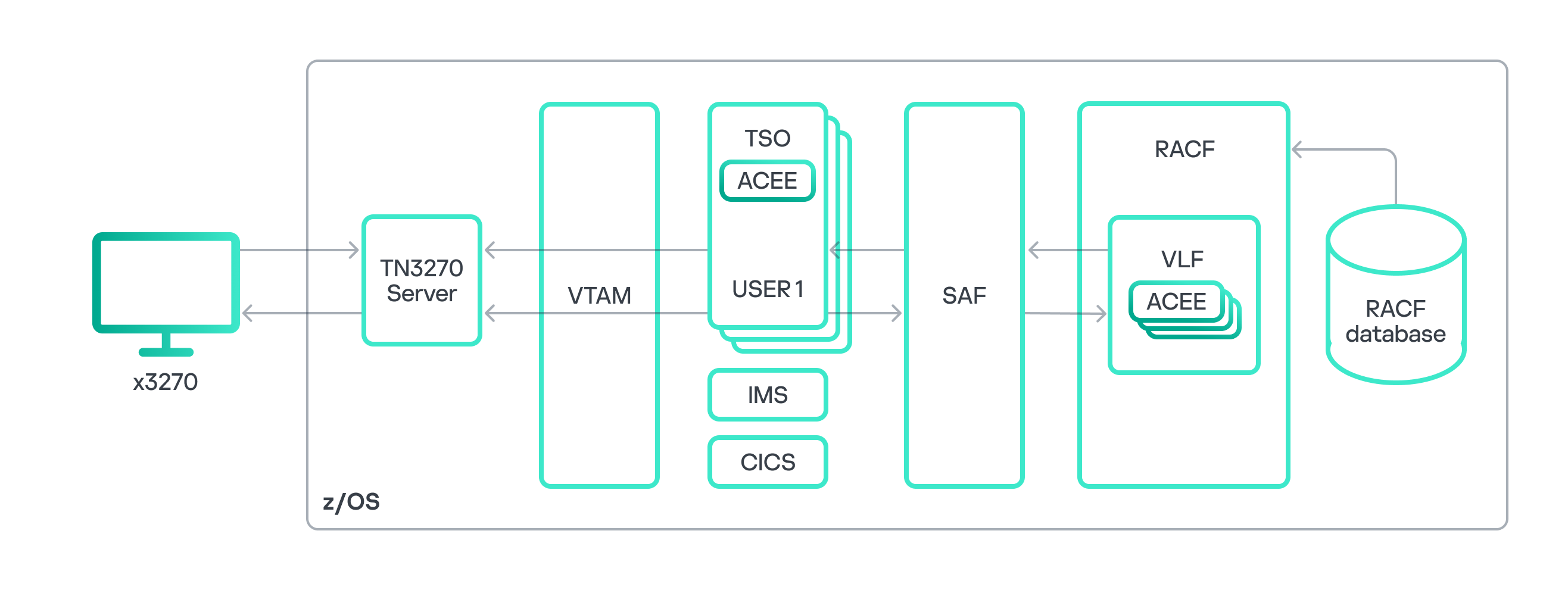
    z/OS access control diagram

    To thoroughly analyze RACF, let’s recall its role and the functions of its components within the overall z/OS architecture. As illustrated in the diagram above, RACF can generally be divided into a service component and a database. Other components exist too, such as utilities for RACF administration and management, or the RACF Auditing and Reporting solution responsible for event logging and reporting. However, for a general understanding of the process, we believe these components are not strictly necessary. The RACF database stores information about z/OS users and the resources for which access control is configured. Based on this data, the RACF service component performs all necessary security checks when requested by other z/OS components and subsystems. RACF typically interacts with other subsystems through the System Authorization Facility (SAF) interface. Various z/OS components use SAF to authorize a user’s access to resources or to execute a user-requested operation. It is worth noting that while this paper focuses on the operating principle of RACF as the standard security package, other security packages like ACF2 or Top Secret can also be used in z/OS.

    Let’s consider an example of user authorization within the Time Sharing Option (TSO) subsystem, the z/OS equivalent of a command line interface. We use an x3270 terminal emulator to connect to the mainframe. After successful user authentication in z/OS, the TSO subsystem uses SAF to query the RACF security package, checking that the user has permission to access the TSO resource manager. The RACF service queries the database for user information, which is stored in a user profile. If the database contains a record of the required access permissions, the user is authorized, and information from the user profile is placed into the address space of the new TSO session within the ACEE (Accessor Environment Element) control block. For subsequent attempts to access other z/OS resources within that TSO session, RACF uses the information in ACEE to make the decision on granting user access. SAF reads data from ACEE and transmits it to the RACF service. RACF makes the decision to grant or deny access, based on information in the relevant profile of the requested resource stored in the database. This decision is then sent back to SAF, which processes the user request accordingly. The process of querying RACF repeats for any further attempts by the user to access other resources or execute commands within the TSO session.

    Thus, RACF handles identification, authentication, and authorization of users, as well as granting privileges within z/OS.

    RACF database components

    As discussed above, access decisions for resources within z/OS are made based on information stored in the RACF database. This data is kept in the form of records, or as RACF terminology puts it, profiles. These contain details about specific z/OS objects. While the RACF database can hold various profile types, four main types are especially important for security analysis:

    1. User profile holds user-specific information such as logins, password hashes, special attributes, and the groups the user belongs to.
    2. Group profile contains information about a group, including its members, owner, special attributes, list of subgroups, and the access permissions of group members for that group.
    3. Data set profile stores details about a data set, including access permissions, attributes, and auditing policy.
    4. General resource profile provides information about a resource or resource class, such as resource holders, their permissions regarding the resource, audit policy, and the resource owner.

    The RACF database contains numerous instances of these profiles. Together, they form a complex structure of relationships between objects and subjects within z/OS, which serves as the basis for access decisions.

    Logical structure of RACF database profiles

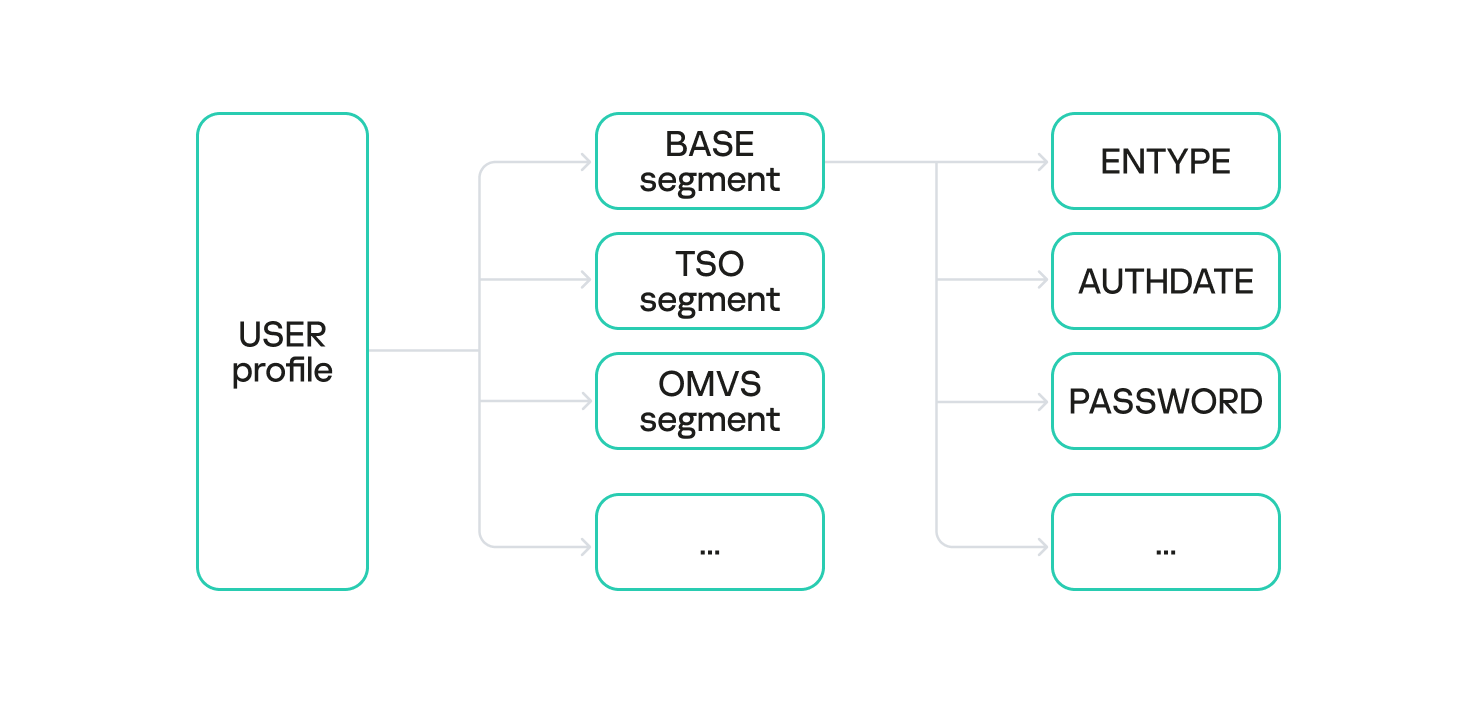
    Each profile is composed of one or more segments. Different profile types utilize different segment types.

    For example, a user profile instance may contain the following segments:

    • BASE: core user information in RACF (mandatory segment);
    • TSO: user TSO-session parameters;
    • OMVS: user session parameters within the z/OS UNIX subsystem;
    • KERB: data related to the z/OS Network Authentication Service, essential for Kerberos protocol operations;
    • and others.

    User profile segments

    Different segment types are distinguished by the set of fields they store. For instance, the BASE segment of a user profile contains the following fields:

    • PASSWORD: the user’s password hash;
    • PHRASE: the user’s password phrase hash;
    • LOGIN: the user’s login;
    • OWNER: the owner of the user profile;
    • AUTHDATE: the date of the user profile creation in the RACF database;
    • and others.

    The PASSWORD and PHRASE fields are particularly interesting for security analysis, and we will dive deeper into these later.

    RACF database structure

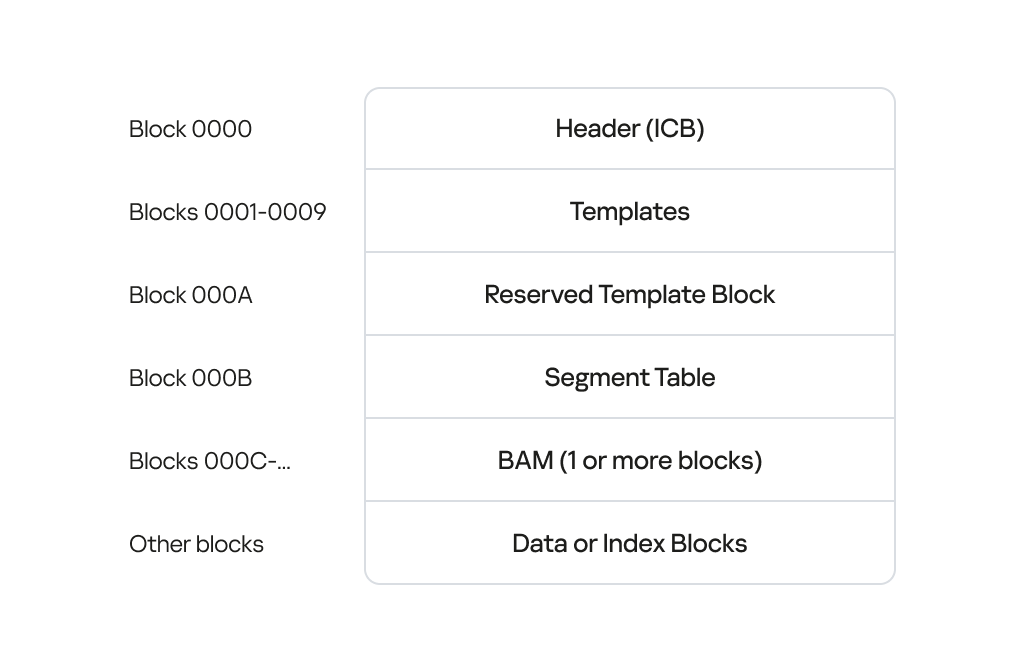
    It is worth noting that the RACF database is stored as a specialized data set with a specific format. Grasping this format is very helpful when analyzing the DB and mapping the relationships between z/OS objects and subjects.

    As discussed in our previous article, a data set is the mainframe equivalent of a file, composed of a series of blocks.

    RACF DB structure

    The image above illustrates the RACF database structure, detailing the data blocks and their offsets. From the RACF DB analysis perspective, and when subsequently determining the relationships between z/OS objects and subjects, the most critical blocks include:

    • The header block, or inventory control block (ICB), which contains various metadata and pointers to all other data blocks within the RACF database. By reading the ICB, you gain access to the rest of the data blocks.
    • Index blocks, which form a singly linked list that contains pointers to all profiles and their segments in the RACF database – that is, to the information about all users, groups, data sets, and resources.
    • Templates: a crucial data block containing templates for all profile types (user, group, data set, and general resource profiles). The templates list fields and specify their format for every possible segment type within the corresponding profile type.

    Upon dissecting the RACF database structure, we identified the need for a utility capable of extracting all relevant profile information from the DB, regardless of its version. This utility would also need to save the extracted data in a convenient format for offline analysis. Performing this type of analysis provides a comprehensive picture of the relationships between all objects and subjects for a specific z/OS installation, helping uncover potential security vulnerabilities that could lead to privilege escalation or lateral movement.

    Utilities for RACF DB analysis

    At the previous stage, we defined the following functional requirements for an RACF DB analysis utility:

    1. The ability to analyze RACF profiles offline without needing to run commands on the mainframe
    2. The ability to extract exhaustive information about RACF profiles stored in the DB
    3. Compatibility with various RACF DB versions
    4. Intuitive navigation of the extracted data and the option to present it in various formats: plaintext, JSON, SQL, etc.

    Overview of existing RACF DB analysis solutions

    We started by analyzing off-the-shelf tools and evaluating their potential for our specific needs:

    • Racf2john extracts user password hashes (from the PASSWORD field) encrypted with the DES and KDFAES algorithms from the RACF database. While this was a decent starting point, we needed more than just the PASSWORD field; specifically, we also needed to retrieve content from other profile fields like PHRASE.
    • Racf2sql takes an RACF DB dump as input and converts it into an SQLite database, which can then be queried with SQL. This is convenient, but the conversion process risks losing data critical for z/OS security assessment and identifying misconfigurations. Furthermore, the tool requires a database dump generated by the z/OS IRRDBU00 utility (part of the RACF security package) rather than the raw database itself.
    • IRRXUTIL allows querying the RACF DB to extract information. It is also part of the RACF security package. It can be conveniently used with a set of scripts written in REXX (an interpreted language used in z/OS). However, these scripts demand elevated privileges (access to one or more IRR.RADMIN.** resources in the FACILITY resource class) and must be executed directly on the mainframe, which is unsuitable for the task at hand.
    • Racf_debug_cleanup.c directly analyzes a RACF DB from a data set copy. A significant drawback is that it only parses BASE segments and outputs results in plaintext.

    As you can see, existing tools don’t satisfy our needs. Some utilities require direct execution on the mainframe. Others operate on a data set copy and extract incomplete information from the DB. Moreover, they rely on hardcoded offsets and signatures within profile segments, which can vary across RACF versions. Therefore, we decided to develop our own utility for RACF database analysis.

    Introducing racfudit

    We have written our own platform-independent utility racfudit in Golang and tested it across various z/OS versions (1.13, 2.02, and 3.1). Below, we delve into the operating principles, capabilities and advantages of our new tool.

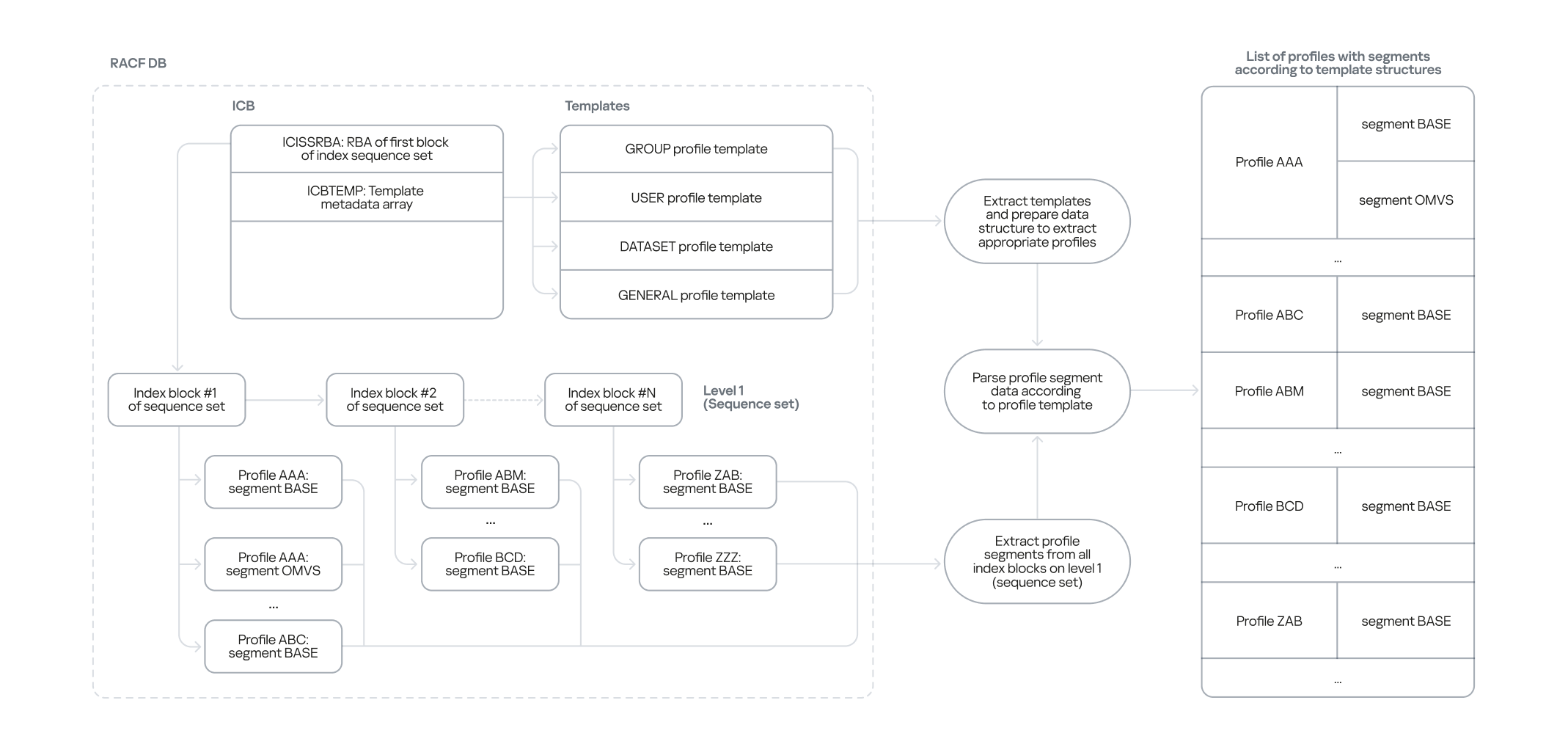
    To analyze RACF DB information offline, we first needed a way to extract structured data. We developed a two-stage approach for this:

    • The first stage involves analyzing the templates stored within the RACF DB. Each template describes a specific profile type, its constituent segments, and the fields within those segments, including their type and size. This allows us to obtain an up-to-date list of profile types, their segments, and associated fields, regardless of the RACF version.
    • In the second stage, we traverse all index blocks to extract every profile with its content from the RACF DB. These collected profiles are then processed and parsed using the templates obtained in the first stage.

    The first stage is crucial because RACF DB profiles are stored as unstructured byte arrays. The templates are what define how each specific profile (byte array) is processed based on its type.

    Thus, we defined the following algorithm to extract structured data.

    Extracting data from the RACF DB using templates

    1. We offload the RACF DB from the mainframe and read its header block (ICB) to determine the location of the templates.
    2. Based on the template for each profile type, we define an algorithm for structuring specific profile instances according to their type.
    3. We use the content of the header block to locate the index blocks, which store pointers to all profile instances.
    4. We read all profile instances and their segments sequentially from the list of index blocks.
    5. For each profile instance and its segments we read, we apply the processing algorithm based on the corresponding template.
    6. All processed profile instances are saved in an intermediate state, allowing for future storage in various formats, such as plaintext or SQLite.

    The advantage of this approach is its version independence. Even if templates and index blocks change their structure across RACF versions, our utility will not lose data because it dynamically determines the structure of each profile type based on the relevant template.

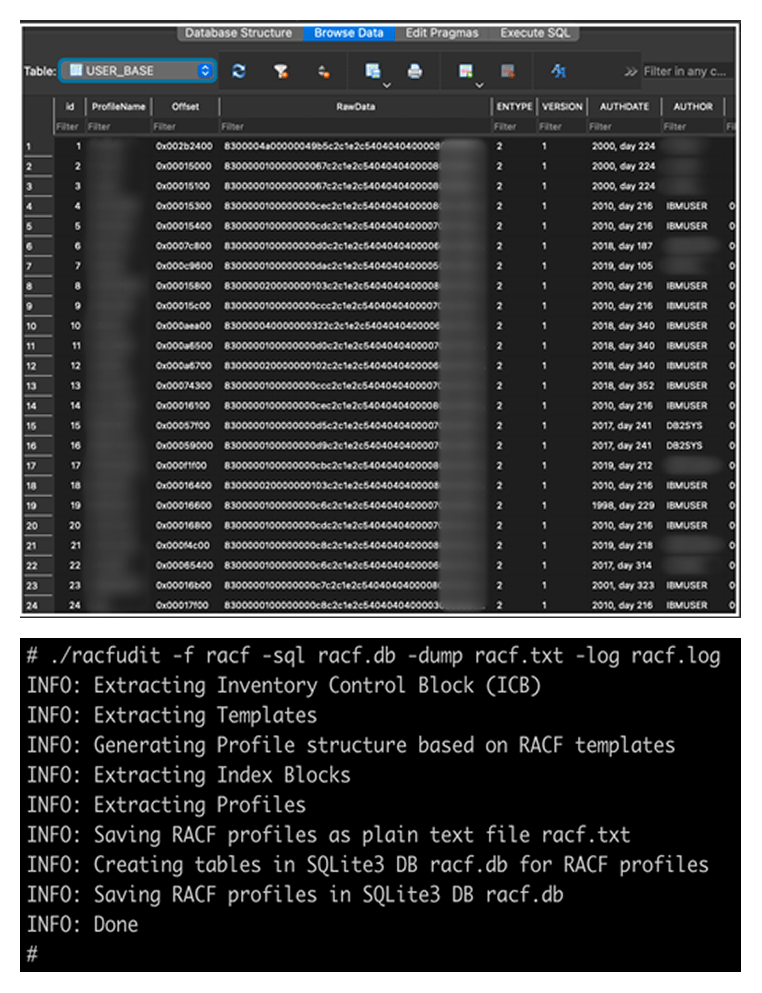
    Our racfudit utility can present collected RACF DB information as an SQLite database or a plaintext file.

    RACF DB information as an SQLite DB (top) and text data (bottom)

    Using SQLite, you can execute SQL queries to identify misconfigurations in RACF that could be exploited for privilege escalation, lateral movement, bypassing access controls, or other pentesting tactics. It is worth noting that the set of SQL queries used for processing information in SQLite can be adapted to validate current RACF settings against security standards and best practices. Let’s look at some specific examples of how to use the racfudit utility to uncover security issues.

    Collecting password hashes

    One of the primary goals in penetration testing is to get a list of administrators and a way to authorize using their credentials. This can be useful for maintaining persistence on the mainframe, moving laterally to other mainframes, or even pivoting to servers running different operating systems. Administrators are typically found in the SYS1 group and its subgroups. The example below shows a query to retrieve hashes of passwords (PASSWORD) and password phrases (PHRASE) for privileged users in the SYS1 group.

    Of course, to log in to the system, you need to crack these hashes to recover the actual passwords. We cover that in more detail below.

    Searching for inadequate UACC control in data sets

    The universal access authority (UACC) defines the default access permissions to the data set. This parameter specifies the level of access for all users who do not have specific access permissions configured. Insufficient control over UACC values can pose a significant risk if elevated access permissions (UPDATE or higher) are set for data sets containing sensitive data or for APF libraries, which could allow privilege escalation. The query below helps identify data sets with default ALTER access permissions, which allow users to read, delete and modify the data set.

    The UACC field is not present only in data set profiles; it is also found in other profile types. Weak control in the configuration of this field can give a penetration tester access to resources.

    RACF profile relationships

    As mentioned earlier, various RACF entities have relationships. Some are explicitly defined; for example, a username might be listed in a group profile within its member field (USERID field). However, there are also implicit relationships. For instance, if a user group has UPDATE access to a specific data set, every member of that group implicitly has write access to that data set. This is a simple example of implicit relationships. Next, we delve into more complex and specific relationships within the RACF database that a penetration tester can exploit.

    RACF profile fields

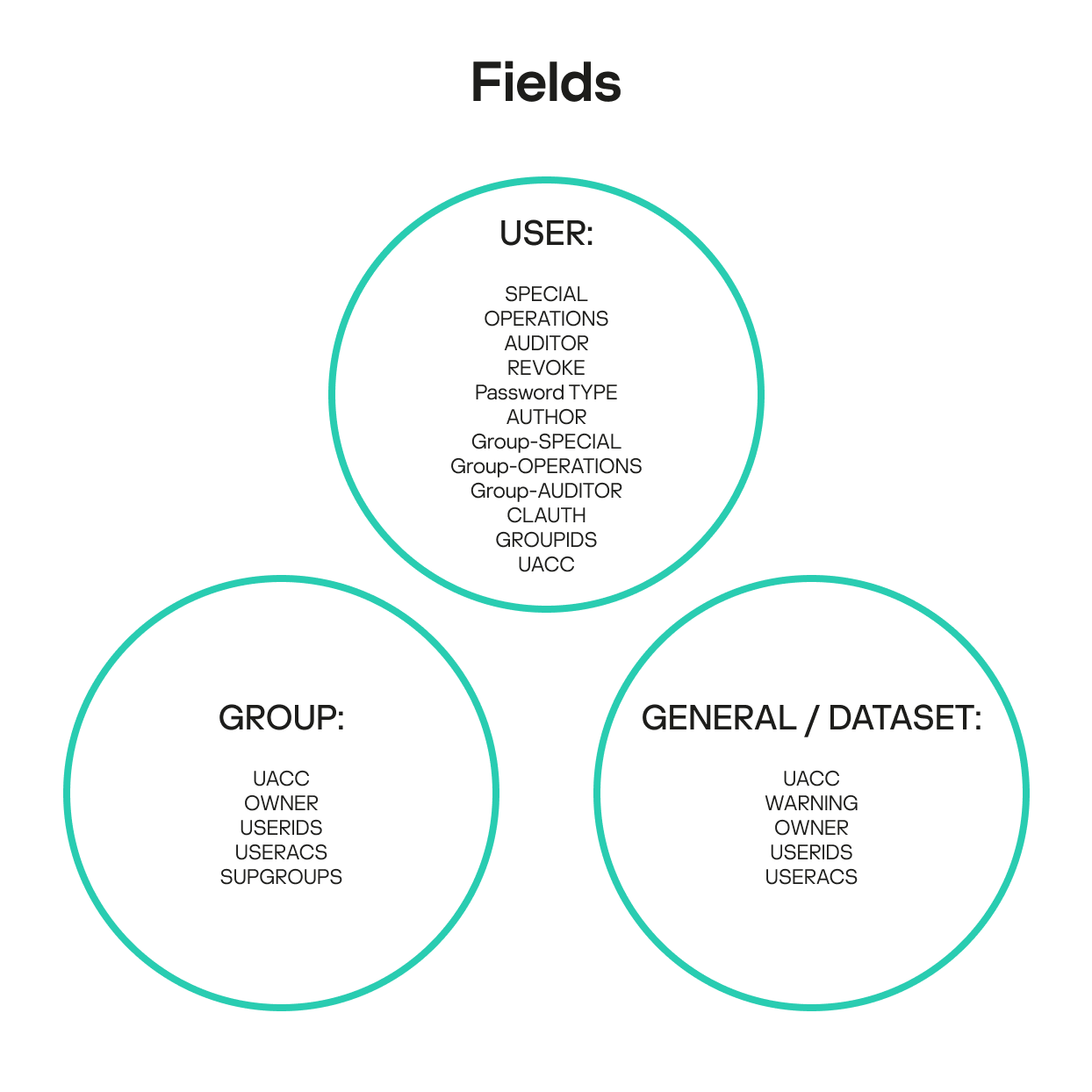
    A deep dive into RACF internal architecture reveals that misconfigurations of access permissions and other attributes for various RACF entities can be difficult to detect and remediate in some scenarios. These seemingly minor errors can be critical, potentially leading to mainframe compromise. The explicit and implicit relationships within the RACF database collectively define the mainframe’s current security posture. As mentioned, each profile type in the RACF database has a unique set of fields and attributes that describe how profiles relate to one another. Based on these fields and attributes, we have compiled lists of key fields that help build and analyze relationship chains.

    User profile fields

    • SPECIAL: indicates that the user has privileges to execute any RACF command and grants them full control over all profiles in the RACF database.
    • OPERATIONS: indicates whether the user has authorized access to all RACF-protected resources of the DATASET, DASDVOL, GDASDVOL, PSFMPL, TAPEVOL, VMBATCH, VMCMD, VMMDISK, VMNODE, and VMRDR classes. While actions for users with this field specified are subject to certain restrictions, in a penetration testing context the OPERATIONS field often indicates full data set access.
    • AUDITOR: indicates whether the user has permission to access audit information.
    • AUTHOR: the creator of the user. It has certain privileges over the user, such as the ability to change their password.
    • REVOKE: indicates whether the user can log in to the system.
    • Password TYPE: specifies the hash type (DES or KDFAES) for passwords and password phrases. This field is not natively present in the user profile, but it can be created based on how different passwords and password phrases are stored.
    • Group-SPECIAL: indicates whether the user has full control over all profiles within the scope defined by the group or groups field. This is a particularly interesting field that we explore in more detail below.
    • Group-OPERATIONS: indicates whether the user has authorized access to all RACF-protected resources of the DATASET, DASDVOL, GDASDVOL, PSFMPL, TAPEVOL, VMBATCH, VMCMD, VMMDISK, VMNODE and VMRDR classes within the scope defined by the group or groups field.
    • Group-AUDITOR: indicates whether the user has permission to access audit information within the scope defined by the group or groups field.
    • CLAUTH (class authority): allows the user to create profiles within the specified class or classes. This field enables delegation of management privileges for individual classes.
    • GROUPIDS: contains a list of groups the user belongs to.
    • UACC (universal access authority): defines the UACC value for new profiles created by the user.

    Group profile fields

    • UACC (universal access authority): defines the UACC value for new profiles that the user creates when connected to the group.
    • OWNER: the creator of the group. The owner has specific privileges in relation to the current group and its subgroups.
    • USERIDS: the list of users within the group. The order is essential.
    • USERACS: the list of group members with their respective permissions for access to the group. The order is essential.
    • SUPGROUP: the name of the superior group.

    General resource and data set profile fields

    • UACC (universal access authority): defines the default access permissions to the resource or data set.
    • OWNER: the creator of the resource or data set, who holds certain privileges over it.
    • WARNING: indicates whether the resource or data set is in WARNING mode.
    • USERIDS: the list of user IDs associated with the resource or data set. The order is essential.
    • USERACS: the list of users with access permissions to the resource or data set. The order is essential.

    RACF profile relationship chains

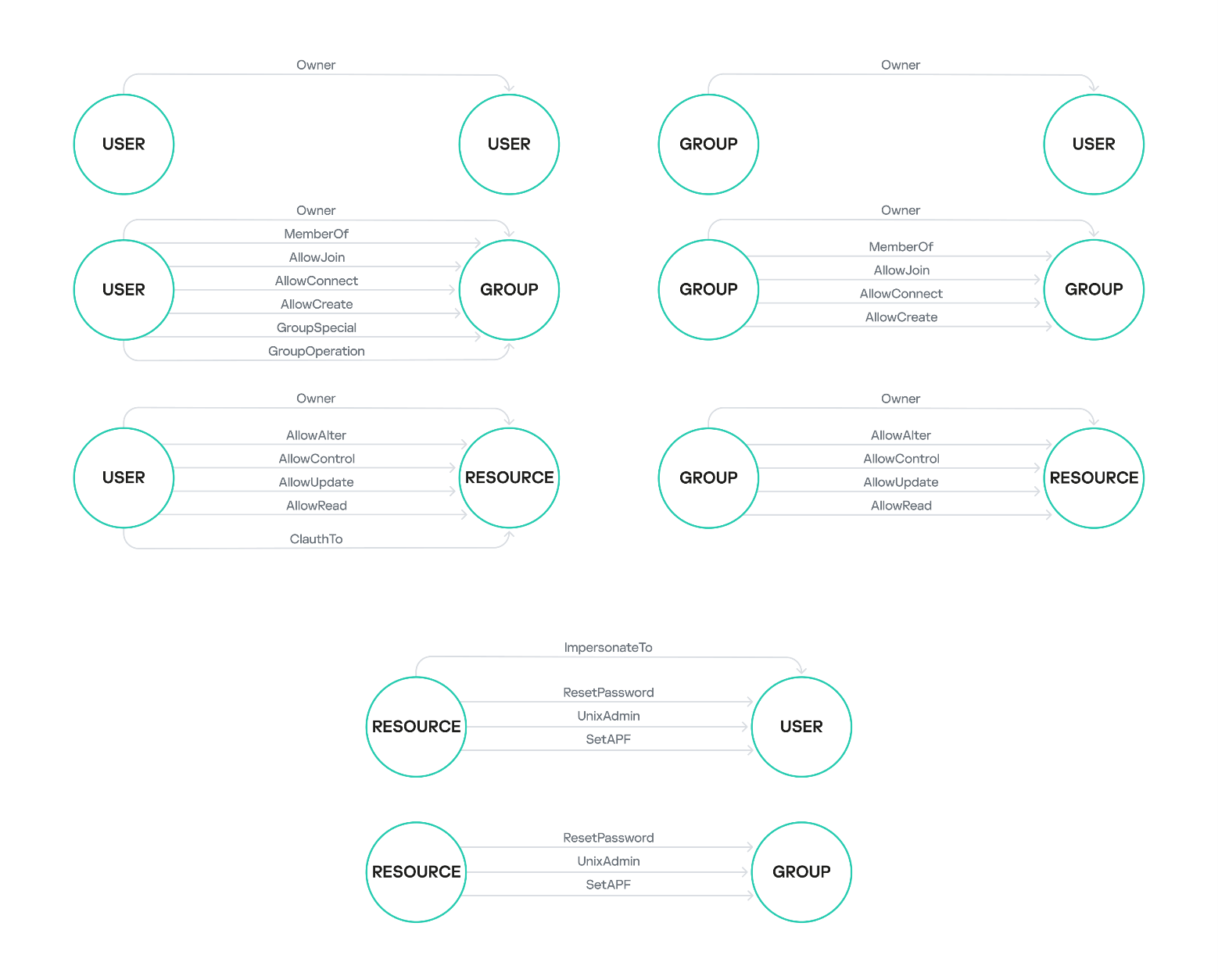
    The fields listed above demonstrate the presence of relationships between RACF profiles. We have decided to name these relationships similarly to those used in BloodHound, a popular tool for analyzing Active Directory misconfigurations. Below are some examples of these relationships – the list is not exhaustive.

    • Owner: the subject owns the object.
    • MemberOf: the subject is part of the object.
    • AllowJoin: the subject has permission to add itself to the object.
    • AllowConnect: the subject has permission to add another object to the specified object.
    • AllowCreate: the subject has permission to create an instance of the object.
    • AllowAlter: the subject has the ALTER privilege for the object.
    • AllowUpdate: the subject has the UPDATE privilege for the object.
    • AllowRead: the subject has the READ privilege for the object.
    • CLAuthTo: the subject has permission to create instances of the object as defined in the CLAUTH field.
    • GroupSpecial: the subject has full control over all profiles within the object’s scope of influence as defined in the group-SPECIAL field.
    • GroupOperations: the subject has permissions to perform certain operations with the object as defined in the group-OPERATIONS field.
    • ImpersonateTo: the subject grants the object the privilege to perform certain operations on the subject’s behalf.
    • ResetPassword: the subject grants another object the privilege to reset the password or password phrase of the specified object.
    • UnixAdmin: the subject grants superuser privileges to the object in z/OS UNIX.
    • SetAPF: the subject grants another object the privilege to set the APF flag on the specified object.

    These relationships serve as edges when constructing a graph of subject–object interconnections. Below are examples of potential relationships between specific profile types.

    Examples of relationships between RACF profiles

    Visualizing and analyzing these relationships helped us identify specific chains that describe potential RACF security issues, such as a path from a low-privileged user to a highly-privileged one. Before we delve into examples of these chains, let’s consider another interesting and peculiar feature of the relationships between RACF database entities.

    Implicit RACF profile relationships

    We have observed a fascinating characteristic of the group-SPECIAL, group-OPERATIONS, and group-AUDITOR fields within a user profile. If the user has any group specified in one of these fields, that group’s scope of influence extends the user’s own scope.

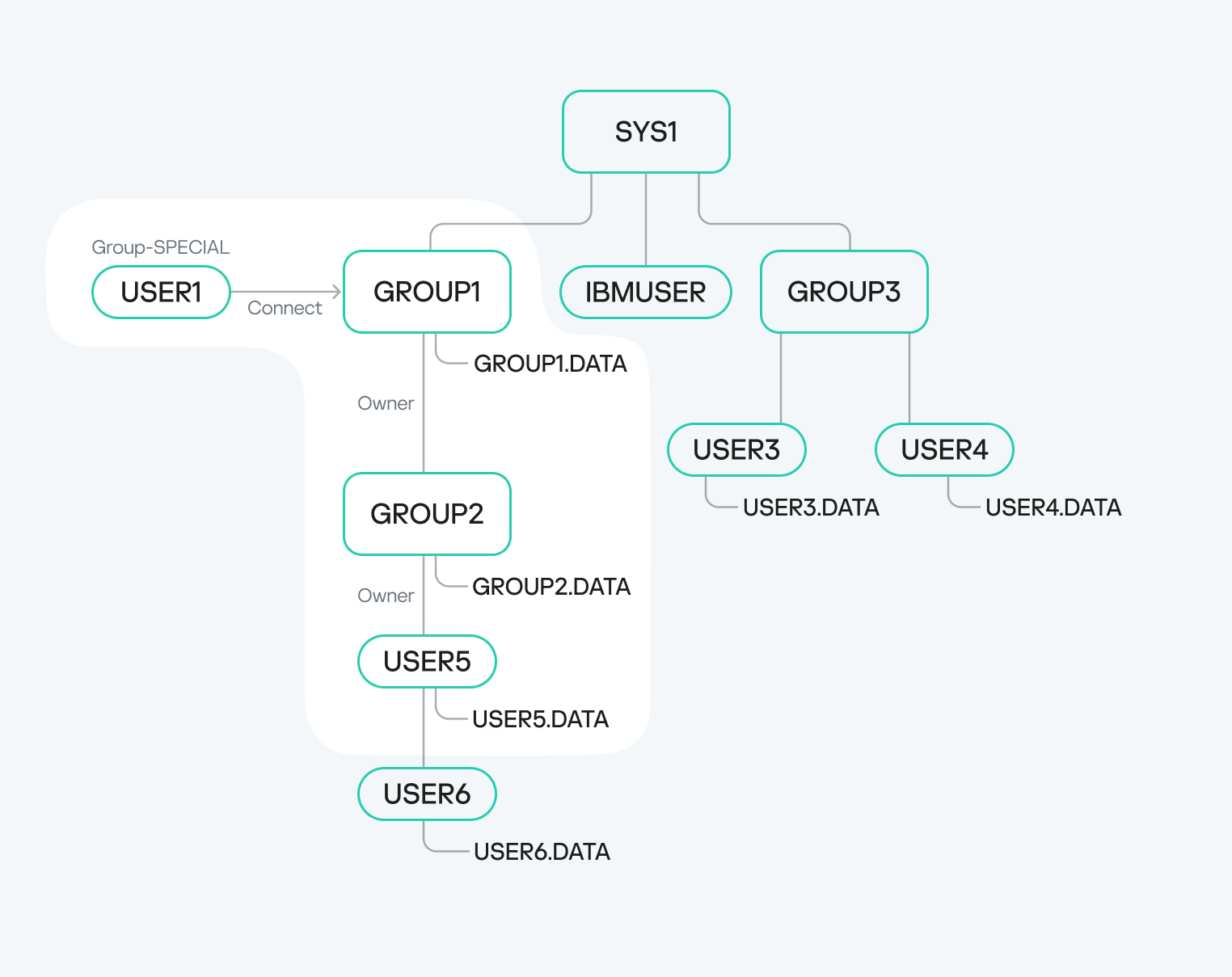
    Scope of influence of a user with a group-SPECIAL field

    For instance, consider USER1 with GROUP1 specified in the group-SPECIAL field. If GROUP1 owns GROUP2, and GROUP2 subsequently owns USER5, then USER1 gains privileges over USER5. This is not just about data access; USER1 essentially becomes the owner of USER5. A unique aspect of z/OS is that this level of access allows USER1 to, for example, change USER5’s password, even if USER5 holds privileged attributes like SPECIAL, OPERATIONS, ROAUDIT, AUDITOR, or PROTECTED.

    Below is an SQL query, generated using the racfudit utility, that identifies all users and groups where the specified user possesses special attributes:

    Here is a query to find users whose owners (AUTHOR) are not the standard default administrators:

    Let’s illustrate how user privileges can be escalated through these implicit profile relationships.

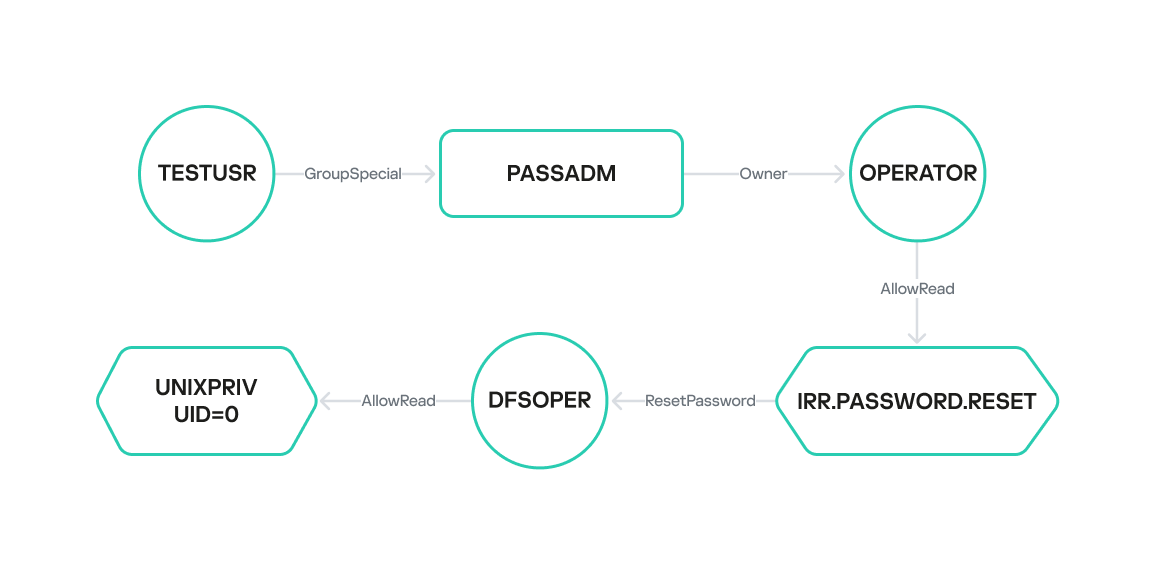
    Privilege escalation via the group-SPECIAL field

    In this scenario, the user TESTUSR has the group-SPECIAL field set to PASSADM. This group, PASSADM, owns the OPERATOR user. This means TESTUSR’s scope of influence expands to include PASSADM’s scope, thereby granting TESTUSR control over OPERATOR. Consequently, if TESTUSR’s credentials are compromised, the attacker gains access to the OPERATOR user. The OPERATOR user, in turn, has READ access to the IRR.PASSWORD.RESET resource, which allows them to assign a password to any user who does not possess privileged permissions.

    Having elevated privileges in z/OS UNIX is often sufficient for compromising the mainframe. These can be acquired through several methods:

    • Grant the user READ access to the BPX.SUPERUSER resource of the FACILITY class.
    • Grant the user READ access to UNIXPRIV.SUPERUSER.* resources of the UNIXPRIV class.
    • Set the UID field to 0 in the OMVS segment of the user profile.

    For example, the DFSOPER user has READ access to the BPX.SUPERUSER resource, making them privileged in z/OS UNIX and, by extension, across the entire mainframe. However, DFSOPER does not have the explicit privileged fields SPECIAL, OPERATIONS, AUDITOR, ROAUDIT and PROTECTED set, meaning the OPERATOR user can change DFSOPER’s password. This allows us to define the following sequence of actions to achieve high privileges on the mainframe:

    1. Obtain and use TESTUSR’s credentials to log in.
    2. Change OPERATOR’s password and log in with those credentials.
    3. Change DFSOPER’s password and log in with those credentials.
    4. Access the z/OS UNIX Shell with elevated privileges.

    We uncovered another implicit RACF profile relationship that enables user privilege escalation.

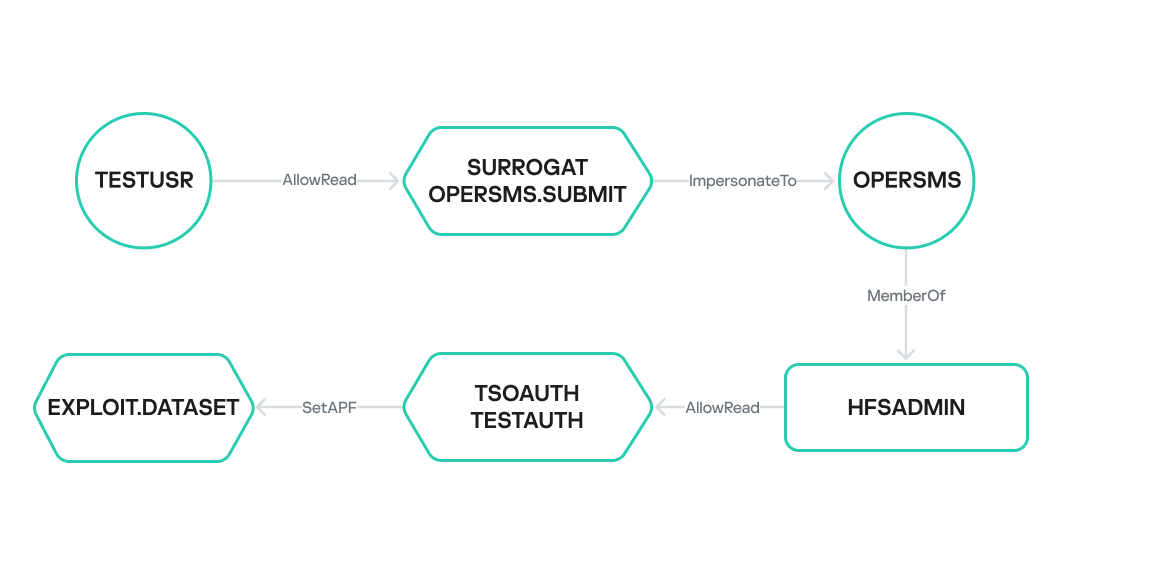
    Privilege escalation from a chain of misconfigurations

    In another example, the TESTUSR user has READ access to the OPERSMS.SUBMIT resource of the SURROGAT class. This implies that TESTUSR can create a task under the identity of OPERSMS using the ImpersonateTo relationship. OPERSMS is a member of the HFSADMIN group, which has READ access to the TESTAUTH resource of the TSOAUTH class. This resource indicates whether the user can run an application or library as APF-authorized – this requires only READ access. Therefore, if APF access is misconfigured, the OPERSMS user can escalate their current privileges to the highest possible level. This outlines a path from the low-privileged TESTUSR to obtaining maximum privileges on the mainframe.

    At this stage, the racfudit utility allows identifying these connections only manually through a series of SQLite database queries. However, we are planning to add support for another output format, including Neo4j DBMS integration, to automatically visualize the interconnected chains described above.

    Password hashes in RACF

    To escalate privileges and gain mainframe access, we need the credentials of privileged users. We previously used our utility to extract their password hashes. Now, let’s dive into the password policy principles in z/OS and outline methods for recovering passwords from these collected hashes.

    The primary password authentication methods in z/OS, based on RACF, are PASSWORD and PASSPHRASE. PASSWORD is a password composed by default of ASCII characters: uppercase English letters, numbers, and special characters (@#$). Its length is limited to 8 characters. PASSPHRASE, or a password phrase, has a more complex policy, allowing 14 to 100 ASCII characters, including lowercase or uppercase English letters, numbers, and an extended set of special characters (@#$&*{}[]()=,.;’+/). Hashes for both PASSWORD and PASSPHRASE are stored in the user profile within the BASE segment, in the PASSWORD and PHRASE fields, respectively. Two algorithms are used to derive their values: DES and KDFAES.

    It is worth noting that we use the terms “password hash” and “password phrase hash” for clarity. When using the DES and KDFAES algorithms, user credentials are stored in the RACF database as encrypted text, not as a hash sum in its classical sense. Nevertheless, we will continue to use “password hash” and “password phrase hash” as is customary in IBM documentation.

    Let’s discuss the operating principles and characteristics of the DES and KDFAES algorithms in more detail.

    DES

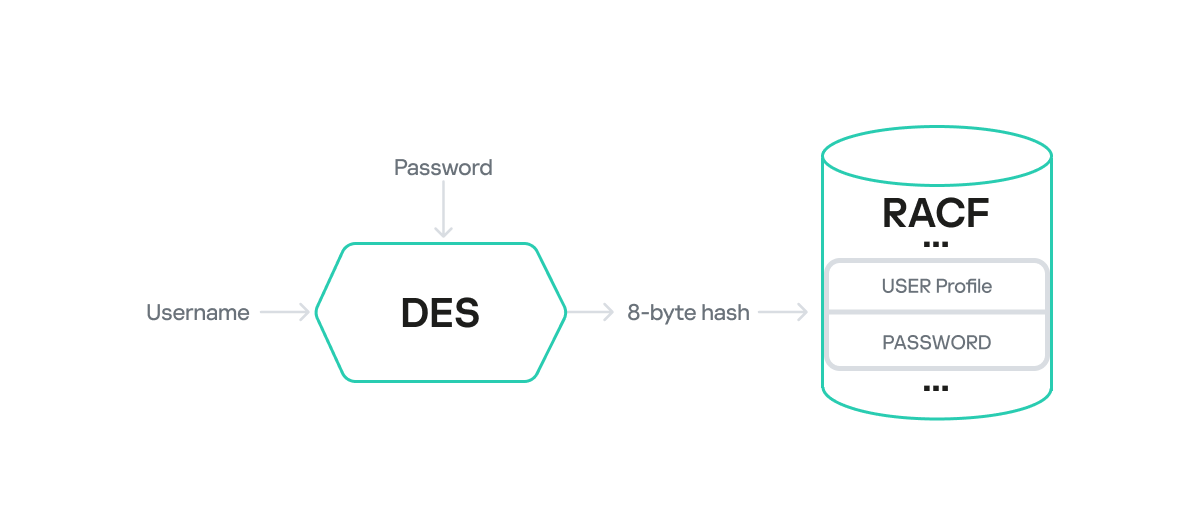
    When the DES algorithm is used, the computation of PASSWORD and PHRASE values stored in the RACF database involves classic DES encryption. Here, the plaintext data block is the username (padded to 8 characters if shorter), and the key is the password (also padded to 8 characters if shorter).

    PASSWORD

    The username is encrypted with the password as the key via the DES algorithm, and the 8-byte result is placed in the user profile’s PASSWORD field.

    DES encryption of a password

    Keep in mind that both the username and password are encoded with EBCDIC. For instance, the username USR1 would look like this in EBCDIC: e4e2d9f140404040. The byte 0x40 serves as padding for the plaintext to reach 8 bytes.

    This password can be recovered quite fast, given the small keyspace and low computational complexity of DES. For example, a brute-force attack powered by a cluster of NVIDIA 4090 GPUs takes less than five minutes.

    The hashcat tool includes a module (Hash-type 8500) for cracking RACF passwords with the DES algorithm.

    PASSPHRASE

    PASSPHRASE encryption is a bit more complex, and a detailed description of its algorithm is not readily available. However, our research uncovered certain interesting characteristics.

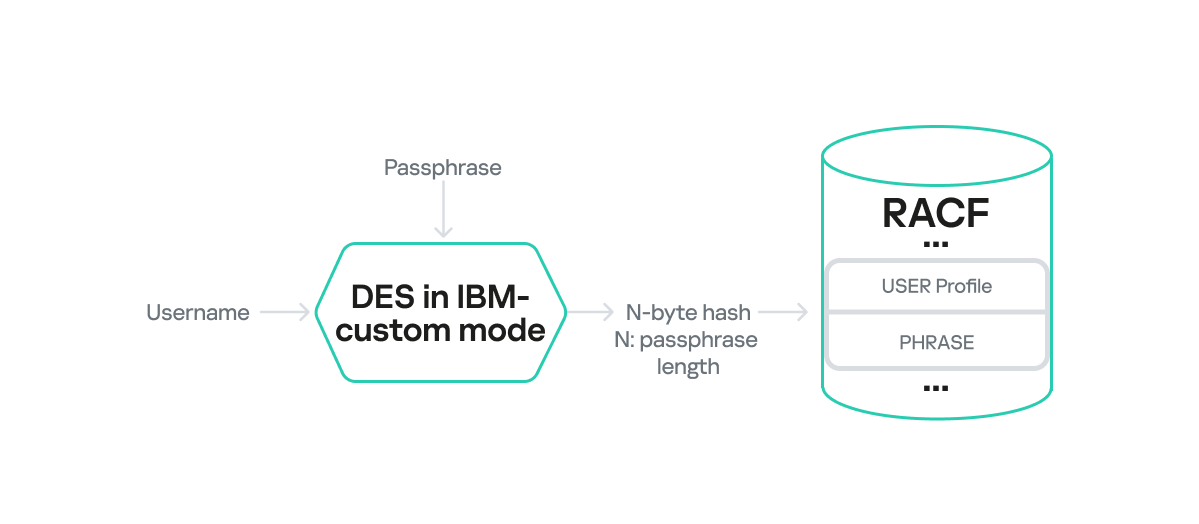
    First, the final hash length in the PHRASE field matches the original password phrase length. Essentially, the encrypted data output from DES gets truncated to the input plaintext length without padding. This design can clearly lead to collisions and incorrect authentication under certain conditions. For instance, if the original password phrase is 17 bytes long, it will be encrypted in three blocks, with the last block padded with seven bytes. These padded bytes are then truncated after encryption. In this scenario, any password whose first 17 encrypted bytes match the encrypted PASSPHRASE would be considered valid.

    The second interesting feature is that the PHRASE field value is also computed using the DES algorithm, but it employs a proprietary block chaining mode. We will informally refer to this as IBM-custom mode.

    DES encryption of a password phrase

    Given these limitations, we can use the hashcat module for RACF DES to recover the first 8 characters of a password phrase from the first block of encrypted data in the PHRASE field. In some practical scenarios, recovering the beginning of a password phrase allowed us to guess the remainder, especially when weak dictionary passwords were used. For example, if we recovered Admin123 (8 characters) while cracking a 15-byte PASSPHRASE hash, then it is plausible the full password phrase was Admin1234567890.

    KDFAES

    Computing passwords and password phrases generated with the KDFAES algorithm is significantly more challenging than with DES. KDFAES is a proprietary IBM algorithm that leverages AES encryption. The encryption key is generated from the password using the PBKDF2 function with a specific number of hashing iterations.

    PASSWORD

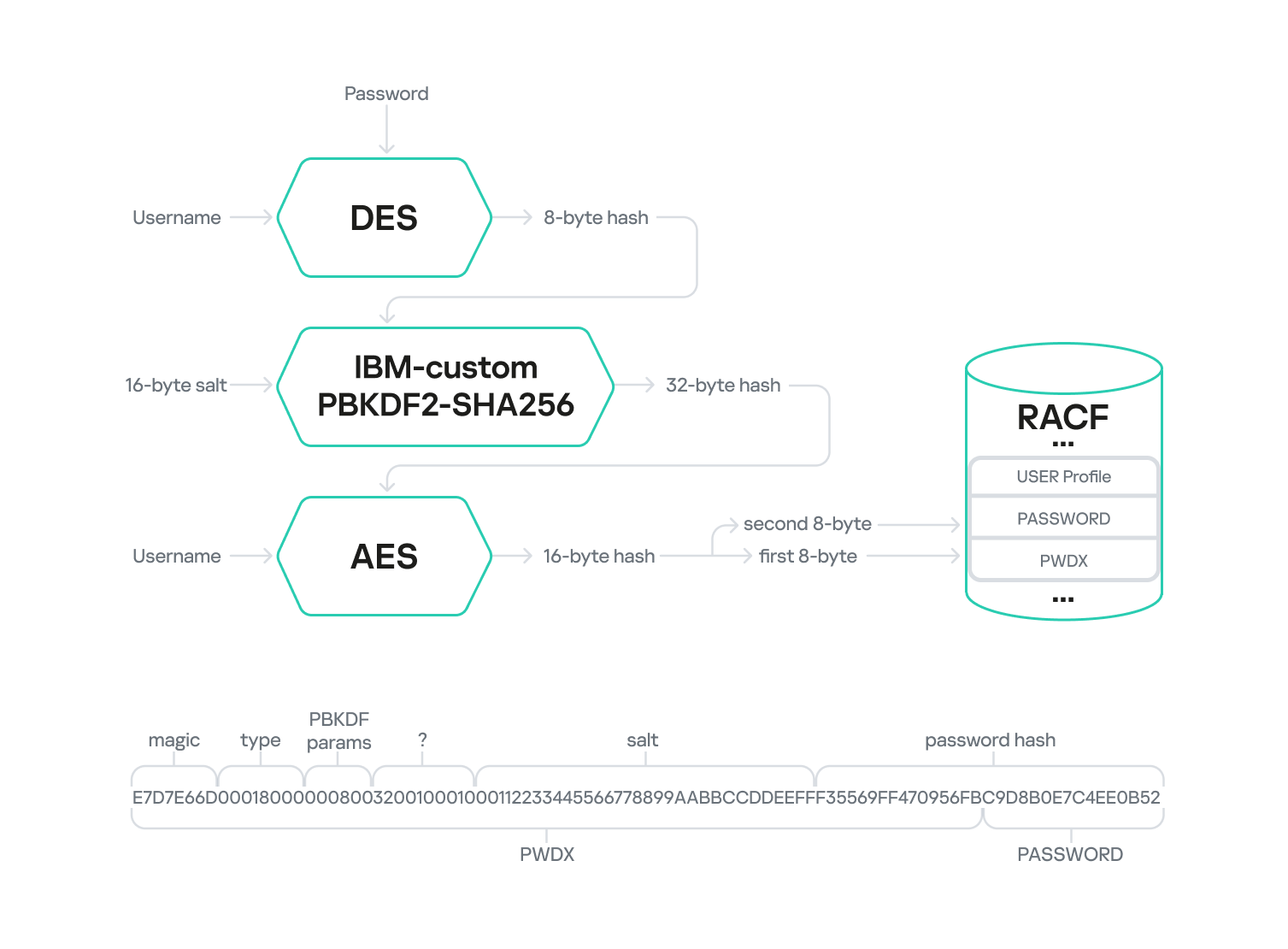
    The diagram below outlines the multi-stage KDFAES PASSWORD encryption algorithm.

    KDFAES encryption of a password

    The first stage mirrors the DES-based PASSWORD computation algorithm. Here, the plaintext username is encrypted using the DES algorithm with the password as the key. The username is also encoded in EBCDIC and padded if it’s shorter than 8 bytes. The resulting 8-byte output serves as the key for the second stage: hashing. This stage employs a proprietary IBM algorithm built upon PBKDF2-SHA256-HMAC. A randomly generated 16-byte string (salt) is fed into this algorithm along with the 8-byte key from the first stage. This data is then iteratively hashed using PBKDF2-SHA256-HMAC. The number of iterations is determined by two parameters set in RACF: the memory factor and the repetition factor. The output of the second stage is a 32-byte hash, which is then used as the key for AES encryption of the username in the third stage.

    The final output is 16 bytes of encrypted data. The first 8 bytes are appended to the end of the PWDX field in the user profile BASE segment, while the other 8 bytes are placed in the PASSWORD field within the same segment.

    The PWDX field in the BASE segment has the following structure:

    Offset Size Field Comment
    0–3 4 bytes Magic number In the profiles we analyzed, we observed only the value E7D7E66D
    4–7 4 bytes Hash type In the profiles we analyzed, we observed only two values: 00180000 for PASSWORD hashes and 00140000 for PASSPHRASE hashes
    8–9 2 bytes Memory factor A value that determines the number of iterations in the hashing stage
    10–11 2 bytes Repetition factor A value that determines the number of iterations in the hashing stage
    12–15 4 bytes Unknown value In the profiles we analyzed, we observed only the value 00100010
    16–31 16 bytes Salt A randomly generated 16-byte string used in the hashing stage
    32–39 8 bytes The first half of the password hash The first 8 bytes of the final encrypted data

    You can use the dedicated module in the John the Ripper utility for offline password cracking. While an IBM KDFAES module for an older version of hashcat exists publicly, it was never integrated into the main branch. Therefore, we developed our own RACF KDFAES module compatible with the current hashcat version.

    The time required to crack an RACF KDFAES hash has significantly increased compared to RACF DES, largely due to the integration of PBKDF2. For instance, if the memory factor and repetition factor are set to 0x08 and 0x32 respectively, the hashing stage can reach 40,000 iterations. This can extend the password cracking time to several months or even years.

    PASSPHRASE

    KDFAES encryption of a password phrase

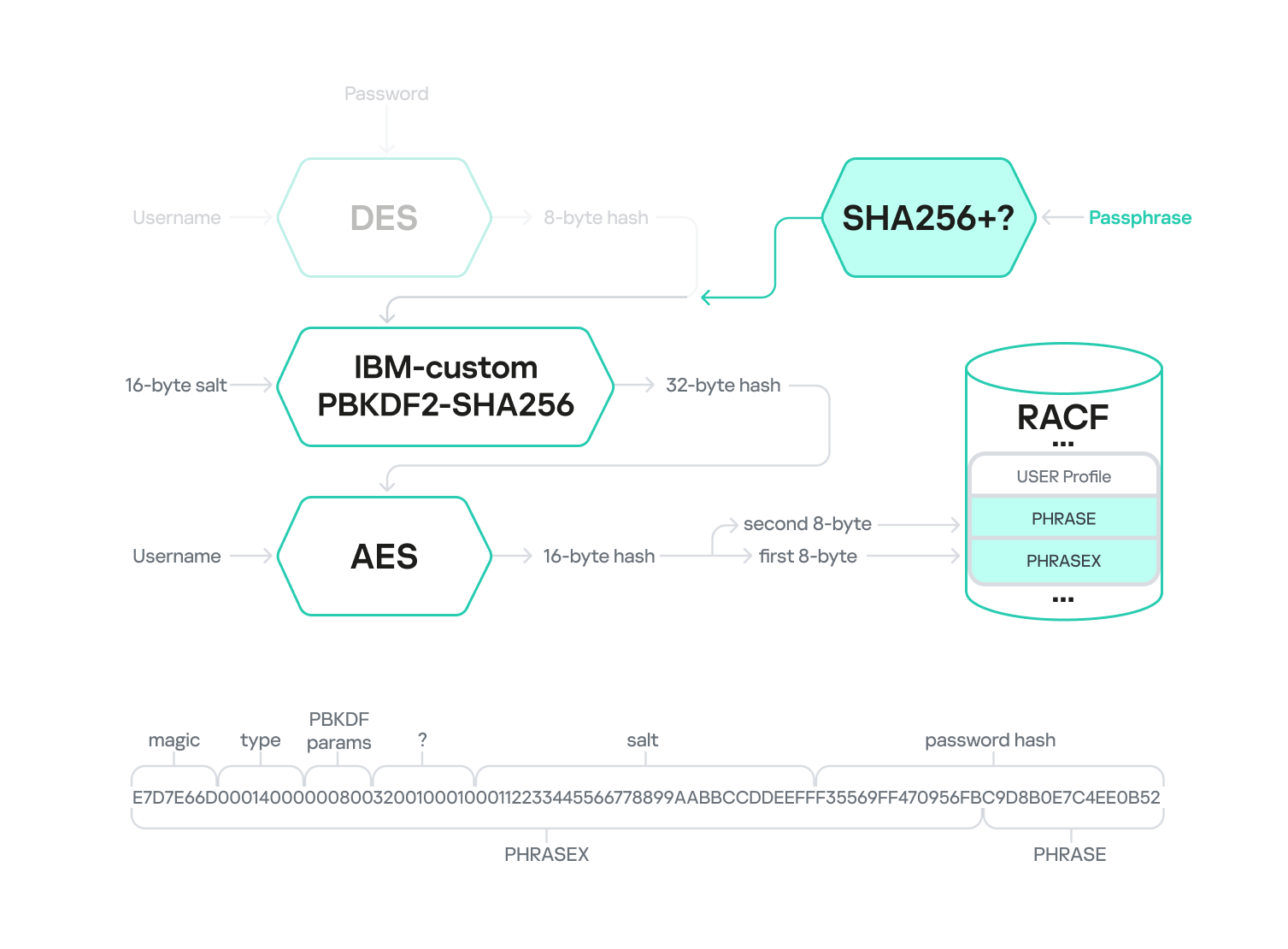
    Encrypting a password phrase hash with KDFAES shares many similarities with encrypting a password hash. According to public sources, the primary difference lies in the key used during the second stage. For passwords, data derived from DES-encrypting the username was used, while for a password phrase, its SHA256 hash is used. During our analysis, we could not determine the exact password phrase hashing process – specifically, whether padding is involved, if a secret key is used, and so on.

    Additionally, when using a password phrase, the PHRASE and PHRASEX fields instead of PASSWORD and PWDX, respectively, store the final hash, with the PHRASEX value having a similar structure.

    Conclusion

    In this article, we have explored the internal workings of the RACF security package, developed an approach to extracting information, and presented our own tool developed for the purpose. We also outlined several potential misconfigurations that could lead to mainframe compromise and described methods for detecting them. Furthermore, we examined the algorithms used for storing user credentials (passwords and password phrases) and highlighted their strengths and weaknesses.

    We hope that the information presented in this article helps mainframe owners better understand and assess the potential risks associated with incorrect RACF security suite configurations and take appropriate mitigation steps. Transitioning to the KDFAES algorithm and password phrases, controlling UACC values, verifying access to APF libraries, regularly tracking user relationship chains, and other steps mentioned in the article can significantly enhance your infrastructure security posture with minimal effort.

    In conclusion, it is worth noting that only a small percentage of the RACF database structure has been thoroughly studied. Comprehensive research would involve uncovering additional relationships between database entities, further investigating privileges and their capabilities, and developing tools to exploit excessive privileges. The topic of password recovery is also not fully covered because the encryption algorithms have not been fully studied. IBM z/OS mainframe researchers have immense opportunities for analysis. As for us, we will continue to shed light on the obscure, unexplored aspects of these devices, to help prevent potential vulnerabilities in mainframe infrastructure and associated security incidents.
    MIL OSI Economics

  • MIL-OSI Submissions: Australia – New study maps key regions for killer whales in Australian waters – Flinders

    Source: Flinders University
     
    While well documented in the Northern Hemisphere and Antarctica, much less is known about killer whales  (Orcinus orca) in Australia. However, orcas are actually sighted year-round in all coastal states and territories and a new Flinders University study has now mapped this across three key regions.
     
    Research led by Flinders University’s Cetacean Ecology, Behaviour and Evolution Lab (CEBEL) models the distribution of killer whales in Australian waters, shedding light on habitat preferences and uncovering ecological distinctions between populations.
     
    In collaboration with the Cetacean Research Centre of WA, Project ORCA and Killer Whales Australia, the paper published in Ecology and Evolution collates 1310 sightings of killer whales around the country from the past four decades. Species distribution modelling is used to pinpoint places of high habitat suitability in southeast, southwest, and northwest Australia – notably the Bonney Upwelling (South Australia / Victoria), Bremer Sub-basin (Western Australia), and Ningaloo Reef (WA).
     
     “This work greatly increases our understanding of killer whales in Australian waters and identifies areas of biological importance for management and monitoring,” says Flinders University CEBEL PhD candidate Marissa Hutchings, lead author of the article.
     
    “Not only now do we have a nationwide picture, but our findings also support the idea that at least two ecologically distinct forms of killer whales exist in Australia – a temperate and a tropical form.”
     
    The research calls for stronger conservation measures to protect these unique populations – “particularly given their role as apex predators in the marine ecosystem and the fact that some of their most important habitats are currently only partially protected by legislation,” she says.
     
    “More research will be vital in ensuring that this species can be adequately managed in a changing environment, but this will only be made possible by collaboration between researchers, citizen scientists, and marine users to improve the size and accessibility of datasets on both killer whales and their prey.”
     
    Another author on the paper, Flinders University Associate Professor Guido Parra, says differences in range and drivers of occurrence are important to recognise because anthropogenic stressors such as commercial fishing, marine tourism, offshore drilling, and chemical pollutants are becoming increasingly prevalent in Australia.
     
    Senior author Flinders Associate Professor Luciana Möller says the study complements ongoing research into the genetics, feeding ecology and diversification of Australia’s killer whale populations – as well as highlights the usefulness of citizen science data.
     
     “We hope this study will help inform the conservation of this species, which is still considered data deficient and remains to be adequately protected under Australian Government legislation.”
     
    The article, ‘Species distribution modeling of killer whales (Orcinus orca) in Australian waters’ (2025) by Marissa J Hutchings (Flinders University), Guido J Parra (Flinders) and John A Totterdell (Cetacean Research Centre of WA), Rebecca Wellard (Project ORCA & Curtin University), David M Donnelly (Killer Whales Australia), Jonathan Sandoval-Castillo (Flinders) and Luciana Möller (Flinders) has been published in Ecology and Evolution (Wiley) DOI: 10.1002/ece3.71359.  First published: 3 July 2025
     
    Acknowledgements: This work was supported by the Royal Society for South Australia (RSSA) Small Research Grants Scheme. Researchers thank research collaborators and citizen scientists for providing the supporting data.

    MIL OSI – Submitted News

  • MIL-OSI Submissions: Australia – New study maps key regions for killer whales in Australian waters – Flinders

    Source: Flinders University
     
    While well documented in the Northern Hemisphere and Antarctica, much less is known about killer whales  (Orcinus orca) in Australia. However, orcas are actually sighted year-round in all coastal states and territories and a new Flinders University study has now mapped this across three key regions.
     
    Research led by Flinders University’s Cetacean Ecology, Behaviour and Evolution Lab (CEBEL) models the distribution of killer whales in Australian waters, shedding light on habitat preferences and uncovering ecological distinctions between populations.
     
    In collaboration with the Cetacean Research Centre of WA, Project ORCA and Killer Whales Australia, the paper published in Ecology and Evolution collates 1310 sightings of killer whales around the country from the past four decades. Species distribution modelling is used to pinpoint places of high habitat suitability in southeast, southwest, and northwest Australia – notably the Bonney Upwelling (South Australia / Victoria), Bremer Sub-basin (Western Australia), and Ningaloo Reef (WA).
     
     “This work greatly increases our understanding of killer whales in Australian waters and identifies areas of biological importance for management and monitoring,” says Flinders University CEBEL PhD candidate Marissa Hutchings, lead author of the article.
     
    “Not only now do we have a nationwide picture, but our findings also support the idea that at least two ecologically distinct forms of killer whales exist in Australia – a temperate and a tropical form.”
     
    The research calls for stronger conservation measures to protect these unique populations – “particularly given their role as apex predators in the marine ecosystem and the fact that some of their most important habitats are currently only partially protected by legislation,” she says.
     
    “More research will be vital in ensuring that this species can be adequately managed in a changing environment, but this will only be made possible by collaboration between researchers, citizen scientists, and marine users to improve the size and accessibility of datasets on both killer whales and their prey.”
     
    Another author on the paper, Flinders University Associate Professor Guido Parra, says differences in range and drivers of occurrence are important to recognise because anthropogenic stressors such as commercial fishing, marine tourism, offshore drilling, and chemical pollutants are becoming increasingly prevalent in Australia.
     
    Senior author Flinders Associate Professor Luciana Möller says the study complements ongoing research into the genetics, feeding ecology and diversification of Australia’s killer whale populations – as well as highlights the usefulness of citizen science data.
     
     “We hope this study will help inform the conservation of this species, which is still considered data deficient and remains to be adequately protected under Australian Government legislation.”
     
    The article, ‘Species distribution modeling of killer whales (Orcinus orca) in Australian waters’ (2025) by Marissa J Hutchings (Flinders University), Guido J Parra (Flinders) and John A Totterdell (Cetacean Research Centre of WA), Rebecca Wellard (Project ORCA & Curtin University), David M Donnelly (Killer Whales Australia), Jonathan Sandoval-Castillo (Flinders) and Luciana Möller (Flinders) has been published in Ecology and Evolution (Wiley) DOI: 10.1002/ece3.71359.  First published: 3 July 2025
     
    Acknowledgements: This work was supported by the Royal Society for South Australia (RSSA) Small Research Grants Scheme. Researchers thank research collaborators and citizen scientists for providing the supporting data.

    MIL OSI – Submitted News

  • MIL-OSI Submissions: Australia – New study maps key regions for killer whales in Australian waters – Flinders

    Source: Flinders University
     
    While well documented in the Northern Hemisphere and Antarctica, much less is known about killer whales  (Orcinus orca) in Australia. However, orcas are actually sighted year-round in all coastal states and territories and a new Flinders University study has now mapped this across three key regions.
     
    Research led by Flinders University’s Cetacean Ecology, Behaviour and Evolution Lab (CEBEL) models the distribution of killer whales in Australian waters, shedding light on habitat preferences and uncovering ecological distinctions between populations.
     
    In collaboration with the Cetacean Research Centre of WA, Project ORCA and Killer Whales Australia, the paper published in Ecology and Evolution collates 1310 sightings of killer whales around the country from the past four decades. Species distribution modelling is used to pinpoint places of high habitat suitability in southeast, southwest, and northwest Australia – notably the Bonney Upwelling (South Australia / Victoria), Bremer Sub-basin (Western Australia), and Ningaloo Reef (WA).
     
     “This work greatly increases our understanding of killer whales in Australian waters and identifies areas of biological importance for management and monitoring,” says Flinders University CEBEL PhD candidate Marissa Hutchings, lead author of the article.
     
    “Not only now do we have a nationwide picture, but our findings also support the idea that at least two ecologically distinct forms of killer whales exist in Australia – a temperate and a tropical form.”
     
    The research calls for stronger conservation measures to protect these unique populations – “particularly given their role as apex predators in the marine ecosystem and the fact that some of their most important habitats are currently only partially protected by legislation,” she says.
     
    “More research will be vital in ensuring that this species can be adequately managed in a changing environment, but this will only be made possible by collaboration between researchers, citizen scientists, and marine users to improve the size and accessibility of datasets on both killer whales and their prey.”
     
    Another author on the paper, Flinders University Associate Professor Guido Parra, says differences in range and drivers of occurrence are important to recognise because anthropogenic stressors such as commercial fishing, marine tourism, offshore drilling, and chemical pollutants are becoming increasingly prevalent in Australia.
     
    Senior author Flinders Associate Professor Luciana Möller says the study complements ongoing research into the genetics, feeding ecology and diversification of Australia’s killer whale populations – as well as highlights the usefulness of citizen science data.
     
     “We hope this study will help inform the conservation of this species, which is still considered data deficient and remains to be adequately protected under Australian Government legislation.”
     
    The article, ‘Species distribution modeling of killer whales (Orcinus orca) in Australian waters’ (2025) by Marissa J Hutchings (Flinders University), Guido J Parra (Flinders) and John A Totterdell (Cetacean Research Centre of WA), Rebecca Wellard (Project ORCA & Curtin University), David M Donnelly (Killer Whales Australia), Jonathan Sandoval-Castillo (Flinders) and Luciana Möller (Flinders) has been published in Ecology and Evolution (Wiley) DOI: 10.1002/ece3.71359.  First published: 3 July 2025
     
    Acknowledgements: This work was supported by the Royal Society for South Australia (RSSA) Small Research Grants Scheme. Researchers thank research collaborators and citizen scientists for providing the supporting data.

    MIL OSI – Submitted News

  • MIL-OSI Africa: Eritrea: Extensive Water and Soil Conservation Program

    Source: APO


    .

    Extensive water and soil conservation activities are being carried out with strong public participation in the Molqui sub-zone.

    Mr. Melake Woldemicael, Head of the Agriculture Office in the sub-zone, stated that the program aims to construct terraces over 2,365 hectares, and so far, 70% of the target has been completed.

    Mr. Melake also noted the exemplary participation of residents in the administrative areas of Adi-Gemi’a, Adi-Mihret, Endabasimon, and Tikul. He called for continued and reinforced public engagement to ensure better outcomes.

    Participants in the campaign, recognizing the impact of the program on improving their agricultural yields, expressed commitment to further strengthen their involvement.

    Distributed by APO Group on behalf of Ministry of Information, Eritrea.

    MIL OSI Africa

  • MIL-OSI Africa: Eritrea: Asmara Music School Graduates 9 Students

    Source: APO


    .

    In its 26th commencement held on 6 July, the Asmara Music School graduated nine students who completed a three-year certificate program.

    Mr. Elias Woldemicael, Director of the School, highlighted the role of music in daily life and its power to motivate public participation in national affairs and promote nationalism. He expressed appreciation to Government institutions and individuals for their support and called on the graduates to continue developing their skills through practice.

    Mr. Tesfay Seium, Director General of Technical and Vocational Training at the Ministry of Education, expressed confidence that the students received quality musical education, citing the school’s long-standing experience in the field. He also praised the efforts of the teachers and school community for nurturing musicians who can contribute to the development of the country’s music industry.

    Distributed by APO Group on behalf of Ministry of Information, Eritrea.

    MIL OSI Africa

  • MIL-OSI Africa: Eritrean Community Festival in Switzerland

    Source: APO


    .

    The 2025 Eritrean Community Festival in Switzerland was enthusiastically held in Zurich on 5 July.

    The annual festival was officially opened by Mr. Habtom Zeray, Chargé d’Affaires at the Eritrean Embassy in Switzerland and Eritrea’s Permanent Representative to the United Nations Offices, along with Mr. Tewolde Yohannes, Head of Public and Community Affairs.

    Mr. Alsheday Mesfun, Secretary of the Holidays Coordinating Committee in Switzerland, congratulated the participants and commended all those who contributed to the successful implementation of the festival.

    In a seminar delivered during the event, Mr. Habtom stated that Eritrea, undeterred by ongoing external threats and hostilities, continues to contribute earnestly to regional peace and stability, standing firm in its national stance.

    Noting the politically motivated smear campaigns being waged against Eritrea, Mr. Habtom emphasized that the Government and people of Eritrea, through strengthened unity and perseverance, are effectively countering external hostilities. He also called on Diaspora nationals to reinforce their unity and increase their participation in national affairs.

    Mr. Tewolde, for his part, said the annual festival—which showcased the unity and harmony of the Eritrean people—was the result of months of preparation. He also highlighted the special significance of the festival for youth and children, as it plays an important role in preserving their cultural values and identity.

    The festival featured cultural and artistic performances by a cultural troupe from Eritrea.

    Distributed by APO Group on behalf of Ministry of Information, Eritrea.

    MIL OSI Africa

  • MIL-OSI Africa: Malawi Launches Second Edition of Pathogen Genomic Surveillance Strategy and Implementation Plan

    Source: APO


    .

    The Malawi Ministry of Health, launched its updated plan for the implementation of its Genomic Surveillance Strategy that was produced with technical support from the Africa Centres for Disease Control and Prevention – Africa Pathogen Genomics Initiative (Africa PGI) on 3 July.

    As pathogen genomics provides a powerful approach towards the investigation, management, and surveillance of infectious diseases, the plan is geared to include integration of multi-pathogen genomic surveillance into existing public health systems, research and development.

    The second version of the plan is aligned to Africa CDC Pathogen Genomics Surveillance Policy Framework and identified priority list of pathogens and use cases for genomic surveillance in Malawi and the region.  The strategy has a robust, comprehensive, fully integrated, harmonized and well-coordinated mechanisms to guide monitoring of the implementation of the plan and evaluate impact.  The improved plan has a National Genomics Committee comprising of a steering committee, advisory group and laboratories from public, private and academia. The first genomic strategy was launched in 2023 and runs to 2030

    In his opening remarks, Secretary for Health Dr. Samsom Kwazirira Mndolo emphasized the critical role of genomics in monitoring antimicrobial resistance, disease outbreak detection, response and prevention as well in precision medicine. 

    He underscored the role of the plan as a roadmap for implementing a robust one health genomic surveillance system across the country with different multi stakeholders, ministries and partners.

    “We have been front runners in genomics, but we lost the opportunity to learn from others, so we decided to revisit and update the 2023 plan,” said Dr Mndolo.

    “This moment marks the dawn of a new era, where science, innovation, and determination converge to build a stronger, more resilient health system for all starting from Malawi by leveraging genomic sequencing power to identify and track pathogens enabling early detection, tracking and characterization of pathogens,” said Dr Lul Riek, Director for the Southern Africa Regional Coordinating Centre.

    Dr Riek said by integrating pathogen genomic sequencing into its healthcare infrastructure, it aims to enhance its health security and swiftly respond to emerging and reemerging threats effectively. “This makes Malawi one step ahead of other countries in disease detection and response,” he said.

    “In the face of several emerging and reemerging health threats including Disease X ” a hypothetical emerging pathogen, from the COVID-19 pandemic to the resurgence of Mpox, Marburg, Cholera and other epidemics, we have witnessed firsthand the urgent need for resilient public health surveillance systems that can provide timely and actionable data,” said Dr Francis Chikuse, Senior Technical Officer for Public Health at Africa CDC.

    “The National Multi Pathogen Genomic Surveillance Strategy is not just a response to these challenges but a proactive step toward building a robust system that leverages the power of molecular diagnostics and sequencing to safeguard the health of the of Malawians and beyond,” said Dr Chikuse.

    He said, Africa CDC in partnership with public, private and philanthropic sectors is enhancing continent-wide sample referral and data sharing strategy, systems, and governance to promote trusted, quality assured and timely data sharing as well as support the design and pilot implementation of high-impact public health priority genomic surveillance and use-cases and facilitate the utility of genomics data for policy, decision making, research and development of pandemic materials. In 2025, the World Health Assembly adopted the historic Pandemic Agreement to enhance global collaboration and to create a more equitable response to future pandemics.

    Africa CDC is working with 16 Member States including the Democratic Republic of Congo, Uganda, Mozambique, Ethiopia, Cameroon, Malawi, Zambia, Republic of Congo, Zimbabwe, Ghana, Morocco, Togo, South Africa, Tanzania, Rwanda, Namibia, to develop their national pathogen genomics strategies. Through this collaboration, Malawi becomes the second country after Zambia to launch their genomic strategy.

    Distributed by APO Group on behalf of Africa Centres for Disease Control and Prevention (Africa CDC).

    MIL OSI Africa

  • MIL-OSI Africa: Protecting our environment, creating opportunities 

    Source: Government of South Africa

    By Bernice Swarts 

    South Africa continues to face a host of interconnected socioeconomic and environmental challenges. These include the triple challenges of inequality, poverty, and unemployment, which are further compounded by climate change, biodiversity loss, and pollution. 

    These threats are not theoretical — they are realities already affecting our families and communities, especially the most vulnerable. Yet, within these challenges lie opportunities, and our department is taking bold steps to transform policy into real, life-changing action.

    National Dialogue 

    Over the past 30 years, we have made great strides as a nation – expanding freedom, deepening democracy and building a better life for millions. Yet we also face persistent challenges: inequality, unemployment, social divisions and a growing disconnect between citizens and institution. In this spirit, President Cyril Ramaphosa has called for an inclusive National Dialogue – a people-led, society-wide process to reflect, reset and reimagine South Africa’s future. The National Dialogue is a chance for all South Africans, from all walks of life, to come together and help shape the next chapter of our democracy. 

    At this point I wish to also express my support for the planned National Dialogue as a forum to unite South Africans behind a shared vision and approach towards addressing structural challenges as a result of the apartheid legacy. 

    For the Department of Forestry, Fisheries and the Environment, the National Dialogue presents an opportunity to engage meaningfully with all South Africans — particularly youth, women, and persons with disabilities — about the socioeconomic opportunities available within our sector. 
    We believe the outcomes of this important national engagement must translate into practical solutions that enable our people to contribute and benefit meaningfully from the work we do as both a department and a government.

    One Million Trees in One Day

    Under the Presidential Flagship “Ten Million Trees Programme,” our department has set out to do something remarkable – plant 1 million trees in one day under the rallying call, “My Tree, My Oxygen. Plant Yours Today,” we invite every South African — from schoolchildren to corporates — to participate.

    This isn’t just a symbolic act. It’s a movement for environmental justice and climate resilience. Trees are nature’s air purifiers, carbon sinks, and shelters for biodiversity. We are in the final year of this programme, and with renewed vigour, we’re mobilising every corner of society to ensure we meet and exceed our target.

    Small-Scale Fisheries – Voices from the Coastline

    Our oceans offer abundant resources, but for too long, small-scale fishers have been left behind. That’s why we convened the Small-Scale Fishing Co-operatives Summit in Mthatha in May. We heard firsthand about the struggles fishers face: poor infrastructure, limited market access, and lack of support.

    The summit wasn’t just a talk-shop. It was a collective turning point. We are now developing technical support packages, mentorship programmes, and policy enhancements to bring dignity and sustainability to the sector. When fishing co-ops thrive, entire coastal communities thrive.

    Tackling E-Waste: A Crisis Turned Opportunity

    Did you know that South Africa generates over 360,000 tons of electronic waste each year? Shockingly, only about 10% of that is properly recycled. The rest — from broken TVs to outdated cellphones — ends up in our landfills or is dumped illegally, contaminating soil and water and endangering our ecosystems.

    To combat this, the Department of Forestry, Fisheries and the Environment (DFFE) has rolled out a groundbreaking e-Waste Recycling Pilot Project. Launched in Limpopo, Mpumalanga and North West, the project has already collected over 30 tons of e-waste from rural municipalities. This isn’t just about waste removal — it’s about building a circular economy, holding producers accountable through Extended Producer Responsibility regulations, and creating green jobs.

    Importantly, this initiative comes as South Africa assumes the G20 Presidency, where we have identified the circular economy and waste management as priorities. 

    Supporting Communities Through Forestry

    Transformation in the Commercial Forestry Sector is no longer aspirational — it is underway. The DFFE is transferring eight state-owned plantations to local communities through Community Forestry Agreements. Alongside this, we’re providing post-settlement support, including business development, training, and job creation.

    This initiative alone is expected to generate over 7,000 work opportunities and 550 full-time jobs, especially in impoverished rural areas. It’s forestry with a human face — empowering people to become stewards of their own natural resources.

    Restoring Biodiversity, One Landscape at a Time

    Through the GEF7-funded Sustainable Land Management Project, we are actively reversing land degradation in Limpopo and the Northern Cape. We have trained 129 community champions, employed over 170 people, and cleared invasive species from vast grazing lands.

    Furthermore, our commitment to combating Desertification, Land Degradation and Drought (DLDD) is echoed on the global stage as a priority under our G20 Presidency.

    Infrastructure for Nature and People

    Our work isn’t only environmental — it’s infrastructural too. The Lowveld National Botanical Garden in Nelspruit, recently restored after flood damage, now boasts a new raised bridge and viewing deck. These are not mere cosmetic upgrades; they are symbols of resilience and investments in nature-based tourism that support SMMEs and jobs.

    Last year alone, the South African National Biodiversity Institute (SANBI) implemented over 50 infrastructure projects, while its Kids in Gardens programme reached more than 153,000 young people with environmental education. We are seeding not only trees, but a new generation of conservationists.

    Building a Just, Green Future

    Our collective mission is clear: we must transition to an environmentally sustainable, economically inclusive society. And that requires partnerships — across sectors, provinces, and people.

    As we deliver on our budget priorities, let us rally behind bold, practical and transformative action — from planting a tree to recycling e-waste to supporting a community forestry project. These aren’t just departmental initiatives. They are building blocks of a just transition that leaves no one behind.

    Together, let us restore our land, empower our people, and green our future.

    *Bernice Swarts is the Deputy Minister of Forestry, Fisheries and the Environment

    MIL OSI Africa

  • MIL-OSI Africa: China to train public servants on city governance

    Source: Government of South Africa

    Tuesday, July 8, 2025

    The National School of Government (NSG) has organised a learning exchange visit to China on city governance for public officials.

    Hosted by the Beijing Jiaotong University and supported by the Chinese Ministry of Commerce, the programme seeks to promote knowledge exchanges on enhancing local government performance as municipalities face growing complexity and public expectations that they must respond to. 

    “The programme explores the Chinese advancement in local government innovation in service delivery, modernisation of governance, construction of smart cities, participatory governance, poverty alleviation and development,” the NSG said in a statement. 

    “Local government is an important sphere of government for implementation of national policy and China’s successes in the performance of this sphere of government has contributed to the abolition of absolute poverty in 2020, ten years before the 2030 deadline which the world set in the United Nations Agenda 2030 for Sustainable Development. 

    “This is the same deadline that South Africa has set in the National Development Plan to eliminate poverty and inequality by the year 2030,” the NSG said.

    The South African government, in the 7th Administration, has committed itself to drive inclusive growth and job creation, to reduce poverty and tackle the high cost of living with a developmental and capable state playing a central role. 

    “Municipalities therefore have a critical role in the achievement of this commitment. The exchange programme on city governance is part of the NSG’s international exchanges that are aimed at facilitating public servants’ access to specialist knowledge and skills needed to enhance public sector performance and development among others and learning from the development trajectory of other countries in the global South and North,” said NSG Principal, Professor Busani Ngcaweni. 

    Ngcaweni added that partnerships were a key focus for the NSG “as they enable us to expand the depth of training delivery, diversity and allow access to expertise that we do not have.” 

    The programme will run from 7 to 27 July. – SAnews.gov.za

    MIL OSI Africa

  • MIL-OSI Africa: Grants review process to ascertain eligibility of beneficiaries

    Source: Government of South Africa

    The South African Social Security Agency (SASSA) has noted commentary about the social grants review process that the agency is currently undertaking to ascertain the eligibility of identified beneficiaries suspected of having additional income that was not disclosed.

    SASSA said it would like to categorically state that there has been no suspension of social grants as stated during the review process.

    In a statement, SASSA explained that grants get delayed momentarily until a beneficiary has successfully completed the review process. 

    “This review is not a punitive measure to deliberately exclude any deserving beneficiary, but it is intended to ensure continued eligibility and prevent misuse of public funds,” it said.

    SASSA CEO, Themba Matlou, has assured grant beneficiaries and the public that SASSA is undertaking the social grants review process for the better good of the government fiscus, thus ensuring that grants are paid to eligible beneficiaries and all the fraudulent elements are rooted out. 

    Matlou stressed that in terms of the Social Assistance legislative framework, beneficiaries are legally required to fully disclose all sources of income during their initial application, adding that they are obligated to inform SASSA of any changes to their financial circumstances after their application has been approved and failure to comply with these requirements constitutes a violation of the Social Assistance legislation and may result in corrective action.

    “The review of social grants helps identify beneficiaries who may no longer qualify due to changes in financial, medical, or legal circumstances and serves as a confirmation of life or existence, ensuring that grants are not paid out to deceased individuals or those who have relocated without updating their records. 

    “More importantly, reviews allow SASSA to detect and prevent cases where individuals continue receiving grants despite being listed on payroll systems of other entities, public or private,” he said. 

    Matlou said work is underway to capacitate all SASSA local offices to ensure that they are able to handle the large volumes of people flocking into the offices for various services including those coming in for a review.

    Beneficiaries who have been affected by the grants review are encouraged to visit their nearest SASSA local office and bring the following documents:

    – Valid South African ID,

    – Proof of income (payslips, pension slips, or affidavits if no longer employed or employment discharge confirmations),

    – Bank statements for the last 3 months for all active bank accounts,

    – Proof of residence (utility bill or letter from a local authority),

    – Medical referral report (if applicable, for disability or care dependency grants) – to confirm disability status,

    – Marriage certificate or divorce decree (if applicable),

    – Death certificate (if some death has occurred for example child, spouse etc),

    – Any other supporting documents relevant to your grant type (ebirth certificates for Child Support Grants, school attendance proof for Foster Care Grants).

    If a beneficiary is bedridden or unable to visit a SASSA office, a procurator may be appointed to represent you. To complete this, beneficiaries are encouraged to contact their local office for assistance in appointing a procurator.

    Beneficiaries are urged to comply with the SASSA review request. Failure to respond to any official communication from the agency may result in delays in future payments, leading to a suspension or lapsing of the beneficiary’s grant and legal proceedings may be instituted.

    “Whilst the review of social grants in an ongoing process, SASSA is working hard to automate the review process by introducing self-service options using online platforms to make it easier for our beneficiaries and reduce queues in our local offices,” said the agency. – SAnews.gov.za

    MIL OSI Africa

  • Haj Committee of India opens application process for Haj 2026

    Source: Government of India

    Source: Government of India (4)

    The Haj Committee of India, under the Ministry of Minority Affairs, officially opened the application process for Haj 2026 on Tuesday, offering Indian Muslims an opportunity to embark on the sacred pilgrimage to Mecca.

    Applications can be submitted online through the official Haj portal at https://hajcommittee.gov.in or via the “HAJ SUVIDHA” mobile app, available on both iOS and Android platforms. The application window will remain open till July 31, 2025.

    Prospective pilgrims are required to carefully read the guidelines and undertakings before applying. A machine-readable Indian International Passport, issued on or before the application deadline and valid at least until December 31, 2026, is mandatory.

    The Haj Committee has urged applicants to assess their preparedness thoroughly before applying. Cancellations – unless due to death or serious medical emergencies – may incur penalties and financial loss.

    For more details and step-by-step instructions, applicants are advised to visit the official website (https://hajcommittee.gov.in).

  • MIL-OSI United Kingdom: Ministry of Justice praises Plymouth Youth Justice Service for ‘exceptional performance’

    Source: City of Plymouth

    Plymouth City Council’s Youth Justice Service has received outstanding recognition from the Ministry of Justice for their exceptional performance in delivering the Turnaround Programme, earning praise for their ‘dedication, professionalism and commitment to improving outcomes for children and their families’.

    The service has been congratulated for successfully diverting children from the youth justice system through innovative early intervention and prevention work that focuses on building meaningful relationships with young people to help them understand healthy relationships, peer dynamics, and the impact of their actions on victims.

    The Turnaround Programme focuses on early intervention and prevention work, which includes relationship building with children to understand healthy relationships, peer relationships, impact on victims, and understanding reasons why children display concerning behaviour and become in conflict with the law.

    It diverts children from the youth justice system at the earliest opportunity. The programme forms part of the wider early help and targeted support offer from Plymouth City Council’s Children’s Services team.

    The success has been remarkable, with the team not only working with the required number of children but being oversubscribed due to the exceptional value of their interventions. The Ministry of Justice contacted the service directly to congratulate staff on their innovative and creative approach to this vital work.

    Councillor Jemima Laing, Cabinet Member for Children’s Social Care, said: “The programme is helping to achieve positive outcomes for children with the aim of preventing them going on to offend.

    “It helps build on work already done to ensure all children on the cusp of the youth justice system are consistently offered the opportunity for support.

    “This work is crucial, and due to Plymouth’s contribution, the Ministry of Justice has exceeded its aim to support just over 17,000 children and young people in the UK over the past three years and there have already been some significant and positive changes achieved for communities.

    “I would like to congratulate the service, and to be recognised by the Ministry of Justice is a huge achievement, it shines a light on all of the great work they are doing to help our young people on to the right path.”

    MIL OSI United Kingdom

  • MIL-OSI United Kingdom: You’re Invited! Central Winchester Regeneration drop-in events

    Source: City of Winchester


    Central Winchester Regeneration’s Development Partner: Jigsaw- Partnerships and Places, will be in Winchester later this month and they’d love to see you!

    Would you like an update on their plans, or do you have any questions about the progress of the project? Jigsaw has been developing some ideas and they would like to share some early thoughts with you.

    They are hosting two drop-in information events at The Guildhall:

    Thursday 17 July 2-7pm

    and

    Friday 18 July 10am-2pm

    The Courtyard, The Guildhall, Winchester, SO23 9GH

    Everyone is welcome to attend to find out the latest update on the project; learn what happens next, give your feedback on early plans and meet members of the project team.

    There is no need to book- just turn up!

    Caption

    MIL OSI United Kingdom

  • MIL-OSI United Kingdom: Fostering for Wolverhampton hosts annual conference

    Source: City of Wolverhampton

    This year’s conference focused on wellbeing, recognising the emotional and physical demands of fostering and the importance of supporting foster parents so they can continue to provide safe, stable, and loving homes.

    The event featured a range of sessions designed to offer practical tools, emotional support, and shared experiences. Highlights included a powerful talk on menopause and its impact on family life, including a male perspective, a breathwork reset session led by Little Earth, and an interactive workshop on stress and coping strategies delivered by Wolves Foundation.

    The conference also provided a space for foster parents to connect, reflect, and feel valued – reinforcing the message that when foster parents thrive, so do the children they care for.

    Alison Hinds, the City of Wolverhampton Council’s Director of Children’s Services, opened the event, thanking foster parents for their dedication and resilience. The day was designed not only to support current foster parents but also to show potential new foster parents the strong network and resources available to them.

    Councillor Jacqui Coogan, Cabinet Member for Children, Young People and Education, said: “We know that fostering is both incredibly rewarding and incredibly demanding. That’s why we’re committed to supporting our foster parents every step of the way – through training, wellbeing support, and events like this.

    “This conference is about more than just information-sharing. It’s about building confidence, strengthening connections, and showing our appreciation for the amazing work foster parents do every single day.”

    Fostering for Wolverhampton welcomes foster parents from all walks of life. To foster, you must live within 20 miles of Wolverhampton, have a spare bedroom, and the time and compassion to care for a child or young person.

    Foster parents receive full training, ongoing support, and a regular, tax-exempt fee and allowance. A buddy system is also in place to support new foster parents, along with regular social events and 24/7 advice.

    To find out more about fostering, visit Fostering for Wolverhampton or call the team on 01902 551133.

    MIL OSI United Kingdom

  • MIL-OSI United Kingdom: The growing case for trees on farms Land managers, farmers, foresters, researchers, and policy makers will gather in Aberdeen for a landmark event to explore how integrating more trees into farmland could play a pivotal role in tackling climate change, improving biodiversity, and supporting resilient rural economies.

    Source: University of Aberdeen

    Tree planting at Glensaugh farm (James Hutton Institute)

    Land managers, farmers, foresters, researchers, and policy makers will gather in Aberdeen for a landmark event to explore how integrating more trees into farmland could play a pivotal role in tackling climate change, improving biodiversity, and supporting resilient rural economies.
    Agroforestry—the practice of integrating trees into crop or livestock systems—offers a range of benefits from improved water cycling and the enrichment of soil health to carbon sequestration and a reduction in erosion.
    Trees can also provide shade and shelter for animals, act as windbreaks and create habitats for pollinators and wildlife.
    The Farm Woodland Forum Annual Meeting, organised in partnership with the University of Aberdeen and The James Hutton Institute, will be held in Aberdeen for the first time in 30 years.
    Themed ‘The role of agroforestry in integrated land management’, the eventwill highlight how trees can work alongside farming to deliver both economic and environmental benefits.
    Dr Josie Geris, Reader in Hydrology at the University and lead host of the conference said: “Farmland trees have often been overlooked in traditional agricultural models, this event will shine a spotlight on their increasing importance in addressing the challenges of climate change, biodiversity loss, and food production.
    “In addition to increasing environmental and farm resilience, well-planned tree planting can deliver wide-ranging benefits, including timber, fruit, fodder and biomass production, alongside other alternative income and energy sources.”
    The conference will take place July 9–10, 2025, starting with a full day of talks and poster sessions at King’s College Conference Centre, followed by a field visit to Glensaugh Research Farm, home of the James Hutton institute’s climate-positive farming initiative where participants will explore long-term agroforestry trials and tree-based climate resilience measures in action.
    Highlights include first-hand insights from farmers integrating trees into livestock and arable systems, research on the role of trees in reducing flooding, improving soil health, and enhancing biodiversity, updates on policy and payment schemes supporting farm woodland expansion and a look at decision-support tools helping farmers plan tree planting to fit their land and business goals.
    Dr Julie Rostan, whose UKRI Treescapes programme funded research with colleagues at the University of Aberdeen and James Hutton Institute has looked at balancing socio-economic and environmental factors of the potential for agroforestry across Scotland, will showcase her work at the event.
    She said: “The research has developed farmed based knowledge and practical tools that can help with decision making about integrating trees into farms for a more strategic approach to planting which can be tailored to individual needs whether it is improving benefits for livestock or farm ecosystem health.”
    “Understanding of the importance and challenges to integrate tree planting into farmland is gaining momentum and this conference is an opportunity to hear from practitioners already seeing the benefits, as well as scientists developing the tools and knowledge to support wider adoption, and third sector organisations that facilitate this.
    “Agroforestry is not about choosing between trees and food production. It’s about designing systems where both thrive.”
    Glensaugh Research Farm has several areas of mature agroforestry which were planted in 1988 to explore the production benefits of integrating trees within a livestock farming system. These were planted as part of a National Network of seven UK research sites, co-ordinated by the Farm Woodland Forum (then the UK Agroforestry Forum). Three species were selected (Scots Pine, Hybrid Larch and Sycamore) and planted at a range of different densities, which allowed comparison of these differences on a range of factors including tree growth, grass production and livestock output. Findings from this have contributed significantly to advancing agroforestry research and knowledge.
    The project continues to provide a living demonstration of the longer-term practicalities of agroforestry management as well as wider environmental benefits for climate change mitigation and adaptation and biodiversity. Currently, several research projects associated with the farm, including the UKRI-funded ‘FARM TREE’ project in collaboration with the University of Aberdeen, which is part of the Future of UK Treescapes Programme. The ‘FARMTREE’ project concerns balancing farm and landscape-scale demands for integrating trees on agricultural land and is developing practical tools for farmers to enhance the expansion of trees on agricultural land.
    Building on lessons learned from these original research plots, as well as from agroforestry studies elsewhere, Hutton researchers planted a new design of silvopastoral agroforestry in early 2024. This integrates oak, a range of other amenity trees and grazing pasture, aiming to maximise the multiple potential benefits and minimise any disbenefits from such a system.
    Professor Alison Hester, who heads up the Climate-Positive Farming Initiative at Glensaugh, said, “We’re delighted to host day two of this year’s farm Woodland Forum Annual Meeting at Glensaugh. Glensaugh has been a core site for agroforestry research since the 1980s and it is wonderful to see the bourgeoning enthusiasm for greater integration of trees into farming systems with all the multiple benefits that this can bring.”

    MIL OSI United Kingdom

  • MIL-OSI United Kingdom: University awarded prestigious AHRC Doctoral Focal Awards to power creative economy in rural areas The University of Aberdeen is part of a consortium which has been awarded a major AHRC Doctoral Focal Award in the Creative Economy.

    Source: University of Aberdeen

    The University of Aberdeen is part of a consortium which has been awarded a major AHRC Doctoral Focal Award in the Creative Economy.
    The Celtic Crescent Creative Economy Doctoral Focal Award will spearhead innovative research into the role of bilingual and rural communities in the creative economy, with a focus on regions often overlooked in national creative strategies.
    This award will fund 20 PhDs and brings together a consortium of universities committed to bilingualism, led by Bangor University and including Aberystwyth University, Falmouth University, Glasgow School of Art, the Royal Welsh College of Music and Drama, The University of Aberdeen and the University of South Wales.
    The consortium is supported by 27 industry and sectoral partners, ranging from national public bodies, theatre groups, media producers and internationally recognised craft producers like Harris Tweed. The funding will support doctoral training focused on building research capacity in strategic areas.
    Professor Nick Forsyth, the University of Aberdeen’s Vice-Principal for Research said: “The University of Aberdeen is proud to work with partners on this important initiative which supports young scholars and will create inclusive, impactful research that will strengthen regional economies and enhance cultural life across the UK. This award underscores the University’s international reputation for research excellence in the arts and humanities, following our recent successful AHRC Doctoral Landscape Award, and demonstrates our commitment to supporting and preparing the next generation of scholars to ensure the vitality of these subjects.”
    This initiative will strengthen collaboration between academia, industry, and communities to deliver broader societal benefits with a key focus on addressing underrepresentation and closing skills gaps in the sector.
    Professor Michelle Macleod, Head of the School of Language, Literature, Music and Visual Culture and Co-Investigator and Impact and Engagement Lead on the Celtic Crescent Management Board, said: “This is a wonderful opportunity to develop a cohort of new researchers in the area of the creative economy with expertise in place-based, multidisciplinary research. Our focus is on the vital role that rural, coastal and multilingual communities play in the UK’s creative industry, recognised by the government as a driver for growth, and, crucially, creating a talent pipeline that will be a driving force for industrial innovation.”
    PhD students will be provided with hands-on research opportunities in collaboration with industry partners and community organisations. The focus will be on developing future-facing skills and opening up career pathways both within and beyond academia, particularly in underrepresented areas and sectors.
    Recruitment for the Celtic Crescent PhDs will open next year, with students beginning in autumn 2026.
    Thugadh Duaisean Dotaireachd Fòcasach cliùiteach AHRC do Oilthigh Obar Dheathain gus eaconamaidh chruthachail ann an sgìrean dùthchail a neartachadh
    Tha Oilthigh Obar Dheathain na phàirt de cho-bhanntachd a fhuair Duais Dotaireachd Fòcasach mhòr bhon AHRC ann an Eaconamaidh Chruthachail.
    Bidh Duais Dotaireachd Fòcasach Eaconamaidh Chruthachail Celtic Crescent a’ stiùireadh rannsachadh ùr-ghnàthach air àite choimhearsnachdan dà-chànanach is dùthchail san eaconamaidh chruthachail, le fòcas air roinnean air an dèanar dearmad gu tric ann an ro-innleachdan cruthachail nàiseanta. Bheir an duais seo maoineachadh do 20 PhD agus tha i a’ toirt còmhla com-pàirteachas de dh’oilthighean a tha dealasach a thaobh dà-chànanachais, air a stiùireadh le Oilthigh Bangor agus a’ gabhail a-steach Oilthigh Aberystwyth, Oilthigh Falmouth, Sgoil Ealain Ghlaschu, Colaiste Rìoghail Ciùil is Dràma na Cuimrigh, Oilthigh Obar Dheathain agus Oilthigh Chuimrigh a Deas. Tha 27 com-pàirtichean gnìomhachais is roinneil a’ toirt taic don cho-bhanntachd, a’ gabhail a-steach buidhnean poblach nàiseanta, buidhnean theatar, riochdairean meadhanan agus riochdairean ciùird a tha aithnichte gu h-eadar-nàiseanta leithid Clò na Hearadh.
    Cuiridh am maoineachadh taic ri trèanadh dotaireil a tha ag amas air comasan rannsachaidh a thogail ann an raointean ro-innleachdail.
    Thuirt an t-Àrd Ollamh Nick Forsyth, Iar-Phrionnsabal airson Rannsachadh aig Oilthigh Obar Dheathain:
    “Tha Oilthigh Obar Dheathain moiteil a bhith ag obair le com-pàirtichean air a’ phròiseact chudromach seo agus tha sinn a’ coimhead air adhart ri bhith ag obair air rannsachadh buadhmhor agus in-ghabhalach a bhios a’ cumail taic ri sgoilearan ùra agus aig a’ cheart àm a bhios a’ neartachadh eaconamaidhean roinneil agus a’ leasachadh beatha chultarail na RA. Tha an duais seo a’ daingneachadh cliù eadar-nàiseanta an Oilthigh airson sàr-mhathas rannsachaidh anns na h-ealain agus na daonnachdan, às dèidh dhuinn Doctoral Landscape AHRC fhaighinn o chionn ghoirid, agus tha e a’ sealltainn ar dealas a thaobh taic a thoirt don ath ghinealach de sgoilearan a neartaicheas na cuspairean seo.”
    Neartaichidh an iomairt seo co-obrachadh eadar an saoghal acadaimigeach, gnìomhachas agus coimhearsnachdan gus buannachdan sòisealta nas fharsainge a lìbhrigeadh le prìomh fhòcas air dèiligeadh ri fo-riochdachadh agus beàrnan sgilean san roinn a dhùnadh.
    Thuirt an t-Àrd Ollamh Michelle NicLeòid, Ceannard Sgoil Cànain, Litreachais, Ciùil agus Cultar Lèirsinnich agus Co-Rannsaiche agus Stiùiriche Buaidh is Conaltraidh air Bòrd Riaghlaidh Celtic Crescent:
    “’S e cothrom air leth a tha seo buidheann de luchd-rannsachaidh ùra a leasachadh ann an raon na h-eaconamaidh cruthachail le eòlas ann an rannsachadh ioma-chuspaireil suidhichte air àite. Tha ar fòcas air a’ phàirt chudromaich a th’ aig coimhearsnachdan dùthchail, ioma-chànanach air a’ chosta ann an gnìomhachas cruthachail na RA, aithnichte leis an riaghaltas mar chulaidh-bhrosnachaidh airson fàs eaconomach, agus ann a bhith a’ cruthachadh tàlant ùr a bhios na fheachd leasachaidh airson ùr-ghnàthachadh gnìomhachais.”
    Gheibh oileanaich PhD cothroman rannsachaidh practaigich ann an co-obrachadh le com-pàirtichean gnìomhachais agus buidhnean coimhearsnachd. Bidh am fòcas air sgilean a tha freagarrach don àm ri teachd a leasachadh agus slighean dreuchdail fhosgladh an dà chuid taobh a-staigh agus taobh a-muigh saoghal nan oilthighean, gu sònraichte ann an raointean air an riochdachadh gu leòr.
    Tòiseachaidh trusadh airson sgoilearachdan PhD Celtic Crescent an ath-bhliadhna, le oileanaich a’ tòiseachadh san fhoghar 2026.

    MIL OSI United Kingdom

  • MIL-OSI United Kingdom: Upgrades underway at Coronation Park Splashpad08 July 2025 A series of improvements are being made to enhance the experience for visitors at the Splashpad in Coronation Park this summer. New shade structures and changing huts are being installed to make visits… Read more

    Source: Channel Islands – Jersey

    08 July 2025

    A series of improvements are being made to enhance the experience for visitors at the Splashpad in Coronation Park this summer. 

    New shade structures and changing huts are being installed to make visits more comfortable for all. 

    The enhancements aim to support family-friendly facilities and provide better on-site amenities. 

    To improve safety and help deter vandalism, CCTV will also be installed across the park. 

    • CCTV installation begins on Monday 7 July and will take approximately one week to complete 
    • Shade and changing facilities installation also starts on Monday 7 July, with work expected to last two weeks. 

    While part of the rear of the park will be closed off during this period, the Splashpad will remain open throughout the works. 

    These improvements reflect the ongoing commitment to maintain Coronation Park as a welcoming and safe space for all visitors.​

    MIL OSI United Kingdom

  • MIL-OSI United Kingdom: Public Health and Safety in Rented Dwellings – first year of licensing scheme08 July 2025 The Government of Jersey has published the first Annual Report on Public Health and Safety in Rented Dwellings, offering a review of the licensing scheme’s first year in operation. The report evaluates… Read more

    Source: Channel Islands – Jersey

    08 July 2025

    The Government of Jersey has published the first Annual Report on Public Health and Safety in Rented Dwellings, offering a review of the licensing scheme’s first year in operation. 

    The report evaluates the scheme’s introduction, implementation, and impact. It highlights the Government’s work to improving housing standards and protecting Islanders living in rented accommodation. 

    Key findings from the first year include: 

    • Over 18,000 properties licensed under the new framework. 
    • 203 inspections carried out, with 60% of properties found to have no recorded hazards at the time of inspection. 
    • In the remaining 40%, between 1 and 9 hazards were identified per property, offering a valuable evidence base to guide future enforcement and support. 
    • Data shows strong consistency between proactive inspections and those carried out in response to complaints, reinforcing confidence in the inspection process and risk-based approach. 

    The report also details common hazards, licensing conditions, enforcement measures, and provides a financial summary of the scheme’s operation.

    Minister for the Environment, Deputy Steve Luce, welcomed the report’s findings: “This first year of licensing has set a strong foundation for the future. I’m pleased to see over 18,000 rented properties now licensed and a clear demonstration of landlord responsibility across the Island. 

    “Most rental homes are being well maintained, which speaks to the shared commitment we all have to improving housing quality. This scheme is helping us raise standards while targeting interventions where they’re needed most.” 

    The licensing scheme under the Public Health and Safety (Rented Dwellings) (Jersey) Law 2018 plays a vital role in safeguarding the health, safety, and wellbeing of Islanders living in rented homes. 

    The report shows its importance as a long-term policy tool and outlines key priorities for the year ahead.​

    MIL OSI United Kingdom

  • MIL-OSI United Kingdom: Life-changing work of York foster carers recognised

    Source: City of York

    Published Monday, 7 July 2025

    The life-changing work of some of York’s longest serving foster carers has been recognised at a special awards ceremony this month.

    The life-changing work of some of York’s longest serving foster carers has been recognised at a special awards ceremony this month.

    13 foster carer households were awarded certificates for completing 20, 30 and 40 years of fostering, adding up to a combined total of 320 years of fostering service, providing safe, loving homes to local children and young people who can’t live with their birth families.

    Longest serving of the foster carers recognised at the event were Sue and Martyn Hill, who have fostered children and young people for 40 years.

    Sue Hill, foster carer, said:

    Fostering has brought us so much pleasure over the years, as well as some challenging moments but it has certainly enriched our lives and hopefully that of the children we have cared for. We can’t think of anything else that we would rather have done in life. Hopefully we will carry on for a good bit longer!”

    Cllr Bob Webb, City of York Council’s Executive Member for Children, Young People and Education, said: “Our foster carers are a hugely valued part of a wider team supporting children and young people in our care. I’m delighted that we’ve been able to recognise the incredible impact our carers have had and would urge anyone who’s considering fostering to get in touch. There are few other roles which give people the chance to make such a positive contribution to young people’s lives. And with a fostering package that is now amongst the best available in the region, there’s never been a better time to foster for City of York Council.”

    Martin Kelly OBE, Corporate Director of Children’s Services and Education at City of York Council, presented the awards. He said: “It is a huge honour for me to present these long service awards to some of our amazing foster carers. The work that they do really is life changing and their commitment and dedication to supporting local children and young people is inspirational.”

    Find out more about fostering for York at Fostering York website.

    MIL OSI United Kingdom

  • MIL-OSI United Kingdom: Scene is set for outdoor theatre at Abbey Pumping Station

    Source: City of Leicester

    THE GROUNDS of Leicester’s Abbey Pumping Station will become the setting for an open-air production of a classic 18th century comedy of manners next week.

    Sheridan’s ‘The Rivals’ will be performed by the Rain or Shine Theatre Company – whatever the weather – at 7pm on Friday 18 July.

    The play has delighted audiences for more than 250 years, featuring a cast of characters embroiled in a whirlwind plot of comic confusion, daring duels and romantic entanglement.

    Set in the spa town of Bath, this brand new adaptation combines Sheridan’s masterpiece with Rain or Shine’s fast and furious comic flair.

    Tickets for the family-friendly farce are now on sale and priced at £17.34 for adults and £8.67 for those aged 15 and under (price includes booking fee).

    Seating is not provided, so ticket holders are invited to bring their own picnic blankets or low-backed chairs for the performance.

    For full information and to book tickets, please go to leicestermuseums.org

    MIL OSI United Kingdom

  • MIL-OSI United Kingdom: ‘Ultra-wealthy and large corporations must pay their fair share’ – Plaid Cymru

    Source: Party of Wales

    Liz Saville Roberts urges UK Government to implement fairer taxation system instead of policies that disproportionately hit Wales 

    Plaid Cymru’s Westminster Leader, Liz Saville Roberts MP, has today (Monday 7 July) urged the UK Government to commit to creating a fairer taxation system whereby the ultra-wealthy and large corporations pay their fair share. 

    Ms Saville Roberts argued that implementing a wealth tax on assets over £10 million would be a fairer policy. 

    A 2% tax on assets over £10 million could raise up to £24 billion every year. 

    She also argued that the Government could clamp down on tax evasion as well as end government subsidies for oil and gas giants. 

    In addition to raising Employer National Insurance Contributions, the Chancellor Rachel Reeves MP, has proposed a number of cuts in her first year in office including the Winter Fuel Payment and disability benefits.  

    Liz Saville Roberts highlighted how these policies “disproportionately hit Welsh communities” but suggested alternatives in order to raise the necessary funds for the Treasury. 


    Speaking in the House of Commons, Liz Saville Roberts MP said: 

    “Plans to plunder disability benefits and the decision to hike National insurance are examples of policies which disproportionately hit Welsh communities. 

    “Instead, we need fair policies like a wealth tax on assets over £10 million, ending government subsidies for the oil and gas giants and clamping down on tax evasion. 

    “So when will the Government’s fiscal rules enshrine fairness where the ultra-wealthy and large corporations pay their fair share?” 


    In his response, the Treasury’s Chief Secretary, Darren Jones MP said: 

    “I think the Honourable Lady has missed the fact that this Government has changed the non-dom tax status – these are the wealthiest people in our country for many years – VAT on private schools and it’s more expensive now to fly a private jet than under the former Prime Minister under the Conservative Party opposite and as a consequence of the decisions the Chancellor took at the Budget last year, we’ve given the largest real terms increase in spending to Wales since devolution began and as a consequence of our reforms to the Bill coming on Wednesday we’ve increased the base rate of Universal Credit for the first time in many, many years.” 

    MIL OSI United Kingdom

  • MIL-OSI United Kingdom: Labour must stop glamorising relationship with Trump

    Source: Scottish Greens

    Starmer must stop copying Trump’s homework and stand up for real values.

    Labour and Keir Starmer must stop cosying up to Donald Trump and instead stand for the values of democracy and human rights, say the Scottish Greens.

    The call came from Scottish Green MSP Maggie Chapman, after Starmer opened up to the BBC about how he and Donald Trump bonded over “shared family values”.

    In 2023 Donald Trump was found guilty of 34 felonies after he paid $130,000 in hush money to cover up an affair with an American porn star. And he has dozens of sexual assault allegations against him dating back to the 1970’s.

    Maggie said:

    “Under Donald Trump, America is in turmoil. His administration is sending innocent people to be tortured in foreign countries, he’s just passed a bill that will strip 17 million Americans of their healthcare, he’s begun an unprecedented transfer of wealth from the poor to his billionaire supporters, and he has openly called for the ethnic cleansing of Gaza.

    “For a UK Prime Minister to sit there and talk about his shared values with this President should set off alarm bells in every institution and every voter in this country. Cosying up to a racist, misogynistic, climate-wrecking authoritarian like Donald Trump is the last thing we should be doing.

    “While values may be a flexible concept to Keir Starmer – if you don’t like his values he, opportunistically, has others – it must not be for our country. If we don’t have our values we have nothing.

    “Already Downing Street is copying Trump’s homework by pushing through drastic cuts to disability benefits in order to boost spending on of war and defence. Rather than working to overcome 14 years of Tory austerity and rebuild the country, Starmer is doubling down on the same disastrous policies that got us into the mess we’re in.

    “And Labour continues to echo the White House by refusing to end their active participation in the ongoing genocide of Palestinians in Gaza. We see the death-toll mounting daily. We watch as innocent civilians are shot or blown up while waiting for food inside barbed wire enclosures. Keir Starmer can’t even bring himself to call out these atrocities, never mind end the UK’s training and arming of those perpetrating them.

    “Are these the family values he speaks of so fondly? Is this really the path we want to follow? Starmer must end this pathetic grovelling to the US President and begin standing up for real values – democracy, human rights, and a fair economy that improves living standards for everyone.”

    MIL OSI United Kingdom

  • MIL-OSI United Kingdom: Green plans would wipe out millions in Council Tax debt

    Source: Scottish Greens

    It is time to stop the clock on cruel historical debt collection.

    Decades-old Council Tax debts worth hundreds of millions of pounds will be written off if MSPs agree to changes proposed by Scottish Greens finance spokesperson Ross Greer.
     

    The proposals, tabled as amendments to the Housing Bill, would end the current situation where Council Tax debts in Scotland are chased for four times as long as other forms of debt before being written off.
     
    Data from The Telegraph published in March this year showed that almost £2 billion of Council Tax arrears have been racked up by Scottish households since the Council Tax system was introduced in 1993.
     
    This change would reduce the time limit for Council Tax arrears, at which point the debt is written off and collection efforts are stopped. The current limit for Scottish Council Tax debt is twenty years, despite English, Welsh and Northern Irish Council Tax arrears being written off after just six years.
     
    The twenty year clock also resets every time someone acknowledges or tries to pay off their debts, effectively meaning that debts are held and pursued permanently, even when there is no prospect of them being paid off.
     
    Most other forms of debt in Scotland are subject to a five year cut-off for collection efforts.
     
    If passed, this proposal would effectively cancel any Council Tax debts built up before 2020. Analysis by the Scottish Greens suggests that the move would take hundreds of millions of pounds of debt off of the shoulders of low-income and vulnerable households.
     
    It would also tackle the problem of vulnerable people not seeking help from their local council for other issues in their lives due to fear that they will be chased for debts they cannot afford to pay off.
     
    Anti-poverty campaigners including Aberlour say that current council and government debt collectors “trap families in a cycle of poverty, through seized benefits, missed payments, new loans and extortionate interest.”
     
    Ross said:

    “We need to break the decades-old cycle of poverty and debt. Scotland’s system for collecting Council tax debts is far harsher than those in the rest of the UK and that needs to end. My proposals would give relief to people who are often in no position to pay back these decades-old debts, letting them get their lives and finances back on track.

    “At the moment, the 20-year clock resets each time someone attempts to pay off or even acknowledge their debt, meaning some councils are still chasing debts from when this system started in 1993. That’s before I was even born.

    “And the fear of having bailiffs at the door means vulnerable people aren’t going to their councils for help when they really need it.

    “Council tax debt is one of the biggest drivers of Scotland’s public debt crisis, locking thousands of vulnerable people into cycles of poverty which they can’t break out of.

    “If we want to end poverty for good and make Scotland a better place to live, we have to end the systems that keep people stuck in cycles of unpayable debts. It is time to wipe out these decades-old Council Tax debts.”

    MIL OSI United Kingdom

  • MIL-OSI China: Xi stresses transforming resource-based economy, advancing Chinese modernization during Shanxi inspection tour

    Source: People’s Republic of China – State Council News

    Xi stresses transforming resource-based economy, advancing Chinese modernization during Shanxi inspection tour

    TAIYUAN, July 8 — President Xi Jinping has called on north China’s Shanxi Province to further promote the transformation and development of the resource-based economy and strive to write its own chapter in advancing Chinese modernization.

    Xi, also general secretary of the Communist Party of China Central Committee and chairman of the Central Military Commission, made the remarks during his inspection tour in Shanxi from Monday to Tuesday.

    MIL OSI China News

  • MIL-OSI China: China puts rookies to test at World Universiade in Germany

    Source: People’s Republic of China – State Council News

    China unveiled its 220-member delegation for the Rhine-Ruhr 2025 FISU World University Games in Germany on Tuesday with most of the athletes making their debuts at the global university students gala.

    The 120 athletes will compete in 14 sports across more than 90 disciplines. However, the team will not participate in wheelchair basketball – making its debut as an official Universiade sport – nor in fencing, water polo, or rowing.

    Among the standout athletes are 24-year-old Liang Yushuai, the men’s 68kg taekwondo bronze medalist at the Paris 2024 Olympics, and 21-year-old Shu Heng, who won the men’s long jump gold medal at the Asian Athletics Championships in May.

    Just about 30 athletes competed in the previous edition of the Universiade, held in Chengdu in 2023. The squad has an average age of 21.9, with athletes ranging from 18 to 25 years old.

    All athletes are undergoing a 15-day training camp in preparation for the Games, which will be held from July 16 to 27 across six cities: Berlin, Hagen, Bochum, Duisburg, Essen, and Mulheim an der Ruhr.

    According to Liu Lixin, president of the China Student Sports Federation, Team China sees the event as a platform for promoting friendship and cultural exchange between Chinese youth and their peers from around the world.

    Germany, the host nation, has announced its largest-ever team for what will be the country’s most significant multi-sport event in over half a century.

    Team Germany will aim for medals in all 18 sports. Among its top athletes is 24-year-old Antonia Kinzel, a student at HS Mannheim and the defending FISU Games champion in the women’s discus.

    Also headlining the squad is Elisa Mevius, a rising star from the University of Oregon’s 3×3 basketball team. A gold medalist at the Paris 2024 Games with the German women’s squad, the 21-year-old is now eager to repeat her success on home soil.

    Russian and Belarusian students will compete as neutral athletes in line with FISU guidelines.

    MIL OSI China News

  • MIL-OSI New Zealand: Child Fund – World’s poorest hit by double whammy – trade war plus a war on aid

    Source: ChildFund New Zealand

    President Trump has announced his latest tariffs after a 90 day pause, confirming an increase for 14 countries, including some of the poorest.
    Today’s announcement includes 40% tariff on goods from Myanmar and Laos, and a 36% tariff on goods from Thailand and Cambodia.
    “We are still waiting to see if he will carry through on his threat to increase tariffs on Pacific Island countries,” says Josie Pagani, CEO of ChildFund.
    In April Trump announced tariffs in the Pacific, with Fiji likely to be charged the most at 32 per cent. Nauru, one of the smallest nations in the world would be hit with a 30 per cent tariff, while Vanuatu would get a 22 per cent tariff.
    The US is Fiji’s top export destination, with Fijian exports totalling $US360 million in 2023.
    Kava represents 70 per cent of Vanuatu exports, and the US is one of its primary export destinations for the local drink.
    “If Vanuatu gets lumped with a 22% tariff on top of cuts to US aid, while it is still struggling to recover from last year’s earthquake, it will be a real blow to its economy,” says Josie Pagani.
    “Being hit with a double whammy – cuts to aid budgets and a trade war – could wreak havoc on the world’s most indebted countries.”
    Low to middle-income countries’ debt levels have more than doubled since 2009 and the cost of servicing that debt has grown.
    “These tariffs make it harder for countries to trade their way out of poverty. It decreases the value of their exports, therefore reducing countries’ access to foreign currencies, which they need to pay back their external debt.”
    “There is some hope. Some developing countries will find new markets in Europe, Southeast Asia and the Pacific, including New Zealand and Australian markets. There are also other development banks who can lend to poor countries, for example the European Investment Bank and the Asian Infrastructure Investment Bank. The U.S. is not a member of either.
    “But there is no doubt that today’s tariff announcement will make it hard for countries to wean themselves off aid by increasing trade. The world is set to become a more dangerous place. The last thing we need now,” says Josie Pagani.

    MIL OSI New Zealand News